When Water Entangles: An Interview with Claudiu Murgan About Water

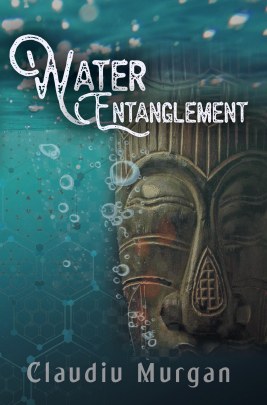
Adobe Photoshop PDFI recently attended Claudiu Murgan’s signing of his science fiction book Water Entanglement at Indigo in Yorkdale Mall and had a chance to ask him some questions about the book that intrigued me.

There are several reasons why I found Claudiu’s book particularly intriguing. Apart from the obvious fact that it has two of my favourite words in the title—Water and Entanglement—there were other intriguing aspects about Claudiu’s book, which takes place in near-future Toronto and features a limnologist as main protagonist.

My just finished novel—A Diary in the Age of Water—is also set in near-future Toronto and features a limnologist—which is what I am—as main protagonist. As we compared more and more notes, I had to laugh at how our two novels were also entangled!

Nina-Claudiu-Indigo2

Nina and Claudiu at Indigo

The time-period and the issues of both novels were very similar: growing tensions and politics surrounding a crisis of water scarcity in the 2050s and the continued short-sightedness of climate-denying politicians and corporate Earth. Both novels read like seamless slipstream between fiction and reality (mine is written partially as a memoir, which increases this experience); both explore humanity’s potential evolution linked to our relationship with an entity that remains as mysterious as it is common and life-giving. An entity that most indigenous peoples call alive.

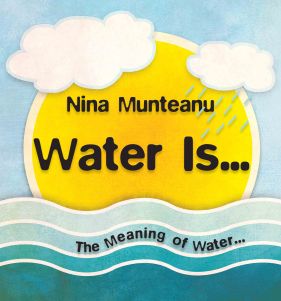
Both Claudiu and I embrace concepts of controversial metaphysical characteristics of water. I wrote about much of this in my book Water Is…The Meaning of Water, which Claudiu references in his novel. “Memory”, quantum coherence, the liquid-crystal state, and polarity express through water’s over 70 anomalous properties: phase, density, thermodynamic, material and physical anomalous properties that include adhesion, cohesion, high specific heat, thermal density, viscosity, and surface tension—just to name some.Water Is-COVER-web

“Water is the most extraordinary substance. Practically all its properties are anomalous,” writes Nobel laureate and physiologist Albert Szent-Gyorgyi.

Water Entanglement’s book jacket blurb provides an intriguing premise:

Adobe Photoshop PDF“…Since the creation of Earth, water and crystals have woven their paths into a billion-year-long tapestry that has captured the cycles of nature’s evolution. They have observed the appearance of humans and their troubled, but fascinating development, and the energies and vibrations of everything that is part of this amazing eco-system . . . In 2055 water activists fight against irresponsible corporations that pillage the Earth. Hayyin, the hidden identity of Cherry Mortinger, a limnologist, leads the movement. Will she be able to prove that water has memory and is alive and that we could awaken to the possibility of facing a fierce battle against the primordial element that gave us life: WATER?”


INTERVIEW

Nina:  What inspired you to write Water Entanglement and why did you set it in Toronto in the near-future?

Claudiu: At the end of the TV interview I gave back in September 2017 when I launched my first novel, The Decadence of Our Souls, the host asked me about my next project. I had an impulse to say that I’m going to write about water. At that time I had no idea about the potential plot and how powerful the message would be. I also think that spending time with you, Nina, and reading Water Is… influenced my subconscious. The Matrix is choosing several authors that are allowed to flow the right messages about water and create the critical point of awareness. I personally know a handful of them that write about water from a deeper level of understanding.

Why Toronto? Because I would like to see Toronto make a firmer stand on various issues that are not ‘politically correct’. The city’s multi-cultural background has created the notion of niceness about us, which is good to have; but at the same time, we can’t allow the big corporations to dictate how to use Canadian fresh-water resources. If the book is read by the right people, then they might get an idea of what could be done.


Nina:  Who should read Water Entanglement and why?

Claudiu: I like to believe that WE is a manifesto written as a Sci-Fi novel. A teenager will find things about water that are not taught in school; properties of water that science can’t deny anymore, but also can’t explain. A Sci-Fi reader will enjoy the geo-political scenarios I imagined along with the fact that water is becoming an active participant in the story, a character that is elusive, unpredictable and creates so much havoc. For an environmentalist and for a water activist, reading about the length corporations are willing to go for a profit will only compell them to continue their fight against greed and disrespect for nature. I didn’t write the book with a specific age bracket in mind, nevertheless, there is a nugget of knowledge for any type of reader willing to accept that the way we treat water is wrong, and that access to clean, potable water is a human right, not a luxury.


Nina: Two of your main POV characters are scientists; one is a limnologist (a freshwater scientist) and another a neurosurgeon. Another character is a Cherokee chief; yet another a UN representative. How did you research your characters to realistically express them in your novel?

Claudiu: The more I write the better I get at doing research. And I have to admit how grateful I am for your advice on my first book, The Decadence of Our Souls, that have elephants as main characters. You said: read more about elephants. So I did. I went to the library and borrowed thirteen books about elephants. For WE I read several books on water, but also interacted with you, Nina, a limnologist, helped me see the world from your point of view. As for my other characters, I had the chance to visit UN HQ and interact with some policy makers. In WE there is less red tape and the UN representative has some liberty when making decisions, ignoring some of the political clutches that currently strangle any decent decision with worldwide implications.


Nina: Your protagonist disguises her subversive activist identity beneath a masked being called Hayyin. Hayyin is an Islamic name that means “without obstacles”, “lenient” or “forgiving.” What was your intention in this name and does it play a role in the theme of your book?

Claudiu: I searched for the word water in Aramaic, which is Jesus’s tribe language. There are historic records that mention Aramaic as being the primordial language. Hayyin, the water activist, had to represent a symbol powerful enough to ignite in his followers the desire to fight for water. We all like to identify ourselves with a symbol that is worth fighting or dying for. Without enough water to sustain our growing population, humanity will fade away in a matter of centuries or less, so I thought that a symbol attached to a hidden identity makes the plot more interesting.


Nina: You cover several subjects of hard—and controversial—science in this book (e.g., homeopathy, epitaxy, polywater, etc.). How did you balance these to create a plausible reality in your novel? What did you have to consider?

Claudiu: I’m not a scientist. As an author I took the liberty of pushing the limits of what is known about water. I consider my research based on data that doesn’t need peer-review validation. I trust the scientists and the authors listed under the bibliography page at the end of the book. There are so many intangible things that touch us daily and most of us are not willing to accept them. The way water behaves in Water Entanglement is an intangible concept for ‘non-believers’ … until it happens. Along with a friend scientist, I’m planning to challenge students to start experiments involving water. They have to engage with their surroundings, ask questions and get their own results.


Nina: A pivotal aspect of your story hinges on the concept of structured water and intention. Can you share a little about it?

Claudiu: When doing my research I learned things about water that I couldn’t believe, but finding the same information from multiple sources convinced me that there is truth to it. I’m a strong believer now that water absorbs our intentions, our thoughts, carries them further until the next ‘shore’. Water that was blessed heals people or sickens them if water transports negative energies and harmful thoughts. Our body cells float in structured water and if the quality / properties of such liquid would be able to be maintained, well … we could live forever.


Nina: the tagline for Water Entanglement challenges: “When will we understand that water has memory, water is alive and the time for her to awaken is NOW?” Your book paints a compelling and terrifying awakening: edible seaweeds turning toxic; sacred rivers losing their healing properties; springs diurnally retreating; raging sinkholes, water turning thick. Tell us a little about these choices for water’s reactions.

Claudiu: What characterizes us as human beings is that we don’t take any potential catastrophic event seriously unless it happens. We would rather deal with the repercussions than prevent the cause. See the levies that broke because of the force of Katrina. The government was well aware of what could happen, but invoked lack of funds. In truth it was lack of government will, the political infighting that is common these days.

In WE I had to give water a radical behavior. Water has intuition and she knows human beings so well. She can predict any of our actions and there is no solution other than offering ‘peace’ – a selfless conduct.


Nina: Your book showcases some of the major challenges humanity faces in how we treat water—scarcity, contamination, diversion, commodification and misappropriation through disrespect of water and Nature, generally. There is an obvious need to alter how we treat water and this must ultimately arise from attitude and knowledge. How do you see us changing our attitude to water when most of us live in cities and don’t even know—or care—where our water comes from or what watershed we live in?

Claudiu: Changing attitude could be a generational approach. To become part of the education at all stages from kindergarten to university. We hear in the news that in Las Vegas the fountains and watering the lawns have been banned. In Africa children and their mothers walk kilometers daily to gather water for drinking and cooking; most of the time it is polluted water. Again, the leaders lack the determination to impose stricter rules or allow technologies that could replace some of the daily activities that require water. Over the years, politicians have enforced the idea that any decision of significance has to go through a lengthy process. It shouldn’t be that way if the greater good is paramount and not petty, personal interest.


Nina:  Your novel touches on global economic and military pressures by corporations and governments in aggressive water acquisition. In your novel this occurs mostly via American interests overseas. Closer to home, Maude Barlow of the Council of Canadians tells us that water abundance in Canada is a myth and we are too complacent. Her recent book Boiling Point exposes Canada’s long-outdated water regulations, unprotected groundwater reserves, agricultural pollution, industrial waste dumping, water advisories and effects of deforestation and climate change. As stewards of 20% of the world’s freshwater, our precious water is being coveted by many entities—from corporations to governments—and holding our own will be a tricky balancing act. What do you think is Canada’s main challenge in keeping its water protected?

Claudiu: Yes, in my book I mention that we are down to 13% of world’s freshwater resources. I also mention that only smart policy could keep the sharks away. We are not a third-world, tiny, easy-to-intimidate country. We should stand our ground and push back on any such attempt. The government should protect both private and public freshwater sources and even offer support regardless of ownership.


Nina: Your book touches upon corrupt government officials and corporate CEOs in terms of water issues. Various anonymous organizations such as WikiLeaks, Anonymous Group, and individuals—including your main character who uses a mask to maintain her anonymity—play a major role as activists in your book. Do you see this as the most effective way to expose wrongdoing and affect change?

Claudiu: It was already proven that revelations through WikiLeaks have affected the political environment, revealing corruption at high levels of government, secret documents mishandling, transaction from which a handful of people benefited, etc. As far as I know no one has dug deeper into these documents for nuggets of shady deals about commodities such as water (as water is considered a commodity to lessen her important role in our lives). But they are happening in the shadows, overseen by easily bribed politicians that only find happiness in short-term gratification. Hacking corporations that claim they are responsible when it comes to environment and human health, is a civic duty. It reveals the gangrene that affects our world.


Nina: In your novel, you created Water For All (WFA) as a global NGO organization devoted to protecting water by exposing heinous wrongdoings and helping to correct them by helping to pass legislature; what do you see as the largest challenges faced by NGOs today?

Claudiu: In my opinion the water movement is fractured in too many pieces. They all want to do good, but there is no scalability to their initiatives. Funding is somehow scarce and not enough to have a significant impact when divided among so many entities. In Water Entanglement I put forward two concepts that might solve this issue. First, WFA is the unique entity that consolidates as many of the water activists and water-related organizations as possible. So funding for selected projects comes from one source. Second, there is a worldwide strategy addressing sensitive areas and the source of pollution is addressed first. Leaders should come together for such a noble goal, give up their egos and create the critical mass that can overpower the influence of the multi-nationals in the water industry.


Nina: Your novel invokes Mother Nature and repeats the Indigenous peoples’ tautology “protect your mother.” You reiterate that for most Aboriginal nations, women are considered the “Water Keepers.” Your main characters—mostly activists—are women. Your main character, Cherry, is a limnologist and water activist; Romana is the UNWater chair; Ilanda is an enlightened neurosurgeon experimenting with crystal technology to help raise awareness and cognition (her husband runs Vivus Water Inc. that uses desalinization plants to further secure their water business). You also reiterate that water carries a female gender as Chief Landing Eagle says: “Fear the day when water remembers what we have done to her.” Do you see a significant role for women in changing how we view and treat water in the world?

Claudiu: Women in general are more empathic and it is a known fact that a world dominated by a matriarch society is a peaceful one. Seems that women care more about the life they nurture inside them for nine months. They are less egotistic and more willing to forgive. It’s an attitude water needs to survive the ordeal we are putting her through. We need more women as decision makers when it comes to water usage and water preservation. It might be easier for a woman to find and keep the balance on the right side of the thin line we are walking as a species. Crossing it could mean the end of the world.


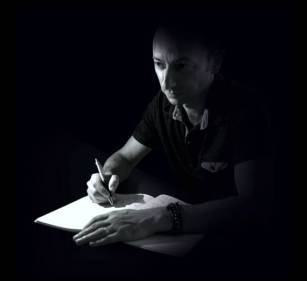
claudiu murganClaudiu Murgan was born in Romania and has called Canada his home since 1997. He started writing science fiction when he was 11 years old. Since then he met remarkable writers who helped him improve his own trade. His first novel, The Decadence of Our Souls highlights his belief in a potentially better world if the meanings of Love, Gratitude and Empathy could be understood by all of our brothers and sisters. www.ClaudiuMurgan.com.


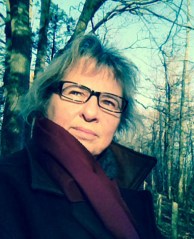
Nina MunteanuNina Munteanu is an ecologist, limnologist and internationally published author of award-nominated speculative novels, short stories and non-fiction. She is co-editor of Europa SF and currently teaches writing courses at George Brown College and the University of Toronto. Visit www.ninamunteanu.ca for the latest on her books.

Nina Munteanu Interviewed by Simon Rose on Fantasy Fiction Focus

On Fantasy Fiction Focus Nina Munteanu discusses with author Simon Rose about the writing process, the emerging hybrid publishing industry, the importance of branding yourself as an author, and what can authors do to successfully market themselves and their writing. She and Simon discuss the writing community and the importance of conventions and festivals for aspiring writers.

The interview was done in 2015 but what Simon and Nina discuss remains topical and germane.

Nina Munteanu

Nina Munteanu is an ecologist, limnologist and internationally published author of award-nominated speculative novels, short stories and non-fiction. She is co-editor of Europa SF and currently teaches writing courses at George Brown College and the University of Toronto. Visit www.ninamunteanu.ca for the latest on her books.

My Writing Retreat in Niagara-on-the-Lake

Ravine-house

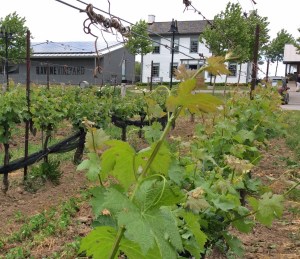
Ravine Vineyard Estate Winery

When I’m not teaching writing at UofT in Toronto, I’m often writing at home. And if I’m not writing at home, I’m often traveling to where I will write. You get the picture: I’m a writer. My website mantra reads: “I live to write; I write to live.”

I’m always looking for great places to write, to synthesize observations and experiences for an article or to plot my next novel. As writers, we are constantly studying the nature of our surroundings, how people interact, what they do, how events affect us and more. Writing is as much about experiencing life as writing about it. But we need both to flourish: something to write about and a place to write about it.

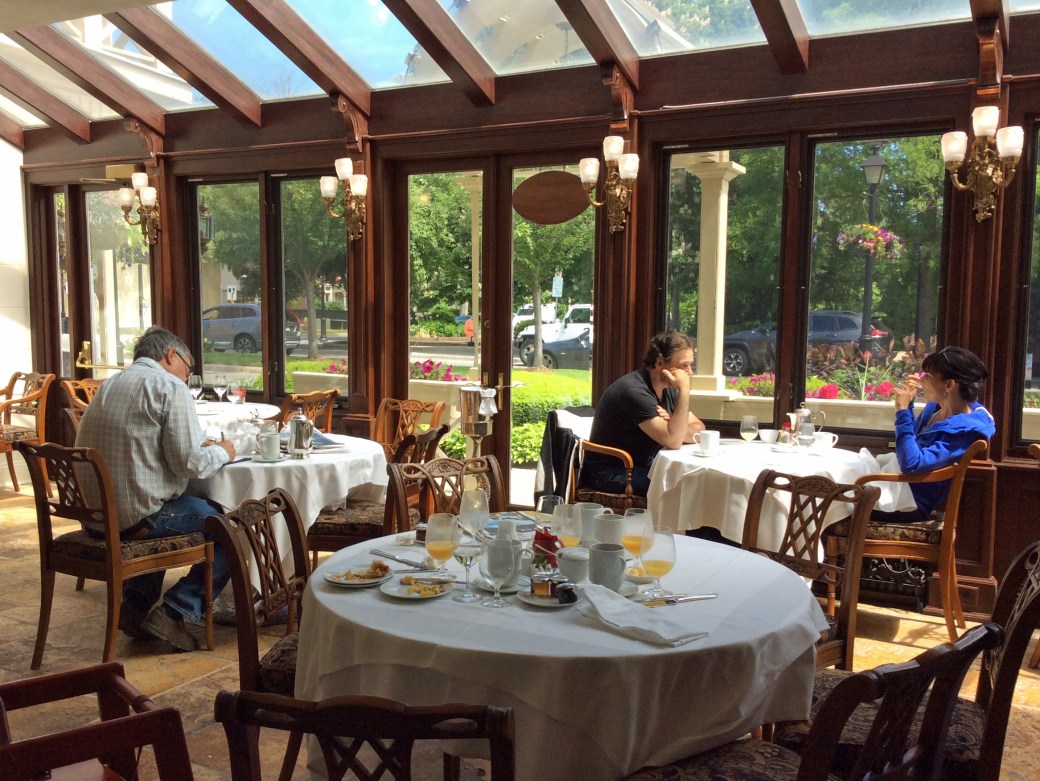
Breakfast Room

Noble Restaurant, Prince of Wales Hotel

Horse carriage01

Horse and carriage on King Street

Recently a good friend of mine lured me out of town on a trip to Niagara-on-the-Lake. She didn’t blink an eye when I grabbed my computer and happily accompanied her on our wonderful adventure. We started at the Prince of Wales Hotel, named in honour of the 1901 visit of the Duke and Duchess of York, who were later crowned King George V and Queen Mary.

FredGamula

Fred Gamula

We got there just in time for supper in the elegant and panoramic Noble restaurant. Of course, we had to order the divine “Grand Hotel Tasting Menu”, a four-course meal, paired with several fine wines. Sommelier Fred Gamula guided us through the “Grand Hotel Tasting Menu” of crisp romaine hearts, grilled chili marinated quail, pan seared trout and Grand Hotel Opera cake. Each course was paired with a wine that brought out the best in each; from an Inniskillin Chardonnay Reserve to a Flat Rock Twisted, to a Cave Spring Gamay and finally a Taylor Fladgate port. Gamula and I got into a diverting conversation about looking after the environment and water (I later gave him a copy of my book “Water Is…”).

PrinceOfWales-patio

Patio of Prince of Wales Hotel

Gamula grew up on a small fruit farm in Niagara-on-the-Lake and has seen some changes in the area due to development. Some not so good. We agreed that the trick is to embrace influx while preserving the very reason for that influx—to enjoy and preserve the wonderful country, vineyards and wineries in the area.

I found a wonderful place to write on the Churchill Room patio facing King Street, where the horses and carriages waited for customers. As the sun set, I drank my Campari and orange juice and wrote my novel to the cheerful sounds of birds, rustling trees and exploring people.

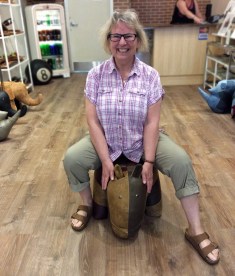
Nina-ottoman store

Nina and her favourite hippo

The next morning we wandered Queen Street before heading out to explore wine country. Curious about Reiner’s window display, I wandered into what I thought was a leather shop—expecting the usual fare such as purses, satchels, belts and the like; but it turned out to be a speciality leather ottoman store.

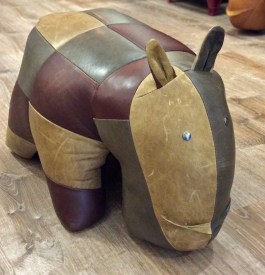
HippoOttomanThese weren’t ordinary ottomans—they were all animals! Hippos, bears, moose, elephants and pigs stood on stout legs, begging for a nice home to live in.

The store is named after leather crafter Reiner Henneveld who came to Canada in 1950 from Germany and created his first animal-shaped ottoman in the shape of a pig—after his pet pig, Wilbur. Reiner’s two sons have taken up the craft with a commitment to individual design and workmanship that includes hand sewing, cutting and stuffing and using the finest upholstery leather. I found them comfortable and very attractive.

wayne-gretzky-whisky

Wayne Gretzky with his “99”

After lunch we visited old favourites and explored new vineyards and wineries. Wayne Gretzky Estates recently opened its winery and distillery on Old Stone Road. The estate is getting known for its No. 99 Red Cask Canadian Whisky; “the same soils that produce great grapes also grow grains that are used to produce whisky,” they write. The whisky is made in small batches from rye, malted rye and corn that has been individually mashed, fermented and distilled. After aging, the whisky is finished with red wine casks from the Wayne Gretzky winery.

IMG_0865

General store of Ravine Vineyard Estate Winery

PorkWithSangria

Pork chop, sea-salted bread and Sangria at the Ravine restaurant

The Ravine Vineyard Estate Winery is an old haunt for its charming and diversely stocked general store and its rustic-style restaurant with imaginative and surprising menus. Both inside and outside seating offer vistas of undulating countryside and the sounds of a working vineyard. Another great place to write!

Ravine-birdhouses

A sparrow sings his heart out on his very own house in Ravine vineyard

Ravine-chickens

Free range chickens roam the vineyard at Ravine

I’m half-inclined to shift over to writing a murder-mystery series about a young recent George Brown graduate who comes to Niagara-on-the-Lake to work as a Sommelier in one of the hotels—only to find intrigue and—of course—a murder to solve. What do you think?…


nina-2014aaa

Nina Munteanu is an ecologist, limnologist and internationally published author of award-nominated speculative novels, short stories and non-fiction. She is co-editor of Europa SF and currently teaches writing courses at George Brown College and the University of Toronto. Visit www.ninamunteanu.ca for the latest on her books.


On Being a Canadian Writer in the Age of Water

Canada is the only country in the world that knows how to live without an identity.”—Marshal McLuhan 

nina-child01

Nina  “reading” in Granby, Quebec

I was born some sixty+ years ago, in the small town of Granby in the Eastern Townships to German-Romanian parents. Besides its zoo—which my brother, sister and I used to visit to collect bottles for a finder’s fee at the local treat shop—the town had no particular features. It typified French-Canada of that era. So did I. I went to school in Quebec then migrated across to the west coast to practice and teach limnology. Given that Canada holds at any one time a fifth of the Earth’s freshwater, that also made sense.

Canada is a vast country with a climate and environment that spans from the boreal forests of the Canadian Shield, muskegs of northern BC, and tundras of the Arctic Circle to the grasslands of the Prairies and southern woodlands of Ontario and Quebec. Canada’s environment is vast and diverse. Like its people.     

Ecologist vs Nationalist

Ecology is the study of “home” (oikos means ‘home’ in Greek). Ecology studies the relationships that make one’s home functional. It is, in my opinion, the most holistic and natural way to assess where we live. My home is currently Toronto, Ontario, Canada and ultimately the planet Earth.

Country_road_Stephane_Lemire

The Eastern Townships in autumn are a cornucopia of festive colours.

Growing up in the Eastern Townships of Quebec, I’d always felt an abiding sense of belonging and I resonated with Canada’s national symbols—mostly based on Nature and found on our currency, our flag, and various sovereign images: the loon, the beaver, the maple tree, our mountains and lakes and boreal forests. Why not? Canadians are custodians of a quarter of the world’s wetlands, longest river systems and most expansive lakes. Most of us recognize this; many of us live, play and work in or near these natural environments.

I have long considered myself a global citizen with no political ties. I saw my country through the lens of an ecologist—I assessed my community and my surroundings in terms of ecosystems that supported all life, not just humanity. Was a community looking after its trees? Was my family recycling? Was a corporation using ‘green’ technology? Was a municipality daylighting its streams and recognizing important riparian zones? I joined environmental movements when I was a teenager. I shifted my studies from art to science because I wanted to make a difference in how we treated our environment. After university, I joined an environmental consulting firm, hoping to educate corporations and individuals as environmental stewards. I brought that philosophy into a teaching career and began writing eco-fiction, science fiction and essays to help promote an awareness and a connection with our natural world. My hope was to illuminate how important Nature and water is to our planet and to our own well-being through an understanding of ecology and how everything is interconnected.

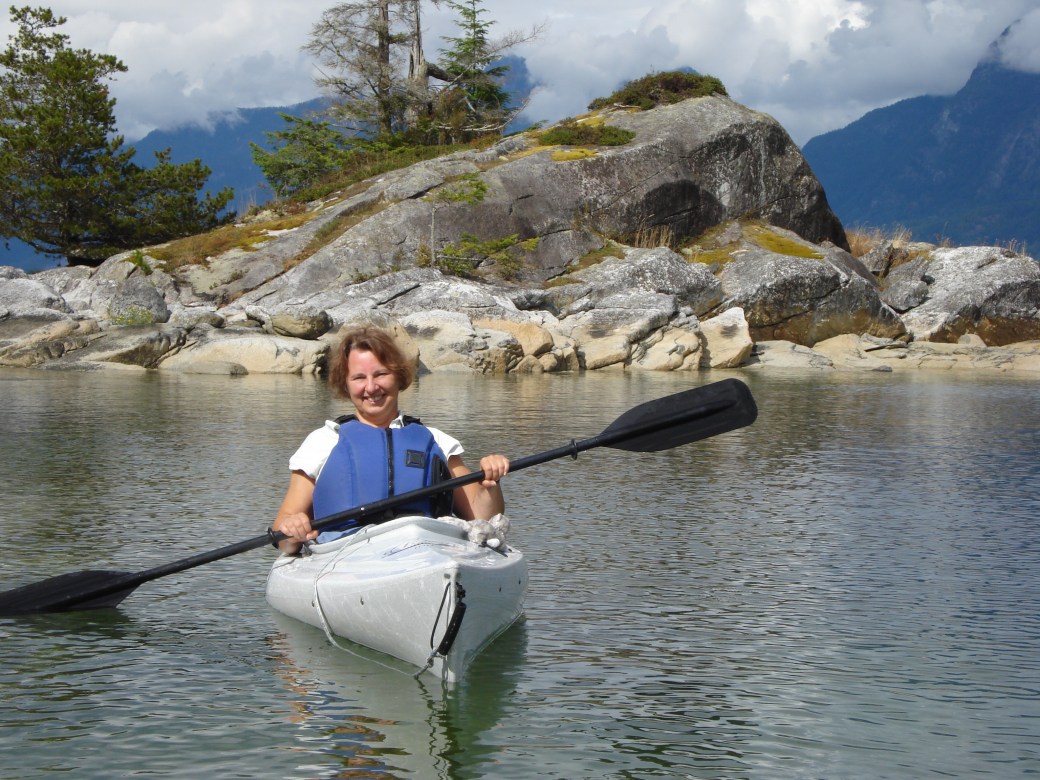
US-tour and Desolation Sound 260 copy

Nina kayaking Desolation Sound in British Columbia

When I think of Canada, I think of my “home”, where I live; my community and my environment. I have traveled the world and I feel a strong sense of “home” and belonging every time I return. Canada is my home. I was born and grew up in Quebec. I lived in British Columbia, Ontario, and Nova Scotia; each of these places engendered a feeling of “home”.

lunenburg-keel-laying

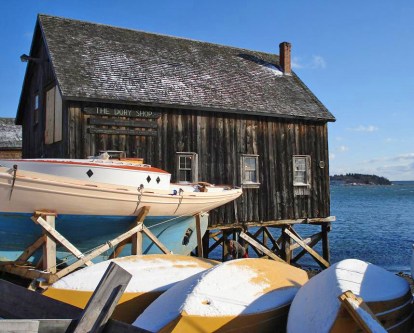
The Dory Shop in Lunenburg, Nova Scotia

I think that part of being a Canadian is related to this sense of belonging (and pride) in a country that is not tied to some core political identity or melting-pot mainstream.

Historian and writer Charlotte Gray wrote:

“we live in a country that has a weak national culture and strong regional identities …Two brands of psychological glue bind Canada together: political culture and love of landscape…[in] a loose federation perched on a magnificent and inhospitable landscape—[we are] a nation that sees survival as a collective enterprise.”—Charlotte Gray

barkerville marsh 9

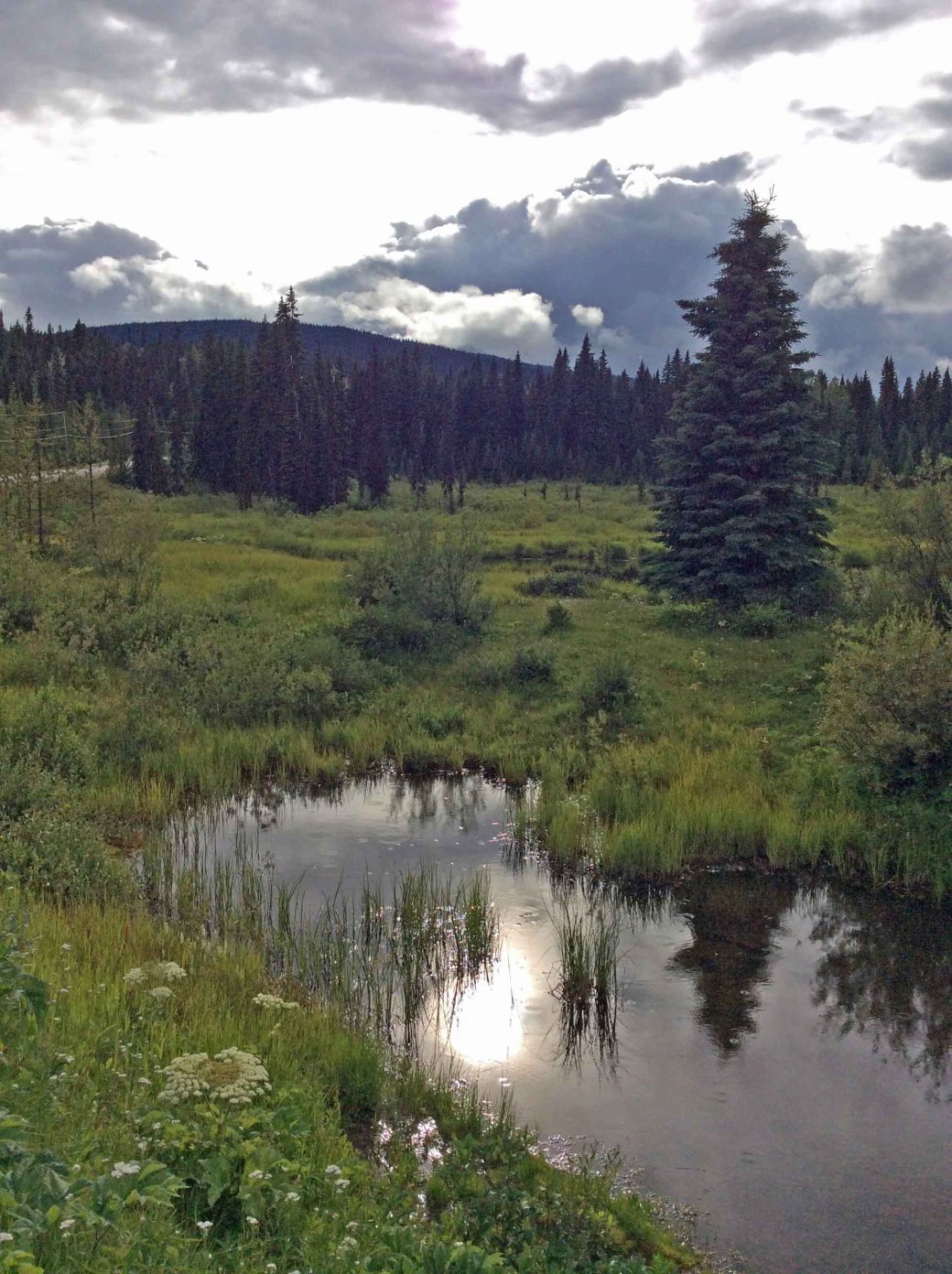
Marsh near Barkerville, BC (photo by Nina Munteanu)

Canada as Postnational State

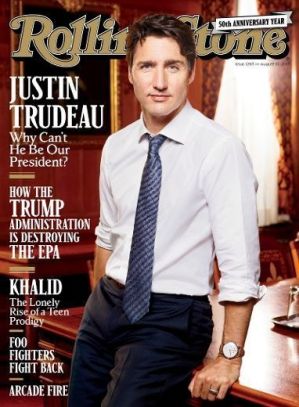
In October 2015, Canada’s Prime Minister Justin Trudeau told the New York Times that Canada may be the “first postnational state,” adding that “there is no core identity, no mainstream in Canada.” This is largely because Canadians, writes Charles Forman in the Guardian, are “philosophically predisposed to an openness that others find bewildering, even reckless.”

Trudeau-RollingStoneTo anyone but a Canadian, Trudeau’s remark would rankle, particularly in a time when many western countries are fearfully and angrily turning against immigration through nativism and exclusionary narratives. A time when the United States elected an authoritarian intent on making “America great again” by building walls. A time when populist right-wing political parties hostile to diversity are gaining momentum in other parts of the world. “Canada’s almost cheerful commitment to inclusion might at first appear almost naive,” writes Forman. It isn’t, he adds. There are practical reasons for keeping our doors open.

We are who we are because of what we are: a vast country the size of Europe. A country dominated by boreal forest, a vital and diverse wilderness that helps maintain the well-being of our entire planet. A land that encompasses over a fifth of the freshwater in the world, and a quarter of the world’s wetlands. Canadians are ultimately the world’s Natural stewards. That is who and what we are.

Eramosa River 3

Eramosa River, Ontario (photo by Nina Munteanu)

According to Forman, postnationalism frames how “to understand our ongoing experiment in filling a vast yet unified geographic space with the diversity of the world” and a “half-century old intellectual project, born of the country’s awakening from colonial slumber.” As the first Europeans arrived in North America, the Indigenous people welcomed them, taught them how to survive and thrive amid multiple identities and allegiances, writes Forman. “That welcome was often betrayed, particularly in the 19th and 20th centuries, when settlers did profound harm to Indigenous people.” But, says Forman, if the imbalance remains, so does the influence: a model of another way of belonging. One I think many Canadians are embracing. We are learning from the natural wisdom of our Indigenous peoples. Even our fiction reflects how we value our environment and embrace diversity. “Diversity fuels, not undermines, prosperity,” writes Forman.

As efforts are made to reconcile the previous wrongs to Indigenous peoples within Canada and as empowering stories about environment are created and shared, Canada carries on the open and welcoming nature of our Indigenous peoples in encouraging immigration. In 2016, the same year the American government announced a ban on refugees, Canada took in 300,000 immigrants, which included 48,000 refuges. Canada encourages citizenship and around 85% of permanent residents typically become citizens. Greater Toronto is currently the most diverse city in the world; half of its residents were born outside the country. Vancouver, Calgary, Ottawa and Montreal are not far behind.

kevin-nina-close

Mom and son explore BC wilderness

Canadian author and visionary Marshal McLuhan wrote in 1963 that, “Canada is the only country in the world that knows how to live without an identity.” This is an incredible accomplishment, particularly given our own colonial history and the current jingoistic influence of the behemoth south of us.

Writer and essayist Ralston Saul suggests that Canada has taken to heart the Indigenous concept of ‘welcome’ to provide,

“Space for multiple identities and multiple loyalties…[based on] an idea of belonging which is comfortable with contradictions.”

Of this Forman writes: “According to poet and scholar BW Powe, McLuhan saw in Canada the raw materials for a dynamic new conception of nationhood, one unshackled from the state’s ‘demarcated borderlines and walls, its connection to blood and soil,’ its obsession with ‘cohesion based on a melting pot, on nativist fervor, the idea of the promised land’. Instead, the weakness of the established Canadian identity encouraged a plurality of them—not to mention a healthy flexibility and receptivity to change. Once Canada moved away from privileging denizens of the former empire to practicing multiculturalism, it could become a place where ‘many faiths and histories and visions would co-exist.”

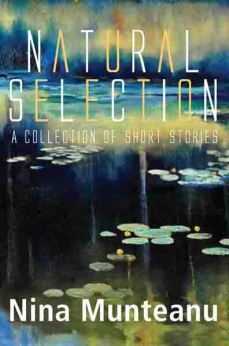
NaturalSelection-front-webAnd that’s exactly what is happening. We are not a “melting pot” stew of mashed up cultures absorbed into a greater homogeneity of nationalism, no longer recognizable for their unique qualities. Canada isn’t trying to “make Canada great again.”

Canada is a true multi-cultural nation that celebrates its diversity: the wholes that make up the wholes.

Confident and comfortable with our ‘incomplete identity’—recognizing it for what it is—is according to Forman, “a positive, a spur to move forward without spilling blood, to keep thinking and evolving—perhaps, in the end, simply to respond to newness without fear.”

This resonates with me as an ecologist. What I envision is a Canada transcending the political to embrace the environment that both defines us and provides us with our very lives; a view that knows no boundaries, and recognizes the importance of diversity, relationship and inclusion, interaction, movement, and discovery.

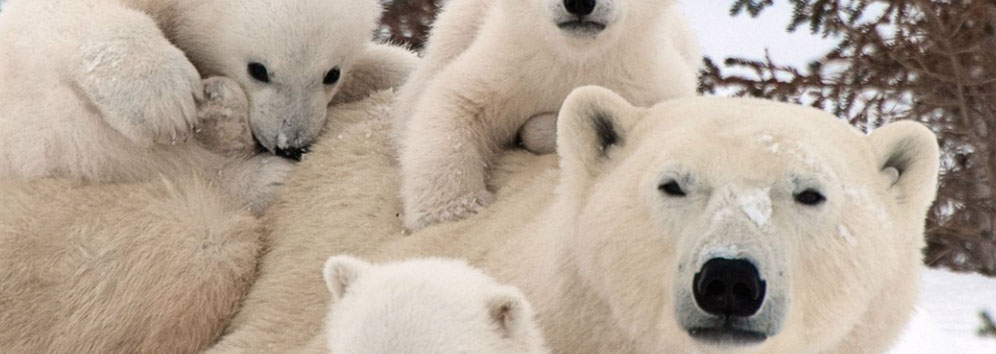
So, am I proud of Canada? Definitely. We have much to be proud of. Canada is the 8th highest ranking nation in the Human Development Index. Canada ranks among the highest in international measurements of government transparency, civil liberties, quality of life, economic freedom, and education. It stands among the world’s most educated countries—ranking first worldwide in the number of adults having tertiary education with 51% of adults holding at least an undergraduate college or university degree. With two official languages, Canada practices an open cultural pluralism toward creating a cultural mosaic of racial, religious and cultural practices. Canada’s symbols are influenced by natural, historical and Aboriginal sources. Prominent symbols include the maple leaf, the beaver, Canada Goose, Common Loon, the Royal Canadian Mounted Police, the polar bear, the totem pole, and Inuksuk.

PolarBearMum-pups

Water Is-COVER-webWe are a northern country with a healthy awareness of our environment—our weather, climate and natural world. This awareness—particularly of climate change—is more and more being reflected in our literature—from Margaret Atwood’s “Maddaddam” trilogy and Kim Stanley Robinson’s “2041” to my short story collection “Natural Selection” and non-fiction book Water Is… .

Water AnthologyCanadians are writing more eco-fiction, climate fiction, and fiction in which environment somehow plays a key role.

Water has become one of those key players: I recently was editor of the Reality Skimming Press anthology “Water”, a collection of six speculative Canadian stories that optimistically explore near-future scenarios with water as principle agent.

The Way of Water-COVERMy short story “The Way of Water” is a near-future vision of Canada that explores the nuances of corporate and government corruption and deceit together with resource warfare.

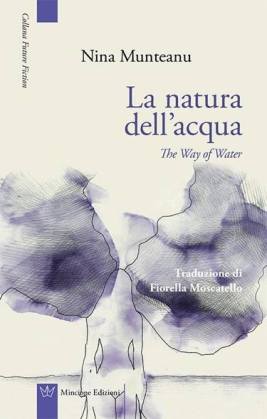
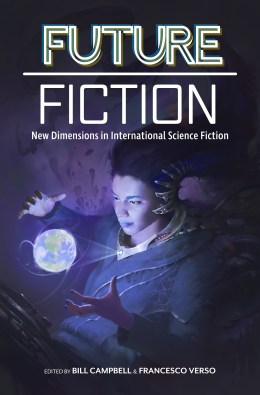
First published as a bilingual print book by Mincione Edizioni (Rome)  (“La natura dell’acqua”), the short story also appears in several anthologies including Exile EditionsCli Fi: Canadian Tales of Climate Change” and “Future Fiction: New Dimensions in International Science Fiction“.  My upcoming “A Diary in the Age of Water” continues the story.

Adobe Photoshop PDFCanadian writer and good friend Claudiu Murgan recently released his book “Water Entanglement“, which also addresses a near-future Canada premise in which water plays a major role.

In a recent interview with Mary Woodbury on Eco-Fiction, I reflected on a trend over the years that I noticed in the science fiction writing course I teach at George Brown College: “It’s a workshop-style course I teach and students are encouraged to bring in their current work in progress. More and more students are bringing in a WIP with strong ecological overtones. I’d say the percentage now is over 70%. This is definitely coming from the students—it’s before I even open my mouth about ecology and eco-fiction—and what it suggests to me is that the welfare of our planet and our ecosystems is on many people’s minds and this is coming through in our most metaphoric writing: science fiction.”

It is healthy to celebrate our accomplishments while remembering where we came from and what we still need to accomplish. This provides direction and motivation.

tree water deer lake

Deer Lake, BC (photo by Nina Munteanu)

Canadians are custodians of a quarter of the world’s wetlands, longest river systems and most expansive lakes. Canada is all about water… And so are we.

We are water; what we do to water we do to ourselves.

Happy Canada Day!


References:

Dechene, Paul. 2015. “Sci-Fi Writers Discuss Climate Catastrophe: Nina Munteanu, Author of Darwin’s Paradox.” Prairie Dog, December 11, 2015.

Forman, Charles. 2017. “The Canada Experiment: Is this the World’s First Postnational Country?” The Guardian, January 4, 2017.

Gray, Charlotte. 2017. “Heroes and Symbols” The Globe and Mail.

Moorhouse, Emilie. 2018. “New ‘cli-fi’ anthology brings Canadian visions of future climate crisis.” National Observer, March 9, 2018.

Munteanu, Nina. 2016. “Crossing into the Ecotone to Write Meaningful Eco-Fiction.” In: NinaMunteanu.me, December 18, 2016.

Newman-Stille, Derek. 2017. “The Climate Around Eco-Fiction.” In: Speculating Canada, May 24, 2017.

Woodbury, Mary. 2016. “Part XV. Women Working in Nature and the Arts: Interview with Nina Munteanu, Ecologist and Author.” Eco-Fiction.com, October 31, 2016.

SONY DSC

Nina Munteanu on the Credit River, Ontario (photo by Merridy Cox)


nina-2014aaaNina Munteanu is an ecologist and internationally published author of award-nominated speculative novels, short stories and non-fiction. She is co-editor of Europa SF and currently teaches writing courses at George Brown College and the University of Toronto. Visit www.ninamunteanu.ca for the latest on her books. Nina’s recent book is the bilingual “La natura dell’acqua / The Way of Water” (Mincione Edizioni, Rome). Her latest “Water Is…” is currently an Amazon Bestseller and NY Times ‘year in reading’ choice of Margaret Atwood.
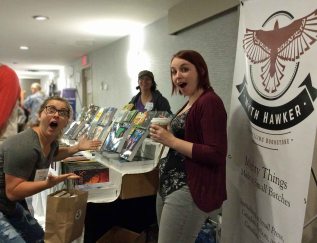
 

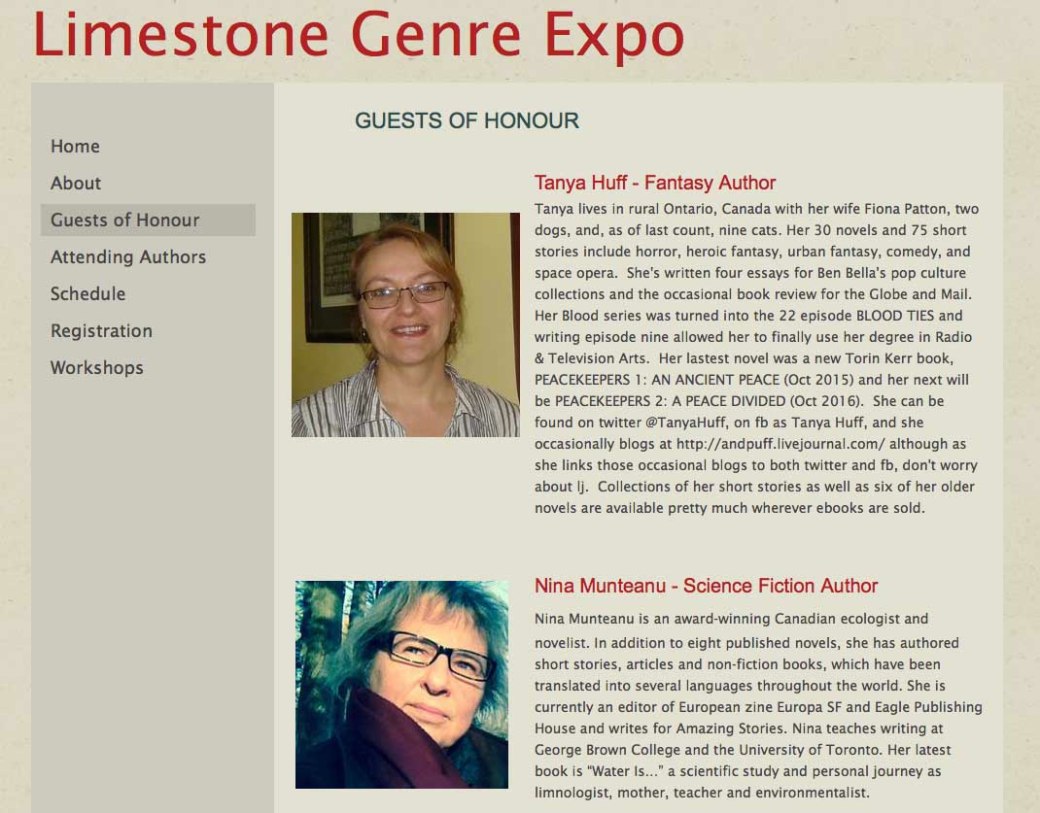
Limestone Genre Expo—May 2018

2018 was the fourth year for Limestone Genre Expo, Kingston’s only genre writing festival. I’ve been to the expo each year from its inaugural festival in 2015. The festival gets its name from the city’s moniker, based on the many heritage buildings constructed there using the local limestone.

In 2016 I was delighted to be the science fiction guest of honour. In 2017, the expo was held at the Saint Lawrence College campus.


Nina-SF GOH-Limestone Genre Expo 2016

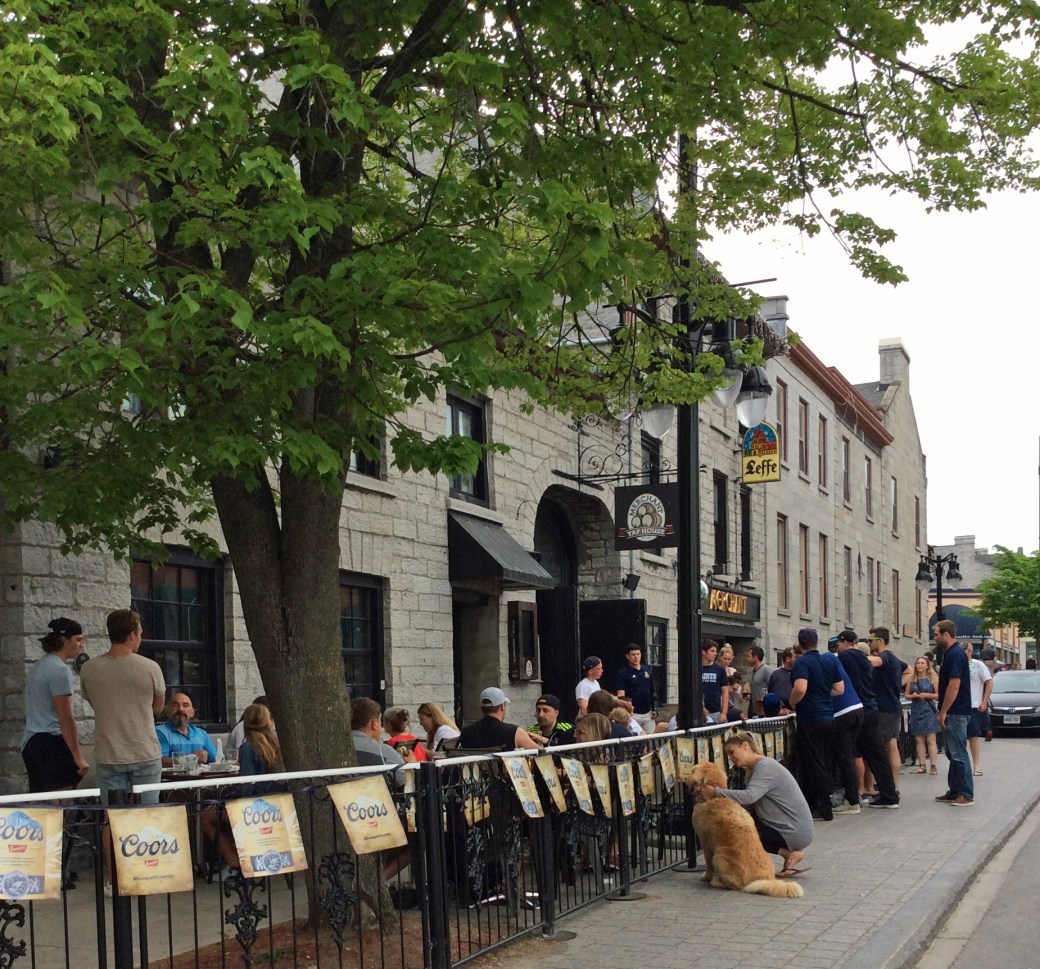
This year, the expo was held at the Holiday Inn, right on the waterfront and literally a staggering distance from the Merchant Tap House, one of the greatest pubs and eateries of the town.

MerchantTapHouse-Limestone2018

Merchant Tap House, Kingston (photo by Nina Munteanu)

As before, the festival covered several of the major genres such as fantasy, science fiction, horror, romance and mystery, with representation by well-known authors in each. Organizers offered a triple track program from 10 am to 5 pm that included panels, informative workshops, readings, book launches, and novel pitch sessions with Bundoran Press.

Liz Strange and programming organizers had me in several panels throughout the two-day expo.

Panels I participated in and in some cases moderated included:

“Mental Health Representation in Fiction: More than Villains” with Michael Slade, Therese Greenwood, Ada Hoffmann, Matt Moore and Madona Skaff. I really enjoyed this panel discussion that explored our evolving perception and representation of mental health in story and in our real lives.

Nina-MentalHealthPanel

Matt Moore, Nina Munteanu, Madona Skaff, Michael Slade, Theresa Greenwood (photo by Marlene Smith)

“Why Do We Love a Good Whodunit?” with Michael Slade, M. H. Callway, Katherine Prairie, Jim Napier, Melissa Yi, and Rosemary McCracken.  The panel and I had fun with this discussion as bizarre real-life stories were thrown into this mix.

Nina-Whodunit Panel

Katherine Prairie, Michael Slade, Melissa Yi, M.H. Callway, Rosemary McCracken, Nina Munteanu

“What Makes a Great Hero?” with Kate Heartfield, Tobin Elliott, Theresa Greenwood, Kris Jacen, Donna Warner, and Douglas Smith. The panel debated what makes a hero, then anti-hero, then sad and terrible hero, then non-hero…and ultimately to the journey of our at times miserable but great hero.

Nina-HeroPanel-LIMESTONE 2018

Douglas Smith, Theresa Greenwood, Nina Munteanu, Donna Warner, Tobin Elliott, Kate Heartfield

“Dystopian Fiction: How to write when the world is falling apart” with Una Verdandi, Robin Timmerman, Brad Baker, Tapanga Koe, Hayden Trenholm and Ursula Pflug. In this rather passionate discussion, we debated the state and shape of dystopia in both the real world and the fiction world and how they inevitably bleed together for the writer.

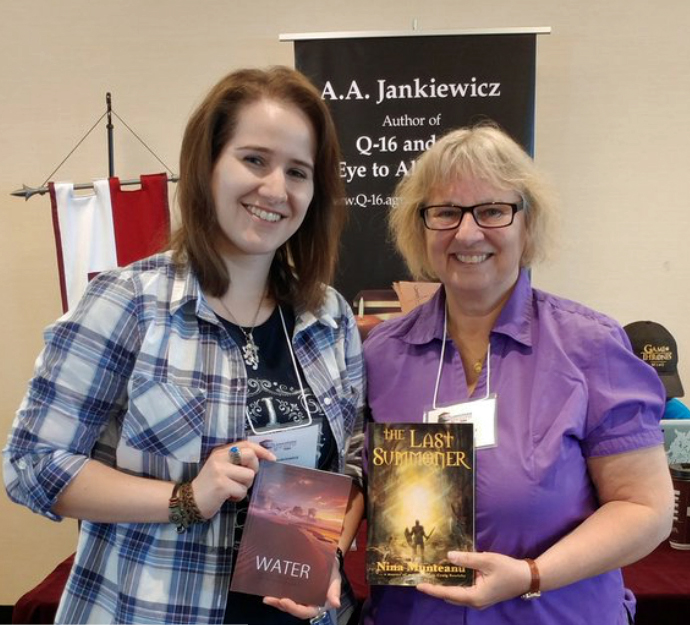
Nina-signingLastSummoner

Nina signs “The Last Summoner” for colleague and reader Agnes

“Women of Science Fiction” with Hayden Trenholm, Laura Baumbach, Ada Hoffmann, Tanya Huff, Tapanaga Koe, and Nancy Baker.  Hayden emerged amid his female colleagues to astutely discuss the reason we are still discussing this topic.

I also sold a number of books, including Water Is… (a Margaret Atwood favourite), my journal and fiction writing guidebooks (The Journal Writer and The Fiction Writer), Reality Skimming’s Water Anthology, for which I was editor, and The Last Summoner.

Nina-Agnes-LIMESTONE

authors Agnes Jankiewicz and Nina Munteanu

One of the key charms of this small venue is that it still provides an intimate setting for great networking. I had a chance to meet many of my old friends and to make new ones. Thanks to Liz, Marlene and wonderful volunteers for another great writing festival!


Nina Munteanu

Nina Munteanu is an ecologist, limnologist and internationally published author of award-nominated speculative novels, short stories and non-fiction. She is co-editor of Europa SF and currently teaches writing courses at George Brown College and the University of Toronto. Visit www.ninamunteanu.ca for the latest on her books.


“Absolutism” in the Time of Climate Change

AboutAbsolutism-webOnce upon a time, there will be one absolute ruler who we, the people, call the Supreme Leader (May He Rule Forever). The Supreme Leader will hate immigrants, writers, scientists, environment and extinct species. We, the people under his rule, will be proud to live in our pure and glorious Motherland. Because we’ll have little to eat, no entertainment, no self-respect, no freedom, no rights, and no access to the outside world, we’ll be happy.

This is the ridiculously sublime scenario that underlies Absolutism, the dystopian card game developed by science fiction author Costi Gurgu and game developer/designer Vali Gurgu about surviving dictatorship.

A week ago, I invited Costi to my science fiction writing class at George Brown College to share his experience in writing and releasing his recent book RecipeArium (now on the short list for an Aurora Award). Costi also brought his new game, Absolutism, based on his latest novel Servitude—a near future dystopia.

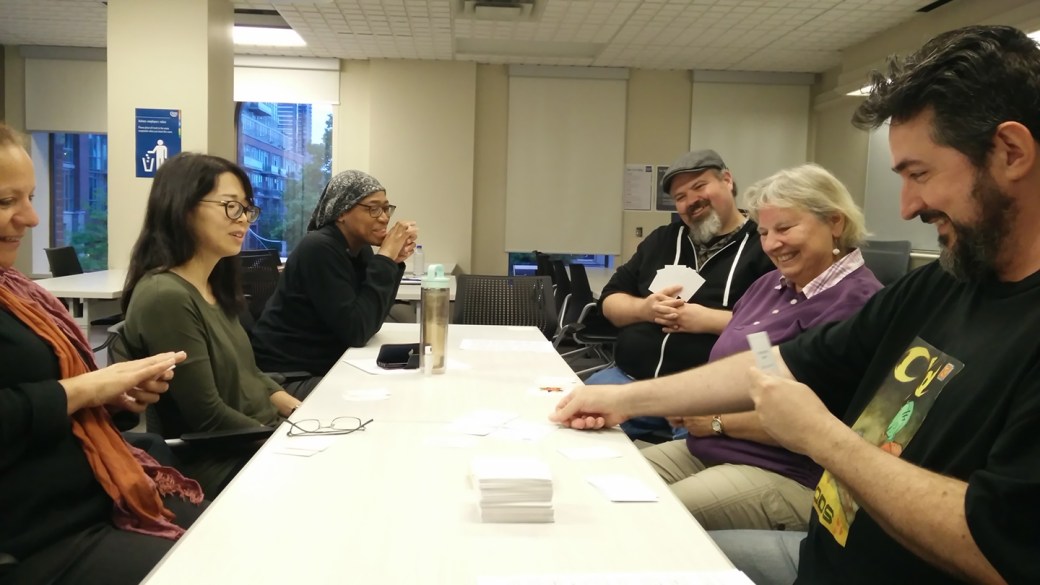
PlaytestGB2

Playing the game at George Brown

“Play unfathomable scenarios of daily life in a totalitarian society. A funny game for people without shame.”—Absolutism


Emerging Dictatorships & “Servitude”—the novel

Costi described how he and Vali came to develop the game: “Based on current global political trends, some could safely assume that in the next 5 to 10 years some present democracies will turn into dictatorships. In Europe for instance, one third of the European countries have nationalistic parties winning their elections—UK, Italy, Poland, Hungary, Slovakia. France and Germany came very close. The United States is slowly sliding into dictatorship. Russia and China are no longer communist countries, like North Korea, but they’re dictatorships. They opened their markets to international trades because they saw the wisdom in making profits, but that was as far as they went with the openness. They still rule their people with an iron fist.”

We are now 7.5 billion people on the planet. As climate change (the ultimate dictator) exacerbates tensions over the unbalanced resource scarcities of our over-populated world, fear-mongering and absolute control of the masses through nationalism, isolationism, trade-wars, etc. will logically follow.

Costi and Vali first conceived a card game entirely based on Costi’s dystopian novel Servitude. But, they soon discovered that the game was too grim.

PlaytestGB3

Life under a Dictatorship—Ceaușescu

Costi and Vali had experienced a dictatorship first hand. They’d grown up in Romania under Communist rule, first by Gheorghe Gheorghiu-Dej, then under the communist dictatorship of Nicolae Ceaușescu. The dictator ruled for over twenty years before a coup d’etat overthrew him in 1989. Ceaușescu had ordered his military to open fire on hundreds of protesters in Timișoara, setting off the Romanian Revolution and ultimately his own execution by firing squad.

Ceaușescu’s totalitarian regime is still considered one of the most repressive in Eastern Europe. His Securitate (secret police) controlled the population through mass surveillance; they enacted many human rights abuses, censorship and relocation, and suppression of the media and press. Political propaganda infected all forms of education, art, entertainment and media. Non-compliant intellectuals were punished, arrested, or simply disappeared.

Inspired by the personality cult surrounding Supreme Leader Kim Il-sung in North Korea, Ceaușescu started his own cult in the Eastern Bloc by imposing a severe nationalist ideology. His policy of economic collectivization destroyed an already fragile economy and oppressed culture. Under the communist regime, thousands of books and magazines were banned and removed from public libraries and schools; intellectuals’ links to the West were severed; long-standing professional organizations were dissolved; and intellectuals, writers, and teachers were imprisoned and put into labor camps.

In Ceaușescu’s Systematisation program of urban planning—based on North Korea’s Juche ideology—whole settlements were demolished and reconstructed in the image of the state.

Ceaușescu made contraception and abortion illegal under Decree 770, and created incentives for high numbers of births—his idea was to increase the country’s population from 22 million to 30 million by the end of the century. By 1977, Romanians were taxed for being childless in a country already unable to house and feed its children. Sadly, this led to an increasing number of orphans, the highest infant mortality rate in Europe and the deaths of thousands of women who attempted illegal abortions. Orphanages were neglected and developed appalling conditions—most were concrete barracks in slums where many children suffered from frostbite, malnutrition and abuse.


“Absolutism”—the game

“Humor is your main weapon in fighting the victorious party and its minions,” say Costi and Vali. “Humor is the one thing that gives people hope and keeps the mental sanity of the masses in the face of oppression.”

And so “Absolutism” was born—a game of twisted strategies, irony and chance. Costi shared that with this game those who have never experienced dictatorship will have a taste of what it is like; the game will also remind those who have escaped oppression by dictatorship what they left behind and why their current freedoms are so precious and important to maintain.

PlaytestGeorgeBrown

players absolutely succumb to the game…

“Maybe after playing Absolutism, people will see that Russia, China, and North Korea are not exceptions,” says Costi. They may realize that “absolutism is not something that can happen only there. It is already knocking on our door.”

Do you have what it takes to survive a totalitarian dictator with a twisted sense of humor? Or to be a successful dictator in the time of climate change?

Having played the game and lost—there is only one winner, of course—I can add that having a twisted sense of humor—is an absolute advantage in the game (along with an absolutely great set of bribe cards!). Thanks to my twisted humor, I was way ahead of everyone and well on my way to becoming the Absolute Ruler, when Costi charged in with a coup d’etat card and I lost all my cards; then the Secret Police rallied behind him and crushed any chance of subversive take over. Maybe next time…

“Absolutism” recently launched on Kickstarter and is still looking for pledges. Make a pledge and help make the game happen—we may never have a better chance at staring unscathed at the face of despotism.


nina-2014aaa

Nina Munteanu is an ecologist, limnologist and internationally published author of award-nominated speculative novels, short stories and non-fiction. She is co-editor of Europa SF and currently teaches writing courses at George Brown College and the University of Toronto. Visit www.ninamunteanu.ca for the latest on her books.

Nina Reads About Water at Oakville Literary Café in Joshua Creek Art Centre

House-road copy

Joshua Creek Art Centre (photo by Nina Munteanu)

In late May, I was invited to read from my short story “The Way of Water” and my recent book “Water Is…” at the Oakville Literary Café, held at the Joshua Creek Art Centre.


The Way of Water

“The Way of Water” has appeared in several collections and anthologies in Europe and North America and received praise from around the world, including: The National Observer, Prism International Magazine, Speculating Canada, SoloLibri in Italy, and most recently in Orson Scott Card’s The Intergalactic Medicine Show.

Lilac2-JoshuaCreekArtCentre

Joshua Creek Art Centre (photo by Nina Munteanu)

“The Chinese multinationals have exchanged the public debt of other states with their water reserves with which, now, they can control the climate, deciding when and where it will rain.Who understands this dirty game has been silenced, like Hilda’s mother, a limnologist, inexplicably arrested and never returned; like the daughter of two water vendors, mysteriously disappeared, after having decided not to bow to economic powers: Hanna, who now prefers secure virtual identities to evanescent real appearances. Water. The two, like the covalent bond of a complex molecule, develop a relationship of attraction and repulsion that will first make them meet and then, little by little, will change into a tormented love but, at the same time, so pure as to cause Hilda at great risk, to make an extreme decision that will allow Hanna to realize the strange prophecy that the internal voice, perhaps the consciousness of water, had resonated in the two women for a long time.” —Simone Casavecchia, SoloLibri.net

The Way of Water-COVERShe imagines its coolness gliding down her throat. Wet with a lingering aftertaste of fish and mud. She imagines its deep voice resonating through her in primal notes; echoes from when the dinosaurs quenched their throats in the Triassic swamps.

Water is a shape shifter.

It changes yet stays the same, shifting its face with the climate. It wanders the earth like a gypsy, stealing from where it is needed and giving whimsically where it isn’t wanted.

Dizzy and shivering in the blistering heat, Hilda shuffles forward with the snaking line of people in the dusty square in front of University College where her mother used to teach. The sun beats down, crawling on her skin like an insect. She’s been standing for an hour in the queue for the public water tap.

Exile-CanTales ClimateChange copyEmilie Moorhouse of Prism International wrote: “Soon after I finished reading the book, Cape Town—known in precolonial times as “the place where clouds gather”—announced that it was only a few months away from what it called “Day Zero,” the day the city would officially run out of water, making the similarities between fiction and reality more than unsettling. Munteanu’s story is set in a futuristic Canada that has been mined of all its water by thirsty corporations who have taken over control of the resource. Rain has not fallen on Canadian soil in years due to advances in geoengineering and weather manipulation preventing rain clouds from going anywhere north of the Canada-US border.”

“In ‘The Way of Water’, Nina Munteanu pens her love letter to water, exulting it as a liquid that has semi-magical properties…’The Way of Water’ evokes a sense of awareness about issues of access to water and about the dangers of imbalances in that access.”—Derek Newman-Stille, Speculating Canada

FF - Rosarium Cover copy“…In an interesting scarcity future in which we follow the fate of a character abandoned by her mother, water itself becomes a character. In the second paragraph we’re told that “Water is a shape shifter,” and in the next page we encounter the following description: “Water was paradox. Aggressive yet yielding. Life-giving yet dangerous. Floods. Droughts. Mudslides. Tsunamis. Water cut recursive patterns of creative destruction through the landscape, an ouroboros remembering.” These descriptive musings cleverly turn out to be more than metaphors and tie in directly to the tale’s surprising ending.”—Alvaro Zinos-Amaro, IntergalacticMedicineShow.com


Water Is-COVER-webWater Is… The Meaning of Water

I also read from my non-fiction book “Water Is… The Meaning of Water.” I read several quotes from “Water Is…”. The water quotes had earlier been displayed at a photographic art exhibition in the Great Hall of the Mississauga Civic Centre. The art exhibition celebrated the Waterfront Connection wetland construction, a realized vision of the late Jim Tovey.

Morphology-Looking Up

Photo Art in the Great Hall of the Mississauga Civic Centre

WaterIs story-photo

Quote from Nina Munteanu’s “Water Is…” displayed alongside photo art

Water-travel

Quote from “Water Is…” displayed at the Civic Centre in Mississauga


Joshua Creek Heritage Art Centre

JoshuaCreekArtCentre

Back patio of Joshua Creek Art Centre (photo by Nina Munteanu)

Envisioned by Sybil Rampen as a place to meet, collaborate and cultivate relationships, the Joshua Creek Heritage Art Centre was established at the 1827 heritage house on Rampen’s family farm on Burnhamthorpe Road in Oakville. The art centre serves the community as a gathering place—creative media workshops, films, musical events, lectures and weddings. The facility promotes local heritage and accessibility. Ecological integrity remains central to its activities.

Joshua Creek

JoshuaCreek

JoshuaCk05

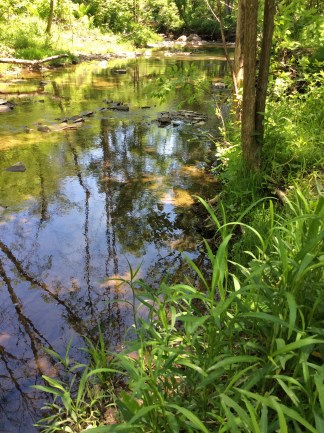
Joshua Creek (photo by Nina Munteanu)

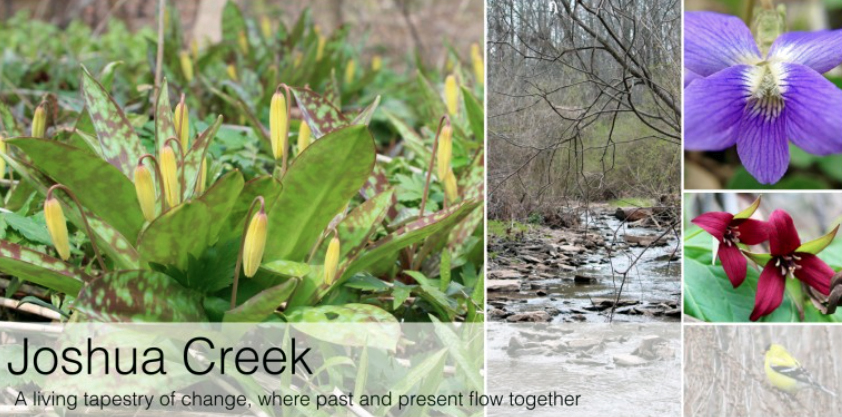
Joshua Creek originates near the art centre north of Burnhamthorpe Road and flows about 6 km south through the farm then mostly forest, eventually emptying into Lake Ontario. I was told that the creek has good water quality, apparently the best in the county. Oakvillegreen.org provides some history on Joshua Creek:

“Joshua Creek exists as a patchwork of past glories and present changes on a very dynamic and human-controlled landscape… many of its lands were cleared and altered beyond recognition, with only certain key areas left mostly to nature. In spite of these influences, Joshua Creek is home to 3 small Environmentally Sensitive Areas (ESAs), although two of these – Joshua Creek Valley and Wildflower Woods – have declined since they were highlighted in the 1970’s, and while still valuable, may no longer qualify as ESAs in the future. In only a handful of decades, development has quickly covered most of the lower two thirds of the creek’s land base, including important parts of its ESAs. In several areas, Joshua’s natural winding “meander” has been artificially straightened in order to efficiently use the land on either side. And in many places, foreign species have invaded the natural areas of the creek, changing the ecosystem in a big way.

JoshuaCk03But Joshua is a spirited creek – in spite of all it has been through, Joshua Creek is among the top two urban creeks for healthy water quality, and is still inhabited by a variety of aquatic animals like small fish and insects. Joshua Creek is home to forests, wetlands and thickets with around 150 plant species, and provides an important natural habitat corridor for the movement of birds and other animals, including migratory species. Rather than exclusively shrinking, there are also areas of Joshua Creek that are actually in the middle of regrowing their forests, and in spite of everything, Joshua still retains some beautiful gems of natural areas.”

nina-2014aaa

Nina Munteanu is an ecologist, limnologist and internationally published author of award-nominated speculative novels, short stories and non-fiction. She is co-editor of Europa SF and currently teaches writing courses at George Brown College and the University of Toronto. Visit www.ninamunteanu.ca for the latest on her books.

JoshuaCreek-WaterBanner


Places to Write: My Secret Places at The University of Toronto

notebook01In my writing guidebook The Journal Writer: Finding Your Voice I write a section on finding the right time and place to write. I call them “sacred”, because that’s what they are. Without them, we struggle to write. In Chapter Two of The Journal Writer I write about the need for a sacred place in journal writing, particularly. The advice is equally important to any form of writing.

Journal Writer-FRONT-cover-WEBFinding the perfect place(s) to write … is important to creating meaningful entries. Journal writing is a reflective activity that requires the right environment for you. The best environment is a quiet one with no interruptions and where you are alone. A reflective environment will let you relax, find a connection with yourself and your feelings. You need a place where you can relax and not worry about someone barging in or other things distracting you from your thoughts. You should also feel physically comfortable and the place should meet your time requirements.

Because the suitability of a place can change with the time of day, learn the rhythms that affect the place you wish to write in. For example, the kitchen may be the centre of activity during the day but an oasis of quietude during the evening. Similarly, learn what kind of environment stimulates and nurtures your writing. Does music help or do you need complete quiet? Do you respond to nature’s soft breezes and sounds or do you prefer to surround yourself with the anonymous murmur of a crowded café for company?

Places that work for me include the local coffee shop, a park near my house, a library or other quiet place where I can enjoy uninterrupted anonymity. Where you write may reflect what you’re writing and vice versa. To some extent, you are environment and environment is you. You might try a few places first and see what happens to the content of your entries. Entries you make while sitting under an apple tree in the breeze hearing the birds singing may differ from entries you make while sitting in your living room by the crackling fireplace with music playing or sitting at your desk in your bedroom in total silence or in a crowded café surrounded by cheerful bustle. I give more details on how to feed the muse in Chapter 4.

Nina-computer-Krave

Sitting in Krave’s outside patio

Some of my favourite places to write are indie cafés that express unique character and rich ambience. Amid the desultory chatter and laughter of people and sipping my flat white, I find myself deep in writing. These days you can most likely find me somewhere on the University of Toronto campus where I teach engineering students, social science students, and health science students how to write.

It’s been four years since I came to UofT and I still feel a glow every time I walk through campus. Whether it’s past a century-old stone building, beneath a canopied archway of chestnuts, into a well-treed enclave, or through a high-ceilinged glass building; I am both home and on an adventure.

ConvocationHall-web

Convocation Hall, UofT

UofT is a place of learning—erudite, splendid, lofty yet humble—and beautifully epitomizing “new embracing old”. When new embraces old, we get magic. Wizard-magic. Harry Potter kind of magic. The kind of magic that only someone who is open, faithful, and confident can wield. This is ancient magic. The magic that lurks like Reznikoff’s ghost in the ancient halls of University College, or the magic currently wielded at 1 Spadina. A magic borne of wisdom, lore, and story.

Established in 1827, the University of Toronto is snugly located in the centre of downtown Toronto; yet, it’s not so much a part of the city as the city is a part of it.  UofT’s campus probes into the city’s infrastructure like a creative amoeba: interacting, absorbing and expressing. The UofT downtown campus sprawls dozens of blocks in all directions; embedding itself in the city with a blend of century-old buildings and avant-garde modern chic. It’s not so much re-inventing itself at every turn as morphing and co-evolving with the city.

UofT-clocktower-sicamortrees

Clock tower, UofT

The UofT campus represents for me the very best the city—any city—has to offer: a vibrant, well-connected place of learning and activity, supported by original and tasteful landscape architecture: healthy trees and parkland full of songbirds, tasteful new and old architecture and alluring courtyards and doorways that beckon my creative soul. The UofT campus provides a myriad of possibilities and historic depth for the adventurous soul. Did you know, for instance, that Canada’s first electric computer was installed at UofT? Or that UofT is haunted? Or that much of UofT’s architecture was inspired by structures at Oxford and Cambridge? Or that an old nuclear accelerator sits fallow in the McLennan Physical Labs building?

My creative soul appreciates UofT’s integration of nature into its architecture and grounds. Its natural enclaves provide ideal settings for quiet contemplation and reflection. They’ve become my “secret places,” destinations along my journeys across campus to my various writing appointments. Places where I can sit, reflect and write. Here are just a few:

  1. Terrence Donnelly’s Bamboo Garden in Terrence Donnelly Centre:
BambooGarden01

Steps leading up past bamboo garden of Terrence Donnelly Centre

The Terrence Donnelly Centre for Cellular & Biomolecular Research (CCBR) is where some of the coolest research and discoveries in biomolecular and cellular research are being made. Benjamin Blencowe and his team’s recent uncovering a protein’s sweeping influence on autism last December using introverted mice, for instance. Named after the philanthropist Terrence J. Donnelly, the centre was the vision of UofT Professors Cecil Yip and James Friesen.

BambooGarden-lookingdown

View of garden resting area from above

In the 1990s they foresaw that new genomic technologies would open-up progress in biomedical research in a time when there was no human genome sequence or stem cell technologies and DNA sequencing was slow and inexpensive. Yip and Friesen envisioned a collaborative and interdisciplinary research facility that, when it opened in 2005, brought together over 500 specialists—biologists, computer scientists, physicians, pharmacists and engineers—to advance the university’s groundbreaking research in molecular biology.

BambooGarden-RosebrughWall

View of Rosebrugh wall from the garden

The centre is located on what was previously Taddle Creek Road. The CCBR building—which from College Street resembles two colourful stacked cubes—is set back by a gradually sloping plaza with granite benches and groves of white paper birch. The building and plaza are flanked by several historic buildings (80-year old Fitzgerald Medical Building to the east; the 1919 Rosebrugh Institute of Biomaterials and 100-year old Lassonde Mining building to the west; and the Medical Sciences Building to the north).


The bamboo garden in Donnelly’s spacious atrium is meditative and calming; a lush forest of bamboo and shrubs amidst wooden floors, benches and steps. Created by landscape architect Diana Gerrard, the garden offers several “picnic” sites of wooden platforms and benches, which I learned had come from the ash, tulip and cherry trees that had occupied the original lane way.

BambooGarden-entrance

Entranceway with bamboo garden of Terrence Donnelly Centre

Upon entering the complex from College Street, the granite plaza gives way to white terrazzo flooring in an expansive multi-story atrium. The top lit glass-ceilinged atrium connects the adjacent heritage Rosebrugh building to the CCBR in a counterpoint of techno-minimalism with Romanesque tradition. As I walk up the shallow wide steps lined by pillars that reach skyward, the tall bamboo forest to my left beckons. I’ve had many lunches there. I also spend many moments sitting there with a book, reading or just daydreaming beneath a texture of greens.

  1. Breezeway of Knox College Quad:
knox college breezeway04 copy

Knox College breezeway in winter

I usually enter the perpendicular gothic style building from St. George Street; though, you can also come in via Kings College Circle, past the chapel—known for its Hellmuth Wolff organ. Once I pass through the heavy doors of the St. George entrance, I enter a dark foyer and instantly feel like I’m in a church. The chapel is on the other side, yet the deep quiet and surrounding dark wood of the floors, walls and stairways to the right and left of me, enclose me with a sense of sacred holiness. I walk the echoing foyer to the stained-glass doorway of the breezeway ahead. As I open the glass door, the complex scent of tulips and pine greets me with the warm breeze. I have entered another magic place.

The gothic archway that connects the Knox College Quad is an open breezeway that looks out onto the interior gardens of the quad. Tables and chairs along each side provide a peaceful place to read and write with a quiet view of the outside courtyard of flowers, shrubs, trees and benches. Hanging vines provide additional greenery in the archway.

knox breezeway01 copy

Knox College breezeway through courtyard

Whenever I come here, the hustle and bustle of the city just fades away. Busy St. George Street is nearby; yet I don’t feel its influence within this quiet haven, where the soft sounds of Nature embrace me with their songs and stories. I often come here to read and write. I listen to the birds and other natural sounds, letting them lull me into a meditative quietude of bliss. Life slows to a philosopher’s pace and my creative muse awakens. Sometimes I bring one of my indulgences—a poutine from one of the chip trucks on St. George—and feast in my secret place as Nature’s melodies feed my soul. On a warm day, the breezeway also provides a cool respite.

  1. The Laidlaw Quadrangle behind University College
Gate to UC courtyard

West gate into University College courtyard

When I first discovered this hidden quadrangle, I felt goosebumps of pure magic course through me. My discovery visit was through the west arched entranceway off the west green, past Bissell House. I passed the gateway into the Courtyard Colonnade, and faced a sunken courtyard shaded by large ironwood and maple trees and surrounded by gothic brick and stone. I’d entered an enchanting world of quiet reflection.

A paved walkway—supported by retaining walls and planted with flowering shrubs—runs on three sides of the quadrangle. The walkway broadens into a terrace to the north, forming an extension of the new Library colonnade. Mature maple and ironwood trees overhang the cloisters and the walkway.

WestCollonade-looking west

West colonnade of quadrangle

Designed by Canadian landscape architect Michael Hough, the quadrangle evokes the courtyards of medieval monasteries and old English universities. Built in 1964, when the Laidlaw wing (and library) separated the college from back campus, Hough’s design translates the essential feature of a monastery or college courtyard—access from inside the building to a covered walk around an open centre—from architecture to landscape.


UniversityCollege-WestCollonade

View of courtyard (to left) from west cloister of University College

I’ve since discovered other ways to enter and leave the quadrangle, each one presenting a new perspective to this peaceful place. Each time I come here, I feel my soul sigh with joy. Birds sing the poetry of Nature. Leaves rustle as the wind plays on them. When I’m here, I feel at peace in the city.

photo-24

UofT Faculty Club

UofT Faculty Club: Every journey requires repast—a place to relax, eat and drink—and my feet naturally direct me to one of my new favourite haunts: the UofT Faculty Club. Located close to the hub of the campus, on Willcocks Street just east of Spadina, the club is open to members who include faculty, staff, graduate alumni and their guests. I enter the 1896 heritage building, built in a Georgian Revival-style, and passed the elegant first floor lounge to the pub below. The pub welcomes me with excellent food, drink and a relaxing ambience. Bathed in rich tones of wood and comfortable chairs and warmed by a cozy fireplace, it reminds me of a Dorset pub I’d visited years ago; full of colourful characters and a well-stocked bar.

UniversityCollege-windows

Windows of University College

I feel both at home and like a traveler. Like I’d walked into history with modern comfort. I order the beet salad from my friendly waitress; it provides a refreshing and attractive light meal for a mid-day travelling writer.

Nina Munteanu

Nina Munteanu is an ecologist, limnologist and internationally published author of award-nominated speculative novels, short stories and non-fiction. She is co-editor of Europa SF and currently teaches writing courses at George Brown College and the University of Toronto. Visit www.ninamunteanu.ca for the latest on her books.


Pictures by Nina Munteanu


New Directions in Self-Publishing: A Discussion by Writers and Editors

Panel-Nina-water

I was recently invited by Editors Toronto and the Toronto chapter of PWAC to participate in a panel (co-sponsored and hosted by UofT’s Creative Writing Program) exploring the current state of self-publishing and the publishing industry in general. I was one of four professionals whose work has involved all facets of the industry from POD, hybrid models, and ebooks to crowdfunding and writing communities.

The four speakers included:

MeghanBehse_closeMeghan Behse, the president of PubLaunch Inc., a new online marketplace and crowdfunding platform where writers, readers, and publishing professionals join forces to get books published. In her role as publisher, she steered Iguana through a new world of digital and print-on-demand publishing while experimenting with unique royalty arrangements and funding models, including crowdfunding. Behse talked about how PubLaunch is using emerging technologies to help overcome the obstacles writers continue to face in the self-publishing industry.

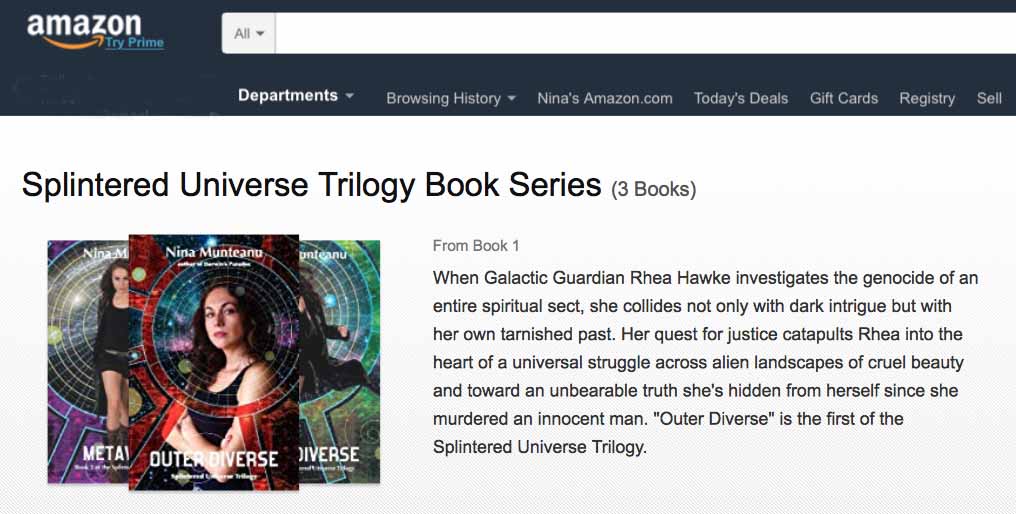
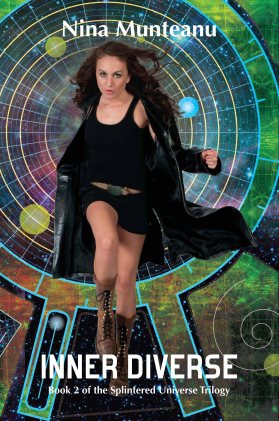
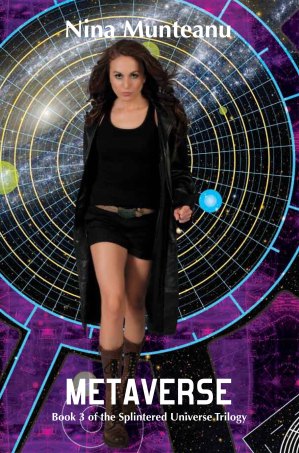
nina-munteanuNina Munteanu, an experienced editor of traditionally published and self-published books, and an award-winning author of eight novels, including Darwin’s Paradox and The Splintered Universe Trilogy. A frequent contributor to Amazing Stories and the current editor of Europa SF, Munteanu teaches writing at George Brown College and the University of Toronto and has also published short stories, essays, and non-fiction books. Her latest book is Water Is…The Meaning of Water, a scientific study and personal journey as limnologist, mother, teacher, and environmentalist. Munteanu provided an overview of the industry—including use and misuse of terms—then spoke about evolving professional standards in self-publishing, and what these changes mean for writers and editors.

sfyshStephanie Fysh, a Toronto-based freelance editor of independent authors in a variety of genres, including fantasy, science fiction, YA, romance, and erotica, and the former chair of Ryerson University’s Publishing program. She works with hybrid publishers on projects that range from harrowing memoirs to comedy, and still enjoys a textbook project that she can learn something from. Using her own experience as example, she talked about what self-publishing authors look for in an editor, and how that differs from the roles built into traditional or hybrid publishing.

MarkLeslieLefebvre_LaurenLangMark Leslie Lefebvre, the author of more than a dozen traditionally published and self-published books, a professional speaker, a digital publishing advocate, and a bookseller with more than a quarter century of experience.  Lefebvre explained what prompted him to self-publish “ten years before any self-respecting writer would admit to such a foul thing.” And he’ll tackle the big-picture questions: “What is currently wrong with self-publishing, and how can we work together to fix that?”

JessShulmanTweet

I started the panel discussion with an overview of the publishing industry from traditional to indie to self-publishing. I overviewed five main publishing models and discussed advantages and disadvantages depending on needs and perspectives of the writer. A few advantages of self-publishing include: 1) getting a book to market more quickly than through the traditional publishing path; and 2) having more control over the end product.

PublishingModels

The downsides in self-publishing arise from the same: 1) getting a book to market more quickly may seduce writers to compromise the lengthy process of perfecting their work (provided by editors, layout and cover artists) to put something out before it is ready; and 2) having more control also means more responsibility borne by the writer (the need to understand more in book production and marketing than a writer in the traditional process needs to). Another important disadvantage to self-publishing lies in more restricted distributing, marketing and exposure.

In my talk, I emphasized that while the current industry is providing great opportunities, with these come great responsibilities.

PPTslide-opportunies-responsibilities

Authors and editors are currently facing a sea of possibilities. New directions, models, collaborations and structures face us as the publishing industry morphs into something new. Self-publishing and hybrid-players are at the forefront of that evolving tide of new publishing. And it’s very exciting!

Suzanne Bowness of PWAC Toronto provided a good summary of the panel discussion on PWAC’s blog Networds, and shared by the Editors Toronto blog Boldface. Editor and publishing consultant Michelle MacAleese who attended the event made these observations:

  • Many in the biz draw a distinction between self-published authors and hybrid-published authors; both are “independent,” but the self-published authors are a special breed, who *are starting to understand art and business and (usually) gladly develop proficiency in all the technical and administrative details of the process.
  • Not surprisingly, options for authors continue to change rapidly. What worked best in 2011 is irrelevant today. Many quality companies offer publishing services and hybrid publishing deals. (Many companies will pretty much just steal your money. One must read up before signing up. *Research is paramount)
  • The best publishing option for e-only genre fiction won’t be the same as for a debut hardcover business book. It’s a wide world of independent publishing.
  • Authors: If you don’t love technical things (formatting ebooks, working Amazon’s categories, tweaking descriptive copy), you probably won’t enjoy starting a publishing house of one.
  • Editors: Working with self-published authors is a specialty and those editors who are good at taking on that relationship and guiding the process are worth their weight in gold. (Isn’t it about time we begin to mentor each other in why this kind of author-editor relationship is unique, and how it borders on the agent role at times? *This is a great opportunity for editors willing to evolve and grow.)
  • Editors who already specialize in working with self-published authors: Let’s talk about how to partner with reputable publishing services companies as well as with other independent designers and book marketing professionals to launch great self-published books that sell! This point was just touched upon in the panel and is still evolving; again, editors are uniquely positioned as author-consultants to play key roles in new networks of independent professionals in the publishing industry. *italics throughout are mine

MichelleMacAleese-Tweet

JenDinsmoreTweet

A few years ago, I gave a talk at Editors Toronto on the industry from the self-publishing author and freelance editor’s perspective. It remains highly relevant today, given that it spoke to the changing face of publishing and what it means for editors and writers. Editors learned about self-publishing and indie publishing, publishing myths, and imaginative ways to find new editing opportunities:

Self-publishing used to be a scar; now it’s a tattoo.”–Greg Cope White

Other relevant articles include:

Nina Munteanu on the Author-Editor Relationship

Beating Today’s “S” Curve (or Why an Editor is Every Writer’s Best Friend)

Walking the Tightrope Between Innocent and Cynical

The Moving Target of Indie Publishing: What Every Editor (and Writer) Needs to Know

The Writer-Editor Relationship, Part 1: Editors Preparing Writers

The Writer-Editor Relationship, Part 2: Five Things Writers Wish Editors Knew—and Followed

The Hidden Costs of Self-Publishing, Part 1: The Solution to “Author Solutions”

What Indie Authors Should Know for 2015

Surfing the Hybrid Wave of Publishing

The Indie Book Tidal Wave…What Does it Mean for Bookstores, Publishers & Writers?


nina-munteanuNina Munteanu is an ecologist and internationally published author of award-nominated speculative novels, short stories and non-fiction. She is co-editor of Europa SF and currently teaches writing courses at George Brown College and the University of

Science Fiction Asks: Are We Worth Saving?

interstellar-GargantuanBlackHole

Gargantua Black Hole in “Interstellar)

Science fiction, which Ted Gioia of The San Francisco Chronicle calls “conceptual fiction” explores the interaction of humanity with some larger phenomenon that involves science. SF writer Robert J. Sawyer calls it the fiction of the large. Large ideas, large circumstance, large impact. Science fiction is a powerful literature of allegory and metaphor that is deeply embedded in culture. By capturing context, SF is a symbolic meditation on history itself and ultimately a literature of great vision.

Science fiction is the literature of consequence that, in exploring large issues faced by humankind, can provide an important vehicle in raising environmental awareness and a planetary consciousness. Much of science fiction is currently focused in that direction. Terms such as eco-fiction, climate fiction and its odd cousin “cli-fi”, have embedded themselves in science fiction terminology; this fiction has attracted a host of impressive authors who write to its calling: Margaret Atwood, Emmi Itäranta, Jeff VanderMeer, Richard Powers, Barbara Kingsolver, Upton Sinclair, Ursula Le Guin, JoeAnn Hart, Frank Herbert, John Yunker, Kim Stanley Robinson, James Bradley, Paolo Bacigalupi, Nathaniel Rich, David Mitchell, Junot Diaz, Claire Vaye Watkins, J.G. Ballard, Marcel Theroux, Thomas Wharton—just to name a few. The list seems endless. Of course, I’m one of them too. Many of these works explore and illuminate environmental degradation and ecosystem collapse at the hands of humanity.

Lately, science fiction is asking the question of whether humanity is worth saving and at what expense?

It’s a valid question.

As the first swell of the climate change tidal wave laps at our feet, we are beginning to see the planetary results of what humanity has created and exacerbated. Humanity has in many ways reached a planetary tipping point; a threshold that will be felt by all aspects of our planet, both animate and inanimate as the planet’s very identity shifts.

the great acceleration copyScientists have suggested that we have now slid from the relatively stable Holocene Epoch to the Anthropocene Epoch—the age of humanity. The term arose not from hubris, but in recognition of our ubiquitous and overwhelming influence on large systems and planetary cycles.

GreatDerangement climatechange copyTake water, for instance. Today, we control water on a massive scale. Reservoirs around the world hold 10,000 cubic kilometres of water; five times the water of all the rivers on Earth. Most of these great reservoirs lie in the northern hemisphere, and the extra weight has slightly changed how the Earth spins on its axis, speeding its rotation and shortening the day by eight millionths of a second in the last forty years. Ponder too, that an age has a beginning and an end. Is climate change the planet’s way of telling us that the  Anthropocene Epoch too shall end? Is that when we end … or transcend?

A tidal wave of TV shows and movies currently explore—or at least acknowledge—the devastation we are forcing on the planet. Every week Netflix puts out a new show that follows this premise of Earth’s devastation: 3%; The 100; The Titan; Orbiter 9; even Lost in Space.

Are we worth saving? Below are a few examples of movies, TV series I’ve lately watched and books I’ve lately read that address this key question to an irresponsible humanity that seems unconcerned that we are destroying our very home. In some the question is subtly implied; in others, not so subtle.

Battlestar Galactica (2004)

Battlestar-Galactica.jpg

In the pilot of Battlestar Galactica, Commander Adama gives an impromptu speech (not the one he prepared; but one provoked by an argument with his son), which resonates throughout the entire series as cylon and human must refashion themselves and their relationship to each other while they discover the cyclical recursive nature of all things and that “all this has happened before and will again.”

The Galactica ship is about to be decommissioned and has now become a museum since the cylons have disappeared forty years ago. The great battle between the cylons and their human creators ended forty years ago with the cylons disappearing suddenly, never to be heard from again. But that is about to change; as Adama gives his speech, the first strike occurs, followed by a massive attack that almost wipes out the human race.

Adama

Commander Adama

In his speech Adama says:

“The cost of wearing the uniform can be high…but sometimes it’s too high. When we fought the cylons, we did it to save ourselves from extinction. But we never answered the question why. Why are we as a people worth saving. We still commit murder because of greed, spite and jealousy. And we still visit all of our sins upon our children. We refuse to accept the responsibility for anything that we’ve done. Like we did with the cylons. We decided to play God. Create life. When that life turned against us, we comforted ourselves in the knowledge that it really wasn’t our fault, not really. You cannot play God then wash your hands of the things you’ve created. Sooner or later the day comes when you can’t hide from the things that you’ve done anymore.”

Interstellar (2014)

interstellar-GargantuanBlackHole

Voyaging to Gargantua Black Hole

Interstellar

Cooper explores the ice planet

Early on in the science fiction movie Interstellar, NASA astronaut Cooper declares that “the world is a treasure, but it’s been telling us to leave for a while now. Mankind was born on Earth; it was never meant to die here.”

After showing Cooper how their last corn crops will eventually fail like the okra and wheat before them, NASA Professor Brand answers Cooper’s question of, “So, how do you plan on saving the world?” with: “We’re not meant to save the world…We’re meant to leave it.” The human-centred hubris in this colonialist mentality lies in what we have left behind—a planet suffocating from the effects of humanity’s careless and thoughtless activities. What Interstellar circles but does not address is the all-important question: is humanity even worth saving?

The suggestion during the movie’s final moments, is that we are worth saving because we will transcend into wiser benevolent beings: a hopeful gesture based on the power of love.

The Three Body Problem (2014)

ThreeBodyProblem-film

Cixin Liu’s The Three Body Problem was set against the backdrop of China’s Cultural Revolution, because, says Liu, “The Cultural Revolution provides the necessary background for the story. The tale I wanted to tell demanded a protagonist [Ye Wenjie] who gave up all hope in humanity and human nature. I think the only episode in modern Chinese history capable of generating such a response is the Cultural Revolution. It was such a dark and absurd time that even dystopias like 1984 seem lacking in imagination in comparison.” (I suppose Cixin did not experience the holocaust of Germany or Stalin’s purge in the Soviet Union).

ThreeBodyProblemIn the story, a secret military project sends signals into space to establish contact with aliens. An alien civilization on the brink of destruction captures the signal and plans to invade Earth. One of the main protagonists is Ye Wenjie, a young woman traumatized after witnessing the execution of her scientist father in a brutal cleansing at the height of the Cultural Revolution. Considered a traitor, young Wenjie is sent to a labour brigade in Inner Mongolia, where she witnesses further destruction by humans:

“Ye Wenjie could only describe the deforestation that she witnessed as madness. The tall Dahurian larch, the evergreen Scots pine, the slim and straight white birch, the cloud-piercing Korean aspen, the aromatic Siberian fir, along with black birch, oak, mountain elm, Chosenia arbutifolia—whatever they laid eyes on, they cut down. Her company wielded hundreds of chain saws like a swarm of steel locusts, and after they passed, only stumps were left.

The fallen Dahurian larch, now bereft of branches, was ready to be taken away by tractor. Ye gently caressed the freshly exposed cross section of the felled trunk. She did this often, as though such surfaces were giant wounds, as though she could feel the tree’s pain… The trunk was dragged away. Rocks and stumps in the ground broke the bark in more places, wounding the giant body further. In the spot where it once stood, the weight of the fallen tree being dragged left a deep channel in the layers of decomposing leaves that had accumulated over the years. Water quickly filled the ditch. The rotting leaves made the water appear crimson, like blood.”

Already cynical about humanity’s failed culture and science—Wenjie acquires a contraband copy of Rachel Carson’s Silent Spring. The book and revelation she experiences from it sets in motion her remaining trajectory.

“More than four decades later, in her last moments, Ye Wenjie would recall the influence Silent Spring had on her life. The book dealt only with a limited subject: the negative environmental effects of excessive pesticide use. But the perspective taken by the author shook Ye to the core. The use of pesticides had seemed to Ye just a normal, proper—or, at least, neutral—act, but Carson’s book allowed Ye to see that, from Nature’s perspective, their use was indistinguishable from the Cultural Revolution, and equally destructive to our world. If this was so, then how many other acts of humankind that had seemed normal or even righteous were, in reality, evil?

As she continued to mull over these thoughts, a deduction made her shudder: Is it possible that the relationship between humanity and evil is similar to the relationship between the ocean and an iceberg floating on its surface? Both the ocean and the iceberg are made of the same material. That the iceberg seems separate is only because it is in a different form. In reality, it is but a part of the vast ocean.…It was impossible to expect a moral awakening from humankind itself, just like it was impossible to expect humans to lift off the earth by pulling up on their own hair. To achieve moral awakening required a force outside the human race.

This thought determined the entire direction of Ye’s life.”

Ye is sent to the Chinese version of SETI and succeeds in sending a message to aliens on Trisolaris. Despite a warning that the Trisolarians mean only to invade, Wenjie invites them to Earth. To ensure the arrival of the Trisolaris aliens, she collaborates with Michael Evans—an oil billionaire’s son who is disgusted with human’s destruction of Nature. Despising humankind in its current state, Wenjie believes the aliens will somehow ensure humanity’s transcendence; Evans, however, applauds the coming invasion as the best route to achieve the eradication of humanity and the survival of the rest of the planet.

The Expanse (2015) 

TheExpanse-GanymedeStation

Bobby Draper and crew face an unknown enemy on Ganymede Station


TheExpanse-Holden-Naomi

Naomi and Holden

The Expanse is a stylish and intelligent science fiction (SF) TV series (on Syfy Channel) based on books by James S.A. Corey. It is set 200 years in the future when humanity has colonized the moon, Mars and the Asteroid Belt to mine minerals and water. This sophisticated SF film noir thriller elevates the space opera sub-genre with a meaningful metaphoric exploration of issues relevant in today’s world—issues of resource allocation, domination & power struggle, values, prejudice, and racism. Ever-expanding outward in a frantic search for resources as Earth’s own resources fester in pollution and Earthers languish on “the dole”, colonizing humans on Mars and the Belt have even changed their physiology, culture, language and identity.

The tag line of the first season poster for The Expanse reads: “We’ve gone too far.” The series begins on Ceres with a Belter activist inciting a crowd with talk about how Mars and Earth are squeezing Belters for all their water.

NUP_166219_0638.JPG

Avasarala and DeGraaf

Not so subtle signs of our destructive jingoistic determination runs through this series (now in its third season). After Under Secretary Avasarala’s friend Degraaf (Earth ambassador to Mars) becomes a casualty of one of her intel games, Degraaf quietly shares: “You know what I love about Mars?… They still dream; we gave up. They are an entire culture dedicated to a common goal: working together as one to turn a lifeless rock into a garden. We had a garden and we paved it.”

miller and dawes copy 2

Miller and Dawes sparring

Ceres born militant activist Anderson Dawes confides to Detective Miller: “All we’ve ever known is low G and an atmosphere we can’t breathe. Earthers,” he continues, “get to walk outside into the light, breathe pure air, look up at a blue sky and see something that gives them hope. And what do they do? They look past that light, past that blue sky. They see the stars and they think ‘mine’… Earthers have a home; it’s time Belters had one too.”

The Martians hold Earth in contempt for their cavalier approach to their resources. Onboard the MCRN Donnager, Martian Lopez asks his prisoner Jim Holden if he misses Earth and Holden grumbles, “If I did, I’d go back.” Lopez then dreamily relates stories his uncle told him about Earth’s “endless blue sky and free air everywhere. Open water all the way to the horizon.” Then Lopez turns a cynical eye back on Holden. “I could never understand your people. Why, when the universe has bestowed so much upon you, you seem to care so little for it.” Holden admits, “Wrecking things is what Earthers do best…”

bobbie-draper-the-expanse

Martian marine Bobbie Draper

Then he churlishly adds, “Martians too, by the look of your ship.” Lopez retorts, “We are nothing like you. The only thing Earthers care about is government handouts. Free food, free water. Free drugs to forget the aimless lives you lead. You’re shortsighted. Selfish. It will destroy you. Earth is over, Mr. Holden. My only hope is that we can bring Mars to life before you destroy that too.” When a Ceres-born Detective Miller asks Holden why he left Earth, Holden responds: “everything I loved there was being destroyed.”

The show makes a few opportunities to point out what we are doing to our planet. Cherish what you have. Cherish your home and take care of it. We’re reminded that time and again, we aren’t doing a good job of that. When Martian marine Bobbie Draper travels to Earth for the first time and is compelled to find the ocean, she is met with the stench of sewage and garbage; yet, she looks longingly out to sea, seeing a dream…

Incorporated (2016)

 Incorporated-green-red zone copy

Incorporated is a science fiction thriller that provides a chilling glimpse of a post-climate change dystopia. Created by David and Alex Pastor and produced by Ben Affleck, Matt Damon, Ted Humphrey and Jennifer Todd, the TV show (filmed in Toronto, Canada) opens in 82 °F Milwaukee in November 2074 after environmental degradation, water level rise, widespread famine and mismanagement have bankrupted governments. We learn later that Milwaukee Airport served as a FEMA climate relocation centre that resembles an impoverished shantytown. In the wake of the governments demise, a tide of multinational corporations has swept in to control 90% of the globe and ratified the 29th amendment, granting them total sovereignty.

Ben- office copy

Corporations fight a brutal covert war for market share and dwindling natural resources. Like turkey vultures circling overhead, they position themselves for what’s left after short-sighted government regulations, lack of corporate check and FEMA mismanagement have ‘had their way’ with the planet. The world is now a very different place. There is no Spain or France. Everything south of the Loire is toxic desert; submerged New York City reduced to a punch line in a joke. Reykjavik and Anchorage are sandy beach destinations and Norway is the new France—at least where champagne vineyards are concerned. Asia and Canada are coveted for their less harsh climates.

Chad-alert copyIncorporated is less thriller than satire; it is less science fiction than cautionary tale.

 “You look to Incorporated for dystopian fiction that expresses our current anxieties,” writes Jeff Jensen of Entertainment Weekly. “What you get is fitful resonance that makes you realize it might be too soon for any show to meet that challenge.”

Or is it more that we may be too late… The question of whether we are worth saving is never asked—it is shown: and perhaps the real reason the show was cancelled after one season.

3% (2016)

3-percent-players copy

3% is set in the near future after the planet has fallen into a divided haves and have-nots through environmental calamity. Three percent of the population live well on an island in the Atlantic Ocean, called Offshore (Mar Alto). The remaining 97% struggle Inland with poverty and scarcity. A selection process lies between them.

3-poster-title copyEvery year the 97% send their 20-year olds to undergo The Process, a grueling Hunger Games-style contest run by the Offshore elite to replenish their numbers. Only 3% of the candidates will be considered worthy. They must pass psychological, emotional and physical tests to earn a place in Mar Alto.

By the time Season 1 is over, candidates will have committed a full range of desperate and unsavory acts to make the cut—the stakes are high, after all: secure a position in the 3% elite or die in squalor and poverty. After being eliminated during the interview process, one youth throws himself off a balcony of the testing centre.

3% examines the motivations and paradoxes of heroism and villainy, sometimes turning them on their sides until they touch with such intimacy you can’t tell them apart. At its deepest, 3% explores the nature of humanity—from its most glorious to its most heinous—under the stress of scarcity and uncertainty. How we behave under these polarizing challenges ultimately determines who we are. The question of whether we are worth saving is explored through the subtleties—or not so subtle aspects—of a fascist society that practices exterminism. 

Missions (2018) 

Missions-VladimirKomarov-Suyuz1 copy

Missions is a French TV series about the race by two ships—the Ulysses and Z1, representing two ambitious billionaires—to explore Mars. It opens in 1967 with the heroic sacrifice of Vladimir Komarov, the pilot of the faulty Soyuz 1, who knew he would not return and accepted his mission to save his best friend, Yuri Gagarin (his backup). This heroic act is mirrored in the last episode of Season 1 with a similar selfless act of heroism by Ulysses psychologist Jeanne Renoir to save her crewmembers who are trying to escape a fatal dust storm on Mars.

missions-posterAfter the 1967 opening scene with Komarov, we go to the present day with psychologist Jeanne Renoir, conducting an experiment on a child: giving them one marshmallow and leaving the room with the instruction that if they don’t eat the marshmallow but wait for her to return, they’ll get two. Jeanne correctly anticipates the child will eat the marshmallow.

Amid developments between the two ship teams in which self-serving agendas, paranoias and blind ambition reign, Jeanne shares a vision with an entity that looks like Komarov, in which he tells her: “Yes, people dream of other places, while they can’t even look after their own planet…You must remember your past in order to think about your future. Do you think Earth has a future?” When Jeanne says she doesn’t know, Komarov challenges, “Yes, you do. They eat their marshmallow right away, when they could have two. Or a thousand. Do you think humanity can continue like that?” Of course she doesn’t think so. Komarov continues, “People have chosen a brief but exciting life. Your species burns the candle at both ends. You know this. And it terrifies you…”

jeanne renoir copy

Jeanne Renoir

From the beginning, we glimpse a surreal connection between Jeanne and Komarov and ultimately between Earth and Mars: from her childhood admiration for the Russian’s heroism on Earth to the “visions” they currently share that link key elements of her past to Mars and Komarov’s strange energy-giving powers, to Jeanne’s own final act of heroism on Mars.

As the storyline develops, linking Earth and Mars in startling ways, and as various agendas—personal missions—are revealed, we finally clue in on the main question that “Missions”—through Komarov and finally Jeanne—is asking: are we worth saving?

The Beyond (2018)

dark orb helicopters sunrise copy

In The Beyond, the sudden appearance of a wormhole causes the disappearance of astronaut Jim Marcell during EVA on Earth’s orbiting space station, followed by associated calamitous phenomena on Earth. Giant dark spherical clouds then appear and settle all over the Earth, disrupting the world’s population, and setting in motion a series of fearful and aggressive reactions by various sectors of humanity.

The Beyond-poster copyThe Beyond’s climax, discovery and resolution is really more of a question. The movie doesn’t have a tidy end; its solution is veiled with more questions.

The film ends with a cautious hope, implicitly asking that big question: are we (humanity) worth saving? When Jessica asks why humanity was offered a second chance by benevolent beings way beyond our comprehension, the returned Jim Marcell (currently a spokesman for the aliens) shows her the GAD (Golden Archive Drive with video images of Earth and humanity—basically our “hello” message to extra-solar life like the one placed onboard NASA’s Pioneer missions) that had accompanied the ship into the wormhole. The message displayed scenes of mothers and their children, people laughing in joy; it also showed scenes of other aspects of this beautiful planet worth saving: the ocean surf, the forests and wildlife. In our hubris, we have lost our perspective about this planet. Perhaps, it wasn’t so much humanity the alien beings intended to save but the Earth itself; we just come along with it. The Earth is, after all, a beautiful, vital and unique world, rich with life-giving water, trees, animals, creatures of all kinds in a diverse network of flowing and evolving beauty. A planet worth saving and that, frankly, functions better without us.

So, the question remains: is humanity worth saving? For centuries we have hubristically and disrespectfully used, discarded and destroyed just about everything on this beautiful planet. According to the World Wildlife Federation, 10,000 species go extinct every year. That’s mostly on us. They are the casualty of our selfish actions. We’ve become estranged from our environment, lacking connection and compassion. That has translated into a lack of consideration—even for each other. In response to mass shootings of children in schools, the U.S. government does nothing to curb gun-related violence through gun-control measures; instead they suggest arming teachers. We light up our cigarettes in front of people who don’t smoke and blow cancer-causing second-hand smoke in each other’s faces. We litter our streets and we refuse to pick up after others even if it helps the environment and provides beauty for self and others. The garbage we thoughtlessly discard pollutes our oceans with plastic and junk, hurting sea creatures and the ocean ecosystem in unimaginable ways. We consume and discard without consideration.

We do not live lightly on this planet.

We tread with incredibly heavy feet. We behave like bullies and, as The Beyond points out, our inclination to self-interest makes us far too prone to suspicion and distrust: when we meet the unknown, we tend to respond with fear and aggression over curiosity, hope and kindness.

Something we need to work on if we are going to survive.

Science fiction—the highest form of metaphoric and visionary art—is telling us something. Are we paying attention?


References:

Carson, Rachel. 1962. “Silent Spring.” Houghton Mifflin. 336pp.

Corey, James S.A. “The Leviathan Wakes.” Orbit. 592 pp.

Liu, Cixin. 2014. “The Three Body Problem.” Tor Books. 400pp.