Creating the Ecotone at ToRo Fest

ToRoFestOn October 5, 6 2018, I participated in the second ToRo Fest International Salon of Literature, Visual Arts & Music, put on by Tradicious at the Centre for Culture, Arts, Media and Education on 918 Bathurst Ave.

After attending the gala opening on Friday, I arrived early Saturday morning and had a chance to wander the two art galleries of the fest before the crowds came. One gallery featured the deep narrative art of nine-year old Sophia Leopold-Muresan. Bright and flowing with child-wisdom, her art was playful, whimsical and thoughtful.

Otilia Gruneantu Scriuba

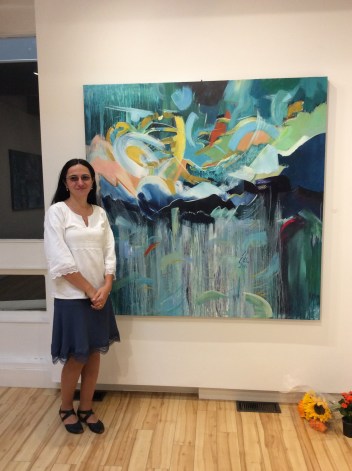
Otilia Greneantu Scriuba stands next to “Fusion”

Otilia Greneantu Scriuba’s abstract art featured cultural symbols such as water, the wave, the horizontal line to convey personal and deep-rooted narratives. The description on her website reads: “Otilia’s art orients images within collages. Parts of her paintings juxtapose original disparate fragments with origins drawn from different historic epochs and through different geographical spaces. Throughout her work she employs important cultural symbols such as: the water, the wave, the horizontal line, the square, the horse, the butterfly, the fish, the egg, the shell and the feather. In addition, she uses other symbols from some of the most important artistic periods: Victoria by Samotrace, human figures by Fidias Metopes, and Venus by Botticelli. Otilia Gruneantu Scriuba creates complex compositions while managing to harmonize her found elements in a unitary image.”

Cioata-Haunted House

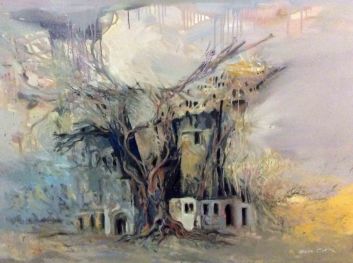
“Haunted House” by Doru Ciota

The surreal realism of Romanian artist Doru Cioata—a mix of detailed graphic design, intricate sketches and paintings—evoked a powerful metaphoric narrative. Seeing this art reminded me of the power of image in writing and my own adventure with image and writing. Several months ago, I was invited to write a flash fiction story based on a chosen Group of Seven painting for an anthology coming out next year. It was one of the most thrilling, fun and difficult projects I’d embarked on—and the most fulfilling. See my article on how visual art and writing communicate.

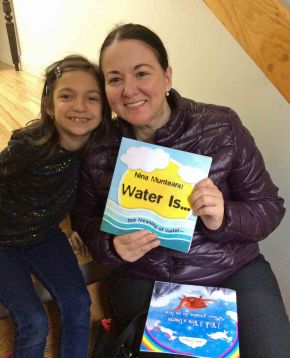
Alice WaterIs

Alice with “Water Is…”

The three-track ToRo Fest ran the whole day with over fifteen book launches, literary presentations—including my talk on “Water Is…”—games, poetry readings, and panels, in addition to excellent live music from piano to guitar and drums.

I participated with Costi Gurgu (author of Aurora-nominated RecipeArium) in Claudiu Murgan’s panel on publishing models: “Publishing your book is not what it used to be: think hard and pick one: traditional vs. self-publishing vs. hybrid.” Costi, Claudiu and I discussed the pros and cons of each model, providing our experiences with these publishing types.

Nina-Costi-Claudiu-panel

Costi Gurgu, Nina Munteanu, and Claudiu Morgan discuss publishing models

I reprised this subject with my lecture on hybrid publishing at the Mississauga Writers Group meeting on October 13 (at the South Common Community Centre, 11 am). I will also be giving this Hybrid Publishing lecture/workshop in the Toronto City Hall through the Immigrant Writers Association’s “writing and publishing series” of their “Learn with IWA” initiative (October 26, 7-9 pm). The lecture/workshop is open to members (zero to $10) and non-members (fee $15).

Absolutism4

Vali Gurgu makes her move in “Absolutism”

Professor Nicolae Gavriliu of the Antiochian House of Studies gave an interesting lecture on the theology and art of the icon. I also attended a student presentation on global issues faced by marginalized groups from Roma in Romania to married children in Lebanon.

Costi and Vali Gurgu brought their new game Absolutism, a funny card game about surviving dictatorship (which should sell very well in the USA…). Several intrepid players tried their hand at dictatorship—and slavery, depending on whether they were losing or winning. I could hear the laughter clear to the lobby. See more about Absolutism, a fascinating, clever and witty game by author-lawyers who did, in fact, survive a dictatorship.

water is-blood

Ad for “Water Is…” on TTC subway

Several of my science fiction, eco-fiction and historical fantasy books were for sale and some sold out. Alice caught up to me for an autograph and joyfully shared that she’d seen the Pixl Press Water Is… ad on the Toronto subway and had told herself, “I need to meet this person.” Then she did—at ToRo!

A week prior to the festival, I was interviewed by Andreea Demirgian of “Radio Encounters” who called me “The Absolute Dame of Canadian Eco-Fiction”! I was flattered … and humbled. In truth, eco-fiction has become my passion and brand in writing. I realized only recently (in the last few years) that I’d been writing eco-fiction for twenty years but had branded my writing under science fiction. Sometimes, it takes a while to find one’s true voice–and niche. Thanks, Andreea! You can listen to the interview below:


GreenBeanery-myFlatWhite

enjoying my flat white at the Green Beanery

After much panelling, talking, selling out of my books, and discovering delicious Romanian pastries, I slipped out into the brisk drizzle with a mission: I was in search of good coffee. I spotted the Green Beanery, looking comfortable in an old brick building on the corner of Bathurst and Bloor. I smiled; I knew I’d found my coffee haven. I ordered my favourite from the barista—a flat white— and relaxed in the funky-hipster atmosphere of the café.

It turns out that the Green Beanery is a Canadian trust, created and staffed by environmentalists at Probe International. All earnings support the charity that protects lands and people’s livelihoods. The Green Beanery promotes small coffee farmers who produce niche coffees with characteristics as distinctive and extraordinary as their local ecology and who are less likely to use pesticides or fertilizers (like their larger counterparts). Green Beanery also encourages neighbourhood-based micro-roasting in small coffee shops and local roasteries. Creating niche markets for little known coffee bean varieties helps maintain the world’s store of genetic diversity.

Nina-Juliana-Crina

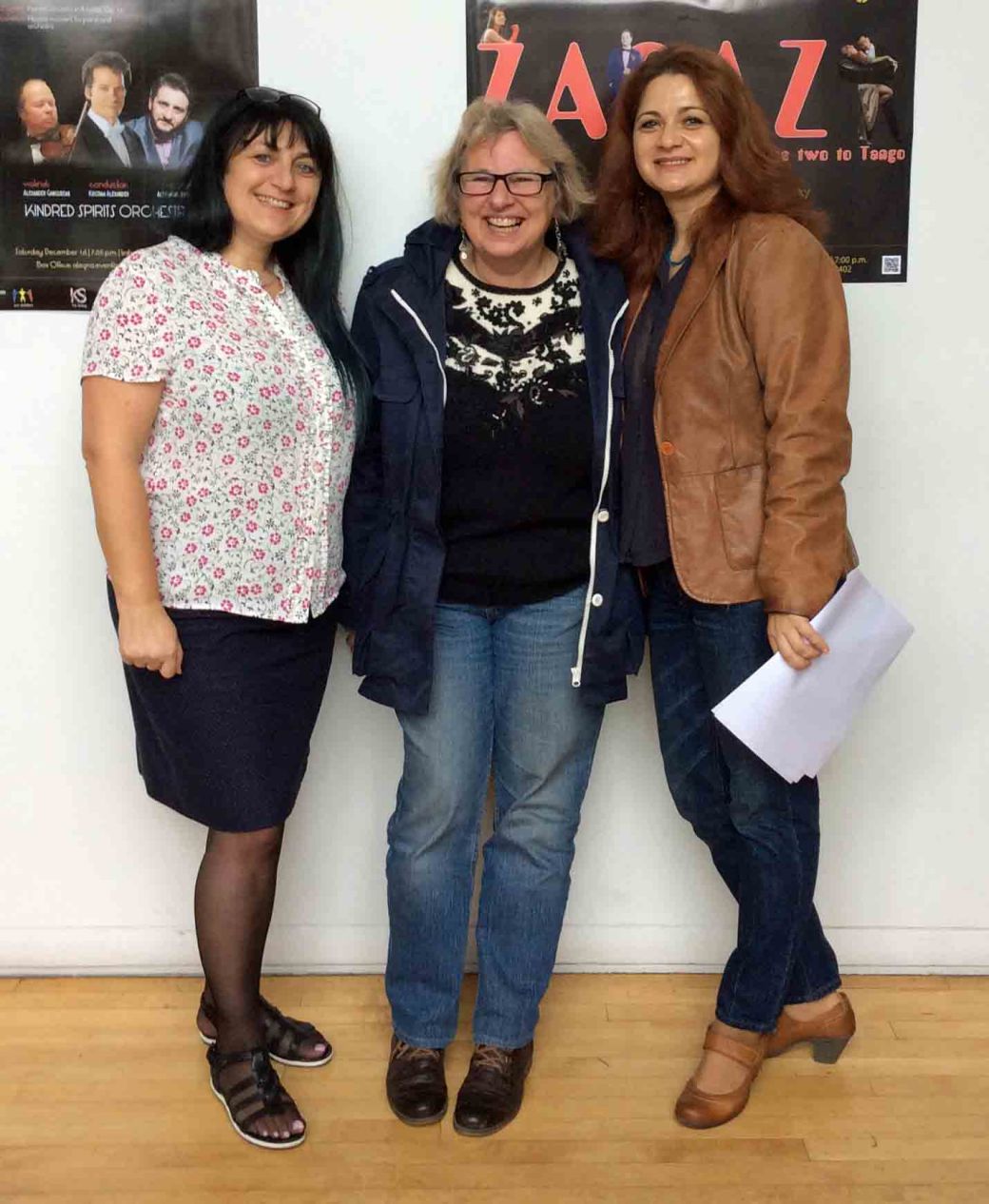
Nina stands between Juliana Pacso and Crina Bud of Tradicious

As I returned refreshed to ToRo, I realized that Tradicious was doing the same thing as Green Beanery: they had brought in a diversity of international artists in music, visual arts, fiction and poetry, philosophy and even socio-politics to meet, share, and discuss. Tradicious had created an ecotone (where worlds and ideas meet, share and learn) where diversity flourishes.

Well done, Tradicious!

nina-2014aaaNina Munteanu is an ecologist and internationally published author of award-nominated speculative novels, short stories and non-fiction. She is co-editor of Europa SF and currently teaches writing courses at George Brown College and the University of Toronto. Visit www.ninamunteanu.ca for the latest on her books. Nina’s recent book is the bilingual “La natura dell’acqua / The Way of Water” (Mincione Edizioni, Rome). Her latest “Water Is…” is currently an Amazon Bestseller and NY Times ‘year in reading’ choice of Margaret Atwood.

“A Day in the Life” of Nina Munteanu in The Toronto Guardian

Cat WaterIs-3

Felix loves water!

On October 20, 2018, the Toronto Guardian presented “A Day in the Life” of Nina Munteanu, Toronto writer. The series previously profiled writer Charles de Lint, dance artist Natasha Powell, choreographer Maria Shalvarova, dancer Lori Duncan, author Claudiu Murgan and many others.

Editor Merridy Cox (who edited Nina’s latest book “Water Is…”) introduced the “Day”, followed by eight photos that marked Nina’s “typical” day, then a short interview by the Guardian.

Photo 1-Nina-Oli

Nina’s early morning walk with Oli

Photo 2-Nina-cafe

Nina writes her next novel at a local indie coffee shop

nina-2014aaaNina Munteanu is an ecologist and internationally published author of award-nominated speculative novels, short stories and non-fiction. She is co-editor of Europa SF and currently teaches writing courses at George Brown College and the University of Toronto. Visit www.ninamunteanu.ca for the latest on her books. Nina’s recent book is the bilingual “La natura dell’acqua / The Way of Water” (Mincione Edizioni, Rome). Her latest “Water Is…” is currently an Amazon Bestseller and NY Times ‘year in reading’ choice of Margaret Atwood.


How Creative Destruction Embraces Paradox…

“Very well, then, I contradict myself; I am large—I contain multitudes.”—Walt Whitman

OuterDiverse-cover-webCreative destruction … sounds like a paradox, doesn’t it? Nature—and God— is full of contradiction and paradox. There is so much that we do not understand (at least on the surface)… and apparent contradiction proves that to me. In Outer Diverse, Book One of The Splintered Universe Trilogy, my character Serge says:

“… somewhere between the infinities of [worlds] you would experience paradox: black holes, quasars; intuition, déjà vu, clairvoyance… order in chaos…darkness at the heart of all beauty… beauty in the heart of all darkness…a mathematician with faith …the strength of surrender…loving your enemy…dying to live…”

Paradox lies undeniably at the heart of the clash of two realms.

I understand something of paradox. As an ecologist, I deal with it all the time.

Destruction in creation and creation in destruction is ingrained in the life-cycles of everything on this planet, indeed in this universe. A forest fire can destroy life but in so doing creates a more vibrant, healthier forest.

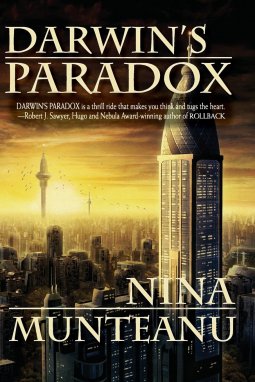
Darwins Paradox-2nd coverIn my speculative fiction novel, Darwin’s Paradox, Julie applies her father’s ecological precept to describe her observations on the rise and fall of a civilization, an ecosystem and an entire world. The precept was based on C.S. Holling’s 1987 ecological model of creative destruction:

Fire was a constant hazard in the heath. Yet, fire served the heath by discouraging invasive shrubs and halting succession. The grazing deer populations completed the job of keeping the heath from reverting to woodland. So, fire had its place as creative destroyer in the natural cycle of ecosystem behavior. Stable chaos, according to her father. It was a harsh and rude environment, Julie concluded. Like thieves in the night, bell heather, gorse and purple loosestrife snatched everything for themselves, leaving nothing for the others. Like many things in nature, the heath plants, though beautiful and fragrant, were ruthlessly greedy. . .

Creative destruction was first introduced as a term in 1942 by the economist, Joseph Schumpeter to describe the process of industrial transformation that accompanies radical innovation. According to Schumpeter’s view of capitalism, innovative entry by entrepreneurs sustained long-term economic growth, even as it destroyed the value of established companies that enjoyed some degree of monopoly power. An example is Xerox, who has seen its profits fall and its dominance vanish as rivals launched improved designs or cut manufacturing costs, drawing customers away.

The Science of Creative Destruction

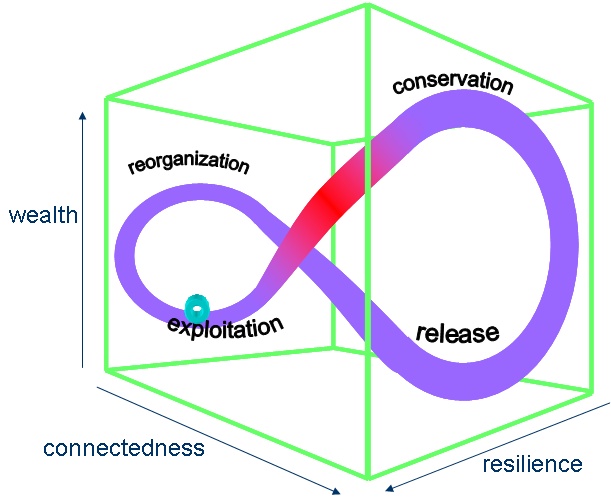
In his classic paper, entitled: “Simplifying the complex: the paradigms of ecological function and structure” (1987) C.S. Holling applied Schumpeter’s term to ecology. Holling’s model of ecosystem behaviour recognized ecosystems as non-linear, self-organizing and continually adapting through cycles of change from expansion and prosperity to creative destruction and reorganization.

creative-destruction-model

Holling presented several paradigms that ecologists use to describe the causes and behaviour (and management) of ecosystems, including an equilibrium-centred view (based on the constancy of behaviour over time), which Simon Forge described as “driving using the rear-view mirror”—trying to judge the road ahead by what went on behind. Holling advocated a “nature evolving” view, which describes ecosystems as undergoing sharp, discontinuous changes that are internally organized and balanced (I like his mobius loop to describe the closed ouroborus-like cycle of creation and destruction in nature). Holling described four phases of natural ecosystem succession within his “nature evolving” paradigm. It starts out with the exploitation phase, in which new opportunities are realized through rapid colonization and competition. Natural forces of conservation (e.g., nurturing, consolidation) lead to vulnerable systems (e.g., old growth forests), as stabilizing factors lose strength and the system evolves from having few interrelationships to having many. The result is often an abrupt change that both destroys systems and creates opportunity (creative destruction) through fire, storms, pests, senescence. Mobilization of bound, stored “capital” (e.g., carbon, nutrients and energy) through physicochemical and biological processes like decomposition and mineralization completes the dynamic cycle of functional ecosystems.

What this means for the ecosystem manager is that efforts to detect responses to changes, including human interventions like restoration activities, are confounded. Traditional (equilibrium-centred) ecosystem management may be misdirected, resulting in pathological “surprises” of ecosystem response and a spiralling vigilance and cost in control measures. Examples of traditional equilibrium-centred management of forests, fish and other organisms of terrestrial and aquatic environments with devastating consequences include:

  • firecycle copySuppression of spruce budworm populations in eastern Canada using insecticides partially protected the forest but left it vulnerable to an outbreak covering an area and of an intensity never experienced before;
  • Forest fire suppression reduced the probability of fire in the national parks of the United States but the consequence has been the accumulation of fuel to produce fires of an extent and cost never experienced before;
  • Semi-arid savanna ecosystems have been turned into productive cattle grazing systems in the Sahel zone of Africa, southern and east Africa, and other parts of the world. However, changes in grass composition have promoted an irreversible switch to woody vegetation and the systems have become highly susceptible to collapse, often triggered by drought; and,
  • Protection and enhancement of salmon spawning on the west coast of North America may have led to some success regarding enhanced stocks (e.g., hatchery-grown fish), but fishing industry is left precariously dependent on a few enhanced stocks which are vulnerable to collapse.

In each of these examples, the policy succeeded in its immediate objective. But in each case the system evolved into something with different properties and each “solution” led to a larger problem. In short, the biophysical environment had evolved into one that was more fragile, more dependent on vigilance and error-free management. Something Holling called “Nature Engineered.”

In his classic 1987 paper, Holling suggests that ecosystems be viewed—and managed—as “Resilient Nature”, where the experience of instability maintains the structure and general patterns of ecosystem behaviour; in other words, that Nature ‘learns’ and accommodates with time. In the final analysis, it is a matter of scale.

We are seeing that now as global warming takes force and we step solidly into the depths of the Anthropocene Age where green is the colour of resilience.

The Narrative of Creative Destruction

Water Is-COVER-webIn my book Water Is… I write: “Destruction in creation and creation in destruction are ingrained in the life cycles of everything on this planet and in the universe. A forest fire can destroy life but in so doing creates a more vibrant, healthier forest. Holling and I, in our separate studies, were really drawing on the ancient knowledge of polarity and cycles in nature. The opposing forces of polarity generate ongoing cycles of creation and destruction. The Ouroboros, remembering.”

The Ouroboros is an ancient symbol that depicts a serpent or dragon swallowing its own tail to form a circle. As a serpent devouring its own tail, the Ouroboros symbolizes the cyclic nature of the Universe: creation out of destruction, Life out of Death. The Ouroboros eats its own tail to sustain its life, in an eternal cycle of renewal. In the Gnosis scriptures, it symbolizes eternity and the soul of the world.

“in the Chinese I Ching, the hexagram for “crisis” also represents “opportunity.” This is because when we are in stasis (which represents lack of movement), we do not recognize our path; perspective only comes with movement. In this way, calamity, initially seen as disaster, may be viewed as unexpected opportunity for creative change. The unpredictable nature of water provides the opportunity to teach and learn.” The “crisis” of change and “destruction” provides opportunity, just as collision of viewpoints bring new ideas.”

Tree-YellowBirch winter-LR

Yellow birch tree in Little Rouge woodland (photo by Nina Munteanu)


Recommended Reading:

Holling, C.S. 1987. Simplifying the complex: the paradigms of ecological function and structure. Eur. J. Oper. Rel. 30: 139-146.

Holling, C.S. 1973. Resilience and stability of ecological systems. Annual Rev. Ecol. Syst. 4: 1-23.

Holling, C.S. 1977. Myths of ecology and energy. In: Proceedings Symposium on Future Strategies for Energy Development, Oak Ridge, Tenn., 20-21 October, 1976. Oxford University Press, New York, N.Y.

Munteanu, N. 2016. Water Is… The Meaning of Water. Pixl Press, Vancouver. 586pp.


nina-2014aaaNina Munteanu is an ecologist and internationally published author of award-nominated speculative novels, short stories and non-fiction. She is co-editor of Europa SF and currently teaches writing courses at George Brown College and the University of Toronto. Visit www.ninamunteanu.ca for the latest on her books. Nina’s recent book is the bilingual “La natura dell’acqua / The Way of Water” (Mincione Edizioni, Rome). Her latest “Water Is…” is currently an Amazon Bestseller and NY Times ‘year in reading’ choice of Margaret Atwood.


Hybrid Publishing: Understanding the Writing and Publishing Landscape

Cafe on Baldwin-TorontoOn Friday evening of October 26th Nina will be giving the first in a series of 10 writing workshops through the Immigrant Writers Association Writing and Publishing workshop series for members and non-members. Workshops are free for Class A members, $10 for Class B members, and $15 for non-members.

WORKSHOP: Hybrid Publishing: Understanding the Landscape 

DESCRIPTION: The workshop is structured as an hour-long lecture followed by discussions pertinent to the topic, such as various publishing models, self-publishing, indie publishing, the traditional and the hybrid model with the pros and cons of each model.

The workshop will cover:

  • An overview of the publishing industry, spanning from traditional to indie and self-publishing and everything in-between.
  • Advantages and disadvantages of each option discussed based on needs and perspectives. These include marketing, distribution, creative control, revenue, timing, branding, and reputation.
  • An exploration of emerging directions, models, collaborations and structures in the publishing industry and what this means for the writer.

TIME: 7pm to 9pm

PLACE: Toronto City Hall, Committee Room #2
100 Queen Street West
Toronto, ON

COST: Free for IWA Member type A; $10 for IWA Member type B; $15 for non-members

REGISTER/PAY HERE

Learn with IWA is an initiative of the Immigrant Writers Association, which helps its members enhance their writing skills, gain knowledge about the Canadian publishing landscape, and advance their careers. IWA also encourages its members and other immigrants to share the expertise they brought along, their culture, and thoughts to enrich the society they live in.

Nina’s IWA Writing and Publishing workshops series include:
(C: on craft; P: on publishing, promotion, marketing)

1 (P): Hybrid Publishing: Understanding the Landscape (Oct 26, 2018)
2 (C): World as Character (Nov 30, 2018)
3 (P): How to Promote Your Book and Increase Your Visibility (Jan, 2019)
4 (C): Storyboarding: creating “story” from scenes to worlds
5 (P): Getting Started and Finishing
6 (C): Things to Consider in Fiction Writing
7 (C): Genre-Specific Writing
8 (P): Cover Design / Interior Layout
9 (C): Self-Editing: Ways to Improve Your Language in Writing
10 (P): Getting Feedback: what to do with it

NinaOct26

_________________________

To find out more about IWA’s membership type A and B, please visit immigrantwriters.com/join-us


nina-2014aaaNina Munteanu is an ecologist and internationally published author of award-nominated speculative novels, short stories and non-fiction. She is co-editor of Europa SF and currently teaches writing courses at George Brown College and the University of Toronto. Visit www.ninamunteanu.ca for the latest on her books. Nina’s recent book is the bilingual “La natura dell’acqua / The Way of Water” (Mincione Edizioni, Rome). Her latest “Water Is…” is currently an Amazon Bestseller and NY Times ‘year in reading’ choice of Margaret Atwood.


Revisiting the Short Story and Heinlein’s Five Rules of Writing

george brown college

The seventh class of my 12-week Creating Science Fiction course at George Brown College is all about short story writing. I’m by nature a progressive—and an itinerant explorer; so, I am updating materials for my students and sharing them with you.

PlayingTheShortGame-DougSmithOne resource I’m eager to introduce to my students is Canadian SF short story writer Douglas Smith’s recent guidebook, Playing the Short Game: How to Market & Sell Short Fiction. Smith’s guidebook is a Tardis-style smallish yet comprehensive guide on what it takes to be a successful short story writer from starting & finishing to marketing & publishing to leveraging & promotion.

Smith is an accomplished short story writer and marketer, who has always openly shared his treasures of acquired wisdom with others.  His stories have appeared in thirty countries and 25 languages. He’s won three awards and has three acclaimed collections—so far. For years, his Foreign Market List has helped writers—including me—sell their work all over the world. To date, I have sold short stories (mostly translated reprints) to markets in Greece, Poland, Romania, Israel, and Italy—thanks to his list.

Why Write Short?

coffee-doubleespressoI’m a petite five foot-three height and purposely wear flat shoes. I love short. I prefer my espresso pulled in short shots—or  ristretto—in my flat white. Described as bolder, fuller, with more body and less bitterness, the ristretto is like a burst of intense flavor with a lingering finish. Short is pretty cool.

Douglas Smith gives seven excellent reasons for writing short fiction, even if you are ultimately a novel writer, like me. Writing short stories:


  1. Helps you learn your craft in easy, short-term, bite-sized amounts and over a reasonable time for you to learn, apply, and relearn
  2. Helps you test the waters of literature, to discover what excites you, provokes you and what ultimately you NEED to express
  3. Builds your resume, again more easily and quickly than a novel, toward that ultimate novel; publishers of magazines and publishing houses are more likely to take your work seriously if you have a publishing history
  4. Helps you explore ideas for your novel, by “pinging” certain premises you may wish to explore in further detail or take elsewhere in a novel
  5. Helps you build a backlist of published stories, which you own, once rights have reverted back to you
  6. Helps you build a network in your writing community of publishing houses, editors, other writers and so forth as you submit and exchange through your works and letters (including all those rejections!). Eventually, a pleased editor/publisher may invite you to submit to a “Best of” anthology or provide a collection. This has happened to me several times.
  7. Helps you learn the publishing business (well, sort of, says Smith…). Through exposure to the business side of publishing, you will gain an appreciation of how the publishing world works.

Know What You’re Writing

Nina-computer-KraveA short story only has 7,000 or less words to get your tale across while a novel has over ten times that many words to do the same. It follows then that the short story format is a simpler one. This does not necessarily mean easier.

Novels provide a sense of change, growth and solutions to problems and conflicts. “The short story doesn’t have the luxury of depicting change; the closest it can come is awareness,” writes Shelley Lowenkopf in her 2007 article “Telling Tales” in The Portable Writer’s Conference: Your Guide to Getting Published by Quill Driver Books.

She goes on to describe the short story as a close-up to a novel’s landscape. The short story is, therefore, often more intense and powerful. A short story, more than a novel, has the power to transport, disturb and enlighten.

ElementsOfFiction-SceneStructure-BickhamRenowned short story authors like Edgar Allen Poe, Nathanial Hawthorne, and Somerset Maugham, emphasize the importance of striving for one effect when writing a short story: the single effect you wish to leave with the reader at the end. This is accomplished by selecting events or situations that build quickly into a combustible response. Even Alice Munro, who is known for cramming long timeframes into her short stories, frames time through a single event: a meal, family gathering, wedding or funeral, for instance.

Jack Bickham, in his book, Elements of Fiction Writing: Scene and Structure by Writer’s Digest Books (1993) writes that, “story length, author intention, traditional expectations of the audience, and all sorts of things may affect the form a story may take.” Choosing the appropriate length to tell your story relies on the complexity of your premise and theme.

Understanding the Short Story Format

Here are seven tips toward writing a compelling and memorable short story:

  1. Open in the middle of something happening (e.g., action/in a “scene”)
  2. Make your opening provocative (raise the stakes as high as you can)
  3. Write scenes and write sparingly (avoid describing the obvious—use description to show something odd, memorable, exotic)
  4. Have characters define themselves and their goals through what they do and observe (e.g., show more than tell)
  5. Define characters with dialogue (a great way to reveal while keeping a high pace)
  6. Withhold vital information for as long as possible
  7. Don’t explain the ending (cut down on the denouement; let the reader make those conclusions—a key in the short story format)

Selling Your Short Story

Smith’s guidebook provides several chapters of excellent advice in logical steps toward a successful career.

Here are just a few gems that I will be sharing with my students.

First of all, remember that you are not selling your story; you’re licensing a particular set of rights for someone to do something with that story. Before you do anything else, do your homework: know the rights you’re selling; and which ones to keep. Smith describes five major types of rights: media; language; geography (less and less relevant); occurrence; and time.
Eramosa River 3

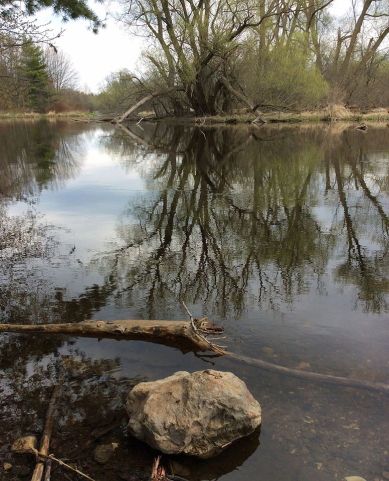
Eramosa River, Ontario (photo by Nina Munteanu)

Media rights include print rights, electronic rights and audio rights. Markets include magazines, anthologies and collections for short stories. Language and geography rights are pretty self-explanatory. Occurrence rights relate to whether the publisher is buying first or second and onward rights (otherwise known as reprints). Most publishers prefer to pay for the right to publish your work for the first time in that particular format (e.g., in print and in English, for instance). Having said that, I’ve had a lucrative history of selling reprints to some of my more popular short stories. I’ve furthered gone on to selling other rights, such as foreign language rights and audiobook and e-book rights. I’ve also sold two short story collections, one to an Italian publisher (coming out this year) and shorts in several anthologies. No movies yet… But I did have a serious discussion with a writer/producer on one of my shorts. Recall how many Philip K. Dick short stories have been adapted to movies (e.g., Total Recall, The Adjustment Bureau, Paycheck, Minority Report, and Blade Runner).

Heinlein’s Five Rules of Writing

Smith evokes SF writer Robert J Heinlein’s 5 rules of writing to succeed as a short story writer (as any kind of writer, actually). These are:

  1. You must write
  2. You must finish what you write
  3. You must refrain from rewriting, except to editorial order
  4. You must put the work on the market
  5. You must keep the work on the market until sold

I know… Number 3 sounds pretty suspicious, or arrogant at the very least. As Robert J. Sawyer concludes on his site in reference to the five rules, number 3 is open to reasonable interpretation. Of course, it must mean AFTER you’ve finished and edited the story with some level of confidence that you’re happy with it—never mind what other people think of it.

FictionWriter-front cover-2nd ed-webNina’s Bus-Terminal Model

In my writing guide The Fiction Writer, Chapter L (for “Long or Short?”), I talk about how I launched my own successful short story writing career. I’d been writing short stories for a few years without much success (I was getting interesting rejection letters, so I knew I was getting close); then I settled into a kind of model/routine. I call it The Bus Terminal Approach. As Smith attests—several times—it’s a numbers game. That’s how I played it. It starts with one story and relies on you not waiting until you write the next, and the next and the next. Here’s how it works:

  1. You list at least 3 markets that you’ve researched for Story A and send it to the first of the three
  2. You start right away writing Story B, send it to the first of 3 markets you’ve researched and listed for it
  3. When Story A rejection arrives, you do not revise but send it right away to the second market
  4. Same thing for Story B
  5. Write Story C and treat similarly

NaturalSelection-front-webRemember to keep track of what you send where and when and what happens to it. It can become a very confusing bus terminal otherwise, with someone ending up in Seattle when they are headed to Toronto! What happens with this approach is several things: you begin to treat the whole marketing/publishing process as a business (which it is) and because you have so many “buses” out there coming and going, the rejections don’t hurt quite as much and instead become part of the learning process, which they should be. You adopt a more business-like approach, which translates into your relationship with editors and publishers. A win-win situation results. Believe me; this works. Once I fell into this method, my sales increased by over 70%.


Several of my stories are currently available in a collection entitled Natural Selection by Pixl Press. You can read one of my short stories right on Amazing Stories: “Virtually Yours”.

My guidebook, The Fiction Writer, can be purchased in various online and onsite bookstores, including Amazon, Kobo, Chapters Online, Barnes & Noble, and several others even I don’t know about.

nina-2014aaaNina Munteanu is an ecologist and internationally published author of award-nominated speculative novels, short stories and non-fiction. She is co-editor of Europa SF and currently teaches writing courses at George Brown College and the University of Toronto. Visit www.ninamunteanu.ca for the latest on her books. Nina’s recent short story is the bilingual “La natura dell’acqua / The Way of Water” (Mincione Edizioni, Rome). Her latest “Water Is…” is currently an Amazon Bestseller and NY Times ‘year in reading’ choice of Margaret Atwood.
Vancouver Coffee Marathon—Four Coffee Shops in Four Hours

First Hour: Nusa Coffee

asian-palm-civet3

The Asian Palm Civet

I started my coffee marathon at Nusa Coffee, on 4th Avenue in Kitsilano. Nusa means “islands” and, indeed, Marcus, one of the partners, told me that most of their coffee comes from Indonesia, an archipelago of over 17,000 islands stretching an expanse the length of Canada.

Nusa features coffee from beans grown in the Ngada region of Flores, the Toraja Highlands of central Sulawesi, the Kintamani Highlands of Bali and the Gayo Highlands in Sumatra Gayo.

Asian-Palm-Civet

Asian Palm Civet

But I’d come for kopi luwak—otherwise known as cat poop coffee—made from coffee beans that have been digested by a small Indonesian cat called an Asian Palm Civet (Paradosorus hermaphroditus)—a small viverrid native to South and Southeast Asia. They help maintain tropical forest ecosystems through seed dispersal as they feed on pulpy fruits such as mango, rambutan and coffee.

Why was I doing this? Well, since I’d heard about it, I just had to try it out for myself. According to The Vancouver Coffee Snob the civets feast on ripe coffee cherries, which start to digest and ferment in their stomachs.

Nusa-coffee pour

Marcus does the pour over

The enzymes allegedly remove the acidic tastes from the coffee, imparting new flavours. The cat then poops what’s left and farmers collect the poop, clean them, process and roast the beans. Civet coffee beans are harder and more brittle because they have been modified by the digestive juices of the civet.

Because of the new trend for Kopi Luwak, civets are being increasingly captured from the wild and fed coffee beans to mass-produce this blend. Many of the captured civets are housed and treated unethically. The impact of all these captures on the wild population and consequent ecosystems they live in, is not yet known. The lesson here is: do your research to ensure that the product you’re buying has been ethically collected from wild Civet poop. Nusa Coffee is one of them.

NUSA-Catpoo Coffee

Kopi Luwak at Nusa Coffee in Vancouver

Marcus let me smell the beans before grinding them. The aroma was deep, pleasant and nutty. That carried into the coffee pour over (which is more gentle than using an espresso machine). Then it came to tasting it: I found it unpretentious, earthy with subtle tones that lingered in the back of the throat. As I breathed in the kopi luwak, I thought of the jungle where the civet lives…and poos. Nusa Coffee is also unpretentious; a cozy café with wood benches and tables and no overbearing music.

Second Hour: Platform 7

Platform7 cafe

Platform 7 and bookstore in Kits (photo by Nina Munteanu)

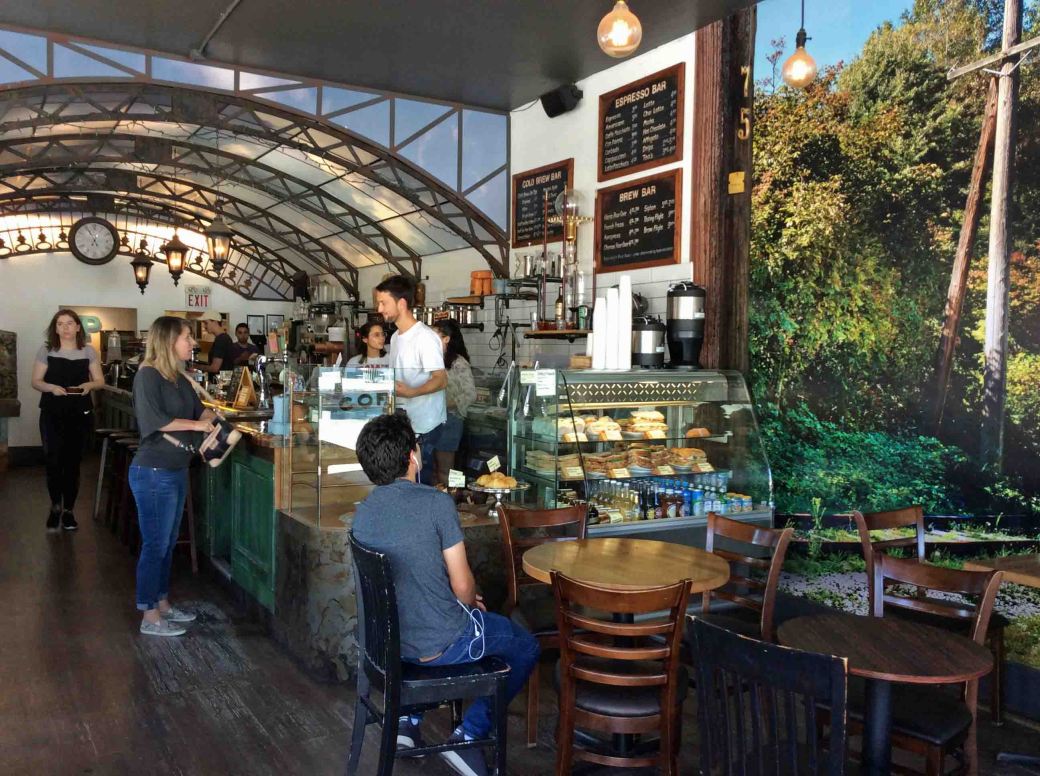
My second stop was Platform 7, on Broadway and Vine, where I stopped for lunch. Located in an old house next to a character-book store (a great combination for a writer!), Platform 7 is a creative take on a bustling “Victorian London train station in East Vancouver and a Belle-Époque Parisienne train station in Kits.”

The café offers a large variety of coffees from their espresso bar, cold bar and brew bar. I enjoyed friendly service and pleasant jazz-fusion music as I ate lunch, a deliciously grilled turkey with cranberry sandwich.

Platform7-interior

Inside Platform 7 Coffee (photo by Nina Munteanu)

Third Hour: Federal Store

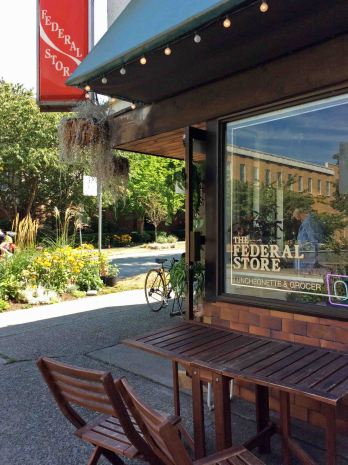
Federal Store outside3

The Federal Store (photo by Nina Munteanu)

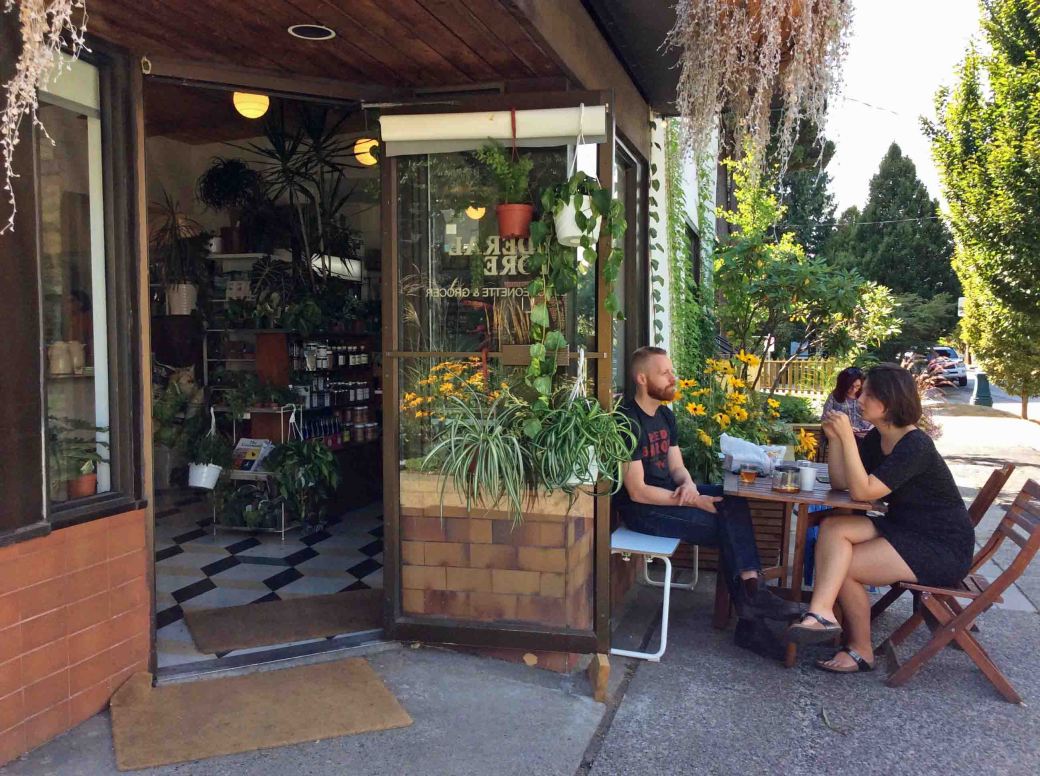
I continued east across town along Broadway into Mount Pleasant and walked south along Quebec Street toward 10th Avenue, where the Federal Store greeted me on the corner. Surrounded with cheerful flowers on all sides and a vegetable garden in the back, the café-grocer beckons me inside. I enter and feel like I’ve entered an alternative past: an integration of ’50s trompe l’oeil 3-D checker floor, plants, and homemade baking in the display with the avant-garde chic of wood and white.

I ordered an Earl Grey tea (for a change from coffee) and sat outside, where I enjoyed the loose tea as birds sang around me and bees buzzed among the flowers.

Mia Stainsby of the Vancouver Sun writes, “One block away, Main Street hyperventilates and cars exhale carbon monoxide. But here at Federal Store, it’s quiet and I’m caught in a time warp. The vintage room stirs up romantic notions of simpler times.”

Federal Store entrance2

The Federal Store (photo by Nina Munteanu)

Fourth Hour: Le Marché St. George

It grew hot as the day progressed, but I kept cool under the thick canopy of maples, chestnuts and ash trees as I proceeded southeast to my next destination. Once I’d topped the hill, I turned east on 28th and as I neared my next destination, I realized that I’d saved the best for last.

Le Marche St George-outside

Le Marche St. George (photo by Nina Munteanu)

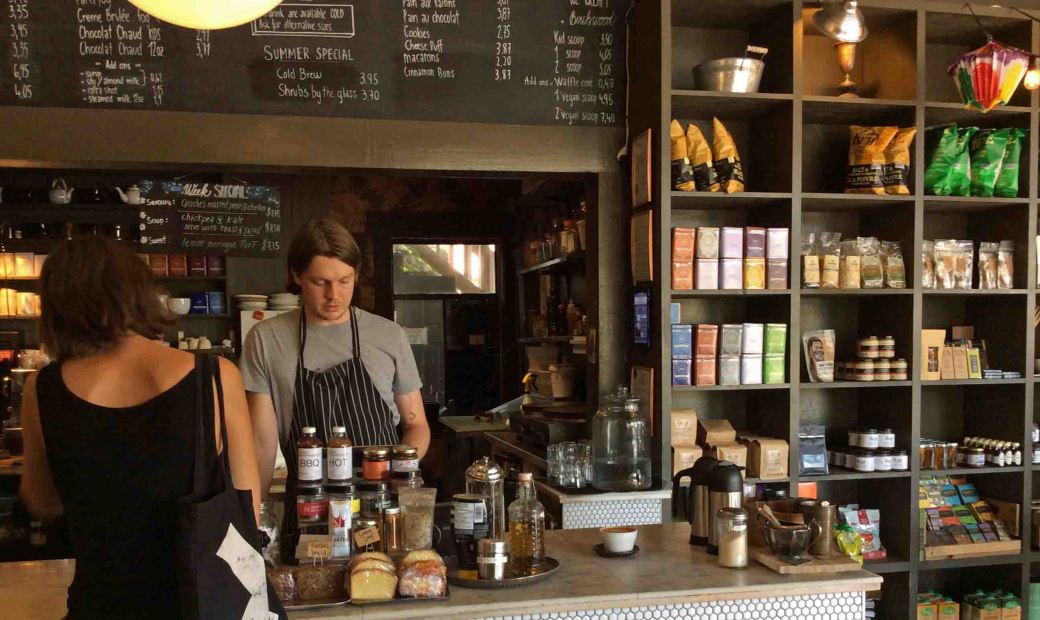
When I caught sight of Le Marché St. George, tucked behind several large poplar trees on the residential corner of 28th and St. George, I had to smile like a pilgrim finding a rest stop. Edith Piaff’s sultry voice sang through the open door of the large old house as cyclists and locals sat outside, drinking coffee and discussing their day. I entered the café-general store, walls high with diverse produce. It was no ordinary general store. This was the kind of place—I recalled my son telling me earlier—where you could buy your next Christmas gift. A cornucopia of interesting flotsam beckoned: from Woodlot candles and Maison Orphée mustard to black cyprus flake sea salt, flat breads, gourmet honey and pasta.

LeMarche StGeorge-inside

Inside Le Marche St. George (photo by Nina Munteanu)

I ordered a flat white, which turned into a cappuccino. The barista—let’s call him Etienne—apologized and was ready to start over but I accepted the drink with a smile; I’d noted that he’d really made a European cappuccino, which is essentially a flat white (a cappuccino with no dry foam). I took the coffee and sat outside under the shade of a poplar tree and opened my book, “Barkskins” by Annie Proulx.

Beside me, two young Asian men were discussing an article they’d read about how men get into and out of a bathtub. I realized I’d read the same line of my book several times when one fellow confided to the other that he thought he had sleep apnea and was slowly dying from oxygen deprivation over nights of not quite sleeping.

All in a summer’s day, I thought, and closed the book and my eyes, then put my feet up on the planter and smiled the smile of pure contentment.

mercurio-swanpuffs

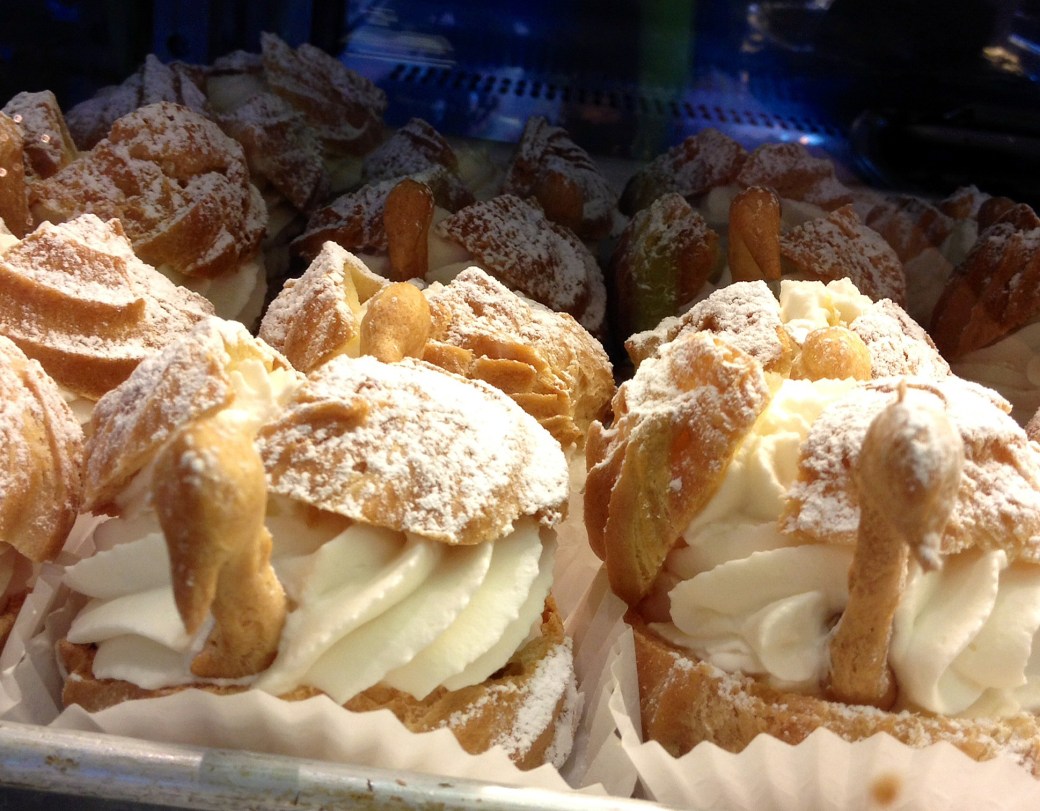
Swan cream puffs (at Mercuro L’Espresso Bar) (photo by Nina Munteanu)

p.s. No good sojourn is without its conclusion and mine began with the bus ride home as it neared the supper hour … It seems that by then all that caffein in my system was truly kicking in; I could hardly sit still during the forty minute ride and if I’d had a computer or pen and paper, surely would have speed written a tome the size of War and Peace by the end of my journey.

But I didn’t. So, I didn’t (tiny smile).

nina-munteanuNina Munteanu is an ecologist, limnologist and internationally published author of award-nominated speculative novels, short stories and non-fiction. She is co-editor of Europa SF and currently teaches writing courses at George Brown College and the University of Toronto. Visit www.ninamunteanu.ca for the latest on her books.

Amazing Cover Art, Part 2: Anne Moody and Costi Gurgu

MockUpEcology-2

The cover for Nina’s upcoming writing guide: illustration by Anne Moody; typology & design by Costi Gurgu

In my article “Should You Judge a Book by its Cover”, I wrote about the importance of cover art for book sales and to maintain integrity and satisfaction with the story inside. In the article, I pointed out that, “If you don’t know the author of the book, the nature—and implied promise—of the cover becomes even more important. If the book does not deliver on the promise of the cover, it will fail with many readers despite its intrinsic value. A broken promise is still a broken promise. I say cover—not necessarily the back jacket blurb—because the front cover is our first and most potent introduction to the quality of the story inside. How many of us have picked up a book—intrigued by its alluring front cover—read the blurb that seemed to resonate with the title and image, then upon reading our cherished purchase been disillusioned with the story and decided we disliked it and its author?”

Cover art provides an important aspect of writer and publisher branding. Cover artists understand this and address the finer nuances of the type and genre of the story to resonate with the reader and their expectations of story. This includes the image/illustration, typography, and overall design of the cover. A cover for a work of literary fiction will look quite different from a work of fantasy or romance. Within a genre, subtle qualities provide more clues—all of which the cover artist grasps with acute expertise.

I’ve been fortunate in my history as a professional writer to have had exceptional art work on the books I’ve written or collections and anthologies I’ve participated in (see the mosaic below of many but not all the covers my work has been associated with).

For most of my books, my publisher provided me with a direct link to the cover artist (e.g., Dragon Moon Press, Edge Publishing, eXtasy Books, Liquid Silver Books, Starfire, Pixl Press) and I retained some creative control. I even found and brought in the cover artist for projects I had with Pixl Press.

Anne Moody and Pixl Press

Anne-Studio01 copy

Anne Moody working on her next painting

I met Anne Moody at the environmental consulting firm where I worked after leaving the University of Victoria. I’d taught limnology (the study of freshwater) for several years at UVic, then I joined the Vancouver firm as an aquatic ecologist and environmental consultant. That’s where I met fellow ecologist, Anne. Anne is a plant ecologist who has worked with federal and provincial governments on reclamation and restoration projects. She’s designed and planted marshes throughout the world and has taught at university in her field of expertise.

Anne wasn’t painting then. She started long after we parted our ways—she to a government job and I to a teaching job at The University of Toronto. However, as she mentions in her short bio, Anne has been drawing and painting since childhood—just like me. The difference is that she has come back to the fine arts with an eye for compelling imagery. Using her science knowledge and discipline to work with light, texture and form, Anne creates works of stunning originality that resonate with rugged landscape and with those who belong to it. Her work is, needless to say, fetching for a book cover!

FictionWriter-front cover-2nd ed-web copyWhen Pixl Press started looking for suitable cover artists to rebrand my writing craft series, I showed some of Anne’s work to the director Anne Voute. Pixl Press had already worked with Costi Gurgu and we liked his work. The result of Anne’s illustrations and Costi’s typography and design was a series of stunning covers that branded my books with just the right voice.

Journal Writer-FRONT-cover-WEB copyThe Alien Guidebook Series, of which two books are out so far (The Fiction Writer: Get Published, Write Now! and The Journal Writer: Finding Your Voice) was designed by Costi with a guidebook brand that would stand out, yet showcase the natural British Columbia landscape art by Anne that I felt strongly connected to. Anne’s cover art for The Journal Writer is one of several studies of Toquart Bay, BC.

FictionWriterCoverWeb copy 2Anne’s illustration for The Fiction Writer (a painting of Knutsford, BC) actually represents the second cover. The Fiction Writer was originally released in May 2009 and the cover portrayed a spiral galaxy—beautifully designed by Virginia O’Dine. The cover overly stressed my science fiction background and did not give a balanced portrayal of the guidebook, which addresses any fiction—not just science fiction. Anne’s portrayal of a field in Knutsford was deemed better suited to a new branding for the series.

MockUpEcology-2I am currently researching and writing the third guidebook in the series—a reference on world building and use of ecology in story—The Ecology of Story: World as Character.

I visited Anne at her ranch near Vanderhoof, B.C., to discuss a cover. Between chores on the 100-acre ranch, gourmet meals from local produce, and lively political discussions over generous amounts of wine—we spent the entire weekend looking over and evaluating Anne’s pieces as potential cover art. Anne had so many good pieces, I became confused with what would work best.

Nina-sedgefield at Annes-closest2 copy 2

Nina stands in Anne’s sedge marsh

Finally on the last day, we stumbled on the perfect one: a painting Anne had done of a photograph her daughter had taken during a wildfire in northern British Columbia. Anne had stylized the photo into its own narrative that was compelling. My publisher was excited by it. We expect Pixl Press to release The Ecology of Story in late 2019.

NaturalSelection-front-web copyAnne’s art work for the cover of Natural Selection: A collection of short stories had originally resonated with me when she had first shown me the original painting at an art show on Vancouver Island. Called Mere Tranquility, her acrylic and oil painting uses shades of aqua, green, blue and yellow to convey a small pond during a quiet summer day. She’d captured the elusive dance of light and water perfectly. I was reminded of the genius of Monet. Anne was delighted to let us use it. Pixl Press commissioned Gurgu to design the cover; his minimalist clean design was pure genius.

The cover for Natural Selection remains one of my favourite covers of all time. And it just so happens that the cover art and design solidly portray the tone and content of the stories within. Bellisima!


anne-moody-plein-air-painting

Anne Moody painting en plein-air

Anne Moody is a celebrated Canadian artist and plant ecologist. She worked with the British Columbia provincial government in their Department of Environment and now consults for her own company. She has been drawing and painting since childhood and won her first award at a “Painting in the Parks Program” when she was nine.

“I consider myself a realist, strongly tempted by abstract elements wrapped in story,” says Anne. “The images that speak to me are scenes that convey meaning beyond superficial beauty. My compulsion to paint takes charge when an image embedded in my memory will not allow me to rest until I promote it to canvas. My choice of medium, water-colour, acrylics or oil, is dictated by the nature of the image.”

All Nina Munteanu books can be found on most Amazon sites.

Microsoft Word - Publication-COVERS-all-2018.docx

nina-2014aaaNina Munteanu is an ecologist and internationally published author of award-nominated speculative novels, short stories and non-fiction. She is co-editor of Europa SF and currently teaches writing courses at George Brown College and the University of Toronto. Visit www.ninamunteanu.ca for the latest on her books. Nina’s recent book is the bilingual “La natura dell’acqua / The Way of Water” (Mincione Edizioni, Rome). Her latest “Water Is…” is currently an Amazon Bestseller and NY Times ‘year in reading’ choice of Margaret Atwood.

Nina Delivers Words and Worlds at WWC

SmokeSun-Rockies2

Smoky sun overlooking Rockies (photo by Nina Munteanu)

I recently travelled from Vancouver with Pixl Press director Anne Voute through the smoky Rockies to the 8th ‘When Words Collide’ writers festival in Calgary. The festival was held August 10-12, 2018 and brought together just under a thousand readers and writers in multi-genres to attend presentations and panels on writing and publishing.

The three-day writers’ festival ran a 10-track program that included informative panels, Blue Pencil Café, Editors Speed Mingle, pitch sessions with agents and publishers, and challenging workshops.

MythHawker table-WWC2018

Selling books at Myth Hawker

My books were on sale in the Merchant’s room at Sentry Box (a local Calgary bookstore) and Myth Hawker Travelling Bookstore. By the third day, Myth Hawker sold all available copies of Water Is…

I participated in panels, Blue Pencil Café, Editors speed mingle and several presentations and workshops:

  • You Oughta Be in Audio: a discussion between me and audiobook narrator and producer Dawn Harvey on the making of the audiobooks for The Splintered Universe—now available in three formats, print, ebook, and audiobook. While paper sales dwindle, audiobooks continue to be the fastest growing segment of the publishing world with sales increasing by 30% year over year for the past decade.

Amazon-SplinteredUniverseTrilogy

  • World As Character: a presentation on creating a world with meaning. In most science fiction and fantasy, the world that we create is often very different from our own; in speculative fiction it’s often very similar; in contemporary fiction it is virtually the same. In all cases the world you build should embed in your story with layered metaphoric meaning. Nina Munteanu will discuss how to build a world that interacts with character to inform greater meaning in story.

FictionWriter-front cover-2nd ed-web copyJournal Writer-FRONT-cover-WEB copyI also networked my writing community for world examples to use in my Alien Guidebook on world building: The Ecology of Story: World as Character. Anticipated release by Pixl Press of this third guidebook in the Alien Guidebook series is Summer of 2019. In keeping with the branding of the series, artist Anne Moody is providing the cover illustration and Costi Gurgu the cover design for The Ecology of Story. Covers for the previous two books were also done by Anne and Costi.

Cover-everyday hero

‘Everyday Hero’ by Anne Moody

Earlier in the month, I travelled north with the Pixl Press director to Anne’s ranch in Vanderhoof to requisition a cover from her for the guidebook. After days of discussion and “show and tell” and after several pieces of art were tentatively selected, Anne pulled out a piece that stopped our search dead. ‘Everyday Hero’ depicts a lonely firefighter, trudging in the burning forest, tired gaze to the burning crown of a tree. Considering the subject matter and our world today, we thought this was perfect for my book.

MockUpEcology-2

cover design by Costi Gurgu, illustration by Anne Moody

Depicted in shades of blue, charcoal and brilliant red, the cover contrasts and harmonizes well with the brand typology and cover design by Toronto graphic artist Costi Gurgu.

.


nina-munteanuNina Munteanu is an ecologist, limnologist and internationally published author of award-nominated speculative novels, short stories and non-fiction. She is co-editor of Europa SF and currently teaches writing courses at George Brown College and the University of Toronto. Visit www.ninamunteanu.ca for the latest on her books.

Amazing Cover Art, Part 1: Tomislav Tikulin and Costi Gurgu

In my article “Should You Judge a Book by its Cover”, I wrote about the importance of cover art for book sales and to maintain integrity and satisfaction with the story inside. In the article, I pointed out that, “If you don’t know the author of the book, the nature—and implied promise—of the cover becomes even more important. If the book does not deliver on the promise of the cover, it will fail with many readers despite its intrinsic value. A broken promise is still a broken promise. I say cover—not necessarily the back jacket blurb—because the front cover is our first and most potent introduction to the quality of the story inside. How many of us have picked up a book, intrigued by its alluring front cover, read the blurb that seemed to resonate with the title and image, then upon reading our cherished purchase been disillusioned with the story and decided we disliked it and its author?”

Collision With Paradise Small

Liquid Silver’s romance / SF cover

Cover art provides an important aspect of writer and publisher branding. Cover artists understand this and address the finer nuances of the type and genre of the story to resonate with the reader and their expectations of story. This includes the image/illustration, typology, and overall design of the cover. A cover for a work of literary fiction will look quite different from a work of fantasy or romance. Within a genre, subtle qualities provide more clues—all of which the cover artist grasps with expertise.

I’ve been fortunate in my history as a professional writer to have had exceptional art work on the books I’ve written or collections and anthologies I’ve participated in (see the mosaic below of many but not all the covers my work has been associated with).

For most of my books, my publisher provided me with a direct link to the cover artist (e.g., Dragon Moon Press, Edge Publishing, eXtasy Books, Liquid Silver Books, Starfire, Pixl Press) and I retained some creative control. I even found and brought in the cover artist for two projects I had with Starfire.


Tomislav Tikulin and “The Last Summoner

DarwinsParadox-Cover-FINALsmall

Dragon Moon’s SF cover

Croation artist Tomislav Tikulin was the artist my Dragon Moon publisher had found for my 2007 book “Darwin’s Paradox”. For Darwin, I worked closely with Tikulin, who created the compelling hard science fiction cover of “future Toronto” that has attracted readers to the book for years. Tikulin has done cover designs for many publishers and bestselling writers from Ray Bradbury’s Dandelion Wine and Arthur C. Clarke’s Rendezvous with Rama to Amazing Stories Magazine.

Cover1_LastSummoner-frontcover

Starfire’s fantasy cover

In perusing Tikulin’s website one day, I was transported by one of his illustrations—of an awestruck knight standing knee deep in a mire within a huge drowned cathedral. Shafts of golden light from the vaulted ceiling angled across, bathing the mire and the bemused knight beneath. There was a powerful story in that image, I thought, and wrote a whole book based on it: “The Last Summoner”. Imagine the feeling when I approached Tikulin to licence the image and then my Starfire publisher to use it—and both agreed! You’ll have to read the book to find out why the image was so important to the overall story. Graphic artist Costi Gurgu took Tikulin’s image and used his typology and design skills to create an extraordinary front and back cover and spine. You can learn more about Tikulin in my interview with him on The Alien Next Door.


Costi Gurgu and “The Splintered Universe Trilogy

Front Cover ONLY-web

Starfire’s SF cover

I met Costi Gurgu and his wife Vali Gurgu at a science fiction convention in Montreal in 2009. Costi and Vali were successful graphic artists working on magazine covers and interiors for top magazines in Toronto. When I eventually moved there to teach at the University of Toronto, I discussed cover design with Costi. I was working on a detective thriller in space with kick-ass female detective and Galactic Guardian, Rhea Hawke. I’d initially envisioned the book as one entire novel with three parts, but it very soon became apparent to me that it was three actual books in a trilogy. The Splintered Universe Trilogy consists of Outer Diverse, Inner Diverse, and Metaverse.

I was intrigued by what Costi designed: a “Triptych” for the three books of The Splintered Universe Trilogy. In an interview I did on The Alien Next Door, I asked him what inspired him to come up with it and what did he like about it? Costi replied:

“Your main character, Rhea, undergoes a certain evolution from a regular human being to… let’s just say something else. And that evolution has three parts, one for each book of the trilogy and it also has a touch of divine. So, the triptych design, so often used for religious paintings, fits like a glove on the entire concept.”

Inner-diverse-front-cover-WEB

Starfire’s SF cover

I was very taken by how the design for the triptych carried a powerful image that conjures a portal or gateway into another world (which is what the trilogy is about). The reader is drawn into an infinite landscape, looking in, and Rhea is looking out from within in Outer Diverse, bursting through in Inner Diverse, and walking outside with confidence in Metaverse. Costi explained the meaning behind the symbols and colours he used: “The initial idea was for the red ring to be a sort of mapping device and a radar combined into one, since Rhea travels great distances in her quest. Then I realized it might as well be a portal device on top of everything else and serve all her travelling needs.

There were two options —either we would look with her outside, to whatever target she had, or look towards her. I thought that it would be more powerful if we could look towards her and see her determined face, see the unflinching resolution in her eyes, while she’s pondering her next move and readying herself to use the device once again. But to look towards her and see her in a confining room of a space ship, or such, would have defeated the purpose. So, I needed to have her against the infinite landscape as the backdrop. She is in a continuous journey to discover herself and this journey takes her literally through the infinite spaces of not just one universe.”

Costi also shared some of the process in creating a cover design:

Metaverse-FRONT-web

Starfire’s SF cover

“Technically speaking, I always start with sketches on paper, which I later scan. I mainly use Adobe Photoshop, but for this illustration I had to use Adobe Illustrator as well. Obviously, the layout and the typography were done in Adobe InDesign.”

Costi’s wife, Vali, was the model for Rhea Hawke. Some of the additional shoots can be seen in the Youtube book trailer). Costi shared that, “I had to decide how to treat her image. I could have gone towards a more glamorous, shiny look, like in a fashion image, or I could just simply keep it more realistic… I chose to keep it that way, because I wanted to offer a realistic image of an ex-police officer: a woman who was used to fighting and chasing criminals, rather than taking care of her appearance.”

You can read the complete interview with Costi on The Alien Next Door.

All Nina Munteanu books can be found on most Amazon sites.

Microsoft Word - Publication-COVERS-all-2017.docx

Sampling of publication cover art for works by Nina Munteanu (to 2017)

nina-2014aaaNina Munteanu is an ecologist and internationally published author of award-nominated speculative novels, short stories and non-fiction. She is co-editor of Europa SF and currently teaches writing courses at George Brown College and the University of Toronto. Visit www.ninamunteanu.ca for the latest on her books. Nina’s recent book is the bilingual “La natura dell’acqua / The Way of Water” (Mincione Edizioni, Rome). Her latest “Water Is…” is currently an Amazon Bestseller and NY Times ‘year in reading’ choice of Margaret Atwood.