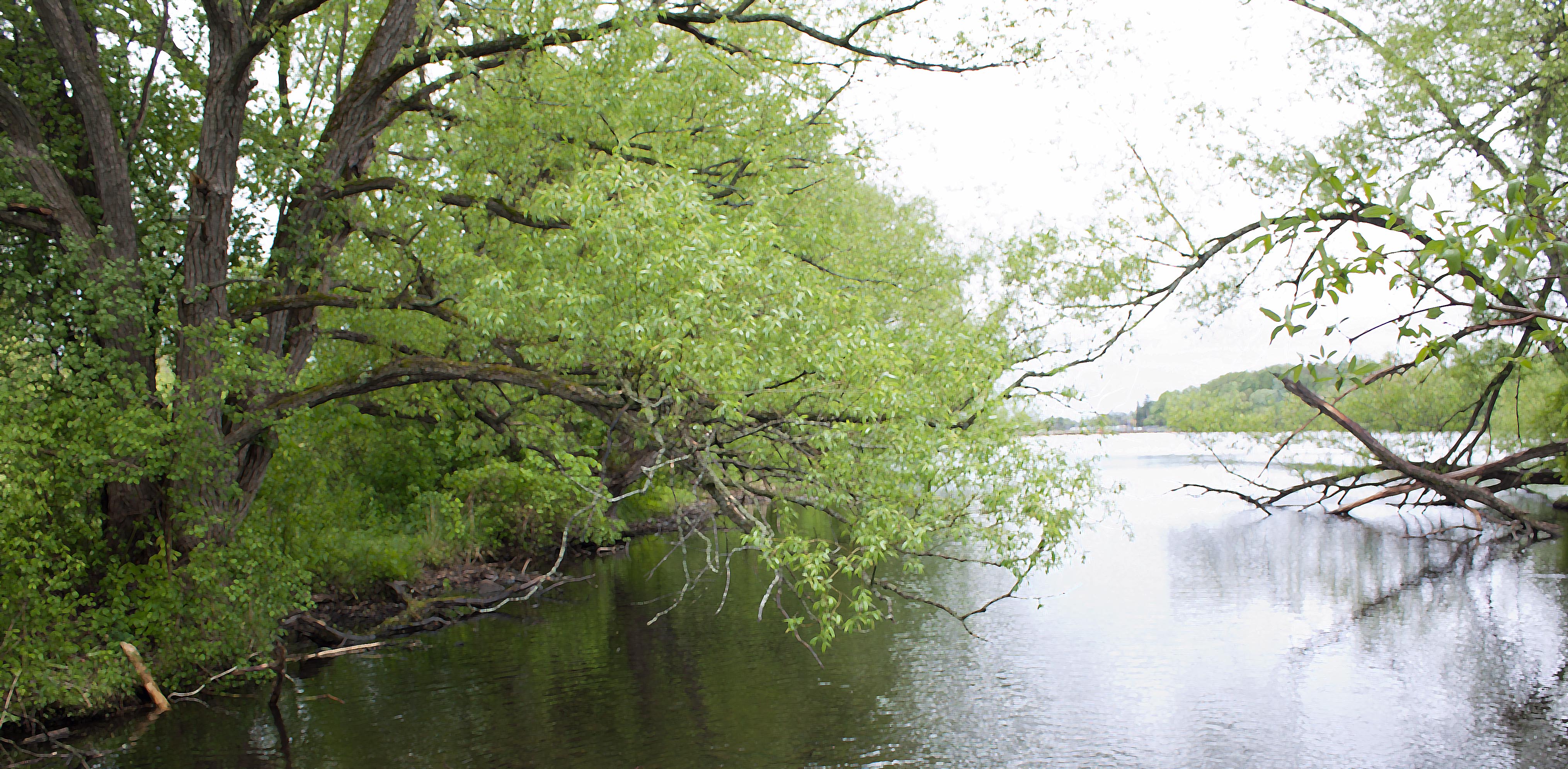
On a recent walk through a vibrant local marsh quietly embedded in a community, I contemplated its tenuous position. I’d stopped on a bridge that overlooked an open pond teaming with clucking and squawking waterfowl and let my mind drift to the busy urban environment I’d left behind. Here I stood in an oasis of being, a treasure threatened by development. I cast my mind to the relentless destruction of our natural world for the sake of ‘progress’ and felt an inlking of solastalgia.
For decades I’ve served as an environmental consultant and limnologist, championing the environment against senseless destruction. I’ve witnessed too many examples of ecosystem simplification and collapse through clear-cutting, urban development, marsh destruction, and diversions of rivers or toxic pollution. All with associated loss of biodiversity and accelerating extinction. The reduction in numbers and the extinction rate of nonhuman life is truly alarming.
I couldn’t help making the connection between our rapidly degrading environment and rapidly rising AI.
You think that a crazy connection? Let me explain.
Artificial Intelligence and associated LLMs are tools borne of the need for efficiency; used properly, they expedite, streamline, simplify, save work time, and may even on some occasions illuminate and educate. Ultimately, these tools speed things up toward a destination. The journey to that destination is often purposely shortened, and usually unnoticed or forgotten. Efficiency isn’t about enjoying the journey; it is all about getting there, wherever that is. That’s our existence today. An existence that belongs to AI. An existence that ignores or ‘others’ Nature and sees it as an impediment to progress. The destruction of our natural world—the one that supports all life—is directly linked to the exploitive model of late capitalism that embraces AI and, at its extreme, the use of technology over (and at the expense of) human labour.
I teach writing at the University of Toronto and at my own coaching site. I recently came across a LinkedIn post by English Professor Susan Ray who mused on the concept of AI grief (of writing instructors) in acknowledging true loss in the gains made with AI: “Sometimes there seems to be kind of a misfire in the message about AI: that we just need to adapt, we need to accept, we need to move on and we need to embrace … But there’s something to grieve and we need to make space for that.”
She gave the example of her own grad school work on the 18th Century novel Tom Jones by Henry Fielding. “There was a quote I couldn’t find. I told one of my advisors that ‘I just hit CTRL F in Gutenburg.org and I found the quote.’ He went kind of ashen and he went ‘this is not how it’s supposed to work. You need to go back to the text; you need to reread, you need to discover something that you missed. That is the process.’ I kind of rolled my eyes—internally, not at my advisor—with the idea that I was supposed to intentionally make more work for myself. But he was trying to protect something sacred that had been taught to him and was part of his academic experience.”
Ray added that this was her experience with her students: “…using AI to brainstorm or talk out thesis statements or find sources or rephrase a passage. We [instructors] wanted something from them; we wanted what we had, which was being assigned a paper, or a project and sitting with it, fighting for that idea, and restructuring it, and revising it. That’s been lost in a lot of ways.”
She then brought up the latest statistic by the Digital Education Council that some 86% of all college students in the world admitted to using AI in their studies. This is likely an underestimate.
In response to Ray’s post, Andrew Sutter, Select Professor in Global Business at Akita International University, offered another more cynical take on AI grief: “I also wonder whether grief is a little too neat an explanation for the whole spectrum of feelings of reluctance about using LLMs … Students finding ways to hand in assignments without understanding them is nothing new … But LLMs do make this much easier. And many students welcome that … I’m really worried about what will happen when this cohort of students, ones made lazy and/or being misled by LLM use, are running the world. That’s not grief: it’s anger and apprehension.”
Beverly Pell, CEO at DuoFeed, summed it up this way: “This is a sorrowful time, a transition for many who enjoyed the discourse in the town square, the struggle, the ambiguity of the text, the nuances, the context, the process, seeing what unfolds, human imagination, and wisdom from experience. It’s a hard earned profession. And now that profession is threatened.”
Pell was talking about the journey, the slow pace of the rapt explorer who enjoys the nuanced filigrees of the minutae, the textures of experience, the colours of time.
My thought is that for every gain something is lost. In this case, the gain and loss lies in the learning process. I think that behind every ‘cheat’ or shortcut—which AI serves only too well as a tool—is a loss in potential discovery, even if that discovery is internal (the best kind) and often a surprise. Whenever we shortcut, we take away an opportunity. Ultimately, all creativity is a process of discovery. Why would you shorten it?
Good writing—like a good cup of tea—must steep for a while to discover its deeper flavours.
But our capitalist-driven society is driven by efficiency (and profit) and embraces the shortcut. This is the capitalist way and so suited to the AI tool—now the authority of Google, smart phones, and social media. In a world of destinations and “getting ahead”, it’s all about finding the shortcut to get what you want. The journey fades into unimportance.
And yet, it is in that journey that true gems reveal themselves through serendipitous discovery. By choosing efficiency over experience, we rob ourselves of the journey to discover. Like engineers impatiently seeking our destination, we pave and straighten our roads into common simplification, shortening that now-boring journey.
How often have I gone through the forest and decided I need to turn back and then thought: one more stretch. That’s where I’d found my treasure. That one extra step held my unique prize. Kismet. Serendipity. These often lie in the dark folds of the less trodden path.
A LinkedIn post by Irreplaceable With AI resonated with me:
“When I look at how fast screens, algorithms, and instant entertainment have taken over childhood, I do not think the problem is technology itself. The problem is what gets squeezed out when every spare moment is filled for them (where so much real creativity begins):
- Unstructured play
- Boredom
- Mess
- Trial and error
- The awkward, beautiful process of making something without being told what to do next”
I would add that in this unstructured space lives the opportunity to be unique and different. Something our society seems bent on destroying; and something our children appear bent on avoiding at all cost.
Here’s what matters most:
- Curiosity over consumption
- Creativity over passive entertainment
- Connection over distraction
- Critical problem solving over screen comfort
- Cultivation of human values over digital convenience
- Courage to confront, be different and to challenge.
Life shouldn’t be a short cut. We need to slow down and use our senses. Or someday we’ll be senselessly lost. And the worst of it will be that we won’t even sense it—even as the world burns down around us.
.

Nina Munteanu is a Canadian ecologist / limnologist and novelist. She is co-editor of Europa SF and currently teaches writing courses at George Brown College and the University of Toronto. Visit www.ninamunteanu.ca for the latest on her books. Nina’s bilingual “La natura dell’acqua / The Way of Water” was published by Mincione Edizioni in Rome. Her non-fiction book “Water Is…” by Pixl Press(Vancouver) was selected by Margaret Atwood in the New York Times ‘Year in Reading’ and was chosen as the 2017 Summer Read by Water Canada. Her eco-fiction clifi novel “A Diary in the Age of Water” was released by Inanna Publications (Toronto) in June 2020. Her most recent novel Gaia’s Revolution was released March 2026 by Dragon Moon Press (Calgary).
.

