Henry of Maple News Wire recently gave me a wonderful welcome back to British Columbia with the following news release and book review:
.
Local Author Returns with a Bang
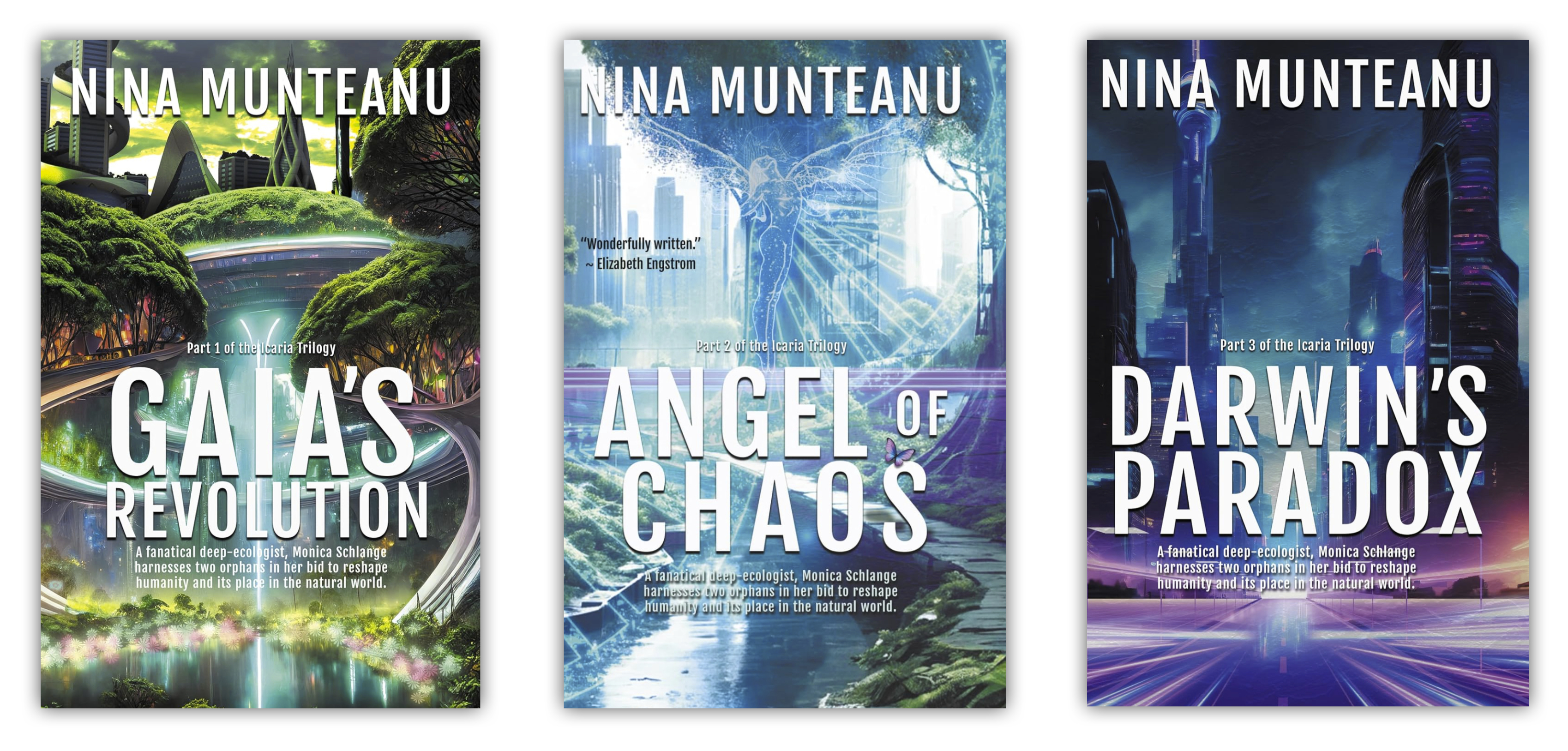
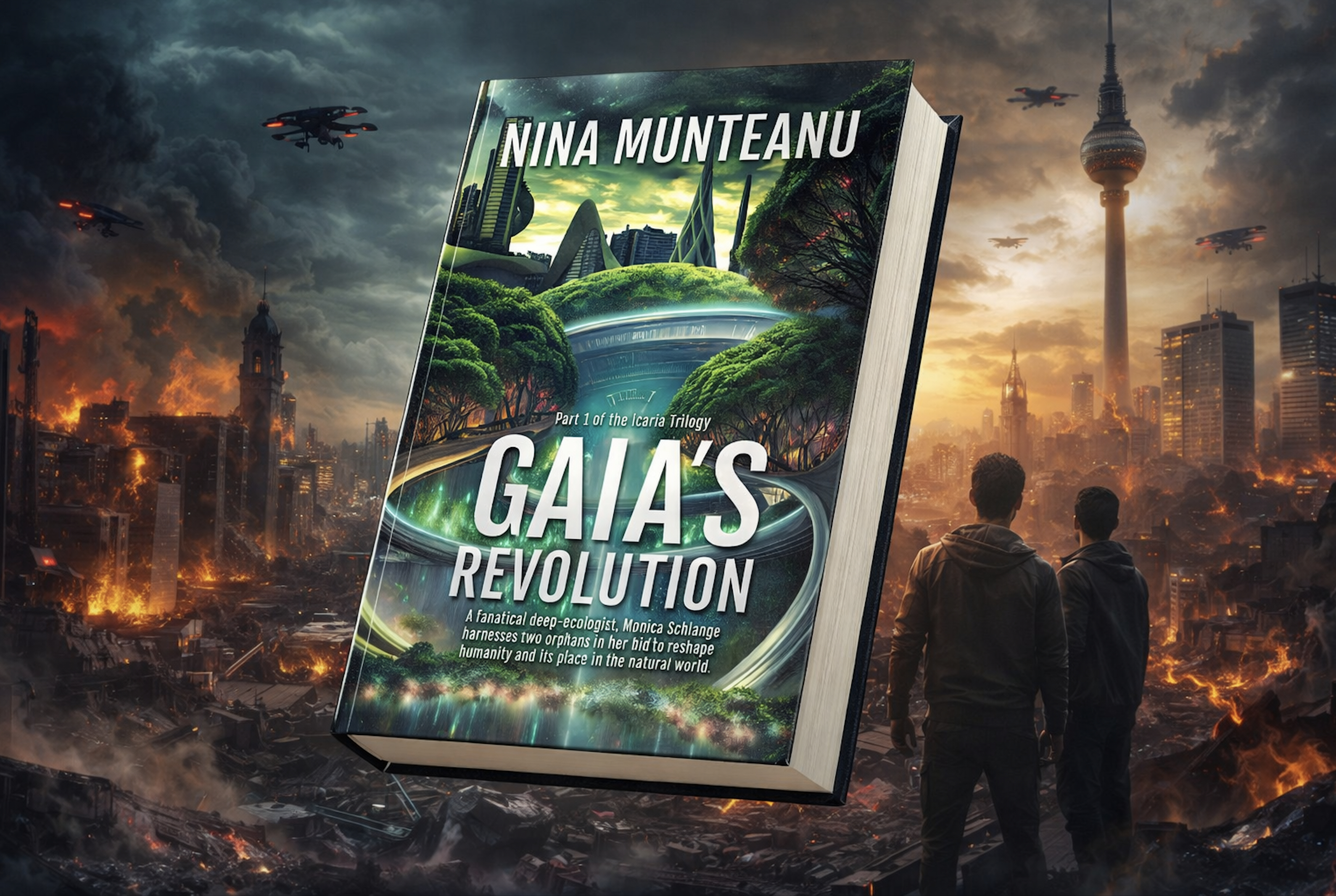
“Nina Munteanu is back in Ladner, and she’s bringing a story that’s impossible to ignore. Her latest novel, Gaia’s Revolution, officially launched on March 10, 2026, is already making waves as an Amazon bestseller. Fans and friends in Delta and Vancouver are celebrating her triumphant return.”
Gaia’s Revolution, says Henry, is a “fast-paced Canadian dystopian thriller tackling climate change, tech chaos, and society on the brink.”
.
.
A Canadian Eco-Dystopia Like No Other
“Gaia’s Revolution plunges readers into a near-future Canada teetering on the edge of collapse. With climate change, societal missteps, and failing technology wreaking havoc, Munteanu paints a vivid picture of what might come.
“The story begins in Berlin in 2022 before moving to Canada, where ambitious twin brothers, Eric and Damien, spark a revolution that could either save the planet or end humanity.
“Monica Schlange, a fanatical deep ecologist, manipulates the twins like chess pieces in her bid to ‘rule the world.’ She ensnares three orphans in a web of intrigue, challenging the very rules of human existence. Yet, it’s the orphans who ultimately shape the fate of humanity.”
.
Fast-Paced Thriller With Real-World Relevance
Munteanu doesn’t hold back. Her novel tackles issues Canadians are already facing—or may soon confront…With every twist, the book explores the delicate balance between humanity and the natural world.”
.
From Classroom to Canadian Landscapes
“Before devoting herself to writing, Munteanu taught limnology at the University of Victoria. Her travels across Canada, including stops in Lunenburg, small-town Ontario, Vancouver, and Fort McPherson, have deeply influenced her storytelling. Each setting in her novels carries the richness of real Canadian locales.
“Now settled in a quiet Ladner neighbourhood, Munteanu is already hard at work on her next project, promising more stories that combine thrilling plots with urgent environmental themes.”
.
This is true. My climate eco-novel Thalweg will release in 2027 with Inanna Publications. I am still working with the editor of the publishing house and anticipate with growing excitement seeing the cover design soon.
.
.
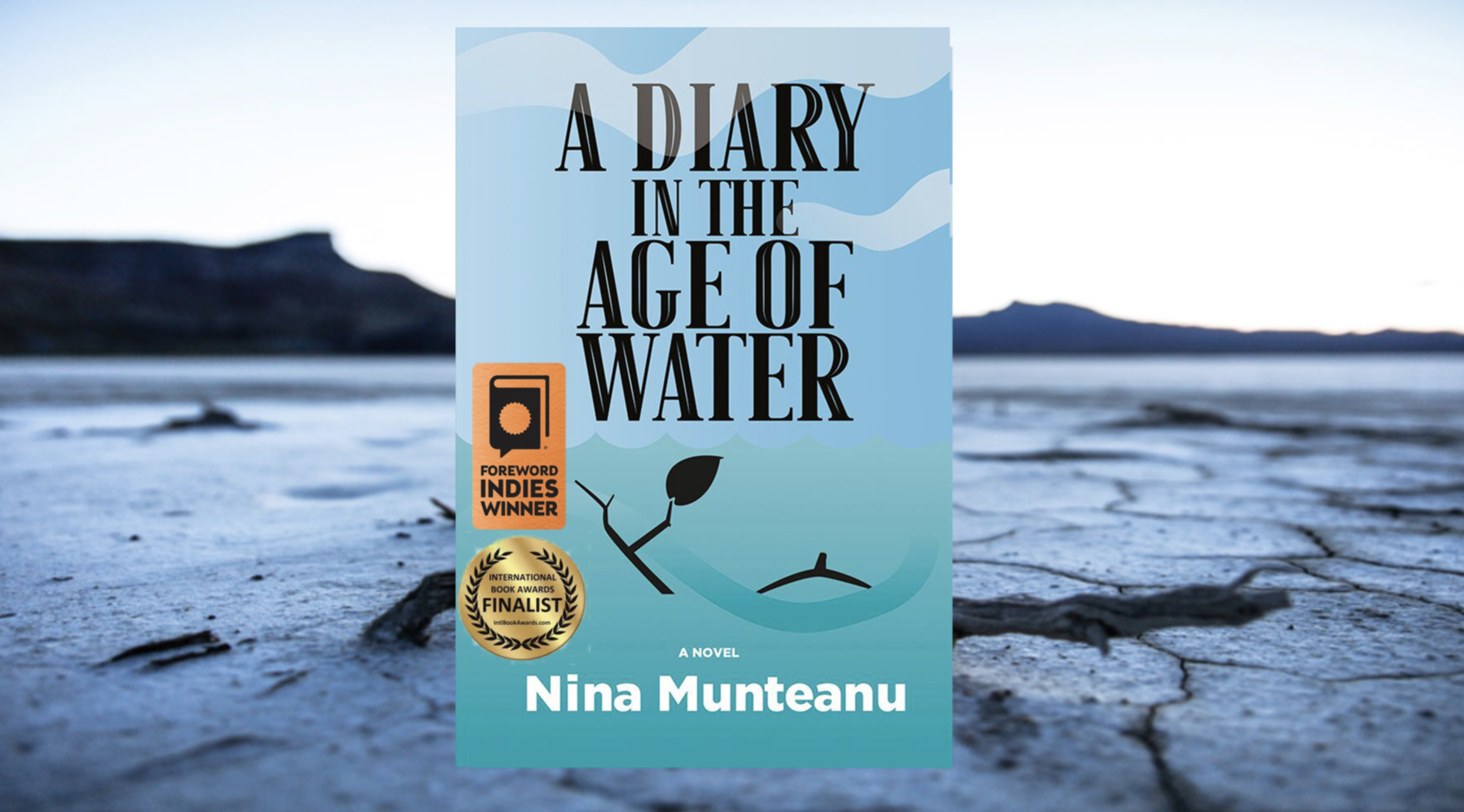
Thalweg is a companion novel to A Diary in the Age of Water (my award-winning story based on the diary of a limnologist during Canada’s growing climate crisis that explores four generations of women, each with a unique relationship with water). Thalweg follows the braided paths of four homeless strangers—each uniquely connected to water—and each destined to play a significant role in water’s future in Canada. I look forward to seeing it soon on bookstore shelves next to Diary.
.
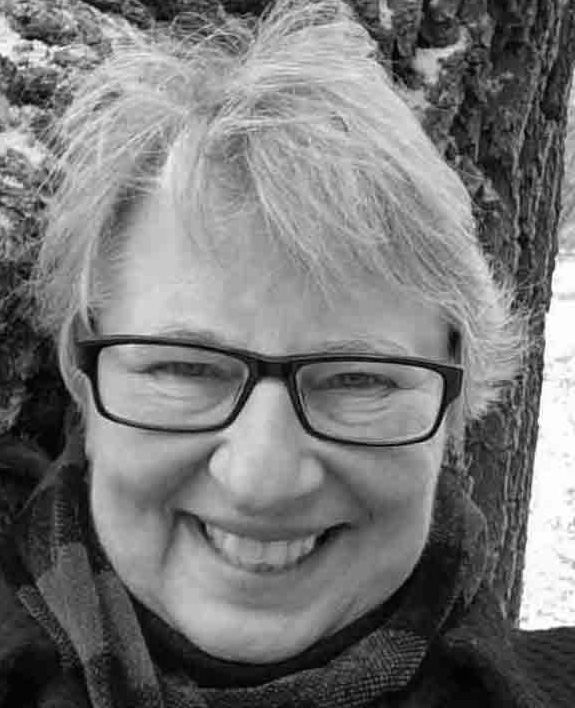
Nina Munteanu is a Canadian ecologist / limnologist and novelist. She is co-editor of Europa SF and currently teaches writing courses at George Brown College and the University of Toronto. For the lates on her books, visit www.ninamunteanu.ca. Nina’s bilingual “La natura dell’acqua / The Way of Water” was published by Mincione Edizioni in Rome. Her non-fiction book “Water Is…” by Pixl Press (Vancouver) was selected by Margaret Atwood in the New York Times ‘Year in Reading’ and was chosen as the 2017 Summer Read by Water Canada. Her novel “A Diary in the Age of Water” was released by Inanna Publications (Toronto) in June 2020.You can read her just released eco-fiction thriller Gaia’s Revolution by Dragon Moon Press.
Place ultimately portrays what lies at the heart of a story. Place as character provides an archetype that story characters connect with and navigate in ways that depend on the story’s theme, particularly in allegories that rely strongly on metaphor. Theme is essentially the “so what part” of a story; what is at stake for the character on their journey. Theme is the backbone—the heart—of the story, driving characters to journey through time and place toward some kind of fulfillment. There is no story without theme. And there is no theme without place.
When place is the environment—a forest, meadow, swamp or heathland—the author has an opportunity to go beyond simple backdrop, even beyond deeper metaphor, to intimately portray the voice of ‘the Other.’ Eco-literature brings awareness to environment as ‘Other’; eco-literature intimately explores humanity’s role in defining ‘the Other’ by portraying environment on a journey as character with agency and sometimes with voice—often through character coupling. Nineteenth Century author Thomas Hardy recognized the tenuous position of wilderness during Victorian Britain with increasing industrialization and urbanization. Taming Nature to achieve ordered beauty had become an obsession; Hardy recognized this and mourned the loss of pre-industrial agrarian landscapes to human greed and modernization.
.
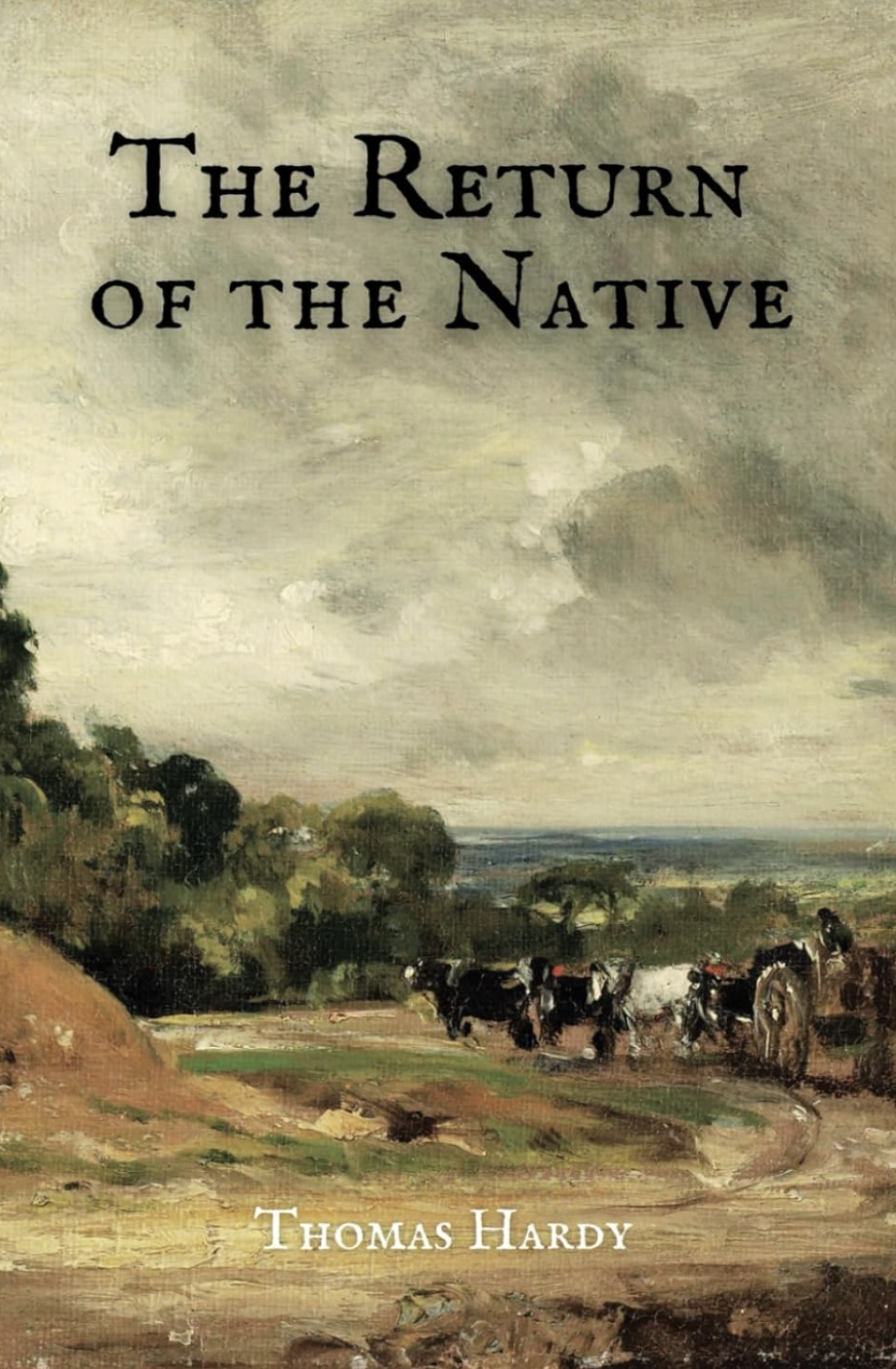
Thomas Hardy’s Heath: Return of the Native
For Victorian author Thomas Hardy, trees, meadows, winding brooks and country roads were far more than back-drop for his world and his stories. Elements of the natural world were characters that impacted other characters in a world dominated by nature.
Perhaps best known for his melancholic stories of fatalistic, ironic tyrannies, Thomas Hardy wrote with a tender and poetic sensibility about Nature, and particularly the heath where he grew up. All of Hardy’s writings embody a strong sense of place. Nature—like his omniscient narrative form—lies beyond the scope of humanity: vast, amoral, and unfathomed; and yet, inextricably linked to the feckless actions of its humans. Egdon Heath in Return of the Native remains one of Hardy’s most enduring characters and best examples of the power of place in story.
.
Author D.H. Lawrence evocatively personified Hardy’s bleak heathland: “Egdon, whose dark soil was strong and crude and organic as the body of a beast.”
Egdon Heath is a metaphoric black hole from which no light escapes. None of Hardy’s characters escape the embrace of this behemoth. Dark, swarthy and associated with the night: “The face of the heath by its mere complexion added half an hour to evening; it could in like manner retard the dawn, sadden noon, anticipate the frowning storms scarcely generated, and intensify the opacity of a moonless midnight to a cause of shaking dread.” Each character is touched by the heath’s brooding grip and each feels its power differently: hapless Wildeve; idealist Clym; desperate Eustacia and suffering Thomasin.
.
Cixin Liu’s Forests: The Three Body Problem
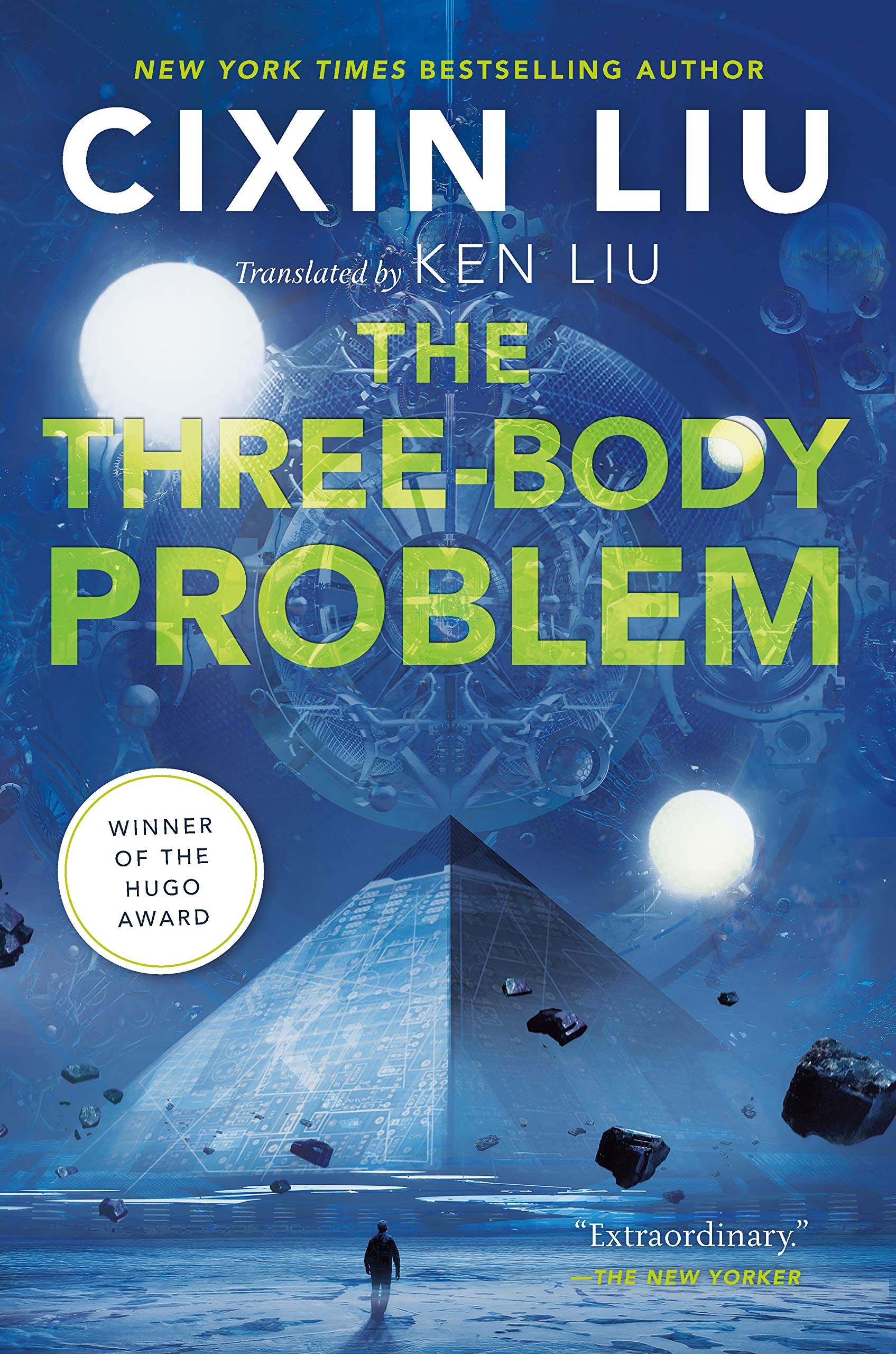
Cixin Liu’s The Three Body Problem—set against the backdrop of China’s Cultural Revolution—follows Wenji Ye, disillusioned by the massive environmental deforestation in the labour camps she is sent to work:
Her company wielded hundreds of chain saws like a swarm of steel locusts, and after they passed, only stumps were left. The fallen Dahurian larch, now bereft of branches, was ready to be taken away by tractor. Ye gently caressedthe freshly exposed cross section of the felled trunk. She did this often, as though such surfaces were giant wounds, as though she could feel the tree’s pain … The trunk was dragged away. Rocks and stumps in the ground broke the bark in more places, wounding the giant body further. In the spot where it once stood, the weight of the fallen tree being dragged left a deep channel in the layers of decomposing leaves that had accumulated over the years. Water quickly filled the ditch. The rotting leaves made the water appear crimson, like blood.
.
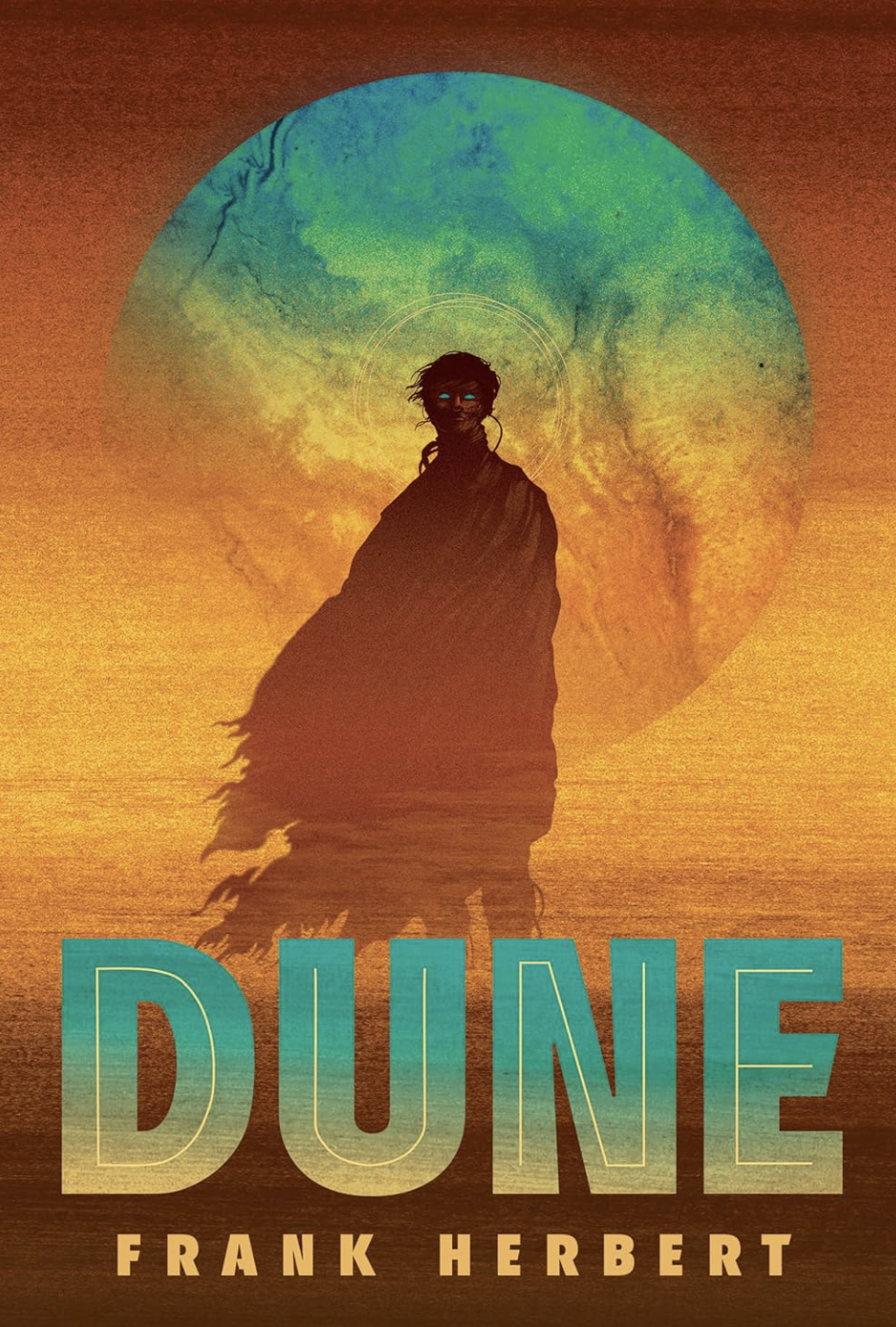
Frank Herbert’s Desert: Dune
Frank Herbert’s Dune chronicles the journey of young Paul Atreides, Duke Leto’s son, who according to the indigenous Fremen prophesy will eventually bring them freedom from their enslavement by the colonialists—The Harkonens—and allow them to live unfettered on the planet Arrakis, known as Dune.
But, as the title of the book clearly reveals, this story is about place—a harsh desert planet whose 800 kph sandblasting winds could flay your flesh—and the power struggle between those who covet its arcane treasures and those who wish only to live free from slavery. Place—and its powerful symbols of desert, water and spice—lies at the heart of this epic story about taking, giving and sharing. When he thinks of Dune, the newly placed Duke Atreides uses water metaphors: “He sighed, glanced back at the dry landscape where the flowers were gone now—trampled by the dew gatherers, wilted under the early sun.”
.
“The desert stretched out like a static ocean. [It] lay there full of moon-silvered waves—shadows of angles that lapsed into curves and, in the distance, lifted to the misted gray blur of another escarpment.”
The immense sandworms of Frank Herbert’s Dune are strong archetypes of Nature—large and graceful creatures whose movements in the vast desert sands resemble the elegant whales of our oceans:
It came from their right with an uncaring majesty that could not be ignored. A twisting burrow-mound of sand cut through the dunes within their field of vision. The mound lifted in front, dusting away like a bow wave in water.
.
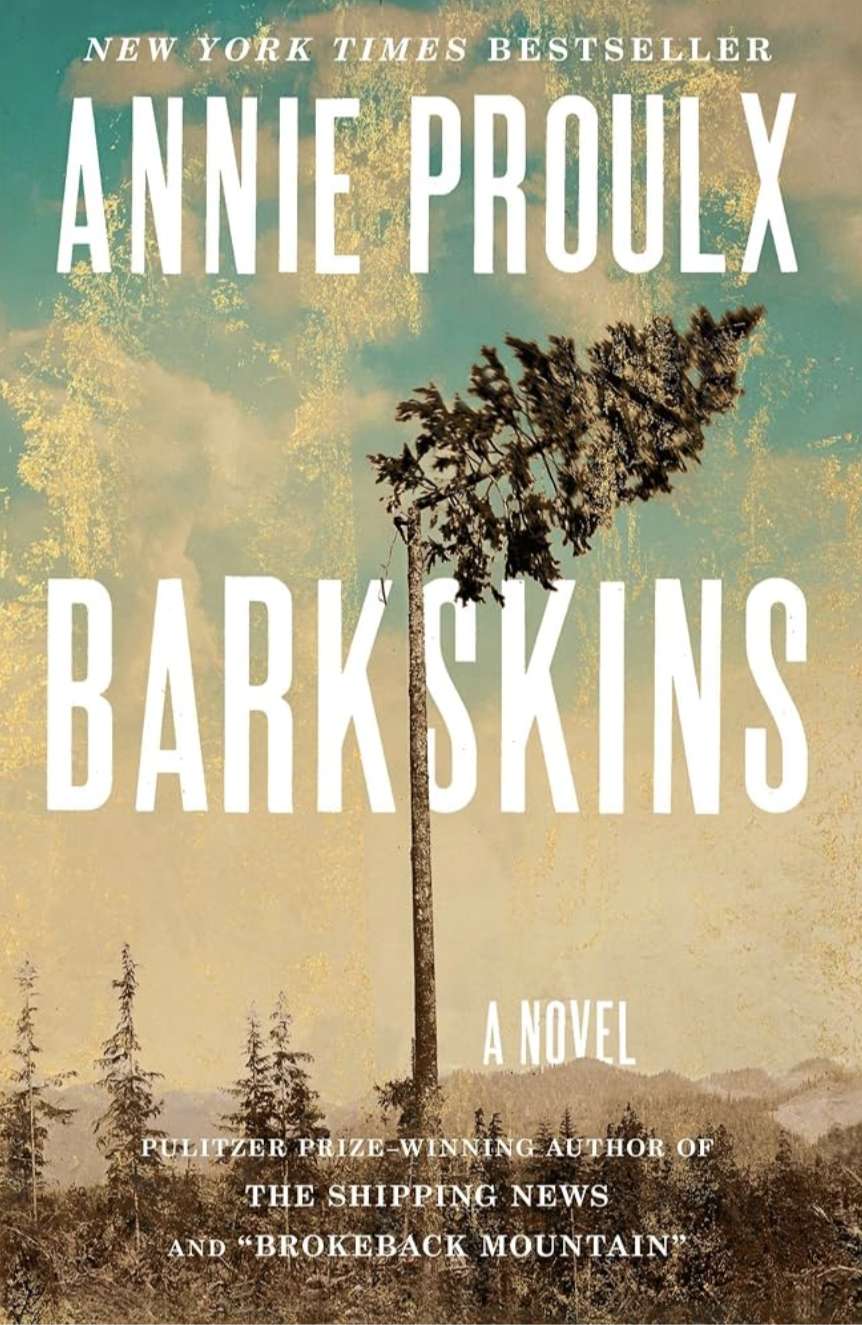
Annie Proulx’s Forest: Barkskins
The opening combines subtle to obvious images of an “unwelcoming” wilderness—as dark behemoth—and foreshadows the forest’s eventual destruction by settlers intent on conquering Nature. Proulx’s 300-year saga starts with the arrival of the Europeans in Canada’s pristine forest
Within the first ten pages we gain a rich and potent collage of first impressions by the settlers of “the moody darkness” of the New France forest, previously only seen by the “sauvages.” The barkskins “tramped up the muddy path toward a line of black mist … In a few hours the sodden leaf mold gave way to pine duff. Fallen needles muted their passage, the interlaced branches absorbed their panting breaths … evergreens larger than cathedrals, cloud-piercing spruce and hemlock. The monstrous deciduous trees stood distant from each other, but overhead their leaf-choked branches merged into a false sky, dark and savage …They walked on through the dim woods, climbing over mossy humps, passing under branches drooping like funeral swags,” hearing pines hissing in the wind,” and crossing “snarling water,” and “swarms of mosquitoes in such millions that their shrill keening was the sound of the woods.”
.
These bleak impressions of a harsh environment crawling with pests such as bébites and moustiques underlie the combative mindset of the settlers to conquer and seize what they can of a presumed infinite resource. By page seventeen, we know that mindset well. René asks why they must cut so much forest when it would be easier to use the many adequate clearings to build their houses and settlements. Trépagny fulminates: “Easier? Yes, easier, but we are here to clear the forest, to subdue this evil wilderness.”
For them, the vast Canadian boreal forest was never-ending and for the taking: “It is the forest of the world. It is infinite. It twists around as a snake swallows its own tail and has no end and no beginning,” Trépagny claims.
.
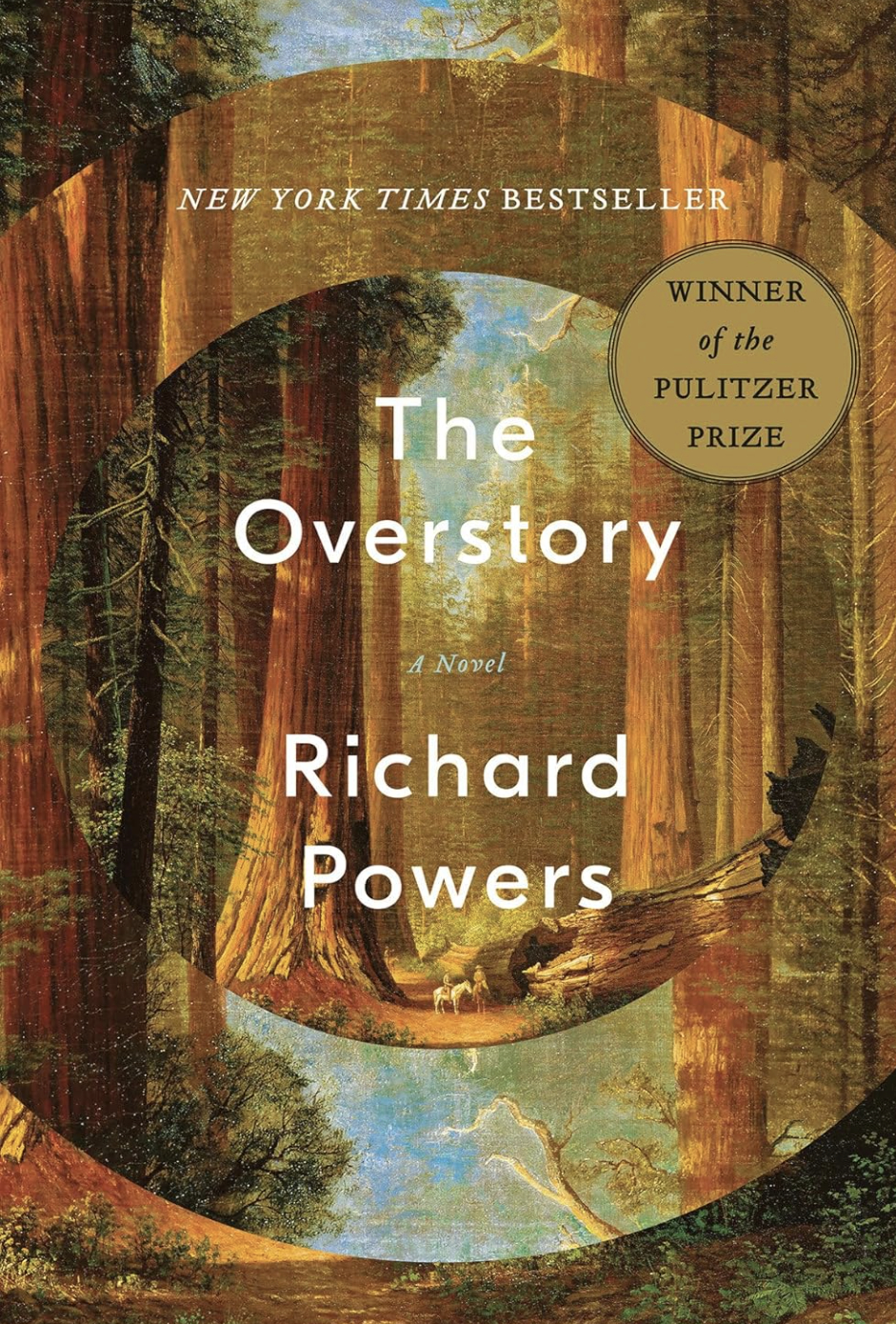
Richard Power’s Forest: The Overstory
Richard Powers’s The Overstory follows the life-stories of nine characters and their journey with trees. At its heart is the pivotal life of botanist Patricia Westerford, whose work resembles that of UBC’s Suzanne Simard. Westerford is a shy introvert who discovers that trees communicate, learn, trade goods and services—and have intelligence. When she shares her discovery, she is ridiculed by her peers and eventually loses her position at the university.
Like the marcescent beech, Patricia finds herself asynchronous with the rest of the forestry department at Purdue, in fact with the entire forestry discipline in the country. She disagrees with their edict of needing to “clean the forest of snags and wind throw to improve forest health.” She disagrees with their use of terms like thrifty young forests and decadent old forests, mean annual increment and economic maturity—not ecological but economic terms based on exploitation and human utility.
.
Patricia’s early conviction that these silent trees are social creatures, sets her on a singular path that will push the boundaries of doctrine and a hegemony of human utility. She assiduously sets out to prove her premise of social trees and in so doing, becomes the forest. “She works all day in the woods, her back crawling with chiggers, her scalp with ticks, her mouth filled with leaf duff, her eyes with pollen, cobwebs like scarves around her face, bracelets of poison ivy, her knees gouged by cinders, her nose lined with spores, the backs of her thighs bitten Braille by wasps, and her heart as happy as the day is generous.” Like Ovid, she is becoming.
Patricia writes in her book The Secret Forest:
There are no individuals in a forest, no separable events. The bird and the branch it sits on are a joint thing. A third or more of the food a big tree makes may go to feed other organisms. Even different kinds of trees form partnerships. Cut down a birch, and a nearby Douglas fir may suffer … Fungi mine stone to supply their trees with minerals. They hunt springtails, which they feed to their hosts. Trees, for their part, store extra sugar in their fungi’s synapses, to dole out to the sick and shaded and wounded. A forest takes care of itself, even as it builds the local climate it needs to survive.
.
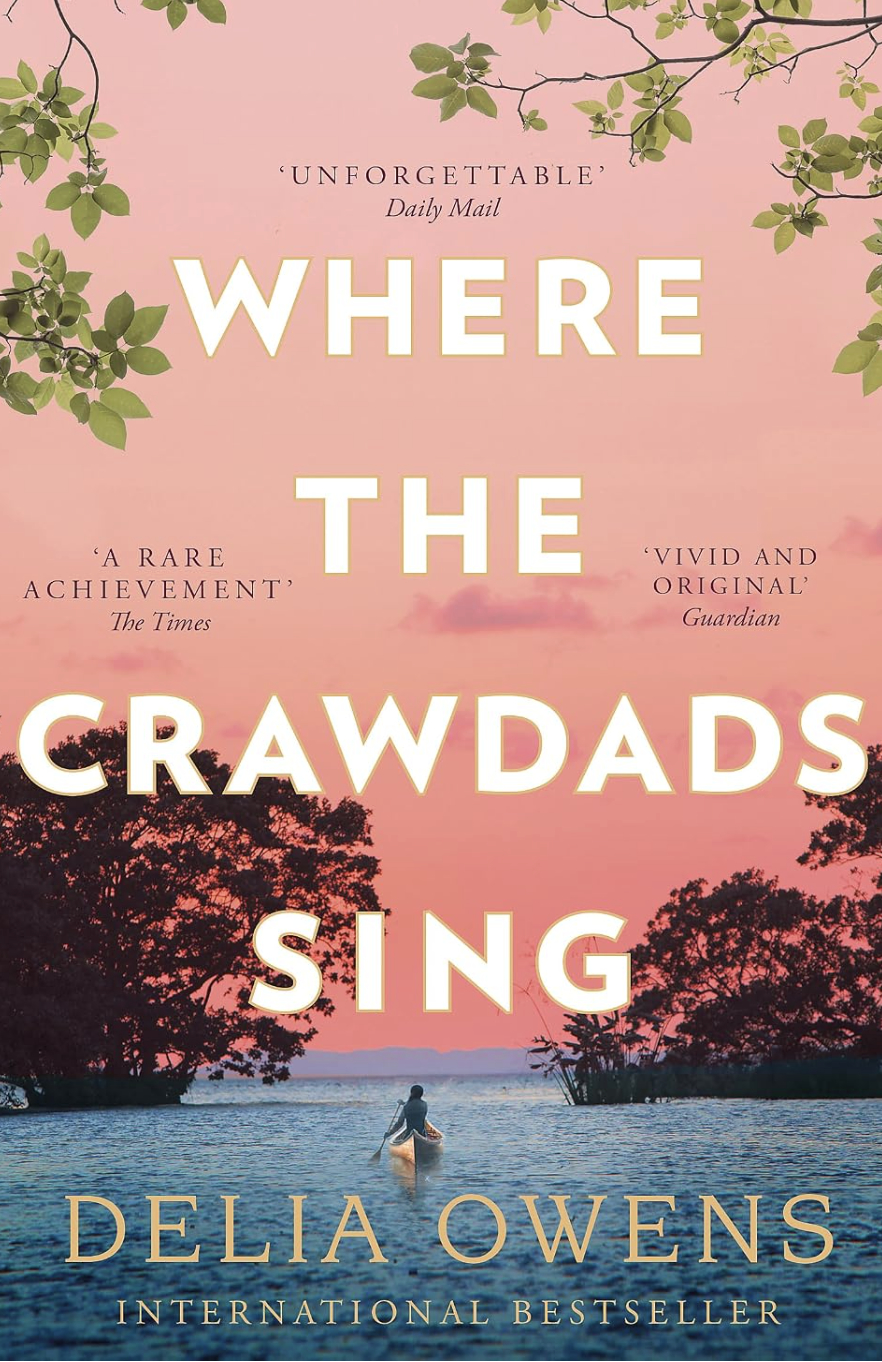
Delia Owens’s Swampland: Where the Crawdads Sing
The swampland is beautifully and evocatively portrayed as a living character; its ‘journey’ is closely linked to the Kya, the main protagonist, as development encroaches both swamp and girl through commercial logging, and wetland drainage to build resort hotels. Kya lives with an unbiased understanding of a quiet biological life, surviving through natural instinct in a circle of life and death: a swamp knows all about death, and does not define it as a tragedy or a sin, thinks Kya who sees the swampland as her mother, teacher and sanctuary, embracing her with a protective mantle of natural beauty and wonder. Whenever she stumbled, it was the land who caught her. When the town marginalizes Kya, calling her “The Marsh Girl”, the swamp shields her from the prejudice and cruelty of the human world, providing an intimate protective barrier. In turn, Kya uses her book advance to buy several hundred acres of marsh as a protected wildlife refuge.
.
In her article on Great Ecology, Liz Clift writes, “During the period in which Where the Crawdads Sing is set, wetlands were typically seen as a nuisance—and that comes through in the story-telling, when developers want to drain the marsh for a development. Wetlands were also seen as mosquito-infested, buggy, smelly, or even an eyesore. A significant number of wetlands around the world, including in the US, have been lost due to land development and agriculture, which is unfortunate because wetlands are rich with biodiversity and play a key role in maintaining both freshwater and saltwater fisheries, support water quality, and protect against flooding.” This is not a phenomenon or attitude of the past; it unfortunately remains prevalent, particularly in North America.
What Delia Owens achieves in Where the Crawdads Sing is two-fold: 1) the reader knows more about the value of the marsh but also gains a sense of its beauty as seen through the eyes of Kya; and, 2) through the strong connection with the main character and use of evocative metaphor, Owens transforms the marsh into a real character.
.
Why Make Place a Character…
Why is this important? Think of a place you know. I’ll use the house I grew up in. To any passerby, the house is just another two-storey cornflower-blue house with veranda on a quiet residential street, lined by trees. But for me, the house carries memories of my childhood, of running up and down the creaky foot-worn stairs, or sharing ghost stories with friends on the back porch as the waning twilight revealed the winking fireflies outside. Playing dolls with my sister in the stuffy attic. The sweet pungent aroma of my father’s pipe smoke in the livingroom and my mother’s thrush-like voice resonating from the kitchen as she baked German sugar cookies. I loved that house, with all its idiosyncratic groans and whistles in the wind and the echoes of cheerful laughter over the years. That house was a character.
Once this happens, once place becomes a character, we find ourselves caring for it.
In story, it is the characters we care about; it is the characters that we cheer for and follow on their journey of loss, redemption or victory.
This is why writers of eco-fiction depict environment as a character. We must first relate and connect before we care; we must first care before we act. Eco-fiction authors also use the device of character-coupling to help readers care. The examples above provide this method through their ‘othered’ characters, who, in turn, relate to the ‘othered’ environment. In another article, I provide more examples of character-coupling in the literature that enable readers to connect to otherwise arcane aspects of their environment through their connection to a character they can relate to.
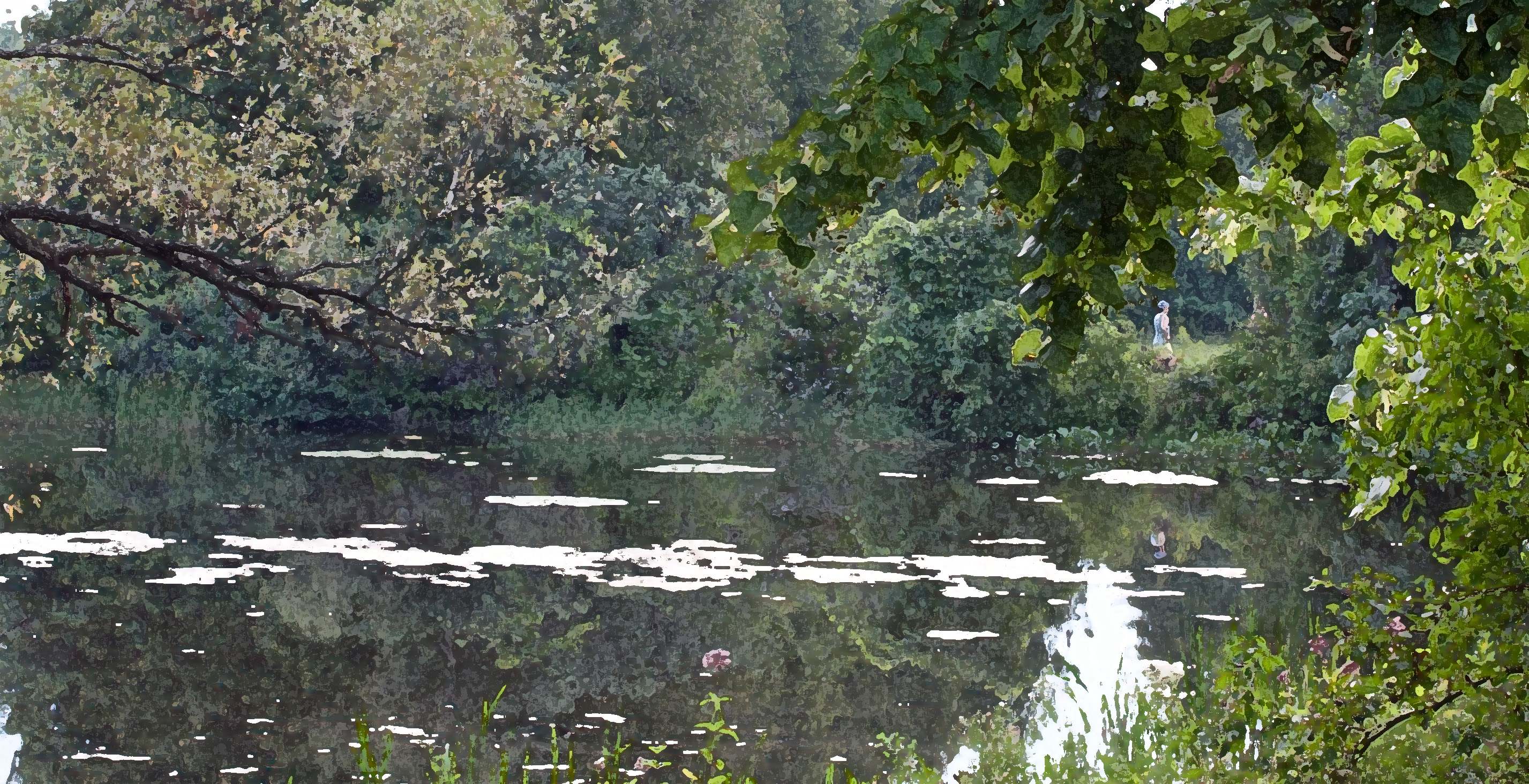
Beaver Pond just before a rainstorm, BC (photo by Nina Munteanu)
.
Nina Munteanu is a Canadian ecologist / limnologist and novelist. She is co-editor of Europa SF and currently teaches writing courses at George Brown College and the University of Toronto. For the lates on her books, visit www.ninamunteanu.ca. Nina’s bilingual “La natura dell’acqua / The Way of Water” was published by Mincione Edizioni in Rome. Her non-fiction book “Water Is…” by Pixl Press (Vancouver) was selected by Margaret Atwood in the New York Times ‘Year in Reading’ and was chosen as the 2017 Summer Read by Water Canada. Her novel “A Diary in the Age of Water” was released by Inanna Publications (Toronto) in June 2020.You can read her just released eco-fiction thriller Gaia’s Revolution by Dragon Moon Press.
It is early spring and I’m walking through one of my favourite woodlands in Ontario’s Carolinian forests. The river that had swollen with snow melt just a week before, now flows with more restraint. I can see the cobbles and clay of scoured banks under the water. Further on, part of the path along the river has collapsed from a major bank scour the previous week. The little river is rather big and capricious, I ponder; then I consider that the entire forest sways to similar vagaries of wind, season, precipitation and unforeseen events. Despite its steadfast appearance, the forest flows—like the river—in a constant state of flux and change, cycling irrevocably through life and death.
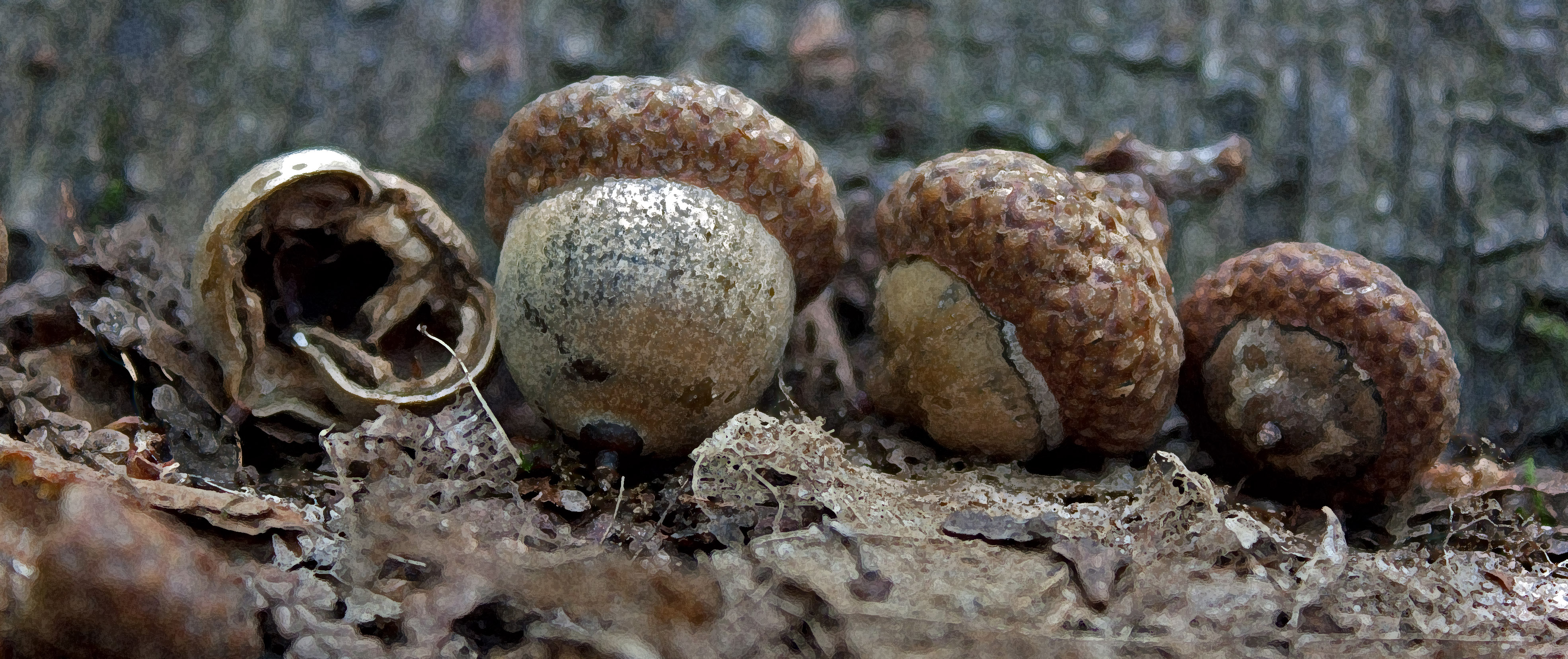
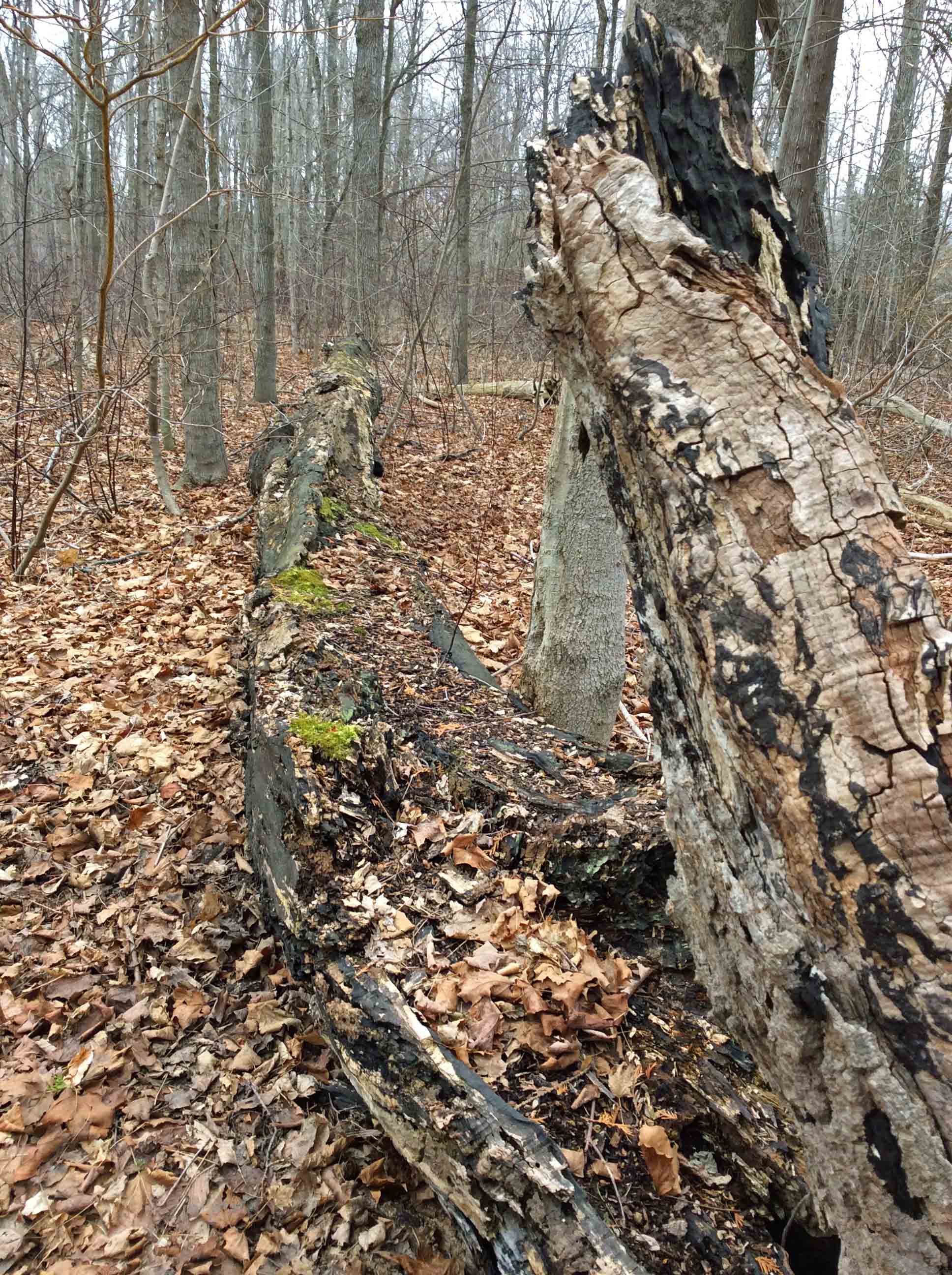
The forest is littered with snags and fallen trees in different stages of breakdown, decomposition and decay. I spot several large cedar, pine, oak and maple snags with woodpecker holes. The snags may remain for many decades before finally falling to the ground.
I walk slowly, eyes cast to the forest floor thick with dead leaves, and discover seeds and nuts—the promise of new life. I aim my gaze past trees and shrubs to the nearby snags and fallen logs. I’m looking for hidden gifts. One fallen cedar log reveals swirling impressionistic patterns of wood grain, dusted with moss and lichen. Nature’s death clothed in beauty.
.
A fallen maple snag decomposes with the help of several organisms, Little Rouge Woodland, ON (photo by Nina Munteanu)
.
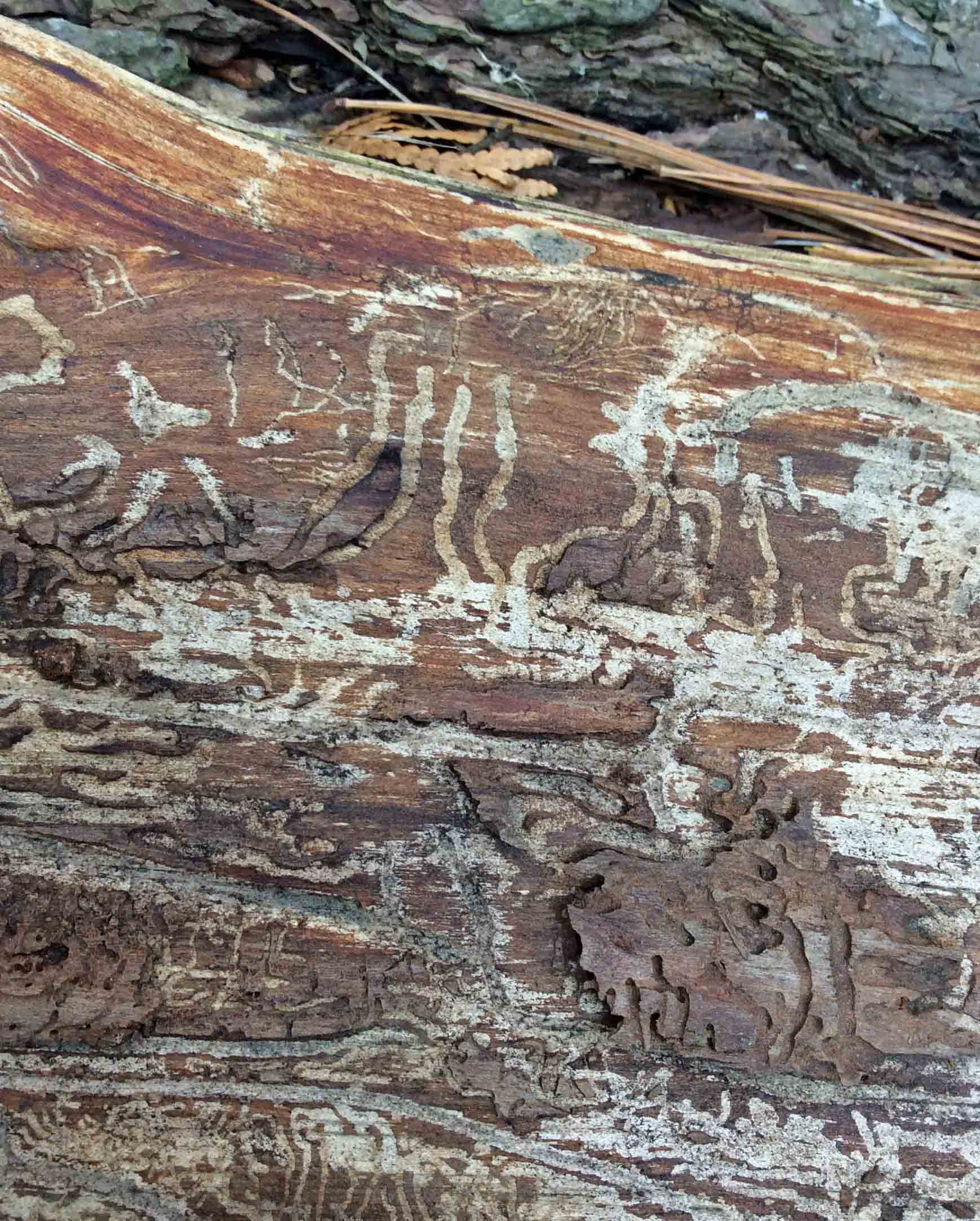
The bark of a large pine tree that has fallen is riddled with tiny beetle holes drilled into its bark. Where the bark has sloughed off, a gallery of larval tracks in the sapwood create a map of meandering texture and colour.
.
Decomposing pine log displays a gallery of larval tracks, Little Rouge Woodland, ON (photo by Nina Munteanu)
.
.
Fallen Heroes & Saprophyte Characters
Rotting maple log, Little Rouge Woodland, ON (photo by Nina Munteanu)
.
The forest ecosystem supports a diverse community of organisms in various stages of life and death and decay. Trees lie at the heart of this ecosystem, supporting a complex and dynamic cycle of evolving life. Even in death, the trees continue to support thriving detrivore and saprophytic communities that, in turn, provide nutrients and soil for the next generation of living trees. It’s a partnership.
Decomposition and decay are the yin to the yang of growth, writes Trees for Life; together, they form two halves of the whole that is the closed loop cycle of natural ecosystems.
.
A fallen tree decomposes with the help of a diversity of organisms
.
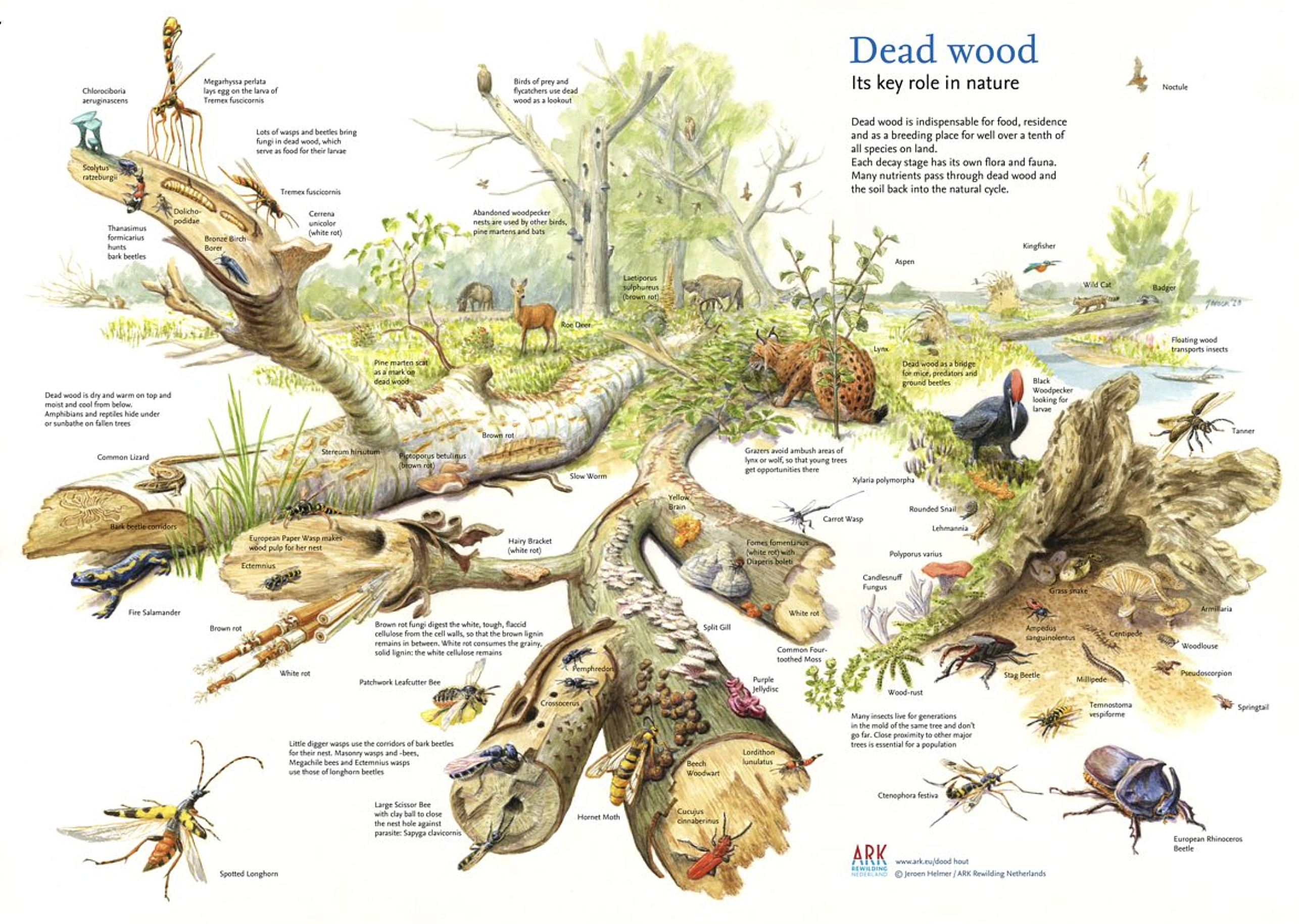
Snags and rotting logs on the forest floor provide damp shelter and food for many plants and animals. Most are decomposers, including earthworms, fungi, and bacteria. As the wood decays, nutrients in the log break down and recycle in the forest ecosystem. Insects, mosses, lichens, and ferns recycle the nutrients and put them back into the soil for other forest plants to use. Dead wood is an important reservoir of organic matter in forests and a source of soil formation. Decaying and dead wood host diverse communities of bacteria and fungi.
.
Mother Archetypes
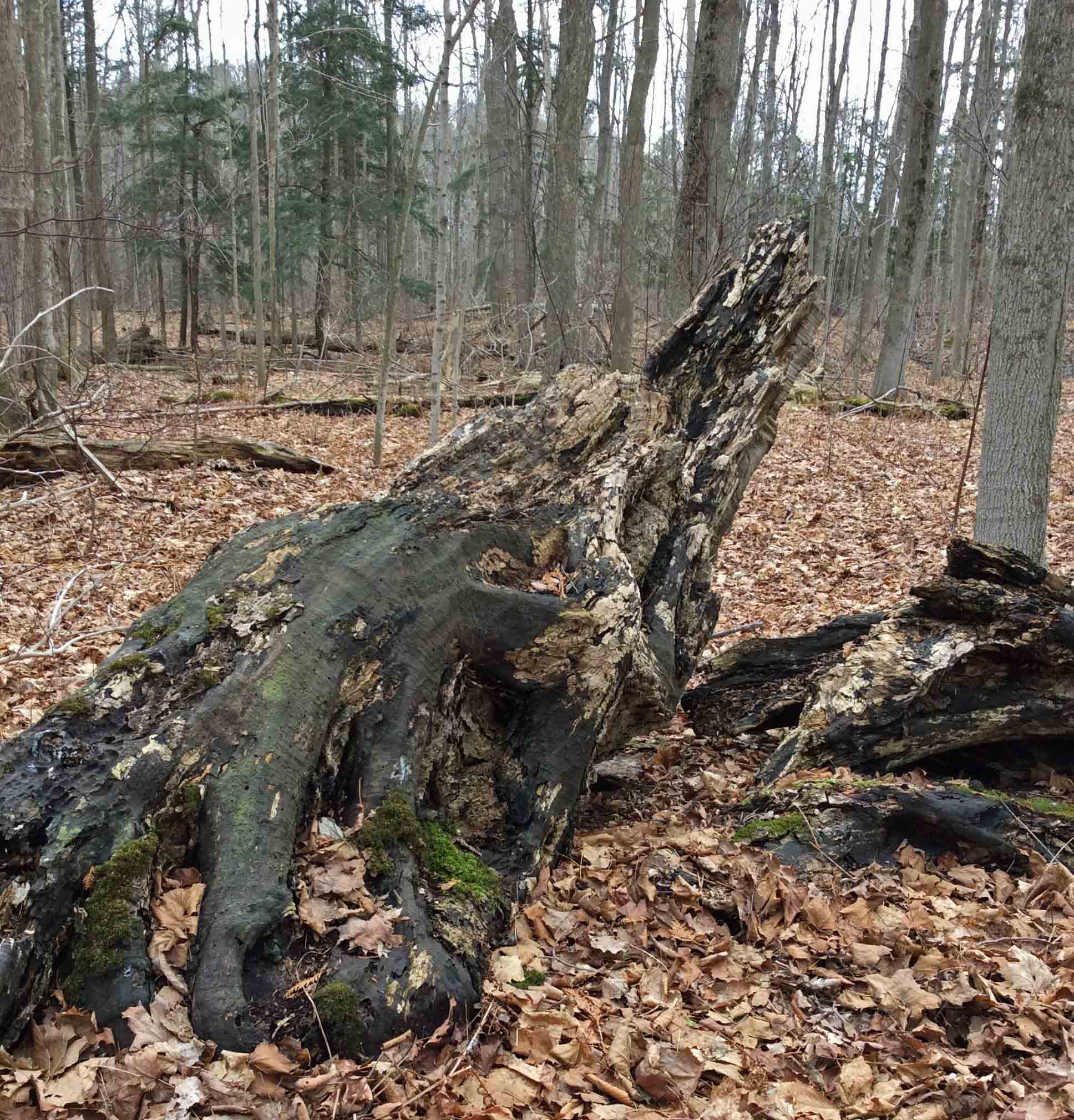
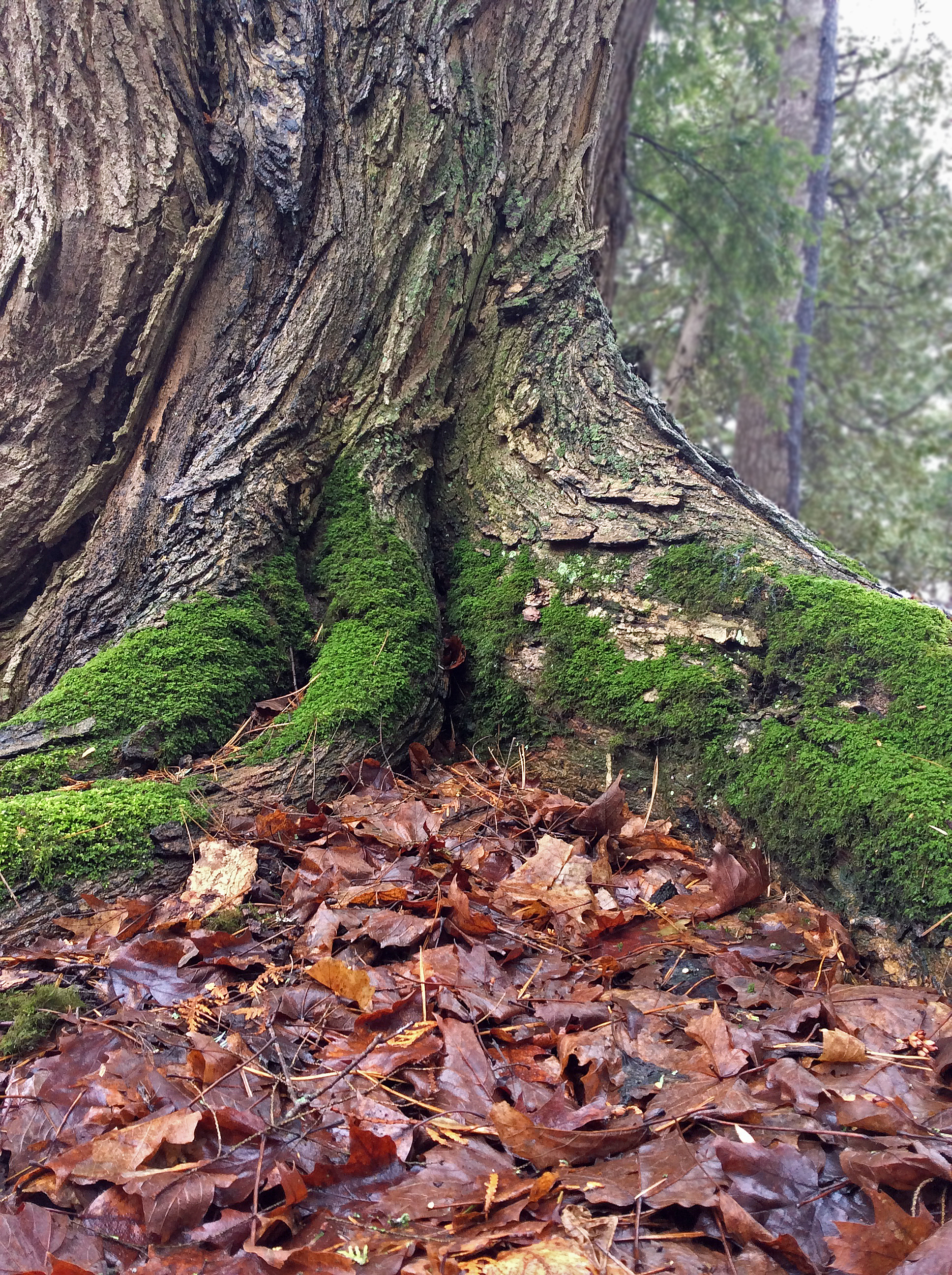
The feet of an old tree trunk reach out to embrace a collection of maple leaves, ON (photo by Nina Munteanu)
.
Wood tissues of tree stems include the outer bark, cork cambium, inner bark (phloem), vascular cambium, outer xylem (living sapwood), and the inner xylem (non-living heartwood). The outer bark provides a non-living barrier between the inner tree and harmful factors in the environment, such as fire, insects, and diseases. The cork cambium produces bark cells. The vascular cambium produces both the phloem cells (principal food-conducting tissue) and xylem cells of the sapwood (the main water storage and conducting tissue) and heartwood.
Forest ecologists defined five broad stages in tree decay, shown by the condition of the bark and wood and presence of insects and other animals. The first two stages evolve rapidly; much more time elapses in the later stages, when the tree sags to the ground. These latter stages can take decades for the tree to break down completely and surrender all of itself back to the forest. A fallen tree nurtures, much like a “mother” archetype; it provides food, shelter, and protection to a vast community—from bears and small mammals to salamanders, invertebrates, fungus, moss and lichens. This is why fallen trees are called “nursing logs.”
.
Heralds & Tricksters
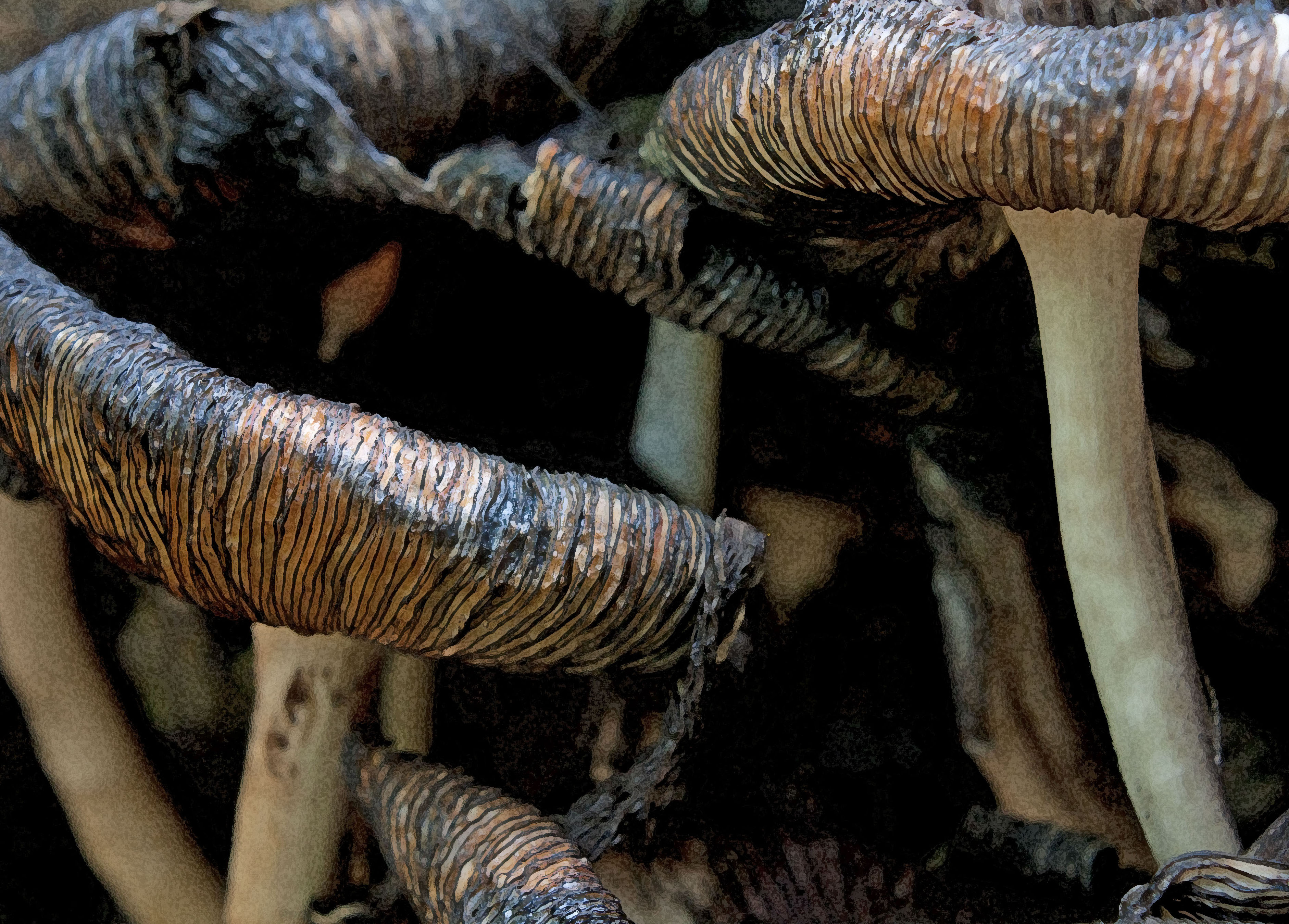
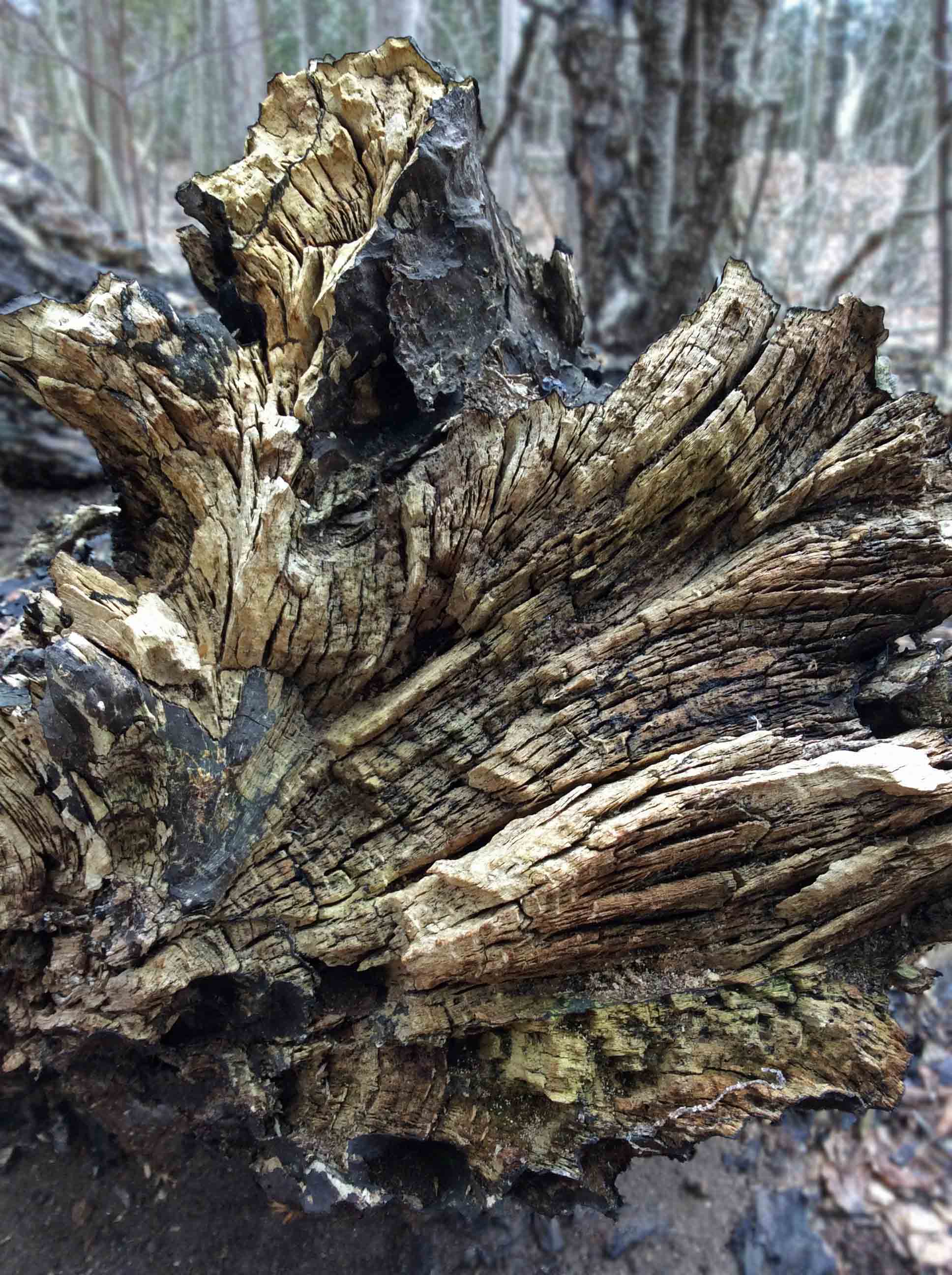
Uprooted stump colonized by carbon cushion fungi, Little Rouge Woodland, ON (photo by Nina Munteanu)
.
I stop to inspect another fallen tree lying on a bed of decaying maple, beech and oak leaves. When a fallen tree decomposes, unique new habitats are created within its body as the outer and inner bark, sapwood, and heartwood decompose at different rates, based in part on their characteristics for fine dining. For instance, the outer layers of the tree are rich in protein; inner layers are high in carbohydrates. This log—probably a sugar maple judging from what bark is left—has surrendered itself with the help of detrivores and saprophytes to decomposition and decay. The outer bark has mostly rotted and fallen away revealing an inner sapwood layer rich in varied colours, textures and incredible patterns—mostly from fungal infestations. In fact, this tree is a rich ecosystem for dozens of organisms. Wood-boring beetle larvae tunnel through the bark and wood, building their chambers and inoculating the tree with microbes. They open the tree to colonization by other microbes and small invertebrates. Slime molds, lichen, moss and fungi join in. The march of decay follows a succession of steps. Even fungi are followed by yet other fungi in the process as one form creates the right condition for another form.
Most hardwoods take several decades to decompose and surrender all of themselves back to the forest. In western Canada’s old growth forest, trees like Western redcedars can take over a hundred years to decay once they’re down. The maple log I’m studying in Ontario’s Carolinian forest looks like it’s been lying on the ground for a while, certainly several years. The bark has fragmented and mostly fallen away, revealing layers of sapwood in differing stages of infestation and decay. Some sapwood is fragmented and cracked into blocks and in places looks like stacked bones.
.
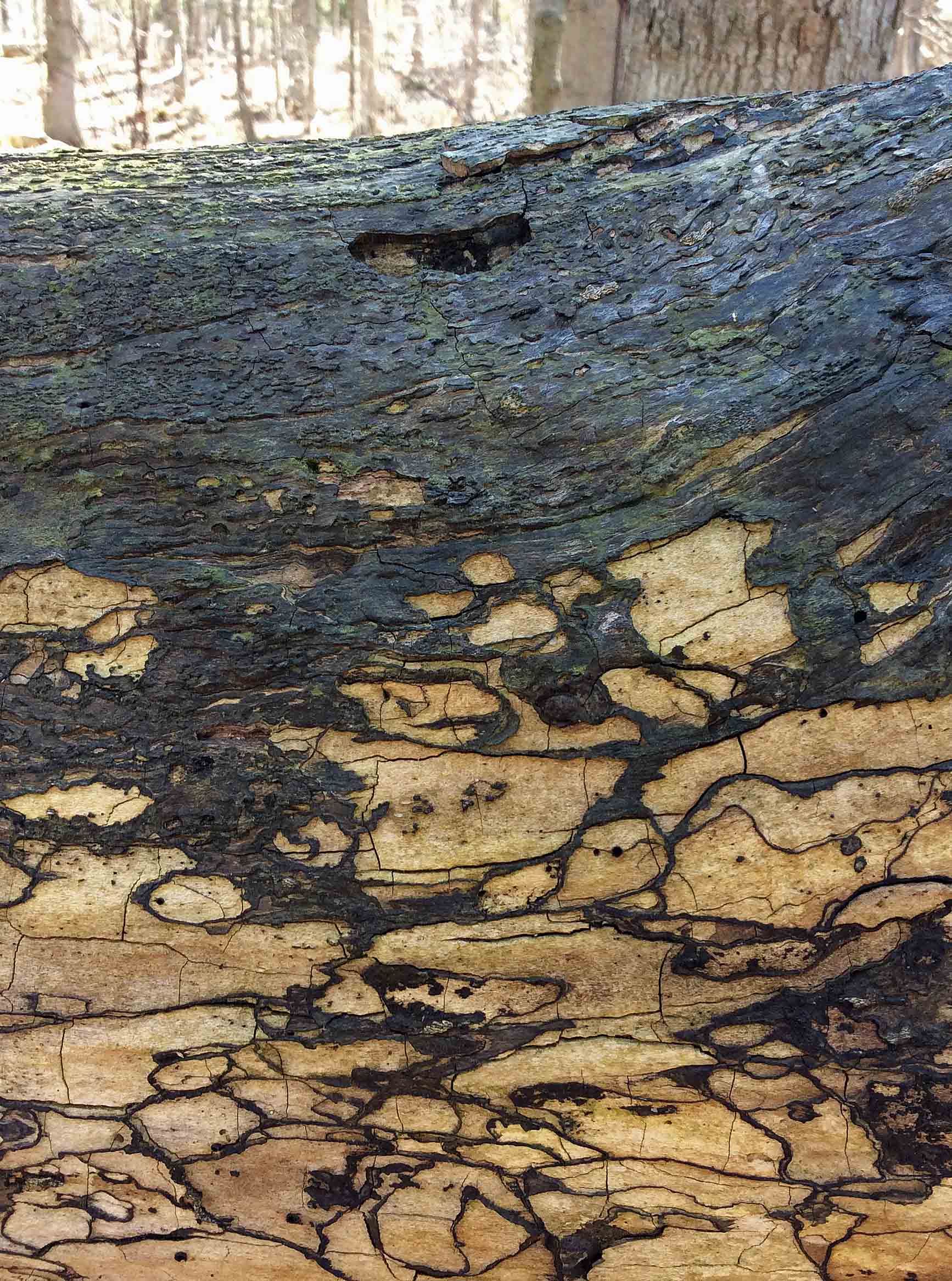
Black lines as though drawn by a child’s paintbrush flow through much of the sapwood; these winding thick streaks of black known as “zone lines” are in fact clumps of dark mycelia, which cause “spalting,” the colouration of wood by fungus. According to mycologist Jens Petersen, these zone lines prevent “a hostile takeover by mycelia” from any interloping fungi. Most common trees that experience spalting include birch, maple, and beech. Two common fungi that cause spalting have colonized my maple log. They’re both carbon cushion fungi.
.
Spalting on a decaying maple log, Little Rouge Woodland, ON (photo by Nina Munteanu)
.
Much of the exposed outer wood layer looks as though it has been spray painted with a green to blue-black layer. The “paint” is caused by the green-stain fungus (Chlorociboria) and blue-stain fungus (Ceratocystis). Spalting is common because of the way fungi colonize, in waves of primary and secondary colonizers. Primary colonizers initially capture and control the resource, change the pH and structure of the wood, then must defend against the secondary colonizers now able to colonize the changed wood.
.
Shapeshifting Characters
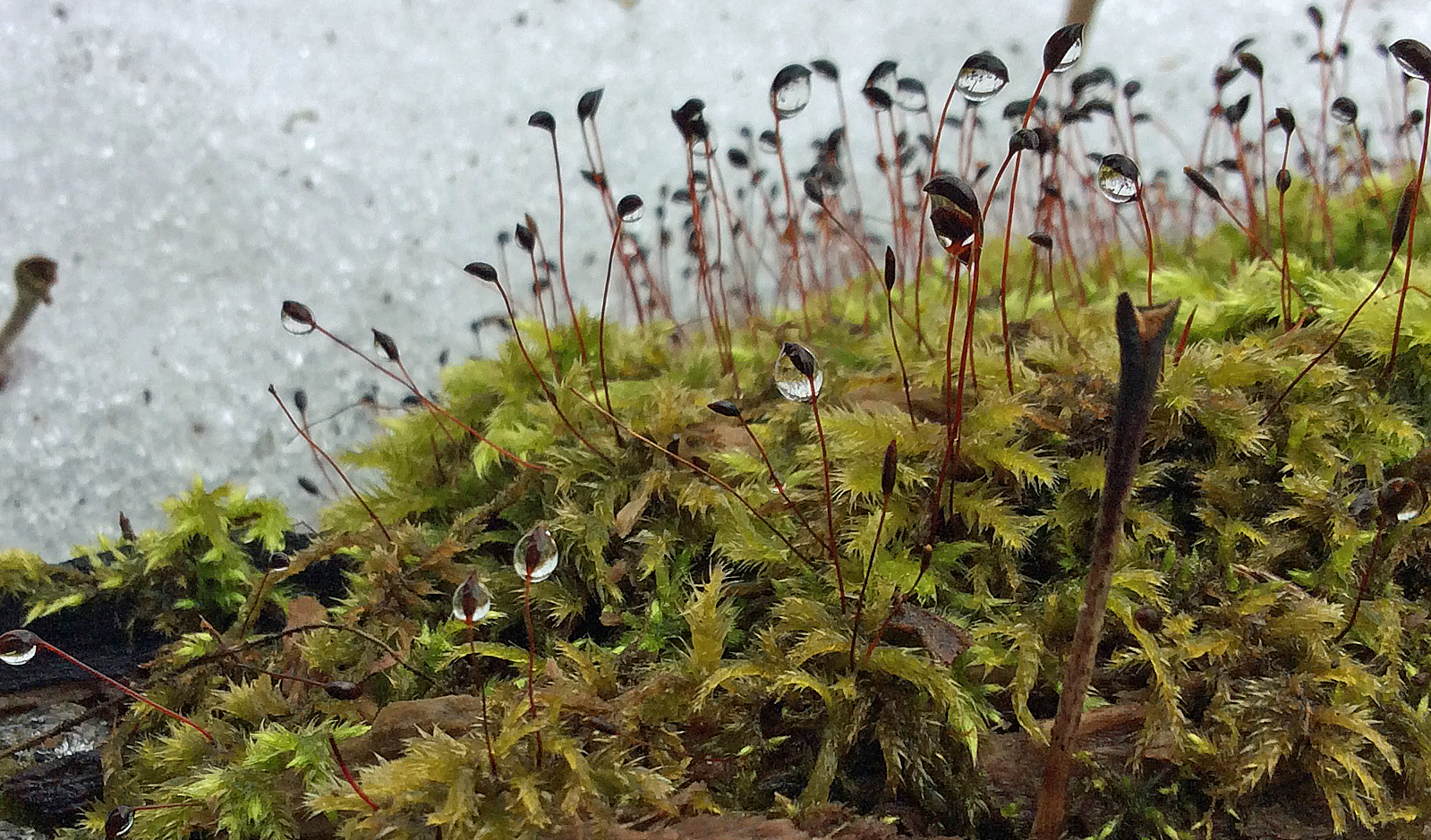
Moss with spores on a log, Little Rouge Woodland, ON (photo by Nina Munteanu)
.
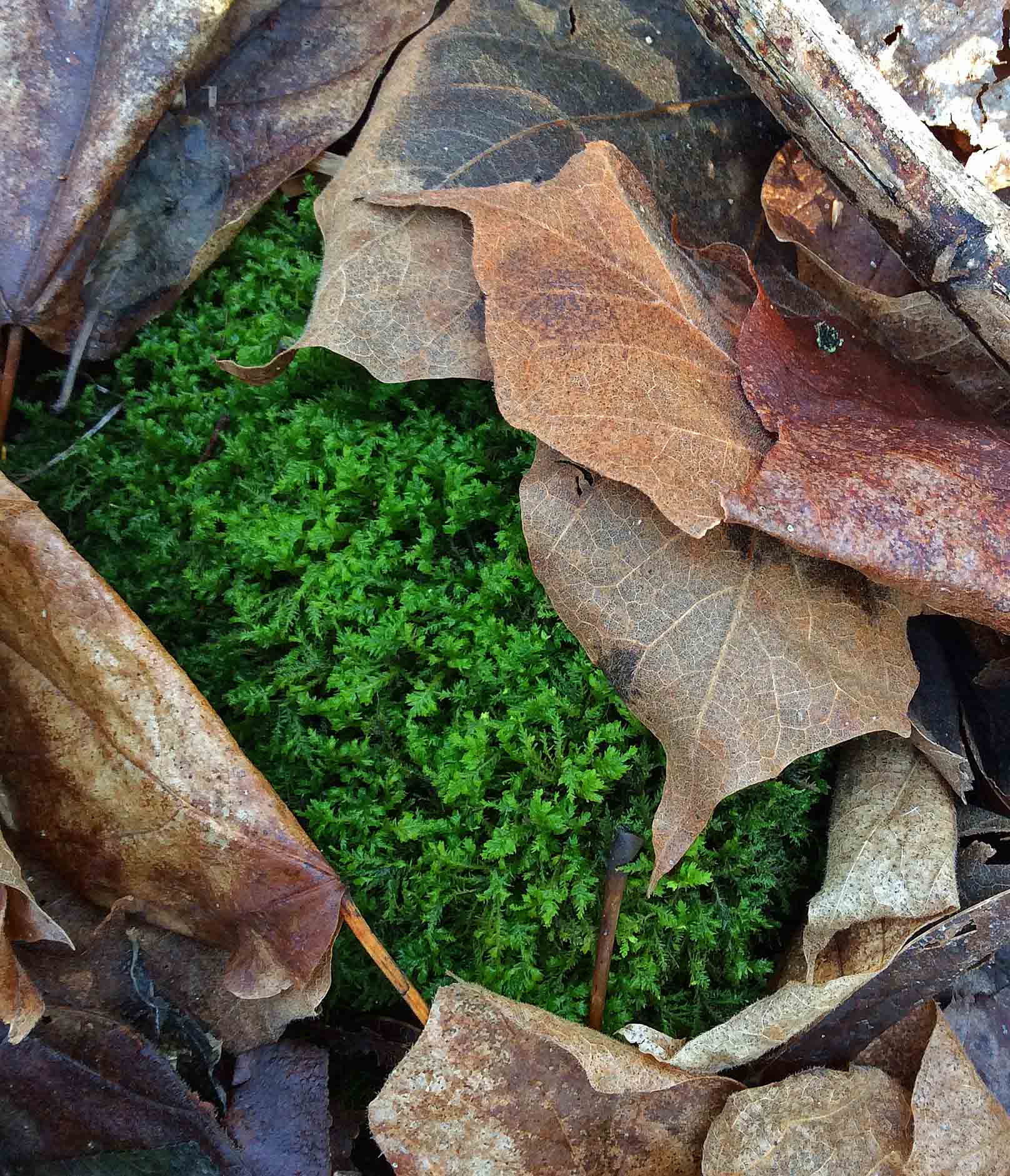
I find moss everywhere in the forest, including beneath the forest floor. Moss is a ubiquitous character, adapting itself to different situations and scenarios. Like a shapeshifter, moss is at once coy, hiding beneath rotting leaf litter, stealthy and curious as it creeps up the feet of huge cedars, and exuberant as it unabashedly drapes itself over every possible surface such as logs, twigs and rocks, and then proceeds to procreate for all to see.
.
Moss hides under dead leaf litter on the forest floor, Little Rouge Woodland, ON (photo by Nina Munteanu)
.
Mosses help with nutrient cycling because they can fix nitrogen from the air, making it available to other plants. Mosses thrive in the wet winter and spring, providing brilliant green to an otherwise brown-gray environment. Even when covered in snow (or a bed of leaves), moss continues its growth cycle, usually in the leafy gametophyte stage. In the spring the capsules release spores that can each create a new moss individual. Moss is quietly, gloriously profligate.
.
Team Players
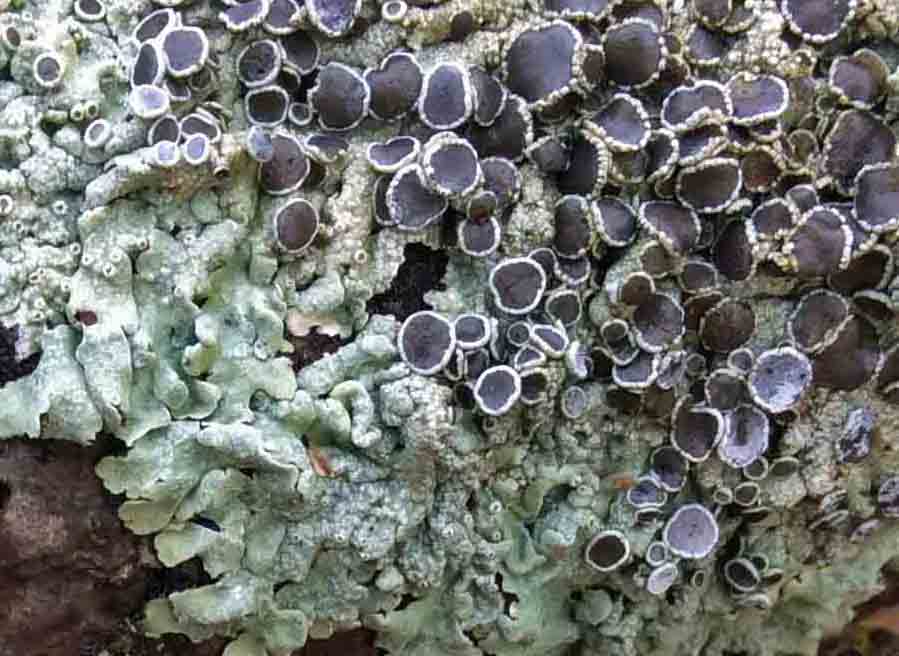
Fruiting lichen on a tree (photo by Nina Munteanu)
.
Lichens are a cooperative character; two characters in one, really. Lichens are a complex symbiotic association of two or more fungi and algae (some also partner up with a yeast). The algae in lichens (called phycobiont or photobiont) photosynthesize and the fungus (mycobiont) provides protection for the photobiont. Both the algae and fungus absorb water, minerals, and pollutants from the air, through rain and dust. In sexual reproduction, the mycobiont produces fruiting bodies, often cup-shaped, called apothecia that release ascospores. The spores must find a compatible photobiont to create a lichen. They depend on each other for resources—from food to shelter and protection.
Place ultimately portrays what lies at the heart of the story. Place as character serves as an archetype that story characters connect with and navigate in ways that depend on the theme of the story, particularly in allegories that rely strongly on metaphor. A story’s theme is essentially the “so what part” of the story. What is at stake for the character on their journey. Theme is the backbone—the heart—of the story, driving characters to journey through time and place toward some kind of fulfillment. There is no story without theme. And there is no theme without place.
Nina Munteanu is a Canadian ecologist / limnologist and novelist. She is co-editor of Europa SF and currently teaches writing courses at George Brown College and the University of Toronto. For the lates on her books, visit www.ninamunteanu.ca. Nina’s bilingual “La natura dell’acqua / The Way of Water” was published by Mincione Edizioni in Rome. Her non-fiction book “Water Is…” by Pixl Press (Vancouver) was selected by Margaret Atwood in the New York Times ‘Year in Reading’ and was chosen as the 2017 Summer Read by Water Canada. Her novel “A Diary in the Age of Water” was released by Inanna Publications (Toronto) in June 2020.You can read her just released eco-fiction thriller Gaia’s Revolution by Dragon Moon Press.
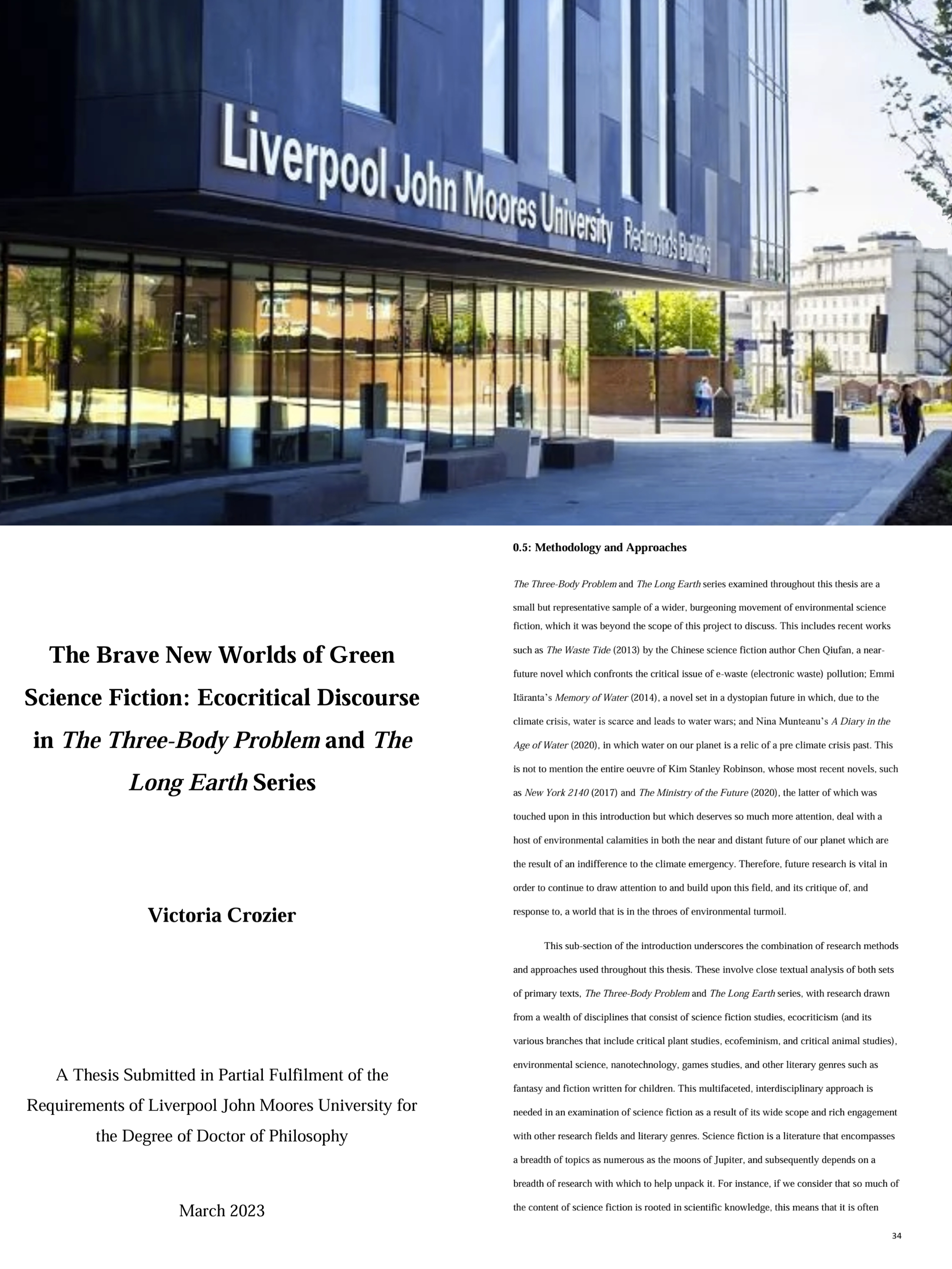
I recently encountered Victoria Crozier’s intriguing PhD thesis and ecocritical discourse out of Liverpool John Moores University entitled “The Brave New Worlds of Green Science Fiction” and found my eco-fiction novel “A Diary in the Age of Water” mentioned alongside other notable eco-fiction works I so enjoyed reading such as Liu Cixin’s The Three-Body Problem, Chen Quifan’s The Waste Tide, Kim Stanley Robinson’s New York 2140 and Emmi Itäranta’s Memory of Water. Crozier calls these “green science fiction,” an appropriate term that I may start using.
.
Nina Munteanu is a Canadian ecologist / limnologist and novelist. She is co-editor of Europa SF and currently teaches writing courses at George Brown College and the University of Toronto. For the lates on her books, visit www.ninamunteanu.ca. Nina’s bilingual “La natura dell’acqua / The Way of Water” was published by Mincione Edizioni in Rome. Her non-fiction book “Water Is…” by Pixl Press (Vancouver) was selected by Margaret Atwood in the New York Times ‘Year in Reading’ and was chosen as the 2017 Summer Read by Water Canada. Her novel “A Diary in the Age of Water” was released by Inanna Publications (Toronto) in June 2020.You can read her just released eco-fiction thriller Gaia’s Revolution by Dragon Moon Press.
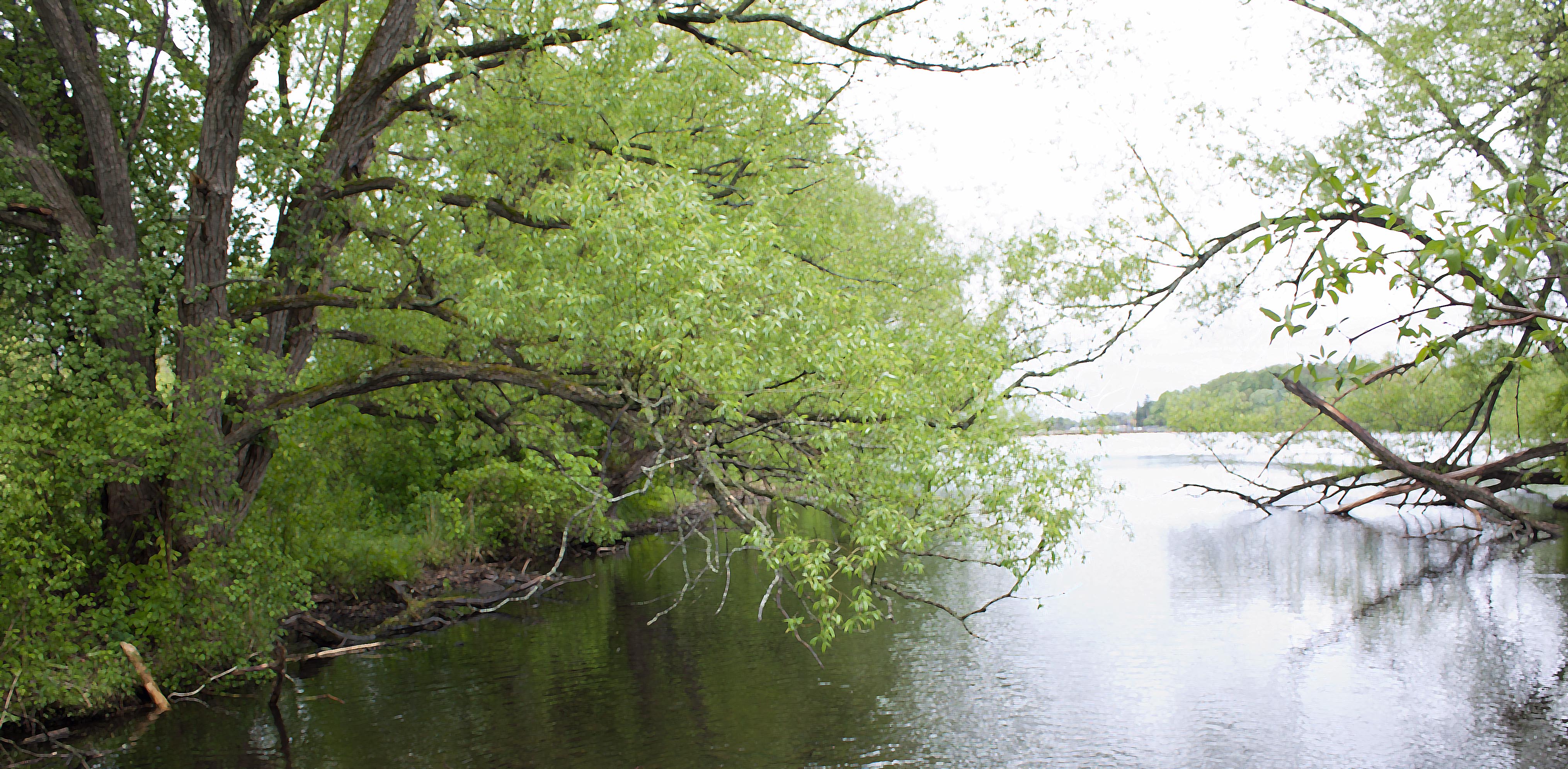
Marsh outlet of Thompson Creek into the Otonabee River, ON (photo and rendition by Nina Munteanu)
On a recent walk through a vibrant local marsh quietly embedded in a community, I contemplated its tenuous position. I’d stopped on a bridge that overlooked an open pond teaming with clucking and squawking waterfowl and let my mind drift to the busy urban environment I’d left behind. Here I stood in an oasis of being, a treasure threatened by development. I cast my mind to the relentless destruction of our natural world for the sake of ‘progress’ and felt an inlking of solastalgia.
For decades I’ve served as an environmental consultant and limnologist, championing the environment against senseless destruction. I’ve witnessed too many examples of ecosystem simplification and collapse through clear-cutting, urban development, marsh destruction, and diversions of rivers or toxic pollution. All with associated loss of biodiversity and accelerating extinction. The reduction in numbers and the extinction rate of nonhuman life is truly alarming.
I couldn’t help making the connection between our rapidly degrading environment and rapidly rising AI.
You think that a crazy connection? Let me explain. I think they are indeed connected. Artificial Intelligence and associated LLMs are tools borne of the need for efficiency; used properly, they expedite, streamline, simplify, save work time, and may even on some occasions illuminate and educate. Ultimately, these tools speed things up toward a destination. The journey to that destination is often purposely shortened, and usually unnoticed or forgotten. Efficiency isn’t about enjoying the journey; it is all about getting there, wherever that is. That’s our existence today. An existence that belongs to AI. An existence that ignores or ‘others’ Natureand sees it as an impediment to progress. The destruction of our natural world—the one that supports all life—is directly linked to the exploitive model of late capitalism that embraces AI and, at its extreme, the use of technology over (at the expense of) human labour.
I also teach writing at the University of Toronto and at my own coaching site. I recently came across a LinkedIn post by English Professor Susan Ray who mused on the concept of AI grief (of writing instructors) in acknowledging true loss in the gains made with AI: “Sometimes there seems to be kind of a misfire in the message about AI: that we just need to adapt, we need to accept, we need to move on and we need to embrace … But there’s something to grieve and we need to make space for that.”
She gave the example of her own grad school work on the 18th Century novel Tom Jones by Henry Fielding. “There was a quote I couldn’t find. I told one of my advisors that ‘I just hit CTRL F in Gutenburg.org and I found the quote.’ He went kind of ashen and he went ‘this is not how it’s supposed to work. You need to go back to the text; you need to reread, you need to discover something that you missed. That is the process.’ I kind of rolled my eyes—internally, not at my advisor—with the idea that I was supposed to intentionally make more work for myself. But he was trying to protect something sacred that had been taught to him and was part of his academic experience.”
Ray added that this was her experience with her students: “…using AI to brainstorm or talk out thesis statements or find sources or rephrase a passage. We [instructors] wanted something from them; we wanted what we had, which was being assigned a paper, or a project and sitting with it, fighting for that idea, and restructuring it, and revising it. That’s been lost in a lot of ways.”
She then brought up the latest statistic by the Digital Education Council that some 86% of all college students in the world admitted to using AI in their studies. This is likely an underestimate.
In response to Ray’s post, Andrew Sutter, Select Professor in Global Business at Akita International University, offered another more cynical take on AI grief: “I also wonder whether grief is a little too neat an explanation for the whole spectrum of feelings of reluctance about using LLMs … Students finding ways to hand in assignments without understanding them is nothing new … But LLMs do make this much easier. And many students welcome that … I’m really worried about what will happen when this cohort of students, ones made lazy and/or being misled by LLM use, are running the world. That’s not grief: it’s anger and apprehension.”
Beverly Pell, CEO at DuoFeed, summed it up this way: “This is a sorrowful time, a transition for many who enjoyed the discourse in the town square, the struggle, the ambiguity of the text, the nuances, the context, the process, seeing what unfolds, human imagination, and wisdom from experience. It’s a hard earned profession. And now that profession is threatened.”
Pell was talking about the journey, the slow pace of the rapt explorer who enjoys the nuanced filigrees of the minutae, the textures of experience, the colours of time.
My thought is that for every gain something is lost. In this case, the gain and loss lies in the learning process. I think that behind every ‘cheat’ or shortcut—which AI serves only too well as a tool—is a loss in potential discovery, even if that discovery is internal (the best kind) and often a surprise. Whenever we shortcut, we take away an opportunity. Ultimately, all creativity is a process of discovery. Why would you shorten it? Good writing—like a good cup of tea—must steep for a while to discover its deeper flavours.
But our capitalist-driven society is driven by efficiency (and profit) and embraces the shortcut. This is the capitalist way and so suited to the AI tool—now the authority of Google, smart phones, and social media. In a world of destinations and “getting ahead”, it’s all about finding the shortcut to get what you want. The journey fades into unimportance.
And yet, it is in that journey that true gems reveal themselves through serendipitous discovery. By choosing efficiency over experience, we rob ourselves of the journey to discover. Like engineers impatiently seeking our destination, we pave and straighten our roads into common simplification, shortening that now-boring journey.
How often have I gone through the forest and decided I need to turn back and then thought: one more stretch. That’s where I’d found my treasure. That one extra step held my unique prize. Kismet. Serendipity. These often lie in the dark folds of the less trodden path.
A LinkedIn post by Irreplaceable With AI resonated with me:
“When I look at how fast screens, algorithms, and instant entertainment have taken over childhood, I do not think the problem is technology itself. The problem is what gets squeezed out when every spare moment is filled for them (where so much real creativity begins):
Unstructured play
Boredom
Mess
Trial and error
The awkward, beautiful process of making something without being told what to do next”
I would add that in this unstructured space lives the opportunity to be unique and different. Something our society seems bent on destroying; and something our children appear bent on avoiding at all cost.
Here’s what matters most:
Curiosity over consumption
Creativity over passive entertainment
Connection over distraction
Critical problem solving over screen comfort
Cultivation of human values over digital convenience
Courage to confront, be different and to challenge.
Life shouldn’t be a short cut. We need to slow down and use our senses. Or someday we’ll be senselessly lost. And the worst of it will be that we won’t even sense it—even as the world burns down around us.
.
Nina Munteanu is a Canadian ecologist / limnologist and novelist. She is co-editor of Europa SF and currently teaches writing courses at George Brown College and the University of Toronto. Visit www.ninamunteanu.ca for the latest on her books. Nina’s bilingual “La natura dell’acqua / The Way of Water” was published by Mincione Edizioni in Rome. Her non-fiction book “Water Is…” by Pixl Press(Vancouver) was selected by Margaret Atwood in the New York Times ‘Year in Reading’ and was chosen as the 2017 Summer Read by Water Canada. Her eco-fiction clifi novel “A Diary in the Age of Water” was released by Inanna Publications (Toronto) in June 2020.Her most recent novel Gaia’s Revolution was released March 2026 by Dragon Moon Press (Calgary).
In two excellent articles in Climate Cultures entitled “A History of Eco-fiction, Part 1 and 2”, eco-fiction author and critic Mary Woodbury starts out with several rather long definitions of eco-fiction—one provided by Jim Dwyer in his 2010 book Where the Wild Books Are: A Field Guide to Eco-Fiction.
She also includes simpler descriptions. For instance, Ashland Creek Press calls it “fiction with a conscience,” and co-founder John Yunker insightfully labelled it a super-genre.
Woodbury then muses: “I think of eco-fiction as not so much a genre than as a way to intersect natural landscape, environmental issues, and wilderness—and human connection to these things—into any genre and make it come alive.” Not a fan of labels, she argues that eco-fiction is broad and has a rich history (of existence long before its label was coined in 1971 in the preface to an anthology by Washington Square Press) and brings up examples such as The Stolen Child by Victorian author and poet WB Yeats. “Eco-fiction has no boundaries in time or space,” argues Woodbury. “It can be set in the past, present, or future. It can be set in other worlds…I think of eco-fiction as a way to bring alive the wild in any genre, whether romance, adventure, mystery, you name it.”
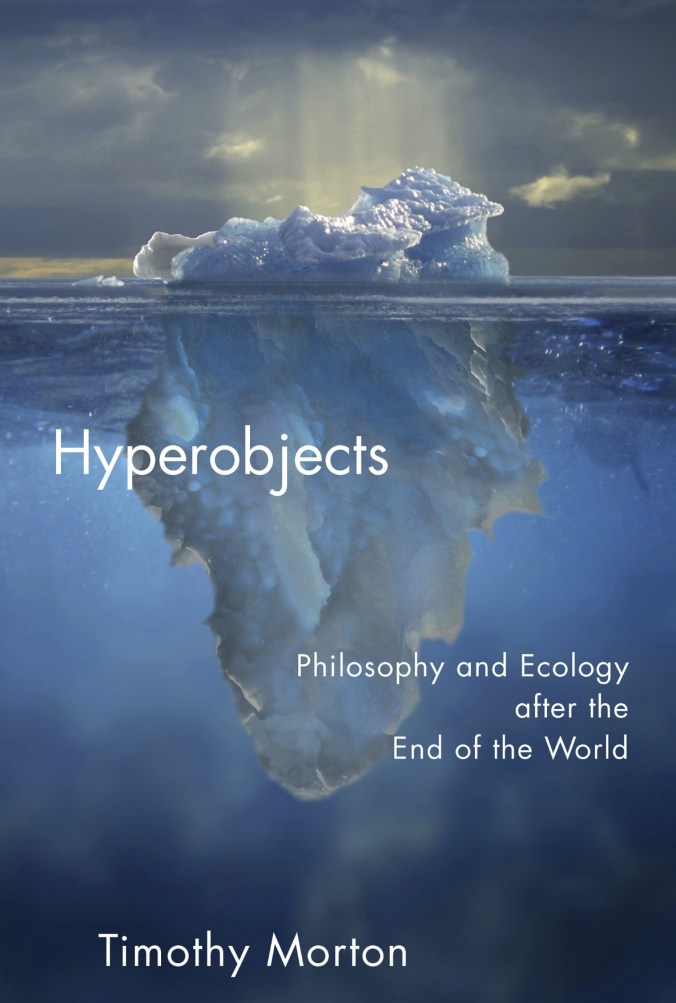
Eco-fiction—like climate change—is a hyperobject. In his 2014 book Hyperobjects, Timothy Morton explains that hyperobjects are immense, non-local entities that challenge our traditional understanding of objects; things so massively distributed in time and space that they defy human perception, given they exist beyond our immediate sensory grasp yet affecting us profoundly. Examples include anthropogenic global warming / climate change, but also pervasive phenomena, like plastic and oil, that have far reaching impacts beyond their simple physical presence.
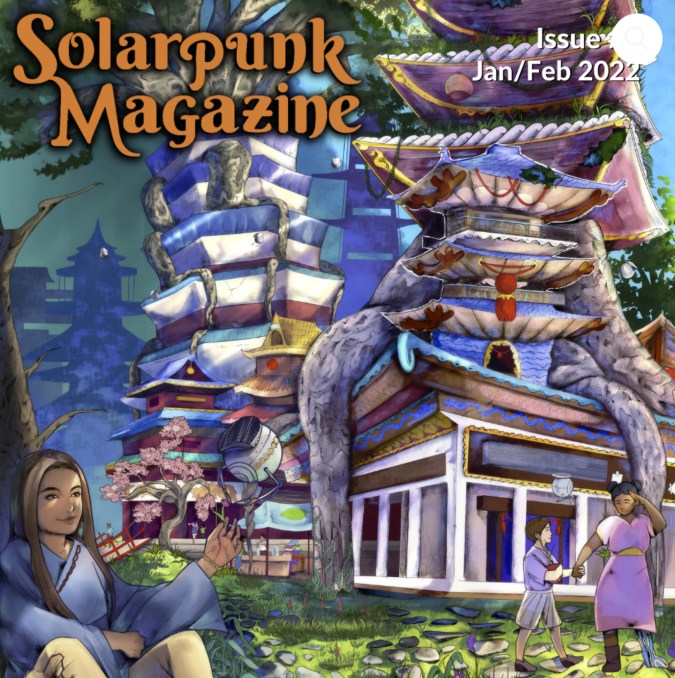
My own definition (from a previous article in Solarpunk Magazine) embraces the hyperobject nature of eco-fiction: eco-fiction (short for ecological fiction) is a kind of fiction in which the environment—or one aspect of the environment—plays a major role in story, either as premise or as character. For instance, several of my eco-fiction stories give Water a voice as character. In my latest novel, A Diary in the Age of Water, each of the four women characters reflects on her relationship with water and, in turn, her view of and journey in a changing world.
Through its vision of our future, eco-fiction encourages conversations and an outward perspective. Eco-fiction can trigger a sense of wonder about the natural world; it may connect with our sense of loss or mourning—our solastalgia—for our changing home. Cautionary tales may nudge people to action and encourage alternative futures. By encouraging empathy and imagination, eco-fiction reaches deep into our souls, where we care. It is only when we care that we act.
A recent survey conducted by Woodbury revealed that, “Fiction exploring humanity’s impacts on nature is becoming more popular [and] has the distinct ability to creatively engage and appeal to readers’ emotions.” Woodbury’s 2020 survey showed that “88% of its participants were inspired to act after reading ecological fiction.”
A few years ago, I wrote an article entitled “Why Ecofiction Will Save the World” which appeared in Issue #1 of Solarpunk Magazine. In it, I mentioned how I’d noticed in my university science fiction course that more and more students were bringing in WIPs on ecological and global environmental issues. Many of the stories involved a premise of environmental calamity, but not in the same vein as previous environmental disasters that depict “man” against Nature. Instead, these works gave the Earth or Nature (or an aspect of Nature) an actual voice—as a character—and had a protagonist who learns to interact with the Earth/Nature character, often cooperatively. This represents a palpable and gestalt cultural awakening of what eco-feminists have called the “feminine archetype” by providing a voice for “the other” in story.
.
This shift reflects what lies at the heart of eco-fiction.
Eco-fiction explores the world and the consequences of humanity’s actions on the environment and ourselves (by inference) through dramatization. The stories that stir our hearts come from deep inside, through symbols, archetypes and metaphor, where the personal meets the universal. In my short story “The Way of Water”(“La natura dell’acqua”), water’s connection with love flows throughout the story:
They met in the lobby of a shabby downtown Toronto hotel. Hilda barely knew what she looked like but when Hanna entered the lobby through the front doors Hilda knew every bit of her. Hanna swept in like a stray summer rainstorm, beaming with the self-conscious optimism of someone who recognized a twin sister. She reminded Hilda of her first boyfriend, clutching flowers in one hand and chocolate in the other. When their eyes met, Hilda knew. For an instant, she knew all of Hanna. For an instant, she’d glimpsed eternity. What she didn’t know then was that it was love.
In a world of severe water scarcity through climate catastrophe and geopolitical oppression, the bond of these two girls—to each other through water and with water—is like the shifting covalent bond of a complex molecule, a bond that fuses a relationship of paradox linked to the paradoxical properties of water. Just as two water drops join, the two women find each other in the wasteland of environmental intrigue. Hilda’s relationship with Hanna—as with water—is both complex and shifting according to the bonds they make and break. Hilda navigates her dystopia by learning meaningful lessons—lessons that pertain directly to our reader in their current world. This is because the premise of a dystopia lies squarely in the present world. Good dystopias enlighten and suggest possibilities; they can warn and herald. At the very least, they incite the necessary conversation.
Our capacity—and need—to share stories is as old as our ancient beginnings. From the Paleolithic cave paintings of Lascaux to our blogs on the Internet, humanity has left a grand legacy of ‘story’ sharing. By providing context to knowledge, story moves us to care, to cherish, and, in turn, to act. What we cherish, we protect. It’s really that simple.
.
“Morton’s book is a queasily vertiginous quest to synthesize the still divergent fields of quantum theory (the weirdness of small objects) and relativity (the weirdness of big objects) and insert them into philosophy and art, which he notes are far behind ontologically speaking (page 150). Morton’s wager is that for the first time, we in the Anthropocene are able to see snapshots of hyperobjects, and that these intimations more or less will force us to undergo a radical reboot of our ontological toolkit and (finally) incorporate the weirdness of physics”—Cara Daggett
.
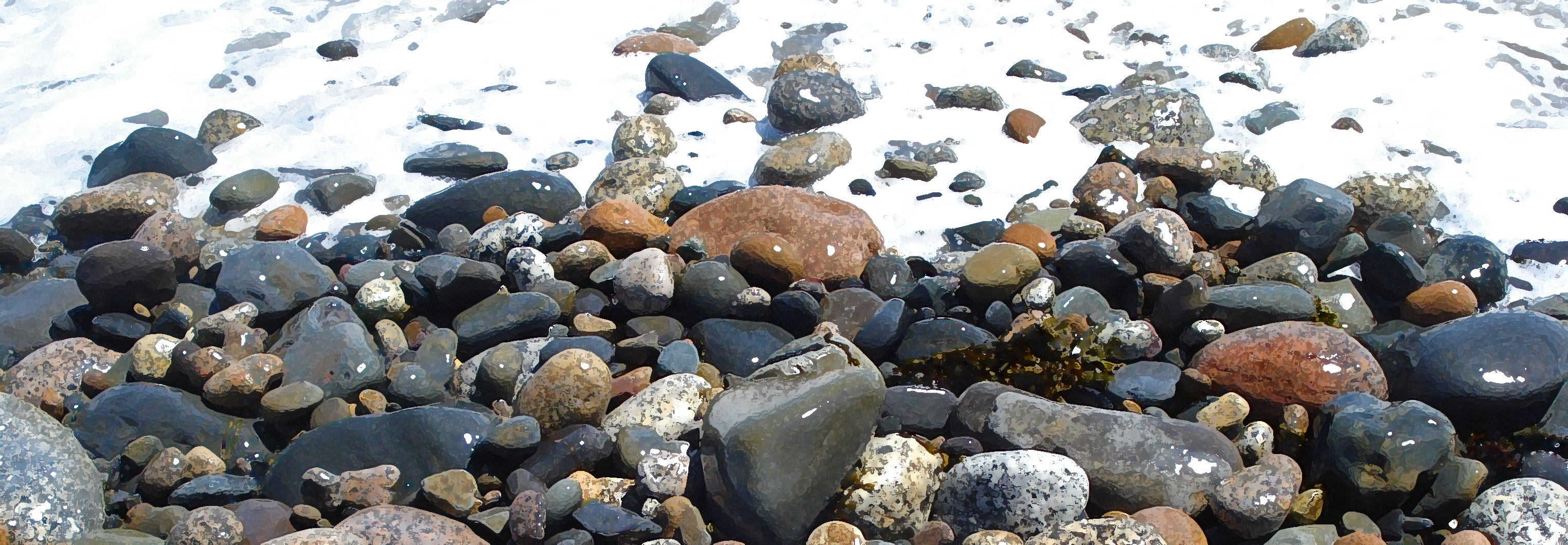
Hirtle Beach, Nova Scotia (photo and rendition by Nina Munteanu)
.
Nina Munteanu is an award-winning novelist and short story writer of eco-fiction, science fiction and fantasy. She also has three writing guides out: The Fiction Writer; The Journal Writer; and The Ecology of Writing and teaches fiction writing and technical writing at university and online. Check the Publications page on this site for a summary of what she has out there. Nina teaches writing at the University of Toronto and has been coaching fiction and non-fiction authors for over 20 years. You can find Nina’s short podcasts on writing on YouTube. Check out this site for more author advice from how to write a synopsis to finding your muse and the art and science of writing.
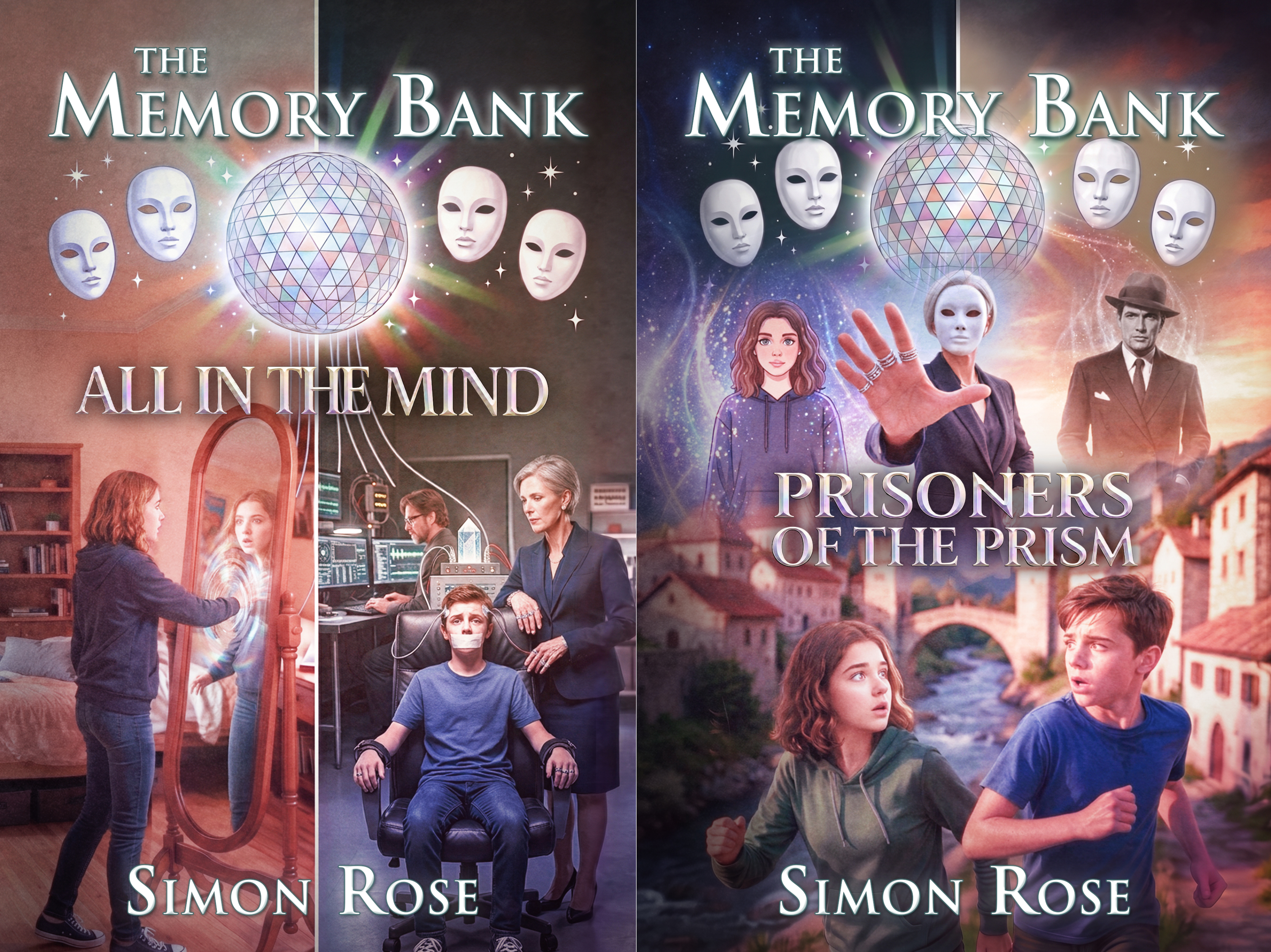
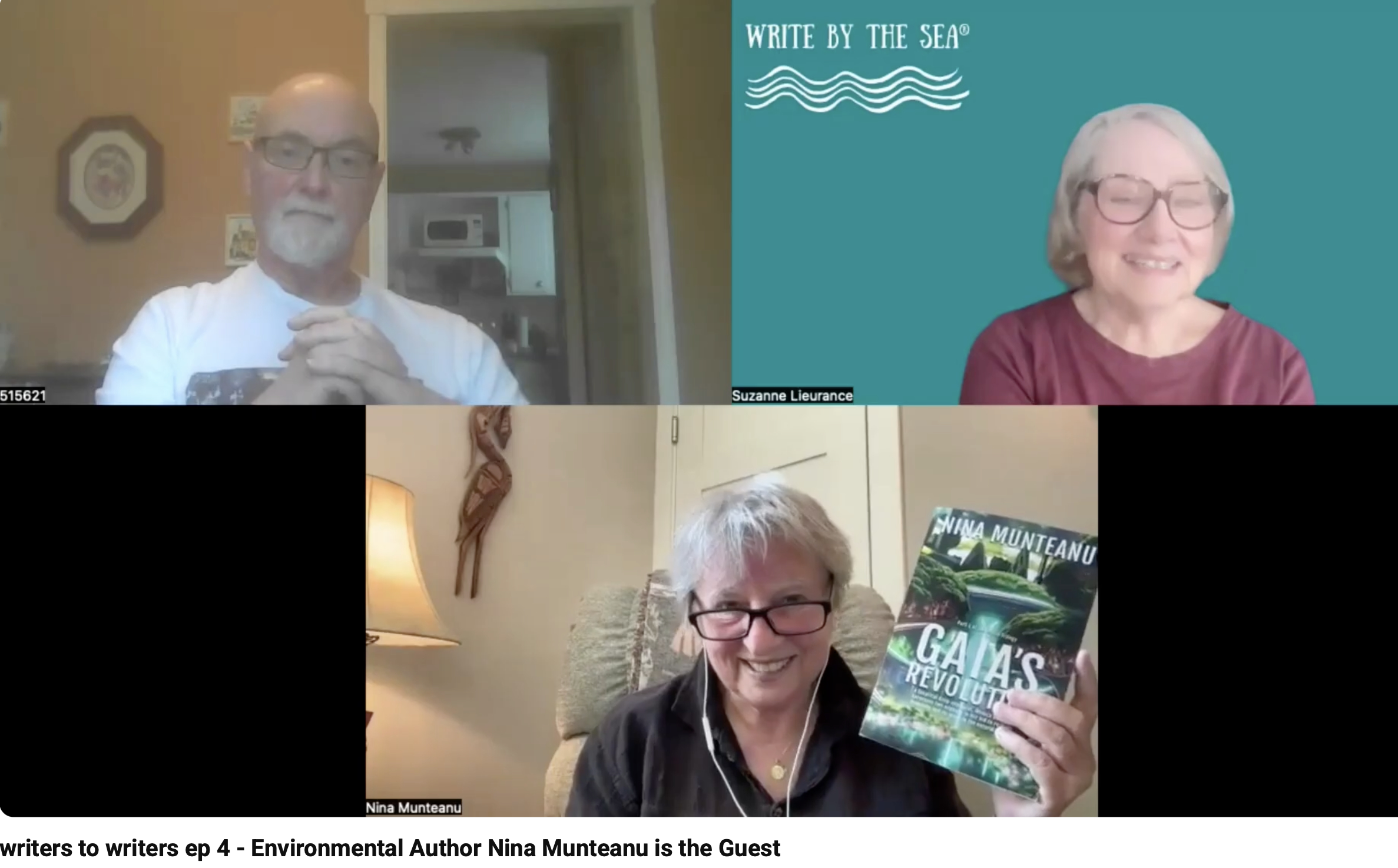
Today, I’m sitting down with authors and writing coaches Suzanne Lieurance and Simon Rose to talk about their brand-new YouTube series, The Law of Attraction for Writers Podcast, which you can find at: https://www.youtube.com/@LawofAttractionforWritersPodca.
The show blends mindset, creativity, and practical writing advice — a combination that’s resonating with writers who want to manifest success and write with more ease.
.
Nina: Welcome, both of you!
Suzanne: Thank you! We’re so excited to finally share this project.
Simon: Yes, it’s been in the works for a while, and we’re thrilled to see writers already responding so positively.
Simon Rose and Suzanne Lieurance
Nina: Let’s start with the big question. Why create a Law of Attraction for Writers podcast?
Suzanne: Well, over the years, I’ve coached so many writers who say things like, “I’ll feel successful when I get an agent,” or “I’ll write when I have more time.” But the Law of Attraction teaches us it works the other way around — you become the person who already feels successful, and the opportunities follow. I wanted to create a podcast that helps writers understand how their thoughts, emotions, and energy shape their writing lives.
Simon: Exactly. So much of writing is mental. You can have the best outline and still feel blocked if your energy is off. We wanted to show that aligning your mindset with your goals isn’t mystical — it’s practical. You’re essentially training your brain to focus on what you want instead of what you fear.
Nina: How would you describe the podcast to someone who hasn’t tuned in yet?
Simon: Each episode focuses on one key aspect of the Law of Attraction and how it connects to the writing process. We might explore a concept like visualization, vibration, or inspired action — and then show writers how to apply that directly to their writing routines.
Suzanne: We wanted to make it accessible. It’s not just theory or motivation. We give writers clear steps they can take right away — ways to shift their thinking, attract new ideas, or rekindle their excitement for a project.
Simon: We also share personal stories. Between the two of us, we’ve seen these principles in action — in publishing, in teaching, and even in everyday creative decisions.
Nina: I love that you connect mindset with the craft of writing. Can you say more about how that works?
Suzanne: Sure. A lot of writers separate the two — mindset on one side, writing craft on the other. But they’re intertwined. You might know every writing technique out there, but if you’re doubting yourself or constantly telling yourself you’re behind, you’ll block the creative flow.
Simon: That’s why the Law of Attraction is so powerful for writers. It’s not just about “thinking positive.” It’s about intentionally setting the tone for your writing sessions, deciding what kind of writer you believe yourself to be, and letting that belief guide your actions.
Suzanne: In one episode, we talk about “energetic alignment” — how your emotional state affects the words you put on the page. When you write from frustration, the writing feels heavy. But when you write from joy or curiosity, the story expands.
Nina: You’ve both been writing coaches for years. How has it been working together on this project?
Simon: It’s been wonderful. Suzanne brings a very intuitive approach to writing and mindset, while I tend to look at things through a more analytical lens. Together, we strike a balance between the spiritual and the practical.
Suzanne: Yes! We complement each other well. Simon often grounds the big ideas in real-world examples, and I love exploring how energy and focus shape results. It’s a true partnership — and we both learn from each other in every episode.
Nina: Without giving too much away, what are some of the themes or takeaways that keep coming up in your discussions?
Suzanne: One theme that runs through everything is trust — trusting yourself, your ideas, and the timing of your success. The Law of Attraction reminds us that everything unfolds when you’re ready to receive it.
Simon: Another recurring idea is momentum. Writers often stop when things get tough, but energy builds through consistent action. You don’t have to write for hours every day — just focus on showing up with intention. That small shift can open the door to much bigger results.
Suzanne: We also talk about how to handle resistance. Every writer faces doubt or creative slumps. The podcast offers ways to turn those moments into opportunities instead of roadblocks.
Nina: You’ve chosen YouTube as your main platform. Why that format?
Simon: We wanted to make it easy and engaging. YouTube allows us to connect visually and energetically with our audience. Writers can listen while they work, which adds a more personal connection.
Suzanne: And YouTube’s format fits how writers consume content today. Many of them already use it to learn about craft and publishing. This podcast adds another layer — the inner work behind writing success.
Nina: What’s ahead for the Law of Attraction for Writers Podcast?
Suzanne: We’ll keep releasing new episodes every Tuesday. Each one will build on the idea that your energy, focus, and beliefs create your writing experience.
Simon: We’re also exploring live Q&A sessions, where writers can ask questions and share how they’ve applied the principles we discuss. It’s exciting to see a community forming around these ideas.
Suzanne: Ultimately, we want every writer to realize they’re not powerless. They can create not only their stories but also their success.
Nina: That’s such an inspiring message. Any final thoughts for writers who might be hesitant to explore this side of writing?
Suzanne: Just start listening with an open mind. You don’t have to “believe” in anything right away — just try applying one idea and see what shifts.
Simon: Yes. Writing is already an act of creation — you’re manifesting something that didn’t exist before. This podcast helps you see that same creative power working in every area of your writing life.
Follow Suzanne Lieurance and Simon Rose for practical, inspiring ways to align your mindset, energy, and creativity — and manifest the writing life you’ve always imagined.
.
Nina Munteanu is an award-winning novelist and short story writer of eco-fiction, science fiction and fantasy. She also has three writing guides out: The Fiction Writer; The Journal Writer; and The Ecology of Writing and teaches fiction writing and technical writing at university and online. Check the Publications page on this site for a summary of what she has out there. Nina teaches writing at the University of Toronto and has been coaching fiction and non-fiction authors for over 20 years. You can find Nina’s short podcasts on writing on YouTube. Check out this site for more author advice from how to write a synopsis to finding your muse and the art and science of writing.
On March 20, 2025, in an article in The Atlantic entitled “The Unbelievable Scale of AI’s Pirated-Books Problem”, Alex Reisner disclosed how META pirated millions of books and research papers to train their flagship AI model Llama 3 to be competitive with products like ChatGPT. Reasons for this illegal action is simply time; asking permission and licensing takes too much time and is too expensive.
On the same day, The Atlantic provided a link to LibGen (the pirated-books database that Meta used to train its AI) so authors could search its collection of millions of illegally captured books and scientific papers. I went there and searched my name for my novels, non-fiction books and scientific papers and discovered several of my works in their AI training collection.
Two of my many scientific papers appeared in LibGen under my scientific author name Norina Munteanu. The first scholarly article came from my post grad work at the University of Victoria on the effects of mine tailing effluent on an oligotrophic lake, published in 1984 in Environmental Pollution Series A, Ecological and BiologicalVolume 33, Issue 1. The second article on the effect of current on settling periphyton came from my M.Sc. ecology research published in 1981 in Hydrobiologia, Volume #78.
.
.
Three of my thirteen novels appeared in LibGen under my fiction author name Nina Munteanu. I found it interesting how their bots captured a good range of my works. These included two of my earliest works. Collision with Paradise (2005) is an ecological science fiction adventure and work of erotica; Darwin’s Paradox (2007) is a science fiction medical-eco thriller that features the domination of society by an intelligent AI community. The bots also found my latest novel, A Diary in the Age of Water(2020), a climate thriller and work of eco-fiction that follows four generations of women and their relationship to water.
.
.
.
Each of these works has been highly successful in sales and has received a fair bit of attention and recognition.
When Genevieve Dubois, Zeta Corp’s hot shot starship pilot, accepts a research mission aboard AI ship ZAC to the mysterious planet Eos, she not only collides with her guilty past but with her own ultimate fantasy. On a yearning quest for paradise, Genevieve thinks she’s found it in Eos and its people; only to discover that she has brought the seed of destruction that will destroy this verdant planet.
Recognition: Gaylactic Spectrum Award (nominee)
“Collision with Paradise is ideal for readers who enjoy dark, introspective science fiction that explores complex moral dilemmas and psychological depth within a lush mythologically-rich setting.”—The Storygraph
.
A devastating disease. A world on the brink of violent change. And one woman who can save it or destroy it all. Julie Crane must confront the will of the ambitious virus lurking inside her to fulfill her final destiny as Darwin’s Paradox, the key to the evolution of an entire civilization. Darwin’s Paradox is a novel about a woman s fierce love and her courageous journey toward forgiveness, trust, and letting go to the tide of her heart.
Recognition: Readers Choice Award (Midwest Book Review); Readers Choice (Delta Optimist); Aurora Award (nominee)
“Darwin’s Paradox is a thrill ride that makes you think and tugs the heart.”—Robert J. Sawyer, Hugo and Nebula Award winning author of Rollback
.
This gritty memoir describes a near-future Toronto in the grips of severe water scarcity during a time when China owns the USA and the USA owns Canada. A Diary in the Age of Water follows the climate-induced journey of Earth and humanity through four generations of women, each with a unique relationship to water. The diary spans a twenty-year period in the mid-twenty-first century of 33-year-old Lynna, a single mother and limnologist of international water utility CanadaCorp, and who witnesses disturbing events that she doesn’t realize will soon lead to humanity’s demise.
Recognition: 2020 Foreword Indies Book of the Year Award (Bronze); 2020 Titan Literary Book Award (Silver); 2021 International Book Award (Finalist).
“If you believe Canada’s water will remain free forever (or that it’s truly free now) Munteanu asks you to think again. Readers have called ‘A Diary in the Age of Water’ “terrifying,” “engrossing,” and “literary.” We call it wisdom.”—LIISBETH
.
The April 3, 2025 article by Ella Creamer of The Guardian noted that a US court filing alleged that Meta CEO Mark Zuckerberg approved the company’s use of the notorious “shadow library”, LibGen, which contains more than 7.5 million books and 81 million research papers. According to Toby Walsh, leading AI researcher at the University of New South Wales: “As far as we know, there was an explicit instruction from Mark Zuckerberg to ignore copyright.”
This begs the question of the role and power of copyright law.
“Copyright law is not complicated at all,” said Richard Osman, author of The Thursday Murder Club series. “If you want to use an author’s work you need to ask for permission. If you use it without permission you’re breaking the law. It’s so simple.”
If it’s so simple then why is Meta and others getting away with it? For its defence, the tech giant is claiming “fair use”, relying on this term permitting the limited use of copyrighted material without the owner’s permission (my italics).
It would seem that just as Trump trumped the presidency, Zuckerberg and his AI minion bots have trumped the copyright law—by flagrantly violating it and getting away with it—so far (on both counts).
The actions of Meta were characterized by Society of Authors chair Vanessa Fox O’Louglin as “illegal, shocking, and utterly devastating for writers.” O’Louglin added that “a book can take a year or longer to write. Meta has stolen books so that their AI can reproduce creative content, potentially putting these same authors out of business.”
.
Three of my novels pirated for AI training
.
Reflecting many authors’ outragethroughout the world, Novelist AJ West remarked, “To have my beautiful books ripped off like this without my permission and without a penny of compensation then fed to the AI monster feels like I’ve been mugged.” Australian Author Sophie Cunninghamsaid, “The average writer earns about $18,000 a year on their writing. It’s one thing to be underpaid. It’s another thing to find that [their] work is being used by a company that you don’t trust.” Bestselling author Hannah Kent said, “If feels a little like my body of work has been plundered.” She adds that this, “opens the door to others also feeling like this is an acceptable way to treat intellectual copyright and creatives who already…are expected to [contribute] so much for free or without due recompense.” Both Kent and Cunningham exhort governments to weigh in with more powerful regulation. And this is precisely what may occur. Nicola Heath of ABC.net.au writes, “the outcomes of the various AI copyright infringement cases currently underway in the US will shape how AI is trained in the future.”
According to The March 20, 2025 Authors Guild article “Meta’s Massive AI Training Book Heist: What Authors Need to Know,” legal action is underway against Meta, OpenAI, Microsoft, Anthopic, and other AI companies for using pirated books. The Authors Guild is a plaintiff in the class action lawsuit against OpenAI, along with John Grisham, Jodi Picoult, David Baldacci, George R.R. Martin, and 13 other authors, but the claims are made on behalf of all US authors whose works have been ingested into GPT.
The Authors Guild suggests five things authors can do to defend their rights:
Send a formal notice: If your books are in the LibGen dataset, send a letter to Meta and other AI companies stating they do not have the right to use your books.
Join the Authors Guild: You should join the Guild and support our joint advocacy to ensure that the writing profession remains alive and vibrant in the age of AI. We give authors a voice, and there is power in numbers. We can also help you ensure that your contracts protect you against unwanted AI use of your work.
Protect your works: Add a “NO AI TRAINING” notice on the copyright page of your works. For online work, you can update your website’s robots.txt file to block AI bots.
Get Human Authored certification: Distinguish your work in an increasingly AI-saturated market with the Authors Guild’s certification program. This visible mark verifies your book was created by a human, not generated by AI.
Stay informed. The Authors Guild suggest signing up for the free Guild biweekly newsletter to keep updated on lawsuits and legislation that could impact you and your rights. The legal landscape is changing rapidly, and they are keeping close watch.
*as delivered by James Holden in Season 3, Episode 7 of “The Expanse”
.
Aspens in fall, ON (photo and rendition by Nina Munteanu)
.
Nina Munteanu is a Canadian ecologist / limnologist and novelist. She is co-editor of Europa SF and currently teaches writing courses at George Brown College and the University of Toronto. Visit www.ninamunteanu.ca for the latest on her books. Nina’s bilingual “La natura dell’acqua / The Way of Water” was published by Mincione Edizioni in Rome. Her non-fiction book “Water Is…” by Pixl Press (Vancouver) was selected by Margaret Atwood in the New York Times ‘Year in Reading’ and was chosen as the 2017 Summer Read by Water Canada. Her novel “A Diary in the Age of Water” was released by Inanna Publications (Toronto) in June 2020.
I recently ran across a list posted on social media of the 20 most popular AI tools for productivity in writing. I only knew two of them. This heightened my anxiety about what I know and am prepared for in the use of genAI, particularly in academic settings, where I teach writing at university. And it got me thinking why I was so anxious…
.
I shared the list with my colleagues at the university writing centre and one instructor who was actively following AI tools admitted that they knew only a few of the listed tools as well. They further shared that they were feeling increasingly apprehensive about genAI’s impact on higher education. “It’s hard not to feel overwhelmed,” they ended.
(Photo: Nina writing her novel at a cafe)
.
This was my exact sentiment: a kind of apprehensive excitement. An understanding that all communicators stand at the precipice of a major paradigm shift in tool use. The ramifications this will have on all aspects of effective and efficient communication will span from redefining plagiarism to reinventing creativity. As with all powerful tools—aside from the obvious threat of misuse—there is always something lost with the gain and I wonder what we are losing with all this. I have some ideas, and they do bother me from time to time.
.
Applications of Generative AI (image by Neebel Technologies)
I do think it important for me as a communicator and writing instructor to understand the trade offs and to work with them.
When the world adopted the portable calculator, rote knowledge of basic math suffered. I know; I tested it during a lab exam when I was teaching college biology many years back. I forbid the use of calculators in the test and many students, who had lost the ability to do long division or multiplication by hand, lost marks. For some reason, I’m still not sure of, it was important for me to insist on students doing math longhand (a basic skill fast becoming obsolete like cursive writing) and punish those who had lost the art. Perhaps I was drawing on Isaac Asimov’s possibly prescient 1957 short story satire The Feeling of Power, which explored the limitations of a future world that lost its basic skills to machines. The corollary, I suppose, is that more complex and conceptual math gained some ground through this handy and efficient tool. Machines have their advantages, certainly. And generative AI is just one sophisticated aspect of machine use.
.
.
Consequences to Creative Writing
In my world of professional fiction authors, there is a palpable fear of being replaced by AI as story creators: a version of the ultimate science fiction horror plot of being taken over by the machine world (I’ve even exploited that in my SF thrillers Angel of Chaos and Darwin’s Paradox).
Given our unique powers of imagination, I don’t think that will happen (very soon, if ever successfully). Though, as we dummy-down and simplify complex stories for fast-paced multiplex audiences addicted to fast-paced bite-sized and easy to digest entertainment, AI-generated narratives could get by. How is all this affecting the publishing industry now? I recently learned that one of the top five online science fiction magazines, Metastellar, accepts AI-assisted stories with the proviso that “they better be good.” And Metastellar provides some convincing reasons. This has become a hot topic among my fellow professional writers at SF Canada. One colleague informed me that a “new publisher Spines plans todisrupt industry by publishing 8000 AI books in 2025 alone.” On checking the news release, I discovered that Spines is, in fact, a tech firm trying to make its mark on publishing, primarily through the use of AI. The company offers the use of AI to proofread, produce, publish, and distribute books. They are, in fact, a vanity publishing platform (essentially a service for self-publishing), charging up to $5000 a book and often taking just three weeks to go from manuscript to a published title. The quality of what they will produce is unclear—and questionable.
All to serve as metaphor for what I and my colleagues at university are striving to achieve with students in their academic writing: excellence in communication, particularly in conveying complex scenarios that require creative solutions where clear, concise, and convincing writing is requisite.
.
I still find myself reluctant to use AI in my writing and communication, though I’ve at times slid into using AI for research and initial summaries to save time. I do this rarely because I absolutely enjoy doing research. I enjoy challenging my brain to summarize key points and write a good line. I enjoy the thrill of unanticipated discoveries, which always happen on these forays. I also recognize that many people do not share my enthusiasm for these brain exercises.
(Photo: Nina writing in another cafe)
.
I think that AI alone will not replace human mind for unique creativity. I didn’t say “can not.” It could; but it won’t. This is because even as genAI becomes infused in many aspects of life pursuit, there will remain those like that rare mathematician capable of doing math by hand in The Feeling of Power, valued not just because they are rare, but because in that rarity, they fulfill a critical role. When the machines stalled in their ability to move society forward in The Feeling of Power and all seemed lost, this archaic mathematician presented new innovation with basic math. I’m not suggesting that the technology will all break down, plunging the world into darkness (though this remains a possibility and is still a great plot for science fiction); but I submit that diversity rules over monopoly when it comes to survival.
.
Five Mass Extinctions
.
This may seem a rather dark projection of the future, but consider that over the millennia, after five mass extinctions and with the sixth mass extinction underway, diversity has always saved the world. Within that necessary diversity, it is the nurtured rarities, the outliers, the misfits and nonconformists that survived the destruction of the previous world. Each time, diversity made that possible. As though engrained in Nature’s world building.
.
Mass Extinctions (image by National Geographic)
.
Ecologists call it ecological succession, others use the term “creative-destruction” to describe the recursive pattern of living and non-living things of the planet. Both describe how the oligarchs of an established climax ecosystem fail due to change or disturbance and are replaced by a previous rare misfit or immigrant better suited to the new environment.
.
Primary and secondary succession in two different ecosystems
.
I think AI is part of our succession. Our use of AI in all its forms will represent a diversity of reaction and action that represent our own diversity and potential to survive in a changing world. All to say: relax and embrace the outliers.
.
Writing in nature (photo by Nina Munteanu)
As William Gibson so famously said in 1993: The Future is already here; it’s just not evenly distributed. And maybe that’s a good thing…
.
So…
…To AI, or not to AI, that is the question: Whether ’tis nobler in the mind to suffer The slings and arrows of terrible writing, Or to take arms against a sea of scribbles And by opposing end them. To think—to write, No more; and by writing to say we end The heart-ache and the thousand natural shocks That tech is heir to: ’tis a consummation Devoutly to be wish’d. To think, to write; To write, perchance to create—ay, there’s the rub: For in that creation of unique thoughts what others may come, When we have shuffled off this genAI…
.
Writing in Nature (photo by Nina Munteanu)
.
Nina Munteanu is a Canadian ecologist / limnologist and novelist. She is co-editor of Europa SF and currently teaches writing courses at George Brown College and the University of Toronto. Visit www.ninamunteanu.ca for the latest on her books. Nina’s bilingual “La natura dell’acqua / The Way of Water” was published by Mincione Edizioni in Rome. Her non-fiction book “Water Is…” by Pixl Press (Vancouver) was selected by Margaret Atwood in the New York Times ‘Year in Reading’ and was chosen as the 2017 Summer Read by Water Canada. Her novel “A Diary in the Age of Water” was released by Inanna Publications (Toronto) in June 2020.
Lynda Williams, author of science fiction series The Okal Rel Saga and publisher of Reality Skimming Press has just pulled together a writers group in Prince George, B.C., for writers to connect with other writers and share feedback on fiction and nonfiction.
Meetings will start March 20 and continue every other Thursday following from 7-9 pm at the Live Well Prince George Society.
All levels of experience are welcome. There is a $2 donation per drop in or $10 annual membership.