Smoke Descending

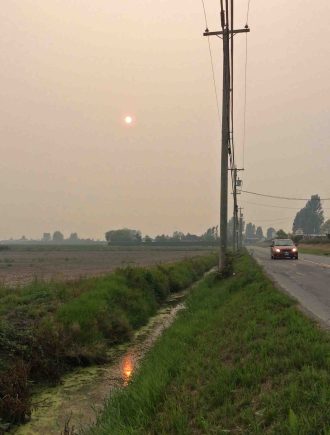
smoky sun-Ladner 6pm

Port Guichon in Ladner at 6 pm (photo by Nina Munteanu

Today—as writing friend Sylvia and I decided to have our coffees inside Stir Coffee House rather than its pleasant patio under the peach-coloured haze of Ladner—much of British Columbia was under high evacuation alert, was being evacuated or was under an air quality advisement. More than 20,000 people have evacuated their homes or are on alert while over 500 fires burn across the province.

In Vanderhoof, where good friend Anne lives on her ranch, the air quality index is beyond the high limit of the scale (over 600 on a scale that only runs to 500).

An air quality advisory was issued for Metro Vancouver and the Fraser Valley on Tuesday. Then the smoke from higher elevations descended that night. Wednesday morning, I walked into Ladner village through a haze that smelled of old fire. An uneasy disquiet stirred inside me. Then I realized it; the air wasn’t that easy to breathe. The AQI was over 150 and steadily climbing. By the time Sylvia and I left the café, the AQI would measure over 200 (considered “very unhealthy”).


According to Environment Canada meteorologist Lisa Coldwells, a broad dome of high pressure is sitting on top of the province, providing only slight winds even at high altitudes. “The smoke doesn’t have a chance to dissipate. It just comes up off the fire(s) and it’s just sort of gently moving towards Vancouver, the southern tip of Vancouver Island and the most populated areas,” she says. A temperature inversion is making the situation worse, effectively trapping the smoke.

Fine particulate matter, also known as PM2.5 (measured as particles at or smaller than 2.5 µm) is causing most of the haze and driving the health warnings. These particles pose the greatest health risk. Much smaller than the width of a human hair these particles can go deep into the lungs and bloodstream, resulting in oxidative stress and affecting the heart. Smoke will also carry coarse particulate matter, known as PM10 (particles that measure 10 µm to 2.5 µm). Coarse particles are of less concern, given they are more easily caught by our filtering systems (like nose hairs and phlegm) but can irritate your eyes, nose and throat. Concentrations of PM2.5 greater than 25 micrograms per cubic metre prompt health warnings. According to Chris Carlsten, UBC public health associate professor, these higher levels dysregulate the normal balance in the lungs, leading to inflammation that causes difficulty in breathing and wheezing.

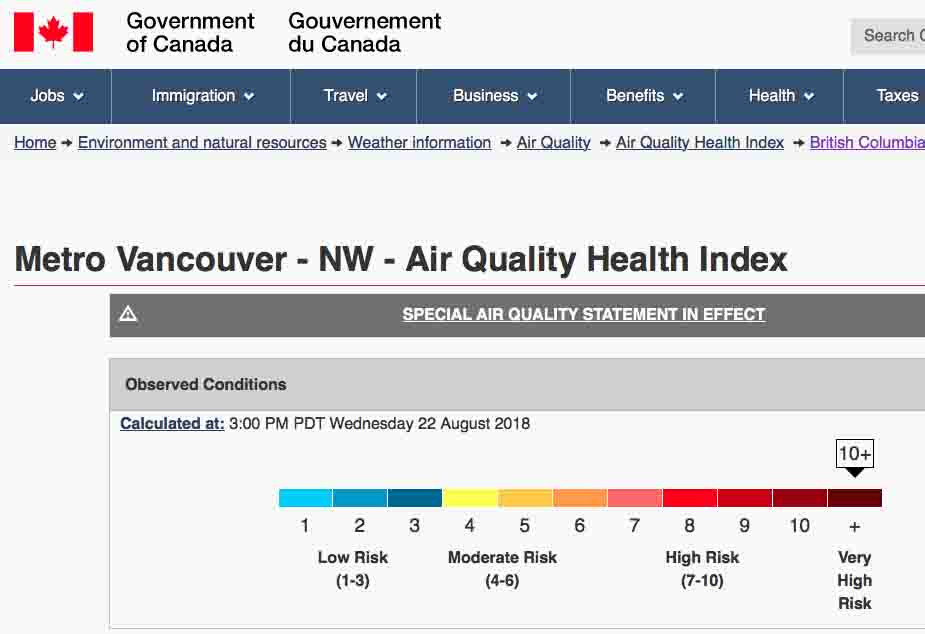
AQHI-MetroVancouver

The Air Quality Health Index (AQHI) was developed by Environment Canada, the BC Ministry of Environment and BC Ministry of Health, Metro Vancouver and the BC Lung Association to measure air quality on a scale. The index typically goes from 0 to 10 with 7-10 representing “high risk” conditions. Numbers higher than 10 are unusual and indicate a very high risk to health. The 0 to 10 index corresponds roughly to the Air Quality Index (AQI), which measures concentrations of particulate matter, sulfur dioxide, carbon monoxide, nitrogen dioxide and ozone and converts these to a number on a scale of 0 to 500.

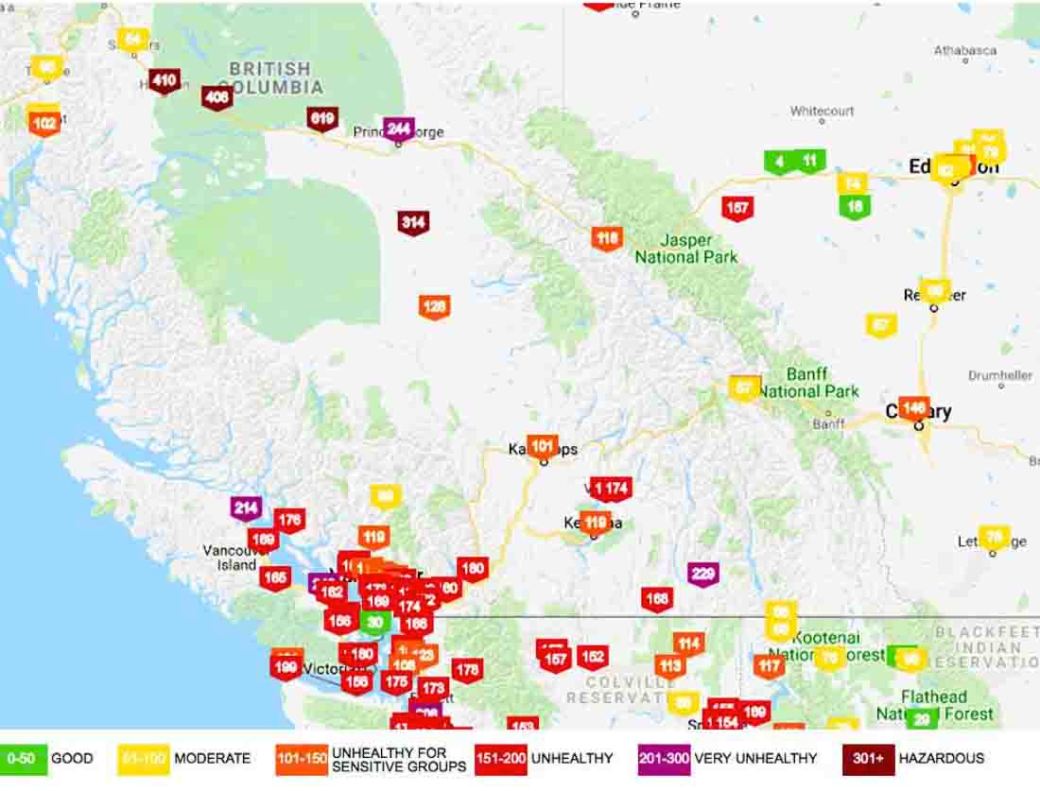
AirQuality-Map

As you can see, an AQI of over 100 is moderately polluted and considered unhealthy, particularly for sensitive groups such as people with asthma, respiratory issues, elderly or small children. Today, Ladner’s AQI rose steadily during the day until it was well over 200, considered very unhealthy.

AQI-concentrations-health

According to Tiffany Crawford of the Vancouver Sun, the air quality in Vanderhoof—30 kilometres south of the more than 86,000-hectare Shovel Lake wildfire—measured over 600 on the AQI; more than double the level considered hazardous to health. The AQI in Houston measured 410 and in Burns Lake it was 408—all levels way beyond ‘hazardous’.

To give you an idea of how that feels, someone developed an app using Berkley Earth’s findings on the equivalence between air pollution and cigarette smoking. According to Berkley’s formula one cigarette smoked per day equals 22 µg/m3 of fine particulate matter.

PM2.5-cigaretts

The current air quality rating in Vancouver measured 10 today, which is like smoking 7.4 cigarettes. In Abbotsford in the Fraser Valley, that comes to 8.3 cigarettes. Further north in Fort St. John you’re smoking 11.8 cigarettes and in Prince George you’re smoking 16.7 cigarettes. By contrast, in Gwallior India—one of the most air-polluted places in the world—the equivalent daily cigarettes smoked is only 3.5.

SmokySun Ladner

Smoky sun over Ladner at 6 pm (photo by Nina Munteanu)

As the coffee machines ground and wheezed with the sweet aroma of coffee, Sylvia and I talked about an exciting project that involved ecology and empowerment. Of course, we talked about the wildfires too. How could we not? It was on everyone’s mind today. With such overt signs, who couldn’t think of them. It was the smoke. We saw it coil and loiter along the street corners. We smelled it. Breathed it in. Felt it inside us. The remains of so many trees that had burned to the ground. “The souls of trees,” as good friend Anne had blurted out. Their ashes and smoke had soared high into the atmosphere and now descended on us, kilometres away. I couldn’t help feeling a sadness. Not just for so many people in hardship. But for so much living tissue, burnt up in smoke.

Sylvia later told me that she didn’t make her next appointment in Vancouver. Feeling the effects of the smoke, she had decided to go home, where her HEPA filter awaited. Smart move, Sylvia.


nina-munteanuNina Munteanu is an ecologist, limnologist and internationally published author of award-nominated speculative novels, short stories and non-fiction. She is co-editor of Europa SF and currently teaches writing courses at George Brown College and the University of Toronto. Visit www.ninamunteanu.ca for the latest on her books.


Coming Home to Water at Stir Coffee House

Nina-LadnerPier copy

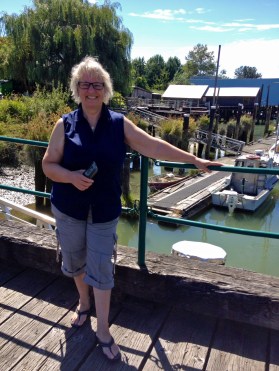
Nina on Ladner pier

For several years I’ve been returning from Toronto—where I teach at The University of Toronto and George Brown College—to Ladner, BC to spend my summers.

I cherish the time as a chance to see family and friends and to enjoy a different pace of life—one I enjoyed when I used to live and work here and where I brought up my family. We lived in a comfortable house on a quiet street and our back yard faced one of Ladner’s sloughs and beyond that a vast tract of farmland, most often scored with rows of potato plants. My son Kevin had grown up swimming in the slough and jumping off the rope swing his dad had constructed. Pilgrims from close and far came to use that swing and enjoy the murky waters of our back slough.

Rope swing copy

Kevin on the rope swing

Parties at our place always involved water and getting wet. We even had a fleet of kayaks and canoes that we took on paddling adventures through farmland and under highways, with the occasional siting of muskrat, carp, heron, or eagle. Coyotes whined and barked at night as bats dipped through the night air, foraging for food. My female cat poised for the hunt and sometimes brought in her “catch of the day.”

Cathleen-Nina-Ladner1 copy

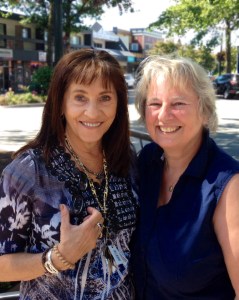
Cathleen and Nina at Stir

This summer, good friend and writer Cathleen Chance Vecchiato decided I should give a talk to my old community on Water Is… my recent bestselling book on water. With that, she immediately made it happen. The venue was already decided: the best café in Ladner, Stir Coffee House. I’d taken Cathleen there the previous year as part of a tour of the old farming and fishing village. Cathleen was charmed by the village atmosphere.

Stir Coffee House was happy to host a talk and Robert and Cathleen proceeded to plan it. Ian Jacques at The Delta Optimist wrote a wonderful piece on my journey, the talk and the book.

Nina-WaterIs-OPTIMIST2018 copy

On the evening of August 16th a growing crowd of people, eager for more on this precious substance flowed into the café until there was hardly a seat left in the cozy venue. I recognized some locals as well as colleagues from my environmental consulting days in Vancouver. It was a good crowd.

Coffee-Water-StirCoffeeHouse copy

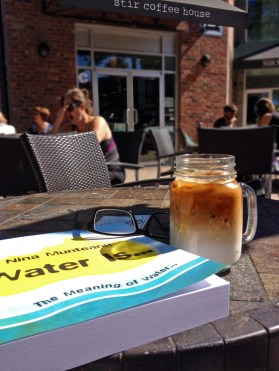
Water Is… snug against an iced latte

I shared the story of how I came to write this book—not a limnology book for non-scientists, as I thought I was going to write—but something that was more than science. Something that encompassed so much more about water: what it means to each of us and how we still don’t understand its many magical anomalous properties. I confided my discovery that the synchronicity of important moments in my life were all connected to water, which compelled the book to evolve into a study of “what water means to us.” Good friend Emmi Itäranta, author of Memory of Water, called Water Is… a biography of water.

Travelling the world has helped me realize that I was blessed with an abundance of water. I lived my entire life in a country of plentiful and healthy water. And for most of that time I didn’t even realize it. Canada holds one fifth of the world’s fresh water in lakes, rivers, and wetlands, as well as in our underground aquifers and glaciers. Canada’s wetlands, which cover more than 1.2 million square kilometres, makes Canada the largest wetland area in the world.

Nina-Hope-Trevor Stir copy

Nina with hosts Hope and Trevor

Perhaps it is no coincidence that Canada is steward of the world’s largest wetlands. Wetlands include marshes, swamps, fens, and bogs, all irreplaceable habitat for a huge diversity of nesting, feeding and staging waterfowl, reptiles, amphibians and mammals—many at risk. Wetlands provide a major filtration system, removing contaminants, improving water quality and renewing water’s vitality; wetlands serve as reservoirs, controlling and reducing flooding toward a more balanced hydrological cycle. Wetlands are a source of oxygen and water vapour, serving a vital role in our global atmospheric and climatic cycles. As ecotones— transitional areas—wetlands protect coasts from erosion and provide exceptional opportunity for boundary interaction and the emergence of vitality. Like a good metaphor, wetlands “recognize” and encompass similarities between dissimilarities. Wetlands powerfully connect. Canada’s strong multi-cultural policies and its open tolerance in embracing and celebrating diversity makes it the “wetland” of the world.

When I turn on the water tap in my house in Canada, it is pure drinking water. I don’t need to boil it or filter it or test it for impurities and toxins. I am confident that it will nourish and hydrate me like water should. I can bathe without restriction. I can play with it.

My water hasn’t changed; but I have. I do not take it for granted. I know that I am blessed.

I am home and I am so grateful.


In the Moment-anthology copyPart of this article is an excerpt from Nina Munteanu’s “Coming Home to Water” first published in “In the Moment” (A Hopeful Sign) edited by Gary Doi, September 2016; reprinted in “The Earth We Love” (Mississauga Writers) edited by Elizabeth Banfalvi, September 2018; and “The Literary Connection IV: Then and Now” (IOWI) edited by Cheryl Antao Xavier, upcoming 2018.


nina-munteanuNina Munteanu is an ecologist, limnologist and internationally published author of award-nominated speculative novels, short stories and non-fiction. She is co-editor of Europa SF and currently teaches writing courses at George Brown College and the University of Toronto. Visit www.ninamunteanu.ca for the latest on her books.


“Water Is…” at The Bookshelf Book Fair in Newmarket

Newmarket-farmers market

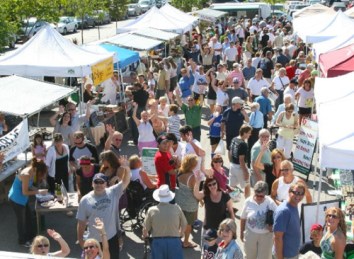
Newmarket farmer’s market

Every summer, the Writers’ Community of York Region (WYRC) holds a book fair (The Bookshelf) at the Newmarket Community Centre & Lions Hall, next to the farmer’s market. The fair showcases over 40 local authors, publishers and artisans through readings, discussions and a tradeshow that features writers’ works in a variety of genres from science fiction and fantasy to mystery, inspiration, science, history, self-help and children’s literature. I participated in this year’s festival on July 7, 2018.

Reading from “Water Is…The Meaning of Water”

Nina-Bookshelf booksale1

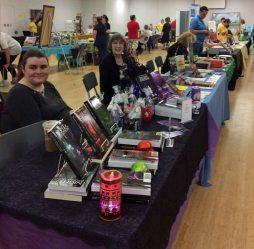
Nina at her book table

At the Reading Lounge onstage in the adjoining Farmers’ Market, I read from my Amazon-bestselling “science-for-lay public” book Water Is…The Meaning of Water. As children and their parents played in the main water feature behind me, I introduced the term “limnology” (someone who studies freshwater) and talked briefly about the meaning of water with an audience eager to learn.

“We can’t live without it, so maybe we should start respecting it; this beautifully designed book by a limnologist looks at water from 12 different angles, from life and motion and vibration to beauty and prayer,” said Canadian author Margaret Atwood when she selected Water Is… as her first pick in the New York Times ‘Year in Reading.’

Water Is-COVER-webEach of the 12 chapters completes the phrase “Water is…” with terms that evolve from science into philosophy and spirituality; terms such as “magic”, “life”, “motion”, “communication”, “memory”, “rhythm”, “vibration”, “beauty”, “story”, “wisdom”, “prayer”, and finally “joy”.

The book is, after all, a celebration of water.

I first shared some history on the making of the book. I shared that the pursuit of this book was oddly serendipitous and “entangled.”

kevin-nina-close

Nina and son go hiking

“Early on, during the research and writing of this book, I discovered that this project on water had become a gestalt watershed for all the important moments in my life. Places I’ve been. Things I’ve learned. People I’ve met and with whom I’d had surprising discussions and realizations. All spanning many years. And many of them totally unrelated. And yet, now, with a sudden flood of context, their significance has transcended into a new fabric of meaning through surprising connection. Like puzzle pieces cooperatively arranging themselves into a symbiotic pattern of synchronicity.”

Writer and philosopher Jake Kotze suggests that, “Synchronicity happens when we notice the bleed-through from one seemingly separate thing into another—or when we for a brief moment move beyond the mind’s divisions of the world.” Synchronicity and serendipitous discovery, like metaphor, appear when we change the way we look at things.

“Serendipitous discovery comes to us through peripheral vision. Like our muse, it doesn’t happen by chasing after it; it sneaks up on us when we’re not looking. It comes to us when we focus outward and embrace our wonder for this world. When we quiet our minds and nurture our souls with beauty. It is then that what we had been seeking naturally comes to us. Like a gift.”

For my reading, I chose several summary quotes that appear at the end of each chapter of the book. These quotes were also featured earlier this year in “Morphology”, an art exhibit in Mississauga that honored the creation of a marsh park as part of Jim Tovey’s vision for the Lakeview Site and the Waterfront Connection:

Water-travel

Quote from “Water Is…” on display at Mississauga Civic Centre

Wonder Woman Respects Water

“Respect water!” says Wonder Woman (aka cosplayer Jes Tongio). Wonder Woman was careful to point out with her wise Amazonian sword of Athena (goddess of wisdom)—forged by Hephaestus—that “Water Is…” provides a doorway to wonder and responsible action.

WonderWoman-WaterIs2a

Wonder Woman (Yes Tongio) with “Water Is…”

Other Authors at The Bookshelf

Bookshelf-venue2

Clair McIntyre and Merridy Cox

I met and visited with other fellow writers, including Clair McIntyre, author of YA/fantasy, and crime writer Joan O’Callaghan.

Fellow authors who read at Reading Lounge included Douglas Smith, award-winning author of “Wolf at the End of the World”; and A.A. Jankewicz,

Nina-Agnes-LIMESTONE

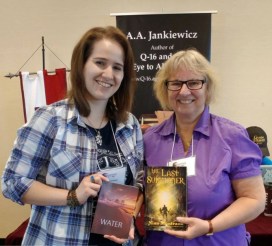
A.A. Jankewicz with Nina Munteanu

fantasy author of Q16, and who’s short story appears in the Water Anthology I edited for Reality Skimming Press; and Gabriela Casineanu read from her bestselling book Introverts: Leverage Your Strengths for an Effective Job Search.

Claudiu Murgan read from Decadence of the Soul; he is launching his recent science fiction novel Water Entanglement next month.

Myth Hawker Travelling Bookstore was also at the festival. Specializing in Canadian authors, Canadian content, and Canadian small press, they  carry an extensive list of local Canadian authors wherever they go across Canada.

The Immigrant Writers Association (IWA)

Nina-IWA-BookshelfinNewcastle

Gabriela, the two Andreeas, Nina and Claudiu

Nina IWA memberThe IWA was also represented, along with member-writers Gabriela Casineanu, Andreea Munteanu, Claudiu Murgan and Andreea Demirgian.

The Immigrant Writers Association provides programs, activities, and services that empower and support immigrant writers in their journeys. According to their website, the goal of the IWA is to  “encourage immigrants to express themselves through writing, to bring more awareness, compassion, and peace into the world.”

As second-generation immigrant daughter to German and Romanian parents, I recently joined the IWA. I look forward to mentoring new writers and providing workshops and lectures to share my experience as a writer, editor, and teacher of fiction and non-fiction.


MJ Moores-Bookshelf

M.J. Moores, chair of the board and founder of Bookshelf

nina-munteanuNina Munteanu is an ecologist, limnologist and internationally published author of award-nominated speculative novels, short stories and non-fiction. She is co-editor of Europa SF and currently teaches writing courses at George Brown College and the University of Toronto. Visit www.ninamunteanu.ca for the latest on her books.

My Writing Retreat in Niagara-on-the-Lake

Ravine-house

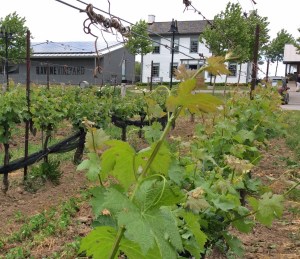
Ravine Vineyard Estate Winery

When I’m not teaching writing at UofT in Toronto, I’m often writing at home. And if I’m not writing at home, I’m often traveling to where I will write. You get the picture: I’m a writer. My website mantra reads: “I live to write; I write to live.”

I’m always looking for great places to write, to synthesize observations and experiences for an article or to plot my next novel. As writers, we are constantly studying the nature of our surroundings, how people interact, what they do, how events affect us and more. Writing is as much about experiencing life as writing about it. But we need both to flourish: something to write about and a place to write about it.

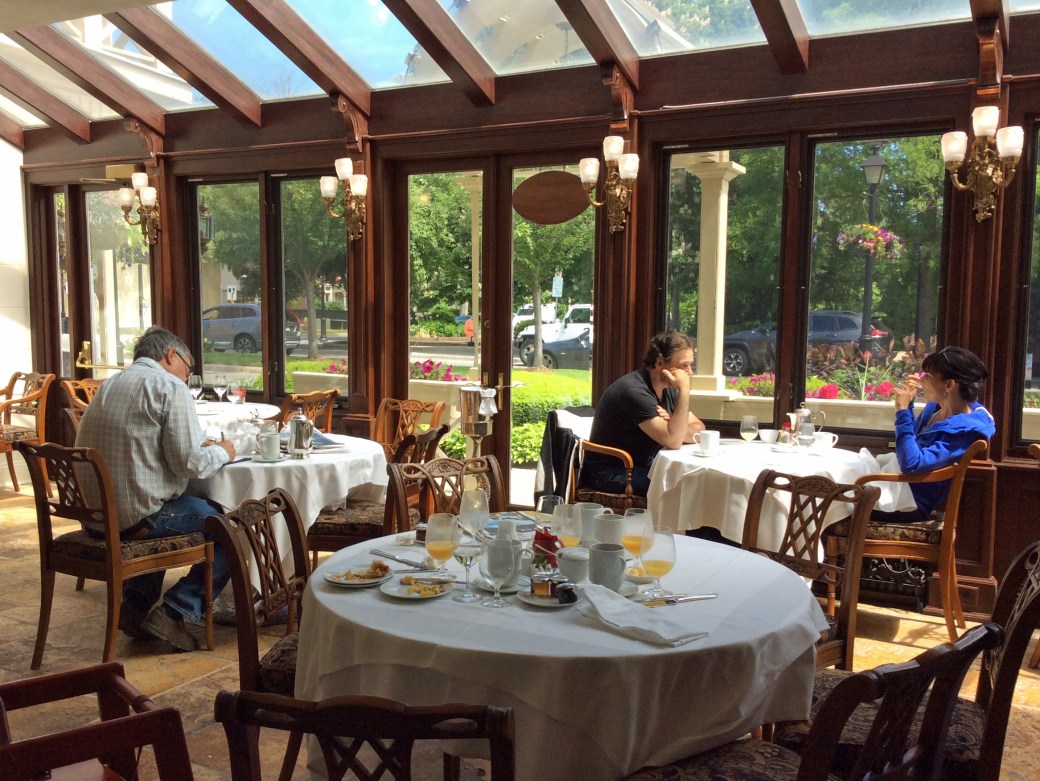
Breakfast Room

Noble Restaurant, Prince of Wales Hotel

Horse carriage01

Horse and carriage on King Street

Recently a good friend of mine lured me out of town on a trip to Niagara-on-the-Lake. She didn’t blink an eye when I grabbed my computer and happily accompanied her on our wonderful adventure. We started at the Prince of Wales Hotel, named in honour of the 1901 visit of the Duke and Duchess of York, who were later crowned King George V and Queen Mary.

FredGamula

Fred Gamula

We got there just in time for supper in the elegant and panoramic Noble restaurant. Of course, we had to order the divine “Grand Hotel Tasting Menu”, a four-course meal, paired with several fine wines. Sommelier Fred Gamula guided us through the “Grand Hotel Tasting Menu” of crisp romaine hearts, grilled chili marinated quail, pan seared trout and Grand Hotel Opera cake. Each course was paired with a wine that brought out the best in each; from an Inniskillin Chardonnay Reserve to a Flat Rock Twisted, to a Cave Spring Gamay and finally a Taylor Fladgate port. Gamula and I got into a diverting conversation about looking after the environment and water (I later gave him a copy of my book “Water Is…”).

PrinceOfWales-patio

Patio of Prince of Wales Hotel

Gamula grew up on a small fruit farm in Niagara-on-the-Lake and has seen some changes in the area due to development. Some not so good. We agreed that the trick is to embrace influx while preserving the very reason for that influx—to enjoy and preserve the wonderful country, vineyards and wineries in the area.

I found a wonderful place to write on the Churchill Room patio facing King Street, where the horses and carriages waited for customers. As the sun set, I drank my Campari and orange juice and wrote my novel to the cheerful sounds of birds, rustling trees and exploring people.

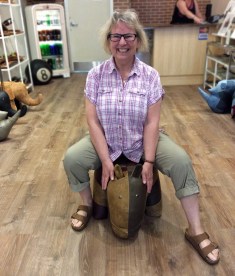
Nina-ottoman store

Nina and her favourite hippo

The next morning we wandered Queen Street before heading out to explore wine country. Curious about Reiner’s window display, I wandered into what I thought was a leather shop—expecting the usual fare such as purses, satchels, belts and the like; but it turned out to be a speciality leather ottoman store.

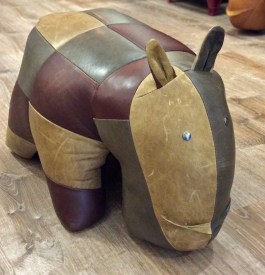
HippoOttomanThese weren’t ordinary ottomans—they were all animals! Hippos, bears, moose, elephants and pigs stood on stout legs, begging for a nice home to live in.

The store is named after leather crafter Reiner Henneveld who came to Canada in 1950 from Germany and created his first animal-shaped ottoman in the shape of a pig—after his pet pig, Wilbur. Reiner’s two sons have taken up the craft with a commitment to individual design and workmanship that includes hand sewing, cutting and stuffing and using the finest upholstery leather. I found them comfortable and very attractive.

wayne-gretzky-whisky

Wayne Gretzky with his “99”

After lunch we visited old favourites and explored new vineyards and wineries. Wayne Gretzky Estates recently opened its winery and distillery on Old Stone Road. The estate is getting known for its No. 99 Red Cask Canadian Whisky; “the same soils that produce great grapes also grow grains that are used to produce whisky,” they write. The whisky is made in small batches from rye, malted rye and corn that has been individually mashed, fermented and distilled. After aging, the whisky is finished with red wine casks from the Wayne Gretzky winery.

IMG_0865

General store of Ravine Vineyard Estate Winery

PorkWithSangria

Pork chop, sea-salted bread and Sangria at the Ravine restaurant

The Ravine Vineyard Estate Winery is an old haunt for its charming and diversely stocked general store and its rustic-style restaurant with imaginative and surprising menus. Both inside and outside seating offer vistas of undulating countryside and the sounds of a working vineyard. Another great place to write!

Ravine-birdhouses

A sparrow sings his heart out on his very own house in Ravine vineyard

Ravine-chickens

Free range chickens roam the vineyard at Ravine

I’m half-inclined to shift over to writing a murder-mystery series about a young recent George Brown graduate who comes to Niagara-on-the-Lake to work as a Sommelier in one of the hotels—only to find intrigue and—of course—a murder to solve. What do you think?…


nina-2014aaa

Nina Munteanu is an ecologist, limnologist and internationally published author of award-nominated speculative novels, short stories and non-fiction. She is co-editor of Europa SF and currently teaches writing courses at George Brown College and the University of Toronto. Visit www.ninamunteanu.ca for the latest on her books.


On Being a Canadian Writer in the Age of Water

“Canada is the only country in the world that knows how to live without an identity.”—Marshal McLuhan 

nina-child01

Nina  “reading” in Granby, Quebec

I was born some sixty+ years ago, in the small town of Granby in the Eastern Townships to German-Romanian parents. Besides its zoo—which my brother, sister and I used to visit to collect bottles for a finder’s fee at the local treat shop—the town had no particular features. It typified French-Canada of that era. So did I. I went to school in Quebec then migrated across to the west coast to practice and teach limnology. Given that Canada holds at any one time a fifth of the Earth’s freshwater, that also made sense.

Canada is a vast country with a climate and environment that spans from the boreal forests of the Canadian Shield, muskegs of northern BC, and tundras of the Arctic Circle to the grasslands of the Prairies and southern woodlands of Ontario and Quebec. Canada’s environment is vast and diverse. Like its people.     

Ecologist vs Nationalist

Ecology is the study of “home” (oikos means ‘home’ in Greek). Ecology studies the relationships that make one’s home functional. It is, in my opinion, the most holistic and natural way to assess where we live. My home is currently Toronto, Ontario, Canada and ultimately the planet Earth.

Country_road_Stephane_Lemire

The Eastern Townships in autumn are a cornucopia of festive colours.

Growing up in the Eastern Townships of Quebec, I’d always felt an abiding sense of belonging and I resonated with Canada’s national symbols—mostly based on Nature and found on our currency, our flag, and various sovereign images: the loon, the beaver, the maple tree, our mountains and lakes and boreal forests. Why not? Canadians are custodians of a quarter of the world’s wetlands, longest river systems and most expansive lakes. Most of us recognize this; many of us live, play and work in or near these natural environments.

I have long considered myself a global citizen with no political ties. I saw my country through the lens of an ecologist—I assessed my community and my surroundings in terms of ecosystems that supported all life, not just humanity. Was a community looking after its trees? Was my family recycling? Was a corporation using ‘green’ technology? Was a municipality daylighting its streams and recognizing important riparian zones? I joined environmental movements when I was a teenager. I shifted my studies from art to science because I wanted to make a difference in how we treated our environment. After university, I joined an environmental consulting firm, hoping to educate corporations and individuals as environmental stewards. I brought that philosophy into a teaching career and began writing eco-fiction, science fiction and essays to help promote an awareness and a connection with our natural world. My hope was to illuminate how important Nature and water is to our planet and to our own well-being through an understanding of ecology and how everything is interconnected.

US-tour and Desolation Sound 260 copy

Nina kayaking Desolation Sound in British Columbia

When I think of Canada, I think of my “home”, where I live; my community and my environment. I have traveled the world and I feel a strong sense of “home” and belonging every time I return. Canada is my home. I was born and grew up in Quebec. I lived in British Columbia, Ontario, and Nova Scotia; each of these places engendered a feeling of “home”.

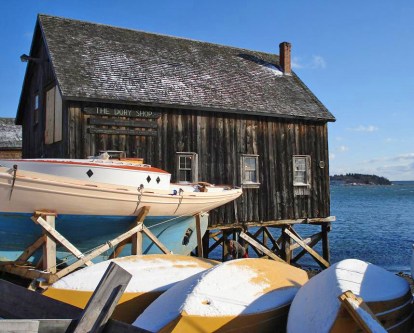
lunenburg-keel-laying

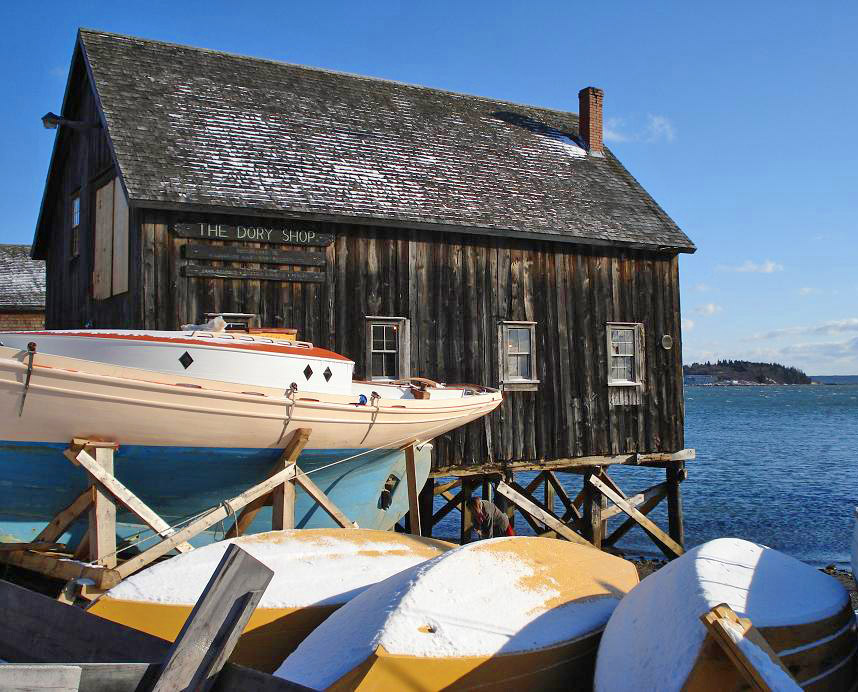
The Dory Shop in Lunenburg, Nova Scotia

I think that part of being a Canadian is related to this sense of belonging (and pride) in a country that is not tied to some core political identity or melting-pot mainstream.

Historian and writer Charlotte Gray wrote:

“we live in a country that has a weak national culture and strong regional identities …Two brands of psychological glue bind Canada together: political culture and love of landscape…[in] a loose federation perched on a magnificent and inhospitable landscape—[we are] a nation that sees survival as a collective enterprise.”—Charlotte Gray

barkerville marsh 9

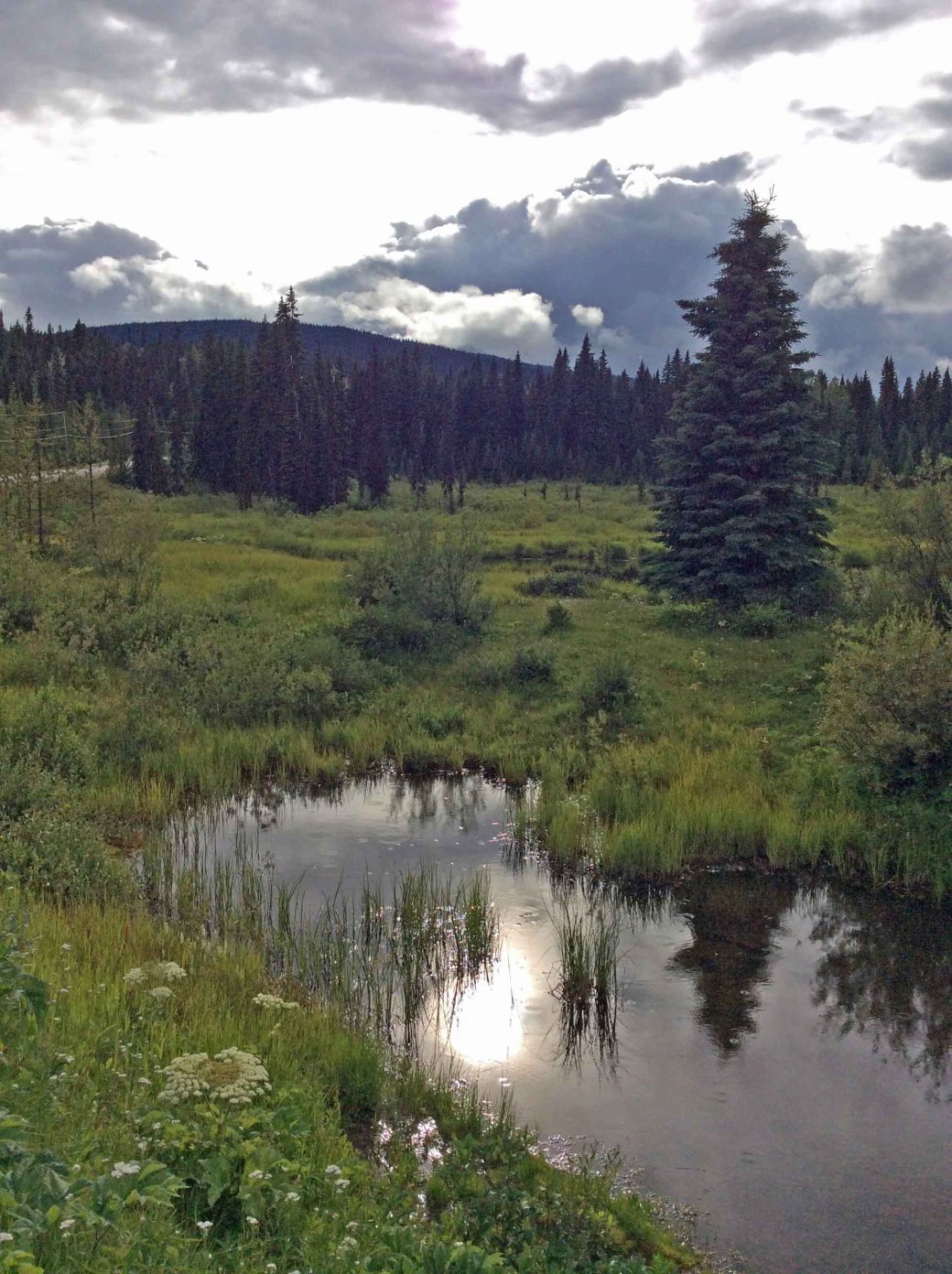
Marsh near Barkerville, BC (photo by Nina Munteanu)

Canada as Postnational State

In October 2015, Canada’s Prime Minister Justin Trudeau told the New York Times that Canada may be the “first postnational state,” adding that “there is no core identity, no mainstream in Canada.” This is largely because Canadians, writes Charles Forman in the Guardian, are “philosophically predisposed to an openness that others find bewildering, even reckless.”

Trudeau-RollingStoneTo anyone but a Canadian, Trudeau’s remark would rankle, particularly in a time when many western countries are fearfully and angrily turning against immigration through nativism and exclusionary narratives. A time when the United States elected an authoritarian intent on making “America great again” by building walls. A time when populist right-wing political parties hostile to diversity are gaining momentum in other parts of the world. “Canada’s almost cheerful commitment to inclusion might at first appear almost naive,” writes Forman. It isn’t, he adds. There are practical reasons for keeping our doors open.

We are who we are because of what we are: a vast country the size of Europe. A country dominated by boreal forest, a vital and diverse wilderness that helps maintain the well-being of our entire planet. A land that encompasses over a fifth of the freshwater in the world, and a quarter of the world’s wetlands. Canadians are ultimately the world’s Natural stewards. That is who and what we are.

Eramosa River 3

Eramosa River, Ontario (photo by Nina Munteanu)

According to Forman, postnationalism frames how “to understand our ongoing experiment in filling a vast yet unified geographic space with the diversity of the world” and a “half-century old intellectual project, born of the country’s awakening from colonial slumber.” As the first Europeans arrived in North America, the Indigenous people welcomed them, taught them how to survive and thrive amid multiple identities and allegiances, writes Forman. “That welcome was often betrayed, particularly in the 19th and 20th centuries, when settlers did profound harm to Indigenous people.” But, says Forman, if the imbalance remains, so does the influence: a model of another way of belonging. One I think many Canadians are embracing. We are learning from the natural wisdom of our Indigenous peoples. Even our fiction reflects how we value our environment and embrace diversity. “Diversity fuels, not undermines, prosperity,” writes Forman.

As efforts are made to reconcile the previous wrongs to Indigenous peoples within Canada and as empowering stories about environment are created and shared, Canada carries on the open and welcoming nature of our Indigenous peoples in encouraging immigration. In 2016, the same year the American government announced a ban on refugees, Canada took in 300,000 immigrants, which included 48,000 refuges. Canada encourages citizenship and around 85% of permanent residents typically become citizens. Greater Toronto is currently the most diverse city in the world; half of its residents were born outside the country. Vancouver, Calgary, Ottawa and Montreal are not far behind.

kevin-nina-close

Mom and son explore BC wilderness

Canadian author and visionary Marshal McLuhan wrote in 1963 that, “Canada is the only country in the world that knows how to live without an identity.” This is an incredible accomplishment, particularly given our own colonial history and the current jingoistic influence of the behemoth south of us.

Writer and essayist Ralston Saul suggests that Canada has taken to heart the Indigenous concept of ‘welcome’ to provide,

“Space for multiple identities and multiple loyalties…[based on] an idea of belonging which is comfortable with contradictions.”

Of this Forman writes: “According to poet and scholar BW Powe, McLuhan saw in Canada the raw materials for a dynamic new conception of nationhood, one unshackled from the state’s ‘demarcated borderlines and walls, its connection to blood and soil,’ its obsession with ‘cohesion based on a melting pot, on nativist fervor, the idea of the promised land’. Instead, the weakness of the established Canadian identity encouraged a plurality of them—not to mention a healthy flexibility and receptivity to change. Once Canada moved away from privileging denizens of the former empire to practicing multiculturalism, it could become a place where ‘many faiths and histories and visions would co-exist.”

NaturalSelection-front-webAnd that’s exactly what is happening. We are not a “melting pot” stew of mashed up cultures absorbed into a greater homogeneity of nationalism, no longer recognizable for their unique qualities. Canada isn’t trying to “make Canada great again.”

Canada is a true multi-cultural nation that celebrates its diversity: the wholes that make up the wholes.

Confident and comfortable with our ‘incomplete identity’—recognizing it for what it is—is according to Forman, “a positive, a spur to move forward without spilling blood, to keep thinking and evolving—perhaps, in the end, simply to respond to newness without fear.”

This resonates with me as an ecologist. What I envision is a Canada transcending the political to embrace the environment that both defines us and provides us with our very lives; a view that knows no boundaries, and recognizes the importance of diversity, relationship and inclusion, interaction, movement, and discovery.

So, am I proud of Canada? Definitely. We have much to be proud of. Canada is the 8th highest ranking nation in the Human Development Index. Canada ranks among the highest in international measurements of government transparency, civil liberties, quality of life, economic freedom, and education. It stands among the world’s most educated countries—ranking first worldwide in the number of adults having tertiary education with 51% of adults holding at least an undergraduate college or university degree. With two official languages, Canada practices an open cultural pluralism toward creating a cultural mosaic of racial, religious and cultural practices. Canada’s symbols are influenced by natural, historical and Aboriginal sources. Prominent symbols include the maple leaf, the beaver, Canada Goose, Common Loon, the Royal Canadian Mounted Police, the polar bear, the totem pole, and Inuksuk.

PolarBearMum-pups

Water Is-COVER-webWe are a northern country with a healthy awareness of our environment—our weather, climate and natural world. This awareness—particularly of climate change—is more and more being reflected in our literature—from Margaret Atwood’s “Maddaddam” trilogy and Kim Stanley Robinson’s “2041” to my short story collection “Natural Selection” and non-fiction book “Water Is…” .

Water AnthologyCanadians are writing more eco-fiction, climate fiction, and fiction in which environment somehow plays a key role.

Water has become one of those key players: I recently was editor of the Reality Skimming Press anthology “Water”, a collection of six speculative Canadian stories that optimistically explore near-future scenarios with water as principle agent.

The Way of Water-COVERMy short story “The Way of Water” is a near-future vision of Canada that explores the nuances of corporate and government corruption and deceit together with resource warfare.

First published as a bilingual print book by Mincione Edizioni (Rome)  (“La natura dell’acqua”), the short story also appears in several anthologies including Exile Editions “Cli Fi: Canadian Tales of Climate Change” and “Future Fiction: New Dimensions in International Science Fiction“.  My upcoming “A Diary in the Age of Water” continues the story.

Adobe Photoshop PDFCanadian writer and good friend Claudiu Murgan recently released his book “Water Entanglement“, which also addresses a near-future Canada premise in which water plays a major role.

In a recent interview with Mary Woodbury on Eco-Fiction, I reflected on a trend over the years that I noticed in the science fiction writing course I teach at George Brown College: “It’s a workshop-style course I teach and students are encouraged to bring in their current work in progress. More and more students are bringing in a WIP with strong ecological overtones. I’d say the percentage now is over 70%. This is definitely coming from the students—it’s before I even open my mouth about ecology and eco-fiction—and what it suggests to me is that the welfare of our planet and our ecosystems is on many people’s minds and this is coming through in our most metaphoric writing: science fiction.”

It is healthy to celebrate our accomplishments while remembering where we came from and what we still need to accomplish. This provides direction and motivation.

tree water deer lake

Deer Lake, BC (photo by Nina Munteanu)

Canadians are custodians of a quarter of the world’s wetlands, longest river systems and most expansive lakes. Canada is all about water… And so are we.

We are water; what we do to water we do to ourselves.

Happy Canada Day!


References:

Dechene, Paul. 2015. “Sci-Fi Writers Discuss Climate Catastrophe: Nina Munteanu, Author of Darwin’s Paradox.” Prairie Dog, December 11, 2015.

Forman, Charles. 2017. “The Canada Experiment: Is this the World’s First Postnational Country?” The Guardian, January 4, 2017.

Gray, Charlotte. 2017. “Heroes and Symbols” The Globe and Mail.

Moorhouse, Emilie. 2018. “New ‘cli-fi’ anthology brings Canadian visions of future climate crisis.” National Observer, March 9, 2018.

Munteanu, Nina. 2016. “Crossing into the Ecotone to Write Meaningful Eco-Fiction.” In: NinaMunteanu.me, December 18, 2016.

Newman-Stille, Derek. 2017. “The Climate Around Eco-Fiction.” In: Speculating Canada, May 24, 2017.

Woodbury, Mary. 2016. “Part XV. Women Working in Nature and the Arts: Interview with Nina Munteanu, Ecologist and Author.” Eco-Fiction.com, October 31, 2016.

SONY DSC

Nina Munteanu on the Credit River, Ontario (photo by Merridy Cox)


nina-2014aaaNina Munteanu is an ecologist and internationally published author of award-nominated speculative novels, short stories and non-fiction. She is co-editor of Europa SF and currently teaches writing courses at George Brown College and the University of Toronto. Visit www.ninamunteanu.ca for the latest on her books. Nina’s recent book is the bilingual “La natura dell’acqua / The Way of Water” (Mincione Edizioni, Rome). Her latest “Water Is…” is currently an Amazon Bestseller and NY Times ‘year in reading’ choice of Margaret Atwood.


The Battle of Grunwald and the Fate of the Teutonic Knights

400px-Grunwald_Wojciech_Kossak copy

Battle of Grunwald

On this day, June 14th, every year, the Polish and Lithuanians celebrate the Battle of Grunwald; they celebrate with pride, erecting mock-ups of the battle to honour this important—yet largely unknown moment—in history: when the proud Teutonic Order fell to its knees and Poland became a nation.

Which brings me to my book The Last Summoner and how I get my ideas for stories…

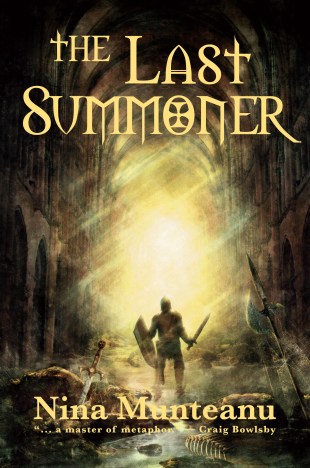
Cover1_LastSummoner-frontcoverI teach writing at the University of Toronto and fiction writing at George Brown College in Toronto. A question I’m often asked is how I get my story ideas. I always start by sharing my favourite example of how I came to write my historical fantasy The Last Summoner:

It started in 2008, when I saw the most incredible image by Croation artist Tomislav Tikulin as I was browsing sites on the Internet. The image was of a magnificent knight, standing in a war-littered mire and gazing up, questioning, at the vaulted ceiling of a drowned cathedral. A great light shone upon the knight in streams of white gold–as if a message from heaven. It sent my imagination soaring with thoughts of chivalry, adventure and intrigue.

Who was this knight?

teutonic_knight_by_flipation

Teutonic knight

With that image imprinted inside me, the next nexus moment came when I stumbled across a significant but little-known battle in the medieval Baltic, the Battle of Grunwald. It would turn out to be the defining battle for what are now the countries of Poland and Lithuania. On June 14, 1410, they were still part of Prussia and tyrannized by the Teutonic Order, who were Christianizing the pagan Baltic on behalf of the Pope. In truth, the Order had been for centuries gathering wealth and land for colonizing Germans in their drang nach osten; they built sturdy castles (many of which still stand today) and grew into a force of monk warriors, feared for their cunning strategy and treacherous combat abilities.

The Battle of Grunwald was, in fact, an upset in history. The Teutonic Order was powerful, intimidating and extremely capable. They should have won; but the peasant armies of Prussia slaughtered the Order, killing most of its knights. Historians debate that the hochmeister’s arrogance—indeed the arrogance of the entire Order—precipitated their downfall. They underestimated their adversaries and got sloppy.

After the Polish and Lithuanian armies outsmarted the Order and slayed the Order’s hochmeister, along with many of their knights, the Order’s own peasant slaves finished the job using clubs, pitchforks and stones.

Every year, the Polish and Lithuanians celebrate June 14th with pride, erecting mock-ups of the battle.

vivianne-medieval-fighterIntrigued by this little known order of religious crusaders, I pursued the premise of an alternative consequence: what if the Teutonic Knights had NOT underestimated their enemy and won the Battle of Grunwald? Would they have continued their catastrophic sweep of Northeast Europe into Russia and beyond? Would they have claimed the whole for Germany’s expansionist lebensraum movement, fueled by its sonderweg—a dialectic that would ultimately lead to the killing fields of the Holocaust?  What if the success of the Teutonic Order helped consolidate a united fascist elite, ambitious to conquer the world? What if Nazism sprang up 100 years earlier than it did in our current reality?

The Last Summoner arose from this premise. Enter our hero, young 14-year old Vivianne Schoen, Baroness von Grunwald, a self-centred romantic who dreams that her ritter will rescue her from an arranged marriage to some foreign warrior. As a result of an impetuous choice, she makes the startling discovery that she can alter history—but not before she’s branded a witch and must flee through a time-space tear into an alternate present-day France—now ruled by fascists. There, she learns that every choice has its price.

knight-cameo copySpanning from medieval Poland to present day Paris, The Last Summoner explores the sweeping consequences of our “subtle” choices. From the smallest grab to the most sweeping gesture, we are accountable for the world we’ve made. During her 600-year journey to save the world and undo the history she authored, Vivianne learns wisdom and humility. Through the paradox of history, she learns that what might have seemed the right choice for an immediate future, turns out to be disastrous for a distant future. To win is also to lose; to save oneself one must surrender oneself; and to save the world one need only save a single soul.

The knight standing in the drowned cathedral is none other than Vivianne.

Inspired by Tikulin’s knight depiction, I managed to convince my publisher at Starfire World Syndicate to purchase rights to the image; Tikulin’s image–Vivianne’s dream–became the actual cover of my book. I was overjoyed! When The Last Summoner hit the shelves in 2012, it quickly soared into an Amazon Canadian bestseller and remained in the top 10 for several months in the category of fantasy, historical fantasy and science fiction. The book continues to find new readers who enjoy the thrilling time-travelling journey of its 15th century heroine and its surprising plot.

LastSummoner-scifi-fantasy

“The Last Summoner” sandwiched nicely between Ray Bradbury and George R.R. Martin

“The Last Summoner is a blend of fantasy, history, and alternate history,” writes Canadian author Kristene Perron. “Fourteen year old Vivianne , the story’s hero, discovers that she has strange powers on the eve of the legendary Battle of Grunwald.  Marked as a witch, Vivianne escapes through time and space, but her actions change history and threaten to destroy the world.”

Kristene had chosen the book to review based on a description I had provided of the painting that inspired the novel created by artist Tomislav Tikulin.

Cover1_LastSummoner-frontcover

Illustration by Tomislav Tikulin. Cover design and typology by Costi Gurgu

The Last Summoner fascinated Kristene. “Ordinarily, historical fiction doesn’t excite me,” writes Kristene. “But the premise of this novel—which included a good dash of fantasy and time travel—was an exception. There is history aplenty and Munteanu has obviously done her homework. The world of 15th century Germany is authentically realized and the little touches of fantasy blend seamlessly.” She was pleased with Vivianne as a hero and how I had “endowed [my] protagonist with the skills and knowledge necessary for the plot without stretching plausibility.”

teutons3-close1

Kristene then added, “What I most enjoyed about this story was that for the majority of it I genuinely didn’t know where the plot was going or what would happen next. I’m one of those annoying people who can usually figure out the entire plot of a book or movie within the first few scenes (watching movies with me can be challenging), so to come teutons3-close02across a story that stumped my super CSI powers of deduction was a real treat.”

“For those in love with science fiction at its best, The Last Summoner is a complex story of ignored responsibilities and their dire consequences, of love and betrayal that span centuries and multiple worlds. Time travel, multiverse travel, immortality, alternate history in which the Nazis have won, not in the twentieth century but way earlier, in the Teutonic age. Angels and mutants, utopias and dystopias, even a Tesla occurrence— everything a science fiction reader could ever desire in a book. A masterfully told story with great characters. Nina Munteanu moves flawlessly from a medieval story to a modern one and everything in between.”—Costi Gurgu, author of RecipeArium

Jonathan, history buff and author of Sci-Fi & Fantasy Reviews , writes: “The Last Summoner is a unique story melding Germany of the 15th century and modern France, even if a different France from what we would recognize. The story centered around the very real and pivotal Battle of Grunwald in which a coalition of Polish and Lithuanian forces defeated the monastic Teutonic Knights. The book takes a look at the young 14-year-old baroness of Grunwald, someone not quite human, and how she attempts to right a wrong and get history back on track…The author is a good writer, and her wordsmithing is excellent…The historical research was outstanding…Given that this is fiction, and that two settings did not follow history as we know it, never-the-less, each event was either very accurate to our known history or made logical sense in the other settings. I am not a huge fan of alternative history books, but in this one, I was extremely caught up in the final section of the book, and I had to contemplate how the world might be different with only a few changes to our history.”

vivianne-dark-medieval-knight copy

Jonathan adds, “While I was familiar with most of the historical background of the book, I was unaware of some facts, such as the Tartars taking part in the Battle of Grunwald. I thought this was a mistake made on the part of the author and went to confirm that, but in fact, the author was correct…a clever, well-written book. I would recommend it without hesitation.” The reviewer did have one quibble: my liberal use of French and German in the book.

Professional photographer and science fiction/fantasy reader, Rick LeBlanc shared that he’d “read The Last Summoner on the flight back from World Fantasy Con: could hardly put it down. Just loved the historical references of gear, place and events. The characters red-leaves-in-pond-vicki horton-botwere incredibly strong and involved you in their lives. The flow was fun & fast-paced. Merci, Nina. Great book!”

“I loved, loved, loved the metaphors. A page-turner that left me wanting to be Vivianne when I grew up.”—Carina Burns, author of The Syrian Jewelry Box

knight-cameo copy“The Last Summoner is an enticing fantasy exploring the Knightly order and adding many new perspectives.”—John Taylor, The Midwest Book Review

nina-2014aaaNina Munteanu is an ecologist, limnologist and internationally published author of award-nominated speculative novels, short stories and non-fiction. She is co-editor of Europa SF and currently teaches writing courses at George Brown College and the University of Toronto. Visit www.ninamunteanu.ca for the latest on her books. 

“Absolutism” in the Time of Climate Change

AboutAbsolutism-webOnce upon a time, there will be one absolute ruler who we, the people, call the Supreme Leader (May He Rule Forever). The Supreme Leader will hate immigrants, writers, scientists, environment and extinct species. We, the people under his rule, will be proud to live in our pure and glorious Motherland. Because we’ll have little to eat, no entertainment, no self-respect, no freedom, no rights, and no access to the outside world, we’ll be happy.

This is the ridiculously sublime scenario that underlies “Absolutism”, the dystopian card game developed by science fiction author Costi Gurgu and game developer/designer Vali Gurgu about surviving dictatorship.

A week ago, I invited Costi to my science fiction writing class at George Brown College to share his experience in writing and releasing his recent book RecipeArium (now on the short list for an Aurora Award). Costi also brought his new game, “Absolutism”, based on his latest novel Servitude—a near future dystopia.

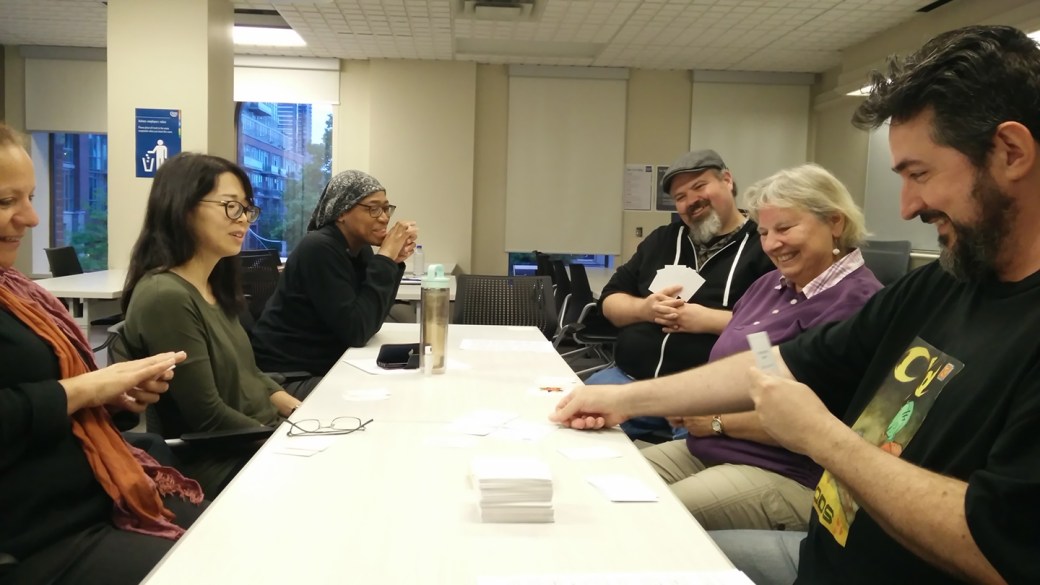
PlaytestGB2

Playing the game at George Brown

“Play unfathomable scenarios of daily life in a totalitarian society. A funny game for people without shame.”—Absolutism


Emerging Dictatorships & “Servitude”—the novel

Costi described how he and Vali came to develop the game: “Based on current global political trends, some could safely assume that in the next 5 to 10 years some present democracies will turn into dictatorships. In Europe for instance, one third of the European countries have nationalistic parties winning their elections—UK, Italy, Poland, Hungary, Slovakia. France and Germany came very close. The United States is slowly sliding into dictatorship. Russia and China are no longer communist countries, like North Korea, but they’re dictatorships. They opened their markets to international trades because they saw the wisdom in making profits, but that was as far as they went with the openness. They still rule their people with an iron fist.”

We are now 7.5 billion people on the planet. As climate change (the ultimate dictator) exacerbates tensions over the unbalanced resource scarcities of our over-populated world, fear-mongering and absolute control of the masses through nationalism, isolationism, trade-wars, etc. will logically follow.

Costi and Vali first conceived a card game entirely based on Costi’s dystopian novel Servitude. But, they soon discovered that the game was too grim.

PlaytestGB3

Life under a Dictatorship—Ceaușescu

Costi and Vali had experienced a dictatorship first hand. They’d grown up in Romania under Communist rule, first by Gheorghe Gheorghiu-Dej, then under the communist dictatorship of Nicolae Ceaușescu. The dictator ruled for over twenty years before a coup d’etat overthrew him in 1989. Ceaușescu had ordered his military to open fire on hundreds of protesters in Timișoara, setting off the Romanian Revolution and ultimately his own execution by firing squad.

Ceaușescu’s totalitarian regime is still considered one of the most repressive in Eastern Europe. His Securitate (secret police) controlled the population through mass surveillance; they enacted many human rights abuses, censorship and relocation, and suppression of the media and press. Political propaganda infected all forms of education, art, entertainment and media. Non-compliant intellectuals were punished, arrested, or simply disappeared.

Inspired by the personality cult surrounding Supreme Leader Kim Il-sung in North Korea, Ceaușescu started his own cult in the Eastern Bloc by imposing a severe nationalist ideology. His policy of economic collectivization destroyed an already fragile economy and oppressed culture. Under the communist regime, thousands of books and magazines were banned and removed from public libraries and schools; intellectuals’ links to the West were severed; long-standing professional organizations were dissolved; and intellectuals, writers, and teachers were imprisoned and put into labor camps.

In Ceaușescu’s Systematisation program of urban planning—based on North Korea’s Juche ideology—whole settlements were demolished and reconstructed in the image of the state.

Ceaușescu made contraception and abortion illegal under Decree 770, and created incentives for high numbers of births—his idea was to increase the country’s population from 22 million to 30 million by the end of the century. By 1977, Romanians were taxed for being childless in a country already unable to house and feed its children. Sadly, this led to an increasing number of orphans, the highest infant mortality rate in Europe and the deaths of thousands of women who attempted illegal abortions. Orphanages were neglected and developed appalling conditions—most were concrete barracks in slums where many children suffered from frostbite, malnutrition and abuse.


“Absolutism”—the game

“Humor is your main weapon in fighting the victorious party and its minions,” say Costi and Vali. “Humor is the one thing that gives people hope and keeps the mental sanity of the masses in the face of oppression.”

And so “Absolutism” was born—a game of twisted strategies, irony and chance. Costi shared that with this game those who have never experienced dictatorship will have a taste of what it is like; the game will also remind those who have escaped oppression by dictatorship what they left behind and why their current freedoms are so precious and important to maintain.

PlaytestGeorgeBrown

players absolutely succumb to the game…

“Maybe after playing Absolutism, people will see that Russia, China, and North Korea are not exceptions,” says Costi. They may realize that “absolutism is not something that can happen only there. It is already knocking on our door.”

Do you have what it takes to survive a totalitarian dictator with a twisted sense of humor? Or to be a successful dictator in the time of climate change?

Having played the game and lost—there is only one winner, of course—I can add that having a twisted sense of humor—is an absolute advantage in the game (along with an absolutely great set of bribe cards!). Thanks to my twisted humor, I was way ahead of everyone and well on my way to becoming the Absolute Ruler, when Costi charged in with a coup d’etat card and I lost all my cards; then the Secret Police rallied behind him and crushed any chance of subversive take over. Maybe next time…

“Absolutism” recently launched on Kickstarter and is still looking for pledges. Make a pledge and help make the game happen—we may never have a better chance at staring unscathed at the face of despotism.


nina-2014aaa

Nina Munteanu is an ecologist, limnologist and internationally published author of award-nominated speculative novels, short stories and non-fiction. She is co-editor of Europa SF and currently teaches writing courses at George Brown College and the University of Toronto. Visit www.ninamunteanu.ca for the latest on her books.

Places to Write: My Secret Places at The University of Toronto

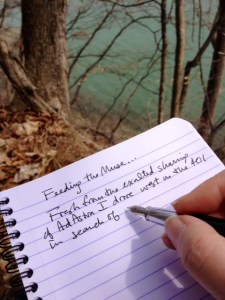
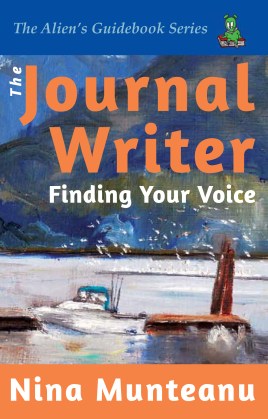
notebook01In my writing guidebook The Journal Writer: Finding Your Voice I write a section on finding the right time and place to write. I call them “sacred”, because that’s what they are. Without them, we struggle to write. In Chapter Two of The Journal Writer I write about the need for a sacred place in journal writing, particularly. The advice is equally important to any form of writing.

Journal Writer-FRONT-cover-WEBFinding the perfect place(s) to write … is important to creating meaningful entries. Journal writing is a reflective activity that requires the right environment for you. The best environment is a quiet one with no interruptions and where you are alone. A reflective environment will let you relax, find a connection with yourself and your feelings. You need a place where you can relax and not worry about someone barging in or other things distracting you from your thoughts. You should also feel physically comfortable and the place should meet your time requirements.

Because the suitability of a place can change with the time of day, learn the rhythms that affect the place you wish to write in. For example, the kitchen may be the centre of activity during the day but an oasis of quietude during the evening. Similarly, learn what kind of environment stimulates and nurtures your writing. Does music help or do you need complete quiet? Do you respond to nature’s soft breezes and sounds or do you prefer to surround yourself with the anonymous murmur of a crowded café for company?

Places that work for me include the local coffee shop, a park near my house, a library or other quiet place where I can enjoy uninterrupted anonymity. Where you write may reflect what you’re writing and vice versa. To some extent, you are environment and environment is you. You might try a few places first and see what happens to the content of your entries. Entries you make while sitting under an apple tree in the breeze hearing the birds singing may differ from entries you make while sitting in your living room by the crackling fireplace with music playing or sitting at your desk in your bedroom in total silence or in a crowded café surrounded by cheerful bustle. I give more details on how to feed the muse in Chapter 4.

Nina-computer-Krave

Sitting in Krave’s outside patio

Some of my favourite places to write are indie cafés that express unique character and rich ambience. Amid the desultory chatter and laughter of people and sipping my flat white, I find myself deep in writing. These days you can most likely find me somewhere on the University of Toronto campus where I teach engineering students, social science students, and health science students how to write.

It’s been four years since I came to UofT and I still feel a glow every time I walk through campus. Whether it’s past a century-old stone building, beneath a canopied archway of chestnuts, into a well-treed enclave, or through a high-ceilinged glass building; I am both home and on an adventure.

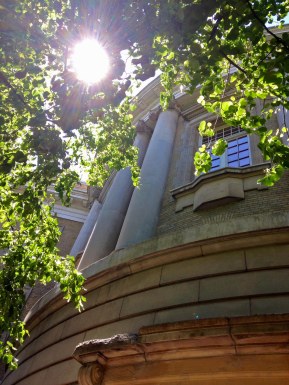
ConvocationHall-web

Convocation Hall, UofT

UofT is a place of learning—erudite, splendid, lofty yet humble—and beautifully epitomizing “new embracing old”. When new embraces old, we get magic. Wizard-magic. Harry Potter kind of magic. The kind of magic that only someone who is open, faithful, and confident can wield. This is ancient magic. The magic that lurks like Reznikoff’s ghost in the ancient halls of University College, or the magic currently wielded at 1 Spadina. A magic borne of wisdom, lore, and story.

Established in 1827, the University of Toronto is snugly located in the centre of downtown Toronto; yet, it’s not so much a part of the city as the city is a part of it.  UofT’s campus probes into the city’s infrastructure like a creative amoeba: interacting, absorbing and expressing. The UofT downtown campus sprawls dozens of blocks in all directions; embedding itself in the city with a blend of century-old buildings and avant-garde modern chic. It’s not so much re-inventing itself at every turn as morphing and co-evolving with the city.

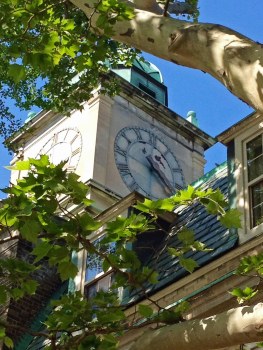
UofT-clocktower-sicamortrees

Clock tower, UofT

The UofT campus represents for me the very best the city—any city—has to offer: a vibrant, well-connected place of learning and activity, supported by original and tasteful landscape architecture: healthy trees and parkland full of songbirds, tasteful new and old architecture and alluring courtyards and doorways that beckon my creative soul. The UofT campus provides a myriad of possibilities and historic depth for the adventurous soul. Did you know, for instance, that Canada’s first electric computer was installed at UofT? Or that UofT is haunted? Or that much of UofT’s architecture was inspired by structures at Oxford and Cambridge? Or that an old nuclear accelerator sits fallow in the McLennan Physical Labs building?

My creative soul appreciates UofT’s integration of nature into its architecture and grounds. Its natural enclaves provide ideal settings for quiet contemplation and reflection. They’ve become my “secret places,” destinations along my journeys across campus to my various writing appointments. Places where I can sit, reflect and write. Here are just a few:

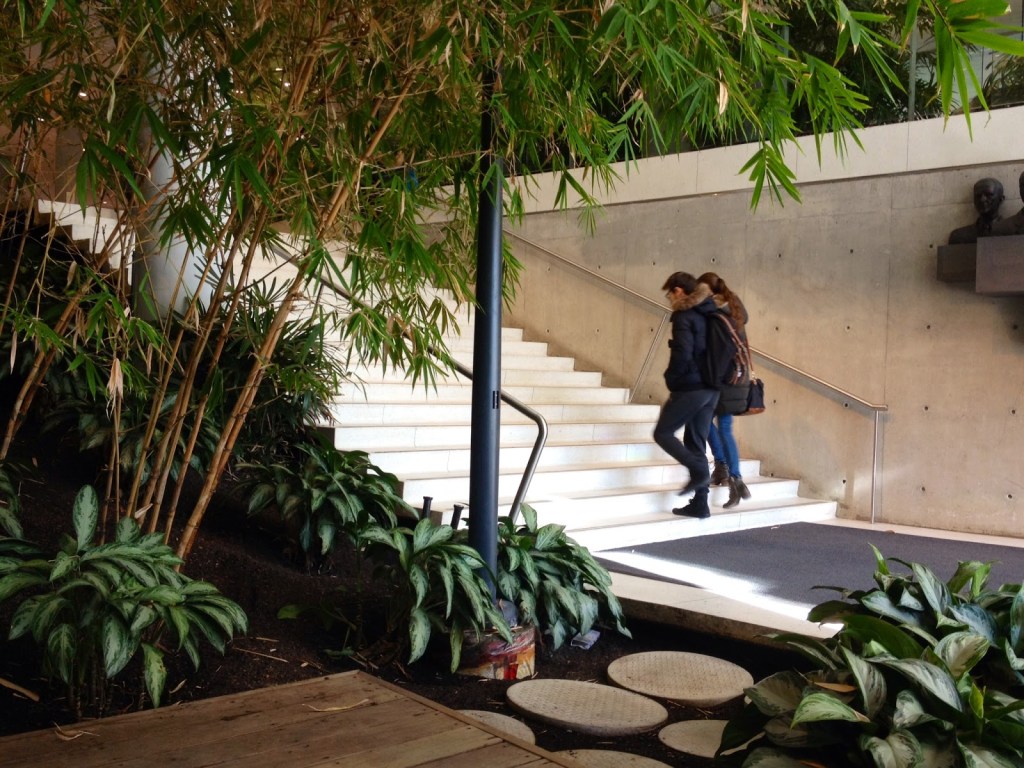
  1. Terrence Donnelly’s Bamboo Garden in Terrence Donnelly Centre:
BambooGarden01

Steps leading up past bamboo garden of Terrence Donnelly Centre

The Terrence Donnelly Centre for Cellular & Biomolecular Research (CCBR) is where some of the coolest research and discoveries in biomolecular and cellular research are being made. Benjamin Blencowe and his team’s recent uncovering a protein’s sweeping influence on autism last December using introverted mice, for instance. Named after the philanthropist Terrence J. Donnelly, the centre was the vision of UofT Professors Cecil Yip and James Friesen.

BambooGarden-lookingdown

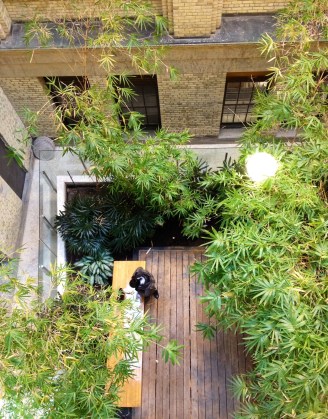
View of garden resting area from above

In the 1990s they foresaw that new genomic technologies would open-up progress in biomedical research in a time when there was no human genome sequence or stem cell technologies and DNA sequencing was slow and inexpensive. Yip and Friesen envisioned a collaborative and interdisciplinary research facility that, when it opened in 2005, brought together over 500 specialists—biologists, computer scientists, physicians, pharmacists and engineers—to advance the university’s groundbreaking research in molecular biology.

BambooGarden-RosebrughWall

View of Rosebrugh wall from the garden

The centre is located on what was previously Taddle Creek Road. The CCBR building—which from College Street resembles two colourful stacked cubes—is set back by a gradually sloping plaza with granite benches and groves of white paper birch. The building and plaza are flanked by several historic buildings (80-year old Fitzgerald Medical Building to the east; the 1919 Rosebrugh Institute of Biomaterials and 100-year old Lassonde Mining building to the west; and the Medical Sciences Building to the north).


The bamboo garden in Donnelly’s spacious atrium is meditative and calming; a lush forest of bamboo and shrubs amidst wooden floors, benches and steps. Created by landscape architect Diana Gerrard, the garden offers several “picnic” sites of wooden platforms and benches, which I learned had come from the ash, tulip and cherry trees that had occupied the original lane way.

BambooGarden-entrance

Entranceway with bamboo garden of Terrence Donnelly Centre

Upon entering the complex from College Street, the granite plaza gives way to white terrazzo flooring in an expansive multi-story atrium. The top lit glass-ceilinged atrium connects the adjacent heritage Rosebrugh building to the CCBR in a counterpoint of techno-minimalism with Romanesque tradition. As I walk up the shallow wide steps lined by pillars that reach skyward, the tall bamboo forest to my left beckons. I’ve had many lunches there. I also spend many moments sitting there with a book, reading or just daydreaming beneath a texture of greens.

  1. Breezeway of Knox College Quad:
knox college breezeway04 copy

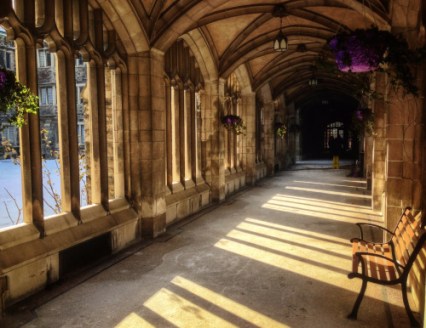
Knox College breezeway in winter

I usually enter the perpendicular gothic style building from St. George Street; though, you can also come in via Kings College Circle, past the chapel—known for its Hellmuth Wolff organ. Once I pass through the heavy doors of the St. George entrance, I enter a dark foyer and instantly feel like I’m in a church. The chapel is on the other side, yet the deep quiet and surrounding dark wood of the floors, walls and stairways to the right and left of me, enclose me with a sense of sacred holiness. I walk the echoing foyer to the stained-glass doorway of the breezeway ahead. As I open the glass door, the complex scent of tulips and pine greets me with the warm breeze. I have entered another magic place.

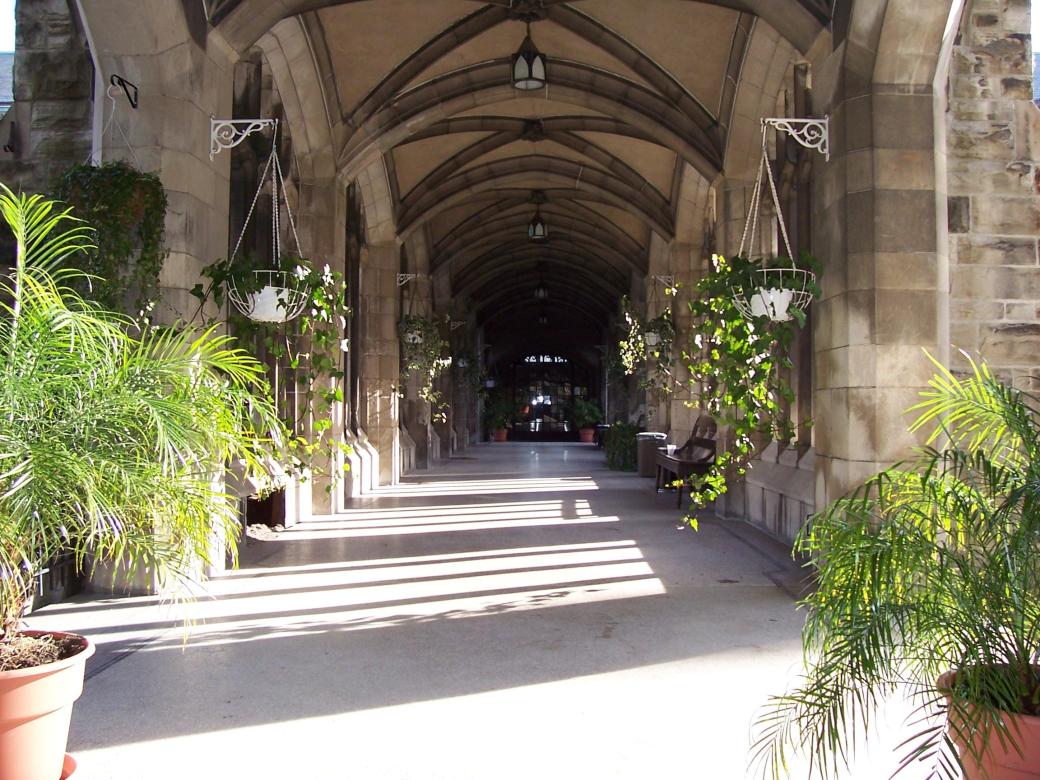
The gothic archway that connects the Knox College Quad is an open breezeway that looks out onto the interior gardens of the quad. Tables and chairs along each side provide a peaceful place to read and write with a quiet view of the outside courtyard of flowers, shrubs, trees and benches. Hanging vines provide additional greenery in the archway.

knox breezeway01 copy

Knox College breezeway through courtyard

Whenever I come here, the hustle and bustle of the city just fades away. Busy St. George Street is nearby; yet I don’t feel its influence within this quiet haven, where the soft sounds of Nature embrace me with their songs and stories. I often come here to read and write. I listen to the birds and other natural sounds, letting them lull me into a meditative quietude of bliss. Life slows to a philosopher’s pace and my creative muse awakens. Sometimes I bring one of my indulgences—a poutine from one of the chip trucks on St. George—and feast in my secret place as Nature’s melodies feed my soul. On a warm day, the breezeway also provides a cool respite.

  1. The Laidlaw Quadrangle behind University College
Gate to UC courtyard

West gate into University College courtyard

When I first discovered this hidden quadrangle, I felt goosebumps of pure magic course through me. My discovery visit was through the west arched entranceway off the west green, past Bissell House. I passed the gateway into the Courtyard Colonnade, and faced a sunken courtyard shaded by large ironwood and maple trees and surrounded by gothic brick and stone. I’d entered an enchanting world of quiet reflection.

A paved walkway—supported by retaining walls and planted with flowering shrubs—runs on three sides of the quadrangle. The walkway broadens into a terrace to the north, forming an extension of the new Library colonnade. Mature maple and ironwood trees overhang the cloisters and the walkway.

WestCollonade-looking west

West colonnade of quadrangle

Designed by Canadian landscape architect Michael Hough, the quadrangle evokes the courtyards of medieval monasteries and old English universities. Built in 1964, when the Laidlaw wing (and library) separated the college from back campus, Hough’s design translates the essential feature of a monastery or college courtyard—access from inside the building to a covered walk around an open centre—from architecture to landscape.


UniversityCollege-WestCollonade

View of courtyard (to left) from west cloister of University College

I’ve since discovered other ways to enter and leave the quadrangle, each one presenting a new perspective to this peaceful place. Each time I come here, I feel my soul sigh with joy. Birds sing the poetry of Nature. Leaves rustle as the wind plays on them. When I’m here, I feel at peace in the city.

photo-24

UofT Faculty Club

UofT Faculty Club: Every journey requires repast—a place to relax, eat and drink—and my feet naturally direct me to one of my new favourite haunts: the UofT Faculty Club. Located close to the hub of the campus, on Willcocks Street just east of Spadina, the club is open to members who include faculty, staff, graduate alumni and their guests. I enter the 1896 heritage building, built in a Georgian Revival-style, and passed the elegant first floor lounge to the pub below. The pub welcomes me with excellent food, drink and a relaxing ambience. Bathed in rich tones of wood and comfortable chairs and warmed by a cozy fireplace, it reminds me of a Dorset pub I’d visited years ago; full of colourful characters and a well-stocked bar.

UniversityCollege-windows

Windows of University College

I feel both at home and like a traveler. Like I’d walked into history with modern comfort. I order the beet salad from my friendly waitress; it provides a refreshing and attractive light meal for a mid-day travelling writer.

Nina Munteanu

Nina Munteanu is an ecologist, limnologist and internationally published author of award-nominated speculative novels, short stories and non-fiction. She is co-editor of Europa SF and currently teaches writing courses at George Brown College and the University of Toronto. Visit www.ninamunteanu.ca for the latest on her books.


Pictures by Nina Munteanu


On Being a Canadian in The Age of Water

“Do I contradict myself? Very well, then I contradict myself; I am large, I contain multitudes.”—Walt Whitman

nina-child01I was born on this day, some sixty+ years ago, in the small town of Granby in the Eastern Townships to German-Romanian parents. Besides its zoo—which my brother, sister and I used to visit to collect bottles for a finder’s fee at the local treat shop—the town had no particular features. It typified French-Canada of that era.

So did I.

I went to school in Quebec then migrated across to the west coast to practice and teach limnology. Given that Canada holds a fifth of the Earth’s freshwater, that also made sense.
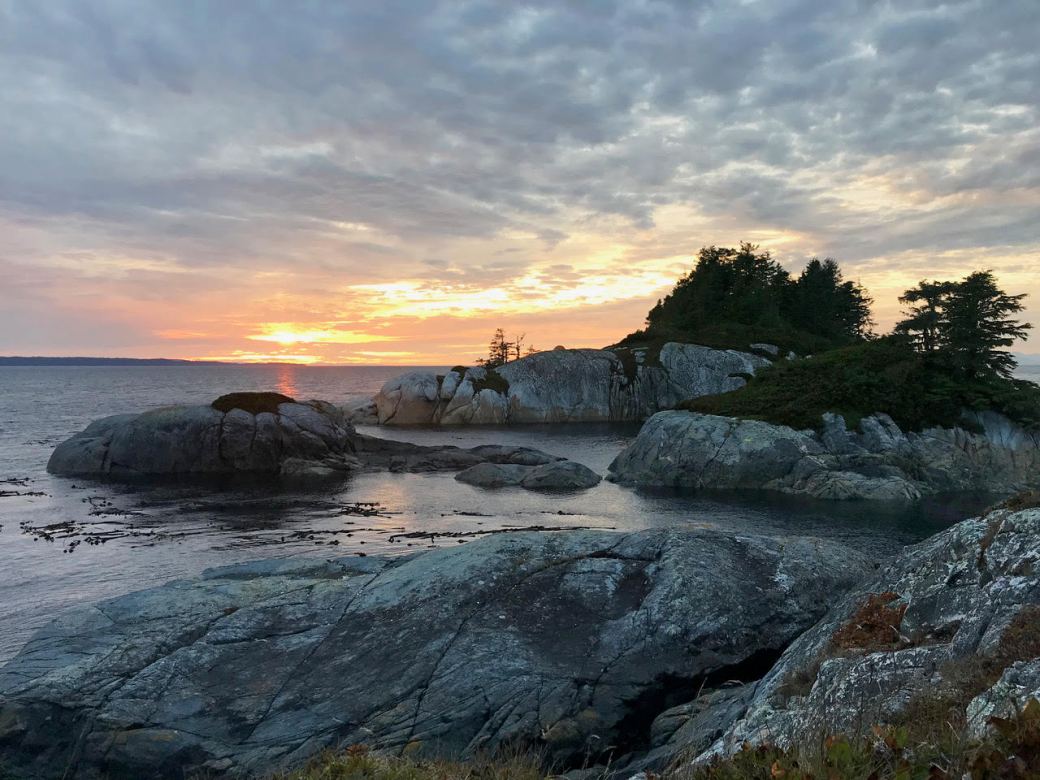
Broughton-sunset-kev

Sunset off Broughton, BC (photo by Nina Munteanu)

Canada is a vast country with a climate and environment that spans from the boreal forests of the Canadian Shield, muskegs of northern BC, and tundras of the Arctic Circle to the grasslands of the Prairies and southern woodlands of Ontario and Quebec. Canada’s environment is vast and diverse. Like its people.
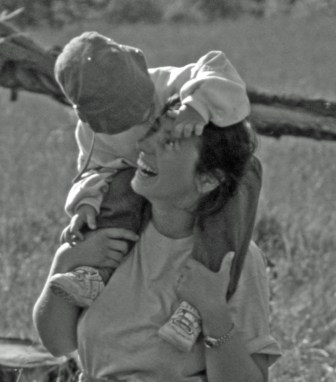
kevin-nina-close

Nina and son Kevin explore Nature

In December of 2017 I participated in a discussion on the subject and role of water in literature in Toronto. I came to the event as a limnologist/ecologist, mother and environmentalist prepared to share how water—its meaning and our relationship with it—is used in my writing and how writing about water can help nurture a future of awareness and action.

But, as the discussion slid into the slippery subject of colonialism, I made the apparent mistake of sharing that—as a Canadian—I was proud of Canada. I was later schooled that “celebrating the nation” was considered anathema to an audience with strong anti-colonialist sentiments and a hatred for neoliberalist corporate Canada (something I share but do not obsess over); I’d obviously crossed some invisible line and I made a mental note to better assess my audience in future).

I also got to thinking about what it means for me to be a Canadian and what my pride in Canada really means. Was I being a “white-toast” nationalist in sharing a pride in my country?

Ecologist vs Nationalist

Ecology is the study of “home” (oikos means ‘home’ in Greek). Ecology studies the relationships that make one’s home functional. It is, in my opinion, the most holistic and natural way to assess where we live. My home is currently Toronto, Ontario, Canada and ultimately the planet Earth.

Country_road_Stephane_Lemire

country road in Eastern Townships of Quebec

Growing up in the Eastern Townships of Quebec, I’d always felt an abiding sense of belonging and I resonated with Canada’s national symbols—mostly based on Nature and found on our currency, our flag, and various sovereign images: the loon, the beaver, the maple tree, our mountains and lakes and boreal forests. Why not? Over 80% of Canada lies in the boreal zone with much of that boreal forest and wilderness (that’s some 552 million hectares). Canadians are custodians of a quarter of the world’s wetlands, longest river systems and most expansive lakes. Most of us recognize this; many of us live, play and work in or near these natural environments.

I have long considered myself a global citizen with no political ties. I saw my country through the lens of an ecologist—I assessed my community and my surroundings in terms of ecosystems that supported all life, not just humanity. Was a community looking after its trees? Was my family recycling? Was a corporation using ‘green’ technology? Was a municipality daylighting its streams and recognizing important riparian zones? I joined environmental movements when I was a teenager. I shifted my studies from art to science because I wanted to make a difference in how we treated our environment. After university, I joined an environmental consulting firm, hoping to educate corporations and individuals as environmental stewards. I brought that philosophy into a teaching career and began writing eco-fiction, science fiction and essays to help promote an awareness and a connection with our natural world. My hope was to illuminate how important Nature and water is to our planet and to our own well-being through an understanding of ecology and how everything is interconnected.
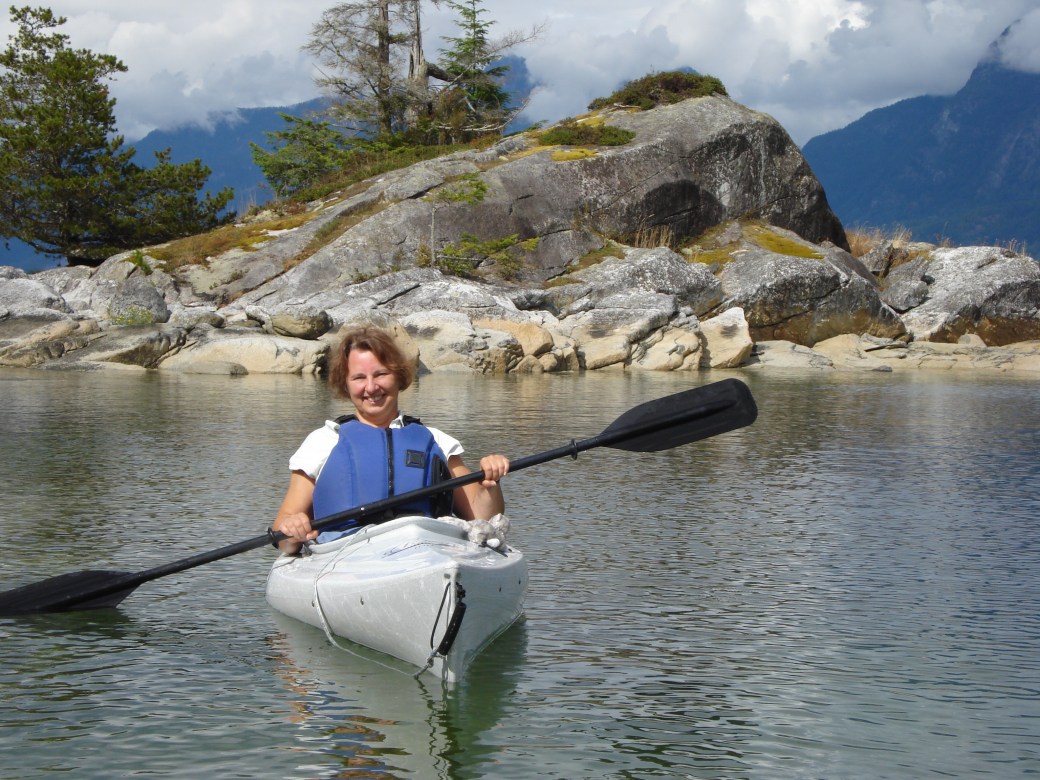
US-tour and Desolation Sound 260 copy

Nina kayaking in Desolation Sound, British Columbia (photo by H. Klassen)

Merriam-Webster defines “nationalism” as: “loyalty and devotion to a nation, especially a sense of national consciousness.” This is not the same as patriotism. Nor does it describe what many think of the word, which is an extreme form of nationalism, in which one nation is exalted above all others (I can think of one nation that is overtly doing that now) and placing primary emphasis on promoting its culture and interests over others—often through isolationism, xenophobia, chauvinism and jingoism. When I think of Canada, I think of my “home”, where I live; my community and my environment. I have traveled the world and I feel a strong sense of “home” and belonging every time I return. Canada is my home. I was born and grew up in Quebec; I raised a family in British Columbia, and I lived in Ontario and Nova Scotia. Each of these places engendered a feeling of “home”. If a strong sense of “home” and belonging is nationalistic, then that is what I am.
lunenburg-keel-laying

The Dory Shop in Lunenburg, Nova Scotia (photo by Nina Munteanu)

Or am I something else? Perhaps, we need to redefine our sense of belonging (and pride) in a country that is not tied to some core political identity or melting-pot mainstream. Historian and writer Charlotte Gray wrote:

“we live in a country that has a weak national culture and strong regional identities …Two brands of psychological glue bind Canada together: political culture and love of landscape…[in] a loose federation perched on a magnificent and inhospitable landscape—[we are] a nation that sees survival as a collective enterprise.”—Charlotte Gray

Canada as Postnational State

Trudeau-RollingStone

Justin Trudeau on the cover of “Rolling Stone”

In October 2015, Canada’s Prime Minister Justin Trudeau told the New York Times that Canada may be the “first postnational state,” adding that “there is no core identity, no mainstream in Canada.” This is largely because Canadians, writes Charles Forman in the Guardian, are “philosophically predisposed to an openness that others find bewildering, even reckless.”

To anyone but a Canadian, Trudeau’s remark would rankle, particularly in a time when many western countries are fearfully and angrily turning against immigration through nativism and exclusionary narratives. A time when the United States elected an authoritarian intent on making “America great again” by building walls. A time when populist right-wing political parties hostile to diversity are gaining momentum in other parts of the world. “Canada’s almost cheerful commitment to inclusion might at first appear almost naive,” writes Forman. It isn’t, he adds. There are practical reasons for keeping our doors open.

We are who we are because of what we are: a vast country the size of Europe. A country dominated by boreal forest, a vital and diverse wilderness that helps maintain the well-being of our entire planet. A land that encompasses over a fifth of the freshwater in the world, and a quarter of the world’s wetlands. Canadians are ultimately the world’s Natural stewards. That is who and what we are.

According to Forman, postnationalism frames how “to understand our ongoing experiment in filling a vast yet unified geographic space with the diversity of the world” and a “half-century old intellectual project, born of the country’s awakening from colonial slumber.” As the first Europeans arrived in North America, the Indigenous people welcomed them, taught them how to survive and thrive amid multiple identities and allegiances, writes Forman. “That welcome was often betrayed, particularly in the 19th and 20th centuries, when settlers did profound harm to Indigenous people.” But, says Forman, if the imbalance remains, so does the influence: a model of another way of belonging. One I think many Canadians are embracing. We are learning from the natural wisdom of our Indigenous peoples. Even our fiction reflects how we value our environment and embrace diversity. “Diversity fuels, not undermines, prosperity,” writes Forman.
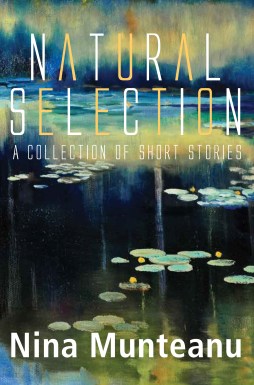
naturalselectionAs efforts are made to reconcile the previous wrongs to Indigenous peoples within Canada and as empowering stories about environment are created and shared, Canada carries on the open and welcoming nature of our Indigenous peoples in encouraging immigration. In 2016, the same year the American government announced a ban on refugees, Canada took in 300,000 immigrants, which included 48,000 refuges. Canada encourages citizenship and around 85% of permanent residents typically become citizens. Greater Toronto is currently the most diverse city in the world; half of its residents were born outside the country. Vancouver, Calgary, Ottawa and Montreal are not far behind.

Canadian author and visionary Marshal McLuhan wrote in 1963 that, “Canada is the only country in the world that knows how to live without an identity.” This is an incredible accomplishment, particularly given our own colonial history and the current jingoistic influence of the behemoth south of us.

The Way of Water-COVERWriter and essayist Ralston Saul suggests that Canada has taken to heart the Indigenous concept of ‘welcome’ to provide, “Space for multiple identities and multiple loyalties…[based on] an idea of belonging which is comfortable with contradictions.” Of this Forman writes:

“According to poet and scholar BW Powe, McLuhan saw in Canada the raw materials for a dynamic new conception of nationhood, one unshackled from the state’s ‘demarcated borderlines and walls, its connection to blood and soil,’ its obsession with ‘cohesion based on a melting pot, on nativist fervor, the idea of the promised land’. Instead, the weakness of the established Canadian identity encouraged a plurality of them—not to mention a healthy flexibility and receptivity to change. Once Canada moved away from privileging denizens of the former empire to practicing multiculturalism, it could become a place where ‘many faiths and histories and visions would co-exist.”
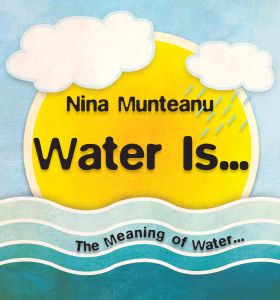
Water Is-COVER-webAnd that’s exactly what is happening. We are not a “melting pot” stew of mashed up cultures absorbed into a greater homogeneity of nationalism, no longer recognizable for their unique qualities. Canada isn’t trying to “make Canada great again.” Canada is a true multi-cultural nation that celebrates its diversity: the wholes that make up the wholes.

Confident and comfortable with our ‘incomplete identity’—recognizing it for what it is—is  according to Forman, “a positive, a spur to move forward without spilling blood, to keep thinking and evolving—perhaps, in the end, simply to respond to newness without fear.”

This resonates with me as an ecologist. What I envision is a Canada transcending the political to embrace the environment that both defines us and provides us with our very lives; a view that knows no boundaries, and recognizes the importance of diversity, relationship and inclusion, interaction, movement, and discovery.
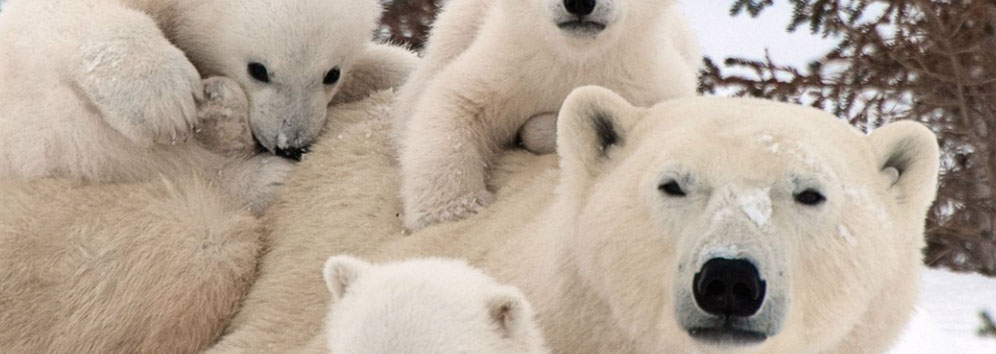
 

PolarBearMum-pupsSo, am I still proud of Canada? Definitely. We have much to be proud of. We live in one of the wealthiest countries in the world and the 8th highest ranking in the Human Development Index. Canada ranks among the highest in international measurements of government transparency, civil liberties, quality of life, economic freedom, and education. It stands among the world’s most educated countries—ranking first worldwide in the number of adults having tertiary education with 51% of adults holding at least an undergraduate college or university degree. With two official languages, Canada practices an open cultural pluralism toward creating a cultural mosaic of racial, religious and cultural practices. Canada’s symbols are influenced by natural, historical and Aboriginal sources. Prominent symbols include the maple leaf, the beaver, Canada Goose, Common Loon, the Royal Canadian Mounted Police, the polar bear, the totem pole, and Inuksuk.
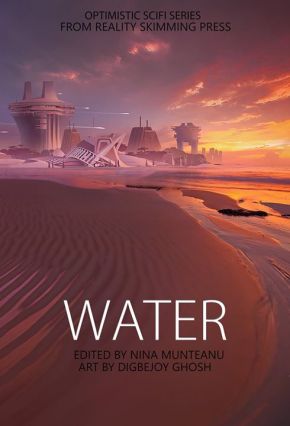
WaterAnthology-RealitySkimmingPressWe are a northern country with a healthy awareness of our environment—our weather, climate and natural world. This awareness—particularly of climate change—is more and more being reflected in our literature—from Margaret Atwood’s “Maddaddam” trilogy and Kim Stanley Robinson’s “New York 2140” to my own book “Water Is…”. Canadians are writing more eco-fiction, climate fiction, and fiction in which environment somehow plays a key role. Water has become one of those key players: I recently was editor of the Reality Skimming Press anthology “Water”, a collection of six speculative Canadian stories that explore near-future scenarios with water as principle agent.

In a recent interview with Mary Woodbury on Eco-Fiction, I reflected on a trend over the years that I noticed in the science fiction writing course I teach at George Brown College: “It’s a workshop-style course I teach and students are encouraged to bring in their current work in progress. More and more students are bringing in a WIP with strong ecological overtones. I’d say the percentage now is over 70%. This is definitely coming from the students—it’s before I even open my mouth about ecology and eco-fiction—and what it suggests to me is that the welfare of our planet and our ecosystems is on many people’s minds and this is coming through in our most metaphoric writing: science fiction.”

It is healthy to celebrate our accomplishments while remembering where we came from and what we still need to accomplish. This provides direction and motivation.


References:

Dechene, Paul. 2015. “Sci-Fi Writers Discuss Climate Catastrophe: Nina Munteanu, Author of Darwin’s Paradox.” Prairie Dog, December 11, 2015.

Forman, Charles. 2017. “The Canada Experiment: Is this the World’s First Postnational Country?” The Guardian, January 4, 2017.

Gray, Charlotte. 2017. “Heroes and Symbols” The Globe and Mail.

Moorhouse, Emilie. 2018. “New ‘cli-fi’ anthology brings Canadian visions of future climate crisis.” National Observer, March 9, 2018.

Munteanu, Nina. 2016. “Crossing into the Ecotone to Write Meaningful Eco-Fiction.” In: NinaMunteanu.me, December 18, 2016.

Newman-Stille, Derek. 2017. “The Climate Around Eco-Fiction.” In: Speculating Canada, May 24, 2017.

Woodbury, Mary. 2016. “Part XV. Women Working in Nature and the Arts: Interview with Nina Munteanu, Ecologist and Author.” Eco-Fiction.com, October 31, 2016.


nina-2014aaaNina Munteanu is an ecologist and internationally published author of award-nominated speculative novels, short stories and non-fiction. She is co-editor of Europa SF and currently teaches writing courses at George Brown College and the University of Toronto. Visit www.ninamunteanu.ca for the latest on her books. Nina’s recent book is the bilingual “La natura dell’acqua / The Way of Water” (Mincione Edizioni, Rome). Her latest “Water Is…” is currently an Amazon Bestseller and NY Times ‘year in reading’ choice of Margaret Atwood.
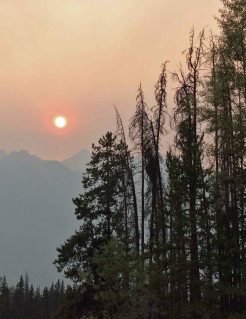

Write About What You Know

Cedar trunk base-LR

Base of cedar tree, Little Rouge woodland (photo by Nina Munteanu)

How many times have you been told to write about what you know? And how many times have you trusted that advice? Well, how interesting is that?!? We think our lives are dull, boring, and mundane. We write – and read – to get away from it, don’t we?

Well, yes…and no…

In the final analysis, even good “escapist” writing, like some science fiction, despite its alien settings and creatures of imagination, is grounded in the realities of our every-day lives, which form the basis of human nature. Love, ambition, trust, hate, envy, honor, courage. All these are universal human traits which the writer taps into and ultimately writes about.

“In the 19th century, John Keats wrote to a nightingale, an urn, a season. Simple, everyday things that he knew,” say Kim Addonizio and Dorianne Laux in The Writer’s Guide to Creativity. “Walt Whitman described the stars, a live oak, a field. They began with what they knew, what was at hand, what shimmered around them in the ordinary world.”

The advice, “write what you know” isn’t about literal truths; it’s about what you know inside. As SF author Marg Gilks says, “You know more than you think.”

Twisted Truths & Inner Knowledge

In an article in Writing World, Gilks discusses how a writer can use her own knowledge and experiences in everyday life and translate them into something far from ordinary. You start with universal experiences.

Get Emotional

What excites you; what frightens you; what angers you, makes you sad, happy. These are emotions we all feel. When we give our characters experiences similar to our own, we breathe life into both character and experience and provide the reader an anchor for her heart.

Get Sensational

You know how it feels when the sun shines on your face or the rain drenches you. You know how it feels to have your knees shake with fatigue after a long climb on a hot day or the invigorating freshness of a cool lake in summer.

Get People Around You

My neighbor has a funny way of focusing his gaze slightly off me when he talks, like he can’t look me directly in the eyes. When he approaches my house to deliver the paper, Dennis strides with a lilting gait as he listens to hip-hop on his ipod.

Drawing from what you observe and know of the people around you is one of a writer’s most treasured resources for character description. I always carry a notebook with me no matter where I go, even if it’s only to the grocery store.

The Magic of Storytelling

A writer is like a magician. You play upon what readers all “know” then surprise them with the unexpected.

Unleashing your imagination and letting it soar while grounding yourself in the realities of universal truths is the stuff of which stories are made. This is what most of us mean when we say “write what you know.”

“Unless you are writing about a personal tragedy,” says Tina Morgan of Fiction Factor, “you will have to use your imagination. Use the creativity that drives you to write in the first place. Take those feelings you have every day and amplify them. Make them more intense, more vivid. Before you know it, you will be ‘writing what you know’.”

“Next time you hear ‘write what you know,’ ” says Gilks, “you’ll realize that you know an awful lot about what matters most in a story’s success. It’s waiting only to be shaped by your imagination.”

Write Real

Literary Agent, Rachelle Gardner, provided a great definition of “write what you know” on her blog. Here’s an excerpt:

Most people think “write what you know” means you have to put characters in situations you’re personally familiar with. If you’re a mom with five kids, you should write a mom story. If you’ve fought cancer and won, you should write about that. But in my opinion, that’s not what it means.

Write what you know means write with authenticity about thoughts, feelings, experiences of life. Be honest. Write from a deep place. Don’t write from the surface. Whether you’re writing about parenthood or cancer or anything else… be real.

Don’t reflect what you know from other people or the media… write what you know from your own inner life.

Nina MunteanuNina Munteanu is an ecologist, limnologist and internationally published author of award-nominated speculative novels, short stories and non-fiction. She is co-editor of Europa SF and currently teaches writing courses at George Brown College and the University of Toronto. Visit www.ninamunteanu.ca for the latest on her books.