Revisiting the Short Story and Heinlein’s Five Rules of Writing

george brown college

The seventh class of my 12-week Creating Science Fiction course at George Brown College is all about short story writing. I’m by nature a progressive—and an itinerant explorer; so, I am updating materials for my students and sharing them with you.

PlayingTheShortGame-DougSmithOne resource I’m eager to introduce to my students is Canadian SF short story writer Douglas Smith’s recent guidebook, Playing the Short Game: How to Market & Sell Short Fiction. Smith’s guidebook is a Tardis-style smallish yet comprehensive guide on what it takes to be a successful short story writer from starting & finishing to marketing & publishing to leveraging & promotion.

Smith is an accomplished short story writer and marketer, who has always openly shared his treasures of acquired wisdom with others.  His stories have appeared in thirty countries and 25 languages. He’s won three awards and has three acclaimed collections—so far. For years, his Foreign Market List has helped writers—including me—sell their work all over the world. To date, I have sold short stories (mostly translated reprints) to markets in Greece, Poland, Romania, Israel, and Italy—thanks to his list.

Why Write Short?

coffee-doubleespressoI’m a petite five foot-three height and purposely wear flat shoes. I love short. I prefer my espresso pulled in short shots—or  ristretto—in my flat white. Described as bolder, fuller, with more body and less bitterness, the ristretto is like a burst of intense flavor with a lingering finish. Short is pretty cool.

Douglas Smith gives seven excellent reasons for writing short fiction, even if you are ultimately a novel writer, like me. Writing short stories:


  1. Helps you learn your craft in easy, short-term, bite-sized amounts and over a reasonable time for you to learn, apply, and relearn
  2. Helps you test the waters of literature, to discover what excites you, provokes you and what ultimately you NEED to express
  3. Builds your resume, again more easily and quickly than a novel, toward that ultimate novel; publishers of magazines and publishing houses are more likely to take your work seriously if you have a publishing history
  4. Helps you explore ideas for your novel, by “pinging” certain premises you may wish to explore in further detail or take elsewhere in a novel
  5. Helps you build a backlist of published stories, which you own, once rights have reverted back to you
  6. Helps you build a network in your writing community of publishing houses, editors, other writers and so forth as you submit and exchange through your works and letters (including all those rejections!). Eventually, a pleased editor/publisher may invite you to submit to a “Best of” anthology or provide a collection. This has happened to me several times.
  7. Helps you learn the publishing business (well, sort of, says Smith…). Through exposure to the business side of publishing, you will gain an appreciation of how the publishing world works.

Know What You’re Writing

Nina-computer-KraveA short story only has 7,000 or less words to get your tale across while a novel has over ten times that many words to do the same. It follows then that the short story format is a simpler one. This does not necessarily mean easier.

Novels provide a sense of change, growth and solutions to problems and conflicts. “The short story doesn’t have the luxury of depicting change; the closest it can come is awareness,” writes Shelley Lowenkopf in her 2007 article “Telling Tales” in The Portable Writer’s Conference: Your Guide to Getting Published by Quill Driver Books.

She goes on to describe the short story as a close-up to a novel’s landscape. The short story is, therefore, often more intense and powerful. A short story, more than a novel, has the power to transport, disturb and enlighten.

ElementsOfFiction-SceneStructure-BickhamRenowned short story authors like Edgar Allen Poe, Nathanial Hawthorne, and Somerset Maugham, emphasize the importance of striving for one effect when writing a short story: the single effect you wish to leave with the reader at the end. This is accomplished by selecting events or situations that build quickly into a combustible response. Even Alice Munro, who is known for cramming long timeframes into her short stories, frames time through a single event: a meal, family gathering, wedding or funeral, for instance.

Jack Bickham, in his book, Elements of Fiction Writing: Scene and Structure by Writer’s Digest Books (1993) writes that, “story length, author intention, traditional expectations of the audience, and all sorts of things may affect the form a story may take.” Choosing the appropriate length to tell your story relies on the complexity of your premise and theme.

Understanding the Short Story Format

Here are seven tips toward writing a compelling and memorable short story:

  1. Open in the middle of something happening (e.g., action/in a “scene”)
  2. Make your opening provocative (raise the stakes as high as you can)
  3. Write scenes and write sparingly (avoid describing the obvious—use description to show something odd, memorable, exotic)
  4. Have characters define themselves and their goals through what they do and observe (e.g., show more than tell)
  5. Define characters with dialogue (a great way to reveal while keeping a high pace)
  6. Withhold vital information for as long as possible
  7. Don’t explain the ending (cut down on the denouement; let the reader make those conclusions—a key in the short story format)

Selling Your Short Story

Smith’s guidebook provides several chapters of excellent advice in logical steps toward a successful career.

Here are just a few gems that I will be sharing with my students.

First of all, remember that you are not selling your story; you’re licensing a particular set of rights for someone to do something with that story. Before you do anything else, do your homework: know the rights you’re selling; and which ones to keep. Smith describes five major types of rights: media; language; geography (less and less relevant); occurrence; and time.
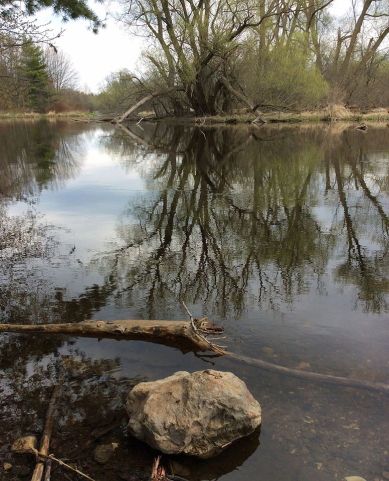
Eramosa River 3

Eramosa River, Ontario (photo by Nina Munteanu)

Media rights include print rights, electronic rights and audio rights. Markets include magazines, anthologies and collections for short stories. Language and geography rights are pretty self-explanatory. Occurrence rights relate to whether the publisher is buying first or second and onward rights (otherwise known as reprints). Most publishers prefer to pay for the right to publish your work for the first time in that particular format (e.g., in print and in English, for instance). Having said that, I’ve had a lucrative history of selling reprints to some of my more popular short stories. I’ve furthered gone on to selling other rights, such as foreign language rights and audiobook and e-book rights. I’ve also sold two short story collections, one to an Italian publisher (coming out this year) and shorts in several anthologies. No movies yet… But I did have a serious discussion with a writer/producer on one of my shorts. Recall how many Philip K. Dick short stories have been adapted to movies (e.g., Total Recall, The Adjustment Bureau, Paycheck, Minority Report, and Blade Runner).

Heinlein’s Five Rules of Writing

Smith evokes SF writer Robert J Heinlein’s 5 rules of writing to succeed as a short story writer (as any kind of writer, actually). These are:

  1. You must write
  2. You must finish what you write
  3. You must refrain from rewriting, except to editorial order
  4. You must put the work on the market
  5. You must keep the work on the market until sold

I know… Number 3 sounds pretty suspicious, or arrogant at the very least. As Robert J. Sawyer concludes on his site in reference to the five rules, number 3 is open to reasonable interpretation. Of course, it must mean AFTER you’ve finished and edited the story with some level of confidence that you’re happy with it—never mind what other people think of it.

FictionWriter-front cover-2nd ed-webNina’s Bus-Terminal Model

In my writing guide The Fiction Writer, Chapter L (for “Long or Short?”), I talk about how I launched my own successful short story writing career. I’d been writing short stories for a few years without much success (I was getting interesting rejection letters, so I knew I was getting close); then I settled into a kind of model/routine. I call it The Bus Terminal Approach. As Smith attests—several times—it’s a numbers game. That’s how I played it. It starts with one story and relies on you not waiting until you write the next, and the next and the next. Here’s how it works:

  1. You list at least 3 markets that you’ve researched for Story A and send it to the first of the three
  2. You start right away writing Story B, send it to the first of 3 markets you’ve researched and listed for it
  3. When Story A rejection arrives, you do not revise but send it right away to the second market
  4. Same thing for Story B
  5. Write Story C and treat similarly

NaturalSelection-front-webRemember to keep track of what you send where and when and what happens to it. It can become a very confusing bus terminal otherwise, with someone ending up in Seattle when they are headed to Toronto! What happens with this approach is several things: you begin to treat the whole marketing/publishing process as a business (which it is) and because you have so many “buses” out there coming and going, the rejections don’t hurt quite as much and instead become part of the learning process, which they should be. You adopt a more business-like approach, which translates into your relationship with editors and publishers. A win-win situation results. Believe me; this works. Once I fell into this method, my sales increased by over 70%.


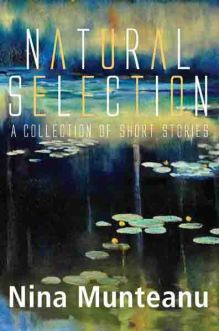
Several of my stories are currently available in a collection entitled Natural Selection by Pixl Press. You can read one of my short stories right on Amazing Stories: “Virtually Yours”.

My guidebook, The Fiction Writer, can be purchased in various online and onsite bookstores, including Amazon, Kobo, Chapters Online, Barnes & Noble, and several others even I don’t know about.

nina-2014aaaNina Munteanu is an ecologist and internationally published author of award-nominated speculative novels, short stories and non-fiction. She is co-editor of Europa SF and currently teaches writing courses at George Brown College and the University of Toronto. Visit www.ninamunteanu.ca for the latest on her books. Nina’s recent short story is the bilingual “La natura dell’acqua / The Way of Water” (Mincione Edizioni, Rome). Her latest “Water Is…” is currently an Amazon Bestseller and NY Times ‘year in reading’ choice of Margaret Atwood.
Vancouver Coffee Marathon—Four Coffee Shops in Four Hours

First Hour: Nusa Coffee

asian-palm-civet3

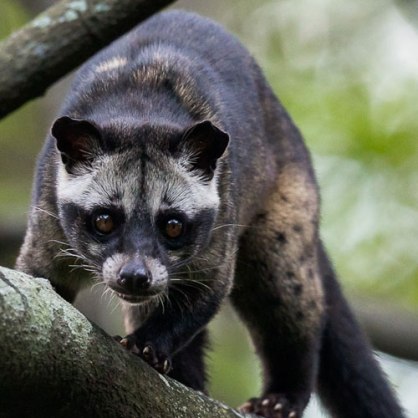
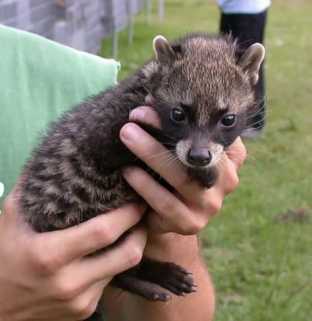
The Asian Palm Civet

I started my coffee marathon at Nusa Coffee, on 4th Avenue in Kitsilano. Nusa means “islands” and, indeed, Marcus, one of the partners, told me that most of their coffee comes from Indonesia, an archipelago of over 17,000 islands stretching an expanse the length of Canada.

Nusa features coffee from beans grown in the Ngada region of Flores, the Toraja Highlands of central Sulawesi, the Kintamani Highlands of Bali and the Gayo Highlands in Sumatra Gayo.

Asian-Palm-Civet

Asian Palm Civet

But I’d come for kopi luwak—otherwise known as cat poop coffee—made from coffee beans that have been digested by a small Indonesian cat called an Asian Palm Civet (Paradosorus hermaphroditus)—a small viverrid native to South and Southeast Asia. They help maintain tropical forest ecosystems through seed dispersal as they feed on pulpy fruits such as mango, rambutan and coffee.

Why was I doing this? Well, since I’d heard about it, I just had to try it out for myself. According to The Vancouver Coffee Snob the civets feast on ripe coffee cherries, which start to digest and ferment in their stomachs.

Nusa-coffee pour

Marcus does the pour over

The enzymes allegedly remove the acidic tastes from the coffee, imparting new flavours. The cat then poops what’s left and farmers collect the poop, clean them, process and roast the beans. Civet coffee beans are harder and more brittle because they have been modified by the digestive juices of the civet.

Because of the new trend for Kopi Luwak, civets are being increasingly captured from the wild and fed coffee beans to mass-produce this blend. Many of the captured civets are housed and treated unethically. The impact of all these captures on the wild population and consequent ecosystems they live in, is not yet known. The lesson here is: do your research to ensure that the product you’re buying has been ethically collected from wild Civet poop. Nusa Coffee is one of them.

NUSA-Catpoo Coffee

Kopi Luwak at Nusa Coffee in Vancouver

Marcus let me smell the beans before grinding them. The aroma was deep, pleasant and nutty. That carried into the coffee pour over (which is more gentle than using an espresso machine). Then it came to tasting it: I found it unpretentious, earthy with subtle tones that lingered in the back of the throat. As I breathed in the kopi luwak, I thought of the jungle where the civet lives…and poos. Nusa Coffee is also unpretentious; a cozy café with wood benches and tables and no overbearing music.

Second Hour: Platform 7

Platform7 cafe

Platform 7 and bookstore in Kits (photo by Nina Munteanu)

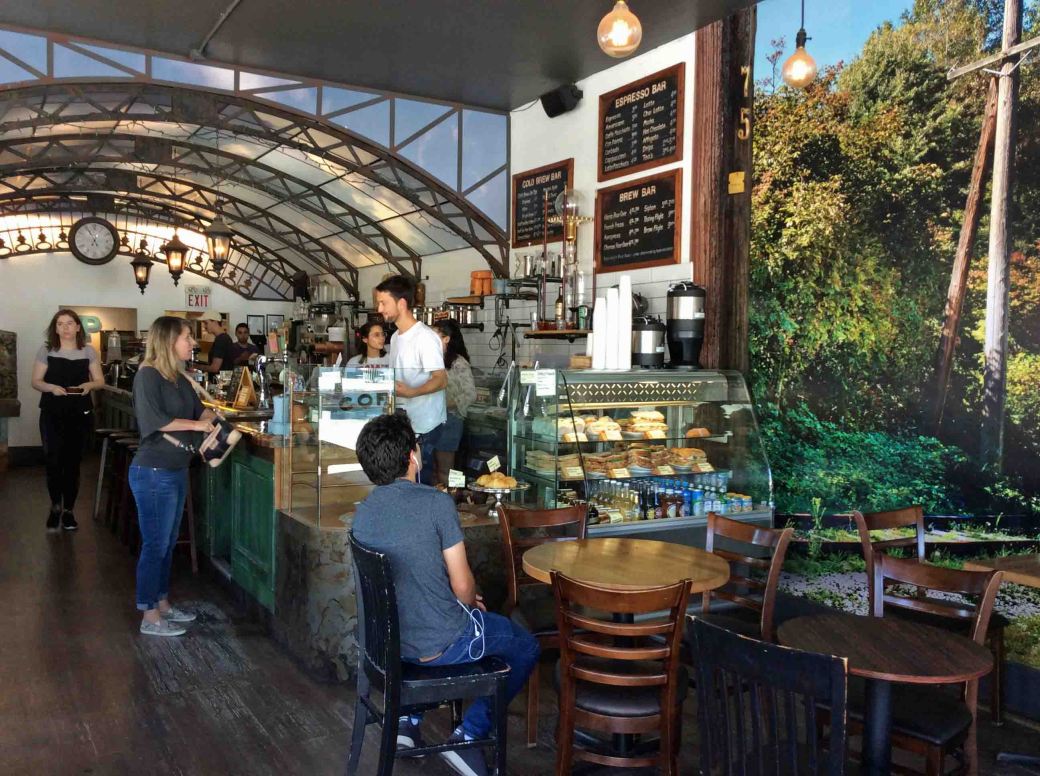
My second stop was Platform 7, on Broadway and Vine, where I stopped for lunch. Located in an old house next to a character-book store (a great combination for a writer!), Platform 7 is a creative take on a bustling “Victorian London train station in East Vancouver and a Belle-Époque Parisienne train station in Kits.”

The café offers a large variety of coffees from their espresso bar, cold bar and brew bar. I enjoyed friendly service and pleasant jazz-fusion music as I ate lunch, a deliciously grilled turkey with cranberry sandwich.

Platform7-interior

Inside Platform 7 Coffee (photo by Nina Munteanu)

Third Hour: Federal Store

Federal Store outside3

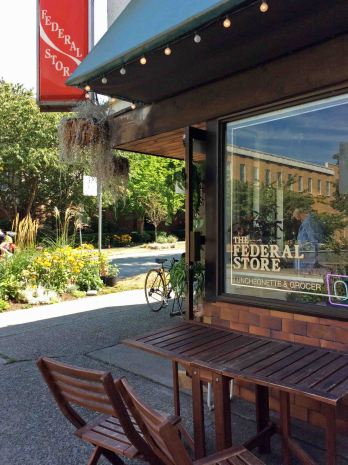
The Federal Store (photo by Nina Munteanu)

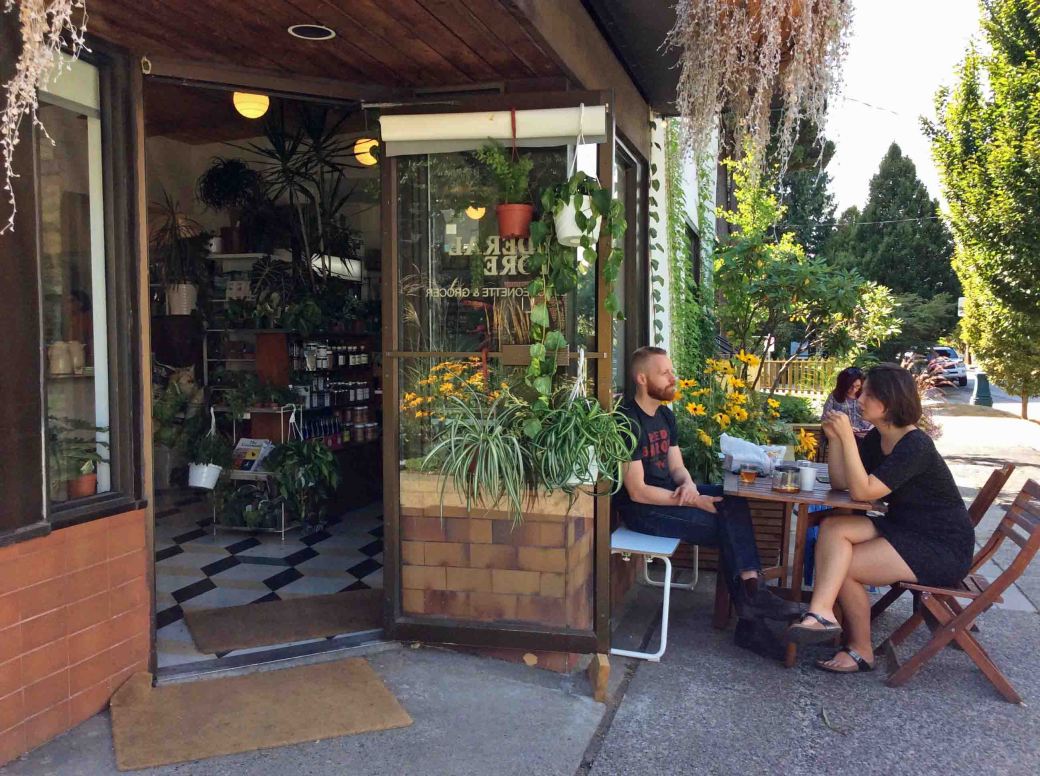
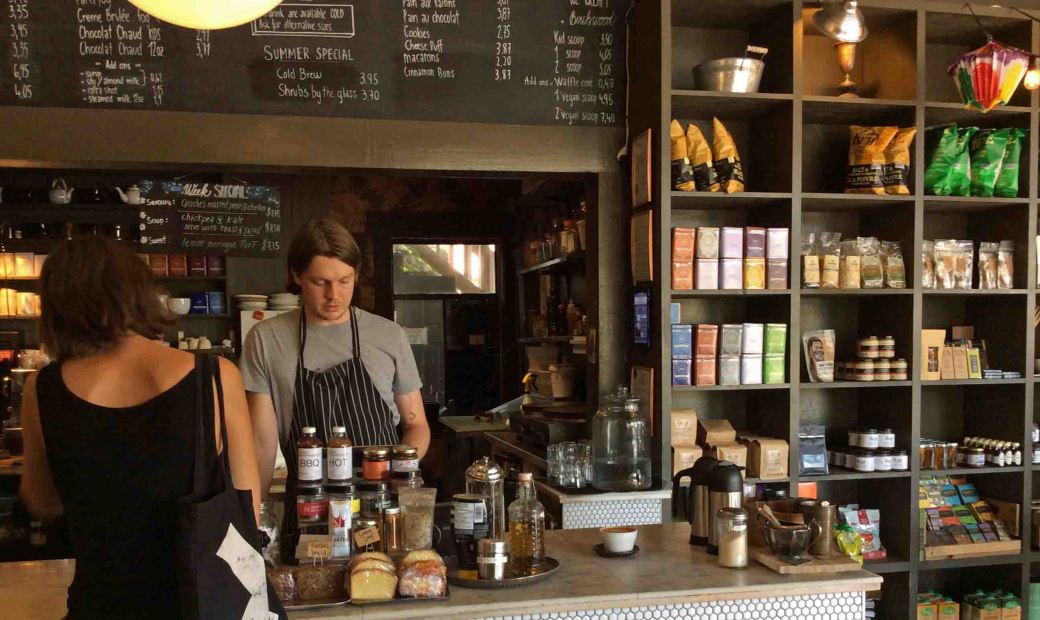
I continued east across town along Broadway into Mount Pleasant and walked south along Quebec Street toward 10th Avenue, where the Federal Store greeted me on the corner. Surrounded with cheerful flowers on all sides and a vegetable garden in the back, the café-grocer beckons me inside. I enter and feel like I’ve entered an alternative past: an integration of ’50s trompe l’oeil 3-D checker floor, plants, and homemade baking in the display with the avant-garde chic of wood and white.

I ordered an Earl Grey tea (for a change from coffee) and sat outside, where I enjoyed the loose tea as birds sang around me and bees buzzed among the flowers.

Mia Stainsby of the Vancouver Sun writes, “One block away, Main Street hyperventilates and cars exhale carbon monoxide. But here at Federal Store, it’s quiet and I’m caught in a time warp. The vintage room stirs up romantic notions of simpler times.”

Federal Store entrance2

The Federal Store (photo by Nina Munteanu)

Fourth Hour: Le Marché St. George

It grew hot as the day progressed, but I kept cool under the thick canopy of maples, chestnuts and ash trees as I proceeded southeast to my next destination. Once I’d topped the hill, I turned east on 28th and as I neared my next destination, I realized that I’d saved the best for last.

Le Marche St George-outside

Le Marche St. George (photo by Nina Munteanu)

When I caught sight of Le Marché St. George, tucked behind several large poplar trees on the residential corner of 28th and St. George, I had to smile like a pilgrim finding a rest stop. Edith Piaff’s sultry voice sang through the open door of the large old house as cyclists and locals sat outside, drinking coffee and discussing their day. I entered the café-general store, walls high with diverse produce. It was no ordinary general store. This was the kind of place—I recalled my son telling me earlier—where you could buy your next Christmas gift. A cornucopia of interesting flotsam beckoned: from Woodlot candles and Maison Orphée mustard to black cyprus flake sea salt, flat breads, gourmet honey and pasta.

LeMarche StGeorge-inside

Inside Le Marche St. George (photo by Nina Munteanu)

I ordered a flat white, which turned into a cappuccino. The barista—let’s call him Etienne—apologized and was ready to start over but I accepted the drink with a smile; I’d noted that he’d really made a European cappuccino, which is essentially a flat white (a cappuccino with no dry foam). I took the coffee and sat outside under the shade of a poplar tree and opened my book, “Barkskins” by Annie Proulx.

Beside me, two young Asian men were discussing an article they’d read about how men get into and out of a bathtub. I realized I’d read the same line of my book several times when one fellow confided to the other that he thought he had sleep apnea and was slowly dying from oxygen deprivation over nights of not quite sleeping.

All in a summer’s day, I thought, and closed the book and my eyes, then put my feet up on the planter and smiled the smile of pure contentment.

mercurio-swanpuffs

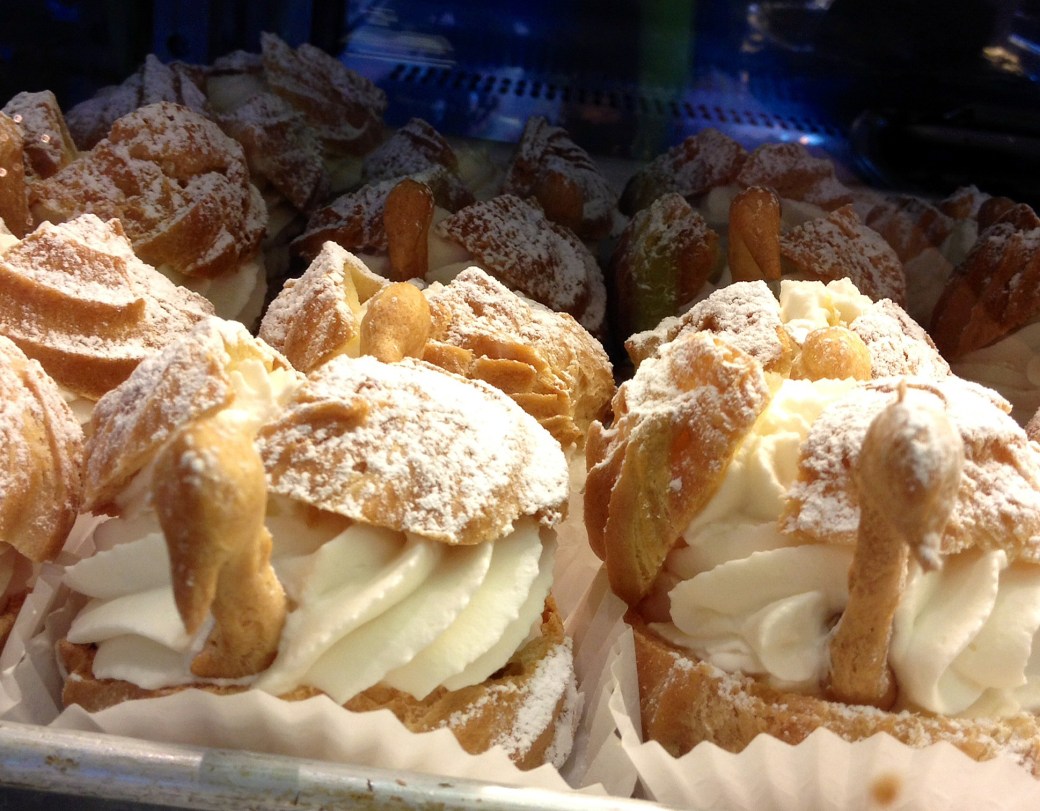
Swan cream puffs (at Mercuro L’Espresso Bar) (photo by Nina Munteanu)

p.s. No good sojourn is without its conclusion and mine began with the bus ride home as it neared the supper hour … It seems that by then all that caffein in my system was truly kicking in; I could hardly sit still during the forty minute ride and if I’d had a computer or pen and paper, surely would have speed written a tome the size of War and Peace by the end of my journey.

But I didn’t. So, I didn’t (tiny smile).

nina-munteanuNina Munteanu is an ecologist, limnologist and internationally published author of award-nominated speculative novels, short stories and non-fiction. She is co-editor of Europa SF and currently teaches writing courses at George Brown College and the University of Toronto. Visit www.ninamunteanu.ca for the latest on her books.

Coming Home to Water at Stir Coffee House

Nina-LadnerPier copy

Nina on Ladner pier

For several years I’ve been returning from Toronto—where I teach at The University of Toronto and George Brown College—to Ladner, BC to spend my summers.

I cherish the time as a chance to see family and friends and to enjoy a different pace of life—one I enjoyed when I used to live and work here and where I brought up my family. We lived in a comfortable house on a quiet street and our back yard faced one of Ladner’s sloughs and beyond that a vast tract of farmland, most often scored with rows of potato plants. My son Kevin had grown up swimming in the slough and jumping off the rope swing his dad had constructed. Pilgrims from close and far came to use that swing and enjoy the murky waters of our back slough.

Rope swing copy

Kevin on the rope swing

Parties at our place always involved water and getting wet. We even had a fleet of kayaks and canoes that we took on paddling adventures through farmland and under highways, with the occasional siting of muskrat, carp, heron, or eagle. Coyotes whined and barked at night as bats dipped through the night air, foraging for food. My female cat poised for the hunt and sometimes brought in her “catch of the day.”

Cathleen-Nina-Ladner1 copy

Cathleen and Nina at Stir

This summer, good friend and writer Cathleen Chance Vecchiato decided I should give a talk to my old community on Water Is… my recent bestselling book on water. With that, she immediately made it happen. The venue was already decided: the best café in Ladner, Stir Coffee House. I’d taken Cathleen there the previous year as part of a tour of the old farming and fishing village. Cathleen was charmed by the village atmosphere.

Stir Coffee House was happy to host a talk and Robert and Cathleen proceeded to plan it. Ian Jacques at The Delta Optimist wrote a wonderful piece on my journey, the talk and the book.

Nina-WaterIs-OPTIMIST2018 copy

On the evening of August 16th a growing crowd of people, eager for more on this precious substance flowed into the café until there was hardly a seat left in the cozy venue. I recognized some locals as well as colleagues from my environmental consulting days in Vancouver. It was a good crowd.

Coffee-Water-StirCoffeeHouse copy

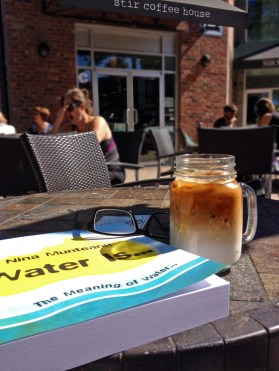
Water Is… snug against an iced latte

I shared the story of how I came to write this book—not a limnology book for non-scientists, as I thought I was going to write—but something that was more than science. Something that encompassed so much more about water: what it means to each of us and how we still don’t understand its many magical anomalous properties. I confided my discovery that the synchronicity of important moments in my life were all connected to water, which compelled the book to evolve into a study of “what water means to us.” Good friend Emmi Itäranta, author of Memory of Water, called Water Is… a biography of water.

Travelling the world has helped me realize that I was blessed with an abundance of water. I lived my entire life in a country of plentiful and healthy water. And for most of that time I didn’t even realize it. Canada holds one fifth of the world’s fresh water in lakes, rivers, and wetlands, as well as in our underground aquifers and glaciers. Canada’s wetlands, which cover more than 1.2 million square kilometres, makes Canada the largest wetland area in the world.

Nina-Hope-Trevor Stir copy

Nina with hosts Hope and Trevor

Perhaps it is no coincidence that Canada is steward of the world’s largest wetlands. Wetlands include marshes, swamps, fens, and bogs, all irreplaceable habitat for a huge diversity of nesting, feeding and staging waterfowl, reptiles, amphibians and mammals—many at risk. Wetlands provide a major filtration system, removing contaminants, improving water quality and renewing water’s vitality; wetlands serve as reservoirs, controlling and reducing flooding toward a more balanced hydrological cycle. Wetlands are a source of oxygen and water vapour, serving a vital role in our global atmospheric and climatic cycles. As ecotones— transitional areas—wetlands protect coasts from erosion and provide exceptional opportunity for boundary interaction and the emergence of vitality. Like a good metaphor, wetlands “recognize” and encompass similarities between dissimilarities. Wetlands powerfully connect. Canada’s strong multi-cultural policies and its open tolerance in embracing and celebrating diversity makes it the “wetland” of the world.

When I turn on the water tap in my house in Canada, it is pure drinking water. I don’t need to boil it or filter it or test it for impurities and toxins. I am confident that it will nourish and hydrate me like water should. I can bathe without restriction. I can play with it.

My water hasn’t changed; but I have. I do not take it for granted. I know that I am blessed.

I am home and I am so grateful.


In the Moment-anthology copyPart of this article is an excerpt from Nina Munteanu’s “Coming Home to Water” first published in “In the Moment” (A Hopeful Sign) edited by Gary Doi, September 2016; reprinted in “The Earth We Love” (Mississauga Writers) edited by Elizabeth Banfalvi, September 2018; and “The Literary Connection IV: Then and Now” (IOWI) edited by Cheryl Antao Xavier, upcoming 2018.


nina-munteanuNina Munteanu is an ecologist, limnologist and internationally published author of award-nominated speculative novels, short stories and non-fiction. She is co-editor of Europa SF and currently teaches writing courses at George Brown College and the University of Toronto. Visit www.ninamunteanu.ca for the latest on her books.


Nina Munteanu Talks Writing and Water on “Liquid Lunch” on That Channel

Nina Munteanu discusses her eco-fiction and water’s strange properties with Hildegard Gmeiner and Hugh Reilly on Liquid Lunch.

Nina Munteanu

Nina Munteanu is an ecologist, limnologist and internationally published author of award-nominated speculative novels, short stories and non-fiction. She is co-editor of Europa SF and currently teaches writing courses at George Brown College and the University of Toronto. Visit www.ninamunteanu.ca for the latest on her books.

On Being a Canadian Writer in the Age of Water

Canada is the only country in the world that knows how to live without an identity.”—Marshal McLuhan 

nina-child01

Nina  “reading” in Granby, Quebec

I was born some sixty+ years ago, in the small town of Granby in the Eastern Townships to German-Romanian parents. Besides its zoo—which my brother, sister and I used to visit to collect bottles for a finder’s fee at the local treat shop—the town had no particular features. It typified French-Canada of that era. So did I. I went to school in Quebec then migrated across to the west coast to practice and teach limnology. Given that Canada holds at any one time a fifth of the Earth’s freshwater, that also made sense.

Canada is a vast country with a climate and environment that spans from the boreal forests of the Canadian Shield, muskegs of northern BC, and tundras of the Arctic Circle to the grasslands of the Prairies and southern woodlands of Ontario and Quebec. Canada’s environment is vast and diverse. Like its people.     

Ecologist vs Nationalist

Ecology is the study of “home” (oikos means ‘home’ in Greek). Ecology studies the relationships that make one’s home functional. It is, in my opinion, the most holistic and natural way to assess where we live. My home is currently Toronto, Ontario, Canada and ultimately the planet Earth.

Country_road_Stephane_Lemire

The Eastern Townships in autumn are a cornucopia of festive colours.

Growing up in the Eastern Townships of Quebec, I’d always felt an abiding sense of belonging and I resonated with Canada’s national symbols—mostly based on Nature and found on our currency, our flag, and various sovereign images: the loon, the beaver, the maple tree, our mountains and lakes and boreal forests. Why not? Canadians are custodians of a quarter of the world’s wetlands, longest river systems and most expansive lakes. Most of us recognize this; many of us live, play and work in or near these natural environments.

I have long considered myself a global citizen with no political ties. I saw my country through the lens of an ecologist—I assessed my community and my surroundings in terms of ecosystems that supported all life, not just humanity. Was a community looking after its trees? Was my family recycling? Was a corporation using ‘green’ technology? Was a municipality daylighting its streams and recognizing important riparian zones? I joined environmental movements when I was a teenager. I shifted my studies from art to science because I wanted to make a difference in how we treated our environment. After university, I joined an environmental consulting firm, hoping to educate corporations and individuals as environmental stewards. I brought that philosophy into a teaching career and began writing eco-fiction, science fiction and essays to help promote an awareness and a connection with our natural world. My hope was to illuminate how important Nature and water is to our planet and to our own well-being through an understanding of ecology and how everything is interconnected.

US-tour and Desolation Sound 260 copy

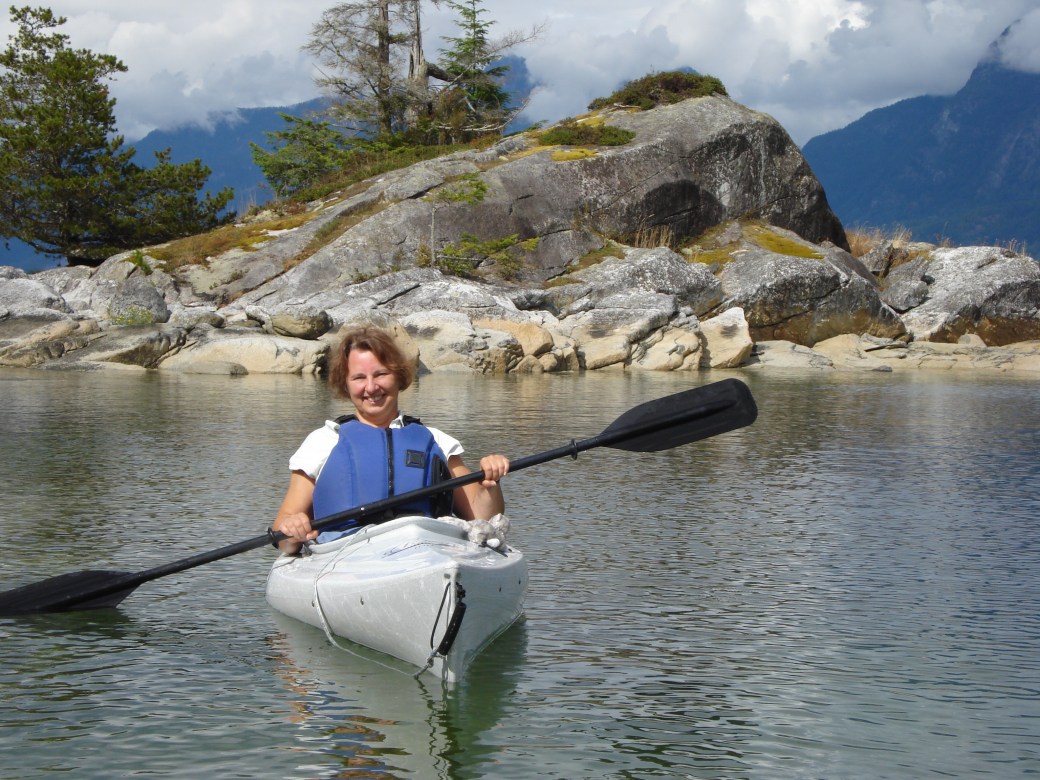
Nina kayaking Desolation Sound in British Columbia

When I think of Canada, I think of my “home”, where I live; my community and my environment. I have traveled the world and I feel a strong sense of “home” and belonging every time I return. Canada is my home. I was born and grew up in Quebec. I lived in British Columbia, Ontario, and Nova Scotia; each of these places engendered a feeling of “home”.

lunenburg-keel-laying

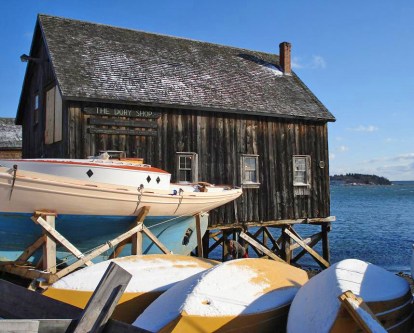
The Dory Shop in Lunenburg, Nova Scotia

I think that part of being a Canadian is related to this sense of belonging (and pride) in a country that is not tied to some core political identity or melting-pot mainstream.

Historian and writer Charlotte Gray wrote:

“we live in a country that has a weak national culture and strong regional identities …Two brands of psychological glue bind Canada together: political culture and love of landscape…[in] a loose federation perched on a magnificent and inhospitable landscape—[we are] a nation that sees survival as a collective enterprise.”—Charlotte Gray

barkerville marsh 9

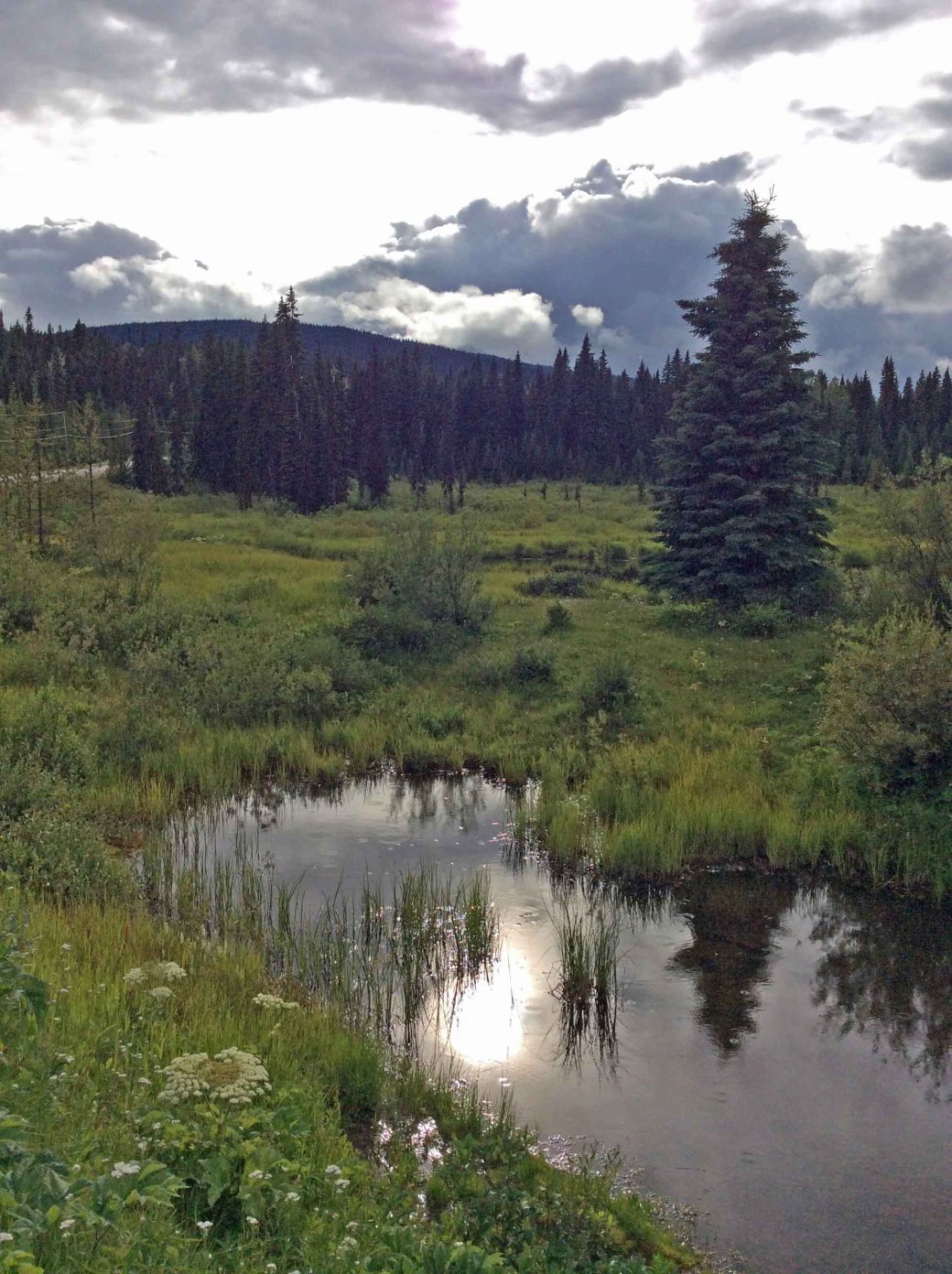
Marsh near Barkerville, BC (photo by Nina Munteanu)

Canada as Postnational State

In October 2015, Canada’s Prime Minister Justin Trudeau told the New York Times that Canada may be the “first postnational state,” adding that “there is no core identity, no mainstream in Canada.” This is largely because Canadians, writes Charles Forman in the Guardian, are “philosophically predisposed to an openness that others find bewildering, even reckless.”

Trudeau-RollingStoneTo anyone but a Canadian, Trudeau’s remark would rankle, particularly in a time when many western countries are fearfully and angrily turning against immigration through nativism and exclusionary narratives. A time when the United States elected an authoritarian intent on making “America great again” by building walls. A time when populist right-wing political parties hostile to diversity are gaining momentum in other parts of the world. “Canada’s almost cheerful commitment to inclusion might at first appear almost naive,” writes Forman. It isn’t, he adds. There are practical reasons for keeping our doors open.

We are who we are because of what we are: a vast country the size of Europe. A country dominated by boreal forest, a vital and diverse wilderness that helps maintain the well-being of our entire planet. A land that encompasses over a fifth of the freshwater in the world, and a quarter of the world’s wetlands. Canadians are ultimately the world’s Natural stewards. That is who and what we are.

Eramosa River 3

Eramosa River, Ontario (photo by Nina Munteanu)

According to Forman, postnationalism frames how “to understand our ongoing experiment in filling a vast yet unified geographic space with the diversity of the world” and a “half-century old intellectual project, born of the country’s awakening from colonial slumber.” As the first Europeans arrived in North America, the Indigenous people welcomed them, taught them how to survive and thrive amid multiple identities and allegiances, writes Forman. “That welcome was often betrayed, particularly in the 19th and 20th centuries, when settlers did profound harm to Indigenous people.” But, says Forman, if the imbalance remains, so does the influence: a model of another way of belonging. One I think many Canadians are embracing. We are learning from the natural wisdom of our Indigenous peoples. Even our fiction reflects how we value our environment and embrace diversity. “Diversity fuels, not undermines, prosperity,” writes Forman.

As efforts are made to reconcile the previous wrongs to Indigenous peoples within Canada and as empowering stories about environment are created and shared, Canada carries on the open and welcoming nature of our Indigenous peoples in encouraging immigration. In 2016, the same year the American government announced a ban on refugees, Canada took in 300,000 immigrants, which included 48,000 refuges. Canada encourages citizenship and around 85% of permanent residents typically become citizens. Greater Toronto is currently the most diverse city in the world; half of its residents were born outside the country. Vancouver, Calgary, Ottawa and Montreal are not far behind.

kevin-nina-close

Mom and son explore BC wilderness

Canadian author and visionary Marshal McLuhan wrote in 1963 that, “Canada is the only country in the world that knows how to live without an identity.” This is an incredible accomplishment, particularly given our own colonial history and the current jingoistic influence of the behemoth south of us.

Writer and essayist Ralston Saul suggests that Canada has taken to heart the Indigenous concept of ‘welcome’ to provide,

“Space for multiple identities and multiple loyalties…[based on] an idea of belonging which is comfortable with contradictions.”

Of this Forman writes: “According to poet and scholar BW Powe, McLuhan saw in Canada the raw materials for a dynamic new conception of nationhood, one unshackled from the state’s ‘demarcated borderlines and walls, its connection to blood and soil,’ its obsession with ‘cohesion based on a melting pot, on nativist fervor, the idea of the promised land’. Instead, the weakness of the established Canadian identity encouraged a plurality of them—not to mention a healthy flexibility and receptivity to change. Once Canada moved away from privileging denizens of the former empire to practicing multiculturalism, it could become a place where ‘many faiths and histories and visions would co-exist.”

NaturalSelection-front-webAnd that’s exactly what is happening. We are not a “melting pot” stew of mashed up cultures absorbed into a greater homogeneity of nationalism, no longer recognizable for their unique qualities. Canada isn’t trying to “make Canada great again.”

Canada is a true multi-cultural nation that celebrates its diversity: the wholes that make up the wholes.

Confident and comfortable with our ‘incomplete identity’—recognizing it for what it is—is according to Forman, “a positive, a spur to move forward without spilling blood, to keep thinking and evolving—perhaps, in the end, simply to respond to newness without fear.”

This resonates with me as an ecologist. What I envision is a Canada transcending the political to embrace the environment that both defines us and provides us with our very lives; a view that knows no boundaries, and recognizes the importance of diversity, relationship and inclusion, interaction, movement, and discovery.

So, am I proud of Canada? Definitely. We have much to be proud of. Canada is the 8th highest ranking nation in the Human Development Index. Canada ranks among the highest in international measurements of government transparency, civil liberties, quality of life, economic freedom, and education. It stands among the world’s most educated countries—ranking first worldwide in the number of adults having tertiary education with 51% of adults holding at least an undergraduate college or university degree. With two official languages, Canada practices an open cultural pluralism toward creating a cultural mosaic of racial, religious and cultural practices. Canada’s symbols are influenced by natural, historical and Aboriginal sources. Prominent symbols include the maple leaf, the beaver, Canada Goose, Common Loon, the Royal Canadian Mounted Police, the polar bear, the totem pole, and Inuksuk.

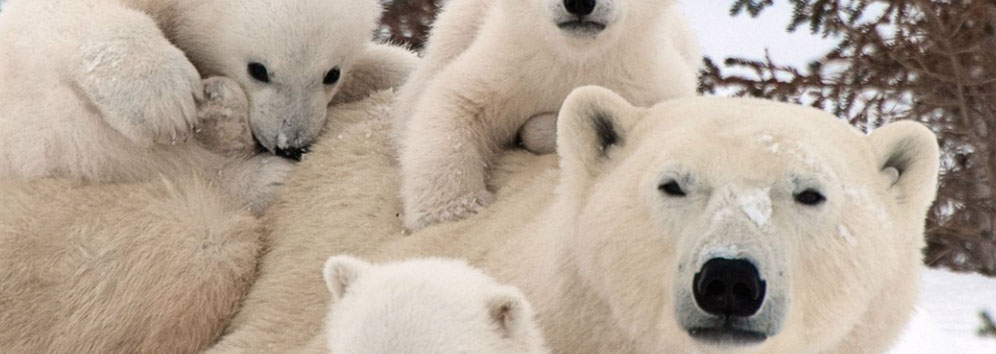
PolarBearMum-pups

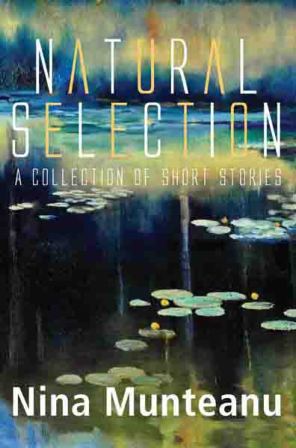
Water Is-COVER-webWe are a northern country with a healthy awareness of our environment—our weather, climate and natural world. This awareness—particularly of climate change—is more and more being reflected in our literature—from Margaret Atwood’s “Maddaddam” trilogy and Kim Stanley Robinson’s “2041” to my short story collection “Natural Selection” and non-fiction book Water Is… .

Water AnthologyCanadians are writing more eco-fiction, climate fiction, and fiction in which environment somehow plays a key role.

Water has become one of those key players: I recently was editor of the Reality Skimming Press anthology “Water”, a collection of six speculative Canadian stories that optimistically explore near-future scenarios with water as principle agent.

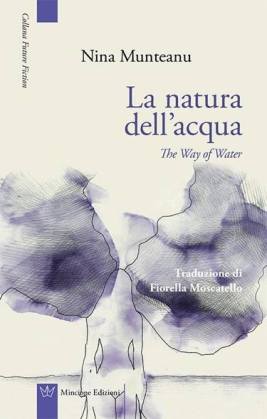
The Way of Water-COVERMy short story “The Way of Water” is a near-future vision of Canada that explores the nuances of corporate and government corruption and deceit together with resource warfare.

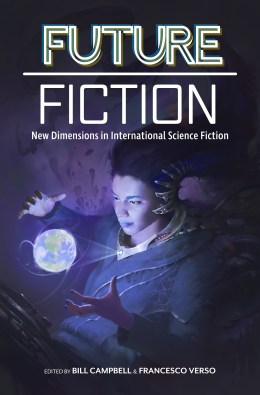
First published as a bilingual print book by Mincione Edizioni (Rome)  (“La natura dell’acqua”), the short story also appears in several anthologies including Exile EditionsCli Fi: Canadian Tales of Climate Change” and “Future Fiction: New Dimensions in International Science Fiction“.  My upcoming “A Diary in the Age of Water” continues the story.

Adobe Photoshop PDFCanadian writer and good friend Claudiu Murgan recently released his book “Water Entanglement“, which also addresses a near-future Canada premise in which water plays a major role.

In a recent interview with Mary Woodbury on Eco-Fiction, I reflected on a trend over the years that I noticed in the science fiction writing course I teach at George Brown College: “It’s a workshop-style course I teach and students are encouraged to bring in their current work in progress. More and more students are bringing in a WIP with strong ecological overtones. I’d say the percentage now is over 70%. This is definitely coming from the students—it’s before I even open my mouth about ecology and eco-fiction—and what it suggests to me is that the welfare of our planet and our ecosystems is on many people’s minds and this is coming through in our most metaphoric writing: science fiction.”

It is healthy to celebrate our accomplishments while remembering where we came from and what we still need to accomplish. This provides direction and motivation.

tree water deer lake

Deer Lake, BC (photo by Nina Munteanu)

Canadians are custodians of a quarter of the world’s wetlands, longest river systems and most expansive lakes. Canada is all about water… And so are we.

We are water; what we do to water we do to ourselves.

Happy Canada Day!


References:

Dechene, Paul. 2015. “Sci-Fi Writers Discuss Climate Catastrophe: Nina Munteanu, Author of Darwin’s Paradox.” Prairie Dog, December 11, 2015.

Forman, Charles. 2017. “The Canada Experiment: Is this the World’s First Postnational Country?” The Guardian, January 4, 2017.

Gray, Charlotte. 2017. “Heroes and Symbols” The Globe and Mail.

Moorhouse, Emilie. 2018. “New ‘cli-fi’ anthology brings Canadian visions of future climate crisis.” National Observer, March 9, 2018.

Munteanu, Nina. 2016. “Crossing into the Ecotone to Write Meaningful Eco-Fiction.” In: NinaMunteanu.me, December 18, 2016.

Newman-Stille, Derek. 2017. “The Climate Around Eco-Fiction.” In: Speculating Canada, May 24, 2017.

Woodbury, Mary. 2016. “Part XV. Women Working in Nature and the Arts: Interview with Nina Munteanu, Ecologist and Author.” Eco-Fiction.com, October 31, 2016.

SONY DSC

Nina Munteanu on the Credit River, Ontario (photo by Merridy Cox)


nina-2014aaaNina Munteanu is an ecologist and internationally published author of award-nominated speculative novels, short stories and non-fiction. She is co-editor of Europa SF and currently teaches writing courses at George Brown College and the University of Toronto. Visit www.ninamunteanu.ca for the latest on her books. Nina’s recent book is the bilingual “La natura dell’acqua / The Way of Water” (Mincione Edizioni, Rome). Her latest “Water Is…” is currently an Amazon Bestseller and NY Times ‘year in reading’ choice of Margaret Atwood.


“Natural Selection”: Fascinating Dramas Set in a World Too Close to Our Own

NaturalSelection-front-web“I write SF about a near future ‘Gaian’ world too, and at times felt I was reading a prequel to my own novels, but that’s not why I rated this collection so highly. I did so for two reasons. First, because the science was so interesting, combining visionary metaphysical speculation with AI corporate tech in scenarios that often seemed chillingly possible. Second, because of the author’s focus on the effects of these developments on human beings with complex pasts and desires. Jealousy, lust, loneliness, grief and love are all drivers of these taut and fascinating narratives…”–Amazon Review


Author’s Introduction to Natural Selection

leaves02croppedEvolution is the language of destiny. What is destiny, after all, but self-actualization and synchronicity? If evolution is the language of destiny, then choice and selection are the words of evolution and “fractal ecology” is its plot.

How do we define today a concept that Darwin originated 200 years ago in a time without bio-engineering, nano-technology, chaos theory, quantum mechanics and the Internet? We live in an exciting era of complicated change, where science based on the limitation of traditional biology is being challenged and stretched by pioneers into areas some scientists might call heretical. Endosymbiosis, synchronicity, autopoiesis & self-organization, morphic resonance, Gaia Hypothesis and planetary intelligence. Some of these might more aptly be described through the language of meta-physics. But should they be so confined? It comes down to language and how we communicate.

Is it possible for an individual to evolve in one’s own lifetime? To become more than oneself? And then pass on one’s personal experience irrevocably to others—laterally and vertically?

leaf-sketchOn the vertical argument, the French naturalist Jean-Baptiste Lamark developed a theory of biological evolution in the early 19th century considered so ridiculous that it spawned a name: Lamarkism. His notion—that acquired traits could be passed along to offspring—was ridiculed for over two hundred years. Until he was proven right. Evolutionary biologists at Tel Aviv University in Israel showed that all sorts of cellular machinery—an intelligence of sorts—played a vital role in how DNA sequences were inherited. When researchers inserted foreign genes into the DNA of lab animals and plants, something strange happened. The genes worked at first; then they were “silenced”. Generation after generation. The host cells had tagged the foreign genes with an “off switch” that made the gene inoperable. And although the new gene was passed onto offspring, so was the off switch. It was Larmarkism in action: the parent’s experience had influenced its offspring’s inheritance. Evolutionists gave it a new name. They called it soft inheritance.

As for passing on one’s experience and acquisitions to others laterally, education in all its facets surely provides a mechanism. This may run the gamut from wise mentors, spiritual leaders, storytellers, courageous heroes to our kindergarten teacher.  Who’s to say that these too are not irrevocable? This relies, after all, on how we learn, and how we “remember”.

Evolution is choice. It is a choice made on many levels, from the intuitive mind to the intelligent cell. The controversial British botanist Rupert Sheldrake proposed that the physical forms we take on are not necessarily contained inside our genes, which he suggested may be more analogous to transistors tuned in to the proper frequencies for translating invisible information into visible form. According to Sheldrake’s morphic resonance, any form always looks alike because it ‘remembers’ its form through repetition and that any new form having similar characteristics will use the pattern of already existing forms as a guide for its appearance.  This notion is conveyed through other phenomena, which truly lie in the realm of metaphysics and lateral evolution; concepts like bilocation, psychic telegraphing, telekinesis and manifestation. Critics condemn these as crazy notions. Or is it just limited vision again? Our future cannot be foretold in our present language; that has yet to be written. Shakespeare knew this…

There are more things in heaven and earth, Horatio, than are dreamt of in your philosophy—Shakespeare

The nine stories contained herein touch on many of these concepts, spanning a 20-year writing period starting in the 1980s from “Arc of Time”, first published by The Armchair Aesthete in 2002, to “Julia’s Gift”, written in 2007, a year that marks a significant nexus in my personal evolution. That’s when I met someone who changed my life and defined my life path, my evolution, and ultimately, I suspect, my destiny.

Each story reflects a perspective on what it means to be human and evolve in a world that is rapidly changing technologically and environmentally. How we relate to our rapidly changing fractal environments—from our cells to our ecosystems, our planet and ultimately our universe—will determine our path and our destiny and those we touch in some way. My friend Heidi Lampietti, publisher of Redjack Books, expressed it eloquently, “For me, one of the most important themes that came through in the collection is the incredible difficulty, complexity, and importance of making conscious choices—and how these choices, large and small, impact our survival, either as individual humans, as a community, a species, or a world.”

Each story touches on a focal point, a nexus in someone’s personal evolution, where a decision—or an indecision—will define one’s entire later path in life. Several stories (e.g., “Butterfly in Peking”, “Frames” and “Julia’s Gift” all set in the same universe as my “Darwin’s Paradox” duology) explore this through war: a paradoxical struggle between those who follow the technological path and those who embrace nature’s intelligence. War is itself a paradox. It is both tragedy and opportunity. The very action of being at war seems to galvanize us and polarize us. War heightens contrast, increases pitch, and resonates through us in ways we have no inkling. It brings out the very worst but also the very best in us; for, as some of us sink into despair and self-serving debauchery, others heroically rise in altruistic service and humble sacrifice to help others. War defines us, perhaps like no other phenomenon.

Several stories are quirky adapted excerpts from my two books, “Darwin’s Paradox” (2007 by Dragon Moon Press) and its prequel “Angel of Chaos” (2010 by Dragon Moon Press). You will find some of the same characters there, though names have been changed to protect the innocent. You will also find the sprawling semi-underground AI-run city of Icaria (a post-industrial plague Toronto) and a character itself. Several of the characters portray “gifted” and troubled misfits—outcasts, anti-heroes, artists not in sync with the rest of the population. Yet how that person’s choices—and how s/he is treated by their community—would influence an entire species or world (“Mark of a Genius”, “Neither Here Nor There”, “Angel’s Promises”, and “Natural Selection”).

Lastly, I explore how humanity evolves, communicates and relates through forces larger than itself, either produced through its own making via technology (in “Virtually Yours”) or through timeless universal intervention (in “Arc of Time”). The last story (in fact the first written) provides a very different interpretation of an old biblical myth about new beginnings and our cyclical destiny of “creative destruction”.

I hope you enjoy reading them all. I enjoyed writing them.

“The Arc of Time” was first published in the Summer/Fall 2002 issue of The Armchair Aesthete. It was reprinted in Imagikon (2003) then scheduled for the premiere issue of Ultra! A charity issue dedicated to cystic fibrosis (Aardwolf Publications), Fall/Winter, 2004. Sadly, Lari Davidson, the editor and visionary behind the project passed away suddenly and the issue never came to fruition.

“Virtually Yours” first appeared in Issue 15 (December 2002) of Hadrosaur Tales.  It was reprinted in Neo-Opsis Science Fiction Magazine (Issue 3, Spring 2004) then translated into Polish and reprinted in the January 2006 issue of Nowa Fantastika (Poland). It was translated into Hebrew and reprinted in Bli-Panika (Israel) in 2006. “Virtually Yours” was selected for the 2006 “The Best of Neo-Opsis Science Fiction Magazine” anthology (Bundoran Press) and was nominated for the Canadian Aurora Prix and the Speculative Literature Foundation Fountain Award.

“Angel’s Promises” was published in Issue #30 (March, 2003) of Dreams & Visions then selected for the anthology “Skysongs II: Spiritual SF” (2005). It was nominated for the SLF Fountain Award.

“A Butterfly in Peking” was first published in Issue #17 (2003) of Chiaroscuro. It was translated into Polish and reprinted in the Summer 2005 issue of Nowa Fantastika (Poland) then translated and reprinted in The Dramaturges of Yann (Greece) in 2006.

“Mark of a Genius” first appeared in Scifidimensions (August 2004 issue) and “Neither Here Nor There” first appeared in Another Realm (September 2005).  “Frames”, “Julia’s Gift” and “Natural Selection” make their first appearance here.

Amazon description of Natural SelectionNaturalSelection-front-web

A man uses cyber-eavedropping to make love. A technocratic government uses gifted people as tools to recast humanity. The ruins of a city serve as battleground between pro-technologists and pro-naturalists. From time-space guardians to cybersex, GMO, and biotech implants, this short story collection by science fiction novelist Nina Munteanu promises a journey of great scope, imagination and vision.


nina-2014aaa

Nina Munteanu is an ecologist, limnologist and internationally published author of award-nominated speculative novels, short stories and non-fiction. She is co-editor of Europa SF and currently teaches writing courses at George Brown College and the University of Toronto. Visit www.ninamunteanu.ca for the latest on her books.
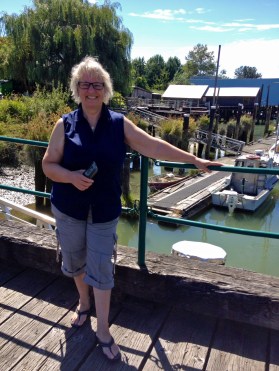


Nina Reads About Water at Oakville Literary Café in Joshua Creek Art Centre

House-road copy

Joshua Creek Art Centre (photo by Nina Munteanu)

In late May, I was invited to read from my short story “The Way of Water” and my recent book “Water Is…” at the Oakville Literary Café, held at the Joshua Creek Art Centre.


The Way of Water

“The Way of Water” has appeared in several collections and anthologies in Europe and North America and received praise from around the world, including: The National Observer, Prism International Magazine, Speculating Canada, SoloLibri in Italy, and most recently in Orson Scott Card’s The Intergalactic Medicine Show.

Lilac2-JoshuaCreekArtCentre

Joshua Creek Art Centre (photo by Nina Munteanu)

“The Chinese multinationals have exchanged the public debt of other states with their water reserves with which, now, they can control the climate, deciding when and where it will rain.Who understands this dirty game has been silenced, like Hilda’s mother, a limnologist, inexplicably arrested and never returned; like the daughter of two water vendors, mysteriously disappeared, after having decided not to bow to economic powers: Hanna, who now prefers secure virtual identities to evanescent real appearances. Water. The two, like the covalent bond of a complex molecule, develop a relationship of attraction and repulsion that will first make them meet and then, little by little, will change into a tormented love but, at the same time, so pure as to cause Hilda at great risk, to make an extreme decision that will allow Hanna to realize the strange prophecy that the internal voice, perhaps the consciousness of water, had resonated in the two women for a long time.” —Simone Casavecchia, SoloLibri.net

The Way of Water-COVERShe imagines its coolness gliding down her throat. Wet with a lingering aftertaste of fish and mud. She imagines its deep voice resonating through her in primal notes; echoes from when the dinosaurs quenched their throats in the Triassic swamps.

Water is a shape shifter.

It changes yet stays the same, shifting its face with the climate. It wanders the earth like a gypsy, stealing from where it is needed and giving whimsically where it isn’t wanted.

Dizzy and shivering in the blistering heat, Hilda shuffles forward with the snaking line of people in the dusty square in front of University College where her mother used to teach. The sun beats down, crawling on her skin like an insect. She’s been standing for an hour in the queue for the public water tap.

Exile-CanTales ClimateChange copyEmilie Moorhouse of Prism International wrote: “Soon after I finished reading the book, Cape Town—known in precolonial times as “the place where clouds gather”—announced that it was only a few months away from what it called “Day Zero,” the day the city would officially run out of water, making the similarities between fiction and reality more than unsettling. Munteanu’s story is set in a futuristic Canada that has been mined of all its water by thirsty corporations who have taken over control of the resource. Rain has not fallen on Canadian soil in years due to advances in geoengineering and weather manipulation preventing rain clouds from going anywhere north of the Canada-US border.”

“In ‘The Way of Water’, Nina Munteanu pens her love letter to water, exulting it as a liquid that has semi-magical properties…’The Way of Water’ evokes a sense of awareness about issues of access to water and about the dangers of imbalances in that access.”—Derek Newman-Stille, Speculating Canada

FF - Rosarium Cover copy“…In an interesting scarcity future in which we follow the fate of a character abandoned by her mother, water itself becomes a character. In the second paragraph we’re told that “Water is a shape shifter,” and in the next page we encounter the following description: “Water was paradox. Aggressive yet yielding. Life-giving yet dangerous. Floods. Droughts. Mudslides. Tsunamis. Water cut recursive patterns of creative destruction through the landscape, an ouroboros remembering.” These descriptive musings cleverly turn out to be more than metaphors and tie in directly to the tale’s surprising ending.”—Alvaro Zinos-Amaro, IntergalacticMedicineShow.com


Water Is-COVER-webWater Is… The Meaning of Water

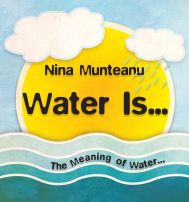
I also read from my non-fiction book “Water Is… The Meaning of Water.” I read several quotes from “Water Is…”. The water quotes had earlier been displayed at a photographic art exhibition in the Great Hall of the Mississauga Civic Centre. The art exhibition celebrated the Waterfront Connection wetland construction, a realized vision of the late Jim Tovey.

Morphology-Looking Up

Photo Art in the Great Hall of the Mississauga Civic Centre

WaterIs story-photo

Quote from Nina Munteanu’s “Water Is…” displayed alongside photo art

Water-travel

Quote from “Water Is…” displayed at the Civic Centre in Mississauga


Joshua Creek Heritage Art Centre

JoshuaCreekArtCentre

Back patio of Joshua Creek Art Centre (photo by Nina Munteanu)

Envisioned by Sybil Rampen as a place to meet, collaborate and cultivate relationships, the Joshua Creek Heritage Art Centre was established at the 1827 heritage house on Rampen’s family farm on Burnhamthorpe Road in Oakville. The art centre serves the community as a gathering place—creative media workshops, films, musical events, lectures and weddings. The facility promotes local heritage and accessibility. Ecological integrity remains central to its activities.

Joshua Creek

JoshuaCreek

JoshuaCk05

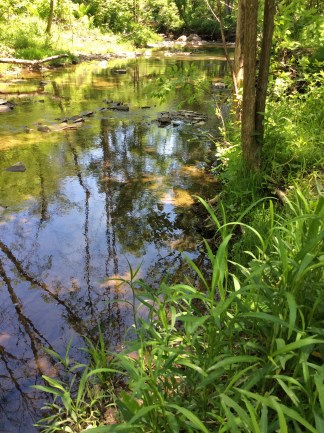
Joshua Creek (photo by Nina Munteanu)

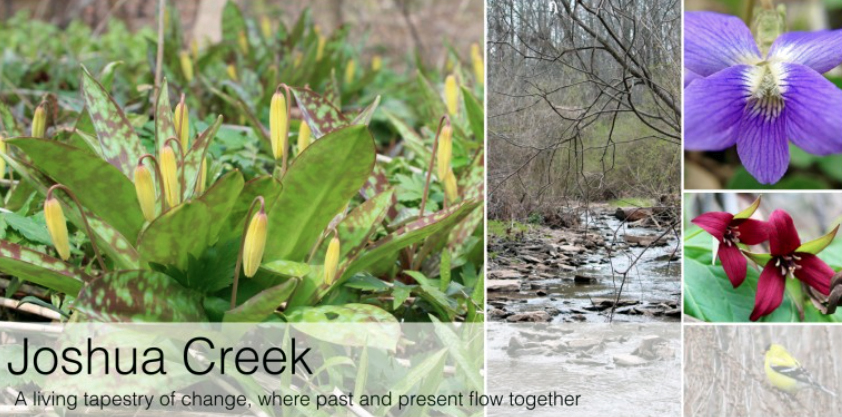
Joshua Creek originates near the art centre north of Burnhamthorpe Road and flows about 6 km south through the farm then mostly forest, eventually emptying into Lake Ontario. I was told that the creek has good water quality, apparently the best in the county. Oakvillegreen.org provides some history on Joshua Creek:

“Joshua Creek exists as a patchwork of past glories and present changes on a very dynamic and human-controlled landscape… many of its lands were cleared and altered beyond recognition, with only certain key areas left mostly to nature. In spite of these influences, Joshua Creek is home to 3 small Environmentally Sensitive Areas (ESAs), although two of these – Joshua Creek Valley and Wildflower Woods – have declined since they were highlighted in the 1970’s, and while still valuable, may no longer qualify as ESAs in the future. In only a handful of decades, development has quickly covered most of the lower two thirds of the creek’s land base, including important parts of its ESAs. In several areas, Joshua’s natural winding “meander” has been artificially straightened in order to efficiently use the land on either side. And in many places, foreign species have invaded the natural areas of the creek, changing the ecosystem in a big way.

JoshuaCk03But Joshua is a spirited creek – in spite of all it has been through, Joshua Creek is among the top two urban creeks for healthy water quality, and is still inhabited by a variety of aquatic animals like small fish and insects. Joshua Creek is home to forests, wetlands and thickets with around 150 plant species, and provides an important natural habitat corridor for the movement of birds and other animals, including migratory species. Rather than exclusively shrinking, there are also areas of Joshua Creek that are actually in the middle of regrowing their forests, and in spite of everything, Joshua still retains some beautiful gems of natural areas.”

nina-2014aaa

Nina Munteanu is an ecologist, limnologist and internationally published author of award-nominated speculative novels, short stories and non-fiction. She is co-editor of Europa SF and currently teaches writing courses at George Brown College and the University of Toronto. Visit www.ninamunteanu.ca for the latest on her books.

JoshuaCreek-WaterBanner


National Observer Praises Nina Munteanu’s “The Way of Water”

Exile-CanTales ClimateChange copyNina Munteanu’s “The Way of Water” and the anthology in which it appears was recently praised by Emilie Moorhouse in Prism International Magazine, in a review entitled “Courage and Imagination in Cli-Fi: Canadian Tales of Climate Change”. The review was also carried by the National Observer:

“The seventeen stories in this book edited by Bruce Meyer examine how humankind might struggle with the potential devastation of climate change in the near or distant future. Soon after I finished reading the book, Cape Town—known in precolonial times as “the place where clouds gather”—announced that it was only a few months away from what it called “Day Zero,” the day the city would officially run out of water, making the similarities between fiction and reality more than unsettling.

Munteanu’s story is set in a futuristic Canada that has been mined of all its water by thirsty corporations who have taken over control of the resource. Rain has not fallen on Canadian soil in years due to advances in geoengineering and weather manipulation preventing rain clouds from going anywhere north of the Canada-US border. . . I believe that fiction offers up two much-needed ingredients in the fight to prevent climate change: courage and imagination. It is my hope that more fiction writers will take up the task of writing in this promising new genre and use their imagination to inspire readers to collectively work towards a more sustainable future.”—Emilie Moorhouse, Prism International

La natura dell'acqua copy 3The Way of Water” (La natura dell’acqua) was translated by Fiorella Smoscatello for Mincione Edizioni. Simone Casavecchia of SoloLibri.net, describes “The Way of Water” in her review of the Italian version:

” ‘The Way of Water’ is to be ‘a shapeshifter,’ says Nina Munteanu in her dystopian narrative, where she draws a dark scenario and, unfortunately, not too improbable in the near future. In the universe of the story water has become a very precious commodity: rationed consumption, credits (always of water) accounted for and debts collected…The Chinese multinationals have exchanged the public debt of other states with their water reserves with which, now, they can control the climate, deciding when and where it will rain. Who understands this dirty game has been silenced, like Hilda’s mother, a limnologist, inexplicably arrested and never returned; like the daughter of two water vendors, mysteriously disappeared, after having decided not to bow to economic powers: Hanna, who now prefers secure virtual identities to evanescent real appearances. Water. The two, like the covalent bond of a complex molecule, develop a relationship of attraction and repulsion that will first make them meet and then, little by little, will change into a tormented love but, at the same time, so pure as to cause Hilda at great risk, to make an extreme decision that will allow Hanna to realize the strange prophecy that the internal voice, perhaps the consciousness of water, had resonated in the two women for a long time.

Nina Munteanu recounts that this element is also a form of love; a story to read, not only to deal with the possible but, above all, to understand that the time still available to “love” may be less than what we believe.”—Simone Casavecchia, SoloLibri.net

Derek Newman-Stille of Speculating Canada, offers the following insight on “The Way of Water”:

WayOfWater-SpecCanada-REVIEW-pg2

FF - Rosarium Cover copyThe Way of Water” will also appear alongside a collection of international works (including authors from Greece, Nigeria, China, India, Russia, Mexico, USA, UK, Italy, Canada (yours truly), Cuba, and Zimbabwe) in Bill Campbell and Francesco Verso’s Rosarium Publishing / Future Fiction’s anthology “New Dimensions in International Science Fiction” in April 2018.


nina-2014aaaNina Munteanu is an ecologist, limnologist and internationally published author of award-nominated speculative novels, short stories and non-fiction. She is co-editor of Europa SF and currently teaches writing courses at George Brown College and the University of Toronto. Visit www.ninamunteanu.ca for the latest on her books. 
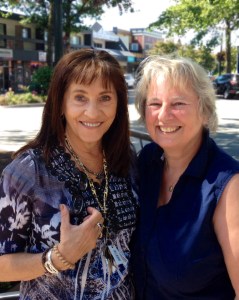
When Do You Know Your Story Is Finished?

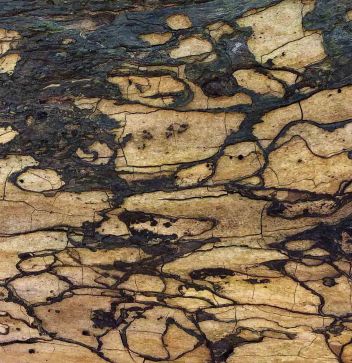
patterns-Spalting-LR

Spalted maple log (photo by Nina Munteanu)

A student of mine once asked me how many drafts it took to get the final version of a story. I answered cagily: as many as you need. I wasn’t trying to be cheeky or elusive. In truth, this is a question that only you can answer; and it will be different with each story you write.

George Lucas once said in an interview about the remaking of Star Wars that in the film industry, projects were never finished; only abandoned. What he meant by this was that at some point in the creative and revision process of polishing a story, you have to stop and show it to the world. Let your baby walk and stand on its own.

This is a big step for all beginning writers and many will freeze. Terrified at the idea of failure or censure, they end up sabotaging their own work. If you’re emotionally or psychologically not ready for the consequences of getting published, then you will falter, procrastinate, forever fuss over your creations and convince yourself that it isn’t ready. In truth, it’s you who aren’t ready.

This is a shame because to have written an entire novel is a great accomplishment. You’ve already done what over 80% of those who embark on a book don’t do: finish it. To halt the process by entering a perpetual cycle of revision is admitting defeat when you have really won the major battle. It’s like that fatal stumble on the last leg of a homerun.

If the idea is to publish, then you need to give yourself a kind of deadline or goal, based on something that makes sense to you and is achievable. This could even include a time deadline.

Robert J. Sawyer’s response to the question of “when do you stop revising?” was: “When you’ve taken out all the boring bits.” That may seem on the face of it either too simple or too abstract. But, in fact, he is right on the mark. However, to truly achieve that conclusion and consequently get your manuscript to where it is meant to be without you lingering like a frightened ghost, you need to accurately perceive what “boring” is. In order to do this you need to do several things.

The first is to gain objectivity of your work. You accomplish this by setting it aside for a while and letting it “breathe” (really, you’re letting yourself breathe). By distancing yourself a little from your work, you are able to return with a fresh outlook and read it more like a reader. Your “boring” meter will be running better this way and you will be in a better position to pick out redundancies, overly long exposition and detail, lack of context, “talking heads”, lack of action or tension, and confusing or awkward sentences. The other thing you gain with distance is the ability to describe your book’s theme and major plot. What is it really about? You need to reach the point where you can describe it in a couple of sentences or even a few words as you would describe a movie you like to a curious friend who hasn’t seen it yet.

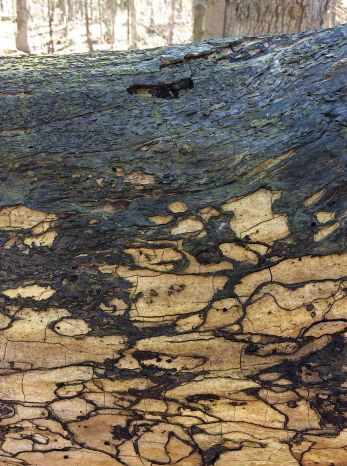
patterns-Spalting log and blu-green stain fungus LR

Carbon cushion fungus spalting maple log (photo by Nina Munteanu)

Once you’ve gained some objectivity, you can critique each scene and each character for his or her plot purpose within that central plot and theme. You can also assess each sub-plot’s role within the major plot and theme. When every paragraph within every scene within every chapter of your story scintillates with purpose and meaning, you have accomplished your task of removing the boring bits. Now you have a story that is finished.

Art is self-expression and expression is a reflection of the culture and time in which you live. Stories are a snapshot of time and place. Treat your art like life; some revision is good but at some point you need to just LIVE. Let go of your work and move on to the next chapter.


Nina MunteanuNina Munteanu is an ecologist, limnologist and internationally published author of award-nominated speculative novels, short stories and non-fiction. She is co-editor of Europa SF and currently teaches writing courses at George Brown College and the University of Toronto. Visit www.ninamunteanu.ca for the latest on her books.


Sensual Writing and Why I Love the Smell of Smoke

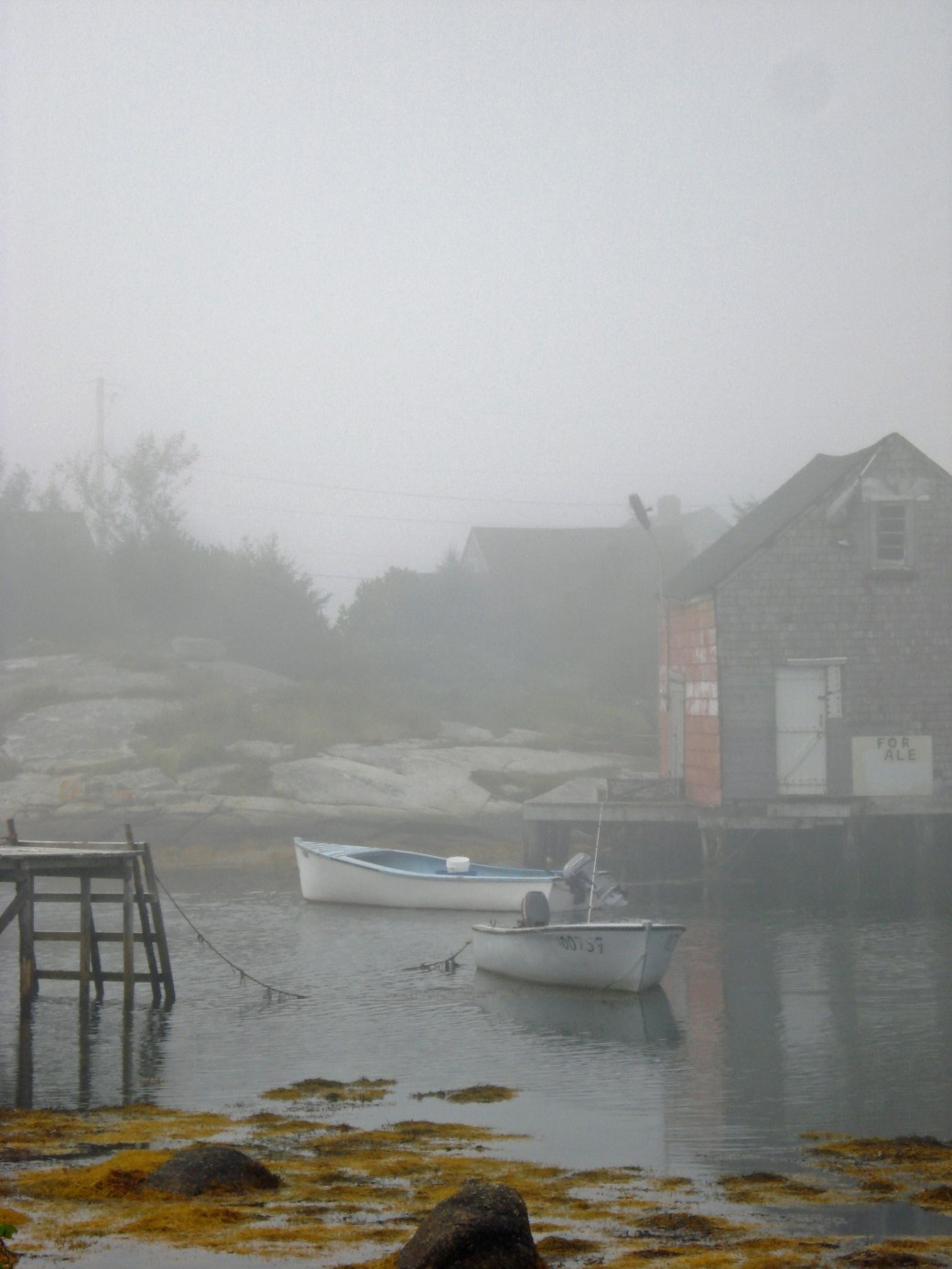
Prospect Point-fog

Prospect Point, NS (photo by Nina Munteanu)

Last week, as I was driving along a winding country road on my way to Bridgewater from Lunenburg, I ran across the smoke of a small fire. They were obviously doing some roadside spring clearing.

Without thinking, I slid the window open and inhaled deeply. I was preparing to experience the exquisite “taste of home”. As I breathed in the aroma of burning vegetation, memories of outdoor campfires and old wood-burning stoves flooded in from my childhood. A goofy smile slid across my face as I bathed in the joyful innocence of adventure, wonder and the comfort of the hearth. I’d had a wonderful childhood and the smell of smoke brought it back to me in its full glory.

What does this have to do with sensual writing? Everything. Storytelling shares universal truth through metaphor, delivered from the heart. Sensual writing doesn’t just involve making sure to include at least a few senses like sight, sound, smell, taste and touch in your narrative. To write sensually involves much more than the simple description of a sense, though this is certainly the first step (and something all too often neglected by novice writers). To not connect a described sense to a memory or emotion is to miss a very important opportunity as a storyteller: that of enlightening the reader on some aspect of the point of view (POV) character experiencing the sense (things like their history, the quality and nature of their relationships, their viewpoints, education, prejudices, how and what they’ve experienced in their life).

Here’s what I mean:

EXAMPLE 1: Ben walked into the Grand Banker Pub and immediately caught the tantalizing aroma of garlic and pears amid the din of jubilant laughter, cackles and desultory conversation. The amber light enhanced the rich tones of nautical oak. Ben saw some friends drinking in the corner and sauntered toward them, smiling.

farm in fog-Liverpool NS

Farm near Liverpool, NS (photo by Nina Munteanu)

EXAMPLE 2: Ben stopped at the door of the Grand Banker Pub, inhaling the exquisite aroma of garlic and pears amid the din of jubilant laughter, cackles and desultory conversation. For a moment he was back on the boat, reliving the party that changed his life. He’d stopped eating pears after that. Ben caught sight of his friends drinking in the corner, beneath the amber light. Like a sailor seizing a rope, he sauntered toward them, a huge smile pasted on his face.

The first example describes; the second example emotes. The first example nicely describes the place but it doesn’t provide us with any information about Ben, except that he likes the aroma of garlic and pears. We don’t know why. In the second example, his senses are used to hint at intrigue linked to memories that, in turn, are linked to the associated sense—in this case the smell of garlic and pears. This is the power of sensual writing. Bringing it back home.

Nina MunteanuNina Munteanu is an ecologist, limnologist and internationally published author of award-nominated speculative novels, short stories and non-fiction. She is co-editor of Europa SF and currently teaches writing courses at George Brown College and the University of Toronto. Visit www.ninamunteanu.ca for the latest on her books.