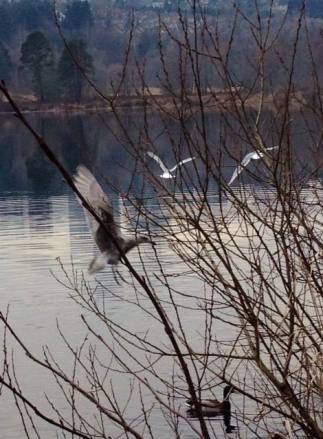
Birds over Deer Lake, BC (photo by Nina Munteanu)
“In their simplest form, symbols are anything outward that stands in for anything inward or abstract, such as a mood or an idea,” writes Donald Maass in Writing the Breakout Novel Workbook. As representations, symbols often serve as markers in a story. They may be a talisman, a totem that inspires a shift or awakening. In story, a symbol—particularly as talisman—may come as a gift to a character in need of inspiration. In the Hero’s Journey trope, this is often provided by a mentor archetype.
An example in story is the light saber that Obi Wan Kenobi presents to Luke Skywalker to aid him on his journey as a Jedi master. Symbols often reoccur as motif to incite an emotional trigger or turning point for a character.
Symbolism in literature provides richness, colour and depth of meaning. Use of symbols helps deepen theme beyond conscious appreciation and into emotional and subconscious levels. Symbolism can be portrayed through figure of speech in which an object or situation has another meaning than its literal meaning. It can also express through the actions and observations of a character, language or event that creates deeper meaning through context.
Maass provides the example of Barbara Kingsolver’s The Poisonwood Bible to depict superb use of symbol in storytelling:
She is inhumanly alone. And then, all at once, she isn’t. A beautiful animal stands on the other side of the water. They look up from their lives, woman and animal, amazed to find themselves in the same place. He freezes, inspecting her with his black-tipped ears. His back is purplish-brown in the dim light, sloping downward from the gentle hump of his shoulders. The forest’s shadows fall into lines across his white-striped flanks. His stiff forelegs play out to the sides like stilts, for he’s been caught in the act of reaching down for water. Without taking his eyes from her, he twitches a little at the knee, then the shoulder, where a fly devils him. Finally he surrenders his surprise, looks away, and drinks. She can feel the touch of his long, curled tongue on the water’s skin, as if he were lapping from her hand. His head bobs gently, nodding small, velvet horns lit white from behind like new leaves.
It lasted just a moment, whatever that is. One held breath? An ant’s afternoon? It was brief, I can promise that much, for although it’s been many years now since my children ruled my life, a mother recalls the measure of the silences. I never had more than five minutes peace unbroken. I was that woman on the stream bank, of course. Orleanna Price, Southern Baptist by marriage, mother of children living and dead. That one time and no other the okapi came to the stream, and I was the only one to see it.
In this opening to her novel, Kingsolver explores a multi-layered symbol for her main character’s bewilderment at the mystery and beauty of the environment around her, tied into her own essential helplessness, says Maass. “Part of what makes [Kingsolver’s] symbols poetic is that all of them emerge from the natural world around her characters,” he adds. Nature’s symbols are powerful archetypes that reveal compelling story. These symbols abound in Kingsolver’s novel that explores the relationships of five women with their environment and the rigid ignorance of their patriarch, Nathan Price. The garden, Maass tells us, provides many examples of this. Price has planted his seeds in a flat, not accounting for the torrential afternoon downpours, which wash away his garden in a flash. Later, the poisonwood tree in their yard gives Price a horrid rash, suggesting that he is messing with a place he does not understand or respect. How each of the women interacts with her environment over time provides a deeply felt and metaphoric revelation of how she relates to others and to herself—all reflecting her personal journey in the story. As the quote indicates, Orleanna Price experienced a turning point through discovery. In this example the discovery occurred through a sudden encounter with a natural element.
In my near-future speculative novel A Diary in the Age of Water, cynical limnologist Lynna sees everything in her life through limnological metaphors, ironically predicting her own future:
An oligotrophic lake is basically a young lake. Still immature and undeveloped, an oligotrophic lake often displays a rugged untamed beauty. An oligotrophic lakes hungers for the stuff of life. Sediments from incoming rivers slowly feed it with dissolved nutrients and particulate organic matter. Detritus and associated microbes slowly seed the lake. Phytoplankton eventually flourish, food for zooplankton and fish. The shores then gradually slide and fill, as does the very bottom. Deltas form and macrophytes colonize the shallows. Birds bring in more creatures. And so on. Succession is the engine of destiny and trophic status its shibboleth.
As Nature tames the unruly lake over time, one thing replaces another. As a lake undergoes its natural succession from oligotrophic to highly productive eutrophic lake, its beauty mellows and it surrenders to the complexities of destiny. Minimalism yields to a baroque richness that, in turn, heralds extinction. The lake shrinks to a swamp then buries itself under a meadow.
We hold ourselves apart from our profligate nature. But we aren’t unique. We are more part of Nature than we admit. Using the thread of epigenetics and horizontal gene transfer, Nature stitches in us a moving tapestry of terrible irony. The irony lies in our conviction that we were made in the inimitable divine image of God. That we are special. Yet over a third of the human population is secular—atheists and agnostics—who do not believe in God. Or anything, for that matter.
Water flows endlessly through us, whether we’re devout Catholics or empty vessels with no purpose. Water makes no distinction. It flows through us even after we bury ourselves.

Log in water, BC (photo by Nina Munteanu)
In the following excerpt from Brokeback Mountain, Annie Proulx uses a mix of senses—but mostly smell—in an evocative description of two shirts to symbolize a love loss:
The shirt seemed heavy until he saw there was another shirt inside it, the sleeves carefully worked down inside Jack’s sleeves. It was his own plaid shirt, lost, he’d thought, long ago in some damn laundry, his dirty shirt, the pocket ripped, buttons missing, stolen by Jack and hidden here inside Jack’s own shirt, the pair like two skins, one inside the other, two in one. He pressed his face into the fabric and breathed in slowly through his mouth and nose, hoping for the faintest smoke and mountain sage and salty sweet stink of Jack, but there was no real scent, only the memory of it, the imagined power of Brokeback Mountain of which nothing was left but what he held in his hands.
In my short story The Way of Water, water’s connection with love flows throughout the story:
They met in the lobby of a shabby downtown Toronto hotel. Hilda barely knew what she looked like but when Hanna entered the lobby through the front doors, Hilda knew every bit of her. Hanna swept in like a stray summer rainstorm, beaming with the self- conscious optimism of someone who recognized a twin sister. She reminded Hilda of her first boyfriend, clutching flowers in one hand and chocolate in the other. When their eyes met, Hilda knew. For an instant, she knew all of Hanna. For an instant, she’d glimpsed eternity. What she didn’t know then was that it was love.
Love flowed like water, gliding into backwaters and lagoons with ease, filling every swale and mire. Connecting, looking for home. Easing from crystal to liquid to vapour then back, water recognized its hydrophilic likeness, and its complement. Before the inevitable decoherence, remnants of the entanglement lingered like a quantum vapour, infusing everything. Hilda always knew where and when to find Hanna on Oracle, as though water inhabited the machine and told her. Water even whispered to her when her wandering friend was about to return from the dark abyss and land unannounced on her doorstep.
In a world of severe water scarcity through climate catastrophe and geopolitical oppression, the bond of these two girls—to each other through water and with water—is like the shifting covalent bond of a complex molecule, a bond that fuses a relationship of paradox linked to the paradoxical properties of water. Just as two water drops join, the two women find each other in the wasteland of intrigue. Hilda’s relationship with Hanna—as with water—is both complex and shifting according to the bonds they make and break.
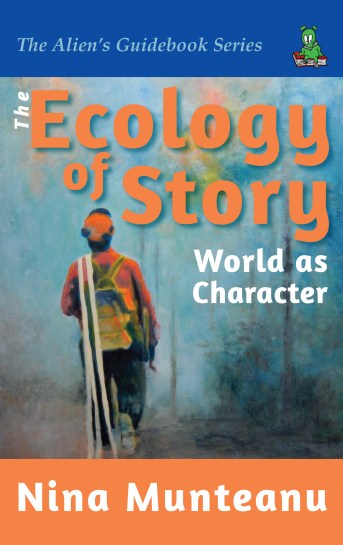
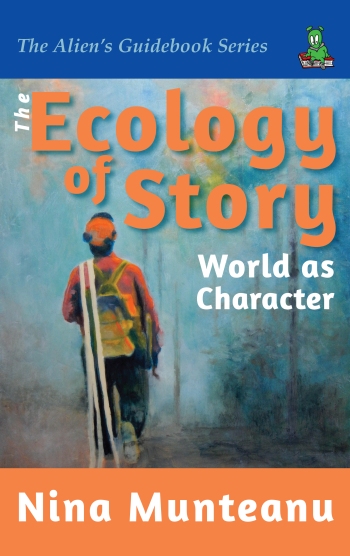 This article is an excerpt from “The Ecology of Story: World as Character” released in June 2019 by Pixl Press.
From Habitats and Trophic Levels to Metaphor and Archetype…
Learn the fundamentals of ecology, insights of world-building, and how to master layering-in of metaphoric connections between setting and character. “Ecology of Story: World as Character” is the 3rd guidebook in Nina Munteanu’s acclaimed “how to write” series for novice to professional writers.

Nina Munteanu is a Canadian ecologist / limnologist and novelist. She is co-editor of Europa SF and currently teaches writing courses at George Brown College and the University of Toronto. Visit www.ninamunteanu.ca for the latest on her books. Nina’s bilingual “La natura dell’acqua / The Way of Water” was published by Mincione Edizioni in Rome. Her non-fiction book “Water Is…” by Pixl Press (Vancouver) was selected by Margaret Atwood in the New York Times ‘Year in Reading’ and was chosen as the 2017 Summer Read by Water Canada. Her novel “A Diary in the Age of Water” will be released by Inanna Publications (Toronto) in 2020.



 This article is an excerpt from

 This article is an excerpt from
  In an article I’d written some time ago on my blog
  Today’s Christ-like hero suffers for the sins of the world and prepares himself (often struggling with this considerably) to deliver salvation, usually through fighting or violent confrontation and often with an incredible arsenal of weapons. I was swiftly brought to mind of the many action shoot-em up films whose tortured hero redeems him(her)self through some selfless, though violent action (e.g., Omega Man, V for Vendetta, Ultra Violet, Aeon Flux — all sci-fi movies, by the way, and ones I enjoyed immensely. And what about all those superhero movies, like Spiderman, X-Men, Green Lantern, etc. These films represent one version of Joseph Campbell’s “Hero’s Journey”, where the original hero leaves his ‘ordinary world’ wherein he/she has some major flaw to overcome (like apathy, greed, distrust, anger, fear of strawberries…etc.) to answer ‘the call’ to be the hero he/she was destined to become. This is a very familiar trope. Erik suggested that Western culture’s “concept of Redemption has invariably separated from the Grace that created it.” Jesus the Teacher had somehow fallen to the wayside to make room for Christ the Redeemer. According to Erik: “Jesus the Teacher said to ‘turn the other cheek’, but today’s Redeemers kick ass. Jesus the Teacher told us that what is done in love is blessed, but today’s Redeemers have more personal and interior motivations.” The two have simply become two different people, says Erik and “the latter is a superstar” compared to the former.” He ends his post with these compelling thoughts:
 If you still don’t get what Erik and I are talking about, go watch the poignant film Pay It Forward and then contrast its main character with the one in Ultra Violet or The Matrix.
 While I agree with Erik on the apparent separation of Christ figure in today’s popular fiction, perhaps there is another way to look at these tales that resolves this apparent dichotomy to some degree. My suggestion is to view them more as allegories with traits and values represented in several characters woven together in a complete and whole tapestry. To do so is to include the secondary character as being equally important. Let’s take Matrix, for instance. In fact, Neo isn’t the only Jesus-figure. His two female opposites (Trinity/Oracle) demonstrate Christ-like traits that embody grace, mercy, love (the holy spirit) and wisdom. Okay, so Trinity kicks major ass too; but her character also provides the chief motivation for our main ‘kick-ass’ hero through her selfless love and humility.























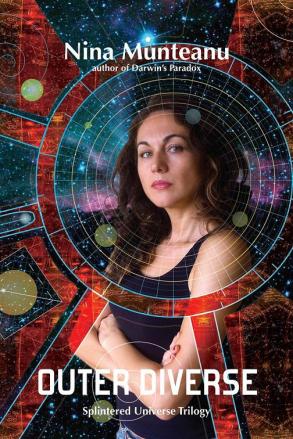
 Outer Diverse is the first book of the Splintered Universe Trilogy, set in and around the Milky Way Galaxy. The first book begins as Galactic Guardian Rhea Hawke intestigates the massacre of an entire religious sect, catapulting her into a treacherous storm of politics, conspiracy and self-discovery. Her quest for justice leads her into the heart of a universal struggle and toward an unbearable truth she’s hidden from herself since she murdered an innocent man.