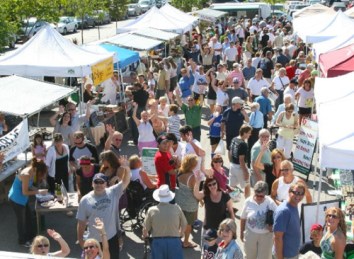
“Water Is…” at The Bookshelf Book Fair in Newmarket

Newmarket-farmers market

Newmarket farmer’s market

Every summer, the Writers’ Community of York Region (WYRC) holds a book fair (The Bookshelf) at the Newmarket Community Centre & Lions Hall, next to the farmer’s market. The fair showcases over 40 local authors, publishers and artisans through readings, discussions and a tradeshow that features writers’ works in a variety of genres from science fiction and fantasy to mystery, inspiration, science, history, self-help and children’s literature. I participated in this year’s festival on July 7, 2018.

Reading from “Water Is…The Meaning of Water”

Nina-Bookshelf booksale1

Nina at her book table

At the Reading Lounge onstage in the adjoining Farmers’ Market, I read from my Amazon-bestselling “science-for-lay public” book Water Is…The Meaning of Water. As children and their parents played in the main water feature behind me, I introduced the term “limnology” (someone who studies freshwater) and talked briefly about the meaning of water with an audience eager to learn.

“We can’t live without it, so maybe we should start respecting it; this beautifully designed book by a limnologist looks at water from 12 different angles, from life and motion and vibration to beauty and prayer,” said Canadian author Margaret Atwood when she selected Water Is… as her first pick in the New York Times ‘Year in Reading.’

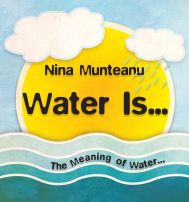
Water Is-COVER-webEach of the 12 chapters completes the phrase “Water is…” with terms that evolve from science into philosophy and spirituality; terms such as “magic”, “life”, “motion”, “communication”, “memory”, “rhythm”, “vibration”, “beauty”, “story”, “wisdom”, “prayer”, and finally “joy”.

The book is, after all, a celebration of water.

I first shared some history on the making of the book. I shared that the pursuit of this book was oddly serendipitous and “entangled.”
kevin-nina-close

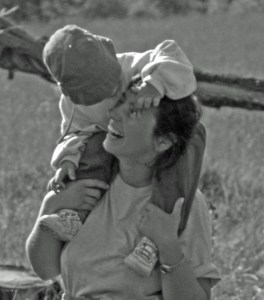
Nina and son go hiking

“Early on, during the research and writing of this book, I discovered that this project on water had become a gestalt watershed for all the important moments in my life. Places I’ve been. Things I’ve learned. People I’ve met and with whom I’d had surprising discussions and realizations. All spanning many years. And many of them totally unrelated. And yet, now, with a sudden flood of context, their significance has transcended into a new fabric of meaning through surprising connection. Like puzzle pieces cooperatively arranging themselves into a symbiotic pattern of synchronicity.”

Writer and philosopher Jake Kotze suggests that, “Synchronicity happens when we notice the bleed-through from one seemingly separate thing into another—or when we for a brief moment move beyond the mind’s divisions of the world.” Synchronicity and serendipitous discovery, like metaphor, appear when we change the way we look at things.

“Serendipitous discovery comes to us through peripheral vision. Like our muse, it doesn’t happen by chasing after it; it sneaks up on us when we’re not looking. It comes to us when we focus outward and embrace our wonder for this world. When we quiet our minds and nurture our souls with beauty. It is then that what we had been seeking naturally comes to us. Like a gift.”

For my reading, I chose several summary quotes that appear at the end of each chapter of the book. These quotes were also featured earlier this year in “Morphology”, an art exhibit in Mississauga that honored the creation of a marsh park as part of Jim Tovey’s vision for the Lakeview Site and the Waterfront Connection:

Water-travel

Quote from “Water Is…” on display at Mississauga Civic Centre

Wonder Woman Respects Water

“Respect water!” says Wonder Woman (aka cosplayer Jes Tongio). Wonder Woman was careful to point out with her wise Amazonian sword of Athena (goddess of wisdom)—forged by Hephaestus—that “Water Is…” provides a doorway to wonder and responsible action.

WonderWoman-WaterIs2a

Wonder Woman (Yes Tongio) with “Water Is…”

Other Authors at The Bookshelf
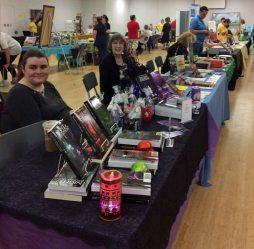
Bookshelf-venue2

Clair McIntyre and Merridy Cox

I met and visited with other fellow writers, including Clair McIntyre, author of YA/fantasy, and crime writer Joan O’Callaghan.

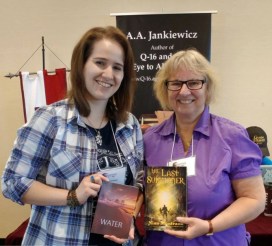
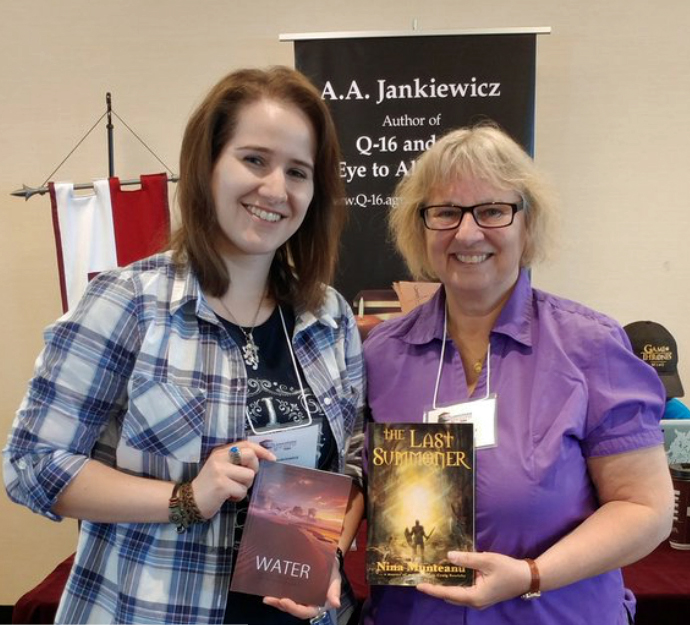
Fellow authors who read at Reading Lounge included Douglas Smith, award-winning author of “Wolf at the End of the World”; and A.A. Jankewicz,
Nina-Agnes-LIMESTONE

A.A. Jankewicz with Nina Munteanu

fantasy author of Q16, and who’s short story appears in the Water Anthology I edited for Reality Skimming Press; and Gabriela Casineanu read from her bestselling book Introverts: Leverage Your Strengths for an Effective Job Search.

Claudiu Murgan read from Decadence of the Soul; he is launching his recent science fiction novel Water Entanglement next month.

Myth Hawker Travelling Bookstore was also at the festival. Specializing in Canadian authors, Canadian content, and Canadian small press, they  carry an extensive list of local Canadian authors wherever they go across Canada.

The Immigrant Writers Association (IWA)

Nina-IWA-BookshelfinNewcastle

Gabriela, the two Andreeas, Nina and Claudiu

Nina IWA memberThe IWA was also represented, along with member-writers Gabriela Casineanu, Andreea Munteanu, Claudiu Murgan and Andreea Demirgian.

The Immigrant Writers Association provides programs, activities, and services that empower and support immigrant writers in their journeys. According to their website, the goal of the IWA is to  “encourage immigrants to express themselves through writing, to bring more awareness, compassion, and peace into the world.”

As second-generation immigrant daughter to German and Romanian parents, I recently joined the IWA. I look forward to mentoring new writers and providing workshops and lectures to share my experience as a writer, editor, and teacher of fiction and non-fiction.


MJ Moores-Bookshelf

M.J. Moores, chair of the board and founder of Bookshelf

nina-munteanuNina Munteanu is an ecologist, limnologist and internationally published author of award-nominated speculative novels, short stories and non-fiction. She is co-editor of Europa SF and currently teaches writing courses at George Brown College and the University of Toronto. Visit www.ninamunteanu.ca for the latest on her books.
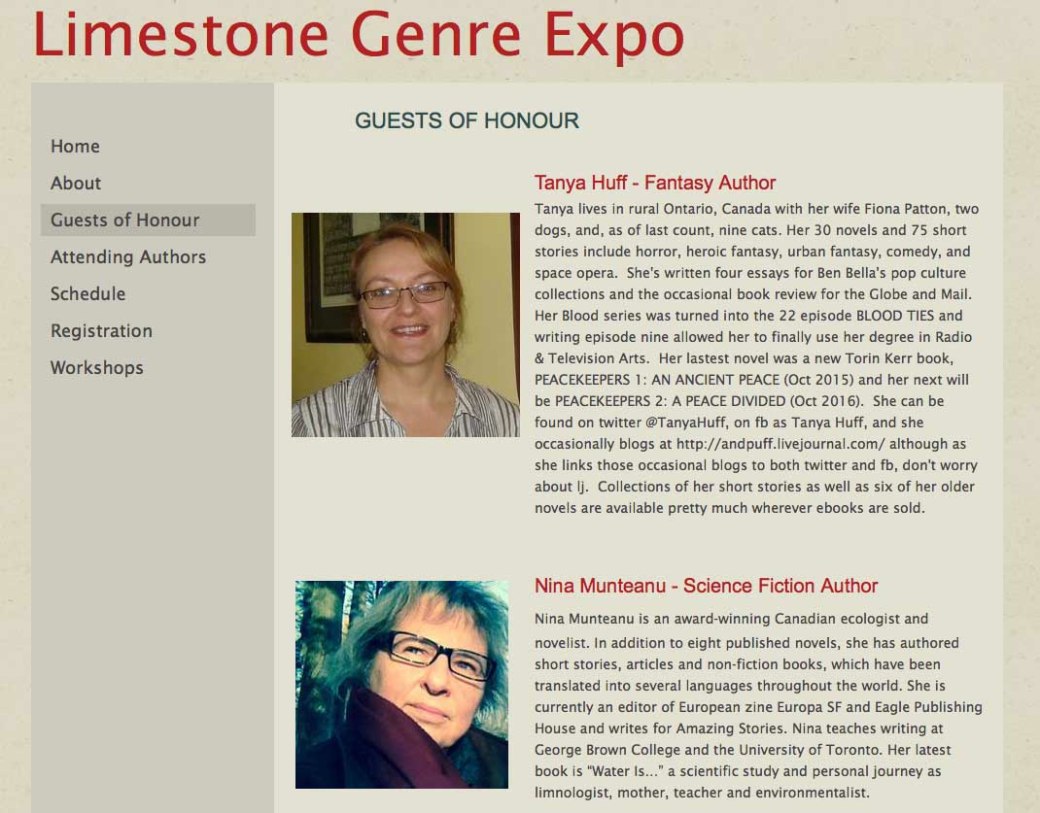
Limestone Genre Expo—May 2018

2018 was the fourth year for Limestone Genre Expo, Kingston’s only genre writing festival. I’ve been to the expo each year from its inaugural festival in 2015. The festival gets its name from the city’s moniker, based on the many heritage buildings constructed there using the local limestone.

In 2016 I was delighted to be the science fiction guest of honour. In 2017, the expo was held at the Saint Lawrence College campus.


Nina-SF GOH-Limestone Genre Expo 2016

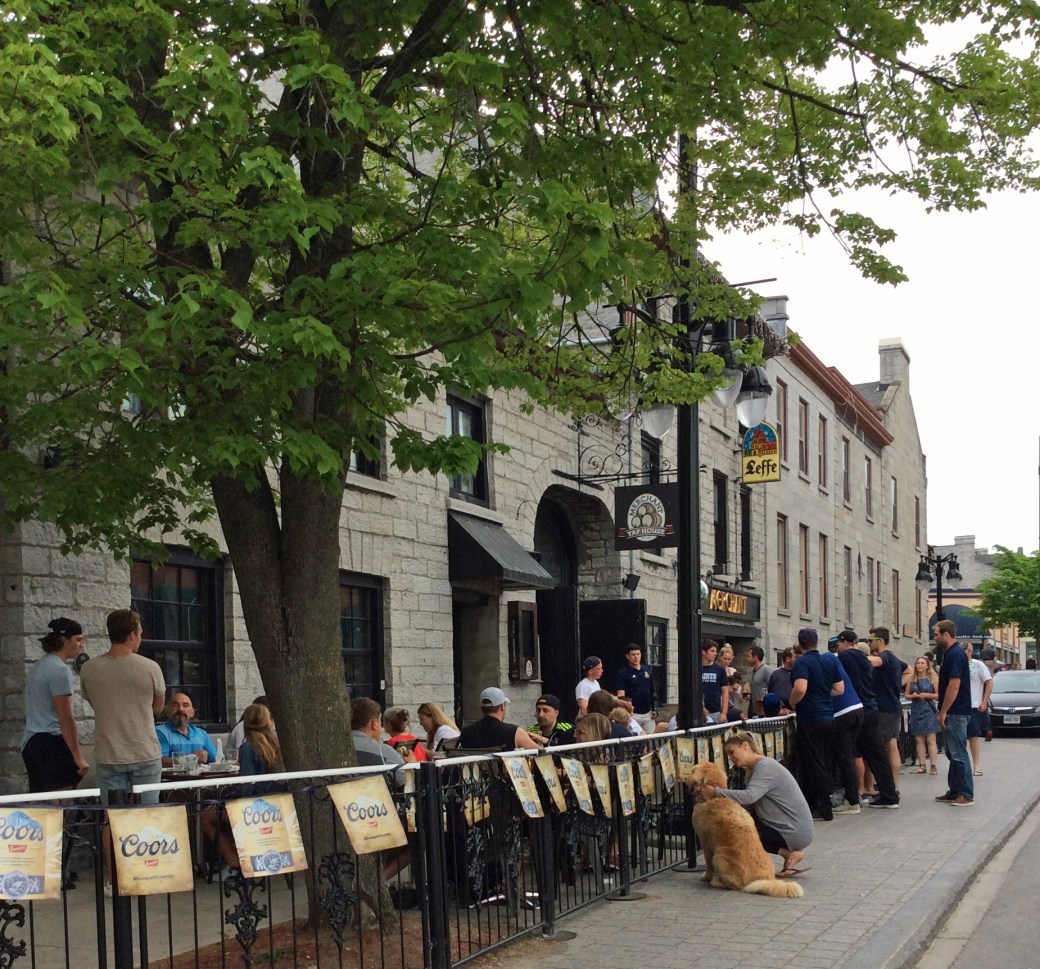
This year, the expo was held at the Holiday Inn, right on the waterfront and literally a staggering distance from the Merchant Tap House, one of the greatest pubs and eateries of the town.

MerchantTapHouse-Limestone2018

Merchant Tap House, Kingston (photo by Nina Munteanu)

As before, the festival covered several of the major genres such as fantasy, science fiction, horror, romance and mystery, with representation by well-known authors in each. Organizers offered a triple track program from 10 am to 5 pm that included panels, informative workshops, readings, book launches, and novel pitch sessions with Bundoran Press.

Liz Strange and programming organizers had me in several panels throughout the two-day expo.

Panels I participated in and in some cases moderated included:

“Mental Health Representation in Fiction: More than Villains” with Michael Slade, Therese Greenwood, Ada Hoffmann, Matt Moore and Madona Skaff. I really enjoyed this panel discussion that explored our evolving perception and representation of mental health in story and in our real lives.

Nina-MentalHealthPanel

Matt Moore, Nina Munteanu, Madona Skaff, Michael Slade, Theresa Greenwood (photo by Marlene Smith)

“Why Do We Love a Good Whodunit?” with Michael Slade, M. H. Callway, Katherine Prairie, Jim Napier, Melissa Yi, and Rosemary McCracken.  The panel and I had fun with this discussion as bizarre real-life stories were thrown into this mix.

Nina-Whodunit Panel

Katherine Prairie, Michael Slade, Melissa Yi, M.H. Callway, Rosemary McCracken, Nina Munteanu

“What Makes a Great Hero?” with Kate Heartfield, Tobin Elliott, Theresa Greenwood, Kris Jacen, Donna Warner, and Douglas Smith. The panel debated what makes a hero, then anti-hero, then sad and terrible hero, then non-hero…and ultimately to the journey of our at times miserable but great hero.

Nina-HeroPanel-LIMESTONE 2018

Douglas Smith, Theresa Greenwood, Nina Munteanu, Donna Warner, Tobin Elliott, Kate Heartfield

“Dystopian Fiction: How to write when the world is falling apart” with Una Verdandi, Robin Timmerman, Brad Baker, Tapanga Koe, Hayden Trenholm and Ursula Pflug. In this rather passionate discussion, we debated the state and shape of dystopia in both the real world and the fiction world and how they inevitably bleed together for the writer.

Nina-signingLastSummoner

Nina signs “The Last Summoner” for colleague and reader Agnes

“Women of Science Fiction” with Hayden Trenholm, Laura Baumbach, Ada Hoffmann, Tanya Huff, Tapanaga Koe, and Nancy Baker.  Hayden emerged amid his female colleagues to astutely discuss the reason we are still discussing this topic.

I also sold a number of books, including Water Is… (a Margaret Atwood favourite), my journal and fiction writing guidebooks (The Journal Writer and The Fiction Writer), Reality Skimming’s Water Anthology, for which I was editor, and The Last Summoner.

Nina-Agnes-LIMESTONE

authors Agnes Jankiewicz and Nina Munteanu

One of the key charms of this small venue is that it still provides an intimate setting for great networking. I had a chance to meet many of my old friends and to make new ones. Thanks to Liz, Marlene and wonderful volunteers for another great writing festival!


Nina Munteanu

Nina Munteanu is an ecologist, limnologist and internationally published author of award-nominated speculative novels, short stories and non-fiction. She is co-editor of Europa SF and currently teaches writing courses at George Brown College and the University of Toronto. Visit www.ninamunteanu.ca for the latest on her books.
 

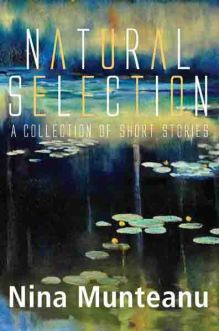
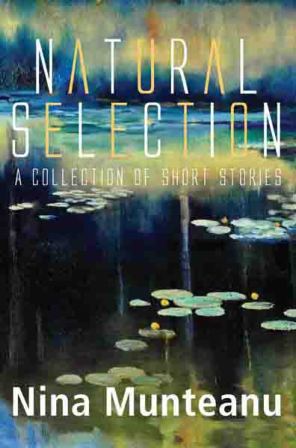
“Natural Selection”: Fascinating Dramas Set in a World Too Close to Our Own

NaturalSelection-front-web“I write SF about a near future ‘Gaian’ world too, and at times felt I was reading a prequel to my own novels, but that’s not why I rated this collection so highly. I did so for two reasons. First, because the science was so interesting, combining visionary metaphysical speculation with AI corporate tech in scenarios that often seemed chillingly possible. Second, because of the author’s focus on the effects of these developments on human beings with complex pasts and desires. Jealousy, lust, loneliness, grief and love are all drivers of these taut and fascinating narratives…”–Amazon Review


Author’s Introduction to Natural Selection

leaves02croppedEvolution is the language of destiny. What is destiny, after all, but self-actualization and synchronicity? If evolution is the language of destiny, then choice and selection are the words of evolution and “fractal ecology” is its plot.

How do we define today a concept that Darwin originated 200 years ago in a time without bio-engineering, nano-technology, chaos theory, quantum mechanics and the Internet? We live in an exciting era of complicated change, where science based on the limitation of traditional biology is being challenged and stretched by pioneers into areas some scientists might call heretical. Endosymbiosis, synchronicity, autopoiesis & self-organization, morphic resonance, Gaia Hypothesis and planetary intelligence. Some of these might more aptly be described through the language of meta-physics. But should they be so confined? It comes down to language and how we communicate.

Is it possible for an individual to evolve in one’s own lifetime? To become more than oneself? And then pass on one’s personal experience irrevocably to others—laterally and vertically?

leaf-sketchOn the vertical argument, the French naturalist Jean-Baptiste Lamark developed a theory of biological evolution in the early 19th century considered so ridiculous that it spawned a name: Lamarkism. His notion—that acquired traits could be passed along to offspring—was ridiculed for over two hundred years. Until he was proven right. Evolutionary biologists at Tel Aviv University in Israel showed that all sorts of cellular machinery—an intelligence of sorts—played a vital role in how DNA sequences were inherited. When researchers inserted foreign genes into the DNA of lab animals and plants, something strange happened. The genes worked at first; then they were “silenced”. Generation after generation. The host cells had tagged the foreign genes with an “off switch” that made the gene inoperable. And although the new gene was passed onto offspring, so was the off switch. It was Larmarkism in action: the parent’s experience had influenced its offspring’s inheritance. Evolutionists gave it a new name. They called it soft inheritance.

As for passing on one’s experience and acquisitions to others laterally, education in all its facets surely provides a mechanism. This may run the gamut from wise mentors, spiritual leaders, storytellers, courageous heroes to our kindergarten teacher.  Who’s to say that these too are not irrevocable? This relies, after all, on how we learn, and how we “remember”.

Evolution is choice. It is a choice made on many levels, from the intuitive mind to the intelligent cell. The controversial British botanist Rupert Sheldrake proposed that the physical forms we take on are not necessarily contained inside our genes, which he suggested may be more analogous to transistors tuned in to the proper frequencies for translating invisible information into visible form. According to Sheldrake’s morphic resonance, any form always looks alike because it ‘remembers’ its form through repetition and that any new form having similar characteristics will use the pattern of already existing forms as a guide for its appearance.  This notion is conveyed through other phenomena, which truly lie in the realm of metaphysics and lateral evolution; concepts like bilocation, psychic telegraphing, telekinesis and manifestation. Critics condemn these as crazy notions. Or is it just limited vision again? Our future cannot be foretold in our present language; that has yet to be written. Shakespeare knew this…

There are more things in heaven and earth, Horatio, than are dreamt of in your philosophy—Shakespeare

The nine stories contained herein touch on many of these concepts, spanning a 20-year writing period starting in the 1980s from “Arc of Time”, first published by The Armchair Aesthete in 2002, to “Julia’s Gift”, written in 2007, a year that marks a significant nexus in my personal evolution. That’s when I met someone who changed my life and defined my life path, my evolution, and ultimately, I suspect, my destiny.

Each story reflects a perspective on what it means to be human and evolve in a world that is rapidly changing technologically and environmentally. How we relate to our rapidly changing fractal environments—from our cells to our ecosystems, our planet and ultimately our universe—will determine our path and our destiny and those we touch in some way. My friend Heidi Lampietti, publisher of Redjack Books, expressed it eloquently, “For me, one of the most important themes that came through in the collection is the incredible difficulty, complexity, and importance of making conscious choices—and how these choices, large and small, impact our survival, either as individual humans, as a community, a species, or a world.”

Each story touches on a focal point, a nexus in someone’s personal evolution, where a decision—or an indecision—will define one’s entire later path in life. Several stories (e.g., “Butterfly in Peking”, “Frames” and “Julia’s Gift” all set in the same universe as my “Darwin’s Paradox” duology) explore this through war: a paradoxical struggle between those who follow the technological path and those who embrace nature’s intelligence. War is itself a paradox. It is both tragedy and opportunity. The very action of being at war seems to galvanize us and polarize us. War heightens contrast, increases pitch, and resonates through us in ways we have no inkling. It brings out the very worst but also the very best in us; for, as some of us sink into despair and self-serving debauchery, others heroically rise in altruistic service and humble sacrifice to help others. War defines us, perhaps like no other phenomenon.

Several stories are quirky adapted excerpts from my two books, “Darwin’s Paradox” (2007 by Dragon Moon Press) and its prequel “Angel of Chaos” (2010 by Dragon Moon Press). You will find some of the same characters there, though names have been changed to protect the innocent. You will also find the sprawling semi-underground AI-run city of Icaria (a post-industrial plague Toronto) and a character itself. Several of the characters portray “gifted” and troubled misfits—outcasts, anti-heroes, artists not in sync with the rest of the population. Yet how that person’s choices—and how s/he is treated by their community—would influence an entire species or world (“Mark of a Genius”, “Neither Here Nor There”, “Angel’s Promises”, and “Natural Selection”).

Lastly, I explore how humanity evolves, communicates and relates through forces larger than itself, either produced through its own making via technology (in “Virtually Yours”) or through timeless universal intervention (in “Arc of Time”). The last story (in fact the first written) provides a very different interpretation of an old biblical myth about new beginnings and our cyclical destiny of “creative destruction”.

I hope you enjoy reading them all. I enjoyed writing them.

“The Arc of Time” was first published in the Summer/Fall 2002 issue of The Armchair Aesthete. It was reprinted in Imagikon (2003) then scheduled for the premiere issue of Ultra! A charity issue dedicated to cystic fibrosis (Aardwolf Publications), Fall/Winter, 2004. Sadly, Lari Davidson, the editor and visionary behind the project passed away suddenly and the issue never came to fruition.

“Virtually Yours” first appeared in Issue 15 (December 2002) of Hadrosaur Tales.  It was reprinted in Neo-Opsis Science Fiction Magazine (Issue 3, Spring 2004) then translated into Polish and reprinted in the January 2006 issue of Nowa Fantastika (Poland). It was translated into Hebrew and reprinted in Bli-Panika (Israel) in 2006. “Virtually Yours” was selected for the 2006 “The Best of Neo-Opsis Science Fiction Magazine” anthology (Bundoran Press) and was nominated for the Canadian Aurora Prix and the Speculative Literature Foundation Fountain Award.

“Angel’s Promises” was published in Issue #30 (March, 2003) of Dreams & Visions then selected for the anthology “Skysongs II: Spiritual SF” (2005). It was nominated for the SLF Fountain Award.

“A Butterfly in Peking” was first published in Issue #17 (2003) of Chiaroscuro. It was translated into Polish and reprinted in the Summer 2005 issue of Nowa Fantastika (Poland) then translated and reprinted in The Dramaturges of Yann (Greece) in 2006.

“Mark of a Genius” first appeared in Scifidimensions (August 2004 issue) and “Neither Here Nor There” first appeared in Another Realm (September 2005).  “Frames”, “Julia’s Gift” and “Natural Selection” make their first appearance here.

Amazon description of Natural SelectionNaturalSelection-front-web

A man uses cyber-eavedropping to make love. A technocratic government uses gifted people as tools to recast humanity. The ruins of a city serve as battleground between pro-technologists and pro-naturalists. From time-space guardians to cybersex, GMO, and biotech implants, this short story collection by science fiction novelist Nina Munteanu promises a journey of great scope, imagination and vision.


nina-2014aaa

Nina Munteanu is an ecologist, limnologist and internationally published author of award-nominated speculative novels, short stories and non-fiction. She is co-editor of Europa SF and currently teaches writing courses at George Brown College and the University of Toronto. Visit www.ninamunteanu.ca for the latest on her books.


The Battle of Grunwald and the Fate of the Teutonic Knights

400px-Grunwald_Wojciech_Kossak copy

Battle of Grunwald

On this day, June 14th, every year, the Polish and Lithuanians celebrate the Battle of Grunwald; they celebrate with pride, erecting mock-ups of the battle to honour this important—yet largely unknown moment—in history: when the proud Teutonic Order fell to its knees and Poland became a nation.

Which brings me to my book The Last Summoner and how I get my ideas for stories…

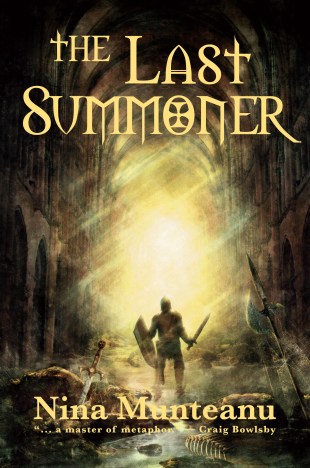
Cover1_LastSummoner-frontcoverI teach writing at the University of Toronto and fiction writing at George Brown College in Toronto. A question I’m often asked is how I get my story ideas. I always start by sharing my favourite example of how I came to write my historical fantasy The Last Summoner:

It started in 2008, when I saw the most incredible image by Croation artist Tomislav Tikulin as I was browsing sites on the Internet. The image was of a magnificent knight, standing in a war-littered mire and gazing up, questioning, at the vaulted ceiling of a drowned cathedral. A great light shone upon the knight in streams of white gold–as if a message from heaven. It sent my imagination soaring with thoughts of chivalry, adventure and intrigue.

Who was this knight?

teutonic_knight_by_flipation

Teutonic knight

With that image imprinted inside me, the next nexus moment came when I stumbled across a significant but little-known battle in the medieval Baltic, the Battle of Grunwald. It would turn out to be the defining battle for what are now the countries of Poland and Lithuania. On June 14, 1410, they were still part of Prussia and tyrannized by the Teutonic Order, who were Christianizing the pagan Baltic on behalf of the Pope. In truth, the Order had been for centuries gathering wealth and land for colonizing Germans in their drang nach osten; they built sturdy castles (many of which still stand today) and grew into a force of monk warriors, feared for their cunning strategy and treacherous combat abilities.

The Battle of Grunwald was, in fact, an upset in history. The Teutonic Order was powerful, intimidating and extremely capable. They should have won; but the peasant armies of Prussia slaughtered the Order, killing most of its knights. Historians debate that the hochmeister’s arrogance—indeed the arrogance of the entire Order—precipitated their downfall. They underestimated their adversaries and got sloppy.

After the Polish and Lithuanian armies outsmarted the Order and slayed the Order’s hochmeister, along with many of their knights, the Order’s own peasant slaves finished the job using clubs, pitchforks and stones.

Every year, the Polish and Lithuanians celebrate June 14th with pride, erecting mock-ups of the battle.

vivianne-medieval-fighterIntrigued by this little known order of religious crusaders, I pursued the premise of an alternative consequence: what if the Teutonic Knights had NOT underestimated their enemy and won the Battle of Grunwald? Would they have continued their catastrophic sweep of Northeast Europe into Russia and beyond? Would they have claimed the whole for Germany’s expansionist lebensraum movement, fueled by its sonderweg—a dialectic that would ultimately lead to the killing fields of the Holocaust?  What if the success of the Teutonic Order helped consolidate a united fascist elite, ambitious to conquer the world? What if Nazism sprang up 100 years earlier than it did in our current reality?

The Last Summoner arose from this premise. Enter our hero, young 14-year old Vivianne Schoen, Baroness von Grunwald, a self-centred romantic who dreams that her ritter will rescue her from an arranged marriage to some foreign warrior. As a result of an impetuous choice, she makes the startling discovery that she can alter history—but not before she’s branded a witch and must flee through a time-space tear into an alternate present-day France—now ruled by fascists. There, she learns that every choice has its price.

knight-cameo copySpanning from medieval Poland to present day Paris, The Last Summoner explores the sweeping consequences of our “subtle” choices. From the smallest grab to the most sweeping gesture, we are accountable for the world we’ve made. During her 600-year journey to save the world and undo the history she authored, Vivianne learns wisdom and humility. Through the paradox of history, she learns that what might have seemed the right choice for an immediate future, turns out to be disastrous for a distant future. To win is also to lose; to save oneself one must surrender oneself; and to save the world one need only save a single soul.

The knight standing in the drowned cathedral is none other than Vivianne.

Inspired by Tikulin’s knight depiction, I managed to convince my publisher at Starfire World Syndicate to purchase rights to the image; Tikulin’s image–Vivianne’s dream–became the actual cover of my book. I was overjoyed! When The Last Summoner hit the shelves in 2012, it quickly soared into an Amazon Canadian bestseller and remained in the top 10 for several months in the category of fantasy, historical fantasy and science fiction. The book continues to find new readers who enjoy the thrilling time-travelling journey of its 15th century heroine and its surprising plot.

LastSummoner-scifi-fantasy

“The Last Summoner” sandwiched nicely between Ray Bradbury and George R.R. Martin

“The Last Summoner is a blend of fantasy, history, and alternate history,” writes Canadian author Kristene Perron. “Fourteen year old Vivianne , the story’s hero, discovers that she has strange powers on the eve of the legendary Battle of Grunwald.  Marked as a witch, Vivianne escapes through time and space, but her actions change history and threaten to destroy the world.”

Kristene had chosen the book to review based on a description I had provided of the painting that inspired the novel created by artist Tomislav Tikulin.

Cover1_LastSummoner-frontcover

Illustration by Tomislav Tikulin. Cover design and typology by Costi Gurgu

The Last Summoner fascinated Kristene. “Ordinarily, historical fiction doesn’t excite me,” writes Kristene. “But the premise of this novel—which included a good dash of fantasy and time travel—was an exception. There is history aplenty and Munteanu has obviously done her homework. The world of 15th century Germany is authentically realized and the little touches of fantasy blend seamlessly.” She was pleased with Vivianne as a hero and how I had “endowed [my] protagonist with the skills and knowledge necessary for the plot without stretching plausibility.”

teutons3-close1

Kristene then added, “What I most enjoyed about this story was that for the majority of it I genuinely didn’t know where the plot was going or what would happen next. I’m one of those annoying people who can usually figure out the entire plot of a book or movie within the first few scenes (watching movies with me can be challenging), so to come teutons3-close02across a story that stumped my super CSI powers of deduction was a real treat.”

“For those in love with science fiction at its best, The Last Summoner is a complex story of ignored responsibilities and their dire consequences, of love and betrayal that span centuries and multiple worlds. Time travel, multiverse travel, immortality, alternate history in which the Nazis have won, not in the twentieth century but way earlier, in the Teutonic age. Angels and mutants, utopias and dystopias, even a Tesla occurrence— everything a science fiction reader could ever desire in a book. A masterfully told story with great characters. Nina Munteanu moves flawlessly from a medieval story to a modern one and everything in between.”—Costi Gurgu, author of RecipeArium

Jonathan, history buff and author of Sci-Fi & Fantasy Reviews , writes: “The Last Summoner is a unique story melding Germany of the 15th century and modern France, even if a different France from what we would recognize. The story centered around the very real and pivotal Battle of Grunwald in which a coalition of Polish and Lithuanian forces defeated the monastic Teutonic Knights. The book takes a look at the young 14-year-old baroness of Grunwald, someone not quite human, and how she attempts to right a wrong and get history back on track…The author is a good writer, and her wordsmithing is excellent…The historical research was outstanding…Given that this is fiction, and that two settings did not follow history as we know it, never-the-less, each event was either very accurate to our known history or made logical sense in the other settings. I am not a huge fan of alternative history books, but in this one, I was extremely caught up in the final section of the book, and I had to contemplate how the world might be different with only a few changes to our history.”

vivianne-dark-medieval-knight copy

Jonathan adds, “While I was familiar with most of the historical background of the book, I was unaware of some facts, such as the Tartars taking part in the Battle of Grunwald. I thought this was a mistake made on the part of the author and went to confirm that, but in fact, the author was correct…a clever, well-written book. I would recommend it without hesitation.” The reviewer did have one quibble: my liberal use of French and German in the book.

Professional photographer and science fiction/fantasy reader, Rick LeBlanc shared that he’d “read The Last Summoner on the flight back from World Fantasy Con: could hardly put it down. Just loved the historical references of gear, place and events. The characters red-leaves-in-pond-vicki horton-botwere incredibly strong and involved you in their lives. The flow was fun & fast-paced. Merci, Nina. Great book!”

“I loved, loved, loved the metaphors. A page-turner that left me wanting to be Vivianne when I grew up.”—Carina Burns, author of The Syrian Jewelry Box

knight-cameo copy“The Last Summoner is an enticing fantasy exploring the Knightly order and adding many new perspectives.”—John Taylor, The Midwest Book Review

nina-2014aaaNina Munteanu is an ecologist, limnologist and internationally published author of award-nominated speculative novels, short stories and non-fiction. She is co-editor of Europa SF and currently teaches writing courses at George Brown College and the University of Toronto. Visit www.ninamunteanu.ca for the latest on her books. 

Nina Reads About Water at Oakville Literary Café in Joshua Creek Art Centre

House-road copy

Joshua Creek Art Centre (photo by Nina Munteanu)

In late May, I was invited to read from my short story “The Way of Water” and my recent book “Water Is…” at the Oakville Literary Café, held at the Joshua Creek Art Centre.


The Way of Water

“The Way of Water” has appeared in several collections and anthologies in Europe and North America and received praise from around the world, including: The National Observer, Prism International Magazine, Speculating Canada, SoloLibri in Italy, and most recently in Orson Scott Card’s The Intergalactic Medicine Show.

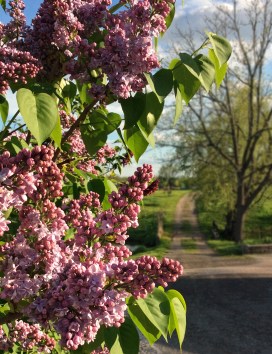
Lilac2-JoshuaCreekArtCentre

Joshua Creek Art Centre (photo by Nina Munteanu)

“The Chinese multinationals have exchanged the public debt of other states with their water reserves with which, now, they can control the climate, deciding when and where it will rain.Who understands this dirty game has been silenced, like Hilda’s mother, a limnologist, inexplicably arrested and never returned; like the daughter of two water vendors, mysteriously disappeared, after having decided not to bow to economic powers: Hanna, who now prefers secure virtual identities to evanescent real appearances. Water. The two, like the covalent bond of a complex molecule, develop a relationship of attraction and repulsion that will first make them meet and then, little by little, will change into a tormented love but, at the same time, so pure as to cause Hilda at great risk, to make an extreme decision that will allow Hanna to realize the strange prophecy that the internal voice, perhaps the consciousness of water, had resonated in the two women for a long time.” —Simone Casavecchia, SoloLibri.net

The Way of Water-COVERShe imagines its coolness gliding down her throat. Wet with a lingering aftertaste of fish and mud. She imagines its deep voice resonating through her in primal notes; echoes from when the dinosaurs quenched their throats in the Triassic swamps.

Water is a shape shifter.

It changes yet stays the same, shifting its face with the climate. It wanders the earth like a gypsy, stealing from where it is needed and giving whimsically where it isn’t wanted.

Dizzy and shivering in the blistering heat, Hilda shuffles forward with the snaking line of people in the dusty square in front of University College where her mother used to teach. The sun beats down, crawling on her skin like an insect. She’s been standing for an hour in the queue for the public water tap.

Exile-CanTales ClimateChange copyEmilie Moorhouse of Prism International wrote: “Soon after I finished reading the book, Cape Town—known in precolonial times as “the place where clouds gather”—announced that it was only a few months away from what it called “Day Zero,” the day the city would officially run out of water, making the similarities between fiction and reality more than unsettling. Munteanu’s story is set in a futuristic Canada that has been mined of all its water by thirsty corporations who have taken over control of the resource. Rain has not fallen on Canadian soil in years due to advances in geoengineering and weather manipulation preventing rain clouds from going anywhere north of the Canada-US border.”

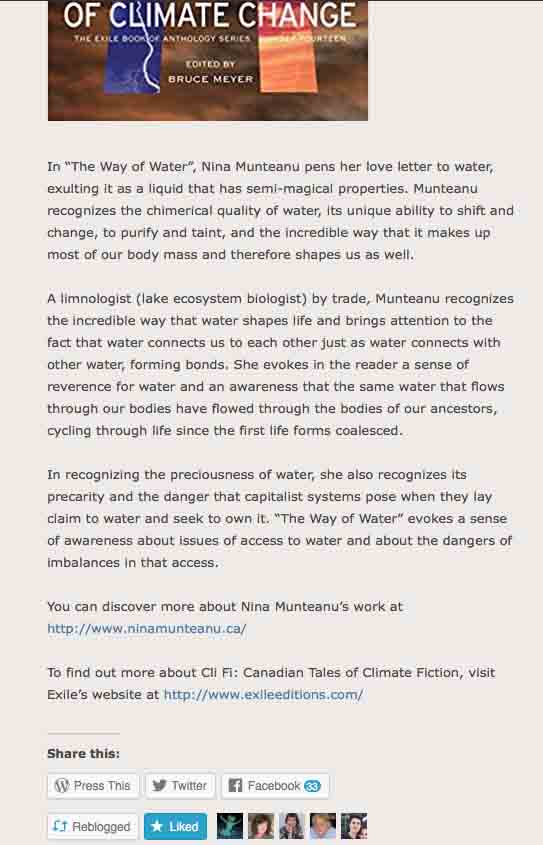
“In ‘The Way of Water’, Nina Munteanu pens her love letter to water, exulting it as a liquid that has semi-magical properties…’The Way of Water’ evokes a sense of awareness about issues of access to water and about the dangers of imbalances in that access.”—Derek Newman-Stille, Speculating Canada

FF - Rosarium Cover copy“…In an interesting scarcity future in which we follow the fate of a character abandoned by her mother, water itself becomes a character. In the second paragraph we’re told that “Water is a shape shifter,” and in the next page we encounter the following description: “Water was paradox. Aggressive yet yielding. Life-giving yet dangerous. Floods. Droughts. Mudslides. Tsunamis. Water cut recursive patterns of creative destruction through the landscape, an ouroboros remembering.” These descriptive musings cleverly turn out to be more than metaphors and tie in directly to the tale’s surprising ending.”—Alvaro Zinos-Amaro, IntergalacticMedicineShow.com


Water Is-COVER-webWater Is… The Meaning of Water

I also read from my non-fiction book “Water Is… The Meaning of Water.” I read several quotes from “Water Is…”. The water quotes had earlier been displayed at a photographic art exhibition in the Great Hall of the Mississauga Civic Centre. The art exhibition celebrated the Waterfront Connection wetland construction, a realized vision of the late Jim Tovey.

Morphology-Looking Up

Photo Art in the Great Hall of the Mississauga Civic Centre

WaterIs story-photo

Quote from Nina Munteanu’s “Water Is…” displayed alongside photo art

Water-travel

Quote from “Water Is…” displayed at the Civic Centre in Mississauga


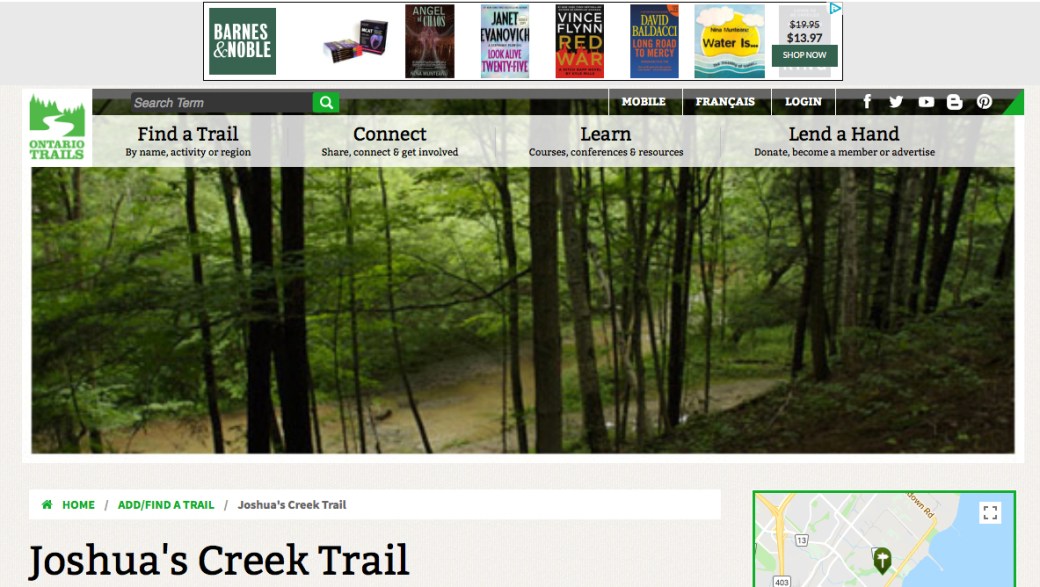
Joshua Creek Heritage Art Centre

JoshuaCreekArtCentre

Back patio of Joshua Creek Art Centre (photo by Nina Munteanu)

Envisioned by Sybil Rampen as a place to meet, collaborate and cultivate relationships, the Joshua Creek Heritage Art Centre was established at the 1827 heritage house on Rampen’s family farm on Burnhamthorpe Road in Oakville. The art centre serves the community as a gathering place—creative media workshops, films, musical events, lectures and weddings. The facility promotes local heritage and accessibility. Ecological integrity remains central to its activities.

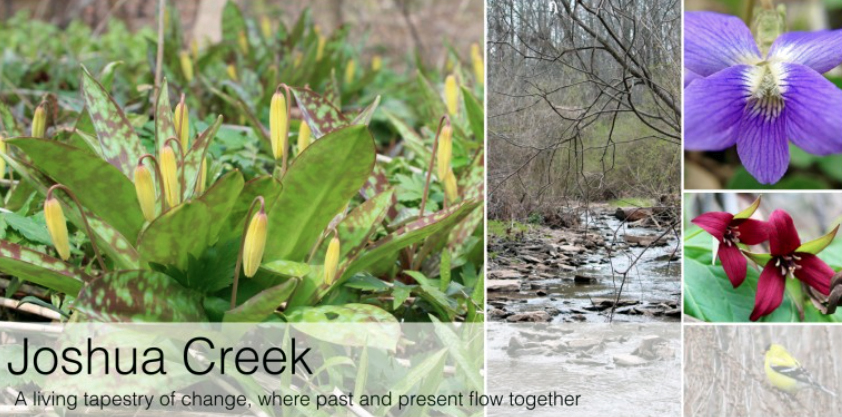
Joshua Creek

JoshuaCreek

JoshuaCk05

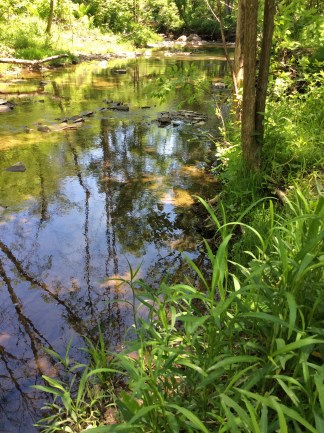
Joshua Creek (photo by Nina Munteanu)

Joshua Creek originates near the art centre north of Burnhamthorpe Road and flows about 6 km south through the farm then mostly forest, eventually emptying into Lake Ontario. I was told that the creek has good water quality, apparently the best in the county. Oakvillegreen.org provides some history on Joshua Creek:

“Joshua Creek exists as a patchwork of past glories and present changes on a very dynamic and human-controlled landscape… many of its lands were cleared and altered beyond recognition, with only certain key areas left mostly to nature. In spite of these influences, Joshua Creek is home to 3 small Environmentally Sensitive Areas (ESAs), although two of these – Joshua Creek Valley and Wildflower Woods – have declined since they were highlighted in the 1970’s, and while still valuable, may no longer qualify as ESAs in the future. In only a handful of decades, development has quickly covered most of the lower two thirds of the creek’s land base, including important parts of its ESAs. In several areas, Joshua’s natural winding “meander” has been artificially straightened in order to efficiently use the land on either side. And in many places, foreign species have invaded the natural areas of the creek, changing the ecosystem in a big way.

JoshuaCk03But Joshua is a spirited creek – in spite of all it has been through, Joshua Creek is among the top two urban creeks for healthy water quality, and is still inhabited by a variety of aquatic animals like small fish and insects. Joshua Creek is home to forests, wetlands and thickets with around 150 plant species, and provides an important natural habitat corridor for the movement of birds and other animals, including migratory species. Rather than exclusively shrinking, there are also areas of Joshua Creek that are actually in the middle of regrowing their forests, and in spite of everything, Joshua still retains some beautiful gems of natural areas.”

nina-2014aaa

Nina Munteanu is an ecologist, limnologist and internationally published author of award-nominated speculative novels, short stories and non-fiction. She is co-editor of Europa SF and currently teaches writing courses at George Brown College and the University of Toronto. Visit www.ninamunteanu.ca for the latest on her books.

JoshuaCreek-WaterBanner


Nina Munteanu Talks About “Water Is…” on Green Majority CIUT Radio

Nina-Saryn-CIUT booth

Nina with Saryn Caister of Green Majority CIUT Radio

Host Saryn Caister of The Green Majority CIUT Radio 89.5 FM discusses “Water Is…” with Nina Munteanu and her philosophy to learning and knowledge.

The interview covers some of water’s anomalous properties and why Nina decided to write a book that spans and integrates such a wide variety of angles and subjects from traditional science to spirituality.

CIUT-radioLOGOSaryn and Nina discuss some of water’s controversial properties and the claims about water and how geopolitics plays a role in this. She brings in her own career as a limnologist and how she broke away from her traditional role of scientist to create a biography of water that anyone can understand—at the risk of being ostracized by her own scientific community (just as Carl Sagan and David Suzuki were in the past).

Saryn shared how Ray John Jr., an Indigenous teacher, on a previous show reminded us why these things matter.

Water Is-COVER-webNina responded with, “The why of things and hence the subtitle: the Meaning of Water. What does it mean to you… That’s what’s missing a lot of the time. We are bombarded with information, knowledge and prescriptions but the subliminal argument underneath—the why—why should it matter to me—is often missing. That becomes the sub-text. And it’s nice when it comes to the surface.”


HartHouse-CIUT Radio

Hart House, University of Toronto


nina-2014aaaNina Munteanu is an ecologist, limnologist and internationally published author of award-nominated speculative novels, short stories and non-fiction. She is co-editor of Europa SF and currently teaches writing courses at George Brown College and the University of Toronto. Visit www.ninamunteanu.ca for the latest on her books.


National Observer Praises Nina Munteanu’s “The Way of Water”

Exile-CanTales ClimateChange copyNina Munteanu’s “The Way of Water” and the anthology in which it appears was recently praised by Emilie Moorhouse in Prism International Magazine, in a review entitled “Courage and Imagination in Cli-Fi: Canadian Tales of Climate Change”. The review was also carried by the National Observer:

“The seventeen stories in this book edited by Bruce Meyer examine how humankind might struggle with the potential devastation of climate change in the near or distant future. Soon after I finished reading the book, Cape Town—known in precolonial times as “the place where clouds gather”—announced that it was only a few months away from what it called “Day Zero,” the day the city would officially run out of water, making the similarities between fiction and reality more than unsettling.

Munteanu’s story is set in a futuristic Canada that has been mined of all its water by thirsty corporations who have taken over control of the resource. Rain has not fallen on Canadian soil in years due to advances in geoengineering and weather manipulation preventing rain clouds from going anywhere north of the Canada-US border. . . I believe that fiction offers up two much-needed ingredients in the fight to prevent climate change: courage and imagination. It is my hope that more fiction writers will take up the task of writing in this promising new genre and use their imagination to inspire readers to collectively work towards a more sustainable future.”—Emilie Moorhouse, Prism International

La natura dell'acqua copy 3“The Way of Water” (La natura dell’acqua) was translated by Fiorella Smoscatello for Mincione Edizioni. Simone Casavecchia of SoloLibri.net, describes “The Way of Water” in her review of the Italian version:

” ‘The Way of Water’ is to be ‘a shapeshifter,’ says Nina Munteanu in her dystopian narrative, where she draws a dark scenario and, unfortunately, not too improbable in the near future. In the universe of the story water has become a very precious commodity: rationed consumption, credits (always of water) accounted for and debts collected…The Chinese multinationals have exchanged the public debt of other states with their water reserves with which, now, they can control the climate, deciding when and where it will rain. Who understands this dirty game has been silenced, like Hilda’s mother, a limnologist, inexplicably arrested and never returned; like the daughter of two water vendors, mysteriously disappeared, after having decided not to bow to economic powers: Hanna, who now prefers secure virtual identities to evanescent real appearances. Water. The two, like the covalent bond of a complex molecule, develop a relationship of attraction and repulsion that will first make them meet and then, little by little, will change into a tormented love but, at the same time, so pure as to cause Hilda at great risk, to make an extreme decision that will allow Hanna to realize the strange prophecy that the internal voice, perhaps the consciousness of water, had resonated in the two women for a long time.

Nina Munteanu recounts that this element is also a form of love; a story to read, not only to deal with the possible but, above all, to understand that the time still available to “love” may be less than what we believe.”—Simone Casavecchia, SoloLibri.net

Derek Newman-Stille of Speculating Canada, offers the following insight on “The Way of Water”:

WayOfWater-SpecCanada-REVIEW-pg2

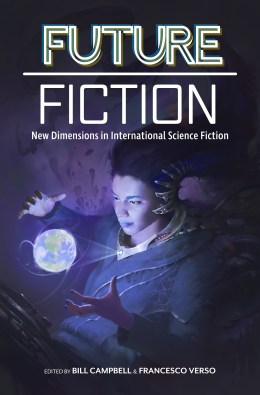
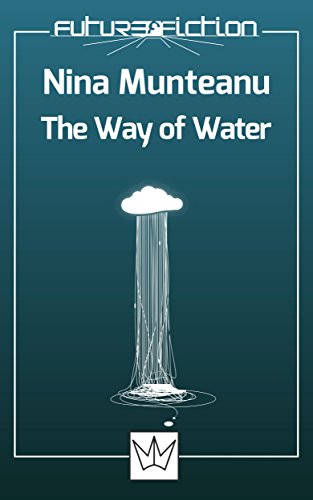
FF - Rosarium Cover copy“The Way of Water” will also appear alongside a collection of international works (including authors from Greece, Nigeria, China, India, Russia, Mexico, USA, UK, Italy, Canada (yours truly), Cuba, and Zimbabwe) in Bill Campbell and Francesco Verso’s Rosarium Publishing / Future Fiction’s anthology “New Dimensions in International Science Fiction” in April 2018.


nina-2014aaaNina Munteanu is an ecologist, limnologist and internationally published author of award-nominated speculative novels, short stories and non-fiction. She is co-editor of Europa SF and currently teaches writing courses at George Brown College and the University of Toronto. Visit www.ninamunteanu.ca for the latest on her books. 
Nina Munteanu’s “The Way of Water” Receives More Praise

Exile-CanTales ClimateChange copyNina Munteanu’s near-future speculative short story “The Way of Water” in Bruce Meyer’s (editor) “Cli Fi: Canadian Tales of Climate Change”, published by Exile Editions in 2017, will appear again in Rosarium Publishing / Future Fiction’s anthology “New Dimensions in International Science Fiction in April 2018.

She imagines its coolness gliding down her throat. Wet with a lingering aftertaste of fish and mud. She imagines its deep voice resonating through her in primal notes; echoes from when the dinosaurs quenched their throats in the Triassic swamps.

Water is a shape shifter.

It changes yet stays the same, shifting its face with the climate. It wanders the earth like a gypsy, stealing from where it is needed and giving whimsically where it isn’t wanted.

Dizzy and shivering in the blistering heat, Hilda shuffles forward with the snaking line of people in the dusty square in front of University College where her mother used to teach. The sun beats down, crawling on her skin like an insect. She’s been standing for an hour in the queue for the public water tap.

“The Way of Water” is a near-future vision that explores the nuances of corporate and government corruption and deceit together with resource warfare. An ecologist and technologist, Nina Munteanu uses both fiction and non-fiction to examine our humanity in the face of climate change and our changing relationship with technology and Nature.

A recent review of the anthology by Emilie Moorhouse in Prism International Magazine, entitled “Courage and Imagination in Cli-Fi: Canadian Tales of Climate Change” and carried by the National Observer, describes it this way:

“The seventeen stories in this book edited by Bruce Meyer examine how humankind might struggle with the potential devastation of climate change in the near or distant future. Soon after I finished reading the book, Cape Town—known in precolonial times as “the place where clouds gather”—announced that it was only a few months away from what it called “Day Zero,” the day the city would officially run out of water, making the similarities between fiction and reality more than unsettling. Munteanu’s story is set in a futuristic Canada that has been mined of all its water by thirsty corporations who have taken over control of the resource. Rain has not fallen on Canadian soil in years due to advances in geoengineering and weather manipulation preventing rain clouds from going anywhere north of the Canada-US border…I believe that fiction offers up two much-needed ingredients in the fight to prevent climate change: courage and imagination. It is my hope that more fiction writers will take up the task of writing in this promising new genre and use their imagination to inspire readers to collectively work towards a more sustainable future.”—Emilie Moorhouse, Prism International


The Way of Water-COVERA bilingual print book by Mincione Edizioni (Rome) showcased “The Way of Water” in Italian (“La natura dell’acqua”, translated by Fiorella Moscatello) and English along with a recounting of what inspired it: “The Story of Water” (“La storia dell’acqua”) in 2016.

“In ‘The Way of Water’, Nina Munteanu pens her love letter to water, exulting it as a liquid that has semi-magical properties…’The Way of Water’ evokes a sense of awareness about issues of access to water and about the dangers of imbalances in that access.”—Derek Newman-Stille, Speculating Canada


“In a short story in which every word has its weight, Nina Munteanu manages to describe a dystopia with ecological, political, social and economic elements and Hilda’s reactions to her situation with a great emotional intensity. To avoid thirst, Hilda ends up embracing an extreme idea, a last hope linked to water.

‘The Way of Water’ is a story of the kind you hope is science fiction but you fear is not.”—Massimo Luciani


FF-TheWayOfWater” ‘The Way of Water’ is to be ‘a shapeshifter,’ says Nina Munteanu in her dystopian narrative, where she draws a dark scenario and, unfortunately, not too improbable in the near future. In the universe of the story water has become a very precious commodity: rationed consumption, credits (always of water) accounted for and debts collected…The Chinese multinationals have exchanged the public debt of other states with their water reserves with which, now, they can control the climate, deciding when and where it will rain. Who understands this dirty game has been silenced, like Hilda’s mother, a limnologist, inexplicably arrested and never returned; like the daughter of two water vendors, mysteriously disappeared, after having decided not to bow to economic powers: Hanna, who now prefers secure virtual identities to evanescent real appearances. Water. The two, like the covalent bond of a complex molecule, develop a relationship of attraction and repulsion that will first make them meet and then, little by little, will change into a tormented love but, at the same time, so pure as to cause Hilda at great risk, to make an extreme decision that will allow Hanna to realize the strange prophecy that the internal voice, perhaps the consciousness of water, had resonated in the two women for a long time.

Nina Munteanu recounts that this element is also a form of love; a story to read, not only to deal with the possible but, above all, to understand that the time still available to “love” may be less than what we believe.”—Simone Casavecchia, SoloLibri.net

FF - Rosarium Cover copy“The Way of Water” will also appear alongside a collection of international works (including authors from Greece, Nigeria, China, India, Russia, Mexico, USA, UK, Italy, Canada (yours truly), Cuba, and Zimbabwe) in Bill Campbell and Francesco Verso’s Rosarium Publishing / Future Fiction’s anthology “New Dimensions in International Science Fiction” in April 2018.

“Nina Munteanu’s “The Way of Water” is perhaps more esoteric in its focus and more abstract in its approach, but I likewise found it to be a strong story. In an interesting scarcity future in which we follow the fate of a character abandoned by her mother, water itself becomes a character. In the second paragraph we’re told that “Water is a shape shifter,” and in the next page we encounter the following description: “Water was paradox. Aggressive yet yielding. Life-giving yet dangerous. Floods. Droughts. Mudslides. Tsunamis. Water cut recursive patterns of creative destruction through the landscape, an ouroboros remembering.” These descriptive musings cleverly turn out to be more than metaphors and tie in directly to the tale’s surprising ending.”—Alvaro Zinos-Amaro, IntergalacticMedicineShow.com


Nina MunteanuNina Munteanu is an ecologist, limnologist and internationally published author of award-nominated speculative novels, short stories and non-fiction. She is co-editor of Europa SF and currently teaches writing courses at George Brown College and the University of Toronto. Visit www.ninamunteanu.ca for the latest on her books.


Nina Munteanu Interviewed on Splintered Universe Trilogy

I was recently interviewed by writer Simon Rose on my space detective thriller trilogy Splintered Universe, now available in all three formats: print, ebook, and audiobook. 


Below is the interview:

My guest today is Nina Munteanu, author of science fiction and fantasy novels, non-fiction books and essays on writing and science. Her latest in a series of prolific works is the recent completion of the audiobook of her science fiction space-thriller trilogy, Splintered Universe.

Can you tell us a little about the Splintered Universe Trilogy?

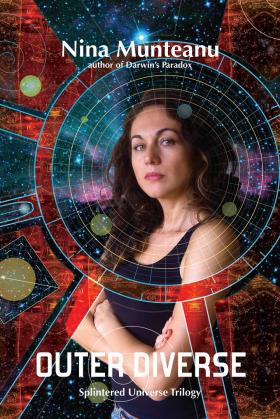
OuterDiverse-cover-web copy

Book 1 of Splintered Universe

The Splintered Universe Trilogy is a detective mystery-thriller that explores metaphysical and existential questions through a high-test space adventure. The three books include Outer Diverse, Inner Diverse and Metaverse.

The main character Rhea Hawke is a Galactic Guardian and the only human in an otherwise alien race of 7-foot tall purple-skinned Eosians—who she actually despises (for reasons you find out later). She’s a loner and a misfit in an elite police force tasked with keeping order in the galaxy; Rhea’s unruly tactics grate on them—particularly her boss. In Outer Diverse, Rhea investigates the genocide of an entire spiritual sect; but instead she kills her only lead.

Following the scent of Glitter Dust, Rhea connects the massacre to the murders of several prominent galactic citizens and finally to the deadly Vos, who invaded our galaxy, then disappeared. She realizes that the Vos have quietly returned, infiltrating every aspect of the civilized world—with dark menace in mind. But no one believes her—particularly her boss, who fires her instead for incompetence: badge, Great Coat and MEC weapon confiscated and her sentient ship Benny put in storage. Compelled by an urgency she herself doesn’t understand, she goes rogue and enlists the aid of surprising allies to save the galaxy.

You mention that Splintered Universe explores issues of existentialism and metaphysics. Can you speak to them?


Inner-diverse-front-cover-WEB copy

Book 2 of Splintered Universe

The Splintered Universe Trilogy explores the fractal fabric of paradox, where the flow of particle, energy, wave and intention embrace: black holes, quasars, neutrinos, intuition, déjà vu, clairvoyance, altruism, faith…

The prediction by Gnostic priest Raphael Martinez (The coming of the Suntelia Aeon will be signified by the joining of twin souls) weaves many disparate threads of existence to Atlantis and the Eosian alien race (who resemble the Bible’s Nephilim), the sacred vishna tree (part of L’Ordre de l’Arbre Sacré in Quebec) and the precious mythical metal Orichalcum used by the Eosians. The prediction ties to an ancient knowledge that describes our very existence through déjà vu, synchronicity, sacred geometry, phi and the golden mean and the notion that “diverses” are mirror universes linked through dreams. The key is Rhea herself—who discovers that she is not who or what she thinks.

You’re a bit known for your world building. Tell us a little about that in this trilogy.

Metaverse-FRONT-web copy

Book 3 of Splintered Universe

I’m an ecologist, so world building with realistic ecosystems is more than fun for me. I enjoy doing the research to create realistic and meaningful worlds. I consulted authorities in the areas of space exploration and habitable zones, AI, biotechnology, sleep biology, neuroscience, and ecology to design alien worlds and systems, populated with extremophiles.

In her pursuit of justice, Rhea travels to all parts of the galaxy and encounters some very strange worlds. In Book 1, Rhea pursues dust trafficker V’mer to the sulphurous AI-run water planet (Mar Delena), located inside the hole of the gaseous “donut” of Fomalhaut; it’s always raining acid. That’s where Book 1 starts: acid rain painfully spattering Rhea’s face as she lies injured and waiting to be dusted (with a lethal dose) by V’mer, surrounded by the oily fur-covered rodent-like Delenians—all dust addicts.

Rhea almost drowns in a high-speed skipboat chase of the murderer of a spiritual sect on the icy moon, Uma 1, (orbiting 47 Uma b of 47 Ursae Majoris b). The moon is mostly ocean beneath a thick layer of ice with thermal vents that provide the inhabitants—a spiritual sect called the Schiss—a home.

NinaMunteanuHalfPage-AD-Astra47 Uma a (also called Horus) was colonized in ancient times by the Khonsus, a raptor-like biped race with mind-probing capability. It is also the home of the ancient migrating trees, ammuts (giant flying insects), and the weeping mountains with their narcotic boiling seas used by the giant apophus to attack and set its millions of babies to devour Rhea in Book 1.

Virgil 9 is a tidally locked moon that orbits the gas giant 70 Virginis b; day and night last for weeks while water swings the extreme from deluge flood to desert conditions. In Virgil City, Rhea does commerce with information broker Shlsh Shle She, a moody amoeba-like photosynthetic Ngu who is just a pseudopod of a larger hive-entity.

Sekmet is a bog planet, where the raw materials of dust are harvested by the Rill, bulbous short smelly bog creatures with tube eyes, webbed limbs and large sexual organs; and who Rhea pretty much wipes out with her MEC weapon. Sekmet is also the location of a galactic penal colony (Hades) where Rhea is sent in Book 2. When she tries to escape, she must contend with other native creatures of Sekmet such as the giant crocodile-like sobeks and the terrifying kepry—giant flying crustaceans.

In Book 3, Rhea returns to Earth, transformed by Eosian settlers from its former polluted state dominated by urban concrete cities to an entirely natural world, now unpolluted and featuring the ancient purple vishna tree and a crystal symbiotic organic technology.


Rhea on Iota Hor

Rhea on Iota Hor-2

Worlds always have cool bling associated with them. What technologies or devices are featured in Splintered Universe?

I created an entire fleet of ships, all run on various technologies, from crystals, to wave-energy to dreams. That was fun to create. Two main ship builders include: Zeta Corp from Earth and Tangent Shipping run by the Fauche from Sigma Draconis. Rhea’s own ship, Benny, is an old ray class Fauche-built corvette, a two-man hybrid organic/nano-tech vehicle with folding wings and fuel scoops (so it can mine energy fuel from gas giants). Benny is a sentient ship that jacks the particle-stream and with whom Rhea has an interesting relationship. The ship serves essentially as butler, administrator, companion, and rescuer.

I also created a wide range of weapons, based on which alien race created them and for what purpose. Rhea gained some notoriety with her own created weapon, the MEC (short for Magnetic-Electro Concussion) pistol, a versatile wave-weapon that can target DNA signatures and do almost anything you want with a single sweep. Her proprietary MEC design is coveted by many groups—from shady crime syndicates such as Eclipse to her own Guardians.

I hear that the last audiobook (the third book) in the trilogy is finally out this January. That means that all three books of the Splintered Universe are now available in print, ebook and audiobook format. How does it feel to have a trilogy available in three complete formats?

It feels great! I’m so excited that readers can now obtain my trilogy in those different ways. It speaks to our different ways of consuming story. Some prefer to settle back by the fire or our favourite place to read with a “real” book; others like a mobile ebook so we can read while we travel and play; and then some like to lean back in the car and listen to a great story.

What was your experience with the narrator of the three books?

Dawn-Harvey

Dawn Harvey of “Dawn of Voice”

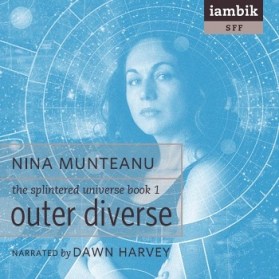
The experience was truly cosmic. When Iambik took on the books as audiobooks, they provided me with three voice artists to audition. I chose Dawn Harvey because I could visualize my main character through her voice, and given that the entire trilogy is told in the first person, the narrator’s voice had to be just right. Dawn’s voice is dark and sultry like coffee. It is sexy and irreverent with a hidden vulnerability and sensitivity that perfectly captured the main character Rhea Hawke. What I didn’t realize then was how well Harvey would represent the 30-odd other characters, mostly aliens—one who spoke through several mouths.

OuterDiverse-audiobook-Iambik

Audiobook of Outer Diverse

Working with Dawn was a pleasure. Dawn is a dedicated professional; she created unique and consistent voices for the book’s thirty-odd mostly alien characters. She ensured that each character had the appropriate vernacular, tone, accent and cadence. Then she did proofs and confirmed them with me. She also tackled the “alien” vocabulary; Rhea’s universe is full of strange and foreign terms (I have a comprehensive glossary at the back of each book). Dawn sent me a list to make sure she was pronouncing everything correctly—mostly made-up words. Dawn is a professional dedicated to her craft and her art. She literally breathed life into Rhea Hawke and all the other characters. The result is three audiobooks that will blow your socks off. I mean it. If you like audiobooks, get the first one and tell me different. When I first listened to Outer Diverse in the car on my way to Nova Scotia, I lost myself in her storytelling and forgot that I’d written it.

Where can people find the Splintered Universe Trilogy?

The best place, of course is Amazon (Amazon.ca or Amazon.com). All three formats are available through Amazon. The Audiobooks are currently available for free through Audible on Amazon. The books are also available through Barnes & Noble, Chapters/Indigo, Kobo, and many other book selling sites and brick and mortar stores.

When you’re not writing what do you do?

These days I’m mostly on the University of Toronto campus, teaching health science and engineering students how to write. When the students find out that I write science fiction, they get all excited. It’s a lot of fun. I also teach a science fiction writing coarse at George Brown College. When I’m not teaching or writing, I’m doing something in Nature, usually by the water. I’ve always had an interest in water. I studied and researched freshwater ecology as a limnologist for three decades. I’m a bit of an environmentalist these days, hoping to raise awareness and action for water. My latest novel—hopefully coming out next year—arose from my nature walks and my research in water. The story chronicles the lives of four generations of women and their relationship with water.

TALKING-AUDIOBOOKS2 copyYou can also listen to the Podcast interview of Dawn Harvey and Nina Munteanu by Casey Trowbridge of Talking Audiobooks on the process of their collaboration. Learn more about the process between writer and voice artist narrator:

The trilogy has received a fair bit of acclaim from reviewers and readers:

Martha’s Bookshelf
Speculating Canada
Dab of Darkness
Goodreads
Amazon
Amazon Canada

“Rhea Hawke is a Galactic Guardian, and I love to say her name. Her name alone let’s you know that there is a bad ass super hero of a woman on site. I can picture her boots, her great coat, and her side arms. I want to be her when I grow up. Obviously, you can tell I developed some hero worship for her by the end of this book. I really got wrapped up in this novel.”–Goodreads Review of Outer Diverse


“Ms. Harvey manages to enthuse the personality of the characters into each voice. The wise, gentle Ka has a soft, strong sound that reminds you of a wise old bird. Shlsh She She, a slippery, slimy creature has a slurry, garbled voice like a mouthful of mushy, wet food. Dawn’s reading conveys the loneliness in Rhea, the sexiness of Serge, the frustrated friendliness of Bas, and the faithful coziness of Benny. She is able to bring emphasis to the action or romance, weariness or fear elements of the story. The narration never takes over the story; but rather enhances it.”–Martha’s Bookshelf on Outer Diverse Audiobook

The excellent cover art for all three books is done by Toronto graphic artist and SF author Costi Gurgu (author of RecipeArium). People keep asking me who the model for the covers is; you’ll have to corner Costi at the next spec fiction con and ask him yourself.

nina-2014aaaNina Munteanu is an ecologist, limnologist and internationally published author of award-nominated speculative novels, short stories and non-fiction. She is co-editor of Europa SF and currently teaches writing courses at George Brown College and the University of Toronto. Visit www.ninamunteanu.ca for the latest on her books.


Ursula K. Le Guin: Her Name is Freedom

Amid the sadness of the passing of Ursula K. Le Guin, we offer her wise advice on art and literature, given in 2014. In receiving her lifetime achievement award in 2014, Ursula delivered a speech that was prescient, timely and necessary:

Neil Gaiman presents lifetime achievement award to Ursula K. Le Guin at 2014 National Book Awards from National Book Foundation on Vimeo.

Ursula K. Le Guin first told her audience that she wanted to share her award with her fellow-fantasy and science fiction writers, who have for so long watched “the beautiful awards” like the one she’d just received, go to the “so-called realists”. She then went on to

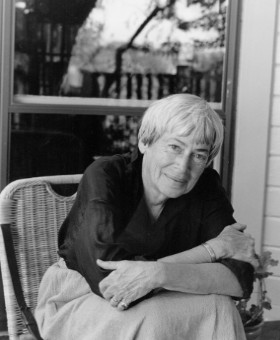
ursula le guin

Ursula K. Le Guin

say:

“I think hard times are coming, when we will be wanting the voices of writers who can see alternatives to how we live now, and can see through our fear-stricken society and its obsessive technologies, to other ways of being. And even imagine some real grounds for hope. We will need writers who can remember freedom: poets, visionaries–the realists of a larger reality. Right now, I think we need writers who know the difference between production of a market commodity and the practice of an art…The profit motive is often in conflict with the aims of art…We live in capitalism. Its power seems inescapable; so did the divine right of kings… Power can be resisted and changed by human beings; resistance and change often begin in art, and very often in our art–the art of words. I’ve had a long career and a good one, in good company, and here, at the end of it, I really don’t want to watch American literature get sold down the river… The name of our beautiful reward is not profit. Its name is freedom.”

nina-2014aaaNina Munteanu is an ecologist and internationally published author of novels, short stories and essays. She coaches writers and teaches writing at George Brown College and the University of Toronto. For more about Nina’s coaching & workshops visit www.ninamunteanu.me. Visit www.ninamunteanu.ca for more about her writing.