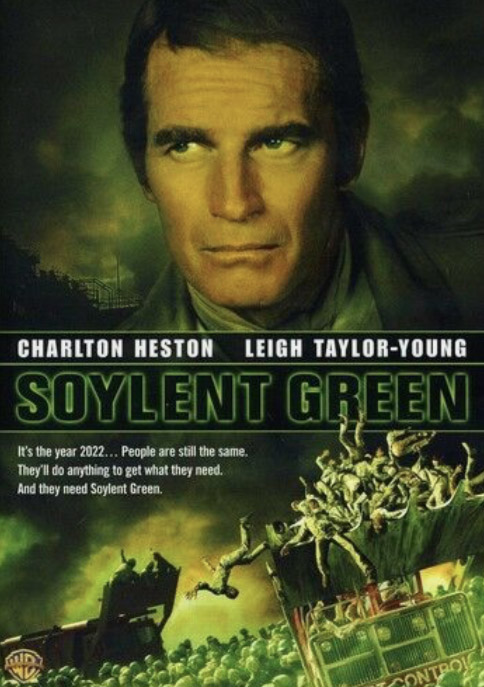
“The year is 2022. Our overpopulated planet is experiencing catastrophic climate change, mega-corporations have excessive power over the government, and clean living is a luxury only the 1 percent can afford. It may read like a scan of the front-page headlines, but these predictions were laid out half a century ago in the dystopian film Soylent Green,” writes George Bass of The Washington Post.
.
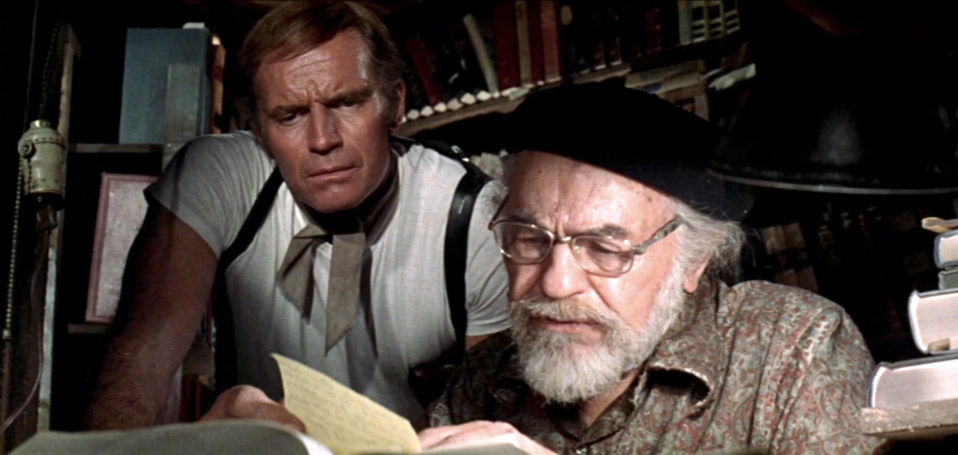
The 1973 science fiction eco-thriller Soylent Green, directed by Richard Fleischer, was based on the 1966 novel Make Room! Make Room! by Harry Harrison. The movie stars Charlton Heston as Robert Thorn, an illiterate rather wily NYC detective who must solve the murder of a Soylent executive with the help of his sidekick researcher and friend Sol Roth (Edward G. Robinson). In one scene, Thorn notes that the city of over 40 million logs 137 homicides a day.
.

.
The murder mystery unravels a hive of intrigue in a sweltering 90° New York City, over-crowded with a restive population of homeless and starving people. “Margarine spoils in the fridge, and a sickly fog … hangs in the air,” writes Bass. Thorn shares a small room with friend and helper Sol in a building where he must daily negotiate an obstacle course of occupants who crowd the stairs and hallways. These scenes contrast with those within the enclaves of the corporate elite, who enjoy a luxurious lifestyle of spacious homes equipped with ample water and food and the latest technology and games—a common trope of ‘haves’ and ‘have nots’ in several dystopian works such as the Brazilian TV show 3%, and the movies Elysium, Advantageous, and Snowpiercer.
.
.
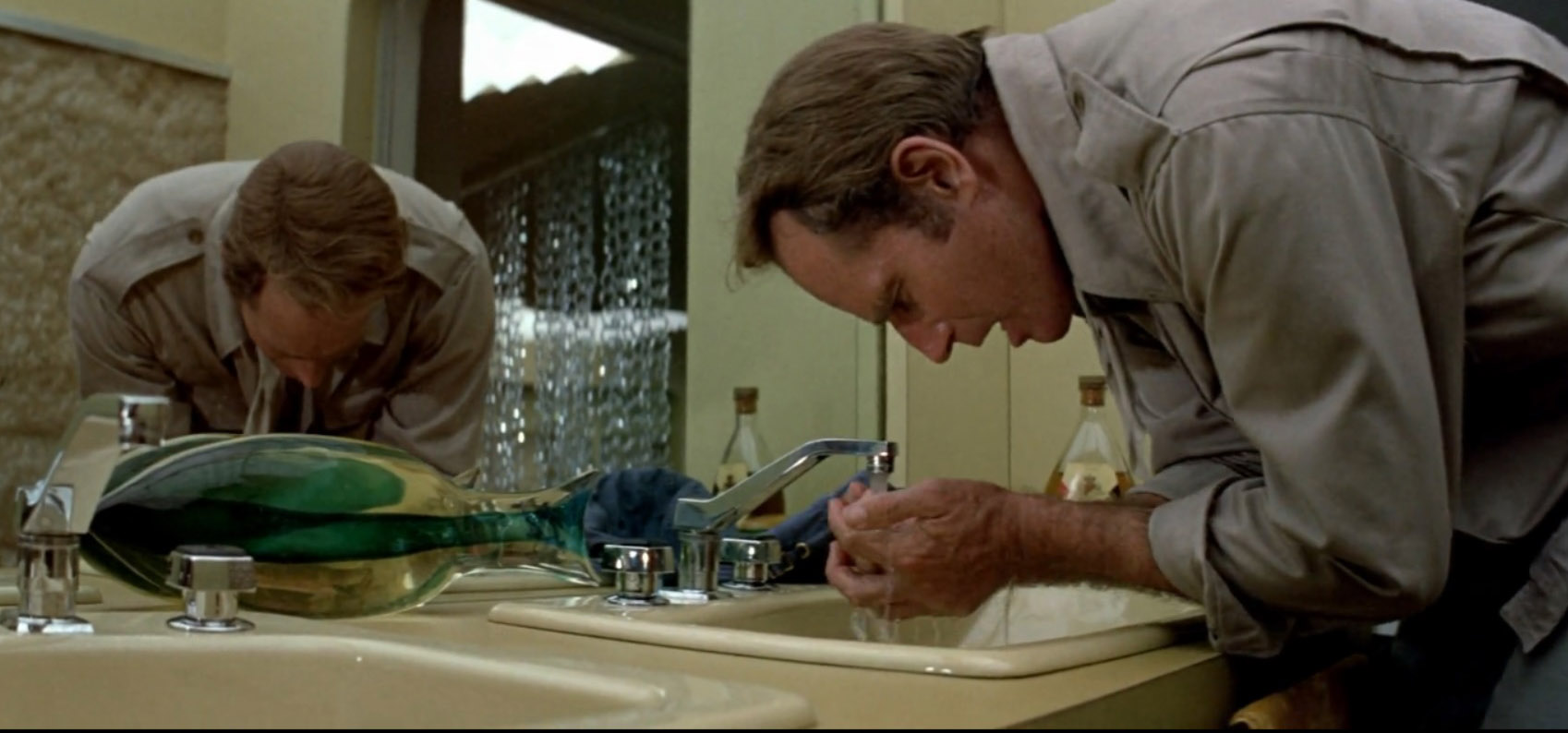
Accustomed to living a scorched existence, Thorn becomes infatuated with a bar of soap he finds in the victim’s mansion and an air conditioner that can make a room “cold, like winter used to be.” I’m reminded of another crusty detective scrabbling for comfort items in a less than comfortable world: Detective Miller in the TV series The Expanse breaks into his subject’s apartment to use her shower.
.
.
In this ‘future’ world of synthetic food, the public lives off the high-energy vegetable concentrates created by the Soylent Corporation. Their latest synthetic food product is Soylent Green, advertised as a “miracle food of high-energy plankton gathered from the oceans of the world,” and is so popular that it must be rationed to a single day availability per week—causing more of those riots I already mentioned. Of course, the wealthy elite still eat meat and semi-fresh vegetables, but even these are not to the standard that we in North America are accustomed to. The meat is old and the vegetables imperfect. Bass notes that “Each door in the luxury tower block is automated, the penthouse butler is dressed in garish hunting pink, and the height of decadence is a fresh shower.” Climate change even impacts the super-rich.
Most pressing on the public’s mind is hunger and food insecurity. Micheal Peck of The Break Through writes that corporations and governments commit murder and state-sanctioned mass cannibalism to protect their food supply. Soylent Corporation employs an assassin to dispatch its enemies and the killer doesn’t spend his pay on a car or a house; instead, he splurges on real strawberry jam (which goes for $150 a jar, marvels Roth).
.
.
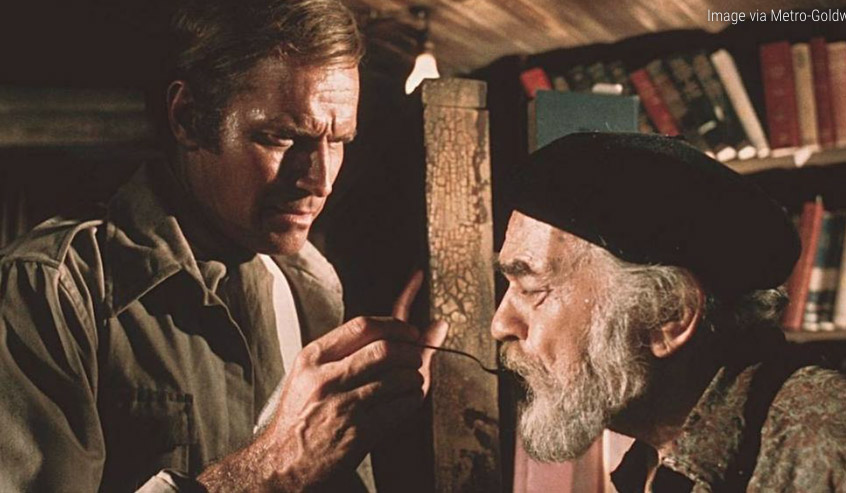
In another scene Roth laments to Thorn, “When I was a kid food was food. Before our scientific magicians poisoned the water, polluted the soil. Decimated plant and animal life. Why, in my day you could buy meat anywhere. Eggs, they had. Real butter. Fresh lettuce in the store.” Thorn answers, “I know, Sol. You told me before. A heat wave all year long. A greenhouse effect. Everything is burning up.” When Thorn brings back a prize of meat and some old vegetables he’d scavenged from the murder victim’s apartment, Roth grows emotional and shares, “I haven’t eaten like this in years.” Thorn responds, “I never ate like this.”
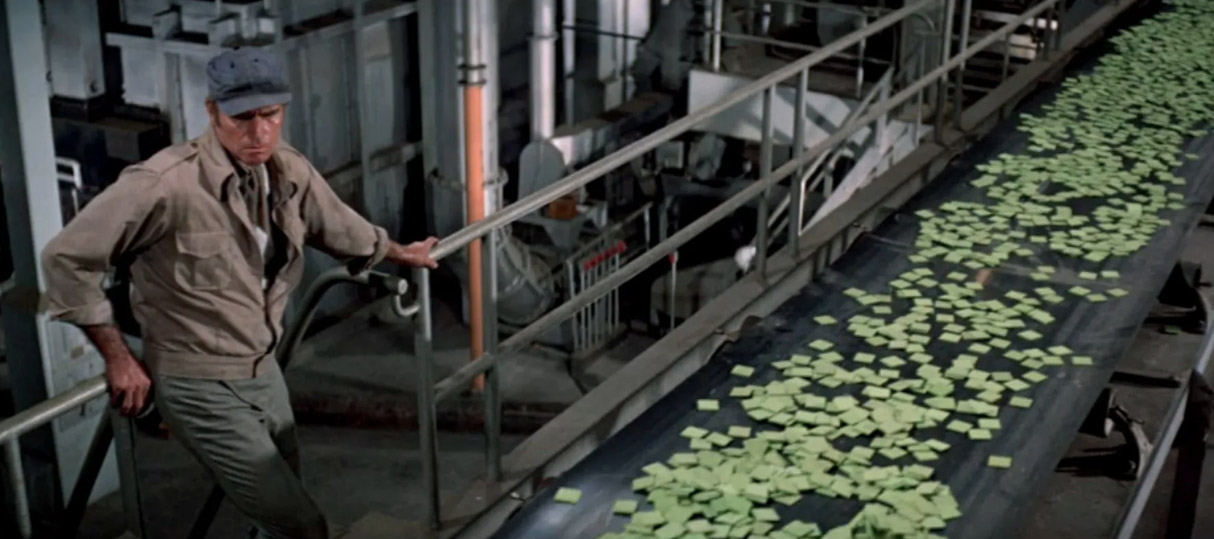
Thorn’s investigation ultimately leads him to a discovery that goes way beyond the murder, which he discovers is really an assassination, one that will reveal the ultimate corporate conspiracy: Soylent Green is people.
.
.
“The uncanny (un)timeliness of the film is profoundly disturbing while at the same time deeply gratifying, as if hearing a voice from the past tell you that your daily anxiety about capitalism-induced climate chaos is not only well justified, it has actually been anticipated for some time,” writes Alisa Lebow in Film Quarterly.
Lebow adds that Soylent Green did not receive the critical acclaim it deserved on its release (though it has since become somewhat of a classic with an eclectic audience). “What none of the critics writing in 1973 could have foreseen … is the near prophetic view of the absolute callousness of late capitalism wherein profit and the enrichment of the few reign supreme.” According to Lebow, while Soylent Green has been largely forgotten, more recent films such as The Day After Tomorrow have been received with great fanfare and have been credited with helping change perceptions about climate change, especially in the US. Lebow argues that The Day After Tomorrow pales in comparison to Soylent Green in terms of urgency and clarity of message and “that the focus on climate as the driver of change is more forthrightly posited in this film than in any popular genre film on the topic that I have seen.”
The crisis of over-population in the film resonates powerfully today and runs in concert with the destruction of our habitable world. The alarming question remains: how to feed an over-crowded planet when the climate is unpredictable and the relentless industrial machine continues to strain the planet’s resources.
.
.
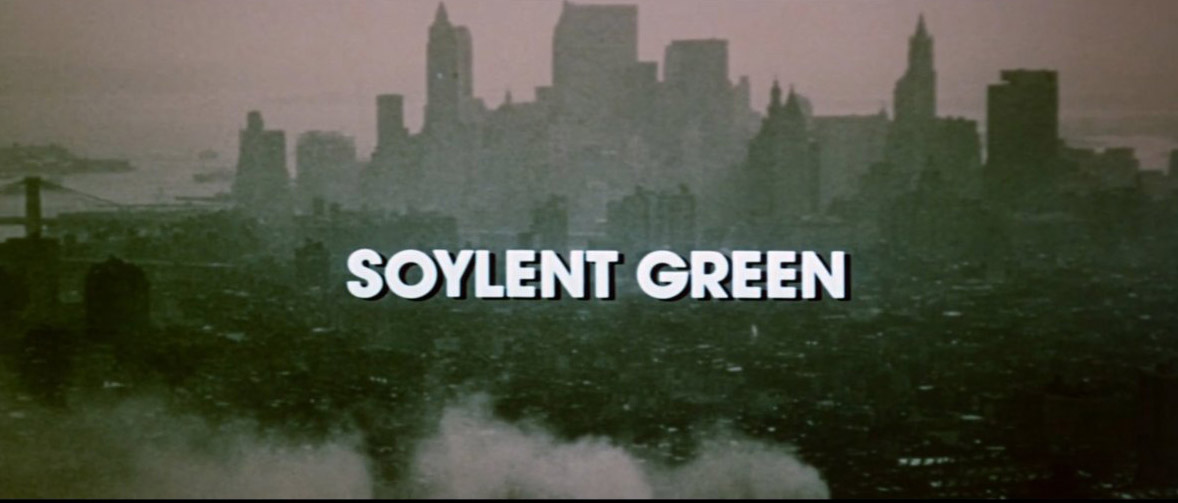
The Opening Title of the Film
Alisa Lebow, Professor of Screen Media at University of Sussex ascribes the opening title of the film as nothing less than brilliant and worthy of study:
“Charles Braverman’s two and a half minute documentary montage that opens the film is a revelation in and of itself and worthy of sustained analysis. Beginning with sepia images of early American settlers, the montage unwittingly apportions blame correctly to the white settler colonists for the maddening pace of industrialization and the demise of any balanced and respectful relationship with the lived environment. The montage quickly accelerates from its proto-Ken Burns Effect zooms and pulls to a frenzied barrage of cuts and dissolves with some nifty split screen effects that could not have been simple to produce at the time. Comprised exclusively of stills, it manages to convey the dizzying pace of development and its often unnoticed effects. Highways are choked with cars, factory chimneys belch black smoke, people crowd the streets in all reaches of the globe, as mountains of junked cars threaten to overtake the frame and garbage piles up in every corner.”
.
.
Decades-Old Cautionary Tale Highly Relevant Today
The 1960s was a time of great activism and environmental awareness, igniting an environmental movement led by Rachel Carson’s 1962 Silent Spring and Paul R. Ehrlich’s 1968 The Population Bomb, among other calls for action. Maurice Mitchell of the Geektwins shares that many important scientific works warning of the future devastation of climate change came to us in the 1960s. “By the 1960s, aerosol pollution had become a serious local problem and scientists began to consider the cooling effect of particulate pollution on global temperatures. Paul R. Ehrlich wrote that the greenhouse effect is being enhanced by carbon dioxide and is being countered by low-level clouds generated by contrails, dust, and other contaminants. In 1963, J. Murray Mitchell presented one of the first up-to-date temperature reconstructions, which showed that global temperatures increased steadily until 1940. In 1965, the Science Advisory Committee warned of the harmful effects of fossil fuel emissions.”
Mitchell adds that Soylent Green was the first movie to caution about greenhouse gas—long before The Day After Tomorrow (2004), The Day the Earth Stood Still (2008), Interstellar (2014), and Don’t Look Up (2021) moved people to ponder the devastation of climate change.
Elisa Guimarães of Collider writes: “At the height of the 21st century, Richard Fleischer’s Soylent Green can make for a somewhat weird watch. Originally released in 1973, the film first produces a sense of disconnect in modern viewers with its initial card, which dates its plot as taking place in the far-off year of 2022. The film’s extremely 1970s brand of sexism and neo-Malthusian approach to overpopulation can also feel uncomfortable for contemporary eyes. And, yet, Soylent Green’s social and environmental concerns feel all the more urgent in a world in which climate change has become undeniable.”
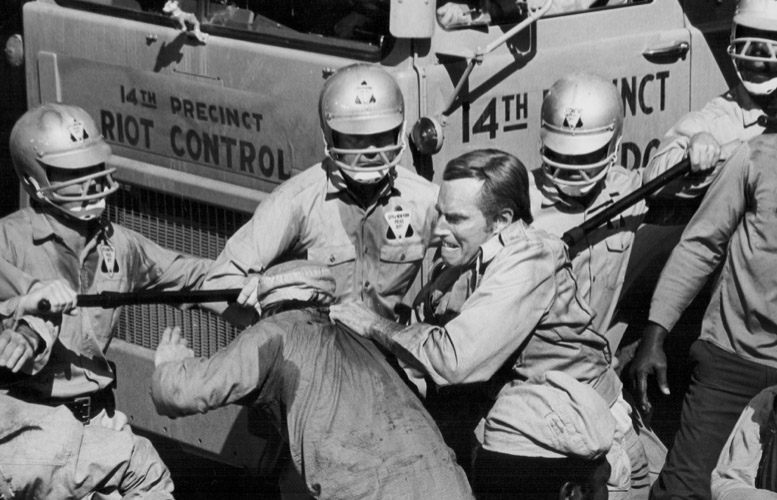
In her article entitled “The Greatest Horror of ‘Soylent Green’ Isn’t Soylent Green—It’s This”, Guimarães notes that “there’s something in Soylent Green that feels even more wrong than the realization that humanity has been engaging in involuntary cannibalism.” Guimarães argues that the scene with the assisted suicide clinic helps viewers comprehend “just how devoid of value human life has become in such a scarcity-ridden world.” The film shows only too clearly how people are treated: as homo sacer commodities in a Foucault biopolitical world of disposable humans. Guimarães argues that the euthanasia facility “is the one place in which the poor and weak of the Soylent Green society may find some semblance of dignity; but it is also the place to which you go to be turned from an unproductive individual into a product.”
In the final scene, when Thorn reveals his horrific discovery of hidden cannibalism, he instantly understands its deeper consequence: in a world of severe resource depletion, humaneness is the main casualty.
“Ocean’s dying, plankton’s dying … it’s people. Soylent Green is made out of people. They’re making our food out of people. Next thing, they’ll be breeding us like cattle for food…We’ve gotta stop them somehow!”
“While [Soylent Green] inevitably gets many things wrong, it also gets something dead right.”
Alisa Lebow
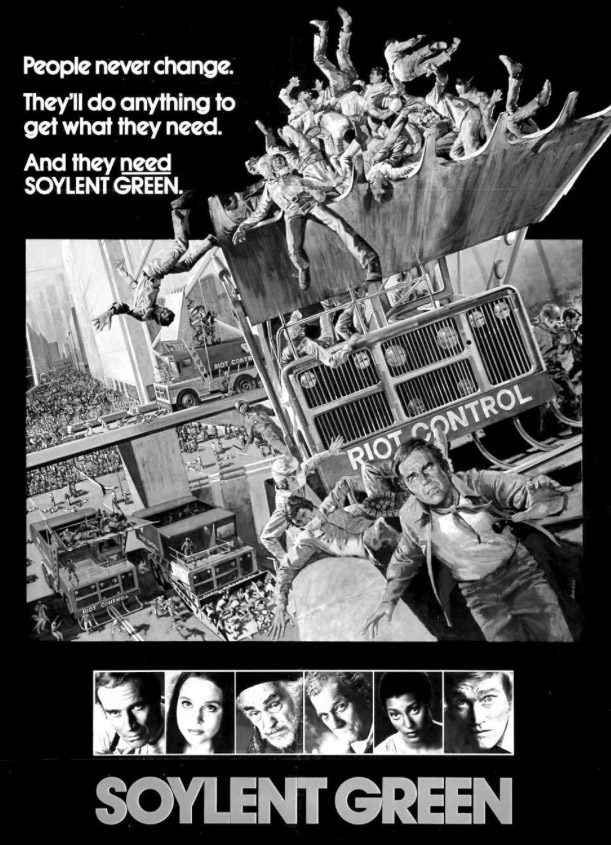
Soylent Green deserves to be watched. It deserves to be discussed. Go watch it and lament how after fifty years we have done so little to change this trajectory.
.

Nina Munteanu is a Canadian ecologist / limnologist and novelist. She is co-editor of Europa SF and currently teaches writing courses at George Brown College and the University of Toronto. Visit www.ninamunteanu.ca for the latest on her books. Nina’s bilingual “La natura dell’acqua / The Way of Water” was published by Mincione Edizioni in Rome. Her non-fiction book “Water Is…” by Pixl Press (Vancouver) was selected by Margaret Atwood in the New York Times ‘Year in Reading’ and was chosen as the 2017 Summer Read by Water Canada. Her novel “A Diary in the Age of Water” was released by Inanna Publications (Toronto) in June 2020.

