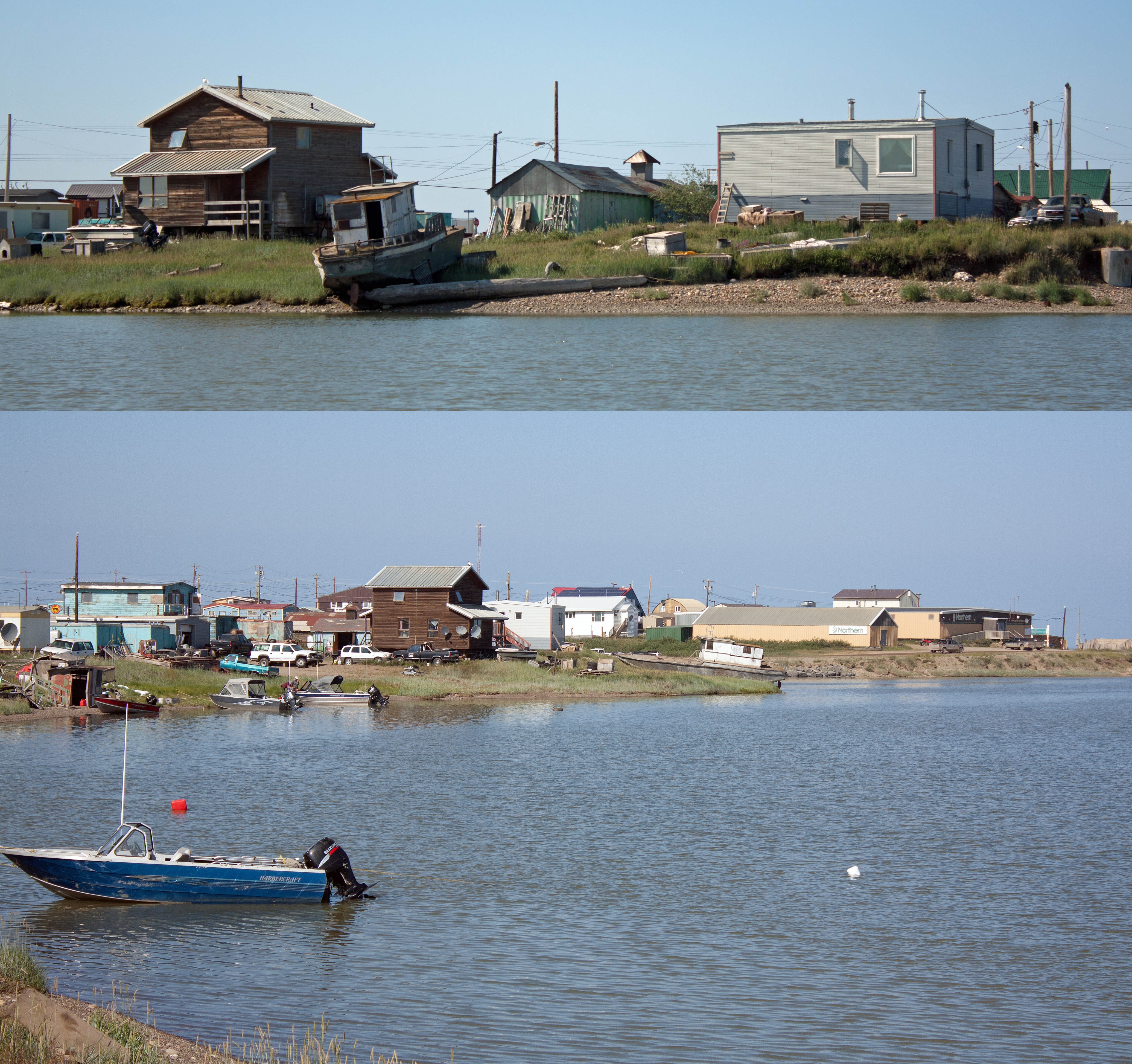
The sleepy village of Tuktoyaktuk on the Arctic Ocean, NWT (photos by Nina Munteanu)
.
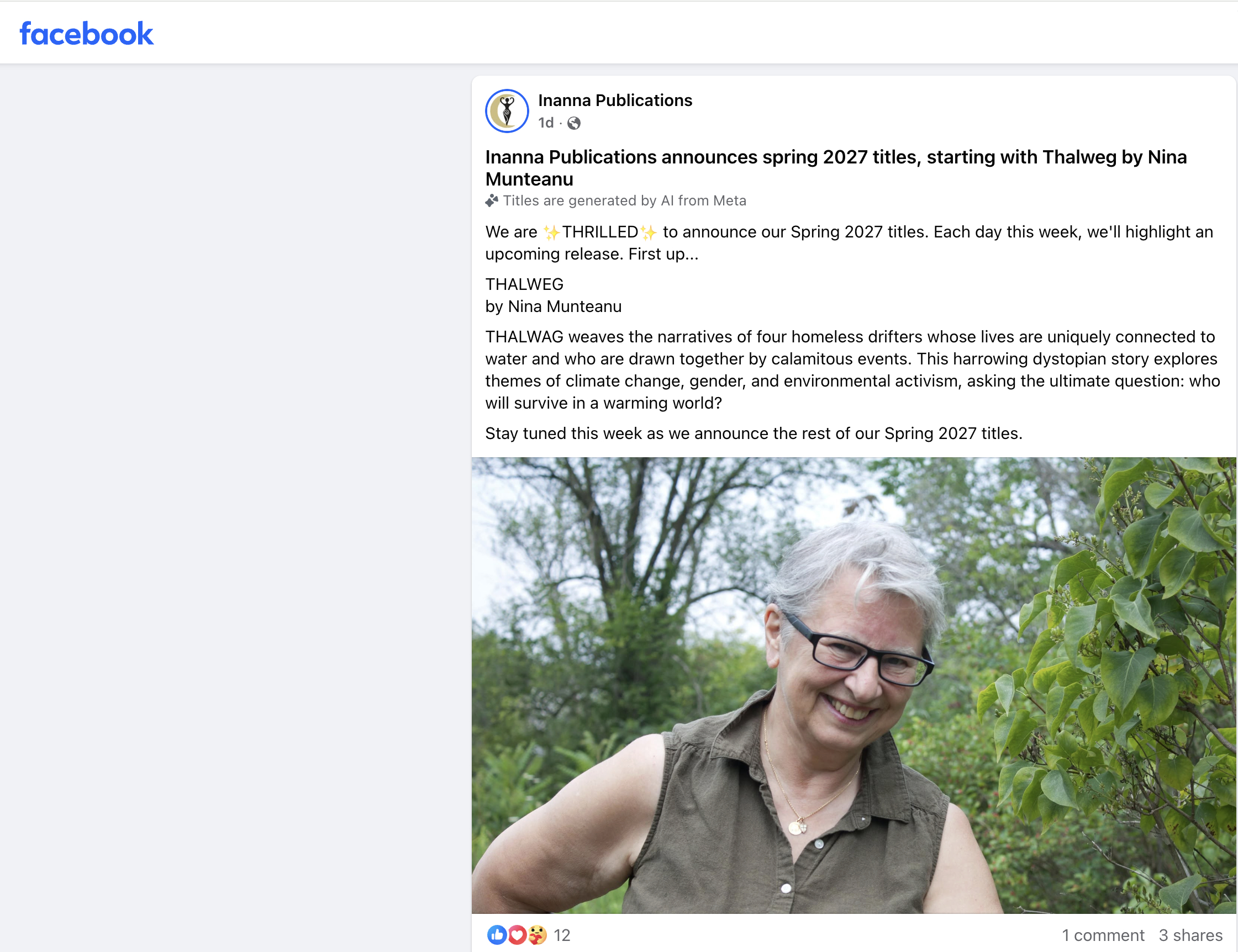
A few years ago, I travelled to the village Tuktoyaktuk in the Northwest Territories on the Arctic Ocean. I was researching my upcoming eco-fiction book Thalweg with Inanna Publications (scheduled for release in early 2027). I drove with my friend Anne Voute; we rented a Dodge Dakota truck and drove the Dempster Highway north from Inuvik and the recently completed NWT Highway 10 (completed in 2017), which provides the remaining 140 km stretch to the Arctic Ocean.
.
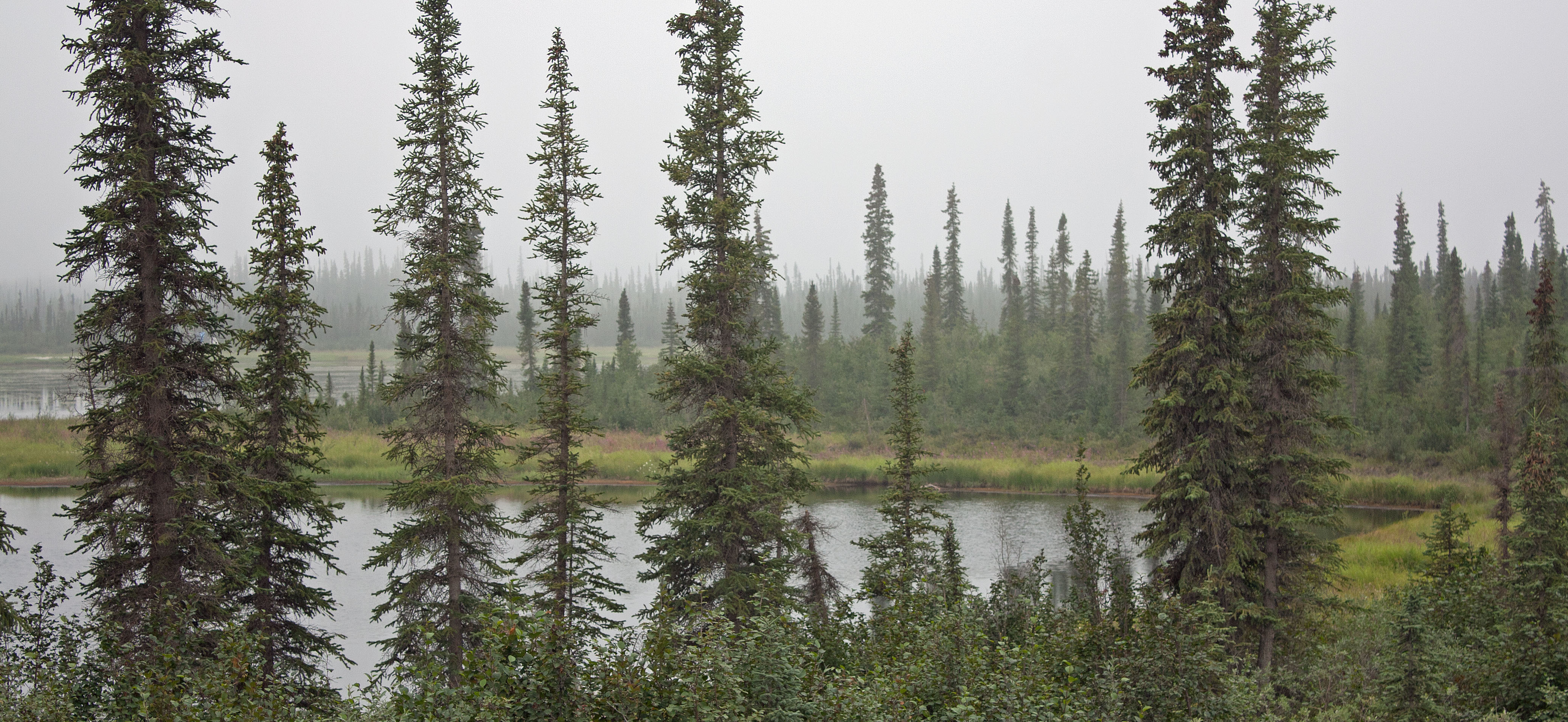
Black spruce forest along the Dempster Highway north of Fort McPherson, NWT (photo by Nina Munteanu)
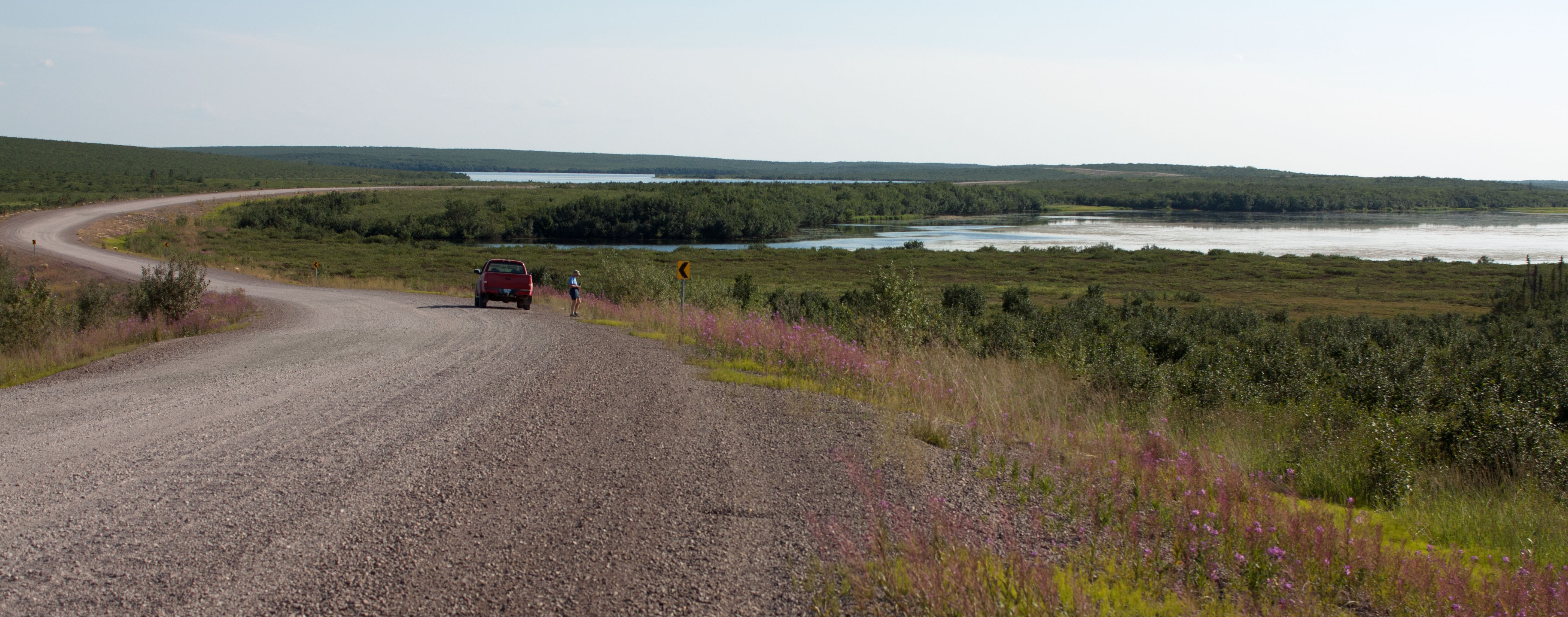
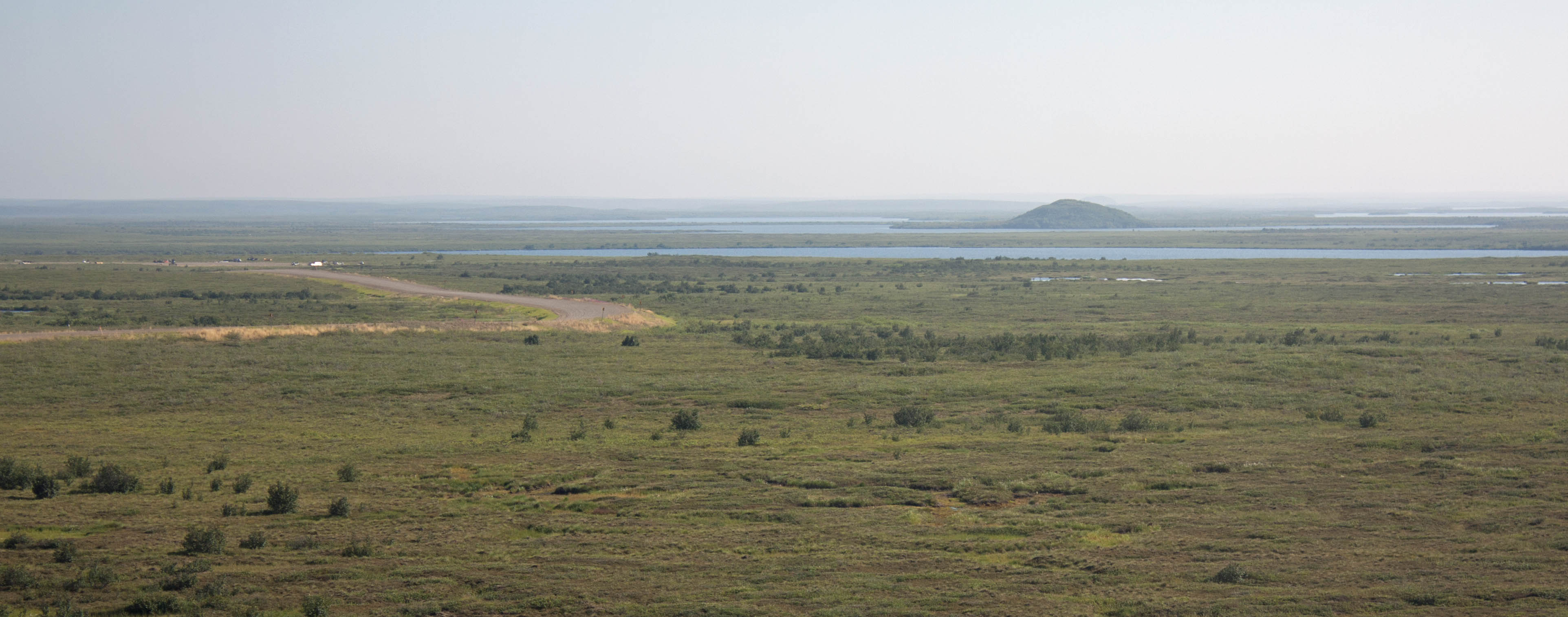
Highway 10 to Tuk winds through the tundra and Husky Lakes, NWT (photo by Nina Munteanu)
.
In Thalweg, main character Bobby-Jo is a Gwich’in limnologist who grew up in Fort McPherson in the Arctic Circle, land of permafrost.
.
Poster Child of Permafrost
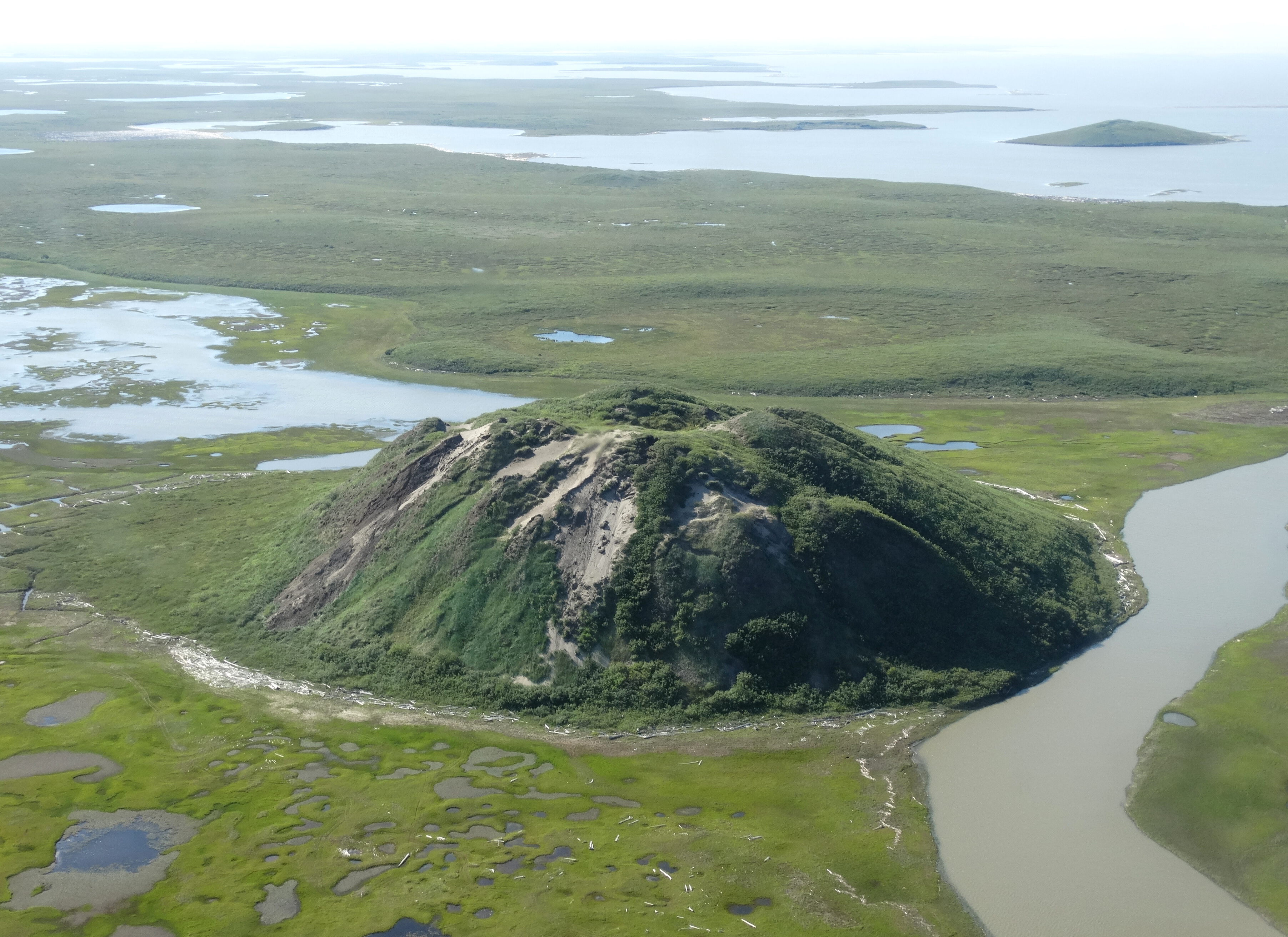
Ibyuk Pingo, near Tuk, NWT (photo shot from Cessna 172 by Adam Jones, 2013; Wikipedia Commons)
.
The poster child of permafrost is the conical ice-cored pingo, common in the Pleistocene Coastal Plain. Pingo is an Inuit word that means conical hill.
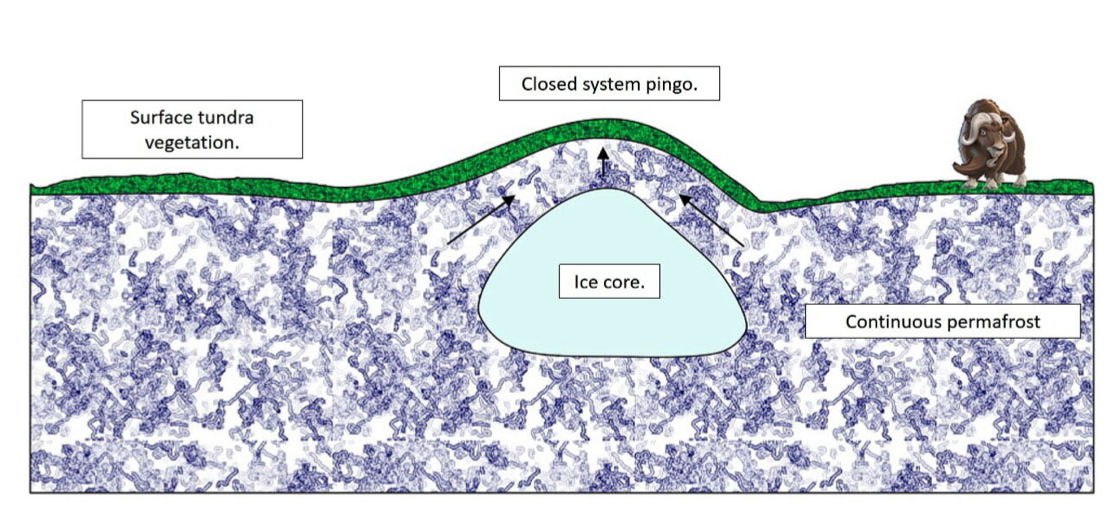
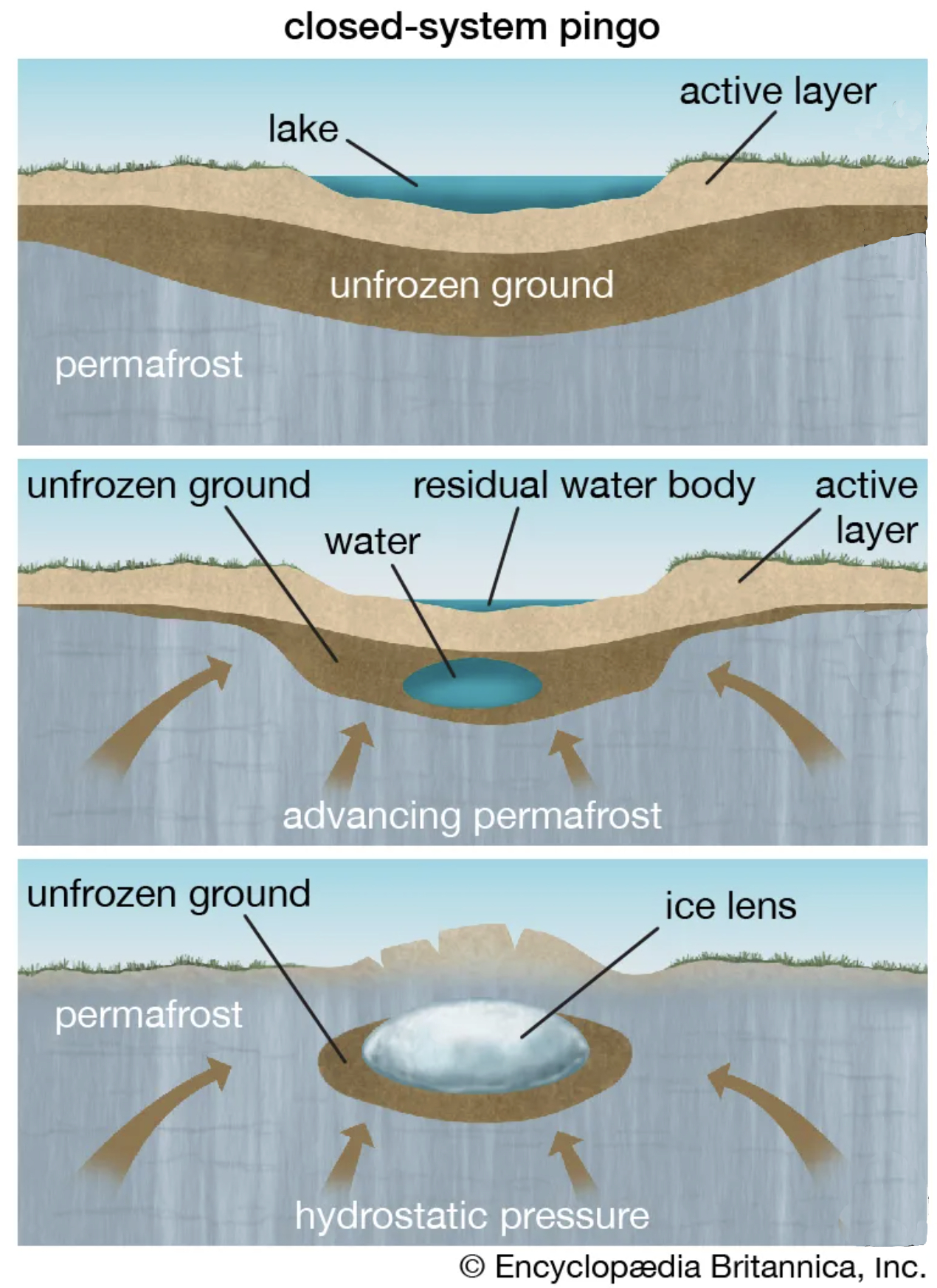
Pingos form when a mass of water is trapped beneath permafrost under pressure. Also called hydrolaccoliths, these huge mounds of earth with ice cores can reach up to 70 meters in height and 600 meters in diameter. Pingos usually grow a few centimeters a year, with the largest having taken decades or even centuries to form. Pingos eventually break down and collapse. They collapse when the ice core melts. This may happen when cracks form on the sides of the pingo that may reach down as far as the ice core, exposing the ice to warm air and sunlight. Once the core completely thaws, what remains is a doughnut-shaped ring of raised tundra enclosing a small round lake. Evidence of collapsed pingos in an area suggests that there was once permafrost there.
Hydrostatic (closed-system) Pingo (illustration by E. Ginn, 2021)
Development of closed-system pingo (illustration by Encyclopedia Brittanica)
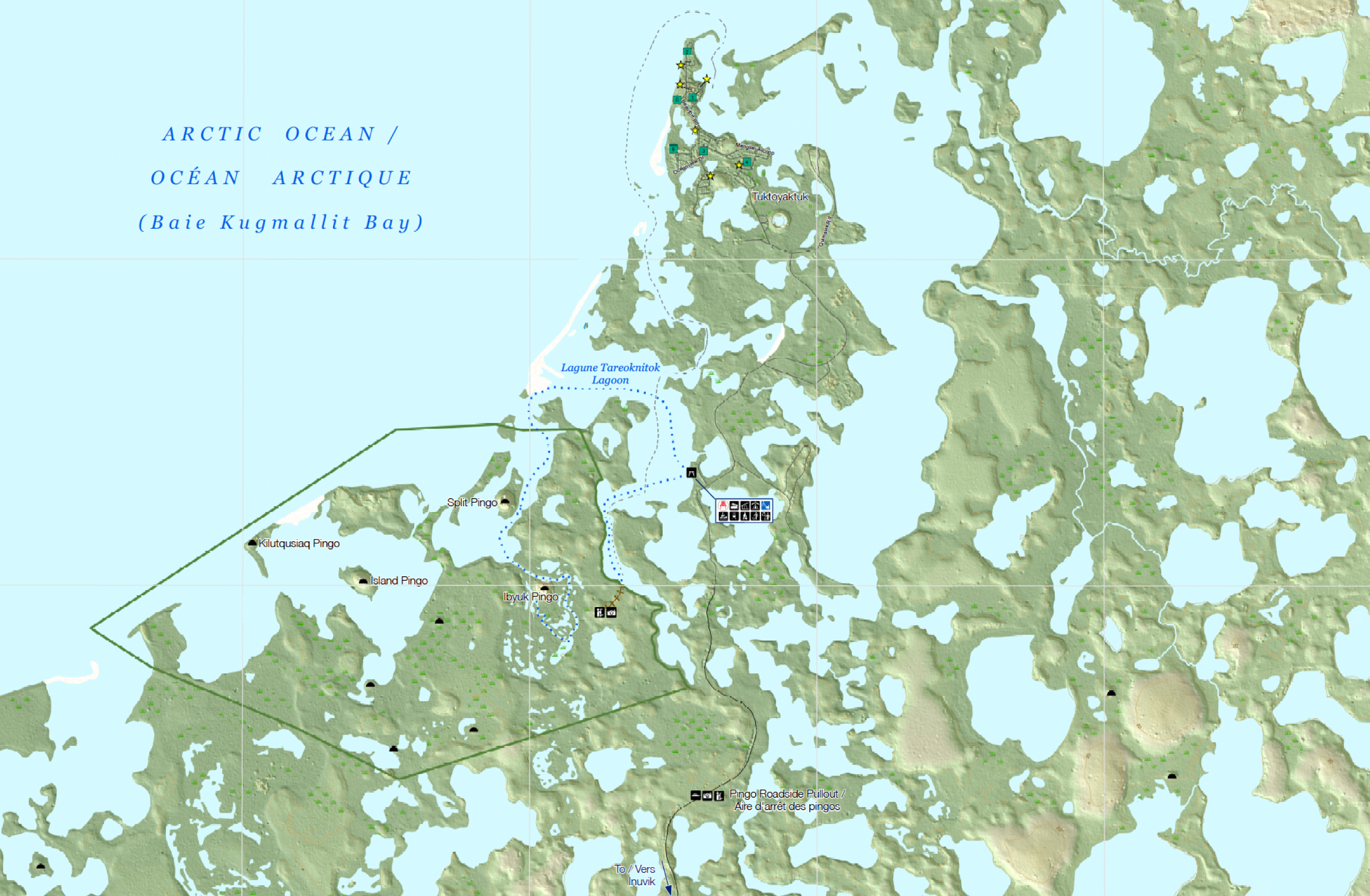
Map of major pingos in the Tuk area, NWT (pingos marked with black semi-circle)
.
One quarter of the world’s pingos, more than fourteen hundred of them, are in the Tuktoyaktuk Peninsula, part of the Mackenzie Delta of the Northwest Territories of Canada. The Inuvialuit and their Thule ancestors used these cone-like hills as navigational landmarks or lookouts when looking for caribou or whales. Hunters also used hollow pingos to freeze meat.
.
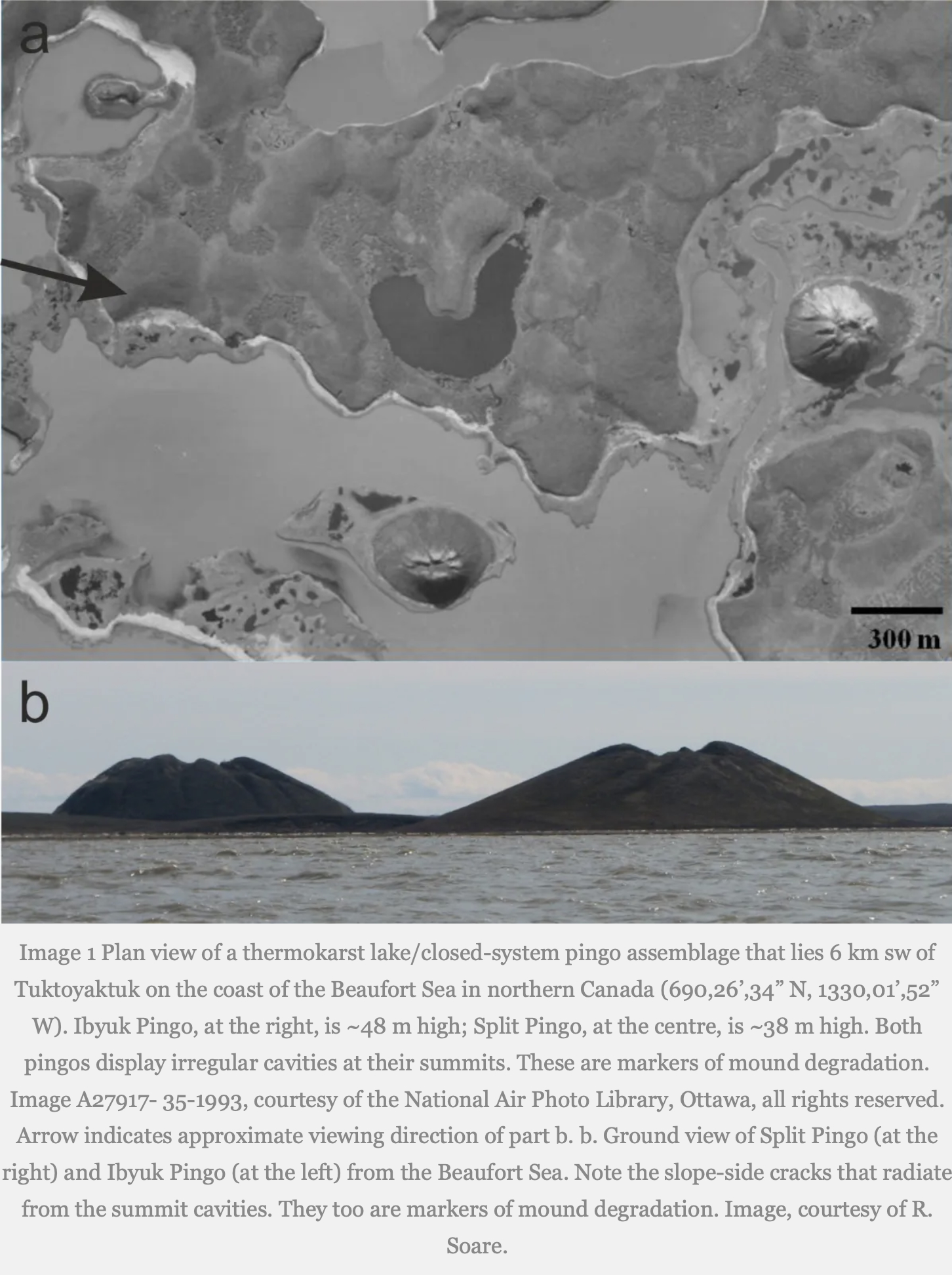
Ibyuk and Split Pingos (photos by National Air Photo Library, Ottawa)
.
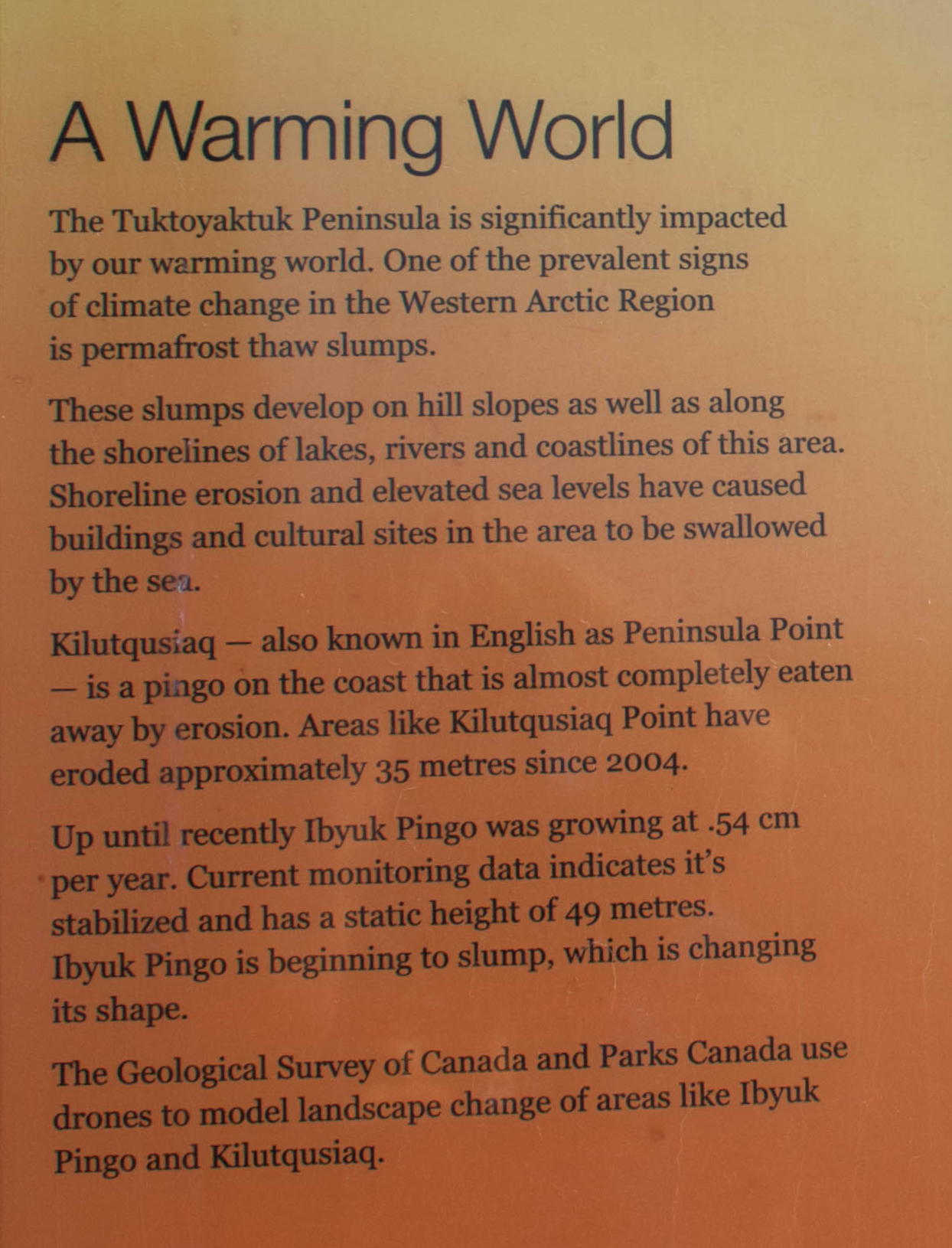
Pingo National Landmark protects eight pingos with the most famous being Ibyuk and Split. Ibyuk is about 50 meters high; it is the tallest pingo in Canada and the second tallest in the world and estimated to be more than 1,000 years old. It is also the world’s largest growing pingo, up to recently growing at a rate of about half a centimeter per year. With ongoing climate change, this is also changing. A local information sign in Tuk mentioned that Ibyuk Pingo has stopped growing and is beginning to slump, which is changing its shape. Kilutqusiaq—Peninsula Point—is a pingo on the coast that is almost completely eaten away by erosion: having eroded about 35 metres since 2004.
.
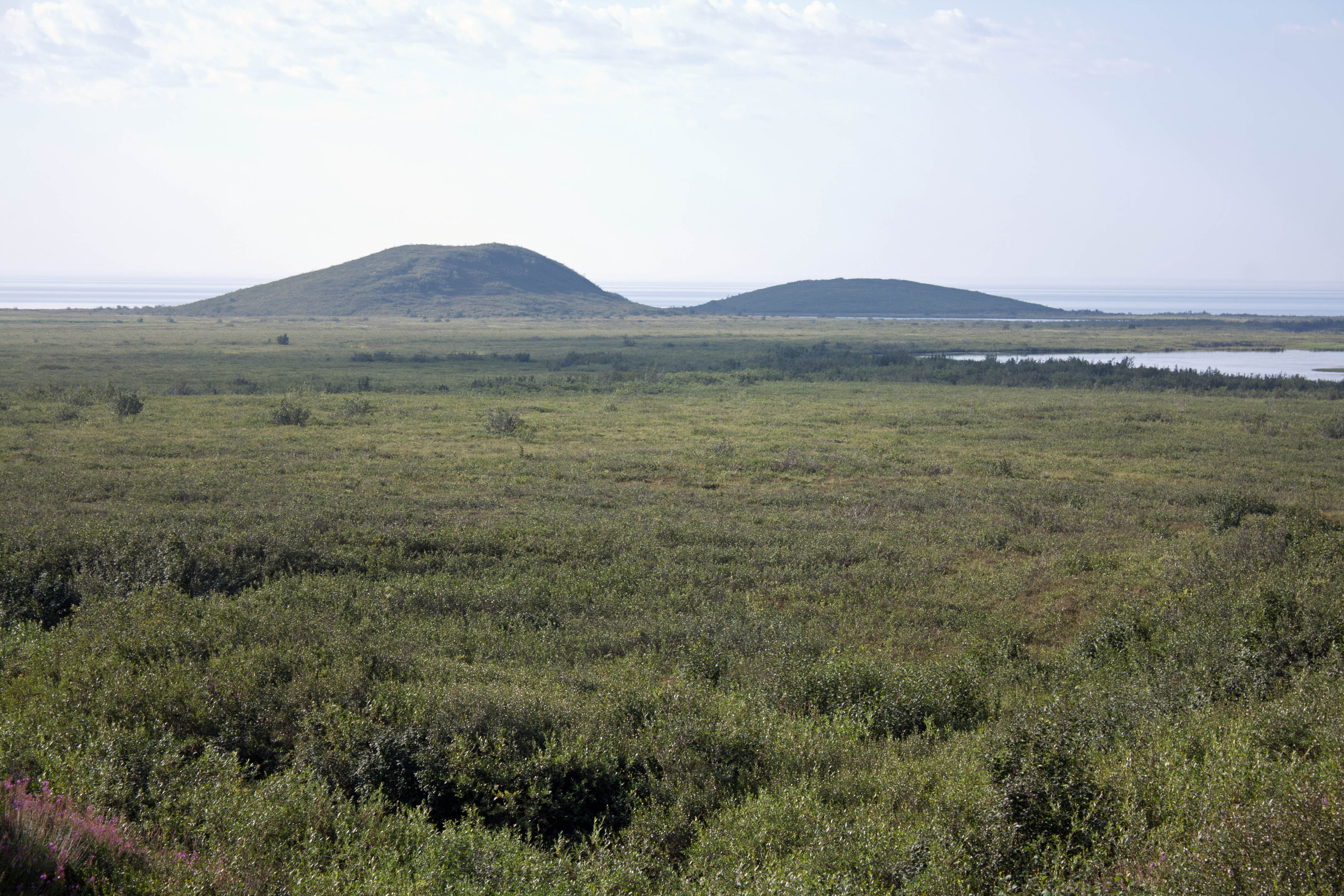
Pingos viewed across tundra near Tuk, NWT (photo by Nina Munteanu)
.
Climate change in the Arctic has caused some permafrost thaw slumps on lake shores, rivers and coastlines; shoreline erosion and sea level rise has swallowed buildings and cultural sites in the Tuk area. Kilutqusiaq—Peninsula Point—is a pingo on the coast that is almost completely eaten away by erosion: having eroded about 35 metres since 2004.
.
Tuk sign on warming climate impact on pingos
.
In the time of my novel Thalweg—2050s—hundreds of pingos near Tuktoyaktuk are caving in and forming circular ponds due to climate change. Giant ice-pimples are exploding as methane-rich gas hydrates decompose and form pressure bombs of combustible methane. The subsidence creates huge sink holes as wide as a house and deeper than hell.
.
Thalweg
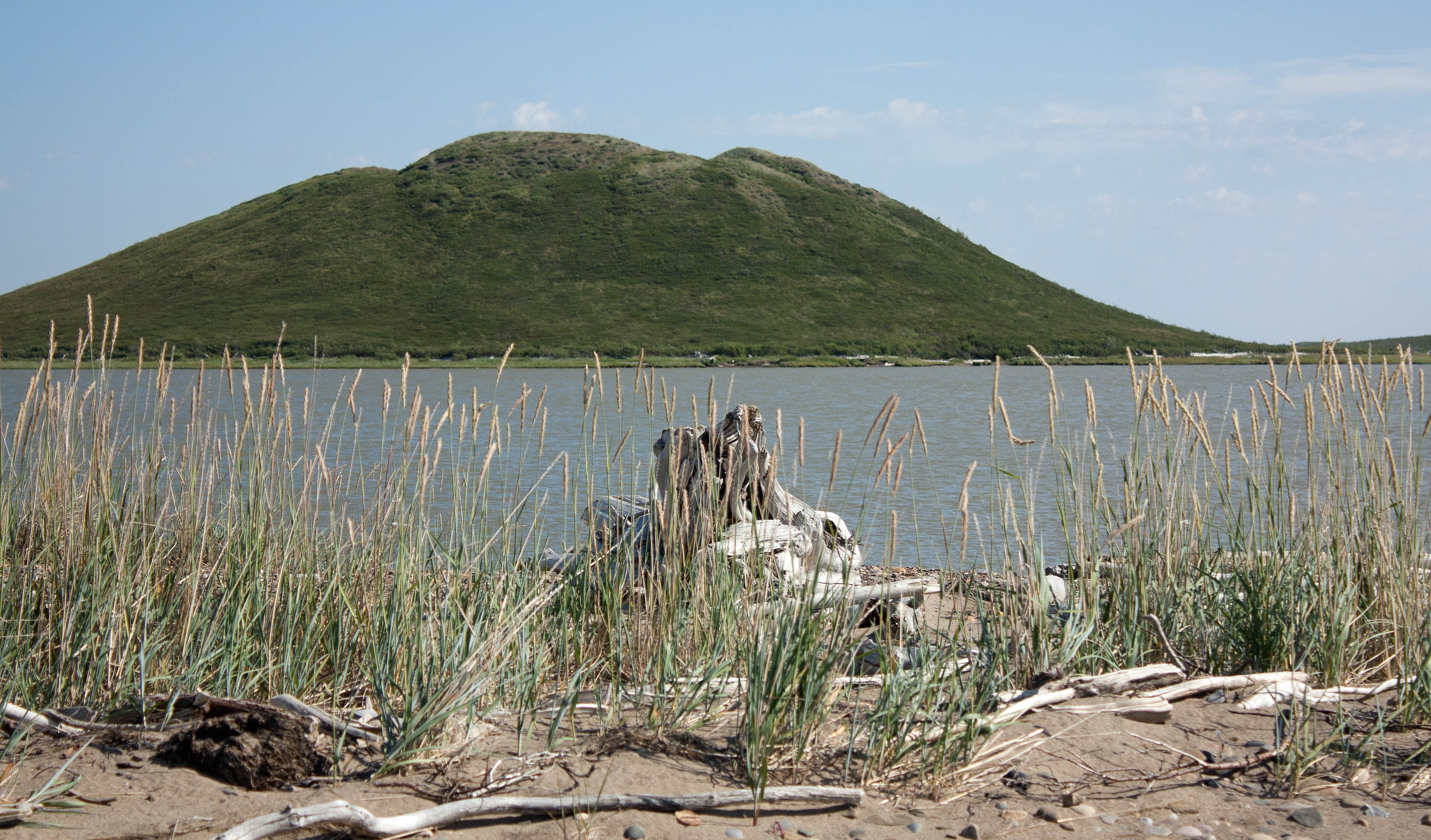
Ibyuk Pingo seen from nearby sandspit, NWT (photo by Nina Munteanu)
.
During her travels, Bobby-Jo thinks of her Inuvialuit friend Mary Steen in Tuk where giant pingos are thawing and exploding—thanks to climate change and permafrost thaw.
When we were kids, Mary took me up the Ibyuk Pingo, the giant cone mountain over a thousand years old. It’s the second highest in the world at forty-nine metres high and three hundred metres across and was still growing a few centimeters a year at its centre—despite the warming climate. Ibyuk is a hydrostatic pingo, which means it formed in an area of continuous permafrost and grew up from a large thermokarst lake. Expelled pore water from permafrost aggradation pushed up the old lake silts and sands from below, and the ice-mountain rose up like a giant frozen pimple above the ancient drained lake flats.
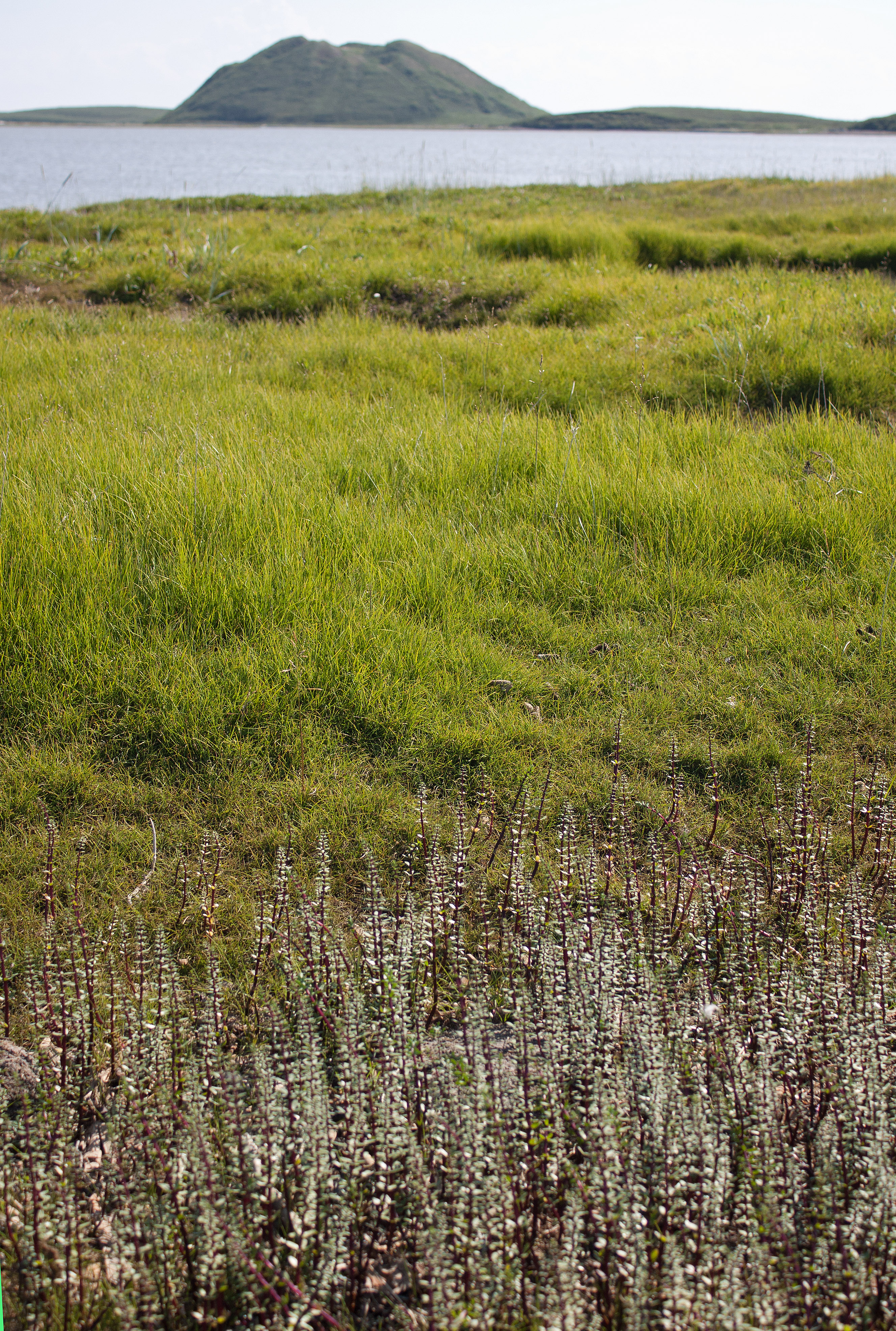
Ibyuk Pingo from a nearby spit of cottongrass and marsh grass, NWT (photo by Nina Munteanu)
.
We shouldn’t have been there; regrowth from trampling is extremely slow, often taking over half a century. The tundra moss, lichen, shrubs and krummholtz help insulate the pingo against ice core melting. When the ice core of the ice-cone is exposed, particularly if the vegetation blanket has broken open by dilation cracks or through erosion, the ice thaws and the mountain eventually collapses. During our climb, Mary and I noticed deep furrows in the vegetated soil layer. They cut down the slope as if a giant bear had clawed it and revealed the pingo’s icy sores.
When Mary and I returned to Tuk from our adventure, she got into trouble with her parents; someone had spotted us climbing the ice mountain and told them. I got a lecture and Mary was grounded for a week.
Because I was visiting, I was grounded alongside her. Pingos are living things, her parents told us sternly. They breathe, they grow, they shrink, they ebb and flow like water; they pulsate vertically. And we’d been in great danger. The Ibyuk Pingo was unstable—not just from a warming climate but from yahoos sliding down its steep sandy slopes and kids climbing where they shouldn’t. Did we know that the depth to its ice crust under the crater pond was shallow and fragile? When we were at the summit, the crater could have collapsed with sudden drainage of the pond and we would have disappeared in a roiling black sink hole!
When I last spoke with Mary five months ago, she told me that the area was starting to look like a moonscape, with craters everywhere. I thought of our little adventure on Ibyuk and decided that my analogy of a pimple or boil was appropriate given that pingos ruptured and flung their icy guts outward with explosive force. Mary admitted in a voice trembling with emotion that Ibyuk, the giant pingo we’d hiked up, had finally collapsed from massive coastal erosion and sea level rise. But not before it exploded.
.
.
Thalweg releases with Inanna Publications in Spring 2027.
.
Road through tundra to Tuk with pingo in background, NWT (photo by Nina Munteanu)
.
Glossary:
Pingo: A dome-shaped mound consisting of a layer of soil over a large core of ice in a permafrost area. Pingos form when a mass of water is trapped beneath permafrost (ground that is frozen for at least two years) under cryostatic or hydraulic pressure. One quarter of the world’s pingos are in the Tuktoyaktuk peninsula, more than fourteen hundred. Most are closed-system hydrostatic pingos, pingos formed in an area of continuous permafrost from pore water expulsion caused by permafrost aggradation at the bottom of a drained lake.
Permafrost Degradation: A naturally or artificially caused decrease in the thickness and areal extent of permafrost (Jorgenson, 2013). Widespread degradation of near-surface permafrost (40-80%) is projected by 2100 (Abbott & Jones, 2015). Release of greenhouse gases from thawing permafrost is likely the largest terrestrial feedback to climate change and one of the most likely to occur (Abbott & Jones, 2015). Degradation of permafrost soils can lead to the collapse, drainage and disappearance of water bodies (Vincent et. al., 2011). Jorgenson categorized twenty-three types of permafrost degradation based on dominant ice type, hydrologic regime, heat source and mass transfer.
.
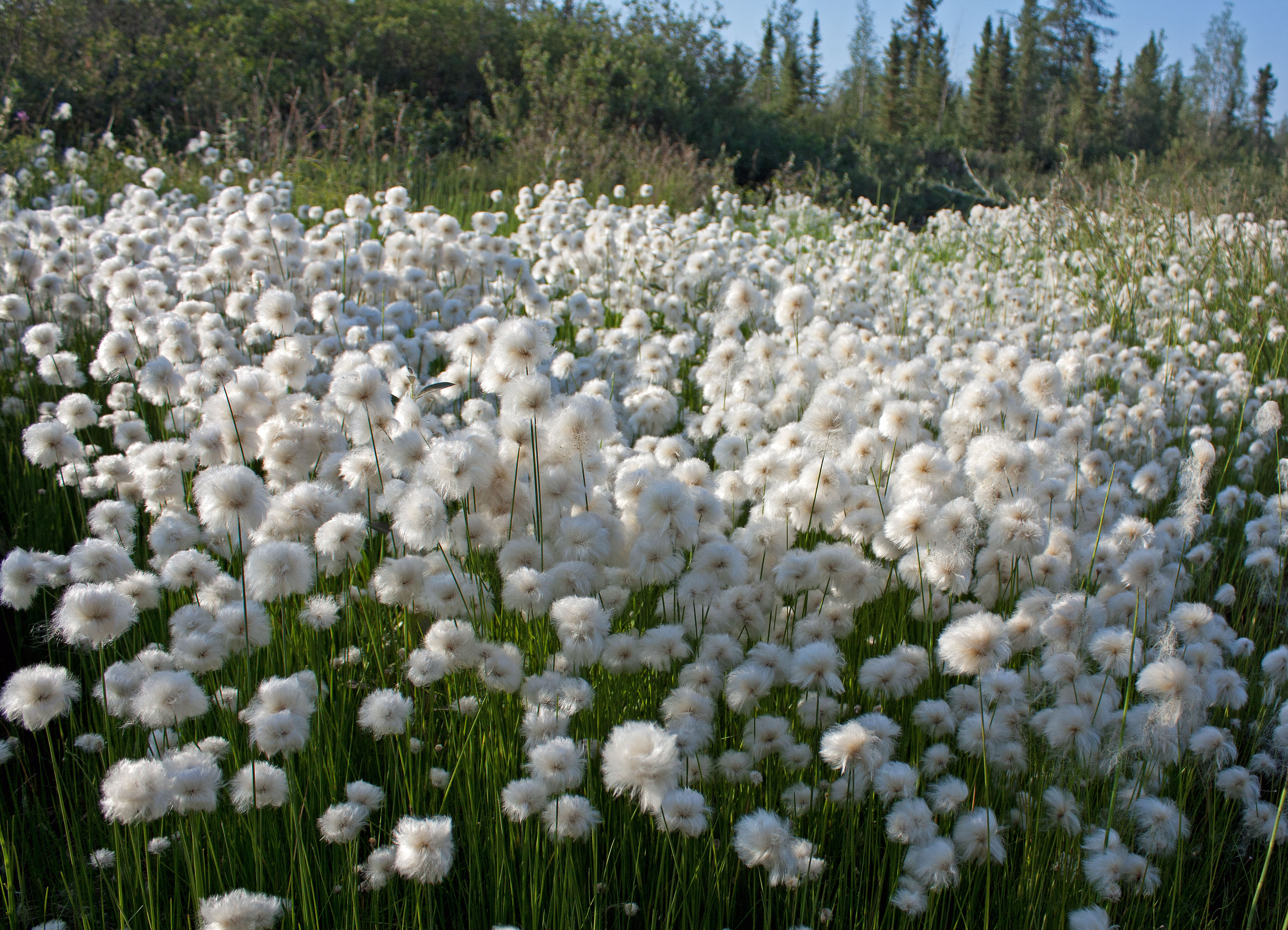
Cottongrass field with black spruce behind, off the Tuk highway, NWT (photo by Nina Munteanu)
.
References:
Abbot, Benjamin W. and Jeremy B. Jones. 2015. “Permafrost collapse alters soil carbon stocks, respiration, CH4, and N2O in upland tundra.” Global Change Biology 21: 4570-4587.
Jorgenson, M.T. and T.F. Osterkamp. 2005. “Response of boreal ecosystems to varying modes of permafrost degradation.” Can. J. For. Res. 35: 2100-2111.
Jorgenson, M.T. 2013. “Thermokarst Terrains.” In: John F. Shroder (Editor-in-chief), Giardino, R., and Harbor, J. (Volume Editors). Treatise on Geomorphology, Vol 8, Glacial and Periglacial Geomorphology, San Diego. Academic Press. pp. 313-324.
Harris, S.A.., French, H.M., Heginbottom, J.A.., Johnston, G.H., Ladanyi, B., Sego, D.C., van Everdingen, R.O., (eds.). 1988. “Glossary of permafrost and related ground-ice terms.” Technical Memorandum 142, Permafrost Subcommittee, National Research Council of Canada.
Mackay, J.R. 1998. “Pingo growth and collapse, Tuktoyaktuk peninsula area, western Arctic coast, Canada: a long-term field study.” Geographie Physique Quaternaire 52(3): 1-53.
Munteanu, Nina. 2027 (upcoming release; in press). “Thalweg.” Inanna Publications, Toronto, ON.
Vincent, Warwick F., et.al. 2011. “Ecological Implications of Changes in the Arctic Cryosphere.” Ambio 30: 87-99.
Ibyuk Pingo seen from nearby grass-covered sandspit, NWT (photo by Nina Munteanu
.
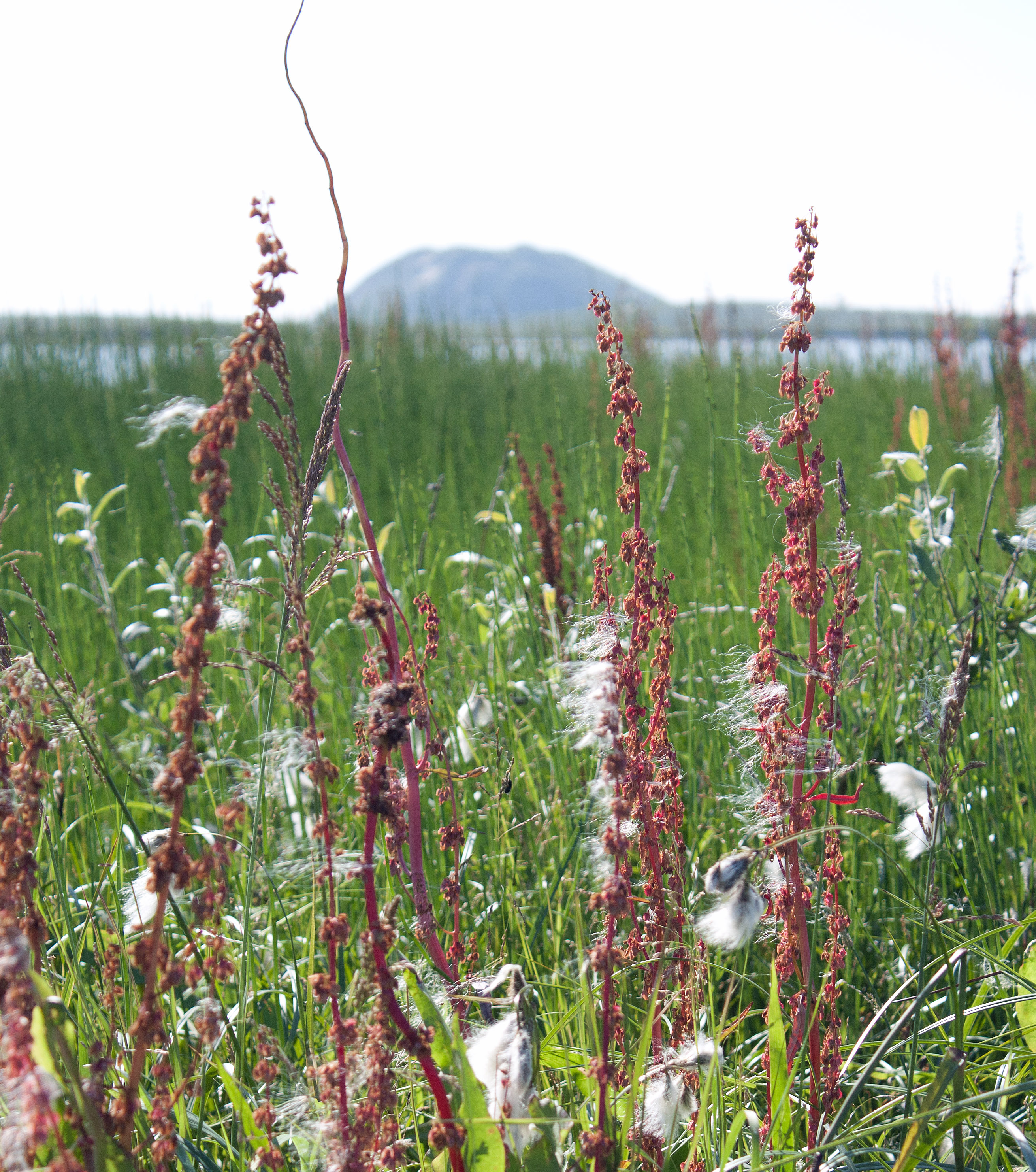
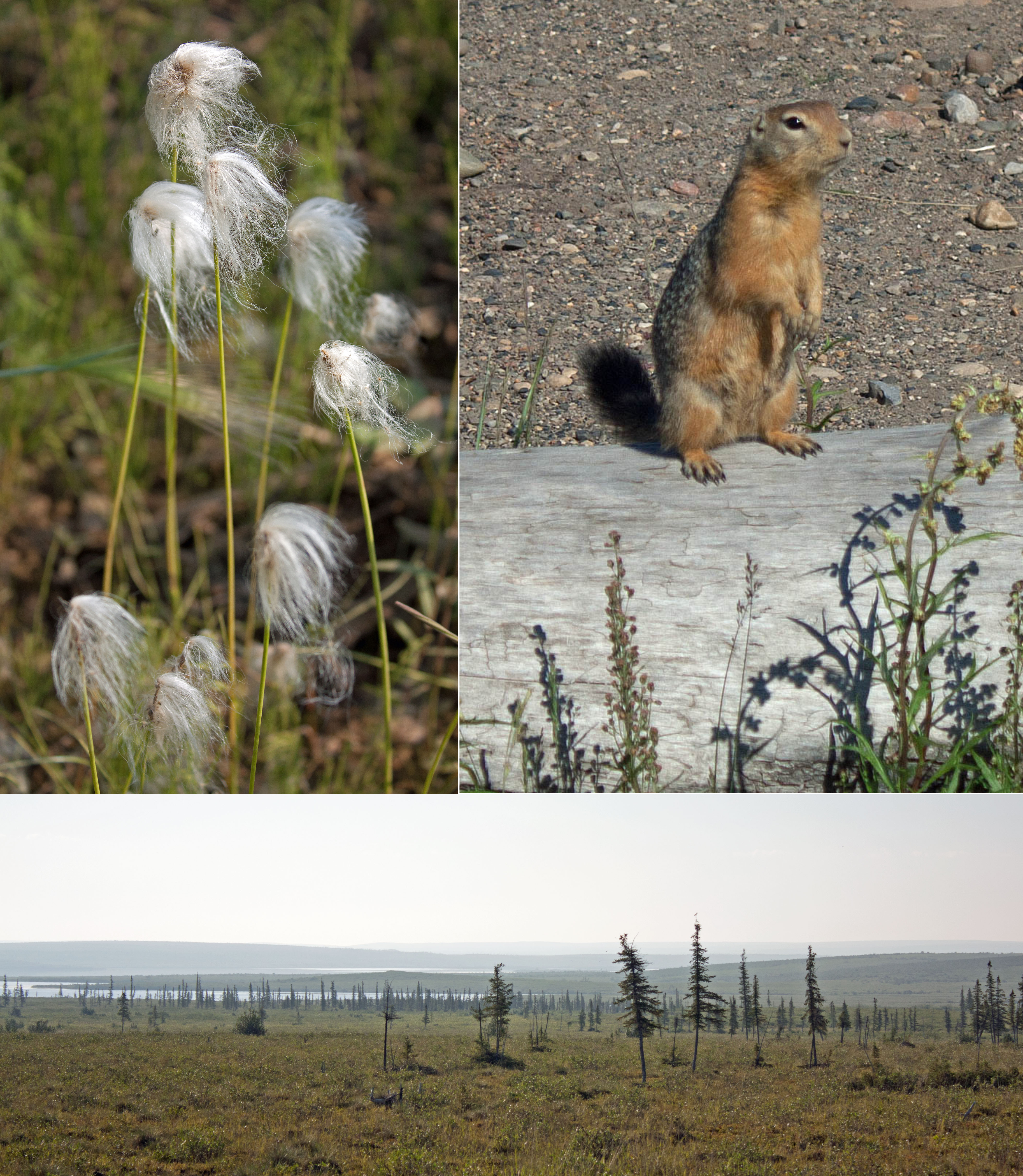
Scenes from in and near Tuk: top left, cottongrass; top right, ground squirrel; bottom, tundra scattered with spruce trees along Highway 10, NWT (photos by Nina Munteanu)
.
Nina Munteanu is a Canadian ecologist / limnologist and novelist. She is co-editor of Europa SF and currently teaches writing courses at George Brown College and the University of Toronto. For the lates on her books, visit www.ninamunteanu.ca. Nina’s bilingual “La natura dell’acqua / The Way of Water” was published by Mincione Edizioni in Rome. Her non-fiction book “Water Is…” by Pixl Press (Vancouver) was selected by Margaret Atwood in the New York Times ‘Year in Reading’ and was chosen as the 2017 Summer Read by Water Canada. Her novel “A Diary in the Age of Water” was released by Inanna Publications (Toronto) in June 2020.You can read her just released eco-fiction thriller Gaia’s Revolution by Dragon Moon Press.
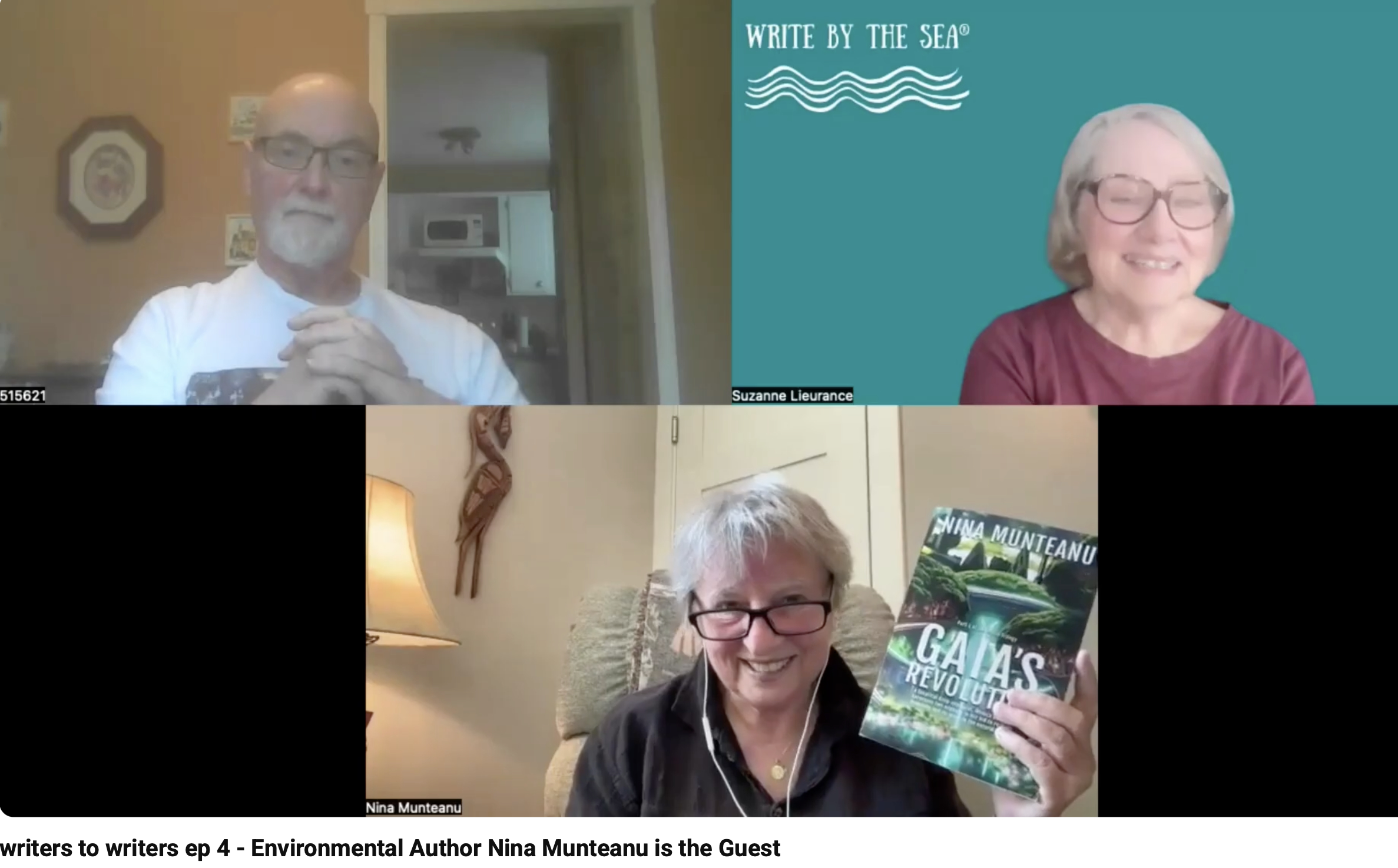
Nina Munteanu with Simon Rose and Suzanne Lieurance on Writers To Writers Podcast
.
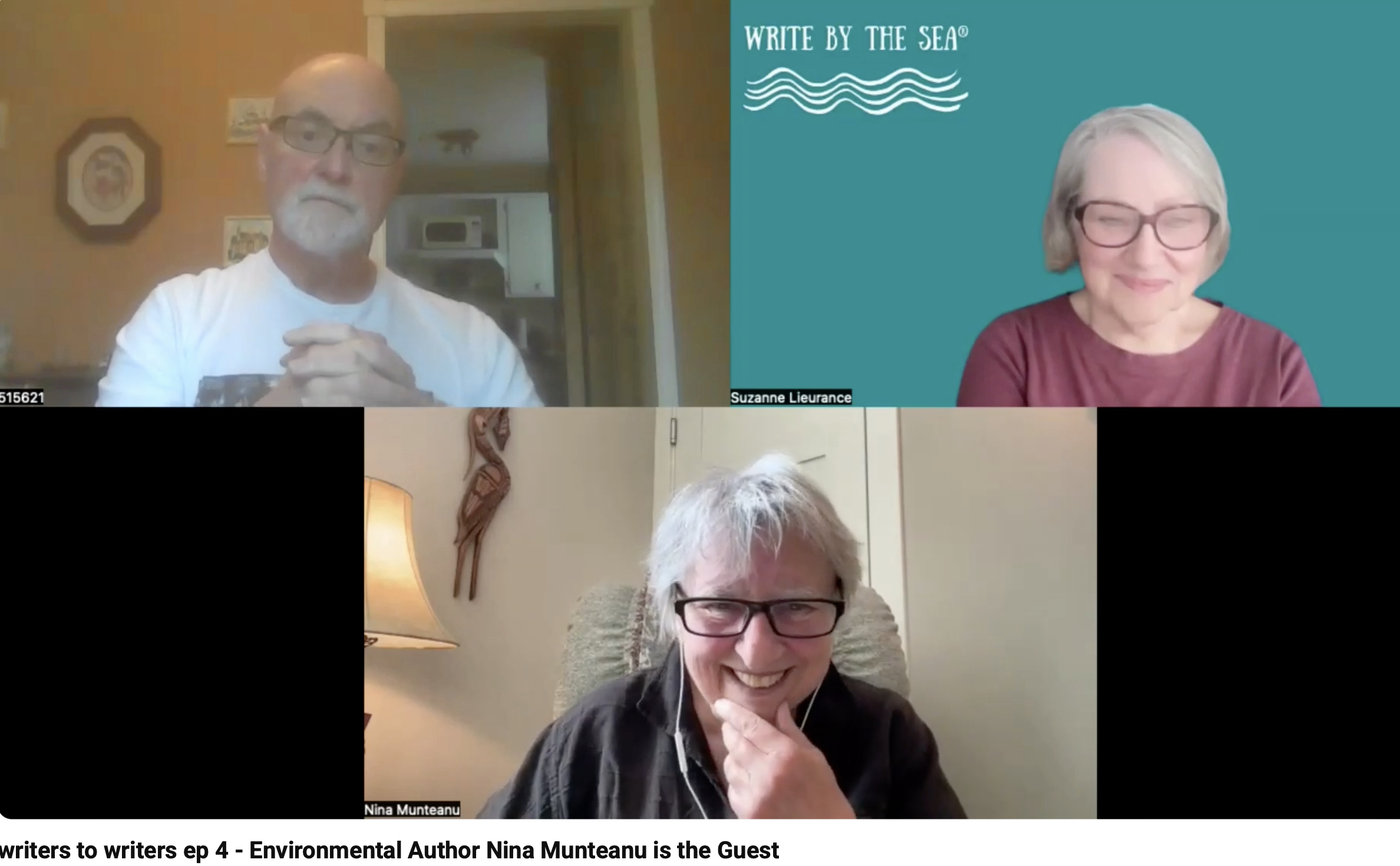
I was recently interviewed by Simon Rose and Suzanne Lieurance on Episode 4 of Writers To Writers June 2026.
We covered why I write about ‘green issues’ in my fiction, how I came to write eco-fiction and my aversion to littering—an aversion which Suzanne shared she also felt—which I ascribed to a disrespect for others and ‘the silent other’, represented by the natural world. We discussed my influences as a kid growing up and then later as an adult.
I shared how I have incorporated ‘green issues’ in both my fiction and non-fiction writing and short and long fiction. We shared how we started as young kids creating stories for our families and neighbourhood friends, developing our skills as storytellers.
We also discussed the strange world of writing and publishing and how a prequel to a prequel can come about. This then morphed into a discussion of morally gray characters and their evolution and why I find the character Loki far more interesting than Thor. If you want clarification on these, go have a listen!
.
.
Nina Munteanu is a Canadian ecologist / limnologist and novelist. She is co-editor of Europa SF and currently teaches writing courses at George Brown College and the University of Toronto. For the latest on her books, visit www.ninamunteanu.ca. Nina’s bilingual “La natura dell’acqua / The Way of Water” was published by Mincione Edizioni in Rome. Her non-fiction book “Water Is…” by Pixl Press (Vancouver) was selected by Margaret Atwood in the New York Times ‘Year in Reading’ and was chosen as the 2017 Summer Read by Water Canada. Her novel “A Diary in the Age of Water” was released by Inanna Publications (Toronto) in June 2020.You can read her just released eco-fiction thriller Gaia’s Revolution by Dragon Moon Press.
.
Nina Munteanu interviewed by Simon Rose and Suzanne Lieurance on Writers To Writers Podcast
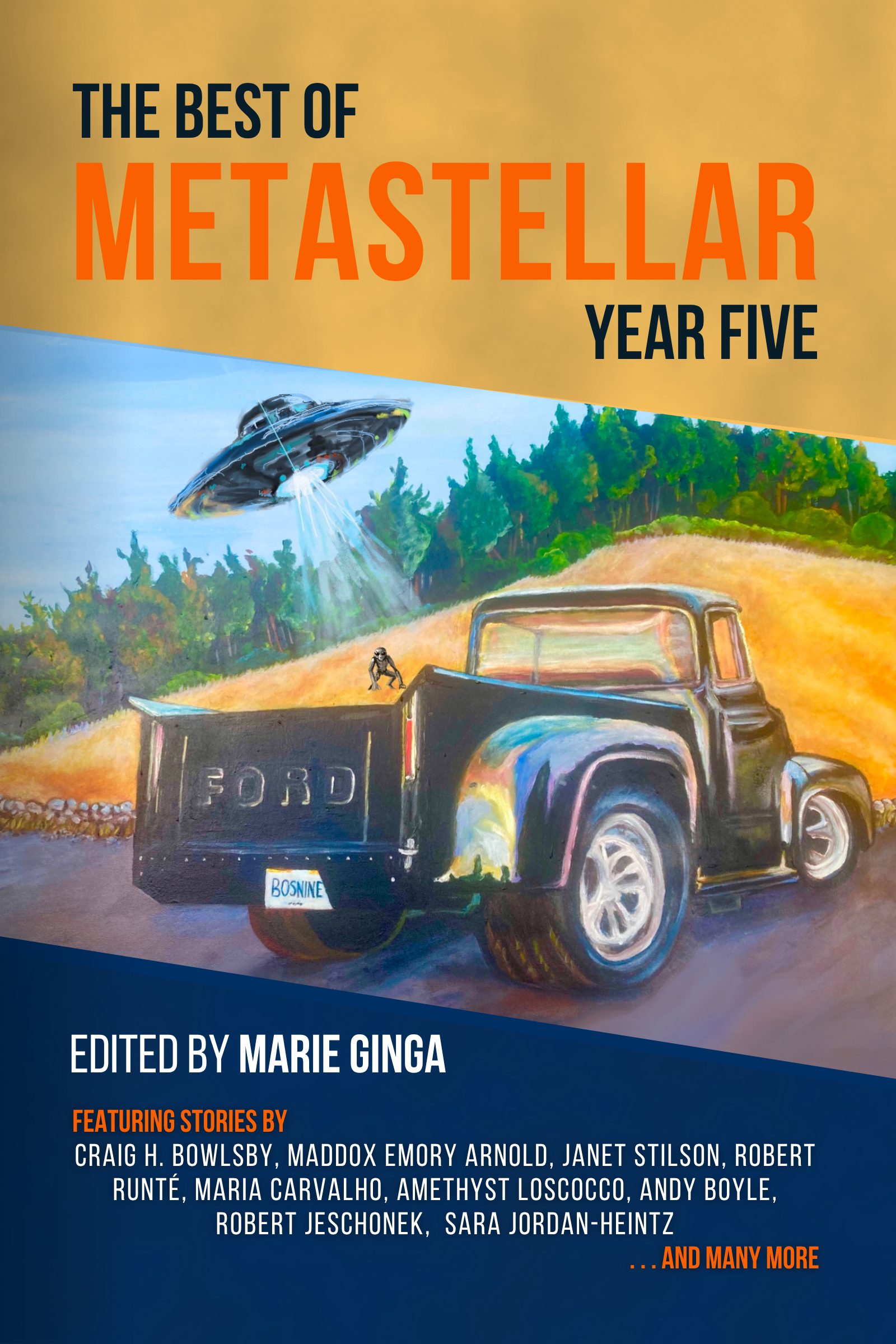
Metastellar Magazine is putting out its “Best of” anthology for this year and my good friend and writing colleague Craig H. Bowlsby has a story in it. It’s one of my favourite stories of his and it has a fetchy title: “The Girl Who Was Only Three Quarters Dead.”
Bowlsby’s story was original published in the April 2022 Issue of Mystery Magazine and won the Crime Writers of Canada Award of Excellence for Best Crime Short Story for 2023. It was then reprinted in Metastellar Magazine and now appears in their 2026 “Best of” anthology, coming out later this summer.
This noir/dystopian story, set in Vancouver, BC, finds Suki prematurely awoken from an induced suspension between being alive and dead. With her retinas deactivated and her Government persona suspended, it’s up to her long-time friend and private investigator, Gabe, to uncover why she was brought back early and the way forward to recover her identity. Through the gritty and flooded streets of East End Vancouver and the mega corporations who control their entire existence, Gabe and Suki scheme to claim what is rightfully Suki’s.
Crime Writers of Canada
The story is set in the near-future in a post climate change Vancouver when sea level rise has water lapping decrepit buildings north of The Oak Street Bridge on Oak and 77th, Amazon owns entire roadways, and people pay corporate credits as currency.
One of the aspects of this mystery story that I found particularly attractive and interesting was Bowlsby’s use of cross-genre (mystery with science fiction), for which he indicated he has an affinity in his interview with Erik D’Souza with Crime Writers of Canada. I was reminded of the eco-techno thriller style of Hayden Trenholm’s detective series The Steele Chronicles, also set in the near future in Alberta Canada where biotechnology strays into the hands of corporate moguls and fundamentalist cults.
Bowlsby manages to cram both rich and seamless world building in his story (a feat in any short story), addressing mundane aspects of life, including the nuances of language (e.g. swear words suited to the time and place). Deadland, for instance, is a slang word that describes a government program that allows people to temporarily commit suicide, allowing them to place their lives on hold to supposedly help them escape their problems and supposedly better cope later (Bowlsby tells us rather pithily that it doesn’t really work).
.
image by Marie Ginga, Metastellar
.
When I asked Bowlsby in an interview what inspired this story and its post-climate change Vancouver setting, he said, “the germ … of this story came from a discussion I had with a friend, twenty years ago, who felt that everything in our society should be available for sale. For him that represented a pure state that would fix all our problems … I disagreed, but I wondered what it would be like if we started on that path. So as a social background, the characters are acting within a stage created for such a system—a system just starting to find its own steady legs. I don’t say it’s bad or good—I just give it free rein. The story itself came from other elements, but the characters’ difficulties are complicated by the hyper-capitalism. As for the climate change problem, and the flooding, that came naturally with the near-future time period; I’m afraid it’s going to happen no matter what we do.”
Nina Munteanu is a Canadian ecologist / limnologist and novelist. She is co-editor of Europa SF and currently teaches writing courses at George Brown College and the University of Toronto. For the latest on her books, visit www.ninamunteanu.ca. Nina’s bilingual “La natura dell’acqua / The Way of Water” was published by Mincione Edizioni in Rome. Her non-fiction book “Water Is…” by Pixl Press (Vancouver) was selected by Margaret Atwood in the New York Times ‘Year in Reading’ and was chosen as the 2017 Summer Read by Water Canada. Her novel “A Diary in the Age of Water” was released by Inanna Publications (Toronto) in June 2020.You can read her just released eco-fiction thriller Gaia’s Revolution by Dragon Moon Press.
There’s a New Wave out there in science fiction. It’s growing. It’s green. And, yes, I’m on it.
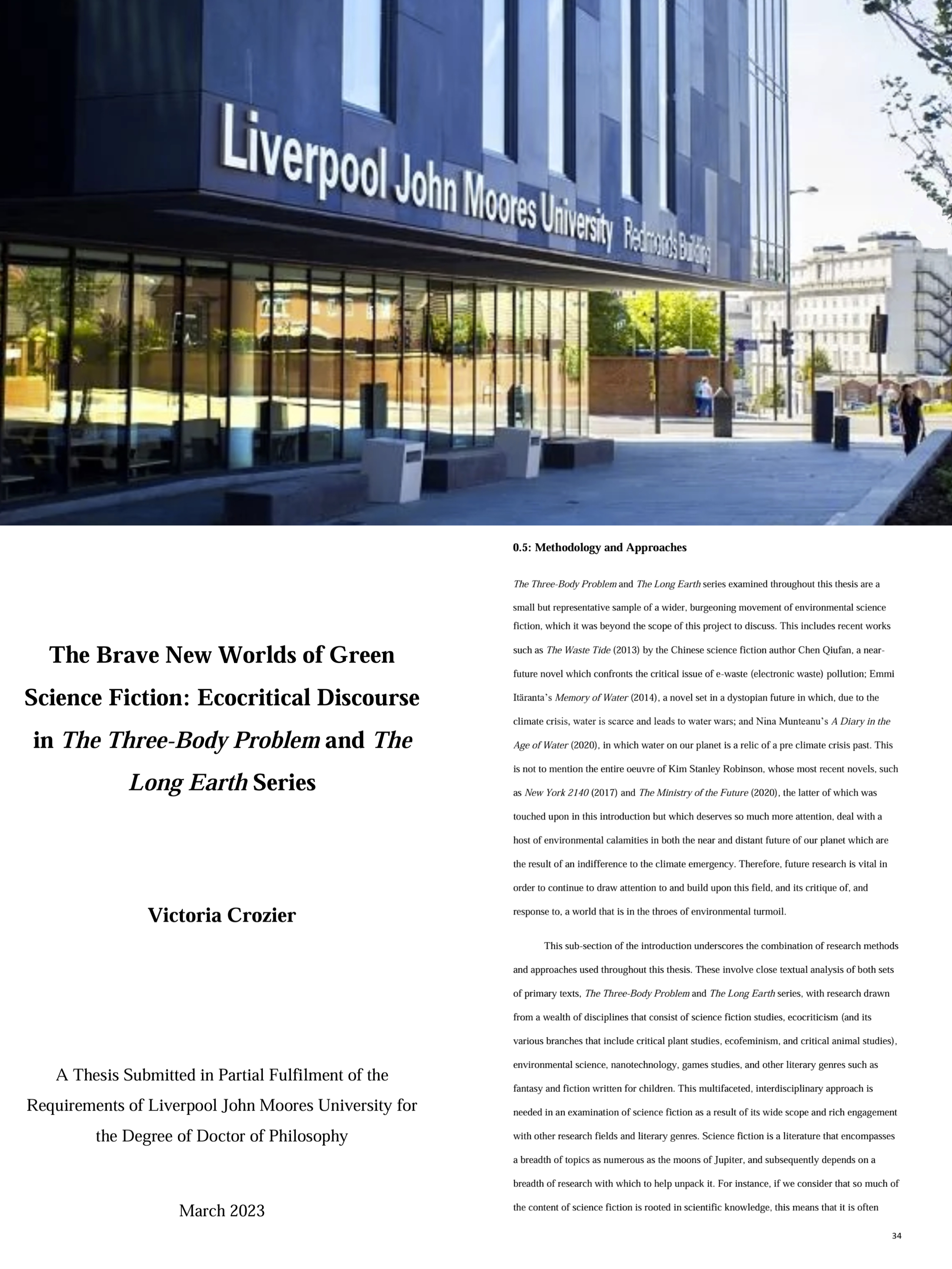
In her 2023 PhD thesis out of Liverpool John Moores University, Victoria Crozier explores the metamorphosis of science fiction from stories primarily focused on human adventure and heroism to ‘New Wave’ stories of green science fiction. Far from celebrating the achievements of a super-capable humanity, these ‘New Wave’ eco-conscious narratives, which began with the environmental movement of the 1960s, reveal humankind as an environmentally destructive force.
.
Pre-1960s: Anthropocentric Androcracy
Pre-1960s science fiction largely featured scientific and technological developments and associated impacts on humans; stories that evoked a sense of wonder and involved heroic adventures of humans in unfamiliar worlds. Stories focused on the need to overcome harsh environments and conquer treacherous alien elements as humans prevailed through various androcratic strengths. I read many of them, mostly written by men. Despite generating excitement and inspiration, these narratives advanced a patriarchal and imperialistic conceit that drew from anthropocentric androcracy.
.
.
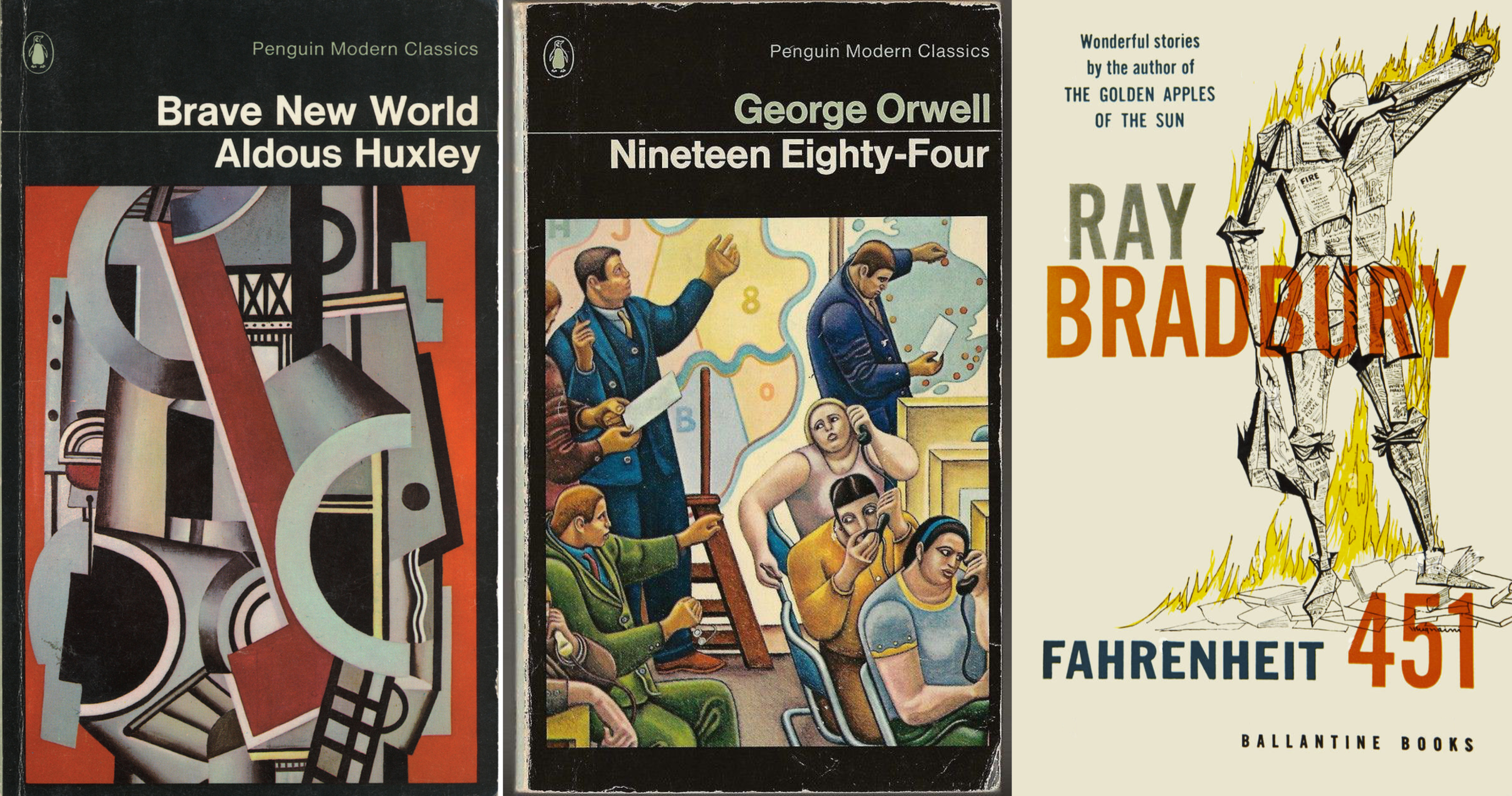
The 1930s and 1940s spawned narratives focused on social justice—responses to both world wars. Aldous Huxley’s Brave New World (1932) and George Orwell’s Nineteen Eighty-Four (1949) and Animal Farm (1945) represented the height of this exploration with a focus on totalitarian rule, surveillance technology, and genetic modification. Ray Bradbury’s Fahrenheit 451 (1953) explored censorship as an important aspect of mind-control by an oppressive rule.
Drawing on a Cartesian directive, science fiction remained largely anthropocentric, typically ‘othering’ Nature and objectifying it. Writers treated the non-human world with fear or disdain; Nature was a device that challenged brave human explorers to exert their superiority through subjugation or annihilation. The environment was seldom portrayed as a character with agency and sensibility. Never something to be admired. Something to love.
.
The 1960s: Rachel Carson’s Revolution
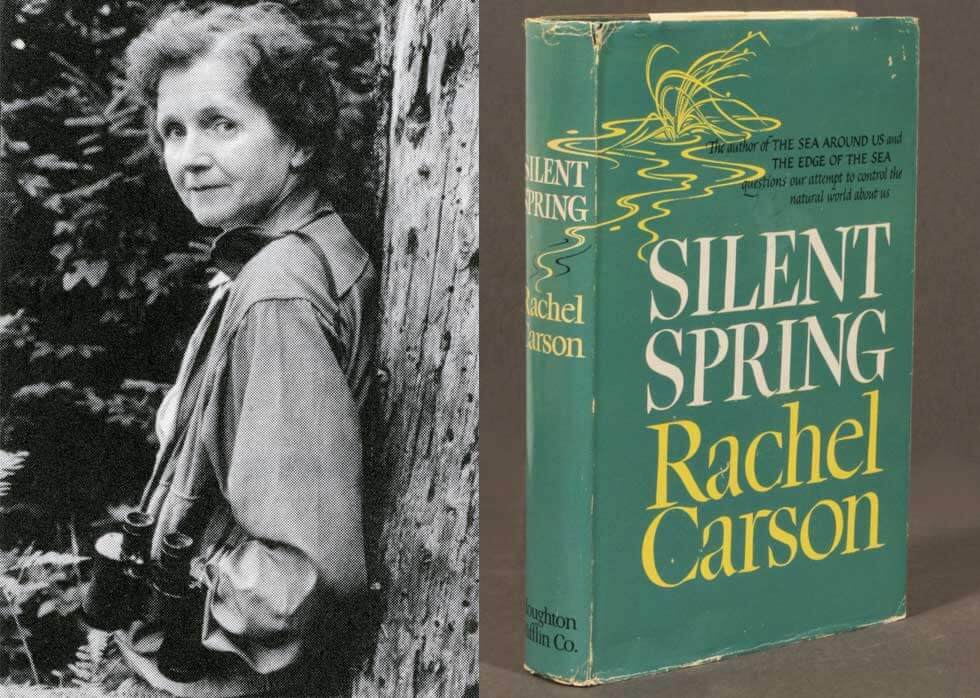
Rachel Carson and her seminal book Silent Spring
.
In 1962, Rachel Carson published her book Silent Spring, regarded by some as the single most important contributor to the environmental movement of the 1960s. Her book warned of our declining bird and bee populations and impacts to human health from unregulated pesticide/herbicide use (such as carcinogens and hormone disruptors).
I was just a kid when Carson’s book came out. But it was already apparent to me that environmental imbalance and destruction were global concerns and we were on the brink of an environmental crisis. Unchecked deforestation was destroying forests around the world, including the boreal and old-growth forests of my own country Canada. Brazil had already begun cutting down trees and burning forest at an alarming rate. Unregulated use of pesticides, herbicides and growth hormones created toxic contamination of our natural world and our food and water supply—despite Carson’s dire warning with Silent Spring. Our waterways were being contaminated by mining wastes and industrial effluents. Killer smog. Noxious algal blooms. Oil spills. Dead zones. The list kept growing.
By the time I was in college, I’d concluded that a hegemony that follows the economic system of late capitalism inevitably commodifies and ‘others’ with ruthless purpose. Once something (or someone) is commodified, they are given a finite value and purpose outside their own existence. They become an object, a symbol to use and trade. They become a resource to manipulate, exchange, and dispose of with impunity. And through this surrender to utility, they become ‘othered.’ The consumer. The trees of the forest. Water. Homo sacer*. Each has a role to play in the late capitalist narrative of digital abundance and physical scarcity.
.
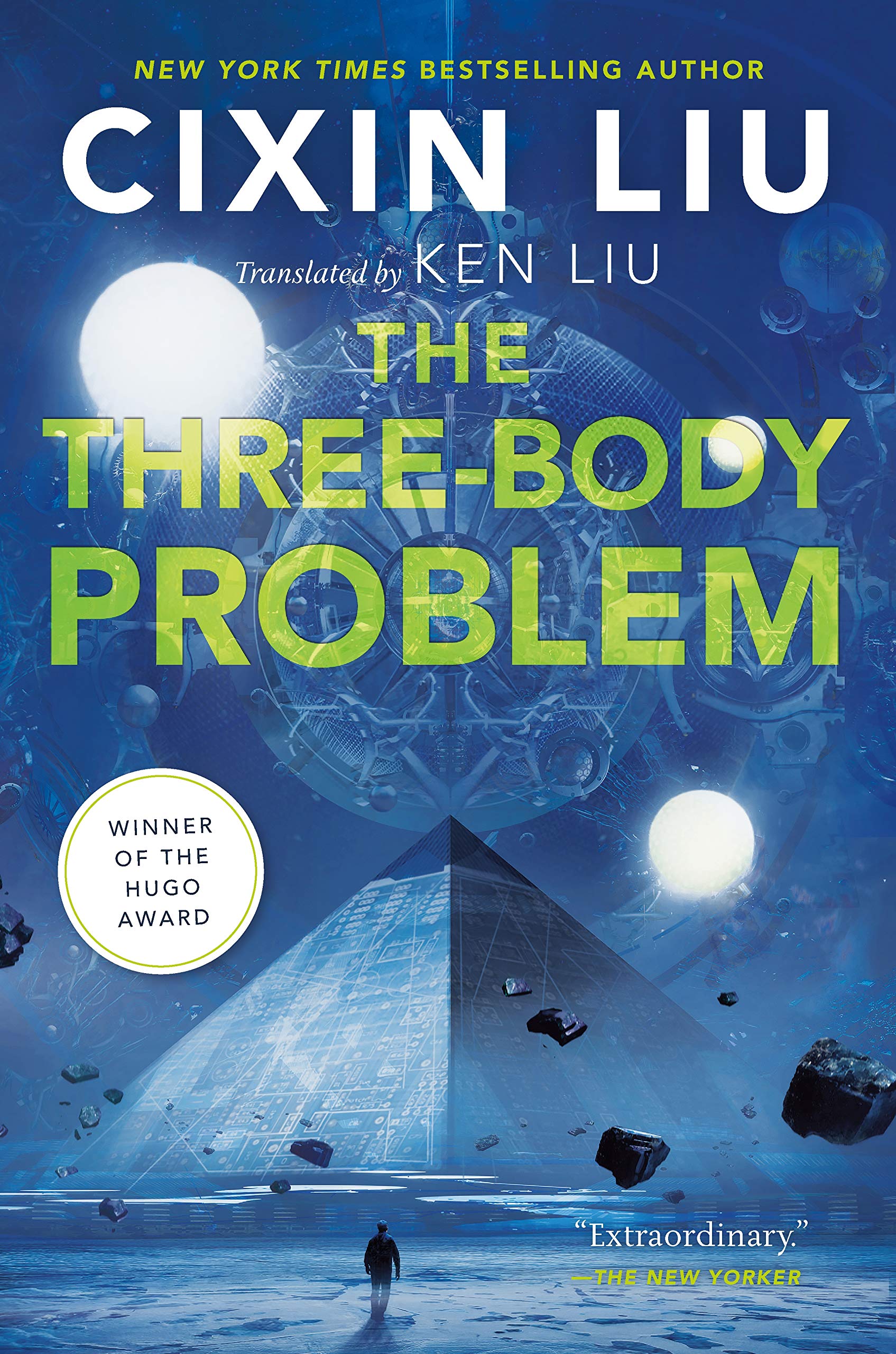
Liu Cixin begins his 2006 science fiction novel The Three Body Problem in the 1960s, during China’s Cultural Revolution. The novel follows astrophysicist Ye Wenji, disillusioned by the massive environmental deforestation in the labour camps she is initially sent to work after witnessing the execution of her scientist father in a brutal cleansing at the height of the revolution. Already cynical about humanity’s failed culture and science—Wenjie acquires a contraband copy of Rachel Carson’s Silent Spring. The book and revelation she experiences from it sets in motion a frightening notion linking the mindset behind the Cultural Revolution and destruction of the environment.
.
Post-1960s: Ecocentric Gylany
On the heels of the environmental movement of the 1960s, the New Wave of eco-science fiction, or what Crozier calls ‘green science fiction’, took hold with science fiction authors and literary fiction authors. Ursula K. LeGuin helped pioneer feminist science fiction as well as eco-fiction and climate fiction. Left Hand of Darkness (1969) introduced ambisexuality, no fixed sex, and The Word for World is Forest (1972) critiqued extractivism by human colonists. The Mars Trilogy by Kim Stanley Robinson (1992-1996) debated the rights of humans to alter a pristine planet, overlooking the intrinsic rights of an alien environment. N.K. Jemison’s The Fifth Season (2015) portrayed the physical Earth as active and angry about its abuse by humanity.
Subtle changes in the portrayal of non-humans and Nature have emerged.
In his 2025 PhD thesis, Steven L. Ogden (University of Albany, State University of New York) explored the concept of “Heterogenous Being”1 linking the sciences with humanities to address the precarious realities of Earth’s ecological and environmental conditions. Entitled, “Heterogenous Being: The Inhumanities and the Creative-Scientific Aesthetic.” Ogden’s thesis acknowledges the influences and agented potentialities of nonhuman subjects in narrative, both in fiction and nonfiction. Including my own portrayal of water as character in my eco-fiction novel A Diary in the Age of Water, Ogden writes,“… these inhuman2 examinations not only provide the nonhuman with a comparable or more profound existence alongside our own; they also illustrate the immense and consequential scope of our collective realities.”
Othering in Science Fiction & Other Genres of Literature
The rhetoric of ‘Otherness’ in most fiction is typically portrayed through the singular point of view (POV) and discourse of a protagonist on a journey.3 In most forms of literature the POV ‘voice’ represents the Self, the inclusive ‘us’ (worldview) in its encounter with the Other, which in turn is the ‘not us.’ In his book Orientalism: Western Conceptions of the Orient Edward W. Said contended that for there to even be an ‘us’, there has to be a ‘not-us’. The resulting power dynamic of “them and us,” of Other and Self, is created and controlled by perceptions of the singular POV voice.
In most genres of literature—and certainly in science fiction—the Other is often relegated to this dichotomous portrayal. In post-apocalyptic and metaphoric journey stories the Other may be the harsh environment or a calamity through which the protagonist must find their own strength to survive; in military stories it is clearly the enemy, seldom portrayed with compassion or understanding but there to test our hero; in coming-of-age stories it may be the oppressive rule or established world the hero must overcome; in some science fiction it is the hostile or unknowable aliens who must be defeated.
Ogden clarifies the irony of this way of thinking: “like René Descartes, many today still consider the mind or “rational soul” of humanity to be entirely exceptional to and independent of animality, and believe no part of Man (as master and possessor of nature) could derive from the “potentiality of [nonhuman] matter.”
Crozier argues that, “Eco-science fiction is an essential cultural instrument with which to understand and respond to our planet in an epoch of environmental crises.”
Eco-science fiction is poised to make meaningful character-couplings between mostly human protagonist and environmental characters or representatives. This is because the protagonist provides relatable qualities for easy reader empathy, while the Othered character is often less relatable—often an arcane aspect of the environment, such as water (Memory of Water or A Diary in the Age of Water) or a forest (The Overstory).
The protagonist’s link to the Other—often as avatar—provides a readable map for the reader to follow and make their own connection.4 In Character Coupling Part 2, I provide examples from several works of eco-science fiction and general eco-fiction, such as The Overstory, Barkskins, The Breathing Hole, The Windup Girl, The Bear, Memory of Water, Dune and my own A Diary in the Age of Water.
Through these linkages, environmental abuse of jingoistic hubris can be felt on a profound and personal level. Eco-science fiction can raise issues of human intersectionality, misogyny, marginalization, oppression of class, privilege, sexuality and race, and misuse of power. Violent acts perpetrated on environment—when environment is personified as ‘character’ and/or coupled directly to a character—elicit powerful emotion and clearly demonstrate how social/human injustice reflects environmental injustice.
.
The ‘New Wave’: A Changing Narrative
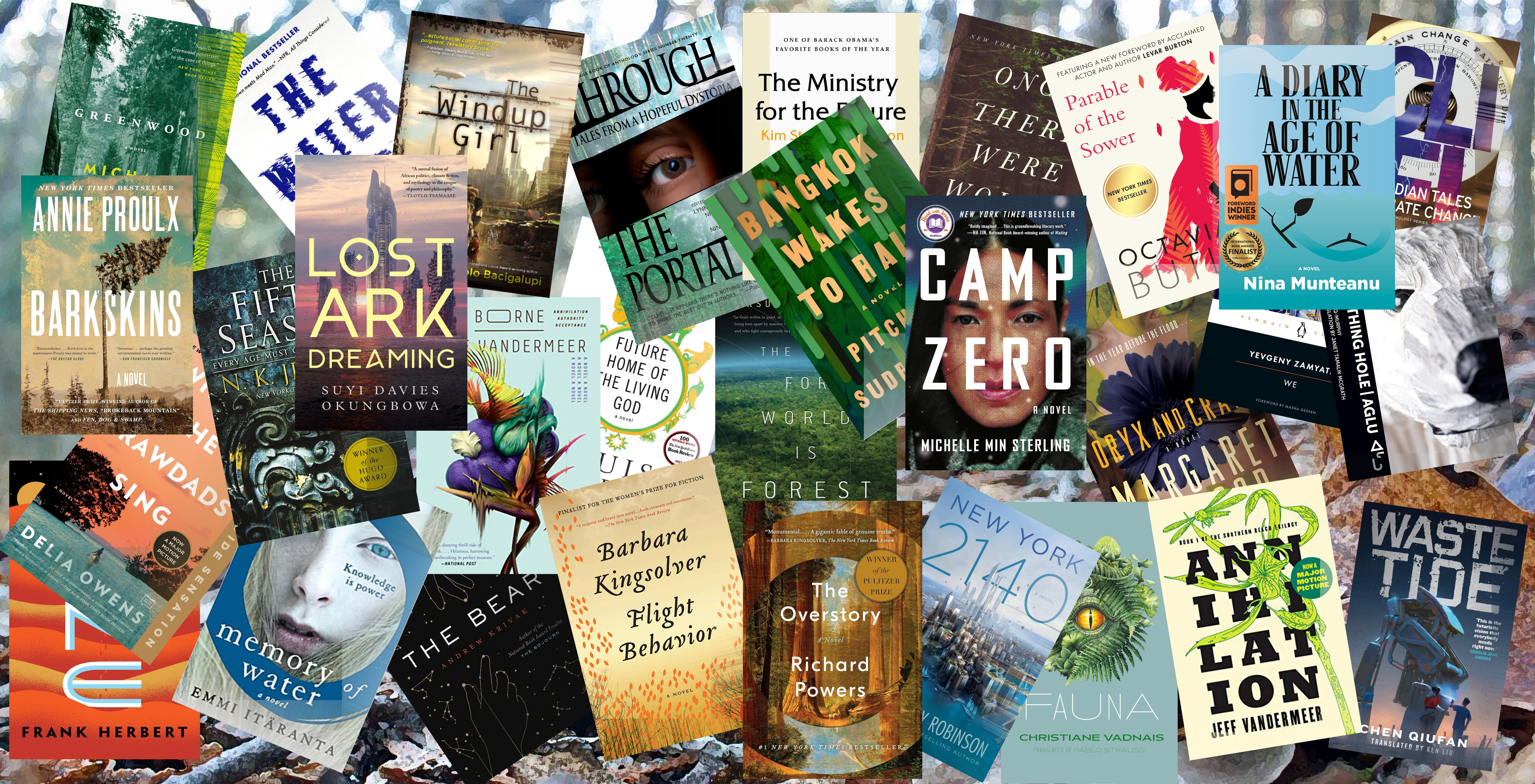
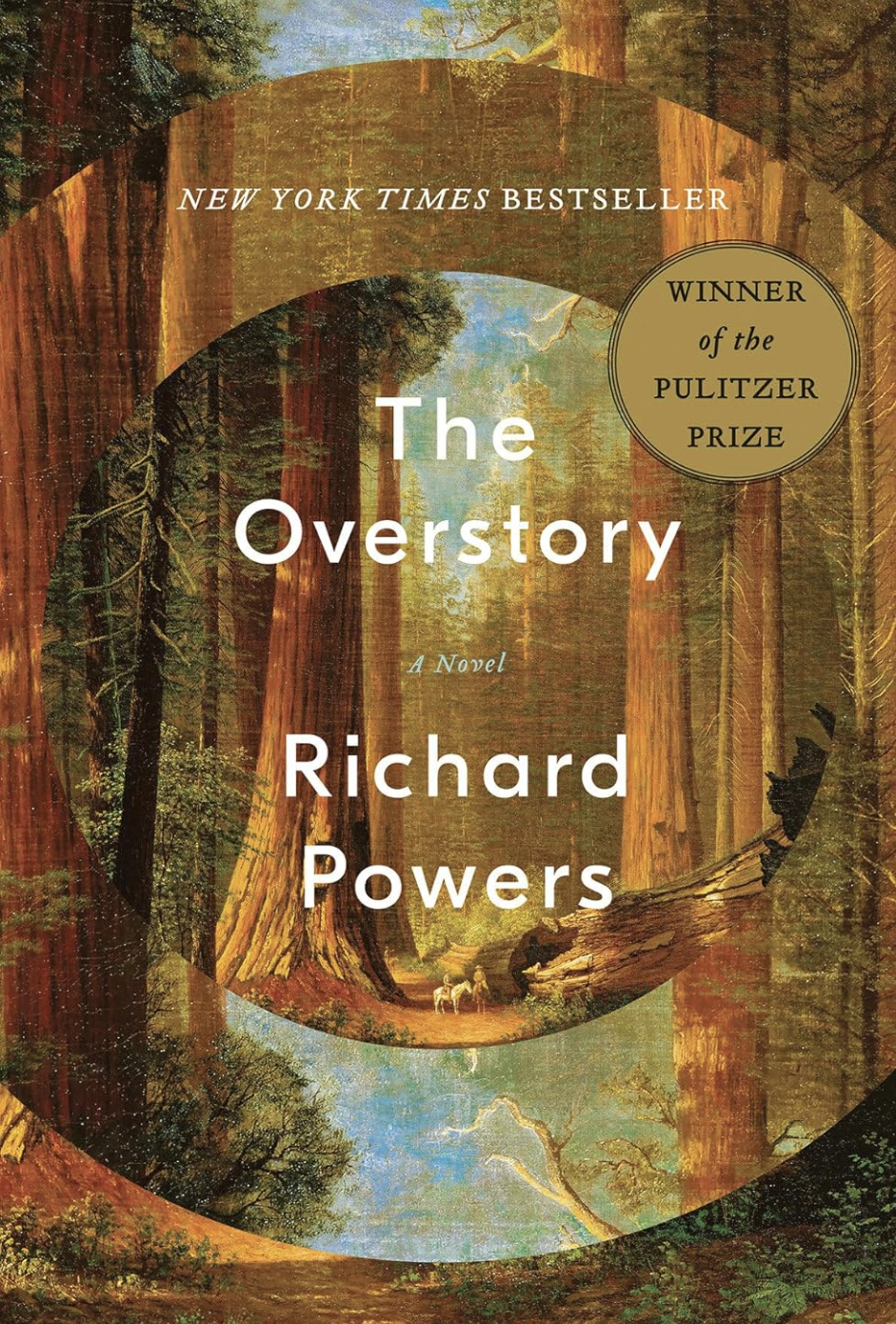
Various green-science fiction and general eco-fiction novels worth reading
.
New Wave green science fiction took shape in the 1960s with J.G. Ballard and Ursula K. LeGuin who spearheaded a transformation toward ecocentric views. New Wave science fiction has burgeoned in the last several decades with highly pertinent narratives to the environmental and climate concerns of our current world. These narratives clearly challenge our political, religious and social worldviews, and patriarchies.
.
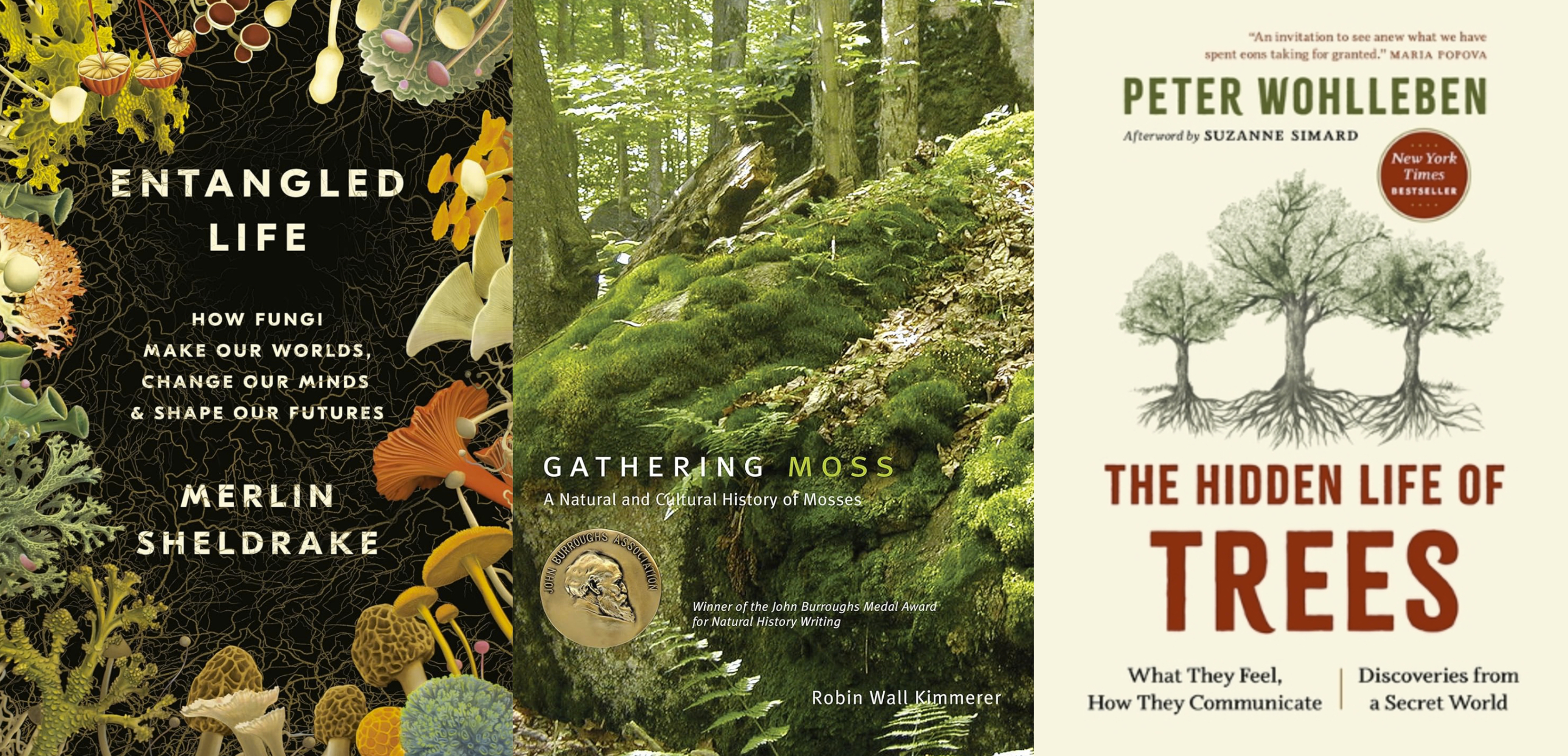
Three non-fiction books that celebrate nonhuman life
.
Acknowledging the early influences of animal studies rooted in biocentricity, Ogden notes that non-fiction representation of nonhuman life has also increased exponentially in the last ten years. Ogden includes the following notable examples: Merlin Sheldrake’s Entangled Life: How Fungi Make Our Worlds; Robin Wall Kimmerer’s Gathering Moss, and Peter Wohlleben’s The Hidden Life of Trees.
.
Ogden argues that “Westerford (a scientist in Richard Powers’s The Overstory) understands that climate and biodiversity are ‘failing precisely because no [story] can make the contest for the world seem as compelling as the struggles between a few lost people.’” Westerford realizes that her peers believe that plants live an inanimate existence, whose rooted immobility points to a kind of “unfreedom” that represents an “archetype of inert matter.” According to poet David Hinton, this devaluation of plant life relates to the human-nonhuman duality, “a Western dichotomy that relegates the vegetal world to a space of ‘linguistic silence.’”
Crozier, Victoria. 2023. “The Brave New Worlds of Green Science Fiction: Ecocritical Discourse in The Three-Body Problem and The Long Earth Series.” Doctoral Thesis, Liverpool John Moores University, UK. April, 2023. 265pp.
Descartes, Rene, et. al. 1998. “Discourse on the Method; and Meditations on First Philosophy.” Hacket Pub.
Ogden, Steven L. 2025. “Heterogenous Being: The inhumanities and the Creative-Scientific Aesthetic.” Doctoral Thesis, University at Albany, State University of New York. Spring, 2025. 220 pp.
Powers, Richard. 2018. “The Overstory.” W.W. Norton & Company, New York. 502pp.
Said, Edward W. 1978. “Orientalism: Western Conceptions of the Orient.” Vintage, London. 432pp.
.
Footnotes:
Ogden describes “Heterogenous Being” as a way of being that recognizes and incorporates humanity’s pluralized configurations with the nonhuman world by uniting the studies of science and humanities into an interdisciplinary hybrid creative-scientific aesthetic.
Ogden explains the use of “inhuman” here by referring to Jeffrey Jerome Cohen’s notes in Stone: An Ecology of the Inhuman, which uses inhuman to “emphasize both difference (‘in-‘ as negative prefix) and intimacy (‘in-‘ as indicator of estranged interiority).” This is akin to the practice of “othering”.
The Other has often been metaphorically portrayed in SF by aliens that lack a distinct voice or viewpoint; some portrayal has reflected a fearful imperialistic colonialism by representing Other as adversary such as an invading monster with no regard for humans (e.g. Robert Heinlein’s The Number of the Beast; H.G. Wells’s War of the Worlds). Kerslake argues that the traits of the Other “fall characteristically—and conveniently—into those spaces we choose not to recognize in ourselves, the ‘half-imagined, half-known: monsters, devils, heroes, terrors, pleasures, desires’ of Said’s ‘Orient’”. The Martians of Ray Bradbury’s Martian Chronicles—who also have no voice—reflect our indigenous peoples under the yoke of settler colonialism and an exploitive resource-extraction mindset. The monster of Mary Shelley’s Frankenstein —also with no voice—exemplifies the disabled/deformed unsavory departure from our ‘perfect’ self-image; to be chased, destroyed and nullified.
In some stories the protagonist is Othered in some way, providing a more direct link to the experience of being the Other or being Othered. For instance, in Mishell Baker’s Borderline, disabled protagonist Millie provides the connection to the greater theme of Othering “lesser beings.” In Costi Gurgu’s Recipearium, the protagonists are not human; they are alien creatures that dwell inside the dead carcass of a monster, representing Other as main character.
.
Glossary:
Androcracy: a form of governing system in which rulers are male.
Gylany: a social system based on equality of men and women.
Homo sacer: a figure from Roman law denoting a person excluded from society who is outside human law (can be killed) and divine law (cannot be sacrificed). The term represents “bare life”: stripped of political rights, legal protection, and social value. Philosopher Giorgo Agamben popularized the term to describe individuals excluded from the political community, such as refugees, stateless persons, or camp detainees. The term illustrates the power of a sovereign in deciding which lives are worthy of protection and which are not.
.
Nina Munteanu is a Canadian ecologist / limnologist and novelist. She is co-editor of Europa SF and currently teaches writing courses at George Brown College and the University of Toronto. For the latest on her books, visit www.ninamunteanu.ca. Nina’s bilingual “La natura dell’acqua / The Way of Water” was published by Mincione Edizioni in Rome. Her non-fiction book “Water Is…” by Pixl Press (Vancouver) was selected by Margaret Atwood in the New York Times ‘Year in Reading’ and was chosen as the 2017 Summer Read by Water Canada. Her novel “A Diary in the Age of Water” was released by Inanna Publications (Toronto) in June 2020.You can read her just released eco-fiction thriller Gaia’s Revolution by Dragon Moon Press.
Every year Literary Titan celebrates the “brilliance of outstanding authors who have captivated us with their skillful prose, engaging narratives, and compelling real and imagined characters. We recognize books that stand out for their innovative storytelling and insightful exploration of truth and fiction. Join us in honoring the dedication and skill of these remarkable authors as we celebrate the diverse and rich worlds they’ve brought to life, whether through the realm of imagination or the lens of reality.”
.
My climate thriller Gaia’s Revolution was honoured with Literary Titan’s Silver Book Award for 2026.
Nina Munteanu is a Canadian ecologist / limnologist and novelist. She is co-editor of Europa SF and currently teaches writing courses at George Brown College and the University of Toronto. For the latest on her books, visit www.ninamunteanu.ca. Nina’s bilingual “La natura dell’acqua / The Way of Water” was published by Mincione Edizioni in Rome. Her non-fiction book “Water Is…” by Pixl Press (Vancouver) was selected by Margaret Atwood in the New York Times ‘Year in Reading’ and was chosen as the 2017 Summer Read by Water Canada. Her novel “A Diary in the Age of Water” was released by Inanna Publications (Toronto) in June 2020.You can read her just released eco-fiction thriller Gaia’s Revolution by Dragon Moon Press.
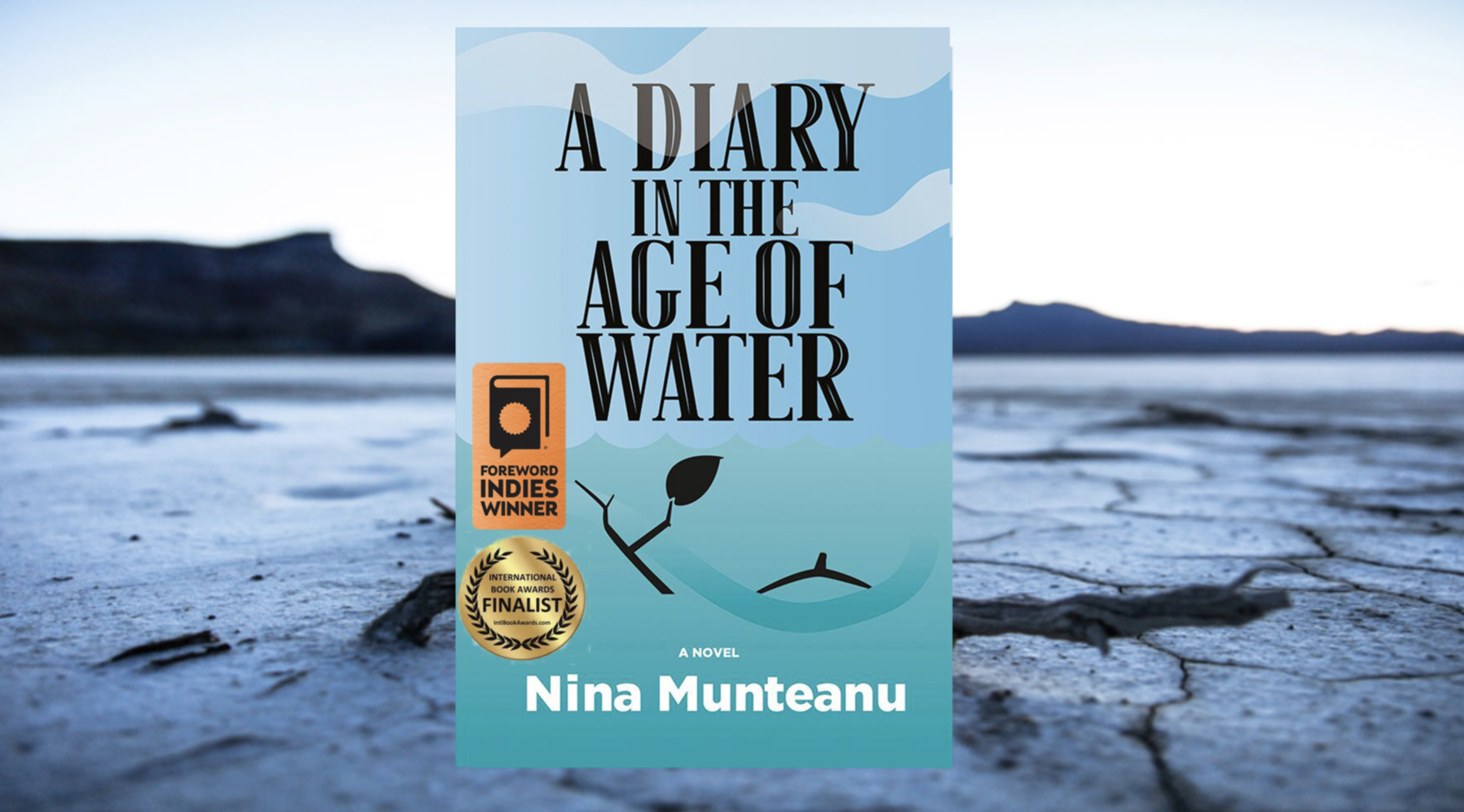
I recently encountered Victoria Crozier’s intriguing PhD thesis and ecocritical discourse out of Liverpool John Moores University entitled “The Brave New Worlds of Green Science Fiction” and found my eco-fiction novel “A Diary in the Age of Water” mentioned alongside other notable eco-fiction works I so enjoyed reading such as Liu Cixin’s The Three-Body Problem, Chen Quifan’s The Waste Tide, Kim Stanley Robinson’s New York 2140 and Emmi Itäranta’s Memory of Water. Crozier calls these “green science fiction,” an appropriate term that I may start using.
.
Nina Munteanu is a Canadian ecologist / limnologist and novelist. She is co-editor of Europa SF and currently teaches writing courses at George Brown College and the University of Toronto. For the lates on her books, visit www.ninamunteanu.ca. Nina’s bilingual “La natura dell’acqua / The Way of Water” was published by Mincione Edizioni in Rome. Her non-fiction book “Water Is…” by Pixl Press (Vancouver) was selected by Margaret Atwood in the New York Times ‘Year in Reading’ and was chosen as the 2017 Summer Read by Water Canada. Her novel “A Diary in the Age of Water” was released by Inanna Publications (Toronto) in June 2020.You can read her just released eco-fiction thriller Gaia’s Revolution by Dragon Moon Press.
“Munteanu seamlessly blends real-life history and technology with tantalizing glimpses of the future’s drugs, diseases, and evolving concepts…Frighteningly plausible…”
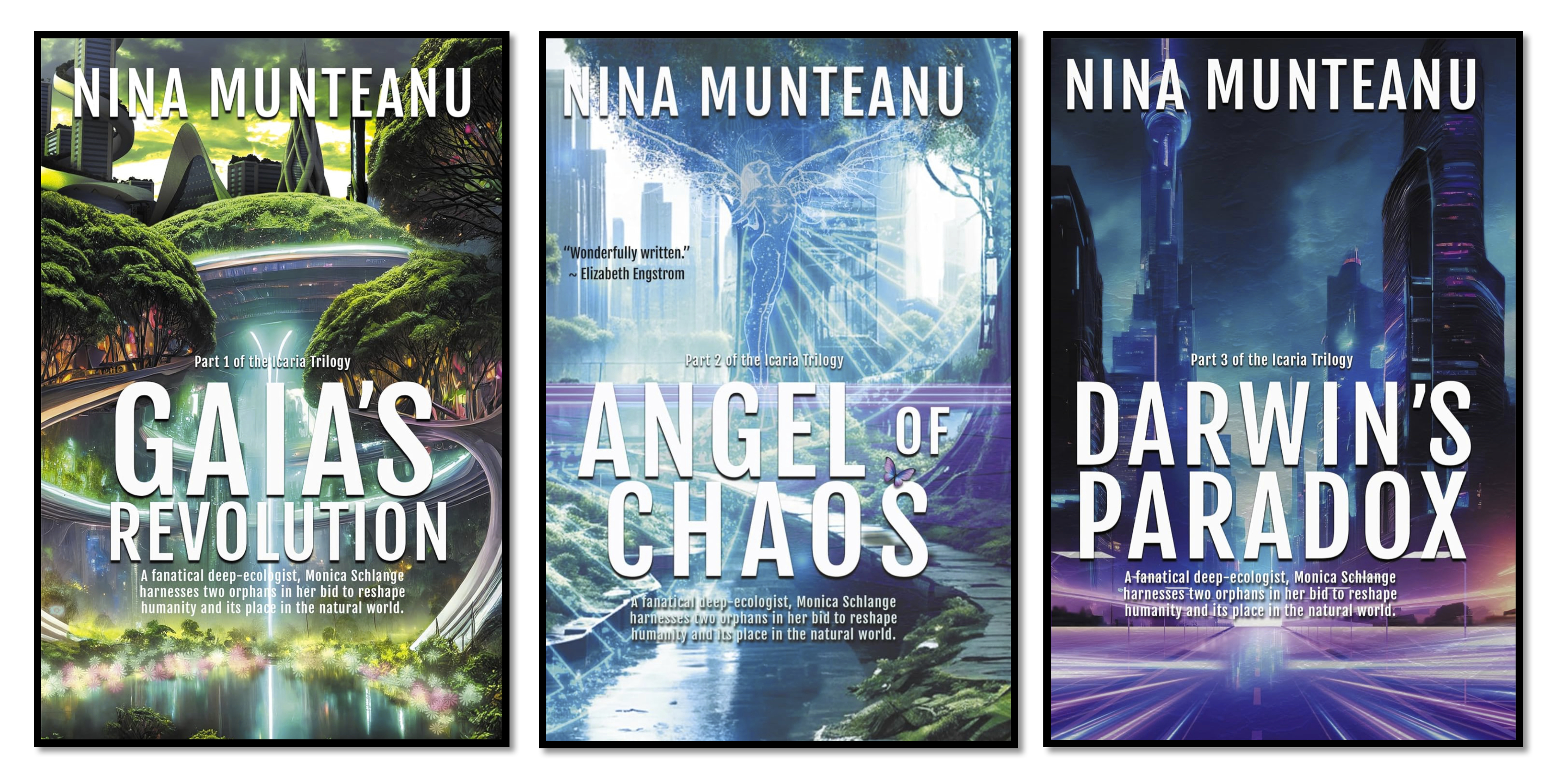
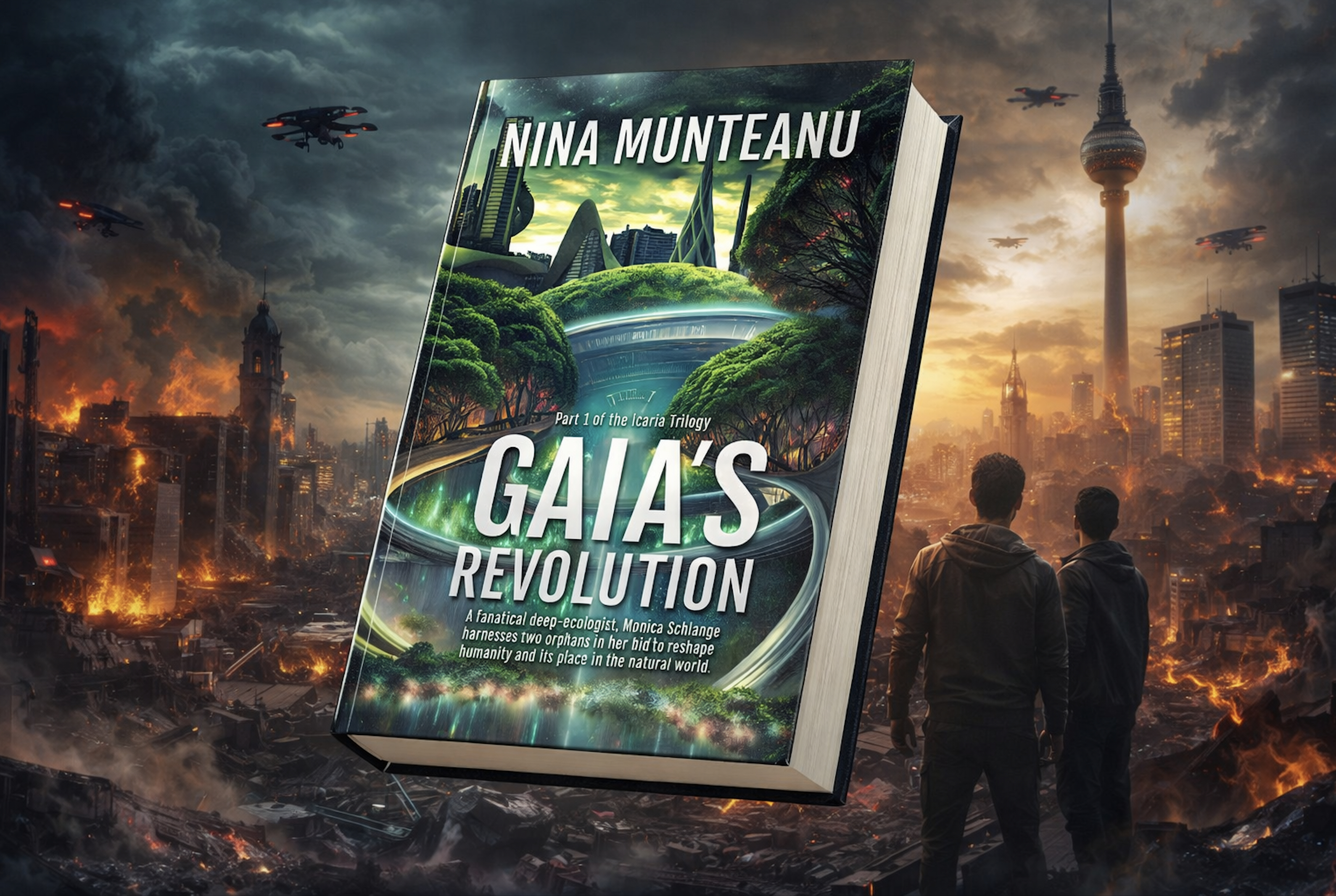
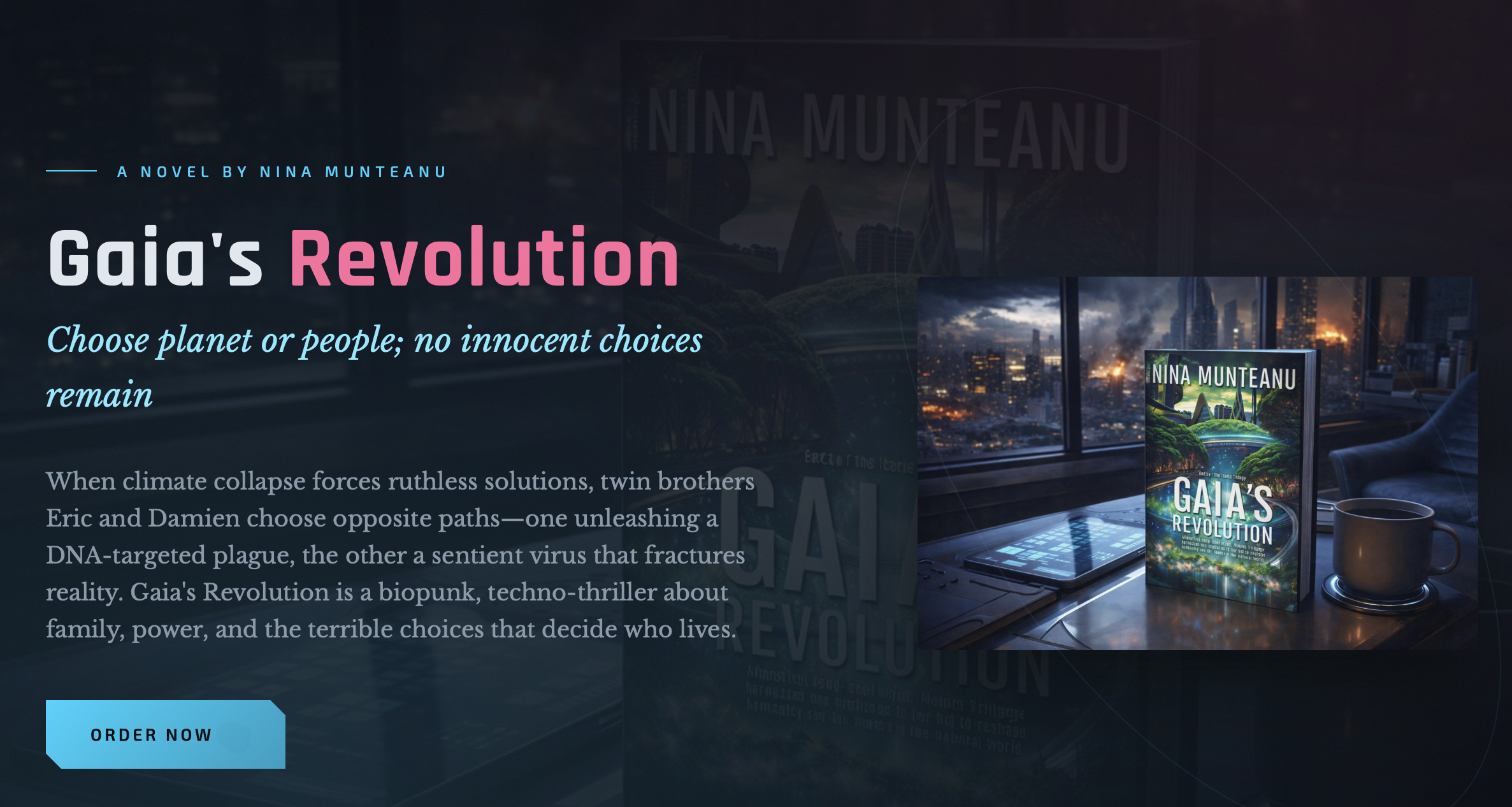
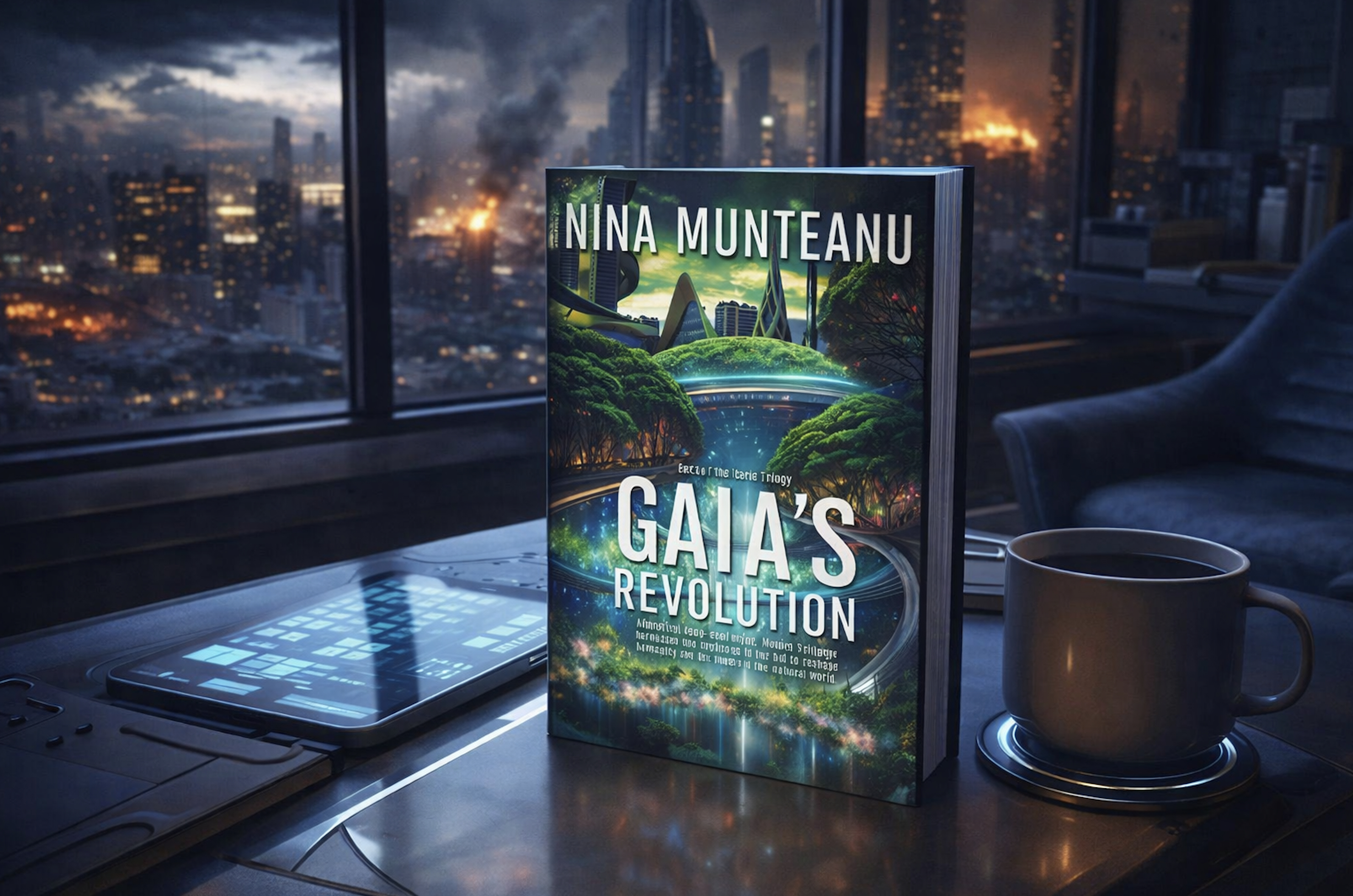
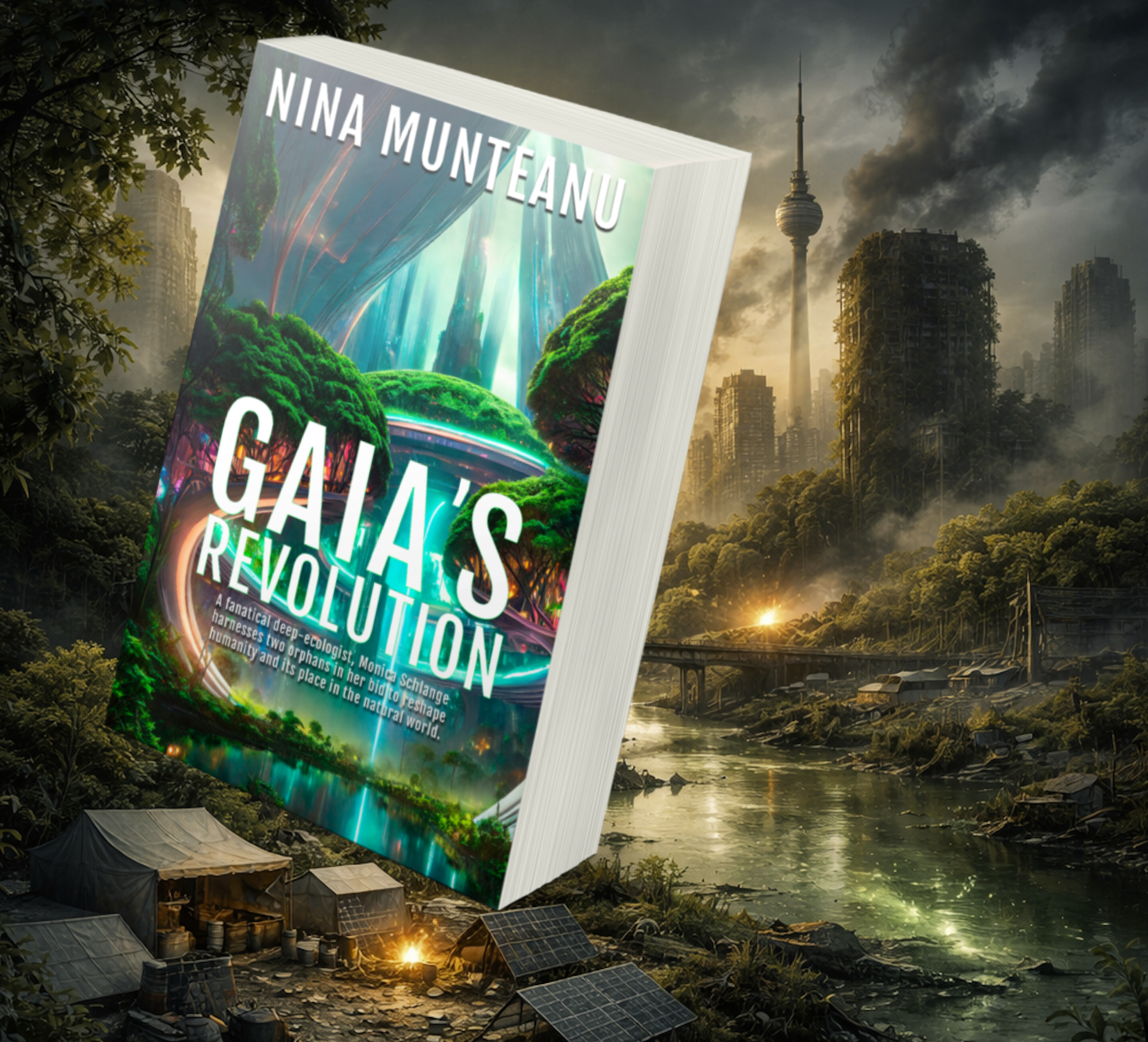
My eco-fiction political thriller Gaia’s Revolution—released March 10 of this year—has already made quite an impact on readers and reviewers: from amazing accolades to outright pans.
I love the controversy!
The book that follows ambitious twin brothers and the woman who plays them has rightly caused a ruckus from its questionable and controversial main characters to a thrilling though notorious plot. Understandably, some readers hated the book, even as others thoroughly enjoyed it. Either way, the book can’t be accused of being mediocre or mundane (something I would detest in my writing).
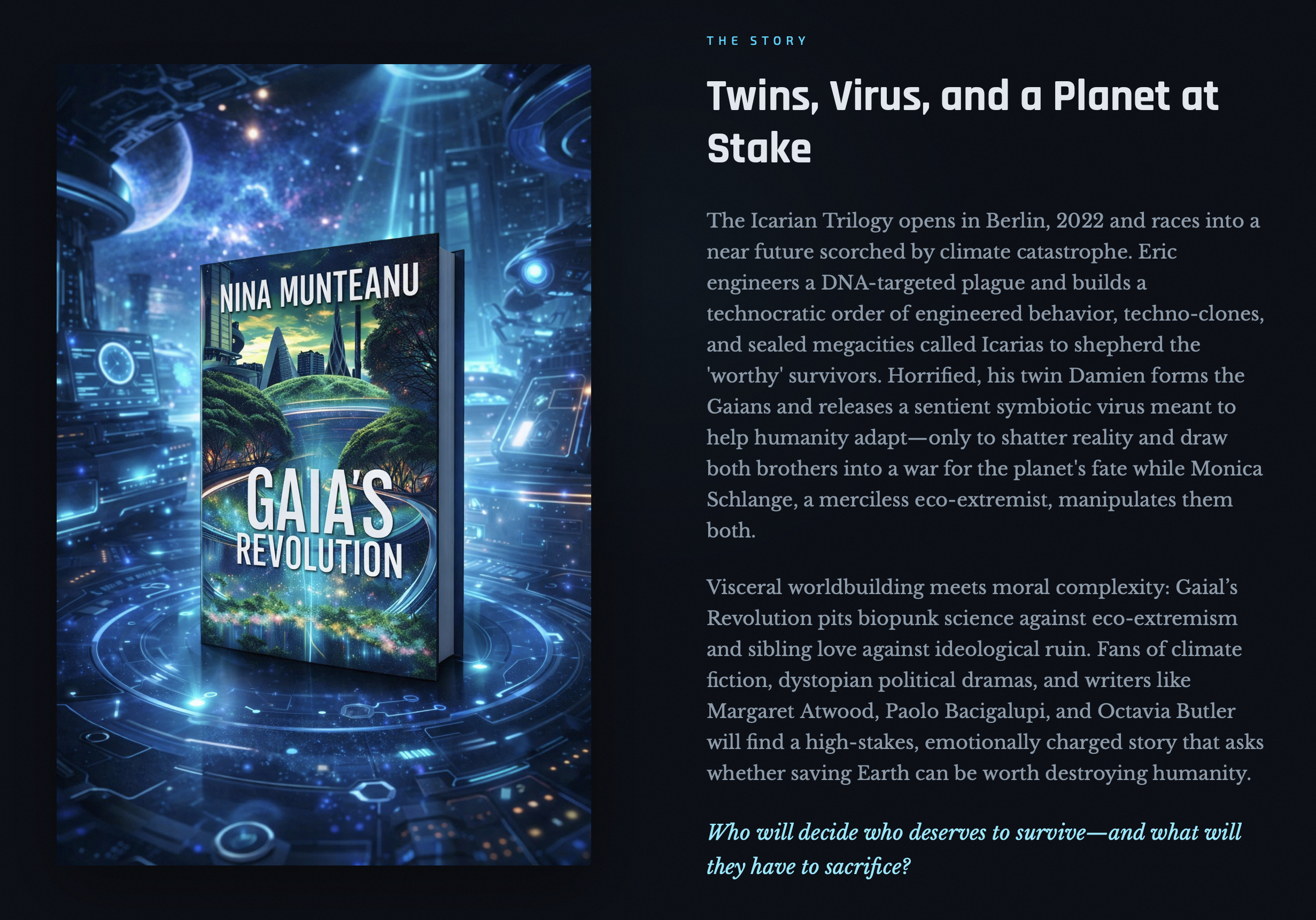
Gaia’s Revolution “is a politically incendiary portrait of a civilization unraveling under climate collapse, historical trauma, and ideological extremism. Berlin, 2022. In a country destabilized by climate catastrophe and political extremism, activist Damien Vogel becomes the target of a violent state crackdown after protesting with Letzte Generation. As he uncovers long-buried truths about his family, he is drawn into conflict with his estranged twin Eric, whose ruthless plan for humanity’s survival threatens to sacrifice freedom itself.”
.
Literary Titan adds that the story “widens into a future history of revolution, ideology, biotech, enclosed cities, and ecological control…The novel is Part 1 of The Icaria Trilogy, and it reads like both an origin story and a warning flare.”
The Prairies Book Review calls Gaia’s Revolution: “Dense, unsettling, and intellectually ambitious.” They describe the novel as “bleak, intelligent, and emotionally explosive.” They add that, “Munteanu crafts the novel as both climate thriller and philosophical inquiry, weaving ecological science, German history, and political paranoia into a narrative charged with dread and moral instability…Munteanu refuses simplistic moral binaries, presenting climate collapse as a force that destabilizes not only ecosystems, but democracy, ethics, and identity itself.”
Reader Neha Shukla writes on Goodreads that Gaia’s Revolution has a “strong message with emotional depth.” Shukla noted that “the emotional side of the story is very well handled.” Lily Thomass wrote on Goodreads that “what stood out to me was the emotional honesty of the story.”
Costi Gurgu, author of Recipearium and The Cursed writes: “Gaia’s Revolution may be the most extensively researched SF novel I’ve ever read…[the book is] so close to reality that it’s frightening.” Claudiu Murgan, author of Water Entanglement, enjoyed the “dynamic plot and interesting, well-defined characters.”
Steve Stanton, Canadian speculative fiction author of Freenet writes: “I love it when novelists tackle the big issues and take on big opponents, and in these perilous times there is no bigger issue than global climate change, and no bigger opponent than patriarchal capitalism. Gaia’s Revolution by Nina Munteanu begins in present-day Germany, where ecological activists are setting the stage even now. In Munteanu’s inspired vision, radical racism, anti-immigration activism, and ultra right-wing security forces will be a crucible fomenting world catastrophe.”
.
.
Stanton adds, “The author uses some subtle stylistic variations for those readers who pay attention to details. The pace is varied, and the plot twists drive the narrative forward. I felt the beginning was a bit wordy with backstory and political philosophy, but Munteanu masterfully dovetails current political unrest and eco-activism into the worldwide dystopia of The Icaria Trilogy. As a prequel, this novel is an embellishment of sci-fi concepts developed very early in Munteanu’s career, but it is also the culmination of a body of work. For me, Gaia’s Revolution has been a delightful rediscovery of a talented Canadian voice.”
Reviews weren’t all positive; some oozed acid in their negative wrath. Why is Gaia’s Revolution eliciting this diversity of polarized reactions?
.
Sophia Wasylinko of The British Columbia Review in part suggests why in her negative review: “The book hooked me at first with its look at a world hostile to environmentalists and deep ecological concepts. Unfortunately, once the brothers cross paths with deep ecologist Monica Schlange, things get messy. Both for them and for the book.”
Wasylinko particularly took exception to Monica’s character.
.
Literary Titan describes Monica’s mercurial shapeshifting character as “a zealous deep ecologist, [who] becomes one of the book’s most dangerous engines: part savior, part tyrant, using damaged people…as instruments in her plan to remake humanity’s relationship with the natural world.” Wasylinko emphatically disliked Monica, which impeded her enjoyment of the book. The reviewer found that, “…as the story progressed, the more irritated I became with [Monica’s] sexual antics and ‘Tears for Fears’ references. While I probably wasn’t supposed to like her, I didn’t care for her at all.” Wasylinko ended with: “I won’t be continuing with the trilogy…I cannot cope with any more of Monica’s crooning Tears for Fears’ big hit of 1985, ‘Everybody Wants to Rule the World.’”
Literary Titan provides another possible reason for the polarized reactions: “the book refuses to make climate politics tidy. It doesn’t give us a simple contest between virtuous activists and corrupt institutions; instead, it shows how righteousness can calcify into doctrine, how grief can become governance, and how ecological thinking can be twisted into a new authoritarian grammar.” The reviewer found that what unsettled them the most, “was the book’s interest in compromised people [who are not] arranged into neat moral bins. They are products of abuse, ideology, scientific ambition, terror, tenderness, cowardice, and survival.”
Kirkus Reviews adds that: “Political ideals clash as the world falls into chaos … the ongoing political war is frighteningly plausible, and some readers may struggle with deciding who the villains are. The author serves up lively discourse in which the characters offer no easy answers; Munteanu seamlessly blends real-life history and technology with tantalizing glimpses of the future’s drugs, diseases, and evolving concepts.”
In describing the diametrically opposed trajectories of twin brothers Eric and Damien, Prairies Book Review adds that, “Eric’s eco-authoritarian worldview is chilling precisely because it emerges logically from the same environmental realities driving Damien’s activism.”
.
.
The book follows six key characters and a handful of minor characters—all with associated archetypes—and their journeys during this catastrophic time are complex and messy; a function of the chaotic time itself. I make no apology to Wasylinko for the messiness. Revolution is messy. In a time of hard choices, innocence is the main casualty. This becomes evident for all the characters in the novel—particularly the children—as fiction reflects non-fiction. In the end, no one is innocent and all are changed.
Gaia’s Revolution is best described as an exploration of violent change and its associated impact and paradoxes. This is something we will face or already are facing with the growing unruliness of global warming, environmental destruction, and planetary change. Gaia’s Revolution ultimately explores the diverse impact of revolution in an unsustainable world; perhaps it is only apt that its reception by readers is equally diverse.
Paradox and irony drive Gaia’s Revolution. Says Wasylinko: “Gaia’s Revolution shows how quickly utopia becomes a dystopia. Nowhere is this more evident than the [revolutionary] Gaian Army adopting the Technocratic government’s weapons, including terrifying clones, and … book burning.”
According to Literary Titan,Gaia’s Revolution “has the grain of a manifesto smuggled inside a thriller, a story with roots sunk deep into Rachel Carson, chaos theory, surveillance states, and the bad old habit of deciding that humanity must be saved from itself.”
Kirkus Reviews described Gaia’s Revolution as: “a bleak but fascinating portrayal of a near-future dystopia.”
Literary Titan recommends Gaia’s Revolution “to readers of climate fiction, eco-dystopian fiction, biopunk, political fiction, and science fiction readers who like their futures thorny rather than sleek. Readers who enjoy Margaret Atwood’s MaddAddam books or Kim Stanley Robinson’s climate-minded fiction may find familiar pleasures here, though Munteanu’s novel is darker, more doctrinal, and more intimate in its wounds.”
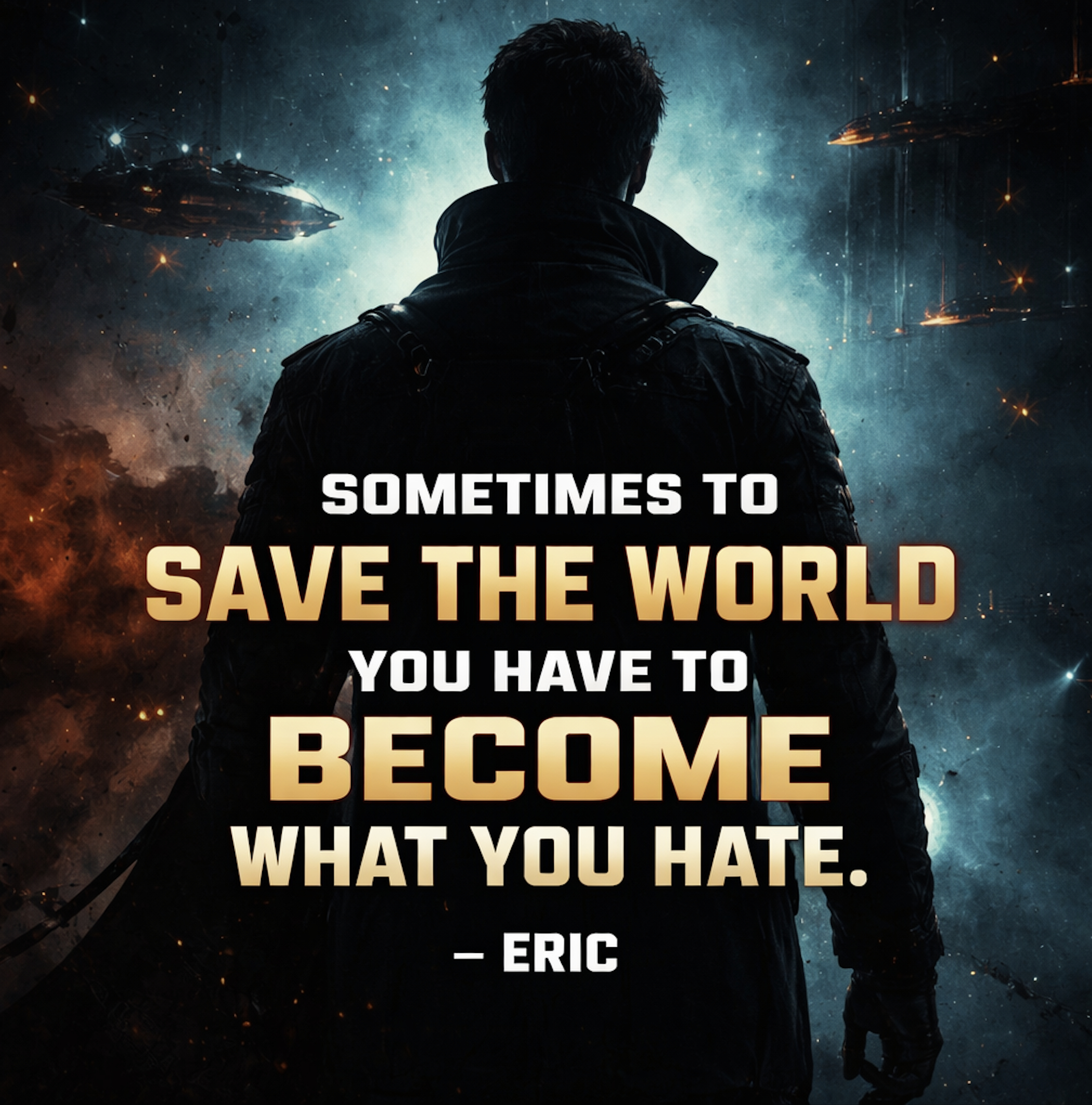
“We must first destroy before we can create. We must be unruly like climate. We must be relentless like climate. We must ride that wave before we can become the wave.”—Eric Vogel, Gaia’s Revolution
.
.
.
.
Nina Munteanu is a Canadian ecologist / limnologist and novelist. She is co-editor of Europa SF and currently teaches writing courses at George Brown College and the University of Toronto. For the lates on her books, visit www.ninamunteanu.ca. Nina’s bilingual “La natura dell’acqua / The Way of Water” was published by Mincione Edizioni in Rome. Her non-fiction book “Water Is…” by Pixl Press (Vancouver) was selected by Margaret Atwood in the New York Times ‘Year in Reading’ and was chosen as the 2017 Summer Read by Water Canada. Her novel “A Diary in the Age of Water” was released by Inanna Publications (Toronto) in June 2020.Her latest eco-fiction novel Gaia’s Revolution was released March 2026 by Dragon Moon Press.
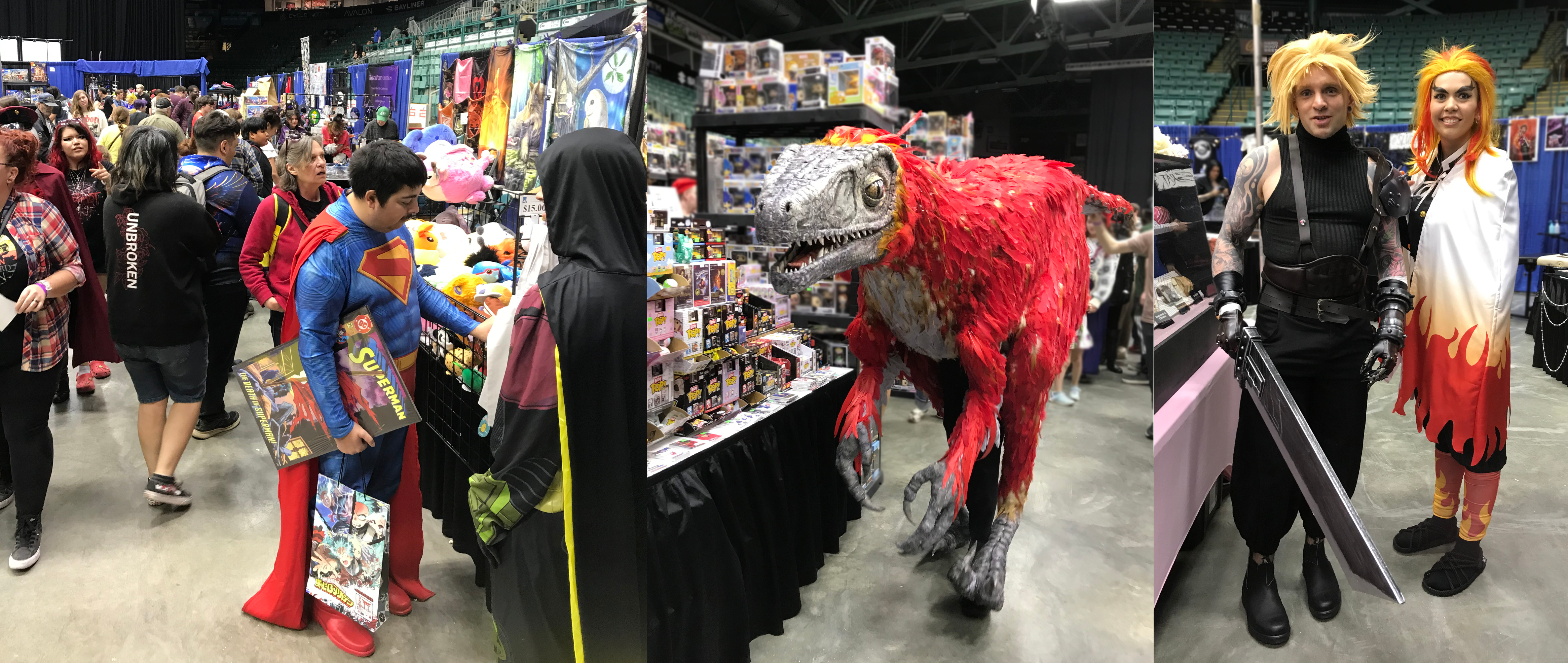
Various ‘characters’ ply through the dense crowds of Northern Fan Con (photos by Nina Munteanu)
.
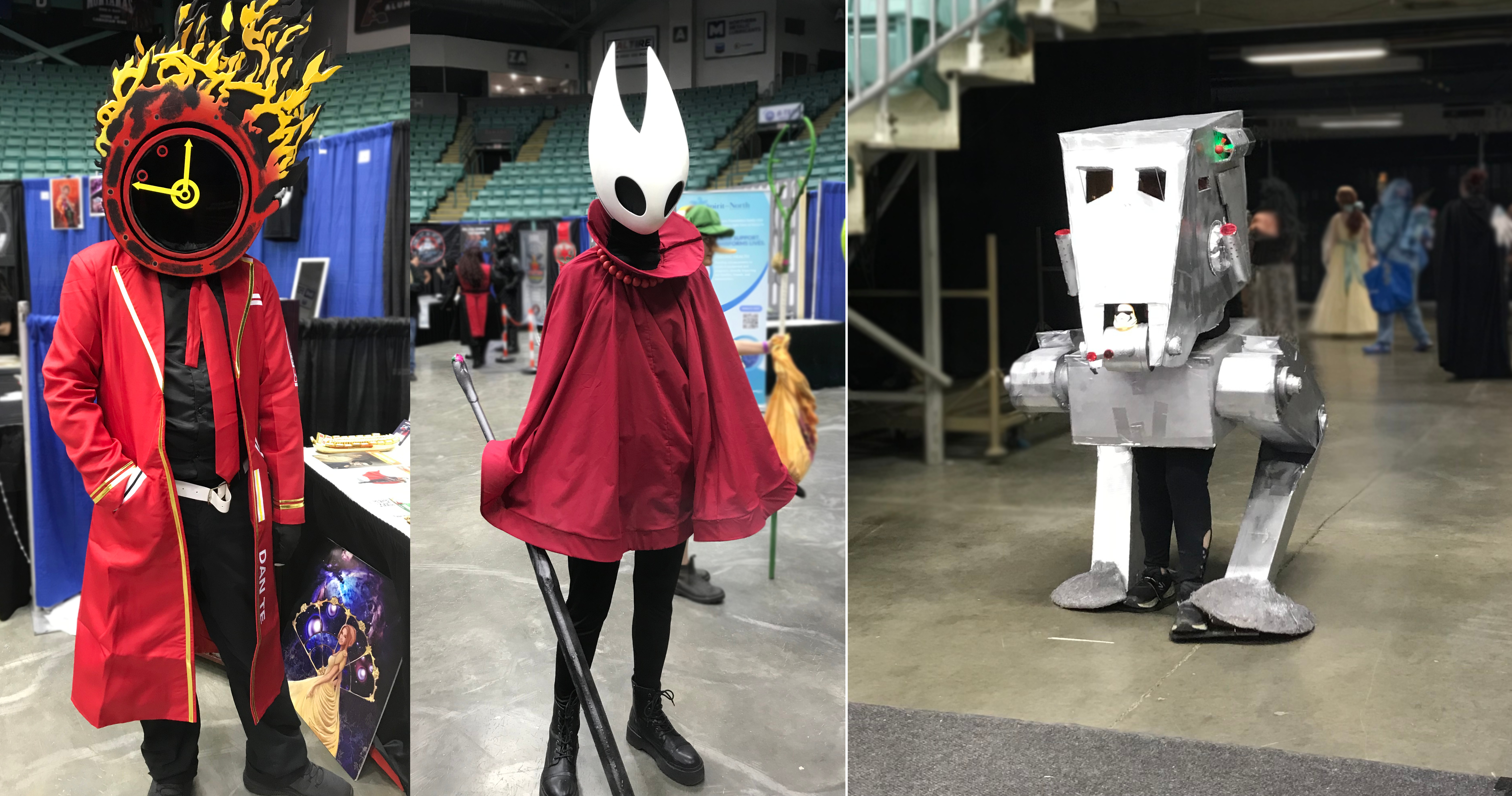
Last weekend I drove north to Prince George to join publisher/writer Lynda Williams and her team at Reality Skimming Press at the Northern Fan Convention. Held at the CN Centre, the con and trade show was very well attended, with booths that held anything from realistic light sabers to anime figurines and collectible cards–and so much more. The con also featured shows with media celebrities, cosplay, workshops, and–of course–the obligatory costume contest.
.
‘Dante’ and ‘Hornet’ join an AT ST making rounds at Northern Fan Con(photos by Nina Munteanu)
.
I helped man the publisher’s table where we were selling books in the Okal Rel series; I also sold out on my two latest novels A Diary in the Age of Water and Gaia’s Revolution.
.
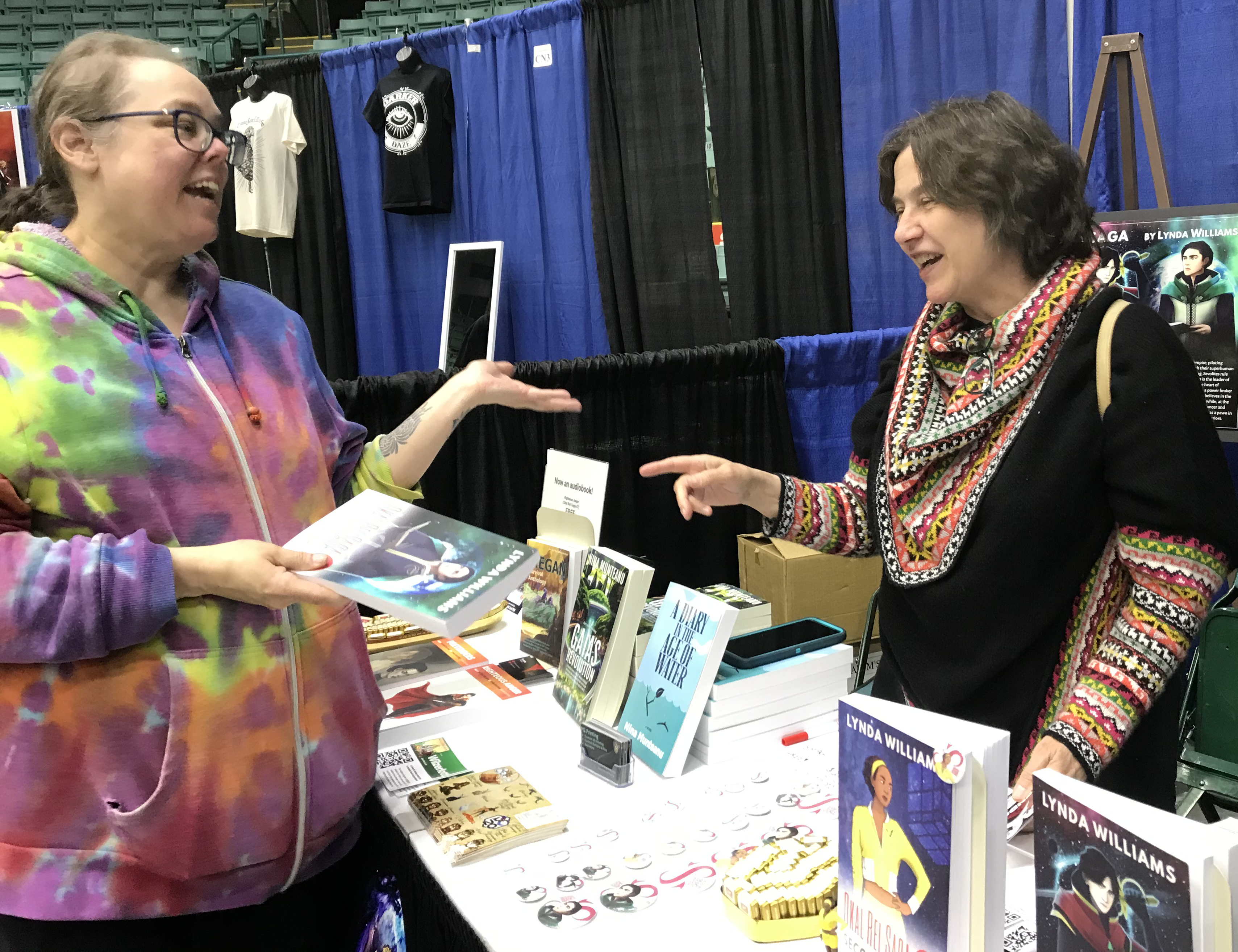
Lynda Williams with a book buyer at Northern Fan Con (photo by Nina Munteanu)
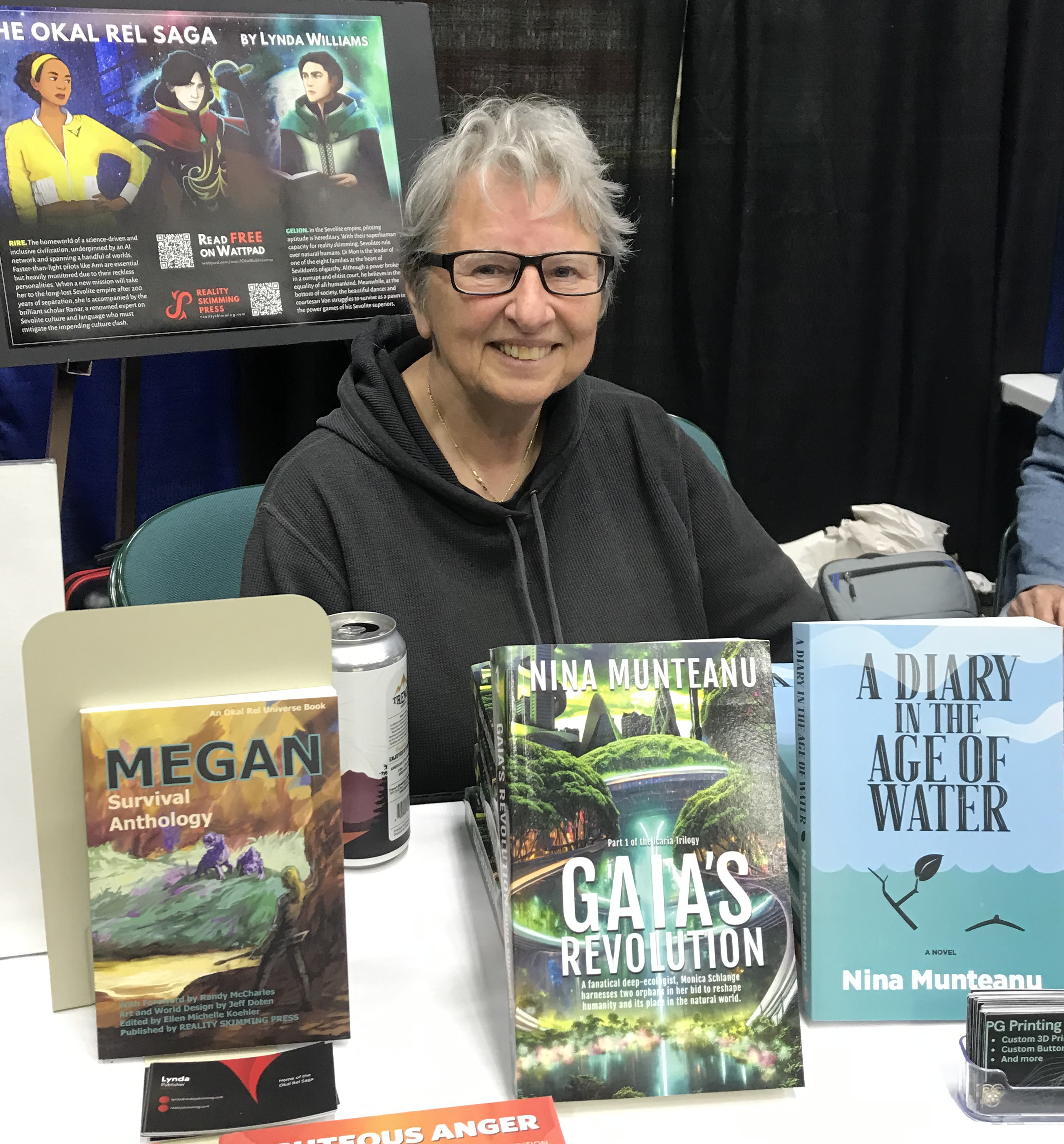
Nina Munteanu selling out her books at Northern Fan Con
.
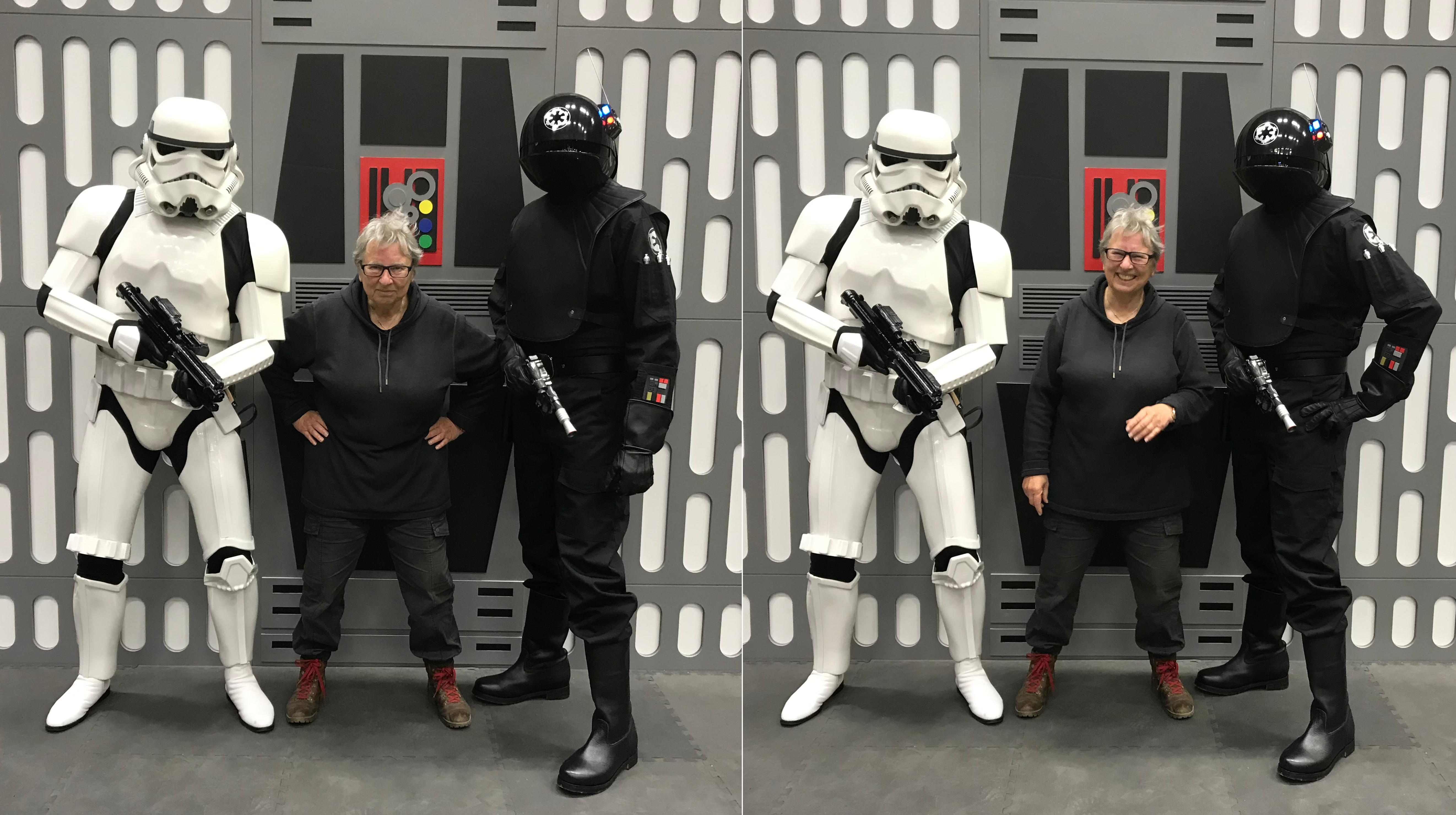
Oh! And I got to play with a Stars Wars storm trooper and tai fighter. Not bad for one weekend!
.
Nina with several Star Wars friends
.
.
Nina Munteanu is a Canadian ecologist / limnologist and novelist. She is co-editor of Europa SF and currently teaches writing courses at George Brown College and the University of Toronto. For the lates on her books, visit www.ninamunteanu.ca. Nina’s bilingual “La natura dell’acqua / The Way of Water” was published by Mincione Edizioni in Rome. Her non-fiction book “Water Is…” by Pixl Press (Vancouver) was selected by Margaret Atwood in the New York Times ‘Year in Reading’ and was chosen as the 2017 Summer Read by Water Canada. Her novel “A Diary in the Age of Water” was released by Inanna Publications (Toronto) in June 2020.You can read her just released eco-fiction thriller Gaia’s Revolution by Dragon Moon Press.
I’m an ecologist. So, when I read books, particularly eco-fiction, I enjoy various authors’ representation of ecologists in literature. Portrayals have ranged quite a bit too. I’ve encountered ecologists, deep ecologists and eco-terrorists. Like real ecologists, these characters are often misunderstood, disrespected or even oppressed for their message of science. This is often by governments, organizations and individuals ruled by agendas of personal or institutional greed. These characters may become morally compromised, driven by righteous anger, on a terrible mission…
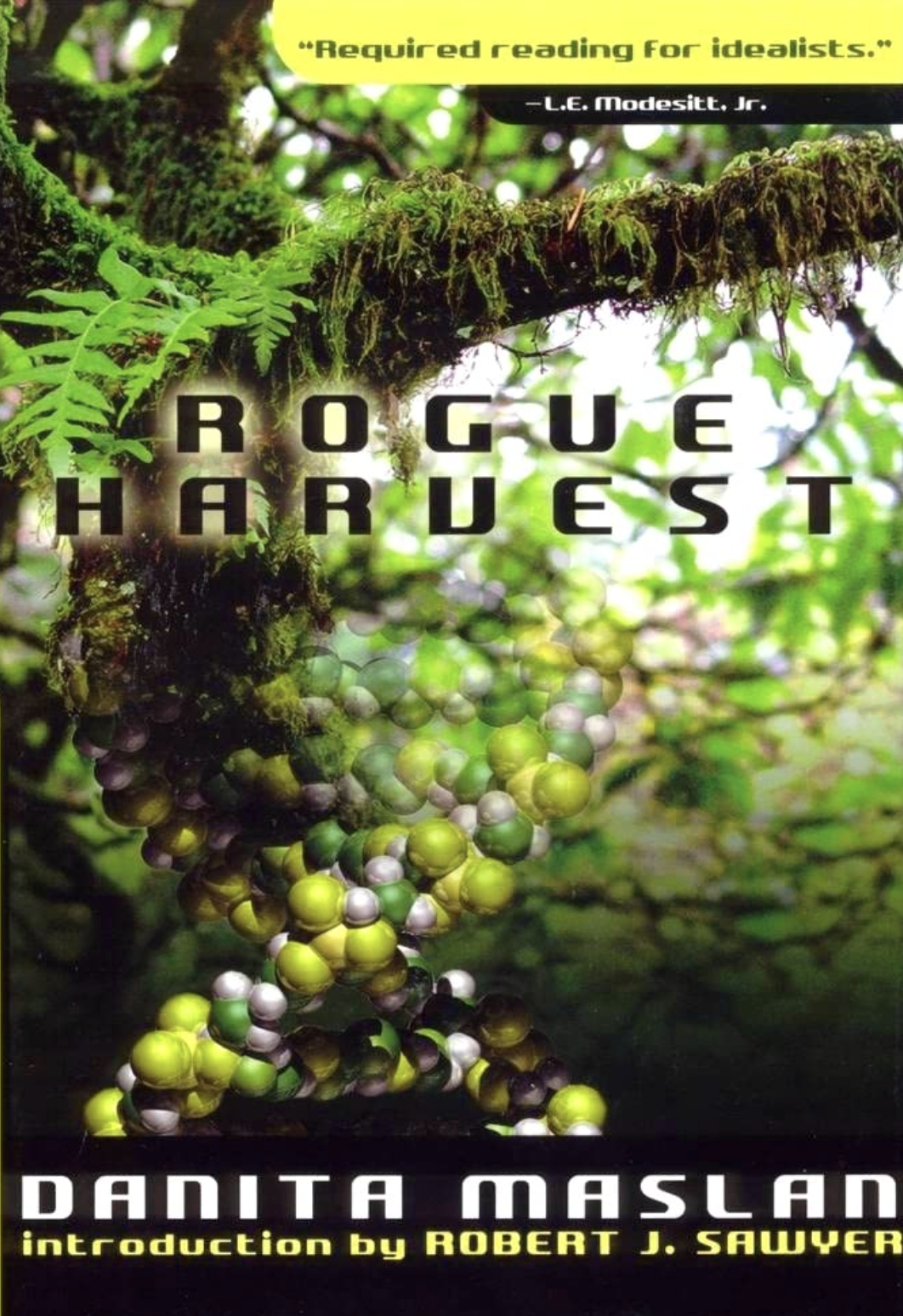
Below are six examples. Some have explored political representations such as environmental technocracy (aka: Rogue Harvest, Gaia’s Revolution). Others have featured radical environmentalists and eco-terrorists (e.g. The Overstory, A Diary in the Age of Water), and even anti-humanists (e.g.: Three Body Problem).
.
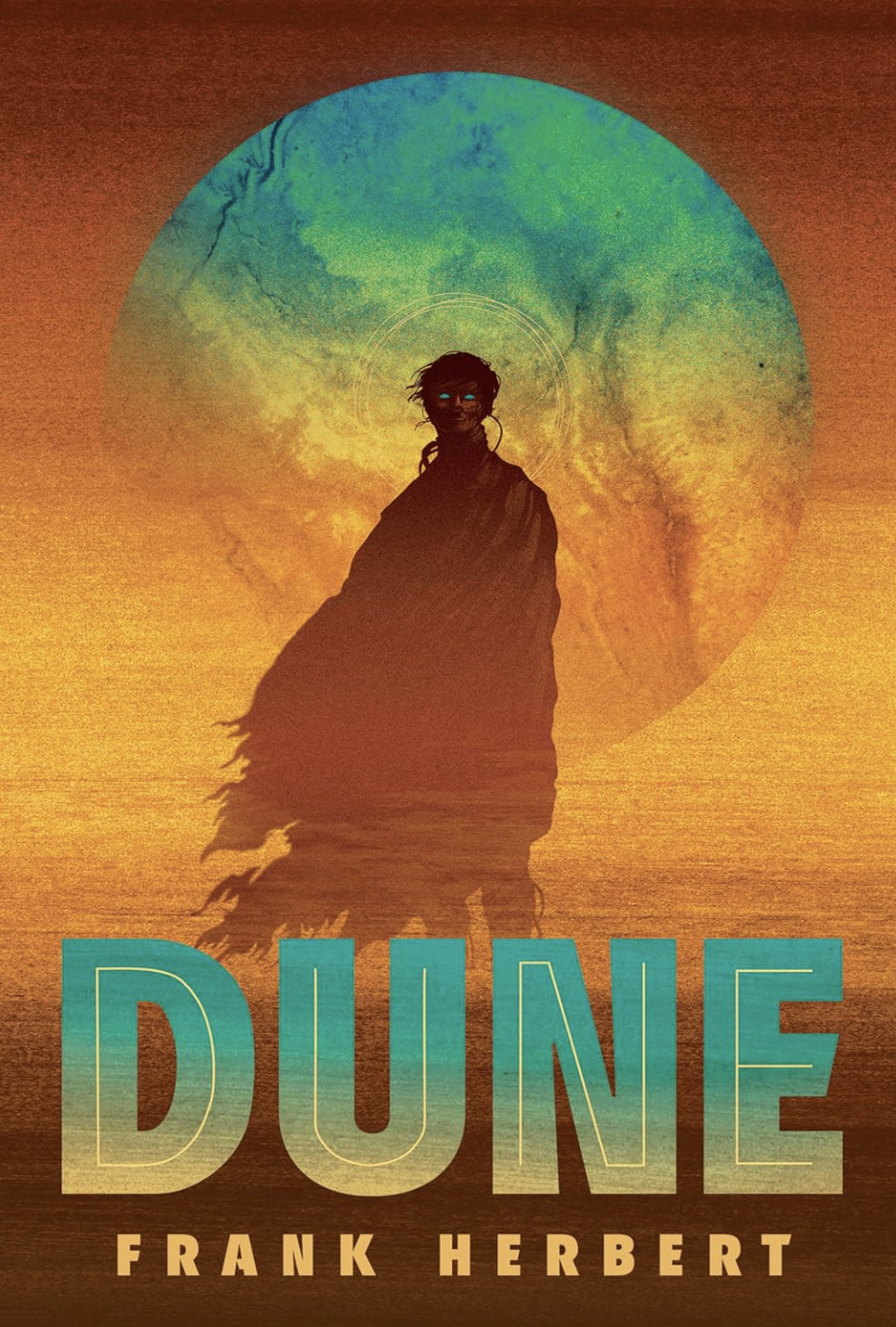
Dune (Chilton Books, 1965)by Frank Herbert:
Dune chronicles the journey of young Paul Atreides, who according to the indigenous Fremen prophesy will eventually bring them freedom from their enslavement by the colonialists—The Harkonens—and allow them to live in ecological harmony with the planet Arrakis, known as Dune. As the title of the book clearly reveals, this story is about place—a harsh desert planet whose 800 kph sandblasting winds could flay your flesh—and the power struggle between those who covet its arcane treasures and those who wish only to live free from slavery. Place—and its powerful symbols of desert, water and spice—lies at the heart of this epic story about taking, giving and sharing. This is nowhere more apparent than in the fate of the immense sandworms, strong archetypes of Nature—large and graceful creatures whose movements in the vast desert sands resemble the elegant whales of our oceans.
.
The subtle connections of the desert planet with the drama of Dune is most apparent in the actions, language and thoughts of the Imperial ecologist-planetologist, Kynes—who rejects his Imperial duties to “go native.” He is the voice of the desert and, by extension, the voice of its native people, the Fremen.
Quotes: (Kynes thinks to himself as he is dying in the desert, abandoned there without water or protection): The highest function of ecology is understanding consequences.
Sometime in the future, Earth is recovering from a devastating 50-year plague that has destroyed most of its natural forests and grasslands and killed two out of every three people. Environmental technocrats now run the world under strict rule: while virgin ecosystems are re-created from original templates through genetic engineering, no human is permitted to set foot in these sanctuaries. As sanctuaries grow ever larger, humanity is pressed into over-crowded cities where boredom and strife dominate.
.
The preservationist organization Emerald Coalition is run by (deep) ecologists who hire reclamation company EcoTech to “recreate the world their great, great grandparents lost.” Main characters wish to open-up the protected nature preserves to regular folk—creating a long-standing conflict between preservation (wilderness not accessed by humans) and conservation (areas where humans extract resources with some environmental risk): demonstrating that, given responsibility for actions within an ecosystem, not all humans behave as they should.
.
The Overstory (Vintage Canada, 2021)by Richard Powers:
The Overstory is a Pulitzer Prize winning work of literary fiction that follows the life-stories of nine characters and their journey with trees—and ultimately their shared conflict with corporate capitalist America. Like all functional ecosystems, these disparate characters—and their trees—weave into each other’s journey toward a terrible irony. Each in their own way battles humanity’s canon of self-serving utility—from shape-shifting Acer saccharum to selfless sacrificing Tachigali versicolor—toward a kind of creative destruction.
.
At the heart of The Overstory is the pivotal life of botanist/ecologist Patricia Westerford, who inspires a movement. Westerford—whose work resembles that of Diana Beresford-Kroeger (author of The Global Forest) and UBC’s Suzanne Simard— is a shy introvert who discovers that trees communicate, learn, trade goods and services—and have intelligence. When she shares her discovery, she is ridiculed by her peers and loses her position at the university. But, just as with Lynn Margulis and her theory of endosymbiosis, Westerford is finally validated. She is the archetypal ‘mother tree’, the metaphoric Tachigali versicolor, who ultimately brings the tangle of narratives together through meaning. What follows is a fractal story of trees with spirit, soul, and timeless societies—and their human avatars.
Quotes (Westerford writes in her book The Sacred Forest): There are no individuals in the forest, no separable events. The bird and the branch it sits on are a joint thing. A third or more of the food a big tree makes may go to feed other organisms. Even different kinds of trees form partnerships. Cut down a birch, and a nearby Douglas fir may suffer…Fungi mine stone to supply their trees with minerals. They hunt springtails, which they feed to their hosts. Trees, for their part, store extra sugar in their fungi’s synapses, to dole out to the sick and shaded and wounded. A forest takes care of itself, even as it builds the local climate it needs to survive…A tree is a wondrous thing that shelters, feeds, and protects all living things. It even offers shade to the axmen who destroy it.
Cixin Liu’s The Three Body Problem—set against the backdrop of China’s Cultural Revolution—follows astrophysicist Ye Wenji, disillusioned by the massive environmental deforestation in the labour camps she is initially sent to work after witnessing the execution of her scientist father in a brutal cleansing at the height of the Cultural Revolution. Already cynical about humanity’s failed culture and science—Wenjie acquires a contraband copy of Rachel Carson’s Silent Spring. The book and revelation she experiences from it sets in motion a frightening notion linking the mindset behind the Cultural Revolution and destruction of the environment. Looking from Nature’s perspective, these were indistinguishable: Is it possible that the relationship between humanity and evil is similar to the relationship between the ocean and an iceberg floating on its surface? Both the ocean and the iceberg are made of the same material. That the iceberg seems separate is only because it is in a different form. In reality, it is but a part of the vast ocean.…It was impossible to expect a moral awakening from humankind itself, just like it was impossible to expect humans to lift off the earth by pulling up on their own hair. To achieve moral awakening required a force outside the human race.
.
Wenjie is sent to the Chinese version of SETI where a secret military project sends signals into space to establish contact with aliens. Wenjie succeeds in amplifying their message to aliens on the dying planet Trisolaris. Despite a warning that the Trisolarians mean only to invade, Wenjie invites them to Earth. To ensure the arrival of the Trisolaris aliens, she collaborates with radical environmentalist Michael Evans—an oil billionaire’s son who is disgusted with humanity’s destruction of Nature. Wenjie believes the aliens will somehow ensure humanity’s transcendence; Evans, however, applauds the coming invasion as the best route to achieve the eradication of humanity and the survival of the rest of the planet and finances the ETO (Earth-Trisolaris Organization) in eco-terrorist activities to protect non-human life—by essentially annihilating humanity.
Quotes: (Wenjie observes the deforestation of an Inner Mongolian labour camp where she was sent to work): Ye Wenjie could only describe the deforestation that she witnessed as madness… Whatever they laid eyes on, they cut down. Her company wielded hundreds of chain saws like a swarm of steel locusts, and after they passed, only stumps were left. The fallen Dahurian larch, now bereft of branches, was ready to be taken away by tractor. Ye gently caressed the freshly exposed cross section of the felled trunk. She did this often, as though such surfaces were giant wounds, as though she could feel the tree’s pain… The trunk was dragged away. Rocks and stumps in the ground broke the bark in more places, wounding the giant body further. In the spot where it once stood, the weight of the fallen tree being dragged left a deep channel in the layers of decomposing leaves that had accumulated over the years. Water quickly filled the ditch. The rotting leaves made the water appear crimson, like blood.
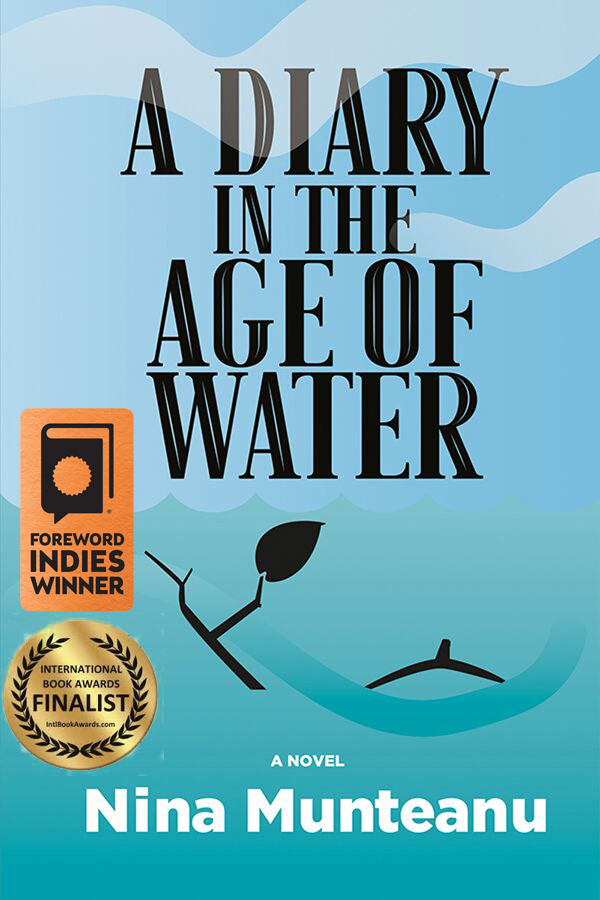
A Diary in the Age of Water follows the climate-induced journey of Earth and humanity through four generations of women, each with a unique relationship to water.
Centuries from now, in a dying boreal forest in what used to be northern Canada, Kyo, a young acolyte called to service in the Exodus, yearns for Earth’s past—the Age of Water, before the “Water Twins” destroyed humanity. Looking for answers and plagued by vivid dreams of this holocaust, Kyo discovers the diary of Lynna, a limnologist from a time just prior to the destruction. The diary spans a 40-year period in the mid-21st century and describes a planet in the grip of severe water scarcity. Lynna, in her work for an international utility that controls everything to do with water, witnesses and records the disturbing events that will soon lead to humanity’s demise.
.
Lynna Dresden is an aquatic ecologist (specifically a limnologist), who’s personal philosophy and world view overlaps with deep ecology. However, she demurs from activism through a fear for reprisals on her and her young daughter. This backfires for her as her daughter later embraces eco-terrorism in her radical behaviour.
Quotes: Lynna Dresden: “The slow violence of free-market capitalism isn’t so much the deliberate and focused actions of a few evil men as the accumulated negligence of an undiscriminating collective of unimaginative humans.” “When you look at a quiet deep pond, you don’t see the bottom, you see yourself reflected there. The calmer the pond the more you see of you; the less of the pond.” “Water—Nature’s herald—is talking loudly to us in the language of irony.”
.
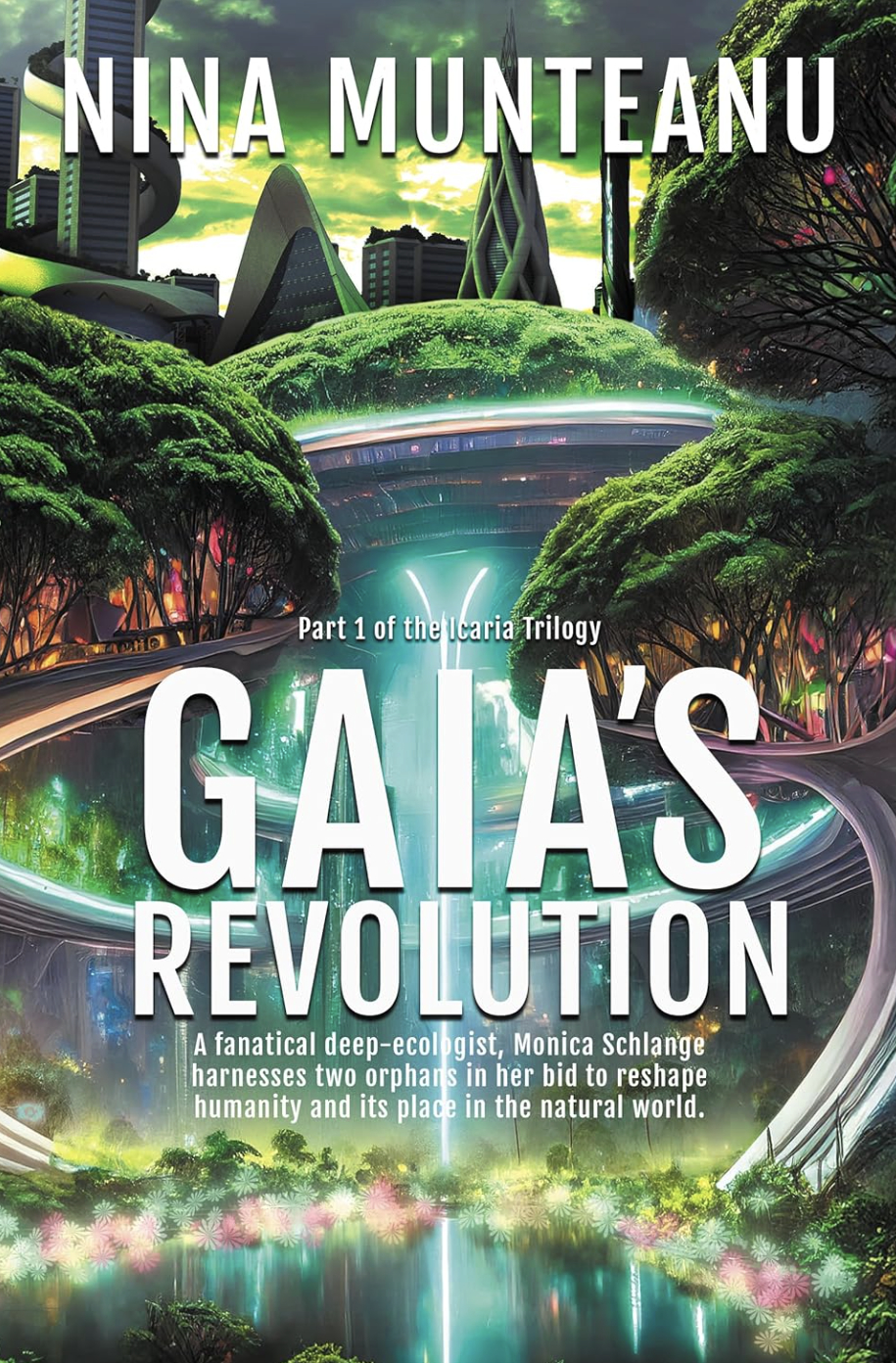
Gaia’s Revolution, Book 1 of The Icaria Trilogy (Dragon Moon Press, 2026)by Nina Munteanu:
Monica Schlange is orphaned by the technocratic corporation, and with a vengeful heart turns to deep ecology and eco-terrorism. A remaining relative helps put her through the University of Toronto, where she studies environmental ethics under Aisha Habib, herself a deep ecologist but also a powerful member of the Technocratic Party in Canada. Schlange’s thesis topic is entitled Ethical Considerations on the Ecological Impact of Corporation Farm Anthropocentrism on the Stability of Gaia Through Ten Metrics. A techno-wiz, Schlange orchestrates a viral social media fiasco that reveals very compromising intel on the Canadian prime minister. She also exposes the environmental minister’s role in a terrible fishing scandal on the central coast of British Columbia that causes the deaths of two Heiltsuk women. Intending covert mischief, Schlange shacks up with a corporate oligarch, looking to bring him and his biotechnology firm down. After the revolution, she garners a position in the governing triad in which she fanatically promotes a ruthless deep ecology agenda.
.
Quotes (After dispatching a fearsome techno-clone—cloned weaponized hybrid-human): Monica straightens, panting out sobbing breaths, and manages a predatory smile. Ambitious men are always underestimating her. Even Techno-clones … Especially Techno-clones.
(after putting down her oligarch-lover in a late-night skirmish when he catches her stealing documents): “Don’t get up…Next time I see you, I will kill you.”
.
Nina Munteanu is a Canadian ecologist / limnologist and novelist. She is co-editor of Europa SF and currently teaches writing courses at George Brown College and the University of Toronto. For the lates on her books, visit www.ninamunteanu.ca. Nina’s bilingual “La natura dell’acqua / The Way of Water” was published by Mincione Edizioni in Rome. Her non-fiction book “Water Is…” by Pixl Press (Vancouver) was selected by Margaret Atwood in the New York Times ‘Year in Reading’ and was chosen as the 2017 Summer Read by Water Canada. Her novel “A Diary in the Age of Water” was released by Inanna Publications (Toronto) in June 2020.Her most recent eco-fiction thriller Gaia’s Revolution (Dragon Moon Press) released March 2026.