Age of Water Podcast

AoW Logo-smallOn November 22, 2019, co-host Claudiu Murgan and I launched the podcast Age of Water in Toronto, Ontario.

The podcast is devoted to informing and entertaining you with topics about water and the environment. We interview scientists, journalists, writers, academia and innovators who share their knowledge and opinions about the real state of the environment and what committed individuals and groups are doing to make a difference. We talk about the problems and we talk about the solutions.

The format of our podcast is a combination of chat cast and informal interview. We cover anything of interest from breaking environmental news to evergreen material. This also includes human interest stories, readings of eco-literature, discussion of film and other media productions of interest.

AgeOfWater-HomePage

Diary Water cover finalClaudiu suggested doing the podcast during a discussion we had about what we could do to make a difference and to help bring more awareness about the environmental challenges we face in water issues and geopolitics.

We both agreed that the podcast should not only explore the issues but also present solutions and ideas in the ongoing conversation. We wanted to point to ways others could participate by talking to those who were indeed making a difference. So far, we have talked to people about positive initiatives such as 350.org, Drawdown, blue communities, Extinction Rebellion and several others. We’ve talked to homeowners and entrepreneurs with innovative ideas on what individuals can do at home and in their community.

The name of the podcast came from my upcoming book “A Diary in the Age of Water,” a novel that chronicles the lives of four generations of women and their relationship with water during a time of catastrophic change. The book will be launched by Inanna Publications in Toronto in May 2020.

Podcast CO-HOSTS

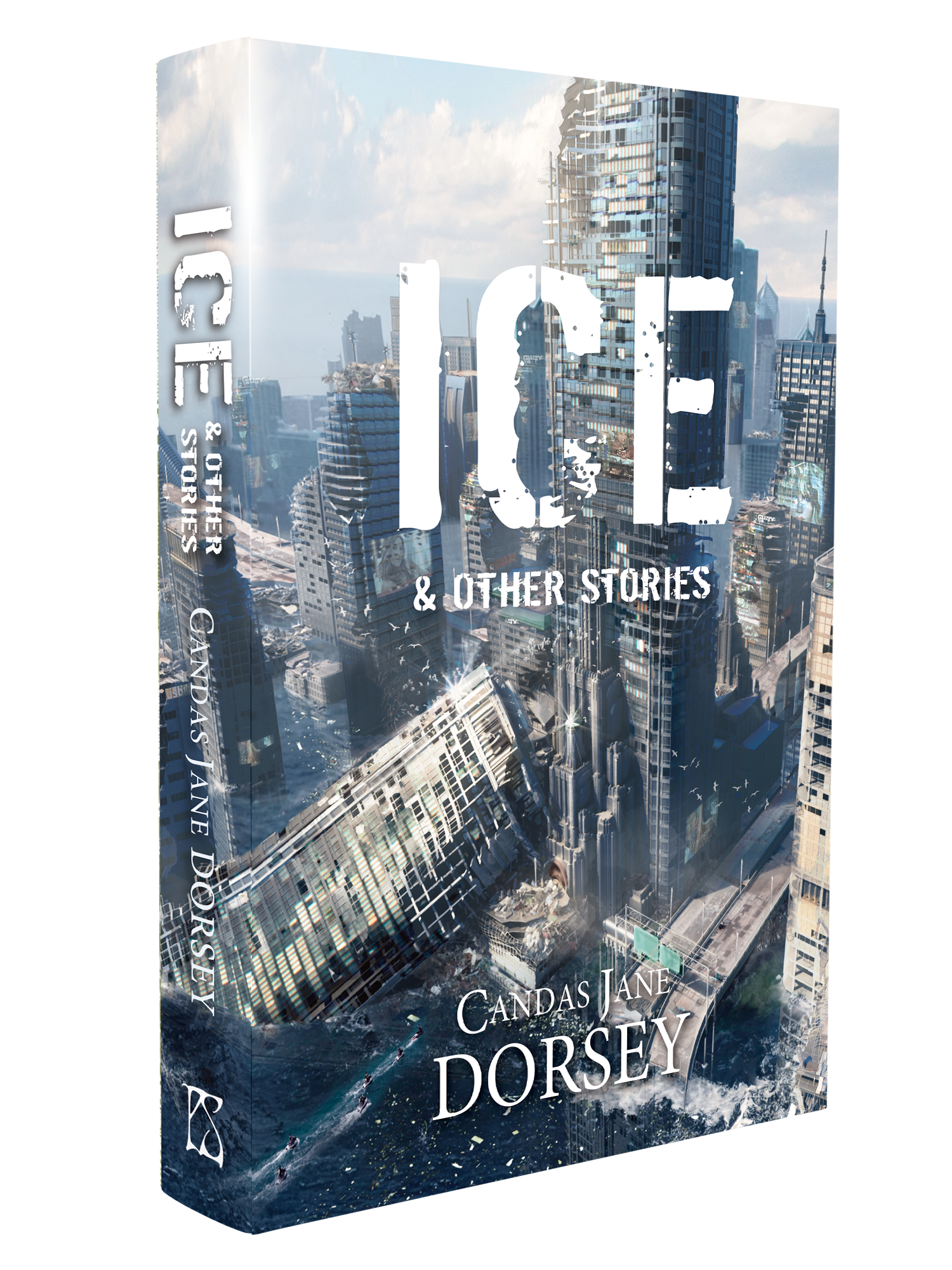
Guests have come from around the world to join us in monthly interviews on Age of Water. These have included so far: economist and educator David Zetland in Holland (aired Nov 2019); award-winning metaphysical author Rainey Highley in California (aired December 2019); Canadian award-winning author Candas Jane Dorsey in Calgary, Alberta (aired January 2020);  activist/author Kaz LeFave in Toronto (airing February 2020); Finnish award-winning author Emmi Itäranta in the UK (to air in March 2020); and Toronto film educators The Water Brothers (to air in April 2020). We interviewed environmental activist Liz Couture in Richmond Hill, Ontario (airing May 2020); Zen master Ian Prattis in Ottawa (airing June 2020), and we also talked to activist/author Merilyn Ruth Liddel in Calgary, Alberta (airing July 2020), and climate researcher / author Martin Bush in Toronto (airing August 2020). Many more are scheduled to be interviewed. For more information go to www.ageofwater.ca

Podcast MISSION

Water Is-COVER-webIn February 2020, we started a reading series on Age of Water, in which Claudiu or I read from a fiction or non-fiction work that resonated with us, followed by a discussion. The first readings is from my book “Water Is…The Meaning of Water,” a celebration of water, which was selected by Margaret Atwood as her choice reading in the New York Times ‘Year in Reading.’

Let us know if you or someone you know wishes to be interviewed on the show. If you have a work you think merits reading and discussing on the show, please let us know as well. Go to the Age of Water site, join the newsletter and email us.


DS-2008-16 copy

Nina kayaks Desolation Sound, off the coast of British Columbia (photo by H. Klassen)

nina-2014aaa

Nina Munteanu is a Canadian ecologist / limnologist and novelist. She is co-editor of Europa SF and currently teaches writing courses at George Brown College and the University of Toronto. Visit www.ninamunteanu.ca for the latest on her books. Nina’s bilingual “La natura dell’acqua / The Way of Water” was published by Mincione Edizioni in Rome. Her non-fiction book “Water Is…” by Pixl Press (Vancouver) was selected by Margaret Atwood in the New York Times ‘Year in Reading’ and was chosen as the 2017 Summer Read by Water Canada. Her novel “A Diary in the Age of Waterwill be released by Inanna Publications (Toronto) in June 2020.

Finding the Right Time and Place to Write

Look and you will find it—what is unsought will go undetected —Sophocles


Beaches-snow01

Snow in the Beaches, Ontario

During a time when I had a demanding job as an scientist with an environmental consulting job, was a devoted wife and mother and community volunteer, I wrote and successfully marketed five books, over a dozen short stories and many articles and reviews. Some people, including my publishers, thought I never slept (true) or had cloned myself (possibly). They couldn’t believe my productivity when I was so busy with life.

But I did what I did, because I’d worked out a system. One that I could live by. One that fit my lifestyle. One created out of respect for my art as part of my “busy” life of commitments.

The truth of it is that we all lead busy lives. If you are going to finish that novel you’ve been working on over the years or book of poems sitting in the bottom dresser drawer, you need to make a commitment. Aside from giving your art the respect it deserves, it comes down to creating a time and place to write.

It starts with being realistic about your daily schedules and routines and inclinations and picking a time and place accordingly. Try to be consistent. It’s actually best to create a routine related to both time and place; the key is to be realistic about it. Don’t fight your inclinations or habits; instead, build your writing into your lifestyle. This will ensure success.

nina-smiling-close

Nina Munteanu teaching in Mahone Bay, NS

Choose a Sacred Time

Finding the time to write is critical to succeeding. If you don’t dedicate time to write, you won’t write. Believe me, you won’t. Make it sacred.

Writer Louise DeSalvo shared a common story about her experience: “Many people I know who want to write but don’t (my husband, Ernie, for example) or who want to write more than they have but say they can’t find the time (my friend Marla) have told me that taking the time to write seems so, well, self-indulgent, self-involved, frivolous even. And that finding the time to write—even a diary, much less fiction or memoir or poetry—in their busy schedules is impossible. I’ll write when I have the time, they say.”

It doesn’t work that way. You don’t find time; you must create it. Writing of any kind is a commitment you make to yourself. So, choose a time that’s right for you. If you’re a morning person, don’t pick the end of the day when you don’t function as well. Instead, pick the early morning to write, a time before everyone else gets up and the day’s distractions pile up.

It’s actually best to create a routine related to time of the day (e.g., fixed time such as every morning or right after supper) or based on some other constant in your life, say the school calendar or your daily activities. The key is to be realistic about the time(s) you’ve chosen. In other words, your goals should be realistic and realizable.

The second part of the commitment is sharing it with your family and friends so that they will respect your sacred writing time. By sharing how important it is to you, you also give them the gift of sharing the experience with you and they are more likely to respect your time alone to write. This is also why choosing a routine makes more sense; it is something your family and friends will better remember and abide by. Making it easy for others is part of making it easy for you.

Find Your Own Rhythm

the beach-2013

The Beaches boardwalk (photo by Nina Munteanu)

There’s no rule for when and how often you write. Because frequency and schedule of writing depends on the kind of writing you do (e.g., novel, short stories, articles, research) and on your own rhythms, you must decide what works best.

Most writers recommend that you commit to a regular writing schedule that is realistic to your overall routine and biorhythms. Some recommend you write in the morning, after a refreshing sleep; others suggest you write at night, at the end of the day when your memories are more fresh with the day’s activities and stimulations. Yet others suggest you take time out during the day to jot down relevant experiences as close to the time as the muse hits you, then spend some time at the end of the day compiling it into your work.

In the end, it’s up to you to choose what works for you and your own rhythms. When is the best time for you to write? And for how long or how many pages? Once you decide, stick to that schedule.

Choose a Sacred Place

Writing is a reflective activity that requires the right environment. The best environment is a quiet one with no interruptions and where you are alone. A reflective environment will let you find a connection with your muse. You need a place where you can relax and not worry about someone barging in or other things distracting you from your reflections. You should also feel physically comfortable and the place should meet your time requirements.

Because the suitability of a place can change with the time of day, learn the rhythms that affect the place you wish to write in. For example, the kitchen may be the centre of activity during the day but an oasis of quietude during the evening. Similarly, learn what kind of environment stimulates and nurtures your writing. Does music help or do you need complete quiet? Do you respond to nature’s soft breezes and sounds or do you prefer to surround yourself with the anonymous murmur of a crowded café for company?

C'est La Vie Cafe

a coffee shop in Val David, Quebec (photo by Nina Munteanu)

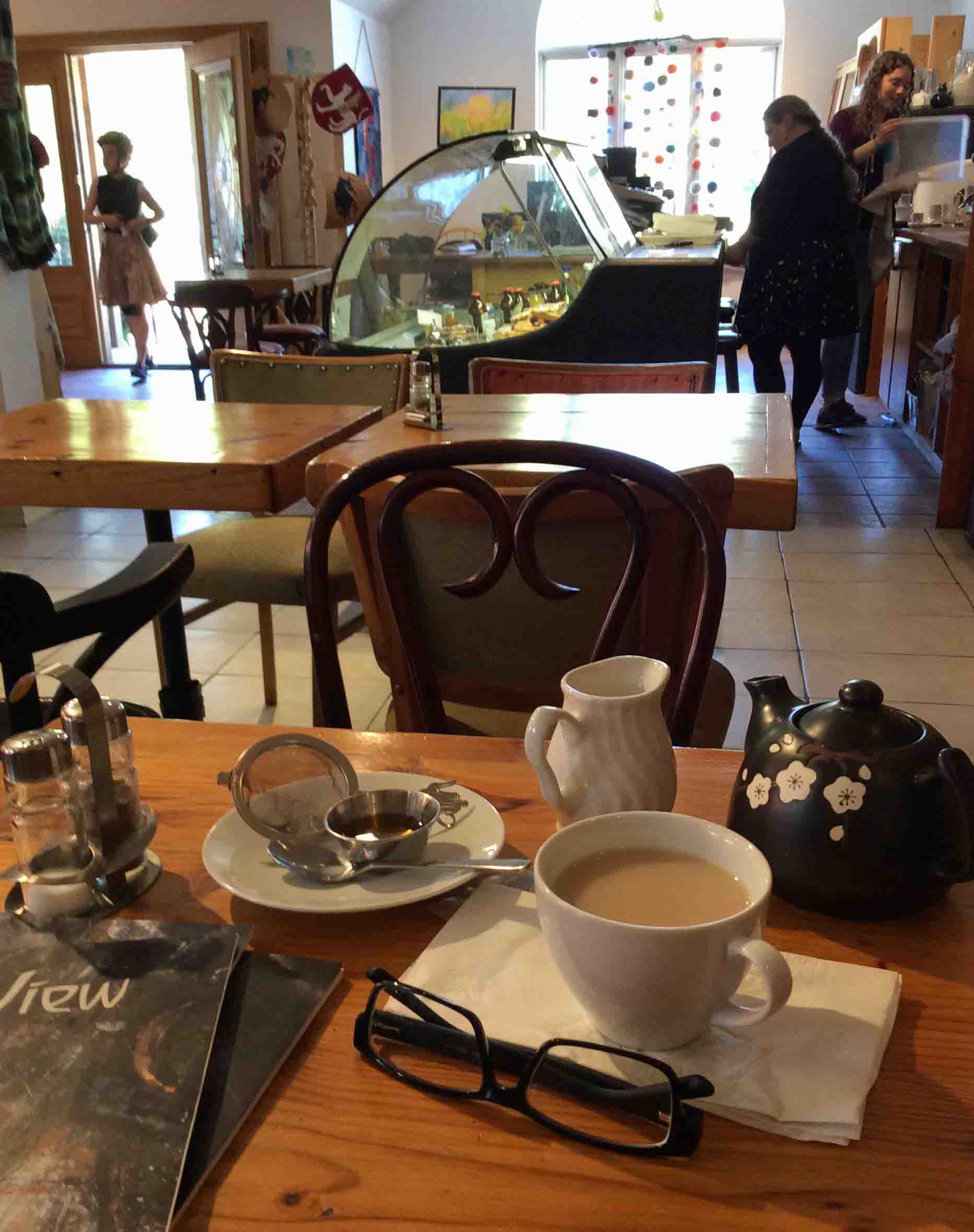
Places that work for me include the local coffee shop, where its desultory conversations and laughter—and wonderful smells of fresh coffee—provide a pleasant living-landscape for my muse. I also enjoy my daily walk with a notebook or iPad in the park along the river near my house. I teach writing at the University of Toronto St George campus in downtown Toronto and just recently discovered an enclave that excited my muse. The outside breezeway at Knox College, with arched ceiling and columns, adorned with hanging plants, is pure magic. The breezeway cuts through an outside courtyard of gardens and yard, populated with songbirds and the gentle rustle of a refreshing breeze. Benches and small tables and chairs line the breezeway, ensuring a writer’s sanctuary.

Where you write may reflect what you’re writing and vice versa. To some extent, you are environment and environment is you. You might try a few places first and see what happens to your muse. What you write while sitting under an apple tree in the breeze hearing the birds singing may differ from what you write while sitting in your living room by the crackling fireplace with music playing or sitting at your desk in your bedroom in total silence or in a crowded café surrounded by cheerful bustle.

Again, as with your choice of time, tell your family and friends about your sacred place. Provide rules, if you have to. Let’s say it’s a desk in the study. You may, for instance, let others know that your “mess” is part of a work in progress, perhaps even explain a little about it so they understand the nature of what you’re doing and why it should not be touched or moved or used, even while you are away from it. This will ensure that they respect your things and what you’re doing.

In the end, it comes to finding the right integration and balance of time and place. Letting others know of your choices is equally important; this will ensure that they can help you, not hinder you in your writing. While writing is to a large extent an activity done in solitude, the journey is far from secluded. Ensure that you have a good support network.

This article is an excerpt from my fiction writing guidebook “The Fiction Writer: Get Published, Write Now!” (Starfire, 2009).

nina-2014aaa

Nina Munteanu is a Canadian ecologist / limnologist and novelist. She is co-editor of Europa SF and currently teaches writing courses at George Brown College and the University of Toronto. Visit www.ninamunteanu.ca for the latest on her books. Nina’s bilingual “La natura dell’acqua / The Way of Water” was published by Mincione Edizioni in Rome. Her non-fiction book “Water Is…” by Pixl Press (Vancouver) was selected by Margaret Atwood in the New York Times ‘Year in Reading’ and was chosen as the 2017 Summer Read by Water Canada. Her novel “A Diary in the Age of Waterwill be released by Inanna Publications (Toronto) in June 2020.


The Careful Writer: When To Use Passive or Active Verbs

patterns-Spalting-LR

Maple spalting with carbon cushion fungus (photo by Nina Munteanu)

One of the most common pieces of advice I give to students of writing in coaching sessions and my classes at UofT (technical and non-fiction writing) and George Brown College (fiction writing) is that active verbs most often work better than passive verbs.


Active Verbs Clarify by Identifying Agent

The use of active verbs avoid confusion because they clearly identify the subject (the doer). For instance, consider these two versions:

ACTIVE: Alice walked the dog.

PASSIVE: The dog was walked.

The active sentence clearly identifies Alice as the one walking the dog; the passive sentence does not provide agency (Alice). We don’t know who walked the dog. When we use active verbs we always know the agent (of change); not so with passive. However, if we modify the passive sentence with “by”, then agency is provided:

PASSIVE (with agency): The dog was walked by Alice.

But the sentence no longer flows easily. This is because the typical subject-verb-object (SVO) flow that we are used to in the English language has changed to object-verb-subject (OVS). If you speak Native Brazilian Hixkaryana, you might be OK with that, given they organize their sentences this way. But that is not how we think and read. Here’s another example:

PASSIVE: The report was written by Ahmed, and it was found to be excellent

ACTIVE: Ahmed wrote the report and it was excellent.

ACTIVE BETTER: Ahmed wrote an excellent report.


Active Verbs Clarify and Empower by Reducing Need for Modifiers

Another reason to use active verbs is that a writer depends less on modifiers to prop up a weak verb, which passive verbs tend to be. For instance, which version is more compelling and easy to take in?

  1. Jill was walking quickly into the room.

  2. Jill rushed into the room.

The example below that I explore in my book The Fiction Writer: Get Published, Write Now! shows how the use of active and powerful verbs adds vividness and clarity to a scene.

PASSIVE

ACTIVE

„ Joe walked slowly into the room.


„ Joe sidled into the room.


„ The naked couple were in the bed almost buried under the rumpled covers. They were now struggling to get up.


„ The naked couple struggled out from the rumple of clothes and blankets.


„ Joe saw the big man sit up and stare at him angrily.


„ The man reared up and glared at Joe.


TOTAL WORDS: 38 TOTAL WORDS: 25

TheFictionWriter-NMNotice how the use of active verbs also unclutters sentences and makes them more succinct and accurate. This was achieved not only by choosing active verbs but power-verbs that more accurately portray the mood and feel of the action. Most of the verbs used in the Passive column are weak and can be interpreted in many ways; words such as “walk” “were” “sit” and “stare”; each of these verbs begs the question ‘how’, hence the inevitable adverb. So we end up with “walk slowly” “were now struggling” “sit up” and “stare angrily.” When activated with power-verbs, we end up with “sidle” “struggled” “rear up” and “glared”—all more succinctly and accurately conveying a mood and feeling behind the action.


When Passive Verbs Clarify…

In Chapter 17 of their book The Craft of Research (University of Chicago Press) Wayne C. Booth and colleagues stress that mindlessly adhering to the tacit rule to choose active verbs over passive verbs can in fact cloud a sentence. They suggest asking a simpler question: do your sentences begin with familiar information, preferably a main character? “If you put familiar characters in your subjects, you will use the active and passive properly,” they say.

It’s all about context.

Booth et al. provide two passages and ask you to choose which “flows” more easily:

  1. The quality of our air and even the climate of the world depend on healthy rain forests in Asia, Africa, and South America. But the increasing demand for more land for agricultural use and for wood products for construction worldwide now threatens these rain forests with destruction.

  2. The quality of our air and even the climate of the world depend on healthy rain forests in Asia, Africa, and South America. But these rain forests are now threatened with destruction by the increasing demand for more land for agricultural use and for wood products used in construction worldwide.

Most readers will find that 2. flows more easily. This is because the beginning of the second sentence picks up on the “character” (the rain forest) introduced at the end of the first sentence (…the rain forests in Asia, Africa, and South America. But these rain forests…). In the active verb version of 1. the second sentence starts with new information unconnected to the first sentence. The sentences don’t flow into each other as well.

The passive version (2.) permitted the reader to continue with the familiar “character” right away. This, argue Booth et al., is the main function of the passive: to build sentences that begin with older information. The other reason version 2. works better is that the second sentence opens with something short, simple and easy to read: These rain forests are now threatened. In the active version 1. the second sentence opens with something long and complex. The key to clarity is to start simple (and strong, with a “character”) and end with complexity; this way, you set up the reader to better understand by starting with familiar/simple and moving to new/complex.

In engineering and the sciences where I teach at UofT, teachers still demand the use of passive verbs, believing that this makes the writing more objective. This advice is often equally misleading. Booth again provide two passages to show this:

  1. Eye movements were measured at tenth-of-second intervals.

  2. We measured eye movements at tenth-of-second intervals.

In fact, both sentences are equally objective; however, their stories differ. Version 1. ignores the person doing the measuring and focuses on the measurement. Avoiding “we” or “I” doesn’t make it more objective; it does, however shift the focus of the narrative. There is another explanation for using the passive version of 1. vs. the active 2. When a scientist uses the passive to describe a process, she implies that the process can be repeated by anyone—much like providing a recipe that anyone can follow.

Consider the following two passages:

  1. It can be concluded that the fluctuations result from the Burnes effect.

  2. We conclude that the fluctuations result from the Burnes effect.

The active verb in 2. conclude and we as subject refers to actions that only the writer / researcher can perform. In other words, they are taking responsibility for that conclusion. Anyone can measure; only the author / researcher can claim what their research means.

The lesson here is that there is no one magic stick for sentence structure and active vs. passive verb use. Reader-ease and clarity depends on context and a natural flow of ideas.


nina-2014aaa

Nina Munteanu is a Canadian ecologist / limnologist and novelist. She is co-editor of Europa SF and currently teaches writing courses at George Brown College and the University of Toronto. Visit www.ninamunteanu.ca for the latest on her books. Nina’s bilingual “La natura dell’acqua / The Way of Water” was published by Mincione Edizioni in Rome. Her non-fiction book “Water Is…” by Pixl Press (Vancouver) was selected by Margaret Atwood in the New York Times ‘Year in Reading’ and was chosen as the 2017 Summer Read by Water Canada. Her novel “A Diary in the Age of Waterwill be released by Inanna Publications (Toronto) in June 2020.

Perr-fecting the Cat Purr Meditation…

Willow-artsy

Willow

Her name is Willow, and she helps me centre my being…

Willow is a diminutive 18-year old Russian blue cat, who I looked after for some friends in Mississauga. When I first met Willow, she responded with reticence–like all smart discerning cats. She appeared so delicate, I was scared to pick her up. I soon realized that this was a fallacy. That not only could I pick her up but that she loved to be held. I just needed to learn how.

As soon as I did, we became best friends. And it all came together with the Purring Cat Meditation.

It starts out with her finding me “doing nothing terribly important” like typing on the computer, or something. A soft but decisive tap of the paw on my leg and I have to smile at her intense look up at me with those guileless emerald eyes. I abandon my work–how can I ignore such a plea?– and pick her up. After all, I know what she wants…And so starts our journey toward “nirvana”… the meditative state that will centre our beings and ultimately save the world.

I wander the house with her. We check out each room and make our silent observations. We end up in the bedroom upstairs, where she normally sleeps (except when she’s decided to join me on my bed to sit on me and purr in my face in the middle of the night).

Willow basking

Willow teasing me

In her sanctuary, we drift to the window that faces the back yard, now in the bright colours of fall. The window is slightly open and a crisp breeze braces us with the deep scent of autumn. I breathe in the fragrance of fallen leaves, mist and bark…

Willow settles into a feather-light pose in the crook of my arms and I hardly feel her. More like she and I have joined to become one. We are both purring …

We remain in Cat-Purr-Meditation for …

Willow looking up

“Time to pick me up, Nina!” says Willow

I have no idea … It feels like moments … infinity … it encompasses and defines an entire world. We’ve just created something. Just by being.

Cats–well, most animal companions–are incredibly centring and can teach us a lot about the art of simply being.

And meditating…


I write about this more in my article entitled “Wake Up Your Muse: How my Cat Taught Me the Art of Being“.

Whenever I run across a bout of writer’s block or need to stoke my muse, instead of trying harder, I stop and reach out for my cat-friend.

And practice Cat-Purring-Meditation…

snow-scene-road-to-Wolfville_edited-1

Winter on the road to Wolfville, NS (photo by Nina Munteanu)


nina-2014aaa

Nina Munteanu is a Canadian ecologist / limnologist and novelist. She is co-editor of Europa SF and currently teaches writing courses at George Brown College and the University of Toronto. Visit www.ninamunteanu.ca for the latest on her books. Nina’s bilingual “La natura dell’acqua / The Way of Water” was published by Mincione Edizioni in Rome. Her non-fiction book “Water Is…” by Pixl Press (Vancouver) was selected by Margaret Atwood in the New York Times ‘Year in Reading’ and was chosen as the 2017 Summer Read by Water Canada. Nina’s short story collection of eco-fiction can be found in “Natural Selection” published by Pixl Press. Her novel “A Diary in the Age of Water” will be released by Inanna Publications (Toronto) in 2020.

What Kind of Hero is Rhea Hawke?

OuterDiverse-front cover

Rhea Hawke on the cover of Outer Diverse

“Rhea Hawke…I want to be her when I grow up.”—Amazon Review

Something is changing for women—and for men too. I’m talking about storytelling—and what makes a hero. Only a few years ago, no one would have predicted the success of Wonder Woman, which portrays a well-rounded female hero as both “badass” warrior (strong, determined and violent) and kind (compassionate, nurturing, empathetic and inclusive).

The male hero stereotype of western neoliberal-corporate culture—and science fiction particularly—has often been characterized by strength, courage, honor, intelligence, and assertive single-mindedness. He is the altruist warrior, often acting alone against an unfair society: all traits honored, respected and esteemed in men. In a woman, these Boadicean qualities often taint her as “bitch”, “bossy”, “cold” or even heartless. She may be considered unwomanly, unlady-like, intimidating, and untouchable (as in lesbian).

In the patriarchal model, a woman “hero” must shed her feminine nurturing qualities of kindness, tenderness, and inclusion, to express those hero-defining qualities that are typically considered male. I have seen too many 2-dimensional female characters limited by their own stereotype in the science fiction genre—particularly in the adventure/thriller sub-genre. If they aren’t untouchable goddesses or “witches”, they are often delegated to enabling the “real hero” on his journey through their belief in him: as Trinity enables Neo; Hermione enables Harry; and Lois enables Superman. In so many of these storylines, the female—no matter how complex, interesting and tough she starts out being—demures to the male lead to support his hero’s journey—without considering her own. And this often means serving as the prize for his chivalry. There’s even a name for it: the Trinity Syndrome.

edge-of-tomorrow-emily-blunt

Rita Vratasky (Emily Blunt) in Edge of Tomorrow

chrisjenavasarala-theexpanse

Avasarala (Shohreh Aghdashloo) in The Expanse

A different kind of hero is gaining momentum in science fiction and action-thrillers in which the heroic gifts of altruism, compassion, faith, courage, passion, and endurance drive the female lead. We see her in movies and TV shows like Edge of Tomorrow, Hunger Games, Divergence, Orphan Black, Farscape, Battlestar Galactica and The Expanse. Even Game of Thrones.

She fights the dragons of prejudice, ignorance, cruelty, greed and intolerance–either in partnership with her male counterpart or alone.

****

Enter Rhea Hawke, Galactic Guardian: wounded hero with a massive grudge. She’s the only human in a galactic police force of giant alien Eosians (who she despises). In the early scenes of Outer Diverse, Rhea is a “badass”; but she’s also far from heroic—displaying cynicism, open racism and even cruelty to her own colleagues. And yet, in her stubborn resolve to solve the massacre of a spiritual sect—even after she’s fired for killing her suspect—and to solve the mystery of the alien spectre of the Vos (who destroyed her home planet Earth), Rhea betrays a humane need to right all wrongs, including her own.

rhea-contemplative01

Rhea Hawke (Vali Gurgu)

Rhea’s journey is large—epic, even. It’s a journey of transformation, both literally and figuratively. Her journey of self-discovery will take her across the galaxy, only to find that compassion and forgiveness were with her all along. She just needed to uncover them to find her whole self. Her sometimes foil and love-interest, Serge, continually bates her, challenges her and even betrays her. By turns a foil and an ally, Serge is Rhea’s perfect counterpart; not weaker or stronger, he is an equal to her. A true partner. And their banter is some of the most rewarding writing I’ve done in my career.

When Galactic Guardian Rhea Hawke investigates the genocide of an entire spiritual sect, she collides not only with dark intrigue but with her own tarnished past. Her quest for justice catapults Rhea into the heart of a universal struggle across alien landscapes of cruel beauty and toward an unbearable truth she’s hidden from herself since she murdered an innocent man.

Get the complete Splintered Universe Trilogy. Available in ALL THREE FORMATS: print, ebook, and audiobook. Read the Splintered Universe reviews on Goodreads.

audible listen

Microsoft Word - trilogy-poster03.docx

nina-2014aaa

Nina Munteanu is a Canadian ecologist / limnologist and novelist. She is co-editor of Europa SF and currently teaches writing courses at George Brown College and the University of Toronto. Visit www.ninamunteanu.ca for the latest on her books. Nina’s bilingual “La natura dell’acqua / The Way of Water” was published by Mincione Edizioni in Rome. Her non-fiction book “Water Is…” by Pixl Press (Vancouver) was selected by Margaret Atwood in the New York Times ‘Year in Reading’ and was chosen as the 2017 Summer Read by Water Canada. Her novel “A Diary in the Age of Water” will be released by Inanna Publications (Toronto) in 2020.

The Splintered Universe, Book 1: “Outer Diverse” Audiobook

OuterDiverse-front coverOuter Diverse is the first book of the Splintered Universe Trilogy, set in and around the Milky Way Galaxy. The first book begins as Galactic Guardian Detective Rhea Hawke investigates the massacre of an entire religious sect, catapulting her into a treacherous storm of politics, conspiracy and self-discovery. Her quest for justice leads her into the heart of a universal struggle and toward an unbearable truth she’s hidden from herself since she murdered an innocent man.

Dab of Darkness summarizes the audiobook:

I had the pleasure to listen to this book 5 or 6 years ago, and I really enjoyed it then. I’m very pleased to say that this book has stood up well over the years. Rhea Hawke is still the bad ass I want to be when I grow up. I love her dress sense (boots, weapons, sentient great coat), her sorta pet tappin (kinda a cat with 3 tails), and her best friend Benny, who is the AI on her little work-issued spaceship. Alas, she messed up big time at work (the Galactic Guardians, which is way more bureaucratic than it sounds), and she lost all but her boot and her sorta cat.

rhea-contemplative01

Rhea Hawke (Vali Gurgu)

While wallowing in her self-pity, wondering what to do with her life now, she joins a gym where she meets Serge. He’s way more sexy than his name hints at. Pretty soon, she’s spending nearly all her time at his place. She’s held back from snooping into his past, as she would have done in a heart beat when she worked for the Guardians. That’s going to come back to bite her in the butt.

I especially enjoyed the tangled relationship she has with her mom. She loves her (maybe) but hates her too (and definitely hates that she sleeps around so much!). But her mom has kept some really big secrets from her and that had to sting, so I see her point most of the time.

So many aliens! I love this aspect to the story because humans aren’t the focus. In fact, they are basically an endangered species. Barely tolerated in most civilized places, Rhea has had to work twice as hard to prove herself worthy. She’d rather do that than take the path her mom did (free love).

Then there’s the evil Vos. Cue evil laughter. So many rumors about what they can do, what atrocities they have done. I know it’s quite silly, but I love this because that’s my last name, minus and S, pronounced the same way. Hahaha! If I lived in Rhea’s universe, I’d have to change my last name or risk being shot on sight…

Dawn Harvey does a great job with all the different alien voices. She really went the extra mile, making them sound as described in the text of the story. I don’t know how she made some of those voices, but they really worked!…The pacing is perfect. Her voice for Rhea is spot on – a hero that is sometimes vulnerable.

SplinteredUniverseTrilogy-Amazon

The trilogy consists of Outer Diverse, Inner Diverse, and Metaverse. and is available in ALL THREE FORMATS: print, ebook, and audiobook. You can listen to a sample recording of all three audiobooks through Audible. Read the Splintered Universe reviews on Goodreads.

audible listen

Nina Munteanu’s story is full of surprises, full of action and twists and I liked it so much!Lilly’s Book World

An addictive start to the trilogy!Book Addict

A feast for the senses; glorious worlds with complex inhabitants hurtle towards our unprepared ears—QuirkyMezzo23

I want to grow up to be Rhea HawkeDabOfDarkness

nina-2014aaa

Nina Munteanu is a Canadian ecologist / limnologist and novelist. She is co-editor of Europa SF and currently teaches writing courses at George Brown College and the University of Toronto. Visit www.ninamunteanu.ca for the latest on her books. Nina’s bilingual “La natura dell’acqua / The Way of Water” was published by Mincione Edizioni in Rome. Her non-fiction book “Water Is…” by Pixl Press (Vancouver) was selected by Margaret Atwood in the New York Times ‘Year in Reading’ and was chosen as the 2017 Summer Read by Water Canada. Her novel “A Diary in the Age of Water” will be released by Inanna Publications (Toronto) in 2020.

Nina Munteanu Talks About Writing and Audiobooks

AudiobookPromotions

In a recent interview with Jess at Audiobookworm Promotions, I talked about the process of turning The Splintered Universe Trilogy into three audiobooks and the process of writing in general:

Nina-tree

Nina Munteanu

Tell us about the process of turning your book into an audiobook.

The process was magical for me. It was professional and proceeded at a pace that felt productive. All of this was mainly because of the professional relationship I had with the narrator. From audition to each step of quality assurance in ensuring character voice, pronunciations, mood, tempo, etc. the narrator and I were in good communication. The final product shows. I can’t recall how long it took for each audiobook to be created, but it didn’t feel long.

How did you select your narrator?

Dawn Harvey2

Dawn Harvey

Dawn Harvey auditioned for my first book along with two other narrators through the audiobook publisher, Iambik. I picked Dawn because her voice resonated with my idea of my main character, Rhea Hawke, a cynical badass detective on a mission to save the world–a world she doesn’t understand. Dawn’s voice carried attitude and sarcasm as well as compassion and kindness. It was exactly what I was looking for in my paradoxical character. Given that the book is told in the first person, the main character voice was critical. Dawn just nailed it. When the second and third books came out, I just HAD to have Dawn do them too—not just for consistency, but because in my mind, Dawn WAS Rhea.

How closely did you work with your narrator before and during the recording process? Did you give them any pronunciation tips or special insight into the characters?

We worked closely and well. Dawn took the driver’s seat in it. She was very professional. She sent me sections of audio to check for tone, voice, etc. She created a list of voices (I had at least twenty different alien species she needed to create unique voices for—one with multiple mouths! And another was a kind of “amoeba”—her voices were splendid!) and a list of terms with her pronunciations for me to vet. She had also asked for more information on the characters, which I was able to provide, given I keep a character dossier on all characters I create.

You can listen to samples of her narration of the three audiobooks below:

audible listen

Are you an audiobook listener? What about the audiobook format appeals to you?

OuterDiverse-web-1 copyI like to listen to audiobooks in the car, especially when I’m on a long trip. I find it a wonderful way to enjoy a book. It’s very relaxing. When my best friend and I used to do road trips down to California from Vancouver, we took turns reading a novel or nonfiction book out loud as the other drove. It was lots of fun. With audiobooks I can do the same even when I’m the only one in the car!

What gets you out of a writing slump? What about a reading slump?

EcologyOfStoryIf I’m in a slump, it’s usually because I can’t figure something out—usually some plot point or character quirk or backstory. What helps me is to put the book I’m working on away and do something else. I know that what I need will come; I just have to let it come on its own terms. The break could even be writing something else, so long as it isn’t my book. Or I could do something else on the book such as edit a certain section or research some element. Other ways I coax my muse back are walks in Nature, reading a good book, visiting the library or a bookstore and cycling. These work really well to take me out of the book and into the muse. When I take my mind out of the direct involvement with the book, I’m letting things outside of me impact me with insight. Invariably that is what happens. I’ll see something or experience something that provides me with a clue or even an epiphany.

What advice would you give to aspiring authors?

InnerDiverse-web copyLearn your “voice” and how it’s unique from anyone else. Write from the heart, write something that means something to you, and keep writing. Success in writing results from a passion to share. If you infuse your writing with passion, everything else comes with it: the patience and determination to learn craft, marketing, and the persistence in your pursuit.

Do you have any tips for authors going through the process of turning their books into audiobooks?

Know what you’re looking for to represent the “voice” of your book. Know the narrative voice you want for your book and don’t compromise on it. Work respectfully with your narrator: if they are good, they will turn your cherished book into something more than it was. Let it surprise you and delight you. Together, you and your narrator will become more than the sum of the parts. Enjoy the process and don’t rush it.

What’s next for you?

MetaverseAUDIO-FINAL2-webI recently finished my latest novel, A Diary in the Age of Water, which was picked up by Inanna Publications in Toronto and will be out in 2020. I recently launched the third book in my “Alien Guidebook” series of writing guides. This one is called The Ecology of Story: World as Character and I’ve had lots of fun with it!

I’m currently at the idea-premise phase of a feature short story commissioned by a magazine in Vancouver. The story, which may involve a branch of ecology called soundscape ecology, explores a world we hope to live in and how we might get there.

nina-2014aaa

Nina Munteanu is a Canadian ecologist / limnologist and novelist. She is co-editor of Europa SF and currently teaches writing courses at George Brown College and the University of Toronto. Visit www.ninamunteanu.ca for the latest on her books. Nina’s bilingual “La natura dell’acqua / The Way of Water” was published by Mincione Edizioni in Rome. Her non-fiction book “Water Is…” by Pixl Press (Vancouver) was selected by Margaret Atwood in the New York Times ‘Year in Reading’ and was chosen as the 2017 Summer Read by Water Canada. Her novel “A Diary in the Age of Water” will be released by Inanna Publications (Toronto) in 2020.

Reflections: The Meaning of Water (a talk for the Lewis Creek Association)

Nina Louis Merridy

Nina Munteanu with Louis DuPont and Merridy Cox with Lewis Creek behind

A short time ago, I was invited to give a talk on water to the Lewis Creek Association during their annual meeting for 2019 to help celebrate their recent accomplishments. Here is their write up:

Join our special guest, Canadian ecologist and author Nina Munteanu, who will discuss the many dimensions of water. She describes personally the curiosity and emotional connection with nature that compels us to caretake our environment with love versus a sense of duty. Her book “Water Is…The Meaning of Water” is an ode to and discourse about water, the indispensable and mysterious element that is the foundation of life here on our blue planet. The book is a fascinating catalogue of the many amazing and anomalous qualities of water, and has become a favorite of several Board members. She trained in limnology, the study of lakes, and has consulted in the aquatic sciences for many years. The author of over a dozen fiction and non-fiction books, she currently teaches writing at the University of Toronto and George Brown College in Toronto, Canada. We are delighted to have Nina join us and share her insights and concerns about this substance we have been concerned with over the last 30 or so years.

Microsoft Word - Nina map Barrio cafe.docx

At Cafe Barrio in Burlington, Vermont, Nina checks the map for directions…and finds her way…

I chose to drive to Vermont from Toronto with good friend and editor Merridy Cox. We crossed into USA near Cornwall and drove through New York state to Rousse’s Point, then into Vermont over the Vermont Bridge over Lake Champlain. We took the scenic route along the islands to the village of Charlotte, where we met with some of the Lewis Creek Board members and enjoyed a wonderful home-cooked supper at executive director Marty Illick’s country home along with Board president Andrea Morgante, board member Louis DuPont, and several other guests.

Merridy-LakeChamplain marsh

Merridy Cox photographing Lake Champlain just east of the Vermont Bridge

The event took place in the large converted barn of Philo Ridge Farm, a 400-acre historic dairy farm now also running as an educational institution of sustainable practices and store and restaurant. The barn is now a state-of-the-art sustainably built facility with a combination of rustic and sophisticated in its design of rich wood walls, large windows and beams with high vaulted ceiling; ideal for a presentation.

I spoke about my roots in the Eastern Townships of Quebec…and where they led me:

I was born in a small town in the Eastern Townships of Quebec, a gently rolling and verdant farming community, where water—l’eau—bubbles and gurgles in at least two languages.

I spent a lot of my childhood days close to the ground, observing, poking, catching, prodding, destroying and creating. Perhaps it was this early induction to the organic fragrances of soil, rotting leaves and moss that set my path in later life as a limnologist, environmental consultant and writer of eco-fiction.

Nina EasternTownships

I followed my older brother and sister to the nearby forest and local stream. We stirred soil, flower petals and other interesting things with water to fuel “magic potions” that we inflicted on some poor insect. Yes, I was a bit destructive as a child—and I took a lot for granted. Like water. There was so much of it, after all. It was clean and easily accessed, fresh from the tap.

When I gave birth to my son, Kevin, I felt a miracle pass through me. Kevin became my doorway back to wonder. His curiosity was boundless and lured me into a special world of transformation.

Nina-Kevin playing

Nina Munteanu and her son hiking in B.C.

I took time off work to spend with Kevin when he was young. We went on great trips, from the local mall, where we had a hot chocolate and played with Lego, to the local beach on the Fraser River, where we explored the rocks. When he was no more than three, I took him on endless adventures in the city and its surroundings. We didn’t have to go far. The mud puddles of a new subdivision after a rain were enough to keep our attention for dozens of minutes. We became connoisseurs of mud. The best kind was “chocolate mud,” with a consistency and viscosity that created the best crater when a rock was thrown into it.

Kevin and I often explored the little woodland near our house. We made “magic potions” out of nightshade flowers, fir needles, loam and moss; we fueled our concoctions with the elixir of water from a stagnant pool. This time the little insects weren’t molested.

Travelling the world has helped me realize that I was blessed with an abundance of water. I lived my entire life in a country of plentiful and healthy water. And for most of that time I didn’t even realize it. Canada holds one fifth of the world’s fresh water in lakes, rivers, and wetlands, as well as in our underground aquifers and glaciers. Canada’s wetlands, which cover more than 1.2 million square kilometres, makes Canada the largest wetland area in the world.*

The folks who attended my presentation were wonderfully receptive, gracious and kind. They bought all my books too! I felt so welcomed by this community concerned about the land and their water. I was also impressed with the dedication, organization and knowledge of this non-profit conservation initiative.

Presentation venue

Venue

Lewis Creek Association

The Lewis Creek Association (LCA) started in 1990, when a group of concerned citizens and the Hinesburg Land Trust came together to conserve a critical stretch of wetland habitat bordering Lewis Creek in Hinesburg, Vermont. Lewis Creek is one of Vermont’s most ecologically diverse streams and suffers from increasing habitat degradation due to river encroachment by development and roads, land use change, and more extreme weather events.

LCA’s mission is to protect, maintain and restore ecological health while promoting social values that support sustainable community development in the Lewis Creek and LaPlatte watershed regions and Vermont generally. Through education and action, LCA works to:

  • Restore water quality, stream stability, and native wildlife habitat
  • Protect and restore important and diverse natural areas
  • Conserve productive and scenic lands that contribute to rural character and economy
  • Support growth compatible with important natural systems and working landscapes
  • Strengthen and support local conservation initiatives and opportunities
  • Model active participation and respect for differences

With a hard-working volunteer board and a part-time paid consultant, LCA facilitates educational, planning, and field work programs involving dozens of volunteers. This work assists town planning and facilitates the restoration and conservation of important Champlain Valley natural areas of high public value.

LCA Annual Party 2019

Their track record has been impressive. Since forming their organization, the LCA has spearheaded and conducted numerous initiatives. Highlights include: annual water quality sampling in six streams and rivers; biodiversity studies of stream corridors, conservation and restoration work in watershed towns; invasive aquatic plant control in local areas; helped educate citizens on ecological improvements; actively participated in implementing VT’s Water Quality Law, Act 64; generated Water Quality Scorecard Maps to track pollution problems; and designed the “Ahead of the Storm” education program used throughout the watershed region.

LakeChamplainBasin

In the Moment-anthology copy*A version of this talk is available in an article I wrote called “Coming Home to Water,” which first appeared in the 2016 anthology In the Moment (A Hopeful Sign) edited by Gary Doi. It was reprinted in 2018 The Earth We Love (Mississauga Writers) edited by Elizabeth Banfalvi; and again in 2019 in The Literary Connection IV: Then and Now (IOWI) edited by Cheryl Antao Xavier.


LakeChamplain-VT-NY bridge

Lake Champlain, looking west from Vermont to New York at Vermont Bridge (right) (photo by Nina Munteanu)


nina-2014aaa

Nina Munteanu is a Canadian ecologist / limnologist and novelist. She is co-editor of Europa SF and currently teaches writing courses at George Brown College and the University of Toronto. Visit www.ninamunteanu.ca for the latest on her books. Nina’s bilingual “La natura dell’acqua / The Way of Water” was published by Mincione Edizioni in Rome. Her non-fiction book “Water Is…” by Pixl Press (Vancouver) was selected by Margaret Atwood in the New York Times ‘Year in Reading’ and was chosen as the 2017 Summer Read by Water Canada. Her novel “A Diary in the Age of Water” will be released by Inanna Publications (Toronto) in 2020.

Word Is Wild Literary Festival in Ontario’s Near North

WordIsWild Festival-presentersB

presenters Nina Munteanu, Merridy Cox, Sharon Berg, Albert Saxby, Carol Williams, Dallas Ray Bader, and Honey Novick

WriterFestival posterI was recently invited by organizer and poet Kathy Figueroa to participate in The Word Is Wild Literary Festival III in Cardiff in Ontario’s northern community. I joined poet and author Sharon Berg from Sarnia, poet and vocalist Honey Novick and poet naturalist Merridy Cox from Toronto, singer / songwriter Albert Saxby from Essenville and other locals for a day of readings, musings, and singing.

I’d not yet ventured to this northern part of Ontario, so I was excited to drive there. I caught a ride with Merridy and Honey and the three of us took turns driving north from Toronto into the rolling hills that blazed in a chaos of fall colour. Dominated by the bright orange of the Sugar Maple, the hills formed a rolling carpet of coppers, yellows, reds and greens of American Beech, Yellow Birch, Red Maple, Eastern Hemlock and White Pine.


Cardiff is a tiny village-suburb of Highlands East, and is a former mining community. The township is located between Haliburton and the old mining town of Bancroft to the north. Bancroft was purchased from the Chippewa and Mississauga First Nations in the 1850s by Irish and English settlers who logged and mined the area for gold and other minerals.


Not far north of Bancroft, Algonquin Park—a provincial park that spans over 7500 km2 between Georgian Bay and the Ottawa River—beckons. Established in 1893—making it the oldest provincial park in Canada—Algonquin Park was frequented by several artists of The Group of Seven, including Tom Thomson. His oil painting entitled The Jack Pine remains an iconic representation of Canada’s most broadly distributed pine species and well-represents this area’s landscape.

The_Jack_Pine,_by_Tom_Thomson

oil painting “The Jack Pine” by Tom Thomson

The three of us settled at the Cardiff House Writers’ Retreat, located right in the middle of Cardiff, then proceeded to the community centre where the festival was held.


Nina WaterIs

Nina Munteanu

I shared how I came to write my latest book, “A Diary in the Age of Water,” coming out in 2020 with Inanna Publications. You can read about it in my post “On Writing ‘A Diary in the Age of Water’ ” I mentioned how it started with a talk by Maude Barlow in a church on Bloor Street in Toronto, which led to a short story, to my non-fiction book “Water Is…” and finally to the novel.

The festival is hosted by Cardiff House Writers’ Retreat along with sponsorship by The League of Canadian Poets & Canada Council Poetry Tours, The Writers’ Union of Canada, and the National Public Reading Program. I hope to return next year. I think I will go for a longer time and explore this spectacular countryside and provincial park.


nina-2014aaa

Nina Munteanu is a Canadian ecologist / limnologist and novelist. She is co-editor of Europa SF and currently teaches writing courses at George Brown College and the University of Toronto. Visit www.ninamunteanu.ca for the latest on her books. Nina’s bilingual “La natura dell’acqua / The Way of Water” was published by Mincione Edizioni in Rome. Her non-fiction book “Water Is…” by Pixl Press (Vancouver) was selected by Margaret Atwood in the New York Times ‘Year in Reading’ and was chosen as the 2017 Summer Read by Water Canada. Her novel “A Diary in the Age of Water” will be released by Inanna Publications (Toronto) in 2020.

A True Rocky Mountain Gem: The Antique Forest of Robson Valley

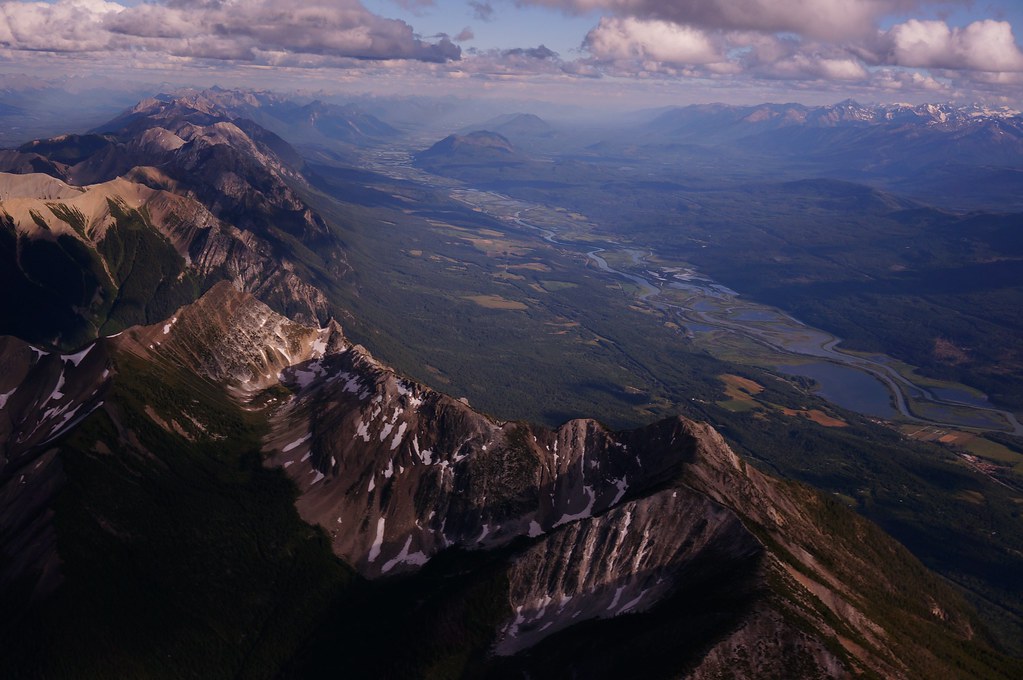
In my novel A Diary in the Age of Water (Inanna Publications) the diarist writes about the huge reservoir complex that was built in the late 2020s in the Rocky Mountain Trench to create an 800 km long reservoir system to rehydrate the United States. Of course, it’s science fiction, but it was based on real plans (NAWAPA) that went all the way to congress in the 1960s. That reservoir might have drowned the rainforest conservation corridor of Robson Valley—a conservation area that continues to experience existential risk due to development, resource harvest, and other disturbance.

Cedar-boardwalk-Anne

Friend Anne walks the boardwalk of the ancient forest park

In Robson Valley—tucked between the Rocky and Cariboo Mountains of East-Central British Columbia, the Fraser River nourishes an ancient rainforest matched nowhere on Earth. Massive Western Redcedar (Thuja plicata)—some over 1200 years-old, 3.5 meters in diameter, and 45 meters high—thrive in this valley, nurtured by abundant groundwater flow and high humidity for healthy tree growth and reduced fire risk. “Unfortunately, this requirement for growth in wet toe-slope positions has had negative consequences for ancient cedar stands. Historically, roads and railroads were placed at the base of mountain slopes, where easy access on level roadside terrain meant that ancient cedar stands were often among the first sites chosen for logging. Ancient cedar stands now represent less than 5% of forested landscapes within the Upper Fraser River watershed.” (UNBC Plant Ecology)

GiantCedars boardwalk2

Moss-covered giant Redcedar in foreground to boardwalk

This valley contains the most extensive inland rainforest in the northern hemisphere and is the only valley in the Rocky Mountains where grizzly bears still feed on wild ocean-going salmon.

Old Cedar-RobsonPark2019

Western Redcedar with wide buttresses

The Save-The-Cedar League also tells us that the Robson Rainforest is oroboreal: mountain-caused with boreal biome characteristics—unlike typical rainforests which are temperate-coastal or tropical. “Antique Forest” is a term used for ancient cedar-hemlock stands that have endured for more than 1000 years. One stand in Primordial Grove can be seen via a well-constructed boardwalk in a small park off Highway 16.

When I entered the ancient forest of magnificent giants with wide buttressed bases, a deep reverence came over me. No other word comes close to describing what I experienced or felt. I was enthralled and humbled by these magnificent trees, silent giants that rose into the mist like sentinels, piercing the heavens. It had rained that morning and the forest dripped with living moisture. Greens of all shades created a living mosaic of hue and texture. Moss covered everything. Lichen dripped off branches and clothed trees in crenulated patterns. The fragrance was intoxicating, a fresh pungency that woke something inside me. The smell has been variously described as “lingering”, “fresh”, “sweet”, “like pineapple when crushed”, or “almost like fresh water.” Even the breeze took on a different voice inside this living cathedral. A kind of deep hush that whispered of sacred grandness.

Cedar-up

Western Redcedar

I knew I was in a sacred place.

This ancient forest had been here at least a millennium; long before the arrival of Christopher Columbus to the Atlantic shores of North America. Long before us. Referred to as “the cornerstone of northwest coastal Indian culture,” the Western Redcedar is known as the “tree of life” and “life giver.” Groves of ancient cedars were symbols of power, and gathering places for ceremonies, retreat, and contemplation.

I kept to the boardwalk—to help prevent unwanted trampling and soil compression. The boardwalk snaked past giant buttressed trees that towered several stories high and formed a feathered canopy way above me. Whenever the boardwalk came close to a giant cedar, I had to stop and touch it. The reddish bark was smooth. I smiled; many others had done the same. In unavoidable reverence.

Breathing in the tree’s exquisite fragrance, I scanned my surroundings. A rich understory of red-berried Devil’s Club (Oplopanax horridus), huckleberry, fern, moss, liverworts and dense ground cover painted the forest floor in varying form and colour. I imagined the diversity of invertebrates, amphibians, reptiles, birds and mammals that flourished here. I’m told that scientists are still finding new species in this rainforest. UBC scientists tell us that arboreal lichen communities of the inland rainforest, especially the epiphytic cyanolichen assemblages on conifers, are among the richest in the world.

Nina-giant cedar03

Nina Munteanu leans against a well-loved giant Western Redcedar


Gentle Giant of North Temporate Rainforest: Western Redcedar (Thuja plicata)

tall cedar-moss

Western Redcedar

The Western Redcedar (Thuja plicata) is one of the most magnificent conifers in Pacific Northwest forests (both coastal and inland); it flourishes along the coastal fog belt from Alaska to northern California, and inland from the Pacific Ocean to Montana. The Western Redcedar is actually an arborvitae—not a true cedar; acknowledged by its name “redcedar”. True cedars only grow in the Mediterranean regions of the world. “Thuja,” is the latinism for the ancient Greek word for a now unknown, long-lost aromatic evergreen wood; “plicata,” means “folded into plaits,” which may refer to the tree’s characteristic foliage or its furrowed, stringy bark. The heartwood is pink- to red-brown to deep warm brown and highly resistant to moisture, decay and insect infestation due to the oils and acids (polyoxylphenols) it produces; it’s the phenols, in fact, that give the cedar its distinctive and pleasant aroma.

Given their extensive root system, cedars can remain standing long after they die. Western Redcedar snags (standing dead trees) can remain intact for up to 125 years. The large snags provide habitat for many cavity-nesting birds and mammals. Many species that require snags for habitats also prey on insects that use trees in a fine balance of a functional ecosystem. Examples include the pileated woodpecker, squirrels, weasels, martens, bats, owls and ducks. A fallen cedar can remain on the forest floor for over a century. “This durability is the result of a natural preservative that is toxic to decay-causing fungi. This ability does not decrease with age; in fact, it increases,” writes Jeri Chase, Oregon forester.

DevilsClub Hemlock-CedarGrove

Devil’s Club

Several of these live ancient cedar trees grow out of the trunks of other live ancient cedars, following a 180 million-year-old pattern observed in the closely-related redwoods (Sequoia). Basal shoots of the trunk yield genetically-superior mature trees when compared to seeds, root sprouts, other shoots or other layering phenomena.

Western Redcedar reproduces from root or branch development on fallen trees—the classic “nurse logs” often seen in northwest forests that also nourish other forest species. The magnificent bark of the Redcedar ranges in color from grey to reddish brown, and is deeply furrowed, forming long flat fibrous plates that peel and shed easily. Wildlife use the cedar in many ways. The foliage is an important winter food for elk and is browsed year-long by deer and rodents. Black bears den in the hollowed-out trunks of old trees and the cedar-dominated old growth forests provide valuable habitat for spotted owls and Vaux swifts.

Functional Ecosystem & Symbiosis

red-backed_vole

Red-backed vole

The Robson Valley cedar-hemlock rainforest supports a diverse and efficient ecosystem from apex and keystone predator—the grizzly—to black bear, gray wolf, cougar, lynx, wolverine, coyote, and seven ungulate species (including the Mountain caribou); all feeding on a diversity of prey and primary producers. The Mountain caribou feeds on mountain boxwood shrubs which are sheltered by the cedar and hemlock canopy layer.

An example of the symbiotic nature of the old growth cedar-hemlock forest is the red-backed vole, which resembles a large plump mouse. This forest mammal eats truffles—a type of fungus that lives underground. After digesting the truffles, voles spread the fungus around the litter layer of the forest through their droppings. The truffles help tree roots absorb soil minerals and the trees produce sugars necessary for the truffles: a win-win symbiotic relationship. The cedar and the hemlock require this alliance with truffles and voles to grow so large in the nutrient-poor soil.

The Inland Sea of the Rocky Mountain Trench (NAWAPA)

Diary Water cover finalUna stopped the car and we stared out across the longest reservoir in North America. What had once been a breathtaking view of the valley floor of the Rocky Mountain Trench was now a spectacular inland sea. It ran north-south over eight hundred kilometres and stretched several kilometres across to the foothills of the Cariboo Mountain Range. Una pointed to Mount Mica, Mount Pierre Elliot Trudeau and several other snow-covered peaks. They stood above the inland sea like sentinels of another time. Una then pointed down to what used to be Jackman Flats—mostly inundated along with McLellan River and the town of Valemont to the south. Hugging the shore of what was left of Jackman Flats was a tiny village. “That’s the new Tête Jaune Cache,” my mother told me.

If villages had karma this one was fated to drown over and over until it got it right.  Once a bustling trading town on the Grand Trunk Pacific railway, Tête Jaune Cache drowned in the early 1900s when the Fraser naturally flooded. The village relocated to the junction of the original Yellowhead 16 and 5 Highways. Villagers settled close to where the Fraser, Tête Creek, and the McLellan River joined, all fed by the meltwater from the glaciers and icefields of the Premiere Range of the Cariboo Mountains. The village drowned again in 2025. I imagined the pool halls, restaurants, saloons and trading posts crushed by the flood.

“This area used to be a prime Chinook spawning ground,” Una said. “They swam over 1,200 km from the Pacific Ocean to lay their eggs right there.” She pointed to the cobalt blue water below us.

The reservoir sparkled in the sun like an ocean. Steep shores rose into majestic snow-capped mountains. The village lay in a kind of cruel paradise, I thought. It was surrounded by a multi-hued forest of Lodgepole pine, Western red cedar, Douglas fir, paper birch and trembling Aspen. Directly behind the village was Mount Terry Fox and across the Robson valley mouth, to the northeast, rose Mount Goslin. Behind it, Mount Robson cut a jagged pyramid against a stunning blue sky. Wispy clouds veiled its crown. I couldn’t help thinking it was the most beautiful place I’d seen. And yet, for all its beauty, the villagers had lost their principle livelihood and food. The reservoir had destroyed the wildlife habitats and the fishery. And its people with it.

Una pointed to where the giant reservoir snaked northwest and where towns like Dunster, McBride and Prince George lay submerged beneath a silent wall of water. Her eyes suddenly misted as she told me about Slim Creek Provincial Park, between what used to be Slim and Driscoll Creeks just northwest of what used to be the community of Urling. She told me about the Oroboreal rainforest, called an “Antique Rainforest”—ancient cedar-hemlock stands over a 1000 years old. She described how massive trunks the width of a small house once rose straight up toward a kinder sun. The Primordial Grove was once home to bears, the gray wolf, cougar, lynx, wolverine and ungulates. It was the last valley in North America where the grizzly bear once fished ocean-going salmon. Now even the salmon were no longer there, she said. Then she bent low beside me and pulled me close to her in a hug. She quietly said to me, “This is what killed Trudeau.”

I stared at her and firmly corrected, “but that was an accident.”

“Yes,” she agreed. Then added, “a planned one.”

A Diary in the Age of Water

tall cedar-moss2 copy

Moss-covered Western Redcedar


NAWAPA (North America Water Power Alliance)

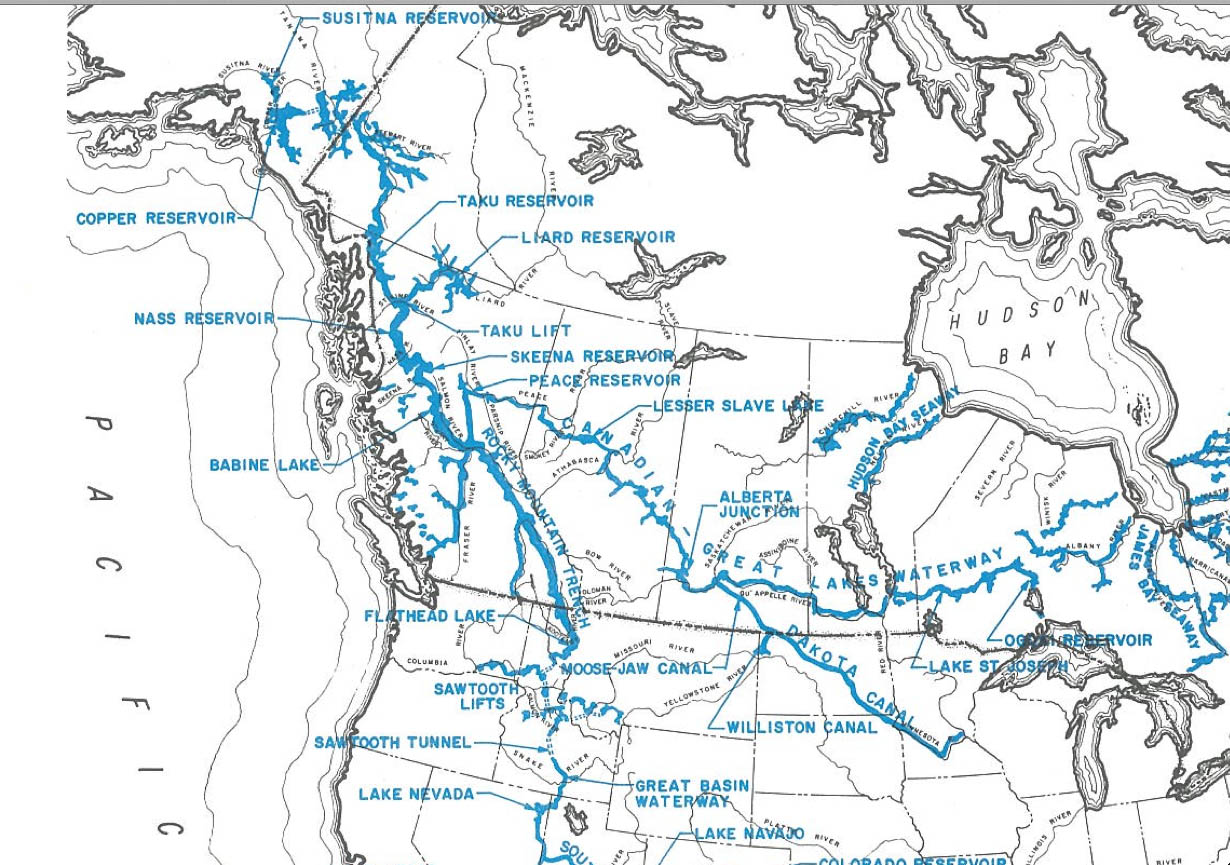
The original NAWAPA Plan was drawn up by the Pasadena-based firm of Ralph M. Parsons Co. in 1964, and had a favorable review by Congress for completion in the 1990s. The plan—thankfully never completed—was drafted by the US Army Corps of Engineers and entailed the southward diversion of a portion (if not all) of the Mackenzie and Yukon rivers in northern Canada and Alaska, now flowing into the Arctic Ocean as well as the Peace, Liard and other rivers flowing into the Pacific by creating massive dams in the north. This would cause the rivers to flow backwards into the mountains to form vast reservoirs that would flood one-tenth of British Columbia. The water would be channeled south through the 800-km Rocky Mountain Trench Reservoir into the Northern USA, and from there along various routes into the dry regions of the South, to California and reaching as far as Mexico.

NAWAPA copy

Expanded NAWAPA XXI plan to hydrate the USA with Canadian water

NAWAPA was envisioned as the largest construction effort of all times, comprising some 369 separate projects of dams, canals, and tunnels, for water diversion. The water diversion would be accomplished through a series of connecting tunnels, canals, lakes, dams, and pump-lifts, as the trench itself is located at an elevation of 914 m (3,000 feet). To the east, a 9 m (thirty-foot) deep canal would be cut from the Peace River to Lake Superior. Its largest proposed dam would be 518 m (1,700 feet) tall, more than twice the height of Hoover Dam (at 221 m) and taller than any dam in the world today, including the Jinping-I Dam in China (at 305 m).

Conspiracy theorist and convicted fraudster Lyndon LaRouche was a principle proponent of the environmentally destructive NAWAPA plan. Although the plan was scrapped in the 1970s due to environmental concerns, it resurfaced in 1982 particularly by Parsons engineer Roland Kelley, who wrote a report called NAWAPA Plan Can Work. LaRouche and his movement revived interest more recently. In 2012 the LaRouche Political Action Committee released their NAWAPA XXI special report, which contained a detailed plan for the revival of an updated and expanded version of NAWAPA. The LaRouche movement continues to promote this outlandish plan today with support from various American politicians and industrialists.

In his book Cadillac Desert, environmental writer Marc Reisner described the plan as one of “brutal magnificence” and “unprecedented destructiveness.” Historian Ted Steinberg suggested that NAWAPA summed up “the sheer arrogance and imperial ambitions of the modern hydraulic West.”

Forest-Cedar giant-marg drybr-LHP

Old growth Redcedar-Douglas fir forest near Vancouver, BC (photo and illustration by Nina Munteanu)

nina-2014aaa

Nina Munteanu is a Canadian ecologist / limnologist and novelist. She is co-editor of Europa SF and currently teaches writing courses at George Brown College and the University of Toronto. Visit www.ninamunteanu.ca for the latest on her books. Nina’s bilingual “La natura dell’acqua / The Way of Water” was published by Mincione Edizioni in Rome. Her non-fiction book “Water Is…” by Pixl Press (Vancouver) was selected by Margaret Atwood in the New York Times ‘Year in Reading’ and was chosen as the 2017 Summer Read by Water Canada. Her novel “A Diary in the Age of Water” will be released by Inanna Publications (Toronto) in 2020.