Can Dystopian Eco-Fiction Save the Planet?

NewYork 2140By failing to engage with climate change, artists and writers are contributing to an impoverished sense of the world, right at the moment when art and literature are most needed to galvanize a grassroots movement in favor of climate justice and carbon mitigation.”—Amitav Ghosh, 2017

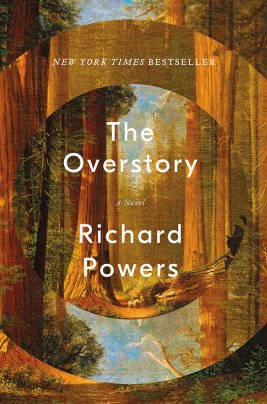
…Margaret Atwood’s The Year of the Flood. Paolo Bacigalupi’s The Windup Girl or The Water Knife. Kim Stanley Robinson’s New York 2140. Nina Munteanu’s A Diary in the Age of Water. Richard Power’s Overstory. Annie Proulx’s Barkskins. Emmi Itäranta’s The Memory of Water

Diary Water cover finalWhat these novels have in common is that they are all Dystopian Eco-Fiction. Humanity’s key role in environmental destruction serves a strong thematic element. In eco-fiction dystopias (as opposed to political or socio-cultural dystopias such as Brave New World, 1984, The Handmaid’s Tale) the environment—whether forest, ocean, water generally, or the animal world—plays a key character.

Our Literature in the Anthropocene

In 2017, Amitav Ghosh observed that the literary world has responded to climate change with almost complete silence (The Great Derangement: Climate Change and the Unthinkable). “How can we explain the fact that writers of fiction have overwhelmingly failed to grapple with the ongoing planetary crisis in their works?” writes Fredrick Albritton Jonsson of The Guardian, who observes that, “for Ghosh, this silence is part of a broader pattern of indifference and misrepresentation. Contemporary arts and literature are characterized by ‘modes of concealment that [prevent] people from recognizing the realities of their plight.’”

Windup GirlAccording to Ghosh, plots and characters of contemporary literature tend to reflect the regularity of middle-class life and the worldview of the Victorian natural sciences, one that depends on a principle of uniformity. Change in Nature has been perceived as gradual (or static by some) and never catastrophic. Extraordinary or bizarre happenings were left to marginal genres like the Gothic tale and—of course—science fiction. The strange and unlikely have been externalized: hence the failure of modern novels and art to recognize anthropogenic climate change.

From Adam Smith’s 18th Century economic vision to the conceit of bankers who drove the 2008 American housing bubble, humanity’s men have consistently espoused the myth of a constant natural world capable of absorbing infinite abuse without oscillation. When James Lovelock and Lynn Margulis proposed the Gaia Hypothesis in the 1970s, many saw its basis in a homeostatic balance of the natural order as confirmation of Nature’s infinite resilience to abuse. They failed to recognize that we are Nature and abuse of Nature is really self-abuse.

Jonsson suggests that these Enlightenment ideas are essentially ideological manifestations of Holocene stability, remnants from 11,000 years of small variability in temperature and carbon dioxide levels, giving rise to deep-seated habits and ideas about the resilience of the natural world. “The commitment to indefinite economic growth espoused by the economics profession in the postwar era is perhaps its most triumphant [and dangerous] expression.”

barkskins

Louise Fabiani of Pacific Standard suggests that novels are still the best way for us to clarify planetary issues and prepare for change—even play a meaningful part in that change. In her article “The Literature of Climate Change” she points to science fiction as helping “us prepare for radical change, just when things may be getting too comfortable.”

Referring to our overwhelming reliance on technology and outsourced knowledge, Fabiani suggests that “our privileged lives (particularly in consumer-based North America) are built on unconscious trust in the mostly invisible others who make this illusion of domestic independence possible—the faith that they will never stop being there for us. And we have no back-ups in place should they let us down.” Which they certainly will—given their short-term thinking.

TheOverstory“To counteract this epidemic of short-term thinking,” says Fabiani, “it might be a good idea for more of us to read science fiction, specifically the post-apocalyptic sub-genre: that is, fiction dealing with the aftermath of major societal collapse, whether due to a pandemic, nuclear fallout, or climate change.”

I suggest widening the genre to include good dystopian eco-fiction, which includes not just post-apocalyptic tales but also cautionary tales, worlds in upheaval, and satires. Dystopian literature is ultimately an exploration of hope through personal experience. The eco-fiction protagonist navigates their dystopia by learning meaningful lessons—lessons that pertain directly to our reader in their current world. This is because the premise of a dystopia lies squarely in the present world. Good dystopias can enlighten and suggest possibilities; they can warn and herald. At the very least, they incite the necessary conversation.

On the Role of Dystopian Eco-Fiction

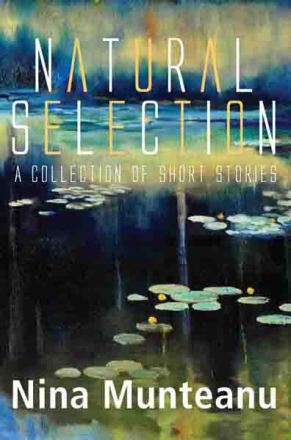
NaturalSelection-front-webI recently shared a panel discussion with writer Kristen Kiomall-Evans at the 2019 Limestone Genre Expo in Kingston entitled: “On the Role of (Dystopian) Literature and Environmental Issues: Can Books Save the Planet.” The audience of mostly women shared enlightened input in an open discussion, which spanned a range of topics and directions from what dystopian literature actually is to whether we are turned off by its negativity—that it may be too close to reality and makes us cringe and want to hide. One person even brought up Game of Thrones as an example; which I then bluntly suggested was not real “story”—it is a stream of episodic sensationalism and horror—aimed at thrilling shock value, not fulfilling meaning.

The group explored what Eco-Fiction is and the possibility of how eco-fiction writers can influence their audience to engage in helping the planet and humanity, in turn.

 “Science doesn’t tell us what we should do,” Barbara Kingsolver wrote in Flight Behavior “It only tells us what is.” Stories can never be a solution in themselves, but they have the capacity to inspire action. Margaret Atwood wrote in MaddAddam, “People need such stories, because however dark, a darkness with voices in it is better than a silent void.”

We explored several areas in which writers could elucidate ways to engage readers for edification, connection and participation. We discussed optimism, new perspectives, envisioning our future, and imaginative use of “product placement” to gain reader engagement and galvanize a movement of action.

Optimism in Story

I pointed out that good dystopias—like all good fiction—follow a character and story arc that must ultimately resolve (which Game of Thrones may never do, certainly not well—J.R.R. Martin’s books series upon which it is based are not even finished yet!). Eco-Fiction Dystopias often conclude with a strong element of hope, based on some positive aspect of humanity and the human spirit—which may include our own evolution. Think Day After Tomorrow, Year of the Flood, Windup Girl, The Postman, Darwin’s Paradox.

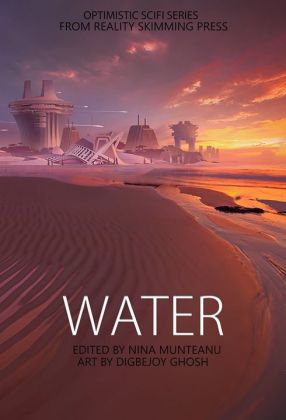
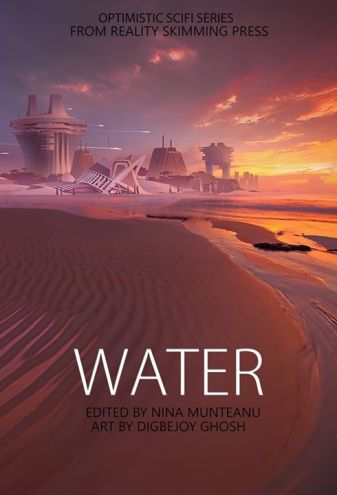
WaterAnthology-RealitySkimmingPress copyIn 2015, I joined Lynda Williams of Reality Skimming Press in creating an optimistic science fiction anthology with the theme of water. My foreword to Water addressed this point:

As we drank Schofferhoffers over salmon burgers, Lynda lamented that while the speculative / science fiction genre has gained a literary presence, this has been at some expense. Much of the current zeitgeist of this genre in Canada tends toward depressing, “self-interested cynicism and extended analogies to drug addiction as a means of coping with reality,” Lynda remarked. Where was the optimism and associated hope for a future? I brought up the “hero’s journey” and its role in meaningful story. One of the reasons this ancient plot approach, based on the hero journey myth, is so popular is that its proper use ensures meaning in story. This is not to say that tragedy is not a powerful and useful story trope; so long as hope for someone—even if just the reader—is generated. Lynda and I concluded that the science fiction genre could use more optimism. [As a result,] these stories explore individual choices and the triumph of human imagination in the presence of adversity. [Each story explores] the surging spirit of humanity toward hopeful shores.

New Perspectives in Story

Evans spoke of the emergence of and need for a strong voice by marginalized groups who would be most affected by things like habitat destruction and climate change. The poor and marginalized will most certainly make up the majority of climate change refugees, starved out and water shorted, and suffering malnutrition, violence and disease.

FifthSeason-JemisinEvans pointed out that afro-American writers (e.g., Octavia Butler, Walter Mosley, Nalo Hopkinson and N.K. Jemisin) and indigenous writers (Cherie Dimaline, Daniel Wilson, Drew Hayden Taylor) are an exciting voice, providing a new and compelling perspective on ongoing global issues.

I would add that the “feminine” voice—the voice of women and the voice of ecology and those who embrace the gylanic voice—are needed. This was strangely not mentioned in the group—perhaps because we were all women—but one. Such a voice can help personalize the experience to readers, by creating discovery, connection and understanding—and ultimately serving a key force in engaging readers to act.

Envisioning Our Future Through Story

One audience member shared a yearning for an optimistic focus through an envisioned world where solutions have successfully created that world. She wasn’t so much suggesting writing a utopia, but including elements of future wishes as an integral part of the world, following Ghandi’s wise advice: be the change you seek. In a recent interview in which I also participated in The Globe and Mail on women science fiction writers, Ottawa writer Marie Bilodeau addressed this concept:

“the best part about writing science fiction is showing different ways of being without having your characters struggle to gain rights. Invented worlds can host a social landscape where debated rights in this world – such as gay marriage, abortion and euthanasia – are just a fact of life.”

People are looking for hopeful fiction that addresses the issues but explores a successful paradigm shift. One that accurately addresses our current issues with intelligence and hope. The power of envisioning a certain future is that the vision enables one to see it as possible.

Product Placement in Story

Editor and naturalist Merridy Cox suggested that writers could make motivating connections through altruistic (not market-driven) “product placement.” She gave the example of an Ash tree. The Ash (Fraxinus species) could subtly make its name, its character and ecology known in the story, along with its plight—its destruction by the non-native invasive emerald ash borer. The use of metaphor and personification would easily link the Ash to a character and at the same time illuminate the reader on a real aspect of the environment to consider. Another example she gave was of the threatened bobolink bird, now all but gone. The bobolink originally made its home in the tallgrass prairie and other open meadows. As native prairies were cleared for farming, the bobolink was displaced and moved to living in hayfields and fallow fields—building their nests on the ground in dense grasses. Changing farm practices (shorter crop rotation and earlier maturing seed mixtures) are now destroying the bobolink’s last refuge.

bobolink-chicks-mom

Bobolink mother and her chicks

Such “product placement” essentially gives Nature and the environmental a personalized face that can easily interact with the story’s theme and its characters. “Product placement”—like symbol—lies embedded in its own story. In the case of the bobolink, it is a story of colonialism, exploitation, and single-minded pursuit at the expense of others not considered, known or understood. These examples have anthropogenic connections to human behaviour, action and knowledge—all related to story and theme.

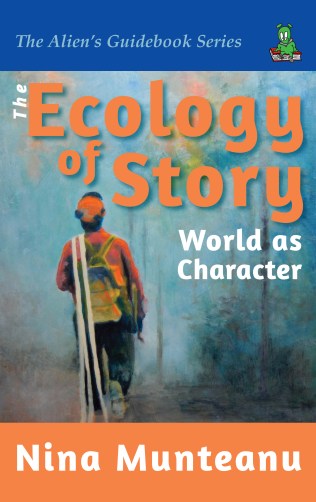
MockUpEcology copyIn my new writing guidebook The Ecology of Story: World as Character I discuss and explore how some authors do this impeccably. Authors such as Barbara Kingsolver, Richard Powers, Frank Herbert, Ray Bradbury, Thomas Hardy, Margaret Atwood, Alice Munro, Janet Fitch, John Steinbeck, David Mitchell, Joanne Harris and many others.

Writing for the Anthropocene

Learn how to write for the Anthropocene: from Habitats and Trophic Levels to Metaphor and Archetype…

Learn the fundamentals of ecology, insights of world-building, and how to master layering-in of metaphoric connections and symbols between setting and character. “Ecology of Story: World as Character” is the 3rd guidebook in Nina Munteanu’s acclaimed “how to write” series for novice to professional writers.

The Ecology of Story will be released by Pixl Press in June 2019.

nina-2014aaa

Nina Munteanu is a Canadian ecologist / limnologist and novelist. She is co-editor of Europa SF and currently teaches writing courses at George Brown College and the University of Toronto. Visit www.ninamunteanu.ca for the latest on her books. Nina’s bilingual “La natura dell’acqua / The Way of Water” was published by Mincione Edizioni in Rome. Her non-fiction book “Water Is…” by Pixl Press (Vancouver) was selected by Margaret Atwood in the New York Times ‘Year in Reading’ and was chosen as the 2017 Summer Read by Water Canada. Her novel “A Diary in the Age of Water” will be released by Inanna Publications (Toronto) in May 2020.

Vonnegut’s Ice-Nine and Superionic Ice

CatsCradle-KurtVonnegutIn 1963 science fiction writer Kurt Vonnegut used the fictionalized concept of ice-IX—a crystalline polymorph of ice that remains stable at room temperature—in his novel Cat’s Cradle.  Ice-nine was a form of water so stable that it never melted and would crystallize all water it touched. It was the Ebola of water…

In Vonnegut’s book, physicist Felix Hoenikker created ice-nine as a tool to help troops easily traverse mud and swamps. Unfortunately, once the process started, it could not be stopped and with a melting point of 114 degrees F, the ice wasn’t likely to melt; in a pivotal scene some of the ice-nine is introduced to the ocean, which freezes solid entirely along with the rest of the planet’s freshwater. This throws the planet into calamity and threatens the natural world with violent storms and tornadoes ravaging the landscape.

With all water on Earth crystalized, locked in the Ice-Nine configuration, humanity is lost:

There were no smells. There was no movement. Every step I took made a gravelly squeak in blue-white frost. And every squeak was echoed loudly. The season of locking was over. The Earth was locked up tight.

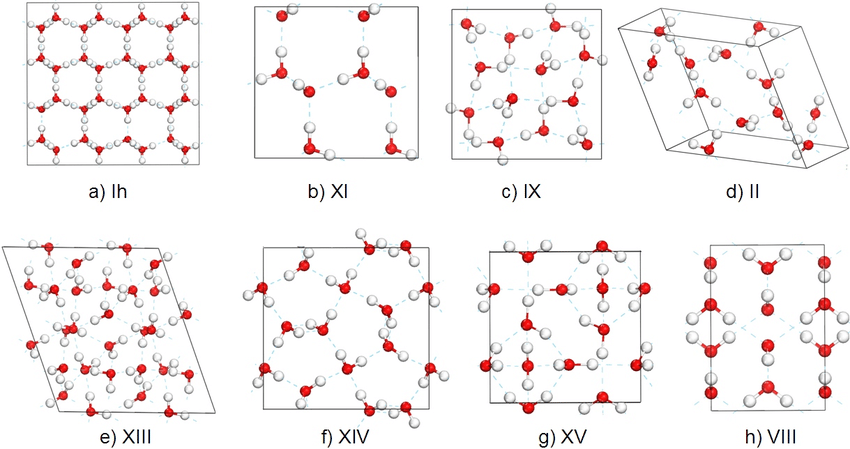
In fact, Ice-IX does exist; it was discovered in 1968 and exits under high pressure as a tetragonal crystal lattice but without the properties of Vonnegut’s ice-nine. It forms by cooling Ice III; it has an identical structure to Ice III other than being hydrogen-ordered. According to Dr. Martin Chaplin, London South Bank University, Vonnegut’s ice-nine has no scientific basis: “The actual Ice-IX is a proton-ordered form of Ice-III, and only exists at very low temperatures and high pressures and cannot exist alongside liquid water under any conditions.”

Ice Phases - unit cells

Ice phases–unit ‘cells’

A form of Vonnegut’s Ice-IX was “created” by Harvard researchers recently through a computer simulation that shows how it might be possible for water to remain frozen at body temperature. They showed how a layer of diamond, coated with sodium atoms, kept water frozen indefinitely at up to 108 degrees Fahrenheit. The technique only works on a very thin layer of water—a few molecules thick—to successfully keep the ice structure intact. The researchers explain:

In ice, water molecules are arranged in a rigid framework that gives the substance its hardness. The process of melting is like a building falling down: pieces that had been arranged into a rigid structure move and flow against one another, becoming liquid water.

The computer model shows that whenever a water molecule near the diamond-sodium surface starts to fall out of place, the surface stabilizes it and reassembles the crystalline ice structure.

hexagonal-water-crystal

Hexagonal structure of water crystal (snowflake)

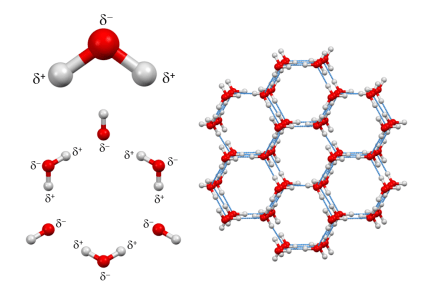
Ordinary ice—the kind we skate on—has a hexagonal structure and is called Ice-Ih. It’s the kind of crystal that forms snowflakes (which are all hexagonal). Including the hexagonal arrangement of common ice, scientists have already discovered a bewildering 18 architectures of ice crystal. At different temperatures and pressures, water forms solids that may be hexagonal (Ice Ih) rhombohedral (Ice II and Ice IV), tetragonal (Ice III and IX), cubic (Ice Ic and Ice XIc), or orthorhomboic (Ice XI) in structure. Some forms of frozen water are disordered (non-crystalline). Eighteen crystalline phases of ice polymorphs have been identified based on the structure of the molecules and atoms and their bonds.

Ice Phases

Ice phases Ih to XV at different temperatures and pressures

Liquid Crystals & Polywater

Around the time that Vonnegut’s novel came out, a similar potential phenomenon of contact-induced change to water structure was discovered: polywater.

In 1961, the Russian physicist Nikolai Fedyakin discovered a new polymerized form of water. He had been measuring the properties of water which had been condensed in, or repeatedly forced through, narrow quartz capillary tubes. Some experiments revealed water with a higher boiling point, lower freezing point, and much higher viscosity than ordinary water; it had the consistency of syrup and was 40% denser and 15 times more viscous. Boris Derjaquin, director of surface physics at the Institute for Physical Chemistry in Moscow reproduced the results and used the term anomalous water.

WaterAnthology-RealitySkimmingPress copyThe media spread a panic about polywater-contaminated oceans of “jelly” aka Vonnegut’s novel Cat’s Cradle.

You can read a compelling version of this scenario in Costi Gurgu’s “Corrosion” in the anthology Water (Reality Skimming Press, 2017) edited by Nina Munteanu.

Subsequent analysis of polywater found that the samples were contaminated with other substances, which explained the changes in melting and boiling points due to colligative properties. Electron microscopy confirmed that the polywater also contained small particles of various solids – from silica to phospholipids, which explained its greater viscosity.

When the experiments which had initially produced polywater were repeated with thoroughly cleaned glassware, the anomalous properties of the resulting water vanished, and even the scientists who had originally advanced the case for polywater agreed it did not exist. The anomalous properties were finally attributed to impurities rather than to the existence of polymeric water molecules.

Fourth Phase of Water

ice_ih_molecular_arrangement

Hexagonal structure of bulk water and ice Ih

The significance of the Russian results was abandoned in the hubbub of scientific embarrassment. “Contaminants” are natural features of water, given its impeccable universal solvent characteristics, and their presence in limited quantities does not necessarily imply that observed features are not relevant to water’s behaviour. The natural question abandoned by the community was this: In the presence of contaminants, why does water take on the interesting features described by Derjaguin’s team? Earlier work by Henniker and Szent-Györgyi had established that water organized itself close to surfaces such as cell membranes.

This was later demonstrated by Gerald Pollack and his team at the University of Washington. Forty years after the polywater debacle, Pollack and other scientists discussed a fourth phase of water, an interfacial water zone that Pollack calls Exclusion Zone water or EZ water, given that it excludes materials. Interfacial EZ water was more stable, more viscous and more ordered, and according to biochemist Martin Chaplin of South Bank University this water was, “hydrophobic, stiffer, superfluidic and thermally more stable than bulk water.” While Chaplin discounts Pollack’s suggested structure for EZ-water (as nonsense), he acknowledges the existence of EZ-water, which forms a liquid ‘phase’ that can be legitimately treated as different from ‘bulk’ liquid water.

Not the same as “polywater” but certainly related. And questions remain.

superionic ice

Superionic ice

Superionic Ice

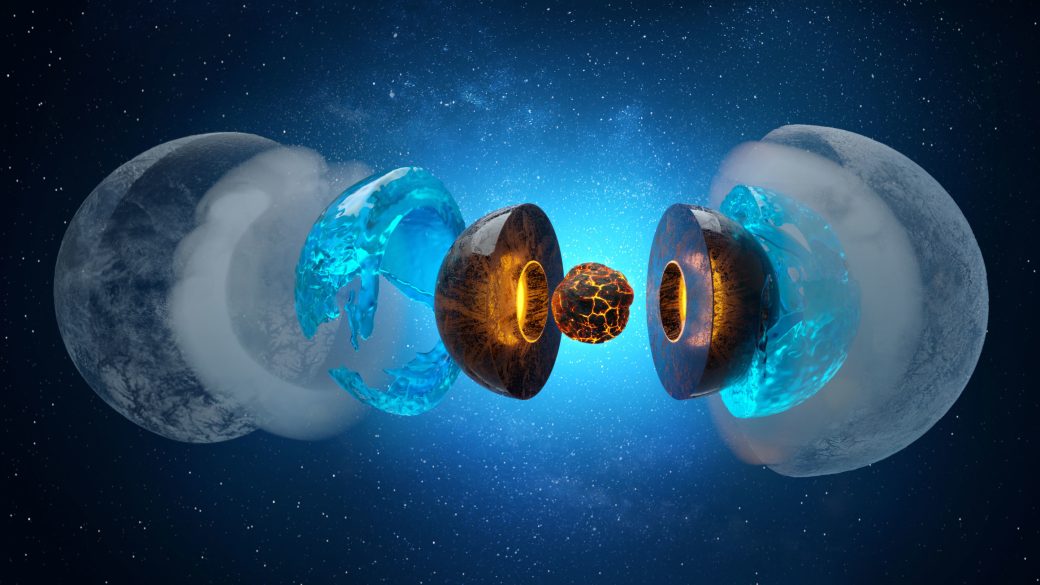
Recently, the Laboratory for Laser Energetics in Brighton, New York, blasted a droplet of water that created a shock wave, raising the water’s pressure to millions of atmospheres and temperature to thousands of degrees. The water atoms inside the shock wave didn’t form superheated liquid or gas; they froze solid into crystalline ice—something called “superionic ice,” a new phase of water with weird properties. It’s black and hot. And weighs four times as much as normal ice.

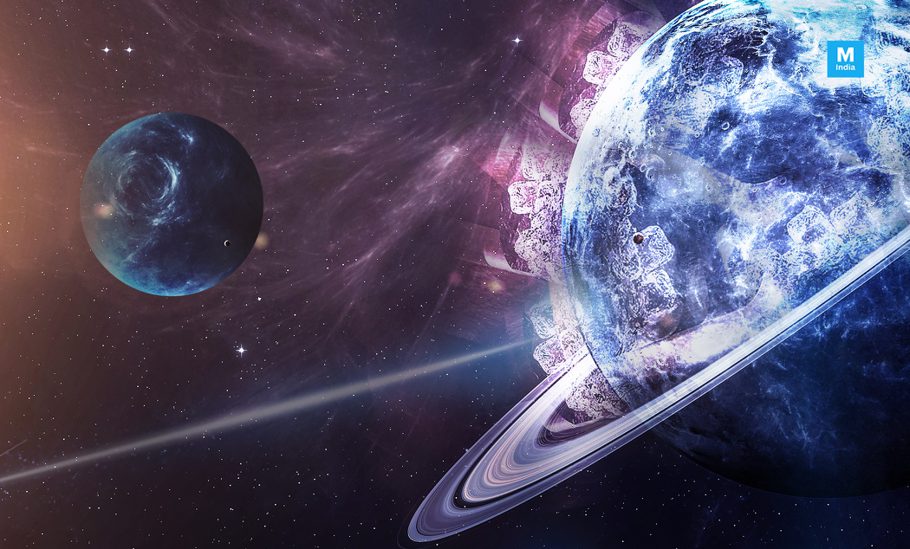
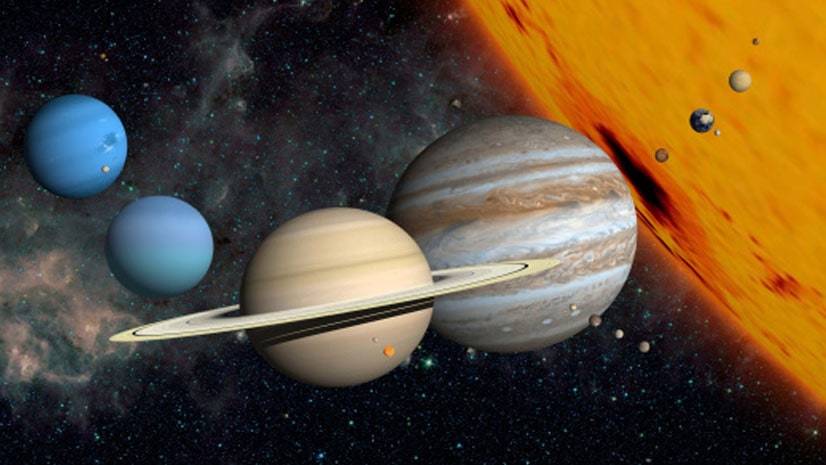
According to Joshua Sokol of Quanta Magazine, scientists suggest that this black hot ice may be the universe’s most common form of water. Superionic ice fills Uranus and Neptune and comprises the bulk of giant icy planets throughout the universe.

gas giants2

Gas giants in our solar system

Superionic ice—called  ice XVIII—is a new cubic crystal but with a twist, writes Sokol:

Superionic Ice3

Superionic ice nearly as hot as the sun

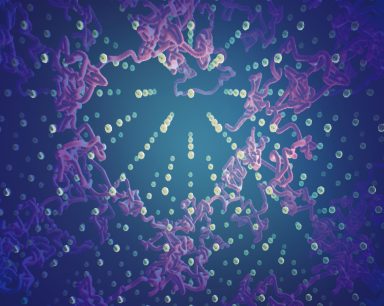
All the previously known water ices are made of intact water molecules, each with one oxygen atom linked to two hydrogen atoms. But superionic ice, the new measurements confirm, isn’t like that. It exists in a sort of surrealist limbo, part solid, part liquid. Individual water molecules break apart. The oxygen atoms form a cubic lattice, but the hydrogen atoms spill free, flowing like a liquid through the rigid cage of oxygens.

Sokol adds, “Experts say the discovery of superionic ice vindicates computer predictions, which could help material physicists craft future substances.”

Because its water molecules break apart, said physicist Livia Bove of France’s National Center for Scientific Research and Pierre and Marie Curie University, it’s not quite a new phase of water. “It’s really a new state of matter,” she said, “which is rather spectacular.”

Sokol tells us that computer simulations led by Pierfranco Demontis in 1988 predicted “water would take on this strange, almost metal-like form if you pushed it beyond the map of known ice phases.” Atoms in the water had rearranged into the long-predicted but never-before-seen architecture, ice XVIII: a cubic lattice with oxygen atoms at every corner and the center of each face. “It’s quite a breakthrough,” Coppari said.

Superionic-Ice-Giant

Superionic ice giant

When Ice Flows

The simulations showed that under extreme pressure and heat water molecules break. With the oxygen atoms locked in a cubic lattice, “the hydrogens now start to jump from one position in the crystal to another, and jump again, and jump again,” Millot said. The jumps between lattice sites are so fast that the ionized hydrogen atoms act as positively charged protons and appear to move like a liquid.

This suggests that superionic ice might conduct electricity, like a metal, with the hydrogens acting as electrons. “Having these loose hydrogen atoms gushing around would also boost the ice’s disorder, or entropy. In turn, that increase in entropy would make this ice much more stable than other kinds of ice crystals, causing its melting point to soar upward,” writes Sokol, and continues:

Neptune

Neptune

Other planets and moons in the solar system likely don’t host the right interior sweet spots of temperature and pressure to allow for superionic ice. But many ice giant-sized exoplanets might, suggesting that the substance could be common inside icy worlds throughout the galaxy.

No real planet contains just water. The ice giants in our solar system also mix in chemical species like methane and ammonia. The extent to which superionic behavior actually occurs in nature is “going to depend on whether these phases still exist when we mix water with other materials,” Stanley said. So far, that isn’t clear, although other researchers have argued superionic ammonia should also exist.

References:

Chaplin, Martin. 2019. “Ice Phases” In: Water Structure and Science. Updated May 16, 2019. Online: http://www1.lsbu.ac.uk/water/ice_phases.html

Munteanu, Nina. 2016. “Water Is…The Meaning of Water.” Pixl Press, Vancouver. 583pp.

Sokol, Joshua. 2019. “Black, Hot Ice May Be Nature’s Most Common Form of Water.” Quanta Magazine. Online: https://www.quantamagazine.org/black-hot-superionic-ice-may-be-natures-most-common-form-of-water-20190508/

nina-2014aaa

Nina Munteanu is a Canadian ecologist / limnologist and novelist. She is co-editor of Europa SF and currently teaches writing courses at George Brown College and the University of Toronto. Visit www.ninamunteanu.ca for the latest on her books. Nina’s bilingual “La natura dell’acqua / The Way of Water” was published by Mincione Edizioni in Rome. Her non-fiction book “Water Is…” by Pixl Press (Vancouver) was selected by Margaret Atwood in the New York Times ‘Year in Reading’ and was chosen as the 2017 Summer Read by Water Canada. Her novel “A Diary in the Age of Water” will be released by Inanna Publications (Toronto) in 2020.

Morphology 2019–Celebrating A New Marsh in Mississauga with Quotes from “Water Is…”

Water Is Life copy

March 22 was World Water Day. As with last year at this same time and place, a brisk wind followed me into the industrial brick building that used to be the Small Arms Inspection Building—now converted into a community arts and culture centre.

JimTovey-Dowd-Morphology-JStewart

Councillor Jim Tovey and Lieutenant Governor Elizabeth Dowdeswell (photo by John Stewart)

Lakeview Plan copy

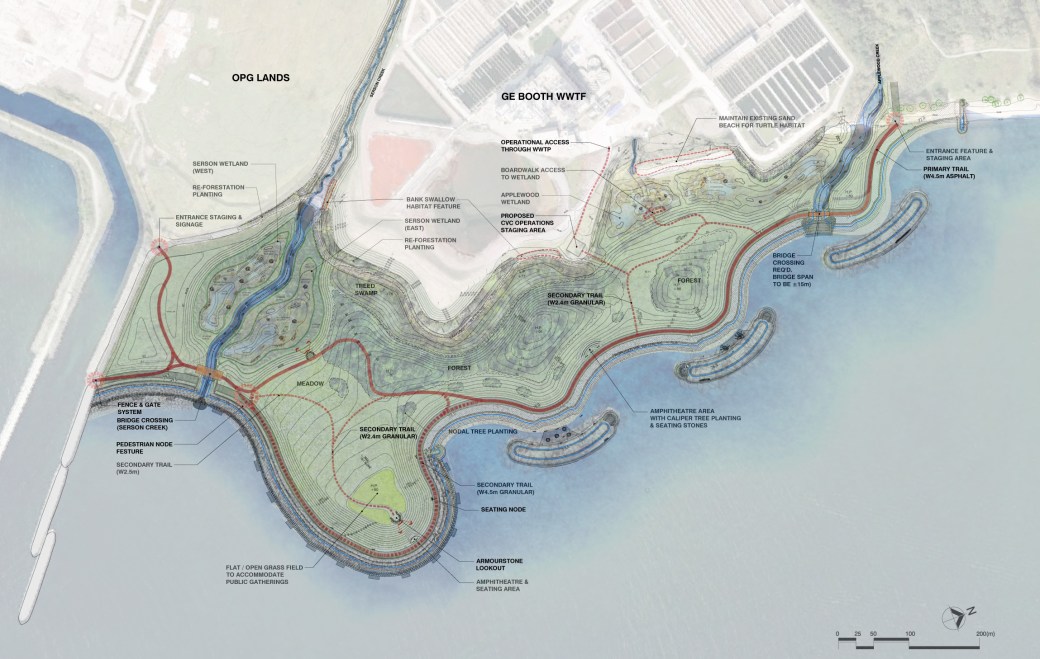
Plan of the conservation site

I was here to celebrate the late Jim Tovey’s dream of creating a 26-hectare park and marsh on Mississauga’s Lake Ontario shore that will connect the Waterfront Trail with Lake Ontario’s shorefront for the public.

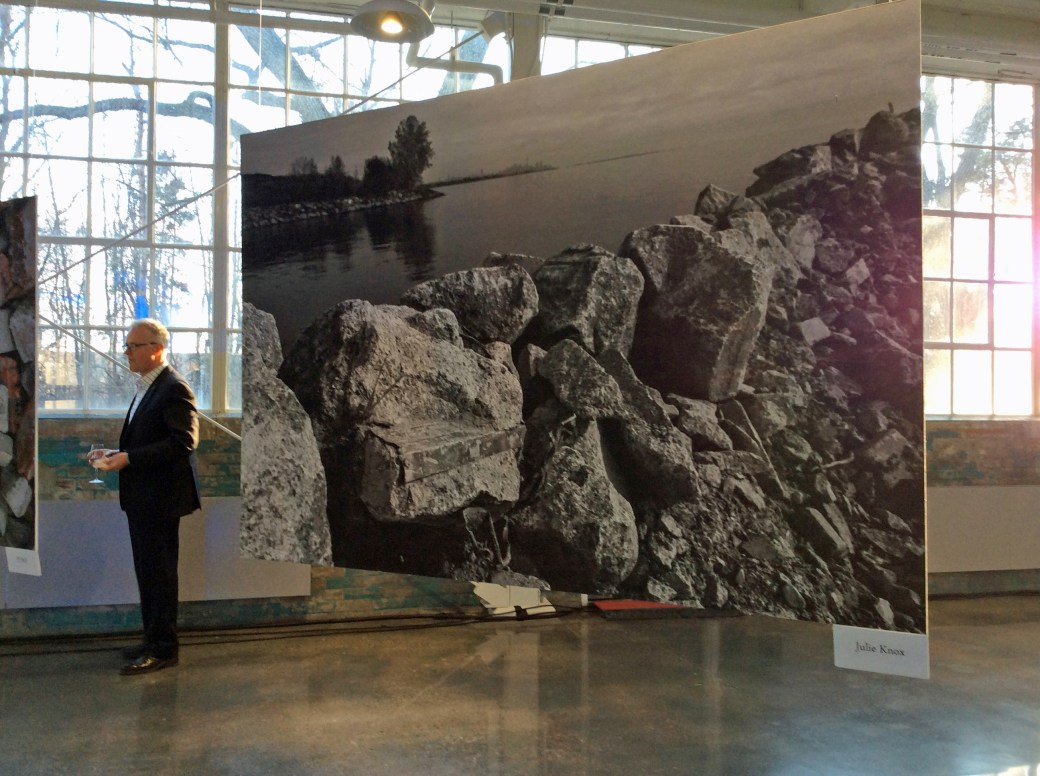
Several dozen photographs that documented the annual and seasonal changes of the developing marsh occupied the spacious hall. The glow of evening sunlight streamed through, touching large photographs that hung from the high ceilings or were mounted on walls. Some photographs spanned over 2 by 3 metres.

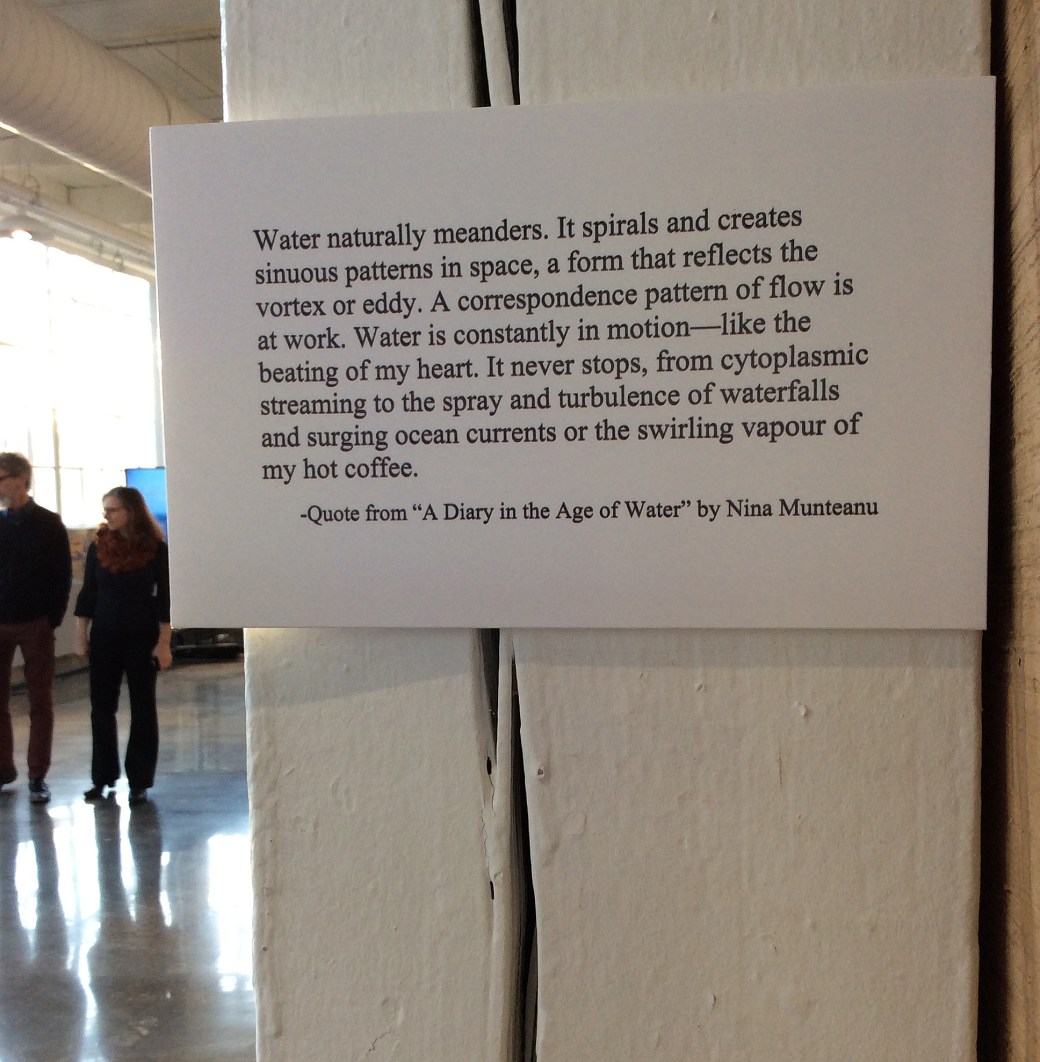
Quotes from my books “Water Is…” (Pixl Press, 2016) and upcoming “A Diary in the Age of Water” (Inanna Publications, 2020) were displayed among the photographs.

Photo Julie Knox

Photograph by Julie Knox

I was mesmerized by the spectacular photographic display.

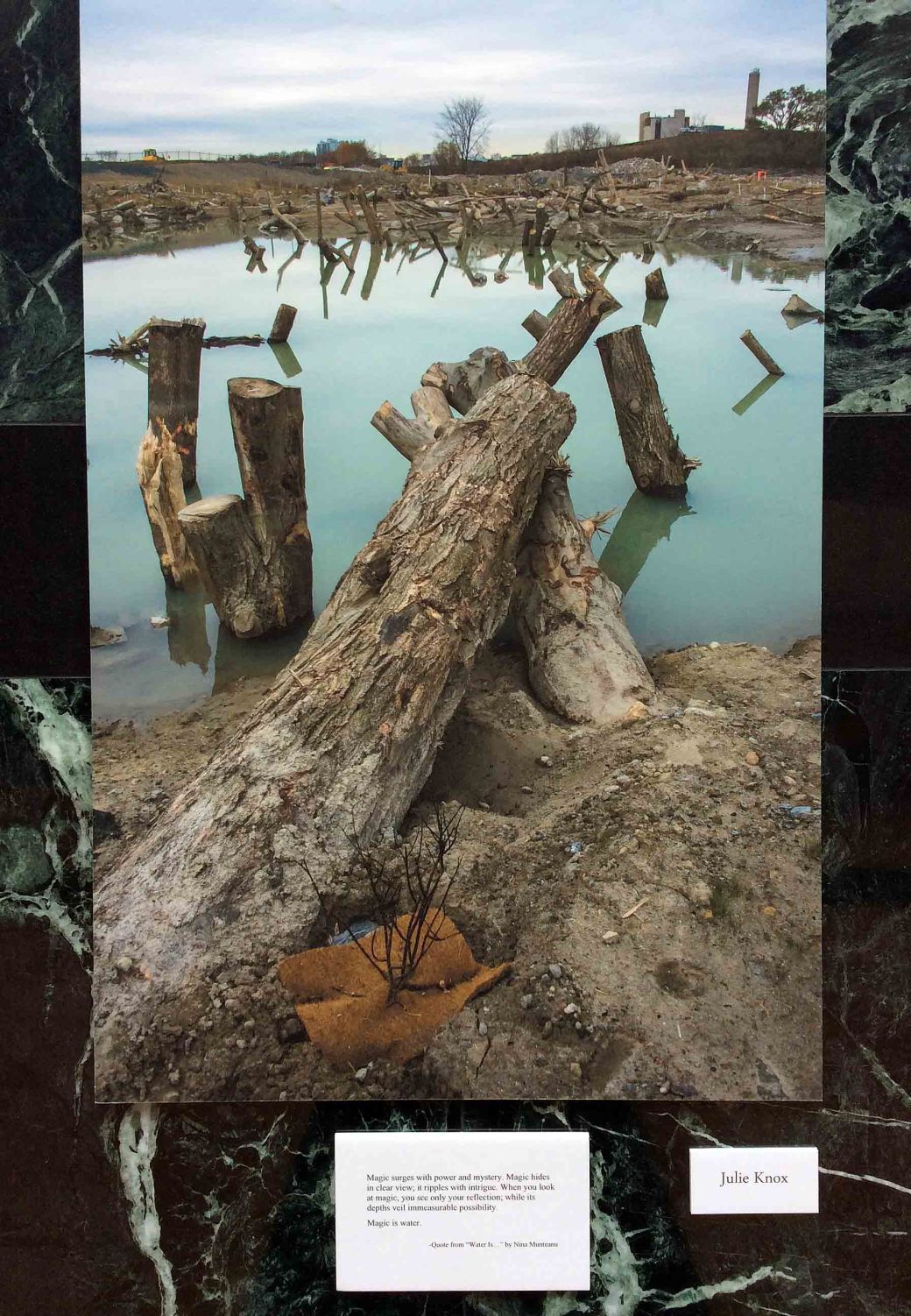
Larger than life photographs caught my attention through light, form and unique perspective. Once caught, I was drawn into their complex narrative. A narrative of morphing shapeshifters, flowing humours and tricksters in the night. Panoramas that stretched over giant muddy holes depicting an evolution of landscape from wet

Photo Gabriella Bank2 copy

Photo by Gabriella Bank

to dry to wet again.

Tree bole, rock and rebar formed bizarre companions in murky pools that harbour life finding itself. Piles of giant boulders shouted their presence to a stormy lake. A frontend loader sat peacefully beneath a glowing sunset. Slopes of wild herbs reached into ponds as if looking for hidden treasure.  Mangled rebar contorted in a frozen ice-dance. A man’s boot tracks cut recursive patterns in the silky mud.

The photographs provided a range of perspectives over the seasons on the early phase of the marsh construction that featured aquatic habitat structures built four metres below the level of Lake Ontario. Councillor Tovey had earlier said of the construction project: “It sort of looks like a Salvador Dali surrealistic sculpture garden…and what an interesting way to really celebrate all of this.”

WaterMeanders2

The Morphology 2019 Photography Exhibit marks the third year of celebrating this morphing natural landscape through the photography of eleven creative photo artists. The opening day of Morphology 2019 was celebrated with a blessing by Cathie Jamieson, Councillor Mississaugas of the Credit First Nation. Lee Tovey spoke as did members of the contributing partners and Mayor Bonnie Crombie of the City of Mississauga.

Water Is Wisdom copy

Construction of the site and marsh began in November 2016 and is ongoing and expected to continue until 2024-2026, when the site will be opened to the public. Starting in 2017, the eleven photographers toured the site to capture the seasonal and annual changes of the developing wetland. I was also invited to tour the site to glimpse a moonscape of dirt and clean rubble as dozers pushed material out to form cells and reclaim marsh habitat from open lake.

Nina-Lee-marsh2Z

the author and Lee Tovey overlooking one of the marsh cells

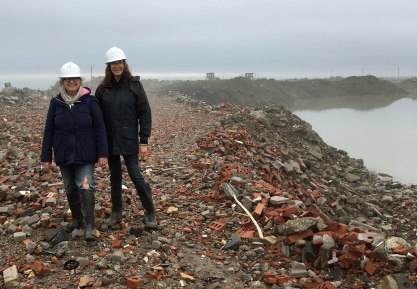
In November of 2017, I walked the undulating “moonscape” with Lee Tovey and Zoe Danahy. Rolling berms snaked around pooled and dry depressions that disappeared in the fog. The smell of rain and mud pervaded as we set out in ankle-deep mud toward the snaking berms. I scrambled over rip rap chunks larger than me to glimpse Lake Ontario—its new shoreline re-imagined. Beyond, the lake vanished in a veil of fog. I was told that on a clear day you could see the Toronto Waterfront and the CN Tower. All I could make out was a few ghost trees that marked the nearby eastern shoreline.

Lee took me along a dyke embankment of clean fill made of red brick and cement riprap from various construction sites. “Clean fill” refers to anything like brick, top soil, gravel, and cement that has been tested for possible contaminants, as opposed to plastic, glass, or metals.

Nina-Lee-marsh bermZ

The author with Lee Tovey on riprap berm

Lee pointed left and right of us to depressions (containment cells) where Lake Ontario was being reclaimed for marsh-building. The depression on my left was still full of water; but the one on my right was fairly dry and already populated with anchored logs and shrub plantings to consolidate the wetland and provide refuge for marsh life. I could hear the large pump actively removing lake water at the south end of the evolving wetland. Beyond the high berm of human-sized riprap was the lake, its shoreline now redefined.

Water-travel

As I gazed over the brown monochromatic landscape, I imagined a tapestry of greens in Councillor Jim Tovey’s vision: 26 hectares of future wetlands, forest and meadow and beach spanning the Lake Ontario shoreline from the old Lakeview generating station to the Toronto line at Marie Curtis Park. Part of the Inspiration Lakeview development, the marsh and wetland park have now been named The Jim Tovey Lakeview Conservation Area.

WaterIs magic-photo

Morphology

Morphology was conceived by the late visionary councillor Jim Tovey who envisioned an evolving photography and writing exhibit to follow the progress of the marsh creation project of what is now The Jim Tovey Lakeview Conservation Area. Spearheaded and nurtured by Councillor Tovey, the marsh construction was part of 26 hectares of future wetlands, forest, meadow and beach. The Lakeview Waterfront Connection will span the Lake Ontario shoreline from the old Lakeview generating station to the Toronto line at Marie Curtis Park. Part of the Inspiration Lakeview development, it will restore pedestrian and cyclist access to a previously forbidden section of the waterfront to “connect 9.5 kilometers of shoreline for water’s edge experience for the public,” said Councillor Tovey.

P01

To celebrate the residential / park development, eleven professional photographers were invited to photograph the marsh construction during its early phases. These images, along with water-inspired narrative provided by limnologist-author Nina Munteanu, were first displayed in an exhibit during a gala event January 14 2018, hosted at the Lakeview water treatment plant. Following Councillor Tovey’s untimely passing, his wife Lee Tovey and others (e.g., TRCA, CVC, Region of Peel) are continuing the project. Morphology was displayed for the public on World Water Day, March of 2018, at the Great Hall in the Mississauga Civic Centre. Its third appearance was at the In Situ Multi Arts Festival in November 2018.

Morphology-Exhibit hall

Morphology Exhibit at the Great Hall, Mississauga Civic Centre

The artist showcase is expected to become an annual event, highlighting the progress of constructed ecosystem. Morphology features works from: Gabriella Bank, Sandor Bank, PJ Bell, Darren Clarke, Julie Knox, Nina Munteanu, Lachlan McVie, Marcelo Leonardo Pazán, Martin Pinker, Annette Seip, Stephen Uhraney and Bob Warren.
https://www.dropbox.com/s/orsich16lbqgamf/MORPHOLOGY_2019.mp4?dl=0

Nina at Morphology

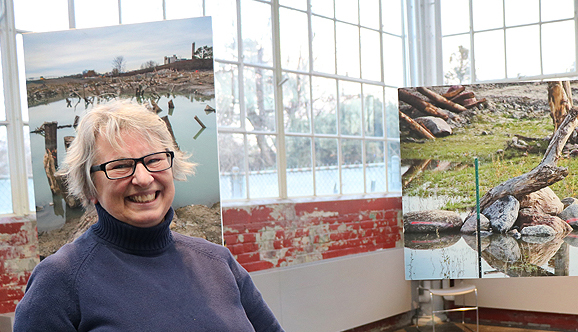
Nina joyfully standing in front of a Sandor Bank photo of the marsh (photo by Gabriella Bank)

nina-2014aaaNina Munteanu is an ecologist and internationally published author of award-nominated speculative novels, short stories and non-fiction. She is co-editor of Europa SF and currently teaches writing courses at George Brown College and the University of Toronto. Visit www.ninamunteanu.ca for the latest on her books. Nina’s recent book is the bilingual “La natura dell’acqua / The Way of Water” (Mincione Edizioni, Rome). Her latest “Water Is…” is currently an Amazon Bestseller and NY Times ‘year in reading’ choice of Margaret Atwood.
 

Eco-Artist Roundtable with Frank Horvat on Green Majority Radio

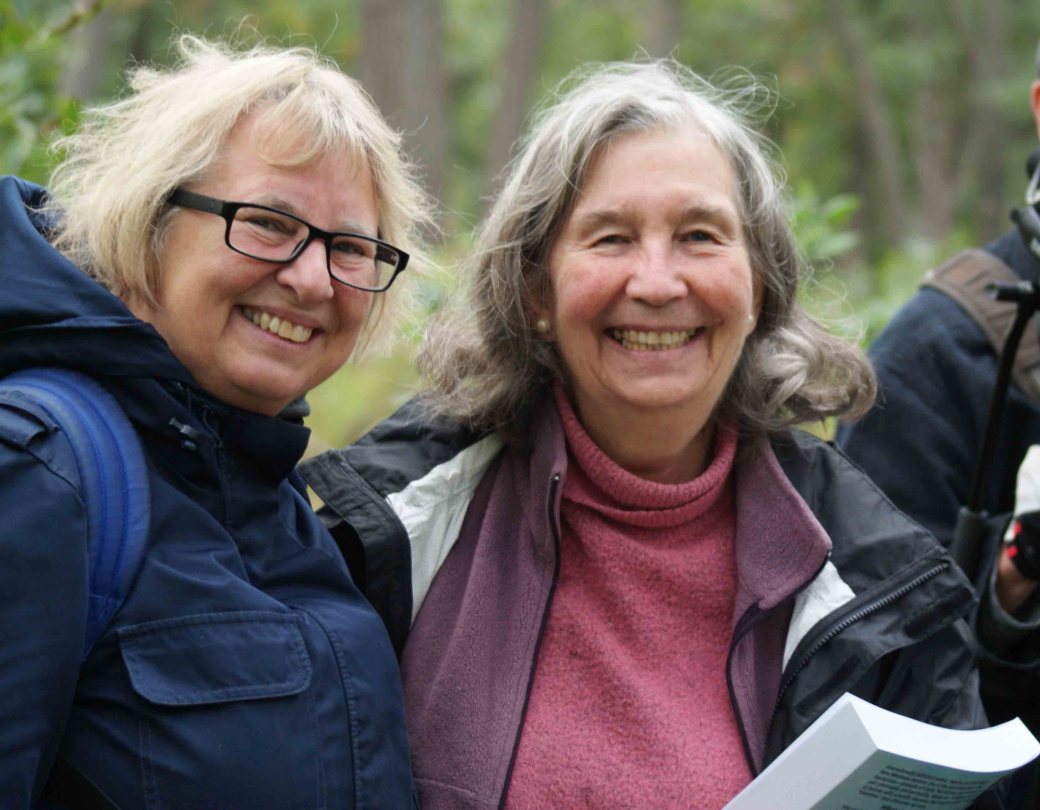
On December 8th on Green Majority Radio, artist and composer Frank Horvat hosted the second Eco-Artist Roundtable featuring visual artist Mark Adair, theatre artist Kevin Matthew Wong, and author Nina Munteanu.

In this hour-long thoughtful and insightful discussion, artists covered a range of topics pertinent to the environment from the role of the artist in raising eco-awareness to activism in art and human rights. Nina also read from her book “Water Is…”

Go have a listen.

CIUT-eco-art panel show

Kevin, Nina, Mark and Frank at the studio

nina-2014aaaNina Munteanu is an ecologist and internationally published author of award-nominated speculative novels, short stories and non-fiction. She is co-editor of Europa SF and currently teaches writing courses at George Brown College and the University of Toronto. Visit www.ninamunteanu.ca for the latest on her books. Nina’s recent book is the bilingual “La natura dell’acqua / The Way of Water” (Mincione Edizioni, Rome). Her latest “Water Is…” is currently an Amazon Bestseller and NY Times ‘year in reading’ choice of Margaret Atwood.

“Water Is… at Banyen Books & Sound, Vancouver

BanyenBooks copy

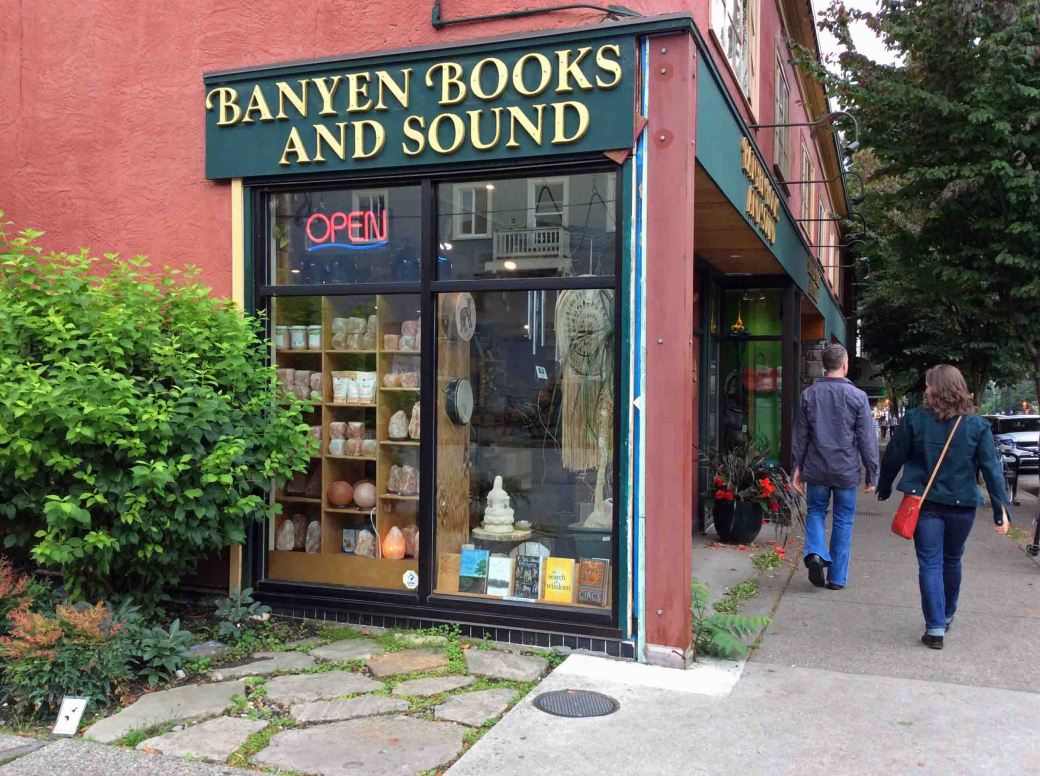
Banyen Books and Sound, Vancouver, BC (photo by Nina Munteanu)

When I lived in Vancouver—raising my family, consulting for the environment and teaching limnology—I often visited my favourite bookstore in town: Banyen Books & Sound on 4th Avenue in Kitsilano. It was a bookstore like no other, I thought. Spacious with comfortable chairs to read, the bookstore became a destination and an experience in discovery for me.

BanyenBooks-Anne-WaterIs2 copy

A customer browses “Water Is…” in Banyen Books

In fact, since opening in 1970 Banyen Books has become Canada’s most comprehensive metaphysical bookstore, offering a broad spectrum of resources from humanity’s spiritual, healing, and earth wisdom traditions. Here is how they put it:

Banyen is an oasis, a crossroads, a meeting place… for East and West, the “old ways” and current discoveries and syntheses. Our beat is the “Perennial Philosophy” as well as our evolving learning edges and best practices in a wide variety of fields, from acupuncture to Zen, from childbirth and business to the Hermetic Mysteries, from the compost pile to the celestial spheres. We’re “in the philosophy business,” on “a street in the philosophy district” (as an old cartoon wagged). We welcome and celebrate the love of wisdom, be it in art, science, lifecraft, healing, visioning, religion, psychology, eco-design, gardening… Our service is to offer life-giving nourishment for the body (resilient, vital), the mind (trained, open), and the soul (resonant, connected, in-formed). Think of us as your open source bookstore for the “University of Life”.

I had long harboured romantic notions of one day seeing my own book on one of their shelves. I must have sent a compelling message to the universe, because in Autumn of 2018, this incredible bookstore agreed to carry “Water Is…

Water Is...” now sits joyfully beside William Mark’s “Holy Order of Water” and Masaru Emoto’s books on water and crystals and Wallace J. Nichol’s bestseller “Blue Mind” on water’s healing powers.

WaterIs-BanyenBookshelf copy

When I mentioned about my book being at Banyens Books, my son Kevin visited the bookstore and soon found “Water Is…” among a variety of other “savoury books”; he admitted a need for strength not to walk out of the bookstore with an armload of books. This has been my experience too.

WaterIs-Banyen-Kevin reading copy

Kevin finds “Water Is…” on Banyen’s shelf and makes himself comfortable…

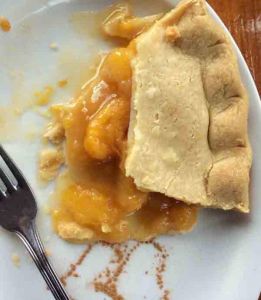
Anne, one of the directors of Pixl Press, visited the bookstore with her friend Jackie from out of town. After browsing the bookstore, they walked across the street to Aphrodites Pies and enjoyed their signature organic peach pie.

Aphrodites Pies

Aphrodites Pies on 4th Avenue (photo by Nina Munteanu)

Banyen Books & Sound:
PeachPie at Aphrodites3608 West 4th Avenue
Vancouver, BC
604-732-7912

HOURS:
Mon-Fri: 10am-9pm
Sat: 10am-8pm
Sun: 11am-7pm


nina-munteanuNina Munteanu is an ecologist, limnologist and internationally published author of award-nominated speculative novels, short stories and non-fiction. She is co-editor of Europa SF and currently teaches writing courses at George Brown College and the University of Toronto. Visit www.ninamunteanu.ca for the latest on her books.

The Ontario Climate Symposium: Adaptive Urban Habitats by Design

SONY DSC

Nina presents Diana Beresford-Kroeger with a copy of “Water Is…”

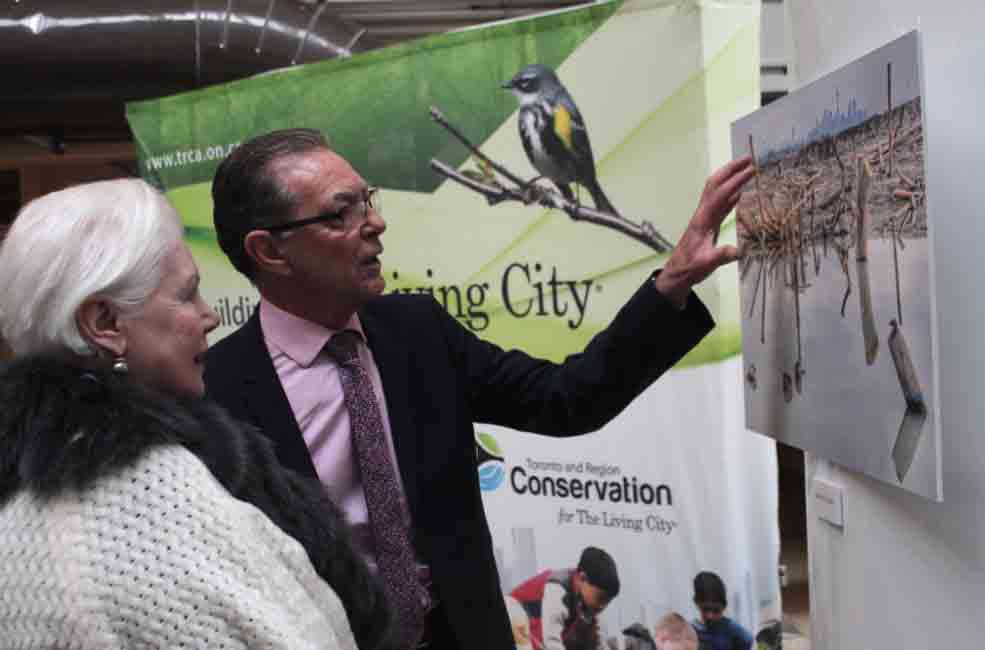
I recently participated in the 2018 Ontario Climate Symposium “Adaptive Urban Habitats by Design” at OCAD University in Toronto, hosted by the Ontario Climate Consortium and the Toronto and Region Conservation Authority.

Day 1 opened with a ceremony by Chief R. Stacey Laforme of the Mississauga of the New Credit First Nation, followed by keynote address by Dr. Faisal Moola, associate professor of the University of Guelph.

A three-track panel stream provided diverse and comprehensive programming that helped further the goal to foster important discussions for how art and design can play a role in developing adaptive, low carbon cities. Panels sparked much networking among a diverse group of participants, who clustered around the refreshments in the Great Hall, where my “Water Is…” exhibit was located.

OCS-venue

The Great Hall, where participants networked over refreshments

WaterIs...at OCS2

one participant clutches “Water Is…”

Water Is… was also there for sale, as part of my exhibit on water, along with Environment and Climate Change Canada, Green Roofs, Waste, and the Environmental Commissioner of Ontario. I had several lively and insightful conversations with participants and I’m glad to say that Water Is… made it into several people’s hands at the symposium. Water is, after all, a key component of climate and climate action.

The film “Call of the Forest: The Forgotten Wisdom of Trees” was screened and scientist Diana Beresford-Kroeger participated in a question and answer period then signed her latest book.

diana_and_the_tree_

Call of the Forest” was called “a folksy and educational documentary with a poetic sort of alarmism about disappearing forests,” by the Globe and Mail. The film “takes us on a journey to the ancient forests of the northern hemisphere, revealing the profound connection that exists between trees and human life and the vital ways that trees sustain all life on this planet.” The movie describes the numerous health-giving aerosols that trees use to communicate. Diana’s genuine and earnest concern illuminates her simple yet powerful narrative, such as when she says that the forests are “haunted by silence and a certain quality of mercy.” Featuring forests from Japan and Germany’s Black Forest to Canada’s boreal forest, this documentary is a powerful manifesto for sustainability.

DianaBeresfordKroeger

Diana lecturing in High Park

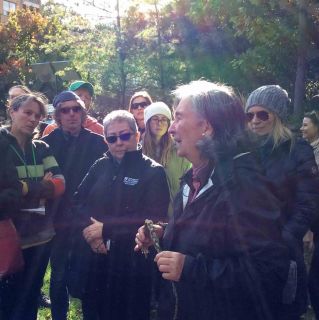
On Day 2, I toured the Black Oak savanna in High Park with Diana Beresford-Kroeger (author of The Global Forest). The tour was refreshing and enlightening. Diana is a genuine advocate for the forest and showed some of the medicinal properties of forest plants. An example is the common weed, Goldenrod; its astringent and antiseptic qualities tighten and tone the urinary system and bladder, making goldenrod useful for UTI infections; Its kidney tropho-restorative abilities both nourishe and restore balance to the kidneys.

Diana spoke from the heart and brought a wealth of scientific knowledge to us in ways easy to understand—like the biochemistry of photosynthesis or quantum coherence. Diana shared how over 200 tree aerosols help combat anything from asthma to cancer. I also talk about this in the “Water Is Life” chapter of my book, Water Is…, which I gave a copy to Diana.

lunenburg-shop01

Shops in Lunenburg, NS (photo by Nina Munteanu)


nina-munteanuNina Munteanu is an ecologist, limnologist and internationally published author of award-nominated speculative novels, short stories and non-fiction. She is co-editor of Europa SF and currently teaches writing courses at George Brown College and the University of Toronto. Visit www.ninamunteanu.ca for the latest on her books.

Ecology, Story & Stranger Things

MockUpEcology-2

Illustration by Anne Moody, typology & design by Costi Gurgu

One of the lectures I give in my science fiction writing course and conference workshops is called “Ecology in Storytelling”. It’s usually well attended by writers hoping to gain better insight into world-building and how to master the layering-in of metaphoric connections between setting and character. My upcoming writing guidebook “Ecology of Story: World as Character” addresses this subject with examples from a wide range of published fiction. The book will be released in June/July of 2019 by Pixl Press.

In my lecture (and book) I talk about the adaptations of organisms to their changing environments. I describe the trophic (energy) relationships from producers to consumers and destroyers in a complex cycle of creative destruction.

Students perk up when I bring up some of the more strange and interesting adaptations of organisms to their environment: twisted stories of adaptations and strategies that involve feeding, locomotion, reproduction and shelter.

Purposeful Miscommunication & Other Lies

alconbluebutterfly-ants

Alcon blue butterfly and caterpillar with ant

For instance, the Alcon blue butterfly hoodwinks ants into caring for its larvae. They do this by secreting a chemical that mimics how ants communicate; the ants in turn adopt the newly hatched caterpillars for two years. There’s a terrible side to this story of deception. The Ichneumon wasp, upon finding an Alcon caterpillar inside an ant colony, secretes a pheromone that drives the ants into confused chaos; allowing it to slip through the confusion and lay its eggs inside the poor caterpillar. When the caterpillar turns into a chrysalis, the wasp eggs hatch and consume it from inside.

This reads like something out of a noir thriller. Or better yet, a horror story. Nature is large, profligate, complex and paradoxical. She is by turns gentle and cruel. Creative and destructive. Competitive and cooperative. Idle and nurturing.

Extremophiles & Anhydrobiosis

water-bear03

Tardigrade on moss

When I bring in the subject of extremophiles, who thrive in places you and I would cringe to set foot in, students’ imaginations run wild with ideas.

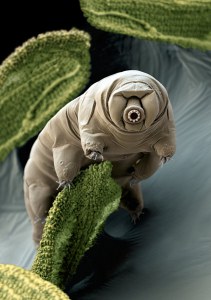
I describe a panoply of weird adaptations in Nature—involving poisons, mimicry and deception, phototaxis and something called anhydrobiosis, which permits the tiny tardigrade to shrivel into a tun in the absence of water then revive after a 100 years with just a drop of water.

All this adaptation hinges on communication. How an organism or population communicates with its environment and among its own.

Examples of “strange” communication are the purview of the science fiction writer … and already the nature of our current world—if you only know where to look. The scope of how Nature communicates—her devices and intentions—embraces the strange to the astonishing. From using infrasound to chemical receptors and sensing magnetic fields. To allelopathy. Aggressive symbiosis. And so much more.

Talking Trees

suzanne-simard-portrait

Dr. Suzanne Simard

UBC researcher Suzanne Simard, who has published hundreds of papers over 30 years of research, suggests a kind of “intelligence” when she describes the underground world “of infinite biological pathways that connect trees and allow them to communicate” In a forest.

This communication allows the forest to behave as if it was a single organism, says Simard. Her early in situ experiments showed solid evidence that tree species, such as Paper Birch and Douglas Fir communicated in a cooperative manner underground through an underground mutualistic-symbiosis involving mycorrhizae (e.g., fungus-root).

forest-conversing

mycelium connects trees underground

These trees were conversing in the language of carbon and nitrogen, phosphorus, water, defense signals, allelo-chemicals, and hormones via a network of mycelia. Fungal threads form a mycelium that infects and colonizes the roots of all the trees and plants. Simard compares this dense network to the Internet, which also has nodes and links—just as the forest.

Fungal highways link each tree and plant to its community, with busiest nodes called hub trees or mother trees. Calling them mother trees is appropriate, given that they nurture their young in the understory; sending excess carbon to the understory trees, which receive less light for photosynthesis. “In a single forest,” says Simard, “a mother tree can be connected to hundreds of other trees.” These mature trees act as nodal anchors—like major hub sites on the Internet—for tree groupings; according to Simard, they look after their families, nurture seedlings and even share wisdom—information—when they are injured or dying.

Fatal Attractions & Natural Bullies

bracken fern copy

Bracken fern fronds

The “ordinary” Bracken fern thrives in a wide range of conditions on virtually every continent (except Antarctica). That’s because it plays the “long game” by having several strategies to outlive and outcompete its surrounding nemeses.

ant on bracken copy

The symbiosis of Bracken fern and ant

Strategies include a loose lifestyle such as several ways to reproduce and grow to accommodate seasons, drought and burning; a shady arrangement with the local thugs (aggressive ants) who protect it for its tasty nectar; use of cyanide and ecdysones by its young shoots; and tough carcinogenic fronds that contain glass-like silicates.

Despite its many uses by humans (e.g., used for potash fertilizer, heating fuel, roofing, bedding for animals), the Bracken fern is considered a pest. In truth, it is a hardy versatile adapter to changing environments. And that is what our climate changing world is fast becoming.

I highly recommend the works of Annie Dillard and Loren Eiseley for wonderful and bizarre examples of natural wonders that resonate with metaphor.

Fallen log stream-2012

Stream in coastal rainforest on Vancouver Island, BC (photo by Kevin Klassen)

I also recommend my upcoming book “Ecology of Story” (Pixl Press), which will showcase a diverse set of examples from the literature of metaphoric environment and creatures. “Ecology of Story” is due for release in Summer of 2019. Look for it on Amazon, Kobo, and a fine bookstore near you. Two other books in my writing guide series include: “The Fiction Writer” and “The Journal Writer“.

Microsoft Word - Three Writing Guides.docx

nina-2014aaaNina Munteanu is an ecologist and internationally published author of award-nominated speculative novels, short stories and non-fiction. She is co-editor of Europa SF and currently teaches writing courses at George Brown College and the University of Toronto. Visit www.ninamunteanu.ca for the latest on her books. Nina’s recent book is the bilingual “La natura dell’acqua / The Way of Water” (Mincione Edizioni, Rome). Her latest “Water Is…” is currently an Amazon Bestseller and NY Times ‘year in reading’ choice of Margaret Atwood.
 

How Creative Destruction Embraces Paradox…

“Very well, then, I contradict myself; I am large—I contain multitudes.”—Walt Whitman

OuterDiverse-cover-webCreative destruction … sounds like a paradox, doesn’t it? Nature—and God— is full of contradiction and paradox. There is so much that we do not understand (at least on the surface)… and apparent contradiction proves that to me. In Outer Diverse, Book One of The Splintered Universe Trilogy, my character Serge says:

“… somewhere between the infinities of [worlds] you would experience paradox: black holes, quasars; intuition, déjà vu, clairvoyance… order in chaos…darkness at the heart of all beauty… beauty in the heart of all darkness…a mathematician with faith …the strength of surrender…loving your enemy…dying to live…”

Paradox lies undeniably at the heart of the clash of two realms.

I understand something of paradox. As an ecologist, I deal with it all the time.

Destruction in creation and creation in destruction is ingrained in the life-cycles of everything on this planet, indeed in this universe. A forest fire can destroy life but in so doing creates a more vibrant, healthier forest.

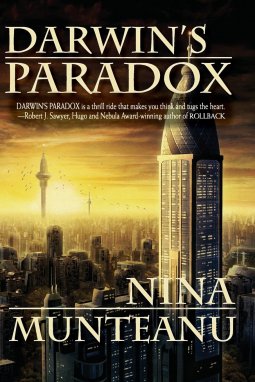
Darwins Paradox-2nd coverIn my speculative fiction novel, Darwin’s Paradox, Julie applies her father’s ecological precept to describe her observations on the rise and fall of a civilization, an ecosystem and an entire world. The precept was based on C.S. Holling’s 1987 ecological model of creative destruction:

Fire was a constant hazard in the heath. Yet, fire served the heath by discouraging invasive shrubs and halting succession. The grazing deer populations completed the job of keeping the heath from reverting to woodland. So, fire had its place as creative destroyer in the natural cycle of ecosystem behavior. Stable chaos, according to her father. It was a harsh and rude environment, Julie concluded. Like thieves in the night, bell heather, gorse and purple loosestrife snatched everything for themselves, leaving nothing for the others. Like many things in nature, the heath plants, though beautiful and fragrant, were ruthlessly greedy. . .

Creative destruction was first introduced as a term in 1942 by the economist, Joseph Schumpeter to describe the process of industrial transformation that accompanies radical innovation. According to Schumpeter’s view of capitalism, innovative entry by entrepreneurs sustained long-term economic growth, even as it destroyed the value of established companies that enjoyed some degree of monopoly power. An example is Xerox, who has seen its profits fall and its dominance vanish as rivals launched improved designs or cut manufacturing costs, drawing customers away.

The Science of Creative Destruction

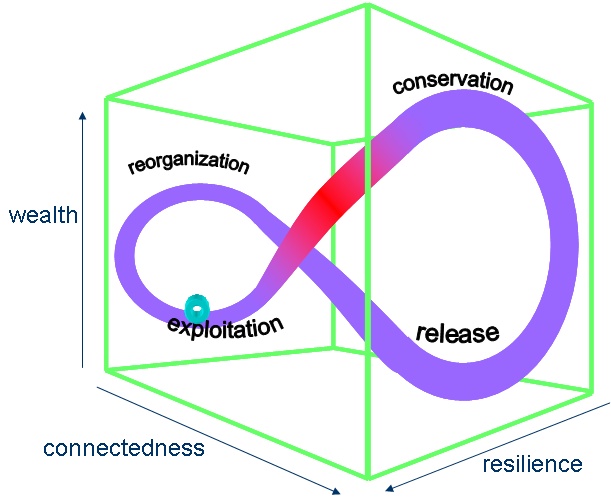
In his classic paper, entitled: “Simplifying the complex: the paradigms of ecological function and structure” (1987) C.S. Holling applied Schumpeter’s term to ecology. Holling’s model of ecosystem behaviour recognized ecosystems as non-linear, self-organizing and continually adapting through cycles of change from expansion and prosperity to creative destruction and reorganization.

creative-destruction-model

Holling presented several paradigms that ecologists use to describe the causes and behaviour (and management) of ecosystems, including an equilibrium-centred view (based on the constancy of behaviour over time), which Simon Forge described as “driving using the rear-view mirror”—trying to judge the road ahead by what went on behind. Holling advocated a “nature evolving” view, which describes ecosystems as undergoing sharp, discontinuous changes that are internally organized and balanced (I like his mobius loop to describe the closed ouroborus-like cycle of creation and destruction in nature). Holling described four phases of natural ecosystem succession within his “nature evolving” paradigm. It starts out with the exploitation phase, in which new opportunities are realized through rapid colonization and competition. Natural forces of conservation (e.g., nurturing, consolidation) lead to vulnerable systems (e.g., old growth forests), as stabilizing factors lose strength and the system evolves from having few interrelationships to having many. The result is often an abrupt change that both destroys systems and creates opportunity (creative destruction) through fire, storms, pests, senescence. Mobilization of bound, stored “capital” (e.g., carbon, nutrients and energy) through physicochemical and biological processes like decomposition and mineralization completes the dynamic cycle of functional ecosystems.

What this means for the ecosystem manager is that efforts to detect responses to changes, including human interventions like restoration activities, are confounded. Traditional (equilibrium-centred) ecosystem management may be misdirected, resulting in pathological “surprises” of ecosystem response and a spiralling vigilance and cost in control measures. Examples of traditional equilibrium-centred management of forests, fish and other organisms of terrestrial and aquatic environments with devastating consequences include:

  • firecycle copySuppression of spruce budworm populations in eastern Canada using insecticides partially protected the forest but left it vulnerable to an outbreak covering an area and of an intensity never experienced before;
  • Forest fire suppression reduced the probability of fire in the national parks of the United States but the consequence has been the accumulation of fuel to produce fires of an extent and cost never experienced before;
  • Semi-arid savanna ecosystems have been turned into productive cattle grazing systems in the Sahel zone of Africa, southern and east Africa, and other parts of the world. However, changes in grass composition have promoted an irreversible switch to woody vegetation and the systems have become highly susceptible to collapse, often triggered by drought; and,
  • Protection and enhancement of salmon spawning on the west coast of North America may have led to some success regarding enhanced stocks (e.g., hatchery-grown fish), but fishing industry is left precariously dependent on a few enhanced stocks which are vulnerable to collapse.

In each of these examples, the policy succeeded in its immediate objective. But in each case the system evolved into something with different properties and each “solution” led to a larger problem. In short, the biophysical environment had evolved into one that was more fragile, more dependent on vigilance and error-free management. Something Holling called “Nature Engineered.”

In his classic 1987 paper, Holling suggests that ecosystems be viewed—and managed—as “Resilient Nature”, where the experience of instability maintains the structure and general patterns of ecosystem behaviour; in other words, that Nature ‘learns’ and accommodates with time. In the final analysis, it is a matter of scale.

We are seeing that now as global warming takes force and we step solidly into the depths of the Anthropocene Age where green is the colour of resilience.

The Narrative of Creative Destruction

Water Is-COVER-webIn my book Water Is… I write: “Destruction in creation and creation in destruction are ingrained in the life cycles of everything on this planet and in the universe. A forest fire can destroy life but in so doing creates a more vibrant, healthier forest. Holling and I, in our separate studies, were really drawing on the ancient knowledge of polarity and cycles in nature. The opposing forces of polarity generate ongoing cycles of creation and destruction. The Ouroboros, remembering.”

The Ouroboros is an ancient symbol that depicts a serpent or dragon swallowing its own tail to form a circle. As a serpent devouring its own tail, the Ouroboros symbolizes the cyclic nature of the Universe: creation out of destruction, Life out of Death. The Ouroboros eats its own tail to sustain its life, in an eternal cycle of renewal. In the Gnosis scriptures, it symbolizes eternity and the soul of the world.

“in the Chinese I Ching, the hexagram for “crisis” also represents “opportunity.” This is because when we are in stasis (which represents lack of movement), we do not recognize our path; perspective only comes with movement. In this way, calamity, initially seen as disaster, may be viewed as unexpected opportunity for creative change. The unpredictable nature of water provides the opportunity to teach and learn.” The “crisis” of change and “destruction” provides opportunity, just as collision of viewpoints bring new ideas.”

Tree-YellowBirch winter-LR

Yellow birch tree in Little Rouge woodland (photo by Nina Munteanu)


Recommended Reading:

Holling, C.S. 1987. Simplifying the complex: the paradigms of ecological function and structure. Eur. J. Oper. Rel. 30: 139-146.

Holling, C.S. 1973. Resilience and stability of ecological systems. Annual Rev. Ecol. Syst. 4: 1-23.

Holling, C.S. 1977. Myths of ecology and energy. In: Proceedings Symposium on Future Strategies for Energy Development, Oak Ridge, Tenn., 20-21 October, 1976. Oxford University Press, New York, N.Y.

Munteanu, N. 2016. Water Is… The Meaning of Water. Pixl Press, Vancouver. 586pp.


nina-2014aaaNina Munteanu is an ecologist and internationally published author of award-nominated speculative novels, short stories and non-fiction. She is co-editor of Europa SF and currently teaches writing courses at George Brown College and the University of Toronto. Visit www.ninamunteanu.ca for the latest on her books. Nina’s recent book is the bilingual “La natura dell’acqua / The Way of Water” (Mincione Edizioni, Rome). Her latest “Water Is…” is currently an Amazon Bestseller and NY Times ‘year in reading’ choice of Margaret Atwood.


Wonder and Reason in The Age of Water

Jungfrau-peak

Mountain peaks at Zermatt, Switzerland (photo by Nina Munteanu)

Writer and essayist Annis Pratt begins her compelling essay “World of Wonder, World of Reason” in Impakter, with the question: “Do we live in a world of wonder where Nature ultimately calls the shots or a world of reason where Homo Sapiens are in control?”

Invoking the now vogue term “Anthropocene”, she puts it another way: “Is Nature dependent upon our definitions of it, or does it both precede and transcend human consciousness?  Does the term “Anthropocene” signal an apocalyptic shift that places us at the center of the Universe and if so, is the death of Nature upon us, or are we mistaken?”

Pratt examined and synthesized four works of different perspectives on nature and humanity to answer these questions. My book “Water Is…” was among them:

  1. The Invention of Nature: Alexander von Humboldt’s New World” by Andrea Wulf (Knoff, 2015)
  2. The Hidden Life of Trees: What They Feel, How They Communicate” by Peter Wohlleben, translated by Jane Billinghurst (Greystone Books, 2016)
  3. Water Is…The Meaning of Water” by Nina Munteanu (Pixl Press, 2016)
  4. Sapiens: A Brief History of Humankind” by Yuval Noah Harari (Harper Collins, 2015)

The first three, says Pratt, are scientists who made close observations of nature that filled them with wonder at the complexity of its processes: “Alexander von Humboldt, an 18th century Prussian scientist, the father of ecology; Peter Wohlleben, an ecologist who worked over twenty years for the forestry commission in Germany and Nina Munteanu, a limnologist, university teacher and award-winning ecologist.” The fourth, an Israeli historian, Yuval Noah Harari took a dramatically different stance, says Pratt. “He deplores our epoch when human egos have run amuck, putting Nature itself in peril.”

Wonder: Alexander von Humboldt

AlexVonHumboldt

Alexander von Humboldt lived from 1769-1859 (when Darwin published Origin of Species) and considered a genius, polymath, explorer and keen observer of botanical phenomena. In a world and time when Enlightenment thinkers and scientists predicated their observations on a premise of a static unchanging Nature (recall this was prior to Darwin’s controversial theory of evolution), von Humboldt discovered that nature’s one constant was change. As with von Goethe and von Schelling, von Humboldt embraced Naturphilosophie to comprehend nature in its totality and to outline its general theoretical structure. Naturphilosophie espoused an organic and dynamic worldview as an alternative to the atomist and mechanist outlook prevailing at the time.

Von Humboldt succeeded in proving that species change according to their circumstances, such as altitude or climate. According to Wulf, Bildungsreich was a force that shaped the formation of bodies, with every living organism, from humans to mould, having this formative drive. Von Humboldt’s “discovery that natural phenomena are inter-influencing elements of an interdependent whole, connected and interacting along an ‘invisible web of life,’ made Humboldt the first ecologist,” writes Pratt.

Wonder: Peter Wohlleben

Wohlleben

“Contemporary German forest ranger Peter Wohlleben belongs to the same school of Naturalphilosophie as Humboldt, bringing a similar sense of curiosity and wonder to his botanical observations,” says Pratt, who suggests that criticism aimed at his work arose in response to the anthropomorphic “voice” he uses—despite validation through the work of Dr. Suzanne Simard, Professor of Forest Ecology at the University of British Columbia.

Simard showed that trees “talk” to each other through electrical impulses as part of an underground network of fungi: “like fiber-optic internet cables.”

Pratt describes the events that led to Wohlleben’s path as an ecologist and his series of “hidden life of” books: he had become uncomfortable chopping down trees and spraying the forest with chemicals and became depressed when his superiors refused to consider his alternative methods. Wohlleben had decided to quit his job and emigrate to Sweden, when the town of Hummel decided to annul its state contract, reconstitute itself as a private preserve, and hire him to implement his innovations.

Wohlleben uses the findings of Simard and other scientists that trees communicate, nourish and heal each other. “It appears that the nutrient exchange and helping neighbors in times of need is the rule, and this leads to the conclusion that forests are superorganisms with interconnections much like ant colonies,” writes Wohlleben.

Wonder: Nina Munteanu

NinaWaterIs-Impakter

“In the same way that Peter Wohlleben approaches the hidden life of trees with a combination of scientific observation and enthusiastic wonder, in Water Is…The Meaning of Water,  Canadian limnologist Nina Munteanu observes the hidden properties of water with a scientist’s eye for detailed processes and a sense of amazement at their intricacies,” writes Pratt. “Echoing Humboldt’s discovery of the interwoven multiplicities of nature, [Munteanu] “transcends ‘Newtonian Physics and Cartesian reductionism aimed at dominating and controlling Nature’”:

“Science is beginning to understand that coherence, which exists on all levels—cellular, molecular, atomic and organic—governs all life processes. Life and all that informs it is a gestalt process. The flow of information is fractal and multidirectional, forming a complex network of paths created by resonance interactions in a self-organizing framework. It’s stable chaos. And water drives the process”—Nina Munteanu, Water Is…

“In addition to providing a gripping analysis of water science,” says Pratt, Nina Munteanu’s Water Is… “provides an encyclopedic trove of quirky observations, like how Galileo understood water flow, the Chinese character for water, Leonardo da Vinci’s water drawings, the Gaia Hypothesis, and David Bohm’s theory of flux.”

“the Gaia Hypothesis proposes that living and non-living parts of our planet interact in a complex network like a super-organism. The hypothesis postulates that all living things exert a regulatory effect on the Earth’s environment that promotes life overall…Much of nature – if not all of it – embraces this hidden order, which I describe as ‘‘stable chaos’”—Nina Munteanu, Water Is…

Reason: Yuval Noah Harari

YuvalNoahHarari

Israeli Historian, Harari sees Homo Sapiens as destructively self-serving. “Even in our earliest history,” Pratt tells us, “he suspects we were responsible for the extirpation of the Neanderthals. Everywhere we settled, mammoths and other megafauna suffered mass extinction. “The historical record,” he concludes, “makes Homo Sapiens look like an ecological serial killer.”

We are like the bully elbowing his way at school. And our casualties—such as the extinction of a dozen species a day—are innocence lost.

According to Harari, while the industrial revolution “liberated humankind from dependence on the surrounding ecosystem,” it provided no lasting benefit to the human race: “Many are convinced that science and technology hold the answers to all our problems…” but, “Like all other parts of our culture, it is shaped by economic, political and religious interests…We constantly wreak havoc on the surrounding ecosystem, seeking little more than our own comfort and amusement, yet never finding satisfaction.”

Human-Centred or Nature-Centred?

To answer Pratt’s first question: “Do we live in a world of wonder where Nature ultimately calls the shots or a world of reason where Homo Sapiens are in control?” she invokes global warming to suggest that we don’t have the last say in the planet’s welfare: “Aren’t these tumultuous catastrophes demonstrative of nature’s ability to rise over and against what we throw at it? Global warming may end civilization and perhaps the human species along with so many others we have destroyed, but are human beings really capable of engineering the destruction of the planet?  I doubt it.”

I concur. While humanity is capable of extensive natural destruction, Gaia will not only accommodate—it will prevail. Very soon—some think now already—Nature may no longer resemble that “friendly” and stable Holocene environment that we’ve come to rely on and exploit so heedlessly. Species will die out. Others will take their place in a shifting world.

As the first swell of the climate change tidal wave laps at our feet, we are beginning to see the planetary results of what humanity has helped create and exacerbate. Humanity has in many ways reached a planetary tipping point; a threshold that will be felt by all aspects of our planet—both animate and inanimate—as the planet’s very identity shifts.

One thing is certain: environments will cease to be hospitable for humanity. Compared with many other life forms, we actually have very narrow tolerances to stay healthy and survive:

  1. We need lots of water (70%)
  2. We freeze or cook beyond the 40-100 degree F range in a galaxy that goes from minus 400 at the moon’s south pole to 25 million degrees inside the sun
  3. We faint from lack of oxygen on our tallest mountains
  4. We need a pH balance of 6.5 to 7.5 to stay alive
  5. Ionizing radiation kills us at low concentrations
  6. Many compounds in the wrong amounts are toxic to us

But something will benefit. For every perturbation imposed there is adaptation and exploitation, stitched into the flowing tapestry of evolution. That is ecology.

Ecology studies relationships and change in our environment: how we interact, impact one another, change one another. Ecology studies individuals, communities and ecosystems and provides insight into the dynamics that cause and result from these interactions.

Diary Water cover finalIn my upcoming novel “A Diary in the Age of Water” (due in May 2020) a journaling limnologist in the near-future reflects on the acidified oceans in her current world: flagellates (microscopic plankton with flagella) have outcompeted diatoms (food for many species) and are mainstay of the box jellyfish—the top marine predator from the Proterozoic Era—that has overrun the entire ocean. The box jellyfish is currently overrunning Tokyo Bay. The story proceeds into the future when dead zones—currently found in the Gulf of Mexico, the mouth of the Mississippi River, Chesapeake Bay, Kattegat Strait, and Baltic Sea—occur on virtually every marine and freshwater coast; the AMOC eventually fails and the oceans grow toxic; sea level immerses Florida, the Pudong District, the entire Maldives, and dozens of coastal cities; and global temperature has triggered a heat-related epidemic involving heat shock proteins. This is a world very different from the one we have grown accustomed to; it is a harsh, hostile world that no longer treats us well; but it is a world, none the less.

Living with Natural Succession

One of the first things we learn in Ecology 101 is that change is the one constant in biology; systems endure by striking dynamic equilibria within a shifting tapestry. Succession—the natural procession of one community to another—lies at the core of a dynamic and functional ecosystem, itself evolving to another system through succession.

“Still immature and undeveloped, an oligotrophic lake often displays a rugged untamed beauty. An oligotrophic lake hungers for the stuff of life. Sediments from incoming rivers slowly feed it with dissolved nutrients and particulate organic matter. Detritus and associated microbes slowly seed the lake. Phytoplankton eventually flourish, food for zooplankton and fish. The shores then gradually slide and fill, as does the very bottom. Deltas form and macrophytes colonize the shallows. Birds bring in more creatures. And so on. As Nature tames the unruly lake over time, one thing replaces another. As a lake undergoes its natural succession from oligotrophic to highly productive eutrophic lake, its beauty mellows and it surrenders to the complexities of destiny. Minimalism yields to a baroque richness that, in turn, heralds extinction. The lake shrinks to a swamp then buries itself under a meadow.”—Nina Munteanu A Diary in the Age of Water

Ecology and Story

NaturalSelection-front-webIn a talk I give at conferences on “Ecology and Story”, I provide examples of extremophiles that have adapted to and thrive in extreme conditions on Earth.  The brine shrimp of Mono Lake—an endorheic lake that is extremely salty, anaerobic and alkaline—happily hatch in the trillions every year. The bacteria of Rio Tinto—toxic with heavy metals—thrive on the iron through a biofilm that protects them. Radiotrophic fungi feed on gamma radiation at the Chernobyl nuclear power plant. Life on Earth will endure and prevail—not despite but alongside humanity’s imposed ecological succession.

The question is, will we survive our own succession?

Literature of the Anthropocene

Memory of waterTerms such as eco-fiction, climate fiction and its odd cousin “cli-fi”, have embedded themselves in science fiction and literary fiction terminology; this fiction has attracted a host of impressive authors who write to its calling: Margaret Atwood, Emmi Itäranta, Jeff VanderMeer, Richard Powers, Barbara Kingsolver, Upton Sinclair, Ursula Le Guin, JoeAnn Hart, Frank Herbert, John Yunker, Kim Stanley Robinson, James Bradley, Paolo Bacigalupi, Nathaniel Rich, David Mitchell, Junot Diaz, Claire Vaye Watkins, J.G. Ballard, Marcel Theroux, Thomas Wharton—just to name a few. The list is growing. Of course, I’m on it too. Many of these works explore and illuminate environmental degradation and ecosystem collapse at the hands of humanity.

.

Nina MunteanuNina Munteanu is an ecologist, limnologist and internationally published author of award-nominated speculative novels, short stories and non-fiction. She is co-editor of Europa SF and currently teaches writing courses at George Brown College and the University of Toronto. Visit www.ninamunteanu.ca for the latest on her books.