The Pit of Despair…

EXCERPT from Inner Diverse, Book 2 of The Splintered Universe: When Rhea is sent to Sekmet to live out her remaining life run by the scum of the criminal community—all addicted to the drugged food—she finds herself reviled as a puny human and an ex-enforcer—she’d put some of them there, after all. Knowing her days are numbered and finding herself without a safe place to bed-down, Rhea makes a desperate bid to survive. Taking a Rill’s advice, she agrees to be sponsored by the ruffian Bondar as a contestant in The Game—a game of survival involving strength, courage and wits to an audience, who bet on a winner. It is a simple contest with one winner and one loser: the simple task is to immobilize or kill the opponent and capture the “magical” wakesh root—a highly sought after elixir that can break her from the soporific addiction of the prison’s drugged food:

rhea-contemplative01

Rhea Hawke (Vali Gurgu)

I stood in the centre of the five hectare blood-stained arena, facing the semi-circular bleachers where Bondar and Barbariccia and an audience of several dozen aliens sat, packed like blood hounds smelling death.

I inhaled the rank smell of unwashed bodies, sweat and old blood and privately wondered what I was doing here. Bondar seemed to think I was capable enough; he’d gleefully accepted me as his candidate and now looked smug, seated not far from Barbariccia, who ignored him and studied me with a look of amusement on his calm face… Suddenly aware of my soiled clothes, I grew self-conscious and nervously fidgeted as I waited for Barbariccia’s candidate to enter the arena.

Bondar abruptly stood up and held up my original jacket in one hand and my slacks in the other.

“I’m still looking for a buyer for these!” he announced happily in a multi-timbral chorus. “Great clothes of impeccable quality. Original Enforcer clothes.”

Which they weren’t, I thought scathingly. They were just ordinary flight clothes. Damn that Bondar! The bastard was selling my clothes right in front of me, his own candidate. It showed me what kind of team we were…and what he thought of my chances.

“Are they intelligent?” someone in the audience asked.

Bondar brought both my jacket and pants up to his reptilian face and buried his snout in them with a deep inhale. All he smelled was me, I thought, wincing inside. I felt my face tighten to a grimace as I watched him smear my clothes over his face: it seemed that essence of Rhea was a perfume for him because his doleful eyes flickered dreamily shut and his many mouths smiled lecherously. Several inmates cackled.

“You can’t tell by smelling it, creon!” someone scoffed.

“They’re far too small!” said another. “She’s just a puny little pip.”

My gaze involuntarily flickered down my own torso. I wasn’t that small, I thought petulantly. I was almost six feet tall.

Bondar bent down and lifted up my boots. “What about these? Real gravity boots. They instantly adjust according to the weight of the wearer to the gravitational pull of any planet you travelled to—”

“No one’s going anywhere, you buffoon!”

They started booing him and shouted for him to sit down.

I dropped my gaze to the dirty blood-stained floor as the jeers and slanders spread to me. I heard several pointed insults aimed at the human race. What was I doing here besides inviting abuse?

Mayling had sagely waited until just before I entered the arena, when it was too late to back out, to fully explain the game to me: “It’s a simple contest: just find and takes possession of the wakesh root, hidden in the obstacle course of the arena, before the opponent does—and keep it by immobilizing the other contestant. This is usually done by killing the opponent but youz don’t haves to…” I had repeated the part about usually killing the opponent and Mayling ignored me to continue: “Whatever youz do, don’t let yourself falls into the pit.”

“Pit?” I had repeated with a hard swallow.

“No one ever gets out. Usually youz just hears a lot of splashing then a lots of silence. Sometimes a sobeks wanders in and manages to eludes the peat saws and turbines, then youz also hear thrashing and lots of awful cries of terrors and pains as the sobek bites off a limb and—”

“I get it,” I cut in.

“There are two ways to plays the games,” Mayling went on. “Defeats your opponent first then looks for the root ats your leisure, or finds the root first and use its to defeats your opponent. Which way youz goes depends on your personal strengths. Considering your present status and your humans abilities, I suggests youz first finds the root, then takes a bite of the root immediately to gives yourselfs a decided advantage over your opponent.”

That only worked if I got it first. And that was unlikely, given the wave-sensitive eyesight of the Xhix, who’d just entered the arena through an adjacent door. Wonderful, I thought with growing despair. Xhix could see through objects.

Holding a mining shovel in one hand, the Xhix waved to the cheering crowd with his other. I dismally recalled the crowd’s jeers and catcalls when I’d entered the arena. It was obvious who they thought would win.

I was contemplating the misnomer of Mayling’s use of the term obstacle course, when Barbariccia stood and shouted, “Let the contest begin!”

I kept a sharp eye on the Xhix, who stood poised several meters from me. Maybe I could outsmart him. I might be more swift, if I let him lead me to the root. The Xhix seemed to realize what I was thinking. He faced me with a smirk and turned black, tapping his shovel with his paw. He wasn’t about to give away the whereabouts of the root.

The floor rumbled and, just a meter from where I stood, it abruptly separated, giving off a strong waft of sulfur. The gap in the floor groaned into a long chasm that continued to widen. Both the Xhix and I stepped back. This must be the infamous pit Mayling had referred to. I carefully leaned over to catch a glimpse of what lay below. I made out murky bog and peat, moving slowly across the gaping opening as the penal facility rolled along, churning up peat and mire some ten meters below—

Something hard and painful struck my head, throwing me off balance into the gap with a startled grunt. I briefly registered the Xhix’s victorious laugh as I pitched forward and blacked out.

I jerked awake, inhaling water. I’d plunged into black cold churning water and broke the surface with gasping breaths.

saltwater marsh-NS copy

Marsh on Sekmet

Inner-diverse-front-cover-WEBInner Diverse is the second book of The Splintered Universe Trilogy:

When Galactic Guardian Rhea Hawke investigates the genocide of an entire spiritual sect, she collides not only with dark intrigue but with her own tarnished past. Her quest for justice catapults Rhea into the heart of a universal struggle across alien landscapes of cruel beauty and toward an unbearable truth she’s hidden from herself since she murdered an innocent man.

Get the complete Splintered Universe Trilogy. Available in ALL THREE FORMATS: print, ebook, and audiobook. You can listen to a sample recording of all three audiobooks through Audible. Read the Splintered Universe reviews on Goodreads.

audible listen

Microsoft Word - trilogy-poster03.docx

nina-2014aaa

Nina Munteanu is a Canadian ecologist / limnologist and novelist. She is co-editor of Europa SF and currently teaches writing courses at George Brown College and the University of Toronto. Visit www.ninamunteanu.ca for the latest on her books. Nina’s bilingual “La natura dell’acqua / The Way of Water” was published by Mincione Edizioni in Rome. Her non-fiction book “Water Is…” by Pixl Press (Vancouver) was selected by Margaret Atwood in the New York Times ‘Year in Reading’ and was chosen as the 2017 Summer Read by Water Canada. Her novel “A Diary in the Age of Water” will be released by Inanna Publications (Toronto) in 2020.

Sekmet, Mistress of Dread

Bog Planet wholeSekmet is the penal planet from which no one ever escapes. The planet is a giant bog-marsh and the prison itself is a massive 2-kilometre barge that travels the wetland planet and mines the peat. The very word evokes fear. Sekmet is the bogeyman. Early on, in Outer Diverse, Rhea’s colleague Bas warns her to be careful or she might end up on Sekmet for her transgressions; Rhea scoffs that only senseless killers go to that bog planet to die and rot. But soon Rhea will alter her cavalier defence. Things will change for her…

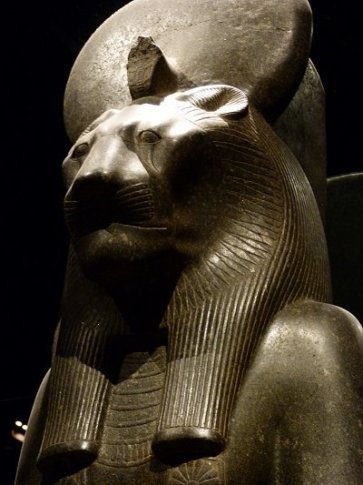
Sekhmet

Sekhmet

Sekmet is named after the lioness-headed Egyptian warrior goddess (Sekhmet). Variously known as “the one who is powerful or mighty”, “One before whom evil trembles”, “mistress of dread”, and “Lady of Slaughter”, Sekhmet is often depicted in red, the colour of blood.

In Inner Diverse, Bas’s warning is realized; Rhea is hunted and captured then after a hasty “trial” she is sent to Sekmet. There, she, too, will meet the goddess’s wrath—and tremble.

As the AI ship takes Rhea down to the planet surface, she has a good view of the wetland planet:

I gazed out my porthole at the barren patchwork of the small wetland-dominated planet, whose surface resembled an early impressionist’s painting. Dominated by sombre russet and indigo tones, the raised bog was dotted by a hasty spray of cobalt lakes and pools.

Although it was mid-morning on the planet, the mostly grey sky was saturated in low cloud and it was drizzling outside. Spates of wind drove sheets of rain hailing sporadically against my porthole. It was a wet desolate place. But then again, “A drowning man is not troubled by rain—Persian Proverb, Rhea,” I said quietly to myself. The weather was the least of my concerns.

Wetland-Trent6

Swamp on Sekmet

As the ship descended, I could make out the individual pool system of the blanket bog with its inhospitable tapestry of dark and wet shapes. I dispassionately reviewed what I knew of the planet. Its cool wet climate and rich iron deposits promoted the development of muskeg, string bogs, darkly forested swamps and wildflower-filled fens. This was Sekmet, a less than Earth sized planet that orbited the KO star, HD177830 in the constellation Vulpecula. My new home. Where I was going to die.

As the ship turned, I made out the actual penal colony with its dozens of grey tapered stacks billowing out white smoke. The facility resembled a huge factory, floating on a glistening wet mosaic of multi-textured and coloured vegetation. The facility, appropriately named Hades by its inmates, was in fact a huge peat mine that migrated across the huge blanket bog, extracting peat for sale to maintain the colony.

The life span of inmates on Sekmet was usually less than a year and I wasn’t sure I was going to be all that tenacious. The Eosian Guardian who’d shoved me into this AI ship had offered his own prognosis with a sinister laugh: “You won’t last a jagging week, human. They despise Enforcers. They’ll eat you alive then excrete you as bog fertilizer!”

The ship had informed me earlier that Hades contained an inordinately high number of Rills as inmates. If any one alien race had the right to despise me, the Rill did. I’d single-handedly subverted their one and only attempt at obtaining freedom from a long life of oppression by the Legess. I decided that Sekmet was going to be my personalized purgatory.

“They will eat the fruit of their ways and be filled with the fruit of their schemes,” I recited the lines from Proverbs in a quiet breath.

When the AI ship lands on the huge barge platform, Rhea is instructed to get off.

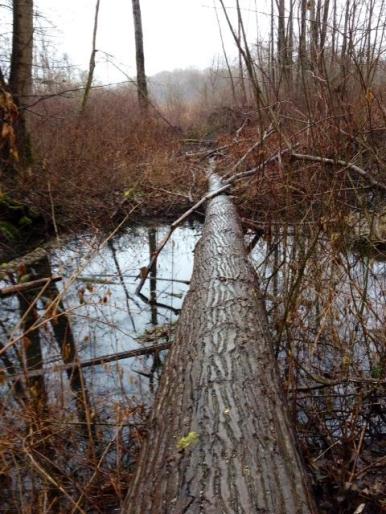
Log over water forest-DeasPark copy

Wetland on Sekmet

The exit hatch door opened and the AI droned, “This is your destination, Rhea Hawke. Please disembark.”

My chest clenched. I swallowed down my fear and stepped out onto the platform of Sekmet’s landing bay, catching the faint sulphurous smell of the bog. The doors of the ship abruptly closed behind me, making me involuntarily flinch. Annoyed at my reaction, I gathered my composure and swiftly assessed the empty platform, hearing only the hum of the ship’s engine. My gaze rested on the endless hummocks and large meandering ponds of tea-stained water outside.

As the ship made ready to leave, I felt my heart pounding with the sudden urge to bolt. I had a panicked notion to leap off the platform into the murky bog. Swim, wade, scrabble to eventual safety in the wilderness of Sekmet in those distant hills. The ship lifted off the ground in a turmoil of dust and thunder. My face twisted with indecision as I tensed, poised to flee—

A male Azorian burst in from the adjoining chamber and I braced for an attack. He pelted right past me then leapt into the murky water. I watched him thrash through the undulating bog, stumbling, submerging and trying to swim—his left arm was amputated at the elbow. I was about to follow when laser shots peppered the water around him for several heartbeats. I flinched. As suddenly as the shots began, they ended and the Azorian slowly sank until only his head remained above the water. I stood stiff, trembling hands over my mouth, and breathing hard. I stared at the head bobbing slowly in the water.

With the ship departed, chaotic sounds drifted in from inside the colony. Faint echoes of shrill outcries, mad laughter and raucous groans filtered in with the light breeze. It sent a chill through me—

“The stupids ones stills thinks theys cans escapes thats ways,” a nasal voice said behind me.

Startled, I spun around. When I saw the female Rill waddle toward me, huge arm—weapon—stretched out, I instinctively went for my MEC and caught air. My MEC was, of course, no longer holstered on my hip. That damned gesture and ominous paw got me every time, I thought and let the tension drain from my posture. I grimaced and murmured to myself, “Speak of the devil.”

At the entrance from the platform inside the penal barge, Rhea passes the looming statues of Anubis—ancient Egyptian jackal god (who took part in judging a person’s guilt) and the lion-headed Sekhmet. High between the massive statues, a makeshift sign has been erected that hangs above the open doorway. Words inscribed in a messy but clear scrawl read: I am the way into eternal grief; abandon every hope, all you who enter.

*****

Inner-diverse-front-cover-WEBInner Diverse is the second book of The Splintered Universe Trilogy:

When Galactic Guardian Rhea Hawke investigates the genocide of an entire spiritual sect, she collides not only with dark intrigue but with her own tarnished past. Her quest for justice catapults Rhea into the heart of a universal struggle across alien landscapes of cruel beauty and toward an unbearable truth she’s hidden from herself since she murdered an innocent man.

Get the complete Splintered Universe Trilogy. Available in ALL THREE FORMATS: print, ebook, and audiobook. You can listen to a sample recording of any of the three audiobooks through Audible. Read the Splintered Universe reviews on Goodreads.

audible listen

Microsoft Word - trilogy-poster03.docx

nina-2014aaa

Nina Munteanu is a Canadian ecologist / limnologist and novelist. She is co-editor of Europa SF and currently teaches writing courses at George Brown College and the University of Toronto. Visit www.ninamunteanu.ca for the latest on her books. Nina’s bilingual “La natura dell’acqua / The Way of Water” was published by Mincione Edizioni in Rome. Her non-fiction book “Water Is…” by Pixl Press (Vancouver) was selected by Margaret Atwood in the New York Times ‘Year in Reading’ and was chosen as the 2017 Summer Read by Water Canada. Her novel “A Diary in the Age of Water” will be released by Inanna Publications (Toronto) in 2020.

Reflections: The Meaning of Water (a talk for the Lewis Creek Association)

Nina Louis Merridy

Nina Munteanu with Louis DuPont and Merridy Cox with Lewis Creek behind

A short time ago, I was invited to give a talk on water to the Lewis Creek Association during their annual meeting for 2019 to help celebrate their recent accomplishments. Here is their write up:

Join our special guest, Canadian ecologist and author Nina Munteanu, who will discuss the many dimensions of water. She describes personally the curiosity and emotional connection with nature that compels us to caretake our environment with love versus a sense of duty. Her book “Water Is…The Meaning of Water” is an ode to and discourse about water, the indispensable and mysterious element that is the foundation of life here on our blue planet. The book is a fascinating catalogue of the many amazing and anomalous qualities of water, and has become a favorite of several Board members. She trained in limnology, the study of lakes, and has consulted in the aquatic sciences for many years. The author of over a dozen fiction and non-fiction books, she currently teaches writing at the University of Toronto and George Brown College in Toronto, Canada. We are delighted to have Nina join us and share her insights and concerns about this substance we have been concerned with over the last 30 or so years.

Microsoft Word - Nina map Barrio cafe.docx

At Cafe Barrio in Burlington, Vermont, Nina checks the map for directions…and finds her way…

I chose to drive to Vermont from Toronto with good friend and editor Merridy Cox. We crossed into USA near Cornwall and drove through New York state to Rousse’s Point, then into Vermont over the Vermont Bridge over Lake Champlain. We took the scenic route along the islands to the village of Charlotte, where we met with some of the Lewis Creek Board members and enjoyed a wonderful home-cooked supper at executive director Marty Illick’s country home along with Board president Andrea Morgante, board member Louis DuPont, and several other guests.

Merridy-LakeChamplain marsh

Merridy Cox photographing Lake Champlain just east of the Vermont Bridge

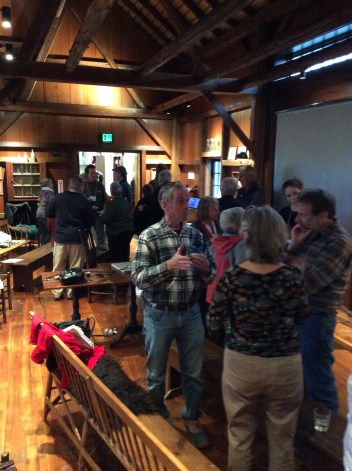
The event took place in the large converted barn of Philo Ridge Farm, a 400-acre historic dairy farm now also running as an educational institution of sustainable practices and store and restaurant. The barn is now a state-of-the-art sustainably built facility with a combination of rustic and sophisticated in its design of rich wood walls, large windows and beams with high vaulted ceiling; ideal for a presentation.

I spoke about my roots in the Eastern Townships of Quebec…and where they led me:

I was born in a small town in the Eastern Townships of Quebec, a gently rolling and verdant farming community, where water—l’eau—bubbles and gurgles in at least two languages.

I spent a lot of my childhood days close to the ground, observing, poking, catching, prodding, destroying and creating. Perhaps it was this early induction to the organic fragrances of soil, rotting leaves and moss that set my path in later life as a limnologist, environmental consultant and writer of eco-fiction.

Nina EasternTownships

I followed my older brother and sister to the nearby forest and local stream. We stirred soil, flower petals and other interesting things with water to fuel “magic potions” that we inflicted on some poor insect. Yes, I was a bit destructive as a child—and I took a lot for granted. Like water. There was so much of it, after all. It was clean and easily accessed, fresh from the tap.

When I gave birth to my son, Kevin, I felt a miracle pass through me. Kevin became my doorway back to wonder. His curiosity was boundless and lured me into a special world of transformation.

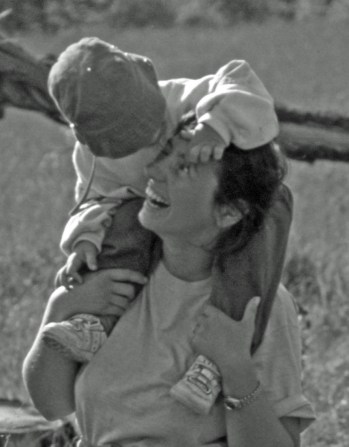
Nina-Kevin playing

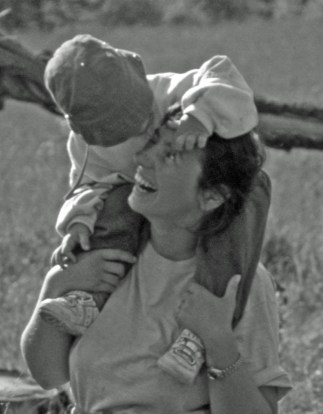
Nina Munteanu and her son hiking in B.C.

I took time off work to spend with Kevin when he was young. We went on great trips, from the local mall, where we had a hot chocolate and played with Lego, to the local beach on the Fraser River, where we explored the rocks. When he was no more than three, I took him on endless adventures in the city and its surroundings. We didn’t have to go far. The mud puddles of a new subdivision after a rain were enough to keep our attention for dozens of minutes. We became connoisseurs of mud. The best kind was “chocolate mud,” with a consistency and viscosity that created the best crater when a rock was thrown into it.

Kevin and I often explored the little woodland near our house. We made “magic potions” out of nightshade flowers, fir needles, loam and moss; we fueled our concoctions with the elixir of water from a stagnant pool. This time the little insects weren’t molested.

Travelling the world has helped me realize that I was blessed with an abundance of water. I lived my entire life in a country of plentiful and healthy water. And for most of that time I didn’t even realize it. Canada holds one fifth of the world’s fresh water in lakes, rivers, and wetlands, as well as in our underground aquifers and glaciers. Canada’s wetlands, which cover more than 1.2 million square kilometres, makes Canada the largest wetland area in the world.*

The folks who attended my presentation were wonderfully receptive, gracious and kind. They bought all my books too! I felt so welcomed by this community concerned about the land and their water. I was also impressed with the dedication, organization and knowledge of this non-profit conservation initiative.

Presentation venue

Venue

Lewis Creek Association

The Lewis Creek Association (LCA) started in 1990, when a group of concerned citizens and the Hinesburg Land Trust came together to conserve a critical stretch of wetland habitat bordering Lewis Creek in Hinesburg, Vermont. Lewis Creek is one of Vermont’s most ecologically diverse streams and suffers from increasing habitat degradation due to river encroachment by development and roads, land use change, and more extreme weather events.

LCA’s mission is to protect, maintain and restore ecological health while promoting social values that support sustainable community development in the Lewis Creek and LaPlatte watershed regions and Vermont generally. Through education and action, LCA works to:

  • Restore water quality, stream stability, and native wildlife habitat
  • Protect and restore important and diverse natural areas
  • Conserve productive and scenic lands that contribute to rural character and economy
  • Support growth compatible with important natural systems and working landscapes
  • Strengthen and support local conservation initiatives and opportunities
  • Model active participation and respect for differences

With a hard-working volunteer board and a part-time paid consultant, LCA facilitates educational, planning, and field work programs involving dozens of volunteers. This work assists town planning and facilitates the restoration and conservation of important Champlain Valley natural areas of high public value.

LCA Annual Party 2019

Their track record has been impressive. Since forming their organization, the LCA has spearheaded and conducted numerous initiatives. Highlights include: annual water quality sampling in six streams and rivers; biodiversity studies of stream corridors, conservation and restoration work in watershed towns; invasive aquatic plant control in local areas; helped educate citizens on ecological improvements; actively participated in implementing VT’s Water Quality Law, Act 64; generated Water Quality Scorecard Maps to track pollution problems; and designed the “Ahead of the Storm” education program used throughout the watershed region.

LakeChamplainBasin

In the Moment-anthology copy*A version of this talk is available in an article I wrote called “Coming Home to Water,” which first appeared in the 2016 anthology In the Moment (A Hopeful Sign) edited by Gary Doi. It was reprinted in 2018 The Earth We Love (Mississauga Writers) edited by Elizabeth Banfalvi; and again in 2019 in The Literary Connection IV: Then and Now (IOWI) edited by Cheryl Antao Xavier.


LakeChamplain-VT-NY bridge

Lake Champlain, looking west from Vermont to New York at Vermont Bridge (right) (photo by Nina Munteanu)


nina-2014aaa

Nina Munteanu is a Canadian ecologist / limnologist and novelist. She is co-editor of Europa SF and currently teaches writing courses at George Brown College and the University of Toronto. Visit www.ninamunteanu.ca for the latest on her books. Nina’s bilingual “La natura dell’acqua / The Way of Water” was published by Mincione Edizioni in Rome. Her non-fiction book “Water Is…” by Pixl Press (Vancouver) was selected by Margaret Atwood in the New York Times ‘Year in Reading’ and was chosen as the 2017 Summer Read by Water Canada. Her novel “A Diary in the Age of Water” will be released by Inanna Publications (Toronto) in 2020.

Why Women Will Save the Planet

I was recently told I was fear-mongering and missing the facts by a person on Facebook when I revealed the environmental dangers of using (and abusing) single-use plastics (specifically Styrofoam); earlier that day a gentleman called me an anarchist after I promoted individual responsibility over government and corporate responsibility on the issue of bottled water in Canada.

At the time, these accusations upset me—I’m a scientist, after all, and truth is #1. Then I realised that they were part of my journey toward activism to save this planet and humanity along with it. It was, in fact, a good day for me. I did have the facts; and they were scary. And, in revealing them and expressing my opinions, I had succeeded in breaking people’s inertia and had challenged them to think outside their comfort zone.  I had created fear in them and I had created anarchy in their ordered world. This promted a strong defensive response. The more intense their defence, the more I’d upset their comfortable inertia. That is what happens when you break through a hegemony or dogma and challenge people to re-evaluate and change their actions or habits—essentially forcing them out of their complacency and bringing it back to personal responsibility.

In both cases, I’d brought it back to personal responsibility and personal action. Too many of us settle for a narrative in which others—often not clearly identified—are responsible–not us.

So, perhaps I am inciting fear. Fear in those who have become or choose to remain too complacent. Good; we are in a planetary and existential crisis. And perhaps I am rather an anarchist; disrupting a system and self-belief that is entrenched and not sustainable.

But that comes at a price.

Greta Thunberg raincoat

Greta Thunberg begins a wave of climate activism

I’m thinking of young climate activist Greta Thunberg, who recently captured the attention of the world in her brave sail across the Atlantic to attend the UN’s Climate Summit and other meetings in the US in addition to her climate strike and rally march in Montreal, Canada, which drew close to half a million people (old and young).

Greta Thunberg Sails Carbon-neutral  Yacht To New York

Greta Thunberg

Earlier, at the World Economic Forum Annual Meeting in Davos, Switzerland, Greta delivered her now iconic speech:

“Adults keep saying we owe it to the young people, to give them hope,” Thunberg said, “But I don’t want your hope. I don’t want you to be hopeful. I want you to panic. I want you to feel the fear I feel every day. I want you to act. I want you to act as you would in a crisis. I want you to act as if the house is on fire, because it is.”

In a recent poll, one out of three Germans said that Thunberg has changed their views on climate change. But that, too, has come at a price.

A tsunami of rage and shameless vitriol was unleashed by conservative men (many with close ties to the fossil fuel profit machine) at this young and brave girl during her 15-day trip across the Atlantic. Their attacks have grown increasingly more personal and vulgar as she has gained world attention. For example, political scientist, economist and climate “skeptic” Bjorn Lomborg (associated with the Heartland Institute and Competitive Enterprise Institute) repeatedly mocked and criticized the 16-year old activist. Using highly inappropriate and unprofessional language (the worst I won’t repeat here), he and others have accused her of being a “puppet”, “naïve”, “unrealistic”, and a “fanatic.” Others like Australian columnist Andrew Bolt have personally attacked Thunberg with reprehensible and boorish remarks about her age and mental health.

Lobbyists Against Greta

oil-profit lobbyists behind shameless vitriol against Greta Thunberg (from Desmog UK)

Andrew Mitrovica’s Opinion piece entitled “Who Is Afraid of Greta Thunberg?” provides eloquent summary: “Of course, the marauding swarm of vitriolic right-wing climate-change deniers see Thunberg—not how the prophetic Zinn envisioned her—but as a tiny, pretentious zealot who threatens the existing order. Their order. Their comforts. Their traditional ‘way of life’.”

Greta—who wears a windbreaker that reads “Unite Behind the Science”— responded in a brave and wonderful tweet:

GretaThunberg-Tweet

Her tweet was followed immediately by one by Alexandria Ocasio-Cortez:


AlexandriaOcasio-Cortez Tweet

This follows a recent finding by researchers that 99% of Republicans are science illiterate and 44% believe that the scientific method can be used to produce any conclusion the researcher wants. Of course the whole point of the scientific method is to prevent this.

Soon after, Martin Gelin wrote an article entitled, “The Misogyny of Climate Deniers” in the August 2019 issue of The New Republic. The subtitle reads: “Why do right-wing men hate Greta Thunberg and Alexandria Ocasio-Cortez so much? Researchers have some troubling answers to that question.”

Greta on boat2

Greta Thunberg sailing to New York

Gelin writes, “On [Thunberg’s] first day of sailing, a multi-millionaire Brexit activist (Arron Banks) tweeted that he wished a freak accident would destroy her boat. A conservative Australian columnist (Andrew Bolt) called her a ‘deeply disturbed messiah of the global warming movement,’ while the British far-right activist David Vance attacked the ‘sheer petulance of this arrogant child.’ … Former Trump staffer Steve Milloy recently called Thunberg a ‘teenage puppet,’ and claimed that ‘the world laughs at this Greta charade,’ while a widely shared far-right meme showed Trump tipping The Statue of Liberty to crush her boat.”

Fierce and undeterred by cohorts of grown human males unable to deal with her, Greta Thunberg gave a scorching speech at the United Nations during her visit to America: “We are in the beginning of a mass extinction, and all you can talk about is money and fairy tales of eternal economic growth,” she admonished a crowd of world leaders. “How dare you.” Her equally scorching look of Donald Trump who rudely ignored her to mumble some nonsense to the press, has become a popular meme. The mashup by Fatboy Slim of Greta Thunberg’s UN speech “Right here, right now” went viral on YouTube.

Greta-trump 2

Greta Thunberg and Donald Trump at the UN climate summit

Of course, this was followed by utterly shameless and cruel vulgarisms by adult bullies that included suggestions to punish her and give her a spanking.

Disinterested in whether she’s liked and undeterred by childish name calling, the activist teenager remained resolute with her weapon: shame.  At every opportunity, Greta Thunberg steadfastly called out adults over twenty years her senior on what they have failed to do; she did it in words that are simple, precise and direct.

After Senator Tom Carper tried to placate her by telling her that young people would soon have the chance to run for office themselves, she returned: “We don’t want to become politicians; we don’t want to run for office. We want you to unite behind the science.”

Carrying herself with admirable focus and buoyed by her dedication to her cause, Greta Thunberg delivered a scintillating speech to close to half a million climate marchers in Montreal:

“Some would say we are wasting lesson time; we say we are changing the world… The people have spoken. And we will continue to speak until our leaders listen and act. We are the change and change is coming.”

greta thunberg speech in montreal

Greta Thunberg speaking in Montreal

In a recent article in the Washington Post, entitled “Greta Thunberg Weaponized Shame in an Era of Shamelessness”, Monica Hesse writes: “We live in an era that has become impervious to shame. An era defined by a president who views it as a weakness. Shame has become an antiquated emotion and a useless one. It’s advantageous, we’ve learned, to respond to charges of indecency with more indecency: attacks, misdirection, faux-victimhood.”

But real shaming—the kind that mothers do with their errant boy-bullies—is precisely what Greta is doing. This kind of shaming cuts deep, because it is the deep and recognizable truth. And it is done through the “mother archetype”—the most powerful energy on this planet.

Gelin tells us that the prominently older white men who are leading these attacks on Greta Thunberg (and by association, other prominent female climate activists such as Alexandria Ocasio-Cortez) “is consistent with a growing body of research linking gender reactionaries to climate-denialism.”

Alexandria Ocasio-Cortez

Alexandria Ocasio-Cortez

Scientists Jonas Anshelm and Martin Hultman in the journal NORMA  analyzed the language of a focus group of climate skeptics, to discover a major theme:

“for climate skeptics … it was not the environment that was threatened, it was a certain kind of modern industrial society built and dominated by their form of masculinity.”

On the heels of the #MeToo movement, climate activism—largely led by strong females—appears to threaten gender identity of conservative males. Right-wing nationalism, anti-feminism, and climate denialism appear inextricably linked. I would add that their lack of respect for and acknowledgement of indigenous peoples is by default part of the package, given that indigenous peoples are so tied to the land and the ecosystem (being destroyed). One need only look to what is currently happening in Brazil for an atrocious example of this kind of male-bully behaviour.

Climate science for skeptics becomes feminized and viewed as “oppositional to assumed entitlements of masculine primacy,” write Hultman and Paul Pule in the 2019 book “Climate Hazards, Disasters, and Gender Ramifications.” Hultman identifies a set of values and behaviours connected to a form of masculinity identified with industrial patriarchy. These males “see the world as separated between humans and nature. They believe humans are obliged to use nature and its resources to make products out of them. And they have a risk perception that nature will tolerate all types of waste. It’s a risk perception that doesn’t think of nature as vulnerable and as something that is possible to be destroyed. For them, economic growth is more important than the environment,” which they choose not to understand—just like women.

The gender gap in the United States is characterized by men who perceive climate activism as inherently feminine. This was demonstrated in a 2017 article in Scientific American entitled, “Men Resist Green Behavior as Unmanly.”  Researchers Aaron R. Brough and James E.B. Wilkie argue that “women have long surpassed men in the arena of environmental action; across age groups and countries, females tend to live a more eco-friendly lifestyle. Compared to men, women litter less, recycle more, and leave a smaller carbon footprint.” While some researchers have demonstrated that women’s prioritization of altruism may help explain this gender gap in green behaviour, the research done by Brough and Wilkie’s—involving more than 2,000 American and Chinese participants— showed that men linked eco-friendliness with femininity and a risk to their masculinity. These findings, coupled with a natural inclination for anti-feminism by older white conservative males, places them at the centre of a major reactionary backlash against climate action.

Gelin ends on a sober note: “As conservative parties become increasingly tied to nationalism, and misogynist rhetoric dominates the far-right, Hultman and his fellow researchers at Chalmers University worry that the ties between climate skeptics and misogyny will strengthen. What was once a practical problem, with general agreement on the facts, has become a matter of identity. And fear of change is powerful motivation.”

Nina-Kevin playing

Nina Munteanu hiking with her son

When fear powers motivation, we must counter with something stronger: hope through action, compassion, and community. And, again, women are in great abundance of these.

“Keep inspiring and organizing,” says Alexandria Ocasio-Cortez to young Greta. “We’re going to save the planet. All of us, together.”

We are all, after all, “the mother.” So, while the old guard of conservative immature men obsess in saving their egos and identities in this crisis, and put up walls of vitriol, name-calling, “flaming”, and “trolling,” it’s up to us, mature women, to really save the planet, the mother of us all.

So, why will women save the planet? Because “Mother Knows Best,” after all…

Time for a paradigm shift. We’re not in the fifties anymore…


nina-2014aaa

Nina Munteanu is a Canadian ecologist / limnologist and novelist. She is co-editor of Europa SF and currently teaches writing courses at George Brown College and the University of Toronto. Visit www.ninamunteanu.ca for the latest on her books. Nina’s bilingual “La natura dell’acqua / The Way of Water” was published by Mincione Edizioni in Rome. Her non-fiction book “Water Is…” by Pixl Press (Vancouver) was selected by Margaret Atwood in the New York Times ‘Year in Reading’ and was chosen as the 2017 Summer Read by Water Canada. Her novel “A Diary in the Age of Water” will be released by Inanna Publications (Toronto) in 2020.


A True Rocky Mountain Gem: The Antique Forest of Robson Valley

In my novel “A Diary in the Age of Water” (Inanna Publications) the diarist writes about the huge reservoir complex that was built in the late 2020s in the Rocky Mountain Trench to create an 800 km long reservoir system to rehydrate the United States. Of course, it’s science fiction, but it was based on real plans (NAWAPA) that went all the way to congress in the 1960s. That reservoir might have drowned the rainforest conservation corridor of Robson Valley—a conservation area that continues to experience existential risk due to development, resource harvest, and other disturbance.

Cedar-boardwalk-Anne

Friend Anne walks the boardwalk of the ancient forest park

In Robson Valley—tucked between the Rocky and Cariboo Mountains of East-Central British Columbia, the Fraser River nourishes an ancient rainforest matched nowhere on Earth. Massive Western Redcedar (Thuja plicata)—some over 1200 years-old, 3.5 meters in diameter, and 45 meters high—thrive in this valley, nurtured by abundant groundwater flow and high humidity for healthy tree growth and reduced fire risk. “Unfortunately, this requirement for growth in wet toe-slope positions has had negative consequences for ancient cedar stands. Historically, roads and railroads were placed at the base of mountain slopes, where easy access on level roadside terrain meant that ancient cedar stands were often among the first sites chosen for logging. Ancient cedar stands now represent less than 5% of forested landscapes within the Upper Fraser River watershed.” (UNBC Plant Ecology)

GiantCedars boardwalk2

Moss-covered giant Redcedar in foreground to boardwalk

This valley contains the most extensive inland rainforest in the northern hemisphere and is the only valley in the Rocky Mountains where grizzly bears still feed on wild ocean-going salmon.

Old Cedar-RobsonPark2019

Western Redcedar with wide buttresses

The Save-The-Cedar League also tells us that the Robson Rainforest is oroboreal: mountain-caused with boreal biome characteristics—unlike typical rainforests which are temperate-coastal or tropical. “Antique Forest” is a term used for ancient cedar-hemlock stands that have endured for more than 1000 years. One stand in Primordial Grove can be seen via a well-constructed boardwalk in a small park off Highway 16.

When I entered the ancient forest of magnificent giants with wide buttressed bases, a deep reverence came over me. No other word comes close to describing what I experienced or felt. I was enthralled and humbled by these magnificent trees, silent giants that rose into the mist like sentinels, piercing the heavens. It had rained that morning and the forest dripped with living moisture. Greens of all shades created a living mosaic of hue and texture. Moss covered everything. Lichen dripped off branches and clothed trees in crenulated patterns. The fragrance was intoxicating, a fresh pungency that woke something inside me. The smell has been variously described as “lingering”, “fresh”, “sweet”, “like pineapple when crushed”, or “almost like fresh water.” Even the breeze took on a different voice inside this living cathedral. A kind of deep hush that whispered of sacred grandness.

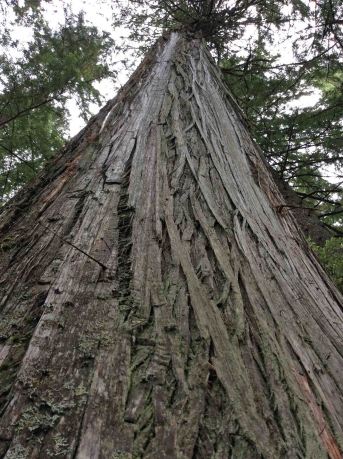
Cedar-up

Western Redcedar

I knew I was in a sacred place.

This ancient forest had been here at least a millennium; long before the arrival of Christopher Columbus to the Atlantic shores of North America. Long before us. Referred to as “the cornerstone of northwest coastal Indian culture,” the Western Redcedar is known as the “tree of life” and “life giver.” Groves of ancient cedars were symbols of power, and gathering places for ceremonies, retreat, and contemplation.

I kept to the boardwalk—to help prevent unwanted trampling and soil compression. The boardwalk snaked past giant buttressed trees that towered several stories high and formed a feathered canopy way above me. Whenever the boardwalk came close to a giant cedar, I had to stop and touch it. The reddish bark was smooth. I smiled; many others had done the same. In unavoidable reverence.

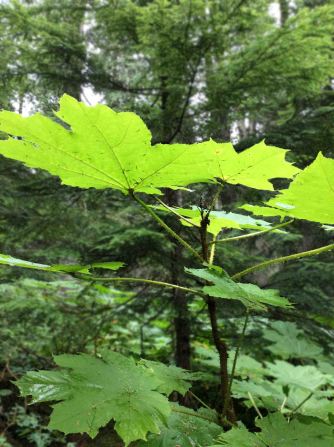
Breathing in the tree’s exquisite fragrance, I scanned my surroundings. A rich understory of red-berried Devil’s Club (Oplopanax horridus), huckleberry, fern, moss, liverworts and dense ground cover painted the forest floor in varying form and colour. I imagined the diversity of invertebrates, amphibians, reptiles, birds and mammals that flourished here. I’m told that scientists are still finding new species in this rainforest. UBC scientists tell us that arboreal lichen communities of the inland rainforest, especially the epiphytic cyanolichen assemblages on conifers, are among the richest in the world.

Nina-giant cedar03

Nina Munteanu leans against a well-loved giant Western Redcedar


Gentle Giant of North Temporate Rainforest: Western Redcedar (Thuja plicata)

tall cedar-moss

Western Redcedar

The Western Redcedar (Thuja plicata) is one of the most magnificent conifers in Pacific Northwest forests (both coastal and inland); it flourishes along the coastal fog belt from Alaska to northern California, and inland from the Pacific Ocean to Montana. The Western Redcedar is actually an arborvitae—not a true cedar; acknowledged by its name “redcedar”. True cedars only grow in the Mediterranean regions of the world. “Thuja,” is the latinism for the ancient Greek word for a now unknown, long-lost aromatic evergreen wood; “plicata,” means “folded into plaits,” which may refer to the tree’s characteristic foliage or its furrowed, stringy bark. The heartwood is pink- to red-brown to deep warm brown and highly resistant to moisture, decay and insect infestation due to the oils and acids (polyoxylphenols) it produces; it’s the phenols, in fact, that give the cedar its distinctive and pleasant aroma.

Given their extensive root system, cedars can remain standing long after they die. Western Redcedar snags (standing dead trees) can remain intact for up to 125 years. The large snags provide habitat for many cavity-nesting birds and mammals. Many species that require snags for habitats also prey on insects that use trees in a fine balance of a functional ecosystem. Examples include the pileated woodpecker, squirrels, weasels, martens, bats, owls and ducks. A fallen cedar can remain on the forest floor for over a century. “This durability is the result of a natural preservative that is toxic to decay-causing fungi. This ability does not decrease with age; in fact, it increases,” writes Jeri Chase, Oregon forester.

DevilsClub Hemlock-CedarGrove

Devil’s Club

Several of these live ancient cedar trees grow out of the trunks of other live ancient cedars, following a 180 million-year-old pattern observed in the closely-related redwoods (Sequoia). Basal shoots of the trunk yield genetically-superior mature trees when compared to seeds, root sprouts, other shoots or other layering phenomena.

Western Redcedar reproduces from root or branch development on fallen trees—the classic “nurse logs” often seen in northwest forests that also nourish other forest species. The magnificent bark of the Redcedar ranges in color from grey to reddish brown, and is deeply furrowed, forming long flat fibrous plates that peel and shed easily. Wildlife use the cedar in many ways. The foliage is an important winter food for elk and is browsed year-long by deer and rodents. Black bears den in the hollowed-out trunks of old trees and the cedar-dominated old growth forests provide valuable habitat for spotted owls and Vaux swifts.

Functional Ecosystem & Symbiosis

red-backed_vole

Red-backed vole

The Robson Valley cedar-hemlock rainforest supports a diverse and efficient ecosystem from apex and keystone predator—the grizzly—to black bear, gray wolf, cougar, lynx, wolverine, coyote, and seven ungulate species (including the Mountain caribou); all feeding on a diversity of prey and primary producers. The Mountain caribou feeds on mountain boxwood shrubs which are sheltered by the cedar and hemlock canopy layer.

An example of the symbiotic nature of the old growth cedar-hemlock forest is the red-backed vole, which resembles a large plump mouse. This forest mammal eats truffles—a type of fungus that lives underground. After digesting the truffles, voles spread the fungus around the litter layer of the forest through their droppings. The truffles help tree roots absorb soil minerals and the trees produce sugars necessary for the truffles: a win-win symbiotic relationship. The cedar and the hemlock require this alliance with truffles and voles to grow so large in the nutrient-poor soil.

The Inland Sea of the Rocky Mountain Trench (NAWAPA)

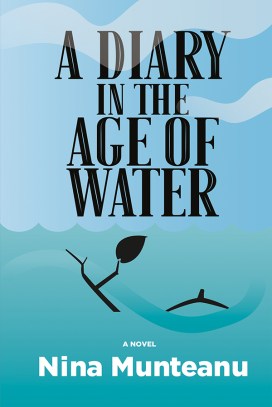
Diary Water cover finalUna stopped the car and we stared out across the longest reservoir in North America. What had once been a breathtaking view of the valley floor of the Rocky Mountain Trench was now a spectacular inland sea. It ran north-south over eight hundred kilometres and stretched several kilometres across to the foothills of the Cariboo Mountain Range. Una pointed to Mount Mica, Mount Pierre Elliot Trudeau and several other snow-covered peaks. They stood above the inland sea like sentinels of another time. Una then pointed down to what used to be Jackman Flats—mostly inundated along with McLellan River and the town of Valemont to the south. Hugging the shore of what was left of Jackman Flats was a tiny village. “That’s the new Tête Jaune Cache,” my mother told me.

If villages had karma this one was fated to drown over and over until it got it right.  Once a bustling trading town on the Grand Trunk Pacific railway, Tête Jaune Cache drowned in the early 1900s when the Fraser naturally flooded. The village relocated to the junction of the original Yellowhead 16 and 5 Highways. Villagers settled close to where the Fraser, Tête Creek, and the McLellan River joined, all fed by the meltwater from the glaciers and icefields of the Premiere Range of the Cariboo Mountains. The village drowned again in 2025. I imagined the pool halls, restaurants, saloons and trading posts crushed by the flood.

“This area used to be a prime Chinook spawning ground,” Una said. “They swam over 1,200 km from the Pacific Ocean to lay their eggs right there.” She pointed to the cobalt blue water below us.

The reservoir sparkled in the sun like an ocean. Steep shores rose into majestic snow-capped mountains. The village lay in a kind of cruel paradise, I thought. It was surrounded by a multi-hued forest of Lodgepole pine, Western red cedar, Douglas fir, paper birch and trembling Aspen. Directly behind the village was Mount Terry Fox and across the Robson valley mouth, to the northeast, rose Mount Goslin. Behind it, Mount Robson cut a jagged pyramid against a stunning blue sky. Wispy clouds veiled its crown. I couldn’t help thinking it was the most beautiful place I’d seen. And yet, for all its beauty, the villagers had lost their principle livelihood and food. The reservoir had destroyed the wildlife habitats and the fishery. And its people with it.

Una pointed to where the giant reservoir snaked northwest and where towns like Dunster, McBride and Prince George lay submerged beneath a silent wall of water. Her eyes suddenly misted as she told me about Slim Creek Provincial Park, between what used to be Slim and Driscoll Creeks just northwest of what used to be the community of Urling. She told me about the Oroboreal rainforest, called an “Antique Rainforest”—ancient cedar-hemlock stands over a 1000 years old. She described how massive trunks the width of a small house once rose straight up toward a kinder sun. The Primordial Grove was once home to bears, the gray wolf, cougar, lynx, wolverine and ungulates. It was the last valley in North America where the grizzly bear once fished ocean-going salmon. Now even the salmon were no longer there, she said. Then she bent low beside me and pulled me close to her in a hug. She quietly said to me, “This is what killed Trudeau.”

I stared at her and firmly corrected, “but that was an accident.”

“Yes,” she agreed. Then added, “a planned one.”

—A Diary in the Age of Water

tall cedar-moss2 copy

Moss-covered Western Redcedar


NAWAPA (North America Water Power Alliance)

The original NAWAPA Plan was drawn up by the Pasadena-based firm of Ralph M. Parsons Co. in 1964, and had a favorable review by Congress for completion in the 1990s. The plan—thankfully never completed—was drafted by the US Army Corps of Engineers and entailed the southward diversion of a portion (if not all) of the Mackenzie and Yukon rivers in northern Canada and Alaska, now flowing into the Arctic Ocean as well as the Peace, Liard and other rivers flowing into the Pacific by creating massive dams in the north. This would cause the rivers to flow backwards into the mountains to form vast reservoirs that would flood one-tenth of British Columbia. The water would be channeled south through the 800-km Rocky Mountain Trench Reservoir into the Northern USA, and from there along various routes into the dry regions of the South, to California and reaching as far as Mexico.

NAWAPA copy

Expanded NAWAPA XXI plan to hydrate the USA with Canadian water

NAWAPA was envisioned as the largest construction effort of all times, comprising some 369 separate projects of dams, canals, and tunnels, for water diversion. The water diversion would be accomplished through a series of connecting tunnels, canals, lakes, dams, and pump-lifts, as the trench itself is located at an elevation of 914 m (3,000 feet). To the east, a 9 m (thirty-foot) deep canal would be cut from the Peace River to Lake Superior. Its largest proposed dam would be 518 m (1,700 feet) tall, more than twice the height of Hoover Dam (at 221 m) and taller than any dam in the world today, including the Jinping-I Dam in China (at 305 m).

Conspiracy theorist and convicted fraudster Lyndon LaRouche was a principle proponent of the environmentally destructive NAWAPA plan. Although the plan was scrapped in the 1970s due to environmental concerns, it resurfaced in 1982 particularly by Parsons engineer Roland Kelley, who wrote a report called NAWAPA Plan Can Work. LaRouche and his movement revived interest more recently. In 2012 the LaRouche Political Action Committee released their NAWAPA XXI special report, which contained a detailed plan for the revival of an updated and expanded version of NAWAPA. The LaRouche movement continues to promote this outlandish plan today with support from various American politicians and industrialists.

In his book Cadillac Desert, environmental writer Marc Reisner described the plan as one of “brutal magnificence” and “unprecedented destructiveness.” Historian Ted Steinberg suggested that NAWAPA summed up “the sheer arrogance and imperial ambitions of the modern hydraulic West.”

Forest-Cedar giant-marg drybr-LHP

Old growth Redcedar-Douglas fir forest near Vancouver, BC (photo and illustration by Nina Munteanu)

nina-2014aaa

Nina Munteanu is a Canadian ecologist / limnologist and novelist. She is co-editor of Europa SF and currently teaches writing courses at George Brown College and the University of Toronto. Visit www.ninamunteanu.ca for the latest on her books. Nina’s bilingual “La natura dell’acqua / The Way of Water” was published by Mincione Edizioni in Rome. Her non-fiction book “Water Is…” by Pixl Press (Vancouver) was selected by Margaret Atwood in the New York Times ‘Year in Reading’ and was chosen as the 2017 Summer Read by Water Canada. Her novel “A Diary in the Age of Water” will be released by Inanna Publications (Toronto) in 2020.

Climate Change: What We Can Do—Nina talks to the Toronto Star

Nina Munteanu

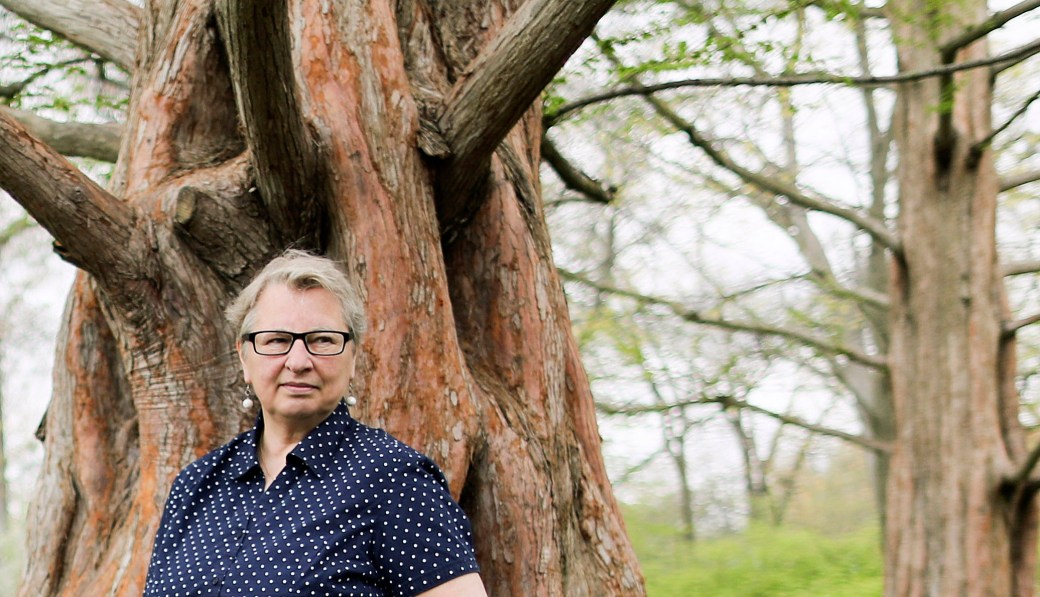
Nina Munteanu (photo by Richard Lautens)

The Toronto Star recently spoke to Nina Munteanu with two questions about climate change. These were included in a recent handbook published by the Star entitled “Undeniable: Canada’s Changing Climate—What We Can Do Now.” In it, The Star showed how the majority of Canadians place climate change as a top priority. In “Let’s Talk” The Star interviews computer scientist and head of UofT’s School of the Environment Steve Easterbrook. Questions involving local community action and the importance of hope.

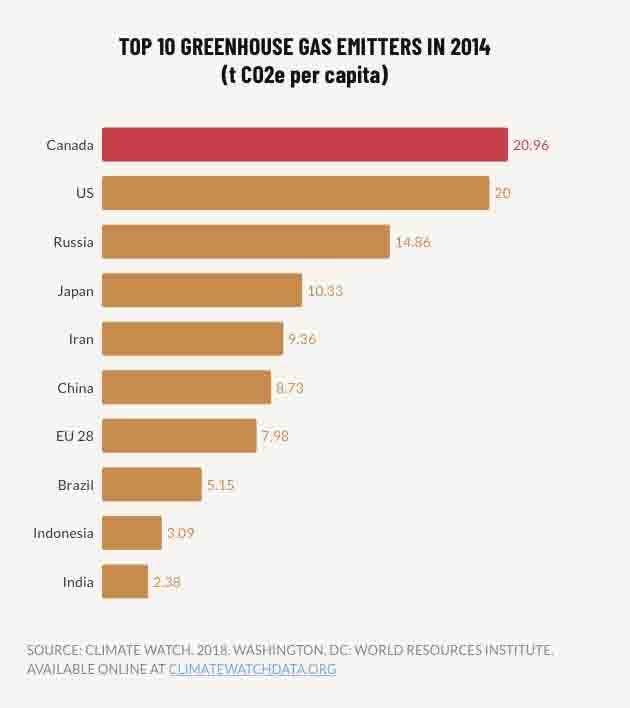
In “Your Carbon Footprint” The Star showed how China and the US together produce over half of the entire greenhouse gases emitted annually by the top ten countries that include EU 28, India, Russia, Japan, Brazil, Indonesia, Canada, and Iran. These ten countries currently emit seventy percent of the world’s greenhouse gases. China (11.912 Mt CO2) continues to lead in greenhouse gas emissions, being over twice the US, the next large emitter (6.371 Mt CO2).

Top Ten GreenhouseGas Countries

However, when The Star looked at per capita greenhouse emissions, Canada jumped to the top rank at 21 tonnes per person annually, followed by the US (20 tonnes/person). By comparison, China—ranked the highest for total emissions—measured only 8.73 tonnes per person annually. And Bangladesh measured 1.1 tonnes/person.

GreenhouseGases-PerCapita

“Most scientists agree that in the coming decades we need to limit our individual annual carbon footprint to 1-2 tons,” says The Star. This entails making personal changes to cut our carbon output. One example is driving less or converting to a hybrid or electric car. “Our behaviours, whether good or bad, are contagious,” says The Star. I agree. It is important to not only do what we can but to share with others and provide our reasons. Seth Wynes, a geographer at the University of British Columbia concurs: “It’s not just about what you do, it’s about setting an example for others.” Research suggests, for example that homeowners are more likely to install solar panels when someone else does it first in their neighbourhood. Wynes in 2017 co-authored a study that ranks the most effective lifestyle changes to curb an individual’s carbon footprint.

In “Four Things You Can Do”, The Star suggests the following key initiatives:

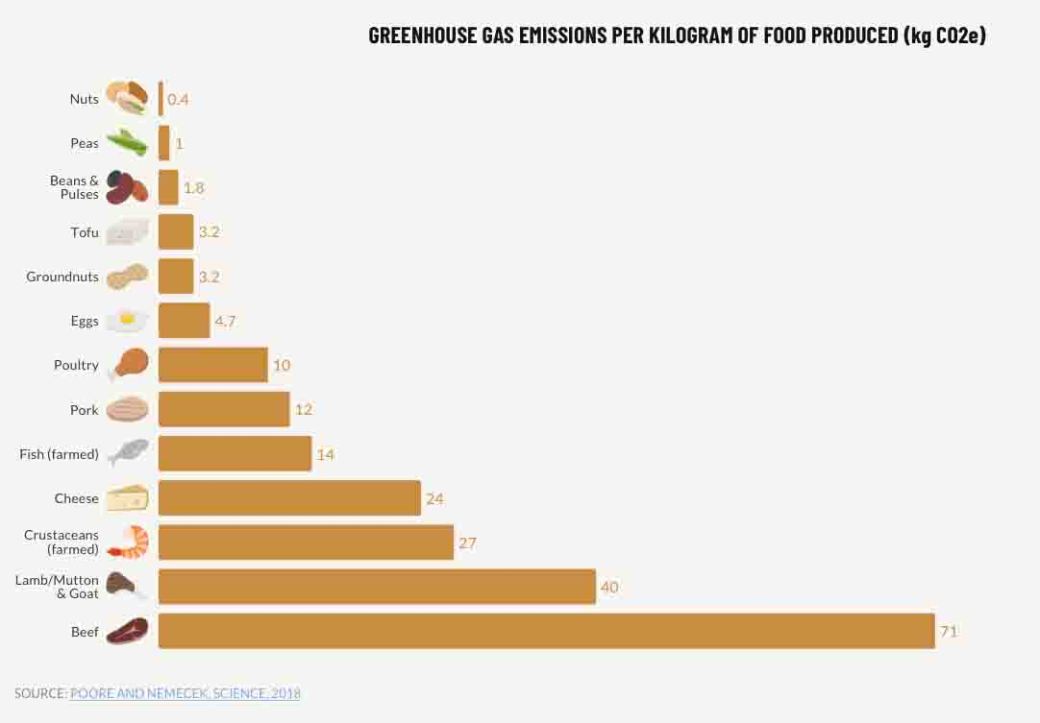
  1. Eat less beef
  2. Live car-free or go hybrid / electric
  3. Invest in green infrastructure
  4. Reduce air travel

Greenhouse Gases-FOOD

The Star also provided good advice on how to talk to children about our changing climate. They provide excellent examples of children empowering themselves by making a difference—instead of becoming depressed with what they are inheriting. In “Political Checkup” The Star discusses with experts how we can best interact with our political leaders to engage and ensure positive change. In “Faith and Community” The Star showcases examples of faith communities addressing our waste stream.

In “The ChangeMakers” The Star asked the same two questions of five Canadians who are making climate change a top priority. They included:

  • Franny Ladell Yakelashek: 12-year old environmental rights activist from Victoria, BC
  • Jocelyn Joe-Strack: Indigenous scientist and storyteller, Whitehorse, Yukon
  • Kathy Bardswick: director of the Institute for Clean Growth and Climate Change, Guelph, ON
  • Gordon McBean: climatologist and professor emeritus at Western University, London, ON
  • Nina Munteanu: ecologist, instructor at The University of Toronto and author of eco-fiction and climate fiction, Toronto, ON.

Q1: What is the one thing about climate change that keeps you up at night?

Nina: I worry that my son and his kids will end up experiencing one of my dystopias from one of my books. My son lives in Vancouver, and my main concern is that he and his kids won’t have the chance to live safely and enjoy a stable and beautiful planet because we have wrecked it for them.

That leads me to the second thing that keeps me up at night, which is that nobody cares. Or that they are scared to care. We’re still going about our business like nothing is happening.

That really frustrates me. I’m a scientist and we’ve been talking about this for a long time; for me it’s been decades. My frustration is that we are still debating climate change, and we should be acting on it.

Q2: What is the one thing Canadians can do to act on climate change?

Nina: I think it has to be three things. First, plant a tree; make an actual difference through action. By doing that, we get out from hiding under the bed and face the monster of climate change and show that we care and that we are not alone. And that — taking direct action — will give us courage and hope.

Second, vote for green politicians. Politicians need to hear directly from their communities, they need you to push them to act on climate change.

Third, find your tribe and create a movement. Everyone says that people have the power, but that power comes best through numbers and solidarity. Find your tribe, and you’ll find yourself more motivated.

For answers to these two questions by the other changemakers, please go to the Toronto Star’s “What You Can Do About Climate Change” site.


nina-2014aaa

Nina Munteanu is a Canadian ecologist / limnologist and novelist. She is co-editor of Europa SF and currently teaches writing courses at George Brown College and the University of Toronto. Visit www.ninamunteanu.ca for the latest on her books. Nina’s bilingual “La natura dell’acqua / The Way of Water” was published by Mincione Edizioni in Rome. Her non-fiction book “Water Is…” by Pixl Press (Vancouver) was selected by Margaret Atwood in the New York Times ‘Year in Reading’ and was chosen as the 2017 Summer Read by Water Canada. Nina’s short story collection of eco-fiction can be found in “Natural Selection” published by Pixl Press. Her novel “A Diary in the Age of Water” will be released by Inanna Publications (Toronto) in 2020.

International Writers’ Festival at Val David

ValDavid-group inside1

International Writers’ Festival & Retreat with Flavia Cosma, Val David

In the middle of June 2019, I drove to Val David, Quebec, with poet-songstress and friend Honey Novick. We had been invited to participate in Les Mots du Monde, the nineteenth international writers’ and artists’ festival of readings, songs, and discussions. The location was the residence of international poet Flavia Cosma. Cosma has been hosting the writer’s event for close to a decade in her large house in the forest just outside the resort town of Val David in the Laurentians.

The program spanned two days of lecture, readings, performance and art by artists and writers from Argentina, Romania, Mexico, USA, Laval, Montreal, and Toronto.

Festival-group outside

International Festival among the trees

Poets, writers, musicians and artists included Honey Novick, Hélène Dorion, Tito Alvarado, Dinorah Gutiérrez Andana, Flavia Cosma, Gerette Buglion, Yvan-Denis Dupuis, EcologyOfStoryJeremiah Wall, Nina Munteanu, Nancy R. Lange, Nicole Davidson, Carmen Doreal, MarieAnnie Soleil, Luis Raúl Calvo, Louis-Philippe Hébert, Melania Rusu Caragioiu, Anna-Louise Fontaine.

I talked about my experience and process of writing my upcoming speculative novel “A Diary in the Age of Water”, coming out in 2020 with Inanna Publications. The novel chronicles four generations of women and their relationship with water during a time of extreme change.

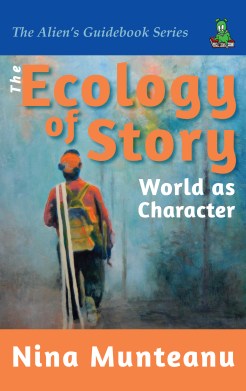
I also shared examples of my recently launched writing guidebook “The Ecology of Story: World as Character” (Pixl Press). The 3rd guidebook in my Alien Guidebook Series, “Ecology of Story” focuses on place and environment and how these form the heart of a good story.

Throughout the festival, we were treated to magnificent ethnic food and refreshments. Interesting discussions on the international literary scene over wine and desert followed.

lunch 2

Lunch at Flavia’s

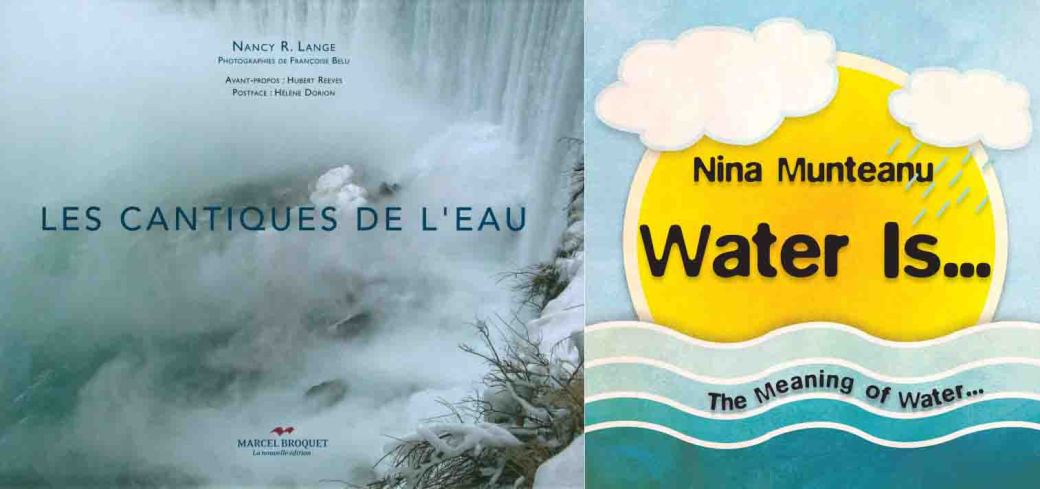
I shared good conversation with fellow poet and water advocate Nancy R. Lange. She had given a compelling presentation on her recent book “Les Cantiques de l’eau” (Marcel Broquet) and knew about my book “Water Is: The Meaning of Water” (Pixl Press). Of course, the best thing to do was exchange books—which we did. Nancy is the literary ambassador for the Eau Secours organization and has promoted responsible water stewardship through her writing and presentations for many years.

Microsoft Word - WaterBooks.docx

“It is not the cliff that shapes the ocean. It is the ocean that shapes the cliff. Fluidity is always the greater force than rigidity.”—Nancy R. Lange


On the final day, the writers and artists put on a public performance at the Val David Centre d’Exposition.

C'est La Vie Cafe

C’est la Vie Cafe, Val David

Val David

Val David is a small resort town located in the Laurentian Mountains about 80 kilometers from Montreal, Quebec. The village is known for its food scene and its artistic character. When I was there, I sampled the local cafes and experienced the street market, which offered a diversity of locally made and sourced produce and crafts.


nina-2014aaa

Nina Munteanu is a Canadian ecologist / limnologist and novelist. She is co-editor of Europa SF and currently teaches writing courses at George Brown College and the University of Toronto. Visit www.ninamunteanu.ca for the latest on her books. Nina’s bilingual “La natura dell’acqua / The Way of Water” was published by Mincione Edizioni in Rome. Her non-fiction book “Water Is…” by Pixl Press (Vancouver) was selected by Margaret Atwood in the New York Times ‘Year in Reading’ and was chosen as the 2017 Summer Read by Water Canada. Her novel “A Diary in the Age of Water” will be released by Inanna Publications (Toronto) in 2020.


How Trees Can Save Us…Five Perspectives on Humanity’s Relationship with Our Forests

Cedar trunk base-LR

Cedar tree in Little Rouge Forest, Ontario (Nina Munteanu)

Alick Bartholomew, author of The Spiritual Life of Water, describes four geologic periods when forests thrived on this planet. The first was the Carboniferous, 350 million years ago, when land vertebrates established. The second was the Jurassic, 170 million years ago, when dinosaurs dominated the planet. The third, the Eocene epoch, 60 million years ago, witnessed the first primitive mammals. The last, the Holocene epoch, which began some 500,000 years ago, ushered in modern humanity. Bartholomew suggests that perhaps, “in each case the forests delivered a boost in the oxygen content of the atmosphere, which may have been a trigger for an evolutionary explosion of life forms.”

Ten thousand years ago, the land along the Mediterranean was covered in mixed forests of conifers and oak. Lebanon’s forests provided timber for the exploring ships of the Phoenician empire in third century BCE. North Africa, a fertile forest two thousand years ago, is now a desert. A thousand years ago, three quarters of the world was forest. Today forest and woodland cover only a third of the world. The UK is currently the least wooded area of Europe with 13% woodland cover; its ancient woodland is being removed at a faster rate than the Amazon rainforest. Humanity is currently cutting down trees at a rate of 15 billion a year. We are losing forests the size of New York City daily; every 100 days we lose forests the size of Scotland; within a single year we lose forest ecosystems the size of Italy.

Since humanity arrived, we have cut down trees for timber, agriculture and development. Our impact is a matter of scale. When humanity was a mere 300 million in pre-medieval times, forest ecosystems remained intact. We are now over 7 billion, doing essentially the same thing we did thousands of years ago. What may have been sustainable then is now extirpating entire complex ecosystems, along with species we may never know existed. Deforestation releases a massive carbon sink into the atmosphere, driving global warming. It is largely responsible for reducing populations of wildlife by half in the last 40 years, and for starting the sixth massive extinction event.

Clearcut gordon valley copy 2

Clearcut in Gordon Valley, Vancouver Island, BC (photo by T.J. Watts)

While too many of us do not understand or appreciate the global consequences of deforestation, we remain intimately and personally connected with trees: in ways we don’t realize or have forgotten.

This article overviews the perspectives of five writers on the role and history of trees in global planetary health and our journey with climate change. I explore three non-fiction books and two fiction books. The non-fiction books include Witness Tree (2017) by Lynda Mapes, The Global Forest (2011) by Diana Beresford-Kroeger, and The Songs of Trees (2018) by David George Haskell. The two fiction books include The Overstory (2018) by Richard Powers and Barkskins (2016) by Annie Proulx. Each work is a compelling testament of humanity’s connection with trees, both historically and in the present. All provide powerful and evocative optimism in different ways.

SONY DSC

Ash tree, Little Rouge River forest, Ontario (photo by Nina Munteanu)


The Philosophical OPTIMISM of Lynda Mapes
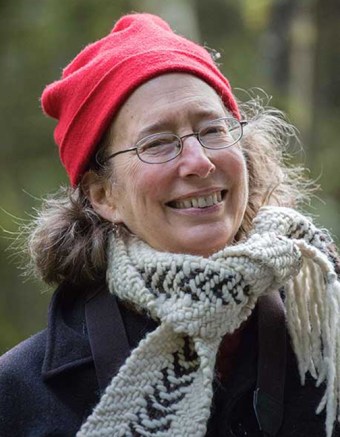
LyndaMapes

Lynda V. Vapes

Seattle Times environmental reporter and author of Witness Tree, Lynda V. Mapes explores a changing natural world and humanity’s relationship with it through a single Century-old red oak tree over four seasons. Mapes brings in elements of physics, ecology, biology and sociology and philosophy to probe her witness tree and reveal a colourful history of aboriginal life, colonialism, commodification and human-caused climate change.

In describing her oak tree, journalist and author of Witness Tree, Lynda V. Mapes writes, “The big oak dominates its space…but it also supports a vast web of life and relies in turn on a menagerie of helpers, aboveground and below. With its crown in the wind and its roots in the teeming soil, the big oak connects earth and sky, and many millions of beings, and is home to each and to all. It is just one tree, and yet a whole world unto itself.”

WitnessTreeMapes reveals that her witness tree overcame a 1 in 500 chance of taking root from tiny acorn to seedling to become a thirteen-storey tall giant. Mapes considered her oak a living timeline that revealed through its phenology how climate change is resetting the seasonal clock. Mapes sought “the quiet testimony of living things.” Through an “intimate exploration” in which she dug below, climbed up and lay beneath her oak, Mapes found vulnerability, loss, renewal, and hope.

“No matter what else the future may bring, in an uncertain world forests are a repository of only good verbs:  Forests shelter. Nurture. Moderate. Cleanse. Regenerate. Provide. Connect. Sustain…Trees can be our wellspring of inspiration. More than building material, fuel, and carbon-storage utilities, forests are foundational to life on the earth, refugia for countless animals, and an endless source of human joy, renewal, and refreshment.”

“People and trees are meant to be together, and if we work at it, that’s how we will stay,” writes Mapes at the end of her book. It is both hope and warning. A quiet clarion for us to “remember” our place in the world and to embrace our relationship with trees as wisdom guide.

Mapes invites us to connect with the forest.

Fallen log stream-2012

Old growth forest on Vancouver Island, British Columbia (photo by Kevin Klassen)

The Practical OPTIMISM of Diana Beresford-Kroeger

Diana-and-the-tree3

Diana Beresford-Kroeger

In her book The Global Forest: 40 Ways Trees Can Save Us, botanist and medical biochemist Diana Beresford-Kroeger tells us that:

“A functioning forest is a complex form of life. It is interconnected by its own flora and driven by the mammals, the amphibians and insects in it. It is kept in place by fungi, algae, lichens, bacteria, viruses, and bacteriophages. The primogenitors of the forests are trees. They communicate by carbon-coded calls and mass-market themselves by infrasound. The atmosphere links forests into the heavens and the great oceans. The human family is both caught and held in that web of life.”

TheGlobalForestWritten with passionate lyricism and a mother’s nurturing spirit, Irish storyteller Beresford-Kroeger weaves a compelling tapestry of ancient forest lore with modern science to promote the global forest. Tapping into aboriginal wisdom and ancient pagan legend, Beresford-Kroeger invites you into the forest to explore the many beneficial and pharmaceutical properties of trees—from leaves that filter the air of particulate pollution, the cardiotonic property of hawthorn, fatty acids in hickory nuts and walnuts that promote brain development, to the aerosols in pine trees that calm nerves.

The titles of her chapters reveal an overarching agenda: “The Global Forest Has Within Itself a Master Plan for Sustainability”; “Climate Change Can Be Reversed: Simplicity, Sustainability, and Sanity”.

“This [global] forest is the environment that drives and fulfills the dream of each leaf in a vast rhythmic cycle called life. Nothing is outside. We are all of it in a unity that transcends the whole. Maybe, just maybe, this resonates of God. If that is so, then we are all His children, every earthworm, every virus, mammal, fish and whale, every fern, every tree, man, woman and child. One equal to another. Again and again.”

Beresford-Kroeger compels us to interact with and learn from the forest.


gnarly cedar tree

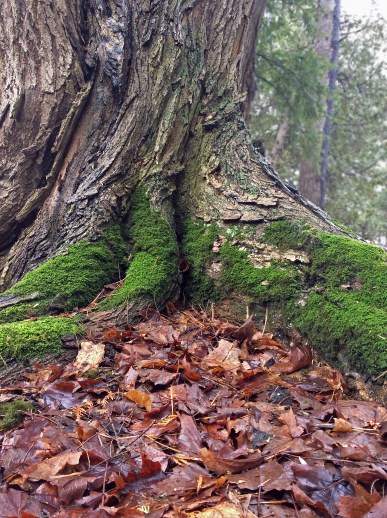
Gnarly “feet” of cedar tree in Little Rouge River forest, Ontario (photo by Nina Munteanu)


The Existential OPTIMISM of David George Haskell  

DavidGeorgeHaskell

David George Haskell

In The Songs of Trees: Stories from Nature’s Great Connectors, biologist David George Haskell pens an existentialist poem to life’s interconnected network. Haskell’s notion of ‘listening to trees’ arises not from metaphor or metaphysics but from a spiritual understanding of the woven tapestry of life.

 “For the Homeric Greeks, kleos, fame, was made of song. Vibrations in air contained the measure and memory of a person’s life. To listen was therefore to learn what endures. I turned my ear to trees, seeking ecological kleos. I found no heroes, no individuals around whom history pivots. Instead, living memories of trees, manifest in their songs, tell of life’s community, a net of relations. We humans belong within this conversation, as blood kin and incarnate members. To listen is therefore to hear our voices and those of our family…To listen is therefore to touch a stethoscope to the skin of a landscape, to hear what stirs below.”

SongsOfTreesIn his travels to visit iconic trees around the world, Haskell draws on the wisdom and moral ethics of “ecological aesthetics” to describe a natural beauty—not as individual property but as a world within a world of interactive life to which we belong and serve but do not own:

“We’re all — trees, humans, insects, birds, bacteria — pluralities. Life is embodied network…where ecological and evolutionary tensions between cooperation and conflict are negotiated and resolved…Because life is network, there is no ‘nature’ or ‘environment,’ separate and apart from humans. We are part of the community of life, composed of relationships with ‘others,’ so the human/nature duality that lives near the heart of many philosophies is, from a biological perspective, illusory…We cannot step outside life’s songs. This music made us; it is our nature…To listen to trees, nature’s great connectors, is therefore to learn how to inhabit the relationships that give life its source, substance, and beauty.”

In the vein of the naturphilosophie of Goethe and Schelling—and later of Carson, Thoreau, Eisely and Dillard—Haskell invites us to cultivate a strong sense of place and being, one that extends beyond “self” to the existential nature of experience. Glancing up a magnificent oak or beech tree reveals wood as “an embodied conversation between plant life, shudder of ground and yaw of wind.”

Haskell exhorts us to be the forest.
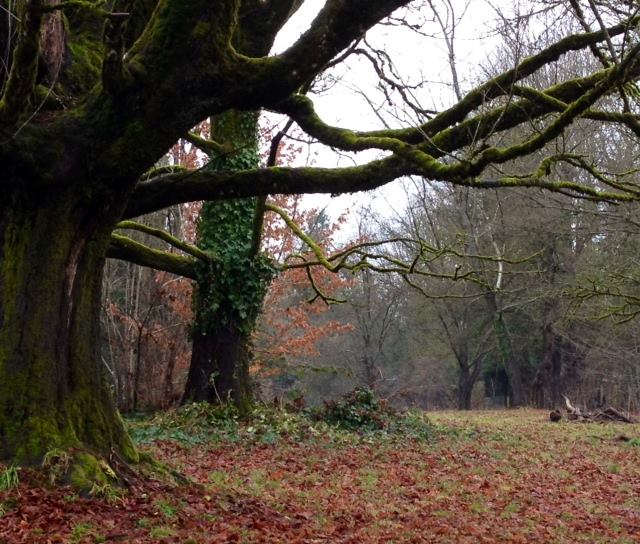
Old tree deer lake park

Old tree in Deer Lake Park, Burnaby, BC (photo by Nina Munteanu)

The Fierce OPTIMISM of Richard Powers  

RichardPowers

Richard Powers

At the heart of Richard Powers’s The Overstory are the pivotal lives of two women, botanist Patricia Westerford and college student Olivia Vandergriff. Both will inspire a movement against the destruction of forests.

Patricia Westerford—whose work resembles that of UBC’s Suzanne Simard—is a shy introvert who discovers that trees communicate, learn, trade goods and services, and have intelligence. When she shares her discovery, she is ridiculed by her peers and loses her position.  But, just as with Lynn Margulis and her theory of endosymbiosis, Westerford is finally validated. She is the archetypal ‘mother tree’, the metaphoric Tachigali versicolor, who ultimately brings the tangle of narratives together through meaning. Westerford writes in her book The Secret Forest:

mossy tree copy

Moss-covered cedar, Alberta (photo by Nina Munteanu)

“There are no individuals in a forest, no separable events. The bird and the branch it sits on are a joint thing. A third or more of the food a big tree makes may go to feed other organisms. Even different kinds of trees form partnerships. Cut down a birch, and a nearby Douglas fir may suffer…Fungi mine stone to supply their trees with minerals. They hunt springtails, which they feed to their hosts. Trees, for their part, store extra sugar in their fungi’s synapses, to dole out to the sick and shaded and wounded. A forest takes care of itself, even as it builds the local climate it needs to survive…A tree is a wondrous thing that shelters, feeds, and protects all living things. It even offers shade to the axmen who destroy it.”
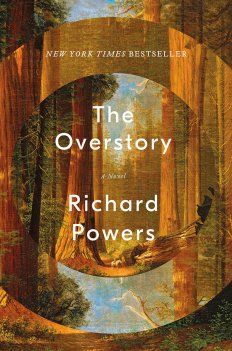
TheOverstoryOlivia Vandergriff miraculously survives an electrocution to become an ecowarrior after she begins to hear the voices of the trees. She rallies others to embrace the urgency of activism in fighting the destruction of California’s redwoods and even camps in the canopy of one of the trees to deter the logging. When the ancient tree she has unsuccessfully protected is felled, the sound is “like an artillery shell hitting a cathedral.” Vandergriff weeps for this magnificent thousand-year old tree. So do I. Perhaps the real heroes of this novel are the ancient trees.

In his review of Overstory in The Guardian, Banjamin Markovits wrote, “ There is something exhilarating…in reading a novel whose context is wider than human life. Like Moby-Dick, The Overstory leaves you with a slightly adjusted frame of reference… And I found, while reading, that some of what was happening to his characters passed into my conscience, like alcohol into the bloodstream, and left a feeling behind of grief or guilt, even after I put it down.”

Powers challenges us to champion the forest.
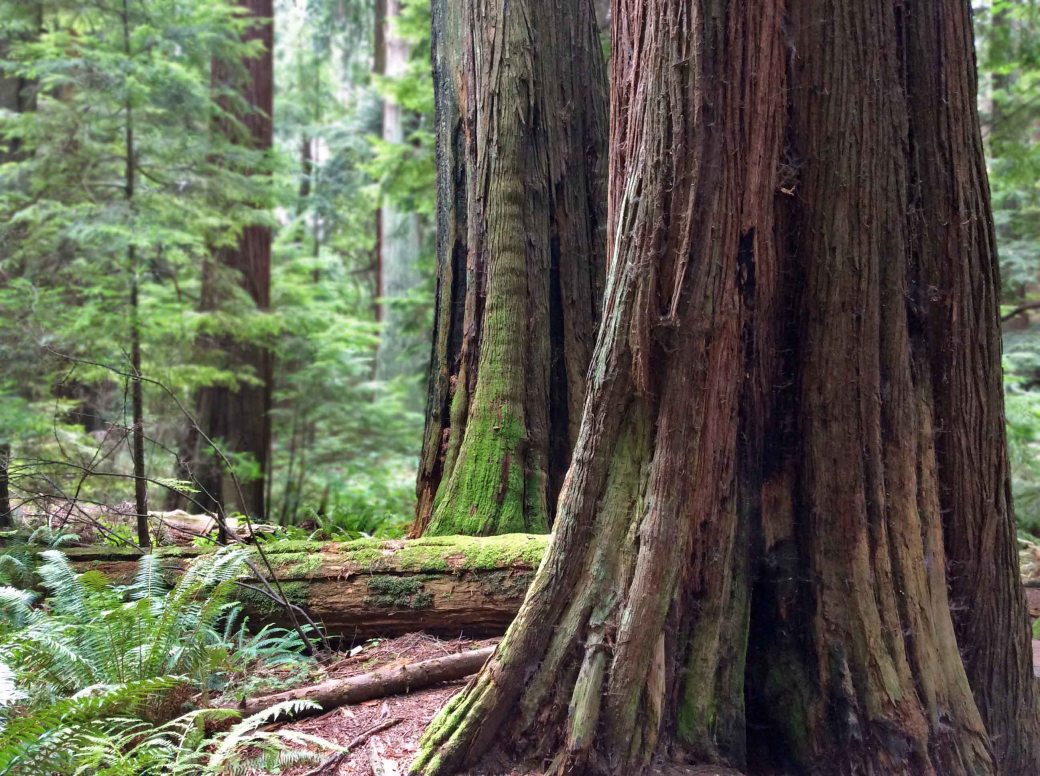
Cedar Giants-LHP

Ancient cedars in Lighthouse Park, West Vancouver, BC (photo by Nina Munteanu)

The Intellectual OPTIMISM of Annie Proulx  

AnnieProulx

Annie Proulx

Annie Proulx’s Barkskins chronicles two immigrants who arrive in Canada in 1693 (Rene Sel and Charles Duquet) and their descendants over 300 years of deforestation of North America starting with the arrival of the Europeans to contemporary global warming. “Barkskins” (woodcutters) are, in fact indentured servants who were brought from the Paris slums to the wilds of New France “to clear the land, to subdue this evil wilderness,” says their seigneur. Sel is forced to marry a native woman and their descendants live trapped between two cultures; Duquet runs away to become a fur trader and build a timber empire.

barkskinsProulx immerses the reader in rich sensory detail of a place and time, equally comfortable describing a white pine stand in Michigan and logging camp in Upper Gatineau to a Mi’kmaq village on the Nova Scotia coast or the stately Boston home of Charles Duquet. The foreshadowing of doom for the magnificent forests is cast by the shadow of how settlers treat the Mi’kmaq people. The fate of the forests and the Mi’kmaq are inextricably linked through settler disrespect and a fierce hunger for “more.”

The novel rolls out events in a relentless stream of life and death; no character is safe from the ravages of nature or the notions of that time period. While most of the book flows like a great amoral river—filled with feckless, unheroic and at times miserable characters—there are moments of emotional shoring. They act like exclamation marks for their rarity. By the 1830s, the character, German forester Armenius Breitsprecher, expresses anger and frustration with his colleagues:

LittleRougeRiver-TreeUp copy

White pine, Little Rouge River forest, Ontario

“Not for the first time he saw that the acquisitive hunger of Duke & Sons was so great they intended to clear the continent. And he was helping them. He hated the [lumber companies] clear-cut despoliation, the insane wastage of sound valuable wood, the destruction of soil, the gullying and erosion, the ruin of the forest world with no thought for the future—the choppers considered the supply to be endless—there was always another forest.”

Proulx’s unsentimental narrative and grand historic set-pieces lure the reader first to passively observe humanity’s struggles with the grand forest; then, once immersed, we are nudged to participate along with the awakening of the human consciousness over the generations of her 300-year long saga—first in the early 1900s through Conrad and Charley who recognize the importance of a functional forest ecosystem then through current day ecologist Sapatisia Sel (descendant of Rene), who responds to a scientist’s claim of  “A great crisis is just ahead” with “The forests, the trees, they can change everything!”

Cedar-boardwalk copy

Giant Cedars boardwalk, Alberta (photo by Nina Munteanu)

The suggestion is that, while we remain inextricably embedded in time and place—we are also progenitors of change to our future generations. Three hundred years ago, our beliefs and knowledge prevented us from acting sustainably. We know better now. The time to save our forests and let them save us is now.

“The reader comes to realize that the novel isn’t really about the human characters so much as it is about the forests,” Gus Powell of The National Post concludes of Barkskins. “As [the forests] disappear, the narrative seems to recede in importance, revealing a crucial interdependence between the human and the natural world previously handled almost entirely as subtext. This is especially true in the novel’s closing, where the anger and despair that have characterized the novel shift into an outspoken environmental advocacy.” This is the essence of optimism…

Proulx dares us to believe in the forest.

*****
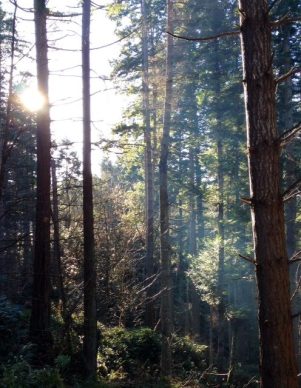
Forest conifers Metchosin

Forest in Metchosin, BC (photo by Nina Munteanu)

Whether philosophical, pragmatic, existentialist, fierce or intellectual, “Optimism is the faith that leads to achievement…No pessimist ever discovered the secret of the stars, or sailed to an uncharted land, or opened a new doorway for the human spirit,” wrote Helen Keller. In her recent book Breaking Murphy’s Law, Suzanne Segerstrom demonstrates the connection between optimists and their investment in goal setting and achievement. The trick to avoiding the cynicism that may come with complacent optimism (thinking, hoping and wishing for good things to happen) is through the simple action of engagement. “Optimists,” says Segerstrom, “are happy and healthy not because of who they are but because of how they act. Optimism is more what we do than what we are, and thereby can be learned.”

I hope so. If we connect, interact and learn, and be the forest, we may find the strength and passion to champion the forest we believe in.


nina-2014aaa

Nina Munteanu is a Canadian ecologist / limnologist and novelist. She is co-editor of Europa SF and currently teaches writing courses at George Brown College and the University of Toronto. Visit www.ninamunteanu.ca for the latest on her books. Nina’s bilingual “La natura dell’acqua / The Way of Water” was published by Mincione Edizioni in Rome. Her non-fiction book “Water Is…” by Pixl Press (Vancouver) was selected by Margaret Atwood in the New York Times ‘Year in Reading’ and was chosen as the 2017 Summer Read by Water Canada. Her novel “A Diary in the Age of Water” will be released by Inanna Publications (Toronto) in 2020.

 

Investing in The Future by Embracing (Climate) Change

Wir müssen uns immer verändern, erneuern, verjüngen; sonst verhärten wir.—Goethe


Nina-reading-Ward Is

Nina reading “How to Read Water” on Algonquin Island, Ontario (photo by Nina Munteanu)

In his book, How to Read Water, Tristan Gooley describes a phenomenon called clapotis gaufre. Also known as “waffled clapotis”, the term comes from the French word (clapotis) for “lapping” and describes a standing wave phenomenon created by the troughs and crests of waves as they hit and reflect back from a barrier. The incoming and reflected outgoing waves, in passing each other, form a waffle-pattern that bobs up and down but otherwise appears stationary.

In fact, it is far from stationary.

But we like “stationary.” So much so that, despite the magnitude of planetary-scale change, everything appears stationary to us. People go on with their daily lives as they have for generations: driving cars; living profligately; wastefully consuming energy, disposables and water; bickering about fuel taxes and job security. But this is an illusion, a very dangerous one. Surface inertia hides a depth of motion. In a river, where high-velocity water roars over a steep river-bottom depression, a frothy stationary breaker forms; it is the most dangerous part of the river. What we can’t see, we think won’t hurt us. But what if we could see the ominous dark cloud of carbon dioxide and methane blotting more and more of our sky? What if we could see the fumes billowing out of our cars and the heat radiating from our homes? Or smell the toxins spilling into our rivers and lakes? Or the quiet extinctions happening by the minute in the wilderness?

oneyearbeijing

Photographs of same Beijing location over a year showing smog days


Old tree deer lake park

Old oak tree in Deer Lake Park, BC

What if we could see the fractal signs of change?

Nothing in nature stays the same. If it does, that’s because change has brought it back to what it once was. Trees move. They grow wider and taller; they just do it at a pace beyond our impatient lifestyle. Because their motion is invisible, they are invisible. We think of trees as stationary objects, not living beings. Like a standing wave of frozen time. We observe through the hurried lens of human impatience and self-preoccupation. A quick glance takes in a scene. We forget that we can “see” with other senses. Smell. Touch. Taste. Hearing. As hyposmia and disinterest dulls our senses, we grow less able to recognize the verisimilitudes of Nature’s trompe l’oeils. Trapped by our preordained notions, we no longer see the changes we’re not prepared to see. And that’s the change that kills us.

In witnessing the collapse of fish populations on the west coast in the ‘90s, UBC fisheries biologist Daniel Pauly noticed that people just went on fishing ever smaller fish. The collapse occurred through what he called “creeping disappearance.” Pauly named this impaired vision “shifting baseline syndrome,” a willing ignorance of consequence based on short-term gain.

One could argue that the inability to feel and connect beyond our immediate line of sight can be a good thing—a kind of selective memory that allows us to adapt to each “new normal.” Mothers of several children can testify to the benefits of “forgetting” their hours of labour to give birth. Hence the ability and willingness to repeat this very painful experience. Is this part of successful biological adaptation in all of us? The ability to reset?

Nina-Kevin playing

Author and her son enjoy an outing

Or is it rather that our mother chooses not to forget but to relegate her memory of the previous birth behind something far more beautiful and wondrous to remember and something she is deeply connected to: the miraculous birth of her child—her investment in the future. Shifting baseline syndrome is part of a larger amnesia, one that encompasses many generations; a selective memory driven by short-sightedness that comes mostly from lack of connection. But to successfully invest in our future, that is precisely what we must do: connect.

If only we could see the fractal signs of change…

Bill McKibben wrote in The New Yorker, “Climate change isn’t just a threat. It’s an opportunity for us to live happier, more fulfilling lives.” True happiness comes with long-term fulfillment, not short-term material wealth and comfort. When we focus from ourselves to embrace the changing world—to connect—we discover a well-spring of altruistic happiness. When we embrace, we transcend. When we transcend, we become fluid with change. That is when we succeed.

quote by Goethe: “We must always change, renew, rejuvenate ourselves; otherwise we harden.”


nina-2014aaa

Nina Munteanu is a Canadian ecologist / limnologist and novelist. She is co-editor of Europa SF and currently teaches writing courses at George Brown College and the University of Toronto. Visit www.ninamunteanu.ca for the latest on her books. Nina’s bilingual “La natura dell’acqua / The Way of Water” was published by Mincione Edizioni in Rome. Her non-fiction book “Water Is…” by Pixl Press (Vancouver) was selected by Margaret Atwood in the New York Times ‘Year in Reading’ and was chosen as the 2017 Summer Read by Water Canada. Her novel “A Diary in the Age of Water” will be released by Inanna Publications (Toronto) in 2020.
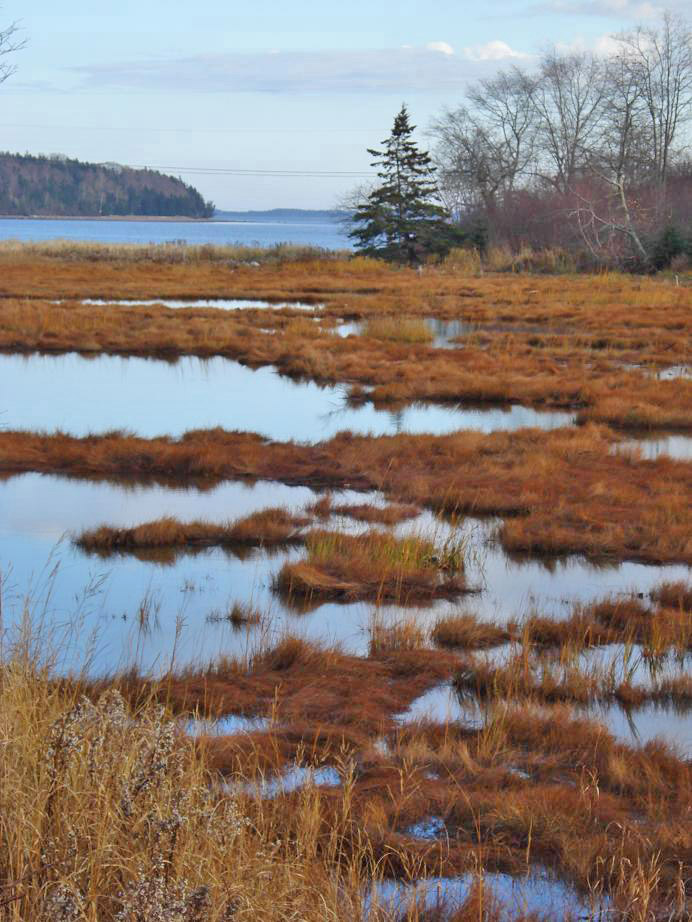


Nina Munteanu’s Short Story “Natural Selection” features in Eagle Literary Magazine Issue #1

NaturalSelection-IonutiBanuta

Illustration by Ionuț Bănuță

Sarah reached the summit, panting for breath, and grinned at her prize. She’d just caught the sun trembling over the horizon, before it dipped out of sight and left a glowing sky under pewter clouds. She glanced behind her, where the towers of Icaria blazed like embers catching fire. Struck by their beauty, Sarah admired their smooth, clean surfaces. When she looked back toward the path, the sanguine images burnt into her eyes.

Which way should she go? The deer path she’d followed now diverged into two smaller ones. She shifted her mind to veemeld with her AI, DEX. Which way should we go, DEX?

Her AI answered in her head: Sarah, shouldn’t you be returning inside? It’s dangerous to stay out this long. Statistics are now against you for getting caught—

Just a few more minutes, DEX. How about to the right?

“Natural Selection” tells the story of Sarah, an unruly veemeld who can speak to the machine world that runs Icaria. Given her immunity to the environmental disease ravaging the enclosed city, Sarah—at least her genetic material—is sought after by the Ecologist government in a bid to maintain order and reshape humanity through “selection”; but Sarah fraternizes with unsavory friends and her truant behaviour poses a great risk to her freedom and survival.

Eagle-1issue-summer2019_Cover_1600“Natural Selection” first appeared in 2013 in my short story collection of the same name by Pixl Press. The story returns in Issue #1 of Eagle Literary Magazine, Pan European Science Fiction & Fantasy Collection (Summer 2019; Nexus Project) edited by Mugur Cornilă and featuring the impeccable artwork of Ionuț Bănuță.

In the 2013 Pixl Press short story collection my introduction describes the theme that embraces the nine stories in the collection:

How do we define today a concept that Darwin originated 200 years ago in a time without bio-engineering, nano-technology, chaos theory, quantum mechanics and the internet? We live in an exciting era of complicated change, where science based on the limitation of traditional biology is being challenged and stretched by pioneers into areas some scientists might call heretical. Endosymbiosis, synchronicity, autopoiesis & self-organization, morphic resonance, Gaia Hypothesis and planetary intelligence. Some of these might more aptly be described through the language of meta physics. But should they be so confined? It comes down to language and how we communicate.

Is it possible for an individual to evolve in one’s own lifetime? To become more than oneself? And then pass on one’s personal experience irrevocably to others—laterally and vertically?

On the vertical argument, the French naturalist Jean-Baptiste Lamark developed a theory of biological evolution in the early 19th century considered so ridiculous that it spawned a name: Lamarkism. His notion — that acquired traits could be passed along to offspring—was ridiculed for over two hundred years. Until he was proven right. Evolutionary biologists at Tel Aviv University in Israel showed that all sorts of cellular machinery — an intelligence of sorts — played a vital role in how DNA sequences were inherited. When researchers inserted foreign genes into the DNA of lab animals and plants, something strange happened. The genes worked at first; then they were “silenced”. Generation after generation. The host cells had tagged the foreign genes with an “off switch” that made the gene inoperable. And although the new gene was passed onto offspring, so was the off switch. It was Larmarkism in action: the parent’s experience had influenced its offspring’s inheritance. Evolutionists gave it a new name. They called it soft inheritance [also known as epigenetics].

NaturalSelection-IonutBanua2

Illustration by Ionuț Bănuță

Horizontal gene transfer (HGT) is the movement of genetic material between organisms other than by vertical transmission of DNA from parent to offspring. Jumping genes (transposons) are mobile segments of DNA that may pick up a gene and insert it into a plastic or chromosome. Pieces of DNA move from one locus to another of a genome without parent-to-offspring by horizontal transposon transfer (HTT). Epigenetics describes the modification of DNA expression through DNA methylation—and results in “Lamarkism.” Transgenerational epigenetic inheritance is the new black: genes and environments interacting. Where do we end and where does environment begin? Researchers have proven the significant role of environmental feedback through HGT in evolutionary success. Researchers showed that up to 20% of a bdelloid rotifer’s genome is made of foreign genes that they stole from the environment through horizontal gene transfer and gene conversion. This compares to about 1% for humans and a fifth for tardigrades.

—excerpts from “A Diary in the Age of Water” due for release in 2020 by Inanna Publications.

Diary Water cover finalAs for passing on one’s experience and acquisitions to others laterally, education in all its facets surely provides a mechanism. This may run the gamut from wise mentors, spiritual leaders, storytellers, courageous heroes to our kindergarten teacher.  Who’s to say that these too are not irrevocable? This relies, after all, on how we learn, and how we “remember”.
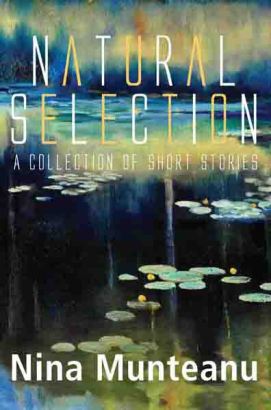
Evolution is choice. It is a choice made on many levels, from the intuitive mind to the intelligent cell. The controversial British botanist Rupert Sheldrake proposed that the physical forms we take on are not necessarily contained inside our genes, which he suggested may be more analogous to transistors tuned in to the proper frequencies for translating invisible information into visible form. According to Sheldrake’s morphic resonance, any form always looks alike because it ‘remembers’ its form through repetition and that any new form having similar characteristics will use the pattern of already existing forms as a guide for its appearance.  This notion is conveyed through other phenomena, which truly lie in the realm of metaphysics and lateral evolution; concepts like bilocation, psychic telegraphing, telekinesis and manifestation. Critics condemn these as crazy notions. Or is it just limited vision again? Our future cannot be foretold in our present language; that has yet to be written. Shakespeare knew this…

There are more things in heaven and earth , Horatio, than are dreamt of in your philosophy—Shakespeare

NaturalSelection-front-webEach story in the “Natural Selection” short story collection reflects a perspective on what it means to be human and evolve in a world that is rapidly changing technologically and environmentally. How we relate to our rapidly changing fractal environments—from our cells to our ecosystems, our planet and ultimately our universe—will determine our path and our destiny and those we touch in some way.

My friend Heidi Lampietti, publisher of Redjack Books, expressed it eloquently, “For me, one of the most important themes that came through in the collection is the incredible difficulty, complexity, and importance of making conscious choices — and how these choices, large and small, impact our survival, either as individual humans, as a community, a species, or a world.”

DarwinsParadox-Cover-FINALsmall“Natural Selection” also features the sprawling semi-underground AI-run city of Icaria (a post-industrial plague Toronto) that was first introduced in my novel “Darwin’s Paradox” and is a character itself. Sarah is a “gifted” and troubled misfit—not in sync with the rest of the population. Yet her choices—and how she is treated by her community— will influence an entire species and world.


You can purchase Issue #1 of Eagle Literary Magazine in the United Kingdom, United States, Spain, Italy, France, Germany, Japan, Canada.


nina-2014aaaNina is a Canadian scientist and novelist. She worked for 25 years as an environmental consultant in the field of aquatic ecology and limnology, publishing papers and technical reports on water quality and impacts to aquatic systems. Nina has written over a dozen eco-fiction, science fiction and fantasy novels. An award-winning short story writer, and essayist, Nina currently lives in Toronto where she teaches writing at the University of Toronto and George Brown College. Her non-fiction book “Water Is…”—a scientific study and personal journey as limnologist, mother, teacher and environmentalist—was picked by Margaret Atwood in the New York Times as 2016 ‘The Year in Reading’. Nina’s most recent novel “A Diary in the Age of Water”— about four generations of women and their relationship to water in a rapidly changing world—will be released in 2020 by Inanna Publications.