Story is place, and place is character—Nina Munteanu
 I write mostly eco-fiction. Even before it was known as eco-fiction, I was writing it. My first book—Darwin’s Paradox—published in 2007 by Dragon Moon Press as science fiction, was also eco-fiction. It takes place in 2075 after climate change has turned southern Ontario into a heathland and Toronto into a self-enclosed city. My latest eco-fiction—A Diary in the Age of Water published in 2020 by Inanna Publications—is set mostly in Toronto from the near-future to 2065 and beyond.
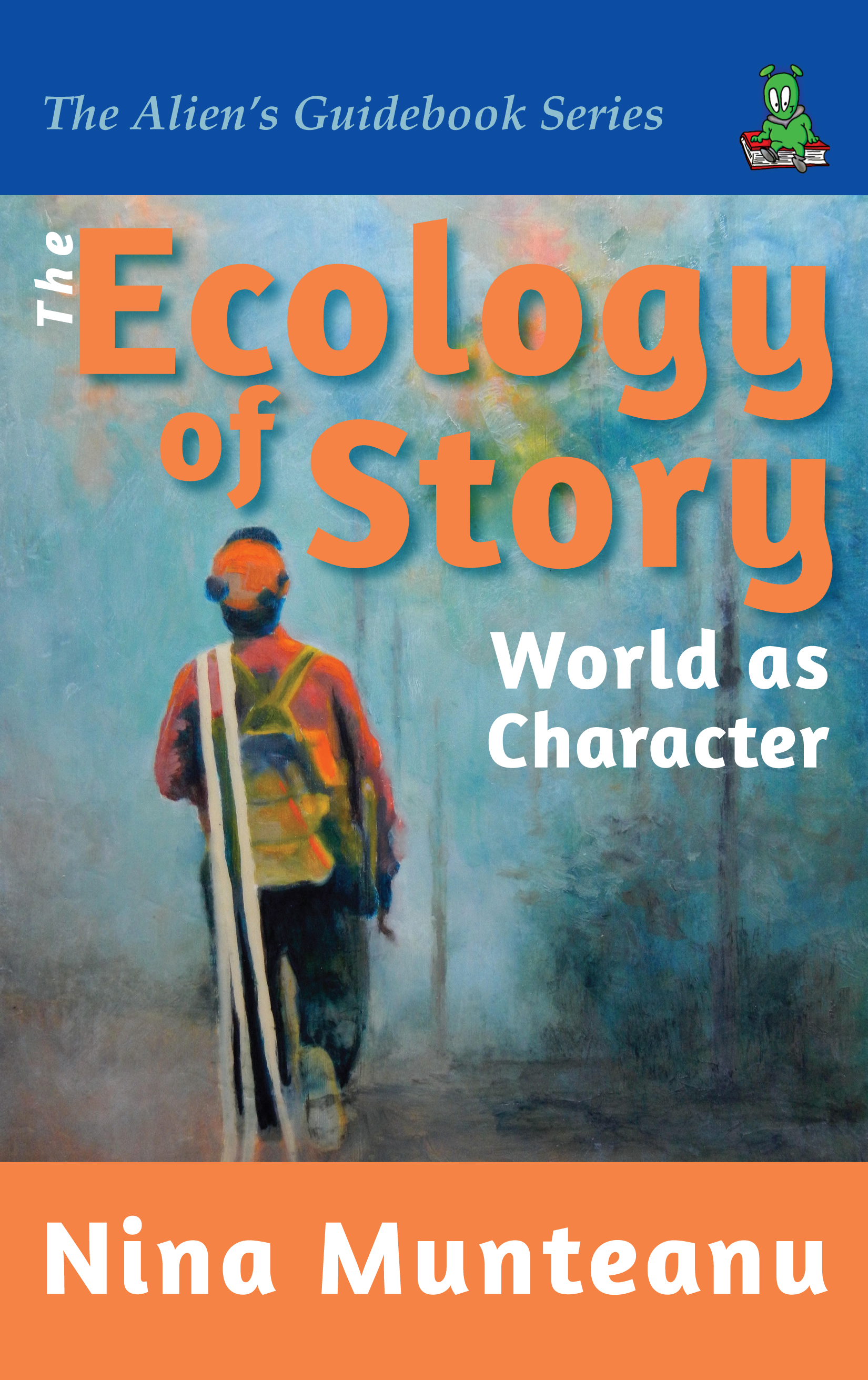
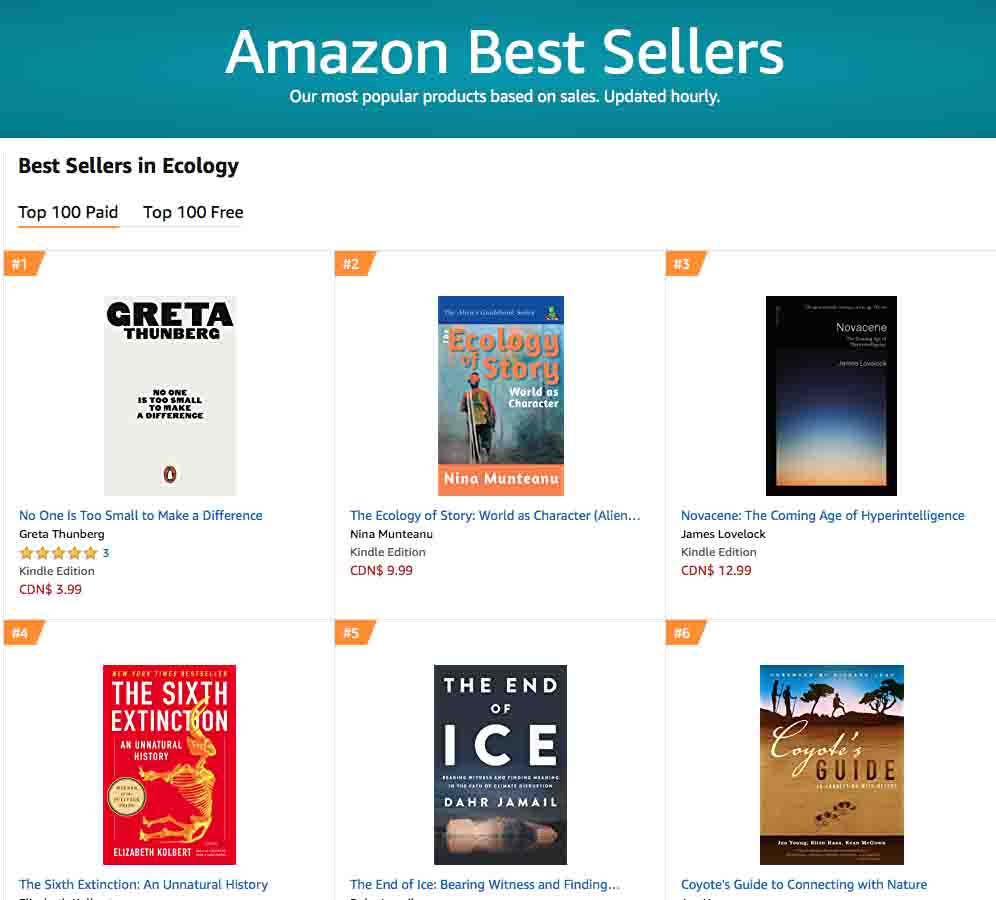
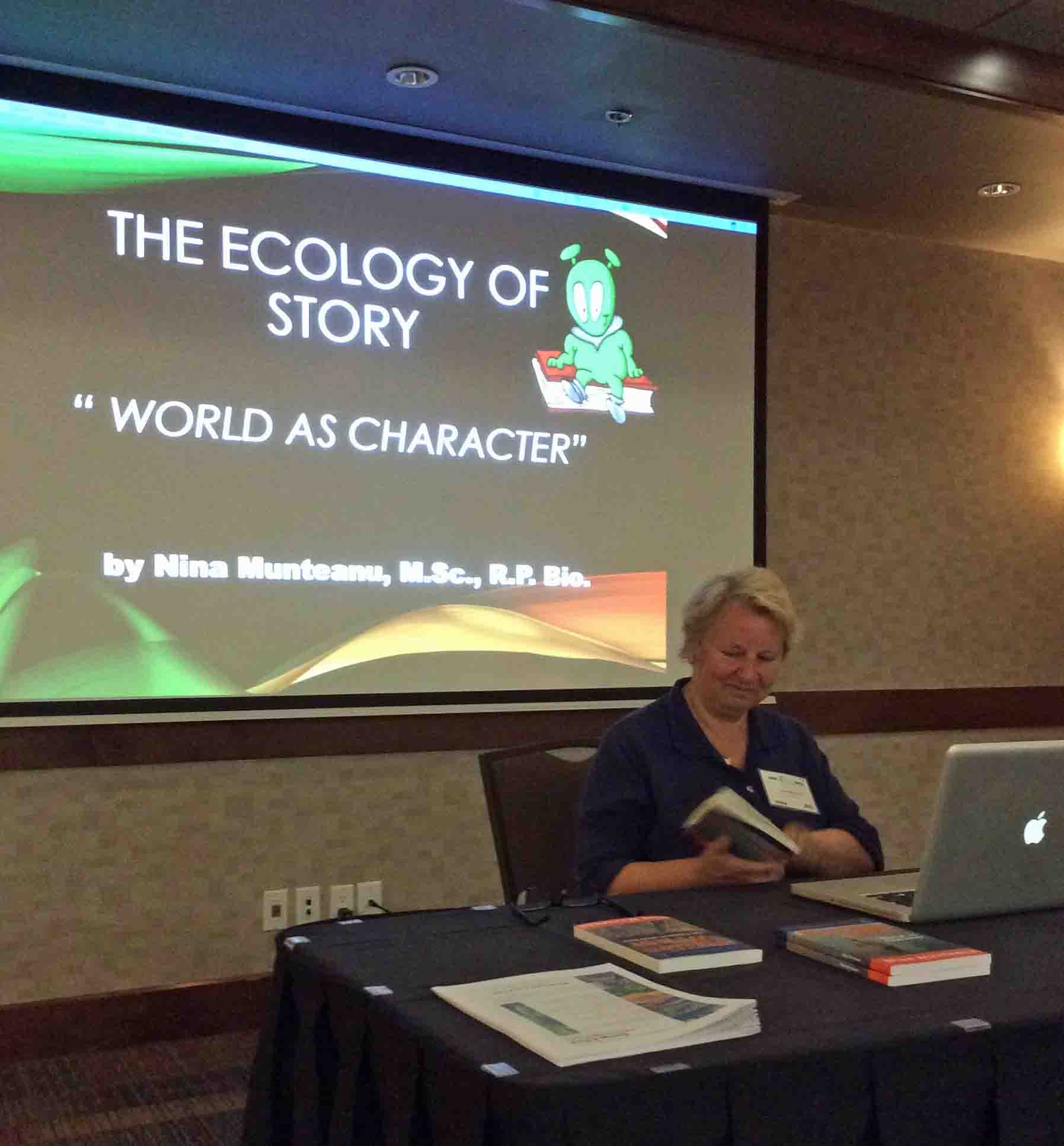
As a writer of eco-fiction and climate fiction, I’m keenly aware of the role environment plays in story. Setting and place are often subtle yet integral aspects of story. In eco-fiction, they can even be a “character,” serve as archetypes and present metaphoric connections to characters on a journey (see my guidebook The Ecology of Story: World as Character published by Pixl Press for more discussion on all aspects of nature’s symbols in writing).
 Things to consider about place as character begin with the POV character and how they interact with their environment and how they reflect their place. For instance, is that interaction obvious or subtle? Is that environment constant or changing, stable or unstable, predictable, or variable? Is the place controllable or not, understandable or not? Is the relationship emotional, connected to senses such as memory?
Place as character serves as an archetype that story characters connect with and navigate in ways that depend on the theme of the story. A story’s theme is essentially the “so what part” of the story. What is at stake for the character on their journey. Theme is the backbone—the heart—of the story, driving characters to journey through time and place toward some kind of fulfillment. There is no story without theme. And there is no theme without place.
Archetypes are ancient patterns of personality shared universally by humanity (e.g. the “mother” archetype is recognized by all cultures). When place or aspects of place act as an archetype or symbol in story—particularly when linked to theme—this provides a depth of meaning that resonates through many levels for the reader.
In Ray Bradbury’s The Martian Chronicles, Mars symbolizes a new Eden. Like Bradbury’s aboriginal Martians—who are mostly invisible—the planet is a mirror that reflects humanity’s best and worst. Who we are, what we are, what we bring with us and what we may become. What we inadvertently do—to others, and finally to ourselves—and how the irony of chance can change everything.
“Nature’s symbols are powerful archetypes that reveal compelling story,” writes Donald Maass in Write the Breakout Novel Workbook.
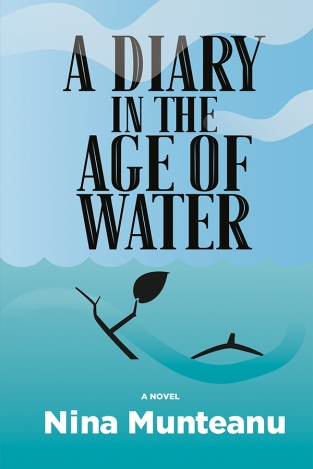 Water has been used as a powerful archetype in many novels. In my latest novel, A Diary in the Age of Water, water plays an important role through its unique metaphoric connection with each of the four main characters; how they relate to it and understand it, and act on its behalf. Water in A Diary in the Age of Water is often personified; water reflects various symbolic and allegorical interpretations and embraces several archetypes including herald-catalyst, trickster, shapeshifter, and shadow.
Strong relationships and linkages can be forged in story between a major character and an aspect of their environment (e.g., home/place, animal/pet, minor character as avatar/spokesperson for environment).
 In these examples the environmental aspect serves as symbol and metaphoric connection to theme. They can illuminate through the sub-text of metaphor a core aspect of the main character and their journey: the grounding nature of the land of Tara for Scarlet O’Hara in Margaret Mitchel’s Gone With the Wind; the white pine forests for the Mi’kmaq in Annie Proulx’s Barkskins; The animals for Beatrix Potter of the Susan Wittig Albert series.
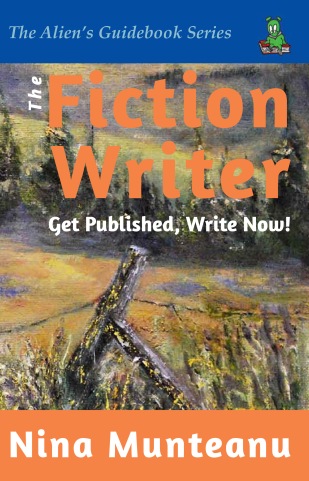
All characters—whether the main POV character, or a minor character or personified element of the environment—have a dramatic function in your story. In my writing courses at George Brown College and The University of Toronto and in my guidebook The Fiction Writer, I provide a list of questions you can ask your character to determine if they are functioning well in the story and if they should even stay in the story. I call it interviewing your character. You can interview any character in your story; it can provide incredible insight. And speaking of character…
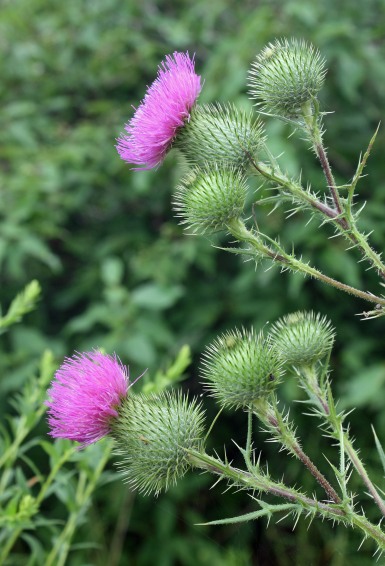
I have of late been walking daily to a lovely meadow beside a stream and thicket where brilliant Bull thistles have burst into flower. I felt the need to research this beautiful yet dangerously prickly plant and why it peaked my interest…
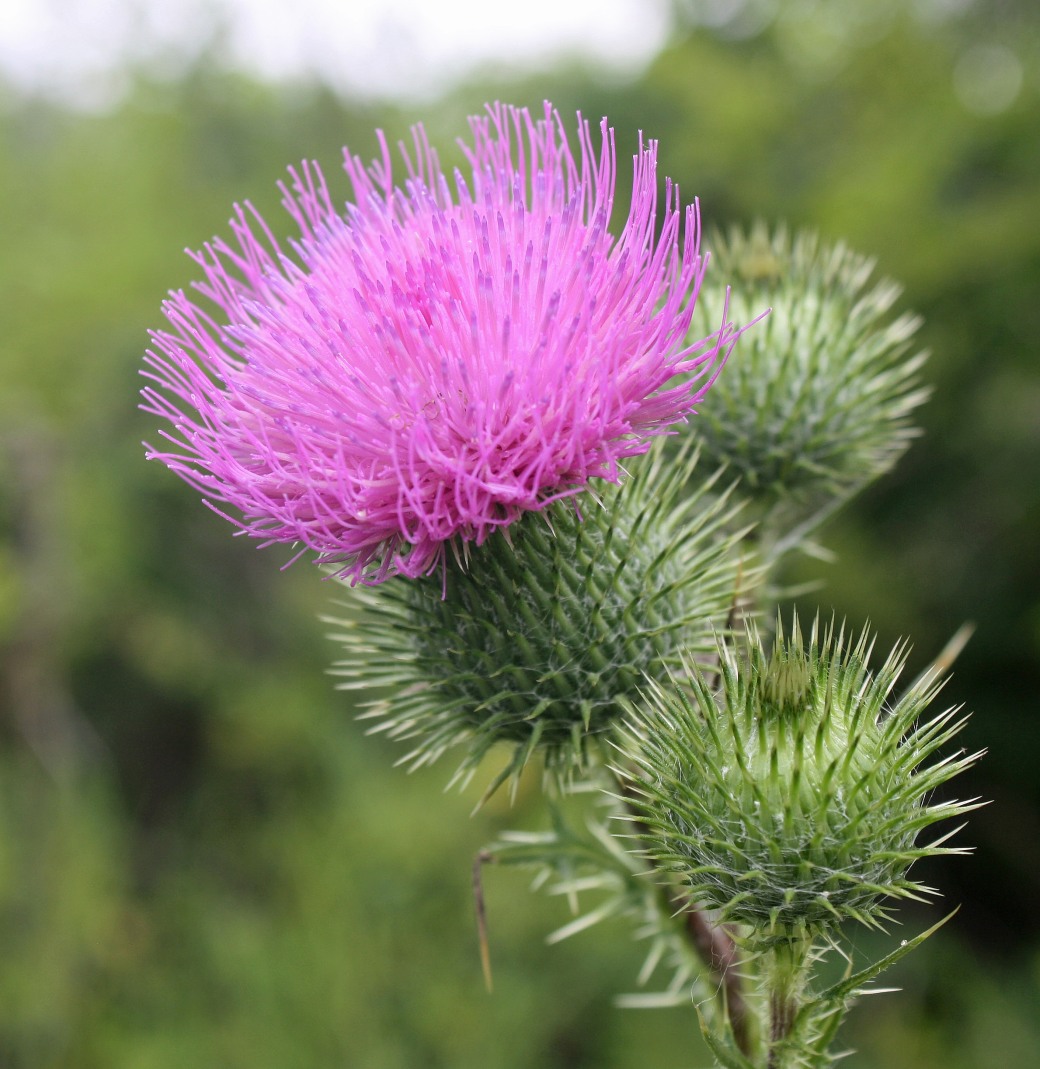
Bull Thistle, ON (photo by Nina Munteanu)
Interview With the Bull Thistle
Nina: Pardon my saying, but you seem to scream paradox. You’re dangerously beautiful. Alluring yet aloof. Standoffish, even threatening. For instance, how is it that you have such a beautiful single purple-pink flower at the top of such a nasty prickly stem and leaves?
Bull Thistle: First of all, it isn’t just a flower at the top; it’s a flower head of over two hundred flowers called florets. Each flower head is a tight community of tube disk bisexual florets arranged in Fibonacci spirals and protected by a collection of spiked bracts called an involucre. And inside the protective outer shell, embedded in a fleshy domed receptacle, are the tiny ovaries, waiting patiently to be fertilized and grown into a seed or achene.

Honey bee getting nectar from the thistle flower head (photo by Nina Munteanu)
Nina: Ah, I beg your pardon. But you still have all those sharp spikes everywhere. I’m guessing they are to protect your developing young, the ovaries. But doesn’t that isolate you? Keep you from integrating in your ecosystem?
Bull Thistle: The bristles are specifically aimed at predators who wish to harm us, eat us, bore into us, pull us out of the earth. We have many friends—the pollinators, the bees, wasps, and butterflies that help us cross-pollinate from plant to plant. And the birds—particularly the goldfinches—also help.
Nina: Wait. Don’t goldfinches eat your babies—eh, seeds?
Bull Thistle: They do. But they also help disperse our children. They land on our dried involucres—now opened to reveal the seeds and their pappus. The birds pull the seeds out by the thistle down that rides the wind. The birds eat the seeds and also use the thistle down to make their nests. But—like the squirrels who love oak acorns—the birds miss as many as they eat. By carrying the down to their nests, they also help the seeds travel great distances farther than the wind would have carried them. By dislodging the seeds in bunches, they help the seeds break away from the receptacle and meet the wind. The pappus, which is branched and light like a billowing sail, carries the seed on the wind to germinate elsewhere to help us colonize.
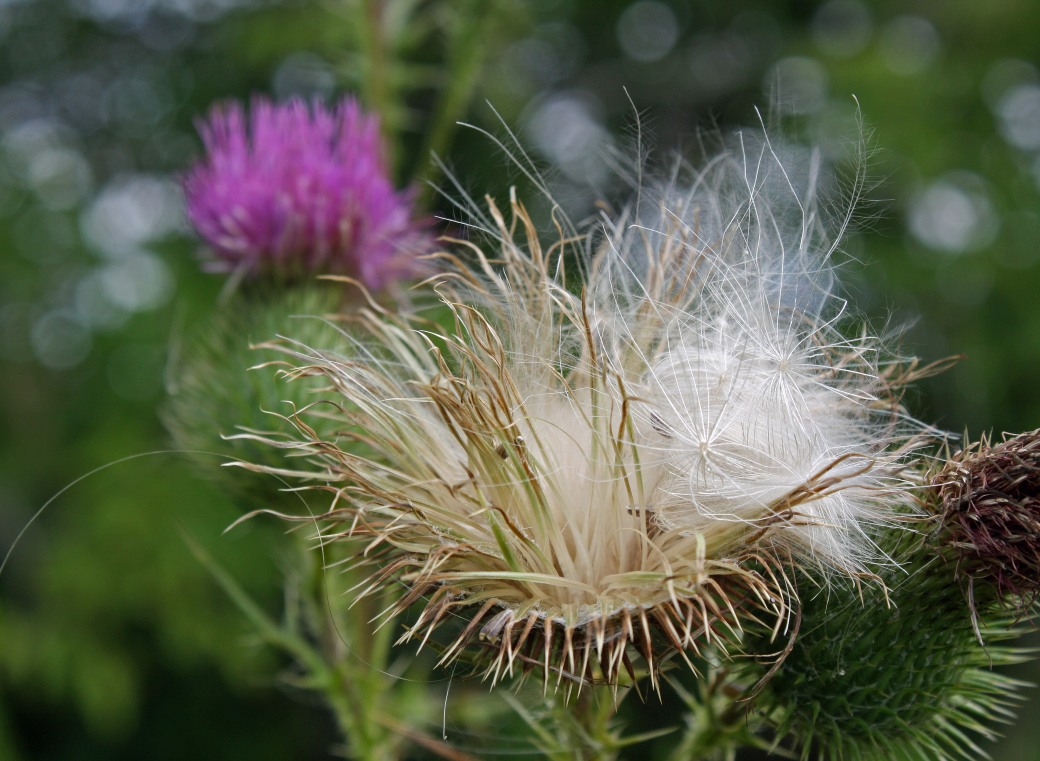
Opened involucre with achenes and pappus ready to disperse, ON (photo by Nina Munteanu)
Nina: So, your enemy is also your friend… The shadow character, who helps the hero on her journey by presenting a perilous aspect of enlightenment.
Bull Thistle: If you say so. What we understand is that Nature’s resilience derives from the balance of give and take over time. Prey and predator. Death, decay, transcendence. Destruction and creation. Ecological succession and change are a gestalt expression of Gaia wisdom as each individual fulfills its particular existential niche. Even if that is to die…for others to live.
Nina: Yes, the hero’s journey…But you’re not originally from here, are you? You were brought to North America from Eurasia. Some consider you an interloper, a disturbance. You could serve the shadow or trickster archetype yourself—outcompeting the native thistle, creating havoc with pasture crops. You can tolerate adverse environmental conditions and adapt to different habitats, letting you spread to new areas. Your high seed production, variation in dormancy, and vigorous growth makes you a serious invader. You cause wool fault and physical injury to animals. Storytellers might identify you metaphorically with the European settler in the colonialism of North America; bullying your way in and destroying the natives’ way of life.
Bull Thistle: We’re unaware of these negative things. We don’t judge. We don’t bully; we simply proliferate. We ensure the survival of our species through adaptation. Perhaps we do it better than others. You’ve lately discovered something we’ve felt and acted on for a long time. Climate is changing. We must keep up with the times… But to address your original challenge, if you did more research, you would find that we serve as superior nectar sources for honey bees (Apis spp.), bumblebees (Bombus spp.) and sweat bees (Anastogapus spp.) who thoroughly enjoy our nectar.

Sweat bee draws the sweet nectar of the Bull Thistle, ON (photo by Nina Munteanu)
We’re considered a top producer of nectar sugar in Britain. Cirsium vulgare—our official name—has ranked in the top 10 for nectar production in a recent UK survey. The goldfinch relies on our seed and down. And we’ve provided food, tinder, paper, and medicine to humans for millennia. As some of your indigenous people point out, it’s a matter of attitude. Change is opportunity.
 Nina: I guess that every weed was once a native somewhere. I also agree that times are changing—faster than many of us are ready for, humans included. If you were to identify with an archetype, which would you choose?
Bull Thistle: That would depend on the perceiver, we suppose. Some of us think of us as the hero, journeying through the change and struggling to survive; others see us as the herald, inciting movement and awareness by our very existence; some of us identify with the trickster, others with the shapeshifter—given how misunderstood we are. In the end, perhaps, we are the mentor, who provides direction through a shifting identity and pointing the way forward through the chaos of change toward enlightenment.
Nina: Yes, I suppose if someone stumbled into your nest of prickles, incredible awareness would result. Speaking of that very awareness, this brings me back to my original question: why are you so beautiful yet deadly?
Bull Thistle: We are the purest beauty—only attained through earnest and often painful awareness. We are the future and the beauty of things to come.
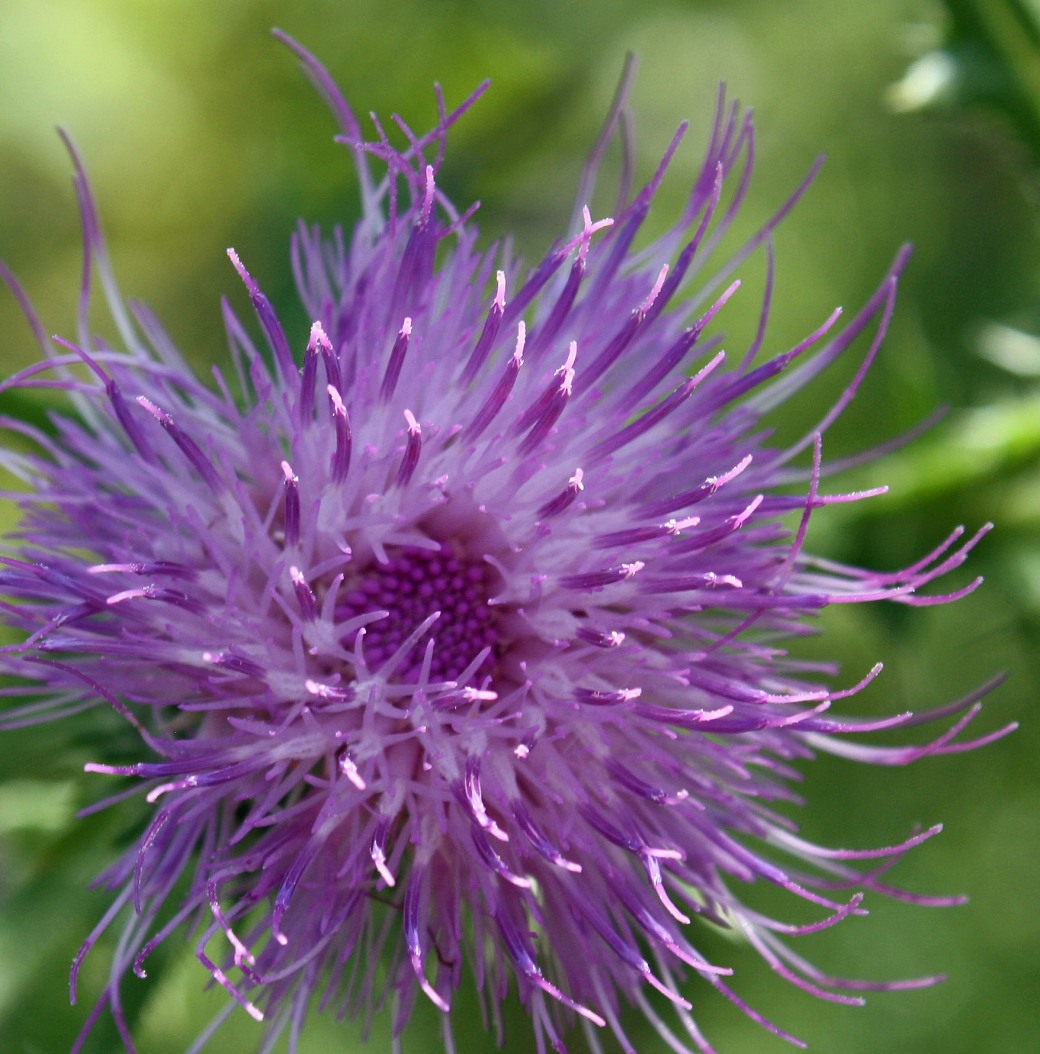
Flower head of Bull Thistle, ON (photo by Nina Munteanu)
You can read more on this topic in Nina’s writing guidebook series, particularly The Fiction Writer: Get Published, Write Now! and The Ecology of Story: World as Character.
Relevant Articles:
The Ecology of Story: Revealing Hidden Characters of the Forest
Ecology of Story: World as Character” Workshop at When Words Collide
Ecology of Story: Place as Allegory
Ecology of Story: Place as Symbol
Ecology of Story: Place as Metaphor
Ecology of Story: Place as Character & Archetype

Nina Munteanu is a Canadian ecologist / limnologist and novelist. She is co-editor of Europa SF and currently teaches writing courses at George Brown College and the University of Toronto. Visit www.ninamunteanu.ca for the latest on her books. Nina’s bilingual “La natura dell’acqua / The Way of Water” was published by Mincione Edizioni in Rome. Her non-fiction book “Water Is…” by Pixl Press(Vancouver) was selected by Margaret Atwood in the New York Times ‘Year in Reading’ and was chosen as the 2017 Summer Read by Water Canada. Her novel “A Diary in the Age of Water” was released by Inanna Publications (Toronto) in June 2020.
 We are now living in the Age of Water. Water is the new “gold”, with individuals, corporations and countries positioning themselves around this precious resource. Water is changing everything. The Age of Water Podcast covers anything of interest from breaking environmental news to evergreen material. This also includes human interest stories, readings of eco-literature, discussion of film and other media productions of interest.
 Patricia Westerford—whose work resembles that of Diana Beresford-Kroeger (author of The Global Forest) and UBC’s
  In his review of Overstory in

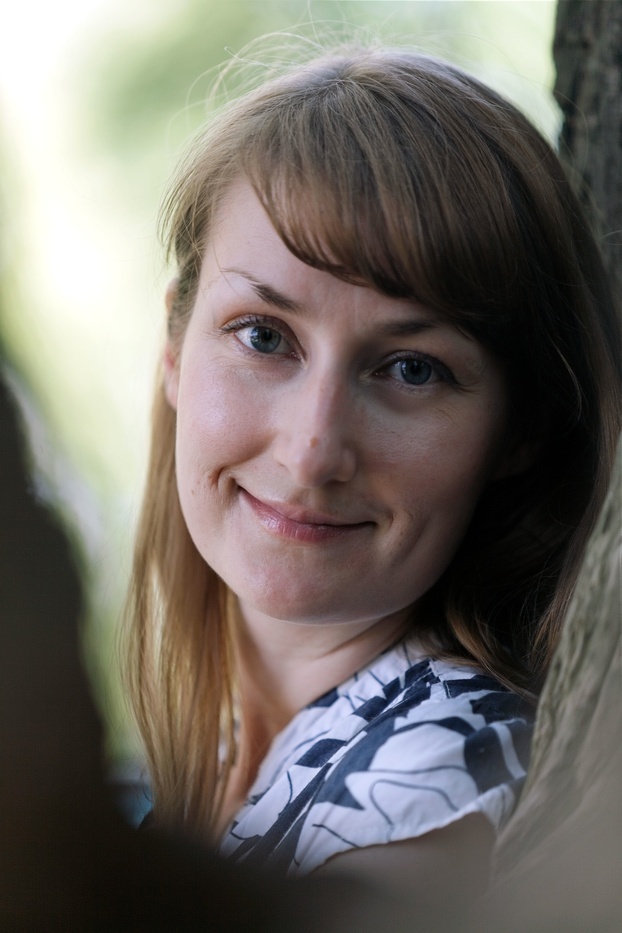
 Emmi Itäranta is an award-winning Finnish author. She holds a MA in Drama from the University of Tampere and worked as a columnist, theatre critic, script writer and press officer. She wrote her debut novel
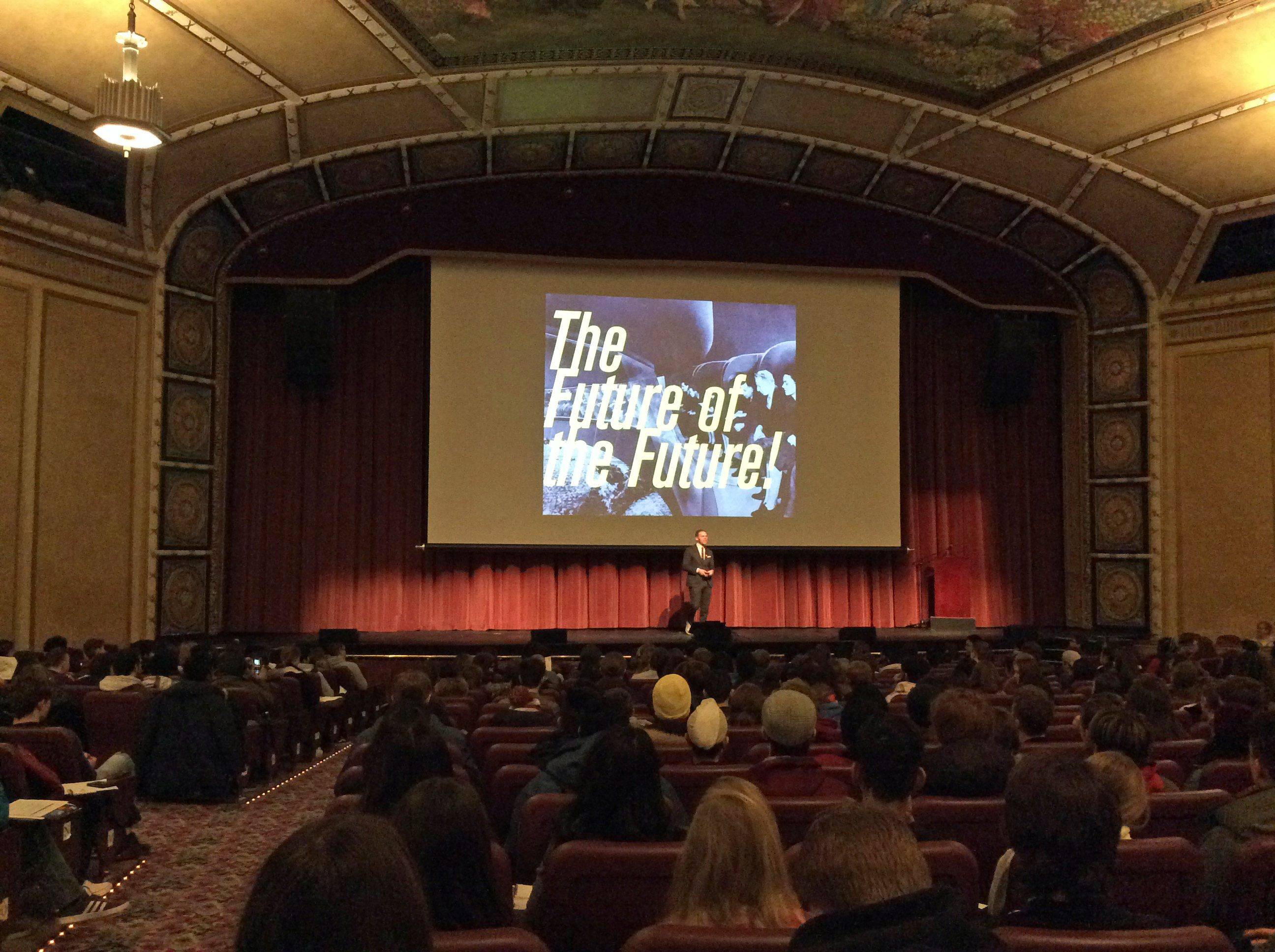
 Journalist, urbanist and futurist Greg Lindsay gave a rousing keynote speech to start the conference. Greg spoke about the future of cities, technology, and mobility. He is the director of applied research at NewCities and director of strategy at its mobility offshoot CoMotion. He also co-authored the international bestseller

 We then discussed future implications of water scarcity (and geopolitical conflict) and some of the things individuals and communities can do. Much of the talk drew from my recent book
 We are now living in the Age of Water. Water is the new “gold”, with individuals, corporations and countries positioning themselves around this precious resource. Water is changing everything. The Age of Water Podcast covers anything of interest from breaking environmental news to evergreen material. This also includes human interest stories, readings of eco-literature, discussion of film and other media productions of interest.
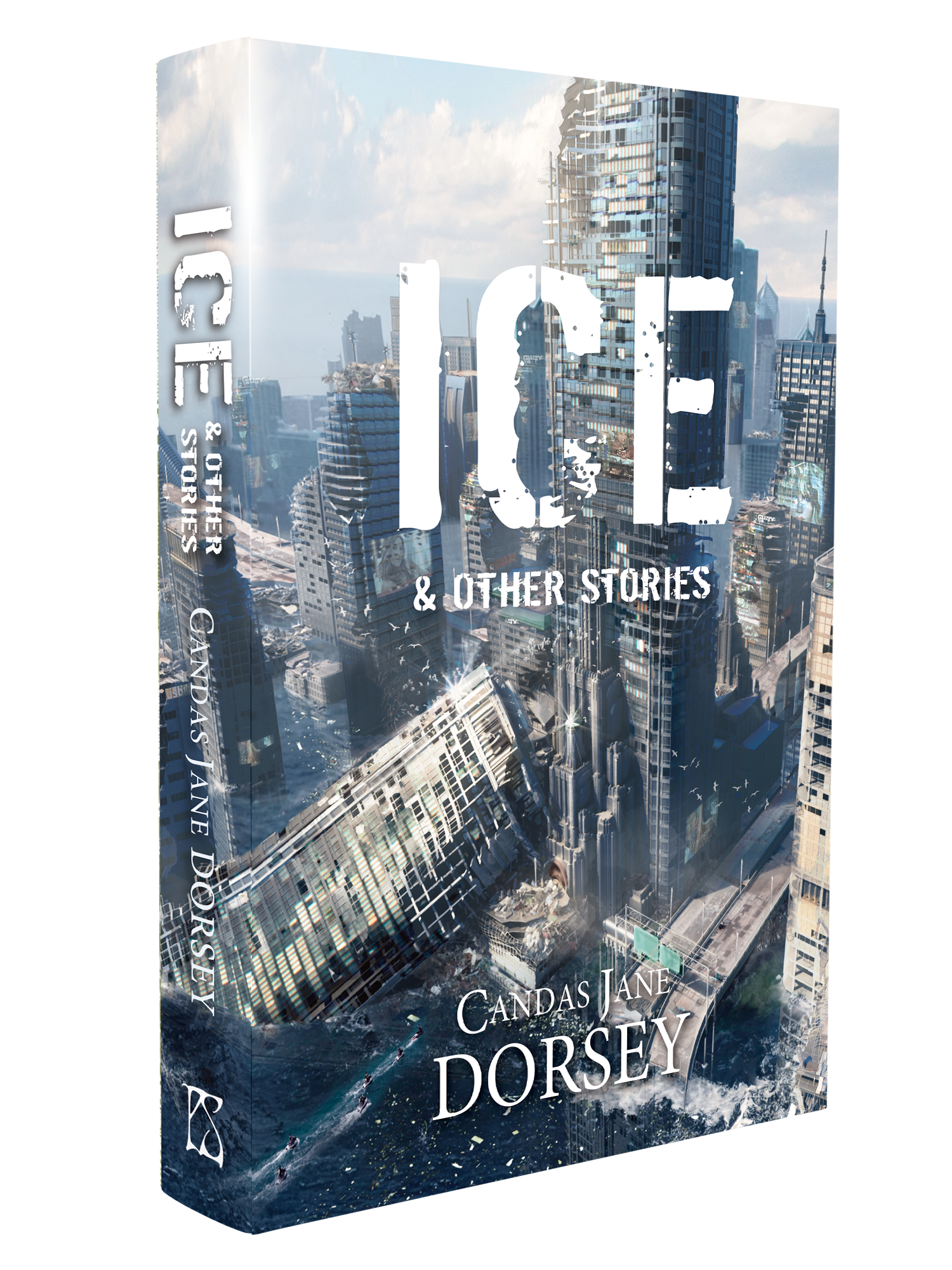 She is best known for her science fiction writing including the novels Black Wine and A Paradigm of Earth, and has also published poetry and short stories, including her well-known short-story collection Machine Sex: And Other Stories. Her latest collection of short stories Ice and other Short Stories spans thirty years of writing. Candas teaches writing and communications at MacEwan University. She was founding president of SF Canada and was president of the Writers Guild of Alberta. Candas was awarded the Province of Alberta Centennial Gold Medal award for artistic achievement and community work and the WGA Golden Pen Award for Lifetime Achievement in the Literary Arts.

 Notice how the use of active verbs also unclutters sentences and makes them more succinct and accurate. This was achieved not only by choosing active verbs but power-verbs that more accurately portray the mood and feel of the action. Most of the verbs used in the Passive column are weak and can be interpreted in many ways; words such as “walk” “were” “sit” and “stare”; each of these verbs begs the question ‘how’, hence the inevitable adverb. So we end up with “walk slowly” “were now struggling” “sit up” and “stare angrily.” When activated with power-verbs, we end up with “sidle” “struggled” “rear up” and “glared”—all more succinctly and accurately conveying a mood and feeling behind the action.







 If I’m in a slump, it’s usually because I can’t figure something out—usually some plot point or character quirk or backstory. What helps me is to put the book I’m working on away and do something else. I know that what I need will come; I just have to let it come on its own terms. The break could even be writing something else, so long as it isn’t my book. Or I could do something else on the book such as edit a certain section or research some element. Other ways I coax my muse back are walks in Nature, reading a good book, visiting the library or a bookstore and cycling. These work really well to take me out of the book and into the muse. When I take my mind out of the direct involvement with the book, I’m letting things outside of me impact me with insight. Invariably that is what happens. I’ll see something or experience something that provides me with a clue or even an epiphany.
 There were stories in sweat. The sweat of a woman bent double in an onion field, working fourteen hours under the hot sun, was different from the sweat of a man as he approached a checkpoint in Mexico, praying to La Santa Muerte that the federales weren’t on the payroll of the enemies he was fleeing…Sweat was a body’s history, compressed into jewels, beaded on the brow, staining shirts with salt. It told you everything about how a person had ended up in the right place at the wrong time, and whether they would survive another day.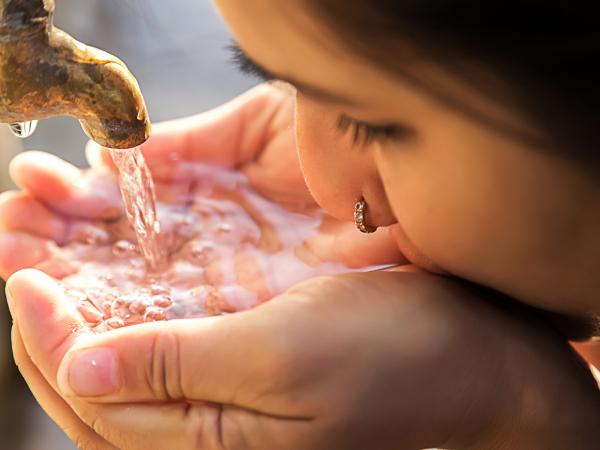
 My upcoming novel by Inanna Publications—A Diary in the Age of Water coming out in 2020—explores the socio-political consequences of corruption in Canada, now owned by China and America as an indentured resource ‘reservoir’; it is a story told through four generations of women and their unique relationship with water during a time of great unheralded change. On February 17, 2046, limnologist Lynna writes in her diary about her mother Una: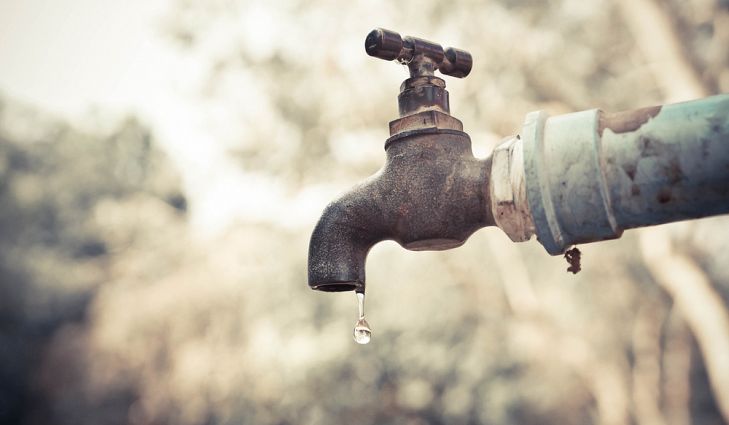
 Science fiction explores our water crisis through premises of extreme water shortage and devastating violence (floods, droughts and storms), water diversion, and hoarding. Premises explore weather manipulation, the consequences of extensive deforestation and the massive extinction of species. As with my own book A Diary in the Age of Water, Claudiu Murgan’s Water Entanglement explores water as a character, as though water has gone rogue, unruly. Perhaps even vengeful…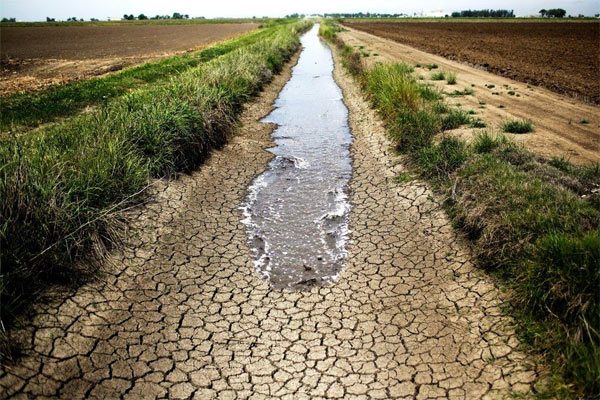
 A tidal wave of TV shows and movies currently explore—or at least acknowledge—the devastation we are forcing on the planet. Every week Netflix puts out a new science fiction show that follows this premise of Earth’s devastation: 3%; The 100; The Titan; Orbiter 9; even Lost in Space.
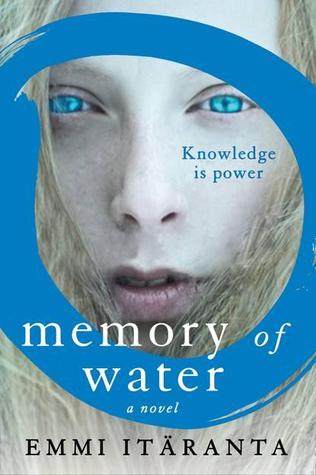 Ellen Szabo, author of Saving the World One Word at a Time: Writing Cli-Fi suggests that the ability to make environmental issues less political and more personal (through story) permits more engagement by readers and a higher likelihood of action toward justice: we are more likely to take action on the things we love and know. It’s all about connection.



 Nina is a Canadian scientist and novelist. She worked for 25 years as an environmental consultant in the field of aquatic ecology and limnology, publishing papers and technical reports on water quality and impacts to aquatic systems. Nina has written over a dozen eco-fiction, science fiction and fantasy novels. An award-winning short story writer, and essayist, Nina currently lives in Toronto where she teaches writing at the University of Toronto and George Brown College. Her non-fiction book “Water Is…”—a scientific study and personal journey as limnologist, mother, teacher and environmentalist—was picked by Margaret Atwood in the New York Times as 2016 ‘The Year in Reading’. Nina’s most recent novel “A Diary in the Age of Water”— about four generations of women and their relationship to water in a rapidly changing world—will be released in 2020 by Inanna Publications.
 Nina Munteanu Writing Coach