Rhea Hawke Interviewed by Galaxy News

I recently accessed a rare interview by Laura Dob of Galaxy News with Galactic Guardian Detective Rhea Hawke conducted in Neon City on Iota Hor-b sometime in 215 SGT:

*****

Rhea library02

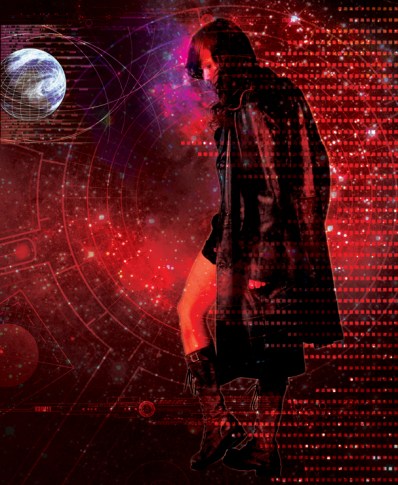
Rhea Hawke (Vali Gurgu)

Laura: Welcome to the studio, Rhea. We’re so pleased that you could take time out of your busy schedule to talk to us.

Rhea: Thank you. Well, my boss told me I had to come and then cleared my schedule.

Laura: Well, that was nice of him.

Rhea: (hardly audible) Not really…

Laura: (clears throat). You’re an enforcer for the Iota Hor-2 Precinct. Is Neon City where you live—when you’re not out chasing the bad guys in your sentient ship, that is?

Rhea: Yes. I live in the eastside in a flat with my tappin, Jasper. I moved there when I started working for the Galactic Guardians. I’m originally from Earth: Vancouver, Canada.

Laura: How does it feel to be the only human in an entirely Eosian Guardian force?

Rhea: Small. Their average height is seven and a half feet. I’m tall for a human female at 6 feet, but I’m still a midget compared to them. Humans generally are small in the galaxy. If you discount the Delenians, Rills and Creons—which most do anyway—we’re pretty much the smallest sentient species in the galaxy.

Laura: (laughs uneasily) How did you become the only human Guardian Enforcer?

Rhea: Plain dumb luck, I guess…

Laura: (shuffles papers uneasily). You must be one of their youngest Enforcers at just twenty-three years old. Most are in their forties by the time they earn an Enforcer badge. With so much training involved how did you accomplish that feat?

Rhea: I started out young.

Laura: So, tell us about your sentient ship. It’s different from the regulation Guardian ships, isn’t it? Why did you choose it—

Rhea: I didn’t choose Benny. But I’m very happy with him. Benny is a ray class ship, a hybrid of old organic nano-technology that uses brainwaves and new technology that uses kappa particles collected through fuel scoops from gas giants. My ship was built by Tangent Shipping, owned and operated by Fauche ship-builders. As far as I’m concerned, the Fauche are the best ship builders in the galaxy.

Laura: Tell us a little about the equipment you use in your work? Like that savory coat. You call it a Great Coat, don’t you? Is it standard Galactic Guardian issue?

Rhea: The coat is intelligent, made with thixotropic material, which protects me, alerts me and provides some enhancing features that help me maneuver out of challenging situations.

Rhea gun03

Rhea and her MEC

Laura: The standard weapon of the Galactic Guardian is the pocket pistol. But you use something different; I hear that you designed your own non-regulated weapon. Is that it, holstered on your hip? I’ve heard it called a MEC…

Rhea: (pulls out the hand gun). It stands for Magnetic-Electro-Concussion pistol. It’s a wave-generating weapon that’s programmable to specific vibrations and wavelengths unique to the DNA of animate and inanimate things. I can program it to do different things to different things in one sweep. This essentially makes the MEC a discerning weapon with distinguishable endpoints from rendering someone unconscious to a swift kill.

Laura: As a Galactic Enforcer, you’re known as a loner who drives a non-regulation ship and uses unconventional ways to complete your missions. Some have criticised your methods as unreliable, shoddy—even dangerous. One Galactic Enforcer told me that no one wants to work with you because—
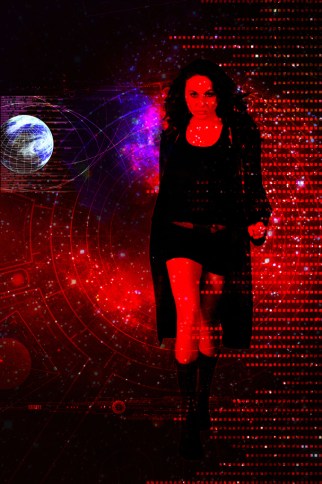
CoverI04

Rhea Hawke (Vali Gurgu)

Rhea: I didn’t join the force to make friends. I became a Guardian to help make things right. I get the job done. There’s no nice way of getting rid of scum, murderers, and terrorists. People have to decide if they want a safe galaxy or if they want to be politically correct in an unsafe one.

Laura: Does that include the Rill rebellion on Omicron 12 where you murdered over a hundred insurgent Rills with that very MEC you’re holding?

Rhea: ‘Talking without thinking is like shooting without aiming’—Old Chinese proverb… It was seventy-seven terrorists I killed.

Laura: (after tense pause in which interviewer notes that Rhea has not put away her MEC) Ok… Well… I heard a story from your mother—

Rhea: You spoke to my mother?

Laura:that you wanted to be an artist when you were young…

Rhea: ‘Dress the monkey in silk and it is still a monkey.’ Argentinian proverb.

Laura: Eh… right… So, what’s your favourite holiday place when you take time off?

Rhea: I don’t take time off. Except for interviews my boss tells me I need to do, that is…

Laura: Eh… right… So, what’s your favourite drink—or drug— and favourite place to get it?

Rhea: (finally smiling) Well, I am rather partial to Plock Nectar but my favourite drink is soyka and one of the best places to get it is right here in Neon City. It’s a funky Italian-Scandi café on Elgin Street in The Hive, called The Muddy Pit.
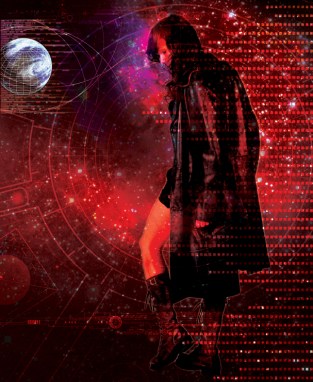
rhea-contemplative01

Rhea Hawke (Vali Gurgu)

Laura: Thank you, Rhea, for talking to us. I wish you well in your journeys.

Rhea: Thank you, Laura. You too.

When Galactic Guardian Rhea Hawke investigates the genocide of an entire spiritual sect, she collides not only with dark intrigue but with her own tarnished past. Her quest for justice catapults Rhea into the heart of a universal struggle across alien landscapes of cruel beauty and toward an unbearable truth she’s hidden from herself since she murdered an innocent man.

Get the complete Splintered Universe Trilogy. Available in ALL THREE FORMATS: print, ebook, and audiobook. Listen to a sample from all three audiobooks on Audible. Read the Splintered Universe reviews on Goodreads.

audible listen

Microsoft Word - trilogy-poster03.docx

nina-2014aaa

Nina Munteanu is a Canadian ecologist / limnologist and novelist. She is co-editor of Europa SF and currently teaches writing courses at George Brown College and the University of Toronto. Visit www.ninamunteanu.ca for the latest on her books. Nina’s bilingual “La natura dell’acqua / The Way of Water” was published by Mincione Edizioni in Rome. Her non-fiction book “Water Is…” by Pixl Press (Vancouver) was selected by Margaret Atwood in the New York Times ‘Year in Reading’ and was chosen as the 2017 Summer Read by Water Canada. Her novel “A Diary in the Age of Water” will be released by Inanna Publications (Toronto) in 2020.

The Splintered Universe, Book 1: “Outer Diverse” Audiobook

OuterDiverse-front coverOuter Diverse is the first book of the Splintered Universe Trilogy, set in and around the Milky Way Galaxy. The first book begins as Galactic Guardian Detective Rhea Hawke investigates the massacre of an entire religious sect, catapulting her into a treacherous storm of politics, conspiracy and self-discovery. Her quest for justice leads her into the heart of a universal struggle and toward an unbearable truth she’s hidden from herself since she murdered an innocent man.

Dab of Darkness summarizes the audiobook:

I had the pleasure to listen to this book 5 or 6 years ago, and I really enjoyed it then. I’m very pleased to say that this book has stood up well over the years. Rhea Hawke is still the bad ass I want to be when I grow up. I love her dress sense (boots, weapons, sentient great coat), her sorta pet tappin (kinda a cat with 3 tails), and her best friend Benny, who is the AI on her little work-issued spaceship. Alas, she messed up big time at work (the Galactic Guardians, which is way more bureaucratic than it sounds), and she lost all but her boot and her sorta cat.

rhea-contemplative01

Rhea Hawke (Vali Gurgu)

While wallowing in her self-pity, wondering what to do with her life now, she joins a gym where she meets Serge. He’s way more sexy than his name hints at. Pretty soon, she’s spending nearly all her time at his place. She’s held back from snooping into his past, as she would have done in a heart beat when she worked for the Guardians. That’s going to come back to bite her in the butt.

I especially enjoyed the tangled relationship she has with her mom. She loves her (maybe) but hates her too (and definitely hates that she sleeps around so much!). But her mom has kept some really big secrets from her and that had to sting, so I see her point most of the time.

So many aliens! I love this aspect to the story because humans aren’t the focus. In fact, they are basically an endangered species. Barely tolerated in most civilized places, Rhea has had to work twice as hard to prove herself worthy. She’d rather do that than take the path her mom did (free love).

Then there’s the evil Vos. Cue evil laughter. So many rumors about what they can do, what atrocities they have done. I know it’s quite silly, but I love this because that’s my last name, minus and S, pronounced the same way. Hahaha! If I lived in Rhea’s universe, I’d have to change my last name or risk being shot on sight…

Dawn Harvey does a great job with all the different alien voices. She really went the extra mile, making them sound as described in the text of the story. I don’t know how she made some of those voices, but they really worked!…The pacing is perfect. Her voice for Rhea is spot on – a hero that is sometimes vulnerable.

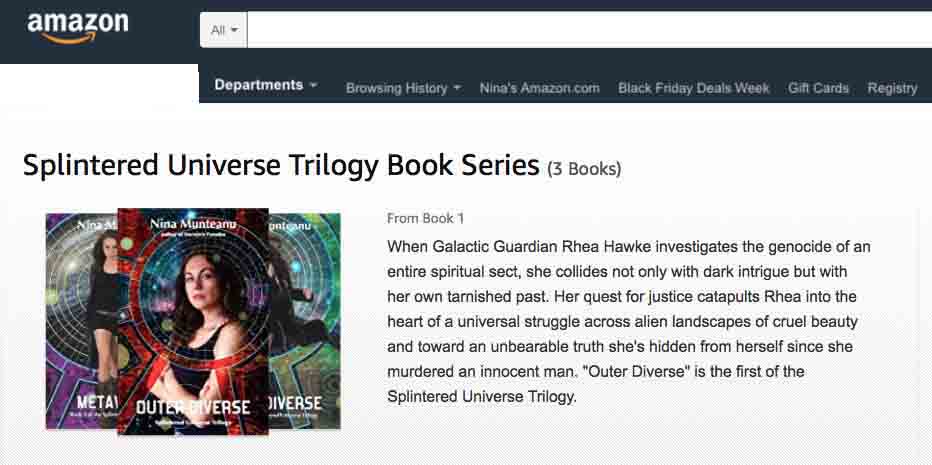
SplinteredUniverseTrilogy-Amazon

The trilogy consists of Outer Diverse, Inner Diverse, and Metaverse. and is available in ALL THREE FORMATS: print, ebook, and audiobook. You can listen to a sample recording of all three audiobooks through Audible. Read the Splintered Universe reviews on Goodreads.

audible listen

Nina Munteanu’s story is full of surprises, full of action and twists and I liked it so much!Lilly’s Book World

An addictive start to the trilogy!Book Addict

A feast for the senses; glorious worlds with complex inhabitants hurtle towards our unprepared ears—QuirkyMezzo23

I want to grow up to be Rhea HawkeDabOfDarkness

nina-2014aaa

Nina Munteanu is a Canadian ecologist / limnologist and novelist. She is co-editor of Europa SF and currently teaches writing courses at George Brown College and the University of Toronto. Visit www.ninamunteanu.ca for the latest on her books. Nina’s bilingual “La natura dell’acqua / The Way of Water” was published by Mincione Edizioni in Rome. Her non-fiction book “Water Is…” by Pixl Press (Vancouver) was selected by Margaret Atwood in the New York Times ‘Year in Reading’ and was chosen as the 2017 Summer Read by Water Canada. Her novel “A Diary in the Age of Water” will be released by Inanna Publications (Toronto) in 2020.

Ursula K. Le Guin: Her Name is Freedom

Amid the sadness of the passing of Ursula K. Le Guin, we offer her wise advice on art and literature, given in 2014. In receiving her lifetime achievement award in 2014, Ursula delivered a speech that was prescient, timely and necessary:

Neil Gaiman presents lifetime achievement award to Ursula K. Le Guin at 2014 National Book Awards from National Book Foundation on Vimeo.

Ursula K. Le Guin first told her audience that she wanted to share her award with her fellow-fantasy and science fiction writers, who have for so long watched “the beautiful awards” like the one she’d just received, go to the “so-called realists”. She then went on to

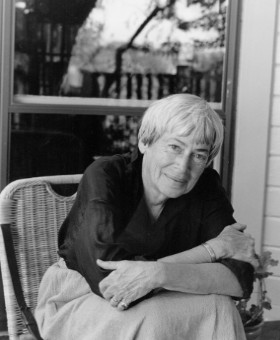
ursula le guin

Ursula K. Le Guin

say:

“I think hard times are coming, when we will be wanting the voices of writers who can see alternatives to how we live now, and can see through our fear-stricken society and its obsessive technologies, to other ways of being. And even imagine some real grounds for hope. We will need writers who can remember freedom: poets, visionaries–the realists of a larger reality. Right now, I think we need writers who know the difference between production of a market commodity and the practice of an art…The profit motive is often in conflict with the aims of art…We live in capitalism. Its power seems inescapable; so did the divine right of kings… Power can be resisted and changed by human beings; resistance and change often begin in art, and very often in our art–the art of words. I’ve had a long career and a good one, in good company, and here, at the end of it, I really don’t want to watch American literature get sold down the river… The name of our beautiful reward is not profit. Its name is freedom.”

nina-2014aaaNina Munteanu is an ecologist and internationally published author of novels, short stories and essays. She coaches writers and teaches writing at George Brown College and the University of Toronto. For more about Nina’s coaching & workshops visit www.ninamunteanu.me. Visit www.ninamunteanu.ca for more about her writing.

Book Review: RecipeArium Delivers a Full Course Thrill

recipearium-costi gurguIn the Green Kingdom, stimulation through the sense of taste has become a powerful and complex art form that rules the lives of the males—the phrils. Not only does it bring pleasure, it can change a phril’s destiny, even guide him into death and beyond. But only if he can afford the services of the artists called Recipears. Without a Recipear, a phril will live and die a pagan, with no chance of an afterlife. The female of the species, called phriliras, cannot experience RecipeArium; they replace it with their faith in one God with changing names. In the world within the huge body of a monstrous beast, the Recipears rule society.
RecipeArium is a tale of sensation and flesh, in which the very hope of an afterlife is determined by one’s sex. The novel takes us on a journey to discover the meaning of love in a boldly imagined world where art is transformative and immortality the destiny of the few.

Carrying the soul of his RecipeArium master within him, Morminiu comes to the royal Court with two objectives: to exact revenge on his master’s enemies and to win for himself the most desired and treacherous position in the realm: Master Recipear of the Kingdom.

Costi-launch

Costi Gurgu, launching at Pierre Leon Gallery

My own testimonial of the book follows:

Gurgu delivers a full course meal of epic transcendence in an alien landscape that is at once grotesque and wondrously compelling.

From the vast and forgotten lands of the Edge of the World to the corrupt decadence and intrigue of the nobility who dwell inside the monstrous Carami, Gurgu’s Recipearium unveils a fascinating world in transformation. Recipearium is a sensual metaphoric tale that explores the dialectic quest of duality to realize itself as whole.

Imaginative. Outrageous. Original.

Gurgu subverts traditional fantasy and SF with the promise of new heights in storytelling.

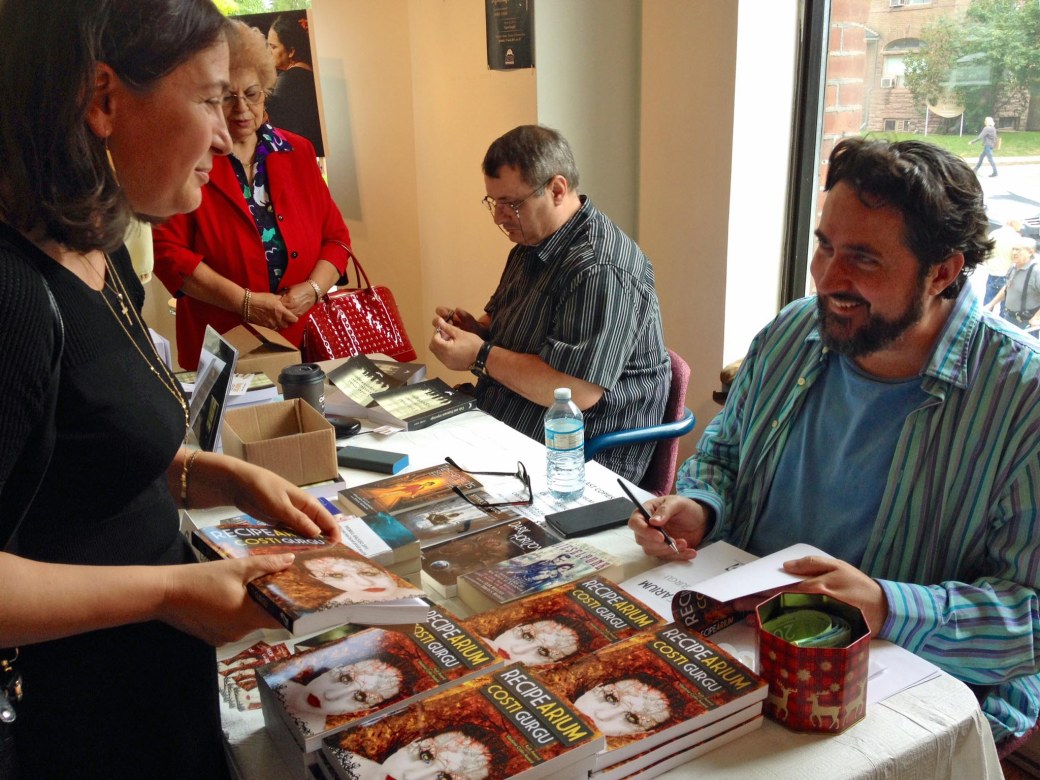
Costi-signing

Costi Gurgy signing his book at launch in Pierre Leon Gallery

The publisher, White Cat Publishers interviewed Costi recently; a few choice questions and answers appear below:

Regarding his aspirations for the book, Costi responded:

First of all, this new release will bring Recipearium to the English speaking market, which is quite a big aspiration in itself. And through Recipearium I hope to open the hearts of North American readers to the rest of my fiction as well as to Romanian Speculative Fiction in general.

To their mention that RecipeArium is considered the “new weird” (even in science RecipeArium launchADASTRAfiction, which is itself considered strange), Costi responded:

Several publishers told me that they hadn’t read anything like it, and therefore they couldn’t compare it to any other book. Yes, at first I wanted to thank them because they practically told me it really was an original novel, but only later I realized that they meant they wouldn’t know how to market it and sell it. They didn’t even know if it would sell, because nobody has sold something similar before.

When I signed the contract in Romania, my Romanian publisher also didn’t know how to market it. So, my editor decided to write and talk about it like any other book and completely ignored that one thing that made it different. He hoped that when the readers discovered it, they would already be hooked and therefore it would be too late for them to freeze in awe. J

It paid off. The story proved a success. Not only because of the awards and the numerous reviews but mostly because of the satisfied readers … So, as a conclusion, I won’t tell you what makes it different from the rest. I want my readers to discover it for themselves. And I promise you it’s not the kind of surprise that goes BANG! It creeps on you slowly.

White Cat then asked Costi to elaborate on his earlier comment about the difference between European and American genre writing. Here’s what Costi said:

Sure. In my opinion there are two major differences. The first one is of perception. In Europe we read fiction works by writers from over seventy countries from all around the world. That is over seventy different cultures in which their authors write stories without worrying that maybe a foreign reader would not understand a certain social, political or cultural event, or a certain attitude, habit or tradition.

Yes, maybe the South American characters act according to a different code of social conduct than Romanians, or maybe French characters’ attitude is strange for a Bulgarian reader, or Chinese motivations are weird to Greeks. But if the story or the characters are gripping enough, all those things don’t stop us from getting the underlying concept from the context and we just keep reading.

The stories we read can take place in real cities or villages from different and unfamiliar parts of the world. Usually the European writer doesn’t care that his readers may have never been in his city and he keeps telling the story as if all his readers are his co-nationals, or even his neighbours.

poster-launchWe embrace the exotic, the foreign, the strange, the unknown… the alien.

American editors have rejected translating huge names from European speculative fiction because they’re considered too strange and not easily understood by North American readers. Because the North American readership has read only North American genre writers for the past fifty years and they wouldn’t accept something different than an American way of perceiving reality and interpreting information. Something that may be too far from the North American system of values.

“But they’re readers of Science Fiction! I mean, they read Science Fiction or Fantasy because they want to be transported to different worlds. You mean that the American readers better understand a story happening on a strange planet or in the underworld, but they will find it difficult to follow a story happening in Bruges, or Warsaw?” I replied.

North American editors don’t appear to have that confidence in their readers. I, on the other hand, have that confidence. It has been proven to me over and over again, that the true SF&F reader, European or North American, is thirsty for new and exotic, and strange, and alien.

The second aspect is technical. It’s about the writing techniques, the story structure, the point of view approach, and so on. It’s an aspect I will not detail here. Suffice to say that while in North America a writer is supposed to write according to a certain and more strict system of technical rules if she’s to be accepted by professional markets, in Europe the editors don’t care if the writer abides by the rules or breaks them, as long as it’s good writing and the readers want more of that author.


“Water” a Speculative Fiction Anthology by Reality Skimming Press

WaterAnthology-RealitySkimmingPressIn December 2017, “Water”, the first of Reality Skimming Press’s Optimistic Sci-Fi Series was released in Vancouver, BC. I was invited to be one of the editors for the anthology, given my passion for and experience with water.
This is how Reality Skimming Press introduces the series:

Reality Skimming Press strives to see the light in the dark world we live in, so we bring to you the optimistic science fiction anthology series. Water is the first book in the series, and is edited by author and scientist Nina Munteanu. Six authors thought optimistically about what Earth will be like in terms of water in the near future and provide us with stories on that theme. Step into the light and muse with us about the world of water.

Editing “Water” was a remarkable experience, best described in my Foreword to the anthology:

LyndaWilliams

Lynda Williams

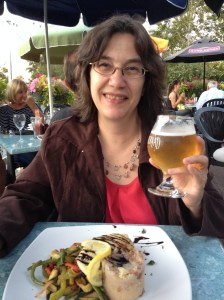
This anthology started for me in Summer of 2015, when Lynda Williams (publisher of RSP) and I were sitting on the patio of Sharky’s Restaurant in Ladner, BC, overlooking the mouth of the Fraser River. As we drank Schofferhoffers over salmon burgers, Lynda lamented that while the speculative / science fiction genre has gained a literary presence, this has been at some expense. Much of the current zeitgeist of this genre in Canada tends toward depressing, “self-interested cynicism and extended analogies to drug addiction as a means of coping with reality,” Lynda remarked.

Nina-Sharkys

lunch at Sharky’s

Where was the optimism and associated hope for a future? I brought up the “hero’s journey” and its role in meaningful story. One of the reasons this ancient plot approach, based on the hero journey myth, is so popular is that its proper use ensures meaning in story. This is not to say that tragedy is not a powerful and useful story trope; so long as hope for someone—even if just the reader—is generated. Lynda and I concluded that the science fiction genre could use more optimism. Reality Skimming Press is the result of that need and I am glad of it.

Megan coverIn the years that followed, Reality Skimming Press published several works, including the “Megan Survival” Anthology for which I wrote a short story, “Fingal’s Cave”. It would be one of several works that I produced on the topic of water.

As a limnologist (freshwater scientist), I am fascinated by water’s anomalous and life-giving properties and how this still little understood substance underlies our lives in so many ways. We—like the planet—are over 70% water. Water dominates the chemical composition of all organisms and is considered by many to be the most important substance in the world. The water cycle drives every process on Earth from the movement of cells to climate change. Water is a curious gestalt of magic and paradox, cutting recursive patterns of creative destruction through the landscape. It changes, yet stays the same, shifting its face with the climate. It wanders the earth like a gypsy, stealing from where it is needed and giving whimsically where it isn’t wanted; aggressive yet yielding. Life-giving yet dangerous. Water is a force of global change, ultimately testing our compassion and wisdom as participants on a grand journey.

When Reality Skimming invited me to be editor of their first anthology in their hard science optimistic series, and that it would be about water, I was delighted and excited.

WATER Anthology-interior-image

Illustration by Digbejoy Gosh for Bruce Meyer’s “The River Tax”

The six short stories captured here flow through exotic landscapes, at once eerie and beautiful. Each story uniquely explores water and our relationship with its profound and magical properties:  melting glaciers in Canada’s north; water’s computing properties and weather control; water as fury and the metaphoric deluge of flood; mining space ice from a nearby comet; water as shapeshifter and echoes of “polywater”. From climate fiction to literary speculative fiction; from the fantastic to the purest of science fiction and a hint of horror—these stories explore individual choices and the triumph of human imagination in the presence of adversity.

I invite you to wade in and experience the surging spirit of humanity toward hopeful shores.

Nina Munteanu, M. Sc., R.P.Bio.
Author of Water Is…
October, 2017
Toronto, Canada

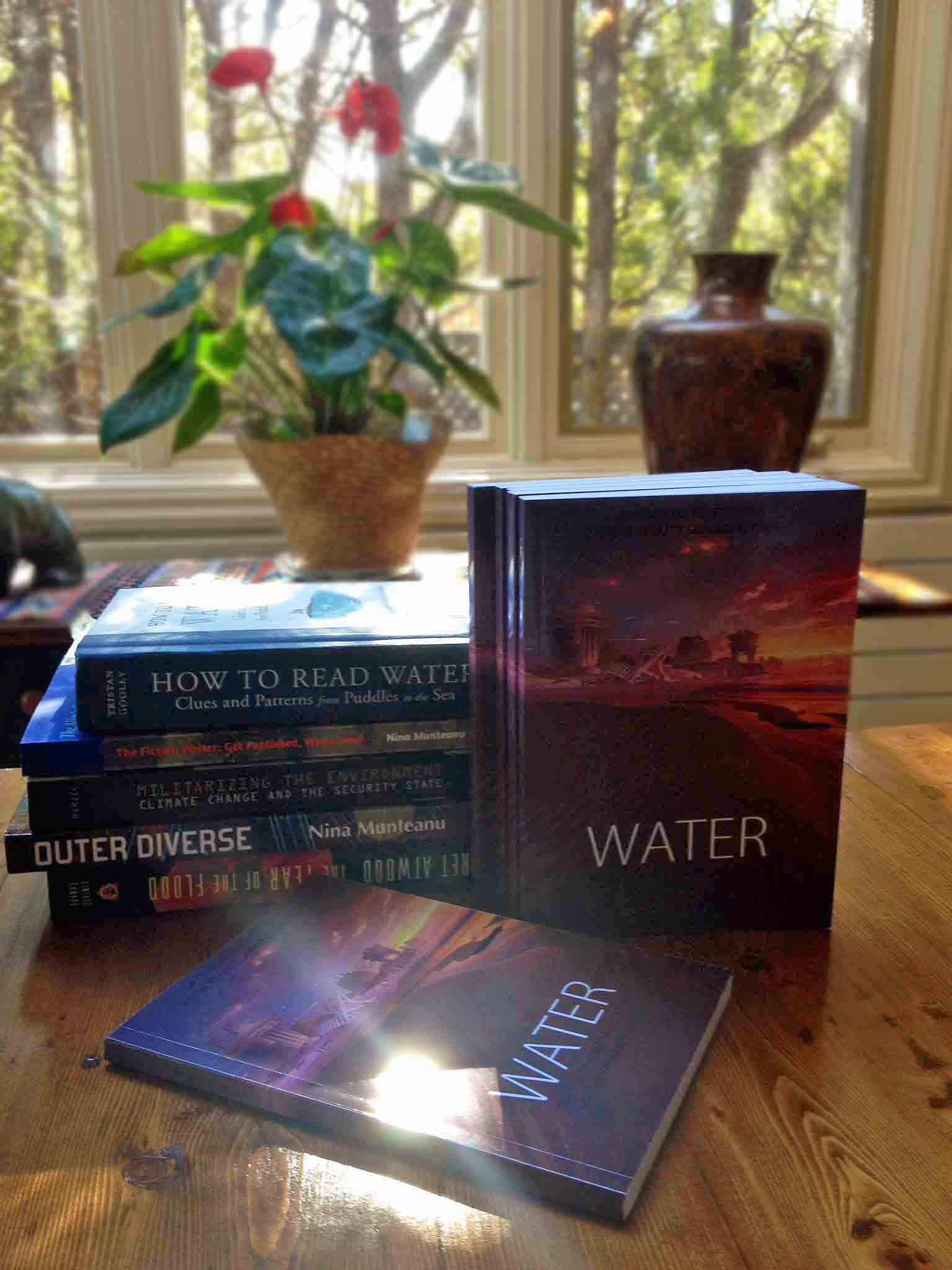
waterbooks2L

My desk with copies of “Water” among my current books to read…

The anthology features the art work of Digbejoy Ghosh (both cover and interior for each story) and stories by:

Holly Schofield
Michelle Goddard
Bruce Meyer
Robert Dawson
A.A. Jankiewicz
Costi Gurgu

You can buy a copy on Amazon.ca or through the publisher.

nina-2014aaaNina Munteanu is an ecologist, limnologist and internationally published author of award-nominated speculative novels, short stories and non-fiction. She is co-editor of Europa SF and currently teaches writing courses at George Brown College and the University of Toronto. Visit www.ninamunteanu.ca for the latest on her books.

Nina Munteanu Talks to Hi-Sci-Fi Radio…

darwins-paradoxHi-Sci-Fi Radio (a podcast radio show out of CJSF 90.1FM in Burnaby, British Columbia) interviewed Nina Munteanu about the paradoxes of her eco-thriller “Darwin’s Paradox” by Dragon Moon Press (Edge Publishing).

A devastating disease. A world on the brink of violent change. And one woman who can save it or destroy it all. Julie Crane must confront the will of the ambitious virus lurking inside her to fulfill her final destiny as Darwin s Paradox, the key to the evolution of an entire civilization.

Nina and Irma Arkus talked synchronicity, autopoiesis, Nature’s intelligence and whether algae can sing in this entertaining interview on science fiction and all things wonderful and strange.

Darwin’s Paradox is a thrill ride that makes you think and tugs the heart.”–Robert J. Sawyer, Hugo and Nebula Award-winning author of Quantum Night