
Illustration by Anne Moody, typology & design by Costi Gurgu
One of the lectures I give in my science fiction writing course and conference workshops is called “Ecology in Storytelling”. It’s usually well attended by writers hoping to gain better insight into world-building and how to master the layering-in of metaphoric connections between setting and character. My upcoming writing guidebook “Ecology of Story: World as Character” addresses this subject with examples from a wide range of published fiction. The book will be released in June/July of 2019 by Pixl Press.
In my lecture (and book) I talk about the adaptations of organisms to their changing environments. I describe the trophic (energy) relationships from producers to consumers and destroyers in a complex cycle of creative destruction.
Students perk up when I bring up some of the more strange and interesting adaptations of organisms to their environment: twisted stories of adaptations and strategies that involve feeding, locomotion, reproduction and shelter.
Purposeful Miscommunication & Other Lies

Alcon blue butterfly and caterpillar with ant
For instance, the Alcon blue butterfly hoodwinks ants into caring for its larvae. They do this by secreting a chemical that mimics how ants communicate; the ants in turn adopt the newly hatched caterpillars for two years. There’s a terrible side to this story of deception. The Ichneumon wasp, upon finding an Alcon caterpillar inside an ant colony, secretes a pheromone that drives the ants into confused chaos; allowing it to slip through the confusion and lay its eggs inside the poor caterpillar. When the caterpillar turns into a chrysalis, the wasp eggs hatch and consume it from inside.
This reads like something out of a noir thriller. Or better yet, a horror story. Nature is large, profligate, complex and paradoxical. She is by turns gentle and cruel. Creative and destructive. Competitive and cooperative. Idle and nurturing.
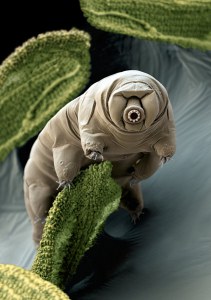
Tardigrade on moss
When I bring in the subject of extremophiles, who thrive in places you and I would cringe to set foot in, students’ imaginations run wild with ideas.
I describe a panoply of weird adaptations in Nature—involving poisons, mimicry and deception, phototaxis and something called anhydrobiosis, which permits the tiny tardigrade to shrivel into a tun in the absence of water then revive after a 100 years with just a drop of water.
All this adaptation hinges on communication. How an organism or population communicates with its environment and among its own.
Examples of “strange” communication are the purview of the science fiction writer … and already the nature of our current world—if you only know where to look. The scope of how Nature communicates—her devices and intentions—embraces the strange to the astonishing. From using infrasound to chemical receptors and sensing magnetic fields. To allelopathy. Aggressive symbiosis. And so much more.

Dr. Suzanne Simard
UBC researcher Suzanne Simard, who has published hundreds of papers over 30 years of research, suggests a kind of “intelligence” when she describes the underground world “of infinite biological pathways that connect trees and allow them to communicate” In a forest.
This communication allows the forest to behave as if it was a single organism, says Simard. Her early in situ experiments showed solid evidence that tree species, such as Paper Birch and Douglas Fir communicated in a cooperative manner underground through an underground mutualistic-symbiosis involving mycorrhizae (e.g., fungus-root).

mycelium connects trees underground
These trees were conversing in the language of carbon and nitrogen, phosphorus, water, defense signals, allelo-chemicals, and hormones via a network of mycelia. Fungal threads form a mycelium that infects and colonizes the roots of all the trees and plants. Simard compares this dense network to the Internet, which also has nodes and links—just as the forest.
Fungal highways link each tree and plant to its community, with busiest nodes called hub trees or mother trees. Calling them mother trees is appropriate, given that they nurture their young in the understory; sending excess carbon to the understory trees, which receive less light for photosynthesis. “In a single forest,” says Simard, “a mother tree can be connected to hundreds of other trees.” These mature trees act as nodal anchors—like major hub sites on the Internet—for tree groupings; according to Simard, they look after their families, nurture seedlings and even share wisdom—information—when they are injured or dying.
Fatal Attractions & Natural Bullies

Bracken fern fronds
The “ordinary” Bracken fern thrives in a wide range of conditions on virtually every continent (except Antarctica). That’s because it plays the “long game” by having several strategies to outlive and outcompete its surrounding nemeses.

The symbiosis of Bracken fern and ant
Strategies include a loose lifestyle such as several ways to reproduce and grow to accommodate seasons, drought and burning; a shady arrangement with the local thugs (aggressive ants) who protect it for its tasty nectar; use of cyanide and ecdysones by its young shoots; and tough carcinogenic fronds that contain glass-like silicates.
Despite its many uses by humans (e.g., used for potash fertilizer, heating fuel, roofing, bedding for animals), the Bracken fern is considered a pest. In truth, it is a hardy versatile adapter to changing environments. And that is what our climate changing world is fast becoming.
I highly recommend the works of Annie Dillard and Loren Eiseley for wonderful and bizarre examples of natural wonders that resonate with metaphor.

Stream in coastal rainforest on Vancouver Island, BC (photo by Kevin Klassen)
I also recommend my upcoming book “Ecology of Story” (Pixl Press), which will showcase a diverse set of examples from the literature of metaphoric environment and creatures. “Ecology of Story” is due for release in Summer of 2019. Look for it on Amazon, Kobo, and a fine bookstore near you. Two other books in my writing guide series include: “The Fiction Writer” and “The Journal Writer“.

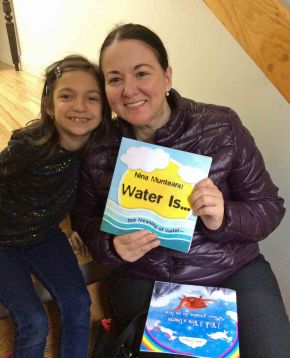
 Nina Munteanu is an ecologist and internationally published author of award-nominated speculative novels, short stories and non-fiction. She is co-editor of Europa SF and currently teaches writing courses at George Brown College and the University of Toronto. Visit www.ninamunteanu.ca for the latest on her books. Nina’s recent book is the bilingual “La natura dell’acqua / The Way of Water” (Mincione Edizioni, Rome). Her latest “Water Is…” is currently an Amazon Bestseller and NY Times ‘year in reading’ choice of Margaret Atwood.
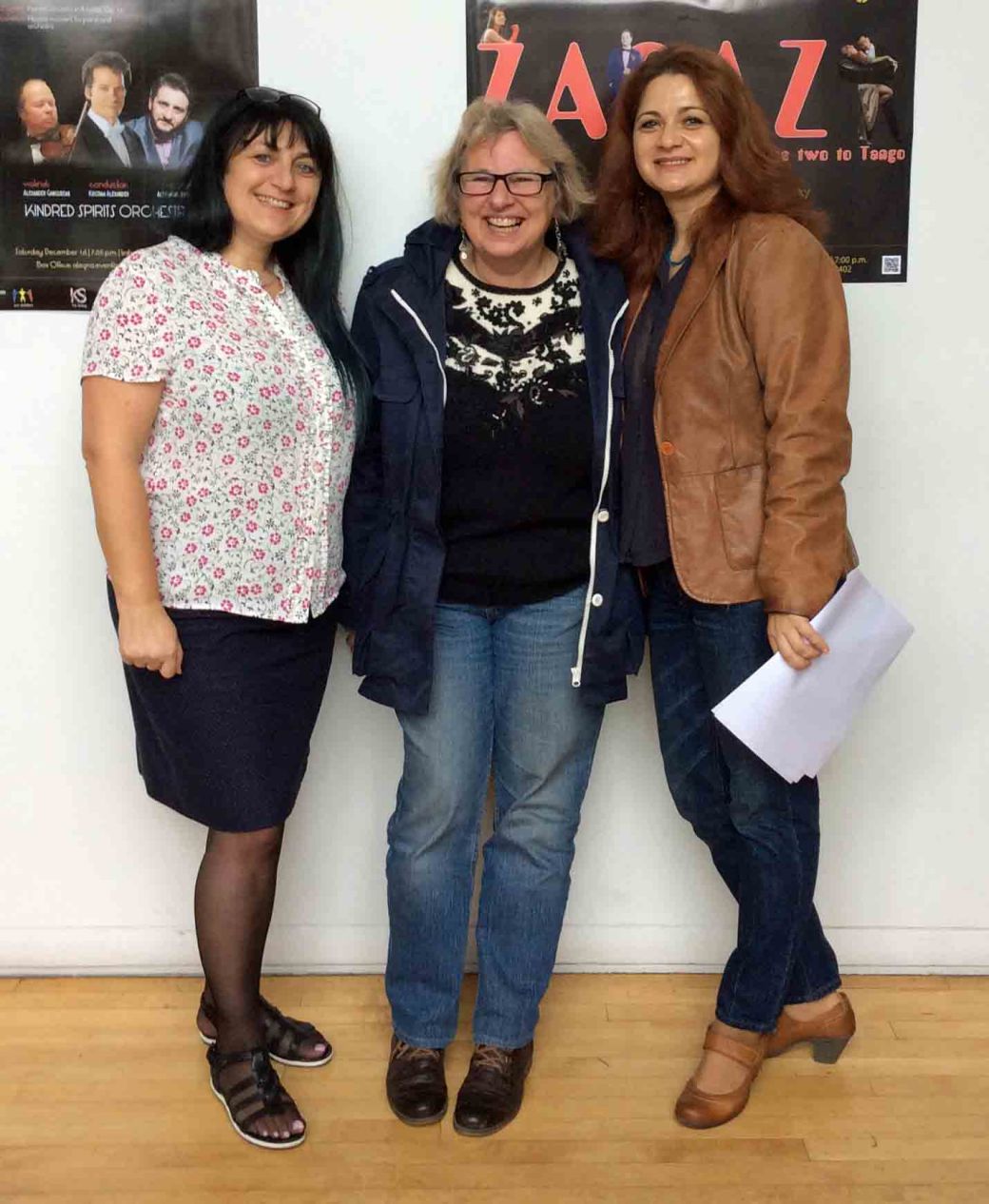
 On October 5, 6 2018, I participated in the second ToRo Fest International Salon of Literature, Visual Arts & Music, put on by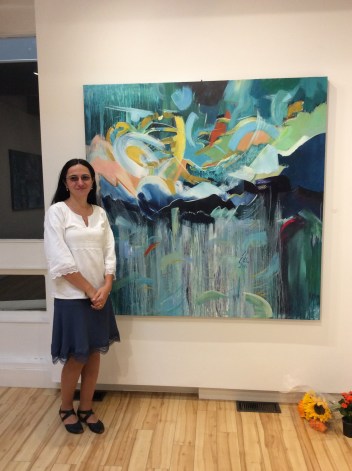




 Creative destruction … sounds like a paradox, doesn’t it? Nature—and God— is full of contradiction and paradox. There is so much that we do not understand (at least on the surface)… and apparent contradiction proves that to me. In
 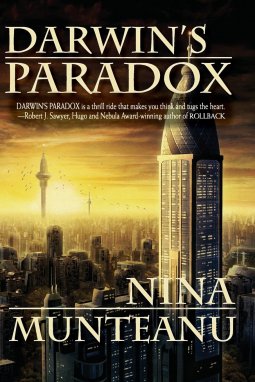 In my speculative fiction novel,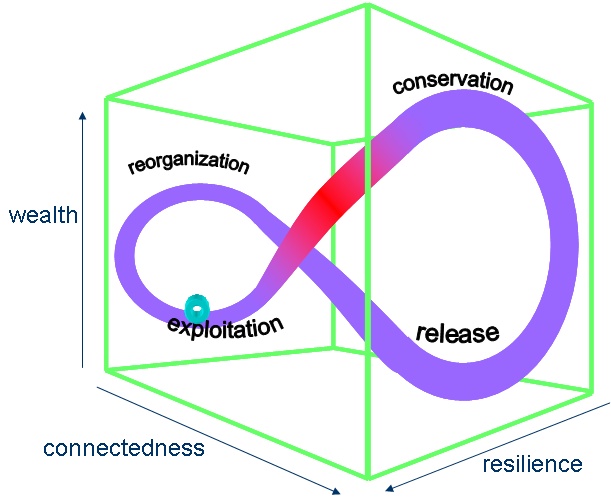
 Suppression of spruce budworm populations in eastern Canada using insecticides partially protected the forest but left it vulnerable to an outbreak covering an area and of an intensity never experienced before;
 In my book
 On Friday evening of October 26th Nina will be giving the first in a series of 10 writing workshops through the Immigrant Writers Association Writing and Publishing workshop series for members and non-members. Workshops are free for Class A members, $10 for Class B members, and $15 for non-members.


 The Fiction Writer (
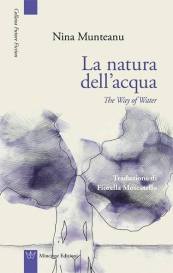 I hope to collaborate more with colleague and friend Cristian Tamas, who introduced me to editor/publisher Francesco Verso (of Future Fiction) and Mincione Edizioni, who published my short story “The Way of Water.” I later developed “The Way of Water” in novel form and I anticipate its release next year.



 One resource I’m eager to introduce to my students is Canadian SF short story writer Douglas Smith’s recent guidebook, Playing the Short Game: How to Market & Sell Short Fiction. Smith’s guidebook is a Tardis-style smallish yet comprehensive guide on what it takes to be a successful short story writer from starting & finishing to marketing & publishing to leveraging & promotion.
 I’m a petite five foot-three height and purposely wear flat shoes. I love short. I prefer my espresso pulled in short shots—or ristretto—in my flat white. Described as bolder, fuller, with more body and less bitterness, the ristretto is like a burst of intense flavor with a lingering finish. Short is pretty cool.
 A short story only has 7,000 or less words to get your tale across while a novel has over ten times that many words to do the same. It follows then that the short story format is a simpler one. This does not necessarily mean easier.
 Renowned short story authors like Edgar Allen Poe, Nathanial Hawthorne, and Somerset Maugham, emphasize the importance of striving for one effect when writing a short story: the single effect you wish to leave with the reader at the end. This is accomplished by selecting events or situations that build quickly into a combustible response. Even Alice Munro, who is known for cramming long timeframes into her short stories, frames time through a single event: a meal, family gathering, wedding or funeral, for instance.
 Nina’s Bus-Terminal Model
 Remember to keep track of what you send where and when and what happens to it. It can become a very confusing bus terminal otherwise, with someone ending up in Seattle when they are headed to Toronto! What happens with this approach is several things: you begin to treat the whole marketing/publishing process as a business (which it is) and because you have so many “buses” out there coming and going, the rejections don’t hurt quite as much and instead become part of the learning process, which they should be. You adopt a more business-like approach, which translates into your relationship with editors and publishers. A win-win situation results. Believe me; this works. Once I fell into this method, my sales increased by over 70%.





 Nina Munteanu is an ecologist, limnologist and internationally published author of award-nominated speculative novels, short stories and non-fiction. She is co-editor of Europa SF and currently teaches writing courses at George Brown College and the University of Toronto. Visit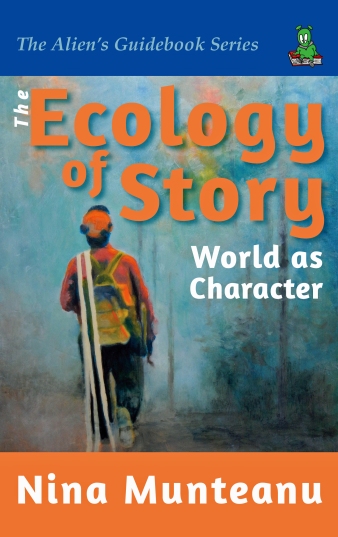

 When Pixl Press started looking for suitable cover artists to rebrand my writing craft series, I showed some of Anne’s work to the director Anne Voute. Pixl Press had already worked with Costi Gurgu and we liked his work. The result of Anne’s illustrations and Costi’s typography and design was a series of stunning covers that branded my books with just the right voice.
 The Alien Guidebook Series, of which two books are out so far (
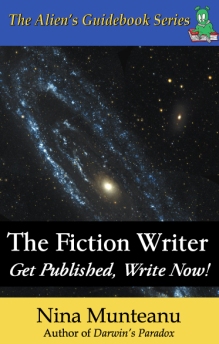 Anne’s illustration for
  I am currently researching and writing the third guidebook in the series—a reference on world building and use of ecology in story—The Ecology of Story: World as Character.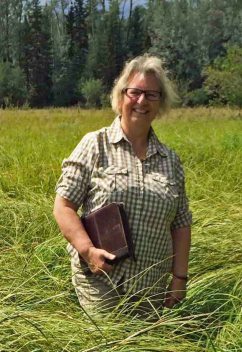
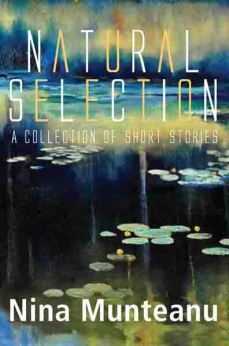 Anne’s art work for the cover of
 Nina Munteanu Writing Coach