Our Deepest Fear

Swiss Alps 2

Mountains in Switzerland (photo by Nina Munteanu)

It’s not what you think it is…

There’s a poignant scene near the end of the 2005 movie “Coach Carter” where a student finally responds to Carter’s insistent question of “what is your deepest fear?”. It is a quote often mistakenly attributed to Nelson Mandela but originally written by Marianne Williamson (“A Return to Love: Reflections on the Principles of A Course in Miracles”). And it speaks to the artist in all of us:

swiss-cabin02

Mountain cabin, Switzerland (photo by Nina Munteanu)

“Our deepest fear is not that we are inadequate. Our deepest fear is that we are powerful beyond measure. It is our light, not our darkness that most frightens us. We ask ourselves, Who am I to be brilliant, gorgeous, talented, fabulous? Actually, who are you not to be? You are a child of God. Your playing small does not serve the world. There is nothing enlightened about shrinking so that other people won’t feel insecure around you. We are all meant to shine, as children do. We were born to make manifest the glory of God that is within us. It’s not just in some of us; it’s in everyone. And as we let our own light shine, we unconsciously give other people permission to do the same. As we are liberated from our own fear, our presence automatically liberates others.”

Let me tell you a story… I’ve been writing stories since I was ten years old. I used to stay up until late at night with my sister, when our parents were snoring in their bed. We told stories: fantastical stories with a cast of thousands and spanning the entire universe. When I was in my teens, I began to write a book, inspired by several dystopian movies and my own passion for saving the planet. It was called “Caged in World”. By the time I was married and had my son, I had written three entire books, none of which I’d published. I had by then sold several short stories and essays and articles to mainstream, travel and science fiction magazines. I started to become known as a reviewer and critic of movies and books. And my short stories were gaining good reputation with stellar reviews and invitations to appear in anthologies.

I began to market my first book—a medical ecological thriller—to agents and publishers. Although I got many bites for partials and even full manuscripts, none came to fruition.

Then something strange happened.

collision with paradise1Driven by something inside me, I wrote over the space of a few months a book entitled “Collision with Paradise” based on some research I’d done on Atlantis, the bible and the Great Flood. The book was important to me on a number of fronts: in its ecological message of cooperation and its exploration of new paradigms of existence. I wrote it fast and well and it hardly needed editing. Without thinking and without hesitation, I submitted it for publication. As quickly as I’d written it, I had an offer from a publisher. My first published book! My first reaction was elation. My second reaction was: What have I done? I was proud of my book and its story, but it also contained erotica. My first thought was: how are my family and friends going to react? What about my parents? OMG! Fear, not of failure but of success came crashing down on me and I felt so exposed. If I could have retracted it, I might have several times. Thankfully, I didn’t. While some friends and family did in fact shake their heads and look askance at my work (and labeled it variously), the book was very well received by mainstream critics and readers alike. It was, in fact, a hit. Faced with success, I bowed to its consequences and embraced what it brought: the good, the bad and the ugly. I was, in fact, relieved. I have many times since contemplated my actions in submitting this subversive novel that exposed me incredibly. Was it brave intuition or bold recklessness that propelled me? The point is, I’d stepped out into the light, crossed the line into another paradigm. There was no way back into the shadows. And that’s good.

Ralph Keyes, author of The Courage to Write, tells us “any writing lays the writer open to judgment about the quality of his work and thought. The closer he gets to painful personal truths, the more fear mounts—not just about what he might reveal, but about what he might discover [about himself] should he venture too deeply inside. But to write well, that’s exactly where we must venture.” If you’re emotionally or psychologically not ready for the consequences of getting published, then you will falter, procrastinate, forever fuss over your creation and convince yourself that it isn’t ready. In truth it’s you who aren’t ready. It’s you who aren’t ready to shine.

karen-sun-zermatt

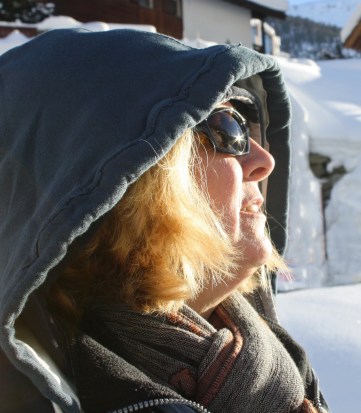
Author’s friend in Zermatt, Switzerland (photo by Nina Munteanu)

Just remember that while we are born artists, it is still our choice to live as artists. Until we embrace that which is within us, we will not find our voice to give to the world. That is our gift to the world. Laurance Gartel says “to be an artist is to take responsibility for the world’s destiny. You shape it by your vision.”

The true artist is not interested in having a nice life, being comfy or fitting in, but rather sees himself as a benefactor. His goal is to make a contribution to life, and to this end there are no barriers, doors or blocks, but only wide open spaces.”—Brian Simons


nina-2014aaNina Munteanu is an ecologist and internationally published author of award-nominated speculative novels, short stories and non-fiction. She is co-editor of Europa SF and currently teaches writing courses at George Brown College and the University of Toronto. Visit www.ninamunteanu.ca for the latest on her books.

Dreaming of Writing a Bestseller

jungfrau04

Jungfrau, Switzerland (photo by Nina Munteanu)

This is a valid desire. It is, after all, why most of us write—to share our stories and messages with as many people as possible. Most writers dream of writing a bestseller although only a handful of authors achieve this status. The irony and the big secret of achieving “bestseller” stature and becoming wildly popular is not what you think.

You thought I was going to send you to the bookstore to research the market, weren’t you? Or go to Amazon and find out what’s selling? Or see who and what is currently on the Bestseller list?

While these are all valid quests, writing to the market will not ensure that your work becomes a bestseller. In fact, it will likely do the opposite. When a writer is writing to the market, she is following the market, not leading it. Here lies the rub; a book becomes a bestseller because it provides something new and refreshing to a wide readership, eager for a story that resonates with originality. This isn’t necessarily something eclectic and strange; but it is most certainly a new voice and/or new way of looking at something familiar. When a unique voice intersects with a popular thought, a bestseller emerges. That is precisely what happened with Harry Potter. J.K. Rowling didn’t invent wizards or fantasy or even a school for wizards; but she did provide a fresh look at the potentially popular subject of an outsider who finds that he is special. And let’s not forget that before her book became a bestseller, it was rejected many times by less visionary publishers unwilling to take a risk.

So, what am I advising? Find your own voice, the one that belongs only to you. Cultivate your unique voice and write with passion. Write about something that means a lot to you or excites you or intrigues you. Be genuine. Be specific. Put yourself out there. Take risks. And be patient. Chances are, your writing will resonate with many.

Arthur Miller, author of Death of a Salesman, recommended that you “develop interest in life as you see it; in people, things, literature, music—the world is so rich, simply throbbing with treasures, beautiful souls and interesting people. Forget yourself.”

Stop chasing success; instead create it.

Auschwitz survivor and psychologist Victor Frankl wisely said: “the more you aim at success and make it a target, the more you are going to miss it … Success , like happiness, cannot be pursued; it must ensue, and it only does so as the unintended side effect of one’s personal dedication to a cause greater than oneself or as a by-product of one’s surrender to a person other than oneself.”

Bottom line: don’t chase it and don’t sweat it; enjoy the journey.

Nina’s latest book “Water Is…” (Pixl Press) is currently a bestseller on Amazon and was top pick for Booker Prize author Margaret Atwood ‘s 2016 ‘The Year in Reading” list in the New York Times.

nina-2014aaNina Munteanu is an ecologist and internationally published author of award-nominated speculative novels, short stories and non-fiction. She is co-editor of Europa SF and currently teaches writing courses at George Brown College and the University of Toronto. Visit www.ninamunteanu.ca for the latest on her books.

The Moving Target of Indie Publishing: What Every Editor (and Writer) Needs to Know

paris-03

The Seine, Paris (photo by Nina Munteanu)

I’m a writer and an editor. I’ve written and published novels, short stories and non-fiction books with traditional publishing houses and indie publishers, and I’ve self-published. As editor, I serve as in-house copy-editor for a publishing house in the United States and have acted as acquisition editor for several anthologies put out by a local indie publisher. I also coach novice writers to publication and edit in that capacity. So, you could say, I know the industry from many angles and perspectives. That’s been good for me, because this industry is a moving target and it’s good to triangulate on a moving object. The entire publishing industry is evolving and it’s a slippery evolution.

Even the words we use are slippery. Indie. Hybrid. Publisher.

Many people, like award-winning author Kristine Kathryn Rusch, when they use the terms indie-writer and indie-publishing include what some call self-publishing in their definitions of indie, “because so many [professional] writers who are not with traditional publishers have started their own presses. It’s not accurate to lump all writers who are not following the traditional route into the self-publishing basket any longer.” According to Rusch, an indie publisher, then, is anyone who is not a traditional publisher. For the sake of this article, I’ve adopted Rusch’s definition to provide the full range of expectations for editors working with writers in the indie field. I define a traditional publisher as an established and often larger publishing house or press that: 1) follows traditional submission criteria; 2) does not charge writers; 3) pays out royalties; and 4) employs in-house editors.

Indie writing and publishing can then be described in several ways depending on where the writer submits, by what mechanism and what model they use. All of these will affect a writer’s needs and perceptions for an editor and, in turn, an editor’s expectations as well.

I overview five major models of indie writing and publishing in Table 1, below.

Table 1: Types of Indie Writing / Publishing Models:
1. Small Independent Press

(not writer’s)

Author submits to a small press that does not require author to pay for publishing costs; house may pay small royalties; acceptance criteria limit submissions; there may or may not be formal distribution
2. Small Independent Press

(not writer’s)

Author submits to a small press that may require author to pay for part of publishing costs; house typically does not pay royalties but may provide complementary copies and/or author’s rate for copies; acceptance criteria may still apply to submissions; distributor tends to be Ingram/Amazon model
3. Small Independent Press

(writer as sole proprietor or part of a consortium; also called self-publishing by some)

Author can pretty well write and publish as she pleases; costs of publication are born solely by the writer(s) and royalties come straight from profit; no acceptance criteria apply; distribution typically Ingram/Amazon model
4. Service “Publisher”

(e.g., iUniverse, Friessen, etc.); this is self-publishing, even though the “publisher” name appears on the work

Author can pretty well write and publish as she pleases; all publication costs born by writer; service will include various services, including: copy-editing, layout, cover design, printing, some distribution, some promotion—all at cost (based on service package); distribution typically Ingram/Amazon model
5. Self-Publishing

(e.g., the publication is in the author’s name)

Author can pretty well write and publish as she pleases; author uses a la carte style of self-publishing in which she hires various experts—or herself does—the production of the work (e.g. editing, layout, cover, printing, distribution, and promotion).

Depending on which model an author uses for their work, their perceived need and actual need for an editor prior to submission and publication will be affected. I make the distinction between “perceived” and “actual” because, unfortunately, in many cases these diverge: an author may not think they need a certain kind of editing for their work when they do. The opposite is more rare: the author thinking she needs an editor when she doesn’t. I will talk more about this in a later article.

The availability of these models and their hybrid cousins has provided writers with a cornucopia of often confusing choices. In many cases, I am finding—particularly with my clients—that writers don’t even know which choice is best for them. Part of the reason for this is that writers carry forward ideas from the old model and create a misconception of expectation. Unfortunately, this often translates into misconceived ideas about and expectations of editors. That’s another article too.

For editors, it’s important to recognize these different models and what they, in turn, provide and expect from authors. A savvy editor translates into a savvy author. Your advice, if driven from a place of publishing industry knowledge, will be invaluable to authors seeking your services. And they will come to rely on this as much as, if not more than, your actual editing.

paris-15

Eiffel Tower, Paris (photo by Nina Munteanu)

By its very nature, indie publishing has given the freelance editor an opportunity to take on a new role—a service that agents used to and still do provide many traditionally-published authors: that of industry consultant. In the traditional model, an author would seek an agent who would then not only sell their work to a publisher but also provide advice on what to expect in the market as well as help with career-longevity choices (which include “branding”); questions many novice authors haven’t even considered, never mind answered sufficiently. Most indie authors will not engage an agent; but most will (should) hire an editor. So, instead of an agent, the freelance editor becomes the first stop in the publishing industry for an indie author. This has become one of my primary roles as editor and writing coach. And this is again because most writers, when they start out, do not know what direction they want to go—mainly because they aren’t familiar enough with what is available to them and the ramifications to their careers.

Here’s an example: one client, working on her first novel, wanted my advice on whether she should try with a traditional publisher or just forgo and self-publish. An editor, if possessing savvy knowledge of the industry and now knowing something of the author’s work and ambitions, can bring informed and constructive advice to the author.

The ramifications on how I handle and edit a story directly follows which route the author has decided to follow. This is every bit as relevant to an author publishing with a traditional publishing house, an indie press, or self-publishing. Style—whether it is that of a publishing house or the author’s brand—relies on consistent application of voice and tone. Just as publishing houses embrace different and unique styles, so do authors. In fact, if they are self-publishing, this is even more important.

The editor plays a crucial role in helping an author establish their “voice” and “style”, and ultimately their “brand.” And, perhaps, this becomes one of the principle differences between traditional and indie publishing. While voice and style is pre-determined to some extent by traditional publishing houses (hence they employ their own editors to impose a style in some cases), it is left to the author—and her freelance editor—to determine this in the indie scene. The structure of traditional publishing is both more orderly and more confining. Indie publishing—particularly self-publishing—is an infinite melting pot of creativity. Some view it as one big mess. In fact, it is a chaos of astonishing opportunity. It is a chance for intimate collaboration that demands mutual respect. Freelance editors are poised as both gatekeepers and enabling wizards of the indie world.

Table 2, below, describes a freelance editor’s focus in the five indie models I described in Table 1.

Table 2: Editing for Different Indie Models:
1. Small Independent Press

(with submission criteria similar to a traditional model)

Authors often think they don’t need a freelance editor if they are submitting to a press with in-house editor; this is incorrect. Those who have had their work edited prior to submission to a press—even a small press—will have a much higher chance of being accepted. The freelance editor’s job, then, will include attending to the style of the publishing house.
2. Small Independent Press

(without submission criteria)

While authors may not recognize the need for an editor in submitting to an indie publisher without submission criteria, the need for editing remains—particularly because many of these presses do not employ or have sufficiently qualified editors. Excellence in presentation and nurturing a strong author voice are the freelance editor’s responsibility.
3. Small Independent Press

(writer’s own press)

Given that the author has pretty well carte blanche on what to write and publish, a freelance editor’s role in recognizing, harmonizing with and helping to establish a genuine and strong author’s “voice” becomes most important.
4. Service “Publisher” Authors have misconceptions about service “publishers” and particularly their editors. I have had several clients come to me after recognizing that their works were not well represented by the provider’s in-house editor. Service “publisher” in-house editors do not represent a particular style, voice or brand (given that most are underpaid students and there is no style identity); the freelance editor role is as with #3.
5. Self-Publishing The same criteria exist here as for model #3.
paris-30

Paris street (photo by Nina Munteanu)

The take home is that freelance editors can flourish in the indie writing and publishing field by: 1) establishing their expertise in the industry and what it requires (taking on the role of consultant, which agents normally provide in the traditional model); 2) recognizing a need for strong authorial voices and helping to foster them; 3) promoting point #2 with consistency in style, tone, etc.

Hope this helps. Let me know.

nina-2014aaNina Munteanu is an ecologist and internationally published author of award-nominated speculative novels, short stories and non-fiction. She is co-editor of Europa SF and currently teaches writing courses at George Brown College and the University of Toronto. Visit www.ninamunteanu.ca for the latest on her books.

The Hidden Costs of Self-Publishing, Part 1: The Solution to “Author Solutions”

author-solutions-friendsWhat do Simon & Schuster, Hay House, Barnes and Noble and Reader’s Digest have in common? Each of these reputable and famous names in publishing has forged a partnership with Author Solutions. What is significant about that? Well…In a detailed article written in April of 2015, author David Gaughran tells us why this is distressing news to authors and I discuss this further below.

Many beginning authors wishing to “self-publish” are looking for a service that will easily and painlessly “publish” their cherished creative as well as help them get it out into the reading world. Naive about what it takes to “get out into the reading world”, many authors are signing up with service-publishers who will “publish” anything so long as the author is willing to pay. You know who they are; I mention some of them below. Although the Internet is populated with excellent book-publishing services by freelance editors, cover artists, layout specialists and various accompanying software and apps, many authors are unwilling to go the a la carte route of experts. Instead, they look for an easy and convenient solution: a one-stop shop to sell their book. The “expertise” and “services” are usually anonymous and nameless, hidden behind the company name. I’ve seen some horrid examples of extremely poor editing in books that had presumably been professionally edited by a service-publisher for which a writer had paid good money. The writer was himself/herself clueless of the poor quality (for some of them, English is not their first language), and couldn’t tell me who had edited their work. When I did some digging into two of these service-publishers, I finally found, in the fine print, that the service-publisher used students. Another client of mine complained bitterly about how he had not received the services promised in the package that he’d paid dearly for. This sort of thing is rampant in the “self-publishing” industry right now.

As with all short cuts, there are hidden costs. Let’s take Author Solutions as a good example.

.

The “Anti-Solution”

Author Solutions provides a “publishing” service to any writer willing to pay.  Typical of virtually all the vanity publishers, Author Solutions and its many affiliates (likely the company you are using) offers several packages for the author, from basic printing services to the deluxe package with promised media coverage and excellent PR. Unfortunately, what they promise and what they deliver can be two different things. Far from providing solutions to an author, Author Solutions operates “more like a telemarketing company whose customer base is the authors themselves,” write plaintiffs Wheeler and Heightsman as part of their 2015 class action law suit against the firm. Some of Author Solutions’ long-standing issues faced by customers include:

  • improperly reporting royalty information
  • non-payment of royalties
  • breach of contract
  • predatory and harassing sales calls
  • excessive markups on review and advertising services
  • failure to deliver marketing services as promised
  • telling customers their add-ons will only cost hundreds of dollars and then charging their credit cards thousands of dollars
  • ignoring customer complaints
  • shaming and banning customers who go public with their stories.

“Despite Author Solutions’ mounting legal troubles and an unending stream of complaints against the company from both its own customers and a whole host of writers’ organizers and campaigners, companies are still queuing up to partner with Author solutions,” writes Gaughran. Is it because its corporate parent is Penguin Random House? Some “Partner Imprints” (in brackets) run by Author Solutions as a self-publishing service for the partner publishing house include:

  • Simon & Schuster (Archway Publishing)
  • Lulu
  • Harlequin (DelleArte Press) – partnership terminated 2015
  • Hay House (Balboa US, Balboa Australia)
  • Barnes & Noble (Nook Press Author Services)
  • Crossbooks (LifeWay) – partnership terminated 2014
  • Penguin (Partridge India, Partridge Singapore, Partridge Africa)
  • HarperCollins/Thomas Nelson/Zondervan (Westbow Press)
  • Random House (MeGustaEscribir)
  • Writer’s Digest (Abbott Press) – partnership terminated 2014

Many authors aren’t aware that these “Partner Imprints” are all run by the same company; or that Author Solutions’ own in-house imprints include iUniverse, Trafford, Palibrio, AuthorHouse, BookTango, and Xlibris. According to Gaughran, this came about as a “solution” for traditional publishing houses to monetize their slush pile. That’s the pile of unsolicited works most beginning writers send to publishing houses that end up in a huge heap in some room that in the past was relegated to new underling editors to cut their teeth on. Now the manuscripts simply go to a company only interested in making money from writers willing to pay for their largely unedited works. Books that would never have been accepted by these traditional publishing houses are now finding a “home”. But what kind of “home” is it and what does the writer really achieve for her many dollars spent? According to Gaughran’s sources at Penguin, the primary directive of Author Solutions is to sell (to the author) the most expensive publishing package they can and encourage authors to buy their own books. When depositions were made public, they revealed that two thirds of Author Solutions revenue comes from selling publishing and marketing packages and one third from selling books—with a vast majority of those book sales coming from authors buying their own books. What about the cool opportunities for book signings at literary events, book displays, advertising space, TV and reviews that they promised? Gaughran provides a staggering list that includes Publishers Weekly, New York Times, Kirkus and the New York Review of Books, and my personal favorite Word on the Street Festival Toronto. “These partnerships don’t provide any real value to Author Solutions customers,” says Gaughran. In an earlier class action lawsuit against Author Solutions by law firm Giskan Solotaroff Anderson & Stewart representing three authors, Publishers Weekly wrote:

The suit, which seeks class action status, alleges that Author Solutions misrepresents itself, luring authors in with claims that its books can compete with “traditional publishers,” offering “greater speed, higher royalties, and more control for its authors.” The company then profits from “fraudulent” practices, the complaint alleges, including “delaying publication, publishing manuscripts with errors to generate fees, and selling worthless services, or services that fail to accomplish what they promise.” The suit also alleges that Author Solutions fails to pay its authors the royalties they are due.

According to the law firm representing the authors:

Author Solutions preys upon the dreams of authors by selling them expensive services that sound exciting but do not actually sell any books. Their defense: They aren’t being deceptive because they aren’t trying to sell books. Of course, for nearly 200,000 authors who have paid thousands (if not tens of thousands) of dollars to buy expensive services that promised to promote their books, Author Solutions’s indifference to book sales comes as more than a bit of a surprise.”

.

The Solution—But You May Not Like It…

So, what’s the solution? For those of you starting out, it’s important to know that firstly there are a lot of genuinely good publishing houses out there potentially interested in your book and willing to work with you in partnership toward a successful book that will sell. And they don’t want your money; they want quality. The book publishing industry is booming in many different ways. And while the predatory arm of the mercenary would like to seduce you with glamour and unrealistic dreams—so long as you pay—a whole cadre of small presses are growing who are producing high quality works by emerging writers. These local Indie publishing houses are worth seeking out and submitting to. But they don’t want to see your book until it is ready. Reader ready. This puts the responsibility back on you, the writer, to produce the very best you can. I tell my writing students at the University of Toronto and George Brown College that if you want to publish, you need to:

  1. write the very best story you can
  2. get it edited, preferably by a professional editor or a writing coach of good repute
  3. research the book publishing market and submit to a traditional publisher (not a service-publisher who wants your money)
  4. rewrite (if you feel the need to) and resubmit to another publisher
  5. resubmit to another publisher

If you decide to self-publish, find a reputable printing house and learn what it takes to create a book. Find someone who does layout and covers professionally. There are good ones out there; I know—I use them myself. Learn some marketing skills or find a marketing specialist or PR specialist who has a sound track record and you can trust. The book industry was and still is based on sound relationships. Writers with editors; publishers with marketers and distributors; writers with readers; and so on.

In the end, it’s up to you. Take charge of your career and bring the “self” back into self-publishing.

In Part 2, I discuss the significance of first impressions and “branding” in self-publishing. Of course with examples.

.

nina-2014aa

Nina Munteanu is an ecologist and internationally published author of award-nominated speculative novels, short stories and non-fiction. She is co-editor of Europa SF and currently teaches writing courses at George Brown College and the University of Toronto. Visit www.ninamunteanu.ca for the latest on her books.  

Swimming Against the Tide and Rising Up & Rising Above

cheryl-xavier

Cheryl Antao Xavier

“Her passion for giving voice to non-mainstream writers has inspired her to swim against the tide in these harsh economic times,” says Desi News (Issue 31; December 2014) of Cheryl Antao-Xavier, publisher of In Our Words, Inc. (IOWI) in Mississauga, Ontario.

I met Cheryl a few years ago at a writer’s event when she introduced herself during a break as I was helping myself to my third samosa. We’ve since collaborated on several projects. The most recent is a literary anthology on what it means to live in Canada and be a Canadian. The call for submissions has just recently been made, so if you’re interested in submitting, check out Cheryl’s website here: http://inourwords.ca/the-literary-connection-volume-ii.html

Born of Goan parents, Cheryl grew up in Bahrain and then Karachi, where books were a rare treat. Cheryl shares the story of her aunt who taught knitting to women in a banking family from whom she borrowed books—Enid Blyton, Grimm’s Fairy Tales, Nancy Drew and comics—for her book-thirsty nieces, who “would devour the books in no time!” says Antao-Xavier.

Quality books were a luxury, even at the university she attended. Cheryl recalls how the Karachi University library had a “chained book” on display. John Stuart Mill’s book was required reading for students of economics but there was only one copy in the KU library. It sat on a wooden stand with a chain running through its spine under a librarian’s guard and you had to book time with the book and wait long hours for a few minutes to make hasty notes.

Cheryl Antao Xavier

Cheryl Antao Xavier

When Cheryl immigrated to Canada in 1988, she found “book heaven” in the second-hand bookstores and libraries. Reading and owning books became an obsession that has endured to this day.

Cheryl worked for several publishing houses before creating her own publishing house In Our Words Inc. (IOWI). IOWI publishes a good variety of works, including literary fiction, creative non-fiction, poetry and children’s stories from both emerging and established writers.

About the work IOWI publishes, Cheryl told Desi News, “I delight in new and fresh voices; language with imagery; twists on the conventional; historical backgrounds with the angst of displaced or marginalized people. For writers with emotional ties to a heritage radically different from the Canadian experience, writing is a cathartic process. There are writers who have lived through cataclysmic events, whose stories are fascinating chips in the mosaic of Canadian literature.”

I recently whisked Cheryl off in Benny, my sentient ship, and settled her to a million dollar view in the aft deck as we circled the planet. I asked her about how she is managing with the industry doing virtual summersaults (as opposed to somersaults–well, it IS summer, eh?) these days. Here’s what went back and forth:

Nina: I was so intrigued by your story, I just have to start by asking you this: what’s your favourite book of all time and why?

Cheryl: Jane Austen’s Pride and Prejudice. Read it umpteen times, saw both movie versions, have the Colin Firth series in my video collection. I looooove period fiction drama. Dickens, the Brontes, Hardy, to the more recent Forsythe Saga, Downton Abbey, etc. etc. My Dad had the full collection of Perry Mason and Zane Grey books. So of course I read them all. I love murder-mysteries from Agatha Christie to the present day forensic science stuff.

Nina: You have excellent taste! … What is your assessment of what is happening with print books vs ebooks vs audio books and such? Do you see one format winning over the other and how will that affect your own publishing model?

Cheryl: Print books should be around for as long as our generation who love holding a paper book survive. But ebooks are increasingly popular and have undeniable environmental merits. Publishing companies like mine have to do what you aptly call ‘virtual somersaults’ to stay current and cut costs to stay viable. Rather than publishing formats, what worries me more is poor quality books being published and the potential for declining readership in general. The tragedy of do-it-yourself print-on-demand software, freely available, is that anybody with passable tech skills can become a ‘published author.’ Books with flashy covers but no creative merit vie for reader attention and diminishing discretionary incomes. Also, media entertainment continues to steal leisure time.

Nina: Can you share some candid thoughts on the advantages and disadvantages for writers starting out in choosing the traditional publishing model vs alternative models such as indie or self-publishing.

Cheryl: The lines between traditional and indie/self-pub have blurred even more with the proliferation of print-on-demand options. Production costs have consequently plummeted. So the financial investment in an author/book has less of a risk. I would say, do your research. Make your manuscript super-strong, that means get it professionally edited, and then try the traditional route. Read publishers’ responses to your queries very carefully. It’s an opportunity to learn. If there are no takers, then research indie publishers and call, discuss contracts and options and make an informed decision. Make doubly sure that the traditional pre-production steps of editing, proofreading and professional design are not bypassed. Sometimes good content is smothered by verbosity and needs a good professional edit. Basic POD ‘template’ designs SCREAM amateur-DIY when they are set with no real imagination in big blocks of text, riddled with typos.

Nina: Do you see any specific roles for indie and/or self-publishing in helping to define artistic expression in Canada?

Cheryl: Definitely. The traditional big publishing houses can accept just so many manuscripts. So obviously they’ll go for the ones that are a sure bet. That’s where the diamonds in the rough can be missed out. Indie publishers who have the resources to work with authors to polish the content to its best possible advantage are ideally placed to bring new or even established voices to the mainstream.

Nina: What in your opinion is the major impact (both negative and positive) of the growing self-publishing model adopted by many writers over both traditional and indie publishing?

Cheryl: Occasionally I read and recommend self-published books for membership in a major professional writer’s organization. I also attend book launches and local literary events looking at books, particularly by self-published authors. The good thing is that these authors went that extra step to raise their voices in the literate world. They feel the satisfaction of being ‘published authors.’ The down side is that once something is in print, and particularly if it has not been professionally edited and designed, that book can end up being an embarrassment and a waste of time and money. Typos jump out at the reader and lower the credibility of the work and its creator. Ultimately, it comes down to what the writer wants to achieve by publishing. 

Nina: What major change do you foresee in the book industry and the readership that will affect us? How and why will that affect IOWI?

Cheryl: Everybody loves a good story, and finds it worth their while to read well-articulated text. So the successful writers will be the ones who manage to engage their readers no matter what the genre. The challenge is also for a good book to stand out from the proliferation of new titles vying for attention in virtual and brick-and-mortar stores. I see social media, forums like Goodreads, and book tours/festivals being key arbiters in what bookworms find and opt to read. IOWI will continue to offer an indie publishing option that stresses putting out a good book. Something that both author and publisher can be proud of.

Nina: Tell us about your current projects and why they excite you. 

Cheryl: IOWI is working on two anthologies currently, with a couple more in the planning stage. A Mississauga youth group is publishing their third anthology through IOWI. It is so exciting to see the writing and photography talent this group has attracted. We are so proud to be their publisher. IOWI has its own anthology The Literary Connection Volume II, with a theme of ‘My Canada’ due to be published by November this year. The call for submissions is already out and closes end-July. I am also working on pulling together a collection of plays by Canadian playwrights. It’s going to be awesome. My aim is to have writers meet with a professional writing coach, yourself Nina, to workshop their submissions into amazing work. I want these anthologies to be a credible contribution to CanLit.

Then another pet project is The Red Bench Project, which seeks to promote reading and literacy at the family and community levels. We must encourage the habit of reading for enjoyment. Bringing authors and public together is part of this project.

Nina: What three pieces of advice do you have for a new writer wishing to get published?

Cheryl: Write every day. Then spend some time editing and rewriting past work. Learn to write well through courses, mentorship or self-study.

Read voraciously and discerningly. Keep clippings or books of your favourite writers handy. Before writing, read a selection from these writers. It influences your own voice and jumpstarts your creativity.

Botanical Beach tidal pools

Botanical Beach, BC (photo by Nina Munteanu)

Be guided by your need to publish your super-amazing manuscript. Not by your need to see your name on a book. If the content is not up to par, that novelty morphs into the proverbial albatross that haunts a fledgling writing career. If you are a serious writer: DON’T PUBLISH TILL YOU ARE READY!


Nina: Great advice, Cheryl! Thanks so much for joining me here and I do promise to get you back on the ground… Don’t the Great Lakes look beautiful from 36,000 km?

Cheryl: Thank YOU for the ride, Nina. Be well.

.

.

nina-2014aaNina Munteanu is an ecologist and internationally published author of award-nominated speculative novels, short stories and non-fiction. She is co-editor of Europa SF and currently teaches writing courses at George Brown College and the University of Toronto. Visit www.ninamunteanu.ca for the latest on her books.

The Future of “Books”

Path deas park

Deas Park, BC (photo by Nina Munteanu)

An August 2013 survey by bestselling author Marie Force revealed some interesting trends about what American readers like, what format they prefer and where they find their writers. While the survey was fairly small and restricted to Americans (just under 3,000 people responded to 44 questions), I think it provides a good microcosm of what the trend is out there in North America generally.

Here are Marie’s main findings and conclusions:

1. FORM: Readers prefer e-books to paperbacks (77%); many buy in multiple formats, including paperback. 52% of surveyed readers do buy their books in print form. Audio books are slowly gaining popularity.

2. REVIEWS & TESTIMONIALS: Retail reviews such as those on Amazon, Barnes & Noble and other retail sites were more important to readers than author endorsements and reviews by professional reviewers on review sites. Fifty percent of readers preferred reviews posted on retail sites for their information; 16% used Goodreads; 72% said that the designation of “New York Times Bestselling Author” did not make a difference in their purchasing choice. 81% did not subscribe or read the major review publications (e.g., RT Book Reviews, Publishers Weekly, Kirkus, Booklist, NYT Sunday Edition, USA Today)

3. BOOKSTORES: A majority of readers bought their books from a virtual bookseller: 80% of surveyed readers buy from Amazon (Barnes & Noble online was second at 23%; iBookstore/Apple scored 13%). 58% of readers surveyed had visited a real bookstore twice or less in the past year. The remaining percent visited more often.

4. PUBLISHER: readers are more likely to buy a self-published book by an author they know; 94% of readers surveyed are “more likely” to buy a self-published book from an author who is known to them; 68% of readers are “less likely” to purchase a self-published book by an author they don’t know.

5. CONTENT & GENRE: Readers are most interested in stories with outstanding characters, setting, storytelling and writing; 75% chose “all of the above” to encompass each of the elements. Unsurprisingly, 81% of readers chose “Romance” is their favorite genre of fiction; contemporary romance is the favorite subgenre with historical romance as the second favorite.

6. HOW READERS FIND & FOLLOW AUTHORS: the best single-most best social media platform for authors is Facebook, used by 85% of surveyed readers; 75% of readers also subscribed to the newsletters of their favorite authors and 55% subscribed to the blogs of their favorite authors. Twitter was not a major site for readers to find and follow their authors. Goodreads was one of the most frequently mentioned sites in the open-ended portion of the questionnaire.
The numbers don’t always match up; nor is the catchment or method of making statistical conclusions sufficiently explained; but the results as presented make logical sense to me. They make sense because the feedback I am getting in my circles is very similar. So, there you go, writers and readers.

Here’s my take on this phenomenon:

1. Increased sales of Digital Books: the increasing sales of digital books (ebooks) and the rising sales of audiobooks is a wonderful and uplifting icon of rising literacy. More people are reading (and listening) to books now than ever. And we have the digital book, Kindles, Kobos and iPads to thank for it. The “book” has become more accessible and readable. People swarm the public transit, clutching their iPhones and reading devices.

2. Readers still choosing Print Books: Obviously, print books are cherished by readers for their intrinsic value. Books—their tangible tactile presence—will always remain with us; in collector’s showcase libraries, in trendy artistic venues, and funky local neighbourhood venues.

3. My Prediction: print books will become the epitome of publishing value and worth. Already coveted by collectors whose libraries will represent the best of the best in the literary world, print books will come to represent the highest status in literature. Only the best stories will endure as print books; perhaps only the “best book” will even be published in print form. Its existence in print form will define its literary value.

4. Take Home Message to Authors: ensure that your book appears in print form and get it into the hands of classy libraries and classy people.

nina-2014aaNina Munteanu is an ecologist and internationally published author of award-nominated speculative novels, short stories and non-fiction. She is co-editor of Europa SF and currently teaches writing courses at George Brown College and the University of Toronto. Visit www.ninamunteanu.ca for the latest on her books.

Learn How to Write Science Fiction at George Brown College

For those in the Toronto area, I’m teaching a 12-week course on how to write science fiction at George Brown College this spring.

Called “Creating Science Fiction”, the course runs Wednesday nights from 6:15 to 9:15 starting April 8th through to June 24th and costs $278. The course is also part of George Brown’s Creative Writing Certificate.
.
Meant for both beginning writers and those already published, the 12-week course is run like a workshop with student input and feedback on student’s WIPs. I explore with students the essential tools used in the SF genre (including world building, research and plot approaches). Students will work toward a publishable original piece by learning to generate and follow through with premise, idea and theme.
Microsoft Word - GBC-SF course-APRIL2015 AD.docx
George Brown College is located on 200 King Street, Toronto, Canada.
.
.
.
.
nina-2014aaNina Munteanu is an ecologist and internationally published author of award-nominated speculative novels, short stories and non-fiction. She is co-editor of Europa SF and currently teaches writing courses at George Brown College and the University of Toronto. Visit www.ninamunteanu.ca for the latest on her books.

Walking the Tightrope Between Innocent and Cynical

jungfrau05

Jungfrau, Switzerland (photo by Nina Munteanu)

The writer’s journey from the passion and vulnerability of innocence to the wisdom of experience can be a dark and twisted road. In fact, if you are a writer of any merit, I guarantee you that yours will be too. Think Dante in the forest…

YellowCreek1

Yellow Creek, Ontario (photo by Nina Munteanu)

Let me tell you a story … It starts in the early 1990s. I was an eager young sprite entering the novel publishing world with my newly finished science fiction novel: “Escape from Utopia”. I’d published a few short stories and many articles by then. In addition, I’d published many scientific papers and reports. Confident and cocky, I was proud of my novel and eager to share it with the world. And I thought I knew my way through that dark forest…

I zealously sent the manuscript to a bazillion agents and editors. I was rewarded for my zealous efforts with a tidal wave of rejection letters. Mostly form letters (see my amusing account of the evolution of rejection letters in my fiction writing guidebook, The Fiction Writer) and an excerpt in a previous post here: “Rejection, Part 2: the Evolution of Rejection

Then it came: an enthusiastic letter from an agent (I can’t remember the name: Literary Bridge or something); they said my work had great promise and that with some help from an editing firm they would consider representing me if I had it edited and resubmitted.

They recommended Edit Ink.

Those of you in the know and with some history in the industry may recall the Edit Ink scandal of the 90s. In short, it was a bait-and-switch scam that Bill Appel and Denise Sterrs (of Edit Ink) and their associated literary agents ran for close to a decade. Edit Ink was a “book doctor” firm near Buffalo, New York. The State of New York eventually convicted Appel and Sterrs and associates for defrauding prospective writers of several million dollars.

I remember my heart swelling with gratitude and optimism. Finally, someone liked my book! I naively considered their recommendation. Soon after—within days—I got an invitational letter from the pro-active Edit Ink. I can’t remember the exact content, except that they assured me that only the most promising writers were recommended to them by this particular agent. I remember seriously considering their offer. Then I got two more letters, one from another agent who recommended Edit Ink and another invitational letter from Edit Ink. Alarm bells went off. I went from naively hopeful to cynically suspicious. I did some investigating (something I should have done initially); by then the buzz was already on the Internet on their questionable practices. The lawsuit by New York State had yet to happen.

The Science Fiction Writers Association (SFWA) runs a “writer Beware” page, where memorable cases are reviewed. It’s worthwhile perusing just for your general knowledge and edification.

Here’s what they said about Edit Ink:

Founded by the husband and wife team of Bill Appel and Denise Sterrs, Edit Ink was a New York State-based editing service that engaged in a kickback referral scheme with a wide network of literary agents. Here’s how the scheme worked.

  • Participating agents sent letters to writers who’d submitted manuscripts the agents didn’t want to represent, saying that the writer’s work showed “promise” but “wasn’t quite ready for publication.” A useful service was recommended: Edit Ink, which for a fee would polish the ms. to make it more salable. Once the ms. had been edited, the agent would then be glad to reconsider it.
  • The agent forwarded the writer’s name to Edit Ink, which sent off a solicitation letter claiming, among other things, that Edit Ink received referrals for only a “select few” manuscripts (false), and that most publishing houses insisted on receiving “professionally edited” work (falser).
  • If the writer took the bait and paid for an edit, the referring agent received a kickback of 15%.
  • Writers who resubmitted their edited manuscripts to referring agents, per the referring agents’ suggestions, were given the brushoff. Either the market had “changed in the interim”, or the agency was “no longer representing that genre.”

Edit Ink charged $5 per page–exorbitant at the time even for a qualified editorial service, which Edit Ink very definitely was not. Its staff mostly consisted of recent college graduates with no publishing experience, working long hours for minimum wage. The typical Edit Ink edit was slipshod and superficial, consisting mainly of basic copy editing suggestions, and omitting the kind of in-depth analysis of plot, theme, character, and structure that might make a professional edit worthwhile.

At its height, dozens of literary agencies participated in the scheme. Edit Ink even set up its own bogus agencies and publishers to funnel more manuscripts its way. It’s estimated that the company made in excess of $5 million.

Mounting complaints from writers, and efforts by writers’ advocacy groups, at last spurred New York State to take action. In January 1998 the NYS Attorney General announced a lawsuit against Edit Ink for deceptive business practices, false advertising, and fraud.

Throughout the appeals process, Edit Ink continued to operate. Many questionable agents continued to refer manuscripts, and Aardvark Literary Agents (one of Edit Ink’s original bogus agencies) was taken over by co-defendant Kelley Culmer so it could go on functioning as a conduit for Edit Ink referrals. Business was dwindling, however–in part as a result of media attention, but largely because of spreading word in the then relatively new environment of the Internet. Once the appeal was denied, the thrill was gone. In August 1999, Appel and Sterrs closed Edit Ink’s doors for good.

Shades of Edit Ink

Edit Ink is by no means unique in the publishing industry. “Book doctors”, associated kick-back agents and subsidy publishers are, in fact, on the rise. This is not surprising, in view of the current rise in self-publishing and associated models. The industry is currently inundated with a range of publishing models from straight printing-only firms to full service publishing houses and anything in-between.

Author Victoria Strauss on her blog “Writer Beware” shares this story:

Over the past couple of days, I’ve heard from several writers who queried agents at Objective Entertainment, a relatively new literary agency with a strong track record and experienced staff, and received the following response:

Dear [name retracted], 

Thank you so much for contacting us at Objective Entertainment. We have reviewed your material and we would like to refer you to one of our Publishers who we trust and believe will be able to serve you best. In order to do this I need your permission and the following information so they can either contact you via Phone or Email. The following information we need is if you would like to receive their newsletter and special offers. I think this is an amazing opportunity for you. 

Please reply with the information we asked so that we can get you that one step closer to getting your work published! 

Best 

Tracey Ravenelle
Objective Entertainment

When the writers, eager to know the name of the publisher, requested more information, they received this response from Ms. Ravenelle:

We work with Iuniverse and AuthorHouse. Iuniverse has the number 5 book this week on the NY Times Best Seller List!

The writers then asked why Objective was recommending a self-publishing service. As of this writing, only one has received a response, which Ms. Strauss reproduced below exactly as it was sent to her:

Because we believe they would be the most beneficial for you at this point in time. Then you would come back to us after the sales starting racking up and we go major! This is the best way for an author to get their work out their. One of their books is number 5 on this weeks upcoming NY Times Best Seller list. So we believe they can help our potential future clients immensely.

EEK… aside from their atrocious grammar, Objective made some questionable recommendations. The major one being that of referring rejected clients to a self-publishing service (of course, they got a fee for referring clients to the house).

Vanity and Subsidy Publishers

SFWA shares another story:

Thousands of writers worldwide entered into contracts with Commonwealth Publications of Canada, a vanity publisher founded in 1995 by fee-charging literary agent Donald Phelan. Phelan worked with a number of other fee-charging agents who, in exchange for a kickback, recommended Commonwealth’s vanity contracts to their clients. Phelan also advertised for manuscripts in magazines such as Writer’s Digest and Writer’s Journal. (Writers take note: this is just one example of why you shouldn’t trust the classified ads in writers’ magazines.)

Commonwealth, which identified itself as a “subsidy” publisher (the implication being that the writer was contributing only a portion of the cost) typically charged $4,500 for publication, with a promised print run of 10,000. Its glossy promotional material promised all kinds of support to its authors: editing, proofreading, marketing, international distribution. But few of these services were actually delivered–and there were many other problems. Publication dates were delayed. Authors didn’t receive the number of books they were promised. The quality of finished books was poor. Books never showed up in bookstores. Royalties from books supposedly sold were never paid.

Fee-Charging Agents

SWFA shares this recent story:

On January 7, 2010, UK literary agent/film producer Robin Price appeared in court, accused of stealing more than half a million pounds from clients.

Price is alleged to have encouraged authors to pay exaggerated literary fees and invest in non-existent film deals, and has been charged with six counts of theft, most committed over the course of several years.

Even successful established writers were taken in by this one.

Writer Brian Knight, who suffered a book doctor agent scam, shares this advice: “New writers need to know that these people are still out there, spewing false promises … patting us on the back with one hand and picking our pockets with the other.” He advises new writers to research every individual and business with which they intend to do business.

Reign in your excitement and enthusiasm. Breathe. Then do the research. “Google.com is your friend,” says Knight. “There are other online resources available to writers. In this era of the information super-highway, it has never been easier to arm yourself against the scumbags and swindlers who make their living off the trusting and naive.” Knight also suggests, www.duotrope.com.

A great site to check out anyone in the writing and publishing industry is “Preditors and Editors” (intentionally misspelled). A site I have come to rely on for excellent market advice is www.ralan.com.

The writer’s journey is a hero’s journey, fraught with obstacles, dangerous distractions, and great disappointments (see Christopher Vogel’s excellent book The Writers Journey: Mythic Structure for Writers for more). But it is a path illuminated by a beacon of passionate expression, great sharing and exquisite victory. Choose your hero archetype carefully: choose magician.

We are the shamans, the myth-makers of our community and society. The artist / writer carries her archetypal message through story to her tribe, her community, her society and her world. It is both fulfilling and a great responsibility.

After the Edit Ink debacle, I picked myself up—a little wiser and a little more careful—and went on to find a traditional publishing house who published my first and second novels. Escape from Utopia became Angel of Chaos published by Dragon Moon Press (Part 1 of the Darwin’s Paradox duology), and I went on to publish seven more novels through traditional, indie, and self-publishing models: a historical fantasy, an SF adventure trilogy, two romantic SF novels, a short story collection (Natural Selection) and two text books on writing.

I haven’t looked back since… except to write this article, that is.

 

nina-2014aaNina Munteanu is an ecologist and internationally published author of award-nominated speculative novels, short stories and non-fiction. She is co-editor of Europa SF and currently teaches writing courses at George Brown College and the University of Toronto. Visit www.ninamunteanu.ca for the latest on her books.

Know What You’re Writing: Short Story or Long Story?

freighter-rowers-sailboat-web

Freighter off Toronto Harbour, Lake Ontario (photo by Nina Munteanu)

How to Decide on the Length of Your Story 

Figuring out what you are writing isn’t always as easy as you think. Many writers, when they begin, may think they are writing a short story when they are actually writing a novel; or vice versa. When I first started, in fact this is what occurred.

Some time ago, when I was a budding novelist working on my second unpublished novel, I decided to write short stories. I’d been told time and again that it was easier to publish short stories (the market is far more diverse) and they provided excellent qualifications for when it came time to market my novel. It wasn’t as easy as I thought. I kept getting rejections with comments that my short story ought to be a novel! It took some time to master the art of short story telling. But when I did, I realized that I’d learned a lot about storytelling that I could apply to my novel. And by the time I was ready to publish my novel, I had several short story publications behind me to prove the salability of my work.

So, what are you really writing? Or, more to the point, what should you be writing?

A short story only has 7,500 words or less to get your tale across while a novel has over ten times that many words to do the same. It follows then that the short story format is a simpler one. This does not necessarily mean easier.

Short Vs. Long—What’s Your Focus?

Novels provide a sense of change, growth and solutions to problems and conflicts. Short stories must be more succinct, contain fewer characters and subplots, have less complicated story arcs and a single theme. You could say that a short story is a poem to a novel’s prose. “The short story doesn’t have the luxury of depicting change; the closest it can come is awareness,” writes Shelley Lowenkopf in her 2007 article “Telling Tales” in The Portable Writer’s Conference: Your Guide to Getting Published by Quill Driver Books. She goes on to describe the short story as a close-up to a novel’s landscape. The short story is, therefore, often more intense and powerful. A short story, more than a novel, has the power to transport, disturb and enlighten.

Renowned short story authors like Edgar Allen Poe, Nathanial Hawthorne, and Somerset Maugham emphasize the importance of striving for one effect when writing a short story: the single effect you wish to leave with the reader at the end. This is accomplished by selecting events or situations that build quickly into a combustible response.

Jack Bickham, in his book, Elements of Fiction Writing: Scene and Structure by Writer’s Digest Books (1993) writes that, “story length, author intention, traditional expectations of the audience, and all sorts of things may affect the form a story may take.” Choosing the appropriate length to tell your story relies on the complexity of your premise and theme.

Pick Your Length Checklist

The following short checklist will help you determine whether you should be writing a short story or something longer like a novel:

  • does your story have several main characters and minor characters?
  • is your story full of subplots?
  • does your story contain multilayered themes and story arcs?
  • do your characters learn and change notably?
  • is there significant change in your story?
  • does your story contain several settings and sub-stories?
  • does your story explore several ideas as opposed to one main idea?
  • does your story investigate several issues rather than making a single point?

If you answered “yes” to most of the above, then you should be writing a novel.

Defining Story Length

The Science Fiction & Fantasy Writers of America defined story length forms in the table below. Definitions vary among other sources but remain close to these.

Table 1: Terminology of Story Lengths
Name Description
Drabble (Flash Fiction) Exactly 100 words
Flash Fiction Less than 500 words
Short short Fiction 500-1,000 words
Short Story Less than 7,500 words
Novelette 7,500 to 17,500 words
Novella 17,500 to 40,000 words
Novel More than 40,000 words


Creative Options & Market Tips

During my early “salad” writing years as a short story writer, I discovered a system that helped me send out material and publish with more ease and efficiency. It helped that I was rather prolific with short story telling and that I was simultaneously working on a few novels. Here are some creative things you can do with both your short stories and novels (in the works or already published) to increase your productivity and publishing opportunities:

  • Use Novel Excerpts: Here’s something I did to save time, hone my craft, and receive early recognition: I took “aha” excerpts from my ongoing novel and adapted them into stand alone short stories—altering at least 20% of the content and other elements like setting, names, etc. In each case, I ensured a powerful story by focusing on the single thematic element. I sold at least five short stories to good magazines this way. The short stories went on to receive recognition, awards and a place in some “Best of” anthologies, long before my novels received similar recognition. In each case, the short story became an equally—if not more—powerful version of its sister work in my novel, much like a poem is to a piece of prose. Try it; you might really like it.
  • Adapt A Short Story into a Novel or Novella: you may find that a powerful thought expressed in your short story engenders interest in a larger plot with more depth, such as a novel. Nancy Kress and Ray Bradbury are two short story/Novella writers who adapted some of their works into longer forms to create something both new and compelling.
  • FictionWriter-front cover-2nd ed-webRun Your Novel and Short Story Submissions Like a Bus Depot: When I was writing a lot of short stories, I kept a list of what and where I submitted, along with the most important item: where to submit NEXT. At any given time, I made sure that I had at least x-number of submissions out there and each story had a designated place to go if it returned. As soon as a story came back from magazine A, I simply re-packaged it and sent it to magazine B. The critical part of the list was to have a contingency for each story: the next place where I would send the story once it returned. I was planning on the story being rejected with the hope that it would be accepted; that way, a rejection became part of a story’s journey rather than a final comment. I ran my submissions like a bus terminal. A story was in and out so fast it never had a chance to cool off. And, since I had five other pieces out there, I could do this with little emotion. I was running a fast-paced “story depot”, after all. All my stories had to be out there as soon as possible; if they were sitting in the terminal, they were doing nothing for me.
  • Reprint Your Published Short Stories: You can only do this if you ensure that you initially only sell First Rights with your story’s first publication. My short story “Virtually Yours” has been reprinted five times and is continuing its journey still. It has appeared in “Best of” anthologies, several collections (e.g., Natural Selection); it has been translated into several languages and published all over the planet. Don’t let your story languish on its first success. See where else it can go. Foreign markets are a largely untapped area.
  • Do Foreign Translations and Reprints: Thankfully, Douglas Smith, a colleague of mine and celebrated short story writer has compiled a list for short story foreign markets. He also recently put out a book on marketing your short story, called “Playing the Short Game”.


References:

Smith, Douglas. 2014. “Playing the Short Game: How to Market and Sell Short Fiction”. Lucky Bat Books. 230pp

Munteanu, Nina. 2009. The Fiction Writer: Get Published, Write Now! Starfire World Syndicate. 266pp.

NaturalSelection-frontHRMunteanu, Nina. 2013. “Virtually Yours” in Natural Selection: a Collection of Short Stories. Pixl Press. 120pp.


This article is an excerpt from Chapter R of The Fiction Writer: Get Published, Write Now! (Starfire, 2009).


nina-2014aaNina Munteanu is an ecologist and internationally published author of award-nominated speculative novels, short stories and non-fiction. She is co-editor of Europa SF and currently teaches writing courses at George Brown College and the University of Toronto. Visit www.ninamunteanu.ca for the latest on her books.

Who’s Your Audience and Why Should You Care?


Beaches-snow06

Winter in The Beach (photo by Nina Munteanu)

The artistic process, whether painting or prose, is admittedly the child of self-expression. The long-standing image of the cloistered artist in her studio — hunched over her writing desk or standing before her canvas to create from the depths of her soul — is surely a truism. Artists create from the heart; we dive deep inside our often tortured souls and closeted past to draw out the universal metaphors that speak to humanity and share—

Ay, there’s the rub. For to share is to have a dialogue and to have a meaningful dialogue is to demonstrate consideration of the other. Somewhere in that journey that began with self, others entered. It is, in fact, something of a paradox and a conundrum for many artists. One that has challenged the artistic community for centuries. It is also why many artists have relied on agents, benefactors, and advocates to effectively communicate, target — and even interpret — their often abstruse “message” to their appropriate audiences.

Purists will tell you that a true artist need not consider her audience; because her self-expression naturally finds relevance with the culture and zeitgeist from which she writes through universally understood metaphor: her story is their story.

But is that enough?

I suppose it finally comes back to whether you are interested in sharing. I don’t know any published authors who don’t wish their books to sell. Every storyteller needs an audience to connect with and engage. That is ultimately what good storytelling does: engage, connect, rouse emotions and evoke empathic feelings. Make an impact.

Beaches-snow03

Photo N. Munteanu

Does identifying and targeting a specific audience result in more satisfied readers and ultimately better sales? Of course it does. The more you—and whoever is helping you market your work—know about your audience, the more likely you are going to attract them to your book, convince them to buy it and ultimately connect with them. That’s the irony of art: it is a treasure that is created out of the depths of solitude but ultimately brought into the light and shared with the world. For your art to have impact, you must know and understand your world.

Knowing your audience will affect every aspect of your book project. It will help determine:

  • What your story is about and how you write it (from language, voice or personality, narrative style, tone or mood/attitude, characters, setting and theme)
  • What genre it lies under
  • the look and tone of the cover and blurb
  • all aspects of promotion

For instance, who are your intended readers? To what age group to they belong? What culture and sub-culture? What gender(s)? What education and intellectual capacity? Economic status? What regions? What political leanings? Prejudices and beliefs? What knowledge-base?

To know your audience is to know your story better.


nina-2014aaNina Munteanu is an ecologist and internationally published author of award-nominated speculative novels, short stories and non-fiction. She is co-editor of Europa SF and currently teaches writing courses at George Brown College and the University of Toronto. Visit www.ninamunteanu.ca for the latest on her books.