Walking the Tightrope Between Innocent and Cynical

jungfrau05

Jungfrau, Switzerland (photo by Nina Munteanu)

The writer’s journey from the passion and vulnerability of innocence to the wisdom of experience can be a dark and twisted road. In fact, if you are a writer of any merit, I guarantee you that yours will be too. Think Dante in the forest…

YellowCreek1

Yellow Creek, Ontario (photo by Nina Munteanu)

Let me tell you a story … It starts in the early 1990s. I was an eager young sprite entering the novel publishing world with my newly finished science fiction novel: “Escape from Utopia”. I’d published a few short stories and many articles by then. In addition, I’d published many scientific papers and reports. Confident and cocky, I was proud of my novel and eager to share it with the world. And I thought I knew my way through that dark forest…

I zealously sent the manuscript to a bazillion agents and editors. I was rewarded for my zealous efforts with a tidal wave of rejection letters. Mostly form letters (see my amusing account of the evolution of rejection letters in my fiction writing guidebook, The Fiction Writer) and an excerpt in a previous post here: “Rejection, Part 2: the Evolution of Rejection

Then it came: an enthusiastic letter from an agent (I can’t remember the name: Literary Bridge or something); they said my work had great promise and that with some help from an editing firm they would consider representing me if I had it edited and resubmitted.

They recommended Edit Ink.

Those of you in the know and with some history in the industry may recall the Edit Ink scandal of the 90s. In short, it was a bait-and-switch scam that Bill Appel and Denise Sterrs (of Edit Ink) and their associated literary agents ran for close to a decade. Edit Ink was a “book doctor” firm near Buffalo, New York. The State of New York eventually convicted Appel and Sterrs and associates for defrauding prospective writers of several million dollars.

I remember my heart swelling with gratitude and optimism. Finally, someone liked my book! I naively considered their recommendation. Soon after—within days—I got an invitational letter from the pro-active Edit Ink. I can’t remember the exact content, except that they assured me that only the most promising writers were recommended to them by this particular agent. I remember seriously considering their offer. Then I got two more letters, one from another agent who recommended Edit Ink and another invitational letter from Edit Ink. Alarm bells went off. I went from naively hopeful to cynically suspicious. I did some investigating (something I should have done initially); by then the buzz was already on the Internet on their questionable practices. The lawsuit by New York State had yet to happen.

The Science Fiction Writers Association (SFWA) runs a “writer Beware” page, where memorable cases are reviewed. It’s worthwhile perusing just for your general knowledge and edification.

Here’s what they said about Edit Ink:

Founded by the husband and wife team of Bill Appel and Denise Sterrs, Edit Ink was a New York State-based editing service that engaged in a kickback referral scheme with a wide network of literary agents. Here’s how the scheme worked.

  • Participating agents sent letters to writers who’d submitted manuscripts the agents didn’t want to represent, saying that the writer’s work showed “promise” but “wasn’t quite ready for publication.” A useful service was recommended: Edit Ink, which for a fee would polish the ms. to make it more salable. Once the ms. had been edited, the agent would then be glad to reconsider it.
  • The agent forwarded the writer’s name to Edit Ink, which sent off a solicitation letter claiming, among other things, that Edit Ink received referrals for only a “select few” manuscripts (false), and that most publishing houses insisted on receiving “professionally edited” work (falser).
  • If the writer took the bait and paid for an edit, the referring agent received a kickback of 15%.
  • Writers who resubmitted their edited manuscripts to referring agents, per the referring agents’ suggestions, were given the brushoff. Either the market had “changed in the interim”, or the agency was “no longer representing that genre.”

Edit Ink charged $5 per page–exorbitant at the time even for a qualified editorial service, which Edit Ink very definitely was not. Its staff mostly consisted of recent college graduates with no publishing experience, working long hours for minimum wage. The typical Edit Ink edit was slipshod and superficial, consisting mainly of basic copy editing suggestions, and omitting the kind of in-depth analysis of plot, theme, character, and structure that might make a professional edit worthwhile.

At its height, dozens of literary agencies participated in the scheme. Edit Ink even set up its own bogus agencies and publishers to funnel more manuscripts its way. It’s estimated that the company made in excess of $5 million.

Mounting complaints from writers, and efforts by writers’ advocacy groups, at last spurred New York State to take action. In January 1998 the NYS Attorney General announced a lawsuit against Edit Ink for deceptive business practices, false advertising, and fraud.

Throughout the appeals process, Edit Ink continued to operate. Many questionable agents continued to refer manuscripts, and Aardvark Literary Agents (one of Edit Ink’s original bogus agencies) was taken over by co-defendant Kelley Culmer so it could go on functioning as a conduit for Edit Ink referrals. Business was dwindling, however–in part as a result of media attention, but largely because of spreading word in the then relatively new environment of the Internet. Once the appeal was denied, the thrill was gone. In August 1999, Appel and Sterrs closed Edit Ink’s doors for good.

Shades of Edit Ink

Edit Ink is by no means unique in the publishing industry. “Book doctors”, associated kick-back agents and subsidy publishers are, in fact, on the rise. This is not surprising, in view of the current rise in self-publishing and associated models. The industry is currently inundated with a range of publishing models from straight printing-only firms to full service publishing houses and anything in-between.

Author Victoria Strauss on her blog “Writer Beware” shares this story:

Over the past couple of days, I’ve heard from several writers who queried agents at Objective Entertainment, a relatively new literary agency with a strong track record and experienced staff, and received the following response:

Dear [name retracted], 

Thank you so much for contacting us at Objective Entertainment. We have reviewed your material and we would like to refer you to one of our Publishers who we trust and believe will be able to serve you best. In order to do this I need your permission and the following information so they can either contact you via Phone or Email. The following information we need is if you would like to receive their newsletter and special offers. I think this is an amazing opportunity for you. 

Please reply with the information we asked so that we can get you that one step closer to getting your work published! 

Best 

Tracey Ravenelle
Objective Entertainment

When the writers, eager to know the name of the publisher, requested more information, they received this response from Ms. Ravenelle:

We work with Iuniverse and AuthorHouse. Iuniverse has the number 5 book this week on the NY Times Best Seller List!

The writers then asked why Objective was recommending a self-publishing service. As of this writing, only one has received a response, which Ms. Strauss reproduced below exactly as it was sent to her:

Because we believe they would be the most beneficial for you at this point in time. Then you would come back to us after the sales starting racking up and we go major! This is the best way for an author to get their work out their. One of their books is number 5 on this weeks upcoming NY Times Best Seller list. So we believe they can help our potential future clients immensely.

EEK… aside from their atrocious grammar, Objective made some questionable recommendations. The major one being that of referring rejected clients to a self-publishing service (of course, they got a fee for referring clients to the house).

Vanity and Subsidy Publishers

SFWA shares another story:

Thousands of writers worldwide entered into contracts with Commonwealth Publications of Canada, a vanity publisher founded in 1995 by fee-charging literary agent Donald Phelan. Phelan worked with a number of other fee-charging agents who, in exchange for a kickback, recommended Commonwealth’s vanity contracts to their clients. Phelan also advertised for manuscripts in magazines such as Writer’s Digest and Writer’s Journal. (Writers take note: this is just one example of why you shouldn’t trust the classified ads in writers’ magazines.)

Commonwealth, which identified itself as a “subsidy” publisher (the implication being that the writer was contributing only a portion of the cost) typically charged $4,500 for publication, with a promised print run of 10,000. Its glossy promotional material promised all kinds of support to its authors: editing, proofreading, marketing, international distribution. But few of these services were actually delivered–and there were many other problems. Publication dates were delayed. Authors didn’t receive the number of books they were promised. The quality of finished books was poor. Books never showed up in bookstores. Royalties from books supposedly sold were never paid.

Fee-Charging Agents

SWFA shares this recent story:

On January 7, 2010, UK literary agent/film producer Robin Price appeared in court, accused of stealing more than half a million pounds from clients.

Price is alleged to have encouraged authors to pay exaggerated literary fees and invest in non-existent film deals, and has been charged with six counts of theft, most committed over the course of several years.

Even successful established writers were taken in by this one.

Writer Brian Knight, who suffered a book doctor agent scam, shares this advice: “New writers need to know that these people are still out there, spewing false promises … patting us on the back with one hand and picking our pockets with the other.” He advises new writers to research every individual and business with which they intend to do business.

Reign in your excitement and enthusiasm. Breathe. Then do the research. “Google.com is your friend,” says Knight. “There are other online resources available to writers. In this era of the information super-highway, it has never been easier to arm yourself against the scumbags and swindlers who make their living off the trusting and naive.” Knight also suggests, www.duotrope.com.

A great site to check out anyone in the writing and publishing industry is “Preditors and Editors” (intentionally misspelled). A site I have come to rely on for excellent market advice is www.ralan.com.

The writer’s journey is a hero’s journey, fraught with obstacles, dangerous distractions, and great disappointments (see Christopher Vogel’s excellent book The Writers Journey: Mythic Structure for Writers for more). But it is a path illuminated by a beacon of passionate expression, great sharing and exquisite victory. Choose your hero archetype carefully: choose magician.

We are the shamans, the myth-makers of our community and society. The artist / writer carries her archetypal message through story to her tribe, her community, her society and her world. It is both fulfilling and a great responsibility.

After the Edit Ink debacle, I picked myself up—a little wiser and a little more careful—and went on to find a traditional publishing house who published my first and second novels. Escape from Utopia became Angel of Chaos published by Dragon Moon Press (Part 1 of the Darwin’s Paradox duology), and I went on to publish seven more novels through traditional, indie, and self-publishing models: a historical fantasy, an SF adventure trilogy, two romantic SF novels, a short story collection (Natural Selection) and two text books on writing.

I haven’t looked back since… except to write this article, that is.


nina-2014aaNina Munteanu is an ecologist and internationally published author of award-nominated speculative novels, short stories and non-fiction. She is co-editor of Europa SF and currently teaches writing courses at George Brown College and the University of Toronto. Visit www.ninamunteanu.ca for the latest on her books.

Know What You’re Writing: Short Story or Long Story?

freighter-rowers-sailboat-web

Freighter off Toronto Harbour, Lake Ontario (photo by Nina Munteanu)

How to Decide on the Length of Your Story 

Figuring out what you are writing isn’t always as easy as you think. Many writers, when they begin, may think they are writing a short story when they are actually writing a novel; or vice versa. When I first started, in fact this is what occurred.

Some time ago, when I was a budding novelist working on my second unpublished novel, I decided to write short stories. I’d been told time and again that it was easier to publish short stories (the market is far more diverse) and they provided excellent qualifications for when it came time to market my novel. It wasn’t as easy as I thought. I kept getting rejections with comments that my short story ought to be a novel! It took some time to master the art of short story telling. But when I did, I realized that I’d learned a lot about storytelling that I could apply to my novel. And by the time I was ready to publish my novel, I had several short story publications behind me to prove the salability of my work.

So, what are you really writing? Or, more to the point, what should you be writing?

A short story only has 7,500 words or less to get your tale across while a novel has over ten times that many words to do the same. It follows then that the short story format is a simpler one. This does not necessarily mean easier.

Short Vs. Long—What’s Your Focus?

Novels provide a sense of change, growth and solutions to problems and conflicts. Short stories must be more succinct, contain fewer characters and subplots, have less complicated story arcs and a single theme. You could say that a short story is a poem to a novel’s prose. “The short story doesn’t have the luxury of depicting change; the closest it can come is awareness,” writes Shelley Lowenkopf in her 2007 article “Telling Tales” in The Portable Writer’s Conference: Your Guide to Getting Published by Quill Driver Books. She goes on to describe the short story as a close-up to a novel’s landscape. The short story is, therefore, often more intense and powerful. A short story, more than a novel, has the power to transport, disturb and enlighten.

Renowned short story authors like Edgar Allen Poe, Nathanial Hawthorne, and Somerset Maugham emphasize the importance of striving for one effect when writing a short story: the single effect you wish to leave with the reader at the end. This is accomplished by selecting events or situations that build quickly into a combustible response.

Jack Bickham, in his book, Elements of Fiction Writing: Scene and Structure by Writer’s Digest Books (1993) writes that, “story length, author intention, traditional expectations of the audience, and all sorts of things may affect the form a story may take.” Choosing the appropriate length to tell your story relies on the complexity of your premise and theme.

Pick Your Length Checklist

The following short checklist will help you determine whether you should be writing a short story or something longer like a novel:

  • does your story have several main characters and minor characters?
  • is your story full of subplots?
  • does your story contain multilayered themes and story arcs?
  • do your characters learn and change notably?
  • is there significant change in your story?
  • does your story contain several settings and sub-stories?
  • does your story explore several ideas as opposed to one main idea?
  • does your story investigate several issues rather than making a single point?

If you answered “yes” to most of the above, then you should be writing a novel.

Defining Story Length

The Science Fiction & Fantasy Writers of America defined story length forms in the table below. Definitions vary among other sources but remain close to these.

Table 1: Terminology of Story Lengths
Name Description
Drabble (Flash Fiction) Exactly 100 words
Flash Fiction Less than 500 words
Short short Fiction 500-1,000 words
Short Story Less than 7,500 words
Novelette 7,500 to 17,500 words
Novella 17,500 to 40,000 words
Novel More than 40,000 words


Creative Options & Market Tips

During my early “salad” writing years as a short story writer, I discovered a system that helped me send out material and publish with more ease and efficiency. It helped that I was rather prolific with short story telling and that I was simultaneously working on a few novels. Here are some creative things you can do with both your short stories and novels (in the works or already published) to increase your productivity and publishing opportunities:

  • Use Novel Excerpts: Here’s something I did to save time, hone my craft, and receive early recognition: I took “aha” excerpts from my ongoing novel and adapted them into stand alone short stories—altering at least 20% of the content and other elements like setting, names, etc. In each case, I ensured a powerful story by focusing on the single thematic element. I sold at least five short stories to good magazines this way. The short stories went on to receive recognition, awards and a place in some “Best of” anthologies, long before my novels received similar recognition. In each case, the short story became an equally—if not more—powerful version of its sister work in my novel, much like a poem is to a piece of prose. Try it; you might really like it.
  • Adapt A Short Story into a Novel or Novella: you may find that a powerful thought expressed in your short story engenders interest in a larger plot with more depth, such as a novel. Nancy Kress and Ray Bradbury are two short story/Novella writers who adapted some of their works into longer forms to create something both new and compelling.
  • FictionWriter-front cover-2nd ed-webRun Your Novel and Short Story Submissions Like a Bus Depot: When I was writing a lot of short stories, I kept a list of what and where I submitted, along with the most important item: where to submit NEXT. At any given time, I made sure that I had at least x-number of submissions out there and each story had a designated place to go if it returned. As soon as a story came back from magazine A, I simply re-packaged it and sent it to magazine B. The critical part of the list was to have a contingency for each story: the next place where I would send the story once it returned. I was planning on the story being rejected with the hope that it would be accepted; that way, a rejection became part of a story’s journey rather than a final comment. I ran my submissions like a bus terminal. A story was in and out so fast it never had a chance to cool off. And, since I had five other pieces out there, I could do this with little emotion. I was running a fast-paced “story depot”, after all. All my stories had to be out there as soon as possible; if they were sitting in the terminal, they were doing nothing for me.
  • Reprint Your Published Short Stories: You can only do this if you ensure that you initially only sell First Rights with your story’s first publication. My short story “Virtually Yours” has been reprinted five times and is continuing its journey still. It has appeared in “Best of” anthologies, several collections (e.g., Natural Selection); it has been translated into several languages and published all over the planet. Don’t let your story languish on its first success. See where else it can go. Foreign markets are a largely untapped area.
  • Do Foreign Translations and Reprints: Thankfully, Douglas Smith, a colleague of mine and celebrated short story writer has compiled a list for short story foreign markets. He also recently put out a book on marketing your short story, called “Playing the Short Game”.


References:

Smith, Douglas. 2014. “Playing the Short Game: How to Market and Sell Short Fiction”. Lucky Bat Books. 230pp

Munteanu, Nina. 2009. The Fiction Writer: Get Published, Write Now! Starfire World Syndicate. 266pp.

NaturalSelection-frontHRMunteanu, Nina. 2013. “Virtually Yours” in Natural Selection: a Collection of Short Stories. Pixl Press. 120pp.


This article is an excerpt from Chapter R of The Fiction Writer: Get Published, Write Now! (Starfire, 2009).


nina-2014aaNina Munteanu is an ecologist and internationally published author of award-nominated speculative novels, short stories and non-fiction. She is co-editor of Europa SF and currently teaches writing courses at George Brown College and the University of Toronto. Visit www.ninamunteanu.ca for the latest on her books.

Who’s Your Audience and Why Should You Care?


Beaches-snow06

Winter in The Beach (photo by Nina Munteanu)

The artistic process, whether painting or prose, is admittedly the child of self-expression. The long-standing image of the cloistered artist in her studio — hunched over her writing desk or standing before her canvas to create from the depths of her soul — is surely a truism. Artists create from the heart; we dive deep inside our often tortured souls and closeted past to draw out the universal metaphors that speak to humanity and share—

Ay, there’s the rub. For to share is to have a dialogue and to have a meaningful dialogue is to demonstrate consideration of the other. Somewhere in that journey that began with self, others entered. It is, in fact, something of a paradox and a conundrum for many artists. One that has challenged the artistic community for centuries. It is also why many artists have relied on agents, benefactors, and advocates to effectively communicate, target — and even interpret — their often abstruse “message” to their appropriate audiences.

Purists will tell you that a true artist need not consider her audience; because her self-expression naturally finds relevance with the culture and zeitgeist from which she writes through universally understood metaphor: her story is their story.

But is that enough?

I suppose it finally comes back to whether you are interested in sharing. I don’t know any published authors who don’t wish their books to sell. Every storyteller needs an audience to connect with and engage. That is ultimately what good storytelling does: engage, connect, rouse emotions and evoke empathic feelings. Make an impact.

Beaches-snow03

Photo N. Munteanu

Does identifying and targeting a specific audience result in more satisfied readers and ultimately better sales? Of course it does. The more you—and whoever is helping you market your work—know about your audience, the more likely you are going to attract them to your book, convince them to buy it and ultimately connect with them. That’s the irony of art: it is a treasure that is created out of the depths of solitude but ultimately brought into the light and shared with the world. For your art to have impact, you must know and understand your world.

Knowing your audience will affect every aspect of your book project. It will help determine:

  • What your story is about and how you write it (from language, voice or personality, narrative style, tone or mood/attitude, characters, setting and theme)
  • What genre it lies under
  • the look and tone of the cover and blurb
  • all aspects of promotion

For instance, who are your intended readers? To what age group to they belong? What culture and sub-culture? What gender(s)? What education and intellectual capacity? Economic status? What regions? What political leanings? Prejudices and beliefs? What knowledge-base?

To know your audience is to know your story better.


nina-2014aaNina Munteanu is an ecologist and internationally published author of award-nominated speculative novels, short stories and non-fiction. She is co-editor of Europa SF and currently teaches writing courses at George Brown College and the University of Toronto. Visit www.ninamunteanu.ca for the latest on her books.


Nina Talks to EAC About the Changing Face of Publishing

In January 2014, I gave a talk to the Editor’s Association of Canada (EAC) on the changing face of publishing and what it means for editors and writers. Editors learned about self-publishing and indie publishing, publishing myths, and where to find new editing opportunities.


nina-2014aaNina Munteanu is an ecologist and internationally published author of award-nominated speculative novels, short stories and non-fiction. She is co-editor of Europa SF and currently teaches writing courses at George Brown College and the University of Toronto. Visit www.ninamunteanu.ca for the latest on her books.

Rejection, Part 2: The Evolution of Rejection

hirtle beachNS

Pebbles on Hirtle Beach, NS (photo by Nina Munteanu)

Enduring and surviving rejection is part of every writer’s successful career. Rejection letters can be part of a writer’s toolkit to success. This comes from objectively perceiving them as opportunities in a long process of relationship-building and the business of writing and publishing.

Writers often witness an evolution in rejection letters as they learn more about their craft and about their markets. The ability to recognize the evolutionary steps can be useful in determining your next move in that particular market.

Below I describe one sequence of a manuscript’s evolutionary path. These don’t necessarily follow a chronological path for any particular manuscript; nor am I suggesting that your personal writer’s path will follow this particular pattern. Take these for what they may represent to you for any particular manuscript’s journey to success.

  • Lowest form: the form-letter, with no name or signature—you get no information from this except that they’re probably swamped with submissions. File the letter and try them again with another story; you can even play a game of it to see how many submissions it takes to get “recognized”. Meantime send the rejected story elsewhere.
  • Next lowest form: Personalized form letter with your name on it and a name and signature on it. Congratulations! You are now a person. And you will likely be remembered when you submit another story here.
  • Higher on the Evolutionary Path: a form letter that includes a personalized note about your work and why it was rejected (often with an added comment about the story or your writing). You have made a mark. Try them again!
  • Even Higher on the Evolutionary Path: a personalized letter that explains why your story was rejected—this says as much about the editor as it does about how they felt about your story; that they are taking the time to write to you and give you suggests means you are worth their valuable time. You have an opportunity to begin a relationship with this editor. Play fair.
  • Highest on the Path: a personalized, perhaps even handwritten, note that specifies why they rejected your piece with suggestions for revision (and resubmission) or invitation to submit another piece. Congratulations! This is the beginning of a relationship. Revise and resubmit.

What Rejection Letters Look Like 

As I’ve already mentioned, I’ve received a lot of rejection letters in the many years of my writing career. They’ve ranged from the short card form letter with no signature to the handwritten, per-sonalized letter with inviting comments.

Zeotrope-rejectionRejection letters will vary as much as the magazine and book market varies. The larger, busier companies that receive many more submissions over a given time period are more likely to go with the form letter. I’ve heard some agents and edit-ors go this route simply because it is safer for them. One magazine editor lamented to me not long ago that after she had provided a writer whose work she’d rejected with sev-eral paragraphs of explanation, the said writer had responded with an irascible diatribe of her skills as an editor.

Take heart: receiving a form letter like the one above from Zoetrope is very common, particularly from a large publisher. And take it for what it is, a letter that gives you very little infor-mation other than they rejected your story. File the letter and send the story elsewhere. challening destiny-rejection

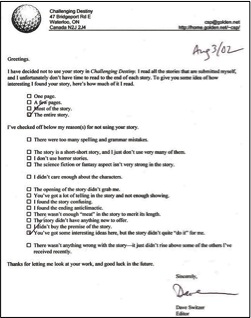
Some publishers and agents use a checklist, which can provide you with very good feedback (see example below from Challenging Destiny for my short story, Arc of Time which found a home in several places after this rejection).

The next letter that rejected my short story Angel of Chaos (which later turned into Butterfly in Peking) provided enough insight to why they didn’t choose it that I could have gone one of two ways: 1) I could have left the story as it was and submitted elsewhere; or 2) I could have emailed them with a suggestion that I’d be willing to revise if they would reconsider a revision according to their specifications. I’ve done this in the past and published. This time I decided not to because I liked the story the way it was. space & time rejection

One magazine I submitted to gives your story to two independent readers whose comments they include along with their rejection or acceptance. This is great feedback for you! What I found frus-tratingly amusing was that the accolades of the reviewers didn’t guarantee the acceptance of my story. While my story Arc of Time generated very positive comments from both reviewers, the magazine still decided against publishing and the rejection letter gave no reason (see reviewer’s comments below):

Reviewer #1:I love the way this story is set up, switching back and forth from the different points of view. The “trippiness” is very appealing and works well with the modern/fantastical contrast.”

Reviewer #2:This was an intriguing and extraordinary clever story. I didn’t have a clue about the jape at the end until I got to the last page. And then it unfolded beautifully. The theological tie-ins were smart and fun and showed either some Mormon extrapolative thought or extreme knowledge of Biblical lore.” talebones rejection

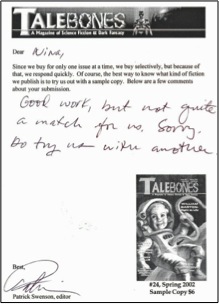
You’d have thought, eh? But they rejected anyway. Below is an example of a form letter with a handwritten comment added along with signature and an invite to try them again. When this happens, by all means, try them again!

Make Rejection Work for You

One way to see your way through rejection is to find ways to distance yourself from your story once you’ve sent it off and to see the whole process of submission-rejection-acceptance as a business. The very best way to do this is to submit lots of stories and to keep submitting them. With novels, this is a little harder to do but you can certainly be working on the next one once you’ve submitted the first.

When I was writing short stories, I kept a list of what and where I sub-mitted, along with the most important item: where to submit NEXT. At any given time, I made sure that I had at least x-number of submissions out there and each story had a designated place to go if it returned. As soon as a story came back from magazine A, I simply re-packaged it and sent it to magazine B. The critical part of the list was to have a contingency for each story: the next place where I would send the story once it returned. I was planning on the story being rejected with the hope that it would be accepted; that way, a rejection became part of a story’s journey rather than a final comment.

FictionWriter-front cover-2nd ed-webI ran my submissions like a bus terminal. A story was in and out so fast it never had a chance to cool off. And, since I had five other pieces out there, I could do this with little emotion. I was running a fast-paced “story depot”, after all. All my stories had to be out there as soon as possible; if they were sitting in the terminal, they were doing nothing for me. Now, ask me if this worked. D*** right! Soon after adopting this process, I started selling. I think several things were happening and galvanizing into sales: publishers were getting to know me; I got more and more familiar with the market and my professionalism paid off.


This article is an excerpt from Chapter R of The Fiction Writer: Get Published, Write Now! (Starfire, 2009).


nina-2014aaNina Munteanu is an ecologist and internationally published author of award-nominated speculative novels, short stories and non-fiction. She is co-editor of Europa SF and currently teaches writing courses at George Brown College and the University of Toronto. Visit www.ninamunteanu.ca for the latest on her books.


Rejection, Part 1: How to Accept Rejection

hirtle beachNS

Pebbles on Hirtle Beach, NS (photo by Nina Munteanu)

We’ve all suffered rejection and disappointment. Perhaps that job you coveted or someone you loved who might have even led you on before dropping you. It hurts. But you move on. And it does get better. Eventually. It does, trust me. It helps by starting with knowing that we don’t always get what we want, but we always get what we need…

Being a published writer involves accepting rejection. It’s part of the job description. Think of rejection as an integral part of your road to success. If you have never been rejected then you haven’t really tried, have you? There are several ways that you can gain a good perspective on your rejection letters and even make them work to your advantage.

Adopt a Healthy Perspective

One way is to adopt a realistic, objective and healthy viewpoint on your story’s rejection:

  • View selling manuscripts as a “cold call” business: When you view it this way, you will treat it that way. Until you establish a relationship with your market, selling becomes a numbers game. The more you send, the more likely you are to get a hit. It’s all in the statistics.
  • View rejections as an opportunity. Rejections can provide you with the opportunity to learn and re-evaluate, usually of appropriate market and publisher subjectivity rather than writing quality.
  • View rejections as the beginning of a relationship. Not all rejections are final; in fact most aren’t. Most rejections by a publisher or magazine editor stem from story redundancy, lack of space or editorial requirements. Many rejection letters will reflect this (e.g., “Thanks, but this isn’t a match for us…do try us again.” They mean it. It just means that the story wasn’t right—they may have run something too similar to it already or it didn’t fit with the other pieces or theme or whatever.)
  • View rejections as part of your success journey. Rejection is a given in the writing business and a necessary aspect of your journey as a soon-to-be and published writer (you don’t stop getting rejections once you’re published!). Often a story may be considered “before its time”; too different, a risk and is therefore harder to place. This is often why a book that was rejected so many times becomes a great hit once it is published. The very quality that made it hard for a publisher to accept made it a success with the readership: its refreshing yet topical originality.
  • View rejections as your first step to success. Take heart in the fact that you reached this stage in your writing career. Getting that first rejection in the mail is a great affirmation that you have taken that first significant step to becoming a serious writer. It means that you’ve completed a work and had the courage to enter it into the world.

Acceptance begins with rejection.

Make Rejection Work for You

You can maintain a more objective view on your rejections by keeping an objective view on your submissions. This can be accomplished by submitting a lot and submitting often. Treat your submissions—and rejections—like a business. The best way to do this is to submit lots of stories and to keep submitting them. The critical part of this process is to always have a contingency ready for each story submitted: once a story is returned, you have a place to send it already. Most professional writers will recommend that you do not revise the story before resending it out. This is because many rejections occur not on account of poor writing, but because of poor or unlucky marketing.

Remember that You’re in Great Company

Virtually every writer of merit who has published has had their work rejected several times. Beatrix Potter’s The Tale of Peter Rabbit was turned down so many times that she initially self-published. Irving Stone’s Lust for Life was rejected sixteen times before a publisher finally picked it up and sold about twenty-five million copies. Not bad for a story that was passed off as “a long, dull novel about an artist.” Jonathan Livingston Seagull was turned down twenty-three times and Dune twenty-one times. There are a bazillion examples; I’ve just picked a few. Go check J.K. Rowling’s track record for rejections before getting her Harry Potter published…

FictionWriter-front cover-2nd ed-webI’ll be talking more about how to read a rejection letter, how to recognize their sub-text messages, and how to make the most out of them in Part 2, the evolution of rejection letters.
 

This article is an excerpt from my fiction writing guidebook The Fiction Writer: Get Published, Write Now! (Starfire, 2009).


nina-2014aaNina Munteanu is an ecologist and internationally published author of award-nominated speculative novels, short stories and non-fiction. She is co-editor of Europa SF and currently teaches writing courses at George Brown College and the University of Toronto. Visit www.ninamunteanu.ca for the latest on her books.

The Art and Magic of Storytelling: Part 1, Sparking the Premise

Cover1_LastSummoner-frontcover copyFrom where do we get our stories?

This is a question I am asked time and again. My readers, friends and colleagues alike marvel at my imagination, and ask me how I create these fantastical worlds and situations. Cornered in a moment of inarticulate bliss (this often happens to me), I shrug and blather off some ridiculously obscure tale of luciferous logolepsy.

The simple of it is that it always comes as a spark. Followed by inspiration. And from there, a story emerges. Premise to dramatization. So, let me tell you a story about how my 2012 historical fantasy The Last Summoner —about a medieval time traveler who must save the past from the future—came to be.

It all began with the Battle of Grunwald and the Fate of the Teutonic Knights—that is, when I stumbled upon it during an Internet ramble. But, in fact, it started before that—the spark, that is.

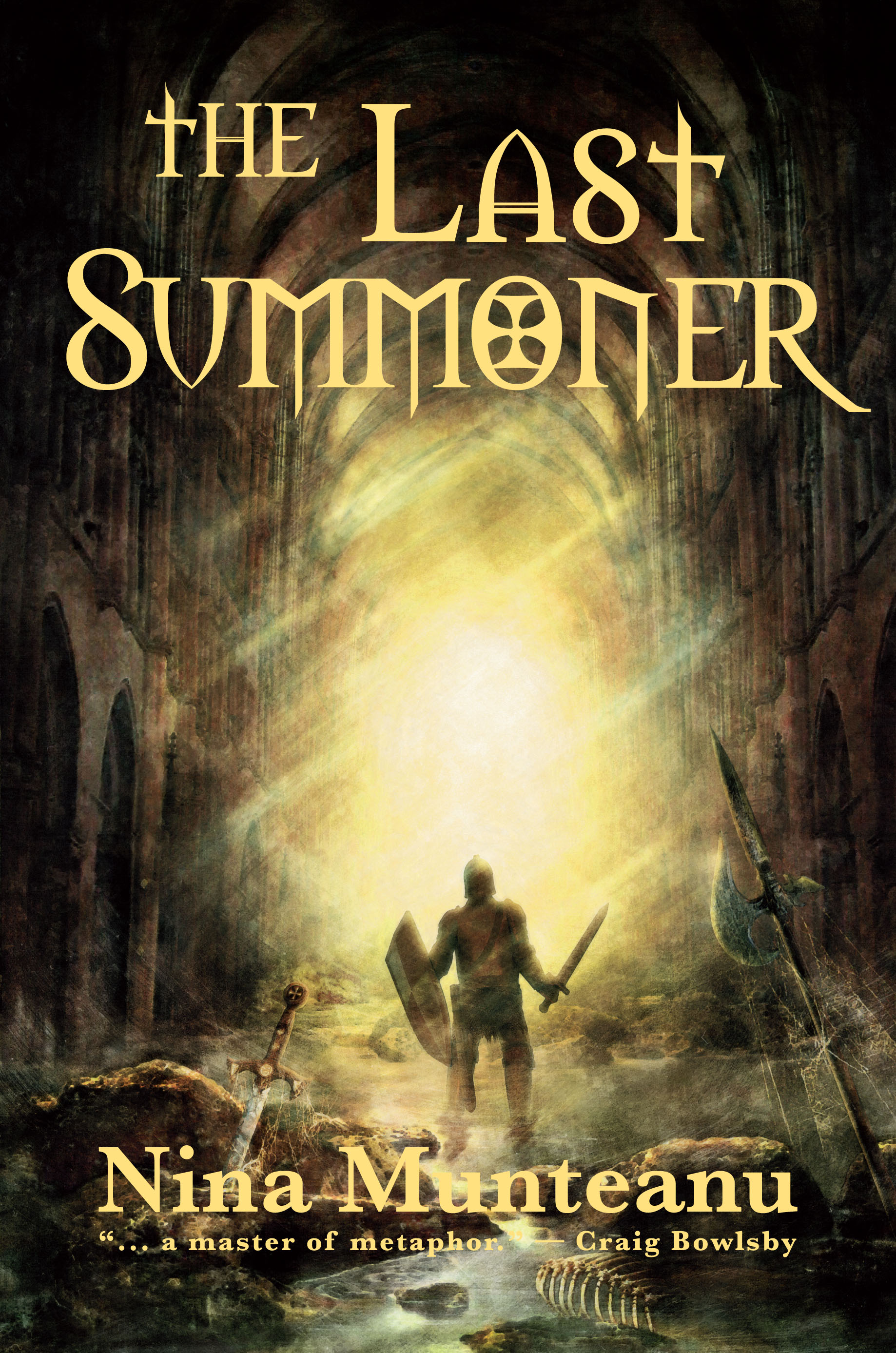
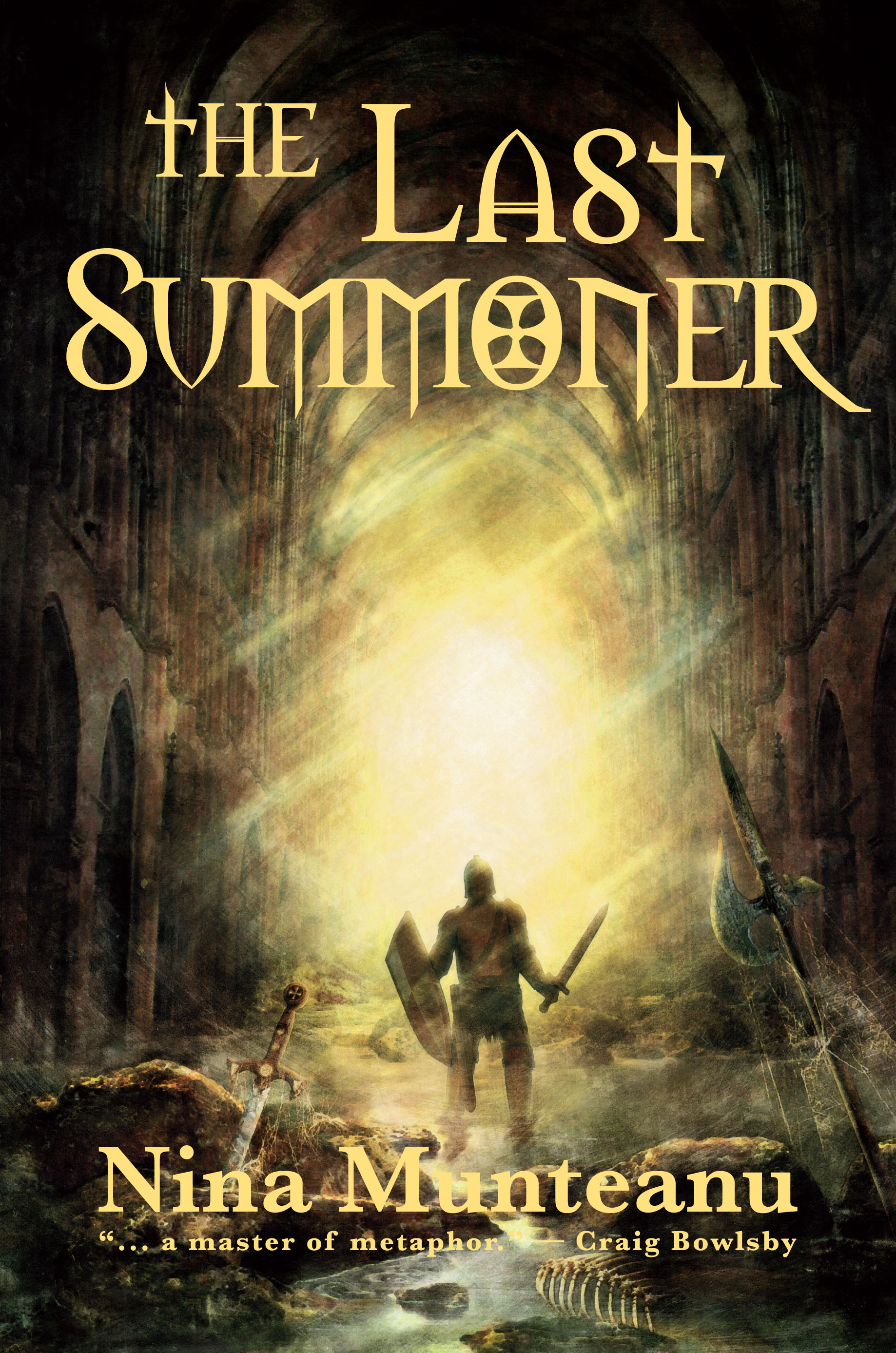
My part in this piece of history really began sometime in 2008 with the vision of an incredible image by Croatian artist Tomislav Tikulin (who had done the cover art for a previous novel Darwin’s Paradox). On Tikulin’s website I glimpsed the image of a magnificent knight, standing in a war-littered mire and gazing up, questioning, at the vaulted ceiling of a drowned cathedral. A great light shone upon the knight in streams of white gold. It sent my imagination soaring with thoughts of chivalry, adventure and intrigue.

Who was this knight standing in the mire?…

teutons3-close1

With that image imprinted inside me, the next nexus moment came when I stumbled across a significant but little-known battle in the medieval Baltic, the Battle of Grunwald. It would turn out to be the defining battle for what are now the countries of Poland and Lithuania. On June 14th 1410, they were still part of Prussia and tyrannized by the Teutonic Order, who were Christianizing the pagan Baltic on behalf of the Pope. In truth, the Order had been for centuries gathering wealth and land for colonizing Germans in their drang nach osten; they built sturdy castles (many of which still stand today) and a force of monk warriors, feared for their cunning strategy and treacherous combat abilities.

The Battle of Grunwald was, in fact, an upset in history. The Teutonic Order was powerful, intimidating and extremely capable. They should have won; but the peasant armies of Prussia slaughtered the Order, killing most of its knights. Historians debate that the hochmeister’s arrogance—indeed, the arrogance of the entire Order—precipitated their downfall. They underestimated their adversaries and got sloppy. After the Polish and Lithuanian armies outsmarted the Order and slayed their hochmeister, along with many of their knights, the Order’s own peasant slaves finished the job using clubs, pitchforks and stones.

Intrigued by this little known order of religious crusaders and their bizarre fate in an upset battle with a peasant army, I pursued the premise of an alternative consequence: what if the Teutonic Knights had NOT underestimated their enemy and won the Battle of Grunwald? Would they have continued their catastrophic sweep of North-east Europe into Russia and beyond? Would they have continued their catastrophic sweep of north- east Europe into Russia and beyond? Would they have claimed the whole for Germany’s expansionist lebensraum movement, fueled by its sonderweg, a dialectic that would ultimately lead to the killing fields of the Holocaust? What if the success of the Teutonic Order helped consolidate a united fascist elite, ambitious to conquer the world? And what if, as a result, Nazism sprang up 100 years earlier?

The Last Summoner, arose from this premise. Enter our heroine, young 14-year old Vivianne Schoen, Baroness von Grunwald, a self-centered romantic who dreams that her ritter (her knight) will rescue her from an arranged marriage to some foreign  warrior. As a result of an impetuous choice, she makes the startling discovery that she can alter history—but not before she’s branded a witch and must flee through a time-space tear into an alternate present-day France ruled by fascists. There, she learns that every choice has its price.

Warrior Woman Silhouette

Spanning from medieval Poland to present day Paris, France, The Last Summoner explores the sweeping consequences of our “subtle” choices. From the smallest grab to the most sweeping gesture, we are accountable for the world we’ve made. During her 600-year journey to save the world and undo the history she authored, Vivianne learns wisdom and humility. Through the paradox of history, she learns that what might have seemed the right choice for an immediate future, turns out to be disastrous for a distant future. To win is also to lose; to save oneself one must surrender oneself; and to save the world one need only save a single soul.

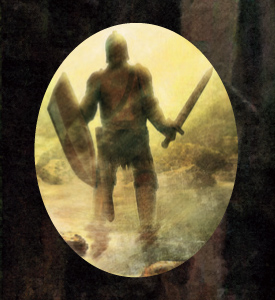
knight-cameoThe knight standing in the mire is Vivianne.

The Last Summoner, published by Starfire World Syndicate, was released in 2012 and remained a Canadian bestseller on Amazon for several months. It represents my first historical fantasy in an otherwise repertoire of hard science fiction. The Polish and Lithuanians celebrate June 14th with pride, erecting mock-ups of the battle annually. Some day I hope to participate.

The cover art for The Last Summoner is that very image that inspired my story. The Universe gifted me with the chance to acquire the image from Mr. Tikulin and a publisher willing to purchase it. I’d entered my own dream.

p.s. definition for luciferous logolepsy: “an illuminating obsession with words”

p.p.s. A novelette version, Summoning the Future’s Past, was released April 2021 in Italian by Delos Digital entitled l’Ultima Evocatrice.

This article first appeared on Warpworld on Nov. 30, 2013.

nina-2014aaNina Munteanu is an ecologist and internationally published author of award-nominated speculative novels, short stories and non-fiction. She is co-editor of Europa SF and currently teaches writing courses at George Brown College and the University of Toronto. Visit www.ninamunteanu.ca for the latest on her books.

.

Should You Judge a Book by its Cover?

NaturalSelection-frontHRMost readers—me included—will pick a book off the bookstore shelf because its cover interests us: the title intrigues; the cover illustration attracts; the author’s name is one we trust.

If you don’t know the author of the book, the nature—and implied promise—of the cover becomes even more important.

If the book does not deliver on the promise of the cover, it will fail with many readers despite its intrinsic value. A broken promise is still a broken promise. I say cover, not necessarily the back jacket blurb, because the front cover is our first and most potent introduction to the quality of the story inside. How many of us have picked up a book, intrigued by its alluring front cover, read the blurb that seemed to resonate with the title and image, then upon reading our cherished purchase been disillusioned with the story and decided we disliked it and its author?

This is because, as readers, from the moment we pick up a book, we engage in a covenant with the story’s author (but in actual fact with the entire publishing company) for a story whose promise we have interpreted from its cover image, title and blurb. It begins with the cover. A book’s cover is its sales pitch: “This is what I’m about!” the cover proclaims in shades of color and texture. The cover sets the tone and attitude with which a reader will interpret the book’s title and back jacket blurb and its interior.

It had better be true.

Front Cover ONLY-webLet me tell you a story…

Some time ago, a writer colleague of mine secured a New York agent—based on her excellent query and synopsis—for her imaginative dragon fantasy. The agent pitched the book to a large publishing company, who made my friend an offer, and the agent secured a three book deal on her behalf. My writing friend’s career as a published author was launched.

Because the publishing company was one of the large firms, my friend’s ability to participate—never mind influence—the cover design and blurb was restricted. Decisions lay in the hands of the people in the marketing department, who may or may not have read the book (most likely not). This is why it is so important to write a blurb/query/pitch that both scintillates AND accurately portrays the story. All too often, the marketing department misrepresents the story (to sell more books) and you end up with an unsatisfied reader. This is what happened to my friend. Through no fault of hers, the marketing people developed a cover that did not reflect the true nature of her story. The trilogy my friend had developed was a dark tale of deceit, betrayal and suffering. The cover portrayed a lively and sultry seductress, draped with flowing robes and bared thighs against her dragon; hardly the ponderous story shrouded within. The blurb at the back was sufficiently vague to aid and abet the deception.

What followed the book’s launch and accompanying ad campaign was a barrage of bad reviews and censure, unfortunately aimed mostly at the author. It was unfortunate that my friend suffered the brunt of the accusations for breaking her promise to the readers, when she had done no such thing; her publisher and marketers had created false expectations. And now she was paying for it.

Cover1_LastSummoner-frontcoverI, too, experienced the effects of mis-marketing. I’d written a dark science fiction romance that ended with resolution but was far from the traditional happy ending, typical of a romance. The publisher marketed it as a romance with science fiction elements instead of a science fiction with romance elements. Reviewers applauded it but it bombed with romance readers, who expected a different kind of resolution. Science fiction readers, however, enjoyed it; they didn’t have the same expectations.
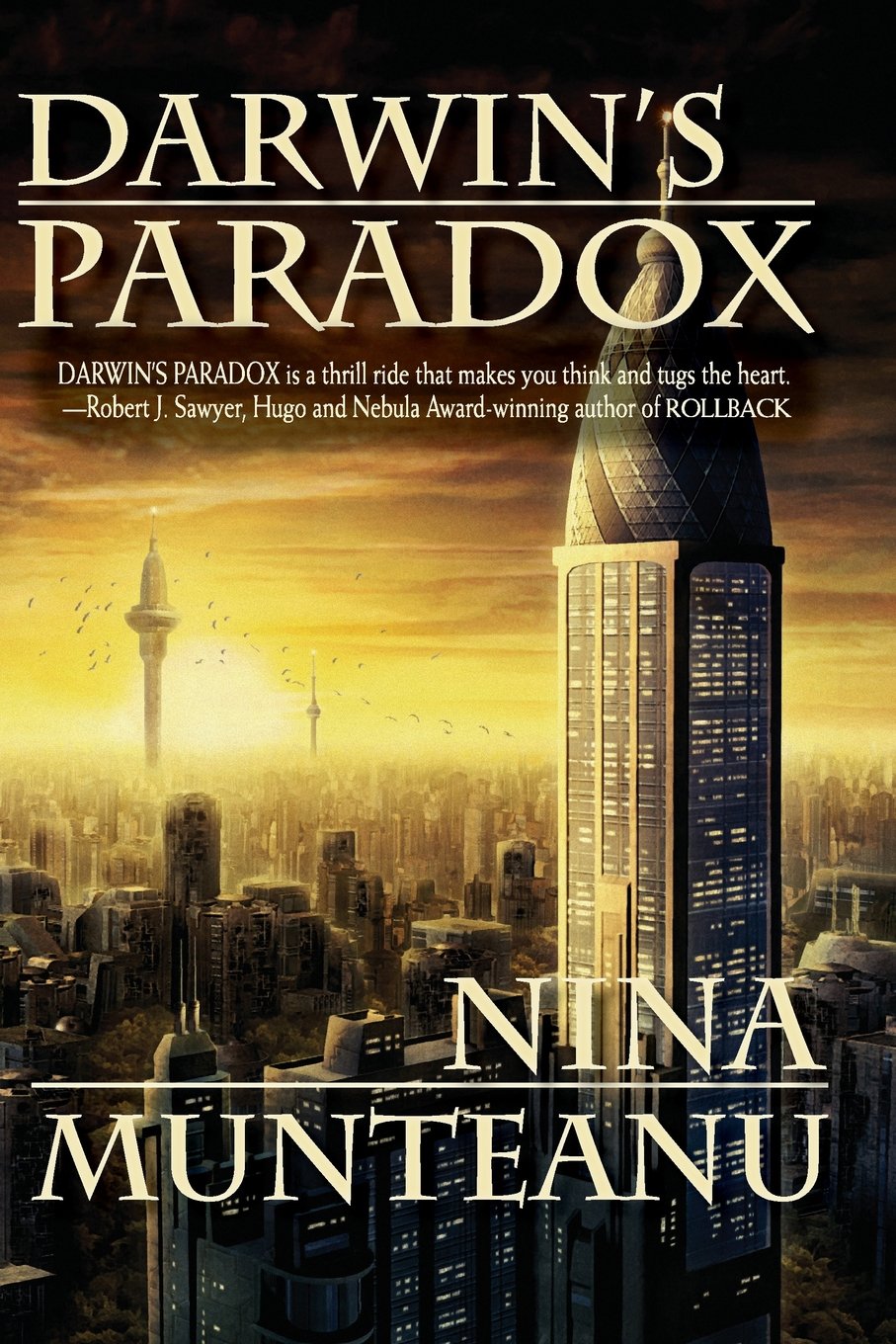
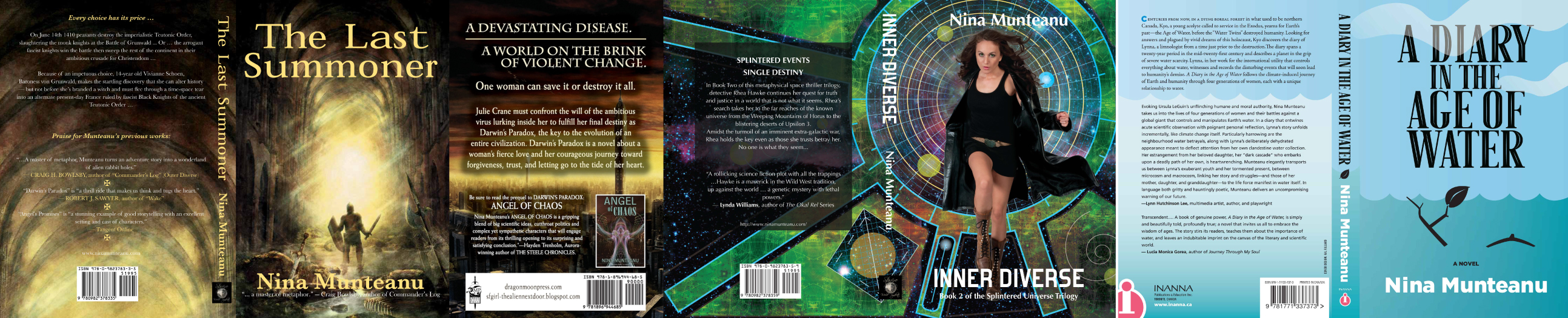

 

The take home lesson for writers is this: write a scintillating but accurate synopsis, blurb, pitch and query that clearly establishes your genre and audience. Chances are your publishers will use it in their marketing department. If you don’t get in with the “Big Boys”, and decide to go with the small presses, chances are very good that you will have more control over marketing and cover design; that is a big bonus. If you are like me, creative control of your intellectual property is more important than the big bucks you get at the expense of your art. Don’t give in to the temptations of wolf-marketing.

I’m still learning that lesson.Darwins Paradox-2nd cover

The take home lesson for readers is this: don’t judge a book by its cover; certainly pick up the book if it looks interesting, then read with an open mind and let the story take you to where it needs to, despite what you may have expected from the false advertising. Chances are, the unexpected journey visited upon you may be a welcome surprise. And don’t blame the writer for something he didn’t have control over.

I’m still learning that lesson too.


Nina Munteanu is an ecologist and internationally published author of award-nominated speculative novels, short stories and non-fiction. She is co-editor of Europa SF and currently teaches writing courses at George Brown College and the University of Toronto. Visit www.ninamunteanu.ca for the latest on her books.


What Indie Authors Should Know…

zermatt-alps01-close

Zermatt, Switzerland (photo by Nina Munteanu)

As we enter a new year in writing and publishing, I thought I’d review some interesting statistics and observed trends over 2014 made by those poised well in the industry.

In July 2014, Publishers Weekly revealed some interesting statistics from various surveys and studies worth considering.

The article was based on two recent surveys: one by best selling indie author Hugh Howey; and the other by Mark Coker, founder of e-book distributor Smashwords.

Publishers Weekly cited Hugh Howey’s Author Earnings Report, in which he claimed that “the report comes to the conclusion that the indie movement in literature is not a blip and not a gold rush.” It is definitely here to stay, said Publishers Weekly. Here’s what they summarized:

  • The Big Five traditional publishers now account for only 16% of the e-books on Amazon’s bestseller lists.
  • Self-published books now represent 31% of e-book sales on Amazon’s Kindle Store.
  • Indie authors are earning nearly 40% of the e-book dollars going to authors.
  • Self-published authors are “dominating traditionally published authors” in sci-fi/fantasy, mystery/thriller, and romance genres but — and here is the surprise — they are also taking “significant market share in all genres.

Publishers Weekly contended that “what is clear is that strong indie sales will continue and indie books are now a significant and permanent part of the book publishing landscape.”

Coker’s survey revealed that the 99¢ ebook was no longer “the sweet spot” for e-book pricing. In his 2014 survey, Coker determined from aggregated retail and library sales data of Smashwords books, that:

  • $2.99 and $3.99 are currently the pricing sweet spots for most e-book bestsellers. In general, authors who price their books modestly earn more than those whose average price is higher, but 99¢ is “no longer the path to riches.”
  • Readers prefer longer e-books. In fact, bestselling books tend to be over 100,000 words.
  • Series books outsell stand alone books — but series books under 50,000 words are at a sales disadvantage.
  • “Free” still works as a marketing tool, especially when an author offers the first book in a series for free, but it is much less effective than before — primarily because so many authors are taking advantage of it.
  • Pre-orders give authors a sales advantage. “I think pre-orders today are where free was five years ago,” says Coker. “The first authors to effectively utilize pre-orders will gain the most advantage, just as the first authors to enter new distribution channels gain the most advantage,” he says.
  • Non-fiction earns more at higher prices. “Non-fiction buyers are less price sensitive,” says Coker. “It appears as if most non-fiction authors are underpricing their works, and they should experiment with higher prices,” he says.

Coker is quick to point out that this analysis is based on his own interpretation of the findings, and should only be used to provide authors with possible clues to help them make informed decisions about how to market their own unique books.

In an excellent article, summarizing 2014, award-winning author Kristine Kathryn Rusch summarizes what indie writers learned in 2014. She prefers to use the terms indie-writer and indie-publishing over self-publishing, “because so many writers who are not with traditional publishers have started their own presses. It’s not accurate to lump all writers who are not following the traditional route into the self-publishing basket any longer, if it ever was.” This is an interesting acknowledgement and considers a movement by established authors toward a different publishing model, including hybrid publishing.

Rusch’s rather pithy article suggests that writing and publishing “is hard”, no matter what model you use. She adds that if you don’t learn to love the business side of the industry, “self-publishing can be a soul-sucking experience.” Rusch is quick to add that business destroys the dreams of many writers. “If you don’t learn to love business, you’ll get destroyed in traditional publishing. It’ll just take ten years, where in self-publishing, it’ll take less time.”

Read her section entitled “Achieving Real Success is Hard” for an insightful and candid study of “success” in writing and publishing.

“We all measure success differently, and we should know what it is before we start publishing. But most writers don’t. Success is finishing a novel (check). Success is getting that novel published (check). Success is getting good reviews (check). Success is getting paid for that novel. (check) Success is making a living. (um, what?)”

Read Rusch’s section entitled “The Gold Rush is Over” for an excellent reality-check of the indie publishing industry.

“The days of slapping something up and making a lot of sales were gone by the end of 2010. But the rumors persisted and a lot of people got into indie publishing expecting to get rich…You are not entitled to fame and riches just because you published a book.”

In his blog post of November 2014, Mark Coker said:

“The gravy train of exponential sales growth is over. Indies have hit a brick wall and are scrambling to make sense of it. … Some authors are considering quitting. It’s heartbreaking to hear this, but I’m not surprised either. When authors hit hard times, sometimes the reasons to quit seem to outnumber the reasons to power on. Often these voices come from friends and family who admire our authorship but question the financial sensibility of it all.”

To Coker’s comment Rusch adds, “I’m pretty sure more writers quit than survived publishing in 2014, but that’s because more writers always quit than survive. As I said above, the entire profession is hard, and for those people who want to get by without working hard, this profession is not for them.”

Rusch sums up, again rather pithily, eight things indie writers learned (or should have learned) in 2014:

  1. Gaming the system is impossible: e.g., “every time we figure out how Amazon’s algorithm works, Amazon changes it”; “free doesn’t help me sell my books any more”; 99cents doesn’t help me sell my books any more”; “the tags are gone”; I can’t seem to get enough reviews”; “now when I post on social media, no one responds”—trying to milk the system doesn’t work for the writer because the system is geared for the customer, not the writer—and it’s always a step ahead of you…
  2. Amazon doesn’t love you: Kindle Unlimited? It isn’t about helping its writers; it is about helping its customers.
  3. No one loves you: writers are not entitled to have their books on a shelf, virtual or real.
  4. Your readers don’t even love you (all the time): “you don’t collect and hoard readers; readers can collect and hoard books. It doesn’t work the other way around,” says Rusch.
  5. Sales based on price no longer work: “even the most denial-filled indie writers are starting to figure out that just because their books are cheap, it doesn’t mean readers will pick up that book,” says Rusch.
  6. Running with the big dogs is hard: “Now that the last thing that differentiated traditional publishing from indie—price— has leveled out, indies discovered in 2014 that they’re no longer competing with each other. They’re competing with traditionally published books, including long-term bestsellers,” says Rusch. As Blake says, “Pro basketball players don’t tell themselves that they don’t have to be all that great because there are plenty of mediocre players.”
  7. There is no status quo: “Working in the arts means accepting constant change. Constant change… One of the stupidest gambits I’ve heard from writers in recent years comes from the indie world. Apparently, writers are now searching key words on Amazon bestseller lists—and writing books based on those key words. Oh, heavens, folks. The Amazon bestseller lists are a fraction of the market in the first place, and in the second, they only reflect what sells well now. What will sell well next Christmas is anyone’s guess—and generally speaking, anyone will be wrong… All these gamings and gambits and strategies are based on status-quo thinking,” says Rusch.
  8. There is such a thing as an Indie Midlist Career: many indie writers are finding that they can earn a living writing, essentially earning out what they earned working for someone else. Indie authors are indeed quitting their day jobs, understanding the financial value of the artistic freedom that indie writing gives us. This, Rusch shares, “is what the self-publishing revolution has brought us.” Not some get rich-quick thing; but the means to do what we love.

So, what’s the take home message here for established and particularly new budding indie authors and publishers?

Writing and publishing is a collaborative effort. Take pride in your work. Embrace your passion for writing. Treat everyone in the industry with professionalism and respect, and above all else, enjoy the journey. It’s worth it.

Oh, and last but not least: ensure you get your work edited by a professional!

Nina Munteanu is an ecologist and internationally published author of award-nominated speculative novels, short stories and non-fiction. She is co-editor of Europa SF and currently teaches writing courses at George Brown College and the University of Toronto. Visit www.ninamunteanu.ca for the latest on her books.

Demystifying the Synopsis

Prospect Point-fog

Fog in Prospect Point, Nova Scotia (photo by Nina Munteanu)

A synopsis is a larger version of the book jacket blurb you see on the back of most paperbacks in the bookstore. You write a synopsis for the same reason: to sell a story idea to a publisher and ultimately to a reader. It is an in-depth summary of the entire book that weaves in thematic elements with plot to portray a compelling often multi-level story arc. Although a well-written synopsis may be the hardest thing to write—particularly for a novice writer and you haven’t finished your book—it is precisely what an editor or agent usually wants to see first of your work (often alongside sample chapters and a query letter).


Why Write a Synopsis

The synopsis is a highly valuable tool to writers for a number of reasons.

  1. A synopsis helps get your manuscript read by an editor. Writing a great synopsis is just as important as writing a compelling first three chapters to hook an editor. Editors most often ask for a combination of these three things in an initial submission: 1) query letter; 2) sample chapters (usually three); and, 3) synopsis. However, publishers’ specifications for synopses vary greatly. For instance, the length of a synopsis may vary from one page to twenty pages and its style will vary accordingly. Whether you submit a synopsis with your novel sample chapters or not, writing one will directly benefit your novel by helping you to sort out what’s important and what drives the theme and characters of your story.
  2. The synopsis can answer questions that may perplex the author, stuck on a scene or plot item. It helps you weave your novel’s elements into a well-integrated story that is compelling at many levels. Let’s face it; if you can’t tell describe what the book is about, what’s important and what drives the story you may have to re-evaluate the story. Certainly don’t expect an editor to know if you don’t. For this reason, it makes sense to write drafts of your synopsis as you go along in the novel; that way it’s useful to both you and to the editor and then it’s more or less written when you need to submit it along with sample chapters…and not quite as daunting a task either.
  3. The synopsis you write for your novel may be used by the publisher’s marketing department to advertize your book and by their cover artists on your cover. Therefore, it’s important to make the tone, flavor and intent of your story clear in your synopsis so that it’s properly represented.


What is a Synopsis?

It helps to know what a synopsis is before embarking on one. Unlike an outline, which is basically a plot summary, a synopsis integrates plot with theme and characterization so a publisher can gauge the meaningfulness of the story. A synopsis can contain the following items: 1) theme; 2) setting and period; 3) plot summary; 4) character sketches; 5) dialogue; 6) emotional turning points; and 7) subplots. The synopsis combines these components to reveal the story’s unique nature and what makes it stand out to both publisher and ultimately reader.


Writing a Synopsis

Theme is the backbone of the novel, the “so what” part. If you are able to reduce it to one sentence or even word, this will help you to focus the other aspects of the synopsis, and novel, around it. For example, “there’s no place like home,” or “to have a friend, you must be a friend.” You can provide setting and period in one or two short sentences, while describing other key elements to your story. Plot summaries provide the skeleton upon which you flesh out characters and their motivations, they form the “what” of the “so what” part. The actual “so what” parts are the emotional turning points or the focal events of the plot that directly link to important thematic parts of the story. Character sketches get woven in as part of theme and plot. Dialogue or quotes (very short excerpts) can be effective. They break up the page and makes it more interesting, while providing a sample of your work.

If this all still sounds daunting to you, think of writing the synopsis in steps:

Step 1: write the outline, using each chapter to write a one or two sentence summary of important points.

Step 2: create a thematic skeleton, by adding the motivational aspects of the plot with the various characters and what’s at stake for each of them. Think of the overarching thema or story arc and include important sub-plots that tie-in to this.

Step 3:flesh out the storytelling by writing it as a story. Use all your fiction writing skills to create a compelling story summary.

Write your synopsis like a story, complete with hook, building a crisis and then climax and denouement.


Some Basic Rules

Despite the varying specific guidelines among publishing houses, they agree on several universal rules that every synopsis should follow. These include:

  • Summarize the complete novel (beginning, middle, and end) regardless of whether you’ve included sample chapters and don’t leave out the ending (as a teaser);
  • Always write the synopsis in the present tense (e.g., the Budong eats Jarek; not the Budong ate Jarek)
  • Write the synopsis from the author’s perspective and use vivid language (e.g., use active power verbs and avoid modifiers)
  • The first time you introduce a character in a synopsis, type the name in CAPITAL letters, but do this only the first time the character is mentioned.
  • Stay consistent with how you describe a character (e.g., not John the first time and Mr. Smith the next)

Remember to check the guidelines of the publishing house to which you are submitting before finalizing your synopsis and the rest of your submission. Every house will be a little different.

SersonCr-mouth close copy

Creek into Lake Ontario, Mississauga (photo by Nina Munteanu)

References

Munteanu, Nina. 2009. The Fiction Writer: Get Published, Write Now! Starfire World Syndicate. Louisville, KY. 266pp


Nina Munteanu is an ecologist and internationally published author of award-nominated speculative novels, short stories and non-fiction. She is co-editor of Europa SF and currently teaches writing courses at George Brown College and the University of Toronto. Visit www.ninamunteanu.ca for the latest on her books.