The Ecology of Story: Revealing Hidden Characters of the Forest

 Story is place, and place is character—Nina Munteanu

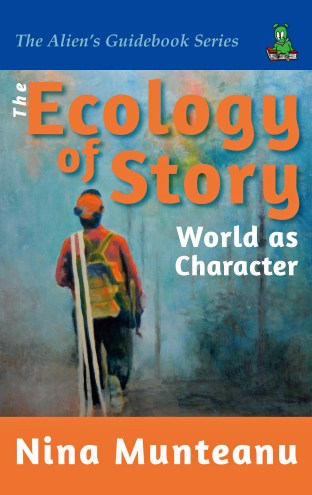
EcologyOfStory coverI remember a wonderful conversation I had several years ago at a conference with another science fiction writer on weird and wonderful protagonists and antagonists. Derek knew me as an ecologist—in fact I’d been invited to do a lecture at that conference entitled “The Ecology of Story” (also the name of my writing guidebook on treating setting and place as a character). We discussed the role that ecology plays in creating setting that resonates with theme and how to provide characters enlivened with metaphor.

Derek was fascinated by saprotrophs and their qualities. Saprotrophs take their nutrition from dead and decaying matter such as decaying pieces of plants or animals by dissolving them and absorbing the energy through their body surface. They accomplish this by secreting digestive enzymes into the dead/decaying matter to absorb the soluble organic nutrients. The process—called lysotrophic nutrition—occurs through microscopic lysis of detritus. Examples of saprotrophs include mushrooms, slime mold, and bacteria.

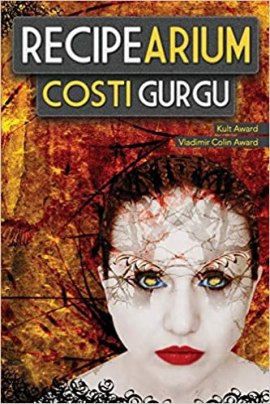
Recipearium CostiGurguI recall Derek’s eagerness to create a story that involved characters who demonstrate saprotrophic traits or even were genuine saprotrophs (in science fiction you can do that—it’s not hard. Check out Costi Gurgu’s astonishing novel Recipearium for a thrilling example). I wonder if Derek fulfilled his imagination.

I think of what Derek said, as I walk in my favourite woodland. It is early spring and the river that had swollen with snow melt just a week before, now flows with more restraint. I can see the cobbles and clay of scoured banks under the water. Further on, part of the path along the river has collapsed from a major bank scour the previous week. The little river is rather big and capricious, I ponder; then I consider that the entire forest sways to similar vagaries of wind, season, precipitation and unforeseen events. Despite its steadfast appearance the forest flows—like the river—in a constant state of flux and change, cycling irrevocably through life and death.

Cedar trunk base

Cedar tree (photo by Nina Munteanu)

As I’m writing this, the entire world struggles with life and death in the deep throws of a viral pandemic. COVID-19 has sent many cities into severe lock down to prevent viral spread in a life and death conflict. I’ve left the city and I’m walking in a quiet forest in southern Ontario in early spring. The forest is also experiencing life and death. But here, this intricate dance has seamlessly partnered death and decay with the living being of the forest. Without the firm embrace of death and decay, life cannot dance. In fact, life would be impossible. What strikes me here in the forest is how the two dance so well.

cedar log patterns2 copy

Cedar log, patterns in sapwood (photo by Nina Munteanu)

I walk slowly, eyes cast to the forest floor to the thick layer of dead leaves, and discover seeds and nuts—the promise of new life. I aim my gaze past trees and shrubs to the nearby snags and fallen logs. I’m looking for hidden gifts. One fallen cedar log reveals swirling impressionistic patterns of wood grain, dusted with moss and lichen. Nature’s death clothed in beauty.

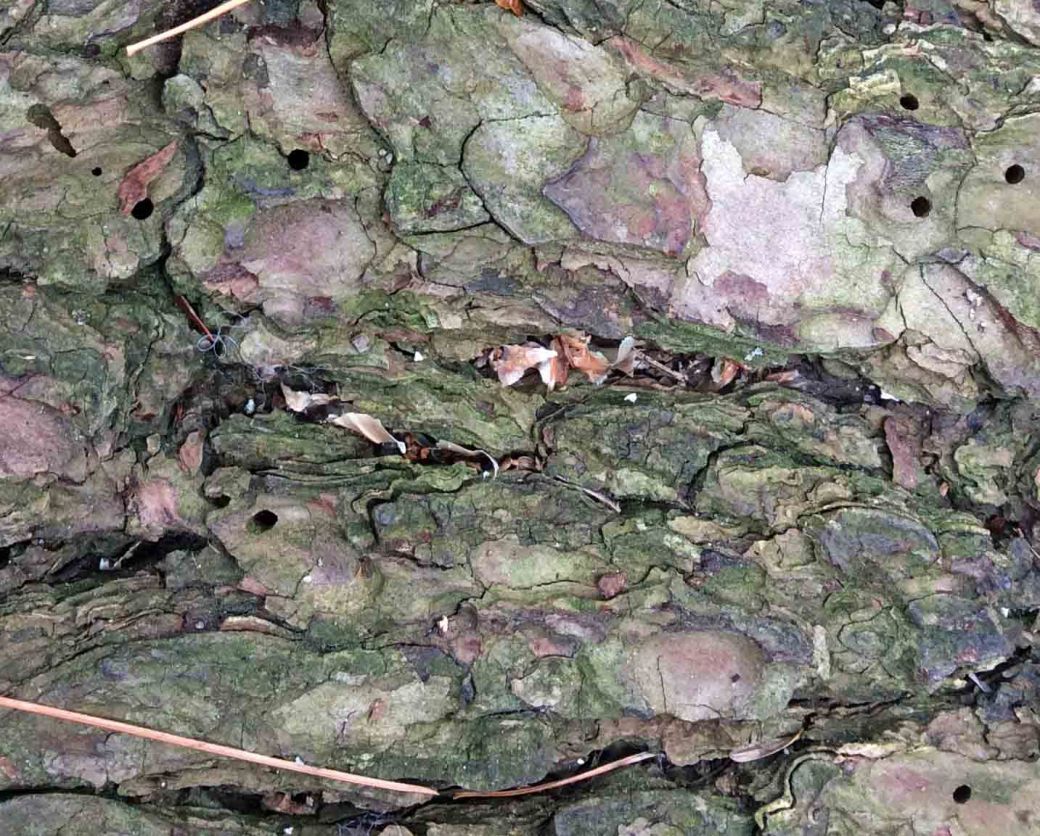
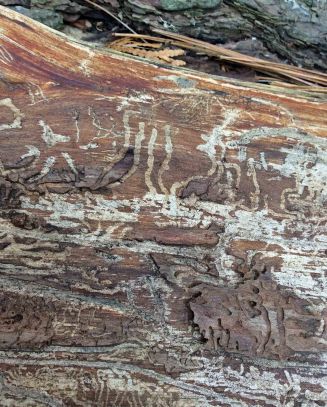
The bark of a large pine tree that has fallen is riddled with tiny beetle holes drilled into its bark. Where the bark has sloughed off, a gallery of larval tracks in the sapwood create a map of meandering texture, form and colour.

Beetle bore holes pine log

White pine bark scales with tiny beetle bore holes, Little Rouge, ON (photo by Nina Munteanu)

larval tracks in pine wood

Beetle larval tracks in pine sapwood (photo by Nina Munteanu)

Nearby, another giant pine stands tall in the forest. Its roughly chiselled bark is dusted in lichens, moss and fungus. The broad thick ridges of the bark seem arranged like in a jigsaw puzzle with scales that resemble metal plates. They form a colourful layered mosaic of copper to gray and greenish-gray. At the base of the tree, I notice that some critter has burrowed a home in a notch between two of the pine’s feet. Then just around the corner, at the base of a cedar, I spot several half-eaten black walnuts strewn in a pile—no doubt brought and left there by some hungry and industrious squirrel who prefers to dine here.

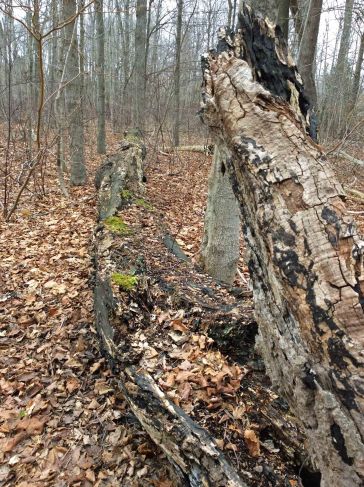
The forest is littered with snags and fallen trees in different stages of breakdown, decomposition and decay. I spot several large cedar, pine, oak and maple snags with woodpecker holes. The snags may remain for many decades before finally falling to the ground.

Fallen Heroes, Mother Archetypes & Saprophyte Characters

WoodpeckerHole on cedar

Woodpecker hole in a snag (photo by Nina Munteanu)

The forest ecosystem supports a diverse community of organisms in various stages of life and death and decay. Trees lie at the heart of this ecosystem, supporting a complex and dynamic cycle of evolving life. Even in death, the trees continue to support thriving detrivore and saprophytic communities that, in turn, provide nutrients and soil for the next generation of living trees. It’s a partnership.

Decomposition and decay are the yin to the yang of growth, writes Trees for Life; and together they form two halves of the whole that is the closed-loop cycle of natural ecosystems.

Snags and rotting logs on the forest floor provide damp shelter and food for many plants and animals. Most are decomposers, including earthworms, fungi, and bacteria. As the wood decays, nutrients in the log break down and recycle in the forest ecosystem. Insects, mosses, lichens, and ferns recycle the nutrients and put them back into the soil for other forest plants to use. Dead wood is an important reservoir of organic matter in forests and a source of soil formation. Decaying and dead wood host diverse communities of bacteria and fungi.

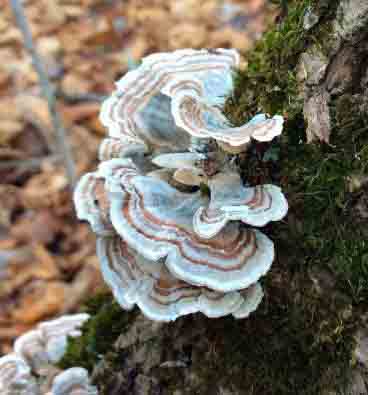
TurkeyTail fungus on tree-LR

Turkey tail fungus, Little Rouge woodland (photo by Nina Munteanu)

Mother Archetypes

Wood tissues of tree stems include the outer bark, cork cambium, inner bark (phloem), vascular cambium, outer xylem (living sapwood), and the inner xylem (non-living heartwood). The outer bark provides a non-living barrier between the inner tree and harmful factors in the environment, such as fire, insects, and diseases. The cork cambium (phellogen) produces bark cells. The vascular cambium produces both the phloem cells (principal food-conducting tissue) and xylem cells of the sapwood (the main water storage and conducting tissue) and heartwood.

stages of tree life

Forest ecologists defined five broad stages in tree decay, shown by the condition of the bark and wood and presence of insects and other animals. The first two stages evolve rapidly; much more time elapses in the later stages, when the tree sags to the ground. These latter stages can take decades for the tree to break down completely and surrender all of itself back to the forest. A fallen tree nurtures, much like a “mother” archetype; it provides food, shelter, and protection to a vast community—from bears and small mammals to salamanders, invertebrates, fungus, moss and lichens. This is why fallen trees are called “nursing logs.”

uprooted stump carbon cushion fungus

Uprooted tree covered in fungi, lichen and moss, Little Rouge, ON (photo by Nina Munteanu)


Heralds, Tricksters and Enablers

rotting maple log2

Rotting maple log (photo by Nina Munteanu)

I stop to inspect another fallen tree lying on a bed of decaying maple, beech and oak leaves. When a fallen tree decomposes, unique new habitats are created within its body as the outer and inner bark, sapwood, and heartwood decompose at different rates, based in part on their characteristics for fine dining. For instance, the outer layers of the tree are rich in protein; inner layers are high in carbohydrates. This log—probably a sugar maple judging from what bark is left—has surrendered itself with the help of detrivores and saprophytes to decomposition and decay. The outer bark has mostly rotted and fallen away revealing an inner sapwood layer rich in varied colours, textures and incredible patterns—mostly from fungal infestations. In fact, this tree is a rich ecosystem for dozens of organisms. Wood-boring beetle larvae tunnel through the bark and wood, building their chambers and inoculating the tree with microbes. They open the tree to colonization by other microbes and small invertebrates. Slime molds, lichen, moss and fungi join in. The march of decay follows a succession of steps. Even fungi are followed by yet other fungi in the process as one form creates the right condition for another form.

rotting maple log

Rotting maple log, covered in carbon cushion fungus, Little Rouge, ON (photo by Nina Munteanu)

Most hardwoods take several decades to decompose and surrender all of themselves back to the forest. In western Canada in the westcoast old growth forest, trees like cedars can take over a hundred years to decay once they’re down. The maple log I’m studying in this Carolinian forest looks like it’s been lying on the ground for a while, certainly several years. The bark has fragmented and mostly fallen away, revealing layers of sapwood in differing stages of infestation and decay. Some sapwood is fragmented and cracked into blocks and in places looks like stacked bones.

Black lines as though drawn by a child’s paintbrush flow through much of the sapwood; these winding thick streaks of black known as “zone lines” are in fact clumps of dark mycelia, which cause “spalting,” the colouration of wood by fungus. According to mycologist Jens Petersen, these zone lines prevent “a hostile takeover by mycelia” from any interloping fungi. Most common trees that experience spalting include birch, maple, and beech. Two common fungi that cause spalting have colonized my maple log. They’re both carbon cushion fungi.

Spalting

Spalting through zone lines by carbon cushion fungus, Little Rouge, ON (photo by Nina Munteanu)

hypoxylon-close

Hypoxylon fungus (photo N. Munteanu)

Brittle cinder (Kretzschmaria deusta) resembles burnt wood at maturity. Deusta means “burned up” referring to the charred appearance of the fungus. Hypoxylon forms a “velvety” grey-greenish cushion or mat (stroma). As the Hypoxylon ages, it blackens and hardens and tiny, embedded fruitbodies (perithecia) show up like pimples over the surface of the crust.

Blue-green fungus on log

Green and Blue Stain fungus (photo N. Munteanu)

Much of the exposed outer wood layer looks as though it has been spray painted with a green to blue-black layer. The “paint” is caused by the green-stain fungus (Chlorociboria) and blue-stain fungus (Ceratocystis). The blue-green stain is a metabolite called xylindein. Chlorociboria and Ceratocystis are also spalter fungi, producing a pigment that changes the color of the wood where they grow. While zone lines that create spalting don’t damage wood, the fungus responsible most likely does.

Spalting is common because of the way fungi colonize, in waves of primary and secondary colonizers. Primary colonizers initially capture and control the resource, change the pH and structure of the wood, then must defend against the secondary colonizers now able to colonize the changed wood.

Intarsia using blue-green spalted wood

Details of 16th century German bureaus containing blue-green spalted wood by the elf-cup fungus Chlorociboria aeruginascens

Wood that is stained green, blue or blue-green by spalting fungi has been and continues to be valued for inlaid woodwork. In an article called “Exquisite Rot: Spalted Wood and the Lost Art of Intarsia” Daniel Elkind writes of how “the technique of intarsia–the fitting together of pieces of intricately cut wood to make often complex images–has produced some of the most awe-inspiring pieces of Renaissance craftsmanship.” The article explores “the history of this masterful art, and how an added dash of colour arose from the most unlikely source: lumber ridden with fungus.”

Shapeshifting Characters

moss hiding under leaves

Moss in forest litter (photo by Nina Munteanu)

I find moss everywhere in the forest, including beneath the forest floor. Moss is a ubiquitous character, adapting itself to different situations and scenarios. Like a shapeshifter, moss is at once coy, hiding beneath rotting leaf litter, stealthy and curious as it creeps up the feet of huge cedars, and exuberant as it unabashedly drapes itself over every possible surface such as logs, twigs and rocks, and then proceeds to procreate for all to see.

Moss is a non-vascular plant that helps create soil; moss also filters and retains water, stabilizes the ground and removes CO2 from the atmosphere. Science tells us that mosses are important regulators of soil hydroclimate and nutrient cycling in forests, particularly in boreal ecosystems, bolstering their resilience. Mosses help with nutrient cycling because they can fix nitrogen from the air, making it available to other plants.

Moss with spores water drops2

Green moss gametophyte with sporophytes growing out of it (photo by Nina Munteanu)

Mosses thrive in the wet winter and spring, providing brilliant green to an otherwise brown-gray environment. Even when covered in snow (or a bed of leaves), moss continues its growth cycle, usually in the leafy gametophyte stage. When the winter is moderate, like it is near Toronto, sporophyte structures can already appear on stalks that hold a capsule full of spores.  In the spring the capsules release spores that can each create a new moss individual. Moss is quietly, gloriously profligate.

Symbiotic Characters

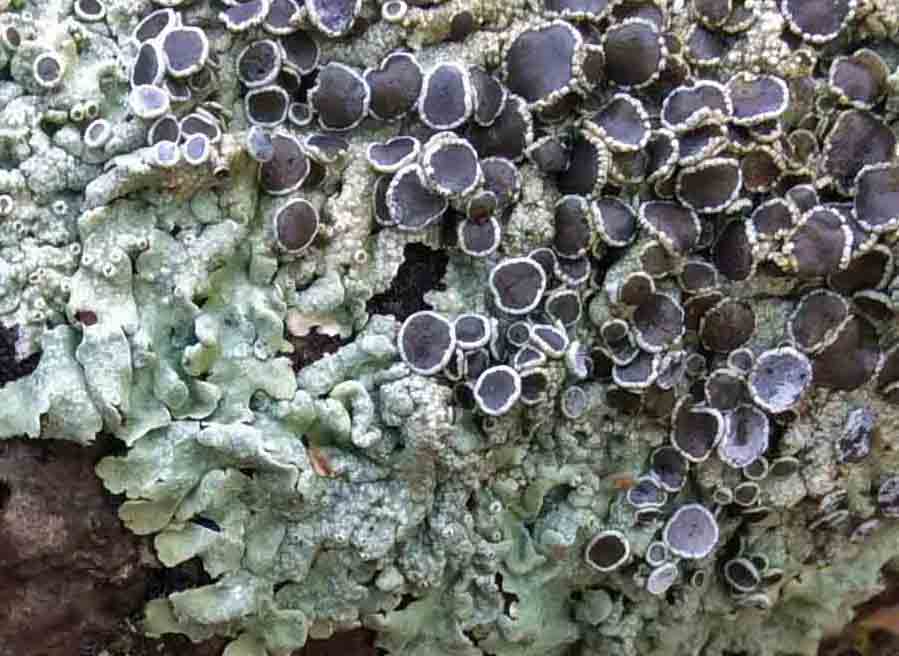
Many twigs strewn on the leaf-covered forest floor are covered in grey-green lichen with leaf-like, lobes. On close inspection, the lichen thallus contains abundant cup-shaped fruiting bodies. I identify the lichen as Physchia stellaris, common and widespread in Ontario and typically pioneering on the bark of twigs—especially of poplars, and alders.

Lichen fruiting-best-2 copy

Physchia stellaris lichen with fruiting bodies (apothecia), Little Rouge, ON (photo by Nina Munteanu)

Lichens are a cooperative character; two characters in one, really. Lichens are a complex symbiotic association of two or more fungi and algae (some also partner up with a yeast). The algae in lichens (called phycobiont or photobiont) photosynthesize and the fungus (mycobiont) provides protection for the photobiont. Both the algae and fungus absorb water, minerals, and pollutants from the air, through rain and dust. In sexual reproduction, the mycobiont produces fruiting bodies, often cup-shaped, called apothecia that release ascospores. The spores must find a compatible photobiont to create a lichen. They depend on each other for resources—from food to shelter and protection.

Forest as Character

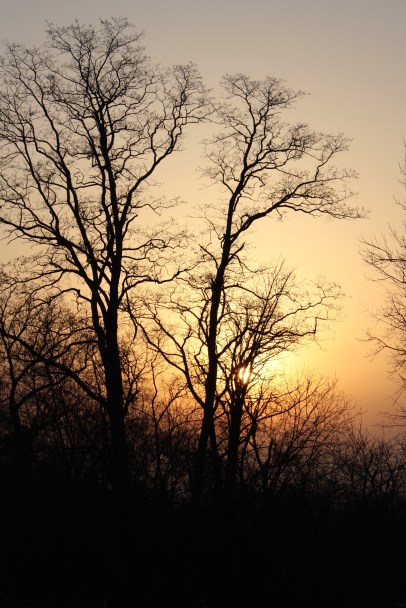
Sunset 1 Niagara

Sunset in Niagara on the Lake (photo by Nina Munteanu)

In Far from the Madding Crowd, Thomas Hardy personified trees as interpreters between Nature and humanity: from the “sobbing breaths” of a fir plantation to the stillness of trees in a quiet fog, standing “in an attitude of intentness, as if they waited longingly for a wind to come and rock them.” Trees, meadows, winding brooks and country roads were far more than back-drop for Hardy’s world and his stories. Elements of the natural world were characters in their own right that impacted the other characters in a world dominated by nature.

Place ultimately portrays what lies at the heart of the story. Place as character serves as an archetype that story characters connect with and navigate in ways that depend on the theme of the story, particularly in allegories that rely strongly on metaphor. A story’s theme is essentially the “so what part” of the story. What is at stake for the character on their journey. Theme is the backbone—the heart—of the story, driving characters to journey through time and place toward some kind of fulfillment. There is no story without theme. And there is no theme without place.
—excerpted from The Ecology of Story: World as Character


nina-2014aaa

Nina Munteanu is a Canadian ecologist / limnologist and novelist. She is co-editor of Europa SF and currently teaches writing courses at George Brown College and the University of Toronto. Visit www.ninamunteanu.ca for the latest on her books. Nina’s bilingual “La natura dell’acqua / The Way of Water” was published by Mincione Edizioni in Rome. Her non-fiction book “Water Is…” by Pixl Press (Vancouver) was selected by Margaret Atwood in the New York Times ‘Year in Reading’ and was chosen as the 2017 Summer Read by Water Canada. Her novel “A Diary in the Age of Waterwill be released by Inanna Publications (Toronto) in June 2020.


Infertility in the Age of Water

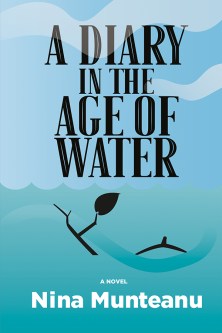
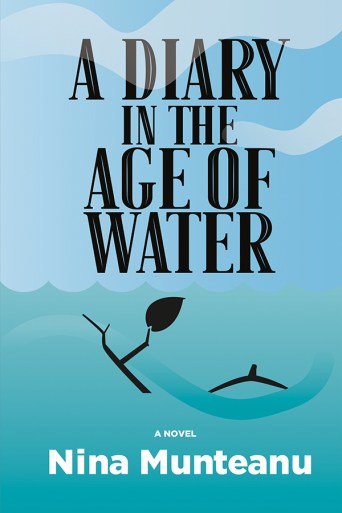
Diary Water cover finalIn a scene of my near-future eco-thriller A Diary in the Age of Water (Inanna Publications, 2020) the diarist’s young colleague Daniel rather too enthusiastically proclaims the impending extinction of males.

“Scientists all agree that environmental factors are the main triggers for male and female infertility through epigenetics…Epigenetics rules climate change-related adaptations. And everything appears stacked heavily for females and intersex humans. Males might go extinct with climate change!”

–A Diary in the Age of Water

Lynna Dresden, the diarist in A Diary in the Age of Water, thinks Daniel rather buffoonish and a traitor to his male kind. Then again, here is how another Daniel starts his article in a 2018 issue of GQ Magazine entitled “Sperm Count Zero“:

Men are doomed. Everybody knows this. We’re obviously all doomed, the women too, everybody in general, just a waiting game until one or another of the stupid things our stupid species is up to finally gets us. But as it turns out, no surprise: men first. Second instance of no surprise: We’re going to take the women down with us.

There has always been evidence that men, throughout life, are at higher risk of early death—from the beginning, a higher male incidence of Death by Mastodon Stomping, a higher incidence of Spiked Club to the Brainpan, a statistically significant disparity between how many men and how many women die of Accidentally Shooting Themselves in the Face or Getting Really Fat and Having a Heart Attack. The male of the species dies younger than the female—about five years on average. Divide a population into groups by birth year, and by the time each cohort reaches 85, there are two women left for every man alive. In fact, the male wins every age class: Baby boys die more often than baby girls; little boys die more often than little girls; teenage boys; young men; middle-aged men. Death champions across the board.

Now it seems that early death isn’t enough for us—we’re on track instead to void the species entirely.

–Daniel Noah Halpern, GQ Magazine

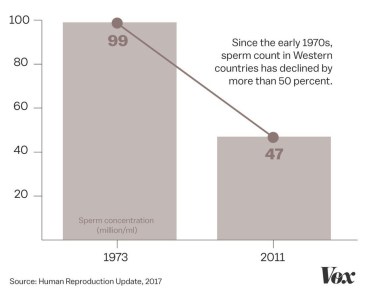
sperm_decline_chartBoth Daniels are talking about the alarming rate at which sperm counts worldwide are falling. They’ve dropped by half in the last fifty years in North America, Europe, Australia and New Zealand—according to a 2017 paper by researchers at Hebrew University and Mount Sinai medical school and more recent studies in 2018.

While an unhealthy lifestyle (being overweight or obese, smoking, stress and alcohol or recreational drug use) is most often implicated, more insidious causes exist.

PHTHALATESResearch shows that consumption and/or exposure to many common constituents of urban living can decrease fertility, increase miscarriage, spontaneous abortion, and lower auto-immune systems. Examples include car exhaust, pesticides, common detergents, hair dyes, cleaning solvents, oil based paints, adhesives, gasoline; and consumption of MSG, coffee, alcohol.

A 2019 study by scientists at Nottingham University identified two chemicals common in home environments that damage sperm in men and dogs. GQ Daniel goes on to explain: “Phthalates and BPA [used to make plastic soft and flexible or harder and stronger] for example, mimic estrogen in the bloodstream. If you’re a man with a lot of phthalates in his system, you’ll produce less testosterone and fewer sperm. If exposed to phthalates in utero, a male fetus’s reproductive system itself will be altered: He will develop to be less male.”

sperm count and platics

This leads Age of Water Daniel to bring up the rise in intersex mammals (individuals born with any of several variations in sex characteristics including chromosomes, gonads, sex hormones or genitals that do not fit the “strict definitions for ‘male’ or ‘female’ bodies”). A 2016 article in Environmental Health Insights by Rich et al. attribute an increasing number of human children born with intersex variation to an increase in hormone disrupting chemicals in our environment.

Phthalates bookLeaning on his microscope, Daniel went on, “Wherever there’s a sewage treatment plant, pulp and paper mill, or herbicides and pesticides in a stream, you get endocrine disruption, which causes more female or intersex fish populations…[Degradation products of surfactants used in commercial and household detergents] inhibit breeding in male fish. And herbicides like atrazine—”

“—Create feminized males with female eggs, along with reduced immunity to disease,” I finished for him.

I knew all this. Hormonal disruption is global. Environmental toxicologists have been finding it in many aquatic animals like fish, turtles, alligators and frogs. And some terrestrial animals…Even humans…Was it also causing the steep rise in ambiguous sex in humans? Is Daniel an intersex human? Apparently 1 in 30 now have bodies that differ notably from standard male or female. Klinefelter, androgen insensitivity syndrome, presence of ovotestes, mixed gonadal dysgenesis, and mosaic genetics are all on the rise. Which was he?

As if he knew what I was thinking, Daniel said dramatically, “The environment is changing us faster than most think and it’s doing it through epigenetics and HGT.”

–A Diary in the Age of Water

Phthalates and BPA can be found everywhere. GQ Daniel lists them: “BPA can be found in water bottles and food containers and sales receipts. Phthalates are even more common: They are in the coatings of pills and nutritional supplements; they’re used in gelling agents, lubricants, binders, emulsifying agents, and suspending agents. Not to mention medical devices, detergents and packaging, paint and modeling clay, pharmaceuticals and textiles and sex toys and nail polish and liquid soap and hair spray. They are used in tubing that processes food, so you’ll find them in milk, yogurt, sauces, soups, and even, in small amounts, in eggs, fruits, vegetables, pasta, noodles, rice, and water. The CDC determined that just about everyone in the United States has measurable levels of phthalates in his or her body—they’re unavoidable.”

These chemicals affect sperm’s ability to swim, navigate and fertilize an egg. DNA fragmentation in the sperm head also occurs, which is basically equivalent to a sperm having a brain hemorrhage. Recent studies suggest that 20-30% of young men today have sperm counts in a range that is associated with reduced fertility. Sarbjit Kaur at the Punjab Agricultural University found that men who live in industrial cities had six times more abnormal sperm than men living in a relatively clean rural town.

TheHandmaid'sTale-bookDr. Marilyn F. Vine at the University of North Carolina demonstrated that smoking men had lower sperm counts by 13-17%. Smokers also had more abnormal sperm. Likewise, women who smoked experienced more spontaneous abortions, early menopause and abnormal oocytes. Follicular fluid also contained high levels of cadmium, a heavy metal present in cigarettes, and cotininie, a metabolite of nicotine.

A growing concern for infertility has entered our general mindset, reflected in the theme of infertility in literature and motion pictures.

Notable examples include Margaret Atwood’s The Handmaid’s Tale (1985), Raising Arizona (1987), Aeon Flux (2005), The Children of Men (2006), Private Life (2018) and my own A Diary in the Age of Water (2020).

Although we are not close to experiencing the global infertility pandemic portrayed in the barren 2027 world of The Children of Men, this cautionary tale of a world gone mad with grief should linger like the whispered truth of a fairy tale.

children of men scene

scene from “Children of Men” motion picture


Suggested Reading:

Carr, Teresa. 2019. “Sperm counts are on the decline—could plastics be to blame?” The Guardian.

Belluz, Julia. 2019. “Sperm counts are falling. This isn’t the reproductive apocalypse—yet” Vox.

Halpern, Daniel Noah. 2018. “Sperm Count Zero.” GQ Magazine.

Fetters, Ashley. 2018. “Sperm Counts Continue to Fall.” The Atlantic.

Stein, Rob. 2017. “Sperm Counts Plummet in Western Men, Study Finds.” NPR.


nina-2014aaa

Nina Munteanu is a Canadian ecologist / limnologist and novelist. She is co-editor of Europa SF and currently teaches writing courses at George Brown College and the University of Toronto. Visit www.ninamunteanu.ca for the latest on her books. Nina’s bilingual “La natura dell’acqua / The Way of Water” was published by Mincione Edizioni in Rome. Her non-fiction book “Water Is…” by Pixl Press (Vancouver) was selected by Margaret Atwood in the New York Times ‘Year in Reading’ and was chosen as the 2017 Summer Read by Water Canada. Her novel “A Diary in the Age of Waterwill be released by Inanna Publications (Toronto) in June 2020.

The Aggressive Symbiosis of SARS-CoV-2: Seeking Balance in an Unbalanced World

SARS-CoV-2

SARS-CoV-2

In the following scene of my upcoming speculative novel “Thalweg” (set in 2053 Toronto) one of my characters, Daniel–who is a bit of a conspiracy theorist–is trapped in an old abandoned garage, about to fight off a pack of stray dogs. His feverish mind thinks back to the COVID-19 pandemic:

“The official story was that SARS-CoV-2, which caused the COVID-19 pandemic of the early ‘20s resulted from the recombination of two previous viruses in some host—supposedly a bat or pangolin—which then ended up in a Wuhun wet market; there, the recombined virus gleefully jumped species to humans, who, in turn, gleefully spread it worldwide. But, according to the study at the Wuhun hospital, patient zero hadn’t been anywhere near the wet market. So, where did the virus really come from?…”

Daniel then recalls a conversation he had–when he still had a job–with colleague Lynna in which he  suggested that the chimera virus–and the others that followed–were developed as a bioweapon through Gain-of-Function research and they somehow leaked into the public. To her scoff, he reminded her that the aim of GOF research is to induce an increase in the transmissibility and/or virulence of pathogens. He then provided numerous examples involving Influenza, SARS, and MERS.

Influenza virus

Influenza virus

Did she know, for instance, that in 2014 Obama put a funding moratorium on all GOFR experiments that might enhance virus pathogenicity or transmissibility in mammals via the respiratory route. Then in 2017, under the Trump administration, the NIH turned it all back on.

squirrel monkey

Squirrel monkey

Lynna responded calmly with a convincing argument, based on science and ecology. “Sure, they could be that,” she acknowledged thoughtfully. “Or they could simply be more cases of co-evolution and aggressive symbiosis…” Then she informed Daniel that viruses commonly form aggressive relationships with their hosts. Every monkey, baboon, chimpanzee and gorilla is carrying at least ten different species of symbiotic viruses, she said. The herpes-B virus that chums with the squirrel monkey is one example. The virus and an immunity to it passes harmlessly from mother to baby monkey. If a rival species like the marmoset monkey invades their territory, the virus jumps species and wipes out the challenger by inducing cancer in the competing marmoset monkey. Ebola and hantavirus outbreaks follow a similar pattern of “aggressive symbiosis.”

This community-symbiosis functions like an ecosystem’s “immune system” that protects its own from the encroachment of invading species—even when that invading species is us.

—excerpt from Nina Munteanu’s “Thalweg” (upcoming)


Aggressive Symbiosis & Virus X

Virus X FrankRyanIn his book Virus X, Dr. Frank Ryan coined the term aggressive symbiosis to explain a common form of symbiosis where one or both symbiotic partners demonstrates an aggressive and potentially harmful effect on the other’s competitor or potential predator. Examples abound, but a few are worth mentioning. In South American forests, a species of acacia tree produces a waxy berry of protein at the ends of its leaves that provides nourishment for the growing infants of the ant colony residing in the tree. The ants, in turn, not only keep the foliage clear of herbivores and preying insects through a stinging assault, but they make hunting forays into the wilderness of the tree, destroying the growing shoots of potential rivals to the acacia.

bamboo rising copy

Bamboo forest near Kyoto, Japan (photo by Nina Munteanu)

In Borneo, a species of rattan cane has developed a symbiotic relationship with a species of ants. The ants make a nest around the cane and drink its sweet sap. The ants, in turn, protect the cane. When a herbivore approaches to feed on the leaves, the ants attack.

Ryan draws an analogy between this aggressive symbiotic partnership and that of new zoonotic agents of disease. He argues that when it comes to emerging viruses, animals are the cane and ants are the virus.

Viruses & Zoonotic Agents of Disease

Ryan suggests that Ebola and hantavirus outbreaks follow a pattern of aggressive symbiosis. This may explain why Ebola is so virulent. The Ebola virus is so fierce that victims don’t make it very far to infect others, suggesting that the virus is an evolutionary failure. However, if the virus is acting as an aggressive symbiont, it may be fulfilling its evolutionary purpose by protecting a host species we haven’t yet identified.

Aztecs and Spaniards

Azteks meet Spaniards who bring smallpox

Historian William H. McNeill suggested that a form of aggressive symbiosis played a key role in the history of human civilization. “At every level of organization—molecular, cellular, organismic, and social—one confronts equilibrium [symbiotic] patterns. Within such equilibria, any alteration from ‘outside’ tends to provoke compensatory changes [aggressive symbiosis] throughout the system to minimize overall upheaval.”

One of a legacy of examples of aggressive symbiosis in history includes smallpox: the Europeans introduced smallpox (symbiotically co-evolved with them) to the Aztecs with devastating results. Other examples of aggressive symbiosis include measles, malaria, and yellow fever.


Wet Markets & Factory Farming

CHINESE MAN DOG RABBIT

Inhumane and unsafe treatment of animals in wet market in China

The National Observer gives a vivid description of the potential for zoonotic viral spread in the world’s wet markets, particularly in Wuhun:

“Dozens of species that rarely, if ever, come in contact with one another in the wild ― fish, turtles, snakes, bamboo rats, bats, even foxes and wolf cubs ― are confined in close quarters, waiting to be butchered and sold. The animals are often stressed, dehydrated and shedding live viruses; the floors, stalls and tables are covered in blood, feces and other bodily fluids.

This is the scene at many of China’s so-called “wet markets,” where a poorly regulated wildlife trade thrives and creates conditions that experts say are ideal for spawning new diseases.

“You could not design a better way of creating pandemics,” said Joe Walston, head of global conservation at the nonprofit Wildlife Conservation Society. “It’s really the perfect mechanism, not just for the Wuhan coronavirus but for the next ones that will undoubtedly emerge sooner rather than later.”

Zoonotic diseases, or diseases that can leap from animals to humans, are not uncommon and they don’t always come from exotic animals, writes Ari Solomon of Veganista. “Many come from the animals we regularly farm and eat. The 1918 influenza pandemic, or the Spanish flu, infected more than 500 million people and killed between 40-50 million worldwide. It is now commonly believed that the disease originated in birds. When the H1N1 virus, the same strain that caused the Spanish flu, showed up again in 2009, it first emerged in pigs. Tuberculosis, mad cow disease, and pig MRSA also came from animals exploited for food.”
cows-seelisberg02

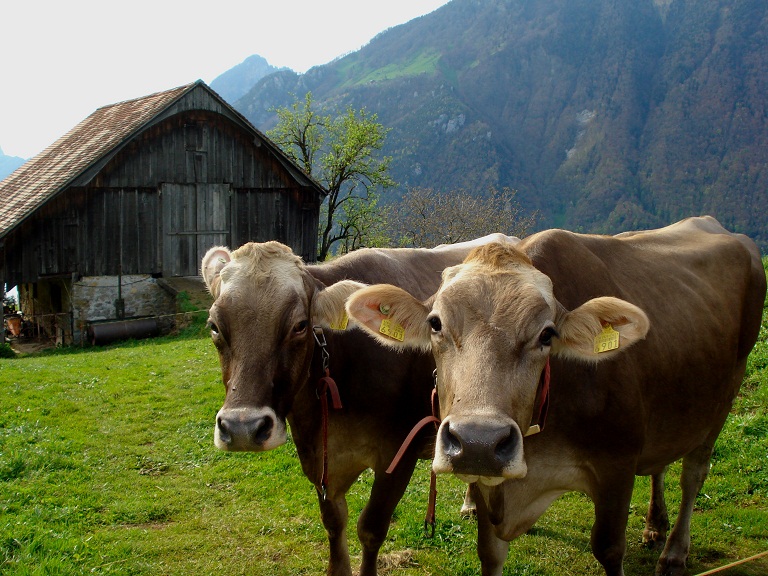
Happy cows in Seelisberg, Switzerland (photo by Nina Munteanu)

In 2004, Linda Saif, with the Department of Food Animal Health Research Program at the Ohio Agricultural Research and Development Center summarizes a number of farm and domestic animal reservoirs of zoonotic corona viruses that have caused human diseases historically and many that may still do so through recombinations. Animals have included cows (BCoV), pigs (PEDV and PRCV), chickens (IBV, turkeys, cats (FCoV and FIPV), ferrets and macaques. Saif cautions that, given an estimated 75% of newly emerging human diseases arise as zoonoses (from wild or farm animals), interspecies transmission poses a continued threat to human health.

Wet markets aren’t the only places where animals are kept under and treated with cruelty and lack of any compassion or kindness:

“Thanks to the advent of factory farming, billions of animals are routinely kept in crammed, filthy conditions that cause them extreme stress. This abhorrent practice creates the perfect breeding ground for new diseases to thrive. Add to that the fact that we regularly feed factory farmed animals low-doses of antibiotics and we really have a recipe for disaster.”—Ari Solomon, Veganista

It comes down to balance. Something about which the human species has much to learn.

costa-maya-09-close

Buttressed fig tree in Costa Maya (photo by Nina Munteanu)

It is clear to me that these pandemics are exacerbated—if not outright caused by—our dense over-population and an exploitation mentality: our encroachment and defilement of natural habitats and the life that inhabits them. Gaia is suggesting that we live more lightly on this planet. Her ecosystems are responding to our aggression with equal aggression. And, make no mistake, we won’t win that battle. Just as we won’t win the battle with changing climate. It’s time to learn humility as a species in a diverse world. Time to cultivate respect for our life-giving environment. Time to learn the power of  kindness.

The National Observer recently ran an article stating that: “COVID-19 and other health endemics are directly connected to climate change and deforestation, according to Indigenous leaders from around the world who gathered on March 13, in New York City, for a panel on Indigenous rights, deforestation and related health endemics.” The virus is telling the world what Indigenous Peoples have been saying for thousands of years: that “if we do not help protect biodiversity and nature, we will face this and even worse threats,” said Levi Sucre Romero, a BriBri Indigenous person from Costa Rica and co-ordinator of the Mesoamerican Alliance of Peoples and Forests (AMPB).

Many environmental experts agree that the novel coronavirus will only be the first in waves of pandemics we can expect if we ignore links between infectious diseases and the destruction of the natural world.
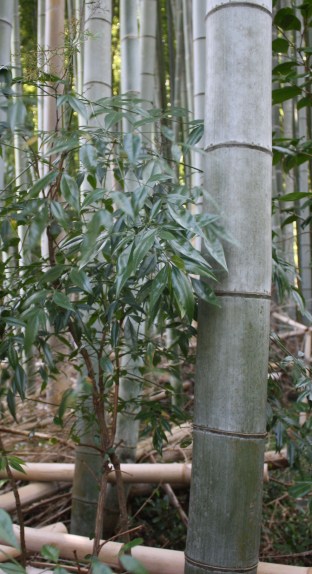
bamboo-close01 copy

Bamboo, Japan (photo by Nina Munteanu)

“I’m absolutely sure that there are going to be more diseases like this in future if we continue with our practices of destroying the natural world,” said marine ecologist Dr Enric Sala to the Independent.


Reiterating the work of Dr. Frank Ryan, David Quammen, author of 2012 Spillover: Animal Infections and the Next Human Pandemic told the Independent: “Our highly diverse ecosystems are filled with many species of wild animals, plants, fungi and bacteria. All of that biological diversity contains unique viruses.” This unique community has developed over many many years into a functional community symbiosis in which viruses play an important part.

“There’s misapprehension among scientists and the public that natural ecosystems are the source of threats to ourselves. It’s a mistake. Nature poses threats, it is true, but it’s human activities that do the real damage. The health risks in a natural environment can be made much worse when we interfere with it,” says Richard Ostfeld, senior scientist at the Cary Institute of Ecosystem Studies in Millbrook, New York.

He and others are developing the emerging discipline of planetary health, which looks at the links between human and ecosystem health.

The disruption of pristine forests driven by logging, mining, road building through remote places, rapid urbanisation and population growth is bringing people into closer contact with animal species they may never have been near before, said Kate Jones, chair of ecology and biodiversity at UCL to The Guardian.

“We are researching how species in degraded habitats are likely to carry more viruses which can infect humans,” says Jones. “Simpler systems get an amplification effect. Destroy landscapes, and the species you are left with are the ones humans get the diseases from…We are going into largely undisturbed places and being exposed more and more. We are creating habitats where viruses are transmitted more easily, and then we are surprised that we have new ones.”

“It’s like if you demolish an old barn then dust flies. When you demolish a tropical forest, viruses fly. Those moments of destruction represent opportunity for unfamiliar viruses to get into humans and take hold.”–David Quammen

It’s aggression meeting aggression.

“Community-symbiosis functions like an ecosystem’s ‘immune system’ that protects its own from the encroachment of invading species—even when that invading species is us.”–Lynna Dresden, in Nina Munteanu’s Thalweg


EcologyOfStoryFor more on “ecology” and a good summary and description of environmental factors like aggressive symbiosis and other ecological relationships, read my book “The Ecology of Story: World as Character” (Pixl Press, 2019).

Glossary of Terms: 

Aggressive Symbiosis: a common form of symbiosis where one or both symbiotic partners demonstrates an aggressive and potentially harmful effect on the other’s competitor or potential predator (Ryan, 1997).

Co-evolution: when two or more species reciprocally affect each other’s evolution through the process of natural selection and other processes. 

Gain-of-Function Research (GOFR): involves experimentation that aims or is expected to (and/or, perhaps, actually does) increase the transmissibility and/or virulence of pathogens (Selgelid, 2016). 

Patient Zero: the person identified as the first carrier of a communicable disease in an outbreak of related cases. 

Recombination: the process by which pieces of DNA are broken and recombined to produce new combinations of alleles. This recombination process creates genetic diversity at the level of genes that reflects differences in the DNA sequences of different organisms.

Symbiosis: Greek for “companionship” describes a close and long term interaction between two organisms that may be beneficial (mutualism), beneficial to one with no effect on the other (commensalism), or beneficial to one at the expense of the other (parasitism). (Munteanu, 2019).

Zoonosis: a zoonotic disease, or zoonosis, is one that can be transmitted from animals, either wild or domesticated, to humans (Haenan et al., 2013).

Virus: a sub-microscopic infectious agent that replicates only inside the living cells of an organism. The virus directs the cell machinery to produce more viruses. Most have either RNA or DNA as their genetic material.


References:

Frazer, Jennifer. 2015. “Root Fungi Can Turn Pine Trees Into Carnivores—or at Least Accomplices.” Scientific American, May 12, 2015. Online: https://blogs. scientificamerican.com/artful-amoeba/root-fungi-can-turn-pine-trees-into- carnivores-8212-or-at-least-accomplices/

Munteanu, N. 2019. “The Ecology of Story: World as Character.” Pixl Press, Vancouver, BC. 198pp. (Section 2.7 Evolutionary Strategies)

Munteanu, N. 2020. “A Diary in the Age of Water.” Inanna Publications, Toronto.

Ryan, Frank, M.D. 1997. “Virus X: Tracking the New Killer Plagues.” Little, Brown and Company, New York, N.Y. 430pp.

Ryan, Frank, M.D. 2009. “Virolution.” Harper Collins, London, UK. 390pp.

Saif, Linda J. 2004. “Animal Coronaviruses: lessons for SARS.” In: “Learning from SARS: Preparing for the Next Disease Outbreak: Workshop Summary.” National Academies Press (US), Kobler S., Mahmoud A., Lemon S., et. al. editors. Washington (DC).

Selgelid, Michael J. 2016. “Gain-of-Function Research: Ethical Analysis.” Sci Eng Ethics 22(4): 923-964.

VanLoon, J. 2000. “Parasite politics: on the significance of symbiosis and assemblage in theorizing community formations.” In: Pierson C and Tormey S (eds.), Politics at the Edge (London, UK: Political Studies Association)

Villarreal LP, Defilippis VR, and Gottlieb KA. 2000. “Acute and persistent viral life strategies and their relationship to emerging diseases.” Virology 272:1-6. Online: http://bird uexposed.com/resources/Villarreal1.pdf

Wohlleben, Peter. 2015. “The Hidden Life of Trees.” Greystone Books, Vancouver, BC. 272pp.


nina-2014aaa

Nina Munteanu is a Canadian ecologist / limnologist and novelist. She is co-editor of Europa SF and currently teaches writing courses at George Brown College and the University of Toronto. Visit www.ninamunteanu.ca for the latest on her books. Nina’s bilingual “La natura dell’acqua / The Way of Water” was published by Mincione Edizioni in Rome. Her non-fiction book “Water Is…” by Pixl Press (Vancouver) was selected by Margaret Atwood in the New York Times ‘Year in Reading’ and was chosen as the 2017 Summer Read by Water Canada. Her novel “A Diary in the Age of Waterwill be released by Inanna Publications (Toronto) in June 2020.

Looking for Great Science Fiction Reading?

Venusian Job Cover

Bundoran Buddies Story Bundle

While you’re self-isolating during the COVID-19 pandemic, pick up some great ebooks in this story bundle offered by Bundoran Buddies Book Bundle for the next three weeks (through to the third week in April). Then read, read, read away the pandemic. Curated by Hayden Trenholm of Bundoran Press, you can get twelve books for as little as $15USD.

Here’s what Hayden says:

OuterDiverse-front coverScience fiction is our conversation with the future. That’s the philosophy of Bundoran Press Publishing House. But how can you have a conversation without friends? Even though in the days of COVID-19, most of those conversations take place on-line or by phone, there’s never been a better time to think and talk about the future.

That’s why I’m curating this twelve-book science fiction bundle for https://storybundle.com/scifi, made up of ten novels and two short story collections from established greats and rising stars. Half of the books were published by the Press and the other six come from some fabulous authors who have been our friends and supporters for years. As always, at Story Bundle, you decide what the books are worth and a portion of the proceeds go to charity.

The Bundoran Buddies Book Bundle includes Lazarus Risen, an international collection of stories focused on longevity and immortality, including Hugo nominated author, Sean McMullen.

Award winners and nominees abound in this bundle. Hugo and Nebula award-winning author Robert J. Sawyer offers up Space: Stories, a collection of his short stories, all of them set off-world, including a Hugo finalist and two Aurora Award winners.  Aurora Award winning Edward Willett gives us a Lost in Translation that explores the necessity of understanding the other in a taut tale of interstellar negotiations.

If your taste runs to near-future, BAFTA nominee, Fiona Moore, brings us Driving Ambition, where the murder of an intelligent car launches the protagonist, a mediator between humans and artificial intelligences, on a dangerous trajectory. Or you might prefer, Madelaine Ashby’s iD, the second volume of her Machine World series which “explores the uncomfortable possibilities and limitations of love within slavery and free will under constraint (Globe and Mail).”

At the other end of the temporal spectrum, we have The Better Part of Valor, the second of the Confederation of Valor series from multi-award-winning author Tanya Huff – still producing best sellers after over two decades in the field. Duatero from Brad C. Anderson, with his first novel from from Bundoran Press, is set on a lost outpost of humanity where moral dilemmas compete with fast paced action on a plague planet.  Jennifer Rahn’s Dark Corridor gives us a fun romp in a hard science thriller that includes cyborgs, drug lords and space Vikings.

But wait, there’s more. Ryan McFadden’s hilarious and exciting The Venusian Job pits thief, Emily Van Lars, a.k.a. The Engineer, and her motley crew of mercenaries against aliens, crime lords and a deadly AI. Gerald Brandt’s The Courier, the first volume of a trilogy, is an action-packed thriller in a dystopian future, Los Angeles. Charmingly written Brendan’s Way by Matthew Bin is set entirely aboard a colony ship heading off world in a novel dubbed “Heinlein meets Marx.”

Get Rhea-HawkeGOODLast but certainly not least, Nina Munteanu’s Outer Diverse, the first volume of the Splintered Universe series, introduces Galactic Guardian Rhea Hawk, who investigates the massacre of an entire spiritual sect, catapulting her into a treacherous storm of politics, conspiracy and self-discovery.

“… a master of metaphor, Munteanu turns an adventure story into a wonderland of alien rabbit holes.”
— CRAIG H. BOWLSBY, author and creator of Commander’s Log

“An addictive start to the trilogy!”— BOOK ADDICT

“Rhea Hawke is a Galactic Guardian, and I love to say her name. Her name alone let’s you know that there is a bad ass super hero of a woman on site. I can picture her boots, her great coat, and her side arms. I want to be her when I grow up. ” — DAB OF DARKNESS

For $5USD (or more if you are feeling generous) you get four of the twelve ebooks – MOBI or ePub – and for $15 or more you unlock the remaining eight.

The initial titles in the bundle (yours for a minimum of $5) include:

  • iD by Madeline Ashby
  • Outer Diverse by Nina Munteanu
  • The Venusian Job by Ryan C. McFadden
  • Lazarus Risen edited by Hayden Trenholm and Michael Rimar

If you pay more than the bonus price of just $15, you get the remaining eight books, including:

  • Duatero by Brad C. Anderson
  • Lost in Translation by Edward Willett
  • Space: Stories by Robert J. Sawyer
  • The Courier by Gerald Brandt
  • Dark Corridor by Jennifer Rahn
  • The Better Part of Valor by Tanya Huff
  • Brendan’s Way by Matthew Bin
  • Driving Ambition by Fiona Moore

What better time to cuddle up with a dozen great books and explore the brave new worlds they present? Self-isolation will never seem so much fun.

The bundle is available for a very limited time only, via https://storybundle.com/scifi. It allows easy reading on computers, smartphones, and tablets as well as Kindle and other ereaders via file transfer, email, and other methods. You get multiple DRM-free formats (.epub and .mobi) for all books, but after the three weeks are over, the bundle is gone forever!

It’s also super easy to give the gift of reading with StoryBundle, thanks to our gift cards – which allow you to send someone a code that they can redeem for any future StoryBundle bundle – and timed delivery, which allows you to control exactly when your recipient will get the gift of StoryBundle.

Now, go get some books and read…


nina-2014aaa

Nina Munteanu is a Canadian ecologist / limnologist and novelist. She is co-editor of Europa SF and currently teaches writing courses at George Brown College and the University of Toronto. Visit www.ninamunteanu.ca for the latest on her books. Nina’s bilingual “La natura dell’acqua / The Way of Water” was published by Mincione Edizioni in Rome. Her non-fiction book “Water Is…” by Pixl Press (Vancouver) was selected by Margaret Atwood in the New York Times ‘Year in Reading’ and was chosen as the 2017 Summer Read by Water Canada. Her novel “A Diary in the Age of Waterwill be released by Inanna Publications (Toronto) in June 2020.
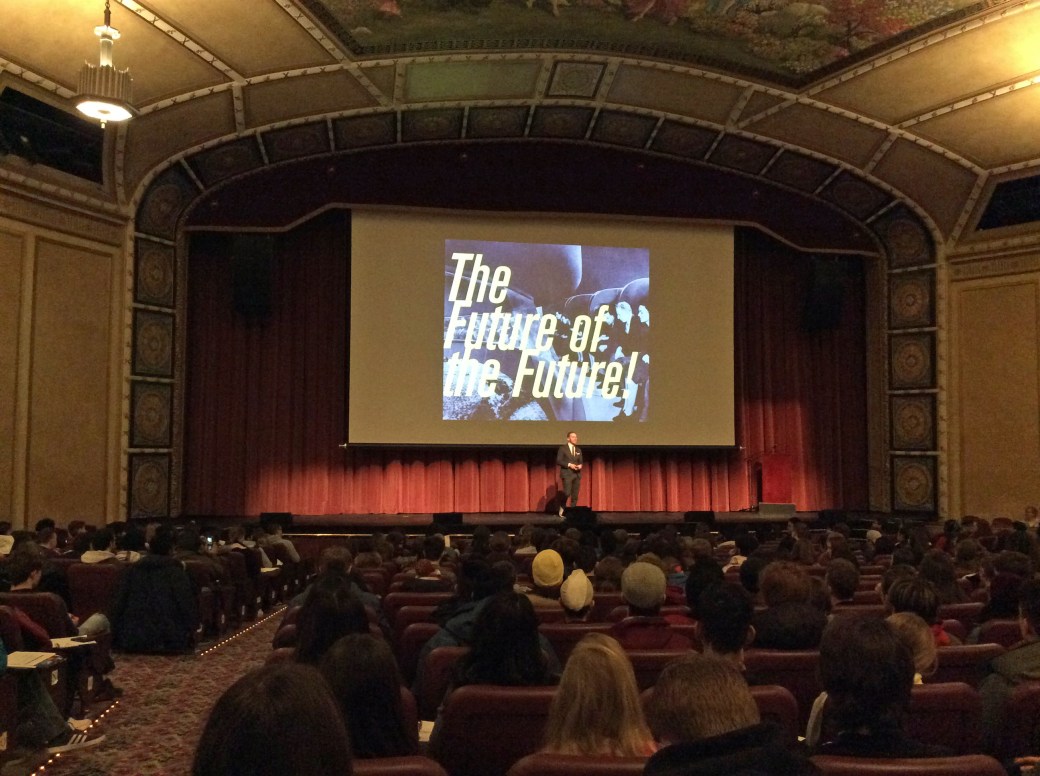
Age of Water Podcast

AoW Logo-smallOn November 22, 2019, co-host Claudiu Murgan and I launched the podcast Age of Water in Toronto, Ontario.

The podcast is devoted to informing and entertaining you with topics about water and the environment. We interview scientists, journalists, writers, academia and innovators who share their knowledge and opinions about the real state of the environment and what committed individuals and groups are doing to make a difference. We talk about the problems and we talk about the solutions.

The format of our podcast is a combination of chat cast and informal interview. We cover anything of interest from breaking environmental news to evergreen material. This also includes human interest stories, readings of eco-literature, discussion of film and other media productions of interest.

AgeOfWater-HomePage

Diary Water cover finalClaudiu suggested doing the podcast during a discussion we had about what we could do to make a difference and to help bring more awareness about the environmental challenges we face in water issues and geopolitics.

We both agreed that the podcast should not only explore the issues but also present solutions and ideas in the ongoing conversation. We wanted to point to ways others could participate by talking to those who were indeed making a difference. So far, we have talked to people about positive initiatives such as 350.org, Drawdown, blue communities, Extinction Rebellion and several others. We’ve talked to homeowners and entrepreneurs with innovative ideas on what individuals can do at home and in their community.

The name of the podcast came from my upcoming book “A Diary in the Age of Water,” a novel that chronicles the lives of four generations of women and their relationship with water during a time of catastrophic change. The book will be launched by Inanna Publications in Toronto in May 2020.

Podcast CO-HOSTS

Guests have come from around the world to join us in monthly interviews on Age of Water. These have included so far: economist and educator David Zetland in Holland (aired Nov 2019); award-winning metaphysical author Rainey Highley in California (aired December 2019); Canadian award-winning author Candas Jane Dorsey in Calgary, Alberta (aired January 2020);  activist/author Kaz LeFave in Toronto (airing February 2020); Finnish award-winning author Emmi Itäranta in the UK (to air in March 2020); and Toronto film educators The Water Brothers (to air in April 2020). We interviewed environmental activist Liz Couture in Richmond Hill, Ontario (airing May 2020); Zen master Ian Prattis in Ottawa (airing June 2020), and we also talked to activist/author Merilyn Ruth Liddel in Calgary, Alberta (airing July 2020), and climate researcher / author Martin Bush in Toronto (airing August 2020). Many more are scheduled to be interviewed. For more information go to www.ageofwater.ca

Podcast MISSION

Water Is-COVER-webIn February 2020, we started a reading series on Age of Water, in which Claudiu or I read from a fiction or non-fiction work that resonated with us, followed by a discussion. The first readings is from my book “Water Is…The Meaning of Water,” a celebration of water, which was selected by Margaret Atwood as her choice reading in the New York Times ‘Year in Reading.’

Let us know if you or someone you know wishes to be interviewed on the show. If you have a work you think merits reading and discussing on the show, please let us know as well. Go to the Age of Water site, join the newsletter and email us.


DS-2008-16 copy

Nina kayaks Desolation Sound, off the coast of British Columbia (photo by H. Klassen)

nina-2014aaa

Nina Munteanu is a Canadian ecologist / limnologist and novelist. She is co-editor of Europa SF and currently teaches writing courses at George Brown College and the University of Toronto. Visit www.ninamunteanu.ca for the latest on her books. Nina’s bilingual “La natura dell’acqua / The Way of Water” was published by Mincione Edizioni in Rome. Her non-fiction book “Water Is…” by Pixl Press (Vancouver) was selected by Margaret Atwood in the New York Times ‘Year in Reading’ and was chosen as the 2017 Summer Read by Water Canada. Her novel “A Diary in the Age of Waterwill be released by Inanna Publications (Toronto) in June 2020.

The Group of Seven Reimagined: An Ekphrastic Celebration

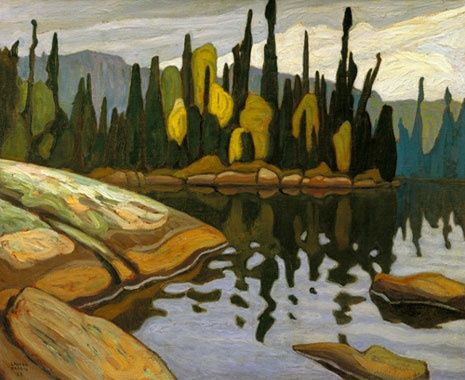
Shimmering Water by Lawren Harris

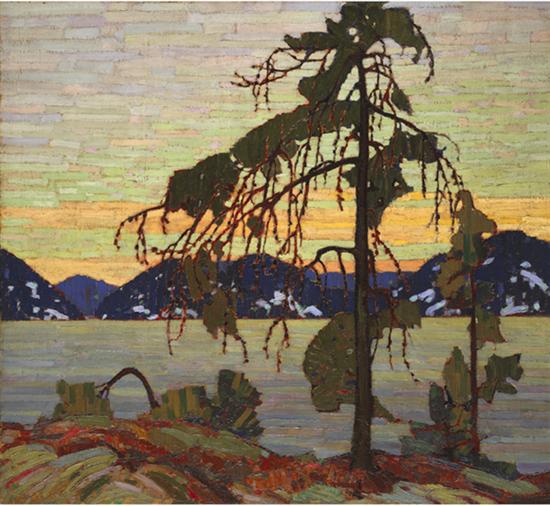
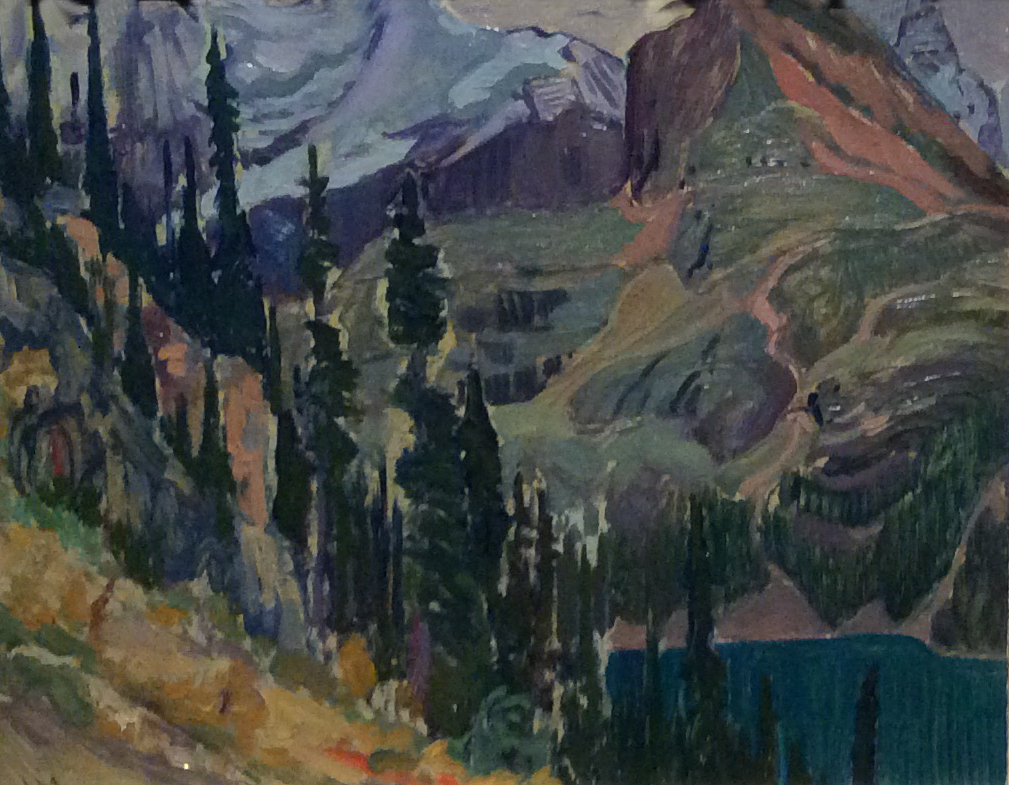
2020 marks the centenary of the formation of the Canadian iconic Group of Seven artists. The Group of Seven movement “dragged Canadian art into the modern age,” writes Christine Sismondo of The Toronto Star in her review of “The Group of Seven Reimagined,” an ekphrastic celebration of the Group of Seven by twenty-one flash fiction authors (including my own “Alien Landscape” inspired by J.E.H. MacDonald’s Lake O’Hara). Sismondo astutely identifies and encapsulates the resonant meaning of the Group of Seven, then and now:

“A hundred years ago, seven Canadian painters got together and decided to start a movement. It was born out of the horrors of war. Now, the potential horrors of climate change are giving the movement an unexpected new life and meaning.”

Jack Pine by Tom Thomson

Sismondo goes on to describe how the movement itself took form:

“At the time, people were trying to put the horrors and sacrifices of the Great War behind them and look to the future to reimagine and redefine Canada itself. It was a pivotal moment, given the role the country had recently played in international affairs and the challenges it faced in becoming an increasingly modern nation. These seven artists—friends and colleagues, many of whom worked together in a Toronto design firm—felt they could help shape this conversation with bold strokes and bright colours to bring out the beauty of the Canadian landscape.”

But in those early days—and more than thirty years after Van Gogh painted Starry Night, Canada still wasn’t ready for Impressionism, or any other art form whose roots came from that movement. Canadian critics disliked the Group of Seven. They were too modern, too experimental. The Group were dismissed as “the Hot Mush School” “a horrible bunch of junk” “the figments of a drunkard’s dream” and “daubing by immature children.”

Mirror Lake by Franklin Carmichael

In his article on the Group of Seven’s reception in England vs Canada, Adam Bunch writes about the reception of the Group of Seven shortly after their formation after the First World War:

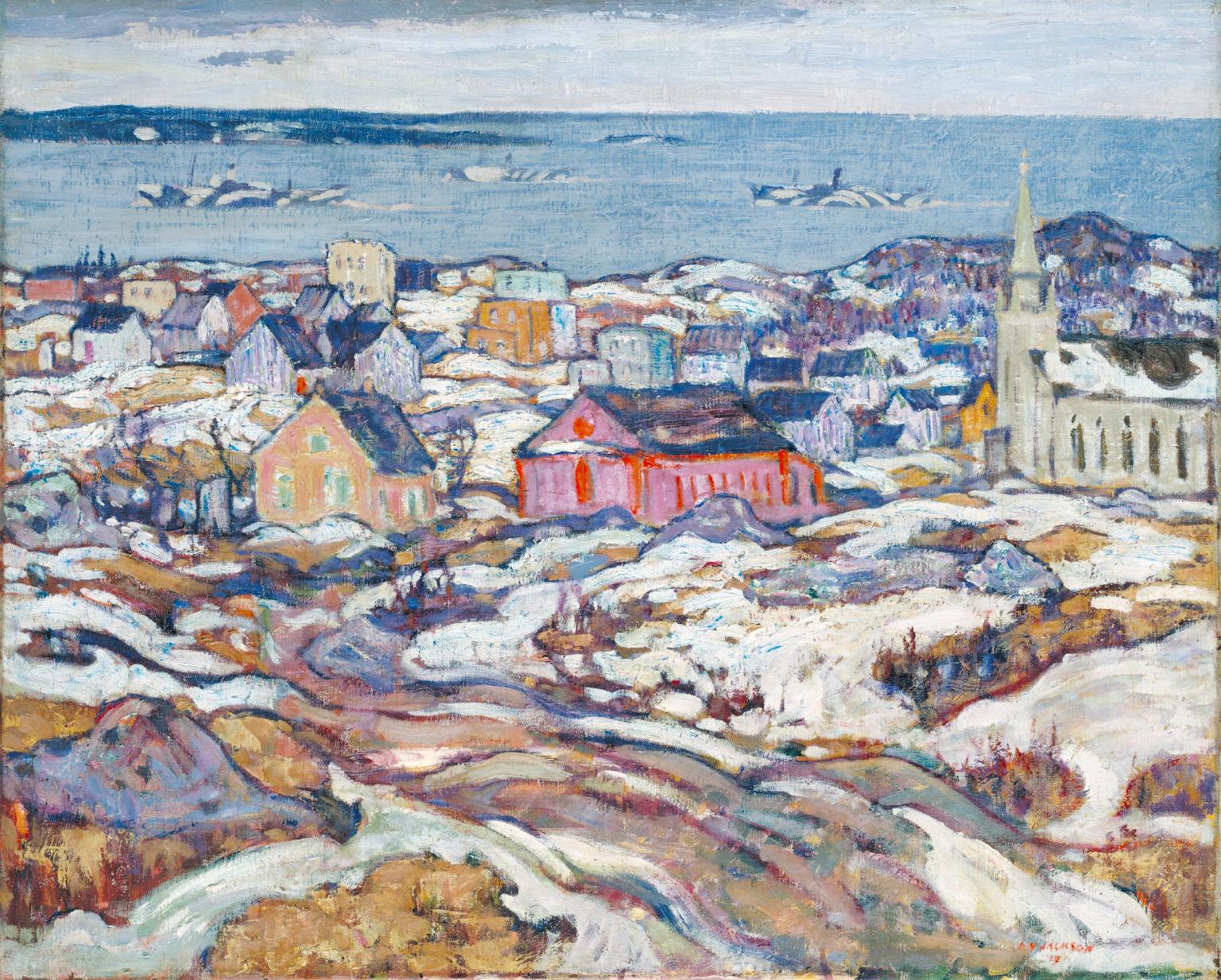
The Entrance to Halifax Harbour by A.Y. Jackson

“The reviews by Canadian critics were harsh. The Toronto Daily Star compared Jackson’s work to “a spilt can of paint.” But the English critics loved it. The Morning Post called the Group of Seven “the foundation of what may become one of the greatest schools of landscape painting.” One piece of Canadian art was even sold during the British Empire Exhibition — and it was Jackson’s. Entrance To Halifax Harbour was bought by the Tate Gallery. It’s still part of their collection today.”

“And despite the poor Canadian reviews, the show in London helped to establish the Group of Seven’s reputation back home. Now that the British took the Group seriously, Canadian collectors started taking them seriously, too. The Group even used the bad press to promote their upcoming shows: they printed posters with the angry Canadian reviews side by side with the glowing English ones.”

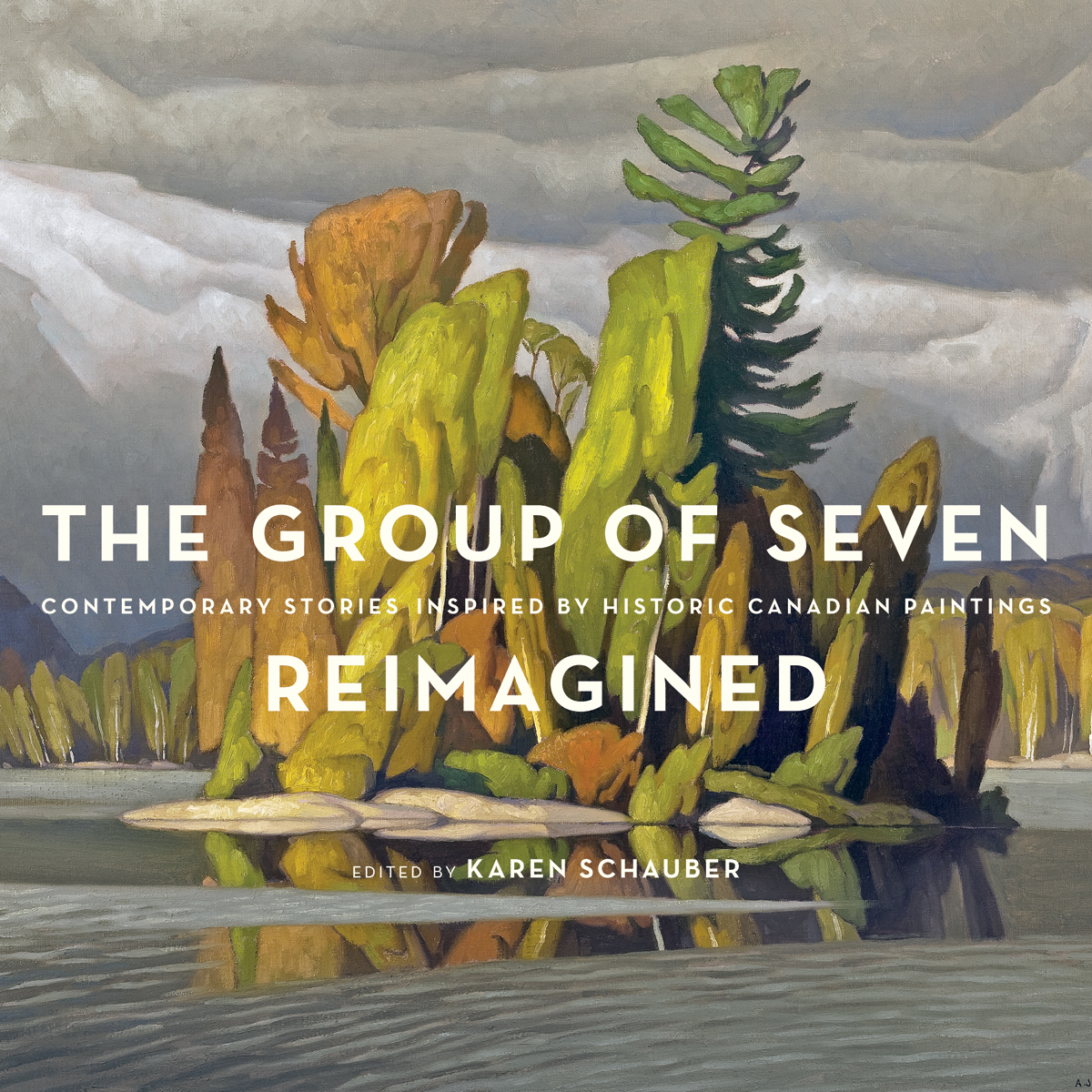
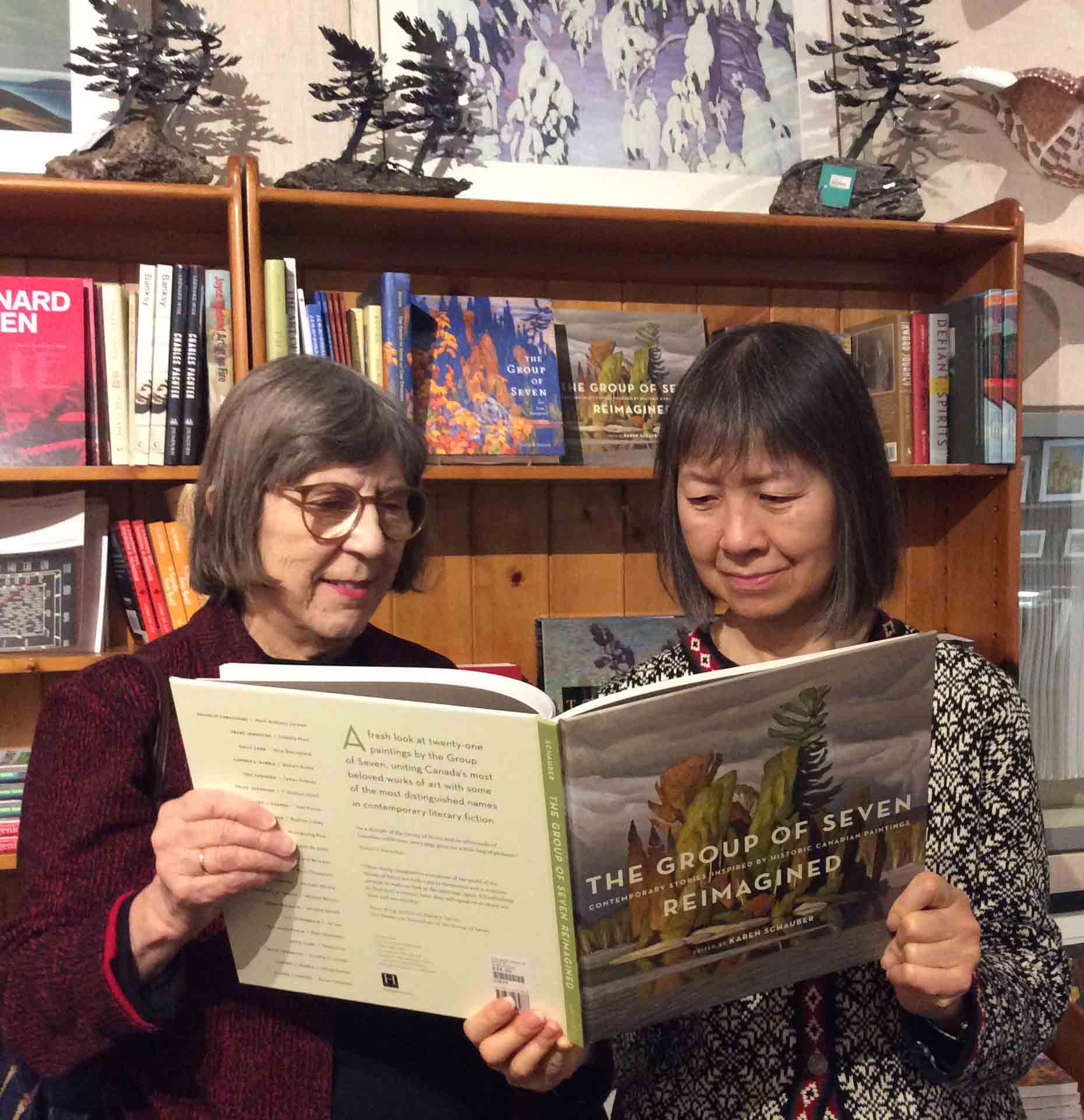
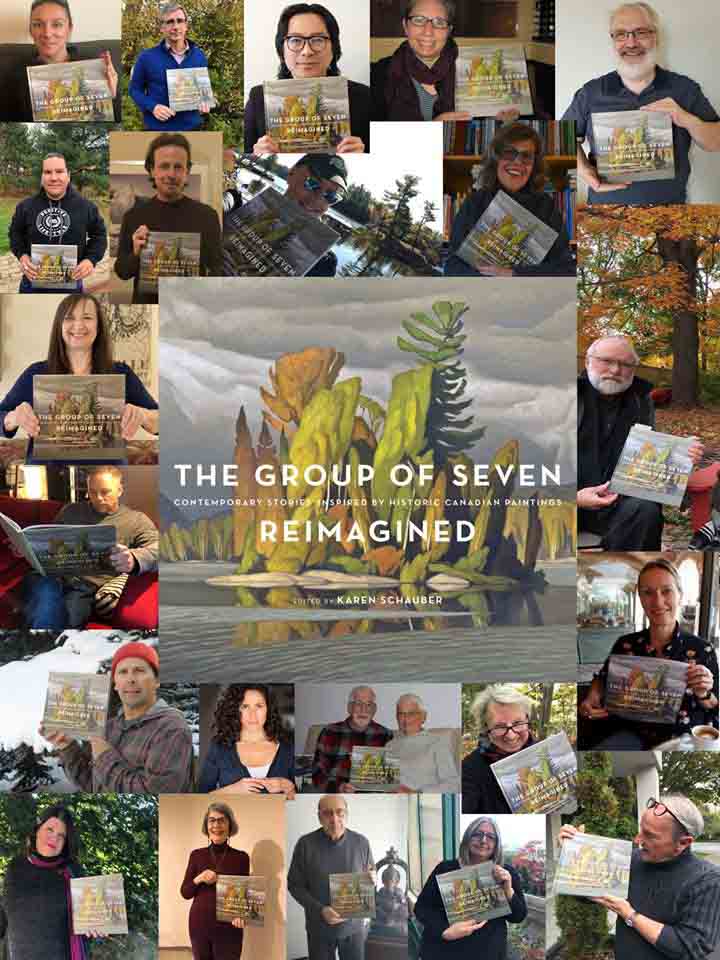
The Group of Seven Reimagined, published by Heritage House, was elegantly edited by flash fiction author Karen Schauber. Karen had invited me to contribute a piece of flash fiction (a piece of less than 500 words), inspired by a Group of Seven piece I would chose to inspire me. I took my time; this would be the first flash fiction piece I would write. It was an art form I was not familiar with, but was happy to experiment with. But I waited too long to decide and when I finally submitted my first choice for a painting, Karen informed me that it had already been selected by another writer. To my great frustration, this went on for a few pieces.

Shore Pattern by A.J. Casson

I finally took a short trip to the McMichael Gallery in Kleinburg to find my piece. In the main hall, I passed the pieces already claimed by my twenty colleagues; I sighed that I had waited so long. By chance, a large selection of artwork by J.E.H. MacDonald—one of the founders of the group—was currently on exhibit on the second floor. That was where I first saw the original oil sketch called Lake O’Hara by MacDonald. It was perfect! My story “Alien Landscape” emerged from the sketch like they had always belonged together.

Lake O’Hara by JEH MacDonald

The Star wrote: “while you might expect a lot of peaceful communing with nature on the page, a surprising number of the written pieces are actually dark tales of conflict and danger—forest fires, mining accidents, boat thieves and murderous plots in the woods. Nina Munteanu, a Canadian ecologist and science-fiction writer, takes J.E.H. MacDonald’s Lake O’Hara in a novel direction in ‘Alien Landscape’ by reimagining it as a refuge for a space heroine fleeing a world that had destroyed nature in pursuit of progress and ended in post-apocalyptic chaos.”

Gift shop at McMichael Gallery

The anthology has found itself gracing the gift shop shelves of several art galleries and museums such as the Royal BC Museum in Victoria, BC, and the McMichael Gallery in Kleinburg. It has likewise received much praise and accolades and appears on several ‘best of’ lists for ekphrastic works, art books, and more.

The anthology was long-listed for The Miramichi Reader’s “The Very Best” Book Award for 2020. The Miramichi Reader writes:

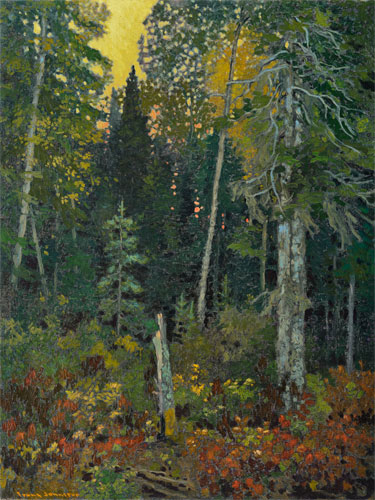
Sunset in the Bush by Frank Johnston

“There’s a very good reason that as I write this, The Group of Seven Reimagined, Contemporary Stories Inspired by Historic Canadian Paintings is sitting at, or near the top of bestseller lists in Canada (currently #3 on the Canadian Art bestseller list at Amazon.ca).  The result is a most attractive book that any lover of art and literature would enjoy, even if they already have more than a passing familiarity with the iconic Group of Seven. All the stories that accompany each image are in the “flash fiction” style, just a page or two in length, a little story that the authors were inspired to write after choosing a particular G7 painting.”


Jules Torti of Cottage Life  describd the book this way:

“Seeking equilibrium? This book is like a yoga session without the scheduling logistics and hustle to class. Balance is found in The Group of Seven Reimagined both as an intelligent coffee table book and tangible source of meditation.

Authors of the anthology

Twenty-five writers with notable street cred contributed “flash fiction” to colour iconic paintings by the Group of Seven (and their tagalongs). Flash fiction are stories categorized by length—they are 500 words or less which means they allow for one decent, undistracted cup of dark roast or whisky on ice. For writers or artists, the temptation to reimagine these works will be irresistible. And, what an intriguing resolution to make! Fiction and paintings both rely on interpretation and consideration. Fill in the gaps and colours with your chosen or perhaps newly discovered medium (watercolour?). As Jim and Sue Waddington suggest in the foreword, an art gallery visit becomes suspended in time. We keep returning to certain paintings that resonate and haunt and inadvertently, ‘Your mind sets off on a journey.’”

Author and reviewer Patricia Sandberg describes the anthology through metaphor: “Like a fine wine with dinner, some things cry out to be paired. In Reimagined, the nearly hundred-year-old brandy that was the Group of Seven is introduced to a fresh vibrant cuisine that is flash fiction, and both are the richer for it.”

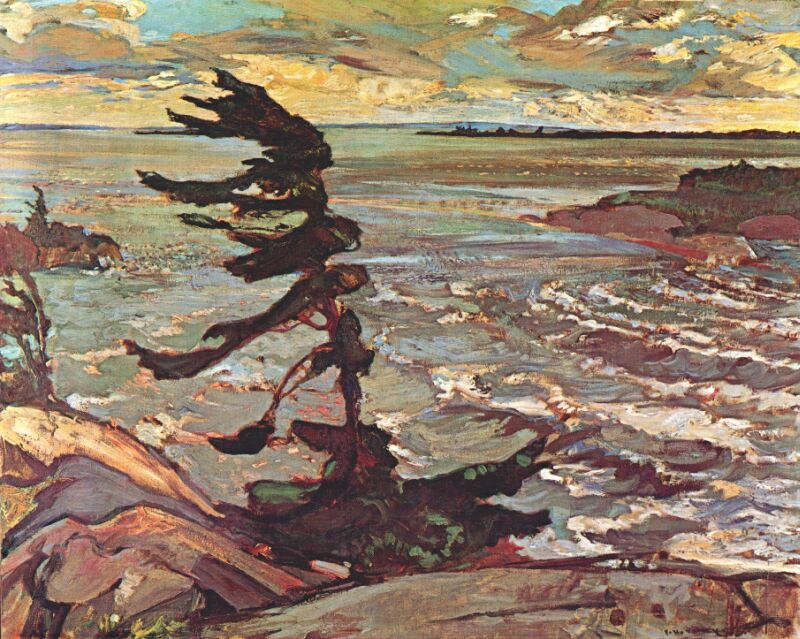
Stormy Weather by Frederick H. Varley

“As a disciple of the Group of Seven and an aficionado of Canadian wilderness, every page gives me a little leap of pleasure.”—Robert Bateman

“These sharp, imaginative evocations of the world of the Group of Seven are both a joy in themselves and a welcome prompt to make us look at the paintings again. It’s refreshing to find that, a century later, they still speak to us about our lives and our country.”—Ross King, author of Defiant Spirits: The Modernist Revolution of the Group of Seven

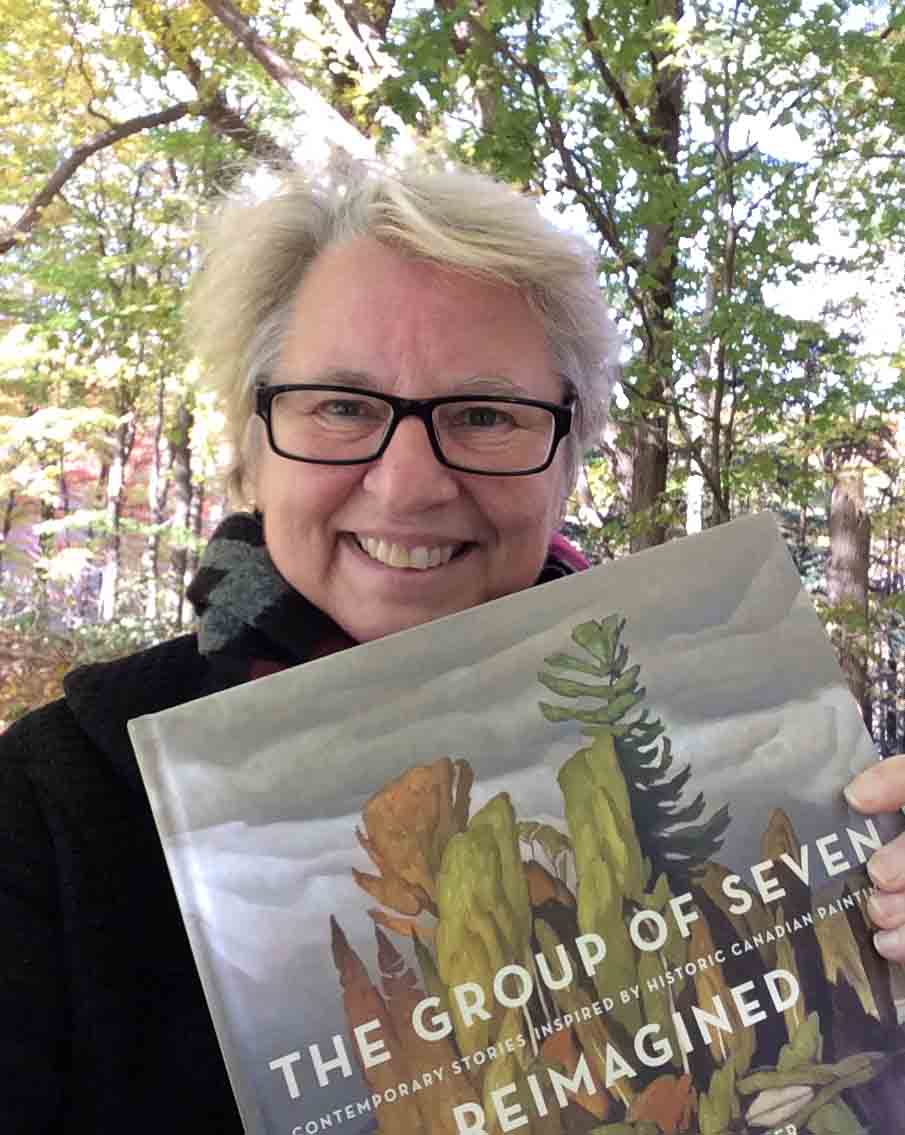
Nina Munteanu with the anthology

“Words, the writer’s paint, are artfully chosen and applied, not one wasted. The stories all compel the reader to dive beneath their surface and linger long after the reading is complete…In 1920 The Group of Seven introduced a new vision for the Canadian landscape. One hundred years later, twenty-one writers in the Group of Seven Reimagined offer a new lens for appreciating their art.”—Ottawa Review of Books

“From one region of Canada to another, a national identity is captured and shared with writers all over the world who, in turn, have crafted beautiful flash fiction pieces that accompany and extend the meaning of the art.”—Niles Reddick, Literary Heist


nina-2014aaa

Nina Munteanu is a Canadian ecologist / limnologist and novelist. She is co-editor of Europa SF and currently teaches writing courses at George Brown College and the University of Toronto. Visit www.ninamunteanu.ca for the latest on her books. Nina’s bilingual “La natura dell’acqua / The Way of Water” was published by Mincione Edizioni in Rome. Her non-fiction book “Water Is…” by Pixl Press (Vancouver) was selected by Margaret Atwood in the New York Times ‘Year in Reading’ and was chosen as the 2017 Summer Read by Water Canada. Her novel “A Diary in the Age of Waterwill be released by Inanna Publications (Toronto) in May 2020.


Nina Munteanu Shares Her Journey With Water

Nina’s recent presentation at the Don Heights Unitarian Congregation on water—”Reflections: the Meaning of Water“—explores the many dimensions of water. She describes how its life-giving anomalous properties can lead us to connect with water and nature to help us be the caretakers we need to be during these changing times.

Based on her celebrated book “Water Is… The Meaning of Water”, Nina shares her personal journey with water—as mother, teacher, environmentalist, traveler and scientist—to explore water’s many “identities” and, ultimately, our own.


Fallen log stream-2012

stream in Westcoast rainforest of BC (photo by Kevin Klassen)

nina-2014aaa

Nina Munteanu is a Canadian ecologist / limnologist and novelist. She is co-editor of Europa SF and currently teaches writing courses at George Brown College and the University of Toronto. Visit www.ninamunteanu.ca for the latest on her books. Nina’s bilingual “La natura dell’acqua / The Way of Water” was published by Mincione Edizioni in Rome. Her non-fiction book “Water Is…” by Pixl Press (Vancouver) was selected by Margaret Atwood in the New York Times ‘Year in Reading’ and was chosen as the 2017 Summer Read by Water Canada. Her novel “A Diary in the Age of Waterwill be released by Inanna Publications (Toronto) in June 2020.

The Invasion of Giant Crayfish Clones & A Diary in the Age of Water

OLYMPUS DIGITAL CAMERA

Marmorkrebs, giant marbled crayfish

In 2018, scientists reported that the giant marbled crayfish (Marmorkrebs [German]: Procambarus fallax f. virginalis) recently developed the strategy of being entirely female and cloning itself via parthenogenesis1; the female doesn’t require a male crayfish to fertilize its eggs. Despite the cloning procedure that makes them virtually identical genetically, the crayfish vary in size and pattern—no doubt due to epigenetics.2

First discovered by a German aquarium in the mid-1990s, these crayfish that developed from Florida-Native crayfish have migrated into the wild and are aggressively spreading in Europe, at the expense of the native European crayfish. The 8 to 12 cm long Marmorkrebs has been observed in Germany, Italy, Slovakia, Sweden, Japan, and Madagascar. The marbled crayfish prefers a warm and humid climate, suggesting that climate change may influence its distribution and success. The clones also thrive in a wide range of habitats—from abandoned coal fields in Germany to rice paddies in Madagascar, writes Carl Zimmer of the New York Times.

Given that every individual Marmorkrebs can reproduce (the advantage of parthenogenesis is that the female crayfish doesn’t need to find a mate—it just gives birth), one European scientist has dramatically suggested that, “we’re being invaded by an army of clones.” Zimmer shares the results of Dr Lyko and his team on how the all-female Marbokrebs came to be:

“Scientists concluded that the new species got its start when two slough crayfish mated. One of them had a mutation in a sex cell — whether it was an egg or sperm, the scientists can’t tell. Normal sex cells contain a single copy of each chromosome. But the mutant crayfish sex cell had two. Somehow the two sex cells fused and produced a female crayfish embryo with three copies of each chromosome instead of the normal two. Somehow, too, the new crayfish didn’t suffer any deformities as a result of all that extra DNA.” 

In its first couple decades, [Marmorkrebs] is doing extremely well, writes Zimmer. But sooner or later, the marbled crayfish’s fortunes may well turn, he adds. “Maybe they just survive for 100,000 years,” Dr. Lyko speculated. “That would be a long time for me personally, but in evolution it would just be a blip on the radar.”

marbled-crayfish2

Marmorkrebs

But what if this speculation isn’t the whole scenario? What if Marmorkrebs is just another example of climate change-induced adaptation and change through epigenetics? While climate forcing and habitat destruction is causing the extinction of many species; other species are, no doubt, adapting and exploiting the change. These generalists (born with change inside them) are poised to take over in Nature’s successional march.3

Bdelloid-rotifer-Philodina-gregaria

Bdelloid rotifer

Parthenogenesis and epigenetic change isn’t new. In fact, it’s very old … All-female bdelloid rotifers have been cloning a sisterhood for millions of years and using incorporated foreign genes through horizontal gene transfer4 (essentially stealing genetic material from their environment) to maintain a healthy diverse population. What’s new and weird is that this crayfish “suddenly” developed this ability—probably through epigenetic means (given this entire group is versatile in reproductive strategies in general). The real question none of the articles that covered this phenonemon ask is: WHY? Why is it happening NOW?

In my latest book A Diary in the Age of Water (due for release in May 2020 by Inanna Publications) I explore this “change” in a unique way:

Diary Water cover finalKyo finds a copy of Robert Wetzel’s Limnology on a lower shelf of the “L” section. It stands tall with a thick green-coloured spine. This is the book that Hilda, one of the Water Twins, had saved from the book burnings of the Water Age. A present from her limnologist mother. Hilda kept it hidden under her mattress. When CanadaCorp police burst into their home and dragged her mother away, Hilda was left alone with Wetzel. The limnology textbook was forbidden reading because its facts were no longer facts. 

After some coaxing, Myo shared a most bizarre tale of that time which led to the catastrophic storms and flood. What the governments hadn’t told their citizens—but what each citizen felt and knew—was that humans had lost the ability to reproduce. Then a spate of “virgin births” throughout the world spawned what seemed a new race of girls—‘deformed’, blue and often with strange abilities. Many considered them abominations, a terrible sign of what was in store for humanity—a punishment for their evil ways. Then, as quickly as they’d populated the world, these strange blue girls all disappeared without a trace. They simply vanished and became the Disappeared. Myo told her that some people called it a Rapture, a portent of the end times. Others suggested that the girls had all been murdered—a genocide, organized by what was left of the world government. 

Then … the storms … changed the world.

–“A Diary in the Age of Water” 

  1. Spontaneous Parthenogenesis: From the Greek Parthenon “virgin” and genesis “creation”, parthenogenesis is a natural form of asexual reproduction in which growth and development of embryos occur without fertilization. In animals it involves development of an embryo from an unfertilized egg; in plants it proceeds through apomixis. The production of only female offspring by parthenogenesis (such as with bdelloid rotifers) is called thelytoky.
  2. Epigenetics is the study of changes in organisms caused by the modification of gene expression (such as environmental triggers) rather than alteration of the genetic code itself. If genetics represents the hardrive of a computer, epigenetics is its software.
  3. Niche (the role or job of an organism or population) can be broad (for generalists) or narrow (for specialists). A specialist has superior abilities to exploit the narrow environmental conditions it lives in and is splendidly adapted to a fixed stable environment; generalists, less successful at exploiting than the specialist but more widely adaptive, can thrive in less stable environments that present a wider range of conditions.
  4. Horizontal gene transfer is the movement of genetic material between organisms other than by the vertical transmission of DNA from parent to offspring through reproduction. HGT is an important factor in the evolution of many organisms.

A Diary in the Age of Water will be released in May 2020 by Inanna Publications, Toronto, Canada.


nina-2014aaa

Nina Munteanu is a Canadian ecologist / limnologist and novelist. She is co-editor of Europa SF and currently teaches writing courses at George Brown College and the University of Toronto. Visit www.ninamunteanu.ca for the latest on her books. Nina’s bilingual “La natura dell’acqua / The Way of Water” was published by Mincione Edizioni in Rome. Her non-fiction book “Water Is…” by Pixl Press (Vancouver) was selected by Margaret Atwood in the New York Times ‘Year in Reading’ and was chosen as the 2017 Summer Read by Water Canada. Her novel “A Diary in the Age of Waterwill be released by Inanna Publications (Toronto) in June 2020.

Reminiscing on 2019…

Diary Water cover finalThis week is a wonderful time to reflect on the past year, 2019. It’s also a good time to be thankful for the things we have: loving family, meaningful friendships, pursuits that fulfill us and a place that nurtures our soul.

It’s been a very good year for my writing…and my soul…

Last year I received a writer’s dream Christmas gift: a signed contract with Inanna Publications to publish my ninth novel: “A Diary in the Age of Water” about four generations of women and their relationship with water during a time of extreme climate change. The book will be released by Inanna in May 2020 with a launch in Toronto on May 26th at Queen Books as part of the Toronto International Festival of Authors. The book is now available on Amazon.ca for pre-order!

Publications   

LBM 2019 ClimateInCrisis2019 saw several of my publications come out. In January 2019 the reprint of my story “The Way of Water” was published by Little Blue Marble Magazine. It will reappear in a print and web anthology devoted to climate fiction called “Little Blue Marble 2019: Climate in Crisis” on December 27, 2019. That will be the sixth time “The Way of Water” has been published!

EcologyOfStoryImpakter Magazine also published my article “How Trees Can Save Us,” an essay on five writers’ perspectives on trees and humanity’s relationship with them.

In June, I published the 3rd guidebook in my Alien Writing Guidebook series—called “The Ecology of Story: Worlds as Character” with Pixl Press in Vancouver. The launch on July 4th at Type Books was well attended with presentations by several local writers and artists.

Nina GroupOfSevenReimagined

Nina Munteanu with The Group of Seven Reimagined

I was commissioned along with twenty other writers to write a piece of flash fiction for a commemorative anthology to the Group of Seven, entitled “The Group of Seven Reimagined,” with Heritage House in Vancouver.

I’d never written flash fiction before and it was both exciting and challenging to write. I was asked to pick an artist’s piece as inspiration for a flash fiction story. The beautiful hardcover book was released October 2019.

October also saw another of my pieces published. I was asked to contribute something to the Immigrant Writer’s Association’s first anthology, entitled “Building Bridges,” about the immigrant’s experience in Canada. While I’m not an immigrant, I did share my parents’ experience who had immigrated to Canada from France. I wrote a piece on the hero’s journey.


Age of Water Podcast 

AgeOfWater-HomePage

On November 22, 2019, co-host Claudiu Murgan and I launched the Age of Water podcast.  The podcast covers anything of interest from breaking environmental news to evergreen material on water and the environment. We interview scientists, journalists, writers, academia and innovators who share their knowledge and opinions about the real state of the environment and what committed individuals and groups are doing to make a difference. We talk about the problems and we talk about the solutions.

Appearances & Media / News

On June 22, I traveled to Port McNicoll at Georgian Bay to help give a writing intensive, hosted by publisher Cheryl Antao-Xavier at IOWI. I was also invited to speak at The Word is Wild Literary Festival in October. The event took place in Cardiff, in the Highlands of Ontario. In late October, I traveled with friend and editor Merridy Cox to Vermont to give a presentation on water to the Lewis Creek Association. Entitled “Reflections: The Meaning of Water”, the talk focused on our individual connection with water. I will be reprising this talk at several venues this year.

Nina Munteanu

Nina Munteanu with a metasequoia in the Beaches (photo by Richard Lautens)

I was also featured in the news a few times. The Toronto Star asked me to answer two questions about climate change and the Vancouver Sun published an Oped of mine entitled “Why Women Will Save the Planet.”

Research & Adventure

Cedar Giants copy

Giant red cedars in Lighthouse Park (photo by Nina Munteanu)

In Summer 2019 I travelled to British Columbia to visit friends and family in Vancouver and elsewhere. Following a dream of mine, I travelled with good friend Anne to Port Renfrew on Vancouver Island to see the ancient forests and the west coast. I had wanted to see these old-growth forests for some time since I’d been to Carmanah many years ago. The ancient forests were magnificent and breathtaking and so nourishing for the soul. Recognizing these forests as living cathedrals, I felt a deep reverence. The silent giants rose from wide buttressed bases into the mist like sentinels, piercing the heavens. A complex tangle of beauty instinct whispered in the breeze with the pungent freshness of pine, cedar and fir. Anne and I even had a chance to hug Big Lonely Doug, the second tallest Douglas fir tree in Canada.

Nina looking up dougfir copy 3

Nina Munteanu stands, dwarfed, by a Douglas fir tree in Lighthouse Park (photo by Margaret Ross)

While in British Columbia, I also visited a small enclave of old-growth forest in the heart of Vancouver at Lighthouse Park (West Vancouver). I went with son Kevin and then again with good friend Margaret. This majestic forest of redcedar, Douglas fir, spruce and hemlock is deeply awesome and humbling. And a real gem for the city.

Nina boot

Nina Munteanu in Ladner, BC (photo by Anne Voute)

Then, with just a few days before my flight back to Toronto, I slipped and fell and broke my ankle. I got a “boot” and a cane then hobbled on the plane and went back to work at UofT.

It has been a wonderfully inspirational year for me in writing and teaching. I still actively teach at The University of Toronto in several writing centres and classes throughout the downtown campus. The students are bright and challenging. I also still coach writers to publication and have helped several finish their works in 2019.


I hope the beauty of the season has filled your heart with joy. Wishing you a wonderful 2020, filled with grace, good health, and sweet adventure!


nina-2014aaa

Nina Munteanu is a Canadian ecologist / limnologist and novelist. She is co-editor of Europa SF and currently teaches writing courses at George Brown College and the University of Toronto. Visit www.ninamunteanu.ca for the latest on her books. Nina’s bilingual “La natura dell’acqua / The Way of Water” was published by Mincione Edizioni in Rome. Her non-fiction book “Water Is…” by Pixl Press (Vancouver) was selected by Margaret Atwood in the New York Times ‘Year in Reading’ and was chosen as the 2017 Summer Read by Water Canada. Her novel “A Diary in the Age of Waterwill be released by Inanna Publications (Toronto) in June 2020.

Lexicon of  “The Splintered Universe”

Aeon \ Æ-ôn \ n : in Gnosticism, a divine power or nature emanating from the Supreme Being and playing various roles in the operation of the universe

Ae•on Sun•tel•ia \ Æ-ôn-sün-tel-ia \ n : 1 : the End of the Age according to the ancient Greeks, described by Plato as a cycle of catastrophe 2 : a prediction made recently by Raphael Martinez, leader of the Hermetic Order of a violent end of an age; the destruction of the old world  according to self-proclaimed prophet “will be signified by the joining of twin soul-mates who will herald the coming of a New Age.” 

al•tru•ism \ ôl-trü-ism \ n : the principle or practice of unselfish concern for or devotion to the welfare of others; a motivation to provide something of value to a part other than oneself; pure altruism consists of sacrificing something (e.g., time, energy, possessions) for someone other than the self with no expectation of compensation or benefits, direct or indirect

al•tru•is•tic \ ôl-trü-is-tik \ adj : describes the action of altruism

ammut \ am-mut \ n : a large invertebrate that makes its eggshells of swamp detritus. During their larval stage, they are extremely carnivorous and will devastate the swamp wildlife. They hatch and swarm during the season of the dead on Horus. The ammut eat the young apophus. As adults they become vegetarian and serve as food for the apophus

anti-Nihilist \ an-tē-nī-a-list \ n : someone who opposes either philosophically or through action the activities and philosophy of the Nihilists.

apophus \ A-pô-fəs \ n : a gigantic snake-like creature known through local myth that inhabits the Boiling Sea in the Weeping Mountains are of the planet Horus (47 Uma a) in the 47 Ursae Majoris system

Azorian \ A-zór-ēən \ n : a tall, heat-loving lean-limbed biped species with tough sand-paper hide, long snout and ferret face from Azor in the Beta Hydri system 

Bado•win \ badō-in \ n  1: a small, very strong, gnarled and hairy biped species of often ill-repute, originating on the planet Nexus in the M103 star cluster

Sand dunes Oregon3

Dunes on Upsilon 3

barkhan (also barchan) \ bär-kən \ n : cresent-shaped migrating sand dunes that are wider than long. These dunes form under winds that blow consistently from one direction and may move over desert surfaces with remarkable speed, particular to Upsilon 3.

bastet \ bas-tet \ n : a genetically produced mammal that displayed aggressive co-evolution and wiped out the domestic cat population and Earth’s large feral cats.

Biomimetic \ bīó-mi-met-ic \ adj : the application of biological methods and systems in nature, particularly in living organisms, in the design by sentient beings of items they use such as houses, engineering structures, vehicles, etc. 

marsh-bog Rhea

Marsh-bog on Sekmet

blanket bog \ blanket bôg \ n  1: an extensive peatland (wet spongy perched water ecosystem) formed in a climate of high rainfall and low level of evapo-transpiration, allowing peat development not only in wet hollows but over large expanses of undulating ground; an ecosystem usually consisting of hummocks and pools with specifically adapted plant and animal life; an extensive bog-fen landscape   

blenoid \ blen-óid \ n  1: a ferocious and dull-witted four-legged dog-like animal with three sets of razor sharp teeth, massive head with three eyes and tough red hide; indigenous to Upsilon 2 in the Epsilon Endari system 2 : term used for a person with these traits : CRAZY; MAD 

Bo•bo Bar \ bō-bō bär \ n : a snack bar comprising of chewy bobouris fruit jerky and artificial chocolate.

seelisberg-view06

Boiling Sea, Horus

Boiling Sea \ boēl-ēng sē \ n : term used for the great convoluted inland sea surrounded by the Weeping Mountains, on the planet Horus

Borr \ bōr \ n 1 : four-legged gentle species, indigenous to the planet Borrias and extirpated by the Vos Nihilists 2 : a shape-shifting species thought to be from Borrias

buma \ bü-mä \ n : the inside muscle of the buiuma’s digestive tract that sloughs off as the buiuma inverts itself. This event occurs twice a year, during kelm, the wet season of the Eosian jungle. It is considered an Eosian delicacy.

Cerberus / Cər-bər-əs / n : the term Rhea coined for the tall cylinders that dispensed the drugged nourishment on the penal colony of Sekmet : “Each cylinder with its swollen bulbous reservoirs, resembled a three-headed cyber-beast, with flexible teets suckling its deformed young.”

chaos \ kā-ôs \ n 1 : the confused unorganized state existing before the creation of distinct forms 2 : complete disorder syn confusion 3 : common expletive to denote less than optimal to utterly calamitous or disastrous conditions syn “hell”

co•bal \ cō-bôl \ n :  a small vole-like burrowing rodent native to the deserts of Upsilon 3 and the mainstay prey of the blenoid

cozu shrub \ co-zü shrub \ n :  a silver-green small shrub with thorns, and “popping” seed pods, indigenous to the desert of Upsilon 3

creel \ crēəl \ n : a fungus from Omega 6 that grows naturally into a metallic burnished hard surface and used by biomimetic architects on Horus to build their floors.

creon \ crē-ôn \ n 1 : an individual of the main species from the planet Creos in the 55 Cancri system; known for their laziness, lack of good judgement and imagination 2 : term used to indicate an individual with these traits : FOOL; IDIOT; DULLARD

Delenean \ Də-le-nē-en \ n : furry simple creatures with six appendages, native to Mar Delena in the Fomalhaut system. This species is subservient to the AI community that runs Mar Delena

Diverse \ dī-vərs \ n : a term that describes the existence of two parallel and divergent universes that comprise a metaverse

Dreccaline \ drec-ca-lēn \ n : a non-specific highly potent nerve poison that kills all life

Du•en•de \ Du-en-de \ n : an old Spanish word that describes a heightened state of emotion, expression and authenticity, loosely meaning “having soul”; promoted and discussed by Spanish poet Frederico Garcia Lorca  as an inner transcendent emotional response and spirit of evocation with roots from Spanish mythology.

dust \ dəst \ n : a psychoactive drug that produces mild euphoria and drowsiness in most sentient species

endo•rheic \ en-dō-rē-ik \ adj : pertaining to a closed drainage basin (a lake) that retains water and allows no outflow to other external bodies of water such as rivers or oceans; a self-enclosed system equilibrated through evaporation

Eos \ Ē-ôs \ n : ringed jungle Planet in the Pleiades Nebula; original home of the vishna tree

collision with paradise-no title

Eosian with Scree on Eos

Eosian \ Ē-ōs-ē-ən \ n : principal sentient being from Eos in the Pleiades Nebula; originally from Earth (Atlantis) and responsible for establishing the Galactic Guardian force in the Milky Way Galaxy

Epoptes \ Ē-pôp-tes \ n : shape-shifting god worshipped by the Eosian species, and from whom the Eosians presumably take their instruction through dreams

Fauche \ Fōsh\ n : an ungulate-like biped species with very long ears, wide frequency hearing and large lustrous eyes, originating from Bedar 9 in the Sigma Draconis system

fok \ fôk \ n : excrement from a blenoid

gadpie \ gad-pī \ n  1: a tree indigenous to Iota Hor-2, the moon of Horologii b  2: the wood of the gadpie tree

ghost \ gōst \ n : a person acting as a portal, capable of recalling aspects of the other diverse through their other soul-half in a déjà vu experience. If they are capable of soul-drifting—locking into someone else’s dream or trance—a ghost can manipulate both the dreams and real aspects of that other person’s life in the other diverse, usually in the form of a lengthy déjà vu

ghou•roud \ gü-rüd \ n : 1 : Original French term for moving dunes;  2 :  fields of moving dunes (barkhans) resulting from shifting sands, particularly found in Upsilon 3

glit•ter \ glit-tər \ n : 1 : a psycho-active drug used by Gnostics to see God; 2 : a refined form of dust, glitter is obtained through the major drug cartel of Dark Sun, run by Barbaricca on Sekmet; also known as glitter dust; also see dust

Gness \ ness \ n : a gentle wolf-like species with translucent skin from the 61 Ursae Majoris system

Gnosis \ nōs-sis \ n : knowledge of God

Gnostic \ nôs-tic \ n : a follower of Gnosticism

Gnosticism \ nôs-ti-sizm \ n : a belief system based on early Christianity, Helenistic Judaism, Greco-roman mystery religions, Zoroastrianism and neoplatonism, which teaches that some esoteric knowledge (gnosis) is necessary for salvation from the material world, created by an intermediary (demiurge; considered evil or merely imperfect) to God

Gnostic Hermetic Order of Québec \ nôs-tic hər-met-ic or-dər of qā-bec \ n : an order devoted to Gnosticism. Founded by Rafael Martinez, the Hermetic Order is based on Earth but has several outposts throughout the universe

Gnostic Schiss Order \ nôs-tic shiss ōr-dər \ n : a very small Hermetic order devoted to Gnosticism with mostly non-human members. Targeted by an Eclipse assassin, the Schiss Order was nearly extirpated. Its remnants is currently based on Uma 1

Rhea library02

Rhea in her Great Coat

Great Coat \ grāt cōt \ n : part of the uniform and weapons arsenal of the Galactic Guardian; millions of thixtropic nano-sensors incorporated into its durable yet flexible fabric let it respond to any number of internal and external stresses, providing its wearer with a shield from the cold or from a weapon’s discharge

hedon \ he-dən \ n 1 : a mildly euphoric recreational drug that is smoked and produces a pungent yellow smoke 2 : used colloquially to indicate incredulity (as in “you must be blowing hedon”)

Her•metic Or•der  (see Gnostic Hermetic Order)

hes•i•um fuel \ hēs- ē-um feü-əl \ n : a highly inflammable and incendiary rocket fuel used by most Zeas Corporation ships

inner diverse \ innər dīvers \ n : the world or existence comprised within the inner twin universe of the metaverse and linked to its twin existence, the outer diverse, through transitional phenomena such as black holes and intuition

jag \ jag \ vb  1 : the act of straying off the space-time stream of faster-than-light travel and often accompanied by dangerous ship stress  2 : used colloquially to indicate a serious misjudgement (as in “he jags up all the time”)

jagging \ jag-gēng \ vb  1 : describing a ship that is straying off the space-time stream 2 : vb; adv : used as an expletive to  describe a person, concept or action that lacks sense or causes harm, embarrassment or discomfort (as in, “he’s jagging with your mind” or “she’s so jagging stupid”)

jagged \ jagd \ vb1 : past tense verb of straying off the space-time stream of faster-than-light travel  2. adj : colloquial expletive term for a serious error or bad circumstance; SCREWED, MESSED UP (as in, “we’re jagged”)

kappa particles \kap-pa pär-ti-cəlz\ n : energy particles that concentrate in the upper atmosphere of several gas giants; retrieved by Fauche ray class sentient ships for fuel using specialized fuel scoops

kelm \ kelm \ n : the wet season on the planet Eos

kepry \ kep-rē \ n : a flying crustacean-like creature on Sekmet that lives in the dung piles left by the sobek

Khonsus \ kón-səs \ n : tall, feathered biped creature with raptor head, wings, and liquid amber eyes able to mind-probe, origin unknown but currently in 47 Ursae Majoris system; these hawk-like people achieve their powers through a symbiotic interaction with the planet’s energy and forces

Legess \ lə-gess \ n : tall, slim praying mantis-like invertebrate creatures who colonized Chara and enslaved native Rills

L’Ordre de l’Arbre Sac•ré  n : see Order of the Sacred Tree

mandala \ man-da-lä \ n : an ornate, highly detailed geometric design made of colored sand and symbolic of the universe. Used in a sacred ceremony by Tibetan Buddist monks, it is painstakingly created over many days and represents their sacred world of balance held together by spirit. Once work of art is finished and revered in a short ceremony, it is destroyed

MEC \ mek \  n : acronym for Magnetic-Electro Concussion pistol, created by Rhea Hawke, which uses electro-magnetic wave energy to focus sub-atomic quintle particles into resonance with specific DNA

Metaverse \ met-a-vərs \ n :  a theoretical term that describes the composition of all matter and energy encompassed by divergent diverses; a whole quantum cosmos that includes all that was and will be

mev•lan•i \ mev-lan-ē \ n : term used on Sekmet to describe the leader of the penal colony

Swamp03 TNS

Migratory trees of Horus

Migra•tor•y Trees \ mī-grə-to-rē trēz \ n : a tree known in myth to migrate from one location to another in the Weeping Mountains area of the planet Horus; according to myth the Khonsus inhabited the trees in ancient times

nexus portal \ nex-əs por-təl \ n : a person who enters the state of acting as a portal with ease through meditation or a self-induced trance. See portal

Ngu \ nü \ n : a photosynthetic amoeboid-like creature with protuberances as sense organs that lives symbiotically with AI-machinery; from Virgil 9 in the 70 Virginis system

Nuyu \ noo-ēü \ n : a nano-chemical mixture, imbibed as a liquid, that acts at the genetic level to temporarily change small aspects of outer appearance such as skin, eyes, hair; used as make-up

Nihilist \ Nī-ə-list \ n  1 : a member of a militant splinter group of the Vos  2 : a specially trained death squad of shapeshifter assassins on the Vos payroll

Order of the Sacred Tree  n : a closed membership in Quebec on Earth, devoted to the divine nature of the vishna tree, considered the tree of life and knowledge and the answer to achieving the balance of all things. The Order believes in the notion that a messiah, connected to the tree, will bring balance and begin a new age of enlightenment and peace

Orichalkon \ o-rich-al-kon \ n : 1 : the durable alloy that the mythical Epoptes bestowed to the Eosians in Atlantis; 2 : an elite guard of five squadrons of highly skilled sleuth Eosian warriors (squadrons include Cadmus, Odysseus, Peometheus, Perseus and Daedalus) dedicated to guard Mon Seigneur Martinez and his Hermetic Gnostic Order

Ouroboros

Ouroboros

Ouroboros \ u-rō-bōr-ōs \ n : a mythical serpent eating its own tail; connected with the Suntelia Aeon that refers to the serpent of light residing in the heavens (the Milky Way); the ouroboros symbolizes an Aeon

outer diverse \ outər dīvers \ n : the world or existence comprised within the outer twin universe of the metaverse and linked to its twin existence, the inner diverse, through transitional phenomena such as black holes and intuition

Peeka \ pēka \ n : a small monotreme creature that produces eggs and lives in the marshes of Omicron 12

play•a \ plī-ä \ n : a dry desert lake that contains water for a short while after a sudden downpour, causing a flood; an endorheic lake that is smooth hardpan most of the time

plock nectar \ plôk nectər \ n : 1 : a tasty nectar that is normally a mixture of juices from various planets with 50% of the juice made from the plock root of Scandia; 2 :  100% nectar from the plock root, known for its medicinal properties

polysynth fiber \ pôlē-sinth fīber \ n  : nano-strings that resonate with matter

pocket \ pôk-et \ n : acronym for  PulsOniC Kinetic Energy Tracker created by Rhea Hawke , which tracks a target once the gun has identified their signature

pockta \ pôkta \ n : a highly nutritional leguminous plant from whose giant seeds a rich thick soup is made

poi mash \ pói mash \ n : a substance like tobacco that is either smoked or chewed.

Portal \ pór-təl \ n : 1 : a person capable of entering into the other diverse and through their experience capable of seeing into the future of their current diverse; 2 : a person in the act of said action; 3 : a person, when acting as a portal, during dreamtime or meditation, may open a gate to the other diverse.

pro•max•in \ pró-max-in \ n : a sleep drug activated by metabolism

pul•son wave \ pəl-sôn wāv \ n : 1 : an electromagnetic green energy wave emitted by a long range stun cannon to disable a ship; 2 : a wave discharged by a weapon used in ships of Tangent Shipping design

quintle \ quin-təl \ n  1 : dark energy particle found in everything  2 : destructive energy discharged from a weapon (Q-gun created by shape-shifters) that resonates with matter to dematerialize an object  3 : used colloquially to express something of importance (as in: “who gives a quintle about spice?”)

Rill n : a short, stout and smelly bog being with tube-eyes, webbed limbs, large genitals and sloughing outer skin from Omicron 12 in the Chara system

sabkha \ sab-kä \ n : a desert feature of Upsilon 3, in which the sand worm hides while waiting for prey

Scandi \ skan-dē \ n : a lizard-like lean-limbed biped with remarkable healing abilities; indigenous to the Upsilon Andromedae system

Schiss \ shiss \ n : a hermetic order of peaceful Gnostic priests, devoted to the use of dream-meditation, particularly lucid dreaming, to achieve transcendence and evolve closer to God and the universal consciousness; several of its older founders experienced the Gate Hallucination; targeted by Eclipse and massacred into near extirpation during a meeting in Paradise City on Uma 1

shallik oil \ shal-lik oil \ n : an oil that possesses natural narcotic properties that numb the nervous system of those in contact with it and make them docile; the oil is produced by microbes indigenous to the Weeping Mountains area of the planet Horus; when ingested, the oil ill make one very ill

shapeshifter \ shāp shiftər \ n : a being able to change his or her physical appearance and associated physiology into several other forms; considered an ability possessed by the Borr species from Borrias

SGT n : Standard Galactic Time; based on a decimal system from the basis of the Earth 24 hour diurnal cycle, with ten days equal to one month and ten months equal to one year; zero SGT is set at the moment of first alien contact with Earth

skipboat \ skip-bōt \ n : a two-man vehicle with skates/skis that is able to move rapidly over water, ice and snow; used by settlers of Uma-1

slave \ slāv \ n : 1 : a derogatory term indicating one of lesser standing, often in actual indentured status : 2 : a term used by crime lords to their own hirelings or any considered lesser being

sling rif•le \ sling rīf-əl \ n : harpoon-like weapon used by hunters, primarily blenoid hunters on Upsilon 3. The sling’s sharp harpooned projectile seldom kills. “Killing wasn’t its objective; maiming, injuring and demobilizing was the intent. The sling was popular with hunters and gamers looking to satisfy their brutal sport of tormenting lesser beings.” – Rhea Hawke

Wetland-Trent3

Habitat of the sober

sobek \ sōbek \ n : a fierce crocodile-like native of Sekmet that digs underwater tunnels in the peat and drowns its victims

soul-drift \ sōl drift \ vb : the practice of entering another’s dreams, even one’s own, and change“reality” through them

soyka \ sói-kä \ n : a soy-based warm drink like coffee; stimulant

Spice \ spīs \ n : a mild psychoactive drug in common usage

Sporian \ spó-rē-ən \ n : a very tall, pear-shaped lanky greenish species with elongated head and leather-like skin, long limbs and large bulbous eyes from Spor in the 18 Scorpii system

stun stick \ stun stik \ n :  a high-energy weapon that resembles a staff. It is used by the Orichalkon, an Eosian elite guard of Mon Seigneur Martinez assigned to guard his gnostic order in their various outposts in the universe. The weapon is wielded like a staff in Tai Chi movements and discharges an energy wave that stuns all in it contacts

Sun•tel•ia Ae•on \ sün-tel-ia Æ-ôn \ n : 1 : the End of the Age according to the ancient Greeks; see Aeon suntelia

synthflesh \ sinth-flesh \ n : real skin molecules and synthetic materials combined by nano-technology, used in synthplast

synthplast \ sinth-plast \ n : prosthetic made of a combination of real skin molecules and synthetic flesh combined by nano-technology

Tangent Shipping \ Tan-gent Ship-pēng \ n : the name of a Fauche ship building company

tappin \ tap-pin \ n : a small domesticated cat-like mammal with fangs and three tails, indigenous to Iota Hor-2

tatsuk \ tat-sək \ n : 1 : original Turkish Earth term meaning prisoner  2 : used by the galactic crime sub-culture, particularly Black Sun, to designate someone under indentured servitude; 3 : slave

1teck \ tek \ n : a permanent genetic change induced through nano-technology developed by Eosians by acting at the DNA level

2teck \ tek \ vb : the act of applying a teck, usually done by a qualified nano-genetics doctor

thix•tro•pic \ thiks-trô-pic \ adj : describes the intelligent nano-sensors incorporated into the durable yet flexible material of a Great Coat, which respond to ongoing environmental stresses that protect its wearer from a range of assaults including disease, weapon discharge, extreme temperature, etc.; see Great Coat

Tocan \ tō-can \ n : a rare insect-like creature indigenous to the Upsion Andromedae system from whose larvae a natural protein fibre is spun to create the shimmering tocanai fabric used in the creation of expensive suits

Tocanai \ tō-can-aē \ n :  the name give to the fabric produced from the fibre spun from the tocan larva

Tree Cult of Earth \ trē cəlt of ərth \ n : see Order of the Sacred Tree

U•ly•sses \ eu-lis-sēz \ n : a space station built by Zeta Corp Aeronotics of Earth; a self-sufficient long term agrarian colony in the vein of an O’Neill Colony with a set of large rotating cylinders many kilometres long and thousands of meters across with large gimballed mirrors; the station maintains a circular motion of 1 rpm to create artificial gravity

Ve•nik \ Ve-nik \ n : a large reptilian-like scaled creature from the HD177830 system with indolent eyes with several sets of arms with poisonous claws and “mouths” or orifices; Veniks are known for their violent and unprincipled nature; they are one of the few species that still actively trade in slaves

vish•na \ vish-nä \ n : a species of tree with thorns and violet flowers, thought to be sentient and linked to an ancient soul, of unknown origin but currently found as the major component of Eosian and Earth forest ecosystems

vizion \ viz-ēôn \ n  1 : a small very strong and tenacious mammalian creature of unknown origin  adj  2 : a term used to describe a powerful grip based on the vizion  

Vos \ Vôs \ n : presumed extragalactic war-like species of which very little is known

wakesh root \ wä-kesh root \ n : edible root, indigenous to the planet Sekmet, with strong psychoactive properties 

Weep•ing Moun•tains \ wēpēng Mountənz \ n : extremely steep and jagged mountains that define and surround the Boiling Seas of the planet Horus (47 Uma a). Microbes, created in the mountains and coat the surface of the Boiling Sea, excrete a narcotic oil (shallik oil) that numbs and hypnotizes prey 

Xhix \ ziks \ n : a chameleon-like species with multiple eyes capable of wide wave-length vision and changeable skin according to mood, indigenous to the 37 Geminorum system

Zar•zo•za \ zar-zō-za \ n : the name for the Gnostic Sanctuary of the Hermetic Order of Québec on Upsilon 3

Zeas Corporation \ zēss cōr-pōr-ā-shän \ n : a galactic trading company specializing in exotic foods and merchandize

ZetaCorp Aeronautics \ ze-ta-cōrp ā-rōnô-tics \ n : a major galactic ship builder originating on Earth

Zi•bar \ zi-bär \ n : an ephemeral desert town on Upsilon 3, where blenoid traders congregate to hunt and process blenoid meat for export

Phonetic symbols based on Merriam Webster’s Collegiate Dictionary and the Dictionary of Pronunciation by Abraham Lass and Betty Lass.

You can listen to a sample recording of Outer Diverse, Inner Diverse, and Metaverse through Audible. The entire Splintered Universe Trilogy in Audiobook formhttps://www.audible.ca/series/The-Splintered-Universe-Audiobooks/B072BTX7ZD is available through Audible.

audible listen

Get the complete Splintered Universe Trilogy on Amazon and other quality bookstores in the format you prefer. Read the Splintered Universe reviews on Goodreads.

Microsoft Word - Trilogy-Vcon-AD-2.docx

nina-2014aaa

Nina Munteanu is a Canadian ecologist / limnologist and novelist. She is co-editor of Europa SF and currently teaches writing courses at George Brown College and the University of Toronto. Visit www.ninamunteanu.ca for the latest on her books. Nina’s bilingual “La natura dell’acqua / The Way of Water” was published by Mincione Edizioni in Rome. Her non-fiction book “Water Is…” by Pixl Press (Vancouver) was selected by Margaret Atwood in the New York Times ‘Year in Reading’ and was chosen as the 2017 Summer Read by Water Canada. Her novel “A Diary in the Age of Water” will be released by Inanna Publications (Toronto) in 2020.