The Group of Seven Reimagined: An Ekphrastic Celebration

Shimmering Water by Lawren Harris

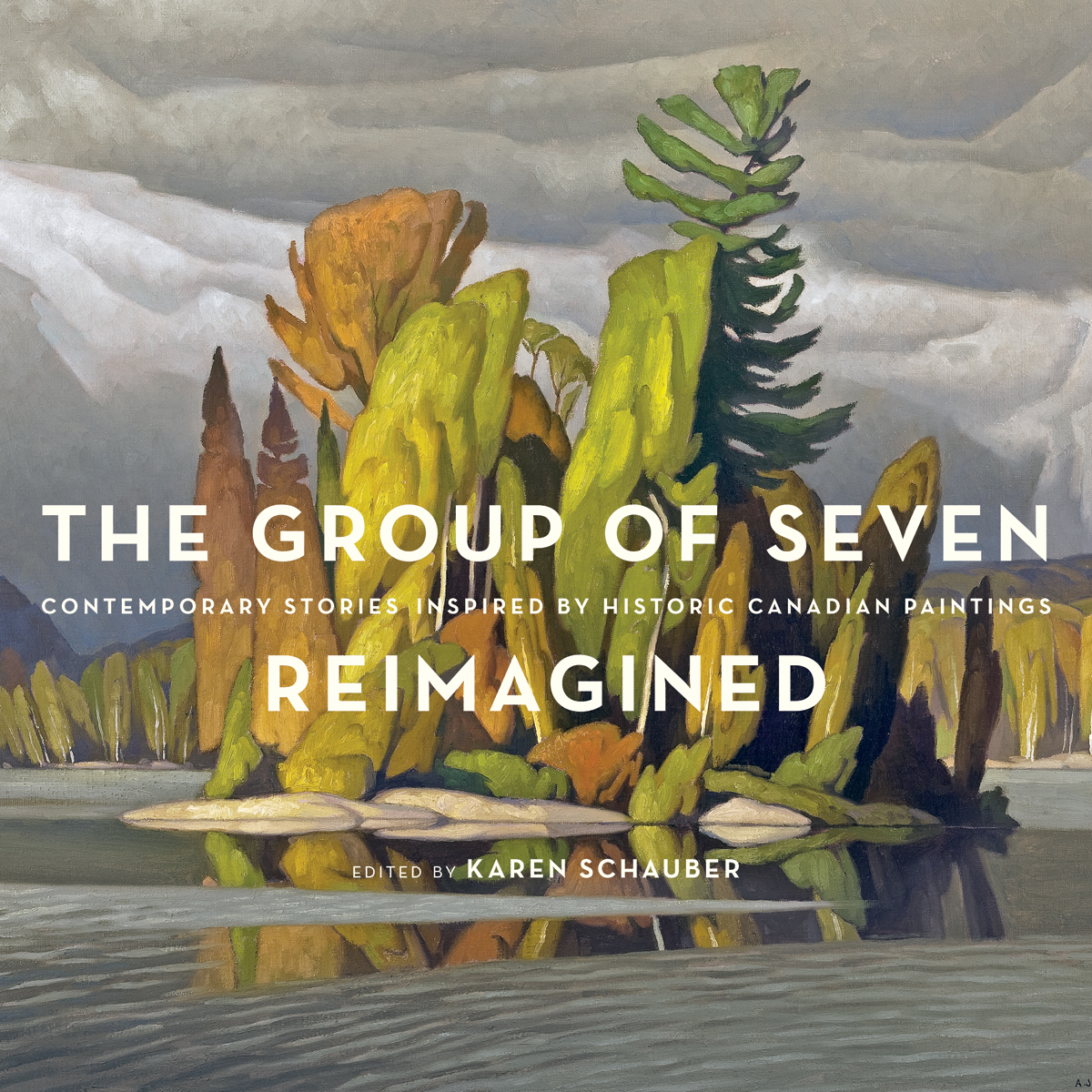
2020 marks the centenary of the formation of the Canadian iconic Group of Seven artists. The Group of Seven movement “dragged Canadian art into the modern age,” writes Christine Sismondo of The Toronto Star in her review of “The Group of Seven Reimagined,” an ekphrastic celebration of the Group of Seven by twenty-one flash fiction authors (including my own “Alien Landscape” inspired by J.E.H. MacDonald’s Lake O’Hara). Sismondo astutely identifies and encapsulates the resonant meaning of the Group of Seven, then and now:

“A hundred years ago, seven Canadian painters got together and decided to start a movement. It was born out of the horrors of war. Now, the potential horrors of climate change are giving the movement an unexpected new life and meaning.”

Jack Pine by Tom Thomson

Sismondo goes on to describe how the movement itself took form:

“At the time, people were trying to put the horrors and sacrifices of the Great War behind them and look to the future to reimagine and redefine Canada itself. It was a pivotal moment, given the role the country had recently played in international affairs and the challenges it faced in becoming an increasingly modern nation. These seven artists—friends and colleagues, many of whom worked together in a Toronto design firm—felt they could help shape this conversation with bold strokes and bright colours to bring out the beauty of the Canadian landscape.”

But in those early days—and more than thirty years after Van Gogh painted Starry Night, Canada still wasn’t ready for Impressionism, or any other art form whose roots came from that movement. Canadian critics disliked the Group of Seven. They were too modern, too experimental. The Group were dismissed as “the Hot Mush School” “a horrible bunch of junk” “the figments of a drunkard’s dream” and “daubing by immature children.”

Mirror Lake by Franklin Carmichael

In his article on the Group of Seven’s reception in England vs Canada, Adam Bunch writes about the reception of the Group of Seven shortly after their formation after the First World War:

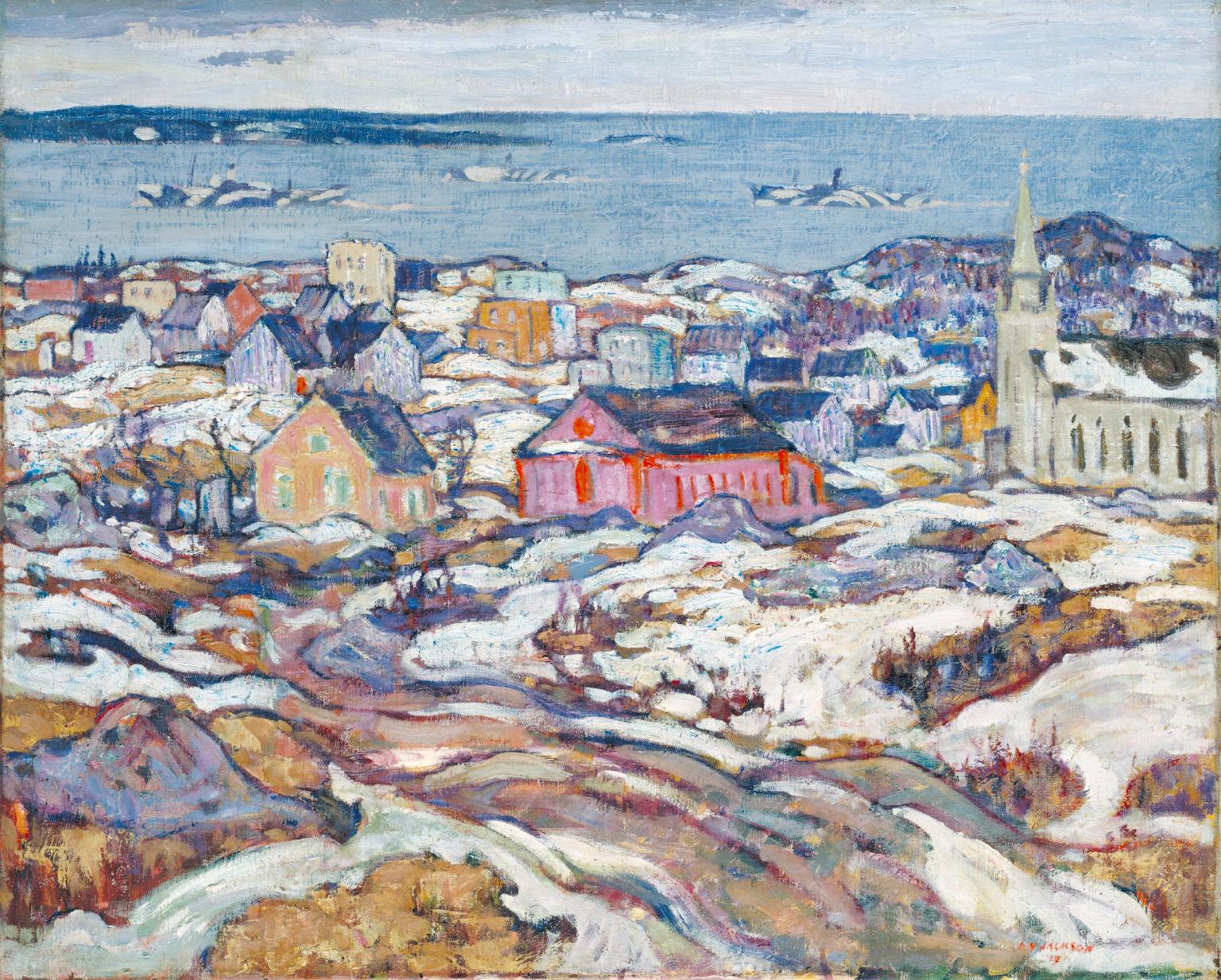
The Entrance to Halifax Harbour by A.Y. Jackson

“The reviews by Canadian critics were harsh. The Toronto Daily Star compared Jackson’s work to “a spilt can of paint.” But the English critics loved it. The Morning Post called the Group of Seven “the foundation of what may become one of the greatest schools of landscape painting.” One piece of Canadian art was even sold during the British Empire Exhibition — and it was Jackson’s. Entrance To Halifax Harbour was bought by the Tate Gallery. It’s still part of their collection today.”

“And despite the poor Canadian reviews, the show in London helped to establish the Group of Seven’s reputation back home. Now that the British took the Group seriously, Canadian collectors started taking them seriously, too. The Group even used the bad press to promote their upcoming shows: they printed posters with the angry Canadian reviews side by side with the glowing English ones.”

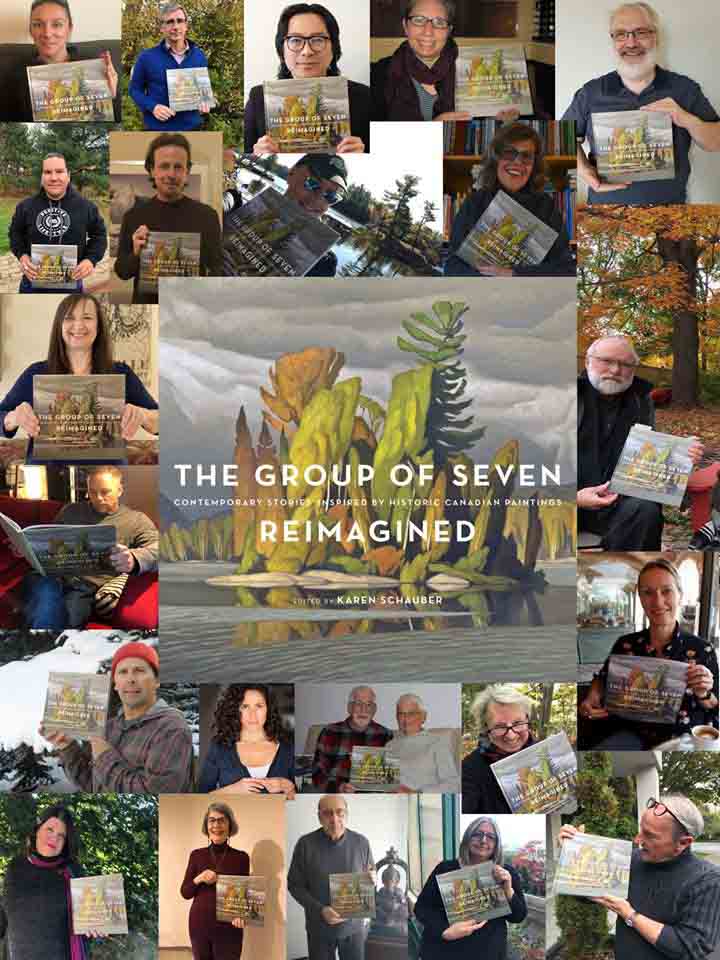
The Group of Seven Reimagined, published by Heritage House, was elegantly edited by flash fiction author Karen Schauber. Karen had invited me to contribute a piece of flash fiction (a piece of less than 500 words), inspired by a Group of Seven piece I would chose to inspire me. I took my time; this would be the first flash fiction piece I would write. It was an art form I was not familiar with, but was happy to experiment with. But I waited too long to decide and when I finally submitted my first choice for a painting, Karen informed me that it had already been selected by another writer. To my great frustration, this went on for a few pieces.

Shore Pattern by A.J. Casson

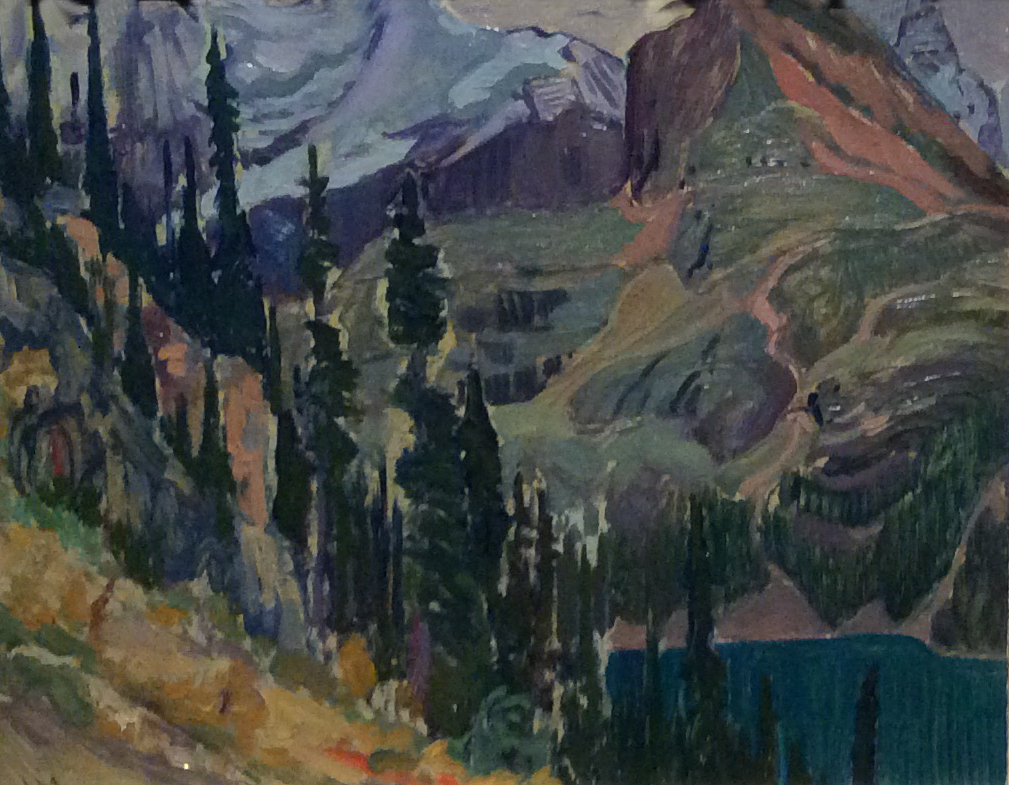
I finally took a short trip to the McMichael Gallery in Kleinburg to find my piece. In the main hall, I passed the pieces already claimed by my twenty colleagues; I sighed that I had waited so long. By chance, a large selection of artwork by J.E.H. MacDonald—one of the founders of the group—was currently on exhibit on the second floor. That was where I first saw the original oil sketch called Lake O’Hara by MacDonald. It was perfect! My story “Alien Landscape” emerged from the sketch like they had always belonged together.

Lake O’Hara by JEH MacDonald

The Star wrote: “while you might expect a lot of peaceful communing with nature on the page, a surprising number of the written pieces are actually dark tales of conflict and danger—forest fires, mining accidents, boat thieves and murderous plots in the woods. Nina Munteanu, a Canadian ecologist and science-fiction writer, takes J.E.H. MacDonald’s Lake O’Hara in a novel direction in ‘Alien Landscape’ by reimagining it as a refuge for a space heroine fleeing a world that had destroyed nature in pursuit of progress and ended in post-apocalyptic chaos.”

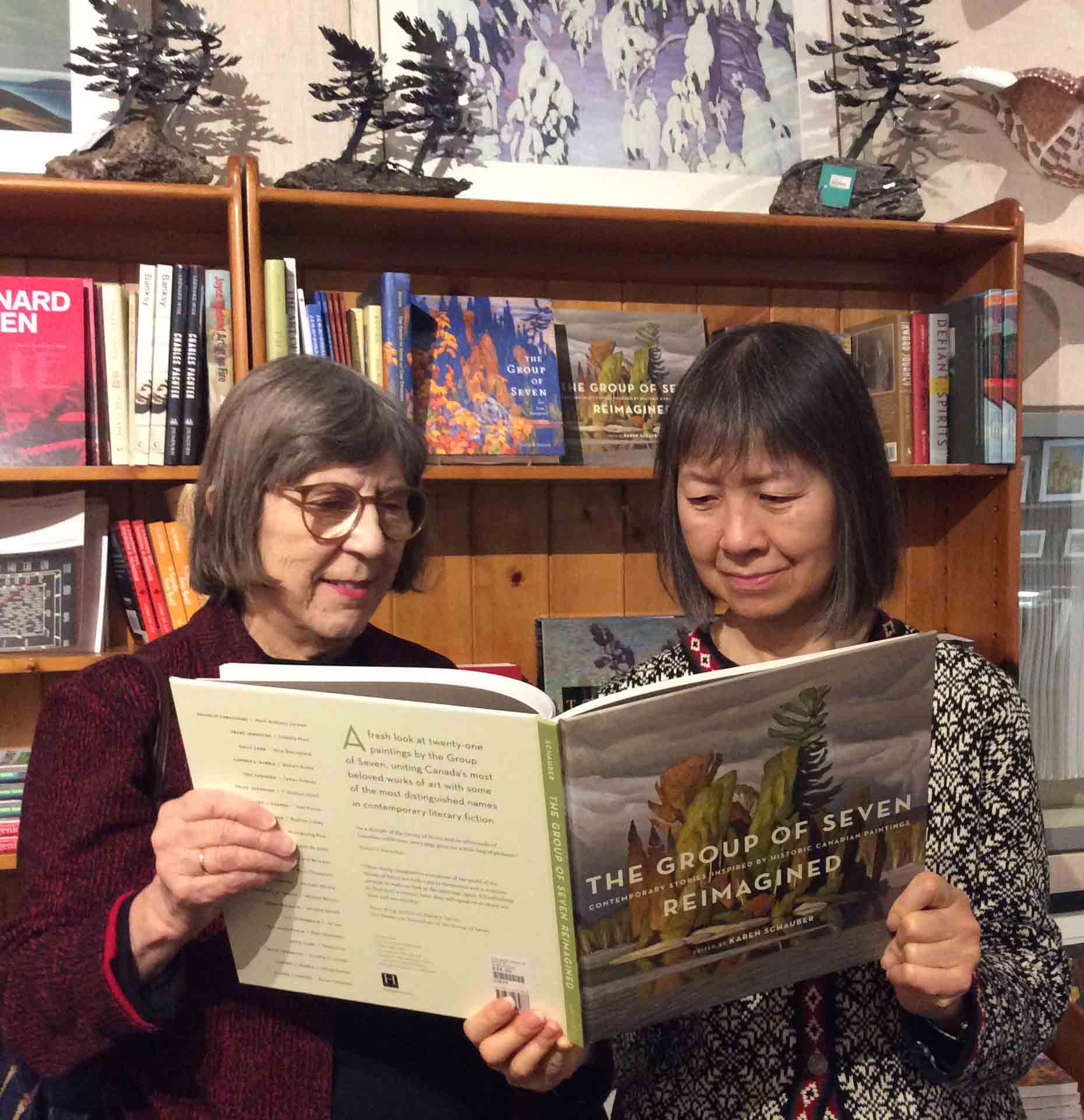
Gift shop at McMichael Gallery

The anthology has found itself gracing the gift shop shelves of several art galleries and museums such as the Royal BC Museum in Victoria, BC, and the McMichael Gallery in Kleinburg. It has likewise received much praise and accolades and appears on several ‘best of’ lists for ekphrastic works, art books, and more.

The anthology was long-listed for The Miramichi Reader’s “The Very Best” Book Award for 2020. The Miramichi Reader writes:

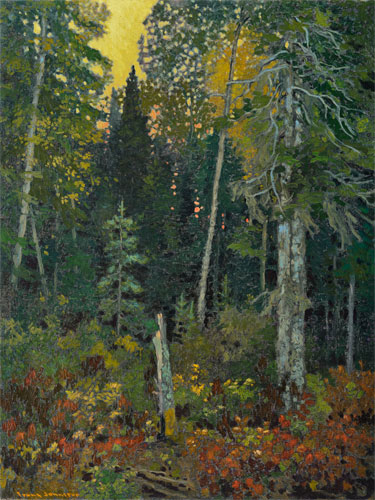
Sunset in the Bush by Frank Johnston

“There’s a very good reason that as I write this, The Group of Seven Reimagined, Contemporary Stories Inspired by Historic Canadian Paintings is sitting at, or near the top of bestseller lists in Canada (currently #3 on the Canadian Art bestseller list at Amazon.ca).  The result is a most attractive book that any lover of art and literature would enjoy, even if they already have more than a passing familiarity with the iconic Group of Seven. All the stories that accompany each image are in the “flash fiction” style, just a page or two in length, a little story that the authors were inspired to write after choosing a particular G7 painting.”


Jules Torti of Cottage Life  describd the book this way:

“Seeking equilibrium? This book is like a yoga session without the scheduling logistics and hustle to class. Balance is found in The Group of Seven Reimagined both as an intelligent coffee table book and tangible source of meditation.

Authors of the anthology

Twenty-five writers with notable street cred contributed “flash fiction” to colour iconic paintings by the Group of Seven (and their tagalongs). Flash fiction are stories categorized by length—they are 500 words or less which means they allow for one decent, undistracted cup of dark roast or whisky on ice. For writers or artists, the temptation to reimagine these works will be irresistible. And, what an intriguing resolution to make! Fiction and paintings both rely on interpretation and consideration. Fill in the gaps and colours with your chosen or perhaps newly discovered medium (watercolour?). As Jim and Sue Waddington suggest in the foreword, an art gallery visit becomes suspended in time. We keep returning to certain paintings that resonate and haunt and inadvertently, ‘Your mind sets off on a journey.’”

Author and reviewer Patricia Sandberg describes the anthology through metaphor: “Like a fine wine with dinner, some things cry out to be paired. In Reimagined, the nearly hundred-year-old brandy that was the Group of Seven is introduced to a fresh vibrant cuisine that is flash fiction, and both are the richer for it.”

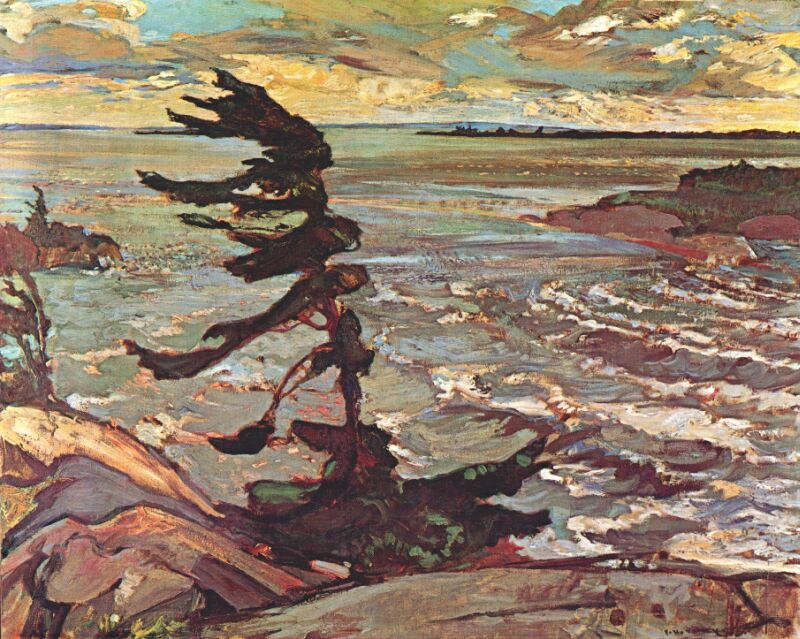
Stormy Weather by Frederick H. Varley

“As a disciple of the Group of Seven and an aficionado of Canadian wilderness, every page gives me a little leap of pleasure.”—Robert Bateman

“These sharp, imaginative evocations of the world of the Group of Seven are both a joy in themselves and a welcome prompt to make us look at the paintings again. It’s refreshing to find that, a century later, they still speak to us about our lives and our country.”—Ross King, author of Defiant Spirits: The Modernist Revolution of the Group of Seven

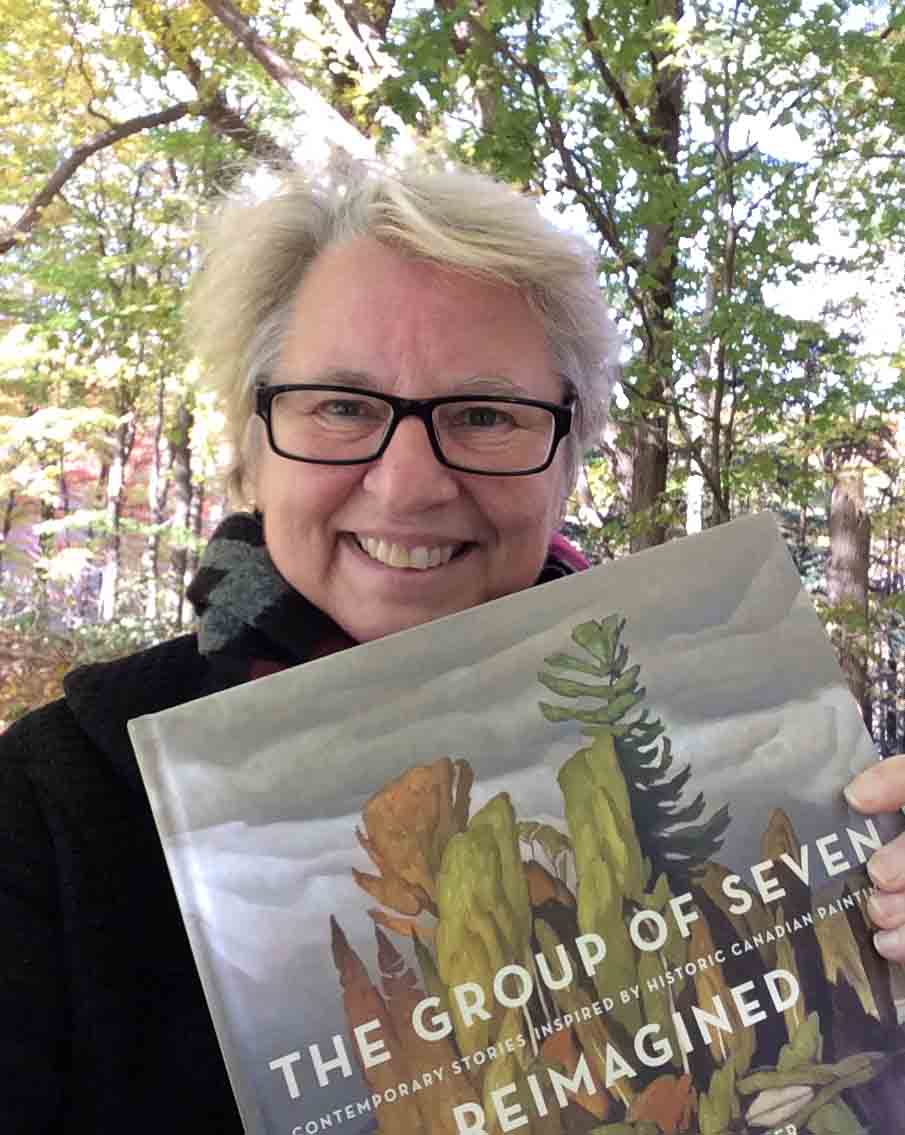
Nina Munteanu with the anthology

“Words, the writer’s paint, are artfully chosen and applied, not one wasted. The stories all compel the reader to dive beneath their surface and linger long after the reading is complete…In 1920 The Group of Seven introduced a new vision for the Canadian landscape. One hundred years later, twenty-one writers in the Group of Seven Reimagined offer a new lens for appreciating their art.”—Ottawa Review of Books

“From one region of Canada to another, a national identity is captured and shared with writers all over the world who, in turn, have crafted beautiful flash fiction pieces that accompany and extend the meaning of the art.”—Niles Reddick, Literary Heist


nina-2014aaa

Nina Munteanu is a Canadian ecologist / limnologist and novelist. She is co-editor of Europa SF and currently teaches writing courses at George Brown College and the University of Toronto. Visit www.ninamunteanu.ca for the latest on her books. Nina’s bilingual “La natura dell’acqua / The Way of Water” was published by Mincione Edizioni in Rome. Her non-fiction book “Water Is…” by Pixl Press (Vancouver) was selected by Margaret Atwood in the New York Times ‘Year in Reading’ and was chosen as the 2017 Summer Read by Water Canada. Her novel “A Diary in the Age of Waterwill be released by Inanna Publications (Toronto) in May 2020.


Finding the Right Time and Place to Write

Look and you will find it—what is unsought will go undetected —Sophocles


Beaches-snow01

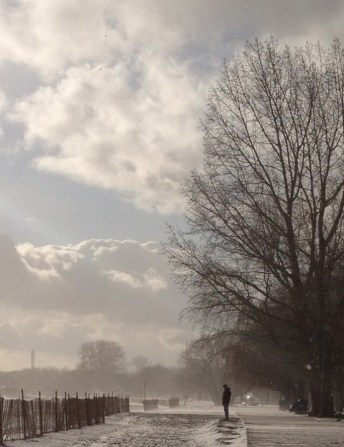
Snow in the Beaches, Ontario

During a time when I had a demanding job as an scientist with an environmental consulting job, was a devoted wife and mother and community volunteer, I wrote and successfully marketed five books, over a dozen short stories and many articles and reviews. Some people, including my publishers, thought I never slept (true) or had cloned myself (possibly). They couldn’t believe my productivity when I was so busy with life.

But I did what I did, because I’d worked out a system. One that I could live by. One that fit my lifestyle. One created out of respect for my art as part of my “busy” life of commitments.

The truth of it is that we all lead busy lives. If you are going to finish that novel you’ve been working on over the years or book of poems sitting in the bottom dresser drawer, you need to make a commitment. Aside from giving your art the respect it deserves, it comes down to creating a time and place to write.

It starts with being realistic about your daily schedules and routines and inclinations and picking a time and place accordingly. Try to be consistent. It’s actually best to create a routine related to both time and place; the key is to be realistic about it. Don’t fight your inclinations or habits; instead, build your writing into your lifestyle. This will ensure success.

nina-smiling-close

Nina Munteanu teaching in Mahone Bay, NS

Choose a Sacred Time

Finding the time to write is critical to succeeding. If you don’t dedicate time to write, you won’t write. Believe me, you won’t. Make it sacred.

Writer Louise DeSalvo shared a common story about her experience: “Many people I know who want to write but don’t (my husband, Ernie, for example) or who want to write more than they have but say they can’t find the time (my friend Marla) have told me that taking the time to write seems so, well, self-indulgent, self-involved, frivolous even. And that finding the time to write—even a diary, much less fiction or memoir or poetry—in their busy schedules is impossible. I’ll write when I have the time, they say.”

It doesn’t work that way. You don’t find time; you must create it. Writing of any kind is a commitment you make to yourself. So, choose a time that’s right for you. If you’re a morning person, don’t pick the end of the day when you don’t function as well. Instead, pick the early morning to write, a time before everyone else gets up and the day’s distractions pile up.

It’s actually best to create a routine related to time of the day (e.g., fixed time such as every morning or right after supper) or based on some other constant in your life, say the school calendar or your daily activities. The key is to be realistic about the time(s) you’ve chosen. In other words, your goals should be realistic and realizable.

The second part of the commitment is sharing it with your family and friends so that they will respect your sacred writing time. By sharing how important it is to you, you also give them the gift of sharing the experience with you and they are more likely to respect your time alone to write. This is also why choosing a routine makes more sense; it is something your family and friends will better remember and abide by. Making it easy for others is part of making it easy for you.

Find Your Own Rhythm

the beach-2013

The Beaches boardwalk (photo by Nina Munteanu)

There’s no rule for when and how often you write. Because frequency and schedule of writing depends on the kind of writing you do (e.g., novel, short stories, articles, research) and on your own rhythms, you must decide what works best.

Most writers recommend that you commit to a regular writing schedule that is realistic to your overall routine and biorhythms. Some recommend you write in the morning, after a refreshing sleep; others suggest you write at night, at the end of the day when your memories are more fresh with the day’s activities and stimulations. Yet others suggest you take time out during the day to jot down relevant experiences as close to the time as the muse hits you, then spend some time at the end of the day compiling it into your work.

In the end, it’s up to you to choose what works for you and your own rhythms. When is the best time for you to write? And for how long or how many pages? Once you decide, stick to that schedule.

Choose a Sacred Place

Writing is a reflective activity that requires the right environment. The best environment is a quiet one with no interruptions and where you are alone. A reflective environment will let you find a connection with your muse. You need a place where you can relax and not worry about someone barging in or other things distracting you from your reflections. You should also feel physically comfortable and the place should meet your time requirements.

Because the suitability of a place can change with the time of day, learn the rhythms that affect the place you wish to write in. For example, the kitchen may be the centre of activity during the day but an oasis of quietude during the evening. Similarly, learn what kind of environment stimulates and nurtures your writing. Does music help or do you need complete quiet? Do you respond to nature’s soft breezes and sounds or do you prefer to surround yourself with the anonymous murmur of a crowded café for company?

C'est La Vie Cafe

a coffee shop in Val David, Quebec (photo by Nina Munteanu)

Places that work for me include the local coffee shop, where its desultory conversations and laughter—and wonderful smells of fresh coffee—provide a pleasant living-landscape for my muse. I also enjoy my daily walk with a notebook or iPad in the park along the river near my house. I teach writing at the University of Toronto St George campus in downtown Toronto and just recently discovered an enclave that excited my muse. The outside breezeway at Knox College, with arched ceiling and columns, adorned with hanging plants, is pure magic. The breezeway cuts through an outside courtyard of gardens and yard, populated with songbirds and the gentle rustle of a refreshing breeze. Benches and small tables and chairs line the breezeway, ensuring a writer’s sanctuary.

Where you write may reflect what you’re writing and vice versa. To some extent, you are environment and environment is you. You might try a few places first and see what happens to your muse. What you write while sitting under an apple tree in the breeze hearing the birds singing may differ from what you write while sitting in your living room by the crackling fireplace with music playing or sitting at your desk in your bedroom in total silence or in a crowded café surrounded by cheerful bustle.

Again, as with your choice of time, tell your family and friends about your sacred place. Provide rules, if you have to. Let’s say it’s a desk in the study. You may, for instance, let others know that your “mess” is part of a work in progress, perhaps even explain a little about it so they understand the nature of what you’re doing and why it should not be touched or moved or used, even while you are away from it. This will ensure that they respect your things and what you’re doing.

In the end, it comes to finding the right integration and balance of time and place. Letting others know of your choices is equally important; this will ensure that they can help you, not hinder you in your writing. While writing is to a large extent an activity done in solitude, the journey is far from secluded. Ensure that you have a good support network.

This article is an excerpt from my fiction writing guidebook “The Fiction Writer: Get Published, Write Now!” (Starfire, 2009).

nina-2014aaa

Nina Munteanu is a Canadian ecologist / limnologist and novelist. She is co-editor of Europa SF and currently teaches writing courses at George Brown College and the University of Toronto. Visit www.ninamunteanu.ca for the latest on her books. Nina’s bilingual “La natura dell’acqua / The Way of Water” was published by Mincione Edizioni in Rome. Her non-fiction book “Water Is…” by Pixl Press (Vancouver) was selected by Margaret Atwood in the New York Times ‘Year in Reading’ and was chosen as the 2017 Summer Read by Water Canada. Her novel “A Diary in the Age of Waterwill be released by Inanna Publications (Toronto) in June 2020.


Nina Munteanu Shares Her Journey With Water

Nina’s recent presentation at the Don Heights Unitarian Congregation on water—”Reflections: the Meaning of Water“—explores the many dimensions of water. She describes how its life-giving anomalous properties can lead us to connect with water and nature to help us be the caretakers we need to be during these changing times.

Based on her celebrated book “Water Is… The Meaning of Water”, Nina shares her personal journey with water—as mother, teacher, environmentalist, traveler and scientist—to explore water’s many “identities” and, ultimately, our own.


Fallen log stream-2012

stream in Westcoast rainforest of BC (photo by Kevin Klassen)

nina-2014aaa

Nina Munteanu is a Canadian ecologist / limnologist and novelist. She is co-editor of Europa SF and currently teaches writing courses at George Brown College and the University of Toronto. Visit www.ninamunteanu.ca for the latest on her books. Nina’s bilingual “La natura dell’acqua / The Way of Water” was published by Mincione Edizioni in Rome. Her non-fiction book “Water Is…” by Pixl Press (Vancouver) was selected by Margaret Atwood in the New York Times ‘Year in Reading’ and was chosen as the 2017 Summer Read by Water Canada. Her novel “A Diary in the Age of Waterwill be released by Inanna Publications (Toronto) in June 2020.

Reminiscing on 2019…

Diary Water cover finalThis week is a wonderful time to reflect on the past year, 2019. It’s also a good time to be thankful for the things we have: loving family, meaningful friendships, pursuits that fulfill us and a place that nurtures our soul.

It’s been a very good year for my writing…and my soul…

Last year I received a writer’s dream Christmas gift: a signed contract with Inanna Publications to publish my ninth novel: “A Diary in the Age of Water” about four generations of women and their relationship with water during a time of extreme climate change. The book will be released by Inanna in May 2020 with a launch in Toronto on May 26th at Queen Books as part of the Toronto International Festival of Authors. The book is now available on Amazon.ca for pre-order!

Publications   

LBM 2019 ClimateInCrisis2019 saw several of my publications come out. In January 2019 the reprint of my story “The Way of Water” was published by Little Blue Marble Magazine. It will reappear in a print and web anthology devoted to climate fiction called “Little Blue Marble 2019: Climate in Crisis” on December 27, 2019. That will be the sixth time “The Way of Water” has been published!

EcologyOfStoryImpakter Magazine also published my article “How Trees Can Save Us,” an essay on five writers’ perspectives on trees and humanity’s relationship with them.

In June, I published the 3rd guidebook in my Alien Writing Guidebook series—called “The Ecology of Story: Worlds as Character” with Pixl Press in Vancouver. The launch on July 4th at Type Books was well attended with presentations by several local writers and artists.

Nina GroupOfSevenReimagined

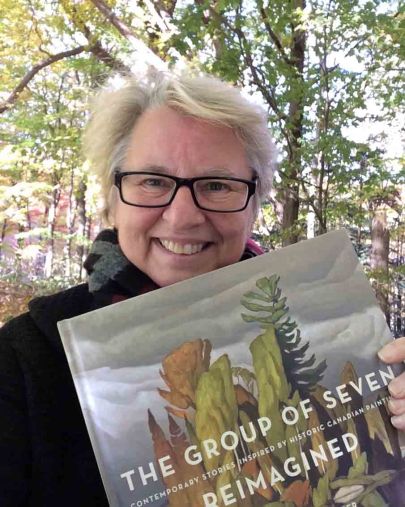
Nina Munteanu with The Group of Seven Reimagined

I was commissioned along with twenty other writers to write a piece of flash fiction for a commemorative anthology to the Group of Seven, entitled “The Group of Seven Reimagined,” with Heritage House in Vancouver.

I’d never written flash fiction before and it was both exciting and challenging to write. I was asked to pick an artist’s piece as inspiration for a flash fiction story. The beautiful hardcover book was released October 2019.

October also saw another of my pieces published. I was asked to contribute something to the Immigrant Writer’s Association’s first anthology, entitled “Building Bridges,” about the immigrant’s experience in Canada. While I’m not an immigrant, I did share my parents’ experience who had immigrated to Canada from France. I wrote a piece on the hero’s journey.


Age of Water Podcast 

AgeOfWater-HomePage

On November 22, 2019, co-host Claudiu Murgan and I launched the Age of Water podcast.  The podcast covers anything of interest from breaking environmental news to evergreen material on water and the environment. We interview scientists, journalists, writers, academia and innovators who share their knowledge and opinions about the real state of the environment and what committed individuals and groups are doing to make a difference. We talk about the problems and we talk about the solutions.

Appearances & Media / News

On June 22, I traveled to Port McNicoll at Georgian Bay to help give a writing intensive, hosted by publisher Cheryl Antao-Xavier at IOWI. I was also invited to speak at The Word is Wild Literary Festival in October. The event took place in Cardiff, in the Highlands of Ontario. In late October, I traveled with friend and editor Merridy Cox to Vermont to give a presentation on water to the Lewis Creek Association. Entitled “Reflections: The Meaning of Water”, the talk focused on our individual connection with water. I will be reprising this talk at several venues this year.

Nina Munteanu

Nina Munteanu with a metasequoia in the Beaches (photo by Richard Lautens)

I was also featured in the news a few times. The Toronto Star asked me to answer two questions about climate change and the Vancouver Sun published an Oped of mine entitled “Why Women Will Save the Planet.”

Research & Adventure

Cedar Giants copy

Giant red cedars in Lighthouse Park (photo by Nina Munteanu)

In Summer 2019 I travelled to British Columbia to visit friends and family in Vancouver and elsewhere. Following a dream of mine, I travelled with good friend Anne to Port Renfrew on Vancouver Island to see the ancient forests and the west coast. I had wanted to see these old-growth forests for some time since I’d been to Carmanah many years ago. The ancient forests were magnificent and breathtaking and so nourishing for the soul. Recognizing these forests as living cathedrals, I felt a deep reverence. The silent giants rose from wide buttressed bases into the mist like sentinels, piercing the heavens. A complex tangle of beauty instinct whispered in the breeze with the pungent freshness of pine, cedar and fir. Anne and I even had a chance to hug Big Lonely Doug, the second tallest Douglas fir tree in Canada.

Nina looking up dougfir copy 3

Nina Munteanu stands, dwarfed, by a Douglas fir tree in Lighthouse Park (photo by Margaret Ross)

While in British Columbia, I also visited a small enclave of old-growth forest in the heart of Vancouver at Lighthouse Park (West Vancouver). I went with son Kevin and then again with good friend Margaret. This majestic forest of redcedar, Douglas fir, spruce and hemlock is deeply awesome and humbling. And a real gem for the city.

Nina boot

Nina Munteanu in Ladner, BC (photo by Anne Voute)

Then, with just a few days before my flight back to Toronto, I slipped and fell and broke my ankle. I got a “boot” and a cane then hobbled on the plane and went back to work at UofT.

It has been a wonderfully inspirational year for me in writing and teaching. I still actively teach at The University of Toronto in several writing centres and classes throughout the downtown campus. The students are bright and challenging. I also still coach writers to publication and have helped several finish their works in 2019.


I hope the beauty of the season has filled your heart with joy. Wishing you a wonderful 2020, filled with grace, good health, and sweet adventure!


nina-2014aaa

Nina Munteanu is a Canadian ecologist / limnologist and novelist. She is co-editor of Europa SF and currently teaches writing courses at George Brown College and the University of Toronto. Visit www.ninamunteanu.ca for the latest on her books. Nina’s bilingual “La natura dell’acqua / The Way of Water” was published by Mincione Edizioni in Rome. Her non-fiction book “Water Is…” by Pixl Press (Vancouver) was selected by Margaret Atwood in the New York Times ‘Year in Reading’ and was chosen as the 2017 Summer Read by Water Canada. Her novel “A Diary in the Age of Waterwill be released by Inanna Publications (Toronto) in June 2020.

When Media Gets the Science Wrong We ALL Suffer

Atlantic salmon farm escape

I was dismayed by a recent news story on CTV on the escape of farm fish into native fish waters. I was dismayed for two reasons: 1) the ecological impacts of this accident; and 2) the failure of CTV in appropriately reporting the seriousness of it.


Shoddy Reporting by CTV 

In late December 2019, a fire at the Mowi fish farm in BC waters near Port Hardy resulted in the escape of over twenty thousand Atlantic salmon. The news story by the CTV media proved biased, incomplete and erroneous—and ultimately dangerous—in its reporting.

CTV targeted “environmentalists and indigenous groups” as worried that “it could have devastating impacts on [Pacific] wild salmon…Escape presents ecological and environmental risks to an already fragile wild salmon population.” But CTV failed to include concerns by environmental scientists in this matter: government or academics with real expertise and authority.

CTV talked to some “so-called” experts to counter the position of the environmentalists. This included comments by a vet (Dr. Hugh Mitchell), who works for the fish farm: “[Atlantic salmon] are brought up on prepared fish pellets from since they start feeding …They don’t know how to forage. They don’t know how to find rivers and reproduce. They get eaten by predators or they die of starvation after they escape.” (see below for proof against this). A vet (who will have some expertise in fish physiology and biology) does not have the same expertise as a fish population biologist, oceanographer, ecologist or geneticist—all of who would better understand the potential impact of released exotic species to native species in a region. But CTV didn’t interview any of these experts. Instead, they interviewed a vet who works for the farm. CTV ends its story with a remark by the managing director of Mowi who said, “Data would suggest there’s a very low risk to the [Atlantic] salmon making it to any rivers and an even lower risk of them establishing successful populations within the BC environment.”

But where’s the data to prove this? And who provided it to Mowi? CTV fails to mention that or show any of “the data”.

This is clearly careless reporting that provides no substantiation for the claims made by Mowi; nor does CTV provide a more robust inquiry into potential risks. Risks posed by more than Atlantic salmon just outcompeting native fish; risks posed by disease and other indirect challenges to native fish—not addressed by Mitchell and Mowi.

Log over water forest-DeasPark

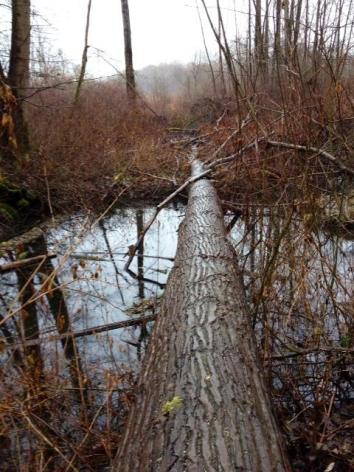
BC wetland (photo by Nina Munteanu)

CTV provided no statement by DFO scientists or academia. Where were the UBC or UVic scientists? Why weren’t these unbiased authorities consulted for their expertise instead of a vet who works for the aquaculture industry? This is very sloppy reporting.


The Vancouver Sun, which also covered this story, showed a little more balance in its reporting. However, when it came time for the Sun to report on DFO’s response, it was less than clear: “Among the feedback the federal government has received through early consultations on the legislation is a need for a more effective risk management framework and support for Indigenous involvement and rights in the sector, it says.”

The Georgia Straight used the right word—claimed—to describe Mowi’s unsubstantiated statements: “The company claimed that the escaped fish are easy prey because they are ‘unaccustomed to living in the wild, and thus unable to forage for their own food.’” The Straight also balanced that claim with another by Ernest Alfred of the ‘Ngamis First Nation and videographer and wild-salmon advocate Tavis Campbell, who suggested that the presence of Atlantic salmon in ocean water “presents a serious threat to native Pacific salmon through transfer of pathogens and other associated risks”. The Straight then followed up with some relevant historic precedence: “After a large number of Atlantic salmon escaped from a Washington state fish farm near Bellingham in 2017, these species were found as far away as the Saanich Inlet and Harrison River.” Hardly the weaklings described by Mowi and Mitchell…

Global News provides a more in-depth examination of the August 2017 net pens collapse in the waters off northwest Washington—pens owned by Canadian company Cooke Aquaculture Pacific — the largest Atlantic salmon farmer in the U.S.

“Up to 263,000 invasive Atlantic salmon escaped into Puget Sound, raising fears about the impact on native Pacific salmon runs. The incident inspired Washington state to introduce legislation that would phase out marine farming of non-native fish by 2022. Groups like the Pacific Salmon Foundation have called for the B.C. and federal governments to do the same in Canada.”


Declining Pacific Wild Salmon 

Stream longshutter-warmed-close01 copy

Westcoast forest stream, BC (photo by Kevin Klassen)

Wild Pacific salmon have been declining for decades off the BC coast and streams. Human interference is primarily responsible, which includes habitat destruction, diversions for agriculture and hydro-power, and climate change. Habitat destruction—both quantity and quality—has occurred mainly from logging, road construction, urban development, mining, agriculture and recreation. Added to that list is the aquaculture industry that uses Atlantic salmon, an exotic to the Pacific Ocean.

A recent study conducted by the Strategic Salmon Health Initiative (SSHI) revealed that the piscine reovirus (PRV) found in farmed Atlantic salmon is linked to disease in Pacific Chinook salmon. The SSHI is an initiative made up of scientists from the Department of Fisheries and Oceans (DFO), Genome B.C., and the Pacific Salmon Foundation (PSF).

The findings show that the same strain of PRV, known to cause heart and skeletal muscle inflammation (HSMI) in farmed Atlantic salmon, is causing Chinook salmon to develop jaundice – anemia, a condition that ruptures red blood cells, and causes organ failure in the fish. The disease could cause a serious threat to wild salmon migrating past open-net fish farms in coastal waters in B.C.

In B.C., concerns about the decline of Pacific salmon have already risen to peak levels after the Big Bar landslide in the Fraser River near Kamloops; scientists say this could result in the extinction of multiple salmon runs by 2020. The federal Liberal government has pledged to transition BC’s open-net pen salmon farms to closed inland containment systems by 2025.

All this corroborates the serious risk of Atlantic salmon farming. Accidents must be expected to happen. They always do. Risk analysis must include the certainty of this inevitability—just as water engineers must account for 100-year storms, which do happen.

Need for Better Risk Management (Type I and Type II Errors in Risk Assessment) 

The scientific method relies on accurately measuring certainty and therefore reliably predicting risk. This means accounting for all biases and errors within an experiment or exploration. In my work as a field scientist and environmental consultant representing a client, we often based our formal hypotheses in statistics, which considered two types of error: Type I and Type II errors. Type I errors are false positives: a researcher states that a specific relationship exists when in fact it does not. This is akin to an alarm sounding when there’s no fire. Type II errors are false negatives: the researcher states that no relationship occurs when in fact it does. This is akin to no alarm sounding during a fire.

The reason why remarks made by vet Mitchell and Mowi are so dangerous is because they make assumptions that are akin to not sounding an alarm when there is a fire; they are committing a Type II error. And in risk assessment, this is irresponsible. And dangerous.

Instead of targeting “environmentalists” “activists” and certain groups for opinions on issues, I strongly urge CTV and other media to seek out evidence-based science through scientists with relevant knowledge (e.g. an ecologist—NOT an economist or a vet—for an environmental issue). My advice to Media: DO YOUR HOMEWORK AND GET THE FACTS STRAIGHT! You need to talk to academics and scientists with no ties to perpetrators and with relevant knowledge on the topic in question.

The Need for The Precautionary Principle in Environmental Science and Reporting 

FinCreek 4-RockyM

Fin Creek, Rocky Mountains, BC (photo by Nina Munteanu)

Environmental scientists generally pride themselves on the use of the Precautionary Principle when dealing with issues of sustainability and environmental management. According to the Precautionary Principle, “one shall take action to avoid potentially damaging impacts on nature even when there is no scientific evidence to prove a causal link between activities and effects.” The environment should be protected against substances (such as an exotic species) which can be assumed potentially harmful to the current ecosystem, even when full scientific certainty is lacking.

Unfortunately, politicians, engineers and the scientists who work for them tend to focus on avoiding Type I rather than Type II statistical errors. In fact, by traditionally avoiding Type I errors, scientists increase the risk of committing Type II errors, which increases the risk that an effect will not be observed, in turn increasing risk to environment.

In describing the case of the eutrophication of a Skagerrak (a marine inlet), Lene Buhl-Mortensen asks which is worse: risk a Type II error and destroy the soft bottom habitat of Skagerrak and perhaps some benthic species, or risk a Type I error and spend money on cleaning the outfalls to Skagerrak when in fact there is no eutrophication? “Scientists have argued that cleaning up is too expensive and should not be done in vain,” writes Buhl-Mortensen. “But more often the opposite is the case. The increased eutrophication of Skagerrak could end up more costly than reducing the outfalls of nutrients [to the inlet].”

“Because threats to the environment are threats to human welfare, ecologists have a prima facie ethical obligation to minimize Type II errors,” argues Buhl-Mortensen in the journal Marine Pollution Bulletin. Use of the precautionary principle will save costs—and lives—in the end.

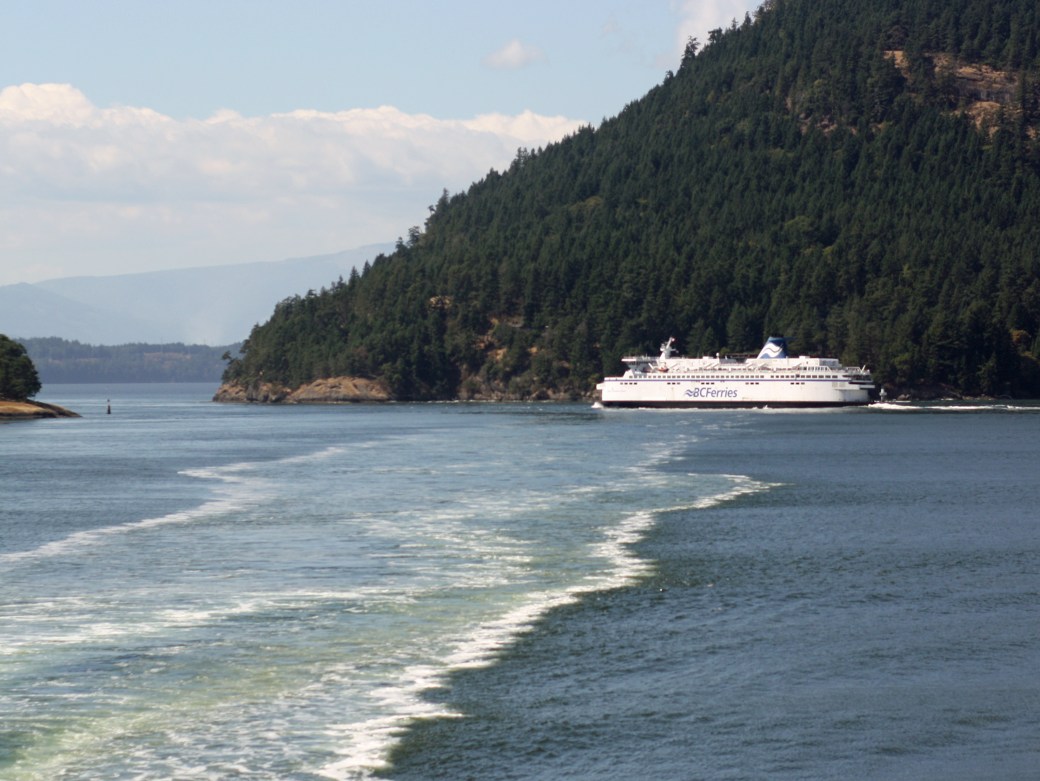
ferry wake active pass copy

Ferry crossing with wake in foreground, BC coast (photo by Nina Munteanu)


nina-2014aaa

Nina Munteanu is a Canadian ecologist / limnologist and novelist. She is co-editor of Europa SF and currently teaches writing courses at George Brown College and the University of Toronto. Visit www.ninamunteanu.ca for the latest on her books. Nina’s bilingual “La natura dell’acqua / The Way of Water” was published by Mincione Edizioni in Rome. Her non-fiction book “Water Is…” by Pixl Press (Vancouver) was selected by Margaret Atwood in the New York Times ‘Year in Reading’ and was chosen as the 2017 Summer Read by Water Canada. Her novel “A Diary in the Age of Waterwill be released by Inanna Publications (Toronto) in June 2020.


Perr-fecting the Cat Purr Meditation…

Willow-artsy

Willow

Her name is Willow, and she helps me centre my being…

Willow is a diminutive 18-year old Russian blue cat, who I looked after for some friends in Mississauga. When I first met Willow, she responded with reticence–like all smart discerning cats. She appeared so delicate, I was scared to pick her up. I soon realized that this was a fallacy. That not only could I pick her up but that she loved to be held. I just needed to learn how.

As soon as I did, we became best friends. And it all came together with the Purring Cat Meditation.

It starts out with her finding me “doing nothing terribly important” like typing on the computer, or something. A soft but decisive tap of the paw on my leg and I have to smile at her intense look up at me with those guileless emerald eyes. I abandon my work–how can I ignore such a plea?– and pick her up. After all, I know what she wants…And so starts our journey toward “nirvana”… the meditative state that will centre our beings and ultimately save the world.

I wander the house with her. We check out each room and make our silent observations. We end up in the bedroom upstairs, where she normally sleeps (except when she’s decided to join me on my bed to sit on me and purr in my face in the middle of the night).

Willow basking

Willow teasing me

In her sanctuary, we drift to the window that faces the back yard, now in the bright colours of fall. The window is slightly open and a crisp breeze braces us with the deep scent of autumn. I breathe in the fragrance of fallen leaves, mist and bark…

Willow settles into a feather-light pose in the crook of my arms and I hardly feel her. More like she and I have joined to become one. We are both purring …

We remain in Cat-Purr-Meditation for …

Willow looking up

“Time to pick me up, Nina!” says Willow

I have no idea … It feels like moments … infinity … it encompasses and defines an entire world. We’ve just created something. Just by being.

Cats–well, most animal companions–are incredibly centring and can teach us a lot about the art of simply being.

And meditating…


I write about this more in my article entitled “Wake Up Your Muse: How my Cat Taught Me the Art of Being“.

Whenever I run across a bout of writer’s block or need to stoke my muse, instead of trying harder, I stop and reach out for my cat-friend.

And practice Cat-Purring-Meditation…

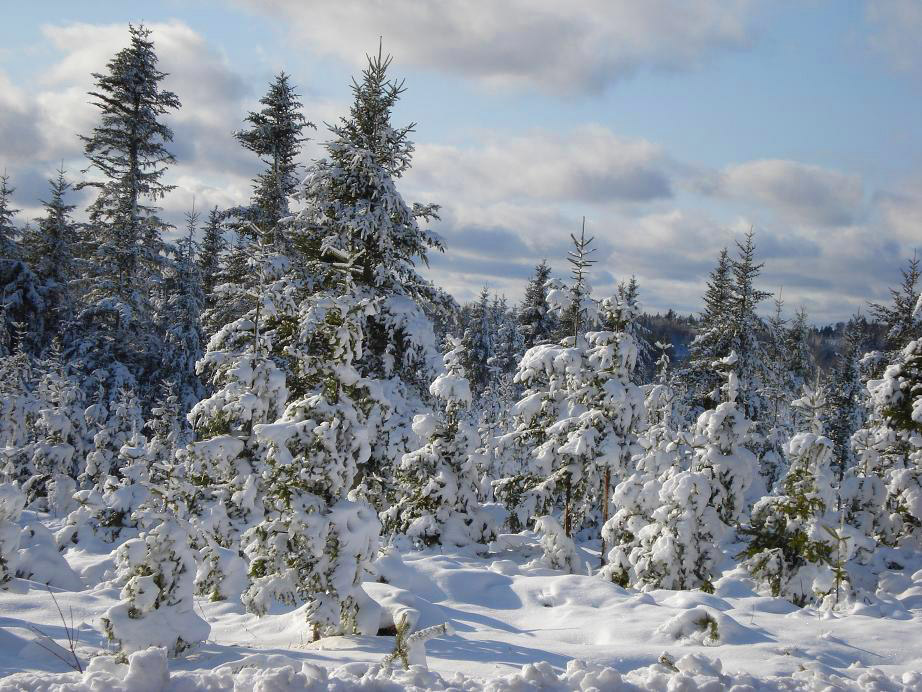
snow-scene-road-to-Wolfville_edited-1

Winter on the road to Wolfville, NS (photo by Nina Munteanu)


nina-2014aaa

Nina Munteanu is a Canadian ecologist / limnologist and novelist. She is co-editor of Europa SF and currently teaches writing courses at George Brown College and the University of Toronto. Visit www.ninamunteanu.ca for the latest on her books. Nina’s bilingual “La natura dell’acqua / The Way of Water” was published by Mincione Edizioni in Rome. Her non-fiction book “Water Is…” by Pixl Press (Vancouver) was selected by Margaret Atwood in the New York Times ‘Year in Reading’ and was chosen as the 2017 Summer Read by Water Canada. Nina’s short story collection of eco-fiction can be found in “Natural Selection” published by Pixl Press. Her novel “A Diary in the Age of Water” will be released by Inanna Publications (Toronto) in 2020.

Walking Helps Me Think and Imagine

Beaches-snow03

Walking in The Beach (photo by Nina Munteanu)

I’ve written many articles and over a dozen books and readers often remark on my imagination with something akin to awe and incredulity. I often get asked where I get my ideas. Let me tell you a story first…

A Toronto friend—himself a prolific letter writer—shares that his ideas come to him during his daily walks (you’ll find his witty, humorous and somewhat pithy letters in the National Post, Globe and Mail or Toronto Star … almost weekly). David Honigsberg doesn’t use his car (that’s reserved for when his son is in town) and he walks every opportunity he gets, whether it’s a short jaunt to the coffee shop several blocks from his work place or a long trek to his home in Mount Pleasant after a lunch engagement near Bloor and Yonge. He tells me that he uses his phone to capture his “eureka” moments in what may now be considered unorthodox—he doesn’t make digital notes (it’s not that kind of phone!) but instead leaves a series of voice mails on his home phone. When he gets home, David replays his messages and writes out his letter to the editor.

What Dave does is not new to creative thinkers all over the world and throughout time. He shares great company with people who used walking as a venue toward creative thinking (and writing); people like Aristotle, Charles Darwin, Charles Dickens, Ludwig van Beethoven, Friedrich Nietzsche, William Wordsworth, Henry David Thoreau, Steve Jobs, and Soren Kierkegaard—just to name a few. All great walkers.

Winter-Forest Hill

Snow day in Forest Hill, Ontario (photo by Nina Munteanu)

Aristotle conducted his lectures while walking the grounds of his school in Athens. His followers, who chased him as he walked, were known as the peripatelics (e.g., Greek for meandering). Darwin refined his ideas on natural selection and other topics during his frequent walks along his “thinking path”, a gravel road called Sandwalk Wood near his home in southeast England. Dickens walked for miles each day and once said, “If I could not walk far and fast, I think I should just explode and perish.” Beethoven often took solitary walks. He strolled the Viennese woods for hours, finding inspiration for his works and jotting them down on a notepad that he carried with him. Nietzsche loved his walks in the mountains. He wrote, “it is only ideas gained from walking that have any worth.” For Wordsworth, the act of walking was one in the same with the act of writing poetry.

Both involved rhythm and meter. Henry David Thoreau was known for his great walkabouts. Walking through nature for Thoreau was a pilgrimage without a destination—more discovery and rapture. “Taking a long walk was [Steve Job’s] preferred way to have a serious conversation,” wrote Job’s biographer Walter Isaacson. Writer and avid walker, Soren Kierkegaard writes:

“Above all, do not lose your desire to walk. Everyday, I walk myself into a state of well-being and walk away from every illness. I have walked myself into my best thoughts, and I know of no thought so burdensome that one cannot walk away from it.”

In the April 2014 issue of the Journal of Experimental Pshychology: Learning, Memory and Cognition, Stanford researchers Marily Oppezzo and Daniel L. Schwartz demonstrated that walking boosts creative inspiration. Using the Guildford’s Alternative Uses Test they showed that the act of walking, whether inside or outside, significantly increased creativity for 81% of the participants. Oppezzo and Schwartz were able to demonstrate that the creative ideas generated while walking were not irrelevant or far-fetched, but innovative and practical.

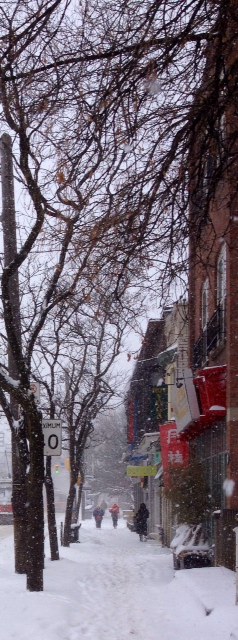
snowy street TheBeach

Snow day walk in The Beach (photo by Nina Munteanu)

In the September 3 2014 issue of The New Yorker, journalist Ferris Jabr describes why this is the case:

“The answer begins with changes to our chemistry. When we go for a walk, the heart pumps faster, circulating more blood and oxygen not just to the muscles but to all the organs—including the brain. Many experiments have shown that after or during exercise, even very mild exertion, people perform better on tests of memory and attention. Walking on a regular basis also promotes new connections between brain cells, staves off the usual withering of brain tissue that comes with age, increases the volume of the hippocampus (a brain region crucial for memory), and elevates levels of molecules that both stimulate the growth of new neurons and transmit messages between them.”

It isn’t just strolling or sauntering that stimulates the creative mind to new heights.

SONY DSC

Author hiking Highland River, Ontario (photo by Merridy Cox)

Stoking the creative artist inside you may be as simple as giving your mind the chance to wander—and taking the time to pay attention. In her book The Artist’s Way Julia Cameron talks about how “rhythm” and regular, repetitive actions play a role in priming the artistic well. She lightheartedly describes how the “s” activities work so well for this: showering, swimming, scrubbing, shaving, strolling, steering a car. I can testify to the latter—how many great plot ideas have I cooked up while driving to work! Filmmaker Steven Spielberg claimed that his best ideas came to him while he was driving the freeway. Negotiating through the flow of traffic triggered the artist-brain with images, translated into ideas. “Why do I get my best ideas in the shower?” Einstein was known to have remarked. Scientists tell us that this is because showering is an artist-brain activity.

The magic part in this is to pay attention. Pay attention to your life experiences; don’t ignore them. Sit up in the bus and watch people, play with the images, sounds and smells. Get sensual and let your eyes, ears, nose and limbs delight in the world. It’s amazing how interesting the world becomes once you start paying attention.

So, to answer the question above about where I get my ideas: in one word, everywhere.

Of course, I find those “s” activities mentioned above very helpful in quieting my mind to “listen” to my creative spirit and see; they calm and focus me. I would add another “s” word–scrawling–to the list. While Dave sends a voice message home on his phone when he gets an idea, I carry a notebook with me to jot down my eureka moments. I find writing by hand additionally helps in the creative process.  What works best for me is a walk in Nature. Nothing beats that…having a dialogue with the wind, or the chiming birds and rustling trees, the gurgling brook or surging sea or tiny insect, the soothing sun…rough bark of a fir tree… The texture of the world…


Snowy Path scarborough

Snowy path in Scarborough, Ontario (photo by Nina Munteanu)

“The texture of the world, its filigree and scrollwork, means that there is the possibility for beauty here, a beauty inexhaustible in its complexity, which opens to my knock, which answers in me a call I do not remember calling, and which trains me to the wild and extravagant nature of the spirit I seek.”—Annie Dillard, Pilgrim at Tinker Creek


References:

Cameron, Julia. 1992. “The Artist’s Way”. Penguin Putnam Inc., New York, NY. 222pp.

Dillard, Annie. 1974. Pilgrim at Tinker Creek. Harper Perennial. 304pp.

Downden, Craig. 2014. “Steve Jobs was Right About Walking” In: The National Post, December 23, 2014.

Munteanu, Nina. 2013. The Journal Writer: Finding Your Voice. Pixl Press, Vancouver, BC. 170pp.

Oppezzo, Marily and Daniel L. Schwartz. 2014. “Give Your Ideas Some Legs: The Positive Effect of Walking on Creative Thinking”, Journal of Experimental Psychology: Learning, Memory, and Cognition, Vol. 40, No. 4: 1142-1152.


nina-2014aaa

Nina Munteanu is a Canadian ecologist / limnologist and novelist. She is co-editor of Europa SF and currently teaches writing courses at George Brown College and the University of Toronto. Visit www.ninamunteanu.ca for the latest on her books. Nina’s bilingual “La natura dell’acqua / The Way of Water” was published by Mincione Edizioni in Rome. Her non-fiction book “Water Is…” by Pixl Press (Vancouver) was selected by Margaret Atwood in the New York Times ‘Year in Reading’ and was chosen as the 2017 Summer Read by Water Canada. Her novel “A Diary in the Age of Water” will be released by Inanna Publications (Toronto) in 2020.

The Exotic Worlds of Rhea Hawke’s Universe

To catch her criminals, Galactic Guardian Detective Rhea Hawke travels far and wide through the Galaxy and beyond in her Ray Class sentient ship Benny. From the oozing Weeping Mountains of Horus to the debauched crime-ridden glassy Splendid City of Ogium 9, here are just some of the worlds Rhea must navigate in The Splintered Universe Trilogy

raindrops creek 05-Pb

Acid rain of Mar Delena (photo by Nina Munteanu)

The Acid Rains of Mar Delena (Book 1)

The trilogy begins on Mar Delena, a water planet in the Fomalhaut system, where Rhea has chased the Dust smuggler V’mer to the AI-run Del City. Unfortunately, she encounters more than the smuggler there, experiencing first-hand what Dust can do…

I found myself absently curling a lock of my hair around one finger and resting my leg on the console as Benny eased into a large circle of Del City. I peered down into the darkness and barely made out the AI city sprawled on a large island surrounded by a rough sea. The dark sea occupied 98 percent of this bleak water planet.

“Mar Delena’s ocean is toxic with a pH of less than two,” Benny informed me. My ship’s voice was a calm tenor. I dropped my leg to lean forward and gazed down at the lights of the city. I made adjustments to the primary controls as Benny descended. Sheets of rain veiled the sentient city in shifting curtains of a shimmering skyscape. “That’s because the sulphurous rain has a pH of three,” Benny went on. “The caustic rain is a maintenance chore for the AIs that run the city’s infrastructure. They’re always repairing. That’s why all the streets are just left as dirt. The dirt lets the acid rain percolate into the ground. Of course it makes for a muddy place, but the Delenians don’t seem to mind.”

“Wonderful,” I muttered, gazing at the towering buildings, whose rounded roofs encouraged the corrosive rain to sheer off harmlessly to the ground. “Remind me to come here for my summer vacation …”

“There it is, Rhea,” Benny said.

“I see it.” I peered out my portside window through the rain and recognized V’mer’s small scythe-wing below. The ship resembled a bird of prey with a head-like cockpit flanked by crescent-shaped wings that flared out to the bow in a point. By analyzing its heat signature, Benny confirmed that the scythe-wing had only set down moments ago.

We’d just jacked the particle-wave stream thousands of light-years to this ancient dusty solar system. I chased V’mer here from a mining colony on Nexus, where the Badowin ran the largest illicit manufacture of Dust in the galaxy for Dark Sun—all cleverly under cover of a mining operation for Spice, a less dangerous narcotic. A little Dust showed you ‘God’; but in larger quantities it threw you convulsing over the precipice straight to chaos.

The Volcanoes of Gliese-876b (Book 1)

Rhea swiftly goes from detective on the hunt to hunted fugitive, wanted by her own Galactic Guardians and local PD for theft and other misdeeds. Disguised, Rhea sneaks into Phoenix City on the moon Gleise-12—home of a major Guardian precinct—in search of her truant and estranged mother to ensure she hasn’t been hurt by Vos terrorists. It doesn’t turn out well…

Gliese-12’s ecosystem wasn’t as friendly to its inhabitants as Iota Hor-2, I thought, gazing with a yawn down at the rich yellow-ochre tones that veiled the hazy moon of Gliese 876-b. Bathed in warm shades of a constant sunset, Phoenix City had been built under a giant energy-shield dome to protect its inhabitants from the incessant incoming stellar debris. As a result, we required special clearance to make port. Playing it safe, Benny had provided us both with an alias, in case the Iota Hor-2 Guardian precinct’s APB on my theft had already reached the Gliese precinct through the Galactic Net…

I strode with forced casual steps out of the Phoenix Sky Port and pulled out a stick of gum. I glanced at the security men and women as I passed the RADs unnoticed, chewing slowly to the rhythm of my steps, then emerged with a smug smile under a permanently blushing sky into the heat and sweet mesquite smell of Phoenix City.

Generally hotter, redder and louder than Neon City, the town was densely populated with towering buildings that rippled in the heat and glowed like burning embers under the fire of Gliese 876.  Many of the tallest buildings were capped with glass-domed promenades, gardens, restaurants, and landing platforms. Their orange reflections glinted like exotic lanky mushrooms.

The city bustled with the thrum of commerce; air vehicles of all sizes zinged overhead in a constant rush. Phoenix City was a major banking centre. Even the Galactic Bank, my bank, had their head office here. All of the tallest towers were banking facilities. Save one, the Guardian precinct.

VancCenLibJPG

Inside a building in Splendid City (photo by Nina Munteanu)

Dangerous Glitter of Ogium 9’s Splendid City (Book 1)

I’d set a course for Ogium 9, a small terrestrial planet orbiting HD70642, a bright star ninety light-years from Earth. I hoped to get information on the whereabouts of the itinerant Ulysses space station from Zec in Splendid City. The very thought of returning to that nest of crime made me uneasy. I’d spent a significant portion of my youth there, surviving by using my brain and keeping my emotions in check. The last time I’d seen Zec, he’d sworn to kill me for jagging him—he nearly did.

Splendid City was, on the surface, quite splendid. I strode along one of the pedestrian air tubes that swayed over a thousand meters above the ground and gazed past my gravity boots through the transparent floor to the city, glowing in the warm blaze of the setting sun. Splendid City sprawled beneath me in a complex thrum and filigree of multi-shaped, rounded, and peaked rooftops. Translucent walkways snaked in and out of them. Catching the sun’s fire, they formed golden streaks across the sky. Air vehicles buzzed around the towers and walkways in swarms of synchronous order.

For some reason, Splendid City had become a Mecca for architects, and each building was a celebration of unique design. Several were modeled on biological creatures: tentacled jellyfish, or arachnids, spiked echinoids, or giant pollen shapes.  The poet Goethe had described architecture as frozen art. I thought it no more apt than here, in Splendid City, where practical design and imagination conspired in the myriad shapes, textures and colors that rose up boldly towards the heavens.

The buildings sparkled like jewels. But the glitter of the throbbing city lay just on the surface, I thought solemnly. Beneath those resplendent spires and glass towers lay a filthy dark underworld devoted to crime. Splendid City was built by crime lords from all across the galaxy. It had been a good place for me when I sold my weapons designs; the place was ripe with young scoundrels, eager to build their little empires by trading one illicit merchandise for another. I’d had no problem finding customers. My challenge had been to keep from getting swallowed up by them…

When the door slid open, I saw Zec right away, feet up on his giant gadpie desk, eyeing me critically with scorn. He was handsome as always with dark, slick hair drawn back in a loose ponytail, with beautiful large heavy-lidded eyes the color of Earth’s ocean, and the lashes of a girl. He wore an expensive silk jacket imported from Earth over a charcoal gray T-shirt and tacky lumi-trousers. Behind him the large windows provided a spectacular view of the city lights in the deepening lavender of dusk. A lecherous smile slid over his face as he looked me up and down approvingly. He’d fancied me as his girlfriend when we’d slummed together in the lower levels. Even tried to kiss me once. He had the scar to prove it.

I met his gaze head on, then glanced down with a smirk to where his tight pants bulged and decided to make the first move. Tongue brushing my upper lip in mock seductiveness, I sneered: “Is that a Q-gun in your pocket or are you just happy to see me?”

jungfrau04 copy

Uma 1 (photo by Nina Munteanu)

The Treacherous Cold of Uma 1 (Book 2)

Rhea travels to the frigid moon Uma 1, to warn the Schiss leader Rashomon of a plan to assassinate him—only to inadvertently cause his gruesome murder and receive her own injuries. She then spots Serge. He bolts and she chases his fleeing figure into the frigid snow and ice sheet of Uma 1…

I pounded after him, ignoring my burning lungs and the pain that flamed up my leg. “Stop!”

He didn’t. An insane rage boiled inside me. It balled my fists and fired my legs into a galloping run. I was gaining on him.

He darted to the skipboats that lined the dock and untied one. He tripped the canopy open and slid into the boat with a sharp glance backward at me.

Just as I reached the skipboat, chest heaving with exertion, Serge started up the engine, and the boat leapt out into the water, accelerating with a high-pitched whine. It threw a pair of five-meter rooster tails behind, splashing the dock and soaking me with a slam of cold water. It almost knocked me off the wharf.

I recovered and scrambled, slipping off balance for a careless moment on the wet wharf, to the next skipboat and found the button to open the canopy. I untied the boat, dropped into the seat with a grunt of pain, closed the canopy, and started up the engine. It sputtered into a vibrating whine. Pressing my lips into a snarl of determination, I slammed on the foot pedal and was thrown back with sudden acceleration. Within seconds I’d reached his wake, skipboat screaming at top speed.

I could make out the end of the thermal shield, where the water abruptly ended in a vast sheet of crusted ice. Serge plunged into the cold, skipboat hitting the lip of ice at full speed and bouncing high. Hot on his heels, I kept my vehicle in full tilt and flinched when it crashed through the icy lip, soaring then landing with a painful jolt on the ice sheet. The vehicle’s thin pontoons allowed the skipboat to skate effortlessly at breakneck speed along the creaking ice sheet that covered the giant underwater city. My lip curled in a wicked smile as I noticed that I was catching up to him.

“Rhea!” the com spattered on with Serge’s voice. “Is that you?”

After a long pause I stabbed the com button and responded savagely, “Yes it’s me. Stand down, Serge.”

He didn’t respond.

“I repeat, STAND DOWN!”

“Listen, Rhea, I didn’t kill Rashomon,” he said in an almost pleading voice.

“No,” I retorted with scornful mockery. “I did.”

“I mean, I wasn’t involved in setting you up.”

“No, your sister did that,” I bit out. You were the bait. “You were probably just back up, in case I jagged up.”

“It wasn’t like that,” Serge protested, betraying some frustration. Why was he even trying to convince me of his innocence? Why did he jagging care what I thought?

“If it wasn’t like that, then what are you doing here, Serge?” I scoffed, forcing out words through shallow painful breaths. The windswept icy surface grew rippled and pitted with blocks of frozen ridges and pockets of water.

“The same as you. Trying to prevent his assassination. You have to believe me, Rhea.”

Serge skirted around several large ice buttresses and domes in quick succession, his vehicle pounding over frozen waves and curtained layers of debris and ice. I kept up, turning each time with grunts of painful effort and feeling each jar like a hard kick in my chest.

“Now, why is it that I don’t?” I snarled. “Maybe it’s because you’ve lied to me ever since we met … V’ser.” I realized that I was panting. “Everything you’ve ever said to me was a lie.”

The com went silent. The scene began to feel painfully surreal. A few times, I saw spots in front of my eyes and realized I was fighting from blacking out.

Serge continued to maneuver through what resembled a giant storm that had been flash-frozen. Where the chaos was he taking us? The turbulent wind blew the snow into eddies of swirling sleet, and it became harder to keep on Serge’s tail. I pounded in and out of dips and waves, painfully chasing the shadow of Serge’s yellow skipboat. Serge led us through a series of looming ice columns toward a rise in the topography. It looked like a giant frozen wave twenty meters tall. Maybe it was …

In a rush of new determination, I pushed out my jaw and felt my teeth gnash.

“Stand down, Serge!” I snorted out the words through panting breaths. “Give yourself up. It’ll end up better for you with the Guardians if you do.” God! Even I didn’t believe that.

He obviously didn’t either. I winced at his sharp laugh of derision.

“My dear Rhea. Always the Enforcer, even when you aren’t. And always in control—even when you obviously aren’t.”

“Jag you, Serge. And I’m not your dear!”

“Well, in that case you’ll have to catch me and stop me first!”

“If you insist.”

I slammed on the accelerator. We reached the rise and were climbing. It was steeper than I had initially thought, and I had to fight the wheel to keep from tipping over on my side as Serge led me on a diagonal vector up the ice and snow slope. Face puckered in a tight snarl, I forced my skipboat to skirt around Serge’s, flanking him on the high side. I caught sight of his tense face through the canopy as he threw alarmed glances at me.

“Rhea, you don’t have any weapons and you’re hurt. I hear it in your voice. How are you going to stop me? With your bare hands?”

“If I have to.”

I came up beside him, nosing toward him to force him down.

We crested the hill at the same time with my vehicle on the outside and—Oh, God! My pulse raced. I knew what lay on the other side before I saw it.

A sheer cliff! More than that, it turned into an inverted cliff at the bottom. I realized that this was just another dome and we’d climbed the windward side where snow and ice had piled to form an incline. I felt myself slide uncontrollably into that awful dreamstate and watched in horror as it played out like I knew it would:

In a panic, Serge overcompensated. I was too close! His tail skidded in counterpoint and collided hard against mine, forcing me over the cliff. Heart surging in a spike of alarm, I fought the wheel as my skipboat slid straight down the dome then hurtled into freefall …

“Rhea! NO!—”

I saw the icy ground rushing toward me then smashed into darkness.

seelisberg-view06 copy

Boiling Sea of Horus (photo by Nina Munteanu)

The Boiling Sea of Horus (Book 2)

In search of answers to her past from her elusive grandmother—who has transformed into a giant snake-like Apophus—Rhea returns to the misty narcotic Boiling Sea within the Oily Range (Weeping Mountains) whose oily residue settles over everything like a clammy soporific slime:

I pulled out a second wad of soyka gum and chewed nervously then resumed paddling, eyes sharp for any boiling masses of water snakes. With each stroke of the paddle I disturbed the surface scum and left a wake of swirling colour. It released a foul stench of rotting compost. The brown mist hovered like a cobweb over the oily film. I searched for any sign of agitation and listened over the gentle chortling of the water between each paddle stroke…

I swept the hair back from my face and squinted, trying to see beyond the ten meters of visibility the dank mist allowed. Following my internal compass, I negotiated the towering islands with unease. The only warning that I was approaching one of their vertical cliffs came in the sudden slap, slosh and gurgle of the waves against the sheer rock face. Then within a heartbeat the slimy dark rock would thrust up like an apparition through the oily mist and I’d steer clear with a sharp intake of air. I must have passed at least a dozen islands as I continued toward my destination, a place in my mind, perhaps planted there by those beasts that had taken brief residence inside me. Ever watchful for the apophus, the giant snake that had previously batted my ship out of the sky then set its babies to consume me, I was acutely aware of my vulnerability in this small canoe. If the apophus was hungry it could easily overturn my boat and spill me into the churning water to either consume me directly or feed me in slow agonizing ecstasy to those nasty babies of hers.

My head began to spin and I felt slightly nauseous…the cloying smell was overpowering. Was I going the right way? Some compass in my head had compelled me to bear toward a northern point on the convoluted shoreline. I’d been paddling for hours, but I could make out nothing in the thick fog. I shook my head to clear my mind and pulled out another soyka gum wad then joined it to the mass already in my mouth. My gaze settled on the iridescent swirling patterns of the whirlpools left in the wake of the draw of my paddle…

…Why did all the women in my family do atrocious things? If Shlsh was telling the truth, my grandmother had been the worst. She’d betrayed all of humanity by letting the Vos into my world. It was inconceivable. How could someone, a single person, have that kind of power? 

>I didn’t…It wasn’t just me…I had help, Vos help…

“What—” I inhaled my gum and my hand slipped on the paddle. It fell into the oily water and drifted away from the canoe. I flung out my arms to retrieve it, throwing the boat into a violent rock. Warm water flooded into the boat with a burst of rank fumes and I jerked back, pitching the boat into a counter rock and nearly fell out. I threw myself onto my stomach and groped for the slippery handle floating in the iridescent scum. Hands scrabbling, I found purchase, bringing more water in. As I pulled the oil-covered paddle into the boat and kneeled to wipe the slime off my arms with shaky hands, the voice returned: 

>I was in love and I fell. Love tricks you. Love blinds you. I think you know about that, Rhea…

“Shut up!” I shouted, clamping slime-covered hands over my ears. But the voice was inside my head. I raked back the hair off my face in a brisk sweep and in a more subdued tone I asked, “Who are you?” 

>Come this way. You will have your answers soon enough. Are you brave enough to handle them? You are almost there…
Swamp03 TNS

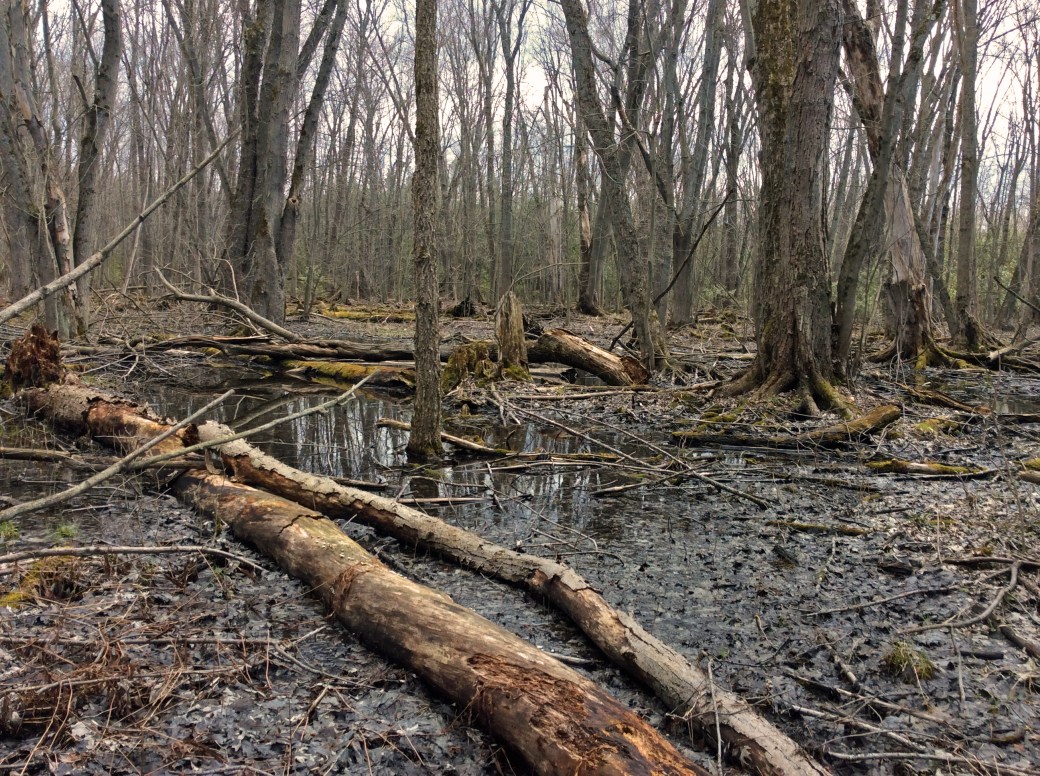
Migratory trees of Horus swamp (photo by Nina Munteanu)

The Migratory Trees of Horus (Book 2)

Once the apophus captures Rhea, it takes her across the Boiling Sea to a swamp where Rhea encounters the legendary migrating trees and—when she escapes the apophus—she collides with something worse—carnivorous ammuts:

The pungent smell of anaerobic mud and crushed vegetation stirred my nostrils and I looked up. I saw that the serpent was lumbering into a narrow canyon toward a ghostly grove of lanky trees. They resembled mangroves in the swirling mist. Within moments the snake began to make those same lyrical sounds that had intoxicated me the first time I’d come here. At the time I didn’t know who or what had made the eerie but beautiful sounds. Within moments an equally beautiful and more eerie multi-timbral chorus of feral ‘voices’ echoed off the canyon walls as if riding on the moving mist. I concluded against my own logic that this was some sort of communication between the apophus and…what? Surely not the trees? I narrowed my eyes with sudden amazement. Was I seeing clearly? Were the trees moving?…

I pulled myself out of the brown-stained pond and waded in a hobble through the warm swamp, Great Coat trailing like floating sails on the water. The canyon eventually opened to a wide valley, surrounded by towering oil-covered cliffs.

A loud pop and crackle ahead made me skid to a halt. I watched with amazement as a ten-foot oval structure made of earth and debris emerged from the muck, creating a small wake in the black water just meters in front of me. I flinched as it snapped open at the top, releasing a sharp odour of clove and burning matches. I considered backing away slowly and took a step back then stopped dead in my tracks and held my breath as two long deep crimson ‘tails’ slowly whipped out. They looked suspiciously like motion-sensing antennae.

When a vicious insect-like head emerged, attached to the ‘tails’ and dripping slime from a long proboscis, I abandoned stealth and bolted through the knee-deep swamp, not waiting to see the rest of the creature. Oh, God! These were the carnivorous larval stage of the ammut that Ka had told me about. I’d picked a great time to return to Horus: the beginning of the ‘season of the dead’ when the ferocious ammut hatched and swarmed.

Within moments, I heard an ominous loud clap and buzz behind me. I forced myself to turn and dared a glance. I clamped terrified eyes on a creature rising in the air, then lost my balance and fell backward into the swamp. A twelve-foot long insect-like creature had unfurled four narrow dragon-fly wings that flapped furiously. Twelve jointed legs dangled below its thick body. Huge multi-faceted amber eyes roamed below its crimson antennae and its long proboscis twitched, hungry for its first meal. Catching my breath, I scrambled under a drowned shrub and the ammut flew past me, the machine-gun flutter of its huge wings reverberating in my gut. I swallowed down my terror and wondered what an adult looked like if this thing was its larval stage.

I backed further into the bush and heard the sounds that I dreaded—more popping and crackling. I stared at the emerging swarm of eggs in the wide valley. Like popcorn, they started with a few snaps here and there. Within moments a cacophony of eruptions and the heady odour of clove and burning matches pervaded. According to Ka these carnivorous larvae left a swath of destruction in the wake of their swarm. No wonder the migrating trees were heading out of the valley!

…Ankle throbbing, I sat in murky marsh water to my waist, Great Coat billowing up around me, and back pressed against a bush. I listened to the chaotic clamber of ammuts emerging and flying. It grew dark overhead as their swarming bodies veiled the orange sky with black. The deafening machine-gun stutter of their wings filled my head and throbbed in my gut. Any moment a stray would find me, sniff me out with its long blood-red antennae, and I’d have to run…and die. In a sudden flash of regret, I wished I’d kissed Serge one final time….

Heart pumping, I dashed out from my temporary cover and fell with a loud splash as my leg gave out painfully under me. Alerted, several ammuts veered down straight for me. Heart slamming, I scrambled into a painful run as the first ammut’s antennae whipped out. It lashed my face and leg with a crackling snap and drew blood. I cried out with the agonizing sting and smelled burning flesh and cloves. I immediately felt a weak numbness spread through my body. Suddenly losing all strength, I stumbled and fell backward into the knee-deep swamp with a gasp. My face plunged into the stained water. I managed to right myself, coughing out black water, and thrashed to keep from sinking in the soft mud. By then more ammuts had buzzed in. Seizing in sobbing breaths, I backed away by scrabbling on my rump, too weak to rise to my feet. The soft bottom kept giving way underneath my hands. They sunk into soft mud and debris.

I watched in terrified revulsion as the nearest ammut descended upon me then I gasped as its chitinous legs poked my breast, as if testing its texture. To my horror, the giant invertebrate then settled partly on top of me and slowly pumped its body up and down, as if excited, effectively pushing me further down into the murky swamp until my head was barely out of the water… I gazed up at the creature’s head, chittering directly above mine, and fought down a moan of terror. Slobber from the creature’s proboscis dripped over my head then plopped, reeking of cloves and sulfur, on my face. I jerked my hand to wipe off the slime, then seized my MEC from its holster in blind panic. I aimed it at the ammut’s head and, pressing the trigger, dialed through every setting I could think of with my other fingers. Nothing worked.

Dear God, I prayed, releasing an involuntary moan, make it quick

Wetland-Trent3

Swamp and marshland of Sekmet (photo by Nina Munteanu)

The Blanket Bogs of Sekmet (Book 2)

When Rhea is captured for several murders she didn’t commit, she is sent to the penal planet Sekmet to serve her life-sentence in Hades, a 2-kilometre mining barge floating on the peat bog.

I gazed out my porthole at the barren patchwork of the small wetland-dominated planet, whose surface resembled an early impressionist’s painting. Dominated by sombre russet and indigo tones, the raised bog was dotted by a hasty spray of cobalt lakes and pools.

Although it was mid-morning on the planet, the mostly grey sky was saturated in low cloud and it was drizzling outside. Spates of wind drove sheets of rain hailing sporadically against my porthole. It was a wet desolate place. But then again, “A drowning man is not troubled by rain—Persian Proverb, Rhea,” I said quietly to myself. The weather was the least of my concerns.

As the ship descended, I could make out the individual pool system of the blanket bog with its inhospitable tapestry of dark and wet shapes. I dispassionately reviewed what I knew of the planet. Its cool wet climate and rich iron deposits promoted the development of muskeg, string bogs, darkly forested swamps and wildflower-filled fens. This was Sekmet, an Earth-sized planet that orbited the KO star, HD177830 in the constellation Vulpecula. My new home. Where I was going to die.

Within moments the ship landed with a sharp jolt in the open landing bay of the floating colony. Then the exit hatch door opened and the AI droned, “This is your destination, Rhea Hawke. Please disembark.”

My chest clenched. I swallowed down my fear and stepped out onto the platform of Sekmet’s landing bay, catching the faint sulphurous smell of the bog. The doors of the ship abruptly closed behind me, making me involuntarily flinch. Annoyed at my reaction, I gathered my composure and swiftly assessed the empty platform, hearing only the hum of the ship’s engine. My gaze rested on the endless hummocks and large meandering ponds of tea-stained water outside.

As the ship made ready to leave, I felt my heart pounding with the sudden urge to bolt. I had a panicked notion to leap off the platform into the murky bog. Swim, wade, scrabble to eventual safety in the wilderness of Sekmet in those distant hills. The ship lifted off the ground in a turmoil of dust and thunder. My face twisted with indecision as I tensed, poised to flee—

A male Azorian burst in from the adjoining chamber and I braced for an attack. He pelted right past me then leapt into the murky water. I watched him thrash through the undulating bog, stumbling, submerging and trying to swim—his left arm was amputated at the elbow. I was about to follow when laser shots peppered the water around him for several heartbeats. As suddenly as the shots began, they ended and the Azorian slowly sank until only his head remained above the water. I stood stiff, trembling hands over my mouth, and breathing hard. I stared at the head bobbing slowly in the water.

Sand dunes Oregon3

Dunes of Upsilon-3 (photo by Nina Munteanu)

The Barkhan Deserts of Upsilon-3 (Book 2)

In a desperate attempt to find the Ancient One—the key to the mystery killings—Rhea steals a Vos ship and the Vos Commander. She forces the terrorist A’ler at gunpoint to take them to Upsilon-3, the inhospitable desert planet where the Ancient One has settled in an enclave created by an ancient civilization. It is also where Rhea was almost killed once in a rabid blenoid attack. She will meet these vicious predators again…

Bleary-eyed and very cross, A’ler took us down to the arid planet, piercing the cerulean atmosphere with a view of mostly ruddy sand dotted with grey-green scrub below. We then crossed a vast expanse of open desert. I gazed down at the waved pattern of cresent-shaped dunes, obviously formed by a constant wind. It was a harsh and miserable environment, I thought.

“Barkhans,” A’ler offered, pointing to the dunes and breaking her taciturn silence. “That’s the West Ghouroud. No one’s ever crossed it and lived.” She eyed me with a dismissive look of disgust as much as to imply, especially a puny like you.

I didn’t respond and let my gaze stray back to the dune sea. The dunes looked like the capped waves of a red ocean, the deep ochre of their shaded slipfaces contrasting with the harsh bright windward sides, still baking in the sun. The dunes looked small, but I guessed that some were at least three hundred meters high.

I’d been there before. I’d tracked and dispatched an Azorian assassin to the small ephemeral town there once—but at the cost of a blenoid attack. In his desperation, the Azorian had fled the ghost town into the arid wilderness, and if I hadn’t shot him, the blenoids would have torn him apart. If they hadn’t, he would have died a horrible death of severe hypothermia. As it turned out, my shot infuriated a pack of sleeping blenoids and I became the subject of their fury instead.
botanical beach tidal pools2

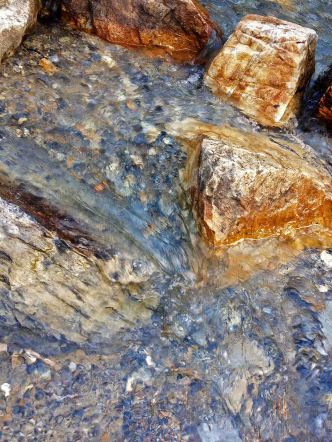
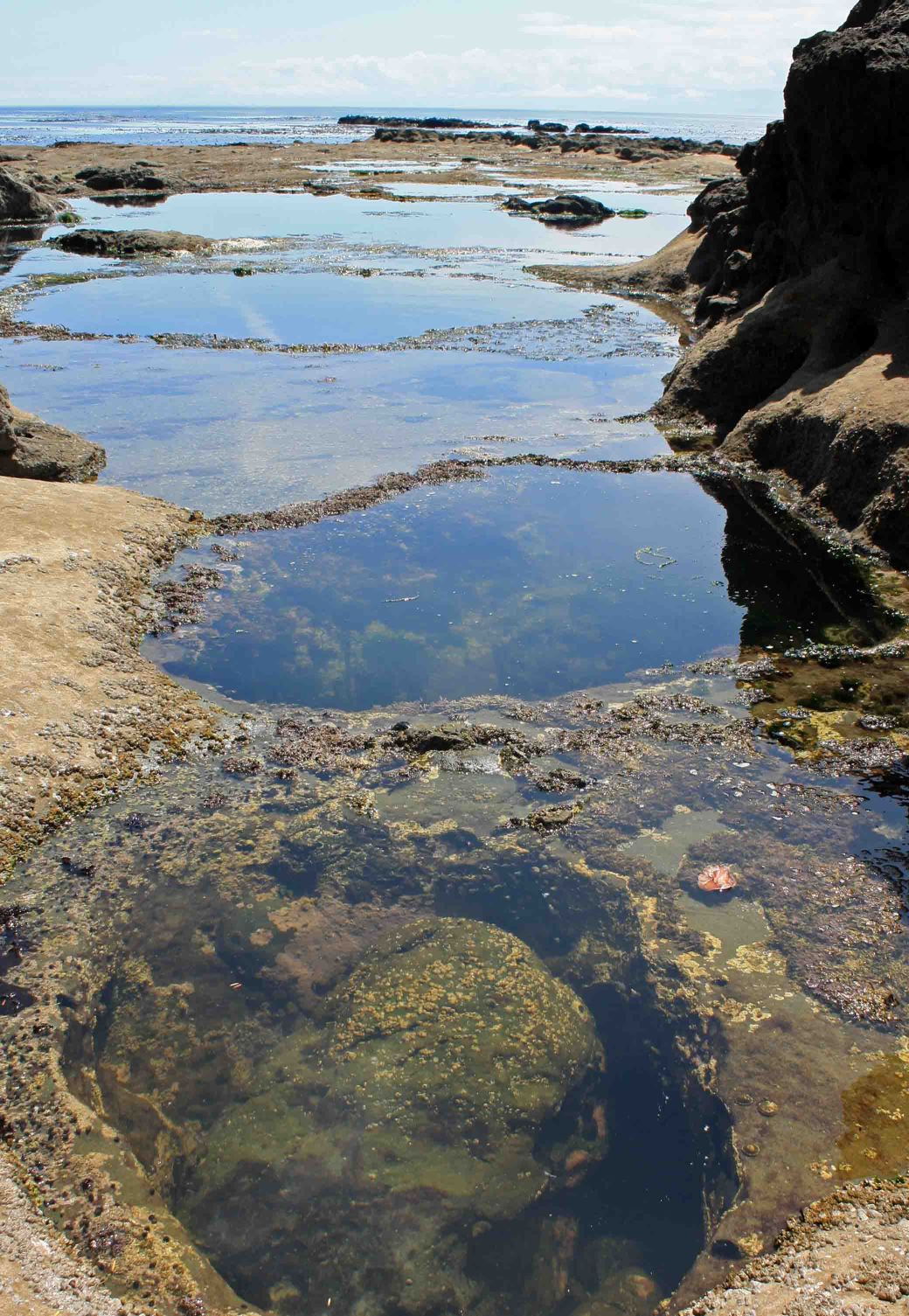
Clear toxic water of the Beleus Sea (photo by Nina Munteanu)

The Toxic sea of Beleus (Book 3)

Rhea makes a daring rescue of the bookseller Serge Bastion (Serge’s outer diverse twin), injured in a med-centre in Beleus City on Beleus. When Bastion refused to jump out the window to safety, Rhea belts him then gets him own by unconventional means to a nearby park.

I spotted it; a small peewee, parked a block away on the side of the road. The small two-seater resembled an ancient Earth motorcycle, except that it could fly. I pelted toward it and, after a brisk glance over my shoulder, straddled the vehicle and jimmied the starter lock then kick-started the engine. The vehicle stuttered on and I drove it to the bush where I’d stowed Bastion. I leapt off and pulled Bastion out from under the bush.  After struggling with his dead weight, I finally got him, still in his pajamas, in the back-supported passenger seat and seat-belted his slumped form in. I jumped in the pilot’s seat, grabbed his limp arms so he was leaning against me and secured his arms around my waist by lashing them together with chord from my pocket. Then we were soaring up just as several Eosian guards ran up to us, waving nokerig pistols and shooting. 

Nihilists had perched themselves on the roof and caught my peewee in a salvo of torpedoes. I veered us out to sea but not before one grazed the vehicle. I felt the hard jerk to the right and craned to look over my shoulder. I noticed to my dismay that a green cloud of hesium fuel was spraying out of the fuselage. But we’d at least cleared the distance they could shoot. I had no idea where I was going, except that it was far from the Med-Facility and the city.

For now I spotted no pursuit. That would change quickly, I thought, glancing down at my options. We were heading out to sea toward a long string of islands. The Beleus Sea shimmered in the sunlight with mercurial hues of lavender, deep purple, aqua green and blue. So different from the oily seas of Horus, the Beleus Ocean was extremely clear, reflecting the shifting light of the planet’s atmosphere in an exotic glitter.

Bastion stirred, head still lolling against my shoulder, and I reached behind me to jab him awake.

“Where are we?” I said gruffly. “We’re low on fuel.” I didn’t tell him we were losing fuel. “And we need to land somewhere fast…and safe!”

I had to give him credit; he sobered fast and unfastened his hands then leaned forward to point to our left, toward a cluster of extremely tall islands. “There. Go there, to the Broken Islands. They won’t find us there.”

That was what I needed to hear. I veered hard to port and heard Bastion grab my waist again and moan out some expletive at me. I glanced over my shoulder and found him glaring at me and rubbing one hand over his sore jaw.

“Sorry,” I muttered. “You weren’t going to jump.”

“What’d you do? Throw me over?” he asked in a sarcastic voice and felt himself gingerly.

“No, I just changed into a bird and flew you down to this vehicle that was waiting for us,” I said, meeting his sarcastic tone.

He remained silent. The truth is always more bizarre than any made up story, I thought dismally.

We were fast approaching the tall island spires. Hundreds of them dotted the iridescent sea. It was obvious to me that we’d reached the Broken Islands. And good thing too, because the engine began to stutter. It spluttered and whined as if in objection as I gunned it. Then I hiked in my breath as we went into a silent glide.

“Are we—” Bastion stopped himself.

He decided that he didn’t want to know; unfortunately I didn’t have that luxury. It’s not enough to know to ride; you must also know how to fall—Mexican proverb. Ok…here we go…

Mont Sacre-Coeur Granby, QC

Original seminary in Granby, Quebec on Earth

The Re-Imagined Earth (Book 3)

Rhea returns to Earth—now transformed by the Eosians who have settled there—She goes there with her inner diverse twin and Serge to warn the eccentric Gnostic Rafael Martinez of plans to assassinate him and also to borrow some of his elite guard to find the hidden Vos weapons facilities and destroy them. But Martinez turns out to be far more than an eccentric priest, challenging Rhea existentially a key to her past and her future…

Martinez had taken up residence in an old Catholic seminary just outside a derelict town in what used to be the rural Eastern Townships of Québec. I thought it apt that he chose a theological school for his Gnostic teachings.

As Benny entered atmosphere and circled down, I gazed through my starboard porthole at the familiar landforms and water masses of Earth. It was a lot greener than the last time I’d seen Earth through my view port aboard the shuttle that had taken me away from my home. Since the Eosians had colonized the planet thirty years ago, Earth had reverted mostly back to wilderness. Eosians were master ecologists who had honed their healthy symbiotic skills with nature into an art.

The planet, Gaia, was certainly healthier and happier now that her ancient prodigal civilization had returned. These former Atlanteans had brought back the wisdom of millennia about living in concert with and through nature’s arcane powers. They’d torn down humanity’s great cities and replaced concrete and glass with natural organic, living materials. They’d uprooted the roads and bridges and introduced their native scree, an intelligent giant raptor, as transportation. They’d let nature absorb the massive agricultural fields and clear-cuts, to harvest and recycle her bounty in beneficial ways. They planted their native tree, the vishna, everywhere. They’d restored the natural environment from the ravages of strip mines, oil fields and gas plants and replaced them with their non-intrusive crystal technology.

I gazed at the endless rolling hills covered in a lush purple and green carpet of young vishna and native trees. It was a monument to a simple and gentle life, a respectful pantheistic life. I could have wept; it was so beautiful. But it wasn’t Earth anymore….

V’rae wept for me. She and Serge had come beside me to watch once we’d entered atmosphere over North America. She said in a wavering voice, “It’s so beautiful…but it isn’t Earth anymore.” Then she burst into tears.

Martinez’s estate, the Solstice, was an island of lavish order in a green frothy sea of mixed wild forest. The derelict farming town of Granby had been demolished and absorbed back into nature since the Eosians had taken over as Earth’s new custodians. I could barely make out a criss-cross pattern of lighter greens in the forest mosaic that betrayed where old foundations and roads had previously lain not far from the current estate. Martinez’s estate was one of the few human-built structures that the Eosians hadn’t torn down and replaced with their symbiotic organic structures or left to natural and enhanced regeneration.

Martinez’s estate, the Solstice, was an island of lavish order in a green frothy sea of mixed wild forest. The derelict farming town of Granby had been demolished and absorbed back into nature since the Eosians had taken over as Earth’s new custodians. I could barely make out a criss-cross pattern of lighter greens in the forest mosaic that betrayed where old foundations and roads had previously lain not far from the current estate. Martinez’s estate was one of the few human-built structures that the Eosians hadn’t torn down and replaced with their symbiotic organic structures or left to natural and enhanced regeneration.

I frowned at him and saw V’rae look puzzled and clutch his arm. “Well, be that as it may,” I returned coolly, “he’s on the hit list and we still have to warn him. Plus he does have the largest and most capable independent Eosian guard in the galaxy.”

His brows came together. Then he bolted forward, bumping past my shoulder with his face so close to mine I could feel the heat coming off him. His arm brushed mine to touch the navigation screen. “I really think we should reconsider and—”

V’rae seized his other hand and pulled him back. “Let her land the ship, V’ser,” she commanded quietly. “We’re here now.” She was right and Serge knew it. He straightened with a sigh and I started to breathe again.

Metaverse-FRONT-web copyThen we were being hailed and I got on with the task at hand. “Strap yourselves in,” I instructed once I’d been given the go ahead to take port in Hanger B, below the seminary. After a long intake of air, I took us down.

In Metaverse, the third and last book of The Splintered Universe Trilogy, Detective Rhea Hawke travels back to Earth, hoping to convince an eccentric mystic to help her defend humanity from an impending Vos attack—only to find herself trapped in a deception that promises to change her and her two worlds forever.

You can listen to a sample recording of Outer Diverse, Inner Diverse, and Metaverse through Audible. Get the complete Splintered Universe Trilogy Audiobooks on Audible or any other format you prefer from quality bookstores. Find Splintered Universe Trilogy reviews on Goodreads.

audible listen

Microsoft Word - trilogy-poster03.docx

nina-2014aaa

Nina Munteanu is a Canadian ecologist / limnologist and novelist. She is co-editor of Europa SF and currently teaches writing courses at George Brown College and the University of Toronto. Visit www.ninamunteanu.ca for the latest on her books. Nina’s bilingual “La natura dell’acqua / The Way of Water” was published by Mincione Edizioni in Rome. Her non-fiction book “Water Is…” by Pixl Press (Vancouver) was selected by Margaret Atwood in the New York Times ‘Year in Reading’ and was chosen as the 2017 Summer Read by Water Canada. Her novel “A Diary in the Age of Water” will be released by Inanna Publications (Toronto) in 2020.
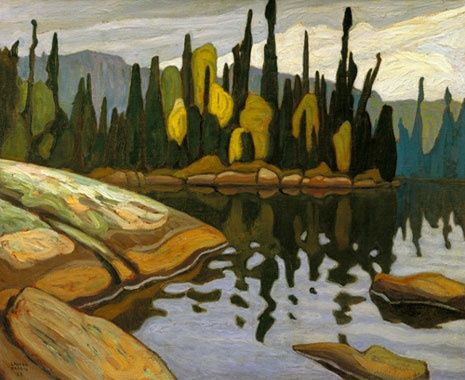
Rhea Hawke Interviewed by Galaxy News

I recently accessed a rare interview by Laura Dob of Galaxy News with Galactic Guardian Detective Rhea Hawke conducted in Neon City on Iota Hor-b sometime in 215 SGT:

*****

Rhea library02

Rhea Hawke (Vali Gurgu)

Laura: Welcome to the studio, Rhea. We’re so pleased that you could take time out of your busy schedule to talk to us.

Rhea: Thank you. Well, my boss told me I had to come and then cleared my schedule.

Laura: Well, that was nice of him.

Rhea: (hardly audible) Not really…

Laura: (clears throat). You’re an enforcer for the Iota Hor-2 Precinct. Is Neon City where you live—when you’re not out chasing the bad guys in your sentient ship, that is?

Rhea: Yes. I live in the eastside in a flat with my tappin, Jasper. I moved there when I started working for the Galactic Guardians. I’m originally from Earth: Vancouver, Canada.

Laura: How does it feel to be the only human in an entirely Eosian Guardian force?

Rhea: Small. Their average height is seven and a half feet. I’m tall for a human female at 6 feet, but I’m still a midget compared to them. Humans generally are small in the galaxy. If you discount the Delenians, Rills and Creons—which most do anyway—we’re pretty much the smallest sentient species in the galaxy.

Laura: (laughs uneasily) How did you become the only human Guardian Enforcer?

Rhea: Plain dumb luck, I guess…

Laura: (shuffles papers uneasily). You must be one of their youngest Enforcers at just twenty-three years old. Most are in their forties by the time they earn an Enforcer badge. With so much training involved how did you accomplish that feat?

Rhea: I started out young.

Laura: So, tell us about your sentient ship. It’s different from the regulation Guardian ships, isn’t it? Why did you choose it—

Rhea: I didn’t choose Benny. But I’m very happy with him. Benny is a ray class ship, a hybrid of old organic nano-technology that uses brainwaves and new technology that uses kappa particles collected through fuel scoops from gas giants. My ship was built by Tangent Shipping, owned and operated by Fauche ship-builders. As far as I’m concerned, the Fauche are the best ship builders in the galaxy.

Laura: Tell us a little about the equipment you use in your work? Like that savory coat. You call it a Great Coat, don’t you? Is it standard Galactic Guardian issue?

Rhea: The coat is intelligent, made with thixotropic material, which protects me, alerts me and provides some enhancing features that help me maneuver out of challenging situations.

Rhea gun03

Rhea and her MEC

Laura: The standard weapon of the Galactic Guardian is the pocket pistol. But you use something different; I hear that you designed your own non-regulated weapon. Is that it, holstered on your hip? I’ve heard it called a MEC…

Rhea: (pulls out the hand gun). It stands for Magnetic-Electro-Concussion pistol. It’s a wave-generating weapon that’s programmable to specific vibrations and wavelengths unique to the DNA of animate and inanimate things. I can program it to do different things to different things in one sweep. This essentially makes the MEC a discerning weapon with distinguishable endpoints from rendering someone unconscious to a swift kill.

Laura: As a Galactic Enforcer, you’re known as a loner who drives a non-regulation ship and uses unconventional ways to complete your missions. Some have criticised your methods as unreliable, shoddy—even dangerous. One Galactic Enforcer told me that no one wants to work with you because—

CoverI04

Rhea Hawke (Vali Gurgu)

Rhea: I didn’t join the force to make friends. I became a Guardian to help make things right. I get the job done. There’s no nice way of getting rid of scum, murderers, and terrorists. People have to decide if they want a safe galaxy or if they want to be politically correct in an unsafe one.

Laura: Does that include the Rill rebellion on Omicron 12 where you murdered over a hundred insurgent Rills with that very MEC you’re holding?

Rhea: ‘Talking without thinking is like shooting without aiming’—Old Chinese proverb… It was seventy-seven terrorists I killed.

Laura: (after tense pause in which interviewer notes that Rhea has not put away her MEC) Ok… Well… I heard a story from your mother—

Rhea: You spoke to my mother?

Laura:that you wanted to be an artist when you were young…

Rhea: ‘Dress the monkey in silk and it is still a monkey.’ Argentinian proverb.

Laura: Eh… right… So, what’s your favourite holiday place when you take time off?

Rhea: I don’t take time off. Except for interviews my boss tells me I need to do, that is…

Laura: Eh… right… So, what’s your favourite drink—or drug— and favourite place to get it?

Rhea: (finally smiling) Well, I am rather partial to Plock Nectar but my favourite drink is soyka and one of the best places to get it is right here in Neon City. It’s a funky Italian-Scandi café on Elgin Street in The Hive, called The Muddy Pit.

rhea-contemplative01

Rhea Hawke (Vali Gurgu)

Laura: Thank you, Rhea, for talking to us. I wish you well in your journeys.

Rhea: Thank you, Laura. You too.

When Galactic Guardian Rhea Hawke investigates the genocide of an entire spiritual sect, she collides not only with dark intrigue but with her own tarnished past. Her quest for justice catapults Rhea into the heart of a universal struggle across alien landscapes of cruel beauty and toward an unbearable truth she’s hidden from herself since she murdered an innocent man.

Get the complete Splintered Universe Trilogy. Available in ALL THREE FORMATS: print, ebook, and audiobook. Listen to a sample from all three audiobooks on Audible. Read the Splintered Universe reviews on Goodreads.

audible listen

Microsoft Word - trilogy-poster03.docx

nina-2014aaa

Nina Munteanu is a Canadian ecologist / limnologist and novelist. She is co-editor of Europa SF and currently teaches writing courses at George Brown College and the University of Toronto. Visit www.ninamunteanu.ca for the latest on her books. Nina’s bilingual “La natura dell’acqua / The Way of Water” was published by Mincione Edizioni in Rome. Her non-fiction book “Water Is…” by Pixl Press (Vancouver) was selected by Margaret Atwood in the New York Times ‘Year in Reading’ and was chosen as the 2017 Summer Read by Water Canada. Her novel “A Diary in the Age of Water” will be released by Inanna Publications (Toronto) in 2020.
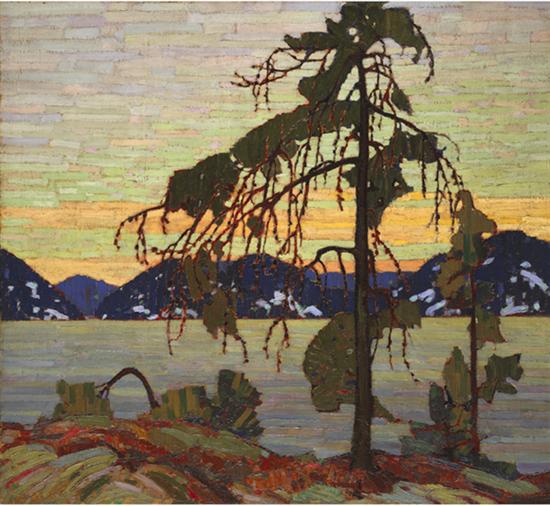
What Kind of Hero is Rhea Hawke?

OuterDiverse-front cover

Rhea Hawke on the cover of Outer Diverse

“Rhea Hawke…I want to be her when I grow up.”—Amazon Review

Something is changing for women—and for men too. I’m talking about storytelling—and what makes a hero. Only a few years ago, no one would have predicted the success of Wonder Woman, which portrays a well-rounded female hero as both “badass” warrior (strong, determined and violent) and kind (compassionate, nurturing, empathetic and inclusive).

The male hero stereotype of western neoliberal-corporate culture—and science fiction particularly—has often been characterized by strength, courage, honor, intelligence, and assertive single-mindedness. He is the altruist warrior, often acting alone against an unfair society: all traits honored, respected and esteemed in men. In a woman, these Boadicean qualities often taint her as “bitch”, “bossy”, “cold” or even heartless. She may be considered unwomanly, unlady-like, intimidating, and untouchable (as in lesbian).

In the patriarchal model, a woman “hero” must shed her feminine nurturing qualities of kindness, tenderness, and inclusion, to express those hero-defining qualities that are typically considered male. I have seen too many 2-dimensional female characters limited by their own stereotype in the science fiction genre—particularly in the adventure/thriller sub-genre. If they aren’t untouchable goddesses or “witches”, they are often delegated to enabling the “real hero” on his journey through their belief in him: as Trinity enables Neo; Hermione enables Harry; and Lois enables Superman. In so many of these storylines, the female—no matter how complex, interesting and tough she starts out being—demures to the male lead to support his hero’s journey—without considering her own. And this often means serving as the prize for his chivalry. There’s even a name for it: the Trinity Syndrome.

edge-of-tomorrow-emily-blunt

Rita Vratasky (Emily Blunt) in Edge of Tomorrow

chrisjenavasarala-theexpanse

Avasarala (Shohreh Aghdashloo) in The Expanse

A different kind of hero is gaining momentum in science fiction and action-thrillers in which the heroic gifts of altruism, compassion, faith, courage, passion, and endurance drive the female lead. We see her in movies and TV shows like Edge of Tomorrow, Hunger Games, Divergence, Orphan Black, Farscape, Battlestar Galactica and The Expanse. Even Game of Thrones.

She fights the dragons of prejudice, ignorance, cruelty, greed and intolerance–either in partnership with her male counterpart or alone.

****

Enter Rhea Hawke, Galactic Guardian: wounded hero with a massive grudge. She’s the only human in a galactic police force of giant alien Eosians (who she despises). In the early scenes of Outer Diverse, Rhea is a “badass”; but she’s also far from heroic—displaying cynicism, open racism and even cruelty to her own colleagues. And yet, in her stubborn resolve to solve the massacre of a spiritual sect—even after she’s fired for killing her suspect—and to solve the mystery of the alien spectre of the Vos (who destroyed her home planet Earth), Rhea betrays a humane need to right all wrongs, including her own.

rhea-contemplative01

Rhea Hawke (Vali Gurgu)

Rhea’s journey is large—epic, even. It’s a journey of transformation, both literally and figuratively. Her journey of self-discovery will take her across the galaxy, only to find that compassion and forgiveness were with her all along. She just needed to uncover them to find her whole self. Her sometimes foil and love-interest, Serge, continually bates her, challenges her and even betrays her. By turns a foil and an ally, Serge is Rhea’s perfect counterpart; not weaker or stronger, he is an equal to her. A true partner. And their banter is some of the most rewarding writing I’ve done in my career.

When Galactic Guardian Rhea Hawke investigates the genocide of an entire spiritual sect, she collides not only with dark intrigue but with her own tarnished past. Her quest for justice catapults Rhea into the heart of a universal struggle across alien landscapes of cruel beauty and toward an unbearable truth she’s hidden from herself since she murdered an innocent man.

Get the complete Splintered Universe Trilogy. Available in ALL THREE FORMATS: print, ebook, and audiobook. Read the Splintered Universe reviews on Goodreads.

audible listen

Microsoft Word - trilogy-poster03.docx

nina-2014aaa

Nina Munteanu is a Canadian ecologist / limnologist and novelist. She is co-editor of Europa SF and currently teaches writing courses at George Brown College and the University of Toronto. Visit www.ninamunteanu.ca for the latest on her books. Nina’s bilingual “La natura dell’acqua / The Way of Water” was published by Mincione Edizioni in Rome. Her non-fiction book “Water Is…” by Pixl Press (Vancouver) was selected by Margaret Atwood in the New York Times ‘Year in Reading’ and was chosen as the 2017 Summer Read by Water Canada. Her novel “A Diary in the Age of Water” will be released by Inanna Publications (Toronto) in 2020.