Nina Delivers Words and Worlds at WWC

SmokeSun-Rockies2

Smoky sun overlooking Rockies (photo by Nina Munteanu)

I recently travelled from Vancouver with Pixl Press director Anne Voute through the smoky Rockies to the 8th ‘When Words Collide’ writers festival in Calgary. The festival was held August 10-12, 2018 and brought together just under a thousand readers and writers in multi-genres to attend presentations and panels on writing and publishing.

The three-day writers’ festival ran a 10-track program that included informative panels, Blue Pencil Café, Editors Speed Mingle, pitch sessions with agents and publishers, and challenging workshops.

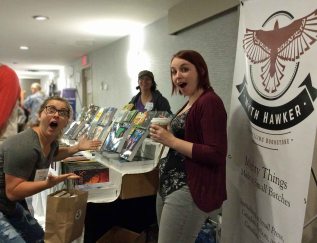
MythHawker table-WWC2018

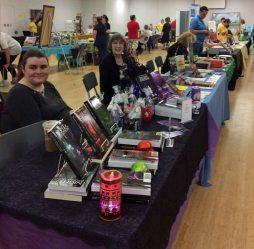
Selling books at Myth Hawker

My books were on sale in the Merchant’s room at Sentry Box (a local Calgary bookstore) and Myth Hawker Travelling Bookstore. By the third day, Myth Hawker sold all available copies of Water Is…

I participated in panels, Blue Pencil Café, Editors speed mingle and several presentations and workshops:

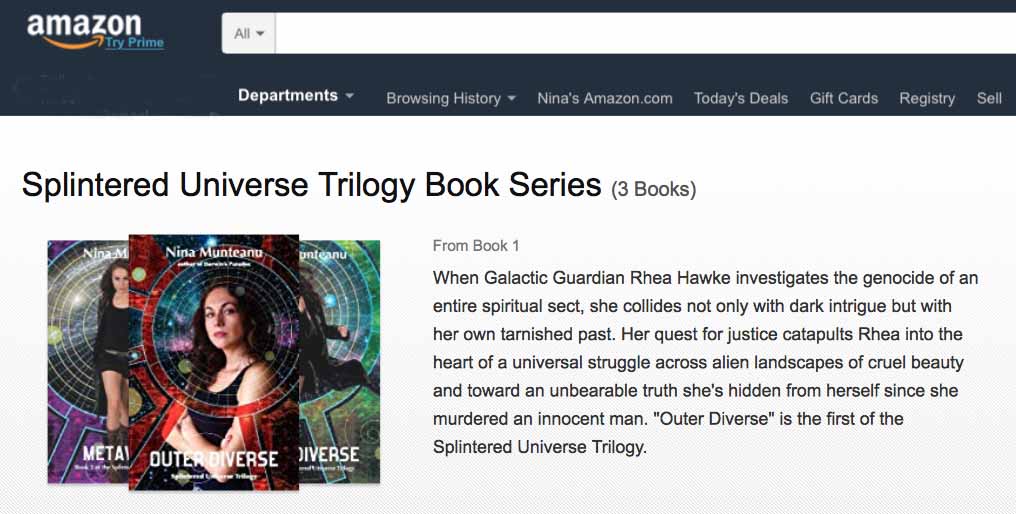
  • You Oughta Be in Audio: a discussion between me and audiobook narrator and producer Dawn Harvey on the making of the audiobooks for The Splintered Universe—now available in three formats, print, ebook, and audiobook. While paper sales dwindle, audiobooks continue to be the fastest growing segment of the publishing world with sales increasing by 30% year over year for the past decade.

Amazon-SplinteredUniverseTrilogy

  • World As Character: a presentation on creating a world with meaning. In most science fiction and fantasy, the world that we create is often very different from our own; in speculative fiction it’s often very similar; in contemporary fiction it is virtually the same. In all cases the world you build should embed in your story with layered metaphoric meaning. Nina Munteanu will discuss how to build a world that interacts with character to inform greater meaning in story.

FictionWriter-front cover-2nd ed-web copyJournal Writer-FRONT-cover-WEB copyI also networked my writing community for world examples to use in my Alien Guidebook on world building: The Ecology of Story: World as Character. Anticipated release by Pixl Press of this third guidebook in the Alien Guidebook series is Summer of 2019. In keeping with the branding of the series, artist Anne Moody is providing the cover illustration and Costi Gurgu the cover design for The Ecology of Story. Covers for the previous two books were also done by Anne and Costi.

Cover-everyday hero

‘Everyday Hero’ by Anne Moody

Earlier in the month, I travelled north with the Pixl Press director to Anne’s ranch in Vanderhoof to requisition a cover from her for the guidebook. After days of discussion and “show and tell” and after several pieces of art were tentatively selected, Anne pulled out a piece that stopped our search dead. ‘Everyday Hero’ depicts a lonely firefighter, trudging in the burning forest, tired gaze to the burning crown of a tree. Considering the subject matter and our world today, we thought this was perfect for my book.

MockUpEcology-2

cover design by Costi Gurgu, illustration by Anne Moody

Depicted in shades of blue, charcoal and brilliant red, the cover contrasts and harmonizes well with the brand typology and cover design by Toronto graphic artist Costi Gurgu.

.


nina-munteanuNina Munteanu is an ecologist, limnologist and internationally published author of award-nominated speculative novels, short stories and non-fiction. She is co-editor of Europa SF and currently teaches writing courses at George Brown College and the University of Toronto. Visit www.ninamunteanu.ca for the latest on her books.

Coming Home to Water at Stir Coffee House

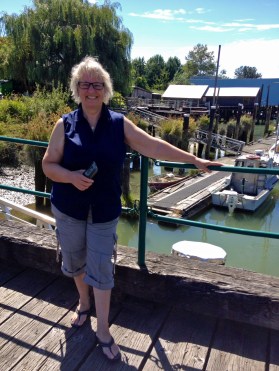
Nina-LadnerPier copy

Nina on Ladner pier

For several years I’ve been returning from Toronto—where I teach at The University of Toronto and George Brown College—to Ladner, BC to spend my summers.

I cherish the time as a chance to see family and friends and to enjoy a different pace of life—one I enjoyed when I used to live and work here and where I brought up my family. We lived in a comfortable house on a quiet street and our back yard faced one of Ladner’s sloughs and beyond that a vast tract of farmland, most often scored with rows of potato plants. My son Kevin had grown up swimming in the slough and jumping off the rope swing his dad had constructed. Pilgrims from close and far came to use that swing and enjoy the murky waters of our back slough.

Rope swing copy

Kevin on the rope swing

Parties at our place always involved water and getting wet. We even had a fleet of kayaks and canoes that we took on paddling adventures through farmland and under highways, with the occasional siting of muskrat, carp, heron, or eagle. Coyotes whined and barked at night as bats dipped through the night air, foraging for food. My female cat poised for the hunt and sometimes brought in her “catch of the day.”

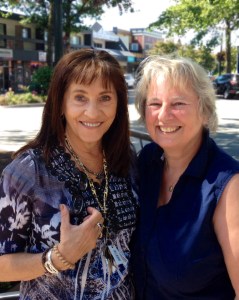
Cathleen-Nina-Ladner1 copy

Cathleen and Nina at Stir

This summer, good friend and writer Cathleen Chance Vecchiato decided I should give a talk to my old community on Water Is… my recent bestselling book on water. With that, she immediately made it happen. The venue was already decided: the best café in Ladner, Stir Coffee House. I’d taken Cathleen there the previous year as part of a tour of the old farming and fishing village. Cathleen was charmed by the village atmosphere.

Stir Coffee House was happy to host a talk and Robert and Cathleen proceeded to plan it. Ian Jacques at The Delta Optimist wrote a wonderful piece on my journey, the talk and the book.

Nina-WaterIs-OPTIMIST2018 copy

On the evening of August 16th a growing crowd of people, eager for more on this precious substance flowed into the café until there was hardly a seat left in the cozy venue. I recognized some locals as well as colleagues from my environmental consulting days in Vancouver. It was a good crowd.

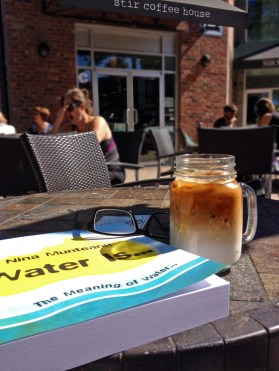
Coffee-Water-StirCoffeeHouse copy

Water Is… snug against an iced latte

I shared the story of how I came to write this book—not a limnology book for non-scientists, as I thought I was going to write—but something that was more than science. Something that encompassed so much more about water: what it means to each of us and how we still don’t understand its many magical anomalous properties. I confided my discovery that the synchronicity of important moments in my life were all connected to water, which compelled the book to evolve into a study of “what water means to us.” Good friend Emmi Itäranta, author of Memory of Water, called Water Is… a biography of water.

Travelling the world has helped me realize that I was blessed with an abundance of water. I lived my entire life in a country of plentiful and healthy water. And for most of that time I didn’t even realize it. Canada holds one fifth of the world’s fresh water in lakes, rivers, and wetlands, as well as in our underground aquifers and glaciers. Canada’s wetlands, which cover more than 1.2 million square kilometres, makes Canada the largest wetland area in the world.

Nina-Hope-Trevor Stir copy

Nina with hosts Hope and Trevor

Perhaps it is no coincidence that Canada is steward of the world’s largest wetlands. Wetlands include marshes, swamps, fens, and bogs, all irreplaceable habitat for a huge diversity of nesting, feeding and staging waterfowl, reptiles, amphibians and mammals—many at risk. Wetlands provide a major filtration system, removing contaminants, improving water quality and renewing water’s vitality; wetlands serve as reservoirs, controlling and reducing flooding toward a more balanced hydrological cycle. Wetlands are a source of oxygen and water vapour, serving a vital role in our global atmospheric and climatic cycles. As ecotones— transitional areas—wetlands protect coasts from erosion and provide exceptional opportunity for boundary interaction and the emergence of vitality. Like a good metaphor, wetlands “recognize” and encompass similarities between dissimilarities. Wetlands powerfully connect. Canada’s strong multi-cultural policies and its open tolerance in embracing and celebrating diversity makes it the “wetland” of the world.

When I turn on the water tap in my house in Canada, it is pure drinking water. I don’t need to boil it or filter it or test it for impurities and toxins. I am confident that it will nourish and hydrate me like water should. I can bathe without restriction. I can play with it.

My water hasn’t changed; but I have. I do not take it for granted. I know that I am blessed.

I am home and I am so grateful.


In the Moment-anthology copyPart of this article is an excerpt from Nina Munteanu’s “Coming Home to Water” first published in “In the Moment” (A Hopeful Sign) edited by Gary Doi, September 2016; reprinted in “The Earth We Love” (Mississauga Writers) edited by Elizabeth Banfalvi, September 2018; and “The Literary Connection IV: Then and Now” (IOWI) edited by Cheryl Antao Xavier, upcoming 2018.


nina-munteanuNina Munteanu is an ecologist, limnologist and internationally published author of award-nominated speculative novels, short stories and non-fiction. She is co-editor of Europa SF and currently teaches writing courses at George Brown College and the University of Toronto. Visit www.ninamunteanu.ca for the latest on her books.


“Water Is…” at The Bookshelf Book Fair in Newmarket

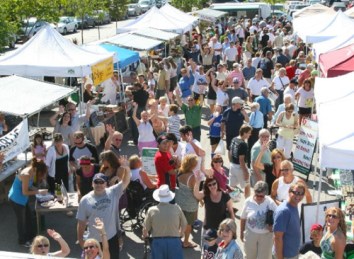
Newmarket-farmers market

Newmarket farmer’s market

Every summer, the Writers’ Community of York Region (WYRC) holds a book fair (The Bookshelf) at the Newmarket Community Centre & Lions Hall, next to the farmer’s market. The fair showcases over 40 local authors, publishers and artisans through readings, discussions and a tradeshow that features writers’ works in a variety of genres from science fiction and fantasy to mystery, inspiration, science, history, self-help and children’s literature. I participated in this year’s festival on July 7, 2018.

Reading from “Water Is…The Meaning of Water

Nina-Bookshelf booksale1

Nina at her book table

At the Reading Lounge onstage in the adjoining Farmers’ Market, I read from my Amazon-bestselling “science-for-lay public” book Water Is…The Meaning of Water. As children and their parents played in the main water feature behind me, I introduced the term “limnology” (someone who studies freshwater) and talked briefly about the meaning of water with an audience eager to learn.

“We can’t live without it, so maybe we should start respecting it; this beautifully designed book by a limnologist looks at water from 12 different angles, from life and motion and vibration to beauty and prayer,” said Canadian author Margaret Atwood when she selected Water Is… as her first pick in the New York Times ‘Year in Reading.’

Water Is-COVER-webEach of the 12 chapters completes the phrase “Water is…” with terms that evolve from science into philosophy and spirituality; terms such as “magic”, “life”, “motion”, “communication”, “memory”, “rhythm”, “vibration”, “beauty”, “story”, “wisdom”, “prayer”, and finally “joy”.

The book is, after all, a celebration of water.

I first shared some history on the making of the book. I shared that the pursuit of this book was oddly serendipitous and “entangled.”

kevin-nina-close

Nina and son go hiking

“Early on, during the research and writing of this book, I discovered that this project on water had become a gestalt watershed for all the important moments in my life. Places I’ve been. Things I’ve learned. People I’ve met and with whom I’d had surprising discussions and realizations. All spanning many years. And many of them totally unrelated. And yet, now, with a sudden flood of context, their significance has transcended into a new fabric of meaning through surprising connection. Like puzzle pieces cooperatively arranging themselves into a symbiotic pattern of synchronicity.”

Writer and philosopher Jake Kotze suggests that, “Synchronicity happens when we notice the bleed-through from one seemingly separate thing into another—or when we for a brief moment move beyond the mind’s divisions of the world.” Synchronicity and serendipitous discovery, like metaphor, appear when we change the way we look at things.

“Serendipitous discovery comes to us through peripheral vision. Like our muse, it doesn’t happen by chasing after it; it sneaks up on us when we’re not looking. It comes to us when we focus outward and embrace our wonder for this world. When we quiet our minds and nurture our souls with beauty. It is then that what we had been seeking naturally comes to us. Like a gift.”

For my reading, I chose several summary quotes that appear at the end of each chapter of the book. These quotes were also featured earlier this year in “Morphology”, an art exhibit in Mississauga that honored the creation of a marsh park as part of Jim Tovey’s vision for the Lakeview Site and the Waterfront Connection:

Water-travel

Quote from “Water Is…” on display at Mississauga Civic Centre

Wonder Woman Respects Water

“Respect water!” says Wonder Woman (aka cosplayer Jes Tongio). Wonder Woman was careful to point out with her wise Amazonian sword of Athena (goddess of wisdom)—forged by Hephaestus—that “Water Is…” provides a doorway to wonder and responsible action.

WonderWoman-WaterIs2a

Wonder Woman (Yes Tongio) with “Water Is…”

Other Authors at The Bookshelf

Bookshelf-venue2

Clair McIntyre and Merridy Cox

I met and visited with other fellow writers, including Clair McIntyre, author of YA/fantasy, and crime writer Joan O’Callaghan.

Fellow authors who read at Reading Lounge included Douglas Smith, award-winning author of “Wolf at the End of the World”; and A.A. Jankewicz,

Nina-Agnes-LIMESTONE

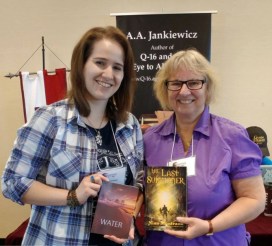
A.A. Jankewicz with Nina Munteanu

fantasy author of Q16, and who’s short story appears in the Water Anthology I edited for Reality Skimming Press; and Gabriela Casineanu read from her bestselling book Introverts: Leverage Your Strengths for an Effective Job Search.

Claudiu Murgan read from Decadence of the Soul; he is launching his recent science fiction novel Water Entanglement next month.

Myth Hawker Travelling Bookstore was also at the festival. Specializing in Canadian authors, Canadian content, and Canadian small press, they  carry an extensive list of local Canadian authors wherever they go across Canada.

The Immigrant Writers Association (IWA)

Nina-IWA-BookshelfinNewcastle

Gabriela, the two Andreeas, Nina and Claudiu

Nina IWA memberThe IWA was also represented, along with member-writers Gabriela Casineanu, Andreea Munteanu, Claudiu Murgan and Andreea Demirgian.

The Immigrant Writers Association provides programs, activities, and services that empower and support immigrant writers in their journeys. According to their website, the goal of the IWA is to  “encourage immigrants to express themselves through writing, to bring more awareness, compassion, and peace into the world.”

As second-generation immigrant daughter to German and Romanian parents, I recently joined the IWA. I look forward to mentoring new writers and providing workshops and lectures to share my experience as a writer, editor, and teacher of fiction and non-fiction.


MJ Moores-Bookshelf

M.J. Moores, chair of the board and founder of Bookshelf

nina-munteanuNina Munteanu is an ecologist, limnologist and internationally published author of award-nominated speculative novels, short stories and non-fiction. She is co-editor of Europa SF and currently teaches writing courses at George Brown College and the University of Toronto. Visit www.ninamunteanu.ca for the latest on her books.

When Water Entangles: An Interview with Claudiu Murgan About Water

Adobe Photoshop PDFI recently attended Claudiu Murgan’s signing of his science fiction book Water Entanglement at Indigo in Yorkdale Mall and had a chance to ask him some questions about the book that intrigued me.

There are several reasons why I found Claudiu’s book particularly intriguing. Apart from the obvious fact that it has two of my favourite words in the title—Water and Entanglement—there were other intriguing aspects about Claudiu’s book, which takes place in near-future Toronto and features a limnologist as main protagonist.

My just finished novel—A Diary in the Age of Water—is also set in near-future Toronto and features a limnologist—which is what I am—as main protagonist. As we compared more and more notes, I had to laugh at how our two novels were also entangled!

Nina-Claudiu-Indigo2

Nina and Claudiu at Indigo

The time-period and the issues of both novels were very similar: growing tensions and politics surrounding a crisis of water scarcity in the 2050s and the continued short-sightedness of climate-denying politicians and corporate Earth. Both novels read like seamless slipstream between fiction and reality (mine is written partially as a memoir, which increases this experience); both explore humanity’s potential evolution linked to our relationship with an entity that remains as mysterious as it is common and life-giving. An entity that most indigenous peoples call alive.

Both Claudiu and I embrace concepts of controversial metaphysical characteristics of water. I wrote about much of this in my book Water Is…The Meaning of Water, which Claudiu references in his novel. “Memory”, quantum coherence, the liquid-crystal state, and polarity express through water’s over 70 anomalous properties: phase, density, thermodynamic, material and physical anomalous properties that include adhesion, cohesion, high specific heat, thermal density, viscosity, and surface tension—just to name some.Water Is-COVER-web
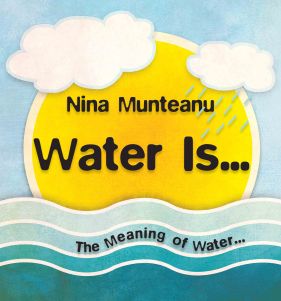
“Water is the most extraordinary substance. Practically all its properties are anomalous,” writes Nobel laureate and physiologist Albert Szent-Gyorgyi.

Water Entanglement’s book jacket blurb provides an intriguing premise:
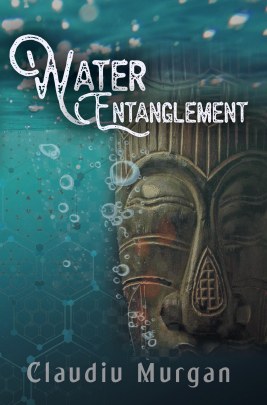
Adobe Photoshop PDF“…Since the creation of Earth, water and crystals have woven their paths into a billion-year-long tapestry that has captured the cycles of nature’s evolution. They have observed the appearance of humans and their troubled, but fascinating development, and the energies and vibrations of everything that is part of this amazing eco-system . . . In 2055 water activists fight against irresponsible corporations that pillage the Earth. Hayyin, the hidden identity of Cherry Mortinger, a limnologist, leads the movement. Will she be able to prove that water has memory and is alive and that we could awaken to the possibility of facing a fierce battle against the primordial element that gave us life: WATER?”


INTERVIEW

Nina:  What inspired you to write Water Entanglement and why did you set it in Toronto in the near-future?

Claudiu: At the end of the TV interview I gave back in September 2017 when I launched my first novel, The Decadence of Our Souls, the host asked me about my next project. I had an impulse to say that I’m going to write about water. At that time I had no idea about the potential plot and how powerful the message would be. I also think that spending time with you, Nina, and reading Water Is… influenced my subconscious. The Matrix is choosing several authors that are allowed to flow the right messages about water and create the critical point of awareness. I personally know a handful of them that write about water from a deeper level of understanding.

Why Toronto? Because I would like to see Toronto make a firmer stand on various issues that are not ‘politically correct’. The city’s multi-cultural background has created the notion of niceness about us, which is good to have; but at the same time, we can’t allow the big corporations to dictate how to use Canadian fresh-water resources. If the book is read by the right people, then they might get an idea of what could be done.


Nina:  Who should read Water Entanglement and why?

Claudiu: I like to believe that WE is a manifesto written as a Sci-Fi novel. A teenager will find things about water that are not taught in school; properties of water that science can’t deny anymore, but also can’t explain. A Sci-Fi reader will enjoy the geo-political scenarios I imagined along with the fact that water is becoming an active participant in the story, a character that is elusive, unpredictable and creates so much havoc. For an environmentalist and for a water activist, reading about the length corporations are willing to go for a profit will only compell them to continue their fight against greed and disrespect for nature. I didn’t write the book with a specific age bracket in mind, nevertheless, there is a nugget of knowledge for any type of reader willing to accept that the way we treat water is wrong, and that access to clean, potable water is a human right, not a luxury.


Nina: Two of your main POV characters are scientists; one is a limnologist (a freshwater scientist) and another a neurosurgeon. Another character is a Cherokee chief; yet another a UN representative. How did you research your characters to realistically express them in your novel?

Claudiu: The more I write the better I get at doing research. And I have to admit how grateful I am for your advice on my first book, The Decadence of Our Souls, that have elephants as main characters. You said: read more about elephants. So I did. I went to the library and borrowed thirteen books about elephants. For WE I read several books on water, but also interacted with you, Nina, a limnologist, helped me see the world from your point of view. As for my other characters, I had the chance to visit UN HQ and interact with some policy makers. In WE there is less red tape and the UN representative has some liberty when making decisions, ignoring some of the political clutches that currently strangle any decent decision with worldwide implications.


Nina: Your protagonist disguises her subversive activist identity beneath a masked being called Hayyin. Hayyin is an Islamic name that means “without obstacles”, “lenient” or “forgiving.” What was your intention in this name and does it play a role in the theme of your book?

Claudiu: I searched for the word water in Aramaic, which is Jesus’s tribe language. There are historic records that mention Aramaic as being the primordial language. Hayyin, the water activist, had to represent a symbol powerful enough to ignite in his followers the desire to fight for water. We all like to identify ourselves with a symbol that is worth fighting or dying for. Without enough water to sustain our growing population, humanity will fade away in a matter of centuries or less, so I thought that a symbol attached to a hidden identity makes the plot more interesting.


Nina: You cover several subjects of hard—and controversial—science in this book (e.g., homeopathy, epitaxy, polywater, etc.). How did you balance these to create a plausible reality in your novel? What did you have to consider?

Claudiu: I’m not a scientist. As an author I took the liberty of pushing the limits of what is known about water. I consider my research based on data that doesn’t need peer-review validation. I trust the scientists and the authors listed under the bibliography page at the end of the book. There are so many intangible things that touch us daily and most of us are not willing to accept them. The way water behaves in Water Entanglement is an intangible concept for ‘non-believers’ … until it happens. Along with a friend scientist, I’m planning to challenge students to start experiments involving water. They have to engage with their surroundings, ask questions and get their own results.


Nina: A pivotal aspect of your story hinges on the concept of structured water and intention. Can you share a little about it?

Claudiu: When doing my research I learned things about water that I couldn’t believe, but finding the same information from multiple sources convinced me that there is truth to it. I’m a strong believer now that water absorbs our intentions, our thoughts, carries them further until the next ‘shore’. Water that was blessed heals people or sickens them if water transports negative energies and harmful thoughts. Our body cells float in structured water and if the quality / properties of such liquid would be able to be maintained, well … we could live forever.


Nina: the tagline for Water Entanglement challenges: “When will we understand that water has memory, water is alive and the time for her to awaken is NOW?” Your book paints a compelling and terrifying awakening: edible seaweeds turning toxic; sacred rivers losing their healing properties; springs diurnally retreating; raging sinkholes, water turning thick. Tell us a little about these choices for water’s reactions.

Claudiu: What characterizes us as human beings is that we don’t take any potential catastrophic event seriously unless it happens. We would rather deal with the repercussions than prevent the cause. See the levies that broke because of the force of Katrina. The government was well aware of what could happen, but invoked lack of funds. In truth it was lack of government will, the political infighting that is common these days.

In WE I had to give water a radical behavior. Water has intuition and she knows human beings so well. She can predict any of our actions and there is no solution other than offering ‘peace’ – a selfless conduct.


Nina: Your book showcases some of the major challenges humanity faces in how we treat water—scarcity, contamination, diversion, commodification and misappropriation through disrespect of water and Nature, generally. There is an obvious need to alter how we treat water and this must ultimately arise from attitude and knowledge. How do you see us changing our attitude to water when most of us live in cities and don’t even know—or care—where our water comes from or what watershed we live in?

Claudiu: Changing attitude could be a generational approach. To become part of the education at all stages from kindergarten to university. We hear in the news that in Las Vegas the fountains and watering the lawns have been banned. In Africa children and their mothers walk kilometers daily to gather water for drinking and cooking; most of the time it is polluted water. Again, the leaders lack the determination to impose stricter rules or allow technologies that could replace some of the daily activities that require water. Over the years, politicians have enforced the idea that any decision of significance has to go through a lengthy process. It shouldn’t be that way if the greater good is paramount and not petty, personal interest.


Nina:  Your novel touches on global economic and military pressures by corporations and governments in aggressive water acquisition. In your novel this occurs mostly via American interests overseas. Closer to home, Maude Barlow of the Council of Canadians tells us that water abundance in Canada is a myth and we are too complacent. Her recent book Boiling Point exposes Canada’s long-outdated water regulations, unprotected groundwater reserves, agricultural pollution, industrial waste dumping, water advisories and effects of deforestation and climate change. As stewards of 20% of the world’s freshwater, our precious water is being coveted by many entities—from corporations to governments—and holding our own will be a tricky balancing act. What do you think is Canada’s main challenge in keeping its water protected?

Claudiu: Yes, in my book I mention that we are down to 13% of world’s freshwater resources. I also mention that only smart policy could keep the sharks away. We are not a third-world, tiny, easy-to-intimidate country. We should stand our ground and push back on any such attempt. The government should protect both private and public freshwater sources and even offer support regardless of ownership.


Nina: Your book touches upon corrupt government officials and corporate CEOs in terms of water issues. Various anonymous organizations such as WikiLeaks, Anonymous Group, and individuals—including your main character who uses a mask to maintain her anonymity—play a major role as activists in your book. Do you see this as the most effective way to expose wrongdoing and affect change?

Claudiu: It was already proven that revelations through WikiLeaks have affected the political environment, revealing corruption at high levels of government, secret documents mishandling, transaction from which a handful of people benefited, etc. As far as I know no one has dug deeper into these documents for nuggets of shady deals about commodities such as water (as water is considered a commodity to lessen her important role in our lives). But they are happening in the shadows, overseen by easily bribed politicians that only find happiness in short-term gratification. Hacking corporations that claim they are responsible when it comes to environment and human health, is a civic duty. It reveals the gangrene that affects our world.


Nina: In your novel, you created Water For All (WFA) as a global NGO organization devoted to protecting water by exposing heinous wrongdoings and helping to correct them by helping to pass legislature; what do you see as the largest challenges faced by NGOs today?

Claudiu: In my opinion the water movement is fractured in too many pieces. They all want to do good, but there is no scalability to their initiatives. Funding is somehow scarce and not enough to have a significant impact when divided among so many entities. In Water Entanglement I put forward two concepts that might solve this issue. First, WFA is the unique entity that consolidates as many of the water activists and water-related organizations as possible. So funding for selected projects comes from one source. Second, there is a worldwide strategy addressing sensitive areas and the source of pollution is addressed first. Leaders should come together for such a noble goal, give up their egos and create the critical mass that can overpower the influence of the multi-nationals in the water industry.


Nina: Your novel invokes Mother Nature and repeats the Indigenous peoples’ tautology “protect your mother.” You reiterate that for most Aboriginal nations, women are considered the “Water Keepers.” Your main characters—mostly activists—are women. Your main character, Cherry, is a limnologist and water activist; Romana is the UNWater chair; Ilanda is an enlightened neurosurgeon experimenting with crystal technology to help raise awareness and cognition (her husband runs Vivus Water Inc. that uses desalinization plants to further secure their water business). You also reiterate that water carries a female gender as Chief Landing Eagle says: “Fear the day when water remembers what we have done to her.” Do you see a significant role for women in changing how we view and treat water in the world?

Claudiu: Women in general are more empathic and it is a known fact that a world dominated by a matriarch society is a peaceful one. Seems that women care more about the life they nurture inside them for nine months. They are less egotistic and more willing to forgive. It’s an attitude water needs to survive the ordeal we are putting her through. We need more women as decision makers when it comes to water usage and water preservation. It might be easier for a woman to find and keep the balance on the right side of the thin line we are walking as a species. Crossing it could mean the end of the world.
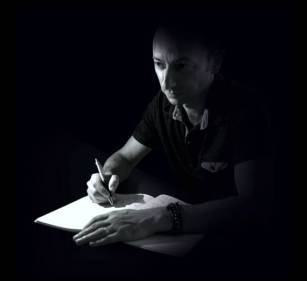
 

claudiu murganClaudiu Murgan was born in Romania and has called Canada his home since 1997. He started writing science fiction when he was 11 years old. Since then he met remarkable writers who helped him improve his own trade. His first novel, The Decadence of Our Souls highlights his belief in a potentially better world if the meanings of Love, Gratitude and Empathy could be understood by all of our brothers and sisters. www.ClaudiuMurgan.com.
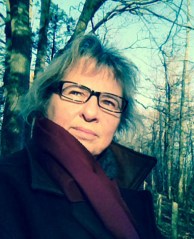


Nina MunteanuNina Munteanu is an ecologist, limnologist and internationally published author of award-nominated speculative novels, short stories and non-fiction. She is co-editor of Europa SF and currently teaches writing courses at George Brown College and the University of Toronto. Visit www.ninamunteanu.ca for the latest on her books.
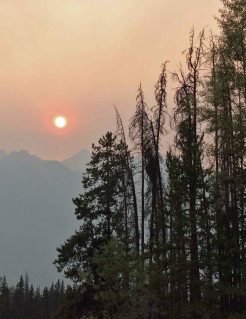
Limestone Genre Expo—May 2018

2018 was the fourth year for Limestone Genre Expo, Kingston’s only genre writing festival. I’ve been to the expo each year from its inaugural festival in 2015. The festival gets its name from the city’s moniker, based on the many heritage buildings constructed there using the local limestone.

In 2016 I was delighted to be the science fiction guest of honour. In 2017, the expo was held at the Saint Lawrence College campus.


Nina-SF GOH-Limestone Genre Expo 2016

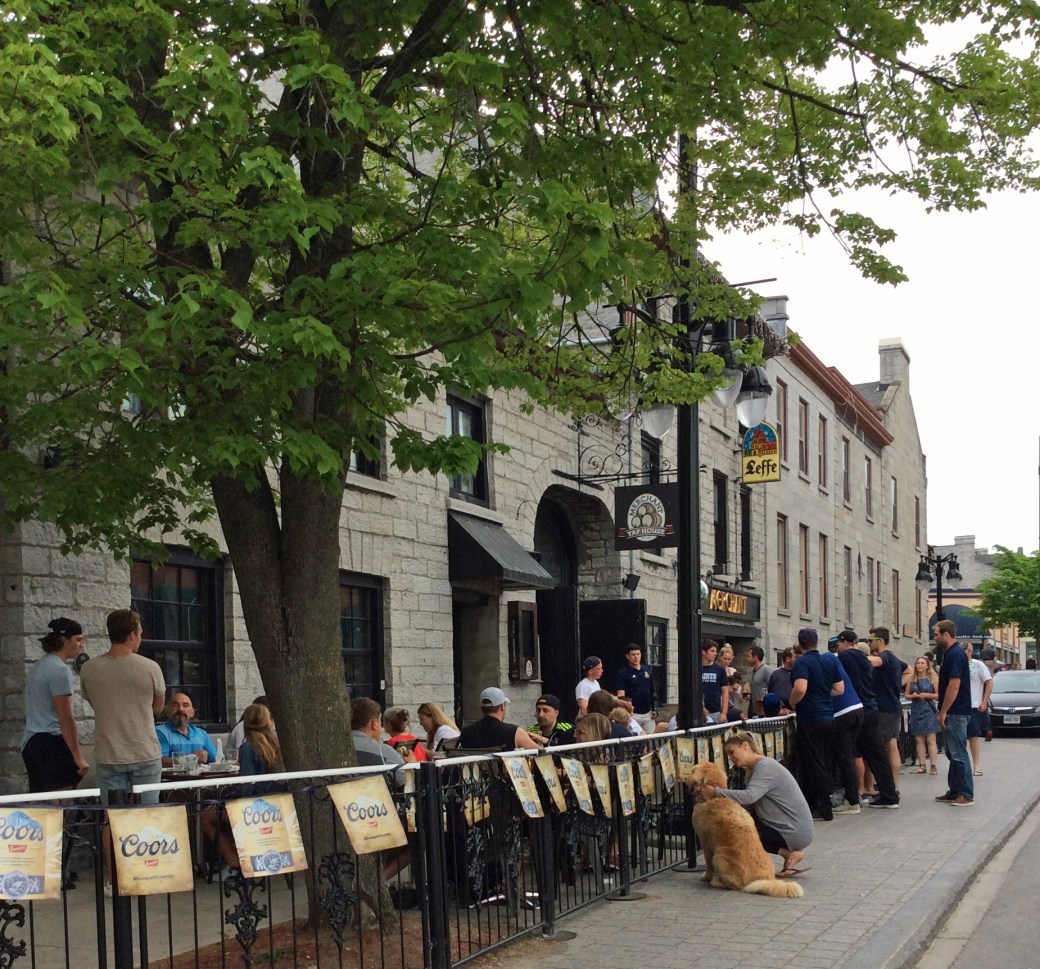
This year, the expo was held at the Holiday Inn, right on the waterfront and literally a staggering distance from the Merchant Tap House, one of the greatest pubs and eateries of the town.

MerchantTapHouse-Limestone2018

Merchant Tap House, Kingston (photo by Nina Munteanu)

As before, the festival covered several of the major genres such as fantasy, science fiction, horror, romance and mystery, with representation by well-known authors in each. Organizers offered a triple track program from 10 am to 5 pm that included panels, informative workshops, readings, book launches, and novel pitch sessions with Bundoran Press.

Liz Strange and programming organizers had me in several panels throughout the two-day expo.

Panels I participated in and in some cases moderated included:

“Mental Health Representation in Fiction: More than Villains” with Michael Slade, Therese Greenwood, Ada Hoffmann, Matt Moore and Madona Skaff. I really enjoyed this panel discussion that explored our evolving perception and representation of mental health in story and in our real lives.

Nina-MentalHealthPanel

Matt Moore, Nina Munteanu, Madona Skaff, Michael Slade, Theresa Greenwood (photo by Marlene Smith)

“Why Do We Love a Good Whodunit?” with Michael Slade, M. H. Callway, Katherine Prairie, Jim Napier, Melissa Yi, and Rosemary McCracken.  The panel and I had fun with this discussion as bizarre real-life stories were thrown into this mix.

Nina-Whodunit Panel

Katherine Prairie, Michael Slade, Melissa Yi, M.H. Callway, Rosemary McCracken, Nina Munteanu

“What Makes a Great Hero?” with Kate Heartfield, Tobin Elliott, Theresa Greenwood, Kris Jacen, Donna Warner, and Douglas Smith. The panel debated what makes a hero, then anti-hero, then sad and terrible hero, then non-hero…and ultimately to the journey of our at times miserable but great hero.

Nina-HeroPanel-LIMESTONE 2018

Douglas Smith, Theresa Greenwood, Nina Munteanu, Donna Warner, Tobin Elliott, Kate Heartfield

“Dystopian Fiction: How to write when the world is falling apart” with Una Verdandi, Robin Timmerman, Brad Baker, Tapanga Koe, Hayden Trenholm and Ursula Pflug. In this rather passionate discussion, we debated the state and shape of dystopia in both the real world and the fiction world and how they inevitably bleed together for the writer.

Nina-signingLastSummoner

Nina signs “The Last Summoner” for colleague and reader Agnes

“Women of Science Fiction” with Hayden Trenholm, Laura Baumbach, Ada Hoffmann, Tanya Huff, Tapanaga Koe, and Nancy Baker.  Hayden emerged amid his female colleagues to astutely discuss the reason we are still discussing this topic.

I also sold a number of books, including Water Is… (a Margaret Atwood favourite), my journal and fiction writing guidebooks (The Journal Writer and The Fiction Writer), Reality Skimming’s Water Anthology, for which I was editor, and The Last Summoner.

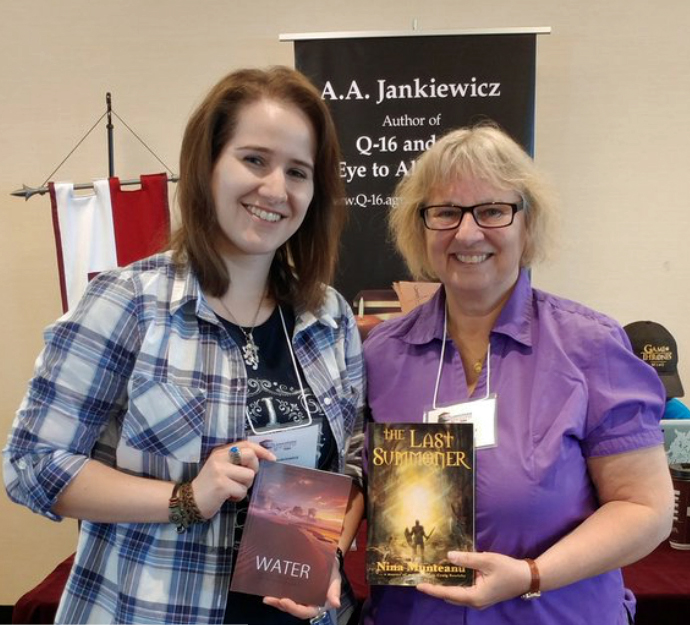
Nina-Agnes-LIMESTONE

authors Agnes Jankiewicz and Nina Munteanu

One of the key charms of this small venue is that it still provides an intimate setting for great networking. I had a chance to meet many of my old friends and to make new ones. Thanks to Liz, Marlene and wonderful volunteers for another great writing festival!


Nina Munteanu

Nina Munteanu is an ecologist, limnologist and internationally published author of award-nominated speculative novels, short stories and non-fiction. She is co-editor of Europa SF and currently teaches writing courses at George Brown College and the University of Toronto. Visit www.ninamunteanu.ca for the latest on her books.
 

“Absolutism” in the Time of Climate Change

AboutAbsolutism-webOnce upon a time, there will be one absolute ruler who we, the people, call the Supreme Leader (May He Rule Forever). The Supreme Leader will hate immigrants, writers, scientists, environment and extinct species. We, the people under his rule, will be proud to live in our pure and glorious Motherland. Because we’ll have little to eat, no entertainment, no self-respect, no freedom, no rights, and no access to the outside world, we’ll be happy.

This is the ridiculously sublime scenario that underlies Absolutism, the dystopian card game developed by science fiction author Costi Gurgu and game developer/designer Vali Gurgu about surviving dictatorship.

A week ago, I invited Costi to my science fiction writing class at George Brown College to share his experience in writing and releasing his recent book RecipeArium (now on the short list for an Aurora Award). Costi also brought his new game, Absolutism, based on his latest novel Servitude—a near future dystopia.

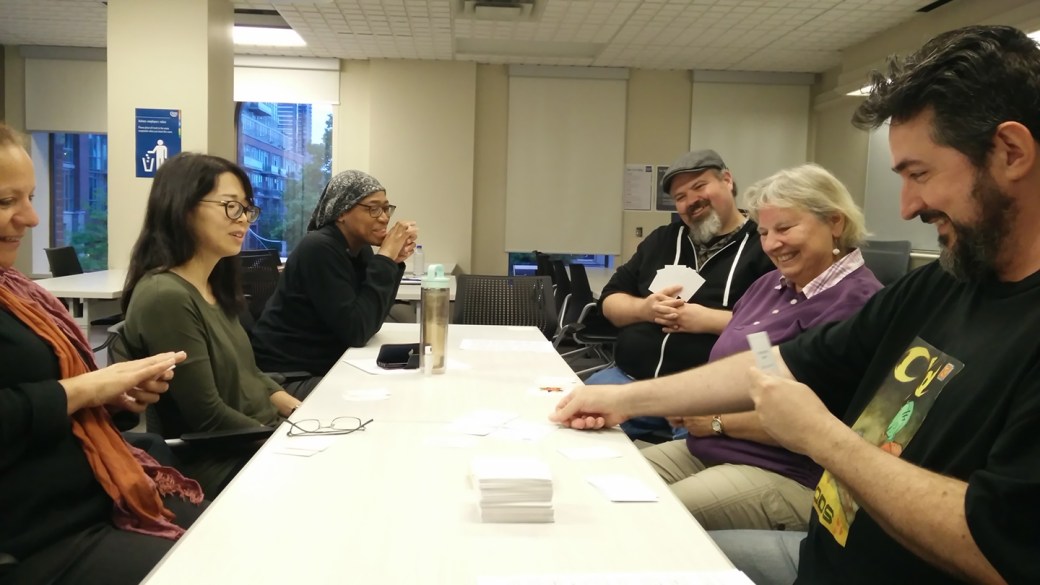
PlaytestGB2

Playing the game at George Brown

“Play unfathomable scenarios of daily life in a totalitarian society. A funny game for people without shame.”—Absolutism


Emerging Dictatorships & “Servitude”—the novel

Costi described how he and Vali came to develop the game: “Based on current global political trends, some could safely assume that in the next 5 to 10 years some present democracies will turn into dictatorships. In Europe for instance, one third of the European countries have nationalistic parties winning their elections—UK, Italy, Poland, Hungary, Slovakia. France and Germany came very close. The United States is slowly sliding into dictatorship. Russia and China are no longer communist countries, like North Korea, but they’re dictatorships. They opened their markets to international trades because they saw the wisdom in making profits, but that was as far as they went with the openness. They still rule their people with an iron fist.”

We are now 7.5 billion people on the planet. As climate change (the ultimate dictator) exacerbates tensions over the unbalanced resource scarcities of our over-populated world, fear-mongering and absolute control of the masses through nationalism, isolationism, trade-wars, etc. will logically follow.

Costi and Vali first conceived a card game entirely based on Costi’s dystopian novel Servitude. But, they soon discovered that the game was too grim.

PlaytestGB3

Life under a Dictatorship—Ceaușescu

Costi and Vali had experienced a dictatorship first hand. They’d grown up in Romania under Communist rule, first by Gheorghe Gheorghiu-Dej, then under the communist dictatorship of Nicolae Ceaușescu. The dictator ruled for over twenty years before a coup d’etat overthrew him in 1989. Ceaușescu had ordered his military to open fire on hundreds of protesters in Timișoara, setting off the Romanian Revolution and ultimately his own execution by firing squad.

Ceaușescu’s totalitarian regime is still considered one of the most repressive in Eastern Europe. His Securitate (secret police) controlled the population through mass surveillance; they enacted many human rights abuses, censorship and relocation, and suppression of the media and press. Political propaganda infected all forms of education, art, entertainment and media. Non-compliant intellectuals were punished, arrested, or simply disappeared.

Inspired by the personality cult surrounding Supreme Leader Kim Il-sung in North Korea, Ceaușescu started his own cult in the Eastern Bloc by imposing a severe nationalist ideology. His policy of economic collectivization destroyed an already fragile economy and oppressed culture. Under the communist regime, thousands of books and magazines were banned and removed from public libraries and schools; intellectuals’ links to the West were severed; long-standing professional organizations were dissolved; and intellectuals, writers, and teachers were imprisoned and put into labor camps.

In Ceaușescu’s Systematisation program of urban planning—based on North Korea’s Juche ideology—whole settlements were demolished and reconstructed in the image of the state.

Ceaușescu made contraception and abortion illegal under Decree 770, and created incentives for high numbers of births—his idea was to increase the country’s population from 22 million to 30 million by the end of the century. By 1977, Romanians were taxed for being childless in a country already unable to house and feed its children. Sadly, this led to an increasing number of orphans, the highest infant mortality rate in Europe and the deaths of thousands of women who attempted illegal abortions. Orphanages were neglected and developed appalling conditions—most were concrete barracks in slums where many children suffered from frostbite, malnutrition and abuse.


“Absolutism”—the game

“Humor is your main weapon in fighting the victorious party and its minions,” say Costi and Vali. “Humor is the one thing that gives people hope and keeps the mental sanity of the masses in the face of oppression.”

And so “Absolutism” was born—a game of twisted strategies, irony and chance. Costi shared that with this game those who have never experienced dictatorship will have a taste of what it is like; the game will also remind those who have escaped oppression by dictatorship what they left behind and why their current freedoms are so precious and important to maintain.

PlaytestGeorgeBrown

players absolutely succumb to the game…

“Maybe after playing Absolutism, people will see that Russia, China, and North Korea are not exceptions,” says Costi. They may realize that “absolutism is not something that can happen only there. It is already knocking on our door.”

Do you have what it takes to survive a totalitarian dictator with a twisted sense of humor? Or to be a successful dictator in the time of climate change?

Having played the game and lost—there is only one winner, of course—I can add that having a twisted sense of humor—is an absolute advantage in the game (along with an absolutely great set of bribe cards!). Thanks to my twisted humor, I was way ahead of everyone and well on my way to becoming the Absolute Ruler, when Costi charged in with a coup d’etat card and I lost all my cards; then the Secret Police rallied behind him and crushed any chance of subversive take over. Maybe next time…

“Absolutism” recently launched on Kickstarter and is still looking for pledges. Make a pledge and help make the game happen—we may never have a better chance at staring unscathed at the face of despotism.


nina-2014aaa

Nina Munteanu is an ecologist, limnologist and internationally published author of award-nominated speculative novels, short stories and non-fiction. She is co-editor of Europa SF and currently teaches writing courses at George Brown College and the University of Toronto. Visit www.ninamunteanu.ca for the latest on her books.
Nina Reads About Water at Oakville Literary Café in Joshua Creek Art Centre

House-road copy

Joshua Creek Art Centre (photo by Nina Munteanu)

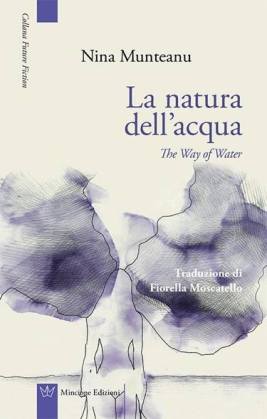
In late May, I was invited to read from my short story “The Way of Water” and my recent book “Water Is…” at the Oakville Literary Café, held at the Joshua Creek Art Centre.


The Way of Water

“The Way of Water” has appeared in several collections and anthologies in Europe and North America and received praise from around the world, including: The National Observer, Prism International Magazine, Speculating Canada, SoloLibri in Italy, and most recently in Orson Scott Card’s The Intergalactic Medicine Show.

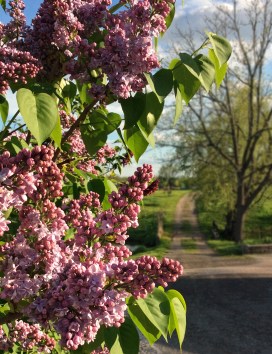
Lilac2-JoshuaCreekArtCentre

Joshua Creek Art Centre (photo by Nina Munteanu)

“The Chinese multinationals have exchanged the public debt of other states with their water reserves with which, now, they can control the climate, deciding when and where it will rain.Who understands this dirty game has been silenced, like Hilda’s mother, a limnologist, inexplicably arrested and never returned; like the daughter of two water vendors, mysteriously disappeared, after having decided not to bow to economic powers: Hanna, who now prefers secure virtual identities to evanescent real appearances. Water. The two, like the covalent bond of a complex molecule, develop a relationship of attraction and repulsion that will first make them meet and then, little by little, will change into a tormented love but, at the same time, so pure as to cause Hilda at great risk, to make an extreme decision that will allow Hanna to realize the strange prophecy that the internal voice, perhaps the consciousness of water, had resonated in the two women for a long time.” —Simone Casavecchia, SoloLibri.net

The Way of Water-COVERShe imagines its coolness gliding down her throat. Wet with a lingering aftertaste of fish and mud. She imagines its deep voice resonating through her in primal notes; echoes from when the dinosaurs quenched their throats in the Triassic swamps.

Water is a shape shifter.

It changes yet stays the same, shifting its face with the climate. It wanders the earth like a gypsy, stealing from where it is needed and giving whimsically where it isn’t wanted.

Dizzy and shivering in the blistering heat, Hilda shuffles forward with the snaking line of people in the dusty square in front of University College where her mother used to teach. The sun beats down, crawling on her skin like an insect. She’s been standing for an hour in the queue for the public water tap.

Exile-CanTales ClimateChange copyEmilie Moorhouse of Prism International wrote: “Soon after I finished reading the book, Cape Town—known in precolonial times as “the place where clouds gather”—announced that it was only a few months away from what it called “Day Zero,” the day the city would officially run out of water, making the similarities between fiction and reality more than unsettling. Munteanu’s story is set in a futuristic Canada that has been mined of all its water by thirsty corporations who have taken over control of the resource. Rain has not fallen on Canadian soil in years due to advances in geoengineering and weather manipulation preventing rain clouds from going anywhere north of the Canada-US border.”

“In ‘The Way of Water’, Nina Munteanu pens her love letter to water, exulting it as a liquid that has semi-magical properties…’The Way of Water’ evokes a sense of awareness about issues of access to water and about the dangers of imbalances in that access.”—Derek Newman-Stille, Speculating Canada

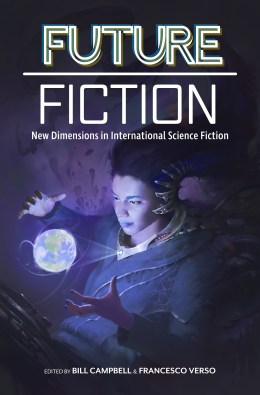
FF - Rosarium Cover copy“…In an interesting scarcity future in which we follow the fate of a character abandoned by her mother, water itself becomes a character. In the second paragraph we’re told that “Water is a shape shifter,” and in the next page we encounter the following description: “Water was paradox. Aggressive yet yielding. Life-giving yet dangerous. Floods. Droughts. Mudslides. Tsunamis. Water cut recursive patterns of creative destruction through the landscape, an ouroboros remembering.” These descriptive musings cleverly turn out to be more than metaphors and tie in directly to the tale’s surprising ending.”—Alvaro Zinos-Amaro, IntergalacticMedicineShow.com


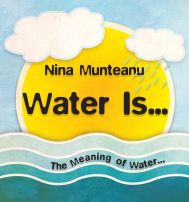
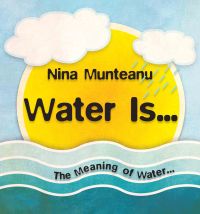
Water Is-COVER-webWater Is… The Meaning of Water

I also read from my non-fiction book “Water Is… The Meaning of Water.” I read several quotes from “Water Is…”. The water quotes had earlier been displayed at a photographic art exhibition in the Great Hall of the Mississauga Civic Centre. The art exhibition celebrated the Waterfront Connection wetland construction, a realized vision of the late Jim Tovey.

Morphology-Looking Up

Photo Art in the Great Hall of the Mississauga Civic Centre

WaterIs story-photo

Quote from Nina Munteanu’s “Water Is…” displayed alongside photo art

Water-travel

Quote from “Water Is…” displayed at the Civic Centre in Mississauga


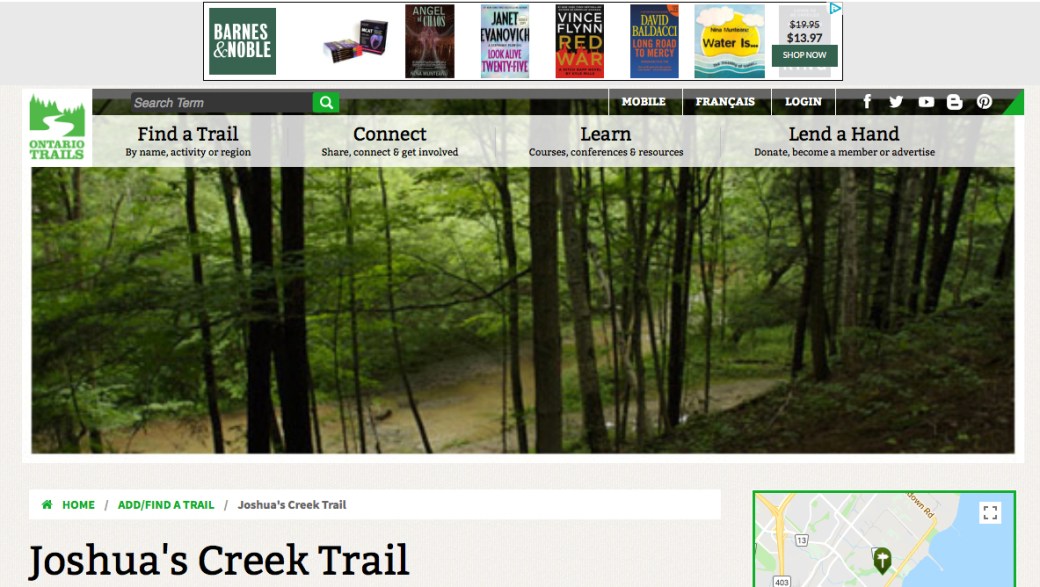
Joshua Creek Heritage Art Centre

JoshuaCreekArtCentre

Back patio of Joshua Creek Art Centre (photo by Nina Munteanu)

Envisioned by Sybil Rampen as a place to meet, collaborate and cultivate relationships, the Joshua Creek Heritage Art Centre was established at the 1827 heritage house on Rampen’s family farm on Burnhamthorpe Road in Oakville. The art centre serves the community as a gathering place—creative media workshops, films, musical events, lectures and weddings. The facility promotes local heritage and accessibility. Ecological integrity remains central to its activities.

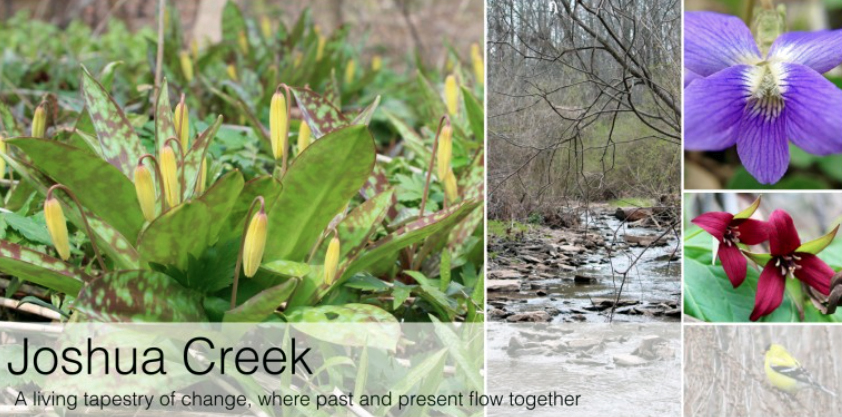
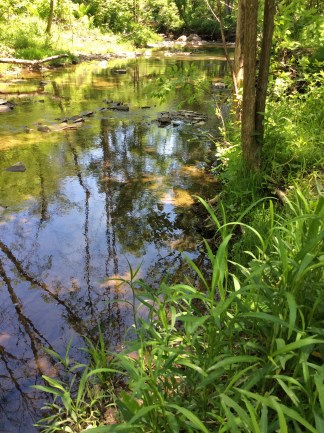
Joshua Creek

JoshuaCreek

JoshuaCk05

Joshua Creek (photo by Nina Munteanu)

Joshua Creek originates near the art centre north of Burnhamthorpe Road and flows about 6 km south through the farm then mostly forest, eventually emptying into Lake Ontario. I was told that the creek has good water quality, apparently the best in the county. Oakvillegreen.org provides some history on Joshua Creek:

“Joshua Creek exists as a patchwork of past glories and present changes on a very dynamic and human-controlled landscape… many of its lands were cleared and altered beyond recognition, with only certain key areas left mostly to nature. In spite of these influences, Joshua Creek is home to 3 small Environmentally Sensitive Areas (ESAs), although two of these – Joshua Creek Valley and Wildflower Woods – have declined since they were highlighted in the 1970’s, and while still valuable, may no longer qualify as ESAs in the future. In only a handful of decades, development has quickly covered most of the lower two thirds of the creek’s land base, including important parts of its ESAs. In several areas, Joshua’s natural winding “meander” has been artificially straightened in order to efficiently use the land on either side. And in many places, foreign species have invaded the natural areas of the creek, changing the ecosystem in a big way.

JoshuaCk03But Joshua is a spirited creek – in spite of all it has been through, Joshua Creek is among the top two urban creeks for healthy water quality, and is still inhabited by a variety of aquatic animals like small fish and insects. Joshua Creek is home to forests, wetlands and thickets with around 150 plant species, and provides an important natural habitat corridor for the movement of birds and other animals, including migratory species. Rather than exclusively shrinking, there are also areas of Joshua Creek that are actually in the middle of regrowing their forests, and in spite of everything, Joshua still retains some beautiful gems of natural areas.”

nina-2014aaa

Nina Munteanu is an ecologist, limnologist and internationally published author of award-nominated speculative novels, short stories and non-fiction. She is co-editor of Europa SF and currently teaches writing courses at George Brown College and the University of Toronto. Visit www.ninamunteanu.ca for the latest on her books.

JoshuaCreek-WaterBanner


Nina Munteanu Talks About “Water Is…” on Green Majority CIUT Radio

Nina-Saryn-CIUT booth

Nina with Saryn Caister of Green Majority CIUT Radio

Host Saryn Caister of The Green Majority CIUT Radio 89.5 FM discusses “Water Is…” with Nina Munteanu and her philosophy to learning and knowledge.

The interview covers some of water’s anomalous properties and why Nina decided to write a book that spans and integrates such a wide variety of angles and subjects from traditional science to spirituality.

CIUT-radioLOGOSaryn and Nina discuss some of water’s controversial properties and the claims about water and how geopolitics plays a role in this. She brings in her own career as a limnologist and how she broke away from her traditional role of scientist to create a biography of water that anyone can understand—at the risk of being ostracized by her own scientific community (just as Carl Sagan and David Suzuki were in the past).

Saryn shared how Ray John Jr., an Indigenous teacher, on a previous show reminded us why these things matter.

Water Is-COVER-webNina responded with, “The why of things and hence the subtitle: the Meaning of Water. What does it mean to you… That’s what’s missing a lot of the time. We are bombarded with information, knowledge and prescriptions but the subliminal argument underneath—the why—why should it matter to me—is often missing. That becomes the sub-text. And it’s nice when it comes to the surface.”


HartHouse-CIUT Radio

Hart House, University of Toronto


nina-2014aaaNina Munteanu is an ecologist, limnologist and internationally published author of award-nominated speculative novels, short stories and non-fiction. She is co-editor of Europa SF and currently teaches writing courses at George Brown College and the University of Toronto. Visit www.ninamunteanu.ca for the latest on her books.


New Directions in Self-Publishing: A Discussion by Writers and Editors

Panel-Nina-water

I was recently invited by Editors Toronto and the Toronto chapter of PWAC to participate in a panel (co-sponsored and hosted by UofT’s Creative Writing Program) exploring the current state of self-publishing and the publishing industry in general. I was one of four professionals whose work has involved all facets of the industry from POD, hybrid models, and ebooks to crowdfunding and writing communities.

The four speakers included:

MeghanBehse_closeMeghan Behse, the president of PubLaunch Inc., a new online marketplace and crowdfunding platform where writers, readers, and publishing professionals join forces to get books published. In her role as publisher, she steered Iguana through a new world of digital and print-on-demand publishing while experimenting with unique royalty arrangements and funding models, including crowdfunding. Behse talked about how PubLaunch is using emerging technologies to help overcome the obstacles writers continue to face in the self-publishing industry.

nina-munteanuNina Munteanu, an experienced editor of traditionally published and self-published books, and an award-winning author of eight novels, including Darwin’s Paradox and The Splintered Universe Trilogy. A frequent contributor to Amazing Stories and the current editor of Europa SF, Munteanu teaches writing at George Brown College and the University of Toronto and has also published short stories, essays, and non-fiction books. Her latest book is Water Is…The Meaning of Water, a scientific study and personal journey as limnologist, mother, teacher, and environmentalist. Munteanu provided an overview of the industry—including use and misuse of terms—then spoke about evolving professional standards in self-publishing, and what these changes mean for writers and editors.

sfyshStephanie Fysh, a Toronto-based freelance editor of independent authors in a variety of genres, including fantasy, science fiction, YA, romance, and erotica, and the former chair of Ryerson University’s Publishing program. She works with hybrid publishers on projects that range from harrowing memoirs to comedy, and still enjoys a textbook project that she can learn something from. Using her own experience as example, she talked about what self-publishing authors look for in an editor, and how that differs from the roles built into traditional or hybrid publishing.

MarkLeslieLefebvre_LaurenLangMark Leslie Lefebvre, the author of more than a dozen traditionally published and self-published books, a professional speaker, a digital publishing advocate, and a bookseller with more than a quarter century of experience.  Lefebvre explained what prompted him to self-publish “ten years before any self-respecting writer would admit to such a foul thing.” And he’ll tackle the big-picture questions: “What is currently wrong with self-publishing, and how can we work together to fix that?”

JessShulmanTweet

I started the panel discussion with an overview of the publishing industry from traditional to indie to self-publishing. I overviewed five main publishing models and discussed advantages and disadvantages depending on needs and perspectives of the writer. A few advantages of self-publishing include: 1) getting a book to market more quickly than through the traditional publishing path; and 2) having more control over the end product.

PublishingModels

The downsides in self-publishing arise from the same: 1) getting a book to market more quickly may seduce writers to compromise the lengthy process of perfecting their work (provided by editors, layout and cover artists) to put something out before it is ready; and 2) having more control also means more responsibility borne by the writer (the need to understand more in book production and marketing than a writer in the traditional process needs to). Another important disadvantage to self-publishing lies in more restricted distributing, marketing and exposure.

In my talk, I emphasized that while the current industry is providing great opportunities, with these come great responsibilities.

PPTslide-opportunies-responsibilities

Authors and editors are currently facing a sea of possibilities. New directions, models, collaborations and structures face us as the publishing industry morphs into something new. Self-publishing and hybrid-players are at the forefront of that evolving tide of new publishing. And it’s very exciting!

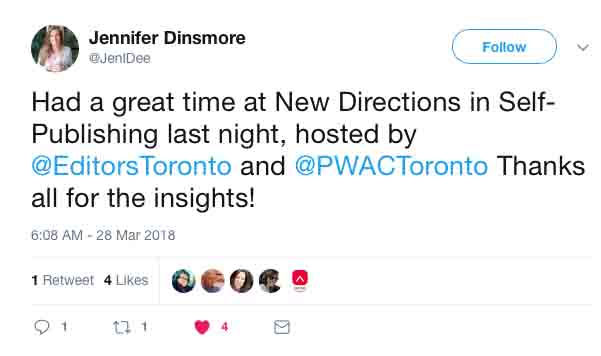
Suzanne Bowness of PWAC Toronto provided a good summary of the panel discussion on PWAC’s blog Networds, and shared by the Editors Toronto blog Boldface. Editor and publishing consultant Michelle MacAleese who attended the event made these observations:

  • Many in the biz draw a distinction between self-published authors and hybrid-published authors; both are “independent,” but the self-published authors are a special breed, who *are starting to understand art and business and (usually) gladly develop proficiency in all the technical and administrative details of the process.
  • Not surprisingly, options for authors continue to change rapidly. What worked best in 2011 is irrelevant today. Many quality companies offer publishing services and hybrid publishing deals. (Many companies will pretty much just steal your money. One must read up before signing up. *Research is paramount)
  • The best publishing option for e-only genre fiction won’t be the same as for a debut hardcover business book. It’s a wide world of independent publishing.
  • Authors: If you don’t love technical things (formatting ebooks, working Amazon’s categories, tweaking descriptive copy), you probably won’t enjoy starting a publishing house of one.
  • Editors: Working with self-published authors is a specialty and those editors who are good at taking on that relationship and guiding the process are worth their weight in gold. (Isn’t it about time we begin to mentor each other in why this kind of author-editor relationship is unique, and how it borders on the agent role at times? *This is a great opportunity for editors willing to evolve and grow.)
  • Editors who already specialize in working with self-published authors: Let’s talk about how to partner with reputable publishing services companies as well as with other independent designers and book marketing professionals to launch great self-published books that sell! This point was just touched upon in the panel and is still evolving; again, editors are uniquely positioned as author-consultants to play key roles in new networks of independent professionals in the publishing industry. *italics throughout are mine

MichelleMacAleese-Tweet

JenDinsmoreTweet

A few years ago, I gave a talk at Editors Toronto on the industry from the self-publishing author and freelance editor’s perspective. It remains highly relevant today, given that it spoke to the changing face of publishing and what it means for editors and writers. Editors learned about self-publishing and indie publishing, publishing myths, and imaginative ways to find new editing opportunities:

Self-publishing used to be a scar; now it’s a tattoo.”–Greg Cope White

Other relevant articles include:

Nina Munteanu on the Author-Editor Relationship

Beating Today’s “S” Curve (or Why an Editor is Every Writer’s Best Friend)

Walking the Tightrope Between Innocent and Cynical

The Moving Target of Indie Publishing: What Every Editor (and Writer) Needs to Know

The Writer-Editor Relationship, Part 1: Editors Preparing Writers

The Writer-Editor Relationship, Part 2: Five Things Writers Wish Editors Knew—and Followed

The Hidden Costs of Self-Publishing, Part 1: The Solution to “Author Solutions”

What Indie Authors Should Know for 2015

Surfing the Hybrid Wave of Publishing

The Indie Book Tidal Wave…What Does it Mean for Bookstores, Publishers & Writers?


nina-munteanuNina Munteanu is an ecologist and internationally published author of award-nominated speculative novels, short stories and non-fiction. She is co-editor of Europa SF and currently teaches writing courses at George Brown College and the University of

Nina Talks Water with Grade 8 Students on World Water Day

Nina-Grade 8 on Water-March22-2018 copy

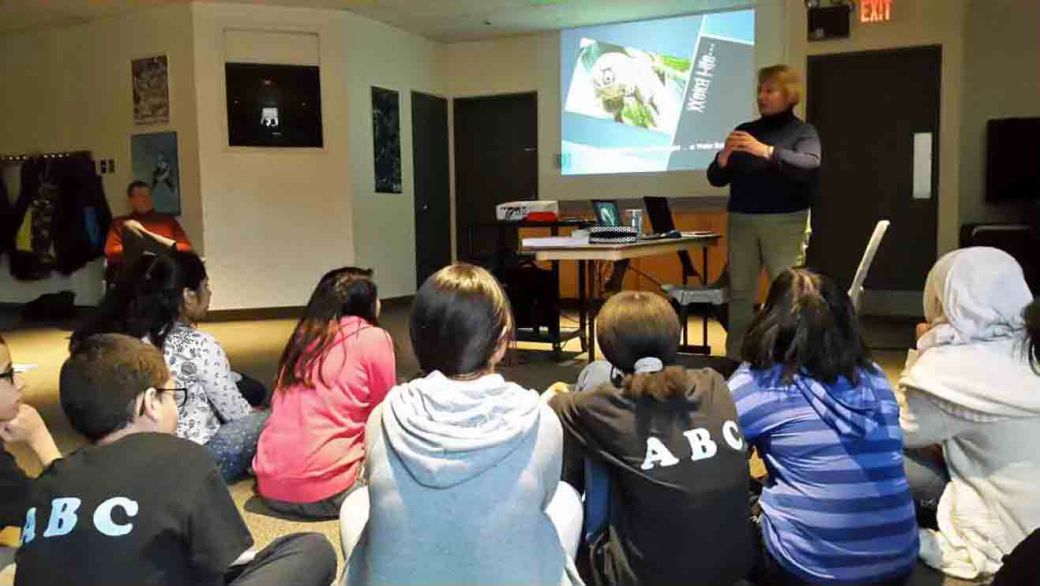
Nina talks with Valleys Senior Public School Grade 8 students about water

On World Water Day, at the kind invitation of Alene Sen (supervisor and coordinator for the City of Mississauga at the Mississauga Valley Library) I talked to some 100 Grade 8 students of Valleys Senior Public School about water. Several classes, in groups of about fifty students each, came at tandem to the library to learn something about water.

I had about half an hour to prime them with something that would spark their interest and which they could take home and think about—and possibly apply in stewardship.

carboniferous-paleozoic eraI started the talk by explaining that I’m a limnologist—someone who studies freshwater—and that water is still a mysterious substance, even for those who make it their profession to study.  After informing them of water’s ubiquity in the universe—it’s virtually everywhere from quasars to planets in our solar system—I reminded them that the water that dinosaurs drank during the Paleozoic Era is the same water that you and I are drinking.

We briefly reviewed some of water’s most interesting anomalous and life-giving properties such as cohesion and adhesion—responsible for surface tension and water’s capillary movement up trees. Below is an excellent 4-minute YouTube video “The Properties of Water” that describes these properties well.

I reviewed the circle of life and energy in an aquatic ecosystem and used the grey whale as an example to study trophic cascades and the balanced trophic cycle—with an endnote on the whale’s significant role in influencing climate.

I introduced each class to the incredible and very tiny Tardigrade, also known as the water bear or moss piglet, with magical properties of its own. The 4-minute TED video by Thomas Boothby is particularly instructive and entertaining.

I then showed the class an image of the Three Gorges Dam in China and reported how as a result of so much dam-building and retention of water—and because most dams are located in the northern hemisphere—we have slightly changed how the Earth spins on its axis. We’ve sped its rotation and shortened the day by 8 millionths of a second in the last forty years.

3-gorges dam

Water needs to constantly move. The Water cycle moves through the planet in all three forms (vapour, liquid and ice), over land and sea and through the earth, but also through all life. We are part of that cycle. We drink it and get immersed in it; we also breathe water in with every breath we take and breathe it out with every breath we exhale.

We are water; what we do to water, we do to ourselves.

I invited the class to discuss things we could do to help water as it moves through the planet. We talked about things we could do at home, with our friends, in our school and community to help water. Things like planting a tree in your back yard; adopting a nearby stream and taking care of it; organizing a beach clean-up; deciding to do something at home to waste water less.

Each action is a small thing. But that is how large things happen, through the accumulation of small things. And with every “small” action is a small shift in thinking, which leads to the kind of leadership that will change the world and make it a better place—for water and everything that depends on it.

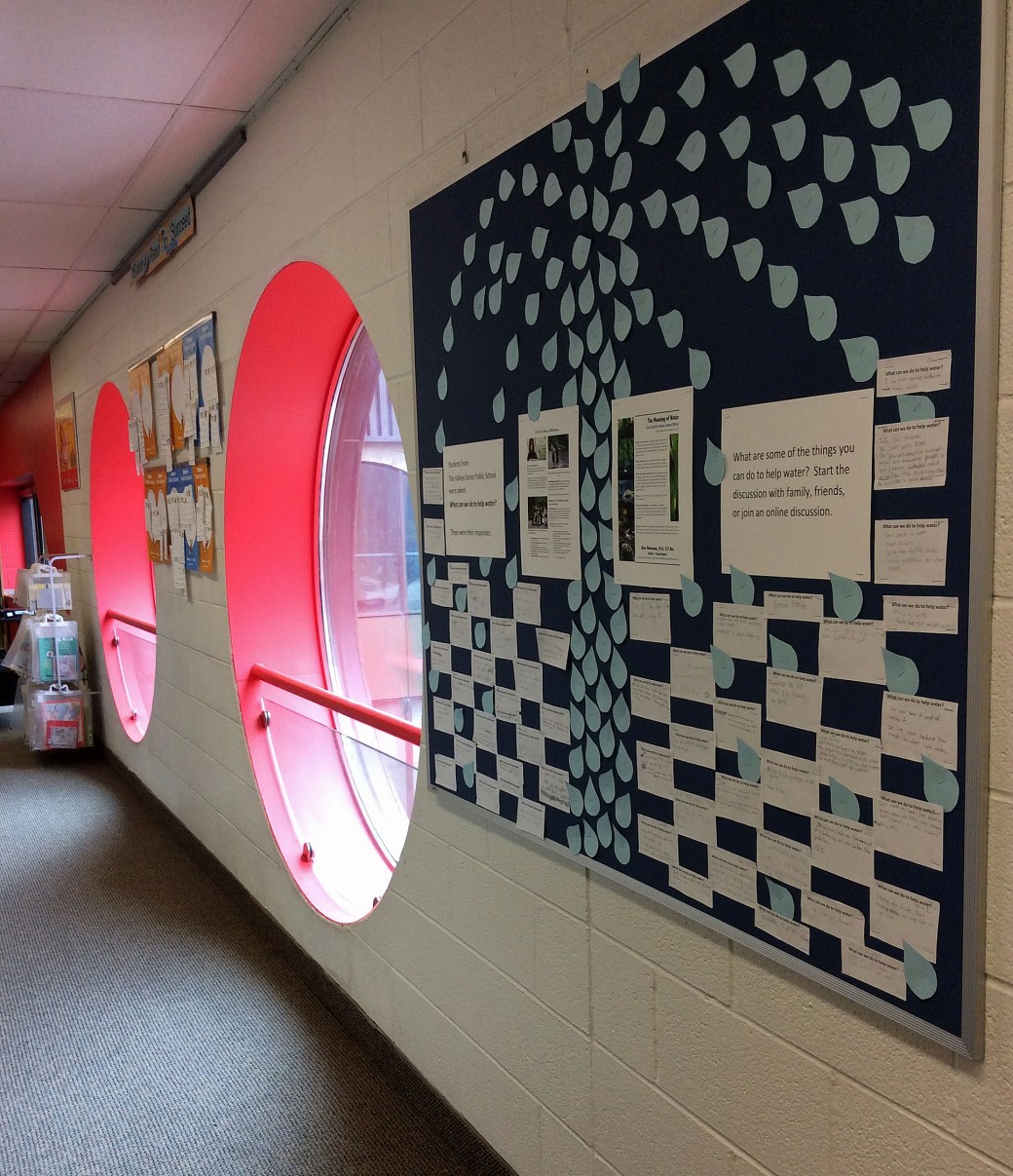
After a discussion of the problems now facing water on the planet, we asked the students from The Valleys Senior Public School to answer the question “What can we do to help water?” on a small sheet of paper, which we then collected. Their responses showed great thought and a willingness to do something concrete. Alene created a billboard at the Mississauga Valley Library with the Valleys Senior Public School student responses to the question.

Water-students-13

Water Tree Display with student responses to the question: “What can we do to help water?”

Below are some examples of responses by students…

Water-students-11

Water-students06

Water-students-Alenelibrary

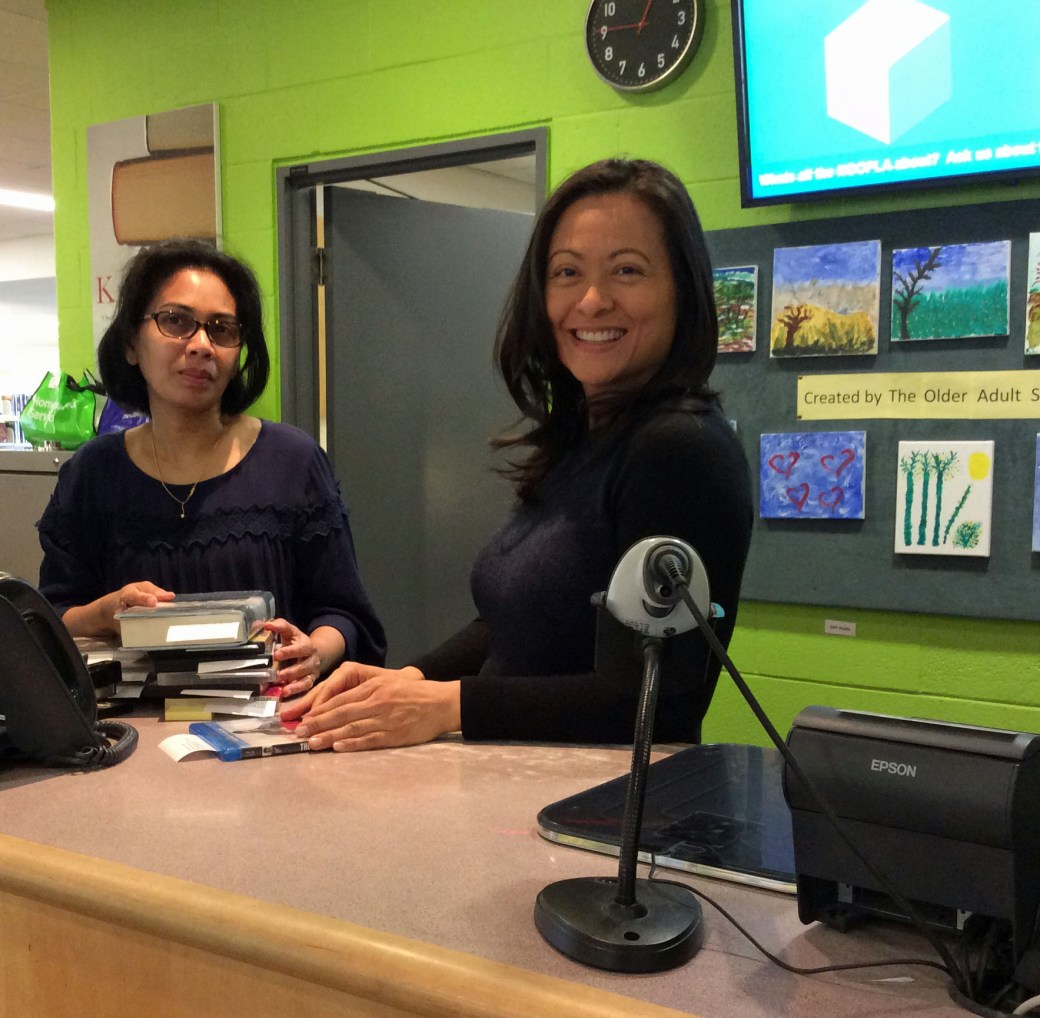
Alene Sen and co-worker at the Mississauga Valley Library

Water Is-COVER-webYou can read so much more about water in my book “Water Is…”. Go see what people are saying about “Water Is…”


nina-2014aaaNina Munteanu is an ecologist, limnologist and internationally published author of award-nominated speculative novels, short stories and non-fiction. She is co-editor of Europa SF and currently teaches writing courses at George Brown College and the University of Toronto. Visit www.ninamunteanu.ca for the latest on her books.