Nina Reads About Water at Oakville Literary Café in Joshua Creek Art Centre

House-road copy

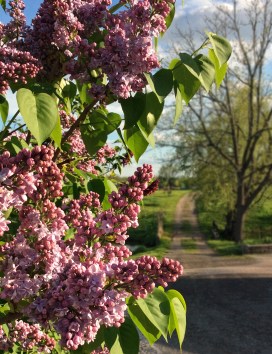
Joshua Creek Art Centre (photo by Nina Munteanu)

In late May, I was invited to read from my short story “The Way of Water” and my recent book “Water Is…” at the Oakville Literary Café, held at the Joshua Creek Art Centre.


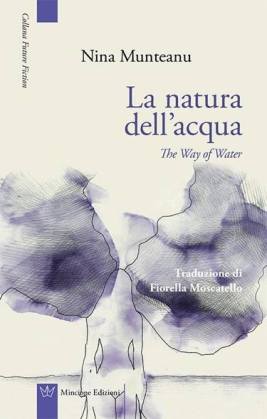
The Way of Water

“The Way of Water” has appeared in several collections and anthologies in Europe and North America and received praise from around the world, including: The National Observer, Prism International Magazine, Speculating Canada, SoloLibri in Italy, and most recently in Orson Scott Card’s The Intergalactic Medicine Show.

Lilac2-JoshuaCreekArtCentre

Joshua Creek Art Centre (photo by Nina Munteanu)

“The Chinese multinationals have exchanged the public debt of other states with their water reserves with which, now, they can control the climate, deciding when and where it will rain.Who understands this dirty game has been silenced, like Hilda’s mother, a limnologist, inexplicably arrested and never returned; like the daughter of two water vendors, mysteriously disappeared, after having decided not to bow to economic powers: Hanna, who now prefers secure virtual identities to evanescent real appearances. Water. The two, like the covalent bond of a complex molecule, develop a relationship of attraction and repulsion that will first make them meet and then, little by little, will change into a tormented love but, at the same time, so pure as to cause Hilda at great risk, to make an extreme decision that will allow Hanna to realize the strange prophecy that the internal voice, perhaps the consciousness of water, had resonated in the two women for a long time.” —Simone Casavecchia, SoloLibri.net

The Way of Water-COVERShe imagines its coolness gliding down her throat. Wet with a lingering aftertaste of fish and mud. She imagines its deep voice resonating through her in primal notes; echoes from when the dinosaurs quenched their throats in the Triassic swamps.

Water is a shape shifter.

It changes yet stays the same, shifting its face with the climate. It wanders the earth like a gypsy, stealing from where it is needed and giving whimsically where it isn’t wanted.

Dizzy and shivering in the blistering heat, Hilda shuffles forward with the snaking line of people in the dusty square in front of University College where her mother used to teach. The sun beats down, crawling on her skin like an insect. She’s been standing for an hour in the queue for the public water tap.

Exile-CanTales ClimateChange copyEmilie Moorhouse of Prism International wrote: “Soon after I finished reading the book, Cape Town—known in precolonial times as “the place where clouds gather”—announced that it was only a few months away from what it called “Day Zero,” the day the city would officially run out of water, making the similarities between fiction and reality more than unsettling. Munteanu’s story is set in a futuristic Canada that has been mined of all its water by thirsty corporations who have taken over control of the resource. Rain has not fallen on Canadian soil in years due to advances in geoengineering and weather manipulation preventing rain clouds from going anywhere north of the Canada-US border.”

“In ‘The Way of Water’, Nina Munteanu pens her love letter to water, exulting it as a liquid that has semi-magical properties…’The Way of Water’ evokes a sense of awareness about issues of access to water and about the dangers of imbalances in that access.”—Derek Newman-Stille, Speculating Canada

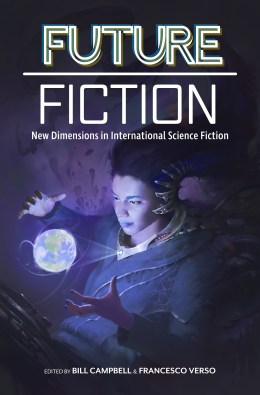
FF - Rosarium Cover copy“…In an interesting scarcity future in which we follow the fate of a character abandoned by her mother, water itself becomes a character. In the second paragraph we’re told that “Water is a shape shifter,” and in the next page we encounter the following description: “Water was paradox. Aggressive yet yielding. Life-giving yet dangerous. Floods. Droughts. Mudslides. Tsunamis. Water cut recursive patterns of creative destruction through the landscape, an ouroboros remembering.” These descriptive musings cleverly turn out to be more than metaphors and tie in directly to the tale’s surprising ending.”—Alvaro Zinos-Amaro, IntergalacticMedicineShow.com


Water Is-COVER-webWater Is… The Meaning of Water

I also read from my non-fiction book “Water Is… The Meaning of Water.” I read several quotes from “Water Is…”. The water quotes had earlier been displayed at a photographic art exhibition in the Great Hall of the Mississauga Civic Centre. The art exhibition celebrated the Waterfront Connection wetland construction, a realized vision of the late Jim Tovey.

Morphology-Looking Up

Photo Art in the Great Hall of the Mississauga Civic Centre

WaterIs story-photo

Quote from Nina Munteanu’s “Water Is…” displayed alongside photo art

Water-travel

Quote from “Water Is…” displayed at the Civic Centre in Mississauga


Joshua Creek Heritage Art Centre

JoshuaCreekArtCentre

Back patio of Joshua Creek Art Centre (photo by Nina Munteanu)

Envisioned by Sybil Rampen as a place to meet, collaborate and cultivate relationships, the Joshua Creek Heritage Art Centre was established at the 1827 heritage house on Rampen’s family farm on Burnhamthorpe Road in Oakville. The art centre serves the community as a gathering place—creative media workshops, films, musical events, lectures and weddings. The facility promotes local heritage and accessibility. Ecological integrity remains central to its activities.

Joshua Creek

JoshuaCreek

JoshuaCk05

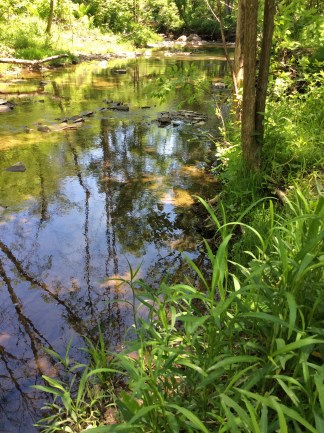
Joshua Creek (photo by Nina Munteanu)

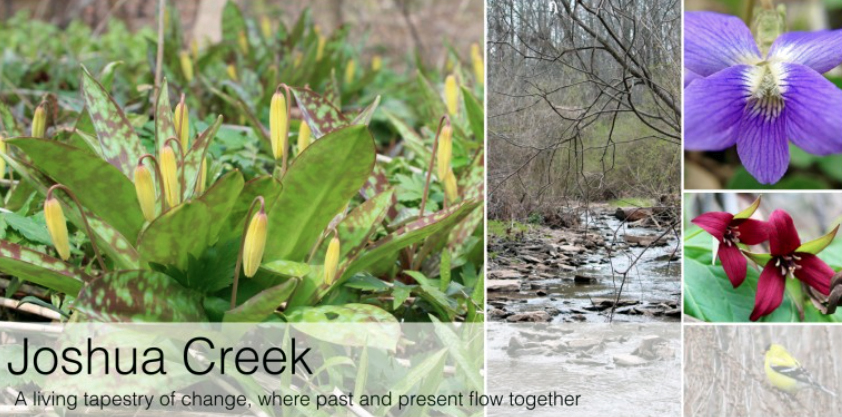
Joshua Creek originates near the art centre north of Burnhamthorpe Road and flows about 6 km south through the farm then mostly forest, eventually emptying into Lake Ontario. I was told that the creek has good water quality, apparently the best in the county. Oakvillegreen.org provides some history on Joshua Creek:

“Joshua Creek exists as a patchwork of past glories and present changes on a very dynamic and human-controlled landscape… many of its lands were cleared and altered beyond recognition, with only certain key areas left mostly to nature. In spite of these influences, Joshua Creek is home to 3 small Environmentally Sensitive Areas (ESAs), although two of these – Joshua Creek Valley and Wildflower Woods – have declined since they were highlighted in the 1970’s, and while still valuable, may no longer qualify as ESAs in the future. In only a handful of decades, development has quickly covered most of the lower two thirds of the creek’s land base, including important parts of its ESAs. In several areas, Joshua’s natural winding “meander” has been artificially straightened in order to efficiently use the land on either side. And in many places, foreign species have invaded the natural areas of the creek, changing the ecosystem in a big way.

JoshuaCk03But Joshua is a spirited creek – in spite of all it has been through, Joshua Creek is among the top two urban creeks for healthy water quality, and is still inhabited by a variety of aquatic animals like small fish and insects. Joshua Creek is home to forests, wetlands and thickets with around 150 plant species, and provides an important natural habitat corridor for the movement of birds and other animals, including migratory species. Rather than exclusively shrinking, there are also areas of Joshua Creek that are actually in the middle of regrowing their forests, and in spite of everything, Joshua still retains some beautiful gems of natural areas.”

nina-2014aaa

Nina Munteanu is an ecologist, limnologist and internationally published author of award-nominated speculative novels, short stories and non-fiction. She is co-editor of Europa SF and currently teaches writing courses at George Brown College and the University of Toronto. Visit www.ninamunteanu.ca for the latest on her books.

JoshuaCreek-WaterBanner


Places to Write: My Secret Places at The University of Toronto

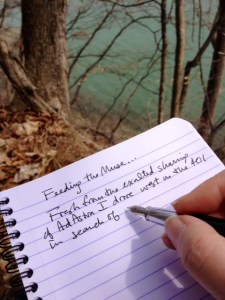
notebook01In my writing guidebook The Journal Writer: Finding Your Voice I write a section on finding the right time and place to write. I call them “sacred”, because that’s what they are. Without them, we struggle to write. In Chapter Two of The Journal Writer I write about the need for a sacred place in journal writing, particularly. The advice is equally important to any form of writing.

Journal Writer-FRONT-cover-WEBFinding the perfect place(s) to write … is important to creating meaningful entries. Journal writing is a reflective activity that requires the right environment for you. The best environment is a quiet one with no interruptions and where you are alone. A reflective environment will let you relax, find a connection with yourself and your feelings. You need a place where you can relax and not worry about someone barging in or other things distracting you from your thoughts. You should also feel physically comfortable and the place should meet your time requirements.

Because the suitability of a place can change with the time of day, learn the rhythms that affect the place you wish to write in. For example, the kitchen may be the centre of activity during the day but an oasis of quietude during the evening. Similarly, learn what kind of environment stimulates and nurtures your writing. Does music help or do you need complete quiet? Do you respond to nature’s soft breezes and sounds or do you prefer to surround yourself with the anonymous murmur of a crowded café for company?

Places that work for me include the local coffee shop, a park near my house, a library or other quiet place where I can enjoy uninterrupted anonymity. Where you write may reflect what you’re writing and vice versa. To some extent, you are environment and environment is you. You might try a few places first and see what happens to the content of your entries. Entries you make while sitting under an apple tree in the breeze hearing the birds singing may differ from entries you make while sitting in your living room by the crackling fireplace with music playing or sitting at your desk in your bedroom in total silence or in a crowded café surrounded by cheerful bustle. I give more details on how to feed the muse in Chapter 4.

Nina-computer-Krave

Sitting in Krave’s outside patio

Some of my favourite places to write are indie cafés that express unique character and rich ambience. Amid the desultory chatter and laughter of people and sipping my flat white, I find myself deep in writing. These days you can most likely find me somewhere on the University of Toronto campus where I teach engineering students, social science students, and health science students how to write.

It’s been four years since I came to UofT and I still feel a glow every time I walk through campus. Whether it’s past a century-old stone building, beneath a canopied archway of chestnuts, into a well-treed enclave, or through a high-ceilinged glass building; I am both home and on an adventure.

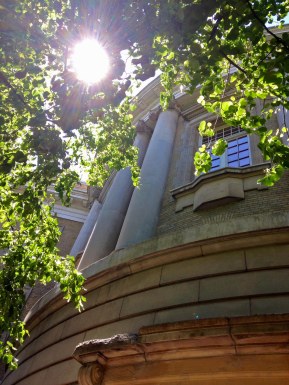
ConvocationHall-web

Convocation Hall, UofT

UofT is a place of learning—erudite, splendid, lofty yet humble—and beautifully epitomizing “new embracing old”. When new embraces old, we get magic. Wizard-magic. Harry Potter kind of magic. The kind of magic that only someone who is open, faithful, and confident can wield. This is ancient magic. The magic that lurks like Reznikoff’s ghost in the ancient halls of University College, or the magic currently wielded at 1 Spadina. A magic borne of wisdom, lore, and story.

Established in 1827, the University of Toronto is snugly located in the centre of downtown Toronto; yet, it’s not so much a part of the city as the city is a part of it.  UofT’s campus probes into the city’s infrastructure like a creative amoeba: interacting, absorbing and expressing. The UofT downtown campus sprawls dozens of blocks in all directions; embedding itself in the city with a blend of century-old buildings and avant-garde modern chic. It’s not so much re-inventing itself at every turn as morphing and co-evolving with the city.

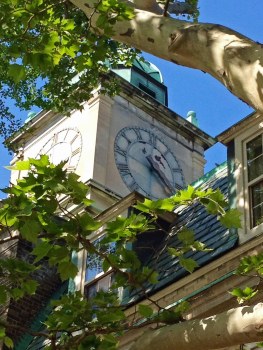
UofT-clocktower-sicamortrees

Clock tower, UofT

The UofT campus represents for me the very best the city—any city—has to offer: a vibrant, well-connected place of learning and activity, supported by original and tasteful landscape architecture: healthy trees and parkland full of songbirds, tasteful new and old architecture and alluring courtyards and doorways that beckon my creative soul. The UofT campus provides a myriad of possibilities and historic depth for the adventurous soul. Did you know, for instance, that Canada’s first electric computer was installed at UofT? Or that UofT is haunted? Or that much of UofT’s architecture was inspired by structures at Oxford and Cambridge? Or that an old nuclear accelerator sits fallow in the McLennan Physical Labs building?

My creative soul appreciates UofT’s integration of nature into its architecture and grounds. Its natural enclaves provide ideal settings for quiet contemplation and reflection. They’ve become my “secret places,” destinations along my journeys across campus to my various writing appointments. Places where I can sit, reflect and write. Here are just a few:

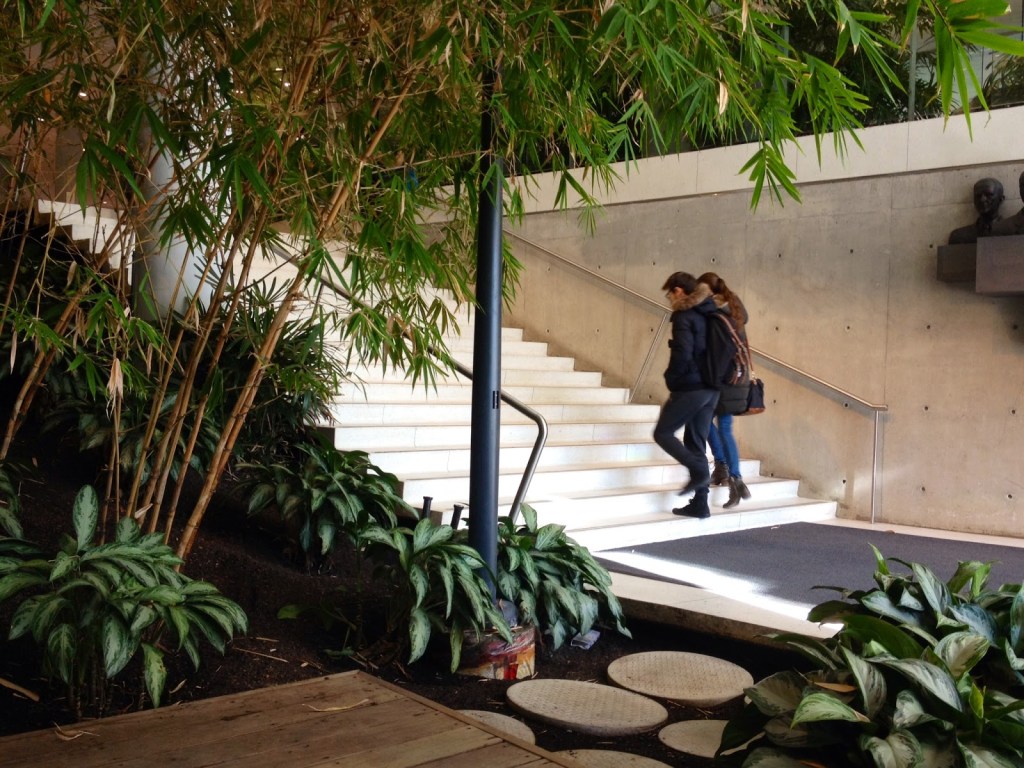
  1. Terrence Donnelly’s Bamboo Garden in Terrence Donnelly Centre:
BambooGarden01

Steps leading up past bamboo garden of Terrence Donnelly Centre

The Terrence Donnelly Centre for Cellular & Biomolecular Research (CCBR) is where some of the coolest research and discoveries in biomolecular and cellular research are being made. Benjamin Blencowe and his team’s recent uncovering a protein’s sweeping influence on autism last December using introverted mice, for instance. Named after the philanthropist Terrence J. Donnelly, the centre was the vision of UofT Professors Cecil Yip and James Friesen.

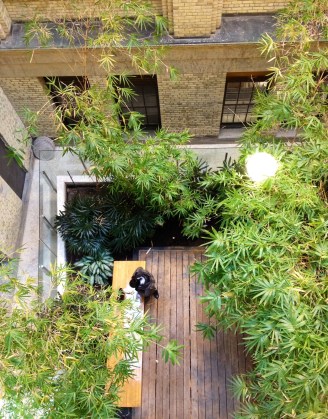
BambooGarden-lookingdown

View of garden resting area from above

In the 1990s they foresaw that new genomic technologies would open-up progress in biomedical research in a time when there was no human genome sequence or stem cell technologies and DNA sequencing was slow and inexpensive. Yip and Friesen envisioned a collaborative and interdisciplinary research facility that, when it opened in 2005, brought together over 500 specialists—biologists, computer scientists, physicians, pharmacists and engineers—to advance the university’s groundbreaking research in molecular biology.

BambooGarden-RosebrughWall

View of Rosebrugh wall from the garden

The centre is located on what was previously Taddle Creek Road. The CCBR building—which from College Street resembles two colourful stacked cubes—is set back by a gradually sloping plaza with granite benches and groves of white paper birch. The building and plaza are flanked by several historic buildings (80-year old Fitzgerald Medical Building to the east; the 1919 Rosebrugh Institute of Biomaterials and 100-year old Lassonde Mining building to the west; and the Medical Sciences Building to the north).


The bamboo garden in Donnelly’s spacious atrium is meditative and calming; a lush forest of bamboo and shrubs amidst wooden floors, benches and steps. Created by landscape architect Diana Gerrard, the garden offers several “picnic” sites of wooden platforms and benches, which I learned had come from the ash, tulip and cherry trees that had occupied the original lane way.

BambooGarden-entrance

Entranceway with bamboo garden of Terrence Donnelly Centre

Upon entering the complex from College Street, the granite plaza gives way to white terrazzo flooring in an expansive multi-story atrium. The top lit glass-ceilinged atrium connects the adjacent heritage Rosebrugh building to the CCBR in a counterpoint of techno-minimalism with Romanesque tradition. As I walk up the shallow wide steps lined by pillars that reach skyward, the tall bamboo forest to my left beckons. I’ve had many lunches there. I also spend many moments sitting there with a book, reading or just daydreaming beneath a texture of greens.

  1. Breezeway of Knox College Quad:
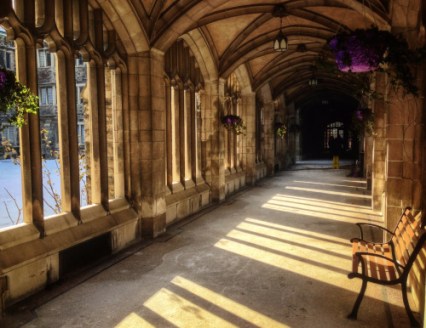
knox college breezeway04 copy

Knox College breezeway in winter

I usually enter the perpendicular gothic style building from St. George Street; though, you can also come in via Kings College Circle, past the chapel—known for its Hellmuth Wolff organ. Once I pass through the heavy doors of the St. George entrance, I enter a dark foyer and instantly feel like I’m in a church. The chapel is on the other side, yet the deep quiet and surrounding dark wood of the floors, walls and stairways to the right and left of me, enclose me with a sense of sacred holiness. I walk the echoing foyer to the stained-glass doorway of the breezeway ahead. As I open the glass door, the complex scent of tulips and pine greets me with the warm breeze. I have entered another magic place.

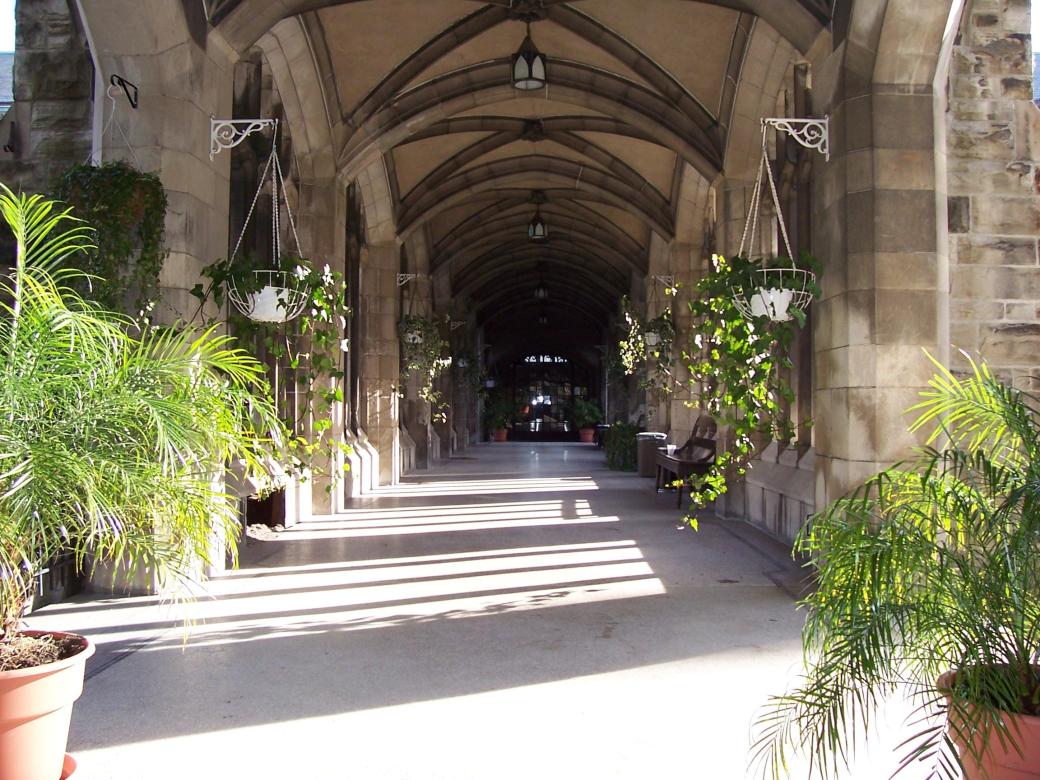
The gothic archway that connects the Knox College Quad is an open breezeway that looks out onto the interior gardens of the quad. Tables and chairs along each side provide a peaceful place to read and write with a quiet view of the outside courtyard of flowers, shrubs, trees and benches. Hanging vines provide additional greenery in the archway.

knox breezeway01 copy

Knox College breezeway through courtyard

Whenever I come here, the hustle and bustle of the city just fades away. Busy St. George Street is nearby; yet I don’t feel its influence within this quiet haven, where the soft sounds of Nature embrace me with their songs and stories. I often come here to read and write. I listen to the birds and other natural sounds, letting them lull me into a meditative quietude of bliss. Life slows to a philosopher’s pace and my creative muse awakens. Sometimes I bring one of my indulgences—a poutine from one of the chip trucks on St. George—and feast in my secret place as Nature’s melodies feed my soul. On a warm day, the breezeway also provides a cool respite.

  1. The Laidlaw Quadrangle behind University College
Gate to UC courtyard

West gate into University College courtyard

When I first discovered this hidden quadrangle, I felt goosebumps of pure magic course through me. My discovery visit was through the west arched entranceway off the west green, past Bissell House. I passed the gateway into the Courtyard Colonnade, and faced a sunken courtyard shaded by large ironwood and maple trees and surrounded by gothic brick and stone. I’d entered an enchanting world of quiet reflection.

A paved walkway—supported by retaining walls and planted with flowering shrubs—runs on three sides of the quadrangle. The walkway broadens into a terrace to the north, forming an extension of the new Library colonnade. Mature maple and ironwood trees overhang the cloisters and the walkway.

WestCollonade-looking west

West colonnade of quadrangle

Designed by Canadian landscape architect Michael Hough, the quadrangle evokes the courtyards of medieval monasteries and old English universities. Built in 1964, when the Laidlaw wing (and library) separated the college from back campus, Hough’s design translates the essential feature of a monastery or college courtyard—access from inside the building to a covered walk around an open centre—from architecture to landscape.


UniversityCollege-WestCollonade

View of courtyard (to left) from west cloister of University College

I’ve since discovered other ways to enter and leave the quadrangle, each one presenting a new perspective to this peaceful place. Each time I come here, I feel my soul sigh with joy. Birds sing the poetry of Nature. Leaves rustle as the wind plays on them. When I’m here, I feel at peace in the city.

photo-24

UofT Faculty Club

UofT Faculty Club: Every journey requires repast—a place to relax, eat and drink—and my feet naturally direct me to one of my new favourite haunts: the UofT Faculty Club. Located close to the hub of the campus, on Willcocks Street just east of Spadina, the club is open to members who include faculty, staff, graduate alumni and their guests. I enter the 1896 heritage building, built in a Georgian Revival-style, and passed the elegant first floor lounge to the pub below. The pub welcomes me with excellent food, drink and a relaxing ambience. Bathed in rich tones of wood and comfortable chairs and warmed by a cozy fireplace, it reminds me of a Dorset pub I’d visited years ago; full of colourful characters and a well-stocked bar.

UniversityCollege-windows

Windows of University College

I feel both at home and like a traveler. Like I’d walked into history with modern comfort. I order the beet salad from my friendly waitress; it provides a refreshing and attractive light meal for a mid-day travelling writer.

Nina Munteanu

Nina Munteanu is an ecologist, limnologist and internationally published author of award-nominated speculative novels, short stories and non-fiction. She is co-editor of Europa SF and currently teaches writing courses at George Brown College and the University of Toronto. Visit www.ninamunteanu.ca for the latest on her books.


Pictures by Nina Munteanu


New Directions in Self-Publishing: A Discussion by Writers and Editors

Panel-Nina-water

I was recently invited by Editors Toronto and the Toronto chapter of PWAC to participate in a panel (co-sponsored and hosted by UofT’s Creative Writing Program) exploring the current state of self-publishing and the publishing industry in general. I was one of four professionals whose work has involved all facets of the industry from POD, hybrid models, and ebooks to crowdfunding and writing communities.

The four speakers included:

MeghanBehse_closeMeghan Behse, the president of PubLaunch Inc., a new online marketplace and crowdfunding platform where writers, readers, and publishing professionals join forces to get books published. In her role as publisher, she steered Iguana through a new world of digital and print-on-demand publishing while experimenting with unique royalty arrangements and funding models, including crowdfunding. Behse talked about how PubLaunch is using emerging technologies to help overcome the obstacles writers continue to face in the self-publishing industry.

nina-munteanuNina Munteanu, an experienced editor of traditionally published and self-published books, and an award-winning author of eight novels, including Darwin’s Paradox and The Splintered Universe Trilogy. A frequent contributor to Amazing Stories and the current editor of Europa SF, Munteanu teaches writing at George Brown College and the University of Toronto and has also published short stories, essays, and non-fiction books. Her latest book is Water Is…The Meaning of Water, a scientific study and personal journey as limnologist, mother, teacher, and environmentalist. Munteanu provided an overview of the industry—including use and misuse of terms—then spoke about evolving professional standards in self-publishing, and what these changes mean for writers and editors.

sfyshStephanie Fysh, a Toronto-based freelance editor of independent authors in a variety of genres, including fantasy, science fiction, YA, romance, and erotica, and the former chair of Ryerson University’s Publishing program. She works with hybrid publishers on projects that range from harrowing memoirs to comedy, and still enjoys a textbook project that she can learn something from. Using her own experience as example, she talked about what self-publishing authors look for in an editor, and how that differs from the roles built into traditional or hybrid publishing.

MarkLeslieLefebvre_LaurenLangMark Leslie Lefebvre, the author of more than a dozen traditionally published and self-published books, a professional speaker, a digital publishing advocate, and a bookseller with more than a quarter century of experience.  Lefebvre explained what prompted him to self-publish “ten years before any self-respecting writer would admit to such a foul thing.” And he’ll tackle the big-picture questions: “What is currently wrong with self-publishing, and how can we work together to fix that?”

JessShulmanTweet

I started the panel discussion with an overview of the publishing industry from traditional to indie to self-publishing. I overviewed five main publishing models and discussed advantages and disadvantages depending on needs and perspectives of the writer. A few advantages of self-publishing include: 1) getting a book to market more quickly than through the traditional publishing path; and 2) having more control over the end product.

PublishingModels

The downsides in self-publishing arise from the same: 1) getting a book to market more quickly may seduce writers to compromise the lengthy process of perfecting their work (provided by editors, layout and cover artists) to put something out before it is ready; and 2) having more control also means more responsibility borne by the writer (the need to understand more in book production and marketing than a writer in the traditional process needs to). Another important disadvantage to self-publishing lies in more restricted distributing, marketing and exposure.

In my talk, I emphasized that while the current industry is providing great opportunities, with these come great responsibilities.

PPTslide-opportunies-responsibilities

Authors and editors are currently facing a sea of possibilities. New directions, models, collaborations and structures face us as the publishing industry morphs into something new. Self-publishing and hybrid-players are at the forefront of that evolving tide of new publishing. And it’s very exciting!

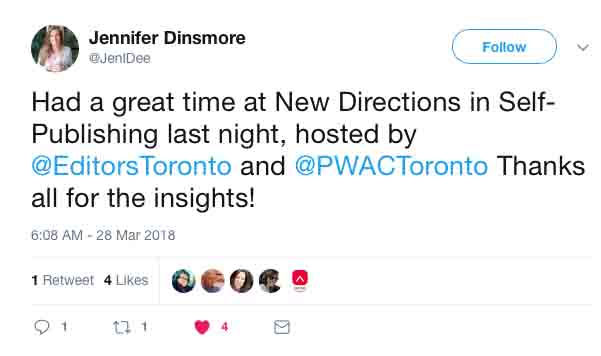
Suzanne Bowness of PWAC Toronto provided a good summary of the panel discussion on PWAC’s blog Networds, and shared by the Editors Toronto blog Boldface. Editor and publishing consultant Michelle MacAleese who attended the event made these observations:

  • Many in the biz draw a distinction between self-published authors and hybrid-published authors; both are “independent,” but the self-published authors are a special breed, who *are starting to understand art and business and (usually) gladly develop proficiency in all the technical and administrative details of the process.
  • Not surprisingly, options for authors continue to change rapidly. What worked best in 2011 is irrelevant today. Many quality companies offer publishing services and hybrid publishing deals. (Many companies will pretty much just steal your money. One must read up before signing up. *Research is paramount)
  • The best publishing option for e-only genre fiction won’t be the same as for a debut hardcover business book. It’s a wide world of independent publishing.
  • Authors: If you don’t love technical things (formatting ebooks, working Amazon’s categories, tweaking descriptive copy), you probably won’t enjoy starting a publishing house of one.
  • Editors: Working with self-published authors is a specialty and those editors who are good at taking on that relationship and guiding the process are worth their weight in gold. (Isn’t it about time we begin to mentor each other in why this kind of author-editor relationship is unique, and how it borders on the agent role at times? *This is a great opportunity for editors willing to evolve and grow.)
  • Editors who already specialize in working with self-published authors: Let’s talk about how to partner with reputable publishing services companies as well as with other independent designers and book marketing professionals to launch great self-published books that sell! This point was just touched upon in the panel and is still evolving; again, editors are uniquely positioned as author-consultants to play key roles in new networks of independent professionals in the publishing industry. *italics throughout are mine

MichelleMacAleese-Tweet

JenDinsmoreTweet

A few years ago, I gave a talk at Editors Toronto on the industry from the self-publishing author and freelance editor’s perspective. It remains highly relevant today, given that it spoke to the changing face of publishing and what it means for editors and writers. Editors learned about self-publishing and indie publishing, publishing myths, and imaginative ways to find new editing opportunities:

Self-publishing used to be a scar; now it’s a tattoo.”–Greg Cope White

Other relevant articles include:

Nina Munteanu on the Author-Editor Relationship

Beating Today’s “S” Curve (or Why an Editor is Every Writer’s Best Friend)

Walking the Tightrope Between Innocent and Cynical

The Moving Target of Indie Publishing: What Every Editor (and Writer) Needs to Know

The Writer-Editor Relationship, Part 1: Editors Preparing Writers

The Writer-Editor Relationship, Part 2: Five Things Writers Wish Editors Knew—and Followed

The Hidden Costs of Self-Publishing, Part 1: The Solution to “Author Solutions”

What Indie Authors Should Know for 2015

Surfing the Hybrid Wave of Publishing

The Indie Book Tidal Wave…What Does it Mean for Bookstores, Publishers & Writers?


nina-munteanuNina Munteanu is an ecologist and internationally published author of award-nominated speculative novels, short stories and non-fiction. She is co-editor of Europa SF and currently teaches writing courses at George Brown College and the University of

Science Fiction Asks: Are We Worth Saving?

interstellar-GargantuanBlackHole

Gargantua Black Hole in “Interstellar)

Science fiction, which Ted Gioia of The San Francisco Chronicle calls “conceptual fiction” explores the interaction of humanity with some larger phenomenon that involves science. SF writer Robert J. Sawyer calls it the fiction of the large. Large ideas, large circumstance, large impact. Science fiction is a powerful literature of allegory and metaphor that is deeply embedded in culture. By capturing context, SF is a symbolic meditation on history itself and ultimately a literature of great vision.

Science fiction is the literature of consequence that, in exploring large issues faced by humankind, can provide an important vehicle in raising environmental awareness and a planetary consciousness. Much of science fiction is currently focused in that direction. Terms such as eco-fiction, climate fiction and its odd cousin “cli-fi”, have embedded themselves in science fiction terminology; this fiction has attracted a host of impressive authors who write to its calling: Margaret Atwood, Emmi Itäranta, Jeff VanderMeer, Richard Powers, Barbara Kingsolver, Upton Sinclair, Ursula Le Guin, JoeAnn Hart, Frank Herbert, John Yunker, Kim Stanley Robinson, James Bradley, Paolo Bacigalupi, Nathaniel Rich, David Mitchell, Junot Diaz, Claire Vaye Watkins, J.G. Ballard, Marcel Theroux, Thomas Wharton—just to name a few. The list seems endless. Of course, I’m one of them too. Many of these works explore and illuminate environmental degradation and ecosystem collapse at the hands of humanity.

Lately, science fiction is asking the question of whether humanity is worth saving and at what expense?

It’s a valid question.

As the first swell of the climate change tidal wave laps at our feet, we are beginning to see the planetary results of what humanity has created and exacerbated. Humanity has in many ways reached a planetary tipping point; a threshold that will be felt by all aspects of our planet, both animate and inanimate as the planet’s very identity shifts.
the great acceleration copyScientists have suggested that we have now slid from the relatively stable Holocene Epoch to the Anthropocene Epoch—the age of humanity. The term arose not from hubris, but in recognition of our ubiquitous and overwhelming influence on large systems and planetary cycles.

GreatDerangement climatechange copyTake water, for instance. Today, we control water on a massive scale. Reservoirs around the world hold 10,000 cubic kilometres of water; five times the water of all the rivers on Earth. Most of these great reservoirs lie in the northern hemisphere, and the extra weight has slightly changed how the Earth spins on its axis, speeding its rotation and shortening the day by eight millionths of a second in the last forty years. Ponder too, that an age has a beginning and an end. Is climate change the planet’s way of telling us that the  Anthropocene Epoch too shall end? Is that when we end … or transcend?

A tidal wave of TV shows and movies currently explore—or at least acknowledge—the devastation we are forcing on the planet. Every week Netflix puts out a new show that follows this premise of Earth’s devastation: 3%; The 100; The Titan; Orbiter 9; even Lost in Space.

Are we worth saving? Below are a few examples of movies, TV series I’ve lately watched and books I’ve lately read that address this key question to an irresponsible humanity that seems unconcerned that we are destroying our very home. In some the question is subtly implied; in others, not so subtle.

Battlestar Galactica (2004)

Battlestar-Galactica.jpg

In the pilot of Battlestar Galactica, Commander Adama gives an impromptu speech (not the one he prepared; but one provoked by an argument with his son), which resonates throughout the entire series as cylon and human must refashion themselves and their relationship to each other while they discover the cyclical recursive nature of all things and that “all this has happened before and will again.”

The Galactica ship is about to be decommissioned and has now become a museum since the cylons have disappeared forty years ago. The great battle between the cylons and their human creators ended forty years ago with the cylons disappearing suddenly, never to be heard from again. But that is about to change; as Adama gives his speech, the first strike occurs, followed by a massive attack that almost wipes out the human race.

Adama

Commander Adama

In his speech Adama says:

“The cost of wearing the uniform can be high…but sometimes it’s too high. When we fought the cylons, we did it to save ourselves from extinction. But we never answered the question why. Why are we as a people worth saving. We still commit murder because of greed, spite and jealousy. And we still visit all of our sins upon our children. We refuse to accept the responsibility for anything that we’ve done. Like we did with the cylons. We decided to play God. Create life. When that life turned against us, we comforted ourselves in the knowledge that it really wasn’t our fault, not really. You cannot play God then wash your hands of the things you’ve created. Sooner or later the day comes when you can’t hide from the things that you’ve done anymore.”

Interstellar (2014)

interstellar-GargantuanBlackHole

Voyaging to Gargantua Black Hole

Interstellar

Cooper explores the ice planet

Early on in the science fiction movie Interstellar, NASA astronaut Cooper declares that “the world is a treasure, but it’s been telling us to leave for a while now. Mankind was born on Earth; it was never meant to die here.”

After showing Cooper how their last corn crops will eventually fail like the okra and wheat before them, NASA Professor Brand answers Cooper’s question of, “So, how do you plan on saving the world?” with: “We’re not meant to save the world…We’re meant to leave it.” The human-centred hubris in this colonialist mentality lies in what we have left behind—a planet suffocating from the effects of humanity’s careless and thoughtless activities. What Interstellar circles but does not address is the all-important question: is humanity even worth saving?

The suggestion during the movie’s final moments, is that we are worth saving because we will transcend into wiser benevolent beings: a hopeful gesture based on the power of love.

The Three Body Problem (2014)

ThreeBodyProblem-film

Cixin Liu’s The Three Body Problem was set against the backdrop of China’s Cultural Revolution, because, says Liu, “The Cultural Revolution provides the necessary background for the story. The tale I wanted to tell demanded a protagonist [Ye Wenjie] who gave up all hope in humanity and human nature. I think the only episode in modern Chinese history capable of generating such a response is the Cultural Revolution. It was such a dark and absurd time that even dystopias like 1984 seem lacking in imagination in comparison.” (I suppose Cixin did not experience the holocaust of Germany or Stalin’s purge in the Soviet Union).
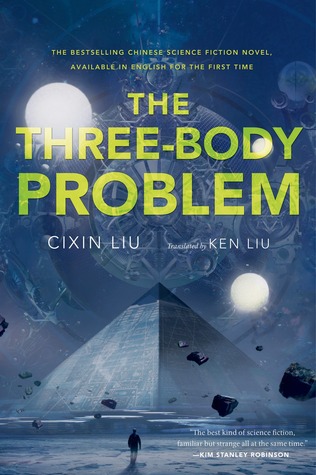
ThreeBodyProblemIn the story, a secret military project sends signals into space to establish contact with aliens. An alien civilization on the brink of destruction captures the signal and plans to invade Earth. One of the main protagonists is Ye Wenjie, a young woman traumatized after witnessing the execution of her scientist father in a brutal cleansing at the height of the Cultural Revolution. Considered a traitor, young Wenjie is sent to a labour brigade in Inner Mongolia, where she witnesses further destruction by humans:

“Ye Wenjie could only describe the deforestation that she witnessed as madness. The tall Dahurian larch, the evergreen Scots pine, the slim and straight white birch, the cloud-piercing Korean aspen, the aromatic Siberian fir, along with black birch, oak, mountain elm, Chosenia arbutifolia—whatever they laid eyes on, they cut down. Her company wielded hundreds of chain saws like a swarm of steel locusts, and after they passed, only stumps were left.

The fallen Dahurian larch, now bereft of branches, was ready to be taken away by tractor. Ye gently caressed the freshly exposed cross section of the felled trunk. She did this often, as though such surfaces were giant wounds, as though she could feel the tree’s pain… The trunk was dragged away. Rocks and stumps in the ground broke the bark in more places, wounding the giant body further. In the spot where it once stood, the weight of the fallen tree being dragged left a deep channel in the layers of decomposing leaves that had accumulated over the years. Water quickly filled the ditch. The rotting leaves made the water appear crimson, like blood.”

Already cynical about humanity’s failed culture and science—Wenjie acquires a contraband copy of Rachel Carson’s Silent Spring. The book and revelation she experiences from it sets in motion her remaining trajectory.

“More than four decades later, in her last moments, Ye Wenjie would recall the influence Silent Spring had on her life. The book dealt only with a limited subject: the negative environmental effects of excessive pesticide use. But the perspective taken by the author shook Ye to the core. The use of pesticides had seemed to Ye just a normal, proper—or, at least, neutral—act, but Carson’s book allowed Ye to see that, from Nature’s perspective, their use was indistinguishable from the Cultural Revolution, and equally destructive to our world. If this was so, then how many other acts of humankind that had seemed normal or even righteous were, in reality, evil?

As she continued to mull over these thoughts, a deduction made her shudder: Is it possible that the relationship between humanity and evil is similar to the relationship between the ocean and an iceberg floating on its surface? Both the ocean and the iceberg are made of the same material. That the iceberg seems separate is only because it is in a different form. In reality, it is but a part of the vast ocean.…It was impossible to expect a moral awakening from humankind itself, just like it was impossible to expect humans to lift off the earth by pulling up on their own hair. To achieve moral awakening required a force outside the human race.

This thought determined the entire direction of Ye’s life.”

Ye is sent to the Chinese version of SETI and succeeds in sending a message to aliens on Trisolaris. Despite a warning that the Trisolarians mean only to invade, Wenjie invites them to Earth. To ensure the arrival of the Trisolaris aliens, she collaborates with Michael Evans—an oil billionaire’s son who is disgusted with human’s destruction of Nature. Despising humankind in its current state, Wenjie believes the aliens will somehow ensure humanity’s transcendence; Evans, however, applauds the coming invasion as the best route to achieve the eradication of humanity and the survival of the rest of the planet.

The Expanse (2015) 
TheExpanse-GanymedeStation

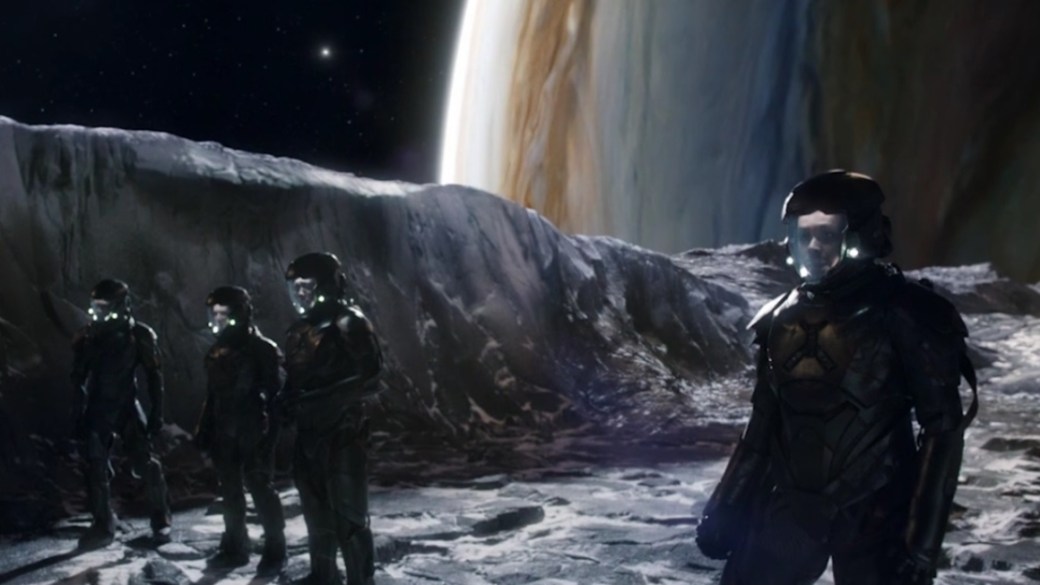
Bobby Draper and crew face an unknown enemy on Ganymede Station


TheExpanse-Holden-Naomi

Naomi and Holden

The Expanse is a stylish and intelligent science fiction (SF) TV series (on Syfy Channel) based on books by James S.A. Corey. It is set 200 years in the future when humanity has colonized the moon, Mars and the Asteroid Belt to mine minerals and water. This sophisticated SF film noir thriller elevates the space opera sub-genre with a meaningful metaphoric exploration of issues relevant in today’s world—issues of resource allocation, domination & power struggle, values, prejudice, and racism. Ever-expanding outward in a frantic search for resources as Earth’s own resources fester in pollution and Earthers languish on “the dole”, colonizing humans on Mars and the Belt have even changed their physiology, culture, language and identity.

The tag line of the first season poster for The Expanse reads: “We’ve gone too far.” The series begins on Ceres with a Belter activist inciting a crowd with talk about how Mars and Earth are squeezing Belters for all their water.
NUP_166219_0638.JPG

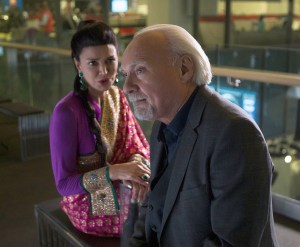
Avasarala and DeGraaf

Not so subtle signs of our destructive jingoistic determination runs through this series (now in its third season). After Under Secretary Avasarala’s friend Degraaf (Earth ambassador to Mars) becomes a casualty of one of her intel games, Degraaf quietly shares: “You know what I love about Mars?… They still dream; we gave up. They are an entire culture dedicated to a common goal: working together as one to turn a lifeless rock into a garden. We had a garden and we paved it.”
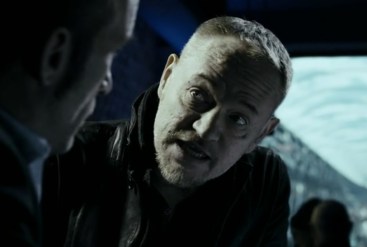
miller and dawes copy 2

Miller and Dawes sparring

Ceres born militant activist Anderson Dawes confides to Detective Miller: “All we’ve ever known is low G and an atmosphere we can’t breathe. Earthers,” he continues, “get to walk outside into the light, breathe pure air, look up at a blue sky and see something that gives them hope. And what do they do? They look past that light, past that blue sky. They see the stars and they think ‘mine’… Earthers have a home; it’s time Belters had one too.”

The Martians hold Earth in contempt for their cavalier approach to their resources. Onboard the MCRN Donnager, Martian Lopez asks his prisoner Jim Holden if he misses Earth and Holden grumbles, “If I did, I’d go back.” Lopez then dreamily relates stories his uncle told him about Earth’s “endless blue sky and free air everywhere. Open water all the way to the horizon.” Then Lopez turns a cynical eye back on Holden. “I could never understand your people. Why, when the universe has bestowed so much upon you, you seem to care so little for it.” Holden admits, “Wrecking things is what Earthers do best…”
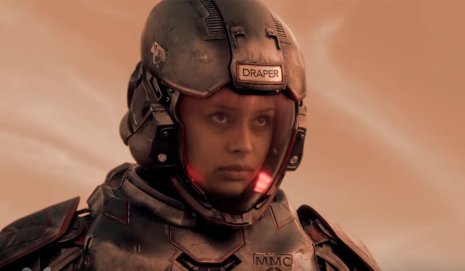
bobbie-draper-the-expanse

Martian marine Bobbie Draper

Then he churlishly adds, “Martians too, by the look of your ship.” Lopez retorts, “We are nothing like you. The only thing Earthers care about is government handouts. Free food, free water. Free drugs to forget the aimless lives you lead. You’re shortsighted. Selfish. It will destroy you. Earth is over, Mr. Holden. My only hope is that we can bring Mars to life before you destroy that too.” When a Ceres-born Detective Miller asks Holden why he left Earth, Holden responds: “everything I loved there was being destroyed.”

The show makes a few opportunities to point out what we are doing to our planet. Cherish what you have. Cherish your home and take care of it. We’re reminded that time and again, we aren’t doing a good job of that. When Martian marine Bobbie Draper travels to Earth for the first time and is compelled to find the ocean, she is met with the stench of sewage and garbage; yet, she looks longingly out to sea, seeing a dream…

Incorporated (2016)
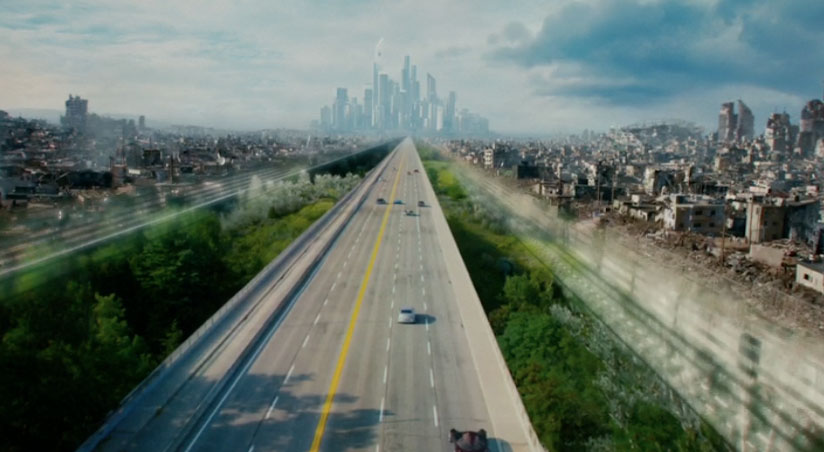
 Incorporated-green-red zone copy

Incorporated is a science fiction thriller that provides a chilling glimpse of a post-climate change dystopia. Created by David and Alex Pastor and produced by Ben Affleck, Matt Damon, Ted Humphrey and Jennifer Todd, the TV show (filmed in Toronto, Canada) opens in 82 °F Milwaukee in November 2074 after environmental degradation, water level rise, widespread famine and mismanagement have bankrupted governments. We learn later that Milwaukee Airport served as a FEMA climate relocation centre that resembles an impoverished shantytown. In the wake of the governments demise, a tide of multinational corporations has swept in to control 90% of the globe and ratified the 29th amendment, granting them total sovereignty.

Ben- office copy

Corporations fight a brutal covert war for market share and dwindling natural resources. Like turkey vultures circling overhead, they position themselves for what’s left after short-sighted government regulations, lack of corporate check and FEMA mismanagement have ‘had their way’ with the planet. The world is now a very different place. There is no Spain or France. Everything south of the Loire is toxic desert; submerged New York City reduced to a punch line in a joke. Reykjavik and Anchorage are sandy beach destinations and Norway is the new France—at least where champagne vineyards are concerned. Asia and Canada are coveted for their less harsh climates.

Chad-alert copyIncorporated is less thriller than satire; it is less science fiction than cautionary tale.

 “You look to Incorporated for dystopian fiction that expresses our current anxieties,” writes Jeff Jensen of Entertainment Weekly. “What you get is fitful resonance that makes you realize it might be too soon for any show to meet that challenge.”

Or is it more that we may be too late… The question of whether we are worth saving is never asked—it is shown: and perhaps the real reason the show was cancelled after one season.

3% (2016)

3-percent-players copy

3% is set in the near future after the planet has fallen into a divided haves and have-nots through environmental calamity. Three percent of the population live well on an island in the Atlantic Ocean, called Offshore (Mar Alto). The remaining 97% struggle Inland with poverty and scarcity. A selection process lies between them.
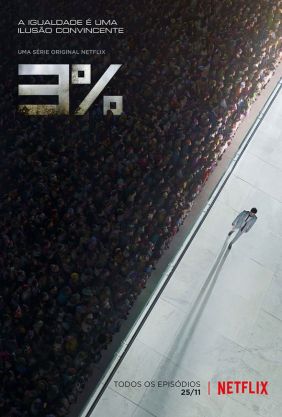
3-poster-title copyEvery year the 97% send their 20-year olds to undergo The Process, a grueling Hunger Games-style contest run by the Offshore elite to replenish their numbers. Only 3% of the candidates will be considered worthy. They must pass psychological, emotional and physical tests to earn a place in Mar Alto.

By the time Season 1 is over, candidates will have committed a full range of desperate and unsavory acts to make the cut—the stakes are high, after all: secure a position in the 3% elite or die in squalor and poverty. After being eliminated during the interview process, one youth throws himself off a balcony of the testing centre.

3% examines the motivations and paradoxes of heroism and villainy, sometimes turning them on their sides until they touch with such intimacy you can’t tell them apart. At its deepest, 3% explores the nature of humanity—from its most glorious to its most heinous—under the stress of scarcity and uncertainty. How we behave under these polarizing challenges ultimately determines who we are. The question of whether we are worth saving is explored through the subtleties—or not so subtle aspects—of a fascist society that practices exterminism. 

Missions (2018) 
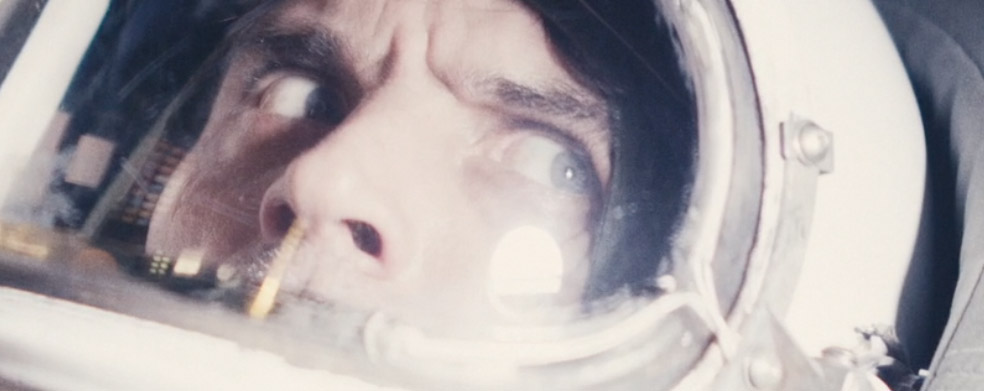
Missions-VladimirKomarov-Suyuz1 copy

Missions is a French TV series about the race by two ships—the Ulysses and Z1, representing two ambitious billionaires—to explore Mars. It opens in 1967 with the heroic sacrifice of Vladimir Komarov, the pilot of the faulty Soyuz 1, who knew he would not return and accepted his mission to save his best friend, Yuri Gagarin (his backup). This heroic act is mirrored in the last episode of Season 1 with a similar selfless act of heroism by Ulysses psychologist Jeanne Renoir to save her crewmembers who are trying to escape a fatal dust storm on Mars.

missions-posterAfter the 1967 opening scene with Komarov, we go to the present day with psychologist Jeanne Renoir, conducting an experiment on a child: giving them one marshmallow and leaving the room with the instruction that if they don’t eat the marshmallow but wait for her to return, they’ll get two. Jeanne correctly anticipates the child will eat the marshmallow.

Amid developments between the two ship teams in which self-serving agendas, paranoias and blind ambition reign, Jeanne shares a vision with an entity that looks like Komarov, in which he tells her: “Yes, people dream of other places, while they can’t even look after their own planet…You must remember your past in order to think about your future. Do you think Earth has a future?” When Jeanne says she doesn’t know, Komarov challenges, “Yes, you do. They eat their marshmallow right away, when they could have two. Or a thousand. Do you think humanity can continue like that?” Of course she doesn’t think so. Komarov continues, “People have chosen a brief but exciting life. Your species burns the candle at both ends. You know this. And it terrifies you…”

jeanne renoir copy

Jeanne Renoir

From the beginning, we glimpse a surreal connection between Jeanne and Komarov and ultimately between Earth and Mars: from her childhood admiration for the Russian’s heroism on Earth to the “visions” they currently share that link key elements of her past to Mars and Komarov’s strange energy-giving powers, to Jeanne’s own final act of heroism on Mars.

As the storyline develops, linking Earth and Mars in startling ways, and as various agendas—personal missions—are revealed, we finally clue in on the main question that “Missions”—through Komarov and finally Jeanne—is asking: are we worth saving?

The Beyond (2018)

dark orb helicopters sunrise copy

In The Beyond, the sudden appearance of a wormhole causes the disappearance of astronaut Jim Marcell during EVA on Earth’s orbiting space station, followed by associated calamitous phenomena on Earth. Giant dark spherical clouds then appear and settle all over the Earth, disrupting the world’s population, and setting in motion a series of fearful and aggressive reactions by various sectors of humanity.

The Beyond-poster copyThe Beyond’s climax, discovery and resolution is really more of a question. The movie doesn’t have a tidy end; its solution is veiled with more questions.

The film ends with a cautious hope, implicitly asking that big question: are we (humanity) worth saving? When Jessica asks why humanity was offered a second chance by benevolent beings way beyond our comprehension, the returned Jim Marcell (currently a spokesman for the aliens) shows her the GAD (Golden Archive Drive with video images of Earth and humanity—basically our “hello” message to extra-solar life like the one placed onboard NASA’s Pioneer missions) that had accompanied the ship into the wormhole. The message displayed scenes of mothers and their children, people laughing in joy; it also showed scenes of other aspects of this beautiful planet worth saving: the ocean surf, the forests and wildlife. In our hubris, we have lost our perspective about this planet. Perhaps, it wasn’t so much humanity the alien beings intended to save but the Earth itself; we just come along with it. The Earth is, after all, a beautiful, vital and unique world, rich with life-giving water, trees, animals, creatures of all kinds in a diverse network of flowing and evolving beauty. A planet worth saving and that, frankly, functions better without us.

So, the question remains: is humanity worth saving? For centuries we have hubristically and disrespectfully used, discarded and destroyed just about everything on this beautiful planet. According to the World Wildlife Federation, 10,000 species go extinct every year. That’s mostly on us. They are the casualty of our selfish actions. We’ve become estranged from our environment, lacking connection and compassion. That has translated into a lack of consideration—even for each other. In response to mass shootings of children in schools, the U.S. government does nothing to curb gun-related violence through gun-control measures; instead they suggest arming teachers. We light up our cigarettes in front of people who don’t smoke and blow cancer-causing second-hand smoke in each other’s faces. We litter our streets and we refuse to pick up after others even if it helps the environment and provides beauty for self and others. The garbage we thoughtlessly discard pollutes our oceans with plastic and junk, hurting sea creatures and the ocean ecosystem in unimaginable ways. We consume and discard without consideration.

We do not live lightly on this planet.

We tread with incredibly heavy feet. We behave like bullies and, as The Beyond points out, our inclination to self-interest makes us far too prone to suspicion and distrust: when we meet the unknown, we tend to respond with fear and aggression over curiosity, hope and kindness.

Something we need to work on if we are going to survive.

Science fiction—the highest form of metaphoric and visionary art—is telling us something. Are we paying attention?


References:

Carson, Rachel. 1962. “Silent Spring.” Houghton Mifflin. 336pp.

Corey, James S.A. “The Leviathan Wakes.” Orbit. 592 pp.

Liu, Cixin. 2014. “The Three Body Problem.” Tor Books. 400pp.


When Do You Know Your Story Is Finished?

patterns-Spalting-LR

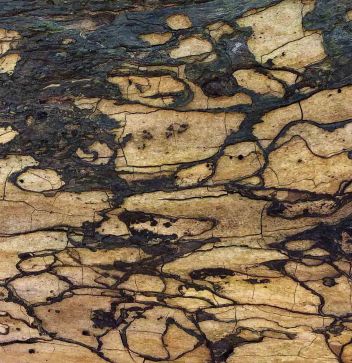
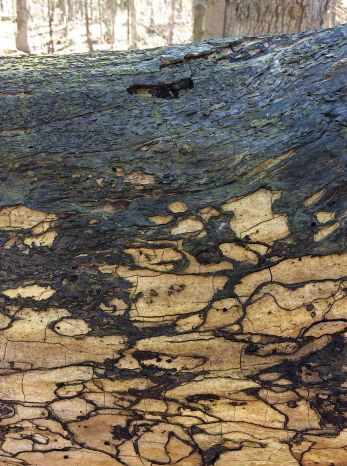
Spalted maple log (photo by Nina Munteanu)

A student of mine once asked me how many drafts it took to get the final version of a story. I answered cagily: as many as you need. I wasn’t trying to be cheeky or elusive. In truth, this is a question that only you can answer; and it will be different with each story you write.

George Lucas once said in an interview about the remaking of Star Wars that in the film industry, projects were never finished; only abandoned. What he meant by this was that at some point in the creative and revision process of polishing a story, you have to stop and show it to the world. Let your baby walk and stand on its own.

This is a big step for all beginning writers and many will freeze. Terrified at the idea of failure or censure, they end up sabotaging their own work. If you’re emotionally or psychologically not ready for the consequences of getting published, then you will falter, procrastinate, forever fuss over your creations and convince yourself that it isn’t ready. In truth, it’s you who aren’t ready.

This is a shame because to have written an entire novel is a great accomplishment. You’ve already done what over 80% of those who embark on a book don’t do: finish it. To halt the process by entering a perpetual cycle of revision is admitting defeat when you have really won the major battle. It’s like that fatal stumble on the last leg of a homerun.

If the idea is to publish, then you need to give yourself a kind of deadline or goal, based on something that makes sense to you and is achievable. This could even include a time deadline.

Robert J. Sawyer’s response to the question of “when do you stop revising?” was: “When you’ve taken out all the boring bits.” That may seem on the face of it either too simple or too abstract. But, in fact, he is right on the mark. However, to truly achieve that conclusion and consequently get your manuscript to where it is meant to be without you lingering like a frightened ghost, you need to accurately perceive what “boring” is. In order to do this you need to do several things.

The first is to gain objectivity of your work. You accomplish this by setting it aside for a while and letting it “breathe” (really, you’re letting yourself breathe). By distancing yourself a little from your work, you are able to return with a fresh outlook and read it more like a reader. Your “boring” meter will be running better this way and you will be in a better position to pick out redundancies, overly long exposition and detail, lack of context, “talking heads”, lack of action or tension, and confusing or awkward sentences. The other thing you gain with distance is the ability to describe your book’s theme and major plot. What is it really about? You need to reach the point where you can describe it in a couple of sentences or even a few words as you would describe a movie you like to a curious friend who hasn’t seen it yet.

patterns-Spalting log and blu-green stain fungus LR

Carbon cushion fungus spalting maple log (photo by Nina Munteanu)

Once you’ve gained some objectivity, you can critique each scene and each character for his or her plot purpose within that central plot and theme. You can also assess each sub-plot’s role within the major plot and theme. When every paragraph within every scene within every chapter of your story scintillates with purpose and meaning, you have accomplished your task of removing the boring bits. Now you have a story that is finished.

Art is self-expression and expression is a reflection of the culture and time in which you live. Stories are a snapshot of time and place. Treat your art like life; some revision is good but at some point you need to just LIVE. Let go of your work and move on to the next chapter.


Nina MunteanuNina Munteanu is an ecologist, limnologist and internationally published author of award-nominated speculative novels, short stories and non-fiction. She is co-editor of Europa SF and currently teaches writing courses at George Brown College and the University of Toronto. Visit www.ninamunteanu.ca for the latest on her books.
 

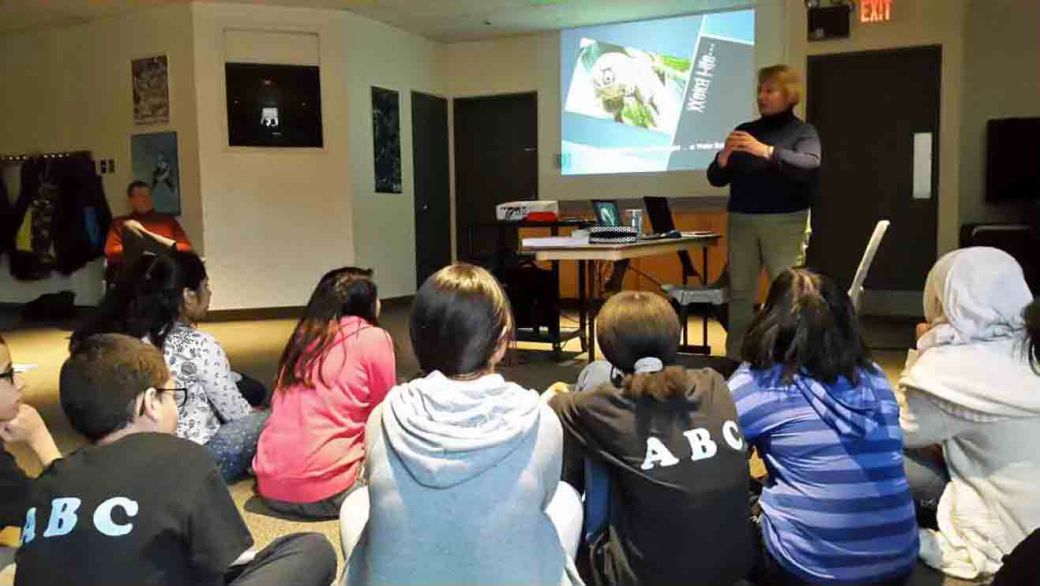
Nina Talks Water with Grade 8 Students on World Water Day

Nina-Grade 8 on Water-March22-2018 copy

Nina talks with Valleys Senior Public School Grade 8 students about water

On World Water Day, at the kind invitation of Alene Sen (supervisor and coordinator for the City of Mississauga at the Mississauga Valley Library) I talked to some 100 Grade 8 students of Valleys Senior Public School about water. Several classes, in groups of about fifty students each, came at tandem to the library to learn something about water.

I had about half an hour to prime them with something that would spark their interest and which they could take home and think about—and possibly apply in stewardship.

carboniferous-paleozoic eraI started the talk by explaining that I’m a limnologist—someone who studies freshwater—and that water is still a mysterious substance, even for those who make it their profession to study.  After informing them of water’s ubiquity in the universe—it’s virtually everywhere from quasars to planets in our solar system—I reminded them that the water that dinosaurs drank during the Paleozoic Era is the same water that you and I are drinking.

We briefly reviewed some of water’s most interesting anomalous and life-giving properties such as cohesion and adhesion—responsible for surface tension and water’s capillary movement up trees. Below is an excellent 4-minute YouTube video “The Properties of Water” that describes these properties well.

I reviewed the circle of life and energy in an aquatic ecosystem and used the grey whale as an example to study trophic cascades and the balanced trophic cycle—with an endnote on the whale’s significant role in influencing climate.

I introduced each class to the incredible and very tiny Tardigrade, also known as the water bear or moss piglet, with magical properties of its own. The 4-minute TED video by Thomas Boothby is particularly instructive and entertaining.

I then showed the class an image of the Three Gorges Dam in China and reported how as a result of so much dam-building and retention of water—and because most dams are located in the northern hemisphere—we have slightly changed how the Earth spins on its axis. We’ve sped its rotation and shortened the day by 8 millionths of a second in the last forty years.

3-gorges dam

Water needs to constantly move. The Water cycle moves through the planet in all three forms (vapour, liquid and ice), over land and sea and through the earth, but also through all life. We are part of that cycle. We drink it and get immersed in it; we also breathe water in with every breath we take and breathe it out with every breath we exhale.

We are water; what we do to water, we do to ourselves.

I invited the class to discuss things we could do to help water as it moves through the planet. We talked about things we could do at home, with our friends, in our school and community to help water. Things like planting a tree in your back yard; adopting a nearby stream and taking care of it; organizing a beach clean-up; deciding to do something at home to waste water less.

Each action is a small thing. But that is how large things happen, through the accumulation of small things. And with every “small” action is a small shift in thinking, which leads to the kind of leadership that will change the world and make it a better place—for water and everything that depends on it.

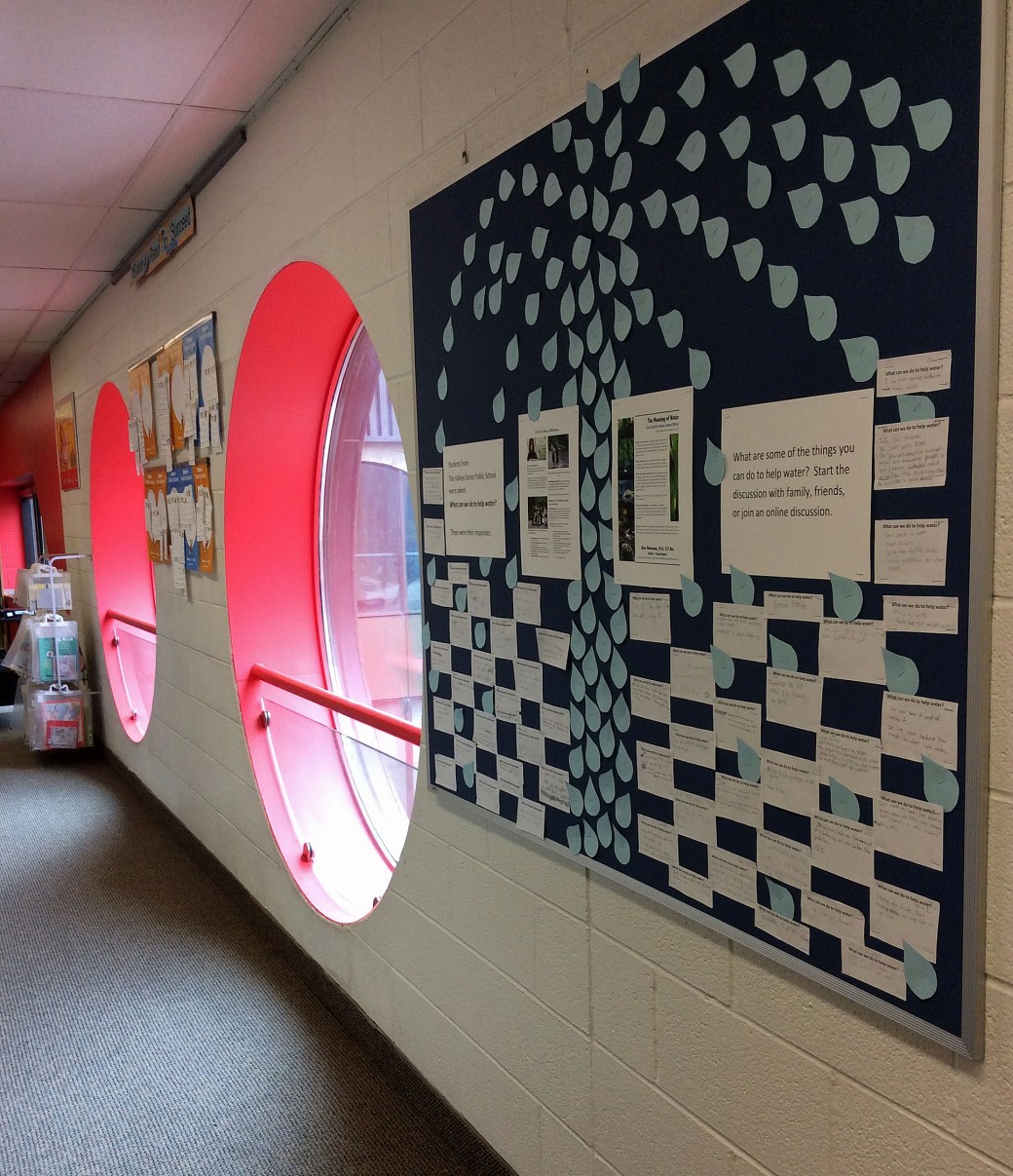
After a discussion of the problems now facing water on the planet, we asked the students from The Valleys Senior Public School to answer the question “What can we do to help water?” on a small sheet of paper, which we then collected. Their responses showed great thought and a willingness to do something concrete. Alene created a billboard at the Mississauga Valley Library with the Valleys Senior Public School student responses to the question.

Water-students-13

Water Tree Display with student responses to the question: “What can we do to help water?”

Below are some examples of responses by students…

Water-students-11

Water-students06

Water-students-Alenelibrary

Alene Sen and co-worker at the Mississauga Valley Library

Water Is-COVER-webYou can read so much more about water in my book “Water Is…”. Go see what people are saying about “Water Is…”


nina-2014aaaNina Munteanu is an ecologist, limnologist and internationally published author of award-nominated speculative novels, short stories and non-fiction. She is co-editor of Europa SF and currently teaches writing courses at George Brown College and the University of Toronto. Visit www.ninamunteanu.ca for the latest on her books. 
Sensual Writing and Why I Love the Smell of Smoke

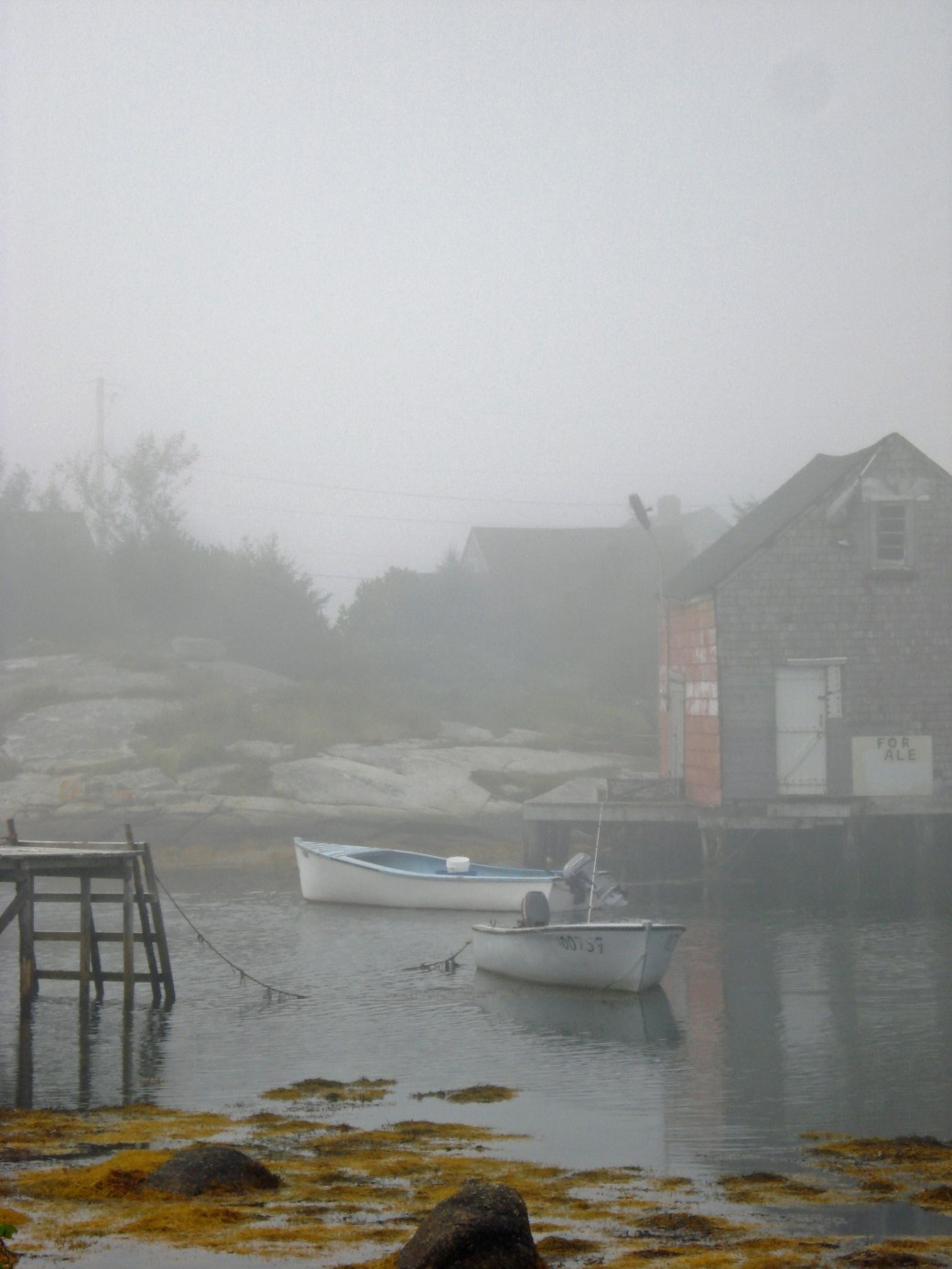
Prospect Point-fog

Prospect Point, NS (photo by Nina Munteanu)

Last week, as I was driving along a winding country road on my way to Bridgewater from Lunenburg, I ran across the smoke of a small fire. They were obviously doing some roadside spring clearing.

Without thinking, I slid the window open and inhaled deeply. I was preparing to experience the exquisite “taste of home”. As I breathed in the aroma of burning vegetation, memories of outdoor campfires and old wood-burning stoves flooded in from my childhood. A goofy smile slid across my face as I bathed in the joyful innocence of adventure, wonder and the comfort of the hearth. I’d had a wonderful childhood and the smell of smoke brought it back to me in its full glory.

What does this have to do with sensual writing? Everything. Storytelling shares universal truth through metaphor, delivered from the heart. Sensual writing doesn’t just involve making sure to include at least a few senses like sight, sound, smell, taste and touch in your narrative. To write sensually involves much more than the simple description of a sense, though this is certainly the first step (and something all too often neglected by novice writers). To not connect a described sense to a memory or emotion is to miss a very important opportunity as a storyteller: that of enlightening the reader on some aspect of the point of view (POV) character experiencing the sense (things like their history, the quality and nature of their relationships, their viewpoints, education, prejudices, how and what they’ve experienced in their life).

Here’s what I mean:

EXAMPLE 1: Ben walked into the Grand Banker Pub and immediately caught the tantalizing aroma of garlic and pears amid the din of jubilant laughter, cackles and desultory conversation. The amber light enhanced the rich tones of nautical oak. Ben saw some friends drinking in the corner and sauntered toward them, smiling.

farm in fog-Liverpool NS

Farm near Liverpool, NS (photo by Nina Munteanu)

EXAMPLE 2: Ben stopped at the door of the Grand Banker Pub, inhaling the exquisite aroma of garlic and pears amid the din of jubilant laughter, cackles and desultory conversation. For a moment he was back on the boat, reliving the party that changed his life. He’d stopped eating pears after that. Ben caught sight of his friends drinking in the corner, beneath the amber light. Like a sailor seizing a rope, he sauntered toward them, a huge smile pasted on his face.

The first example describes; the second example emotes. The first example nicely describes the place but it doesn’t provide us with any information about Ben, except that he likes the aroma of garlic and pears. We don’t know why. In the second example, his senses are used to hint at intrigue linked to memories that, in turn, are linked to the associated sense—in this case the smell of garlic and pears. This is the power of sensual writing. Bringing it back home.

Nina MunteanuNina Munteanu is an ecologist, limnologist and internationally published author of award-nominated speculative novels, short stories and non-fiction. She is co-editor of Europa SF and currently teaches writing courses at George Brown College and the University of Toronto. Visit www.ninamunteanu.ca for the latest on her books.
The Gestalt Nature of Passion & Success

What is to give light must endure burning —Victor Frankl


Tree Deer Lake

Deer Lake Park, BC (photo by Nina Munteanu)

“Any writing lays the writer open to judgment about the quality of his work and thought,” writes Ralph Keyes, author of The Courage to Write. “The closer [the writer] gets to painful personal truths, the more fear mounts—not just about what he might reveal, but about what he might discover should he venture too deeply inside. But to write well, that’s exactly where we must venture.”

So, why do it, then? Why bother? Is it worth it to make yourself totally vulnerable to the possible censure and ridicule of your peers, friends, and relatives? To serve up your heart on a platter to just have them drag it around as Stevie Nicks would say?…

Welcome to the threshold of your career as a writer. This is where many aspiring writers stop: in abject fear, not just of failure but of success. The only difference between those that don’t and those that do, is that the former come to terms with their fears, in fact learn to use them as a barometer to what is important.

“Everyone is afraid to write,” says Keyes. “They should be. Writing is dangerous…To love writing, fear writing and pray for the courage to write is no contradiction. It’s the essence of what we do.”

Unravelling the Secret…

How do you get past the fear of being exposed, past the anticipated disappointment of peers, past the terror of success?

The answer is passion. If you are writing about something you are passionate about, you will find the courage to see it through. “The more I read, and write,” says Keyes:

The more convinced I am that the best writing flows less from acquired skill than conviction expressed with courage. By this I don’t mean moral convictions, but the sense that what one has to say is something others need to know.—Ralph Keyes

This is ultimately what drives a writer to not just write but to publish: the need to share one’s story, over and over again. To prevail, persist, and ultimately succeed, a writer must have conviction and believe in his or her writing. You must believe that you have something to say that others want to read. Ask yourself why you are a writer. Your answer might surprise you.

Every writer is an artist. And every artist is a cultural reporter. One who sometimes holds the world accountable. “Real art,” says Susan Sontag, “makes us nervous.”

The first step, then, is to acknowledge your passion and own it. Flaunt it, even. Find your conviction, define what matters and explore it to the fullest. You will find that such an acknowledgement will give you the strength and fortitude to persist and persevere, particularly in the face of those fears. Use the fears to guide you into that journey of personal truths. Frederick Busch described it this way: “You go to dark places so that you can get there, steal the trophy and get out.”

John Steinbeck, author of Grapes of Wrath, said:

If there is a magic in story writing, and I am convinced that there is, no one has ever been able to reduce it to a recipe that can be passed from one person to another. The formula seems to lie solely in the aching urge of the writer to convey something he feels important to the reader.—John Steinbeck

Finding Success Through Meaning

Victor Frankl survived Auschwitz to become an important neurologist and psychiatrist of our time and to write Man’s Search for Meaning.

Blogger Gavin Ortlund wrote: “What gripped me most about [Frankl’s] book, and has stayed with me to this day, is not the horror and barbarity of his experiences in concentration camps—when you pick up a book about the holocaust, you expect that. What really struck me was Frankl’s repeated insistence that even there, in the most inhumane and horrific conditions imaginable, the greatest struggle is not mere survival. The greatest struggle is finding meaning. As I was reading, I was struck with this thought: going to a concentration camp is not the worst thing that can happen to a person. The worst that can happen to a person is not having a transcendent reason to live. Life is about more than finding comfort and avoiding suffering: it’s about finding what is ultimate, whatever the cost.”

Victor Frankl wisely said:

The more you aim at success and make it a target, the more you are going to miss it. Success, like happiness, cannot be pursued; it must ensue, and it only does so as the unintended side effect of one’s personal dedication to a cause greater than oneself or as the by-product of one’s surrender to a person other than oneself. Happiness must happen, and the same holds for success: you have to let it happen by not caring about it. I want you to listen to what your conscience commands you to do and go on to carry it out to the best of your knowledge. Then you will live to see that in the long-run—in the long-run, I say!—success will follow you precisely because you had forgotten to think about it.—Victor Frankl

Frankl is talking about passion. “If you long to excel as a writer,” says Margot Finke, author of How to Keep Your Passion and Survive as a Writer, “treasure the passion that is unique within yourself. Take the irreplaceable elements of your life and craft them into your own personal contribution to the world.” It’s what has you up to 2 am, pounding the keys. It follows you down the street and to work with thoughts of another world. It puts a notebook and pen in your hand as you drive to the store, ready to record thoughts about a character, scene or place. “For the passionate, writing is not a choice; it’s a force that cannot be denied.”

tree water deer lake

Deer Lake, BC (photo by Nina Munteanu)

Finke says it astutely: You need to be passionate about everything to do with your book—the writing and rewriting, your critique group, your research, your search for the best agent/editor, plus your query letter. Not to mention the passion that goes into promoting your book. Nothing less will assure your survival—and success—as a writer.

Follow your inner moonlight, don’t hide the madness—Allen Ginsberg, American poet

This article is an excerpt from The Fiction Writer: Get Published, Write Now! by Nina Munteanu

References:

Finke, Margot. 2008. “How to Keep Your Passion and Survive as a Writer.” In: The Purple Crayonhttp://www.underdown.org/mf_ writing_passion

Frankl, Victor. (1946) 1997. Man’s Search for Meaning. Pocket Books. 224 pp.

Keyes, Ralph. 1999. The Writer’s Guide to Creativity. Writer’s Digest, 1999.

Munteanu, Nina. 2009. The Fiction Writer: Get Published, Write Now. Starfire World Syndicate. 294pp

Ortlund, Gavin. 2008. “Frankl, the holocaust and meaning.” In: Let Us Hold Fast. http://gro1983.blogspot.com/2008/02/frankl-holocaust-and-meaning.html

Slonim Aronie, Nancy. 1998. Writing from the Heart: Tapping the Power of Your Inner Voice. Hyperion. 256pp.


nina-2014aaaNina Munteanu is an ecologist, limnologist and internationally published author of award-nominated speculative novels, short stories and non-fiction. She is co-editor of Europa SF and currently teaches writing courses at George Brown College and the University of Toronto. Visit www.ninamunteanu.ca for the latest on her books.
 

Nina Munteanu Interviewed on Splintered Universe Trilogy

I was recently interviewed by writer Simon Rose on my space detective thriller trilogy Splintered Universe, now available in all three formats: print, ebook, and audiobook. 


Below is the interview:

My guest today is Nina Munteanu, author of science fiction and fantasy novels, non-fiction books and essays on writing and science. Her latest in a series of prolific works is the recent completion of the audiobook of her science fiction space-thriller trilogy, Splintered Universe.

Can you tell us a little about the Splintered Universe Trilogy?

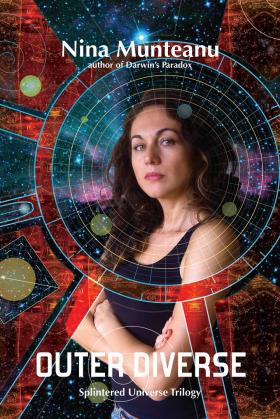
OuterDiverse-cover-web copy

Book 1 of Splintered Universe

The Splintered Universe Trilogy is a detective mystery-thriller that explores metaphysical and existential questions through a high-test space adventure. The three books include Outer Diverse, Inner Diverse and Metaverse.

The main character Rhea Hawke is a Galactic Guardian and the only human in an otherwise alien race of 7-foot tall purple-skinned Eosians—who she actually despises (for reasons you find out later). She’s a loner and a misfit in an elite police force tasked with keeping order in the galaxy; Rhea’s unruly tactics grate on them—particularly her boss. In Outer Diverse, Rhea investigates the genocide of an entire spiritual sect; but instead she kills her only lead.

Following the scent of Glitter Dust, Rhea connects the massacre to the murders of several prominent galactic citizens and finally to the deadly Vos, who invaded our galaxy, then disappeared. She realizes that the Vos have quietly returned, infiltrating every aspect of the civilized world—with dark menace in mind. But no one believes her—particularly her boss, who fires her instead for incompetence: badge, Great Coat and MEC weapon confiscated and her sentient ship Benny put in storage. Compelled by an urgency she herself doesn’t understand, she goes rogue and enlists the aid of surprising allies to save the galaxy.

You mention that Splintered Universe explores issues of existentialism and metaphysics. Can you speak to them?


Inner-diverse-front-cover-WEB copy

Book 2 of Splintered Universe

The Splintered Universe Trilogy explores the fractal fabric of paradox, where the flow of particle, energy, wave and intention embrace: black holes, quasars, neutrinos, intuition, déjà vu, clairvoyance, altruism, faith…

The prediction by Gnostic priest Raphael Martinez (The coming of the Suntelia Aeon will be signified by the joining of twin souls) weaves many disparate threads of existence to Atlantis and the Eosian alien race (who resemble the Bible’s Nephilim), the sacred vishna tree (part of L’Ordre de l’Arbre Sacré in Quebec) and the precious mythical metal Orichalcum used by the Eosians. The prediction ties to an ancient knowledge that describes our very existence through déjà vu, synchronicity, sacred geometry, phi and the golden mean and the notion that “diverses” are mirror universes linked through dreams. The key is Rhea herself—who discovers that she is not who or what she thinks.

You’re a bit known for your world building. Tell us a little about that in this trilogy.

Metaverse-FRONT-web copy

Book 3 of Splintered Universe

I’m an ecologist, so world building with realistic ecosystems is more than fun for me. I enjoy doing the research to create realistic and meaningful worlds. I consulted authorities in the areas of space exploration and habitable zones, AI, biotechnology, sleep biology, neuroscience, and ecology to design alien worlds and systems, populated with extremophiles.

In her pursuit of justice, Rhea travels to all parts of the galaxy and encounters some very strange worlds. In Book 1, Rhea pursues dust trafficker V’mer to the sulphurous AI-run water planet (Mar Delena), located inside the hole of the gaseous “donut” of Fomalhaut; it’s always raining acid. That’s where Book 1 starts: acid rain painfully spattering Rhea’s face as she lies injured and waiting to be dusted (with a lethal dose) by V’mer, surrounded by the oily fur-covered rodent-like Delenians—all dust addicts.

Rhea almost drowns in a high-speed skipboat chase of the murderer of a spiritual sect on the icy moon, Uma 1, (orbiting 47 Uma b of 47 Ursae Majoris b). The moon is mostly ocean beneath a thick layer of ice with thermal vents that provide the inhabitants—a spiritual sect called the Schiss—a home.

NinaMunteanuHalfPage-AD-Astra47 Uma a (also called Horus) was colonized in ancient times by the Khonsus, a raptor-like biped race with mind-probing capability. It is also the home of the ancient migrating trees, ammuts (giant flying insects), and the weeping mountains with their narcotic boiling seas used by the giant apophus to attack and set its millions of babies to devour Rhea in Book 1.

Virgil 9 is a tidally locked moon that orbits the gas giant 70 Virginis b; day and night last for weeks while water swings the extreme from deluge flood to desert conditions. In Virgil City, Rhea does commerce with information broker Shlsh Shle She, a moody amoeba-like photosynthetic Ngu who is just a pseudopod of a larger hive-entity.

Sekmet is a bog planet, where the raw materials of dust are harvested by the Rill, bulbous short smelly bog creatures with tube eyes, webbed limbs and large sexual organs; and who Rhea pretty much wipes out with her MEC weapon. Sekmet is also the location of a galactic penal colony (Hades) where Rhea is sent in Book 2. When she tries to escape, she must contend with other native creatures of Sekmet such as the giant crocodile-like sobeks and the terrifying kepry—giant flying crustaceans.

In Book 3, Rhea returns to Earth, transformed by Eosian settlers from its former polluted state dominated by urban concrete cities to an entirely natural world, now unpolluted and featuring the ancient purple vishna tree and a crystal symbiotic organic technology.


Rhea on Iota Hor

Rhea on Iota Hor-2

Worlds always have cool bling associated with them. What technologies or devices are featured in Splintered Universe?

I created an entire fleet of ships, all run on various technologies, from crystals, to wave-energy to dreams. That was fun to create. Two main ship builders include: Zeta Corp from Earth and Tangent Shipping run by the Fauche from Sigma Draconis. Rhea’s own ship, Benny, is an old ray class Fauche-built corvette, a two-man hybrid organic/nano-tech vehicle with folding wings and fuel scoops (so it can mine energy fuel from gas giants). Benny is a sentient ship that jacks the particle-stream and with whom Rhea has an interesting relationship. The ship serves essentially as butler, administrator, companion, and rescuer.

I also created a wide range of weapons, based on which alien race created them and for what purpose. Rhea gained some notoriety with her own created weapon, the MEC (short for Magnetic-Electro Concussion) pistol, a versatile wave-weapon that can target DNA signatures and do almost anything you want with a single sweep. Her proprietary MEC design is coveted by many groups—from shady crime syndicates such as Eclipse to her own Guardians.

I hear that the last audiobook (the third book) in the trilogy is finally out this January. That means that all three books of the Splintered Universe are now available in print, ebook and audiobook format. How does it feel to have a trilogy available in three complete formats?

It feels great! I’m so excited that readers can now obtain my trilogy in those different ways. It speaks to our different ways of consuming story. Some prefer to settle back by the fire or our favourite place to read with a “real” book; others like a mobile ebook so we can read while we travel and play; and then some like to lean back in the car and listen to a great story.

What was your experience with the narrator of the three books?

Dawn-Harvey

Dawn Harvey of “Dawn of Voice”

The experience was truly cosmic. When Iambik took on the books as audiobooks, they provided me with three voice artists to audition. I chose Dawn Harvey because I could visualize my main character through her voice, and given that the entire trilogy is told in the first person, the narrator’s voice had to be just right. Dawn’s voice is dark and sultry like coffee. It is sexy and irreverent with a hidden vulnerability and sensitivity that perfectly captured the main character Rhea Hawke. What I didn’t realize then was how well Harvey would represent the 30-odd other characters, mostly aliens—one who spoke through several mouths.

OuterDiverse-audiobook-Iambik

Audiobook of Outer Diverse

Working with Dawn was a pleasure. Dawn is a dedicated professional; she created unique and consistent voices for the book’s thirty-odd mostly alien characters. She ensured that each character had the appropriate vernacular, tone, accent and cadence. Then she did proofs and confirmed them with me. She also tackled the “alien” vocabulary; Rhea’s universe is full of strange and foreign terms (I have a comprehensive glossary at the back of each book). Dawn sent me a list to make sure she was pronouncing everything correctly—mostly made-up words. Dawn is a professional dedicated to her craft and her art. She literally breathed life into Rhea Hawke and all the other characters. The result is three audiobooks that will blow your socks off. I mean it. If you like audiobooks, get the first one and tell me different. When I first listened to Outer Diverse in the car on my way to Nova Scotia, I lost myself in her storytelling and forgot that I’d written it.

Where can people find the Splintered Universe Trilogy?

The best place, of course is Amazon (Amazon.ca or Amazon.com). All three formats are available through Amazon. The Audiobooks are currently available for free through Audible on Amazon. The books are also available through Barnes & Noble, Chapters/Indigo, Kobo, and many other book selling sites and brick and mortar stores.

When you’re not writing what do you do?

These days I’m mostly on the University of Toronto campus, teaching health science and engineering students how to write. When the students find out that I write science fiction, they get all excited. It’s a lot of fun. I also teach a science fiction writing coarse at George Brown College. When I’m not teaching or writing, I’m doing something in Nature, usually by the water. I’ve always had an interest in water. I studied and researched freshwater ecology as a limnologist for three decades. I’m a bit of an environmentalist these days, hoping to raise awareness and action for water. My latest novel—hopefully coming out next year—arose from my nature walks and my research in water. The story chronicles the lives of four generations of women and their relationship with water.

TALKING-AUDIOBOOKS2 copyYou can also listen to the Podcast interview of Dawn Harvey and Nina Munteanu by Casey Trowbridge of Talking Audiobooks on the process of their collaboration. Learn more about the process between writer and voice artist narrator:

The trilogy has received a fair bit of acclaim from reviewers and readers:

Martha’s Bookshelf
Speculating Canada
Dab of Darkness
Goodreads
Amazon
Amazon Canada

“Rhea Hawke is a Galactic Guardian, and I love to say her name. Her name alone let’s you know that there is a bad ass super hero of a woman on site. I can picture her boots, her great coat, and her side arms. I want to be her when I grow up. Obviously, you can tell I developed some hero worship for her by the end of this book. I really got wrapped up in this novel.”–Goodreads Review of Outer Diverse


“Ms. Harvey manages to enthuse the personality of the characters into each voice. The wise, gentle Ka has a soft, strong sound that reminds you of a wise old bird. Shlsh She She, a slippery, slimy creature has a slurry, garbled voice like a mouthful of mushy, wet food. Dawn’s reading conveys the loneliness in Rhea, the sexiness of Serge, the frustrated friendliness of Bas, and the faithful coziness of Benny. She is able to bring emphasis to the action or romance, weariness or fear elements of the story. The narration never takes over the story; but rather enhances it.”–Martha’s Bookshelf on Outer Diverse Audiobook

The excellent cover art for all three books is done by Toronto graphic artist and SF author Costi Gurgu (author of RecipeArium). People keep asking me who the model for the covers is; you’ll have to corner Costi at the next spec fiction con and ask him yourself.

nina-2014aaaNina Munteanu is an ecologist, limnologist and internationally published author of award-nominated speculative novels, short stories and non-fiction. She is co-editor of Europa SF and currently teaches writing courses at George Brown College and the University of Toronto. Visit www.ninamunteanu.ca for the latest on her books.


Write About What You Know

Cedar trunk base-LR

Base of cedar tree, Little Rouge woodland (photo by Nina Munteanu)

How many times have you been told to write about what you know? And how many times have you trusted that advice? Well, how interesting is that?!? We think our lives are dull, boring, and mundane. We write – and read – to get away from it, don’t we?

Well, yes…and no…

In the final analysis, even good “escapist” writing, like some science fiction, despite its alien settings and creatures of imagination, is grounded in the realities of our every-day lives, which form the basis of human nature. Love, ambition, trust, hate, envy, honor, courage. All these are universal human traits which the writer taps into and ultimately writes about.

“In the 19th century, John Keats wrote to a nightingale, an urn, a season. Simple, everyday things that he knew,” say Kim Addonizio and Dorianne Laux in The Writer’s Guide to Creativity. “Walt Whitman described the stars, a live oak, a field. They began with what they knew, what was at hand, what shimmered around them in the ordinary world.”

The advice, “write what you know” isn’t about literal truths; it’s about what you know inside. As SF author Marg Gilks says, “You know more than you think.”

Twisted Truths & Inner Knowledge

In an article in Writing World, Gilks discusses how a writer can use her own knowledge and experiences in everyday life and translate them into something far from ordinary. You start with universal experiences.

Get Emotional

What excites you; what frightens you; what angers you, makes you sad, happy. These are emotions we all feel. When we give our characters experiences similar to our own, we breathe life into both character and experience and provide the reader an anchor for her heart.

Get Sensational

You know how it feels when the sun shines on your face or the rain drenches you. You know how it feels to have your knees shake with fatigue after a long climb on a hot day or the invigorating freshness of a cool lake in summer.

Get People Around You

My neighbor has a funny way of focusing his gaze slightly off me when he talks, like he can’t look me directly in the eyes. When he approaches my house to deliver the paper, Dennis strides with a lilting gait as he listens to hip-hop on his ipod.

Drawing from what you observe and know of the people around you is one of a writer’s most treasured resources for character description. I always carry a notebook with me no matter where I go, even if it’s only to the grocery store.

The Magic of Storytelling

A writer is like a magician. You play upon what readers all “know” then surprise them with the unexpected.

Unleashing your imagination and letting it soar while grounding yourself in the realities of universal truths is the stuff of which stories are made. This is what most of us mean when we say “write what you know.”

“Unless you are writing about a personal tragedy,” says Tina Morgan of Fiction Factor, “you will have to use your imagination. Use the creativity that drives you to write in the first place. Take those feelings you have every day and amplify them. Make them more intense, more vivid. Before you know it, you will be ‘writing what you know’.”

“Next time you hear ‘write what you know,’ ” says Gilks, “you’ll realize that you know an awful lot about what matters most in a story’s success. It’s waiting only to be shaped by your imagination.”

Write Real

Literary Agent, Rachelle Gardner, provided a great definition of “write what you know” on her blog. Here’s an excerpt:

Most people think “write what you know” means you have to put characters in situations you’re personally familiar with. If you’re a mom with five kids, you should write a mom story. If you’ve fought cancer and won, you should write about that. But in my opinion, that’s not what it means.

Write what you know means write with authenticity about thoughts, feelings, experiences of life. Be honest. Write from a deep place. Don’t write from the surface. Whether you’re writing about parenthood or cancer or anything else… be real.

Don’t reflect what you know from other people or the media… write what you know from your own inner life.

Nina MunteanuNina Munteanu is an ecologist, limnologist and internationally published author of award-nominated speculative novels, short stories and non-fiction. She is co-editor of Europa SF and currently teaches writing courses at George Brown College and the University of Toronto. Visit www.ninamunteanu.ca for the latest on her books.