The Ecology of Story: Revealing Hidden Characters of the Forest

 Story is place, and place is character—Nina Munteanu
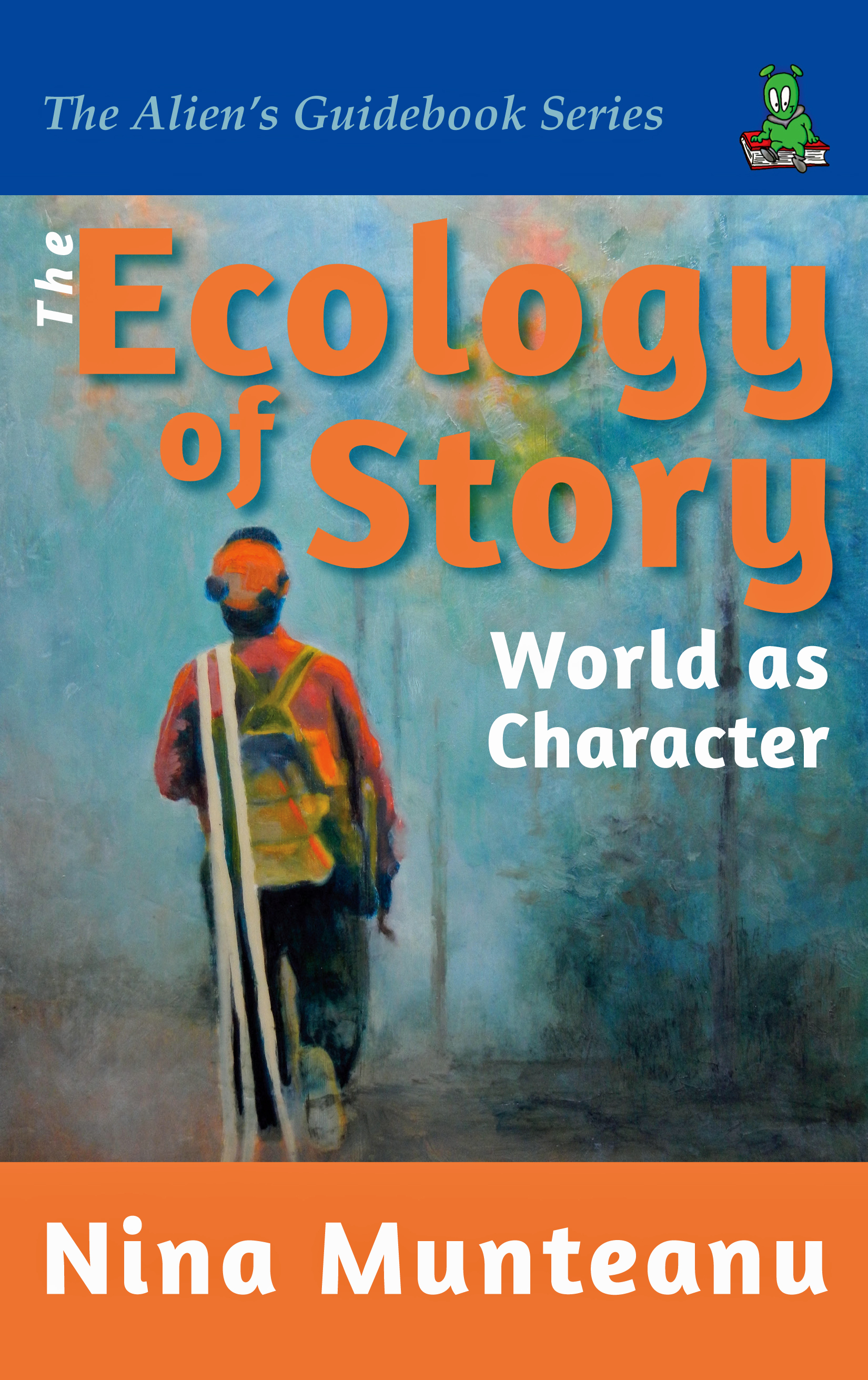
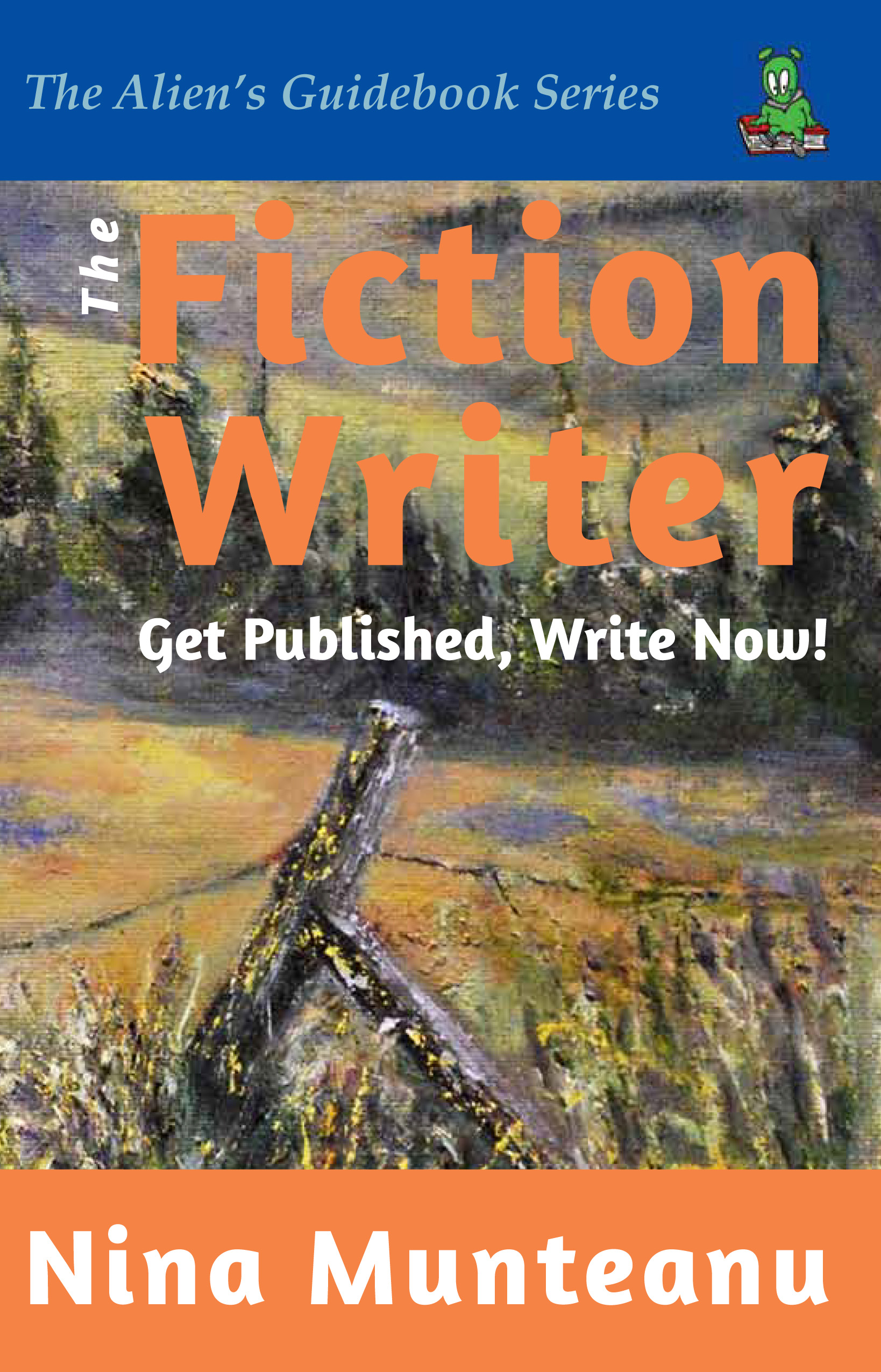
EcologyOfStory coverI remember a wonderful conversation I had several years ago at a conference with another science fiction writer on weird and wonderful protagonists and antagonists. Derek knew me as an ecologist—in fact I’d been invited to do a lecture at that conference entitled “The Ecology of Story” (also the name of my writing guidebook on treating setting and place as a character). We discussed the role that ecology plays in creating setting that resonates with theme and how to provide characters enlivened with metaphor.

Derek was fascinated by saprotrophs and their qualities. Saprotrophs take their nutrition from dead and decaying matter such as decaying pieces of plants or animals by dissolving them and absorbing the energy through their body surface. They accomplish this by secreting digestive enzymes into the dead/decaying matter to absorb the soluble organic nutrients. The process—called lysotrophic nutrition—occurs through microscopic lysis of detritus. Examples of saprotrophs include mushrooms, slime mold, and bacteria.
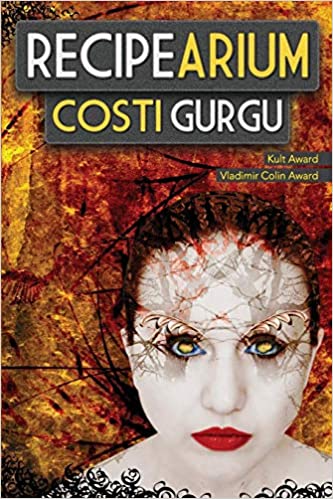
Recipearium CostiGurguI recall Derek’s eagerness to create a story that involved characters who demonstrate saprotrophic traits or even were genuine saprotrophs (in science fiction you can do that—it’s not hard. Check out Costi Gurgu’s astonishing novel Recipearium for a thrilling example). I wonder if Derek fulfilled his imagination.

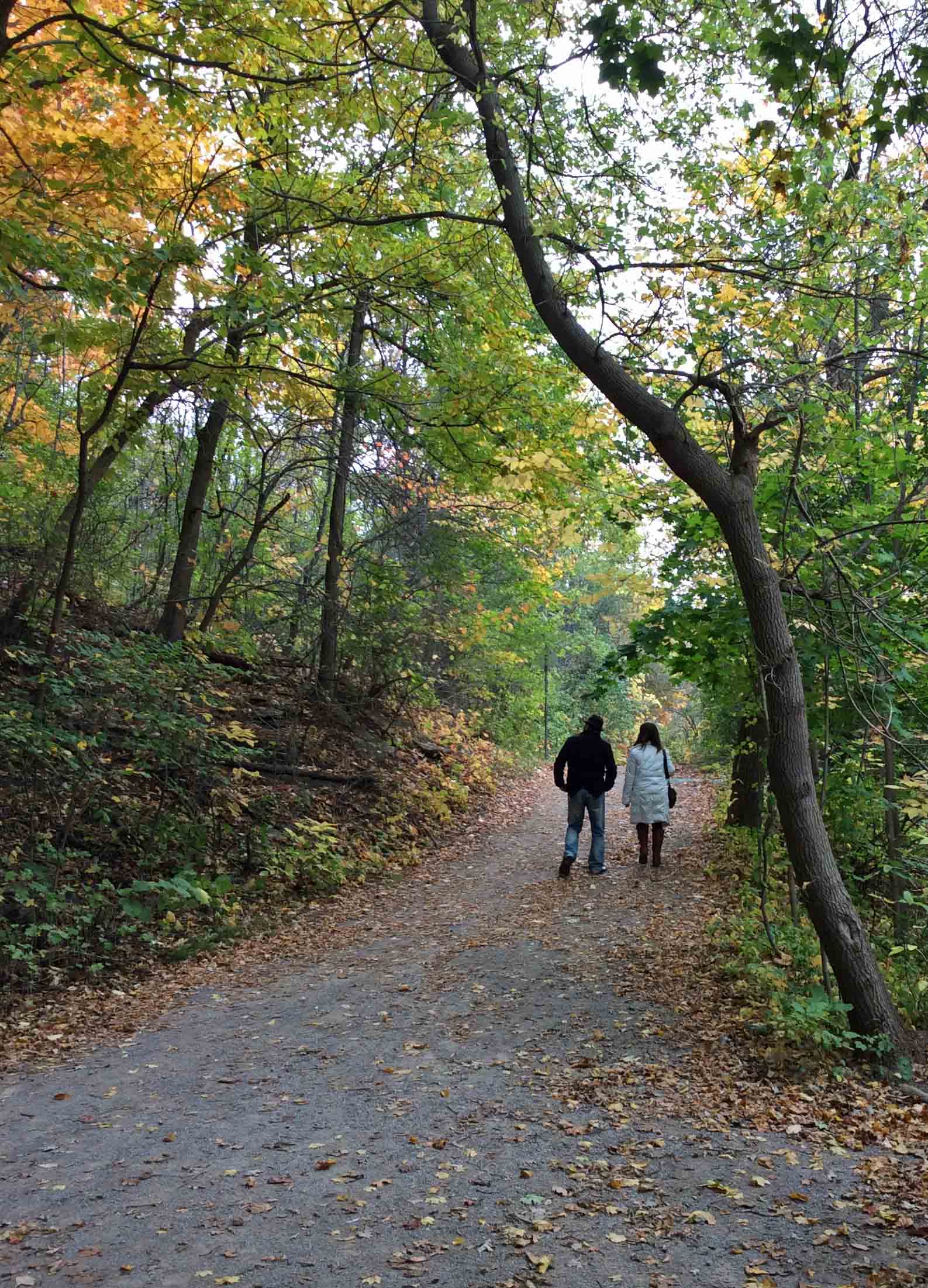
I think of what Derek said, as I walk in my favourite woodland. It is early spring and the river that had swollen with snow melt just a week before, now flows with more restraint. I can see the cobbles and clay of scoured banks under the water. Further on, part of the path along the river has collapsed from a major bank scour the previous week. The little river is rather big and capricious, I ponder; then I consider that the entire forest sways to similar vagaries of wind, season, precipitation and unforeseen events. Despite its steadfast appearance the forest flows—like the river—in a constant state of flux and change, cycling irrevocably through life and death.

Cedar trunk base

Cedar tree (photo by Nina Munteanu)

As I’m writing this, the entire world struggles with life and death in the deep throws of a viral pandemic. COVID-19 has sent many cities into severe lock down to prevent viral spread in a life and death conflict. I’ve left the city and I’m walking in a quiet forest in southern Ontario in early spring. The forest is also experiencing life and death. But here, this intricate dance has seamlessly partnered death and decay with the living being of the forest. Without the firm embrace of death and decay, life cannot dance. In fact, life would be impossible. What strikes me here in the forest is how the two dance so well.

cedar log patterns2 copy

Cedar log, patterns in sapwood (photo by Nina Munteanu)

I walk slowly, eyes cast to the forest floor to the thick layer of dead leaves, and discover seeds and nuts—the promise of new life. I aim my gaze past trees and shrubs to the nearby snags and fallen logs. I’m looking for hidden gifts. One fallen cedar log reveals swirling impressionistic patterns of wood grain, dusted with moss and lichen. Nature’s death clothed in beauty.

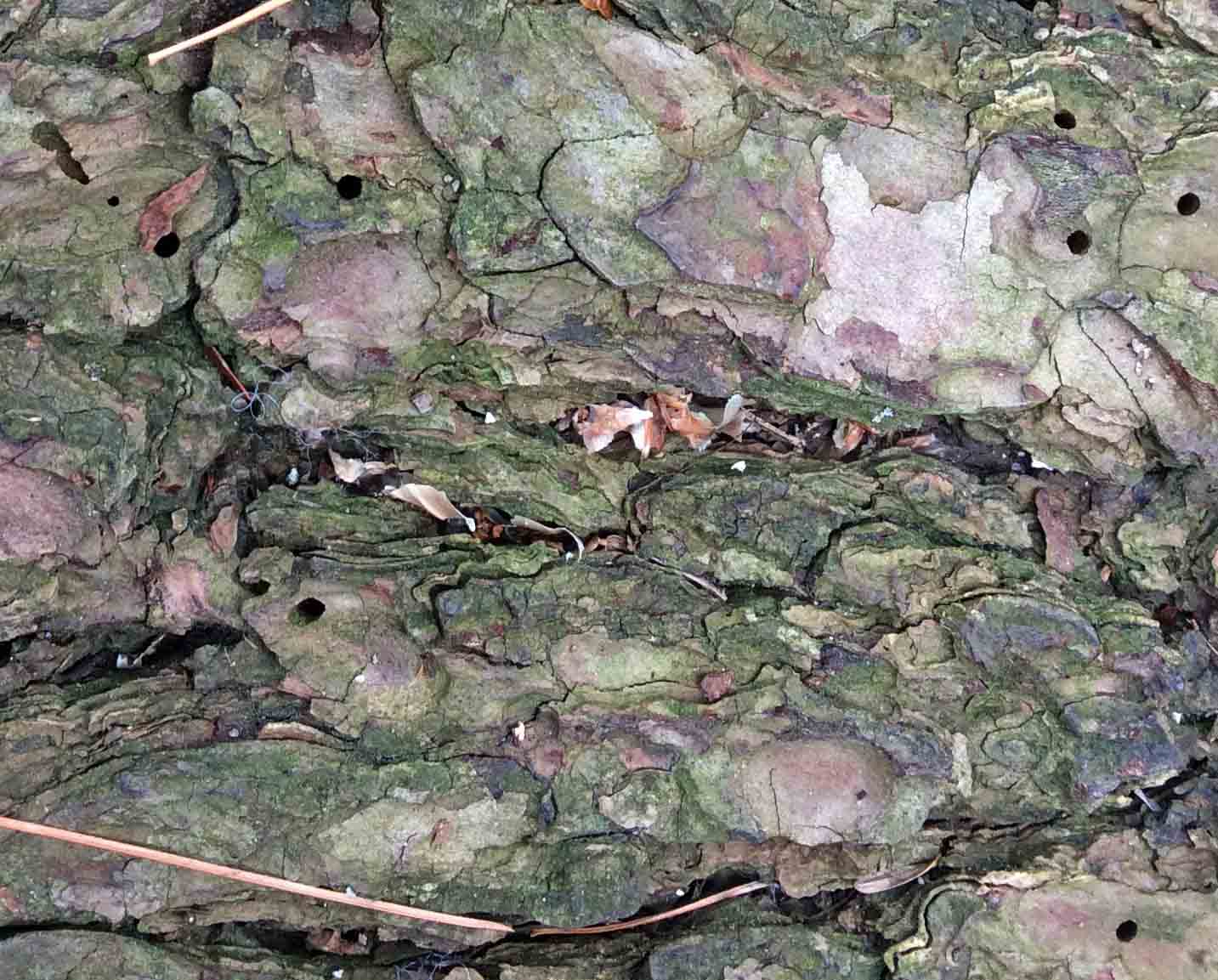
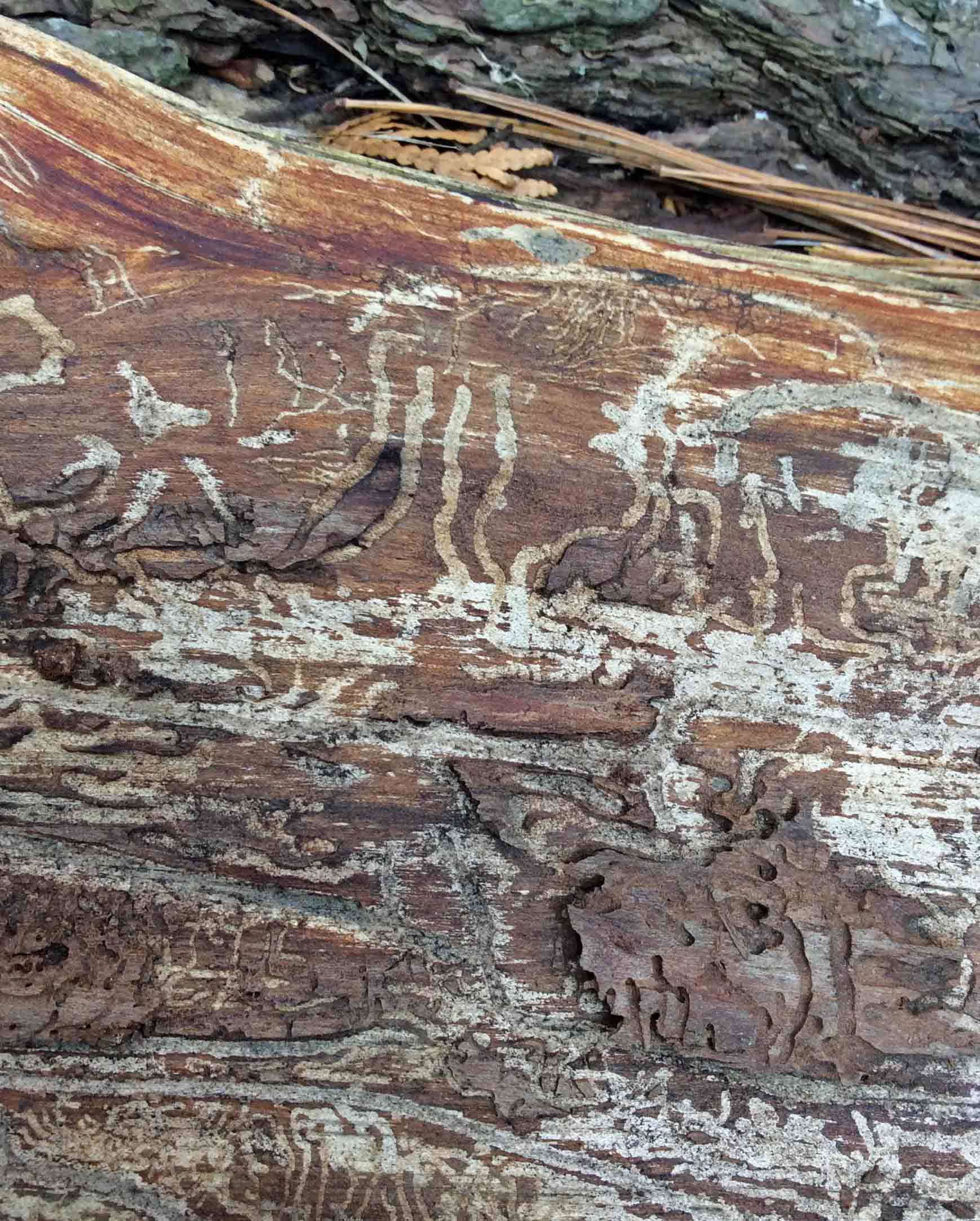
The bark of a large pine tree that has fallen is riddled with tiny beetle holes drilled into its bark. Where the bark has sloughed off, a gallery of larval tracks in the sapwood create a map of meandering texture, form and colour.
Beetle bore holes pine log

White pine bark scales with tiny beetle bore holes, Little Rouge, ON (photo by Nina Munteanu)
larval tracks in pine wood

Beetle larval tracks in pine sapwood (photo by Nina Munteanu)

Nearby, another giant pine stands tall in the forest. Its roughly chiselled bark is dusted in lichens, moss and fungus. The broad thick ridges of the bark seem arranged like in a jigsaw puzzle with scales that resemble metal plates. They form a colourful layered mosaic of copper to gray and greenish-gray. At the base of the tree, I notice that some critter has burrowed a home in a notch between two of the pine’s feet. Then just around the corner, at the base of a cedar, I spot several half-eaten black walnuts strewn in a pile—no doubt brought and left there by some hungry and industrious squirrel who prefers to dine here.

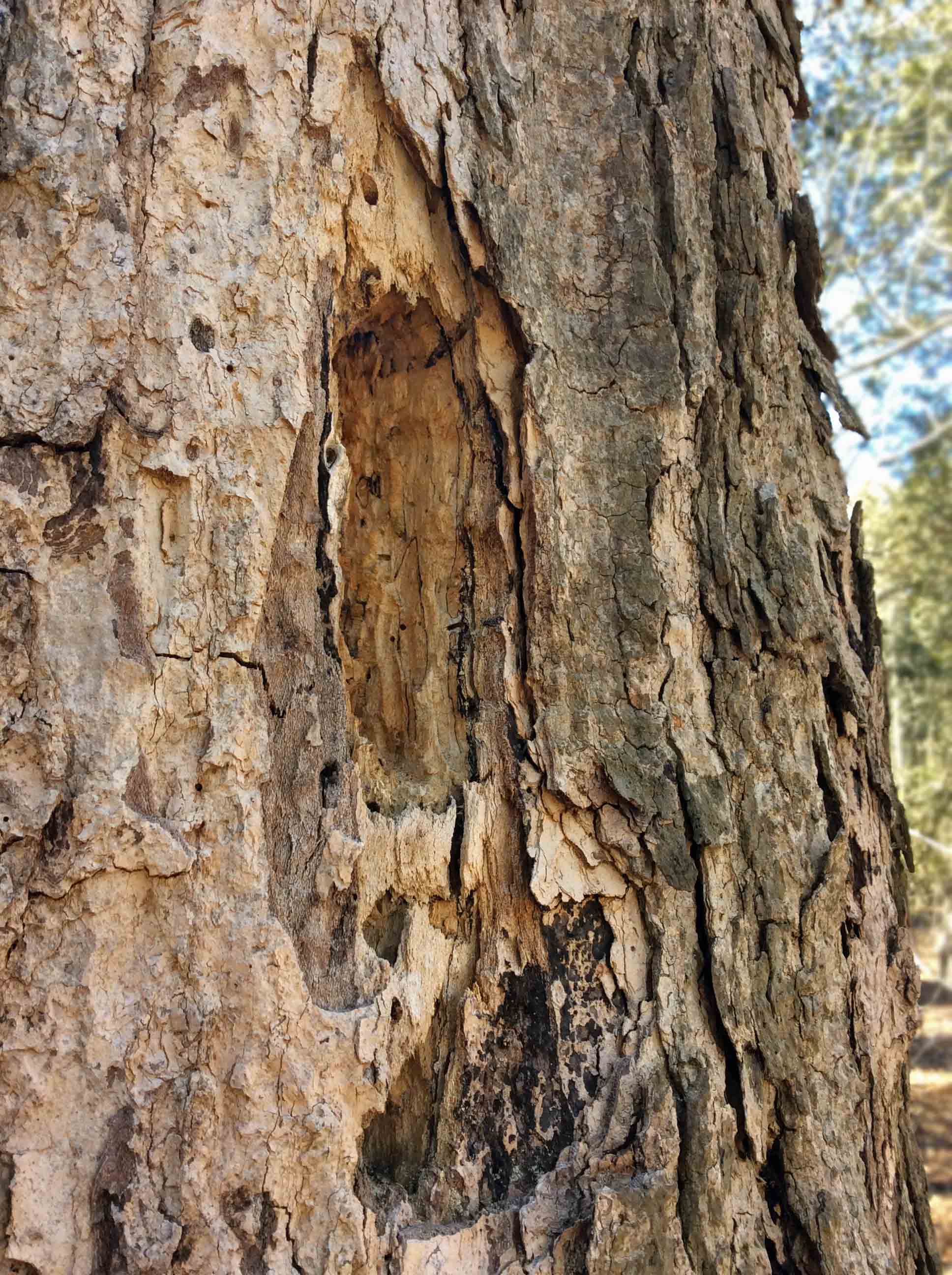
The forest is littered with snags and fallen trees in different stages of breakdown, decomposition and decay. I spot several large cedar, pine, oak and maple snags with woodpecker holes. The snags may remain for many decades before finally falling to the ground.

Fallen Heroes, Mother Archetypes & Saprophyte Characters
WoodpeckerHole on cedar

Woodpecker hole in a snag (photo by Nina Munteanu)

The forest ecosystem supports a diverse community of organisms in various stages of life and death and decay. Trees lie at the heart of this ecosystem, supporting a complex and dynamic cycle of evolving life. Even in death, the trees continue to support thriving detrivore and saprophytic communities that, in turn, provide nutrients and soil for the next generation of living trees. It’s a partnership.

Decomposition and decay are the yin to the yang of growth, writes Trees for Life; and together they form two halves of the whole that is the closed-loop cycle of natural ecosystems.

Snags and rotting logs on the forest floor provide damp shelter and food for many plants and animals. Most are decomposers, including earthworms, fungi, and bacteria. As the wood decays, nutrients in the log break down and recycle in the forest ecosystem. Insects, mosses, lichens, and ferns recycle the nutrients and put them back into the soil for other forest plants to use. Dead wood is an important reservoir of organic matter in forests and a source of soil formation. Decaying and dead wood host diverse communities of bacteria and fungi.
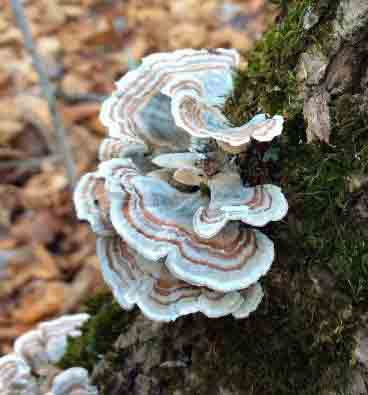
TurkeyTail fungus on tree-LR

Turkey tail fungus, Little Rouge woodland (photo by Nina Munteanu)

Mother Archetypes

Wood tissues of tree stems include the outer bark, cork cambium, inner bark (phloem), vascular cambium, outer xylem (living sapwood), and the inner xylem (non-living heartwood). The outer bark provides a non-living barrier between the inner tree and harmful factors in the environment, such as fire, insects, and diseases. The cork cambium (phellogen) produces bark cells. The vascular cambium produces both the phloem cells (principal food-conducting tissue) and xylem cells of the sapwood (the main water storage and conducting tissue) and heartwood.
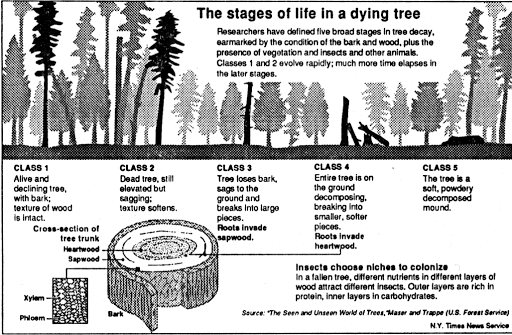
stages of tree life

Forest ecologists defined five broad stages in tree decay, shown by the condition of the bark and wood and presence of insects and other animals. The first two stages evolve rapidly; much more time elapses in the later stages, when the tree sags to the ground. These latter stages can take decades for the tree to break down completely and surrender all of itself back to the forest. A fallen tree nurtures, much like a “mother” archetype; it provides food, shelter, and protection to a vast community—from bears and small mammals to salamanders, invertebrates, fungus, moss and lichens. This is why fallen trees are called “nursing logs.”

uprooted stump carbon cushion fungus

Uprooted tree covered in fungi, lichen and moss, Little Rouge, ON (photo by Nina Munteanu)


Heralds, Tricksters and Enablers
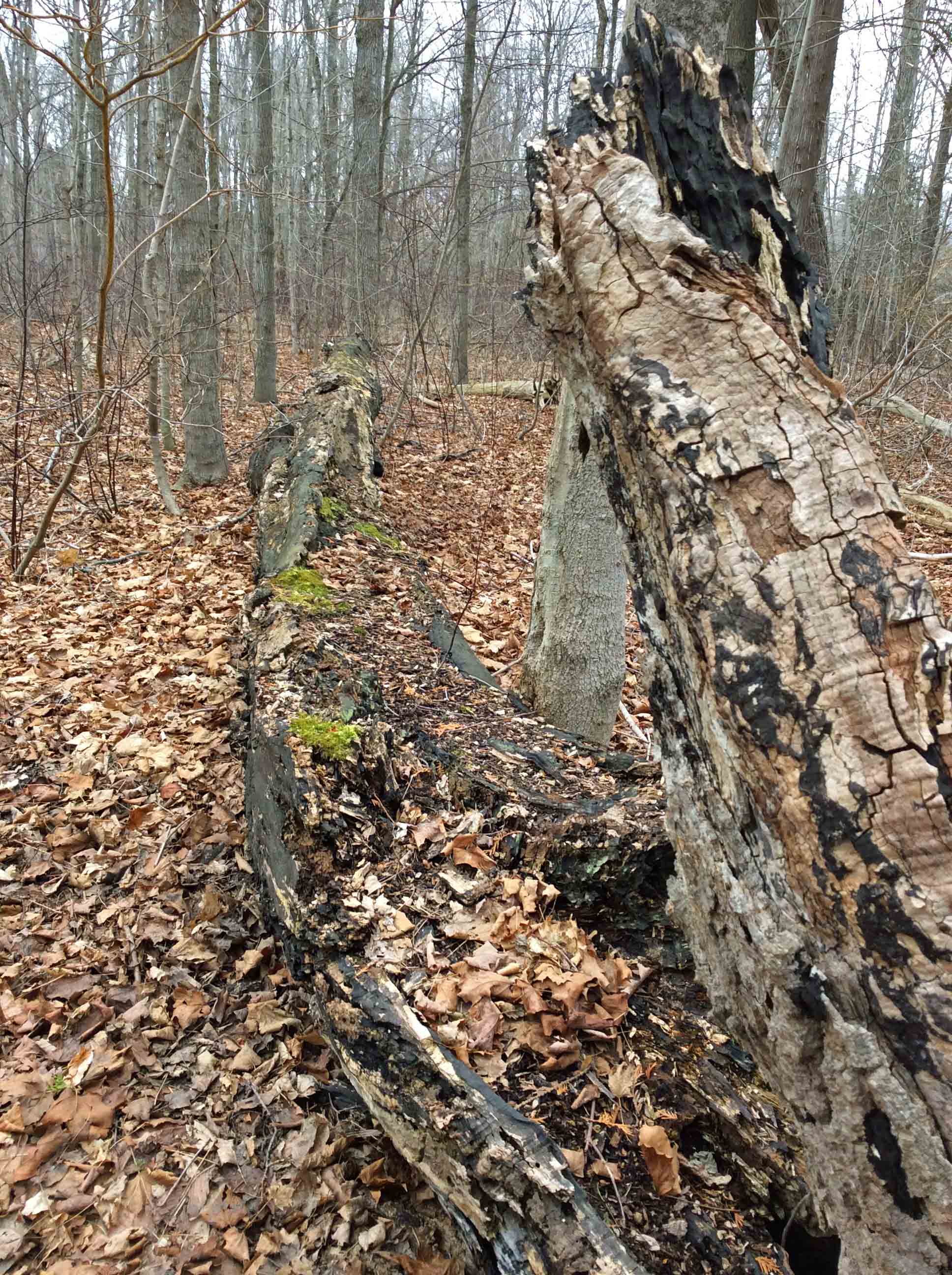
rotting maple log2

Rotting maple log (photo by Nina Munteanu)

I stop to inspect another fallen tree lying on a bed of decaying maple, beech and oak leaves. When a fallen tree decomposes, unique new habitats are created within its body as the outer and inner bark, sapwood, and heartwood decompose at different rates, based in part on their characteristics for fine dining. For instance, the outer layers of the tree are rich in protein; inner layers are high in carbohydrates. This log—probably a sugar maple judging from what bark is left—has surrendered itself with the help of detrivores and saprophytes to decomposition and decay. The outer bark has mostly rotted and fallen away revealing an inner sapwood layer rich in varied colours, textures and incredible patterns—mostly from fungal infestations. In fact, this tree is a rich ecosystem for dozens of organisms. Wood-boring beetle larvae tunnel through the bark and wood, building their chambers and inoculating the tree with microbes. They open the tree to colonization by other microbes and small invertebrates. Slime molds, lichen, moss and fungi join in. The march of decay follows a succession of steps. Even fungi are followed by yet other fungi in the process as one form creates the right condition for another form.
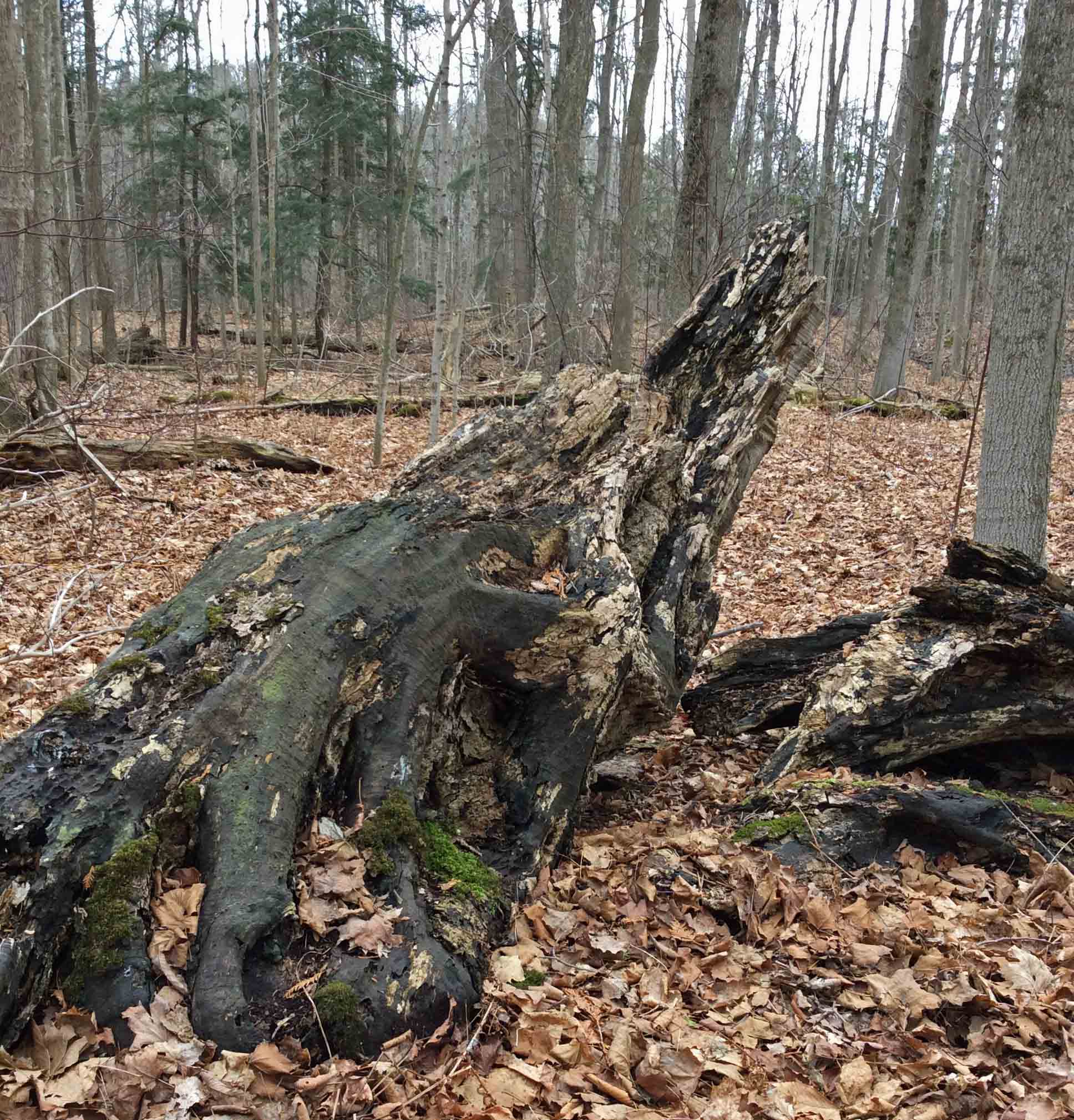
rotting maple log

Rotting maple log, covered in carbon cushion fungus, Little Rouge, ON (photo by Nina Munteanu)

Most hardwoods take several decades to decompose and surrender all of themselves back to the forest. In western Canada in the westcoast old growth forest, trees like cedars can take over a hundred years to decay once they’re down. The maple log I’m studying in this Carolinian forest looks like it’s been lying on the ground for a while, certainly several years. The bark has fragmented and mostly fallen away, revealing layers of sapwood in differing stages of infestation and decay. Some sapwood is fragmented and cracked into blocks and in places looks like stacked bones.

Black lines as though drawn by a child’s paintbrush flow through much of the sapwood; these winding thick streaks of black known as “zone lines” are in fact clumps of dark mycelia, which cause “spalting,” the colouration of wood by fungus. According to mycologist Jens Petersen, these zone lines prevent “a hostile takeover by mycelia” from any interloping fungi. Most common trees that experience spalting include birch, maple, and beech. Two common fungi that cause spalting have colonized my maple log. They’re both carbon cushion fungi.
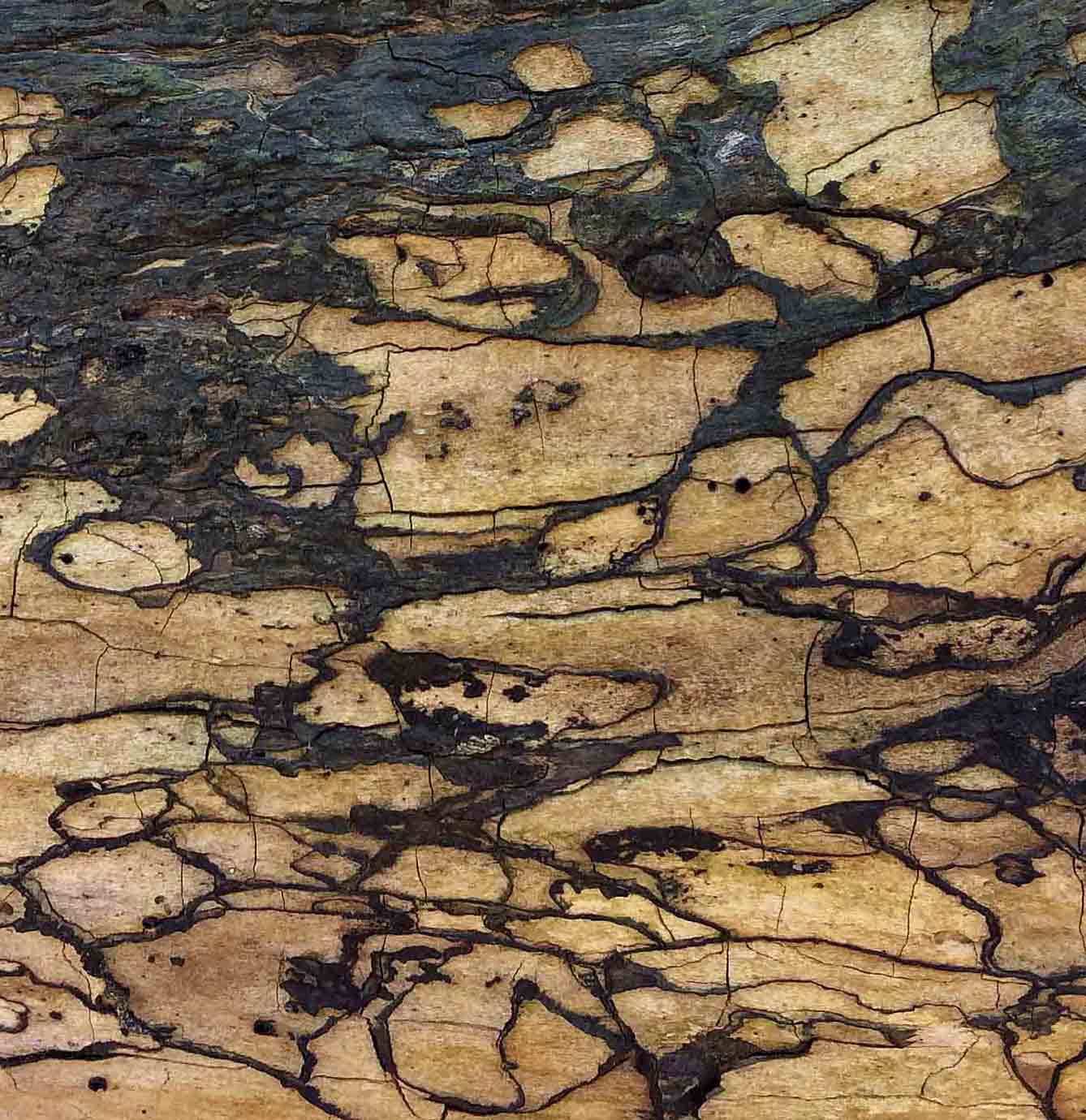
Spalting

Spalting through zone lines by carbon cushion fungus, Little Rouge, ON (photo by Nina Munteanu)

hypoxylon-close

Hypoxylon fungus (photo N. Munteanu)

Brittle cinder (Kretzschmaria deusta) resembles burnt wood at maturity. Deusta means “burned up” referring to the charred appearance of the fungus. Hypoxylon forms a “velvety” grey-greenish cushion or mat (stroma). As the Hypoxylon ages, it blackens and hardens and tiny, embedded fruitbodies (perithecia) show up like pimples over the surface of the crust.

Blue-green fungus on log

Green and Blue Stain fungus (photo N. Munteanu)

Much of the exposed outer wood layer looks as though it has been spray painted with a green to blue-black layer. The “paint” is caused by the green-stain fungus (Chlorociboria) and blue-stain fungus (Ceratocystis). The blue-green stain is a metabolite called xylindein. Chlorociboria and Ceratocystis are also spalter fungi, producing a pigment that changes the color of the wood where they grow. While zone lines that create spalting don’t damage wood, the fungus responsible most likely does.

Spalting is common because of the way fungi colonize, in waves of primary and secondary colonizers. Primary colonizers initially capture and control the resource, change the pH and structure of the wood, then must defend against the secondary colonizers now able to colonize the changed wood.
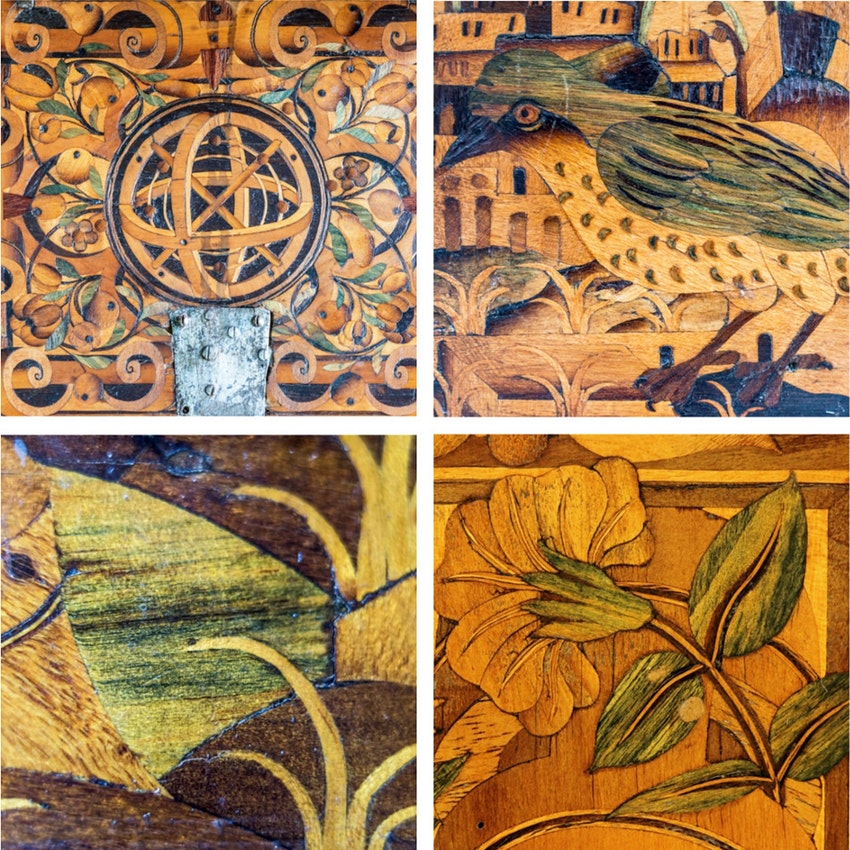
Intarsia using blue-green spalted wood

Details of 16th century German bureaus containing blue-green spalted wood by the elf-cup fungus Chlorociboria aeruginascens

Wood that is stained green, blue or blue-green by spalting fungi has been and continues to be valued for inlaid woodwork. In an article called “Exquisite Rot: Spalted Wood and the Lost Art of Intarsia” Daniel Elkind writes of how “the technique of intarsia–the fitting together of pieces of intricately cut wood to make often complex images–has produced some of the most awe-inspiring pieces of Renaissance craftsmanship.” The article explores “the history of this masterful art, and how an added dash of colour arose from the most unlikely source: lumber ridden with fungus.”

Shapeshifting Characters
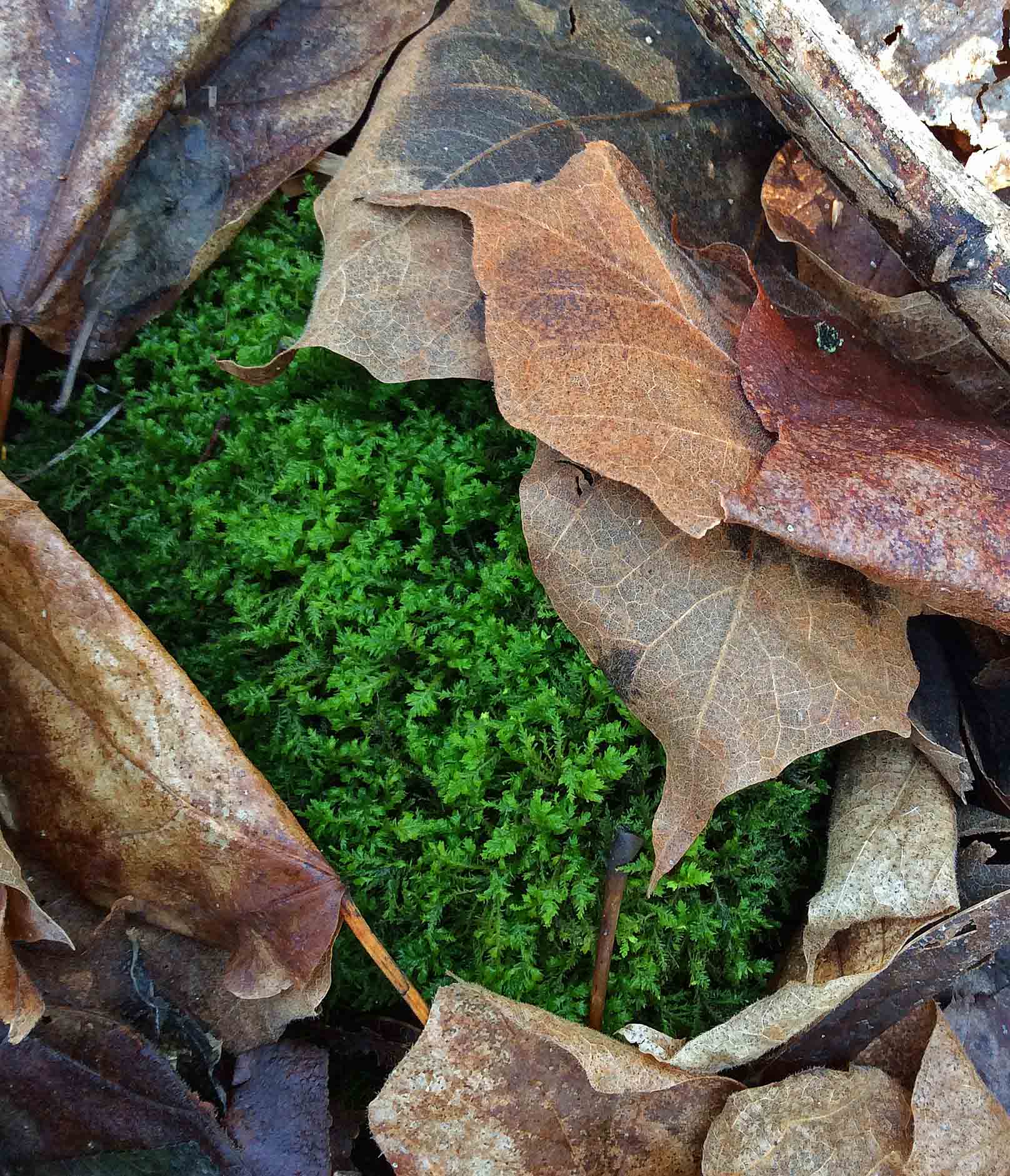
moss hiding under leaves

Moss in forest litter (photo by Nina Munteanu)

I find moss everywhere in the forest, including beneath the forest floor. Moss is a ubiquitous character, adapting itself to different situations and scenarios. Like a shapeshifter, moss is at once coy, hiding beneath rotting leaf litter, stealthy and curious as it creeps up the feet of huge cedars, and exuberant as it unabashedly drapes itself over every possible surface such as logs, twigs and rocks, and then proceeds to procreate for all to see.

Moss is a non-vascular plant that helps create soil; moss also filters and retains water, stabilizes the ground and removes CO2 from the atmosphere. Science tells us that mosses are important regulators of soil hydroclimate and nutrient cycling in forests, particularly in boreal ecosystems, bolstering their resilience. Mosses help with nutrient cycling because they can fix nitrogen from the air, making it available to other plants.

Moss with spores water drops2

Green moss gametophyte with sporophytes growing out of it (photo by Nina Munteanu)

Mosses thrive in the wet winter and spring, providing brilliant green to an otherwise brown-gray environment. Even when covered in snow (or a bed of leaves), moss continues its growth cycle, usually in the leafy gametophyte stage. When the winter is moderate, like it is near Toronto, sporophyte structures can already appear on stalks that hold a capsule full of spores.  In the spring the capsules release spores that can each create a new moss individual. Moss is quietly, gloriously profligate.

Symbiotic Characters

Many twigs strewn on the leaf-covered forest floor are covered in grey-green lichen with leaf-like, lobes. On close inspection, the lichen thallus contains abundant cup-shaped fruiting bodies. I identify the lichen as Physchia stellaris, common and widespread in Ontario and typically pioneering on the bark of twigs—especially of poplars, and alders.
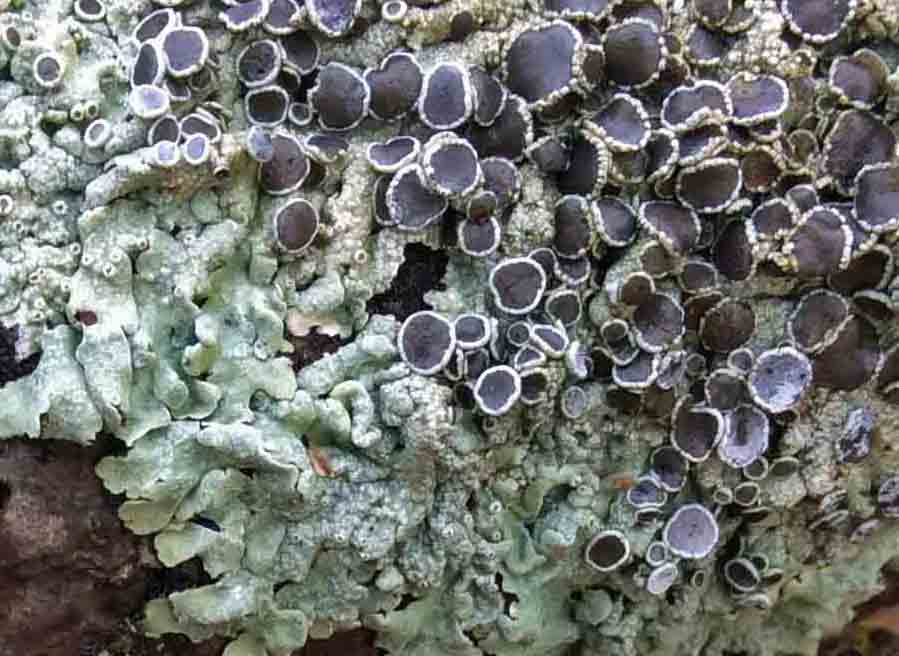
Lichen fruiting-best-2 copy

Physchia stellaris lichen with fruiting bodies (apothecia), Little Rouge, ON (photo by Nina Munteanu)

Lichens are a cooperative character; two characters in one, really. Lichens are a complex symbiotic association of two or more fungi and algae (some also partner up with a yeast). The algae in lichens (called phycobiont or photobiont) photosynthesize and the fungus (mycobiont) provides protection for the photobiont. Both the algae and fungus absorb water, minerals, and pollutants from the air, through rain and dust. In sexual reproduction, the mycobiont produces fruiting bodies, often cup-shaped, called apothecia that release ascospores. The spores must find a compatible photobiont to create a lichen. They depend on each other for resources—from food to shelter and protection.

Forest as Character
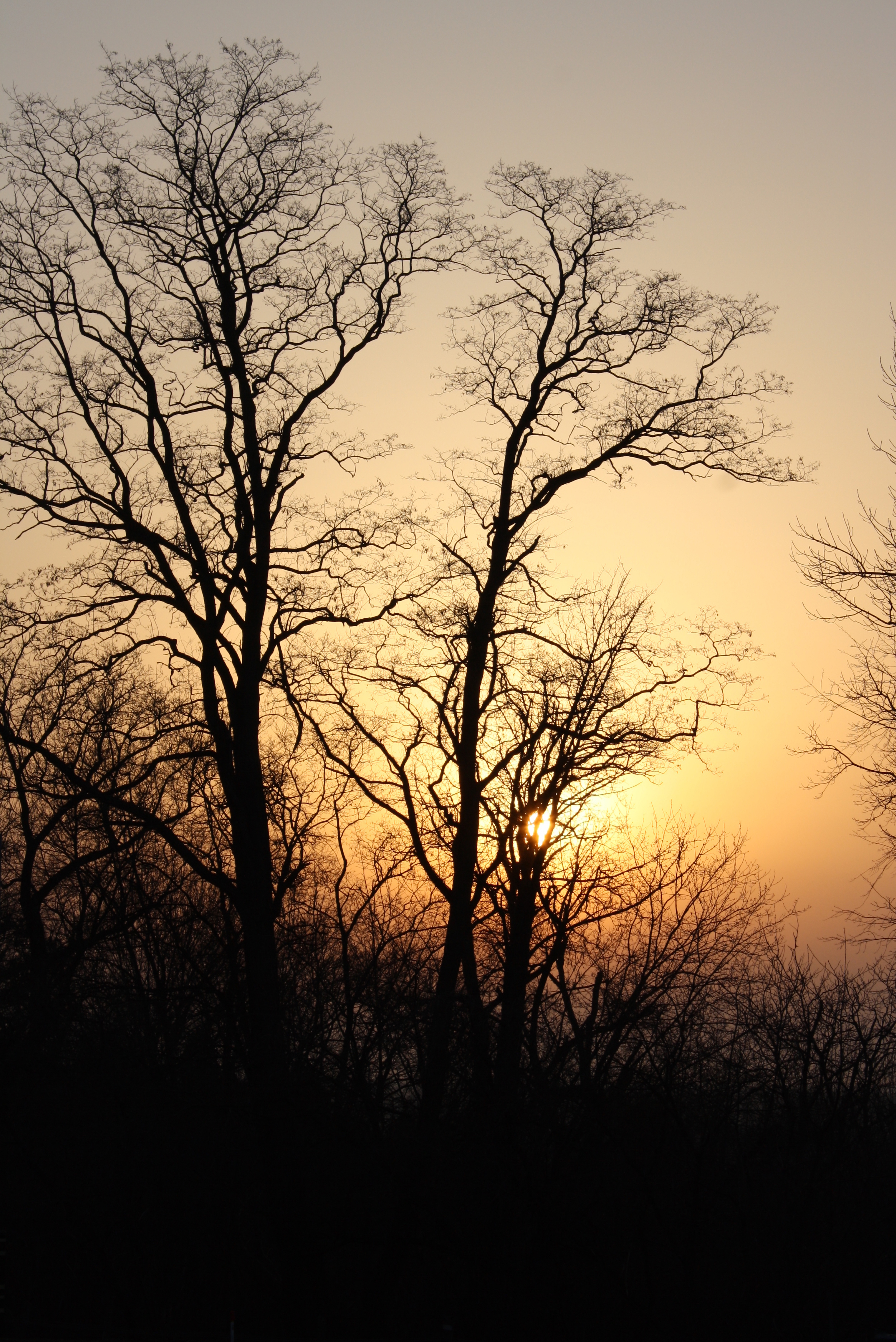
Sunset 1 Niagara

Sunset in Niagara on the Lake (photo by Nina Munteanu)

In Far from the Madding Crowd, Thomas Hardy personified trees as interpreters between Nature and humanity: from the “sobbing breaths” of a fir plantation to the stillness of trees in a quiet fog, standing “in an attitude of intentness, as if they waited longingly for a wind to come and rock them.” Trees, meadows, winding brooks and country roads were far more than back-drop for Hardy’s world and his stories. Elements of the natural world were characters in their own right that impacted the other characters in a world dominated by nature.

Place ultimately portrays what lies at the heart of the story. Place as character serves as an archetype that story characters connect with and navigate in ways that depend on the theme of the story, particularly in allegories that rely strongly on metaphor. A story’s theme is essentially the “so what part” of the story. What is at stake for the character on their journey. Theme is the backbone—the heart—of the story, driving characters to journey through time and place toward some kind of fulfillment. There is no story without theme. And there is no theme without place.
—excerpted from The Ecology of Story: World as Character


nina-2014aaa

Nina Munteanu is a Canadian ecologist / limnologist and novelist. She is co-editor of Europa SF and currently teaches writing courses at George Brown College and the University of Toronto. Visit www.ninamunteanu.ca for the latest on her books. Nina’s bilingual “La natura dell’acqua / The Way of Water” was published by Mincione Edizioni in Rome. Her non-fiction book “Water Is…” by Pixl Press (Vancouver) was selected by Margaret Atwood in the New York Times ‘Year in Reading’ and was chosen as the 2017 Summer Read by Water Canada. Her novel “A Diary in the Age of Waterwill be released by Inanna Publications (Toronto) in June 2020.



Infertility in the Age of Water

Diary Water cover finalIn a scene of my near-future eco-thriller A Diary in the Age of Water (Inanna Publications, 2020) the diarist’s young colleague Daniel rather too enthusiastically proclaims the impending extinction of males.

“Scientists all agree that environmental factors are the main triggers for male and female infertility through epigenetics…Epigenetics rules climate change-related adaptations. And everything appears stacked heavily for females and intersex humans. Males might go extinct with climate change!”

–A Diary in the Age of Water

Lynna Dresden, the diarist in A Diary in the Age of Water, thinks Daniel rather buffoonish and a traitor to his male kind. Then again, here is how another Daniel starts his article in a 2018 issue of GQ Magazine entitled “Sperm Count Zero“:

Men are doomed. Everybody knows this. We’re obviously all doomed, the women too, everybody in general, just a waiting game until one or another of the stupid things our stupid species is up to finally gets us. But as it turns out, no surprise: men first. Second instance of no surprise: We’re going to take the women down with us.

There has always been evidence that men, throughout life, are at higher risk of early death—from the beginning, a higher male incidence of Death by Mastodon Stomping, a higher incidence of Spiked Club to the Brainpan, a statistically significant disparity between how many men and how many women die of Accidentally Shooting Themselves in the Face or Getting Really Fat and Having a Heart Attack. The male of the species dies younger than the female—about five years on average. Divide a population into groups by birth year, and by the time each cohort reaches 85, there are two women left for every man alive. In fact, the male wins every age class: Baby boys die more often than baby girls; little boys die more often than little girls; teenage boys; young men; middle-aged men. Death champions across the board.

Now it seems that early death isn’t enough for us—we’re on track instead to void the species entirely.

–Daniel Noah Halpern, GQ Magazine

sperm_decline_chartBoth Daniels are talking about the alarming rate at which sperm counts worldwide are falling. They’ve dropped by half in the last fifty years in North America, Europe, Australia and New Zealand—according to a 2017 paper by researchers at Hebrew University and Mount Sinai medical school and more recent studies in 2018.

While an unhealthy lifestyle (being overweight or obese, smoking, stress and alcohol or recreational drug use) is most often implicated, more insidious causes exist.

PHTHALATESResearch shows that consumption and/or exposure to many common constituents of urban living can decrease fertility, increase miscarriage, spontaneous abortion, and lower auto-immune systems. Examples include car exhaust, pesticides, common detergents, hair dyes, cleaning solvents, oil based paints, adhesives, gasoline; and consumption of MSG, coffee, alcohol.

A 2019 study by scientists at Nottingham University identified two chemicals common in home environments that damage sperm in men and dogs. GQ Daniel goes on to explain: “Phthalates and BPA [used to make plastic soft and flexible or harder and stronger] for example, mimic estrogen in the bloodstream. If you’re a man with a lot of phthalates in his system, you’ll produce less testosterone and fewer sperm. If exposed to phthalates in utero, a male fetus’s reproductive system itself will be altered: He will develop to be less male.”

sperm count and platics

This leads Age of Water Daniel to bring up the rise in intersex mammals (individuals born with any of several variations in sex characteristics including chromosomes, gonads, sex hormones or genitals that do not fit the “strict definitions for ‘male’ or ‘female’ bodies”). A 2016 article in Environmental Health Insights by Rich et al. attribute an increasing number of human children born with intersex variation to an increase in hormone disrupting chemicals in our environment.

Phthalates bookLeaning on his microscope, Daniel went on, “Wherever there’s a sewage treatment plant, pulp and paper mill, or herbicides and pesticides in a stream, you get endocrine disruption, which causes more female or intersex fish populations…[Degradation products of surfactants used in commercial and household detergents] inhibit breeding in male fish. And herbicides like atrazine—”

“—Create feminized males with female eggs, along with reduced immunity to disease,” I finished for him.

I knew all this. Hormonal disruption is global. Environmental toxicologists have been finding it in many aquatic animals like fish, turtles, alligators and frogs. And some terrestrial animals…Even humans…Was it also causing the steep rise in ambiguous sex in humans? Is Daniel an intersex human? Apparently 1 in 30 now have bodies that differ notably from standard male or female. Klinefelter, androgen insensitivity syndrome, presence of ovotestes, mixed gonadal dysgenesis, and mosaic genetics are all on the rise. Which was he?

As if he knew what I was thinking, Daniel said dramatically, “The environment is changing us faster than most think and it’s doing it through epigenetics and HGT.”

–A Diary in the Age of Water

Phthalates and BPA can be found everywhere. GQ Daniel lists them: “BPA can be found in water bottles and food containers and sales receipts. Phthalates are even more common: They are in the coatings of pills and nutritional supplements; they’re used in gelling agents, lubricants, binders, emulsifying agents, and suspending agents. Not to mention medical devices, detergents and packaging, paint and modeling clay, pharmaceuticals and textiles and sex toys and nail polish and liquid soap and hair spray. They are used in tubing that processes food, so you’ll find them in milk, yogurt, sauces, soups, and even, in small amounts, in eggs, fruits, vegetables, pasta, noodles, rice, and water. The CDC determined that just about everyone in the United States has measurable levels of phthalates in his or her body—they’re unavoidable.”

These chemicals affect sperm’s ability to swim, navigate and fertilize an egg. DNA fragmentation in the sperm head also occurs, which is basically equivalent to a sperm having a brain hemorrhage. Recent studies suggest that 20-30% of young men today have sperm counts in a range that is associated with reduced fertility. Sarbjit Kaur at the Punjab Agricultural University found that men who live in industrial cities had six times more abnormal sperm than men living in a relatively clean rural town.

TheHandmaid'sTale-bookDr. Marilyn F. Vine at the University of North Carolina demonstrated that smoking men had lower sperm counts by 13-17%. Smokers also had more abnormal sperm. Likewise, women who smoked experienced more spontaneous abortions, early menopause and abnormal oocytes. Follicular fluid also contained high levels of cadmium, a heavy metal present in cigarettes, and cotininie, a metabolite of nicotine.

A growing concern for infertility has entered our general mindset, reflected in the theme of infertility in literature and motion pictures.

Notable examples include Margaret Atwood’s The Handmaid’s Tale (1985), Raising Arizona (1987), Aeon Flux (2005), The Children of Men (2006), Private Life (2018) and my own A Diary in the Age of Water (2020).

Although we are not close to experiencing the global infertility pandemic portrayed in the barren 2027 world of The Children of Men, this cautionary tale of a world gone mad with grief should linger like the whispered truth of a fairy tale.

children of men scene

scene from “Children of Men” motion picture


Suggested Reading:

Carr, Teresa. 2019. “Sperm counts are on the decline—could plastics be to blame?” The Guardian.

Belluz, Julia. 2019. “Sperm counts are falling. This isn’t the reproductive apocalypse—yet” Vox.

Halpern, Daniel Noah. 2018. “Sperm Count Zero.” GQ Magazine.

Fetters, Ashley. 2018. “Sperm Counts Continue to Fall.” The Atlantic.

Stein, Rob. 2017. “Sperm Counts Plummet in Western Men, Study Finds.” NPR.


nina-2014aaa

Nina Munteanu is a Canadian ecologist / limnologist and novelist. She is co-editor of Europa SF and currently teaches writing courses at George Brown College and the University of Toronto. Visit www.ninamunteanu.ca for the latest on her books. Nina’s bilingual “La natura dell’acqua / The Way of Water” was published by Mincione Edizioni in Rome. Her non-fiction book “Water Is…” by Pixl Press (Vancouver) was selected by Margaret Atwood in the New York Times ‘Year in Reading’ and was chosen as the 2017 Summer Read by Water Canada. Her novel “A Diary in the Age of Waterwill be released by Inanna Publications (Toronto) in June 2020.
Looking for Great Science Fiction Reading?

Venusian Job Cover

Bundoran Buddies Story Bundle

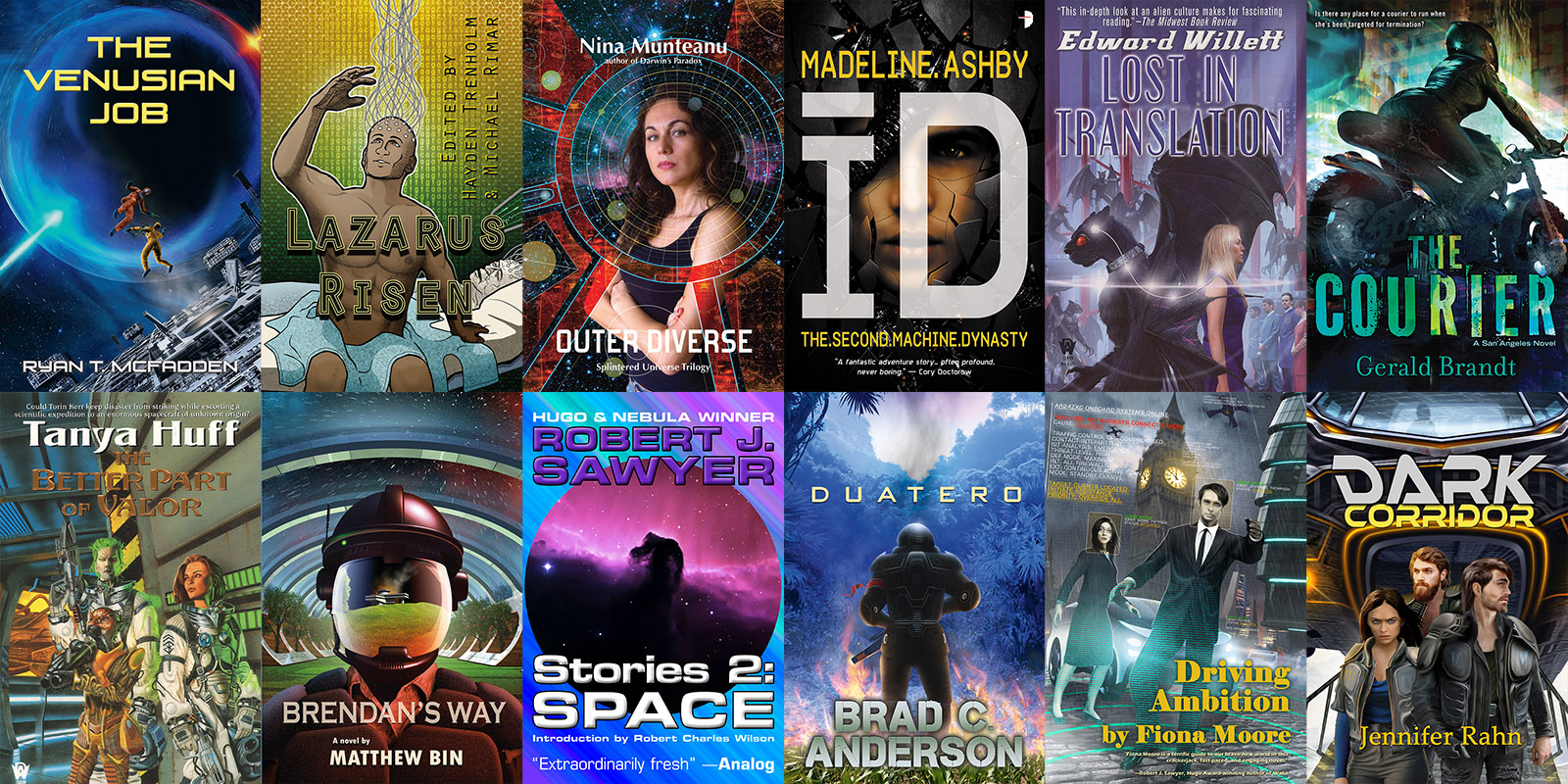
While you’re self-isolating during the COVID-19 pandemic, pick up some great ebooks in this story bundle offered by Bundoran Buddies Book Bundle for the next three weeks (through to the third week in April). Then read, read, read away the pandemic. Curated by Hayden Trenholm of Bundoran Press, you can get twelve books for as little as $15USD.

Here’s what Hayden says:

OuterDiverse-front coverScience fiction is our conversation with the future. That’s the philosophy of Bundoran Press Publishing House. But how can you have a conversation without friends? Even though in the days of COVID-19, most of those conversations take place on-line or by phone, there’s never been a better time to think and talk about the future.

That’s why I’m curating this twelve-book science fiction bundle for https://storybundle.com/scifi, made up of ten novels and two short story collections from established greats and rising stars. Half of the books were published by the Press and the other six come from some fabulous authors who have been our friends and supporters for years. As always, at Story Bundle, you decide what the books are worth and a portion of the proceeds go to charity.

The Bundoran Buddies Book Bundle includes Lazarus Risen, an international collection of stories focused on longevity and immortality, including Hugo nominated author, Sean McMullen.

Award winners and nominees abound in this bundle. Hugo and Nebula award-winning author Robert J. Sawyer offers up Space: Stories, a collection of his short stories, all of them set off-world, including a Hugo finalist and two Aurora Award winners.  Aurora Award winning Edward Willett gives us a Lost in Translation that explores the necessity of understanding the other in a taut tale of interstellar negotiations.

If your taste runs to near-future, BAFTA nominee, Fiona Moore, brings us Driving Ambition, where the murder of an intelligent car launches the protagonist, a mediator between humans and artificial intelligences, on a dangerous trajectory. Or you might prefer, Madelaine Ashby’s iD, the second volume of her Machine World series which “explores the uncomfortable possibilities and limitations of love within slavery and free will under constraint (Globe and Mail).”

At the other end of the temporal spectrum, we have The Better Part of Valor, the second of the Confederation of Valor series from multi-award-winning author Tanya Huff – still producing best sellers after over two decades in the field. Duatero from Brad C. Anderson, with his first novel from from Bundoran Press, is set on a lost outpost of humanity where moral dilemmas compete with fast paced action on a plague planet.  Jennifer Rahn’s Dark Corridor gives us a fun romp in a hard science thriller that includes cyborgs, drug lords and space Vikings.

But wait, there’s more. Ryan McFadden’s hilarious and exciting The Venusian Job pits thief, Emily Van Lars, a.k.a. The Engineer, and her motley crew of mercenaries against aliens, crime lords and a deadly AI. Gerald Brandt’s The Courier, the first volume of a trilogy, is an action-packed thriller in a dystopian future, Los Angeles. Charmingly written Brendan’s Way by Matthew Bin is set entirely aboard a colony ship heading off world in a novel dubbed “Heinlein meets Marx.”

Get Rhea-HawkeGOODLast but certainly not least, Nina Munteanu’s Outer Diverse, the first volume of the Splintered Universe series, introduces Galactic Guardian Rhea Hawk, who investigates the massacre of an entire spiritual sect, catapulting her into a treacherous storm of politics, conspiracy and self-discovery.

“… a master of metaphor, Munteanu turns an adventure story into a wonderland of alien rabbit holes.”
— CRAIG H. BOWLSBY, author and creator of Commander’s Log

“An addictive start to the trilogy!”— BOOK ADDICT

“Rhea Hawke is a Galactic Guardian, and I love to say her name. Her name alone let’s you know that there is a bad ass super hero of a woman on site. I can picture her boots, her great coat, and her side arms. I want to be her when I grow up. ” — DAB OF DARKNESS

For $5USD (or more if you are feeling generous) you get four of the twelve ebooks – MOBI or ePub – and for $15 or more you unlock the remaining eight.

The initial titles in the bundle (yours for a minimum of $5) include:

  • iD by Madeline Ashby
  • Outer Diverse by Nina Munteanu
  • The Venusian Job by Ryan C. McFadden
  • Lazarus Risen edited by Hayden Trenholm and Michael Rimar

If you pay more than the bonus price of just $15, you get the remaining eight books, including:

  • Duatero by Brad C. Anderson
  • Lost in Translation by Edward Willett
  • Space: Stories by Robert J. Sawyer
  • The Courier by Gerald Brandt
  • Dark Corridor by Jennifer Rahn
  • The Better Part of Valor by Tanya Huff
  • Brendan’s Way by Matthew Bin
  • Driving Ambition by Fiona Moore

What better time to cuddle up with a dozen great books and explore the brave new worlds they present? Self-isolation will never seem so much fun.

The bundle is available for a very limited time only, via https://storybundle.com/scifi. It allows easy reading on computers, smartphones, and tablets as well as Kindle and other ereaders via file transfer, email, and other methods. You get multiple DRM-free formats (.epub and .mobi) for all books, but after the three weeks are over, the bundle is gone forever!

It’s also super easy to give the gift of reading with StoryBundle, thanks to our gift cards – which allow you to send someone a code that they can redeem for any future StoryBundle bundle – and timed delivery, which allows you to control exactly when your recipient will get the gift of StoryBundle.

Now, go get some books and read…


nina-2014aaa

Nina Munteanu is a Canadian ecologist / limnologist and novelist. She is co-editor of Europa SF and currently teaches writing courses at George Brown College and the University of Toronto. Visit www.ninamunteanu.ca for the latest on her books. Nina’s bilingual “La natura dell’acqua / The Way of Water” was published by Mincione Edizioni in Rome. Her non-fiction book “Water Is…” by Pixl Press (Vancouver) was selected by Margaret Atwood in the New York Times ‘Year in Reading’ and was chosen as the 2017 Summer Read by Water Canada. Her novel “A Diary in the Age of Waterwill be released by Inanna Publications (Toronto) in June 2020.

Author’s Retreat: Changing the World with Your Mind and Faith

Snow hoar frost

Hoar frost-covered snow pillows, near Manning Park, B.C. (photo by Nina Munteanu)

Some time ago I went on an author’s retreat at my friend’s cabin near Manning Park in British Columbia. Some of them were going skiing at the nearby ski hill and Anne thought I’d appreciate the rustic setting as an ideal place to write. I leapt at the chance. I had lots of writing to do and had set myself up for quite a work schedule: I’d promised ten articles and some excerpts to my publisher, three articles to the online magazine I write for, a review of my manuscript contract with my other publisher, and to write as much as possible on my prequel.

zermatt-hut01

Zermatt in winter (photo by Nina Munteanu)

I’d set myself up for quite a work schedule…Hey, didn’t I say that already?…There was no internet access at the cabin. In fact, no cell phone coverage either. We were pretty isolated from the rest of the world—except for the bustling ski hill not far from us…

Then my computer refused to work…

The ski hill beckoned…

The snowshoes came out…

The sun blazed…

And the hoarfrost on the frozen lake sparkled like jewels in the snow…

…My promise to myself to write melted like giant snow crystals in the sun as I indulged in outdoor walks and diverting conversations with my friend, Anne.

Later in the evening, after the boys finally got the fire going, Anne and I got to talking about the book I’d leant her—Calculating God, by Robert J. Sawyer. We were soon discussing God and faith; what it meant to have faith in oneself and in others and ultimately what it meant to have someone show faith in you.

After returning from Manning, I ran across an article in Time that featured Dr. Andrew Newberg (professor of radiology, psychology and religious studies at the University of Pennsylvania) who’d recently authored the book, How God Changes Your Brain. What I found incredibly interesting was the connection made between faith and well-being.

manning-nina

Nina Munteanu explores with friend Kai near Manning Park

According to Newberg and other neuroscientists, when people engage in prayer or meditation they engage the frontal lobes of the brain, since they govern focus and concentration. In fact, if you pray or meditate long enough you may change your brain permanently; creating thicker frontal lobes. “People who describe themselves as highly spiritual tend to exhibit an asymmetry in the thalamus—a feature that other people can develop after just eight weeks of training in meditation skills,” says Newberg. Better functioning frontal lobes help boost memory, by the way.

manning-anne-angel

Angel-winged Anne fishes for a treat for her black lab

That faith can play a key role in how our mind and body regulate our general health and determine our own well-being is proven in experiments involving “placebos”. First described in the medical literature in the 1780s, the placebo effect has been documented in some amazing examples of mind-over-matter. Time writer Jeffrey Kluger in his February 23, 2009 article “The Biology of Belief” describes how Parkinson’s disease patients who underwent a sham surgery that they were told would boost the low dopamine levels responsible for their symptoms actually experienced a dopamine bump. Newberg described a cancer patient who regulated his tumors based on his belief of a drug’s efficacy (his tumor shrank).

manning-shrub

Hoar-frost covered shrub

In a post about Brain-Mind-Interfaces (BMI) on The Alien Next Door, I discussed the notion of using our minds to control computers and robots either inside us or close to us and the current technology that is making that possible. Then my good friend, Margaret, told me about this workshop on neurotherapy that she’d attended given by a Dr. Paul Swingle in Vancouver. “He uses biofeedback for the brain to treat attention deficit and hyperactivity

manning-hoer frost-close

Hoar frost covered buds

disorders, epilepsy, anxiety, migraine, trauma, and depression,” says Margaret. “It’s all based on the idea that we can control our brain activity and that through training, the brain can learn to modify its own electrical patterns for more efficient processing or to overcome various states of dysfunction.”


Neal Krause, a sociologist and public health expert at the University of Michigan, found that people who maintain a sense of gratitude for what’s going right in their lives have a reduced incidence of depression. In another study, he found that people who believe their lives have meaning live longer than people who don’t. Victor Frankl could have told him that!

p.s. speaking of belief, I got all my writing done in the end! My computer decided to behave itself and I got very productive…especially after the chocolate cake.

zermatt-alps03

Zermatt Alps (photo by Nina Munteanu)


nina-2014aaa

Nina Munteanu is a Canadian ecologist / limnologist and novelist. She is co-editor of Europa SF and currently teaches writing courses at George Brown College and the University of Toronto. Visit www.ninamunteanu.ca for the latest on her books. Nina’s bilingual “La natura dell’acqua / The Way of Water” was published by Mincione Edizioni in Rome. Her non-fiction book “Water Is…” by Pixl Press (Vancouver) was selected by Margaret Atwood in the New York Times ‘Year in Reading’ and was chosen as the 2017 Summer Read by Water Canada. Her novel “A Diary in the Age of Waterwill be released by Inanna Publications (Toronto) in June 2020.

Age of Water Podcast: Nina Reads from “Water Is…”

AoW Logo-smallWe are now living in the Age of Water. Water is the new “gold”, with individuals, corporations and countries positioning themselves around this precious resource. Water is changing everything. The Age of Water Podcast covers anything of interest from breaking environmental news to evergreen material. This also includes human interest stories, readings of eco-literature, discussion of film and other media productions of interest.

In this episode of Age of Water, Nina reads from her book “Water Is…The Meaning of Water”, a celebration of the varied faces of water and what they mean to us.


Water is emerging as one of the single most important resources of Planet Earth. Already scarce in some areas, it has become the new “gold” to be bought, traded, coveted, cherished, hoarded, and abused worldwide. It is currently traded on the Stock Exchange…

Water Is-COVER-webNina Munteanu’s Water Is…”represents the culmination of over twenty-five years of dedication as limnologist and aquatic ecologist in the study of water. As a research scientist and environmental consultant, Nina studied water’s role in energizing and maintaining the biomes, ecosystems, and communities of our precious planet.

During her consulting career for industry and government, Nina discovered a great disparity between humanity’s use, appreciation and understanding of water. This set in motion a quest to further explore our most incredible yet largely misunderstood and undervalued substance. Part history, part science and part philosophy and spirituality, Water Is…” combines personal journey with scientific discovery that explores water’s many “identities” and ultimately our own.


DS-2008-16 copy

Nina Munteanu kayaks in Desolation Sound off coast of British Columbia (photo by H. Klassen)

nina-2014aaa

Nina Munteanu is a Canadian ecologist / limnologist and novelist. She is co-editor of Europa SF and currently teaches writing courses at George Brown College and the University of Toronto. Visit www.ninamunteanu.ca for the latest on her books. Nina’s bilingual “La natura dell’acqua / The Way of Water” was published by Mincione Edizioni in Rome. Her non-fiction book “Water Is…” by Pixl Press (Vancouver) was selected by Margaret Atwood in the New York Times ‘Year in Reading’ and was chosen as the 2017 Summer Read by Water Canada. Her novel “A Diary in the Age of Waterwill be released by Inanna Publications (Toronto) in June 2020.

Age of Water Podcast: Interview with Candas Jane Dorsey

CandasJaneDorsey

Candas Jane Dorsey with a friend

AoW Logo-smallWe are now living in the Age of Water. Water is the new “gold”, with individuals, corporations and countries positioning themselves around this precious resource. Water is changing everything. The Age of Water Podcast covers anything of interest from breaking environmental news to evergreen material. This also includes human interest stories, readings of eco-literature, discussion of film and other media productions of interest.

Join the discussion!

In this episode of Age of Water, we join award-winning Canadian author Candas Jane Dorsey in Calgary, Alberta, where she talks about “Ice and other stories”, teaching at university, what eco-fiction means, and how writers can be “sneaky.”


CandasJaneDorsey2

Candas Jane Dorsey

CanCandas Jane Dorsey is an award-winning Canadian author of novels, short stories, and poetry. She also served as editor / publisher of several literary presses.

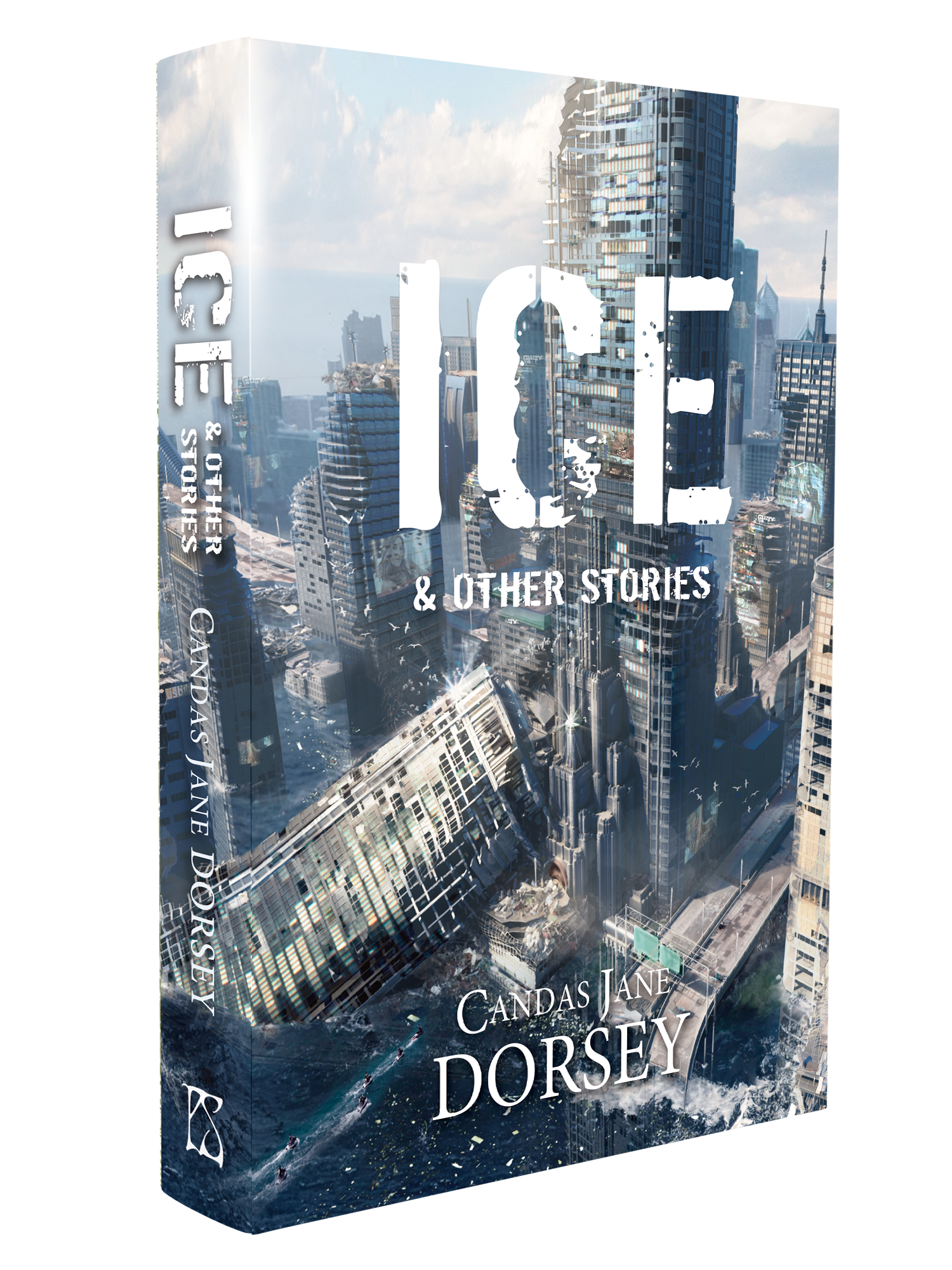
Ice by CandasJaneDorseyShe is best known for her science fiction writing including the novels Black Wine and A Paradigm of Earth, and has also published poetry and short stories, including her well-known short-story collection Machine Sex: And Other Stories. Her latest collection of short stories Ice and other Short Stories spans thirty years of writing. Candas teaches writing and communications at MacEwan University. She was founding president of SF Canada and was president of the Writers Guild of Alberta. Candas was awarded the Province of Alberta Centennial Gold Medal award for artistic achievement and community work and the WGA Golden Pen Award for Lifetime Achievement in the Literary Arts.


DS-2008-16 copy

Nina Munteanu kayaks in Desolation Sound, British Columbia (photo by H. Klassen)


nina-2014aaa

Nina Munteanu is a Canadian ecologist / limnologist and novelist. She is co-editor of Europa SF and currently teaches writing courses at George Brown College and the University of Toronto. Visit www.ninamunteanu.ca for the latest on her books. Nina’s bilingual “La natura dell’acqua / The Way of Water” was published by Mincione Edizioni in Rome. Her non-fiction book “Water Is…” by Pixl Press (Vancouver) was selected by Margaret Atwood in the New York Times ‘Year in Reading’ and was chosen as the 2017 Summer Read by Water Canada. Her novel “A Diary in the Age of Waterwill be released by Inanna Publications (Toronto) in June 2020.


Age of Water Podcast

AoW Logo-smallOn November 22, 2019, co-host Claudiu Murgan and I launched the podcast Age of Water in Toronto, Ontario.

The podcast is devoted to informing and entertaining you with topics about water and the environment. We interview scientists, journalists, writers, academia and innovators who share their knowledge and opinions about the real state of the environment and what committed individuals and groups are doing to make a difference. We talk about the problems and we talk about the solutions.

The format of our podcast is a combination of chat cast and informal interview. We cover anything of interest from breaking environmental news to evergreen material. This also includes human interest stories, readings of eco-literature, discussion of film and other media productions of interest.

AgeOfWater-HomePage

Diary Water cover finalClaudiu suggested doing the podcast during a discussion we had about what we could do to make a difference and to help bring more awareness about the environmental challenges we face in water issues and geopolitics.

We both agreed that the podcast should not only explore the issues but also present solutions and ideas in the ongoing conversation. We wanted to point to ways others could participate by talking to those who were indeed making a difference. So far, we have talked to people about positive initiatives such as 350.org, Drawdown, blue communities, Extinction Rebellion and several others. We’ve talked to homeowners and entrepreneurs with innovative ideas on what individuals can do at home and in their community.

The name of the podcast came from my upcoming book “A Diary in the Age of Water,” a novel that chronicles the lives of four generations of women and their relationship with water during a time of catastrophic change. The book will be launched by Inanna Publications in Toronto in May 2020.

Podcast CO-HOSTS

Guests have come from around the world to join us in monthly interviews on Age of Water. These have included so far: economist and educator David Zetland in Holland (aired Nov 2019); award-winning metaphysical author Rainey Highley in California (aired December 2019); Canadian award-winning author Candas Jane Dorsey in Calgary, Alberta (aired January 2020);  activist/author Kaz LeFave in Toronto (airing February 2020); Finnish award-winning author Emmi Itäranta in the UK (to air in March 2020); and Toronto film educators The Water Brothers (to air in April 2020). We interviewed environmental activist Liz Couture in Richmond Hill, Ontario (airing May 2020); Zen master Ian Prattis in Ottawa (airing June 2020), and we also talked to activist/author Merilyn Ruth Liddel in Calgary, Alberta (airing July 2020), and climate researcher / author Martin Bush in Toronto (airing August 2020). Many more are scheduled to be interviewed. For more information go to www.ageofwater.ca

Podcast MISSION

Water Is-COVER-webIn February 2020, we started a reading series on Age of Water, in which Claudiu or I read from a fiction or non-fiction work that resonated with us, followed by a discussion. The first readings is from my book “Water Is…The Meaning of Water,” a celebration of water, which was selected by Margaret Atwood as her choice reading in the New York Times ‘Year in Reading.’

Let us know if you or someone you know wishes to be interviewed on the show. If you have a work you think merits reading and discussing on the show, please let us know as well. Go to the Age of Water site, join the newsletter and email us.


DS-2008-16 copy

Nina kayaks Desolation Sound, off the coast of British Columbia (photo by H. Klassen)

nina-2014aaa

Nina Munteanu is a Canadian ecologist / limnologist and novelist. She is co-editor of Europa SF and currently teaches writing courses at George Brown College and the University of Toronto. Visit www.ninamunteanu.ca for the latest on her books. Nina’s bilingual “La natura dell’acqua / The Way of Water” was published by Mincione Edizioni in Rome. Her non-fiction book “Water Is…” by Pixl Press (Vancouver) was selected by Margaret Atwood in the New York Times ‘Year in Reading’ and was chosen as the 2017 Summer Read by Water Canada. Her novel “A Diary in the Age of Waterwill be released by Inanna Publications (Toronto) in June 2020.

The Group of Seven Reimagined: An Ekphrastic Celebration

Shimmering Water by Lawren Harris

2020 marks the centenary of the formation of the Canadian iconic Group of Seven artists. The Group of Seven movement “dragged Canadian art into the modern age,” writes Christine Sismondo of The Toronto Star in her review of “The Group of Seven Reimagined,” an ekphrastic celebration of the Group of Seven by twenty-one flash fiction authors (including my own “Alien Landscape” inspired by J.E.H. MacDonald’s Lake O’Hara). Sismondo astutely identifies and encapsulates the resonant meaning of the Group of Seven, then and now:

“A hundred years ago, seven Canadian painters got together and decided to start a movement. It was born out of the horrors of war. Now, the potential horrors of climate change are giving the movement an unexpected new life and meaning.”

Jack Pine by Tom Thomson

Sismondo goes on to describe how the movement itself took form:

“At the time, people were trying to put the horrors and sacrifices of the Great War behind them and look to the future to reimagine and redefine Canada itself. It was a pivotal moment, given the role the country had recently played in international affairs and the challenges it faced in becoming an increasingly modern nation. These seven artists—friends and colleagues, many of whom worked together in a Toronto design firm—felt they could help shape this conversation with bold strokes and bright colours to bring out the beauty of the Canadian landscape.”

But in those early days—and more than thirty years after Van Gogh painted Starry Night, Canada still wasn’t ready for Impressionism, or any other art form whose roots came from that movement. Canadian critics disliked the Group of Seven. They were too modern, too experimental. The Group were dismissed as “the Hot Mush School” “a horrible bunch of junk” “the figments of a drunkard’s dream” and “daubing by immature children.”

Mirror Lake by Franklin Carmichael

In his article on the Group of Seven’s reception in England vs Canada, Adam Bunch writes about the reception of the Group of Seven shortly after their formation after the First World War:

The Entrance to Halifax Harbour by A.Y. Jackson

“The reviews by Canadian critics were harsh. The Toronto Daily Star compared Jackson’s work to “a spilt can of paint.” But the English critics loved it. The Morning Post called the Group of Seven “the foundation of what may become one of the greatest schools of landscape painting.” One piece of Canadian art was even sold during the British Empire Exhibition — and it was Jackson’s. Entrance To Halifax Harbour was bought by the Tate Gallery. It’s still part of their collection today.”

“And despite the poor Canadian reviews, the show in London helped to establish the Group of Seven’s reputation back home. Now that the British took the Group seriously, Canadian collectors started taking them seriously, too. The Group even used the bad press to promote their upcoming shows: they printed posters with the angry Canadian reviews side by side with the glowing English ones.”

The Group of Seven Reimagined, published by Heritage House, was elegantly edited by flash fiction author Karen Schauber. Karen had invited me to contribute a piece of flash fiction (a piece of less than 500 words), inspired by a Group of Seven piece I would chose to inspire me. I took my time; this would be the first flash fiction piece I would write. It was an art form I was not familiar with, but was happy to experiment with. But I waited too long to decide and when I finally submitted my first choice for a painting, Karen informed me that it had already been selected by another writer. To my great frustration, this went on for a few pieces.

Shore Pattern by A.J. Casson

I finally took a short trip to the McMichael Gallery in Kleinburg to find my piece. In the main hall, I passed the pieces already claimed by my twenty colleagues; I sighed that I had waited so long. By chance, a large selection of artwork by J.E.H. MacDonald—one of the founders of the group—was currently on exhibit on the second floor. That was where I first saw the original oil sketch called Lake O’Hara by MacDonald. It was perfect! My story “Alien Landscape” emerged from the sketch like they had always belonged together.

Lake O’Hara by JEH MacDonald

The Star wrote: “while you might expect a lot of peaceful communing with nature on the page, a surprising number of the written pieces are actually dark tales of conflict and danger—forest fires, mining accidents, boat thieves and murderous plots in the woods. Nina Munteanu, a Canadian ecologist and science-fiction writer, takes J.E.H. MacDonald’s Lake O’Hara in a novel direction in ‘Alien Landscape’ by reimagining it as a refuge for a space heroine fleeing a world that had destroyed nature in pursuit of progress and ended in post-apocalyptic chaos.”

Gift shop at McMichael Gallery

The anthology has found itself gracing the gift shop shelves of several art galleries and museums such as the Royal BC Museum in Victoria, BC, and the McMichael Gallery in Kleinburg. It has likewise received much praise and accolades and appears on several ‘best of’ lists for ekphrastic works, art books, and more.

The anthology was long-listed for The Miramichi Reader’s “The Very Best” Book Award for 2020. The Miramichi Reader writes:

Sunset in the Bush by Frank Johnston

“There’s a very good reason that as I write this, The Group of Seven Reimagined, Contemporary Stories Inspired by Historic Canadian Paintings is sitting at, or near the top of bestseller lists in Canada (currently #3 on the Canadian Art bestseller list at Amazon.ca).  The result is a most attractive book that any lover of art and literature would enjoy, even if they already have more than a passing familiarity with the iconic Group of Seven. All the stories that accompany each image are in the “flash fiction” style, just a page or two in length, a little story that the authors were inspired to write after choosing a particular G7 painting.”


Jules Torti of Cottage Life  describd the book this way:

“Seeking equilibrium? This book is like a yoga session without the scheduling logistics and hustle to class. Balance is found in The Group of Seven Reimagined both as an intelligent coffee table book and tangible source of meditation.

Authors of the anthology

Twenty-five writers with notable street cred contributed “flash fiction” to colour iconic paintings by the Group of Seven (and their tagalongs). Flash fiction are stories categorized by length—they are 500 words or less which means they allow for one decent, undistracted cup of dark roast or whisky on ice. For writers or artists, the temptation to reimagine these works will be irresistible. And, what an intriguing resolution to make! Fiction and paintings both rely on interpretation and consideration. Fill in the gaps and colours with your chosen or perhaps newly discovered medium (watercolour?). As Jim and Sue Waddington suggest in the foreword, an art gallery visit becomes suspended in time. We keep returning to certain paintings that resonate and haunt and inadvertently, ‘Your mind sets off on a journey.’”

Author and reviewer Patricia Sandberg describes the anthology through metaphor: “Like a fine wine with dinner, some things cry out to be paired. In Reimagined, the nearly hundred-year-old brandy that was the Group of Seven is introduced to a fresh vibrant cuisine that is flash fiction, and both are the richer for it.”

Stormy Weather by Frederick H. Varley

“As a disciple of the Group of Seven and an aficionado of Canadian wilderness, every page gives me a little leap of pleasure.”—Robert Bateman

“These sharp, imaginative evocations of the world of the Group of Seven are both a joy in themselves and a welcome prompt to make us look at the paintings again. It’s refreshing to find that, a century later, they still speak to us about our lives and our country.”—Ross King, author of Defiant Spirits: The Modernist Revolution of the Group of Seven

Nina Munteanu with the anthology

“Words, the writer’s paint, are artfully chosen and applied, not one wasted. The stories all compel the reader to dive beneath their surface and linger long after the reading is complete…In 1920 The Group of Seven introduced a new vision for the Canadian landscape. One hundred years later, twenty-one writers in the Group of Seven Reimagined offer a new lens for appreciating their art.”—Ottawa Review of Books

“From one region of Canada to another, a national identity is captured and shared with writers all over the world who, in turn, have crafted beautiful flash fiction pieces that accompany and extend the meaning of the art.”—Niles Reddick, Literary Heist


nina-2014aaa

Nina Munteanu is a Canadian ecologist / limnologist and novelist. She is co-editor of Europa SF and currently teaches writing courses at George Brown College and the University of Toronto. Visit www.ninamunteanu.ca for the latest on her books. Nina’s bilingual “La natura dell’acqua / The Way of Water” was published by Mincione Edizioni in Rome. Her non-fiction book “Water Is…” by Pixl Press (Vancouver) was selected by Margaret Atwood in the New York Times ‘Year in Reading’ and was chosen as the 2017 Summer Read by Water Canada. Her novel “A Diary in the Age of Waterwill be released by Inanna Publications (Toronto) in May 2020.


Nina Munteanu Shares Her Journey With Water

Nina’s recent presentation at the Don Heights Unitarian Congregation on water—”Reflections: the Meaning of Water“—explores the many dimensions of water. She describes how its life-giving anomalous properties can lead us to connect with water and nature to help us be the caretakers we need to be during these changing times.

Based on her celebrated book “Water Is… The Meaning of Water”, Nina shares her personal journey with water—as mother, teacher, environmentalist, traveler and scientist—to explore water’s many “identities” and, ultimately, our own.


Fallen log stream-2012

stream in Westcoast rainforest of BC (photo by Kevin Klassen)

nina-2014aaa

Nina Munteanu is a Canadian ecologist / limnologist and novelist. She is co-editor of Europa SF and currently teaches writing courses at George Brown College and the University of Toronto. Visit www.ninamunteanu.ca for the latest on her books. Nina’s bilingual “La natura dell’acqua / The Way of Water” was published by Mincione Edizioni in Rome. Her non-fiction book “Water Is…” by Pixl Press (Vancouver) was selected by Margaret Atwood in the New York Times ‘Year in Reading’ and was chosen as the 2017 Summer Read by Water Canada. Her novel “A Diary in the Age of Waterwill be released by Inanna Publications (Toronto) in June 2020.

The Invasion of Giant Crayfish Clones & A Diary in the Age of Water

OLYMPUS DIGITAL CAMERA

Marmorkrebs, giant marbled crayfish

In 2018, scientists reported that the giant marbled crayfish (Marmorkrebs [German]: Procambarus fallax f. virginalis) recently developed the strategy of being entirely female and cloning itself via parthenogenesis1; the female doesn’t require a male crayfish to fertilize its eggs. Despite the cloning procedure that makes them virtually identical genetically, the crayfish vary in size and pattern—no doubt due to epigenetics.2

First discovered by a German aquarium in the mid-1990s, these crayfish that developed from Florida-Native crayfish have migrated into the wild and are aggressively spreading in Europe, at the expense of the native European crayfish. The 8 to 12 cm long Marmorkrebs has been observed in Germany, Italy, Slovakia, Sweden, Japan, and Madagascar. The marbled crayfish prefers a warm and humid climate, suggesting that climate change may influence its distribution and success. The clones also thrive in a wide range of habitats—from abandoned coal fields in Germany to rice paddies in Madagascar, writes Carl Zimmer of the New York Times.

Given that every individual Marmorkrebs can reproduce (the advantage of parthenogenesis is that the female crayfish doesn’t need to find a mate—it just gives birth), one European scientist has dramatically suggested that, “we’re being invaded by an army of clones.” Zimmer shares the results of Dr Lyko and his team on how the all-female Marbokrebs came to be:

“Scientists concluded that the new species got its start when two slough crayfish mated. One of them had a mutation in a sex cell — whether it was an egg or sperm, the scientists can’t tell. Normal sex cells contain a single copy of each chromosome. But the mutant crayfish sex cell had two. Somehow the two sex cells fused and produced a female crayfish embryo with three copies of each chromosome instead of the normal two. Somehow, too, the new crayfish didn’t suffer any deformities as a result of all that extra DNA.” 

In its first couple decades, [Marmorkrebs] is doing extremely well, writes Zimmer. But sooner or later, the marbled crayfish’s fortunes may well turn, he adds. “Maybe they just survive for 100,000 years,” Dr. Lyko speculated. “That would be a long time for me personally, but in evolution it would just be a blip on the radar.”

marbled-crayfish2

Marmorkrebs

But what if this speculation isn’t the whole scenario? What if Marmorkrebs is just another example of climate change-induced adaptation and change through epigenetics? While climate forcing and habitat destruction is causing the extinction of many species; other species are, no doubt, adapting and exploiting the change. These generalists (born with change inside them) are poised to take over in Nature’s successional march.3

Bdelloid-rotifer-Philodina-gregaria

Bdelloid rotifer

Parthenogenesis and epigenetic change isn’t new. In fact, it’s very old … All-female bdelloid rotifers have been cloning a sisterhood for millions of years and using incorporated foreign genes through horizontal gene transfer4 (essentially stealing genetic material from their environment) to maintain a healthy diverse population. What’s new and weird is that this crayfish “suddenly” developed this ability—probably through epigenetic means (given this entire group is versatile in reproductive strategies in general). The real question none of the articles that covered this phenonemon ask is: WHY? Why is it happening NOW?

In my latest book A Diary in the Age of Water (due for release in May 2020 by Inanna Publications) I explore this “change” in a unique way:

Diary Water cover finalKyo finds a copy of Robert Wetzel’s Limnology on a lower shelf of the “L” section. It stands tall with a thick green-coloured spine. This is the book that Hilda, one of the Water Twins, had saved from the book burnings of the Water Age. A present from her limnologist mother. Hilda kept it hidden under her mattress. When CanadaCorp police burst into their home and dragged her mother away, Hilda was left alone with Wetzel. The limnology textbook was forbidden reading because its facts were no longer facts. 

After some coaxing, Myo shared a most bizarre tale of that time which led to the catastrophic storms and flood. What the governments hadn’t told their citizens—but what each citizen felt and knew—was that humans had lost the ability to reproduce. Then a spate of “virgin births” throughout the world spawned what seemed a new race of girls—‘deformed’, blue and often with strange abilities. Many considered them abominations, a terrible sign of what was in store for humanity—a punishment for their evil ways. Then, as quickly as they’d populated the world, these strange blue girls all disappeared without a trace. They simply vanished and became the Disappeared. Myo told her that some people called it a Rapture, a portent of the end times. Others suggested that the girls had all been murdered—a genocide, organized by what was left of the world government. 

Then … the storms … changed the world.

–“A Diary in the Age of Water” 

  1. Spontaneous Parthenogenesis: From the Greek Parthenon “virgin” and genesis “creation”, parthenogenesis is a natural form of asexual reproduction in which growth and development of embryos occur without fertilization. In animals it involves development of an embryo from an unfertilized egg; in plants it proceeds through apomixis. The production of only female offspring by parthenogenesis (such as with bdelloid rotifers) is called thelytoky.
  2. Epigenetics is the study of changes in organisms caused by the modification of gene expression (such as environmental triggers) rather than alteration of the genetic code itself. If genetics represents the hardrive of a computer, epigenetics is its software.
  3. Niche (the role or job of an organism or population) can be broad (for generalists) or narrow (for specialists). A specialist has superior abilities to exploit the narrow environmental conditions it lives in and is splendidly adapted to a fixed stable environment; generalists, less successful at exploiting than the specialist but more widely adaptive, can thrive in less stable environments that present a wider range of conditions.
  4. Horizontal gene transfer is the movement of genetic material between organisms other than by the vertical transmission of DNA from parent to offspring through reproduction. HGT is an important factor in the evolution of many organisms.

A Diary in the Age of Water will be released in May 2020 by Inanna Publications, Toronto, Canada.


nina-2014aaa

Nina Munteanu is a Canadian ecologist / limnologist and novelist. She is co-editor of Europa SF and currently teaches writing courses at George Brown College and the University of Toronto. Visit www.ninamunteanu.ca for the latest on her books. Nina’s bilingual “La natura dell’acqua / The Way of Water” was published by Mincione Edizioni in Rome. Her non-fiction book “Water Is…” by Pixl Press (Vancouver) was selected by Margaret Atwood in the New York Times ‘Year in Reading’ and was chosen as the 2017 Summer Read by Water Canada. Her novel “A Diary in the Age of Waterwill be released by Inanna Publications (Toronto) in June 2020.