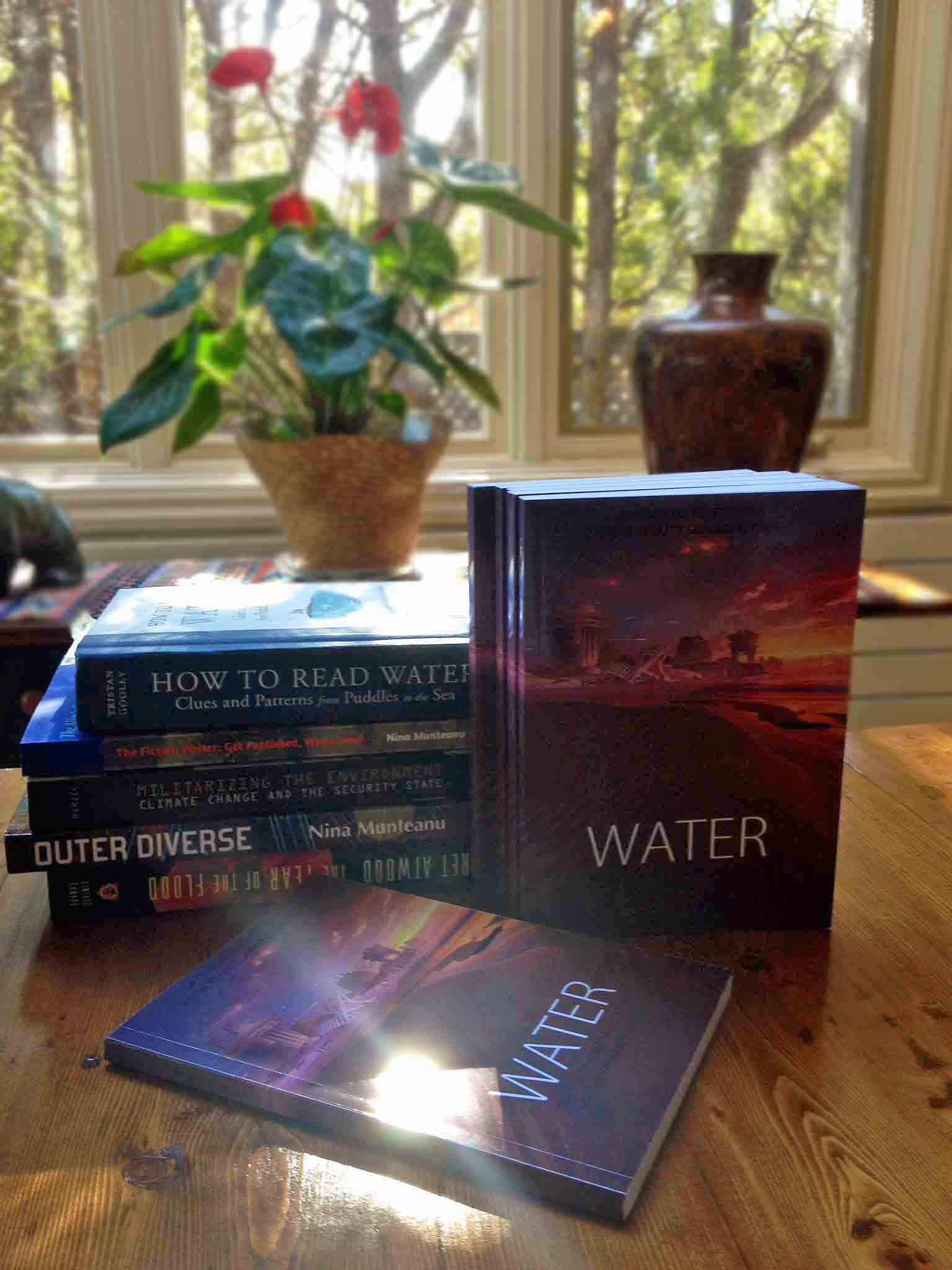
Call for Submissions: Water Anthology

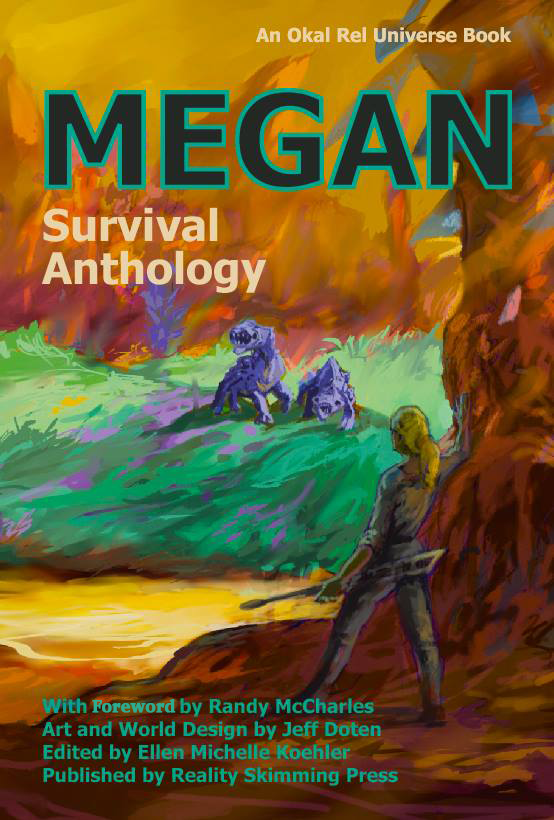
Reality Skimming Press is looking for submissions to their first anthology in their hard science optimistic series. This first anthology is a Water Anthology, obviously based on the theme of water. The project coordinator is Ellen Michelle. The water anthology will be edited by scientist and author Nina Munteanu.

Story requirements:

Stories must use real or realistic science based on the theme of water in the near future (50-100 years from 2017). Your story must be considered optimistic—this does not mean that bad things can’t happen in your story, but there has to be an optimistic twist and an optimistic ending (a happy ending or hope for a happy ending). For example, your main character can die at the end as long as their death brings hope for others. Any stories that are not deemed optimistic will not be considered.

How to submit:

Stories can be submitted to realityskimmingpress@outlook.com with Water Submission in the subject. Any emails without this subject heading will be ignored by the system.

Submission requirements:

  • Stories must not exceed 5,000 words
  • Stories must be accompanied by a short cover letter in the body of the submissions email explaining your past publications or other accreditation including any science education or background you may have. *Note that we do often publish first time authors, so having no previous publications is not detrimental to your submission.
  • Submit your story as an attachment to the email in Word document format only (.doc or .docx).
  • Authors must be Canadian, permanent residents of Canada, or otherwise have a Canadian connection. If you are not Canadian by birth please explain your Canadian connection in the cover letter.
  • Authors may submit only one story to the anthology.
  • Previously published stories are accepted as long as you have the rights to republish it.
  • If you have submitted your story for consideration elsewhere, or plan to do so, please state that in your cover letter.
  • Authors will be paid $30 for their stories if accepted into the anthology.
  • Submission deadline is midnight July 22nd (extended for some groups).

See Submission guidelines here.


Nina MunteanuNina Munteanu is an ecologist and internationally published author of award-nominated speculative novels, short stories and non-fiction. She is co-editor of Europa SF and currently teaches writing courses at George Brown College and the University of Toronto. Visit www.ninamunteanu.ca for the latest on her books.


Story and Metaphor in Art Form: How Writing and Painting Whisper or Shout Their Truths

God whispers to us in our pleasures, speaks in our conscience, but shouts in our pains; it is His megaphone to rouse a deaf world—C.S. Lewis

Prospect Point-fog

Prospect Point in the fog, NS (photo by Nina Munteanu)

A short while ago I painted on a canvas for the first time in over twenty years…okay, thirty years. It was a thrilling experience but also refreshing and freeing to use a different medium to express myself and tap into that place—that force—that resides inside us and speaks to us.

Part of the thrill was that I was being coached by a good friend of mine who is a master painter and teacher. What’s interesting is that while she instructed me on some of the painting methods, it struck us both how many similarities existed in composition, technique and structure between visual art and storytelling.

Take direction, for instance. A writer uses plot and subplots to move a story and its characters through a textured and colored tapestry of theme. According to my friend, every painting flows, often directionally (like many photographs) from the lower left to upper right, leading the eye from one place to another, exploring a theme, idea or emotion. Plot is motion. So is the paint brush.

You think only writers tell stories. Well, look again at visual art. Every work of art expresses an artist’s feelings, thoughts and emotions; an artist’s story. We are all stories, after all, and we all have many stories inside us. The writer’s medium is the word; the painter’s is the visual image. Isn’t it a truism that a picture is worth a thousand words? The range and type of story varies equally in both media. For instance, writing ranges from poetry or poetic prose (e.g., Ulysses by James Joyce) that requires substantial interpretation to allegory (obvious symbols) or creative non-fiction (like this blog post) whose artistry lies mostly in its composition and reporting style. Paintings also display a range from the poetry of abstract or surrealistic art (e.g., the surrealism of Salvadore Dali), which requires more interpretation, to realistic “photographic” art whose interpretation lies more in its composition (e.g., the detailed realism of Tomislav Tikulin).

The “language” that writers and painters use finds its parallels in form, structure and intent.

For example, let’s take metaphor. The writer uses one concept or image to evoke the feeling of another; “raining cats and dogs” for instance. The painter can evoke the feeling of one medium with another, achieving the same effect through metaphor—producing a stronger more compelling image through oblique metaphor and another perspective. For instance, a painter using acrylics may evoke the tone and emotion of a watercolor by using soft brushstrokes or another medium (e.g., using a sponge or cloth to apply the paint) and lighter softer colors to achieve that signature wash.

A story’s depth is achieved through animating three-dimensional characters that reflect a multi-layered theme. A painting’s depth works through the dance of light, shadows and textures and the use of techniques like fading and detail. Chiaroscuro in story and in painting play on contrast, perspective and the interplay of light and color to pull the viewer and reader deep into the artwork.

Painters echo elements from one part of a painting to another to make it cohesive and provide a “complete” piece that is ultimately satisfying to the viewer. Painters do this by using repeated elements like shapes, curves, and color schemes to get the same flow, or using a faded version of a similar image elsewhere. Techniques that writers use to achieve the same echoing effects for a satisfying story include parallel plotting, mirrored plots, framing (particularly of story promise with climax and dénouement), and themed beginnings and endings.

You’ve heard of writer’s block? There’s also painter’s block; the painter staring at the white canvas, paint brush poised to make that first stroke. Luckily, there’s something called painting-over the dry; not unlike editing a paragraph using the control-shift “x” and “v” key on the computer. Writers continually revise their first drafts, cutting out extraneous exposition and adding thematic details. The writer’s revision process is all about fine-tuning, simplifying and polishing. Painters also “edit” their art through similar means. We even use similar language for both media: “polishing”, “adding color”, “making it flow”, “adding texture”, etc.

Every artist is a reporter of life and truth; every artist chooses the medium that best expresses his or her art. I started out in the visual arts. I was all ready to pursue a fine arts degree in university to become a commercial artist. Then, right on registration day, I opted out of art altogether and went into the science program. Heck, I went all the way to getting a Masters of Science degree, taught university science courses and consulted in the environment. Now, here I am writing science fiction and eco-fiction and teaching writing to engineers and scientists and science fiction writers. Cool, how we choose our path…


nina-2014aaNina Munteanu is an ecologist and internationally published author of award-nominated speculative novels, short stories and non-fiction. She is co-editor of Europa SF and currently teaches writing courses at George Brown College and the University of Toronto. Visit www.ninamunteanu.ca for the latest on her books.
The Fifteenth International Writers’ and Artists’ Festival / Le XVe Festival International des écrivains et artistes–Quebec

best best group shotOn Friday, June 9th, I drove with friend, songwriter and poet Honey Novick, to the 15th International Writers’ and Artists’ Festival in Val-David, Quebec (June 10th and 11th, 2017). Celebrated artists, poets, writers and singers with an international heritage that included France, Chile, Argentina, Romania, Canada and the USA would congregate at the festival, set in a large house nestled deep in the Maple Laurentian forest.

The mixed Laurentian forest is called the “eastern forest-boreal transition” and includes a varied tapestry of broadleaf (aspen, oak, paper birch, mountain ash and maple) and conifer (pine, spruce and fir) trees.

Nina-fest-close-web

Nina Munteanu

When we reached our destination—a large three-story house surrounded by forest—I took in the aroma of fresh pine and “sweet fern” and spotted Bunchberry (soon to be designated Canada’s national flower), forget-me-nots and lupine carpeting the ground near the house. A young deer, foraging on a shrub’s new leaves beside the house, glanced at us without fear then slipped back into the forest.

I thought the setting ideal for an international festival celebrating the expression of the arts. I was scheduled to talk about my latest book Water Is…”, a personal and scientific journey with water, and to give a lecture on eco-fiction.

Outside-view-web

View outside my bedroom

Flavia Cosma, the originator and organizer of the festival for over a decade, greeted us at the door and in true Romanian-fashion immediately sat us down to eat and drink. After a seven-hour drive (we somehow ended up in Charlamagne, Celine Dion’s birthplace), I was hungry and enjoyed some of Flavia’s signature dishes, varză a la Cluj (cabbage a la Cluj) and salată boeuf (beef salad), made with carrots, parsley roots, eggs, potatoes, beef, pickles and peas mixed with mayonnaise. The view outside my bedroom on the third floor peered through tall firs to a mountain valley and the small village of Val-David. I looked forward to meeting poets, writers, musicians and artists the next day…


Day 1: Saturday

HoneyNovickBC-web

Honey Novick

Honey Novick (Toronto, Ontario), poet laureate of the Summer of Love Project 2007 Luminato Festival and winner of the Bobbi Nahwegahbow Memorial Award, opened the festival with an inspirational song.

Composers and singers Brian Campbell (Montréal, Quebec) and Ivan-Denis Dupuis (Sainte Adele, QC) provided additional and stirring song performance.

Louis Hebert

Louis-Philippe Hebert

Quebec author Louis-Philippe Hébert (Saint Sauveur, QC), winner of the Grand Prix Québecor du Festival de Poésie de Trois-Rivières and the Prix du Festival de Poésie de Montréal, read from his novel Un homme discret (Lévesque, 2017). Poet Julie de Belle read several poems, including When the sea subsides, finalist in the Malahat Review. Brian Campbell, finalist in the 2006 CBC Literary Award for Poetry, read from his book Shimmer Report (Ekstasis Editions, 2015).

FlaviaCosma-EarlyYears

Flavia Cosma

Poet and award-winning TV documentarist Flavia Cosma, who received the gold medal as an honorary member by the Casa del Poeta Peruano, Lima, Peru in 2010, nominated for the Pushcart Prize, and whose work has been used in University of Toronto literature courses, read from her collection of poems, The Latin Quarter (MadHat Press, 2015) and Plumas de Angeles (Editorial Dunken, 2008).

Felicia Mihali

Felicia Mihali

Romanian writer Felicia Mihali read from her novel La bien-aimée de Kandahar, nominated for Canada Reads 2013. Romanian author Melania Rusi Caragioiu, member of the Canadian Association of Romanian Writers, read from her book of poems Basm în versuri și poeme pentru copii in Romanian.

Nicole Davidson, the mayor of Val-David, read some of her poetry. Jeanine Pioger, French author of Permanence de l’instant, read a selection of her poetry. Jocelyne Dubois showed her artwork and Romanian artists Carmen Doreal and Eva Halus discussed their artwork and poetry.

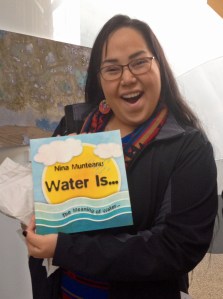
water-is-cover-web“Water Is…”: I shared the inspiration and making of my latest book, “Water Is…”, a scientific study and personal journey as limnologist, mother, teacher and environmentalist, which was recently picked by Margaret Atwood in the NY Times as 2016 ‘Year in Reading’ and recommended by Water Canada as ‘Summer Reading’. I discussed how I first conceived the book as a textbook early in my career as a freshwater biologist and how it morphed from one idea into something completely different and why it is my most cherished work to date.

Day 2: Sunday

French poet David Brême gave a workshop on poetry and the cultural hybridization of franco-québécoise (atelier sur la poésie et l’hybridation culturelle franco québécoise), which he had given earlier in Toronto.

couzier_nane

Nane Couzier

Montreal poet from France and Senegal, Nane Couzier, read from her collection Commencements, honorable mention in le Prix de poésie 2016 des Écrivains francophones d’Amerique.

JocelyneDubois

Jocelyne Dubois

Novelist and short story writer Jocelyne Dubois read from her novel World of Glass, finalist for the 2013 QWF Paragraphe Hugh MaLennan Prize for fiction. Laurentian poet John Monette, author of the collection Occupons Montréal (Editions Louise Courteau, 2012) read several poems and Eva Halus, Romanian poet, read from her book Pour tous les Voyages. Chilean poet Tito Alvarado also read his poetry.

NasulTV-claudiuScrieciu

Claudiu Scrieciu of Nasul.TV Canada

Claudiu Scrieciu and Felicia Popa of Nasul.TV CanadaTeleviziunea Libera—the Canadian chapter of Romanian TV in St. Laurent, Quebec, televised aspects of the festival and the closing ceremony. Felicia, who interviewed me for their show, talked with me about “Water Is…”.

naturalselectionEco-Fiction: I discussed how eco-fiction evolved as a genre and its importance, both metaphorically and literally, in the literature of the Anthropocene (with a nod to Margaret Atwood’s 2016 challenge to a college audience in Barrie, Ontario, to write the stories that focus on our current global environmental crisis). I provided examples of ecological metaphor such as Barbara Kingsolver’s Flight Behavior, Michael Ondaadje’s The English Patient, Frank Hebert’s Dune, and Thomas Hardy’s The Return of the Native. Astute questions, initiated by Flavia, led to an animated discussion on our ultimate participation in Nature, co-evolution, cooperation vs competition, soft-inheritance, DNA repair and the role and place of water in virtually all things.

The festival concluded at the Centre d’Exposition (art centre) of Val David with “Les Mots du Monde”, where poets, songwriters and writers performed readings and song to the community. The cultural setting and perfect acoustics provided a true inspiration for Honey Novick’s stirring opening songs—angelic in nature and in voice. I asked colleague Jeanine Pioger to read my essay “Why I Write,” which I had translated into French with help from colleague Betty Ing. The French version appears below.

toast02

Toasting the international festival

After the closing ceremony, Flavia invited participants to a grand dinner party at the festival house featuring authentic Romanian dishes, good wine and stimulating conversation.

The festival was a great success on many levels. Honey Novick astutely thanked Flavia in a Facebook post, “thanks for the wonderful memories, great inspiration, generous hearts and a tremendous weekend.”  I felt a great resonance and synchronicity throughout the weekend. It was as though we all embarked on a dimensional ride together, orchestrated by Flavia, that challenged, fulfilled and enlightened…I spoke English, French and puțin limba română. Foarte puțin… …And the food… OOHLALA!

Mulțumesc, Flavia! A fost minunat!

BrianCambell-ShimmerReportEva Halus-Pour tous les VoyagesLatinQuarter-flavia cosmaun homme discret


La raison pour laquelle j’écris

L’écriture est le souffle et la lumière de mon âme et la source de mon essence. Quand j’écris, je vis le moment présent. Je suis dans le moment de la création, connecté au Soi Divin, embrassant la nature et l’ensemble de l’univers fractal.

Je fais quelque chose d’important.

Je me connecte avec vous.

Isaac Asimov a dit : « j’écris pour la même raison que je respire — parce que si je ne le faisais pas, je mourrirais ». C’était aussi vrai quand il était auteur inconnu qu’après qu’il est devenu grand écrivain. Il parlait métaphoriquement, spirituellement et littéralement. Je sais que si je n’écrivais pas, je me priverais mon âme de sa respiration de vie. Il représente plus que la vérité métaphorique ; il est scientifiquement prouvé. L’écriture expressive — que ce soit sous la forme de l’écriture d’un journal, de blogging, de l’écriture de lettres, de mémoires ou de fiction — améliore la santé.

Que vous publiiez ou non, votre écriture est importante et utile. Prenez possession de celle-ci, nourrissez-la et considérez-la comme sacrée. Inspirez le respect des autres et respectez tous les écrivains à leur tour ; ne laissez pas l’ignorance vous intimider et vous faire taire.

L’écriture, comme toute forme de créativité, exige un acte de foi ; tant en nous-mêmes qu’en les autres. Et c’est effrayant. C’est effrayant, parce qu’il faut que nous renoncions au contrôle. Il est d’autant plus préférable d’écrire. La résistance est une forme d’autodestruction, dit Julia Cameron, auteur de The Artist’s Way.

Nous résistons afin de maintenir une vague idée de contrôle, mais au contraire, nous augmentons nos chances de développer la dépression, l’anxiété et la confusion. Booth et al. (1997) ont conclu que la divulgation écrite réduit sensiblement le stress physiologique du corps causé par une inhibition. Nous sommes nés pour créer. Pourquoi hésitons-nous et résistons-nous? Parce que, dit Cameron, « nous avons accepté le message de notre culture… [que] nous sommes censés faire notre devoir et puis mourir. La vérité est que nous sommes censés être prospères et vivre ».

Joseph Campbell a écrit : « suivez votre bonheur et les portes s’ouvriront là où il n’y avait pas de portes avant. » Cameron ajoute : « c’est l’engagement interne pour être fidèle à nous-mêmes et de suivre nos rêves qui déclenche le soutien de l’univers. Alors que nous sommes ambivalents, l’univers nous semblera également être ambivalent et erratique. » Quand j’écris, je vis le moment présent, en harmonie avec le moment divin de la création.

En pleine joie.

nina-2014aaNina Munteanu is an ecologist and internationally published author of award-nominated speculative novels, short stories and non-fiction. She is co-editor of Europa SF and currently teaches writing courses at George Brown College and the University of Toronto. Visit www.ninamunteanu.ca for the latest on her books.
Limestone Genre Expo—One of Kingston’s Gems

Nina-Hali-clifi2

Nina Munteanu and Halli Villegas

I recently attended the Limestone Genre Expo in Kingston, Ontario. Held at the St. Lawrence College campus—ideally suited to a literary festival—the expo featured panels, readings, and workshops.

The festival was well attended by local, Canadian and international authors, editors, publishers, and readers—all committed to exploring literature, the arts and to having a good time.

Authors included Tanya Huff, Nancy Kilpatrick, Caro Soles, Violette Malan, Rick Blechta, Matthew Bin and Eve Langlais, among many others.

Nina-books-Limestone2016

Science Fiction GOH in 2016

Publishers included Exile Editions, Chizine Publications, Bundoran Press and others. Exile Editions recently published their anthology “Cli Fi: Canadian Tales of Climate Change” in which my story “The Way of Water” appears.

I was Limestone’s Science Fiction Guest of Honour last year; this year I got to relax and I sat on three panels.

NancyKilpatrick-limestone

Nancy Kilpatrick

In “Alternative Histories to Cyberpunk“, I was joined on the panel by Matthew Bin, Maldonado Skaff-Koren, Eric Desmarais, Michael Romaric, Dominic Bercier, and A.A. Jankiewicz with moderator Sean Moreland. We mostly discussed the literary device of alternative timelines and unanimously concluded that visionary science fiction that “failed” to predict the future was successful alternative “history”. This theme continued in the science fiction panel.

Cover1_LastSummoner-frontcoverI brought up the notion of history’s quantum properties, a braided flow of multi-dimensional and entangled realities. This served as premise for my alternative historical time-travel fantasy The Last Summoner, which takes place in fifteenth century Poland. On her fourteenth birthday, the baroness Vivianne Von Grunwald discovers that she can change history as an aeon; but she soon realizes that, while she is able to change some disastrous historic event, its entangled “destiny” indelibly moves closer to the original consequence than her intended one: yet another disaster. My scientific approach to alternate history is what excited me to write this, my only fantasy so far among a dozen science fiction novels.

CaroSoles

Caro Soles

In the panel “The Science behind Science Fiction” I was joined by Katherine Prairie, Anita Dolman, Matthew Bin, Lisa Tooey, Kristen Kiomall, and A.A. Jankiewicz with moderator Caroline Frechette. We discussed the utility and risk of using pseudoscience in a science fiction story, a genre known for expectations of accuracy and prescience. In 1979, Ray Bradbury wrote: People ask me to predict the future, when all I want to do is prevent it. Better yet, build it. Predicting the future is much too easy, anyway. You look at the people around you, the street you stand on, the visible air you breathe, and predict more of the same. To hell with more. I want better.”

TanyaHuff-signing

Tanya Huff signs one of her books

Depending on whether the story is considered hard SF or soft SF, this level of accuracy in both actual science presented as premise and ability to predict science and technology will vary. Given that science fiction is largely metaphoric, the predictability of an SF story is secondary to the story’s value as metaphor and allegory. The consensus of the panel was that the audience determined the importance of precision and accuracy. In the final analysis, if the story is grounded in its own consistency, anything is possible.

WonderWoman

Wonder Woman (Gal Gadot)

In “Women in Genre” I was joined by Violette Malan, Nancy Kilpatrick, Eve Langland, Alyssa Cooper, Janet Kellogg, and Liz Lindsay with moderator Sandra Kasturi. The banter was by turns fun and edgy, all lubricated with good humour by all participants. As a writer of science fiction and fantasy of which 90% feature a “strong female protagonist”, I brought up the controversy of what, in fact, determines a good female lead in story. Why do so many heroines still provide just a kick-ass version of a male hero? Why are so many female protagonist heroes still defined by the rules of what makes a male a hero? Where are the real women?

Politics south of us aside—along with Margaret Atwood’s all too realistic Handmaid’s Tale (currently playing on Bravo TV), we discussed the recent push-back in Texas on the all-women showing of “Wonder Woman,” which prompted many heated tweets. The Atlantic recently published an article on the film—and surrounding events—entitled “Wonder Woman, Heroine of the Post-Truth Age.”wonder-woman-movie-poster

Wonder Woman is set at the height of World War I, but is otherwise a decidedly modern movie,” writes Megan Garber of The Atlantic. “It stars a woman (Gal Gadot) and treats a man, Steve (Chris Pine), as its damsel-in-distress. It has managed, even before its release, to enrage men’s-rights activists, which is quickly becoming a reliable measure of a movie’s modernity.”

wonderwoman-golden lassoWonder Woman uses a unique weapon, the Golden Lasso, known as the Lasso of Truth—because it compels anyone wrapped by it to reveal the truth.

When William Moulton Marston—scientist and inventor of the polygraph machine— created the Wonder Woman character, he envisioned a warrior who was also an investigator of truth. “Frankly,” he said, “Wonder Woman is psychological propaganda for the new type of woman who should, I believe, rule the world.” He believed that a world that gave women more power—politically and otherwise—would be more peaceful, more empathetic, more worthy, writes Garber. “And so Wonder Woman is a work that is decidedly at home, across its dimensions, in the world of 2017—a world that is on the one hand newly recognizing women’s widespread capabilities, but that is on the other deeply anxious about ‘alternative facts,’ about ‘fake news,’ about politically weaponized lies, about falsehoods that are uttered with no seeming consequence. The princess’s lasso, that shimmering metaphor for objective truth, is a symbol of aspiration; seen in another way, though, it is a symbol of despair. Here, in this wobbling weapon, is “wonder” as in awe; here, too, is “wonder” as in uncertainty. Here is a tool of truth that is decidedly ambivalent about its own powers. “How do I know you’re not lying to me right now?” the princess asks the spy. And the only way she can know for sure is to trust, paradoxically, in magic.”

Magic is OK, though. It is, after all, the stuff from which we draw when we write.

Nina-SF GOH-Limestone Genre Expo

Nina Munteanu, Science Fiction GOH at Limestone Genre Expo 2016

nina-2014aaNina Munteanu is an ecologist and internationally published author of award-nominated speculative novels, short stories and non-fiction. She is co-editor of Europa SF and currently teaches writing courses at George Brown College and the University of Toronto. Visit www.ninamunteanu.ca for the latest on her books.

“Water Is…” Recommended Summer Read by Water Canada Magazine

water-is-cover-web“Water Is…” (Pixl Press) by Nina Munteanu was among several books recommended by Water Canada as a good summer read for 2017.

One of Canada’s premiere magazines on issues of water and water management, Water Canada suggested recharging this summer with “the latest selection of winning water management fiction and non-fiction.” The list comprised mostly of 2017 publications, but included a few late arrivals from 2016.

Recommendations included:

schmidt comps.indd“Water, Abundance, Scarcity, and Security in the Age of Humanity” (NYU Press) by Jeremy Schmidt is an intellectual history of America’s water management philosophy. Debates over how human impacts on the planet, writes Water Canada, are connected to a new geological epoch—“the Anthropocene”—tend to focus on either the social causes of environmental crises or scientific assessments of the Earth system. Schmidt shows how, when it comes to water, the two are one and the same. The very way we think about managing water resources validates putting ever more water to use for some human purposes at the expense of others.


ARiverCaptured“A River Captured: The Columbia River Treaty and Catastrophic Change” (RMB Books) By Eileen Delehanty Pearkes reviews key historical events that preceded the Treaty, including the Depression-era construction of Grand Coulee Dam in central Washington, a project that resulted in the extirpation of prolific runs of chinook, coho and sockeye into B.C. Prompted by concerns over the 1948 flood, American and Canadian political leaders began to focus their policy energy on governing the flow of the snow-charged Columbia to suit agricultural and industrial interests. Water Canada writes, “Referring to national and provincial politics, First Nations history, and ecology, the narrative weaves from the present day to the past and back again in an engaging and unflinching examination of how and why Canada decided to sell water storage rights to American interests. The resulting Treaty flooded three major river valleys with four dams, all constructed in a single decade.”


borderflows“Border Flows: A Century of the Canadian-American Water Relationship” (University of Calgary Press), Lynne Heasley and Daniel Macfarlane, editors, explore and discuss Canada-U.S. governance. Water Canada writes, “Ranging across the continent, from the Great Lakes to the Northwest Passage to the Salish Sea, the histories in Border Flows offer critical insights into the historical struggle to care for these vital waters. From multiple perspectives, the book reveals alternative paradigms in water history, law, and policy at scales from the local to the transnational. Students, concerned citizens, and policymakers alike will benefit from the lessons to be found along this critical international border.”


NewYork2140“New York 2140” (Orbit) by Kim Stanley Robinson is a novel set in New York City following major sea level rises due to climate change. Water Canada writes, “The book explores a full eight separate narratives: the market trader, who finds opportunities where others find trouble; the detective, whose work will never disappear, along with the lawyers, of course; an Internet star; a building’s manager; and two boys who don’t live there, but have no other home—and who are more important to its future than anyone might imagine. Lastly there are the coders, temporary residents on the roof, whose disappearance triggers a sequence of events that threatens the existence of all– and even the long-hidden foundations on which the city rests.”


Death and Life of Great Lakes_FINAL 1129.indd“The Death and Life of the Great Lakes” (WW Norton & Company Inc. Press) by Dan Egan is a frank discussion of the threat under which the five Great Lakes currently suffer. This book, writes Water Canada is “prize-winning reporter Dan Egan’s compulsively readable portrait of an ecological catastrophe happening right before our eyes, blending the epic story of the lakes with an examination of the perils they face and the ways we can restore and preserve them for generations to come…Egan explores why outbreaks of toxic algae stemming from the over-application of farm fertilizer have left massive biological “dead zones” that threaten the supply of fresh water. He examines fluctuations in the levels of the lakes caused by manmade climate change and overzealous dredging of shipping channels. And he reports on the chronic threats to siphon off Great Lakes water to slake drier regions of America or to be sold abroad.”


downstream“Downstream: reimagining water” (Wilfred Laurier University Press) by Dorothy Christian & Rita Wong “brings together artists, writers, scientists, scholars, environmentalists, and activists who understand that our shared human need for clean water is crucial to building peace and good relationships with one another and the planet. This book explores the key roles that culture, arts, and the humanities play in supporting healthy water-based ecology and provides local, global, and Indigenous perspectives on water that help to guide our societies in a time of global warming. The contributions range from practical to visionary, and each of the four sections closes with a poem to encourage personal freedom along with collective care,” writes Water Canada.


water-is-cover-webWater Is…The Meaning of Water (Pixl Press) by Nina Munteanu “explores the many dimension of H2O—the practical, the physical, and the magical. Water Is… represents the culmination of over twenty-five years of her study of water. During her consulting career for industry and government, Munteanu discovered a great disparity between humanity’s use, appreciation, and understanding of water. This set in motion a quest to further explore our most incredible yet largely misunderstood and undervalued substance. Part history, part science and part philosophy and spirituality, Water Is… combines personal journey with scientific discovery that explores water’s many “identities” and ultimately our own,” writes Water CanadaWater Is…  was recommended by Margaret Atwood as her premiere choice in the New York Times ‘The Year in Reading‘ for 2016.


WaterCanada-LOGO

WaterCanada-coversWater Canada is a Canadian magazine that provides news and feature articles on water and water management. They currently co-host the Canadian Water Summit, a gathering of professionals from the water industry including academia, NGOs, local communities, cleantech, industry associations, manufacturing and government. “Delegates will explore opportunities to collaborate on water technology and infrastructure finance, ‘blue economy’ growth and climate change resilience through progressive policies, smart business and bold investment leadership.” This year’s summit will occur June 22, 2017 at the Sheraton Centre Hotel in Toronto.

DS-2008-16 copy

Nina Munteanu kayaking Desolation Sound on the west coast of British Columbia


#CanadaReads #Canada150 #WhatIsWATER #TheMeaningOfWater #WaterCanada


The Art & Science of World Building: The Tools You Need to Make a Believable World

Vanc Library-Atrium2
Vancouver Central Library (photo by Nina Munteanu)

Most fantasy and science fiction novels require major world-building, which involves both real and imagined aspects.

World building spices real physical and social facts with the author’s imagination to create a civilization, a political structure, a culture and zeitgeist as backdrop and influence to story. Writers define world-building as the process of constructing an imaginary world, usually associated with a fictional universe.

Popularized at science fiction workshops during the 1970s, the term describes the development of an imaginary setting that is coherent and possesses a history, geography, and ecology that is rich, unique and resonates with the story’s premise.

The list below provides things to consider when first building your world:

  • The world (e.g., on Earth or not)
  • Physical and historical features (climate, geography, resources)
  • Magic and magicians (e.g., rules of magic, technology)
  • Peoples and customs (e.g., language, ethics and values, religion)
  • Social organization & structure (e.g., government, politics, conflicts, fashion, entertainment)
  • Commerce & trade (e.g., industry, transportation, communication)

Science vs. Art In World-Building

EcologyOfStory

If a novel is a historical fantasy set on Earth, science is not a critical part of world building; if a novel is set on some probable planet in the Andromeda Galaxy, then science becomes an integral part. But, in both cases the writer needs to do his or her research. In the case of the historical fantasy, world building will be based on accurate historical information, even if an alternate history is being written.

Part of the reason people read historical epics is to learn more about that particular civilization and time period. The reader trusts that the writer will give him or her the facts on the world, while taking liberties on the remaining story elements. Similarly, a science fiction reader opens the first book in Larry Niven’s Ringworld series with the expectation of learning about a made-up world based on accurate principals of science.

A lot of science fiction is written by nonscientists. That said, many science fiction readers— particularly those who enjoy hard science fiction—expect your science to be not only plausible but somewhat proven and your premise to be based upon sound scientific principle. They expect your research to be impeccable because they are expecting to learn something—in science.

World-Builder’s Disease? 

City of Woven Streets

“Fantasy writers have a penchant for working up histories of imaginary empires that can run for hundreds of pages, full of maps and chronologies and genealogical trees a yard long,” says Ansen Dibell, author of The Elements of Writing Fiction: Plot. “Similarly, science fiction writers can fall in love with their hardware and want to show it off,” he adds and describes this as a kind of narrative cancer, a “World-Builder’s disease.”

Most writers who world-build keep extensive files of background information on their worlds. In some cases, these can be published as companions to the main book series (e.g., J.K. Rowling’s books on Quiddich or magical creatures, which most certainly came from her extensive background notes). Dibell’s point is that this information doesn’t belong in the main book, where it can interfere with the process of storytelling. It becomes “info dump”, which is often very static, lacks drama, and proves ultimately boring.

Tying Your World to Theme and Plot

NineteenEightyFour
“Nineteen Eighty Four” by George Orwell

What’s important to remember is that the world you build is part of the story. It isn’t just a lot of “interesting” detail. The world you build, like a character in your story, plays a role in defining and supporting its theme. The major qualities of your world are, therefore, best derived for plot and thematic reasons—which come from “story”. The rest—the details—are things you can find in books, websites or get from experts in your local university, etc.  Don’t let science intimidate you; but ensure that you get it right by using your resources and verifying your information with an expert. Use your local libraries, universities, colleges, and online resources. Interview scientists, technical people and other writers. That’s part of being a writer too.

Nina Munteanu is an ecologist and internationally published author of award-nominated speculative novels, short stories and non-fiction. She is co-editor of Europa SF and currently teaches writing courses at George Brown College and the University of Toronto. Visit www.ninamunteanu.ca for the latest on her books.
Canadian Tales of Climate Change–Launch in Toronto, May 7th 2017

Launching CLI-FI: Canadian Tales of Climate Change (anthology)

CliFiAnthologyLaunch-Exile
Sunday, May 7, at the SUPERMARKET Restaurant & Bar
268 Augusta Avenue (Kennsington Market) 3:00–5:30

Toronto, ON

Readings start at 3:30

Featuring:

Geoffrey W. Cole, Rati Mehrotra

Peter Timmerman, Leslie Goodreid, Halli Villegas

John Oughton, Nina Munteanu, Lynn Hutchinson-Lee

“With the world facing the greatest global crisis of all time – climate change – personal and political indifference has wrought a series of unfolding complications that are altering our planet, and threatening our very existence. These stories of Climate Fiction (Cli-Fi) feature perspectives by culturally diverse Canadian writers of short fiction, science fiction, fantasy, and futurist works, and transcend traditional doomsday stories by inspiring us to overcome the bleak forecasted results of our current indifference.”
amazing-picture-of-earth-as-seen-from-space

Parallel Plotting: Mirror, Mirror on the Wall…

tree water deer lake

Deer Lake, Burnaby (photo by Nina Munteanu)

“The common definition of plot,” says Ansen Dibell, author of Elements of Fiction Writing: Plot, “is that it’s whatever happens in the story.” But, “it doesn’t tell you how to make one,” he adds. “Plot is built of significant events in a given story—significant because they have important consequences.”

Dibell describes plot as a tapestry of pattern, form, shape and colour that share recognizable meanings. And subplots are the threads that make up the story’s fabric. Parallel plots, braided plots … even the terms reflect a flowing river. This is an apt metaphor, particularly given that, as Dibell reminds us, “plot is a verb.” It is the engine that moves the story.

Subplots are more common in long fiction, where they are used to deepen a story and add layers that make it more intriguing and tease out more depth to the story. Subplots may provide varying aspects of a theme, from community to individual as played out by different characters. Ultimately, subplots and how they are crafted, provide the writer with the means to transcend plot into what Dibell calls pattern.

Parallel Plotlines & Patterns

Dibell describes “braided” plots, in which two or more subplots are woven together, and parallel plotlines, in which two plots share almost equal footing. This happens when strong protagonists carry each plot. Parallel plotlines often run counterpoint to each other in pace, tone and color. Each plot becomes richer and stronger when contrasted with the other. And they are always connected in some way, in many ways.

In Matrix Reloaded, Neo’s introspective and thoughtful plot with the architect of the matrix runs counterpoint with Trinity’s action plot as she sabotages the matrix and battles an agent. Both demonstrate conflict and tension but the tone and pace are opposite. This contrast only heightens each plot line.

Notice also how the two plot lines are connected and eventually converge in the final scene where Neo saves Trinity’s life by restarting her heart. Earlier on in, while Trinity is totally engrossed in her problems, Neo becomes aware of her struggle through the architect’s artful hint; this prompts Neo to choose his path to join her plot. His awareness is the bridge between the two plotlines. If you look carefully, you will find many other ways the two plotlines are connected, visually, mentally and viscerally and how they inevitably draw together in that riveting last scene; “how thoroughly,” Dibell says, “the story belongs to itself.”

Mirrored Pattern on the Wall…

Scenes, characters, and plots can be mirrored. It starts with identifying two situations that can be tagged for connection and built-in recurrence. Mirrored plots often run as double stories concurrently or through alternating flashback narration. Good examples include The Empire Strikes Back, Wuthering Heights and Lord of the Rings. My short story, The Arc of Time, used a double plot set 40,000 years apart, one played out with real characters and the other in the form of e-letters between two lovers. Both plots converged in the end.

Mirrored plots are achieved by setting up pairs of opposite and/or complimentary scenes that share emotional resonance.

Dibell provides these hints to create effective mirroring scenes:

  • Repeat one or more lines of dialogue (e.g. the “I love you” “I know” between Han and Leia in Star Wars).
  • Repeat a brief description of emotion.
  • Have the two situations go through similar stages.
  • Use similar imagery.
  • Ensure that subject and terms are the same.
  • Keep the polarities and emotional content the same.

Ultimately, the pattern that develops forms a moving story that has rhythm and cadence.

In short, nothing should happen at random. Plot should stem from “character under adversity” often with an urgent personal agenda. The plot of a story synthesizes the individual character subplots and sub-themes and resonates with the overarching theme.

For more writing tips on writing fiction (and non-fiction or memoir) check out “The Alien Guidebook Series” on writing.

Nina Munteanu is an ecologist and internationally published author of award-nominated speculative novels, short stories and non-fiction. She is co-editor of Europa SF and currently teaches writing courses at George Brown College and the University of Toronto. Visit www.ninamunteanu.ca for the latest on her books.
The Power of Myth in Storytelling

If a being from another world were to ask you, ‘How can I learn what it’s like to be human?’ a good answer would be, ‘Study mythology.’ ”—Joseph Campbell

chillon-dungeon-storeroom

the dungeons of Chillon Castle, Switzerland (photo by Nina Munteanu)

For Joseph Campbell, perhaps our era’s most influential student of mythology, myths express our basic need to explain, celebrate and immortalize the essence of life. Given that life itself has no “meaning”—it simply is—it is our stories (pulled from the ethers of our “muse”) that give meaning to life. We tell stories about how the world began, our struggles to survive, our victories against greed and evil. Each culture clothes its stories according to the place and time and associated issues. And each defines its heroes and villains accordingly. At the root of all these lies a universal and timeless human experience; where metaphor and imagery of myth transcend culture, time and place to encompass all of humanity and our striving journey toward truth, grace and peace. This is why all myth, from Plutarch’s Theseus & the Minotaur to George Lucus’s Star Wars, resonates with us, regardless of whether it was created yesterday or thousands of years ago.

Greek, Roman, Norse, African and Asian myths all address fundamental questions about our humanity: the fall of Icarus, Jason and the Argonauts, Romulus and Remus, Oedipus, Medusa, Perseus, King Arthur, Oedisseus, Vassilisa, Siegfried and the Nibelungenleid, Beowulf and Grendel, Jonah and the whale, Isolde and Tristan, Persephone and the underworld, Orpheus and Eurydice, Hercules, Osiris, Gilgamesh … the list is endless.

Artist as Mythmaker … and Shaman

“There’s an old romantic idea in German, das Volk dichtet, which says that the ideas and poetry of the traditional cultures come out of the folk. They do not,” says Campbell. “They come out of an elite experience, the experience of people particularly gifted, whose ears are open to the song of the universe.” He is referring to the artist, who speaks to “the folk”, who answer and create an interaction. “The first impulse in the shaping of the folk tradition,” says Campbell, “comes from above, not from below.” He is referring to the divine source, the muse, the gift of “seeing” bestowed on those willing to open themselves to it. According to Campbell, “The function of the artist is the mythologization of the environment and the world.” Like the shamans of ancient times, the storyteller— whether painter, writer, actor, singer or filmmaker— interprets the divinity in nature for others. We interpret unseen things for a tangible world.

Artists are the mythmakers — the shamans — of today. The ancient shaman’s authority came from individual psychological experience, not a social ordination (like a priest). A shaman’s powers were symbolized through his own familiars and the deities of his own personal experience. His personal truth. As artists we wholly participate in our “landscape”. Like Dante, we journey to the depths of our world, become its deepest truths to emerge later and share.

The Mythic Hero’s Journey in Story

In my opinion, the best stories follow the mythic hero’s journey plot structure. This is because “hero’s journey” stories are transformative for not only the protagonist (our hero) but for readers following along and identifying with her. Stories that pull a reader through the three steps of a human being’s evolution (separation, transformation, and return) promise great depth and fulfillment. This is what great storytelling does: they take us on a transformative journey of learning, through challenges of change to realize a prevailing victory. Writers are the shamans of today and the heroes we write about are our agents of change. Through our artistic drama of metaphor, we make commentary on the world and what it means to be human.

The hero archetype is particularly interesting, given that he or she is essentially us as we journey to prevail over the obstacles of our fears, weaknesses, and disappointments. Every hero is on a quest or mission (whether she realizes it or not). The true mark of a hero is in her willingness to sacrifice something of value, perhaps even her life, on behalf of an ideal or a group and ultimately for the greater good. A hero is the ultimate altruist. And she is you, the artist.

The Power of Mythologist

chateau-chillon-lake-geneva

Chateau Chillon, Lake Geneva, Switzerland (photo by Nina Munteanu)

I recall a discussion with a young friend some time ago about her knowledge of writers vs. book titles (she knew few names of writers, even those whose works she had enjoyed, but could happily recite book titles). I realized that she chose her books based on their cover and the promised story within—with no attention placed on the author and no intention of following the author’s other works.

“When you find an author who really grabs you, read everything s/he has done,” says Campbell. “Don’t say, ‘oh, I want to know what so-and-so did’—and don’t read the best-seller list. Just read what this one author has given you … the world opens up in a way that is consistent with a certain point of view … When you go from one author to another, you may be able to tell us the date when each wrote such and such —but he hasn’t said anything to you.”

Nina Munteanu is an ecologist and internationally published author of award-nominated speculative novels, short stories and non-fiction. She is co-editor of Europa SF and currently teaches writing courses at George Brown College and the University of Toronto. Visit www.ninamunteanu.ca for the latest on her books.