 On October 5, 6 2018, I participated in the second ToRo Fest International Salon of Literature, Visual Arts & Music, put on by Tradicious at the Centre for Culture, Arts, Media and Education on 918 Bathurst Ave.
After attending the gala opening on Friday, I arrived early Saturday morning and had a chance to wander the two art galleries of the fest before the crowds came. One gallery featured the deep narrative art of nine-year old Sophia Leopold-Muresan. Bright and flowing with child-wisdom, her art was playful, whimsical and thoughtful.
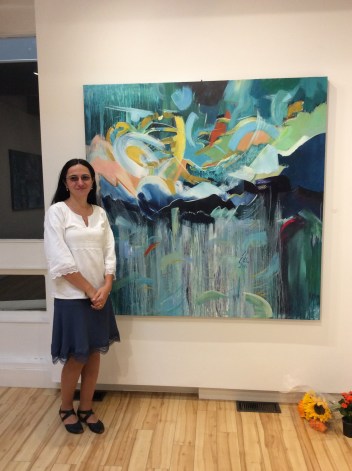
Otilia Greneantu Scriuba stands next to “Fusion”
Otilia Greneantu Scriuba’s abstract art featured cultural symbols such as water, the wave, the horizontal line to convey personal and deep-rooted narratives. The description on her website reads: “Otilia’s art orients images within collages. Parts of her paintings juxtapose original disparate fragments with origins drawn from different historic epochs and through different geographical spaces. Throughout her work she employs important cultural symbols such as: the water, the wave, the horizontal line, the square, the horse, the butterfly, the fish, the egg, the shell and the feather. In addition, she uses other symbols from some of the most important artistic periods: Victoria by Samotrace, human figures by Fidias Metopes, and Venus by Botticelli. Otilia Gruneantu Scriuba creates complex compositions while managing to harmonize her found elements in a unitary image.”
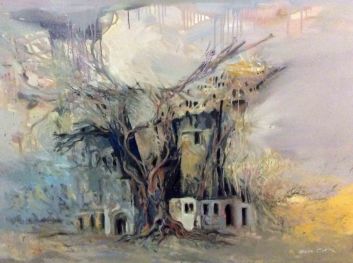
“Haunted House” by Doru Ciota
The surreal realism of Romanian artist Doru Cioata—a mix of detailed graphic design, intricate sketches and paintings—evoked a powerful metaphoric narrative. Seeing this art reminded me of the power of image in writing and my own adventure with image and writing. Several months ago, I was invited to write a flash fiction story based on a chosen Group of Seven painting for an anthology coming out next year. It was one of the most thrilling, fun and difficult projects I’d embarked on—and the most fulfilling. See my article on how visual art and writing communicate.
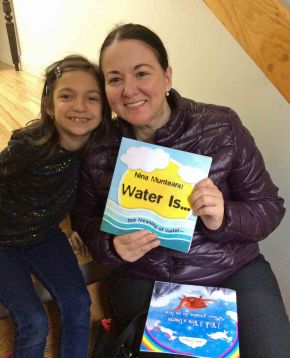
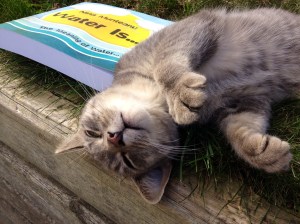
Alice with “Water Is…”
The three-track ToRo Fest ran the whole day with over fifteen book launches, literary presentations—including my talk on “Water Is…”—games, poetry readings, and panels, in addition to excellent live music from piano to guitar and drums.
I participated with Costi Gurgu (author of Aurora-nominated RecipeArium) in Claudiu Murgan’s panel on publishing models: “Publishing your book is not what it used to be: think hard and pick one: traditional vs. self-publishing vs. hybrid.” Costi, Claudiu and I discussed the pros and cons of each model, providing our experiences with these publishing types.

Costi Gurgu, Nina Munteanu, and Claudiu Morgan discuss publishing models
I reprised this subject with my lecture on hybrid publishing at the Mississauga Writers Group meeting on October 13 (at the South Common Community Centre, 11 am). I will also be giving this Hybrid Publishing lecture/workshop in the Toronto City Hall through the Immigrant Writers Association’s “writing and publishing series” of their “Learn with IWA” initiative (October 26, 7-9 pm). The lecture/workshop is open to members (zero to $10) and non-members (fee $15).

Vali Gurgu makes her move in “Absolutism”
Professor Nicolae Gavriliu of the Antiochian House of Studies gave an interesting lecture on the theology and art of the icon. I also attended a student presentation on global issues faced by marginalized groups from Roma in Romania to married children in Lebanon.
Costi and Vali Gurgu brought their new game Absolutism, a funny card game about surviving dictatorship (which should sell very well in the USA…). Several intrepid players tried their hand at dictatorship—and slavery, depending on whether they were losing or winning. I could hear the laughter clear to the lobby. See more about Absolutism, a fascinating, clever and witty game by author-lawyers who did, in fact, survive a dictatorship.

Ad for “Water Is…” on TTC subway
Several of my science fiction, eco-fiction and historical fantasy books were for sale and some sold out. Alice caught up to me for an autograph and joyfully shared that she’d seen the Pixl Press Water Is… ad on the Toronto subway and had told herself, “I need to meet this person.” Then she did—at ToRo!
A week prior to the festival, I was interviewed by Andreea Demirgian of “Radio Encounters” who called me “The Absolute Dame of Canadian Eco-Fiction”! I was flattered … and humbled. In truth, eco-fiction has become my passion and brand in writing. I realized only recently (in the last few years) that I’d been writing eco-fiction for twenty years but had branded my writing under science fiction. Sometimes, it takes a while to find one’s true voice–and niche. Thanks, Andreea! You can listen to the interview below:

enjoying my flat white at the Green Beanery
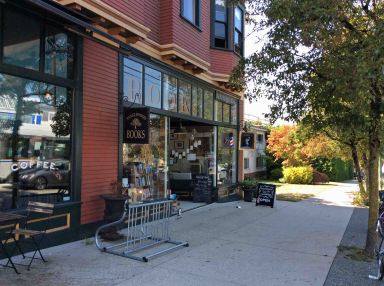
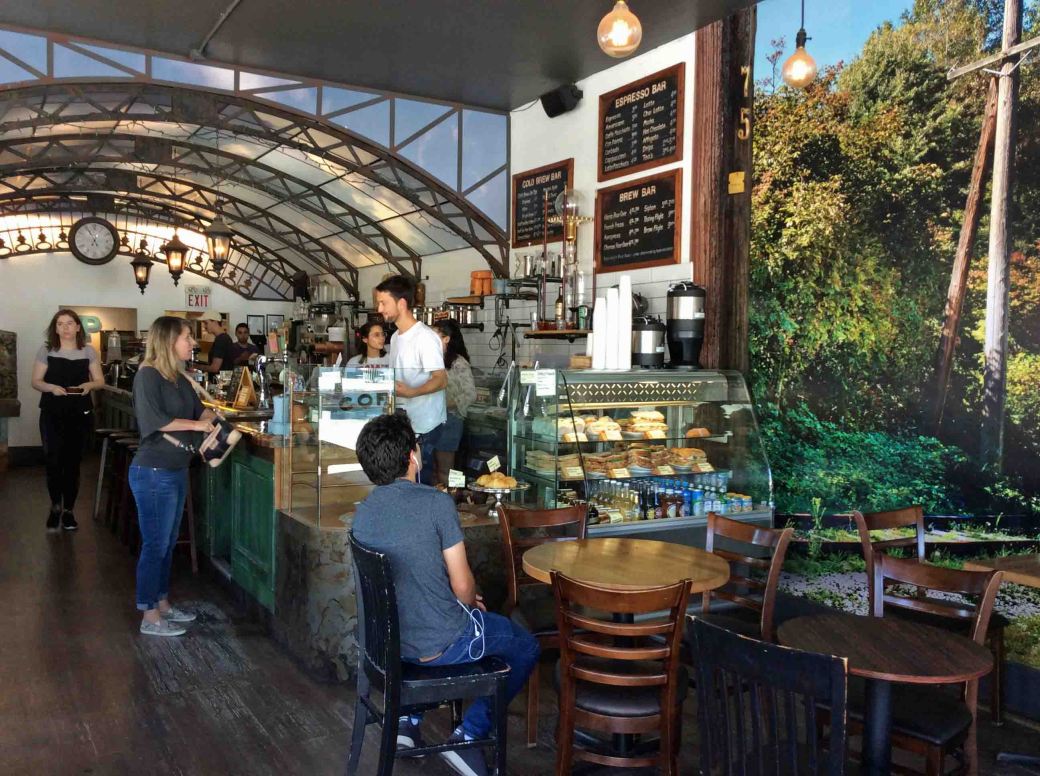
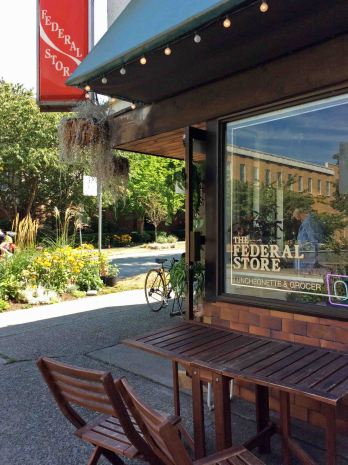
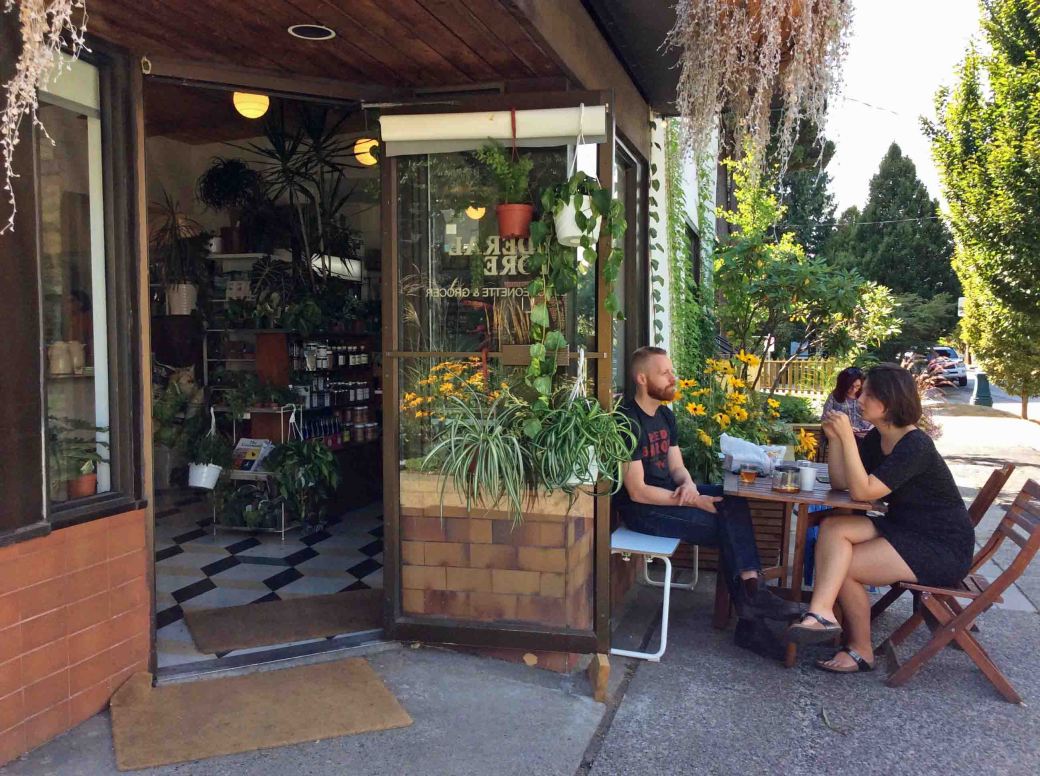
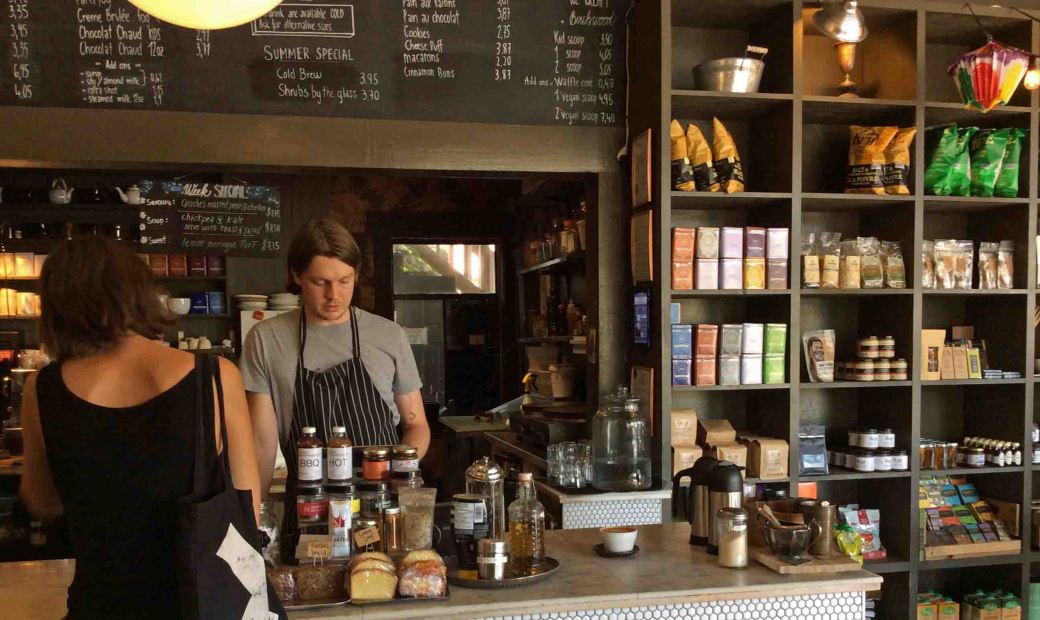
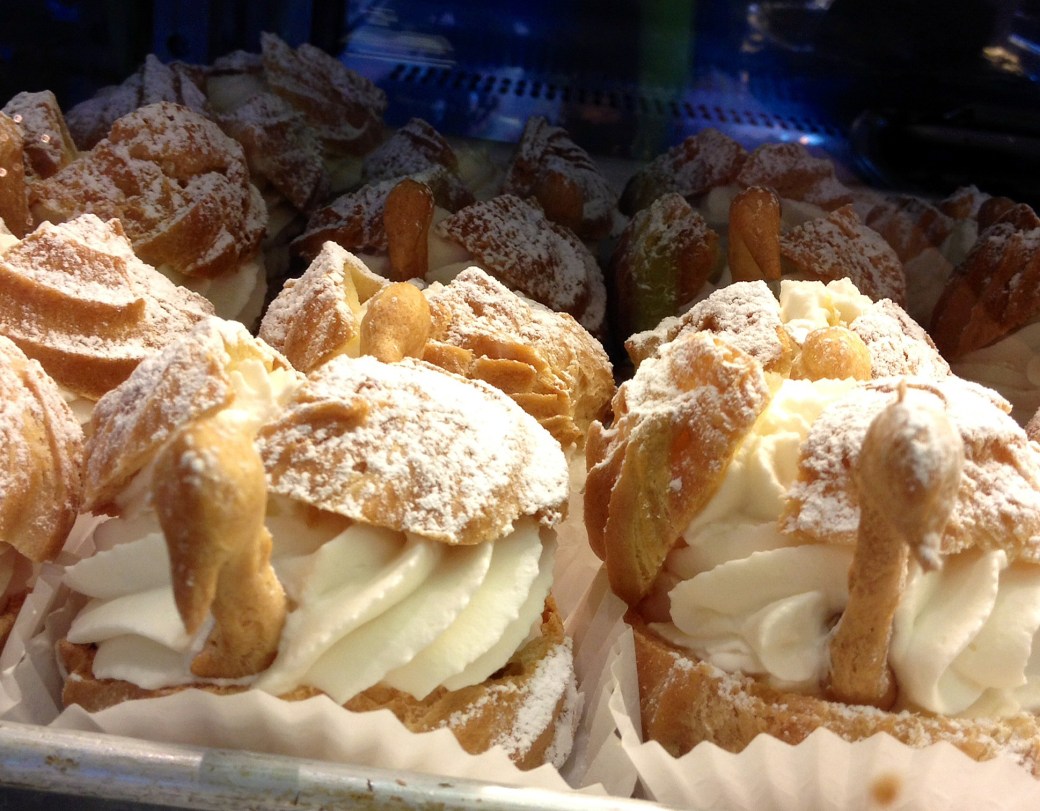
After much panelling, talking, selling out of my books, and discovering delicious Romanian pastries, I slipped out into the brisk drizzle with a mission: I was in search of good coffee. I spotted the Green Beanery, looking comfortable in an old brick building on the corner of Bathurst and Bloor. I smiled; I knew I’d found my coffee haven. I ordered my favourite from the barista—a flat white— and relaxed in the funky-hipster atmosphere of the café.
It turns out that the Green Beanery is a Canadian trust, created and staffed by environmentalists at Probe International. All earnings support the charity that protects lands and people’s livelihoods. The Green Beanery promotes small coffee farmers who produce niche coffees with characteristics as distinctive and extraordinary as their local ecology and who are less likely to use pesticides or fertilizers (like their larger counterparts). Green Beanery also encourages neighbourhood-based micro-roasting in small coffee shops and local roasteries. Creating niche markets for little known coffee bean varieties helps maintain the world’s store of genetic diversity.
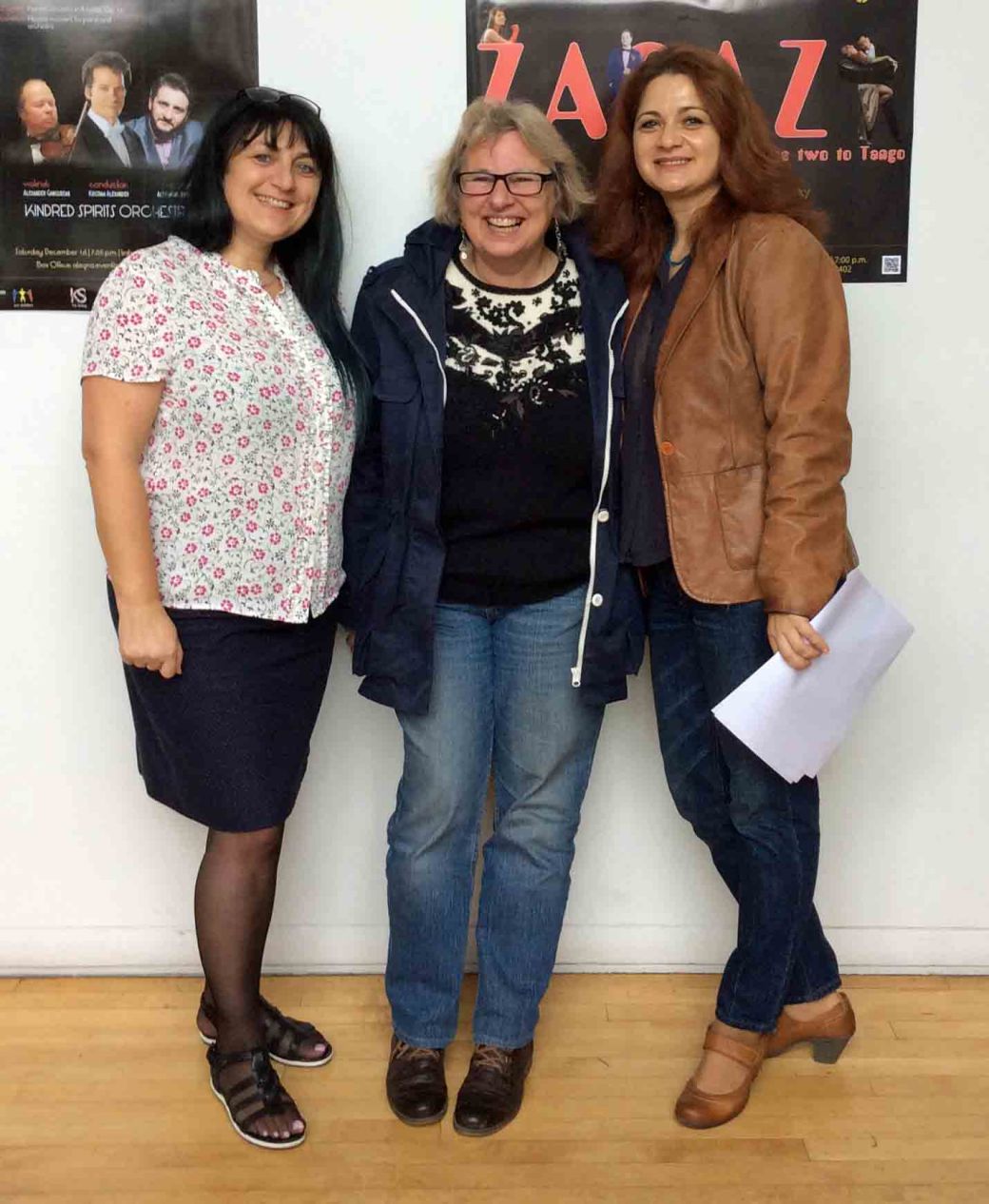
Nina stands between Juliana Pacso and Crina Bud of Tradicious
As I returned refreshed to ToRo, I realized that Tradicious was doing the same thing as Green Beanery: they had brought in a diversity of international artists in music, visual arts, fiction and poetry, philosophy and even socio-politics to meet, share, and discuss. Tradicious had created an ecotone (where worlds and ideas meet, share and learn) where diversity flourishes.
Well done, Tradicious!
 Nina Munteanu is an ecologist and internationally published author of award-nominated speculative novels, short stories and non-fiction. She is co-editor of Europa SF and currently teaches writing courses at George Brown College and the University of Toronto. Visit www.ninamunteanu.ca for the latest on her books. Nina’s recent book is the bilingual “La natura dell’acqua / The Way of Water” (Mincione Edizioni, Rome). Her latest “Water Is…” is currently an Amazon Bestseller and NY Times ‘year in reading’ choice of Margaret Atwood.


 Creative destruction … sounds like a paradox, doesn’t it? Nature—and God— is full of contradiction and paradox. There is so much that we do not understand (at least on the surface)… and apparent contradiction proves that to me. In
 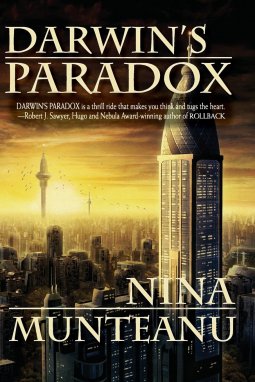 In my speculative fiction novel,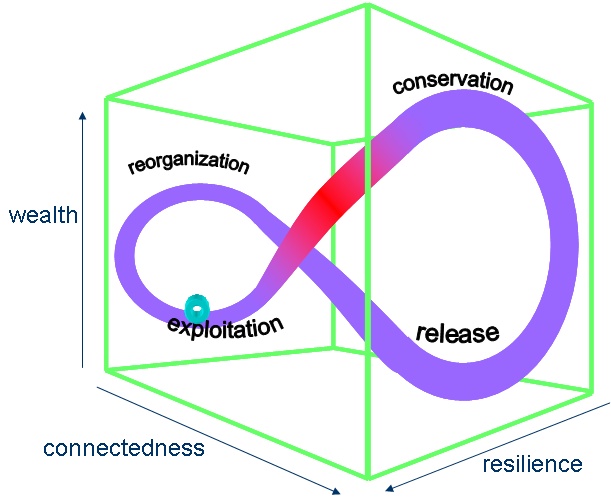
 Suppression of spruce budworm populations in eastern Canada using insecticides partially protected the forest but left it vulnerable to an outbreak covering an area and of an intensity never experienced before;
 In my book
 On Friday evening of October 26th Nina will be giving the first in a series of 10 writing workshops through the Immigrant Writers Association Writing and Publishing workshop series for members and non-members. Workshops are free for Class A members, $10 for Class B members, and $15 for non-members.


 The Fiction Writer (
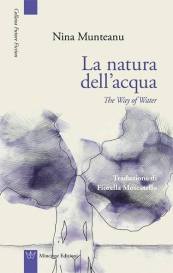 I hope to collaborate more with colleague and friend Cristian Tamas, who introduced me to editor/publisher Francesco Verso (of Future Fiction) and Mincione Edizioni, who published my short story “The Way of Water.” I later developed “The Way of Water” in novel form and I anticipate its release next year.


 One resource I’m eager to introduce to my students is Canadian SF short story writer Douglas Smith’s recent guidebook, Playing the Short Game: How to Market & Sell Short Fiction. Smith’s guidebook is a Tardis-style smallish yet comprehensive guide on what it takes to be a successful short story writer from starting & finishing to marketing & publishing to leveraging & promotion.
 I’m a petite five foot-three height and purposely wear flat shoes. I love short. I prefer my espresso pulled in short shots—or ristretto—in my flat white. Described as bolder, fuller, with more body and less bitterness, the ristretto is like a burst of intense flavor with a lingering finish. Short is pretty cool.
 A short story only has 7,000 or less words to get your tale across while a novel has over ten times that many words to do the same. It follows then that the short story format is a simpler one. This does not necessarily mean easier.
 Renowned short story authors like Edgar Allen Poe, Nathanial Hawthorne, and Somerset Maugham, emphasize the importance of striving for one effect when writing a short story: the single effect you wish to leave with the reader at the end. This is accomplished by selecting events or situations that build quickly into a combustible response. Even Alice Munro, who is known for cramming long timeframes into her short stories, frames time through a single event: a meal, family gathering, wedding or funeral, for instance.
 Nina’s Bus-Terminal Model
 Remember to keep track of what you send where and when and what happens to it. It can become a very confusing bus terminal otherwise, with someone ending up in Seattle when they are headed to Toronto! What happens with this approach is several things: you begin to treat the whole marketing/publishing process as a business (which it is) and because you have so many “buses” out there coming and going, the rejections don’t hurt quite as much and instead become part of the learning process, which they should be. You adopt a more business-like approach, which translates into your relationship with editors and publishers. A win-win situation results. Believe me; this works. Once I fell into this method, my sales increased by over 70%.




 Nina Munteanu is an ecologist, limnologist and internationally published author of award-nominated speculative novels, short stories and non-fiction. She is co-editor of Europa SF and currently teaches writing courses at George Brown College and the University of Toronto. Visit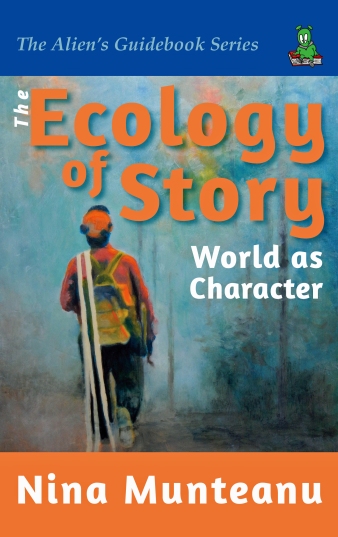

 When Pixl Press started looking for suitable cover artists to rebrand my writing craft series, I showed some of Anne’s work to the director Anne Voute. Pixl Press had already worked with Costi Gurgu and we liked his work. The result of Anne’s illustrations and Costi’s typography and design was a series of stunning covers that branded my books with just the right voice.
 The Alien Guidebook Series, of which two books are out so far (
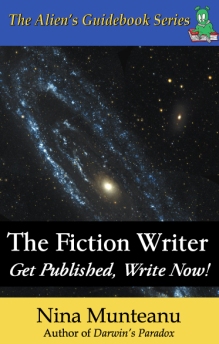 Anne’s illustration for
  I am currently researching and writing the third guidebook in the series—a reference on world building and use of ecology in story—The Ecology of Story: World as Character.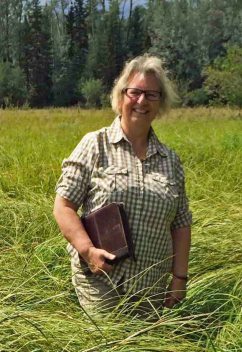
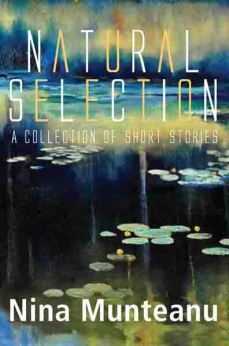 Anne’s art work for the cover of

 In my upcoming novel “
 In a talk I give at conferences on “
 Terms such as
 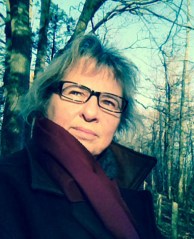 Nina Munteanu is an ecologist, limnologist and internationally published author of award-nominated speculative novels, short stories and non-fiction. She is co-editor of Europa SF and currently teaches writing courses at George Brown College and the University of Toronto. Visit
