“Do I contradict myself? Very well, then I contradict myself; I am large, I contain multitudes.”—Walt Whitman
 I was born on this day, some sixty+ years ago, in the small town of Granby in the Eastern Townships to German-Romanian parents. Besides its zoo—which my brother, sister and I used to visit to collect bottles for a finder’s fee at the local treat shop—the town had no particular features. It typified French-Canada of that era.
So did I.
I went to school in Quebec then migrated across to the west coast to practice and teach limnology. Given that Canada holds a fifth of the Earth’s freshwater, that also made sense.
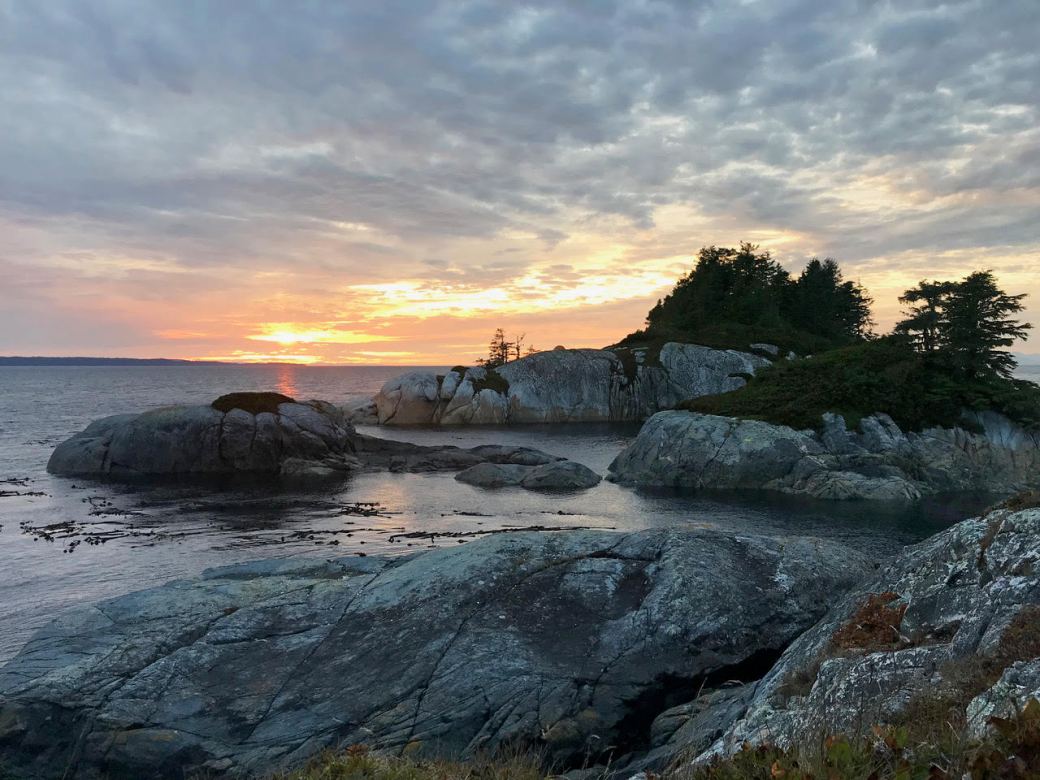
Sunset off Broughton, BC (photo by Nina Munteanu)
Canada is a vast country with a climate and environment that spans from the boreal forests of the Canadian Shield, muskegs of northern BC, and tundras of the Arctic Circle to the grasslands of the Prairies and southern woodlands of Ontario and Quebec. Canada’s environment is vast and diverse. Like its people.
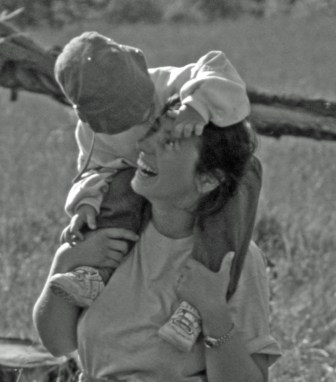
Nina and son Kevin explore Nature
In December of 2017 I participated in a discussion on the subject and role of water in literature in Toronto. I came to the event as a limnologist/ecologist, mother and environmentalist prepared to share how water—its meaning and our relationship with it—is used in my writing and how writing about water can help nurture a future of awareness and action.
But, as the discussion slid into the slippery subject of colonialism, I made the apparent mistake of sharing that—as a Canadian—I was proud of Canada. I was later schooled that “celebrating the nation” was considered anathema to an audience with strong anti-colonialist sentiments and a hatred for neoliberalist corporate Canada (something I share but do not obsess over); I’d obviously crossed some invisible line and I made a mental note to better assess my audience in future).
I also got to thinking about what it means for me to be a Canadian and what my pride in Canada really means. Was I being a “white-toast” nationalist in sharing a pride in my country?
Ecologist vs Nationalist
Ecology is the study of “home” (oikos means ‘home’ in Greek). Ecology studies the relationships that make one’s home functional. It is, in my opinion, the most holistic and natural way to assess where we live. My home is currently Toronto, Ontario, Canada and ultimately the planet Earth.

country road in Eastern Townships of Quebec
Growing up in the Eastern Townships of Quebec, I’d always felt an abiding sense of belonging and I resonated with Canada’s national symbols—mostly based on Nature and found on our currency, our flag, and various sovereign images: the loon, the beaver, the maple tree, our mountains and lakes and boreal forests. Why not? Over 80% of Canada lies in the boreal zone with much of that boreal forest and wilderness (that’s some 552 million hectares). Canadians are custodians of a quarter of the world’s wetlands, longest river systems and most expansive lakes. Most of us recognize this; many of us live, play and work in or near these natural environments.
I have long considered myself a global citizen with no political ties. I saw my country through the lens of an ecologist—I assessed my community and my surroundings in terms of ecosystems that supported all life, not just humanity. Was a community looking after its trees? Was my family recycling? Was a corporation using ‘green’ technology? Was a municipality daylighting its streams and recognizing important riparian zones? I joined environmental movements when I was a teenager. I shifted my studies from art to science because I wanted to make a difference in how we treated our environment. After university, I joined an environmental consulting firm, hoping to educate corporations and individuals as environmental stewards. I brought that philosophy into a teaching career and began writing eco-fiction, science fiction and essays to help promote an awareness and a connection with our natural world. My hope was to illuminate how important Nature and water is to our planet and to our own well-being through an understanding of ecology and how everything is interconnected.
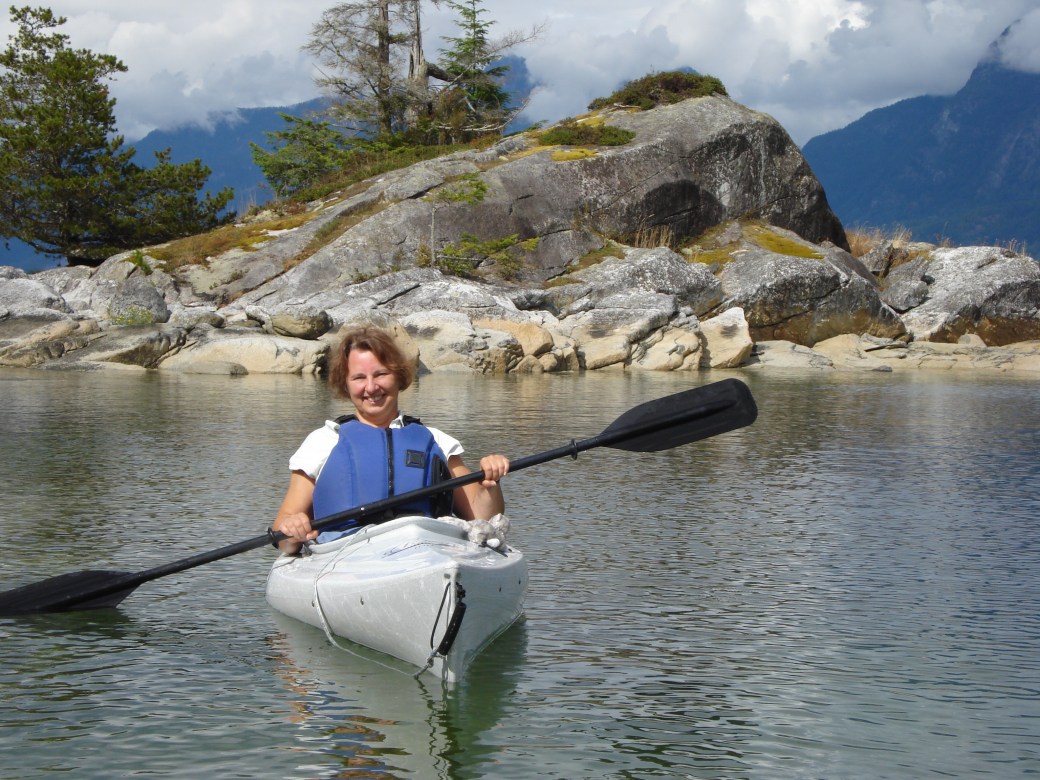
Nina kayaking in Desolation Sound, British Columbia (photo by H. Klassen)
Merriam-Webster defines “nationalism” as: “loyalty and devotion to a nation, especially a sense of national consciousness.” This is not the same as patriotism. Nor does it describe what many think of the word, which is an extreme form of nationalism, in which one nation is exalted above all others (I can think of one nation that is overtly doing that now) and placing primary emphasis on promoting its culture and interests over others—often through isolationism, xenophobia, chauvinism and jingoism. When I think of Canada, I think of my “home”, where I live; my community and my environment. I have traveled the world and I feel a strong sense of “home” and belonging every time I return. Canada is my home. I was born and grew up in Quebec; I raised a family in British Columbia, and I lived in Ontario and Nova Scotia. Each of these places engendered a feeling of “home”. If a strong sense of “home” and belonging is nationalistic, then that is what I am.
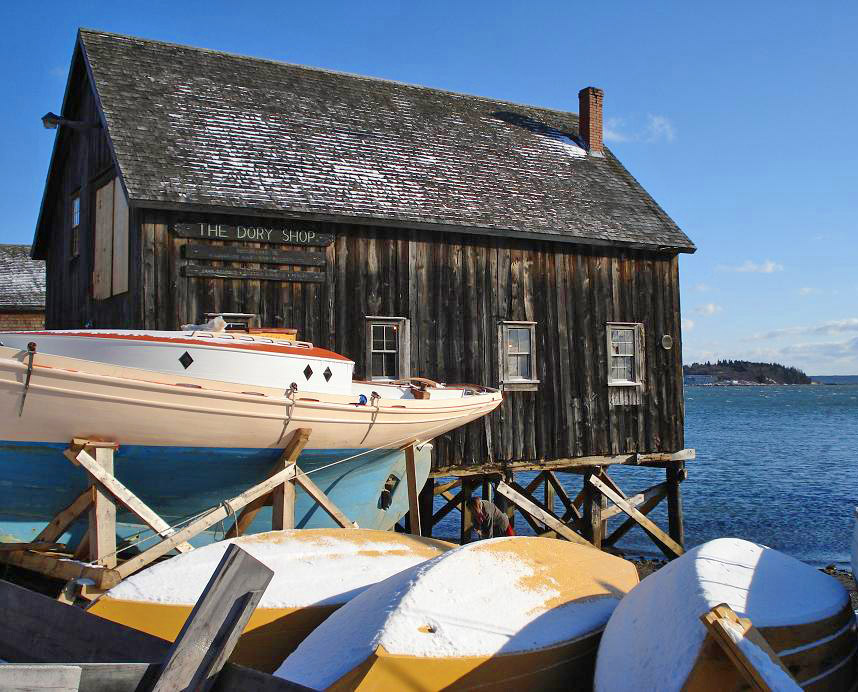
The Dory Shop in Lunenburg, Nova Scotia (photo by Nina Munteanu)
Or am I something else? Perhaps, we need to redefine our sense of belonging (and pride) in a country that is not tied to some core political identity or melting-pot mainstream. Historian and writer Charlotte Gray wrote:
“we live in a country that has a weak national culture and strong regional identities …Two brands of psychological glue bind Canada together: political culture and love of landscape…[in] a loose federation perched on a magnificent and inhospitable landscape—[we are] a nation that sees survival as a collective enterprise.”—Charlotte Gray
Canada as Postnational State

Justin Trudeau on the cover of “Rolling Stone”
In October 2015, Canada’s Prime Minister Justin Trudeau told the New York Times that Canada may be the “first postnational state,” adding that “there is no core identity, no mainstream in Canada.” This is largely because Canadians, writes Charles Forman in the Guardian, are “philosophically predisposed to an openness that others find bewildering, even reckless.”
To anyone but a Canadian, Trudeau’s remark would rankle, particularly in a time when many western countries are fearfully and angrily turning against immigration through nativism and exclusionary narratives. A time when the United States elected an authoritarian intent on making “America great again” by building walls. A time when populist right-wing political parties hostile to diversity are gaining momentum in other parts of the world. “Canada’s almost cheerful commitment to inclusion might at first appear almost naive,” writes Forman. It isn’t, he adds. There are practical reasons for keeping our doors open.
We are who we are because of what we are: a vast country the size of Europe. A country dominated by boreal forest, a vital and diverse wilderness that helps maintain the well-being of our entire planet. A land that encompasses over a fifth of the freshwater in the world, and a quarter of the world’s wetlands. Canadians are ultimately the world’s Natural stewards. That is who and what we are.
According to Forman, postnationalism frames how “to understand our ongoing experiment in filling a vast yet unified geographic space with the diversity of the world” and a “half-century old intellectual project, born of the country’s awakening from colonial slumber.” As the first Europeans arrived in North America, the Indigenous people welcomed them, taught them how to survive and thrive amid multiple identities and allegiances, writes Forman. “That welcome was often betrayed, particularly in the 19th and 20th centuries, when settlers did profound harm to Indigenous people.” But, says Forman, if the imbalance remains, so does the influence: a model of another way of belonging. One I think many Canadians are embracing. We are learning from the natural wisdom of our Indigenous peoples. Even our fiction reflects how we value our environment and embrace diversity. “Diversity fuels, not undermines, prosperity,” writes Forman.
 As efforts are made to reconcile the previous wrongs to Indigenous peoples within Canada and as empowering stories about environment are created and shared, Canada carries on the open and welcoming nature of our Indigenous peoples in encouraging immigration. In 2016, the same year the American government announced a ban on refugees, Canada took in 300,000 immigrants, which included 48,000 refuges. Canada encourages citizenship and around 85% of permanent residents typically become citizens. Greater Toronto is currently the most diverse city in the world; half of its residents were born outside the country. Vancouver, Calgary, Ottawa and Montreal are not far behind.
Canadian author and visionary Marshal McLuhan wrote in 1963 that, “Canada is the only country in the world that knows how to live without an identity.” This is an incredible accomplishment, particularly given our own colonial history and the current jingoistic influence of the behemoth south of us.
 Writer and essayist Ralston Saul suggests that Canada has taken to heart the Indigenous concept of ‘welcome’ to provide, “Space for multiple identities and multiple loyalties…[based on] an idea of belonging which is comfortable with contradictions.” Of this Forman writes:
“According to poet and scholar BW Powe, McLuhan saw in Canada the raw materials for a dynamic new conception of nationhood, one unshackled from the state’s ‘demarcated borderlines and walls, its connection to blood and soil,’ its obsession with ‘cohesion based on a melting pot, on nativist fervor, the idea of the promised land’. Instead, the weakness of the established Canadian identity encouraged a plurality of them—not to mention a healthy flexibility and receptivity to change. Once Canada moved away from privileging denizens of the former empire to practicing multiculturalism, it could become a place where ‘many faiths and histories and visions would co-exist.”
 And that’s exactly what is happening. We are not a “melting pot” stew of mashed up cultures absorbed into a greater homogeneity of nationalism, no longer recognizable for their unique qualities. Canada isn’t trying to “make Canada great again.” Canada is a true multi-cultural nation that celebrates its diversity: the wholes that make up the wholes.
Confident and comfortable with our ‘incomplete identity’—recognizing it for what it is—is according to Forman, “a positive, a spur to move forward without spilling blood, to keep thinking and evolving—perhaps, in the end, simply to respond to newness without fear.”
This resonates with me as an ecologist. What I envision is a Canada transcending the political to embrace the environment that both defines us and provides us with our very lives; a view that knows no boundaries, and recognizes the importance of diversity, relationship and inclusion, interaction, movement, and discovery.
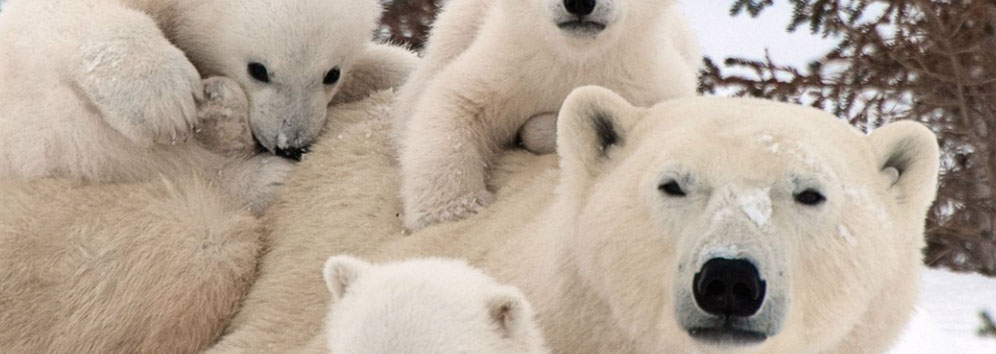 So, am I still proud of Canada? Definitely. We have much to be proud of. We live in one of the wealthiest countries in the world and the 8th highest ranking in the Human Development Index. Canada ranks among the highest in international measurements of government transparency, civil liberties, quality of life, economic freedom, and education. It stands among the world’s most educated countries—ranking first worldwide in the number of adults having tertiary education with 51% of adults holding at least an undergraduate college or university degree. With two official languages, Canada practices an open cultural pluralism toward creating a cultural mosaic of racial, religious and cultural practices. Canada’s symbols are influenced by natural, historical and Aboriginal sources. Prominent symbols include the maple leaf, the beaver, Canada Goose, Common Loon, the Royal Canadian Mounted Police, the polar bear, the totem pole, and Inuksuk.
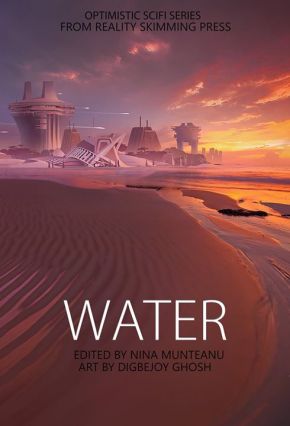 We are a northern country with a healthy awareness of our environment—our weather, climate and natural world. This awareness—particularly of climate change—is more and more being reflected in our literature—from Margaret Atwood’s “Maddaddam” trilogy and Kim Stanley Robinson’s “New York 2140” to my own book “Water Is…”. Canadians are writing more eco-fiction, climate fiction, and fiction in which environment somehow plays a key role. Water has become one of those key players: I recently was editor of the Reality Skimming Press anthology “Water”, a collection of six speculative Canadian stories that explore near-future scenarios with water as principle agent.
In a recent interview with Mary Woodbury on Eco-Fiction, I reflected on a trend over the years that I noticed in the science fiction writing course I teach at George Brown College: “It’s a workshop-style course I teach and students are encouraged to bring in their current work in progress. More and more students are bringing in a WIP with strong ecological overtones. I’d say the percentage now is over 70%. This is definitely coming from the students—it’s before I even open my mouth about ecology and eco-fiction—and what it suggests to me is that the welfare of our planet and our ecosystems is on many people’s minds and this is coming through in our most metaphoric writing: science fiction.”
It is healthy to celebrate our accomplishments while remembering where we came from and what we still need to accomplish. This provides direction and motivation.
References:
Dechene, Paul. 2015. “Sci-Fi Writers Discuss Climate Catastrophe: Nina Munteanu, Author of Darwin’s Paradox.” Prairie Dog, December 11, 2015.
Forman, Charles. 2017. “The Canada Experiment: Is this the World’s First Postnational Country?” The Guardian, January 4, 2017.
Gray, Charlotte. 2017. “Heroes and Symbols” The Globe and Mail.
Moorhouse, Emilie. 2018. “New ‘cli-fi’ anthology brings Canadian visions of future climate crisis.” National Observer, March 9, 2018.
Munteanu, Nina. 2016. “Crossing into the Ecotone to Write Meaningful Eco-Fiction.” In: NinaMunteanu.me, December 18, 2016.
Newman-Stille, Derek. 2017. “The Climate Around Eco-Fiction.” In: Speculating Canada, May 24, 2017.
Woodbury, Mary. 2016. “Part XV. Women Working in Nature and the Arts: Interview with Nina Munteanu, Ecologist and Author.” Eco-Fiction.com, October 31, 2016.
 Nina Munteanu is an ecologist and internationally published author of award-nominated speculative novels, short stories and non-fiction. She is co-editor of Europa SF and currently teaches writing courses at George Brown College and the University of Toronto. Visit www.ninamunteanu.ca for the latest on her books. Nina’s recent book is the bilingual “La natura dell’acqua / The Way of Water” (Mincione Edizioni, Rome). Her latest “Water Is…” is currently an Amazon Bestseller and NY Times ‘year in reading’ choice of Margaret Atwood.

 J.K. Rowling was an unemployed single mother on public assistance when she wrote the first book. The book was rejected by over a dozen publishers before a small British publisher, Bloomsbury, said yes.
 John Steinbeck worked through many odd jobs before earning enough to work as a full time writer. His day jobs included: apprentice painter, fruit picker, estate caretaker and Madison Square Garden construction worker. He also ran a fish hatchery in Lake Tahoe and did guided tours there.
 Margaret Atwood worked in a coffee shop. She says her first job experience was NOT ideal: She had to deal with a difficult cash register, a rude ex-boyfriend who would come by just to stare at her and barely tip, and fellow employees who were definitely not friendship material.
 Before his writing career blossomed, William Faulkner worked for the postal service, as postmaster at the University of Mississippi. In his resignation note, he summarized the struggle of art and commerce faced by most authors: “As long as I live under the capitalist system I expect to have my life influenced by the demands of moneyed people. But I will be damned if I propose to be at the beck and call of every itinerant scoundrel who has two cents to invest in a postage stamp. This, sir, is my resignation.”
 In a 1953 interview, J.D. Salinger shared that he had served as entertainment director on the HMS Kungsholm, a Swedish luxury liner. He drew on the experience for his short story “Teddy”, which takes place on a liner.
 Ursula Le Guin struggled initially to be published in the mainstream fiction world, but her first three novels, Rocannon’s World, Planet of Exile and City of Illusions, put her on the sci-fi map.
 An accomplished tenor, James Joyce made money singing for his supper before his work was published.
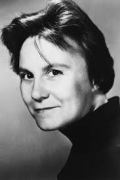 Harper Lee worked as a reservation clerk for Eastern Air Lines for several years, writing stories in her spare time. A windfall came when a friend offered her a Chirsmas gift of one year’s wages and one year off to write whatever she pleased; she wrote the first draft of “To Kill a Mockingbird”.
 Stephen King was a janitor for a high school as he struggled to get his fiction published. His time wheeling the cart through the halls inspired him to write the opening girl’s locker room scene in “Carrie”, his breakout novel.
 Kurt Vonnegut managed Americas first Saab dealership in Cape Cod during the late 1950s, a job he joked about in a 2004 essay, “I now believe my failure as a dealer … explains what would otherwise remain a deep mystery: why the Swedes have never given me a Nobel prize for literature.”
 When Virginia Woolf’s brilliant novels failed to find a publisher, she and her husband Leonard bought a printing press and set up their own publishing compay Hogarth Press in their living room. They published Woolf’s masterful novels, such as Orlando and To The Lighthouse, as well as T.S. Eliot’s The Waste Land, among other classics of the era.
 T.S. Eliot worked as a clerk for Lloyds Bank of London. During that time, he composed “The Waste Land”.
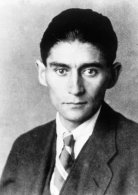 Franz Kafka served as the Chief Legal Secretary of the Workmen’s Accident Insurance Institute. Obviously.
 and The Hitchhiker’s Guide to the Galaxy author Douglas Adams was no exception: At one point, he served as a bodyguard for a wealthy Arabian family while he wrote for radio shows and Monty Python. Good writers are good multitaskers!
 James A. Michener was a teacher before writing only at age 40. He Michener is notable more for his output than his age. The Tales of the South Pacific author (whose Pulitzer Prize-winning book would later be adapted into a Broadway musical) wrote a staggering 40 books after the age of 40—nearly a
 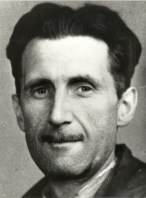 book a year—after spending much of his life as a teacher.
 Nina Munteanu is an ecologist, limnologist and internationally published author of award-nominated speculative novels, short stories and non-fiction. She is co-editor of Europa SF and currently teaches writing courses at George Brown College and the University of Toronto. Visit www.ninamunteanu.ca for the latest on her books.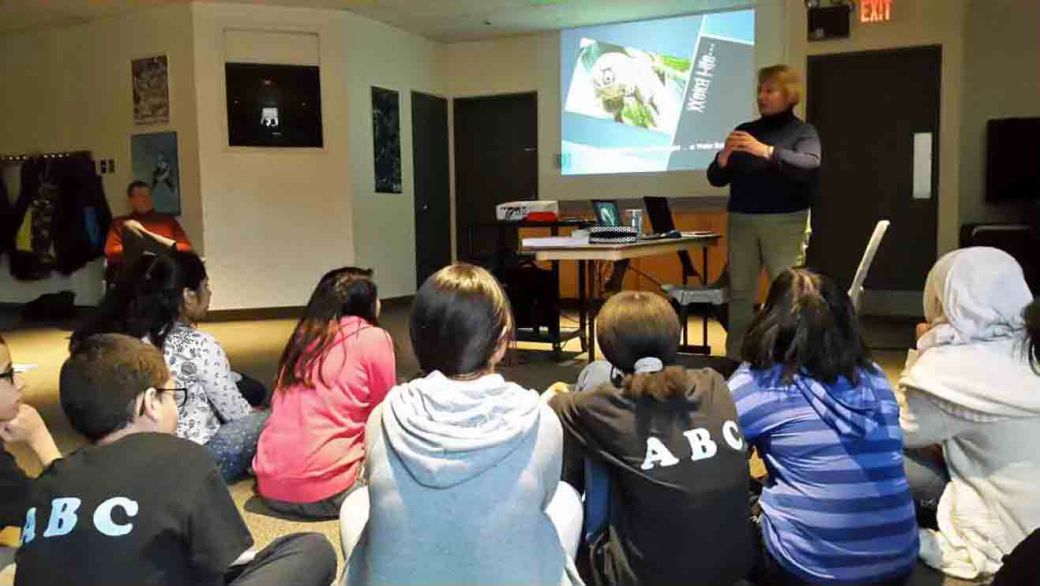
 I started the talk by explaining that I’m a limnologist—someone who studies freshwater—and that water is still a mysterious substance, even for those who make it their profession to study. After informing them of water’s ubiquity in the universe—it’s virtually everywhere from quasars to planets in our solar system—I reminded them that the water that dinosaurs drank during the Paleozoic Era is the same water that you and I are drinking.



 You can read so much more about water in my book
  Nina Munteanu is an ecologist, limnologist and internationally published author of award-nominated speculative novels, short stories and non-fiction. She is co-editor of Europa SF and currently teaches writing courses at George Brown College and the University of Toronto. Visit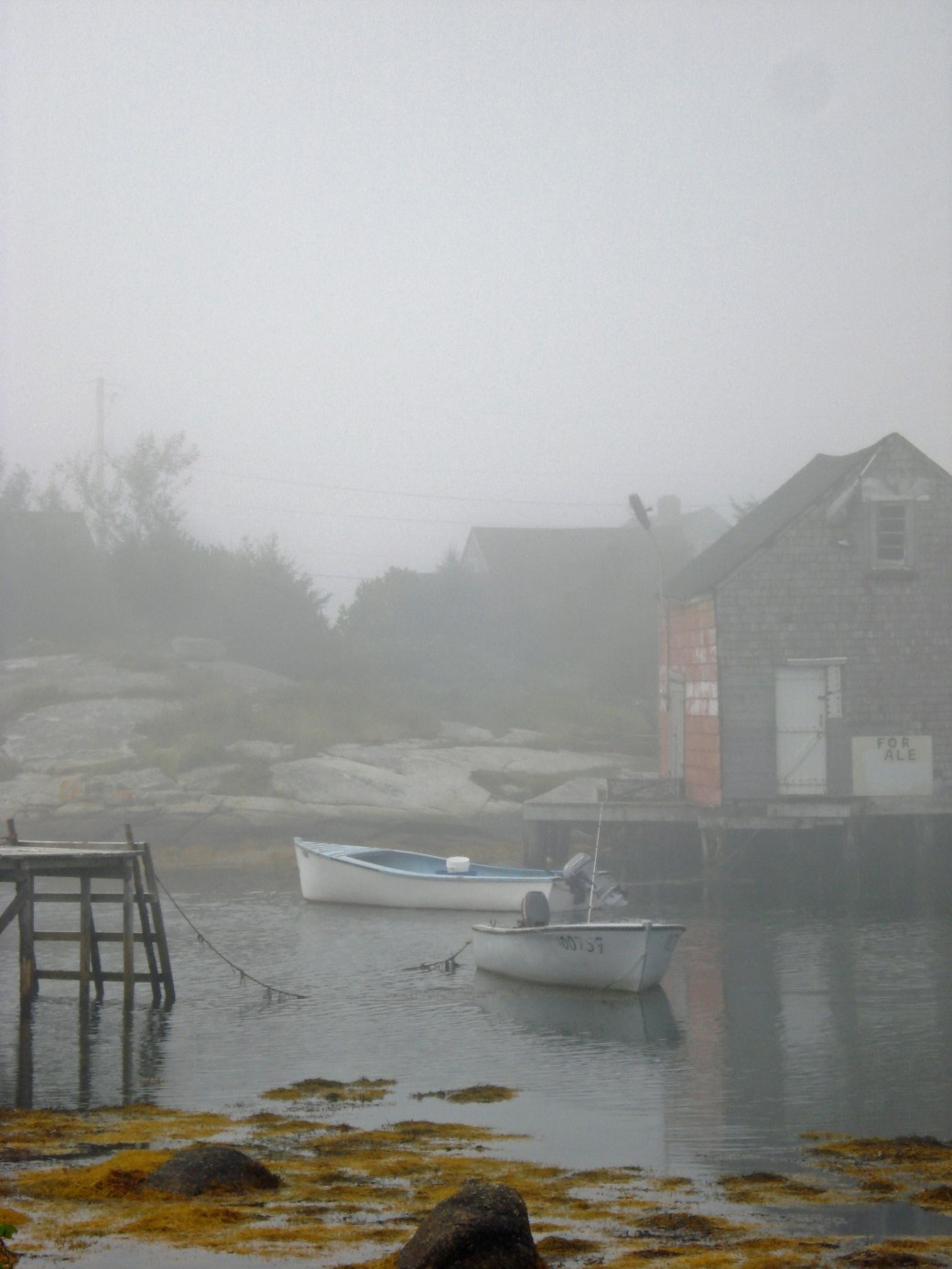

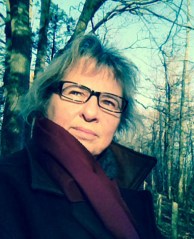 Nina Munteanu is an ecologist, limnologist and internationally published author of award-nominated speculative novels, short stories and non-fiction. She is co-editor of Europa SF and currently teaches writing courses at George Brown College and the University of Toronto. Visit
 In the androcratic model, a woman “hero” often presupposes she shed her feminine nurturing qualities of compassion, kindness, tenderness, and inclusion, to express those hero-defining qualities that are typically considered “male”. I have seen too many 2-dimensional female characters limited by their own stereotype in the science fiction genre—particularly in the adventure/thriller sub-genre. If they aren’t untouchable goddesses or “witches” in a gynocratic paradigm, they are often delegated to the role of enabling the “real hero” on his journey through their belief in him: as Trinity enables Neo; Hermione enables Harry; Mary Jane enables Spiderman; Lois enables Superman; etc. etc. etc.

 liberator for Belters but is really a terrorist revolutionary group, looking to shift the balance of power); she naively joined to help the lowly belters achieve justice and a voice in the oppressive squeeze by Martian and Earth corporate interests. In “Back to the Butcher”, a colleague of Julie’s relates how she selflessly helped injured minors on Calisto in a tunnel collapse with cadmium poisoning: “I never saw her shed a tear over the fact that she’d have to take anti-cancer meds for the rest of her life.” The only time she cried, he shares, was when she was acknowledged as being a true “beltalowda.”
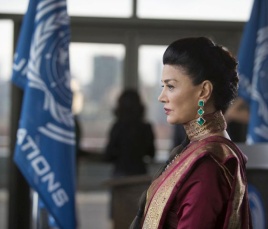 from a higher calling, not from lust for power or self-serving greed. She’s seeks the truth. And, like Miller, she struggles with a conscience. Chrisjen is a complex and paradoxical character. Her passionate and unrelenting search for the truth together with unscrupulous methods, make her one of the most interesting characters in the growing intrigue of The Expanse. Avasarala is a powerful character on many levels—none the least in her potent presence (thanks to Shohreh Aghdashloo’s powerful performance); when Avasarala walks into a scene, all eyes turn to her.
 operative and she finds herself ironically defending the Belt and Belters in the struggle between Earth and Mars. “We need to stick together,” she tells fellow Belter Miller and helps Fred Johnson’s team. Driven to help those in need, Naomi selflessly puts herself in harm’s way to save Belters used as lab rats on Eros or those left to die on Ganymede after a Mars and Earth skirmish. In an intimate moment with Holden after the atrocity on Eros with the proto-molecule experiment, Naomi reminds him: “We did not choose this but this is our fight now. We’re the only ones who know what’s going on down there; we’re the only ones with a chance to stop it.”
 Station. A complex character with mysterious connections and intuitive skills for people, Drummer gives one the impression that she can nimbly navigate between hard-line OPA and Fred’s Earther-version of OPA justice for Belters. In “Pyre”, she shows her mettle when—after being shot and held hostage by a militant faction on Tycho—she finds the strength to summarily execute them.
 Bobbie Draper (Frankie Adams) is a staunch hard-fighting Martian marine who dreams of a terraformed Mars with lakes and vegetation and breathable atmosphere. Because of Earth’s Vesta blockade, Draper realizes that she will not realize her childhood dream of seeing Mars “turned from a lifeless rock into a garden.” The blockade forced Mars to ramp up its military at the expense of terraforming. Draper laments that, “with all those resources moved to the military, none of us will live to see an atmosphere over Mars” and bears a strong resentment against Earth. However, when Bobbie discovers her own government’s culpability with an Earth weapons manufacturer that used her own marines as guinea pigs, she chooses honour over loyalty and defects to seek justice.
 The Secretary General (who she had a previous friendship that soured over some dubious event) has called Anna in to write a stirring speech to unite Earth behind the war erupting between Earth and Mars. Anna enters the political intrigue with naive hope and is badly used; but her inner strength, keen intelligence and courage propels her on an amazing trajectory of influence to the outer reaches of the solar system where first contact is imminent. Like a quiet summer rainstorm, Anna brings a fresh perspective on heroism through faith, hope and inclusion.
 to name just a few. The gender of the hero I empathized with was irrelevant. What remained important was their sensibilities and their actions of respect and integrity on behalf of humanity, all life and the planet.
 Nina Munteanu’s near-future speculative short story “The Way of Water” in Bruce Meyer’s (editor) “Cli Fi: Canadian Tales of Climate Change”, published by
  A bilingual print book by
 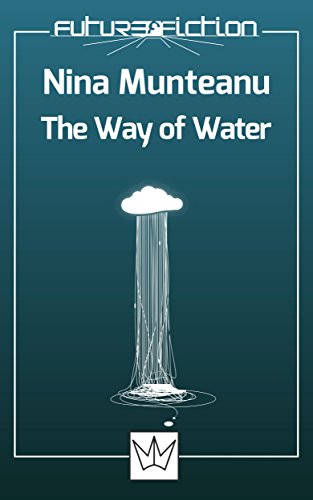 ” ‘The Way of Water’ is to be ‘a shapeshifter,’ says Nina Munteanu in her dystopian narrative, where she draws a dark scenario and, unfortunately, not too improbable in the near future. In the universe of the story water has become a very precious commodity: rationed consumption, credits (always of water) accounted for and debts collected…The Chinese multinationals have exchanged the public debt of other states with their water reserves with which, now, they can control the climate, deciding when and where it will rain. Who understands this dirty game has been silenced, like Hilda’s mother, a limnologist, inexplicably arrested and never returned; like the daughter of two water vendors, mysteriously disappeared, after having decided not to bow to economic powers: Hanna, who now prefers secure virtual identities to evanescent real appearances. Water. The two, like the covalent bond of a complex molecule, develop a relationship of attraction and repulsion that will first make them meet and then, little by little, will change into a tormented love but, at the same time, so pure as to cause Hilda at great risk, to make an extreme decision that will allow Hanna to realize the strange prophecy that the internal voice, perhaps the consciousness of water, had resonated in the two women for a long time.
 “The Way of Water” will also appear alongside a collection of international works (including authors from Greece, Nigeria, China, India, Russia, Mexico, USA, UK, Italy, Canada (yours truly), Cuba, and Zimbabwe) in Bill Campbell and Francesco Verso’s

 Nina Munteanu is an ecologist, limnologist and internationally published author of award-nominated speculative novels, short stories and non-fiction. She is co-editor of Europa SF and currently teaches writing courses at George Brown College and the University of Toronto. Visit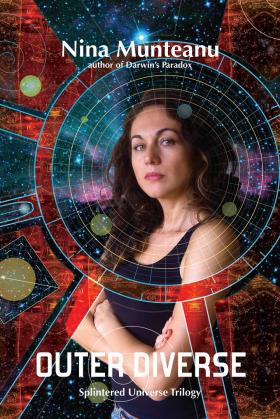


 47 Uma a (also called Horus) was colonized in ancient times by the Khonsus, a raptor-like biped race with mind-probing capability. It is also the home of the ancient migrating trees, ammuts (giant flying insects), and the weeping mountains with their narcotic boiling seas used by the giant apophus to attack and set its millions of babies to devour Rhea in Book 1.

 You can also listen to the Podcast


 Nina Munteanu Writing Coach