Find Your Focus This Christmas–Reprise

christmas-ballsHow many of you are still running around preparing for the Christmas celebration or secular family festivity? Buying that last minute gift you’d forgotten or were chasing down since a bazillion days ago? Or making last minute changes to your travel plans, house-cleaning for guests, mailing of cards or parcels or meal preparations?

Well, you’re reading this blog post … That means you’re sitting down and taking a minute to relax and regroup. That’s good. Remember to breathe… while I tell you a story…

I’d just finished a three-day drive through snow and rain storms from Mahone Bay, Nova Scotia, to Toronto, Ontario, where I was staying for a few days before catching a flight to Vancouver to spend Christmas with my son and good friends on the west coast. Talk about fast living.

I move around a lot these days. It helps me to appreciate some of the most simple things in life and reminds me of what I love most about Christmas: how it focuses my heart and reconnects me. I don’t mean just with relatives and friends either, although the season certainly does that. I’m talking about my soul and the universe itself. Before I became an itinerant, Christmas bustled with my responsibilities as primary caregiver, social coordinator and hostess of major parties. After I’d said goodbye to our visiting friends and done the dishes and tidied the house; after my husband and son had gone to bed, I sat in the dark living room lit only with the Christmas Tree lights and the flickering candle, and listened to soft Christmas music, primed to write.

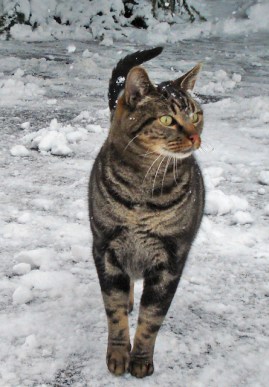
snow-christmas2008-sammyMy male cat, smelling fresh from outside, found his rightful place on my lap and settled there, pinning me down with love. And there, as I breathed in the scent of wax and fir and cat I found myself again.

Most of us think of Christmas as a busy time, of getting together (often dutifully) with family and friends, exchanging presents and feasting. Christmas is certainly this, but that is only a shallow view of a far deeper event; and I don’t mean only for Christians.

Whether celebrating the holy light of Hannukah or the birth of Jesus, or the winter solstice, this season provides us with the opportunity to meditate on far more than the surficial nature of the symbols we have come to associate with the season: the Christmas tree, presents, turkey dinner, Santa Claus or Saint Nicholas—most of which originate from pagan tradition, by the way.

Says Lama Christie McNally (author of The Tibetan Book of Meditation), “once you dive below the surface, you will discover a beautiful clear place—like a diamond hidden beneath the rubble. It is your own mind, uncovered … Tibetans say we have only just begun the process of awakening—that we still have quite a way to go in our evolutionary process. And it has nothing to do with building spaceships or computers. The next step in our evolution takes place within.”

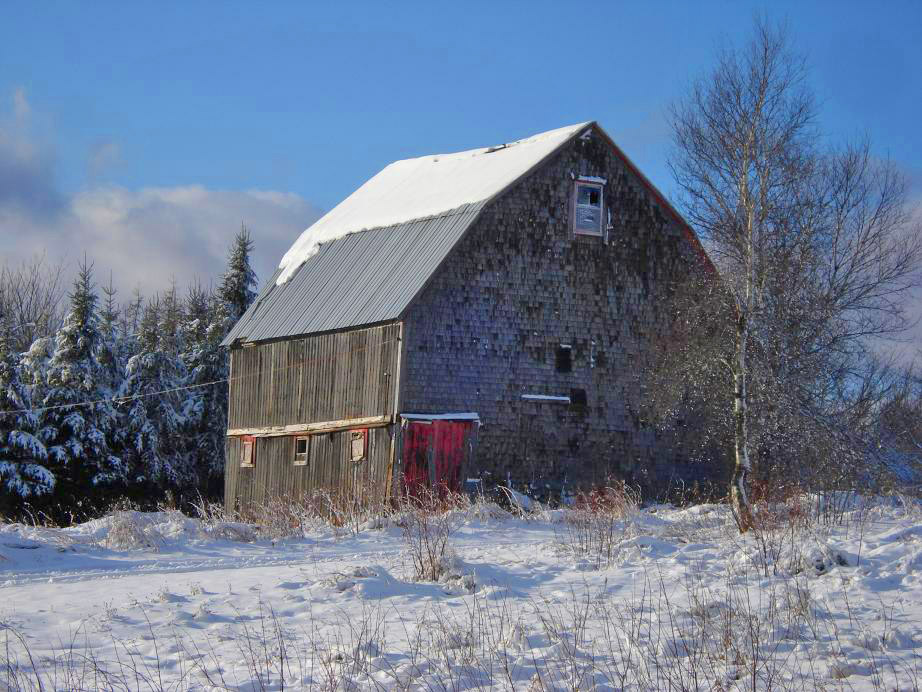
snow-scene-road-to-Wolfville-barn_edited-1

Barn on the road to Wolfville, NS (photo by Nina Munteanu)

Christmas is, more than anything, a time of embracing paradox. It is an opportunity to still oneself amid the bustle; to find joy in duty; to give of one’s precious time when others have none, to embrace selflessness when surrounded by promoted selfishness, and to be genuine in a commercial and dishonest world. If one were to look beyond the rhetoric and imposed tradition, the Christmas season represents a time of focus, a time to reflect on one’s genuine nature and altruistic destiny. A time to reconnect with the harmony and balance in our lives.

A time to sit with our cat, pinned with love, and write our next novel.

Merry Christmas!


Nina Munteanu is an ecologist and internationally published author of award-nominated speculative novels, short stories and non-fiction. She is co-editor of Europa SF and currently teaches writing courses at George Brown College and the University of Toronto. Visit www.ninamunteanu.ca for the latest on her books.

Crossing into the Ecotone to Write Meaningful Eco-Fiction

If you have an apple and I have an apple and we exchange apples then you and I will still each have one apple. But if you have an idea and I have an idea and we exchange these ideas, then each of us will have two ideas.”—George Bernard Shaw


naturalselectionAt Calgary’s When Words Collide this past August, I moderated a panel on Eco-Fiction with publisher/writer Hayden Trenholm, and writers Michael J. Martineck, Sarah Kades, and Susan Forest. The panel was well attended; panelists and audience discussed and argued what eco-fiction was, its role in literature and storytelling generally, and even some of the risks of identifying a work as eco-fiction.

Someone in the audience brought up the notion that “awareness-guided perception” may suggest an increase of ecological awareness in literature when it is more that readers are just noticing what was always there. Authors agreed and pointed out that environmental fiction has been written for years and it is only now—partly with the genesis of the term eco-fiction—that the “character” and significance of environment is being acknowledged beyond its metaphor; for its actual value. It may also be that the metaphoric symbols of environment in certain classics are being “retooled” through our current awareness much in the same way that Aldous Huxley’s Brave New World or George Orwell’s Nineteen Eighty Four are being re-interpreted—and newly appreciated— in today’s world of pervasive surveillance and bio-engineering.

darwins-paradoxI submit that if we are noticing it more, we are also writing it more. Artists are cultural leaders and reporters, after all. My own experience in the science fiction classes I teach at UofT and George Brown College, is that I have noted a trend of increasing “eco-fiction” in the works in progress that students are bringing in to workshop in class. Students were not aware that they were writing eco-fiction, but they were indeed writing it.
I started branding my writing as eco-fiction a few years ago. Prior to that—even though my stories were strongly driven by an ecological premise and strong environmental setting—I described them as science fiction and many as technological thrillers. Environment’s role remained subtle and—at times—insidious. Climate change. Water shortage. Environmental disease. A city’s collapse. War. I’ve used these as backdrops to explore relationships, values (such as honour and loyalty), philosophies, moralities, ethics, and agencies of action. The stuff of storytelling.

Environment, and ecological characteristics were less “theme” than “character,” with which the protagonist and major characters related in important ways.

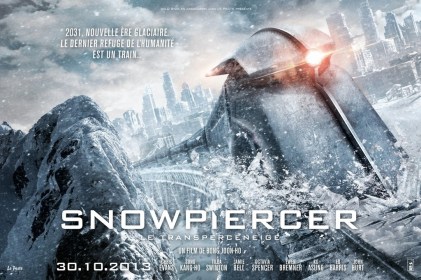
Snowpiercer-frenchJust as Bong Joon-Ho’s 2014 science fiction movie Snowpiercer wasn’t so much about climate change as it was about exploring class struggle, the capitalist decadence of entitlement, disrespect and prejudice through the premise of climate catastrophe. Though, one could argue that these form a closed loop of cause and effect (and responsibility).
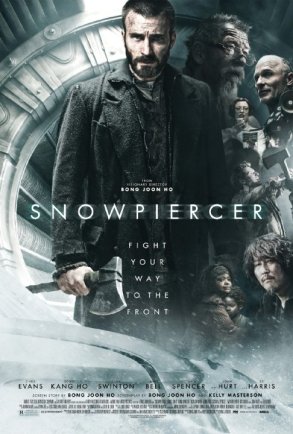
snowpiercer-posterThe self-contained closed ecosystem of the Snowpiercer train is maintained by an ordered social system, imposed by a stony militia. Those at the front of the train enjoy privileges and luxurious living conditions, though most drown in a debauched drug stupor; those at the back live on next to nothing and must resort to savage means to survive. Revolution brews from the back, lead by Curtis Everett (Chris Evans), a man whose two intact arms suggest he hasn’t done his part to serve the community yet.

Minister Mason (Tilda Swinton), an imperious yet simpering figure who serves the ruling class without quite being part of it, reminds the lower class that:

We must all of us on this train of life remain in our allotted station. We must each of us occupy our preordained particular position. Would you wear a shoe on your head? Of course you wouldn’t wear a shoe on your head. A shoe doesn’t belong on your head. A shoe belongs on your foot. A hat belongs on your head. I am a hat. You are a shoe. I belong on the head. You belong on the foot. Yes? So it is.  snowpiercer-mason

In the beginning, order was prescribed by your ticket: First Class, Economy, and freeloaders like you…Now, as in the beginning, I belong to the front. You belong to the tail. When the foot seeks the place of the head, the sacred line is crossed. Know your place. Keep your place. Be a shoe.”

Ecotones are places where “lines are crossed,” where barriers are breached, where “words collide” and new opportunities arise. Sometimes from calamity. Sometimes from tragedy. Sometimes from serendipity.

When environment shapes a story as archetype—hero, victim, trickster, shadow or shape shifter—we get strong eco-fiction. Good eco-fiction, like any good story, explores the choices we make and the consequences of those choices. Good eco-fiction ventures into the ecotone of overlap, collision, exchange and ultimate change.

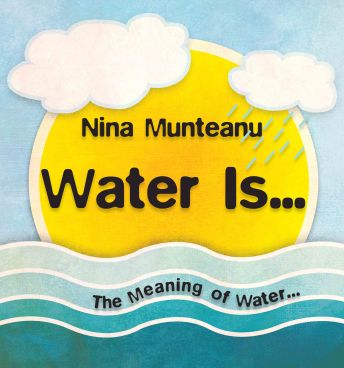
water-is-webIn my latest book Water Is… I define an ecotone as the transition zone between two overlapping systems. It is essentially where two communities exchange information and integrate. Ecotones typically support varied and rich communities, representing a boiling pot of two colliding worlds. An estuary—where fresh water meets salt water. The edge of a forest with a meadow. The shoreline of a lake or pond.
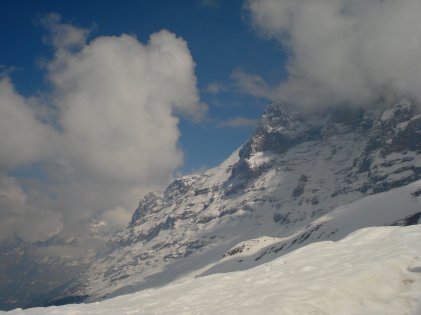
For me, this is a fitting metaphor for life, given that the big choices we must face usually involve a collision of ideas, beliefs, lifestyles or worldviews: these often prove to enrich our lives the most for having gone through them. Evolution (any significant change) doesn’t happen within a stable system; adaptation and growth occur only when stable systems come together, disturb the equilibrium, and create opportunity. Good social examples include a close friendship or a marriage in which the process of “I” and “you” becomes a dynamic “we” (the ecotone) through exchange and reciprocation. Another version of Bernard Shaw’s quote, above, by the Missouri Pacific Agriculture Development Bulletin reads: “You have an idea. I have an idea. We swap. Now, you have two ideas and so do I. Both are richer. What you gave you have. What you got I did not lose. This is cooperation.” This is ecotone.

Jungfrau-peak

Jungfrau, Switzerland (photo by Nina Munteanu)

I think we are seeing more eco-fiction out there because ecosystems, ecology and environment are becoming more integral to story: as characters in their own right. I think we are seeing more eco-fiction out there because we are ready to see it. Just as quantum physics emerged when it did and not sooner, an idea—a thought—crystalizes when we are ready for it.

Don’t stay a shoe … go find an ecotone. Then write about it.


nina-2014aaNina Munteanu is an ecologist and internationally published author of award-nominated speculative novels, short stories and non-fiction. She is co-editor of Europa SF and currently teaches writing courses at George Brown College and the University of Toronto. Visit www.ninamunteanu.ca for the latest on her books.

Where Is the Literature of the Anthropocene?

interstellar-cooper-ice-planet2Early on in the recent science fiction movie Interstellar, NASA astronaut Cooper declares that “the world’s a treasure, but it’s been telling us to leave for a while now. Mankind was born on Earth; it was never meant to die here.” After showing Cooper how their last corn crops will eventually fail like the okra and wheat before them, NASA Professor Brand answers Cooper’s question of, “So, how do you plan on saving the world?” with: “We’re not meant to save the world…We’re meant to leave it.” Cooper rejoins: “I’ve got kids.” To which Brand answers: “Then go save them.”


In a 1976 NBC interview on the significance of the Viking 1 landing on Mars, astronomer Carl Sagan likened our space program to watching a dandelion gone to seed: “I can’t help but think of this as an epochal moment in planetary exploration. If you can imagine, a sort of a very patient observer, observing the earth for its four and half billion-year lifetime: for all of that period, lots of things came onto the earth, but nothing left it. And now just in the last 10 years, things are spewing off the earth.”

NewYork-Soho01

Apartments in Soho, New York City (photo by Nina Munteanu)

The Onset of the Anthropocene & the Great Acceleration

In a Guardian article entitled “The Holocene hangover: it is time for humanity to make fundamental changes”, Fredrick Albritton Jonsson examines Amitav Ghosh’s interpretation of climate change and considers the need to acknowledge Earth’s own powerful and changing identity—particularly through the face of climate change.

Is climate change the planet’s way of telling us that we no longer belong—like Cooper was suggesting in the movie Interstellar?

That we’ve largely orchestrated these changes may be considered ironic—or is it simply inevitable? For me, as an ecologist, this is not a new concept. Ecological succession is the process of ecosystem change and development over time (usually following a disturbance) as an establishing species impacts and alters its environment to eventually make the environment less suited to it and more to another species, which will replace it. Succession only stops when a climax community—which is in equilibrium with a stable environment—establishes. This climax stage can persist indefinitely—until the next environmental disturbance, that is. Succession occurs everywhere in Nature; examples include the recolonization of Mount St. Helen following the volcanic eruption. Natural succession occurs in human society as well. A good example can be found in any city. My landscape architect son described the natural process of “gentrification” in a large city: a process of renovation and revival of deteriorated urban areas through an influx of more affluent residents, resulting in increased property values and a displacement of lower-income families and businesses. Inherent in succession is movement and flow—something Nature is very familiar with and uses well.

“Our planet is changing into a strange and unstable new environment, in a process seemingly outside technological control,” writes Jonsson, who laments in a disillusioned patriarchal voice: “The fossil fuels that once promised mastery over nature have turned out to be tools of destruction, disturbing the basic biogeochemical processes that make our world habitable [for us]. Even the recent past is no longer what we thought it was.”

Jonsson then unleashes a litany of examples where humanity has imposed global change, including: climate change; reduced biodiversity of ecosystems; acidification of marine life and oceans capacity to absorb carbon dioxide; fresh water scarcity; ozone depletion, which threatens atmospheric stability; and disruption of global nitrogen and phosphorus cycles—to mention a few. “Indeed,” says Jonsson, “the planet’s biosphere bears so many marks of anthropogenic influence that it is no longer possible to [distinguish] between the realm of wilderness and the world of human habitation.”

world-war-2-goosestep“Scientists are telling us that the whole territory of modern history, from the end of World War II to the present, forms the threshold to a new geological epoch,” adds Jonsson. This epoch succeeded the relatively stable natural variability of the Holocene Epoch that had endured for 11,700 years. Scientists Paul Crutzen and Eugene Stoermer call it the Anthropocene Epoch. Suggestions for its inception vary from the time of the Industrial Revolution in the late 1700s with the advent of the steam engine and a fossil fuel economy to the time of the Great Acceleration—the economic boom following World War II.
the-great-accelerationThe Great Acceleration describes a kind of tipping point in planetary change and succession resulting from a rising market society.

From the devices we carry to the lives we lead, everything is getting faster, faster.  The International Geosphere-Bioshpere Programme writes that “the last 60 years have without doubt seen the most profound transformation of the human relationship with the natural world in the history of humankind.” They suggest that the second half of the 20th Century is unique in the history of human existence. “Many key indicators of the functioning of the Earth system are now showing responses that are, at least in part, driven by the changing human imprint on the planet. The human imprint influences all components of the global environment – oceans, coastal zone, atmosphere, and land.”

While this notion rings hubristic, there is no question that humanity is now a major driver of planetary change: from tipping the Earth’s axis through the creation of massive water reservoirs and diverting a third of Earth’s available fresh water to increasing carbon dioxide to a levels found 800,000 years ago—changing global climate.

Geologists and historians discussed how the Anthropocene Epoch would best be identified by observers in a distant future. “Among the plausible candidates proposed are micro-plastics, metal alloys, and artificial isotopes,” writes Jonsson. “Such stratigraphic markers must be placed in their historical context. The scientific identification of the Anthropocene with the year 1945 gives us not just a plausible geological end to the Holocene, but also a watershed that fits comfortably with a great body of scholarly work about the historical consequences of World War II.”

great-acceleration-chartThe Great Acceleration encompasses the notion of “planetary boundaries,” thresholds of environmental risks beyond which we can expect nonlinear and irreversible change on a planetary level. A well known one is that of carbon emissions. Emissions above 350 ppm represent unacceptable danger to the welfare of the planet in its current state; and humanity—adapted to this current state. This threshold has already been surpassed during the postwar capitalism period decades ago.

Our Literature in the Anthropocene

greatderangement-climatechangeIn Amitav Ghosh’s diagnosis of the condition of literature and culture in the Age of the Anthropocene (The Great Derangement: Climate Change and the Unthinkable), he observes that the literary world has responded to climate change with almost complete silence. “How can we explain the fact that writers of fiction have overwhelmingly failed to grapple with the ongoing planetary crisis in their works?” continues Jonsson, who observes that, “for Ghosh, this silence is part of a broader pattern of indifference and misrepresentation. Contemporary arts and literature are characterized by ‘modes of concealment that [prevent] people from recognizing the realities of their plight.’”

“By failing to engage with climate change, artists and writers are contributing to an impoverished sense of the world, right at the moment when art and literature are most needed to galvanize a grassroots movement in favor of climate justice and carbon mitigation.”

According to Ghosh, the “great derangement” stemmed from a certain kind of rationality. Plots and characters of bourgeois novelists reflected the regularity of middle-class life and the worldview of the Victorian natural sciences, one that depended on a principle of uniformity. Change in Nature was gradual and never catastrophic. Extraordinary or bizarre happenings were left to marginal genres like the Gothic tale, romance novel, and—of course—science fiction. The strange and unlikely were externalized: hence the failure of modern novels and art to recognize anthropogenic climate change.

flight-behaviorJonsson tells us that bourgeois reason takes many forms, showing affinities with classical political economy, and—I would add—in classical physics and Cartesian philosophy. From Adam Smith’s 18th Century economic vision to the conceit of bankers who drove the 2008 American housing bubble, humanity’s men have consistently espoused the myth of a constant natural world capable of absorbing infinite abuse without oscillation. When James Lovelock and Lynn Margulis proposed the Gaia Hypothesis in the 1970s, many saw its basis in a homeostatic balance of the natural order as confirmation of Nature’s infinite resilience to abuse. They failed to recognize that we are Nature and abuse of Nature is really self-abuse.

Jonsson suggests that these Enlightenment ideas are essentially ideological manifestations of Holocene stability, remnants from 11,000 years of small variability in temperature and carbon dioxide levels, giving rise to deep-seated habits and ideas about the resilience of the natural world. “The commitment to indefinite economic growth espoused by the economics profession in the postwar era is perhaps its most triumphant [and dangerous] expression.”

memory-of-water-emmi-itarantaLouise Fabiani of Pacific Standard suggests that novels are still the best way for us to clarify planetary issues and prepare for change—even play a meaningful part in that change. In her article “The Literature of Climate Change” she points to science fiction as helping “us prepare for radical change, just when things may be getting too comfortable.” Referring to our overwhelming reliance on technology and outsourced knowledge, Fabiani suggests that “our privileged lives (particularly in consumer-based North America) are built on unconscious trust in the mostly invisible others who make this illusion of domestic independence possible—the faith that they will never stop being there for us. And we have no back-ups in place should they let us down.” Which they will—given their short-term thinking.

“To counteract this epidemic of short-term thinking,” says Fabiani, “it might be a good idea for more of us to read science fiction, specifically the post-apocalyptic sub-genre: that is, fiction dealing with the aftermath of major societal collapse, whether due to a pandemic, nuclear fallout, or climate change.”

year-of-the-flood-atwoodIn my interview with Mary Woodbury on Eco-Fiction I remind readers that “science fiction is a powerful literature of allegory and metaphor and deeply embedded in culture. By its very nature, SF is a symbolic meditation on history itself and ultimately a literature of great vision. Some of the very best of fiction falls under the category of science fiction, given the great scope of its platform. More and more literary fiction writers are embracing the science fiction genre (e.g., Margaret Atwood, Kuzuo Ishiguro, Michael Chabon, Philip Roth, Iain Banks, David Mitchell); these writers recognize its immense scope and powerful metaphoric possibilities. From science fiction to eco-fiction is a natural process. Exploring large societal and planetary issues is the purview of both.”

Let’s see more. We need it.

You can find an excellent databank of eco-fiction books on Mary Woodbury’s site Eco-Fiction. Mary Woodbury also includes “12 works of climate fiction everyone should read.” Midge Raymond of Literary Hub lists “5 important works of eco-fiction you need to read.” And then there is the Goodreads Listopia for “Best eco-fiction

naturalselectionMy own works of eco science fiction can be found on my author’s website, Nina Muneanu Writer and at a quality bookstore near you.

Why not find a work of eco-fiction and share it with someone you care about this Christmas.

nina-2014aaNina Munteanu is an ecologist and internationally published author of award-nominated speculative novels, short stories and non-fiction. She is co-editor of Europa SF and currently teaches writing courses at George Brown College and the University of Toronto. Visit www.ninamunteanu.ca for the latest on her books.

Writing a Review on Amazon or Goodreads…It’s Not So Hard To Do

NewYork-BryantPark-grill

Bryant Park, New York City (photo by Jane Raptor)

WHY Do a Review

There are several reasons to provide an online review.

As a reader, you can offer a recommendation to your fellow readers on a writer whose work you like. You are doing that writer a BIG favor by providing the review; just by adding an additional voice to that book’s virtual shelf. Any voice is better than no voice at all. This is why I generally don’t do negative reviews: just by adding a review (good or bad) you are adding to the voices associated with that book. I prefer to concentrate on adding a positive voice to the conversation. I’d rather spend my time helping and supporting writers and works that I like than bashing works I don’t care for. So, if you like a writer / book, letting other readers know right where the book is selling is a very effective way to help.

water-is-amazoncan-usa

Figure 1. Amazon Canada reviews of “Water Is…” (with added Amazon USA reviews)

Online reviews on Kobo, Barnes & Noble, and Amazon (primarily Amazon.com, but also Amazon.ca for Canada, and others throughout the world) are very useful and much appreciated by writers who you are reading and who want to keep writing for you. Goodreads (a primary book review and recommendation site) is another excellent site to place a review. It’s a free website for book lovers, who can feature their bookshelves, write reviews and rank books.

last-summoner-goodreads

Figure 2. Goodreads reviews and ranks for “The Last Summoner”

Reviews are one of the best ways to give back to the writers you wish to support. And, believe me, writers need that support! With Christmas coming around the corner, now is a prime time to get that review out that you’ve been thinking of doing to help your favorite writer or book. As a writer, if you aren’t writing reviews or making some recommendations on books and authors you like, you may wish to read my article on reciprocal altruism and the case of the vampire bat.

natural-selection-amazon

Figure 3. Amazon USA Kindle reviews for “Natural Selection”

HOW to Do a Review

I think so many of us get into thinking that we must write a “book report” like the one we hated doing in high school. But a review—particularly a good one—is not a book report. It is not the same as a critique, which may go into depth about artistic interpretation and symbolism. A review for a bookseller, like Amazon, Kobo or Barnes & Noble, is a lot simpler and serves a different purpose.

A good review provides key information on how the book resonated—or didn’t—with you. It’s really not that hard to write. Here are some tips:

  • A book review is NOT a plot outline. You don’t need to tell the potential reader all the ins and outs of the story. In fact, to get a good sense of the book, particularly if it is a non-fiction reference book, you don’t need to finish the book before you review it. What you do need to have done is read enough to have the book “speak” to you in some way.
  • Reviews are about connection and resonation. What did you like most about the book or what bothered you the most? The best reviews have a balance of both positive and negative things. But they don’t need to. Are you glad you bought it? Why? Did you learn something? Did it change your perspective? How did it touch you? Would you buy more by the same author? Would you recommend it? And if so, why. Think of your fellow readers. In fact, that’s a good way to write the review:
  • Write in a conversational tone as if you are describing the book to a friend you are recommending it to. You don’t need to get all technical or “literary” or use fancy or clever language. Write in the language that feels familiar to you. Remember, you’re writing to other readers.
  • Just be honest. What’s the first thing that comes to you? Write from the heart: “I loved this book because…” Perhaps it’s the memorable main character. Or the rich setting and history. Or the incredible world. Or the imaginative idea and twists in the story. Or the unforeseen but appropriate end. Did the book linger with you? Tell us why.
  • A book review can be short and work very well. I’ve seen a single under 10-word sentence for some reviews of my books. But those less than 10 words mean a lot, especially if they say: “Amazing wealth of information!” Or “A wonderful read.” Or “brilliantly written!” Short is direct and clean—like a poem—and distills your impressions down to an essence that will appeal to many. It will more likely be read in a sea of longer reviews. See examples in Figures 1, 2, and 5.
  • Combine this with a good title and you have a very powerful statement. I’m talking about the space that Amazon also provides for a “title” to your review (see examples in Figure 1 and 3), which appears at the top in bold and is, therefore very prominent. Be mindful of this title as readers may skim through these and use them alone to gain a sense of the reviews. Think of it as a one-line book tag, a distillation of how you felt about the book (e.g., This book changed my perspective on water; I want to be her when I grow up), or who you are, even (e.g., Limnologist Recommends…)
  • Ranking a book is useful. Most bookseller and book review sites include a place for you to rank the book, without even needing to put in a written review. These all help a reader sense the book’s popularity. You can also help by “liking” other people’s reviews, helping to give them importance.
darwins-paradox-goodreads

Figure 4. Goodreads rankings for “Darwin’s Paradox”

WHERE to Do a Review

I’ve already mentioned the main sites that either sell books online or talk about books. The major bookstore sites include: Amazon, Kobo, Barnes & Noble, and Indigo. There are many other online booksellers, but the ones I mentioned will get to the most readers; so, your review will serve its purpose more powerfully there.

Just a note here about Amazon: I’m a Canadian and my books sell on Amazon.ca as well as on Amazon.com (in the USA). My books also sell in Japan, Australia, UK, Germany, France, Spain and Italy, just to name a few countries. Each of these countries is represented by its own Amazon online store (like Amazon.ca for Canada). If you write a review on Amazon.ca, it will only show up on Amazon.ca. If you write a review on Amazon.com, it will show up on all the other Amazon sites (see Figure 1). Generally, it’s best to write your review on the site from where you bought the book; but, this isn’t a hard and fast rule. I’ve bought a book on one Amazon site and written a review on another.

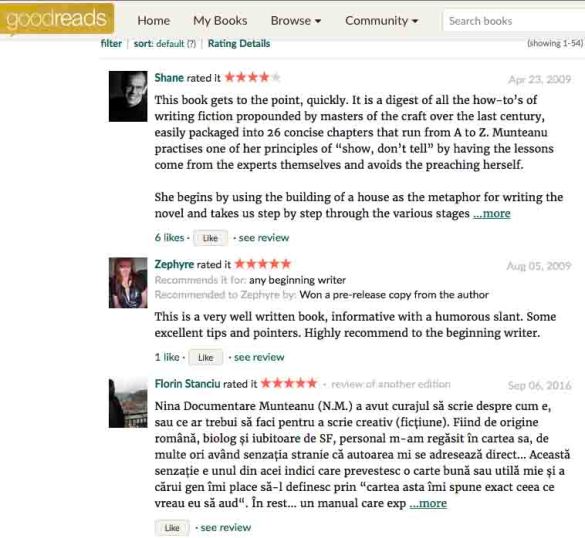
Goodreads is one of the best book review sites, given its popularity and large, diverse and active membership. Goodreads readers—and their authors—take books seriously. But even there, reviews can vary from extensive to a few sentences as shown in these reviews for my writing guide “The Fiction Writer” (Figure 5), and in Figure 2 for “The Last Summoner.”

fiction-writer-goodreads

Figure 5. Goodreads Reviews for “The Fiction Writer”

WHAT Reviews Look Like

I’ve included throughout this article examples of reviews for my various books which show you a range of style and impression—both positive and negative. Writers do want an honest review. Yes, we’d rather see all positive reviews. But the negative review has its place, the very least, to demonstrate to readers that the critique forum is objective and unbiased and embraces free expression.

Notice that Goodreads embraces a platform that shows a combination of review and rank, which works very well (see Figure 2). Also, notice the Goodreads ranks for my first novel, “Darwin’s Paradox” in Figure 4, which represent a healthy range from 1 to five stars. Figures 6 and 7, below, demonstrate the full range of reviews a single book can get, in this case for the first book, “Outer Diverse”, of my space adventure trilogy, “Splintered Universe”.

outer-diverse-goodreads2

outer-diverse-goodreads-neg

Figure 7. Another Goodreads review of “Outer Diverse”

So, have fun writing your review; but go and write it!


nina-2014aaa

Nina Munteanu is a Canadian ecologist / limnologist and novelist. She is co-editor of Europa SF and currently teaches writing courses at George Brown College and the University of Toronto. Visit www.ninamunteanu.ca for the latest on her books. Nina’s bilingual “La natura dell’acqua / The Way of Water” was published by Mincione Edizioni in Rome. Her non-fiction book “Water Is…” by Pixl Press (Vancouver) was selected by Margaret Atwood in the New York Times ‘Year in Reading’ and was chosen as the 2017 Summer Read by Water Canada. Her novel “A Diary in the Age of Water” will be released by Inanna Publications (Toronto) in 2020.

Sharing Nature’s Secrets And When Trees Share the Dirt…

EcologyOfStoryOne of the lectures I give to my science fiction writing students is called “Ecology in Storytelling”. It’s usually well attended by writers hoping to gain better insight into world-building and how to master the layering-in of metaphoric connections between setting and character.1
I talk about the adaptations of organisms to their changing environments. I describe the trophic (energy) relationships from producers to consumers and destroyers in a complex cycle of creative destruction. Students perk up when I discuss some of the more strange and interesting adaptations of organisms to their environment: twisted stories of adaptations and strategies that involve feeding, locomotion, reproduction and shelter.

Purposeful Miscommunication & Other Lies

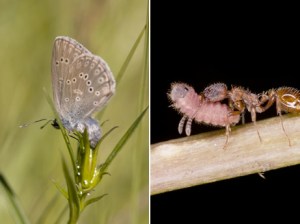
For instance, the Alcon blue butterfly hoodwinks ants into caring alconbluebutterfly-antsfor its larvae. They do this by secreting a chemical that mimics how ants communicate; the ants in turn adopt the newly hatched caterpillars for two years. There’s a terrible side to this story of deception. The Ichneumon wasp, upon finding an Alcon caterpillar inside an ant colony, secretes a pheromone that drives the ants into confused chaos; allowing it to slip through the confusion and lay its eggs inside the poor caterpillar. When the caterpillar turns into a chrysalis, the wasp eggs hatch and consume it from inside.

This reads like something out of a noir thriller. Or better yet, a horror story. Nature is large, profligate, complex and paradoxical. She is by turns gentle and cruel. Creative and destructive. Competitive and cooperative. Idle and nurturing.

When I bring in extremophiles, who thrive in places you and I would cringe to set foot in, students’ imaginations run wild with ideas. I describe a panoply of weird adaptations in Nature—involving poisons, mimicry and deception, phototaxis and something called anhydrobiosis, which permits the tiny tardigrade to shrivel into a tun in the absence of water then revive after a 100 years with just a drop of water.

water-bear03

Tardigrade

All this adaptation hinges on communication. How an organism or population communicates with its environment and among its own. Examples of “strange” communication are the purview of the science fiction writer … and already the nature of our current world—if you only know where to look. The scope of how Nature communicates—her devices and intentions—embraces the strange to the astonishing. From using infrasound to chemical receptors and sensing magnetic fields. To allelopathy. Aggressive symbiosis. And so much more.

When Trees Share the Dirt

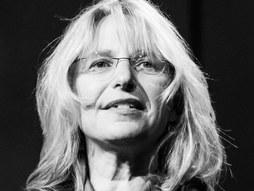
“Trees are the foundation of a forest, but a forest is much more than what you see,” says University of British Columbia forest ecologist Suzanne Simard.

suzanne-simard-portrait

Suzanne Simard

Simard, who has published hundreds of papers over 30 years of research, suggests a kind of “intelligence” when she describes the underground world “of infinite biological pathways that connect trees and allow them to communicate” In a forest. This communication allows the forest to behave as if it was a single organism, says Simard. Her early in situ experiments showed solid evidence that tree species, such as Paper Birch and Douglas Fir communicated in a cooperative manner underground through an underground mutualistic-symbiosis involving mycorrhizae (e.g., fungus-root). These trees were conversing in the language of carbon and nitrogen, phosphorus, water, defense signals, allelo-chemicals, and hormones via a network of mycelia. Fungal threads form a mycelium that infects and colonizes the roots of all the trees and plants. Simard compares this dense network to the Internet, which also has nodes and links—just as the forest.

forest-conversing

Myccorhyzae and fungal highways

Fungal highways link each tree and plant to its community, with busiest nodes called hub trees or mother trees. Calling them mother trees is appropriate, given that they nurture their young in the understory; sending excess carbon to the understory trees, which receive less light for photosynthesis. “In a single forest,” says Simard, “a mother tree can be connected to hundreds of other trees.” These mature trees act as nodal anchors—like major hub sites on the Internet—for tree groupings; according to Simard, they look after their families, nurture seedlings and even share wisdom—information—when they are injured or dying.

Simard made another incredible discovery: that mother trees “recognize their kin.” In experiments her team ran using related and unrelated seedlings, the mother tree preferentially sent its excess carbon to kin over non-kin seedlings.

These discoveries pose some serious implications in how we do and should manage our forests. “You can take out one or two hub trees, but there’s a tipping point,” says Simard. “You take out one too many and the whole system collapses.”

Simard shared that “in 2014 the World Resources Institute reported that Canada in the past decade has had the highest forest disturbance rate of any country worldwide…In Canada it’s 3.6% per year…about four times the rate that is sustainable.”

“Massive disturbance at this scale is known to affect hydrological cycles, degrade wildlife habitat and emit greenhouse gases back to the atmosphere, which creates more disturbance and more tree die-backs,” says Simard. She adds that the practice of planting commercially valued species at the expense of the indigenous aspens and birches lacks complexity and promotes vulnerability to disease. It’s creating “a perfect storm,” Simard concludes.

Trees & Climate Change

A major international report on climate change shows that wildlife habitats will be dramatically impacted around the world. In Canada, this could fundamentally alter 65 per cent of its existing natural habitat in the boreal and Arctic regions, where warming will be the greatest. The report says that seven Canadian provinces – Ontario, Quebec, Alberta, British Columbia, the Yukon, Newfoundland and Labrador and Manitoba – will have more than half of their natural habitat at risk.

Simard asks: “Instead of weakening our forests, how can we reinforce them and help them deal with climate change?” She suggests four simple solutions:

  1. Get out into the forest and re-establish local involvement in our forests, using management techniques based on local knowledge
  2. Save our old-growth forests, the repositories of genetic material, mother trees and micorhizal networks
  3. Save the mother trees when cutting trees
  4. Regenerate our forests with a diversity of species types and structures

“Forests aren’t just a bunch of trees competing with each other; they are super-cooperators,” Simard points out. “The great thing about forests,” she reminds us, “is that as complex systems, they have an enormous capacity to self-heal.”

How Healing Trees Can Heal Us

Aside from being highly evolved water management specialists, trees are chemical factories that broadcast a host of aerosols into the atmosphere around them. Researchers have found over 120 substances, of which only half could be identified. These aerosols are part of a sophisticated survival strategy, writes botanist and biochemist Diana Beresford-Kroeger. Studies have shown that willows, poplars and maples warn each other about insect attacks; undamaged trees then pump bug-repelling chemicals to ward off the attack. Black walnut trees emit juglone, an aerosol that repels competing nearby plants and some insects. Scientists demonstrated that airborne communication between individual sagebrush plants (called “eavesdropping”) helped neighbouring plants resist attacks. The monoterpenes like pinene and linene can relieve asthma and even fight cancer.

Water Is-COVERYou can read more about this in my book “Water Is… (Pixl Press).
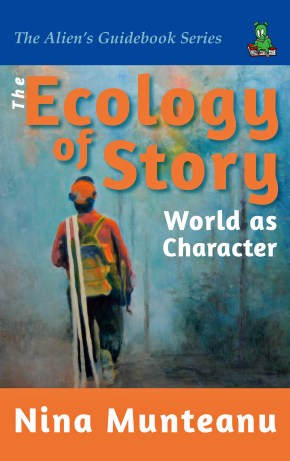
1I give several lectures based on this general topic of world building for writers. One I gave recently, at CanCon2016 in Ottawa, focused on aquatic worlds, my scientific area of expertise. These lectures are based on my upcoming guidebook “The Ecology of Story: World as Character”

.

.

nina-2014aaNina Munteanu is an ecologist and internationally published author of award-nominated speculative novels, short stories and non-fiction. She is co-editor of Europa SF and currently teaches writing courses at George Brown College and the University of Toronto. Visit www.ninamunteanu.ca for the latest on her books. Read Nina’s climate/eco-fiction Darwin’s ParadoxAngel of Chaos and Natural Selection.

A Rose By Any Other Name…

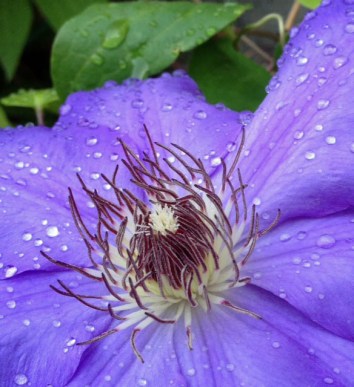
clematis5

Clematis (photo by Nina Munteanu)

…Would it smell as sweet? When Shakespeare first used that now famous line spoken by Juliet in Romeo and Juliet, he was no doubt evoking the importance of representative symbolism while suggesting that the true nature of the thing had its intrinsic value beyond its icon. Or did it? “’Tis but thy name that is my enemy,” Juliet goes on to say. “Thou art thyself.” Surely, in society, a name embodies the thing; the part the whole. We even have a word for that kind of metaphor. It’s called synecdoche.

It does bring to mind the importance of names in culture and literature. The name of a thing may often link it to its invariable destiny. Or is it the other way around? And does it matter, in the final analysis, whether “the name” is the function of existentialist predilection or the end result of fatalistic determination. Of the egg and the chicken, which comes first? And does it matter? Even for a writer—artist and “God of story”—this is not totally clear. How will we choose and how will we be interpreted?


My Name…

Nina_Woods_5

Nina hiking in an Ontario forest (photo by Merridy Cox)

Take my name, for instance. When I tell people my name I often add that my last name, Munteanu, means “from the mountain” in Romanian. I often fanaticized that my ancestors had come from the Transylvanian Alps of Romania. What I often forget to tell people is that my first name, Nina, means “little girl” in Italian, Spanish and Russian and God knows what other language in the universe. If you were to put the two names together, you would get the archetype represented by Heidi or Pipi Longstocking—depending on what kind of attitude you cared to promote. While I admired the feisty Swedish redhead’s unconventionality and fortitude, I, gravitated to the Heidi image—I identified with that spirited but ever-so-cute Shirley Temple version of an orphan girl who comes down from the pure fresh mountains and brings joy and laughter to the cynical world around her. As a child, I empathized with her stubborn crusade for truth and justice: that famous pout and little stomp of her foot as Heidi stood up to those big bullies and managed to endear herself into the hearts of everyone.

Okay. I’m not Heidi. But that archetype resonated with me as I was growing up. In some way, my empathy with the Heidi archetype played a role in my life-choices. Whether this resulted from gestalt psychology or universal determinism is likely not important. What is important in storytelling is how we as artists use this in our choice of names: all kinds of names, from places to events, to people and things (which for me as a science fiction and fantasy writer is equally important, given that many of the terms I use I created from my imagination). Let’s look at some examples…


Names in Literature and Film…

the MatrixNeo in The Matrix is an anagram for “One”. Before he changes his name to Neo, he goes by the name of Thomas Anderson. Thomas is Hebrew for “twin” (e.g., Agent Smith tells Neo, “you have been living two lives.”). Of course, Thomas was also one of Jesus’s disciples, the one who doubted. The Wachowski Brothers chose the names of all their main characters with careful purpose. Morpheus (the god of dreams, who takes Neo out of his dream); Trinity (who connects and unifies the “father” the “son” and the “holy spirit” through her faith).
Atticus in To Kill a Mockingbird is a true country gentleman and modern knight, espousing the chivalric code of courage, humility, justice and service. Atticus draws an association from Attica of ancient Greece in which Athens was located. A place renowned for its wisdom, rational approach to life and its belief in justice. 

Luke Skywalker in George Lucas’s Star Wars is another clearly allegorical name that evokes the hero’s journey. Luke, besides reflecting Lucus’s alter-ego, also means “light”. The name Skywalker effectively portrays a god-like individual who must wander far in a heavenly walkabout on his quest for freedom and justice and the light of truth. George Lucas created allegorical identities with most of his Star Wars characters from Han Solo to Princess Leia Organa.

Becky Sharp in William Thackery’s Vanity Fair dispensed her “sharp” wit to manipulate her entire world from the dull-witted Amelia Sedley to her high society suitors. Her last name also carries connotations of a “sharper” or con-man.

Scarlet O’Hara of Margaret Mitchel’s Gone with the Wind was a woman who breathed fire and passion.  She epitomized the famous quote of Victor Frankl:  what is to give light must endure burning. She burns all right; and lives—humbled and enlightened and even more determined.

John Crichton-S1

John Crichton (Ben Browder)

John Crichton in David Kemper’s Farscape. Choosing the name John for the main character identified him as a “universal everyman” and representative of humanity, from his frequent references to pop culture to his off-colour jokes about humanity in general. The name also identifies the kind of hero he portrays. He is not some super-hero with extra-ordinary powers or qualities. He is an ordinary man who finds himself in extraordinary circumstances; he is you and me. Together with the name Crichton, this associates him with adventuring, generosity, idealism and inspiration. Indeed, this character proves himself a very different kind of hero. John Crichton is a diplomat, a humorist, a clown, an intellectual and strategist all rolled into one. A warrior poet.

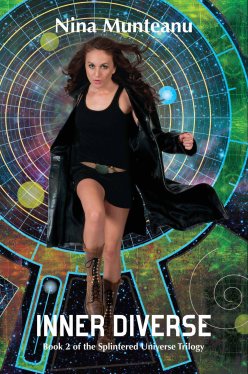
Inner-diverse-front-cover-WEB

Rhea Hawke, Galactic Guardian

I chose the name Rhea Hawke in my trilogy The Splintered Universe to represent the complex and paradoxical nature of the lead character. The Titan Goddess Rhea is the mother of all gods, including Zeus, giving birth and nurturing all that she has created. Those of you who have read Outer Diverse, Inner Diverse and Metaverse (Books 1 to 3 of The Splintered Universe Trilogy) will recognize that Rhea Hawke is, in fact, an agent of death. She is essentially an assassin for the Galactic Guardians; one who invented a much coveted devastating weapon of mass destruction, the MEC (that selectively maims, kills or leaves alone any species based on their unique DNA signature).  This aspect of her character of course fits with the hawk, the stealthy keen-eyed predator. A creative predator. But, there is a nurturing, soft and “mothering” side to Rhea beneath her predatory bravado. It reveals itself through sub-text and subtle metaphor. Rhea Hawke is ultimately a paradox. Like her name. Like most of us.

Cover1_LastSummoner-frontcoverLady Vivianne Schoen, the Baroness von Grunwald, in my historical fantasy The Last Summoner, is a being of light who can travel time-space and must alter history starting with the Battle of Grunwald in 1410. Her first name derives from the Latin vivus meaning alive or the French word vivre for life. And live she must—for over six hundred years— if she is to succeed in recasting history to make this a better world. There is an ironic layer to her name, but I can’t reveal it here for those who haven’t yet read the book. In future Paris she meets François Rabelais, named after the 15th Century satirist, philosopher and dissident. While this youth on the surface represents the antithesis of the medieval scholar, he finally reveals himself as a philosopher warrior and humanist like his 15th Century namesake.

 

Names as Symbols of a Changing Culture…

Names—what we call things—are supreme icons for a culture of a time and place to identify and define its archetypes, values, symbols and hegemonies. Names define an entire zeitgeist.

Think of the word chivalry. Derived from the 11th Century French term chevalier (horseman), the term came to be understood in the 12th Century and later as a moral, religious and social code of knightly conduct. The code generally emphasized the virtues of courage, honor, purity and service. The term also described an idealization of the life and manners of the knight at home in his castle and with his court, embodying notions of “courtly love” and devotion to God and country. However, when it originated in the 11th Century, chivalry meant simply the “status of fee associated with military follower owning a war horse.”

The Sufi word futuwwa shares similar connotations to chivalry and virtue. Futuwwa was also the name of ethical urban guilds in Medieval Muslim realms that emphasized the virtues of honesty, peacefulness, gentleness, generosity, avoidance of complaint and of hospitality in life. However, Al-Futuwa was also the name of the Arab-Nationalist Young Arab Association and the Hitler-Jugend style pan Arab fascist nationalistic youth movement in Iraq in the 1930s to 50s.

clematis2

Clematis (photo by Nina Munteanu)

Speaking of Hitler and Nazi Germany, another name and symbol, the swastika—which in the modern post-WW2 world has become synonymous with fascism and anti-Semitism—was in fact an ancient symbol of prosperity that represented the revolving sun, fire or life. In the ancient language of Sanskrit, swastika means “well-being”. It was used widely in ancient Mesopotamia, South and Central American Mayan art, by the Navajos and continues to symbolize the four possible places of rebirth in Jainism and night-magic-purity-destruction to Hindus.

Choose your names carefully and with purpose.


nina-2014aaNina Munteanu is an ecologist and internationally published author of award-nominated speculative novels, short stories and non-fiction. She is co-editor of Europa SF and currently teaches writing courses at George Brown College and the University of Toronto. Visit www.ninamunteanu.ca for the latest on her books. Read Nina’s climate/eco-fiction Darwin’s ParadoxAngel of Chaos and Natural Selection.


When Art Tangos with Science

Imagination is more important than knowledge—Albert Einstein


patterns-Cedar log moss2-LR

Cedar log (photo by Nina Munteanu)

I tell stories. I’m also a scientist. I use the scientific method in my research to seek truth; I also find truth presented to me through the symbols of intuition.

A few years ago, I was introduced to Krista Fogel, a University of British Columbia masters student, who was investigating the use of creative art in high-ability scientists. She named her thesis: “The Self-Perceived Experience of Investigating Science with an Artistic Spirit: A Hermeneutic Phenomenological Study of High Ability Scientists Who Also Engage in the Arts”. Hermeneutic, by the way, is the development and study of theories of the interpretation and understanding of texts (I had to look it up) and phenomenology is an approach to philosophy through the study of phenomena.

Krista wanted to interview me as part of her project. I was flattered, of course. Me, a High Ability Scientist? Who’d told her that? Once I got past my own humble angst, I found Krista’s questions bracing; they reopened a world of compelling ideas I had carried with me for some time. The concept of using art to do good science has dwelled inside me since registration day at Concordia University when I quit my fine arts program to pursue a science degree only to come full circle and write fiction. I got my Masters Degree in Ecology and Limnology and was then working as a scientist for an environmental consulting firm (I now write and teach writing full time). I did research, drove boats, collected samples and analyzed data then wrote up my findings and made recommendations. I wrote science fiction novels on the side.

“History shows that eminent scientists, such as Leonardo da Vinci, also engaged in the arts,” said Fogel. She went on to cite 400 other famous scientists who also practiced art at a high level. “If not entirely engaged in the arts, scientists throughout history have at least engaged in science with an artistic spirit. Scientists and artists use common tools for thinking such as intuition and imaginative processes.”

Krista and I met several times at the local Starbucks, where I “toked” on coffee as she fumbled with her notes. A young gal with a direct but unassuming gaze and a gentle smile, Krista asked me to share my personal experience of mixing art with science. Every good scientist is an artist at heart: science is the tool and art is the process.

Fogel concluded that when conducting scientific investigations with an artistic spirit, the scientist holds her heart central, from which the artist springs. This “allows us to connect with serendipitous occurrences, which breed discovery,” Fogel added.

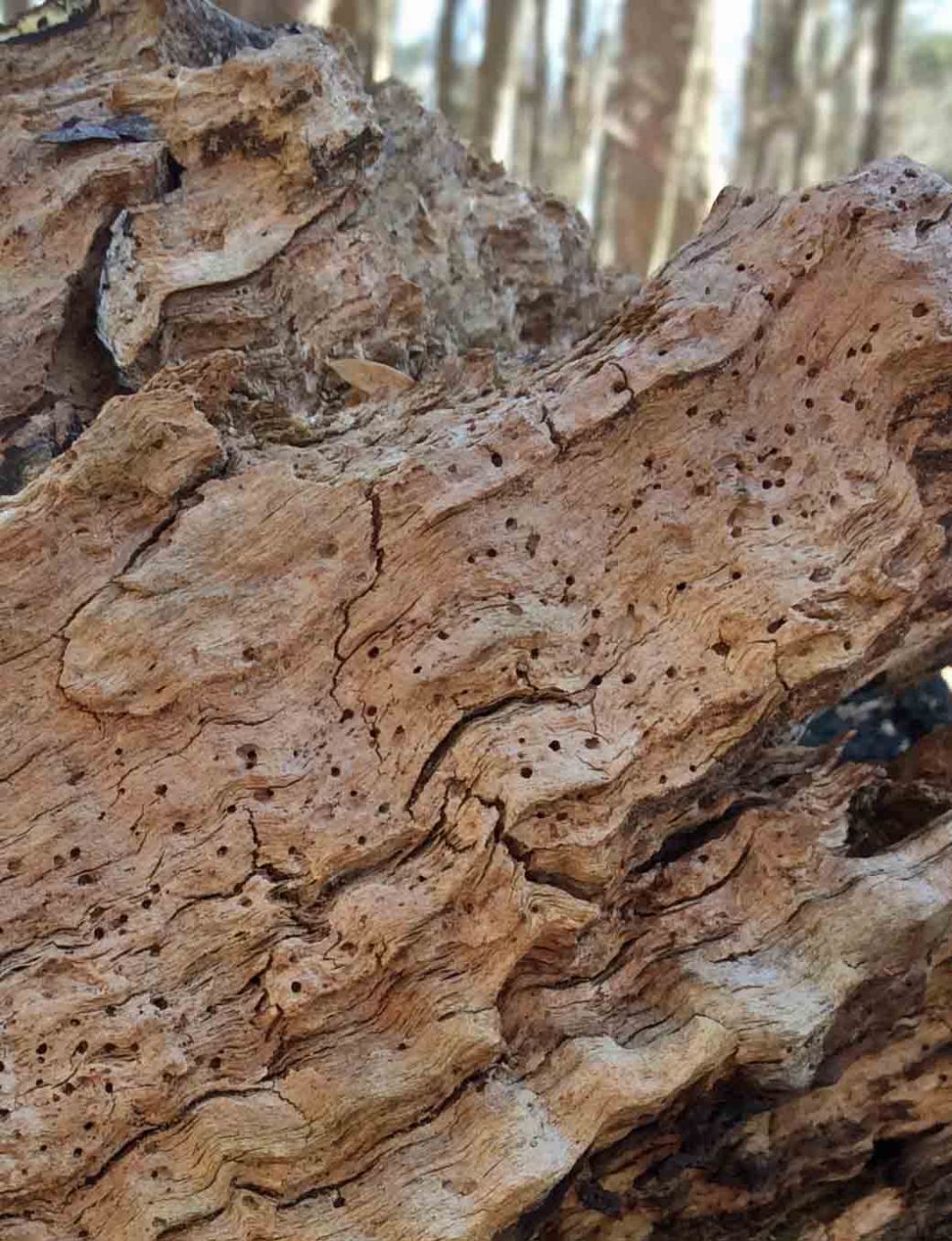
patterns2-log-beetl holes-LR

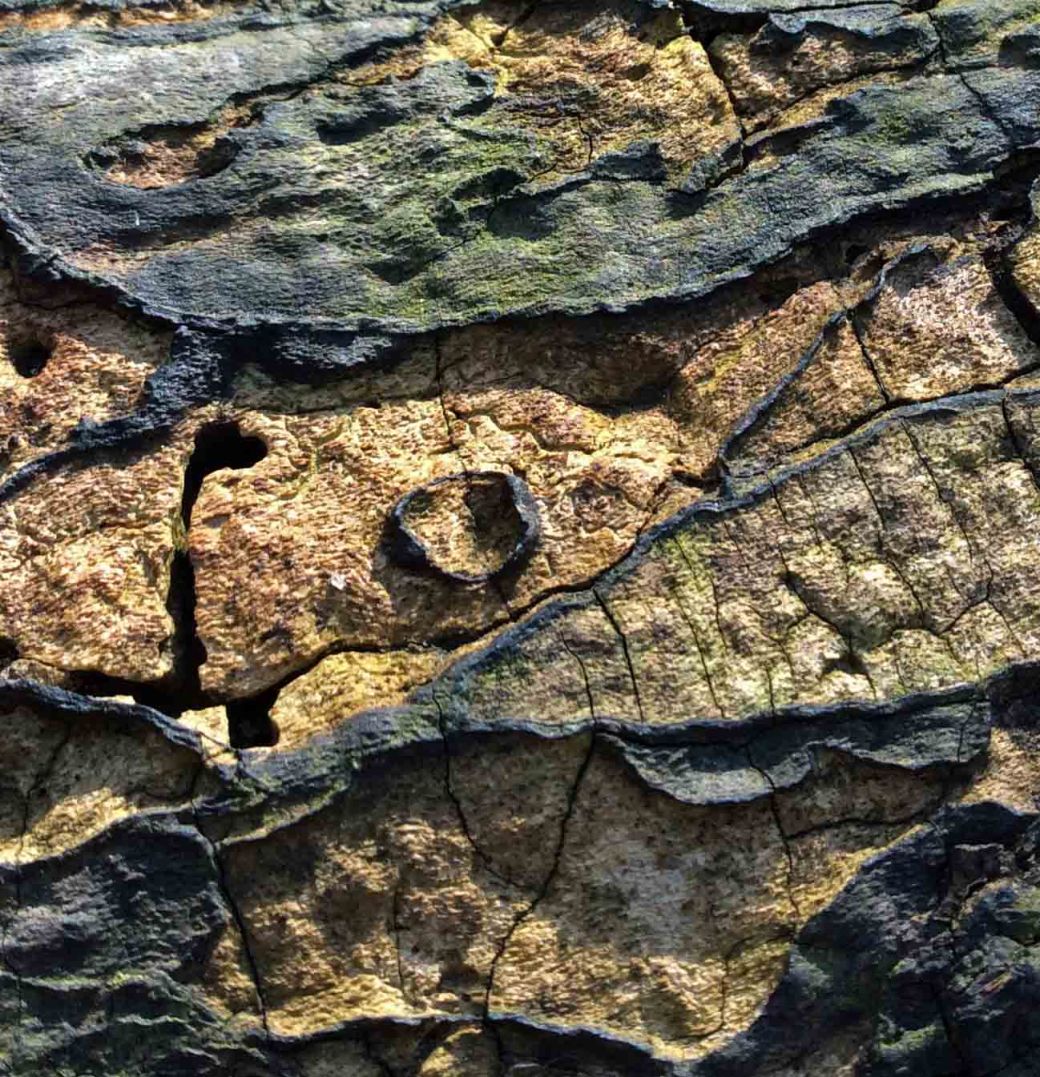
Decaying log with insect bore holes (photo by Nina Munteanu)

You can train your mind as both artist and scientist to become more aware of serendipitous occurrences around you. I call it being in sync and wrote about it in a previous article here (“Writing in Sync”). Often, when I’m researching a novel, I pick up things serendipitously. Something will come up that just fits with what I was searching for. An article pops up in the news. Or I’m talking to someone and they bring up just the topic I am researching. These things always happen to me. This occurs not only in my fiction writing but in my scientific pursuits. Some years ago, I was doing a pollution study using glass slides for colonizing algae to compare communities of an urban stream to those of an agricultural stream. I was really looking to see the difference between communities of these different stream environments when I discovered that the algae were colonizing the glass surfaces according to the current. Compelled with more questions of why, how and what if, I pursued this new line of research (which turned out to be far more interesting than my original research premise) and wrote several ground-breaking papers on it.

Indeed, questions like “why” and “what if” are germane to both art and science; the ‘what if’ question is the science fiction writer’s mantra and the premise, which comes from the artist part of you: imagination and an inquisitive and open mind. The idea of seemingly unrelated events intersecting to produce meaningful patterns has spawned new notions of thought from the scientific study of spontaneous order in the universe (synchrony), to Synchromysticism — the discovery of convergent archetypal symbols in pop culture (e.g., books, music and film).

Writer and philosopher Jake Kotze suggests that, “Synchronicity happens when we notice the bleed-through from one seemingly separate thing into another — or when we for a brief moment move beyond the mind’s divisions of the world.” Synchronicity and serendipitous discovery, like metaphor, appears when we change the way we look at things.

Serendipitous discovery comes to us through peripheral vision. Like our muse, it doesn’t happen by chasing after it; it sneaks up on us when we’re not looking. It comes to us when we focus outward and embrace our wonder for this world. When we quiet our minds and nurture our souls with beauty. It is then that what we had been seeking naturally comes to us. Like a gift.

Author Sibyl Hunter tells us that “Sync operates as an undercurrent of divine awareness personified through the myriad processes and symbols that make up the building blocks of our reality. Within that current, we spin our modern-day myths into books, fairy tales and movies, subconsciously retelling ourselves the same story over and over.” This also holds true in the models and metaphors of scientific genius, which often spring from the creativity of an intuitive heart and imaginative mind.

According to Mark A. Runco (California State University) “creativity depends on originality, while accomplishment and achievement reflect other problem-solving skills. Creative thinking involves at least three things: 1) the cognitive capacity to transform experience into original interpretations, 2) an interest in producing original interpretations, and 3) discretion.” The title of Piaget’s monograph, To Understand Is to Invent, reflects the fact that we do not have an authentic understanding of our experience until we construct that understanding for ourselves. In other words, “it is one thing to memorize some datum; it is quite another to discover it for one’s self; only then do we understand,” says Runco. Fogel concurs: “what Piaget called invention is a kind of creation, a creation of personal meaning. Piaget tied assimilation to imaginative play into creative interpretation.”

Blue-green fungus pattern

Decaying log displaying spalting (photo by Nina Munteanu)

According to Dean Keith Simonton (University of California), even the most illustrious creative geniuses of history have careers riddled by both hits and misses, both successes and failures. He uses Albert Einstein as an example. A man who has achieved almost mythical status as a genius, Einstein’s career “was plagued by terrible ideas, false starts and surprising disasters.” Simonton tells the story of Einstein’s debate with Niels Bohr over the implications of quantum theory, in which Einstein offered a series of arguments that Bohr countered. Bohr once even pointed out that Einstein failed to take into consideration the theory of relativity! According to some, Einstein wasted the final years of his career working on a unified field theory that was almost universally rejected by his colleagues. Einstein defended his missteps by noting that errors can advance science so long as they are not trivial; the greater the error, the greater the opportunity for new perspective and discovery.

It is left for us to simply recognize the dance.


nina-2014aaNina Munteanu is an ecologist and internationally published author of award-nominated speculative novels, short stories and non-fiction. She is co-editor of Europa SF and currently teaches writing courses at George Brown College and the University of Toronto. Visit www.ninamunteanu.ca for the latest on her books. Read Nina’s climate/eco-fiction Darwin’s ParadoxAngel of Chaos and Natural Selection.


Eight Ways to Move From Prosaic to Spectacular

Nina-reading-Ward Is

Reading on Algonquin Island, Lake Ontario (photo by Nina Munteanu)

What makes some writing stunning and other writing lackluster? Mostly, it’s the language—the words—you use. And, it isn’t just what words you use; it’s how you use them. Here are a few things you need to consider when translating your work into something that “sings”.

  1. Use Active Verbs and Reduce Modifiers

Many writers, not just beginners, slide into the pattern of using passive and weak verbs (e.g., were, was, being, etc.). Then they add a modifier to strengthen it. It doesn’t. Actively look for strong, vivid verbs. This is the key to good writing. Active and powerful verbs move a story forward. For instance, which version is more compelling?

Jill was walking quickly into the room.

or…

Jill stomped into the room.

The second example not only more quickly and efficiently demonstrates how Jill entered the room, but demonstrates with what attitude. There is no substitute for the use of powerful, appropriate verbs in sentences.   

2. Avoid Excessive & Meaningless Prose

Novice writers often use too many words to describe an event, action or scene. An overabundance of words slows down the story and obscures plot and action. Excessive prose includes:

Repetition: many beginning writers will often first tell then show in a scene. You don’t need to do both; trust the reader to get the “show”.

Extraneous words: e.g. “he started to think” instead of “he thought”; use of the obvious such as “she saw the big man lying on the bed” instead of “a big man lay on the bed” (“she saw” is implied through her POV). This second example also demonstrates how you can shift the readers’ attention from “her seeing” (in the first phrase) to “the man lying” on the bed (in the revised phrase). This simple change can create a much more powerful sentence through the seamless shift in reader attention.

Dull description not related to plot: I recently edited a writer’s over 400-page urban fantasy that contained far too much ordinary detail. Detail that, in small doses, may have enlightened the reader on the qualities of the protagonist; but in larger doses ground the narrative to a boring halt.

When you look for a more efficient and purposeful way to say something, you cut out unnecessary detail. Remember that virtually all description should be related to the plot and theme of the story.

3. Use Alliteration, Metaphor, Simile, Personification

These devices bring lyricism and cadence and powerful imagery to your prose. However, as with anything powerful, you need to use these judiciously. Use them where you wish to convey a strong image and to punctuate your prose.

4. Be Mindful of Word Accuracy

More often than you might think, a writer inadvertently misuses a word to convey an idea or emotion. For instance, let’s consider the following sentence, which describes a character’s reaction to a dog being cruelly mishandled:

“What are they doing?” Jack said crossly.

The modifier crossly suggests that Jack lacks compassion; it infers petulant annoyance.

“What are they doing?” Jack scowled.

Scowled still suggests the same icy disdain, though it may have been delivered with false bravado or through genuine discomfort from a hidden compassion. If the writer wished to convey shock, disgust or compassion, the following would better represent that sentiment:

“What are they doing?” Jack said, eyes wide.

Or:

“What are they doing?” Jack stammered.

5. Avoid Using Words like “Felt” or “Seem”

These “telly” words prevent the reader from directly experiencing the story by imposing a level of interpretation. For example, “he felt himself falling” can be improved to “he fell”. If you want to spice up the phrase, use another verb: “he toppled” “he stumbled” or “he crashed”.

6. Read your Writing Aloud & Punctuate Your Pauses

It isn’t just a clever metaphor when they say your writing style is called your “voice”; because your readers “listen” to what you write. Reading out loud helps define cadence, tone and pace of your prose and streamlines your writing. When you read aloud, pay attention to where you naturally pause. You may wish to put in a comma, semi-colon or period there.

7. Size and Vary Your Paragraphs  

Paragraphs are visual elements that help people read; they break up text on a page in logical places to provide white space for reader ease. I’ve heard people quote the “two-inch” rule for maximum paragraph length and I concur. This is one of the reasons some passages are harder to read than others; long paragraphs are more tiring to the eye. Find those logical breaks and put them in. Varying paragraph length creates a more interesting story “landscape” for the reader. Don’t be afraid to go to some extremes like using the one sentence – or even one word – paragraph.

Looking at Ward Island from Algonquin Is.

View of Ward Island from Algonquin Island (photo by Nina Munteanu

8. Size and Vary Your Sentences  

As with paragraphs, overly long sentences can try a reader’s patience and you may lose them entirely. Too many short choppy sentences can also reduce your prose to a mundane level. Varying your sentence length in a paragraph creates the lyricism and cadence that makes prose enjoyable to read.

For more tips on how to improve your writing for publication, go check my writing guide series The Alien Guidebook Series.

nina-2014aaNina Munteanu is an ecologist and internationally published author of award-nominated speculative novels, short stories and non-fiction. She is co-editor of Europa SF and currently teaches writing courses at George Brown College and the University of Toronto. Visit www.ninamunteanu.ca for the latest on her books. Read Nina’s climate/eco-fiction Darwin’s ParadoxAngel of Chaos and Natural Selection.

Flight Behavior

In a world that’s quickly heating up and drying up, you can’t go home again—even if you never leave—Clive Thompson


flightbehaviourBarbara Kingsolver’s 2012 novel Flight Behavior was, according to The Globe and Mail, the first novel that dealt “specifically, determinedly and overtly with climate change. And “only Kingsolver could pull it off,” they add.

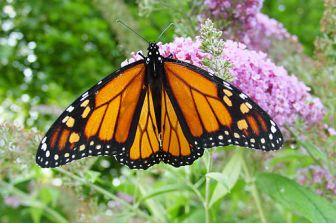
The premise of climate change and its affect on the monarch butterfly migration is told through the eyes of Dellarobia Turnbow, a rural housewife, who yearns for meaning in her life.

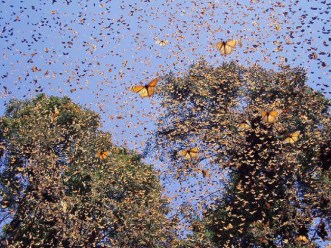
The book starts with her scrambling up the forested mountain—slated to be clear cut—behind her eastern Tennessee farmhouse; she is desperate to take flight from her dull and pointless marriage of myopic routine. The first line of Kingsolver’s book reads: “A certain feeling comes from throwing your good life away, and it is one part rapture.” Dellarobia thinks she’s about to throw away her ordinary life by running away with the telephone man. But the rapture she’s about to experience is not from the thrill of truancy; it will come from the intervention of Nature:monarch butterfly-migrating

A small shift between cloud and sun altered the daylight, and the whole landscape intensified, brightening before her eyes. The forest blazed with its own internal flame. “Jesus,” she said, not calling for help, she and Jesus weren’t that close, but putting her voice in the world because nothing else present made sense…The mountain seemed to explode with light. Brightness of a new intensity moved up the valley in a rippling wave. Like the disturbed surface of a lake. Every bough glowed with an orange blaze. “Jesus God,” she said again…Trees turned to fire…The flame now appeared to lift from individual treetops in shows of orange sparks, exploding the way a pine log does in a campfire when it’s poked. The sparks spiraled upwards in swirls like funnel clouds….It was a lake of fire, something far more fierce and wondrous than either of those elements alone. The impossible…She was on her own here, staring at glowing trees. Fascination curled itself around her fright. This was no forest fire. She was pressed by the quiet elation of escape and knowing better and seeing straight through to the back of herself, in solitude. She couldn’t remember when she’d had such room for being. This was not just another fake thing in her life’s cheap chain of events, leading up to this day of sneaking around in someone’s thrown-away boots. Here that ended. Unearthly beauty had appeared to her, a vision of glory to stop her in the road. For her alone these orange boughs lifted, these long shadows became brightness rising. It looked like the inside of joy, if a person could see that. A valley of lights, and ethereal wind.

It had to mean something.

Although Dellarobia doesn’t realize it yet, that moment proves life-changing for her: no longer “watching a nearly touchable lover behind her eyelids but now seeing flame in patterns that swirled and rippled. A lake of fire.” That day, she participates in the sheep shearing, greatly distracted from a new awakening to the power and wisdom of Nature:

Monarch Butterfly (Danaus plexippus). Monarch Butterflies cluste

Monarch butterfly

“Watch and learn, Dellarobia thought, feeling an unaccustomed sympathy for the animals, whose dumb helplessness generally aggrieved her. Today they struck her as cannier than the people. If the forest behind them burned, these sheep would come to terms with their fate in no time flat. Flee or cower, they’d make their best call and fill up their bellies with grass to hedge their bets. In every way more realistic about their circumstances. And the border collies too. They would watch, ears up, forepaws planted, patiently bearing with the mess made by undisciplined humans as the world fell down around them.”

Entomologist Ovid Byron (in response to a reporter’s suggestion that scientists disagree about whether it’s happening and whether humans have a role) talks about the tipping point we’ve ignorantly raced past: “The Arctic is genuinely collapsing. Scientists used to call these things the canary in the mine. What they say now is, the canary is dead. We are at the top of Niagara Falls… in a canoe. There is an image for your viewers. We got here by drifting, but we cannot turn around for a lazy paddle back when you finally stop pissing around. We have arrived at the point of an audible roar. Does it strike you as a good time to debate the existence of the falls?” Ovid (really Kingsolver) effectively reiterates what most scientists know: that we have already crossed the tipping point of no return. There is no point in looking back to restore what we are losing; there is only the option of looking forward to adapt—and assist—as best we can.

Climate change—and all that is associated with it—is altering our planet irreparably, one sure-footed step at a time. The irony is that, as audible a roar climate change is for scientists like Ovid, to most of us climate change whispers insidious notes too subtle for us to comprehend or care about.

How does one grasp the gravity of a few degrees difference in temperature? The subtle rise in sea level? The almost imperceptible shift in the migratory pattern of a bird? When we are already so disconnected from Nature and lack the sensibilities—and compassion—to recognize and empathize with her trials and tribulations. Kingsolver suggests—quite accurately, I think—that only scientists can truly appreciate the portent of these subtle changes because it speaks in a language only they can understand.monarch copy

Flight Behavior resonated with Kristen Poppleton, climate change educator, who shared that Kingsolver was spot on in her “description of the grief and sensation of loss most of us in this business of climate change education, communication and science carry around daily.” This type of grief is so prevalent, in fact, that it has a name: solastalgia. Poppleton empathized with scientist Ovid’s grief as Kingsolver writes, “The one thing most beloved to him was dying.  Not a death in the family…but maybe as serious as that.  He’d chased this life for all his years; it had brought him this distance…Now began the steps of grief.  It would pass through this world…while most people paid no attention.”

Flight Behavior isn’t so much about climate change and its effects and its continued denial as it is about our perceptions and the actions that rise from them: the motives that drive denial and belief. This is no more apparent than in Kingsolver’s use of biblical references of fire and flood. Both water and flame are potent cleansing agents. They evoke powerful change. They represent givers—and takers—of life. Together, fire and water frame Kingsolver’s book with a strong metaphoric beginning and end that embrace creative destruction.

monarch-butterfly-migrationKathleen Byrne of The Globe and Mail writes: “We begin in flames and end in flood, which suits the biblical (and scientific) parameters of a novel whose setting in Tennessee’s Appalachian mountains is the nexus of a God-fearing religious literalism and an untaught but unbudging righteousness that finds expression in the view that “weather is the Lord’s business.”

When Dellarobia questions Cub, her farmer husband, “Why would we believe Johnny Midgeon about something scientific, and not the scientists?” he responds, “Johnny Midgeon gives the weather report.” Kingsolver writes:  “and Dellarobia saw her life pass before her eyes, contained in the small enclosure of this logic.” Because Johnny told me

clouds-wyoming

Mammatous clouds, Wyoming (photo by Nina Munteanu)

Ovid shares with Dellarobia a terrible insight about science and our perceptions of scientists:

“There are always more questions. Science as a process is never complete. It is not a foot race, with a finish line…. People will always be waiting at a particular finish line: journalists with their cameras, impatient crowds eager to call the race, astounded to see the scientists approach, pass the mark, and keep running. It’s a common misunderstanding, [Ovid] said. They conclude there was no race. As long as we won’t commit to knowing everything, the presumption is we know nothing.”

The grief that Poppleton feels, voiced by Kingsolver through her character Ovid, is really a grief for us, for the “home” we grew up in and love. The world we made. Near the end of Kingsolver’s book, Dellarobia makes this observation: “Mistakes wreck your life. But they make what you have. It’s kind of all one…it’s no good to complain about your flock, because it’s the put-together of all your past choices.”

Male_monarch_butterfly-buddleiaWe—humanity—may not be around here for much longer. Nature will endure without us. Planet Earth will continue, in some form and Nature and life will endure, evolve, and flourish—in its own way. It will change, perhaps grow more unruly than it is already, but Gaia will continue after she has kicked us off. Ecologists have long recognized the pattern of colonization, exploitation, decadence and succession. How hubristic of humanity not to include itself in that cycle. The cycle of continuing change. We grasp—we clamor—for the world we knew—even as we senselessly impose irreparable change. Shaving forests to the ground so water has no where else to go but down and in a torrent. Creating hot deserts by diverting great rivers somewhere else. Mining vast oil and mineral reserves by scraping the earth until it “bleeds” from unhealable wounds.

Evolution and Nature march on, greater than us, encompassing us—whether we recognize it or not—and in ways we can’t imagine (and science is only beginning to discover).  Our vast Universe is so much more than we are capable of even imagining.

Flight Behavior is a multi-layered metaphoric study of “flight” in all its iterations: as movement, flow, change, transition, beauty and transcendence.

Kingsolver ends her book with Dellarobia caught in a mountain flood that may take her

kingsolver-barbara-ap1credit-david-wood

Barbara Kingsolver

life; yet, she remains suspended—transfixed in the moment of the miracle unfolding before her. The monarchs survived the winter and are taking flight:

“The vivid blur of their reflections glowed on the rumpled surface of the water, not clearly defined as individual butterflies but as masses of pooled, streaky color, like the sheen of floating oil, only brighter, like a lava flow. That many.

She was wary of taking her eyes very far from her footing, but now she did that, lifted her sights straight up to watch them passing overhead. Not just a few, but throngs, an airborne zootic force flying out in formation, as if to war…Her eyes held steady on the fire bursts of wings reflected across the water, a merging of flame and flood. Above the lake of the world, flanked by white mountains, they flew out to a new earth.”

And a new earth is what we can be sure of. Whether we’ll be there is debatable—unless we too change.


Nina MunteanuNina Munteanu is an ecologist and internationally published author of award-nominated speculative novels, short stories and non-fiction. She is co-editor of Europa SF and currently teaches writing courses at George Brown College and the University of Toronto. Visit www.ninamunteanu.ca for the latest on her books. Read Nina’s climate/eco-fiction Darwin’s Paradox, Angel of Chaos and Natural Selection.


The Way of Water (La natura dell’acqua)

la natura dell'acquaShe imagines its coolness gliding down her throat. Wet with a lingering aftertaste of fish and mud. She imagines its deep voice resonating through her in primal notes; echoes from when the dinosaurs quenched their throats in the Triassic swamps.

Water is a shape shifter.

It changes yet stays the same, shifting its face with the climate. It wanders the earth like a gypsy, stealing from where it is needed and giving whimsically where it isn’t wanted.

Dizzy and shivering in the blistering heat, Hilda shuffles forward with the snaking line of people in the dusty square in front of University College where her mother used to teach. The sun beats down, crawling on her skin like an insect. She’s been standing for an hour in the queue for the public water tap.


“La immagina scenderle fresca giù per la gola, con un persistente retrogusto umido di pesce e fango. La immagina risuonarle dentro con voce cupa, una voce primordiale; gli echi del tempo in cui i dinosauri placavano la sete nelle paludi del Triassico.

L’acqua è un mutaforma.

Cambia pur restando la stessa, muta il proprio volto insieme al clima. Vaga per il pianeta come una nomade, rubando da dove è necessaria e dandosi per capriccio dove non serve.

Frastornata e tremante nel caldo afoso, Hilda si trascina a fatica dietro al serpente di persone sul piazzale polveroso di fronte al college universitario in cui insegnava sua madre. Il sole picchia e le striscia sulla pelle come un insetto. È in fila da un’ora davanti al distributore pubblico di acqua.


“The Way of Water” is a near-future vision that explores the nuances of corporate and government corruption and deceit together with resource warfare. An ecologist and technologist, Nina Munteanu uses both fiction and non-fiction to examine our humanity in the face of climate change and our changing relationship with technology and Nature.

The bilingual print book by Mincione Edizioni showcases this short story in Italian and English along with a recounting of what inspired it: “The Story of Water” (“La storia dell’acqua”).

See reviews for “The Way of Water” (“La natura dell’acqua”) below:

Simone Casevecchia of SoloLibri.net

Net Massimo (English)

Net Massimo (Italian)

laNaturaDell'Acqua-coverAfter the release of the print book, Future Fiction released “The Way of Water” (“La natura dell’acqua”) in ebook format. The ebook contains the “Way of Water” story and another story, “Virtually Yours” (“Virtualmente tua”) alongside “The Story of Water” (non-fiction), which can be purchased in either Italian or Engish versions.

“Virtually Yours” was first published in Issue #4 of Neo-Opsis Science Fiction Magazine (Canada); it was reprinted in several languages in other countries including USA, Poland, Romania, Greece, and now Italy. It also appears as one of nine stories on human evolution in Natural Selection, a Canadian collection of short stories (Pixl Press) that examine the evolution of humanity with Nature and technology.

Nina’s short stories have received praise for their world building, depth of character, compelling plot and use of evocative metaphor:NaturalSelection-front-FB

“.a stunning example of good storytelling with an excellent setting and cast of characters.”–Tangent Online

“…Written with flare and a conscience…Munteanu shines a light on human evolution and how the choices we do or don’t make today, may impact our planet and future generations. The science is fascinating and so are these nine short stories.”—J.P. McLean, author of The Gift Legacy

“…Fascinating dramas set in a world too close to our own…the science was so interesting, combining visionary metaphysical speculation with AI corporate tech in scenarios that often seemed chillingly possible.”—Amazon review

“…Jealousy, lust, loneliness, grief and love are all drivers of these taut and fascinating narratives.”—Amazon review

“…a fantastic collection of stories by a deeply-involved writer, based in Canada.”—Amazon review

“…a well written, thought provoking collection of stories that will leave you hoping the future that Nina Munteanu projects never happens…Nina Munteanu is a gifted writer. Each story surprises and delights.”—Allan Stanleigh, author of USNA

“Actually brought to mind Niven’s Tales of Known Space…Nina’s stories tease you.”—D. Merchant, Louisianna Tech University College


The Way of Water can be purchased as:

WayofWater copy 2Ebook (Italian OR English) with additional short story “Virtually Yours” through Future Fiction (Mincione Edizioni) for €1,99  at:

Print book (Italian AND English) through Mincione Edizioni for €7,00 at:

Eramosa River 3

Eramosa River, Ontario (photo by Nina Munteanu)


Translated into Italian by Fiorella Moscatello. Print book cover by Laura Cionci. Ebook cover by Brad Sharp.