speculative fiction
Endocrine Disruption in The Age of Water
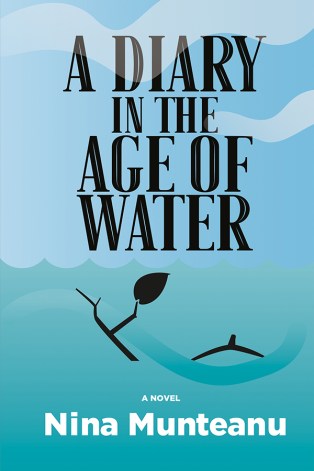 In my recent novel A Diary in the Age of Water published by Inanna Publications Lynna, the diarist, talks with colleague Daniel about the increase in human infertility related to endocrine disruption. Daniel starts with a litany of reasons for human infertility:
“Scientists all agree that environmental factors are the main triggers for male and female infertility through epigenetics. The list of exposure triggers is endless. You know the main culprits: heavy metals, pesticides, PCBs, PAHs, VOCs, car exhaust, tobacco smoke … mostly chemicals with hormonal properties” Leaning on his microscope, Daniel went on, “Wherever there’s a sewage treatment plant, pulp and paper mill, or herbicides and pesticides in a stream, you get endocrine disruption, which causes more female or intersex fish populations. Then there’s nonylphenols—”
“—Degradation products of surfactants used in commercial and household detergents,” I ended for him and leaned against the doorway.
He nodded. “They inhibit breeding in male fish. And herbicides like atrazine—”
“—Create feminized males with female eggs, along with reduced immunity to disease,” I finished for him.
I knew all this. Hormonal disruption is global. Environmental toxicologists have been finding it in many aquatic animals like fish, turtles, alligators and frogs. And some terrestrial animals…Even humans…Was it also causing the steep rise in ambiguous sex in humans? Apparently 1 in 30 now have bodies that differ notably from standard male or female. Klinefelter, androgen insensitivity syndrome, presence of ovotestes, mixed gonadal dysgenesis, and mosaic genetics are all on the rise.
Daniel added, “The environment is changing us faster than most think and it’s doing it through epigenetics and HGT.”
Their discussion, which leads to something far more disastrous, is based on the reality of today.
 The endocrine system is a set of glands and the hormones they produce that help guide and regulate the development, growth, reproduction and behavior of most living things (yes plants too!). Some hormones are also released from parts of the body that aren’t glands, like the stomach, intestines or nerve cells. These usually act closer to where they are released. The endocrine system is made up of glands, which secrete hormones, and receptor cells which detect and react to the hormones. Hormones travel throughout the body, acting as chemical messengers, and interact with cells that contain matching receptors. The hormone binds with the receptor, like a key into a lock. Some chemicals, both natural and human-made, may interfere with the hormonal system. They’re called endocrine disruptors.
Endocrine (hormone) disruptors are substances that interfere with an organism’s endocrine system and disrupt the physiologic function of hormones. Studies have linked endocrine disruptors to adverse biological effects in animals, giving rise to valid concerns that low-level exposure can cause similar effects in human beings.

Common endocrine disruptors
Disruption of the endocrine system via Endocrine Disrupting Chemicals (EDCs) or Hormone Disrupting Chemicals (HDCs) happens in different ways. Some chemicals mimic a natural hormone, fooling the body into over-responding to the stimulus, or responding at inappropriate times. Other endocrine disruptors curtail the effects of a hormone from certain receptors by blocking the receptor site on a cell. Still others directly stimulate or inhibit the endocrine system and cause overproduction or underproduction of hormones.

The effects of endocrine disruptors in humans include:
- Reduction of male fertility;
- Abnormalities in male reproductive organs;
- Female reproductive diseases;
- Earlier puberty; and,
- Declines in the numbers of males born.
Some EDCs can also affect the development of the nervous and immune systems. Some well-known examples of EDCs include the contraceptive pill (17-alpha ethinylestradiol), dioxins, PCBs, PAHs, furans, phenols and several organic pesticides (most prominently DDT and its derivatives).
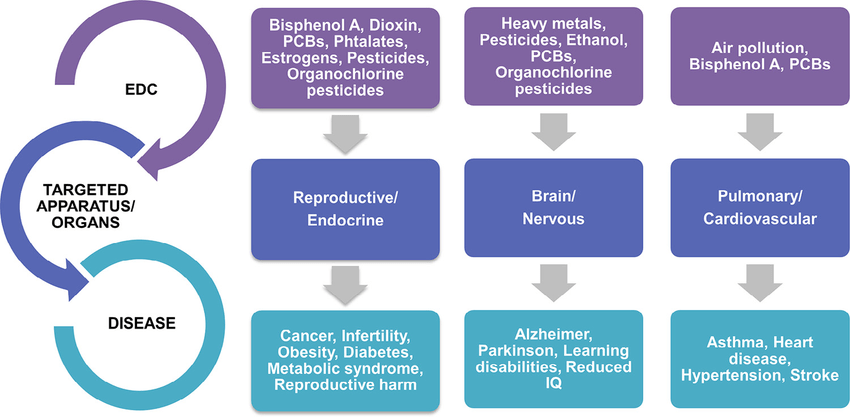
Pathophysiological pathways of EDCs
Sources for common EDCs in our daily lives are provided by Hormone Health Network in the table below:
| Common EDCs: | Used In: |
| DDT, Chlorpyrifos, Atrazine, 2, 4-D, Glyphosate | Pesticides |
| Lead, Phthalates, Cadmium | Children’s Products |
| Polychlorinated biphenyls (PCBs) and Dioxins | Industrial Solvents or Lubricants and their Byproducts |
| Bisphenol A (BPA), Phthalates, Phenol | Plastics and Food Storage Materials |
| Brominated Flame Retardants, PCBs | Electronics and Building Materials |
| Phthalates, Parabeans, UV Filters | Personal Care Products, Medical Tubing, Suncreen |
| Triclosan | Anti-Bacterial Soaps, Colgate Total |
| Perfluorochemicals | Textiles, Clothing, Non-Stick Food Wrappers, Mircowave Popcorn Bags, Old Teflon Cookware |
Several chemicals have been found to disrupt the endocrine systems of animals in laboratory studies, and strong evidence exists that chemical exposure has been associated with adverse developmental and reproductive effects on fish and wildlife. The relationship of human diseases of the endocrine system and exposure to environmental contaminants, however, is still poorly understood (Kavlock et al., 1996, EPA, 1997).
One example of the devastating consequences of the exposure of developing animals, including humans, to endocrine disruptors is the case of the potent drug diethylstilbestrol (DES), a synthetic estrogen. Prior to its ban in the early 1970s, doctors mistakenly prescribed DES to as many as five million pregnant women to block spontaneous abortion and promote fetal growth. It was discovered after the children went through puberty that DES affected the development of the reproductive system and caused vaginal cancer. In addition to disruption of reproductive hormones, modulation of adrenal, thyroid and growth hormone function have also been described for various compounds in both humans and some animals, although the significance of these effects have not yet been fully determined.
Chemicals with affinities for estrogen receptors may cause lowered sperm count and other related reproductive abnormalities. Male fetuses exposed to high doses of estrogens may develop many female characteristics. Lower doses may alter the differentiation and multiplication of the germ cells that eventually give rise to sperm. Dr. John A. McLachlan, director of intramural research at the National Institute of Environmental Health Sciences noted that “some of the environmental chemicals that have estrogenic activity also seem to have a long half-life and can bioaccumulate” in the body’s fat tissue. Most endocrine disrupting chemicals are fat-soluble. This means that they do not get rapidly flushed out of the body, but are stored in fat. These chemicals bioaccumulate up the food chain. As a result, an individual will accumulate more of these chemicals throughout his/her lifetime. Major routes of removing these chemicals involve transfer from mother to child, through the placenta and in breast milk.
In 1992 researchers at Lake Apopka in Florida associated a declining alligator population with a depressed reproduction rate. Many of the male alligators had tiny penises that prevented successful reproduction. These developmental problems were connected to a large organochlorine pesticide spill several years earlier; although the water tested clean, the alligators and their eggs contained detectable levels of endocrine disrupting pesticides.

Fish in the Great Lakes, which are heavily contaminated with polychlorinated biphenyls (PCBs) and other organochlorines, exhibit numerous reproductive function problems and swelling of the thyroid gland. Fish-eating birds, such as eagles, terns, and gulls are also showing similar health effects, as are mink, a mammal that also eats fish from the Great Lakes. These findings are consistent with lab studies that indicate that PCBs interfere with thyroid function and with sex hormones.
The environment is a global entity that recognizes no political boundaries. Issuing a plea for wise action, the National Resources Defense Council state: “Dioxin from a paper mill in the US can accumulate within livestock that is exported to another country; water vapor carrying DDT (now banned in the US) from Mexico can be rained down in Minnesota. Individuals living near the North Pole, where DDT has never been used, have surprisingly high levels of it in their body fat. The laws that ban the production and use of specific chemicals in the United States do little to regulate against exposure via imported products from countries that allow the use of these chemicals.”
Given the common use of sources (in industry, agriculture and residential) that contain and distribute endocrine disruptive chemicals by the human population, and given their bioaccumulation in human tissue, I can practically guarantee that virtually all humans carry some endocrine disruptive chemical in their bodies. How much depends on your life style, where you live and work, your eating habits and your physiology.

Freighter in Toronto Harbour (photo by Nina Munteanu)
Recommended Reading:
Lauretta, Rosa, Andrea Sansone, Missimiliano Sansone, Francesco Romanelli and Marialuisa Appetecchia. 2019. “Endocrine Disrupting Chemicals: Effects on Endocrine Glands.” Front. Endocrinol. Online: https://www.frontiersin.org/articles/10.3389/fendo.2019.00178/full
Colborn, Theo, Dianne Dumanoski, and John Peterson Myers. 1996. “Our stolen future : are we threatening our fertility, intelligence, and survival? : a scientific detective story.” Dutton, New York. 306 pp.
Hormone Health Network. 2020. “Endocrine-Disrupting Chemicals EDCs.” Website: https://www.hormone.org/your-health-and-hormones/endocrine-disrupting-chemicals-edcs
National Institute of Environmental Health Sciences. 2019. “Endocrine Disruptors.” Website: https://www.niehs.nih.gov/health/topics/agents/endocrine/index.cfm
NRDC. 2016. “9 Ways to Avoid Hormone-Disrupting Chemicals.” Website: http://www.nrdc.org/health/effects/bendrep.asp
More on A Diary in the Age of Water:
- On Writing “A Diary in the Age of Water”
- The Invasion of Giant Crayfish Clones & A Diary in the Age of Water
- A Diary in the Age of Water: The Rocky Mountain Trench Inland Sea

Nina Munteanu is a Canadian ecologist / limnologist and novelist. She is co-editor of Europa SF and currently teaches writing courses at George Brown College and the University of Toronto. Visit www.ninamunteanu.ca for the latest on her books. Nina’s bilingual “La natura dell’acqua / The Way of Water” was published by Mincione Edizioni in Rome. Her non-fiction book “Water Is…” by Pixl Press (Vancouver) was selected by Margaret Atwood in the New York Times ‘Year in Reading’ and was chosen as the 2017 Summer Read by Water Canada. Her novel “A Diary in the Age of Water” was released by Inanna Publications (Toronto) in June 2020.
Age of Water Podcast: Interview with Emmi Itäranta
Emmi Itäranta
We are now living in the Age of Water. Water is the new “gold”, with individuals, corporations and countries positioning themselves around this precious resource. Water is changing everything. The Age of Water Podcast covers anything of interest from breaking environmental news to evergreen material. This also includes human interest stories, readings of eco-literature, discussion of film and other media productions of interest.
In this episode of Age of Water, we join award-winning Finnish author Emmi Itäranta in the UK, where she talks about her eco-fiction including The Memory of Water and how her childhood in Finland helped shape her own activism.

 Emmi Itäranta is an award-winning Finnish author. She holds a MA in Drama from the University of Tampere and worked as a columnist, theatre critic, script writer and press officer. She wrote her debut novel Memory of Water simultaneously in Finnish and English during a creative writing course. The English version was published by HarperCollins in 2014 in the United States, United Kingdom and Australia and was nominated for the 2014 Philip K. Dick Award, and the Golden Tentacle Award and the Arthur C. Clarke Award. The book was translated into over a dozen languages throughout the world. Her novel The City of Woven Streets (The Weaver) won the City of Tampere Literary Award. Emmi Itäranta lives in Canterbury, United Kingdom.
Nina Munteanu is a Canadian ecologist / limnologist and novelist. She is co-editor of Europa SF and currently teaches writing courses at George Brown College and the University of Toronto. Visit www.ninamunteanu.ca for the latest on her books. Nina’s bilingual “La natura dell’acqua / The Way of Water” was published by Mincione Edizioni in Rome. Her non-fiction book “Water Is…” by Pixl Press (Vancouver) was selected by Margaret Atwood in the New York Times ‘Year in Reading’ and was chosen as the 2017 Summer Read by Water Canada. Her novel “A Diary in the Age of Water” will be released by Inanna Publications (Toronto) in June 2020.
Petrichor—The Smell of Rain…
 In my novel A Diary in the Age of Water, the diarist, Lynna Dresden, writes in her entry for September 9, 2048:
Petrichor: A pleasant smell that frequently accompanies the first rain after a long period of warm, dry weather. The rain helps release plant oils into the air and chemicals produced by soil-dwelling bacteria called actinomycetes. The term arose from the Greek petra (“stone”) and ichor, the fluid that flows in the veins of the gods.
I know that musty, barky aroma of fresh rain on the dry earth. I know it well. It was the scent in the air when I gave birth to Hildegard seven years ago. She was born on the first rain in forty days. It wouldn’t rain for another forty.
Despite the nurses at the hospital discouraging me, I took my baby girl outside and let the fresh rain spatter our faces and soak us through. Little Hilde loved it. She cooed and watched with the awe of innocence. She’s still so innocent and still loves water.
She’s in Grade Two now and doesn’t comprehend that it isn’t God who controls the weather and the rain; it’s CanadaCorp.

Raindrops in a creek, ON (photo by Nina Munteanu)
Rich Hardy of New Atlas adds that a recent study in Nature Microbiology demonstrates that the bacteria evolved to release this chemical to attract a particular arthropod as a way to spread their spores. “The smell is a 500-million-year-old example of chemical communication, evolved to help a particular type of bacteria spread,” writes Hardy.
The term petrichor was created by Isabel Joy Bear and Richard G. Thomas, two Australian researchers after an article in Nature, in which authors described how the smell originates from an oil produced by plants during dry periods. The oil is released into the air along with geosmin, a metabolic by-product of certain actinobacteria when it rains.
One major component of petrichor is an organic compound called geosmin. Scientists already knew that a common genus of bacteria, known as Streptomyces, produce geosmin. Virtually all species of Streptomyces release geosmin when they die; but until now it was unclear why they generated this distinctive scent.
“The fact that they all make geosmin suggested that it confers a selective advantage on the bacteria, otherwise they wouldn’t do it,” says Mark Buttner, one of the researchers. “We suspected they were signaling to something and the most obvious thing would be some animal or insect that might help distribute the Streptomyces spores.”
Researchers discovered that geosmin specifically attracts springtails—a type of tiny arthropod—that use their antennae to sense chemical. The Streptomyces serve as food for the springtails; the springtails in turn help spread the bacterial spores. This suggests that the two organisms co-evolved in a symbiotic relationship. “This is analogous to birds eating the fruits of plants; they get food but they also distribute the seeds, which benefits the plants,” said Buttner.
Streptomyces—one of the most important sources of antibiotics to humans—relies on the springtail, given that its antibiotic compounds make it toxic to other potential distributors such as fruit flies or nematodes. Springtails generate a number of enzymes that can detoxify the antibiotics produced by Streptomyces. This suggests a form of aggressive symbiosis in a co-evolution between these two organisms—an interaction that is more common in Nature than previously thought.
The earthy scent of rain on dry soil evokes wonderful memories of playful childhood, freedom and awestruck wonder. Why not? Petrichor is, after all, the fluid that flows in the veins of the gods…
 For more on “ecology” and a good summary and description of environmental factors like aggressive symbiosis, co-evolution, and other ecological relationships, read my book “The Ecology of Story: World as Character” (Pixl Press, 2019).
Glossary of Terms:
Aggressive Symbiosis: a common form of symbiosis where one or both symbiotic partners demonstrates an aggressive and potentially harmful effect on the other’s competitor or potential predator (Ryan, 1997).
Co-evolution: when two or more species reciprocally affect each other’s evolution through the process of natural selection and other processes.
Petrichor: A pleasant smell that frequently accompanies the first rain after a long period of warm, dry weather. The rain helps release plant oils into the air and chemicals produced by soil-dwelling bacteria called actinomycetes. The term arose from the Greek petra (“stone”) and ichor, the fluid that flows in the veins of the gods.
Symbiosis: Greek for “companionship” describes a close and long term interaction between two organisms that may be beneficial (mutualism), beneficial to one with no effect on the other (commensalism), or beneficial to one at the expense of the other (parasitism). (Munteanu, 2019).
References:
Frazer, Jennifer. 2015. “Root Fungi Can Turn Pine Trees Into Carnivores—or at Least Accomplices.” Scientific American, May 12, 2015. Online: https://blogs. scientificamerican.com/artful-amoeba/root-fungi-can-turn-pine-trees-into- carnivores-8212-or-at-least-accomplices/
Hardy, Rich. 2020. “The 500-million-year-old reason behind the unique scent of rain” New Atlas.
Munteanu, N. 2019. “The Ecology of Story: World as Character.” Pixl Press, Vancouver, BC. 198pp. (Section 2.7 Evolutionary Strategies)
Munteanu, N. 2020. “A Diary in the Age of Water.” Inanna Publications, Toronto. 300pp.
Nina Munteanu is a Canadian ecologist / limnologist and novelist. She is co-editor of Europa SF and currently teaches writing courses at George Brown College and the University of Toronto. Visit www.ninamunteanu.ca for the latest on her books. Nina’s bilingual “La natura dell’acqua / The Way of Water” was published by Mincione Edizioni in Rome. Her non-fiction book “Water Is…” by Pixl Press (Vancouver) was selected by Margaret Atwood in the New York Times ‘Year in Reading’ and was chosen as the 2017 Summer Read by Water Canada. Her novel “A Diary in the Age of Water” will be released by Inanna Publications (Toronto) in June 2020.
A Diary in the Age of Water: The Rocky Mountain Trench Inland Sea
In my novel “A Diary in the Age of Water” (Inanna Publications) the diarist writes about the huge 800-km reservoir complex built in the late 2020s in the Rocky Mountain Trench to rehydrate the United States. Of course, it’s science fiction, but it was based on real plans that went all the way to Congress in the 1960s.
Snaking along the length of the Rocky Mountain Trench, the reservoir promised to submerge numerous British Columbia towns such as Dunster, McBride and Valemount and pose an existential threat to northern communities of BC and Alaska.
The Trench
The Rocky Mountain Trench is a long and deep valley walled by sedimentary, volcanic and igneous rock that extends about 1,500 km from Flathead Lake and the ‘banana but’ of the Bitterroot Valley of western Montana through British Columbia to the Liard Plain just south of the Yukon Territory. Blanketed mostly by white and black spruce, subalpine fir and lodgepole pine, the northern trench stretches 3–20 km wide to accommodate the major river systems that snake along its mostly flat floor. This rich ecosystem is home to bears, caribou, moose and wolves. To the south, where the valley meanders more at lower elevation, the forest opens up and gives way to grasslands, marsh and farmland. The Trench is sometimes referred to as the “Valley of a Thousand Peaks” because of the towering mountain ranges on either side: the Rocky Mountains to the east and the Columbia, Omineca and Cassiar mountains to the west.
The Trench is a large fault—a crack in the Earth’s crust—and bordered along much of its length by smaller faults. Major structural features resulted from the shifting and thrusting of tectonic plates of the crust during the early Cenozoic Era, some 65 million years ago to form mountains. The ridges of fractured crust then pulled apart and the land in between dropped, creating the floor of the Trench.

Rocky Mountain Trench, near Golden, B.C.
Among the major rivers that flow through the trench are the Fraser, Liard, Peace and Columbia rivers. Construction of hydroelectric projects—particularly those at Peace Canyon and Mica Dam—have disrupted the seven major rivers that once flowed through the Trench. All but the Fraser and Kechika rivers now empty into reservoirs on the valley floor; these include several reservoirs along the Columbia River in the southern trench such as the Kinbasket reservoir (created by the Mica Dam in 1973 to form Canoe Reach), and Revelstoke Lake (created by the Revelstoke Dam in 1984). Williston Lake was formed by the A.C. Bennet Dam on the Peace River in 1968. I had studied the effects of pulp mill activities for the federal government’s Environmental Effects Monitoring (EEM) Program.
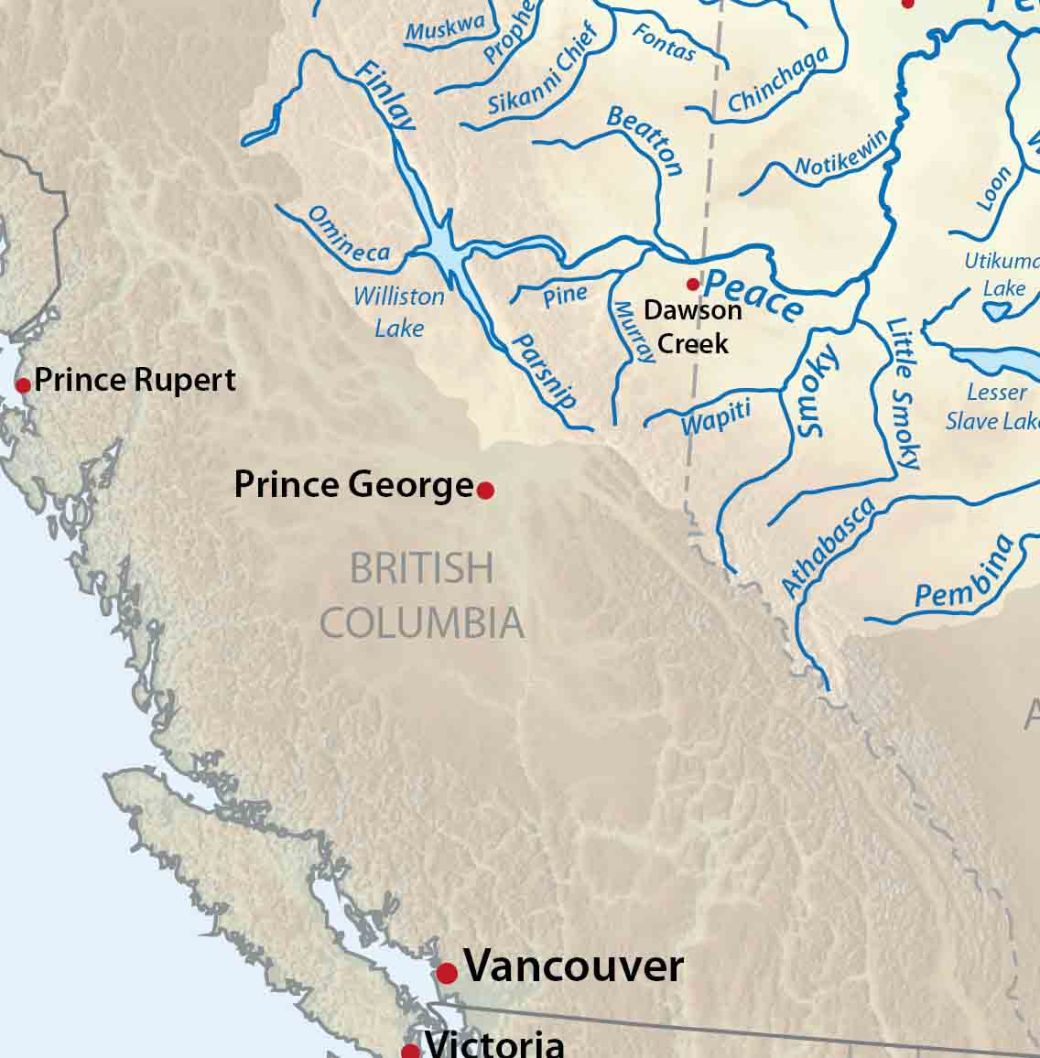
The Rocky Mountain Trench is topographically visible as it follows the BC-Alberta border south from Williston Lake
The Inland Sea
Like pseudopods of a hunting amoeba, the Rocky Mountain Trench reservoir system would have sent tendrils of water up river arms, and drowned swaths of ancient oroboreal rainforest. The rainforest corridor of Robson Valley—a conservation area that continues to experience existential risk due to development, resource harvest, and other disturbance—would have been one of the many casualties.

Ancient Redcedars in old-growth rainforest (photo by Nina Munteanu)
Una stopped the car and we stared out across the longest reservoir in North America. What had once been a breathtaking view of the valley floor of the Rocky Mountain Trench was now a spectacular inland sea. It ran north-south over eight hundred kilometres and stretched several kilometres across to the foothills of the Cariboo Mountain Range. Una pointed to Mount Mica, Mount Pierre Elliot Trudeau and several other snow-covered peaks. They stood above the inland sea like sentinels of another time. Una then pointed down to what used to be Jackman Flats—mostly inundated along with McLellan River and the town of Valemont to the south. Hugging the shore of what was left of Jackman Flats was a tiny village. “That’s the new Tête Jaune Cache,” my mother told me.
If villages had karma this one was fated to drown over and over until it got it right. Once a bustling trading town on the Grand Trunk Pacific railway, Tête Jaune Cache drowned in the early 1900s when the Fraser naturally flooded. The village relocated to the junction of the original Yellowhead 16 and 5 Highways. Villagers settled close to where the Fraser, Tête Creek, and the McLellan River joined, all fed by the meltwater from the glaciers and icefields of the Premiere Range of the Cariboo Mountains. The village drowned again in 2025. I imagined the pool halls, restaurants, saloons and trading posts crushed by the flood.
“This area used to be a prime Chinook spawning ground,” Una said. “They swam over 1,200 km from the Pacific Ocean to lay their eggs right there.” She pointed to the cobalt blue water below us.
Kinbasket Reservoir
The reservoir sparkled in the sun like an ocean. Steep shores rose into majestic snow-capped mountains. The village lay in a kind of cruel paradise, I thought. It was surrounded by a multi-hued forest of Lodgepole pine, Western red cedar, Douglas fir, paper birch and trembling Aspen. Directly behind the village was Mount Terry Fox and across the Robson valley mouth, to the northeast, rose Mount Goslin. Behind it, Mount Robson cut a jagged pyramid against a stunning blue sky. Wispy clouds veiled its crown. I couldn’t help thinking it was the most beautiful place I’d seen. And yet, for all its beauty, the villagers had lost their principle livelihood and food. The reservoir had destroyed the wildlife habitats and the fishery. And its people with it.
Una pointed to where the giant reservoir snaked northwest and where towns like Croydon, Dunster, and McBride lay submerged beneath a silent wall of water. Her eyes suddenly misted as she told me about Slim Creek Provincial Park, between what used to be Slim and Driscoll Creeks just northwest of what used to be the community of Urling. She told me about the Oroboreal rainforest, called an “Antique Rainforest”—ancient cedar-hemlock stands over a 1000-years old. She described how massive trunks the width of a small house once rose straight up toward a kinder sun. The Primordial Grove was once home to bears, the gray wolf, cougar, lynx, wolverine and ungulates. It was the last valley in North America where the grizzly bear once fished ocean-going salmon. Now even the salmon were no longer there, she said. Then she bent low beside me and pulled me close to her in a hug. She quietly said to me, “This is what killed Trudeau.”
I stared at her and firmly corrected, “but that was an accident.”
“Yes,” she agreed. Then added, “a planned one.”

NAWAPA (North America Water Power Alliance)
The original NAWAPA Plan was drawn up by the Pasadena-based firm of Ralph M. Parsons Co. in 1964, and had a favorable review by Congress for completion in the 1990s. The plan—thankfully never completed—was drafted by the US Army Corps of Engineers and entailed the southward diversion of a portion (if not all) of the Mackenzie and Yukon rivers in northern Canada and Alaska, now flowing into the Arctic Ocean as well as the Peace, Liard and other rivers flowing into the Pacific by creating massive dams in the north. This would cause the rivers to flow backwards into the mountains to form vast reservoirs that would flood one-tenth of British Columbia. The water would be channeled south through the 800-km Rocky Mountain Trench Reservoir into the Northern USA, and from there along various routes into the dry regions of the South, to California and reaching as far as Mexico.
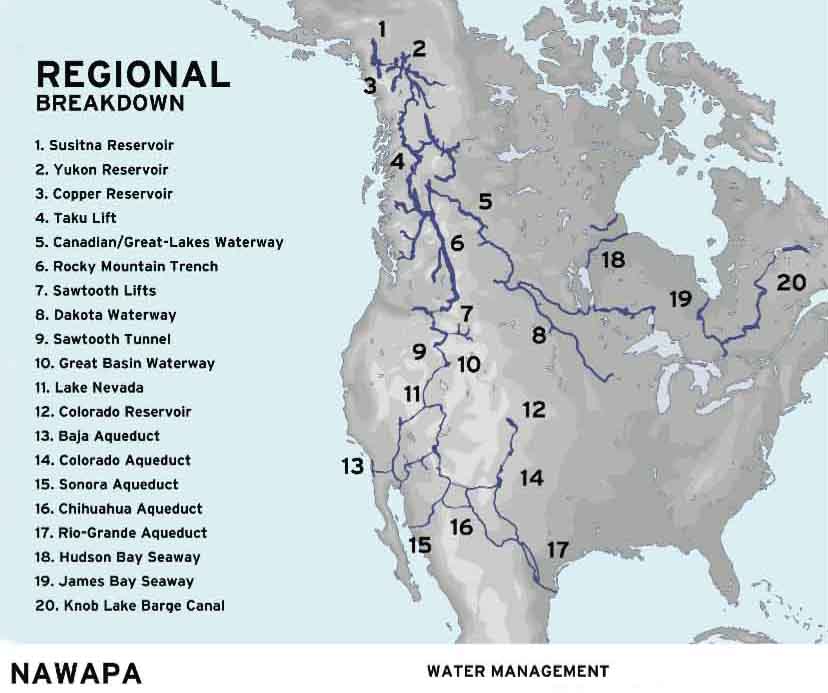
NAWAPA was envisioned as the largest construction effort of all times, comprising some 369 separate projects of dams, canals, and tunnels, for water diversion. The water diversion would be accomplished through a series of connecting tunnels, canals, lakes, dams, and pump-lifts, as the trench itself is located at an elevation of 914 m (3,000 feet). To the east, a 9 m (thirty-foot) deep canal would be cut from the Peace River to Lake Superior. NAWAPA’s largest proposed dam would be 518 m (1,700 feet) tall, more than twice the height of Hoover Dam (at 221 m) and taller than any dam in the world today, including the Jinping-I Dam in China (at 305 m).
Conspiracy theorist and convicted fraudster Lyndon LaRouche was a principle proponent of the environmentally destructive NAWAPA plan. Although the plan was scrapped in the 1970s due to environmental concerns, it resurfaced in 1982 particularly by Parsons engineer Roland Kelley, who wrote a report called NAWAPA Plan Can Work. LaRouche and his movement revived interest more recently. In 2012 the LaRouche Political Action Committee released their NAWAPA XXI special report, which contained a detailed plan for the revival of an updated and expanded version of NAWAPA. The LaRouche movement continues to promote this outlandish plan today with support from various American politicians and industrialists.
In his book Cadillac Desert, environmental writer Marc Reisner described the plan as one of “brutal magnificence” and “unprecedented destructiveness.” Historian Ted Steinberg suggested that NAWAPA summed up “the sheer arrogance and imperial ambitions of the modern hydraulic West.”

Expanded NAWAPA XXI plan

Rocky Mountain Trench near Radium Hot Springs
Nina Munteanu is a Canadian ecologist / limnologist and novelist. She is co-editor of Europa SF and currently teaches writing courses at George Brown College and the University of Toronto. Visit www.ninamunteanu.ca for the latest on her books. Nina’s bilingual “La natura dell’acqua / The Way of Water” was published by Mincione Edizioni in Rome. Her non-fiction book “Water Is…” by Pixl Press (Vancouver) was selected by Margaret Atwood in the New York Times ‘Year in Reading’ and was chosen as the 2017 Summer Read by Water Canada. Her novel “A Diary in the Age of Water” will be released by Inanna Publications (Toronto) in June 2020.
Infertility in the Age of Water
 In a scene of my near-future eco-thriller A Diary in the Age of Water (Inanna Publications, 2020) the diarist’s young colleague Daniel rather too enthusiastically proclaims the impending extinction of males.
“Scientists all agree that environmental factors are the main triggers for male and female infertility through epigenetics…Epigenetics rules climate change-related adaptations. And everything appears stacked heavily for females and intersex humans. Males might go extinct with climate change!”
–A Diary in the Age of Water
Lynna Dresden, the diarist in A Diary in the Age of Water, thinks Daniel rather buffoonish and a traitor to his male kind. Then again, here is how another Daniel starts his article in a 2018 issue of GQ Magazine entitled “Sperm Count Zero“:
Men are doomed. Everybody knows this. We’re obviously all doomed, the women too, everybody in general, just a waiting game until one or another of the stupid things our stupid species is up to finally gets us. But as it turns out, no surprise: men first. Second instance of no surprise: We’re going to take the women down with us.
There has always been evidence that men, throughout life, are at higher risk of early death—from the beginning, a higher male incidence of Death by Mastodon Stomping, a higher incidence of Spiked Club to the Brainpan, a statistically significant disparity between how many men and how many women die of Accidentally Shooting Themselves in the Face or Getting Really Fat and Having a Heart Attack. The male of the species dies younger than the female—about five years on average. Divide a population into groups by birth year, and by the time each cohort reaches 85, there are two women left for every man alive. In fact, the male wins every age class: Baby boys die more often than baby girls; little boys die more often than little girls; teenage boys; young men; middle-aged men. Death champions across the board.
Now it seems that early death isn’t enough for us—we’re on track instead to void the species entirely.
–Daniel Noah Halpern, GQ Magazine
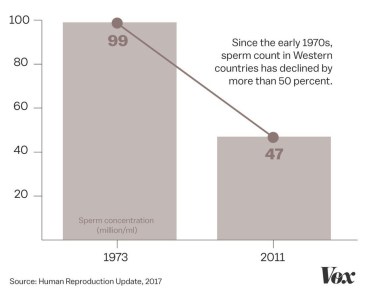 Both Daniels are talking about the alarming rate at which sperm counts worldwide are falling. They’ve dropped by half in the last fifty years in North America, Europe, Australia and New Zealand—according to a 2017 paper by researchers at Hebrew University and Mount Sinai medical school and more recent studies in 2018.
While an unhealthy lifestyle (being overweight or obese, smoking, stress and alcohol or recreational drug use) is most often implicated, more insidious causes exist.
 Research shows that consumption and/or exposure to many common constituents of urban living can decrease fertility, increase miscarriage, spontaneous abortion, and lower auto-immune systems. Examples include car exhaust, pesticides, common detergents, hair dyes, cleaning solvents, oil based paints, adhesives, gasoline; and consumption of MSG, coffee, alcohol.
A 2019 study by scientists at Nottingham University identified two chemicals common in home environments that damage sperm in men and dogs. GQ Daniel goes on to explain: “Phthalates and BPA [used to make plastic soft and flexible or harder and stronger] for example, mimic estrogen in the bloodstream. If you’re a man with a lot of phthalates in his system, you’ll produce less testosterone and fewer sperm. If exposed to phthalates in utero, a male fetus’s reproductive system itself will be altered: He will develop to be less male.”

This leads Age of Water Daniel to bring up the rise in intersex mammals (individuals born with any of several variations in sex characteristics including chromosomes, gonads, sex hormones or genitals that do not fit the “strict definitions for ‘male’ or ‘female’ bodies”). A 2016 article in Environmental Health Insights by Rich et al. attribute an increasing number of human children born with intersex variation to an increase in hormone disrupting chemicals in our environment.
Leaning on his microscope, Daniel went on, “Wherever there’s a sewage treatment plant, pulp and paper mill, or herbicides and pesticides in a stream, you get endocrine disruption, which causes more female or intersex fish populations…[Degradation products of surfactants used in commercial and household detergents] inhibit breeding in male fish. And herbicides like atrazine—”
“—Create feminized males with female eggs, along with reduced immunity to disease,” I finished for him.
I knew all this. Hormonal disruption is global. Environmental toxicologists have been finding it in many aquatic animals like fish, turtles, alligators and frogs. And some terrestrial animals…Even humans…Was it also causing the steep rise in ambiguous sex in humans? Is Daniel an intersex human? Apparently 1 in 30 now have bodies that differ notably from standard male or female. Klinefelter, androgen insensitivity syndrome, presence of ovotestes, mixed gonadal dysgenesis, and mosaic genetics are all on the rise. Which was he?
As if he knew what I was thinking, Daniel said dramatically, “The environment is changing us faster than most think and it’s doing it through epigenetics and HGT.”
–A Diary in the Age of Water
Phthalates and BPA can be found everywhere. GQ Daniel lists them: “BPA can be found in water bottles and food containers and sales receipts. Phthalates are even more common: They are in the coatings of pills and nutritional supplements; they’re used in gelling agents, lubricants, binders, emulsifying agents, and suspending agents. Not to mention medical devices, detergents and packaging, paint and modeling clay, pharmaceuticals and textiles and sex toys and nail polish and liquid soap and hair spray. They are used in tubing that processes food, so you’ll find them in milk, yogurt, sauces, soups, and even, in small amounts, in eggs, fruits, vegetables, pasta, noodles, rice, and water. The CDC determined that just about everyone in the United States has measurable levels of phthalates in his or her body—they’re unavoidable.”
These chemicals affect sperm’s ability to swim, navigate and fertilize an egg. DNA fragmentation in the sperm head also occurs, which is basically equivalent to a sperm having a brain hemorrhage. Recent studies suggest that 20-30% of young men today have sperm counts in a range that is associated with reduced fertility. Sarbjit Kaur at the Punjab Agricultural University found that men who live in industrial cities had six times more abnormal sperm than men living in a relatively clean rural town.
 Dr. Marilyn F. Vine at the University of North Carolina demonstrated that smoking men had lower sperm counts by 13-17%. Smokers also had more abnormal sperm. Likewise, women who smoked experienced more spontaneous abortions, early menopause and abnormal oocytes. Follicular fluid also contained high levels of cadmium, a heavy metal present in cigarettes, and cotininie, a metabolite of nicotine.
A growing concern for infertility has entered our general mindset, reflected in the theme of infertility in literature and motion pictures.
Notable examples include Margaret Atwood’s The Handmaid’s Tale (1985), Raising Arizona (1987), Aeon Flux (2005), The Children of Men (2006), Private Life (2018) and my own A Diary in the Age of Water (2020).
Although we are not close to experiencing the global infertility pandemic portrayed in the barren 2027 world of The Children of Men, this cautionary tale of a world gone mad with grief should linger like the whispered truth of a fairy tale.
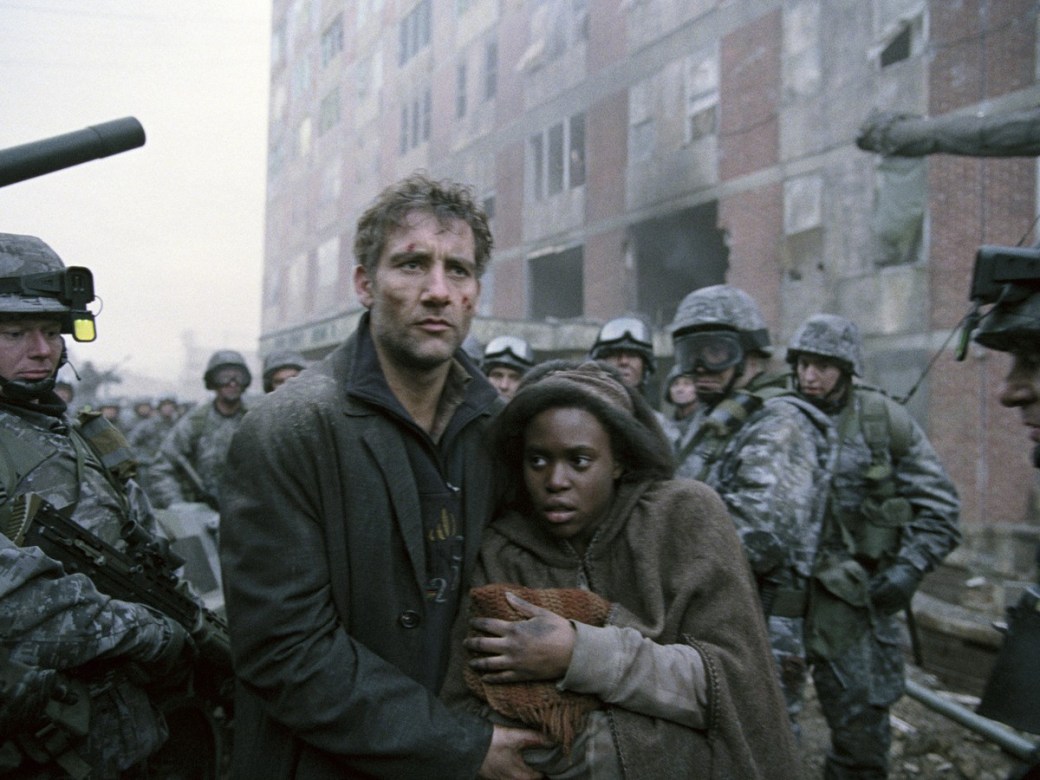
scene from “Children of Men” motion picture
Suggested Reading:
Carr, Teresa. 2019. “Sperm counts are on the decline—could plastics be to blame?” The Guardian.
Belluz, Julia. 2019. “Sperm counts are falling. This isn’t the reproductive apocalypse—yet” Vox.
Halpern, Daniel Noah. 2018. “Sperm Count Zero.” GQ Magazine.
Fetters, Ashley. 2018. “Sperm Counts Continue to Fall.” The Atlantic.
Stein, Rob. 2017. “Sperm Counts Plummet in Western Men, Study Finds.” NPR.
Nina Munteanu is a Canadian ecologist / limnologist and novelist. She is co-editor of Europa SF and currently teaches writing courses at George Brown College and the University of Toronto. Visit www.ninamunteanu.ca for the latest on her books. Nina’s bilingual “La natura dell’acqua / The Way of Water” was published by Mincione Edizioni in Rome. Her non-fiction book “Water Is…” by Pixl Press (Vancouver) was selected by Margaret Atwood in the New York Times ‘Year in Reading’ and was chosen as the 2017 Summer Read by Water Canada. Her novel “A Diary in the Age of Water” will be released by Inanna Publications (Toronto) in June 2020.
Dreams and Perceptions…And ‘The Other’
path along Credit River (photo by Nina Munteanu)
It was a while ago, as I was driving home from a friend’s place in the sultry dark of night that I noticed the change…

Perhaps it was the rain and the winding road that nudged my psyche to wander into that other realm. Or was it the surrealistic motion picture The Fountain that I’d seen the evening before? Or had it more to do with the fact that I’d been, for various reasons, without sleep for over forty hours that I glimpsed the ordinary in an extra-ordinary light?
Light had everything to do with it…Amber traffic lights at a construction site pulsed like living things. Smoky back-lit clouds billowed over an inky sky. A garish screen of trees, caught in the beams of my car lights as I turned a corner, flashed. Nature recast. A half-built apartment building loomed up like some dark tower in Lord of the Rings. I was reminded of a scene early on in The Fountain where the viewer is disoriented initially by a busy street at night because it was shot upside down. Ironically, the picture was filmed in my hometown of Montreal and I didn’t even recognize it.
Have you ever done that? Looked backward while driving through a familiar scene to gain a different perspective? And felt different for just a moment? Like you’d briefly entered a different dimension and glimpsed “the other”?
What is it like to meet “the other”?
What is it like to approach the unfamiliar? A new landscape. A stranger in town. A different culture. An “alien” encounter. How do we react? Is it with wonder? Curiosity? Fear? Hatred? A mixture of these?
The genre of science fiction vividly explores our humanity through our reactions to “the other.” It does this by looking at both perspectives. By describing “the other,” science fiction writers describe “us.” In his book Orientalism: Western Conceptions of the Orient Edward W. Said contended that for there to be an ‘us’, there has to be a ‘not-us.’ According to Patricia Kerslake of Central Queensland University, this arises from a postcolonial notion of ‘the Other’, through a mutual process of exclusion. This exclusion inspires the very idea of ‘alien’ by imposing expectation on perception. Kerslake argues that: “When one culture imposes its perceptions on another, in that it begins to see the Other not as they are but as, in Said’s words, ‘they ought to be’, then the process of representation becomes inevitable: a choice is made to see a ‘preferred’ real.”
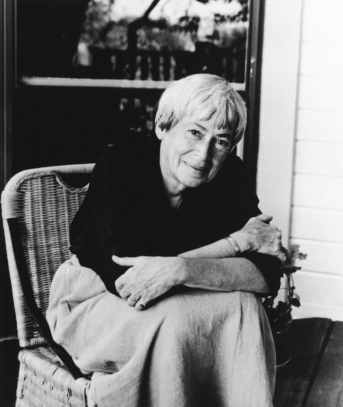
Ursula K. LeGuin
In her 1975 article “American SF and the Other,” Ursula K. LeGuin unequivocally scolded the Western SF genre for representing and promoting colonialism and androcratic motives.
One of the great early socialists said that the status of women in a society is a pretty reliable index of the degree of civilization of that society. If this is true, then the very low status of women in SF should make us ponder about whether SF is civilized at all.
The women’s movement has made most of us conscious of the fact that SF has either totally ignored women, or presented them as squeaking dolls subject to instant rape by monsters—or old-maid scientists de-sexed by hypertrophy of the intellectual organs—or, at best, loyal little wives or mistresses of accomplished heroes. Male elitism has run rampant in SF. But is it only male elitism? Isn’t the “subjection of women” in SF merely a symptom of a whole which is authoritarian, power-worshiping, and intensely parochial?
The question involved here is the question of The Other—the being who is different from yourself. This being can be different from you in its sex; or in its annual income; or in its way of speaking and dressing and doing things; or in the color of its skin, or the number of its legs and heads. In other words, there is the sexual Alien, and the social Alien, and the cultural Alien, and finally the racial Alien.
Well, how about the social Alien in SF? How about, in Marxist terms, “the proletariat”? Where are they in SF? Where are the poor, the people who work hard and go to bed hungry? Are they ever persons, in SF? No. They appear as vast anonymous masses fleeing from giant slime-globules from the Chicago sewers, or dying off by the billion from pollution or radiation, or as faceless armies being led to battle by generals and statesmen. In sword and sorcery they behave like the walk-on parts in a high school performance of The Chocolate Prince. Now and then there’s a busty lass amongst them who is honored by the attentions of the Captain of the Supreme Terran Command, or in a space-ship crew there’s a quaint old cook, with a Scots or Swedish accent, representing the Wisdom of the Common Folk.
The people, in SF, are not people. They are masses, existing for one purpose: to be led by their superiors…
…What about the cultural and the racial Other? This is the Alien everybody recognizes as alien, supposed to be the special concern of SF. Well, in the old pulp SF, it’s very simple. The only good alien is a dead alien—whether he is an Aldebaranian Mantis-Man, or a German dentist. And this tradition still flourishes: witness Larry Niven’s story “Inconstant Moon” (in All the Myriad Ways, 1941) which has a happy ending—consisting of the fact that America, including Los Angeles, was not hurt by a solar flare. Of course a few million Europeans and Asians were fried, but that doesn’t matter, it just makes the world a little safer for democracy, in fact. (It is interesting that the female character in the same story is quite brainless; her only function is to say Oh? and Ooooh! to the clever and resourceful hero.)
If you deny any affinity with another person or kind of person, if you declare it to be wholly different from yourself—as men have done to women, and class has done to class, and nation has done to nation—you may hate it, or deify it; but in either case you have denied its spiritual equality, and its human reality. You have made it into a thing, to which the only possible relationship is a power relationship. And thus you have fatally impoverished your own reality.
You have, in fact, alienated yourself.
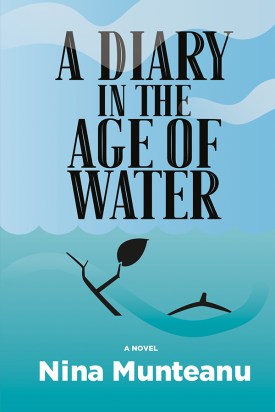 Written 45 years ago, Le Guin’s scathing article may have accurately represented the North American science fiction community of writers of that time. Today, despite the remnants of a strong old guard that still promotes a patriarchal colonialist hegemony, the science fiction genre has matured and grown beyond this self-limiting view. This is partly because current authors—many who are women and many who are representatives of minority or marginalized groups—have given SF a new face and voice that promises to include equality, inclusion, and a fresh look at exploration and ‘the other.’
The genre of science fiction has matured by diversifying to embrace “mundane science fiction,” literary fiction, speculative fiction, climate fiction, cli-fi, eco-fiction, indigenous futurisms and more.
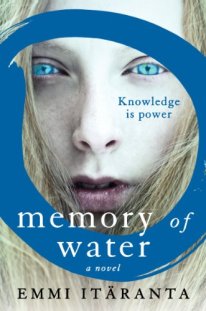 Science fiction that leans toward “mundane”(everyday life) and literary fiction include the works of Paulo Bacigalupi (Windup Girl), Margaret Atwood (Year of the Flood), and Kim Stanley Robinson (New York 2140). Literary fiction overlaps with science fiction through eco-fiction and climate fiction which address oppression, jingoism and neoliberalism often through dystopian themes—and often through the voice of women writers—such as Octavia Butler’s Parable of the Sower, N.K. Jemisin’s The Broken Earth series, Emmi Itäranta’s The Memory of Water, Nina Munteanu’s A Diary in the Age of Water, Barbara Kingsolver’s Flight Behavior, Annie Proulx’s Barkskins, and Richard Power’s Overstory.
 In 2017, several publications addressed different aspects of society through speculative fiction. Laksa Media published Strangers Among Us: Tales of the Underdogs and Outcasts, which explores issues of mental health. Exile Editions published Cli-Fi: Tales of Climate Change with stories on personal experience with climate change. Reality Skimming Press published Water, for which I was editor, which explored optimism in the face of climate change.
In Ann Leckie’s 2014 Ancillary Justice, the main character is a space ship. The Gethenians in Ursula K. LeGuin’s The Left Hand of Darkness are humanoids with fluid gender, adapted to environment. In Kim Stanley Robinson’s 2312, humans have abandoned the gender binary for an intersex existence based on proven longevity.
 Novels and anthologies of short stories that feature disabled characters are also growing. Examples include Borderline by Mishell Baker, We Who Are About To… by Joanna Russ, Murderbot series by Martha Wells, and Uncanny: Disabled People Destroy Science Fiction (edited by Elsa Sjunneson-Henry, Dominik Parisien et al.) among many others.
Indigenous futurisms, speculative writings on issues of colonialism, identity, AI, and climate change include Trail of Lightning by Rebecca Roanhorse, Mongrels by Stephen Graham Jones, Robopocalypse by Daniel H. Wilson, Take Us to Your Chief, by Drew Hayden Taylor, The Marrow Thieves by Cherie Dimaline, Walking the Clouds Anthology edited by Grace L. Dillon, and Future Home of the Living God by Louise Erdrich.
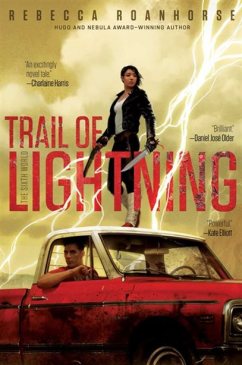 In an introduction to seven Indigenous Futurism books, Barnes and Noble writes:
So many stories, well intentioned and not-so-well-intentioned, have fixated on the dark pasts of Indigenous people, assuming that colonization stole from them any future not involving slow decline and assimilation. Though there’s plenty of tragedy to be recounted, Indigenous history didn’t end there, and a wave of modern authors are exploring Indigenous cultures as living, vibrant, and firmly fixed in both the modern and furute worlds—sovereign nations with as much claim to an endless array of possible futures as any other culture. So much of what we call classic science fiction involves tropes that look very different to colonized peoples: the heroic space explorers who travel the stars visiting (and often conquering) alien worlds look very different to people whose histories are so strongly marked by the scars of colonization.
Of Indigenous Futurisms, the Seattle Public Library writes:
Indigenous Futurisms confront many of the norms of speculative fiction by challenging, subverting, or refusing to engage with colonial, racist, and otherwise oppressive genre tropes. Indigenous Futurism draws on the strength of Indigenous knowledge systems, worldviews, stories, languages, and traditions to reimagine the past, present, and future of this world and others. Yet it is not necessarily utopic or optimistic. Many authors writing within the Indigenous Futurisms genre engage with the realities of ongoing colonialism around the world, and the apocalyptic nature of the present for many Indigenous communities. However, characters struggle despite the circumstances for a better future.
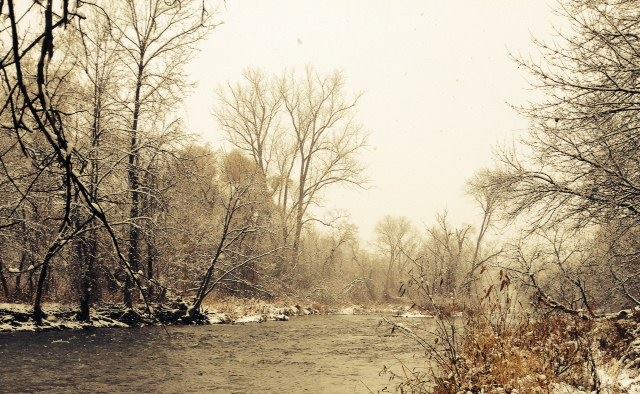
First snow on the Credit River (photo by Nina Munteanu)
Nina Munteanu is a Canadian ecologist / limnologist and novelist. She is co-editor of Europa SF and currently teaches writing courses at George Brown College and the University of Toronto. Visit www.ninamunteanu.ca for the latest on her books. Nina’s bilingual “La natura dell’acqua / The Way of Water” was published by Mincione Edizioni in Rome. Her non-fiction book “Water Is…” by Pixl Press (Vancouver) was selected by Margaret Atwood in the New York Times ‘Year in Reading’ and was chosen as the 2017 Summer Read by Water Canada. Her novel “A Diary in the Age of Water” will be released by Inanna Publications (Toronto) in June 2020.
Nina Munteanu Talks About Writing and Audiobooks

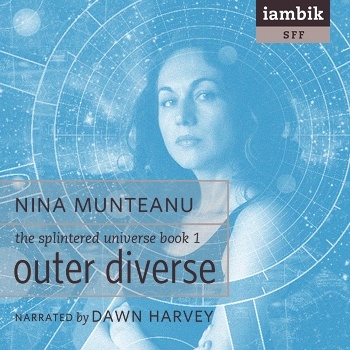
In a recent interview with Jess at Audiobookworm Promotions, I talked about the process of turning The Splintered Universe Trilogy into three audiobooks and the process of writing in general:

Nina Munteanu
Tell us about the process of turning your book into an audiobook.
The process was magical for me. It was professional and proceeded at a pace that felt productive. All of this was mainly because of the professional relationship I had with the narrator. From audition to each step of quality assurance in ensuring character voice, pronunciations, mood, tempo, etc. the narrator and I were in good communication. The final product shows. I can’t recall how long it took for each audiobook to be created, but it didn’t feel long.
How did you select your narrator?

Dawn Harvey
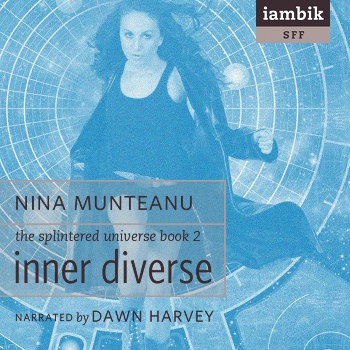
Dawn Harvey auditioned for my first book along with two other narrators through the audiobook publisher, Iambik. I picked Dawn because her voice resonated with my idea of my main character, Rhea Hawke, a cynical badass detective on a mission to save the world–a world she doesn’t understand. Dawn’s voice carried attitude and sarcasm as well as compassion and kindness. It was exactly what I was looking for in my paradoxical character. Given that the book is told in the first person, the main character voice was critical. Dawn just nailed it. When the second and third books came out, I just HAD to have Dawn do them too—not just for consistency, but because in my mind, Dawn WAS Rhea.
How closely did you work with your narrator before and during the recording process? Did you give them any pronunciation tips or special insight into the characters?
We worked closely and well. Dawn took the driver’s seat in it. She was very professional. She sent me sections of audio to check for tone, voice, etc. She created a list of voices (I had at least twenty different alien species she needed to create unique voices for—one with multiple mouths! And another was a kind of “amoeba”—her voices were splendid!) and a list of terms with her pronunciations for me to vet. She had also asked for more information on the characters, which I was able to provide, given I keep a character dossier on all characters I create.
You can listen to samples of her narration of the three audiobooks below:

Are you an audiobook listener? What about the audiobook format appeals to you?
 I like to listen to audiobooks in the car, especially when I’m on a long trip. I find it a wonderful way to enjoy a book. It’s very relaxing. When my best friend and I used to do road trips down to California from Vancouver, we took turns reading a novel or nonfiction book out loud as the other drove. It was lots of fun. With audiobooks I can do the same even when I’m the only one in the car!
What gets you out of a writing slump? What about a reading slump?
 If I’m in a slump, it’s usually because I can’t figure something out—usually some plot point or character quirk or backstory. What helps me is to put the book I’m working on away and do something else. I know that what I need will come; I just have to let it come on its own terms. The break could even be writing something else, so long as it isn’t my book. Or I could do something else on the book such as edit a certain section or research some element. Other ways I coax my muse back are walks in Nature, reading a good book, visiting the library or a bookstore and cycling. These work really well to take me out of the book and into the muse. When I take my mind out of the direct involvement with the book, I’m letting things outside of me impact me with insight. Invariably that is what happens. I’ll see something or experience something that provides me with a clue or even an epiphany.
What advice would you give to aspiring authors?
 Learn your “voice” and how it’s unique from anyone else. Write from the heart, write something that means something to you, and keep writing. Success in writing results from a passion to share. If you infuse your writing with passion, everything else comes with it: the patience and determination to learn craft, marketing, and the persistence in your pursuit.
Do you have any tips for authors going through the process of turning their books into audiobooks?
Know what you’re looking for to represent the “voice” of your book. Know the narrative voice you want for your book and don’t compromise on it. Work respectfully with your narrator: if they are good, they will turn your cherished book into something more than it was. Let it surprise you and delight you. Together, you and your narrator will become more than the sum of the parts. Enjoy the process and don’t rush it.
What’s next for you?
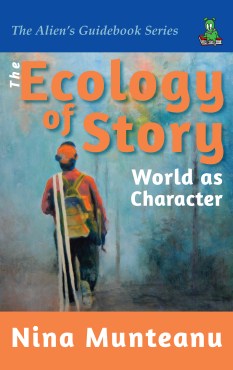
 I recently finished my latest novel, A Diary in the Age of Water, which was picked up by Inanna Publications in Toronto and will be out in 2020. I recently launched the third book in my “Alien Guidebook” series of writing guides. This one is called The Ecology of Story: World as Character and I’ve had lots of fun with it!
I’m currently at the idea-premise phase of a feature short story commissioned by a magazine in Vancouver. The story, which may involve a branch of ecology called soundscape ecology, explores a world we hope to live in and how we might get there.
Nina Munteanu is a Canadian ecologist / limnologist and novelist. She is co-editor of Europa SF and currently teaches writing courses at George Brown College and the University of Toronto. Visit www.ninamunteanu.ca for the latest on her books. Nina’s bilingual “La natura dell’acqua / The Way of Water” was published by Mincione Edizioni in Rome. Her non-fiction book “Water Is…” by Pixl Press (Vancouver) was selected by Margaret Atwood in the New York Times ‘Year in Reading’ and was chosen as the 2017 Summer Read by Water Canada. Her novel “A Diary in the Age of Water” will be released by Inanna Publications (Toronto) in 2020.
On Writing “A Diary in the Age of Water”
How does any fire begin? With a spark…
 In Summer of 2016, I attended a talk given by Maude Barlow on water justice. The radical talk was based on her recent book “Boiling Point”, a comprehensive exploration of Canada’s water crisis—a crisis that most Canadians weren’t—and still aren’t—aware. Canada is steward to a fifth of the world’s fresh water, after all. It is a water-rich country. Of the dozen largest inland lakes in the world, Canada holds eight of them. So, why water crisis? Well, Maude explains. And you should read “Boiling Point.” It will open your eyes to the politics of water and how multinational corporations—like Nestlé—are already grabbing and funneling water away from Canadians and into the global profit machine.
Maude’s talk was in a church on Bloor Street in Toronto. I sat close to the front to best see her. But I soon noticed that many people had elected to sit in the gallery above. I found myself focusing on a young mother and her little girl. The girl had some paper and crayons and was busy with that as the enthusiastic mother listened to Maude deliver dire facts about corporate water high-jacking and government complicity.
I saw a story there.
What mother would take her pre-school child to a socio-political talk on water? I would later reflect that memory of the mother and her little girl through my characters Una and her little daughter Lynna, the diarist in my novel “A Diary in the Age of Water” (due for publication in 2020 with Inanna Publications).

Reflections on the Eramosa River, Ontario (photo by Nina Munteanu)
The spark for my novel began with a short story I was invited to write in 2015 about water and politics in Canada. I had long been thinking of potential ironies in Canada’s water-rich heritage. The premise I wanted to explore was the irony of people in a water-rich nation experiencing water scarcity: living under a government-imposed daily water quota of 5 litres as water bottling and utility companies took it all.
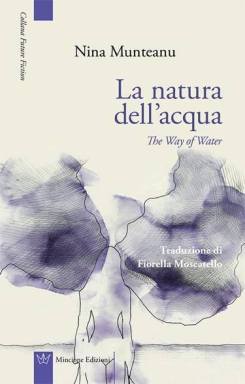 I named the story “The Way of Water.” It was about a young woman (Hilda) in near-future Toronto who has run out of water credits for the public iTap; by this time houses no longer have potable water and their water taps have been cemented shut; the only way to get water is through the public iTaps—at great cost. She is two metres from water—in a line of people waiting to use the tap—and dying of thirst.
“The Way of Water” captures a vision that explores the nuances of corporate and government corruption and deceit together with global resource warfare. In this near-future, Canada is mined of all its water by thirsty Chinese and US multinationals—leaving nothing for the Canadians. Rain has not fallen on Canadian soil in years due to advances in geoengineering and weather manipulation that prevent rain clouds from going anywhere north of the Canada-US border. If you’re wondering if this is possible, it’s already happening in China and surrounding countries.
 The story first appeared in 2015 in Future Fiction, edited by Francesco Verso, and in 2016 as a bilingual (English and Italian) book and essay published by Mincione Edizioni in Rome. The story was reprinted in magazines and anthologies several times since, including “Cli-Fi: Canadian Tales of Climate Change Anthology” (Exile Editions, Bruce Meyer, ed), in 2017, Future Fiction: New Dimensions in International Science Fiction (Francesco Verso & Bill Campbell, eds; Future Fiction / Rosarium Publishing, Rome and Greenbelt, MD) in 2018; and in Little Blue Marble Magazine (Katrina Archer, ed) in January, 2019. “The Way of Water” received generous praise from review sites and the press worldwide.
After the success of this short story, I realized that I needed to tell the larger story—how did the world—Canada—get to where Hilda was? Her mysterious mother, the limnologist Lynna who was taken away by the RCMP in 2063, clamored for more attention. I remembered that four-year old girl and her mother in the gallery at Maude Barlow’s talk on water politics. And I thought of my characters: young Lynna and her mother Una. How does a daughter of an activist mother behave and think? How best to express her voice?
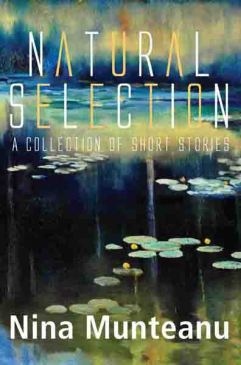 I had earlier written a short story that was a mix of correspondence (emails) and third person narrative (“The Arc of Time” in Natural Selection), which I felt captured the voices of the characters well. I realized that a diary by Lynna would be an ideal way for her to express her unique worldview and cynicism—yet allow her vulnerable humanity to reveal itself through this unique relationship with her diary. The remaining characters and their narratives emerged easily from there: Una, her activist mother; Daniel, her conspiracy theorist colleague (and her conscience); Orvil, the water baron (and lover she betrayed); and Hilda, her “wayward” supposedly mind-challenged daughter—who appears in the short story that takes place later.
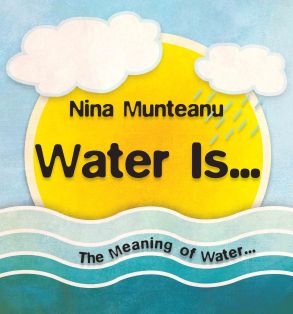 I had a lot of material; I had already been researching water issues and climate change in my activism as a science reporter. I had recently published “Water Is… The Meaning of Water”, essentially a biography of water, written from the perspective of mother, environmentalist and scientist. I had practiced as a limnologist for over twenty-five years and could mine my various personal experiences in the field, lab and office with genuine realism. I chose Robert Wetzel’s Limnology (the classic text book I used in my introductory limnology course) for quotes to each of Lynna’s entries; this added an opportunity to provide additional metaphor and irony through Lynna’s scientific voice. I placed the child Lynna (who was born in 2012) into actual events in Toronto, where I currently live. This pushed the story further into the area of documentary and blurred the lines between fiction and non-fiction to achieve a gritty and textured reality. Lynna also taught limnology at the University of Toronto, where I currently teach.
Just as “Water Is…” served as a watershed for all my relevant experiences as mother, environmentalist and scientist, “A Diary in the Age of Water” would galvanize many of my personal experiences, doubts, challenges and victories into compelling story. Although parts of the story wrote themselves, the entire book was not easy to write. There were times when I had to walk away from the book to gain some perspective—and optimism—before continuing. When I found myself drowning in Lynna’s voice, I invoked Hilda to guide me to shore. I found a balance that worked and compelled. Ultimately this opened to some of the best internal conflict and tension I have experienced in my writing.
Like water itself, A Diary in the Age of Water expresses through many vessels and in many perspectives, spanning hundreds of years—and four generations of women—with a context wider than human life. Through its characters, A Diary in the Age of Water explores the big question of humanity’s deadlock with planetary wellness and whether one is worth saving at the expense of the other. One of the characters asks Lynna the hard question: “If you had the chance to save the planet [stop the mass extinctions, deforestation and pollution ravaging the planet], but it was at the expense of humanity, would you do it?”
Water is, in fact, a character in the book—sometimes subtle and revealed in subtext, other times horrific and roaring with a clamorous voice. Water plays both metaphoric and literal roles in this allegorical tale of humanity’s final journey from home. The story explores identity and our concept of what is “normal”—as a nation and an individual—in a world that is rapidly and incomprehensibly changing—and in which each of us plays a vital role simply by doing or not doing.
“A Diary in the Age of Water” promises to leave you adjusting your frame of reference to see the world, yourself—and water—in a different way. “A Diary in the Age of Water” is scheduled for release by Inanna Publications in 2020.
Water drops (photo by Peter James)
Nina Munteanu is a Canadian ecologist / limnologist and novelist. She is co-editor of Europa SF and currently teaches writing courses at George Brown College and the University of Toronto. Visit www.ninamunteanu.ca for the latest on her books. Nina’s bilingual “La natura dell’acqua / The Way of Water” was published by Mincione Edizioni in Rome. Her non-fiction book “Water Is…” by Pixl Press (Vancouver) was selected by Margaret Atwood in the New York Times ‘Year in Reading’ and was chosen as the 2017 Summer Read by Water Canada. Her novel “A Diary in the Age of Water” will be released by Inanna Publications (Toronto) in May 2020.
Audiobook Blog Tour of The Splintered Universe Trilogy: Book 2 “Inner Diverse”
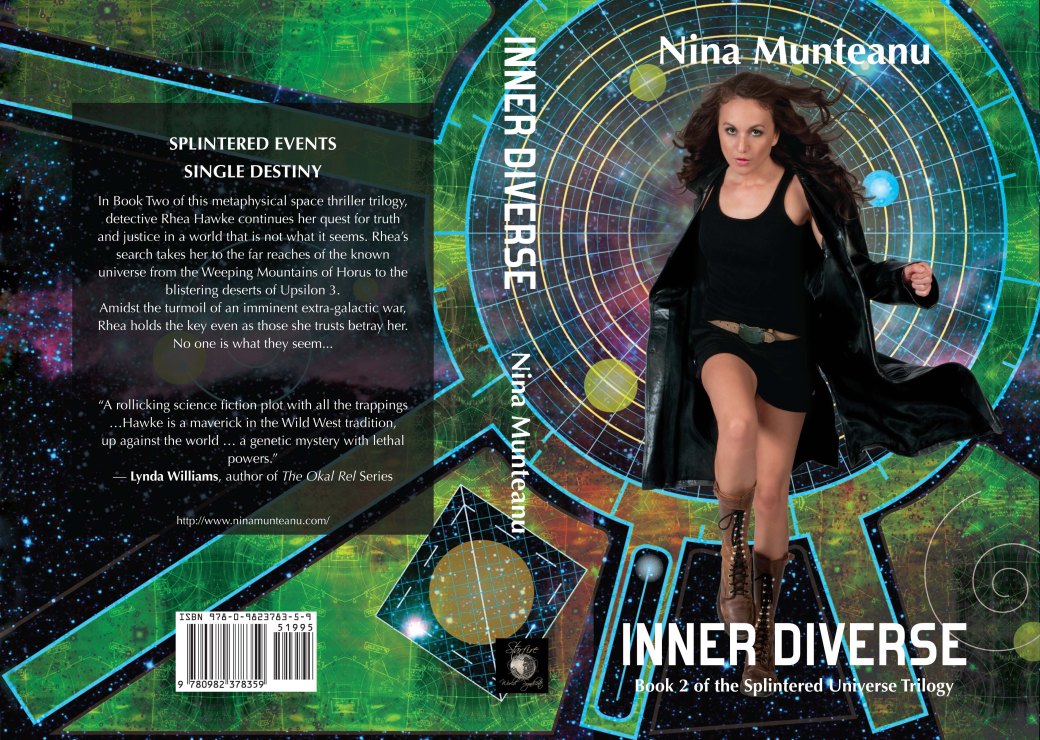
We continue our Audiobook series blog tour with Book 2 “Inner Diverse” of Nina Munteanu’s “The Splintered Universe Trilogy,” a science fiction detective adventure, starring the indomitable Galactic Guardian, Rhea Hawke.
“Dawn Harvey breathed incredible life into the lead character, Rhea Hawke–both sarcastic and vulnerable at the same time; a detective with a cynical edge, and sultry voice tinged with wiry sarcasm. The story unfolded through Rhea’s narrative like an old film noir as she unraveled mysteries that led to the greatest one: her own.”–Amazon Review
Book 1, Outer Diverse: January 8-14
Book 2, Inner Diverse: January 15-21
Book 3, Metaverse: January 21-28
The tour with blog sites includes spotlights, reviews, audio excerpts, guest posts, interviews of author, narrator (and character Rhea Hawke!)
Join the second part of the audiobook tour with “Inner Diverse“, Book 2 of the trilogy.
Rhea Hawke (Vali Gurgu)
In Inner Diverse (Book Two) of this metaphysical space thriller trilogy, detective Rhea Hawke continues her quest for truth and justice in a world that is not what it seems. Rhea’s search takes her to the far reaches of the known universe from the Weeping Mountains of Horus to the blistering deserts of Upsilon 3. Amidst the turmoil of an imminent extra-galactic war, Rhea holds the key even as those she trusts betray her. No one is what they seem…

“An action packed adventure! I really enjoyed the narration by Harvey for this second book. She has a large cast of characters to portray and she did them all excellently! I felt like each was easily distinguishable and had their own quirks. The story … had a great amount of action to keep me interested the whole time. I feel like I truly understand more about this crazy and exciting world. I can’t wait to see how this all ends up, but I’m now 100% invested in Reah and her companions! ”–The Book Addict
TOUR SCHEDULE for INNER DIVERSE
Follow the itinerary for “Inner Diverse“, Book 2 of the trilogy (Jan 15-21):
Jan. 15th:
Assorted Nonsense (Narrator Interview)
Jan. 16th:
Lilly’s Book World (Review, Spotlight + Audio Excerpt)
Jan. 17th:
Jazzy Book Reviews (Spotlight + Audio Excerpt, Rhea’s Proverbs, Giveaway)
Jan. 18th:
Dab of Darkness Book Reviews (Review, Narrator Interview & testimonial, Rhea’s Proverbs)
Jan. 19th:
The Book Addict’s Reviews (Review, Audio Excerpt, Narrator Interview & testimonial, Rhea’s Proverbs)
Jan. 20th:
Book Addict (Review, Spotlight + Audio Excerpt, Narrator Interview, Giveaway)
Jan. 21st:
Chapter Break (Spotlight + Audio Excerpt, Narrator Interview, Guest Post)
“A master of metaphor, Munteanu turns an adventure story into a wonderland of alien rabbit holes… a fascinating and enthralling read.” (Craig Bowlsby, author of Commander’s Log)
“A rollicking science fiction plot with all the trappings…Hawke is a maverick in the wild west tradition…a genetic mystery with lethal powers.” (Lynda Williams, author of Okal Rel series)

Remaining tour continues with Book 3 (“Metaverse“) Jan 22-28. Come join us and share your thoughts.

