
I met my fellow Romanian author friend Lucia Monica Gorea several years ago at a writer’s function in Vancouver and our (Romanian) passion for writing and storytelling made us fast friends. At the time Lucia was teaching writing at UBC and was co-hosting a radio show on Vancouver Coop Radio. She interviewed me several times about my science fiction publications, about water, my limnology and my eco-fiction.

Co-host Lucia with Nina and Coop Radio team, Vancouver, BC

Nina Munteanu and Lucia Monica Gorea at Gaudeamus Book Fair, Bucharest, Romania
We also together attended the launch of our books with Romanian publisher Editura Paralela 45 in Bucharest Romania at the Gaudeamus Book Fair. I was launching my translated book on fiction writing, “Manual de Scriere Creativa” (The Fiction Writer: Get Published, Write Now!) and Lucia was launching her English / Romanian translation of Petre Ispirescu’s fairy tale “The Morning Star and the Evening Star.”
I’ve since moved to Ontario and teach writing at the University of Toronto and Lucia moved to Nanaimo, BC, where she teaches at Vancouver Island University.
I recently interviewed Lucia, who just reissued her most recent children’s book “Yukon,” a wonderfully illustrated story about a young polar bear who loses his mother and goes on a perilous adventure:
- You recently republished your children’s climate fiction book “Yukon” through Bestsellers Publishing Academy. Tell us about the book.
Yukon, the Polar Bear is a story that brings awareness about global warming and climate change and teaches children how important our planet is. The reader is not only drawn into the story, but he or she learns how climate change affects polar bear habitat, and how polar bears will eventually become extinct if we don’t take action now.

Yukon and his mom
Since younger children can’t easily grasp concepts such as, glaciers and sea ice melting, or ocean acidification, they can better understand the issues our planet faces at the moment, through stories that are age appropriate.
- What inspired you to write “Yukon”?
I have always been fascinated by polar bears. I believe that they are so cool.
Seeing that their habitat is in huge danger, I wanted to bring my small apport to educate children, by letting them know how important our planet is through this children’s book.

Yukon alone on a melting ice float after losing his mother
- Who do you hope will read “Yukon”?
“Yukon” is intended for grade school children, ages 7+, for parents, and teachers alike. The topic of climate change can initiate interesting discussions and debates at school or home, during circle time, book clubs, or science classes. Teachers can assign research topics and invite children to further explore polar bear habitat, and learn how the Arctic animals are being affected by global warming.
- What does the polar bear represent in our awareness and fight against climate change?
Polar bears represent a “healthy planet.” As climate change forces polar bears to spend longer time offshore, they come in contact with Arctic coastal communities. Unfortunately, these interactions sometimes end badly for both humans and bears. At the same time, the melting of the ice is resulting in more polar bears spending longer periods on land.
The expansion of offshore petroleum installations and operations in the Arctic are expected to increase in number. This expansion would affect polar bears and their habitat in many negative ways. As oil tankers and cargo ships in Arctic waters increase, so do the risks of polar bear disturbance. It is our responsibility to protect these iconic creatures. It is no wonder that the polar bear is of great cultural significance to the Canadian people. For the Inuit and many northern communities, polar bears are especially significant culturally, spiritually, and economically.

Jasper teaches Yukon how to survive on terra firma
- In your book, Yukon meets a brown bear named Jasper and Jasper’s family teaches Yukon how to feed and take care of himself in his new environment. How close do you think this matches what is already happening in our northern regions as melting sea ice is forcing polar bears onto dry land into northern communities and the Inuvialuit Game Council reports that more and more grizzly bears are moving into Canada’s High Arctic? Is this heralding a future written by climate change?
Experts say that interbreeding is happening more frequently now due to climate change.
With climate change, grizzly bears are moving further north, so there is more overlap between grizzly bears and polar bears in terms of their range. A hybrid bear is unofficially called a grolar bear if the sire is a grizzly bear, and a pizzly bear if the sire is a polar bear. A third potential name is nanurlak — a word combining the Inuit-language words for polar bear and grizzly, nanuk and aklak.

Grizzly bear + Polar bear = Pizzly or Grolar (depending on who the mother bear is)
Grizzly bears in Alaska and Canada are moving north as their environment warms, bringing them into contact with polar bears located on the coastline
“…predicting that far into the future is a challenge and it really depends on what we do about global warming as a whole,” says Andrew Derocher, bear biologist.
- Will you do an educational tour with the book?
 Absolutely! As soon as COVID- 19 will not pose a threat to BC schools, and to schools around the country, and when the students are safe to return to class, I plan a reading and educational tour on Vancouver Island, then I will visit various schools within the province.
- Where can individuals and schools purchase “Yukon”?
“Yukon” can be purchased in both paperback and electronic format on Amazon, Draft to Digital, Smashwords, Ingram, and Barnes and Noble.
- What projects are you working on next?
I have already started working on two projects. One is a How-to book titled, “Write! Publish! Sell!” – and the second book is a collection of supernatural short stories that take place in my native Transylvania, “The Hills of Magherani.”
On the podcast “Age of Water”, co-host Claudiu Murgan and I interviewed Lucia about her book, about young readers and climate change, and about writing in general. The podcast episode with Lucia will air in December, 2020.
More about Lucia Monica Gorea

Lucia Monica Gorea
Lucia Monica Gorea, is a Canadian poet and award-winning author of fifteen books spanning multiple genres including poetry, short stories, a historical novel, ESL texts, children’s books, fairy tales, and translations.
The Transylvanian province of Romania, which filled Lucia with literary passion inspired her to write at a young age. She graduated from the University of Bucharest with degrees in English, French and Linguistics then earned her PhD in English and Education in the USA.
Her interest in history inspired The Impaler, her debut novel, which tells the captivating and intriguing story of Vlad the Impaler. She has also written Journey Through My Soul—a collection of love and mystical poems, Welcome to America! ESL Games and Classroom Activities, and Speak English for Success. Lucia also wrote several children’s stories that were inspired by her son, Alex: How Alex Saved Christmas, The Crow That Swallowed a Pearl, Halloween in Transylvania, and Yukon, the Polar Bear.

Lucia with young girl, reading her translated book at Gaudeamus
Lucia translated several fairy tales and poetry books from Romanian into English: The Enchanted Turtle, Aleodor the Emperor, The Morning Star and the Evening Star, and The Enchanted Pig, fairy tales authored by Petre Ispirescu.
Lucia was the keynote speaker at the 8th International Symposium on Translation, Interpretation, and Terminology in Havana (2013). Lucia currently teaches English courses at Vancouver Island University in British Columbia, and graduate studies at Atlantic International University in the United States.
Lucia founded BestSellers Publishing Academy – Your Story Must Be Told in 2019. She also founded Poetry Around the World, Monica’s Writers’ Café and Poets and Writers’ Café, online groups. She hosted radio (World Poetry Café Radio Show) and television poetry shows (Poetry Around the World) in Portland, Oregon, Vancouver, and Nanaimo, BC.
More about the Polar Bear
Temperatures in the Arctic are rising at least twice as fast as the global average and sea ice cover is diminishing by nearly four per cent per decade.
The primary habitat of the polar bear is sea ice, which they use to hunt seals. Polar bears live in the Arctic regions of Canada, Greenland/Denmark, Norway, Russia and the United States. The primary habitat of the polar bear is sea ice, which they use to hunt seals. Polar bears feed on ringed seals that live at the ice edge; the bears get two thirds of the energy they need for the entire year in late spring and early summer. Sea ice loss due to climate change poses the single largest threat to polar bear numbers according to a recent comprehensive review. As the ice retreats earlier in spring and forms later in winter, the bears have less time to hunt prey. Consequences mean that the bears average weight declines and fewer cubs survive; the ones that do are smaller. Warming has also caused bear dens to collapse, trapping a female’s young.
Scientists’ best estimate is that there’s a 70% chance the global population of polar bears will fall by more than a third within the next three generations.

Polar bear cubs in their den

Nina Munteanu is a Canadian ecologist / limnologist and novelist. She is co-editor of Europa SF and currently teaches writing courses at George Brown College and the University of Toronto. Visit www.ninamunteanu.ca for the latest on her books. Nina’s bilingual “La natura dell’acqua / The Way of Water” was published by Mincione Edizioni in Rome. Her non-fiction book “Water Is…” by Pixl Press (Vancouver) was selected by Margaret Atwood in the New York Times ‘Year in Reading’ and was chosen as the 2017 Summer Read by Water Canada. Her novel “A Diary in the Age of Water” was released by Inanna Publications (Toronto) in June 2020.

 Our predictions and visions of the future are certainly predicated on our perceptions of the present and the past. So, what happens when yesterday’s “future” collides with today’s past? Well, retro-fiction, alternate history and steam-punk, you quip, eyes askance with mischief: edgy sociopathic Sherlock Holmes with bipolar or obsessive /compulsive tendencies; flying aircraft carriers in Sky Captain and the World of Tomorrow, robot-like workers of Metropolis…
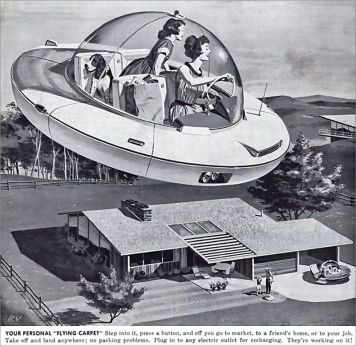
 There are, in most cases, no technological impediments to the flying car, the jetpack, and moon-bases; only cultural ones. “These SF predictions ought to be viewed as visions of where we could be, as opposed to where we will be, or, keeping Bradbury in mind, visions of where we don’t want to go and, thankfully, have mostly managed to avoid to date,” says Steve Davidson of Grasping for the Wind. “Perhaps it’s all cultural,” he adds.
 George Orwell wrote his dystopian satire in 1949 about a mind-controlled society in response to the Cold War. The book was a metaphor “against totalitarianism and for democratic socialism,” said Orwell in his 1947 essay Why I Write, adding, “Good prose is like a windowpane.” Was Orwell’s Nineteen Eighty-Four a failed novel because the real 1984 didn’t turn out quite like his 1984? Hugo Award-winning novelist Robert J. Sawyer suggests that we consider it a success, “because it helped us avoid that future. So just be happy that the damn dirty apes haven’t taken over yet.”
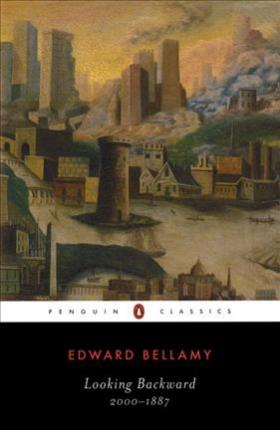 A hundred years before 1984, Edward Bellamy published Looking Backward, “a romance of an ideal world”. It tells the story of a young man who falls into a hypnotic sleep in 1887, waking up in 2000 when the world has evolved into a great socialist paradise. It sold over a million copies and ranked only behind Uncle Tom’s Cabin and Ben-Hur: A Tale of the Christ as the top best-seller of the era. Looking Backward laid out a futuristic socialism, or was it a socialistic future?
 In a foreward to a later printing of Brave New World years after it was first published, Aldous Huxley explained why, when given the chance to revise the later edition, he left it exactly as it was initially written twenty years earlier:
 We are now living in the Age of Water. Water is the new “gold”, with individuals, corporations and countries positioning themselves around this precious resource. Water is changing everything. The Age of Water Podcast covers anything of interest from breaking environmental news to evergreen material. This also includes human interest stories, readings of eco-literature, discussion of film and other media productions of interest.
 Proulx immerses the reader in rich sensory detail of a place and time, equally comfortable describing a white pine stand in Michigan and logging camp in Upper Gatineau to a Mi’kmaq village on the Nova Scotia coast or the stately Boston home of Charles Duquet. The foreshadowing of doom for the magnificent forests is cast by the shadow of how settlers treat the Mi’kmaq people. The fate of the forests and the Mi’kmaq are inextricably linked through settler disrespect and a fierce hunger for “more.”
 “The reader comes to realize that the novel isn’t really about the human characters so much as it is about the forests,” Gus Powell of
  In my recent novel
  The endocrine system is a set of glands and the hormones they produce that help guide and regulate the development, growth, reproduction and behavior of most living things (yes plants too!). Some hormones are also released from parts of the body that aren’t glands, like the stomach, intestines or nerve cells. These usually act closer to where they are released. The endocrine system is made up of glands, which secrete hormones, and receptor cells which detect and react to the hormones. Hormones travel throughout the body, acting as chemical messengers, and interact with cells that contain matching receptors. The hormone binds with the receptor, like a key into a lock. Some chemicals, both natural and human-made, may interfere with the hormonal system. They’re called endocrine disruptors.


 My short story “Out of the Silence,” which appeared in the Spring 2020 issue of
 In her 1997 biography Rachel Carson: Witness for Nature, historian and science biographer Linda Lear wrote: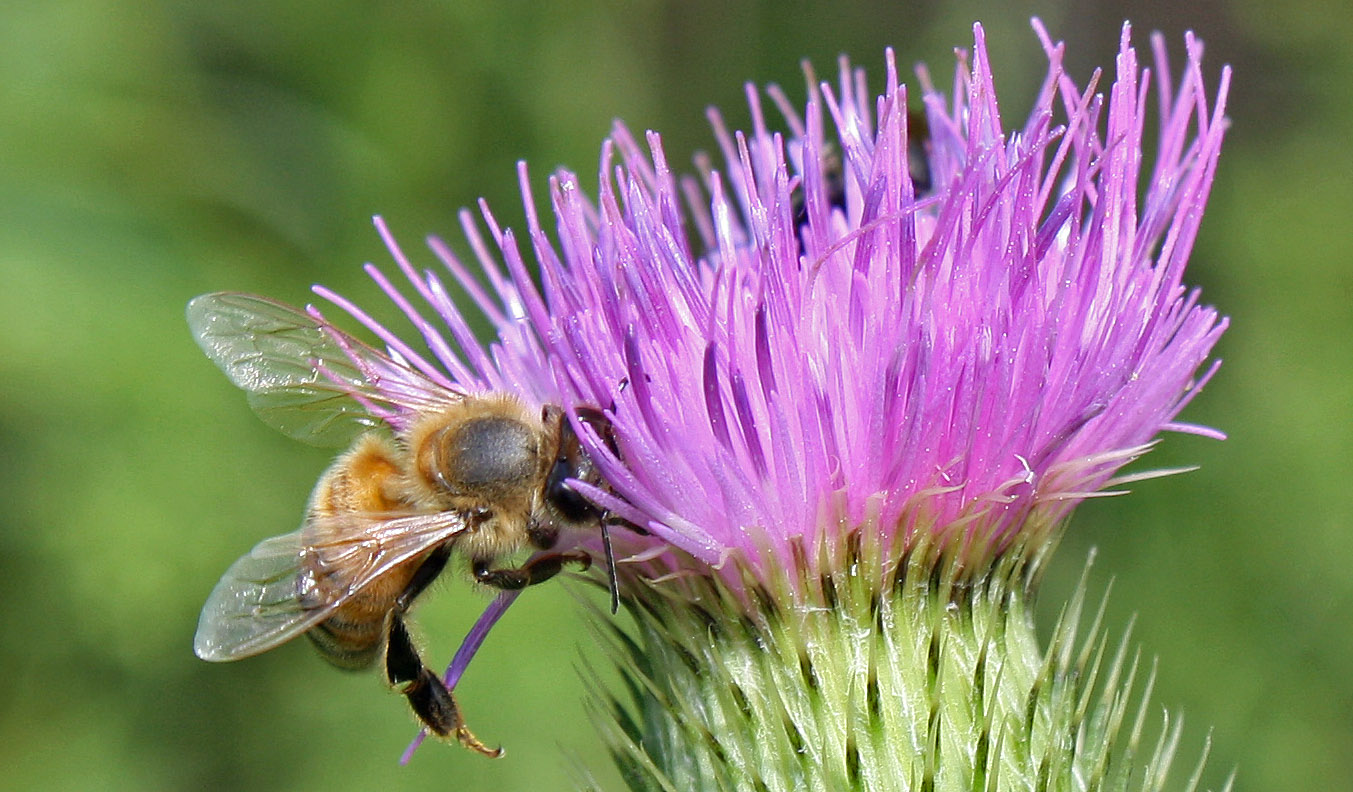
 “Miss Rachel Carson’s reference to the selfishness of insecticide manufacturers probably reflects her Communist sympathies, like a lot of our writers these days. We can live without birds and animals, but, as the current market slump shows, we cannot live without business. As for insects, isn’t it just like a woman to be scared to death of a few little bugs! As long as we have the H-bomb everything will be O.K.”


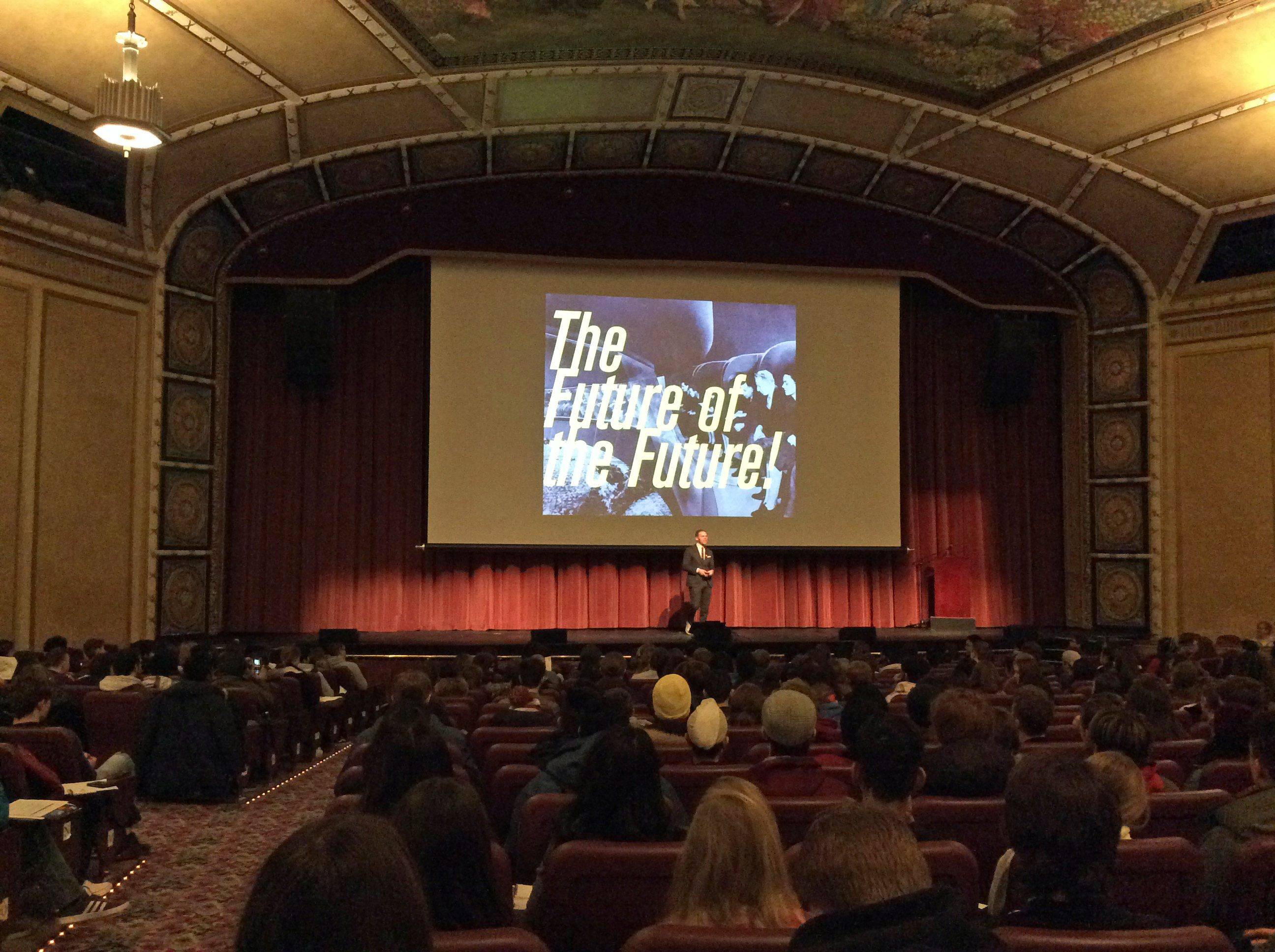
 Journalist, urbanist and futurist Greg Lindsay gave a rousing keynote speech to start the conference. Greg spoke about the future of cities, technology, and mobility. He is the director of applied research at NewCities and director of strategy at its mobility offshoot CoMotion. He also co-authored the international bestseller

 We then discussed future implications of water scarcity (and geopolitical conflict) and some of the things individuals and communities can do. Much of the talk drew from my recent book
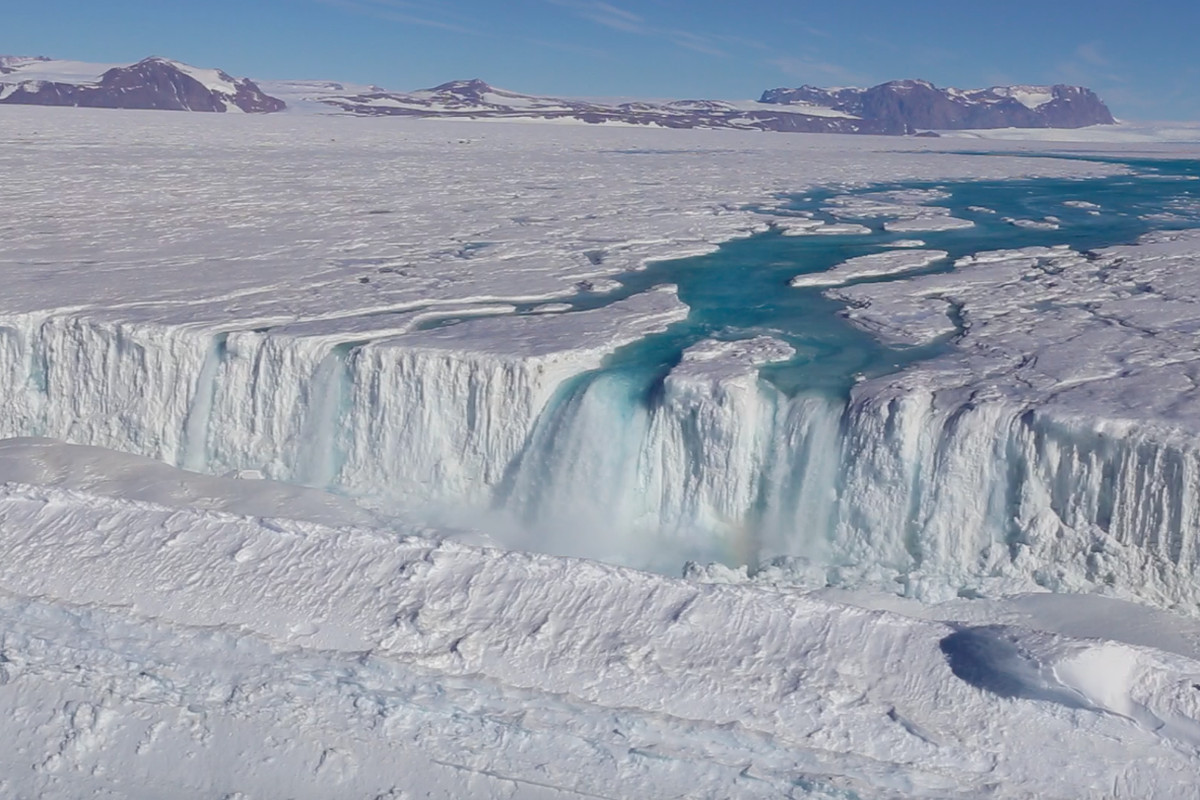
  Craig Russell begins his eco-thriller Fragment with a TV interview of glaciologist Kate Sexsmith in Scott Base Antarctica. The interview is interrupted by what turns out to be four runaway glaciers that have avalanched into the back of the Ross Ice Shelf and a fragment the size of Switzerland surges out into the open sea. Hence the title: Fragment.


 In my novel “



 Both Daniels are talking about the alarming rate at which
  Research shows that consumption and/or exposure to many common constituents of urban living can decrease fertility, increase miscarriage, spontaneous abortion, and lower auto-immune systems. Examples include car exhaust, pesticides, common detergents, hair dyes, cleaning solvents, oil based paints, adhesives, gasoline; and consumption of MSG, coffee, alcohol.
 Leaning on his microscope, Daniel went on, “Wherever there’s a sewage treatment plant, pulp and paper mill, or herbicides and pesticides in a stream, you get endocrine disruption, which causes more female or intersex fish populations…[Degradation products of surfactants used in commercial and household detergents] inhibit breeding in male fish. And herbicides like atrazine—”
 Dr. Marilyn F. Vine at the University of North Carolina demonstrated that smoking men had lower sperm counts by 13-17%. Smokers also had more abnormal sperm. Likewise, women who smoked experienced more spontaneous abortions, early menopause and abnormal oocytes. Follicular fluid also contained high levels of cadmium, a heavy metal present in cigarettes, and cotininie, a metabolite of nicotine.
 Nina Munteanu Writing Coach