Do you believe in serendipity or destiny? That all things are interconnected in a flowing web that responds like a super consciousness?
Swiss psychiatrist Carl Jung called it “meaningful coincidence.” Bohm used the term “implicate order”; the Vedas call it “akasha; Goethe gave it the name “the ground of all being”; and Mae-Wan Ho described it as “quantum entanglement”: when puzzle pieces cooperatively arrange themselves into a symbiotic pattern of synchronicity to provide meaning.
The universe provides…
I’ve come to rely on it in my writing: moments when key things of interest reveal themselves to me just when I need them. I call it writing in sync. Time and again, I’ve serendipitously discovered just what I needed for a plot point or something to complete a backstory: a news event, a conversation with a friend, or an image on the internet. Synchronicity occurs all around us. Birds flying in formation during migration. Electrons synchronizing by the billions and passing through impenetrable barriers. Fireflies flashing in harmony.
Rupert Sheldrake , British botanist and author of The Rebirth of Nature, suggests that “our minds are extended in both space and time with other people’s minds, and with the group mind or cultural mind by way of their connection to the collective unconscious.” Sheldrake posits that we tune into archetypal fields or patterns and “our minds are much broader than the ‘things’ inside our brains. He’s talking about Jungian archetypal gestalt synchronicity. The notion of consciousness as a global phenomenon that occurs everywhere in the body, not just our brains. “Consciousness, at its most basic, [is] coherent light,”writes science journalist Lynne McTaggart in her book The Field.

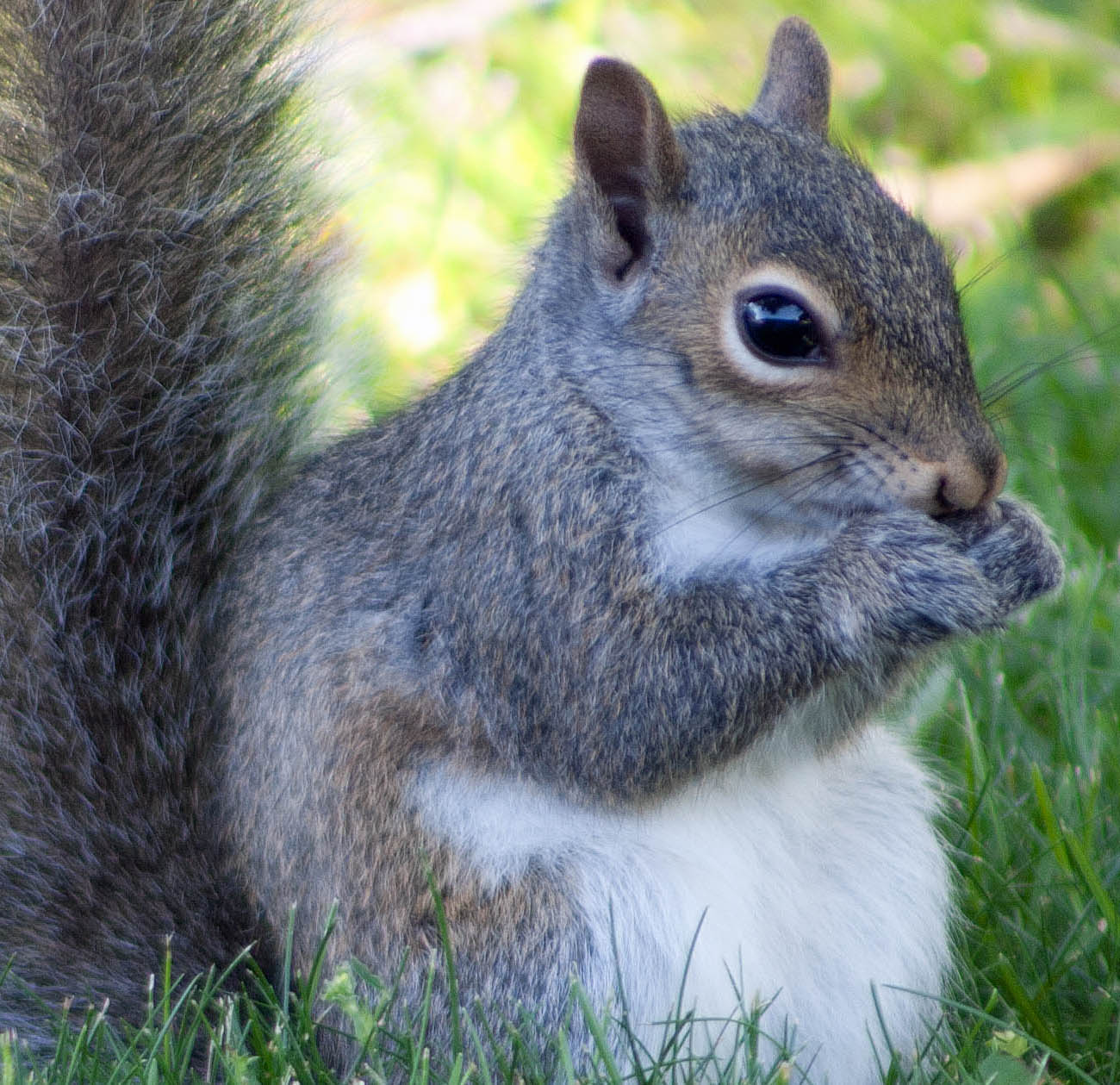
It started when I was lunching with good friend Merridy and we were observing several young black and grey squirrels stretched out, lying down on the grass or a branch of the silver maple. They were obviously litter mates and had just finished a playful romp on the grass with sneak-ups, great leaps in the air, twirls and ‘attacks’ and rolls. Such fun! Merridy and I agreed that they looked satisfied and happy after their play, stretched out and languishing in the sun. We talked about how playful squirrels were and how science didn’t seem to acknowledge this. That led to a discussion on people’s perception being largely based on worldview. I shared how we see only what we’re prepared to see and we discussed how science, in its preoccupation with objectivity, can take the ‘soul’ out of life by not observing as much as it could by observing. The concept of anthropomorphism—ascribing exclusively human traits and behaviours to other animals—is based on our own limited definition of what is an exclusively human trait. Who unequivocally proved that only humans are capable of thought or feelings? This recalled a quote of Goethe that I used in the preface of my book Water Is…: “Whatever you cannot calculate, you do not think is real.” We are often blinded by our beliefs and hubris.

During the 1600s in what is ironically called the “Age of Enlightenment,” the highly regarded philosopher René Descartes denied thought to animals; he claimed that animals could not process pain through thought and certainly not through emotions such as joy, sadness, or embarrassment. Only humans were conscious, had souls, and were capable of meaningful communication and language. What he failed to observe—in his own pet dog, even—was that animals other than humans are capable of these thoughts and emotions. One need only pay attention through an unrestricted lens to recognize their expressions and behaviours.
In western exploitive society and religions particularly, this Cartesian view has persisted into the present day with those who still argue that animals are incapable of altruism or empathy, can’t reason or calculate, are bound by the “selfish gene”, and don’t have souls. These persist in the face of scientific evidence to the contrary and ironically serve an economic and social worldview of Nature exploitation.
Then, in a wonderfully serendipitous moment of synchronicity, Merridy announced the next day that she had just read the following passage by David George Haskell in his recent book The Forest Unseen. It was as though he had overheard our conversation about the squirrels:
Four grey squirrels loaf in the bright upper branches of a dead shagbark hickory tree fifty meters down the slope. I watch them for an hour, and mostly they loll in the sun, limbs sprawled. They seem companionable, sporadically nibbling the fur on one another’s hind legs or tails. Occasionally one will break from sunbathing and chew the fungus-encrusted dead branches, then return to sit silently with the other squirrels.
This scene of scoured tranquility makes me unaccountably delighted. Perhaps I so often see and hear squabbling among the squirrels that today’s ease seems particularly sweet. But something more is behind my delight; I feel freed from some burden carried by my over-trained mind. Wild animals enjoying one another and taking pleasure in their world is so immediate and so real, yet this reality is utterly absent from textbooks and academic papers about animals and ecology.
This insight is not that science is wrong or bad. On the contrary; science, done well, deepens our intimacy with the world. But there is a danger in an exclusively scientific way of thinking. The forest is turned into a diagram; animals become mere mechanism; nature’s workings become clever graphs. Today’s conviviality of squirrels seems a refutation of such narrowness. Nature is not a machine. These animals feel. They are alive; they are our cousins, with the shared experience that kinship implies.
And they appear to enjoy the sun, a phenomenon that occurs nowhere in the curriculum of modern biology.
Sadly, modern science is too often unable or unwilling to visualize or feel what others experience. Certainly science’s “objective” gambit can be helpful in understanding parts of nature and in freeing us from some cultural preconceptions. Our modern scientific taste for dispassion when analyzing animal behaviour formed in reaction to the Victorian naturalists and their predecessors who saw all nature as an allegory confirming their cultural values. But a gambit is just an opening move, not a coherent vision of the whole game. Science’s objectivity sheds some assumptions but takes on others that, dressed up in academic rigour, can produce hubris and callousness about the world. The danger comes when we confuse the limited scope of our scientific methods with the true scope of the world. It may be useful or expedient to describe nature as a flow diagram or an animal as a machine, but such utility should not be confused with a confirmation that our liming assumptions reflect the shape of the world.
Not coincidentally, the hubris of narrowly applied science serves the needs of the industrial economy. Machines are bought, sold, and discarded; joyful cousins are not.
David George Haskell, “The Forest Unseen”


Nina Munteanu is a Canadian ecologist / limnologist and novelist. She is co-editor of Europa SF and currently teaches writing courses at George Brown College and the University of Toronto. Visit www.ninamunteanu.ca for the latest on her books. Nina’s bilingual “La natura dell’acqua / The Way of Water” was published by Mincione Edizioni in Rome. Her non-fiction book “Water Is…” by Pixl Press(Vancouver) was selected by Margaret Atwood in the New York Times ‘Year in Reading’ and was chosen as the 2017 Summer Read by Water Canada. Her novel “A Diary in the Age of Water” was released by Inanna Publications (Toronto) in June 2020.






 Nina Munteanu is an ecologist and internationally published author of award-nominated speculative novels, short stories and non-fiction. She is co-editor of Europa SF and currently teaches writing courses at George Brown College and the University of Toronto. Visit

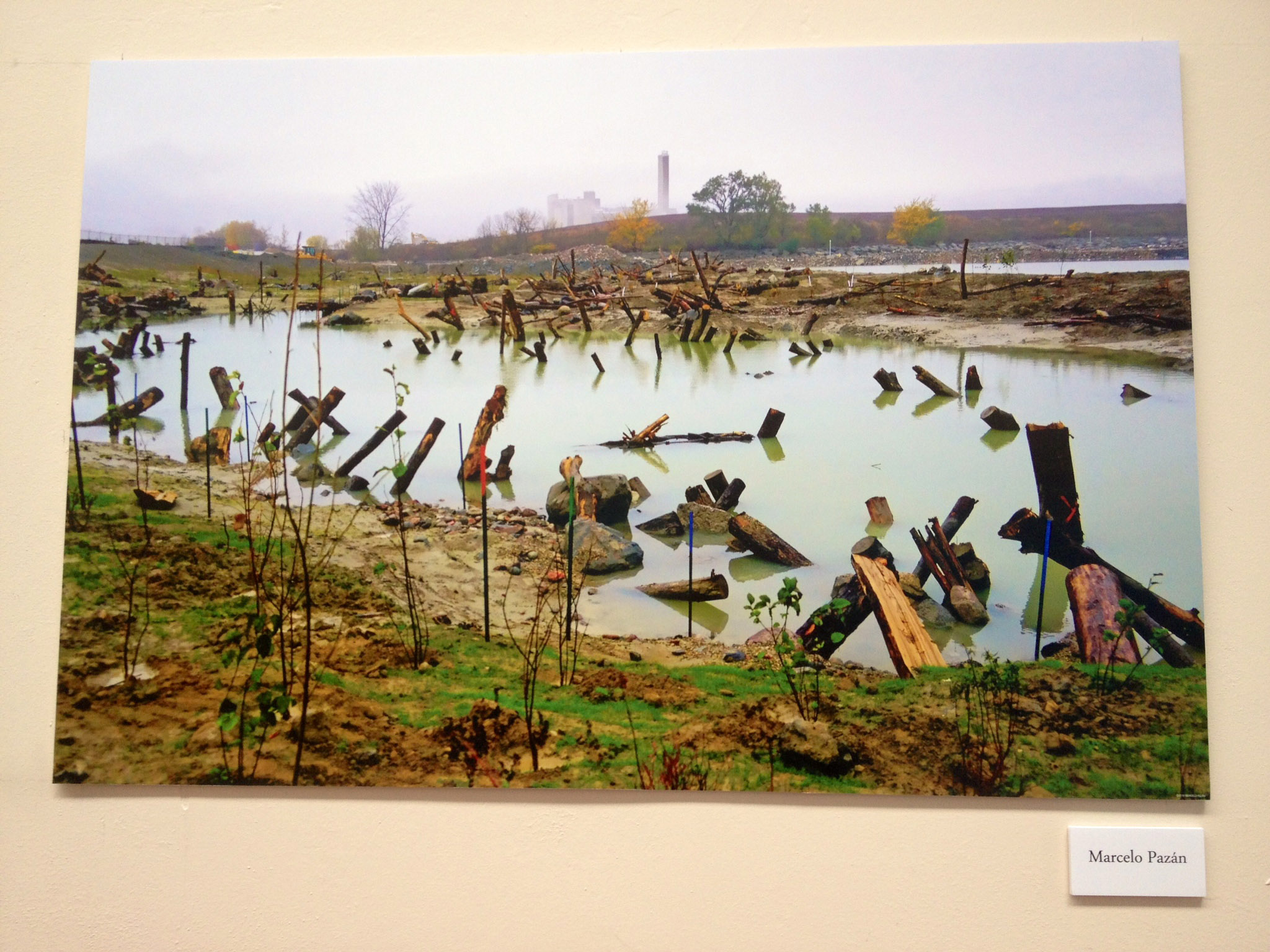
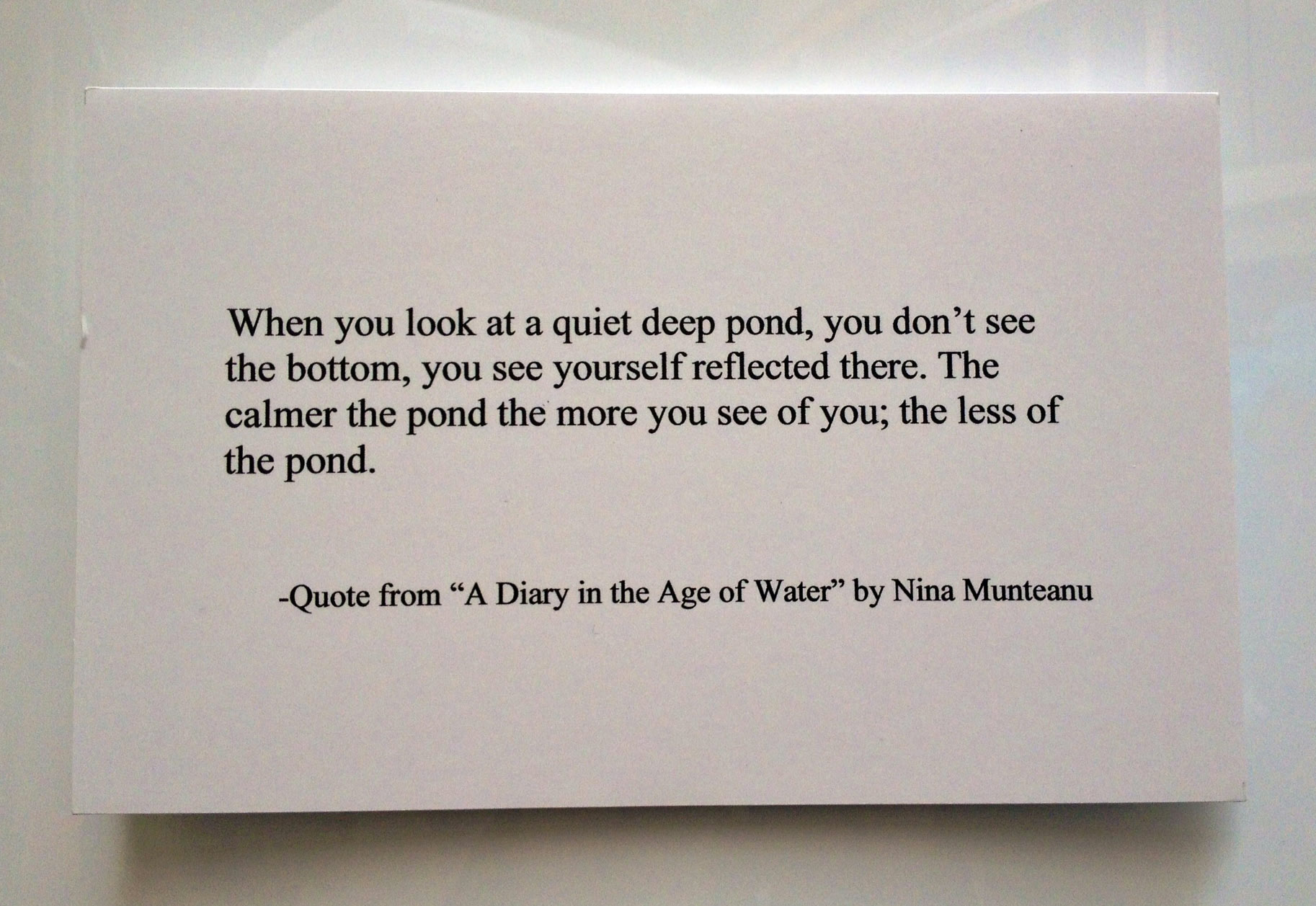 Reiterating Jim Tovey’s earlier comment on the water treatment plant as its own sculpture-art, Munteanu celebrated the location and the nature of the exhibit: “When technology, art and ecology are celebrated together, you get magic.”

 Nina Munteanu is an ecologist, limnologist and internationally published author of award-nominated speculative novels, short stories and non-fiction. She is co-editor of Europa SF and currently teaches writing courses at George Brown College and the University of Toronto. Visit
 In “Outer Diverse”, the first book of “The Splintered Universe Trilogy” (Starfire), Galactic Guardian Rhea Hawke speaks with Ka, an alien mystic, about music, frequency and harmony. And something called “the music of the spheres”. Says Ka:
 imprint,” Ka continued, now leaning forward with his cup in both hands, “and said that in the vital power of the human being, ignited at birth, that remembered image glows. That geometric-harmonic imprint is the music that impels each listener to dance … from the particle to the cosmic. Your own heart finds its shifting harmony between excessive order and complete randomness, encompassing complex variability—a symphony—in its beating pattern. Sound—vibration—is the language of the mind and the secret to creation.”
 Nina Munteanu is an ecologist and internationally published author of award-nominated speculative novels, short stories and non-fiction. She is co-editor of Europa SF and currently teaches writing courses at George Brown College and the University of Toronto. Visit
 How many of you are still running around preparing for the Christmas celebration or secular family festivity? Buying that last minute gift you’d forgotten or were chasing down since a bazillion days ago? Or making last minute changes to your travel plans, house-cleaning for guests, mailing of cards or parcels or meal preparations?
 My male cat, smelling fresh from outside, found his rightful place on my lap and settled there, pinning me down with love. And there, as I breathed in the scent of wax and fir and cat I found myself again.

 Early on in the recent science fiction movie Interstellar, NASA astronaut Cooper declares that “the world’s a treasure, but it’s been telling us to leave for a while now. Mankind was born on Earth; it was never meant to die here.” After showing Cooper how their last corn crops will eventually fail like the okra and wheat before them, NASA Professor Brand answers Cooper’s question of, “So, how do you plan on saving the world?” with: “We’re not meant to save the world…We’re meant to leave it.” Cooper rejoins: “I’ve got kids.” To which Brand answers: “Then go save them.”
 “Scientists are telling us that the whole territory of modern history, from the end of World War II to the present, forms the threshold to a new geological epoch,” adds Jonsson. This epoch succeeded the relatively stable natural variability of the Holocene Epoch that had endured for 11,700 years. Scientists Paul Crutzen and Eugene Stoermer call it the Anthropocene Epoch. Suggestions for its inception vary from the time of the Industrial Revolution in the late 1700s with the advent of the steam engine and a fossil fuel economy to the time of the Great Acceleration—the economic boom following World War II.
 The Great Acceleration describes a kind of tipping point in planetary change and succession resulting from a rising market society.
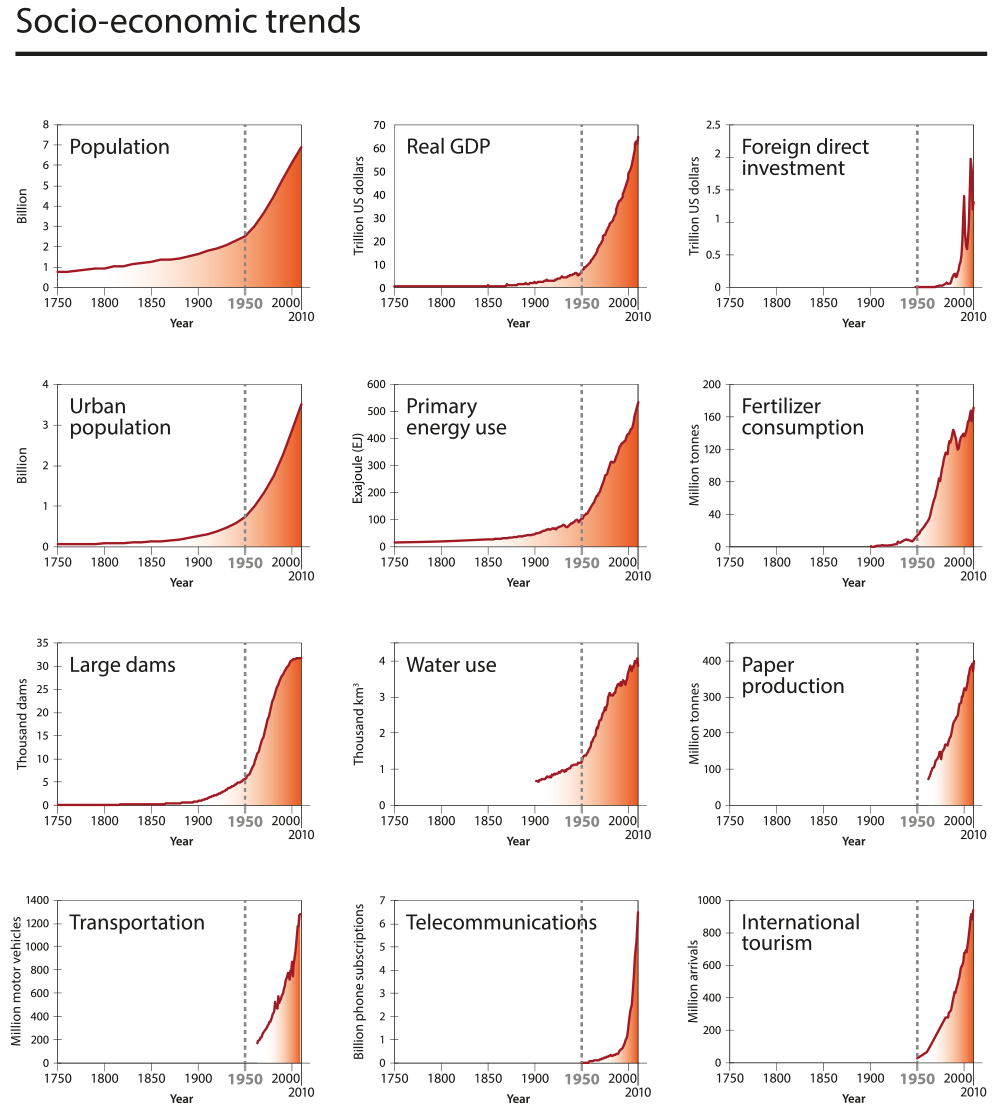 The Great Acceleration encompasses the notion of “planetary boundaries,” thresholds of environmental risks beyond which we can expect nonlinear and irreversible change on a planetary level. A well known one is that of carbon emissions. Emissions above 350 ppm represent unacceptable danger to the welfare of the planet in its current state; and humanity—adapted to this current state. This threshold has already been surpassed during the postwar capitalism period decades ago.
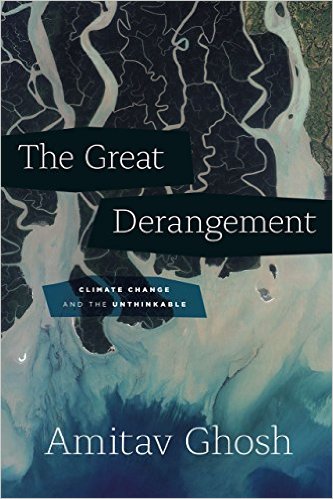 In Amitav Ghosh’s diagnosis of the condition of literature and culture in the Age of the Anthropocene (The Great Derangement: Climate Change and the Unthinkable), he observes that the literary world has responded to climate change with almost complete silence. “How can we explain the fact that writers of fiction have overwhelmingly failed to grapple with the ongoing planetary crisis in their works?” continues Jonsson, who observes that, “for Ghosh, this silence is part of a broader pattern of indifference and misrepresentation. Contemporary arts and literature are characterized by ‘modes of concealment that [prevent] people from recognizing the realities of their plight.’”
 Jonsson tells us that bourgeois reason takes many forms, showing affinities with classical political economy, and—I would add—in classical physics and Cartesian philosophy. From Adam Smith’s 18th Century economic vision to the conceit of bankers who drove the 2008 American housing bubble, humanity’s men have consistently espoused the myth of a constant natural world capable of absorbing infinite abuse without oscillation. When James Lovelock and Lynn Margulis proposed the Gaia Hypothesis in the 1970s, many saw its basis in a homeostatic balance of the natural order as confirmation of Nature’s infinite resilience to abuse. They failed to recognize that we are Nature and abuse of Nature is really self-abuse.
 Louise Fabiani of Pacific Standard suggests that novels are still the best way for us to clarify planetary issues and prepare for change—even play a meaningful part in that change. In her article “The Literature of Climate Change” she points to science fiction as helping “us prepare for radical change, just when things may be getting too comfortable.” Referring to our overwhelming reliance on technology and outsourced knowledge, Fabiani suggests that “our privileged lives (particularly in consumer-based North America) are built on unconscious trust in the mostly invisible others who make this illusion of domestic independence possible—the faith that they will never stop being there for us. And we have no back-ups in place should they let us down.” Which they will—given their short-term thinking.
 In my interview with Mary Woodbury on
  My own works of

 Nina Munteanu Writing Coach