Nina Munteanu Talks to Hi-Sci-Fi Radio…

darwins-paradoxHi-Sci-Fi Radio (a podcast radio show out of CJSF 90.1FM in Burnaby, British Columbia) interviewed Nina Munteanu about the paradoxes of her eco-thriller “Darwin’s Paradox” by Dragon Moon Press (Edge Publishing).

A devastating disease. A world on the brink of violent change. And one woman who can save it or destroy it all. Julie Crane must confront the will of the ambitious virus lurking inside her to fulfill her final destiny as Darwin s Paradox, the key to the evolution of an entire civilization.

Nina and Irma Arkus talked synchronicity, autopoiesis, Nature’s intelligence and whether algae can sing in this entertaining interview on science fiction and all things wonderful and strange.

Darwin’s Paradox is a thrill ride that makes you think and tugs the heart.”–Robert J. Sawyer, Hugo and Nebula Award-winning author of Quantum Night

He said, She said: Using Dialogue

Steveston-boats

Boats in Steveston, BC (photo by Nina Munteanu)

One of the most important devices to spice up narrative and increase pace is the use of dialogue. There’s a reason for this: we read dialogue more quickly; it’s written in more fluid, conversational English; it tends to create more white space on a page with less dense text, more pleasing to the reader’s eye.  Dialogue is action. It gets readers involved.

Good dialogue neither exactly mimics actual speech (e.g., it’s not usually mundane, repetitive or broken with words like “uh”) nor on the other extreme does it proselytize or educate the reader through long discourse (unless the character is that kind of person). Good dialogue in a story should be somewhere in the middle. While it should read as fluid conversation, dialogue remains a device to propel the plot or enlighten us to the character of the speaker). No conversation follows a perfect linear progression. People interrupt one another, talk over one another, often don’t answer questions posed to them or avoid them by not answering them directly. These can all be used by the writer to establish character, tension, and relationship.

Below, I provide a few tips when using dialogue in your story.

  • Show, don’t tell: a common error of beginning writers is to use dialogue to explain something that both participants should already know but the reader doesn’t. It is both awkward and unrealistic and immediately exposes you as a novice. For instance, avoid the use of “As you know…” It’s better to keep the reader in the dark for a while than to use dialogue to explain something. Which brings us to the next point.
  • Have your characters talk to each other, not to the reader: for instance, “Hello, John, you loser drunk and wayward son of the most feared gangster in town!” could be improved to, “You stink like a distillery, John! Wait ‘til papa’s thugs find you!”
  • Avoid adverbs: e.g., he said dramatically, she said pleadingly; instead look for better ways to express the way they said it with actual dialogue. That’s not to say you can’t use adverbs (I believe J.K. Rowling is notorious for this), just use them sparingly and judiciously.
  • Avoid tag lines that repeat what the dialogue already tells the reader: e.g., “I’m sorry,” he apologized. “Do you have a dog?” she asked.
  • He said, she said: reduce tag lines where possible and keep them simple by using “said”; another sign of a novice is the overuse of words other than said (e.g., snarled, hissed, purred, etc.). While these can add spice, keep them for special places as they are noticed by the reader and will distract otherwise.
  • Pay consistent attention to a character’s “voice”: each character has a way of speaking that identifies them as a certain type of person. This can be used to identify class, education, culture, ethnicity, proclivities, etc. For instance one character might use Oxford English and another might swear every third word.
  • Use speech signatures: pick out particular word phrases for characters that can be their own and can be identified with them. If they have additional metaphoric meaning to the story, even better. For instance, I know a person who always adds “Don’t you think?” to almost everything they say. This says something about how that person… well, thinks… I knew another person who always added “Do you see?” at the end of their phrase. Again rather revealing.
  • Intersperse dialogue with good descriptive narrative: don’t forget to keep the reader plugged into the setting. Many beginning writers forget to “ground” the reader with sufficient cues as to where the characters are and what they’re doing while they are having this great conversation. This phenomenon is so common, it even has a name. It’s called “talking heads.”
  • Contradict dialogue with narrative: when dialogue contradicts body language or other narrative cues about the speaker, this adds an element of compelling tension and heightens reader excitement while telling them something important. Here are a few examples:

“How’d it go?”

“Great,” he lied.

“I feel so much better now,” she said, eyes darting away from him.

Well, you get the picture, anyway.

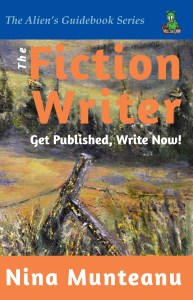
This is an excerpt from The Fiction Writer: Get Published, Write Now! (Starfire)


nina-2014aaNina Munteanu is an ecologist and internationally published author of award-nominated speculative novels, short stories and non-fiction. She is co-editor of Europa SF and currently teaches writing courses at George Brown College and the University of Toronto. Visit www.ninamunteanu.ca for the latest on her books.

Nina Talks Writing on Dragon Page

michael-stackpoleSome years ago, I was interviewed by Michael Stackpole (New York Times bestselling author of over 40 novels, including “I, Jedi” and “Rogue Squadron”) and Michael Mennenga (CEO of “Slice of Sci-Fi”) on Dragon Page Cover to Cover.

michael mennengaWe talked about my book “The Fiction Writer: Get Published, Write Now!” and what new writers fret over. A lot of the discussion focused on how to handle rejection and I shared my “bus terminal” model (also in my book), which worked very well. For details on our discussion about the industry and craft of writing, listen below:


DragonPage-FictionWriter

The Bus Terminal Model:

FictionWriter-front cover-2nd ed-webHere is an excerpt from The Fiction Writer, Chapter R:

One way to see your way through rejection is to find ways to distance yourself from your story once you’ve sent it off and to see the whole process of submission-rejection-acceptance as a business. The very best way to do this is to submit lots of stories and to keep submitting them. With novels, this is a little harder to do but you can certainly be working on the next one once you’ve submitted the first.

When I was writing short stories, I kept a list of what and where I submitted, along with the most important item: where to submit NEXT. At any given time, I made sure that I had at least x-number of submissions out there and each story had a designated place to go if it returned. As soon as a story came back from magazine A, I simply re-packaged it and sent it to magazine B. The critical part of the list was to have a contingency for each story: the next place where I would send the story once it returned. I was planning on the story being rejected with the hope that it would be accepted; that way, a rejection became part of a story’s journey rather than a final comment.

I ran my submissions like a bus terminal. A story was in and out so fast it never had a chance to cool off. And, since I had five other pieces out there, I could do this with little emotion. I was running a fast-paced “story depot”, after all. All my stories had to be out there as soon as possible; if they were sitting in the terminal, they were doing nothing for me.


nina-2014aaNina Munteanu is an ecologist and internationally published author of award-nominated speculative novels, short stories and non-fiction. She is co-editor of Europa SF and currently teaches writing courses at George Brown College and the University of Toronto. Visit www.ninamunteanu.ca for the latest on her books.

Limestone Genre Expo—One of Kingston’s Gems

Nina-Hali-clifi2

Nina Munteanu and Halli Villegas

I recently attended the Limestone Genre Expo in Kingston, Ontario. Held at the St. Lawrence College campus—ideally suited to a literary festival—the expo featured panels, readings, and workshops.

The festival was well attended by local, Canadian and international authors, editors, publishers, and readers—all committed to exploring literature, the arts and to having a good time.

Authors included Tanya Huff, Nancy Kilpatrick, Caro Soles, Violette Malan, Rick Blechta, Matthew Bin and Eve Langlais, among many others.

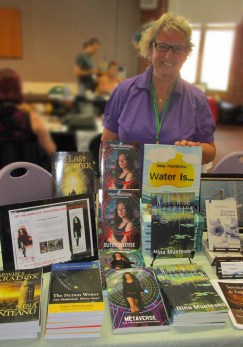
Nina-books-Limestone2016

Science Fiction GOH in 2016

Publishers included Exile Editions, Chizine Publications, Bundoran Press and others. Exile Editions recently published their anthology “Cli Fi: Canadian Tales of Climate Change” in which my story “The Way of Water” appears.

I was Limestone’s Science Fiction Guest of Honour last year; this year I got to relax and I sat on three panels.

NancyKilpatrick-limestone

Nancy Kilpatrick

In “Alternative Histories to Cyberpunk“, I was joined on the panel by Matthew Bin, Maldonado Skaff-Koren, Eric Desmarais, Michael Romaric, Dominic Bercier, and A.A. Jankiewicz with moderator Sean Moreland. We mostly discussed the literary device of alternative timelines and unanimously concluded that visionary science fiction that “failed” to predict the future was successful alternative “history”. This theme continued in the science fiction panel.

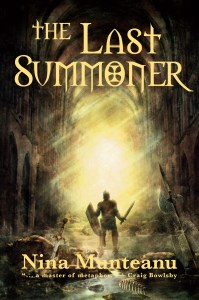
Cover1_LastSummoner-frontcoverI brought up the notion of history’s quantum properties, a braided flow of multi-dimensional and entangled realities. This served as premise for my alternative historical time-travel fantasy The Last Summoner, which takes place in fifteenth century Poland. On her fourteenth birthday, the baroness Vivianne Von Grunwald discovers that she can change history as an aeon; but she soon realizes that, while she is able to change some disastrous historic event, its entangled “destiny” indelibly moves closer to the original consequence than her intended one: yet another disaster. My scientific approach to alternate history is what excited me to write this, my only fantasy so far among a dozen science fiction novels.

CaroSoles

Caro Soles

In the panel “The Science behind Science Fiction” I was joined by Katherine Prairie, Anita Dolman, Matthew Bin, Lisa Tooey, Kristen Kiomall, and A.A. Jankiewicz with moderator Caroline Frechette. We discussed the utility and risk of using pseudoscience in a science fiction story, a genre known for expectations of accuracy and prescience. In 1979, Ray Bradbury wrote: People ask me to predict the future, when all I want to do is prevent it. Better yet, build it. Predicting the future is much too easy, anyway. You look at the people around you, the street you stand on, the visible air you breathe, and predict more of the same. To hell with more. I want better.”

TanyaHuff-signing

Tanya Huff signs one of her books

Depending on whether the story is considered hard SF or soft SF, this level of accuracy in both actual science presented as premise and ability to predict science and technology will vary. Given that science fiction is largely metaphoric, the predictability of an SF story is secondary to the story’s value as metaphor and allegory. The consensus of the panel was that the audience determined the importance of precision and accuracy. In the final analysis, if the story is grounded in its own consistency, anything is possible.

WonderWoman

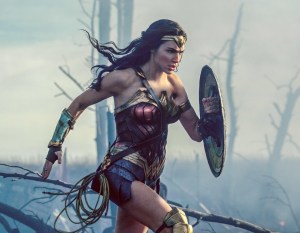
Wonder Woman (Gal Gadot)

In “Women in Genre” I was joined by Violette Malan, Nancy Kilpatrick, Eve Langland, Alyssa Cooper, Janet Kellogg, and Liz Lindsay with moderator Sandra Kasturi. The banter was by turns fun and edgy, all lubricated with good humour by all participants. As a writer of science fiction and fantasy of which 90% feature a “strong female protagonist”, I brought up the controversy of what, in fact, determines a good female lead in story. Why do so many heroines still provide just a kick-ass version of a male hero? Why are so many female protagonist heroes still defined by the rules of what makes a male a hero? Where are the real women?

Politics south of us aside—along with Margaret Atwood’s all too realistic Handmaid’s Tale (currently playing on Bravo TV), we discussed the recent push-back in Texas on the all-women showing of “Wonder Woman,” which prompted many heated tweets. The Atlantic recently published an article on the film—and surrounding events—entitled “Wonder Woman, Heroine of the Post-Truth Age.”wonder-woman-movie-poster

Wonder Woman is set at the height of World War I, but is otherwise a decidedly modern movie,” writes Megan Garber of The Atlantic. “It stars a woman (Gal Gadot) and treats a man, Steve (Chris Pine), as its damsel-in-distress. It has managed, even before its release, to enrage men’s-rights activists, which is quickly becoming a reliable measure of a movie’s modernity.”

wonderwoman-golden lassoWonder Woman uses a unique weapon, the Golden Lasso, known as the Lasso of Truth—because it compels anyone wrapped by it to reveal the truth.

When William Moulton Marston—scientist and inventor of the polygraph machine— created the Wonder Woman character, he envisioned a warrior who was also an investigator of truth. “Frankly,” he said, “Wonder Woman is psychological propaganda for the new type of woman who should, I believe, rule the world.” He believed that a world that gave women more power—politically and otherwise—would be more peaceful, more empathetic, more worthy, writes Garber. “And so Wonder Woman is a work that is decidedly at home, across its dimensions, in the world of 2017—a world that is on the one hand newly recognizing women’s widespread capabilities, but that is on the other deeply anxious about ‘alternative facts,’ about ‘fake news,’ about politically weaponized lies, about falsehoods that are uttered with no seeming consequence. The princess’s lasso, that shimmering metaphor for objective truth, is a symbol of aspiration; seen in another way, though, it is a symbol of despair. Here, in this wobbling weapon, is “wonder” as in awe; here, too, is “wonder” as in uncertainty. Here is a tool of truth that is decidedly ambivalent about its own powers. “How do I know you’re not lying to me right now?” the princess asks the spy. And the only way she can know for sure is to trust, paradoxically, in magic.”

Magic is OK, though. It is, after all, the stuff from which we draw when we write.

Nina-SF GOH-Limestone Genre Expo

Nina Munteanu, Science Fiction GOH at Limestone Genre Expo 2016

nina-2014aaNina Munteanu is an ecologist and internationally published author of award-nominated speculative novels, short stories and non-fiction. She is co-editor of Europa SF and currently teaches writing courses at George Brown College and the University of Toronto. Visit www.ninamunteanu.ca for the latest on her books.

Crossing into the Ecotone to Write Meaningful Eco-Fiction

If you have an apple and I have an apple and we exchange apples then you and I will still each have one apple. But if you have an idea and I have an idea and we exchange these ideas, then each of us will have two ideas.”—George Bernard Shaw


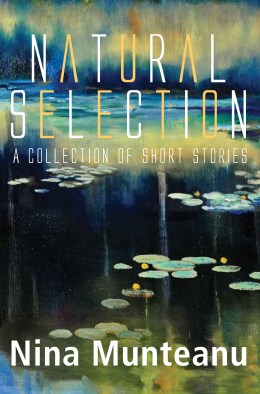
naturalselectionAt Calgary’s When Words Collide this past August, I moderated a panel on Eco-Fiction with publisher/writer Hayden Trenholm, and writers Michael J. Martineck, Sarah Kades, and Susan Forest. The panel was well attended; panelists and audience discussed and argued what eco-fiction was, its role in literature and storytelling generally, and even some of the risks of identifying a work as eco-fiction.

Someone in the audience brought up the notion that “awareness-guided perception” may suggest an increase of ecological awareness in literature when it is more that readers are just noticing what was always there. Authors agreed and pointed out that environmental fiction has been written for years and it is only now—partly with the genesis of the term eco-fiction—that the “character” and significance of environment is being acknowledged beyond its metaphor; for its actual value. It may also be that the metaphoric symbols of environment in certain classics are being “retooled” through our current awareness much in the same way that Aldous Huxley’s Brave New World or George Orwell’s Nineteen Eighty Four are being re-interpreted—and newly appreciated— in today’s world of pervasive surveillance and bio-engineering.

darwins-paradoxI submit that if we are noticing it more, we are also writing it more. Artists are cultural leaders and reporters, after all. My own experience in the science fiction classes I teach at UofT and George Brown College, is that I have noted a trend of increasing “eco-fiction” in the works in progress that students are bringing in to workshop in class. Students were not aware that they were writing eco-fiction, but they were indeed writing it.

I started branding my writing as eco-fiction a few years ago. Prior to that—even though my stories were strongly driven by an ecological premise and strong environmental setting—I described them as science fiction and many as technological thrillers. Environment’s role remained subtle and—at times—insidious. Climate change. Water shortage. Environmental disease. A city’s collapse. War. I’ve used these as backdrops to explore relationships, values (such as honour and loyalty), philosophies, moralities, ethics, and agencies of action. The stuff of storytelling.

Environment, and ecological characteristics were less “theme” than “character,” with which the protagonist and major characters related in important ways.

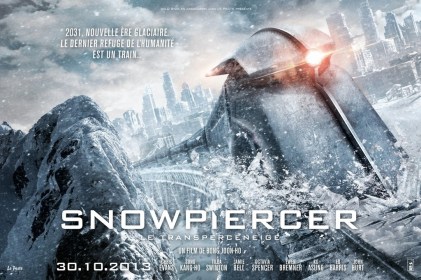
Snowpiercer-frenchJust as Bong Joon-Ho’s 2014 science fiction movie Snowpiercer wasn’t so much about climate change as it was about exploring class struggle, the capitalist decadence of entitlement, disrespect and prejudice through the premise of climate catastrophe. Though, one could argue that these form a closed loop of cause and effect (and responsibility).

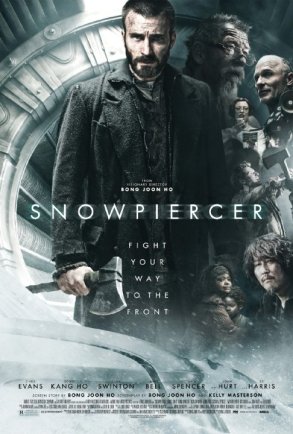
snowpiercer-posterThe self-contained closed ecosystem of the Snowpiercer train is maintained by an ordered social system, imposed by a stony militia. Those at the front of the train enjoy privileges and luxurious living conditions, though most drown in a debauched drug stupor; those at the back live on next to nothing and must resort to savage means to survive. Revolution brews from the back, lead by Curtis Everett (Chris Evans), a man whose two intact arms suggest he hasn’t done his part to serve the community yet.

Minister Mason (Tilda Swinton), an imperious yet simpering figure who serves the ruling class without quite being part of it, reminds the lower class that:

We must all of us on this train of life remain in our allotted station. We must each of us occupy our preordained particular position. Would you wear a shoe on your head? Of course you wouldn’t wear a shoe on your head. A shoe doesn’t belong on your head. A shoe belongs on your foot. A hat belongs on your head. I am a hat. You are a shoe. I belong on the head. You belong on the foot. Yes? So it is.  snowpiercer-mason

In the beginning, order was prescribed by your ticket: First Class, Economy, and freeloaders like you…Now, as in the beginning, I belong to the front. You belong to the tail. When the foot seeks the place of the head, the sacred line is crossed. Know your place. Keep your place. Be a shoe.”

Ecotones are places where “lines are crossed,” where barriers are breached, where “words collide” and new opportunities arise. Sometimes from calamity. Sometimes from tragedy. Sometimes from serendipity.

When environment shapes a story as archetype—hero, victim, trickster, shadow or shape shifter—we get strong eco-fiction. Good eco-fiction, like any good story, explores the choices we make and the consequences of those choices. Good eco-fiction ventures into the ecotone of overlap, collision, exchange and ultimate change.

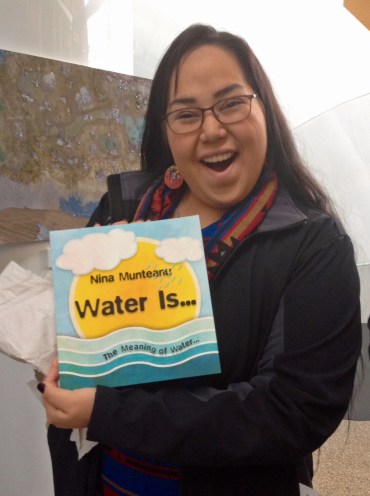
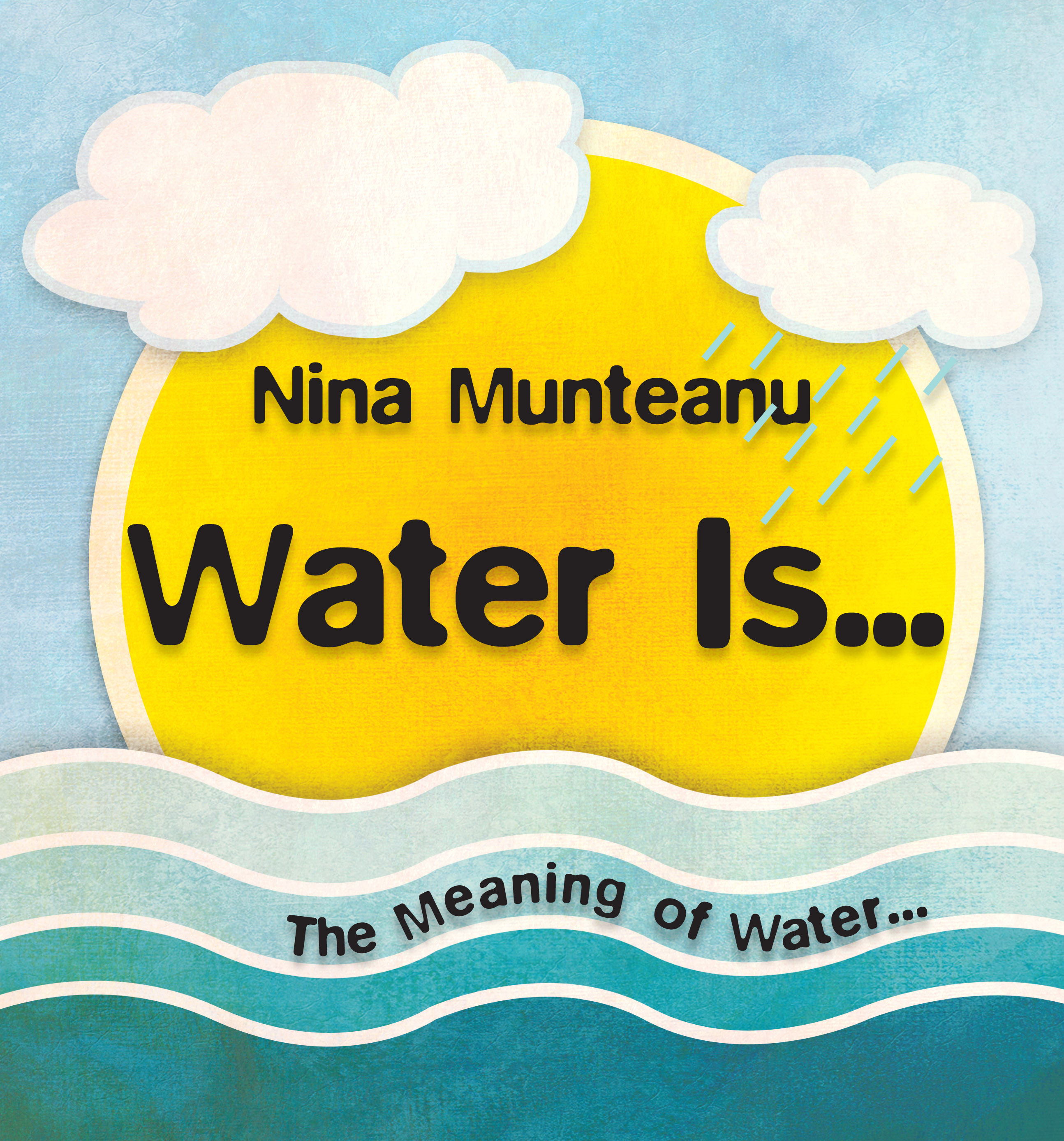
water-is-webIn my latest book Water Is… I define an ecotone as the transition zone between two overlapping systems. It is essentially where two communities exchange information and integrate. Ecotones typically support varied and rich communities, representing a boiling pot of two colliding worlds. An estuary—where fresh water meets salt water. The edge of a forest with a meadow. The shoreline of a lake or pond.

For me, this is a fitting metaphor for life, given that the big choices we must face usually involve a collision of ideas, beliefs, lifestyles or worldviews: these often prove to enrich our lives the most for having gone through them. Evolution (any significant change) doesn’t happen within a stable system; adaptation and growth occur only when stable systems come together, disturb the equilibrium, and create opportunity. Good social examples include a close friendship or a marriage in which the process of “I” and “you” becomes a dynamic “we” (the ecotone) through exchange and reciprocation. Another version of Bernard Shaw’s quote, above, by the Missouri Pacific Agriculture Development Bulletin reads: “You have an idea. I have an idea. We swap. Now, you have two ideas and so do I. Both are richer. What you gave you have. What you got I did not lose. This is cooperation.” This is ecotone.

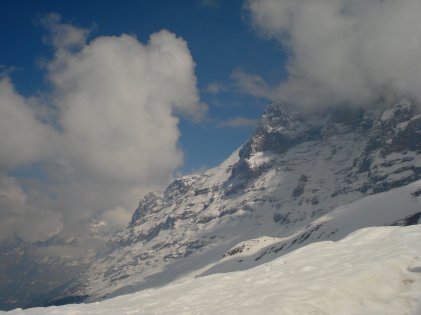
Jungfrau-peak

Jungfrau, Switzerland (photo by Nina Munteanu)

I think we are seeing more eco-fiction out there because ecosystems, ecology and environment are becoming more integral to story: as characters in their own right. I think we are seeing more eco-fiction out there because we are ready to see it. Just as quantum physics emerged when it did and not sooner, an idea—a thought—crystalizes when we are ready for it.

Don’t stay a shoe … go find an ecotone. Then write about it.


nina-2014aaNina Munteanu is an ecologist and internationally published author of award-nominated speculative novels, short stories and non-fiction. She is co-editor of Europa SF and currently teaches writing courses at George Brown College and the University of Toronto. Visit www.ninamunteanu.ca for the latest on her books.

Nina Talks Water at Word Up in Barrie

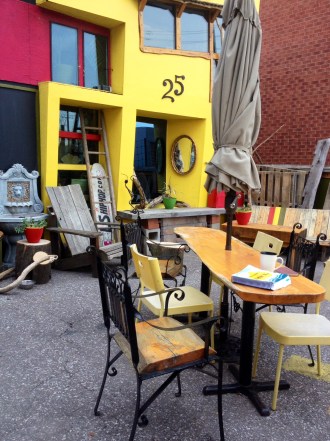
Unity Market-outside

Unity Market & Cafe outside patio

Every month on the second Thursday, Word Up in Barrie hosts readings by writers, poets, and spoken word artists. From pros to amateurs, and all genres of writing, Word Up’s open mic has welcomed writers of all genres, from amateurs to winners of the Governor General’s Award.

The volunteer run group holds its reading night at the artisanal Unity Market and Café, on Toronto Street, just a walk away from Barrie’s charming downtown core and harbor on Lake Simcoe. Apart from its famous “scuffins” (an amalgam of muffin and scone, generously filled with savory goodness), the market is a gestalt meeting place for creativity, holding events almost daily.

I heartily accepted when Linda Laforge invited me to speak about my last project to those in attendance last Thursday. My latest book is Water Is…, a non-fiction work that took me three years to write and the culmination of a career and life with water.

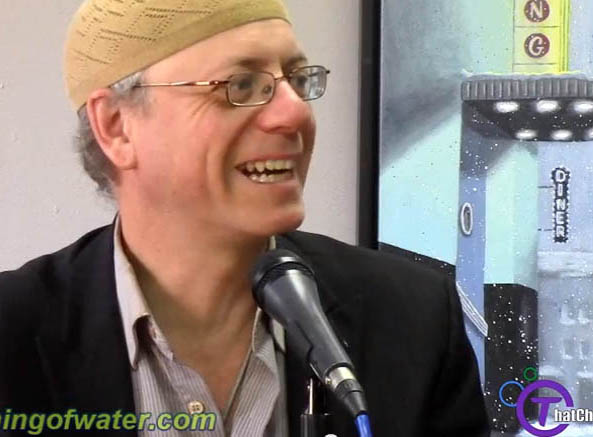
Shane-Unity Market

Shane making a tea

I talked about how the book came about—linking it to how I came about—and the process of research and writing—which morphed into something beyond what I had initially conceived. The book in some ways wrote itself, telling me to go here and there; gathering friends and colleagues to me—some from far away—to provide important information I needed to put into the book.

I ended my talk with a description of the Watermark Project, a Lake Ontario Water Keepers initiative to give narrative to our connections with water—exactly what I’d intended with Water Is…

Barrie-tulips

Barrie harbor front

What followed was an open mic that resonated with water connections from a short story about death to learning how to heal with water. Damian Lopes, Barrie’s Poet Laureate, delivered a compelling poem on Canadian sociopolitics.

The open mic closed with Shane Dennis’s freestyle oration—a spontaneous stream-of-consciousness flow of powerful imagery that both summarized the night’s readings and set it aflame and into flight.

Damian Lopes won the raffle for a free Water Is… book. And I sold a few books to a few hydrophiles. A wonderful evening!

Thanks, Linda, Aaron, Bruce and Shane!


For more about my book Water Is… and about water see TheMeaningOfWater.com.

word up banner

Nina at Word Up-Barrie

Summoning the Slow Train To Find “The Last Summoner”

Atonement_(novel)In her book The Art of Slow Writing, Louise DeSalvo tells the story of how Ian McEwan composed his book Atonement.

McEwan had shared that the novel “grew out of many months of sketches and doodling.” Then one morning, he wrote “six hundred words or so describing a young woman entering a drawing room with some wild flowers in her hand, searching for a vase,” and “aware of a young man outside gardening whom she wishes both to see and avoid.”

He knew he had at last started a novel, says DeSalvo. But beyond that, he knew nothing. Slowly, McEwan pieced together a chapter, the one in which “Cecilia and Robbie go to the fountain, the vase breaks, she strips off and plunges into the water to retrieve the pieces, she walks away from him without a word.”

McEwan then languished for six weeks with questions: who was the woman? Who was the young man? What was their relationship? When and where did this event take place? And what was its significance to the story? What was the story about?

McEwan went on to write the chapter in which Briony attempts to put on a play with her cousins. Upon completing that chapter, he finally realized what the story was about. He realized that he would write about Dunkirk and St. Thomas’s hospital. He also knew that Briony was the main protagonist and POV character; that “she was going to commit a terrible error, and that writing…throughout her life would be her form of atonement.” Briony is in fact, what we call a displaced narrator. While the focus of the story is on the tragic journeys of Ceclia and Robbie—resulting largely from Briony’s eventful action—the deeper tragedy is Briony’s who must live the remainder of her life with what she has done.

“McEwan’s remarks illustrate how a successful writer sometimes begins without knowing the work’s subject,” writes DeSalvo. This process of creative problem solving can take on many forms. McEwan sketched and wrote what Diana Gabaldon calls “kernel scenes”, muse-inspired scenes—usually character-based—that represent major emotional turning points or events: important moments in forming a larger set piece toward a larger story. McEwan wrote a scene that required for him to solve some creative problems. Each solution provided him with another piece to the creative puzzle and the blurry meaning of the story slowly came into focus.

According to DeSalvo, McEwan swapped his first two chapters and rewrote them several times before he realized that the novel should begin with Briony. Once that watershed moment came to him, the rest of the process fell into place and practically wrote itself.

This type of “organic” writing can be very exciting and revealing to an author; it can also be chaotic and time-consuming. That’s OK. You need the time for the story to reveal itself to you. As DeSalvo says, “we can’t force a resolution too quickly.” She adds that “creative solutions often take us into unexpected territory—the introduction of Briony’s narrative, for example—and often these swerves take us into exciting solutions we hadn’t anticipated—Briony as narrator, for example—and push our work in an altogether different direction.”

If McEwan had kept the first narrative that emerged—Cecilia and Robbie at the fountain—and if he hadn’t been open to the potential in Briony’s narrative, he would no doubt have written a less complex but still successful novel about love, class, and war. But in deciding to give Briony a voice and combine both narratives, McEwan introduced another more metaphoric layer of meaning to the more literal one—that of personal betrayal and the impact of knowing you have destroyed two people’s lives.

The Last Summoner … Summoned

Cover1_LastSummoner-frontcover

cover art by Tomislav Tikulin

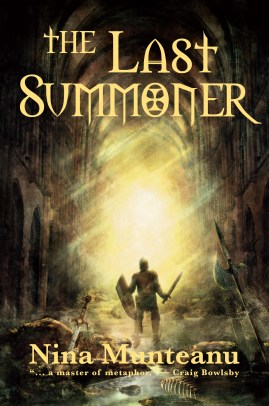
My historical fantasy The Last Summoner came to me in a single image. I’d run across a spectacular image by Croation artist Tomislav Tikulin (he’d done the cover art for Darwin’s Paradox, my previous book published by Dragon Moon Press). When I checked his website, there it was: this incredibly evocative image of a knight, standing in the war-littered mire of a drowned cathedral. The knight gazed up, questioning, at the vaulted ceiling from which shone streams of white gold. It sent my imagination soaring with thoughts of chivalry, adventure and intrigue.

Who was this knight? Where was he and why? What were the circumstances?

At that point I only had an image and many questions. I knew I wanted to write about this knight and this setting. Since I can remember, I’ve been fascinated by Europe during the medieval ages and I had been thinking of writing outside the science fiction genre for a while.

The image remained imprinted inside me for weeks, months, until the next nexus moment came. I stumbled across a significant but little-known battle in the medieval Baltic, the Battle of Grunwald. It would turn out to be the defining battle for what are now the countries of Poland and Lithuania. On June 14th 1410, they were still part of Prussia and tyrannized by the Teutonic Order, who were Christianizing the pagan Baltic on behalf of the Pope. In truth, the Order had been for centuries gathering wealth and land for colonizing Germans in their drang nach osten; they built sturdy castles (many of which still stand today) and a force of monk warriors, feared for their cunning strategy and treacherous combat abilities.

chateau-chillon-lake-geneva

Chilean castle, Switzerland (photo by Nina Munteanu)

The Battle of Grunwald was, in fact, an upset in history. The Teutonic Order was powerful, intimidating and extremely capable. They should have won; but the peasant armies of Prussia slaughtered the Order, killing most of its knights. Historians debate that the hochmeister’s arrogance—indeed, the arrogance of the entire Order—precipitated their downfall. They underestimated their adversaries and got sloppy. After the Polish and Lithuanian armies outsmarted the Order and slayed their hochmeister, along with most of their knights, the Order’s own peasant slaves finished the job using clubs, pitchforks and stones.
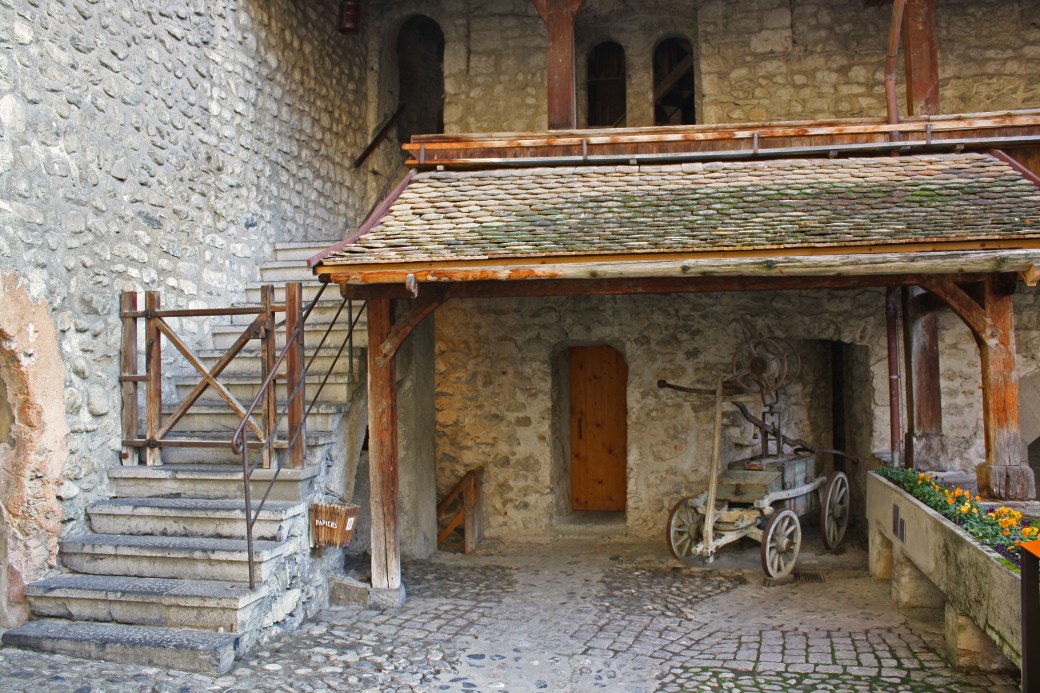
chillon-inner courtyard

Courtyard at Chillon Castle, Switzerland (photo by Nina Munteanu)

Intrigued by this lessor known order of religious crusaders, I pursued the premise of an alternative consequence: what if the Teutonic Knights had NOT underestimated their enemy and won the Battle of Grunwald? Would they have continued their catastrophic sweep of Northeast Europe into Russia and beyond? Would they have claimed the whole for Germany’s expansionist lebensraum movement, fueled by its sonderweg, a dialectic that would ultimately lead to the killing fields of the Holocaust? What if the success of the Teutonic Order helped consolidate a united fascist elite, ambitious to conquer the world?

And what if, as a result, Nazism sprang up 100 years earlier? The Last Summoner, arose from this premise.

I’d already conceived a heroine: a self-centered romantic noblewoman who has a vision of a knight in a drowned cathedral. Fourteen-year old Vivianne Schoen, Baroness von Grunwald, dreams that her ritter will rescue her from the drudgeries of her duties and an arranged marriage to some foreign warrior. When she discovers that her intended is a cruel and abusive mercenary, Vivianne makes a bold and impetuous choice that results in a startling discovery that she can alter history—but not before she’s branded a witch and must flee through a time-space tear into a alternate present-day Paris, now ruled by fascists. There, in present-day Paris she learns that every choice has its price. She meets François, a self-serving street kid who tries to monetize her and her gear but then falls for her anachronistic charm.

knight-cameoI originally wrote the Paris section in Vivianne’s point of view, but it seemed flat with too obvious fish-out-of-water observations. I let the book sit, while I conducted more research on Paris, and then it came to me: give the narrative to François. This part of the book was his story. By giving François the only POV, I also gave his character agency to react and change to Vivianne’s role as “catalyst hero.” I rewrote this section, starting with François fleeing from a street crime he’d committed, when Vivianne literally appears and knocks him down. She then sweeps him up in a high-stakes chase that will change his worldview. When Vivianne returns to 1410 Poland in the last section of the book, her great journey of self-discovery and atonement begins.

Spanning from medieval Poland to present day Paris, France, The Last Summoner explores the sweeping consequences of our “subtle” choices. From the smallest grab to the most sweeping gesture, we are accountable for the world we’ve made. During her 600-year journey to save the world and undo the history she authored, Vivianne learns wisdom and humility. Through the paradox of history, she learns that what might have seemed the right choice for an immediate future, turns out to be disastrous for a distant future. To win is also to lose; to save oneself one must surrender oneself; and to save the world one need only save a single soul.

The knight standing in the drowned cathedral is Vivianne.


 The Last Summoner, published by Starfire World Syndicate, was released in Cover1_LastSummoner-frontcover2012 and remained a Canadian bestseller on Amazon for several months. It represents my first historical fantasy in an otherwise repertoire of hard science fiction. The cover of the book is indeed the original image that had inspired the book in the first place; and was kindly acquired by my publisher. The Polish and Lithuanians celebrate June 14th with pride, erecting mock-ups of the battle annually. Some day I hope to participate.


References:

DeSalvo, Louise. 2014.”The Art of Slow Writing”. St. Martin’s Griffin. New York, NY. 306pp.

Munteanu, Nina. 2012. “The Last Summoner”. Starfire World Syndicate.

nina-2014aaNina Munteanu is a Canadian ecologist and internationally published author of award-nominated speculative novels, short stories and non-fiction. She is co-editor of Europa SF and currently teaches writing courses at George Brown College and the University of Toronto. Visit www.ninamunteanu.ca for the latest on her books.
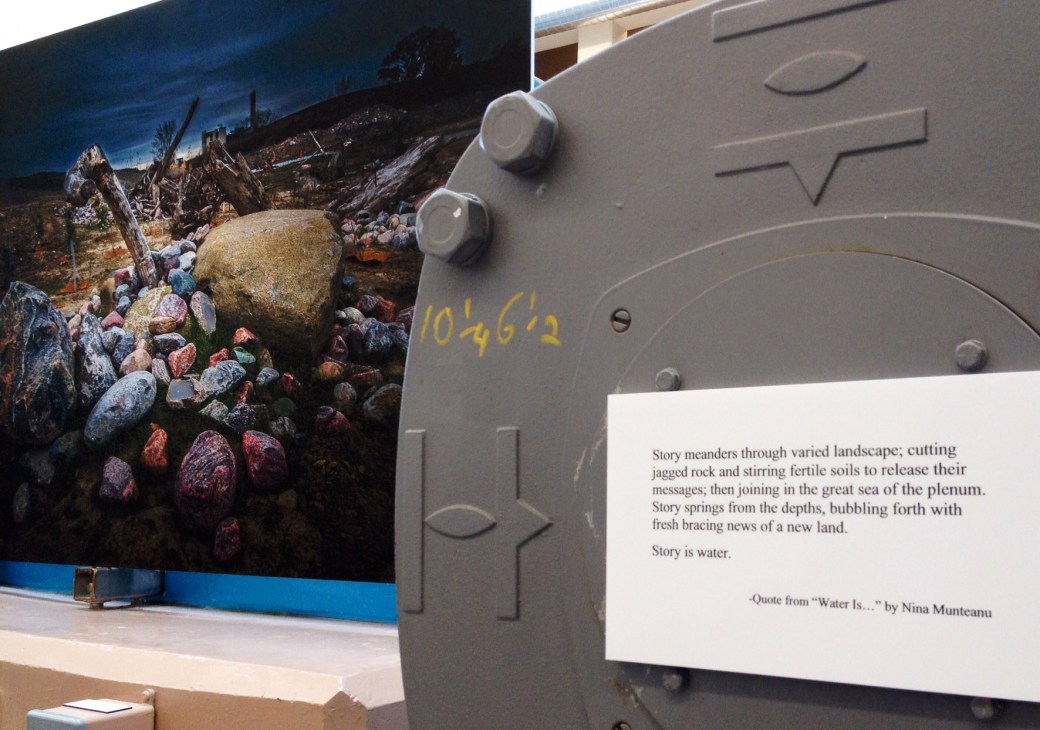
The Meaning of Writing and Water with Nina Munteanu

I was recently invited to “Liquid Lunch” a program on That Channel in Toronto, Ontario, to discuss the writing process and my new book on water, “Water Is…” with Hugh Reilly and Hildegard Gmeiner:

hugh-LL

Hugh Reilly

hildegard-LL

Hildegard Gmeiner

nina-LL-interview

Nina Munteanu

“Water Is…” is due for release early 2016. Below is the final cover by Aurora finalist Costi Gurgu (more on the book and the cover later):

Water Is-cover01

How We Will Tell Stories in the Future

Cover1_LastSummoner-frontcoverIn the early 1400s, when Lady Vivianne Schoen (the hero of my book  The Last Summoner) lived, one of the largest libraries in Europe was at the University of Cambridge; it held an impressive list of 122 books. That library currently houses over 7 million books.

Books were a work of art in the 1400s. And part of an elite. Delicate, large and beautiful, they were created in the language of the church—Latin—and in turn copied entirely by hand by the monks. With the dimensions of a current newspaper, but much thicker, these large illuminated manuscripts sometimes weighed more than 50 pounds.

There is a scene early on in The Last Summoner where, under the tutelage of Pere Daniel at her father’s castle in Grunwald, Vivianne learns this arcain craft of manuscript copying.

An illuminated manuscript, the exemplar, and its parchment copy, still in progress, lay on the desk top; both were held down from curling by several hanging weights. Ink pots, gold leaf, a pen knife and a quill lay beside the sloped desk-top—the scribe’s tools.

Père Daniel had studied the art of manuscript illumination, scribing, binding and even parchment-making at the Sorbonne. Last year he’d begun to teach Vivianne the art of creating illuminated manuscripts and she had eagerly begun her own, finding that she had a steady hand at illumination. Père Daniel had shown her how to make parchment from the skins of deer that the Baron brought back from his hunts in the Grunwald forest. Despite the availability of paper, parchment was preferred “because it is velvety, folds easily and gives an agreeable flexibility to pen strokes compared with the unyielding flatness of writing on paper,” the chaplain reasoned. He always gave a reason for the painstaking preparation that involved flaying, soaking, stretching and scraping: “Parchment wants to curl onto its darker, grain side; and hastily prepared parchment wants to do it more.” Nothing was better than parchment made from game “because the vein marks left from blood in the skin when the animal died is the animal’s contribution to the art of illumination,” he attested with the fervency of a man with a passion.

Père demonstrated with exacting care and infinite patience how to use the illuminator’s tools and create a professional-looking manuscript. He provided Vivianne with parchment, a quill for a left-handed scribe, a penknife to sharpen her quills, a pot of ink and a sloping desktop. He taught her how to make iron-gall ink by mixing a solution of tannic acids and copperas with added gum arabic from the dried-up sap of the acacia tree as thickener. It was important, said the Père, to pick a mature oak-gall, one that bore a hole from the matured wasp that had developed inside and left a juicy concoction of gallic acids. The galls were then crushed up and boiled for a long as it took to recite the Pater Noster three times, he’d said. The blackness, he told her, resulted from the chemical reaction of the oak-gall potion when copperas was stirred in. He’d shown her how to create the vermillion color, commonly used in headings, which he made from brazilwood chips infused in urine and stirred with gum arabic. Vivianne never asked Père Daniel where he got his urine. She and Père also raided Theobald’s kitchen to hunt down the outer right wing pinions of a goose for making a quill pen that naturally curved to the left, because she was left-handed.

knight-cameoPère showed Vivianne how the height of the written area should equal the width of the whole page in a well-proportioned manuscript. Père also showed her how to rule the guidelines for the script and make the initial under-drawing of her illumination in plummet then in ink after which the gold leaf was applied. Vivianne had become adept at applying the gold leaf over the raised gesso, that she made of slaked lime and white lead mixed with pink clay, sugar, a dash of gum and egg glair glue. After painstakingly painting the gesso where she wanted the gold leaf to remain and letting it dry, Vivianne then carefully lowered the fragile tissue-thin leaf over the gesso and pressed down through a piece of silk then buffed the gold to a brilliant finish with a dog’s tooth by vigorously rubbing back and forth until it was smooth and the edges where there was no gessocrumbled away.

Making books was called “black art” from the black ink that stained the worker’s hands after a long day of creating type. Readers were mostly scholars and the religious elite. In fact, reading was an elite occupation. The majority of people at the time were illiterate and had no interest in books. Moreover, books were written in the language of the church, not in the commonly spoken language of the countryside such as English, French, German or Spanish.

So, when Johannes Gutenberg invented the revolutionary printing press in 1452 to publish the Gutenberg Bible, neither monk nor Joe peasant took much notice. The monks considered the product inferior to their works of art and dismissed the new technology—until it had largely replaced their trade.

chillon-inner courtyard

Inner courtyard of Chilean Castle, Switzerland (photo by Nina Munteanu)

In fact, the presses formed the very basis of the artistic Renaissance, the religious reformations and the scientific revolution, wrote Elizabeth Eisenstein in The Printing Press as an Agent of Change. “The printing press allowed the spread of information that couldn’t be controlled by the clergy, kings, politicians, or the religious elite,” adds New York Times technology reporter Nick Bilton in I Live in the Future and Here’s How It Works. Storytelling was no longer confined to an elite clergy; books could be created by anyone and shared in the spoken languages of the people.

Bilton shares another interesting fact: Gutenberg’s printed books were as heavy and unwieldy as the original handmade books of the monks. It was much later, in 1502, that Aldus Manutius of Venice invented a more portable book that could fit in a large jacket pocket; essentially inventing “the mobile phone of his day” wrote Bilton.

Historian Alistair McCleery wrote that the political and religious leaders initially panicked over the potential for the uncensored sharing of new and varied ideas among the lay public (which brings to mind similar fears of what the internet was providing to and enabling in the lay public: uncensored self-expression by the masses for the masses). Up until then, sharing stories among the common folk was limited to oral storytelling, which suffered from inconsistency and other limitations of the oral tradition. Within a short period of time, the ability to record and share “stories” had moved from a closeted elite to the world citizen. That is what the printing press—and the Internet today—did. Both have shifted the zeitgeist of an entire world.

Storytelling today is changing again. While many people still read books and go to the cinema, watch pre-programmed TV or rent DVDs, many more enjoy their stories through other devices like computers, downloads, mobile phones and e-readers that provide material through other media and venues such as Indie and self-publishing, amateur YouTube videos, interactive games and social networks. We stand poised on the edge of a wonderful cliff that celebrates the expression — and consumer choice — of the individual. The music industry shows this the best, where people dismissed the prepackaged albums and CDs and opted to create their own unique playlists through individual song downloads. The publishing industry is currently struggling with its own painful yet thrilling metamorphosis as is the visual arts industry. In fact, they are all blurring into one large integrated amalgam of artistic expression.

NYC-times-square-lawn-chairs

Times Square in New York City (photo by Nina Munteanu)

The information you get today is coming “more and more through your friends and through your social network. It’s being distributed through channels of trust and the trust isn’t necessarily the BBCor The New York Times. It’s people,” says B.J. Fogg founder of the Persuasive Technology Lab at Stanford University.

new-york-toulouse-officer-montalvo

New York policeman sports my friend Toulouse on his gun (photo by Nina Munteanu)

During the days of packaged content, leading storytellers were published authors, journalists and writers of newspapers and magazines. “Now distribution channels matter less and anyone with an appropriate device can be a storyteller,” says Bilton, who shares that on the internet we tend to follow individuals we trust (e.g., Clive Thompson or David Carr) as much if not more than established organizations (like Wired Magazine or The New York Times). Accessible technology, platforms, free applications and software has truly enabled the individual.  No longer confined to the written word via paper books or visual expression through movies or TV shows, storytelling has embraced many forms. Amateur and professional have equally blurred.

It comes down to content. Technology and format aside, nothing compares to a good solid story. We all listen to or watch stories. We all tell or show stories, some of us more than others and some better than others.

With the advent of new and accessible technologies and applications available to individuals, the art of storytelling has entered a new renaissance. Good stories, like good content, will always prevail and surface into prominence, like cream in milk. They have just been released into a sea of possibilities like a stream previously confined in a gorge, spilling joyfully into the ocean.

Front Cover ONLY-webHarnessing the opening range of technologies available to us will only give us more choices to tell our stories. For instance, my latest book Outer Diverse (the first book of The Splintered Universe Trilogy) was published by Starfire World Syndicate in print form and e-format and will soon be available in audiobook format through Audible. I have also created associated YouTube promotional videos and am working with colleagues to produce a short story musical video on the book. Another colleague has embraced the image of the strong female hero with a jewelry line called the Rhea Hawke Collection and is looking at other “storytelling” merchandise. I am discussing with other colleagues possibilities for a graphic novel and an interactive video game version of the trilogy that will offer reader participation in storytelling.

The future embraces story in all its possible facets. Our role as storytellers is to embrace the future in all its facets.


Nina Munteanu is an ecologist and internationally published author of award-nominated speculative novels, short stories and non-fiction. She is co-editor of Europa SF and currently teaches writing courses at George Brown College and the University of Toronto. Visit www.ninamunteanu.ca for the latest on her books.