Resonating with the Universe

Eramosa River 3

Eramosa River, Guelph (photo by Nina Munteanu)

Does art imitate life or does life imitate art? Which came first? Story or reality? Do we dream about our past or of another reality? What is déjà vu…really?  What came BEFORE the Big Bang? Did time even exist before we defined it?

The most frequent question asked of writers is “where do you get your ideas?” to which we often bumble some inadequate reply and evoke that indefinable abstruse term MUSE. But what is muse…really? Intuition? Divine inspiration?

In a quote from his autobiographical essay, Philip Pullman says, “It’s important to put it like that: not ‘I am a writer’ but rather ‘I write stories’. If you put the emphasis on yourself rather than your work, you’re in danger of thinking that you’re the most important thing. But you’re not. The story is what matters and you’re only the servant, and your job is to get it out on time and in good order.” But where do they come from, Philip?

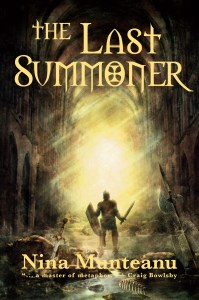
In my 2012 historical fantasy “The Last Summoner” (Starfire), the young Baroness Vivianne discovered that she could alter History. Having travelled into the future (e.g., 2010 from 1410 Poland), she used hindsight to recreate a new path for humanity, one devoid of two world wars and the evils consequently unleashed. Vivianne traveled back in time and tried to subvert critical events (time/space nodes) involving Emperor Wilhelm II, Annie Oakley, Nikola Tesla and others. In each case, her interference failed to alter the event in the way she had hoped. In fact, while the details of History differed, the end result remained pretty much the same. For instance, it seemed that no matter what she did to prevent World War I, it happened anyway.

Vivianne discovered that she was unable to alter History the way she’d intended. She found to her dismay that every time she set out to alter a crucial event, quirky consequences ensued and events did not yield to her clever manipulations—as though History had an uncooperative conscience and a predetermined destiny to fulfill.

OK… That’s just me being the writer, subverting the protagonist with obstacles played out in ever-twisting plots and subplots. But, what if…

What if… History (as in any realized reality) is predetermined through its harmonic relationship with other realizable realities? Given that all mass and energy is governed and expressed through frequency, and given that in physics (and music) frequencies exist as multiples of some fundamental frequency; then does it not follow that threads of realizable realities, intertwined around a fundamental path (of history), would move inexorably toward a common destiny?

A recent article I ran across on a writer’s forum discussed how artists tend to mimic each other’s ideas, or come up with the same ideas at the same time. Aside from outright stealing (which happens a lot less than people think), multiple and independent formulation of same ideas is also more common than people think. And it’s increasing. Multiple-independent discoveries (and inventions) have increased in society a thousand-fold since the nineteenth century. Some followers of Jungian thought suggest that this is because the fabric of our society is acting more and more like a neural network, learning, interacting and sharing toward the achievement of a common zeitgeist.

What if… the whole of our society behaves like an autopoietic system, self-organized, adaptive, evolving and tapping into—and possibly influencing—a common super consciousness? One related to a fundamental frequency?

Ray Tomes of the Alexandria City Meeting in 1996 suggested that “the pattern of cycles found in every field of study on earth, in astronomy and also in music are all explained by a simple rule that says that a single initial frequency will generate harmonics and each of these will do the same.”

Why do galaxies and stars form where they do? Toss a handful of sand on a drum and then beat it (not at the centre); you will find that the sand moves to certain places and congregates into predetermined patterns. These are the nodes of the standing waves in the drum. The standing waves are electromagnetic waves (e.g., radio waves, light and x-rays etc). Consider the “predetermined” beauty of natural phenomena. Consider the Fibonacci numbers and the golden mean in nature. Consider fractals and the Mandelbrot Set, quantum entanglement, and Schumann Resonance. Consider synchronicity, autopoiesis and self-organization…

Einstein tells us that, “everything in life is vibration.” Schroedinger’s wave function describes us as vibrating waves.

The normal standing wave created in the Schumann Cavity (the cavity formed by the Earth’s conducting surface and the ionosphere) occurs at a wavelength equal to the circumference of the Earth, and at a base frequency (and highest intensity) of between 6-8 Hz (7.83 Hz). This is called Schumann Resonance Frequency, after the man who formulated it mathematically in 1954 (after Nikola Tesla described it in the late 1800s). Some call this basic frequency the Earth’s “heartbeat” or the “tuning fork” of the planet, suggesting that it generates natural healing properties when living things are entrained to its rhythm. It turns out that all biological systems resonate at this same frequency range. The electrical resonance of the Earth lies between 6-8 Hz. This coincides with alpha rhythms produced by the human brain during meditation, relaxation and creativity.

“Vibrations are dynamic things not unlike living things,” John Keely, researcher in harmonics, adds. “They are active and prolific in their dynamics as are their harmonic offspring. These discrete tones of the harmonics interact with each other… They will in a very natural way mix, merge and divide among themselves just like living cells.”

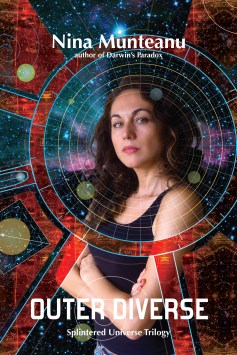
Get-Rhea-Hawke01 copyIn “Outer Diverse”, the first book of “The Splintered Universe Trilogy” (Starfire), Galactic Guardian Rhea Hawke speaks with Ka, an alien mystic, about music, frequency and harmony. And something called “the music of the spheres”. Says Ka:

“…The particular tone of the planet’s song is dependent upon the ratio of its orbit, just like the relationship of a keynote to its octave. The cosmic beauty of the octave is that it divides wholeness into two audibly distinguishable parts, yet remains recognizable as the same musical note…We, of course, now know that ratios in frequencies of spectra of elements compare to intervals in a musical chord,” Ka went on, leaning forward on his massive feathered arms. “Given that a pitch of sound is analogous to the color of light, both being caused by the frequencies of their waves, we can characterize entire worlds based on these properties,” he ended, beak-mouth breaking into a beaming grin that showed his round little teeth.  “It was your Kepler—a scientist I believe—who suggested that when planets formed angles equivalent to particular harmonic ratios, a resonance was created both in the archetypal ‘Earth soul’ and in the souls of individuals born under those configurations…He called it a celestial Front Cover ONLY-webimprint,” Ka continued, now leaning forward with his cup in both hands, “and said that in the vital power of the human being, ignited at birth, that remembered image glows. That geometric-harmonic imprint is the music that impels each listener to dance … from the particle to the cosmic. Your own heart finds its shifting harmony between excessive order and complete randomness, encompassing complex variability—a symphony—in its beating pattern. Sound—vibration—is the language of the mind and the secret to creation.”

We are creatures of this planet, co-evolved with Earth’s environment through the helix structure of our DNA and the water coursing through us; this is reflected in our behavior, culture, intelligence and beliefs. Our entire bodies resonate with all other life at a similar frequency as the planet Earth. Our brains in their most “divine” state of creativity, prayer or meditation reflect the same frequency. We are a gestalt culmination of light, wave-pulse, matter and motion resonating with this beloved planet Earth. Our minds, bodies and souls “sing” its choral aria. What is muse if not this wonderful “intent”?

So, which came first? Story or reality?


nina-2014aaNina Munteanu is an ecologist and internationally published author of award-nominated speculative novels, short stories and non-fiction. She is co-editor of Europa SF and currently teaches writing courses at George Brown College and the University of Toronto. Visit www.ninamunteanu.ca for the latest on her books.


Write What You Know–Write “From the Inside Out”

Canadian ForestWhen I first heard the writer’s edict “write what you know” I rejoined: but I write science fiction—I write about the unknown. What I still had to learn was that by describing “the other” SF really describes “us”. We explore ourselves through our relationship with the unknown. We do this by ensuring that all our plotlines reflect theme.

Write About What You Know

How many times have you been told to write about what you know? And how many times have you trusted that advice? Well, how interesting is that?!? We think our lives are dull, boring, and mundane. We write – and read – to get away from it, don’t we?

nina-LL-interviewe-closer

Nina Munteanu

Well, yes…and no…

In the final analysis, even good “escapist” writing, like some science fiction, despite its alien settings and creatures of imagination, is grounded in the realities of our every-day lives, which form the basis of human nature. Love, ambition, trust, hate, envy, honor, courage. All these are universal human traits which the writer taps into and ultimately writes about.

“In the 19th century, John Keats wrote to a nightingale, an urn, a season. Simple, everyday things that he knew,” say Kim Addonizio and Dorianne Laux in The Writer’s Guide to Creativity. “Walt Whitman described the stars, a live oak, a field. They began with what they knew, what was at hand, what shimmered around them in the ordinary world.”

Writing about what you know isn’t about literal truths; it’s about what you know inside your heart. Write from the inside out. Write about what excites you; what frightens you; what angers you, makes you sad, happy. As SF author Marg Gilks says, “You know more than you think.”

Twisted Truths & Inner Knowledge

Writers can use our own knowledge and experiences in everyday life and translate them into something far from ordinary. You start with universal experiences.

Get Emotional

What excites you; what frightens you; what angers you, makes you sad, happy. These are emotions we all feel. When we give our characters experiences similar to our own, we breathe life into both character and experience and provide the reader an anchor for her heart.

Get Sensational

You know how it feels to have your knees shake with fatigue after a long climb or the hair-raising trepidation of walking into a dark place. Use these sensations to make your writing more sensual with added dimensions of reality.

Get People Around You

My neighbor has a funny way of focusing his gaze slightly off me when he talks, like he can’t look me directly in the eyes. When he approaches my house to deliver the paper, Dennis strides with a lilting gait as he listens to hip-hop on his ipod.

Drawing from what you observe and know of the people around you is one of a writer’s most treasured resources for character description. I always carry a notebook with me no matter where I go, even if it’s only to the grocery store.

The Magic of Storytelling

A writer is like a magician. You play upon what readers all “know” then surprise them with the unexpected.

Unleashing your imagination and letting it soar while grounding yourself in the realities of universal truths is the stuff of which stories are made. This is what most of us mean when we say “write what you know.”

“Unless you are writing about a personal tragedy,” says Tina Morgan of Fiction Factor, “you will have to use your imagination. Use the creativity that drives you to write in the first place. Take those feelings you have every day and amplify them. Make them more intense, more vivid. Before you know it, you will be ‘writing what you know’.”

“Next time you hear ‘write what you know,’ ” says Gilks, “you’ll realize that you know an awful lot about what matters most in a story’s success. It’s waiting only to be shaped by your imagination.”

Write Real

Literary Agent, Rachelle Gardner, provided a great definition of “write what you know” on her blog. Here’s an excerpt:

Most people think “write what you know” means you have to put characters in situations you’re personally familiar with. If you’re a mom with five kids, you should write a mom story. If you’ve fought cancer and won, you should write about that. But in my opinion, that’s not what it means.

Write what you know means write with authenticity about thoughts, feelings, experiences of life. Be honest. Write from a deep place. Don’t write from the surface. Whether you’re writing about parenthood or cancer or anything else… be real.
Rachell Gardner

Don’t reflect what you know from other people or the media… write what you know from your own inner life.

An excerpt of this article appeared in CBC’s Canada Writes.

Nina-CanadaWrites2012

Nina Talks Writing on Dragon Page

michael-stackpoleSome years ago, I was interviewed by Michael Stackpole (New York Times bestselling author of over 40 novels, including “I, Jedi” and “Rogue Squadron”) and Michael Mennenga (CEO of “Slice of Sci-Fi”) on Dragon Page Cover to Cover.

michael mennengaWe talked about my book “The Fiction Writer: Get Published, Write Now!” and what new writers fret over. A lot of the discussion focused on how to handle rejection and I shared my “bus terminal” model (also in my book), which worked very well. For details on our discussion about the industry and craft of writing, listen below:


DragonPage-FictionWriter

The Bus Terminal Model:

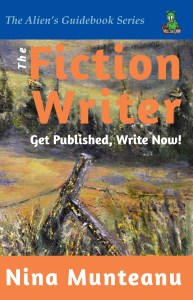
FictionWriter-front cover-2nd ed-webHere is an excerpt from The Fiction Writer, Chapter R:

One way to see your way through rejection is to find ways to distance yourself from your story once you’ve sent it off and to see the whole process of submission-rejection-acceptance as a business. The very best way to do this is to submit lots of stories and to keep submitting them. With novels, this is a little harder to do but you can certainly be working on the next one once you’ve submitted the first.

When I was writing short stories, I kept a list of what and where I submitted, along with the most important item: where to submit NEXT. At any given time, I made sure that I had at least x-number of submissions out there and each story had a designated place to go if it returned. As soon as a story came back from magazine A, I simply re-packaged it and sent it to magazine B. The critical part of the list was to have a contingency for each story: the next place where I would send the story once it returned. I was planning on the story being rejected with the hope that it would be accepted; that way, a rejection became part of a story’s journey rather than a final comment.

I ran my submissions like a bus terminal. A story was in and out so fast it never had a chance to cool off. And, since I had five other pieces out there, I could do this with little emotion. I was running a fast-paced “story depot”, after all. All my stories had to be out there as soon as possible; if they were sitting in the terminal, they were doing nothing for me.


nina-2014aaNina Munteanu is an ecologist and internationally published author of award-nominated speculative novels, short stories and non-fiction. She is co-editor of Europa SF and currently teaches writing courses at George Brown College and the University of Toronto. Visit www.ninamunteanu.ca for the latest on her books.

Limestone Genre Expo—One of Kingston’s Gems

Nina-Hali-clifi2

Nina Munteanu and Halli Villegas

I recently attended the Limestone Genre Expo in Kingston, Ontario. Held at the St. Lawrence College campus—ideally suited to a literary festival—the expo featured panels, readings, and workshops.

The festival was well attended by local, Canadian and international authors, editors, publishers, and readers—all committed to exploring literature, the arts and to having a good time.

Authors included Tanya Huff, Nancy Kilpatrick, Caro Soles, Violette Malan, Rick Blechta, Matthew Bin and Eve Langlais, among many others.

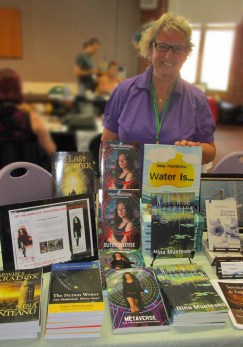
Nina-books-Limestone2016

Science Fiction GOH in 2016

Publishers included Exile Editions, Chizine Publications, Bundoran Press and others. Exile Editions recently published their anthology “Cli Fi: Canadian Tales of Climate Change” in which my story “The Way of Water” appears.

I was Limestone’s Science Fiction Guest of Honour last year; this year I got to relax and I sat on three panels.

NancyKilpatrick-limestone

Nancy Kilpatrick

In “Alternative Histories to Cyberpunk“, I was joined on the panel by Matthew Bin, Maldonado Skaff-Koren, Eric Desmarais, Michael Romaric, Dominic Bercier, and A.A. Jankiewicz with moderator Sean Moreland. We mostly discussed the literary device of alternative timelines and unanimously concluded that visionary science fiction that “failed” to predict the future was successful alternative “history”. This theme continued in the science fiction panel.

Cover1_LastSummoner-frontcoverI brought up the notion of history’s quantum properties, a braided flow of multi-dimensional and entangled realities. This served as premise for my alternative historical time-travel fantasy The Last Summoner, which takes place in fifteenth century Poland. On her fourteenth birthday, the baroness Vivianne Von Grunwald discovers that she can change history as an aeon; but she soon realizes that, while she is able to change some disastrous historic event, its entangled “destiny” indelibly moves closer to the original consequence than her intended one: yet another disaster. My scientific approach to alternate history is what excited me to write this, my only fantasy so far among a dozen science fiction novels.
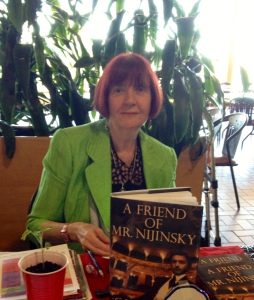
CaroSoles

Caro Soles

In the panel “The Science behind Science Fiction” I was joined by Katherine Prairie, Anita Dolman, Matthew Bin, Lisa Tooey, Kristen Kiomall, and A.A. Jankiewicz with moderator Caroline Frechette. We discussed the utility and risk of using pseudoscience in a science fiction story, a genre known for expectations of accuracy and prescience. In 1979, Ray Bradbury wrote: People ask me to predict the future, when all I want to do is prevent it. Better yet, build it. Predicting the future is much too easy, anyway. You look at the people around you, the street you stand on, the visible air you breathe, and predict more of the same. To hell with more. I want better.”

TanyaHuff-signing

Tanya Huff signs one of her books

Depending on whether the story is considered hard SF or soft SF, this level of accuracy in both actual science presented as premise and ability to predict science and technology will vary. Given that science fiction is largely metaphoric, the predictability of an SF story is secondary to the story’s value as metaphor and allegory. The consensus of the panel was that the audience determined the importance of precision and accuracy. In the final analysis, if the story is grounded in its own consistency, anything is possible.

WonderWoman

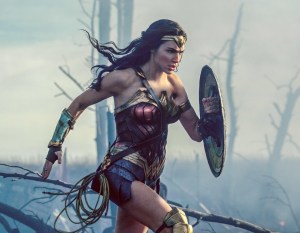
Wonder Woman (Gal Gadot)

In “Women in Genre” I was joined by Violette Malan, Nancy Kilpatrick, Eve Langland, Alyssa Cooper, Janet Kellogg, and Liz Lindsay with moderator Sandra Kasturi. The banter was by turns fun and edgy, all lubricated with good humour by all participants. As a writer of science fiction and fantasy of which 90% feature a “strong female protagonist”, I brought up the controversy of what, in fact, determines a good female lead in story. Why do so many heroines still provide just a kick-ass version of a male hero? Why are so many female protagonist heroes still defined by the rules of what makes a male a hero? Where are the real women?

Politics south of us aside—along with Margaret Atwood’s all too realistic Handmaid’s Tale (currently playing on Bravo TV), we discussed the recent push-back in Texas on the all-women showing of “Wonder Woman,” which prompted many heated tweets. The Atlantic recently published an article on the film—and surrounding events—entitled “Wonder Woman, Heroine of the Post-Truth Age.”wonder-woman-movie-poster

Wonder Woman is set at the height of World War I, but is otherwise a decidedly modern movie,” writes Megan Garber of The Atlantic. “It stars a woman (Gal Gadot) and treats a man, Steve (Chris Pine), as its damsel-in-distress. It has managed, even before its release, to enrage men’s-rights activists, which is quickly becoming a reliable measure of a movie’s modernity.”

wonderwoman-golden lassoWonder Woman uses a unique weapon, the Golden Lasso, known as the Lasso of Truth—because it compels anyone wrapped by it to reveal the truth.

When William Moulton Marston—scientist and inventor of the polygraph machine— created the Wonder Woman character, he envisioned a warrior who was also an investigator of truth. “Frankly,” he said, “Wonder Woman is psychological propaganda for the new type of woman who should, I believe, rule the world.” He believed that a world that gave women more power—politically and otherwise—would be more peaceful, more empathetic, more worthy, writes Garber. “And so Wonder Woman is a work that is decidedly at home, across its dimensions, in the world of 2017—a world that is on the one hand newly recognizing women’s widespread capabilities, but that is on the other deeply anxious about ‘alternative facts,’ about ‘fake news,’ about politically weaponized lies, about falsehoods that are uttered with no seeming consequence. The princess’s lasso, that shimmering metaphor for objective truth, is a symbol of aspiration; seen in another way, though, it is a symbol of despair. Here, in this wobbling weapon, is “wonder” as in awe; here, too, is “wonder” as in uncertainty. Here is a tool of truth that is decidedly ambivalent about its own powers. “How do I know you’re not lying to me right now?” the princess asks the spy. And the only way she can know for sure is to trust, paradoxically, in magic.”

Magic is OK, though. It is, after all, the stuff from which we draw when we write.

Nina-SF GOH-Limestone Genre Expo

Nina Munteanu, Science Fiction GOH at Limestone Genre Expo 2016

nina-2014aaNina Munteanu is an ecologist and internationally published author of award-nominated speculative novels, short stories and non-fiction. She is co-editor of Europa SF and currently teaches writing courses at George Brown College and the University of Toronto. Visit www.ninamunteanu.ca for the latest on her books.