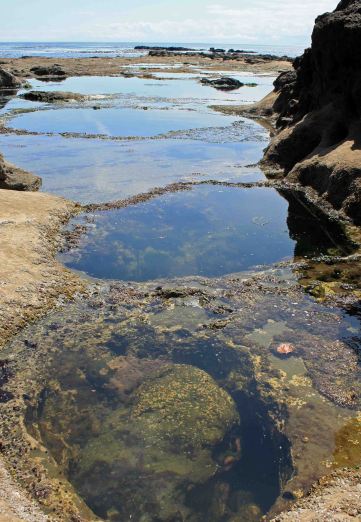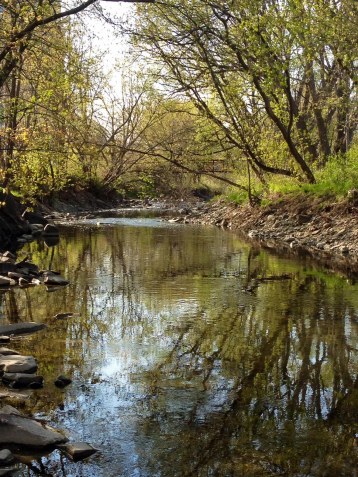
Mimico Creek (photo N. Munteanu)
On June 12th, Councillor Jim Tovey, Mississauga Nation knowledge keeper Nancy Rowe and others helped me celebrate the launch of my long-awaited book “Water Is…” (three years in the making!) with a water blessing of Mimico Creek and various water-engaging activities.
The environmental event “celebrated water and our connection with it” at Islington Golf Course in Etobicoke. The 75 people who attended also included the Toronto and Region Conservation Authority, Credit Valley Conservation Authority, Lake Ontario Waterkeeper, Ecologos (WaterDocs), Rethink Sustainability Initiatives, poets, writers and artists.
In her powerful and compelling blessing, Nancy Rowe said, “Water is life, water is healing, we owe everything to water.” Despite the celebration, Mimico’s ironic reality was reflected in the ceremony: “You used to be able to drink this water,” Rowe lamented as she used tap water for the water blessing ceremony.
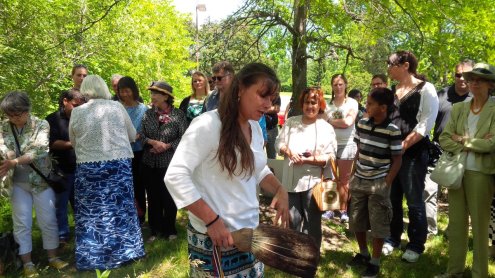
Nancy Rowe blesses the water (photo Maureen Pogue)
Vince D’Elia of TRCA gave Mimico Creek a failed report card and spoke about the need to educate the public on water and watersheds. Given that Mimico Creek flows some 33 km within a 77 square km watershed that encompasses three jurisdictions (Brampton, Mississauga, and Toronto); harmonizing efforts is no easy task.
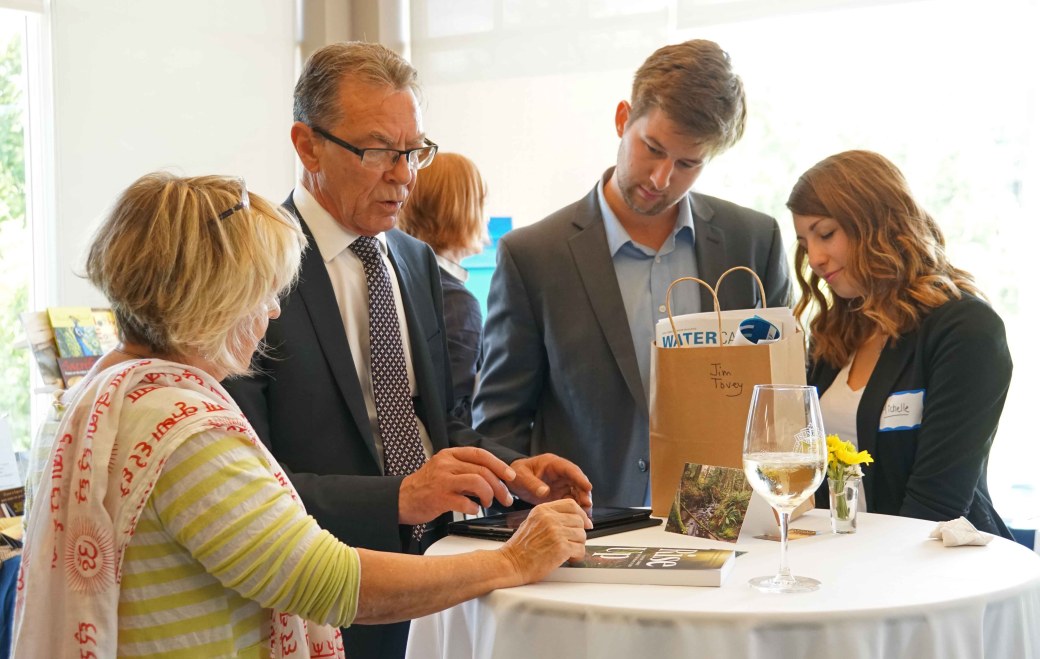
Jim Tovey with Yasmin Glanville, Travis Belanger and Michelle Stone (photo K. September)
Councillor Tovey stressed connection of individuals, communities and jurisdictions to create awareness and action in re-wilding our watersheds and to foster beauty. He highlighted Mississauga’s extensive planning and investment into these initiatives, saying that they are setting the precedent for all Canadian cities for sustainability planning.
Claire Lawson of LOWaterkeeper proclaimed that, “We are Lake Ontario,” referring to us being 70% water and the constant circulation of water on the planet. She gave us the 6 steps to water leadership: 1) know your watermark; 2) orient yourself; 3) get out there; 4) know the rules; 5) participate; and 6) dedicate yourself. She told us why sharing our personal watermarks was so important and urged participants to share their watermark–a personal story that connected them with a particular waterbody and event–to help promote meaning and protection of waterbodies around the world.
Ro Omrow, with Ecologos (WaterDocs) invited participants to sign a petition to make Toronto a Blue Community. Initiated by the Council of Canadians, a Blue Community is one that:
- recognizes water as a human right
- bans the sale of bottled water in public facilities and at municipal events
- promotes publicly financed, owned and operated water and wastewater services

Tasnim Jivaji sets up her water art at Nina’s launch/event (photo K. September)
Colleague, Naturalist friend, editor, indexer and poet, Merridy Cox, shared her watermark. Liana Di Marco read her poem “Rewilding the Sacred”, which appears in my book. John Ambury, whose poem also appears in my book read “Moving Waters.”

Liana Di Marco signing her pledge
Mississauga artist Tasnim Jivaji exhibited her water-inspired art. Originally from Mombasa, Kenya, Jivaji said, “In all my travels, in all the places around the world, it has never been the concrete that takes my breath away; it is always the body of water.”
The event also included a Water Action Station, which featured a three-step process toward successful water-action:
According to Tovey, my book “Water Is…” bridges the gap from awareness to appreciation, connection and final action.
This book came from a lifetime’s dedication to water, humanity and our environment–from the moment I realized as a little girl that I felt the planet. I firmly think that water is the “glue” that can help us all connect and this book is the result.
Water is the ultimate gift and connecting force.
In the months and years to come we may see water further commodified, abused, and persecuted, figuring in tensions, take-overs and wars … Or not … That depends on us, everyone of us. We’re over 70% water, after all.
We ARE water…
What we think, feel and do, so does water.
#WhatIsWATER
#TheMeaningOfWater
Images taken by Kevin September (@SeptemberSphere; http://kevinseptember.com) unless otherwise shown.
Praise for “Water Is…” from around the world:
“This book emotionally connected me with water. As a result it fed my perception about the value of life. It reminded me that life reveals in each space a complex system that is full of surprise and beauty. A system of which I am part, without separation.”—Laura Fres, One Deep Sustainability, Barcelona, Spain
“A sumptuous collection of treasures…from the basics of matter itself to the social and spiritual aspects of this substance, which touches our lives so much and is still not really understood.”—Dr. B. Kröplin and Regine C. Henschel, “World in a Drop”, Germany
“Congratulations, Nina! Water Is… is an adventurous, surprising and inspiring book that could not feel more timely. The writing swept me away on a journey through history, landscape and our entire universe, yet brought me back home in the end with a fresh perspective on the significance of water.”—Emmi Itäranta, author of Memory of Water, United Kingdom
“If you don’t want to read all those other books on water, just read this one.”—John Stewart, Mississauga News, Ontario, Canada
“[Nina] is immersed well enough in water to tell us about how we should think about it. And the way she goes about it in this book is awfully good…A fine achievement.”—Joseph Planta, The Commentary, Vancouver, Canada
“This book leaves me impressed. From science to science fiction, from philosophy to religion, from history to fairytale, the role of water is illustrated and illuminated. Water is probably the best investigated and least understood substance on this world, yet we still don’t know how to describe it in a better way than calling it H2O. This book tries to zero in on the missing part, the great unknown of water, and it does it in a very intelligent and charming way.”—Elmar C. Fuchs, scientist, WETSUS Program Manager, Netherlands
“Kudus to Nina Munteanu for sharing her deep wisdom, experience and knowledge of humanity’s greatest natural resource! As Leonardo da Vinci said, “We forget that the water cycle and the life cycle are one.” We forget at our own peril and so I am deeply grateful for this book by so highly qualified an author!”—Elisabet Sahtouris, evolution biologist, futurist, author of Gaia’s Dance: The story of Earth & Us, USA


 For me this represents a palpable and gestalt cultural awakening in the realm of the “feminine archetype”.
 I mentioned that the majority of my stories are science fiction (SF). SF is a literature of allegory and metaphor and deeply embedded in culture. It draws me because it is the literature of consequence exploring large issues faced by humankind. In a February 2013 interview in The Globe and Mail I described how by its very nature SF is a symbolic meditation on history itself and ultimately a literature of great vision: “Speaking for myself, and for the other women I know who read science fiction, the need is for good stories featuring intelligent women who are directed in some way to make a difference in the world…The heroism [of women] may manifest itself through co-operation and leadership in community, which is [often] different from their die-hard male counterparts who want to tackle the world on their own. Science fiction provides a new paradigm for heroism and a new definition of hero as it balances technology and science with human issues and needs.”
 We’ve progressed from the biological to the mechanical to the purely mental, from the natural world to a manufactured world to a virtual world, writes philosopher and writer Charles Eisenstein. According to Carolyn Merchant, professor at UC Berkley, early scientists of the 1600s used metaphor, rhetoric, and myth to develop a new method of interrogating nature as “part of a larger project to create a new method that would allow humanity to control and dominate the natural world.”
 Competition is a natural reaction based on distrust—of both the environment and of the “other”—both aspects of “self” (as part) separated from “self” (as whole). The greed for more than is sustainable reflects an urgent fear of failure and a sense of being separate. It ultimately perpetuates actions dominated by self-interest and is the harbinger of “the Tragedy of the Commons”.
 Examples of creative cooperatives exist throughout the world, offering an alternative to the traditional model of competition. Cultural creatives are changing the world, Ruche tells us. These creatives, while being community-oriented with an awareness of planet-wide issues, honor and embody feminine values, such as empathy, solidarity, spiritual and personal development, and relationships. Mechanisms include reciprocity, trust, communication, fairness, and a group-sense of belonging. I give examples in my upcoming book “Water Is…” by Pixl Press, due in Spring 2016.
 Nina Munteanu is an ecologist and internationally published author of award-nominated speculative novels, short stories and non-fiction. She is co-editor of Europa SF and currently teaches writing courses at George Brown College and the University of Toronto. Visit
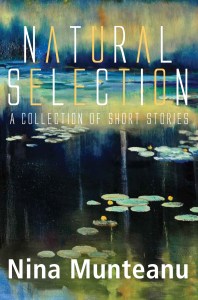 I started branding my writing as eco-fiction a few years ago. Prior to that—even though my stories were strongly driven by an ecological premise and strong environmental setting—I described them as science fiction and many as technological thrillers. Environment’s role remained subtle and—at times—insidious. Climate change. Water shortage. Environmental disease. A city’s collapse. War. I’ve used these as backdrops to explore relationships, values (such as honour and loyalty), philosophies, moralities, ethics, and agencies of action. The stuff of storytelling.

 In my latest book