 Nina Munteanu’s near-future speculative short story “The Way of Water” in Bruce Meyer’s (editor) “Cli Fi: Canadian Tales of Climate Change”, published by Exile Editions in 2017, will appear again in Rosarium Publishing / Future Fiction’s anthology “New Dimensions in International Science Fiction in April 2018.
She imagines its coolness gliding down her throat. Wet with a lingering aftertaste of fish and mud. She imagines its deep voice resonating through her in primal notes; echoes from when the dinosaurs quenched their throats in the Triassic swamps.
Water is a shape shifter.
It changes yet stays the same, shifting its face with the climate. It wanders the earth like a gypsy, stealing from where it is needed and giving whimsically where it isn’t wanted.
Dizzy and shivering in the blistering heat, Hilda shuffles forward with the snaking line of people in the dusty square in front of University College where her mother used to teach. The sun beats down, crawling on her skin like an insect. She’s been standing for an hour in the queue for the public water tap.
“The Way of Water” is a near-future vision that explores the nuances of corporate and government corruption and deceit together with resource warfare. An ecologist and technologist, Nina Munteanu uses both fiction and non-fiction to examine our humanity in the face of climate change and our changing relationship with technology and Nature.
A recent review of the anthology by Emilie Moorhouse in Prism International Magazine, entitled “Courage and Imagination in Cli-Fi: Canadian Tales of Climate Change” and carried by the National Observer, describes it this way:
“The seventeen stories in this book edited by Bruce Meyer examine how humankind might struggle with the potential devastation of climate change in the near or distant future. Soon after I finished reading the book, Cape Town—known in precolonial times as “the place where clouds gather”—announced that it was only a few months away from what it called “Day Zero,” the day the city would officially run out of water, making the similarities between fiction and reality more than unsettling. Munteanu’s story is set in a futuristic Canada that has been mined of all its water by thirsty corporations who have taken over control of the resource. Rain has not fallen on Canadian soil in years due to advances in geoengineering and weather manipulation preventing rain clouds from going anywhere north of the Canada-US border…I believe that fiction offers up two much-needed ingredients in the fight to prevent climate change: courage and imagination. It is my hope that more fiction writers will take up the task of writing in this promising new genre and use their imagination to inspire readers to collectively work towards a more sustainable future.”—Emilie Moorhouse, Prism International
 A bilingual print book by Mincione Edizioni (Rome) showcased “The Way of Water” in Italian (“La natura dell’acqua”, translated by Fiorella Moscatello) and English along with a recounting of what inspired it: “The Story of Water” (“La storia dell’acqua”) in 2016.
“In ‘The Way of Water’, Nina Munteanu pens her love letter to water, exulting it as a liquid that has semi-magical properties…’The Way of Water’ evokes a sense of awareness about issues of access to water and about the dangers of imbalances in that access.”—Derek Newman-Stille, Speculating Canada
“In a short story in which every word has its weight, Nina Munteanu manages to describe a dystopia with ecological, political, social and economic elements and Hilda’s reactions to her situation with a great emotional intensity. To avoid thirst, Hilda ends up embracing an extreme idea, a last hope linked to water.
‘The Way of Water’ is a story of the kind you hope is science fiction but you fear is not.”—Massimo Luciani
” ‘The Way of Water’ is to be ‘a shapeshifter,’ says Nina Munteanu in her dystopian narrative, where she draws a dark scenario and, unfortunately, not too improbable in the near future. In the universe of the story water has become a very precious commodity: rationed consumption, credits (always of water) accounted for and debts collected…The Chinese multinationals have exchanged the public debt of other states with their water reserves with which, now, they can control the climate, deciding when and where it will rain. Who understands this dirty game has been silenced, like Hilda’s mother, a limnologist, inexplicably arrested and never returned; like the daughter of two water vendors, mysteriously disappeared, after having decided not to bow to economic powers: Hanna, who now prefers secure virtual identities to evanescent real appearances. Water. The two, like the covalent bond of a complex molecule, develop a relationship of attraction and repulsion that will first make them meet and then, little by little, will change into a tormented love but, at the same time, so pure as to cause Hilda at great risk, to make an extreme decision that will allow Hanna to realize the strange prophecy that the internal voice, perhaps the consciousness of water, had resonated in the two women for a long time.
Nina Munteanu recounts that this element is also a form of love; a story to read, not only to deal with the possible but, above all, to understand that the time still available to “love” may be less than what we believe.”—Simone Casavecchia, SoloLibri.net
 “The Way of Water” will also appear alongside a collection of international works (including authors from Greece, Nigeria, China, India, Russia, Mexico, USA, UK, Italy, Canada (yours truly), Cuba, and Zimbabwe) in Bill Campbell and Francesco Verso’s Rosarium Publishing / Future Fiction’s anthology “New Dimensions in International Science Fiction” in April 2018.
“Nina Munteanu’s “The Way of Water” is perhaps more esoteric in its focus and more abstract in its approach, but I likewise found it to be a strong story. In an interesting scarcity future in which we follow the fate of a character abandoned by her mother, water itself becomes a character. In the second paragraph we’re told that “Water is a shape shifter,” and in the next page we encounter the following description: “Water was paradox. Aggressive yet yielding. Life-giving yet dangerous. Floods. Droughts. Mudslides. Tsunamis. Water cut recursive patterns of creative destruction through the landscape, an ouroboros remembering.” These descriptive musings cleverly turn out to be more than metaphors and tie in directly to the tale’s surprising ending.”—Alvaro Zinos-Amaro, IntergalacticMedicineShow.com
 Nina Munteanu is an ecologist, limnologist and internationally published author of award-nominated speculative novels, short stories and non-fiction. She is co-editor of Europa SF and currently teaches writing courses at George Brown College and the University of Toronto. Visit www.ninamunteanu.ca for the latest on her books.


 Nina Munteanu is an ecologist, limnologist and internationally published author of award-nominated speculative novels, short stories and non-fiction. She is co-editor of Europa SF and currently teaches writing courses at George Brown College and the University of Toronto. Visit



 When I was just beginning as a novelist, the publisher guideline request “submit a synopsis and sample chapters” was intimidating to say the least. There was something terrifyingly daunting about writing a succinct compelling summary of my 300-page novel packaged into just a few pages. As author Katherine Eliska Kimbriel said, “The instinctive response [of the author] is to clap on a helmet and start digging a trench.” I had a right to be terrified. In some ways the synopsis is the hardest thing for a novelist to write. Yet it is the first thing most publishers and agents want (and have time) to see of your cherished project (aside from those sample chapters, of course). Every fiction writer who wants to sell in the current market must know how to write a synopsis because that’s what an editor wants to see first. Most editors (if they’re good) are overworked with scarce enough time to answer their phones, much less their emails.
 A synopsis of your novel goes beyond the outline to help polish elements of story arc, characterization with plot and setting with story. The synopsis can answer questions perplexing the author, stuck on a scene or plot item. It helps you weave your novel’s elements into a well-integrated story that is compelling at many levels. Because the synopsis is based on emotional turning points (related to theme), character dramatization of the premise is a key foundation. It makes sense to write drafts of your synopsis as you go along in the novel; that way it’s useful to both you and to the editor and then it’s more or less written when you need to submit it along with sample chapters…and not quite as daunting a task either.
 Nina Munteanu is an ecologist and internationally published author of award-nominated speculative novels, short stories and non-fiction. She is co-editor of Europa SF and currently teaches writing courses at George Brown College and the University of Toronto. Visit
 In “Outer Diverse”, the first book of “The Splintered Universe Trilogy” (Starfire), Galactic Guardian Rhea Hawke speaks with Ka, an alien mystic, about music, frequency and harmony. And something called “the music of the spheres”. Says Ka:
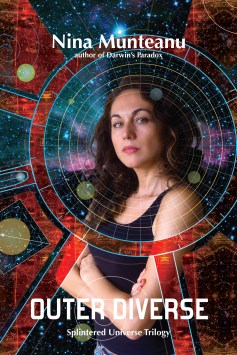 imprint,” Ka continued, now leaning forward with his cup in both hands, “and said that in the vital power of the human being, ignited at birth, that remembered image glows. That geometric-harmonic imprint is the music that impels each listener to dance … from the particle to the cosmic. Your own heart finds its shifting harmony between excessive order and complete randomness, encompassing complex variability—a symphony—in its beating pattern. Sound—vibration—is the language of the mind and the secret to creation.”
 When I first heard the writer’s edict “write what you know” I rejoined: but I write science fiction—I write about the unknown. What I still had to learn was that by describing “the other” SF really describes “us”. We explore ourselves through our relationship with the unknown. We do this by ensuring that all our plotlines reflect theme.

 Some years ago, I was interviewed by Michael Stackpole (New York Times bestselling author of over 40 novels, including “I, Jedi” and “Rogue Squadron”) and Michael Mennenga (CEO of “Slice of Sci-Fi”) on
  We talked about my book “
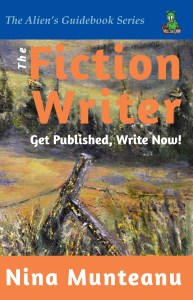 Here is an excerpt from
 Nina Munteanu Writing Coach