How Trees Can Save Us…Five Perspectives on Humanity’s Relationship with Our Forests

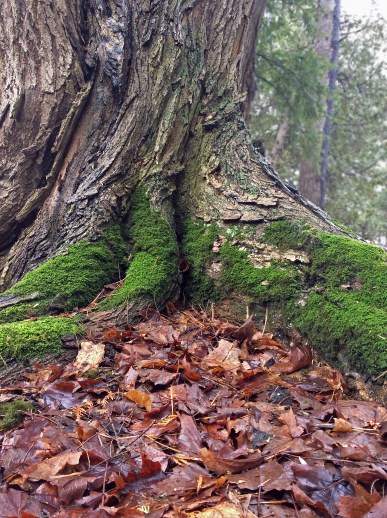
Cedar trunk base-LR

Cedar tree in Little Rouge Forest, Ontario (Nina Munteanu)

Alick Bartholomew, author of The Spiritual Life of Water, describes four geologic periods when forests thrived on this planet. The first was the Carboniferous, 350 million years ago, when land vertebrates established. The second was the Jurassic, 170 million years ago, when dinosaurs dominated the planet. The third, the Eocene epoch, 60 million years ago, witnessed the first primitive mammals. The last, the Holocene epoch, which began some 500,000 years ago, ushered in modern humanity. Bartholomew suggests that perhaps, “in each case the forests delivered a boost in the oxygen content of the atmosphere, which may have been a trigger for an evolutionary explosion of life forms.”

Ten thousand years ago, the land along the Mediterranean was covered in mixed forests of conifers and oak. Lebanon’s forests provided timber for the exploring ships of the Phoenician empire in third century BCE. North Africa, a fertile forest two thousand years ago, is now a desert. A thousand years ago, three quarters of the world was forest. Today forest and woodland cover only a third of the world. The UK is currently the least wooded area of Europe with 13% woodland cover; its ancient woodland is being removed at a faster rate than the Amazon rainforest. Humanity is currently cutting down trees at a rate of 15 billion a year. We are losing forests the size of New York City daily; every 100 days we lose forests the size of Scotland; within a single year we lose forest ecosystems the size of Italy.

Since humanity arrived, we have cut down trees for timber, agriculture and development. Our impact is a matter of scale. When humanity was a mere 300 million in pre-medieval times, forest ecosystems remained intact. We are now over 7 billion, doing essentially the same thing we did thousands of years ago. What may have been sustainable then is now extirpating entire complex ecosystems, along with species we may never know existed. Deforestation releases a massive carbon sink into the atmosphere, driving global warming. It is largely responsible for reducing populations of wildlife by half in the last 40 years, and for starting the sixth massive extinction event.

Clearcut gordon valley copy 2

Clearcut in Gordon Valley, Vancouver Island, BC (photo by T.J. Watts)

While too many of us do not understand or appreciate the global consequences of deforestation, we remain intimately and personally connected with trees: in ways we don’t realize or have forgotten.

This article overviews the perspectives of five writers on the role and history of trees in global planetary health and our journey with climate change. I explore three non-fiction books and two fiction books. The non-fiction books include Witness Tree (2017) by Lynda Mapes, The Global Forest (2011) by Diana Beresford-Kroeger, and The Songs of Trees (2018) by David George Haskell. The two fiction books include The Overstory (2018) by Richard Powers and Barkskins (2016) by Annie Proulx. Each work is a compelling testament of humanity’s connection with trees, both historically and in the present. All provide powerful and evocative optimism in different ways.

SONY DSC

Ash tree, Little Rouge River forest, Ontario (photo by Nina Munteanu)


The Philosophical OPTIMISM of Lynda Mapes
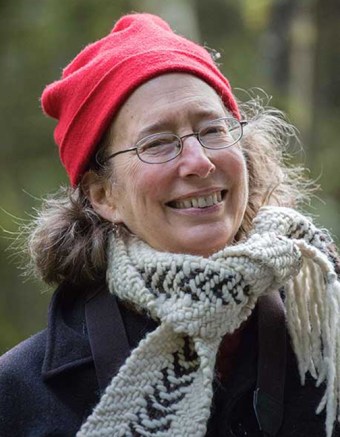
LyndaMapes

Lynda V. Vapes

Seattle Times environmental reporter and author of Witness Tree, Lynda V. Mapes explores a changing natural world and humanity’s relationship with it through a single Century-old red oak tree over four seasons. Mapes brings in elements of physics, ecology, biology and sociology and philosophy to probe her witness tree and reveal a colourful history of aboriginal life, colonialism, commodification and human-caused climate change.

In describing her oak tree, journalist and author of Witness Tree, Lynda V. Mapes writes, “The big oak dominates its space…but it also supports a vast web of life and relies in turn on a menagerie of helpers, aboveground and below. With its crown in the wind and its roots in the teeming soil, the big oak connects earth and sky, and many millions of beings, and is home to each and to all. It is just one tree, and yet a whole world unto itself.”

WitnessTreeMapes reveals that her witness tree overcame a 1 in 500 chance of taking root from tiny acorn to seedling to become a thirteen-storey tall giant. Mapes considered her oak a living timeline that revealed through its phenology how climate change is resetting the seasonal clock. Mapes sought “the quiet testimony of living things.” Through an “intimate exploration” in which she dug below, climbed up and lay beneath her oak, Mapes found vulnerability, loss, renewal, and hope.

“No matter what else the future may bring, in an uncertain world forests are a repository of only good verbs:  Forests shelter. Nurture. Moderate. Cleanse. Regenerate. Provide. Connect. Sustain…Trees can be our wellspring of inspiration. More than building material, fuel, and carbon-storage utilities, forests are foundational to life on the earth, refugia for countless animals, and an endless source of human joy, renewal, and refreshment.”

“People and trees are meant to be together, and if we work at it, that’s how we will stay,” writes Mapes at the end of her book. It is both hope and warning. A quiet clarion for us to “remember” our place in the world and to embrace our relationship with trees as wisdom guide.

Mapes invites us to connect with the forest.

Fallen log stream-2012

Old growth forest on Vancouver Island, British Columbia (photo by Kevin Klassen)

The Practical OPTIMISM of Diana Beresford-Kroeger

Diana-and-the-tree3

Diana Beresford-Kroeger

In her book The Global Forest: 40 Ways Trees Can Save Us, botanist and medical biochemist Diana Beresford-Kroeger tells us that:

“A functioning forest is a complex form of life. It is interconnected by its own flora and driven by the mammals, the amphibians and insects in it. It is kept in place by fungi, algae, lichens, bacteria, viruses, and bacteriophages. The primogenitors of the forests are trees. They communicate by carbon-coded calls and mass-market themselves by infrasound. The atmosphere links forests into the heavens and the great oceans. The human family is both caught and held in that web of life.”
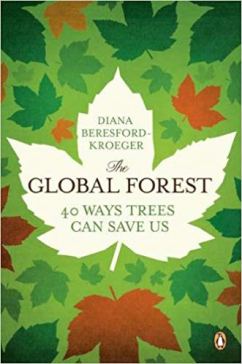
TheGlobalForestWritten with passionate lyricism and a mother’s nurturing spirit, Irish storyteller Beresford-Kroeger weaves a compelling tapestry of ancient forest lore with modern science to promote the global forest. Tapping into aboriginal wisdom and ancient pagan legend, Beresford-Kroeger invites you into the forest to explore the many beneficial and pharmaceutical properties of trees—from leaves that filter the air of particulate pollution, the cardiotonic property of hawthorn, fatty acids in hickory nuts and walnuts that promote brain development, to the aerosols in pine trees that calm nerves.

The titles of her chapters reveal an overarching agenda: “The Global Forest Has Within Itself a Master Plan for Sustainability”; “Climate Change Can Be Reversed: Simplicity, Sustainability, and Sanity”.

“This [global] forest is the environment that drives and fulfills the dream of each leaf in a vast rhythmic cycle called life. Nothing is outside. We are all of it in a unity that transcends the whole. Maybe, just maybe, this resonates of God. If that is so, then we are all His children, every earthworm, every virus, mammal, fish and whale, every fern, every tree, man, woman and child. One equal to another. Again and again.”

Beresford-Kroeger compels us to interact with and learn from the forest.


gnarly cedar tree

Gnarly “feet” of cedar tree in Little Rouge River forest, Ontario (photo by Nina Munteanu)


The Existential OPTIMISM of David George Haskell  

DavidGeorgeHaskell

David George Haskell

In The Songs of Trees: Stories from Nature’s Great Connectors, biologist David George Haskell pens an existentialist poem to life’s interconnected network. Haskell’s notion of ‘listening to trees’ arises not from metaphor or metaphysics but from a spiritual understanding of the woven tapestry of life.

 “For the Homeric Greeks, kleos, fame, was made of song. Vibrations in air contained the measure and memory of a person’s life. To listen was therefore to learn what endures. I turned my ear to trees, seeking ecological kleos. I found no heroes, no individuals around whom history pivots. Instead, living memories of trees, manifest in their songs, tell of life’s community, a net of relations. We humans belong within this conversation, as blood kin and incarnate members. To listen is therefore to hear our voices and those of our family…To listen is therefore to touch a stethoscope to the skin of a landscape, to hear what stirs below.”

SongsOfTreesIn his travels to visit iconic trees around the world, Haskell draws on the wisdom and moral ethics of “ecological aesthetics” to describe a natural beauty—not as individual property but as a world within a world of interactive life to which we belong and serve but do not own:

“We’re all — trees, humans, insects, birds, bacteria — pluralities. Life is embodied network…where ecological and evolutionary tensions between cooperation and conflict are negotiated and resolved…Because life is network, there is no ‘nature’ or ‘environment,’ separate and apart from humans. We are part of the community of life, composed of relationships with ‘others,’ so the human/nature duality that lives near the heart of many philosophies is, from a biological perspective, illusory…We cannot step outside life’s songs. This music made us; it is our nature…To listen to trees, nature’s great connectors, is therefore to learn how to inhabit the relationships that give life its source, substance, and beauty.”

In the vein of the naturphilosophie of Goethe and Schelling—and later of Carson, Thoreau, Eisely and Dillard—Haskell invites us to cultivate a strong sense of place and being, one that extends beyond “self” to the existential nature of experience. Glancing up a magnificent oak or beech tree reveals wood as “an embodied conversation between plant life, shudder of ground and yaw of wind.”

Haskell exhorts us to be the forest.
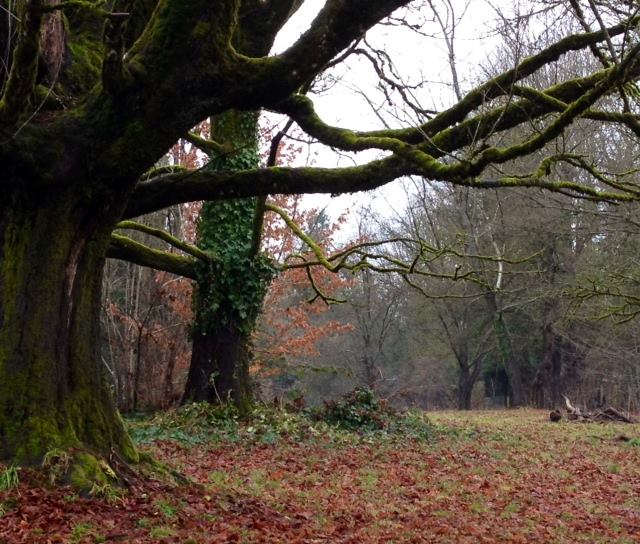
Old tree deer lake park

Old tree in Deer Lake Park, Burnaby, BC (photo by Nina Munteanu)

The Fierce OPTIMISM of Richard Powers  

RichardPowers

Richard Powers

At the heart of Richard Powers’s The Overstory are the pivotal lives of two women, botanist Patricia Westerford and college student Olivia Vandergriff. Both will inspire a movement against the destruction of forests.

Patricia Westerford—whose work resembles that of UBC’s Suzanne Simard—is a shy introvert who discovers that trees communicate, learn, trade goods and services, and have intelligence. When she shares her discovery, she is ridiculed by her peers and loses her position.  But, just as with Lynn Margulis and her theory of endosymbiosis, Westerford is finally validated. She is the archetypal ‘mother tree’, the metaphoric Tachigali versicolor, who ultimately brings the tangle of narratives together through meaning. Westerford writes in her book The Secret Forest:

mossy tree copy

Moss-covered cedar, Alberta (photo by Nina Munteanu)

“There are no individuals in a forest, no separable events. The bird and the branch it sits on are a joint thing. A third or more of the food a big tree makes may go to feed other organisms. Even different kinds of trees form partnerships. Cut down a birch, and a nearby Douglas fir may suffer…Fungi mine stone to supply their trees with minerals. They hunt springtails, which they feed to their hosts. Trees, for their part, store extra sugar in their fungi’s synapses, to dole out to the sick and shaded and wounded. A forest takes care of itself, even as it builds the local climate it needs to survive…A tree is a wondrous thing that shelters, feeds, and protects all living things. It even offers shade to the axmen who destroy it.”

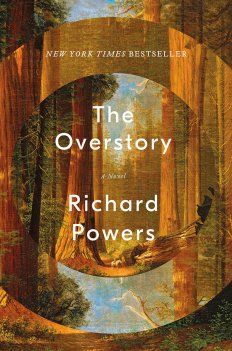
TheOverstoryOlivia Vandergriff miraculously survives an electrocution to become an ecowarrior after she begins to hear the voices of the trees. She rallies others to embrace the urgency of activism in fighting the destruction of California’s redwoods and even camps in the canopy of one of the trees to deter the logging. When the ancient tree she has unsuccessfully protected is felled, the sound is “like an artillery shell hitting a cathedral.” Vandergriff weeps for this magnificent thousand-year old tree. So do I. Perhaps the real heroes of this novel are the ancient trees.

In his review of Overstory in The Guardian, Banjamin Markovits wrote, “ There is something exhilarating…in reading a novel whose context is wider than human life. Like Moby-DickThe Overstory leaves you with a slightly adjusted frame of reference… And I found, while reading, that some of what was happening to his characters passed into my conscience, like alcohol into the bloodstream, and left a feeling behind of grief or guilt, even after I put it down.”

Powers challenges us to champion the forest.
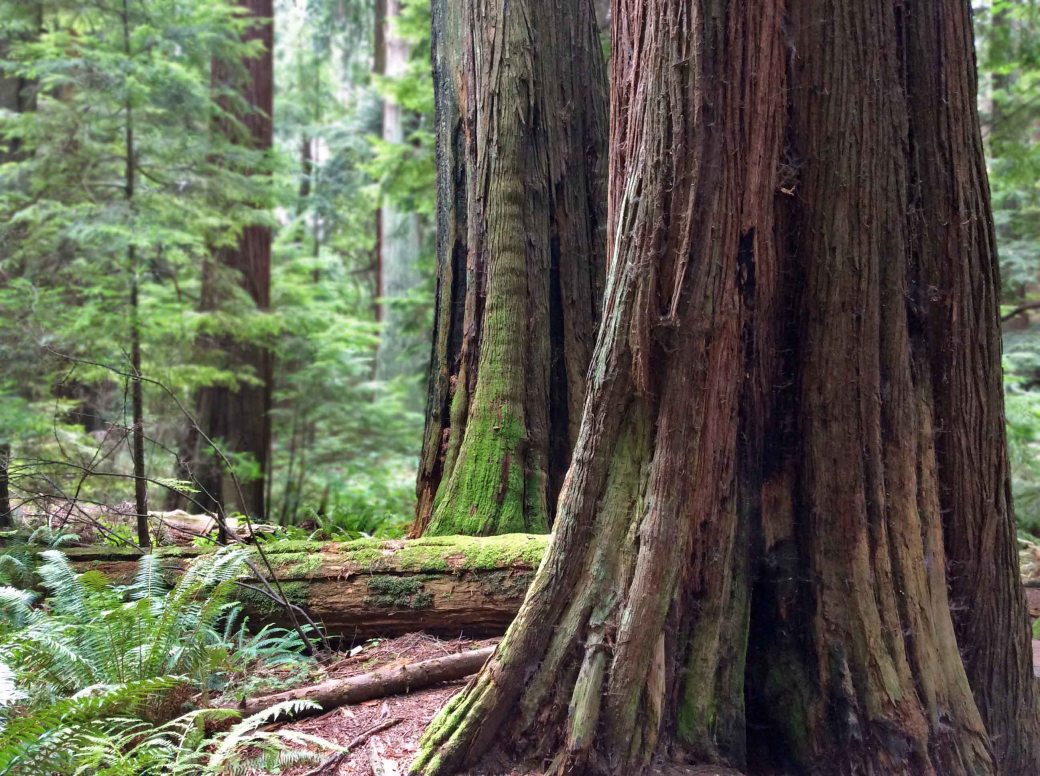
Cedar Giants-LHP

Ancient cedars in Lighthouse Park, West Vancouver, BC (photo by Nina Munteanu)

The Intellectual OPTIMISM of Annie Proulx  

AnnieProulx

Annie Proulx

Annie Proulx’s Barkskins chronicles two immigrants who arrive in Canada in 1693 (Rene Sel and Charles Duquet) and their descendants over 300 years of deforestation of North America starting with the arrival of the Europeans to contemporary global warming. “Barkskins” (woodcutters) are, in fact indentured servants who were brought from the Paris slums to the wilds of New France “to clear the land, to subdue this evil wilderness,” says their seigneur. Sel is forced to marry a native woman and their descendants live trapped between two cultures; Duquet runs away to become a fur trader and build a timber empire.

barkskinsProulx immerses the reader in rich sensory detail of a place and time, equally comfortable describing a white pine stand in Michigan and logging camp in Upper Gatineau to a Mi’kmaq village on the Nova Scotia coast or the stately Boston home of Charles Duquet. The foreshadowing of doom for the magnificent forests is cast by the shadow of how settlers treat the Mi’kmaq people. The fate of the forests and the Mi’kmaq are inextricably linked through settler disrespect and a fierce hunger for “more.”

The novel rolls out events in a relentless stream of life and death; no character is safe from the ravages of nature or the notions of that time period. While most of the book flows like a great amoral river—filled with feckless, unheroic and at times miserable characters—there are moments of emotional shoring. They act like exclamation marks for their rarity. By the 1830s, the character, German forester Armenius Breitsprecher, expresses anger and frustration with his colleagues:

LittleRougeRiver-TreeUp copy

White pine, Little Rouge River forest, Ontario

“Not for the first time he saw that the acquisitive hunger of Duke & Sons was so great they intended to clear the continent. And he was helping them. He hated the [lumber companies] clear-cut despoliation, the insane wastage of sound valuable wood, the destruction of soil, the gullying and erosion, the ruin of the forest world with no thought for the future—the choppers considered the supply to be endless—there was always another forest.”

Proulx’s unsentimental narrative and grand historic set-pieces lure the reader first to passively observe humanity’s struggles with the grand forest; then, once immersed, we are nudged to participate along with the awakening of the human consciousness over the generations of her 300-year long saga—first in the early 1900s through Conrad and Charley who recognize the importance of a functional forest ecosystem then through current day ecologist Sapatisia Sel (descendant of Rene), who responds to a scientist’s claim of  “A great crisis is just ahead” with “The forests, the trees, they can change everything!”

Cedar-boardwalk copy

Giant Cedars boardwalk, Alberta (photo by Nina Munteanu)

The suggestion is that, while we remain inextricably embedded in time and place—we are also progenitors of change to our future generations. Three hundred years ago, our beliefs and knowledge prevented us from acting sustainably. We know better now. The time to save our forests and let them save us is now.

“The reader comes to realize that the novel isn’t really about the human characters so much as it is about the forests,” Gus Powell of The National Post concludes of Barkskins. “As [the forests] disappear, the narrative seems to recede in importance, revealing a crucial interdependence between the human and the natural world previously handled almost entirely as subtext. This is especially true in the novel’s closing, where the anger and despair that have characterized the novel shift into an outspoken environmental advocacy.” This is the essence of optimism…

Proulx dares us to believe in the forest.

*****
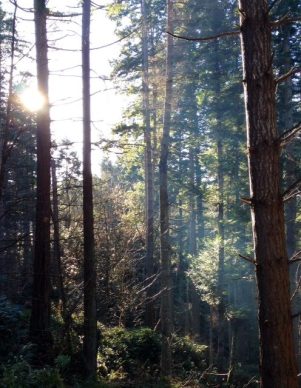
Forest conifers Metchosin

Forest in Metchosin, BC (photo by Nina Munteanu)

Whether philosophical, pragmatic, existentialist, fierce or intellectual, “Optimism is the faith that leads to achievement…No pessimist ever discovered the secret of the stars, or sailed to an uncharted land, or opened a new doorway for the human spirit,” wrote Helen Keller. In her recent book Breaking Murphy’s Law, Suzanne Segerstrom demonstrates the connection between optimists and their investment in goal setting and achievement. The trick to avoiding the cynicism that may come with complacent optimism (thinking, hoping and wishing for good things to happen) is through the simple action of engagement. “Optimists,” says Segerstrom, “are happy and healthy not because of who they are but because of how they act. Optimism is more what we do than what we are, and thereby can be learned.”

I hope so. If we connect, interact and learn, and be the forest, we may find the strength and passion to champion the forest we believe in.


nina-2014aaa

Nina Munteanu is a Canadian ecologist / limnologist and novelist. She is co-editor of Europa SF and currently teaches writing courses at George Brown College and the University of Toronto. Visit www.ninamunteanu.ca for the latest on her books. Nina’s bilingual “La natura dell’acqua / The Way of Water” was published by Mincione Edizioni in Rome. Her non-fiction book “Water Is…” by Pixl Press (Vancouver) was selected by Margaret Atwood in the New York Times ‘Year in Reading’ and was chosen as the 2017 Summer Read by Water Canada. Her novel “A Diary in the Age of Water” will be released by Inanna Publications (Toronto) in 2020.


Investing in The Future by Embracing (Climate) Change

Wir müssen uns immer verändern, erneuern, verjüngen; sonst verhärten wir.—Goethe


Nina-reading-Ward Is

Nina reading “How to Read Water” on Algonquin Island, Ontario (photo by Nina Munteanu)

In his book, How to Read Water, Tristan Gooley describes a phenomenon called clapotis gaufre. Also known as “waffled clapotis”, the term comes from the French word (clapotis) for “lapping” and describes a standing wave phenomenon created by the troughs and crests of waves as they hit and reflect back from a barrier. The incoming and reflected outgoing waves, in passing each other, form a waffle-pattern that bobs up and down but otherwise appears stationary.

In fact, it is far from stationary.

But we like “stationary.” So much so that, despite the magnitude of planetary-scale change, everything appears stationary to us. People go on with their daily lives as they have for generations: driving cars; living profligately; wastefully consuming energy, disposables and water; bickering about fuel taxes and job security. But this is an illusion, a very dangerous one. Surface inertia hides a depth of motion. In a river, where high-velocity water roars over a steep river-bottom depression, a frothy stationary breaker forms; it is the most dangerous part of the river. What we can’t see, we think won’t hurt us. But what if we could see the ominous dark cloud of carbon dioxide and methane blotting more and more of our sky? What if we could see the fumes billowing out of our cars and the heat radiating from our homes? Or smell the toxins spilling into our rivers and lakes? Or the quiet extinctions happening by the minute in the wilderness?

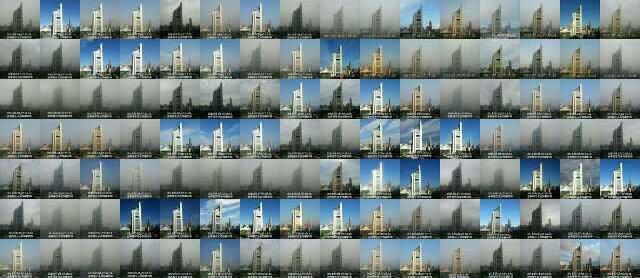
oneyearbeijing

Photographs of same Beijing location over a year showing smog days


Old tree deer lake park

Old oak tree in Deer Lake Park, BC

What if we could see the fractal signs of change?

Nothing in nature stays the same. If it does, that’s because change has brought it back to what it once was. Trees move. They grow wider and taller; they just do it at a pace beyond our impatient lifestyle. Because their motion is invisible, they are invisible. We think of trees as stationary objects, not living beings. Like a standing wave of frozen time. We observe through the hurried lens of human impatience and self-preoccupation. A quick glance takes in a scene. We forget that we can “see” with other senses. Smell. Touch. Taste. Hearing. As hyposmia and disinterest dulls our senses, we grow less able to recognize the verisimilitudes of Nature’s trompe l’oeils. Trapped by our preordained notions, we no longer see the changes we’re not prepared to see. And that’s the change that kills us.

In witnessing the collapse of fish populations on the west coast in the ‘90s, UBC fisheries biologist Daniel Pauly noticed that people just went on fishing ever smaller fish. The collapse occurred through what he called “creeping disappearance.” Pauly named this impaired vision “shifting baseline syndrome,” a willing ignorance of consequence based on short-term gain.

One could argue that the inability to feel and connect beyond our immediate line of sight can be a good thing—a kind of selective memory that allows us to adapt to each “new normal.” Mothers of several children can testify to the benefits of “forgetting” their hours of labour to give birth. Hence the ability and willingness to repeat this very painful experience. Is this part of successful biological adaptation in all of us? The ability to reset?

Nina-Kevin playing

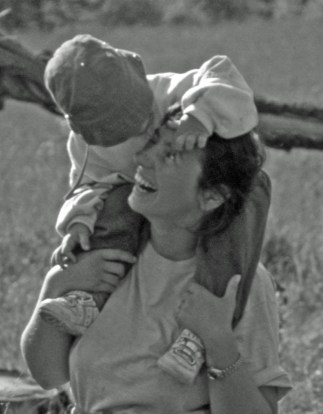
Author and her son enjoy an outing

Or is it rather that our mother chooses not to forget but to relegate her memory of the previous birth behind something far more beautiful and wondrous to remember and something she is deeply connected to: the miraculous birth of her child—her investment in the future. Shifting baseline syndrome is part of a larger amnesia, one that encompasses many generations; a selective memory driven by short-sightedness that comes mostly from lack of connection. But to successfully invest in our future, that is precisely what we must do: connect.

If only we could see the fractal signs of change…

Bill McKibben wrote in The New Yorker, “Climate change isn’t just a threat. It’s an opportunity for us to live happier, more fulfilling lives.” True happiness comes with long-term fulfillment, not short-term material wealth and comfort. When we focus from ourselves to embrace the changing world—to connect—we discover a well-spring of altruistic happiness. When we embrace, we transcend. When we transcend, we become fluid with change. That is when we succeed.

quote by Goethe: “We must always change, renew, rejuvenate ourselves; otherwise we harden.”


nina-2014aaa

Nina Munteanu is a Canadian ecologist / limnologist and novelist. She is co-editor of Europa SF and currently teaches writing courses at George Brown College and the University of Toronto. Visit www.ninamunteanu.ca for the latest on her books. Nina’s bilingual “La natura dell’acqua / The Way of Water” was published by Mincione Edizioni in Rome. Her non-fiction book “Water Is…” by Pixl Press (Vancouver) was selected by Margaret Atwood in the New York Times ‘Year in Reading’ and was chosen as the 2017 Summer Read by Water Canada. Her novel “A Diary in the Age of Water” will be released by Inanna Publications (Toronto) in 2020.


Book Review: “The Windup Girl” When Monsanto Gets Its Way…

Windup GirlPaolo Bacigalupi’s 2015 biopunk science fiction novel The Windup Girl occurs in 23rd century post-food crash Thailand after global warming has raised sea levels and carbon fuel sources are depleted. Thailand struggles under the tyrannical boot of ag-biotech multinational giants such as AgriGen, RedStar, and PurCal—predatory companies who have fomented corruption and political strife through their plague-inducing and sterilizing genetic manipulations. The story’s premise could very easily be described as “what would happen if Monsanto got its way?”

Bacigalupi’s story opens in Bangkok, “City of Angels”, now below sea level and precariously protected by a giant sea wall and pumps that run on bio-power:

Windup Girl-closeIt’s difficult not to always be aware of those high walls and the pressure of the water beyond. Difficult not to think of the City of Divine Beings as anything other than a disaster waiting to happen. But the Thais are stubborn and have fought to keep their revered city of Krung Thep from drowning. With coal-burning pumps and leveed labor and a deep faith in the visionary leadership of their Chakri Dynasty they have so far kept at bay that thing which has swallowed New York and Rangoon, Mumbai and New Orleans.

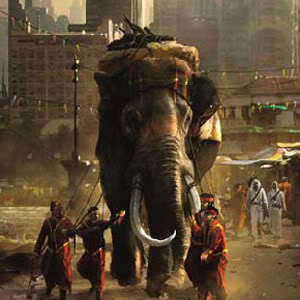
Energy storage in this post-oil society is provided by manually-wound springs using cruelly mistreated genehacked megodonts—elephant-slave labor. Biotechnology dominates via international mega-corporations—called calorie companies—that control food production through genehacked seeds. The companies use bioterrorism and economic hitmen to secure markets for their products—just as Monsanto is currently doing. Plagues (some they created, others unintended mutations) have wiped out the natural seed stock, now virtually supplanted by genetically engineered sterile plants and mutant pests such as cibiscosis, blister rust, and genehack weevil. Thailand—one of the economically disadvantaged—has avoided economic subjugation by the foreign calorie companies through some ingenuity—a hidden seedbank of diverse natural seeds—and is now targeted by the agri-corporations.

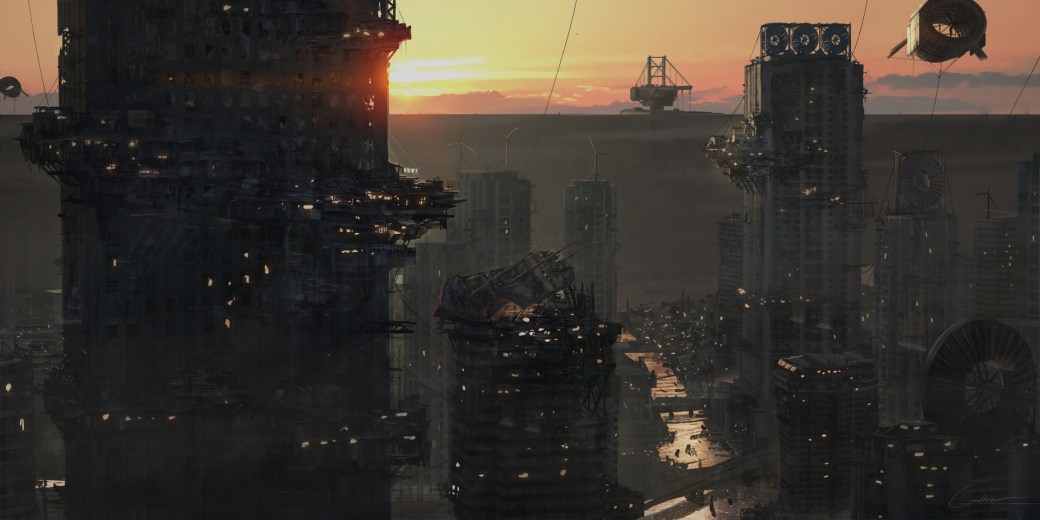
julien-gauthier-bangkok

future Bangkok envisioned by Julien Gauthier

Bacigalupi’s opening entwines the clogged and crumbling city of Bangkok and its swarming beggars, slaves and laborers in a microcosm of a world spinning out of control:

Overhead, the towers of Bangkok’s old Expansion loom, robed in vines and mold, windows long ago blown out, great bones picked clean. Without air conditioning or elevators to make them habitable, they stand and blister in the sun. The black smoke of illegal dung fires wafts from their pores, marking where Malayan refugees hurriedly scald chapatis and boil kopi before the white shirts can storm the sweltering heights and beat them for their infringements.

Anderson Lake is a farang (of white race) who owns an AgriGen factory trying to mass-produce kink-springs—successors to the internal combustion engine) to store energy. The factory is in fact a cover for his real mission: to find and exploit the secret Thai seedbank with its wealth of genetic material. We later discover that Lake is an economic hitman and spy whose previous missions have destroyed entire countries for the sake of monopoly.

Emiko is an illegal Japanese “windup” (genetically modified human), owned by a Thai sex club owner, and treated as a sub-human slave. When she meets Lake, he cavalierly shares that a refuge in the remnant forests of northern Thailand exists for people like her (the “New People”); Emiko dreams of escaping her bonds to find her own people in the north. But like Bangkok itself, both protected and trapped by the wall against a sea poised to claim it—a bustling city of squalor caught up in the clash of new and old—Emiko cannot escape who and what she is: a gifted modified human—and possible herald of a sustainable future—vilified and feared by the very humanity that created her.

Bangkok-floating market

Bangkok’s floating market

Bangkok emerges as a central character in a story that explores the paradox of conflicting dialectics battling for survival in a violently changing world. Anyone who has spent time in Bangkok will recognize the connective tissue that holds together its crumbling remnants with ambitious chic. Just like the novel’s cheshires: genetically created “cats” (made by an agri-giant as a “toy”) that wiped out the regular cat Felis domesticus.

cheshire-cat

Cheshire Cat of “Alice in Wonderland”

Named after Alice in Wonderland’s Cheshire Cat, these crafty creatures have adapted well to Bangkok’s unstable environment. The cheshires exemplify the cost of unintended consequence (a major theme in the novel); the cheshires also reflect the paradoxical nature of a shape-shifting city of Thais, Chinese and Malaya refuges who struggle to survive in a place that is both haven and danger:

Cheshire cat-disappearing

Cheshire cat disappearing

The flicker-shimmer shapes of cheshires twine, yowling and hoping for scraps … The old man’s flinch is as hallucinogenic as a cheshire’s fade—one moment there, the next gone and doubted … The devil cats flicker closer. Calico and ginger, black as night—all of them fading in and out of view as their bodies take on the colors of their surroundings.

Captain Jaidee Rojjanasukchai is a righteous white shirt—the strong arm of the Ministry of the Environment. He is a faithful Thai Buddhist, whose only weakness is his sense of invincibility borne from a mistaken sense of government integrity. Revered by fellow white shirts as the “Tiger of Bangkok,” he is incorruptible—we find out that he may be the only person in the entire place who refuses to be swayed by bribes. A true and passionate believer in the cause he is fighting for—the very survival of the environment and his people by association—Jaidee is ruthless in his raids and attacks on those who wish to open the markets of globalization and potential contamination. Early in the novel, Jaidee reflects on humanity’s impact on the ecological cycle:

All life produces waste. The act of living produces costs, hazards, and disposal questions, and so the Ministry has found itself in the centre of all life, mitigating, guiding and policing the detritus of the average person along with investigating the infractions of the greedy and short-sighted, the ones who wish to make quick profits and trade on others’ lives for it.

Bacigalupi astutely identifies the tenuous role of any government’s environment ministry—to protect and champion the environment—within a government that values its economy more highly and when, in fact, most of the time its members operate quietly in the pocket of short-sighted politicians and business men who focus myopically on short-term gain. “The symbol for the Environment Ministry is the eye of the tortoise, for the long view—the understanding that nothing comes cheap or quickly without a hidden cost,” Jaidee thinks. The United States EPA is a prime example of such paradox—in which the agency’s top executive is in fact a former industrialist who lobbied for deregulation. The current EPA no longer fulfills its role as guardian of the environment. In Canada, I have witnessed terrible conflict between one ministry with another in a game of greed vs. protection. Bacigalupi showcases this diametric with his characters Pracha (Environment) and Akkarat (Trade).

Abandoned Shopping Mall now Koi Pond

Abandoned supermarket now a giant koi pond, Bangkok

The rivalry between Thailand’s Minister of Trade and Minister of the Environment represent the central conflict of the novel, reflecting the current conflict of neo-liberal promotion of globalization and its senseless exploitation (Akkarat) with the forces of sustainability, fierce environmental protection and (in some cases) isolationism (Pracha). Given the setting and the two men vying for power, both scenarios are extreme and there appears no middle ground for a balanced existence using responsible and sustainable means. Emiko, who represents a possible future, is precariously poised; Jaidee, the single individual who refuses to succumb to the bribes of a dying civilization—is sacrificed: just as integrity and righteousness are violently destroyed when chaos threatens and engulfs.

Bangkok dam

“Windup Girl” Bangkok dam

Various reviewers of the novel identify the gaijin (foreigner) Anderson Lake as the closest thing to a protagonist. In fact, Lake never manages to rise from his avatar as the human face to the behemoth of ruthless globalization, the face of a Monsanto-look-alike. He is an unsympathetic and weak character, who—despite showing some feelings for the windup girl—connives and lacks human compassion to the end. Not a protagonist. During a meeting with the Minister of Trade, in which Lake hubristically offers “aid”, Akkarat confronts Lake on the destruction of his greedy corporation: “Ever since your first missionaries landed on our shores, you have always sought to destroy us. During the old Expansion your kind tried to take every part of us. Chopping off the arms and legs of our country…With the Contraction, your worshipped global economy left us starving and over-specialized. And then your calorie plagues came.” Lake shrugs this off and continues his aggressive exchange with the minister—sealing his fate beneath Nature’s relentless tsunami.

rob-davies-WIndupGirl-twug-tank

Twug tank, imagined by Rob Davies

Jaidee—who is brutally killed on page 197 of the novel with another 200 pages to go—remains Bacigalupi’s only character of agency worth following. The Tiger of Bangkok represents the Ministry of Environment’s hard policy of environmental protection—the only thing that kept Thailand from falling to the global mega-corporation’s plagues. With Jaidee’s demise, we tumble in free fall into a “Game of Thrones” miasma of “who goes next—I don’t care.” While I continued to read, it was more from post-traumatic shock than from eager interest. It was as though I’d lost a good friend—my safety anchor in a horrid place—and was now set adrift. I drifted, alone, amid the remaining characters—each pathetic in their own way—on a slow slide into the wrathful hell of a vengeful Nature. I found myself rooting for the cheshires and windups, experiments-turned victims-turned adapted survivors of a vast unintended consequence in human greed.

Perhaps that is what Bacigalupi intended.

WindupGirl-megadonts

Concept of megadonts in “Windup Girl”

And yet, there is unsmiling monosyllabic Kanya, Jaidee’s not-so-pure lieutenant, now promoted to his position and eager to atone for her former betrayal—we learn that she was planted as a Trade mole in Environment. Struggling to do the right thing after Jaidee’s murder, Kanya emerges as the true protagonist in the novel. As we learn more of her unfortunate history and gain a clear understanding of her complex motivations (we get no such insight into Lake), Kanya’s journey unfolds through heartbreak and redemption. Kanya picks up Jaidee’s spirit—literally—and, accompanied by his phii (his ghost), tries to settle the warring factions to gain peace for a rioting city. Of course, it doesn’t work and the gaiji devils return in full force as Akkarat hands over Thailand and its precious seedbank to the American corporations.

Happy with Akkarat’s coup, corporate mogul Carlyle says to Lake: “The first thing we do is go find some whiskey and a rooftop, and watch the damn sun rise over the country we just bought.”

Instructed to take the AgriGen gaigi to the vault and hand over the seedbank to them, “Kanya studies the people who used to be called calorie demons and who now walk so brazenly in Krung Thep, the City of Divine Beings.” Jeering and laughing with no respect, the gaiji behave like they own the place. In a sudden moment of clarity—inspired by Jaidee’s phii—Kanya then singlehandedly creates her own coup by executing the AgriGen gaigi and instructing the monks to dispatch Thailand’s precious seedbank safely to the jungle wilderness. Husked of its precious treasure, the city implodes.  Floodwater pumps and locks fail to sabotage. Then the monsoons arrive. The City of Angels gives in to the sea that chases refugees into the genehack-destroyed outer forests.

paolo-bacigalupi

Paolo Bacigalupi

While Kanya triumphs in her own personal battle, she remains less agent of change than feckless witness to Nature’s powerful force as it unfurls like a giant cheshire and sends dominoes crashing into one another.

Fittingly, Bacigalupi’s Epilogue belongs to the windup girl and the cheshires. And an uncertain future with promise of change.

And that is certainly what Bacigalupi intended.

julien-gauthier-bangkoksunset

Bangkok sunset by Julien Gauthier

nina-2014aaa

Nina Munteanu is a Canadian ecologist / limnologist and novelist. She is co-editor of Europa SF and currently teaches writing courses at George Brown College and the University of Toronto. Visit www.ninamunteanu.ca for the latest on her books. Nina’s bilingual “La natura dell’acqua / The Way of Water” was published by Mincione Edizioni in Rome. Her non-fiction book “Water Is…” by Pixl Press (Vancouver) was selected by Margaret Atwood in the New York Times ‘Year in Reading’ and was chosen as the 2017 Summer Read by Water Canada. Her novel “A Diary in the Age of Water” will be released by Inanna Publications (Toronto) in 2020.
On Writing “A Diary in the Age of Water”

How does any fire begin? With a spark…

FillingAtWaterTap copyIn Summer of 2016, I attended a talk given by Maude Barlow on water justice. The radical talk was based on her recent book “Boiling Point”, a comprehensive exploration of Canada’s water crisis—a crisis that most Canadians weren’t—and still aren’t—aware. Canada is steward to a fifth of the world’s fresh water, after all. It is a water-rich country. Of the dozen largest inland lakes in the world, Canada holds eight of them. So, why water crisis? Well, Maude explains. And you should read “Boiling Point.” It will open your eyes to the politics of water and how multinational corporations—like Nestlé—are already grabbing and funneling water away from Canadians and into the global profit machine.
Maude’s talk was in a church on Bloor Street in Toronto. I sat close to the front to best see her. But I soon noticed that many people had elected to sit in the gallery above. I found myself focusing on a young mother and her little girl. The girl had some paper and crayons and was busy with that as the enthusiastic mother listened to Maude deliver dire facts about corporate water high-jacking and government complicity.

I saw a story there.

What mother would take her pre-school child to a socio-political talk on water? I would later reflect that memory of the mother and her little girl through my characters Una and her little daughter Lynna, the diarist in my novel “A Diary in the Age of Water” (due for publication in 2020 with Inanna Publications).


Elora Park something river 4

Reflections on the Eramosa River, Ontario (photo by Nina Munteanu)

The spark for my novel began with a short story I was invited to write in 2015 about water and politics in Canada.  I had long been thinking of potential ironies in Canada’s water-rich heritage. The premise I wanted to explore was the irony of people in a water-rich nation experiencing water scarcity: living under a government-imposed daily water quota of 5 litres as water bottling and utility companies took it all.

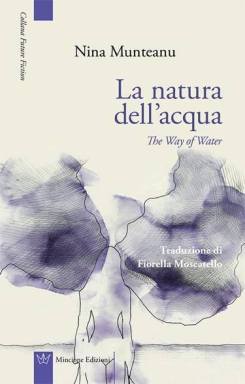
The Way of Water-COVERI named the story “The Way of Water.” It was about a young woman (Hilda) in near-future Toronto who has run out of water credits for the public iTap; by this time houses no longer have potable water and their water taps have been cemented shut; the only way to get water is through the public iTaps—at great cost. She is two metres from water—in a line of people waiting to use the tap—and dying of thirst.

The Way of Water” captures a vision that explores the nuances of corporate and government corruption and deceit together with global resource warfare. In this near-future, Canada is mined of all its water by thirsty Chinese and US multinationals—leaving nothing for the Canadians. Rain has not fallen on Canadian soil in years due to advances in geoengineering and weather manipulation that prevent rain clouds from going anywhere north of the Canada-US border. If you’re wondering if this is possible, it’s already happening in China and surrounding countries.

Exile-CanTales ClimateChangeThe story first appeared in 2015 in Future Fiction, edited by Francesco Verso, and in 2016 as a bilingual (English and Italian) book and essay published by Mincione Edizioni in Rome. The story was reprinted in magazines and anthologies several times since, including “Cli-Fi: Canadian Tales of Climate Change Anthology” (Exile Editions, Bruce Meyer, ed), in 2017, Future Fiction: New Dimensions in International Science Fiction (Francesco Verso & Bill Campbell, eds; Future Fiction / Rosarium Publishing, Rome and Greenbelt, MD) in 2018; and in Little Blue Marble Magazine (Katrina Archer, ed) in January, 2019. “The Way of Water” received generous praise from review sites and the press worldwide.

FF - Rosarium CoverAfter the success of this short story, I realized that I needed to tell the larger story—how did the world—Canada—get to where Hilda was? Her mysterious mother, the limnologist Lynna who was taken away by the RCMP in 2063, clamored for more attention. I remembered that four-year old girl and her mother in the gallery at Maude Barlow’s talk on water politics. And I thought of my characters: young Lynna and her mother Una. How does a daughter of an activist mother behave and think? How best to express her voice?
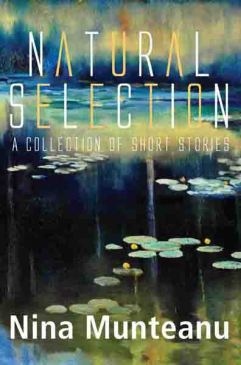
NaturalSelection-front-webI had earlier written a short story that was a mix of correspondence (emails) and third person narrative (“The Arc of Time” in Natural Selection), which I felt captured the voices of the characters well. I realized that a diary by Lynna would be an ideal way for her to express her unique worldview and cynicism—yet allow her vulnerable humanity to reveal itself through this unique relationship with her diary. The remaining characters and their narratives emerged easily from there: Una, her activist mother; Daniel, her conspiracy theorist colleague (and her conscience); Orvil, the water baron (and lover she betrayed); and Hilda, her “wayward” supposedly mind-challenged daughter—who appears in the short story that takes place later.
Water Is-COVER-webI had a lot of material; I had already been researching water issues and climate change in my activism as a science reporter. I had recently published “Water Is… The Meaning of Water”, essentially a biography of water, written from the perspective of mother, environmentalist and scientist. I had practiced as a limnologist for over twenty-five years and could mine my various personal experiences in the field, lab and office with genuine realism. I chose Robert Wetzel’s Limnology (the classic text book I used in my introductory limnology course) for quotes to each of Lynna’s entries; this added an opportunity to provide additional metaphor and irony through Lynna’s scientific voice. I placed the child Lynna (who was born in 2012) into actual events in Toronto, where I currently live. This pushed the story further into the area of documentary and blurred the lines between fiction and non-fiction to achieve a gritty and textured reality. Lynna also taught limnology at the University of Toronto, where I currently teach.

Just as Water Is…” served as a watershed for all my relevant experiences as mother, environmentalist and scientist, “A Diary in the Age of Water” would galvanize many of my personal experiences, doubts, challenges and victories into compelling story. Although parts of the story wrote themselves, the entire book was not easy to write. There were times when I had to walk away from the book to gain some perspective—and optimism—before continuing. When I found myself drowning in Lynna’s voice, I invoked Hilda to guide me to shore. I found a balance that worked and compelled. Ultimately this opened to some of the best internal conflict and tension I have experienced in my writing.

Diary Water cover finalLike water itself, A Diary in the Age of Water expresses through many vessels and in many perspectives, spanning hundreds of years—and four generations of women—with a context wider than human life. Through its characters, A Diary in the Age of Water explores the big question of humanity’s deadlock with planetary wellness and whether one is worth saving at the expense of the other. One of the characters asks Lynna the hard question: “If you had the chance to save the planet [stop the mass extinctions, deforestation and pollution ravaging the planet], but it was at the expense of humanity, would you do it?”
 

Water is, in fact, a character in the book—sometimes subtle and revealed in subtext, other times horrific and roaring with a clamorous voice. Water plays both metaphoric and literal roles in this allegorical tale of humanity’s final journey from home. The story explores identity and our concept of what is “normal”—as a nation and an individual—in a world that is rapidly and incomprehensibly changing—and in which each of us plays a vital role simply by doing or not doing.

A Diary in the Age of Water” promises to leave you adjusting your frame of reference to see the world, yourself—and water—in a different way. “A Diary in the Age of Water” is scheduled for release by Inanna Publications in 2020.

WaterDrop-byPeterJames

Water drops (photo by Peter James)


nina-2014aaa

Nina Munteanu is a Canadian ecologist / limnologist and novelist. She is co-editor of Europa SF and currently teaches writing courses at George Brown College and the University of Toronto. Visit www.ninamunteanu.ca for the latest on her books. Nina’s bilingual “La natura dell’acqua / The Way of Water” was published by Mincione Edizioni in Rome. Her non-fiction book “Water Is…” by Pixl Press (Vancouver) was selected by Margaret Atwood in the New York Times ‘Year in Reading’ and was chosen as the 2017 Summer Read by Water Canada. Her novel “A Diary in the Age of Waterwill be released by Inanna Publications (Toronto) in May 2020.


Can Dystopian Eco-Fiction Save the Planet?

NewYork 2140By failing to engage with climate change, artists and writers are contributing to an impoverished sense of the world, right at the moment when art and literature are most needed to galvanize a grassroots movement in favor of climate justice and carbon mitigation.”—Amitav Ghosh, 2017

…Margaret Atwood’s The Year of the Flood. Paolo Bacigalupi’s The Windup Girl or The Water Knife. Kim Stanley Robinson’s New York 2140. Nina Munteanu’s A Diary in the Age of Water. Richard Power’s Overstory. Annie Proulx’s Barkskins. Emmi Itäranta’s The Memory of Water

Diary Water cover finalWhat these novels have in common is that they are all Dystopian Eco-Fiction. Humanity’s key role in environmental destruction serves a strong thematic element. In eco-fiction dystopias (as opposed to political or socio-cultural dystopias such as Brave New World, 1984, The Handmaid’s Tale) the environment—whether forest, ocean, water generally, or the animal world—plays a key character.

Our Literature in the Anthropocene

In 2017, Amitav Ghosh observed that the literary world has responded to climate change with almost complete silence (The Great Derangement: Climate Change and the Unthinkable). “How can we explain the fact that writers of fiction have overwhelmingly failed to grapple with the ongoing planetary crisis in their works?” writes Fredrick Albritton Jonsson of The Guardian, who observes that, “for Ghosh, this silence is part of a broader pattern of indifference and misrepresentation. Contemporary arts and literature are characterized by ‘modes of concealment that [prevent] people from recognizing the realities of their plight.’”

Windup GirlAccording to Ghosh, plots and characters of contemporary literature tend to reflect the regularity of middle-class life and the worldview of the Victorian natural sciences, one that depends on a principle of uniformity. Change in Nature has been perceived as gradual (or static by some) and never catastrophic. Extraordinary or bizarre happenings were left to marginal genres like the Gothic tale and—of course—science fiction. The strange and unlikely have been externalized: hence the failure of modern novels and art to recognize anthropogenic climate change.

From Adam Smith’s 18th Century economic vision to the conceit of bankers who drove the 2008 American housing bubble, humanity’s men have consistently espoused the myth of a constant natural world capable of absorbing infinite abuse without oscillation. When James Lovelock and Lynn Margulis proposed the Gaia Hypothesis in the 1970s, many saw its basis in a homeostatic balance of the natural order as confirmation of Nature’s infinite resilience to abuse. They failed to recognize that we are Nature and abuse of Nature is really self-abuse.

Jonsson suggests that these Enlightenment ideas are essentially ideological manifestations of Holocene stability, remnants from 11,000 years of small variability in temperature and carbon dioxide levels, giving rise to deep-seated habits and ideas about the resilience of the natural world. “The commitment to indefinite economic growth espoused by the economics profession in the postwar era is perhaps its most triumphant [and dangerous] expression.”

barkskins

Louise Fabiani of Pacific Standard suggests that novels are still the best way for us to clarify planetary issues and prepare for change—even play a meaningful part in that change. In her article “The Literature of Climate Change” she points to science fiction as helping “us prepare for radical change, just when things may be getting too comfortable.”

Referring to our overwhelming reliance on technology and outsourced knowledge, Fabiani suggests that “our privileged lives (particularly in consumer-based North America) are built on unconscious trust in the mostly invisible others who make this illusion of domestic independence possible—the faith that they will never stop being there for us. And we have no back-ups in place should they let us down.” Which they certainly will—given their short-term thinking.

TheOverstory“To counteract this epidemic of short-term thinking,” says Fabiani, “it might be a good idea for more of us to read science fiction, specifically the post-apocalyptic sub-genre: that is, fiction dealing with the aftermath of major societal collapse, whether due to a pandemic, nuclear fallout, or climate change.”
I suggest widening the genre to include good dystopian eco-fiction, which includes not just post-apocalyptic tales but also cautionary tales, worlds in upheaval, and satires. Dystopian literature is ultimately an exploration of hope through personal experience. The eco-fiction protagonist navigates their dystopia by learning meaningful lessons—lessons that pertain directly to our reader in their current world. This is because the premise of a dystopia lies squarely in the present world. Good dystopias can enlighten and suggest possibilities; they can warn and herald. At the very least, they incite the necessary conversation.

On the Role of Dystopian Eco-Fiction

NaturalSelection-front-webI recently shared a panel discussion with writer Kristen Kiomall-Evans at the 2019 Limestone Genre Expo in Kingston entitled: “On the Role of (Dystopian) Literature and Environmental Issues: Can Books Save the Planet.” The audience of mostly women shared enlightened input in an open discussion, which spanned a range of topics and directions from what dystopian literature actually is to whether we are turned off by its negativity—that it may be too close to reality and makes us cringe and want to hide. One person even brought up Game of Thrones as an example; which I then bluntly suggested was not real “story”—it is a stream of episodic sensationalism and horror—aimed at thrilling shock value, not fulfilling meaning.
The group explored what Eco-Fiction is and the possibility of how eco-fiction writers can influence their audience to engage in helping the planet and humanity, in turn.

 “Science doesn’t tell us what we should do,” Barbara Kingsolver wrote in Flight Behavior “It only tells us what is.” Stories can never be a solution in themselves, but they have the capacity to inspire action. Margaret Atwood wrote in MaddAddam, “People need such stories, because however dark, a darkness with voices in it is better than a silent void.”

We explored several areas in which writers could elucidate ways to engage readers for edification, connection and participation. We discussed optimism, new perspectives, envisioning our future, and imaginative use of “product placement” to gain reader engagement and galvanize a movement of action.

Optimism in Story

I pointed out that good dystopias—like all good fiction—follow a character and story arc that must ultimately resolve (which Game of Thrones may never do, certainly not well—J.R.R. Martin’s books series upon which it is based are not even finished yet!). Eco-Fiction Dystopias often conclude with a strong element of hope, based on some positive aspect of humanity and the human spirit—which may include our own evolution. Think Day After Tomorrow, Year of the Flood, Windup Girl, The Postman, Darwin’s Paradox.

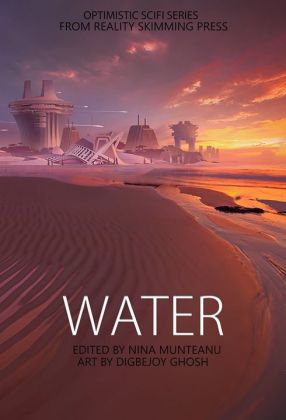
WaterAnthology-RealitySkimmingPress copyIn 2015, I joined Lynda Williams of Reality Skimming Press in creating an optimistic science fiction anthology with the theme of water. My foreword to Water addressed this point:

As we drank Schofferhoffers over salmon burgers, Lynda lamented that while the speculative / science fiction genre has gained a literary presence, this has been at some expense. Much of the current zeitgeist of this genre in Canada tends toward depressing, “self-interested cynicism and extended analogies to drug addiction as a means of coping with reality,” Lynda remarked. Where was the optimism and associated hope for a future? I brought up the “hero’s journey” and its role in meaningful story. One of the reasons this ancient plot approach, based on the hero journey myth, is so popular is that its proper use ensures meaning in story. This is not to say that tragedy is not a powerful and useful story trope; so long as hope for someone—even if just the reader—is generated. Lynda and I concluded that the science fiction genre could use more optimism. [As a result,] these stories explore individual choices and the triumph of human imagination in the presence of adversity. [Each story explores] the surging spirit of humanity toward hopeful shores.

New Perspectives in Story

Evans spoke of the emergence of and need for a strong voice by marginalized groups who would be most affected by things like habitat destruction and climate change. The poor and marginalized will most certainly make up the majority of climate change refugees, starved out and water shorted, and suffering malnutrition, violence and disease.

FifthSeason-JemisinEvans pointed out that afro-American writers (e.g., Octavia Butler, Walter Mosley, Nalo Hopkinson and N.K. Jemisin) and indigenous writers (Cherie Dimaline, Daniel Wilson, Drew Hayden Taylor) are an exciting voice, providing a new and compelling perspective on ongoing global issues.

I would add that the “feminine” voice—the voice of women and the voice of ecology and those who embrace the gylanic voice—are needed. This was strangely not mentioned in the group—perhaps because we were all women—but one. Such a voice can help personalize the experience to readers, by creating discovery, connection and understanding—and ultimately serving a key force in engaging readers to act.

Envisioning Our Future Through Story

One audience member shared a yearning for an optimistic focus through an envisioned world where solutions have successfully created that world. She wasn’t so much suggesting writing a utopia, but including elements of future wishes as an integral part of the world, following Ghandi’s wise advice: be the change you seek. In a recent interview in which I also participated in The Globe and Mail on women science fiction writers, Ottawa writer Marie Bilodeau addressed this concept:

“the best part about writing science fiction is showing different ways of being without having your characters struggle to gain rights. Invented worlds can host a social landscape where debated rights in this world – such as gay marriage, abortion and euthanasia – are just a fact of life.”

People are looking for hopeful fiction that addresses the issues but explores a successful paradigm shift. One that accurately addresses our current issues with intelligence and hope. The power of envisioning a certain future is that the vision enables one to see it as possible.

Product Placement in Story

Editor and naturalist Merridy Cox suggested that writers could make motivating connections through altruistic (not market-driven) “product placement.” She gave the example of an Ash tree. The Ash (Fraxinus species) could subtly make its name, its character and ecology known in the story, along with its plight—its destruction by the non-native invasive emerald ash borer. The use of metaphor and personification would easily link the Ash to a character and at the same time illuminate the reader on a real aspect of the environment to consider. Another example she gave was of the threatened bobolink bird, now all but gone. The bobolink originally made its home in the tallgrass prairie and other open meadows. As native prairies were cleared for farming, the bobolink was displaced and moved to living in hayfields and fallow fields—building their nests on the ground in dense grasses. Changing farm practices (shorter crop rotation and earlier maturing seed mixtures) are now destroying the bobolink’s last refuge.

bobolink-chicks-mom

Bobolink mother and her chicks

Such “product placement” essentially gives Nature and the environmental a personalized face that can easily interact with the story’s theme and its characters. “Product placement”—like symbol—lies embedded in its own story. In the case of the bobolink, it is a story of colonialism, exploitation, and single-minded pursuit at the expense of others not considered, known or understood. These examples have anthropogenic connections to human behaviour, action and knowledge—all related to story and theme.

MockUpEcology copyIn my new writing guidebook The Ecology of Story: World as Character I discuss and explore how some authors do this impeccably. Authors such as Barbara Kingsolver, Richard Powers, Frank Herbert, Ray Bradbury, Thomas Hardy, Margaret Atwood, Alice Munro, Janet Fitch, John Steinbeck, David Mitchell, Joanne Harris and many others.

Writing for the Anthropocene

Learn how to write for the Anthropocene: from Habitats and Trophic Levels to Metaphor and Archetype…

Learn the fundamentals of ecology, insights of world-building, and how to master layering-in of metaphoric connections and symbols between setting and character. “Ecology of Story: World as Character” is the 3rd guidebook in Nina Munteanu’s acclaimed “how to write” series for novice to professional writers.

The Ecology of Story will be released by Pixl Press in June 2019.

nina-2014aaa

Nina Munteanu is a Canadian ecologist / limnologist and novelist. She is co-editor of Europa SF and currently teaches writing courses at George Brown College and the University of Toronto. Visit www.ninamunteanu.ca for the latest on her books. Nina’s bilingual “La natura dell’acqua / The Way of Water” was published by Mincione Edizioni in Rome. Her non-fiction book “Water Is…” by Pixl Press (Vancouver) was selected by Margaret Atwood in the New York Times ‘Year in Reading’ and was chosen as the 2017 Summer Read by Water Canada. Her novel “A Diary in the Age of Water” will be released by Inanna Publications (Toronto) in May 2020.
The Ontario Climate Symposium: Adaptive Urban Habitats by Design

SONY DSC

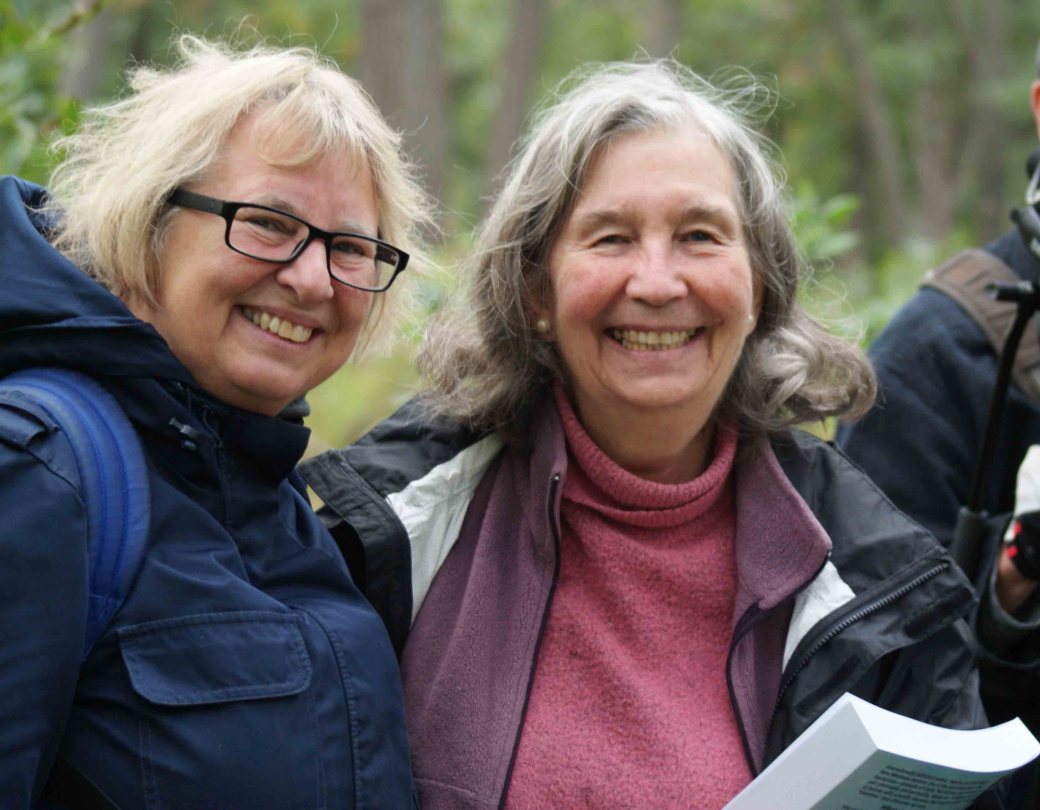
Nina presents Diana Beresford-Kroeger with a copy of “Water Is…”

I recently participated in the 2018 Ontario Climate Symposium “Adaptive Urban Habitats by Design” at OCAD University in Toronto, hosted by the Ontario Climate Consortium and the Toronto and Region Conservation Authority.

Day 1 opened with a ceremony by Chief R. Stacey Laforme of the Mississauga of the New Credit First Nation, followed by keynote address by Dr. Faisal Moola, associate professor of the University of Guelph.

A three-track panel stream provided diverse and comprehensive programming that helped further the goal to foster important discussions for how art and design can play a role in developing adaptive, low carbon cities. Panels sparked much networking among a diverse group of participants, who clustered around the refreshments in the Great Hall, where my “Water Is…” exhibit was located.

OCS-venue

The Great Hall, where participants networked over refreshments

WaterIs...at OCS2

one participant clutches “Water Is…”

Water Is… was also there for sale, as part of my exhibit on water, along with Environment and Climate Change Canada, Green Roofs, Waste, and the Environmental Commissioner of Ontario. I had several lively and insightful conversations with participants and I’m glad to say that Water Is… made it into several people’s hands at the symposium. Water is, after all, a key component of climate and climate action.

The film “Call of the Forest: The Forgotten Wisdom of Trees” was screened and scientist Diana Beresford-Kroeger participated in a question and answer period then signed her latest book.

diana_and_the_tree_

Call of the Forest” was called “a folksy and educational documentary with a poetic sort of alarmism about disappearing forests,” by the Globe and Mail. The film “takes us on a journey to the ancient forests of the northern hemisphere, revealing the profound connection that exists between trees and human life and the vital ways that trees sustain all life on this planet.” The movie describes the numerous health-giving aerosols that trees use to communicate. Diana’s genuine and earnest concern illuminates her simple yet powerful narrative, such as when she says that the forests are “haunted by silence and a certain quality of mercy.” Featuring forests from Japan and Germany’s Black Forest to Canada’s boreal forest, this documentary is a powerful manifesto for sustainability.

DianaBeresfordKroeger

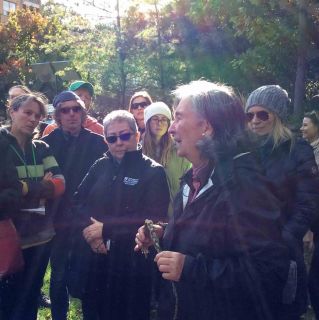
Diana lecturing in High Park

On Day 2, I toured the Black Oak savanna in High Park with Diana Beresford-Kroeger (author of The Global Forest). The tour was refreshing and enlightening. Diana is a genuine advocate for the forest and showed some of the medicinal properties of forest plants. An example is the common weed, Goldenrod; its astringent and antiseptic qualities tighten and tone the urinary system and bladder, making goldenrod useful for UTI infections; Its kidney tropho-restorative abilities both nourishe and restore balance to the kidneys.

Diana spoke from the heart and brought a wealth of scientific knowledge to us in ways easy to understand—like the biochemistry of photosynthesis or quantum coherence. Diana shared how over 200 tree aerosols help combat anything from asthma to cancer. I also talk about this in the “Water Is Life” chapter of my book, Water Is…, which I gave a copy to Diana.

lunenburg-shop01

Shops in Lunenburg, NS (photo by Nina Munteanu)


nina-munteanuNina Munteanu is an ecologist, limnologist and internationally published author of award-nominated speculative novels, short stories and non-fiction. She is co-editor of Europa SF and currently teaches writing courses at George Brown College and the University of Toronto. Visit www.ninamunteanu.ca for the latest on her books.
Wonder and Reason in The Age of Water

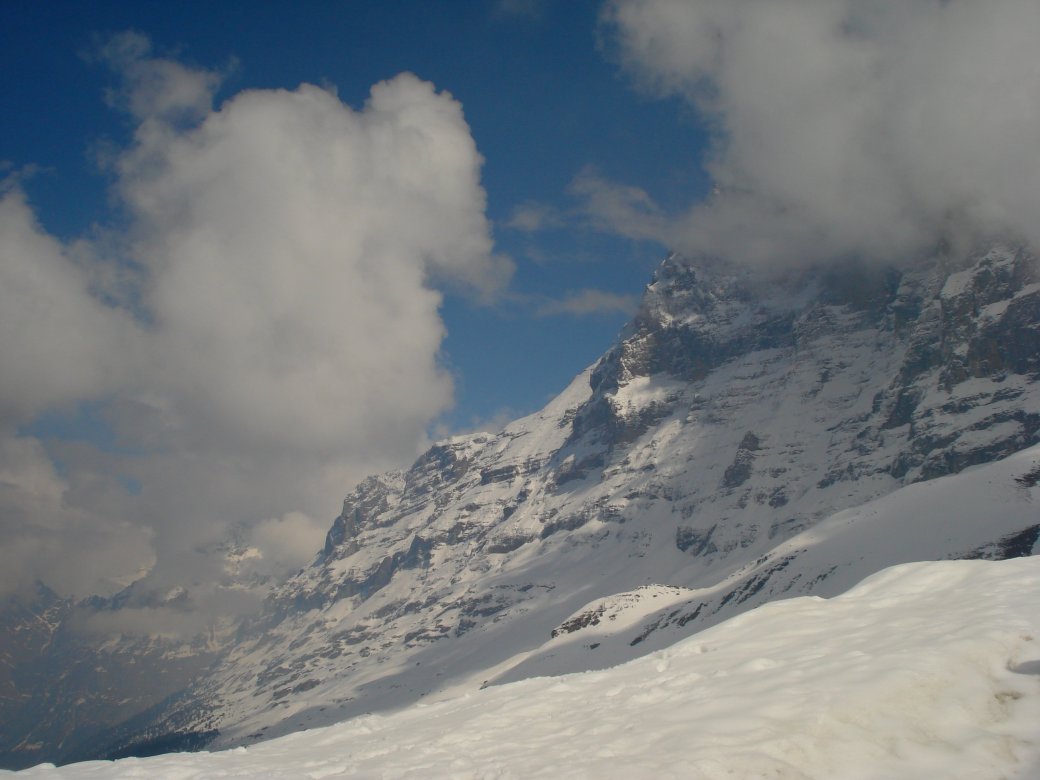
Jungfrau-peak

Mountain peaks at Zermatt, Switzerland (photo by Nina Munteanu)

Writer and essayist Annis Pratt begins her compelling essay “World of Wonder, World of Reason” in Impakter, with the question: “Do we live in a world of wonder where Nature ultimately calls the shots or a world of reason where Homo Sapiens are in control?”

Invoking the now vogue term “Anthropocene”, she puts it another way: “Is Nature dependent upon our definitions of it, or does it both precede and transcend human consciousness?  Does the term “Anthropocene” signal an apocalyptic shift that places us at the center of the Universe and if so, is the death of Nature upon us, or are we mistaken?”

Pratt examined and synthesized four works of different perspectives on nature and humanity to answer these questions. My book “Water Is…” was among them:

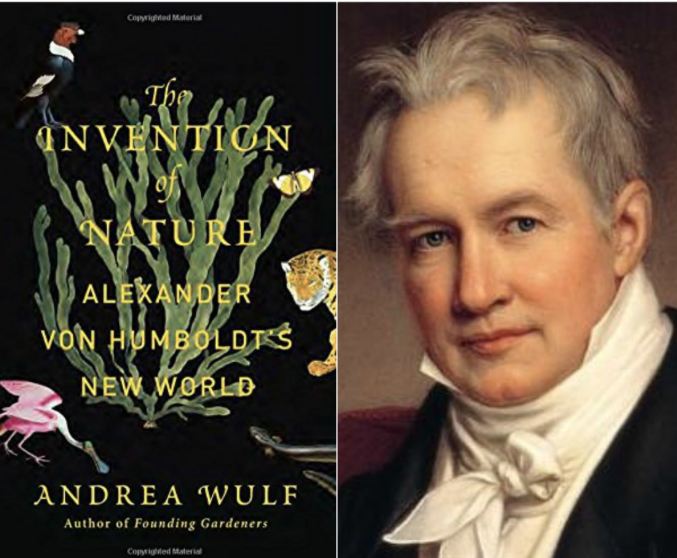
  1. The Invention of Nature: Alexander von Humboldt’s New World” by Andrea Wulf (Knoff, 2015)
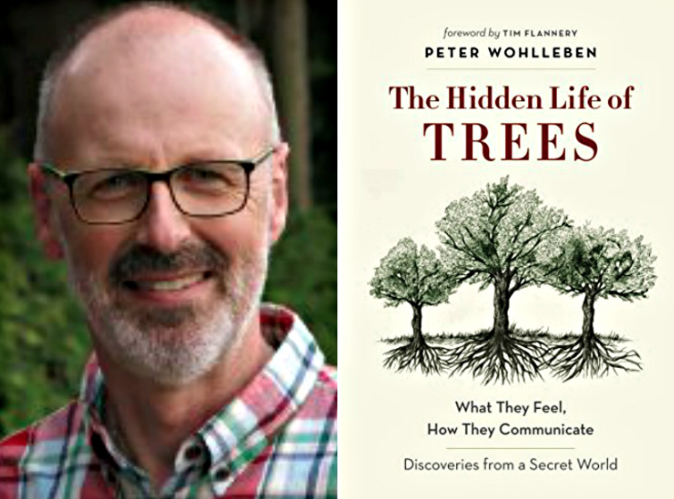
  2. The Hidden Life of Trees: What They Feel, How They Communicate” by Peter Wohlleben, translated by Jane Billinghurst (Greystone Books, 2016)
  3. Water Is…The Meaning of Water” by Nina Munteanu (Pixl Press, 2016)
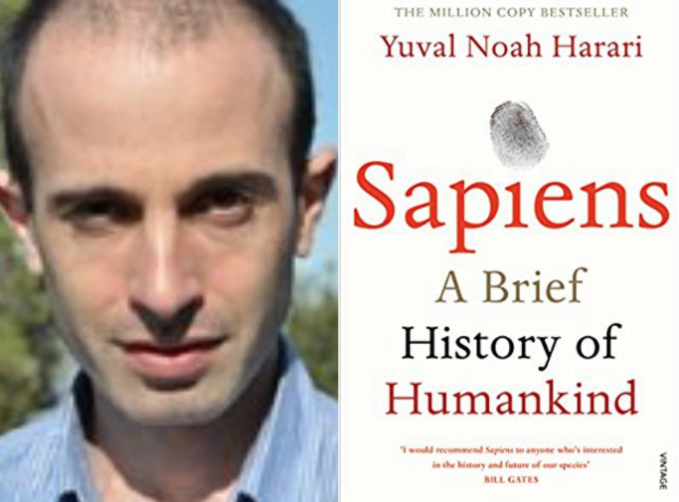
  4. Sapiens: A Brief History of Humankind” by Yuval Noah Harari (Harper Collins, 2015)

The first three, says Pratt, are scientists who made close observations of nature that filled them with wonder at the complexity of its processes: “Alexander von Humboldt, an 18th century Prussian scientist, the father of ecology; Peter Wohlleben, an ecologist who worked over twenty years for the forestry commission in Germany and Nina Munteanu, a limnologist, university teacher and award-winning ecologist.” The fourth, an Israeli historian, Yuval Noah Harari took a dramatically different stance, says Pratt. “He deplores our epoch when human egos have run amuck, putting Nature itself in peril.”

Wonder: Alexander von Humboldt

AlexVonHumboldt

Alexander von Humboldt lived from 1769-1859 (when Darwin published Origin of Species) and considered a genius, polymath, explorer and keen observer of botanical phenomena. In a world and time when Enlightenment thinkers and scientists predicated their observations on a premise of a static unchanging Nature (recall this was prior to Darwin’s controversial theory of evolution), von Humboldt discovered that nature’s one constant was change. As with von Goethe and von Schelling, von Humboldt embraced Naturphilosophie to comprehend nature in its totality and to outline its general theoretical structure. Naturphilosophie espoused an organic and dynamic worldview as an alternative to the atomist and mechanist outlook prevailing at the time.

Von Humboldt succeeded in proving that species change according to their circumstances, such as altitude or climate. According to Wulf, Bildungsreich was a force that shaped the formation of bodies, with every living organism, from humans to mould, having this formative drive. Von Humboldt’s “discovery that natural phenomena are inter-influencing elements of an interdependent whole, connected and interacting along an ‘invisible web of life,’ made Humboldt the first ecologist,” writes Pratt.

Wonder: Peter Wohlleben

Wohlleben

“Contemporary German forest ranger Peter Wohlleben belongs to the same school of Naturalphilosophie as Humboldt, bringing a similar sense of curiosity and wonder to his botanical observations,” says Pratt, who suggests that criticism aimed at his work arose in response to the anthropomorphic “voice” he uses—despite validation through the work of Dr. Suzanne Simard, Professor of Forest Ecology at the University of British Columbia.

Simard showed that trees “talk” to each other through electrical impulses as part of an underground network of fungi: “like fiber-optic internet cables.”

Pratt describes the events that led to Wohlleben’s path as an ecologist and his series of “hidden life of” books: he had become uncomfortable chopping down trees and spraying the forest with chemicals and became depressed when his superiors refused to consider his alternative methods. Wohlleben had decided to quit his job and emigrate to Sweden, when the town of Hummel decided to annul its state contract, reconstitute itself as a private preserve, and hire him to implement his innovations.

Wohlleben uses the findings of Simard and other scientists that trees communicate, nourish and heal each other. “It appears that the nutrient exchange and helping neighbors in times of need is the rule, and this leads to the conclusion that forests are superorganisms with interconnections much like ant colonies,” writes Wohlleben.

Wonder: Nina Munteanu

NinaWaterIs-Impakter

“In the same way that Peter Wohlleben approaches the hidden life of trees with a combination of scientific observation and enthusiastic wonder, in Water Is…The Meaning of Water,  Canadian limnologist Nina Munteanu observes the hidden properties of water with a scientist’s eye for detailed processes and a sense of amazement at their intricacies,” writes Pratt. “Echoing Humboldt’s discovery of the interwoven multiplicities of nature, [Munteanu] “transcends ‘Newtonian Physics and Cartesian reductionism aimed at dominating and controlling Nature’”:

“Science is beginning to understand that coherence, which exists on all levels—cellular, molecular, atomic and organic—governs all life processes. Life and all that informs it is a gestalt process. The flow of information is fractal and multidirectional, forming a complex network of paths created by resonance interactions in a self-organizing framework. It’s stable chaos. And water drives the process”—Nina Munteanu, Water Is…

“In addition to providing a gripping analysis of water science,” says Pratt, Nina Munteanu’s Water Is… “provides an encyclopedic trove of quirky observations, like how Galileo understood water flow, the Chinese character for water, Leonardo da Vinci’s water drawings, the Gaia Hypothesis, and David Bohm’s theory of flux.”

“the Gaia Hypothesis proposes that living and non-living parts of our planet interact in a complex network like a super-organism. The hypothesis postulates that all living things exert a regulatory effect on the Earth’s environment that promotes life overall…Much of nature – if not all of it – embraces this hidden order, which I describe as ‘‘stable chaos’”—Nina Munteanu, Water Is…

Reason: Yuval Noah Harari

YuvalNoahHarari

Israeli Historian, Harari sees Homo Sapiens as destructively self-serving. “Even in our earliest history,” Pratt tells us, “he suspects we were responsible for the extirpation of the Neanderthals. Everywhere we settled, mammoths and other megafauna suffered mass extinction. “The historical record,” he concludes, “makes Homo Sapiens look like an ecological serial killer.”

We are like the bully elbowing his way at school. And our casualties—such as the extinction of a dozen species a day—are innocence lost.

According to Harari, while the industrial revolution “liberated humankind from dependence on the surrounding ecosystem,” it provided no lasting benefit to the human race: “Many are convinced that science and technology hold the answers to all our problems…” but, “Like all other parts of our culture, it is shaped by economic, political and religious interests…We constantly wreak havoc on the surrounding ecosystem, seeking little more than our own comfort and amusement, yet never finding satisfaction.”

Human-Centred or Nature-Centred?

To answer Pratt’s first question: “Do we live in a world of wonder where Nature ultimately calls the shots or a world of reason where Homo Sapiens are in control?” she invokes global warming to suggest that we don’t have the last say in the planet’s welfare: “Aren’t these tumultuous catastrophes demonstrative of nature’s ability to rise over and against what we throw at it? Global warming may end civilization and perhaps the human species along with so many others we have destroyed, but are human beings really capable of engineering the destruction of the planet?  I doubt it.”

I concur. While humanity is capable of extensive natural destruction, Gaia will not only accommodate—it will prevail. Very soon—some think now already—Nature may no longer resemble that “friendly” and stable Holocene environment that we’ve come to rely on and exploit so heedlessly. Species will die out. Others will take their place in a shifting world.

As the first swell of the climate change tidal wave laps at our feet, we are beginning to see the planetary results of what humanity has helped create and exacerbate. Humanity has in many ways reached a planetary tipping point; a threshold that will be felt by all aspects of our planet—both animate and inanimate—as the planet’s very identity shifts.

One thing is certain: environments will cease to be hospitable for humanity. Compared with many other life forms, we actually have very narrow tolerances to stay healthy and survive:

  1. We need lots of water (70%)
  2. We freeze or cook beyond the 40-100 degree F range in a galaxy that goes from minus 400 at the moon’s south pole to 25 million degrees inside the sun
  3. We faint from lack of oxygen on our tallest mountains
  4. We need a pH balance of 6.5 to 7.5 to stay alive
  5. Ionizing radiation kills us at low concentrations
  6. Many compounds in the wrong amounts are toxic to us

But something will benefit. For every perturbation imposed there is adaptation and exploitation, stitched into the flowing tapestry of evolution. That is ecology.

Ecology studies relationships and change in our environment: how we interact, impact one another, change one another. Ecology studies individuals, communities and ecosystems and provides insight into the dynamics that cause and result from these interactions.

Diary Water cover finalIn my upcoming novel “A Diary in the Age of Water” (due in May 2020) a journaling limnologist in the near-future reflects on the acidified oceans in her current world: flagellates (microscopic plankton with flagella) have outcompeted diatoms (food for many species) and are mainstay of the box jellyfish—the top marine predator from the Proterozoic Era—that has overrun the entire ocean. The box jellyfish is currently overrunning Tokyo Bay. The story proceeds into the future when dead zones—currently found in the Gulf of Mexico, the mouth of the Mississippi River, Chesapeake Bay, Kattegat Strait, and Baltic Sea—occur on virtually every marine and freshwater coast; the AMOC eventually fails and the oceans grow toxic; sea level immerses Florida, the Pudong District, the entire Maldives, and dozens of coastal cities; and global temperature has triggered a heat-related epidemic involving heat shock proteins. This is a world very different from the one we have grown accustomed to; it is a harsh, hostile world that no longer treats us well; but it is a world, none the less.

Living with Natural Succession

One of the first things we learn in Ecology 101 is that change is the one constant in biology; systems endure by striking dynamic equilibria within a shifting tapestry. Succession—the natural procession of one community to another—lies at the core of a dynamic and functional ecosystem, itself evolving to another system through succession.

“Still immature and undeveloped, an oligotrophic lake often displays a rugged untamed beauty. An oligotrophic lake hungers for the stuff of life. Sediments from incoming rivers slowly feed it with dissolved nutrients and particulate organic matter. Detritus and associated microbes slowly seed the lake. Phytoplankton eventually flourish, food for zooplankton and fish. The shores then gradually slide and fill, as does the very bottom. Deltas form and macrophytes colonize the shallows. Birds bring in more creatures. And so on. As Nature tames the unruly lake over time, one thing replaces another. As a lake undergoes its natural succession from oligotrophic to highly productive eutrophic lake, its beauty mellows and it surrenders to the complexities of destiny. Minimalism yields to a baroque richness that, in turn, heralds extinction. The lake shrinks to a swamp then buries itself under a meadow.”—Nina Munteanu A Diary in the Age of Water

Ecology and Story

NaturalSelection-front-webIn a talk I give at conferences on “Ecology and Story”, I provide examples of extremophiles that have adapted to and thrive in extreme conditions on Earth.  The brine shrimp of Mono Lake—an endorheic lake that is extremely salty, anaerobic and alkaline—happily hatch in the trillions every year. The bacteria of Rio Tinto—toxic with heavy metals—thrive on the iron through a biofilm that protects them. Radiotrophic fungi feed on gamma radiation at the Chernobyl nuclear power plant. Life on Earth will endure and prevail—not despite but alongside humanity’s imposed ecological succession.

The question is, will we survive our own succession?

Literature of the Anthropocene

Memory of waterTerms such as eco-fiction, climate fiction and its odd cousin “cli-fi”, have embedded themselves in science fiction and literary fiction terminology; this fiction has attracted a host of impressive authors who write to its calling: Margaret Atwood, Emmi Itäranta, Jeff VanderMeer, Richard Powers, Barbara Kingsolver, Upton Sinclair, Ursula Le Guin, JoeAnn Hart, Frank Herbert, John Yunker, Kim Stanley Robinson, James Bradley, Paolo Bacigalupi, Nathaniel Rich, David Mitchell, Junot Diaz, Claire Vaye Watkins, J.G. Ballard, Marcel Theroux, Thomas Wharton—just to name a few. The list is growing. Of course, I’m on it too. Many of these works explore and illuminate environmental degradation and ecosystem collapse at the hands of humanity.

.

Nina MunteanuNina Munteanu is an ecologist, limnologist and internationally published author of award-nominated speculative novels, short stories and non-fiction. She is co-editor of Europa SF and currently teaches writing courses at George Brown College and the University of Toronto. Visit www.ninamunteanu.ca for the latest on her books.
Nina Delivers Words and Worlds at WWC

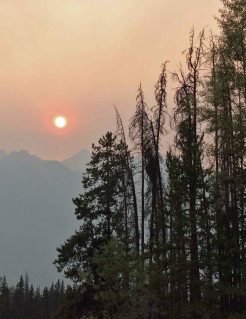
SmokeSun-Rockies2

Smoky sun overlooking Rockies (photo by Nina Munteanu)

I recently travelled from Vancouver with Pixl Press director Anne Voute through the smoky Rockies to the 8th ‘When Words Collide’ writers festival in Calgary. The festival was held August 10-12, 2018 and brought together just under a thousand readers and writers in multi-genres to attend presentations and panels on writing and publishing.

The three-day writers’ festival ran a 10-track program that included informative panels, Blue Pencil Café, Editors Speed Mingle, pitch sessions with agents and publishers, and challenging workshops.

MythHawker table-WWC2018

Selling books at Myth Hawker

My books were on sale in the Merchant’s room at Sentry Box (a local Calgary bookstore) and Myth Hawker Travelling Bookstore. By the third day, Myth Hawker sold all available copies of Water Is…

I participated in panels, Blue Pencil Café, Editors speed mingle and several presentations and workshops:

  • You Oughta Be in Audio: a discussion between me and audiobook narrator and producer Dawn Harvey on the making of the audiobooks for The Splintered Universe—now available in three formats, print, ebook, and audiobook. While paper sales dwindle, audiobooks continue to be the fastest growing segment of the publishing world with sales increasing by 30% year over year for the past decade.

Amazon-SplinteredUniverseTrilogy

  • World As Character: a presentation on creating a world with meaning. In most science fiction and fantasy, the world that we create is often very different from our own; in speculative fiction it’s often very similar; in contemporary fiction it is virtually the same. In all cases the world you build should embed in your story with layered metaphoric meaning. Nina Munteanu will discuss how to build a world that interacts with character to inform greater meaning in story.

FictionWriter-front cover-2nd ed-web copyJournal Writer-FRONT-cover-WEB copyI also networked my writing community for world examples to use in my Alien Guidebook on world building: The Ecology of Story: World as Character. Anticipated release by Pixl Press of this third guidebook in the Alien Guidebook series is Summer of 2019. In keeping with the branding of the series, artist Anne Moody is providing the cover illustration and Costi Gurgu the cover design for The Ecology of Story. Covers for the previous two books were also done by Anne and Costi.

Cover-everyday hero

‘Everyday Hero’ by Anne Moody

Earlier in the month, I travelled north with the Pixl Press director to Anne’s ranch in Vanderhoof to requisition a cover from her for the guidebook. After days of discussion and “show and tell” and after several pieces of art were tentatively selected, Anne pulled out a piece that stopped our search dead. ‘Everyday Hero’ depicts a lonely firefighter, trudging in the burning forest, tired gaze to the burning crown of a tree. Considering the subject matter and our world today, we thought this was perfect for my book.

MockUpEcology-2

cover design by Costi Gurgu, illustration by Anne Moody

Depicted in shades of blue, charcoal and brilliant red, the cover contrasts and harmonizes well with the brand typology and cover design by Toronto graphic artist Costi Gurgu.

.


nina-munteanuNina Munteanu is an ecologist, limnologist and internationally published author of award-nominated speculative novels, short stories and non-fiction. She is co-editor of Europa SF and currently teaches writing courses at George Brown College and the University of Toronto. Visit www.ninamunteanu.ca for the latest on her books.

“Absolutism” in the Time of Climate Change

AboutAbsolutism-webOnce upon a time, there will be one absolute ruler who we, the people, call the Supreme Leader (May He Rule Forever). The Supreme Leader will hate immigrants, writers, scientists, environment and extinct species. We, the people under his rule, will be proud to live in our pure and glorious Motherland. Because we’ll have little to eat, no entertainment, no self-respect, no freedom, no rights, and no access to the outside world, we’ll be happy.

This is the ridiculously sublime scenario that underlies Absolutism, the dystopian card game developed by science fiction author Costi Gurgu and game developer/designer Vali Gurgu about surviving dictatorship.

A week ago, I invited Costi to my science fiction writing class at George Brown College to share his experience in writing and releasing his recent book RecipeArium (now on the short list for an Aurora Award). Costi also brought his new game, Absolutism, based on his latest novel Servitude—a near future dystopia.

PlaytestGB2

Playing the game at George Brown

“Play unfathomable scenarios of daily life in a totalitarian society. A funny game for people without shame.”—Absolutism


Emerging Dictatorships & “Servitude”—the novel

Costi described how he and Vali came to develop the game: “Based on current global political trends, some could safely assume that in the next 5 to 10 years some present democracies will turn into dictatorships. In Europe for instance, one third of the European countries have nationalistic parties winning their elections—UK, Italy, Poland, Hungary, Slovakia. France and Germany came very close. The United States is slowly sliding into dictatorship. Russia and China are no longer communist countries, like North Korea, but they’re dictatorships. They opened their markets to international trades because they saw the wisdom in making profits, but that was as far as they went with the openness. They still rule their people with an iron fist.”

We are now 7.5 billion people on the planet. As climate change (the ultimate dictator) exacerbates tensions over the unbalanced resource scarcities of our over-populated world, fear-mongering and absolute control of the masses through nationalism, isolationism, trade-wars, etc. will logically follow.

Costi and Vali first conceived a card game entirely based on Costi’s dystopian novel Servitude. But, they soon discovered that the game was too grim.

PlaytestGB3

Life under a Dictatorship—Ceaușescu

Costi and Vali had experienced a dictatorship first hand. They’d grown up in Romania under Communist rule, first by Gheorghe Gheorghiu-Dej, then under the communist dictatorship of Nicolae Ceaușescu. The dictator ruled for over twenty years before a coup d’etat overthrew him in 1989. Ceaușescu had ordered his military to open fire on hundreds of protesters in Timișoara, setting off the Romanian Revolution and ultimately his own execution by firing squad.

Ceaușescu’s totalitarian regime is still considered one of the most repressive in Eastern Europe. His Securitate (secret police) controlled the population through mass surveillance; they enacted many human rights abuses, censorship and relocation, and suppression of the media and press. Political propaganda infected all forms of education, art, entertainment and media. Non-compliant intellectuals were punished, arrested, or simply disappeared.

Inspired by the personality cult surrounding Supreme Leader Kim Il-sung in North Korea, Ceaușescu started his own cult in the Eastern Bloc by imposing a severe nationalist ideology. His policy of economic collectivization destroyed an already fragile economy and oppressed culture. Under the communist regime, thousands of books and magazines were banned and removed from public libraries and schools; intellectuals’ links to the West were severed; long-standing professional organizations were dissolved; and intellectuals, writers, and teachers were imprisoned and put into labor camps.

In Ceaușescu’s Systematisation program of urban planning—based on North Korea’s Juche ideology—whole settlements were demolished and reconstructed in the image of the state.

Ceaușescu made contraception and abortion illegal under Decree 770, and created incentives for high numbers of births—his idea was to increase the country’s population from 22 million to 30 million by the end of the century. By 1977, Romanians were taxed for being childless in a country already unable to house and feed its children. Sadly, this led to an increasing number of orphans, the highest infant mortality rate in Europe and the deaths of thousands of women who attempted illegal abortions. Orphanages were neglected and developed appalling conditions—most were concrete barracks in slums where many children suffered from frostbite, malnutrition and abuse.


“Absolutism”—the game

“Humor is your main weapon in fighting the victorious party and its minions,” say Costi and Vali. “Humor is the one thing that gives people hope and keeps the mental sanity of the masses in the face of oppression.”

And so “Absolutism” was born—a game of twisted strategies, irony and chance. Costi shared that with this game those who have never experienced dictatorship will have a taste of what it is like; the game will also remind those who have escaped oppression by dictatorship what they left behind and why their current freedoms are so precious and important to maintain.

PlaytestGeorgeBrown

players absolutely succumb to the game…

“Maybe after playing Absolutism, people will see that Russia, China, and North Korea are not exceptions,” says Costi. They may realize that “absolutism is not something that can happen only there. It is already knocking on our door.”

Do you have what it takes to survive a totalitarian dictator with a twisted sense of humor? Or to be a successful dictator in the time of climate change?

Having played the game and lost—there is only one winner, of course—I can add that having a twisted sense of humor—is an absolute advantage in the game (along with an absolutely great set of bribe cards!). Thanks to my twisted humor, I was way ahead of everyone and well on my way to becoming the Absolute Ruler, when Costi charged in with a coup d’etat card and I lost all my cards; then the Secret Police rallied behind him and crushed any chance of subversive take over. Maybe next time…

“Absolutism” recently launched on Kickstarter and is still looking for pledges. Make a pledge and help make the game happen—we may never have a better chance at staring unscathed at the face of despotism.


nina-2014aaa

Nina Munteanu is an ecologist, limnologist and internationally published author of award-nominated speculative novels, short stories and non-fiction. She is co-editor of Europa SF and currently teaches writing courses at George Brown College and the University of Toronto. Visit www.ninamunteanu.ca for the latest on her books.