The Way of Water (La natura dell’acqua)

la natura dell'acquaShe imagines its coolness gliding down her throat. Wet with a lingering aftertaste of fish and mud. She imagines its deep voice resonating through her in primal notes; echoes from when the dinosaurs quenched their throats in the Triassic swamps.

Water is a shape shifter.

It changes yet stays the same, shifting its face with the climate. It wanders the earth like a gypsy, stealing from where it is needed and giving whimsically where it isn’t wanted.

Dizzy and shivering in the blistering heat, Hilda shuffles forward with the snaking line of people in the dusty square in front of University College where her mother used to teach. The sun beats down, crawling on her skin like an insect. She’s been standing for an hour in the queue for the public water tap.


“La immagina scenderle fresca giù per la gola, con un persistente retrogusto umido di pesce e fango. La immagina risuonarle dentro con voce cupa, una voce primordiale; gli echi del tempo in cui i dinosauri placavano la sete nelle paludi del Triassico.

L’acqua è un mutaforma.

Cambia pur restando la stessa, muta il proprio volto insieme al clima. Vaga per il pianeta come una nomade, rubando da dove è necessaria e dandosi per capriccio dove non serve.

Frastornata e tremante nel caldo afoso, Hilda si trascina a fatica dietro al serpente di persone sul piazzale polveroso di fronte al college universitario in cui insegnava sua madre. Il sole picchia e le striscia sulla pelle come un insetto. È in fila da un’ora davanti al distributore pubblico di acqua.


“The Way of Water” is a near-future vision that explores the nuances of corporate and government corruption and deceit together with resource warfare. An ecologist and technologist, Nina Munteanu uses both fiction and non-fiction to examine our humanity in the face of climate change and our changing relationship with technology and Nature.

The bilingual print book by Mincione Edizioni showcases this short story in Italian and English along with a recounting of what inspired it: “The Story of Water” (“La storia dell’acqua”).

See reviews for “The Way of Water” (“La natura dell’acqua”) below:

Simone Casevecchia of SoloLibri.net

Net Massimo (English)

Net Massimo (Italian)

laNaturaDell'Acqua-coverAfter the release of the print book, Future Fiction released “The Way of Water” (“La natura dell’acqua”) in ebook format. The ebook contains the “Way of Water” story and another story, “Virtually Yours” (“Virtualmente tua”) alongside “The Story of Water” (non-fiction), which can be purchased in either Italian or Engish versions.

“Virtually Yours” was first published in Issue #4 of Neo-Opsis Science Fiction Magazine (Canada); it was reprinted in several languages in other countries including USA, Poland, Romania, Greece, and now Italy. It also appears as one of nine stories on human evolution in Natural Selection, a Canadian collection of short stories (Pixl Press) that examine the evolution of humanity with Nature and technology.

Nina’s short stories have received praise for their world building, depth of character, compelling plot and use of evocative metaphor:NaturalSelection-front-FB

“.a stunning example of good storytelling with an excellent setting and cast of characters.”–Tangent Online

“…Written with flare and a conscience…Munteanu shines a light on human evolution and how the choices we do or don’t make today, may impact our planet and future generations. The science is fascinating and so are these nine short stories.”—J.P. McLean, author of The Gift Legacy

“…Fascinating dramas set in a world too close to our own…the science was so interesting, combining visionary metaphysical speculation with AI corporate tech in scenarios that often seemed chillingly possible.”—Amazon review

“…Jealousy, lust, loneliness, grief and love are all drivers of these taut and fascinating narratives.”—Amazon review

“…a fantastic collection of stories by a deeply-involved writer, based in Canada.”—Amazon review

“…a well written, thought provoking collection of stories that will leave you hoping the future that Nina Munteanu projects never happens…Nina Munteanu is a gifted writer. Each story surprises and delights.”—Allan Stanleigh, author of USNA

“Actually brought to mind Niven’s Tales of Known Space…Nina’s stories tease you.”—D. Merchant, Louisianna Tech University College


The Way of Water can be purchased as:

WayofWater copy 2Ebook (Italian OR English) with additional short story “Virtually Yours” through Future Fiction (Mincione Edizioni) for €1,99  at:

Print book (Italian AND English) through Mincione Edizioni for €7,00 at:

Eramosa River 3

Eramosa River, Ontario (photo by Nina Munteanu)


Translated into Italian by Fiorella Moscatello. Print book cover by Laura Cionci. Ebook cover by Brad Sharp.

The Writer-Editor Relationship, Part 2: Five Things Writers Wish Editors Knew—and Followed

patterns-Cedar log moss2-LR

Cedar log (photo by Nina Munteanu)

In my previous article, “The Writer-Editor Relationship, Part 1: Editors Preparing Writers,” I focused on clarifying expectations between editors and writers from the editor’s point of view. Part 2, this article, focuses on this same relationship from the writer’s point of view.

Clarity of expectation, honesty, and mutual respect are key features in a productive and successful writer-editor relationship. Writers expect editors to inform them if their expectations are out of line, and writers rely on editors’ honesty and transparency to let them know if they are comfortable with the task being asked of them. This, of course, is predicated on the editor’s full understanding of what that task is; again, it is the responsibility of the editor to determine the scope of work from the author—just as a doctor will ask key questions to diagnose a patient. If an editor has reservations, caveats, or limitations with the project, these should be shared upfront. Honesty is always best, and it should start right from the beginning so that mutual respect is cemented.

Below is a list of five things that writers wish editors knew—and followed.

  1. Edit to preserve the writer’s voice through open and respectful dialogue

Losing your voice to the “hackings of an editor” is perhaps a beginner writer’s greatest fear. This makes sense, given that a novice writer’s voice is still in its infancy; it is tentative, evolving, and striving for an identity. While a professional editor is not likely to “hack,” the fear may remain well-founded.

A novice’s voice is often tangled and enmeshed in a chaos of poor narrative style, grammatical errors, and a general misunderstanding of the English language. Editors trying to improve a novice writer’s narrative flow without interfering with voice are faced with a challenge. Teasing out the nuances of creative intent amid the turbulent flow of awkward and obscure expression requires finesse—and consideration. Good editors recognize that every writer has a voice, no matter how weak or ill-formed, and that voice is the culmination of a writer’s culture, beliefs, and experiences. Editing to preserve a writer’s voice—particularly when it is weak and not fully formed—needs a “soft touch” that invites more back-and-forth than usual, uses more coaching-style language, and relies on good feedback.

An editor colleague of mine consistently accompanies her edits with the question, “Does this change preserve your meaning?” This prompt both focuses on “voice” and reminds the writer that the editor is considering it, which fosters a nurturing environment of mutual respect. Editors who are not familiar with working with writers in the early stage of their careers may wish to defer to one who is more experienced.

Editors also need to consider how the author’s narrative voice harmonizes with the standard in the author’s targeted genre and niche market. Pursuing respectful and open dialogue about how the author’s voice fits or doesn’t fit that standard is another responsibility of a good editor and one an author will come to rely on—particularly early on in their career.

  1. Understand—and embrace—the market and genre of your writer

Writers are often told to write what they know. This edict applies equally to editors: edit what you “know” and understand. Each form of writing—from literary and genre fiction to journalism, the memoir, and technical writing—encompasses an overall style, culture and vision, associated language, and even “jargon” that is important to understand to succeed with readers. Even writers who subvert the trope need to first understand what they are subverting, and so does the editor.

I write and edit science fiction and fantasy. I do it very well, because I have a passion for it and I intimately understand its world and language, including where the boundaries lie and where the risks—and sublime nuances of originality—also lie. I worked as a scientist for over 20 years and have published papers in peer-reviewed journals, so I am comfortable editing technical and scientific papers. I live that world. On the other hand, I do not read, nor do I understand or care for, the horror fiction genre. Not only would I do a lousy job editing a work of horror, but I wouldn’t provide the discerning editorial advice to best place that work in the horror market. It is in the area of market niche that one editor will shine over another based on their familiarity with, and current activity in, that industry sector. This is ultimately what writers are paying for: the multi-layered understanding of the editor that comes with a full embrace of that world.

Editors should ensure a good fit and the best chance for success by not taking on work in a genre with which they are neither familiar nor comfortable. Think of the author. Which leads me to the next point:

  1. Be honest and practice moral integrity: Don’t take on a writer’s work unless you like and believe in it

 When I was starting out as a writer with my first novel, I shopped it around to many agents, hoping for representation. While the book was eventually published with great success, many agents had rejected it. Literary agents take on clients and shop their books to publishing houses. They usually charge a percentage of the take and are not paid (if they are good agents) until the book is sold to a publishing house. Payment, therefore, is predicated on success. In many cases, an agent would respond with good things to say about my first manuscript but would not take it on, citing this common phrase: “It just didn’t excite me enough.” I was initially puzzled by this response. If they liked it, why didn’t they take it on? But “I like” isn’t the same as “I’m excited.” I soon realized the importance that excitement played in the agent’s business. They were my advocate, after all. If they weren’t eager about the book, how could they sell it to someone else? And if they couldn’t sell it to someone else, how could they get paid?

While the editor is usually paid up front and/or upon deliverable, they fulfill a similar role: that of advocate. If an editor takes on a writer’s work without enjoying it or believing in it, they are much less likely to do a good job. And both lose when that happens.

When we just do a job for the money and not for the passion of doing something well, we run the risk of losing on all fronts. We run the risk of being dishonest in our assessments and then doing a shabby job. And then losing our reputation. Be an advocate and be honest; sometimes, that means saying “no” to a project and explaining why. The writer will benefit and will thank you for it—if not right away, then eventually.

  1. Edit professionally and appropriately to promised deliverable

In my capacity as writing coach, I have met with several writers who have complained that their work had been insufficiently or inappropriately edited. This can occur for several reasons: (a) lack of time; (b) incompetence; or (c) inappropriate match-up.

  • Lack of time 

As a writer, I once experienced an insufficient copy edit by a freelance professional editor. In fact, this particular editor was a good editor and had impeccably edited a previous work of mine. When I submitted my “edited” work to a beta reader, he pointed out many places that my copy editor had missed. A few is OK, but she’d missed many. From subsequent correspondence, I deduced that my editor had been overrun with other projects and had skimmed mine a little too fast. Unfortunately, this was unacceptable, given that I’d agreed to pay her a professional rate for a specific deliverable: a copy-edited, proofed, and publication-ready manuscript.

The ultimate message here for editors is, don’t take on a writer’s work and make promises of delivering until you know what you’re getting into and know that you can do it in the time you suggested. Honesty is best here. If you are too busy to meet the specified deadline, say so and refer the writer to another respected editor if they can’t wait. And don’t worry about “losing” the client—you haven’t. But that editor I mentioned in the previous paragraph did.

  • Incompetence 

Unfortunately, most editors who are incompetent are unaware of it. One of my professional writer-editor colleagues at SF Canada invoked the Dunning-Kruger Effect (“at a certain point, people who really don’t know something don’t know that they don’t know it”) to share her story of what passes for editorial input in “an age of homonym errors.” She suggested that some self-appointed editors are convinced they have significant skills but allow a large error rate.

This is where organizations like Editors Canada become invaluable. Editors Canada certifies editors for skills in various editing fields and forms (that is, structural-, stylistic-, and copy editing and proofreading). If you are a professional editor with certification, ensure that you make this known to the writer; many writers not only don’t understand the various editing forms (for example, copy editing vs. structural editing), they also don’t necessarily recognize competence until after the job is done—when it’s too late.

  • Inappropriate match-up 

This is similar to point 2, which talks about matching writer and editor through genre and market. A good fit also includes temperament, schedules, communication style, and other considerations that will affect the editor-writer relationship and the natural progress of the project. As editor, I have encountered a few clients whose communications with me created tension and misunderstanding. We mutually agreed to terminate our arrangement early on, which saved much tension and grief. The transparency of the relationship allowed us to recognize the mismatch early on and attend to it before it became problematic and wasted both our time and efforts.

  1. Keep the relationship—and language—professional and respectful 

Without necessarily expressing this, the majority of writers—particularly beginning writers and, by default, indie/self-published writers—seek a professional editor who will treat them with respect. What this translates into is the use of professional language, tone, and behaviour. Writers aren’t looking for an editor to be their “friend.” Writers are also not looking for a professional editor to validate their work or them as people. Writers seek professional editors to give them honest and helpful advice that will help them create the very best work they can for eventual publication.

Simple. Not so simple.

As an editor who is also a writer (who gets edited a lot), I provide rationale as much as I can for the suggestions I make to writers. This helps establish and maintain a respectful and collaborative relationship between author and editor through the use of professional language, tone, and behaviour. Think of it as a doctor-patient relationship; I’ve dropped doctors like hot potatoes who are not willing to sit with me as an equal and discuss their prognoses. I want to know why, and ultimately, it’s my decision. The editor is an expert, but so is the writer.

The writer-editor relationship is foremost a professional one. As an editor, I feel it is my duty to promote integrity and respect with the writer, and this hopefully within a safe and nurturing environment for the achievement of mutual excellence.

This article was copy edited by Nicole North.


Nina MunteanuNina Munteanu is an ecologist and internationally published author of award-nominated speculative novels, short stories and non-fiction. She is co-editor of Europa SF and currently teaches writing courses at George Brown College and the University of Toronto. Visit www.ninamunteanu.ca for the latest on her books.

Nina Teaching SF Writing Course at George Brown College FALL 2015

 nina-workshop 2

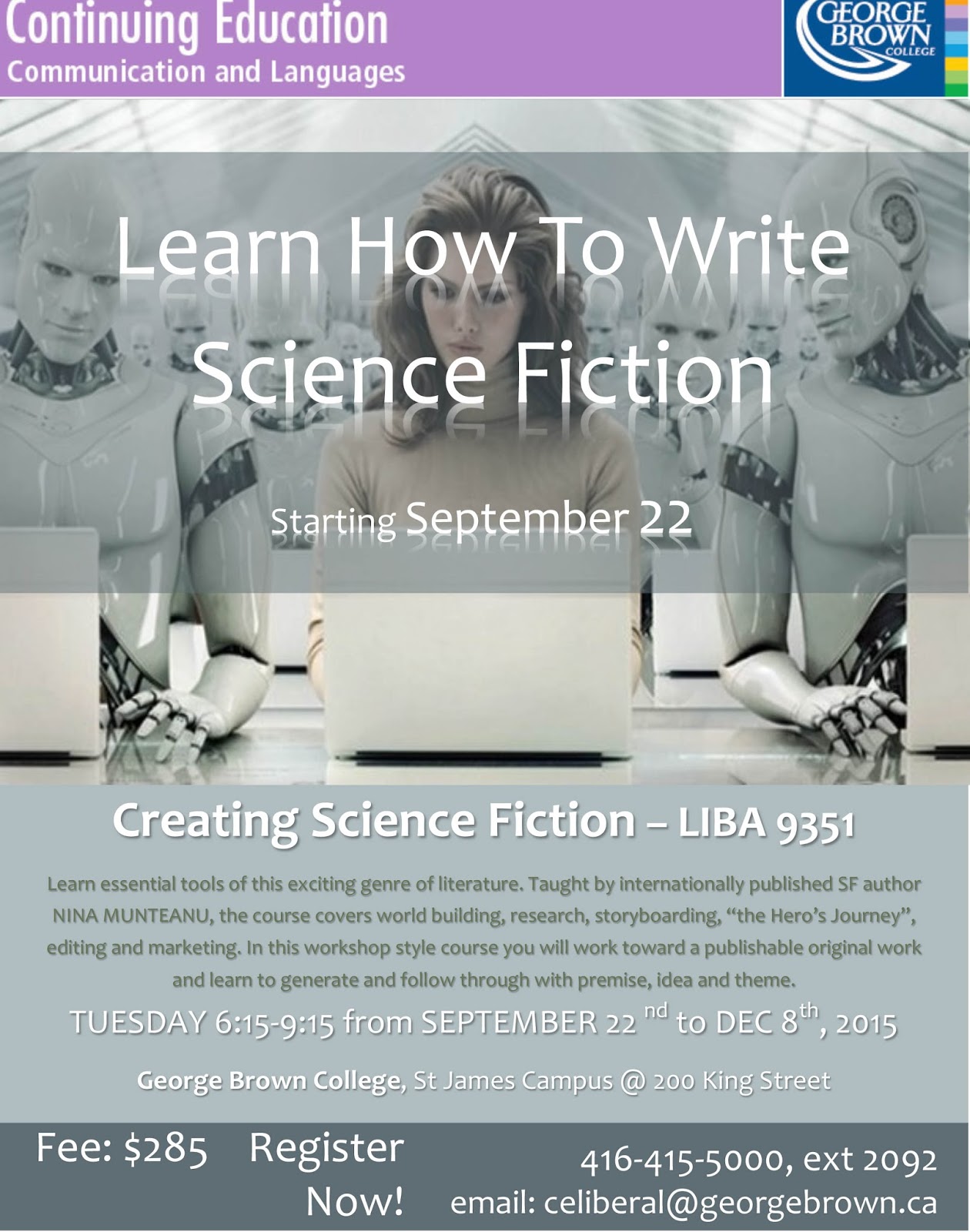
I’m back at George Brown College in Toronto, teaching my 12-week long writing course on how to write science fiction. “Creating Science Fiction” is now part of George Brown’s Creative Writing Certificate.

The 12-week course starts SEPTEMBER 22 (TUESDAY)  and runs until DECEMBER 8th. See the description below:

The course “Creating Science Fiction” runs TUESDAY nights from 6:15 to 9:15 starting September 22nd through to December 8th and costs $285.
.
Meant for both beginning writers and those already published, the 12-week course is run like a workshop with student input and feedback on student’s WIPs.
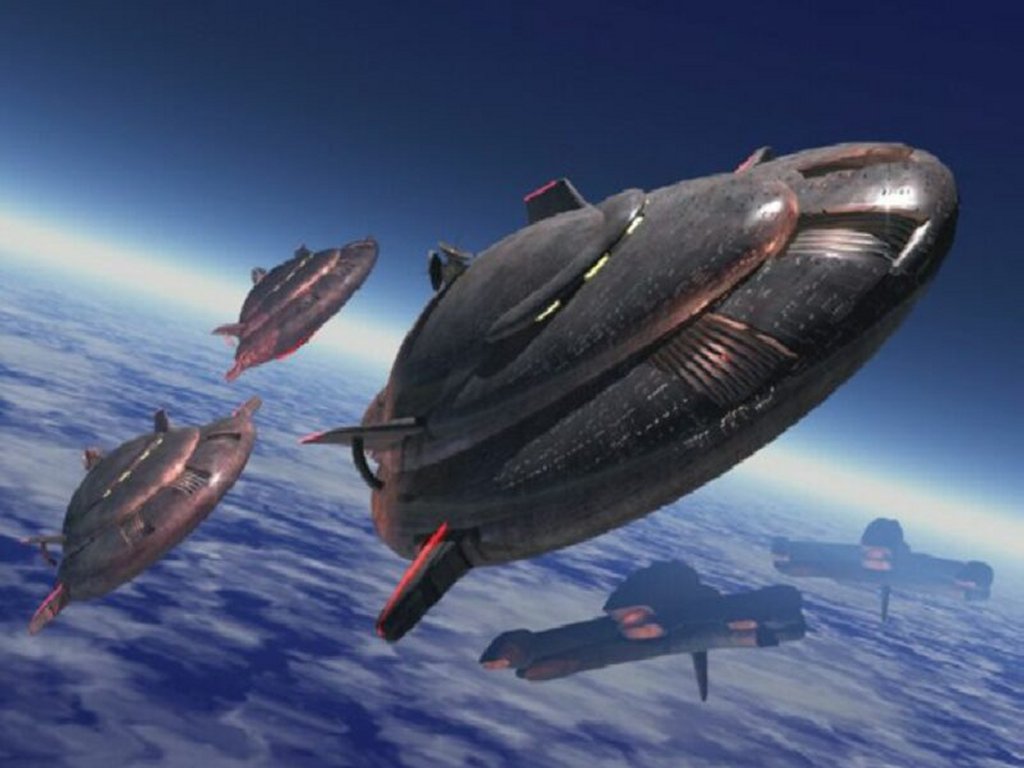
.spaceship02
Munteanu explores with students the essential tools used in the SF genre (including world building, research and plot approaches). “Students will work toward a publishable original piece by learning to generate and follow through with premise, idea and theme,” says Munteanu.
.
You can register for the course here: 
George Brown College is located on 200 King Street, Toronto, Canada.
nina-2014aaNina Munteanu is an ecologist and internationally published author of award-nominated speculative novels, short stories and non-fiction. She is co-editor of Europa SF and currently teaches writing courses at George Brown College and the University of Toronto. Visit www.ninamunteanu.ca for the latest on her books.

Limestone Genre Expo—July 2015

I recently attended the inaugural festival of the Limestone Genre Expo (July 25, 2015) for writers in Kingston, Ontario. The festival gets its name from the city’s moniker, based on the many heritage buildings constructed there using local limestone.

It would have been a very long trip from my digs in Nova Scotia; but I’m currently in Toronto, teaching writing at UofT and George Brown College. I still had to get up earlier than I normally do to get to the 1-day festival that started at ten in the morning.venue

It was worth it.

Organizers Liz Strange, Barry King, Delina MacDonald and Marlene Smith nailed everything right. Being the first of hopefully many more, this writers’ festival wisely started small. But, like the good Doctor’s tardis, the venue belied its size by being dense with quality and diversity.

Alison Sinclair

Alison Sinclair

The Ongwandada Resource Centre, where the festival was held, had lots of parking with a friendly well-lit ambience inside under an atrium with tables and chairs for gathering and several rooms for panels and workshops.

The festival covered several of the major genres such as fantasy, science fiction, horror, romance and mystery, with representation by well-known authors in each. Organizers offered a triple track program from 10 am to 5 pm that included panels, informative workshops, readings, novel pitch sessions with CZP

Sandra Kasturi of CZP

Sandra Kasturi of CZP

and Bundoran Press and first page critiques with Caro Soles. Festival organizers populated their program with well-established writers from their own communities. Readers of genre fiction and writers looking to learn and network were given the opportunity to meet some of the top genre writers in the region. The venue included a book fair, box lunches and a snack stand. The only thing missing was a primo coffee bar.

Marie Bilodeau

Marie Bilodeau

The small venue provided an intimate setting for great networking. I had a chance to meet many of my old friends and to make new ones. Marie Bilodeau, an Ottawa fantasy writer, gave an exquisite reading of her new series “Nigh”. Alison Sinclair, recently moved to Ottawa, beamed as she showed me the new release of her Eyre series, “Contagion” by Bundoran Press. Aurora-winning short story author Douglas Smith gave

Doug Smith

Doug Smith

an informative workshop on how to market and sell your short stories. His excellent guidebook “Playing the Short Game” sold for a special festival price. I caught Derek Newman-Stille sitting in the lounge over a box lunch and discussed his radio show in Peterborough and traded stories with Hayden Trenholm, publisher of Bundoran Press and aurora-winning author of the Steeles Chronicles. Other writers who I had a chance to visit

Alyssa Cooper

Alyssa Cooper

with and meet included Caro Soles, Sandra Kasturi (of Chizine), Alyssa Cooper, Eve Langlais, Matt Moore, Nancy Kilpatrick, Matthew Johnson, and Violette Malan.

The organizers—themselves published genre writers (Strange writes fantasy, horror and mystery and just released her first science fiction novel, “Erased”; King writes science fiction)—started the festival in response to an observed need to showcase genre writers in the Kingston area, otherwise rich in non-genre writing festivals. “Kingston is in an interesting position because we do have so many writers and we do have the WritersFest and so on,” explained King to Peter Hendra of the Kingston Whig-Standard. King felt there was room to showcase this literature in Kingston and the surrounding area.

Derek Newman-Stille

Derek Newman-Stille

“I find that genre fiction can sometimes be seen on a lower status as ‘literary fiction’, and that stings,” Strange confided to me. “I thought [the LGE] would succeed because there are not that many festivals of this sort, and after we put feelers out to see who might be interested in attending the positive responses were overwhelming.”

Caro Soles

Caro Soles

Strange added that “nerd culture” these days is more mainstream than in the past, thanks to George R.R. Martin’s Game of Thrones and Stephanie Meyer’s Twilight series. Strange concluded that this is a good thing for writers of romance, sci-fi, horror, mystery and fantasy and observed that genres are blending a lot more (e.g., historical fantasy, paranormal romance, etc.). I personally write mostly blended genres: science fiction thrillers; SF eco-fiction; historical fantasy and romantic SF.

Violette Malan

Violette Malan

I asked Strange for her opinion on whether the festival was a success and what the organizers plan to do for next year. She gave a resounding yes; they had double the numbers they’d hoped for and didn’t lose money (a common challenge with writing festivals). With most events tending to be in spring or fall, they chose summer, which worked well and showed off Kingston.

Liz Strange, Marlene Smith, Barry King, Delina MacDonald

Liz Strange, Marlene Smith, Barry King, Delina MacDonald

Based on the feedback and success of the con, it looks like the festival next year will run two days.

Now that’s great news!

.

.

.

nina-2014aaNina Munteanu is an ecologist and internationally published author of award-nominated speculative novels, short stories and non-fiction. She is co-editor of Europa SF and currently teaches writing courses at George Brown College and the University of Toronto. Visit www.ninamunteanu.ca for the latest on her books.

The Ecology of Print Books: Niche Partitioning by Young Readers

Anne-walking-Cedars

Friend Anne walks boardwalk in giant cedar forest, BC (photo by Nina Munteanu)

A while ago, I wrote about the S-curve in publishing, an ecological phenomenon applied to the book industry. Today I’d like to talk about another ecological phenomenon: niche partitioning.

Earlier this year, SF author and fellow Canadian Cory Doctorow cited several reports on his blog BoingBoing suggesting that “young readers generally prefer to read books from paper, not screens.” More than that, he adds, “they find ebooks and printed books complementary.”

I’m an ecologist and this makes sense to me. It comes down to niche-partitioning. Every organism occupies a niche, which can be defined as that organism’s “job” in its ecosystem; so niche-partitioning is a way for organisms to co-exist cooperatively—rather than competitively and exclusively—by apportioning or segregating various jobs or roles in an ecosystem. It’s a bit like syndicalism vs. capitalism, in which functional, rather than territorial precepts are used.

“The future composts the past,” says Doctorow. “The advent of films made it possible for performances that couldn’t work onstage to be born and it moved all the plays that were uncomfortable fits onstage to the screen. What it left behind were plays that were more like plays—and a theater industry that’s still going strong, even if it’s dwarfed by the screen.” He’s talking about niche-partitioning here.

I generally find that ebooks are convenient for my mobile lifestyle. I’ve recently adopted an itinerant, gypsy life from my former “nesting” days. My family has grown up and left the nest and I’ve gone “walkabout”. My giant library of print books had to find good homes, rather than travel with me to all parts of the world. I keep a collection of virtual books on my device for reference (like a dictionary). I also find ebooks a good option for a one-off read—something I can get cheap and read without needing to “befriend” and keep.

I treasure my few printed books, both reference and story. My reference print books are underlined and marked and worn from being used over and over again. Printed books are best for protracted reading and comprehension. You want a print book when you wish to delve deep into “story” and relax.

As with the theatre becoming more theatre-like, Doctorow adds that, “books are becoming more book-like. Books that work best as e-books—for example, big reference books; but also short works that are too slight to rest comfortably on their own between covers—are moving to e-book-land. Things that are produced as printed books have passed a test in which someone has asked, Is there an important reason for this to exist in print, instead of exclusively onscreen?

I talked about this in my previous article The Future of Books on this blog: “print books will become the epitome of publishing value and worth. Already coveted by collectors whose libraries will represent the best of the best in the literary world, print books will come to represent the highest status in literature. Only the best stories will endure as print books; perhaps only the ‘best book’ will even be published in print form. Its existence in print form will define its literary value.” Niche-partitioning, like I said…

In an article called Why Digital Natives Prefer Reading in Print. Yes, You Read That Right, Washington Post reporter Michael S. Rosenwald reported that, “Textbook makers, bookstore owners and college student surveys all say millennials still strongly prefer print for pleasure and learning, a bias that surprises reading experts given the same group’s proclivity to consume most other content digitally.”

students-print-online2014Rosenwald adds, “The preference for print over digital can be found at independent bookstores such as the Curious Iguana in downtown Frederick, Md., where owner Marlene England said millennials regularly tell her they prefer print because it’s “easier to follow stories.” Pew studies show the highest print readership rates are among those ages 18 to 29, and the same age group is still using public libraries in large numbers.” Rosenwald adds, “And it can be seen most prominently on college campuses, where students still lug backpacks stuffed with books, even as they increasingly take notes (or check Facebook) on laptops during class. At American, Cooper Nordquist, a junior studying political science, is even willing to schlep around Alexis de Tocqueville’s 900-plus-page “Democracy in America.”

I’ve noticed the same phenomenon at the University of Toronto campus where I teach. Rosenwald writes about Frank Schembary, a young student who loves books—printed books. He loves how they smell. He loves scribbling in the margins, underlining interesting sentences, folding a page corner to mark his place. “I like the feeling of it,” says Schembary, reading under natural light in a campus atrium, his smartphone next to him. “I like holding it. It’s not going off. It’s not making sounds.”

Cedar trunk base-LR

Cedar tree, Little Rouge woodland (photo by Nina Munteanu)

Naomi S. Baron, an American University linguist who studies digital communication, wrote a book Words Onscreen that reported her studies of students’ reading patterns. She found, along with other studies, that readers tend to skim on screens. Her favourite response to her question of what students disliked the most about reading in print was: “It takes me longer because I read more carefully.”

Students prefer digital for science and math subjects, where they also have access to online portals and resources linked to their subject matter and assignments.

Niche partitioning makes the world go round. Now, if we can only use its logic in economic systems.

nina-2014aaNina Munteanu is an ecologist and internationally published author of award-nominated speculative novels, short stories and non-fiction. She is co-editor of Europa SF and currently teaches writing courses at George Brown College and the University of Toronto. Visit www.ninamunteanu.ca for the latest on her books.

The Future of “Books”

Path deas park

Deas Park, BC (photo by Nina Munteanu)

An August 2013 survey by bestselling author Marie Force revealed some interesting trends about what American readers like, what format they prefer and where they find their writers. While the survey was fairly small and restricted to Americans (just under 3,000 people responded to 44 questions), I think it provides a good microcosm of what the trend is out there in North America generally.

Here are Marie’s main findings and conclusions:

1. FORM: Readers prefer e-books to paperbacks (77%); many buy in multiple formats, including paperback. 52% of surveyed readers do buy their books in print form. Audio books are slowly gaining popularity.

2. REVIEWS & TESTIMONIALS: Retail reviews such as those on Amazon, Barnes & Noble and other retail sites were more important to readers than author endorsements and reviews by professional reviewers on review sites. Fifty percent of readers preferred reviews posted on retail sites for their information; 16% used Goodreads; 72% said that the designation of “New York Times Bestselling Author” did not make a difference in their purchasing choice. 81% did not subscribe or read the major review publications (e.g., RT Book Reviews, Publishers Weekly, Kirkus, Booklist, NYT Sunday Edition, USA Today)

3. BOOKSTORES: A majority of readers bought their books from a virtual bookseller: 80% of surveyed readers buy from Amazon (Barnes & Noble online was second at 23%; iBookstore/Apple scored 13%). 58% of readers surveyed had visited a real bookstore twice or less in the past year. The remaining percent visited more often.

4. PUBLISHER: readers are more likely to buy a self-published book by an author they know; 94% of readers surveyed are “more likely” to buy a self-published book from an author who is known to them; 68% of readers are “less likely” to purchase a self-published book by an author they don’t know.

5. CONTENT & GENRE: Readers are most interested in stories with outstanding characters, setting, storytelling and writing; 75% chose “all of the above” to encompass each of the elements. Unsurprisingly, 81% of readers chose “Romance” is their favorite genre of fiction; contemporary romance is the favorite subgenre with historical romance as the second favorite.

6. HOW READERS FIND & FOLLOW AUTHORS: the best single-most best social media platform for authors is Facebook, used by 85% of surveyed readers; 75% of readers also subscribed to the newsletters of their favorite authors and 55% subscribed to the blogs of their favorite authors. Twitter was not a major site for readers to find and follow their authors. Goodreads was one of the most frequently mentioned sites in the open-ended portion of the questionnaire.
The numbers don’t always match up; nor is the catchment or method of making statistical conclusions sufficiently explained; but the results as presented make logical sense to me. They make sense because the feedback I am getting in my circles is very similar. So, there you go, writers and readers.

Here’s my take on this phenomenon:

1. Increased sales of Digital Books: the increasing sales of digital books (ebooks) and the rising sales of audiobooks is a wonderful and uplifting icon of rising literacy. More people are reading (and listening) to books now than ever. And we have the digital book, Kindles, Kobos and iPads to thank for it. The “book” has become more accessible and readable. People swarm the public transit, clutching their iPhones and reading devices.

2. Readers still choosing Print Books: Obviously, print books are cherished by readers for their intrinsic value. Books—their tangible tactile presence—will always remain with us; in collector’s showcase libraries, in trendy artistic venues, and funky local neighbourhood venues.

3. My Prediction: print books will become the epitome of publishing value and worth. Already coveted by collectors whose libraries will represent the best of the best in the literary world, print books will come to represent the highest status in literature. Only the best stories will endure as print books; perhaps only the “best book” will even be published in print form. Its existence in print form will define its literary value.

4. Take Home Message to Authors: ensure that your book appears in print form and get it into the hands of classy libraries and classy people.

nina-2014aaNina Munteanu is an ecologist and internationally published author of award-nominated speculative novels, short stories and non-fiction. She is co-editor of Europa SF and currently teaches writing courses at George Brown College and the University of Toronto. Visit www.ninamunteanu.ca for the latest on her books.

When We Burn Books & Ray Bradbury’s Fireman

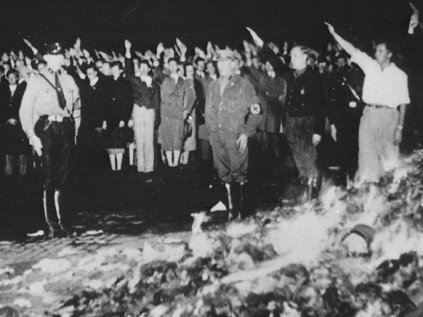
Book burning Opernplatz

Book burning Opernplatz

The burning of an author’s books…has always been the tribute that an ignorant age pays to the genius of its time — Joseph Lewis

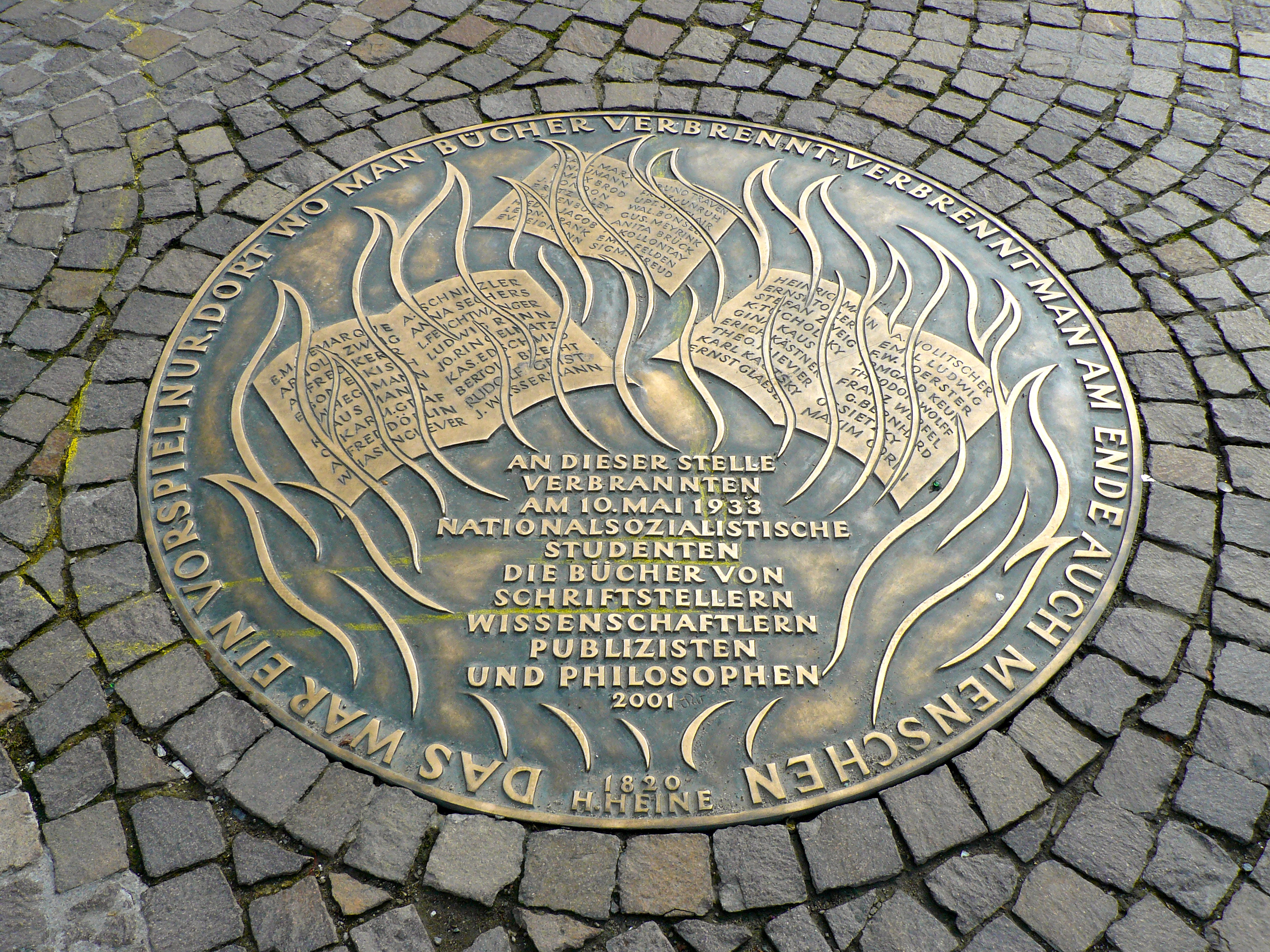
In his 1821 play Almansor the German writer Heinrich Heine wrote (referring to the burning of the Muslim holy book, the Koran, during the Spanish Inquisition): “Dort, wo man Bucher verbrennt, verbrennt man am Ende auch Menschen” –“Where they burn books, they will end in burning human beings.” A century later, on May 10th, 1933, Heine’s books were among the thousands of volumes publicly hauled out and burned in the streets by the Nazis in Berlin’s Opernplatz (Bebelplatz). A violent outburst that did, in fact, foreshadow the blazing ovens of the Holocaust.Commemorative_Plaque_book_burning_Frankfurt_Hesse_Germany

Wikipedia defines ‘book burning’ as the “practice of ceremoniously destroying by fire one or more copies of a book or other written material.” The practice, usually carried out in public (like public hangings in Medieval times) is generally motivated by moral, religious or political objections to the material. Some notable and particularly destructive book burnings have included:

  • the destruction of the Library of Alexandria;
  • burning books and burying scholars (they mean ‘live burying’, folks!) under China’s Qin Dynasty (3rd Century);
  • Cathar texts in the Lanquedoc region of France in the 13th Century;
  • the Talmud in Paris by the French crown in 1242;
  • Arabic and Hebrew books at Andalucia, Spain, in 1499;
  • Servetus’s “heretical” writings along with the writer in Geneva in 1553;
  • Maya sacred books in Yucatan (1562);
  • Tyndale’s New Testament by the English authorities in 1525 and 1526;
  • Luthar’s Bible in Germany (1624) as ordered by the Pope;
  • Robespierre’s destruction of religious libraries in 1793;
  • anti-communist books by the Bolsheviks in 1917;
  • Jewish, anti-Nazi and “degenerate” books by the Nazis in the 1930s and 1940s;
  • Communist and “fellow traveller” books by Senator McCarthy in 1953;
  • The Satanic Verses by Muslims in the UK in 1988; and,
  • Harry Potter books in various American cities, 2001-2005.
Ray Bradbury copy

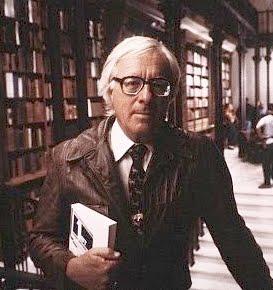
Ray Bradbury

In the 1967 introduction of his novel, Fahrenheit 451 (based on his novella, The Fireman), Ray Bradbury implied that the Nazi book burnings inspired his story. I found his statement both eloquent and powerful: “It follows then that when Hitler burned a book I felt it as keenly, please forgive me, as his killing a human, for in the long sum of history they are one in the same flesh.” For those of you who haven’t yet read his novel (one of my favourite books, ever), this cautionary tale explores a fictional future society that has institutionalized book burning in an effort by authorities to maintain order and ‘happiness’. In Bradbury’s fictional world, firemen don’t put out fires; they start them. The story begins with Montag, an ordinary fireman:

It was a pleasure to burn. It was a special pleasure to see things eaten, to see things blackened and changed. With the brass nozzle in his fists, with this great python spitting its venomous kerosene upon the world, the blood pounded in his head, and his hands were the hands of some amazing conductor playing all the symphonies of blazing and burning to bring down the tatters and charcoal ruins of historyMontag grinned the fierce grin of all men singed and driven back by the flame. He knew that when he returned to the firehouse, he might wink at himself, a minstrel man, burnt-corked, in the mirror.”

bookburning-Opernplatz

book burning in Opernplatz

Bradbury wove a multi-layered political and social tale that followed one man’s journey to find his soul. Fahrenheit 451 explores the theme of intellectual freedom using censorship as his plot device. Montag is “everyman” who must make a choice for personal freedom at the expense of the “good censored life”. It is the choice all artists must make. In choosing freedom, we make an obligation to respect and tolerate those with whom we disagree; otherwise we are just tyrants and not really free.

fahrenheit-451-book-coverIn 1795 Thomas Paine wrote, “He that would make his own liberty secure, must guard even his enemy from opposition: for if he violates this duty he establishes a precedent that will reach to himself.”

The American Library Association defines intellectual freedom as the right of every individual to both seek and receive information from all points of view without restriction. It also encompasses the freedom to hold, and disseminate ideas. Intellectual freedom is the basis for our democratic system. We expect our people to be self-governors. But to do so responsibly, our citizenry must be well-informed. Libraries — and the free internet — provide the ideas and information to allow people to inform themselves.

John F. Kennedy once said that “a nation that is afraid to let its people judge the truth and falsehood in an open market is a nation that is afraid of its people.”

nazi book burning2Censorship suppresses ideas and information that certain people — individuals, groups or government officials — find objectionable or dangerous. Censors pressure public institutions, like libraries, to suppress and remove from public access information they judge inappropriate or dangerous, so that no one else has the chance to read or view the material and make up their own minds about it. “Censorship … creates, in the end, the kind of society that is incapable of exercising real discretion,” said Henry Steel Commager.
When does simple disapproval turn into active disallowing; when does banning of books turn into burning of books?

I believe that censorship occurs when one submits to fear and insecurity: the bully being bullied and ruled by his own fear. Okay, we all fear; that’s only natural. We’re animals and fear is a survival instinct we all need and use. But, we don’t live in caves and hunt sloth anymore; that fear can be tempered by a civilized educated culture. Without the benefit of a nurturing faith and belief in the goodness of humankind, fear will lead to prejudice, racism and a general isolationist paranoia.

Winston Churchill said: “You see these dictators on their pedestals, surrounded by the bayonets of their soldiers and the truncheons of their police. Yet in their hearts there is unspoken–unspeakable–fear. They are afraid of words and thoughts! Words spoken abroad, thoughts stirring at home, all the more powerful because they are forbidden. These terrify them. A little mouse–a little tiny mouse! -of thought appears in the room, and even the mightiest potentates are thrown into panic.”

nazi book burning3

Book burning in Opernplatz

The danger comes when an organized group subscribes to a common fear. It is often driven by a charismatic leader, who has somehow captured that fear, harnessed its raging force then propelled it like a projectile. One’s anonymity and shared (and supposedly diluted) responsibility within the “mob” may compel the individual to commit irrational acts of atrocity he/she would never otherwise contemplate on his/her own. How many of us have been caught up in the mass enthusiasm of a sports match? We’ve all felt it; the power of the mob, its energy crackling in the air around our pounding hearts and cries. To yield to a mob-mentality is to subscribe to a condoned insanity, within which the ‘mob’ takes on its own irrational personality that is more than the sum of its parts…to become a kind of autopoietic entity that swiftly and ruthlessly dispenses its own perverse form of justice.

Perhaps for this reason more than any other, I see the artist’s path as a singular one, part of, yet apart from, the crowd. Neither leader, nor follower; rather, a wizard and a “trickster”, a shining beacon, both reviled and honored simultaneously. We are our books.

It was Victor Frankl, survivor of Auschwitz, who said, “what is to give light must endure burning.”

In her acceptance speech for a lifetime award by the NBA, author Ursula K. LeGuin said:

le-guin copy

Ursula K. LeGuin

“I think hard times are coming, when we will be wanting the voices of writers who can see alternatives to how we live now, and can see through our fear-stricken society and its obsessive technologies, to other ways of being. And even imagine some real grounds for hope. We will need writers who can remember freedom: poets, visionaries–the realists of a larger reality. Right now, I think we need writers who know the difference between production of a market commodity and the practice of an art…The profit motive is often in conflict with the aims of art…We live in capitalism. Its power seems inescapable; so did the divine right of kings… Power can be resisted and changed by human beings; resistance and change often begin in art, and very often in our art–the art of words. I’ve had a long career and a good one, in good company, and here, at the end of it, I really don’t want to watch American literature get sold down the river… The name of our beautiful reward is not profit. Its name is freedom.”

nina-2014aaNina Munteanu is an ecologist and internationally published author of award-nominated speculative novels, short stories and non-fiction. She is co-editor of Europa SF and currently teaches writing courses at George Brown College and the University of Toronto. Visit www.ninamunteanu.ca for the latest on her books.

From Pocketbook to Tablet … What’s Next?

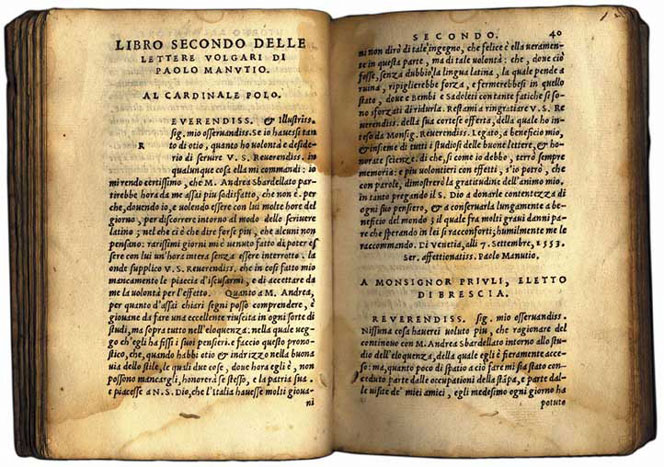
aldus manutius bookThe recent exhibition at the Grolier Club in Manhattan, “Aldus Manutius: A Legacy More Lasting Than Bronze” reminded me that the pocket-sized book was invented some five hundred years ago.

The pocket book revolutionized not only how we read but who and what we read.

In a recent talk I gave to the Editors Association of Canada about the changing face of publishing, I defined two milestones in the publishing industry.

First Milestone…

The first milestone came in two stages, beginning with the invention of the printing press by Johannes Guttenburg in 1452. Up to then,

…Books were a work of art… And part of an elite. Delicate, large and beautiful, they were created in the language of the church—Latin—and in turn copied entirely by hand by the monks. With the dimensions of a current newspaper, but much thicker, these large illuminated manuscripts sometimes weighed more than 50 pounds.

Readers were mostly scholars and the religious elite. In fact, reading was an elite occupation. The majority of people at the time couldn’t read and had no interest in books. Besides, books were not written in the commonly spoken language of the countryside such as English, French, German or Spanish.

In fact, the presses formed the very basis of the artistic Renaissance, the religious reformations and the scientific revolution, wrote Elizabeth Eisenstein in The Printing Press as an Agent of Change. “The printing press allowed the spread of information that couldn’t be controlled by the clergy, kings, politicians, or the religious elite,” adds New York Times technology reporter Nick Bilton in I Live in the Future and Here’s How It Works. Storytelling was no longer confined to an elite clergy; books could be created by anyone and shared in the spoken languages of the people.

The printing press had opened a gate of opportunity for secular expression to a greater audience. Whenever an opportunity is created, a corresponding need is identified. The need to connect a literate lay public with scholars and storytellers was resolved fifty years later by Aldus Manutius.

Until then, books, albeit printed in the language of the people, remained large, heavy and cumbersome. In 1502, Aldus Manutius invented the portable pocketsize book—the small format libelli portatiles (portable little books)—effectively creating “the mobile phone of his day,” according to Bilton.

Bound in vellum, these long, narrow libelli portatiles, easily transported in a pocket or a satchel, “could be held in the hand and learned by heart by everyone,” wrote Manutius. aldine press book

Manutius founded The Aldine Press in 1495 in Venice. His printing company proudly bore the logo of dolphin entwining an anchor—taken from the term festina lente (hasten slowly), a motto Manutius took from a Roman coin—and Aldine books quickly gained a reputation for their clean design, excellence in typography and inexpensive and accessible price. The Aldine press emphasized Greek and Latin lexicons and grammar manuals, with the first printed edition of Aristotle in 1495. Manutius was also the first to print Thucydides, Herodotus, Sophocles and other Greek philosophers. “He was possibly the first printer to compare manuscripts to arrive at the most reliable text,” adds Jennifer Schuessler of the New York Times (February 27, 2015).

Manutius was the first to use italic type, mimicking the handwriting of that time, and the first to use the semicolon in its modern sense. In 1501, Manutius released Virgil’s Opera as the first of his octavo editions of the classics and the first book to use italic print. It was produced in higher-than-normal print runs (1,000 rather than the usual 200 to 500 copies).

The octavo format book is created from one or more full sheets of paper on which 16 pages of text are printed; the sheet is folded three times to produce eight leaves. Each leaf of an octavo book represents one-eighth the size of the original sheet. The actual size of the book depends on the original size of the full sheet of paper on which it is printed. These varied according to place and time. A sixteenth century octavo printed in France or Italy was about the size of a modern paperback; an eighteenth-century octavo printed in England was larger, about the size of a modern hardcover novel.

Second Milestone…

The second milestone I talked about is, of course, the worldwide use of the Internet. Like the Guttenberg printing press, the Internet and associated World Wide Web has created a gate of opportunity that has identified a need. That need is currently being satisfied by ebook publishing, mobile phone communication and the Indie/self-publishing model.

In my September 6, 2014 article “How We Will Tell Stories in the Future” I describe the effect of the Internet and use of digital devices as agents of change and empowerment in storytelling and publishing.

The first email was delivered in 1971 and in 1989 Cern gave us the WorldWide Web. The Internet wasn’t commercialized until 1995. The first web log (blog) was published in the late 1990s and Facebook was launched in 2004. A few years later smart communication devices were created and mass marketed with multi-touch interface (e.g., the iPhone). By 2013, over 2 billion people were using the Internet and social media via computer, smartphones, tablets, game consoles, e-readers and music players. Over 156 million blogs were identified and over 1 billion files were uploaded daily to Dropbox.

While many people still read books and go to the cinema, watch pre-programmed TV or rent DVDs, many more enjoy their stories through other devices: computers, downloads, mobile phones and e-readers that provide material through other media and venues such as Indie and self-publishing, amateur YouTube videos, interactive games and social networks. We stand poised on the edge of a wonderful cliff that celebrates the expression — and consumer choice — of the individual. The music industry shows this the best, where people dismissed the prepackaged albums and CDs and opted to create their own unique playlists through individual song downloads. The publishing industry is currently struggling with its own painful yet thrilling metamorphosis as is the visual arts industry. In fact, they are all blurring into one large integrated amalgam of artistic expression.

The information you get today is coming “more and more through your friends and through your social network. It’s being distributed through channels of trust and the trust isn’t necessarily the BBCor The New York Times. It’s people,” says B.J. Fogg founder of the Persuasive Technology Lab at Stanford University.

WardIsland wall in forest

Ward Island, Ontario (photo by Nina Munteanu)

During the days of packaged content, leading storytellers were published authors, journalists and writers of newspapers and magazines. “Now distribution channels matter less and anyone with an appropriate device can be a storyteller,” says Bilton, who shares that on the Internet we tend to follow individuals we trust (e.g., Clive Thompson or David Carr) as much if not more than established organizations (like Wired Magazine or The New York Times). Accessible technology, platforms, free applications and software has totally enabled the individual.  No longer confined to the written word via paper books or visual expression through movies or TV shows, storytelling has embraced many forms. Amateur and professional have equally blurred.

From paperbacks to digital phones and tablets, we are embracing the shifting zeitgeist of an entire world. The future belongs to the storyteller, from pocketbook to tablet. What’s next?


nina-2014aaNina Munteanu is an ecologist and internationally published author of award-nominated speculative novels, short stories and non-fiction. She is co-editor of Europa SF and currently teaches writing courses at George Brown College and the University of Toronto. Visit www.ninamunteanu.ca for the latest on her books.

The Indie Book Tidal Wave …What Does it Mean for Bookstores, Publishers & Writers?

botanical beach tidal pools copy

Tidal pools, Botany Bay, BC (photo by Nina Munteanu)

We’re all agreed: the publishing industry is in upheaval. A kind of change that ripples in fractal waves throughout its entire expression and existence. A kind of change that creates a great paradigm shift. A kind of change that heralds in a new world.

Of course, much of this is due to a change in perspective: how we approach things and direct ourselves; the models and designs we use as our vehicles of expression; and how we apply them in relationship with our world.

So, what I’m saying is that the publishing industry is changing because we are changing, not the other way around. We are directing that change. We are directing that change every bit as much as we are directing changes in other important elements in our lives.

You don’t need to embrace new-age spirituality, mystery school teachings, non-locality particle physics, quantum entanglement or “intuitive science” to appreciate that our entire existence as a species, a living community and a planet is in upheaval.

You know what I mean. Wherever you look, it’s crazy (put your own examples here; there are too many). And in the midst of all this, miracles happen. What does this have to do with indie publishing? Well, nothing…well, everything. Let me tell you a little about me and my books…

paris-04

Bouquinistes along River Seine, Paris (photo by Nina Munteanu)

I’ve had over a dozen books published with small to mid-sized presses as well as my own small press, recently started up. My first book made it to the shelves of big bookstores like Chapters/Indigo and Barnes & Noble. I’ve seen my books on the shelves of small indie bookstores in Toronto and Vancouver areas and in a Paris bookstore. I’ve also had the heartache of seeing too many of my books returned from these same large bookstores, no longer “stocking” a particular title (although they kept it in their online catalogue). Over the years my thinking as both writer and publisher has shifted: mostly to do with what bookstores are doing; who to publish with; and what formats to provide my readership (e.g., e-book, print, audiobook).

Along with that shift, my definition of “big thinking” also changed. The possibilities are endless in a world where an unknown individual can achieve worldwide fame through a single twitter feed.

In the first in a new series of articles devoted to “Killing the Top Ten Sacred Cows of Indie Publishing” Dean Wesley Smith recently shared some interesting facts and opinions about how changes in book production along with reader technology has affected the industry.

He dispels the notion of many indies that their books can’t easily get into bookstores. Distribution channels for books, particularly indie books, are more than arcane. Smith advises indie publishers and writers that, “If you are already doing some things correctly, there’s a big chance your books are already in bookstores and you don’t even know it.” He’s right. I’ve published several of my books with indie publishers and both my publisher and I were unaware of some of the bookstores my books ended up in all over the world! I only found out because I frequently google my books for just such surprises. “And of course, in this new world,” Smith continues, “you don’t even know what it means ‘to have your books in a bookstore’.”

What does it mean to have your book in a bookstore? It’s in the store if it is sitting on one of the shelves, says Smith. It’s also “in the store” if it’s in the bookstore’s online database, which is where most indie books end up—virtually there, if not actually there. Considering how most people shop for books these days, and the inadequacy of shelf exposure (only so many books can appear on the shelf with their covers visible as opposed to their less compelling spine), this is not necessarily a lesser thing for the indie writer and publisher.

Botanical Beach beachcombing

Investigating the tidal pools of Botanical Beach, BC (photo by Nina Munteanu)

Ten years ago, says Smith, most bookstores used to order “to stock”. Today smart bookstores order “to replace”. This is now possible because of quicker distribution, and swift and high quality digital POD methods of book production (including neat quirky things like Espresso Book Machines or EBMs). Along with this new policy comes another potential change in the transaction model—that of returns. Smith reports that the returns system is “drifting away and is now under 18% standard and still dropping.” They were more like 50% not too long ago, which can be potentially disastrous to a small publishing company or self-published author with small revenue-base. Smith reports that many large publishers are even offering no-return choices, usually with higher discounts, which bookstores are accepting. This is great news again to small and new publishers, who cannot afford the uncertain and sudden cost of returns. Of course, returns will likely remain as a reassurance to booksellers when picking up unknown titles. In fact, this practice was adopted to permit booksellers to carry more new and untried authors without putting them at grave risk.

Smith confirms something I envisioned a while ago: that bookstores won’t disappear; instead they will morph into a more diverse set of small and specialized stores, stocking less numbers of any one book (one or two copies tops) for show with the ability to order new books and get them quickly. This is the new model Smith talks about: stock low and order to replace. So, “instead of ten of the last Patterson, there are two of the Patterson and eight other author’s books in the same shelf space,” says Smith.

So, for indie book publishers and writers, and bookstores who carry them, we are seeing the rise of a new paradigm; new trade arrangements that include consignment agreements, small but diverse inventory, and huge opportunity.

botanical beach sandstone cliffbeach

Sandstone beach in Botanical Beach near Port Renfrew, BC (photo by Nina Munteanu)


Nina Munteanu is an ecologist and internationally published author of award-nominated speculative novels, short stories and non-fiction. She is co-editor of Europa SF and currently teaches writing courses at George Brown College and the University of Toronto. Visit www.ninamunteanu.ca for the latest on her books.