How the Bdelloid Rotifer Lived for Millennia — Without Sex

As a child, I always wanted a microscope.

I would have collected slimy waters from the scum ponds and murky puddles near my house. I would have brought them home and exposed them to the light of my microscope. I would then have peered deep into a secret world, where shady characters and alien forms lurked and traded.

It would be many years, when I was in college, before I finally witnessed this world—so alien, it might have inspired the science fiction books I wrote later as an adult. As it turned out, I was led to pursue a Masters of Science degree, studying periphyton (microscopic aquatic communities attached and associated with surfaces like rocks and plants) in local streams in the Eastern Townships of Quebec.

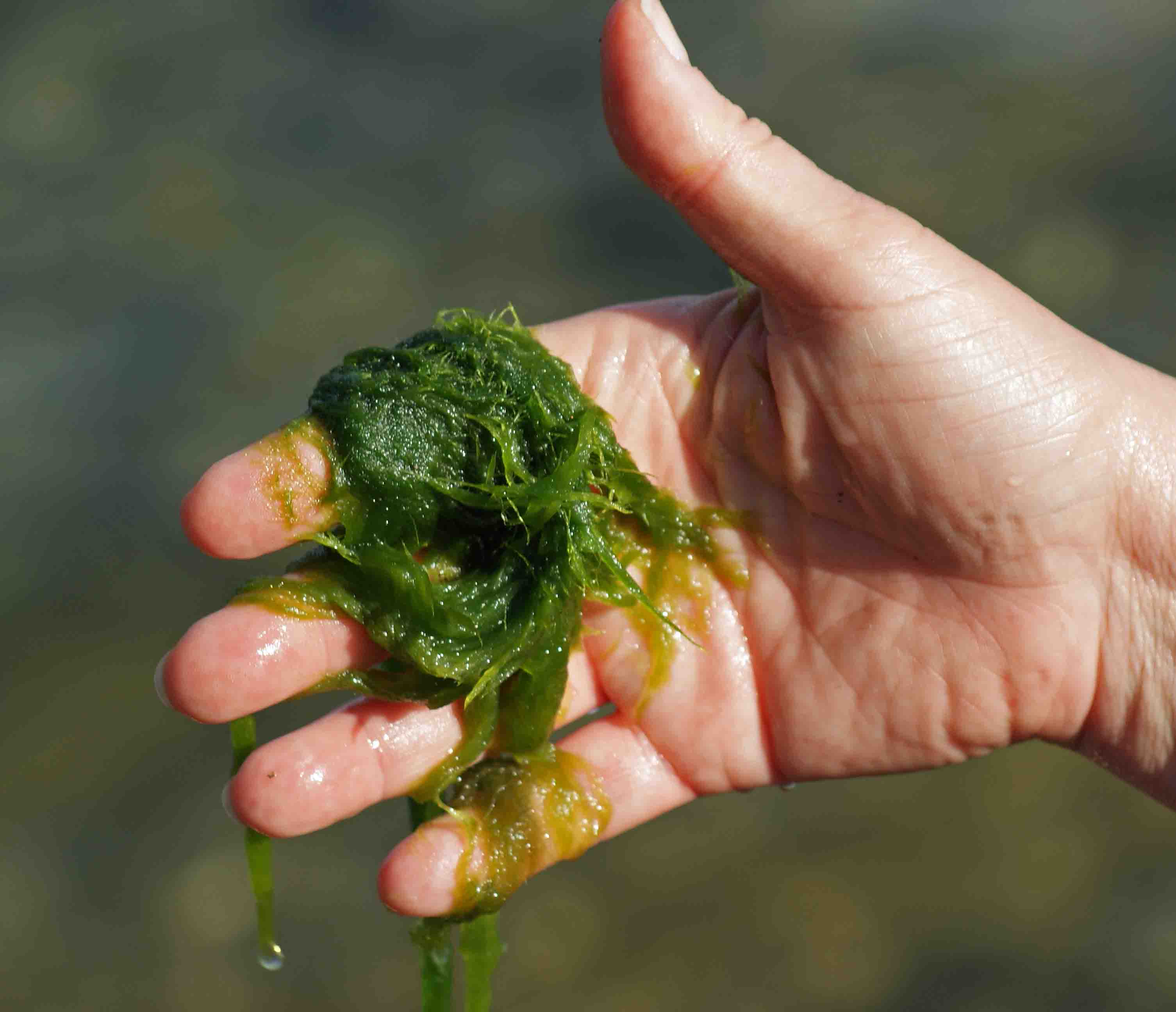
Filamentous algae collected in Lake Ontario, ON (photo by Nina Munteanu)

While my work focused on how diatoms (glass-walled algae) colonized surfaces, micro-invertebrates kept vying for my attention. Water fleas (cladocerans), copepods, rotifers, seed shrimps (ostracods) and water bears sang across my field of vision. They flitted, lumbered, wheeled and meandered their way like tourists lost in Paris. But this wasn’t Paris; I’d taken the blue pill and entered the rabbit hole into another world…

Sketch of common zooplankton and phytoplankton (illustration by Nina Munteanu)

The Secret—and Dangerous—World of Micro-Organisms

Small Freshwater habitats are home to a highly productive and diverse collection of micro-invertebrates—multicellular animals that can barely be seen with the naked eye. Many average from 0.5 to 1 mm in size and resemble little white blobs; however, a scholar can distinguish each invertebrate by its unique movement. For instance, when presented with a jar of pond water, I can usually distinguish among the wheel-like wandering of a gastrotrich, dirigible-like gliding of an ostracod (seed shrimp), the vertical goldfinch-style “hopping” of the cladoceran (water flea) as it beats its antennae, or the halting-jerking movements of copepods (oar-feet) as their antennae drive them along like a dingy propelled by an amateur oarsman.

Alas, puddles, ephemeral ponds and vernal pools pose sketchy habitats, given their tendency to appear and disappear in a wink. And like the thief in the night, they pose a harsh and uncertain home to many small organisms. These environments are ever-changing, unstable, chaotic and unpredictable. Yet, anyone who has studied these variable ecosystems understands that they team with life. 

When a puddle or ephemeral pond dries up then reappears with rain, how can these communities thrive? Or do they all die off and then somehow recruit when the pond reappears? Many of these invertebrates have evolved creative ways to survive in very unstable environments. Some form a resting stage—a spore, resting egg or ‘tun’—that goes dormant and rides out the bad weather.

Philodina, a bdelloid rotifer (microscope photo by Bob Blaylock)

Animalcules & the Bdelloid Rotifer

In 1701, Antonie van Leeuwenhoek observed that “animalcules” (likely the bdelloid rotifer Philodina roseaola) survived desiccation and were “resurrected” when water was added to them. He’d discovered a highly resistant dormant state of an aquatic invertebrate to desiccation.

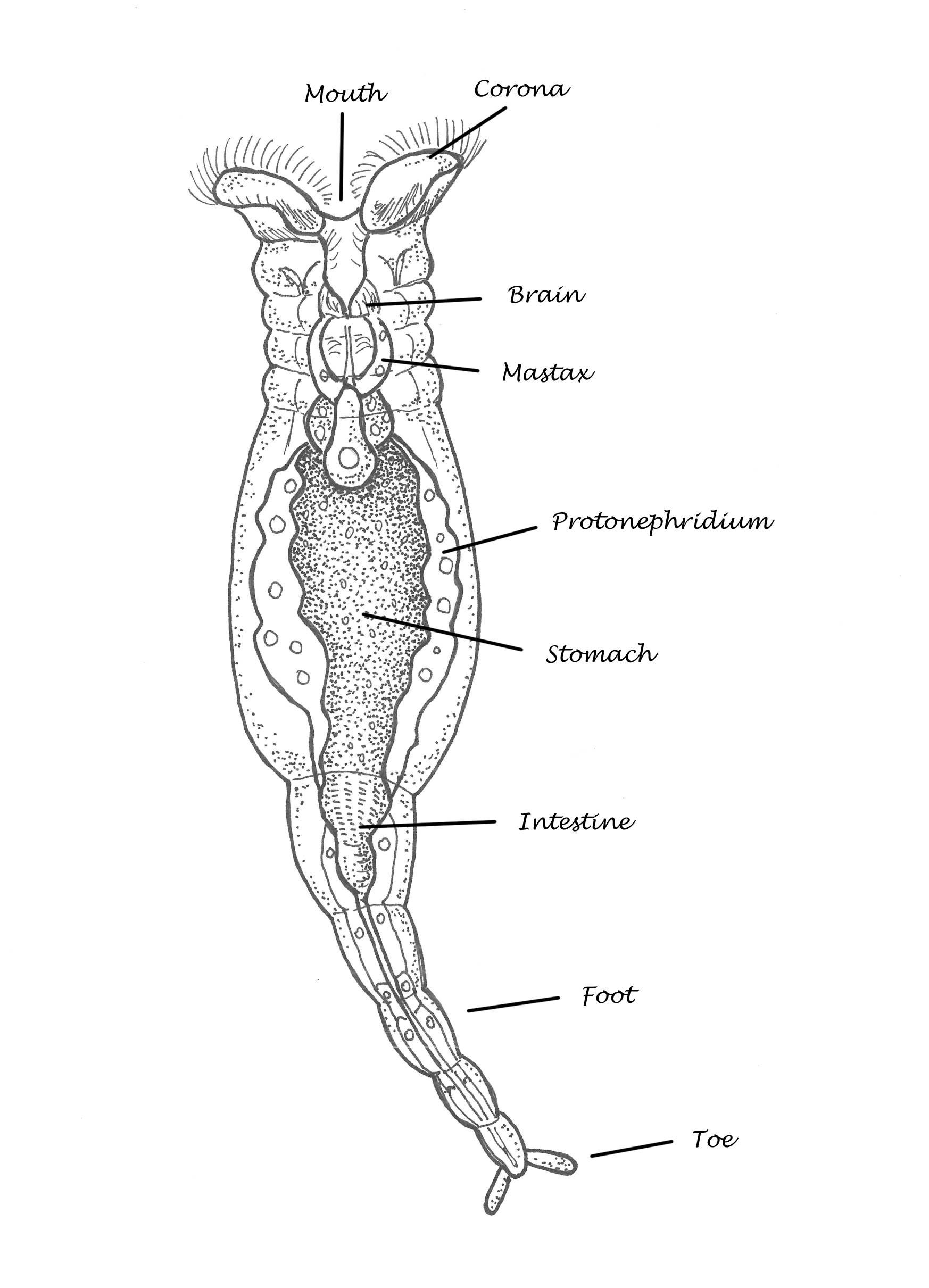
Dormancy is a common strategy of organisms that live in harsh and unstable environments and has been documented in crustaceans, rotifers, tardigrades, phytoplankton and ciliates. “Dormant forms of some planktonic invertebrates are among the most highly resistant … stages in the whole animal kingdom,” writes Jacek Radzikowski in a 2013 review in the Journal of Plankton Research. Radzikowski describes two states of dormancy: diapause and quiescence. (on right: sketch of bdelloid rotifer by Nina Munteanu

Bdelloid rotifers can go into quiescent dormancy at practically any stage in their life cycle in response to unfavorable conditions. Early research noted that dormant animals could withstand freezing and thawing from −40°C to 100°C and storage under vacuum. They also tolerated high doses of UV and X radiation. Later work reported that some rotifers could survive extreme abiotic conditions, such as exposure to liquid nitrogen (−196°C) for several weeks or liquid helium (−269°C) for several hours. Desiccated adult bdelloid rotifers apparently survived minus 80°C conditions for more than 6 years. The dormant eggs of cladocerans and ostracods also survived below freezing temperatures for years.

Rotifers are cosmopolitan detrivores (they eat detritus) and contribute to the decomposition of organic matter. Rotifers create a vortex with ciliated tufts on their heads that resemble spinning wheels, sweeping food into their mouths. They often anchor to larger debris while they feed or inch, worm-like, along substrates. Some are sessile, living inside tubes or gelatinous holdfasts and may even be colonial. Rotifers reproduce by parthenogenesis (in the absence of mates), producing clones (like cladocerans). Resting eggs (sometimes called zygotes) survive when a pond dries up. Bdelloid rotifers don’t produce resting eggs; they survive desiccation through a process called anhydrobiosis, contracting into an inert form and losing most of their body water. Embryos, juveniles and adults can undergo this process. The bdelloid withdraws its head and foot and contracts its body into a compact shape called a tun; a generally unprotected dormant state that remains permeable to gases and liquids. Like Tardigrades, Bdelloid rotifers can resist ionizing radiation because they can repair DNA double-strand breaks.

The long-term survival and evolutionary success of bdelloid rotifers in the absence of sex arises from horizontal gene transfer via DNA repair.

In my eco-novel A Diary in the Age of Water the limnologist Lynna visits her technician Daniel as he peers through a microscope and makes the observation of why the bdelloid rotifer is well-suited to climate change:

I bent to peer through the eyepiece at what turned out to be a pond sample in a Petri dish. Attached to a pile of detritus shivering in the current, several microscopic metazoans—rotifers—swung like trees in a gale; they were feeding. Their ciliated disk-like mouths twirled madly, capturing plankton to eat. Watching them reminded me of my early research days as an honours undergrad at Concordia University in Montreal. Probably Philodina, I thought; I had seen many during my stream research in Quebec.

“They’re the future,” Daniel said, looking up at me with a smirk as I straightened.

I raised my eyebrows, inviting him to elaborate, which he cheerfully did.

“They’re the future because of their incredible evolutionary success and their ecological attraction to environmental disaster.” He knew he’d piqued my interest. “These little creatures have existed for over forty million years, Lynna. Without sex! And they’re everywhere. In temporary ponds, moss, even tree bark. Bdelloid mothers that go through desiccation produce daughters with increased fitness and longevity. In fact, if desiccation doesn’t occur over several generations, the rotifers lose their fitness. They need the unpredictable environment to keep robust.” They incorporate genes from their environment: they acquire DNA transposons—mobile DNA—through HGT.”

—A DIARY IN THE AGE OF WATER

The bdelloid all-female populations have thrived for millions of years by maintaining a robust and diverse population through epigenetics and DNA repair during dormancy…The dormancy of all-female bdelloids is an elegant technique to ride out harsh conditions. The bdelloids can go dormant quickly in any stage of their life cycle, and they’re capable of remaining dormant for decades. They can recover from their dormancy state within hours when the right conditions return and go on reproducing without the need to find a mate.

Highly variable environments tend to support rare species: organisms that are uniquely equipped for change. These are the explorers, misfits, and revolutionaries who do their work to usher in a new paradigm. They carry change inside them, through phenotypic plasticity, physiological stress response mechanisms, or life history adaptations. Like bdelloid rotifers going dormant through anhydrobiosis. Or blue-green algae forming dormant akinete spores. In tune with the vacillations of Nature, epigenetics-induced adaptation is the only option for keeping up with rapid and catastrophic environmental change, not to mention something as gigantic as climate change. That’s why the bdelloid rotifers survived for millennia and will continue for many more. They adapt by counting on change.

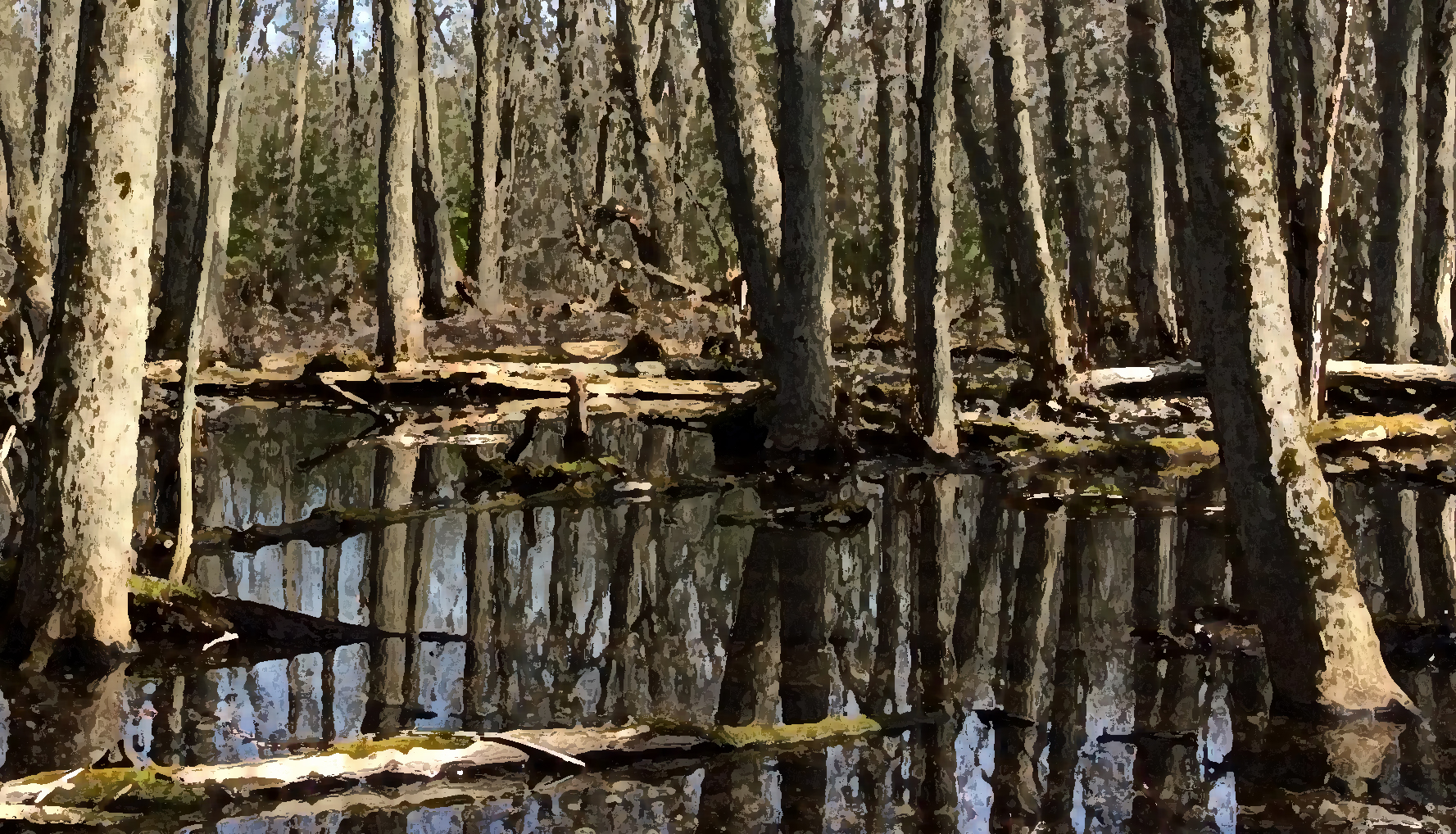
Maple swamp forest in Trent Nature Sanctuary, ON (photo and rendition by Nina Munteanu)

References:

Munteanu, Nina. 2020. “A Diary in the Age of Water.” Inanna Publications, Toronto. 300pp.

Munteanu, Nina. 2016. “Water Is…The Meaning of Water.” Pixl Press, Vancouver. 586pp.

O’Leary, Denise. 2015. “Horizontal gene transfer: Sorry, Darwin, it’s not your evolution anymore.” Evolution News, August 13, 2015. Online: https://www.evolutionnews.org/201508/horizontal_gene/

Ricci, C. And D. Fontaneto. 2017. “The importance of being a bdelloid: Ecological and evolutionary consequences of dormancy.” Italian Journal ofZoology, 76:3, 240-249.

Robinson, Kelly and Julie Dunning. 2016. “Bacteria and humans have been swapping DNA for millennia”. The Scientist Magazine, October 1, 2016. Online: https://www.the-scientist.com/?articles.view/articleNo/47125/title/Bacteria-and-Humans-Have-Been-Swapping-DNA-for-Millennia/

Weinhold, Bob. 2006. “Epigenetics: the science of change.” Environmental Health Perspectives, 114(3): A160-A167.

Williams, Sarah. 2015. “Humans may harbour more than 100 genes from other organisms”. Science, March 12, 2015. Online: http://www.sciencemag.org/news/2015/03/humans-may-harbor-more-100-genes-other-organisms

Nina Munteanu is a Canadian ecologist / limnologist and novelist. She is co-editor of Europa SF and currently teaches writing courses at George Brown College and the University of Toronto. Visit www.ninamunteanu.ca for the latest on her books. Nina’s bilingual “La natura dell’acqua / The Way of Water” was published by Mincione Edizioni in Rome. Her non-fiction book “Water Is…” by Pixl Press (Vancouver) was selected by Margaret Atwood in the New York Times ‘Year in Reading’ and was chosen as the 2017 Summer Read by Water Canada. Her novel “A Diary in the Age of Water” was released by Inanna Publications (Toronto) in June 2020.

W.O.W Interviews Nina Munteanu on “A Diary in the Age of Water”

Thompson Creek outlet, ON (photo and rendition by Nina Munteanu)

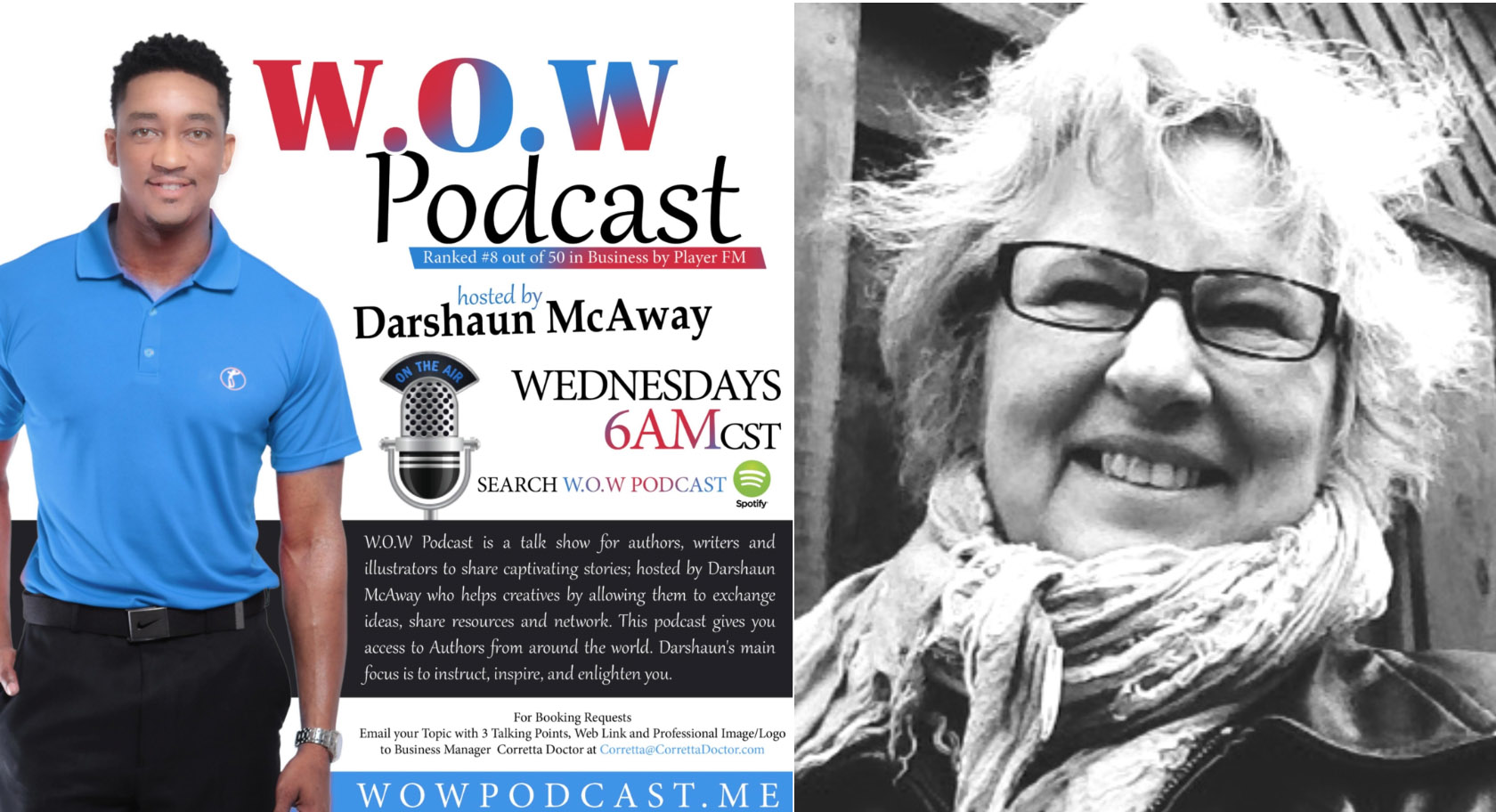
I recently chatted with Darshaun McWay on W.O.W. Podcast about my recent novel A Diary in the Age of Water.

We talked about the story, its main characters–including water as a character–and why I write about water. We also covered why the book is written partly as a diary. Margaret Atwood’s name came up a few times…

Here is the W.O.W description of the interview:

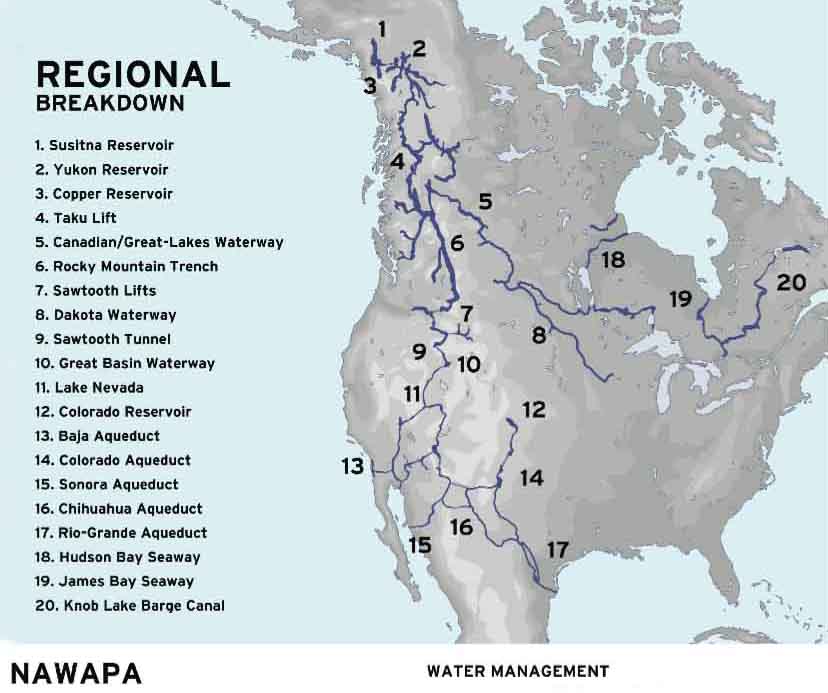
Nina Munteanu chats with Darshaun McAway of W.O.W. Podcast about her new clifi novel “A Diary in the Age of Water”: a novel about the journeys of four generations of women and their unique relationship with water during a time of great environmental change. Darshaun and Nina talk about her use of water as a character, her choice of heroines and her use of a diary format to tell the story.  Nina shares that the book–set in the near future as a limnologist’s diary and the far future with an evolved human–explores the premise of a water-scarce Canada whose water now belongs to the USA, who, in turn, is owned by China. The events about which the diarist writes are based on real historic events and people. Nina brings her considerable scientific, limnological and research skills to bear in describing a future Canada both dystopic and harrowing–yet very familiar. One real event taken as premise in the book that Nina shared with Darshaun is the American NAWAPA plan of the 1960s that went to congress and was (and still is) seriously discussed for years following: the plan was to divert massive amounts of fresh water from Canada and store by inundating the Rocky Mountain Trench and piped south to hydrate dwindling aquifers in the USA.

W.O.W Interview with Nina Munteanu and Darshaun McAway

Nina Munteanu is a Canadian ecologist / limnologist and novelist. She is co-editor of Europa SF and currently teaches writing courses at George Brown College and the University of Toronto. Visit www.ninamunteanu.ca for the latest on her books. Nina’s bilingual “La natura dell’acqua / The Way of Water” was published by Mincione Edizioni in Rome. Her non-fiction book “Water Is…” by Pixl Press(Vancouver) was selected by Margaret Atwood in the New York Times ‘Year in Reading’ and was chosen as the 2017 Summer Read by Water Canada. Her novel “A Diary in the Age of Water” was released by Inanna Publications (Toronto) in June 2020.

Nina Munteanu Interviewed About “A Diary in the Age of Water” by Simon Rose

Diary Water cover finalI was recently interviewed by Canadian writer Simon Rose on my recent novel release “A Diary in the Age of Water” by Inanna Publications. Set mostly in near-future and far-future Toronto area, the book has already received some praise:

Evoking Ursula LeGuin’s unflinching humane and moral authority, Nina Munteanu takes us into the lives of four generations of women and their battles against a global giant that controls and manipulates Earth’s water…In language both gritty and hauntingly poetic, Munteanu delivers an uncompromising warning of our future.”—Lynn Hutchinson Lee, Toronto playwright

Dragonfly.eco calls the book “an insightful novel…a cautionary tale rummaging through the forgotten drawers of time in the lives of four generations…This whirling, holistic, and evolving novel comes alive, like we imagine water does.”

The novel received a five-star review in Foreword Clarion Review and Kirkus Reviews writes: “Munteanu transmutes a harrowing dystopia into a transcendentalist origin myth. A sobering and original cautionary tale that combines a family drama with an environmental treatise.”

Part of the story is told through the diary of a limnologist (someone who studies freshwater) who witnesses and suffers through severe water taxes and imposed restrictions, dark intrigue through neighbourhood water betrayals, corporate spying and espionage, and repression of her scientific freedoms. Some people die. Others disappear… Here’s an excerpt from the interview:

What is “A Diary in the Age of Water” about? 

The book is essentially a journey of four generations of women who have a unique relationship with water, through a time of extreme change through climate change and water shortage. The book spans over forty years (from the 2020s to the 2060s) and into the far future, mostly through the diary of a limnologist, which is found by a future water-being. During the diarist’s lifetime, all things to do with water are overseen and controlled by the international giant water utility CanadaCorp—with powers to arrest and detain anyone. This is a world in which China owns America and America, in turn, owns Canada.

You mention the” Age of Water” in your book. Are there other ages/epochs?

Yes. The story begins in the far future with young Kyo during the Age of Trees, after the end of the Age of Water. It is, in fact, the end of that age as well and that is why she prepares for the Exodus to “humanity’s” new home.

What inspired you to write this book? 

The Way of Water-COVERMy publisher in Rome (Mincione Edizioni) had asked me for a short story on water and politics. I wanted to write about Canada and I wanted something ironic… so I chose water scarcity in Canada, a nation rich in water. The bilingual story “The Way of Water” (“La natura dell’acqua”) resulted, which has been reprinted in several magazines and anthologies, including Cli-Fi: Canadian Tales of Climate Change (Exile Editions), Future Fiction: New Dimensions in International Science Fiction (Future Fiction/Rosarium Publishing), Little Blue Marble Magazine, and Climate Crisis Anthology (Little Blue Marble). The story was about young Hilde—the daughter of the diarist (of the novel). Hilde was dying of thirst in Toronto and the story begged for more … so the novel came from it…

Why did you choose to write your novel as a diary?

I was writing about both the far and the near future and much of it was based—like Margaret Atwood and her books—on real events and even real people. I wanted personal relevance to what was going on, particularly with climate change. I also wanted to achieve a gritty realism of “the mundane” and a diary felt right. Lynna—the diarist—is also a reclusive inexpressive character, so I thought a personal diary would help bring out her thoughts and feelings more. There’s nothing like eves-dropping to make the mundane exciting. The diary-aspect of the book characterizes it as “mundane science fiction” by presenting an “ordinary” setting for characters to play out. The tension arises more from insidious cumulative events and circumstances that slowly grow into something incendiary.

Your book has been described by various reviewers and literary types as being anything from literary fiction and FemLit to science fiction, Cli-Fi and eco-fiction How would you describe it?

Reeds and water sparkles drybr Otonabee

Otonabee shoreline, ON (photo by Nina Munteanu)

It’s really all these things. The story carries the personal journeys of four strong and complex women characters. It gives them much agency in dealing with the climate and water crisis—socially, politically, and environmentally. One is a political activist, another a wary scientist, and another an anarchist. However, while A Diary in the Age of Water showcases strong women characters, its main climate and environmental theme carries the story through the four generations to its climax. In the end, the book’s classification will depend on the reader, who will decide which aspect of the novel resonates the most with them. The main protagonist in “A Diary in the Age of Water” is a limnologist (someone who studies freshwater); so are you. Is there any resemblance? Both Lynna and I chose to study water through the discipline of limnology; Lynna did most of her work on Canadian glaciers, while my focus was on small streams in southern Quebec. We also share similar views on the environment and humanity’s place in it. I might even have some of her character foibles … hopefully not ALL of them. However, how she chose to live that worldview—cloistered, repressed, and fearful—is not me at all. I tend to bluster, confront, and generally get into trouble. In that way, I might more resemble Lynna’s daughter. Having said that, I’d say that all good characters have a piece of the writer in them. Some dark and some light. How can they not? In this case, the resemblance with the diarist is heightened because she is depicted through her diary, which adds a gritty realism and a highly personal aspect to the first person fiction. There’s a piece of me in each of the four women depicted in the story.

You mentioned that each of the four generations of women have a singular relationship with water. What role does water play in the book?

Well, in some important way, water is the fifth character. You could say even the main character. Water is the theme that carries each woman on her personal journey with climate change and the devastation that occurs—through water, I might add. Climate change is a water phenomenon, after all… So, water—like place and setting—plays a subtle yet powerful role in the story, influencing each character in her own way and bringing them together in the overall journey of humanity during a time of great and catastrophic change.

Pond lily 2 mouth TC

Pond lily, ON (photo by Nina Munteanu)

The diary spans a twenty-year period in the mid-twenty-first century and describes a Canada in the grips of severe water scarcity. Tell us about that—how does a water-rich country like Canada suffer severe water scarcity?

Water gold-blue patterns

Trent Canal, ON (photo by Nina Munteanu)

Ecologists and economists alike (who truly understand water and its global distribution and movement) will tell you that there is, in fact enough water on the planet; scarcity results from its unequal distribution, pollution and toxic input, squandering, diversion, and manipulation (one example being making rain and instructing it to fall here rather than there). Maude Barlow (Chairperson of the Council of Canadians) will tell you that Canada is currently at risk of giving away much of its water. Foreign companies are now mining Canada’s watersheds with impunity and at minimal cost. Under my premise, United States (and China) aggressively mines Canada’s groundwater, glaciers, rain and surface water through massive diversion projects to rehydrate the dwindling aquifers of the United States.

My premise is based on real events currently ongoing throughout the world. China leads the world in rainmaking and manipulation. Egypt plans to pump water from Lake Nassar into the Sahara as tensions between Egypt, and nine upstream countries for control of water in the Nile watershed increase from dams the Sudanese and Ethiopians build and as Tanzania pumps water from Lake Victoria, and Kenya diverts lakes feeding Lake Victoria to its arid eastern regions. India, Pakistan, Bangladesh, and China are in conflict over control of rivers such as the Indus, Ganges, and particularly the Brahmaputra. India’s River Link Plan impacts Bangladesh. As Pakistan, Kashmir and India fight over more and more water, the Indus dries up and no longer flows into the ocean. Meantime, Russian scientists are reviving a 1930s Soviet plan to reverse some of Siberia’s largest rivers to the parched former Soviet republics of central Asia with plans to replenish the Aral Sea. This is something very similar to the USA’s 1960 plan to divert Canada’s northward waterways south to rehydrate America’s drying midwest. Massive water diversion is also being debated within a single country; Spain’s water-rich northern region has fallen under pressure by Spain’s water-poor southern region, provoking the controversial Ebro diversion project. Norwegian university professor Terje Tvedt aptly concludes: “At the heart of these gigantic enterprises lies one of history’s great paradoxes: the more humans try to tame and regulate water by means of large-scale elaborate projects, the more water will, in turn, control society.”

Back to Canada and my not so outlandish premise: by the 2040s, Canadians are indentured to US needs through massive diversions and resulting water-use restrictions. One example, taken from precedent set in states like Colorado, is an imposed ruling by CanadaCorp that Canadians cannot collect rainwater. Something several states have already implemented.

The novel mentions a huge water diversion plan called NAWAPA. Can you tell us about that?

The original NAWAPA (North America Water Power Alliance) Plan was drawn up by the Pasadena-based firm of Ralph M. Parsons Co. in 1964, and had a favorable review by Congress for completion in the 1990s. The plan—thankfully never completed—was drafted by the US Army Corps of Engineers and entailed the southward diversion of a portion (if not all) of the Mackenzie and Yukon rivers in northern Canada and Alaska, now flowing into the Arctic Ocean as well as the Peace, Liard and other rivers flowing into the Pacific by creating massive dams in the north. This would cause the rivers to flow backwards into the mountains to form vast reservoirs that would flood one-tenth of British Columbia. The water would be channeled south through the 800-km Rocky Mountain Trench Reservoir into the Northern USA, and from there along various routes into the dry regions of the South, to California and reaching as far as Mexico.

NAWAPA proposal Ralph M. ParsonsCo-1960s

NAWAPA was envisioned as the largest construction effort of all times, comprising some 369 separate projects of dams, canals, and tunnels, for water diversion. The water diversion would be accomplished through a series of connecting tunnels, canals, lakes, dams, and pump-lifts, as the trench itself is located at an elevation of 914 m (3,000 feet). To the east, a 9 m (thirty-foot) deep canal would be cut from the Peace River to Lake Superior. NAWAPA’s largest proposed dam would be 518 m (1,700 feet) tall, more than twice the height of Hoover Dam (at 221 m) and taller than any dam in the world today, including the Jinping-I Dam in China (at 305 m).

In the novel, NAWAPA-2 gets completed by 2045, which includes creating a giant inland sea in the Rocky Mountain Trench in British Columbia and a huge diversion in central Canada as well.

Very intriguing. Where can readers purchase the book? 

They can buy the book in most quality bookstores such as Chapters-Indigo, Barnes & Noble, and Amazon. They can also purchase the book through the publisher, Inanna Publications.

Best of luck, Nina, on this book!

Thanks, Simon!


nina-2014aaa

Nina Munteanu is a Canadian ecologist / limnologist and novelist. She is co-editor of Europa SF and currently teaches writing courses at George Brown College and the University of Toronto. Visit www.ninamunteanu.ca for the latest on her books. Nina’s bilingual “La natura dell’acqua / The Way of Water” was published by Mincione Edizioni in Rome. Her non-fiction book “Water Is…” by Pixl Press(Vancouver) was selected by Margaret Atwood in the New York Times ‘Year in Reading’ and was chosen as the 2017 Summer Read by Water Canada. Her novel “A Diary in the Age of Waterwas released by Inanna Publications (Toronto) in June 2020.

“A Diary in the Age of Water” Receives Literary Titan Award

Nina Munteanu’s cli-fi eco-novel “A Diary in the Age of Water” was awarded a Silver Literary Titan Award for a book that:

expertly delivers complex characters, intricate worlds, and thought provoking themes. The ease with which the story is told is a reflection of the author’s talent in exercising fluent, powerful, and appropriate language.”–Literary Titan

“A Diary in the Age of Water” received a 4-star review by Literary Titan:

While bringing attention to the current politicization of climate change, the story maintains important underlying themes like family, love, forgiveness, and the complexity of the human soul. The author has gone to great lengths to show that there are different layers to each character, none fully evil nor fully good. A Diary in the Age of Water is an exceptional and thought-provoking dystopian fiction.
—LITERARY TITAN (4-star)

Atlantykron Summer Academy—2020

Because of the COVID19 pandemic, The 31st annual summer academy for learning was held virtually this year by New Horizons (of the World Genesis Foundation and United Nations Educational, Scientific and Cultural Organization).

Because of this, I was finally able to participate. Virtually and all the way from Canada.

Atlantykron island

Atlantykron on the Danube

The international event is normally held on an island on the Danube River near the village and ancient Roman ruins of Capidava, Romania. First held in the summer of 1989, the event has attracted hundreds of youth and teachers from around the world to learn with scientists, artists, writers and other professionals in a wilderness setting.

Coordinated by Sorin Repanovici of the World Genesis Foundation and run by Dr. Florin Munteanu, Heather Caton-Anderson and Constantin D. Pavel, Atlantykron promotes UNESCO core goals of promoting sustainable development and creating dialogue and collaboration among nations in the areas of education, science, culture and communications.

Key presentations in the 2020 Atlantykron included:

  • “New Horizons of Animal-Human Relationships” by Chan Chow Wah in China
  • “Mars 2020 Mission Perseverance” by Ravi Prakash and Erisa K. Stilley in USA
  • “Planning and Scripting a Time-Lapse Movie” by Stan Jiman in USA
  • “Generating & Solving Crisis to Avoid Imbalance and Catastrophe” by Dr. Florin Colceag in Romania
  • “The Science and Meaning of Water” by Nina Munteanu in Canada
  • “Who’s Afraid of Autonomous Cars” by Pompilian Tofilescu in USA

Atlantykron pg2 copy

Florin Munteanu

Dr. Florin Munteanu

I’d met Florin Munteanu in 2012, when I went to Bucharest, Romania to participate in the launch of the Romanian translation of my book The Fiction Writer (Manual de Scriere Creativa: scriitorul de fictiune) with Editura Paralela 45 at the Gaudeamus Book Fair. Florin met me at the airport and took me to the Phoenicia Grand Hotel where I was staying. We had some coffee and pastries over a wonderful chat and he then coordinated a tour of the city for me with one of his students at the Centre of Complexity Studies where he taught.

When Florin invited me to speak at Atlantykron 2020, I was more than pleased.

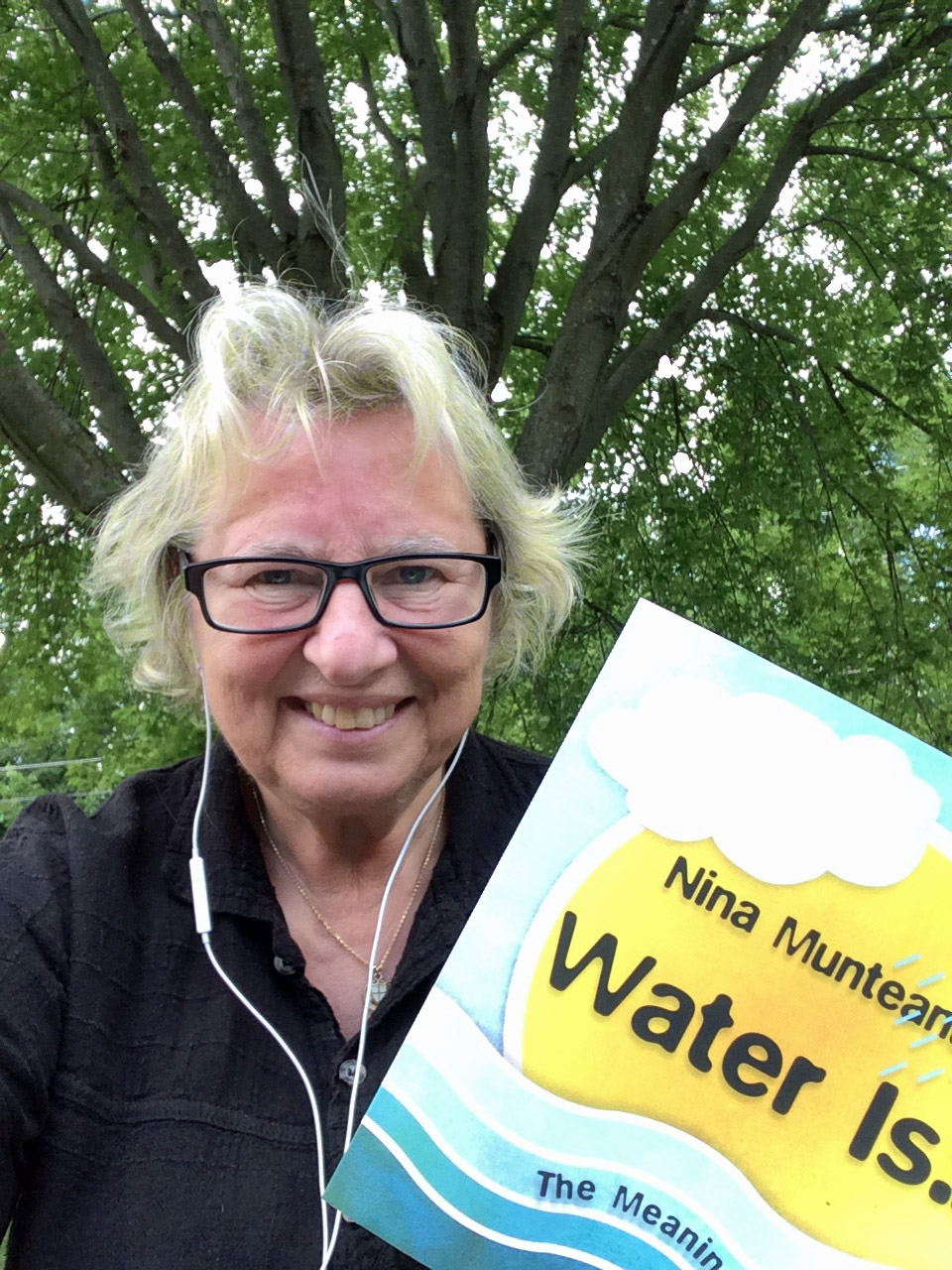
Nina WaterIs book

Nina with “Water Is…”

As a limnologist and with two major books on water published, I gave a talk on the science and meaning of water. Much of what I shared is in my book Water Is… The Meaning of Water, which provides 12 different angles on what water means—to different people from scientists and technologists to politicians, spiritualists and lay folk.

Water is so much more than the sum of its parts…

“Ultimately, water and our relationship with it is a curious gestalt of magic and paradox. Like the Suntelia Aion described by the Greeks, water cuts recursive patterns of creative destruction through the landscape, an ouroborous remembering. It changes, yet stays the same, shifting its face with the climate. It wanders the earth like a gypsy, stealing from where it is needed and giving whimsically where it isn’t wanted; aggressive yet yielding. Life-giving yet dangerous. Water is the well-spring of life. Yet it is the River Styx that leads the dead to Hades… Water is a shape shifter.”—Water Is…The Meaning of Water

Nina A Diary book

Nina with “A Diary in the Age of Water”

I overviewed some of water’s many anomalous qualities such as its unique density, cohesive, and adhesive properties—all life-giving. I discussed the water bridge, demonstrated by Dr. Elmar C. Fuchs and Professor Jakob Woisetchlager in 2007. I explored why water—particularly moving water—makes us feel so good (all those negative ions!). I went over the water cycle, water’s role in most natural cycles, and how it contributes to climate.

I then explored some of the oddest but most common tiny water residents. One example is the bdelloid rotifer—featured in my latest novel A Diary in the Age of Water—which is smaller than a millimeter, ubiquitous, lives wherever there is some water and can withstand desiccation, drying up into a dormant stage called a tun. Bdelloids create protective proteins, such as LEA, which act as a molecular shield.

Illustration 11 Rotifer copy 2

Sketch of a bdelloid rotifer (illustration by Nina Munteanu)

The bdelloid rotifer has existed for over forty million years. It reproduces through obligate parthenogenesis to produce all females, called thelytoky. Their long-term survival and evolutionary success in the absence of sex is largely a function of ecological adaptation that involves horizontal gene transfer through DNA repair. While they are patching up their broken genes from desiccation, they stitch in foreign DNA from the environment through horizontal gene transfer.

I ended the talk with some notes about conservation and stewardship of water. Using twelve-year old Rachel Parent and Greta Thunberg as examples, I stressed that no one is too young or too alone to make a difference; we then explored several activities that anyone could do.

Microsoft Word - What You Can Do.docx

Did you know slide

nina-2014aaa

Nina Munteanu is a Canadian ecologist / limnologist and novelist. She is co-editor of Europa SF and currently teaches writing courses at George Brown College and the University of Toronto. Visit www.ninamunteanu.ca for the latest on her books. Nina’s bilingual “La natura dell’acqua / The Way of Water” was published by Mincione Edizioni in Rome. Her non-fiction book “Water Is…” by Pixl Press(Vancouver) was selected by Margaret Atwood in the New York Times ‘Year in Reading’ and was chosen as the 2017 Summer Read by Water Canada. Her novel “A Diary in the Age of Waterwas released by Inanna Publications (Toronto) in June 2020.

Nina Munteanu Talks “A Diary in the Age of Water” on W.O.W. Podcast

Microsoft Word - WOW-Nina.docx

I recently chatted with Darshaun McWay on W.O.W. Podcast about my recent novel A Diary in the Age of Water.

We talked about the story, its main characters–including water as a character–and why I write about water. We also covered why the book is written partly as a diary. Margaret Atwood’s name came up too…

The interview will air on W.O.W. Podcast on October 15, 2020. Darshaun kindly provided the recording for my community. Here it is:

Darshaun McAwayDarshaun McAway has been hosting W.O.W. Podcast from Arkansas in the USA since 2017. With over a hundred episodes to date, Darshaun’s main focus is to instruct, inspire and enlighten through interviews with authors around the world. Other Canadian science fiction authors who have appeared on W.O.W include Cat Rambo and Edward Willett.

pebble shoreline drybr ThompsonCreek

Pebbled shoreline of Thompson Creek, ON (photo by Nina Munteanu)

nina-2014aaa

Nina Munteanu is a Canadian ecologist / limnologist and novelist. She is co-editor of Europa SF and currently teaches writing courses at George Brown College and the University of Toronto. Visit www.ninamunteanu.ca for the latest on her books. Nina’s bilingual “La natura dell’acqua / The Way of Water” was published by Mincione Edizioni in Rome. Her non-fiction book “Water Is…” by Pixl Press(Vancouver) was selected by Margaret Atwood in the New York Times ‘Year in Reading’ and was chosen as the 2017 Summer Read by Water Canada. Her novel “A Diary in the Age of Waterwas released by Inanna Publications (Toronto) in June 2020.

An Interview with a Bull Thistle

Story is place, and place is character—Nina Munteanu
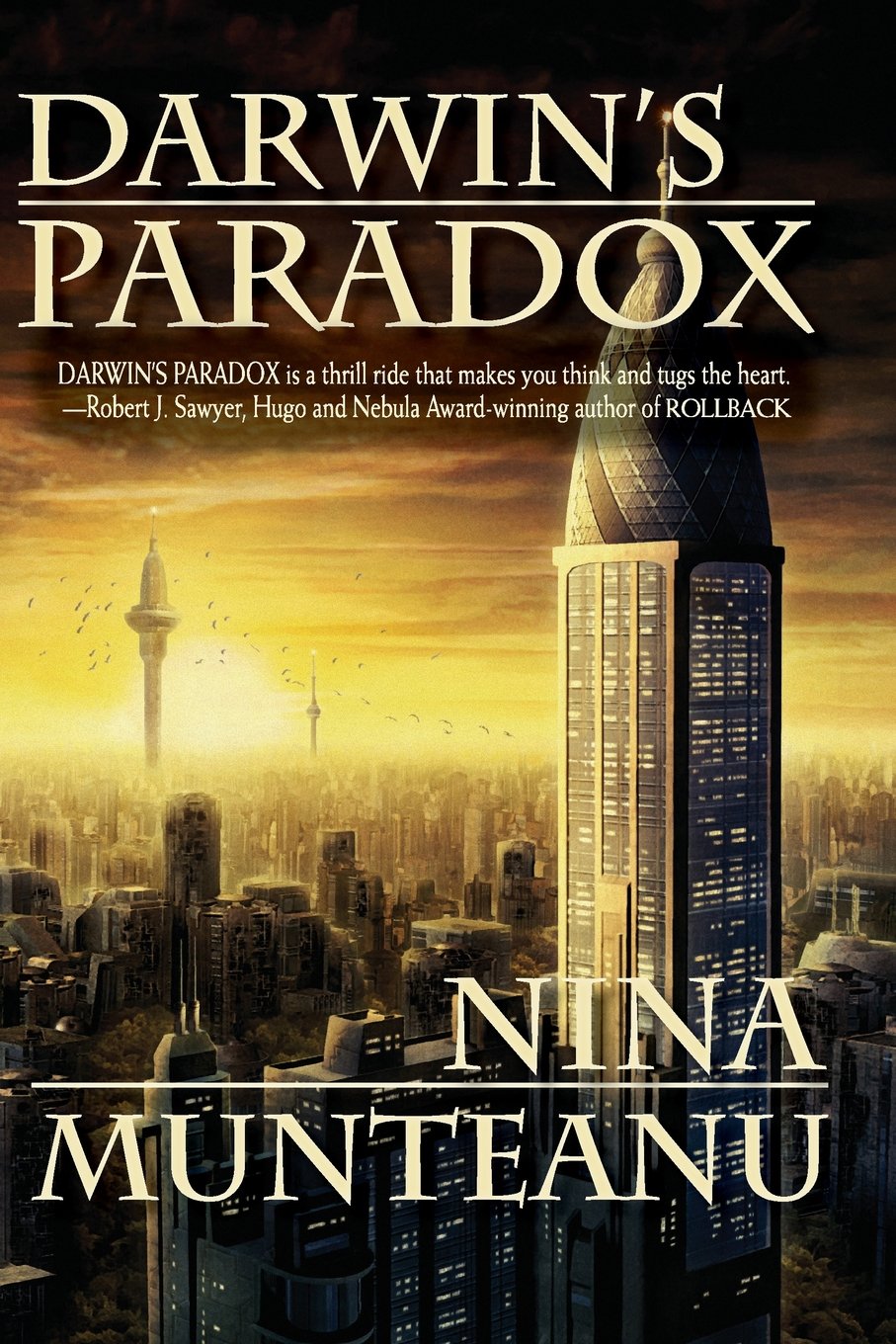
Darwins Paradox-2nd edI write mostly eco-fiction. Even before it was known as eco-fiction, I was writing it. My first book—Darwin’s Paradox—published in 2007 by Dragon Moon Press as science fiction, was also eco-fiction. It takes place in 2075 after climate change has turned southern Ontario into a heathland and Toronto into a self-enclosed city. My latest eco-fiction—A Diary in the Age of Water published in 2020 by Inanna Publications—is set mostly in Toronto from the near-future to 2065 and beyond.

As a writer of eco-fiction and climate fiction, I’m keenly aware of the role environment plays in story. Setting and place are often subtle yet integral aspects of story. In eco-fiction, they can even be a “character,” serve as archetypes and present metaphoric connections to characters on a journey (see my guidebook The Ecology of Story: World as Character published by Pixl Press for more discussion on all aspects of nature’s symbols in writing).

EcologyOfStoryThings to consider about place as character begin with the POV character and how they interact with their environment and how they reflect their place. For instance, is that interaction obvious or subtle? Is that environment constant or changing, stable or unstable, predictable, or variable? Is the place controllable or not, understandable or not? Is the relationship emotional, connected to senses such as memory?

Place as character serves as an archetype that story characters connect with and navigate in ways that depend on the theme of the story. A story’s theme is essentially the “so what part” of the story. What is at stake for the character on their journey. Theme is the backbone—the heart—of the story, driving characters to journey through time and place toward some kind of fulfillment. There is no story without theme. And there is no theme without place.

Archetypes are ancient patterns of personality shared universally by humanity (e.g. the “mother” archetype is recognized by all cultures). When place or aspects of place act as an archetype or symbol in story—particularly when linked to theme—this provides a depth of meaning that resonates through many levels for the reader.

In Ray Bradbury’s The Martian Chronicles, Mars symbolizes a new Eden. Like Bradbury’s aboriginal Martians—who are mostly invisible—the planet is a mirror that reflects humanity’s best and worst. Who we are, what we are, what we bring with us and what we may become. What we inadvertently do—to others, and finally to ourselves—and how the irony of chance can change everything.

“Nature’s symbols are powerful archetypes that reveal compelling story,” writes Donald Maass in Write the Breakout Novel Workbook.

Diary Water cover finalWater has been used as a powerful archetype in many novels. In my latest novel, A Diary in the Age of Water, water plays an important role through its unique metaphoric connection with each of the four main characters; how they relate to it and understand it, and act on its behalf. Water in A Diary in the Age of Water is often personified; water reflects various symbolic and allegorical interpretations and embraces several archetypes including herald-catalyst, trickster, shapeshifter, and shadow.

Strong relationships and linkages can be forged in story between a major character and an aspect of their environment (e.g., home/place, animal/pet, minor character as avatar/spokesperson for environment).

FictionWriter-cover-2nd edIn these examples the environmental aspect serves as symbol and metaphoric connection to theme. They can illuminate through the sub-text of metaphor a core aspect of the main character and their journey: the grounding nature of the land of Tara for Scarlet O’Hara in Margaret Mitchel’s Gone With the Wind; the white pine forests for the Mi’kmaq in Annie Proulx’s Barkskins; The animals for Beatrix Potter of the Susan Wittig Albert series.

All characters—whether the main POV character, or a minor character or personified element of the environment—have a dramatic function in your story. In my writing courses at George Brown College and The University of Toronto and in my guidebook The Fiction Writer, I provide a list of questions you can ask your character to determine if they are functioning well in the story and if they should even stay in the story. I call it interviewing your character. You can interview any character in your story; it can provide incredible insight. And speaking of character…

I have of late been walking daily to a lovely meadow beside a stream and thicket where brilliant Bull thistles have burst into flower. I felt the need to research this beautiful yet dangerously prickly plant and why it peaked my interest…
Thistle group 2 Pb copy

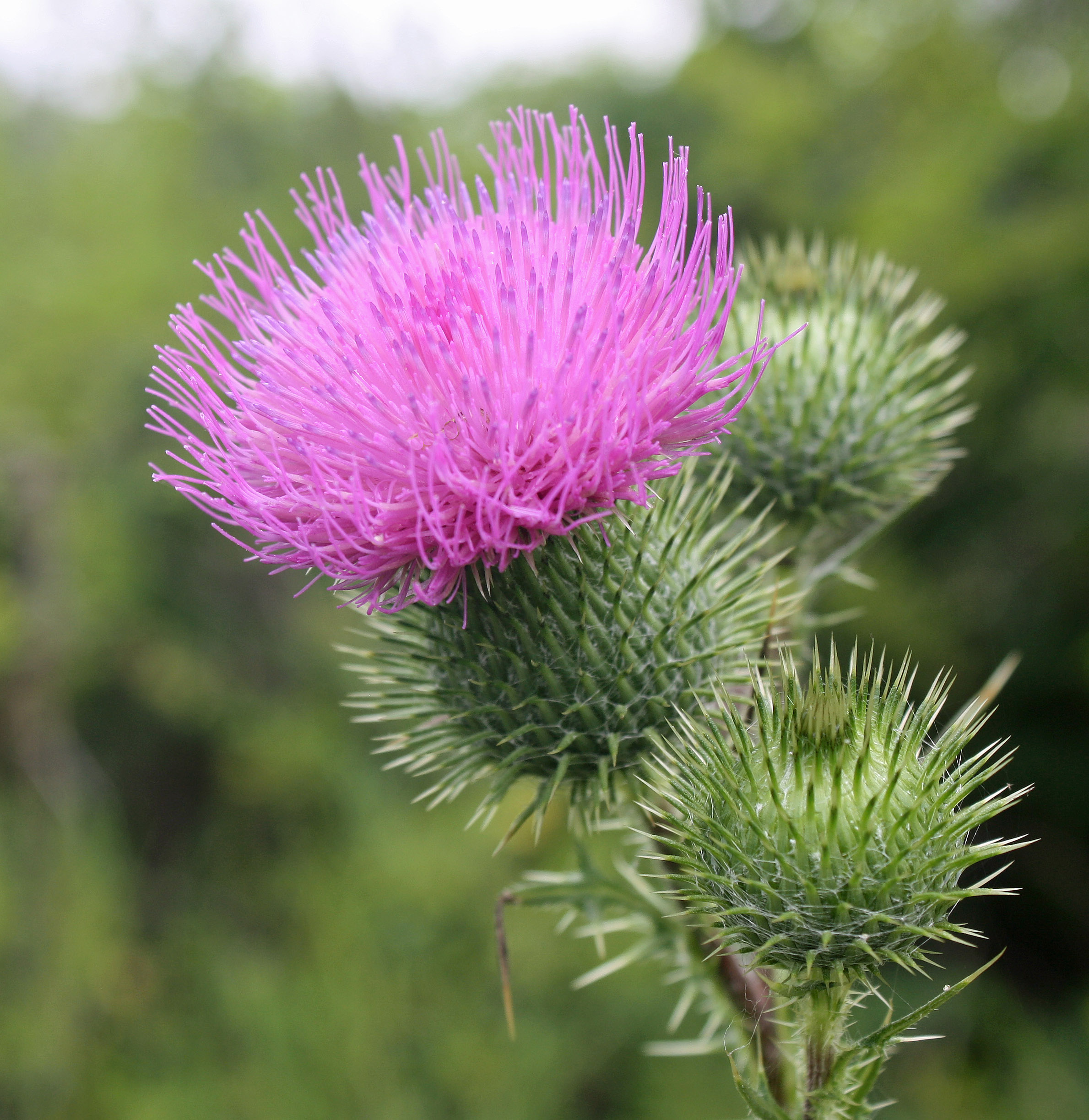
Bull Thistle, ON (photo by Nina Munteanu)

 Interview With the Bull Thistle

Nina: Pardon my saying, but you seem to scream paradox. You’re dangerously beautiful. Alluring yet aloof. Standoffish, even threatening. For instance, how is it that you have such a beautiful single purple-pink flower at the top of such a nasty prickly stem and leaves?

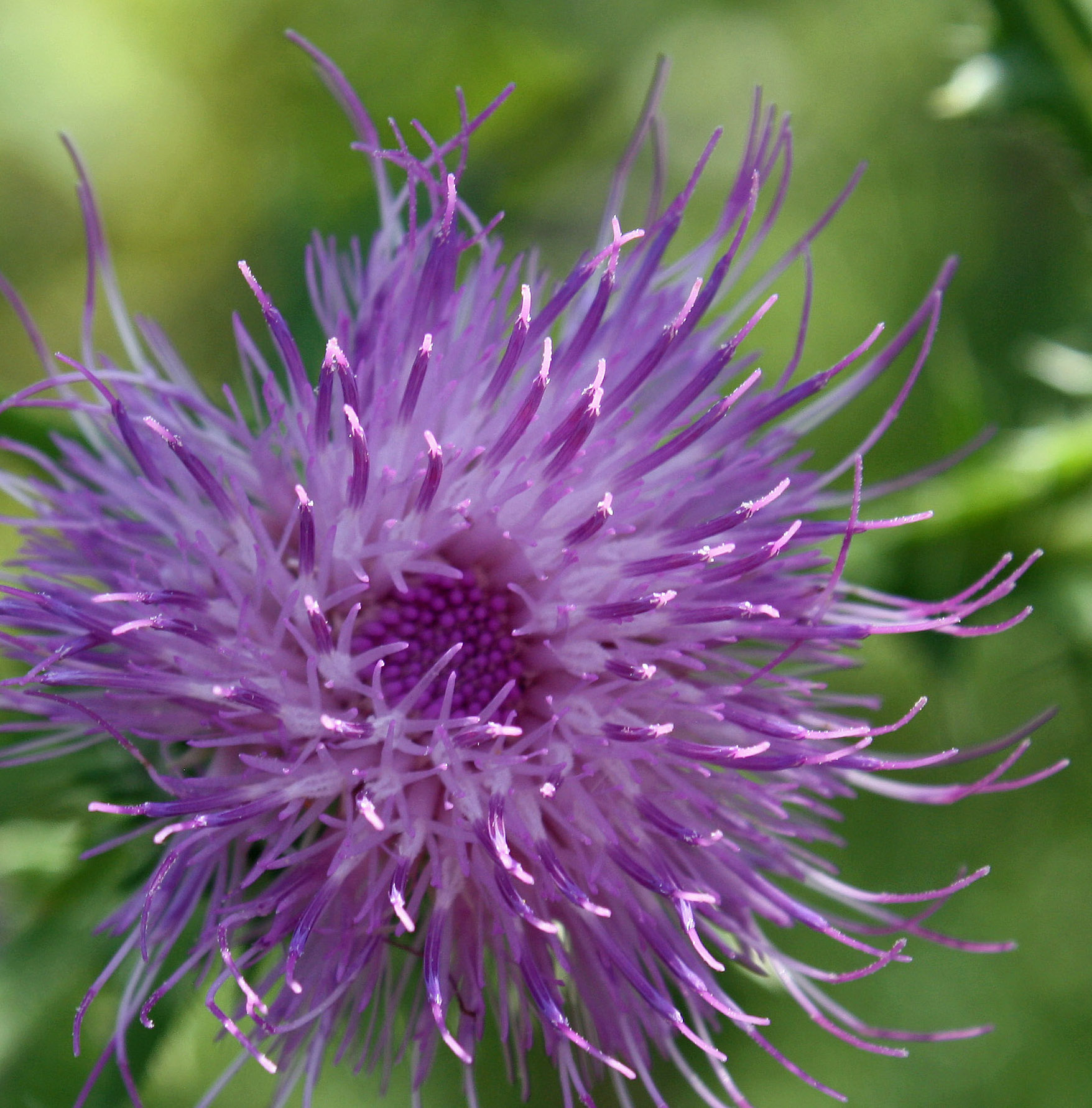
Bull Thistle: First of all, it isn’t just a flower at the top; it’s a flower head of over two hundred flowers called florets. Each flower head is a tight community of tube disk bisexual florets arranged in Fibonacci spirals and protected by a collection of spiked bracts called an involucre. And inside the protective outer shell, embedded in a fleshy domed receptacle, are the tiny ovaries, waiting patiently to be fertilized and grown into a seed or achene.
Thistle honey bee 2 closer

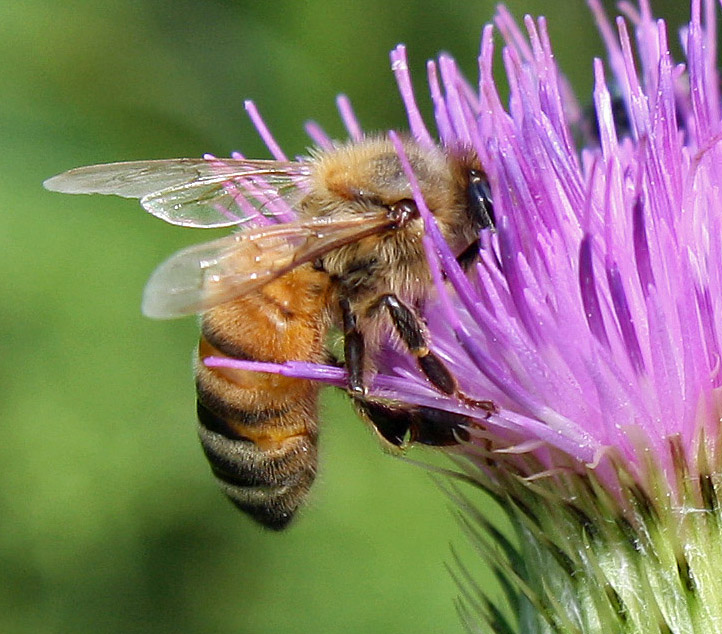
Honey bee getting nectar from the thistle flower head (photo by Nina Munteanu)

Nina: Ah, I beg your pardon. But you still have all those sharp spikes everywhere. I’m guessing they are to protect your developing young, the ovaries. But doesn’t that isolate you? Keep you from integrating in your ecosystem?

Bull Thistle: The bristles are specifically aimed at predators who wish to harm us, eat us, bore into us, pull us out of the earth. We have many friends—the pollinators, the bees, wasps, and butterflies that help us cross-pollinate from plant to plant. And the birds—particularly the goldfinches—also help.

Nina: Wait. Don’t goldfinches eat your babies—eh, seeds?

Bull Thistle: They do. But they also help disperse our children. They land on our dried involucres—now opened to reveal the seeds and their pappus. The birds pull the seeds out by the thistle down that rides the wind. The birds eat the seeds and also use the thistle down to make their nests. But—like the squirrels who love oak acorns—the birds miss as many as they eat. By carrying the down to their nests, they also help the seeds travel great distances farther than the wind would have carried them. By dislodging the seeds in bunches, they help the seeds break away from the receptacle and meet the wind. The pappus, which is branched and light like a billowing sail, carries the seed on the wind to germinate elsewhere to help us colonize.

Thistle opened involucre scattering seeds

Opened involucre with achenes and pappus ready to disperse, ON (photo by Nina Munteanu)

Nina: So, your enemy is also your friend… The shadow character, who helps the hero on her journey by presenting a perilous aspect of enlightenment.

Bull Thistle: If you say so. What we understand is that Nature’s resilience derives from the balance of give and take over time. Prey and predator. Death, decay, transcendence. Destruction and creation. Ecological succession and change are a gestalt expression of Gaia wisdom as each individual fulfills its particular existential niche. Even if that is to die…for others to live.

Nina: Yes, the hero’s journeyBut you’re not originally from here, are you? You were brought to North America from Eurasia. Some consider you an interloper, a disturbance. You could serve the shadow or trickster archetype yourself—outcompeting the native thistle, creating havoc with pasture crops. You can tolerate adverse environmental conditions and adapt to different habitats, letting you spread to new areas. Your high seed production, variation in dormancy, and vigorous growth makes you a serious invader. You cause wool fault and physical injury to animals. Storytellers might identify you metaphorically with the European settler in the colonialism of North America; bullying your way in and destroying the natives’ way of life.

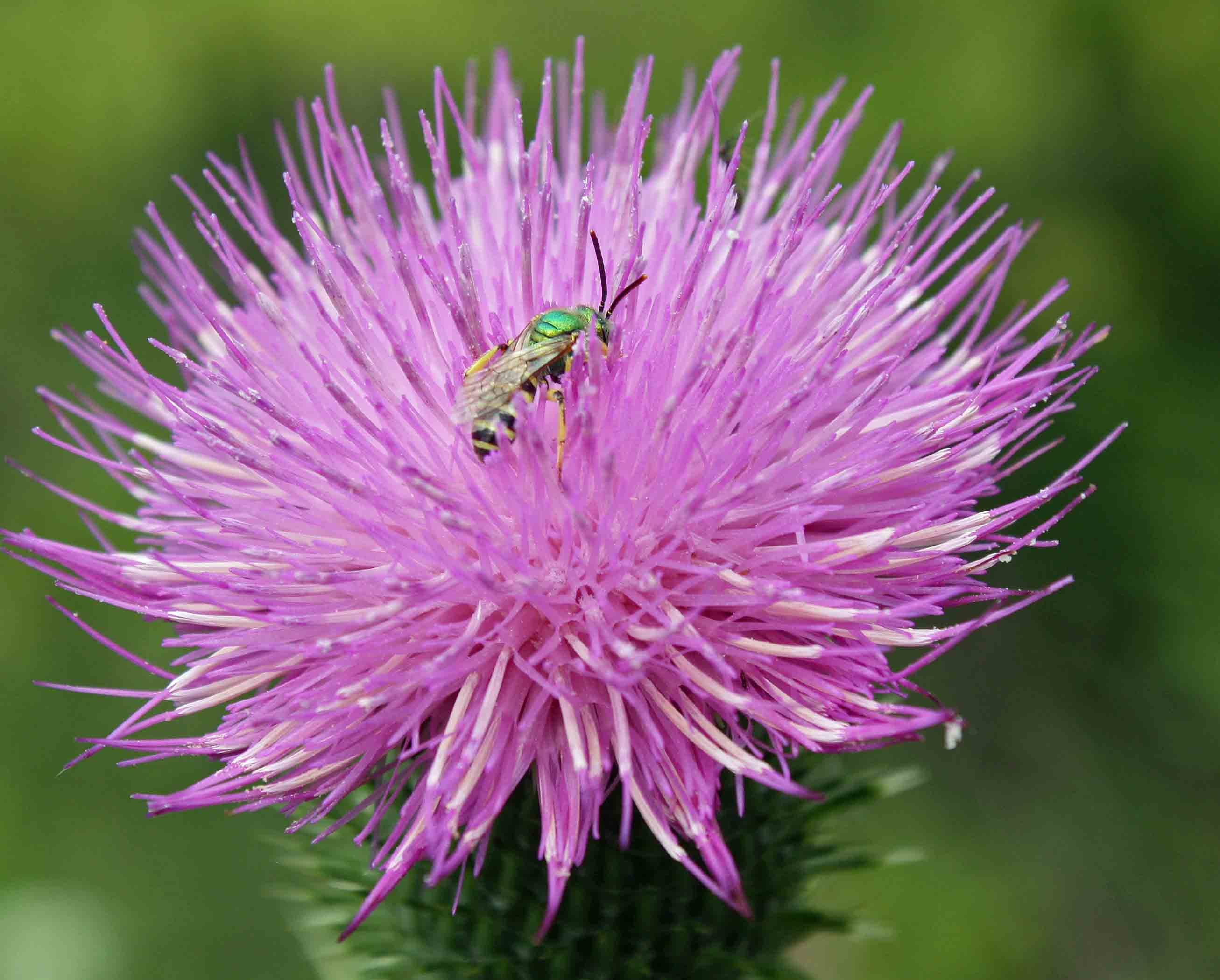
Bull Thistle: We’re unaware of these negative things. We don’t judge. We don’t bully; we simply proliferate. We ensure the survival of our species through adaptation. Perhaps we do it better than others. You’ve lately discovered something we’ve felt and acted on for a long time. Climate is changing. We must keep up with the times… But to address your original challenge, if you did more research, you would find that we serve as superior nectar sources for honey bees (Apis spp.), bumblebees (Bombus spp.) and sweat bees (Anastogapus spp.) who thoroughly enjoy our nectar.
Thistle head sweat bee Pb copy

Sweat bee draws the sweet nectar of the Bull Thistle, ON (photo by Nina Munteanu)

We’re considered a top producer of nectar sugar in Britain. Cirsium vulgare—our official name—has ranked in the top 10 for nectar production in a recent UK survey.  The goldfinch relies on our seed and down. And we’ve provided food, tinder, paper, and medicine to humans for millennia. As some of your indigenous people point out, it’s a matter of attitude. Change is opportunity.
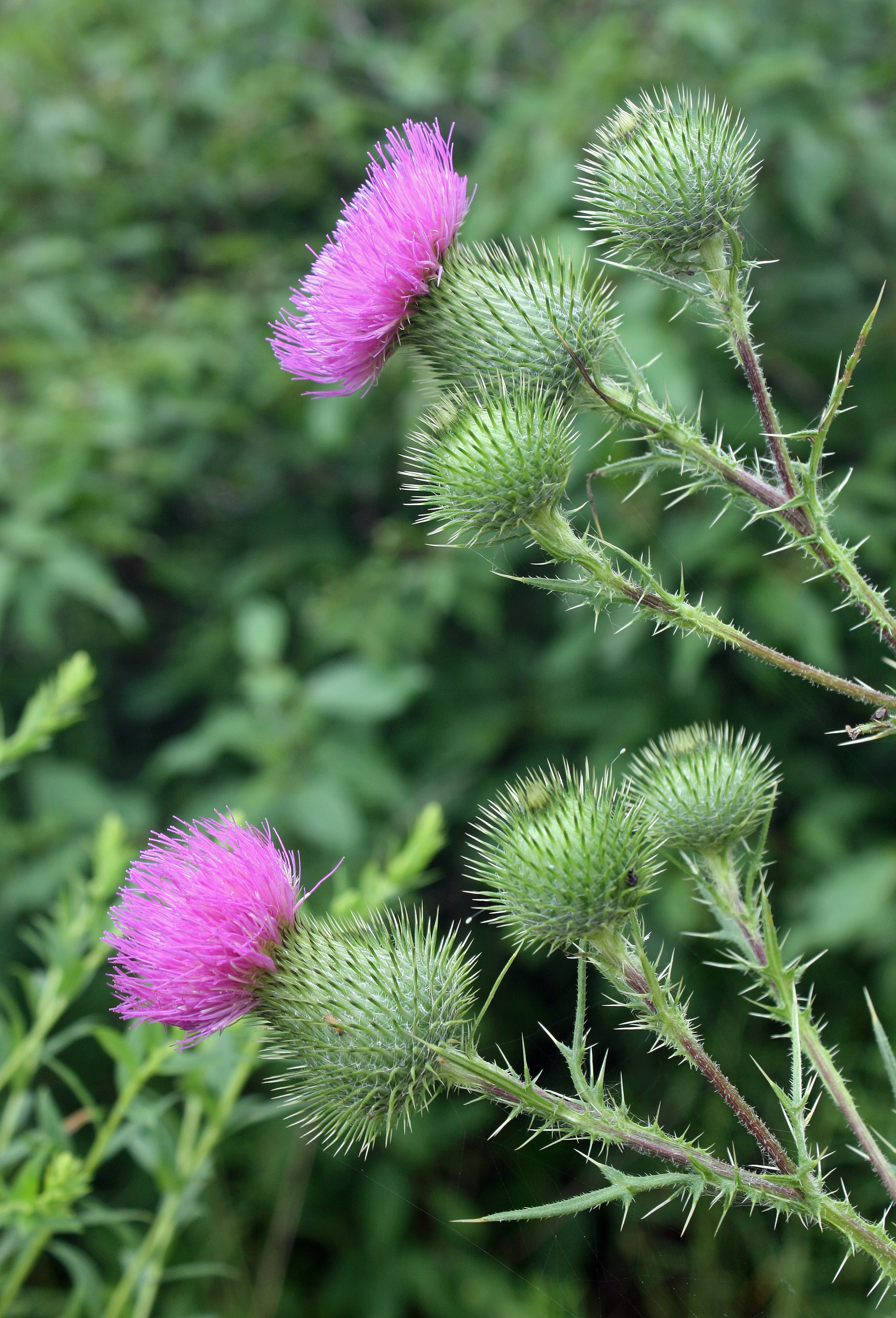
Thistle group Pb copyNina: I guess that every weed was once a native somewhere. I also agree that times are changing—faster than many of us are ready for, humans included. If you were to identify with an archetype, which would you choose?

Bull Thistle: That would depend on the perceiver, we suppose. Some of us think of us as the hero, journeying through the change and struggling to survive; others see us as the herald, inciting movement and awareness by our very existence; some of us identify with the trickster, others with the shapeshifter—given how misunderstood we are. In the end, perhaps, we are the mentor, who provides direction through a shifting identity and pointing the way forward through the chaos of change toward enlightenment.

Nina: Yes, I suppose if someone stumbled into your nest of prickles, incredible awareness would result. Speaking of that very awareness, this brings me back to my original question: why are you so beautiful yet deadly?

Bull Thistle: We are the purest beauty—only attained through earnest and often painful awareness. We are the future and the beauty of things to come.
Thistle head on full of pollen close

Flower head of Bull Thistle, ON (photo by Nina Munteanu)

You can read more on this topic in Nina’s writing guidebook series, particularly The Fiction Writer: Get Published, Write Now! and The Ecology of Story: World as Character.

Relevant Articles:

The Ecology of Story: Revealing Hidden Characters of the Forest

Ecology of Story: World as Character” Workshop at When Words Collide

Ecology of Story: Place as Allegory

Ecology of Story: Place as Symbol

Ecology of Story: Place as Metaphor

Ecology of Story: Place as Character & Archetype

nina-2014aaa

Nina Munteanu is a Canadian ecologist / limnologist and novelist. She is co-editor of Europa SF and currently teaches writing courses at George Brown College and the University of Toronto. Visit www.ninamunteanu.ca for the latest on her books. Nina’s bilingual “La natura dell’acqua / The Way of Water” was published by Mincione Edizioni in Rome. Her non-fiction book “Water Is…” by Pixl Press(Vancouver) was selected by Margaret Atwood in the New York Times ‘Year in Reading’ and was chosen as the 2017 Summer Read by Water Canada. Her novel “A Diary in the Age of Waterwas released by Inanna Publications (Toronto) in June 2020.


Age Of Water Podcast: Nina Reads from “The Overstory”

AoW Logo-smallWe are now living in the Age of Water. Water is the new “gold”, with individuals, corporations and countries positioning themselves around this precious resource. Water is changing everything. The Age of Water Podcast covers anything of interest from breaking environmental news to evergreen material. This also includes human interest stories, readings of eco-literature, discussion of film and other media productions of interest.

In this episode of Age of Water, Nina reads from the eco-fiction book “Overstory” by Richard Powers, an exploration of the relationship of trees and humanity…


At the heart of Richard Powers’s The Overstory are the pivotal lives of two women, botanist Patricia Westerford and college student Olivia Vandergriff. Both will inspire a movement against the destruction of forests.

theoverstoryPatricia Westerford—whose work resembles that of Diana Beresford-Kroeger (author of The Global Forest) and UBC’s Suzanne Simard—is a shy introvert who discovers that trees communicate, learn, trade goods and services, and have intelligence. When she shares her discovery, she is ridiculed by her peers and loses her position.  But, just as with Lynn Margulis and her theory of endosymbiosis, Westerford is finally validated. She is the archetypal ‘mother tree’, the metaphoric Tachigali versicolor, who ultimately brings the tangle of narratives together through meaning. Westerford writes in her book The Secret Forest:

“There are no individuals in a forest, no separable events. The bird and the branch it sits on are a joint thing. A third or more of the food a big tree makes may go to feed other organisms. Even different kinds of trees form partnerships. Cut down a birch, and a nearby Douglas fir may suffer…Fungi mine stone to supply their trees with minerals. They hunt springtails, which they feed to their hosts. Trees, for their part, store extra sugar in their fungi’s synapses, to dole out to the sick and shaded and wounded. A forest takes care of itself, even as it builds the local climate it needs to survive…A tree is a wondrous thing that shelters, feeds, and protects all living things. It even offers shade to the axmen who destroy it.”

Olivia Vandergriff miraculously survives an electrocution to become an ecowarrior after she begins to hear the voices of the trees. She rallies others to embrace the urgency of activism in fighting the destruction of California’s redwoods and even camps in the canopy of one of the trees to deter the logging. When the ancient tree she has unsuccessfully protected is felled, the sound is “like an artillery shell hitting a cathedral.” Vandergriff weeps for this magnificent thousand-year old tree. So do I. Perhaps the real heroes of this novel are the ancient trees.

EcologyOfStoryIn his review of Overstory in The Guardian, Banjamin Markovits wrote, “ There is something exhilarating…in reading a novel whose context is wider than human life. Like Moby-DickThe Overstory leaves you with a slightly adjusted frame of reference… And I found, while reading, that some of what was happening to his characters passed into my conscience, like alcohol into the bloodstream, and left a feeling behind of grief or guilt, even after I put it down.”

I further explore the use of metaphor and other storytelling devices used by Richard Powers in his strongly symbolic novel in my writing guidebook “Ecology of Story: World as Character.”


nina-2014aaa

Nina Munteanu is a Canadian ecologist / limnologist and novelist. She is co-editor of Europa SF and currently teaches writing courses at George Brown College and the University of Toronto. Visit www.ninamunteanu.ca for the latest on her books. Nina’s bilingual “La natura dell’acqua / The Way of Water” was published by Mincione Edizioni in Rome. Her non-fiction book “Water Is…” by Pixl Press (Vancouver) was selected by Margaret Atwood in the New York Times ‘Year in Reading’ and was chosen as the 2017 Summer Read by Water Canada. Her novel “A Diary in the Age of Waterwas released by Inanna Publications (Toronto) in June 2020.
Launch of “A Diary in the Age of Water” by Nina Munteanu

june 18 launch evite1

Diary Water cover finalOn June 18th, Toronto book publishing house Inanna Publications launched its second spring series and A Diary in the Age of Water, my near-future/far-future speculative fiction book was among them.

A Diary in the Age of Water follows the climate-induced journey of Earth and humanity through four generations of women, each with a unique relationship to water.

Evoking Ursula LeGuin’s unflinching humane and moral authority, Nina Munteanu takes us into the lives of four generations of women and their battles against a global giant that controls and manipulates Earth’s water. In a diary that entwines acute scientific observation with poignant personal reflection, Lynna’s story unfolds incrementally, like climate change itself. Particularly harrowing are the neighbourhood water betrayals, along with Lynna’s deliberately dehydrated appearance meant to deflect attention from her own clandestine water collection. Her estrangement from her beloved daughter, her “dark cascade” who embarks upon a deadly path of her own, is heartwrenching. Munteanu elegantly transports us between Lynna’s exuberant youth and her tormented present, between microcosm and macrocosm, linking her story and struggles – and those of her mother, daughter and granddaughter – to the life force manifest in water itself. In language both gritty and hauntingly poetic, Munteanu delivers an uncompromising warning of our future.

—Lynn Hutchinson Lee


NINA-RENEE-TOAST2a

Renee Knapp and Nina Munteanu toast Inanna and all participants at the launch

A Diary in the Age of Water starts with young Kyo in the dying boreal forest of what used to be northern Canada. Kyo yearns inordinately for the Age of Water, a turbulent time of great change, before the “Water Twins” destroyed humanity. Looking for answers and plagued by vivid dreams of this holocaust, Kyo discovers the diary of Lynna, a limnologist from a time just prior to the destruction.

At the book launch, I read from Lynna’s first diary entry—in 2045. I then answered questions from audience members who came from Canada’s coast to coast:


What inspired you to write this book?

The Way of Water-COVERWho really… My publisher in Rome (Mincione Edizioni) had asked me for a short story on water and politics. I wanted to write about Canada and I wanted something ironic… so I chose water scarcity in Canada, a nation rich in water. “The Way of Water” (“La natura dell’acqua”) resulted, which has been reprinted in several magazines and anthologies, including Cli-Fi: Canadian Tales of Climate Change (Exile Editions), Future Fiction: New Dimensions in International Science Fiction (Future Fiction/Rosarium Publishing), Little Blue Marble Magazine, and Climate Crisis Anthology (Little Blue Marble). The story was about young Hilde—the daughter of the diarist—dying of thirst in Toronto… It begged for more … so the novel came from it…
 

Why did you choose to write your novel as a diary?

I was writing about both the far and the near future and much of it was based—like Margaret Atwood and her books—on real events and even real people. I wanted personal relevance to what’s going on, particularly with climate change.  I also wanted to achieve a gritty realism of the mundane and a diary felt right. The diarist—Lynna—is also a reclusive inexpressive character, so I thought a personal diary would help bring out her thoughts and feelings. There’s nothing like eves-dropping to make the mundane exciting.


If the oceans are rising because the ice caps are melting, is the ocean actually getting less salty?

The short answer is “yes.” As glaciers melt and introduce fresh water to the ocean—contributing to the rise in sea level—salinity is reduced in the surrounding sea. This has far-reaching consequences that lie beyond just rising sea levels and promise to affect all ocean life. Because freshwater is less dense than seawater—hence the saltwater wedge we experience on the lower Fraser River in Vancouver—freshwater increase in seawater will interfere with the pattern, mixing, and movement of ocean currents; this could be devastating to ocean life. The overall movement of ocean currents throughout the planet is called the Great Ocean Conveyor—or Atlantic Meridional Overturning Circulation (AMOC)—which circulates ocean water very much like in a lake, with dense water sinking beneath warmer, less salty water. As my diarist in the book writes, dumping in more and more freshwater into the ocean has slowed the sinking (and mixing) and the whole machine is slowing down. Freshwater is jamming the conveyor. If it stalls, this would unbalance the heat flux of the planet with more climate devastation.

Illustration 17 AMOC

Sketch of Atlantic Meridional Overturning Circulation (AMOC) from “A Diary in the Age of Water” Inanna Publications (sketch by Nina Munteanu)

The main protagonist is a limnologist; so are you; is there any resemblance?

Oh yes! Well, apart from the obvious—we both chose the same scientific discipline, we have similar views on the environment and humanity’s place in it. I might even have some of her foibles…hopefully not ALL of them… But, I’d say that all good characters have a piece of ourselves in them. Some dark and some light. The resemblance is heightened because she is depicted through her diary, which adds a gritty realism and a highly personal aspect to the fiction. In truth there’s a piece of me in each of the four women depicted in the story.


What is happening to the water in Ontario?

Water quality in Ontario waterways has not improved in the last decade and this can be placed squarely on the shoulders of local, regional and provincial governments and their failure to legislate and act. Inaction varies from lack of regulations and policing of industry to lack of city infrastructure and lack of ecological foresight.

SONY DSC

Cladophora alga in Lake Ontario

Lake Ontario itself receives pollution from Chicago, Sarnia, Detroit, Cleveland, Buffalo, Hamilton and Toronto. Pollution includes agricultural runoff (such as excess nutrients and cancer-causing pesticides and herbicides), disease-carrying sewage, and hormone-disrupting storm water runoff. Nine million people rely on the lake for drinking water. Greatest threats to the lake’s health come from urban development, electricity generation, sewage, and storm water contamination. In cities with large amounts of impervious surfaces, storm water runs over pavement and parking lots, picking up oil and other pollutants before flowing into a nearby river or stream. Flash floods are often accompanied by sewage overflow, which carries numerous pathogens. In addition, storm water picks up toxic heavy metals, endocrine disrupting chemicals and pharmaceuticals. All with devastating consequences to humans, never mind aquatic life and other wildlife.

Every five years the Conservation Authority Watershed Report Cards provide an assessment of ground and surface water quality in various watersheds of Ontario. The latest one by the TRCA (Toronto and Region Conservation Authority) in 2018 gave an overall grade of “D” (unchanged from 2013). They cited storm water runoff and lack of its management improvement as the chief reason for the poor grade. Increasing chloride concentrations in the Toronto region (mostly from liberal use of road salt) poses a real problem to aquatic life.


Log over water forest-DeasPark copy

Forest swamp in Deas Park, BC (photo by Nina Munteanu)

You mentioned that each of the four generations of women have a singular relationship with water. What role does water play in the book?

Well, in some important way, water is the fifth character. You could say even the main character. Water is the theme that carries each woman on her personal journey with climate change and the devastation that occurs—through water, I might add. Climate change is a water phenomenon, after all… So, water—like place and setting—plays a subtle yet powerful role in the story, influencing each character in her own way and bringing them together in the overall journey of humanity during a time of great and catastrophic change.


Are there other ages/epochs?

Yes. The story begins in the far future with young Kyo during the Age of Trees, after the end of the Age of Water. It is, in fact, the end of that age as well and that is why she prepares for the Exodus to “humanity’s” new home.

All Inanna titles are 30% off with coupon code: summer20. Please also consider purchasing “A Diary in the Age of Water” from an independent bookstore this summer. Find your local bookstore: http://open-book.ca/News/Your-Community-Your-Bookstore. And here is the current map of independent bookstores that are doing curbside pick up and delivery across Canada.


Beach stones foam HB-NS drybrush

Surf on Hirtle Beach, NS (photo and illustration by Nina Munteanu)

nina-2014aaa

Nina Munteanu is a Canadian ecologist / limnologist and novelist. She is co-editor of Europa SF and currently teaches writing courses at George Brown College and the University of Toronto. Visit www.ninamunteanu.ca for the latest on her books. Nina’s bilingual “La natura dell’acqua / The Way of Water” was published by Mincione Edizioni in Rome. Her non-fiction book “Water Is…” by Pixl Press(Vancouver) was selected by Margaret Atwood in the New York Times‘Year in Reading’ and was chosen as the 2017 Summer Read by Water Canada. Her novel “A Diary in the Age of Waterwas released by Inanna Publications (Toronto) in June 2020.