Write and Publish, Part 7: How to Keep Motivated

Author and university writing instructor Nina Munteanu shares how to stay motivated in your writing by participating—connecting—with your community

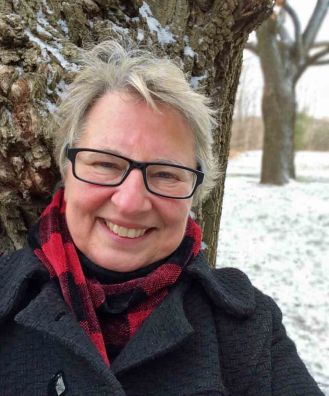
Nina-stay motivated

The Write and Publish Series

You want to write but don’t know how to get started? The Write and Publish Series focuses on:

  • How to find time to write around your busy schedule
  • How to make the most of your present resources
  • How to get inspired and motivate yourself to write
  • How to write, finish and submit your work

This 7-part series of lectures consists of: 1) Nina’s 5-Ps to Success; 2) Redefine Yourself as an Author; 3) Time and Space to Write; 4) Adopt a Winning Attitude; 5) Write What Excites You; 6) How to Beat Writer’s Block; and 7) How to Keep Motivated.

The Writer’s Toolkit

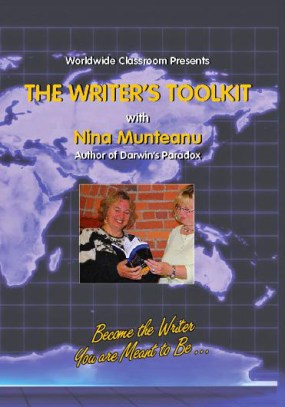
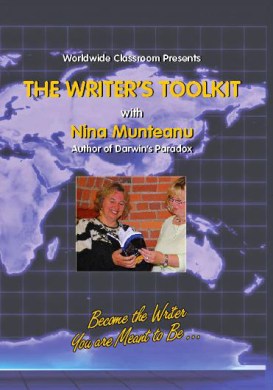
This series of lectures and workshops is part of Nina Munteanu’s “The Writer’s Toolkit”, available as three workshops and DVDs for writers wishing to get published. This 6-hour set of three discs contains lectures, examples and exercises on how to get started and finish, writing craft, marketing and promotion. Available through the author (nina.sfgirl@gmail.com).

the writers toolkit-front-WEBI was fascinated by Nina’s clear and extremely interesting lecture on the hero’s journey.  Maybe all writers have a novel in their heads they want to write one day, and the techniques Nina  shared with us will help me when I get to that point.  In fact, because of her, I may get there a lot sooner than I had planned.”— Zoe M. Hicks, Saint Simon’s Island, GA

Nina Munteanu’s command of the subject matter and her ability to explain in a way that the audience understood was excellent. As a hopeful author, I found her words inspiring.”—Amanda Lott, Scribblers Writers’ Retreat, GA

Rarely have I encountered someone of Nina’s considerable talent and intellect tied to such an extraordinary work ethic…A gifted and inventive writer, Nina is also an excellent speaker who is able to communicate complicated ideas in simple terms and generate creative thought in others. Her accessible, positive approach and delightful sense of humor set people at ease almost immediately.”–Heather Dugan, Ohio writer and voice artist

What you’ve done for me, Nina, is you’ve just opened up a whole new world. You’ve shown me how to put soul into my books.”–Hectorine Roy, Nova Scotia writer

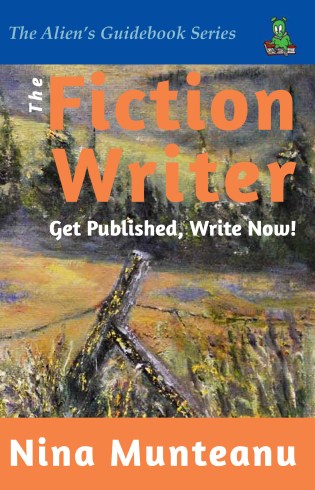
The Writer’s Toolkit workshops were based on my award-nominated fiction writing guide: The Fiction Writer: Get Published, Write Now!

“…Like the good Doctor’s Tardis, The Fiction Writer is larger than it appears… Get Get Published, Write Now! right now.”—David Merchant, Creative Writing Instructor

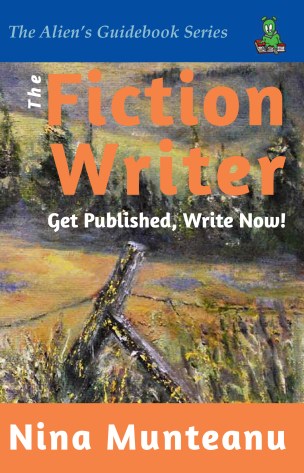
The Fiction Writer: Get Published, Write Now! (Starfire World Syndicate) is a digest of how-to’s in writing fiction and creative non-fiction by masters of the craft from over the last century. Packaged into 26 chapters of well-researched and easy to read instruction, novelist and teacher Nina Munteanu brings in entertaining real-life examples and practical exercises. The Fiction Writer will help you learn the basic, tried and true lessons of a professional writer: 1) how to craft a compelling story; 2) how to give editors and agents what they want and 3) how to maintain a winning attitude.

FictionWriter-front cover-2nd ed-webThe Fiction Writer is at the top of the required reading list for my Writer’s Workshop students. With its engagingly direct, conversational style and easily accessible format, it is a veritable cornucopia of hands-on help for aspiring writers of any age…the quintessential guidebook for the soon-to-be-published.”—Susan McLemore, Writing Instructor

As important a tool as your laptop or your pen.”—Cathi Urbonas, Halifax writer

Has become my writing bible.”—Carina Burns, author of The Syrian Jewelry Box

I highly recommend this book for any writer wishing to get published.”—Marie Bilodeau, acclaimed author of Destiny’s Blood

I’m thoroughly enjoying the book and even learning a thing or two!”—Robert J. Sawyer, Hugo and Nebula Award-winning author of Wake
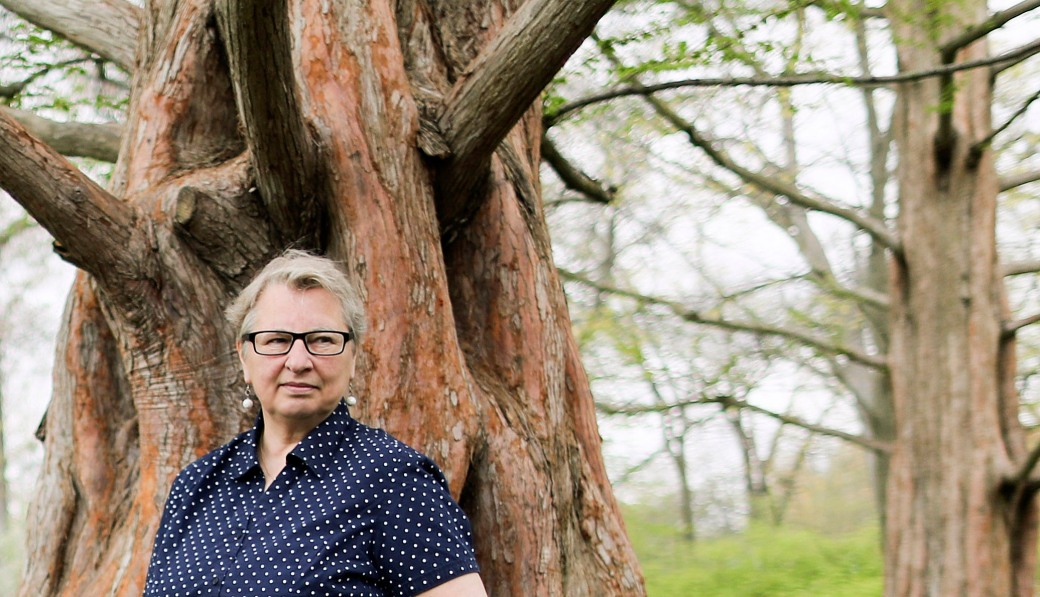
 

Nina Munteanu

Nina Munteanu in front of metasequoia tree in The Beach, Ontario (photo by Richard Lautens)

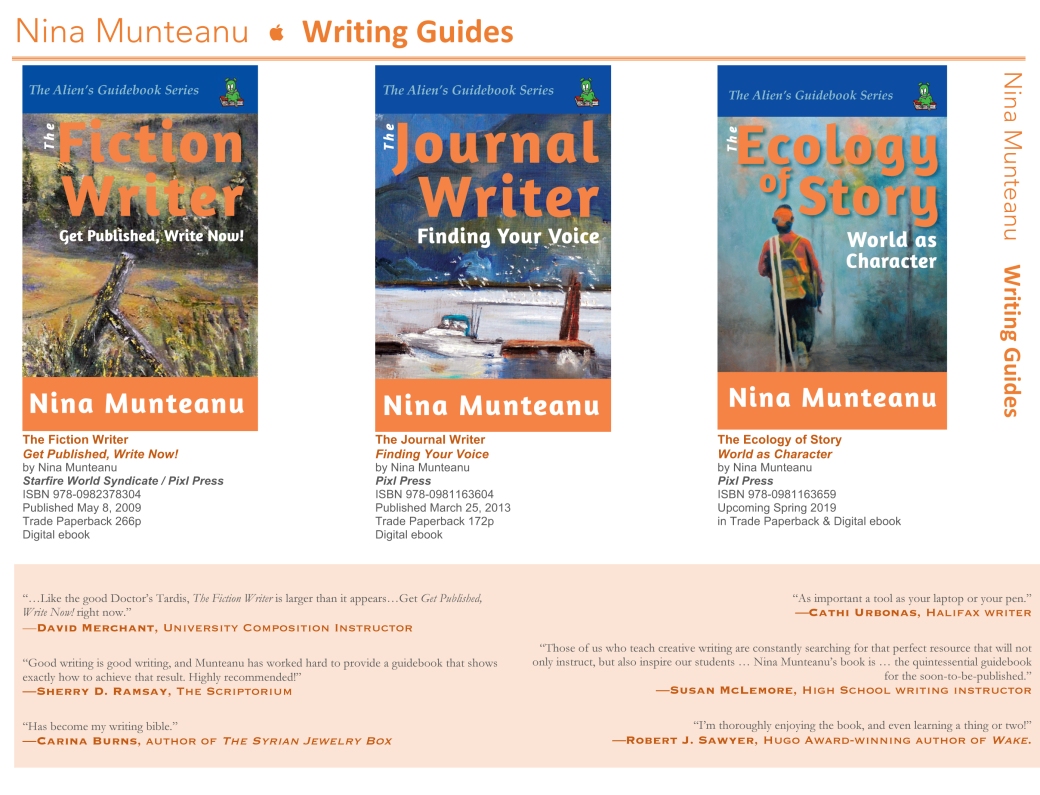
The Fiction Writer is the first of a series of writing guides, which consist so far of: The Journal Writer: Finding Your Voice; and The Ecology of Story: World as Character.
Microsoft Word - Three Writing Guides.docx


nina-2014aaa

Nina Munteanu is a Canadian ecologist / limnologist and novelist. She is co-editor of Europa SF and currently teaches writing courses at George Brown College and the University of Toronto. Visit www.ninamunteanu.ca for the latest on her books. Nina’s bilingual “La natura dell’acqua / The Way of Water” was published by Mincione Edizioni in Rome. Her non-fiction book “Water Is…” by Pixl Press (Vancouver) was selected by Margaret Atwood in the New York Times ‘Year in Reading’ and was chosen as the 2017 Summer Read by Water Canada. Her novel “A Diary in the Age of Water” will be released by Inanna Publications (Toronto) in 2020.

Ecology of Story: Place as Metaphor

Birds deer lake

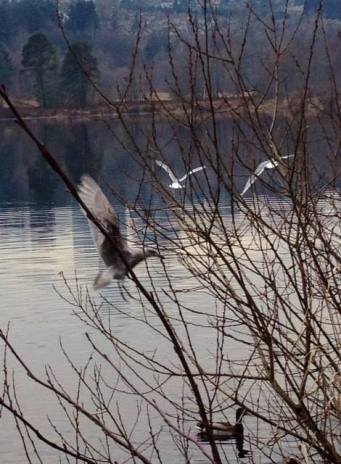
Birds flying over Deer Lake, BC (photo by Nina Munteanu)

Ray Bradbury once told me that everything in story is metaphor. That is no more apparent than in setting and place, in which a story is embedded and through which characters move and interact. Metaphor is the subtext that provides subtleties in story, subtleties that evoke mood, anticipation, and memorable scenes. Richard Russo says, “to know the rhythms, the textures, the feel of a place is to know more deeply and truly its people.” When you choose your setting, remember that its primary metaphoric role is to help depict theme. This is because place is destiny.

Metaphor provides similarity to two dissimilar things through meaning. In the metaphor “Love danced in her heart” or the simile “his love was like a slow dance”, love is equated with the joy of dance. By providing figurative rather than literal description to something, metaphor invites participation through interpretation.

When I write “John’s office was a prison,” I am efficiently and sparingly suggesting in five words—in what would normally take a paragraph—how John felt about his workplace. The reader would conjure imagery suggested by their knowledge of a prison cell: that John felt trapped, cramped, solitary, stifled, oppressed—even frightened and threatened. Metaphor relies on sub-text knowledge.

This is why metaphor is so powerful and universally relevant: the reader fully participates—the reader brings in relevance through their personal knowledge and experience and this creates the memorable aspect to the scene.

Russo tells us that place is crucial to human destiny and the formation of human personality. “The more specific and individual things become, the more universal they feel,” says Russo. This is not an oxymoron, but an example of the principle of a truism that primarily comes to us in the form of paradox (like all good truisms). Detail provides the color and texture of your story and helps it resonate with a sense of place. This does not necessarily translate into a lot of exposition; but it does require creative choice of words. So, instead of “He took a drag from his cigarette as he drove his sports car along a winding road in the country”; (twenty words) try something like “Vinnie sucked on a Camel as his red Corvette careered the hair-pinned curves of Hell’s Gate.” (seventeen words).

Place Personified

Tree-YellowBirch winter-LR

Old yellow birch tree in Little Rouge woodland (photo by Nina Munteanu)

Personification is powerful metaphor that gives nonhuman things human qualities. It personalizes, energizes and emotionalizes. Place described through personification can illuminate both characters and their environment in compelling ways. By giving an object, place, or animal the qualities of a person, personification provides subtle aspects of mood and links the reader to a cocktail subtext of human feelings and struggles. Personification can connect the reader to “lifeless” objects such as water, soil, rock, the sun, moon, planet, concrete, paper, etc., to map the larger meaning of the story. Putting a character’s feelings into the objects around her—as POV character—creates a subtle but deep connection with the reader: “The darkness embraced her”; “The open-throated roar of the river pulled her near.”

D.H. Lawrence’s creates strong personification of Thomas Hardy’s Egdon Heath in Return of the Native:

…Egdon, whose dark soil was strong and crude and organic as the body of a beast.

In The Handmaid’s Tale—a dystopian tale of oppression and intrigue—Margaret Atwood writes:

There is something subversive about this garden of Serena’s, a sense of buried things bursting upwards, wordlessly, into the light, as if to point, to say: Whatever is silenced will clamour to be heard, though silently … Light pours down upon it from the sun, true, but also heat rises, from the flowers themselves, you can feel it: like holding your hand an inch above an arm, a shoulder. It breathes, in the warmth, breathing itself in.

Martin Nolan’s Still Point creates powerful imagery of a storm aftermath through an abandoned old shed and contrasts its loneliness to the half-wild woods nearby:

A deserted shed by the road, buckling under its roof, kneels into the tall grass. The woods beyond it hide the river … I turn back to the half-wild woods. These trees speak to each other, are wild enough for that. They live together, holding the riverbanks in place.

Cixin Liu’s The Three Body Problem—set against the backdrop of China’s Cultural Revolution—follows Wenji Ye, disillusioned by the massive environmental deforestation in the labour camps she is sent to work:

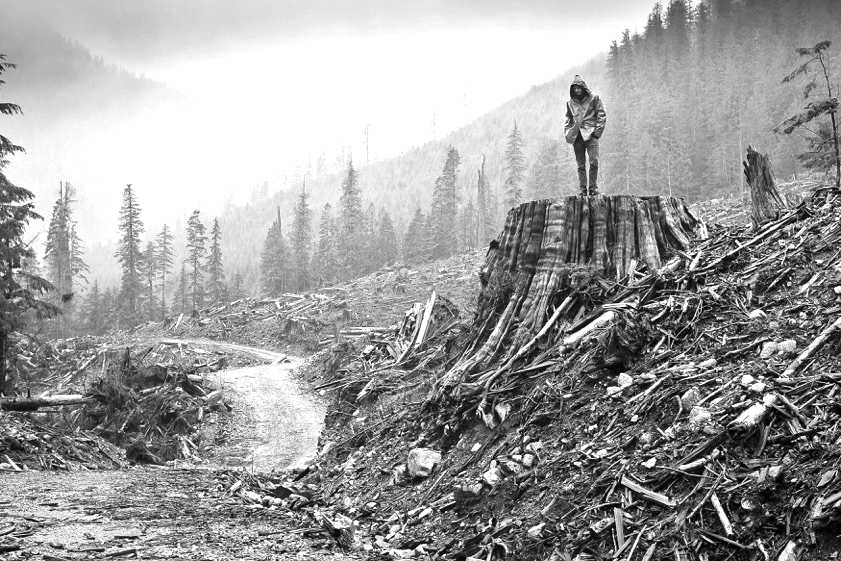
Her company wielded hundreds of chain saws like a swarm of steel locusts, and after they passed, only stumps were left. The fallen Dahurian larch, now bereft of branches, was ready to be taken away by tractor. Ye gently caressed the freshly exposed cross section of the felled trunk. She did this often, as though such surfaces were giant wounds, as though she could feel the tree’s pain …

Clearcut gordon valley-BW

Clearcut in Gordon Valley, British Columbia (photo by T.J. Watts)

In Memory of Water, Emmi Itäranta personifies this life-giving substance whose very nature is tightly interwoven with her main character. As companion and harbinger, water is portrayed simultaneously as friend and enemy. As giver and taker of life.

Water is the most versatile of all elements … Water walks with the moon and embraces the earth, and it isn’t afraid to die in fire or live in air. When you step into it, it will be as close as your own skin, but if you hit it too hard, it will shatter you … Death is water’s close companion. The two cannot be separated, and neither can be separated from us, for they are what we are ultimately made of: the versatility of water, and the closeness of death. Water has no beginning and no end, but death has both. Death is both. Sometimes death travels hidden in water, and sometimes water will chase death away, but they go together always, in the world and in us.

Personification of natural things provides the reader with an image they can clearly and emotionally relate to and care about. When a point-of-view character does the describing, we get a powerful and intimate indication of their thoughts and feelings—mainly in how they connect to place (often as symbol). When this happens, place and perception entwine in powerful force.


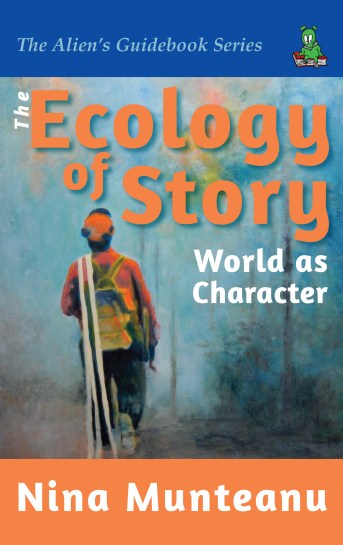
MockUpEcology copyThis article is an excerpt from “The Ecology of Story: World as Character” due in June 2019 by Pixl Press.


From Habitats and Trophic Levels to Metaphor and Archetype…

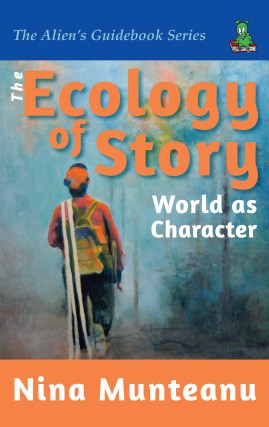
Learn the fundamentals of ecology, insights of world-building, and how to master layering-in of metaphoric connections between setting and character. Ecology of Story: World as Character is the 3rd guidebook in Nina Munteanu’s acclaimed “how to write” series for novice to professional writers.


Microsoft Word - Three Writing Guides.docx

nina-2014aaa

Nina Munteanu is a Canadian ecologist / limnologist and novelist. She is co-editor of Europa SF and currently teaches writing courses at George Brown College and the University of Toronto. Visit www.ninamunteanu.ca for the latest on her books. Nina’s bilingual “La natura dell’acqua / The Way of Water” was published by Mincione Edizioni in Rome. Her non-fiction book “Water Is…” by Pixl Press (Vancouver) was selected by Margaret Atwood in the New York Times ‘Year in Reading’ and was chosen as the 2017 Summer Read by Water Canada. Her novel “A Diary in the Age of Water” will be released by Inanna Publications (Toronto) in 2020.


Write and Publish, Part 6: How to Beat Writer’s Block

Author and university writing instructor NIna Munteanu gives some cool tips on how to beat the block.

Nina-Avoid the Block

The Write and Publish Series

You want to write but don’t know how to get started? The Write and Publish Series focuses on:

  • How to find time to write around your busy schedule
  • How to make the most of your present resources
  • How to get inspired and motivate yourself to write
  • How to write, finish and submit your work

This 7-part series of lectures consists of: 1) Nina’s 5-Ps to Success; 2) Redefine Yourself as an Author; 3) Time and Space to Write; 4) Adopt a Winning Attitude; 5) Write What Excites You; 6) How to Beat Writer’s Block; and 7) How to Keep Motivated.

The Writer’s Toolkit

This series of lectures and workshops is part of Nina Munteanu’s “The Writer’s Toolkit”, available as three workshops and DVDs for writers wishing to get published. This 6-hour set of three discs contains lectures, examples and exercises on how to get started and finish, writing craft, marketing and promotion. Available through the author (nina.sfgirl@gmail.com).

the writers toolkit-front-WEBI was fascinated by Nina’s clear and extremely interesting lecture on the hero’s journey.  Maybe all writers have a novel in their heads they want to write one day, and the techniques Nina shared with us will help me when I get to that point.  In fact, because of her, I may get there a lot sooner than I had planned.”— Zoe M. Hicks, Saint Simon’s Island, GA

Nina Munteanu’s command of the subject matter and her ability to explain in a way that the audience understood was excellent. As a hopeful author, I found her words inspiring.”—Amanda Lott, Scribblers Writers’ Retreat, GA

Rarely have I encountered someone of Nina’s considerable talent and intellect tied to such an extraordinary work ethic…A gifted and inventive writer, Nina is also an excellent speaker who is able to communicate complicated ideas in simple terms and generate creative thought in others. Her accessible, positive approach and delightful sense of humor set people at ease almost immediately.”–Heather Dugan, Ohio writer and voice artist

What you’ve done for me, Nina, is you’ve just opened up a whole new world. You’ve shown me how to put soul into my books.”–Hectorine Roy, Nova Scotia writer

The Writer’s Toolkit workshops were based on my award-nominated fiction writing guide: The Fiction Writer: Get Published, Write Now!

FictionWriter-front cover-2nd ed-web“…Like the good Doctor’s Tardis, The Fiction Writer is larger than it appears… Get Get Published, Write Now! right now.”—David Merchant, Creative Writing Instructor

The Fiction Writer: Get Published, Write Now! (Starfire World Syndicate) is a digest of how-to’s in writing fiction and creative non-fiction by masters of the craft from over the last century. Packaged into 26 chapters of well-researched and easy to read instruction, novelist and teacher Nina Munteanu brings in entertaining real-life examples and practical exercises. The Fiction Writer will help you learn the basic, tried and true lessons of a professional writer: 1) how to craft a compelling story; 2) how to give editors and agents what they want and 3) how to maintain a winning attitude.

The Fiction Writer is at the top of the required reading list for my Writer’s Workshop students. With its engagingly direct, conversational style and easily accessible format, it is a veritable cornucopia of hands-on help for aspiring writers of any age…the quintessential guidebook for the soon-to-be-published.”—Susan McLemore, Writing Instructor

As important a tool as your laptop or your pen.”—Cathi Urbonas, Halifax writer

Has become my writing bible.”—Carina Burns, author of The Syrian Jewelry Box

I highly recommend this book for any writer wishing to get published.”—Marie Bilodeau, acclaimed author of Destiny’s Blood

I’m thoroughly enjoying the book and even learning a thing or two!”—Robert J. Sawyer, Hugo and Nebula Award-winning author of Wake


Nina Munteanu

Nina Munteanu stands next to metasequoia tree in The Beach, Ontario (photo by Richard Lautens)


The Fiction Writer is the first of a series of writing guides, which consist so far of: The Journal Writer: Finding Your Voice; and The Ecology of Story: World as Character.

Microsoft Word - Three Writing Guides.docx


nina-2014aaa

Nina Munteanu is a Canadian ecologist / limnologist and novelist. She is co-editor of Europa SF and currently teaches writing courses at George Brown College and the University of Toronto. Visit www.ninamunteanu.ca for the latest on her books. Nina’s bilingual “La natura dell’acqua / The Way of Water” was published by Mincione Edizioni in Rome. Her non-fiction book “Water Is…” by Pixl Press (Vancouver) was selected by Margaret Atwood in the New York Times ‘Year in Reading’ and was chosen as the 2017 Summer Read by Water Canada. Her novel “A Diary in the Age of Water” will be released by Inanna Publications (Toronto) in 2020.
Ecology of Story: Place as Character & Archetype

Birds deer lake

Birds flying over Deer Lake, BC (photo by Nina Munteanu)

A novelist, when portraying several characters, may often find herself painting a portrait of a place. This is place being “character.” Place functions as a catalyst, and molds the more traditional characters that animate a story. Think of any of your favorite books, particularly the epics: The Wizard of Oz, Tale of Two Cities, Doctor Zhivago, Lord of the Rings, The Odyssey, etc. In each of these books the central character is the place, which is firmly linked to its main character. How much is Frodo, for instance, an extension of his beloved Shire? They are one in the same. Just as the London of Charles Dickens spawned Scrooge.

Place ultimately portrays what lies at the heart of the story. Place as character serves as an archetype that story characters connect with and navigate in ways that depend on the theme of the story. A story’s theme is essentially the “so what part” of the story. What is at stake for the character on their journey. Theme is the backbone—the heart—of the story, driving characters to journey through time and place toward some kind of fulfillment. There is no story without theme. And there is no theme without place.

Things to consider about place as character begin with the POV character and how they interact with their environment and how they reflect their place. For instance is that interaction obvious or subtle? Is that environment constant or changing, stable or unstable, predictable, or variable? Is the place controllable or not, understandable or not? Is the relationship emotional, connected to senses such as memory?

I discuss archetypes in detail, particularly as part of the “Hero’s Journey” in Chapter J of The Fiction Writer. In summary, archetypes are ancient patterns of personality shared universally by humanity (e.g. the “mother” archetype is recognized by all cultures). When place acts as an archetype or symbol in story—particularly when linked to theme—it provides a depth of meaning that resonates through many levels for the reader. From obvious to subtle.

A subtle yet potent example of this is provided by Annie Proulx’s novel The Shipping News; Proulx uses subtle body language of her protagonist to provide a strong sense of place. The main character, Quoyle, displays a self-conscious gesture of covering his strong native chin with his hand until he leaves New York to his homeland of Newfoundland from where he is descended— a place where he can live a natural and graceful life without apology.

In Ray Bradbury’s The Martian Chronicles, Mars symbolizes a new Eden—though unimagined. Like Bradbury’s aboriginal Martians—who are mostly invisible—the planet is a mirror that reflects humanity’s best and worst. Who we are, what we are, what we bring with us and what we may become. What we inadvertently do—to others, and finally to ourselves—and how the irony of chance can change everything.

Martian ChroniclesThey came because they were afraid or unafraid, happy or unhappy. There was a reason for each man. They were coming to find something or get something, or to dig up something or bury something. They were coming with small dreams or big dreams or none at all.

The 1970 Bantam book jacket aptly calls The Martian Chronicles, “a story of familiar people and familiar passions set against incredible beauties of a new world … A skillful blending of fancy and satire, terror and tenderness, wonder and contempt.”

Written in the 1940s, The Martian Chronicles drip with a nostalgic atmosphere — shady porches with tinkling pitchers of lemonade, grandfather clocks, chintz-covered sofas. But longing for this comfortable past proves dangerous in every way to Bradbury’s characters — the golden-eyed Martians as well as the humans. Starting in the far-flung future of 1999, expedition after expedition leaves Earth to explore Mars. The chameleon-like Martians guard their mysteries well, but soon succumb to the diseases that arrive with the rockets — recapitulating the tragedies that European colonization imposed on our indigenous peoples. Colonists appear on Mars, most of them with ideas no more lofty than starting a hot-dog stand, and with no respect for the culture they are impacting and an entire people they are destroying. Bradbury weaves metaphor into the opening when the heat of a rocket ship turned an Ohio dark winter into summer:

Rocket summer. The words passed among the people in the open, airing houses. Rocket summer. The warm desert air changing the frost patterns on the windows, erasing the art work. The skis and sleds suddenly useless. The snow, falling from the cold sky upon the town, turned to a hot rain before it touched the ground.

Rocket summer. People leaned form their dripping porches and watched the reddening sky. The rocket lay on the launching field, blowing out pink clouds of fire and even heat. The rocket stood in the cold winter morning, making summer with every breath of its mighty exhausts. The rocket made climates, and summer lay for a brief moment on the land…

What unfolds is a profound and tender analysis of the quiet yet devastating power humanity can wield unawares. Bradbury paints a multi-layered tapestry of hopes and dreams through metaphor. To Bradbury everything a writer writes is metaphor. Metaphor is powerful through perspective. It makes the ordinary strange and the strange ordinary.

MemoryOfWater_Emmi ItarantaIn Emmi Itäranta’s Memory of Water—about a post-climate change world of sea level rise—water is a powerful archetype, whose secret tea masters guard with their lives:

The story tells that water has a consciousness, that it carries in its memory everything that’s ever happened in this world, from the time before humans until this moment, which draws itself in its memory even as it passes. Water understands the movements of the world; it knows when it is sought and where it is needed. Sometimes a spring or a well dries for no reason, without explanation. It’s as if the water escapes of its own will, withdrawing into the cover of the earth to look for another channel. Tea masters believe there are times when water doesn’t wish to be found because it knows it will be chained in ways that are against its nature.

ThePenelopiadWater, with its life-giving properties and other strange qualities, has been used as a powerful metaphor and archetype in many stories: from vast oceans of mystery, beauty and danger—to the relentless flow of an inland stream. Margaret Atwood’s The Penelopiad is just one example:

Water does not resist. Water flows. When you plunge your hand into it, all you feel is a caress. Water is not a solid wall, it will not stop you. But water always goes where it wants to go, and nothing in the end can stand against it. Water is patient. Dripping water wears away a stone. Remember that, my child. Remember you are half water. If you can’t go through an obstacle, go around it. Water does.

MockUpEcology copyThis article is an excerpt from “The Ecology of Story: World as Character” released in June 2019 by Pixl Press.

From Habitats and Trophic Levels to Metaphor and Archetype…

Learn the fundamentals of ecology, insights of world-building, and how to master layering-in of metaphoric connections between setting and character. Ecology of Story: World as Character is the 3rd guidebook in Nina Munteanu’s acclaimed “how to write” series for novice to professional writers.


Microsoft Word - Three Writing Guides.docx


nina-2014aaa

Nina Munteanu is a Canadian ecologist / limnologist and novelist. She is co-editor of Europa SF and currently teaches writing courses at George Brown College and the University of Toronto. Visit www.ninamunteanu.ca for the latest on her books. Nina’s bilingual “La natura dell’acqua / The Way of Water” was published by Mincione Edizioni in Rome. Her non-fiction book “Water Is…” by Pixl Press (Vancouver) was selected by Margaret Atwood in the New York Times ‘Year in Reading’ and was chosen as the 2017 Summer Read by Water Canada. Her novel “A Diary in the Age of Water” will be released by Inanna Publications (Toronto) in 2020.
Write and Publish, Part 5: Write What Excites You

Author and university writing instructor Nina Munteanu shares the importance of tapping into what excites you to succeed, where ideas come from, and what to do with them.

Nina-WhatExitesYou

The Write and Publish Series

You want to write but don’t know how to get started? The Write and Publish Series focuses on:

  • How to find time to write around your busy schedule
  • How to make the most of your present resources
  • How to get inspired and motivate yourself to write
  • How to write, finish and submit your work

This 7-part series of lectures consists of: 1) Nina’s 5-Ps to Success; 2) Redefine Yourself as an Author; 3) Time and Space to Write; 4) Adopt a Winning Attitude; 5) Write What Excites You; 6) How to Beat Writer’s Block; and 7) How to Keep Motivated.

The Writer’s Toolkit

This series of lectures and workshops is part of Nina Munteanu’s “The Writer’s Toolkit”, available as three workshops and DVDs for writers wishing to get published. This 6-hour set of three discs contains lectures, examples and exercises on how to get started and finish, writing craft, marketing and promotion. Available through the author (nina.sfgirl@gmail.com).

the writers toolkit-front-WEBI was fascinated by Nina’s clear and extremely interesting lecture on the hero’s journey.  Maybe all writers have a novel in their heads they want to write one day, and the techniques Nina  shared with us will help me when I get to that point.  In fact, because of her, I may get there a lot sooner than I had planned.”— Zoe M. Hicks, Saint Simon’s Island, GA

Nina Munteanu’s command of the subject matter and her ability to explain in a way that the audience understood was excellent. As a hopeful author, I found her words inspiring.”—Amanda Lott, Scribblers Writers’ Retreat, GA

Rarely have I encountered someone of Nina’s considerable talent and intellect tied to such an extraordinary work ethic…A gifted and inventive writer, Nina is also an excellent speaker who is able to communicate complicated ideas in simple terms and generate creative thought in others. Her accessible, positive approach and delightful sense of humor set people at ease almost immediately.”–Heather Dugan, Ohio writer and voice artist

What you’ve done for me, Nina, is you’ve just opened up a whole new world. You’ve shown me how to put soul into my books.”–Hectorine Roy, Nova Scotia writer

The Writer’s Toolkit workshops were based on my award-nominated fiction writing guide: The Fiction Writer: Get Published, Write Now!

“…Like the good Doctor’s Tardis, The Fiction Writer is larger than it appears… Get Get Published, Write Now! right now.”—David Merchant, Creative Writing Instructor
The Fiction Writer: Get Published, Write Now! (Starfire World Syndicate) is a digest of how-to’s in writing fiction and creative non-fiction by masters of the craft from over the last century. Packaged into 26 chapters of well-researched and easy to read instruction, novelist and teacher Nina Munteanu brings in entertaining real-life examples and practical exercises. The Fiction Writer will help you learn the basic, tried and true lessons of a professional writer: 1) how to craft a compelling story; 2) how to give editors and agents what they want and 3) how to maintain a winning attitude.

FictionWriter-front cover-2nd ed-webThe Fiction Writer is at the top of the required reading list for my Writer’s Workshop students. With its engagingly direct, conversational style and easily accessible format, it is a veritable cornucopia of hands-on help for aspiring writers of any age…the quintessential guidebook for the soon-to-be-published.”—Susan McLemore, Writing Instructor

As important a tool as your laptop or your pen.”—Cathi Urbonas, Halifax writer

Has become my writing bible.”—Carina Burns, author of The Syrian Jewelry Box

I highly recommend this book for any writer wishing to get published.”—Marie Bilodeau, acclaimed author of Destiny’s Blood

I’m thoroughly enjoying the book and even learning a thing or two!”—Robert J. Sawyer, Hugo and Nebula Award-winning author of Wake


Nina Munteanu

Nina Munteanu stands with metasequoia tree in The Beach (photo by Richard Lautens)


The Fiction Writer is the first of a series of writing guides, which consist so far of: The Journal Writer: Finding Your Voice; and The Ecology of Story: World as Character.

Microsoft Word - Three Writing Guides.docx


nina-2014aaa

Nina Munteanu is a Canadian ecologist / limnologist and novelist. She is co-editor of Europa SF and currently teaches writing courses at George Brown College and the University of Toronto. Visit www.ninamunteanu.ca for the latest on her books. Nina’s bilingual “La natura dell’acqua / The Way of Water” was published by Mincione Edizioni in Rome. Her non-fiction book “Water Is…” by Pixl Press (Vancouver) was selected by Margaret Atwood in the New York Times ‘Year in Reading’ and was chosen as the 2017 Summer Read by Water Canada. Her novel “A Diary in the Age of Water” will be released by Inanna Publications (Toronto) in 2020.


Ecology of Story: The Difference Between Anecdotes and Stories—How to Tell a Good Story

Birds deer lake

Birds fly over Deer Lake, BC (photo by Nina Munteanu)

In her article in Quartz Magazine, Lila MacLellan suggests that “we’ve become masters of telling anecdotes, and terrible at telling our friends real stories.” Sometimes people think they are telling a story, but they are really just telling anecdotes, MacLellan reports after interviewing Maggie Cino, senior story producer for Moth storytelling series. While “anecdotes just relate facts,” Cino explains, stories are “about letting us know that things started one way and ended a different way.” Stories create space for movement.

Merriam-Webster defines an anecdote as a “short narrative of an interesting, amusing, or biographical incident.” Anecdotes serve to incite interest and to illustrate a point. They are often amusing, odd, sad or even tragic; if they are biographical, they often serve to reflect someone’s personality, attitude or philosophy. While anecdotes often provide a contextual jumping board to make a point—drawing you in with relevance—they lack the structure of stories. An anecdote is something that happens; a story has a structure that makes it memorable and provides a depth of meaning.

Stories move with direction; they have a beginning, middle and end. Stories evoke emotional truths. They compel with intrigue then fulfil us with awareness and, sometimes, understanding. The best stories are told through metaphor, those universal truths we all live by. And all good stories weave a premise, theme, plot, character and setting into a tapestry with meaning.

I teach new writers at the University of Toronto and George Brown College how to tell stories. I teach how stories can tell us who we are. Where we’ve been. And sometimes, where we are  going. The stories that stir our hearts come from deep inside, where the personal meets the universal, through symbols or archetypes and metaphor.

Depth psychologist Carl Jung described these shared symbols, metaphors and archetypes as pre-existing forms of the psyche. He drew parallels between synchronicity, relativity theory and quantum mechanics to describe life as an expression of a deeper order. He believed that we are both embedded in a framework of a whole and are the focus of that whole. Jung was describing a fractal whole, which reflects quantum scientist David Bohm’s quantum vision of holomovement.

Jung’s concept of embedded whole and a universal collective unconscious was embraced by Hero’s Journey author and scholar Joseph Campbell, who suggested that these mythic images lie at the depth of the unconscious where humans are no longer distinct individuals, where our minds widen and merge into the mind and memory of humankind—where we are all the same, in Unity. Carl Jung’s thesis of the “collective unconscious” in fact linked with what Freud called archaic remnants: mental forms whose presence cannot be explained by anything in the individual’s own life and which seem aboriginal, innate, and the inherited shapes of the human mind. Marie-Louise von Franz, in 1985, identified Jung’s hypothesis of the collective unconscious with the ancient idea of an all- extensive world-soul. Writer Sherry Healy suggested that Jung viewed the human mind as linked to “a body of unconscious energy that lives forever.”

What Makes a Good Story?

subway

Passengers on the Toronto subway (photo by Nina Munteanu)

A good story is about something important; attracted by gravity, it has purpose and seeks a destination. A good story goes somewhere; it flows like a river from one place to another. A good story has meaning; its undercurrents run deep across hidden substrates with intrigue. A good story resonates with place; it finds its way home. We’ve just touched upon the five main components of good story: premise, character on a journey & plot, theme and—what is ultimately at the heart of a story—setting or place.

Story Components

The premise of a story is like the anecdote, a starting point of interest. It is an idea that will be dramatized through plot, character and setting. In idea-driven stories, it can often be identified by asking the question: “What if?” For instance, what if time travel was possible?

A character on a journey propels the story through meaningful change. Characters provide dramatized meaning to premise through personal representation of global themes. A character takes an issue and through their actions and circumstance in story provide a fractal connection to a larger issue. Characters need to move. They need to “go somewhere.” Archetypes—ancient patterns of personality (symbols) shared by humanity and connected by our collective unconscious—are metaphoric characters (which includes place) in the universal language of storytelling that help carry the story forward.

The theme of a story takes the premise and gives it personal and metaphoric meaning by dramatizing through a character journey. It is often identified by asking the question: “What’s at stake?” In taking the time travel premise, a theme of forgiveness may be applied by choosing a character wishing to return to the past to right a wrong, when what they just need to do is forgive others and themselves, not travel to the past at all, and get on with their lives.

DS-2008-26

Cliff diving on BC coast (photo by Nina Munteanu)

In such a story, the plot would provide means and obstacles for the character in their journey toward enlightenment. Plot works together with theme to challenge and push a character toward their epiphany and meaningful change. Plot provides obstacles. Challenges. Emotional turning points. Opportunities for learning and change.

The role of setting or place is often not as clear to writers. Because of this, place and setting may often be neglected and haphazardly tacked on without addressing its role in story; in such a case the story will not resonate with what is often at the heart of the story: a sense of place. In stories where the setting changes (either itself changing such as in a story about the volcanic eruption of Vesuvius impacting Pompeii’s community; or by the character’s own movements from place to place) it appears easier to include how setting affects characters. However, the effect of place on character when the setting does not change can be equally compelling even if more subtle; the change is still there but lies in the POV character’s altered relationship to that place—a reflection of change within them.


MockUpEcology copyThis article is an excerpt from “The Ecology of Story: World as Character” due in June 2019 by Pixl Press.

From Habitats and Trophic Levels to Metaphor and Archetype…

Learn the fundamentals of ecology, insights of world-building, and how to master layering-in of metaphoric connections between setting and character. Ecology of Story: World as Character is the 3rd guidebook in Nina Munteanu’s acclaimed “how to write” series for novice to professional writers.


nina-2014aaa

Nina Munteanu is a Canadian ecologist / limnologist and novelist. She is co-editor of Europa SF and currently teaches writing courses at George Brown College and the University of Toronto. Visit www.ninamunteanu.ca for the latest on her books. Nina’s bilingual “La natura dell’acqua / The Way of Water” was published by Mincione Edizioni in Rome. Her non-fiction book “Water Is…” by Pixl Press (Vancouver) was selected by Margaret Atwood in the New York Times ‘Year in Reading’ and was chosen as the 2017 Summer Read by Water Canada. A collection of Nina’s short eco-fiction can be found in “Natural Selection” by Pixl Press.  Her novel “A Diary in the Age of Water” will be released by Inanna Publications (Toronto) in 2020.


Write and Publish, Part 4: Adopt a Winning Attitude

Author and university writing instructor Nina Munteanu describes the attitude you need to successfully write, complete and market your works.

Nina-Attitude

The Write and Publish Series

You want to write but don’t know how to get started? The Write and Publish Series focuses on:

  • How to find time to write around your busy schedule
  • How to make the most of your present resources
  • How to get inspired and motivate yourself to write
  • How to write, finish and submit your work

The 7-part series of lectures consists of: 1) Nina’s 5-Ps to Success; 2) Redefine Yourself as an Author; 3) Time and Space to Write; 4) Adopt a Winning Attitude; 5) Write What Excites You; 6) How to Beat Writer’s Block; and 7) How to Keep Motivated.

The Writer’s Toolkit

This series of lectures and workshops is part of Nina Munteanu’s “The Writer’s Toolkit”, available as three workshops and DVDs for writers wishing to get published. This 6-hour set of three discs contains lectures, examples and exercises on how to get started and finish, writing craft, marketing and promotion. Available through the author (nina.sfgirl@gmail.com).

the writers toolkit-front-WEBI was fascinated by Nina’s clear and extremely interesting lecture on the hero’s journey.  Maybe all writer’s have a novel in their heads they want to write one day, and the techniques Nina  shared with us will help me when I get to that point.  In fact, because of her, I may get there a lot sooner than I had planned.”— Zoe M. Hicks, Saint Simon’s Island, GA

Nina Munteanu’s command of the subject matter and her ability to explain in a way that the audience understood was excellent. As a hopeful author, I found her words inspiring.”—Amanda Lott, Scribblers Writers’ Retreat, GA

Rarely have I encountered someone of Nina’s considerable talent and intellect tied to such an extraordinary work ethic…A gifted and inventive writer, Nina is also an excellent speaker who is able to communicate complicated ideas in simple terms and generate creative thought in others. Her accessible, positive approach and delightful sense of humor set people at ease almost immediately.”–Heather Dugan, Ohio writer and voice artist

What you’ve done for me, Nina, is you’ve just opened up a whole new world. You’ve shown me how to put soul into my books.”–Hectorine Roy, Nova Scotia writer

The Writer’s Toolkit workshops were based on my award-nominated fiction writing guide: The Fiction Writer: Get Published, Write Now!

“…Like the good Doctor’s Tardis, The Fiction Writer is larger than it appears… Get Get Published, Write Now! right now.”—David Merchant, Creative Writing Instructor

The Fiction Writer: Get Published, Write Now! (Starfire World Syndicate) is a digest of how-to’s in writing fiction and creative non-fiction by masters of the craft from over the last century. Packaged into 26 chapters of well-researched and easy to read instruction, novelist and teacher Nina Munteanu brings in entertaining real-life examples and practical exercises. The Fiction Writer will help you learn the basic, tried and true lessons of a professional writer: 1) how to craft a compelling story; 2) how to give editors and agents what they want and 3) how to maintain a winning attitude.

FictionWriter-front cover-2nd ed-webThe Fiction Writer is at the top of the required reading list for my Writer’s Workshop students. With its engagingly direct, conversational style and easily accessible format, it is a veritable cornucopia of hands-on help for aspiring writers of any age…the quintessential guidebook for the soon-to-be-published.”—Susan McLemore, Writing Instructor

As important a tool as your laptop or your pen.”—Cathi Urbonas, Halifax writer

Has become my writing bible.”—Carina Burns, author of The Syrian Jewelry Box

I highly recommend this book for any writer wishing to get published.”—Marie Bilodeau, acclaimed author of Destiny’s Blood

I’m thoroughly enjoying the book and even learning a thing or two!”—Robert J. Sawyer, Hugo and Nebula Award-winning author of Wake


Nina Munteanu

Nina Munteanu next to a metasequoia tree in The Beach, Ontario (photo by Richard Lautens)


The Fiction Writer is the first of a series of writing guides, which consist so far of: The Journal Writer: Finding Your Voice; and The Ecology of Story: World as Character.

Microsoft Word - Three Writing Guides.docx


nina-2014aaaNina Munteanu is an ecologist and internationally published author of award-nominated speculative novels, short stories and non-fiction. She is co-editor of Europa SF and currently teaches writing courses at George Brown College and the University of Toronto. Visit www.ninamunteanu.ca for the latest on her books. Nina’s recent book is the bilingual “La natura dell’acqua / The Way of Water” (Mincione Edizioni, Rome). Her latest “Water Is…” is currently an Amazon Bestseller and NY Times ‘year in reading’ choice of Margaret Atwood.

Write and Publish, Part 3: Time and Space to Write

Author and university instructor Nina Munteanu talks about the importance of defining and respecting your time and space for a successful writing career.

Nina-SacredSpace

The Write and Publish Series

You want to write but don’t know how to get started? The Write and Publish Series focuses on:

  • How to find time to write around your busy schedule
  • How to make the most of your present resources
  • How to get inspired and motivate yourself to write
  • How to write, finish and submit your work

The 7-part series of lectures consists of: 1) Nina’s 5-Ps to Success; 2) Redefine Yourself as an Author; 3) Time and Space to Write; 4) Adopt a Winning Attitude; 5) Write What Excites You; 6) How to Beat Writer’s Block; and 7) How to Keep Motivated.

The Writer’s Toolkit

This series of lectures and workshops is part of Nina Munteanu’s “The Writer’s Toolkit”, available as three workshops and DVDs for writers wishing to get published. This 6-hour set of three discs contains lectures, examples and exercises on how to get started and finish, writing craft, marketing and promotion. Available through the author (nina.sfgirl@gmail.com).

the writers toolkit-front-WEBI was fascinated by Nina’s clear and extremely interesting lecture on the hero’s journey.  Maybe all writer’s have a novel in their heads they want to write one day, and the techniques Nina shared with us will help me when I get to that point.  In fact, because of her, I may get there a lot sooner than I had planned.”— Zoe M. Hicks, Saint Simon’s Island, GA
Nina Munteanu’s command of the subject matter and her ability to explain in a way that the audience understood was excellent. As a hopeful author, I found her words inspiring.”—Amanda Lott, Scribblers Writers’ Retreat, GA

Rarely have I encountered someone of Nina’s considerable talent and intellect tied to such an extraordinary work ethic…A gifted and inventive writer, Nina is also an excellent speaker who is able to communicate complicated ideas in simple terms and generate creative thought in others. Her accessible, positive approach and delightful sense of humor set people at ease almost immediately.”–Heather Dugan, Ohio writer and voice artist

What you’ve done for me, Nina, is you’ve just opened up a whole new world. You’ve shown me how to put soul into my books.”–Hectorine Roy, Nova Scotia writer

The Writer’s Toolkit workshops were based on my award-nominated fiction writing guide: The Fiction Writer: Get Published, Write Now!

“…Like the good Doctor’s Tardis, The Fiction Writer is larger than it appears… Get Get Published, Write Now! right now.”—David Merchant, Creative Writing Instructor

The Fiction Writer: Get Published, Write Now! (Starfire World Syndicate) is a digest of how-to’s in writing fiction and creative non-fiction by masters of the craft from over the last century. Packaged into 26 chapters of well-researched and easy to read instruction, novelist and teacher Nina Munteanu brings in entertaining real-life examples and practical exercises. The Fiction Writer will help you learn the basic, tried and true lessons of a professional writer: 1) how to craft a compelling story; 2) how to give editors and agents what they want’ and 3) how to maintain a winning attitude.

FictionWriter-front cover-2nd ed-webThe Fiction Writer is at the top of the required reading list for my Writer’s Workshop students. With its engagingly direct, conversational style and easily accessible format, it is a veritable cornucopia of hands-on help for aspiring writers of any age…the quintessential guidebook for the soon-to-be-published.”—Susan McLemore, Writing Instructor

As important a tool as your laptop or your pen.”—Cathi Urbonas, Halifax writer

Has become my writing bible.”—Carina Burns, author of The Syrian Jewelry Box

I highly recommend this book for any writer wishing to get published.”—Marie Bilodeau, acclaimed author of Destiny’s Blood

I’m thoroughly enjoying the book and even learning a thing or two!”—Robert J. Sawyer, Hugo and Nebula Award-winning author of Wake


Nina Munteanu

Nina Munteanu next to metasequoia tree in The Beach, ON (photo by Richard Lautens)


The Fiction Writer is the first of a series of writing guides, which consist so far of: The Journal Writer: Finding Your Voice; and The Ecology of Story: World as Character.

Microsoft Word - Three Writing Guides.docx


nina-2014aaaNina Munteanu is an ecologist and internationally published author of award-nominated speculative novels, short stories and non-fiction. She is co-editor of Europa SF and currently teaches writing courses at George Brown College and the University of Toronto. Visit www.ninamunteanu.ca for the latest on her books. Nina’s recent book is the bilingual “La natura dell’acqua / The Way of Water” (Mincione Edizioni, Rome). Her latest “Water Is…” is currently an Amazon Bestseller and NY Times ‘year in reading’ choice of Margaret Atwood.

Write and Publish, Part 2: Redefining Yourself

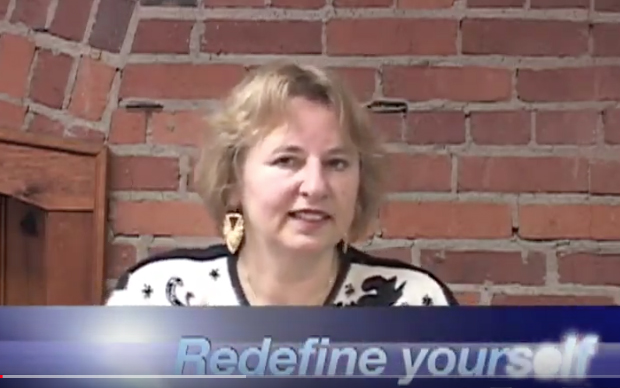
Author and university writing instructor Nina Munteanu shares how you can become successful as a writer: one of them is to redefine yourself as an author–to be successful you need to play the part.


Nina-RedefineYourself

The Write and Publish Series

You want to write but don’t know how to get started? The Write and Publish Series focuses on:

  • How to find time to write around your busy schedule
  • How to make the most of your present resources
  • How to get inspired and motivate yourself to write
  • How to write, finish and submit your work

The 7-part series of lectures consists of: 1) Nina’s 5-Ps to Success; 2) Redefine Yourself as an Author; 3) Time and Space to Write; 4) Adopt a Winning Attitude; 5) Write What Excites You; 6) How to Beat Writer’s Block; and 7) How to Keep Motivated.

The Writer’s Toolkit

This series of lectures and workshops is part of Nina Munteanu’s “The Writer’s Toolkit”, available as three workshops and DVDs for writers wishing to get published. This 6-hour set of three discs contains lectures, examples and exercises on how to get started and finish, writing craft, marketing and promotion. Available through the author (nina.sfgirl@gmail.com).

the writers toolkit-front-WEBI was fascinated by Nina’s clear and extremely interesting lecture on the hero’s journey.  Maybe all writer’s have a novel in their heads they want to write one day, and the techniques Nina  shared with us will help me when I get to that point.  In fact, because of her, I may get there a lot sooner than I had planned.”— Zoe M. Hicks, Saint Simon’s Island, GA

Nina Munteanu’s command of the subject matter and her ability to explain in a way that the audience understood was excellent. As a hopeful author, I found her words inspiring.”—Amanda Lott, Scribblers Writers’ Retreat, GA

Rarely have I encountered someone of Nina’s considerable talent and intellect tied to such an extraordinary work ethic…A gifted and inventive writer, Nina is also an excellent speaker who is able to communicate complicated ideas in simple terms and generate creative thought in others. Her accessible, positive approach and delightful sense of humor set people at ease almost immediately.”–Heather Dugan, Ohio writer and voice artist

What you’ve done for me, Nina, is you’ve just opened up a whole new world. You’ve shown me how to put soul into my books.”–Hectorine Roy, Nova Scotia writer

The Writer’s Toolkit workshops were based on my award-nominated fiction writing guide: The Fiction Writer: Get Published, Write Now!

“…Like the good Doctor’s Tardis, The Fiction Writer is larger than it appears… Get Get Published, Write Now! right now.”—David Merchant, Creative Writing Instructor

The Fiction Writer: Get Published, Write Now! (Starfire World Syndicate) is a digest of how-to’s in writing fiction and creative non-fiction by masters of the craft from over the last century. Packaged into 26 chapters of well-researched and easy to read instruction, novelist and teacher Nina Munteanu brings in entertaining real-life examples and practical exercises. The Fiction Writer will help you learn the basic, tried and true lessons of a professional writer: 1) how to craft a compelling story; 2) how to give editors and agents what they want’ and 3) how to maintain a winning attitude.

FictionWriter-front cover-2nd ed-webThe Fiction Writer is at the top of the required reading list for my Writer’s Workshop students. With its engagingly direct, conversational style and easily accessible format, it is a veritable cornucopia of hands-on help for aspiring writers of any age…the quintessential guidebook for the soon-to-be-published.”—Susan McLemore, Writing Instructor
As important a tool as your laptop or your pen.”—Cathi Urbonas, Halifax writer

Has become my writing bible.”—Carina Burns, author of The Syrian Jewelry Box

I highly recommend this book for any writer wishing to get published.”—Marie Bilodeau, acclaimed author of Destiny’s Blood

I’m thoroughly enjoying the book and even learning a thing or two!”—Robert J. Sawyer, Hugo and Nebula Award-winning author of Wake


Nina Munteanu

Nina Munteanu next to a metasequoia tree in The Beach, ON (photo by Richard Lautens)


The Fiction Writer is the first of a series of writing guides, which consist so far of: The Journal Writer: Finding Your Voice; and The Ecology of Story: World as Character.


Microsoft Word - Three Writing Guides.docx


nina-2014aaaNina Munteanu is an ecologist and internationally published author of award-nominated speculative novels, short stories and non-fiction. She is co-editor of Europa SF and currently teaches writing courses at George Brown College and the University of Toronto. Visit www.ninamunteanu.ca for the latest on her books. Nina’s recent book is the bilingual “La natura dell’acqua / The Way of Water” (Mincione Edizioni, Rome). Her latest “Water Is…” is currently an Amazon Bestseller and NY Times ‘year in reading’ choice of Margaret Atwood.

How Walking in Nature Helps Me Write

StoneStairs-oakforest Rouge

Staircase to Rouge River (photo by Nina Munteanu)

I don’t often get writer’s block. I just walk out of it into Nature.

My favourite place to walk is the forest, along a river.

Walking in a forest unclutters my mind and soul. The forest is simple in its natural complexity. Its beauty combs out the tangles of human complexity like a dam dissolving and grounds me back to the simplicity of natural life.

The river trickles in the background as I step through dappled light and inhale the organic scents of the forest. The forest and the river help me re-align and focus—without trying. That’s the magic of it. It’s in the not trying.

I carry a notebook with me to jot down ideas that come to me. They always do. I find writing by hand additionally helps in the creative process.

My favourite park is the little woodland of the Little Rouge River, located off a small road hidden from the sprawling desert of suburbia.

LittleRougeRiver-Maple-spring

my old maple leaning over the Little Rouge River (photo by Nina Munteanu)

It was spring when I first entered this forest. I inhaled its complex smell, awakening with spring flowers. At my entrance, chipmunks scattered and scolded me for interrupting their calm. I chuckled and thought that I’d seen more within the space of one minute here than I had in a year in the suburb I currently live in. A duff-strewn path led me beneath the pungent smell of pine and cedar. I made my way toward the riverbank where beech and maple leaned over the water. I found a place to write.

When I returned in the fall, the forest was a mix of colour.  Most of the deciduous trees had dropped their leaves in a revealing show of textured grays, gray-browns and blacks. The bare trunks and fractal branches contrasted with the deep greens of the conifers. Rogue trees—like the oak and beech—still claimed their leaves, adding deep russet tones to the varied grays and deep greens of the canopy. The forest was now more open, emerging with ancient magnificence from a soft brown carpet on the ground. The air was fresh with the scent of loam, decaying leaves and saprophyte activity.

LittleRouge-icing shallows

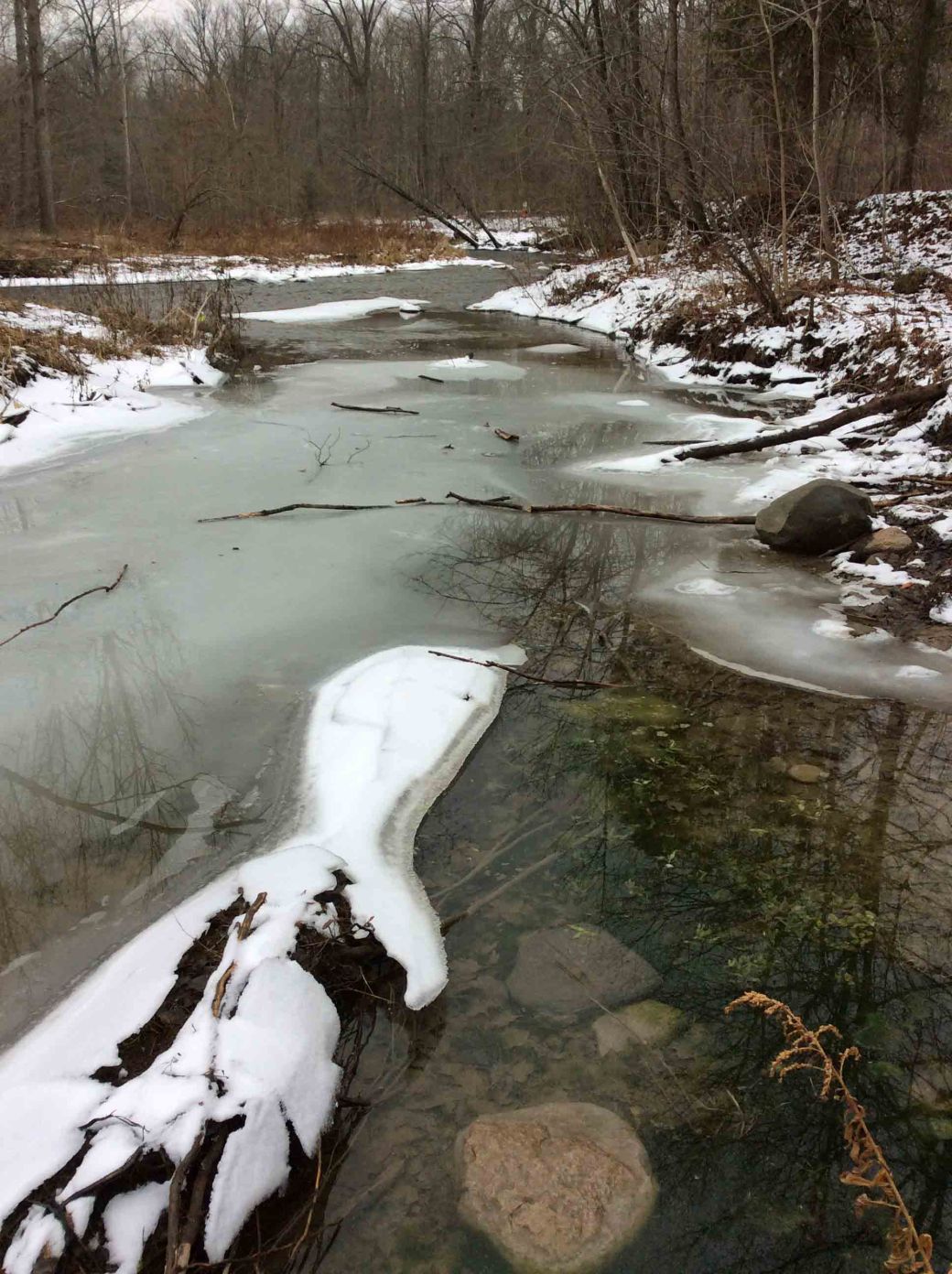
A shallow part of the Little Rouge ices over with the first snowfall in late autumn (photo by Nina Munteanu)

I strayed off the path toward the riverbank again. I was looking for the old sugar maple I’d spent time with the previous spring. After several bends in the river, I saw it, leaning precipitously over the river like an old man sharing an intimate story. It had already lost its leaves; they covered the ground in a soft carpet. The old tree literally hugged the bank in a braided network of snaking roots; like a carved figurehead hugs the prow of a great tall ship.

My OldMaple-burl copy

Burl on my maple (photo by Nina Munteanu)

Eager to see my old friend up close, I scrambled down the overhanging bank using the old maple’s root “stairway,” then ungracefully dropped onto the cobbles below. Every part of my gnarly old maple tree was splendid. Its shaggy trunk stretched up with typical silhouette of branching-out arms that every Canadian kid drew when they were six. The horizontal roots stretched out in a tangle and stitched the bank together, keeping it intact.

The Little Rouge River calls me to sit and listen to its flowing song—a joyful playful symphony of breaths, chortles and open-throated froth. I sit. And still my breath. I find my whole body relax from the tension of the suburban drive. I am home, sighing with a rhythm I’d forgotten. Re-aligning. Bones with rock. Rock with twig. Twig with root. The animals no longer scold me. They have resumed their natural rhythm, as I merge into scenery. And write…

****

gnarly cedar

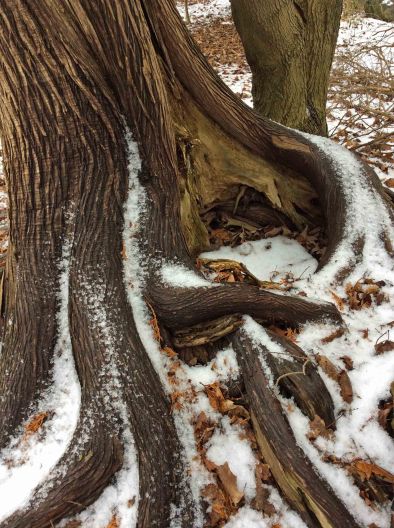
gnarly cedar roots (photo by Nina Munteanu)

What I do is not new to creative thinkers all over the world and throughout time. I share great company with people who used walking (usually in Nature) as a venue toward creative thinking (and writing). All great walkers.

Aristotle conducted his lectures while walking the grounds of his school in Athens. His followers, who chased him as he walked, were known as the peripatelics (e.g., Greek for meandering). Darwin refined his ideas on natural selection and other topics during his frequent walks along his “thinking path”, a gravel road called Sandwalk Wood near his home in southeast England. Dickens walked for miles each day: “If I could not walk far and fast, I think I should just explode and perish.” Beethoven often took solitary walks. He strolled the Viennese woods for hours, finding inspiration for his works and jotting them down on a notepad that he carried with him. Nietzsche loved his walks in the mountains: “it is only ideas gained from walking that have any worth.” For Wordsworth, the act of walking was one in the same with the act of writing poetry. Both involved rhythm and meter. Henry David Thoreau was known for his great walkabouts. Walking through nature for Thoreau was a pilgrimage without a destination—more discovery and rapture.

YellowBirch-winter

Yellow birch trunk (photo by Nina Munteanu)

Stanford researchers demonstrated that walking boosts creative inspiration. They showed that the act of walking significantly increased creativity for 81% of the participants and that the creative ideas generated while walking were not irrelevant or far-fetched, but innovative and practical.

“The answer begins with changes to our chemistry,” writes journalist Ferris Jabr in The New Yorker (2014). “When we go for a walk, the heart pumps faster, circulating more blood and oxgen not just to the muscles but to all the organs—including the brain. Many experiments have shown that after or during exercise, even very mild exertion, people perform better on tests of memory and attention. Walking on a regular basis also promotes new connections between brain cells, staves off the usual withering of brain tissue that comes with age, increases the volume of the hippocampus (a brain region crucial to memory) and elevates levels of molecules that both stimulate the growth of new neurons and transmit messages between them.”

SONY DSC

Nina Munteanu walks the forest (photo by Merridy Cox)

While walking is good for our creativity and general well-being, walking in a park or wilderness is so much better. Researchers in Europe and Japan found that anxiety and depression was significantly reduced in the presence of green space and that it boosted attentiveness, focus and academic performance. Vegetation creates “a halo of improved health.” Dr. Frances Kuo at the University of Illinois demonstrated that just seeing a tree helps cognition and promotes a sense of well-being. While a human-made environment of objects—cars and buildings—requires high-frequency processing in the brain; a landscaped environment allows the observer to relax his or her attention, resulting in reduced muscle tension, lower heart rate, and a generally less stressful physiology.

Finding a favourite tree might be the best thing you do to boost your creativity.


Forest path-NS

Forest path in Nova Scotia (photo by Nina Munteanu)

References:

Nina-willowtree

Nina Munteanu by a large willow tree (photo Jane Raptor)

Cameron, Julia. 1992. “The Artist’s Way”. Penguin Putnam Inc., New York, NY. 222pp.

Deasey, Louise. 2015. “Negative Ions Are Great for Your Health”. 
Body and Soul.

Munteanu, Nina. 2013. The Journal Writer: Finding Your Voice. Pixl Press, Vancouver, BC. 170pp.

Oppezzo, Marily and Daniel L. Schwartz. 2014. “Give Your Ideas Some Legs: The Positive Effect of Walking on Creative Thinking”, Journal of Experimental Psychology: Learning, Memory, and Cognition, Vol. 40, No. 4: 1142-1152.

Wells, Nancy M. 2000. “At Home with Nature: Effects of ‘Greenness’ on Children’s Cognitive Functioning”. Environment and Behavior 32 (6): 775–795.


nina-2014aaaNina Munteanu is an ecologist and internationally published author of award-nominated speculative novels, short stories and non-fiction. She is co-editor of Europa SF and currently teaches writing courses at George Brown College and the University of Toronto. Visit www.ninamunteanu.ca for the latest on her books. Nina’s recent book is the bilingual “La natura dell’acqua / The Way of Water” (Mincione Edizioni, Rome). Her latest “Water Is…” is currently an Amazon Bestseller and NY Times ‘year in reading’ choice of Margaret Atwood.