Infertility in the Age of Water

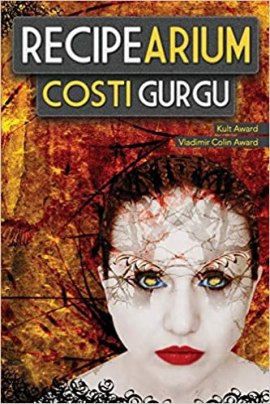
Diary Water cover finalIn a scene of my near-future eco-thriller A Diary in the Age of Water (Inanna Publications, 2020) the diarist’s young colleague Daniel rather too enthusiastically proclaims the impending extinction of males.

“Scientists all agree that environmental factors are the main triggers for male and female infertility through epigenetics…Epigenetics rules climate change-related adaptations. And everything appears stacked heavily for females and intersex humans. Males might go extinct with climate change!”

–A Diary in the Age of Water

Lynna Dresden, the diarist in A Diary in the Age of Water, thinks Daniel rather buffoonish and a traitor to his male kind. Then again, here is how another Daniel starts his article in a 2018 issue of GQ Magazine entitled “Sperm Count Zero“:

Men are doomed. Everybody knows this. We’re obviously all doomed, the women too, everybody in general, just a waiting game until one or another of the stupid things our stupid species is up to finally gets us. But as it turns out, no surprise: men first. Second instance of no surprise: We’re going to take the women down with us.

There has always been evidence that men, throughout life, are at higher risk of early death—from the beginning, a higher male incidence of Death by Mastodon Stomping, a higher incidence of Spiked Club to the Brainpan, a statistically significant disparity between how many men and how many women die of Accidentally Shooting Themselves in the Face or Getting Really Fat and Having a Heart Attack. The male of the species dies younger than the female—about five years on average. Divide a population into groups by birth year, and by the time each cohort reaches 85, there are two women left for every man alive. In fact, the male wins every age class: Baby boys die more often than baby girls; little boys die more often than little girls; teenage boys; young men; middle-aged men. Death champions across the board.

Now it seems that early death isn’t enough for us—we’re on track instead to void the species entirely.

–Daniel Noah Halpern, GQ Magazine

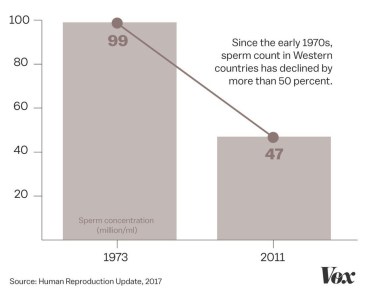
sperm_decline_chartBoth Daniels are talking about the alarming rate at which sperm counts worldwide are falling. They’ve dropped by half in the last fifty years in North America, Europe, Australia and New Zealand—according to a 2017 paper by researchers at Hebrew University and Mount Sinai medical school and more recent studies in 2018.

While an unhealthy lifestyle (being overweight or obese, smoking, stress and alcohol or recreational drug use) is most often implicated, more insidious causes exist.

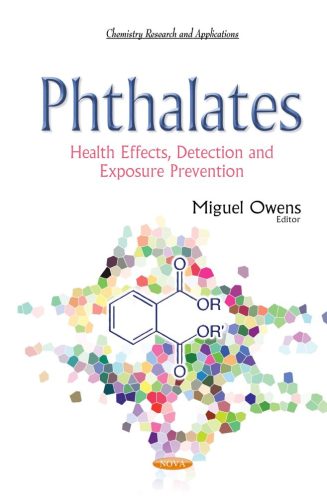
PHTHALATESResearch shows that consumption and/or exposure to many common constituents of urban living can decrease fertility, increase miscarriage, spontaneous abortion, and lower auto-immune systems. Examples include car exhaust, pesticides, common detergents, hair dyes, cleaning solvents, oil based paints, adhesives, gasoline; and consumption of MSG, coffee, alcohol.

A 2019 study by scientists at Nottingham University identified two chemicals common in home environments that damage sperm in men and dogs. GQ Daniel goes on to explain: “Phthalates and BPA [used to make plastic soft and flexible or harder and stronger] for example, mimic estrogen in the bloodstream. If you’re a man with a lot of phthalates in his system, you’ll produce less testosterone and fewer sperm. If exposed to phthalates in utero, a male fetus’s reproductive system itself will be altered: He will develop to be less male.”

sperm count and platics

This leads Age of Water Daniel to bring up the rise in intersex mammals (individuals born with any of several variations in sex characteristics including chromosomes, gonads, sex hormones or genitals that do not fit the “strict definitions for ‘male’ or ‘female’ bodies”). A 2016 article in Environmental Health Insights by Rich et al. attribute an increasing number of human children born with intersex variation to an increase in hormone disrupting chemicals in our environment.

Phthalates bookLeaning on his microscope, Daniel went on, “Wherever there’s a sewage treatment plant, pulp and paper mill, or herbicides and pesticides in a stream, you get endocrine disruption, which causes more female or intersex fish populations…[Degradation products of surfactants used in commercial and household detergents] inhibit breeding in male fish. And herbicides like atrazine—”

“—Create feminized males with female eggs, along with reduced immunity to disease,” I finished for him.

I knew all this. Hormonal disruption is global. Environmental toxicologists have been finding it in many aquatic animals like fish, turtles, alligators and frogs. And some terrestrial animals…Even humans…Was it also causing the steep rise in ambiguous sex in humans? Is Daniel an intersex human? Apparently 1 in 30 now have bodies that differ notably from standard male or female. Klinefelter, androgen insensitivity syndrome, presence of ovotestes, mixed gonadal dysgenesis, and mosaic genetics are all on the rise. Which was he?

As if he knew what I was thinking, Daniel said dramatically, “The environment is changing us faster than most think and it’s doing it through epigenetics and HGT.”

–A Diary in the Age of Water

Phthalates and BPA can be found everywhere. GQ Daniel lists them: “BPA can be found in water bottles and food containers and sales receipts. Phthalates are even more common: They are in the coatings of pills and nutritional supplements; they’re used in gelling agents, lubricants, binders, emulsifying agents, and suspending agents. Not to mention medical devices, detergents and packaging, paint and modeling clay, pharmaceuticals and textiles and sex toys and nail polish and liquid soap and hair spray. They are used in tubing that processes food, so you’ll find them in milk, yogurt, sauces, soups, and even, in small amounts, in eggs, fruits, vegetables, pasta, noodles, rice, and water. The CDC determined that just about everyone in the United States has measurable levels of phthalates in his or her body—they’re unavoidable.”

These chemicals affect sperm’s ability to swim, navigate and fertilize an egg. DNA fragmentation in the sperm head also occurs, which is basically equivalent to a sperm having a brain hemorrhage. Recent studies suggest that 20-30% of young men today have sperm counts in a range that is associated with reduced fertility. Sarbjit Kaur at the Punjab Agricultural University found that men who live in industrial cities had six times more abnormal sperm than men living in a relatively clean rural town.

TheHandmaid'sTale-bookDr. Marilyn F. Vine at the University of North Carolina demonstrated that smoking men had lower sperm counts by 13-17%. Smokers also had more abnormal sperm. Likewise, women who smoked experienced more spontaneous abortions, early menopause and abnormal oocytes. Follicular fluid also contained high levels of cadmium, a heavy metal present in cigarettes, and cotininie, a metabolite of nicotine.

A growing concern for infertility has entered our general mindset, reflected in the theme of infertility in literature and motion pictures.

Notable examples include Margaret Atwood’s The Handmaid’s Tale (1985), Raising Arizona (1987), Aeon Flux (2005), The Children of Men (2006), Private Life (2018) and my own A Diary in the Age of Water (2020).

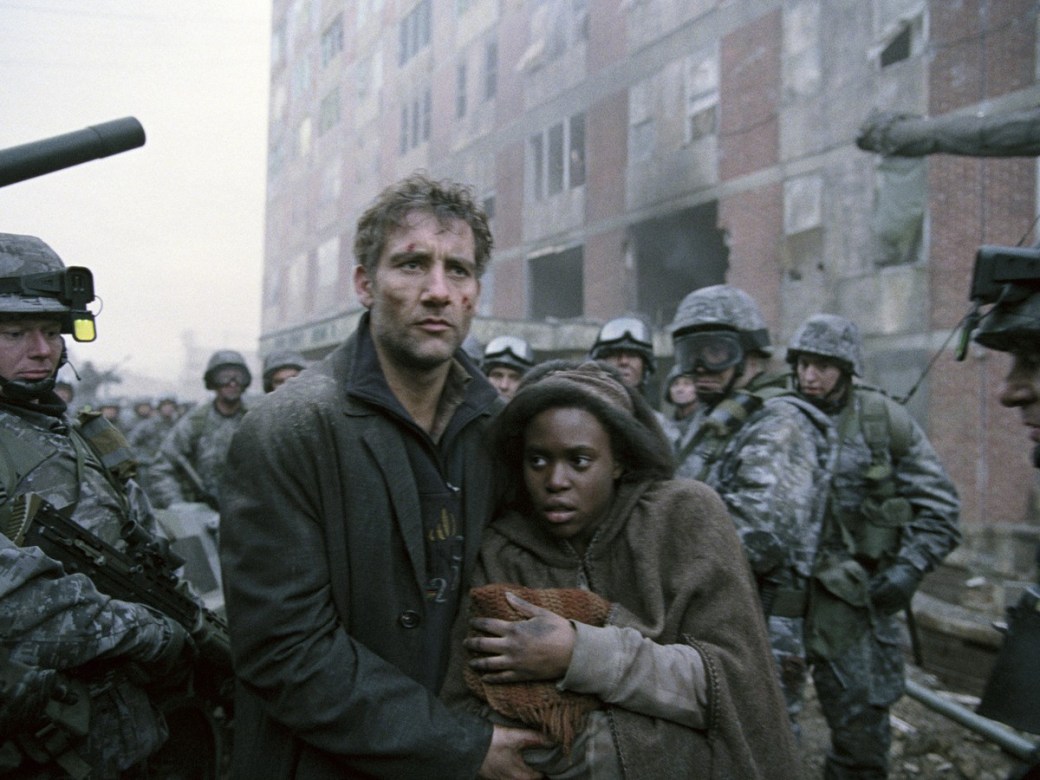
Although we are not close to experiencing the global infertility pandemic portrayed in the barren 2027 world of The Children of Men, this cautionary tale of a world gone mad with grief should linger like the whispered truth of a fairy tale.

children of men scene

scene from “Children of Men” motion picture


Suggested Reading:

Carr, Teresa. 2019. “Sperm counts are on the decline—could plastics be to blame?” The Guardian.

Belluz, Julia. 2019. “Sperm counts are falling. This isn’t the reproductive apocalypse—yet” Vox.

Halpern, Daniel Noah. 2018. “Sperm Count Zero.” GQ Magazine.

Fetters, Ashley. 2018. “Sperm Counts Continue to Fall.” The Atlantic.

Stein, Rob. 2017. “Sperm Counts Plummet in Western Men, Study Finds.” NPR.


nina-2014aaa

Nina Munteanu is a Canadian ecologist / limnologist and novelist. She is co-editor of Europa SF and currently teaches writing courses at George Brown College and the University of Toronto. Visit www.ninamunteanu.ca for the latest on her books. Nina’s bilingual “La natura dell’acqua / The Way of Water” was published by Mincione Edizioni in Rome. Her non-fiction book “Water Is…” by Pixl Press (Vancouver) was selected by Margaret Atwood in the New York Times ‘Year in Reading’ and was chosen as the 2017 Summer Read by Water Canada. Her novel “A Diary in the Age of Waterwill be released by Inanna Publications (Toronto) in June 2020.
The Aggressive Symbiosis of SARS-CoV-2: Seeking Balance in an Unbalanced World

SARS-CoV-2

SARS-CoV-2

In the following scene of my upcoming speculative novel “Thalweg” (set in 2053 Toronto) one of my characters, Daniel–who is a bit of a conspiracy theorist–is trapped in an old abandoned garage, about to fight off a pack of stray dogs. His feverish mind thinks back to the COVID-19 pandemic:

“The official story was that SARS-CoV-2, which caused the COVID-19 pandemic of the early ‘20s resulted from the recombination of two previous viruses in some host—supposedly a bat or pangolin—which then ended up in a Wuhun wet market; there, the recombined virus gleefully jumped species to humans, who, in turn, gleefully spread it worldwide. But, according to the study at the Wuhun hospital, patient zero hadn’t been anywhere near the wet market. So, where did the virus really come from?…”

Daniel then recalls a conversation he had–when he still had a job–with colleague Lynna in which he  suggested that the chimera virus–and the others that followed–were developed as a bioweapon through Gain-of-Function research and they somehow leaked into the public. To her scoff, he reminded her that the aim of GOF research is to induce an increase in the transmissibility and/or virulence of pathogens. He then provided numerous examples involving Influenza, SARS, and MERS.

Influenza virus

Influenza virus

Did she know, for instance, that in 2014 Obama put a funding moratorium on all GOFR experiments that might enhance virus pathogenicity or transmissibility in mammals via the respiratory route. Then in 2017, under the Trump administration, the NIH turned it all back on.

squirrel monkey

Squirrel monkey

Lynna responded calmly with a convincing argument, based on science and ecology. “Sure, they could be that,” she acknowledged thoughtfully. “Or they could simply be more cases of co-evolution and aggressive symbiosis…” Then she informed Daniel that viruses commonly form aggressive relationships with their hosts. Every monkey, baboon, chimpanzee and gorilla is carrying at least ten different species of symbiotic viruses, she said. The herpes-B virus that chums with the squirrel monkey is one example. The virus and an immunity to it passes harmlessly from mother to baby monkey. If a rival species like the marmoset monkey invades their territory, the virus jumps species and wipes out the challenger by inducing cancer in the competing marmoset monkey. Ebola and hantavirus outbreaks follow a similar pattern of “aggressive symbiosis.”

This community-symbiosis functions like an ecosystem’s “immune system” that protects its own from the encroachment of invading species—even when that invading species is us.

—excerpt from Nina Munteanu’s “Thalweg” (upcoming)


Aggressive Symbiosis & Virus X

Virus X FrankRyanIn his book Virus X, Dr. Frank Ryan coined the term aggressive symbiosis to explain a common form of symbiosis where one or both symbiotic partners demonstrates an aggressive and potentially harmful effect on the other’s competitor or potential predator. Examples abound, but a few are worth mentioning. In South American forests, a species of acacia tree produces a waxy berry of protein at the ends of its leaves that provides nourishment for the growing infants of the ant colony residing in the tree. The ants, in turn, not only keep the foliage clear of herbivores and preying insects through a stinging assault, but they make hunting forays into the wilderness of the tree, destroying the growing shoots of potential rivals to the acacia.

bamboo rising copy

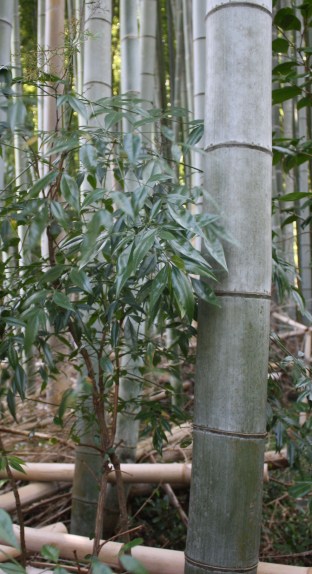
Bamboo forest near Kyoto, Japan (photo by Nina Munteanu)

In Borneo, a species of rattan cane has developed a symbiotic relationship with a species of ants. The ants make a nest around the cane and drink its sweet sap. The ants, in turn, protect the cane. When a herbivore approaches to feed on the leaves, the ants attack.

Ryan draws an analogy between this aggressive symbiotic partnership and that of new zoonotic agents of disease. He argues that when it comes to emerging viruses, animals are the cane and ants are the virus.

Viruses & Zoonotic Agents of Disease

Ryan suggests that Ebola and hantavirus outbreaks follow a pattern of aggressive symbiosis. This may explain why Ebola is so virulent. The Ebola virus is so fierce that victims don’t make it very far to infect others, suggesting that the virus is an evolutionary failure. However, if the virus is acting as an aggressive symbiont, it may be fulfilling its evolutionary purpose by protecting a host species we haven’t yet identified.

Aztecs and Spaniards

Azteks meet Spaniards who bring smallpox

Historian William H. McNeill suggested that a form of aggressive symbiosis played a key role in the history of human civilization. “At every level of organization—molecular, cellular, organismic, and social—one confronts equilibrium [symbiotic] patterns. Within such equilibria, any alteration from ‘outside’ tends to provoke compensatory changes [aggressive symbiosis] throughout the system to minimize overall upheaval.”

One of a legacy of examples of aggressive symbiosis in history includes smallpox: the Europeans introduced smallpox (symbiotically co-evolved with them) to the Aztecs with devastating results. Other examples of aggressive symbiosis include measles, malaria, and yellow fever.


Wet Markets & Factory Farming

CHINESE MAN DOG RABBIT

Inhumane and unsafe treatment of animals in wet market in China

The National Observer gives a vivid description of the potential for zoonotic viral spread in the world’s wet markets, particularly in Wuhun:

“Dozens of species that rarely, if ever, come in contact with one another in the wild ― fish, turtles, snakes, bamboo rats, bats, even foxes and wolf cubs ― are confined in close quarters, waiting to be butchered and sold. The animals are often stressed, dehydrated and shedding live viruses; the floors, stalls and tables are covered in blood, feces and other bodily fluids.

This is the scene at many of China’s so-called “wet markets,” where a poorly regulated wildlife trade thrives and creates conditions that experts say are ideal for spawning new diseases.

“You could not design a better way of creating pandemics,” said Joe Walston, head of global conservation at the nonprofit Wildlife Conservation Society. “It’s really the perfect mechanism, not just for the Wuhan coronavirus but for the next ones that will undoubtedly emerge sooner rather than later.”

Zoonotic diseases, or diseases that can leap from animals to humans, are not uncommon and they don’t always come from exotic animals, writes Ari Solomon of Veganista. “Many come from the animals we regularly farm and eat. The 1918 influenza pandemic, or the Spanish flu, infected more than 500 million people and killed between 40-50 million worldwide. It is now commonly believed that the disease originated in birds. When the H1N1 virus, the same strain that caused the Spanish flu, showed up again in 2009, it first emerged in pigs. Tuberculosis, mad cow disease, and pig MRSA also came from animals exploited for food.”

cows-seelisberg02

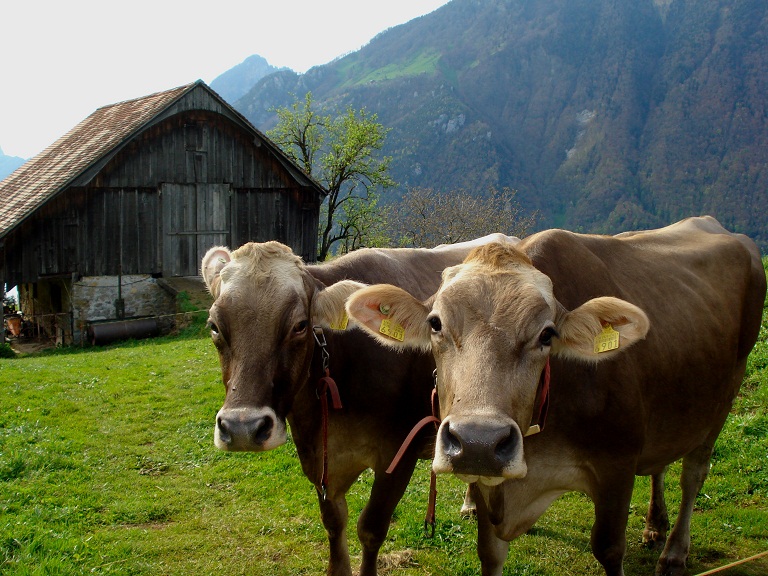
Happy cows in Seelisberg, Switzerland (photo by Nina Munteanu)

In 2004, Linda Saif, with the Department of Food Animal Health Research Program at the Ohio Agricultural Research and Development Center summarizes a number of farm and domestic animal reservoirs of zoonotic corona viruses that have caused human diseases historically and many that may still do so through recombinations. Animals have included cows (BCoV), pigs (PEDV and PRCV), chickens (IBV, turkeys, cats (FCoV and FIPV), ferrets and macaques. Saif cautions that, given an estimated 75% of newly emerging human diseases arise as zoonoses (from wild or farm animals), interspecies transmission poses a continued threat to human health.

Wet markets aren’t the only places where animals are kept under and treated with cruelty and lack of any compassion or kindness:

“Thanks to the advent of factory farming, billions of animals are routinely kept in crammed, filthy conditions that cause them extreme stress. This abhorrent practice creates the perfect breeding ground for new diseases to thrive. Add to that the fact that we regularly feed factory farmed animals low-doses of antibiotics and we really have a recipe for disaster.”—Ari Solomon, Veganista

It comes down to balance. Something about which the human species has much to learn.

costa-maya-09-close

Buttressed fig tree in Costa Maya (photo by Nina Munteanu)

It is clear to me that these pandemics are exacerbated—if not outright caused by—our dense over-population and an exploitation mentality: our encroachment and defilement of natural habitats and the life that inhabits them. Gaia is suggesting that we live more lightly on this planet. Her ecosystems are responding to our aggression with equal aggression. And, make no mistake, we won’t win that battle. Just as we won’t win the battle with changing climate. It’s time to learn humility as a species in a diverse world. Time to cultivate respect for our life-giving environment. Time to learn the power of  kindness.

The National Observer recently ran an article stating that: “COVID-19 and other health endemics are directly connected to climate change and deforestation, according to Indigenous leaders from around the world who gathered on March 13, in New York City, for a panel on Indigenous rights, deforestation and related health endemics.” The virus is telling the world what Indigenous Peoples have been saying for thousands of years: that “if we do not help protect biodiversity and nature, we will face this and even worse threats,” said Levi Sucre Romero, a BriBri Indigenous person from Costa Rica and co-ordinator of the Mesoamerican Alliance of Peoples and Forests (AMPB).

Many environmental experts agree that the novel coronavirus will only be the first in waves of pandemics we can expect if we ignore links between infectious diseases and the destruction of the natural world.

bamboo-close01 copy

Bamboo, Japan (photo by Nina Munteanu)

“I’m absolutely sure that there are going to be more diseases like this in future if we continue with our practices of destroying the natural world,” said marine ecologist Dr Enric Sala to the Independent.


Reiterating the work of Dr. Frank Ryan, David Quammen, author of 2012 Spillover: Animal Infections and the Next Human Pandemic told the Independent: “Our highly diverse ecosystems are filled with many species of wild animals, plants, fungi and bacteria. All of that biological diversity contains unique viruses.” This unique community has developed over many many years into a functional community symbiosis in which viruses play an important part.

“There’s misapprehension among scientists and the public that natural ecosystems are the source of threats to ourselves. It’s a mistake. Nature poses threats, it is true, but it’s human activities that do the real damage. The health risks in a natural environment can be made much worse when we interfere with it,” says Richard Ostfeld, senior scientist at the Cary Institute of Ecosystem Studies in Millbrook, New York.

He and others are developing the emerging discipline of planetary health, which looks at the links between human and ecosystem health.

The disruption of pristine forests driven by logging, mining, road building through remote places, rapid urbanisation and population growth is bringing people into closer contact with animal species they may never have been near before, said Kate Jones, chair of ecology and biodiversity at UCL to The Guardian.

“We are researching how species in degraded habitats are likely to carry more viruses which can infect humans,” says Jones. “Simpler systems get an amplification effect. Destroy landscapes, and the species you are left with are the ones humans get the diseases from…We are going into largely undisturbed places and being exposed more and more. We are creating habitats where viruses are transmitted more easily, and then we are surprised that we have new ones.”

“It’s like if you demolish an old barn then dust flies. When you demolish a tropical forest, viruses fly. Those moments of destruction represent opportunity for unfamiliar viruses to get into humans and take hold.”–David Quammen

It’s aggression meeting aggression.

“Community-symbiosis functions like an ecosystem’s ‘immune system’ that protects its own from the encroachment of invading species—even when that invading species is us.”–Lynna Dresden, in Nina Munteanu’s Thalweg


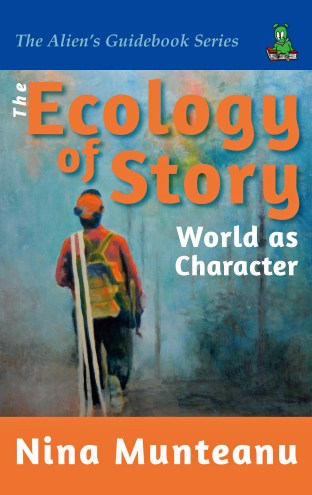
EcologyOfStoryFor more on “ecology” and a good summary and description of environmental factors like aggressive symbiosis and other ecological relationships, read my book “The Ecology of Story: World as Character” (Pixl Press, 2019).

Glossary of Terms: 

Aggressive Symbiosis: a common form of symbiosis where one or both symbiotic partners demonstrates an aggressive and potentially harmful effect on the other’s competitor or potential predator (Ryan, 1997).

Co-evolution: when two or more species reciprocally affect each other’s evolution through the process of natural selection and other processes. 

Gain-of-Function Research (GOFR): involves experimentation that aims or is expected to (and/or, perhaps, actually does) increase the transmissibility and/or virulence of pathogens (Selgelid, 2016). 

Patient Zero: the person identified as the first carrier of a communicable disease in an outbreak of related cases. 

Recombination: the process by which pieces of DNA are broken and recombined to produce new combinations of alleles. This recombination process creates genetic diversity at the level of genes that reflects differences in the DNA sequences of different organisms.

Symbiosis: Greek for “companionship” describes a close and long term interaction between two organisms that may be beneficial (mutualism), beneficial to one with no effect on the other (commensalism), or beneficial to one at the expense of the other (parasitism). (Munteanu, 2019).

Zoonosis: a zoonotic disease, or zoonosis, is one that can be transmitted from animals, either wild or domesticated, to humans (Haenan et al., 2013).

Virus: a sub-microscopic infectious agent that replicates only inside the living cells of an organism. The virus directs the cell machinery to produce more viruses. Most have either RNA or DNA as their genetic material.


References:

Frazer, Jennifer. 2015. “Root Fungi Can Turn Pine Trees Into Carnivores—or at Least Accomplices.” Scientific American, May 12, 2015. Online: https://blogs. scientificamerican.com/artful-amoeba/root-fungi-can-turn-pine-trees-into- carnivores-8212-or-at-least-accomplices/

Munteanu, N. 2019. “The Ecology of Story: World as Character.” Pixl Press, Vancouver, BC. 198pp. (Section 2.7 Evolutionary Strategies)

Munteanu, N. 2020. “A Diary in the Age of Water.” Inanna Publications, Toronto.

Ryan, Frank, M.D. 1997. “Virus X: Tracking the New Killer Plagues.” Little, Brown and Company, New York, N.Y. 430pp.

Ryan, Frank, M.D. 2009. “Virolution.” Harper Collins, London, UK. 390pp.

Saif, Linda J. 2004. “Animal Coronaviruses: lessons for SARS.” In: “Learning from SARS: Preparing for the Next Disease Outbreak: Workshop Summary.” National Academies Press (US), Kobler S., Mahmoud A., Lemon S., et. al. editors. Washington (DC).

Selgelid, Michael J. 2016. “Gain-of-Function Research: Ethical Analysis.” Sci Eng Ethics 22(4): 923-964.

VanLoon, J. 2000. “Parasite politics: on the significance of symbiosis and assemblage in theorizing community formations.” In: Pierson C and Tormey S (eds.), Politics at the Edge (London, UK: Political Studies Association)

Villarreal LP, Defilippis VR, and Gottlieb KA. 2000. “Acute and persistent viral life strategies and their relationship to emerging diseases.” Virology 272:1-6. Online: http://bird uexposed.com/resources/Villarreal1.pdf

Wohlleben, Peter. 2015. “The Hidden Life of Trees.” Greystone Books, Vancouver, BC. 272pp.


nina-2014aaa

Nina Munteanu is a Canadian ecologist / limnologist and novelist. She is co-editor of Europa SF and currently teaches writing courses at George Brown College and the University of Toronto. Visit www.ninamunteanu.ca for the latest on her books. Nina’s bilingual “La natura dell’acqua / The Way of Water” was published by Mincione Edizioni in Rome. Her non-fiction book “Water Is…” by Pixl Press (Vancouver) was selected by Margaret Atwood in the New York Times ‘Year in Reading’ and was chosen as the 2017 Summer Read by Water Canada. Her novel “A Diary in the Age of Waterwill be released by Inanna Publications (Toronto) in June 2020.

Corona Virus Testing in a World of False Negatives

Atlantic salmon farm escape copy

broken enclosure of Mowi fish farm off British Columbia coast

Some time ago, I wrote an article to express my dismay about some poor science reporting by CTV on the escape of Atlantic farm fish into native fish waters of the Pacific. My dismay arose for two reasons: 1) the ecological impacts of this accident; and 2) the failure of CTV in appropriately reporting the seriousness of it. Their biased and incomplete reporting failed to include accurate and relevant scientific expertise (they did, however, include the biased accounts of irrelevant “experts” who were associated with the fish farm company).

Need for Better Risk Management (Type 1 and Type 2 Errors in Risk Assessment) 

The scientific method relies on accurately measuring certainty and therefore reliably predicting risk. This means accounting for all biases and errors within an experiment or exploration. In my work as a field scientist and environmental consultant representing a client, we often based our formal hypotheses in statistics, which considered two types of error: Type 1 and Type 2 errors.

Type 1 errors are false positives: a researcher states that a specific relationship exists when in fact it does not. This is akin to an alarm sounding when there’s no fire.

Type 2 errors are false negatives: the researcher states that no relationship occurs when in fact it does. This is akin to no alarm sounding during a fire.

Put simply, environmental risk management assesses two types of cost through statistical probability: one to environment and one to investment. Risk analyses are often used in cost-benefit analyses in which the risk posed by errors as a cost to the environment vs a cost to revenue are assessed and balanced. Type 1 errors create false positives (that a cost to environment exists when there is little or none). Type 2 errors create false negatives (that there is no cost to environment when there is). Industry and their consultants predominantly focus on avoiding Type 1 errors (while often ignoring Type 2 errors) to protect their investments.

The reason why the down-playing remarks made by vet Mitchell and the fish farm company in British Columbia are so dangerous is because they make assumptions that are akin to not sounding an alarm when there is a fire; they are committing a Type 2 error and increasing the risk of a false negative. In risk assessment, this is irresponsible. And ultimately dangerous. Instead of targeting “environmentalists” “activists” and certain groups for opinions on issues, CTV should have sought out evidence-based science through scientists with relevant knowledge (e.g. an ecologist—not an economist or a vet (particularly one associated with the culprit)—for an environmental issue). Does this sound familiar on the topic of COVID-19 and the behaviour of the Trump administration?

The Difference Between Perceived Cases and Actual Cases

In his comprehensive March 10 article Coronavirus: Why You Must Act Now in The Medium, Tomas Pueyo argued that Washington State is America’s “Wuhun”:

“The number of cases there [in Washington State] are growing exponentially. It’s currently at 140. But something interesting happened early on. The death rate was through the roof. At some point, the state had 3 cases and one death. We know from other places that the death rate of the coronavirus is anything between 0.5% and 5% (more on that later). How could the death rate be 33%?

It turned out that the virus had been spreading undetected for weeks. It’s not like there were only 3 cases. It’s that authorities only knew about 3, and one of them was dead because the more serious the condition, the more likely somebody is to be tested…they only knew about the official cases and they looked good: just 3. But in reality, there were hundreds, maybe thousands of true cases.”


The False Negatives in Corona Virus Testing

In a March 11 The Atlantic article entitled “What Will You Do If You Start Coughing?”, Dr. James Hamblin mentioned the 1.5 million diagnostic tests for the Corona virus to be made available by the end of last week in the United States (according to Vice President Mike Pence). They never materialized. “But even when these tests eventually are available, some limitations will have to be realized,” Hamblin wrote.

For instance, these tests are diagnostic tests—not screening tests.

“The difference comes down to a metric known as sensitivity of the test: how many people who have the virus will indeed test positive. No medical test is perfect. Some are too sensitive, meaning that the result may say you’re infected when you’re actually not. Others aren’t sensitive enough, meaning they don’t detect something that is actually there. The latter is the model for a diagnostic test. These tests can help to confirm that a sick person has the virus; but they can’t always tell you that a person does not. When people come into a clinic or hospital with severe flu-like symptoms, a positive test for the new coronavirus can seal the diagnosis. Screening mildly ill people for the presence of the virus is, however, a different challenge.”

‘The problem in a scenario like this is false negatives,’ says Albert Ko, the chair of epidemiology of microbial diseases at the Yale School of Public Health. If you wanted to use a test to, for example, help you decide whether an elementary-school teacher can go back to work without infecting his whole class, you really need a test that will almost never miss the virus.”

“An inaccurate test—one prone to false positive or false negative results, can be worse than no test at all,” argues Ian Lipkin, an epidemiology professor at Columbia University. The CDC has not shared the exact sensitivity of the testing process it has been using. When Anthony Fauci, the director of the National Institute of Allergy and Infectious Diseases, was asked about it on Monday, he hedged: “If it’s positive, you absolutely can make a decision,” he said. If it’s not, that’s a judgment call, he said.

Corona virus testing drive through Germany

Doctor in Germany testing for COVID 19

Diagnostic testing is a classic case of a Type 2 error scenario: increasing the risk of concluding that there is no fire when there is one. It is a highly combustable (pardon the pun) scenario. False negatives can breed over-confidence. In the case of a disease, this can lead to people who are actually sick spreading the disease further when they should be self-isolating.

The absence of a quick, sensitive, ubiquitous screening test that can decisively rule out coronavirus infection—and send healthy people back out into the world to work and to live—presents unique and grave challenges.

Back to the environment (of which diseases are of course a part):

The Need for The Precautionary Principle in Environmental Science and Reporting 

Environmental scientists generally pride themselves on the use of the Precautionary Principle when dealing with issues of sustainability and environmental management. According to the Precautionary Principle, “one shall take action to avoid potentially damaging impacts on nature even when there is no scientific evidence to prove a causal link between activities and effects.” The environment should be protected against substances (such as an exotic species) which can be assumed potentially harmful to the current ecosystem, even when full scientific certainty is lacking.

Botanical Beach tidal pools

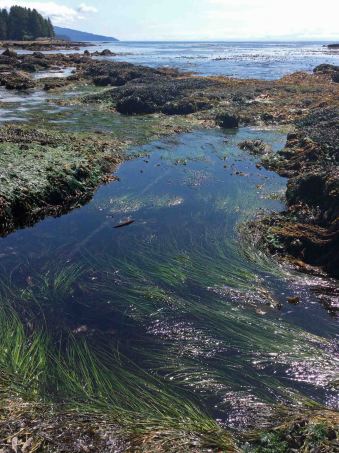
Botanical Beach, BC

Unfortunately, politicians, engineers and the scientists who work for them tend to focus on avoiding Type 1 rather than Type 2 statistical errors. To avoid the risk of cost; they risk the environment. There is an irony to this, though. In fact, by traditionally avoiding Type 1 errors, scientists increase the risk of committing Type 2 errors, which increases the risk that an effect will not be observed, in turn increasing risk to environment. Environmental effects in turn incur added costs, which are often far greater in the end.

In describing the case of the eutrophication of a Skagerrak (a marine inlet), Lene Buhl-Mortensen asks which is worse: risk a Type 2 error and destroy the soft bottom habitat of Skagerrak and perhaps some benthic species, or risk a Type 1 error and spend money on cleaning the outfalls to Skagerrak when in fact there is no eutrophication? “Scientists have argued that cleaning up is too expensive and should not be done in vain,” writes Buhl-Mortensen. “But more often the opposite is the case. The increased eutrophication of Skagerrak could end up more costly than reducing the outfalls of nutrients [to the inlet].”

“Because threats to the environment are threats to human welfare, ecologists have a prima facie ethical obligation to minimize Type 2 errors,” argues Buhl-Mortensen in the journal Marine Pollution Bulletin.

We can draw lessons from these environmental science examples in addressing disease—such as the current Corona virus pandemic. Differing strategies of countries to the COVID-19 pandemic have resulted in Type 2 (economy-driven; no fire when there is one) or Type 1 (health-driven; fire when there may not be one…yet) scenarios—with revealing results. Countries like Taiwan, Singapore, Hong Kong, and Japan have acted pro-actively and decisively with excellent results in containment and mitigation. Others such as the USA, France, Spain, Germany, and Switzerland have lagged behind, with disastrous results.

DailyGrowthRate of COVID Cases

The strategy taken by the Trump Administration on major issues from climate change (by denying it) to the recent COVID-19 pandemic (by downplaying it) exemplifies the promotion of false negatives, with disastrous results.

The incredibly irresponsible behaviour of the Trump administration will more than likely cause more deaths than otherwise. This behaviour is borderline criminal.

Peter Wehner of The Atlantic reported that, “The president reportedly ignored early warnings of the severity of the virus and grew angry at a CDC official who in February warned that an outbreak was inevitable. The Trump administration dismantled the National Security Council’s global-health office, whose purpose was to address global pandemics; we’re now paying the price for that…We may face a shortage of ventilators and medical supplies, and hospitals may soon be overwhelmed, certainly if the number of coronavirus cases increases at a rate anything like that in countries such as Italy. (This would cause not only needless coronavirus-related deaths, but deaths from those suffering from other ailments who won’t have ready access to hospital care.)”

Trump is not the only politician who has purposely downplayed the disease or obstructed science and its disclosures to the public. This has been happening from the beginning. Writes Laurie Garrett in the March 11, 2020 issue of the Lancet:

“Had China allowed physician Li Wenliang and his brave Wuhan colleagues to convey their suspicions regarding a new form of infection pneumonia to colleagues, social media, and journalists without risking sanction, and had local officials not for weeks released false epidemic information to the world, we might not now be facing a pandemic. Had Japanese officials allowed full disclosure of their quarantine and testing procedures aboard the marooned Princess Diamond cruise ship, crucial attention might have helped prevent spread aboard the ship and concern in other countries regarding home return of potentially infectious passengers. Had Shincheonji Church and its supporters within the South Korean Government not refused to provide the names and contact information on its members and blocked journalists’ efforts to decipher spread of the virus in its ranks, lives in that country might have been spared infection, illness, and death. Had Iran’s deputy health minister, Iraj Harirchi, and members of the country’s ruling council not tried to convince the nation that the COVID-19 situation was “almost stabilized”, even as Harirchi visibly suffered from the disease while on camera, the Middle East might not now find itself in grave danger from the spread of the disease, with Saudi Arabia suspending visas for pilgrims seeking to visit Mecca and Medina. Neither Iran nor Saudi Arabia has are and open journalism, and both nations seek to control narratives through social media censorship, imprisonment, or even execution.”

COVID 19 testing in Calgary

Drive through COVID 19 testing in Calgary

According to Pueyo, countries that are prepared (e.g. containment and mitigation through en masse social distancing) will see a fatality rate closer to 0.5% (South Korea) to 0.9% (rest of China); while countries that are overwhelmed will experience a fatality rate closer to 3% and 5% if not higher. “Put in another way,” writes Pueyo, “Countries that act fast reduce the number of deaths at least by 10x.”

COVID-19-Epidemiology

Given that 26% of contagions happen before there are symptoms, use of the precautionary principle will save lives—and ultimately all costs—in the end.


nina-2014aaa

Nina Munteanu is a Canadian ecologist / limnologist and novelist. She is co-editor of Europa SF and currently teaches writing courses at George Brown College and the University of Toronto. Visit www.ninamunteanu.ca for the latest on her books. Nina’s bilingual “La natura dell’acqua / The Way of Water” was published by Mincione Edizioni in Rome. Her non-fiction book “Water Is…” by Pixl Press (Vancouver) was selected by Margaret Atwood in the New York Times ‘Year in Reading’ and was chosen as the 2017 Summer Read by Water Canada. Her novel “A Diary in the Age of Waterwill be released by Inanna Publications (Toronto) in June 2020.

The Subversive Side of Colonization & The Emerald Ash Tree Borer

Col-o-ni-zation: 1) the action by a plant or animal of establishing itself in a [new] area; 2) the action of appropriating a place or domain for one’s own use; 3) the action or process of settling among and establishing control over the indigenous people [or other native species] of an area.


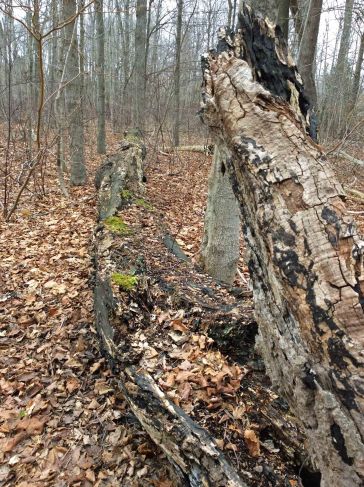
AshTree decaying-EastDonRiver

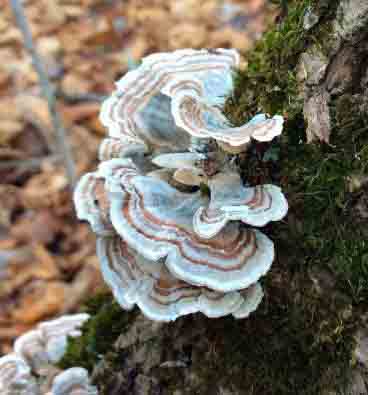
Ash tree decays with help from colonizing blue stain fungus (photo by Nina Munteanu)

In a previous article, I wrote about how escaped Atlantic salmon from farm pens in the Pacific posed a threat to the wild Pacific salmon. Some argue that these interlopers will outcompete their Pacific cousins for habitat and food like many exotics when they are first introduced (think of Purple loosestrife in Canada).

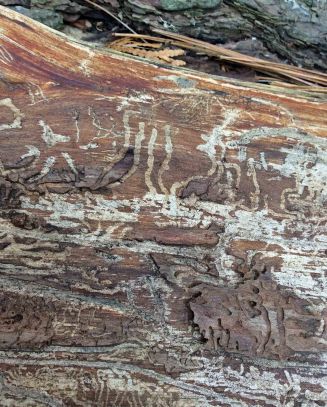
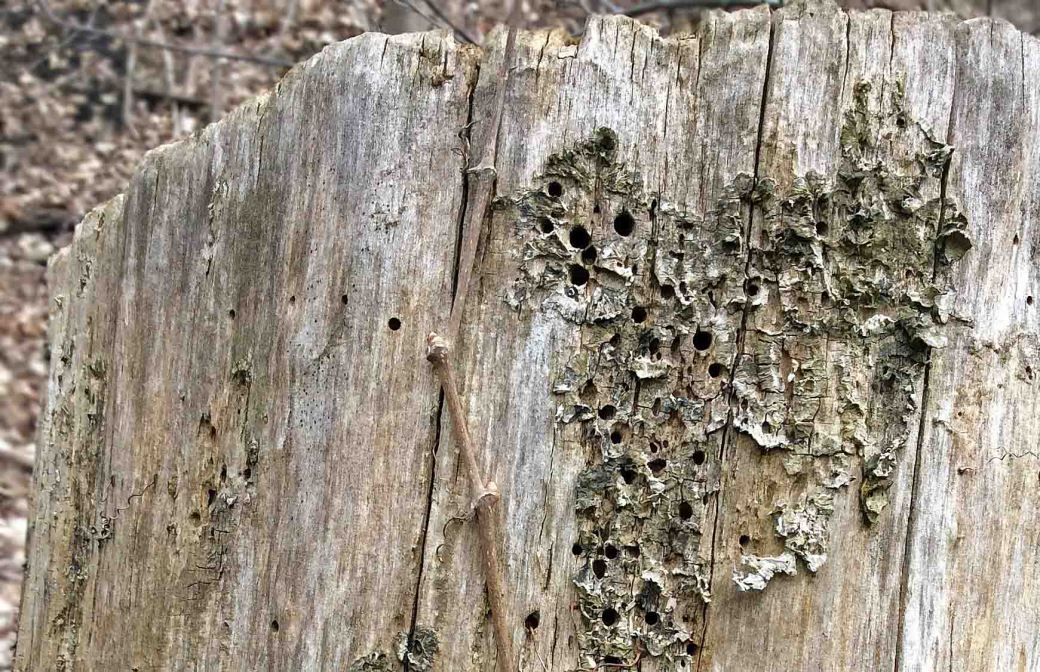
Tree-bore holes close-EDRpark

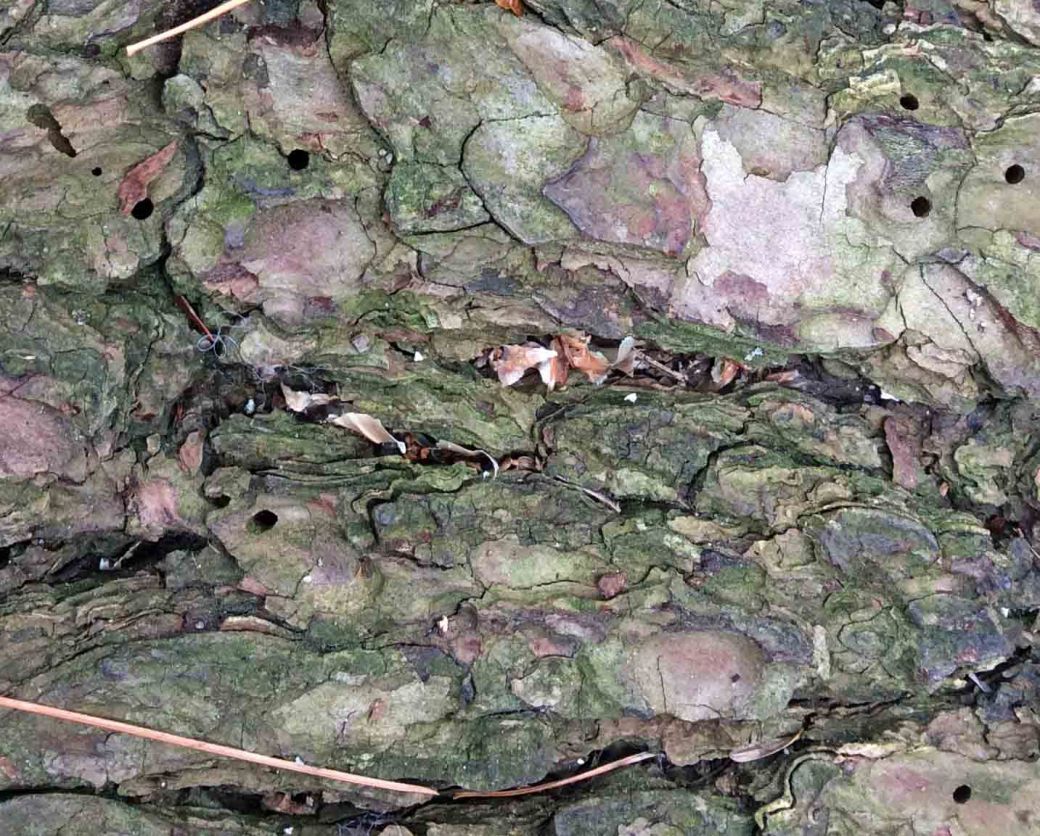
Insect bore holes in dead tree (photo by Nina Munteanu)

Purple loosestrife spread rapidly across North America’s wetlands, roadsides and disturbed areas after it was introduced in the 1800s when its seeds were included in soil used as ballast in European sailing ships and discarded here; Purple loosestrife is present in nearly every Canadian province and almost every U.S. state. This plant can produce as many as two million seeds in a growing season, causing dense stands of purple loosestrife and outcompeting native plants for habitat. This results in changes to ecosystem functions such as reductions in nesting sites, shelter and food for the native birds, as well as an overall decline in biodiversity (which causes ecosystem fragility).

What we often forget to consider is the indirect impact of the invasive: disease. What something considered innocuous brings with it. When the Atlantic salmon was brought from its native Atlantic habitat to be farmed in the Pacific (because it grew so fast), it brought its toolkit of adaptations—and what it carried—that was unfamiliar to a vulnerable Pacific wild population. The piscine orthoreovirus (PRV) that makes the Atlantic salmon sick, kills the Pacific native (think how the European settlers inadvertently brought in smallpox that killed thousands of indigenous people in Canada).

Ash-bored-RougeJPG

Ash tree succumbs to Agrilus in Rouge Park (photo by Nina Munteanu)

The emerald ash borer (Agrilus planipennis) is a “disease” inadvertently brought in by Chinese or Russian traders to North America that is destroying the native ash tree (e.g. green ash, Fraxinus pennsylvanica; American ash, Fraxinus Americana; Black ash, F.nigra; Blue ash, F. quadrangulata). A native to East Asia, including China and the Russian Far East, the ash borer has no natural predator here. It was likely brought to North America on wood packaging materials in the early 1990s. They were first detected in Detroit, Michigan and Windsor, Ontario in 2002; and have since spread to more than 30 states and 5 provinces since. Most species of North American ash trees are vulnerable to the beetle, which has already killed millions of trees in Canada in forested and urban areas. No North American natural predators (e.g., woodpeckers, other insects or parasites) have slowed the spread of the emerald ash borer. Up to 99% of all ash trees are killed within 8-10 years once the beetle arrives in the area.

In a note on the text of his small collection of stories entitled “Trees Hate Us” (Odourless Press, 2019) E. Martin Nolan writes on behalf of the Ash tree:

Dying Ash-Patrick ButlerThe Emerald Ash Borer hasn’t a real predator here. Don’t blame it for doing what it does, for being in the crates humans ship across oceans. Killed 30 million in Michigan, where it was first found. It’ll kill clear to the ocean.

I am a living ash. For my own safety, I cannot disclose my name or location. Call me Last Ash. The humans do not understand why I lived. I believe it to be a curse—one I’m prepared to live out. Perhaps I contain a deformity that kills the beetle. Maybe I don’t attract it. Call that evolution. Your words will always be your words.

I have watched all of my kind die around me. Dying gives them the art of poetry. Foreknowledge of death opens their language so a human can hear it. One human. Immune, I am left alone like a city tree, to converse in prose among strange maples, birches, pines and firs reluctant to share speech with a member of so plagued a species. As I live out my natural days, these poems—at least the middle bit—will bring me some small contentment. And we may yet return. The trees’ story is long and slow, despite this lightning-fast shrapnel from the human timeline.

E. Martin NolanE Martin Nolan is a poet, essayist and editor. He edits interviews at The Puritan, where he’s also published numerous essays, interviews and blog posts. He teaches in the Engineering Communication Program at The University of Toronto, and is a PhD Candidate in Applied Linguistics at York University. Born and raised in Detroit, he received his Bachelor’s Degree in English Writing at Loyola University New Orleans, and received his Master’s in the Field of Creative Writing from the University of Toronto.


nina-2014aaa

Nina Munteanu is a Canadian ecologist / limnologist and novelist. She is co-editor of Europa SF and currently teaches writing courses at George Brown College and the University of Toronto. Visit www.ninamunteanu.ca for the latest on her books. Nina’s bilingual “La natura dell’acqua / The Way of Water” was published by Mincione Edizioni in Rome. Her non-fiction book “Water Is…” by Pixl Press (Vancouver) was selected by Margaret Atwood in the New York Times ‘Year in Reading’ and was chosen as the 2017 Summer Read by Water Canada. Her novel “A Diary in the Age of Waterwill be released by Inanna Publications (Toronto) in June 2020.


Age of Water Podcast: Nina Reads from “Water Is…”

AoW Logo-smallWe are now living in the Age of Water. Water is the new “gold”, with individuals, corporations and countries positioning themselves around this precious resource. Water is changing everything. The Age of Water Podcast covers anything of interest from breaking environmental news to evergreen material. This also includes human interest stories, readings of eco-literature, discussion of film and other media productions of interest.

In this episode of Age of Water, Nina reads from her book “Water Is…The Meaning of Water”, a celebration of the varied faces of water and what they mean to us.


Water is emerging as one of the single most important resources of Planet Earth. Already scarce in some areas, it has become the new “gold” to be bought, traded, coveted, cherished, hoarded, and abused worldwide. It is currently traded on the Stock Exchange…

Water Is-COVER-webNina Munteanu’s Water Is…”represents the culmination of over twenty-five years of dedication as limnologist and aquatic ecologist in the study of water. As a research scientist and environmental consultant, Nina studied water’s role in energizing and maintaining the biomes, ecosystems, and communities of our precious planet.

During her consulting career for industry and government, Nina discovered a great disparity between humanity’s use, appreciation and understanding of water. This set in motion a quest to further explore our most incredible yet largely misunderstood and undervalued substance. Part history, part science and part philosophy and spirituality, Water Is…” combines personal journey with scientific discovery that explores water’s many “identities” and ultimately our own.


DS-2008-16 copy

Nina Munteanu kayaks in Desolation Sound off coast of British Columbia (photo by H. Klassen)

nina-2014aaa

Nina Munteanu is a Canadian ecologist / limnologist and novelist. She is co-editor of Europa SF and currently teaches writing courses at George Brown College and the University of Toronto. Visit www.ninamunteanu.ca for the latest on her books. Nina’s bilingual “La natura dell’acqua / The Way of Water” was published by Mincione Edizioni in Rome. Her non-fiction book “Water Is…” by Pixl Press (Vancouver) was selected by Margaret Atwood in the New York Times ‘Year in Reading’ and was chosen as the 2017 Summer Read by Water Canada. Her novel “A Diary in the Age of Waterwill be released by Inanna Publications (Toronto) in June 2020.

Age of Water Podcast: Interview with Candas Jane Dorsey

CandasJaneDorsey

Candas Jane Dorsey with a friend

AoW Logo-smallWe are now living in the Age of Water. Water is the new “gold”, with individuals, corporations and countries positioning themselves around this precious resource. Water is changing everything. The Age of Water Podcast covers anything of interest from breaking environmental news to evergreen material. This also includes human interest stories, readings of eco-literature, discussion of film and other media productions of interest.

Join the discussion!

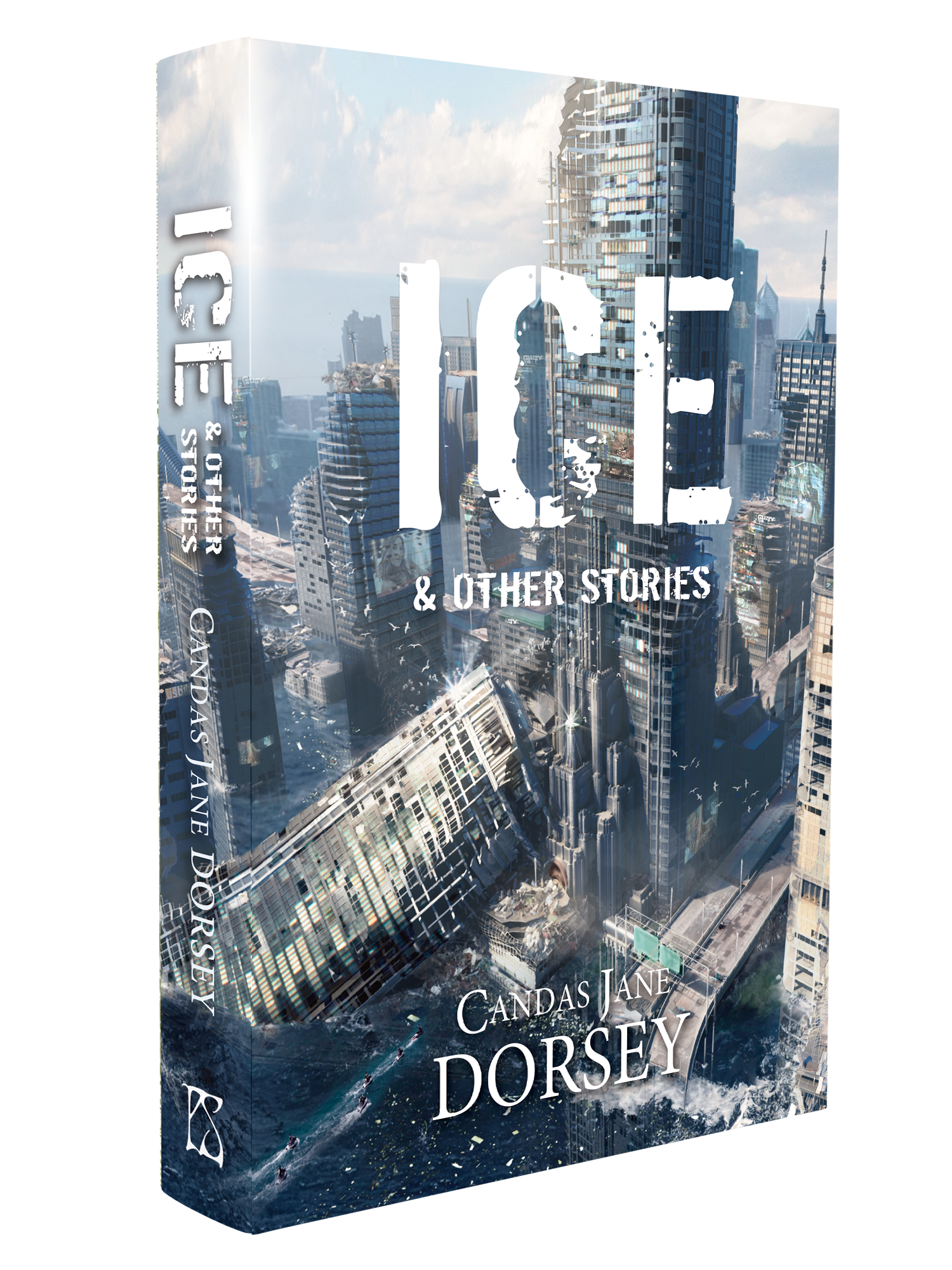
In this episode of Age of Water, we join award-winning Canadian author Candas Jane Dorsey in Calgary, Alberta, where she talks about “Ice and other stories”, teaching at university, what eco-fiction means, and how writers can be “sneaky.”


CandasJaneDorsey2

Candas Jane Dorsey

CanCandas Jane Dorsey is an award-winning Canadian author of novels, short stories, and poetry. She also served as editor / publisher of several literary presses.

Ice by CandasJaneDorseyShe is best known for her science fiction writing including the novels Black Wine and A Paradigm of Earth, and has also published poetry and short stories, including her well-known short-story collection Machine Sex: And Other Stories. Her latest collection of short stories Ice and other Short Stories spans thirty years of writing. Candas teaches writing and communications at MacEwan University. She was founding president of SF Canada and was president of the Writers Guild of Alberta. Candas was awarded the Province of Alberta Centennial Gold Medal award for artistic achievement and community work and the WGA Golden Pen Award for Lifetime Achievement in the Literary Arts.


DS-2008-16 copy

Nina Munteanu kayaks in Desolation Sound, British Columbia (photo by H. Klassen)


nina-2014aaa

Nina Munteanu is a Canadian ecologist / limnologist and novelist. She is co-editor of Europa SF and currently teaches writing courses at George Brown College and the University of Toronto. Visit www.ninamunteanu.ca for the latest on her books. Nina’s bilingual “La natura dell’acqua / The Way of Water” was published by Mincione Edizioni in Rome. Her non-fiction book “Water Is…” by Pixl Press (Vancouver) was selected by Margaret Atwood in the New York Times ‘Year in Reading’ and was chosen as the 2017 Summer Read by Water Canada. Her novel “A Diary in the Age of Waterwill be released by Inanna Publications (Toronto) in June 2020.


Age of Water Podcast

AoW Logo-smallOn November 22, 2019, co-host Claudiu Murgan and I launched the podcast Age of Water in Toronto, Ontario.

The podcast is devoted to informing and entertaining you with topics about water and the environment. We interview scientists, journalists, writers, academia and innovators who share their knowledge and opinions about the real state of the environment and what committed individuals and groups are doing to make a difference. We talk about the problems and we talk about the solutions.

The format of our podcast is a combination of chat cast and informal interview. We cover anything of interest from breaking environmental news to evergreen material. This also includes human interest stories, readings of eco-literature, discussion of film and other media productions of interest.

AgeOfWater-HomePage

Diary Water cover finalClaudiu suggested doing the podcast during a discussion we had about what we could do to make a difference and to help bring more awareness about the environmental challenges we face in water issues and geopolitics.


We both agreed that the podcast should not only explore the issues but also present solutions and ideas in the ongoing conversation. We wanted to point to ways others could participate by talking to those who were indeed making a difference. So far, we have talked to people about positive initiatives such as 350.org, Drawdown, blue communities, Extinction Rebellion and several others. We’ve talked to homeowners and entrepreneurs with innovative ideas on what individuals can do at home and in their community.

The name of the podcast came from my upcoming book “A Diary in the Age of Water,” a novel that chronicles the lives of four generations of women and their relationship with water during a time of catastrophic change. The book will be launched by Inanna Publications in Toronto in May 2020.

Podcast CO-HOSTS

Guests have come from around the world to join us in monthly interviews on Age of Water. These have included so far: economist and educator David Zetland in Holland (aired Nov 2019); award-winning metaphysical author Rainey Highley in California (aired December 2019); Canadian award-winning author Candas Jane Dorsey in Calgary, Alberta (aired January 2020);  activist/author Kaz LeFave in Toronto (airing February 2020); Finnish award-winning author Emmi Itäranta in the UK (to air in March 2020); and Toronto film educators The Water Brothers (to air in April 2020). We interviewed environmental activist Liz Couture in Richmond Hill, Ontario (airing May 2020); Zen master Ian Prattis in Ottawa (airing June 2020), and we also talked to activist/author Merilyn Ruth Liddel in Calgary, Alberta (airing July 2020), and climate researcher / author Martin Bush in Toronto (airing August 2020). Many more are scheduled to be interviewed. For more information go to www.ageofwater.ca

Podcast MISSION

Water Is-COVER-webIn February 2020, we started a reading series on Age of Water, in which Claudiu or I read from a fiction or non-fiction work that resonated with us, followed by a discussion. The first readings is from my book “Water Is…The Meaning of Water,” a celebration of water, which was selected by Margaret Atwood as her choice reading in the New York Times ‘Year in Reading.’

Let us know if you or someone you know wishes to be interviewed on the show. If you have a work you think merits reading and discussing on the show, please let us know as well. Go to the Age of Water site, join the newsletter and email us.


DS-2008-16 copy

Nina kayaks Desolation Sound, off the coast of British Columbia (photo by H. Klassen)

nina-2014aaa

Nina Munteanu is a Canadian ecologist / limnologist and novelist. She is co-editor of Europa SF and currently teaches writing courses at George Brown College and the University of Toronto. Visit www.ninamunteanu.ca for the latest on her books. Nina’s bilingual “La natura dell’acqua / The Way of Water” was published by Mincione Edizioni in Rome. Her non-fiction book “Water Is…” by Pixl Press (Vancouver) was selected by Margaret Atwood in the New York Times ‘Year in Reading’ and was chosen as the 2017 Summer Read by Water Canada. Her novel “A Diary in the Age of Waterwill be released by Inanna Publications (Toronto) in June 2020.

Nina Munteanu Shares Her Journey With Water

Nina’s recent presentation at the Don Heights Unitarian Congregation on water—”Reflections: the Meaning of Water“—explores the many dimensions of water. She describes how its life-giving anomalous properties can lead us to connect with water and nature to help us be the caretakers we need to be during these changing times.

Based on her celebrated book “Water Is… The Meaning of Water”, Nina shares her personal journey with water—as mother, teacher, environmentalist, traveler and scientist—to explore water’s many “identities” and, ultimately, our own.


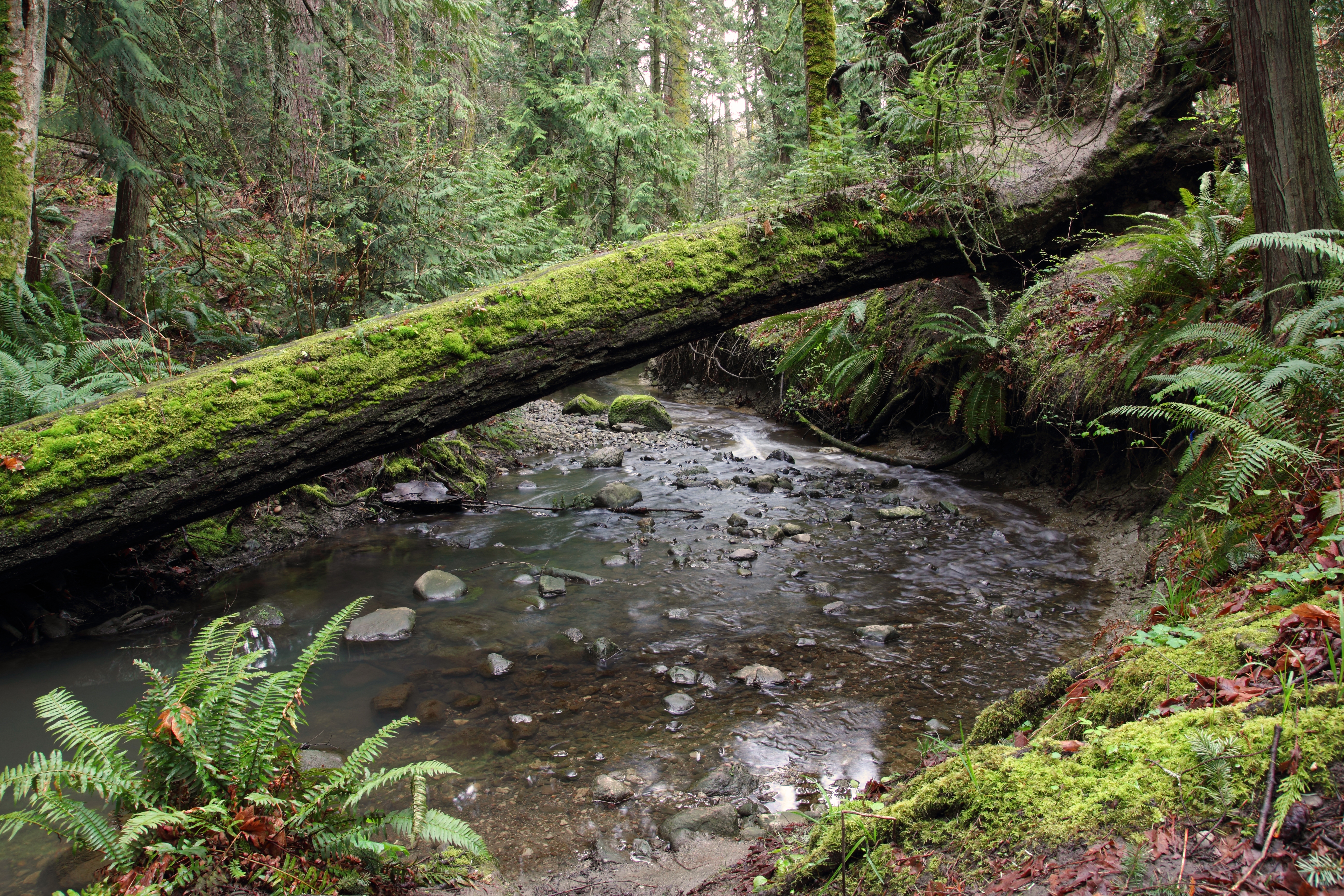
Fallen log stream-2012

stream in Westcoast rainforest of BC (photo by Kevin Klassen)

nina-2014aaa

Nina Munteanu is a Canadian ecologist / limnologist and novelist. She is co-editor of Europa SF and currently teaches writing courses at George Brown College and the University of Toronto. Visit www.ninamunteanu.ca for the latest on her books. Nina’s bilingual “La natura dell’acqua / The Way of Water” was published by Mincione Edizioni in Rome. Her non-fiction book “Water Is…” by Pixl Press (Vancouver) was selected by Margaret Atwood in the New York Times ‘Year in Reading’ and was chosen as the 2017 Summer Read by Water Canada. Her novel “A Diary in the Age of Waterwill be released by Inanna Publications (Toronto) in June 2020.

The Invasion of Giant Crayfish Clones & A Diary in the Age of Water

OLYMPUS DIGITAL CAMERA

Marmorkrebs, giant marbled crayfish

In 2018, scientists reported that the giant marbled crayfish (Marmorkrebs [German]: Procambarus fallax f. virginalis) recently developed the strategy of being entirely female and cloning itself via parthenogenesis1; the female doesn’t require a male crayfish to fertilize its eggs. Despite the cloning procedure that makes them virtually identical genetically, the crayfish vary in size and pattern—no doubt due to epigenetics.2

First discovered by a German aquarium in the mid-1990s, these crayfish that developed from Florida-Native crayfish have migrated into the wild and are aggressively spreading in Europe, at the expense of the native European crayfish. The 8 to 12 cm long Marmorkrebs has been observed in Germany, Italy, Slovakia, Sweden, Japan, and Madagascar. The marbled crayfish prefers a warm and humid climate, suggesting that climate change may influence its distribution and success. The clones also thrive in a wide range of habitats—from abandoned coal fields in Germany to rice paddies in Madagascar, writes Carl Zimmer of the New York Times.

Given that every individual Marmorkrebs can reproduce (the advantage of parthenogenesis is that the female crayfish doesn’t need to find a mate—it just gives birth), one European scientist has dramatically suggested that, “we’re being invaded by an army of clones.” Zimmer shares the results of Dr Lyko and his team on how the all-female Marbokrebs came to be:

“Scientists concluded that the new species got its start when two slough crayfish mated. One of them had a mutation in a sex cell — whether it was an egg or sperm, the scientists can’t tell. Normal sex cells contain a single copy of each chromosome. But the mutant crayfish sex cell had two. Somehow the two sex cells fused and produced a female crayfish embryo with three copies of each chromosome instead of the normal two. Somehow, too, the new crayfish didn’t suffer any deformities as a result of all that extra DNA.” 

In its first couple decades, [Marmorkrebs] is doing extremely well, writes Zimmer. But sooner or later, the marbled crayfish’s fortunes may well turn, he adds. “Maybe they just survive for 100,000 years,” Dr. Lyko speculated. “That would be a long time for me personally, but in evolution it would just be a blip on the radar.”

marbled-crayfish2

Marmorkrebs

But what if this speculation isn’t the whole scenario? What if Marmorkrebs is just another example of climate change-induced adaptation and change through epigenetics? While climate forcing and habitat destruction is causing the extinction of many species; other species are, no doubt, adapting and exploiting the change. These generalists (born with change inside them) are poised to take over in Nature’s successional march.3

Bdelloid-rotifer-Philodina-gregaria

Bdelloid rotifer

Parthenogenesis and epigenetic change isn’t new. In fact, it’s very old … All-female bdelloid rotifers have been cloning a sisterhood for millions of years and using incorporated foreign genes through horizontal gene transfer4 (essentially stealing genetic material from their environment) to maintain a healthy diverse population. What’s new and weird is that this crayfish “suddenly” developed this ability—probably through epigenetic means (given this entire group is versatile in reproductive strategies in general). The real question none of the articles that covered this phenonemon ask is: WHY? Why is it happening NOW?

In my latest book A Diary in the Age of Water (due for release in May 2020 by Inanna Publications) I explore this “change” in a unique way:

Diary Water cover finalKyo finds a copy of Robert Wetzel’s Limnology on a lower shelf of the “L” section. It stands tall with a thick green-coloured spine. This is the book that Hilda, one of the Water Twins, had saved from the book burnings of the Water Age. A present from her limnologist mother. Hilda kept it hidden under her mattress. When CanadaCorp police burst into their home and dragged her mother away, Hilda was left alone with Wetzel. The limnology textbook was forbidden reading because its facts were no longer facts. 

After some coaxing, Myo shared a most bizarre tale of that time which led to the catastrophic storms and flood. What the governments hadn’t told their citizens—but what each citizen felt and knew—was that humans had lost the ability to reproduce. Then a spate of “virgin births” throughout the world spawned what seemed a new race of girls—‘deformed’, blue and often with strange abilities. Many considered them abominations, a terrible sign of what was in store for humanity—a punishment for their evil ways. Then, as quickly as they’d populated the world, these strange blue girls all disappeared without a trace. They simply vanished and became the Disappeared. Myo told her that some people called it a Rapture, a portent of the end times. Others suggested that the girls had all been murdered—a genocide, organized by what was left of the world government. 

Then … the storms … changed the world.

–“A Diary in the Age of Water” 

  1. Spontaneous Parthenogenesis: From the Greek Parthenon “virgin” and genesis “creation”, parthenogenesis is a natural form of asexual reproduction in which growth and development of embryos occur without fertilization. In animals it involves development of an embryo from an unfertilized egg; in plants it proceeds through apomixis. The production of only female offspring by parthenogenesis (such as with bdelloid rotifers) is called thelytoky.
  2. Epigenetics is the study of changes in organisms caused by the modification of gene expression (such as environmental triggers) rather than alteration of the genetic code itself. If genetics represents the hardrive of a computer, epigenetics is its software.
  3. Niche (the role or job of an organism or population) can be broad (for generalists) or narrow (for specialists). A specialist has superior abilities to exploit the narrow environmental conditions it lives in and is splendidly adapted to a fixed stable environment; generalists, less successful at exploiting than the specialist but more widely adaptive, can thrive in less stable environments that present a wider range of conditions.
  4. Horizontal gene transfer is the movement of genetic material between organisms other than by the vertical transmission of DNA from parent to offspring through reproduction. HGT is an important factor in the evolution of many organisms.

A Diary in the Age of Water will be released in May 2020 by Inanna Publications, Toronto, Canada.


nina-2014aaa

Nina Munteanu is a Canadian ecologist / limnologist and novelist. She is co-editor of Europa SF and currently teaches writing courses at George Brown College and the University of Toronto. Visit www.ninamunteanu.ca for the latest on her books. Nina’s bilingual “La natura dell’acqua / The Way of Water” was published by Mincione Edizioni in Rome. Her non-fiction book “Water Is…” by Pixl Press (Vancouver) was selected by Margaret Atwood in the New York Times ‘Year in Reading’ and was chosen as the 2017 Summer Read by Water Canada. Her novel “A Diary in the Age of Waterwill be released by Inanna Publications (Toronto) in June 2020.

When Media Gets the Science Wrong We ALL Suffer

Atlantic salmon farm escape

I was dismayed by a recent news story on CTV on the escape of farm fish into native fish waters. I was dismayed for two reasons: 1) the ecological impacts of this accident; and 2) the failure of CTV in appropriately reporting the seriousness of it.


Shoddy Reporting by CTV 

In late December 2019, a fire at the Mowi fish farm in BC waters near Port Hardy resulted in the escape of over twenty thousand Atlantic salmon. The news story by the CTV media proved biased, incomplete and erroneous—and ultimately dangerous—in its reporting.

CTV targeted “environmentalists and indigenous groups” as worried that “it could have devastating impacts on [Pacific] wild salmon…Escape presents ecological and environmental risks to an already fragile wild salmon population.” But CTV failed to include concerns by environmental scientists in this matter: government or academics with real expertise and authority.

CTV talked to some “so-called” experts to counter the position of the environmentalists. This included comments by a vet (Dr. Hugh Mitchell), who works for the fish farm: “[Atlantic salmon] are brought up on prepared fish pellets from since they start feeding …They don’t know how to forage. They don’t know how to find rivers and reproduce. They get eaten by predators or they die of starvation after they escape.” (see below for proof against this). A vet (who will have some expertise in fish physiology and biology) does not have the same expertise as a fish population biologist, oceanographer, ecologist or geneticist—all of who would better understand the potential impact of released exotic species to native species in a region. But CTV didn’t interview any of these experts. Instead, they interviewed a vet who works for the farm. CTV ends its story with a remark by the managing director of Mowi who said, “Data would suggest there’s a very low risk to the [Atlantic] salmon making it to any rivers and an even lower risk of them establishing successful populations within the BC environment.”

But where’s the data to prove this? And who provided it to Mowi? CTV fails to mention that or show any of “the data”.

This is clearly careless reporting that provides no substantiation for the claims made by Mowi; nor does CTV provide a more robust inquiry into potential risks. Risks posed by more than Atlantic salmon just outcompeting native fish; risks posed by disease and other indirect challenges to native fish—not addressed by Mitchell and Mowi.

Log over water forest-DeasPark

BC wetland (photo by Nina Munteanu)

CTV provided no statement by DFO scientists or academia. Where were the UBC or UVic scientists? Why weren’t these unbiased authorities consulted for their expertise instead of a vet who works for the aquaculture industry? This is very sloppy reporting.


The Vancouver Sun, which also covered this story, showed a little more balance in its reporting. However, when it came time for the Sun to report on DFO’s response, it was less than clear: “Among the feedback the federal government has received through early consultations on the legislation is a need for a more effective risk management framework and support for Indigenous involvement and rights in the sector, it says.”

The Georgia Straight used the right word—claimed—to describe Mowi’s unsubstantiated statements: “The company claimed that the escaped fish are easy prey because they are ‘unaccustomed to living in the wild, and thus unable to forage for their own food.’” The Straight also balanced that claim with another by Ernest Alfred of the ‘Ngamis First Nation and videographer and wild-salmon advocate Tavis Campbell, who suggested that the presence of Atlantic salmon in ocean water “presents a serious threat to native Pacific salmon through transfer of pathogens and other associated risks”. The Straight then followed up with some relevant historic precedence: “After a large number of Atlantic salmon escaped from a Washington state fish farm near Bellingham in 2017, these species were found as far away as the Saanich Inlet and Harrison River.” Hardly the weaklings described by Mowi and Mitchell…

Global News provides a more in-depth examination of the August 2017 net pens collapse in the waters off northwest Washington—pens owned by Canadian company Cooke Aquaculture Pacific — the largest Atlantic salmon farmer in the U.S.

“Up to 263,000 invasive Atlantic salmon escaped into Puget Sound, raising fears about the impact on native Pacific salmon runs. The incident inspired Washington state to introduce legislation that would phase out marine farming of non-native fish by 2022. Groups like the Pacific Salmon Foundation have called for the B.C. and federal governments to do the same in Canada.”


Declining Pacific Wild Salmon 

Stream longshutter-warmed-close01 copy

Westcoast forest stream, BC (photo by Kevin Klassen)

Wild Pacific salmon have been declining for decades off the BC coast and streams. Human interference is primarily responsible, which includes habitat destruction, diversions for agriculture and hydro-power, and climate change. Habitat destruction—both quantity and quality—has occurred mainly from logging, road construction, urban development, mining, agriculture and recreation. Added to that list is the aquaculture industry that uses Atlantic salmon, an exotic to the Pacific Ocean.

A recent study conducted by the Strategic Salmon Health Initiative (SSHI) revealed that the piscine reovirus (PRV) found in farmed Atlantic salmon is linked to disease in Pacific Chinook salmon. The SSHI is an initiative made up of scientists from the Department of Fisheries and Oceans (DFO), Genome B.C., and the Pacific Salmon Foundation (PSF).

The findings show that the same strain of PRV, known to cause heart and skeletal muscle inflammation (HSMI) in farmed Atlantic salmon, is causing Chinook salmon to develop jaundice – anemia, a condition that ruptures red blood cells, and causes organ failure in the fish. The disease could cause a serious threat to wild salmon migrating past open-net fish farms in coastal waters in B.C.

In B.C., concerns about the decline of Pacific salmon have already risen to peak levels after the Big Bar landslide in the Fraser River near Kamloops; scientists say this could result in the extinction of multiple salmon runs by 2020. The federal Liberal government has pledged to transition BC’s open-net pen salmon farms to closed inland containment systems by 2025.

All this corroborates the serious risk of Atlantic salmon farming. Accidents must be expected to happen. They always do. Risk analysis must include the certainty of this inevitability—just as water engineers must account for 100-year storms, which do happen.

Need for Better Risk Management (Type I and Type II Errors in Risk Assessment) 

The scientific method relies on accurately measuring certainty and therefore reliably predicting risk. This means accounting for all biases and errors within an experiment or exploration. In my work as a field scientist and environmental consultant representing a client, we often based our formal hypotheses in statistics, which considered two types of error: Type I and Type II errors. Type I errors are false positives: a researcher states that a specific relationship exists when in fact it does not. This is akin to an alarm sounding when there’s no fire. Type II errors are false negatives: the researcher states that no relationship occurs when in fact it does. This is akin to no alarm sounding during a fire.

The reason why remarks made by vet Mitchell and Mowi are so dangerous is because they make assumptions that are akin to not sounding an alarm when there is a fire; they are committing a Type II error. And in risk assessment, this is irresponsible. And dangerous.

Instead of targeting “environmentalists” “activists” and certain groups for opinions on issues, I strongly urge CTV and other media to seek out evidence-based science through scientists with relevant knowledge (e.g. an ecologist—NOT an economist or a vet—for an environmental issue). My advice to Media: DO YOUR HOMEWORK AND GET THE FACTS STRAIGHT! You need to talk to academics and scientists with no ties to perpetrators and with relevant knowledge on the topic in question.

The Need for The Precautionary Principle in Environmental Science and Reporting 

FinCreek 4-RockyM

Fin Creek, Rocky Mountains, BC (photo by Nina Munteanu)

Environmental scientists generally pride themselves on the use of the Precautionary Principle when dealing with issues of sustainability and environmental management. According to the Precautionary Principle, “one shall take action to avoid potentially damaging impacts on nature even when there is no scientific evidence to prove a causal link between activities and effects.” The environment should be protected against substances (such as an exotic species) which can be assumed potentially harmful to the current ecosystem, even when full scientific certainty is lacking.

Unfortunately, politicians, engineers and the scientists who work for them tend to focus on avoiding Type I rather than Type II statistical errors. In fact, by traditionally avoiding Type I errors, scientists increase the risk of committing Type II errors, which increases the risk that an effect will not be observed, in turn increasing risk to environment.

In describing the case of the eutrophication of a Skagerrak (a marine inlet), Lene Buhl-Mortensen asks which is worse: risk a Type II error and destroy the soft bottom habitat of Skagerrak and perhaps some benthic species, or risk a Type I error and spend money on cleaning the outfalls to Skagerrak when in fact there is no eutrophication? “Scientists have argued that cleaning up is too expensive and should not be done in vain,” writes Buhl-Mortensen. “But more often the opposite is the case. The increased eutrophication of Skagerrak could end up more costly than reducing the outfalls of nutrients [to the inlet].”

“Because threats to the environment are threats to human welfare, ecologists have a prima facie ethical obligation to minimize Type II errors,” argues Buhl-Mortensen in the journal Marine Pollution Bulletin. Use of the precautionary principle will save costs—and lives—in the end.

ferry wake active pass copy

Ferry crossing with wake in foreground, BC coast (photo by Nina Munteanu)


nina-2014aaa

Nina Munteanu is a Canadian ecologist / limnologist and novelist. She is co-editor of Europa SF and currently teaches writing courses at George Brown College and the University of Toronto. Visit www.ninamunteanu.ca for the latest on her books. Nina’s bilingual “La natura dell’acqua / The Way of Water” was published by Mincione Edizioni in Rome. Her non-fiction book “Water Is…” by Pixl Press (Vancouver) was selected by Margaret Atwood in the New York Times ‘Year in Reading’ and was chosen as the 2017 Summer Read by Water Canada. Her novel “A Diary in the Age of Waterwill be released by Inanna Publications (Toronto) in June 2020.