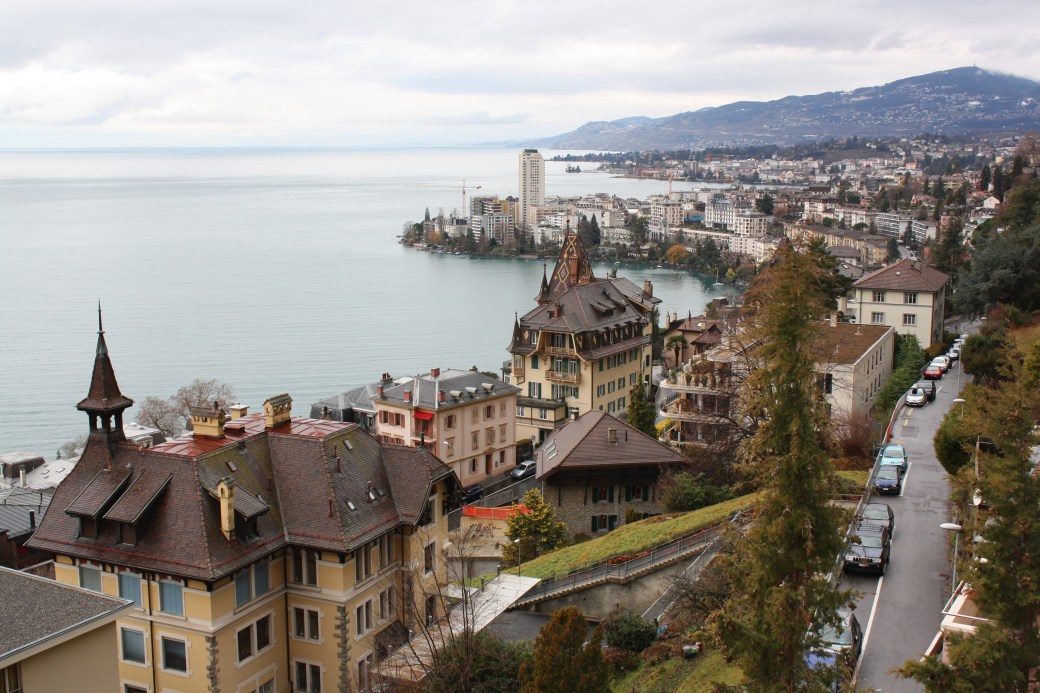
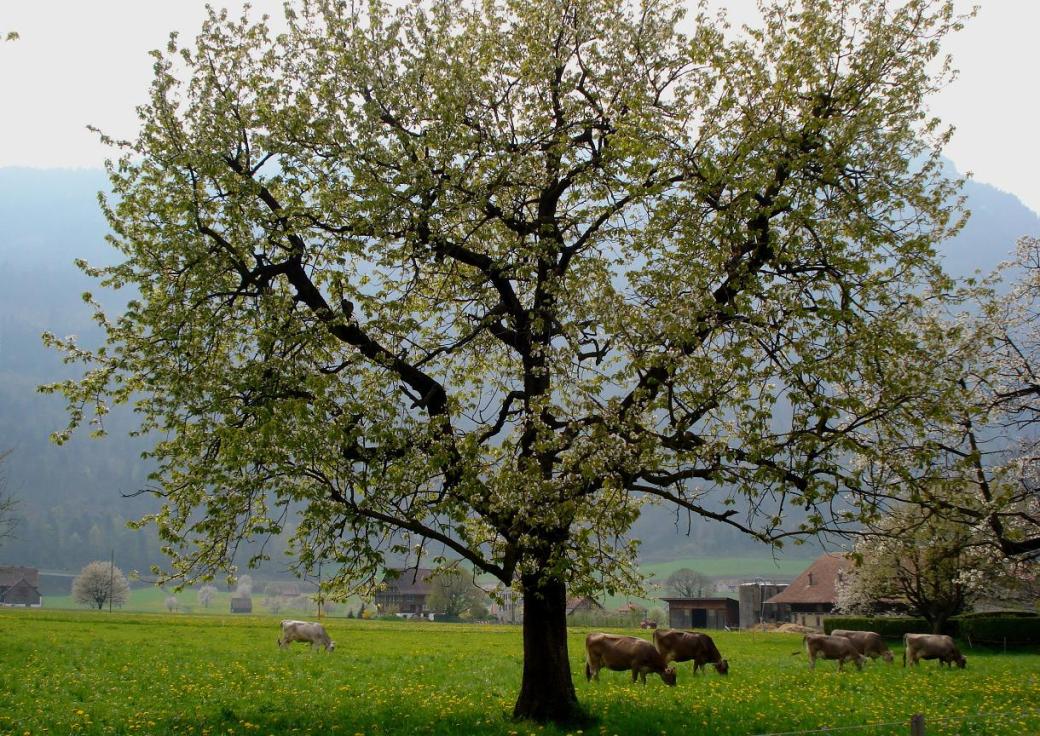
Montreux, Switzerland (photo by Nina Munteanu)
I’m an ecologist. We look at why things happen and work, and—perhaps most importantly—how they affect one another. Ecology is the science of relationships and consequence. I taught at the University of Victoria for several years then conducted environmental assessments as a limnologist (aquatic ecologist) for environmental consulting firms in British Columbia.
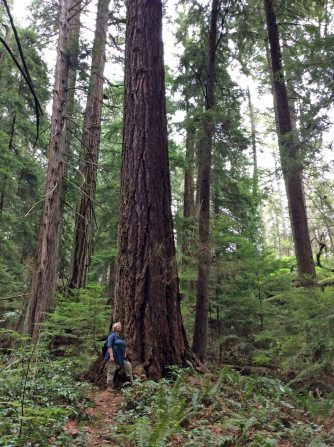
Nina next to giant Douglas fir, Vancouver (photo by Margaret Ross)
My short stories and novels are—no big surprise—mostly eco-fiction. It’s been that way since I started high school in Quebec, in fact. That first year, when I fervently expressed exhortations for global environmental action, a well-meaning, but myopic teacher chided me for my extravagant worldview. “Stick to little things and your community—like recycling,” he’d suggested patronizingly.
I remember the shock of realizing that not everyone felt the planet like I did. Perhaps it was a teenage-thing, or a girl-thing, or a nina-thing. I prayed it wasn’t just a nina-thing…
For the past few years I’ve been teaching writing at the University of Toronto and George Brown College in Ontario. I teach a workshop-style class that involves students bringing in and working on their current Work-In-Progress (WIP). And I’ve been noticing an interesting trend. Something cool is happening in my classes. More and more students are bringing in WIPs on ecological and global environmental issues. Many of the stories involve a premise of environmental calamity, but not in the same vain as previous environmental disasters that depict “man” against Nature. These works give the Earth, Nature or Water an actual voice (as a character). And a protagonist who learns to interact with it cooperatively.
 For me this represents a palpable and gestalt cultural awakening in the realm of the “feminine archetype”.
The history of storytelling and of humanity’s evolution—how we relate to each other and our environment—are inextricably tied. The stories we tell—whether fiction or non-fiction—reflect who we are, what we value, and what we will become. Good stories are about relationships and their consequences.
Our capacity—and need—to share stories is as old as our ancient beginnings. From the Paleolithic cave paintings of Lascaux to our blogs on the Internet, humanity has left a grand legacy of ‘story’ sharing. Evolutionary biologist and futurist Elisabet Sahtouris tells us that, “whether we create our stories from the revelations of religions or the researches of science, or the inspirations of great artists and writers or the experiences of our own lives, we live by the stories we believe and tell to ourselves and others.”
 I mentioned that the majority of my stories are science fiction (SF). SF is a literature of allegory and metaphor and deeply embedded in culture. It draws me because it is the literature of consequence exploring large issues faced by humankind. In a February 2013 interview in The Globe and Mail I described how by its very nature SF is a symbolic meditation on history itself and ultimately a literature of great vision: “Speaking for myself, and for the other women I know who read science fiction, the need is for good stories featuring intelligent women who are directed in some way to make a difference in the world…The heroism [of women] may manifest itself through co-operation and leadership in community, which is [often] different from their die-hard male counterparts who want to tackle the world on their own. Science fiction provides a new paradigm for heroism and a new definition of hero as it balances technology and science with human issues and needs.”
Author Marie Bilodeau in the same interview added that, “the best part about writing science fiction is showing different ways of being without having your characters struggle to gain rights. Invented worlds can host a social landscape where debated rights in this world – such as gay marriage, abortion and euthanasia – are just a fact of life.”
Once the almost exclusive domain of male writers and readers, SF has been steadily changing, attracting more women writers and women readers. It is no coincidence that mainstream literary fiction writer Margaret Atwood began to write science fiction (which she still calls speculative fiction) in the 1980s with Handmaid’s Tale, and that her last five books are pure science fiction, mostly dystopias that explore the evolution of humanity.
Science fiction is maturing.
 We’ve progressed from the biological to the mechanical to the purely mental, from the natural world to a manufactured world to a virtual world, writes philosopher and writer Charles Eisenstein. According to Carolyn Merchant, professor at UC Berkley, early scientists of the 1600s used metaphor, rhetoric, and myth to develop a new method of interrogating nature as “part of a larger project to create a new method that would allow humanity to control and dominate the natural world.”
“The modern self,” writes Eisenstein, has become, “a discrete and separate subject in a universe that is other [something SF writers know and write about]. It is the economic man of Adam Smith; it is the skin-encapsulated ego of Alan Watts; it is the embodied soul of religion; it is the selfish gene [of Richard Dawkins].”
 Competition is a natural reaction based on distrust—of both the environment and of the “other”—both aspects of “self” (as part) separated from “self” (as whole). The greed for more than is sustainable reflects an urgent fear of failure and a sense of being separate. It ultimately perpetuates actions dominated by self-interest and is the harbinger of “the Tragedy of the Commons”.
According to Elisabet Sahtoutis, humanity is currently poised on a tipping point. Thousands of years of national and corporate empire-building have reached a tipping point in planetary exploitation, says Sahtouris, “where enmities are more expensive in all respects than friendly collaboration.”
Competition naturally gives way to creative cooperation as trust in both “self” and the “other” develops and is encouraged. “Communities with many cooperators and altruists do better than groups dominated by narrow and selfish thinking,” writes Alain Ruche, strategist for the Secretary General of the EU External Service. Ruche adds that a biological predisposition to cooperate appears to be independent of culture.
 Examples of creative cooperatives exist throughout the world, offering an alternative to the traditional model of competition. Cultural creatives are changing the world, Ruche tells us. These creatives, while being community-oriented with an awareness of planet-wide issues, honor and embody feminine values, such as empathy, solidarity, spiritual and personal development, and relationships. Mechanisms include reciprocity, trust, communication, fairness, and a group-sense of belonging. I give examples in my upcoming book “Water Is…” by Pixl Press, due in Spring 2016.
In the September 2009 Peace Summit in Vancouver B.C., the Dalai Lama shared that “the world will be saved by the western woman.” This “call to adventure” by His Holiness reflects the hero’s journey steps suggested by Richard Tarnas in the epilogue of his book The Passion of the Western Mind: “the driving impulse of the West’s masculine consciousness has been its dialectical quest not only to realize itself, to forge its own autonomy, but also, finally, to recover its connection with the whole, to come to terms with the great feminine principle in life…to reunite with the mystery of life, of nature, of soul.”

Deas park, BC (photo by Nina Munteanu)
Poised and ready, rising from its previous dualistic perception, the soul finds Home in Wholeness, and returns to the intrinsic truth of the world. The world realizes itself within and through the human mind, projecting a fractal vision of a holonomic universe.
To return to science fiction, my point is that the stories I’m seeing more and more—whether by established writers or by my own students—are reflecting this emerging worldview. It is the worldview of Jung and synchronicity; of David Bohm and “implicate order”; of Rudolf Steiner and “cosmic intelligence”, of biochemist Mae-Wan Ho and “quantum entanglement”, of Frans de Waal and “empathy”, and of Matt Ridley and “altruism”.
In Part 2 (Praxis), I provide examples and interviews with other writers.
 Nina Munteanu is an ecologist and internationally published author of award-nominated speculative novels, short stories and non-fiction. She is co-editor of Europa SF and currently teaches writing courses at George Brown College and the University of Toronto. Visit www.ninamunteanu.ca for the latest on her books.
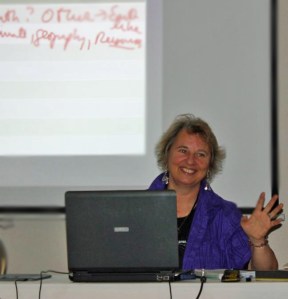 This April, I will teach my 12-week long writing course on how to write science fiction. The 12-week course “Creating Science Fiction” runs TUESDAY nights from 6:15 to 9:15 starting April 5th through to June 21st at George Brown College on King Street in Toronto and costs $285.

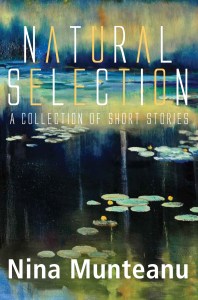 I started branding my writing as eco-fiction a few years ago. Prior to that—even though my stories were strongly driven by an ecological premise and strong environmental setting—I described them as science fiction and many as technological thrillers. Environment’s role remained subtle and—at times—insidious. Climate change. Water shortage. Environmental disease. A city’s collapse. War. I’ve used these as backdrops to explore relationships, values (such as honour and loyalty), philosophies, moralities, ethics, and agencies of action. The stuff of storytelling.
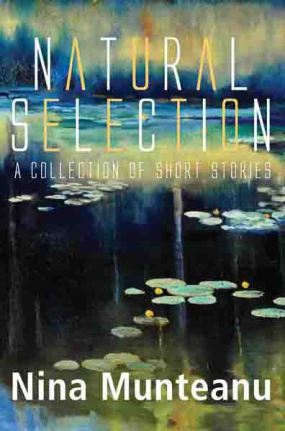
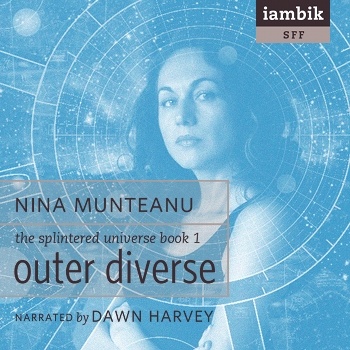
 In my latest book


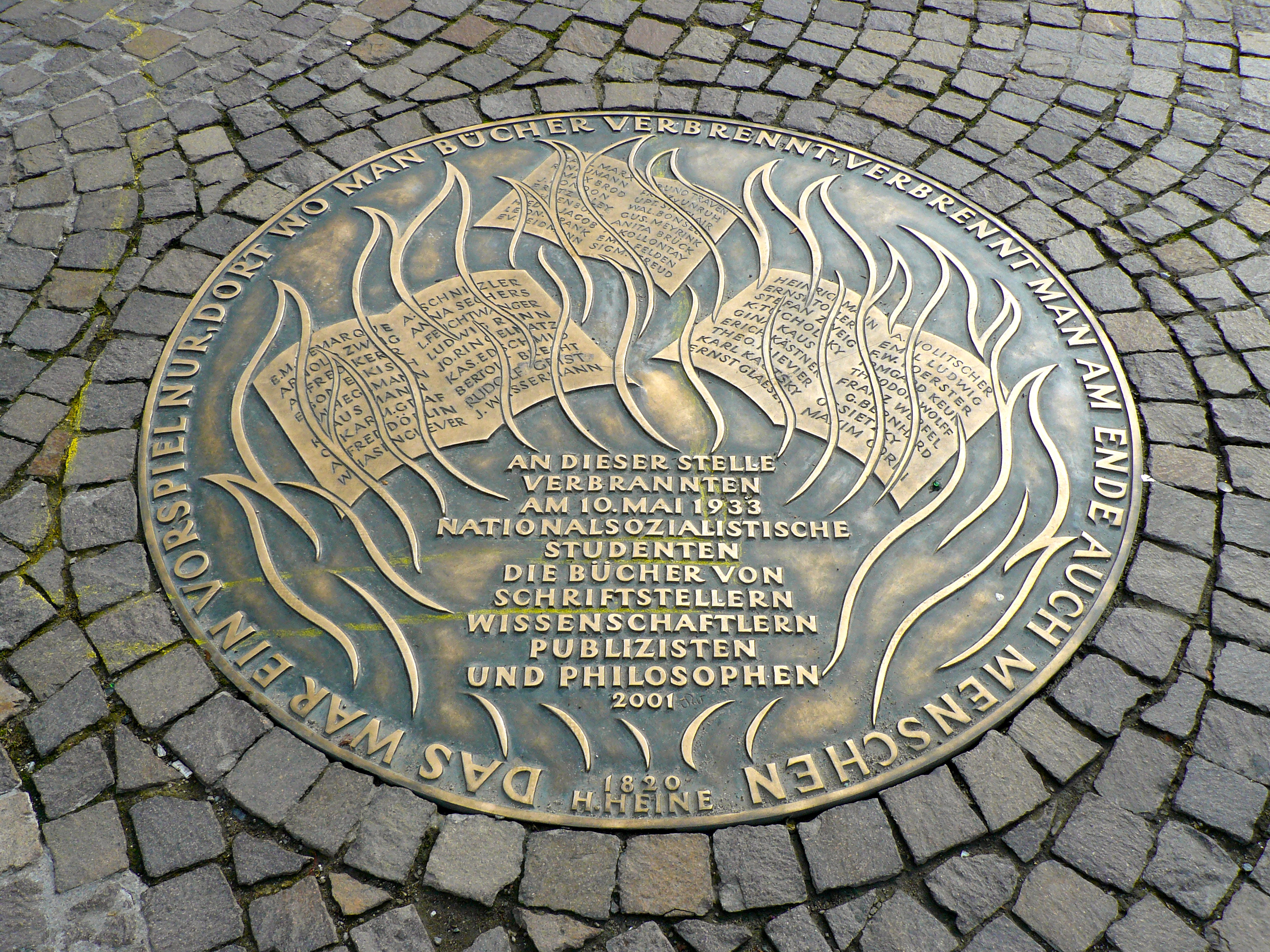
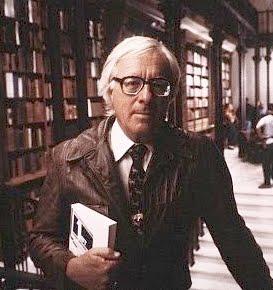


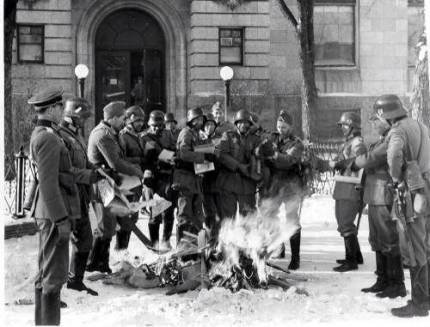 Censorship suppresses ideas and information that certain people — individuals, groups or government officials — find objectionable or dangerous. Censors pressure public institutions, like libraries, to suppress and remove from public access information they judge inappropriate or dangerous, so that no one else has the chance to read or view the material and make up their own minds about it. “Censorship … creates, in the end, the kind of society that is incapable of exercising real discretion,” said Henry Steel Commager.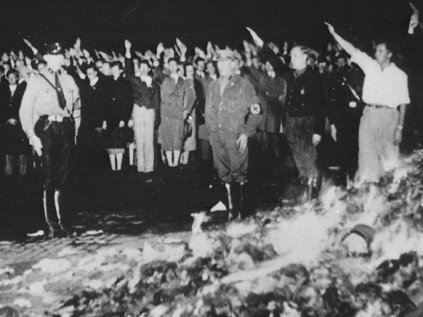




 Nina Munteanu Writing Coach