Fingal’s Cave by Nina Munteanu

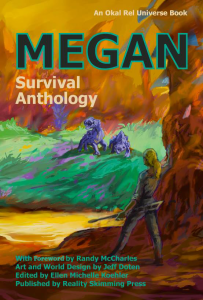
FingalsCave-MeganSurvivalAfter she and fellow colonists crash land on the hostile jungle planet of Mega, rebel-scientist Izumi, widower and hermit, boldly sets out against orders on a hunch that may ultimately save her fellow survivors—but may also risk all. As the other colonists take stock, Izumi—obsessed with discovery and the need to save lives—plunges into the dangerous forest, which harbors answers, not only to their freshwater problem, but ultimately to the nature of the universe itself. Mega was a goldilocks planet—it had saltwater and supported life—but the planet also possessed magnetic-electro-gravitational anomalies and a gravitational field that didn’t match its size and mass. The synchronous dance of its global electromagnetic field suggested self-organization to Izumi, who slowly pieced together Mega’s secrets: from its “honeycomb” pools to the six-legged uber-predators and jungle infrasounds—somehow all connected to the water. Still haunted by the meaningless death of her family back on Mars, Izumi’s intrepid search for life becomes a metaphoric and existential journey of the heart that explores how we connect and communicate—with one another and the universe—a journey intimately connected with water.

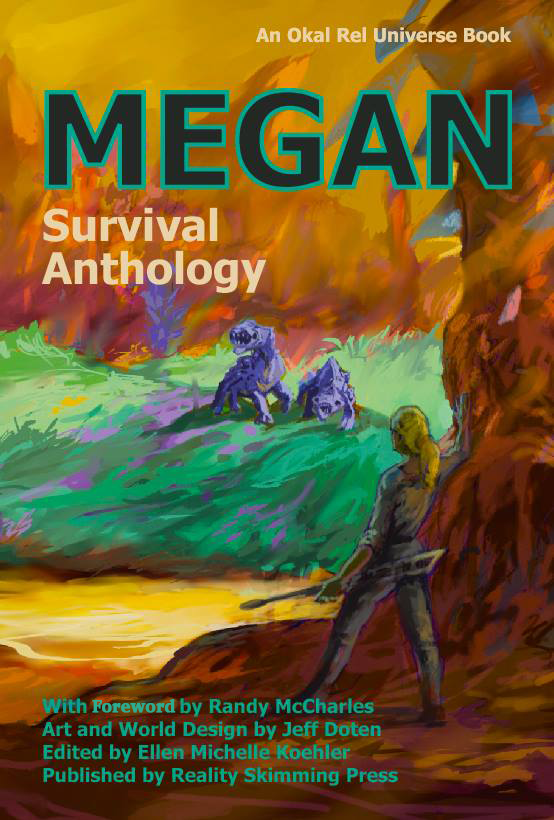
Megan coverFingal’s Cave by Nina Munteanu is the first story in the Megan Survival Anthology by Reality Skimming Press. The story is available as an ebook here. The print anthology is available here.

Nina was interviewed by Ellen Mitchell of Reality Skimming Press on writing Fingal’s Cave.

On the connection between ecology and science fiction, Nina says:

The science of ecology studies relationships. It looks at how things relate to one another. Ecology is the study of communities and ecosystems and how these interact—often in a global setting. Science fiction writing explores the interaction of humanity with some larger phenomenon involving science. Robert J. Sawyer calls it the fiction of the large. Large ideas, large circumstance, large impact. Both ecology and science fiction explore consequence in a big way. Ecology—like “setting” and “world”—manifests and integrates in story theme more than some of the hard sciences, which may contribute more to a story’s premise or plot. This is because, while most sciences study the nature and behaviour of “phenomena”, ecology examines the consequences of the relationship of these phenomena and the impact of their behaviours on each other and the rest of the world. It is in this arena that science fiction becomes great: when it explores relationship and consequence.

On the significance and importance of optimism in science fiction, Nina says:

Optimistic SF is the antithesis of pointless SF. The reason I define it that way is because I believe many would box the term too tightly, equating it to “happy ending” or the equivalent of “and they all lived happily ever after.” Others may even include a certain requisite language and tone, and subject matter that must be excluded to make it optimistic.

For me, it is enough that the story resolves and has a point to it; that the reader is able—even if the hero isn’t—to see a way out into the light. The story itself need not be “optimistic”; but the reader is fulfilled somehow. I suppose one could elucidate Optimistic SF through the “Hero’s Journey Myth”, a plot approach that describes the metaphoric journey of a character or set of characters toward some destiny that involves change and learning. Ultimately, for a story to be worthwhile, it must have a point to it. Otherwise, it’s just “reality TV”.

You can read the entire interview with Nina Munteanu by Ellen Mitchell of Reality Skimming Press here.

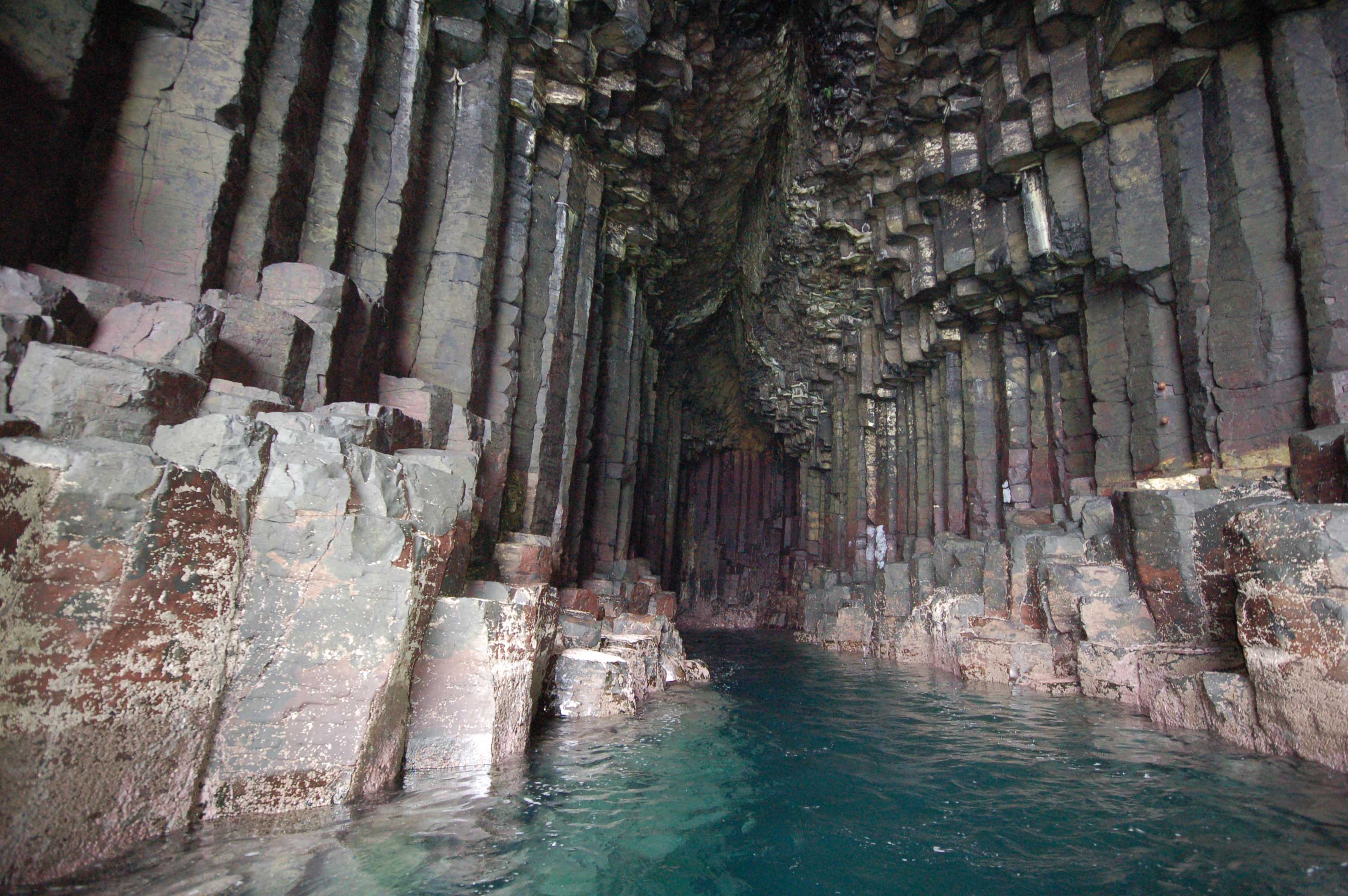
fingalsCaveFingal’s Cave is a sea cave on the uninhabited island of Staffa in the Inner Hebrides of Scotland. The cave is formed entirely from hexagonally jointed basalt columns in a Paleocene lava flow (similar to the Giant’s Causeway in Northern Ireland). Its entrance is a large archway filled by the sea. The eerie sounds made by the echoes of waves in the cave, give it the atmosphere of a natural cathedral. Known for its natural acoustics, the cave is named after the hero of an epic poem by 18th century Scots poet-historian James Macpherson. Fingal means “white stranger”.

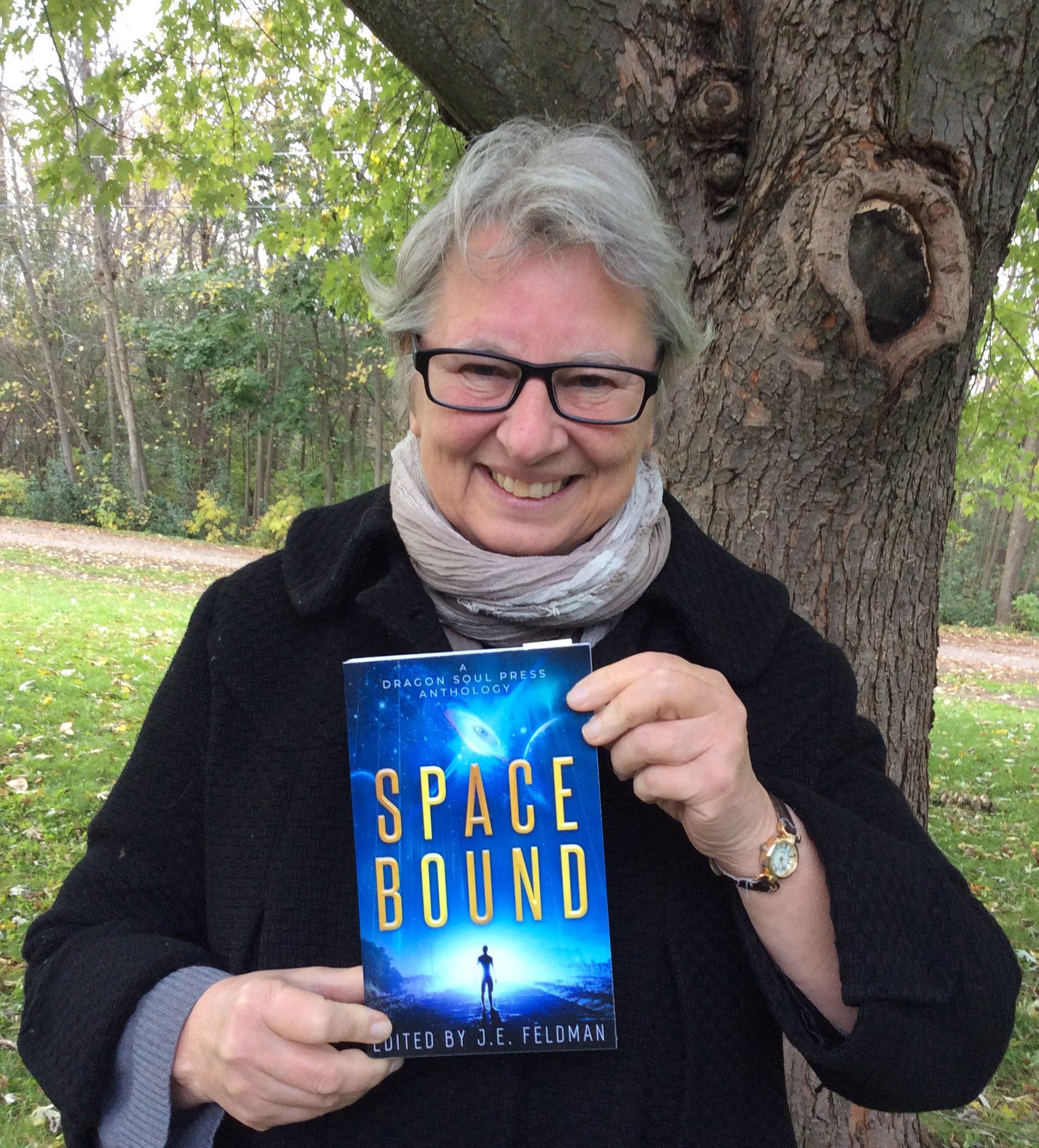
p.s. Dragon Soul Press has recently included “Fingal’s Cave” in their 2021 anthology “Space Bound.”

Nina Munteanu holds her copy of “Space Bound” anthology with her story “Fingal’s Cave”

Fingal’s Cave was reprinted in 2023 on the online magazine Metastellar Speculative Fiction and Beyond.

Nina Munteanu is an ecologist, limnologist and internationally published author of award-nominated speculative novels, short stories and non-fiction. She is co-editor of Europa SF and currently teaches writing courses at George Brown College and the University of Toronto. Visit www.ninamunteanu.ca for the latest on her books.

Ursula K. Le Guin: Her Name is Freedom

Amid the sadness of the passing of Ursula K. Le Guin, we offer her wise advice on art and literature, given in 2014. In receiving her lifetime achievement award in 2014, Ursula delivered a speech that was prescient, timely and necessary:

Neil Gaiman presents lifetime achievement award to Ursula K. Le Guin at 2014 National Book Awards from National Book Foundation on Vimeo.

Ursula K. Le Guin first told her audience that she wanted to share her award with her fellow-fantasy and science fiction writers, who have for so long watched “the beautiful awards” like the one she’d just received, go to the “so-called realists”. She then went on to

ursula le guin

Ursula K. Le Guin

say:

“I think hard times are coming, when we will be wanting the voices of writers who can see alternatives to how we live now, and can see through our fear-stricken society and its obsessive technologies, to other ways of being. And even imagine some real grounds for hope. We will need writers who can remember freedom: poets, visionaries–the realists of a larger reality. Right now, I think we need writers who know the difference between production of a market commodity and the practice of an art…The profit motive is often in conflict with the aims of art…We live in capitalism. Its power seems inescapable; so did the divine right of kings… Power can be resisted and changed by human beings; resistance and change often begin in art, and very often in our art–the art of words. I’ve had a long career and a good one, in good company, and here, at the end of it, I really don’t want to watch American literature get sold down the river… The name of our beautiful reward is not profit. Its name is freedom.”

nina-2014aaaNina Munteanu is an ecologist and internationally published author of novels, short stories and essays. She coaches writers and teaches writing at George Brown College and the University of Toronto. For more about Nina’s coaching & workshops visit www.ninamunteanu.me. Visit www.ninamunteanu.ca for more about her writing.

Book Review: RecipeArium Delivers a Full Course Thrill

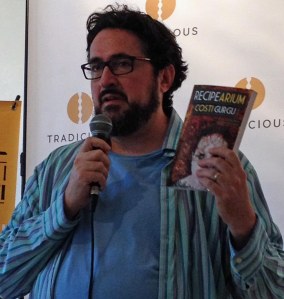
recipearium-costi gurguIn the Green Kingdom, stimulation through the sense of taste has become a powerful and complex art form that rules the lives of the males—the phrils. Not only does it bring pleasure, it can change a phril’s destiny, even guide him into death and beyond. But only if he can afford the services of the artists called Recipears. Without a Recipear, a phril will live and die a pagan, with no chance of an afterlife. The female of the species, called phriliras, cannot experience RecipeArium; they replace it with their faith in one God with changing names. In the world within the huge body of a monstrous beast, the Recipears rule society.
RecipeArium is a tale of sensation and flesh, in which the very hope of an afterlife is determined by one’s sex. The novel takes us on a journey to discover the meaning of love in a boldly imagined world where art is transformative and immortality the destiny of the few.

Carrying the soul of his RecipeArium master within him, Morminiu comes to the royal Court with two objectives: to exact revenge on his master’s enemies and to win for himself the most desired and treacherous position in the realm: Master Recipear of the Kingdom.

Costi-launch

Costi Gurgu, launching at Pierre Leon Gallery

My own testimonial of the book follows:

Gurgu delivers a full course meal of epic transcendence in an alien landscape that is at once grotesque and wondrously compelling.

From the vast and forgotten lands of the Edge of the World to the corrupt decadence and intrigue of the nobility who dwell inside the monstrous Carami, Gurgu’s Recipearium unveils a fascinating world in transformation. Recipearium is a sensual metaphoric tale that explores the dialectic quest of duality to realize itself as whole.

Imaginative. Outrageous. Original.

Gurgu subverts traditional fantasy and SF with the promise of new heights in storytelling.

Costi-signing

Costi Gurgy signing his book at launch in Pierre Leon Gallery

The publisher, White Cat Publishers interviewed Costi recently; a few choice questions and answers appear below:

Regarding his aspirations for the book, Costi responded:

First of all, this new release will bring Recipearium to the English speaking market, which is quite a big aspiration in itself. And through Recipearium I hope to open the hearts of North American readers to the rest of my fiction as well as to Romanian Speculative Fiction in general.

To their mention that RecipeArium is considered the “new weird” (even in science RecipeArium launchADASTRAfiction, which is itself considered strange), Costi responded:

Several publishers told me that they hadn’t read anything like it, and therefore they couldn’t compare it to any other book. Yes, at first I wanted to thank them because they practically told me it really was an original novel, but only later I realized that they meant they wouldn’t know how to market it and sell it. They didn’t even know if it would sell, because nobody has sold something similar before.

When I signed the contract in Romania, my Romanian publisher also didn’t know how to market it. So, my editor decided to write and talk about it like any other book and completely ignored that one thing that made it different. He hoped that when the readers discovered it, they would already be hooked and therefore it would be too late for them to freeze in awe. J

It paid off. The story proved a success. Not only because of the awards and the numerous reviews but mostly because of the satisfied readers … So, as a conclusion, I won’t tell you what makes it different from the rest. I want my readers to discover it for themselves. And I promise you it’s not the kind of surprise that goes BANG! It creeps on you slowly.

White Cat then asked Costi to elaborate on his earlier comment about the difference between European and American genre writing. Here’s what Costi said:

Sure. In my opinion there are two major differences. The first one is of perception. In Europe we read fiction works by writers from over seventy countries from all around the world. That is over seventy different cultures in which their authors write stories without worrying that maybe a foreign reader would not understand a certain social, political or cultural event, or a certain attitude, habit or tradition.

Yes, maybe the South American characters act according to a different code of social conduct than Romanians, or maybe French characters’ attitude is strange for a Bulgarian reader, or Chinese motivations are weird to Greeks. But if the story or the characters are gripping enough, all those things don’t stop us from getting the underlying concept from the context and we just keep reading.

The stories we read can take place in real cities or villages from different and unfamiliar parts of the world. Usually the European writer doesn’t care that his readers may have never been in his city and he keeps telling the story as if all his readers are his co-nationals, or even his neighbours.

poster-launchWe embrace the exotic, the foreign, the strange, the unknown… the alien.

American editors have rejected translating huge names from European speculative fiction because they’re considered too strange and not easily understood by North American readers. Because the North American readership has read only North American genre writers for the past fifty years and they wouldn’t accept something different than an American way of perceiving reality and interpreting information. Something that may be too far from the North American system of values.

“But they’re readers of Science Fiction! I mean, they read Science Fiction or Fantasy because they want to be transported to different worlds. You mean that the American readers better understand a story happening on a strange planet or in the underworld, but they will find it difficult to follow a story happening in Bruges, or Warsaw?” I replied.

North American editors don’t appear to have that confidence in their readers. I, on the other hand, have that confidence. It has been proven to me over and over again, that the true SF&F reader, European or North American, is thirsty for new and exotic, and strange, and alien.

The second aspect is technical. It’s about the writing techniques, the story structure, the point of view approach, and so on. It’s an aspect I will not detail here. Suffice to say that while in North America a writer is supposed to write according to a certain and more strict system of technical rules if she’s to be accepted by professional markets, in Europe the editors don’t care if the writer abides by the rules or breaks them, as long as it’s good writing and the readers want more of that author.


“Water” a Speculative Fiction Anthology by Reality Skimming Press

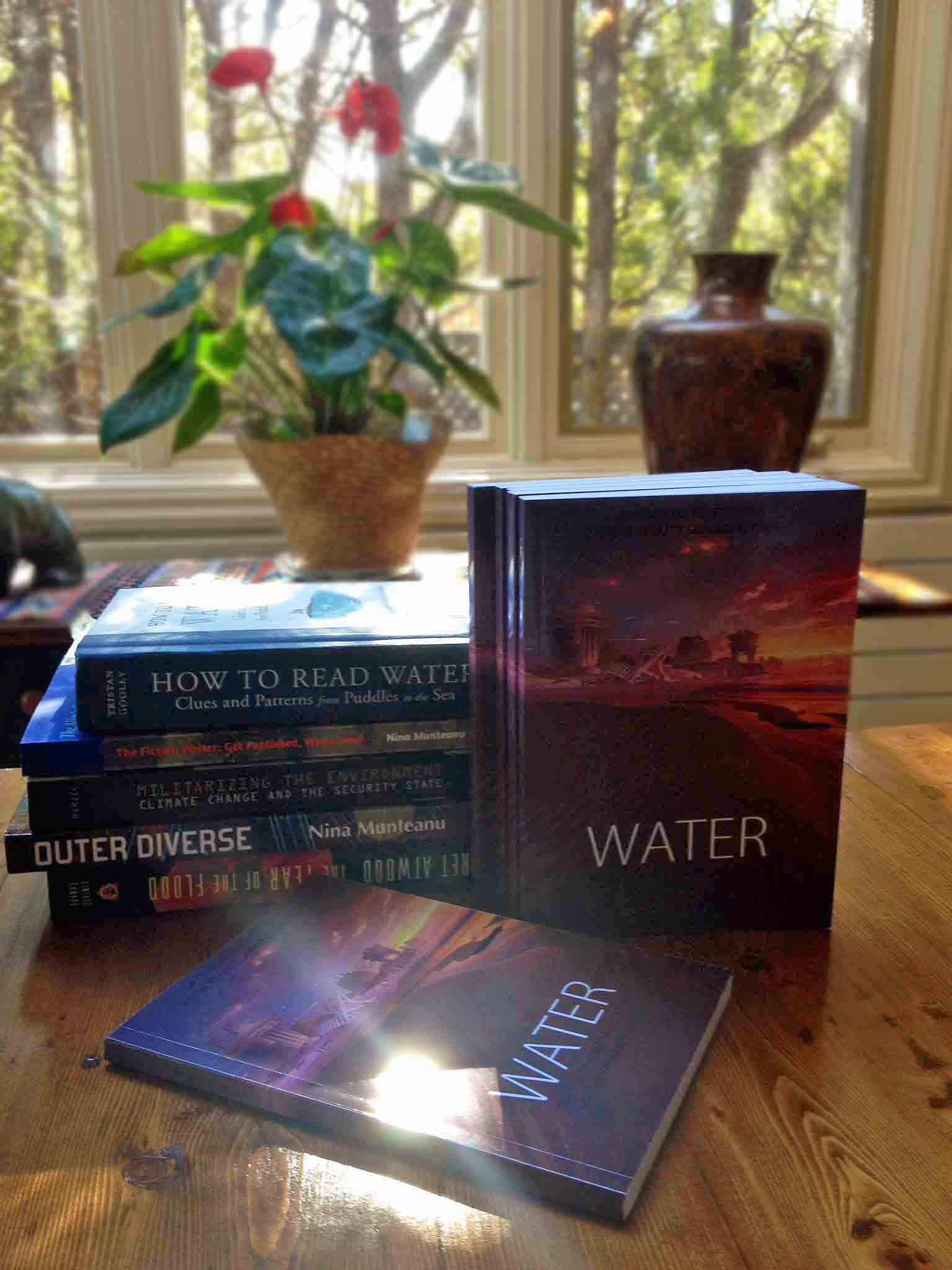
WaterAnthology-RealitySkimmingPressIn December 2017, “Water”, the first of Reality Skimming Press’s Optimistic Sci-Fi Series was released in Vancouver, BC. I was invited to be one of the editors for the anthology, given my passion for and experience with water.

This is how Reality Skimming Press introduces the series:

Reality Skimming Press strives to see the light in the dark world we live in, so we bring to you the optimistic science fiction anthology series. Water is the first book in the series, and is edited by author and scientist Nina Munteanu. Six authors thought optimistically about what Earth will be like in terms of water in the near future and provide us with stories on that theme. Step into the light and muse with us about the world of water.

Editing “Water” was a remarkable experience, best described in my Foreword to the anthology:

LyndaWilliams

Lynda Williams

This anthology started for me in Summer of 2015, when Lynda Williams (publisher of RSP) and I were sitting on the patio of Sharky’s Restaurant in Ladner, BC, overlooking the mouth of the Fraser River. As we drank Schofferhoffers over salmon burgers, Lynda lamented that while the speculative / science fiction genre has gained a literary presence, this has been at some expense. Much of the current zeitgeist of this genre in Canada tends toward depressing, “self-interested cynicism and extended analogies to drug addiction as a means of coping with reality,” Lynda remarked.

Nina-Sharkys

lunch at Sharky’s

Where was the optimism and associated hope for a future? I brought up the “hero’s journey” and its role in meaningful story. One of the reasons this ancient plot approach, based on the hero journey myth, is so popular is that its proper use ensures meaning in story. This is not to say that tragedy is not a powerful and useful story trope; so long as hope for someone—even if just the reader—is generated. Lynda and I concluded that the science fiction genre could use more optimism. Reality Skimming Press is the result of that need and I am glad of it.

Megan coverIn the years that followed, Reality Skimming Press published several works, including the “Megan Survival” Anthology for which I wrote a short story, “Fingal’s Cave”. It would be one of several works that I produced on the topic of water.

As a limnologist (freshwater scientist), I am fascinated by water’s anomalous and life-giving properties and how this still little understood substance underlies our lives in so many ways. We—like the planet—are over 70% water. Water dominates the chemical composition of all organisms and is considered by many to be the most important substance in the world. The water cycle drives every process on Earth from the movement of cells to climate change. Water is a curious gestalt of magic and paradox, cutting recursive patterns of creative destruction through the landscape. It changes, yet stays the same, shifting its face with the climate. It wanders the earth like a gypsy, stealing from where it is needed and giving whimsically where it isn’t wanted; aggressive yet yielding. Life-giving yet dangerous. Water is a force of global change, ultimately testing our compassion and wisdom as participants on a grand journey.

When Reality Skimming invited me to be editor of their first anthology in their hard science optimistic series, and that it would be about water, I was delighted and excited.

WATER Anthology-interior-image

Illustration by Digbejoy Gosh for Bruce Meyer’s “The River Tax”

The six short stories captured here flow through exotic landscapes, at once eerie and beautiful. Each story uniquely explores water and our relationship with its profound and magical properties:  melting glaciers in Canada’s north; water’s computing properties and weather control; water as fury and the metaphoric deluge of flood; mining space ice from a nearby comet; water as shapeshifter and echoes of “polywater”. From climate fiction to literary speculative fiction; from the fantastic to the purest of science fiction and a hint of horror—these stories explore individual choices and the triumph of human imagination in the presence of adversity.

I invite you to wade in and experience the surging spirit of humanity toward hopeful shores.

Nina Munteanu, M. Sc., R.P.Bio.
Author of Water Is…
October, 2017
Toronto, Canada

waterbooks2L

My desk with copies of “Water” among my current books to read…

The anthology features the art work of Digbejoy Ghosh (both cover and interior for each story) and stories by:

Holly Schofield
Michelle Goddard
Bruce Meyer
Robert Dawson
A.A. Jankiewicz
Costi Gurgu

You can buy a copy on Amazon.ca or through the publisher.

nina-2014aaaNina Munteanu is an ecologist, limnologist and internationally published author of award-nominated speculative novels, short stories and non-fiction. She is co-editor of Europa SF and currently teaches writing courses at George Brown College and the University of Toronto. Visit www.ninamunteanu.ca for the latest on her books.

A Tardigrade Christmas…

…A Different Christmas Story…

water bear03 copyBlika lived in Mossland with her clone sestras, gathering and sucking the delicious juices of detritus and algae. Never in a hurry, she lumbered from frond to frond on eight stubby legs in a gestalt of feasting and being. Blika led a microscopic life of bloated bliss—unaware of forests, human beings, quantum physics or the coming singularity…water bear010 copy

A sudden fierce wind wicked her water away. In a burst of alien urgency, she wriggled madly for purchase on the frond as it shivered violently in the roaring wind. Blika lost hold and the wind swept her into a dark dryness. Her liquid life-force bleeding away from her, Blika crawled into herself. The moss piglet felt herself shrivel into oblivion.

water bear08 copy

No, not oblivion… more like a vast expanse…

She had entered a wonderland of twinkling lights in a vast fabric of dark matter. Where am I?

It occurred to her that she had never thought such a thing before. Am I dead? She’d never thought about existence before either. What has happened to me? And where are my sestras? She felt an overwhelming sadness. Something else she’d never felt before and wondered why she hadn’t. Did it have to do with that liquid that had always embraced her with its life-force? Here, in the darkness of space, she felt alone for the first time, separated from the plenum.tardigrades_in_space copy

“Welcome, sestra!” boomed a large voice.

Blika beheld a being like her with eight arms and hands, seated on a throne and wearing a jeweled crown. “Why do you call me sestra?” Blika asked.

tardigrade-queen-by-thomas a gieseke copy“Because we are ALL sestras! You are a Tardigrade, aren’t you?” She waved all eight arms at Blika. “Well, I am your queen!” She looked self-pleased. “You are in Tunland now! The land of awareness. And now that you are self-aware, you can do anything! We’re special,” the queen ended in smug delight. The folds of her body jiggled and shimmered.

“Why are we special?” Blika asked.

“Because we are!” the queen said sharply, already losing patience with her new subject. “Don’t you know that you can survive anything? Ionizing radiation. Huge pressure. Boiling heat. Freezing cold. Absolutely no air. And no water…”

Blika gasped. Water was the elixor that connected her to her sestras and her world… her…home…

“How do you think you got here, eh?” the queen mocked her with a sinister laugh. Blika cringed. The queen went on blithely, “So, where do you come from, piglet?”

“I’m trying to find my way home…”

tardigrades holiday copy

“Your way? All ways here are my ways!”

“But I was just thinking—”

“I warn you, child…” The queen glowered at her. “If I lose my temper, you lose your head. Understand?”

Blika nodded, now missing her home even more.

“Why think when you can do!” the queen added, suddenly cheerful again. “First there is BE, then THINK, then DO. Why not skip the think part and go straight to the do part? In Tunland we do that all the time,” she went on cheerfully. “And, as I was saying, here we can do anything!”

The queen grabbed Blika by an arm and steered them through the swirling darkness of space toward a box-like floating object. “This is my doctor’s Tardis…”

“Doctor who?” Blika naively asked.

The queen shivered off her annoyance and led them eagerly through the door and into her kingdom.

tardigradetardis copyThey entered a strange place of giant blocks and whining sounds beneath a dark swirling sky.

The first thing Blika noticed was the huge tardigrades floating above them like dirigibles! Others were dressed in suits holding little suitcases and walking into and out of the huge blocks through doorways.

“We’ve crossed into another dimension—my universe,” the queen announced cheerfully. “Here you can do anything you want. So, why be tiny and feckless when you can be huge and powerful!” She studied Blika. “This is your moment to do what you could never do before. Think of the possibilities! You too could be huge!”

Blika stared at the strange world of smoke and metal and yearned for her simple mossy home.

tardigrade-helmet-1 copyAs if she knew what Blika wanted, the queen quickly added, “But you can never go back home!”

“Why not?” Blika asked, disappointed.

Because, that’s why!” the queen shouted.  Squinting, she added, “It’s too late. It’s just not done! Once you’ve learned what the colour green means you can’t erase its significance!”

“But I still don’t know what the colour green means,” Blika complained. “And, besides, I think you’re wrong. Becoming self-aware doesn’t stop you from going home. It just changes its meaning. And if I can really do what I want, then you can’t stop me. I’m going home to my family.”

attack_of_the_tardigrades_by_ramul copy 2

The little hairs on the queen bristled. Then she grew terribly calm. “I won’t stop you, but…” The queen pointed to the floating tardigrades above them. “My water bear army will. I sentence you to remain in Tunland forever for your crime!”

“I haven’t done anything…yet.”

“You’ve broken the law of thinking before doing. In Tunland you have to skip that part—”

“You just made that up—”

“Doesn’t matter!” shouted the queen. “Sentence first, verdict afterwards!”

“That’s nonsense,” said Blika loudly. “The idea of having the sentence first.”

“Hold your tongue!” said the queen, turning a shade of chartreuse.

“I won’t,” said Blika.

“Off with your head!” the queen shouted at the top of her voice, pointing to Blika with all eight of her appendages. The water bear army hovered over Blika, taking aim. They were going to get more than her head with those lasers, Blika thought, and scurried for cover faster than her stubby eight legs had ever moved before. She was doomed—

Then, just beyond her sight, she saw—no felt—something far more significant than the colour green…or a huge bloated water bear army about to shoot her…

Water! She could taste it, smell it, hear it. Blika rejoiced with thoughts of her green home.

i believeThe water came in a giant wet wave of blue and silver and frothy green. Tunland sloshed then totally dissolved. Blika surfed the churning water. That green! She knew what it was! Blika reached out with her deft claws and snagged a tumbling moss frond. It finally settled and there were her sestras! So many of them clinging to the same green moss! She’d found her family! She was home! Yes, it was a different home and different sestras, but it was also the same. Love made it so…

Merry Christmas!


water bear02 copyTardigrades, also known as water bears or moss piglets, are plump, microscopic organisms with eight clawed legs. Fossils of tardigrades date to the Cambrian period over 500 million years ago. Over 900 species are known. Tardigrades were first described by the German pastor Johann August Ephraim Goeze in 1773 and given the name Tardigrada, meaning “slow stepper,” by the Italian biologist Lazzaro Spallanzani. Tardigrades reproduce asexually (parthenogenesis) or sexually. They mostly suck on the fluids of plant cells, animal cells, and bacteria.

Tardigrades survive adverse environmental stresses including:

  • High and low temperatures (e.g., -273°C to +151°C)
  • freezing and thawing
  • changes in salinity
  • lack of oxygen
  • lack of water
  • levels of X-ray radiation 1000x the lethal human dose
  • some toxic chemicals
  • boiling alcohol
  • low pressure of a vacuum
  • high pressure (up to 6x the pressure of the deepest ocean).

Water Bear or TardigradeTardigrades respond to adverse environmental stresses through “cryptobiosis”, a process that greatly slows their metabolism. Tardigrades survive dry periods by shriveling up into a little ball or tun and waiting it out. They make a protective sugar called trehalose, which moves into the cells to replace the lost water. You could say that the water bear turns into a gummy bear.

Tardigrades have revived after a 100 years of desiccation. The antioxidants they make soak up dangerous chemicals and tardigrades can also repair damaged DNA from long term dry-out. In low oxygen, the tardigrade stretches out, relaxed muscles letting more water and oxygen enter its cells. The tardigrade’s cold-resistant tun also prevents ice crystals that could damage cell membranes.

Tardigrades survive temperatures, pressures and ionizing radiation not normally found on Earth. All this raises questions of origin and evolutionary adaptation. How—and why—have tardigrades developed the ability to survive the vacuum and ionizing radiation of space? Some suggest that it’s because they originated there. Scientists argue that they developed extreme tolerances from Earth’s volatile environments (e.g., water bodies that freeze or dry up, and undergo anoxia). But, if they can make it there, they can make it anywhere. So, where is “home” really?…

Water Is-COVER-web copyMy Book “Water Is…” by Pixl Press explores this creature and many other interesting things about water. Look for it on Amazon, Chapters, Kobo and in bookstores & libraries near you. If it’s not in your local library, ask for it.


nina-2014aaaNina Munteanu is an ecologist, limnologist and internationally published author of award-nominated speculative novels, short stories and non-fiction. She is co-editor of Europa SF and currently teaches writing courses at George Brown College and the University of Toronto. Visit www.ninamunteanu.ca for the latest on her books.

Everything Change Climate Fiction Contest–2018

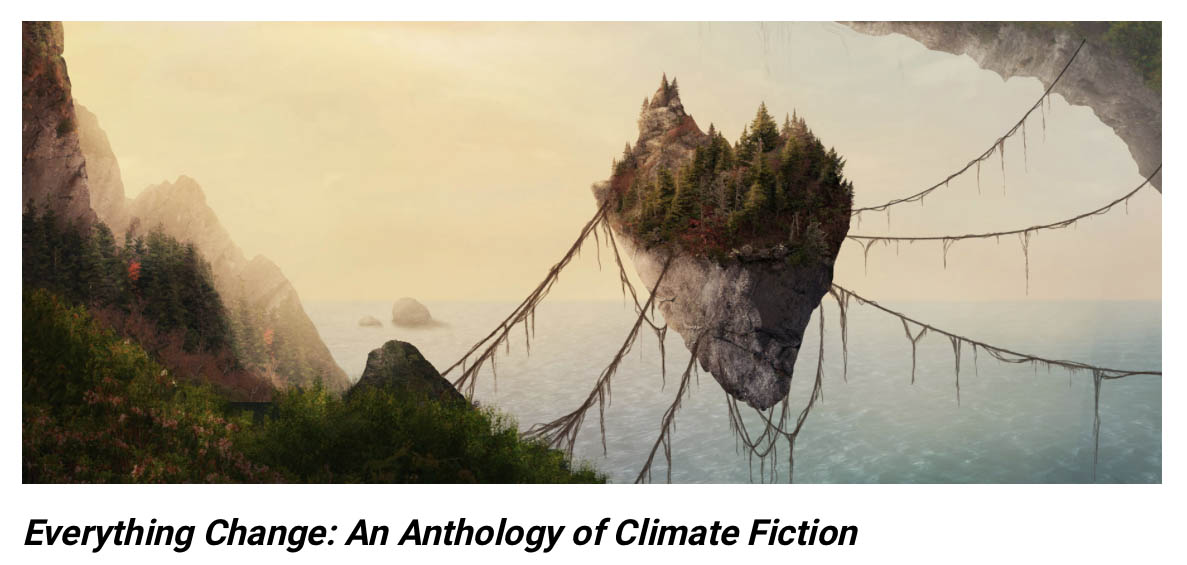
climate fiction contestArizona State University’s Imagination and Climate Futures Initiative is again hosting a Climate Fiction Short Story Contest. In years past they invited writers from around the world to submit speculative fiction stories that explore climate change to narrate a world in flux. Previous contests received submissions from 67 different countries and 12 finalists were published in a digital anthology “Everything Change”.
everything change

The 2018 Climate Fiction Short Story Contest invites submissions in all genres, including speculative, realistic, literary, experimental, hybrid forms, and more.

The context will again be judged by science fiction writer Kim Stanley Robinson, award-winning author of many foundational works in climate fiction, including New York 2140.

The winning story will receive a $1,000 prize. Nine finalists will receive $50 each. The winner and finalists will be published in an online anthology, which will be free to download, read, and share.

The deadline for submission is February 28, 2018, with the finalists announced in summer 2018. All submissions must be received through their online submissions manager at https://everythingchange.submittable.com.

For more details on submission guidelines and eligibility go to the climate imagination site.

PolarBear-facepalm

Don’t be shy.  Write your best and submit.


Nina Munteanu Talks to Hi-Sci-Fi Radio…

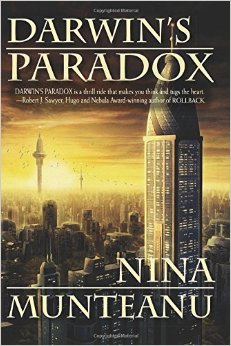
darwins-paradoxHi-Sci-Fi Radio (a podcast radio show out of CJSF 90.1FM in Burnaby, British Columbia) interviewed Nina Munteanu about the paradoxes of her eco-thriller “Darwin’s Paradox” by Dragon Moon Press (Edge Publishing).

A devastating disease. A world on the brink of violent change. And one woman who can save it or destroy it all. Julie Crane must confront the will of the ambitious virus lurking inside her to fulfill her final destiny as Darwin s Paradox, the key to the evolution of an entire civilization.

Nina and Irma Arkus talked synchronicity, autopoiesis, Nature’s intelligence and whether algae can sing in this entertaining interview on science fiction and all things wonderful and strange.

Darwin’s Paradox is a thrill ride that makes you think and tugs the heart.”–Robert J. Sawyer, Hugo and Nebula Award-winning author of Quantum Night

Write What You Know–Write “From the Inside Out”

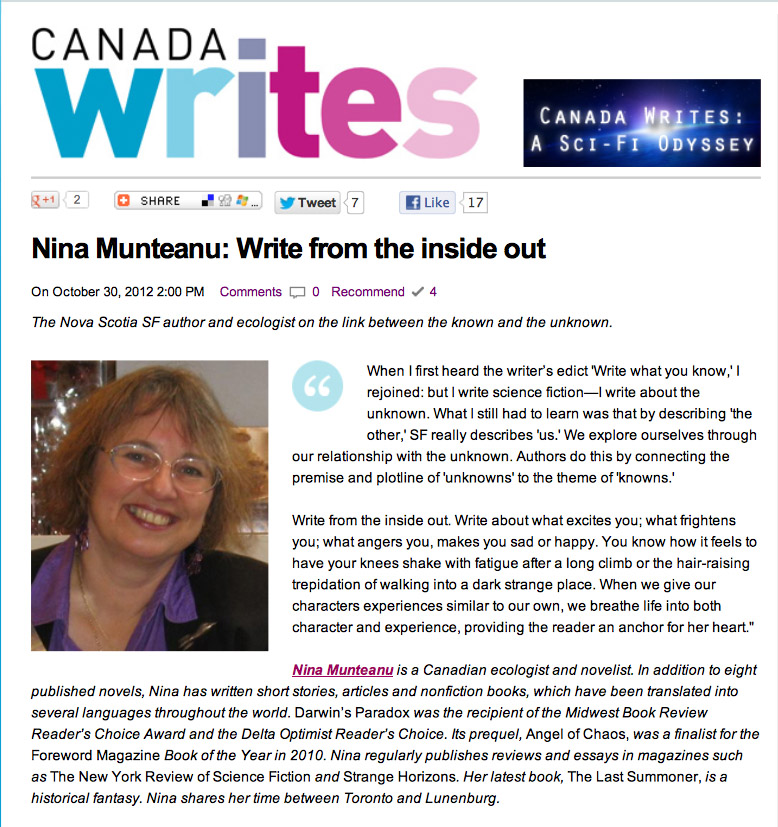
Canadian ForestWhen I first heard the writer’s edict “write what you know” I rejoined: but I write science fiction—I write about the unknown. What I still had to learn was that by describing “the other” SF really describes “us”. We explore ourselves through our relationship with the unknown. We do this by ensuring that all our plotlines reflect theme.
Write About What You Know

How many times have you been told to write about what you know? And how many times have you trusted that advice? Well, how interesting is that?!? We think our lives are dull, boring, and mundane. We write – and read – to get away from it, don’t we?

nina-LL-interviewe-closer

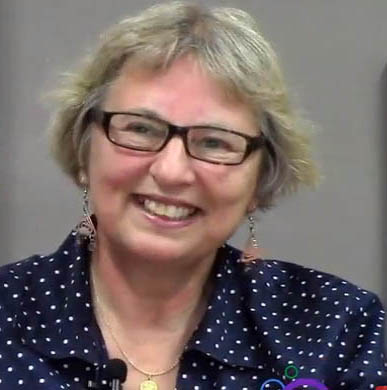
Nina Munteanu

Well, yes…and no…

In the final analysis, even good “escapist” writing, like some science fiction, despite its alien settings and creatures of imagination, is grounded in the realities of our every-day lives, which form the basis of human nature. Love, ambition, trust, hate, envy, honor, courage. All these are universal human traits which the writer taps into and ultimately writes about.

“In the 19th century, John Keats wrote to a nightingale, an urn, a season. Simple, everyday things that he knew,” say Kim Addonizio and Dorianne Laux in The Writer’s Guide to Creativity. “Walt Whitman described the stars, a live oak, a field. They began with what they knew, what was at hand, what shimmered around them in the ordinary world.”

Writing about what you know isn’t about literal truths; it’s about what you know inside your heart. Write from the inside out. Write about what excites you; what frightens you; what angers you, makes you sad, happy. As SF author Marg Gilks says, “You know more than you think.”

Twisted Truths & Inner Knowledge

Writers can use our own knowledge and experiences in everyday life and translate them into something far from ordinary. You start with universal experiences.

Get Emotional

What excites you; what frightens you; what angers you, makes you sad, happy. These are emotions we all feel. When we give our characters experiences similar to our own, we breathe life into both character and experience and provide the reader an anchor for her heart.

Get Sensational

You know how it feels to have your knees shake with fatigue after a long climb or the hair-raising trepidation of walking into a dark place. Use these sensations to make your writing more sensual with added dimensions of reality.

Get People Around You

My neighbor has a funny way of focusing his gaze slightly off me when he talks, like he can’t look me directly in the eyes. When he approaches my house to deliver the paper, Dennis strides with a lilting gait as he listens to hip-hop on his ipod.

Drawing from what you observe and know of the people around you is one of a writer’s most treasured resources for character description. I always carry a notebook with me no matter where I go, even if it’s only to the grocery store.

The Magic of Storytelling

A writer is like a magician. You play upon what readers all “know” then surprise them with the unexpected.

Unleashing your imagination and letting it soar while grounding yourself in the realities of universal truths is the stuff of which stories are made. This is what most of us mean when we say “write what you know.”

“Unless you are writing about a personal tragedy,” says Tina Morgan of Fiction Factor, “you will have to use your imagination. Use the creativity that drives you to write in the first place. Take those feelings you have every day and amplify them. Make them more intense, more vivid. Before you know it, you will be ‘writing what you know’.”

“Next time you hear ‘write what you know,’ ” says Gilks, “you’ll realize that you know an awful lot about what matters most in a story’s success. It’s waiting only to be shaped by your imagination.”

Write Real

Literary Agent, Rachelle Gardner, provided a great definition of “write what you know” on her blog. Here’s an excerpt:

Most people think “write what you know” means you have to put characters in situations you’re personally familiar with. If you’re a mom with five kids, you should write a mom story. If you’ve fought cancer and won, you should write about that. But in my opinion, that’s not what it means.

Write what you know means write with authenticity about thoughts, feelings, experiences of life. Be honest. Write from a deep place. Don’t write from the surface. Whether you’re writing about parenthood or cancer or anything else… be real.
Rachell Gardner

Don’t reflect what you know from other people or the media… write what you know from your own inner life.

An excerpt of this article appeared in CBC’s Canada Writes.

Nina-CanadaWrites2012

Publishers Weekly Praises Cli-Fi: Canadian Tales of Climate Change & “The Way of Water”

Publishers Weekly writes:

cli-fi-exile anthology2017“In his introduction to this all-original set of (at times barely) futuristic tales, Meyer warns readers, “[The] imaginings of today could well become the cold, hard facts of tomorrow.” Meyer (Testing the Elements) has gathered an eclectic variety of eco-fictions from some of Canada’s top genre writers, each of which, he writes, reminds readers that “the world is speaking to us and that it is our duty, if not a covenant, to listen to what it has to say.” In these pages, scientists work desperately against human ignorance, pockets of civilization fight to balance morality and survival, and corporations cruelly control access to basic needs such as water. The most affecting tale, Wendy Bone’s “Abdul,” is also the least futuristic, an emotional story that touchingly contrasts Western guilt against the life of a captive orangutan. The anthology may be inescapably dark, but it is a necessary read, a clarion call to take action rather than, as a character in Seán Virgo’s “My Atlantis” describes it, “waiting unknowingly for the plague, the hive collapse, the entropic thunderbolt.” Luckily, it’s also vastly entertaining. It appears there’s nothing like catastrophe to bring the best out in authors in describing the worst of humankind.”

My story The Way of Water is one of 17 stories in Exile’s anthology, published in May 2017. It was originally published in English and Italian [La natura dell’acqua] by Mincione Edizioni [print] and Future Fiction [ebook] in Rome in early 2016. The Way of Water is a near-future vision that explores the nuances of corporate and government corruption and deceit together with resource warfare. An ecologist and technologist, Nina Munteanu uses both fiction and non-fiction to examine our humanity in the face of climate change and our changing relationship with technology and Nature … through water.

la natura dell'acquaShe imagines its coolness gliding down her throat. Wet with a lingering aftertaste of fish and mud. She imagines its deep voice resonating through her in primal notes; echoes from when the dinosaurs quenched their throats in the Triassic swamps.

Water is a shape shifter.

It changes yet stays the same, shifting its face with the climate. It wanders the earth like a gypsy, stealing from where it is needed and giving whimsically where it isn’t wanted.

Dizzy and shivering in the blistering heat, Hilda shuffles forward with the snaking line of people in the dusty square in front of University College where her mother used to teach. The sun beats down, crawling on her skin like an insect. She’s been standing for an hour in the queue for the public water tap.

The Way of Water takes place in Toronto, Ontario in Canada, mostly on or near the campus of the University of Toronto.

In The Way of Water, Nina Munteanu pens her love letter to water, exulting it as a liquid that has semi-magical properties. Munteanu recognizes the chimerical quality of water, its unique ability to shift and change, to purify and taint, and the incredible way that it makes up most of our body mass and therefore shapes us as well.

nina-TV-nov2015A limnologist (lake ecosystem biologist) by trade, Munteanu recognizes the incredible way that water shapes life and brings attention to the fact that water connects us to each other just as water connects with other water, forming bonds. She evokes in the reader a sense of reverence for water and an awareness that the same water that flows through our bodies have flowed through the bodies of our ancestors, cycling through life since the first life forms coalesced.

In recognizing the preciousness of water, she also recognizes its precarity and the danger that capitalist systems pose when they lay claim to water and seek to own it. “The Way of Water” evokes a sense of awareness about issues of access to water and about the dangers of imbalances in that access.”—Derek Newman-Stille, Speculating Canada


book-patio2 copy“Water covers every aspect of this science fiction story that pits the vulnerable citizen against the evil multinational corporation in a dystopian Canada sometime in our future. Water is presented in its multiplicity of facets: in the science behind its composition, in its history, in it’s symbolic nature and different physical states; water is a giver and taker of life, and is the form in which the friendship of protagonists Hilda and Hanna functions. Water is also magic and the ultimate righter of wrongs committed to it and to a humanity it gives life to. Within this framework, Munteanu spins a thought-provoking tale that projects where our headlong pursuit of profit may one day lead us to, and how nature will ultimately, with a little human coaxing, be the only one to correct the balance.”—Shane Joseph, Canadian author of Fringe Dwellers

“Nina Munteanu with The Way of Water suggests that this element is also a form of laNaturaDell'Acqua-coverlove; a story to read, not only to deal with the possible but, above all, to understand that the time still available for “love” might be less than what you believe.”—Simone Casavecchia, SoloLibri.net (read the original Italian review here)

The Way of Water is a story of the kind you hope is science fiction but you fear is not.”—Massimo Luciani, NetMassimo (read the original Italian review here)


nina-2014aaNina Munteanu is an ecologist and internationally published author of award-nominated speculative novels, short stories and non-fiction. She is co-editor of Europa SF and currently teaches writing courses at George Brown College and the University of Toronto. Visit www.ninamunteanu.ca for the latest on her books.