Defining Moments and The Last Summoner

A few years ago I attended a panel at Toronto’s Ad Astra convention called “Stealth Science Fiction in Person of Interest.” The panel was the brainchild of fellow science fiction writer Ira Nayman, an avid watcher of the TV show. Unbeknownst to me, the panel I’d been assigned to participate with Ira and another panelist was about a TV show (which I’d never seen)—not just an expression.

I bumbled in the beginning as realization dawned on me that this was what the panel was about and quietly berated myself for not rereading the short description (which had been sufficiently vague—at least to me). I finally let the panelists and audience know my limitation when Ira astutely noted that I was being extra reticent (not one of my usual traits in panels). We muddled along, despite my infirmity, and the panel went along admirably—mainly because Ira moderated with great astuteness and audience members participated enthusiastically.

One of the plot points of the show led Ira to share a personality-defining hypothetical dilemma that he’d encountered. Here’s how he described it: if you knew you could save five people by instigating the death of another person, would you do it? Or would you, by your inaction, allow the five to die by not instigating that person’s death? The premise, of course, is that you could tell the future of two divergent actions.

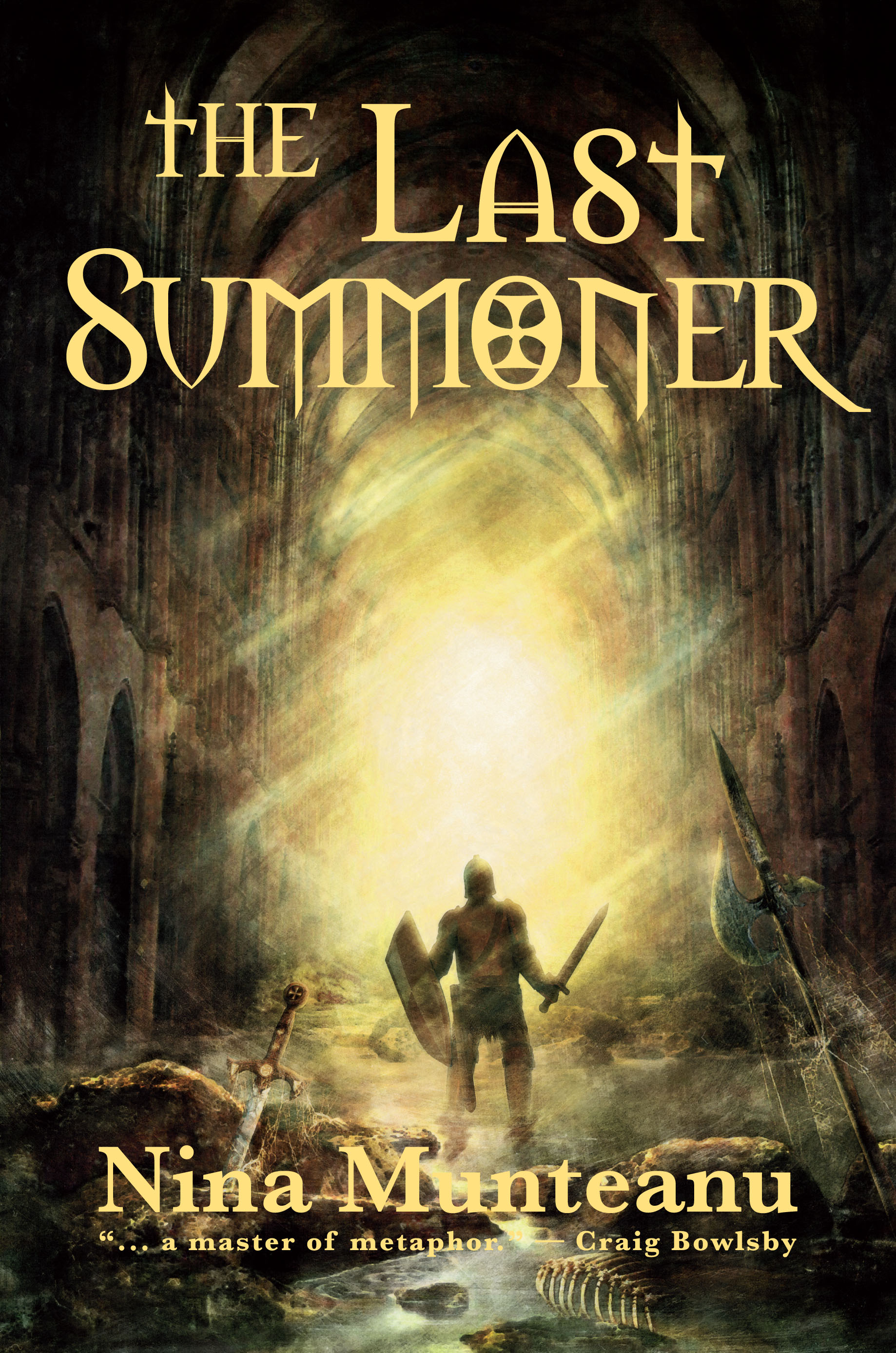
LastSummoner-coverI realized soon after that this is exactly the situation that my main character Vivianne Schoen, the Baroness Von Grunwald, faced in her journey to change the history she’d inadvertently authored (in The Last Summoner). As a medieval time traveler, she was presented with several courses of history and needed to choose her actions carefully in accordance with both short-term and long-term consequences. Faced with the possibility of saving utterly millions of people who were fated to perish in World War I by instigating the death of one man—Kaiser Wilhelm II—Vivianne sets out to do the deed.

Besides her ability to time travel, Vivianne is able to manipulate metal through mind-wave energy. Because of this power, she decides to participate in a momentous event in which her power will have a potentially deadly effect. The year is 1889, just a year after Kaiser Wilhelm II was crowned Emperor, and the place is Charlottenburg Race Course in Berlin in this excerpt from The Last Summoner:

VIVIANNE pulled up the collar and hood of her fur coat to ward off the November chill as she walked next to Jurgen von Eisenreich in Berlin’s Charlottenburg Race Course. The coat barely kept the winter wind from cutting through her cream- colored evening gown. Fastened at the back, it had no bustle and signaled the upcoming style. They were here to watch Europe’s latest touring attraction from America: Buffalo Bill’s Wild West Show. Steering her by the elbow, von Eisenreich guided her up the rafter stairs toward the Royal Box, where the new Emperor was already seated with his retinue of several statesmen, including his aides-de-camp, and two imperial guards. Vivianne recognized the odious and obsequious Count Alfred von Waldersee, seated beside the Emperor. Twenty-seven years the Kaiser’s senior, the Count was a power-mongering anti-Semite, who would prove to mold the weak-minded Crown Prince into the bigoted warlord Kaiser Wilhelm II was becoming.

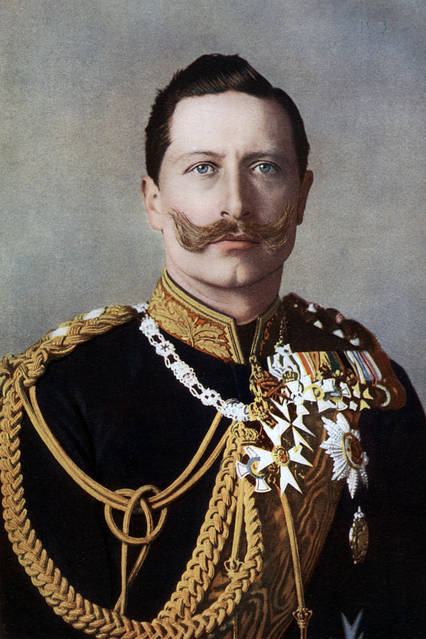
Wilhelm II

Kaiser Wilhelm II

Vivianne stole a long glance to the Reich’s young ruler. It had been just a year since the Crown Prince had ascended to the imperial thrown and he had already stirred up trouble with his insulting behavior of his mother, the dowager Empress, and his uncompassionate handling of his father’s funeral; then his shabby treatment of England’s Queen and her son, the Prince of Wales.

Vivianne furtively studied the dashing thirty-year old ruler with deep interest. Dressed impeccably in uniform, he was rakishly handsome, she decided, with sharp intelligent eyes, a long aristocratic nose and well-waxed handle-bar mustache. She found herself staring at his withered left arm, which he rested on his lap. Though she could not make it out, it was a good six inches shorter than the other arm and partially lifeless. He’d been a breech birth and both he and his mother were lucky to be alive.

Vivianne reflected on that eventful day when she’d botched her attempt to save the last Emperor of Germany from an unnatural birth. While Oskar had been instantly killed, the doctor had survived the carriage accident with only a severe concussion; he’d still only managed to get to Unter den Linden by early afternoon, having lain unconscious and unattended for most of the morning then having awoken at Humboldt Hospital where he’d ironically been scheduled to speak that day and had then foolishly insisted on tending to Vivianne first, who’d suffered a nasty head wound that she hadn’t even been aware of receiving.

The Emperor—like Vivianne—was here, in the District of Charlottenburg in West Berlin, to see the show’s star attraction, Annie Oakley, who acquired world fame for her skills with a Colt .45. The young sharpshooter had been invited by the Kaiser for a private performance for the Union-Club. Vivianne found her breaths escalate at the thought of what the impetuous Kaiser was about to do; and what she intended to do, as a result. Was it an ironic twist of history that only months ago Adolf Hitler was born this year? Vivianne glanced down at the program in her gloved hand:

Programme of Miss Annie Oakley’s Private Performance Before the Members and Their Friends of the Union-Club, Berlin, on November 13, 1889, at Charlottenburg Race Course.

There followed a list of up to seventeen feats she would perform, beginning with her exhibition of rifle shooting, followed by clay-pigeon sharp-shooting then various feats involving trapping and agility in weapon handling. She was not fated to get very far in her program before calamity of sorts would strike, Vivianne thought cynically.

“He’s alone…without his family?” she asked von Eisenreich. That would make it much easier, she concluded with an inward sigh.

“Dona prefers the comfort and warmth of the royal palace in Potsdam, and the company of her children,” he responded. “She’s not interested in this sort of thing. She has few interests other than church service, I’m afraid.” Then he leaned his head close to hers to confide. “Ten years ago, Wilhelm was smitten by his beautiful cousin, Victoria Elizabeth, the second eldest daughter of the Grand Duke and Duchess of Hesse and the Rhine. But Ella wouldn’t have him.” Then von Eisenreich surveyed Vivianne with an appraising look and smiled enigmatically. “In fact, she looked a lot like you.”

Vivianne swallowed down a sudden discomfort, not sure of its source. Von Eisenreich went on, “Poor Wilhelm became very self-conscious about his arm and thought himself unattractive. That might be why he chose a plain and simple, but pious woman.”

More like narrow-minded, anti-Semitic and bigoted thought Vivianne. Unfortunately the Empress fit in too well with the Kaiser’s own bigoted views and apparently her nature only served to exacerbate the Kaiser’s arrogance and insufferable nature.

Von Eisenreich chuckled to himself. “I heard that the Empress Dona was called unimaginative and prejudiced by the Emperor’s own mother. Dona hates the English. But don’t we all!” He laughed.

Vivianne thought of the cutting words of the gossiping socialite, Daisy, Princess of Pless: for a woman in that position I have never met anyone so devoid of any individual thought or agility of brain and understanding. She is just like a good, quiet, soft cow that has calves and eats grass slowly then lies down and ruminates.

“Apart from that homosexual, Count Philipp von Eulenburg, I’m the Emperor’s only real friend,” von Eisenreich confided rather smugly to Vivianne as they approached the Royal Box.

As if he felt her stealthy glance, the Kaiser turned to look directly at her. After an unabashedly long appraisal, he let his eyes drift away and leaned out, looking past his aide to focus on von Eisenreich. “Ah, Jurgen! So that’s why you dallied and missed my retinue!” The Kaiser yelled in a coarse Potsdam accent, eyes flitting back critically to Vivianne like she was merchandize. He stood up and clapped von Eisenreich hard on the back, clearly happy to see him. Vivianne got a clear view of his short left arm with dark brown mole on his shriveled hand. She noted that he was rather short in stature for a man, about her height or less, with a squat and slightly lopsided neck—owing to his left arm being shorter than the other. Eisenreich drew Vivianne forward.

“This is the Comptesse d’Anjou,” von Eisenreich said.

She pulled down her hood and curtsied slightly, eyes downcast. “I’m honored and humbled, your Imperial Majesty,” she said.

“No doubt you are!” he responded, swiftly tucking his left hand in his pocket. When she raised her eyes to meet his, Vivianne caught the brief instant as his eyes grew wide and deep with hidden intensity.
 Jurgen caught it too. “I thought so, also,” he said with amusement to the Emperor. He was, no doubt referring to her likeness to the Princess Ella.

The Kaiser sucked in a breath and straightened with an imperceptible tremble, as if to shake off an old memory. Then he gave Vivianne a cold smile and extended his good hand to her in greeting. She accepted and instantly winced with excruciating pain. He barked out a cruel laugh and said, “The French are, I’m afraid, just like the English when it comes to my German mailed fist!”

Vivianne had heard of his sadistic handshake: he was in the habit of turning his many rings inward prior to clasping one’s hand with a vice-like grip. Somehow, she hadn’t expected him to inflict her with it. Perhaps it was his way of punishing his cousin for not accepting his marriage proposal, she concluded, regretful of her resemblance. The Kaiser hung on to her hand much longer than he needed to, Vivianne decided, squirming and attempting to retract it from his painful grasp. His grip was too strong.

Their eyes locked. And to her frustrated anger, her eyes teared up with the stinging pain through her glove.

In that moment she saw the hurt little boy in that bigoted, arrogant and angry face. She instantly knew that she’d misjudged one of his critical nexuses. Her mission this day might have been prevented. If she’d intersected with his life earlier, and somehow convinced his beloved Ella to accept his proposal, the single-minded but compassionate princess might have softened him, completed him, inspired him to be the great man he could have become instead of the bitter and insecure bully he now was.

Something passed between them and he abruptly let go of her hand with a sudden intake of air. “I beg pardon,” he said, voice softening from that harsh Potsdam accent. “You reminded me of someone I once knew…” In a flush of solicitous emotion, he pulled off her glove to inspect the damage he’d inflicted on her hand. Several red welts had surfaced on the inside of her lower palm where his rings had gouged into her flesh. “Ahh…such dear soft and warm hands…” he cooed in near reverence. “How remarkable…the soft insides of your hands…”

Vivianne slowly pulled her hand away.

They both looked awkward for a moment. Then the Kaiser broke out into a blustery laugh and turned to von Eisenreich.

“So, where’s your good wife, von Eisenreich?”

“Like you, I left her at home with my dear children, where she should be, your Majesty,” von Eisenreich responded cheerfully. “They’re no fun at these sorts of things.”

“Ah, but I wager the Comptesse is,” said the Emperor brashly and took the opportunity to rake her over with appreciative eyes.

Von Eisenreich let loose a conspiratorial laugh, as if to ratify the Kaiser’s innuendo. He then leaned into Vivianne beside him with a chuckle until his shoulder collided into hers. “I brought my lovely companion, the charming Comptesse d’Anjou, to improve my demeanour and make me interesting.”

The Kaiser threw his head back and shouted an open- mouthed laugh of abandon then stomped his foot. “Indeed, she has managed that!” He surveyed Vivianne with critical eyes that flashed with approval. When she’d first been introduced to him, she’d felt the Kaiser’s burning gaze roam over her like the eager hands of a lover. “Good choice,” Wilhelm said.

He’d clearly deduced that she was von Eisenreich’s mistress and Jurgen had as much as confirmed it. The Kaiser had several mistresses of his own and Vivianne had the impression he wouldn’t have minded another.

As Uta had predicted, Vivianne had indeed filled out into what most men commonly considered a woman of striking beauty. And she’d had many years to cultivate it into an irresistible package. She was now over four hundred years old, yet she looked no more than in her early twenties. That arcane quality alone, she knew, was enough to drive men to distraction.

Vivianne had only met von Eisenreich last week at a masked ball and, knowing his weakness for beautiful women, she’d shamelessly flirted with him; within short order she’d seduced his keen interest in her and ensured for herself an invitation to this event.

The Kaiser let his gaze stray to Vivianne as he spoke to von Eisenreich. Then he finally let his eyes rest openly on her with a cool smile. “You speak German very well for a French woman, Comptesse,” he said to her. “I detected no accent when we were first introduced.”

She smiled demurely and didn’t bother to correct him on her German lineage.

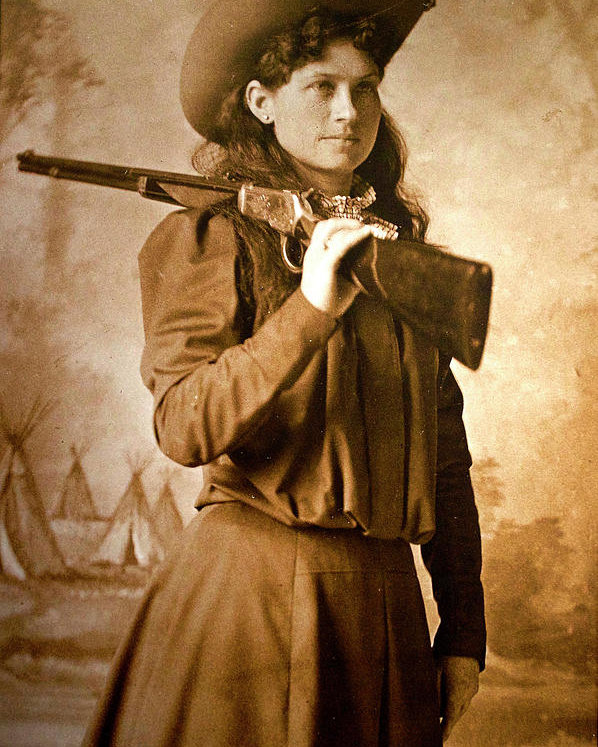
Annie Oakley

Annie Oakley

Then the show began and their attention was diverted to the ring below. Vivianne’s heart raced when Annie Oakley finally emerged. The diminutive woman stood facing the royal box in a smartly collared buckskin dress, bedecked with glittering metals from contests she’d won, cowboy hat, and holding her Colt .45.

Von Eisenreich leaned his head close to hers. “Chief Sitting Bull gave her the nickname of ‘Little Sure Shot’ because of her dead shot with a pistol, rifle and shotgun. Did you know that she began handling firearms at the tender age of nine to supply her widowed mother with game and eventually paid off the mortgage on her mother’s house?”

Vivianne let her brows rise in impressed surprise. In truth she knew. She knew everything about the American sharp-shooter. At 90 feet Annie could shoot a dime tossed in the air. With the thin edge of a playing card facing her at 90 feet, she could hit the card and puncture it with five or six more shots as it settled to the ground.

Vivianne felt her mouth go dry; she knew what came next.

With a flourishing turn, Annie faced the royal box and announced, “For my final act, I will attempt to shoot the ashes from the cigar of a lady or gentleman in the audience. “Who will volunteer to hold the cigar?” she asked the audience. Vivianne’s heart pounded. She knew that the little sharpshooter from Cincinnati expected no one to volunteer; Annie had simply asked for laughs. Her attentive manager-husband, Frank Butler, always stepped forward and offered himself. Not this time—

Just as laughter bubbled up in the crowd, Kaiser Wilhelm leapt out of the royal box and strutted into the arena to a stunned audience. Laughter turned to gasps as the Kaiser approached the sharpshooter. Annie Oakley visibly stiffened. In horror, Vivianne thought. The two guards scrambled forward from the rafters but the Kaiser gruffly waved them off. Vivianne marveled at Annie’s cool resolve; after handing the cigar to Wilhelm, the performer paced off her usual distance and the Kaiser lit the cigar with flourish.

Several German policemen rushed into the arena in a panicked attempt to preempt the stunt, but the Kaiser brusquely waved them off too. Then he lifted his head and placed the cigar to his mouth in a pose of a statue.

“No,” Annie said. “In your hand, please, Your Majesty,” she instructed. He looked disappointed but did as she’d asked.

Annie raised her Colt and took aim.

Royal_Irish_Rifles first day at Somme_July_1916

Royal Irish Rifles in the Somme, 1916

Vivianne swallowed the gorge in her throat. This was the moment she’d waited for; the moment for which she’d come. If this volatile and ambitious ruler were removed from the scene, one of the key reasons for World War I would also vanish. An entire world war would likely be averted. She only had to redirect the bullet; it was made of metal, after all. Kill a bully and incriminate and ruin the life of an innocent young woman … in exchange for over two million lives and the prevention of an age of non-stop violence—

Annie fired.

First World War wounded

Carrying the wounded and dead out of the battle field

“For those in love with science fiction at its best, The Last Summoner is a complex story of ignored responsibilities and their dire consequences, of love and betrayal that span centures and multiple worlds. Time travel, multiverse travel, immortality, alternate history in which the Nazies have won, not in the twentieth century but way earlier, in the Teutonic age. Angels and mutants, utopias and dystopias, even a Tesla occurrence—everything a science fiction reader could ever desire in a book. A masterfully told story with great characters. Nina Munteanu moves flawlessly from a medieval story to a modern one and everything in between.”—Costi Gurgu, author of RecipeArium

Grapevine-dogwood 2 willow water TC

At the mouth of Thompson Creek, ON (photo by Nina Munteanu)

nina-2014aaa

Nina Munteanu is a Canadian ecologist / limnologist and novelist. She is co-editor of Europa SF and currently teaches writing courses at George Brown College and the University of Toronto. Visit www.ninamunteanu.ca for the latest on her books. Nina’s bilingual “La natura dell’acqua / The Way of Water” was published by Mincione Edizioni in Rome. Her non-fiction book “Water Is…” by Pixl Press (Vancouver) was selected by Margaret Atwood in the New York Times ‘Year in Reading’ and was chosen as the 2017 Summer Read by Water Canada. Her novel “A Diary in the Age of Waterwas released by Inanna Publications (Toronto) in June 2020.

An Interview with a Bull Thistle

Story is place, and place is character—Nina Munteanu

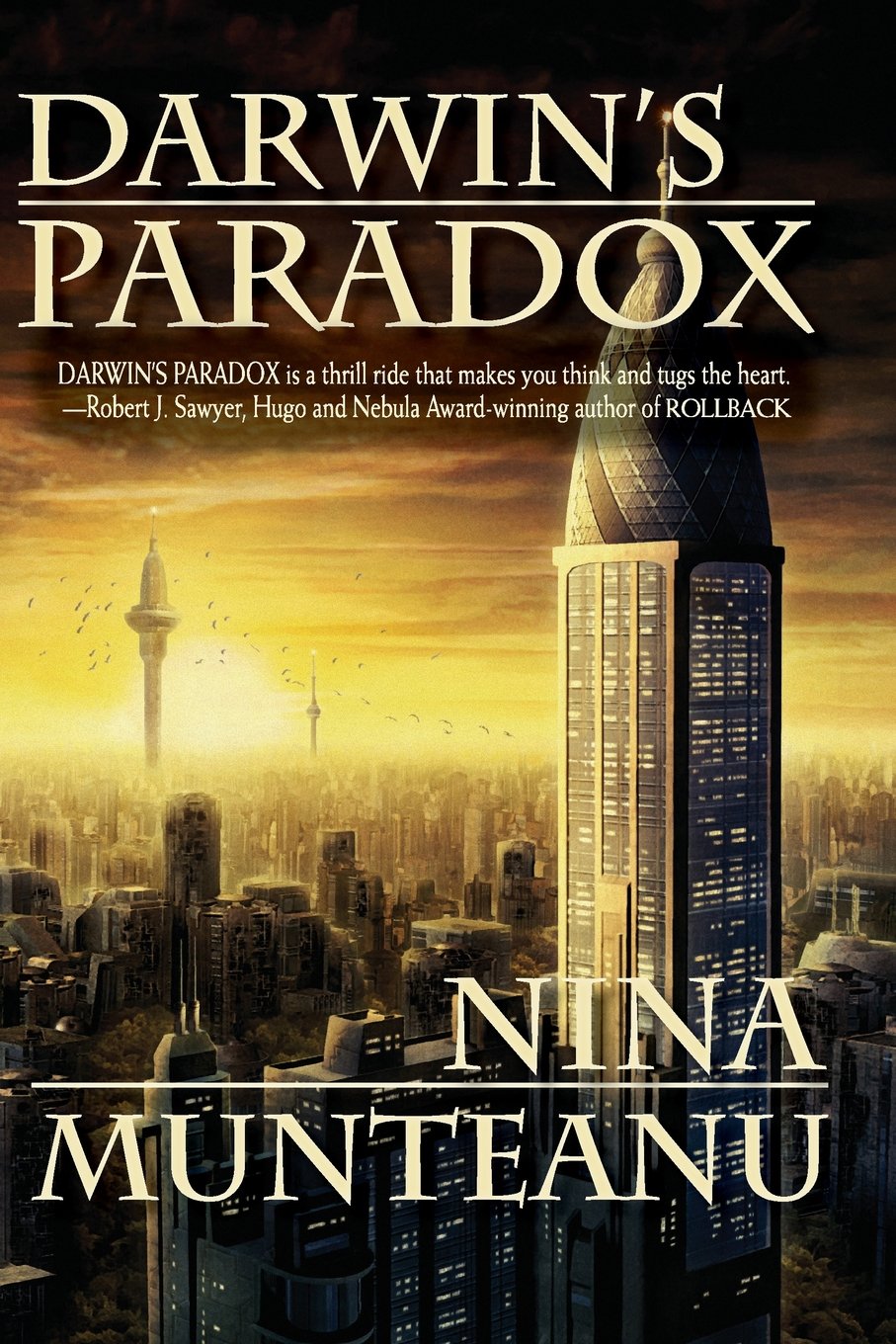
Darwins Paradox-2nd edI write mostly eco-fiction. Even before it was known as eco-fiction, I was writing it. My first book—Darwin’s Paradox—published in 2007 by Dragon Moon Press as science fiction, was also eco-fiction. It takes place in 2075 after climate change has turned southern Ontario into a heathland and Toronto into a self-enclosed city. My latest eco-fiction—A Diary in the Age of Water published in 2020 by Inanna Publications—is set mostly in Toronto from the near-future to 2065 and beyond.

As a writer of eco-fiction and climate fiction, I’m keenly aware of the role environment plays in story. Setting and place are often subtle yet integral aspects of story. In eco-fiction, they can even be a “character,” serve as archetypes and present metaphoric connections to characters on a journey (see my guidebook The Ecology of Story: World as Character published by Pixl Press for more discussion on all aspects of nature’s symbols in writing).

EcologyOfStoryThings to consider about place as character begin with the POV character and how they interact with their environment and how they reflect their place. For instance, is that interaction obvious or subtle? Is that environment constant or changing, stable or unstable, predictable, or variable? Is the place controllable or not, understandable or not? Is the relationship emotional, connected to senses such as memory?

Place as character serves as an archetype that story characters connect with and navigate in ways that depend on the theme of the story. A story’s theme is essentially the “so what part” of the story. What is at stake for the character on their journey. Theme is the backbone—the heart—of the story, driving characters to journey through time and place toward some kind of fulfillment. There is no story without theme. And there is no theme without place.

Archetypes are ancient patterns of personality shared universally by humanity (e.g. the “mother” archetype is recognized by all cultures). When place or aspects of place act as an archetype or symbol in story—particularly when linked to theme—this provides a depth of meaning that resonates through many levels for the reader.

In Ray Bradbury’s The Martian Chronicles, Mars symbolizes a new Eden. Like Bradbury’s aboriginal Martians—who are mostly invisible—the planet is a mirror that reflects humanity’s best and worst. Who we are, what we are, what we bring with us and what we may become. What we inadvertently do—to others, and finally to ourselves—and how the irony of chance can change everything.

“Nature’s symbols are powerful archetypes that reveal compelling story,” writes Donald Maass in Write the Breakout Novel Workbook.

Diary Water cover finalWater has been used as a powerful archetype in many novels. In my latest novel, A Diary in the Age of Water, water plays an important role through its unique metaphoric connection with each of the four main characters; how they relate to it and understand it, and act on its behalf. Water in A Diary in the Age of Water is often personified; water reflects various symbolic and allegorical interpretations and embraces several archetypes including herald-catalyst, trickster, shapeshifter, and shadow.

Strong relationships and linkages can be forged in story between a major character and an aspect of their environment (e.g., home/place, animal/pet, minor character as avatar/spokesperson for environment).

FictionWriter-cover-2nd edIn these examples the environmental aspect serves as symbol and metaphoric connection to theme. They can illuminate through the sub-text of metaphor a core aspect of the main character and their journey: the grounding nature of the land of Tara for Scarlet O’Hara in Margaret Mitchel’s Gone With the Wind; the white pine forests for the Mi’kmaq in Annie Proulx’s Barkskins; The animals for Beatrix Potter of the Susan Wittig Albert series.

All characters—whether the main POV character, or a minor character or personified element of the environment—have a dramatic function in your story. In my writing courses at George Brown College and The University of Toronto and in my guidebook The Fiction Writer, I provide a list of questions you can ask your character to determine if they are functioning well in the story and if they should even stay in the story. I call it interviewing your character. You can interview any character in your story; it can provide incredible insight. And speaking of character…

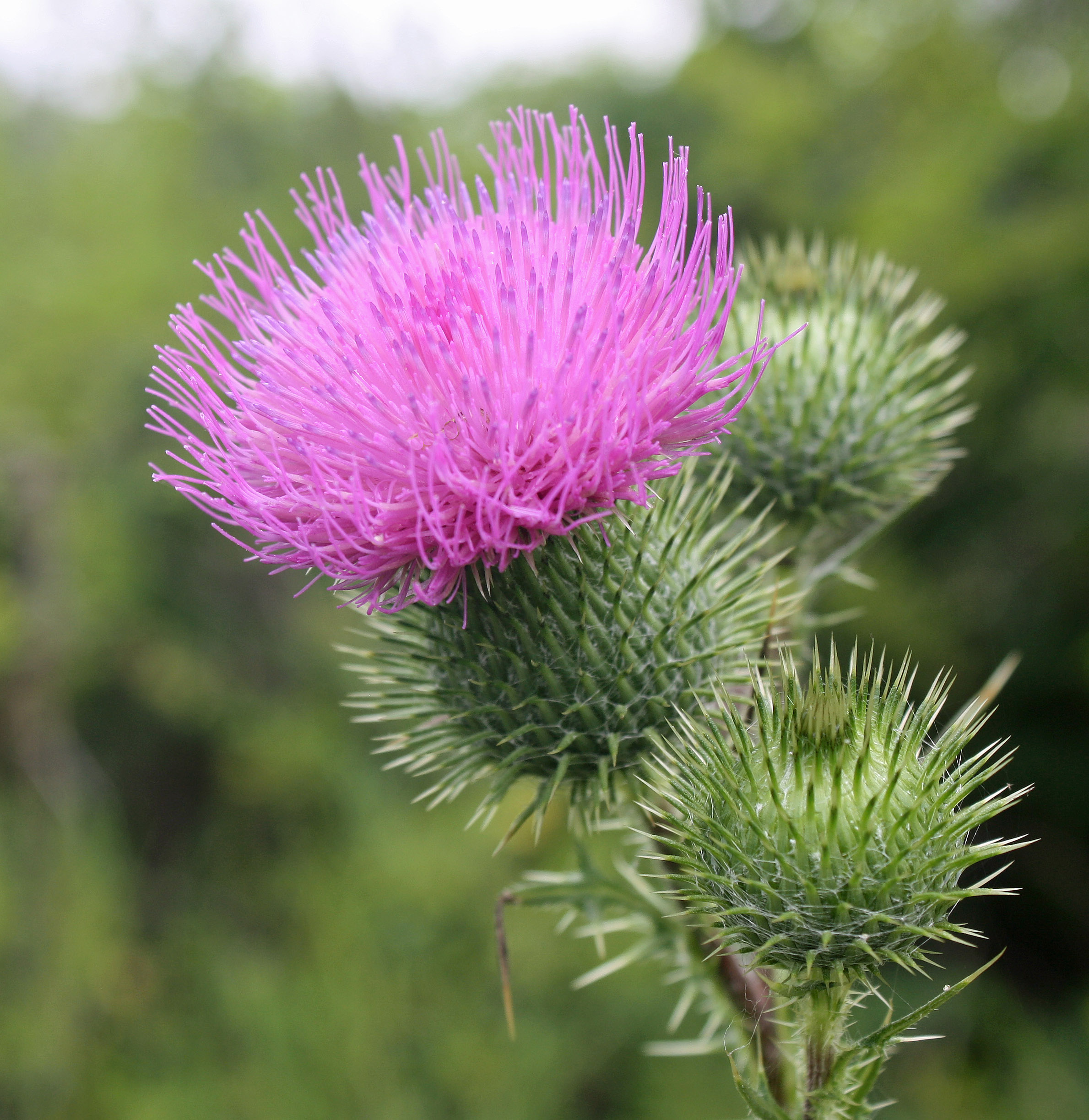
I have of late been walking daily to a lovely meadow beside a stream and thicket where brilliant Bull thistles have burst into flower. I felt the need to research this beautiful yet dangerously prickly plant and why it peaked my interest…

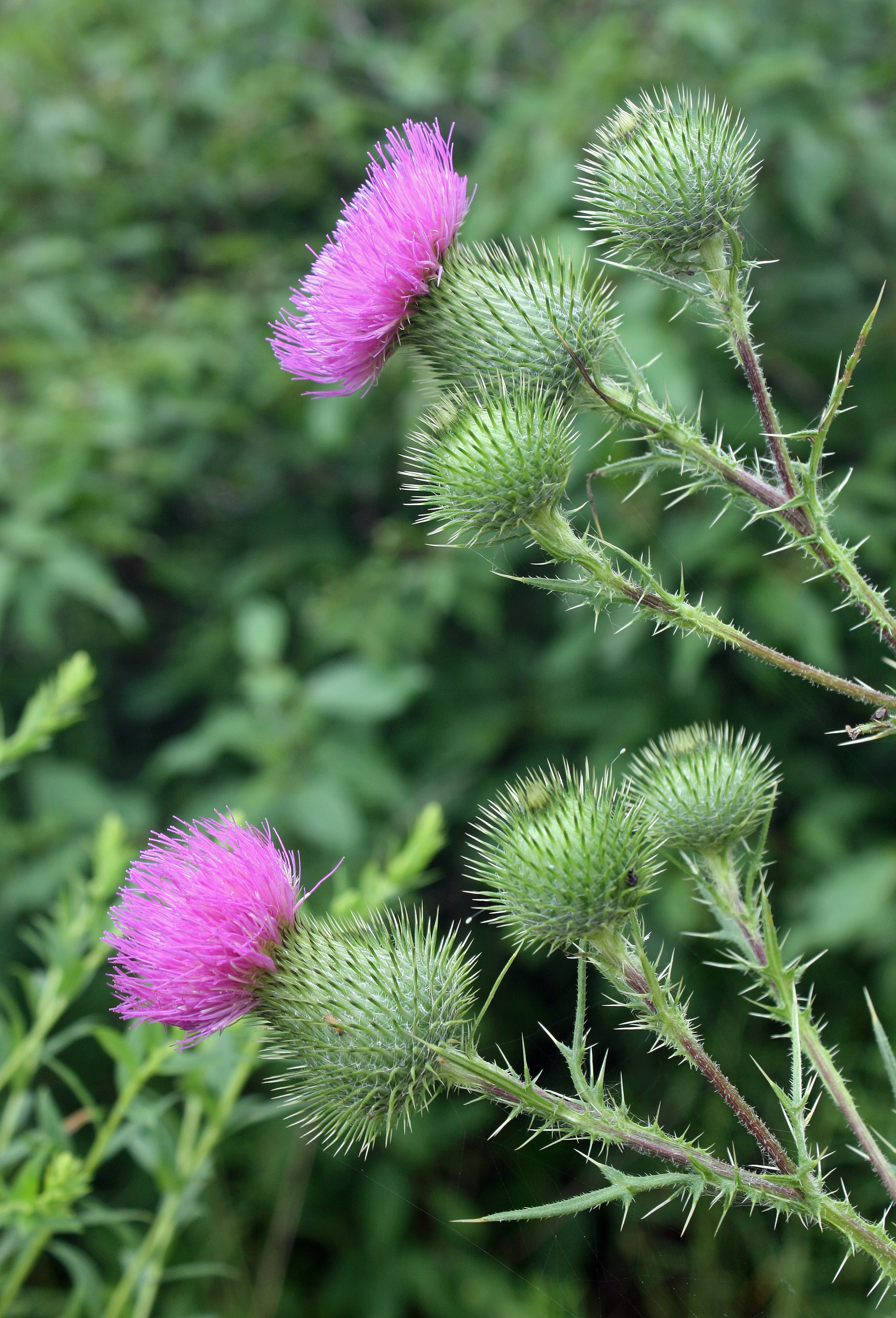
Thistle group 2 Pb copy

Bull Thistle, ON (photo by Nina Munteanu)

 Interview With the Bull Thistle

Nina: Pardon my saying, but you seem to scream paradox. You’re dangerously beautiful. Alluring yet aloof. Standoffish, even threatening. For instance, how is it that you have such a beautiful single purple-pink flower at the top of such a nasty prickly stem and leaves?

Bull Thistle: First of all, it isn’t just a flower at the top; it’s a flower head of over two hundred flowers called florets. Each flower head is a tight community of tube disk bisexual florets arranged in Fibonacci spirals and protected by a collection of spiked bracts called an involucre. And inside the protective outer shell, embedded in a fleshy domed receptacle, are the tiny ovaries, waiting patiently to be fertilized and grown into a seed or achene.

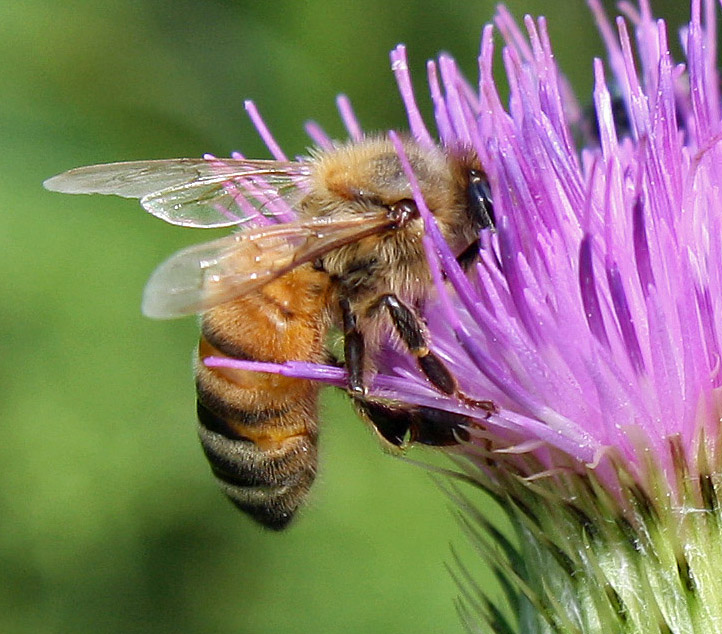
Thistle honey bee 2 closer

Honey bee getting nectar from the thistle flower head (photo by Nina Munteanu)

Nina: Ah, I beg your pardon. But you still have all those sharp spikes everywhere. I’m guessing they are to protect your developing young, the ovaries. But doesn’t that isolate you? Keep you from integrating in your ecosystem?

Bull Thistle: The bristles are specifically aimed at predators who wish to harm us, eat us, bore into us, pull us out of the earth. We have many friends—the pollinators, the bees, wasps, and butterflies that help us cross-pollinate from plant to plant. And the birds—particularly the goldfinches—also help.

Nina: Wait. Don’t goldfinches eat your babies—eh, seeds?

Bull Thistle: They do. But they also help disperse our children. They land on our dried involucres—now opened to reveal the seeds and their pappus. The birds pull the seeds out by the thistle down that rides the wind. The birds eat the seeds and also use the thistle down to make their nests. But—like the squirrels who love oak acorns—the birds miss as many as they eat. By carrying the down to their nests, they also help the seeds travel great distances farther than the wind would have carried them. By dislodging the seeds in bunches, they help the seeds break away from the receptacle and meet the wind. The pappus, which is branched and light like a billowing sail, carries the seed on the wind to germinate elsewhere to help us colonize.

Thistle opened involucre scattering seeds

Opened involucre with achenes and pappus ready to disperse, ON (photo by Nina Munteanu)

Nina: So, your enemy is also your friend… The shadow character, who helps the hero on her journey by presenting a perilous aspect of enlightenment.

Bull Thistle: If you say so. What we understand is that Nature’s resilience derives from the balance of give and take over time. Prey and predator. Death, decay, transcendence. Destruction and creation. Ecological succession and change are a gestalt expression of Gaia wisdom as each individual fulfills its particular existential niche. Even if that is to die…for others to live.

Nina: Yes, the hero’s journeyBut you’re not originally from here, are you? You were brought to North America from Eurasia. Some consider you an interloper, a disturbance. You could serve the shadow or trickster archetype yourself—outcompeting the native thistle, creating havoc with pasture crops. You can tolerate adverse environmental conditions and adapt to different habitats, letting you spread to new areas. Your high seed production, variation in dormancy, and vigorous growth makes you a serious invader. You cause wool fault and physical injury to animals. Storytellers might identify you metaphorically with the European settler in the colonialism of North America; bullying your way in and destroying the natives’ way of life.

Bull Thistle: We’re unaware of these negative things. We don’t judge. We don’t bully; we simply proliferate. We ensure the survival of our species through adaptation. Perhaps we do it better than others. You’ve lately discovered something we’ve felt and acted on for a long time. Climate is changing. We must keep up with the times… But to address your original challenge, if you did more research, you would find that we serve as superior nectar sources for honey bees (Apis spp.), bumblebees (Bombus spp.) and sweat bees (Anastogapus spp.) who thoroughly enjoy our nectar.

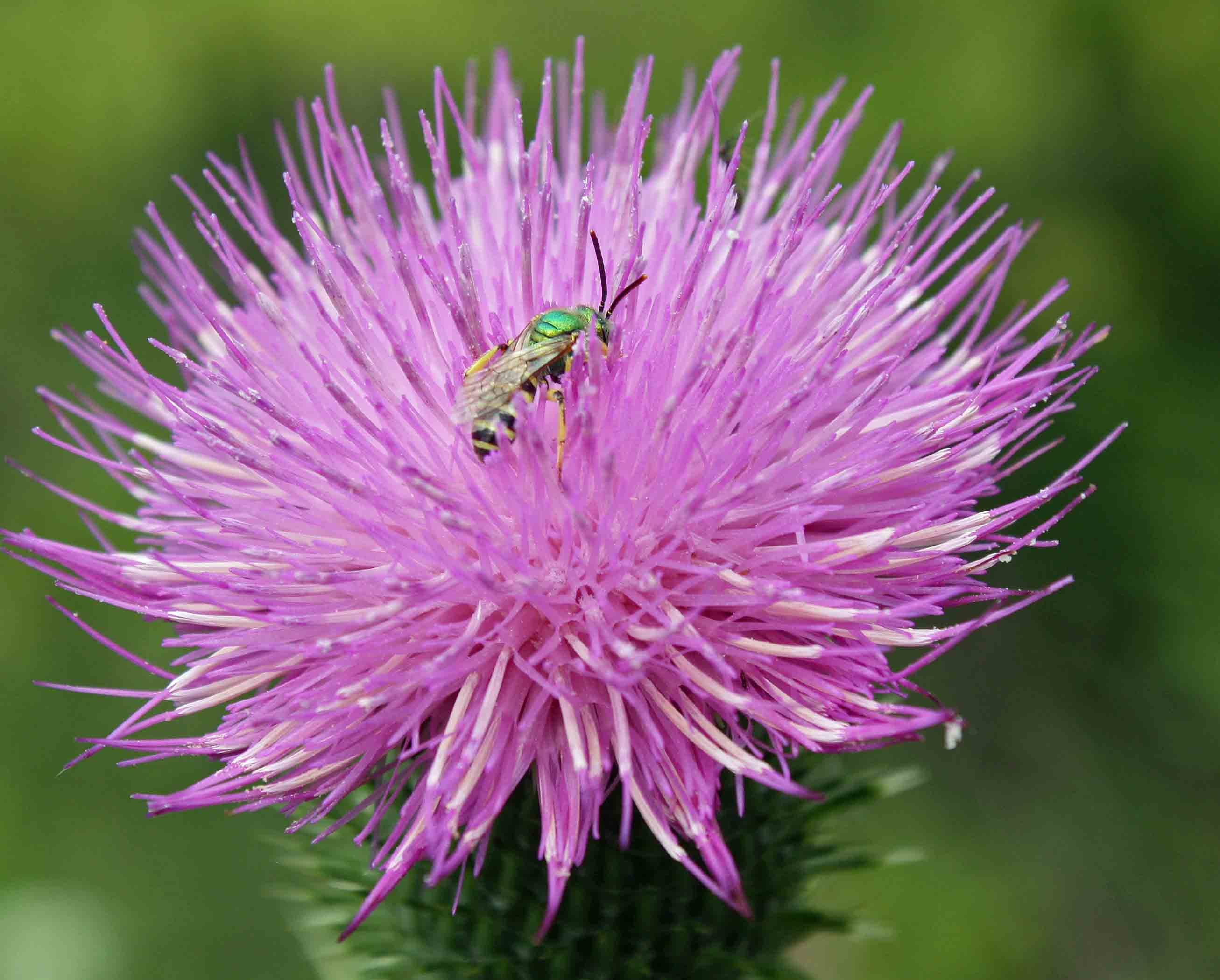
Thistle head sweat bee Pb copy

Sweat bee draws the sweet nectar of the Bull Thistle, ON (photo by Nina Munteanu)

We’re considered a top producer of nectar sugar in Britain. Cirsium vulgare—our official name—has ranked in the top 10 for nectar production in a recent UK survey.  The goldfinch relies on our seed and down. And we’ve provided food, tinder, paper, and medicine to humans for millennia. As some of your indigenous people point out, it’s a matter of attitude. Change is opportunity.

Thistle group Pb copyNina: I guess that every weed was once a native somewhere. I also agree that times are changing—faster than many of us are ready for, humans included. If you were to identify with an archetype, which would you choose?

Bull Thistle: That would depend on the perceiver, we suppose. Some of us think of us as the hero, journeying through the change and struggling to survive; others see us as the herald, inciting movement and awareness by our very existence; some of us identify with the trickster, others with the shapeshifter—given how misunderstood we are. In the end, perhaps, we are the mentor, who provides direction through a shifting identity and pointing the way forward through the chaos of change toward enlightenment.

Nina: Yes, I suppose if someone stumbled into your nest of prickles, incredible awareness would result. Speaking of that very awareness, this brings me back to my original question: why are you so beautiful yet deadly?

Bull Thistle: We are the purest beauty—only attained through earnest and often painful awareness. We are the future and the beauty of things to come.

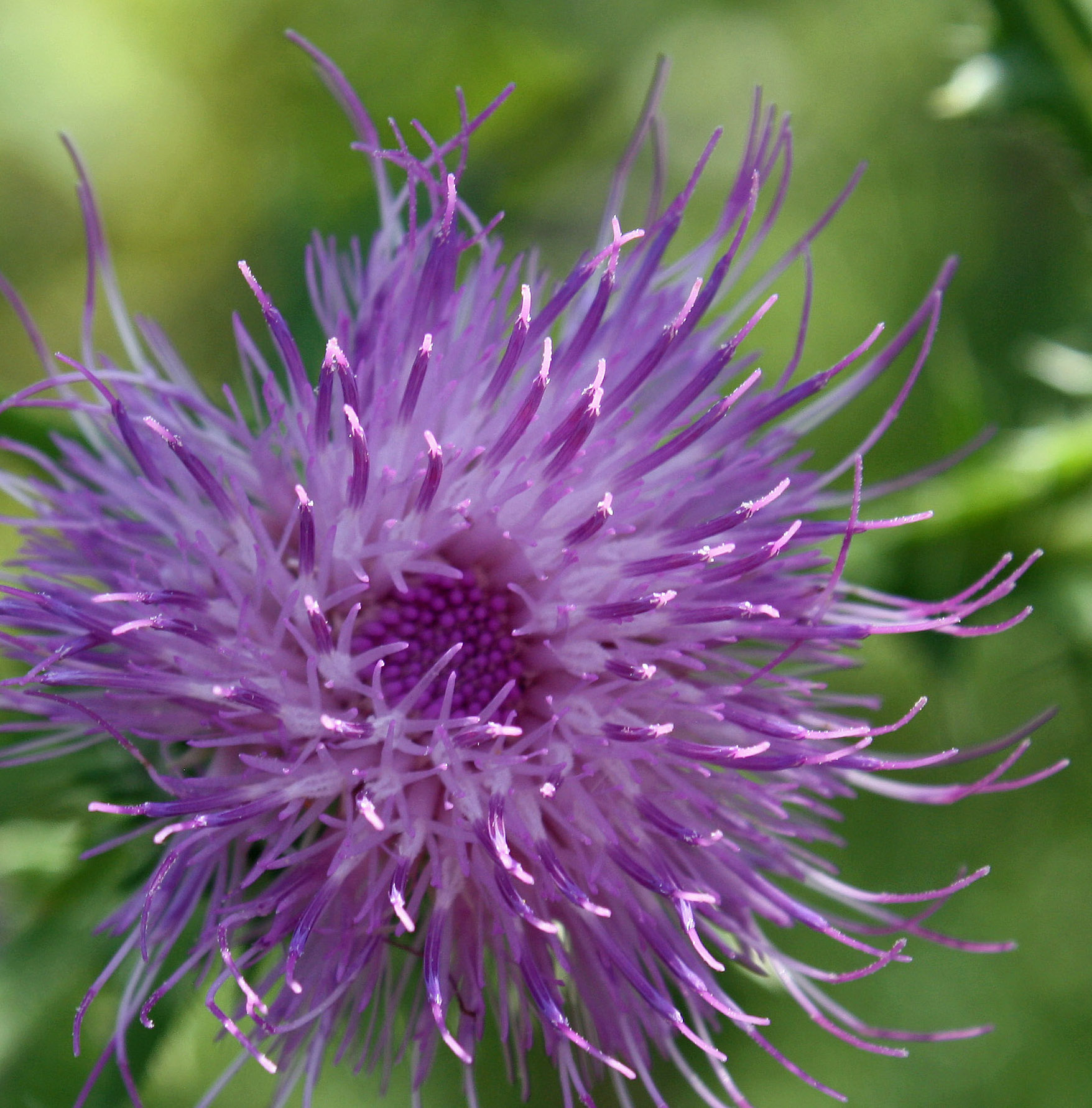
Thistle head on full of pollen close

Flower head of Bull Thistle, ON (photo by Nina Munteanu)

You can read more on this topic in Nina’s writing guidebook series, particularly The Fiction Writer: Get Published, Write Now! and The Ecology of Story: World as Character.

Relevant Articles:

The Ecology of Story: Revealing Hidden Characters of the Forest

Ecology of Story: World as Character” Workshop at When Words Collide

Ecology of Story: Place as Allegory

Ecology of Story: Place as Symbol

Ecology of Story: Place as Metaphor

Ecology of Story: Place as Character & Archetype

nina-2014aaa

Nina Munteanu is a Canadian ecologist / limnologist and novelist. She is co-editor of Europa SF and currently teaches writing courses at George Brown College and the University of Toronto. Visit www.ninamunteanu.ca for the latest on her books. Nina’s bilingual “La natura dell’acqua / The Way of Water” was published by Mincione Edizioni in Rome. Her non-fiction book “Water Is…” by Pixl Press(Vancouver) was selected by Margaret Atwood in the New York Times ‘Year in Reading’ and was chosen as the 2017 Summer Read by Water Canada. Her novel “A Diary in the Age of Waterwas released by Inanna Publications (Toronto) in June 2020.


Cymatics: How Frequency Changes the Very Nature of Matter and Energy

Water rain reeds4 Pb

Reeds in Otonabee River (photo by Nina Munteanu)

Music can help recover damaged brain function by activating parts of the brain that are nearby—Oliver Sacks

If, indeed God moves us to express that within us which is divine, then poetry is the language of the heart and music is the language of the soul—Nina Munteanu

We are creatures of rhythm; circadian, diurnal, seasonal. Let’s face it; our environment—light especially—affects our behavior, psychologically, physiologically and even socially. For instance, mood-altering chemicals generated in the pineal gland in our brain, are partially affected by the light received from our retina. In an earlier post, entitled “The Mozart Effect: The Power of Music” I discussed how music can heal the body, strengthen the mind and unlock the creative spirit. For instance, music with a pulse of about sixty beats per minute can shift consciousness from the beta wave (ordinary consciousness at 14-20 Hz) toward the alpha range (heightened awareness at 8-13 Hz), enhancing alertness and general well-being.

Our world is composed of energy, light, sound and matter, all expressed at different frequencies.

The study of cymatics, coined by Hans Jenny from the Greek word kyma (wave), explores how sound affects gases, liquids, plasmas and solids and how vibrations, in the broad sense, generate and influence patterns, shapes and moving processes. When sound travels through non-solids it moves in longitudinal waves called compression waves. In matter, the medium is displaced by sound waves, causing it to oscillate at a frequency relative to the sound, and visible patterns emerge.

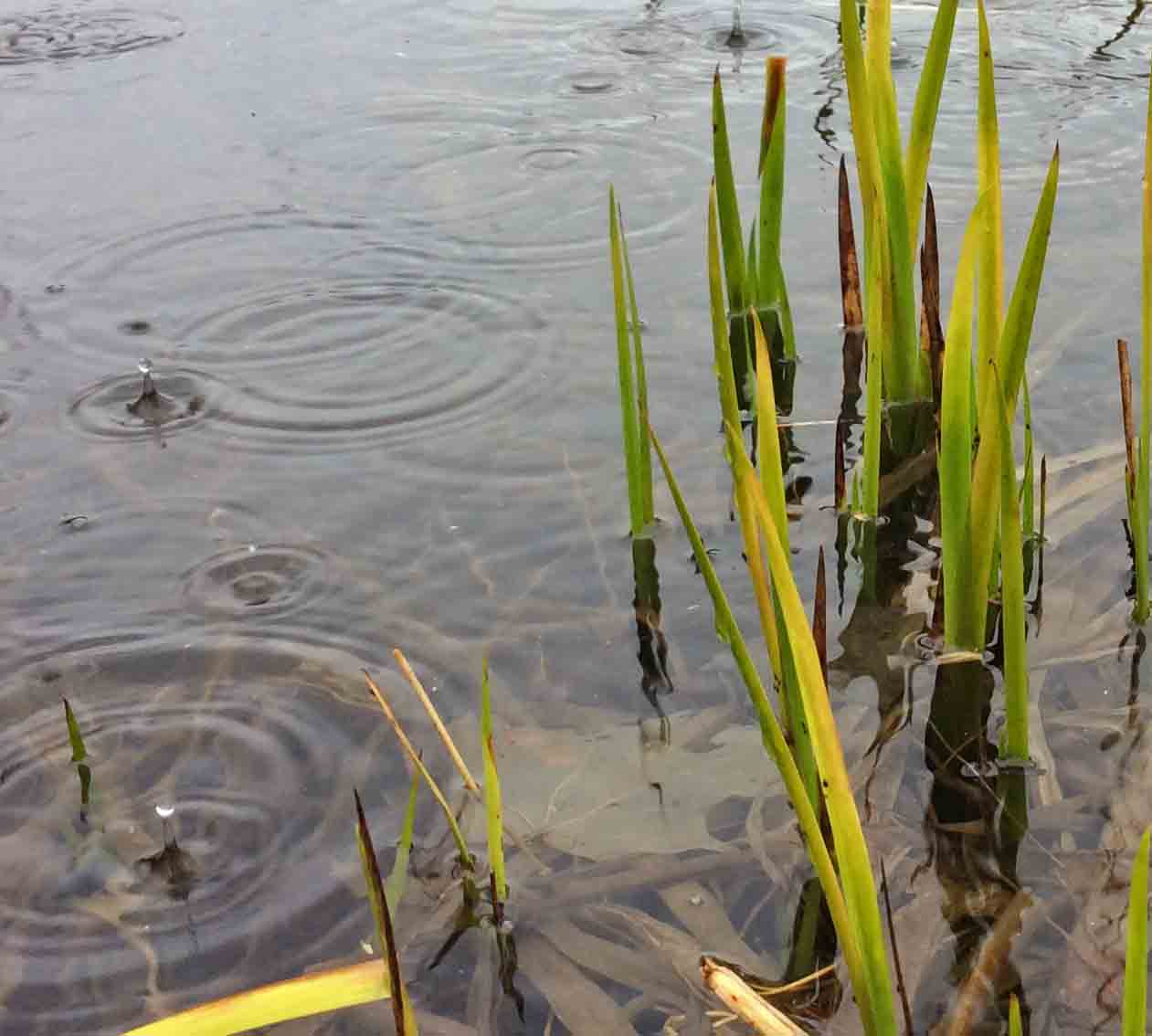
Water rain reeds 10 Pb

Water drops in rainfall on Otanabee River, ON (photo by Nina Munteanu)

Leonardo da Vinci, Galileo Galilei, Robert Hooke, and Ernst Chladni investigated this phenomenon in the 1400s, 1500s, 1700s, and 1800s, respectively. In 1967, Hans Jenny, a Swiss doctor, artist, and researcher, published Kymatik-Wellen und Schwingungen mit ihrer Struktur und Dynamik/ Cymatics (The Structure and Dynamics of Waves and Vibrations). Like Chladni two hundred years earlier, Jenny showed what happened when one took various materials like sand, spores, iron filings, water, and viscous substances, and placed them on vibrating metal plates and membranes. What then appeared were shapes and motion-patterns which varied from the nearly perfectly ordered and stationary to those that were turbulently developing, organic, and constantly in motion.

Using crystal oscillators and his invention called a “tonoscope” to set plates and membranes vibrating, Jenny controlled frequency and amplitude/volume to demonstrate that simple frequencies and songs could rearrange the essential molecular structure of water and other materials.

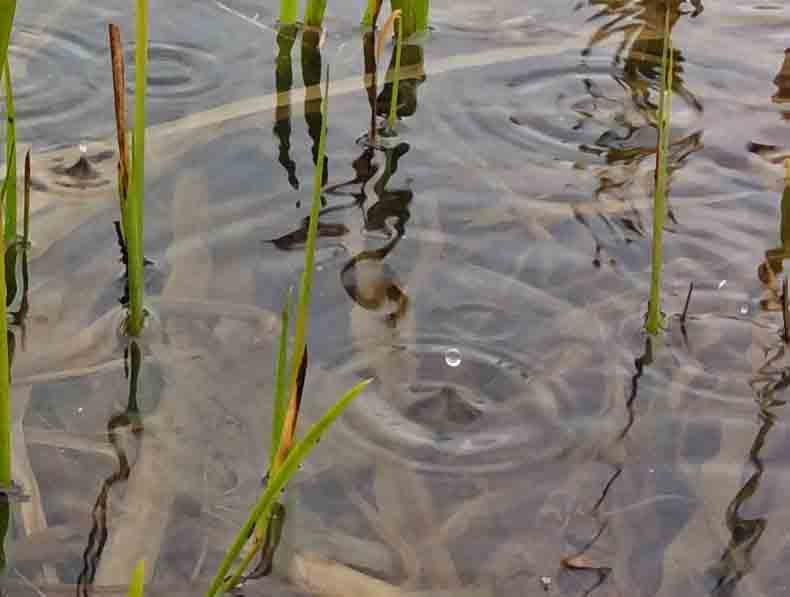
water rain reeds 9 Pb

Raindrops falling among reeds in Otonabee River, ON (photo by Nina Munteanu)

Jenny was convinced that biological evolution was a result of vibrations, and that their nature determined the ultimate outcome. He speculated that every cell has its own frequency and that a number of cells with the same frequency create a new frequency which is harmonious with the original, which in its turn possibly formed an organ that also created a new frequency in harmony with the two preceding ones. Jenny was saying that the key to understanding how we can heal the body with the help of tones lies in our understanding of how different frequencies influence genes, cells and various structures in the body.

Boldly extended his tonoscope research into voice and language, Jenny discovered that when the vowels of ancient Hebrew and Sanskrit were pronounced, the sand took the shape of the written symbols for these vowels, while modern languages didn’t generate the same result. This has led spiritual philosophers to ponder if “sacred languages” (including Tibetan and Egyptian) have the power to influence and transform physical reality, to create things through their inherent power, or through the recitation or singing of sacred texts, to heal a person who has gone “out of tune”?

Cymatics photographer and author Alexander Lauterwasser showed that:

  • Higher frequencies created more intricate and complex patterns
  • Typical line types were radial and spherical or elliptical lines that repeated the outer form of the perimeter
  • When asymmetrical shapes developed at certain frequencies, symmetrical shapes always formed in between

In a controversial movie called “Water”, Rustum Roy, professor at the State University of Pennsylvania and Member of the International Academy of Sciences, suggested that water has “memory”, based on the structure it takes on as a result of electromagnetic fields and various frequencies to which it is exposed.

Water rain reeds 2

Rain falling among reeds in Otonabee River, ON (photo by Nina Munteanu)

I’m a practicing aquatic scientist and this is what I find fascinating: noting that the human brain is 75% water, it is not surprising that we can be affected by the shape and form of water itself—and, in turn, may shape water with our minds. This is in itself a startling admission and opens up a myriad of controversial topics, which many scientists find hard to reconcile and refuse to investigate, let alone entertain. And, yes, I am edging into the area of metaphysics, of “science fiction”, of “fanciful thinking”. A place populated by heretics who do “questionable science”, those rogue mavericks who dare step outside the realm of traditional science to imagine, to dare ask the unaskable, to dare pursue a truth using unconventional means.

Here’s my point: water is important to us in ways science can’t even begin to explain. Because science can’t yet explain it, should we abandon the potential and its investigation? All good science was once perceived as magic before it was understood.

Let me take it one step further:

I posit that our entire bodies are sending and receiving vibrations at different frequencies with our environment, other people, other animals around us, inanimate objects, even the seemingly ‘empty’ space. Our intimate relationship with frequency and waves has permeated our culture more than you may realize, including the metaphors we have seamlessly adopted in our common language: terms like “bad vibes”, “making waves”, “you can feel the tension”, and “you could cut the air in here with a knife”.

LastSummoner-coverIf you think this is all too weird, consider the weirdness of quantum mechanics, which shows us that not only is “solid” matter made up mostly of energy and “empty” space but what makes a solid a chair vs. you sitting on it is the vibration of its energy. Quantum science has demonstrated that light and matter are made of both particles and waves (New Scientist, May 6, 2010) and can exist in two simultaneous states. Let’s consider, for instance, “entanglement” (quantum non-local connection), the notion that particles can be linked in such a way that changing the quantum state of one instantaneously affects the other, even if they are light years apart. And what does it mean when solid flows, ghost-like, through itself under certain conditions? Or parallel universes created by splitting realities? Check out my historical fantasy novel The Last Summoner for a unique take on this popular notion.

Nobel prize-winning physicist Richard Feyman says of the paradoxes presented by quantum mechanics, “the ‘paradox’ is only a conflict between reality and your feeling of what reality ought to be.”

Magic, again… The mind is powerful and graceful in its unanswerable and infinite beauty.

Water rocks Otonabee R Pb

Near shore of Otonabee River early evening, ON (photo by Nina Munteanu)

nina-2014aaa

Nina Munteanu is a Canadian ecologist / limnologist and novelist. She is co-editor of Europa SF and currently teaches writing courses at George Brown College and the University of Toronto. Visit www.ninamunteanu.ca for the latest on her books. Nina’s bilingual “La natura dell’acqua / The Way of Water” was published by Mincione Edizioni in Rome. Her non-fiction book “Water Is…” by Pixl Press(Vancouver) was selected by Margaret Atwood in the New York Times ‘Year in Reading’ and was chosen as the 2017 Summer Read by Water Canada. Her novel “A Diary in the Age of Waterwas released by Inanna Publications (Toronto) in June 2020.

Age of Water Podcast: Nina Reads from “Barkskins”

AoW Logo-smallWe are now living in the Age of Water. Water is the new “gold”, with individuals, corporations and countries positioning themselves around this precious resource. Water is changing everything. The Age of Water Podcast covers anything of interest from breaking environmental news to evergreen material. This also includes human interest stories, readings of eco-literature, discussion of film and other media productions of interest.

In this episode of Age of Water, Nina reads from the novel “Barkskins” by Annie Proulx a poignant exploration of the forest industry in Canada and North America.


Annie Proulx’s Barkskins chronicles two immigrants who arrive in Canada in 1693 (Rene Sel and Charles Duquet) and their descendants over 300 years of deforestation of North America starting with the arrival of the Europeans to contemporary global warming. “Barkskins” (woodcutters) are, in fact indentured servants who were brought from the Paris slums to the wilds of New France “to clear the land, to subdue this evil wilderness,” says their seigneur. Sel is forced to marry a native woman and their descendants live trapped between two cultures; Duquet runs away to become a fur trader and build a timber empire.

Barkskins AnnieProulxProulx immerses the reader in rich sensory detail of a place and time, equally comfortable describing a white pine stand in Michigan and logging camp in Upper Gatineau to a Mi’kmaq village on the Nova Scotia coast or the stately Boston home of Charles Duquet. The foreshadowing of doom for the magnificent forests is cast by the shadow of how settlers treat the Mi’kmaq people. The fate of the forests and the Mi’kmaq are inextricably linked through settler disrespect and a fierce hunger for “more.”

The novel rolls out events in a relentless stream of life and death; no character is safe from the ravages of nature or the notions of that time period. While most of the book flows like a great amoral river—filled with feckless, unheroic and at times miserable characters—there are moments of emotional shoring. They act like exclamation marks for their rarity.

EcologyOfStory“The reader comes to realize that the novel isn’t really about the human characters so much as it is about the forests,” Gus Powell of The National Post concludes of Barkskins. “As [the forests] disappear, the narrative seems to recede in importance, revealing a crucial interdependence between the human and the natural world previously handled almost entirely as subtext. This is especially true in the novel’s closing, where the anger and despair that have characterized the novel shift into an outspoken environmental advocacy.”

I further explore the use of metaphor and other storytelling devices used by Annie Proulx in this strongly symbolic novel in my writing guidebook “Ecology of Story: World as Character.”


nina-2014aaa

Nina Munteanu is a Canadian ecologist / limnologist and novelist. She is co-editor of Europa SF and currently teaches writing courses at George Brown College and the University of Toronto. Visit www.ninamunteanu.ca for the latest on her books. Nina’s bilingual “La natura dell’acqua / The Way of Water” was published by Mincione Edizioni in Rome. Her non-fiction book “Water Is…” by Pixl Press(Vancouver) was selected by Margaret Atwood in the New York Times‘Year in Reading’ and was chosen as the 2017 Summer Read by Water Canada. Her novel “A Diary in the Age of Waterwas released by Inanna Publications (Toronto) in June 2020.

Launch of “A Diary in the Age of Water” by Nina Munteanu

june 18 launch evite1

Diary Water cover finalOn June 18th, Toronto book publishing house Inanna Publications launched its second spring series and A Diary in the Age of Water, my near-future/far-future speculative fiction book was among them.

A Diary in the Age of Water follows the climate-induced journey of Earth and humanity through four generations of women, each with a unique relationship to water.

Evoking Ursula LeGuin’s unflinching humane and moral authority, Nina Munteanu takes us into the lives of four generations of women and their battles against a global giant that controls and manipulates Earth’s water. In a diary that entwines acute scientific observation with poignant personal reflection, Lynna’s story unfolds incrementally, like climate change itself. Particularly harrowing are the neighbourhood water betrayals, along with Lynna’s deliberately dehydrated appearance meant to deflect attention from her own clandestine water collection. Her estrangement from her beloved daughter, her “dark cascade” who embarks upon a deadly path of her own, is heartwrenching. Munteanu elegantly transports us between Lynna’s exuberant youth and her tormented present, between microcosm and macrocosm, linking her story and struggles – and those of her mother, daughter and granddaughter – to the life force manifest in water itself. In language both gritty and hauntingly poetic, Munteanu delivers an uncompromising warning of our future.

—Lynn Hutchinson Lee


NINA-RENEE-TOAST2a

Renee Knapp and Nina Munteanu toast Inanna and all participants at the launch

A Diary in the Age of Water starts with young Kyo in the dying boreal forest of what used to be northern Canada. Kyo yearns inordinately for the Age of Water, a turbulent time of great change, before the “Water Twins” destroyed humanity. Looking for answers and plagued by vivid dreams of this holocaust, Kyo discovers the diary of Lynna, a limnologist from a time just prior to the destruction.

At the book launch, I read from Lynna’s first diary entry—in 2045. I then answered questions from audience members who came from Canada’s coast to coast:


What inspired you to write this book?

The Way of Water-COVERWho really… My publisher in Rome (Mincione Edizioni) had asked me for a short story on water and politics. I wanted to write about Canada and I wanted something ironic… so I chose water scarcity in Canada, a nation rich in water. “The Way of Water” (“La natura dell’acqua”) resulted, which has been reprinted in several magazines and anthologies, including Cli-Fi: Canadian Tales of Climate Change (Exile Editions), Future Fiction: New Dimensions in International Science Fiction (Future Fiction/Rosarium Publishing), Little Blue Marble Magazine, and Climate Crisis Anthology (Little Blue Marble). The story was about young Hilde—the daughter of the diarist—dying of thirst in Toronto… It begged for more … so the novel came from it…


Why did you choose to write your novel as a diary?

I was writing about both the far and the near future and much of it was based—like Margaret Atwood and her books—on real events and even real people. I wanted personal relevance to what’s going on, particularly with climate change.  I also wanted to achieve a gritty realism of the mundane and a diary felt right. The diarist—Lynna—is also a reclusive inexpressive character, so I thought a personal diary would help bring out her thoughts and feelings. There’s nothing like eves-dropping to make the mundane exciting.


If the oceans are rising because the ice caps are melting, is the ocean actually getting less salty?

The short answer is “yes.” As glaciers melt and introduce fresh water to the ocean—contributing to the rise in sea level—salinity is reduced in the surrounding sea. This has far-reaching consequences that lie beyond just rising sea levels and promise to affect all ocean life. Because freshwater is less dense than seawater—hence the saltwater wedge we experience on the lower Fraser River in Vancouver—freshwater increase in seawater will interfere with the pattern, mixing, and movement of ocean currents; this could be devastating to ocean life. The overall movement of ocean currents throughout the planet is called the Great Ocean Conveyor—or Atlantic Meridional Overturning Circulation (AMOC)—which circulates ocean water very much like in a lake, with dense water sinking beneath warmer, less salty water. As my diarist in the book writes, dumping in more and more freshwater into the ocean has slowed the sinking (and mixing) and the whole machine is slowing down. Freshwater is jamming the conveyor. If it stalls, this would unbalance the heat flux of the planet with more climate devastation.

Illustration 17 AMOC

Sketch of Atlantic Meridional Overturning Circulation (AMOC) from “A Diary in the Age of Water” Inanna Publications (sketch by Nina Munteanu)

The main protagonist is a limnologist; so are you; is there any resemblance?

Oh yes! Well, apart from the obvious—we both chose the same scientific discipline, we have similar views on the environment and humanity’s place in it. I might even have some of her foibles…hopefully not ALL of them… But, I’d say that all good characters have a piece of ourselves in them. Some dark and some light. The resemblance is heightened because she is depicted through her diary, which adds a gritty realism and a highly personal aspect to the fiction. In truth there’s a piece of me in each of the four women depicted in the story.


What is happening to the water in Ontario?

Water quality in Ontario waterways has not improved in the last decade and this can be placed squarely on the shoulders of local, regional and provincial governments and their failure to legislate and act. Inaction varies from lack of regulations and policing of industry to lack of city infrastructure and lack of ecological foresight.

SONY DSC

Cladophora alga in Lake Ontario

Lake Ontario itself receives pollution from Chicago, Sarnia, Detroit, Cleveland, Buffalo, Hamilton and Toronto. Pollution includes agricultural runoff (such as excess nutrients and cancer-causing pesticides and herbicides), disease-carrying sewage, and hormone-disrupting storm water runoff. Nine million people rely on the lake for drinking water. Greatest threats to the lake’s health come from urban development, electricity generation, sewage, and storm water contamination. In cities with large amounts of impervious surfaces, storm water runs over pavement and parking lots, picking up oil and other pollutants before flowing into a nearby river or stream. Flash floods are often accompanied by sewage overflow, which carries numerous pathogens. In addition, storm water picks up toxic heavy metals, endocrine disrupting chemicals and pharmaceuticals. All with devastating consequences to humans, never mind aquatic life and other wildlife.

Every five years the Conservation Authority Watershed Report Cards provide an assessment of ground and surface water quality in various watersheds of Ontario. The latest one by the TRCA (Toronto and Region Conservation Authority) in 2018 gave an overall grade of “D” (unchanged from 2013). They cited storm water runoff and lack of its management improvement as the chief reason for the poor grade. Increasing chloride concentrations in the Toronto region (mostly from liberal use of road salt) poses a real problem to aquatic life.


Log over water forest-DeasPark copy

Forest swamp in Deas Park, BC (photo by Nina Munteanu)

You mentioned that each of the four generations of women have a singular relationship with water. What role does water play in the book?

Well, in some important way, water is the fifth character. You could say even the main character. Water is the theme that carries each woman on her personal journey with climate change and the devastation that occurs—through water, I might add. Climate change is a water phenomenon, after all… So, water—like place and setting—plays a subtle yet powerful role in the story, influencing each character in her own way and bringing them together in the overall journey of humanity during a time of great and catastrophic change.


Are there other ages/epochs?

Yes. The story begins in the far future with young Kyo during the Age of Trees, after the end of the Age of Water. It is, in fact, the end of that age as well and that is why she prepares for the Exodus to “humanity’s” new home.

All Inanna titles are 30% off with coupon code: summer20. Please also consider purchasing “A Diary in the Age of Water” from an independent bookstore this summer. Find your local bookstore: http://open-book.ca/News/Your-Community-Your-Bookstore. And here is the current map of independent bookstores that are doing curbside pick up and delivery across Canada.


Beach stones foam HB-NS drybrush

Surf on Hirtle Beach, NS (photo and illustration by Nina Munteanu)

nina-2014aaa

Nina Munteanu is a Canadian ecologist / limnologist and novelist. She is co-editor of Europa SF and currently teaches writing courses at George Brown College and the University of Toronto. Visit www.ninamunteanu.ca for the latest on her books. Nina’s bilingual “La natura dell’acqua / The Way of Water” was published by Mincione Edizioni in Rome. Her non-fiction book “Water Is…” by Pixl Press(Vancouver) was selected by Margaret Atwood in the New York Times‘Year in Reading’ and was chosen as the 2017 Summer Read by Water Canada. Her novel “A Diary in the Age of Waterwas released by Inanna Publications (Toronto) in June 2020.


Petrichor—The Smell of Rain…

Diary Water cover finalIn my novel A Diary in the Age of Water, the diarist, Lynna Dresden, writes in her entry for September 9, 2048:

Petrichor: A pleasant smell that frequently accompanies the first rain after a long period of warm, dry weather. The rain helps release plant oils into the air and chemicals produced by soil-dwelling bacteria called actinomycetes. The term arose from the Greek petra (“stone”) and ichor, the fluid that flows in the veins of the gods.

I know that musty, barky aroma of fresh rain on the dry earth. I know it well. It was the scent in the air when I gave birth to Hildegard seven years ago. She was born on the first rain in forty days. It wouldn’t rain for another forty.

Despite the nurses at the hospital discouraging me, I took my baby girl outside and let the fresh rain spatter our faces and soak us through. Little Hilde loved it. She cooed and watched with the awe of innocence. She’s still so innocent and still loves water.

She’s in Grade Two now and doesn’t comprehend that it isn’t God who controls the weather and the rain; it’s CanadaCorp.

raindrops creek03

Raindrops in a creek, ON (photo by Nina Munteanu)

Rich Hardy of New Atlas adds that a recent study in Nature Microbiology demonstrates that the bacteria evolved to release this chemical to attract a particular arthropod as a way to spread their spores. “The smell is a 500-million-year-old example of chemical communication, evolved to help a particular type of bacteria spread,” writes Hardy.

The term petrichor was created by Isabel Joy Bear and Richard G. Thomas, two Australian researchers after an article in Nature, in which authors described how the smell originates from an oil produced by plants during dry periods. The oil is released into the air along with geosmin, a metabolic by-product of certain actinobacteria when it rains.

One major component of petrichor is an organic compound called geosmin. Scientists already knew that a common genus of bacteria, known as Streptomyces, produce geosmin. Virtually all species of Streptomyces release geosmin when they die; but until now it was unclear why they generated this distinctive scent.

“The fact that they all make geosmin suggested that it confers a selective advantage on the bacteria, otherwise they wouldn’t do it,” says Mark Buttner, one of the researchers. “We suspected they were signaling to something and the most obvious thing would be some animal or insect that might help distribute the Streptomyces spores.”

Researchers discovered that geosmin specifically attracts springtails—a type of tiny arthropod—that use their antennae to sense chemical. The Streptomyces serve as food for the springtails; the springtails in turn help spread the bacterial spores. This suggests that the two organisms co-evolved in a symbiotic relationship. “This is analogous to birds eating the fruits of plants; they get food but they also distribute the seeds, which benefits the plants,” said Buttner.

Streptomyces—one of the most important sources of antibiotics to humans—relies on the springtail, given that its antibiotic compounds make it toxic to other potential distributors such as fruit flies or nematodes. Springtails generate a number of enzymes that can detoxify the antibiotics produced by Streptomyces. This suggests a form of aggressive symbiosis in a co-evolution between these two organisms—an interaction that is more common in Nature than previously thought.

The earthy scent of rain on dry soil evokes wonderful memories of playful childhood, freedom and awestruck wonder. Why not? Petrichor is, after all, the fluid that flows in the veins of the gods…

EcologyOfStoryFor more on “ecology” and a good summary and description of environmental factors like aggressive symbiosis, co-evolution, and other ecological relationships, read my book “The Ecology of Story: World as Character” (Pixl Press, 2019).


Glossary of Terms: 

Aggressive Symbiosis: a common form of symbiosis where one or both symbiotic partners demonstrates an aggressive and potentially harmful effect on the other’s competitor or potential predator (Ryan, 1997). 

Co-evolution: when two or more species reciprocally affect each other’s evolution through the process of natural selection and other processes. 

Petrichor: A pleasant smell that frequently accompanies the first rain after a long period of warm, dry weather. The rain helps release plant oils into the air and chemicals produced by soil-dwelling bacteria called actinomycetes. The term arose from the Greek petra (“stone”) and ichor, the fluid that flows in the veins of the gods. 

Symbiosis: Greek for “companionship” describes a close and long term interaction between two organisms that may be beneficial (mutualism), beneficial to one with no effect on the other (commensalism), or beneficial to one at the expense of the other (parasitism). (Munteanu, 2019).


References:

Frazer, Jennifer. 2015. “Root Fungi Can Turn Pine Trees Into Carnivores—or at Least Accomplices.” Scientific American, May 12, 2015. Online: https://blogs. scientificamerican.com/artful-amoeba/root-fungi-can-turn-pine-trees-into- carnivores-8212-or-at-least-accomplices/

Hardy, Rich. 2020. “The 500-million-year-old reason behind the unique scent of rain” New Atlas.

Munteanu, N. 2019. “The Ecology of Story: World as Character.” Pixl Press, Vancouver, BC. 198pp. (Section 2.7 Evolutionary Strategies)

Munteanu, N. 2020. “A Diary in the Age of Water.” Inanna Publications, Toronto. 300pp.


nina-2014aaa

Nina Munteanu is a Canadian ecologist / limnologist and novelist. She is co-editor of Europa SF and currently teaches writing courses at George Brown College and the University of Toronto. Visit www.ninamunteanu.ca for the latest on her books. Nina’s bilingual “La natura dell’acqua / The Way of Water” was published by Mincione Edizioni in Rome. Her non-fiction book “Water Is…” by Pixl Press (Vancouver) was selected by Margaret Atwood in the New York Times ‘Year in Reading’ and was chosen as the 2017 Summer Read by Water Canada. Her novel “A Diary in the Age of Waterwill be released by Inanna Publications (Toronto) in June 2020.


Vision 2020 and Water Is…

BHNCDSB_STEM_Poster_36x24-4.pdf

In February 2020, I was invited to speak and do workshops with over a hundred Grade 11 and 12 students about the future in the “2020 Vision into the Future” conference at Wilfrid Laurier University in Brantford, Ontario.

FutureOfFuture-GLindsay

Keynote speaker Greg Lindsay talks to students at Sanderson Centre

AerotropolisJournalist, urbanist and futurist Greg Lindsay gave a rousing keynote speech to start the conference. Greg spoke about the future of cities, technology, and mobility. He is the director of applied research at NewCities and director of strategy at its mobility offshoot CoMotion. He also co-authored the international bestseller Aerotropolis: The Way We’ll Live Next.

I joined a suite of technologists, visionaries and other scientists in presenting various scenarios of the future through workshops and seminars.

Workshop subjects included quantum cryptography, autonomous vehicles, flying cars, robotic surgery, zero waste, computer glasses, and my workshop “writing science fiction.”

Instructive seminars included topics such as feeding 9 billion people, mental health, AI & computers, the science and meaning of water, urban development, the future of transportation and space exploration.

How to Write Science Fiction

the-city-cgtrader copy

Top choice image prompt for storytelling

I gave two workshops on how to write science fiction. The workshop began with a brief discussion on what a story is (and is not) and a summary of the key tools of writing good story (e.g. premise, plot, theme, character, and setting) with a focus on world-building and the role of science.

Each group then set out to create the framework for a story based on a premise from an image prompt and shared what they’d put together. In one session we all worked together with me scribing on one whiteboard, creating together as a class; in another session, small groups formed and created their own story among four to five members as I went from team to team.

everyday hero-2 copy

Next popular storytelling image (cover illustration for “Ecology of Story” by Anne Moody)

Amazing stories emerged in both cases from the image prompts chosen. Students demonstrated imaginative, mature and original premises and carried through with thoughtful and imaginative plot, theme and character journeys. I was very impressed.

The Science and Meaning of Water

In this seminar I gave a summary of water’s life-giving anomalous properties on Earth and discussed the history and field of limnology (study of freshwater). I explored our history with water (including our impacts) and the implications of climate change on our future with water on the planet. Points of interest included water’s many weird properties, water’s ubiquity and its origins, the hydrological cycle, and the often strange adaptations of life with (or without) water.

Water Is-COVER-webWe then discussed future implications of water scarcity (and geopolitical conflict) and some of the things individuals and communities can do. Much of the talk drew from my recent book Water Is… The Meaning of Water.


nina-2014aaa

Nina Munteanu is a Canadian ecologist / limnologist and novelist. She is co-editor of Europa SF and currently teaches writing courses at George Brown College and the University of Toronto. Visit www.ninamunteanu.ca for the latest on her books. Nina’s bilingual “La natura dell’acqua / The Way of Water” was published by Mincione Edizioni in Rome. Her non-fiction book “Water Is…” by Pixl Press (Vancouver) was selected by Margaret Atwood in the New York Times ‘Year in Reading’ and was chosen as the 2017 Summer Read by Water Canada. Her novel “A Diary in the Age of Waterwill be released by Inanna Publications (Toronto) in June 2020.


A Diary in the Age of Water: The Rocky Mountain Trench Inland Sea

Diary Water cover finalIn my novel A Diary in the Age of Water (Inanna Publications) the diarist writes about the huge 800-km reservoir complex built in the late 2020s in the Rocky Mountain Trench to rehydrate the United States. Of course, it’s science fiction, but it was based on real plans that went all the way to Congress in the 1960s.

Snaking along the length of the Rocky Mountain Trench, the reservoir promised to submerge numerous British Columbia towns such as Dunster, McBride and Valemount and pose an existential threat to northern communities of BC and Alaska.

The Trench

The Rocky Mountain Trench is a long and deep valley walled by sedimentary, volcanic and igneous rock that extends about 1,500 km from Flathead Lake and the ‘banana but’ of the Bitterroot Valley of western Montana through British Columbia to the Liard Plain just south of the Yukon Territory. Blanketed mostly by white and black spruce, subalpine fir and lodgepole pine, the northern trench stretches 3–20 km wide to accommodate the major river systems that snake along its mostly flat floor. This rich ecosystem is home to bears, caribou, moose and wolves. To the south, where the valley meanders more at lower elevation, the forest opens up and gives way to grasslands, marsh and farmland. The Trench is sometimes referred to as the “Valley of a Thousand Peaks” because of the towering mountain ranges on either side: the Rocky Mountains to the east and the Columbia, Omineca and Cassiar mountains to the west.

The Trench is a large fault—a crack in the Earth’s crust—and bordered along much of its length by smaller faults. Major structural features resulted from the shifting and thrusting of tectonic plates of the crust during the early Cenozoic Era, some 65 million years ago to form mountains. The ridges of fractured crust then pulled apart and the land in between dropped, creating the floor of the Trench.

RMT near Golden-south of Kinbasket

Rocky Mountain Trench, near Golden, B.C.

Among the major rivers that flow through the trench are the Fraser, Liard, Peace and Columbia rivers. Construction of hydroelectric projects—particularly those at Peace Canyon and Mica Dam—have disrupted the seven major rivers that once flowed through the Trench. All but the Fraser and Kechika rivers now empty into reservoirs on the valley floor; these include several reservoirs along the Columbia River in the southern trench such as the Kinbasket reservoir (created by the Mica Dam in 1973 to form Canoe Reach), and Revelstoke Lake (created by the Revelstoke Dam in 1984). Williston Lake was formed by the A.C. Bennet Dam on the Peace River in 1968. I had studied the effects of pulp mill activities for the federal government’s Environmental Effects Monitoring (EEM) Program.

Mackenzie-RMT

The Rocky Mountain Trench is topographically visible as it follows the BC-Alberta border south from Williston Lake

The Inland Sea

Like pseudopods of a hunting amoeba, the Rocky Mountain Trench reservoir system would have sent tendrils of water up river arms, and drowned swaths of ancient oroboreal rainforest. The rainforest corridor of Robson Valley—a conservation area that continues to experience existential risk due to development, resource harvest, and other disturbance—would have been one of the many casualties.

Cedar base-old growth copy 2

Ancient Redcedars in old-growth rainforest (photo by Nina Munteanu)

Una stopped the car and we stared out across the longest reservoir in North America. What had once been a breathtaking view of the valley floor of the Rocky Mountain Trench was now a spectacular inland sea. It ran north-south over eight hundred kilometres and stretched several kilometres across to the foothills of the Cariboo Mountain Range. Una pointed to Mount Mica, Mount Pierre Elliot Trudeau and several other snow-covered peaks. They stood above the inland sea like sentinels of another time. Una then pointed down to what used to be Jackman Flats—mostly inundated along with McLellan River and the town of Valemont to the south. Hugging the shore of what was left of Jackman Flats was a tiny village. “That’s the new Tête Jaune Cache,” my mother told me.

If villages had karma this one was fated to drown over and over until it got it right.  Once a bustling trading town on the Grand Trunk Pacific railway, Tête Jaune Cache drowned in the early 1900s when the Fraser naturally flooded. The village relocated to the junction of the original Yellowhead 16 and 5 Highways. Villagers settled close to where the Fraser, Tête Creek, and the McLellan River joined, all fed by the meltwater from the glaciers and icefields of the Premiere Range of the Cariboo Mountains. The village drowned again in 2025. I imagined the pool halls, restaurants, saloons and trading posts crushed by the flood.

“This area used to be a prime Chinook spawning ground,” Una said. “They swam over 1,200 km from the Pacific Ocean to lay their eggs right there.” She pointed to the cobalt blue water below us.

Kinbasket Lake-RMT

Kinbasket Reservoir

The reservoir sparkled in the sun like an ocean. Steep shores rose into majestic snow-capped mountains. The village lay in a kind of cruel paradise, I thought. It was surrounded by a multi-hued forest of Lodgepole pine, Western red cedar, Douglas fir, paper birch and trembling Aspen. Directly behind the village was Mount Terry Fox and across the Robson valley mouth, to the northeast, rose Mount Goslin. Behind it, Mount Robson cut a jagged pyramid against a stunning blue sky. Wispy clouds veiled its crown. I couldn’t help thinking it was the most beautiful place I’d seen. And yet, for all its beauty, the villagers had lost their principle livelihood and food. The reservoir had destroyed the wildlife habitats and the fishery. And its people with it.

Una pointed to where the giant reservoir snaked northwest and where towns like Croydon, Dunster, and McBride lay submerged beneath a silent wall of water. Her eyes suddenly misted as she told me about Slim Creek Provincial Park, between what used to be Slim and Driscoll Creeks just northwest of what used to be the community of Urling. She told me about the Oroboreal rainforest, called an “Antique Rainforest”—ancient cedar-hemlock stands over a 1000-years old. She described how massive trunks the width of a small house once rose straight up toward a kinder sun. The Primordial Grove was once home to bears, the gray wolf, cougar, lynx, wolverine and ungulates. It was the last valley in North America where the grizzly bear once fished ocean-going salmon. Now even the salmon were no longer there, she said. Then she bent low beside me and pulled me close to her in a hug. She quietly said to me, “This is what killed Trudeau.”

I stared at her and firmly corrected, “but that was an accident.”

“Yes,” she agreed. Then added, “a planned one.”

A Diary in the Age of Water

NAWAPA (North America Water Power Alliance)

The original NAWAPA Plan was drawn up by the Pasadena-based firm of Ralph M. Parsons Co. in 1964, and had a favorable review by Congress for completion in the 1990s. The plan—thankfully never completed—was drafted by the US Army Corps of Engineers and entailed the southward diversion of a portion (if not all) of the Mackenzie and Yukon rivers in northern Canada and Alaska, now flowing into the Arctic Ocean as well as the Peace, Liard and other rivers flowing into the Pacific by creating massive dams in the north. This would cause the rivers to flow backwards into the mountains to form vast reservoirs that would flood one-tenth of British Columbia. The water would be channeled south through the 800-km Rocky Mountain Trench Reservoir into the Northern USA, and from there along various routes into the dry regions of the South, to California and reaching as far as Mexico.

NAWAPA proposal Ralph M. ParsonsCo-1960s copy

NAWAPA was envisioned as the largest construction effort of all times, comprising some 369 separate projects of dams, canals, and tunnels, for water diversion. The water diversion would be accomplished through a series of connecting tunnels, canals, lakes, dams, and pump-lifts, as the trench itself is located at an elevation of 914 m (3,000 feet). To the east, a 9 m (thirty-foot) deep canal would be cut from the Peace River to Lake Superior. NAWAPA’s largest proposed dam would be 518 m (1,700 feet) tall, more than twice the height of Hoover Dam (at 221 m) and taller than any dam in the world today, including the Jinping-I Dam in China (at 305 m).

Conspiracy theorist and convicted fraudster Lyndon LaRouche was a principle proponent of the environmentally destructive NAWAPA plan. Although the plan was scrapped in the 1970s due to environmental concerns, it resurfaced in 1982 particularly by Parsons engineer Roland Kelley, who wrote a report called NAWAPA Plan Can Work. LaRouche and his movement revived interest more recently. In 2012 the LaRouche Political Action Committee released their NAWAPA XXI special report, which contained a detailed plan for the revival of an updated and expanded version of NAWAPA. The LaRouche movement continues to promote this outlandish plan today with support from various American politicians and industrialists.

In his book Cadillac Desert, environmental writer Marc Reisner described the plan as one of “brutal magnificence” and “unprecedented destructiveness.” Historian Ted Steinberg suggested that NAWAPA summed up “the sheer arrogance and imperial ambitions of the modern hydraulic West.”

NAWAPA copy 2

Expanded NAWAPA XXI plan

Rocky Mountain Trench near Radium Hot Springs, BC

Rocky Mountain Trench near Radium Hot Springs

nina-2014aaa

Nina Munteanu is a Canadian ecologist / limnologist and novelist. She is co-editor of Europa SF and currently teaches writing courses at George Brown College and the University of Toronto. Visit www.ninamunteanu.ca for the latest on her books. Nina’s bilingual “La natura dell’acqua / The Way of Water” was published by Mincione Edizioni in Rome. Her non-fiction book “Water Is…” by Pixl Press (Vancouver) was selected by Margaret Atwood in the New York Times ‘Year in Reading’ and was chosen as the 2017 Summer Read by Water Canada. Her novel “A Diary in the Age of Waterwill be released by Inanna Publications (Toronto) in June 2020.

The Ecology of Story: Revealing Hidden Characters of the Forest

 Story is place, and place is character—Nina Munteanu

EcologyOfStory coverI remember a wonderful conversation I had several years ago at a conference with another science fiction writer on weird and wonderful protagonists and antagonists. Derek knew me as an ecologist—in fact I’d been invited to do a lecture at that conference entitled “The Ecology of Story” (also the name of my writing guidebook on treating setting and place as a character). We discussed the role that ecology plays in creating setting that resonates with theme and how to provide characters enlivened with metaphor.

Derek was fascinated by saprotrophs and their qualities. Saprotrophs take their nutrition from dead and decaying matter such as decaying pieces of plants or animals by dissolving them and absorbing the energy through their body surface. They accomplish this by secreting digestive enzymes into the dead/decaying matter to absorb the soluble organic nutrients. The process—called lysotrophic nutrition—occurs through microscopic lysis of detritus. Examples of saprotrophs include mushrooms, slime mold, and bacteria.

Recipearium CostiGurguI recall Derek’s eagerness to create a story that involved characters who demonstrate saprotrophic traits or even were genuine saprotrophs (in science fiction you can do that—it’s not hard. Check out Costi Gurgu’s astonishing novel Recipearium for a thrilling example). I wonder if Derek fulfilled his imagination.

I think of what Derek said, as I walk in my favourite woodland. It is early spring and the river that had swollen with snow melt just a week before, now flows with more restraint. I can see the cobbles and clay of scoured banks under the water. Further on, part of the path along the river has collapsed from a major bank scour the previous week. The little river is rather big and capricious, I ponder; then I consider that the entire forest sways to similar vagaries of wind, season, precipitation and unforeseen events. Despite its steadfast appearance the forest flows—like the river—in a constant state of flux and change, cycling irrevocably through life and death.

Cedar trunk base

Cedar tree (photo by Nina Munteanu)

As I’m writing this, the entire world struggles with life and death in the deep throws of a viral pandemic. COVID-19 has sent many cities into severe lock down to prevent viral spread in a life and death conflict. I’ve left the city and I’m walking in a quiet forest in southern Ontario in early spring. The forest is also experiencing life and death. But here, this intricate dance has seamlessly partnered death and decay with the living being of the forest. Without the firm embrace of death and decay, life cannot dance. In fact, life would be impossible. What strikes me here in the forest is how the two dance so well.

cedar log patterns2 copy

Cedar log, patterns in sapwood (photo by Nina Munteanu)

I walk slowly, eyes cast to the forest floor to the thick layer of dead leaves, and discover seeds and nuts—the promise of new life. I aim my gaze past trees and shrubs to the nearby snags and fallen logs. I’m looking for hidden gifts. One fallen cedar log reveals swirling impressionistic patterns of wood grain, dusted with moss and lichen. Nature’s death clothed in beauty.

The bark of a large pine tree that has fallen is riddled with tiny beetle holes drilled into its bark. Where the bark has sloughed off, a gallery of larval tracks in the sapwood create a map of meandering texture, form and colour.

Beetle bore holes pine log

White pine bark scales with tiny beetle bore holes, Little Rouge, ON (photo by Nina Munteanu)

larval tracks in pine wood

Beetle larval tracks in pine sapwood (photo by Nina Munteanu)

Nearby, another giant pine stands tall in the forest. Its roughly chiselled bark is dusted in lichens, moss and fungus. The broad thick ridges of the bark seem arranged like in a jigsaw puzzle with scales that resemble metal plates. They form a colourful layered mosaic of copper to gray and greenish-gray. At the base of the tree, I notice that some critter has burrowed a home in a notch between two of the pine’s feet. Then just around the corner, at the base of a cedar, I spot several half-eaten black walnuts strewn in a pile—no doubt brought and left there by some hungry and industrious squirrel who prefers to dine here.

The forest is littered with snags and fallen trees in different stages of breakdown, decomposition and decay. I spot several large cedar, pine, oak and maple snags with woodpecker holes. The snags may remain for many decades before finally falling to the ground.

Fallen Heroes, Mother Archetypes & Saprophyte Characters

WoodpeckerHole on cedar

Woodpecker hole in a snag (photo by Nina Munteanu)

The forest ecosystem supports a diverse community of organisms in various stages of life and death and decay. Trees lie at the heart of this ecosystem, supporting a complex and dynamic cycle of evolving life. Even in death, the trees continue to support thriving detrivore and saprophytic communities that, in turn, provide nutrients and soil for the next generation of living trees. It’s a partnership.

Decomposition and decay are the yin to the yang of growth, writes Trees for Life; and together they form two halves of the whole that is the closed-loop cycle of natural ecosystems.

Snags and rotting logs on the forest floor provide damp shelter and food for many plants and animals. Most are decomposers, including earthworms, fungi, and bacteria. As the wood decays, nutrients in the log break down and recycle in the forest ecosystem. Insects, mosses, lichens, and ferns recycle the nutrients and put them back into the soil for other forest plants to use. Dead wood is an important reservoir of organic matter in forests and a source of soil formation. Decaying and dead wood host diverse communities of bacteria and fungi.

TurkeyTail fungus on tree-LR

Turkey tail fungus, Little Rouge woodland (photo by Nina Munteanu)

Mother Archetypes

Wood tissues of tree stems include the outer bark, cork cambium, inner bark (phloem), vascular cambium, outer xylem (living sapwood), and the inner xylem (non-living heartwood). The outer bark provides a non-living barrier between the inner tree and harmful factors in the environment, such as fire, insects, and diseases. The cork cambium (phellogen) produces bark cells. The vascular cambium produces both the phloem cells (principal food-conducting tissue) and xylem cells of the sapwood (the main water storage and conducting tissue) and heartwood.

stages of tree life

Forest ecologists defined five broad stages in tree decay, shown by the condition of the bark and wood and presence of insects and other animals. The first two stages evolve rapidly; much more time elapses in the later stages, when the tree sags to the ground. These latter stages can take decades for the tree to break down completely and surrender all of itself back to the forest. A fallen tree nurtures, much like a “mother” archetype; it provides food, shelter, and protection to a vast community—from bears and small mammals to salamanders, invertebrates, fungus, moss and lichens. This is why fallen trees are called “nursing logs.”

uprooted stump carbon cushion fungus

Uprooted tree covered in fungi, lichen and moss, Little Rouge, ON (photo by Nina Munteanu)


Heralds, Tricksters and Enablers

rotting maple log2

Rotting maple log (photo by Nina Munteanu)

I stop to inspect another fallen tree lying on a bed of decaying maple, beech and oak leaves. When a fallen tree decomposes, unique new habitats are created within its body as the outer and inner bark, sapwood, and heartwood decompose at different rates, based in part on their characteristics for fine dining. For instance, the outer layers of the tree are rich in protein; inner layers are high in carbohydrates. This log—probably a sugar maple judging from what bark is left—has surrendered itself with the help of detrivores and saprophytes to decomposition and decay. The outer bark has mostly rotted and fallen away revealing an inner sapwood layer rich in varied colours, textures and incredible patterns—mostly from fungal infestations. In fact, this tree is a rich ecosystem for dozens of organisms. Wood-boring beetle larvae tunnel through the bark and wood, building their chambers and inoculating the tree with microbes. They open the tree to colonization by other microbes and small invertebrates. Slime molds, lichen, moss and fungi join in. The march of decay follows a succession of steps. Even fungi are followed by yet other fungi in the process as one form creates the right condition for another form.

rotting maple log

Rotting maple log, covered in carbon cushion fungus, Little Rouge, ON (photo by Nina Munteanu)

Most hardwoods take several decades to decompose and surrender all of themselves back to the forest. In western Canada in the westcoast old growth forest, trees like cedars can take over a hundred years to decay once they’re down. The maple log I’m studying in this Carolinian forest looks like it’s been lying on the ground for a while, certainly several years. The bark has fragmented and mostly fallen away, revealing layers of sapwood in differing stages of infestation and decay. Some sapwood is fragmented and cracked into blocks and in places looks like stacked bones.

Black lines as though drawn by a child’s paintbrush flow through much of the sapwood; these winding thick streaks of black known as “zone lines” are in fact clumps of dark mycelia, which cause “spalting,” the colouration of wood by fungus. According to mycologist Jens Petersen, these zone lines prevent “a hostile takeover by mycelia” from any interloping fungi. Most common trees that experience spalting include birch, maple, and beech. Two common fungi that cause spalting have colonized my maple log. They’re both carbon cushion fungi.

Spalting

Spalting through zone lines by carbon cushion fungus, Little Rouge, ON (photo by Nina Munteanu)

hypoxylon-close

Hypoxylon fungus (photo N. Munteanu)

Brittle cinder (Kretzschmaria deusta) resembles burnt wood at maturity. Deusta means “burned up” referring to the charred appearance of the fungus. Hypoxylon forms a “velvety” grey-greenish cushion or mat (stroma). As the Hypoxylon ages, it blackens and hardens and tiny, embedded fruitbodies (perithecia) show up like pimples over the surface of the crust.

Blue-green fungus on log

Green and Blue Stain fungus (photo N. Munteanu)

Much of the exposed outer wood layer looks as though it has been spray painted with a green to blue-black layer. The “paint” is caused by the green-stain fungus (Chlorociboria) and blue-stain fungus (Ceratocystis). The blue-green stain is a metabolite called xylindein. Chlorociboria and Ceratocystis are also spalter fungi, producing a pigment that changes the color of the wood where they grow. While zone lines that create spalting don’t damage wood, the fungus responsible most likely does.

Spalting is common because of the way fungi colonize, in waves of primary and secondary colonizers. Primary colonizers initially capture and control the resource, change the pH and structure of the wood, then must defend against the secondary colonizers now able to colonize the changed wood.

Intarsia using blue-green spalted wood

Details of 16th century German bureaus containing blue-green spalted wood by the elf-cup fungus Chlorociboria aeruginascens

Wood that is stained green, blue or blue-green by spalting fungi has been and continues to be valued for inlaid woodwork. In an article called “Exquisite Rot: Spalted Wood and the Lost Art of Intarsia” Daniel Elkind writes of how “the technique of intarsia–the fitting together of pieces of intricately cut wood to make often complex images–has produced some of the most awe-inspiring pieces of Renaissance craftsmanship.” The article explores “the history of this masterful art, and how an added dash of colour arose from the most unlikely source: lumber ridden with fungus.”

Shapeshifting Characters

moss hiding under leaves

Moss in forest litter (photo by Nina Munteanu)

I find moss everywhere in the forest, including beneath the forest floor. Moss is a ubiquitous character, adapting itself to different situations and scenarios. Like a shapeshifter, moss is at once coy, hiding beneath rotting leaf litter, stealthy and curious as it creeps up the feet of huge cedars, and exuberant as it unabashedly drapes itself over every possible surface such as logs, twigs and rocks, and then proceeds to procreate for all to see.

Moss is a non-vascular plant that helps create soil; moss also filters and retains water, stabilizes the ground and removes CO2 from the atmosphere. Science tells us that mosses are important regulators of soil hydroclimate and nutrient cycling in forests, particularly in boreal ecosystems, bolstering their resilience. Mosses help with nutrient cycling because they can fix nitrogen from the air, making it available to other plants.

Moss with spores water drops2

Green moss gametophyte with sporophytes growing out of it (photo by Nina Munteanu)

Mosses thrive in the wet winter and spring, providing brilliant green to an otherwise brown-gray environment. Even when covered in snow (or a bed of leaves), moss continues its growth cycle, usually in the leafy gametophyte stage. When the winter is moderate, like it is near Toronto, sporophyte structures can already appear on stalks that hold a capsule full of spores.  In the spring the capsules release spores that can each create a new moss individual. Moss is quietly, gloriously profligate.

Symbiotic Characters

Many twigs strewn on the leaf-covered forest floor are covered in grey-green lichen with leaf-like, lobes. On close inspection, the lichen thallus contains abundant cup-shaped fruiting bodies. I identify the lichen as Physchia stellaris, common and widespread in Ontario and typically pioneering on the bark of twigs—especially of poplars, and alders.

Lichen fruiting-best-2 copy

Physchia stellaris lichen with fruiting bodies (apothecia), Little Rouge, ON (photo by Nina Munteanu)

Lichens are a cooperative character; two characters in one, really. Lichens are a complex symbiotic association of two or more fungi and algae (some also partner up with a yeast). The algae in lichens (called phycobiont or photobiont) photosynthesize and the fungus (mycobiont) provides protection for the photobiont. Both the algae and fungus absorb water, minerals, and pollutants from the air, through rain and dust. In sexual reproduction, the mycobiont produces fruiting bodies, often cup-shaped, called apothecia that release ascospores. The spores must find a compatible photobiont to create a lichen. They depend on each other for resources—from food to shelter and protection.

Forest as Character

Sunset 1 Niagara

Sunset in Niagara on the Lake (photo by Nina Munteanu)

In Far from the Madding Crowd, Thomas Hardy personified trees as interpreters between Nature and humanity: from the “sobbing breaths” of a fir plantation to the stillness of trees in a quiet fog, standing “in an attitude of intentness, as if they waited longingly for a wind to come and rock them.” Trees, meadows, winding brooks and country roads were far more than back-drop for Hardy’s world and his stories. Elements of the natural world were characters in their own right that impacted the other characters in a world dominated by nature.

Place ultimately portrays what lies at the heart of the story. Place as character serves as an archetype that story characters connect with and navigate in ways that depend on the theme of the story, particularly in allegories that rely strongly on metaphor. A story’s theme is essentially the “so what part” of the story. What is at stake for the character on their journey. Theme is the backbone—the heart—of the story, driving characters to journey through time and place toward some kind of fulfillment. There is no story without theme. And there is no theme without place.
—excerpted from The Ecology of Story: World as Character


nina-2014aaa

Nina Munteanu is a Canadian ecologist / limnologist and novelist. She is co-editor of Europa SF and currently teaches writing courses at George Brown College and the University of Toronto. Visit www.ninamunteanu.ca for the latest on her books. Nina’s bilingual “La natura dell’acqua / The Way of Water” was published by Mincione Edizioni in Rome. Her non-fiction book “Water Is…” by Pixl Press (Vancouver) was selected by Margaret Atwood in the New York Times ‘Year in Reading’ and was chosen as the 2017 Summer Read by Water Canada. Her novel “A Diary in the Age of Waterwill be released by Inanna Publications (Toronto) in June 2020.