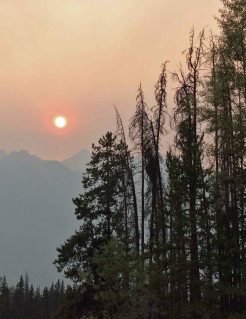
Smoky sun overlooking Rockies (photo by Nina Munteanu)
I recently travelled from Vancouver with Pixl Press director Anne Voute through the smoky Rockies to the 8th ‘When Words Collide’ writers festival in Calgary. The festival was held August 10-12, 2018 and brought together just under a thousand readers and writers in multi-genres to attend presentations and panels on writing and publishing.
The three-day writers’ festival ran a 10-track program that included informative panels, Blue Pencil Café, Editors Speed Mingle, pitch sessions with agents and publishers, and challenging workshops.
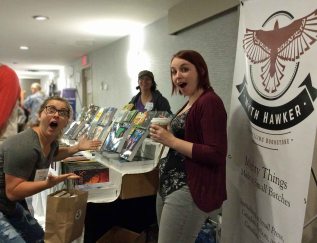
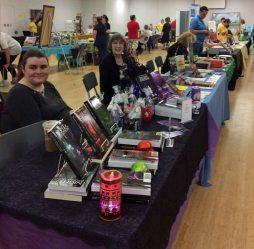
Selling books at Myth Hawker
My books were on sale in the Merchant’s room at Sentry Box (a local Calgary bookstore) and Myth Hawker Travelling Bookstore. By the third day, Myth Hawker sold all available copies of Water Is…
I participated in panels, Blue Pencil Café, Editors speed mingle and several presentations and workshops:
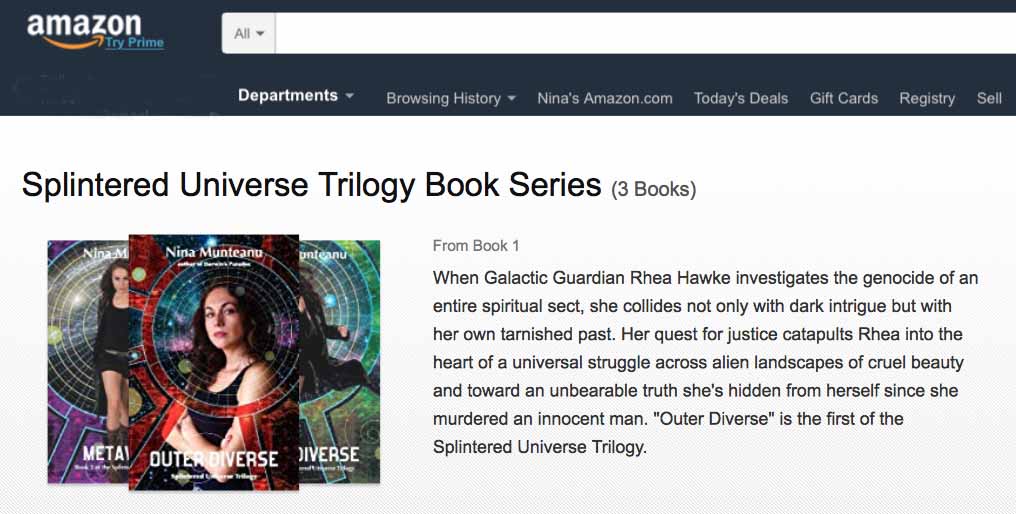
You Oughta Be in Audio: a discussion between me and audiobook narrator and producer Dawn Harvey on the making of the audiobooks for The Splintered Universe—now available in three formats, print, ebook, and audiobook. While paper sales dwindle, audiobooks continue to be the fastest growing segment of the publishing world with sales increasing by 30% year over year for the past decade.
World As Character: a presentation on creating a world with meaning. In most science fiction and fantasy, the world that we create is often very different from our own; in speculative fiction it’s often very similar; in contemporary fiction it is virtually the same. In all cases the world you build should embed in your story with layered metaphoric meaning. Nina Munteanu will discuss how to build a world that interacts with character to inform greater meaning in story.
I also networked my writing community for world examples to use in my Alien Guidebook on world building: “The Ecology of Story: World as Character.” Anticipated release by Pixl Press of this third guidebook in the Alien Guidebook series is Summer of 2019. In keeping with the branding of the series, artist Anne Moody is providing the cover illustration and Costi Gurgu the cover design for The Ecology of Story. Covers for the previous two books were also done by Anne and Costi.
‘Everyday Hero’ by Anne Moody
Earlier in the month, I travelled north with the Pixl Press director to Anne’s ranch in Vanderhoof to requisition a cover from her for the guidebook. After days of discussion and “show and tell” and after several pieces of art were tentatively selected, Anne pulled out a piece that stopped our search dead. ‘Everyday Hero’ depicts a lonely firefighter, trudging in the burning forest, tired gaze to the burning crown of a tree. Considering the subject matter and our world today, we thought this was perfect for my book.
cover design by Costi Gurgu, illustration by Anne Moody
Depicted in shades of blue, charcoal and brilliant red, the cover contrasts and harmonizes well with the brand typology and cover design by Toronto graphic artist Costi Gurgu.
.
Nina Munteanu is an ecologist, limnologist and internationally published author of award-nominated speculative novels, short stories and non-fiction. She is co-editor of Europa SF and currently teaches writing courses at George Brown College and the University of Toronto. Visit www.ninamunteanu.ca for the latest on her books.
For several years I’ve been returning from Toronto—where I teach at The University of Toronto and George Brown College—to Ladner, BC to spend my summers.
I cherish the time as a chance to see family and friends and to enjoy a different pace of life—one I enjoyed when I used to live and work here and where I brought up my family. We lived in a comfortable house on a quiet street and our back yard faced one of Ladner’s sloughs and beyond that a vast tract of farmland, most often scored with rows of potato plants. My son Kevin had grown up swimming in the slough and jumping off the rope swing his dad had constructed. Pilgrims from close and far came to use that swing and enjoy the murky waters of our back slough.
Kevin on the rope swing
Parties at our place always involved water and getting wet. We even had a fleet of kayaks and canoes that we took on paddling adventures through farmland and under highways, with the occasional siting of muskrat, carp, heron, or eagle. Coyotes whined and barked at night as bats dipped through the night air, foraging for food. My female cat poised for the hunt and sometimes brought in her “catch of the day.”
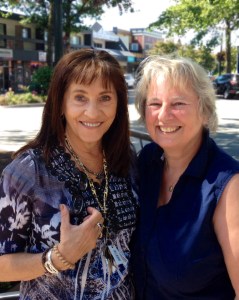
Cathleen and Nina at Stir
This summer, good friend and writer Cathleen Chance Vecchiato decided I should give a talk to my old community on Water Is… my recent bestselling book on water. With that, she immediately made it happen. The venue was already decided: the best café in Ladner, Stir Coffee House. I’d taken Cathleen there the previous year as part of a tour of the old farming and fishing village. Cathleen was charmed by the village atmosphere.
Stir Coffee House was happy to host a talk and Robert and Cathleen proceeded to plan it. Ian Jacques at The Delta Optimist wrote a wonderful piece on my journey, the talk and the book.
On the evening of August 16th a growing crowd of people, eager for more on this precious substance flowed into the café until there was hardly a seat left in the cozy venue. I recognized some locals as well as colleagues from my environmental consulting days in Vancouver. It was a good crowd.
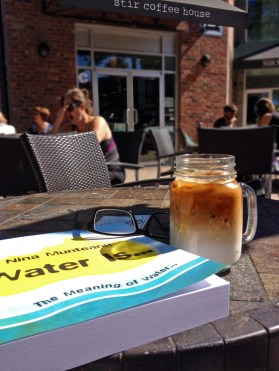
Water Is… snug against an iced latte
I shared the story of how I came to write this book—not a limnology book for non-scientists, as I thought I was going to write—but something that was more than science. Something that encompassed so much more about water: what it means to each of us and how we still don’t understand its many magical anomalous properties. I confided my discovery that the synchronicity of important moments in my life were all connected to water, which compelled the book to evolve into a study of “what water means to us.” Good friend Emmi Itäranta, author of Memory of Water, called Water Is… a biography of water.
Travelling the world has helped me realize that I was blessed with an abundance of water. I lived my entire life in a country of plentiful and healthy water. And for most of that time I didn’t even realize it. Canada holds one fifth of the world’s fresh water in lakes, rivers, and wetlands, as well as in our underground aquifers and glaciers. Canada’s wetlands, which cover more than 1.2 million square kilometres, makes Canada the largest wetland area in the world.
Nina with hosts Hope and Trevor
Perhaps it is no coincidence that Canada is steward of the world’s largest wetlands. Wetlands include marshes, swamps, fens, and bogs, all irreplaceable habitat for a huge diversity of nesting, feeding and staging waterfowl, reptiles, amphibians and mammals—many at risk. Wetlands provide a major filtration system, removing contaminants, improving water quality and renewing water’s vitality; wetlands serve as reservoirs, controlling and reducing flooding toward a more balanced hydrological cycle. Wetlands are a source of oxygen and water vapour, serving a vital role in our global atmospheric and climatic cycles. As ecotones— transitional areas—wetlands protect coasts from erosion and provide exceptional opportunity for boundary interaction and the emergence of vitality. Like a good metaphor, wetlands “recognize” and encompass similarities between dissimilarities. Wetlands powerfully connect. Canada’s strong multi-cultural policies and its open tolerance in embracing and celebrating diversity makes it the “wetland” of the world.
When I turn on the water tap in my house in Canada, it is pure drinking water. I don’t need to boil it or filter it or test it for impurities and toxins. I am confident that it will nourish and hydrate me like water should. I can bathe without restriction. I can play with it.
My water hasn’t changed; but I have. I do not take it for granted. I know that I am blessed.
I am home and I am so grateful.
Part of this article is an excerpt from Nina Munteanu’s “Coming Home to Water” first published in “In the Moment” (A Hopeful Sign) edited by Gary Doi, September 2016; reprinted in “The Earth We Love” (Mississauga Writers) edited by Elizabeth Banfalvi, September 2018; and “The Literary Connection IV: Then and Now” (IOWI) edited by Cheryl Antao Xavier, upcoming 2018.
Nina Munteanu is an ecologist, limnologist and internationally published author of award-nominated speculative novels, short stories and non-fiction. She is co-editor of Europa SF and currently teaches writing courses at George Brown College and the University of Toronto. Visit www.ninamunteanu.ca for the latest on her books.
Every summer, the Writers’ Community of York Region (WYRC) holds a book fair (The Bookshelf) at the Newmarket Community Centre & Lions Hall, next to the farmer’s market. The fair showcases over 40 local authors, publishers and artisans through readings, discussions and a tradeshow that features writers’ works in a variety of genres from science fiction and fantasy to mystery, inspiration, science, history, self-help and children’s literature. I participated in this year’s festival on July 7, 2018.
At the Reading Lounge onstage in the adjoining Farmers’ Market, I read from my Amazon-bestselling “science-for-lay public” book Water Is…The Meaning of Water. As children and their parents played in the main water feature behind me, I introduced the term “limnology” (someone who studies freshwater) and talked briefly about the meaning of water with an audience eager to learn.
“We can’t live without it, so maybe we should start respecting it; this beautifully designed book by a limnologist looks at water from 12 different angles, from life and motion and vibration to beauty and prayer,” said Canadian author Margaret Atwood when she selected Water Is… as her first pick in the New York Times ‘Year in Reading.’
Each of the 12 chapters completes the phrase “Water is…” with terms that evolve from science into philosophy and spirituality; terms such as “magic”, “life”, “motion”, “communication”, “memory”, “rhythm”, “vibration”, “beauty”, “story”, “wisdom”, “prayer”, and finally “joy”.
The book is, after all, a celebration of water.
I first shared some history on the making of the book. I shared that the pursuit of this book was oddly serendipitous and “entangled.”
Nina and son go hiking
“Early on, during the research and writing of this book, I discovered that this project on water had become a gestalt watershed for all the important moments in my life. Places I’ve been. Things I’ve learned. People I’ve met and with whom I’d had surprising discussions and realizations. All spanning many years. And many of them totally unrelated. And yet, now, with a sudden flood of context, their significance has transcended into a new fabric of meaning through surprising connection. Like puzzle pieces cooperatively arranging themselves into a symbiotic pattern of synchronicity.”
Writer and philosopher Jake Kotze suggests that, “Synchronicity happens when we notice the bleed-through from one seemingly separate thing into another—or when we for a brief moment move beyond the mind’s divisions of the world.” Synchronicity and serendipitous discovery, like metaphor, appear when we change the way we look at things.
“Serendipitous discovery comes to us through peripheral vision. Like our muse, it doesn’t happen by chasing after it; it sneaks up on us when we’re not looking. It comes to us when we focus outward and embrace our wonder for this world. When we quiet our minds and nurture our souls with beauty. It is then that what we had been seeking naturally comes to us. Like a gift.”
Quote from “Water Is…” on display at Mississauga Civic Centre
Wonder Woman Respects Water
“Respect water!” says Wonder Woman (aka cosplayer Jes Tongio). Wonder Woman was careful to point out with her wise Amazonian sword of Athena (goddess of wisdom)—forged by Hephaestus—that “Water Is…” provides a doorway to wonder and responsible action.
Wonder Woman (Yes Tongio) with “Water Is…”
Other Authors at The Bookshelf
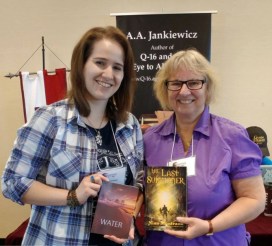
Clair McIntyre and Merridy Cox
I met and visited with other fellow writers, including Clair McIntyre, author of YA/fantasy, and crime writer Joan O’Callaghan.
Myth Hawker Travelling Bookstore was also at the festival. Specializing in Canadian authors, Canadian content, and Canadian small press, they carry an extensive list of local Canadian authors wherever they go across Canada.
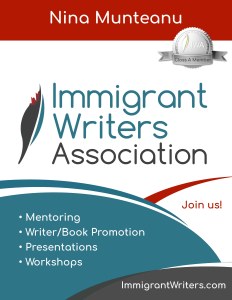
The IWA was also represented, along with member-writers Gabriela Casineanu, Andreea Munteanu, Claudiu Murgan and Andreea Demirgian.
The Immigrant Writers Association provides programs, activities, and services that empower and support immigrant writers in their journeys. According to their website, the goal of the IWA is to “encourage immigrants to express themselves through writing, to bring more awareness, compassion, and peace into the world.”
As second-generation immigrant daughter to German and Romanian parents, I recently joined the IWA. I look forward to mentoring new writers and providing workshops and lectures to share my experience as a writer, editor, and teacher of fiction and non-fiction.
M.J. Moores, chair of the board and founder of Bookshelf
Nina Munteanu is an ecologist, limnologist and internationally published author of award-nominated speculative novels, short stories and non-fiction. She is co-editor of Europa SF and currently teaches writing courses at George Brown College and the University of Toronto. Visit www.ninamunteanu.ca for the latest on her books.
On Fantasy Fiction Focus Nina Munteanu discusses with author Simon Rose about the writing process, the emerging hybrid publishing industry, the importance of branding yourself as an author, and what can authors do to successfully market themselves and their writing. She and Simon discuss the writing community and the importance of conventions and festivals for aspiring writers.
The interview was done in 2015 but what Simon and Nina discuss remains topical and germane.
Nina Munteanu is an ecologist, limnologist and internationally published author of award-nominated speculative novels, short stories and non-fiction. She is co-editor of Europa SF and currently teaches writing courses at George Brown College and the University of Toronto. Visit www.ninamunteanu.ca for the latest on her books.
On this day, June 14th, every year, the Polish and Lithuanians celebrate the Battle of Grunwald; they celebrate with pride, erecting mock-ups of the battle to honour this important—yet largely unknown moment—in history: when the proud Teutonic Order fell to its knees and Poland became a nation.
Which brings me to my book The Last Summonerand how I get my ideas for stories…
I teach writing at the University of Toronto and fiction writing at George Brown College in Toronto. A question I’m often asked is how I get my story ideas. I always start by sharing my favourite example of how I came to write my historical fantasy The Last Summoner:
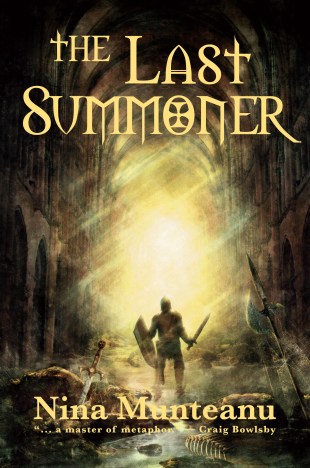
It started in 2008, when I saw the most incredible image by Croation artist Tomislav Tikulin as I was browsing sites on the Internet. The image was of a magnificent knight, standing in a war-littered mire and gazing up, questioning, at the vaulted ceiling of a drowned cathedral. A great light shone upon the knight in streams of white gold–as if a message from heaven. It sent my imagination soaring with thoughts of chivalry, adventure and intrigue.
Who was this knight?
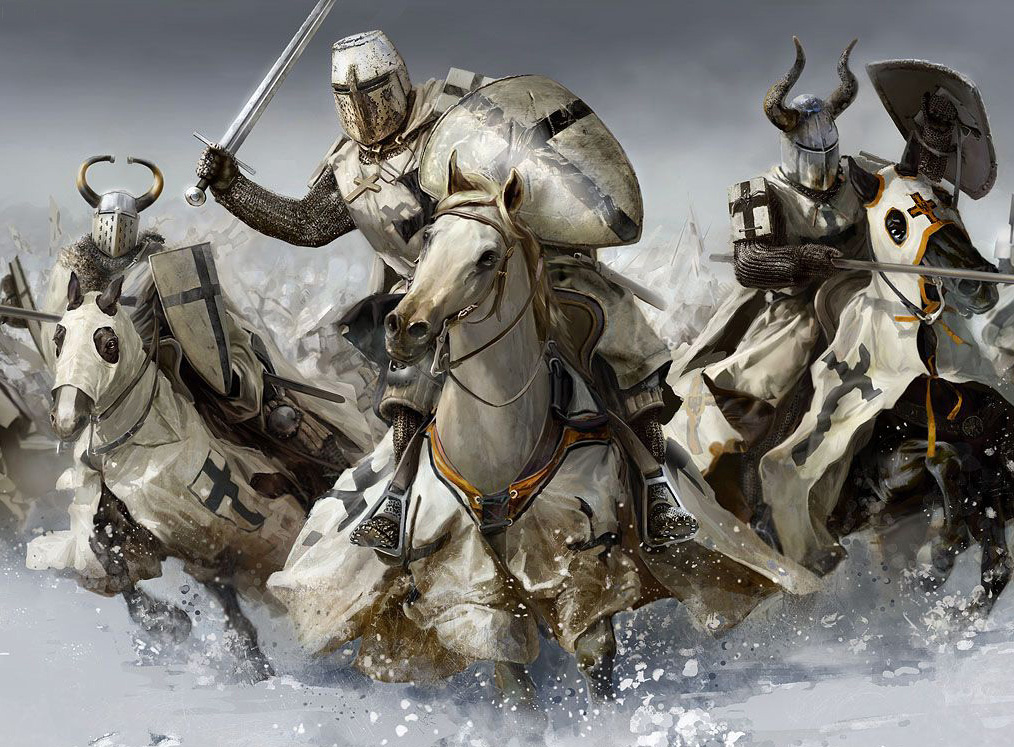
Teutonic knight
With that image imprinted inside me, the next nexus moment came when I stumbled across a significant but little-known battle in the medieval Baltic, the Battle of Grunwald. It would turn out to be the defining battle for what are now the countries of Poland and Lithuania. On June 14, 1410, they were still part of Prussia and tyrannized by the Teutonic Order, who were Christianizing the pagan Baltic on behalf of the Pope. In truth, the Order had been for centuries gathering wealth and land for colonizing Germans in their drang nach osten; they built sturdy castles (many of which still stand today) and grew into a force of monk warriors, feared for their cunning strategy and treacherous combat abilities.
The Battle of Grunwald was, in fact, an upset in history. The Teutonic Order was powerful, intimidating and extremely capable. They should have won; but the peasant armies of Prussia slaughtered the Order, killing most of its knights. Historians debate that the hochmeister’s arrogance—indeed the arrogance of the entire Order—precipitated their downfall. They underestimated their adversaries and got sloppy.
After the Polish and Lithuanian armies outsmarted the Order and slayed the Order’s hochmeister, along with many of their knights, the Order’s own peasant slaves finished the job using clubs, pitchforks and stones.
Every year, the Polish and Lithuanians celebrate June 14th with pride, erecting mock-ups of the battle.
Intrigued by this little known order of religious crusaders, I pursued the premise of an alternative consequence: what if the Teutonic Knights had NOT underestimated their enemy and won the Battle of Grunwald? Would they have continued their catastrophic sweep of Northeast Europe into Russia and beyond? Would they have claimed the whole for Germany’s expansionist lebensraum movement, fueled by its sonderweg—a dialectic that would ultimately lead to the killing fields of the Holocaust? What if the success of the Teutonic Order helped consolidate a united fascist elite, ambitious to conquer the world? What if Nazism sprang up 100 years earlier than it did in our current reality?
The Last Summoner arose from this premise. Enter our hero, young 14-year old Vivianne Schoen, Baroness von Grunwald, a self-centred romantic who dreams that her ritter will rescue her from an arranged marriage to some foreign warrior. As a result of an impetuous choice, she makes the startling discovery that she can alter history—but not before she’s branded a witch and must flee through a time-space tear into an alternate present-day France—now ruled by fascists. There, she learns that every choice has its price.
Spanning from medieval Poland to present day Paris, The Last Summoner explores the sweeping consequences of our “subtle” choices. From the smallest grab to the most sweeping gesture, we are accountable for the world we’ve made. During her 600-year journey to save the world and undo the history she authored, Vivianne learns wisdom and humility. Through the paradox of history, she learns that what might have seemed the right choice for an immediate future, turns out to be disastrous for a distant future. To win is also to lose; to save oneself one must surrender oneself; and to save the world one need only save a single soul.
The knight standing in the drowned cathedral is none other than Vivianne.
Inspired by Tikulin’s knight depiction, I managed to convince my publisher at Starfire World Syndicate to purchase rights to the image; Tikulin’s image–Vivianne’s dream–became the actual cover of my book. I was overjoyed! When The Last Summoner hit the shelves in 2012, it quickly soared into an Amazon Canadian bestseller and remained in the top 10 for several months in the category of fantasy, historical fantasy and science fiction. The book continues to find new readers who enjoy the thrilling time-travelling journey of its 15th century heroine and its surprising plot.
“The Last Summoner” sandwiched nicely between Ray Bradbury and George R.R. Martin
“The Last Summoner is a blend of fantasy, history, and alternate history,” writes Canadian author Kristene Perron. “Fourteen year old Vivianne , the story’s hero, discovers that she has strange powers on the eve of the legendary Battle of Grunwald. Marked as a witch, Vivianne escapes through time and space, but her actions change history and threaten to destroy the world.”
Illustration by Tomislav Tikulin. Cover design and typology by Costi Gurgu
The Last Summoner fascinated Kristene. “Ordinarily, historical fiction doesn’t excite me,” writes Kristene. “But the premise of this novel—which included a good dash of fantasy and time travel—was an exception. There is history aplenty and Munteanu has obviously done her homework. The world of 15th century Germany is authentically realized and the little touches of fantasy blend seamlessly.” She was pleased with Vivianne as a hero and how I had “endowed [my] protagonist with the skills and knowledge necessary for the plot without stretching plausibility.”
Kristene then added, “What I most enjoyed about this story was that for the majority of it I genuinely didn’t know where the plot was going or what would happen next. I’m one of those annoying people who can usually figure out the entire plot of a book or movie within the first few scenes (watching movies with me can be challenging), so to come across a story that stumped my super CSI powers of deduction was a real treat.”
“For those in love with science fiction at its best, The Last Summoner is a complex story of ignored responsibilities and their dire consequences, of love and betrayal that span centuries and multiple worlds. Time travel, multiverse travel, immortality, alternate history in which the Nazis have won, not in the twentieth century but way earlier, in the Teutonic age. Angels and mutants, utopias and dystopias, even a Tesla occurrence— everything a science fiction reader could ever desire in a book. A masterfully told story with great characters. Nina Munteanu moves flawlessly from a medieval story to a modern one and everything in between.”—Costi Gurgu, author of RecipeArium
Jonathan, history buff and author of Sci-Fi & Fantasy Reviews , writes: “The Last Summoner is a unique story melding Germany of the 15th century and modern France, even if a different France from what we would recognize. The story centered around the very real and pivotal Battle of Grunwald in which a coalition of Polish and Lithuanian forces defeated the monastic Teutonic Knights. The book takes a look at the young 14-year-old baroness of Grunwald, someone not quite human, and how she attempts to right a wrong and get history back on track…The author is a good writer, and her wordsmithing is excellent…The historical research was outstanding…Given that this is fiction, and that two settings did not follow history as we know it, never-the-less, each event was either very accurate to our known history or made logical sense in the other settings. I am not a huge fan of alternative history books, but in this one, I was extremely caught up in the final section of the book, and I had to contemplate how the world might be different with only a few changes to our history.”
Jonathan adds, “While I was familiar with most of the historical background of the book, I was unaware of some facts, such as the Tartars taking part in the Battle of Grunwald. I thought this was a mistake made on the part of the author and went to confirm that, but in fact, the author was correct…a clever, well-written book. I would recommend it without hesitation.” The reviewer did have one quibble: my liberal use of French and German in the book.
Professional photographer and science fiction/fantasy reader, Rick LeBlanc shared that he’d “read The Last Summoner on the flight back from World Fantasy Con: could hardly put it down. Just loved the historical references of gear, place and events. The characters were incredibly strong and involved you in their lives. The flow was fun & fast-paced. Merci, Nina. Great book!”
“I loved, loved, loved the metaphors. A page-turner that left me wanting to be Vivianne when I grew up.”—Carina Burns, author of The Syrian Jewelry Box
“The Last Summoner is an enticing fantasy exploring the Knightly order and adding many new perspectives.”—John Taylor, The Midwest Book Review
Nina Munteanu is an ecologist, limnologist and internationally published author of award-nominated speculative novels, short stories and non-fiction. She is co-editor of Europa SF and currently teaches writing courses at George Brown College and the University of Toronto. Visit www.ninamunteanu.ca for the latest on her books.
In late May, I was invited to read from my short story “The Way of Water” and my recent book “Water Is…” at the Oakville Literary Café, held at the Joshua Creek Art Centre.
The Way of Water
“The Way of Water” has appeared in several collections and anthologies in Europe and North America and received praise from around the world, including: The National Observer, Prism International Magazine, Speculating Canada, SoloLibri in Italy, and most recently in Orson Scott Card’s The Intergalactic Medicine Show.
Joshua Creek Art Centre (photo by Nina Munteanu)
“The Chinese multinationals have exchanged the public debt of other states with their water reserves with which, now, they can control the climate, deciding when and where it will rain.Who understands this dirty game has been silenced, like Hilda’s mother, a limnologist, inexplicably arrested and never returned; like the daughter of two water vendors, mysteriously disappeared, after having decided not to bow to economic powers: Hanna, who now prefers secure virtual identities to evanescent real appearances. Water. The two, like the covalent bond of a complex molecule, develop a relationship of attraction and repulsion that will first make them meet and then, little by little, will change into a tormented love but, at the same time, so pure as to cause Hilda at great risk, to make an extreme decision that will allow Hanna to realize the strange prophecy that the internal voice, perhaps the consciousness of water, had resonated in the two women for a long time.” —Simone Casavecchia, SoloLibri.net
She imagines its coolness gliding down her throat. Wet with a lingering aftertaste of fish and mud. She imagines its deep voice resonating through her in primal notes; echoes from when the dinosaurs quenched their throats in the Triassic swamps.
Water is a shape shifter.
It changes yet stays the same, shifting its face with the climate. It wanders the earth like a gypsy, stealing from where it is needed and giving whimsically where it isn’t wanted.
Dizzy and shivering in the blistering heat, Hilda shuffles forward with the snaking line of people in the dusty square in front of University College where her mother used to teach. The sun beats down, crawling on her skin like an insect. She’s been standing for an hour in the queue for the public water tap.
Emilie Moorhouse of Prism International wrote: “Soon after I finished reading the book, Cape Town—known in precolonial times as “the place where clouds gather”—announced that it was only a few months away from what it called “Day Zero,” the day the city would officially run out of water, making the similarities between fiction and reality more than unsettling. Munteanu’s story is set in a futuristic Canada that has been mined of all its water by thirsty corporations who have taken over control of the resource. Rain has not fallen on Canadian soil in years due to advances in geoengineering and weather manipulation preventing rain clouds from going anywhere north of the Canada-US border.”
“In ‘The Way of Water’, Nina Munteanu pens her love letter to water, exulting it as a liquid that has semi-magical properties…’The Way of Water’ evokes a sense of awareness about issues of access to water and about the dangers of imbalances in that access.”—Derek Newman-Stille, Speculating Canada
“…In an interesting scarcity future in which we follow the fate of a character abandoned by her mother, water itself becomes a character. In the second paragraph we’re told that “Water is a shape shifter,” and in the next page we encounter the following description: “Water was paradox. Aggressive yet yielding. Life-giving yet dangerous. Floods. Droughts. Mudslides. Tsunamis. Water cut recursive patterns of creative destruction through the landscape, an ouroboros remembering.” These descriptive musings cleverly turn out to be more than metaphors and tie in directly to the tale’s surprising ending.”—Alvaro Zinos-Amaro, IntergalacticMedicineShow.com
Water Is… The Meaning of Water
I also read from my non-fiction book “Water Is… The Meaning of Water.” I read several quotes from “Water Is…”. The water quotes had earlier been displayed at a photographic art exhibition in the Great Hall of the Mississauga Civic Centre. The art exhibition celebrated the Waterfront Connection wetland construction, a realized vision of the late Jim Tovey.
Photo Art in the Great Hall of the Mississauga Civic Centre
Quote from Nina Munteanu’s “Water Is…” displayed alongside photo art
Quote from “Water Is…” displayed at the Civic Centre in Mississauga
Joshua Creek Heritage Art Centre
Back patio of Joshua Creek Art Centre (photo by Nina Munteanu)
Envisioned by Sybil Rampen as a place to meet, collaborate and cultivate relationships, the Joshua Creek Heritage Art Centre was established at the 1827 heritage house on Rampen’s family farm on Burnhamthorpe Road in Oakville. The art centre serves the community as a gathering place—creative media workshops, films, musical events, lectures and weddings. The facility promotes local heritage and accessibility. Ecological integrity remains central to its activities.
Joshua Creek
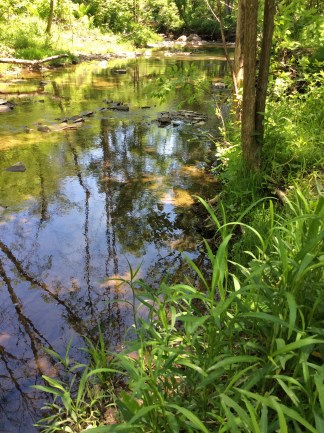
Joshua Creek (photo by Nina Munteanu)
Joshua Creek originates near the art centre north of Burnhamthorpe Road and flows about 6 km south through the farm then mostly forest, eventually emptying into Lake Ontario. I was told that the creek has good water quality, apparently the best in the county. Oakvillegreen.org provides some history on Joshua Creek:
“Joshua Creek exists as a patchwork of past glories and present changes on a very dynamic and human-controlled landscape… many of its lands were cleared and altered beyond recognition, with only certain key areas left mostly to nature. In spite of these influences, Joshua Creek is home to 3 small Environmentally Sensitive Areas (ESAs), although two of these – Joshua Creek Valley and Wildflower Woods – have declined since they were highlighted in the 1970’s, and while still valuable, may no longer qualify as ESAs in the future. In only a handful of decades, development has quickly covered most of the lower two thirds of the creek’s land base, including important parts of its ESAs. In several areas, Joshua’s natural winding “meander” has been artificially straightened in order to efficiently use the land on either side. And in many places, foreign species have invaded the natural areas of the creek, changing the ecosystem in a big way.
But Joshua is a spirited creek – in spite of all it has been through, Joshua Creek is among the top two urban creeks for healthy water quality, and is still inhabited by a variety of aquatic animals like small fish and insects. Joshua Creek is home to forests, wetlands and thickets with around 150 plant species, and provides an important natural habitat corridor for the movement of birds and other animals, including migratory species. Rather than exclusively shrinking, there are also areas of Joshua Creek that are actually in the middle of regrowing their forests, and in spite of everything, Joshua still retains some beautiful gems of natural areas.”
Nina Munteanu is an ecologist, limnologist and internationally published author of award-nominated speculative novels, short stories and non-fiction. She is co-editor of Europa SF and currently teaches writing courses at George Brown College and the University of Toronto. Visit www.ninamunteanu.ca for the latest on her books.
I was recently invited by Editors Toronto and the Toronto chapter of PWAC to participate in a panel (co-sponsored and hosted by UofT’s Creative Writing Program) exploring the current state of self-publishing and the publishing industry in general. I was one of four professionals whose work has involved all facets of the industry from POD, hybrid models, and ebooks to crowdfunding and writing communities.
The four speakers included:
Meghan Behse, the president of PubLaunch Inc., a new online marketplace and crowdfunding platform where writers, readers, and publishing professionals join forces to get books published. In her role as publisher, she steered Iguana through a new world of digital and print-on-demand publishing while experimenting with unique royalty arrangements and funding models, including crowdfunding. Behse talked about how PubLaunch is using emerging technologies to help overcome the obstacles writers continue to face in the self-publishing industry.
Nina Munteanu, an experienced editor of traditionally published and self-published books, and an award-winning author of eight novels, including Darwin’s Paradox and The Splintered Universe Trilogy. A frequent contributor to Amazing Stories and the current editor of Europa SF, Munteanu teaches writing at George Brown College and the University of Toronto and has also published short stories, essays, and non-fiction books. Her latest book is Water Is…The Meaning of Water, a scientific study and personal journey as limnologist, mother, teacher, and environmentalist. Munteanu provided an overview of the industry—including use and misuse of terms—then spoke about evolving professional standards in self-publishing, and what these changes mean for writers and editors.
Stephanie Fysh, a Toronto-based freelance editor of independent authors in a variety of genres, including fantasy, science fiction, YA, romance, and erotica, and the former chair of Ryerson University’s Publishing program. She works with hybrid publishers on projects that range from harrowing memoirs to comedy, and still enjoys a textbook project that she can learn something from. Using her own experience as example, she talked about what self-publishing authors look for in an editor, and how that differs from the roles built into traditional or hybrid publishing.
Mark Leslie Lefebvre, the author of more than a dozen traditionally published and self-published books, a professional speaker, a digital publishing advocate, and a bookseller with more than a quarter century of experience. Lefebvre explained what prompted him to self-publish “ten years before any self-respecting writer would admit to such a foul thing.” And he’ll tackle the big-picture questions: “What is currently wrong with self-publishing, and how can we work together to fix that?”
I started the panel discussion with an overview of the publishing industry from traditional to indie to self-publishing. I overviewed five main publishing models and discussed advantages and disadvantages depending on needs and perspectives of the writer. A few advantages of self-publishing include: 1) getting a book to market more quickly than through the traditional publishing path; and 2) having more control over the end product.
The downsides in self-publishing arise from the same: 1) getting a book to market more quickly may seduce writers to compromise the lengthy process of perfecting their work (provided by editors, layout and cover artists) to put something out before it is ready; and 2) having more control also means more responsibility borne by the writer (the need to understand more in book production and marketing than a writer in the traditional process needs to). Another important disadvantage to self-publishing lies in more restricted distributing, marketing and exposure.
In my talk, I emphasized that while the current industry is providing great opportunities, with these come great responsibilities.
Authors and editors are currently facing a sea of possibilities. New directions, models, collaborations and structures face us as the publishing industry morphs into something new. Self-publishing and hybrid-players are at the forefront of that evolving tide of new publishing. And it’s very exciting!
Suzanne Bowness of PWAC Toronto provided a good summary of the panel discussion on PWAC’s blog Networds, and shared by the Editors Toronto blog Boldface. Editor and publishing consultant Michelle MacAleese who attended the event made these observations:
Many in the biz draw a distinction between self-published authors and hybrid-published authors; both are “independent,” but the self-published authors are a special breed, who *are starting to understand art and business and (usually) gladly develop proficiency in all the technical and administrative details of the process.
Not surprisingly, options for authors continue to change rapidly. What worked best in 2011 is irrelevant today. Many quality companies offer publishing services and hybrid publishing deals. (Many companies will pretty much just steal your money. One must read up before signing up. *Research is paramount)
The best publishing option for e-only genre fiction won’t be the same as for a debut hardcover business book. It’s a wide world of independent publishing.
Authors: If you don’t love technical things (formatting ebooks, working Amazon’s categories, tweaking descriptive copy), you probably won’t enjoy starting a publishing house of one.
Editors: Working with self-published authors is a specialty and those editors who are good at taking on that relationship and guiding the process are worth their weight in gold. (Isn’t it about time we begin to mentor each other in why this kind of author-editor relationship is unique, and how it borders on the agent role at times? *This is a great opportunity for editors willing to evolve and grow.)
Editors who already specialize in working with self-published authors: Let’s talk about how to partner with reputable publishing services companies as well as with other independent designers and book marketing professionals to launch great self-published books that sell! This point was just touched upon in the panel and is still evolving; again, editors are uniquely positioned as author-consultants to play key roles in new networks of independent professionals in the publishing industry. *italics throughout are mine
A few years ago, I gave a talk at Editors Toronto on the industry from the self-publishing author and freelance editor’s perspective. It remains highly relevant today, given that it spoke to the changing face of publishing and what it means for editors and writers. Editors learned about self-publishing and indie publishing, publishing myths, and imaginative ways to find new editing opportunities:
“Self-publishing used to be a scar; now it’s a tattoo.”–Greg Cope White
Nina Munteanu is an ecologist and internationally published author of award-nominated speculative novels, short stories and non-fiction. She is co-editor of Europa SF and currently teaches writing courses at George Brown College and the University of
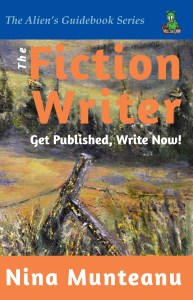
Writer Timea Noemi selected The Fiction Writer by Nina Munteanu along with the works of Angela Ackerman and Katie Weiland as her Top books on How to Write.
“[The Fiction Writer]is the most practical book on publishing that I’ve ever read, and I’ve read them all! Not only is each chapter packed with advice for writers at every level of the publishing process, but the text is highly readable and even entertaining. The clear format, the direct style and the playful layout keep the large volume of information from ever becoming dry or boring.”–Lucia Gorea, English Instructor, University of Vancouver
“Eu mutumesc enorm! Cartea aceasta ma invatat atat de multe lucruri este bibia mea de scriitor. Din pacate nu prea se gasesc carti despre scriere creative in tara si m-am bucurat tare mult sa gasesc aceasta carte.” (Thank you so much! This book taught me so many things; it is my writer’s Bible. Unfortunately, there are no books on creative writing in the country, and I enjoyed finding this book.)
Cu plecere, Timi!
In fact, I knew this (that writing guides were lacking in Romania, a country full of writers!) and so did my Romanian publisher Calin Vlasie of Editura Paralela 45. This is why Editura Paralela 45 translated and published a Romanian version of The Fiction Writer. It so gladdens me to hear that this book on writing is making its way around the country.
My father is originally from Romania and grew up in Bucharest. So, I was delighted to attend the launch of Manual de Scriere Creativa. Scriitorul de fictiune (The Fiction Writer) in Bucharest in 2011, hosted by Editura Paralela 45 in the Gaudeamus Book Fair. It was a wonderful experience, which included drinking copious amounts of Romania’s national drink Tuica (plum liquor that packs a punch!) with my publisher. You can find out more about my adventure in Bucharest on my good friend’s site, Toulouse On the Loose.
Canadians can purchase “The Fiction Writer” at a very decent price right now from Chapters / Indigo. The Fiction Writer is the first book of The Alien Guidebook Series, which includes The Journal Writer: Finding Your Voice(for journalling and memoir writing) and upcoming The Ecology of Story: World as Character (on setting, place and world building–scheduled release Summer 2019).
Nina Munteanu is an ecologist, limnologist and internationally published author of award-nominated speculative novels, short stories and non-fiction. She is co-editor of Europa SF and currently teaches writing courses at George Brown College and the University of Toronto. Visit www.ninamunteanu.ca for the latest on her books.
When I was just beginning as a novelist, the publisher guideline request “submit a synopsis and sample chapters” was intimidating to say the least. There was something terrifyingly daunting about writing a succinct compelling summary of my 300-page novel packaged into just a few pages. As author Katherine Eliska Kimbriel said, “The instinctive response [of the author] is to clap on a helmet and start digging a trench.” I had a right to be terrified. In some ways the synopsis is the hardest thing for a novelist to write. Yet it is the first thing most publishers and agents want (and have time) to see of your cherished project (aside from those sample chapters, of course). Every fiction writer who wants to sell in the current market must know how to write a synopsis because that’s what an editor wants to see first. Most editors (if they’re good) are overworked with scarce enough time to answer their phones, much less their emails.
I’m not going to describe how to write a synopsis in this post. If you want to see an excellent summary of what a good synopsis should look like, there are many excellent descriptions by professional editors, agents and other writers who describe what a synopsis is and even give examples—including my own book “The Fiction Writer: Get Published, Write Now!”, Chapter “O.” Elizabeth Lyon also describes the synopsis (as opposed to an outline) in several of her how-to books.
Instead, I present here why you should write that dreaded synopsis, and way before you finish your book, too.
Synopsis vs. Outline
A synopsis is not an outline. Both are useful to the writer, yet each serves a very different purpose. An outline is a tool (usually just for the writer) that sketches plot items of a book. It provides a skeleton or framework of people, places and their relationships to the storyline that permits the writer to ultimately gauge scene, setting, and character depth or even determine whether a character is required (every character must have a reason to be in the book, usually to move the plot). For writers just beginning, this is an excellent tool to keep the narrative spare and compelling and to remove superfluous characters and other things (a common beginning writer inclination). A synopsis, on the other hand, is an in-depth summary of the entire book that weaves in thematic elements with plot to portray a compelling often multi-level story arc. This is usually what an editor wants to see, although I have seen them request an outline as well. To put it basically, the outline describes what happens when and to whom, while the synopsis includes the “why” part.
What a synopsis does (along with the sample chapters and extremely important query letter) is get your manuscript read by an editor. That’s the real purpose of a synopsis. An editor makes his/her decision to look at your manuscript based on these three items: query letter (intro to you); sample chapters; and your synopsis. Ultimately, their decision resides with whether your project fits their own imprint at the time.
If that isn’t reason enough to write a synopsis of your novel, below are two others:
Synopsis as Storytelling Prompt
A synopsis of your novel goes beyond the outline to help polish elements of story arc, characterization with plot and setting with story. The synopsis can answer questions perplexing the author, stuck on a scene or plot item. It helps you weave your novel’s elements into a well-integrated story that is compelling at many levels. Because the synopsis is based on emotional turning points (related to theme), character dramatization of the premise is a key foundation. It makes sense to write drafts of your synopsis as you go along in the novel; that way it’s useful to both you and to the editor and then it’s more or less written when you need to submit it along with sample chapters…and not quite as daunting a task either.
Synopsis as Marketing Summary
Your well-written synopsis is often used internally by the publishing house staff (e.g., by artist, copywriter, and sales department) once your novel has been accepted.
I advise you to write it now. Don’t wait. Make the synopsis work for you throughout your novel’s journey.
Nina Munteanu is an ecologist and internationally published author of award-nominated speculative novels, short stories and non-fiction. She is co-editor of Europa SF and currently teaches writing courses at George Brown College and the University of Toronto. Visit www.ninamunteanu.ca for the latest on her books.
Some years ago, I was interviewed by Michael Stackpole (New York Times bestselling author of over 40 novels, including “I, Jedi” and “Rogue Squadron”) and Michael Mennenga (CEO of “Slice of Sci-Fi”) on Dragon Page Cover to Cover.
We talked about my book “The Fiction Writer: Get Published, Write Now!” and what new writers fret over. A lot of the discussion focused on how to handle rejection and I shared my “bus terminal” model (also in my book), which worked very well. For details on our discussion about the industry and craft of writing, listen below:
One way to see your way through rejection is to find ways to distance yourself from your story once you’ve sent it off and to see the whole process of submission-rejection-acceptance as a business. The very best way to do this is to submit lots of stories and to keep submitting them. With novels, this is a little harder to do but you can certainly be working on the next one once you’ve submitted the first.
When I was writing short stories, I kept a list of what and where I submitted, along with the most important item: where to submit NEXT. At any given time, I made sure that I had at least x-number of submissions out there and each story had a designated place to go if it returned. As soon as a story came back from magazine A, I simply re-packaged it and sent it to magazine B. The critical part of the list was to have a contingency for each story: the next place where I would send the story once it returned. I was planning on the story being rejected with the hope that it would be accepted; that way, a rejection became part of a story’s journey rather than a final comment.
I ran my submissions like a bus terminal. A story was in and out so fast it never had a chance to cool off. And, since I had five other pieces out there, I could do this with little emotion. I was running a fast-paced “story depot”, after all. All my stories had to be out there as soon as possible; if they were sitting in the terminal, they were doing nothing for me.
Nina Munteanu is an ecologist and internationally published author of award-nominated speculative novels, short stories and non-fiction. She is co-editor of Europa SF and currently teaches writing courses at George Brown College and the University of Toronto. Visit www.ninamunteanu.ca for the latest on her books.

 I also networked my writing community for world examples to use in my Alien Guidebook on world building: “The Ecology of Story: World as Character.” Anticipated release by Pixl Press of this third guidebook in the Alien Guidebook series is Summer of 2019. In keeping with the branding of the series, artist Anne Moody is providing the cover illustration and Costi Gurgu the cover design for The Ecology of Story. Covers for the previous two books were also done by Anne and Costi.

 Nina Munteanu is an ecologist, limnologist and internationally published author of award-nominated speculative novels, short stories and non-fiction. She is co-editor of Europa SF and currently teaches writing courses at George Brown College and the University of Toronto. Visit www.ninamunteanu.ca for the latest on her books.



 Part of this article is an excerpt from Nina Munteanu’s “Coming Home to Water” first published in “In the Moment” (A Hopeful Sign) edited by Gary Doi, September 2016; reprinted in “The Earth We Love” (Mississauga Writers) edited by Elizabeth Banfalvi, September 2018; and “The Literary Connection IV: Then and Now” (IOWI) edited by Cheryl Antao Xavier, upcoming 2018.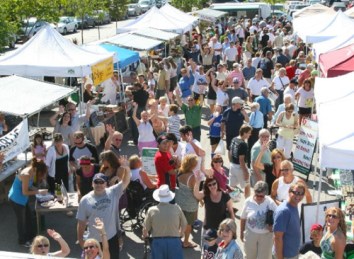

 Each of the 12 chapters completes the phrase “Water is…” with terms that evolve from science into philosophy and spirituality; terms such as “magic”, “life”, “motion”, “communication”, “memory”, “rhythm”, “vibration”, “beauty”, “story”, “wisdom”, “prayer”, and finally “joy”.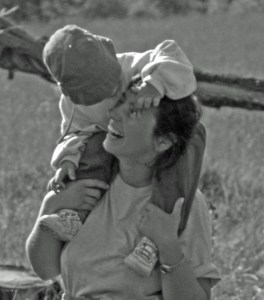



 The
The 

 I teach writing at the University of Toronto and fiction writing at George Brown College in Toronto. A question I’m often asked is how I get my story ideas. I always start by sharing my favourite example of how I came to write my historical fantasy
 Intrigued by this little known order of religious crusaders, I pursued the premise of an alternative consequence: what if the Teutonic Knights had NOT underestimated their enemy and won the Battle of Grunwald? Would they have continued their catastrophic sweep of Northeast Europe into Russia and beyond? Would they have claimed the whole for Germany’s expansionist lebensraum movement, fueled by its sonderweg—a dialectic that would ultimately lead to the killing fields of the Holocaust? What if the success of the Teutonic Order helped consolidate a united fascist elite, ambitious to conquer the world? What if Nazism sprang up 100 years earlier than it did in our current reality?
 Spanning from medieval Poland to present day Paris,

 across a story that stumped my super CSI powers of deduction was a real treat.”
 were incredibly strong and involved you in their lives. The flow was fun & fast-paced. Merci, Nina. Great book!”
 Nina Munteanu is an ecologist, limnologist and internationally published author of award-nominated speculative novels, short stories and non-fiction. She is co-editor of Europa SF and currently teaches writing courses at George Brown College and the University of Toronto. Visit
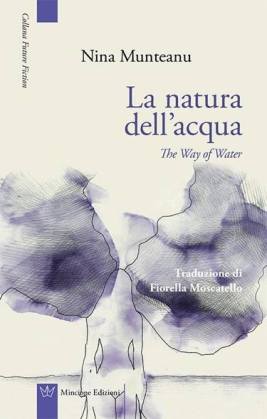 She imagines its coolness gliding down her throat. Wet with a lingering aftertaste of fish and mud. She imagines its deep voice resonating through her in primal notes; echoes from when the dinosaurs quenched their throats in the Triassic swamps.
 Emilie Moorhouse of
 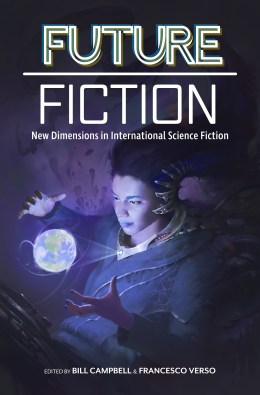 “…In an interesting scarcity future in which we follow the fate of a character abandoned by her mother, water itself becomes a character. In the second paragraph we’re told that “Water is a shape shifter,” and in the next page we encounter the following description: “Water was paradox. Aggressive yet yielding. Life-giving yet dangerous. Floods. Droughts. Mudslides. Tsunamis. Water cut recursive patterns of creative destruction through the landscape, an ouroboros remembering.” These descriptive musings cleverly turn out to be more than metaphors and tie in directly to the tale’s surprising ending.”—Alvaro Zinos-Amaro,
 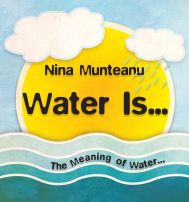 Water Is… The Meaning of Water


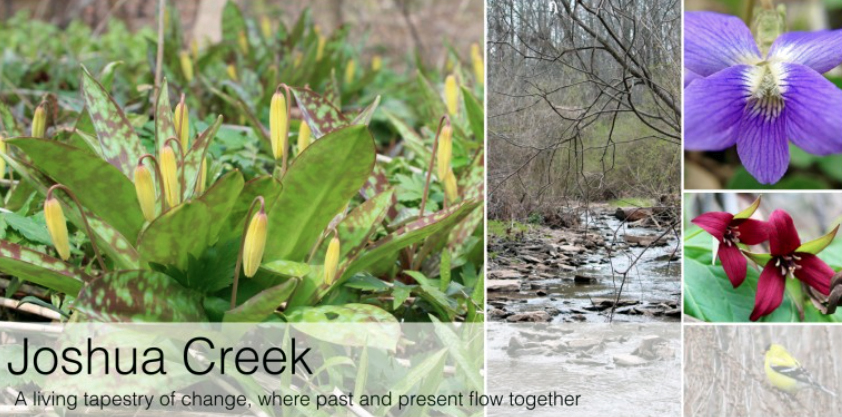
 But Joshua is a spirited creek – in spite of all it has been through, Joshua Creek is among the top two urban creeks for healthy water quality, and is still inhabited by a variety of aquatic animals like small fish and insects. Joshua Creek is home to forests, wetlands and thickets with around 150 plant species, and provides an important natural habitat corridor for the movement of birds and other animals, including migratory species. Rather than exclusively shrinking, there are also areas of Joshua Creek that are actually in the middle of regrowing their forests, and in spite of everything, Joshua still retains some beautiful gems of natural areas.”

 Meghan Behse
 Nina Munteanu
 Stephanie Fysh
 Mark Leslie Lefebvre


 Nina Munteanu is an ecologist and internationally published author of award-nominated speculative novels, short stories and non-fiction. She is co-editor of Europa SF and currently teaches writing courses at George Brown College and the University of
  Writer Timea Noemi selected
 Timea Noemi also recommended the Romanian translated version of
 Cu plecere, Timi!
 My father is originally from Romania and grew up in Bucharest. So, I was delighted to attend the launch of
  When I was just beginning as a novelist, the publisher guideline request “submit a synopsis and sample chapters” was intimidating to say the least. There was something terrifyingly daunting about writing a succinct compelling summary of my 300-page novel packaged into just a few pages. As author Katherine Eliska Kimbriel said, “The instinctive response [of the author] is to clap on a helmet and start digging a trench.” I had a right to be terrified. In some ways the synopsis is the hardest thing for a novelist to write. Yet it is the first thing most publishers and agents want (and have time) to see of your cherished project (aside from those sample chapters, of course). Every fiction writer who wants to sell in the current market must know how to write a synopsis because that’s what an editor wants to see first. Most editors (if they’re good) are overworked with scarce enough time to answer their phones, much less their emails.
 A synopsis of your novel goes beyond the outline to help polish elements of story arc, characterization with plot and setting with story. The synopsis can answer questions perplexing the author, stuck on a scene or plot item. It helps you weave your novel’s elements into a well-integrated story that is compelling at many levels. Because the synopsis is based on emotional turning points (related to theme), character dramatization of the premise is a key foundation. It makes sense to write drafts of your synopsis as you go along in the novel; that way it’s useful to both you and to the editor and then it’s more or less written when you need to submit it along with sample chapters…and not quite as daunting a task either.
 Nina Munteanu is an ecologist and internationally published author of award-nominated speculative novels, short stories and non-fiction. She is co-editor of Europa SF and currently teaches writing courses at George Brown College and the University of Toronto. Visit
  Some years ago, I was interviewed by Michael Stackpole (New York Times bestselling author of over 40 novels, including “I, Jedi” and “Rogue Squadron”) and Michael Mennenga (CEO of “Slice of Sci-Fi”) on
  We talked about my book “
 Here is an excerpt from
