Ecology of Story: Place as Allegory

Birds deer lake

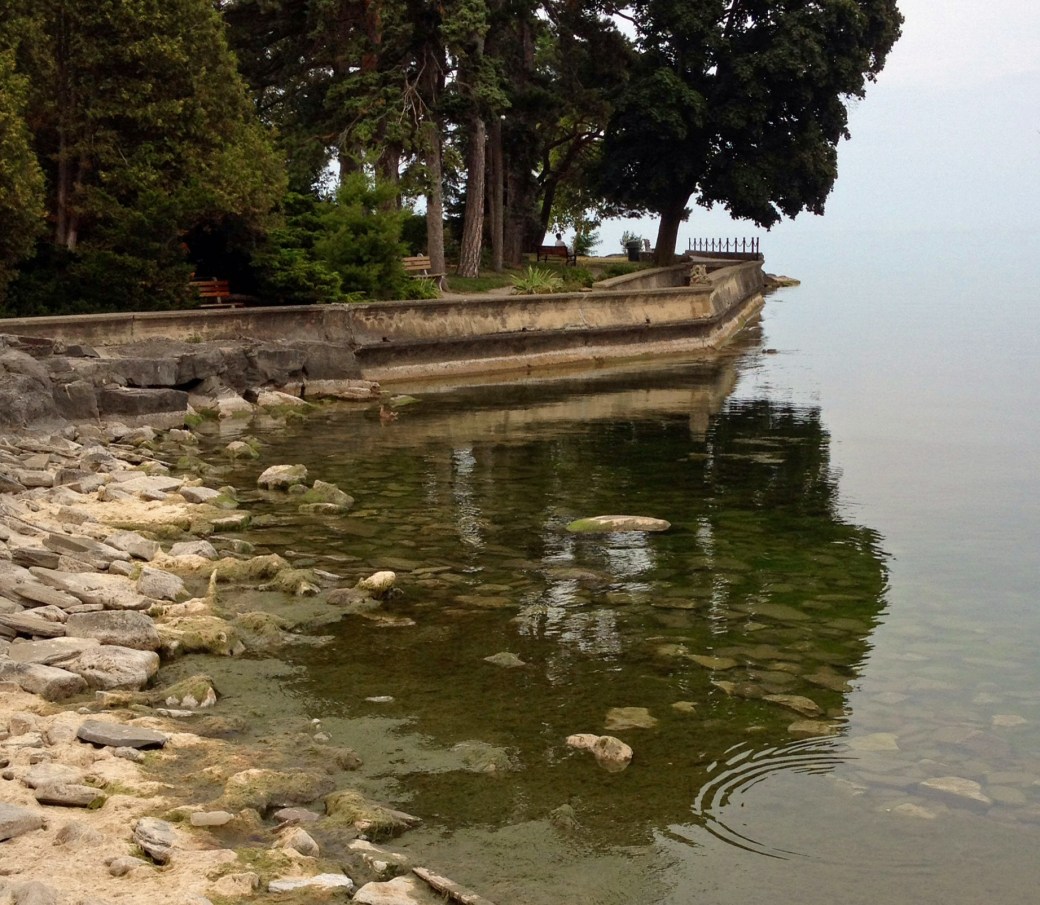
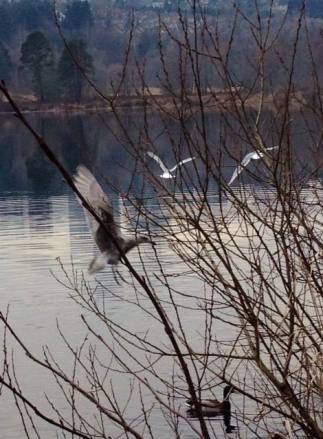
Birds on Deer Lake, BC (photo by Nina Munteanu)

An allegory is a complete narrative whose images and material things represent an abstract idea or theme such as a political system, religious practice or figure, or a philosophical viewpoint. The entire narrative is a metaphor in which all components are symbolic. Most fairy tales, folk tales and myths are allegories. Examples include: Edmund Spencer’s Faerie Queen; Mary Shelley’s Frankenstein; and Beowulf.

The narrative of allegory is a fractal nest of symbolic names, places and things, that contribute key elements to the story (e.g., Luke Skywalker and Han Solo in Star Wars; Gabriel Oak in Far From the Madding Crowd; John Savage of Stanger in a Strange Land; Darwin Mall in Darwin’s Paradox; Middle Earth in Lord of the Rings; Lilliput in Gulliver’s Travels). Setting and place in allegory symbolizes the theme being explored (e.g. Orwell’s farm in Animal Farm represents a totalitarian world of oppression; the road in John Bunyan’s Pilgrim’s Progress represents the journey of humankind; the island in William Golding’s Lord of the Flies represents the world at war).

As an aside, the science of place names, geographical names or toponyms (derived from a topographic feature) is called toponymy. The city of Montreal, for instance, is a toponym (named after le Mont Royal). Toponyms often come through the local vernacular. Given their link to cultural identity, such place names can provide a significant symbolic role in story.
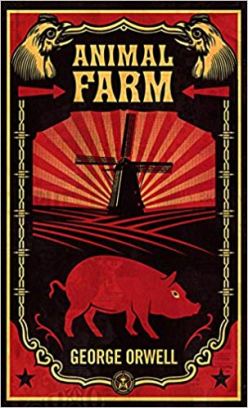
Animal Farm-GeorgeOrwellIn Animal Farm, George Orwell uses animals to describe the revolution against a totalitarian regime (e.g. the overthrow of the last Russian Csar and the Communist Revolution of Russia). The animals embrace archetypes to symbolize the actions and thoughts of various sectors within that world. The pigs are the leaders of the revolution; Mr. Jones represents the ruling despot who is overthrown; the horse Boxer is the ever-loyal and unquestioning labor class.

John Bunyan’s The Pilgrim’s Progress, published in 1678, tells the story of a narrator who falls asleep and dreams of a man named Christian fleeing the City of Destruction while bearing a heavy burden (e.g., symbolizing his own sins) on his back. A character named Evangelist shows Christian the way to Celestial City, a perilous journey through the Slough (swamp) as characters called Mr. Worldly Wiseman and Hypocrisy try to lead him astray.
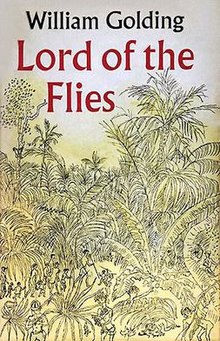
LordOfTheFlies-WilliamGoldingIn Lord of the Flies, William Golding explores the conflict in humanity between the impulse toward civilization and the impulse toward savagery. The symbols of the island, the ocean, the conch shell, Piggy’s glasses, and the Lord of the Flies, or the Beast, represent central ideas that reinforce this main theme. Each character has recognizable symbolic significance: Ralph represents civilization and democracy; Piggy represents intellect and rationalism; Jack represents self-interested savagery and dictatorship; and Simon (the outsider in so many ways) represents altruistic purity.

Many of Golding’s potent symbols to power his allegory come from the natural world. These include the use of smoke, fire, and snakes to invoke the imaginary beast (that exists within each of them). The scar left from the plane crash that destroys this natural paradise symbolizes our savage and destructive nature.

Allegories may also be powerful as satires. The social commentary of satires expose and criticize corruption and foolhardiness of societies, groups or even individuals through humor, irony and even ridicule. Gulliver’s Travels by Jonathan Swift is a good example of satire and parody. Swift targets politics, religion and western culture through satire. Aspects of place, landscape and setting are effectively used to feature his commentary. Another excellent example of political satire and use of place and setting with embedded character is found in Lewis Carroll’s Alice’s Adventures in Wonderland.
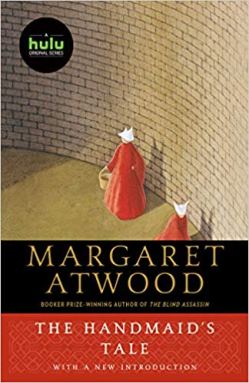
TheHandmaidsTale-MargaretAtwoodExcellent examples of satires with less obvious allegorical structure (but it’s there) can be found in the genre of science fiction—a highly metaphorical literature that makes prime use of place and setting with archetypal characters to satirize an aspect of society. Brave New World by Aldous Huxley is a satirical response to his observation of humans’ addiction to (sexual) pleasure and vulnerability to mind control and the dumbing of civilization in the 1930s. George Orwell’s Nineteen Eight-Four satirizes humanity’s vulnerability to fascism, based on his perception of humans’ sense of fear and helplessness under powerful governments and their oppressive surveillance. Margaret Atwood’s The Handmaid’s Tale satirizes a society in which a woman struggles in a fundamentalist Christian dictatorship patriarchy where women are forced into a system of sexual slavery for the ruling patriarchy.

Other examples include Stranger in a Strange Land by Robert Heinlein; The Dispossessed by Ursula K. Le Guin; The Time Machine by H. G. Wells; The Hunger Games by Suzanne Collins. Each of these stories examines the world of the day and provides critical commentary through premise, place and character. In each of these stories, place and setting help define premise and theme (e.g., what is being satirized.)
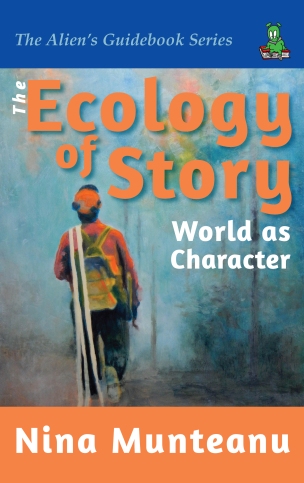


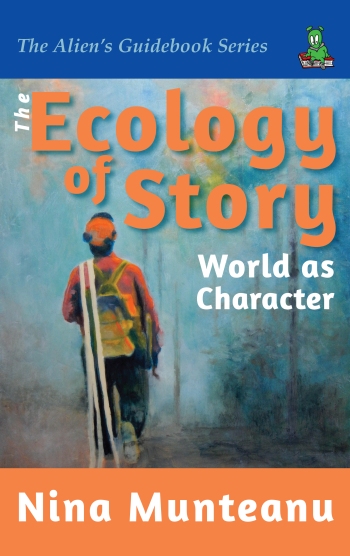
MockUpEcology copyThis article is an excerpt from The Ecology of Story: World as Character released in June 2019 by Pixl Press.

From Habitats and Trophic Levels to Metaphor and Archetype…

Learn the fundamentals of ecology, insights of world-building, and how to master layering-in of metaphoric connections between setting and character. “Ecology of Story: World as Character” is the 3rd guidebook in Nina Munteanu’s acclaimed “how to write” series for novice to professional writers.


Microsoft Word - Three Writing Guides.docx


nina-2014aaa

Nina Munteanu is a Canadian ecologist / limnologist and novelist. She is co-editor of Europa SF and currently teaches writing courses at George Brown College and the University of Toronto. Visit www.ninamunteanu.ca for the latest on her books. Nina’s bilingual “La natura dell’acqua / The Way of Water” was published by Mincione Edizioni in Rome. Her non-fiction book “Water Is…” by Pixl Press (Vancouver) was selected by Margaret Atwood in the New York Times ‘Year in Reading’ and was chosen as the 2017 Summer Read by Water Canada. Her novel “A Diary in the Age of Water” will be released by Inanna Publications (Toronto) in 2020.

Ecology of Story: Place as Symbol

Birds deer lake

Birds over Deer Lake, BC (photo by Nina Munteanu)

“In their simplest form, symbols are anything outward that stands in for anything inward or abstract, such as a mood or an idea,” writes Donald Maass in Writing the Breakout Novel Workbook. As representations, symbols often serve as markers in a story. They may be a talisman, a totem that inspires a shift or awakening. In story, a symbol—particularly as talisman—may come as a gift to a character in need of inspiration. In the Hero’s Journey trope, this is often provided by a mentor archetype.

An example in story is the light saber that Obi Wan Kenobi presents to Luke Skywalker to aid him on his journey as a Jedi master. Symbols often reoccur as motif to incite an emotional trigger or turning point for a character.

Symbolism in literature provides richness, colour and depth of meaning. Use of symbols helps deepen theme beyond conscious appreciation and into emotional and subconscious levels. Symbolism can be portrayed through figure of speech in which an object or situation has another meaning than its literal meaning. It can also express through the actions and observations of a character, language or event that creates deeper meaning through context.

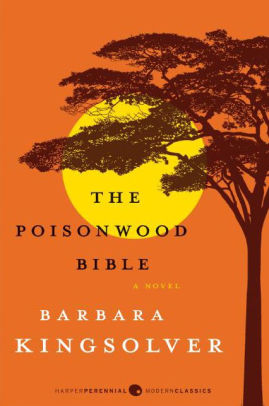
Maass provides the example of Barbara Kingsolver’s The Poisonwood Bible to depict superb use of symbol in storytelling:

Poisonwood Bible-KingsolverShe is inhumanly alone. And then, all at once, she isn’t. A beautiful animal stands on the other side of the water. They look up from their lives, woman and animal, amazed to find themselves in the same place. He freezes, inspecting her with his black-tipped ears. His back is purplish-brown in the dim light, sloping downward from the gentle hump of his shoulders. The forest’s shadows fall into lines across his white-striped flanks. His stiff forelegs play out to the sides like stilts, for he’s been caught in the act of reaching down for water. Without taking his eyes from her, he twitches a little at the knee, then the shoulder, where a fly devils him. Finally he surrenders his surprise, looks away, and drinks. She can feel the touch of his long, curled tongue on the water’s skin, as if he were lapping from her hand. His head bobs gently, nodding small, velvet horns lit white from behind like new leaves. 

It lasted just a moment, whatever that is. One held breath? An ant’s afternoon? It was brief, I can promise that much, for although it’s been many years now since my children ruled my life, a mother recalls the measure of the silences. I never had more than five minutes peace unbroken. I was that woman on the stream bank, of course. Orleanna  Price, Southern Baptist by marriage, mother of children living and dead. That one time and no other the okapi came to the stream, and I was the only one to see it.

In this opening to her novel, Kingsolver explores a multi-layered symbol for her main character’s bewilderment at the mystery and beauty of the environment around her, tied into her own essential helplessness, says Maass. “Part of what makes [Kingsolver’s] symbols poetic is that all of them emerge from the natural world around her characters,” he adds. Nature’s symbols are powerful archetypes that reveal compelling story. These symbols abound in Kingsolver’s novel that explores the relationships of five women with their environment and the rigid ignorance of their patriarch, Nathan Price. The garden, Maass tells us, provides many examples of this. Price has planted his seeds in a flat, not accounting for the torrential afternoon downpours, which wash away his garden in a flash. Later, the poisonwood tree in their yard gives Price a horrid rash, suggesting that he is messing with a place he does not understand or respect. How each of the women interacts with her environment over time provides a deeply felt and metaphoric revelation of how she relates to others and to herself—all reflecting her personal journey in the story. As the quote indicates, Orleanna Price experienced a turning point through discovery. In this example the discovery occurred through a sudden encounter with a natural element.

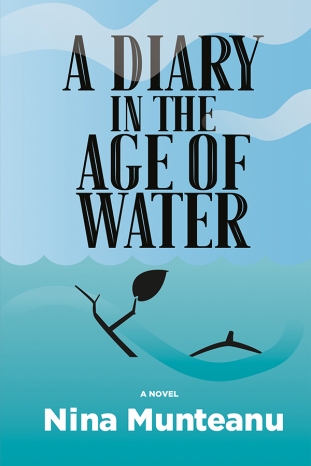
In my near-future speculative novel A Diary in the Age of Water, cynical limnologist Lynna sees everything in her life through limnological metaphors, ironically predicting her own future:

Diary Water cover finalAn oligotrophic lake is basically a young lake. Still immature and undeveloped, an oligotrophic lake often displays a rugged untamed beauty. An oligotrophic lakes hungers for the stuff of life. Sediments from incoming rivers slowly feed it with dissolved nutrients and particulate organic matter. Detritus and associated microbes slowly seed the lake. Phytoplankton eventually flourish, food for zooplankton and fish. The shores then gradually slide and fill, as does the very bottom. Deltas form and macrophytes colonize the shallows. Birds bring in more creatures. And so on. Succession is the engine of destiny and trophic status its shibboleth.

As Nature tames the unruly lake over time, one thing replaces another. As a lake undergoes its natural succession from oligotrophic to highly productive eutrophic lake, its beauty mellows and it surrenders to the complexities of destiny. Minimalism yields to a baroque richness that, in turn, heralds extinction. The lake shrinks to a swamp then buries itself under a meadow.

We hold ourselves apart from our profligate nature. But we aren’t unique. We are more part of Nature than we admit. Using the thread of epigenetics and horizontal gene transfer, Nature stitches in us a moving tapestry of terrible irony. The irony lies in our conviction that we were made in the inimitable divine image of God. That we are special. Yet over a third of the human population is secular—atheists and agnostics—who do not believe in God. Or anything, for that matter. 

Water flows endlessly through us, whether we’re devout Catholics or empty vessels with no purpose. Water makes no distinction. It flows through us even after we bury ourselves.

Log over water forest-DeasPark

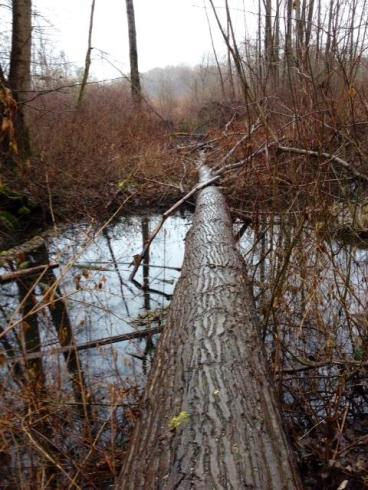
Log in water, BC (photo by Nina Munteanu)

In the following excerpt from Brokeback Mountain, Annie Proulx uses a mix of senses—but mostly smell—in an evocative description of two shirts to symbolize a love loss:

The shirt seemed heavy until he saw there was another shirt inside it, the sleeves carefully worked down inside Jack’s sleeves. It was his own plaid shirt, lost, he’d thought, long ago in some damn laundry, his dirty shirt, the pocket ripped, buttons missing, stolen by Jack and hidden here inside Jack’s own shirt, the pair like two skins, one inside the other, two in one. He pressed his face into the fabric and breathed in slowly through his mouth and nose, hoping for the faintest smoke and mountain sage and salty sweet stink of Jack, but there was no real scent, only the memory of it, the imagined power of Brokeback Mountain of which nothing was left but what he held in his hands. 

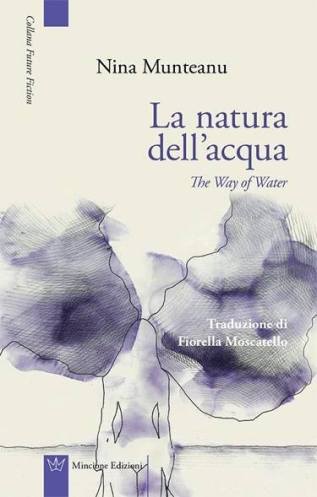
In my short story The Way of Water, water’s connection with love flows throughout the story:

The Way of Water-COVERThey met in the lobby of a shabby downtown Toronto hotel. Hilda barely knew what she looked like but when Hanna entered the lobby through the front doors, Hilda knew every bit of her. Hanna swept in like a stray summer rainstorm, beaming with the self- conscious optimism of someone who recognized a twin sister. She reminded Hilda of her first boyfriend, clutching flowers in one hand and chocolate in the other. When their eyes met, Hilda knew. For an instant, she knew all of Hanna. For an instant, she’d glimpsed eternity. What she didn’t know then was that it was love.

Love flowed like water, gliding into backwaters and lagoons with ease, filling every swale and mire. Connecting, looking for home. Easing from crystal to liquid to vapour then back, water recognized its hydrophilic likeness, and its complement. Before the inevitable decoherence, remnants of the entanglement lingered like a quantum vapour, infusing everything. Hilda always knew where and when to find Hanna on Oracle, as though water inhabited the machine and told her. Water even whispered to her when her wandering friend was about to return from the dark abyss and land unannounced on her doorstep.

In a world of severe water scarcity through climate catastrophe and geopolitical oppression, the bond of these two girls—to each other through water and with water—is like the shifting covalent bond of a complex molecule, a bond that fuses a relationship of paradox linked to the paradoxical properties of water. Just as two water drops join, the two women find each other in the wasteland of intrigue. Hilda’s relationship with Hanna—as with water—is both complex and shifting according to the bonds they make and break.


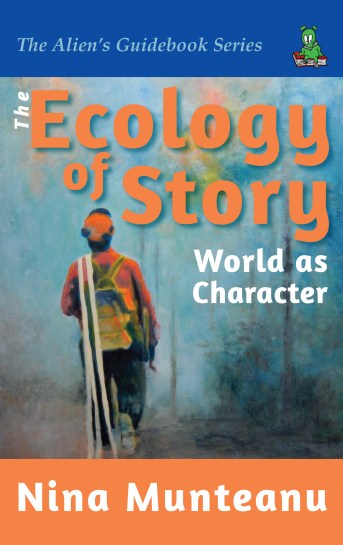
MockUpEcology copyThis article is an excerpt from “The Ecology of Story: World as Character” released in June 2019 by Pixl Press.

From Habitats and Trophic Levels to Metaphor and Archetype…

Learn the fundamentals of ecology, insights of world-building, and how to master layering-in of metaphoric connections between setting and character. Ecology of Story: World as Character is the 3rd guidebook in Nina Munteanu’s acclaimed “how to write” series for novice to professional writers.


Microsoft Word - Three Writing Guides.docx


nina-2014aaa

Nina Munteanu is a Canadian ecologist / limnologist and novelist. She is co-editor of Europa SF and currently teaches writing courses at George Brown College and the University of Toronto. Visit www.ninamunteanu.ca for the latest on her books. Nina’s bilingual “La natura dell’acqua / The Way of Water” was published by Mincione Edizioni in Rome. Her non-fiction book “Water Is…” by Pixl Press (Vancouver) was selected by Margaret Atwood in the New York Times ‘Year in Reading’ and was chosen as the 2017 Summer Read by Water Canada. Her novel “A Diary in the Age of Water” will be released by Inanna Publications (Toronto) in 2020.

Ecology of Story: Place as Metaphor

Birds deer lake

Birds flying over Deer Lake, BC (photo by Nina Munteanu)

Ray Bradbury once told me that everything in story is metaphor. That is no more apparent than in setting and place, in which a story is embedded and through which characters move and interact. Metaphor is the subtext that provides subtleties in story, subtleties that evoke mood, anticipation, and memorable scenes. Richard Russo says, “to know the rhythms, the textures, the feel of a place is to know more deeply and truly its people.” When you choose your setting, remember that its primary metaphoric role is to help depict theme. This is because place is destiny.

Metaphor provides similarity to two dissimilar things through meaning. In the metaphor “Love danced in her heart” or the simile “his love was like a slow dance”, love is equated with the joy of dance. By providing figurative rather than literal description to something, metaphor invites participation through interpretation.

When I write “John’s office was a prison,” I am efficiently and sparingly suggesting in five words—in what would normally take a paragraph—how John felt about his workplace. The reader would conjure imagery suggested by their knowledge of a prison cell: that John felt trapped, cramped, solitary, stifled, oppressed—even frightened and threatened. Metaphor relies on sub-text knowledge.

This is why metaphor is so powerful and universally relevant: the reader fully participates—the reader brings in relevance through their personal knowledge and experience and this creates the memorable aspect to the scene.

Russo tells us that place is crucial to human destiny and the formation of human personality. “The more specific and individual things become, the more universal they feel,” says Russo. This is not an oxymoron, but an example of the principle of a truism that primarily comes to us in the form of paradox (like all good truisms). Detail provides the color and texture of your story and helps it resonate with a sense of place. This does not necessarily translate into a lot of exposition; but it does require creative choice of words. So, instead of “He took a drag from his cigarette as he drove his sports car along a winding road in the country”; (twenty words) try something like “Vinnie sucked on a Camel as his red Corvette careered the hair-pinned curves of Hell’s Gate.” (seventeen words).

Place Personified

Tree-YellowBirch winter-LR

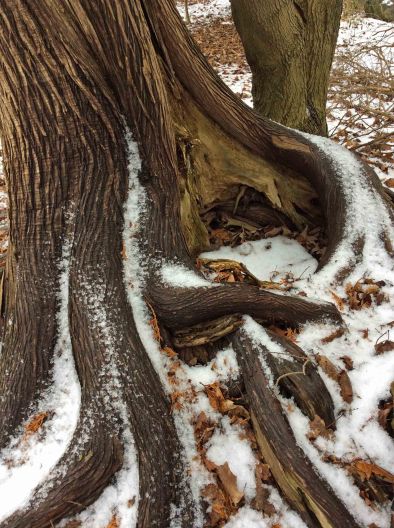
Old yellow birch tree in Little Rouge woodland (photo by Nina Munteanu)

Personification is powerful metaphor that gives nonhuman things human qualities. It personalizes, energizes and emotionalizes. Place described through personification can illuminate both characters and their environment in compelling ways. By giving an object, place, or animal the qualities of a person, personification provides subtle aspects of mood and links the reader to a cocktail subtext of human feelings and struggles. Personification can connect the reader to “lifeless” objects such as water, soil, rock, the sun, moon, planet, concrete, paper, etc., to map the larger meaning of the story. Putting a character’s feelings into the objects around her—as POV character—creates a subtle but deep connection with the reader: “The darkness embraced her”; “The open-throated roar of the river pulled her near.”

D.H. Lawrence’s creates strong personification of Thomas Hardy’s Egdon Heath in Return of the Native:

…Egdon, whose dark soil was strong and crude and organic as the body of a beast.

In The Handmaid’s Tale—a dystopian tale of oppression and intrigue—Margaret Atwood writes:

There is something subversive about this garden of Serena’s, a sense of buried things bursting upwards, wordlessly, into the light, as if to point, to say: Whatever is silenced will clamour to be heard, though silently … Light pours down upon it from the sun, true, but also heat rises, from the flowers themselves, you can feel it: like holding your hand an inch above an arm, a shoulder. It breathes, in the warmth, breathing itself in.

Martin Nolan’s Still Point creates powerful imagery of a storm aftermath through an abandoned old shed and contrasts its loneliness to the half-wild woods nearby:

A deserted shed by the road, buckling under its roof, kneels into the tall grass. The woods beyond it hide the river … I turn back to the half-wild woods. These trees speak to each other, are wild enough for that. They live together, holding the riverbanks in place.

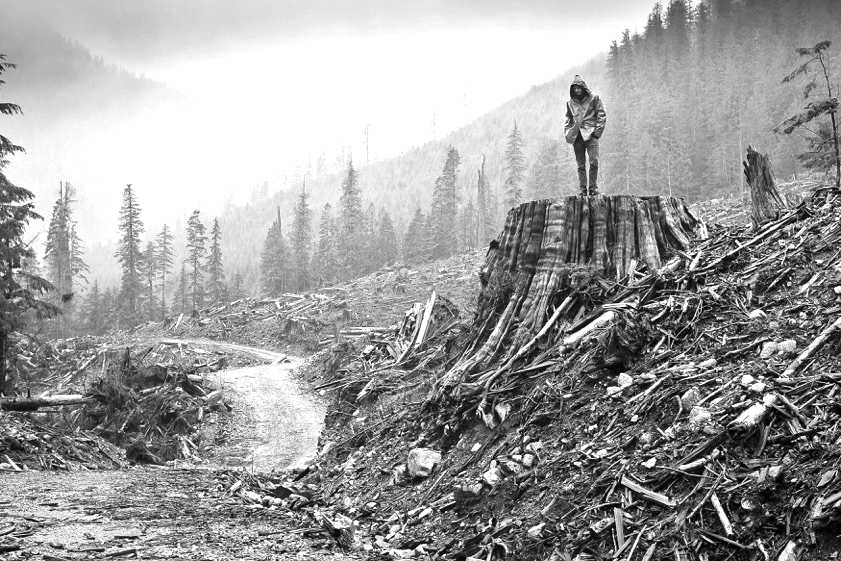
Cixin Liu’s The Three Body Problem—set against the backdrop of China’s Cultural Revolution—follows Wenji Ye, disillusioned by the massive environmental deforestation in the labour camps she is sent to work:

Her company wielded hundreds of chain saws like a swarm of steel locusts, and after they passed, only stumps were left. The fallen Dahurian larch, now bereft of branches, was ready to be taken away by tractor. Ye gently caressed the freshly exposed cross section of the felled trunk. She did this often, as though such surfaces were giant wounds, as though she could feel the tree’s pain …

Clearcut gordon valley-BW

Clearcut in Gordon Valley, British Columbia (photo by T.J. Watts)

In Memory of Water, Emmi Itäranta personifies this life-giving substance whose very nature is tightly interwoven with her main character. As companion and harbinger, water is portrayed simultaneously as friend and enemy. As giver and taker of life.

Water is the most versatile of all elements … Water walks with the moon and embraces the earth, and it isn’t afraid to die in fire or live in air. When you step into it, it will be as close as your own skin, but if you hit it too hard, it will shatter you … Death is water’s close companion. The two cannot be separated, and neither can be separated from us, for they are what we are ultimately made of: the versatility of water, and the closeness of death. Water has no beginning and no end, but death has both. Death is both. Sometimes death travels hidden in water, and sometimes water will chase death away, but they go together always, in the world and in us.

Personification of natural things provides the reader with an image they can clearly and emotionally relate to and care about. When a point-of-view character does the describing, we get a powerful and intimate indication of their thoughts and feelings—mainly in how they connect to place (often as symbol). When this happens, place and perception entwine in powerful force.


MockUpEcology copyThis article is an excerpt from “The Ecology of Story: World as Character” due in June 2019 by Pixl Press.


From Habitats and Trophic Levels to Metaphor and Archetype…

Learn the fundamentals of ecology, insights of world-building, and how to master layering-in of metaphoric connections between setting and character. Ecology of Story: World as Character is the 3rd guidebook in Nina Munteanu’s acclaimed “how to write” series for novice to professional writers.


Microsoft Word - Three Writing Guides.docx

nina-2014aaa

Nina Munteanu is a Canadian ecologist / limnologist and novelist. She is co-editor of Europa SF and currently teaches writing courses at George Brown College and the University of Toronto. Visit www.ninamunteanu.ca for the latest on her books. Nina’s bilingual “La natura dell’acqua / The Way of Water” was published by Mincione Edizioni in Rome. Her non-fiction book “Water Is…” by Pixl Press (Vancouver) was selected by Margaret Atwood in the New York Times ‘Year in Reading’ and was chosen as the 2017 Summer Read by Water Canada. Her novel “A Diary in the Age of Water” will be released by Inanna Publications (Toronto) in 2020.


Ecology of Story: The Difference Between Anecdotes and Stories—How to Tell a Good Story

Birds deer lake

Birds fly over Deer Lake, BC (photo by Nina Munteanu)

In her article in Quartz Magazine, Lila MacLellan suggests that “we’ve become masters of telling anecdotes, and terrible at telling our friends real stories.” Sometimes people think they are telling a story, but they are really just telling anecdotes, MacLellan reports after interviewing Maggie Cino, senior story producer for Moth storytelling series. While “anecdotes just relate facts,” Cino explains, stories are “about letting us know that things started one way and ended a different way.” Stories create space for movement.

Merriam-Webster defines an anecdote as a “short narrative of an interesting, amusing, or biographical incident.” Anecdotes serve to incite interest and to illustrate a point. They are often amusing, odd, sad or even tragic; if they are biographical, they often serve to reflect someone’s personality, attitude or philosophy. While anecdotes often provide a contextual jumping board to make a point—drawing you in with relevance—they lack the structure of stories. An anecdote is something that happens; a story has a structure that makes it memorable and provides a depth of meaning.

Stories move with direction; they have a beginning, middle and end. Stories evoke emotional truths. They compel with intrigue then fulfil us with awareness and, sometimes, understanding. The best stories are told through metaphor, those universal truths we all live by. And all good stories weave a premise, theme, plot, character and setting into a tapestry with meaning.

I teach new writers at the University of Toronto and George Brown College how to tell stories. I teach how stories can tell us who we are. Where we’ve been. And sometimes, where we are  going. The stories that stir our hearts come from deep inside, where the personal meets the universal, through symbols or archetypes and metaphor.

Depth psychologist Carl Jung described these shared symbols, metaphors and archetypes as pre-existing forms of the psyche. He drew parallels between synchronicity, relativity theory and quantum mechanics to describe life as an expression of a deeper order. He believed that we are both embedded in a framework of a whole and are the focus of that whole. Jung was describing a fractal whole, which reflects quantum scientist David Bohm’s quantum vision of holomovement.

Jung’s concept of embedded whole and a universal collective unconscious was embraced by Hero’s Journey author and scholar Joseph Campbell, who suggested that these mythic images lie at the depth of the unconscious where humans are no longer distinct individuals, where our minds widen and merge into the mind and memory of humankind—where we are all the same, in Unity. Carl Jung’s thesis of the “collective unconscious” in fact linked with what Freud called archaic remnants: mental forms whose presence cannot be explained by anything in the individual’s own life and which seem aboriginal, innate, and the inherited shapes of the human mind. Marie-Louise von Franz, in 1985, identified Jung’s hypothesis of the collective unconscious with the ancient idea of an all- extensive world-soul. Writer Sherry Healy suggested that Jung viewed the human mind as linked to “a body of unconscious energy that lives forever.”

What Makes a Good Story?

subway

Passengers on the Toronto subway (photo by Nina Munteanu)

A good story is about something important; attracted by gravity, it has purpose and seeks a destination. A good story goes somewhere; it flows like a river from one place to another. A good story has meaning; its undercurrents run deep across hidden substrates with intrigue. A good story resonates with place; it finds its way home. We’ve just touched upon the five main components of good story: premise, character on a journey & plot, theme and—what is ultimately at the heart of a story—setting or place.

Story Components

The premise of a story is like the anecdote, a starting point of interest. It is an idea that will be dramatized through plot, character and setting. In idea-driven stories, it can often be identified by asking the question: “What if?” For instance, what if time travel was possible?

A character on a journey propels the story through meaningful change. Characters provide dramatized meaning to premise through personal representation of global themes. A character takes an issue and through their actions and circumstance in story provide a fractal connection to a larger issue. Characters need to move. They need to “go somewhere.” Archetypes—ancient patterns of personality (symbols) shared by humanity and connected by our collective unconscious—are metaphoric characters (which includes place) in the universal language of storytelling that help carry the story forward.

The theme of a story takes the premise and gives it personal and metaphoric meaning by dramatizing through a character journey. It is often identified by asking the question: “What’s at stake?” In taking the time travel premise, a theme of forgiveness may be applied by choosing a character wishing to return to the past to right a wrong, when what they just need to do is forgive others and themselves, not travel to the past at all, and get on with their lives.

DS-2008-26

Cliff diving on BC coast (photo by Nina Munteanu)

In such a story, the plot would provide means and obstacles for the character in their journey toward enlightenment. Plot works together with theme to challenge and push a character toward their epiphany and meaningful change. Plot provides obstacles. Challenges. Emotional turning points. Opportunities for learning and change.

The role of setting or place is often not as clear to writers. Because of this, place and setting may often be neglected and haphazardly tacked on without addressing its role in story; in such a case the story will not resonate with what is often at the heart of the story: a sense of place. In stories where the setting changes (either itself changing such as in a story about the volcanic eruption of Vesuvius impacting Pompeii’s community; or by the character’s own movements from place to place) it appears easier to include how setting affects characters. However, the effect of place on character when the setting does not change can be equally compelling even if more subtle; the change is still there but lies in the POV character’s altered relationship to that place—a reflection of change within them.


MockUpEcology copyThis article is an excerpt from “The Ecology of Story: World as Character” due in June 2019 by Pixl Press.

From Habitats and Trophic Levels to Metaphor and Archetype…

Learn the fundamentals of ecology, insights of world-building, and how to master layering-in of metaphoric connections between setting and character. Ecology of Story: World as Character is the 3rd guidebook in Nina Munteanu’s acclaimed “how to write” series for novice to professional writers.


nina-2014aaa

Nina Munteanu is a Canadian ecologist / limnologist and novelist. She is co-editor of Europa SF and currently teaches writing courses at George Brown College and the University of Toronto. Visit www.ninamunteanu.ca for the latest on her books. Nina’s bilingual “La natura dell’acqua / The Way of Water” was published by Mincione Edizioni in Rome. Her non-fiction book “Water Is…” by Pixl Press (Vancouver) was selected by Margaret Atwood in the New York Times ‘Year in Reading’ and was chosen as the 2017 Summer Read by Water Canada. A collection of Nina’s short eco-fiction can be found in “Natural Selection” by Pixl Press.  Her novel “A Diary in the Age of Water” will be released by Inanna Publications (Toronto) in 2020.


Christ-Figure in Movies & Books: Grace or Redemption?

ChildrenOfMenIn an article I’d written some time ago on my blog The Alien Next Door (“Fertility — Infertility & the Environment”, with commentary on the film “Children of Men”) I got into a rather lively discussion with a fellow blogger (Erik) about the tendency in Western Culture mythos (in literature and in movies, particularly) to portray the main character in fiction as Christ figure and the ramifications of this choice. Erik lamented the separation that has occurred between “Jesus the Teacher” and “Christ the Redeemer”. I hadn’t really given this much thought until he brought it up. But his examples (e.g., Matrix and Harry Potter) and his discourse were so compelling, I had to ponder. So, here are my ponderings.

aeon-flux-posterToday’s Christ-like hero suffers for the sins of the world and prepares himself (often struggling with this considerably) to deliver salvation, usually through fighting or violent confrontation and often with an incredible arsenal of weapons. I was swiftly brought to mind of the many action shoot-em up films whose tortured hero redeems him(her)self through some selfless, though violent action (e.g., Omega Man, V for Vendetta, Ultra Violet, Aeon Flux — all sci-fi movies, by the way, and ones I enjoyed immensely. And what about all those superhero movies, like Spiderman, X-Men, Green Lantern, etc. These films represent one version of Joseph Campbell’s “Hero’s Journey”, where the original hero leaves his ‘ordinary world’ wherein he/she has some major flaw to overcome (like apathy, greed, distrust, anger, fear of strawberries…etc.) to answer ‘the call’ to be the hero he/she was destined to become. This is a very familiar trope. Erik suggested that Western culture’s “concept of Redemption has invariably separated from the Grace that created it.” Jesus the Teacher had somehow fallen to the wayside to make room for Christ the Redeemer. According to Erik: “Jesus the Teacher said to ‘turn the other cheek’, but today’s Redeemers kick ass. Jesus the Teacher told us that what is done in love is blessed, but today’s Redeemers have more personal and interior motivations.” The two have simply become two different people, says Erik and “the latter is a superstar” compared to the former.” He ends his post with these compelling thoughts:

“The Beatitudes have become rather old fashioned, it seems, as has the idea of Grace. That is what seems to be the problem with today’s Redeemers: theirs is a personal battle with evil, and not a social one. ‘Love thy neighbor as thyself’ is an alien concept in a world that is perfectly self centered. All that’s left to do is kick ass on those who disagr — er, behave in an evil way, yeah, that’s it! If popular fiction really is a mirror being held up against us, the image we see is not a pretty one. The heritage of Western Culture has turned into a strange kind of cartoon — exaggerated, repetitious, vain, slapstick, and ultimately too silly to watch. For some reason, very few people seem to understand this. They are too busy fixing their own hair in the mirror.”

pay it forwardIf you still don’t get what Erik and I are talking about, go watch the poignant film Pay It Forward and then contrast its main character with the one in Ultra Violet or The Matrix.

The definition for grace occupies almost half a page in the dictionary. When I think of grace I think of selfless compassion, humility, gentleness, kindness, mercy and forgiveness and both inner and outer beauty. So, why does grace languish in the shadows of redemption? Why do we watch — and more importantly, totally enjoy — these latter movies at the expense of the former? Why do we long for a strong but flawed hero with personal issues as our icon? One who is often tough, independent, and ‘kicks ass’ at the expense of gentleness, humility, cooperation and selflessness? If, as Erik suggests, we are seeking heroes who reflect our own self-image or at least the traits we strive to have, then what does popular fiction say about our choices in life? Is Erik right about this dichotomy? I’d say definitely yes…but also no…

MATRIXWhile I agree with Erik on the apparent separation of Christ figure in today’s popular fiction, perhaps there is another way to look at these tales that resolves this apparent dichotomy to some degree. My suggestion is to view them more as allegories with traits and values represented in several characters woven together in a complete and whole tapestry. To do so is to include the secondary character as being equally important. Let’s take Matrix, for instance. In fact, Neo isn’t the only Jesus-figure. His two female opposites (Trinity/Oracle) demonstrate Christ-like traits that embody grace, mercy, love (the holy spirit) and wisdom. Okay, so Trinity kicks major ass too; but her character also provides the chief motivation for our main ‘kick-ass’ hero through her selfless love and humility.

I assert that these two aspects of Christ (merciful teacher and redeemer) are indeed both represented (albeit in separate individuals) in films today: two individuals, one Christ the redeemer and the other Jesus the savior, often joined through a bond of selfless love; two halves of a whole.

The Gnostics have a word for this divine male/female pair: they call them syzygies, aeons (beings of light and emanations of God) that exist as complimentary pairs or twins. The aeon pair of Caen (which represents power, the redeemer) and Akhana (truth, love and grace, the teacher) are complimentary and inseparable. The yin/yang of a whole. The paradoxical oxymoron of order in chaos.

In Gnostic belief, aeons are emanations of God. According to one version, an aeon named Sophia (wisdom) emanated without her partner aeon, creating a Demiurge (responsible for the creation of the physical universe; Ialdaboth in Gnostic texts). Ialdaboth was not part of the Pleroma (fullness and the region of light) and apart from the divine totality [a metaphor possibly for humanity]). God then emanated two savior aeons, Christ and the Holy Spirit to save humanity from the Demiurge. Christ then took the form of the human, Jesus, to teach humanity how to achieve Gnosis (and know God).

So, for every Neo there is a Trinity/Oracle; for Violet there is Six; for Aeon Flux there is Trevor Goodchild; for Harry there is Dumbledore, and so on. In this way, the two complimentary aspects of Christ are reconciled. And in cases where such complimentary pairing is achieved (e.g., Neo would not have succeeded without both Trinity and the Oracle) we are taught that selfless cooperation is the highest form of heroism.

nina-2014aaaNina Munteanu is an ecologist and internationally published author of award-nominated speculative novels, short stories and non-fiction. She is co-editor of Europa SF and currently teaches writing courses at George Brown College and the University of Toronto. Visit www.ninamunteanu.ca for the latest on her books. Nina’s recent book is the bilingual “La natura dell’acqua / The Way of Water” (Mincione Edizioni, Rome). Her latest “Water Is…” is currently an Amazon Bestseller and NY Times ‘year in reading’ choice of Margaret Atwood.


How Walking in Nature Helps Me Write

StoneStairs-oakforest Rouge

Staircase to Rouge River (photo by Nina Munteanu)

I don’t often get writer’s block. I just walk out of it into Nature.

My favourite place to walk is the forest, along a river.

Walking in a forest unclutters my mind and soul. The forest is simple in its natural complexity. Its beauty combs out the tangles of human complexity like a dam dissolving and grounds me back to the simplicity of natural life.

The river trickles in the background as I step through dappled light and inhale the organic scents of the forest. The forest and the river help me re-align and focus—without trying. That’s the magic of it. It’s in the not trying.

I carry a notebook with me to jot down ideas that come to me. They always do. I find writing by hand additionally helps in the creative process.

My favourite park is the little woodland of the Little Rouge River, located off a small road hidden from the sprawling desert of suburbia.

LittleRougeRiver-Maple-spring

my old maple leaning over the Little Rouge River (photo by Nina Munteanu)

It was spring when I first entered this forest. I inhaled its complex smell, awakening with spring flowers. At my entrance, chipmunks scattered and scolded me for interrupting their calm. I chuckled and thought that I’d seen more within the space of one minute here than I had in a year in the suburb I currently live in. A duff-strewn path led me beneath the pungent smell of pine and cedar. I made my way toward the riverbank where beech and maple leaned over the water. I found a place to write.

When I returned in the fall, the forest was a mix of colour.  Most of the deciduous trees had dropped their leaves in a revealing show of textured grays, gray-browns and blacks. The bare trunks and fractal branches contrasted with the deep greens of the conifers. Rogue trees—like the oak and beech—still claimed their leaves, adding deep russet tones to the varied grays and deep greens of the canopy. The forest was now more open, emerging with ancient magnificence from a soft brown carpet on the ground. The air was fresh with the scent of loam, decaying leaves and saprophyte activity.

LittleRouge-icing shallows

A shallow part of the Little Rouge ices over with the first snowfall in late autumn (photo by Nina Munteanu)

I strayed off the path toward the riverbank again. I was looking for the old sugar maple I’d spent time with the previous spring. After several bends in the river, I saw it, leaning precipitously over the river like an old man sharing an intimate story. It had already lost its leaves; they covered the ground in a soft carpet. The old tree literally hugged the bank in a braided network of snaking roots; like a carved figurehead hugs the prow of a great tall ship.

My OldMaple-burl copy

Burl on my maple (photo by Nina Munteanu)

Eager to see my old friend up close, I scrambled down the overhanging bank using the old maple’s root “stairway,” then ungracefully dropped onto the cobbles below. Every part of my gnarly old maple tree was splendid. Its shaggy trunk stretched up with typical silhouette of branching-out arms that every Canadian kid drew when they were six. The horizontal roots stretched out in a tangle and stitched the bank together, keeping it intact.

The Little Rouge River calls me to sit and listen to its flowing song—a joyful playful symphony of breaths, chortles and open-throated froth. I sit. And still my breath. I find my whole body relax from the tension of the suburban drive. I am home, sighing with a rhythm I’d forgotten. Re-aligning. Bones with rock. Rock with twig. Twig with root. The animals no longer scold me. They have resumed their natural rhythm, as I merge into scenery. And write…

****

gnarly cedar

gnarly cedar roots (photo by Nina Munteanu)

What I do is not new to creative thinkers all over the world and throughout time. I share great company with people who used walking (usually in Nature) as a venue toward creative thinking (and writing). All great walkers.

Aristotle conducted his lectures while walking the grounds of his school in Athens. His followers, who chased him as he walked, were known as the peripatelics (e.g., Greek for meandering). Darwin refined his ideas on natural selection and other topics during his frequent walks along his “thinking path”, a gravel road called Sandwalk Wood near his home in southeast England. Dickens walked for miles each day: “If I could not walk far and fast, I think I should just explode and perish.” Beethoven often took solitary walks. He strolled the Viennese woods for hours, finding inspiration for his works and jotting them down on a notepad that he carried with him. Nietzsche loved his walks in the mountains: “it is only ideas gained from walking that have any worth.” For Wordsworth, the act of walking was one in the same with the act of writing poetry. Both involved rhythm and meter. Henry David Thoreau was known for his great walkabouts. Walking through nature for Thoreau was a pilgrimage without a destination—more discovery and rapture.

YellowBirch-winter

Yellow birch trunk (photo by Nina Munteanu)

Stanford researchers demonstrated that walking boosts creative inspiration. They showed that the act of walking significantly increased creativity for 81% of the participants and that the creative ideas generated while walking were not irrelevant or far-fetched, but innovative and practical.

“The answer begins with changes to our chemistry,” writes journalist Ferris Jabr in The New Yorker (2014). “When we go for a walk, the heart pumps faster, circulating more blood and oxgen not just to the muscles but to all the organs—including the brain. Many experiments have shown that after or during exercise, even very mild exertion, people perform better on tests of memory and attention. Walking on a regular basis also promotes new connections between brain cells, staves off the usual withering of brain tissue that comes with age, increases the volume of the hippocampus (a brain region crucial to memory) and elevates levels of molecules that both stimulate the growth of new neurons and transmit messages between them.”

SONY DSC

Nina Munteanu walks the forest (photo by Merridy Cox)

While walking is good for our creativity and general well-being, walking in a park or wilderness is so much better. Researchers in Europe and Japan found that anxiety and depression was significantly reduced in the presence of green space and that it boosted attentiveness, focus and academic performance. Vegetation creates “a halo of improved health.” Dr. Frances Kuo at the University of Illinois demonstrated that just seeing a tree helps cognition and promotes a sense of well-being. While a human-made environment of objects—cars and buildings—requires high-frequency processing in the brain; a landscaped environment allows the observer to relax his or her attention, resulting in reduced muscle tension, lower heart rate, and a generally less stressful physiology.

Finding a favourite tree might be the best thing you do to boost your creativity.


Forest path-NS

Forest path in Nova Scotia (photo by Nina Munteanu)

References:

Nina-willowtree

Nina Munteanu by a large willow tree (photo Jane Raptor)

Cameron, Julia. 1992. “The Artist’s Way”. Penguin Putnam Inc., New York, NY. 222pp.

Deasey, Louise. 2015. “Negative Ions Are Great for Your Health”. 
Body and Soul.

Munteanu, Nina. 2013. The Journal Writer: Finding Your Voice. Pixl Press, Vancouver, BC. 170pp.

Oppezzo, Marily and Daniel L. Schwartz. 2014. “Give Your Ideas Some Legs: The Positive Effect of Walking on Creative Thinking”, Journal of Experimental Psychology: Learning, Memory, and Cognition, Vol. 40, No. 4: 1142-1152.

Wells, Nancy M. 2000. “At Home with Nature: Effects of ‘Greenness’ on Children’s Cognitive Functioning”. Environment and Behavior 32 (6): 775–795.


nina-2014aaaNina Munteanu is an ecologist and internationally published author of award-nominated speculative novels, short stories and non-fiction. She is co-editor of Europa SF and currently teaches writing courses at George Brown College and the University of Toronto. Visit www.ninamunteanu.ca for the latest on her books. Nina’s recent book is the bilingual “La natura dell’acqua / The Way of Water” (Mincione Edizioni, Rome). Her latest “Water Is…” is currently an Amazon Bestseller and NY Times ‘year in reading’ choice of Margaret Atwood.

Morphology 2019–Celebrating A New Marsh in Mississauga with Quotes from “Water Is…”

Water Is Life copy

March 22 was World Water Day. As with last year at this same time and place, a brisk wind followed me into the industrial brick building that used to be the Small Arms Inspection Building—now converted into a community arts and culture centre.

JimTovey-Dowd-Morphology-JStewart

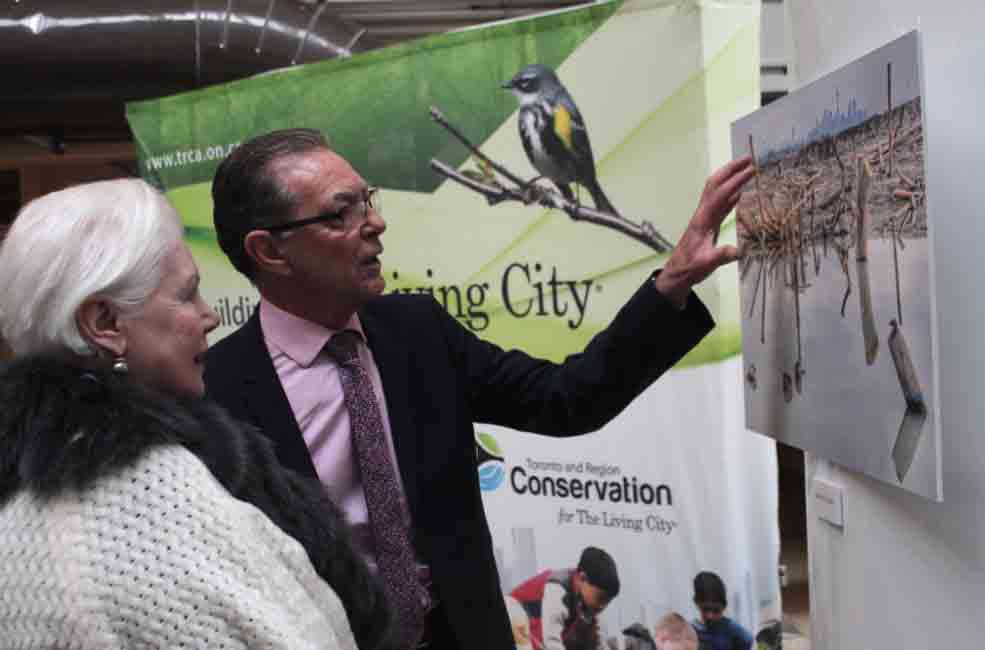
Councillor Jim Tovey and Lieutenant Governor Elizabeth Dowdeswell (photo by John Stewart)

Lakeview Plan copy

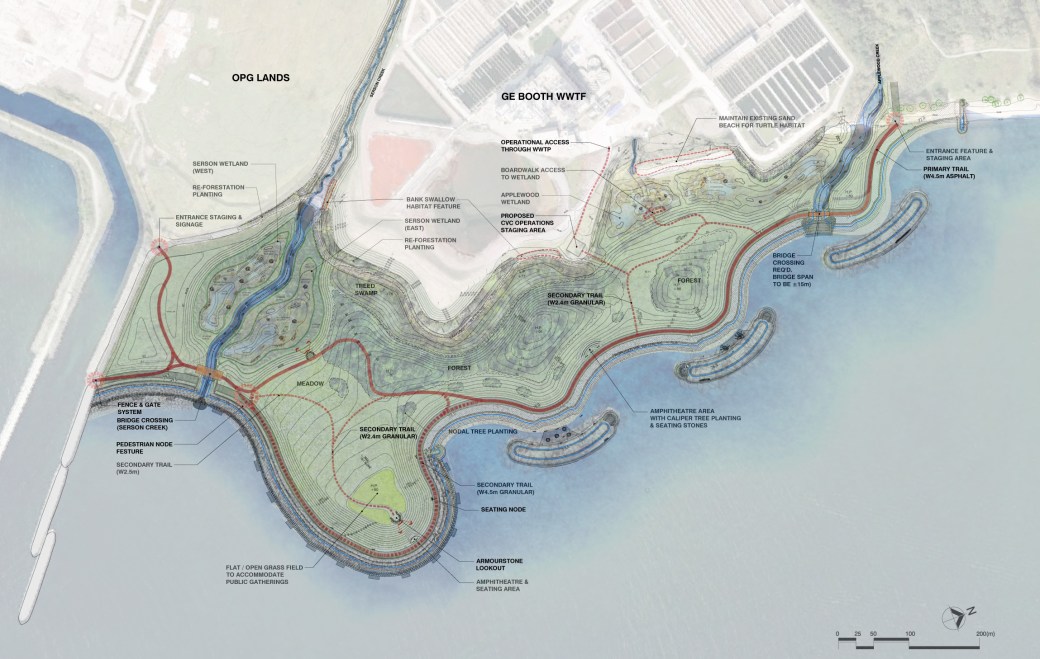
Plan of the conservation site

I was here to celebrate the late Jim Tovey’s dream of creating a 26-hectare park and marsh on Mississauga’s Lake Ontario shore that will connect the Waterfront Trail with Lake Ontario’s shorefront for the public.

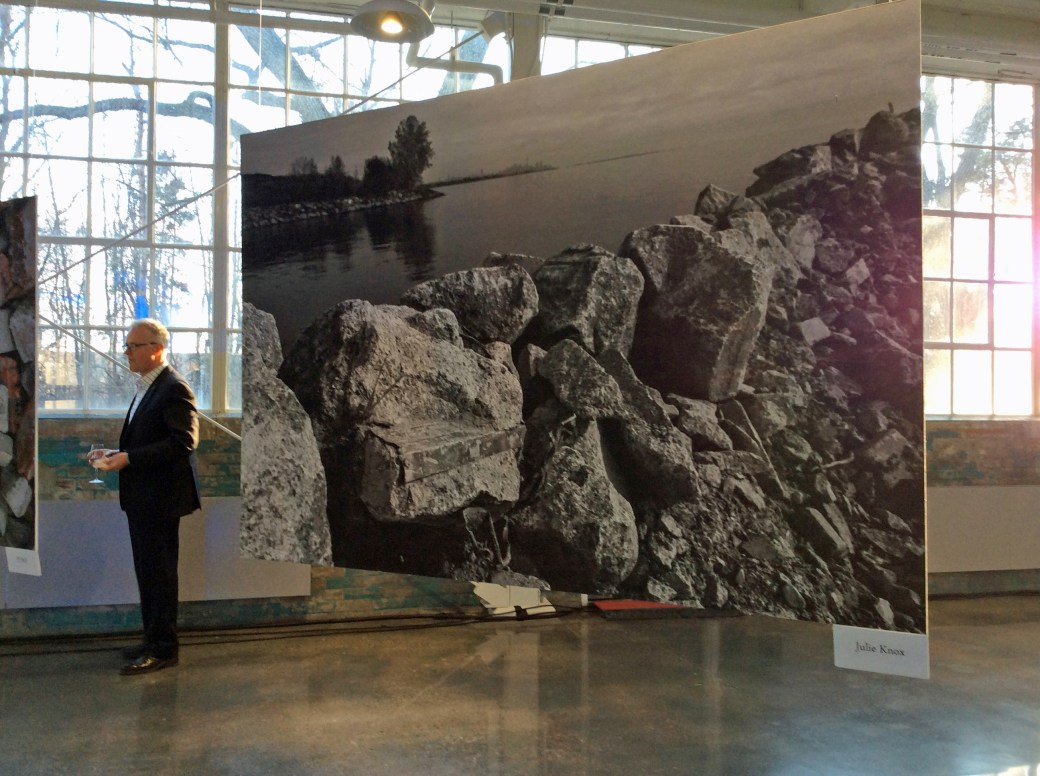
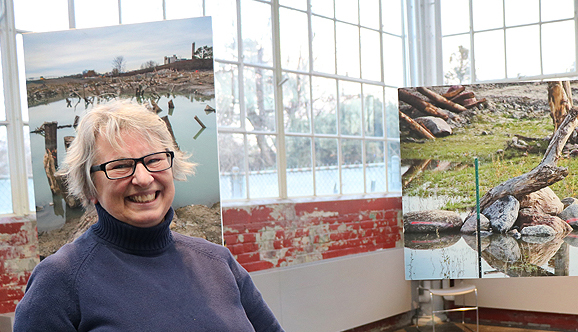
Several dozen photographs that documented the annual and seasonal changes of the developing marsh occupied the spacious hall. The glow of evening sunlight streamed through, touching large photographs that hung from the high ceilings or were mounted on walls. Some photographs spanned over 2 by 3 metres.

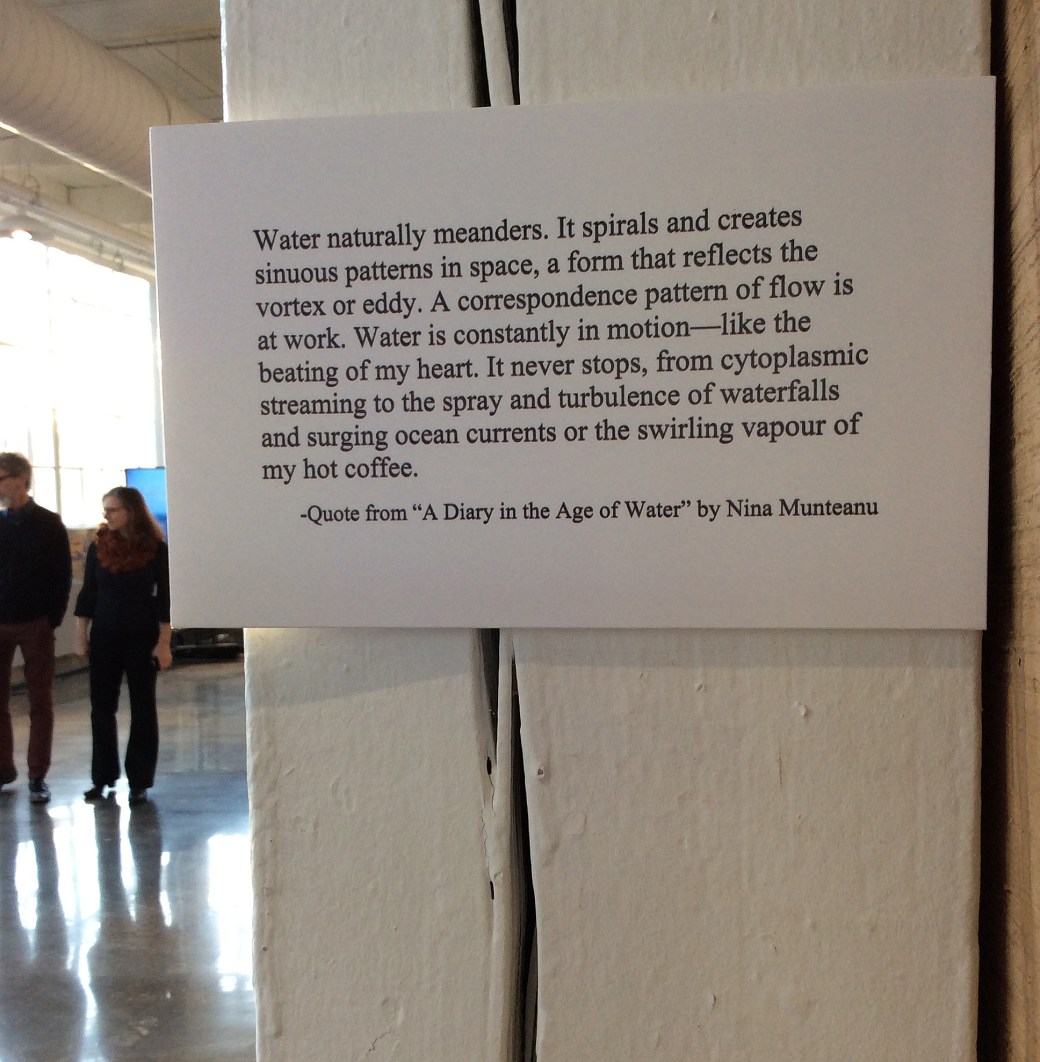
Quotes from my books “Water Is…” (Pixl Press, 2016) and upcoming “A Diary in the Age of Water” (Inanna Publications, 2020) were displayed among the photographs.

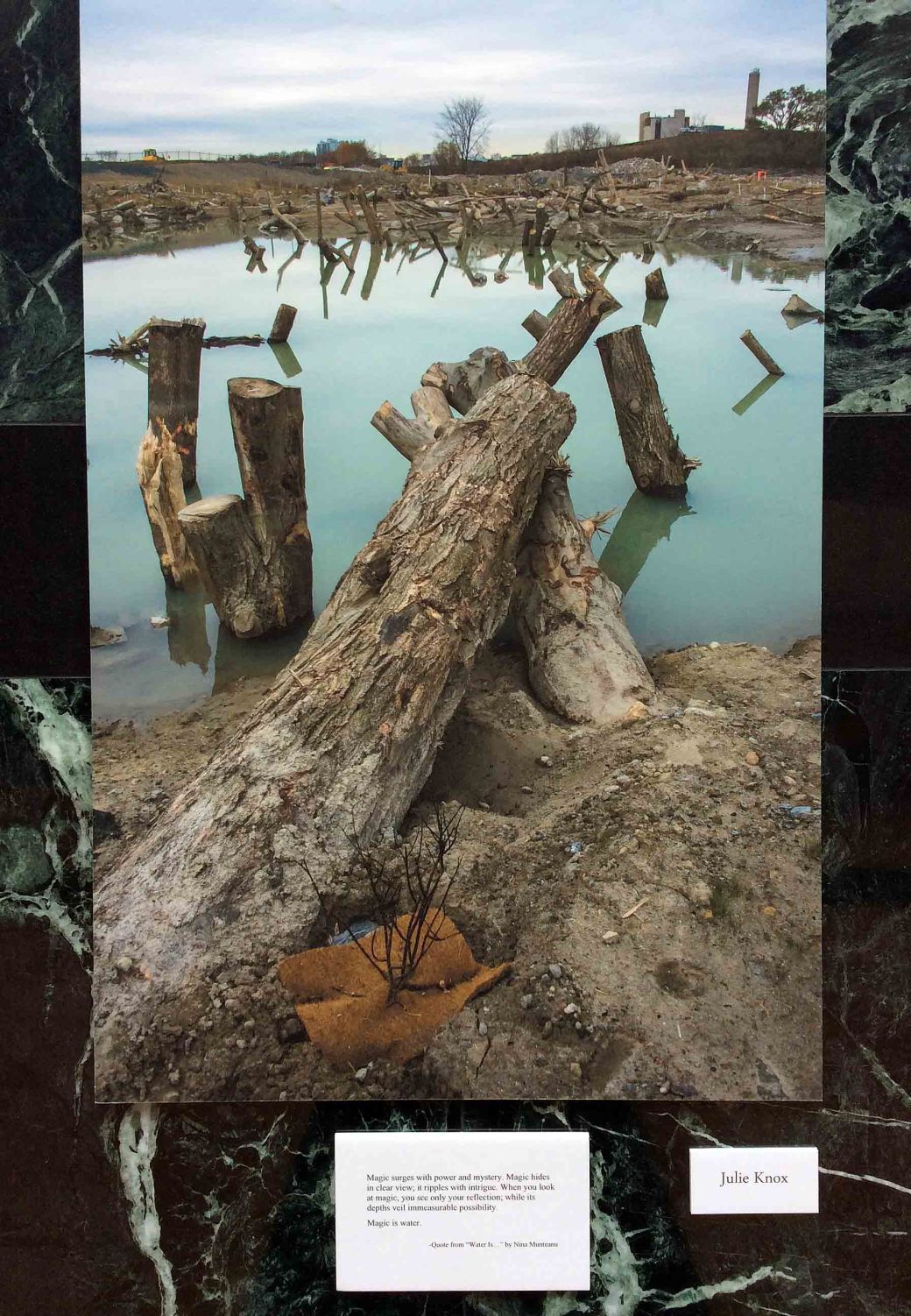
Photo Julie Knox

Photograph by Julie Knox

I was mesmerized by the spectacular photographic display.

Larger than life photographs caught my attention through light, form and unique perspective. Once caught, I was drawn into their complex narrative. A narrative of morphing shapeshifters, flowing humours and tricksters in the night. Panoramas that stretched over giant muddy holes depicting an evolution of landscape from wet

Photo Gabriella Bank2 copy

Photo by Gabriella Bank

to dry to wet again.

Tree bole, rock and rebar formed bizarre companions in murky pools that harbour life finding itself. Piles of giant boulders shouted their presence to a stormy lake. A frontend loader sat peacefully beneath a glowing sunset. Slopes of wild herbs reached into ponds as if looking for hidden treasure.  Mangled rebar contorted in a frozen ice-dance. A man’s boot tracks cut recursive patterns in the silky mud.

The photographs provided a range of perspectives over the seasons on the early phase of the marsh construction that featured aquatic habitat structures built four metres below the level of Lake Ontario. Councillor Tovey had earlier said of the construction project: “It sort of looks like a Salvador Dali surrealistic sculpture garden…and what an interesting way to really celebrate all of this.”

WaterMeanders2

The Morphology 2019 Photography Exhibit marks the third year of celebrating this morphing natural landscape through the photography of eleven creative photo artists. The opening day of Morphology 2019 was celebrated with a blessing by Cathie Jamieson, Councillor Mississaugas of the Credit First Nation. Lee Tovey spoke as did members of the contributing partners and Mayor Bonnie Crombie of the City of Mississauga.

Water Is Wisdom copy

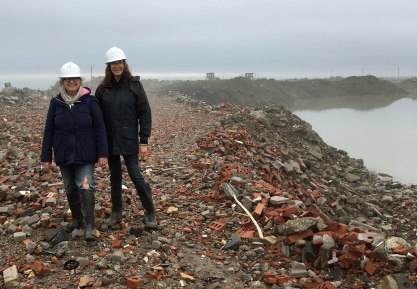
Construction of the site and marsh began in November 2016 and is ongoing and expected to continue until 2024-2026, when the site will be opened to the public. Starting in 2017, the eleven photographers toured the site to capture the seasonal and annual changes of the developing wetland. I was also invited to tour the site to glimpse a moonscape of dirt and clean rubble as dozers pushed material out to form cells and reclaim marsh habitat from open lake.

Nina-Lee-marsh2Z

the author and Lee Tovey overlooking one of the marsh cells

In November of 2017, I walked the undulating “moonscape” with Lee Tovey and Zoe Danahy. Rolling berms snaked around pooled and dry depressions that disappeared in the fog. The smell of rain and mud pervaded as we set out in ankle-deep mud toward the snaking berms. I scrambled over rip rap chunks larger than me to glimpse Lake Ontario—its new shoreline re-imagined. Beyond, the lake vanished in a veil of fog. I was told that on a clear day you could see the Toronto Waterfront and the CN Tower. All I could make out was a few ghost trees that marked the nearby eastern shoreline.

Lee took me along a dyke embankment of clean fill made of red brick and cement riprap from various construction sites. “Clean fill” refers to anything like brick, top soil, gravel, and cement that has been tested for possible contaminants, as opposed to plastic, glass, or metals.

Nina-Lee-marsh bermZ

The author with Lee Tovey on riprap berm

Lee pointed left and right of us to depressions (containment cells) where Lake Ontario was being reclaimed for marsh-building. The depression on my left was still full of water; but the one on my right was fairly dry and already populated with anchored logs and shrub plantings to consolidate the wetland and provide refuge for marsh life. I could hear the large pump actively removing lake water at the south end of the evolving wetland. Beyond the high berm of human-sized riprap was the lake, its shoreline now redefined.

Water-travel

As I gazed over the brown monochromatic landscape, I imagined a tapestry of greens in Councillor Jim Tovey’s vision: 26 hectares of future wetlands, forest and meadow and beach spanning the Lake Ontario shoreline from the old Lakeview generating station to the Toronto line at Marie Curtis Park. Part of the Inspiration Lakeview development, the marsh and wetland park have now been named The Jim Tovey Lakeview Conservation Area.

WaterIs magic-photo

Morphology

Morphology was conceived by the late visionary councillor Jim Tovey who envisioned an evolving photography and writing exhibit to follow the progress of the marsh creation project of what is now The Jim Tovey Lakeview Conservation Area. Spearheaded and nurtured by Councillor Tovey, the marsh construction was part of 26 hectares of future wetlands, forest, meadow and beach. The Lakeview Waterfront Connection will span the Lake Ontario shoreline from the old Lakeview generating station to the Toronto line at Marie Curtis Park. Part of the Inspiration Lakeview development, it will restore pedestrian and cyclist access to a previously forbidden section of the waterfront to “connect 9.5 kilometers of shoreline for water’s edge experience for the public,” said Councillor Tovey.

P01

To celebrate the residential / park development, eleven professional photographers were invited to photograph the marsh construction during its early phases. These images, along with water-inspired narrative provided by limnologist-author Nina Munteanu, were first displayed in an exhibit during a gala event January 14 2018, hosted at the Lakeview water treatment plant. Following Councillor Tovey’s untimely passing, his wife Lee Tovey and others (e.g., TRCA, CVC, Region of Peel) are continuing the project. Morphology was displayed for the public on World Water Day, March of 2018, at the Great Hall in the Mississauga Civic Centre. Its third appearance was at the In Situ Multi Arts Festival in November 2018.

Morphology-Exhibit hall

Morphology Exhibit at the Great Hall, Mississauga Civic Centre

The artist showcase is expected to become an annual event, highlighting the progress of constructed ecosystem. Morphology features works from: Gabriella Bank, Sandor Bank, PJ Bell, Darren Clarke, Julie Knox, Nina Munteanu, Lachlan McVie, Marcelo Leonardo Pazán, Martin Pinker, Annette Seip, Stephen Uhraney and Bob Warren.
https://www.dropbox.com/s/orsich16lbqgamf/MORPHOLOGY_2019.mp4?dl=0

Nina at Morphology

Nina joyfully standing in front of a Sandor Bank photo of the marsh (photo by Gabriella Bank)

nina-2014aaaNina Munteanu is an ecologist and internationally published author of award-nominated speculative novels, short stories and non-fiction. She is co-editor of Europa SF and currently teaches writing courses at George Brown College and the University of Toronto. Visit www.ninamunteanu.ca for the latest on her books. Nina’s recent book is the bilingual “La natura dell’acqua / The Way of Water” (Mincione Edizioni, Rome). Her latest “Water Is…” is currently an Amazon Bestseller and NY Times ‘year in reading’ choice of Margaret Atwood.


Surfing Schumann’s Wave and Catching the Ion Spray: Everything in Life is Vibration

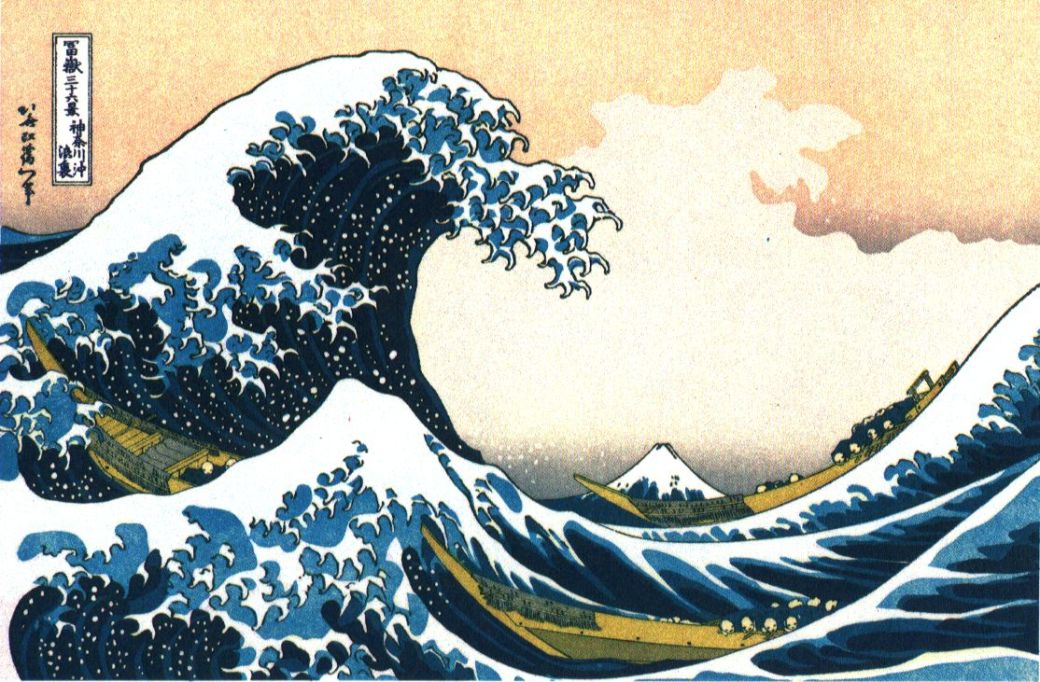
hokusai-wave

The Wave by Hokusai

Sometime ago, on another writing site that I used to post for, a reader/writer made an interesting comment to my article ” Stoking the Scintillation of Inspiration.” She said, “I feel energized and challenged to see where my mind takes me in the midst of my mommy days.  Often it’s when my four young children are home the ideas long to push through the clutter of multiple voices and feverish activity.

It made me think about what it is in those “repetitive tasks” that stoke our muse and how we as writers can benefit from them. Is it simply God’s ironic sense of humor (e.g., “You’re too busy to do anything about it now, so I will give you a genius moment to ponder….Good luck remembering it!”). Or have we inadvertently caught the universal wave? Einstein once said, “everything in life is vibration.”

We are creatures of rhythm: circadian, diurnal, and seasonal. Let’s face it; our environment—light especially—affects our behavior, psychologically, physiologically and even socially. For instance, mood-altering chemicals generated in the pineal gland in our brain, are partially affected by the light received from our retina. Our world is composed of energy, light, sound and matter, all expressed at different frequencies. Music—which is all frequency—can heal the body, strengthen the mind and unlock the creative spirit. For instance, music with a pulse of about sixty beats per minute can shift consciousness from the beta wave (ordinary consciousness at 14-20 Hz) toward enhanced alertness and general well-being at the alpha range (heightened awareness at 8-13 Hz, and essentially the standing wave in Schumann’s Cavity).

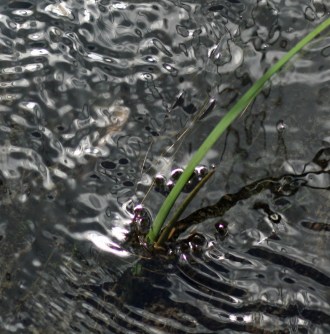
water pattern01-credit

wave patterns (photo by Nina Munteanu)

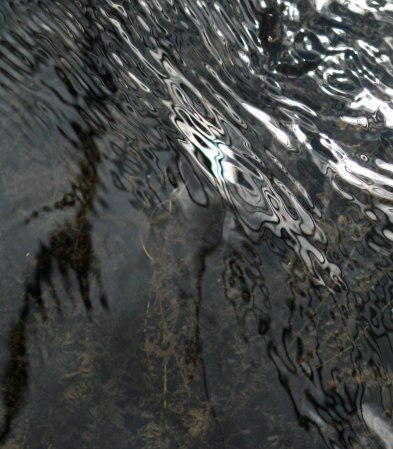
The study of cymatics, coined in 1967 by Swiss doctor Hans Jenny from the Greek word kyma (wave), explores how sound affects gases, liquids, plasmas and solids and how vibrations, in the broad sense, generate and influence patterns, shapes and moving processes. When sound travels through non-solids it moves in longitudinal waves called compression waves. In matter, the medium is displaced by sound waves, causing it to oscillate at a frequency relative to the sound, and visible patterns emerge.

Using crystal oscillators and a “tonoscope” to set plates and membranes vibrating, Jenny controlled frequency and amplitude/volume to demonstrate that simple frequencies and songs could rearrange the essential molecular structure of water and other materials.

water-pattern03-credit

Wave patterns (photo by Nina Munteanu)

Jenny was convinced that biological evolution resulted from vibrations in a kind of fractal progression, and that their nature determined the ultimate outcome. He speculated that every cell has its own frequency and that a number of cells with the same frequency create a new frequency, which is harmonious with the original, which in its turn possibly forms an organ that also creates a new frequency in harmony with the two preceding ones. Jenny was saying that the key to understanding how we can heal the body with the help of tones lies in our understanding of how different frequencies influence genes, cells and various structures in the body (think of how you feel when you listen to Mozart’s Divertimento No. 15 vs. when you’re listening to Mick Jagger belt out Ruby Tuesday).

Boldly extending his tonoscope research into voice and language, Jenny discovered that when the vowels of ancient Hebrew and Sanskrit were pronounced, the sand took the shape of the written symbols for these vowels, while modern languages didn’t generate the same result. This has led spiritual philosophers to ponder if “sacred languages” (including Tibetan and Egyptian) have the power to influence and transform physical reality, to create things through their inherent power, or through the recitation or singing of sacred texts, to heal a person who has gone “out of tune”?…

This is an exceptional concept…

In a controversial movie called “Water”, Rustum Roy, professor at the State University of Pennsylvania and member of the International Academy of Sciences, posited that water has “memory”, based on the structure it takes on as a result of electromagnetic fields and various frequencies to which it is exposed.

water-pattern-06-credit

Wave patterns (photo by Nina Munteanu)

I’m a practicing aquatic scientist and I’m compelled to note that the human brain is 75% water; it is not surprising that we can be affected by the shape and form of water itself—and, in turn, may shape water with our minds. This is in itself a startling admission and opens up a myriad of controversial topics, which many scientists find hard to reconcile and refuse to investigate, let alone entertain. And, yes, I am edging into the area of metaphysics, “science fiction”, and “fanciful thinking”. A place populated by heretics who do “questionable science”, those rogue mavericks who dare step outside the realm of traditional science to imagine, to dare pursue a truth using unconventional means.

Here’s my point: water is important to us in ways science can’t even begin to explain. Because science can’t yet explain it, should we abandon the potential and its investigation? All good science was once perceived as magic before it was understood.

Let me take it one step further:

water-pattern-07-credit

Water patterns (photo by Nina Munteanu)

I posit that our entire bodies are sending and receiving vibrations at different frequencies with our environment, other people and other animals around us, inanimate objects, even the seemingly ‘empty’ space. It has permeated our culture more than you may realize, including the metaphors we have seamlessly adopted in our common language: terms like “bad vibes”, “you can feel the tension”, and “you could cut the air in here with a knife”.

If you think this is all too weird, consider the weirdness of quantum mechanics, which shows us that not only is “solid” matter made up mostly of energy and “empty” space but what makes a solid a chair vs. you sitting on it is the vibration of its energy. Quantum science has demonstrated that light and matter are made of both particles and waves (New Scientist, May 6, 2010) and can exist in two simultaneous states (heard of Schrodinger’s Cat?). Let’s consider, for instance, “entanglement” (quantum non-local connection), the notion that particles can be linked in such a way that changing the quantum state of one instantaneously affects the other, even if they are light years apart. And what does it mean when solid flows, ghost-like, through itself under certain conditions? Or parallel universes are created by splitting realities? (You’ll have to check out my historical fantasy “The Last Summoner” for a unique take on this popular notion).

Nobel prize-winning physicist Richard Feyman says of the paradoxes presented by quantum mechanics, “the ‘paradox’ is only a conflict between reality and your feeling of what reality ought to be.”

So, what does all of this have to do with “writing”, scintillating or otherwise, some of you may be asking… Well, nothing … Everything …


Reference:
Munteanu, Nina. 2016. “Water Is…The Meaning of Water” Pixl Press, Vancouver, BC. 585pp.


nina-2014aaaNina Munteanu is an ecologist and internationally published author of award-nominated speculative novels, short stories and non-fiction. She is co-editor of Europa SF and currently teaches writing courses at George Brown College and the University of Toronto. Visit www.ninamunteanu.ca for the latest on her books. Nina’s recent book is the bilingual “La natura dell’acqua / The Way of Water” (Mincione Edizioni, Rome). Her latest “Water Is…” is currently an Amazon Bestseller and NY Times ‘year in reading’ choice of Margaret Atwood.

Stoking the Scintillation of Inspiration

Forest conifers Metchosin

Forest in Metchosin, BC (photo by Nina Munteanu)

“Many of us wish we were more creative,” Julia Cameron, author of The Artist’s Way, shares. “Many of us sense we are more creative, but unable to effectively tap that creativity. Our dreams elude us. Our lives feel somehow flat. Often, we have great ideas, wonderful dreams, but are unable to actualize them for ourselves. Sometimes we have specific creative longings we would love to be able to fulfill … we hunger for what might be called creative living.”

Many of us are, in fact, creatively blocked. How would you know if you were? Jealousy is an excellent clue. Are there creative people you resent? Do you tell yourself, ‘I could do that, if only…’ An old friend of mine used to constantly share that he would “start living and settle down” once he had enough money. It never happened; and he never did—twenty years later. That was sad; because he was waiting for life to begin, when it was already happening—and he was missing it.

YellowCreek-3

Stairway to Yellow River, Ontario (photo by Nina Munteanu)

Creative recovery (or discovery) is something you can learn. It is something you can enhance and direct. “As you learn to recognize, nurture, and protect your inner artist,” says Cameron, “you will be able to move beyond pain and creative constriction. You will learn ways to recognize and resolve fear, remove emotional scar tissue, and strengthen your confidence.”

Stoking the creative artist inside you may be as simple as giving your mind the chance to wander—and taking the time to pay attention. Rhythm and regular, repetitive actions play a role in priming the artistic well. Cameron lightheartedly describes how the “s” activities work so well for this: showering, swimming, scrubbing, shaving, steering a car. I can testify to the latter—how many great plot ideas have I cooked up while driving to work! Filmmaker Steven Spielberg claimed that his best ideas came to him while he was driving the freeway. Negotiating through the flow of traffic triggered the artist-brain with images that translated into ideas. “Why do I get my best ideas in the shower?” Einstein was known to have remarked. Scientists tell us that this is because showering is an artist-brain activity.

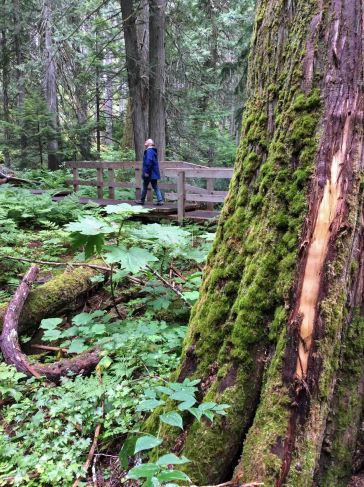
Anne-walking-Cedars

Giant Cedar forest, Revelstoke Park, BC (photo by Nina Munteanu)

The magical part in this is to pay attention. Pay attention to your life experiences; don’t ignore them. Sit up in the bus and watch people, play with the images, sounds and smells. Get sensual and let your eyes, ears, nose and limbs delight in the world. It’s amazing how interesting the world becomes once you start paying attention.

Henry Miller tells us to develop interest in your daily life; in people, things, literature, and music: “the world is … simply throbbing with rich treasures, beautiful souls and interesting people. Forget yourself,” he says.

Looking outward as well as inward allows us to explore different angles and facets of the same thing. When we see the same thing through different perspectives we rediscover something new in ourselves. We create interest and connect the world to ourselves.

GairlochGardens-LakeOntario

Lake Ontario at Gairloch Gardens, Ontario (photo by Nina Munteanu)

Julia Cameron shares that “art may seem to spring from pain, but perhaps that is because pain serves to focus our attention onto details (for instance, the excruciatingly beautiful curve of a lost lover’s neck). Art may seem to involve broad strokes, grand schemes, great plans. But it is the attention to detail that stays with us; the singular image is what haunts us and becomes art. Even in the midst of pain, this singular image brings delight. The artist who tells you different is lying.”


Brenda Ueland tells us why we should all use our creative power: “Because there is nothing that makes people so generous, joyful, lively, bold and compassionate, so indifferent to fighting and the accumulation of objects and money.”

References:

Julia Cameron. 2002. “The Artist’s Way”. Tarcher. 272pp.
Nina Munteanu. In Press. “The Journal Writer:  Finding Your Voice”. Pixl Press. 132pp.


nina-2014aaaNina Munteanu is an ecologist and internationally published author of award-nominated speculative novels, short stories and non-fiction. She is co-editor of Europa SF and currently teaches writing courses at George Brown College and the University of Toronto. Visit www.ninamunteanu.ca for the latest on her books. Nina’s recent book is the bilingual “La natura dell’acqua / The Way of Water” (Mincione Edizioni, Rome). Her latest “Water Is…” is currently an Amazon Bestseller and NY Times ‘year in reading’ choice of Margaret Atwood.

Wake up Your Muse–How my Cat Taught Me the Art of Being…

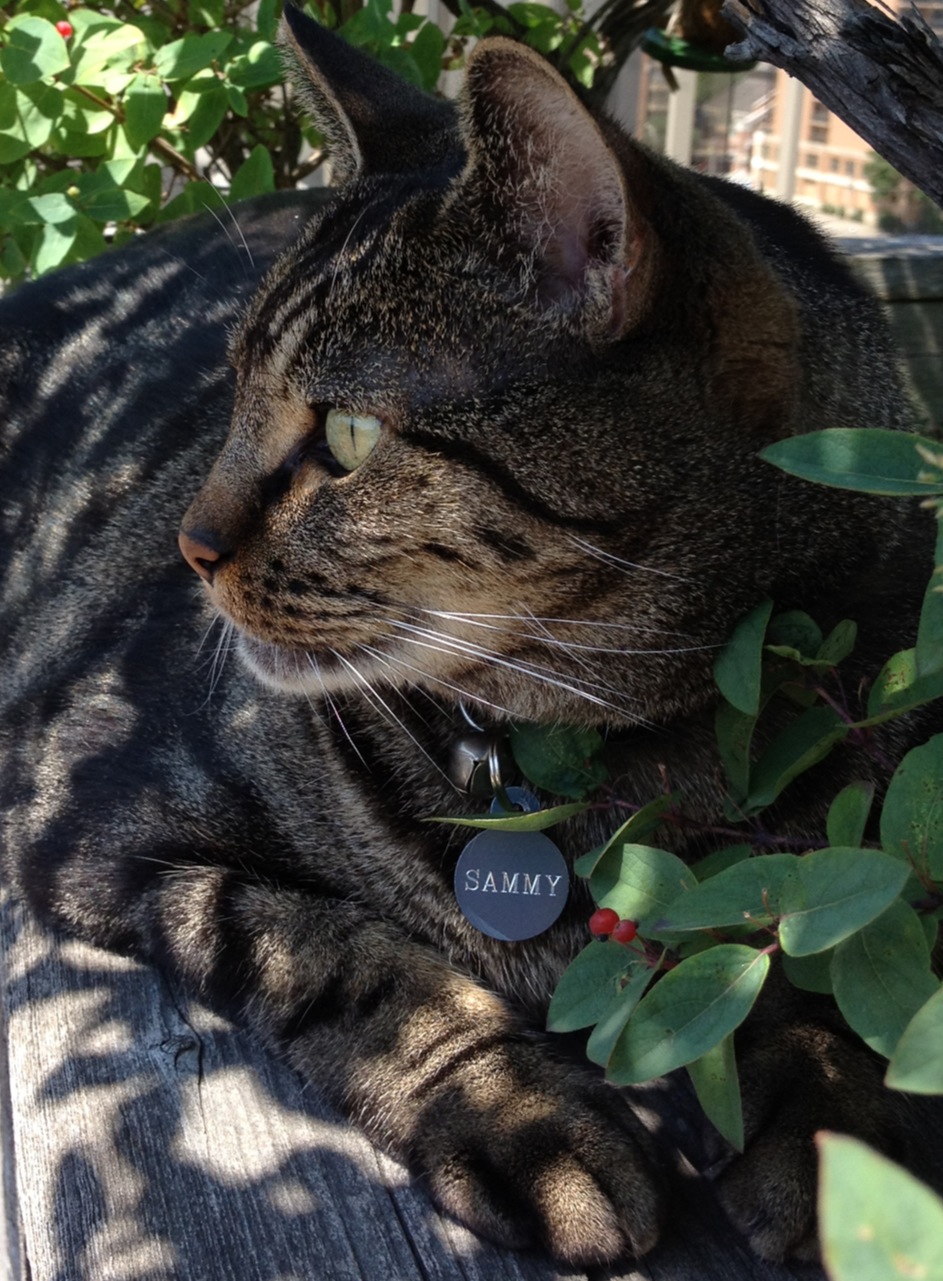
Sammy

I’m not a very patient person. I make no time for writer’s block or lingering in useless limbo over some plot issue or misbehaving minor character. I write pretty much to a tight schedule: this short story to that market by this date; edits to this book to the editor by that date; blog posts created by such and such a time; an article to another market by another date. It goes on and on. When I go to my computer to write, I write.

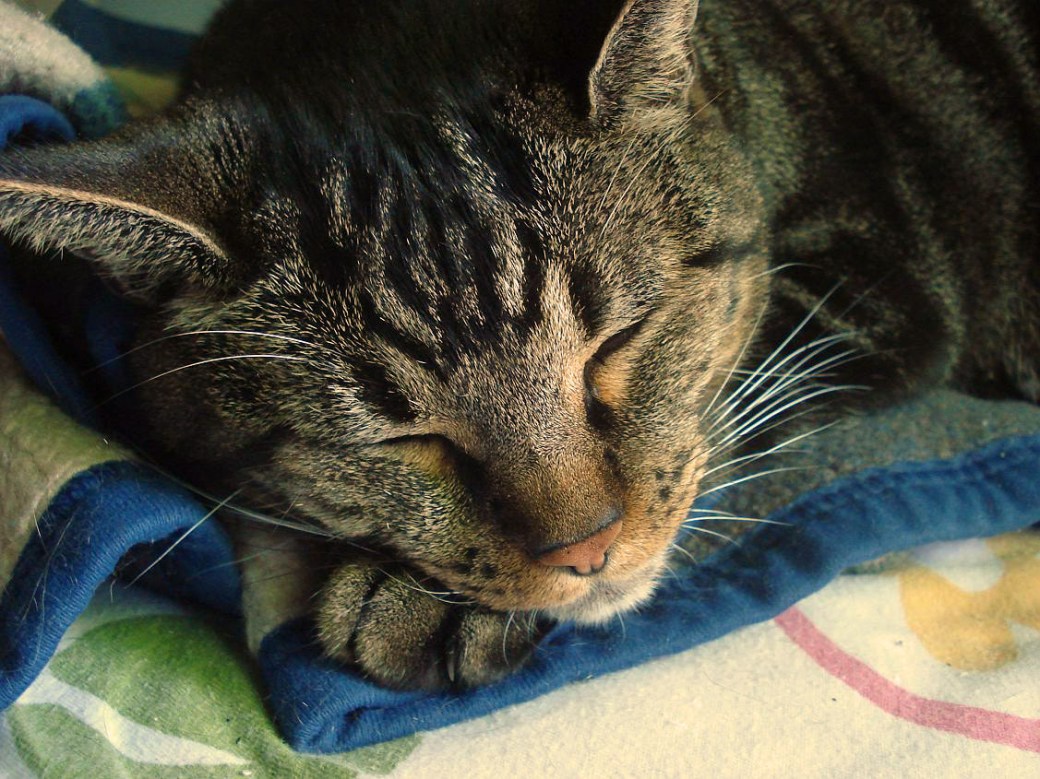
Then there’s Sammy. My cat.

Who likes to jump on my lap, make himself all comfortable and then lie over my arm — trapping it along with five of my typing digits. Now what??? Some of you would advise me to simply pull out my pinned arm and/or shove him off. But how can I disturb such a blissful creature? He is so content furled on me, so satisfied that he has captured that wandering appendage of business that is all his now. Content in the bliss of now. In the bliss of cat-purr-meditation…

sammy-2010-01_edited-1Pinned in the moment, my mind first struggles with the need to pound out the next line. My mind then rephrases and teases out nuances of that line. Finally, it wanders out with my gaze and I find myself daydreaming in a kind of trance. Giving in to the cat-purr-meditation.

And it is here that magic happens. In the being; not in the doing.

This is the irony of writing and the muse. To write we need to live; we need to have something to write about and we need to be in that state of mind that allows us to set it to print. I am at my best as a writer when I am focused on the essence of the story, its heart and soul beating through me with a life of its own.

My cat Sammy isn’t the only vehicle to my magical muses.


Waking up the Muse

Here are a few things that help me entice those capricious muses into action:

snow-christmas2008-sammy

Sammy hunting

Music: music moves me in inexplicable ways. I use music to inspire my “muse”. Every book I write has its thematic music, which I play while I write and when I drive to and from work (where I do my best plot/theme thinking). I even go so far as to have a musical theme for each character.

Walks: going for a walk, particularly in a natural environment, uncluttered with human-made distractions, also unclutters the mind and soul. It grounds you back to the simplicity of life, a good place to start.

Cycling: one of my favorite ways to clear my mind is to cycle (I think any form of exercise would suffice); just getting your heart rate up and pumping those endorphins through you soothes the soul and unleashes the brain to freely run the field.

Attend writer’s functions: go to the library and listen to a writer read from her work. You never know how it might inspire you. Browse the bookshelves of the library or bookstore. Attend a writer’s convention or conference.

Visit an art gallery, go to a movie: art of any kind can inspire creativity. Fine art is open to interpretation and can provoke your mind in ways you hadn’t thought before. If you go with an appreciative friend and discuss what you’ve seen you add another element to the experience.

Go on a trip with a friend: tour the city or, better yet, take a road trip with a good friend or alone (if you are comfortable with it). I find that travelling is a great way to help me focus outward, forget myself, and open my mind and soul to adventure and learning something new. Road trips are metaphoric journeys of the soul.

Form a writer’s group: sharing ideas with people of like mind (or not, but of respectful mind) can both inspire you and provide the seeds of ideas.

Practice Cat-Purr-Meditation: you need a willing cat for this; I find that I need tostudy my cat’s meditative practices; where does he most like to relax? Mine loves to look outside the window onto the back yard and garden. That’s where I take him and there, together, we breathe deep and “purr” in the moment…You can read more about purring cat meditation in my Alien Next Door post, “Perfecting the Cat Purr Meditation


Nina Munteanu is an ecologist and internationally published author of award-nominated speculative novels, short stories and non-fiction. She is co-editor of Europa SF and currently teaches writing courses at George Brown College and the University of Toronto. Visit www.ninamunteanu.ca for the latest on her books.