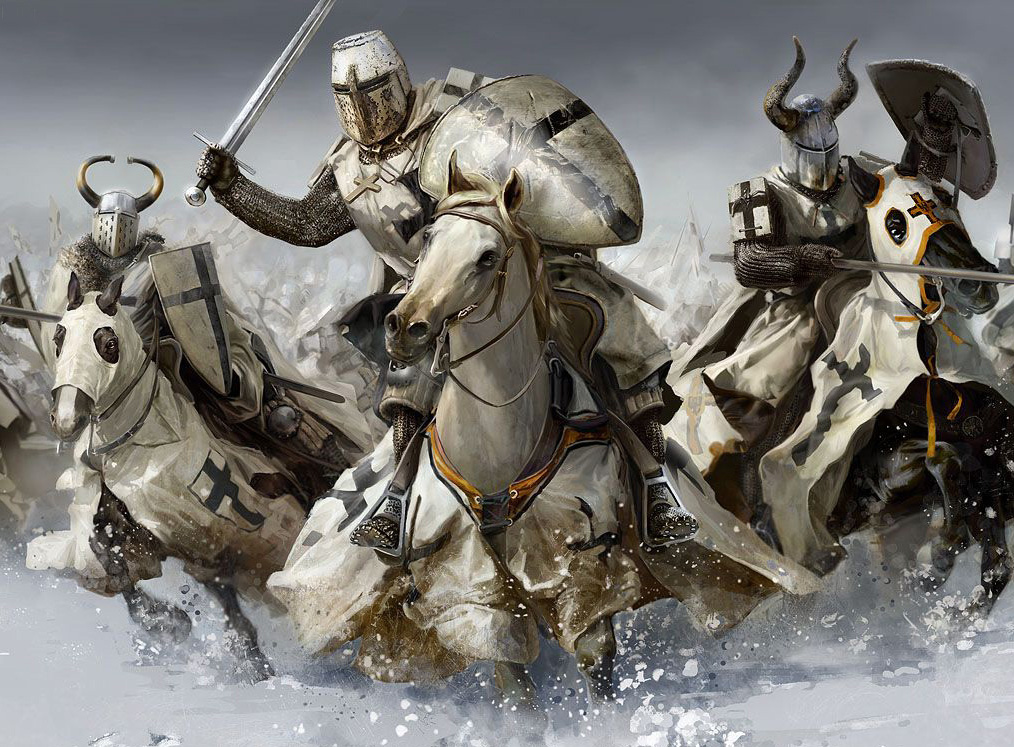
The knight in Vivianne’s dream (illustration by Tomislav Tikulin)
If you want to find the secrets of the universe, think in terms of energy, frequency and vibration
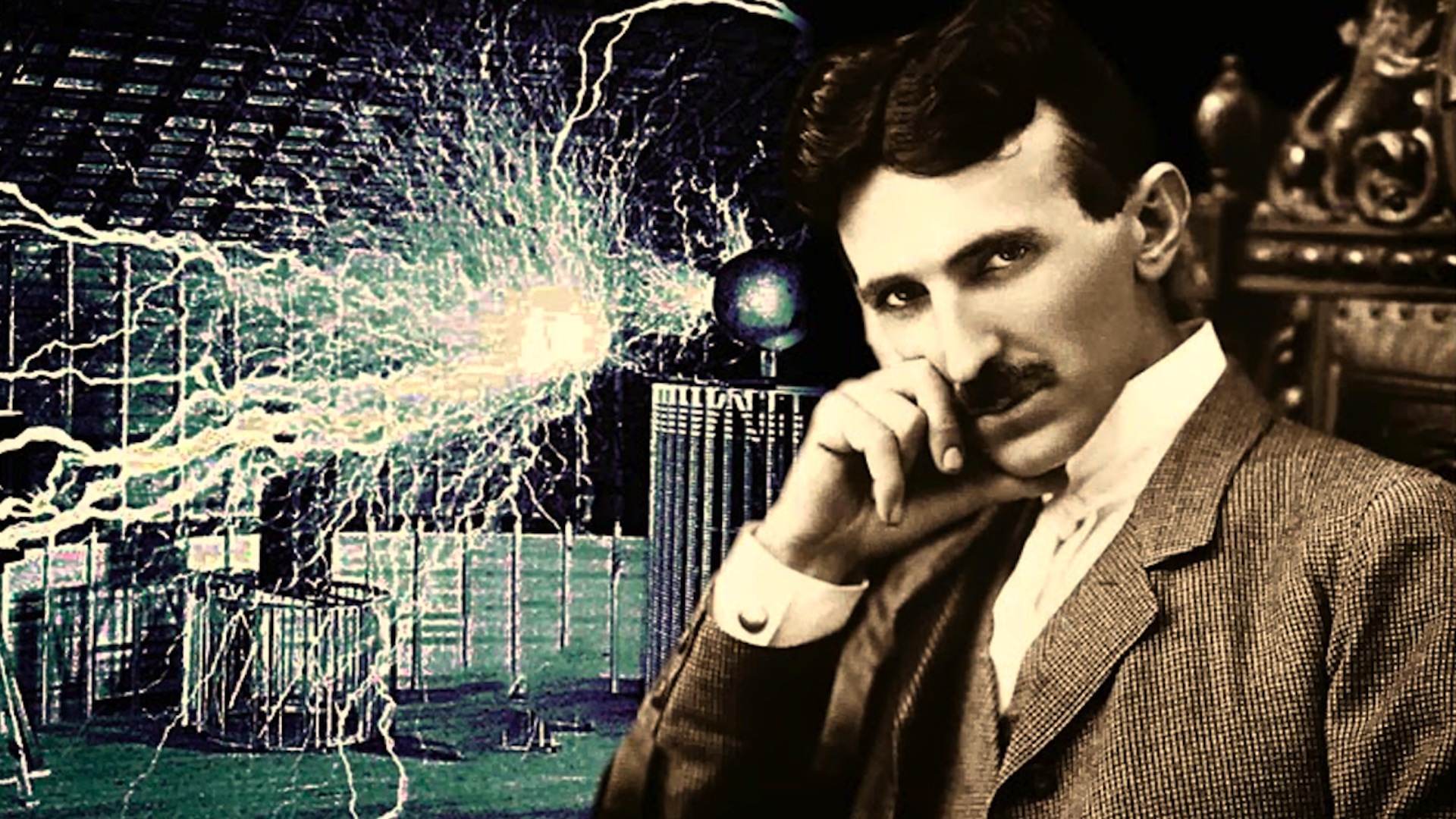
Nikola Tesla
In my historical fantasy The Last Summoner, Vivianne Schön, the Baroness Von Grunwald, travels through time from the 1400s to 1905 to meet Nikola Tesla and make a deal with the eccentric scientist in a bid to make the world a better place:
The Story (excerpt of The Last Summoner)
New York, 1905
VIVIANNE straightened when she glimpsed the elegantly dressed Serbian as he entered Bryant Park. From her bench in the shade of a sycamore tree, she watched him saunter to his favourite bench then sit down and cross his legs. He emitted a somber sigh, pulled out a small notebook from his jacket pocket and began to write. Vivianne studied his long face, straight nose and well groomed mustache. It was an intense face, though worn with reserve. He quelled the fire that burned inside him beneath a shell of enigmatic reflection. He brushed a hand over his thick hair, then set his mouth in a thin line of determined concentration as he hastily sketched something inside the notebook. He didn’t look terribly heartbroken for a man who had just lost his dream, she reflected. But she did recognize disappointment on his furrowed brow. He was used to that, she decided, reviewing his personal history, which had been plagued by rivalry and betrayal for nearly all his life. A visionary of his genius quality was easy fodder for bullying, whether it was schoolmates or the scientific community.
After adjusting her brimmed hat and flowing blue lace gown, Vivianne rose and approached the forty-eight year old Serbian visionary, musing how he would later be called the “Father of the 20th Century”.
She was barely a metre away from him before he looked up, ready to express annoyance at being interrupted. She took pleasure in seeing his expression change from a glower to a startled look of curiosity. She knew she was beautiful, but it was rather delightful to see that she could divert this intense scientist.
“Hello, Mister Tesla,” Vivianne greeted him with a curtsy. “I am the Comptesse d’Anjou at your service. May I join you and sit down?”
He frowned at first then nodded politely with not quite a smile. He was not known for his smiles, she recalled. Tesla rose to his feet and bowed to her but did not offer his hand. She did not press him, knowing of his particular compulsion for avoiding human contact. “Of course you may,” he said with a mild accent and nodded to her in invitation. They both sat down in unison and he added, “To what do I owe this pleasure, Comptesse? Do I know you?”
“No, Mister Tesla.” She smiled with irony. “We have never met—not in person, anyway. But I believe you may be interested in what I have to say.” She paused to take in his curiosity and continued, “Pardon me for what I am about to reveal of your affairs, but I represent the interests of La Banque Internationale du Monde in Geneva, Switzerland—perhaps you know of us—and the law offices of Frankl & Frankl. We are one of the five largest investment banks in the world, dating back to the late 1400s with offices in Amsterdam and Hamburg. We are a private bank who screen for altruistic and environmentally conscious investors. In short, we help finance only those projects that will help make the world a better world.” She paused.
Tesla studied her inquisitively but said nothing.
She smiled internally at his puzzled expression then continued, “We are very interested in your Wardenclyffe Tower in Shoreham, Long Island, and associated global wireless power transmission.”
Tesla slid his notebook back into his jacket pocket and now gave her his full attention. She knew that he’d been trying for years to gain backing for his enigmatic projects with little to no success.
She continued, “You theorized that electrical energy can be transmitted through the earth and the atmosphere…without power lines.”
“Yes, I can light lamps at moderate distances and can detect the transmitted energy at much greater distances. The Wardenclyffe Tower uses a rapidly alternating electrostatic field and was a proof-of-concept for global wireless power trans-mission.”
“Yes, I know.”
He frowned. “But my funding—“
“Yes, I know. Your backers don’t like the idea of unmetered power consumption.”
His face hardened with dark thoughts. “Free electricity isn’t profitable.”
“Least of all to greedy bankers with no vision or faith like J.P. Morgan or John Jacob Astor,” she added. “I know you’ve been in financial trouble with high construction costs since Morgan pulled out last year and encouraged other investors to do the same.”
Her last remark made him stiffen. She was hitting a painful nerve.
“I know about your expired patents and the resulting lack of royalty payments,” she continued. “Within another five to ten years your projects will all be defunk and you will be totally broke. And no one will listen to the ideas that come to you fully formed through visions and dreams.”
He straightened and looked her directly in the eyes. “What do you want of me, Comptesse? Who are you?”
“An ally,” she answered. “I am well aware of your humanitarian pursuits and altruistic nature. I know that you wish simply to make the world a better world. That is my wish also. Energy is and will continue to be one of the most important forces on this earth. Like water, it should be free and available to each and everyone of us. I think you can provide us with that gift and would be happy to as well. Mister Tesla, I want to offer you financial backing at zero percent interest.”
He let loose a humourless laugh. He had finally learned to be cynical about bankers, she thought.
“Make no mistake, Mister Tesla; I expect to become one of the wealthiest people on this planet because of you. But I will gain that wealth only as you gain yours, through a partnership, and not at the expense of others; rather, for the benefit of others. Your wireless technology will help in areas you have yet to imagine: instant global communications and the personal computer; clean energy for homes and industry; laser medicine; robotics; interstellar travel; instant matter transference; even time travel and so much more.”
He was staring at her now. “Who are you, really?”
An angel, she thought to herself. “I’m part of the future, Mister Tesla. A future of your making.” Then without thinking, she held out her hand. “You can call me Vivianne.”
To her delighted surprise, he smiled for the first time. He took her hand then lightly kissed it, as was the custom of most eastern Europeans. “And you can call me Nikola.”
The Man
Nikola Tesla and his experiments with electricity
Nikola Tesla intuited that energy waves in the earth and the atmosphere could be used to transmit power to any point on the globe. He understood that the surface of the Earth, the ionosphere and the atmosphere together form one gigantic electrical circuit—an electrified Gaia, so to speak—and this formed the basis for his work on wireless energy transmission. Tesla was able to transmit power and energy wirelessly over long distances (via transverse waves and longitudinal waves). He transmitted extremely low frequencies (ELF) through the ground and between the Earth’s surface and the Kennelly-Heaviside layer of the ionosphere. Tesla patented wireless transceivers that developed standing waves and it was he who discovered that the resonant frequency of the Earth was about 8 Hz and in the range of the Schumann Resonance or Cavity.
Tesla in his Colorado Springs lab
Modern technology appears to be threatening humanity’s connection with earth’s fundamental frequency and the natural vibrations of Schumann Resonance. Threats include artificial man-made EMF radiation, wireless technology, and high frequency heating microwaves pulsed at 2.45 GHz. Whether we co-evolved with Earth’s natural electromagnetic environment or were created with Divine Intelligence to live in harmony with it, many experts believe that artificial man-made EMF radiation masks the natural beneficial frequency of the Earth and may create an environment that is literally `out of tune’ with Nature itself.
The Book
The Last Summonerby Nina Munteanu is a fresh twist on chaos theory and observer-induced collapse of quantum entanglement. It’s June 14th, 1410, on the eve of the Battle of Grunwald when history records that a ragtag peasant army will slaughter the arrogant monk knights of the imperialistic Teutonic Order … or will they? Because of an impetuous choice, 14-year old Vivianne Schoen, Baroness von Grunwald, makes the startling discovery that she can alter history—but not before she’s branded a witch and must flee through a time-space tear. Now in an alternate present-day France ruled by fascist Black Knights of the ancient Teutonic Order, she must decide how to remake history.
Detail of ‘The Battle of Grunwald’ (painting by Jan Matejko)
“For those in love with science fiction at its best, The Last Summoner is a complex story of ignored responsibilities and their dire consequences, of love and betrayal that span centuries and multiple worlds. Time travel, multiverse travel, immortality, alternate history in which the Nazis have won, not in the twentieth century but way earlier, in the Teutonic age. Angels and mutants, utopias and dystopias, even a Tesla occurrence— everything a science fiction reader could ever desire in a book. A masterfully told story with great characters. Nina Munteanu moves flawlessly from a medieval story to a modern one and everything in between.”
Depiction of fierce Teutonic Knights crusading in the Baltic north during the 13th Century (illustration by Mariusz Kozik)
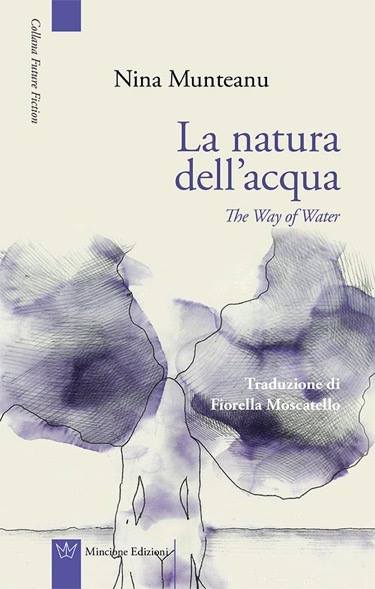
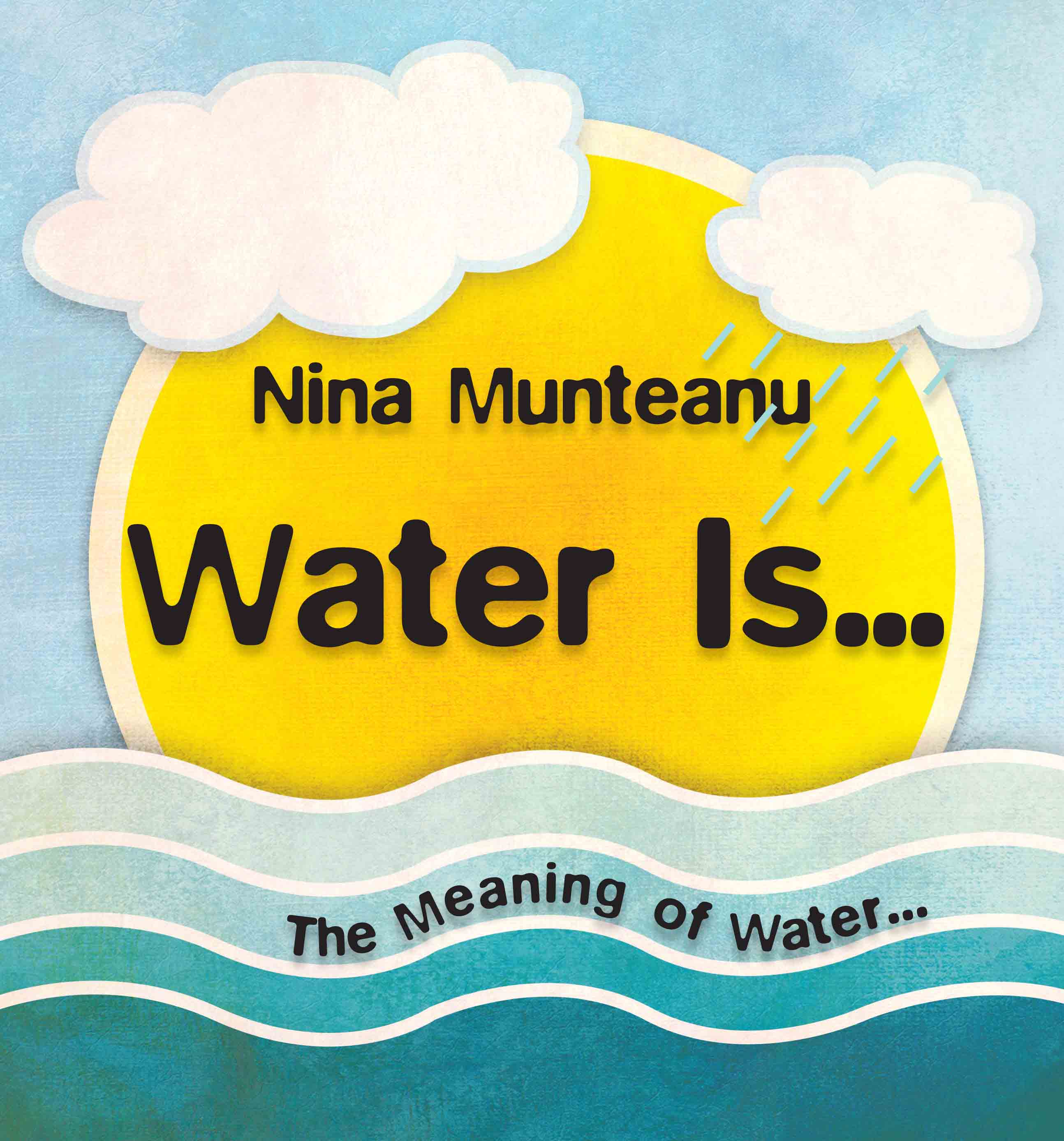
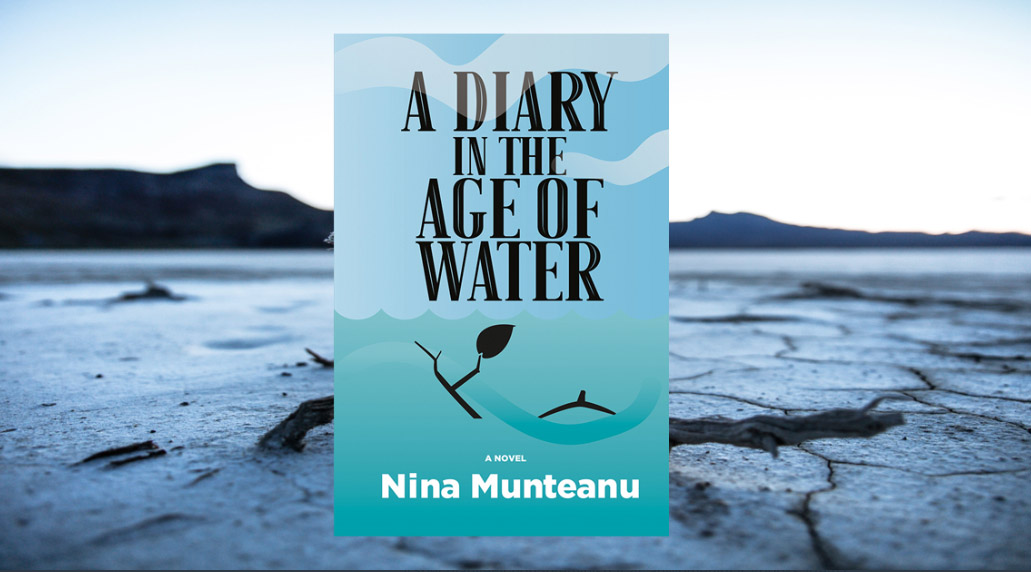
Nina Munteanu is a Canadian ecologist / limnologist and novelist. She is co-editor of Europa SF and currently teaches writing courses at George Brown College and the University of Toronto. Visit www.ninamunteanu.ca for the latest on her books. Nina’s bilingual “La natura dell’acqua / The Way of Water” was published by Mincione Edizioni in Rome. Her non-fiction book “Water Is…” by Pixl Press (Vancouver) was selected by Margaret Atwood in the New York Times ‘Year in Reading’ and was chosen as the 2017 Summer Read by Water Canada. Her novel “A Diary in the Age of Water” was released by Inanna Publications (Toronto) in June 2020.
McGill University, view from main gate on Rue Sherbrooke (photo by Nina Munteanu)
I’ve just returned from Montreal, where I was invited to participate in a two-day conference hosted by McGill University’s Bieler School of Environment at Esplanade Tranquil. Named after Kim Stanley Robinson’s eco-fiction novel New York 2140, the conference brought together a diverse assemblage of scientists, academic researchers, urban planners, speculative fiction writers, artists, and students in a small setting dedicated to encourage cross-pollination of ideas and visions through panels and workshops. I sat on a panel and a roundtable with other writers, urban planners, engineers, scientists and activists to discuss futures through science and story. Much of the event focused on the literary genre called Hopepunk—a sub-genre of Speculative Fiction devoted to optimistic themes of scientific transformation, discovery and empathy. Resulting dialogue explored forms of communication, expression, and ways not just to deal with growing solastalgia, eco-grief, and environmental anxiety but to move forward through action and hope.
Breakout groups in Seeds of Good Anthropocenes Workshop (photo by Nina Munteanu)
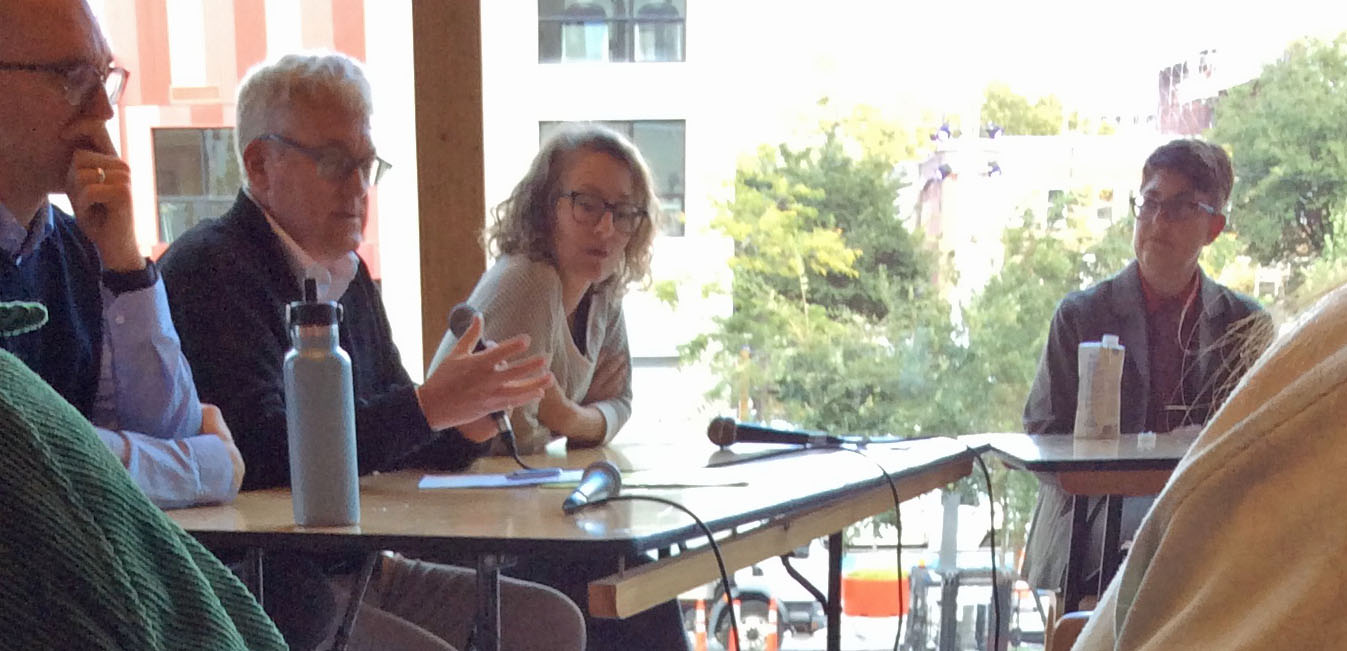
McGill faculty in Panel on ‘Turning Research into Hopeful Stories’ (photo by Nina Munteanu)
In the Thursday morning writer’s panel, in which we explored the role of science knowledge and hope in story, I shared the writing process I underwent with my latest published novel A Diary in the Age of Water, which I categorize as a hopeful dystopia (‘Hopeful dystopias’ are much more than an apparent oxymoron; they are in some fundamental way, the spearhead of the future—and ironically often a celebration of human spirit by shining a light through the darkness of disaster):
The main character in A Diary in the Age of Water was a limnologist like me who kept a journal (the diary referenced in the title of the book). This part of the story took place in the near-future when the water crisis and associated climate change phenomena had become calamitous. Being a scientist with so much intimate knowledge of the crisis, the diarist became cynical and lost her faith in humanity. I recall my own journey into despair as I did the research needed to convey the character’s knowledge and situation. I found myself creating a new character (the diarist’s daughter) much in the way a drowning swimmer takes hold of a life-saver, to pull me out of the darkness I’d tumbled into. The daughter’s hopeful nature and faith in humanity pulled both me and the reader out of the darkness. The cynical nature of the diarist came from a sense of being overwhelmed by the largeness of the crisis and froze her with feelings of powerlessness. The diarist’s daughter rose like an underground spring from the darkness by focusing on a single light: her friend and lover who pointed to a way forward. As Greta so aptly said once, “action leads to hope” and hope leads to action. Despite the dire circumstances in the novel, I think of A Diary in the Age of Water as a story of resilience. And ultimately of hope.
I came to the conference as a writer, scientist, mother, and environmental activist. What I discovered was an incredible solidarity with a group so diverse in culture, disciplines, expression and language—and yet so singularly united. It was heartwarming. Hopeful. And necessary. This conference ultimately felt like a lifeline to a world of possibilities.
Organizers brought in a wide variety of talent, skill, and interest and challenged everyone through well-run workshops to think, feel, discover, discuss, collaborate and express. Workshops, panels, and multimedia art incited co-participation with all attendees in imaginative and fun ways. On-site lunches and drinks helped keep everyone together and provided further space for interaction and discussion.
Student-led break out group discussing ways to transform eco-emotions into hope (photo by Nina Munteanu)
At every turn, I made contacts across disciplines and interests and had stimulating and meaningful conversations. I discovered many hopeful ‘stories’ of Montreal and elsewhere on hopeful visions and endeavors. These included “Seeds of good Anthropocenes” (small ground-rooted projects and initiatives aimed at shaping a future that is just, prosperous, and sustainable); turning scientific research into hopeful stories; and world building as resistance. I talked with artistic creators, students doing masters in Hopepunk literature and co-panelists on all manner of subjects from urban encampments, greening and rewilding Montreal, to how Rachel Carson’s Silent Spring informed a main character in Liu Cixin’s novel The Three Body Problem.
Creating visual art via MAPP (photo by Nina Munteanu)
Marc-Olivier Lamothe stands next to a MAPP projection (photo by Nina Munteanu)
Conversations often led to an acknowledgement of art as an effective means of expression and creative therapy in the context of the climate crisis. I met creatives such as Marc-Olivier Lamothe and his colleagues at MAPP and had the chance to experiment first hand with his creative tools. I had wonderful discussions with storytelling visual artist Alina Gutierrez Mejia of Visual Versa, whose evolving mural of each day’s events was truly mesmerizing to watch—and rather revealing.
Alina Gutierrez Mejia creates a visual representation of the day’s conference (photo by Nina Munteanu)
In future, I’ll post more on these and other creatives I encountered at the conference.
Program for Montreal 2140
THURSDAY morning began with an introduction by BDE Director Frédéric Fabry.
This was followed by a panel entitled Hopeful Stories Across Science and Fiction, in which I participated, along with fellow writers Su J. Sokol (author of Zee), Alyx Dellamonica (author of Gamechanger), Rich Larson (author of Annex and Ymir), Genevieve Blouin (author of Le mouroir des anges) and Andrea Renaud Simard (author of Les Tisseurs). The panel was moderated by McGill geographer Renee Sieber and McGill urban planner Lisa Bornstein.
After lunch, a panel entitled Faculty Workshop: Turning Research into Hopeful Stories was moderated by McGill researcher Kevin Manaugh and Annalee Newitz (journalist and author of Four Lost Cities). McGill researchers included: Caroline Wagner (bioengineering), Hillary Kaell (anthropology and religious studies); Jim Nicell (civil engineering); Sébastien Jodoin (law); and Michael Hendricks (biology).
McGill students who lead the workshop on Hope and the Future stand with one of the conference organizers Daniel Lukes (photo by Nina Munteanu)
The faculty panel was followed by the Student Workshop, Hope and the Future, led by McGill students Tom Nakasako, Rachel Barker, Tatum Hillier, and Lydia Lepki.
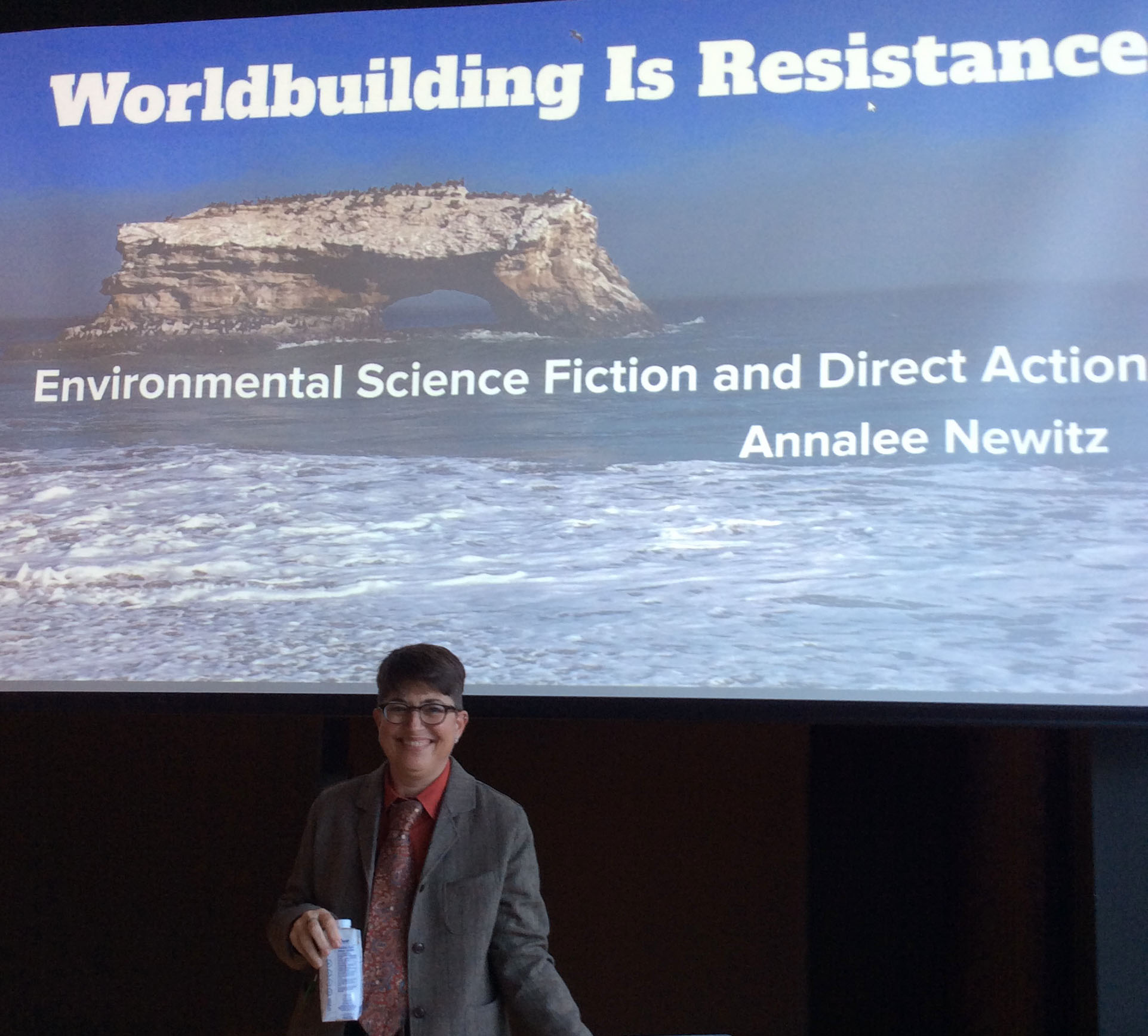
Annalee Newitz gives her keynote (photo by Nina Munteanu)
Annalee Newitz closed the day with their keynote presentation Worldbuilding Is Resistance that explored the dystopia binary of environmental science fiction. A theme to which the next keynote by Kim Stanley Robinson would touch on as well.
Elson Galang presenting Seeds workshop (photo by Nina Munteanu)
FRIDAY morning started with Elson Galang and Elena Bennett (McGill University), who led the Seeds of Good Anthropocenes Workshop, which introduced the concept of seeds programs then further explored through breakout discussion groups they moderated.
This was followed by faculty-led Teaching and Learning for Hopeful Futures Workshop, in which McGill instructors from varied disciplines (including education, political science, environment, urban planning and planetary sciences) discussed translating science into hopeful narratives.
pre-meet on Zoom of participants of the Roundtable
I then participated in a roundtable of authors, scholars, researchers and planners entitled Telling the Story of the Future, moderated by Chris Barrington-Leigh (McGill BSE/Health and Social Policy). The roundtable included fellow authors Alyx Dellamonica and Su J. Sokol. Other participants of the roundtable included Stephanie Posthumus (languages, literatures, cultures at McGill), Jayne Engle (public policy at McGill) Richard Sheamur (urban planning at McGill), and limnologist Irene Gregory-Eaves (biology at McGill).
BDE Director Frédéric Fabry introduces the conference (photo by Nina Munteanu)
The final keynote was given by Kim Stanley Robinson (author of New York 2140 and The Ministry of the Future).
Storyboard of the first day of the conference by Visual Versa (photo by Nina Munteanu)
Nina Munteanu is a Canadian ecologist / limnologist and novelist. She is co-editor of Europa SF and currently teaches writing courses at George Brown College and the University of Toronto. Visit www.ninamunteanu.ca for the latest on her books. Nina’s bilingual “La natura dell’acqua / The Way of Water” was published by Mincione Edizioni in Rome. Her non-fiction book “Water Is…” by Pixl Press (Vancouver) was selected by Margaret Atwood in the New York Times ‘Year in Reading’ and was chosen as the 2017 Summer Read by Water Canada. Her novel “A Diary in the Age of Water” was released by Inanna Publications (Toronto) in June 2020.
Maude Barlow, author of Boiling Point, Chairman of the Council of Canadians
Like a car, every novel has its point of ignition: a spark that sets it in motion. This occurs when a premise or idea comes together with an incendiary moment of clarity or a thematic question. Mine—though I didn’t know it at the time—happened in a church on the Summer of 2016.
I was in a United Church on Bloor Street, in Toronto’s Annex, watching a talk given by Maude Barlow on water justice. The radical talk was based on her recent book Boiling Point, a comprehensive exploration of Canada’s water crisis—a crisis that most Canadians weren’t—and still aren’t—aware. Canada is steward to a fifth of the world’s fresh water, after all. It is a water-rich country. Of the dozen largest inland lakes in the world, Canada holds eight of them. So, why water crisis? Barlow explains. And you should read Boiling Point, particularly if you’re Canadian. It will open your eyes to the politics of water and how multinational corporations—like Nestlé—are already grabbing and funneling water away from Canadians and into the global profit machine.
I sat close to the front of the Church sanctuary to best see her. But I soon noticed that many people had elected to sit in the gallery above. I found myself focusing on a young mother and her little girl. The girl had some paper and crayons and was busy with that as the enthusiastic mother listened to Maude deliver dire facts about corporate water high-jacking and government complicity.
I saw a story there.
What mother would take her pre-school child to a socio-political talk on water? I would later reflect that memory of the mother and her little girl through my characters Una and her little daughter Lynna, the diarist in my novel A Diary in the Age of Water (eventually published in 2020 with Inanna Publications).
Fresh water flows down the barrel of a hand-operated water pump.
My novel really began with a short story I was invited to write in 2015 by editors of Future Fiction and Mincione Edizioni about water and politics in Canada; the premise of this story would later find it’s way into the larger novel. I had long been thinking of potential ironies in Canada’s water-rich heritage. The premise I wanted to explore was the irony of people in a water-rich nation experiencing water scarcity: living under a government-imposed daily water quota of 5 litres as water bottling and utility companies took it all. I named the story “The Way of Water.” It was about a young woman (Hilda) in near-future Toronto who has run out of water credits for the public wTap; by this time houses no longer have potable water and their water taps have been cemented shut; the only way to get water is through the public wTaps—at great cost. She is in a line of people; she’s two metres from water—and dying of thirst.
“The Way of Water” captures a vision that explores the nuances of corporate and government corruption and deceit together with global resource warfare. In this near-future, Canada is mined of all its water by thirsty Chinese and US multinationals—leaving nothing for the Canadians. Rain has not fallen on Canadian soil in years due to advances in geoengineering and weather manipulation that prevent rain clouds from going anywhere north of the Canada-US border. If you’re wondering if this is possible, it’s already happening in China and surrounding countries.
The story first appeared in 2015 in Future Fiction, edited by Francesco Verso, and in 2016 as a bilingual (English and Italian) book and essay published by Mincione Edizioni in Rome. The story has so far been reprinted seven times in magazines and anthologies, including “Cli-Fi: Canadian Tales of Climate Change Anthology” (Exile Editions, Bruce Meyer, ed), in 2017, “Future Fiction: New Dimensions in International Science Fiction” (Francesco Verso & Bill Campbell, eds; Future Fiction / Rosarium Publishing, Rome and Greenbelt, MD) in 2018; and in Little Blue Marble Magazine (Katrina Archer, ed) in January, 2019 and in their ‘Best of’ anthology. It was then published in 2022 in Metastellar Magazine and later in their ‘Best of’ anthology. “The Way of Water” received generous praise from review sites and the press worldwide.
After the success of this short story, I realized that I needed to tell the larger story—how did the world—Canada—get to where Hilda was? Her mysterious mother, the limnologist Lynna who was taken away by the RCMP in 2063, clamored for more attention. I remembered that four-year old girl and her mother in the gallery at Maude Barlow’s talk on water politics. And I thought of my characters: young Lynna and her mother Una. How does a daughter of an activist mother behave and think? How best to express her voice? I had earlier written a short story that was a mix of correspondence (emails) and third person narrative (“The Arc of Time” in Natural Selection, later reprinted in Metastellar Magazine), which I felt captured the voices of the characters well. I realized that a diary by Lynna would be an ideal way for her to express her unique worldview and cynicism—yet allow her vulnerable humanity to reveal itself through this unique relationship with her diary. The remaining characters and their narratives emerged easily from there: Una, her activist mother; Daniel, her conspiracy theorist colleague (and her conscience); Orvil, the water baron (and lover she betrayed); and Hilda, her “wayward” supposedly mind-challenged daughter—who appears in the short story that takes place later.
I had a lot of material; I had already been researching water issues and climate change in my activism as a science writer and reporter. In 2016, Pixl Press had published “Water Is… The Meaning of Water”,essentially a biography of water, written from the perspective of mother, environmentalist and scientist. I had practiced as a limnologist for over twenty-five years and could mine my various personal experiences in the field, lab and office with genuine realism. I chose Wetzel’s Limnology (the classic text book I used in my introductory limnology course) for quotes to each of Lynna’s entries; this added an opportunity to provide additional metaphor and irony through Lynna’s scientific voice. I placed the child Lynna (who was born in 2012) into actual events in Toronto, where I currently live. This pushed the story further into the area of documentary and blurred the lines between fiction and non-fiction to achieve a gritty and textured reality. Lynna also taught limnology at the University of Toronto, where I currently teach.
Just as Water Is… served as a watershed for all my relevant experiences as mother, environmentalist and scientist, A Diary in the Age of Water would galvanize many of my personal experiences, doubts, challenges and victories into compelling story. Although parts of the story wrote themselves, the entire book was not easy to write. There were times when I had to walk away from the book to gain some perspective—and optimism—before continuing. When I found myself drowning in Lynna’s voice, I invoked Hilda to guide me to shore. I found a balance that worked and compelled. Ultimately this opened to some of the best internal conflict and tension I have experienced in my writing.
Like water itself, A Diary in the Age of Water expresses through many vessels and in many perspectives, spanning hundreds of years—and four generations of women—with a context wider than human life. Through its characters, A Diary in the Age of Waterexplores the big question of humanity’s deadlock with planetary wellness and whether one is worth saving at the expense of the other. One of the characters asks Lynna the hard question: “If you had the chance to save the planet [stop the mass extinctions, deforestation and pollution ravaging the planet], but it was at the expense of humanity, would you do it?”
Water is, in fact, a character in the book—sometimes subtle and revealed in subtext, other times horrific and roaring with a clamorous voice. Water plays both metaphoric and literal roles in this allegorical tale of humanity’s final journey from home. The story explores identity and our concept of what is “normal”—as a nation and an individual—in a world that is rapidly and incomprehensibly changing—and in which each of us plays a vital role simply by doing or not doing.
A Diary in the Age of Water promises to leave you adjusting your frame of reference to see the world, yourself—and water—in a different way.
Illustration on Liisbeth article (photo collage by PK Mutch and Dreamstime
This is what PK Mutch of Liisbeth and Ariel Kroon (PhD graduate of English Literature at the University of Alberta and co-editor at Solarpunk Magazine) say about A Diary in the Age of Water, published by Inanna Publications in 2020:
The novel has received wonderful praise and prizes, including the Literary Titan Award, the Foreword Indies Award and finalist in the International Book Awards. I wonder if Maude Barlow has read it?… Maybe I (or someone) should get her a copy, huh?…
Maude Barlow with ‘Save our River’ sign
Maude Barlow is a Canadian activist and author of Blue Gold, Boiling Point and several other books on water justice. She chairs the board of Washington-based Food and Water Watch and Ottawa-based Blue Planet Project. Maude co-founded the Council of Canadians and chaired its board for over three decades.
Nina Munteanu is a Canadian ecologist / limnologist and novelist. She is co-editor of Europa SF and currently teaches writing courses at George Brown College and the University of Toronto. Visit www.ninamunteanu.ca for the latest on her books. Nina’s bilingual “La natura dell’acqua / The Way of Water” was published by Mincione Edizioni in Rome. Her non-fiction book “Water Is…” by Pixl Press (Vancouver) was selected by Margaret Atwood in the New York Times ‘Year in Reading’ and was chosen as the 2017 Summer Read by Water Canada. Her novel “A Diary in the Age of Water” was released by Inanna Publications (Toronto) in June 2020.
My guest today is Calgary author Simon Rose, who has published eighteen novels for children and young adults, eight guides for writers, more than a hundred nonfiction books, and numerous articles on a wide range of topics.
Nina:Your most recently published books were those in The Stone of the Seer series. Remind us again of what it’s all about.
Simon:The Stone of the Seer is young adult historical fantasy series, featuring The Stone of the Seer, Royal Blood, and Revenge of the Witchfinder. The exciting story is mostly set in the mid-seventeenth century during the English Civil War. In The Stone of the Seer, Lady Elizabeth Usborne, Kate, and Tom encounter a magical stone, mysterious parchments and manuscripts, and an incredible time viewing device. In Royal Blood, Lady Elizabeth, Kate, and Tom are in London, witnessing the political turmoil at the time of the Civil War, including the king’s trial and execution. Revenge of the Witchfinder takes place in multiple time periods. The story features weird dreams, disturbing visions, parallel lives, and a bewildering identity crisis, as the lead characters discover to their horror that not even the passage of centuries can prevent a bloodthirsty witchfinder from the 1640s from seeking his deadly revenge.
Nina:Do you have any current projects?
Simon: Right now, I’m working on another historical fantasy novel series, this time set in the early years of World War II, that I’m hoping to publish next year. I’ve recently finished another story that takes place in the later stages of World War II and am putting the finishing touches to that one as well, potentially for publication the following year. Yet another series is currently in development in the same paranormal genre as my previously published Flashback series, which can learn more about on my website.
I’ve also been working on the script for a film project and continue to work on the adaptations of my Shadowzone series into screenplays for movies and TV shows. You can learn more about my work writing screenplays for clients and creating adaptations of my own work here on my website.
Anyone interested in keeping up to date with the projects that I’m working on is always welcome to subscribe to my monthly newsletter, which you can do on my website.
Nina:You certainly seem to be very busy. You also do other work related to writing and publishing, right?
Simon: Yes, I offer coaching, editing, consulting, and mentoring services for writers of novels, short stories, fiction, nonfiction, biographies, and in many other genres, plus work with writers of scripts and screenplays.
I’m also a writing instructor and mentor at the University of Calgary and have some courses coming up in the fall, including Writing for Children and Youth. My own online courses, including Writing Historical Fiction and Writing for Children and Young Adults, are also always available.
Simon: People can buy The Stone of the Seer, Royal Blood, and Revenge of the Witchfinder, as well as all my other books, at Amazon and all the other usual places online, which you can link to on my website at www.simon-rose.com I’ll also be making some personal appearances at local events in the fall, where people can buy autographed copies of all the books in the series, as well as all my other novels.
Nina:Thanks Simon, for being my guest here today.
Simon: My pleasure, Nina.
You can learn more about Simon and his work on his website at www.simon-rose.com where you can also link to him on social media and at other locations online.
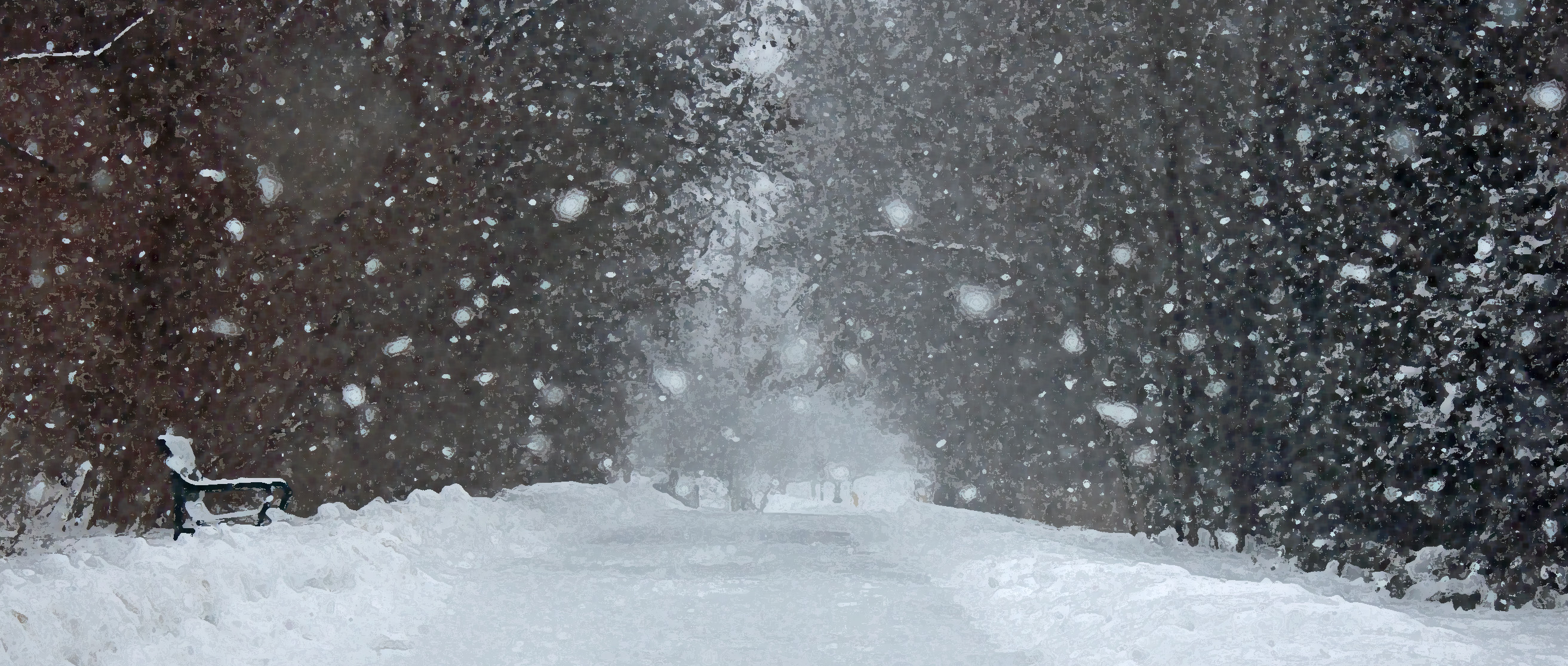
Heavy snowfall where I live in Ontario (photo by Nina Munteanu)
I currently live in Ontario, Canada, where the four seasons are still distinct and winter comes with signature cold temperature well below zero degrees Centigrade along with lots and lots of snow. I grew up in Quebec, where the snow often piled up higher than I stood tall. Temperatures often went into the minus zero teens and twenties with wind chills reaching minus thirty degrees. This called for the right equipment. Insulated coat or jacket, snow pants, wool toque and mittens and/or gloves that are also well insulated. And, of course, warm snow boots.
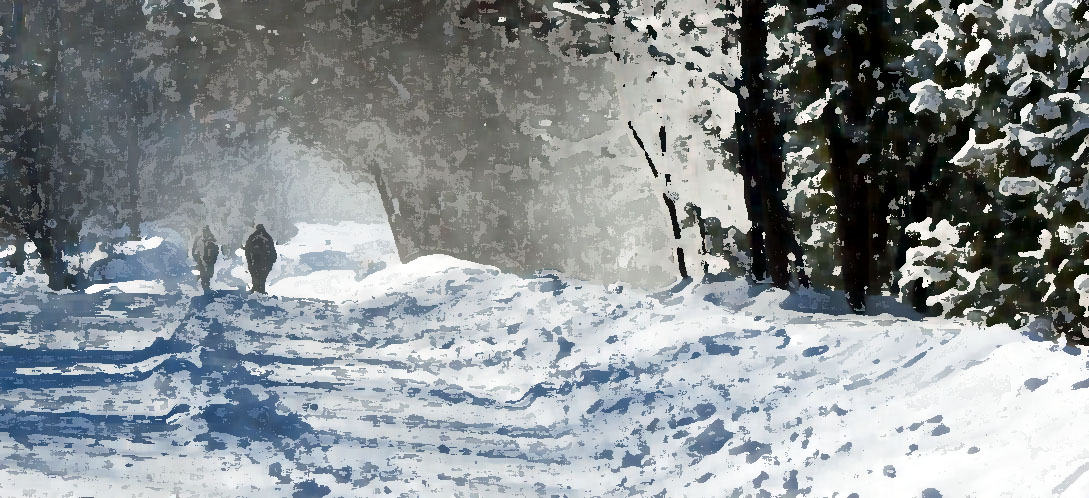
Nina on a walk during a snowstorm, ON (photo by Merridy Cox)
Country road in the Kawarthas, ON (photo and rendition by Nina Munteanu)
Nina’s car on ‘walkabout’ through Kawartha country after a fresh snowfall, ON (photo and rendition by Nina Munteanu)
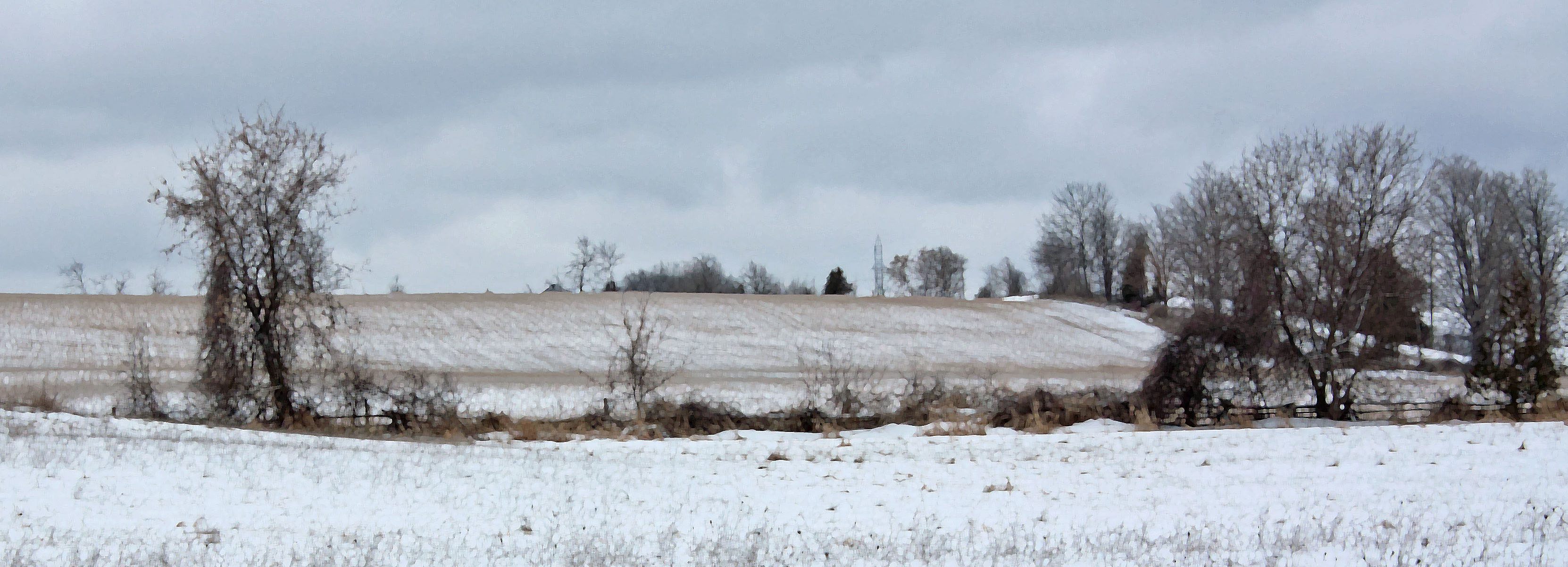
Farm in the Kawarthas, ON (photo and rendition by Nina Munteanu)
Cows on a farm in the Kawarthas, ON (photo and rendition by Nina Munteanu)
Country field in Kawarthas, ON (photo and rendition by Nina Munteanu)
School kids heading to class after a fresh snow, ON (photo by Nina Munteanu)
The Rotary Trail after a fresh snowfall, ON (photo and rendition by Nina Munteanu)
Heavy snow falls on a trail in the Kawarthas, ON (photo and rendition by Nina Munteanu)
Since moving to the West Coast then back east to Ontario, I’ve come to realize that I love winters. I love how snow covers everything, how it quiets the landscape and changes it in subtle ways. I love the frigid wind, how it bites the face with invigorating energy, reminding me that I am so alive. I love the sounds of winter, of walking on snow, crunching and squeaking, of the howl of the wind and the creaking and groaning of the trees, or the cracking and booming of the ice forming and reforming on the river.
Bridge over creek in Trent Nature Sanctuary during heavy snowfall, ON (photo and rendition by Nina Munteanu)
Jackson Creek after a fresh snowfall, ON (photo and rendition by Nina Munteanu)
Woman and her dog walk through cedar swamp forest after a fresh snowfall, ON (photo and rendition by Nina Munteanu)
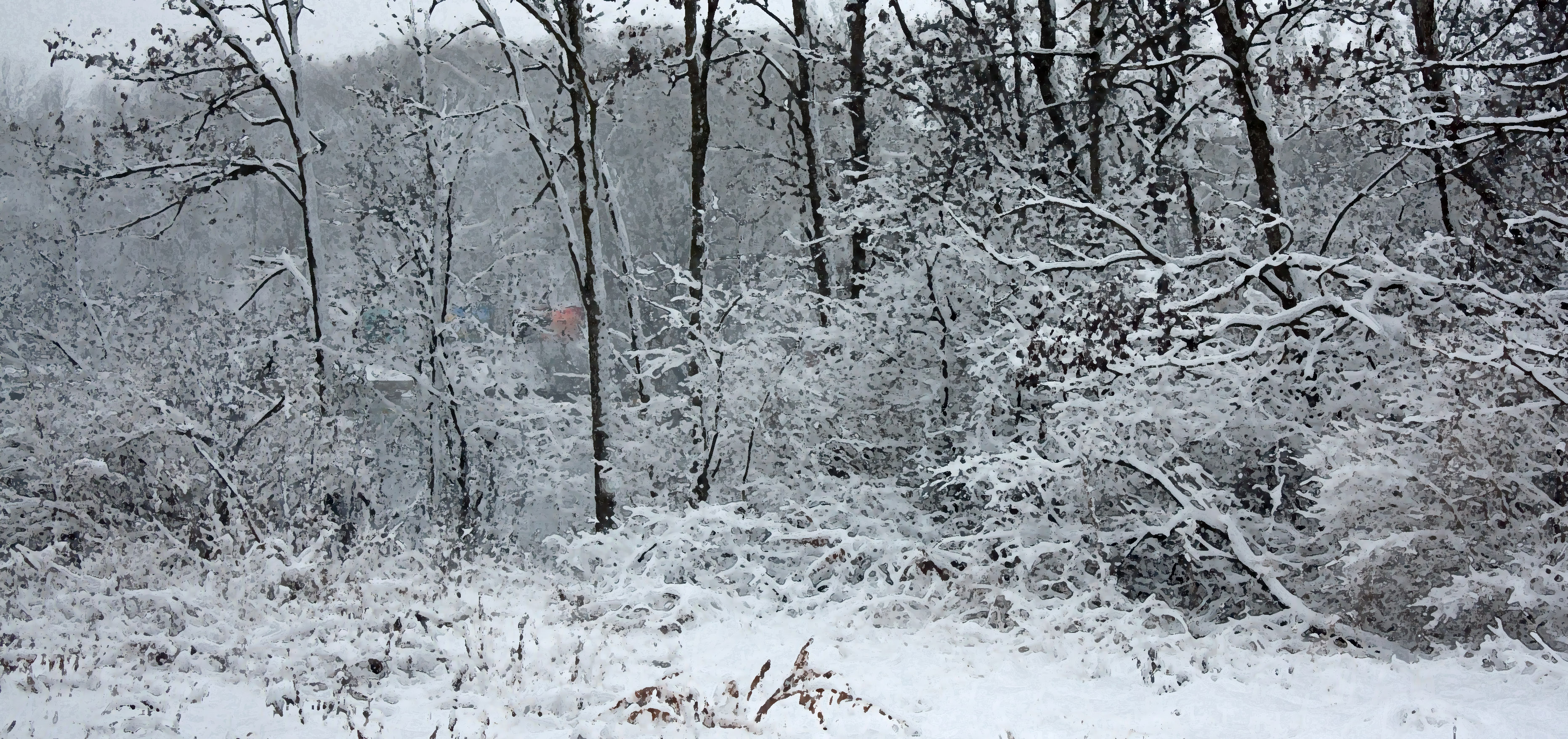
Riparian forest clothed in fresh snow, ON (photo and rendition by Nina Munteanu)
Riparian forest after a fresh snowfall, ON (photo and rendition by Nina Munteanu)
I am currently finishing my fiction book Thalweg, which takes place throughout Canada, but predominantly in northern British Columbia and the arctic of the Northwest Territories. My main character, a Gwich’in scientist, explores the land during a time of climate change, and much of it involves the expansive vast snowfields of northern Canada in which she describes the look, smell, feel, and sounds of snow. She thinks with great fondness of home in the Arctic where snow prominently features and, bringing in all her senses, of course, includes sound:
There are many different kinds of snow, and any native of the north can recognize them. We can not only tell something of the quality of weather from it, but also its history. Without having experienced the day or history of the place, we will know simply from walking through it. For instance, on a minus twenty-degree Centigrade day, when the cold bites your face and your breath coils out of your mouth like steam, old snow shines under a raking sun like an ice sheet. As though clear plastic was stretched over it. Sometimes, a hoar frost will form on the glassy thin layer, adding more glitter. Walking through it creates a symphony of crunch, pop and skittle sounds as each step breaks through the thin brittle layer into soft snow underneath. The scattering flat shards tingle like glass across the glistening ice-snow sheet.
Fresh snow that has fallen on a frigid night of minus fifteen degrees in a drier climate is fluffy, individual snowflakes glinting like jewels in the sun, and emits a high-pitched squeak and crunch as your boots press down on it. The colder the temperature, the higher the squeak. I just made that up. I’m not sure if it’s true. But considering the relationship of harmonics with temperature, it’s plausible.
Squeaky snow is the snow of my home up north, where it arrives in a thick passion in October with the winter darkness, and where a constant minus 16°C to minus 30°C pervades until spring, six months later. The snow resembles powdered sugar, glittering like millions of tiny mica flakes under the moonlight of an arctic winter night. It covers everything, the ground, the trees and tiniest vegetation with a white blanket of snow. And when the wind teases the trees, they rain glitter-dust. In places where the north wind freely drifts across open landscape, sastrugi form; frozen wavelets, mini-barchans and dune chains that resemble the wave ripples of a sandy white beach. In some vast open areas, the wind will sculpt a frozen sea of irregular ridges and grooves up to a metre high. Mary’s friend Jem from Igloolik calls these snowdrifts qimugruk, whose distinctive shapes become permanent features of the snowscape, with tips always pointing west-northwest. Igloolik hunters use these uqalurait to set their bearings when travelling across the expansive tundra, particularly during poor visibility from storms or darkness.
Tracks through a small path by the river, ON (photo and rendition by Nina Munteanu)
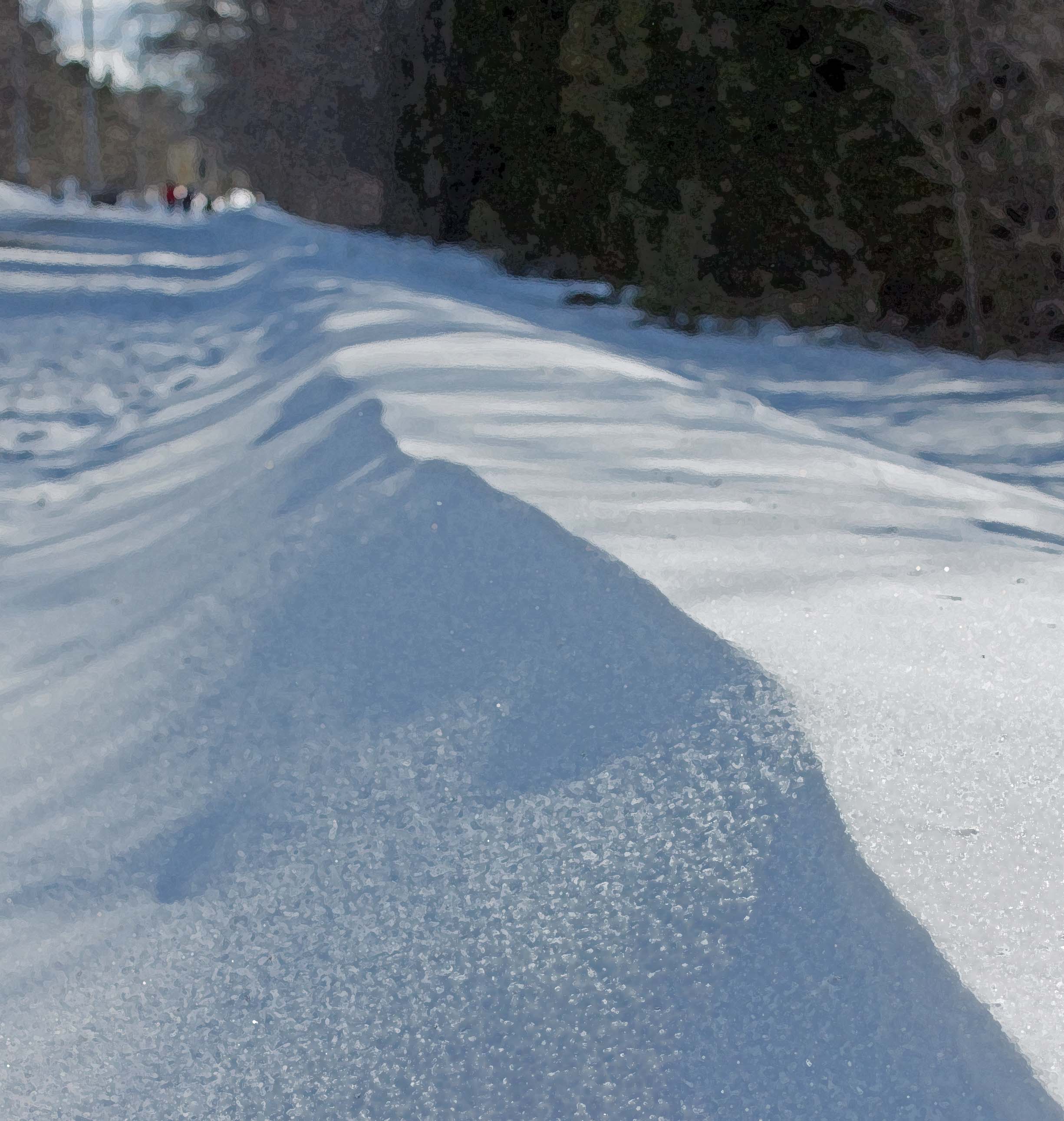
Snow drift on a trail by the river, ON (photo and rendition by Nina Munteanu)
One of the sensitivity readers for Thalweg, anthropologist and Gwich’in scholar Ingrid Kritsch, related to me an interesting account during attempts to open up to oil and gas development the Arctic National Wildlife Refuge–a critical area where the Porcupine Caribou herd calve. “To many Americans, it was just a big, white, barren expanse of unused lands,” said Ingrid. She recalled a Senator speaking for development on these lands. The Senator held up a blank sheet of white paper and claimed “this is what the area looks like!”
The vast snowfields look nothing like that…
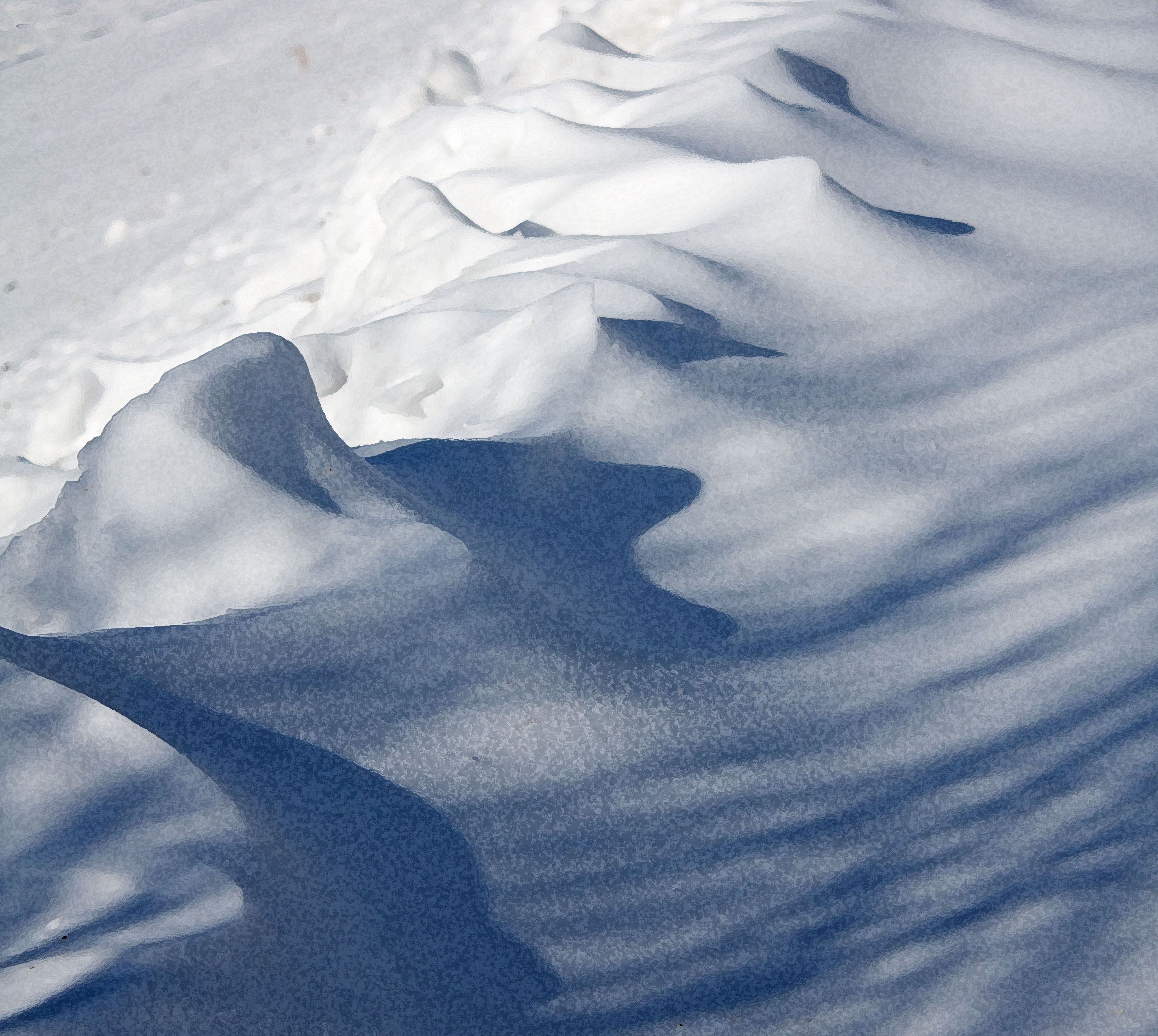
Snow drifts in Ontario (photo and rendition by Nina Munteanu)
…Now, don’t forget to play in the snow…
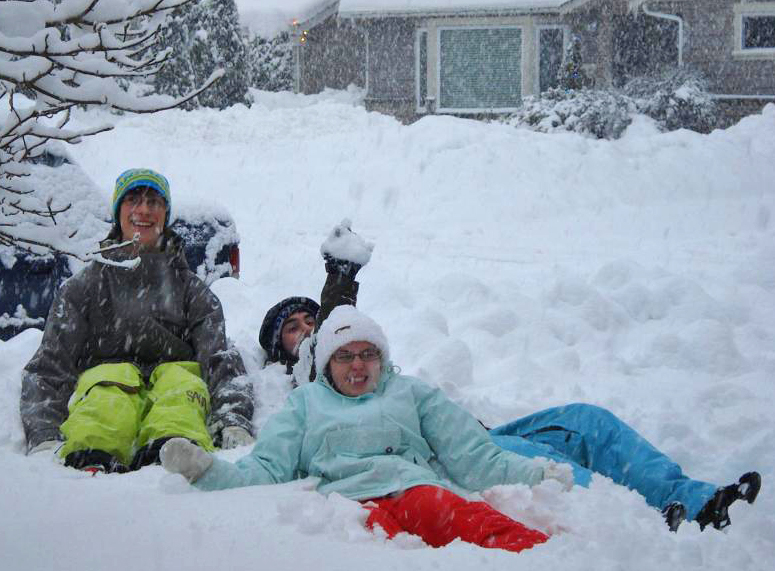
Author’s son and friends play in fresh snow on Christmas in BC (photo by Nina Munteanu)
Nina Munteanu reads a book with her cup of tea in +8 degree C, ON (photo by Merridy Cox)
Nina Munteanu is a Canadian ecologist / limnologist and novelist. She is co-editor of Europa SF and currently teaches writing courses at George Brown College and the University of Toronto. Visit www.ninamunteanu.ca for the latest on her books. Nina’s bilingual “La natura dell’acqua / The Way of Water” was published by Mincione Edizioni in Rome. Her non-fiction book “Water Is…” by Pixl Press(Vancouver) was selected by Margaret Atwood in the New York Times‘Year in Reading’ and was chosen as the 2017 Summer Read by Water Canada. Her novel “A Diary in the Age of Water” was released by Inanna Publications (Toronto) in June 2020.
Country road through Kawarthas, ON (photo and rendition by Nina Munteanu)
Issue #128 of Apex Magazine featured an interview that Rebecca E. Treasure did with me. We discussed the power of story, the use of dystopian narrative, and the blur between fiction and non-fiction to create meaningful eco-fiction. Below we talk about the writing process I use for my stories these days. For the complete interview go here:
AM:The language in your stories is richly thematic, using strong description to weave the subtext into the piece. For example, “killing two squirrels with one stone.” Is that something that comes about organically as you compose a piece, or a more intentional part of editing?
NM: I use both processes to achieve a final narrative that is multi-layered with metaphor, symbols, and deep meaning. The first process is through intuition derived through intimacy; the second process is more deliberate and generated through objectivity. Insights from intimacy come about organically, during moments of true inspiration, when my muse connects me to the deeper truth of a character’s voice and actions. Given that the inner story runs many layers (some of which I, as writer, may not even be overtly aware) and links in a fractal relationship with the outer story, those moments of inner inspiration happen as if of their own accord. That’s what writers mean when they admit that their characters “talk” to them and instruct them on what to write. When a writer achieves that level of intimacy and understanding, they can let the muse guide them.
Much of the description that is woven into story is generated through the editing process when I read the manuscript as a reader. The process involves letting the story sit for a while so when I return to it, I am reading more objectively. During this process, I apply my knowledge in storytelling craft to showcase combustible moments in plot, and work in foreshadowing, subtext, and compelling metaphor. A writer can’t add metaphor without context related to story theme (otherwise this may result in what the industry calls “purple prose”). Metaphor—given its roots in the deeper psyche of a culture—must arise organically from a deep, sometimes intuitive, understanding—where the personal meets the universal.
Nina Munteanu is a Canadian ecologist / limnologist and novelist. She is co-editor of Europa SF and currently teaches writing courses at George Brown College and the University of Toronto. Visit www.ninamunteanu.ca for the latest on her books. Nina’s bilingual “La natura dell’acqua / The Way of Water” was published by Mincione Edizioni in Rome. Her non-fiction book “Water Is…” by Pixl Press(Vancouver) was selected by Margaret Atwood in the New York Times‘Year in Reading’ and was chosen as the 2017 Summer Read by Water Canada. Her novel “A Diary in the Age of Water” was released by Inanna Publications (Toronto) in June 2020.
Jackson Creek after a fresh snowfall, ON (photo and rendition by Nina Munteanu)
Issue #128 of Apex Magazine featured an interview that Rebecca E. Treasure did with me. We discussed the power of story, the use of dystopian narrative, and the blur between fiction and non-fiction to create meaningful eco-fiction. Below we talk about the role of stories in the climate action movement. For the complete interview go here:
AM:Your work takes complex topics that are nonetheless critical to humanity’s future and pulls stories with compelling characters out of them, making the science accessible, the warnings personal to the reader. This has always been one of the callings of science fiction. What is the role of stories in the climate action movement?
NM: Our capacity and need to tell stories is as old as our ancient beginnings. From the Paleolithic cave paintings of Lascaux to our blogs on the internet, humanity has always shared story. Story is powerful in how it helps us define who we are, what’s important to us, and where we are going. Stories compel with intrigue, stir our emotions, connect with our souls through symbols, archetypes and metaphor. Stories inspire action. We live by the stories we tell.
For too long, our stories have promoted a dominant worldview of exploitation and capitalism. We’ve been telling the patriarchal story of “othering” for too long; we need a new voice and a new worldview to replace our old stories of conquering and taming a “savage land” and “savage people.” When Copernicus proclaimed in 1543 that the sun did not revolve around the Earth, it took a long time for the world to accept and let go of its Ptolemaic Earth-centered view. But the world did come around eventually to the point now that this is common knowledge and lies embedded in our daily lives and language.
Storytelling about how the Earth takes care of us and how we can take care of Earth is urgently needed.
This means shifting our stories from an exploitive capitalist narrative of separation toward an inclusive partnership narrative. This means embracing a more eco-centric worldview; a worldview in which humanity is not central, but lies embedded within greater planetary forces and phenomena. A worldview that sees humanity only as part of a greater entity, as participant in a greater existential celebration of life and the elements. A humanity that must learn to play along, not bully and take over. A humanity that must embrace compassion, respect and kindness; a humanity directed by humility—not hubris. It is my firm belief that until our worldview embraces humility in partnership with the natural world—until we cast off our self-serving, neo-liberal, capitalist ideologies—we will remain hampered in our journey forward. When we change our stories, we change our lives and we change the world along with it.
This is already happening with the emergence of a strong eco-voice by writers through the feminine voice, the gylanic voice, the voice of the marginalized, of ecology and the environment itself. Authors such as Barbara Kingsolver, Annie Proulx, Margaret Atwood, Richard Powers, Emmi Itäranta, Jeff Vandermeer, Cherie Demaline, Christiane Vadnais, Pitchaya Sudbanthad, Chen Qiufan, Paolo Bacigalupi, Grace Dillon, Andrew Krivak, Kim Stanley Robinson, and Coleen Murphy … These all give Nature a face and voice to care about. And caring is the first step.
Nina Munteanu and her award-winning eco-novel “A Diary in the Age of Water”
Nina Munteanu is a Canadian ecologist / limnologist and novelist. She is co-editor of Europa SF and currently teaches writing courses at George Brown College and the University of Toronto. Visit www.ninamunteanu.ca for the latest on her books. Nina’s bilingual “La natura dell’acqua / The Way of Water” was published by Mincione Edizioni in Rome. Her non-fiction book “Water Is…” by Pixl Press(Vancouver) was selected by Margaret Atwood in the New York Times‘Year in Reading’ and was chosen as the 2017 Summer Read by Water Canada. Her novel “A Diary in the Age of Water” was released by Inanna Publications (Toronto) in June 2020.
Issue #128 of Apex Magazine featured an interview that Rebecca E. Treasure did with me. We discussed the power of story, the use of dystopian narrative, and the blur between fiction and non-fiction to create meaningful eco-fiction. Below we talk about the role of stories in the climate action movement. For the complete interview go here:
AM:Your also stories bridge fiction with nonfiction, using speculative fiction as a lens to bring your subject into focus for the reader. How does that work? Why do you approach story in this way?
NM: Marcie McCauley with Temz Review observed that, “[Munteanu] does not appear to view fiction and non-fiction as separate territories; or, if she does, then this book [A Diary in the Age of Water] is a bridge between them.” In Herizons, Ursula Pflug called the book “a bit of a hybrid, and Munteanu a risk-taker.” Buried in Printwrote of the same book, “ultimately it exists in an in-between place, some mystical elements of the generational tale possibly alienating the dedicated science-y readers and the instructional elements possibly alienating fiction devotees. And, yet, I read on: strangely compelling.”
I find that I enjoy this in-between place that blurs fiction with nonfiction. It’s more edgy, gripping, and believable, albeit fantastical, even playfully challenging at times. For instance, I may subvert facts, creating semi-facts to tease the discerning reader (e.g. when the diarist in “A Diary in the Age of Water” observed that President Trump had gone blind from staring at the sun during an eclipse; while Trump did stare directly at the sun without eye protection during an eclipse in 2017, he did not go blind—yet). Readers have told me that the story was more impactful; they honestly didn’t know what was taken from fact and what was fictionalized. Such narrative reads like a true story and there is little more tantalizing than eavesdropping on another’s real experience and intrigue. The risk—that the blur will either confuse the reader or invalidate its truths and message—is hopefully addressed through compelling narrative that engages the reader. But this is also why I tend to include an extensive bibliography at the end of a novel or short story.
Readers have told me that my fiction/nonfiction storytelling trope, like “mundane science fiction,” grips my stories with a more keen sense of relevance. Given that I am writing mostly climate fiction and eco-fiction these days, that sense of relevance is exactly what I wish to achieve.
Nina Munteanu is a Canadian ecologist / limnologist and novelist. She is co-editor of Europa SF and currently teaches writing courses at George Brown College and the University of Toronto. Visit www.ninamunteanu.ca for the latest on her books. Nina’s bilingual “La natura dell’acqua / The Way of Water” was published by Mincione Edizioni in Rome. Her non-fiction book “Water Is…” by Pixl Press(Vancouver) was selected by Margaret Atwood in the New York Times‘Year in Reading’ and was chosen as the 2017 Summer Read by Water Canada. Her novel “A Diary in the Age of Water” was released by Inanna Publications (Toronto) in June 2020.
The Darwin duology by Dragon Moon Press, depicting the late 21st Century, by Nina Munteanu
.
.
In my 2007 novel Darwin’s Paradox and its 2010 prequel Angel of Chaos—dystopian tales set in an unrecognizable post-climate change Canada at the end of the 21st Century—the father of the main character lectures his impressionable young daughter about how climate change helped create the heathland scrub that replaced the mixed woodlands of the old Carolinian and sub-Boreal environments:
“What’s over there?” She points to a far, dark hill.
“Woodland. This was all forest before the cities got built and the climate changed.”
“Climate changed?”
“Yes, honey.” He focuses on the distance. “Caused the revolution thirty years ago. Since then the Ecologists have virtually eliminated our greenhouse gas emissions. Of course, the planet will be feeling the effects of global warming for decades to come. Perhaps centuries.”
“They saved the planet, didn’t they?”
His brows knit. “Perhaps they did, perhaps they didn’t,” he says enigmatically.
.
I’d originally written the novel and its prequel in the seventies, before entering university. So, you might think that I was incredibly imaginative and prescient to come up with such climate devastation. But this simply isn’t so (well, not entirely, anyway). Just as with Margaret Atwood—who says: “When I wrote the Handmaid’s Tale, nothing went into it that had not happened in real-life somewhere at some time”—I was simply reading the signs.
.
Margaret Atwood demonstrating a fire-proof version of her book The Handmaid’s Tale
.
.
When it came to climate change, of course, I had some help. During my days at university, studying limnology, and in the 1980s and ‘90s when I worked as an environmental scientist and consultant, I encountered evidence of a changing environment and climate; people in the environmental sciences certainly knew the dangers of climate change long before it entered the common zeitgeist.
Science fiction dystopias aren’t so much predictive as realistically projecting possibilities based on current or past social patterns (these past social patterns, as Santayana notes, have a way of returning to us when we don’t pay attention to them). This notion lies at the root of the term cautionary tale and what makes one truly harrowing or terrifying; we sense to our very core how likely these scenarios are.
My near-future climate dystopia released by Inanna Publications in 2020
Response to my 2020 cautionary tale A Diary in the Age of Water reflects this visceral reaction by readers who shared that this blur of fiction with non-fiction and sense of realism—a “this could happen” quality—totally unbalanced them and engrossed them. Comments included “unique and captivating,” “unsettling and yet deliciously readable,” “strangely compelling” “scary and comforting at the same time,” “made my heart clench,” “a book of genuine power.”
Scene from Michael Radford’s film “Nineteen Eighty-Four” released in 1984, based on George Orwell’s 1949 novel
.
.
Indeed, many successful predictions have been made in speculative fiction. In 1961, Stanislaw Lem’s novel Return From the Stars predicted the invention of the touch pad, iPhone, iPad and Kindle. The telescreens that monitored the citizens of George Orwell’s Oceania in his dystopian 1949 novel Nineteen Eighty-Four was reflected, twenty years later, in the first CCTV installed in the United Kingdom. Philip K. Dick’s Minority Report accurately predicted personalized ads, voice-controlled homes, facial and optical recognition, and gesture-based computing. Self-driving cars were showcased in many speculative books and films such as Bladerunner, and Isaac Asimov’s I, Robot.
.
Scene from the film Minority Report with Tom Cruise
.
.
But many speculations have also not been realized. No flying cars—OK, some companies such as Toyota, Hyundai and Tesla are working on prototypes. While NASA plans to construct a surface habitat called Artemis Base Camp so that astronauts can remain on the moon’s surface for days or perhaps even weeks, it is far from happening soon. Also, no rotating space stations and space elevator—yet.
Many envisioned totalitarian/dystopian states in speculative fiction have also not been realized (e.g. We, Nineteen Eighty-Four, Brave New World, Fahrenheit 451, Handmaid’s Tale, Hunger Games, The Dispossessed, V for Vendetta )—though one could argue that aspects of each world envisioned by an author has occurred or is occurring in some form. One need only recall Edward Snowdon’s disclosures of NSA’s insidious surveillance to see parallels with Orwell’s Nineteen Eighty-Four. And as Margaret Atwood famously said in the quote above, nothing goes into her stories “that have not happened in real-life somewhere at some time.”
“The function of science fiction is not only to predict the future but to prevent it.”
Ray Bradbury
There are, in most cases, no technological impediments to the flying car, the jetpack, and moon-bases; only cultural ones. “These SF predictions ought to be viewed as visions of where we could be, as opposed to where we will be, or, keeping Bradbury in mind, visions of where we don’t want to go and, thankfully, have mostly managed to avoid to date,” says Steve Davidson of Grasping for the Wind. “Perhaps it’s all cultural,” he adds. Science fiction writer and futurist David Brin says that he is “more interested in exploring possibilities than likelihoods, because a great many more things might happen than do.”
In his book Four Futures: Life After Capitalism Peter Frase writes: “the importance of assessing possibility rather than likelihood is that it puts our collective action at the centre, while making confident predictions only encourages passivity.” In his 2010 essay, David Brin cites Orwell’s 1984 as a “self-preventing prophecy” that helped prevent the scenario (at least in its fullest).
George Orwell wrote his dystopian satire in 1949 about a mind-controlled society in response to the Cold War. The book was a metaphor “against totalitarianism and for democratic socialism,” said Orwell in his 1947 essay Why I Write, adding that, “Good prose is like a windowpane.” Was Orwell’s Nineteen Eighty-Four a failed novel because the real 1984 didn’t turn out quite like his 1984? Hardly. Hugo Award-winning novelist Robert J. Sawyer argues that we consider it a success, “because it helped us avoid that future. So just be happy that the damn dirty apes haven’t taken over yet.”
.
References:
Brin, David. 2010. “The Self-Preventing Prophecy: Or How a Dose of Nightmare Can Help Tame Tomorrow’s Path.” in Abbott Gleason et al. eds., On Nineteen Eighty-Four: Orwell and Our Future. Princeton University Press, Princeton, p.222.
Frase, Peter. 2016. “Four Futures: Life After Capitalism.” Verso Press, London. 150pp.
.
Country road in the Kawarthas during a foggy morning, ON (photo by Nina Munteanu)
.
Nina Munteanu is a Canadian ecologist / limnologist and novelist. She is co-editor of Europa SF and currently teaches writing courses at George Brown College and the University of Toronto. Visit www.ninamunteanu.ca for the latest on her books. Nina’s bilingual “La natura dell’acqua / The Way of Water” was published by Mincione Edizioni in Rome. Her non-fiction book “Water Is…” by Pixl Press(Vancouver) was selected by Margaret Atwood in the New York Times‘Year in Reading’ and was chosen as the 2017 Summer Read by Water Canada. Her novel “A Diary in the Age of Water” was released by Inanna Publications (Toronto) in June 2020.