How Climate Change Is Altering My Winter

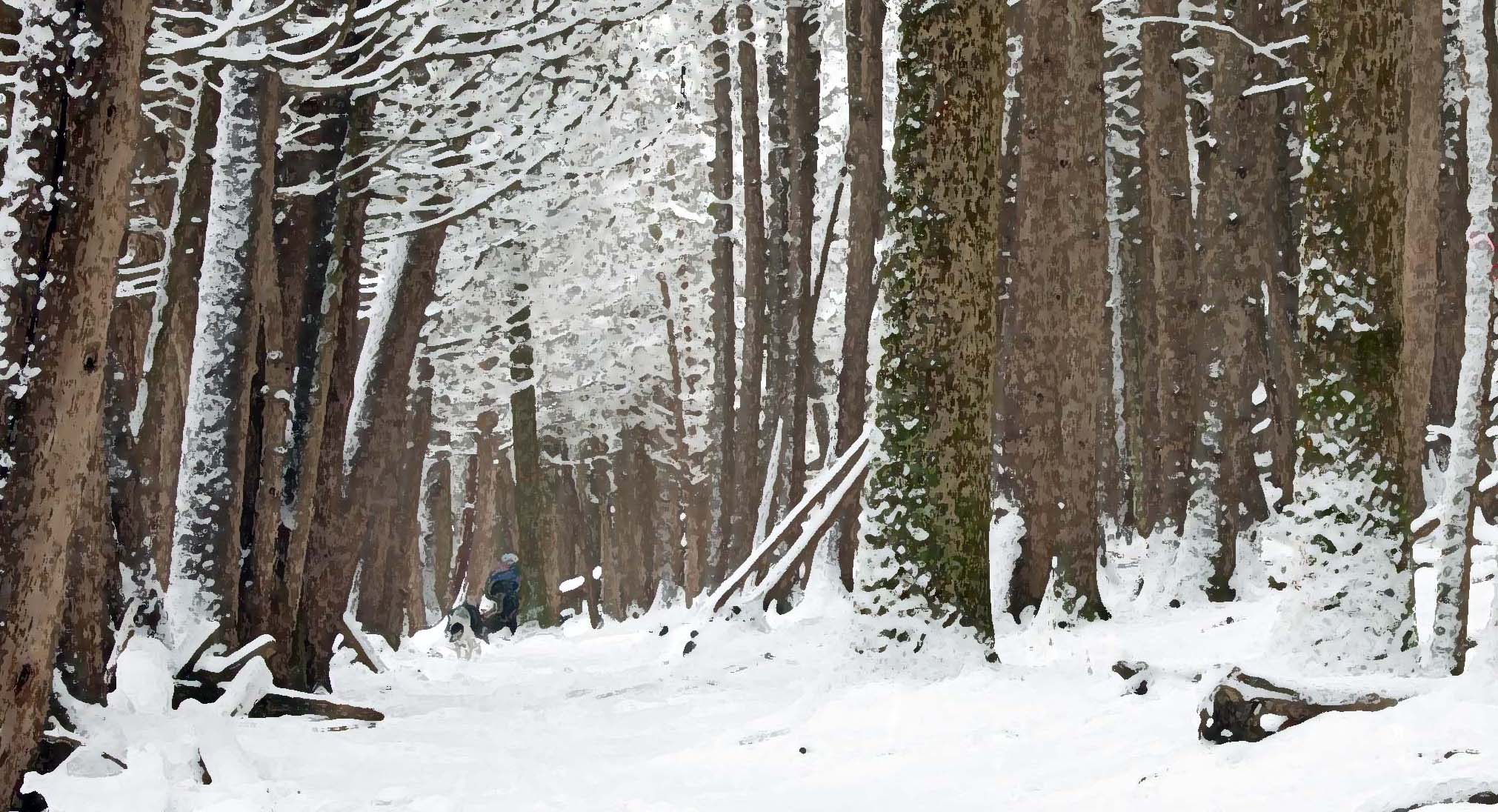
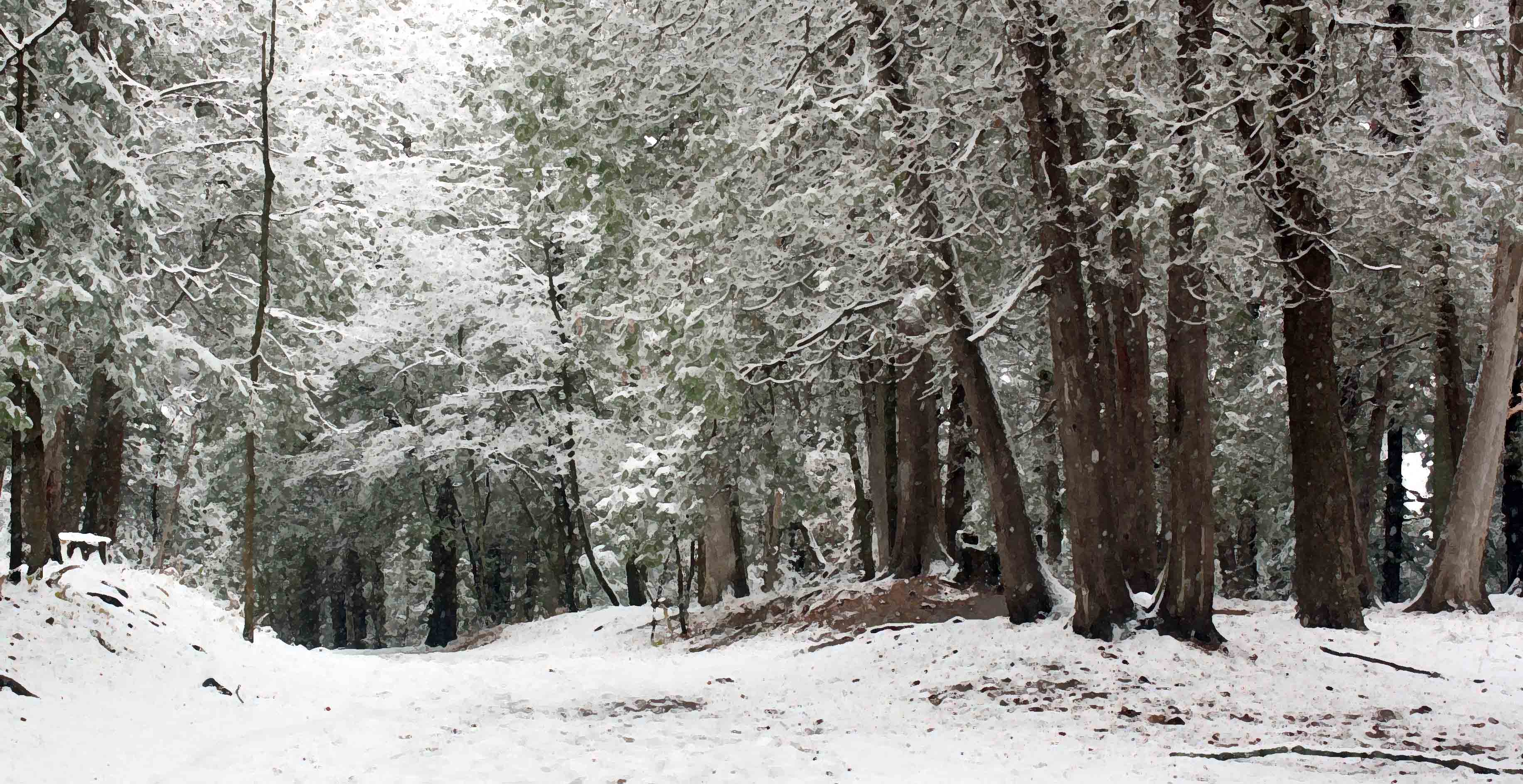
Cedar-pine forest covered in new snow of winter, ON (photo and rendition by Nina Munteanu)

I’m Canadian, and I love the snow. When I grew up in the Eastern Townships of Quebec, we enjoyed a brisk cold winter with deep snow for a good six months of the year. I’ve since lived in Vancouver, British Columbia, which experiences a milder regional climate; I now live in the Kawarthas of Ontario, which has a similar regional climate to what I experienced growing up in Quebec. Living in the Kawarthas reminds me of my childhood days with winter snow.
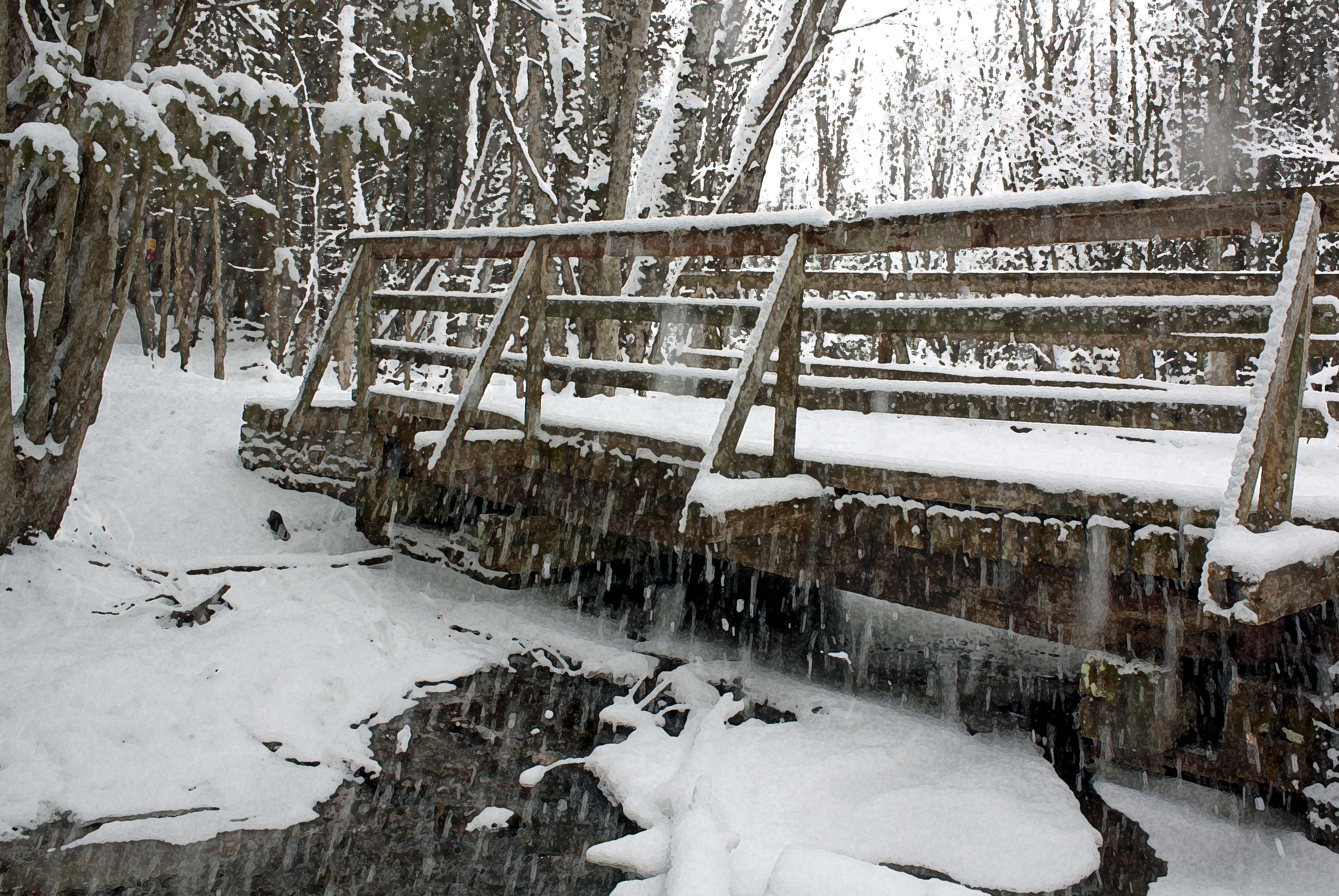
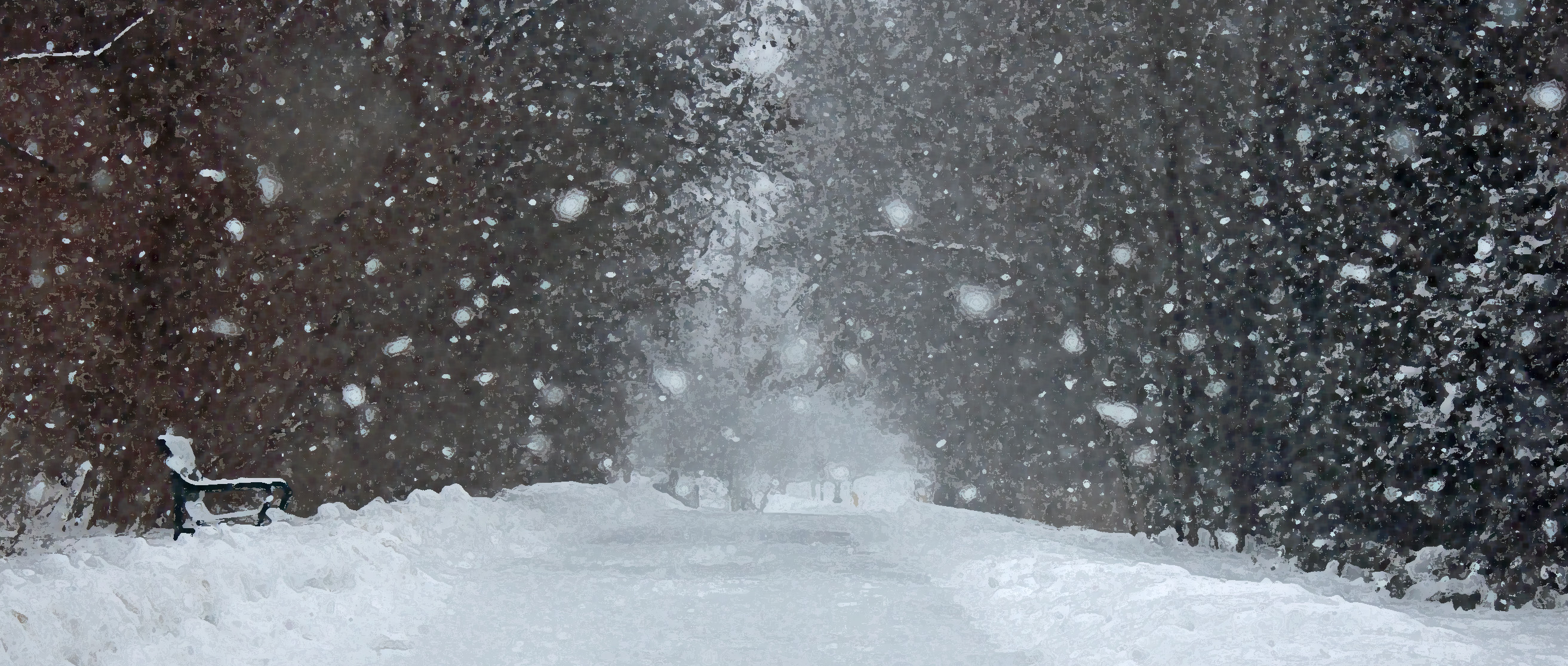
Heavy snowfall in Trent Nature Sanctuary, ON (photo and rendition by Nina Munteanu)

I love how the first snow of the season often comes from the sky in a thick passion. Huge flakes of unique beauty would settle on my coat sleeves and within minutes I’d be covered in snow. I would stand enraptured, arms out to catch snowflakes, and study each individual with admiration.
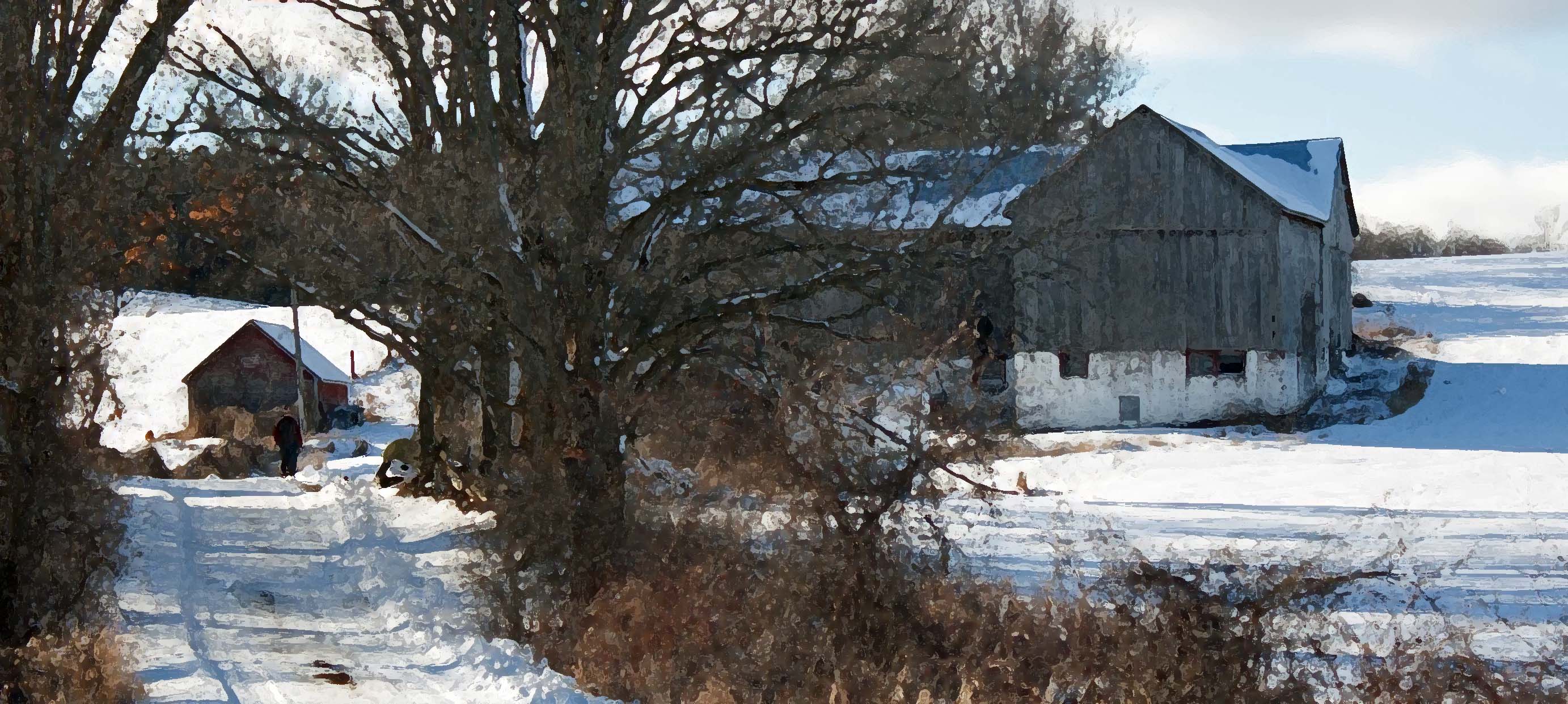
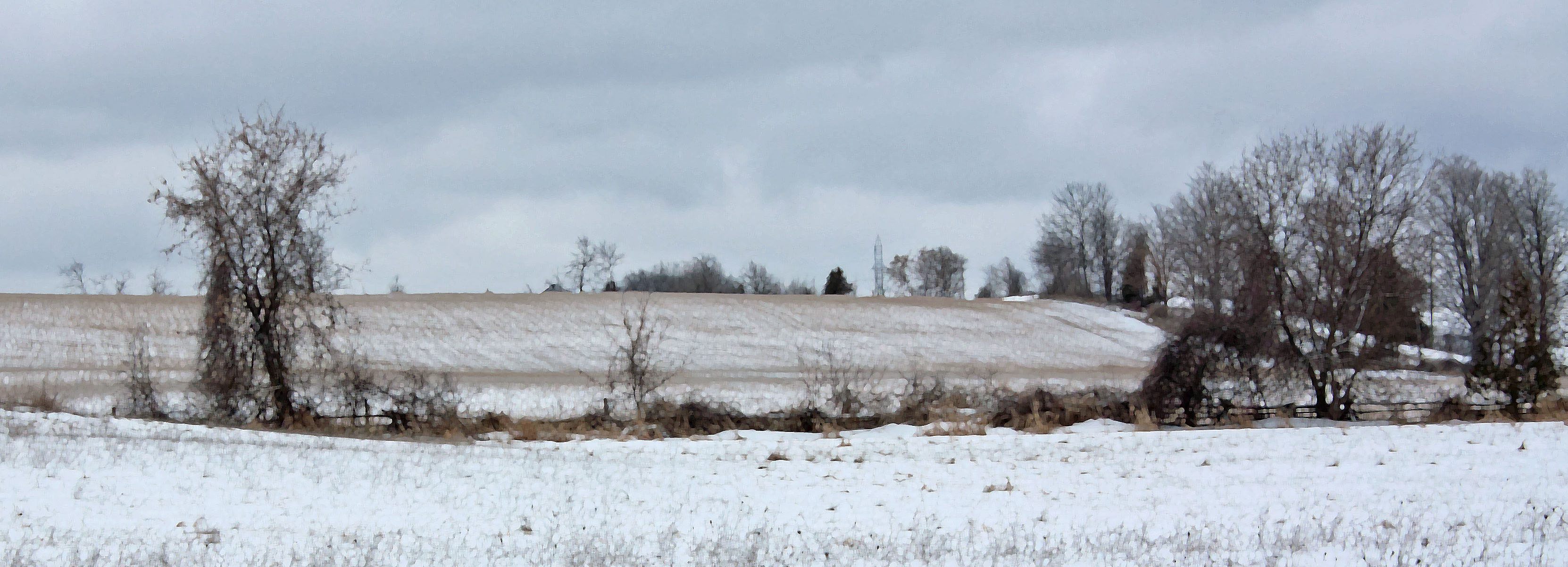
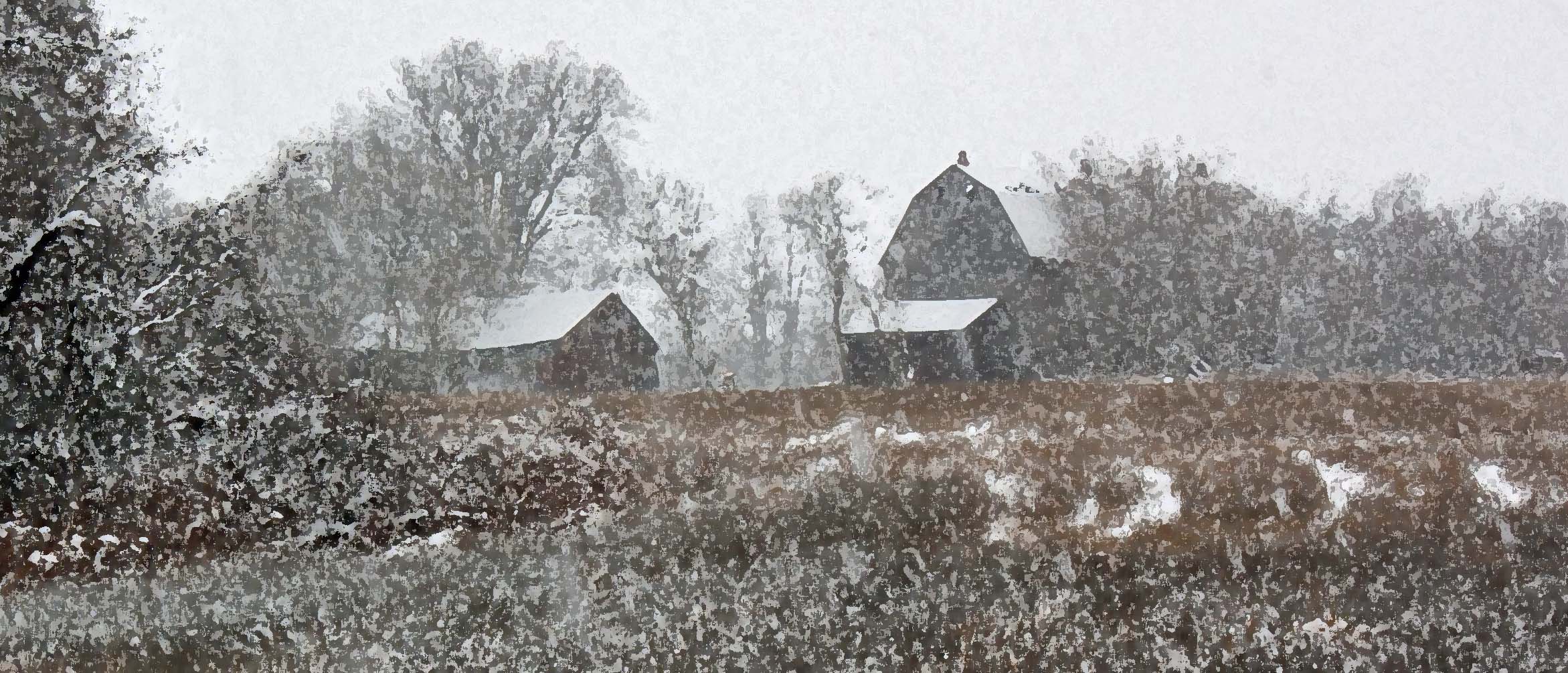
Farm and road in winter in Kawarthas, ON (photo and rendition by Nina Munteanu)
Young locust trees covered in new snow, ON (photo and rendition by Nina Munteanu)

Snow wraps everything in a blanket of soft acceptance. It creates a dazzling face on a dark earth. It refuses to distinguish between artificial and natural. It covers everything—decorated house, shabby old car, willowy trees, manicured lawn—beneath its white mantle. It quiets the Earth.

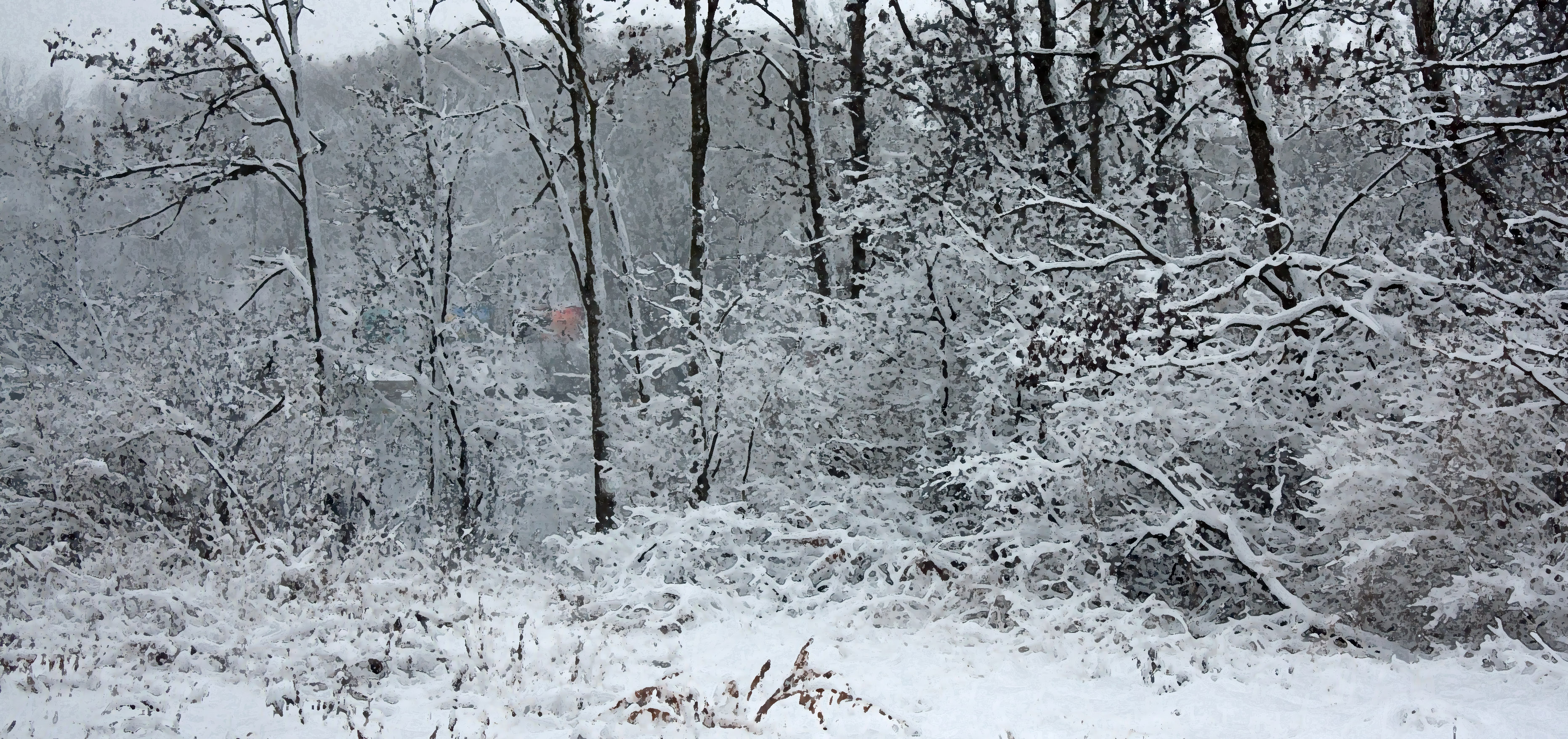
Trees and shrubs covered in new soft snow during snowfall, ON (photo and rendition by Nina Munteanu)

I often walk a trail through the forest after a fresh snow has fallen and the sun reveals itself on a crisp day. Like a balancing tightrope walker, the snow piles itself on everything, from fat fir branch to thin black locust twig. The snow then gives itself to the vagaries of a playful wind. Occasionally, a gust would send a shower of glitter snow dust raining down on me.

Snow-covered branches overlook path in show, ON (photo and rendition by Nina Munteanu)
Twigs piled with snow on a calm morning, ON (photo and rendition by Nina Munteanu)

I particularly enjoy walking a trail in the evening light after a fresh snow. Boots crunch on the fresh crisp snow that glistens in the moonlight. Each step is its own symphony of textured sound. A kind of collaboration with the deep of the night and Nature’s own whisperings.

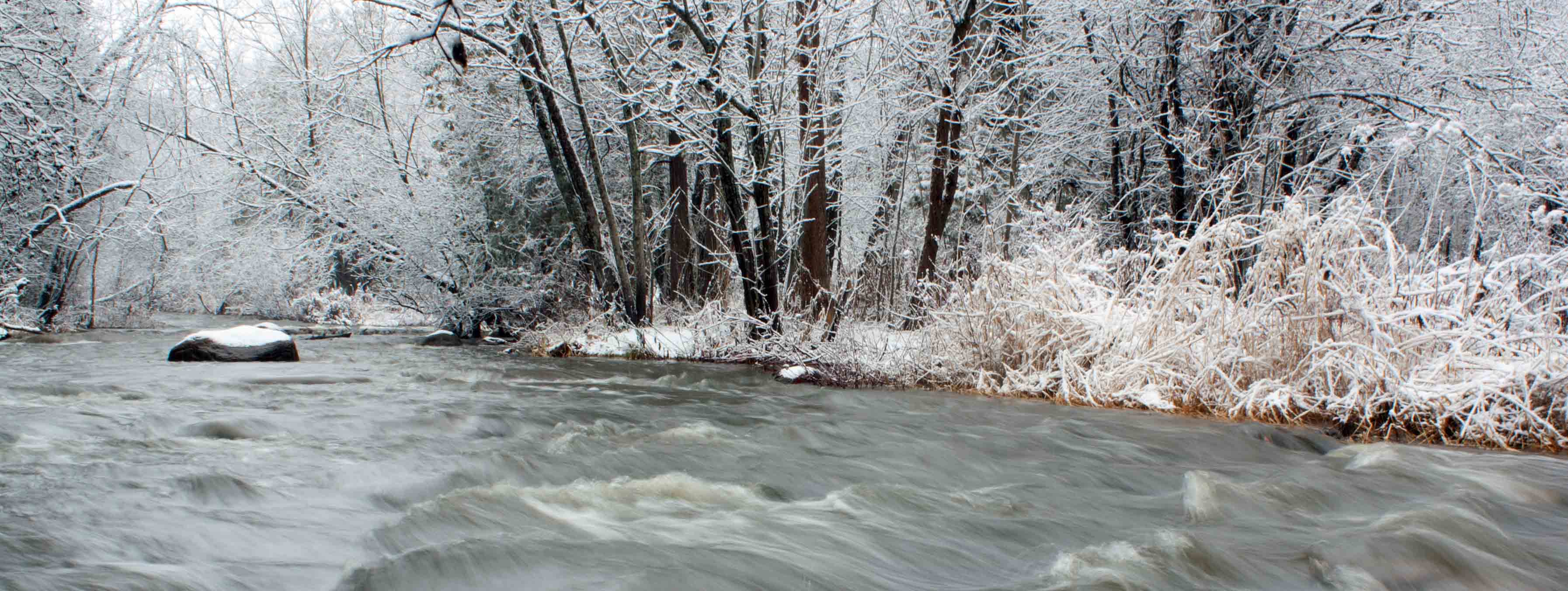
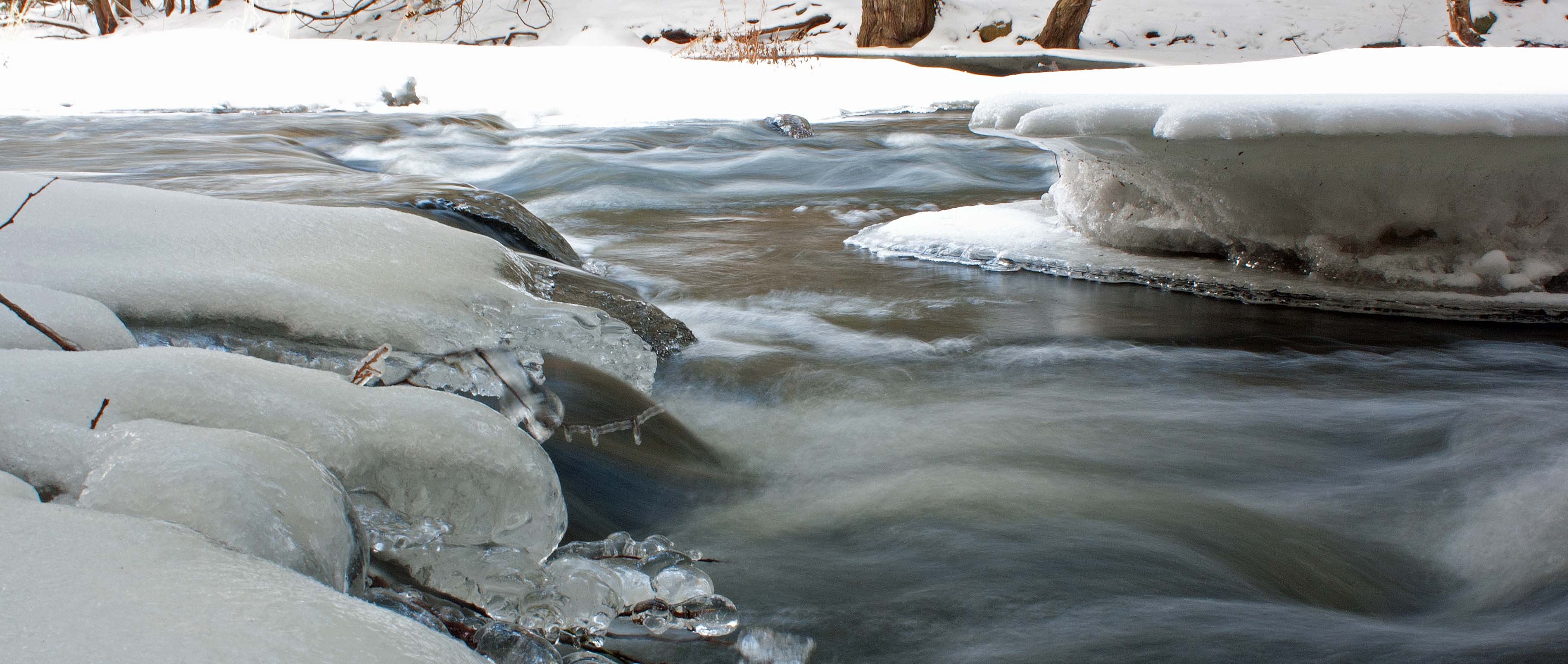
Jackson Creek after a snowfall, ON (photo and rendition by Nina Munteanu)

Since moving to the Kawarthas, close to the Otonabee River, I walk daily along the river and its riparian forest. Winters here have graced us with a variety of typical winter morphology: thick and copious snowfall, enduring fog, imaginative ice formations on the river, and glittering hoarfrost and rime everywhere else.  The first snowfall can come in November, large flakes falling on still fully-clothed shrubs and trees, creating a painter’s landscape of reds, yellows, and greens dusted in a white blanket. This is when, some mornings, mist will rise like a cold breath from the river or flow and pool in depressions of the rolling Kawartha drumlins.

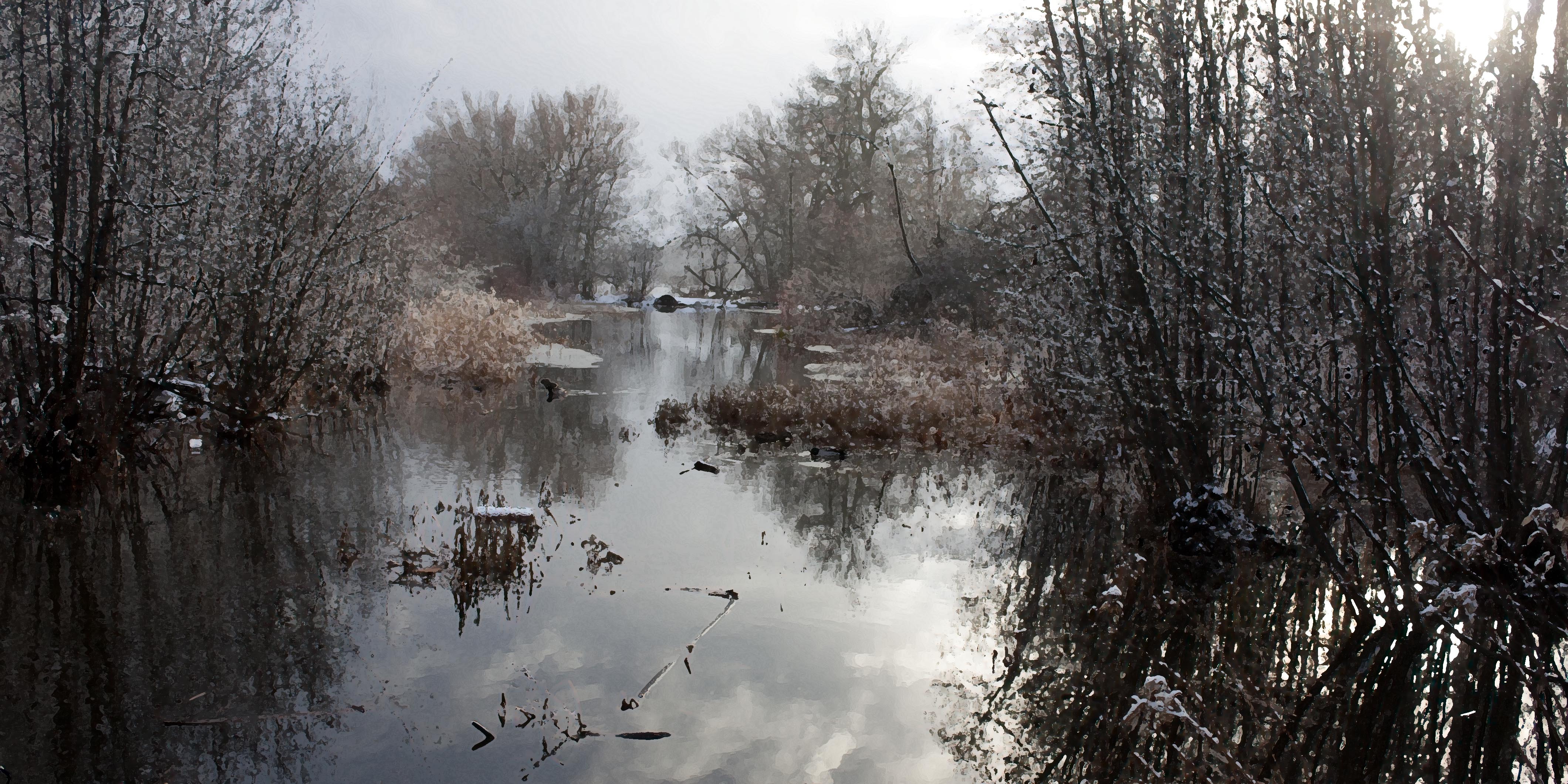
Thick first snowfall on Thompson Creek marsh in early winter, ON (photo and rendition by Nina Munteanu)

On cold nights in December, hoarfrost will form filigreed ‘leaves’ over everything—ground, sticks, ice and even snow. For a brief magical moment, this miniature crystal forest glitters like a field of jewels in the morning sun before vanishing by coffee break time. The river ices up in December, first with frazil that froths and fizzes as it coagulates into grease ice then shuga and finally to ice pancakes that crowd the shore, nudging each other like suburban women at a sale, then stitching themselves together into solid ice sheets attached to shore. By January and February, all is in place and the deep winter is upon us until ice break up and snow melt in late April into May. The river ice extends out from the bays in vast thick sheets where people can skate. The snow forms deep banks and drifts everywhere through which only snowshoes or skis can penetrate.

Mist off the river rises like steam on a cold day in winter, ON (photo by Nina Munteanu)
Old shed by the Otonabee River during a snowfall, ON (photo and rendition by Nina Munteanu)

Lately (in the past few years) I’ve noticed that this pattern has become interrupted by extremely mild weather throughout the winter season. January can look like November, with the exception of the absence of leaves on trees and shrubs; the greens and browns of other vegetation such as grasses, forbs and forest litter can still be revealed. The fogs of early winter may also return. The river ice sheets may fragment and flow downstream, only to reform as waters refreeze. The formerly uninterrupted reign of winter is waning and this saddens me with feelings of solastalgia. The Kawarthas still get good dumps of snow and magical frost. But for each champagne powder snow day, and hoarfrost glitter, there is a melt day, when snow melts and it rains, turning the parking lot into a skating rink as temperatures plummet with nightfall.

Snow melt on the side of a country road, ON (photo and rendition by Nina Munteanu)

I grew up in a part of Canada that experienced four distinct seasons. While spring and fall exemplify transition into and out of the two stable seasons of summer and winter, this is no longer the case in many parts of Canada, where formerly well-defined and uninterrupted winters and summers could be predicted. Now all the seasons experience transition and unpredictable phenomena. Winter temperatures in the Kawarthas were often stable at just below zero Centigrade to minus 20°; they now fluctuate more highly from minus 20° to +10.

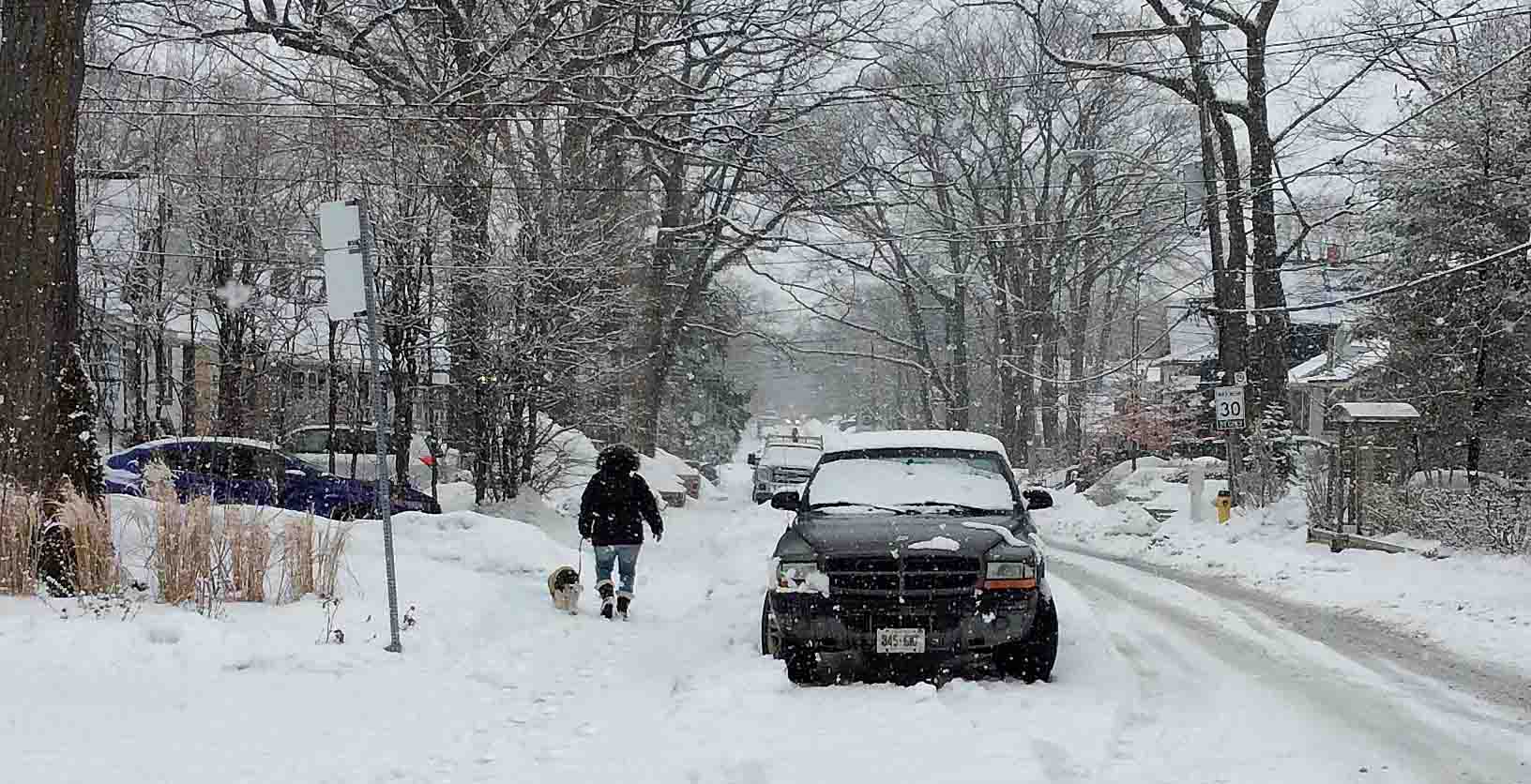
Author’s car parks on a country road after a snowfall, ON (photo and rendition by Nina Munteanu)

A report by NASA’s Goddard Institute for Space Studies released in 2022 confirmed that global temperatures in 2022 were 1.6 degrees Fahrenheit above the average baseline period of 1951 to 1980 and 2 degrees warmer than the late 19th century average. They reported that the past nine years have been the warmest since modern record keeping began in 1880.

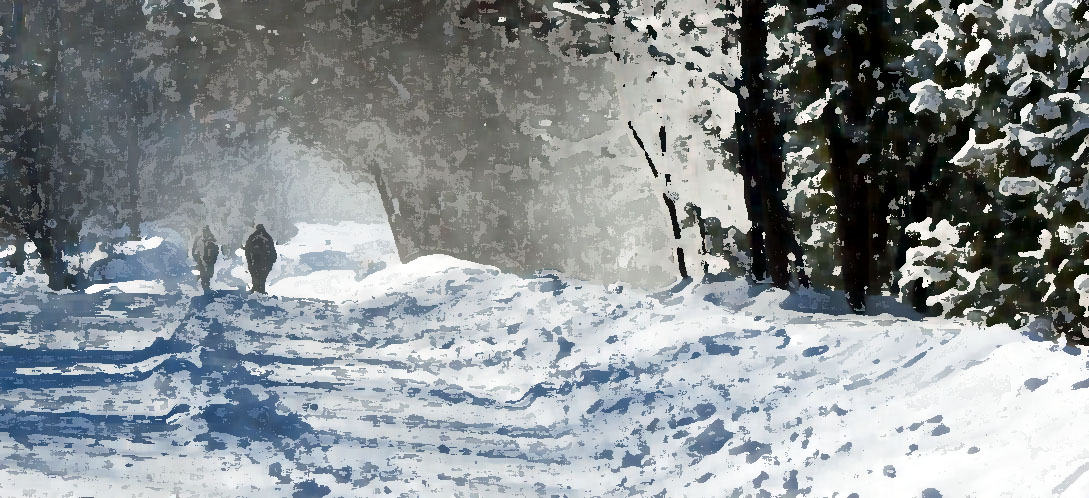
Teenagers walk the Rotary Trail after a snowfall, ON (photo and rendition by Nina Munteanu)

The winter that I grew up with is changing into something else. It, like the changing world, is in transition. There is no denying that global warming is upon us and each region is uniquely experiencing its effects. Climate is changing and the environment is adapting to that change.

Thompson Creek after a snowfall, ON (photo and rendition by Nina Munteanu)

While solastalgia creeps into my psyche at times, I am assiduously learning to pace myself with my changing environment. As the regional weather adapts to the warming climate, I am learning to adapt too. One way is through the equipment I use: I still use my snowshoes (a recent gift from my son) in winter; but, more often, I use snow/rain boots with crampons for terrain that includes wet snow, slush, and ice. Being prepared for change allows me to accept it with grace. I have learned to cherish those moments when fresh snow falls from the heavens like confetti. I charge outside in my snow gear and enjoy it while it’s there. I have learned to live in discovery and to thrill in the unpredictable. Each day is a gift of unknown and thrilling surprise.
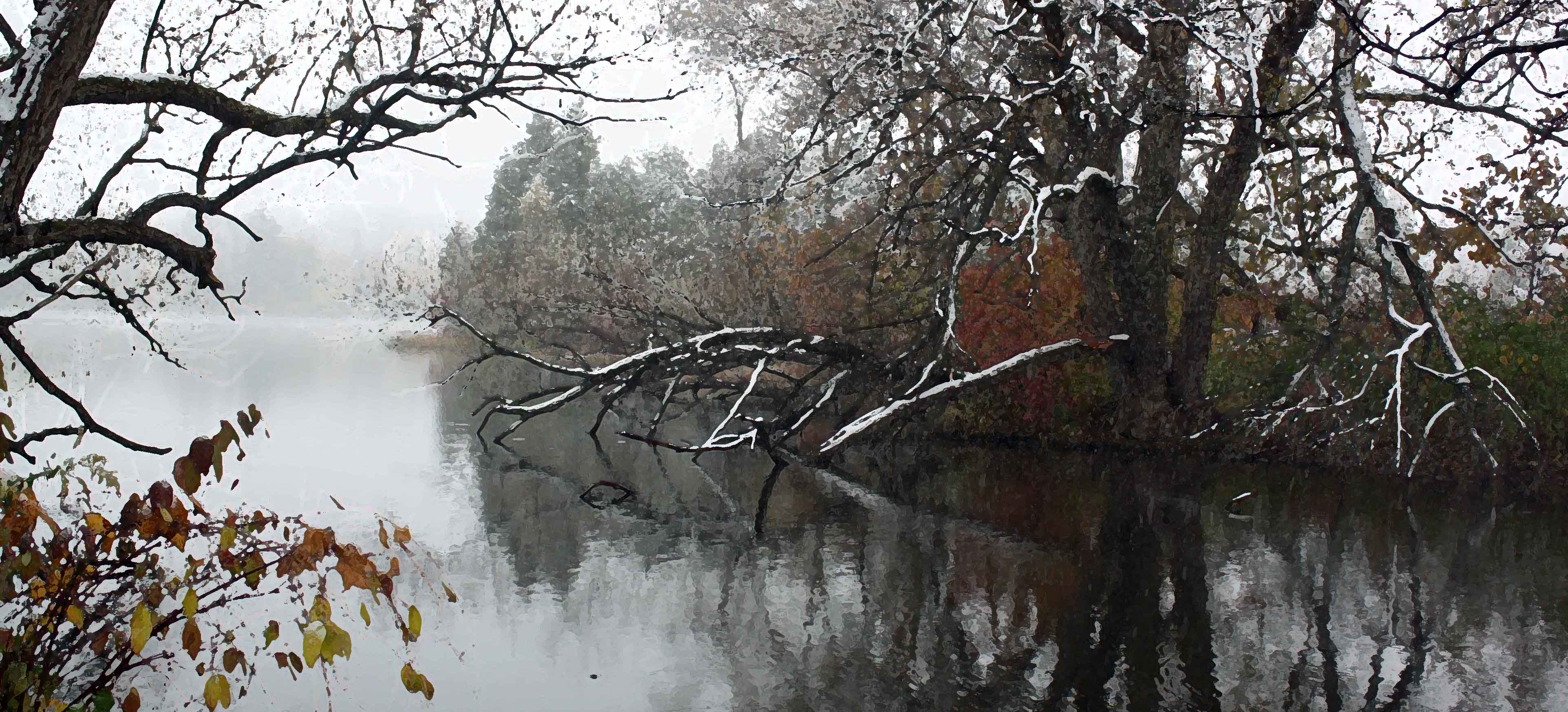
First snow in early winter at Thompson Creek, ON (photo and rendition by Nina Munteanu)

I have learned to live in the moment and to cherish that moment as a gift.

Because, even change is a gift.
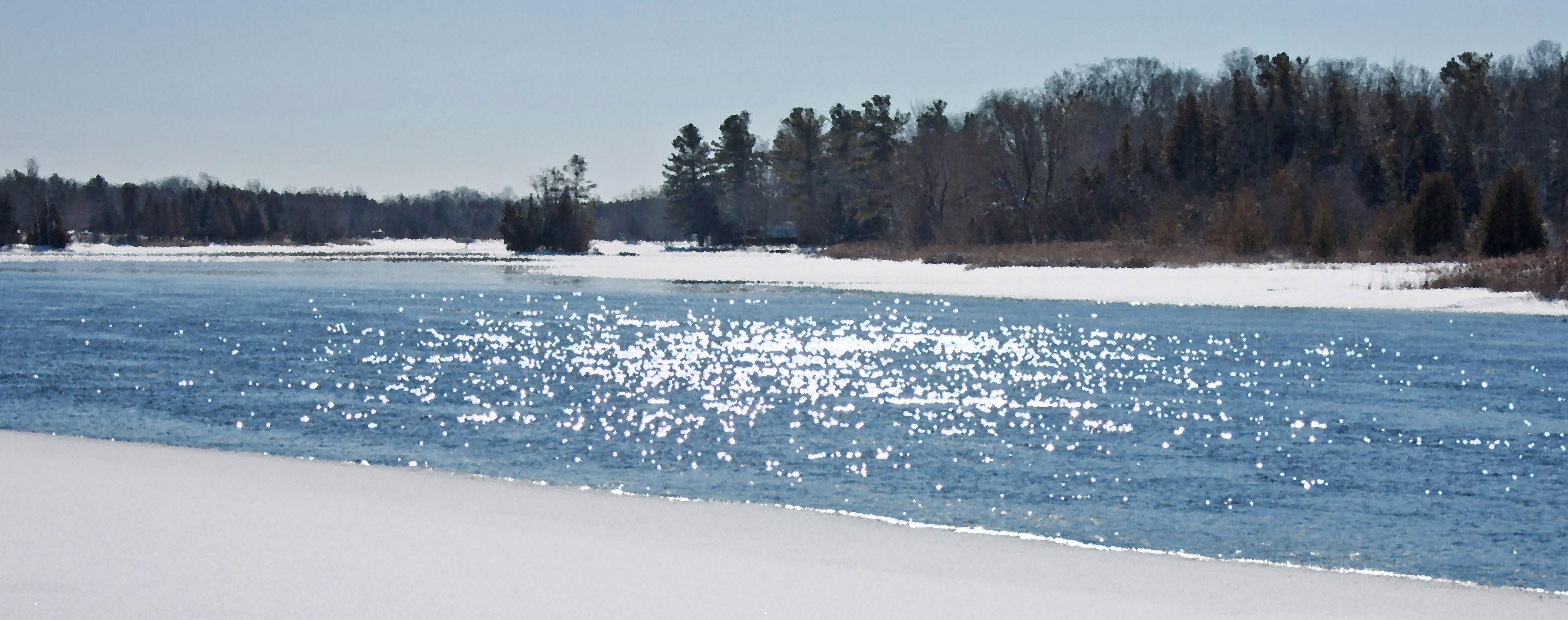
Partially iced over Otonabee River, ON (photo and rendition by Nina Munteanu)

Article originally published January 2023 in Rewilding Our Stories (edited by Mary Woodbury) then January 2, 2024 on Dragon.eco.
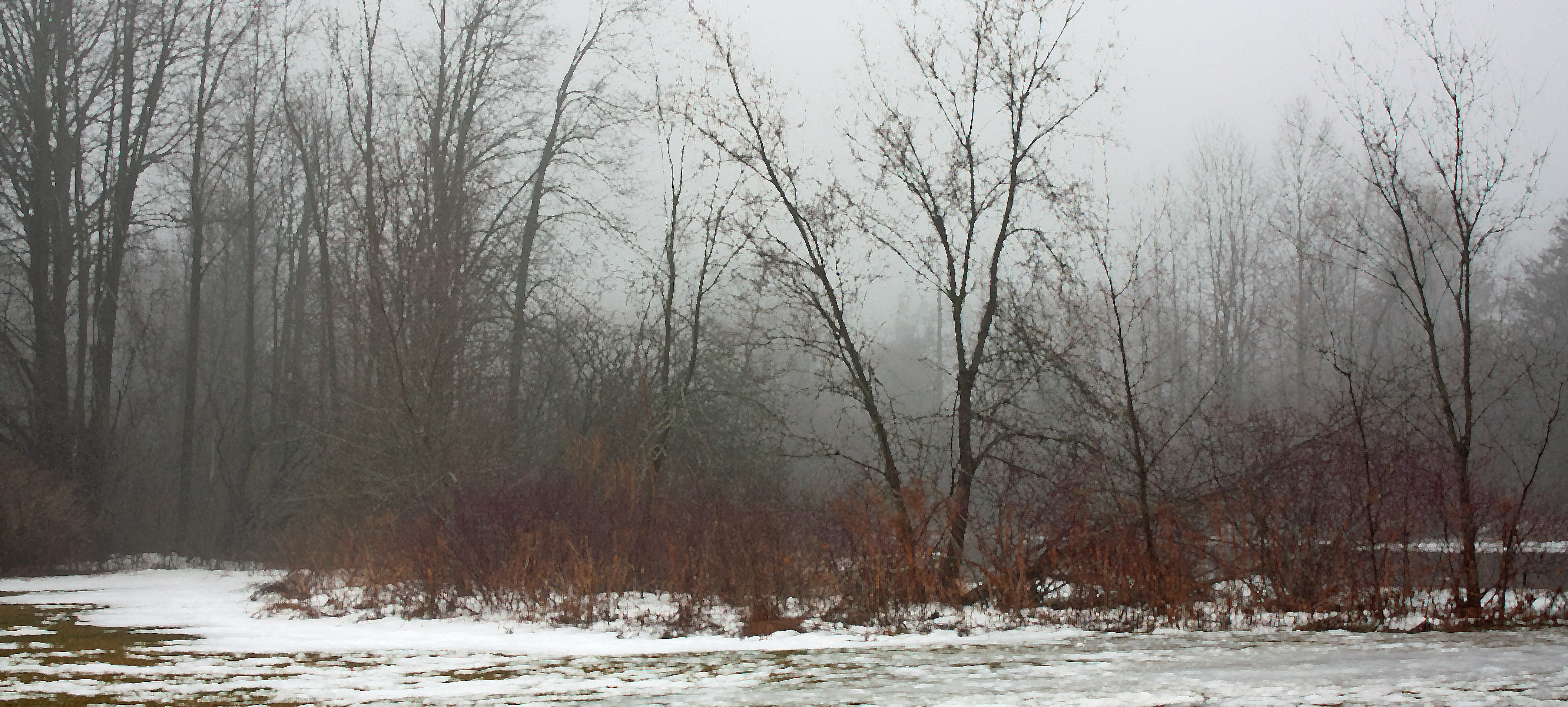
Trees and dogwood shrubs in winter by the Thompson Marsh, ON (photo and rendition by Nina Munteanu)
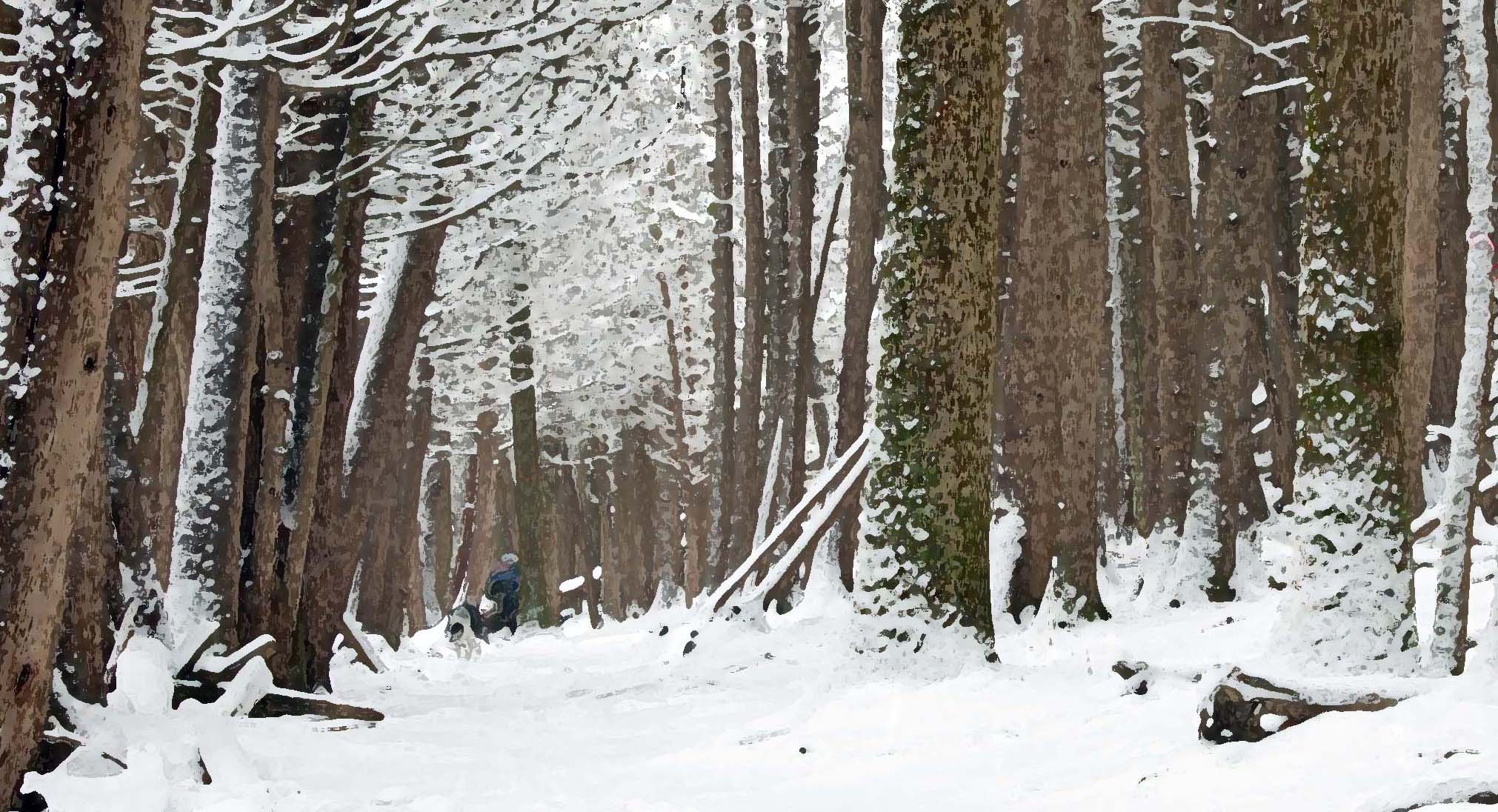
Woman and her dog walk among giant cedars after a snowfall, ON (photo and rendition by Nina Munteanu)

Nina Munteanu is a Canadian ecologist / limnologist and novelist. She is co-editor of Europa SF and currently teaches writing courses at George Brown College and the University of Toronto. Visit www.ninamunteanu.ca for the latest on her books. Nina’s bilingual “La natura dell’acqua / The Way of Water” was published by Mincione Edizioni in Rome. Her non-fiction book “Water Is…” by Pixl Press (Vancouver) was selected by Margaret Atwood in the New York Times ‘Year in Reading’ and was chosen as the 2017 Summer Read by Water Canada. Her novel “A Diary in the Age of Water” was released by Inanna Publications (Toronto) in June 2020.
When Ice Shapes Art…

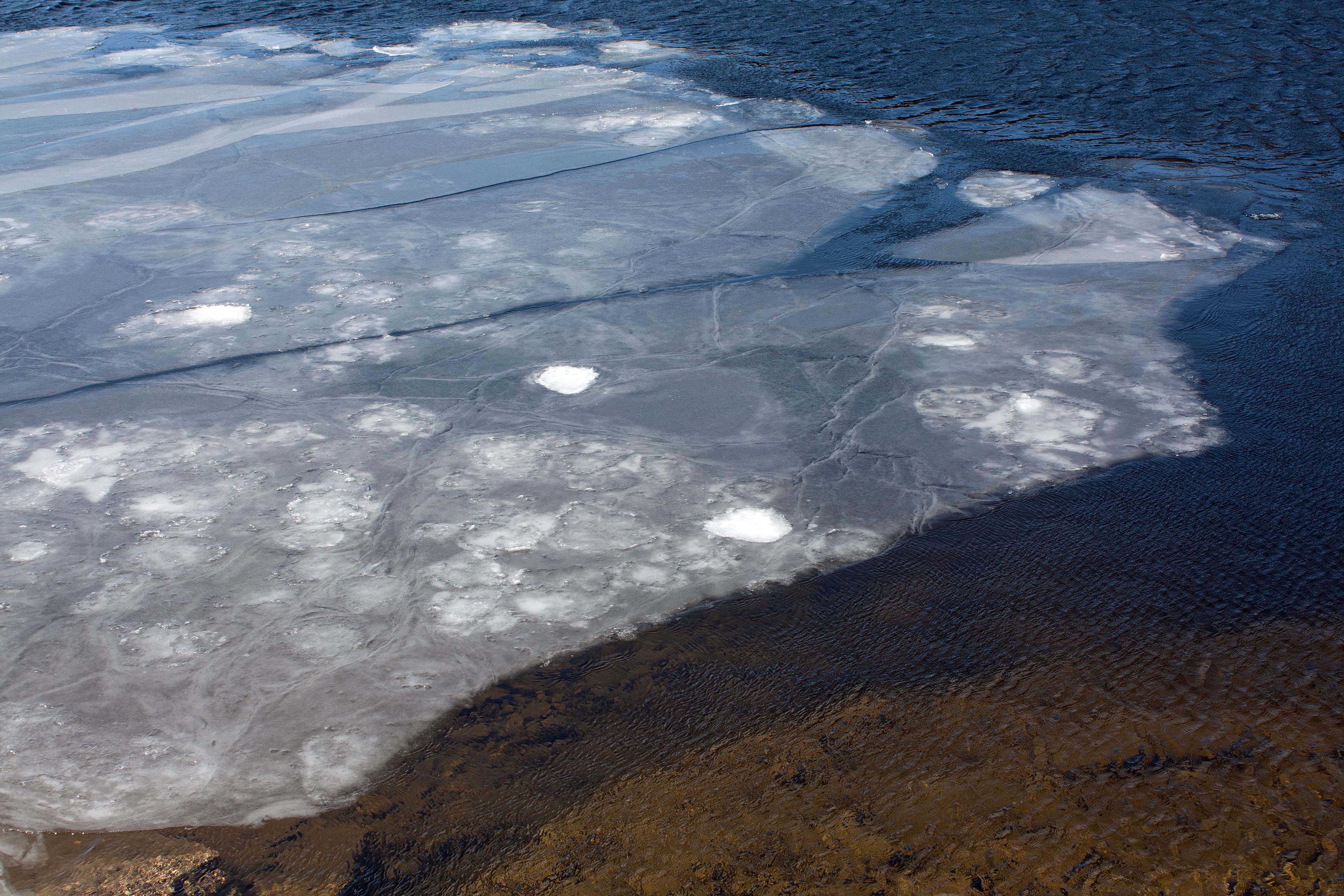
Ice sheet with embedded pancake ice breaking into fragments on the Otonabee River, ON (photo by Nina Munteanu)

It’s spring and every day on the river is different. One day the ice thaws. The next day it reforms only to thaw again.

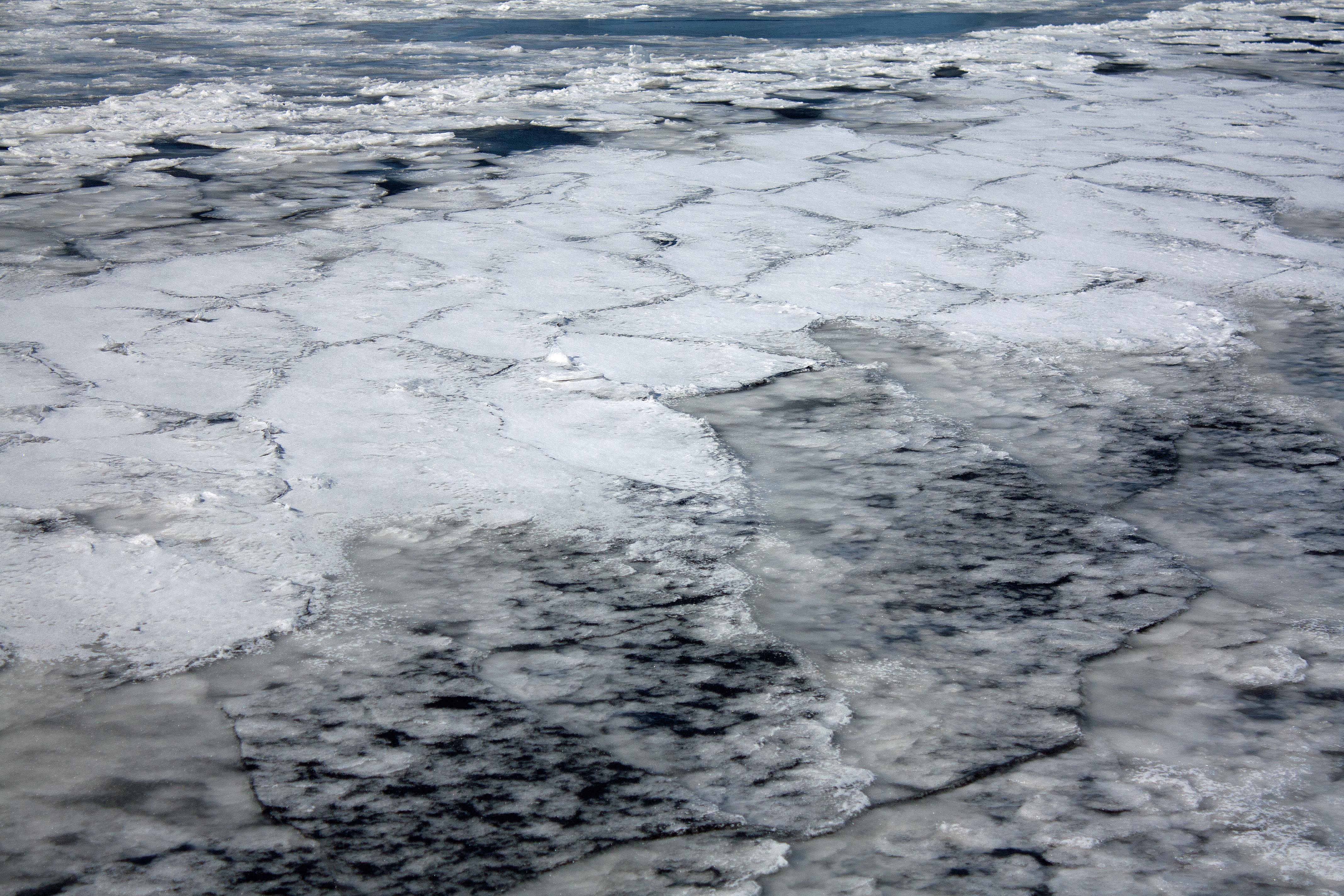
Ice sheet stitched together by ice pancakes and fragments, ON (photo by Nina Munteanu)

I love watching the process of ice pancake formation and reformation on the Otonabee River. It starts with primordial ice-froth, which then coagulates into ice sheets. These sometimes look like fabric or white felt.

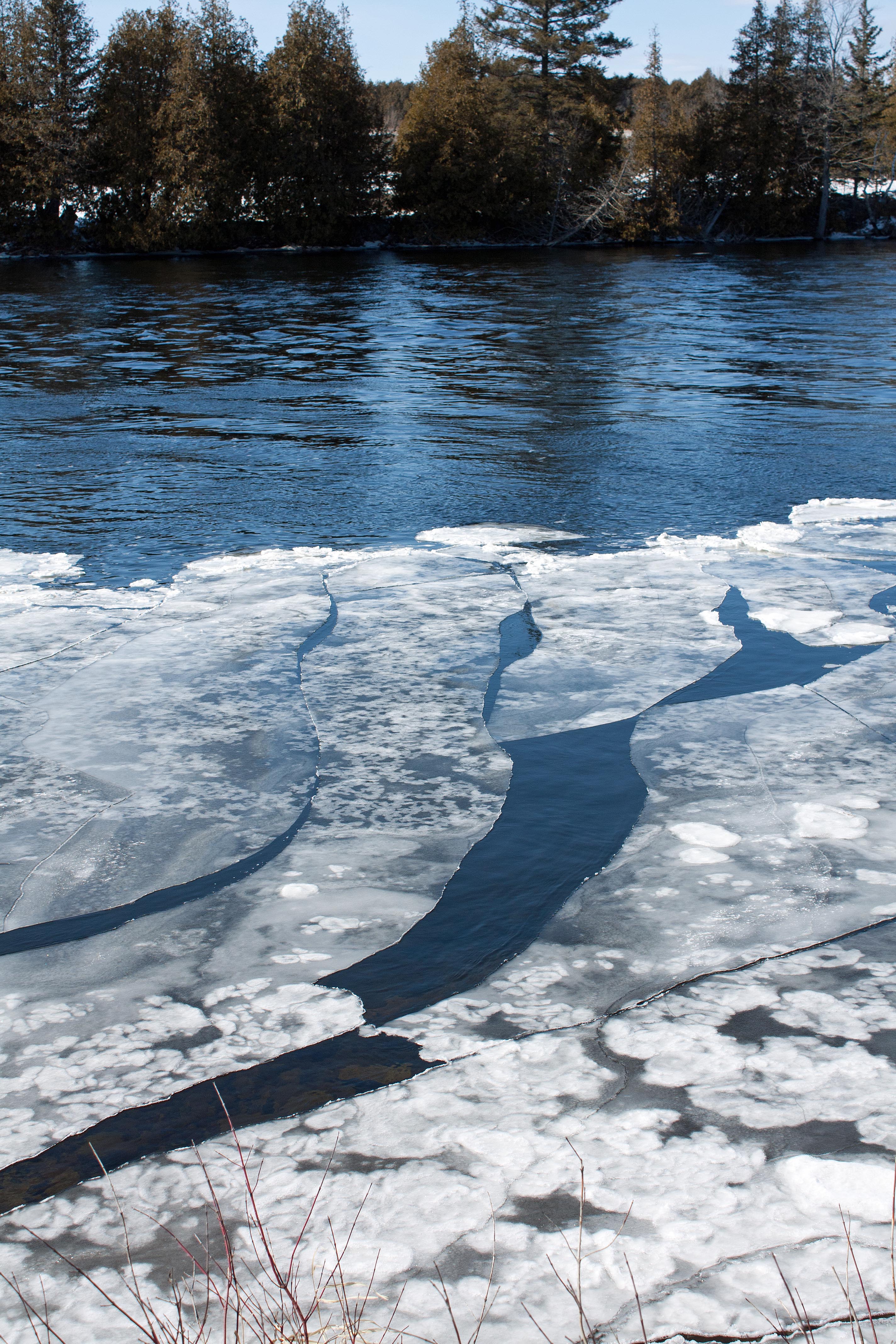
Giant ice fragments with embedded pancake ice break off ice sheets in spring on the river, ON (photo by Nina Munteanu)

Then entire sheets break up into long fragments like giant pieces of glass shards, all floating down the river, little opaque pancakes embedded in clear glassy sheets. And the water beneath is the darkest blue.

Ice pancakes glued into an ice sheet by clear ice formed around them (photo by Nina Munteanu)
Ice sculptures form as wave-induced ice shuga collide and form strange shapes, Otonabee River, ON (photo by Nina Munteanu)

Nina Munteanu is a Canadian ecologist / limnologist and novelist. She is co-editor of Europa SF and currently teaches writing courses at George Brown College and the University of Toronto. Visit www.ninamunteanu.ca for the latest on her books. Nina’s bilingual “La natura dell’acqua / The Way of Water” was published by Mincione Edizioni in Rome. Her non-fiction book “Water Is…” by Pixl Press(Vancouver) was selected by Margaret Atwood in the New York Times‘Year in Reading’ and was chosen as the 2017 Summer Read by Water Canada. Her novel “A Diary in the Age of Water” was released by Inanna Publications (Toronto) in June 2020.
The Sound of Snow…

Heavy snowfall where I live in Ontario (photo by Nina Munteanu)

I currently live in Ontario, Canada, where the four seasons are still distinct and winter comes with signature cold temperature well below zero degrees Centigrade along with lots and lots of snow. I grew up in Quebec, where the snow often piled up higher than I stood tall. Temperatures often went into the minus zero teens and twenties with wind chills reaching minus thirty degrees. This called for the right equipment. Insulated coat or jacket, snow pants, wool toque and mittens and/or gloves that are also well insulated. And, of course, warm snow boots.

Nina on a walk during a snowstorm, ON (photo by Merridy Cox)
Country road in the Kawarthas, ON (photo and rendition by Nina Munteanu)
Nina’s car on ‘walkabout’ through Kawartha country after a fresh snowfall, ON (photo and rendition by Nina Munteanu)
Farm in the Kawarthas, ON (photo and rendition by Nina Munteanu)
Cows on a farm in the Kawarthas, ON (photo and rendition by Nina Munteanu)
Country field in Kawarthas, ON (photo and rendition by Nina Munteanu)
School kids heading to class after a fresh snow, ON (photo by Nina Munteanu)
The Rotary Trail after a fresh snowfall, ON (photo and rendition by Nina Munteanu)
Heavy snow falls on a trail in the Kawarthas, ON (photo and rendition by Nina Munteanu)

Since moving to the West Coast then back east to Ontario, I’ve come to realize that I love winters. I love how snow covers everything, how it quiets the landscape and changes it in subtle ways. I love the frigid wind, how it bites the face with invigorating energy, reminding me that I am so alive. I love the sounds of winter, of walking on snow, crunching and squeaking, of the howl of the wind and the creaking and groaning of the trees, or the cracking and booming of the ice forming and reforming on the river.

Bridge over creek in Trent Nature Sanctuary during heavy snowfall, ON (photo and rendition by Nina Munteanu)
Jackson Creek after a fresh snowfall, ON (photo and rendition by Nina Munteanu)
Woman and her dog walk through cedar swamp forest after a fresh snowfall, ON (photo and rendition by Nina Munteanu)
Riparian forest clothed in fresh snow, ON (photo and rendition by Nina Munteanu)
Riparian forest after a fresh snowfall, ON (photo and rendition by Nina Munteanu)

I am currently finishing my fiction book Thalweg, which takes place throughout Canada, but predominantly in northern British Columbia and the arctic of the Northwest Territories. My main character, a Gwich’in scientist, explores the land during a time of climate change, and much of it involves the expansive vast snowfields of northern Canada in which she describes the look, smell, feel, and sounds of snow. She thinks with great fondness of home in the Arctic where snow prominently features and, bringing in all her senses, of course, includes sound:

There are many different kinds of snow, and any native of the north can recognize them. We can not only tell something of the quality of weather from it, but also its history. Without having experienced the day or history of the place, we will know simply from walking through it. For instance, on a minus twenty-degree Centigrade day, when the cold bites your face and your breath coils out of your mouth like steam, old snow shines under a raking sun like an ice sheet. As though clear plastic was stretched over it. Sometimes, a hoar frost will form on the glassy thin layer, adding more glitter. Walking through it creates a symphony of crunch, pop and skittle sounds as each step breaks through the thin brittle layer into soft snow underneath. The scattering flat shards tingle like glass across the glistening ice-snow sheet.

Fresh snow that has fallen on a frigid night of minus fifteen degrees in a drier climate is fluffy, individual snowflakes glinting like jewels in the sun, and emits a high-pitched squeak and crunch as your boots press down on it. The colder the temperature, the higher the squeak. I just made that up. I’m not sure if it’s true. But considering the relationship of harmonics with temperature, it’s plausible.

Squeaky snow is the snow of my home up north, where it arrives in a thick passion in October with the winter darkness, and where a constant minus 16°C to minus 30°C pervades until spring, six months later. The snow resembles powdered sugar, glittering like millions of tiny mica flakes under the moonlight of an arctic winter night. It covers everything, the ground, the trees and tiniest vegetation with a white blanket of snow. And when the wind teases the trees, they rain glitter-dust. In places where the north wind freely drifts across open landscape, sastrugi form; frozen wavelets, mini-barchans and dune chains that resemble the wave ripples of a sandy white beach. In some vast open areas, the wind will sculpt a frozen sea of irregular ridges and grooves up to a metre high. Mary’s friend Jem from Igloolik calls these snowdrifts qimugruk, whose distinctive shapes become permanent features of the snowscape, with tips always pointing west-northwest. Igloolik hunters use these uqalurait to set their bearings when travelling across the expansive tundra, particularly during poor visibility from storms or darkness.

Tracks through a small path by the river, ON (photo and rendition by Nina Munteanu)
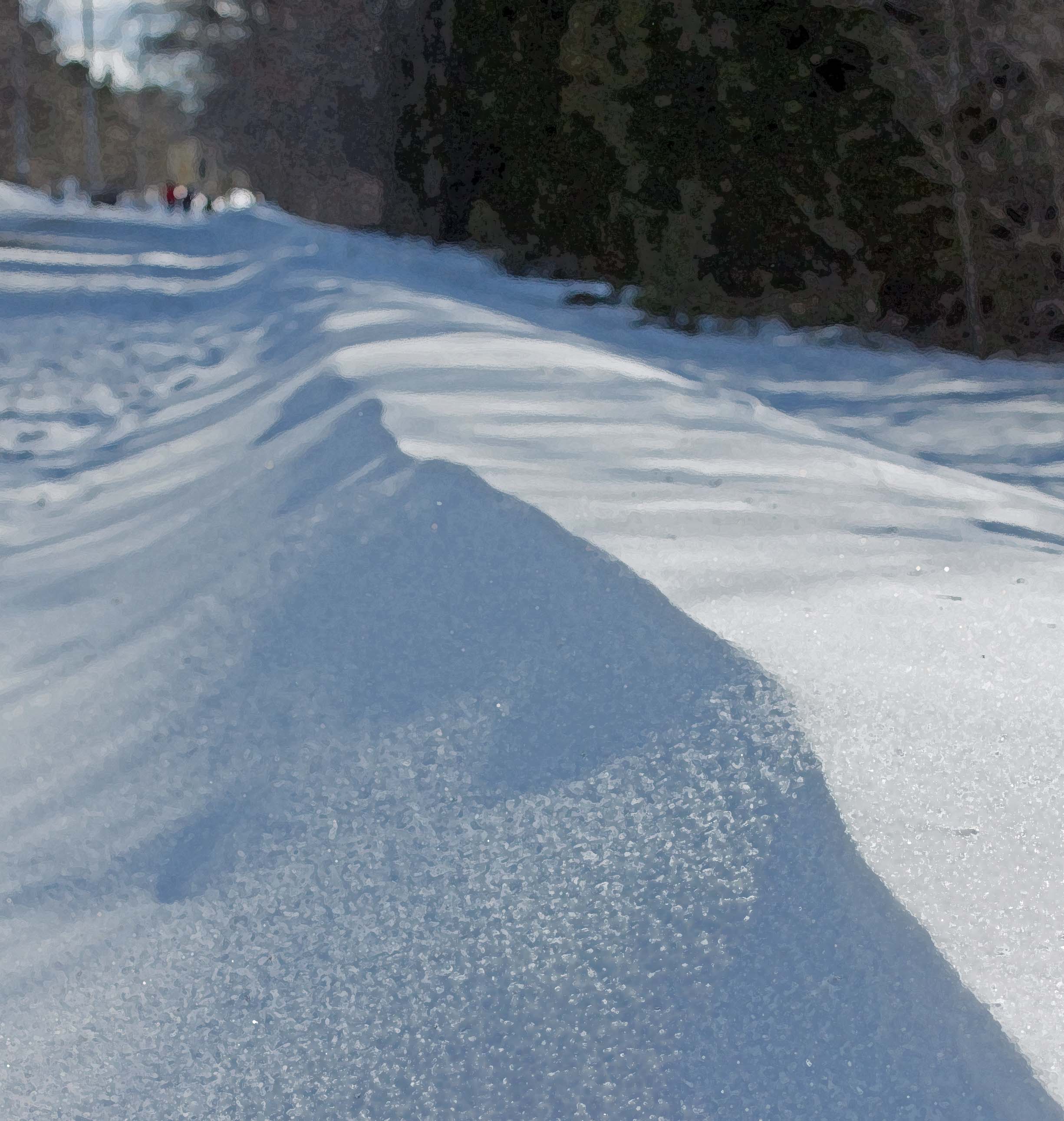
Snow drift on a trail by the river, ON (photo and rendition by Nina Munteanu)

One of the sensitivity readers for Thalweg, anthropologist and Gwich’in scholar Ingrid Kritsch, related to me an interesting account during attempts to open up to oil and gas development the Arctic National Wildlife Refuge–a critical area where the Porcupine Caribou herd calve. “To many Americans, it was just a big, white, barren expanse of unused lands,” said Ingrid. “She recalled a Senator speaking for development on these lands. The Senator held up a blank sheet of white paper and claimed ‘this is what the area looks like!’

The vast snowfields look nothing like that…

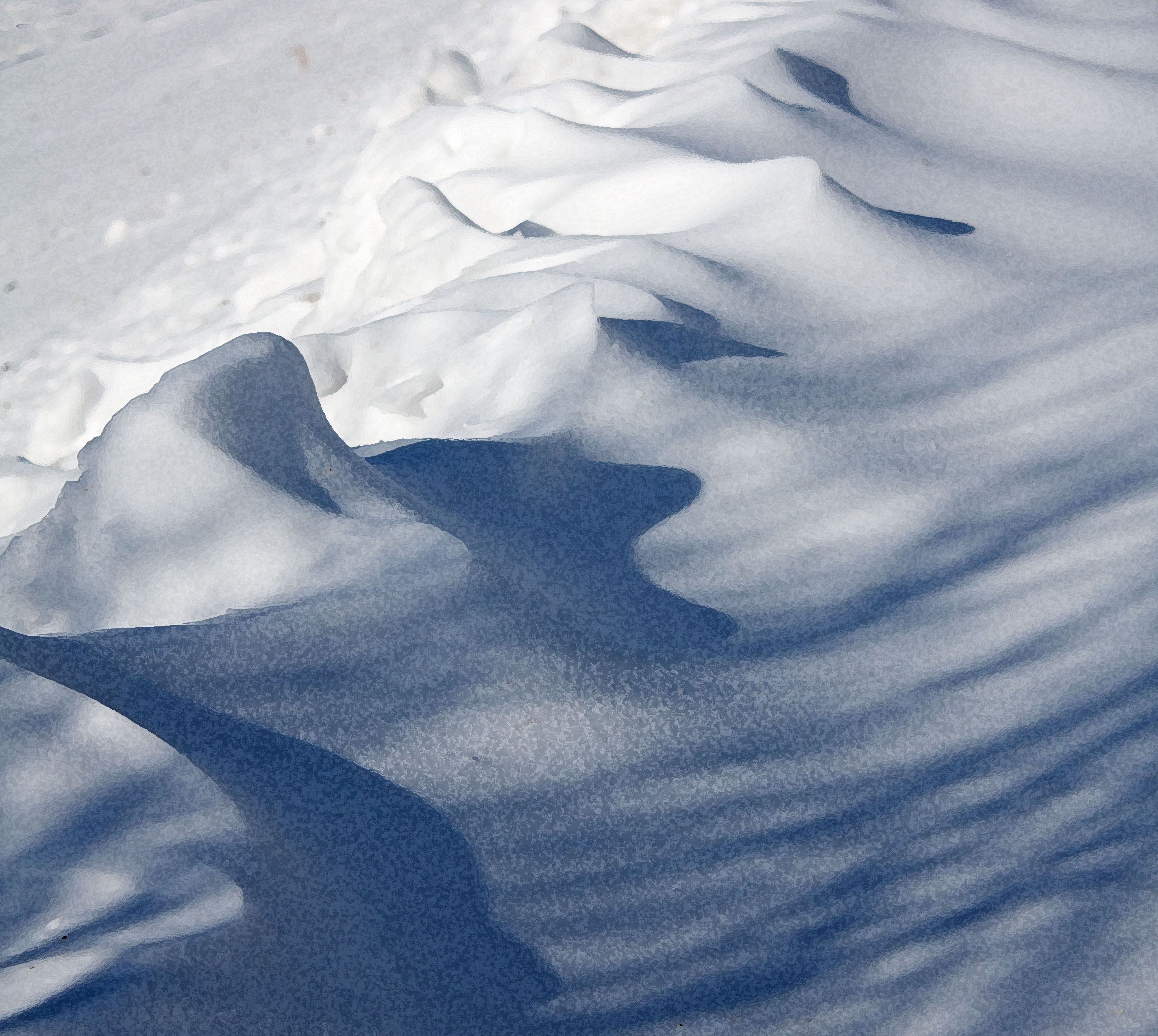
Snow drifts in Ontario (photo and rendition by Nina Munteanu)

…Now, don’t forget to play in the snow…

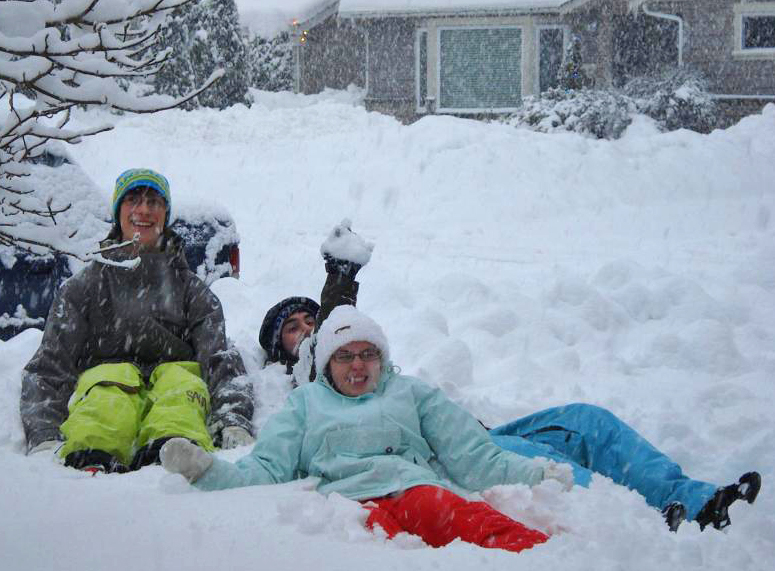
Author’s son and friends play in fresh snow on Christmas in BC (photo by Nina Munteanu)
Nina Munteanu reads a book with her cup of tea in +8 degree C, ON (photo by Merridy Cox)

Nina Munteanu is a Canadian ecologist / limnologist and novelist. She is co-editor of Europa SF and currently teaches writing courses at George Brown College and the University of Toronto. Visit www.ninamunteanu.ca for the latest on her books. Nina’s bilingual “La natura dell’acqua / The Way of Water” was published by Mincione Edizioni in Rome. Her non-fiction book “Water Is…” by Pixl Press(Vancouver) was selected by Margaret Atwood in the New York Times‘Year in Reading’ and was chosen as the 2017 Summer Read by Water Canada. Her novel “A Diary in the Age of Water” was released by Inanna Publications (Toronto) in June 2020.
The Beauty & Magic of Snow

Nina, the snow bear, enjoying a heavy snowfall in early winter, ON (photo by M. Cox)

I grew up in southern Quebec, where the first snow of the season often came from the sky in a thick passion. Huge flakes of unique beauty settled on my coat sleeves and within minutes I was covered in snow. I would stand enraptured and study each one as I could. Snow wraps everything in a blanket of soft acceptance. It creates a dazzling face on a dark Earth. It refuses to distinguish between artificial and natural. It covers everything—decorated house, shabby old car, willowy trees, manicured lawn—beneath its white mantle. It quiets the Earth.

Old barn after a fresh snow near Wolfville, NS (photo by Nina Munteanu)

Have you ever gone for an evening walk in the fresh crisp snow, boots crunching, snow glistening in the moonlight? Each step is its own symphony of textured sound. A kind of collaboration with the deep of the night and Nature’s own whisperings.

Heavy snowfall in a forest during early winter, ON (photo by Nina Munteanu)
A heavy snow falls in the Beach in Toronto, ON (photo by Nina Munteanu)

Snow is a shape shifter, charging down in a fierce blizzard and as glittering hoarfrost that forms on cold, clear nights. Snow is a gypsy, conspiring with the clever wind to form mini-tornadoes and swirling on the cold pavement like misbehaving fairies. It drifts like a vagabond and piles up, cresting over the most impressive structure, creating phantoms out of icons. Some people, fearful of the chaos and confusion that snow brings, hide indoors out of the cold. Others embrace its many forms, punching holes through the snow crust to find the treasure of powder beneath or ploughing through its softness, leaving behind an ivory trail of adventure.

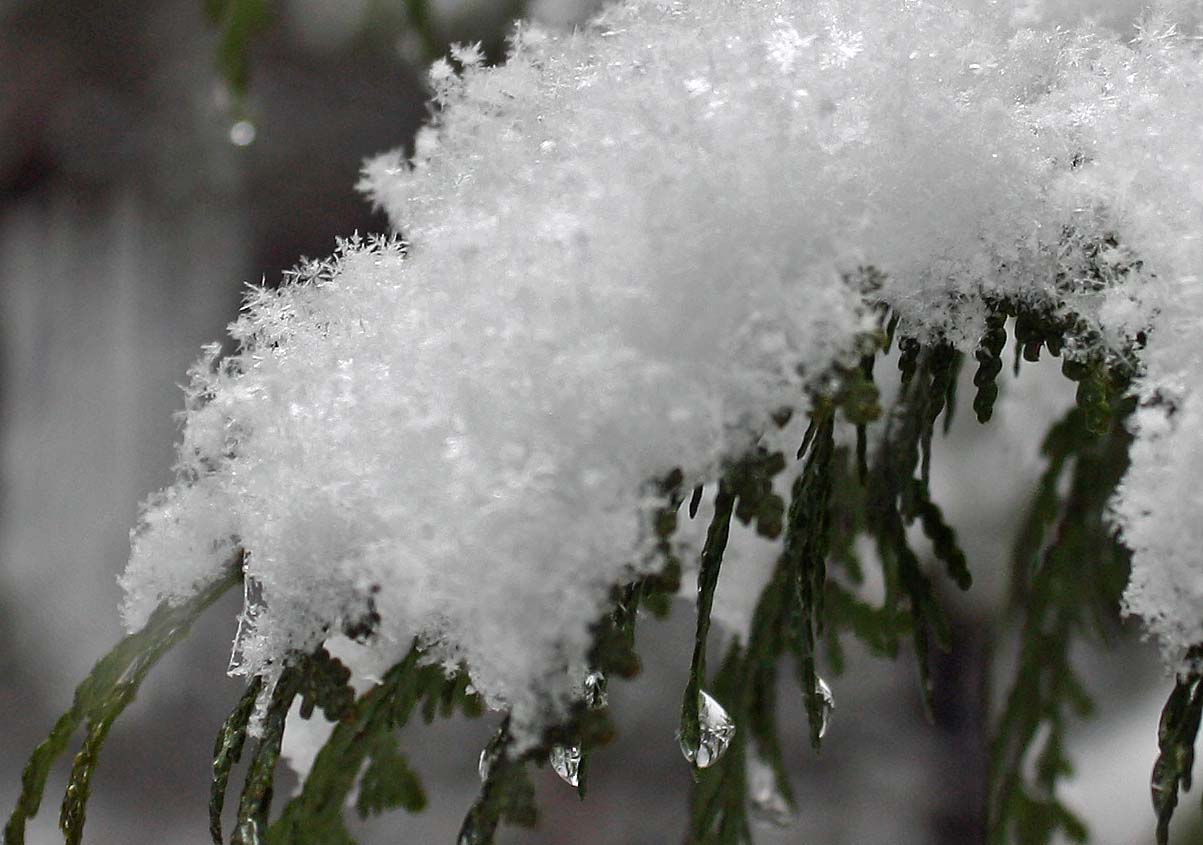
Snow crystals poised on the leaves of a white cedar, ON (photo by Nina Munteanu)

Snow is magic. It reveals as it cloaks. Animals leave their telltale tracks behind their silent sleuthing. No two snowflakes are alike. Yet every non-aggregated snowflake forms a six-fold radial symmetry, based on the hexagonal alignment of water molecules when they form ice. Tiny perfectly shaped ice-flowers drift down like world peace and settle in a gentle carpet of white. Oddly, a snowflake is really clear and colourless. It only looks white because the whole spectrum of light bounces off the crystal facets in diffuse reflection (i.e., at many angles). My son, who skies, extols “champagne powder”—very smooth and dry snow, ideal for gliding on. On powder days, after a fresh snowfall, mountain trees form glabrous Henry Moore-like sculptures. Skiers wind their way between the “snow ghosts,” leaving meandering double-helix tracks behind them.

Pump Peak, north view with snow ghosts, Mount Seymour, BC (photo by Kevin Klassen)
Skier shushing through powder among snow ghosts, Kaslo BC (photo by Kevin Klassen)
Snow ghosts at sunset, BC (photo by Kevin Klassen)

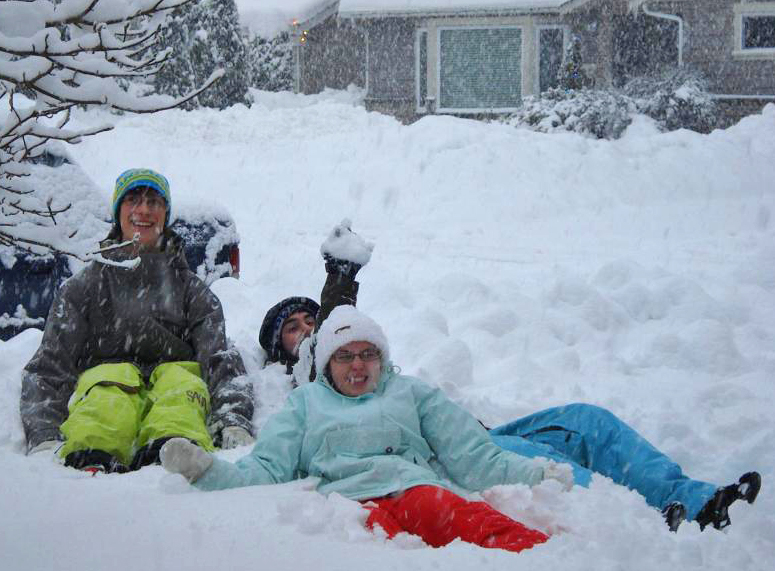
Snow is playful. It beckons you to stick out your tongue and taste the clouds. Snow is like an unruly child. Snow is the trickster. It stirs things up. Makes a mess. It is the herald of change, invigorating, fresh and wondrous. Cars skid in it and squeal with objection. Grumpy drivers honk their horns, impatient to get home; while others sigh in their angry wake. Brown slush flies in a chaotic fit behind a bus and splatters your new coat. Boys and girls of all ages venture outside, mischief glinting in their eyes, and throw snowballs. Great battles are fought in backyards where children build awesome forts and defend them with fierce determination.

The author’s son and friends playing in a snowstorm, BC (photo by Nina Munteanu)
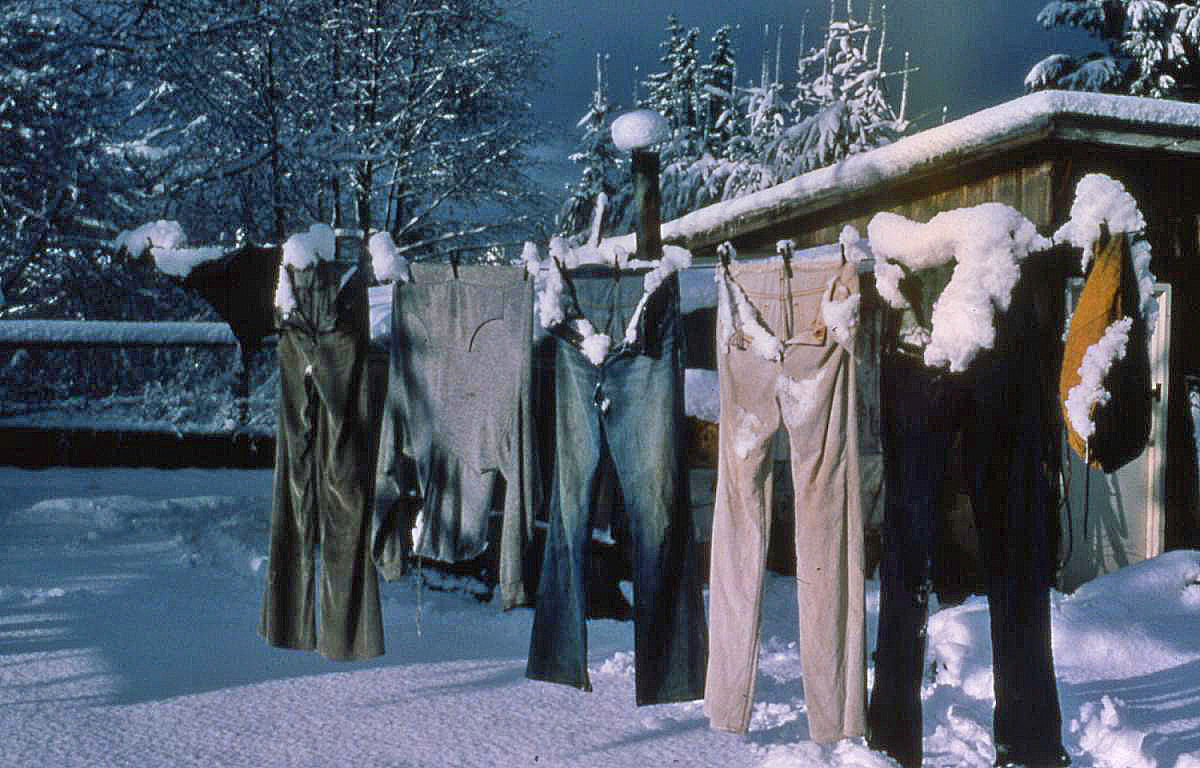
Laundry left out during a snowfall, BC (photo by Nina Munteanu)

In the end, snow—a solid form of water—remains implacable, untouched by our spurious activities. It lies beyond our tedious attempts to salt it, dirty it, move it or make it, turn it into slush, sublimate it or even desublimate it. Snow, like the water it is, cannot be ‘owned’ or kept. Ultimately, it will do its job to energize the earth, give life, then quietly transform, take its leave, and move on. Along with its various water cousins, it will move mountains particle by particle with a subtle hand; it will paint the world with beauty then return to its fold and rejoice; it will transcend time and space to share and teach and transform a world.

Skier exploring a high mountain bowl, Cloudburst Mountain, Squamish, BC (photo by Kevin Klassen)

This article is an excerpt from “Water Is…The Meaning of Water”(Pixl Press)

Jackson Creek flows through a forest after a fresh snowfall in early winter, ON (photo by Nina Munteanu)

Nina Munteanu is a Canadian ecologist / limnologist and novelist. She is co-editor of Europa SF and currently teaches writing courses at George Brown College and the University of Toronto. Visit www.ninamunteanu.ca for the latest on her books. Nina’s bilingual “La natura dell’acqua / The Way of Water” was published by Mincione Edizioni in Rome. Her non-fiction book “Water Is…” by Pixl Press(Vancouver) was selected by Margaret Atwood in the New York Times ‘Year in Reading’ and was chosen as the 2017 Summer Read by Water Canada. Her novel “A Diary in the Age of Water” was released by Inanna Publications (Toronto) in June 2020.

“Sunlight on Snow” an ekphrastic poem by Bev Gorbet

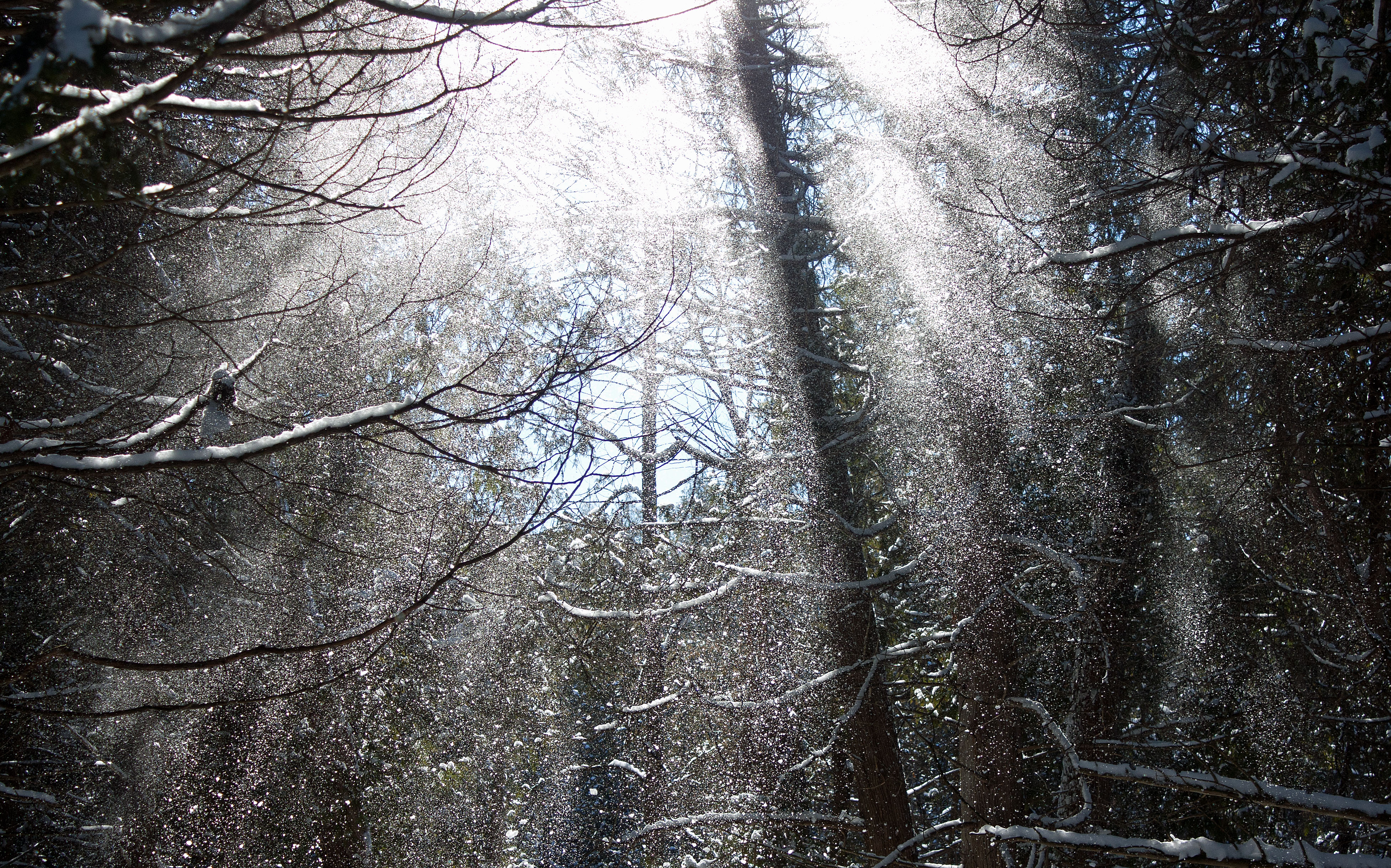
Snow glitter rains down from cedar tree on a sunny day after a major snowfall, ON (photo by Nina Munteanu)

Bright lit: the great cedar forest,
Cathedral dome skies bright sunlit above…
All of a fulgent blue, all of an azure glow…
Everywhere, the peace of a radiant sunlight

Pine tree with snow glitter behind in Jackson Creek Park, ON (photo and rendition by Nina Munteanu)

Worlds of magic and a most sacred light
Bright sunlit day, bright shafts 
Through a portico of treetops high above
The trees reaching so very high,
Deep into the sheltering skies

Snow-covered Buckthorn with path through a snowy meadow, ON (photo and rendition by Nina Munteanu)

Snow decked branch and bough: gently swaying memory;
Movement into the swaying winter winds
The gentle whispers, the gentle sighs 
The treetops,
Their  song, their gentle touch, their toss, their glide

Snow dust falls in a cedar forest, ON (photo by Nina Munteanu)

A deepest silence, a most profound contemplation
Midst snowdrift and snowlit mists as they shift
Between icy branch and snow covered green bough

Dust of snow and cedar lights:
All the ethereal wonders of a snowy day, 
The snow blessed, lost ephemeral lands
In a full clothed beauty, snowy wonders: of sunlight, of shadow

Snow-covered shrub on a snowy day, ON (photo and rendition by Nina Munteanu)

Oh! sacred forest, this great beauty of place
To overwhelm, to protect, to shelter…
Here, a deepest meditation, a deepest circumspection…
Snow and ice and all the wonder of a  glorious sunlit day
All the ephemeral beauty in a winter’s sunlight world.

Snow dust rains down from snow-laden cedar trees in Jackson Creek Park, ON (photo by Nina Munteanu)

Bev Gorbet is a Toronto poet and retired school teacher. She has published several poems with the Retired Teachers Organization and most recently in “Literary Connection IV: Then and Now” (In Our Words Inc., 2019), edited by Cheryl Antao Xavier.

A Late Autumn Snowfall–An Ekphrastic Poem by Bev Gorbet

Otonabee River glints in the sun as it snows, ON (photo and rendition by Nina Munteanu)

An autumn’s last days, fierce snowfalls, fall lights and storm
The autumn landscape now full of wild moods,
Hints of a magic wilderness and an encircling cold,
The bitter winds, the fast falling hail:
Landscape echo and retreat

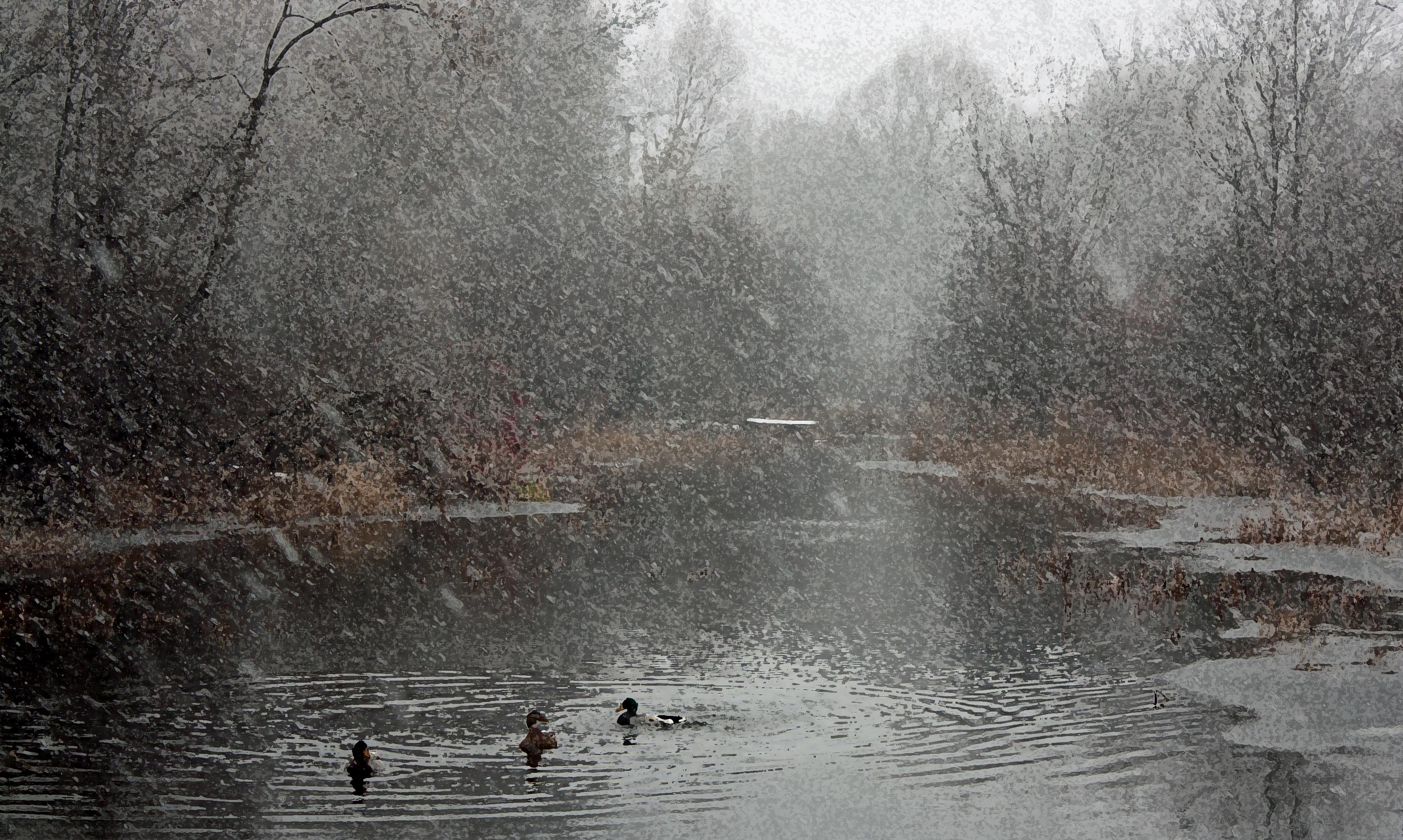
Mallards contently swim the marsh under a heavy snow, ON (photo and rendition by Nina Munteanu)

Snow veil mists over the receiving marsh lands:
Somber cloud grays, shades of amber glow…
Mallard ducks unconcernedly paddling 
On the smooth black marsh waters
The snows above falling in majestic blizzards:
Powerful bursts of snow over treetop
And bended bough,
Moody haze lit skies high falling away
In blasts of snow and wind

Heavy snow falls in the riparian forest, ON (photo and rendition by Nina Munteanu)

Snowy reflections over high treetop above…
Snowy days and last messages of a fading autumn’s glory:
Detritus of bronze leaf, the withered beauty of a fading goldenrod
A final sadness, autumn’s last messages, 
Haunted promises of a brilliant winter sunshine
On snowy fields, velvet days and gold

Snow flies horizontally in a fierce wind, ON (photo and rendition by Nina Munteanu)

Now the forests bend, overwhelmed by the flying snow
Thick tumbling down, shards of ice and rain
Clouds of snow falling everywhere
Forest pathways now covered in a lucent white glow,
The shaded greens of cedar and fir picked out in a forest landscape;
The continuing deluge, wild nature’s primordial powers: 
Mad windstorm and snow drift

Sun emerges over Thompson Creek marsh after the snowstorm, ON (photo and rendition by Nina Munteanu)

The still marsh waters now reflect the gray cloud, the  sky high above
All the windstorm madness, the bog detritus on the still marsh 
Now snow covered and silent, the snowfall ended
The marsh now a sacred retreat: worlds of a glorious and gentle reflection,
A tender, and radiant peace overall.

Bev Gorbet is a Toronto poet and retired school teacher. She has published several poems with the Retired Teachers Organization and most recently in “Literary Connection IV: Then and Now” (In Our Words Inc., 2019), edited by Cheryl Antao Xavier.

Thompson Creek marsh after a first snow in late autumn, ON (photo and rendition by Nina Munteanu)
Nina Munteanu revels in a snowstorm in Ontario (photo by Merridy Cox)

Chasing the Blue Forest Sprite

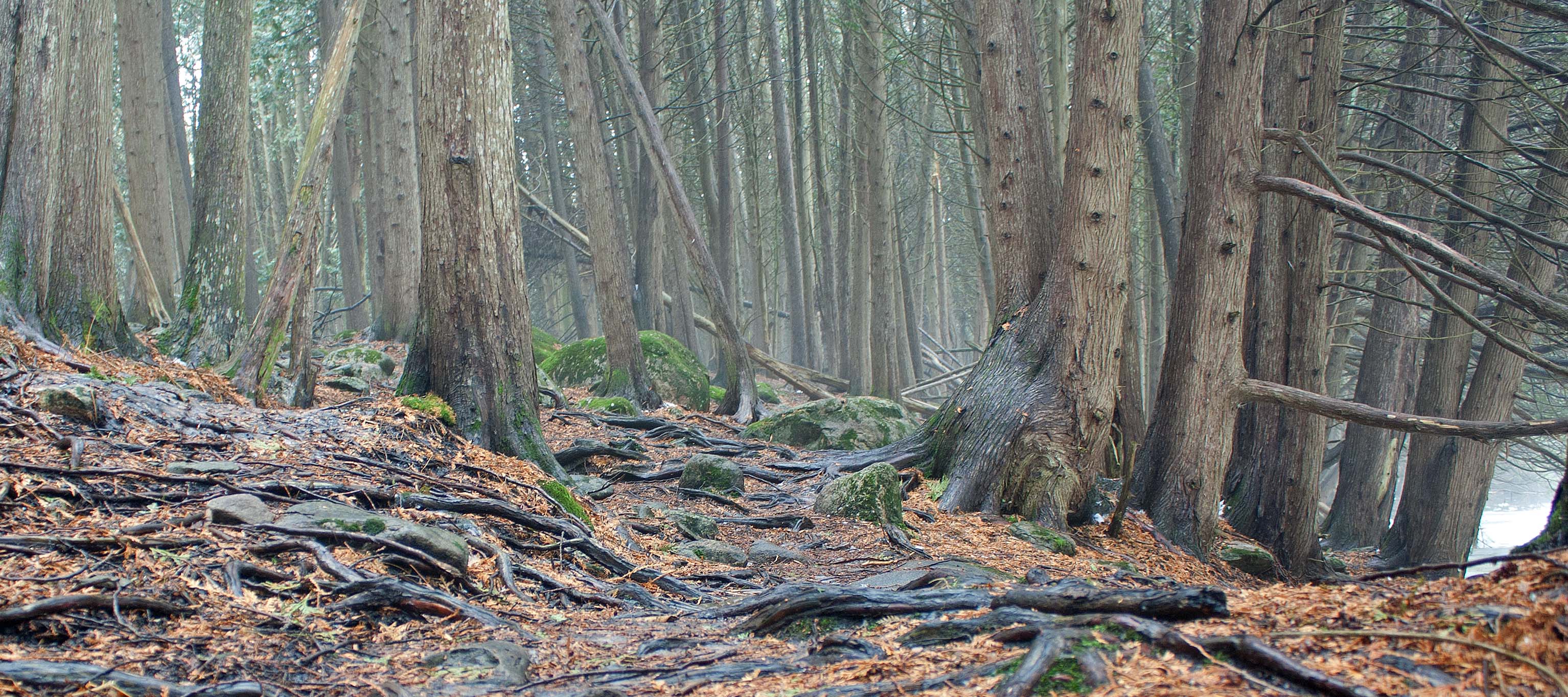
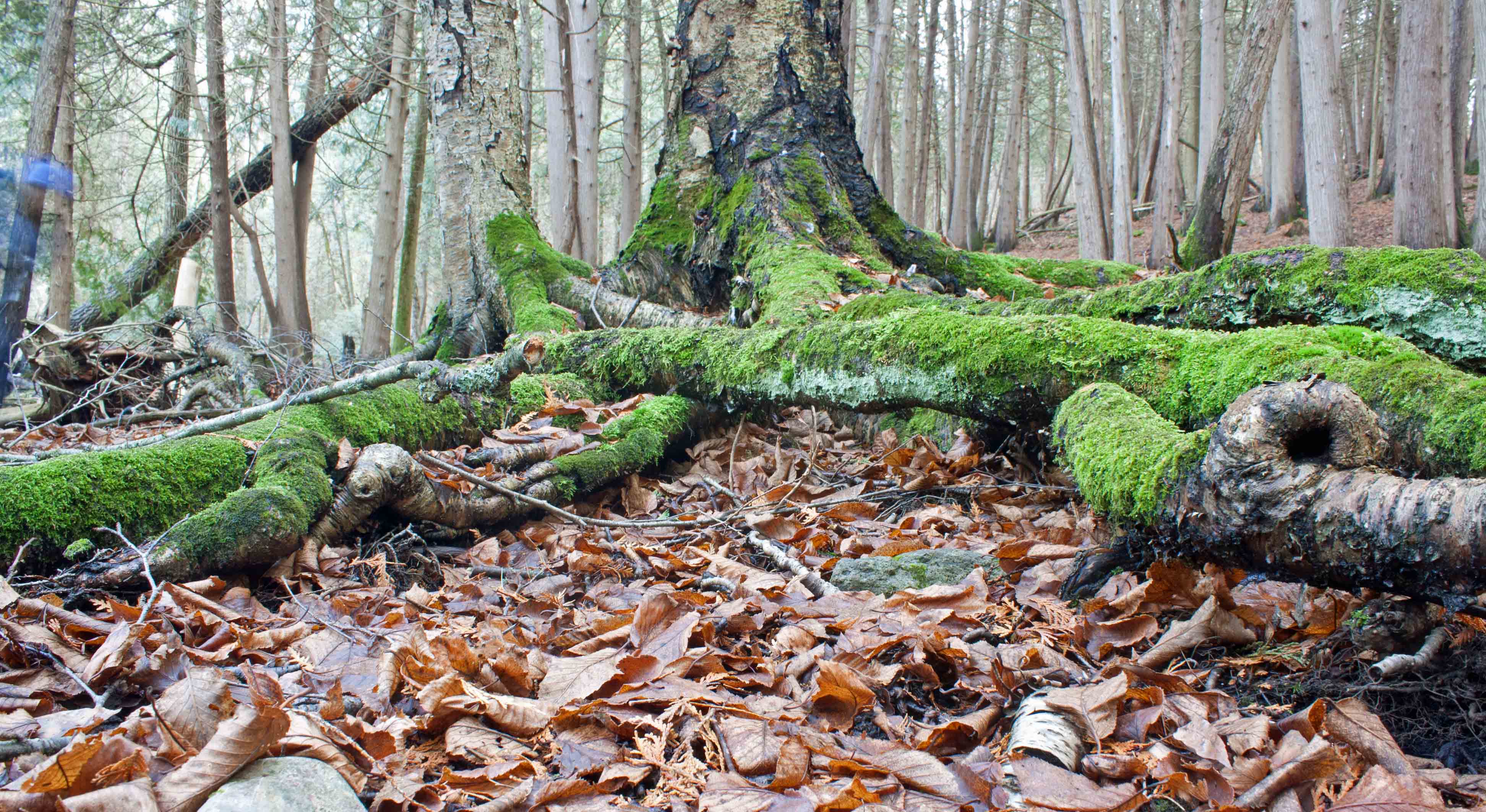
Cedar forest and extensive roots amid glacial erratics flank Jackson Creek on the right, ON (photo by Nina Munteanu)

It was a cold November day, after a light snow, as I wandered the Jackson Creek old-growth forest. Centuries-old cedar, pine and hemlock towered above me, giving off the fresh scent of forest. The trees creaked and cracked, swaying in a mischievous wind.  I left the main path and descended the leaf-strewn slope toward the river. My boots pressed through a frosty crust into the spongy ground of dead leaves and organic soil. I stopped and breathed in the fresh coolness of the air. A damp mist huddled among the trees, adding wisps of mystery to the ancient forest. It was as though I’d entered an enchanted forest in some fanciful fairy tale.

Cedar forest on slope of Jackson Creek Park in early winter, ON (photo by Nina Munteanu)

Not far from the river, I approached an old yellow birch tree, large trunk rising as tall as some of the cedars and pines around it. Golden flakes of bark curled and formed craggy patterns around the girth of the old tree. Radiating out from the tree, moss-covered roots snaked out like tangled ropes in a profusion of brilliant green. This was fairy country, I suddenly thought.

I dropped to my knees, crouching down, and set up my tripod and camera to capture this magical tree from the perspective of the forest floor. Head almost touching the ground, I inhaled the scent of loam and decaying leaves. The fresh pungency of cedar, pine, and humid moss hung in the air. Nearby, the river chortled and bubbled in a content symphony of motion. A curious red squirrel parked itself on a log nearby to watch me. It didn’t scold me like they normally did when I entered the forest; like it understood… It then occurred to me, as I set up my equipment under the squirrel’s careful stare, that I was in the presence of an enchantment. Like I was peering into a secret dance of feral celebration. But being there and appreciating it, I had now become part of it; I was Alice going down the rabbit hole into a true wonderland…

It was then that I glimpsed it as I carefully took my timed pictures. A blur of blue. What had I witnessed? A motion? A colour? Then it was gone. But in that moment, I’d felt the spark of an elation that comes with a glimpse into a secret world.

Old yellow birch tree and moss-covered roots with approaching blue sprite from left (photo by Nina Munteanu)

When I returned home to look at the images I saw that my camera had captured a wispy blue entity that flowed into its view and peered around the old birch at me with a kind of curious though mischievous grin. 

Had I just captured a blue sprite? Something was unmistakably there!

Forest sprite peers around a yellow birch tree, Jackson Creek Park, ON (photo by Nina Munteanu)

I read up on sprites. According to European lore, a sprite is a supernatural entity. They are often depicted as fairy-like creatures or as an ethereal entity. The word sprite comes from the Latin spiritus (“spirit”), via the French esprit.

Given that the sprite I’d observed was blue and we were close to the river, I wondered if it was not a forest or wood sprite, but a water sprite. According to alchemist Paracelsus, the term ‘water sprite’ is used for any elemental spirit associated with water. They can breathe water or air and sometimes can fly. They also possess the power of hydrokinesis, which is the ability to create and manipulate water at will. Also known as ‘water nymphs’ and naiads (or nyads), these divine entities tend to be fixed in one place. Slavic mythology calls them vilas. Sprites are not corporeal beings (like selkies, mermaids and sirens) given that they are not purely physical; they are more like local deities than animals. This explained the wispy nature of the being I’d seen peering at me from the tree.

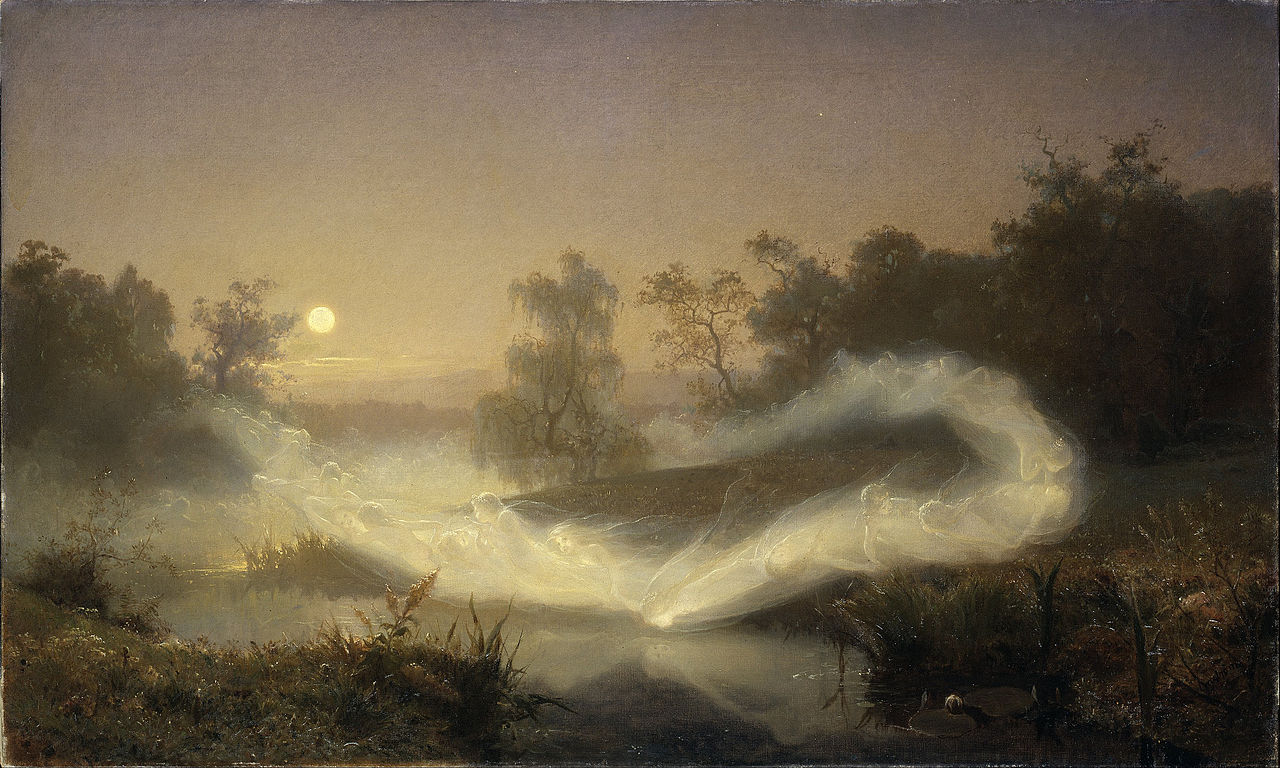
“Dancing Fairies” by August Malmström

After consulting with several friends—some who purported to know much more about sprites than I did—I concluded that this sprite was, in fact, a forest sprite and it was blue because it was near the water. Friend Merridy suggested that “forest sprites, normally green, may turn blue if a nearby brook calls to them.” She added that “water sprites can be distinguished by their chatty nature. They rarely go beyond the banks of a river or brook. Forest sprites are mostly silent.” Which this one certainly was. Friend Craig then pondered, “Are digital sprites in our world or in an electro-magnetic world? Or something else?” He was referring to them showing up on my camera without me even noticing they were there. When I told him I would return in search of them he observed, “if you’re looking for them that might be when they hide. Or maybe not. Any type of sprite is probably good, mischievous or friendly.” Thanks, Craig! That was helpful…  

Glacial erratic boulders in Jackson Creek, ON (photo by Nina Munteanu)
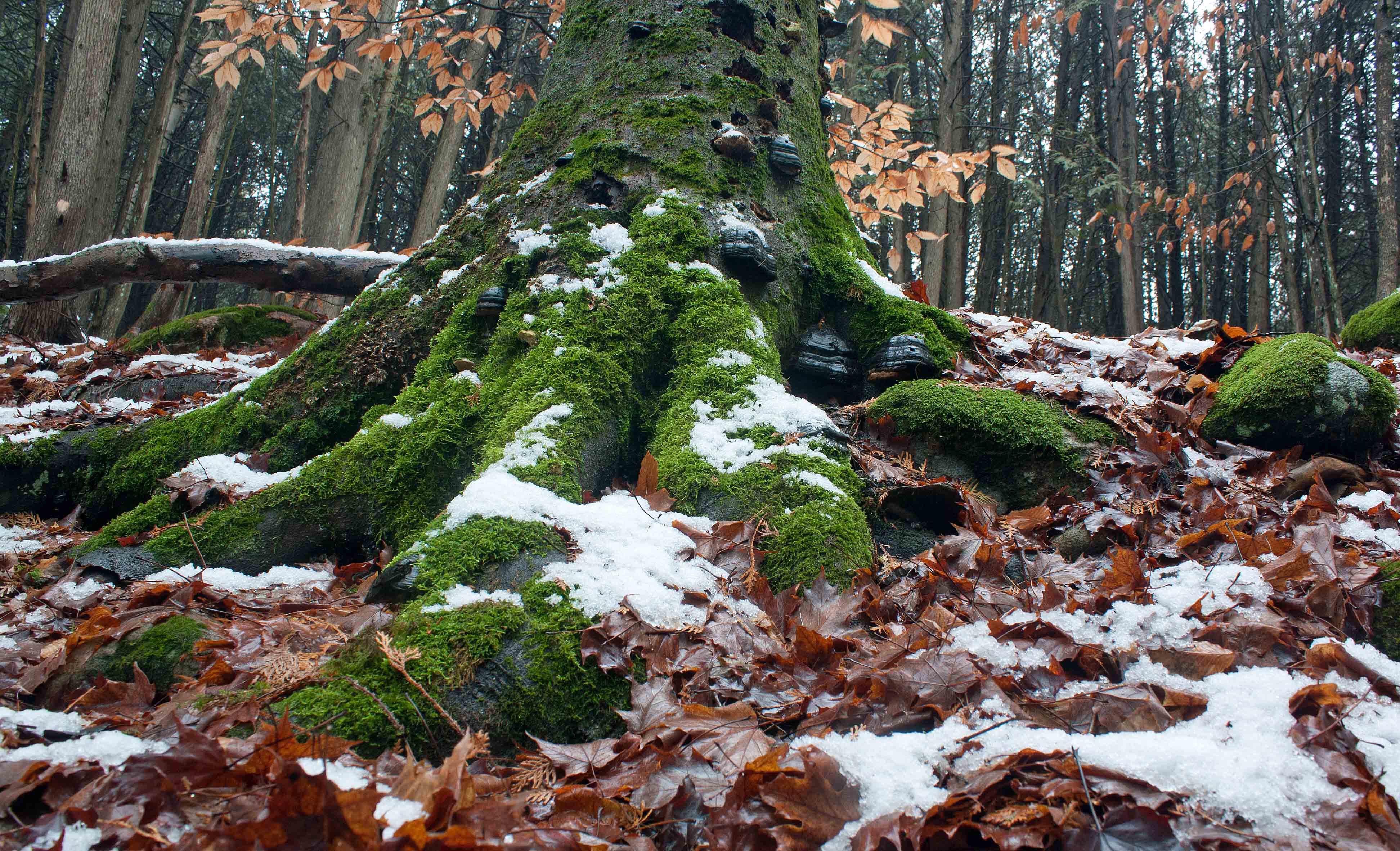
Century-old beech tree, decaying and moss-covered in early winter, Jackson Creek Park, ON (photo by Nina Munteanu)
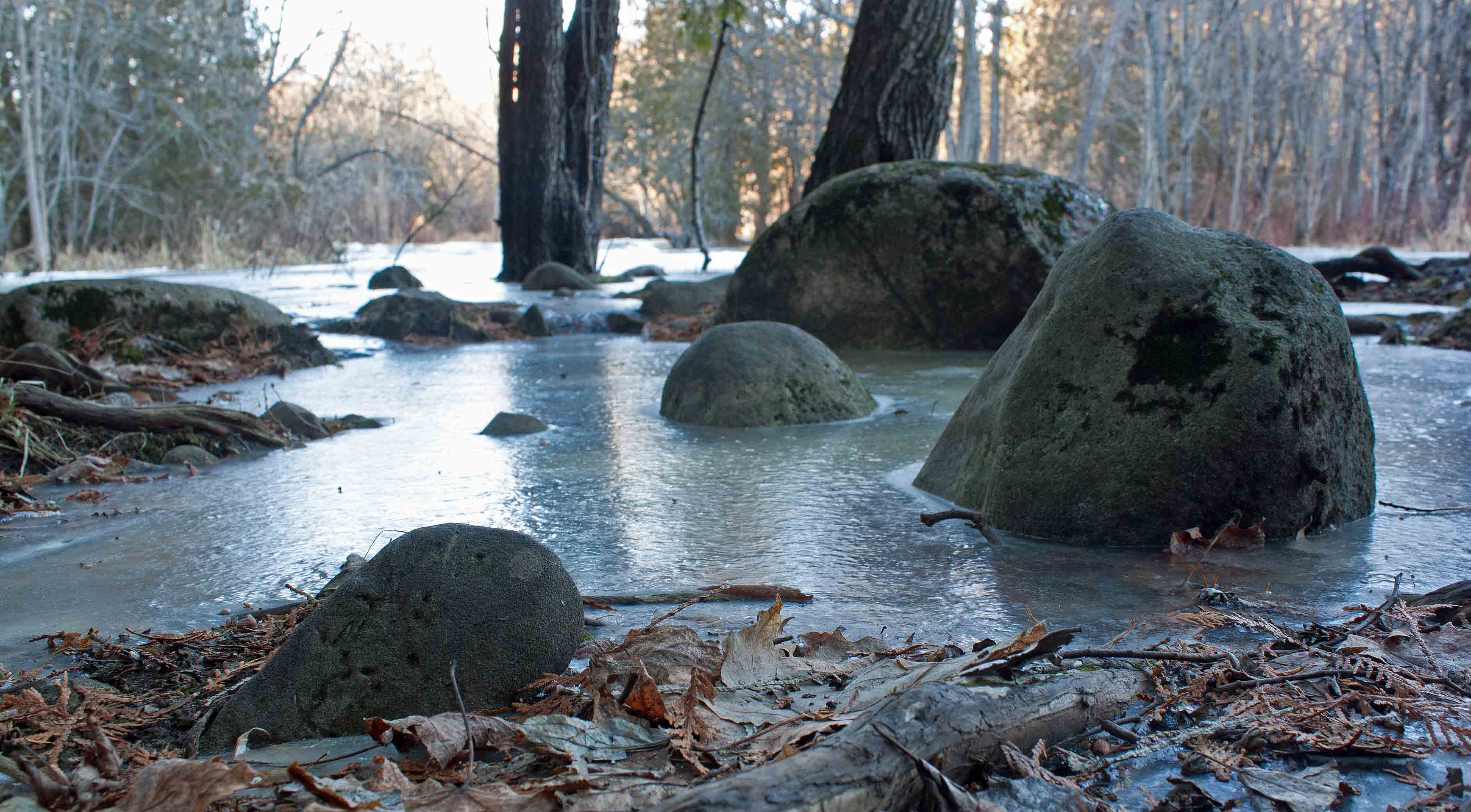
Ancient cedar tree stands next to an ice sheet on the path beside Jackson Creek, ON (photo by Nina Munteanu)

I visited the forest many times after but saw no sign of any sprites. Perhaps Craig was right; they were hiding from me.

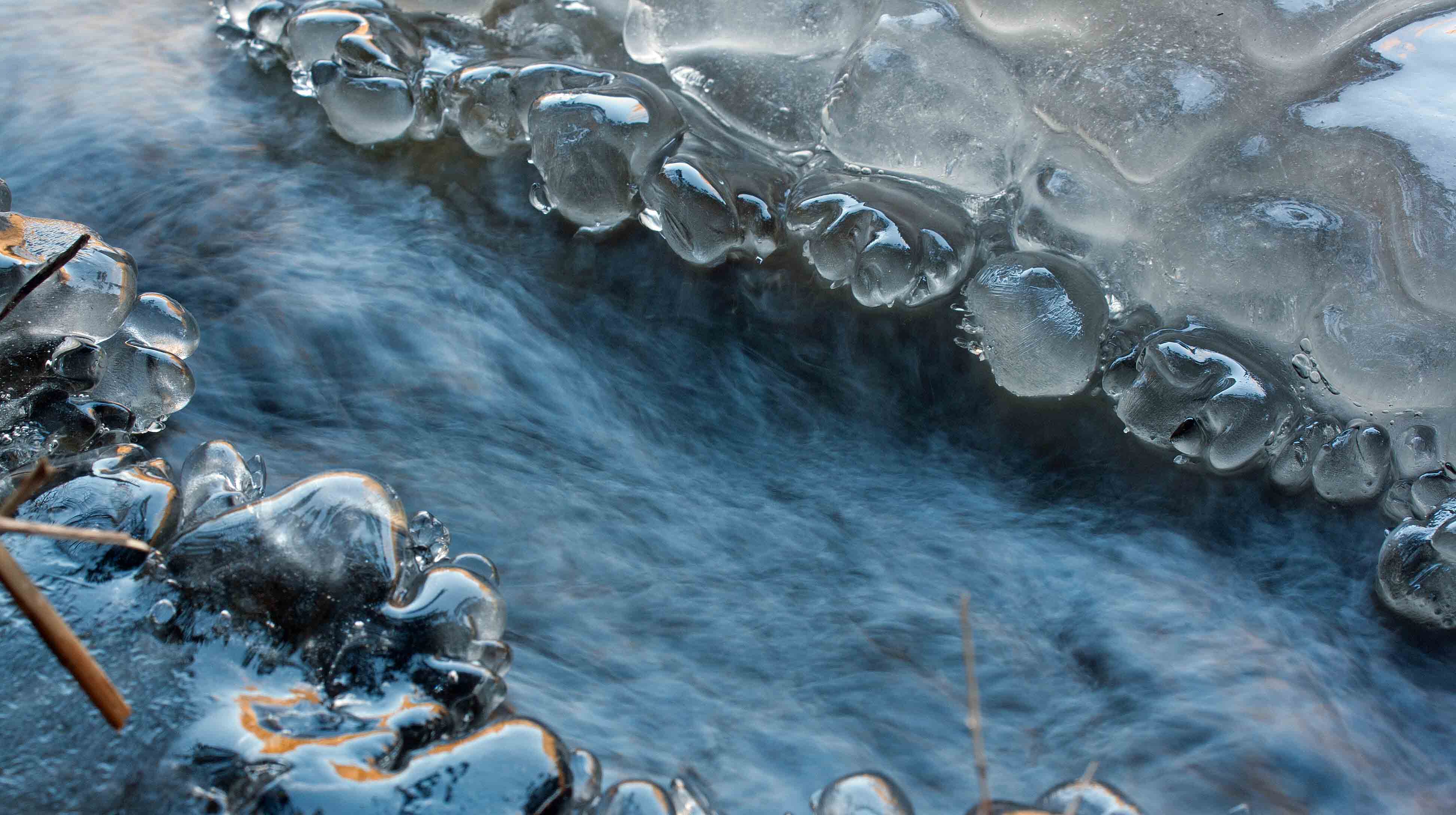
Then, on a foggy late December day, after a light dusting of snow, I returned to document the ice forming in the river. Islands and columns of ice had created a new topography for the flowing waters of Jackson Creek. Ice sheets also covered the forest path in places—making the walk somewhat treacherous. At times, I had to scramble and seize hold of branches to haul my way up precipitous banks from where I’d captured sculptures of ice ‘pearls,’ ‘platforms,’ and ‘columns’ on the river. 

Ice forming on Jackson Creek in early winter, ON (photo by Nina Munteanu)
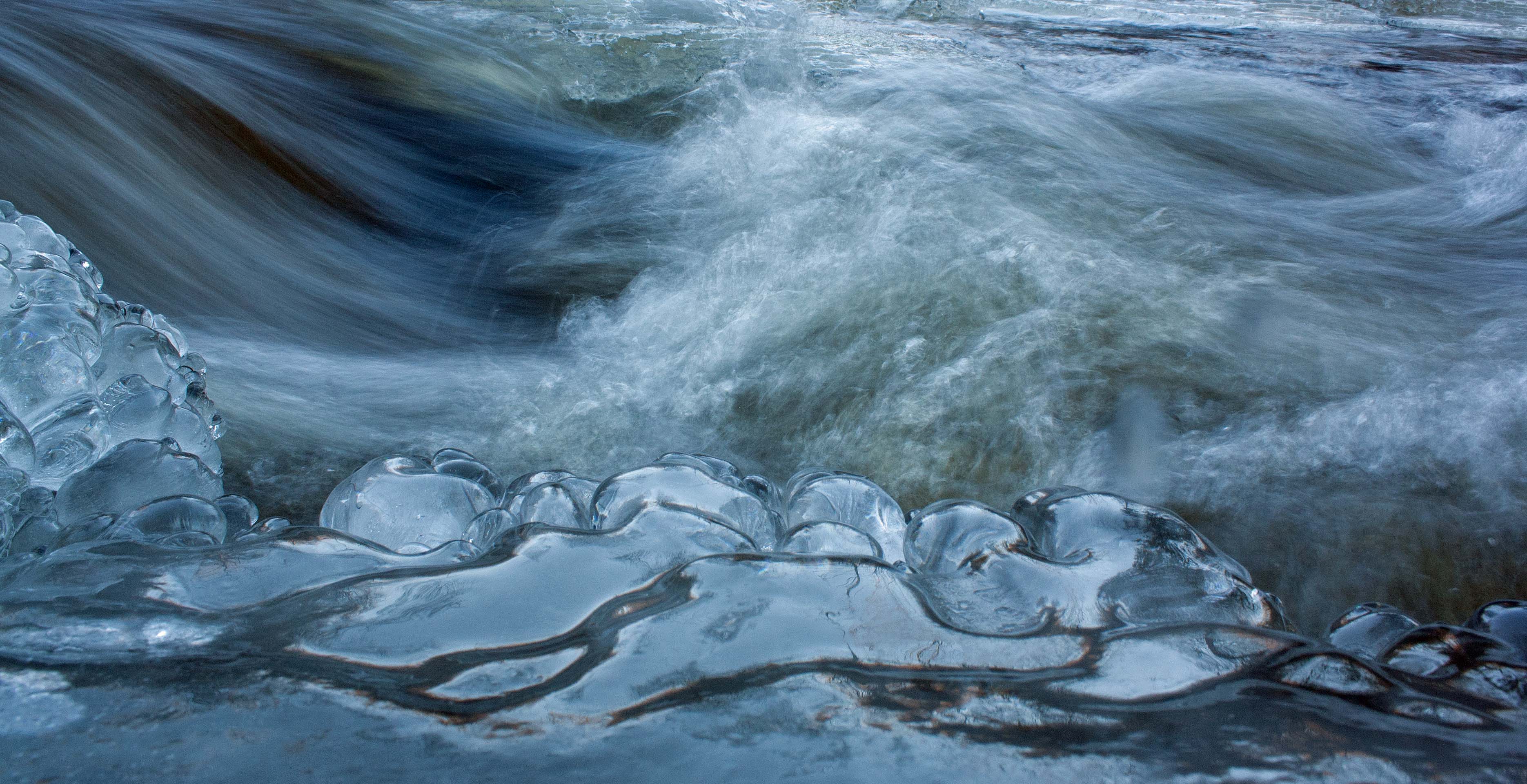
Ice ‘pearls’ forming on shore by rushing river, Jackson Creek, ON (photo by Nina Munteanu)

The fog grew thick as my walk eventually led me into an area of eccentric lopsided cedars in a ‘drunken’ stand by the river bank. The cedars sent out a tangled tapestry of gnarly roots I had to negotiate. I could feel the earth-magic. I dropped to my knees again and set my camera and tripod to the level of the roots. That is when I saw the blue sprite again! This time the sprite wasn’t playful; it appeared startled and disoriented. But, I managed to capture it as it fled the scene in wisps of blue smoke. As I left the forest, my thoughts returned to this serendipitous moment. Had I interrupted the wood /earth sprite in its work in the forest? These sprites are known to have the power of chlorokinesis, the ability to grow and control plants at will. When I checked my images at home, the sprite appeared to float near one of the cedars.


Blue forest sprite floats by cedar tree, Jackson Creek Park, ON (photo by Nina Munteanu)

When she saw the image, friend Merridy asked, “was the sprite entering the tree?” Thinking of incantations, friend Dyana asked if I’d had my recording feature on, which I’d never thought to do. On second thought, she decided that it might be dangerous. Not a good idea to anger a sprite. Friend Gabriela then challenged me: “did you ask what message they have for you, Nina? They keep showing up in your way, they might have a message for you or to be delivered through you to…” whoever… I hadn’t thought of that either. How would I hear their message when they were silent and so fleeting, I challenged back. She wisely responded, “Just ask yourself the question; you might be surprised when your next thought brings the answer. Since everything is energy, and you saw them at least twice, you’re probably connected with them.”

Sprite vaporizes behind tree, Jackson Creek Park, ON (photo by Nina Munteanu)

I didn’t tell her that the question that came to mind after seeing the sprite was: I wonder what’s for dinner!

I must ponder this more, however. 

Cedar forest on a misty winter day, Jackson Creek Park, ON (photo by Nina Munteanu)

Thinking of Gabriela’s interesting remark, I am reminded of a rather sad but evocative tale by Vladimir Nabokov entitled “The Wood Sprite.” Told in the first person, it recounts the narrator’s experience when he was visited at his desk by an old wood sprite, “powdered with the pollen of the frosty, starry night.” The creature tells of his exile from a country wood in Russia, all cut down and burned amid the treachery of war. 

Now that I think of it, I know the blue sprite’s message. And now you know it too.

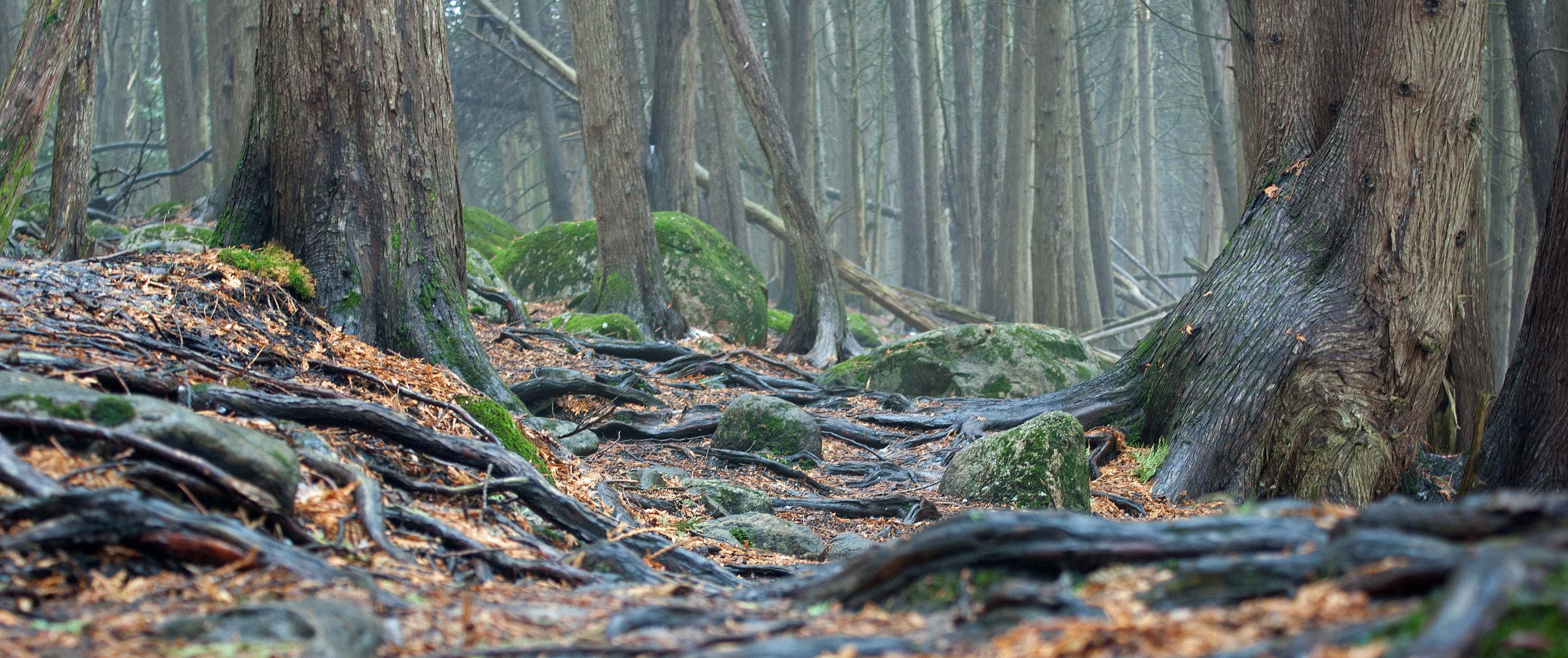
Cedar forest and roots amid glacial erratics in Jackson Creek Park, ON (photo by Nina Munteanu)

p.s. January 2025: You can read my short story “The Water Sprite“, inspired by this experience, in several places, but most recently in Exile Edition‘s anthology “Through the Portal: Tales from a Hopeful Dystopia.”

Nina Munteanu is a Canadian ecologist / limnologist and novelist. She is co-editor of Europa SF and currently teaches writing courses at George Brown College and the University of Toronto. Visit www.ninamunteanu.ca for the latest on her books. Nina’s bilingual “La natura dell’acqua / The Way of Water” was published by Mincione Edizioni in Rome. Her non-fiction book “Water Is…” by Pixl Press(Vancouver) was selected by Margaret Atwood in the New York Times‘Year in Reading’ and was chosen as the 2017 Summer Read by Water Canada. Her novel “A Diary in the Age of Water” was released by Inanna Publications (Toronto) in June 2020.

Nature as Poet … Country Roads in Winter

Undulating hills of a farmer’s field in Kawartha countryside, ON (photo and dry brush rendition by Nina Munteanu)
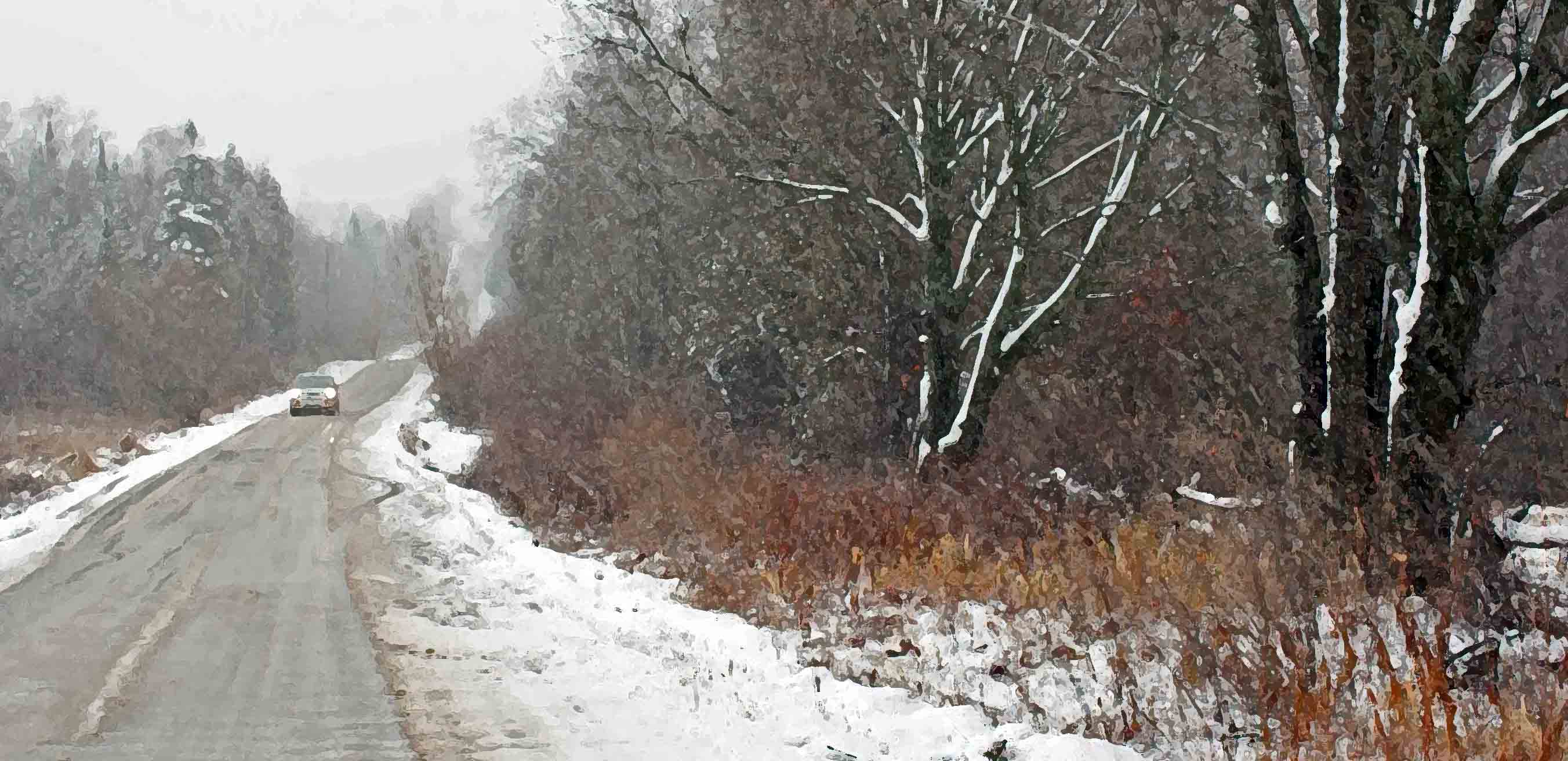
Country road in Kawarthas during snowfall early winter, ON (photo and dry brush rendition by Nina Munteanu)
Farmer’s field by country road in early winter, ON (photo and dry brush rendition by Nina Munteanu)
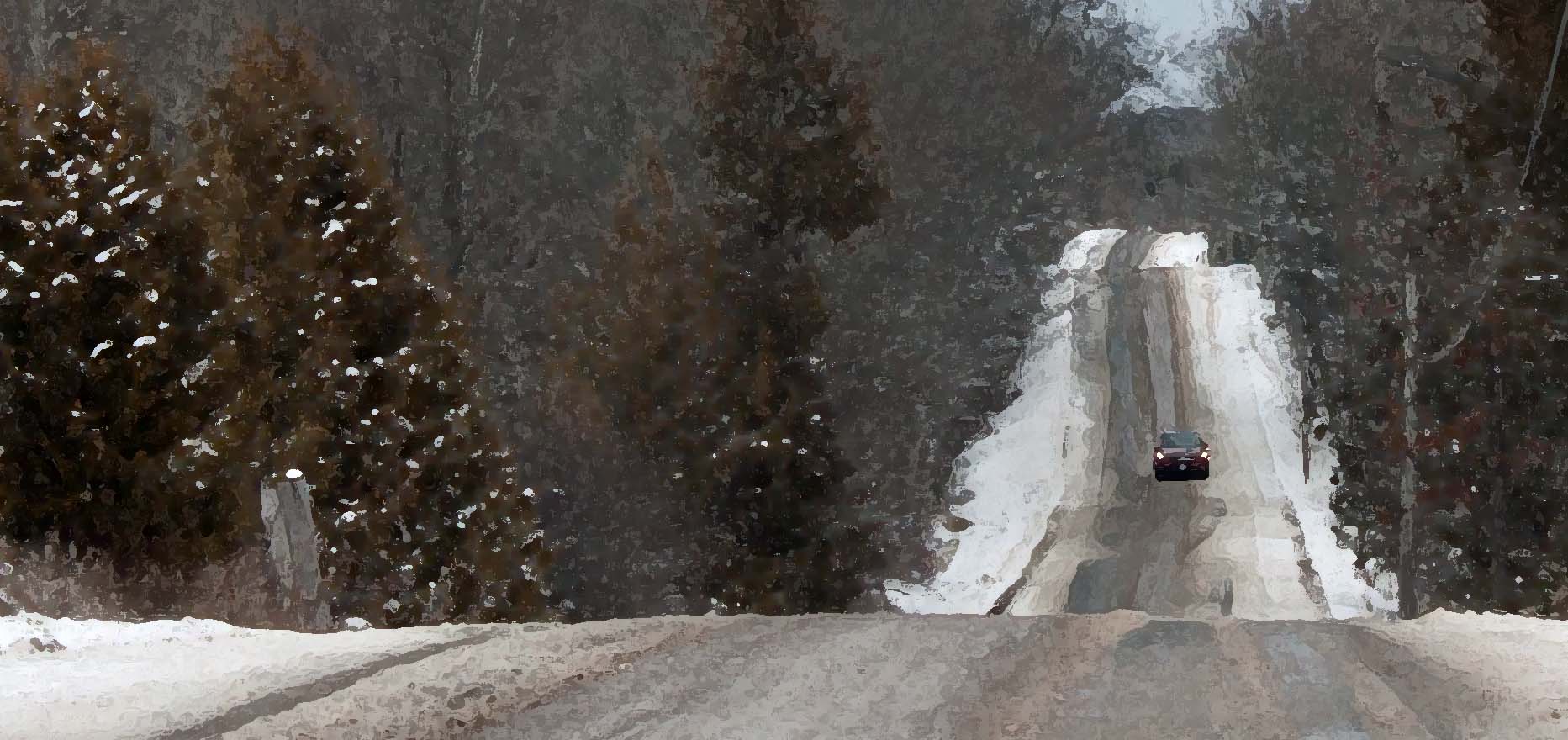
Country road viewed from Kawartha drumlin during snowfall, ON (photo and dry brush rendition by Nina Munteanu)
Small farm in Kawartha countryside in winter, ON (photo and dry brush rendition by Nina Munteanu)
Country road in winter on a sunny day, ON (photo and dry brush rendition by Nina Munteanu)
Farmer’s field during snow fog of winter, ON (photo and dry brush rendition by Nina Munteanu)
Country road during snowfall, ON (photo and dry brush rendition by Nina Munteanu)
Farm and field during heavy snowfall, ON (photo and dry brush rendition by Nina Munteanu)
Country road in Kawarthas in winter, ON (photo and dry brush rendition by Nina Munteanu)
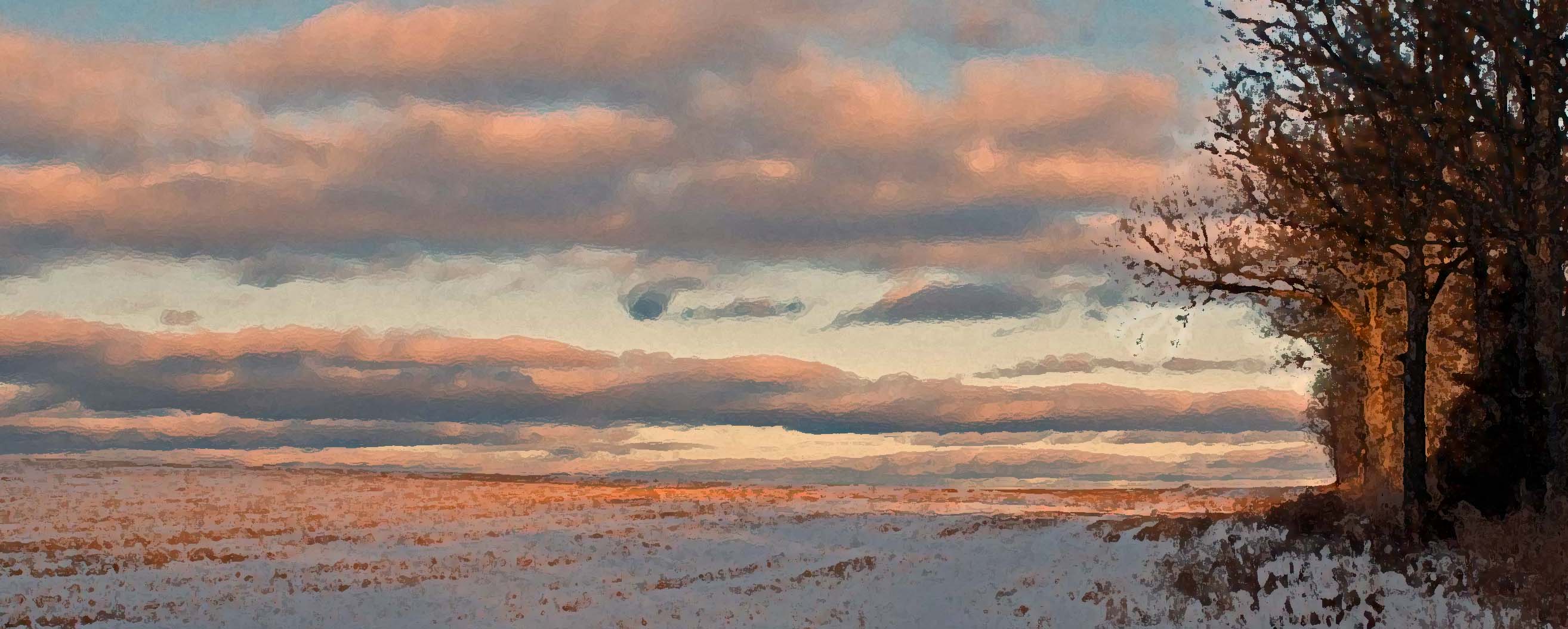
Farmer’s field aglow at sunset in winter, ON (photo and dry brush rendition by Nina Munteanu)

Nina Munteanu is a Canadian ecologist / limnologist and novelist. She is co-editor of Europa SF and currently teaches writing courses at George Brown College and the University of Toronto. Visit www.ninamunteanu.ca for the latest on her books. Nina’s bilingual “La natura dell’acqua / The Way of Water” was published by Mincione Edizioni in Rome. Her non-fiction book “Water Is…” by Pixl Press(Vancouver) was selected by Margaret Atwood in the New York Times‘Year in Reading’ and was chosen as the 2017 Summer Read by Water Canada. Her novel “A Diary in the Age of Water” was released by Inanna Publications (Toronto) in June 2020.

Nature as Poet … The Forest in Winter

Woman and her dog walk the cedar swamp forest, Trent Nature Sanctuary, ON (photo and dry brush rendition by Nina Munteanu
Trail through cedar forest in first snow, Trent Nature Sanctuary, ON (photo and dry brush rendition by Nina Munteanu)
Moss covered roots and trunk of yellow birch after snowfall, Jackson Creek Park, ON (photo and dry brush rendition by Nina Munteanu)
Young marcescent beech tree among moss covered glacial erratics in Jackson Creek Park, ON (photo and dry brush rendition by Nina Munteanu)
Snow-covered marcescent beech leaves in Jackson Creek Park, ON (photo and dry brush rendition by Nina Munteanu)
Heavy snowfall at bridge in Trent Nature Sanctuary, ON (photo and rendition by Nina Munteanu)
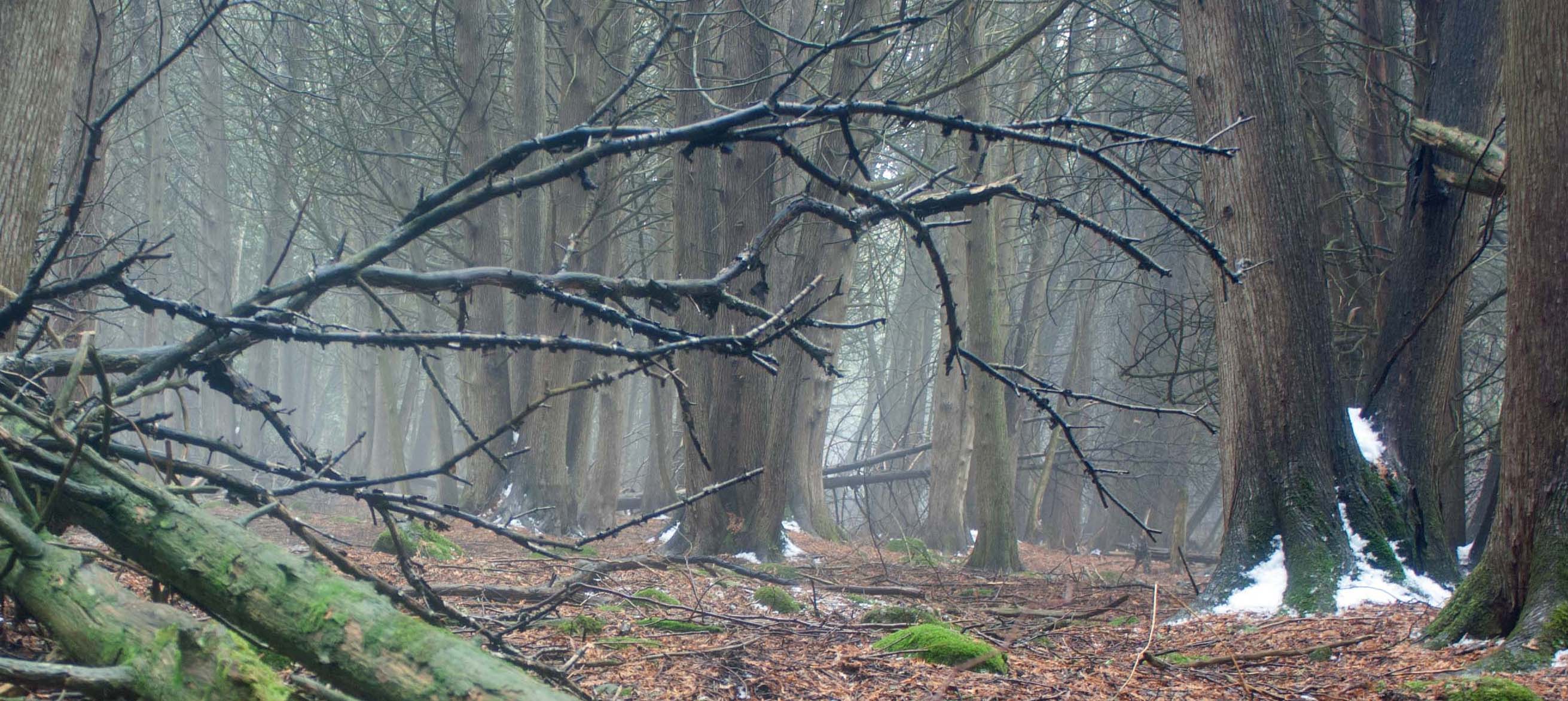
Cedar pine forest after first snow, Jackson Creek Park, ON (photo and dry brush rendition by Nina Munteanu)

Nina Munteanu is a Canadian ecologist / limnologist and novelist. She is co-editor of Europa SF and currently teaches writing courses at George Brown College and the University of Toronto. Visit www.ninamunteanu.ca for the latest on her books. Nina’s bilingual “La natura dell’acqua / The Way of Water” was published by Mincione Edizioni in Rome. Her non-fiction book “Water Is…” by Pixl Press(Vancouver) was selected by Margaret Atwood in the New York Times ‘Year in Reading’ and was chosen as the 2017 Summer Read by Water Canada. Her novel “A Diary in the Age of Water” was released by Inanna Publications (Toronto) in June 2020.

“Sacred River” an Ekphrastic Poem by Bev Gorbet

Jackson Creek ices up in December (photo by Nina Munteanu)

Like the purest of sounds,
Like the rhapsodic tinkling, windblown days,
Of glass wind chime and bell,
The call, the pure rhythm, the lyrical song
River of crystal waters pouring down under ice

Jackson Creek flows like liquid sunshine around terraced ice islands in morning light, ON (photo by Nina Munteanu)

Holy nature’s melody, all the grace, the sacred beauty
Of the wild outdoors…
The magical distortions of light under ice,
Luminescence and glow, bright sunlight
On a cold winter’s day…

Ice shoals of Jackson Creek, ON (photo by Nina Munteanu)

The lightening glitter in moving prisms of light…
Majesty, deep within water and ice,
Carousels of prismatic light moving elegantly across
The stony river bed below…
And above, a magnificent solemnity:
Backlit snow drift, detritus of crystal flake:
Azure and lavender lights

Ice shelves forming on quiet shore of Jackson Creek, ON (photo by Nina Munteanu)

Everywhere a reverential light reflected upwards
To catch the delighted eye…
Radiant reflections of warmth and comfort:
The sound of the dancing winds high above,

Jackson Creek and forest after first snow (photo by Nina Munteanu)
Snow-covered cedars in Trent Sanctuary forest, ON (photo by Nina Munteanu)


And icey patches, snowdrift on treetop and cold bough,
Gently melting drops, rainbow lights
Softly falling down to touch a lyric memory:
The pure song, wind chime echo and dream,
Sacred memory: sacred river, deepest reflection…

–Bev Gorbet, December, 2020

Clouds of ice pearls in Jackson Creek, ON (photo by Nina Munteanu)
Ice pearls form over rocks in Jackson Creek, ON (photo by Nina Munteanu)
Ice shore beside flowing Jackson Creek, ON (photo by Nina Munteanu)
Ice beads form islands in froth of Jackson Creek water, ON (photo by Nina Munteanu)
Ice beads form off ice columns over Jackson Creek, ON (photo by Nina Munteanu)
Ice platforms and ice-covered twigs peer over flowing Jackson Creek, ON (photo by Nina Munteanu)

Nina Munteanu is a Canadian ecologist / limnologist and novelist. She is co-editor of Europa SF and currently teaches writing courses at George Brown College and the University of Toronto. Visit www.ninamunteanu.ca for the latest on her books. Nina’s bilingual “La natura dell’acqua / The Way of Water” was published by Mincione Edizioni in Rome. Her non-fiction book “Water Is…” by Pixl Press(Vancouver) was selected by Margaret Atwood in the New York Times‘Year in Reading’ and was chosen as the 2017 Summer Read by Water Canada. Her novel “A Diary in the Age of Water” was released by Inanna Publications (Toronto) in June 2020.