My Books at VPL Central Library, Vancouver

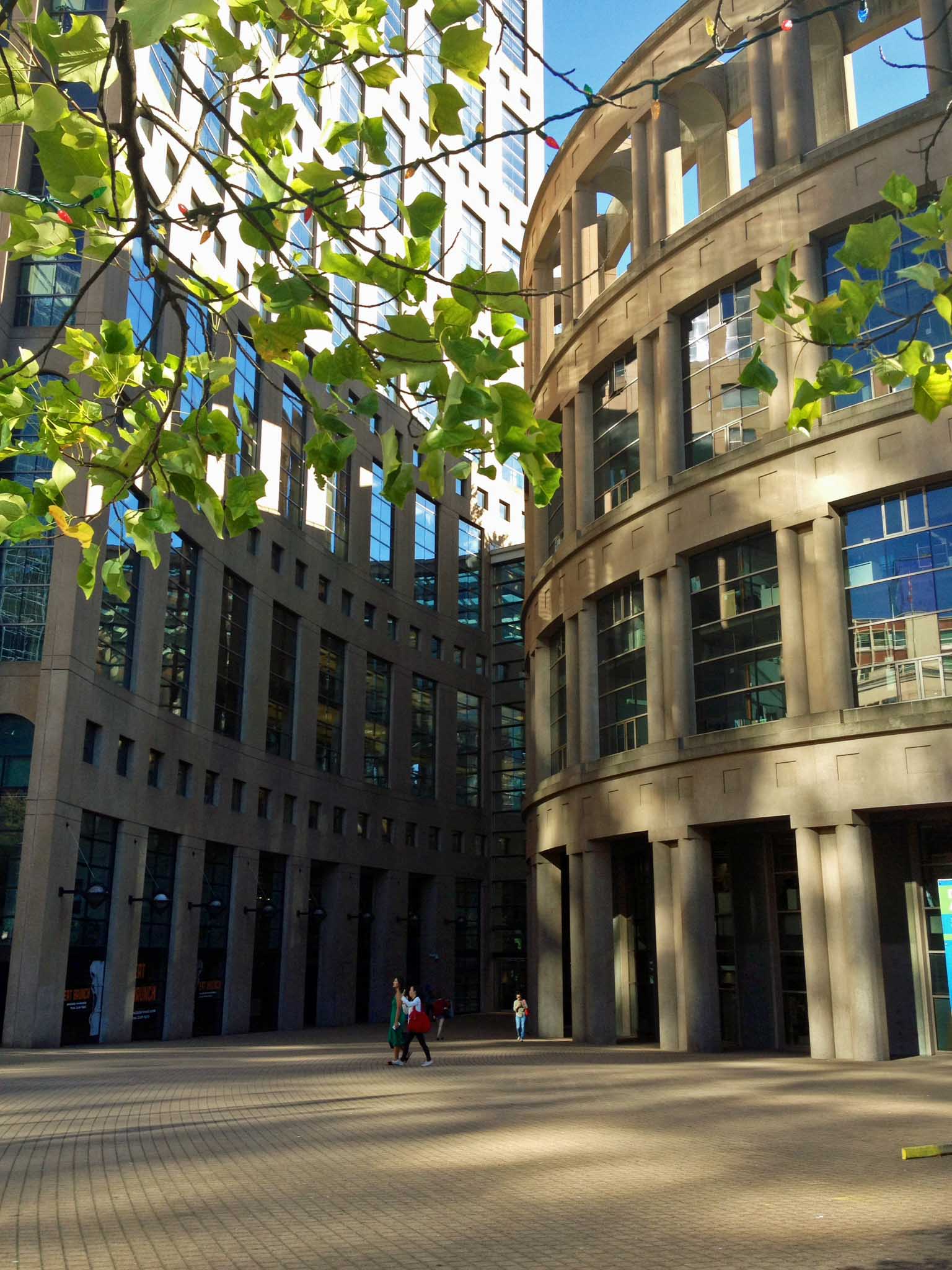
The Vancouver Central Library (photo by Nina Munteanu)

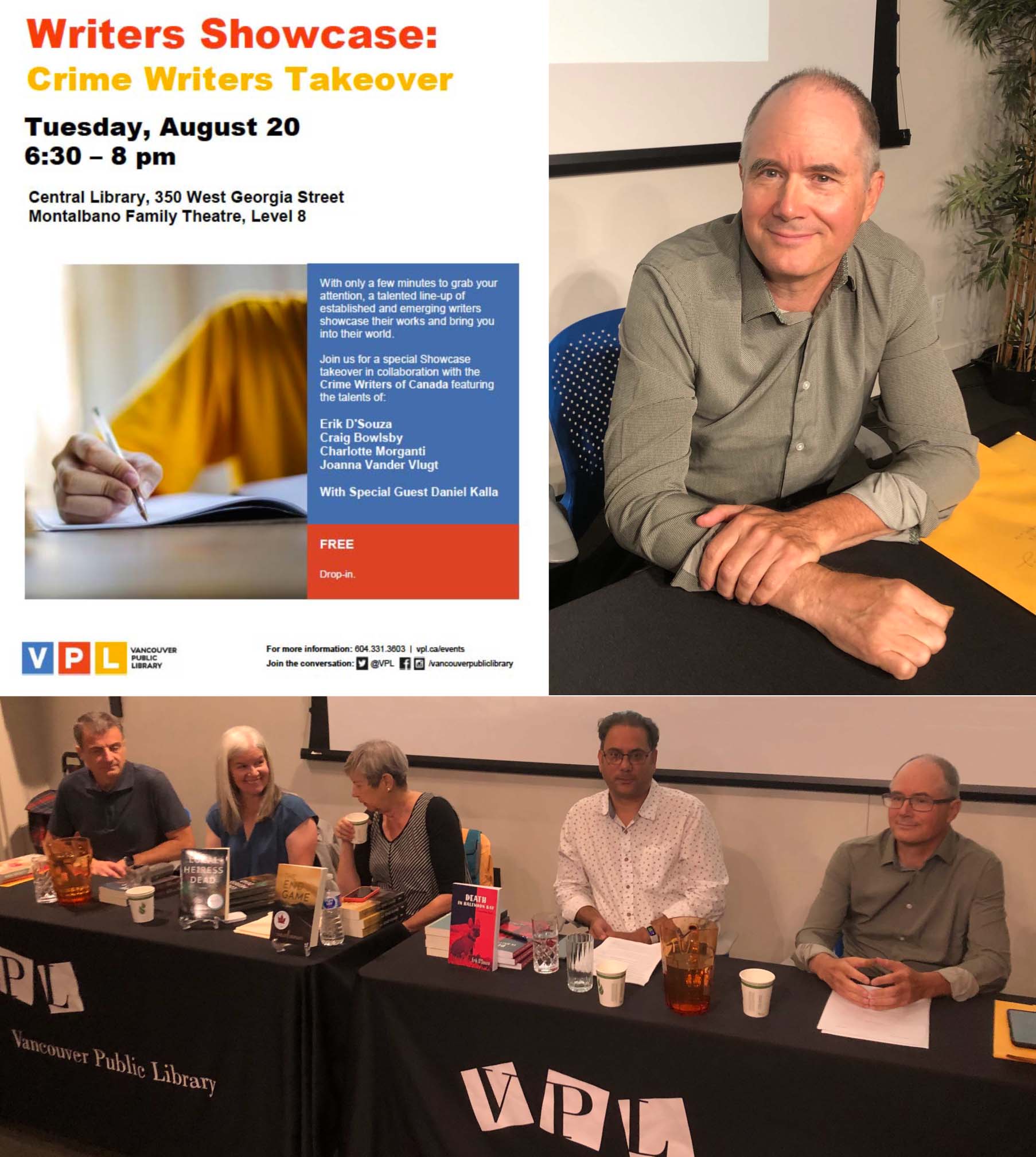
I was recently at Vancouver’s Central Library on Georgia Street to listen to my colleague Craig Bowlsby give a reading from his much anticipated novel Requiem for a Lotus. He was joined by four other crime writers who gave readings that evening, including Daniel Kalla who read from his 2024 book High Society.

Book reading at VPL Central Library

My Books

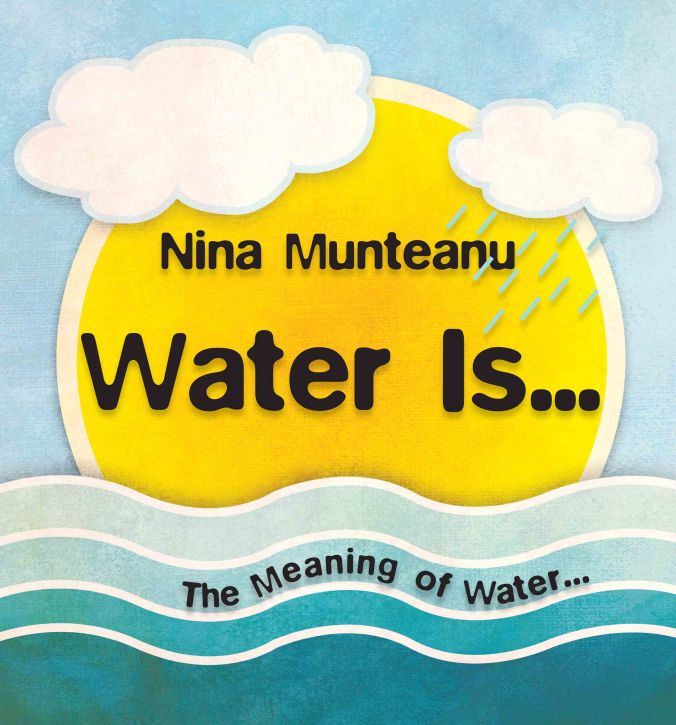
Feeling whimsical on my way out, I asked the librarian if the library carried any of Nina Munteanu’s books. They did, and plenty of them! Most of my science fiction books were on their shelves as well as my historical fantasy The Last Summoner, my writing guide The Fiction Writer, and my nonfiction book on water Water Is…The Meaning of Water.

I returned the next day to check out my books and to enjoy the wonderful setting of this large and iconic Coliseum-inspired library in downtown Vancouver. It was a typical Vancouver drizzly day; a good day to spend in a library, I thought.

My book “Water Is…” at the Vancouver Central Library; note how my book answers the question posed by the book next to it (photo by Nina Munteanu)

I found Water Is… on the ground floor among other books on water. My science fiction books were up on the fourth floor, clustered with my historical fantasy The Last Summoner. Books included Darwin’s Paradox and two books of my Splintered Universe Trilogy, Inner Diverse and Metaverse; Outer Diverse was out with a customer. They also had my short story collection Natural Selection

My science fiction and fantasy books at the Vancouver Central Library (photo by Nina Munteanu)
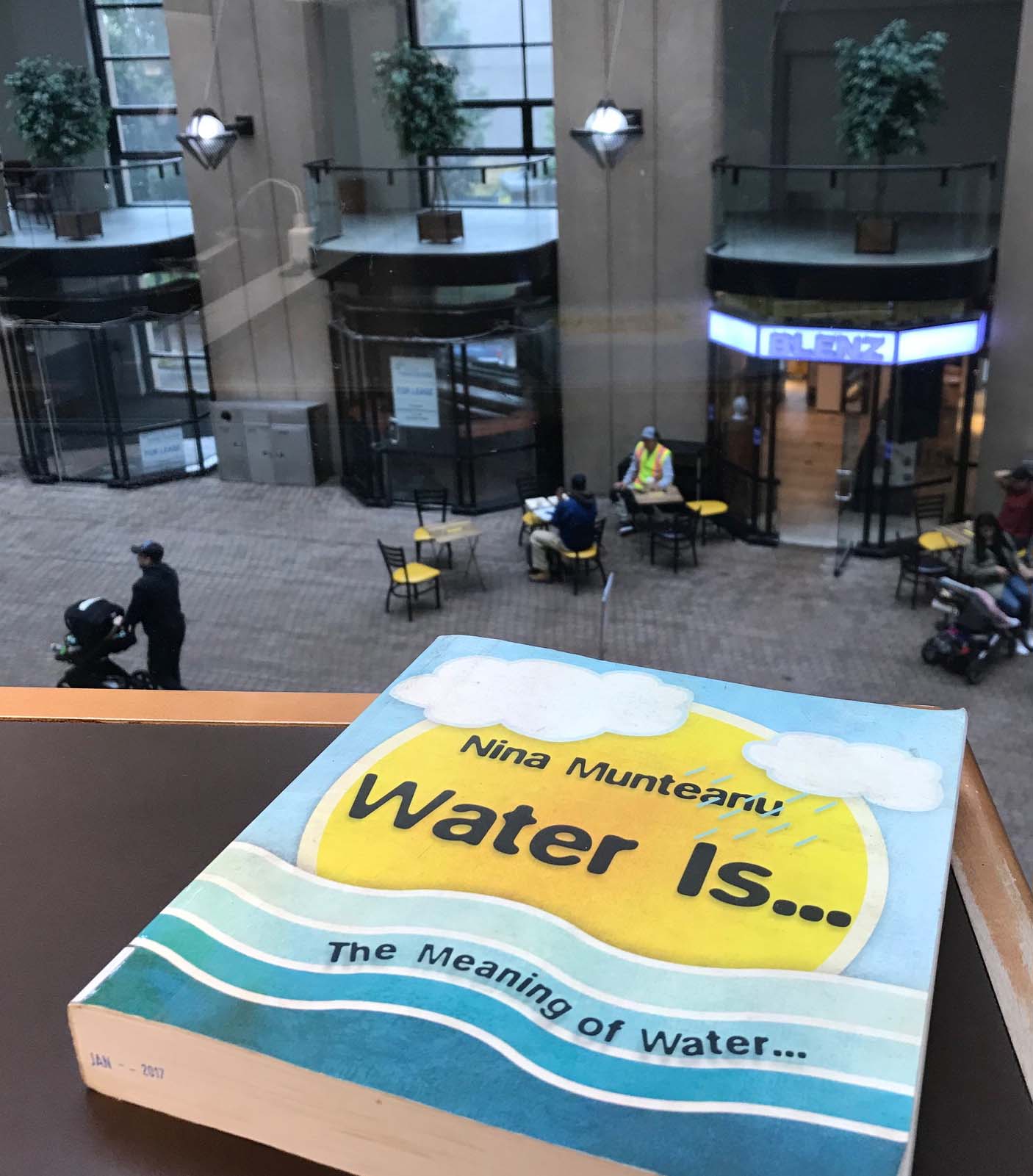
“Water Is…” sits at a desk overlooking the atrium, Vancouver Central Library (photo by Nina Munteanu)

The Library

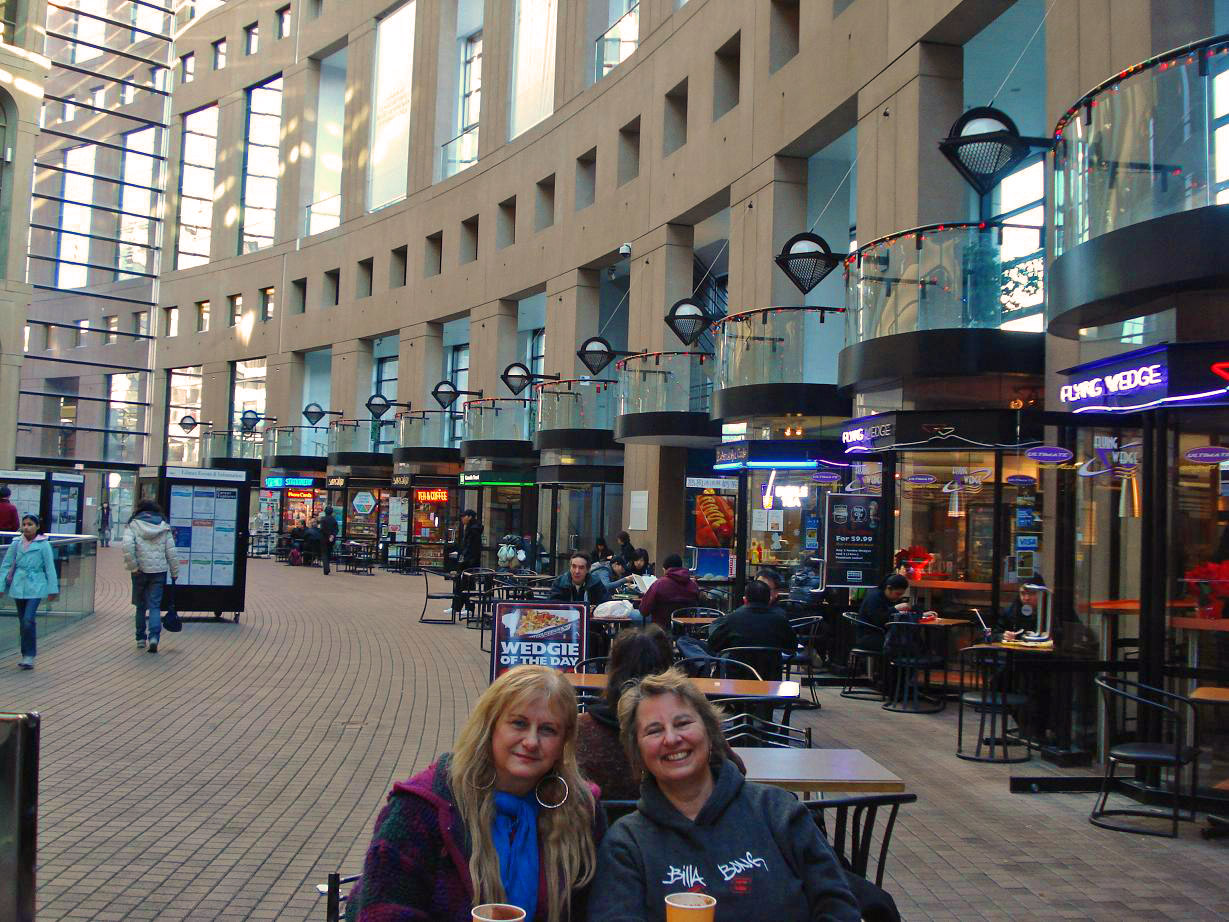
Nina Munteanu and Vancouver poet Lucia Gorea share a Blenz coffee in the atrium of the library complex, Vancouver (photo by

The Vancouver Central Library is an iconic feature of downtown Vancouver. Its Coliseum-style architecture lends a note of gravitas and traditional beauty to the nouveau chic revitalized downtown. Occupying an entire city block in the eastward expansion of Vancouver’s downtown core, the library complex along with federal office building tower is made of sandstone-coloured precast concrete. The building exterior is covered in granite quarried in Horsefly, BC and built to the highest seismic standards. In the words of Safdie Architects: “the heart of the Vancouver Public Library is a spiraling grand urban room that draws the public into Library Square as both a quiet place for study and contemplation and a vital community meeting place.”

Vancouver Central Library complex (photo by Nina Munteanu)

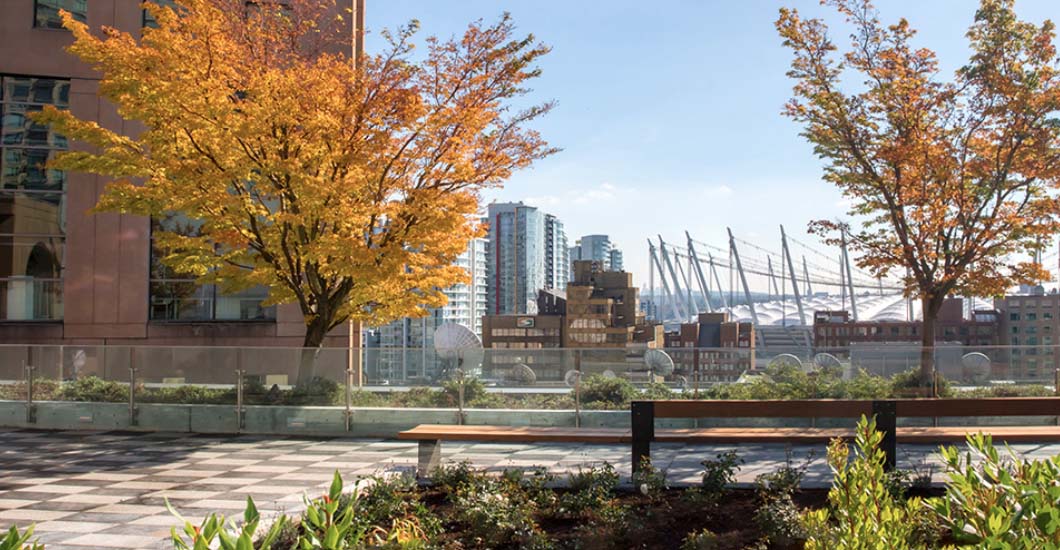
The library opened in May of 1995; then expansion of the upper floors began in June 2017.  As the lease came due on the upper two floors (levels 8 and 9), the library undertook planning to transform the area and offer much needed community spaces.  Rather than featuring traditional collections, the expansion now provides meeting rooms, a glass enclosed reading room, an 80-seat theatre (where I listened to Craig read his book), an exhibition space, as well as a long awaited public rooftop garden and outdoor terraces. Original architects (Moshe Safdie & Associates with local partners DA Architects) were retained to design the new expansion. Cornelia Hahn Oberlander, the landscape architect responsible for the green roof, designed the long-awaited rooftop gardens.

Rooftop gardens of the Vancouver Central Library in the fall

The Environs

I spent a drizzly morning and afternoon in the library with its spacious atrium along with bookstore and Blenz coffee bar, and other interesting places on Georgia Street nearby.

Glowbal, outside and inside (photos by Nina Munteanu)

Close by, at Glowbal, I treated myself to a wonderful lunch on their heated patio undercover. I then dashed through the rain to Telus Gardens next door that I found attractive, fresh and welcoming with its succulent jungle of plants, fragrant orchids and swimming koi ponds. I sipped my London Fog and ate a wonderful apple custard caramel croissant (from Café Bisou), while sitting in a flower-petal chair and enjoying the blissful serenade of a piano player.

Telus Gardens, Vancouver (photos by Nina Munteanu)

The day of sensual pleasures and intellectual satisfaction was complete!

Next time you find yourself in Vancouver’s downtown, check out my books at the Central Library and enjoy the vibrant downtown core.

Looking up at various floors of the Central Library from the atrium (photo by Nina Munteanu)

Nina Munteanu is a Canadian ecologist / limnologist and novelist. She is co-editor of Europa SF and currently teaches writing courses at George Brown College and the University of Toronto. Visit www.ninamunteanu.ca for the latest on her books. Nina’s bilingual “La natura dell’acqua / The Way of Water” was published by Mincione Edizioni in Rome. Her non-fiction book “Water Is…” by Pixl Press (Vancouver) was selected by Margaret Atwood in the New York Times ‘Year in Reading’ and was chosen as the 2017 Summer Read by Water Canada. Her novel “A Diary in the Age of Water” was released by Inanna Publications (Toronto) in June 2020.

Crossing into the Ecotone to Write Meaningful Eco-Fiction

If you have an apple and I have an apple and we exchange apples then you and I will still each have one apple. But if you have an idea and I have an idea and we exchange these ideas, then each of us will have two ideas.”—George Bernard Shaw

At Calgary’s When Words Collide some years ago, I moderated a panel on Eco-Fiction with publisher/writer Hayden Trenholm, and writers Michael J. Martineck, Sarah Kades, and Susan Forest. The panel was well attended; panelists and audience discussed and argued what eco-fiction was, its role in literature and storytelling generally, and even some of the risks of identifying a work as eco-fiction.

Someone in the audience brought up the notion that “awareness-guided perception” may suggest an increase of ecological awareness in literature when it is more that readers are just noticing what was always there. Authors agreed and pointed out that environmental fiction has been written for years and it is only now—partly with the genesis of the term eco-fiction—that the “character” and significance of environment is being acknowledged beyond its metaphor; for its actual value. It may also be that the metaphoric symbols of environment in certain classics are being “retooled” through our current awareness much in the same way that Aldous Huxley’s Brave New World or George Orwell’s Nineteen Eighty Four are being re-interpreted—and newly appreciated— in today’s world of pervasive surveillance and bio-engineering.

I would submit that if we are noticing it more, we are also writing it more. Artists are cultural leaders and reporters, after all. I shared my own experience in the science fiction classes I was teaching at UofT and George Brown College, in which I noted a trend of increasing “eco-fiction” in the works in progress that students were bringing in to workshop in class. Students were not aware that they were writing eco-fiction, but they were indeed writing it.

I started branding my writing as eco-fiction a few years ago. Prior to that—even though my stories were strongly driven by an ecological premise and strong environmental setting—I described them as science fiction and many as technological thrillers. Environment’s role remained subtle and—at times—insidious. Climate change. Water shortage. Environmental disease. A city’s collapse. War. I’ve used these as backdrops to explore relationships, values (such as honour and loyalty), philosophies, moralities, ethics, and agencies of action. The stuff of storytelling.

Environment, and ecological characteristics were less “theme” than “character,” with which the protagonist and major characters related in important ways.

Just as Bong Joon-Ho’s 2014 science fiction movie Snowpiercer wasn’t so much about climate change as it was about exploring class struggle, the capitalist decadence of entitlement, disrespect and prejudice through the premise of climate catastrophe. Though, one could argue that these form a closed loop of cause and effect (and responsibility).

The self-contained closed ecosystem of the Snowpiercer train is maintained by an ordered social system, imposed by a stony militia. Those at the front of the train enjoy privileges and luxurious living conditions, though most drown in a debauched drug stupor; those at the back live on next to nothing and must resort to savage means to survive. Revolution brews from the back, lead by Curtis Everett (Chris Evans), a man whose two intact arms suggest he hasn’t done his part to serve the community yet.

Minister Mason (Tilda Swinton), an imperious yet simpering figure who serves the ruling class without quite being part of it, reminds the lower class that: 

We must all of us on this train of life remain in our allotted station. We must each of us occupy our preordained particular position. Would you wear a shoe on your head? Of course you wouldn’t wear a shoe on your head. A shoe doesn’t belong on your head. A shoe belongs on your foot. A hat belongs on your head. I am a hat. You are a shoe. I belong on the head. You belong on the foot. Yes? So it is.  In the beginning, order was prescribed by your ticket: First Class, Economy, and freeloaders like you…Now, as in the beginning, I belong to the front. You belong to the tail. When the foot seeks the place of the head, the sacred line is crossed. Know your place. Keep your place. Be a shoe.”

Ecotones are places where “lines are crossed,” where barriers are breached, where “words collide” and new opportunities arise. Sometimes from calamity. Sometimes from tragedy. Sometimes from serendipity.

When environment shapes a story as archetype—hero, victim, trickster, shadow or shape shifter—we get strong eco-fiction. Good eco-fiction, like any good story, explores the choices we make and the consequences of those choices. Good eco-fiction ventures into the ecotone of overlap, collision, exchange and ultimate change.

In my non-fiction book Water Is… I define an ecotone as the transition zone between two overlapping systems. It is essentially where two communities exchange information and integrate. Ecotones typically support varied and rich communities, representing a boiling pot of two colliding worlds. An estuary—where fresh water meets salt water. The edge of a forest with a meadow. The shoreline of a lake or pond.

For me, this is a fitting metaphor for life, given that the big choices we must face usually involve a collision of ideas, beliefs, lifestyles or worldviews: these often prove to enrich our lives the most for having gone through them. Evolution (any significant change) doesn’t happen within a stable system; adaptation and growth occur only when stable systems come together, disturb the equilibrium, and create opportunity. Good social examples include a close friendship or a marriage in which the process of “I” and “you” becomes a dynamic “we” (the ecotone) through exchange and reciprocation. Another version of Bernard Shaw’s quote, above, by the Missouri Pacific Agriculture Development Bulletin reads: “You have an idea. I have an idea. We swap. Now, you have two ideas and so do I. Both are richer. What you gave you have. What you got I did not lose. This is cooperation.” This is ecotone.

I think we are seeing more eco-fiction out there because ecosystems, ecology and environment are becoming more integral to story: as characters in their own right. I think we are seeing more eco-fiction out there because we are ready to see it. Just as quantum physics emerged when it did and not sooner, an idea—a thought—crystalizes when we are ready for it.

Don’t stay a shoe … go find an ecotone. Then write about it.

Thirty-Six Eco-Fiction Books Worth Reading…

Nina Munteanu is a Canadian ecologist / limnologist and novelist. She is co-editor of Europa SF and currently teaches writing courses at George Brown College and the University of Toronto. Visit www.ninamunteanu.ca for the latest on her books. Nina’s bilingual “La natura dell’acqua / The Way of Water” was published by Mincione Edizioni in Rome. Her non-fiction book “Water Is…” by Pixl Press (Vancouver) was selected by Margaret Atwood in the New York Times ‘Year in Reading’ and was chosen as the 2017 Summer Read by Water Canada. Her novel “A Diary in the Age of Water” was released by Inanna Publications (Toronto) in June 2020.

My Journey with Water: Nina Munteanu Talks to the Toronto Probus Group

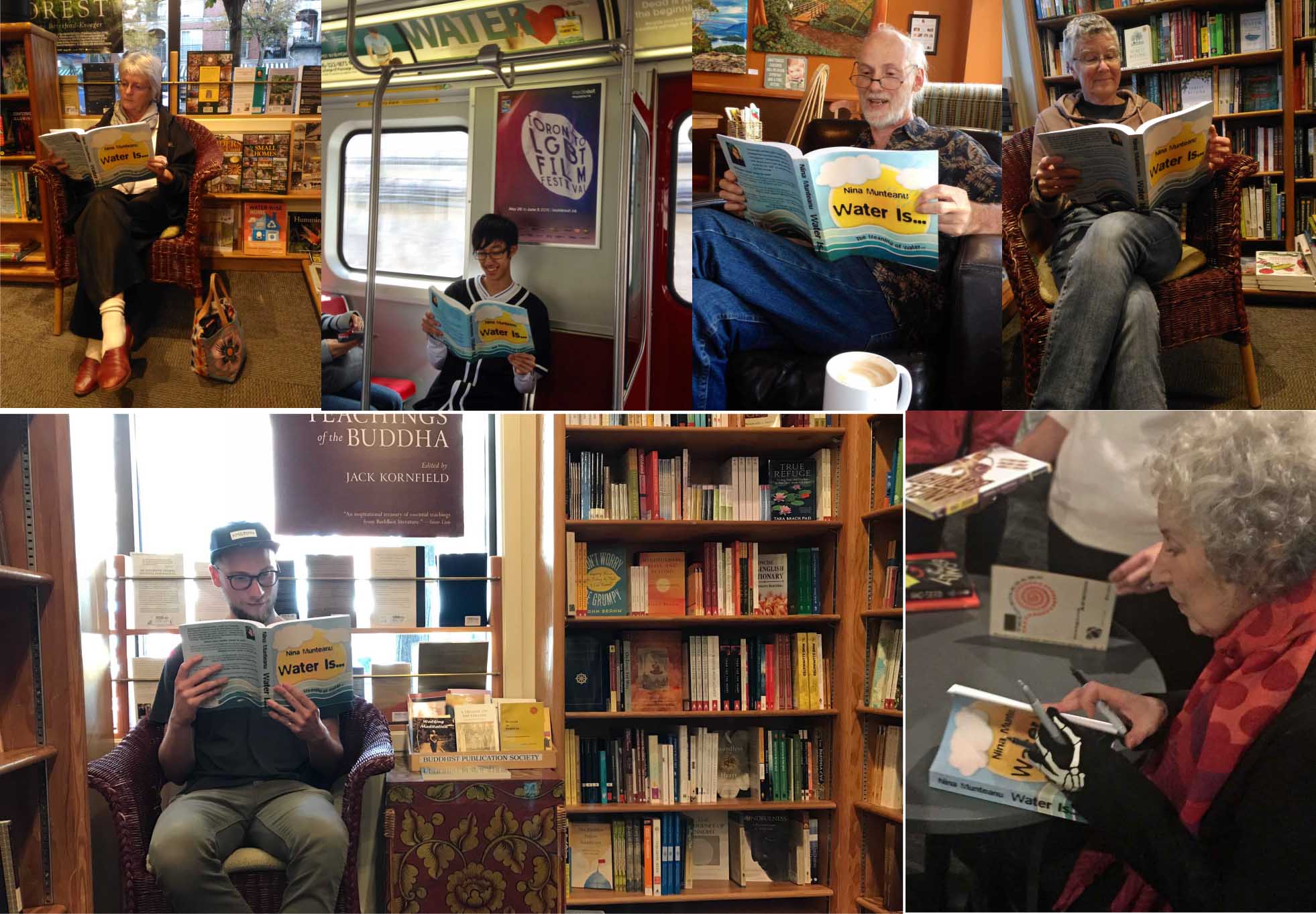
People reading “Water Is…” in Vancouver and Toronto

Margaret McCaffery, chair of the PROBUS Toronto Speakers Committee invited me some time ago to speak to their club in June of 2024 on my experience with water: as scientist, mother, and environmentalist. The audience was mostly retired professional and business people with enquiring minds. I gave my Powerpoint talk in the Holy Rosary Parish Hall on St. Clair West and then enjoyed a vigorous session of challenging and interesting questions to which I responded with equal vigour.

Here is the blurb for the presentation:

Canadian limnologist Nina Munteanu explores the many dimensions of water through her journey with water as mother, educator, and scientist. She describes an emotional connection with nature that compels us to take care of our environment with love versus a sense of duty. 

Nina’s talk draws on her book Water Is… The Meaning of Water, part history, part science and part philosophy and spirituality. The book examines water’s many anomalous properties and what these meant to us. In sharing her personal journey with this mysterious elixir, Nina explores water’s many ‘identities’ and, ultimately, our own. Water Is… was Margaret Atwood’s first choice in the 2016 New York Times ‘Year in Reading.’ Water is… will be available for sale at the talk.

I started with my story as a child, growing up in the Eastern Townships of Canada
I defined “limnology” and talked about my career as a limnologist and environmental consultant
I discussed some of water’s anomalous properties, all life-giving
I brought in some interesting things about water…
I tied my journey with water to family and friends and my watershed
I ended my talk with a discussion of the Watermark Project to catalogue significant stories to water bodies all over the world

I also brought my latest eco-clifi novel A Diary in the Age of Water for sale. It interested quite a few people and generated several wonderful discussions.

Nina Munteanu and her latest eco-novel

Nina Munteanu is a Canadian ecologist / limnologist and novelist. She is co-editor of Europa SF and currently teaches writing courses at George Brown College and the University of Toronto. Visit www.ninamunteanu.ca for the latest on her books. Nina’s bilingual “La natura dell’acqua / The Way of Water” was published by Mincione Edizioni in Rome. Her non-fiction book “Water Is…” by Pixl Press (Vancouver) was selected by Margaret Atwood in the New York Times ‘Year in Reading’ and was chosen as the 2017 Summer Read by Water Canada. Her novel “A Diary in the Age of Water” was released by Inanna Publications (Toronto) in June 2020.

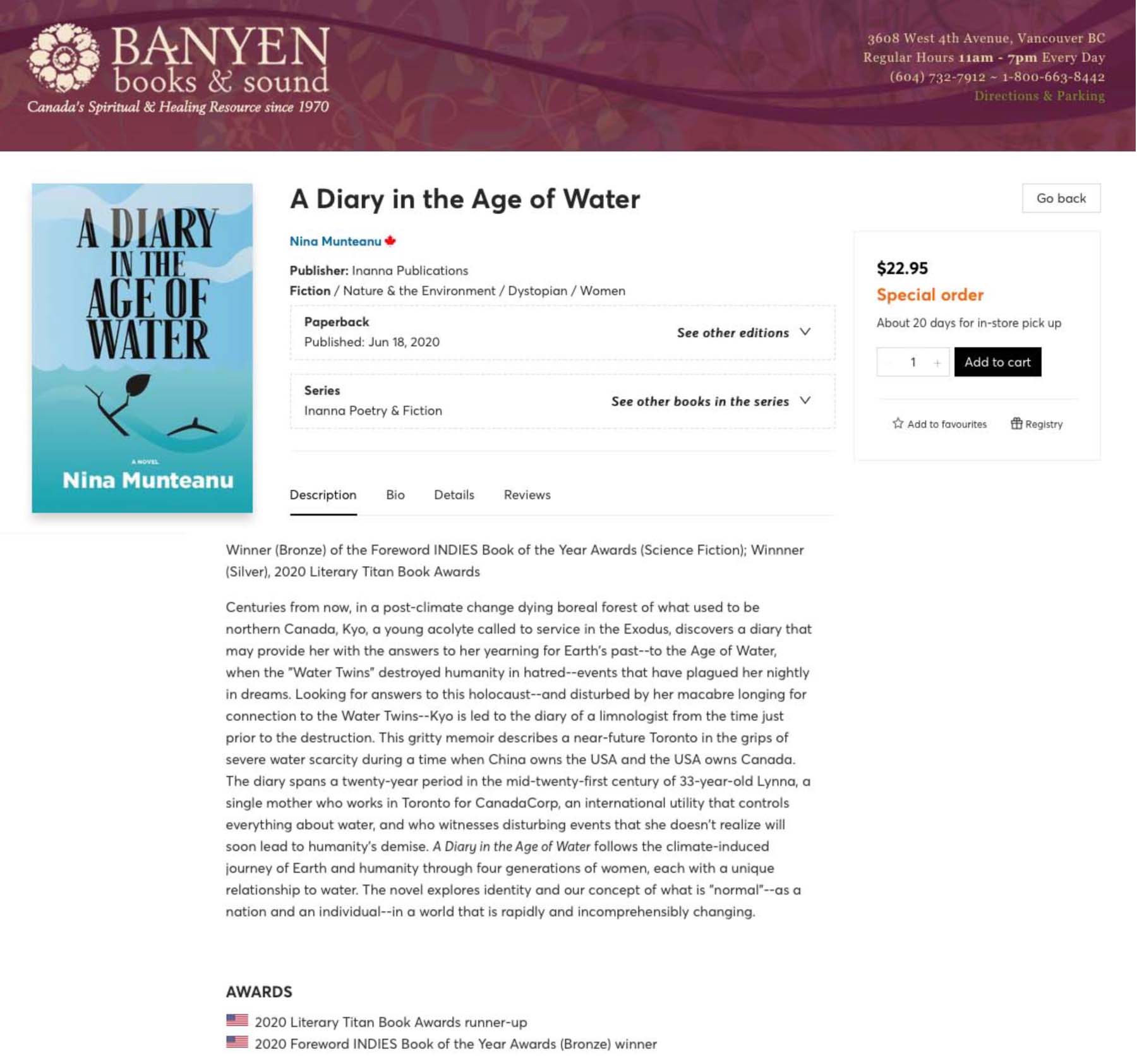
“Water Is…” now selling at Banyen Books, Vancouver

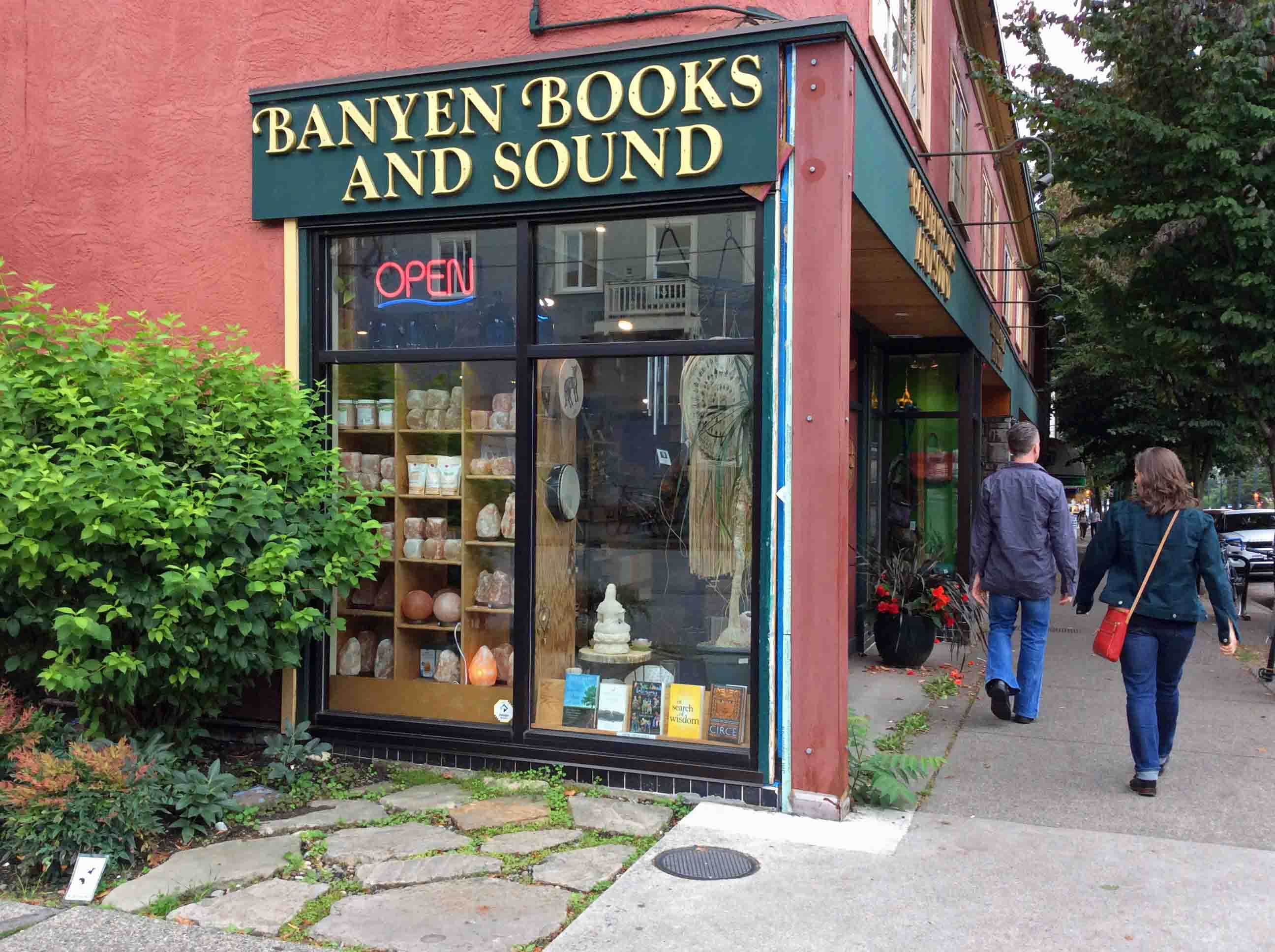
Banyen Books & Sound on corner of Dunbar and W 4th Avenue, Vancouver (photo by Nina Munteanu)

One of my favourite bookstores in Vancouver is Banyen Books & Sound  on the southwest corner of W 4th Avenue and Dunbar. So, whenever I go back to my home town to visit family and friends, I stop there to linger amid the shelves of wonder and erudite adventure. Then I usually cross Dunbar to Aphrodite’s Organic Pie Shop for a delicious fresh pie—usually peach, if it is available. So good! Two things I love: books and pie!

Aphrodite’s Organic Pies, next door to Banyen’s, Vancouver (photos by Nina Munteanu)
Pacific Spirit Regional Park, Vancouver, BC (photo by Nina Munteanu)

During my recent visit this year to Vancouver, my friends and I had a fulfilling walk one morning through the big tree forest of Pacific Spirit Park near UBC. Margaret suggested we go to Aphrodite’s Organic Café for lunch, located across 4th Avenue from Banyen Books (the sister restaurant to the pie shop). After a delicious lunch, we wandered into Banyen, like desert nomads looking for water, and lost ourselves in a treasure of books, magazines, crystals, cards, singing bowls and other spiritual/healing items. Like a braided river, we dispersed according to our wayward interests.

Water Is… at Banyen Books, Vancouver (photos by Nina Munteanu)

Then friend Anne soon found me and pulled my sleeve. “Your book is here!” She led me to where my book Water Is… stood, face out, on the top shelf marked ‘Water: Life Force & Resource.’ In truth, I already knew through Pixl Press that the book was selling there. But here it was, showcased so nicely! It sat rather stately amid Emoto’s Secret Life of Water and Ryrie’s Healing Energies of Water.

Banyen customers find Water Is… and find a chair to take a look

One of the perks of Banyen Books are the comfortable seats for easy browsing. When I teasingly asked one of the clerks if they noticed people lingering for the day, they said, “yeah! They might leave for lunch then come back for the afternoon!” I can see why; Banyen is an entire world to discover. It is called Canada’s most comprehensive Body-Mind-Spirit bookstore, “offering a broad spectrum of resources from humanity’s spiritual, healing, and earth wisdom traditions…Our service is to offer life-giving nourishment for the body (resilient, vital), the mind (trained, open), and the soul (resonant, connected, in-formed). Think of us as your open source bookstore for the ‘University of Life’.”

“Banyen is an oasis, a crossroads, a meeting place…for East and West, the ‘old ways’ and current discoveries and syntheses.”

This is how Banyen describes its birth in 1970:

“The Golden Lotus Restaurant and Natural Food Store on Fourth Avenue at Bayswater was a hothouse for spiritual seekers, new vegetarians and spaced-out hippies grounding through good work. Banyen was born in a tiny book corner of the Golden Lotus. That lovely place was a connection to India, meditation and spiritual growth from 1967 to 1970. As its sun set, what was to become the Naam restaurant, Lifestream, Woodlands, Nature’s Path, and Banyen Books arose.”

Along with Water Is… Banyen is also selling my latest eco-fiction novel A Diary in the Age of Water.

Nina Munteanu is a Canadian ecologist / limnologist and novelist. She is co-editor of Europa SF and currently teaches writing courses at George Brown College and the University of Toronto. Visit www.ninamunteanu.ca for the latest on her books. Nina’s bilingual “La natura dell’acqua / The Way of Water” was published by Mincione Edizioni in Rome. Her non-fiction book “Water Is…” by Pixl Press (Vancouver) was selected by Margaret Atwood in the New York Times ‘Year in Reading’ and was chosen as the 2017 Summer Read by Water Canada. Her novel “A Diary in the Age of Water” was released by Inanna Publications (Toronto) in June 2020.

Nina Munteanu’s “Water Is…” Discussed in Book Club

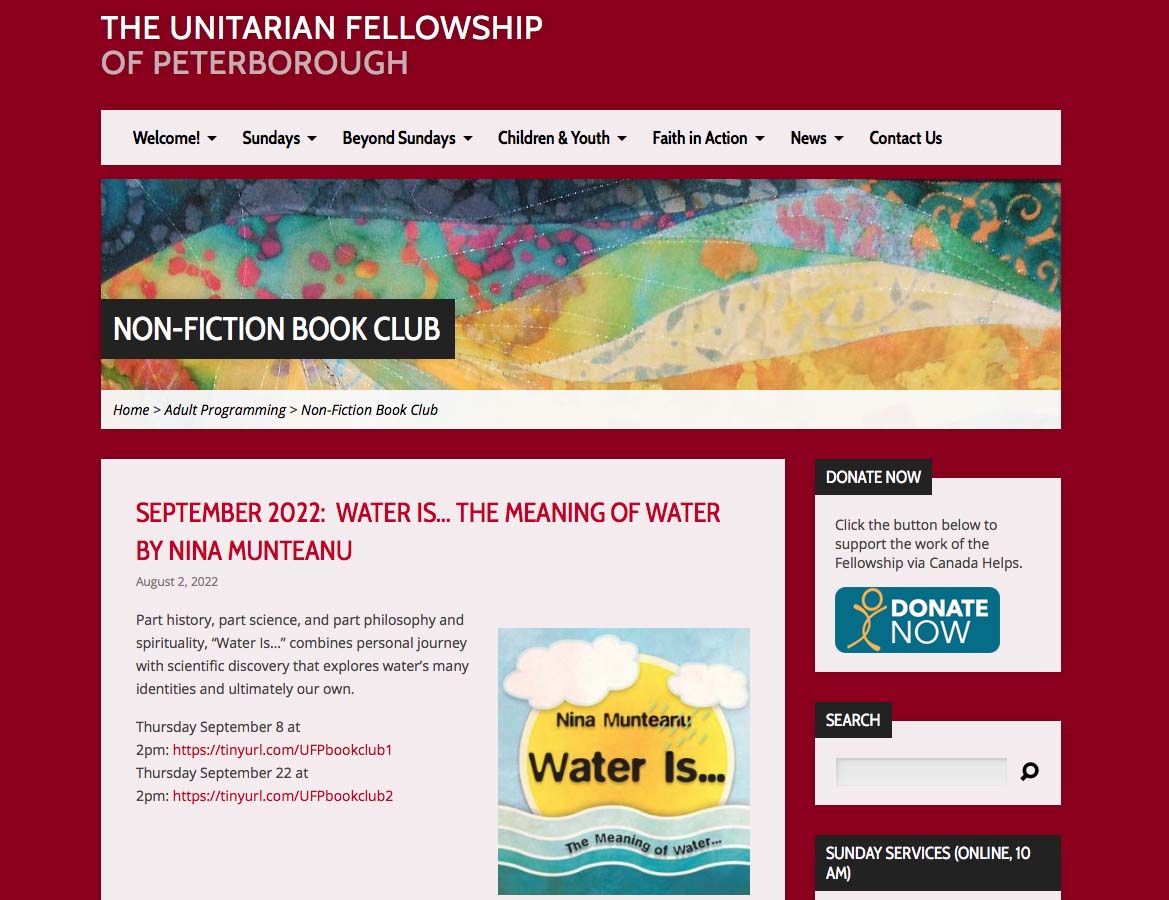
This month of September (September 8 and 22 at 2 pm) the Unitarian Fellowship of Peterborough Non-Fiction Book Club will discuss my book “Water Is…”

NINA MUNTEANU is a Canadian ecologist / limnologist and novelist. She is co-editor of Europa SF and currently teaches writing courses at George Brown College and the University of Toronto. Visit  www.ninamunteanu.ca for the latest on her books. Nina’s bilingual “La natura dell’acqua / The Way of Water” was published by Mincione Edizioni in Rome. Her non-fiction book “Water Is…” by Pixl Press(Vancouver) was selected by Margaret Atwood in the New York Times ‘Year in Reading’ and was chosen as the 2017 Summer Read by Water Canada. Her novel “A Diary in the Age of Water” was released by Inanna Publications (Toronto) in June 2020.

Nina Munteanu Talks About ‘Water Is…’ and ‘A Diary in the Age of Water’ with Dr. Steven Miletto

Nina Munteanu appears on “Teaching, Learning, Leading, K-12” Podcast with Dr. Steven Miletto

I was recently interviewed by Dr. Steven Miletto in Georgia on his podcast “Teaching Learning Leading K12”—Episode 401. We talked about my two recent books on water,Water Is…and A Diary in the Age of Water. The 1-hour interview covered a range of topics from why water makes us feel so good, to the study of limnology, and writing both non-fiction and fiction about water. In the latter, I talked about water as a character in story. We also talked about how characters form in a story and how to keep going when the muse or the joy buries itself.

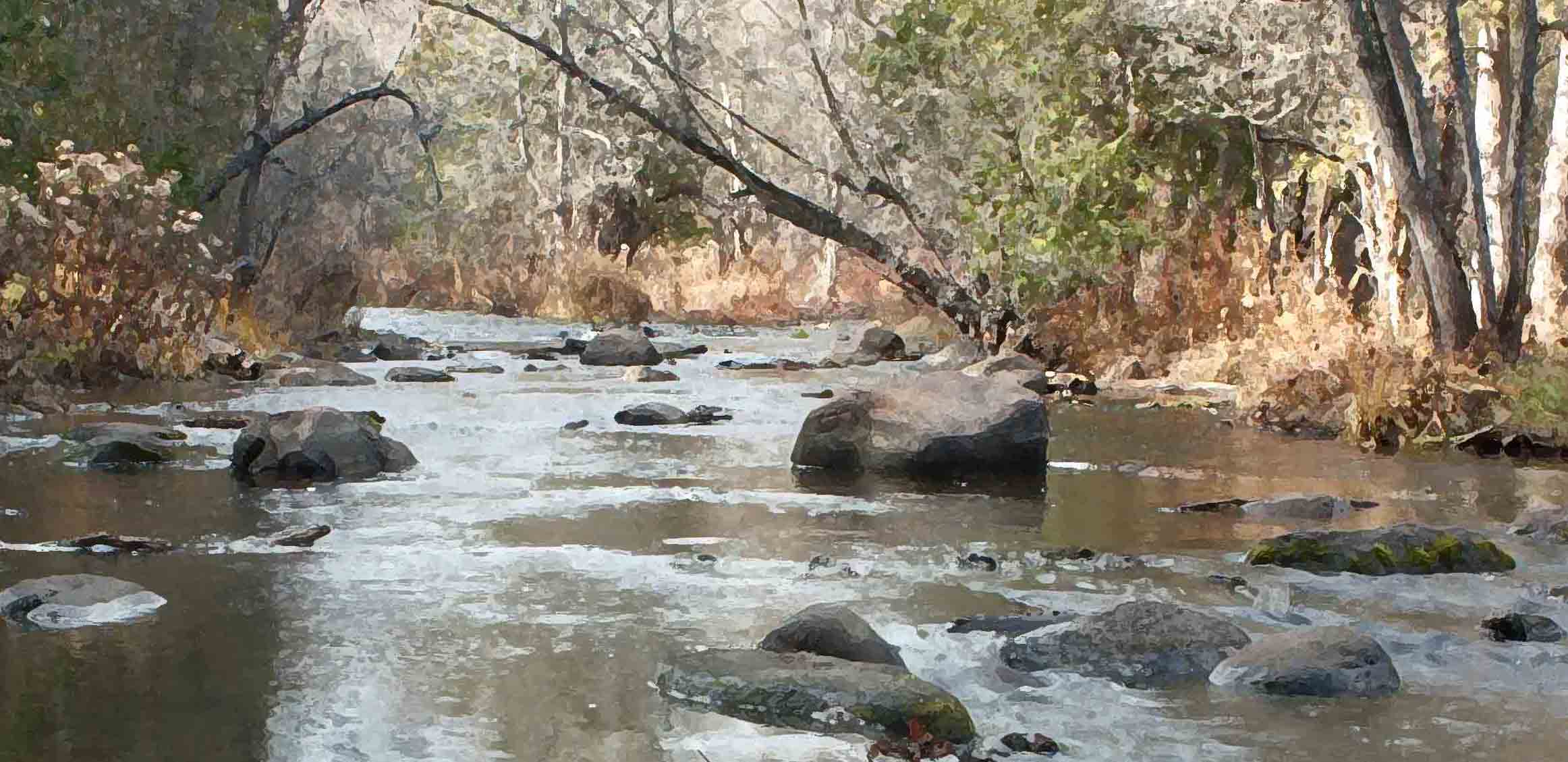
Jackson Creek, ON (photo and dry-brush rendition by Nina Munteanu)

Nina Munteanu is a Canadian ecologist / limnologist and novelist. She is co-editor of Europa SF and currently teaches writing courses at George Brown College and the University of Toronto. Visit www.ninamunteanu.ca for the latest on her books. Nina’s bilingual “La natura dell’acqua / The Way of Water” was published by Mincione Edizioni in Rome. Her non-fiction book “Water Is…” by Pixl Press(Vancouver) was selected by Margaret Atwood in the New York Times ‘Year in Reading’ and was chosen as the 2017 Summer Read by Water Canada. Her novel “A Diary in the Age of Water” was released by Inanna Publications (Toronto) in June 2020.

Nina Talks About Being a Scientist and a Storytelling Artist on “The Authors Book Club”

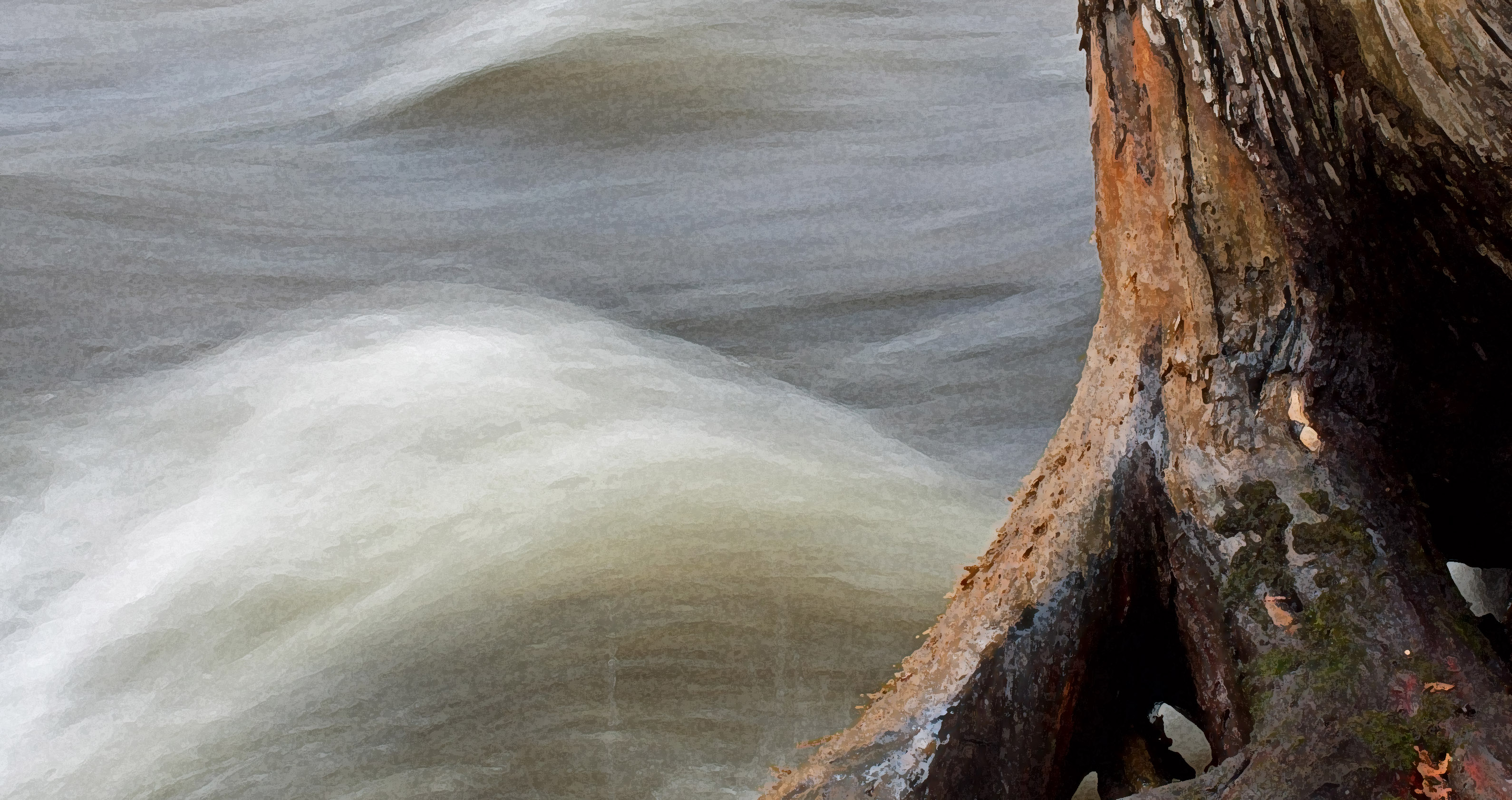
Cedar beside swift water of Jackson Creek, ON (photo and rendition by Nina Munteanu)

Fiona Ross with The Authors Book Club talked with limnologist and eco-fiction author Nina Munteanu about her journey as both author and scientist and her latest book A Diary in the Age of Water (Inanna Publications). 

Advice on writing:

“Write with passion. A lot of people say ‘write what you know.’ Those two in some ways are the same thing. You can do a lot of research on things that you don’t know and bring that in [to your writing.] But to know in your soul, in your heart, the thing that’s important that you need to write about is more what I mean by ‘write what you know.’ If you’re passionate about something—a global catastrophe or a personal journey with abuse—if it comes from the heart, it will keep you on track through those rejections and to finish and complete your work. Otherwise you won’t persist and you’ll let someone tell you that it isn’t important, it’s just a hobby.”

On water:

Nina and Fiona discuss the perils of commodifying water and Canada’s role in protecting the freshwater of the world and the boreal zone of Canada.

Nina talks about how she turned her fear of water as a child into a fascination for water and a passion for its protection. “I’m a limnologist, an ecologist. I’ve have been studying it since I was a little kid who was scared of water. I triumphed over that into fascination and made that into a career.” Nina’s non-fiction book Water Is… was published in 2016 as a biography of water and was endorsed by Margaret Atwood in the New York Times ‘Year in Reading.’

Nina talks about some of water’s over 70 anomalous properties and how virtually each is life-giving. She shares how water can teach us to be stewards and protectors of water within an emerging paradigm of gratitude and humbleness.  

On being both scientist and artist:

Nina suggests that: “All great scientists are informed by art. They are creative in some way. [Scientists] bring that creativity, that original thinking and that curiosity, with them into their science. That’s what makes their science great because they are willing to look outward…We try to compartmentalize so we can better understand [art and science] but the irony is that we better understand them by bringing them together and integrating them…”

Nina Munteanu is a Canadian ecologist / limnologist and novelist. She is co-editor of Europa SF and currently teaches writing courses at George Brown College and the University of Toronto. Visit www.ninamunteanu.ca for the latest on her books. Nina’s bilingual “La natura dell’acqua / The Way of Water” was published by Mincione Edizioni in Rome. Her non-fiction book “Water Is…” by Pixl Press(Vancouver) was selected by Margaret Atwood in the New York Times‘Year in Reading’ and was chosen as the 2017 Summer Read by Water Canada. Her novel “A Diary in the Age of Water” was released by Inanna Publications (Toronto) in June 2020.

Nina Munteanu Talks Water on Sustainably Geeky

I appeared recently on the Sustainably Geeky Podcast Episode 33 “Making a Splash” to talk with host Jennifer Hetzel about all things to do with water, from physics and chemistry to geography and politics. We discussed what a limnologist does (like zoom around lakes in a jet boat and collect water samples, among other things).

Here is their blurb about the episode:

“Water you waiting for? This month we talk with limnologist and cli-fi author Nina Munteanu about the water cycle and how human activity affects it. Nina discusses the importance of water in all its forms, and its affect on global warming.”

Click below to listen:

Jackson Creek in early winter high flow, ON (photo and dry brush rendering by Nina Munteanu)

Nina Munteanu is a Canadian ecologist / limnologist and novelist. She is co-editor of Europa SF and currently teaches writing courses at George Brown College and the University of Toronto. Visit www.ninamunteanu.ca for the latest on her books. Nina’s bilingual “La natura dell’acqua / The Way of Water” was published by Mincione Edizioni in Rome. Her non-fiction book “Water Is…” by Pixl Press(Vancouver) was selected by Margaret Atwood in the New York Times‘Year in Reading’ and was chosen as the 2017 Summer Read by Water Canada. Her novel “A Diary in the Age of Water” was released by Inanna Publications (Toronto) in June 2020.

Water Protectors

“Every story is a story of water,” says Mojave American poet Natalie Diaz

In her article on Diaz, Maria Popova reiterates, “we ourselves are a story of water—biologically and culturally, in our most elemental materiality and our mightiest metaphors.”

There is a reason that women are recognized worldwide as water keepers. Women are intimately connected with flowing water; everything about us is flowing: from our menstrual and birthing waters to the waters of our nurturing milk and the tears we shed for our lost ones. We flow with life and it flows out of us. 

The water walk with Grandmother Josephine along Lake Ontario in 2019 (photo by Nina Munteanu)

So, when Lake Erie became a person with rights in February 2019, this landmark designation came with both triumph and some irony to womankind and water keepers around the world.

“After local residents banded together to compose a visionary bill of rights for the lake’s ecosystem, defending its right “to exist, flourish, and naturally evolve,” it was granted personhood in the eyes of the law. It was an ancient recognition — native cultures have always recognized the animacy of the land — disguised as a radical piece of policy. It was also the single most poetic piece of legislation since the landmark 1964 Wilderness Act, which defined a wilderness as “an area where the earth and its community of life are untrammeled by man, where man himself is a visitor who does not remain.”

Based on that quote, it would seem that only men did the trammelling (given that women are not included or the more correct term would be “human”). It was only a hundred years ago, in 1920, that the 19thAmendment granted women legal personhood in the United States; and in that amendment Native American women were not included—until years after. In her poem Lake-loop, Mojave poet Natalie Diaz explored “how that nesting doll of exclusions breaks open into the living reality of this Earth”: 

“Part of the San Andreas fault runs along the Mojave Desert. We see and feel the fault, it has always been a part of Mojave stories and geography. We have always existed with it–in rift–part land. We are land’s action, maybe. I am always wondering and wandering around what it means to be part of this condition, in shift. What it means to embrace discontinuity, to need it and even to need to cause it in order to be–depression but also moving energy. The necessary fracturing of what is broken. The idea of being made anything or nothing in this country–“to be ruined before becoming”–the idea that this country tried to give us no space to exist, yet we made that space, and make it still–in stress, in friction, glide and flow, slip and heave. We are tectonic, and ready.”

NATALIE DIAZ

The Earth is indeed shifting. As are we. If we are to survive, that is. This will come with a connection with Earth’s natural rhythms. We haven’t been doing that very well, particularly under an “othering” capitalist, exploitive, hubristic dogma. It’s time to ride the swells and turbulence of a Nature evolving. And co-evolve; or get left behind.  We can learn much from the stories of our Indigenous relatives. We can learn much from the stories of our non-human relatives too.

That’s what climate change is: a new story. And that story is all about water.

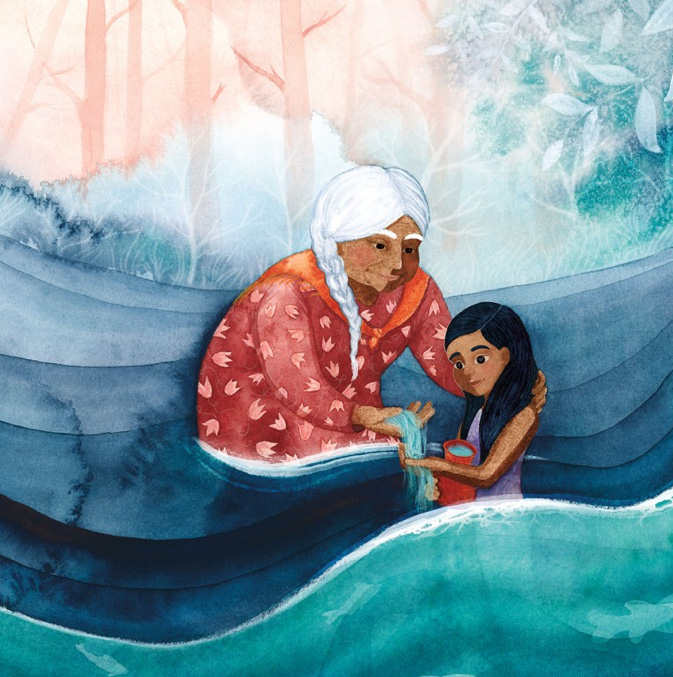
Grandmother with young water keeper (illustration by Michaela Goade)

For this World Water Day, I share with you a wonderful story of water keepers and the water we keep safe. Author Carole Lindstrom, member of the Turtle Mountain Band of Ojibwe, and artist Michaela Goade, member of the Central Council of the Tlingit Haida Tribe of Alaska. have produced “We Are Water Protectors”, a lyrical illustrated celebration of cultural heritage and the courage to stand up for nature.

The water story (illustration by Michaela Goade)

In her address at Scripps College graduatesRachel Carson—who catalyzed the environmental movement with her stunning exposé Silent Spring—exhorted to her future humanity:

“Yours is a grave and sobering responsibility, but it is also a shining opportunity. You go out into a world where [human]kind is challenged, as it has never been challenged before, to prove its maturity and its mastery–not of nature but of itself. Therein lies our hope and our destiny.”

RACHEL CARSON

Today is World Water Day…

I exhort you to do something for water today. Plant a tree (they love water and water loves them). Clean up a local stream or lakeshore. Write a letter to a government official about protecting your watershed. Research something about water and share with someone. Share your watermark on the WatermarkProject.ca site. Buy We Are Water Protectors and share it with someone or give it away. Or buy Silent Spring and share it with someone who hasn’t read it yet.

Keep it flowing…

Nina Munteanu is a Canadian ecologist / limnologist and novelist. She is co-editor of Europa SF and currently teaches writing courses at George Brown College and the University of Toronto. Visit www.ninamunteanu.ca for the latest on her books. Nina’s bilingual “La natura dell’acqua / The Way of Water” was published by Mincione Edizioni in Rome. Her non-fiction book “Water Is…” by Pixl Press(Vancouver) was selected by Margaret Atwood in the New York Times‘Year in Reading’ and was chosen as the 2017 Summer Read by Water Canada. Her novel “A Diary in the Age of Water” was released by Inanna Publications (Toronto) in June 2020.

Nina Munteanu Talks About “A Diary in the Age of Water” with Sustainably Geeky

Jackson Creek swells in early winter, ON (photo and dry brush rendition by Nina Munteanu)

I appeared recently on the Sustainably Geeky Podcast Episode 34 “We’re in Hot Water” to talk with host Jennifer Hetzel about my latest eco-novel “A Diary in the Age of Water” published by Inanna Publications

Here is their blurb about the episode:

“In this bonus episode, we continue our conversation with limnologist and cli-fi author Nina Munteanu. We discuss her book A Diary in the Age of Water and what led her to write this dystopian tale of a future that revolves around water scarcity. Nina’s background as a limnologist gives her a unique perspective on the challenges that await us if we do not address climate change.”

Click below to listen:

Nina Munteanu is a Canadian ecologist / limnologist and novelist. She is co-editor of Europa SF and currently teaches writing courses at George Brown College and the University of Toronto.  Visit www.ninamunteanu.ca for the latest on her books. Nina’s bilingual “La natura dell’acqua / The Way of Water” was published by Mincione Edizioni in Rome. Her non-fiction book “Water Is…” by Pixl Press(Vancouver) was selected by Margaret Atwood in the New York Times‘Year in Reading’ and was chosen as the 2017 Summer Read by Water Canada. Her novel “A Diary in the Age of Water” was released by Inanna Publications (Toronto) in June 2020.