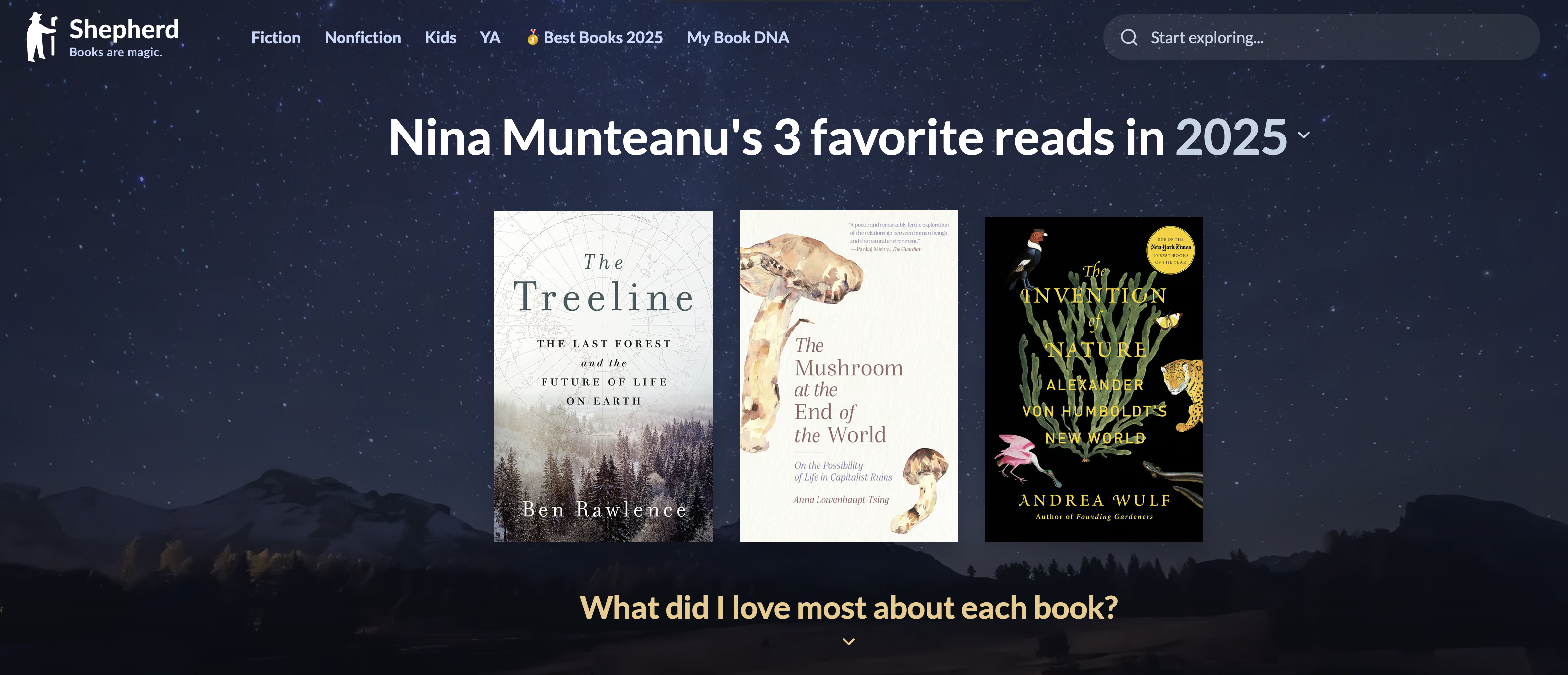
My Three Favourite Reads in 2025

As with previous years, Shepherd invited me to post my three favourite reads of 2025. These aren’t necessarily books published in 2025; just books I read in that year. Each time I do this, I find that, without conscious intent, my favourites fall under a general theme that have touched me that year. Past favourite reads included Feminist Eco-Fiction in 2023 and Cautionary Eco-Fiction in 2024.

2025 yielded a non-fiction book theme; books that touch on humanity’s understanding—or lack of understanding—of our fragile environment and the importance of humility and collaboration to our survival on a changing planet. Here are my three favourites:

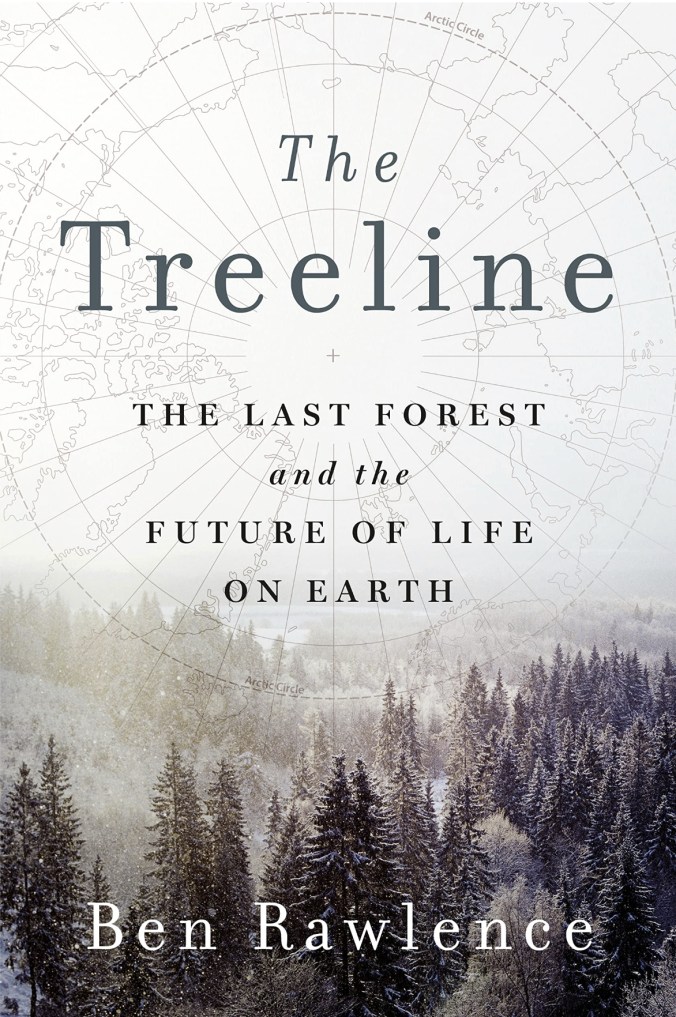
Treeline (St. Martin’s Press, 2022) by Ben Rawlence

This book made me think. It made me cry. It made me despair. It also gave me hope. I was gripped by Rawlence’s honest and unflinching exploration on the moving treeline with climate change and what it will mean for humanity. Rawlence describes the forests of the world as the ‘heartbeat of the planet,’ the cycles of breathing and the pulses of life from the spike of oxygen in the spring when trees put out their leaves to the peaks and troughs over day and night that regulate plant photosynthesis and respiration. Their breaths are getting shallower, he writes. With more carbon dioxide in the air the trees inhale less and exhale less oxygen.

Beautifully written and rigorously reported, Rawlence invited me on a journey of the major treelines over the globe from Scotland, Norway and Russia, to Alaska, Canada and Greenland. Throughout his description of a warming world and a vanishing way of life, Rawlence meditates on the many repercussions on how humans live. There is warning. And there is optimism. This is an important book.

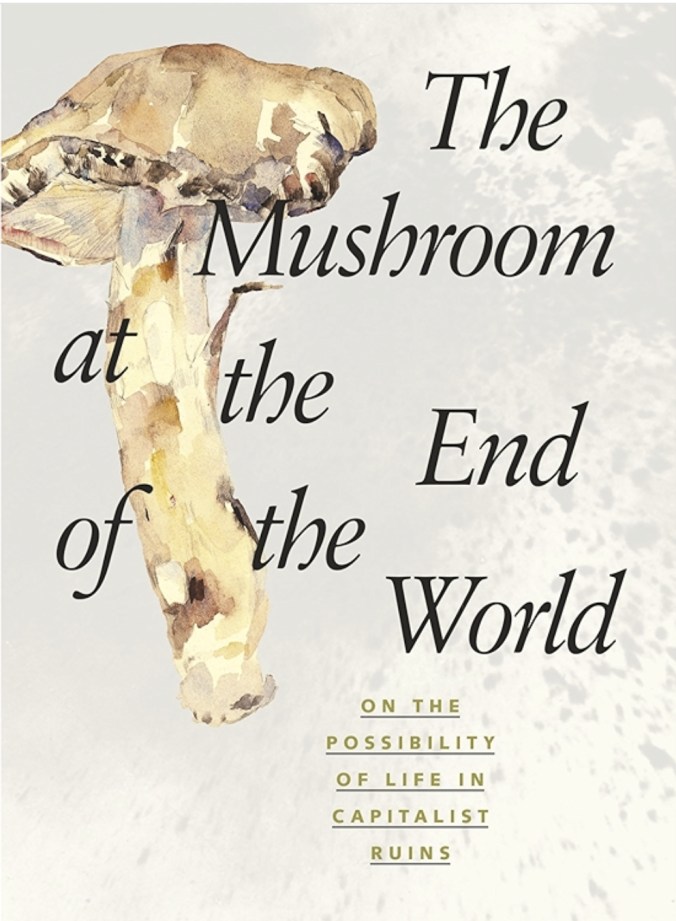
The Mushroom at the End of the World (Princeton University Press, 2021) by Anna Lowenhaupt Tsing

Tsing’s colourful narrative drew me into a metaphoric study of humanity’s journey through the ecology and commerce of the rare Matsutake mushroom. Both treatise on industrial capitalism and parable of survival and renewal under post-capitalist ruin, Tsing’s brilliant storytelling uses the matsutake mushroom and its industry to explore our ecological crisis: how it came about, what drives its continuation and what the consequences may look like.

The matsutake mushroom is considered a weed, growing in human-disturbed forests in the Northern Hemisphere; yet it is prized for its gourmet value. Tsing’s investigation of this rare sought-after mushroom, serves as an excellent metaphor for the study of a post-industrialist world and the promise of life after ruin. Tsing draws together a web of interconnected human and natural ecologies—from the foragers in Oregon and the Hmong jungle fighters to the capitalist traders and Japanese gourmets—to tell a fascinating tale of intrigue, greed, and violence. Laced throughout the story, are her personal reflections on the possibilities of collaborative survival of human and nonhuman.

The book is simply brilliant. The writing riveting. The story important. 

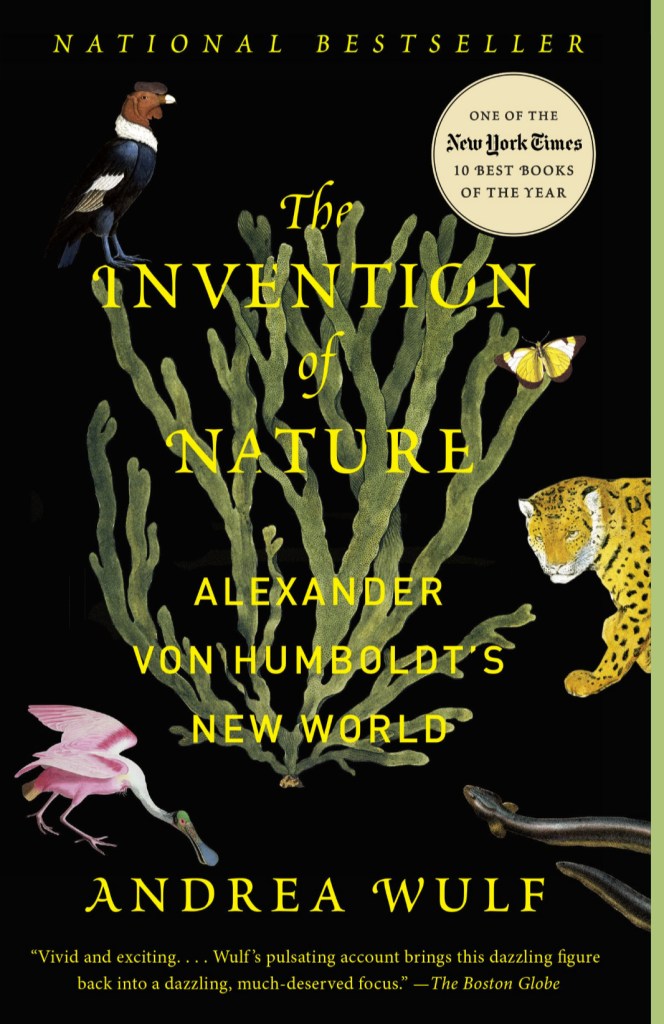
The Invention of Nature: Alexander von Humboldt’s New World (Vintage, 2016) by Andrea Wulf

I was riveted by this fascinating and illuminating biography of a visionary German naturalist and polymath—mostly forgotten—brought back to life through vivid narrative and seamless research to interesting detail. Wulf’s storytelling style drew me into this man’s incredible life, a planetologist way ahead of his time, who predicted human-induced climate change, and formulated a radical concept of nature as both a complex and intertwined global entity—long before Lovelock and Margulis came up with the Gaia Hypothesis in the 1960s.

Humboldt was the first ecologist, practicing the science of ecology for fifty years by the time German scientist Ernst Haeckel created a name for it (ökologie) in 1869. Humboldt embraced Schelling’s naturphilosophie, which espoused an organic and dynamic worldview as an alternative to the atomist and mechanist outlook that prevailed at the time. He saw nature as a living organism, animated by dynamic forces. True to his holistic vision, Humboldt invented global temperature isopleths—still used today. It is no surprise that the world’s first ecologist would also predict humanity’s devastating effect on global climate.

I found Wulf’s biography of von Humboldt fascinating, surprising, often sad, and poignant. What struck me the most was how von Humboldt’s discoveries and predictions were lost to the world with devastating effect. He made the connection and warned of human-induced climate change 200 years ago. If civilization had only heeded his warning!

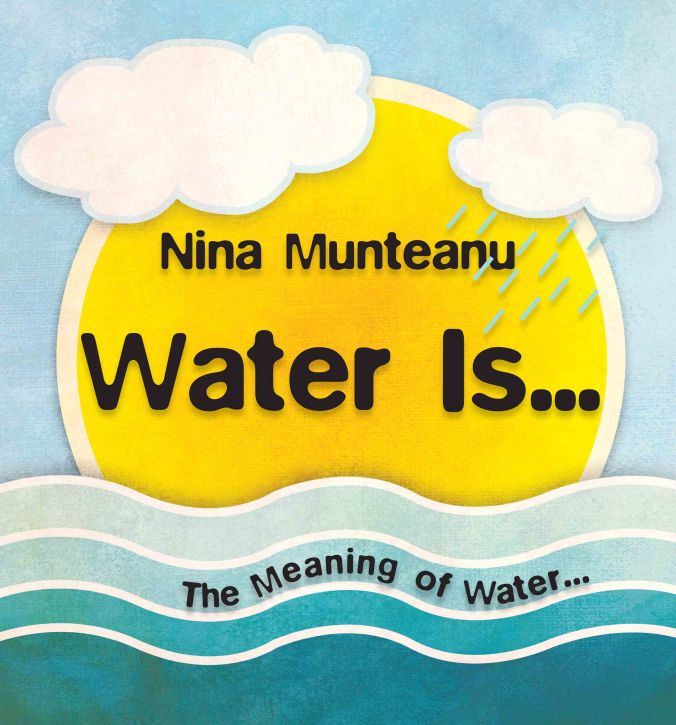
Water Is… The Meaning of Water (Pixl Press, 2016) by Nina Munteanu

My own non-fiction book Water Is…The Meaning of Water—a celebration of water in all its facets—is offered here as fitting this theme of celebrating Nature and educating us on how to live more lightly and responsibly. Here’s what the publisher’s blurb says:

Internationally published author, teacher and limnologist Nina Munteanu explores one of the most important substances of Earth. Nina Munteanu’s Water Is… The Meaning of Water represents the culmination of over twenty-five years of dedication as limnologist and aquatic ecologist in the study of water. As a research scientist and environmental consultant, Nina studied water’s role in energizing and maintaining the biomes, ecosystems, and communities of our precious planet. During her consulting career for industry and government, Nina discovered a great disparity between humanity’s use, appreciation and understanding of water. This set in motion a quest to further explore our most incredible yet largely misunderstood and undervalued substance. Part history, part science and part philosophy and spirituality, Water Is… combines personal journey with scientific discovery that explores water’s many “identities” and ultimately our own.

Water Is… was chosen by Margaret Atwood that year as one of her favourites in The New York Times ‘Year in Reading.’

Nina Munteanu is an award-winning novelist and short story writer of eco-fiction, science fiction and fantasy. She also has three writing guides out: The Fiction WriterThe Journal Writer; and The Ecology of Writing and teaches fiction writing and technical writing at university and online. Check the Publications page on this site for a summary of what she has out there. Nina teaches writing at the University of Toronto and has been coaching fiction and non-fiction authors for over 20 years. You can find Nina’s short podcasts on writing on YouTube. Check out this site for more author advice from how to write a synopsis to finding your muse and the art and science of writing.

When the Permafrost Thaws…

Ice and snow cover the Otonabee River in winter, ON (photo and rendition by Nina Munteanu)

In my upcoming novel “Gaia’s Revolution,” one of the protagonists, Damien Vogel, contemplates in 2022 a key event from 2020 that only a few seem to take seriously:

In Siberia in June 2020, record heat of thirty degrees Centigrade, over the average of 11 degrees, collapsed permafrost and caused oil tanks in Norilsk to rupture. Over twenty thousand tonnes of diesel spilled into the Pyasina lake and river system. Damien remembers looking at the veins of red on satellite images from space. That disaster is just the beginning of what the ‘sleeping bear’ of methane hydrates promise to unleash when the permafrost reaches a critical thaw and those hydrates awaken. Melting permafrost is a quiet sleeper in the climate change procession, he considers. At a microscopic level, in the chemistry of the water and in the change in the atmosphere, a time bomb is ticking.

A decade later, Damien’s twin brother, Eric, notes that:

“Back in the ‘20s scientists started noticing major permafrost melt on the Siberian Shelf,” Eric goes on. “The melting released hydrates, which set the oil and gas companies frothing at the mouth with joy and the climate scientists spinning in a panic because of what they knew it meant for the planet. It was the harbinger of the largest methane ‘burp’ ever.”

Eric then adds:

“Permafrost thaw kicked us into this devastating global warming, Dame, and everyone—even the climate modellers—ignored it, because they didn’t have enough data. Gott verdammt! They’re all still asleep, Dame!”

In his book The Treeline, Ben Rawlence writes about the ongoing extinction of indigenous peoples in the north as the treeline migrates northward into tundra and the permafrost and sea ice change and go extinct themselves.

Ice fragments on the Otonabee River, ON (photo by Nina Munteanu)

Methane & The Clathrate Gun Hypothesis 

Because methane is present in much smaller concentrations many scientists have mistakenly deemed it as important as carbon dioxide in the climate change equation; however, it is becoming obvious that methane poses a real and largely unacknowledged danger. Methane is twenty times more efficient in trapping heat than carbon dioxide. Permafrost—which is currently melting rapidly in the north—contains almost twice as much carbon as is currently in the atmosphere. In the rapidly warming Arctic (warming twice as fast as the globe as a whole), the upper layers of this frozen soil are thawing, allowing deposited organic material to decompose and release methane.

.

The clathrate gun hypothesis is the notion that sea temperature rises (and/or drops in sea levels) may trigger a catastrophic positive feedback on climate:  warming would cause a sudden release of methane from methane clathrate (hydrate) compounds buried in seabeds, in the permafrost, and under ice sheets.

Something of this nature has already occurred in Siberia in 2020. In his book The Treeline Ben Rawlence reports the following warning by Dutch scientist Dr. Ko van Huissteden, a leading authority on permafrost:

“It is hard to measure methane release … [but] some studies have suggested that an unstable seabed could release a methane ‘burp’ of 500-5000 gigatonnes, equivalent to decades of greenhouse gas emissions, contributing to an abrupt jump in temperature that humans will be powerless to arrest.” (Wadhams, 2015)

Creation of gas hydrates requires high pressure; water; gas—mainly methane—and low temperatures. Three environments considered suitable for this process to occur include: sub-seabed along the world’s continental margins; permafrost areas on land and off shore; and a process for storing methane hydrates: ice sheets. As long as the climate is cold and the ice sheet stable, the gas hydrate zone remains stable. As the ice sheets melt, the pressure on the ground decreases; hydrates destabilize and release methane into rising seawater and finally into the atmosphere.

A recent study in Science revealed that hundreds of massive, kilometer-wide craters on the ocean floor in the Arctic were formed by substantial methane expulsions. Because methane is a powerful greenhouse gas, temperatures would rise exponentially. Once started, this runaway process could be as irreversible as the firing of a gun—and on a time scale less than a human lifetime.

The sudden release of large amounts of natural warming gas from methane clathrate deposits in runaway climate change could be a cause of past, future, and present climate changes.

Latest research on the Greenland ice sheet and elsewhere throughout the Arctic has revealed major methane discharges in Arctic lakes in areas of permafrost thaw. Scientists are exploring areas where methane is bubbling to the surface and releasing to the atmosphere.

If human emissions continue at their current rate, rapidly changing ocean currents and retreating ice sheets may uncork methane from under ice caps, ocean sediments and Arctic permafrost, causing a jump in radiative forcing. Even if rapid ice sheet disintegration were to scatter large amounts of ice into the oceans, the net cooling effect would be strongly countered and likely overwhelmed. The areas that did cool would likely trigger severe weather outbreaks.

As I write, we are pumping out CO2 into the atmosphere at a rate 10 times faster than at any point in the past 66 m years, with the resulting sea level rises, extreme weather events, heat waves, droughts, unseasonal storms, and stress on biodiversity around the globe.  Research published in the journal Nature Geoscience demonstrates that “the world has entered ‘uncharted territory’ and that the consequences for life on land and in the oceans may be more severe than at any time since the extinction of the dinosaurs,” writes Damian Carrington of The Guardian.

In an interview with Guardian reporter John Abraham, Woods Hole expert Robert Max Holmes, exhorted:

It’s essential that policymakers begin to seriously consider the possibility of a substantial permafrost carbon feedback to global warming. If they don’t, I suspect that down the road we’ll all be looking at the 2°C threshold in our rear-view mirror.

Ice break up on the Otonabee River in early spring, ON (photo by Nina Munteanu)

References:

Hansen, James and Sato, Makiko; Update of Greenland ice sheet mass loss: Exponential?; (26 December 2012).

Adams, J., M.A. Maslin and E. Thomas Sudden climate transitions during the Quaternary; Progress in Physical Geography, 23, 1, 1-36 (1999)

Andreassen et al. 2017. “Massive blow-out craters formed by hydrate-controlled methane expulsion from the Arctic seafloor,” Sciencescience.sciencemag.org/cgi/doi … 1126/science.aal4500


Carrington, Damian. 2016. “Carbon emission release rate ‘unprecedented’ in past 66 m years.” The Guardian, March 21, 2016.

Hansen, James and Sato, Makiko. 2012. Update of Greenland ice sheet mass loss: Exponential?; (26 December 2012).

Portnov et al. 2016. Ice-sheet-driven methane storage and release in the ArcticNature Communications 7

Rawlence, Ben. 2022. “The Treeline.” Jonathan Cape, London. 342pp.

Sachs, Julian and Anderson, Robert. 2005. Increased productivity in the subantarctic ocean during Heinrich events; Nature 434, 1118-1121;(28 April 2005).

Sojtaric, Maja. 2016. Ice Sheets May be Hiding Vast Reservoirs of Powerful Greenhouse GasCAGE.

Wadhams, Peter. 2015. “A Farewell to Ice.” Penguin.

Flowing water in a river, ON (photo by Nina Munteanu)

Nina Munteanu is a Canadian ecologist / limnologist and novelist. She is co-editor of Europa SF and currently teaches writing courses at George Brown College and the University of Toronto. Visit www.ninamunteanu.ca for the latest on her books. Nina’s bilingual “La natura dell’acqua / The Way of Water” was published by Mincione Edizioni in Rome. Her non-fiction book “Water Is…” by Pixl Press (Vancouver) was selected by Margaret Atwood in the New York Times ‘Year in Reading’ and was chosen as the 2017 Summer Read by Water Canada. Her novel “A Diary in the Age of Water” was released by Inanna Publications (Toronto) in June 2020.

This entry was posted in booksCanadaChoices for WaterClimate Changeeco-fictionecologyenvironmentSciencesustainabilityThe FutureWater Is and tagged arctic ice meltArctic OceanBen Rawlenceclathrate gun hypothesisClimate Changeeco-fictionecologyenvironmentGaia’s Revolutionglobal warmingice sheetsmelting permafrostmethanemethane clathratesmethane hydratespermafrostpermafrost thawrunaway climate changeScienceThe Treelinewater. Bookmark the permalinkEdit