How Maude Barlow Sparked My Novel “A Diary in the Age of Water”

Maude Barlow, author of Boiling Point, Chairman of the Council of Canadians

Like a car, every novel has its point of ignition: a spark that sets it in motion. This occurs when a premise or idea comes together with an incendiary moment of clarity or a thematic question. Mine—though I didn’t know it at the time—happened in a church on the Summer of 2016.

I was in a United Church on Bloor Street, in Toronto’s Annex, watching a talk given by Maude Barlow on water justice. The radical talk was based on her recent book Boiling Point, a comprehensive exploration of Canada’s water crisis—a crisis that most Canadians weren’t—and still aren’t—aware. Canada is steward to a fifth of the world’s fresh water, after all. It is a water-rich country. Of the dozen largest inland lakes in the world, Canada holds eight of them. So, why water crisis? Barlow explains. And you should read Boiling Point, particularly if you’re Canadian. It will open your eyes to the politics of water and how multinational corporations—like Nestlé—are already grabbing and funneling water away from Canadians and into the global profit machine.

I sat close to the front of the Church sanctuary to best see her. But I soon noticed that many people had elected to sit in the gallery above. I found myself focusing on a young mother and her little girl. The girl had some paper and crayons and was busy with that as the enthusiastic mother listened to Maude deliver dire facts about corporate water high-jacking and government complicity.

I saw a story there.

What mother would take her pre-school child to a socio-political talk on water? I would later reflect that memory of the mother and her little girl through my characters Una and her little daughter Lynna, the diarist in my novel A Diary in the Age of Water (eventually published in 2020 with Inanna Publications).

Fresh water flows down the barrel of a hand-operated water pump.

My novel really began with a short story I was invited to write in 2015 by editors of Future Fiction and Mincione Edizioni about water and politics in Canada; the premise of this story would later find it’s way into the larger novel. I had long been thinking of potential ironies in Canada’s water-rich heritage. The premise I wanted to explore was the irony of people in a water-rich nation experiencing water scarcity: living under a government-imposed daily water quota of 5 litres as water bottling and utility companies took it all. I named the story “The Way of Water.” It was about a young woman (Hilda) in near-future Toronto who has run out of water credits for the public wTap; by this time houses no longer have potable water and their water taps have been cemented shut; the only way to get water is through the public wTaps—at great cost. She is in a line of people; she’s two metres from water—and dying of thirst.

The Way of Water” captures a vision that explores the nuances of corporate and government corruption and deceit together with global resource warfare. In this near-future, Canada is mined of all its water by thirsty Chinese and US multinationals—leaving nothing for the Canadians. Rain has not fallen on Canadian soil in years due to advances in geoengineering and weather manipulation that prevent rain clouds from going anywhere north of the Canada-US border. If you’re wondering if this is possible, it’s already happening in China and surrounding countries.
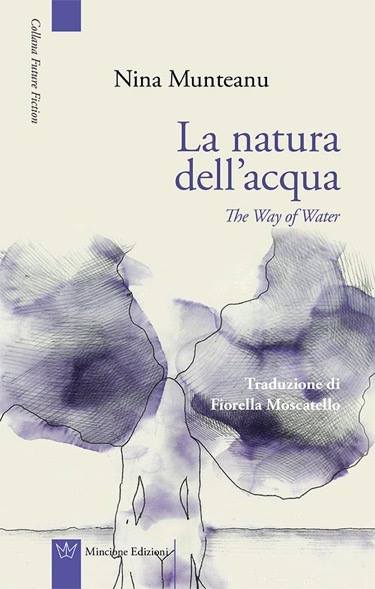
The story first appeared in 2015 in Future Fiction, edited by Francesco Verso, and in 2016 as a bilingual (English and Italian) book and essay published by Mincione Edizioni in Rome. The story has so far been reprinted seven times in magazines and anthologies, including “Cli-Fi: Canadian Tales of Climate Change Anthology” (Exile Editions, Bruce Meyer, ed), in 2017, “Future Fiction: New Dimensions in International Science Fiction” (Francesco Verso & Bill Campbell, eds; Future Fiction / Rosarium Publishing, Rome and Greenbelt, MD) in 2018; and in Little Blue Marble Magazine (Katrina Archer, ed) in January, 2019 and in their ‘Best of’ anthology. It was then published in 2022 in Metastellar Magazine and later in their ‘Best of’ anthology. “The Way of Water” received generous praise from review sites and the press worldwide.

After the success of this short story, I realized that I needed to tell the larger story—how did the world—Canada—get to where Hilda was? Her mysterious mother, the limnologist Lynna who was taken away by the RCMP in 2063, clamored for more attention. I remembered that four-year old girl and her mother in the gallery at Maude Barlow’s talk on water politics. And I thought of my characters: young Lynna and her mother Una. How does a daughter of an activist mother behave and think? How best to express her voice? I had earlier written a short story that was a mix of correspondence (emails) and third person narrative (“The Arc of Time” in Natural Selection, later reprinted in Metastellar Magazine), which I felt captured the voices of the characters well. I realized that a diary by Lynna would be an ideal way for her to express her unique worldview and cynicism—yet allow her vulnerable humanity to reveal itself through this unique relationship with her diary. The remaining characters and their narratives emerged easily from there: Una, her activist mother; Daniel, her conspiracy theorist colleague (and her conscience); Orvil, the water baron (and lover she betrayed); and Hilda, her “wayward” supposedly mind-challenged daughter—who appears in the short story that takes place later.
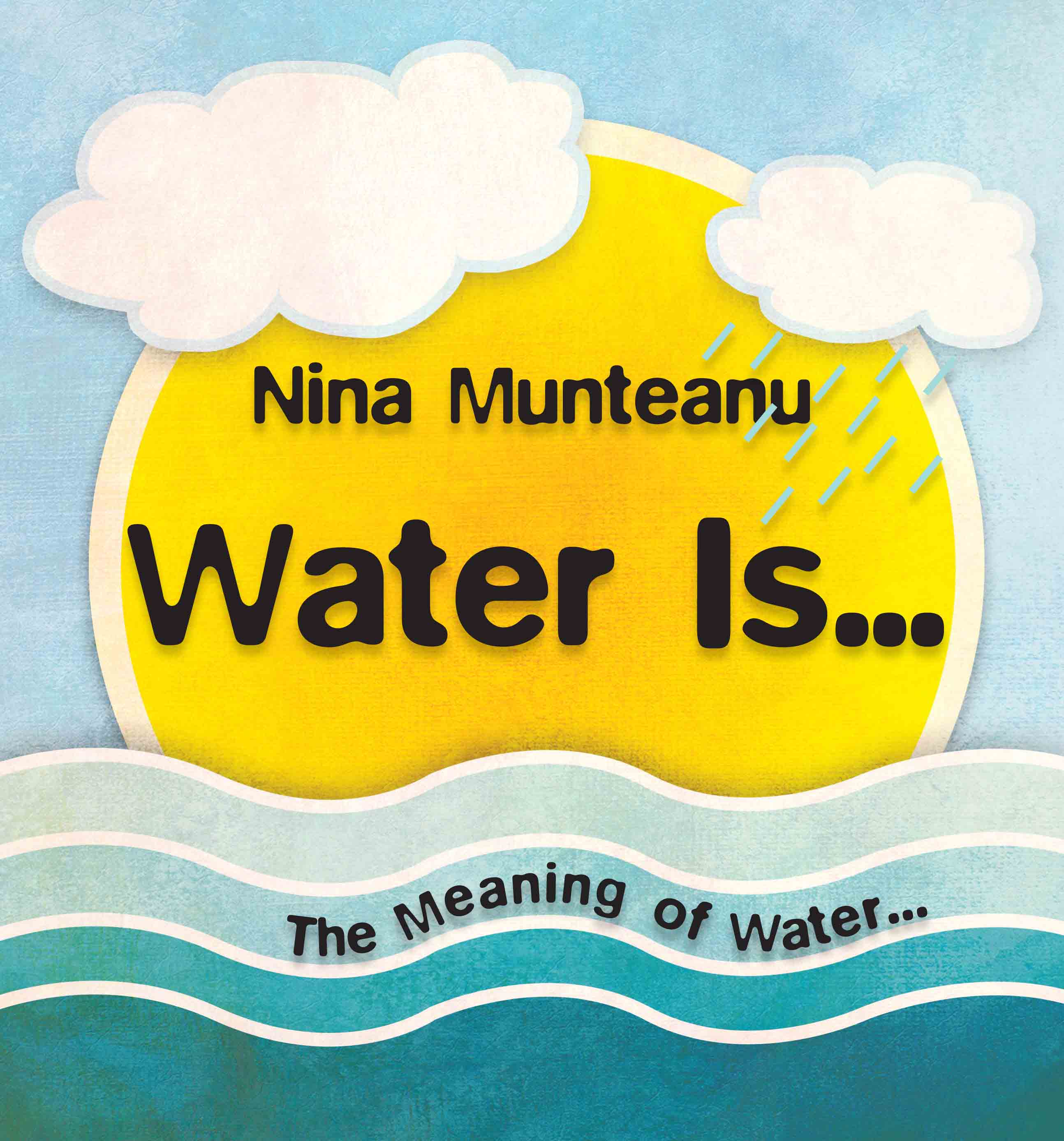
I had a lot of material; I had already been researching water issues and climate change in my activism as a science writer and reporter. In 2016, Pixl Press had published “Water Is… The Meaning of Water”, essentially a biography of water, written from the perspective of mother, environmentalist and scientist. I had practiced as a limnologist for over twenty-five years and could mine my various personal experiences in the field, lab and office with genuine realism. I chose Wetzel’s Limnology (the classic text book I used in my introductory limnology course) for quotes to each of Lynna’s entries; this added an opportunity to provide additional metaphor and irony through Lynna’s scientific voice. I placed the child Lynna (who was born in 2012) into actual events in Toronto, where I currently live. This pushed the story further into the area of documentary and blurred the lines between fiction and non-fiction to achieve a gritty and textured reality. Lynna also taught limnology at the University of Toronto, where I currently teach.
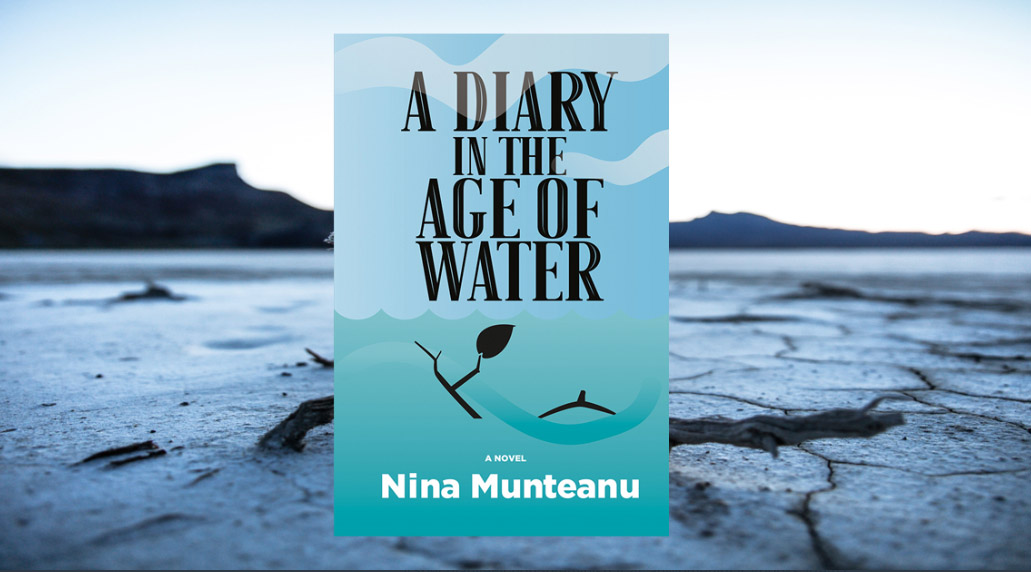
Just as Water Is… served as a watershed for all my relevant experiences as mother, environmentalist and scientist, A Diary in the Age of Water would galvanize many of my personal experiences, doubts, challenges and victories into compelling story. Although parts of the story wrote themselves, the entire book was not easy to write. There were times when I had to walk away from the book to gain some perspective—and optimism—before continuing. When I found myself drowning in Lynna’s voice, I invoked Hilda to guide me to shore. I found a balance that worked and compelled. Ultimately this opened to some of the best internal conflict and tension I have experienced in my writing.

Like water itself, A Diary in the Age of Water expresses through many vessels and in many perspectives, spanning hundreds of years—and four generations of women—with a context wider than human life. Through its characters, A Diary in the Age of Water explores the big question of humanity’s deadlock with planetary wellness and whether one is worth saving at the expense of the other. One of the characters asks Lynna the hard question: “If you had the chance to save the planet [stop the mass extinctions, deforestation and pollution ravaging the planet], but it was at the expense of humanity, would you do it?”

Water is, in fact, a character in the book—sometimes subtle and revealed in subtext, other times horrific and roaring with a clamorous voice. Water plays both metaphoric and literal roles in this allegorical tale of humanity’s final journey from home. The story explores identity and our concept of what is “normal”—as a nation and an individual—in a world that is rapidly and incomprehensibly changing—and in which each of us plays a vital role simply by doing or not doing.

A Diary in the Age of Water promises to leave you adjusting your frame of reference to see the world, yourself—and water—in a different way.

Illustration on Liisbeth article (photo collage by PK Mutch and Dreamstime

This is what PK Mutch of Liisbeth and Ariel Kroon (PhD graduate of English Literature at the University of Alberta and co-editor at Solarpunk Magazine) say about A Diary in the Age of Water, published by Inanna Publications in 2020:
The novel has received wonderful praise and prizes, including the Literary Titan Award, the Foreword Indies Award and finalist in the International Book Awards. I wonder if Maude Barlow has read it?… Maybe I (or someone) should get her a copy, huh?…

Maude Barlow with ‘Save our River’ sign

Maude Barlow is a Canadian activist and author of Blue Gold, Boiling Point and several other books on water justice. She chairs the board of Washington-based Food and Water Watch and Ottawa-based Blue Planet Project. Maude co-founded the Council of Canadians and chaired its board for over three decades.

Maude Barlow arrested in 2011 for environmental activism

Nina Munteanu is a Canadian ecologist / limnologist and novelist. She is co-editor of Europa SF and currently teaches writing courses at George Brown College and the University of Toronto. Visit www.ninamunteanu.ca for the latest on her books. Nina’s bilingual “La natura dell’acqua / The Way of Water” was published by Mincione Edizioni in Rome. Her non-fiction book “Water Is…” by Pixl Press (Vancouver) was selected by Margaret Atwood in the New York Times ‘Year in Reading’ and was chosen as the 2017 Summer Read by Water Canada. Her novel “A Diary in the Age of Water” was released by Inanna Publications (Toronto) in June 2020.
Defining Moments and The Last Summoner

A few years ago I attended a panel at Toronto’s Ad Astra convention called “Stealth Science Fiction in Person of Interest.” The panel was the brainchild of fellow science fiction writer Ira Nayman, an avid watcher of the TV show. Unbeknownst to me, the panel I’d been assigned to participate with Ira and another panelist was about a TV show (which I’d never seen)—not just an expression.

I bumbled in the beginning as realization dawned on me that this was what the panel was about and quietly berated myself for not rereading the short description (which had been sufficiently vague—at least to me). I finally let the panelists and audience know my limitation when Ira astutely noted that I was being extra reticent (not one of my usual traits in panels). We muddled along, despite my infirmity, and the panel went along admirably—mainly because Ira moderated with great astuteness and audience members participated enthusiastically.

One of the plot points of the show led Ira to share a personality-defining hypothetical dilemma that he’d encountered. Here’s how he described it: if you knew you could save five people by instigating the death of another person, would you do it? Or would you, by your inaction, allow the five to die by not instigating that person’s death? The premise, of course, is that you could tell the future of two divergent actions.

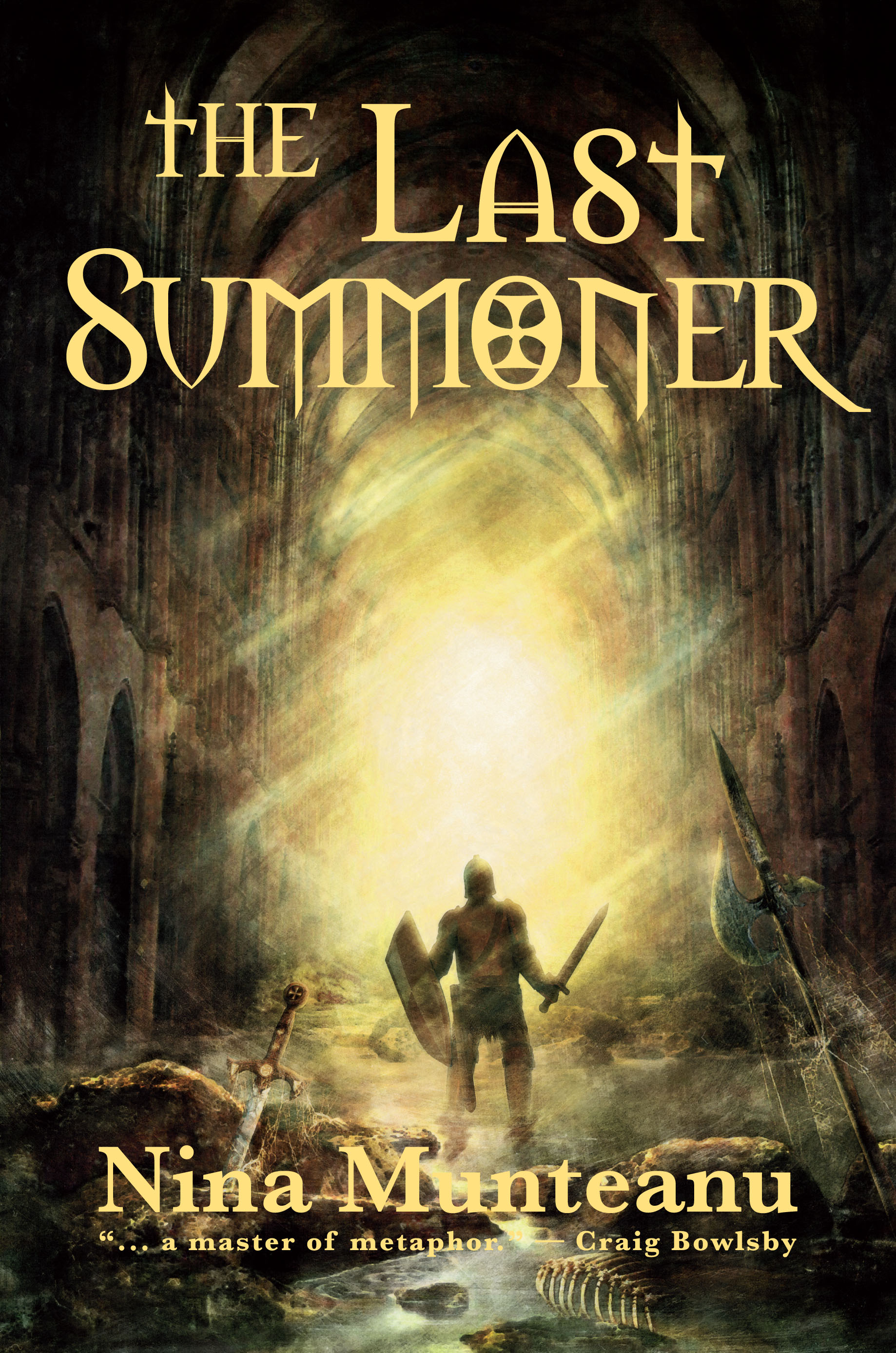
LastSummoner-coverI realized soon after that this is exactly the situation that my main character Vivianne Schoen, the Baroness Von Grunwald, faced in her journey to change the history she’d inadvertently authored (in The Last Summoner). As a medieval time traveler, she was presented with several courses of history and needed to choose her actions carefully in accordance with both short-term and long-term consequences. Faced with the possibility of saving utterly millions of people who were fated to perish in World War I by instigating the death of one man—Kaiser Wilhelm II—Vivianne sets out to do the deed.
Besides her ability to time travel, Vivianne is able to manipulate metal through mind-wave energy. Because of this power, she decides to participate in a momentous event in which her power will have a potentially deadly effect. The year is 1889, just a year after Kaiser Wilhelm II was crowned Emperor, and the place is Charlottenburg Race Course in Berlin in this excerpt from The Last Summoner:

VIVIANNE pulled up the collar and hood of her fur coat to ward off the November chill as she walked next to Jurgen von Eisenreich in Berlin’s Charlottenburg Race Course. The coat barely kept the winter wind from cutting through her cream- colored evening gown. Fastened at the back, it had no bustle and signaled the upcoming style. They were here to watch Europe’s latest touring attraction from America: Buffalo Bill’s Wild West Show. Steering her by the elbow, von Eisenreich guided her up the rafter stairs toward the Royal Box, where the new Emperor was already seated with his retinue of several statesmen, including his aides-de-camp, and two imperial guards. Vivianne recognized the odious and obsequious Count Alfred von Waldersee, seated beside the Emperor. Twenty-seven years the Kaiser’s senior, the Count was a power-mongering anti-Semite, who would prove to mold the weak-minded Crown Prince into the bigoted warlord Kaiser Wilhelm II was becoming.

Wilhelm II

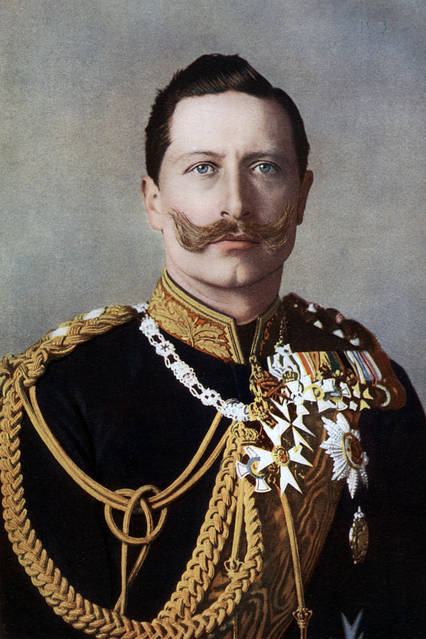
Kaiser Wilhelm II

Vivianne stole a long glance to the Reich’s young ruler. It had been just a year since the Crown Prince had ascended to the imperial thrown and he had already stirred up trouble with his insulting behavior of his mother, the dowager Empress, and his uncompassionate handling of his father’s funeral; then his shabby treatment of England’s Queen and her son, the Prince of Wales.

Vivianne furtively studied the dashing thirty-year old ruler with deep interest. Dressed impeccably in uniform, he was rakishly handsome, she decided, with sharp intelligent eyes, a long aristocratic nose and well-waxed handle-bar mustache. She found herself staring at his withered left arm, which he rested on his lap. Though she could not make it out, it was a good six inches shorter than the other arm and partially lifeless. He’d been a breech birth and both he and his mother were lucky to be alive.

Vivianne reflected on that eventful day when she’d botched her attempt to save the last Emperor of Germany from an unnatural birth. While Oskar had been instantly killed, the doctor had survived the carriage accident with only a severe concussion; he’d still only managed to get to Unter den Linden by early afternoon, having lain unconscious and unattended for most of the morning then having awoken at Humboldt Hospital where he’d ironically been scheduled to speak that day and had then foolishly insisted on tending to Vivianne first, who’d suffered a nasty head wound that she hadn’t even been aware of receiving.

The Emperor—like Vivianne—was here, in the District of Charlottenburg in West Berlin, to see the show’s star attraction, Annie Oakley, who acquired world fame for her skills with a Colt .45. The young sharpshooter had been invited by the Kaiser for a private performance for the Union-Club. Vivianne found her breaths escalate at the thought of what the impetuous Kaiser was about to do; and what she intended to do, as a result. Was it an ironic twist of history that only months ago Adolf Hitler was born this year? Vivianne glanced down at the program in her gloved hand:

Programme of Miss Annie Oakley’s Private Performance Before the Members and Their Friends of the Union-Club, Berlin, on November 13, 1889, at Charlottenburg Race Course.

There followed a list of up to seventeen feats she would perform, beginning with her exhibition of rifle shooting, followed by clay-pigeon sharp-shooting then various feats involving trapping and agility in weapon handling. She was not fated to get very far in her program before calamity of sorts would strike, Vivianne thought cynically.

“He’s alone…without his family?” she asked von Eisenreich. That would make it much easier, she concluded with an inward sigh.

“Dona prefers the comfort and warmth of the royal palace in Potsdam, and the company of her children,” he responded. “She’s not interested in this sort of thing. She has few interests other than church service, I’m afraid.” Then he leaned his head close to hers to confide. “Ten years ago, Wilhelm was smitten by his beautiful cousin, Victoria Elizabeth, the second eldest daughter of the Grand Duke and Duchess of Hesse and the Rhine. But Ella wouldn’t have him.” Then von Eisenreich surveyed Vivianne with an appraising look and smiled enigmatically. “In fact, she looked a lot like you.”

Vivianne swallowed down a sudden discomfort, not sure of its source. Von Eisenreich went on, “Poor Wilhelm became very self-conscious about his arm and thought himself unattractive. That might be why he chose a plain and simple, but pious woman.”

More like narrow-minded, anti-Semitic and bigoted thought Vivianne. Unfortunately the Empress fit in too well with the Kaiser’s own bigoted views and apparently her nature only served to exacerbate the Kaiser’s arrogance and insufferable nature.

Von Eisenreich chuckled to himself. “I heard that the Empress Dona was called unimaginative and prejudiced by the Emperor’s own mother. Dona hates the English. But don’t we all!” He laughed.

Vivianne thought of the cutting words of the gossiping socialite, Daisy, Princess of Pless: for a woman in that position I have never met anyone so devoid of any individual thought or agility of brain and understanding. She is just like a good, quiet, soft cow that has calves and eats grass slowly then lies down and ruminates.

“Apart from that homosexual, Count Philipp von Eulenburg, I’m the Emperor’s only real friend,” von Eisenreich confided rather smugly to Vivianne as they approached the Royal Box.

As if he felt her stealthy glance, the Kaiser turned to look directly at her. After an unabashedly long appraisal, he let his eyes drift away and leaned out, looking past his aide to focus on von Eisenreich. “Ah, Jurgen! So that’s why you dallied and missed my retinue!” The Kaiser yelled in a coarse Potsdam accent, eyes flitting back critically to Vivianne like she was merchandize. He stood up and clapped von Eisenreich hard on the back, clearly happy to see him. Vivianne got a clear view of his short left arm with dark brown mole on his shriveled hand. She noted that he was rather short in stature for a man, about her height or less, with a squat and slightly lopsided neck—owing to his left arm being shorter than the other. Eisenreich drew Vivianne forward.

“This is the Comptesse d’Anjou,” von Eisenreich said.

She pulled down her hood and curtsied slightly, eyes downcast. “I’m honored and humbled, your Imperial Majesty,” she said.

“No doubt you are!” he responded, swiftly tucking his left hand in his pocket. When she raised her eyes to meet his, Vivianne caught the brief instant as his eyes grew wide and deep with hidden intensity.
 Jurgen caught it too. “I thought so, also,” he said with amusement to the Emperor. He was, no doubt referring to her likeness to the Princess Ella.

The Kaiser sucked in a breath and straightened with an imperceptible tremble, as if to shake off an old memory. Then he gave Vivianne a cold smile and extended his good hand to her in greeting. She accepted and instantly winced with excruciating pain. He barked out a cruel laugh and said, “The French are, I’m afraid, just like the English when it comes to my German mailed fist!”

Vivianne had heard of his sadistic handshake: he was in the habit of turning his many rings inward prior to clasping one’s hand with a vice-like grip. Somehow, she hadn’t expected him to inflict her with it. Perhaps it was his way of punishing his cousin for not accepting his marriage proposal, she concluded, regretful of her resemblance. The Kaiser hung on to her hand much longer than he needed to, Vivianne decided, squirming and attempting to retract it from his painful grasp. His grip was too strong.

Their eyes locked. And to her frustrated anger, her eyes teared up with the stinging pain through her glove.

In that moment she saw the hurt little boy in that bigoted, arrogant and angry face. She instantly knew that she’d misjudged one of his critical nexuses. Her mission this day might have been prevented. If she’d intersected with his life earlier, and somehow convinced his beloved Ella to accept his proposal, the single-minded but compassionate princess might have softened him, completed him, inspired him to be the great man he could have become instead of the bitter and insecure bully he now was.

Something passed between them and he abruptly let go of her hand with a sudden intake of air. “I beg pardon,” he said, voice softening from that harsh Potsdam accent. “You reminded me of someone I once knew…” In a flush of solicitous emotion, he pulled off her glove to inspect the damage he’d inflicted on her hand. Several red welts had surfaced on the inside of her lower palm where his rings had gouged into her flesh. “Ahh…such dear soft and warm hands…” he cooed in near reverence. “How remarkable…the soft insides of your hands…”

Vivianne slowly pulled her hand away.

They both looked awkward for a moment. Then the Kaiser broke out into a blustery laugh and turned to von Eisenreich.

“So, where’s your good wife, von Eisenreich?”

“Like you, I left her at home with my dear children, where she should be, your Majesty,” von Eisenreich responded cheerfully. “They’re no fun at these sorts of things.”

“Ah, but I wager the Comptesse is,” said the Emperor brashly and took the opportunity to rake her over with appreciative eyes.

Von Eisenreich let loose a conspiratorial laugh, as if to ratify the Kaiser’s innuendo. He then leaned into Vivianne beside him with a chuckle until his shoulder collided into hers. “I brought my lovely companion, the charming Comptesse d’Anjou, to improve my demeanour and make me interesting.”

The Kaiser threw his head back and shouted an open- mouthed laugh of abandon then stomped his foot. “Indeed, she has managed that!” He surveyed Vivianne with critical eyes that flashed with approval. When she’d first been introduced to him, she’d felt the Kaiser’s burning gaze roam over her like the eager hands of a lover. “Good choice,” Wilhelm said.

He’d clearly deduced that she was von Eisenreich’s mistress and Jurgen had as much as confirmed it. The Kaiser had several mistresses of his own and Vivianne had the impression he wouldn’t have minded another.

As Uta had predicted, Vivianne had indeed filled out into what most men commonly considered a woman of striking beauty. And she’d had many years to cultivate it into an irresistible package. She was now over four hundred years old, yet she looked no more than in her early twenties. That arcane quality alone, she knew, was enough to drive men to distraction.

Vivianne had only met von Eisenreich last week at a masked ball and, knowing his weakness for beautiful women, she’d shamelessly flirted with him; within short order she’d seduced his keen interest in her and ensured for herself an invitation to this event.

The Kaiser let his gaze stray to Vivianne as he spoke to von Eisenreich. Then he finally let his eyes rest openly on her with a cool smile. “You speak German very well for a French woman, Comptesse,” he said to her. “I detected no accent when we were first introduced.”

She smiled demurely and didn’t bother to correct him on her German lineage.

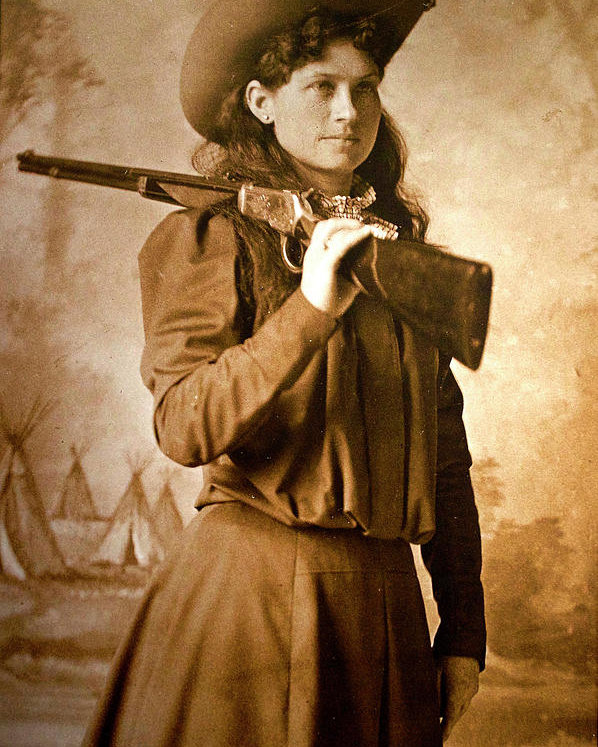
Annie Oakley

Annie Oakley

Then the show began and their attention was diverted to the ring below. Vivianne’s heart raced when Annie Oakley finally emerged. The diminutive woman stood facing the royal box in a smartly collared buckskin dress, bedecked with glittering metals from contests she’d won, cowboy hat, and holding her Colt .45.

Von Eisenreich leaned his head close to hers. “Chief Sitting Bull gave her the nickname of ‘Little Sure Shot’ because of her dead shot with a pistol, rifle and shotgun. Did you know that she began handling firearms at the tender age of nine to supply her widowed mother with game and eventually paid off the mortgage on her mother’s house?”

Vivianne let her brows rise in impressed surprise. In truth she knew. She knew everything about the American sharp-shooter. At 90 feet Annie could shoot a dime tossed in the air. With the thin edge of a playing card facing her at 90 feet, she could hit the card and puncture it with five or six more shots as it settled to the ground.

Vivianne felt her mouth go dry; she knew what came next.

With a flourishing turn, Annie faced the royal box and announced, “For my final act, I will attempt to shoot the ashes from the cigar of a lady or gentleman in the audience. “Who will volunteer to hold the cigar?” she asked the audience. Vivianne’s heart pounded. She knew that the little sharpshooter from Cincinnati expected no one to volunteer; Annie had simply asked for laughs. Her attentive manager-husband, Frank Butler, always stepped forward and offered himself. Not this time—

Just as laughter bubbled up in the crowd, Kaiser Wilhelm leapt out of the royal box and strutted into the arena to a stunned audience. Laughter turned to gasps as the Kaiser approached the sharpshooter. Annie Oakley visibly stiffened. In horror, Vivianne thought. The two guards scrambled forward from the rafters but the Kaiser gruffly waved them off. Vivianne marveled at Annie’s cool resolve; after handing the cigar to Wilhelm, the performer paced off her usual distance and the Kaiser lit the cigar with flourish.

Several German policemen rushed into the arena in a panicked attempt to preempt the stunt, but the Kaiser brusquely waved them off too. Then he lifted his head and placed the cigar to his mouth in a pose of a statue.

“No,” Annie said. “In your hand, please, Your Majesty,” she instructed. He looked disappointed but did as she’d asked.

Annie raised her Colt and took aim.

Royal_Irish_Rifles first day at Somme_July_1916

Royal Irish Rifles in the Somme, 1916

Vivianne swallowed the gorge in her throat. This was the moment she’d waited for; the moment for which she’d come. If this volatile and ambitious ruler were removed from the scene, one of the key reasons for World War I would also vanish. An entire world war would likely be averted. She only had to redirect the bullet; it was made of metal, after all. Kill a bully and incriminate and ruin the life of an innocent young woman … in exchange for over two million lives and the prevention of an age of non-stop violence—

Annie fired.

First World War wounded

Carrying the wounded and dead out of the battle field

“For those in love with science fiction at its best, The Last Summoner is a complex story of ignored responsibilities and their dire consequences, of love and betrayal that span centures and multiple worlds. Time travel, multiverse travel, immortality, alternate history in which the Nazies have won, not in the twentieth century but way earlier, in the Teutonic age. Angels and mutants, utopias and dystopias, even a Tesla occurrence—everything a science fiction reader could ever desire in a book. A masterfully told story with great characters. Nina Munteanu moves flawlessly from a medieval story to a modern one and everything in between.”—Costi Gurgu, author of RecipeArium

Grapevine-dogwood 2 willow water TC

At the mouth of Thompson Creek, ON (photo by Nina Munteanu)

nina-2014aaa

Nina Munteanu is a Canadian ecologist / limnologist and novelist. She is co-editor of Europa SF and currently teaches writing courses at George Brown College and the University of Toronto. Visit www.ninamunteanu.ca for the latest on her books. Nina’s bilingual “La natura dell’acqua / The Way of Water” was published by Mincione Edizioni in Rome. Her non-fiction book “Water Is…” by Pixl Press (Vancouver) was selected by Margaret Atwood in the New York Times ‘Year in Reading’ and was chosen as the 2017 Summer Read by Water Canada. Her novel “A Diary in the Age of Waterwas released by Inanna Publications (Toronto) in June 2020.