Our current world—under the final shadow of climate calamity and environmental destruction—is steadily polarizing: politically, socially, and environmentally. Wealthy vs. poor. Privileged vs. indentured. Right vs. Left. Educated vs. illiterate. And so on.
This is the opposite of what we need—particularly to deal with the hyperobjects of climate change and environmental destruction; these require a united global intelligence and effort to address and overcome. Oddly enough, the hyper-destructive forces that we’ve unleashed are only intensifying our polarization as our capitalist paradigm encourages separation, segregation, and ‘othering.’ As more things go wrong, some look to lay blame. There is always the ‘Other.’
As there appears less to share, some greedily disparage ‘the other’ and take what they consider theirs in a version of Sonderweg—an elitist’s special and privileged path.
Polarization leads to lack of consensus, greater misunderstanding, violence and eventually to outrage. Polarization breeds fanaticism. Borne of deep frustration and fueled by relentless passion, fanaticism sparks violent change. We are seeing some of this today throughout the world: unhinged fanaticism, fed by growing polarization and exclusion. In Germany, the far-right fascist Reichsbürgers movement violently rejects the legitimacy of the modern German state. In the USA, far-right white supremacists and Christian fundamentalists incite domestic terrorist violence fueled by nativism, populism, anti-communism, and ultra-nationalism.
Eco-terrorism—from mild civil disobedience to destructive violence—is increasing in tandem. Eco-terrorism has increased by over 22% since 2017 as acts of radical environmental activism have steadily escalated into environmental warfare.
Amid all this violent foreplay between fanatics, the rest of us slide into a solipsistic brain coma as we stare mesmerized at our phones expecting godlike answers delivered uniquely to us by chatbots.
I recently read on Locus Magazine a commentary by Canadian author Cory Doctorow called “Hell is Other People” in which he characterized our AI-infatuated oligarchy:
A subset of humanity is committed to a world where everyone else takes orders from them. We have different names for these people. We call the majority of them “toddlers,” but we call the others “bosses” or “tyrants.” These latter two groups – who, unlike toddlers, are unlikely to outgrow their belief that everyone else should shut up and do as they’re told – are also among the people most excited about AI. What’s more, the more powerful these people are, the more credulous and enthusiastic they are about AI.
Among bosses, the most enthusiastic boosters are tech overlords. These billionaires will not shut up about AI, and, tellingly, the thing they’re most excited about is the fact that AI might let them fire programmers and replace them with chatbots.
While tech bosses look forward to AI replacing workers, social media bosses (like Mark Zuckerberg) look forward to AI replacing friends. How many of us are already relying on AI (which uses the first person narrative) to answer almost every question?
.
According to Doctorow, “Zuckerberg hopes that bots will produce a social media service without socializing. If he can imprison you in a mirror-palace of chatbots, he can order them to say the things they calculate will make you keep scrolling, and he will owe them nothing.”
This, of course, aligns with the oligarch’s puppet regime, whose first directive is to remove opposition provided by independent-thinking people. Doctorow pithily describes it:
The broccoli-haired brownshirts from DOGE laid waste to the civil service, indiscriminately firing skilled workers who do things that America needs done. When asked to justify this vandalism, they said that those fired workers were superfluous to requirements, because “General AI” was just around the corner. The idea of creating and enslaving an artificial god is so attractive to them because it allows them to realize the fascist dream, in which every whim of their cult leader is instantaneously translated into action – without having to pass through the filter of skilled people who understand how things work.
.
Ink cap mushrooms curling and deliquescing (photo by Nina Munteanu)
.
Nina Munteanu is a Canadian ecologist / limnologist and novelist. She is co-editor of Europa SF and currently teaches writing courses at George Brown College and the University of Toronto. For the latest on her books, visit www.ninamunteanu.ca. Nina’s bilingual “La natura dell’acqua / The Way of Water” was published by Mincione Edizioni in Rome. Her non-fiction book “Water Is…” by Pixl Press (Vancouver) was selected by Margaret Atwood in the New York Times ‘Year in Reading’ and was chosen as the 2017 Summer Read by Water Canada. Her novel “A Diary in the Age of Water” was released by Inanna Publications (Toronto) in June 2020.You can read her just released eco-fiction thriller Gaia’s Revolution by Dragon Moon Press.
.
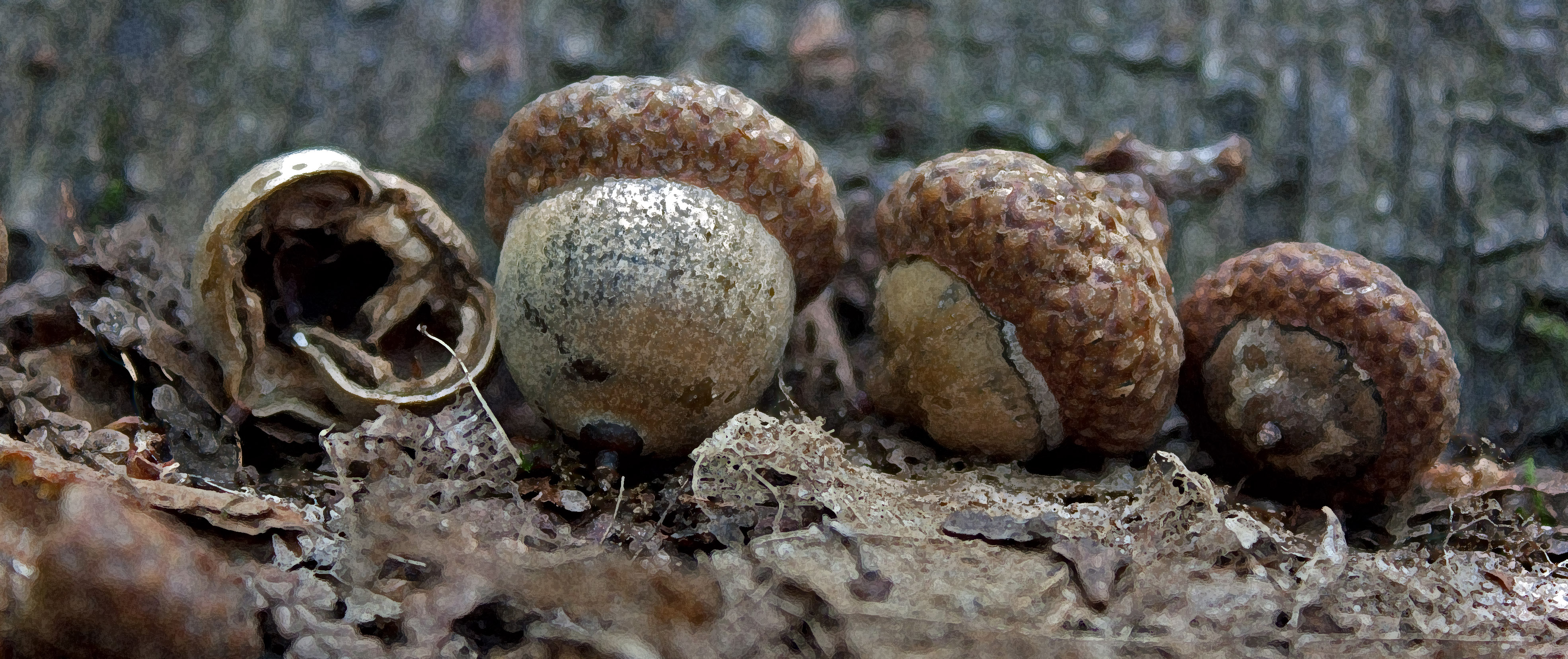
Acorns line up beneath a red oak, Jackson Creek Park, ON (photo by Nina Munteanu)
Minerva in Shakespeare’s The Tempest and John Savage in Aldous Huxley’s Brave New World
In today’s world of gene editing, plant and animal cloning, DYI biohacking, and artificial intelligence, the transhumanist movement merits careful thought. Simply put, transhumanism is a philosophical and intellectual movement that advocates for enhancing the human condition and expanding human capabilities through advanced technology.
But when does a Transhumanist’s individual expression of “transcendence” become a movement toward the Singularity? The political ambitions that wish to use science to “enhance” humanity, based on someone’s idea of “perfect” carry dangerous social implications. The transhumanist notion of “self-directed evolution” to recast humanity in the image of “perfection” evokes social Darwinism and the Übermensch. It brings to mind the early American eugenics programs that inspired the fascist sonderweg and Hitler’s aggressive “race hygiene” by application of eugenics in the Holocaust.
.
Eugenics: Designing A ‘Perfect Society’ from a ‘Perfect Human’
The eugenics tree (American Philosophical Society)
.
Put simply, eugenics is the scientifically erroneous and immoral belief and practice of “racial genetic improvement’ and “selective breeding” (or more currently through genetic manipulation), which gained particular popularity during the early 20th century with key scientific misappropriation (scientific racism).
Eugenics and scientific racism are concepts as old as Plato and have haunted humanity since the biblical portrayal of Adam and Eve. The philosophy and associated practice became increasingly common in the 1870s and 1880s as leaders and intellectuals worldwide argued for policies based on racist and xenophobic attitudes—justifying actions of antisemitism, sexism, colonialism, slavery, and imperialism. Discussions of ‘human improvement’ and the ideology of scientific racism became increasingly common. In 1883, Francis Galton, English statistician and ethnologist (and cousin of Charles Darwin), gave the practice a name. He called it eugenics, which comes from a Greek term meaning “good” or “noble” birth.
.
In 1938, German Dr. Bruno Beger measures a Tibetan woman’s head to demonstrate ‘inferior’ characteristics of her race; Beger later works for the Nazi SS to help identify Jews (Wikimedia Commons))
.
Eugenics was based on ‘scientific racism’, an ideology that appropriated the legitimate methods of science to argue for the superiority of white Europeans. Misappropriation of advances in medicine, anatomy and statistics during the 18th and 19th centuries (including Charles Darwin’s 1859 theory of evolution and Gregor Mendel’s laws of inheritance) added a false sense of validity to these racist claims.
.
The practice of eugenics is based on the notion that not only physical traits but mental and behavioral attributes—like mental capacity, musical ability, insanity, sexual licentiousness and criminality—are inheritable and therefore can be directed through breeding, sterilization and now through genetic manipulation.
(A child’s head is measured to determine his personality and predict his future, Schleswig-Holstein, Germany, 1932)
.
Historically the ideology of ‘scientific racism’ and practice of eugenics took on two forms: 1) positive eugenics—encouraging people deemed ‘superior’ or ‘fit’ (based on wealth, race or intelligence) to have more children; and 2) negative eugenics—discouraging or preventing people deemed ‘unfit’ (e.g. ethnic minorities, poor or disabled) from having children (most commonly through forced sterilization or murder).
.
1926 poster warning that breeding among the unfit creates an unwanted burden on society, Philadelphia, Pensylvania (Wikipedia Commons)
For instance, Work conducted at the Eugenics Record Office (ERO) in Cold Spring Harbor, under the direction of Charles Benedict Davenport from 1910 to 1939, directly led to the forced sterilization of thousands of American citizens and the passage of anti-immigration laws.
.
Coldspring Harbor Laboratory in 1920s where American eugenicists used state fairs as a venue for popular education, and judged “human stock” to select the most eugenically fit family in contests such as this one. (American Philosophical Society.
.
By the 1920s, eugenics was a global phenomenon, popular with the elite, particularly in countries such as Germany, the United States, Great Britain, Italy, Mexico, and Canada. In the United States, involuntary sterilization, forced institutionalization, social ostracization and stigma have continued well into the 1970s. Concerned over “race suicide” (based on differential birthrates of races), American eugenicists promoted involuntary sterilization of mostly native Americans, African Americans, poor whites and people with disabilities; declaring certain individuals “feebleminded” or anti-social. Over 60,000 people were sterilized against their will by the 1970s.
.
Ultimately, these same beliefs inspired the Nazis to exterminate people with disabilities and “lessor” ethnic or philosophical backgrounds. At least 400,000 victims were sterilized and over 70,000 adults and 5,000 children euthanized.
Nazi propaganda poster
.
“Perhaps more than any other science, biology has consistently been employed as an accomplice to moral claims because it has tremendous social utility in translating scientific findings into political imperatives,” says Cosima Herter, science consultant for the TV show Orphan Black (which covers the topic of eugenics well.) “Deeply embedded in the public consciousness is the hope that social problems can be solved with ‘scientific panaceas’,” Herter adds. “…Science can as easily act as an ally to existing institutions and justify pernicious prejudices – racism, sexism, homophobia, and class disparity to name a few – as it can produce wondrous, beautiful, and beneficial fruits in the service of a better world.”
.
Eugenics remains alive and well in North America. Much of it lies buried under beneath medical well-being, gene manipulation research or detainment, incarceration of illegal immigrants, or even the “metaeugenics” of AI. In her 2024 book Menace to the Future: A Disability and Queer History of Carceral Eugenics, Jess Whatcott introduces the term “carceral eugenics” which she defines as: “a concept that analyzes how state confinement functions to control the reproduction and life choices of groups of people who have been deemed biologically undesirable.”
.
Eugenics & Transhumanism
In 1929, Cambridge crystallographer J.D. Bernal, speculated on radical changes to human bodies and intelligence through bionic implants and cognitive enhancement. Two years before that, Fritz Lang’s expressionist SF film Metropolis introduced the first robot depicted in cinema: the Maschinenmensch, the machine-human.
.
Aldous Huxley’s 1932 dystopian novel Brave New World describes a ‘utopia’ based on eugenic principles. It is a stratified genetic caste society where the lower orders are deliberately stunted both mentally and physically. The destiny of its five main strata is determined from an early age. The strata consist of Alphas, destined for leadership positions; Betas, who hold less exalted but still intellectually demanding jobs; Gammas and Deltas, who occupy roles needing some intelligence; and finally Epsilons, happy and easily-controlled morons capable of only the most menial and unskilled tasks.
.
Biologist Julian Huxley, brother of author Aldous Huxley, first used the word Transhumanism in a 1957 article, where he presented the concept of the technological singularity, or the ultra-rapid advent of superhuman intelligence. Julian Huxley defined Transhumanism as “man remaining man, but transcending himself, by realizing new possibilities of and for his human nature.”
The founders of Transhumanism were educated wealthy individuals of mostly British and European descent. They were an elite ruling class, who considered themselves the forward-thinking intelligentsia. Transhumanismis an intellectual and cultural movement that promotes eugenic principles through science & technology to improve human mental and physical characteristics and capacities. Transhumanists seek to expand technological opportunities for people to live longer and healthier lives and enhance their intellectual, physical, and emotional capacities through the use of synthetic biology: genetic, cybernetic and nanotechnologies. From the transhuman perspective, “in time the line between machines and living beings will blur and eventually vanish, making us part of a bionic ecology.”
While early Transhumanists advocated the elitest pseudoscience of eugenics or “racial hygiene”, many of today’s Transhumanistsargue that market dynamics and individual choice will drive twenty-first century eugenics. However, this argument contradicts the movement’s own dialectic: that of achieving the Singularity. The Transhuman quest for the Singularity of the Übermenschconsists of the ability to upload the minds of all individuals to a Hive Mind, a symbiotic collective consciousness, in which all peoples can link to an artificial “brain” or global hard drive, to achieve super-intelligence. The Mind Upload Research Group (MURG) is currently researching this possibility.
.
Futurist Ray Kurzweil, author of The Age of Spiritual Machines and co-founder of the Singularity University, predicts that humans will be uploading their minds to computers by 2045 and that bodies will be replaced by machines—essentially achieving “immortality”—before the end of the century. “We’re going to become increasingly non-biological to the point where the non-biological part dominates and the biological part is not important any more,” says Kurzweil. “In fact the non-biological part – the machine part – will be so powerful it can completely model and understand the biological part. So even if that biological part went away it wouldn’t make any difference.”
.
If such an existence were even desirable—which it isn’t to me—such a utopia would not be available to everyone; it would remain the domain of a wealthy aristocracy, creating yet another class system. I’m reminded of William Gibson’s pithy proclamation: “The future is already here—it’s just not evenly distributed.”
Kurzweil admits: “Humans who resist the pressure to alter their bodies by becoming part-cyborg or are unable to afford such procedures will be ostracized from society. Humans who do not utilize such implants are unable to meaningfully participate in dialogues with those who do.”
In Kurzweil’s brave new world of biological and non-biological intelligence, immortal software-based humans, and ultra-high levels of intelligence will expand outward in the universe at the speed of light. Will such an elite see the mass of humanity as worthless parasites and either prevent them from reproducing via mass sterilization programs or simply slaughter them outright?
The smell of eugenics remains ever-present.
Its oppressive aroma lingers in the biocapital frontier. In the neo-eugenic ‘marketplace of genetics’ encouraged by current advances in genetic screening and gene editing. In the continued confabulations of “designer babies” for the wealthy. In the neoliberal commodification of “human capital,” and rebranding of the “unfit.” In the biopolitics of disabled populations. In the persistence of white-supremacist movements throughout the world.
A class studies the Bertilon method of criiminal identification, based on measuring body parts, Paris, France, 1910-15
In the introduction to their 2000 paper in Nature Reviews Genetics entitled “Engineering American society: the lesson of eugenics”, researchers David Micklos and Elof Carlson write: “We stand at the threshold of a new century, with the whole human genome stretched out before us. Messages from science, the popular media, and the stock market suggest a world of seemingly limitless opportunities to improve human health and productivity. But at the turn of the last century, science and society faced a similar rush to exploit human genetics. The story of eugenics—humankind’s first venture into a ‘gene age’—holds a cautionary lesson for our current preoccupation with genes.”
A phrenologist demonstrates how to measure a person’s head for their mental energy, UK, 1937
What is perfect and how do we measure it? What is the risk of even suggesting a recipe for such a thing? A perfect society? Isn’t a Utopia an oxymoron of unresolvable paradox? Science fiction literature has given us many visions of where so-called utopias may descend (e.g., Brave New World, 1984, Fahrenheit 451, A Stranger in a Strange Land, The Handmaid’s Tale, The Matrix, The Hunger Games, Elysium, Divergent, Clockwork Orange, Delirium, and so many more). The very act of being an individual provides complexity and diversity that promotes stability in change.
Stable chaos.
.
Perhaps, one day, when we are done hubristically tampering with things we shouldn’t be, we may find that the mess that is humanity fits rather nicely in this wonderfully messy world—and we’ll leave it all well alone.
More likely, that will be done for us by a world no longer patient with us.
.
Nazi propaganda poster
.
Glossary:
Der Übermensch (‘superman’): a philosophical concept introduced by Friedrich Nietzsche in his 1883 book Also sprach Zarathustra in which his character Zarathustra posits as a goal for humanity the Übermensch: a higher, self-mastering individual who creates their own values, affirms earthly life, and transcends the limitations of traditional morality and religion.
Transhumanism: a philosophical and intellectual movement that advocates for enhancing the human condition and expanding human capabilities through advanced technology.
Sonderweg: “special/unique path”; historically the term refers to the German/Teutonic belief that Germans were entitled to a distinct, separate historical development from the rest of Western Europe, ultimately leading to the rise of Nazism and the events of World War II. Historically, some German thinkers proudly viewed their special path as superior. They argued that Germany possessed a uniquely deep culture, strong statehood, and efficient bureaucracy that stood above “superficial” Western liberalism and parliamentary democracy
.
References:
Micklos, David and Elof Carlson. 2000. “Engineering American society: the lesson of eugenics.” Nature Reviews Genetics 1: 153-158.
Rutherford, Adam. 2022. “Control: The Dark History and Troubling Present of Eugenics.” WW Norton. 384pp.
Torres, Mark. 2025. “Long Island and the Legacy of Eugenics: Station of Intolerance.” The History Press. 240pp.
Whatcott, Jess. 2024. “Menace to the Future: A Disability and Queer History of Carceral Eugenics.” Durham & London, Duke University Press. 248pp.
.
Nina Munteanu is a Canadian ecologist / limnologist and novelist. She is co-editor of Europa SF and currently teaches writing courses at George Brown College and the University of Toronto. For the latest on her books, visit www.ninamunteanu.ca. Nina’s bilingual “La natura dell’acqua / The Way of Water” was published by Mincione Edizioni in Rome. Her non-fiction book “Water Is…” by Pixl Press (Vancouver) was selected by Margaret Atwood in the New York Times ‘Year in Reading’ and was chosen as the 2017 Summer Read by Water Canada. Her novel “A Diary in the Age of Water” was released by Inanna Publications (Toronto) in June 2020.You can read her just released eco-fiction thriller Gaia’s Revolution by Dragon Moon Press.
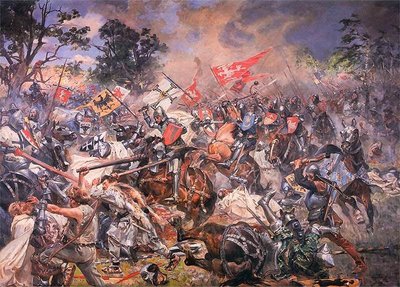
On this day, June 14th, every year, the Polish and Lithuanians celebrate the Battle of Grunwald; they celebrate with pride, erecting mock-ups of the battle to honour this important—yet largely unknown moment—in history: when the proud Teutonic Order fell to its knees and Poland became a nation.
Which brings me to my book The Last Summonerand how I get my ideas for stories…
I teach writing at the University of Toronto and fiction writing at George Brown College in Toronto. A question I’m often asked is how I get my story ideas. I always start by sharing my favourite example of how I came to write my historical fantasy The Last Summoner:
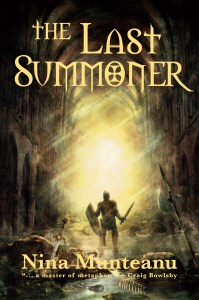
It started in 2008, when I saw the most incredible image by Croation artist Tomislav Tikulin as I was browsing sites on the Internet. The image was of a magnificent knight, standing in a war-littered mire and gazing up, questioning, at the vaulted ceiling of a drowned cathedral. A great light shone upon the knight in streams of white gold–as if a message from heaven. It sent my imagination soaring with thoughts of chivalry, adventure and intrigue.
Who was this knight?
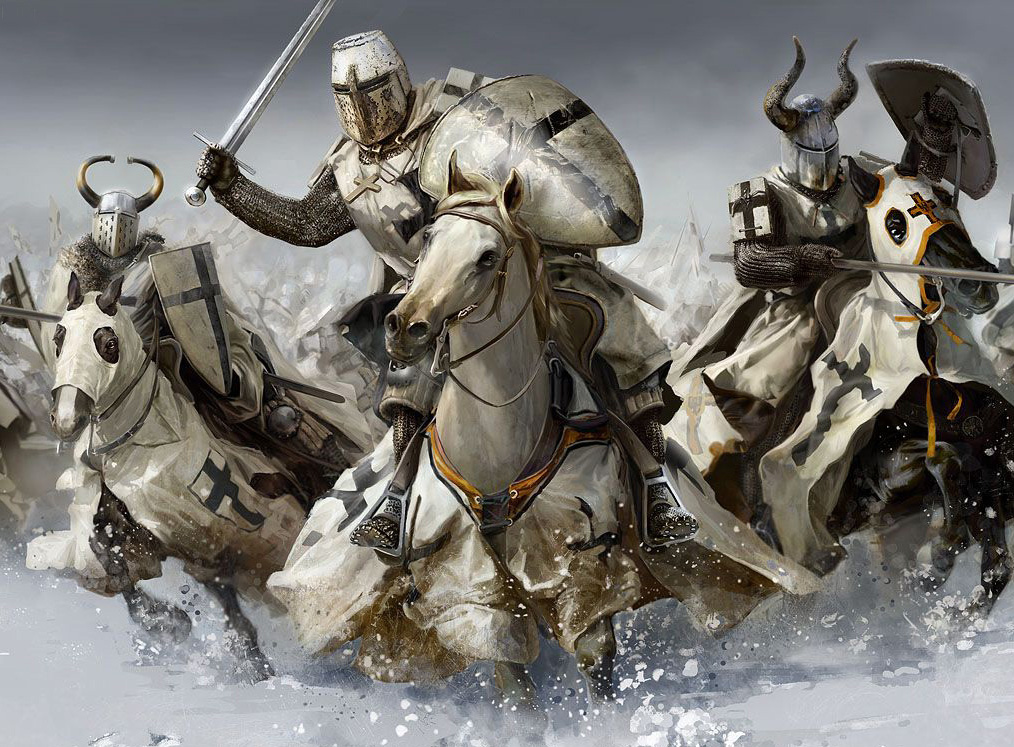
Teutonic knight
With that image imprinted inside me, the next nexus moment came when I stumbled across a significant but little-known battle in the medieval Baltic, the Battle of Grunwald. It would turn out to be the defining battle for what are now the countries of Poland and Lithuania. On June 14, 1410, they were still part of Prussia and tyrannized by the Teutonic Order, who were Christianizing the pagan Baltic on behalf of the Pope. In truth, the Order had been for centuries gathering wealth and land for colonizing Germans in their drang nach osten; they built sturdy castles (many of which still stand today) and grew into a force of monk warriors, feared for their cunning strategy and treacherous combat abilities.
The Battle of Grunwald was, in fact, an upset in history. The Teutonic Order was powerful, intimidating and extremely capable. They should have won; but the peasant armies of Prussia slaughtered the Order, killing most of its knights. Historians debate that the hochmeister’s arrogance—indeed the arrogance of the entire Order—precipitated their downfall. They underestimated their adversaries and got sloppy.
After the Polish and Lithuanian armies outsmarted the Order and slayed the Order’s hochmeister, along with many of their knights, the Order’s own peasant slaves finished the job using clubs, pitchforks and stones.
Every year, the Polish and Lithuanians celebrate June 14th with pride, erecting mock-ups of the battle.
Intrigued by this little known order of religious crusaders, I pursued the premise of an alternative consequence: what if the Teutonic Knights had NOT underestimated their enemy and won the Battle of Grunwald? Would they have continued their catastrophic sweep of Northeast Europe into Russia and beyond? Would they have claimed the whole for Germany’s expansionist lebensraum movement, fueled by its sonderweg—a dialectic that would ultimately lead to the killing fields of the Holocaust? What if the success of the Teutonic Order helped consolidate a united fascist elite, ambitious to conquer the world? What if Nazism sprang up 100 years earlier than it did in our current reality?
The Last Summoner arose from this premise. Enter our hero, young 14-year old Vivianne Schoen, Baroness von Grunwald, a self-centred romantic who dreams that her ritter will rescue her from an arranged marriage to some foreign warrior. As a result of an impetuous choice, she makes the startling discovery that she can alter history—but not before she’s branded a witch and must flee through a time-space tear into an alternate present-day France—now ruled by fascists. There, she learns that every choice has its price.
Spanning from medieval Poland to present day Paris, The Last Summoner explores the sweeping consequences of our “subtle” choices. From the smallest grab to the most sweeping gesture, we are accountable for the world we’ve made. During her 600-year journey to save the world and undo the history she authored, Vivianne learns wisdom and humility. Through the paradox of history, she learns that what might have seemed the right choice for an immediate future, turns out to be disastrous for a distant future. To win is also to lose; to save oneself one must surrender oneself; and to save the world one need only save a single soul.
The knight standing in the drowned cathedral is none other than Vivianne.
Inspired by Tikulin’s knight depiction, I managed to convince my publisher at Starfire World Syndicate to purchase rights to the image; Tikulin’s image–Vivianne’s dream–became the actual cover of my book. I was overjoyed! When The Last Summoner hit the shelves in 2012, it quickly soared into an Amazon Canadian bestseller and remained in the top 10 for several months in the category of fantasy, historical fantasy and science fiction. The book continues to find new readers who enjoy the thrilling time-travelling journey of its 15th century heroine and its surprising plot.
“The Last Summoner” sandwiched nicely between Ray Bradbury and George R.R. Martin
“The Last Summoner is a blend of fantasy, history, and alternate history,” writes Canadian author Kristene Perron. “Fourteen year old Vivianne , the story’s hero, discovers that she has strange powers on the eve of the legendary Battle of Grunwald. Marked as a witch, Vivianne escapes through time and space, but her actions change history and threaten to destroy the world.”
Illustration by Tomislav Tikulin. Cover design and typology by Costi Gurgu
The Last Summoner fascinated Kristene. “Ordinarily, historical fiction doesn’t excite me,” writes Kristene. “But the premise of this novel—which included a good dash of fantasy and time travel—was an exception. There is history aplenty and Munteanu has obviously done her homework. The world of 15th century Germany is authentically realized and the little touches of fantasy blend seamlessly.” She was pleased with Vivianne as a hero and how I had “endowed [my] protagonist with the skills and knowledge necessary for the plot without stretching plausibility.”
Kristene then added, “What I most enjoyed about this story was that for the majority of it I genuinely didn’t know where the plot was going or what would happen next. I’m one of those annoying people who can usually figure out the entire plot of a book or movie within the first few scenes (watching movies with me can be challenging), so to come across a story that stumped my super CSI powers of deduction was a real treat.”
“For those in love with science fiction at its best, The Last Summoner is a complex story of ignored responsibilities and their dire consequences, of love and betrayal that span centuries and multiple worlds. Time travel, multiverse travel, immortality, alternate history in which the Nazis have won, not in the twentieth century but way earlier, in the Teutonic age. Angels and mutants, utopias and dystopias, even a Tesla occurrence— everything a science fiction reader could ever desire in a book. A masterfully told story with great characters. Nina Munteanu moves flawlessly from a medieval story to a modern one and everything in between.”—Costi Gurgu, author of RecipeArium
Jonathan, history buff and author of Sci-Fi & Fantasy Reviews , writes: “The Last Summoner is a unique story melding Germany of the 15th century and modern France, even if a different France from what we would recognize. The story centered around the very real and pivotal Battle of Grunwald in which a coalition of Polish and Lithuanian forces defeated the monastic Teutonic Knights. The book takes a look at the young 14-year-old baroness of Grunwald, someone not quite human, and how she attempts to right a wrong and get history back on track…The author is a good writer, and her wordsmithing is excellent…The historical research was outstanding…Given that this is fiction, and that two settings did not follow history as we know it, never-the-less, each event was either very accurate to our known history or made logical sense in the other settings. I am not a huge fan of alternative history books, but in this one, I was extremely caught up in the final section of the book, and I had to contemplate how the world might be different with only a few changes to our history.”
Jonathan adds, “While I was familiar with most of the historical background of the book, I was unaware of some facts, such as the Tartars taking part in the Battle of Grunwald. I thought this was a mistake made on the part of the author and went to confirm that, but in fact, the author was correct…a clever, well-written book. I would recommend it without hesitation.” The reviewer did have one quibble: my liberal use of French and German in the book.
Professional photographer and science fiction/fantasy reader, Rick LeBlanc shared that he’d “read The Last Summoner on the flight back from World Fantasy Con: could hardly put it down. Just loved the historical references of gear, place and events. The characters were incredibly strong and involved you in their lives. The flow was fun & fast-paced. Merci, Nina. Great book!”
“I loved, loved, loved the metaphors. A page-turner that left me wanting to be Vivianne when I grew up.”—Carina Burns, author of The Syrian Jewelry Box
“The Last Summoner is an enticing fantasy exploring the Knightly order and adding many new perspectives.”—John Taylor, The Midwest Book Review
Nina Munteanu is an ecologist, limnologist and internationally published author of award-nominated speculative novels, short stories and non-fiction. She is co-editor of Europa SF and currently teaches writing courses at George Brown College and the University of Toronto. Visit www.ninamunteanu.ca for the latest on her books.




 I teach writing at the University of Toronto and fiction writing at George Brown College in Toronto. A question I’m often asked is how I get my story ideas. I always start by sharing my favourite example of how I came to write my historical fantasy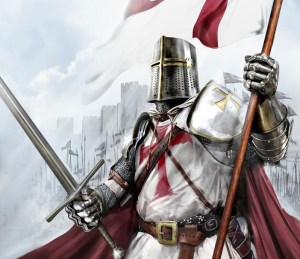
 Intrigued by this little known order of religious crusaders, I pursued the premise of an alternative consequence: what if the Teutonic Knights had NOT underestimated their enemy and won the Battle of Grunwald? Would they have continued their catastrophic sweep of Northeast Europe into Russia and beyond? Would they have claimed the whole for Germany’s expansionist lebensraum movement, fueled by its sonderweg—a dialectic that would ultimately lead to the killing fields of the Holocaust? What if the success of the Teutonic Order helped consolidate a united fascist elite, ambitious to conquer the world? What if Nazism sprang up 100 years earlier than it did in our current reality?
 Spanning from medieval Poland to present day Paris,

 across a story that stumped my super CSI powers of deduction was a real treat.”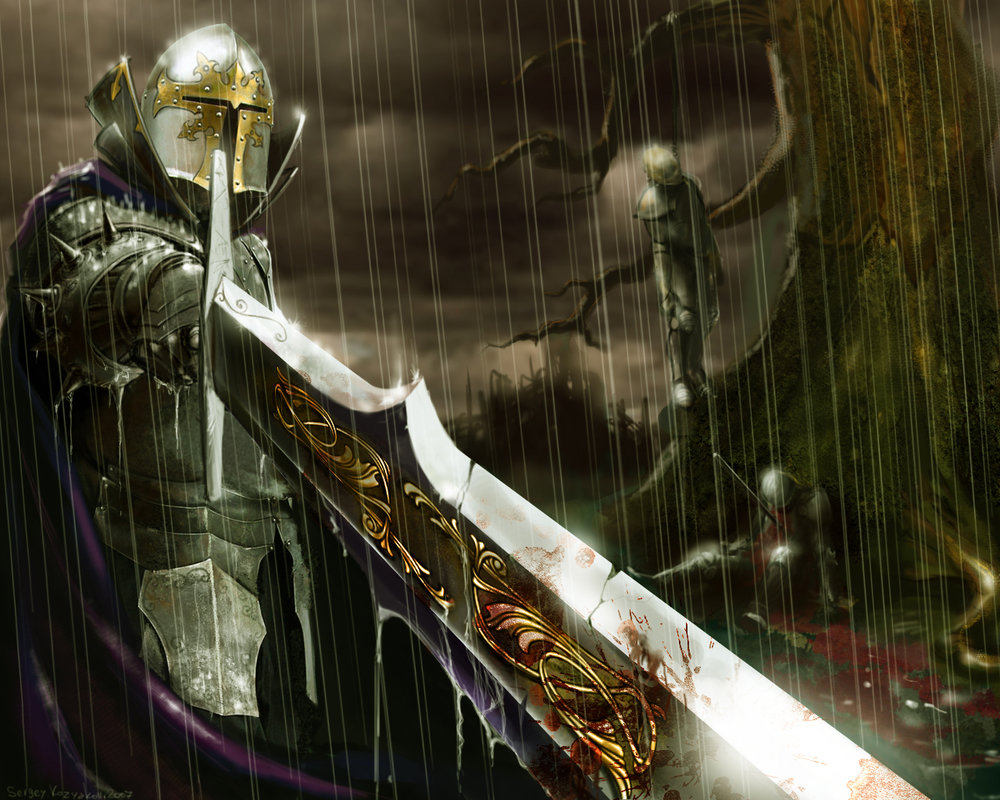
 were incredibly strong and involved you in their lives. The flow was fun & fast-paced. Merci, Nina. Great book!”
 Nina Munteanu is an ecologist, limnologist and internationally published author of award-nominated speculative novels, short stories and non-fiction. She is co-editor of Europa SF and currently teaches writing courses at George Brown College and the University of Toronto. Visit
